FM 3-06.1 AVIATION URBAN OPERATIONS. MULTISERVICE PROCEDURES FOR AVIATION URBAN OPERATIONS (APRIL 2001) - page 3
k. Tactical recovery of aircraft & personnel (TRAP) orientation package
(USMC). The MEU S-2 prepares this package in coordination with MEU S-3
based on the mission requirements. It includes maps and imagery to facilitate
rapid reaction to downed aircraft. All materials applicable to the operational
area are prepackaged for rapid orientation of the recovery and security elements.
l. Joint annual review of SERE production (JARSP). Prepared by the Joint
Services SERE Agency (JSSA). The JARSP lists blood chits, evasion charts
designated SAFE area products, and SERE after action reports from past
operations. The JARSP details the procedure for ordering the listed SERE
products.
m. Psychological operations (PSYOP) studies. These are prepared by the US
Army 4th Psychological Operations Group, strategic studies detachments (SSD)
and the National Ground Intelligence Center (NGIC). There are four types of
PSYOP studies: the PSYOP Annex to Military Capabilities Study (MCS), the
Basic PSYOP Study (BPS), the Special PSYOP Study (SPS), and the Special
PSYOP Assessment (SPA). The MCS summarizes PSYOP relevant issues. The
BPS is a nine-chapter document that analyzes the PSYOP environment and
vulnerabilities of selected countries to include political, economic, and cultural
characteristics. The SPS is formatted like the BPS but has a narrower focus. It
addresses such subjects as specific target groups, regional or geographical areas,
social institutions, and media analysis. Perceptions towards the US or issues
important to specific population groups may also be discussed. The SPA is a time
sensitive intelligence memorandum (usually an electronic message) providing
assessments of significant crisis situations, events, or issues from a PSYOP
standpoint. Requests for any of the four PYSOP studies are made through
PSYOP or SOF units or staff liaison elements supporting the JFC. Studies are
also available from the intelligence link (INTELINK) of the Special Operations
Command Research, Analysis, and Threat Evaluation System (SOCRATES).
n. Basic Targeting Graphic (BTG). The BTG is prepared in support of theater
operations or contingency plans. It is updated regularly (3-4 year intervals) in
support of an operations plan (OPLAN). The BTG includes 11” X 16” format high-
resolution EO imagery. It also includes an orientation map, small-scale
orientation photo(s), and annotated large-scale imagery. The focus of most BTGs
is military and industrial targets in urban areas.
o. Intelligence Support Package (ISP). Prepared by DIA, the product includes
graphics, LANDSAT and LANDSAT-digital terrain evaluation data (DTED)
merge imagery, maps, target line drawings, photography (when available), and
multi-scale EO imagery. A target summary provides data on target significance,
description, imagery annotations, node functions, air defenses, and critical nodal
analysis. The ISP is produced in response to the theater or joint task force (JTF)
target list or a request for information (RFI). The ISP supports targeting of
specific military and civilian installations.
p. Critical elements of selected generic installations. Previously published by
DIA, the product includes imagery and text discussion of general categories of
B-4
man-made structures and facilities. They describe functional components and
critical nodes of military, industrial, and transportation facilities. The also assess
damage and repair time of key components.
q. Digital terrain analysis mapping system (DTAMS). The DTAMS facilitates
the production and updating of maps. It also allows creation of detailed drawings
of urban areas and large-scale diagrams of specific targets, objectives, and HLZs.
DTAMS is capable of generating grid overlay of objective areas for fire support,
etc. New maps can be produced in three to four hours. Old maps may be updated
within two hours.
r. Video support product (VSP). Produced by the Marine Corps Intelligence
Activity (MCIA), the VSP is an annotated and narrated video home system (VHS)
videotape of EO imagery. It is oriented towards a specific mission.
s. Top Scene. The Naval Strike Warfare Center (NSWC) at Naval Air Station
(NAS) Fallon, Nevada produces Top Scene. Top Scene includes a VHS tape
product, merging EO imagery with DTED. It provides oblique and vertical
coverage at various altitudes and ranges from the target or objective. It is
oriented towards naval air strike mission planning.
t. Pattern Analysis. Prepared by USMC MEU S-2, this product includes
multiple map overlays and text assessing military or terrorist activity in an urban
area.
u. TerraBase II. Terrabase II is a terrain evaluation tool for the exploitation
of readily available NIMA standard gridded and raster products. The system
works on a Windows 95 or Windows NT operating system. It produces LOS,
weapons fans/visible area plots (VAP), oblique, perspective, and elevation views,
elevation tints, contour plots, slope tints, reflective plots, point elevations, range
circles, fly-through/terrain walk tactical decision aids and more.
v. Digital Topographic Support System (DTSS). This US Army system
provides commanders a means of producing a variety of topographic products
using terrain models. The system has the capability to produce multiple, full-
color, hard copy terrain products.
w.Urban Terrain Feature Overlay (UTFO)-Vertical & Lateral References.
This product is used to prepare aircrews for aviation urban operations. It
annotates prominent navigation features as points (vertical structures), lines
(lateral references), or areas. The altitude in feet mean sea level (MSL) and, in
parenthesis, height AGL, i.e., “1460’ (940’), follows vertical features. Elevation
data, both MSL and AGL, is important for mission planning. This overlay may be
combined with the urban terrain orientation graphic (UTOG) detailed below.
The UTFO identifies and plots:
(1) Dominant vertical features,
(2) Significant linear features,
B-5
(3) Prominent, unique structures,
(4) Currently known deliberate hazards or helicopter countermeasures.
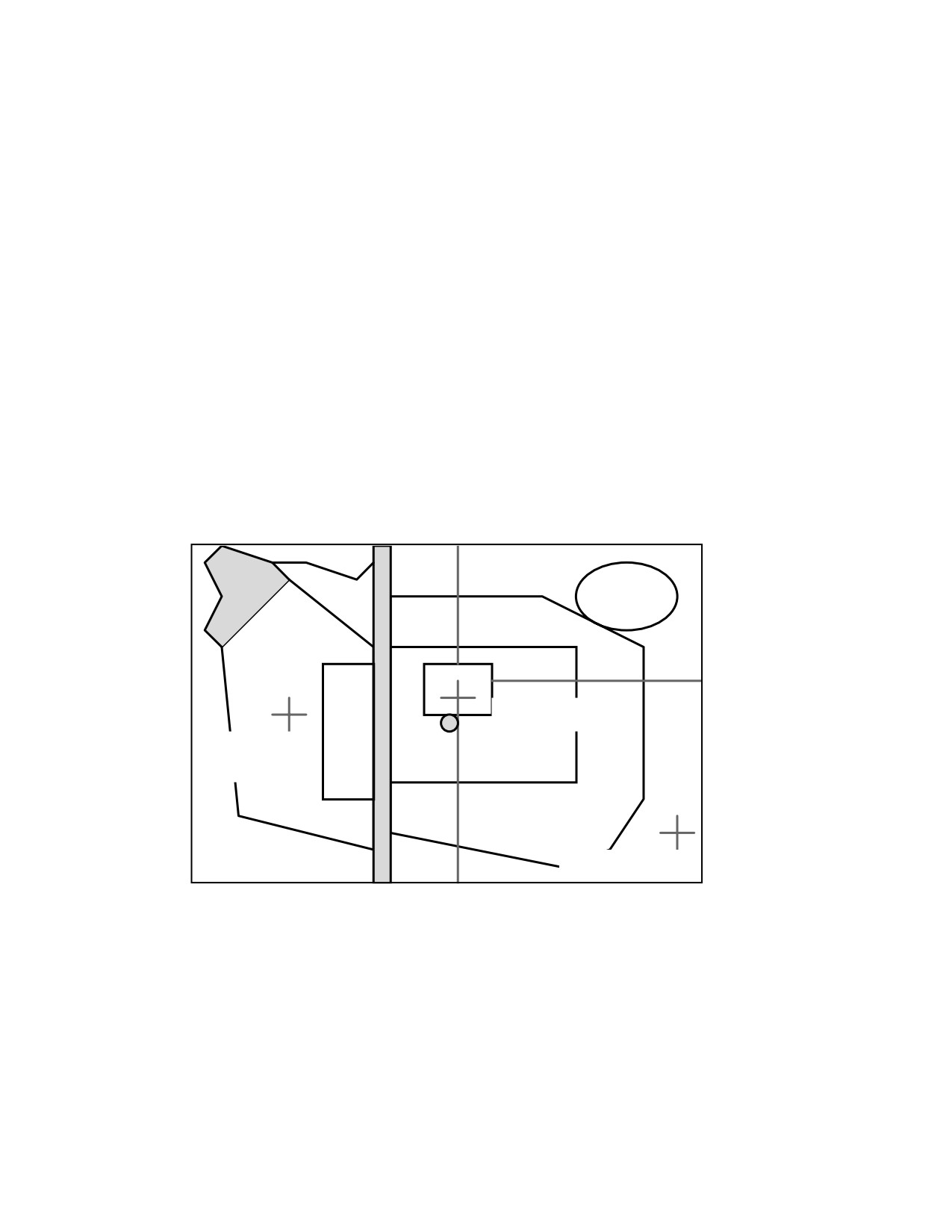
x. UTOG.
(Figure B-1) This product is used for aircrew orientation. A
graphical depiction of urban terrain characteristics allows a more thorough
orientation than map reconnaissance alone. The UTOG is prepared by dividing
the terrain into areas classified by density of structures and building
construction. Digital Feature Analysis Data (DFAD) codes may be used on
overlay products to minimize clutter. This product serves as a substitute for the
traditional combined obstacle overlay (COO) for aviation operations and may be
combined with the UTFO. The UTOG lends itself for use by the S-3 and fire
support element (FSE) for development of the battle tracking overlay (BTO). The
UTOG provides the following urban area general characteristics:
(1) Density of structures,
(2) Building Construction,
(3) Street pattern.
#701
C-4
E-9
B-2
D-6
#302-850’(150’)
#807-
#323
D-8
B-5
950’(250’)
C-3
#949
#512-1200’(500’)
Figure B-1. Combined UTOG/UTF Overlay (Simplified Example)
y. Target/Objective (T/O) Catalog. The T/O Catalog is a technical database of
urban facilities and structures. It is essentially a record of data collected for
features throughout the operational area. The DFAD numbering system may be
used for identification of prominent reference features and for development of a
T/O catalog. This allows computerized search and rapid access to T/O data based
on location, DFAD feature identification (FID) code, or other characteristics.
Priority should be placed on features of navigational significance, followed by
other structures based on importance. Building and continuously updating a T/O
catalog allows rapid and effective mission planning.
B-6

z. Modified Combined Obstacle Overlay (MCOO). The urban MCOO usually
reflects terrain effects on ground maneuver. It combines trafficability data found
on a COO with avenues of approach, friendly situation, enemy situation, and
potential enemy objectives. Additional urban terrain factors that influence the
ground tactical situation are underground systems that provide concealed
mobility corridors. These can be annotated on a separate overlay.
aa. Avenues of Approach Overlay. The overlay considers unique terrain
effects and obstacles, such as urban damage and rubble. This product may be
unnecessary if a MCOO has been prepared.
bb. Roof Coverage Overlay. In urban terrain, roof coverage is more
meaningful to aviation operations than a ground-based horizontal visibility (fields
of fire) analysis. This overlay depicts concealment from aerial observation and
directly relates to the density of structures.
(Figure B-2)
Symbol
% Roof
Category Concealment
75-100
Congested
Excellent
50-75
Dense
Good
25-50
Moderate
Fair
5-25
Sparse
Poor
0-5
Open
None
Figure B-2. Roof Coverage
cc. Threat Evaluation. This analysis is prepared based on the enemy situation
and doctrine. An overlay depicts possible and likely enemy COA.
3. Imagery
a. Imagery is an excellent way of obtaining detailed information about
potential objective areas. There are several considerations to observe when using
imagery: resolution, specific requirements, and date. The resolution must be
sufficient to provide the type of specific information required. The resolution of
overhead national technical means (NTM) EO imagery is measured by the
national imagery interpretability rating scale (NIIRS) and is divided into 10
rating levels. The NIIRS is based on the ability to detect, distinguish between, and
identify objects and structures on the image. For example, a NIIRS 1 image
allows you to detect or distinguish between taxiways and runways at a large
airfield. NIIRS 5 allows identification of small items such as individual rail cars.
B-7
An NIIRS 6 image can identify automobiles as sedans or station wagons. A NIIRS
9 product should detect individual spikes holding railroad track. As a general
rule, NIIRS 5 to 7 images are of sufficient resolution to provide staffs and
aircrews sufficient detail needed for planning operations. For SOF or SAR
missions, imagery with greater resolution may be required.
b. Requests for current, high-resolution imagery may require a significant
time to fulfill. Avoid over-tapping limited resources and assets by asking only for
what you need. Consult the NIIRS manual or your intelligence unit for more
information about imagery products.
c. Specify information requirements precisely. If you are executing a pre-
planned SAR mission or expect to ingress/egress a city from a certain direction at
a specific time, request imagery that closely resembles that profile. The lead-
time for obtaining imagery to meet specific requirements are based on
prioritization of needs and may entail a time lag between the time of the request
to dissemination of the product. The characteristics of various imaging
techniques and the peculiarities of various imaging platforms should be
thoroughly understood to maximize the use of the information. For example,
imagery taken at an oblique angle versus straight overhead aids in determining
heights of building and obstacles. It also helps highlight utility poles. Early
coordination with intelligence sections assists in obtaining data from national,
theater, and tactical assets.
d. There are vast amounts of archived imagery available. If older imagery
meets operational requirements, it may be more quickly obtained than newly
generated requests for imagery. It is important to carefully evaluate the risks of
using dated information. For example, in Operation RESTORE DEMOCRACY, a
unit planned flight routes in Port-au-Prince using overhead imagery. The ingress
route followed a canal, and the aircrew plan to use identifiable bridges as
navigation aids to find a specific street. Unfortunately, the photos were over a
year old and depicted three bridges over the canal. The unit discovered one of
the bridges was no longer there. This caused momentary confusion overcome by
reference to other terrain features based on their imagery study.
e. In addition to image resolution and currency of the information, there is a
variety of imagery products available. These include three-dimensional imagery
of the T/O area, obtainable in different scales, that is useful for determining the
height relationship of buildings in the objective area. Large wall-sized imagery
sheets are available and can be used for planning, briefing, intelligence updates,
and updating hazards. Whenever possible, compare the most current imagery
available to map products to ensure the most current and accurate data are used
for mission planning and execution.
B-8
Appendix C
MUNITIONS
1. Laser-Guided Bomb
a. LGBs offer accurate targeting using laser terminal guidance. Various
weapons yields are available based on Mark 82, 83, or 84 series weapons.
Paveway II guidance kits attached to the appropriate series weapons make up the
guided bomb unit (GBU). Urban LGB considerations include building proximity,
laser LOS, podium effects due to building faces, collateral damage due to weapon
yield, guidance failure, smoke, haze, and rubble.
b. Planners should use the JMEM to determine weapons effects associated
with the appropriate GBU. In general LGBs provide good capability against soft
targets due to the associated blast, fragmentation, and overpressure. Penetration
capability is enhanced with delayed fusing and increased impact angles. Use
Bomb Live Unit (BLU) 109 bomb bodies against hard targets when desiring deep
weapon penetration. Weapons impact angles are generally determined based on
horizontal targets. The weapon impact angle against vertical targets can be
estimated by adding approximately 90 degrees to the horizontal impact angle.
c. Laser spot placement should be considered due to the tendency for GBU
weapons to impact short of a target. Laser designators should elevate the laser
spot relative to the desired impact point to offset inherent trajectory sag
associated with LGBs. Elevating the laser spot allows the GBU to maintain a
higher potential energy level into the terminal phase of the flight at which time
the spot can be shifted down and onto the desired impact point.
2. Maverick (AGM-65 Block B/D/E/G/K)
a. AGM-65 Maverick provides a launch and leave precision guided munitions
capability in urban terrain operations. AGM-65 A/B models are centroid tracking
EO versions which utilize a shaped charge warhead and are capable against
small, point targets such as vehicles, including armor. AGM-65 D is similar,
except it uses IR imaging to track targets. Larger targets may be engaged using
the AGM-65 G, or an IR Maverick with a HE warhead. The G model Maverick
has a forced correlation capability. This allows selection of a specific desired
mean point of impact (DMPI) on larger targets as well as a ground selectable
fuzing delay allowing the missile to penetrate the outer surface of the target and
detonate inside. AGM-65K utilizes an EO seeker, carries the same blast warhead
as the AGM-65G, and provides significantly greater standoff range than the AGM-
65B. It also has forced correlation track capability. Time of flight of the missile
should be considered when employing the AGM-65 against moving vehicle targets
in urban terrain since terrain masking due to vertical obstructions will cause the
missile to break lock. Once the missile breaks lock, its flight path will become
unpredictable, but it remains armed and will detonate upon impact.
Consideration should be given to releasing at closer slant ranges if friendly forces
are in close proximity to the target to minimize the missile time of flight. When
C-1
using the AGM-65 G in the force correlation mode, consideration should be given
to the apparent target size when engaging targets in close proximity to friendly
positions. A decrease in slant range will provide a larger apparent target, which
in turn will allow a more precise aimpoint to be selected.
b. For the AGM-65F IR Maverick, breaklock algorithms will cause the missile
to go into a correlate track or “stare” mode. In this mode, the weapon will
attempt to track any object closest to the centroid of the IR scene at breaklock. If
this occurs, there is no guarantee that it is the intended target. If no other object
is present, the missile will drive to the centroid of the IR scene and detonate.
The hit will be entirely dependent on the composition of the missile’s IR scene.
The point of impact relative to the intended target can only be a guess.
c. Regarding the AGM-65E Laser Maverick, if the proper laser source is lost
for over 1.5 seconds the missile will safe itself and assume a lofted profile. The
intent is for the missile to land long as a dud. This feature, in addition to the
modest yield and excellent penetration characteristics make it a potential
weapon for urban CAS.
3. Cluster Munitions
a. Generally, cluster munitions are appropriate for use in the urban
environment only in very limited circumstances. The area effects of the weapon
and relatively high dud rate of the submunitions often make them inappropriate
for use in densely populated areas because of their great potential for immediate
and persistent civilian collateral damage. If specific circumstances suggest the
use of cluster munitions, very careful consideration should be given to the
collateral damage likely to result. Particularly after air operations in Kosovo, the
use of air delivered cluster munitions has become a very sensitive one in the
international community. Expect that approval authority for the use of cluster
munitions will be retained at higher levels in future operations.
b. Cluster Bomb Units (CBU) include mark (Mk) -20 Rockeye, CBU-87
combined effects munition (CEM), CBU-89 Gator air delivered mines, and CBU-
97 sensor-fuzed weapon (SFW). Each weapon uses a dispenser. Rockeye uses a
shaped charge penetrator and is typically used against armor. CEM bomblets
have three kill mechanisms, shaped-charge penetration, fragmentation, and
incendiary. The Gator consists of anti-armor and antipersonnel mines. SFWs
consists of submunitions designed for use against tanks, armored vehicles,
artillery, armored personnel carriers (APC), and support vehicles.
c. Cluster weapons can be equipped with either a mechanical time fuze or
radar proximity fuze. The type of fuze will dictate the type of delivery option/
mode to use.
(1) While very reliable, time fuzes do not allow a great deal of flexibility in
delivery options. Once the arming time is selected prior to flight, it cannot be
changed. When unsure whether a low-altitude or medium-altitude employment
C-2
option will be used during the mission, set the primary time for a medium-
altitude option and the option time for a low-altitude option.
(2) Proximity fuzes provide greater flexibility for delivery of the cluster
weapon. Variations in munitions time of fall will not affect the fuze function
altitude as long as fuze-arming restrictions are met. Delivery parameters can be
adjusted for the situation.
d. Advantages of CBU over general-purpose bombs include:
(1) good area coverage,
(2) very effective against personnel and soft-skinned vehicles ,
(3) ability to penetrate armor,
(4) low-altitude deliveries.
e. CBU-89 provides a minefield for a controlled period and is excellent for a
denial/channelization
f. Disadvantages of CBU include:
(1) fixed employment slant ranges for timed fuzes,
(2) high drag,
(3) dud bomblets,
(4) time-delay bomblets may hinder friendly passage through an area,
(5) pattern size and coverage make delivery in a troops in contact (TIC)
situation difficult, if not impossible.
4. Joint Direct Attack Munition (JDAM) (GBU-29, GBU-30, GBU-31, GBU-32)
a. The JDAM can be used for CAS, interdiction, SEAD, naval anti-surface
warfare, and amphibious strike missions. This munition serves to upgrade the
existing inventory of Mk 80 series general-purpose bombs. This is accomplished
by integrating it with an INS/GPS guidance kit. JDAM variants for the Mk-81
250-pound and Mk-82 500-pound bombs are designated GBU-29 and GBU-30,
respectively. The Mk-83 1,000-pound, and Mk-84 2,000-pound general-purpose
bombs, are designated as the GBU-31 and GBU-32. Hard Target penetrators that
are being changed into low-cost JDAM include the 2,000-pound BLU-109 and
1,000-pound BLU-110.
b. The JDAM can be continuously updated by aircraft avionics systems before
release. Once released, the INS/GPS of the bomb will take over and guide the
bomb to its target regardless of weather. Guidance is accomplished via the tight
C-3
coupling of an accurate GPS with a 3-axis INS. The guidance control unit
provides accurate guidance in both GPS-aided INS modes of operation and INS-
only modes of operation. This inherent JDAM capability will counter the threat
from near-term technological advances in GPS jamming. The weapon system
allows launch from very low to very high altitude. It can also be launched in a
dive, toss, loft, or in straight and level flight with an on-axis or off-axis delivery.
JDAM also allows multiple target engagements on a single pass delivery. JDAM
provides the user with a variety of targeting schemes, such as preplanned and in-
flight captive carriage retargeting.
5. Tube launched, Optically tracked, Wire guided (TOW)
a. The TOW is a precision guided munition (PGM) with a small CEP. The
minimum engagement range is 500 meters. An external guidance mechanism
(laser) is not required. The warhead is able to penetrate urban structures as well
as conventional armor.
b. The following discussion concerning the “Hellfire” covers PGM and shaped
charge characteristics in detail, however the TOW delivery mechanics are
mentioned here as the guidance mechanisms differ. When using TOW in an
urban environment, building types will have to be analyzed to determine window
locations, type construction (framed or frameless), etc. Generally, framed
buildings are newer and use steel girder construction; Therefore, it will be harder
to achieve the desired effects with a shaped charge warhead than when used
against frameless building, which tends to be an older masonry structure. The
structure construction will determine whether the building’s room is destroyed,
the building collapses, or the target is unharmed. Generally, TOW missiles are
not fired into an open window or aperture because the PGM warhead will travel
through the room and impact the other side of the room and far wall. This will
negate the warhead effects since the warhead will detonate and explode into the
wrong room. Depending on the building, target, and desired effects, TOWs may
be aimed at windows, the upper, middle, or lower one-third part of a building
side, or into the roof.
6. Hellfire
a. Shaped charged warheads are not optimized against urban structures.
TOW or Hellfire can destroy small buildings constructed of light wood, metal, or
concrete. TOW or Hellfire shaped charge penetration of generic (brick, concrete,
or wood) building structures will generally be limited to one compartment of the
building due to shaped charge size, shaped charge impact characteristics, and
average missile velocity. As a rule of thumb, Hellfire shaped charge jet
penetration is 42 inches of rolled homogenous armor (RHA), 10.5 feet of non-
reinforced concrete, 12 feet of wood, and 12.5 feet of unconfined sand. In general,
expect a TOW warhead to blow an 8-18 inch hole in 8 inches of double reinforced
concrete and a 5-12 inch hole in triple brick. Firing a TOW into cinder block
blows a 3-5 foot hole, or roughly large enough for a man to crawl through. The
size is not only dependent on the material, but also on the angle of attack upon
C-4
impact. A higher angle of impact against a vertical surface increases the net
effective thickness of the wall that the warhead must travel through (similar to
sloped armor). Expect the missile body, motor, and casing to travel into the room,
adding to the spalling effect. With more porous materials (concrete), the spalling
fragments are larger, but they lose energy quicker and do not travel as far into
the room. The resulting cloud of masonry dust is an ineffective kill mechanism,
but has the equivalent effect of throwing sand into someone’s eyes. The dust
cloud covers an approximately ten foot square area. Against masonry structures,
masonry dust will affect personnel inside the room and dust will be visible
coming from the impact hole.
b. Shaped charge warheads can penetrate the above materials. Localized
spalling normally spreads out from the entry point in an approximate 6-inch to 1-
foot spall cone. The warhead effect immediately starts to breakup inside the
building, but due to its speed, may travel some distance before stopping. When
impacting an outer wall (reinforced concrete or triple brick), most of the
overpressure is dissipated outside of the building upon impact. The following
peak overpressure effects are achievable with the Hellfire shaped charge
warhead: 3 pounds per square inch (psi) at 60 feet, 6 psi at @ 40 feet, and 12 psi at
25 feet. A rule of thumb for comparing any warhead penetration against 6500 psi
concrete is: steel thickness divided by .556 equals the equivalent 6500 psi
concrete penetration. Example: 2 inches of steel/.556 = 3.6 inches of concrete
equivalent. Therefore, knowing what a warhead can penetrate in terms of steel
allows a conservative estimate of concrete penetration. It is important to note,
though, that concrete density and building materials vary across the world.
Shaped charged warheads will still penetrate any building material, but the
internal effect may be lessened. The overpressure falls off quickly and is
equivalent to the cube of the radius from the impact. For comparison - if a
nominal warhead could produce lethal effects against personnel at 2 feet, then at
8 feet the effects would render personnel unconscious, and at 512 feet, the effects
would be heard, but not felt. The incidental overpressure effects are of a very
short duration (<30 milliseconds) and may not cause immediate incapacitation,
but require several minutes before internal bodily effects are felt on such organs
as the kidney, liver, spleen, eardrums, etc. If the material is thin, the missile will
pass through the material and expend most of its overpressure inside the
building upon impact with the interior wall/floor. Only 1 inch plywood, or
equivalent, is required to detonate the Hellfire warhead. If the warhead is shot
through an aperture (ex. window glass, doorway, etc.), the resulting overpressure
will be much greater inside the building or room. However, the incapacitative
spalling is lessened because the warhead travels through the room and impacts
on the back wall of the room. At short distances (room width) the spalling cone
has not had time to expand, therefore only enemy personnel directly within the
spall cone will be injured by the spall. However, total kill mechanisms include
heat, flash blindness, eardrum rupture, concussion, and fragments. Shaped
charged warheads are not optimized against urban structures, however, shooting
a missile into a building or room should immobilize the enemy, if not kill him. A
moderate Pi (fragmentary effects only) is achievable with a TOW or Hellfire used
against double reinforced concrete or triple brick.
C-5
c. Against a 10-inch thick, non-reinforced concrete structure, Hellfire
normally produces a clear hole approximately 3 feet in diameter. Two missiles
fired in rapid or ripple can be very effective against reinforced concrete
structures. The first missile clears an approximate 3 foot opening that fills with
smoke for several seconds. The second missile is guided through the opening
creating significantly greater overpressure inside. Any remaining reinforcement
bars should cause the second missile to detonate on the wall, reducing the effect,
although overpressure inside the enclosure rises markedly at detonation because
of the large opening. Highly volatile materials inside the enclosure may produce
too much smoke from the first missile, creating a tracking hazard for the second
missile and affecting accuracy.
d. Actual measured data in a bunker indicates that the spall shower can be a
very effective secondary weapon given a masonry or armored steel target. In a
test firing, the warhead detonated 4 feet in front of the bunker in earth terrain
before penetrating 30 inches of reinforced concrete bunker wall. Overpressure
and concrete spall destroyed two anthropomorphic dummies inside the bunker.
The spall shower had a weight of 128 pounds and lethal concrete fragments were
recovered from witness panels at a density of over 12 fragments per square foot
on the back of the 20 square foot bunker. The jet passed through the 12 inch
reinforced concrete rear wall and greater than 3 feet into the surrounding earth
embankment. Typical brick or masonry structures will react similar to the
bunker but thinner walls will produce proportionally smaller spall showers.
e. The tandem warhead is not expected to make any difference in the effect on
occupants inside the building relative to a single high explosive anti-tank (HEAT)
warhead, regardless of whether the warhead detonates inside or outside. During
Operation Just Cause in Panama, one missile was fired into each floor of a
headquarters building. Although the missiles detonated upon contact with the
windows, internal blast overpressure gutted an entire floor overturning furniture
and file cabinets and igniting combustibles.
f. The amount of overpressure inside confined spaces depends upon the
internal volume of the enclosure. It is also modified by the volume of solids in the
enclosure, such as furniture, file cabinets, and personnel.
g. The Hellfire is not a quick reaction CAS weapon. To employ Hellfire in an
urban environment requires careful consideration of LOS geometry. Hellfire
provides standoff capability versus enemy air defense at the expense of
increasing altitude to obtain LOS. If using autonomous designating, a balance
between designator LOS and exposure to the enemy weapons engagement zone
(WEZ) is required. The Hellfire trajectory is optimized for an up and over, top-
down attack profile in order to defeat enemy tanks. The trajectory ranges from
10 to 25 degrees downward at impact. This trajectory can not be changed to fly a
direct profile such as the TOW flies. However, this profile is useful in engaging
targets in buildings or in streets between buildings. To shape the terminal
trajectory to the flattest profile requires understanding the effects of launch
mode, range to target, and delay designation. Generally, a flatter profile will be
flown at minimum launch ranges, while longer ranges increase the terminal dive
C-6
angle. Regardless of range or delay, the AGM-114K flies a steeper profile than the
AGM-114B. The most significant limitation of PGMs is their minimum arming
distance.
7.
20mm Cannon
a. The M56 round will not penetrate heavy armor at tactical ranges. Its
penetration on concrete ranges from minimal to none. Precision guidance unit
(PGU) rounds will penetrate cinderblock walls and have a reasonable capability
versus concrete. On RHA, it penetrates 3/8 inch at 45-degree obliquity at 2500
feet slant range from a 450 knot aircraft. This is approximately equivalent to ½
inch at normal (perpendicular) impact. Vertical surfaces should not dud the M50
series round. High explosive incendiary (HEI) round impacts have the smallest
fragmentation pattern and will minimize ricochets, thus minimizing collateral
damage. HEI rounds are a potential fire starter when used against wooden
structures. Target-practice 20mm rounds ricochet more than HEI rounds. Inert
PGU-27 20mm, delivered 7.5 degrees downward, will ricochet as far as the
maximum range of the round (2000 meters) and up to 400 feet from the point of
impact when delivered against horizontal hard flat surfaces. This ricochet effect
may affect noncombatants. HEI rounds (M56A3/A4) can produce casualties to
exposed personnel within a +/- 2 meter radius.
b. Tracers are a double-edged weapon in this environment. The normal
method of firing 20mm is to shoot, observe the rounds impact, and if necessary,
walk the rounds onto the target. However, in urban areas, rounds off target are
more likely to cause collateral damage. In Chechnya, the Russians prohibited
tracers on any firing platform due to the intense and devastating fire returned
from the Chechen rebels. A compromise solution is to mix tracer and non-tracer
rounds in a 1:10 mix. Given the M197 rate of fire (650 rounds per minute), a
tracer would be seen once for every 10 rounds fired. The reverse is true if the
enemy is firing at you with tracer-mixed ammo (i.e., for every tracer seen, 10-20
rounds are never seen). If tracers are not used, 20mm HEI detonations against
hard surfaces cue the pilots where the rounds are impacting.
8.
25mm Cannon
a. Both the AC-130U gunship and the AV-8B Harrier use the GAU-12/U 25mm
gattling gun.
b. The 25mm cannon is effective against personnel and soft-skinned vehicles
in the open or under light cover. It has a maximum capacity of 3,000 rounds and a
rate of fire of 1,800 rounds per minute. Burst length is computer adjustable from
15 to 350 rounds. The 25mm cannon is an effective area suppression weapon.
Available munitions are HEI, API, and training projectile (TP).
9.
30mm Cannon
a. The M230A1 “Chaingun” is used by the Apache helicopter against soft-
skinned and lightly armored targets, and for self-defense. It has a single barrel,
C-7
externally powered hydraulically driven turret. Maximum capacity is 1200
rounds with a rate of fire of 600-650 rounds per minute. Maximum range is 4,000
meters with a maximum effective range of 1500 to 1700 meters. Ordinance
includes the M789 HE dual-purpose ammunition.
b. The GAU-8 30mm cannon is a seven-barrel; percussion primed Gatling gun
used by the A-10. It is effective against tanks, armored vehicles, and a variety of
mobile and fixed targets. The GAU-8 holds 1,150 rounds and uses three different
bullets; TP, HEI, and an armor piercing (AP) depleted uranium round. The AP
penetrates armor at slant ranges out to 6,000 feet from a low altitude, less than
15-degree delivery angle and outside 10,000 foot slant range from high dive
angles. The HEI round functions at ranges beyond the computed gun sight
maximum slant ranges. The TP round is used for training, but possesses a limited
penetration capability. The computed gun sight allows accurate employment up
to 15,000 foot slant range. The velocity of the GAU-8 bullet 6,000 feet from the
muzzle is the same as a 20mm bullet velocity at the muzzle. The high bullet
velocity, rate of fire (approximately 70 rounds per second), and small dispersion
(5-mile radius for all bullets) provide a good bullet density and a powerful punch.
The GAU-8 is a very reliable, accurate, and simple point-and-shoot weapon that
can be used close to friendly ground troops and possesses a relatively long-range
capability. Disadvantages include a large ricochet pattern, decreased bullet
density at shallow dive angles, and long slant ranges.
10. 40mm Cannon
a. The AC-130 Gunship employs the M2A1 Modified 40mm cannon, which fires
various types of HE and WP rounds. The 40mm cannon is an effective weapon for
urban terrain, especially urban CAS. This weapon is a good compromise between
lethality, collateral damage, and fratricide potential. Most 40mm munitions have
limited penetration capability. Thus, a significant factor limiting 40mm
effectiveness is the abundance of cover for targets in urban terrain. The gun fires
a high explosive-plugged (HE-P), high explosive incendiary-plugged (HEI-P), HEI
zirconium, and armor piercing tracer (APT) rounds.
b. The HE-P cartridge is used against material and personnel targets. The
round utilizes the Mk-27 fuze which functions on light impact. Fuze action time is
short, giving the ammunition limited penetration capability. This round is fair
against hard targets, but does provide suppression for personnel in the open or
under light cover.
c. The HEI-P cartridge is used against material targets. It was developed
specifically to increase fire-starting capability against trucks. The round has
good incendiary potential but contains less trinitrotoluene (TNT), producing less
fragmentation than HE-P. The standard Mk-2 projectile body was modified by
adding a metal liner, producing bright sparks on detonation. This effect makes
the round a good choice for target marking. In particular, when the gunship
cannot maintain constant LOS with the target, a well boresighted system can
mark a target even if it cannot observe round impact. Because of the fire-starting
potential of this round, carefully consider using it during urban operations.
C-8
d. The HEI zirconium cartridge is used against material and personnel
targets. It was developed specifically to increase fire-starting capability, while
maintaining adequate fragmentation for anti-personnel use. The standard Mk-2
projectile body was completely redesigned by adding additional explosive fill and
a zirconium liner, producing bright sparks on impact. Because of the fire-starting
potential of this round, carefully consider using it during urban operations.
e. APT rounds penetrate RHA of various thicknesses. The projectile contains
no explosives, relying on kinetic energy as its damage mechanism. APT can be
used in urban operations to minimize collateral damage. It is generally
ineffective against multiple personnel targets and difficult to see the actual
impact point of the round.
11. 105mm Cannon
a. The AC-130 Gunship carries an M102 105mm Cannon. This gun fires the
105mm HE rounds.
b. The M102 105mm HE cartridge is used against such targets as personnel,
material, and light to medium structures. It has a large lethal fan from shrapnel
and blast. Upon detonation, this projectile produces approximately 3,000
fragments. As urban terrain often requires target engagement very near friendly
positions, use M102 HE only if adequate cover is available and the target cannot
be attacked other means. For other than general-purpose applications, the M102
round can accommodate various fuzes. The M-557 fuze is good for general-
purpose point detonation or selectable delayed detonation. It requires a
minimum of one inch of wood to function reliably. The M102 performs poorly
against hard targets or buildings with thick concrete, brick, or rock walls, unless
specifically fuzed for this application. The fused munition unit (FMU)-151/B
hardened fuze gives the M102 capability against hard targets in the delay mode.
It requires a minimum of two inches of wood to reliably function. The M102 with
this fuze will penetrate 10 inches of 5,000 psi reinforced concrete (0 degrees
obliquity). When fired against typical structures, the point detonating (PD)
function opens holes about three feet in diameter and the delay function results
in penetration of exterior walls with detonation immediately inside the wall. For
anti-personnel applications, the M-732 fuze detonates the projectile at about 7
meters above the ground. Large buildings in urban terrain may cause the fuze to
function early, reducing effectiveness, and increasing collateral damage. The fuze
will also point detonate if needed or if the proximity function fails.
12. Rockets
a. 2.75 inch rockets can be used against various urban targets including, light
wood frame buildings, personnel, and area targets. The rocket produces a
significant psychological impact. Unguided rockets have an inherent dispersion
error. Add to this error an aiming error, rocket pod boresight error, and range
estimation error, and the results are a larger target dispersion error. Laser
rangefinders, launcher stabilization adapters, and firing at close range
C-9
compensate for some of this dispersion error. Fuze arming may be a factor for
short firing range. Mk-423 PD and the Mk-427 PD fuzes arm at 300 feet and 1250
feet respectively. A rule of thumb for the 2.75 inch Mk-151 warhead penetration
against 6500 psi concrete is 4 to 6 inches. In addition, smoke, flechette, and
visible/IR illumination rounds are available.
b. The 5 inch rocket may be used for dense structures. The Mk-24 Mod 0,
M191 warhead and fuze combination penetrates 24 inches of reinforced concrete
and becomes armed at 800 feet. However, due to weight restrictions, fewer 5 inch
rockets can be carried if a mix of ordnance is desired. The large blast effect,
equivalent to 105mm artillery rounds, may not be desired near personnel. For
comparison, the Mk-24 general purpose (GP) 5 inch rocket carries approximately
4 times the warhead weight as the 2.75 inch, 1.5 times a TOW, and .7 times the
weight of a Hellfire warhead. The 5 inch rocket has similar dispersion error as
the 2.75 inch rockets.
13. Medium/heavy Machine-guns (7.62mm and .50 caliber)
a. Machine-guns. The .50-caliber machine-gun and the 7.62-mm M60, M240,
and M-134 machine-guns provide high-volume, long-range, automatic fires for
suppressing or destroying targets. They can be used to penetrate light
structures. The 50-caliber machine-gun is most effective in this role. Tracers
from all machine-guns are likely to start fires, but the .50-caliber tracer is more
apt to do so.
b. Employment. The primary consideration is the limited availability of long-
range fields of fire. Although machine-guns should be employed at the lowest
level possible, grazing fire at ground level is often obstructed by rubble. Because
of their reduced penetration power, 7.62mm machine-guns are less effective
against masonry targets than the .50-caliber. However, their availability and
light weight make them well suited to augment heavy machine-guns or in areas
where .50-caliber machine-guns cannot be positioned or are not available.
c. Penetration. The range and type of target affects the penetration ability of
the 7.62-mm and .50-caliber rounds. At 200 meters, the 7.62-mm ball round
penetrates a single layer of sandbags, but not a double layer. The armor-piercing
round does only slightly better. Concentrated machine-gun fire penetrates typical
wall construction. It will not normally penetrate reinforced concrete structures
or dense natural stone walls. Internal walls, partitions, plaster, floors, ceilings,
common office furniture, home appliances, and bedding are easily penetrated by
both 7.62-mm and .50-caliber rounds. Table C-1 details the penetration
characteristics of the 7.62mm ball round.
C-10

Table C-1. Penetration Capabilities of 7.62mm (Ball) Round
Range (m)
Pine Boards (in)
Cinder Block (in)
Concrete (in)
Dry Sand (in)
25
13
8
2
5
100
18
10
2
4.5
200
41
8
2
7
d. The .50-caliber round penetrates better at all ranges. For hard targets,
obliquity and range affect .50-caliber penetration. Both armor piercing and ball
ammunition penetrate 14 inches of sand or 28 inches of packed earth at 200
meters, if the rounds impact perpendicular to the flat face of the target. Table C-
2 explains the effect of a 25-degree obliquity on a .50-caliber penetration.
Table C-2. Rounds (Rds) Needed to Penetrate Reinforced Concrete Wall
(At a 25-Degree Obliquity)
Thickness (ft)
100 m
200 m
2
300 Rds
1,200 Rds
3
450 Rds
1,800 Rds
4
600 Rds
2,400 Rds
e. Protection. Barriers against small arms are also effective against 7.62-mm
rounds with some exceptions. The 7.62-mm round penetrates a windowpane at a
45-degree obliquity, a hollow cinder block, and both sides of a car body. It also
penetrates wooden frame buildings. The .50-caliber round penetrates all common
urban materials except a sand-filled 55-gallon drum.
C-11
Appendix D
PERSONNEL RECOVERY
1. Personnel Recovery
a. PR is an umbrella term for operations focusing on the task of recovering
captured, missing, or isolated personnel from danger. It includes, but is not
limited to, theater SAR; CSAR; SERE; evasion and recovery (E&R); and the
coordination of negotiated as well as forcible recovery options.
b. Urban PR. All military personnel, including aviators, have the potential to
become isolated. Recovery in an urban setting poses a unique challenge and can
place a heavy demand on the isolated person(s), the recovery force, and
operational planners tasked to return this individual to friendly control.
Successful recovery of the isolated person, specifically the E&R component, may
be predicated on overcoming a number of problems unique to an urban
environment. With a higher indigenous population, the risk of immediate capture
will be proportionally higher. It is also very likely that an evader in an urban
setting will draw attention and thus be quickly cut off from friendly support.
Therefore, individuals who can avoid immediate capture must be thoroughly
familiar with urban evasion techniques. This is particularly important for
aviators who, although trained in traditional evasion procedures (nonurban
settings), are confronted with an unfamiliar environment. The challenges of
urban evasion are mitigated through realistic training and a prepared evader.
Training and preparation are also essential to a successful PR mission. Other
critical elements include an effective C2 architecture and recovery force. A
comprehensive understanding of urban evasion and recovery procedures is
necessary because all elements of a joint force can be tasked to lend assistance in
an urban PR mission.
c. Additional information is found in the following manuals; JP 3-50.2,
Doctrine for Joint Combat Search and Rescue; JP 3-50.21, JTTP for Combat
Search and Rescue, JP 3-50.3, Joint Doctrine for Evasion and Recovery; Air Force
Doctrine Document (AFDD) 2-1.6, for CSAR, or AFTTP 3-1, Volumes 1, 3, 24, and
25 (Classified).
2. Evasion
a. Evasion skills. Urban evaders must be familiar with and skilled in
movement and concealment techniques. The ability to use buildings, rubble,
foliage, smoke, shadows, and sub-surface avenues will conceal movement and help
avoid detection. Movement during the hours of darkness or low light conditions
will also help minimize detection. Urban environments offer numerous areas to
hide. Basements, subway tunnels, sewers, and other underground structures can
offer suitable hideouts. Security during evasion movement may be enhanced by
the use of specialized equipment, such as NVDs. These devices are also useful
while conducting surveillance before attempting to move to a safer area and/or
suitable recovery site.
D-1
b. Evader Movement. The absence of a nearby, suitable recovery site (e.g.,
HLZ) and/or the presence of hostile forces may require evader movement over a
significant distance in order to link-up with friendly forces. Therefore, evaders
must be able to precisely navigate and report their location. In an urban
environment, traditional navigation skills may be degraded. Man-made
structures will affect the evader’s ability to take a straight route, visually acquire
prominent landmarks, or view celestial navigational cues. Commercial hand-held
GPS receivers provide specific position/location; however, their accuracy can
yield position errors up to 150 meters, a margin that could equate to several city
streets or blocks. An adequate GPS position may not be attainable in an urban
environment due to satellite obscuration. Urban evaders will have to rely on
major urban features including significant buildings, street names, and major
intersections to provide specific location to recovery forces.
3. Charts, Communications, and Signaling
a. Charts, imagery, and landmarks. Standard 1:250,000 scale Evasion Charts
(EVCs) may not provide sufficient detail to allow urban land or aerial navigation,
especially in city centers. As such, providing aviators and recovery personnel
with larger scale special purpose urban or high-resolution imagery are a priority
consideration. Such charts and imagery can be difficult to obtain, but can greatly
assist the mission planners in pinpointing the location of the evader before and
during the recovery effort. During pre-mission study of urban environments,
mission planners should identify significant (easily recognizable) landmarks and
terrain features to serve as navigational reference points and as a means to
determine location. Examples may include bridges, high-rise buildings,
cathedrals, stadiums, major road intersections, or natural high ground (hilltops).
Designate one selected feature or geoposition as the search and rescue dot
(SARDOT). The SARDOT serves as a predesignated position from which evaders
and recovery forces reference their current location. The evaders’ position is
transmitted relative in terms of radial/distance from the SARDOT. The (ATO)
Special Instructions (SPINS) will include SARDOT location and specific
instructions on how to use the SARDOT.
b. Communications. Communication presents another challenge for evaders.
Currently fielded survival radios such as the PRC-90 and PRC-112 are non-secure
and LOS limited. Urban terrain may block radio signals. In addition, radio
transmissions can be intercepted and exploited by opposition forces. They may
glean important information or find an evader’s location using DF equipment and
tactics. Although available in limited quantity (1000 units), the newly fielded
PRC-112B (also called the HOOK 112) survival radio is a conventional PRC-112
modified with a GPS receiver. It is also upgraded with an encoded data burst
capability that provides a covert or semi-secure means to communicate.
(NOTE:
Voice transmission over any of the five HOOK 112 frequencies is not secure. Only
the data burst feature can be encoded for semi-secure communication.)
Preprogrammed or free-text messages can be data burst transmitted and
received. The PRC-112B data burst feature communicates with rescue forces
through two specially designed airborne interrogation devices referred to as the
SUITCASE Interrogator unit and QUICKDRAW unit. The QUICKDRAW, fielded
D-2
only by the US Navy, is a less functional hand-held version of the SUITCASE
Interrogator. The PRC-112B survival radio is affected by the same phenomenon
and limitations of the standard issue PRC-90 and PRC-112 radios, including those
associated with LOS and DF exploitation. Should the survival radio become
unusable or inoperable, consider using existing communications systems. The
commercial telephone system, if working, is one possibility that should not be
overlooked. An international telephone credit card with emergency numbers as
part of the aviator’s personal evasion kit could simplify communicating via
commercial telephone. Another option is the use of cellular telephones, some of
which include secure capability as well as a worldwide coverage area. When all
electronic means of voice communications fail, evaders will need to use visual
electronic signals or construct a ground-to-air signal. These signals, that provide
a recognizable contrast with the urban background, can be manmade items issued
as survival equipment or improvised. Finally, Combat Survivor/Evader Locator
(CSEL), if available, can provide two-way over-the-horizon secure message and
voice communications; near real time geopositioning information between the
user and a base station; and ability to identify/authenticate the specific user.
c. Signaling. Signaling methods should be pre-coordinated and documented
in the individual’s evasion plan of action (EPA). Furthermore, signaling devices
and their employment must be commensurate with the environment in which
they are used, be rapidly discernible by rescue forces, and avoid compromising
the evader’s location. To better facilitate the use of signaling devices, consider
using equipment that is compact enough to be carried, easy to operate, and
reusable. An urban environment presents clutter and light pollution when
viewed from the air. Visually locating a lone evader in this situation can be
difficult. Employing covert signaling devices developed specifically for day/night
and vertical/horizontal application can overcome environmental limitations and
allow the evader to become observable. The traditional signal mirror is visually
observable at considerable distances and can be directed toward specific
observers while concealed from unintended observers. However, careless use of
this device can compromise an evader’s location. Although less observable,
another option is the visual signal (VS) -17 panel (NOTE: currently not carried by
US Navy (USN) or USAF aviators). It is a brightly colored panel, which provides
a bright color contrast when placed against a neutral background. A VS-17 panel,
oriented vertically or horizontally, is generally easily recognized. Both the signal
mirror and VS-17 panel should be used in accordance with the evasion plan of
action to avoid unintended detection. Because the human eye can detect moving
or blinking sources better than static or constant sources, careful consideration
should be taken in night urban signaling: Visible light lasers such as a “Green
Beam” work well. In addition, laser-pointing devices can be highly effective for
signaling to NVG equipped recovery forces. They can also be used to illuminate/
designate targets or threats to the evader or recovery forces.
(NOTE: In cases
where laser-pointing devices are used, recovery package strike aircraft should
use caution when engaging a target designated by an evader. The evader may not
have the appropriate training/familiarity to perform target designation duties.)
Another signaling device is the FIREFLY. Fireflies are IR light emitting diodes,
powered by a 9-volt direct current (DC) battery. They are employed in two
methods, either in the factory setting mode or in a programmable mode. Each
D-3
mode dictates the sequence and frequency of the flash. The programmable model
has a unique coding system, which allows any sequence of flashes up to four
seconds in duration, to be programmed into the unit. The advantage of the
programmable model is the ability to code beacons with different flash rates,
enabling any one to be distinguished from a group. Either model provides an
effective method of attracting attention of friendly forces. Equipped with several
Fireflies, an evader can attach the lights to a length of string and display them
from a window or rooftop for observation by recovery forces. Again, the best
employment of this device will result from a comprehensive scheme outlined in
the individual’s EPA. Glint tape or other combat identification systems can
facilitate distinct identification of evaders. In addition, “No Power Thermal
Target Material” known as “cold sky” can enhance evader recognition to friendly
FLIR/IDS-equipped aircraft. Certain environments may permit the use of overt
signals such as smoke grenades, flares, penguns, and personal locator beacons
(that emit homing signals) regardless of day/night conditions to assist recovery
operations. However, employment of these devices must be measured against the
potential for unintended compromise of the evader’s position and added danger
to recovery forces.
4. Recovery
Urban recovery may increase the intelligence requirements for a successful
recovery. Knowing the evader’s exact location is an essential element that
significantly reduces recovery force exposure time during the terminal phase of a
recovery mission. Depending on threat assessments and vulnerabilities, time
available to search for the evader may be limited. Consider incorporating a
concept of operations to employ UAVs to locate an evader. Equipping evaders
with the latest technology in navigation and signaling devices improves the
evader’s chances for swift and successful recovery. Evasion and recovery plans
must be carefully crafted, briefed and fully understood.
D-4
REFERENCES
Joint
1.
Joint Pub 1-02, DOD Dictionary of Military and Associated Terms, As amended
through 10 January 2000.
2.
Joint Pub 3-09.3, JTTP for Close Air Support (CAS), 1 December 1995.
3.
Joint Pub 3-50.21, JTTP for Combat Search and Rescue, 23 March 1998.
4.
Joint Pub 3-50.3, Joint Doctrine for Evasion and Recovery, 6 September 1996.
5.
Joint Pub 3-56.1, Command and Control for Joint Air Operations, 14 November
1994.
Multi-Service
1.
The Air Land Sea Bulletin (ALSB) 96-1, article on “AC-130 Gunship CAS” written
by Capt Havel, 18th Flight Test Squadron (FTS).
2.
The ALSB 97-3, article on “AC-130 Employment during MOUT” written by Capt
Taylor, HQ Air Force Special Operations Command (AFSOC/DOVF, Flight Standards
Branch).
Army
1.
FM 90-10, Military Operations on Urbanized Terrain (MOUT), 15 August 1979.
2.
FM 90-10-1, An Infantryman’s Guide to Combat in Built-up Areas, 12 May 1993.
3.
FM 1-100, Army Aviation Operations, 21 Feb 1997.
4.
FM 1-111, Aviation Brigades, 27 Oct 1997.
5.
FM 1-112, Attack Helicopter Operations, 02 Apr 1997.
6.
FM 1-113, Utility and Cargo Helicopter Operations, 12 Sep 1997.
7.
FM 1-120, Army Air Traffic Services Contingency and Combat Zone Operations, 22
May 1995.
8.
FM 1-140, Helicopter Gunnery, 29 Mar 1996.
9.
FM 5-33, Terrain Analysis, 11 Jul 1990.
10. FM 34-130, Intelligence Preparation of the Battlefield, 08 Jul 1994.
11. FM 100-5, Operations, 14 Jun 1993.
12. FM 100-103, Army Airspace Command and Control in a Combat Zone, 07 Oct 1987.
13. FM 100-103-1, Integrated Combat Airspace Command and Control (ICAC2), 03 Oct
1994.
14. TC 1-209, Aircrew Training Manual, Aviator/Aeroscout Observer, OH-58D, 09 Dec
1992.
15. TC 1-211, Aircrew Training Manual, Utility Helicopter, UH-1, 09 Dec 1992.
16. TC 1-212, Aircrew Training Manual, Utility Helicopter, UH-60/EH-60, 08 Mar
1996.
17. TC 1-213, Aircrew Training Manual, Attack Helicopter, AH-1, 09 Dec 1992.
18. TC 1-214, Aircrew Training Manual, Attack Helicopter, AH-64, 20 May 1992.
19. TC 1-215, Aircrew Training Manual, Observation Helicopter, OH-58-A/C, 02 Mar
1993.
20. TC 1-216, Aircrew Training Manual, Cargo Helicopter, CH-47, 08 Oct 1992.
21. CALL Newsletter 90-9, Operation JUST CAUSE (Vols I, II, III).
22. CALL Newsletter 93-7, Operations Other Than War Volume III, Civil Disturbance.
23. CALL Lessons Learned Report, US Army Operations in Support of UNOSOM II.
References-1
24. CALL Bulletin 90-4, Introduction to Low Intensity Conflict.
25. CALL Handbook 92-3, Fratricide Risk Assessment for Company Leadership.
26. CALL Newsletter 92-4, Fratricide: Reducing Self-Inflicted Losses.
27. CALL Newsletter 94-3, (Special Edition) Haiti.
28. CALL Newsletter 93-1, (Special Edition) Somalia.
29. CALL Newsletter 95-13, (Special Edition) Supporting the Peace: Bosnia-
Herzegovina.
Marine Corps
1.
MCWP 3-35.3, Military Operations on Urbanized Terrain (MOUT), 16 April 1998.
2.
Aviation Combat Element Military Operations on Urban Terrain Manual, edition VI,
December 1997.
Navy
1.
Naval Institute Proceedings, February 1998, “MOUT: The Show Stopper”
written by Robert E. Polesny.
2.
Navy Times Marine Corps Edition, February 16, 1998, “Urban Warriors”
written by John R. Anderson.
3.
Navy Aviation Systems Team Handbook AVDEP-HDBK-12, Mapping,
Charting, and Geodesy.
Air Force
AFDD 1, Air Force Basic Doctrine, 1 Sep 1997.
AFDD 2-1, Air Warfare, 22 Jan 2000.
AFDD 2-1.3, Counterland, 27 Aug 1999.
AFDD 2-1.6, Combat Search, and Rescue, 30 Sep 1998.
AFDD 2-1.7, Airspace Control in the Combat Zone, 4 Jun 1998.
AFDD 2-3, Military Operations Other Than War (MOOTW), 5 Oct 1996.
AFDD 2-6, Air Mobility Operations, 13 Nov 1999.
AFDD 2-6.1, Airlift Operations, 13 Nov 1999.
AFDD 2-7, Special Operations, 1 Jul 1999.
AFTTP 3-1, Series Publications.
422 TES April 1998 Final Report, Urban Close Air Support Tactics, Development, and
Evaluation (S).
Article: Mission Planning for Rescue Operations in Urban Terrain (ROUT), by Capt
Michael D. Geragosian, 422 TES/DOH.
Other
1. Rand Note N-3519-AF, Air Force Noncombat Operations: Lessons from the Past,
Thoughts for the Future.
2. Rand Report R-1871-ARPA, Military Operations in Built-Up Areas: Essays on Some
Past, Present, and Future Aspects.
3. DMA Homepage, http://www.dma.gov
4. NOAA Homepage, http://www.noaa.gov
5. USGS Homepage, http://www.usgs.gov
6. TEC Mosaic Homepage, http//cat.tec.army.mil/
References-2
7. Real-Time Support for the Warrior, http://www.ait.nrl.navy.mil/rts/warrior.html
8.
61 JTCG/ME-1-2, Joint Service Index of Specialized Technical Handbooks (U)
9.
61 JTCG/ME-87-1, Initial Development/Application of Urban Terrain Data for
Artillery Employment in MOUT (U)
10.61 JTCG/ME-88-7, JMEM/AS Weaponeering Guide (U)
References-3
Glossary
PART I—ABBREVIATIONS AND ACRONYMS
A
AA
assembly areas
AAA
antiaircraft artillery
ABCCC
airborne battlefield command and control center
ACA
airspace coordination area
ACP
air control point
AFDC
Air Force Doctrine Center
AFDD
Air Force Doctrine Document
AFI
Air Force Instruction
AFTTP
Air Force Tactics, Techniques, and Procedures
AFTTP(I)
Air Force Tactics, Techniques, and Procedures (Interservice)
AGL
above ground level
AGM
air-to-surface guided missile
AIE
alternate insertion/extraction
ALSA
Air Land Sea Application
ALLTV
all light level television
AP
armor piercing
APC
armored personnel carrier
API
armor piercing incendiary
APT
armor piercing tracer
ASE
aircraft survivability equipment
ATC
air traffic control
ATO
air tasking order
AWACS
Airborne Warning and Control System
B
BDA
battle damage assessment
BLU
bomb live unit
BPS
basic PSYOP study
BTG
basic targeting graphic
BTO
battle tracking overlay
C
C2
command and control
C3
command, control, and communications
CA
civil affairs
CARVER
criticality, accessibility, recuperability, vulnerability, effect,
recognizability
CAS
close air support
CATF
Commander, Amphibious Task Force
CBU
cluster bomb unit
Glossary-1
CCDTV
charged coupled device television
CDET
collateral damage estimate tool
CEP
circular error probable
CEM
combined effects munition
CJCS
Chairman of the Joint Chiefs of Staff
CJCSI
CJCS Instruction
cm
centimeter
COA
course of action
COO
combined obstacle overlay
CSAR
combat search and rescue
CSEL
combat survivor evader locator
CSP
contingency support package
CSS
contingency support study
D
DA
Department of Army
DALS
downed aviator locator system (USN)
DC
direct current
DCA
defensive counter-air
DF
direction finding
DFAD
digital feature analysis data
DIA
Defense Intelligence Agency
DMA
Defense Mapping Agency
DMPI
desired mean point of impact
DOD
Department of Defense
DOS
Department of State
DSN
Defense Switched Network
DTAMS
digital terrain analysis mapping system
DTED
digital terrain elevation data
DTSS
digital topographic support system
DTV
day television
DVO
Direct View Optics
DZ
drop zone
E
E&R
evasion & recovery
EAP
emergency action plan
EO
electro-optical
ELINT
electronic intelligence
EPA
evasion plan of action
EVC
evasion chart
F
FAC
forward air controller
FAC (A)
forward air controller airborne
FAE
fuel-air explosive
Glossary-2
FARP
forward arming and refueling point
FHM
flight hazard map
FID
feature identification
FLIP
Flight Information Publication, flight instruction procedures
FLIR
forward-looking infrared
FM
field manual
FMU
fused munition unit
FSE
fire support element
G
GBU
guided bomb unit
GLINT
gated laser intensifier
GP
general purpose
GPS
global positioning system
GRG
gridded reference graphic
H
HARM
high-speed anti-radiation missile
HE
high explosive
HEAT
high explosive, anti-tank
HEI
high explosive incendiary
HEI-P
high explosive incendiary-plugged
HE-P
high explosive-plugged
HEDP
high explosive dual purpose
HIDACZ
high-density airspace control zone
HLZ
helicopter landing zone
HN
host nation
HTS
HARM targeting system
HUMINT
human intelligence
I
IADS
integrated air defense system
ICAC2
integrated combat airspace command and control
ID
identification
IDF
Israel Defense Forces
IDM
improved data modem
IDS
integrated display system
IFF
identification, friend or foe
INS
inertial navigation system
INTELINK
Intelligence Link
IO
information operations
IP
initial point
IPB
intelligence preparation of the battlespace
IR
infrared
ISP ISR
intelligence support package Intelligence, Surveillance,
Reconaissance
Glossary-3
IZLID
Infrared Zoom Laser Illuminator Designator
J
JACC/CP
joint airborne communications center/command post
JARSP
Joint annual review of SERE production
JDAM
Joint Direct Attack Munition
JDISS
Joint deployable intelligence support system
JFC
Joint force commander
JIPB
Joint intelligence preparation of the battlespace
JMEM
Joint Munitions Effectiveness Manual
JOG
Joint operations graphics
JP
Joint publication
JSSA
Joint Services SERE Agency
JSTARS
joint surveillance, target, attack, radar system
JTF
Joint task force
JWAC
Joint Warfare Assessment Center
K
km
kilometer
L
LANDSAT
land satellite
LGB
laser guided bomb
LLLTV
low-light level television
LOAC
law of armed conflict
LOC
line of communications
LOS
line of sight
LPL
laser pointer long range
LST
laser spot tracker
LTD
laser target designator
LTD/R
laser target designator/ranger
LUU
LZ
landing zone
M
m
meter
MAGTF
Marine air-ground task force
MANPADS
man-portable air defense system
MAWTS-1
Marine Aviation Weapons and Tactics Squadron One
MCCDC
Marine Corps Combat Development Command
MCIA
Marine Corps Intelligence Activity
MCPDS
Marine Corps publication distribution system
MCRP
Marine Corps reference publication
MCS
military capabilities study
MCOO
modified combined obstacle overlay
Glossary-4
MEDEVAC
medical evacuation
MEU
Marine expeditionary unit
MGRS
Military Grid Reference System
MILSTRIP
military standard requisitioning and issue procedure
Mk
mark
mm
millimeter
MOUT
military operations on urbanized terrain
MRE
meal, ready to eat
MSL
mean sea level
MTTP
multi-Service tactics, techniques, and procedures
N
NAS
Naval air station
NAVSOP
Naval standing operating procedure
NCA
National Command Authorities
NEO
noncombatant evacuation operation
NISH
NEO intelligence support handbook
NEOPAC
noncombatant evacuation operation packet
NFA
no-fire area
NGIC
National Ground Intelligence Center
NGO
nongovernmental organization
NIIRS
national imagery interpretability rating scale
NIMA
National Imagery and Mapping Agency
NSFS
naval surface fire support
NSWC
Naval Strike Warfare Center
NTM
national technical means
NVD
night vision devices
NVG
night vision goggles
NWDC
Navy Warfare Development Command
O
OCA
offensive counter-air
OPLAN
operations plan
OPORD
operations order
OPR
office of primary responsibility
P
PD
point detonating
PGM
precision-guided munitions
PGU
precision guidance unit
Pi
probability of incapacitation
PPN
PR
personnel recovery
psi
pounds per square inch
PSYOP
psychological operations
PZ
pickup zone
Glossary-5
Q
R
Rds
rounds
RFI
request for information
RHA
rolled homogenous armor
ROE
rules of engagement
ROZ
restricted operating zone
S
SAID
safe area intelligence description
SAM
surface-to-air missile
SAR
search and rescue
SARDOT
search and rescue dot
SEAD
suppression of enemy air defense
SERE
survival, evasion, resistance, and escape
SFW
sensor-fuzed weapon
SLAM
stand-off land attack missile
SOCRATES
Special Operations Command Research, Analysis and Threat
Evaluation System
SOF
special operations forces
SOP
standing operating procedure
SPA
special PSYOP assessment
SPINS
special instructions
SPS
special PSYOP study
SROE
standing rules of engagement
SSD
strategic studies detachment
SST
selectable strike
T
TACP
tactical air control party
TGP
targeting pod
TIC
troops in contact
TLM
tactical land maps
TNT
trinitrotoluene
TOW
tube launched, optically tracked, wire guided
TP
training projectile
TPC
tactical pilotage chart
TRADOC
Training and Doctrine Command
TRAP
tactical recovery of aircraft and personnel
TRP
target reference point
TTP
tactics, techniques, and procedures
TV/EO
television/electro-optical
Glossary-6
U
UARM
unconventional assisted recovery mechanism
UAV
unmanned aerial vehicle
UCMJ
uniform code of military justice
US
United States
USAF
United States Air Force
USMC
United States Marine Corps
USN
United States Navy
UTFO
urban terrain feature overlay
UTM
universal transverse mercator
UTOG
urban terrain orientation graphic
V
VAP
visible area plots
VHS
video home system
VIRS
visually initiated release system
VS
visual signal
VSP
video support product
VT
variable time
W
WEZ
weapons engagement zone
WGS
World Geodetic System
WP
white phosphorus
X
Y
Z
Glossary-7
PART II—TERMS AND DEFINITIONS
call for fire (DOD, NATO). A request for fire containing data necessary for
obtaining the required fire on a target.
close air support (DOD). Air action by fixed- and rotary-wing aircraft against
hostile targets which are in close proximity to friendly forces and which require
detailed integration of each air mission with the fire and movement of those
forces. Also called CAS.
cluster bomb unit (DOD, NATO). An aircraft store composed of a dispenser and
submunitions.
combat search and rescue (DOD). A specific task performed by rescue forces to
effect the recovery of distressed personnel during war or military operations
other than war. Also called CSAR.
control point (DOD, NATO). 1. A position along a route of march at which men
are stationed to give information and instructions for the regulation of supply or
traffic.
2. A position marked by a buoy, boat, aircraft, electronic device,
conspicuous terrain feature, or other identifiable object which is given a name or
number and used as an aid to navigation or control of ships, boats, or aircraft.
3.
In making mosaics, a point located by ground survey with which a corresponding
point on a photograph is matched as a check.
danger close (DOD, NATO). In artillery and naval gunfire support, information
in a call for fire to indicate that friendly forces are within 600 meters of the
target.
datum (geodetic) (DOD). A reference surface consisting of five quantities: the
latitude and longitude of an initial point, the azimuth of a line from that point,
and the parameters of the reference ellipsoid.
direct fire (DOD). Gunfire delivered on a target, using the target itself as a point
of aim for either the gun or the director.
direct supporting fire (DOD, NATO). Fire delivered in support of part of a
force, as opposed to general supporting fire which is delivered in support of the
force as a whole.
drop zone (DOD, NATO). A specific area upon which airborne troops, equipment,
or supplies are airdropped.
evasion and recovery (DOD). the full spectrum of coordinated actions carried
out by evader, recovery forces, and operational recovery planners to effect the
successful repatriation of personnel isolated in hostile territory to friendly
control.
(JP 3-50.3) This method includes, but is not limited to, recovery by
surface craft, submarines, SOF aircraft or ground / sea teams, and unconventional
assisted recovery mechanism (UARM).
Glossary-8
fire support (DOD). Fires that directly support land, maritime, amphibious, and
special operation forces to engage enemy forces, combat formations, and facilities
in pursuit of tactical and operational objectives.
forward looking infrared (DOD). An airborne, electro-optical thermal imaging
device that detects far-infrared energy, converts the energy into an electronic
signal, and provides a visible image for day or night viewing. Also called FLIR.
helicopter landing zone (DOD). A specified ground area for landing assault
helicopters to embark or disembark troops and/or cargo. A landing zone may
contain one or more landing sites.
high-density airspace control zone (DOD). Airspace designated in an airspace
control plan or airspace control order, in which there is a concentrated
employment of numerous and varied weapons and airspace users. A high-density
airspace control zone has defined dimensions, which usually coincide with
geographical features or navigational aids. Access to a high-density airspace
control zone is normally controlled by the maneuver commander. The maneuver
commander can also direct a more restrictive weapons status within the high-
density airspace control zone. Also called HIDACZ.
holding point (DOD). A geographically or electronically defined location used in
stationing aircraft in flight in a predetermined pattern in accordance with ATC
clearance.
joint fires (DOD). Fires produced during the employment of forces from two or
more components in coordinated action toward a common objective.
Joint Munitions Effectiveness Manual (DOD). A publication providing a single,
comprehensive source of information covering weapon effectiveness, selection,
and requirements for special operations munitions. In addition, the closely
related fields of weapon characteristics and effects, target characteristics, and
target vulnerability are treated in limited detail required by the mission planner.
Although emphasis is placed on weapons that are currently in the inventory,
information is also included for some weapons not immediately available but
projected for the near future. Also called JMEM.
joint urban operations (DOD). Joint operations planned and conducted across
the range of military operations on, or against objectives on, a topographical
complex and its adjacent natural terrain where manmade construction and the
density of noncombatants are the dominant features. Also called JUO.
landing zone (DOD, NATO). Any specified zone used for the landing of aircraft.
military grid reference system (DOD, NATO). A system which uses a standard-
scaled grid square, based on a point of origin on a map projection of the surface of
the earth in an accurate and consistent manner to permit either position
referencing or the computation of direction and distance between grid positions.
Glossary-9
military operations on urbanized terrain. All military actions that are
planned and conducted on a topographical complex and its adjacent natural
terrain where manmade construction is the dominant feature. It includes combat
in cities, which is that portion of combat involving house-to-house and street-by-
street fighting in towns and cities. Also called MOUT.
night vision device (DOD). Any electro-optical device that is used to detect
visible and infrared energy and provide a visible image. Night vision goggles,
forward-looking infrared, thermal sights, and low light level television are night
vision devices. Also called NVD.
night vision goggle(s) (DOD). An electro-optical image intensifying device that
detects visible and near-infrared energy, intensifies the energy, and provides a
visible image for night viewing. Night vision goggles can be either hand-held or
helmet-mounted. Also called NVG.
noncombatant evacuation operations (DOD). Operations directed by the
Department of State, the Department of Defense, or other appropriate authority
whereby noncombatants are evacuated from foreign countries when their lives
are endangered by war, civil unrest, or natural disaster to safe havens or to the
United States. Also called NEO.
nongovernmental organizations (DOD). Transnational organizations of private
citizens that maintain a consultative status with the Economic and Social Council
of the United Nations. Nongovernmental organizations may be professional
associations, foundations, multinational businesses, or simply groups with a
common interest in humanitarian assistance activities (development and relief).
“Nongovernmental organizations” is a term normally used by non-United States
organizations. Also called NGO.
personnel recovery (DOD). The umbrella term for operations focused on the
task of recovering captured, missing, or isolated personnel from danger. It is the
sum of military, civil, and political efforts to obtain the release or recovery of
personnel from uncertain or hostile environments and denied areas either they
are captured, missing, or isolated. That includes US, allied, coalition, friendly
military, or paramilitary and others designated by the National Command
Authorities (NCA). PR includes, but is not limited to, theater (civil) search and
rescue (SAR); combat search and rescue (CSAR); survival, evasion, resistance, and
escape (SERE); evasion and recovery (E&R); and the coordination of negotiated as
well as forcible recovery options. PR may occur through military action, action by
nongovernmental organizations (NGO), other US Government-approved action,
and/or diplomatic initiatives, or through any of those options. Also called PR.
positive control (DOD). A method of airspace control which relies on positive
identification, tracking, and direction of aircraft within an airspace, conducted
with electronic means by an agency having the authority and responsibility
therein.
precision bombing (DOD). Bombing directed at a specific point target.
Glossary-10
rules of engagement (DOD). Directives issued by competent military authority
which delineate the circumstances and limitations under which United States
forces will initiate and/or continue combat engagement with other forces
encountered. Also called ROE.
SARDOT. A reference point on land that serves as a predesignated position from
which evaders and recovery forces reference their current location. The Air
Tasking Order (ATO) Special Instructions (SPINS) will include SARDOT location
and specific instructions on how to use the SARDOT.
target (DOD). 1. A geographical area, complex, or installation planned for
capture or destruction by military forces.
2. In intelligence usage, a country, area,
installation, agency, or person against which intelligence operations are directed.
3. An area designated and numbered for future firing.
4. In gunfire support usage,
an impact burst which hits the target.
targeting (DOD). 1. The process of selecting targets and matching the
appropriate response to them, taking account of operational requirements and
capabilities.
2. The analysis of enemy situations relative to the commander’s
mission, objectives, and capabilities at the commander’s disposal, to identify and
nominate specific vulnerabilities that, if exploited, will accomplish the
commander’s purpose through delaying, disrupting, disabling, or destroying
enemy forces or resources critical to the enemy.
universal transverse mercator grid (DOD, NATO). A grid coordinate system
based on the transverse mercator projection, applied to maps of the Earth’s
surface extending to 84 degrees N and 80 degrees S latitudes. Also called UTM
Grid.
Glossary-11