FM 3-06.1 AVIATION URBAN OPERATIONS. MULTISERVICE PROCEDURES FOR AVIATION URBAN OPERATIONS (APRIL 2001) - page 1
Chapter I
OVERVIEW
1. Introduction
a. Background. Urban areas generally function as centers of social, economic,
industrial, and political power. These areas facilitate formal and informal civilian
and military interaction, and can offer ready access to important resources, such as
labor, water, technology, and information. Historically, United States (US) Forces
have operated within, or in close proximity to urban areas. Demographic and
population trends indicate that, in the future, a majority of the world’s population
will reside in urban areas. Trends toward increased urbanization increase the
potential for US forces to operate in urban areas.
b. Doctrine. US Army and US Marine Corps (USMC) doctrine recommends
isolating and bypassing urban areas when possible due to the costs involved.
Former Soviet Union doctrine also recommended avoiding large cities in favor of
speed and maneuver. However, avoiding urban areas does not prevent an adversary
from exploiting its defensive advantages. US Air Force (USAF) doctrine maintains
that airpower’s versatility and responsiveness allows the simultaneous application
of mass and air maneuver, almost anywhere, from almost any direction. The speed,
range, precision weapons, communications, command and control (C2), information
gathering, and transportation capabilities of US military aircraft enable airpower to
play a major, if not decisive, role in urban operations when proper tactics are
employed. This is possible whether aviation operations are conducted
independently, or in conjunction with the operations of friendly ground forces.
Operations in Panama City, Baghdad, Mogadishu, Port Au Prince, Sarajevo, and
Pristina, are a few examples where airpower has been influential in urban
operations in the past.
c. Urban Considerations. Aviation urban operations can be planned and
conducted across the range of military operations. The two dominant characteristics
affecting aviation urban operations are the existence of manmade construction and
the presence of noncombatants. These operations may be conducted on or against
objectives on a complex urban topology and its adjacent natural terrain. The
compressed battlespace in the urban environment creates unique considerations for
planning and conducting aviation operations. These include:
(1) operations in urban canyons,
(2) deconfliction in confined airspace,
(3) restrictive rules of engagement (ROE),
(4) difficulty in threat analysis,
(5) an overload of visual cues,
I-1
(6) the presence of noncombatants,
(7) the potential for collateral damage, and
(8) the increased risk of fratricide.
These considerations and others, as well as some historical lessons will be discussed
in this publication.
2. Historical Lessons
a. Background. Urban operations have been conducted many times in the 20th
century. See Table I-1. Familiarity with historical lessons is fundamental to
understanding the difficulties associated with conducting aviation urban operations.
In many conflicts throughout the 20th century, aviation (air power) has played an
important and sometimes decisive role in isolating and interdicting the flow of the
defender’s supplies and reinforcements into the urban areas. Advancements in
aircraft design and precision munitions in conjunction with specific training for
urban operations have increased effectiveness of these operations. For example, the
Israel Defense Forces (IDF) during operations in Beirut, successfully used aviation
in a compressed urban battlespace through bombing by fixed-wing aircraft, ground
attack by helicopters, and aerial medical evacuation of wounded personnel.
b. Tactical Challenges. Employment of aviation assets in urban operations
presents important tactical challenges. For example, one tactic used successfully by
both attackers and defenders for protection against air and artillery attack has been
to keep one’s forces deployed in close proximity to the enemy; thus deterring enemy
air or artillery support. This “hugging” tactic, whether by design or as a
consequence of close combat, was often effectively used in many modern urban
battles.
c. Planning and Conducting Operations. Due to the complexities and increased
challenges involved in conducting aviation urban operations, the following are some
of the important areas of consideration when planning for and conducting
operations in this environment.
(1) Physical limitations. Urban areas offer defenders several advantages.
These include the availability of obstacles, cover, concealment, and potential
strongpoints. City layouts limit traditional methods of military operations. The
vertical nature of this environment and subterranean infrastructure limit line of
sight (LOS).
(2) Surprise. Surprise can help shift the balance of combat power by
overcoming other disadvantages and may be critical to success in urban
operations. Surprise was achieved by the attacker at Aachen and Ban Me Thout
and by the defender at Suez City. Without the element of surprise, friendly
forces may encounter strong, well-prepared defenses without adequate warning.
Rapid, accurate, intelligence analysis and dissemination is a key to the element of
surprise.
I-2

Table I-1.
20th Century Urban Operations
EBROIN
1938
WARSAW
1939
ROTTERDAM
1940
MOSCOW
1942
STALINGRAD
1942
LENINGRAD
1942
WARSAW
1943
PALERMO
1944
TOKYO
1944
DRESDEN
1944
BREST
1944
WARSAW
1944
AACHEN
1944
ORTONA
1944
CHERBOURG
1944
BRESLAU
1945
WEISSENFELS
1945
BERLIN
1945
MANILA
1945
SAN MANUEL
1945
BERLIN AIRLIFT
1948-49
SEOUL
1950
BUDAPEST
1956
BEIRUT
1958
SANTO DOMINGO
1965
SAIGON
1968
KONTUM
1968
HUE
1968
BELFAST
1972
MONTEVIDEO
1972
QUANGTRI CITY
1972
AN LOC
1972
XUAN LOC
1975
SAIGON
1975
BEIRUT
1975-78
MANAGUA
1978
SIDON
1982
KABUL
1978-87
TYRE
1982
PANAMA CITY
1989
KHAFJI
1991
BAGHDAD
1991-98
MOGADISHU
1992-94
PORT AU PRINCE
1994
SARAJEVO
1994-98
GROZNY
1994-95
MONROVIA
1996
FREETOWN
1997
BELGRADE
1999
PRISTINA
1999
NOTE: Bold type denotes direct US involvement
(3) Isolation. Sustained isolation of a defending force has often afforded the
attacker a tremendous combat advantage. Conversely, minimizing or overcoming
the effects of isolation has often enabled victory by defending forces. The offensive
use of airpower by the attacking force has often significantly influenced the isolation
of defending forces by stemming what could otherwise be an unimpeded flow of
manpower, supplies, and weapons to replace their losses. The battle at Khafji is one
example, where, during fierce ground fighting in and around the city, coalition air
forces destroyed Iraqi reinforcements from the air. However, airpower’s influence on
isolation is not limited to aerial bombardment. For example, the employment of
airlift and special operations aircraft has helped attacking forces initiate and/or
sustain attacks to isolate defending forces by massing friendly ground troops into
urban areas. Operations in Panama City and Port Au Prince are two examples
where this was the case. Additionally, airpower has also helped defending or
occupying friendly forces and populations in urban areas overcome the effects of
isolation through resupply and humanitarian relief efforts, such as operations in
Berlin, Mogadishu, and Sarajevo.
(4) Time. In most cases, the time required for successful conclusion of an
urban operation exceeded the initial estimates. Two operations where time played a
critical role in the attacker’s strategic timetable (and this role was not anticipated)
were Aachen and Stalingrad. In these operations, the defenders delayed the
I-3
attackers longer than was estimated, resulting in the modification of operational
or strategic plans. A well-planned urban defense, even if the defender is isolated
or lacking aviation, armor, or artillery, can consume inordinate amounts of the
attacker’s time and resources. This time can permit the defender to reorganize,
redeploy, or otherwise effectively marshal resources in other areas.
(5) Intelligence. Many defeats can be attributed to errors in the initial
intelligence assessments. The operation at Arnhem in World War II might not have
occurred if the Allies had been aware of the strength and locations of the German
forces. At Stalingrad, the attacking Germans were aware of the defending forces
facing them in the Sixth Army’s zone. However, they incorrectly analyzed the build-
up of Soviet forces in other areas; thus resulting in tactical surprise at those points,
and diluting their offensive to seize the city. Aviation forces are uniquely suited to
provide timely, thorough, and on-demand intelligence, although the urban
environment poses some unique challenges to aerial and space reconnaissance.
(6) Forces. Whether attacking or defending, the size of the force relative to
the enemy’s can be a critical determinant of success or failure. Historically, when
the attacker outnumbered the defender and/or the quality of defending forces was
inferior, the defeat of the force defending the city was almost certain. The average
attacker to defender ratio in the battles referenced in Table I-1 was four-to-one.
Nevertheless, regardless of the size or quality of the defensive forces, the defender
can exact enormous costs on the attacker in time, resources, and casualties. As was
seen at Khorramshahr, the defensive Iranian forces, which were outnumbered four
to one, still held the city for approximately twenty-six days. Another consideration
for both attacker and defender is the inversely proportional relationship between
force strength and combat duration. Historically, the stronger the attacker, the
shorter the duration of the fight. Aircraft and their unique capabilities provide a
significant force multiplier to either an attacker or defender.
(7) Command, Control, and Communications (C3). C3 is often difficult in
the urban environment. In particular, controlling airspace and air to ground
coordination may be hampered by physical and technical limitations. The urban
environment may adversely affect friendly-force communications, with LOS
communications severely limited at times. Effective communications requires
planning and clear orders.
(a) Planning must address redundant and alternate means of
communications. Visual signaling, while difficult, has proven to be effective when
other means of communication are unavailable. The use of commercial telephone
systems or landlines may be also appropriate, but are susceptible to damage,
sabotage, and monitoring. Airborne platforms or rooftop retransmission systems
can help alleviate these problems by providing the “high ground” for
communications relay. The IDF for example, employed unmanned aerial vehicles
as retransmission platforms during the War in Lebanon (1982) with considerable
success. In addition to enhancing operations by serving as communications
relays, airborne platforms may also provide commanders real or near-real time
intelligence.
I-4
(b) There is always the possibility some subordinate units may be out of
contact with higher headquarters during much of their mission execution.
Therefore, clear orders to subordinate commands, and a thorough understanding
of the commander’s intent is essential in helping subordinates understand the
larger context of their actions. This allows them to exercise judgement and
initiative When situations change, making a task obsolete, an understanding of
intent is more lasting and continues to guide subordinate commanders’ actions.
General Chuikov of the 62nd Russian Army summed up the concept of
commander’s intent when speaking of the battle of Stalingrad: “Fighting in a
city…is much more involved than fighting in the field. Here, the ‘big chiefs’ have
practically no influence on the officers and squad leaders commanding units and
subunits and into those of the soldiers themselves.”
(8) Weather. Weather may adversely affect aviation operations. Over-
reliance on aviation forces may render a force, particularly in the high intensity
environment of urban combat, susceptible to the uncertainties of weather. In the
battle for Hue City for example, US Marines were unable to effectively employ
aviation because of low cloud ceilings. Consequently, only one flight of A-4s was able
to employ ordnance in support of the Marines fighting in Hue City during the entire
battle.
(9) Logistics and medical. Urban operations require a responsive logistical
support system. Of particular importance is a responsive and robust treatment
and evacuation plan for casualties. To meet casualty and evacuation needs, plan
to establish aid stations and landing zones as far forward as the situation allows.
(10) ROE. Because aviation urban operations normally pose a high risk of
civilian collateral damage and fratricide, operations-specific ROE must be crafted
carefully to allow flexibility in fulfillment of the mission. At the same time, ROE
must limit the danger to noncombatants and friendly forces. Because this is such
a crucial issue in the context of urban operations, some historical examples are
instructive.
(a) Manila-1945. Before the battle of Manila in 1945, General
MacArthur prohibited aerial bombardment.
“The inaccuracy of this type of
bombardment would result beyond question in the death of thousands of innocent
civilians.” He further confined artillery support to observed fire on confirmed
point targets. However, the artillery restrictions were removed after the first
few days because of growing US casualties. Furthermore, in apparent disregard
for the ROE, cases of air bombardment and strafing in support of US forces
occurred in the latter stages of the battle. During this operation, much of the city
was destroyed, or damaged and an estimated 100,000 civilians died.
(b) Seoul-1950. At the outset of the battle, US Marines entered the fight
under very restrictive ROE. Both damage to the city and civilian casualties were
to be held to a minimum. There was to be no close air support (CAS) at all.
However, this restriction was lifted in the face of heavy enemy opposition. In the
aftermath of the US victory over the defending North Korean forces, 65% of the
city was destroyed and thousands of South Korean civilians were killed.
I-5
(c) Hue City-1968. As US Marines entered Hue City in 1968, the use of
heavy artillery, bombs, and napalm was prohibited. The Army of the Republic of
Vietnam corps commander’s request to spare civilians and reduce destruction to
the historic city drove these restrictions. However, as the battle’s progress
slowed with significant US Marine casualties, this policy was abandoned and
artillery and tanks became a crucial factor in the ultimate success of the battle.
In the aftermath of the US victory over the defending North Vietnamese forces,
“the estimates tallied ten thousand houses either destroyed or damaged, roughly
forty percent of the city.”
3. Political and Civilian Considerations
a. Collateral Damage. One of the risks in urban operations is the possibility
of widespread collateral damage. While this damage is unintended, the resulting
images of destroyed homes, damaged churches, and injured civilian casualties
may have severe operational consequences. This damage is exacerbated by world
wide media reports and enemy attempts to characterize such damage as unlawful.
These media reports and claims may affect strategic decision making and lead to
the loss of international and public support. Commanders and planning staffs
must keep these considerations in mind at all times when planning or conducting
urban aviation operations. One of the ways in which these issues can be managed
is through the careful drafting and management of ROE. However, paramount to
the drafting of these ROE is the need to emphasize the right and obligation of
self-defense, force protection, and military necessity.
b. Military/Civilian Interaction. During urban aviation operations, US forces
should expect that many civilians and civilian objects would be intermingled with
military objectives. Some civilians will pose risks because they may be hostile to
US Forces. This may involve civilians committing hostile acts against US or
friendly forces. On the other hand, the majority of civilians will act strictly in
accordance with their status as non-combatants. Non-combatants should be
protected and respected at all times. Therefore, efforts must be made to protect
non-combatants and civilian objects, which by definition are not military
objectives. Military objectives are those objects, which by their nature, location,
purpose, or use effectively contribute to the enemy’s war fighting or war
sustaining capability. However, the will of the population can be targeted by non-
violent measures including offensive information operations (IO). IO can
persuade civilians to avoid any involvement in combat operations. IO can also
inform non-combatants of the likely location of combat operations. This
information assists them in avoiding any accidental involvement, and in
minimizing the likelihood of incidental injuries. However, these kinds of IO
should be consistent with operations security (OPSEC) requirements and fully
integrated with other IO actions.
c. Post-Hostilities Support. After hostilities cease, military forces may be
required under international law to take on the burden of providing support to
the civilian population in any occupied territory until civilian authority is
restored. Accordingly, commanders must keep in mind that destruction of
essential urban infrastructure can complicate this post combat transition period.
Therefore, air planners and commanders conducting aviation urban operations
must be mindful of all the issues associated with civilian presence.
I-6
4. Law of War (LOW)/Law of Armed Conflict (LOAC)
It is US policy that our forces will abide by LOW/LOAC in all their military
operations, no matter how characterized. Urban aviation operations present unique
challenges, but these too must be conducted in compliance with LOW/LOAC.
Commanders and planners must seek the advice of judge advocates at all stages of
planning to ensure compliance with LOW/LOAC. The two most fundamental and
important LOW/LOAC concepts are distinction and proportionality.
a. Distinction.
(1) The concept of distinction requires that combatants make every effort to
distinguish between military targets and civilian persons or objects. The
principle of distinction prohibits intentional attacks on non-combatants or non-
military objects. Urban operations require accurate targeting, precision weapons,
and realistic training to distinguish successfully between military and civilian
targets.
(2) It is extremely important to distinguish between non-combatants and
combatants. This task can be greatly complicated by the urban environment.
Valid military targets or combatants belong to any of the following categories:
(a) members of armed forces,
(b) members of organized militia,
(c) members of resistance movements,
(d) inhabitants of a non-occupied area who take up arms on the
approach of the attacking force,
(e) any civilian who actively poses a direct threat to US forces,
(f) any structure that produces services or warfighting equipment for
the fighting force.
(3) In urban areas, it is often impossible to distinguish adequately between
combatants and non-combatants or between military targets and civilian objects.
LOW/LOAC attempts to ameliorate this dilemma by requiring defending forces to
remove the civilian population from the vicinity of military objectives and not to
locate military objectives within or near densely populated areas. Although
strictly prohibited by LOW/LOAC, recent experience demonstrates that
defenders may attempt to render military forces and objectives immune from
attack by mixing their soldiers among non-combatants and using civilian
structures for overtly military purposes. A failure by an adversary to adequately
safeguard the civilian population does not relieve the attacking commander from
his obligation to consider civilian collateral damage and injury—any attack must
still be proportionate.
I-7
(4) US forces will face similar dilemmas in future operations. When an
unscrupulous enemy uses members of the civilian population as “human shields”,
US forces are under no legal obligation to assume all responsibility for their
safety, nor to place US lives at undue risk. While US forces may attack lawful
targets consistent with the principle of proportionality, the enemy may exploit
civilian casualties resulting from their use of human shields. Therefore,
commanders should be prepared to provide information to counter enemy
misinformation.
b. Proportionality.
(1) The concept of proportionality requires that any application of combat
power against a lawful military target and any resulting damage to noncombatant
life and/or property not be disproportionate to the military advantage anticipated.
For example, under most circumstances leveling an entire city block to kill a single
sniper is disproportionate.
(2) The concept of proportionality as applied to the high population density
urban environment implies the need for weapons with precise and controllable
effects. Particularly in the urban environment, excessive weapons effects can result
in disproportionate civilian collateral damage.
5. Rules of Engagement
a. Background. Drafting and implementing ROE is a challenging but vital issue
when planning and executing urban operations. As in any operation, ROE must be
liberal enough to allow commanders operational flexibility while ensuring friendly
forces stay within the mission’s legal, political, and operational boundaries.
Although tension exists between operational efficiency and necessary constraints in
all ROE, the close proximity and intermingling of civilian persons and objects in the
urban combat environment greatly magnifies this tension. When drafting air ROE,
this problem is even more acute. Careful consideration must be given to weapon
system capabilities and C3 assets when crafting air ROE for the urban
environment. The degree of positive control of air assets and surety of target
identification that is both desirable and possible must be carefully considered.
b. Developing ROE. During planning, ROE must be carefully drafted and
thoroughly reviewed in the context of scenarios likely to be encountered by friendly
forces—“chair flying” and “what-iffing” is essential at this time. Operational
planners should seek guidance and advice from legal and civil affairs (CA) personnel
to ensure proposed ROE are consistent with LOW/LOAC, national directives, and
the mission’s political mandate. During deployment and execution, commanders
must continually evaluate the ROE and make recommendations for modifications as
required by mission exigencies. The ROE must be practical, realistic, enforceable,
flexible, and clearly stated. Chairman of the Joint Chiefs of Staff (CJCS) standing
ROE (SROE) found in CJCS Instruction (CJCSI) 3121.01A, and other applicable
theater ROE must be analyzed and incorporated during planning.
I-8
c. ROE Guidance. LOW/LOAC and the SROE provide authoritative guidance
when drafting operation-specific ROE. With SROE, a system is in place to ensure
authoritative ROE guidance at all times, and to develop mission specific rules.
Units must ensure that the ROE are available and conduct periodic ROE training.
d. Publish and disseminate ROE to all levels. Commanders must ensure
training facilitates a thorough understanding of the ROE by all members of the
force. When the ROE changes, there must be a system established to ensure the
changes are disseminated and implemented. Mission rehearsals should include
ROE exercises during which individuals apply the ROE in realistic situations.
Remember, failure to comply with ROE is punishable under the uniform code of
military justice (UCMJ) and may in extreme instances constitute a war crime, so
commanders have a moral obligation to ensure all their personnel are thoroughly
familiar with mission ROE.
6. Collateral Damage
Collateral damage is the unavoidable or unplanned damage to civilian
personnel or property resulting from an attack on a military target. An important
fact to keep in mind is that civilian collateral damage is not illegal under LOW/
LOAC; excessive civilian collateral damage is. Generally, the incidental loss of
civilian life or damage to civilian property must not be excessive relative to expected
military damage to be gained from the attack. This is the concept of proportionality
in military attacks. During urban operations, civilian collateral damage may be
significant, and the goal should be to minimize collateral damage and the inherent
risk to non-combatants to the greatest extent possible under the circumstances. The
risk to non-combatants can be mitigated by:
a. appropriate weapon selection,
b. carefully drafted ROE,
c. positive tactical control of offensive air assets, thorough training in urban
tactics,
d. moving non-combatants to a safer location whenever possible.
7. Fratricide Prevention
a. Background. Fratricide is the employment of friendly weapons and
munitions with the intent to kill the enemy or destroy his equipment or facilities,
which results in unforeseen and unintentional deaths or injury to friendly
personnel. Fratricide prevention is a matter of concern in all operations. In
urban operations, the characteristics of the terrain create an environment posing
additional challenges. The challenge is minimizing fratricide without
unreasonably restricting the friendly force’s ability to accomplish the mission.
Reducing fratricide requires accurate information pertaining to the location of
friendly, neutral, and hostile personnel. This is facilitated through our training,
doctrine, tactics, techniques, and procedures (TTP), C3, and sensor employment.
I-9
b. Fratricide Potential. Urban terrain increases the potential for fratricide
because of the likelihood of close quarters, location and identification (ID)
problems, and unintentional secondary weapons effects. During operations in
Panama City in Operation JUST CAUSE, infantry units operating in limited
visibility participated in a coordinated attack with aviation assets. Smoke
resulting from preparatory fires began to obscure much of the area.
Consequently, the fire control officer of an AC-130 aircraft switched from the low-
light level television (LLLTV) to the infrared (IR) sensor. This improved the
gunship’s acquisition capability, but the gated laser intensifier (GLINT) tape on
friendly forces was not visible in the thermal sensor. In the course of orbiting the
objective, the gunner’s orientation of the perimeter became confused. Without
the confirmation of the GLINT tape, he acquired a friendly vehicle outside the
position and reported it inside the position. In accordance with the fire support
coordination measures, the gunship was cleared to engage. Mistaking the
friendly fire for enemy mortar fire, the ground unit suffered several casualties
before transmitting the appropriate alarm. In many ways, this incident
reinforces the need for thoroughly planned and executed ROE in an urban
environment to prevent fratricide.
c. Recognizing Friendly Forces. Aviation units must know the locations of
friendly ground forces. In Operation JUST CAUSE, units providing fire support
were informed that another unit had cleared a building to the second floor. In fact,
the unit had cleared to the tenth floor and was still conducting operations in the
building. Supporting units, observing fire and protruding weapons began
suppressive fires. This drew return fire from the friendly unit in the building for
several seconds. All units must have standardized, clearly understood procedures
for marking cleared rooms, floors, and buildings in an urban area. These procedures
must be practiced and discernible even in periods of limited visibility so friendly
aviation units will recognize them.
8. Training Considerations
a. Background. Aviation missions cross the spectrum of operations. Even a
benign environment, such as disaster relief or civilian assistance requires focused
training to minimize mission risks. Baseline training requirements must address
navigating on urban terrain. It must also address locating and evaluating drop
zones (DZ), locating and evaluating landing zones/pickup zones (LZ/PZ), and safely
negotiating manmade obstacles during a confined area takeoff, or landing.
b. Training Programs. Frequent, realistic training is required to overcome the
difficulties associated with aviation urban operations. This environment requires
achieving and maintaining a high degree of aircrew proficiency. The following areas
should be included in unit training programs:
(1) centralized control, decentralized execution,
(2) application of ROE,
(3) low level flight and navigation,
I-10
(4) night operations,
(5) and live fire training exercises focused on target ID, terminal control, and
fratricide prevention.
c. Video and simulation. These aids can enhance planning. Available sources
and types of video simulation vary. Video footage may augment information
regarding hazards, lighting, and human intelligence (HUMINT). The capability to
“fly” a route in planning and/or rehearsal with a video or computer simulation
provides advantages in mission planning and execution. Check with the military
installation or urban training facility manager to determine a site’s availability and
capability.
I-11
Chapter II
URBAN CHARACTERISTICS
1. Background
a. Urban Characteristics. The phrases “urban terrain”, “urban areas”, and
“built-up areas”, refer to concentrations of manmade structures and associated
population that alter the natural landscape. The characteristics of the urban
environment are important to identify because they influence operations. Aircrew
and mission planners must establish order and purpose from the apparent chaos of
an urban area. These areas range from old to new, large to small, and contain
populations from a few thousand to millions. Planners must make sense of this
environment for successful planning.
b. Common Characteristics. Understanding the common characteristics is
important to planning. These characteristics include size, patterns, population
density, structural density, and building construction. One of the most significant
characteristics affecting urban operations is the structural density - how close the
buildings are to each other. Generally, population density is directly proportional to
structural density except in cities where most of the people live in the suburbs or
outskirts. When planning urban operations, the general disposition and attitude of
the local population are integral to assessments regarding the population density.
As experienced in Somalia, crowds can gather quickly and may interfere with
operations.
2. Size
The following categories commonly are used for classifying the size of urban
areas.
a. Villages. Population less than 3,000.
b. Towns and small cities (not part of a major urban complex). Population 3,000
to 100,000.
c. Large cities with associated urban sprawl. Population 100,000 to the
millions. Covers hundreds of square kilometers.
d. Strip areas. Urban areas built along roads connecting towns or cities.
3. Patterns
a. Urban Patterns. Urban patterns reflect the nature of the surrounding terrain
and the relationships between different areas. Classifying urban areas into
patterns aids in navigation, route and LZ selection, and observation techniques.
The following patterns represent the common classification patterns.
II-1

(1) Hub. The hub effect refers to an urban area’s effect on maneuver. The
“hub” is the central built-up area and the main city around which outlying urban
areas are arrayed. The hub acts as an obstacle to surface maneuver within the
sector. See Figure II-1.
Figure II-1. Hub
(2) Satellite. It is common to find smaller, dependent built-up areas around a
hub. This relationship between the primary urban area and its associated smaller
towns or villages is referred to as a satellite pattern. Lines of communications
(LOCs) within a satellite pattern converge on the hub. See Figure II-2.
Figure II-2. Satellite
(3) Network. Network
patterns are complex arrays based on the basic satel-
lite pattern. They consist of interlocking primary hubs and subordinate satellites.
LOCs within a network are more extensive than those in a simple satellite pattern
and may exhibit a rectangular, rather than convergent pattern. See Figure II-3.
Figure II-3. Network
II-2
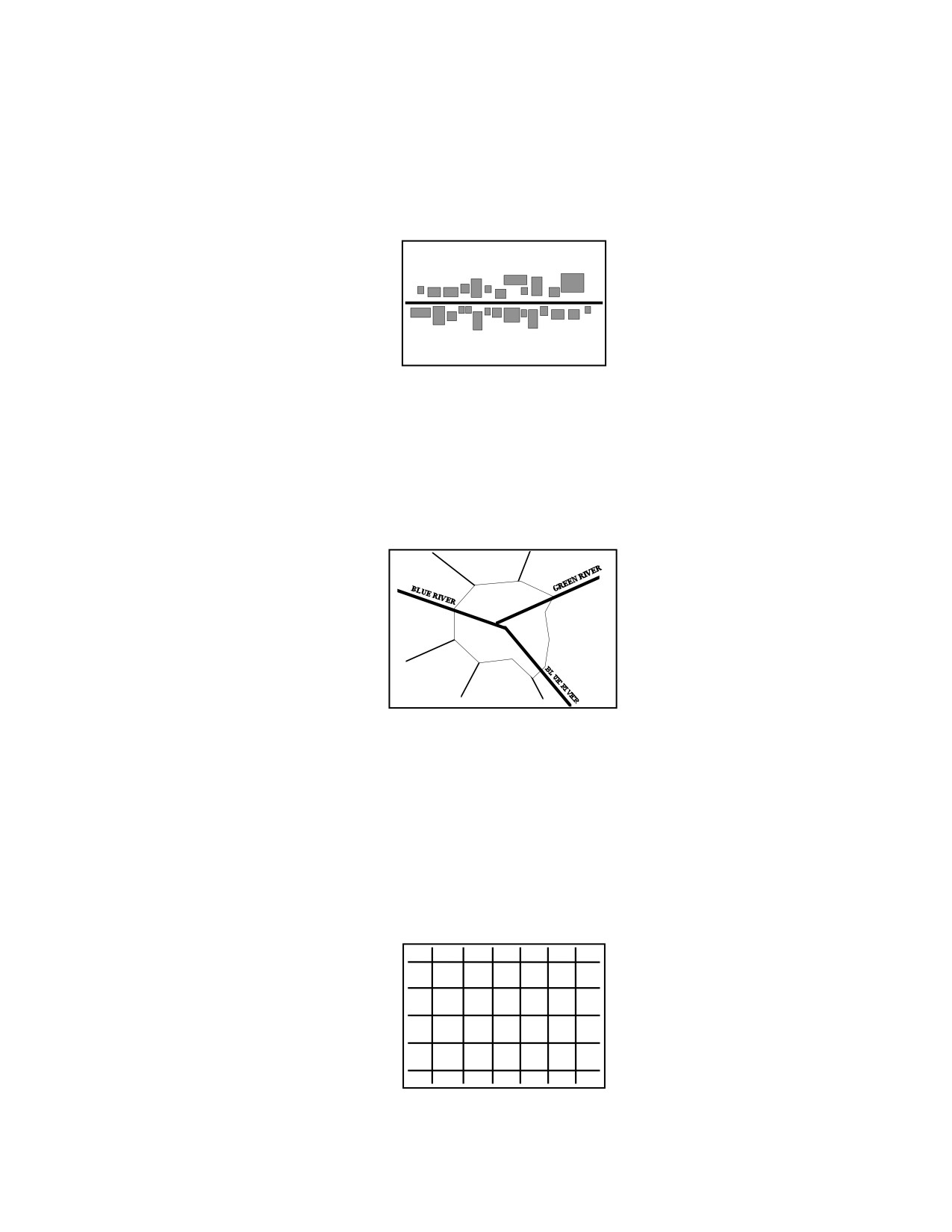
(4) Linear. Built-up areas often follow a linear feature or LOC. These built-
up areas are commonly found along interconnecting LOCs within a satellite or
network pattern. Buildings extending along major and urban strips or along the
banks of a river or along a coastline are also examples of linear patterns. See Figure
II-4.
Figure II-4. Linear
(5) Segment or Pie Slice. When an urban pattern is divided by a dominant
natural or manmade terrain feature, it creates a segmented pattern. Rivers, canals,
major roadways, or railways can create a division of the urban area or pattern. If
these features converge within the hub or urban pattern, it can create multiple
segments or “pie slice” characteristics. See Figure II-5.
Figure II-5. Segment/Pie Slice
b. Street Patterns. Another common set of patterns in urban areas is street
patterns. Streets vary in pattern and in width. Outside the US, street widths vary
from 7 to 15 meters while boulevards range from 25 to 50 meters. In the US, street
widths normally range from 15 to 25 meters. The following represent common
street classifications.
(1) Rectangular. Streets are grid-like in pattern, with parallel streets
intersected by perpendicular streets. See Figure II-6.
Figure II-6. Rectangular
II-3

(2) Radial. Primary thoroughfares radiate out from a central point. These
streets may extend outward 360 degrees around the central point or within an arc
from a point along a natural barrier, such as a coastline. See Figure II-7.
Figure II-7. Radial
(3) Concentric. A pattern of successively larger loops or rings with a common
center point. This street pattern is found in conjunction with larger radial patterns.
See Figure II-8.
Figure II-8. Concentric
(4) Contour Conforming. Pronounced terrain relief influences construction of
roadways along lines of elevation. Primary streets run parallel to the ground
contour with intersecting roads connecting them. See Figure II-9.
Figure II-9 Contour Conforming
(5) Irregular. Little or no discernible pattern resulting from unplanned
expansion and modernization of population centers. Older European cities
frequently contain an “old city” section, which characterizes this lack of pattern.
See Figure II-10.
II-4

Figure II-10. Irregular
(6) Planned Irregular.
Street patterns that are specifically engineered
without geometric patterns for aesthetic or functional reasons. US subdivisions
with curving streets and numerous cul-de-sacs are examples. See Figure II-11.
Figure II-11. Planned Irregular
4. Characteristics
a. Background. The urban patterns have characteristics affecting military
operations. These characteristics can be classified as:
(1) city core,
(2) outlying high-rise,
(3) commercial ribbon,
(4) core periphery,
(5) residential sprawl,
(6) outlying industrial areas.
b. City Core and Outlying High-rise. In many cities, the core has undergone
more recent development than the core periphery. As a result, the two regions are
often quite different. Typical city cores consist of high-rise buildings, varying
greatly in height. Modern planning for built-up areas allows for more open spaces
between buildings than in old city cores or in the core peripheries. Outlying high-
rise areas are dominated by this open construction style more than city cores.
II-5
c. Commercial Ribbons. These areas are characterized by rows of stores,
shops, and restaurants built along both sides of major streets through built-up
areas. Usually, such streets are 25 meters wide or more. The buildings are
uniformly 2 to 3 stories tall, about one story taller than the dwellings on the
streets behind them.
d. Core Periphery. This area consists of streets 12 to 20 meters wide with
continuous fronts of brick or concrete buildings. The building heights are
uniform, 2 or 3 stories in small towns, 5 to 10 stories in large cities.
e. Residential Sprawl and Outlying Industrial. These areas consist of low
buildings that are 1 to 3 stories tall. Buildings are detached and arranged in
irregular patterns along the streets with many open areas.
5. Population Density
a. Background. The physical characteristics of an urban area influence its
population density. Population density is influenced by such urban features as
roadways, public transportation, utilities, and building construction. Other
factors that determine the population density include available land resources,
economic resources, and cultural characteristics.
b. Land Resources. Areas with little land available for human occupation
tend to be more densely populated. Geographical limitations such as mountains,
waterways, or islands also tend to concentrate population.
c. Economic Resources. Economics influence population density, even with
severe limitations on available land. A wealthier nation can build tall vertical
structures; thus overcoming a shortage of land.
d. Cultural Characteristics. Another set of factors influencing population
density is the cultural and social traits of its people. These characteristics can
influence the number of civilians who choose to remain in the area, affecting the
population density. If a large number of civilians leave the urban center and
decrease the population density, a great concern is refugee control. If a large
number of civilians remain, then the greater concern is civilian collateral damage.
6. Structural Density
a. Background. Structural density is proportional to the population density.
While the following categories refer primarily to the spatial relationships
between structures, the titles imply the function of an area. Building
construction is assessed using these categories during the joint intelligence
preparation of the battlespace (JIPB) process. See Appendix B for details.
Remember that the specific type of structural density can be used for a quick
direction reference, which aids situational awareness.
b. Dense, Random Construction (Type A). This type of construction is found
in lesser-developed and nondeveloping nations. Close groupings of older
II-6
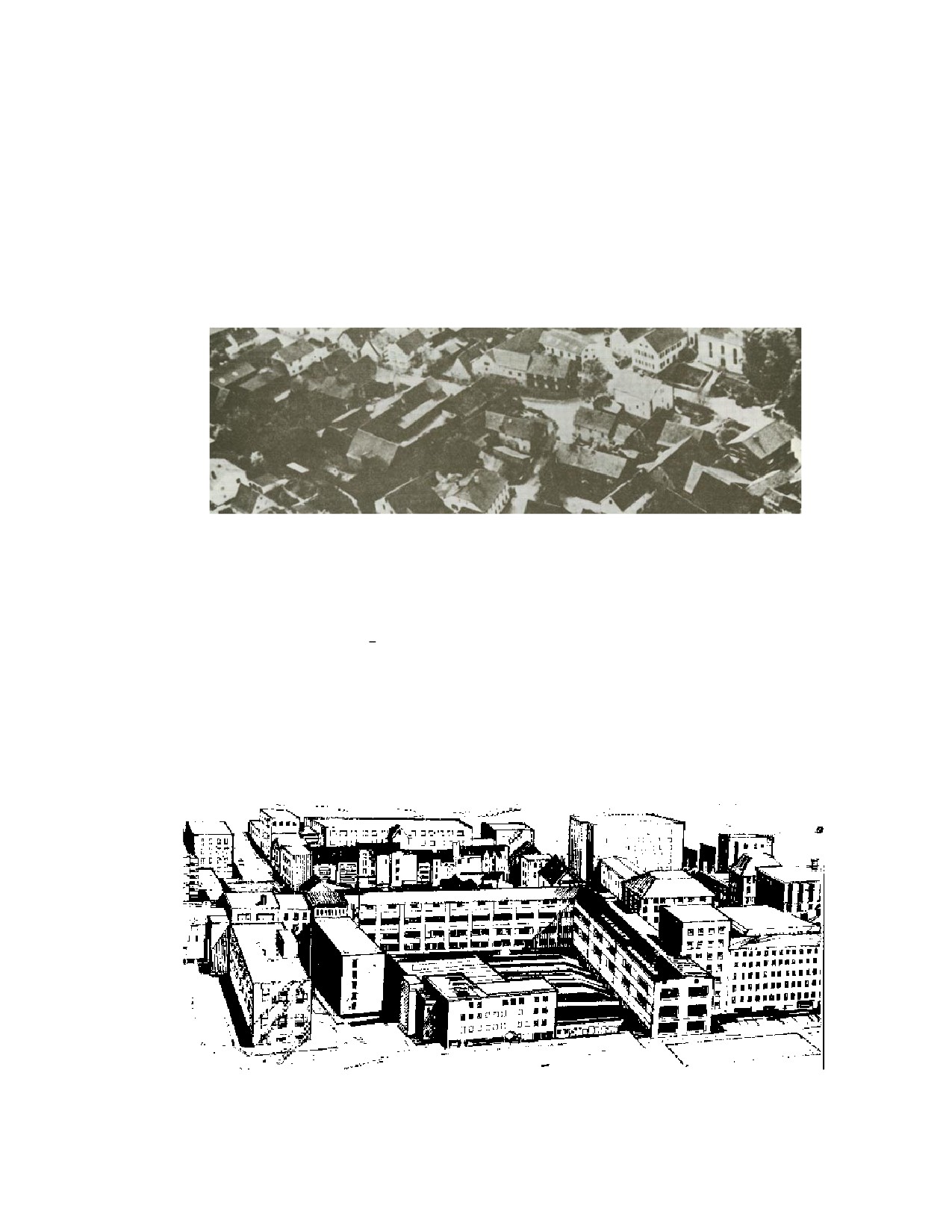
buildings are found in the center of villages, towns, and cities. A high density of
close or adjoining structures along narrow streets characterizes the oldest
sections of many cities. Port-au-Prince, Haiti, with its narrow twisting roads, is
good example of this construction type. A variety of construction types and
materials may be present with little or no setback of structures from the street
itself. In the downtown areas, buildings are often connected to each other,
making ID of specific target sites extremely difficult. This construction type
considerably limits LOS and fields of fire. Navigation is difficult and aircrews can
become disoriented quickly without easily discernable references. See Figure II-
12.
Figure II-12. Type “A”
c. Closed-Orderly Block Construction (Type B). Type B characterizes
medium-size towns and large cities like Las Vegas, Nevada. These areas consist
of residential and commercial buildings that often form continuous street fronts.
Inner courtyards may be contained within the block structure. See Figure II-13.
Type B construction typically consists of residential and commercial buildings,
small factories, and wider roads. The average street width is 26 meters allowing
greater vehicle movement and possible low hover operations. This allows better
fields of view and longer LOS distances. Distinct building types make identifying
the objective area easier than in a dense random type of development but locating
friendly forces remains difficult.
Figure II-13. Type “B”
II-7
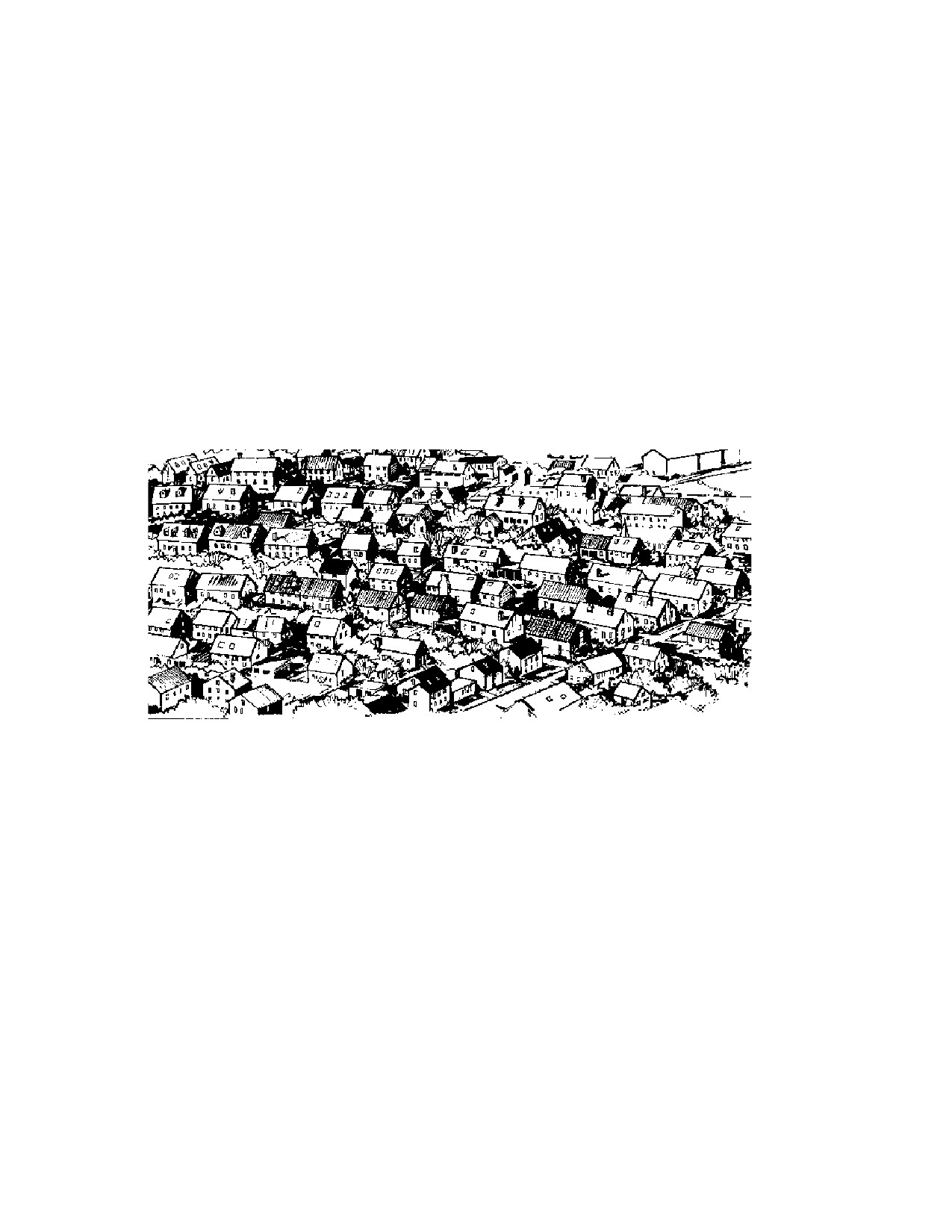
d. Residential Area Construction (Type C). Type C areas are often contiguous
to Type B areas. Residential areas are normally located on the outskirts of cities
and can pose several problems for aircrews. Residential areas normally consist of
rowhouses or single dwellings with yards, trees, gardens, and fences. The street
widths average 14 meters, with building setback distances of 6-8 meters. This
provides an effective street width or visibility corridor of up to 30 meters. Older
European or colonial urban residential areas may have more narrow streets and
little or no setback of the dwellings. See Figure II-14. Closely spaced houses and
narrow roads may limit the availability of a suitable LZ. Suburban areas may be
obstacle rich environments. Power poles, wires, and communications towers are
generally numerous. Cultural lighting may affect the performance of some night
vision devices (NVD). Dense concentration of buildings and civilians in these areas
may significantly hamper ability to visually or electronically acquire and track
ground forces. LOS communications for aviation assets should not be affected since
structures tend to be limited to 1 and 2 stories.
Figure II-14. Type “C”
e. High-Rise Area Construction (Type D). Type D construction is found in
medium-size and large city residential developments and business parks. High-rise
cities such as Houston, Texas and Ankara, Turkey are examples. These cities
contain multi-story apartment or office buildings separated by large open areas such
as parking lots, parks, and individual one-story buildings. See Figure II-15. High-
rise cities tend to have a stereotypical downtown area with an elevated skyline and
development. These multi-storied buildings offer many challenges to the aircrew.
These large, significant terrain features may simplify navigation, but tall buildings
and narrow roads severely limit the ability to fly between buildings. Large open
areas for LZs or DZs, such as parks and parking lots, are often adjacent to these
buildings. If extremely steep ingress/approach and egress/departure angles are
required for LZ/DZ access, utility may be limited. Open rooftops offer easy access to
insert ground teams and extract isolated personnel, but the very nature of these
multi-storied buildings may require out of ground effect hover or aircraft operating
near maximum power available limitations. Depending on weather conditions,
aircraft limitations may exclude this type of maneuver. The threat level coupled
II-8
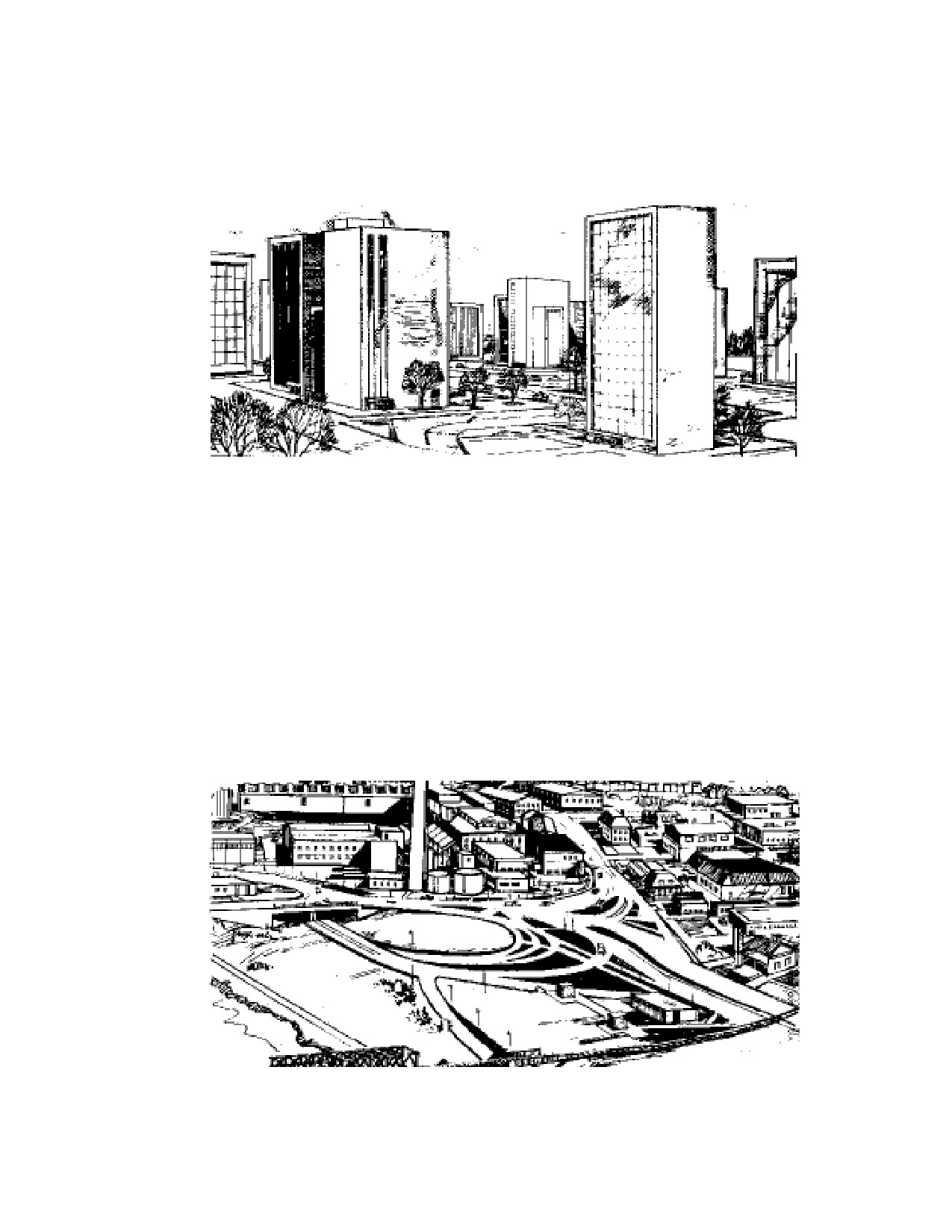
with the ability to gain access to rooftops and their structural integrity will
influence their use. Enemy access to upper levels and rooftops may allow them to
fire down on aircraft and ground forces below.
Figure II-15. Type “D”
f. Industrial/Transportation Construction (Type E). Type E areas are the
most open and dispersed types. Newer industrial or transportation areas are
generally located on or near the edge of towns and cities. They typically consist
of low, flat-roofed factory buildings, warehouses, and railway facilities. Industrial
buildings are large, functionally designed, and normally have large parking lots
or work yards suitable for LZ operations. See Figure II-16. Aircraft can operate
more effectively due to the low building profiles, better LOS, and reliable
communications. There are some disadvantages to industrial areas. One concern
is heightened exposure to secondary explosions from ordnance. Another is the
flammable and explosive hazard normally found with petroleum, oil, and
lubricant tanks, refineries, and factories.
Figure II-16. Type “E”
II-9
7. Building Construction
a. Background. The construction and types of buildings within an area further
define its characteristics. When looking at a city composition, planners should
analyze building types, construction materials and area density. Urban areas are
composed of two types of building composition, framed and mass. Knowing the
difference assists in determining the effectiveness of munitions and the cover offered
to personnel. In many industrialized nations with modern cities, most buildings are
framed. Examples of framed buildings are the residential home with 2 x 4 (or
larger) construction, numerous non load-bearing walls, and large windows.
Commercial offices and high rise buildings are generally framed with steel girders.
Mass buildings are built so exterior walls bear the weight of the structure. The
walls of mass structures are usually thick and constructed of masonry materials
such as stone, brick, or reinforced concrete. Approximately 62 percent of buildings
outside the US consist of mass construction technique. Mass structures provide
more protection for ground forces than framed buildings. For a more detailed
discussion on the link between weapons effects and the type of building
construction, reference the Joint Munitions Effectiveness Manual (JMEM).
b. Construction Types. Individual building construction is analyzed during the
JIPB process. See Appendix B for more information. The definition of each type
emphasizes the construction and materials of the structure. A particular single
family dwelling, for example, may be more properly classified as Type 1, not Type 3
or 4. The following is a description of each type of construction:
(1) Wood and Timber Frame Construction (Type 1) (Framed Construction).
Type 1 buildings have wooden rafters and weak exterior walls, offering little
protection from fires. Farm buildings, older city dwellings and inexpensive
private storage buildings are examples. The fire hazard for Type 1 buildings is
high.
(2) Masonry Construction (Type 2) (Mass Construction). Type 2 buildings
have strong stone or brick walls, and are more suitable for defense than Type 1.
Older governmental or institutional buildings, such as courthouses and schools are
often Type 2 construction. The fire hazard for Type 2 buildings is low.
(3) One or Two-Family Dwelling (Type 3) (Mass Construction). Type 3
buildings have walls of solid or insulating brick or cinder blocks with ceilings of
reinforced concrete. They offer significant protection and require little
reinforcement. Type 3 buildings often contain strongly constructed basements and
are low fire hazards.
(4) Prefabricated One-Family Dwelling (Type 4) (Framed Construction). Type
4 buildings are pre-cast of light building materials and offer less protection and
greater fire hazard than Type 3 buildings. These buildings frequently contain
strongly constructed basements.
II-10
(5) Low-Rise Office Building (Type 5) (Framed Construction). Type 5
buildings have multi-story steel frame and reinforced concrete construction.
They are frequently characterized by large expanses of glass, offering little
protection from direct fire.
(6) High-rise office building (Type 6) (Framed Construction). Type 6
buildings are similar in construction and characteristics to Type 5 office
buildings, but consist of six or more stories.
(7) Low-Rise Apartment Building (Type 7) (Framed Construction). Type 6
buildings are similar in size to Type 5 office buildings, but with less glass and
with load-bearing reinforced concrete walls. They offer greater protection from
direct fire.
(8) High-rise apartment building (Type 8) (Framed Construction). Type 8
buildings are similar in construction and characteristics to Type 7 apartment
buildings, but consist of six or more stories.
(9) Industrial/Warehouse Complexes (Type 9) (Framed Construction). Type
9 building construction varies considerably, but is generally steel frame with
lightweight exterior walls. Reinforced concrete floors and ceilings are found in
multistory Type 9 buildings.
8. Features of Special Consideration
a. Coastal Features and Waterways.
(1) Background. All hydrography associated with urban terrain warrants
careful analysis. Water features represent possible mobility obstacles to surface
forces, and are a potential LOC. The presence of a coastline or major waterway is
often the reason that a population center came into existence in a particular
place.
(2) Port Facilities. Port facilities represent a focal point for commerce and
logistics. They hold strategic significance in many cases. Control of docks and
associated facilities accommodates large-scale transport functions into or out of a
city. Port seizures may be a primary objective for attacking forces.
(3) Rivers and Canals. Rivers and canals can divide urban areas and
represent significant physical obstacles to surface maneuver. Control of bridges
and crossing sites is critical to ground mobility and security of an urban area.
Major rivers are primary LOCs at a national level. Rivers can be used to
transport commodities, raw materials, and finished products. Similarly, military
logistics requirements can be supported by the use of rivers and canals. Aircrews
should minimize exposure time over major LOCs.
II-11
b. Airfields. Airfields and other landing sites are major urban commerce and
logistic centers. The flow of commercial and/or military traffic is vital to an
operation. The control of these areas and the airspace around them could be a
decisive factor in an operation. Airfields and improved landing areas such as
wide, multi-lane, straight highways can accommodate large-scale transport
aircraft. Size, load bearing capability, and aircraft parking areas figure greatly
into the value of an airfield. Seizure of an airfield is often a primary objective.
c. Subterranean Features.
(1) Background. Larger cities feature a variety of subterranean systems of
military significance. A complex network of tunnels and passageways may exist
below the surface. While not visible or directly influencing aviation operations,
subterranean features figure prominently into urban operations.
(2) Public Transport. Underground public transport systems, such as
subways, represent major LOCs within the urban environment. Tunnels
associated with these systems can accommodate vehicular traffic and large
numbers of troops.
(3) Passageways. Some cities contain sophisticated underground
pedestrian passageways and shopping “malls” in the central business district.
While generally not large enough to support vehicular traffic, these complexes
can be exploited for troop mobility and assembly, logistical operations, and C2.
Smaller utility passageways may be quite extensive and optimal for use as
infiltration routes by small forces.
(4) Waterways and Tunnels. Special operations forces (SOF), sappers,
terrorists, or partisans may use underground waterways or communications
tunnels. Storm sewers are generally large enough to allow troop movement. The
passageways, accessed generally through manholes, may be almost as extensive as
the street pattern. Sanitary sewers are usually much smaller, less accessible, and
less suitable for use by troops than are storm sewers.
d. Cultural Sites. Cultural and historical sites such as churches, museums,
and mausoleums, also are found routinely in urban areas. International law
provides special protections for many of these landmarks. These areas may be
designated in appropriate plans such as the airspace control plan. The areas may
be designated as a no fly area (NFA), restricted fire area, restricted operating
zone (ROZ), etc. Fire control measures for other areas such as medical treatment
facilities, water purification plants, nongovernmental organization (NGO)
operating locations, or other structures or areas may be designated.
II-12
Chapter III
FLIGHT OPERATIONS
1. Background
This chapter details the unique considerations of aviation urban operations.
Urban operations may include combat, peacekeeping, peacemaking, and
humanitarian support in non-combat environments, as well as combinations of all
types. Regardless of the type of operation, detailed planning and a thorough JIPB
are required. See Appendix B.
2. Threat Considerations
a. Threat Analysis. Intelligence on the threat will be difficult to obtain and more
difficult to accurately update. Areas of control can change rapidly and may be
confusing. Planners must anticipate rapid changes in the threat and incomplete
information. Every building and structure in an urban area is a potential enemy
position. The presence of snipers, vulnerability to ambush, and difficulty in
distinguishing combatants from non-combatants places participants under
additional psychological stress.
b. Reconnaissance. Commanders must establish reconnaissance operations
early, using all available assets. Unmanned aerial vehicles (UAV) with data linked
video are useful assets. Manned aircraft with multiple reconnaissance systems such
as LLLTV, forward-looking infrared (FLIR), and NVDs can provide focused
concentration of specific areas. These visual systems, coupled with space-based
intelligence, surveillance, and reconnaissance systems (ISR) assets, electronic
intelligence systems, voice interceptions, direction finding (DF) platforms networked
with ground-based systems, CA, SOF, and ground forces provide a picture of the
urban environment. HUMINT can provide information on threat intent and forces,
as well as information about city infrastructure and status. Gathering detailed
information during the planning phase of an aviation operation provides planners
and aircrew with information about threat positions, movements, routes, and
weapons.
c. Civilian Population. A defending enemy force normally has the advantage of
familiarity with the terrain. The civilian population of the area can play an active
role in the defense. Regardless of its activity, the larger the civilian population
remaining within the area, the more influences it has on military operations.
Enemy or friendly forces can have the support of the remaining people. Their
support provides significant intelligence, logistics, and security, as well as a
potential paramilitary capability.
d. Ground Threat. Urban operations often magnify the threat to aircraft. Light
to medium antiaircraft artillery (AAA) may be employed from ground sites, the tops
of buildings, in or near otherwise protected (attack prohibited by ROE, operational
planning, etc.,) structures, or mounted on civilian vehicles, thus providing aircrews
with a very complex threat picture. A man-portable air defense system
III-1
(MANPADS), with its small size, light weight, rapid engagement capability, and
ease of concealment, is an excellent weapon for operating in close proximity to or on
top of buildings and other structures. Heavy AAA and surface-to-air missiles (SAM)
require open terrain due to radar or siting requirements. However, this does not
prevent their employment within urban boundaries. The obstructions and crowded
airspace of cities limit aircraft defensive maneuvering options, increasing the
effectiveness of AAA, MANPADS, and SAMs while at the same time providing
excellent opportunities for the establishment of ambush sites. Urban terrain
provides virtually unlimited concealment, thus complicating escort missions,
suppression of enemy air defenses (SEAD), and counter attack. Restricted orbits,
weapons employment, and rotary-wing landing approaches increase aircraft
vulnerability and limit defensive options. The terrain may also limit suppression
options. The cluttered environment (e.g., lights, fires, smoke, dust, etc.) makes
identification of missile launches or ground fire more difficult. Aircrews and
planners should also consider the effects of fixation and visual confusion. Missions
requiring landing operations must also consider ground threats such as artillery,
mortars, or snipers. Planners must expand their view of what constitutes a threat
to aviation operations in the urban environment.
3. Weather
a. Background. The aviation commander must establish minimum weather
requirements before conducting operations. Weather conditions affect the employment
of all aircraft and weapons systems. Adverse weather will hinder the employment of
UAVs, radar, FLIR, laser, optical systems, NVDs, and IR weapons.
b. Ceilings. Low ceilings affect all aviation assets, especially fixed-wing aircraft.
Low ceilings can obscure high rise rooftops, and other obstructions such as power
lines, towers, and smokestacks. Low ceilings can also deny fixed-wing aircraft the
required time and altitude to obtain a satisfactory ordnance delivery solution. The
presence of high rise buildings and low ceilings decreases the effective above ground
level (AGL) operating area. Low ceilings will also affect the performance of laser-
guided weapons. In addition, artificial lighting against a low overcast will highlight
aircraft flying under the overcast to ground observers.
c. Visibility. Smog buildup from industrial areas and vehicle exhausts also
reduce visibility. Smoke from fires and dust from damage and destruction may
reduce the visibility in otherwise clear conditions. Reduction in visibility can
significantly degrade the performance of weapons sensors and laser or optically
guided munitions.
d. Winds. In urban areas, the city structure affects wind patterns. Wind
patterns are “broken up” and funneled down streets and alleys. While the wind may
be calm along one end of a block, it can be turbulent at another. City structure also
influences the location of turbulent areas. Therefore, predicting turbulent areas is
difficult. Turbulence affects aircraft performance and weapons delivery.
e. Temperatures. IR signatures are affected by the proximity of other buildings
and structures (for example, shadowing and winds). Times of thermal crossover
III-2
occur when objects viewed through IR sensors may be indistinguishable due to their
temperature similarities with their backgrounds. Thermal crossover in urban areas
may be relatively insignificant due to shadowing effects of structures and the types
of materials (e.g., asphalt, concrete, etc.) making up the background. However,
when using a FLIR, aircrews must pay particular attention during this period.
Furthermore, during this period, thermal crossover is particularly sensitive to wind,
which can affect differences in target and background temperatures. Urban
temperatures are generally higher than those in rural areas and can be 10 to 20
degrees higher than the surrounding environment. High thermal contrast can
adversely affect thermal sight performance.
4. Command, Control, and Communications
a. Commander’s Intent. A clear understanding of the commander’s intent is an
imperative for all operations, facilitating initiative in harmony with the
commander’s desires. Through a mission type or operation order (OPORD), the
commander states his intent, allowing subordinates the initiative to achieve
objectives in whatever method the subordinate deems appropriate. In the complex
urban environment, maintaining communications can be difficult because of
interference caused by structures restricting LOS systems. This increases reliance
on decentralized execution. Detailed mission orders and briefings aid in conducting
operations.
b. C3 Planning. A detailed, flexible, and redundant C3 plan is essential. Aerial
or rooftop retransmission systems and the use of remote antennas may overcome
some of these problems. Airborne C3 support systems (e.g., airborne battlefield
command and control center (ABCCC), Airborne Warning and Control System
(AWACS), joint surveillance target, attack, radar system (JSTARS), and joint
airborne communications center/command post (JACC/CP) equipped C-130/C141s)
may alleviate some of these difficulties. Another option is an appropriately
equipped UH-60 or UH-1 helicopter. Each of these platforms has inherent
capabilities and weaknesses that may make them more or less desirable for
operations in urban environments. Reference system publications and joint
planning publications for more detailed information on capabilities.
c. Air Asset Control. Although all air assets should remain under positive
control to the greatest extent possible, procedural control measures may be required
for air operations in the objective area. This is especially true in situations where
airborne C3 assets are unavailable or unable to communicate due to interference.
Visual signaling may also be affected by vertical development in urban areas.
Normal urban clutter makes it harder to differentiate these signals from their
background.
d. Common Frequency. A common frequency for all units facilitates rapid
transfer and understanding of information. Specific information concerning multi-
Service tactics, techniques, and procedures (MTTP) for air-to-air, air-to- surface, and
surface-to-air brevity codes is found in Service manuals, Field Manual (FM) 90-38,
Marine Corps Reference Publication (MCRP) 3-25B, Naval Warfare Publication
(NWP) 6-02.1, and Air Force Tactics, Techniques, and Procedures (Interservice)
III-3
(AFTTP(I)) 3-2.5. The issue of common frequency use, particularly for encrypted
transmission, can be greatly complicated in multinational operations. Planners
should consider this issue and develop methods for in-the-clear communications if
necessary.
5. Airspace Control
a. Compressed Airspace. Compressed airspace and a unique three-dimensional
environment characterize aviation urban operations. These factors increase
planning and execution problems, especially when in close proximity to friendly
forces and non-combatants. The compressed urban airspace brings separate and
diverse missions into close proximity. For example, an airdrop of supplies could be
performed simultaneously with CAS missions protecting the unit being supplied.
Knowledge of other missions tasked for the same area is vital to avoid interference.
b. Control Measures. Develop positive and procedural control measures for
specific airspace. This will assist in eliminating mission conflicts. These measures
must also consider ongoing host nation (HN) or foreign military airspace
requirements. A useful method of implementing positive control is execution of a
joint air tasking order (ATO) through the Theater Air Ground System (TAGS). The
joint ATO assures deconfliction and synchronization of aviation assets.
Multinational air assets may also be included in the joint ATO. A combination of
positive and procedural control measures may be appropriate because of the
potential for high volumes of air traffic over urban areas. For example, establishing
a ROZ or high-density airspace control zone (HIDACZ) over the area of operations is
one means to facilitate the simultaneous employment of aerial platforms.
Heightened awareness of support missions operating in and throughout the general
area must be maintained. Detailed information concerning multi-Service
procedures for integrated combat airspace command and control (ICAC2) is provided
in Service manuals, FM 100-103-1, MCRP 5-61, NWP 3-52.1, and AFTTP(I) 3-2.16.
6. Air-to-Ground Coordination
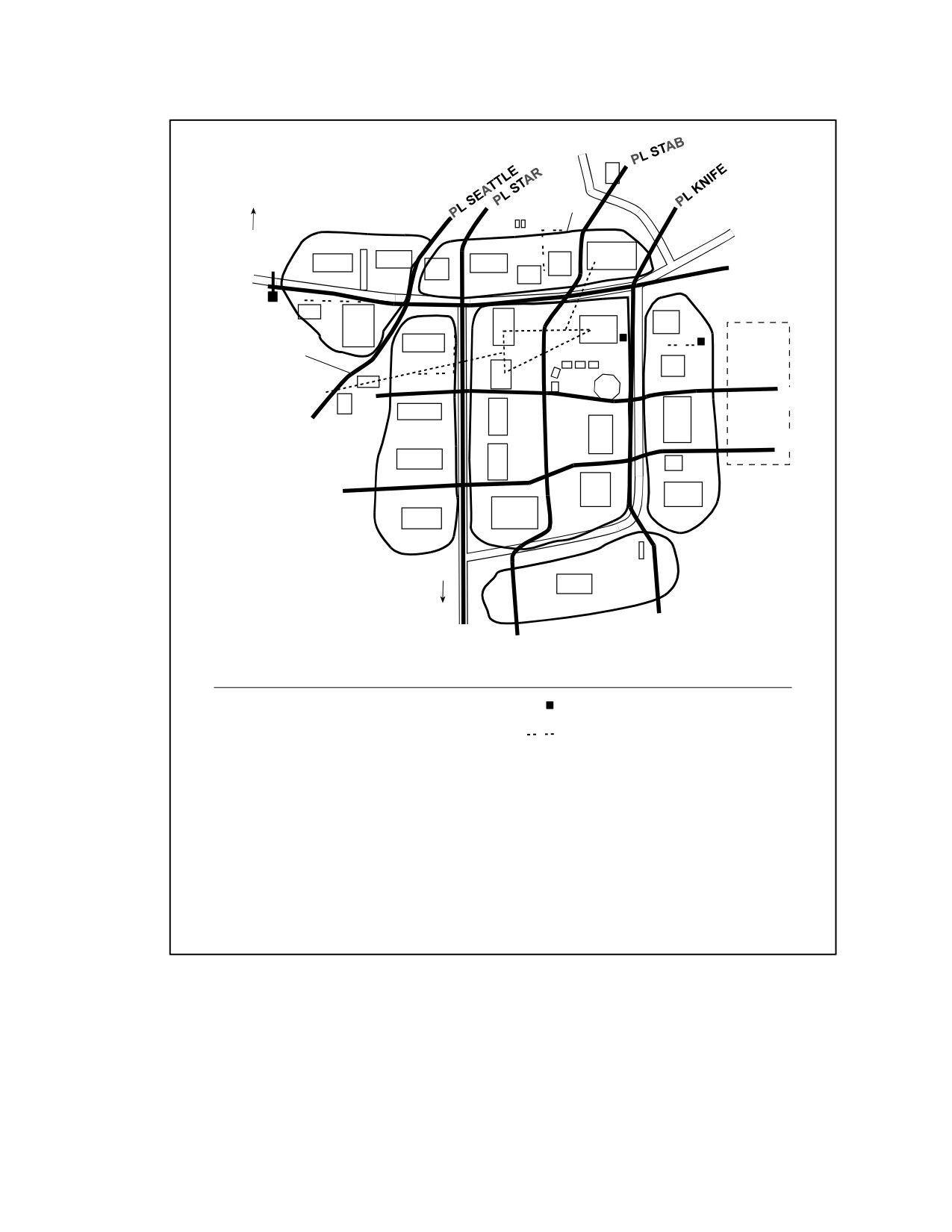
Air-to-ground coordination is improved using overlays and pictures. Figure
III-1 depicts an example of a ground unit’s control measures. The sketch numbers
major structures and labels building corners (A-D) providing a legend to identify
each building. Establishing objectives and phase lines assists in understanding the
ground scheme of maneuver and is one method to integrate both air and ground
operations. Specific information concerning multi-Service procedures for a TAGS is
provided in Service manuals, FM 100-103-2, MCWP 3-25.2, NWP 3-56.2, and
AFTTP(I) 3-2.17.
7. Maps and Charts—Selection and Preparation
a. General Considerations. Consider all types of geospatial products ranging
from paper maps and charts to digital mapping databases including commercial as
well as government products. Maps with a larger scale than 1:50,000 (i.e., 1:24,000
or 1:12,500) provide greater detail for urban mission planning and execution.
Numerous large-scale maps exist to assist aircrews.
III-4
(Not to Scale)
THEATER
CEM
porta-
john
N
A
B
OBJ GRIZZLY
B
A
B
OBJ 1 A B
A
B
A
A
B
52
A B
57
51
54
56
53
PL SWORD
D
C
D
C
D
C
55
C
D C D
D C
D C
PL SWORD
SWING
A
B
A
B
A
B
A B
GATE
RED
58
67
69
CONNEX
A
B
70
68
D
C
COVERED
D
C
D
C
A B
AREA
D
C
D
C
B
A
59
SOCCER
77
SHEDS
FIELD
TUNNEL
D
C
D C
71
SYSTEM
PL
A
B
A
B
A
B
PL FIRE
FIRE
66
A
B
RED
76
60
D
C
CONNEX
D
C
72
PL SEATTLE
A
B
A
B
D
C
PL TORCH
65
D
C
75
61
D
C
A
B
D
C
A
B
PL TORCH
B
73
62
A
B
A
D
C
D
C
74
64
OBJ 4
OBJ 3
D
C
D
C
OBJ 2
A
B
63
OBJ 5
D
C
TO
WORD
PL KNIFE
PL STAR
PL STAB
LEGEND
51
Factory
65
Bank
Generator/Box
52
Warehouse
66
Vet Clinic
Fence
53
Private Home
67
Office Building
54
Town House
68
Gas Station
55
Private Home
69
Post Office
56
Church
70
City Hall
57
Municipal Building
71
Water Tower
58
Power Station
72
health Clinic
59
Private Home
73
Private Home
60
Town House
74
Hotel
61
Radio Station
75
store
62
School
76
Fire Station
63
Private Home
77
Police Station
64
Private Home
Figure III-1. Ground Unit Control Measures
b. Government Products. The National Imagery and Mapping Agency (NIMA)
produces 1:12,500 scale maps for specific urban areas as specified by the customer.
A non-combatant evacuation operation (NEO) intelligence support handbook (NISH)
is also available for every American Embassy (classified SECRET). The NISH is
intended to augment the planning for NEO or hostage recovery operations and
III-5
contains information such as pre-surveyed LZ listings. Planners must consider
currency of terrain information during planning.
c. Civilian Maps. Commercially available civilian or tourist maps may show
greater and more current urban detail than military maps. While street maps and
tourist maps do not normally show terrain, they often provide useful information on
current street and bridge locations, street names, shapes of prominent buildings,
and cultural features. Civilian maps usually have a reference grid overlay that, if
available in sufficient quantities, may be useful as a supplemental terrain reference
during urban operations. However, these maps do not come marked with the
Military Grid Reference System (MGRS) or universal transverse mercator (UTM)
references. Although marked with a common reference grid, commercial maps or
charts should not be used as a reference for employing munitions. Ensure all units
disseminate any approved non-standard reference systems to enable proper target
ID and fratricide prevention.
WARNING: Check the reference system used to prepare a map or chart (i.e.,
World Geodetic System 1984 (WGS-84), Tokyo Special, etc.). Different datum
can cause significant confusion and errors.
d. Geospatial Products. Units must maintain accurate geospatial products for
their operational area and continuously update them as new features and hazards
are identified. This is a shared responsibility for aircrews, intelligence personnel,
and operations sections. For example, the intelligence staff, as part of the JIPB
process, should conduct initial preparation of the maps and charts since intelligence
sources may be the only source of hazard information before mission execution.
Other sources of hazards include the airspace authority that publishes known flight
hazards, such as the notice to airmen. Detailed analysis of flight hazards during
mission planning is critical to safe flight operations in urban terrain. Many hazards
may be unlit and difficult to discern amongst the bright ground lights. Several
types of flight hazards exist:
(1) Physical Hazards. The majority of physical hazards within an urban area
are manmade. These include antennas, wires, power lines, Tube-launched, optically
tracked, wire-guided (TOW) missile wires, and other obstructions.
(2) Environmental Hazards. Environmental hazards include meteorological
effects, extremes in artificial illumination, and unpredictable wind effects.
(3) Natural Hazards. Natural hazards include tall trees, and areas of high
bird concentration.
(4) Air Traffic Hazards. The high volume of air traffic over and within urban
areas is another significant hazard.
(5) Other Hazards. Other hazards include high intensity radio transmission
areas. All known radio emitters should be assessed for potentially adverse effects
on aircraft systems.
III-6
8. Route Planning and Navigation
a. Planning Factors. Appropriate flight profile and route selection are perhaps
the most difficult planning factors. A dynamic flight profile offers the best
survivability and responsiveness. Aircrews should base their flight profile on
traditional factors of mission, enemy, terrain and weather, troops and support
available, and time available. Special consideration must be given to the unique
characteristics of urban terrain. Plan appropriate routes and altitudes to consider
known threats and exploit environmental factors such as wind direction, moon angle
and azimuth, and urban noise.
b. Navigation Techniques. In an urban environment, a small navigational error
(i.e., a couple of city blocks) can rapidly evolve into disorientation. Although natural
land features (rivers, lakes, etc.) are preferable landmarks, they may not be useable
during various flight profiles. Manmade features may provide the majority of
available navigation aids. If possible, pick large recognizable features for
navigation. Examples include cemeteries, stadiums, cathedrals, and major roads.
Linear features, such as major highways, rivers, railways, canals, and coastlines
provide easily recognizable boundaries and references to assist aircrews in
maintaining orientation. Prominent rail and highway interchanges are useful as en
route checkpoints. However, remember that in enemy-held areas, these same
prominent features might be protected by anti-air weapon systems. As aircrews
become more familiar with the operational area, more use is made of local
landmarks during flight.
c. Enhancing Survivability. Low-level flight techniques, adapted for urban
terrain, may be employed to enhance survivability. Remaining unseen visually and
electronically is the most effective method of preventing an engagement by hostile
forces. Obviously, if there is no tactical reason to operate in low profiles (i.e.,
disaster assistance operations), higher profiles are more suitable and safer. “High”
versus “low” is matter of carefully weighing the factors, making an informed
decision, and remaining flexible if the situation dictates a profile change. The
navigation techniques employed and the use of night systems will factor greatly into
the degree of risk and effectiveness of a particular profile. Distilled to its most basic
elements, the issue is this: “do aircrews want brief exposure to hostile weapons at
close range, or continuous enemy observation and exposure to weapons at extended
slant range?”
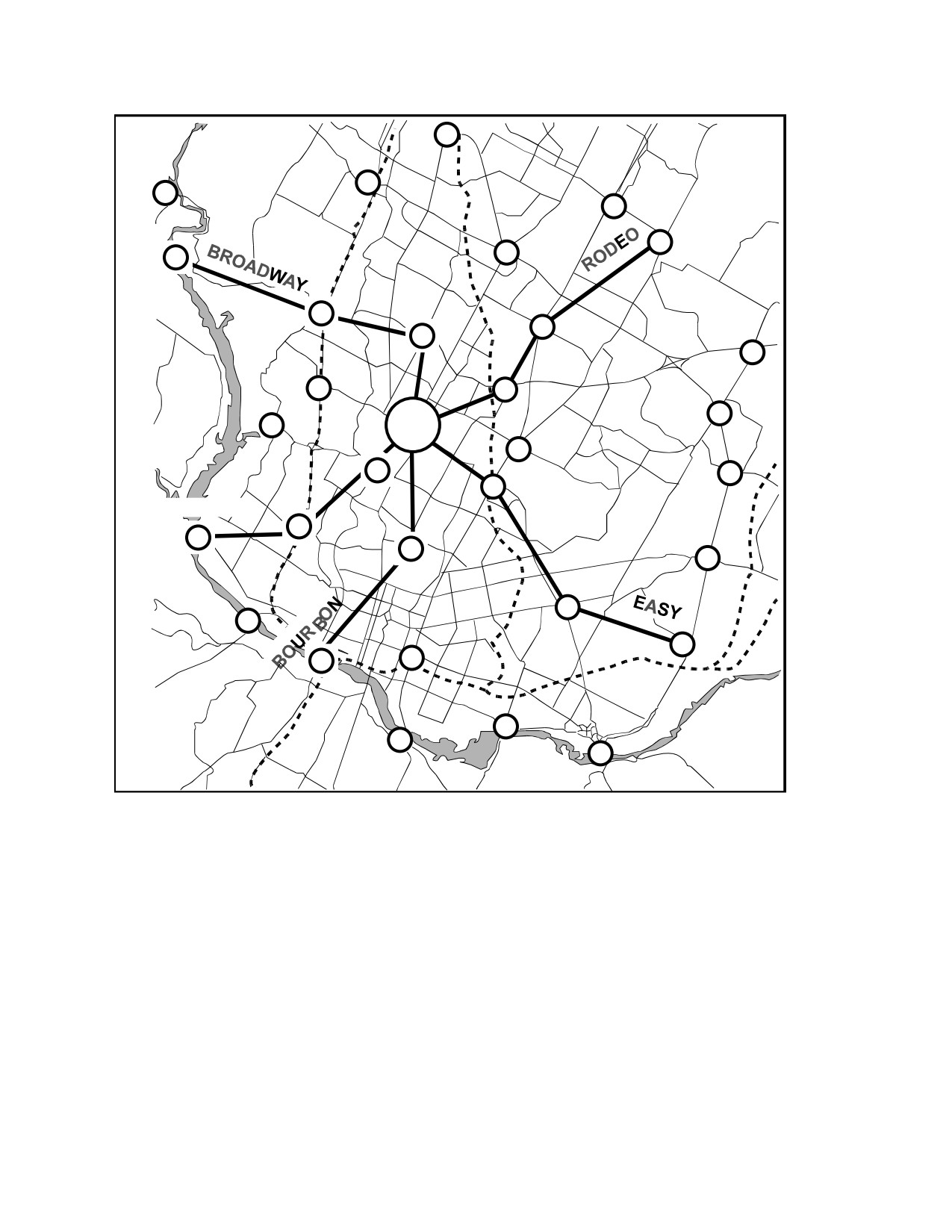
d. Route Planning. A network route structure of air control points (ACP) and
routes (preferably surveyed) may be used to facilitate route planning, navigation
and C3. See Figure III-2. ACPs are especially useful for aircraft navigation systems
that require visual updates. Different sequences of ACPs appropriate to the mission
may be assigned code words to facilitate operational security, control, and route
changes in flight. For example, “Broadway” may be a route with ACP sequence 2, 7,
and 8; “Wall Street,” ACPs 1, 6, and 3; “Bourbon”, ACPs 4, and 9; etc. Before ever
being used in a tactical environment, a clearly defined initial point (IP) should be
verified by aircrews of high performance aircraft to ensure that both IP data and
aircraft systems are correct and reliable. Offset aimpoints may also facilitate target
ID. The location of these points should be published in all applicable plans and
III-7
2
7
8
OBJ
3
W ALLSTREET
6
1
9
4
Figure III-2. Network Route Structure
orders. In situations where enemy forces are present, great care must be taken to
avoid predictability of routes. Whenever possible, plan to use routes, battle
positions, attack by fire positions, airspace coordination areas (ACA), holding areas,
and orbits over friendly held terrain that do not expose aircraft to threats. Terrain
and congested airspace may force repeated use of ACPs, LZs and flight profiles. The
habitual flying of routes from one obvious feature to the next, or along LOCs, is
strongly discouraged in the presence of enemy forces or potentially hostile civilians.
Avoid predictability of flight routing in all but the most benign of operational
environments. Track the frequency that each ACP is used to better control route
over-use. Route names and “call signs” should not be re-used repetitively with the
same ACP sequence. Flight profiles must take into consideration small arms, AAA,
MANPAD, and SAM weapon ranges and communications.
III-8
e. Effective Navigation. Navigation over urban terrain can be more difficult
than over natural terrain due to an over-abundance of cues. Navigation is also more
difficult for rotary-wing aircraft because most maps do not show the vertical
development of urban terrain. The high density of structures, variety of
geographical references, and high light levels can create “visual saturation.” Rapid
displacement from position to position can sometimes create confusion between
aerial and ground observers as to cardinal directions or locations. Familiarity with
the characteristics of urban terrain allows aircrews to discern key features in this
environment. Navigational aids, such as the global positioning system (GPS), have
reduced but not eliminated this problem. Effective navigation over large towns and
cities can require the use of a variety of navigational systems and techniques. The
use of GPS eases the problems associated with night navigation and orientation;
whereas, handheld laser pointers or designators ease the problems associated with
orientation and target ID. Aircrews must monitor their equipment closely and
crosscheck their position by all available means. Navigation systems may be
degraded due to interference induced by buildings. Aircrews should perform
detailed mission planning to maximize the effectiveness of all available assets.
9. Night Vision Devices
a. Considerations. When planning for and employing NVDs, aircrews must pay
careful attention to the color, location, and intensity of urban lights, in addition to
the moon angle and lunar illumination along the flight route and in the objective
area. Night imagery of the area is an important tool for effective analysis and
mission planning. To determine when and where to use NVD, image intensifiers, or
IR sensors, a detailed analysis of the area is necessary. Aircrews should prepare to
make frequent and rapid transitions from aided to unaided flight during urban
flights.
b. Characteristics. Night vision goggles (NVG), and FLIR/Integrated Display
System (IDS) are affected by the composition and surface conditions of urban
terrain. A rural battlefield has a somewhat homogeneous composition where man-
made objects contrast sharply. However, in an environment that consists primarily
of manmade objects there is very little consistency in the thermal/visual scene.
High light levels in urban areas create special problems. The volume and irregular
patterns of ground lights in urban areas affect NVG operations. The FLIR/IDS is an
excellent identification aid for terrain features and hazards in brightly-lighted night
urban environments as it is not susceptible to blooming effects from overt lighting
as are NVG. Brightly lit cities can be navigated without NVDs, but discerning
detail in darkened areas or shadows requires using image intensifiers or IR sensors.
Relatively dark areas, such as large city parks, are readily identified and make good
navigation references at night. Cultural lighting will often washout NVG,
decreasing their effectiveness.
c. Environmental Concerns.
(1) Lighting Condition. Operations conducted during twilight, dawn, or dusk
may present problems. The rapid changes in the illumination during these periods
and the inability of the eyes to quickly adjust make it difficult for aircrews to
III-9
observe terrain features and see other aircraft. FLIR devices are not affected by
artificial light and are generally effective navigation and targeting systems during
this period. However, they are subject to being overpowered by intense heat sources
within their field of view. Very hot areas, such as factory smoke stacks or fires,
make the details of objects with lower thermal contrast difficult to discern. Hostile
forces may attempt to degrade the effectiveness of thermal systems by lighting
bonfires, buildings, cars, tires, etc. in the area of operations. If a supported ground
unit is using laser pointers, aircrews using FLIR will not be able to detect the spot.
The laser pointer is detectable with NVG.
(2) Thermal Clutter. FLIR/IDS thermal clutter occurs when there are a
number of objects in the sensor’s field of view with approximately the same thermal
signature. These objects can be “cool”, leading to an overall dark image, or “hot”
enough to result in an image saturated with bright spots. Overlapping hot spots
results in overall reduced image quality. Using the gain and/or polarity functions
can enhance FLIR/IDS imagery enough to highlight cultural features. Smoke from
a smoke grenade and/or burning diesel fuel will not affect the FLIR/IDSs
performance. A good rule of thumb is that if you can detect a target with a FLIR/
IDS and consistently employ the laser ranging and designation functions, then you
can most likely designate and lase the target satisfactorily for a laser-guided
weapon. Generally all buildings will be seen and recognizable on the FLIR/IDS.
Building roofs will present a different signature from walls due to the material
emissivity, and this may act as another cue aiding target acquisition. If aircraft are
forced to operate below 200’ AGL, then the low slant angle will make building
acquisition difficult and personnel/vehicle target acquisition more difficult. Slight
variations in construction material for either roads or structures can alter the image
enough to inhibit target acquisition and tracking. For example, while the terminal
guidance controller may see an NVG image of two contrasting materials around a
target, the aircrews using a FLIR/IDS may not see the same contrast due to the
differences in temperature and emissivity. Furthermore, airspeed and altitude can
have the same affect.
(3) Thermal Reflection. Thermal reflections can produce odd signatures,
making target ID difficult. Smooth or glassy surfaces such as windshields,
unpainted metal surfaces, or water are examples of thermal reflectors. They can
reflect IR radiation images, like a mirror, of other nearby sources. They can appear
very dark because they reflect the low radiant temperatures from the night sky.
Most buildings constructed from concrete or brick will have high thermal mass,
meaning their rate of temperature gain will be slow during the day (until noontime)
and rate of loss will be slow during the night. Urban structures viewed mid-day can
be distinctly different from a late afternoon view after having been heated
throughout the day; structures of plywood or aluminum lose heat quickly and
provide high thermal contrast with backgrounds that cool more slowly. As late
afternoon approaches, heat dissipates quickly. In the morning, objects facing the
sunrise will heat more quickly, appearing hotter than objects that face away from
sunrise. Air conditioning or heating units on buildings can produce localized hot
spots. Windows will appear very dark when reflecting the night sky temperature.
However in a combat zone, as was seen in Bosnia, many building windows may be
broken out.
III-10
(4) Smoke/Fog. FLIR/IDS visibility through fog or smoke is very good.
However, smoke from burning phosphorous or flares significantly hinder thermal
transmission. The atmosphere can attenuate transmission of IR energy through
refraction, absorption or scattering. High water vapor concentrations, which occur
at high humidity, are responsible for the majority of IR absorption. Urban areas can
have significant concentrations of carbon dioxide, which is also an IR absorber, can
potentially degrade FLIR/IDS performance. In practice, carbon dioxide absorption
does not usually impact FLIR performance.
10. Rotary-Wing Operations
a. Background. A typical rotary-wing urban flight profile consists of modified
low-level and contour techniques. Aircrews must evaluate obstacles, ambient light
levels, and available navigation cues as well as types and locations of threat sources
to determine the optimum altitude and airspeed. Maintaining higher airspeeds can
minimize exposure time. To limit exposure to antiaircraft weapons, the preferred
method of ingress and egress is a low, swift flight profile. However, slower flight
speeds may be necessary to allow enough time to precisely identify and navigate to
the objective area. Avoid true nap-of-the-earth flight as it exposes the aircraft to a
greater potential for engagements. Slow speeds coupled with low altitudes can put
the aircraft and aircrews at greater ground threat risk (small arms, rocket-propelled
grenades, etc.). A low density of structures or extensive enemy use of high rooftops
diminishes the masking advantages of low flight profiles. To buffer obstacle and
hazard clearance, a higher flight altitude (300 to 500 feet AGL) over a city, day or
night may be necessary. However, flight at higher en route altitudes exposes the
aircraft to observation as it approaches the objective and makes it far more
vulnerable to engagement during the descent for landing. This exposes aircraft to
shoulder-launched or radar-guided SAM threats. However, the trade-off provides a
better margin of safety from the hazards of unlit towers, cranes, and power-lines
that blend into the urban landscape and are more difficult to detect.
b. Flight Profile. Areas of consideration when determining flight profiles
include:
(1) The mission requirements.
(2) The hazards to flight.
(3) The integrated air defense system (IADS) in use by adversary forces.
(4) The small arms threat.
(5) The terrain relief and building height in and around the area.
(6) The density of structures.
(7) The accessibility/security of high, dominant rooftops.
(8) The dominant natural terrain around the urban area.
III-11
(9) The SAM threat.
c. Multi-ship Operations. Multi-ship rotary-wing operations are challenging
and can require application of unique formation techniques, especially when
operating with NVDs. To prevent the loss of visual contact with other aircraft
among ground lights, a non-traditional vertical “stack-down” formation positioning
may be required. Planning must include formation break-up and rendezvous
procedures if visual contact is lost within the flight or evasive maneuvering is
executed. When multiple aircraft are operating together, consider greater formation
spacing to facilitate more flexible maneuvering while still providing mutual support.
A wingman flying in a vertical “stack down” position from the preceding helicopter
will not have the flexibility of maneuver normally enjoyed in the traditional vertical
“stack up” position. Maintain a position that compensates for the illumination
pollution, but avoids jeopardizing the aircraft by greater exposure to obstacle
hazards or increased formation collision potential.
WARNING: If stacking down, pay strict attention to disk spacing and have a
pre-briefed formation break-up plan. Formation break-up from a stack-low
position is more dangerous than from a stack-high position.
d. Aircraft Lighting. For both day and night operations, Aircrew should
experiment with aircraft external lighting to best accommodate the mission,
otherwise follow standing operating procedures (SOP). If overt external lighting is
mandated, use the flash position to better distinguish aircraft from static light
sources. In brightly-lighted areas, covert lights may not be visible. Aircrew should
weigh mission lighting needs against the possibility of visual detection by the
enemy. During Operation JUST CAUSE, reflective tape was placed on all friendly
aircraft to assist in identification during ingress and egress. Bright ambient
illumination can be favorable at times. During Operation EASTERN EXIT, the
1991 NEO operations in Somalia, evacuees commented that in the darkened landing
zone, they could hear the helicopters but did not see them until they were already on
the ground.
11. Fixed-Wing Operations
a. AC-130 Gunship Operations. Due to AC-130 characteristics and their
requirement to fly under the protection of darkness in higher threat environments,
special consideration must be given to the threat. Commanders and planners must
consider the threat determined in the JIPB process before tasking the AC-130
because its effectiveness in interdiction or ground support missions could be limited
by a number of factors unique to the urban environment. Using a wide range of
altitude and orbit patterns, the AC-130 is a versatile platform and can perform
missions ranging from C3 to CAS. If employed correctly, the AC-130 can provide
commanders with excellent situational awareness. The AC-130H and the AC-130U
currently employed generally operate in the same manner but have some
differences. The AC-130U is all weather capable for interdiction and can predict
impact points of fired ordnance. Reconnaissance in instrument meteorological
conditions is degraded due to the ability to detect only radar significant targets (i.e.,
III-12
///////////////////////////////////////