FM 4-94 THEATER SUSTAINMENT COMMAND (February 2010) - page 3
Chapter 4
4-22. Collaborative planning and coordination between the TSC and strategic/joint headquarters is especially
critical to the TSC’s ability to synchronize and integrate intratheater deployment and distribution operations.
This planning and coordination effort provides the TSC with the means to successfully:
• Monitor airlift and sealift flow.
• Provide movement control of arriving supplies, personnel, equipment, and units.
• Establish theater-wide capabilities required to meet anticipated transportation and throughput
capacities.
• Provide life support.
• Establish effective liaison among the Service components and strategic providers.
• Identify HNS requirements.
• See JP 3-35 and FMI 3-35 for additional information concerning RSOI operations.
SECTION III: PROVIDE DISTRIBUTION MANAGEMENT
4-23. The Army distribution system is designed to optimize available infrastructure, reduce response time,
maximize throughput, and support time-definite delivery. Effective distribution management synchronizes and
optimizes the various sub-elements of the distribution system. Methods may include, but are not limited to:
maximizing containerization, increasing standardized transportation and materiel handling equipment,
integrating aerial re-supply as a routine method of delivery, synchronizing and integrating retrograde operations
across all available transportation modes, reducing storage, reducing transportation mode transfer handling
requirements, and increasing ITV in an AO/joint operations area (JOA).
TSC/ESC DISTRIBUTION MANAGEMENT ROLES
4-24. The TSC is the distribution manager of the intratheater segment of the global distribution system. It
executes distribution operations in accordance with priorities promulgated by the ASCC G-4. If an ESC is
deployed, it performs the role of distribution manager for its specified theater of operations or JOA. The ESC
and sustainment brigades monitor, track, and execute distribution operations in accordance with TSC guidance.
4-25. Under certain METT-TC conditions, an ESC may also have supporting to supported relationships with
other ESCs or sustainment brigades supporting other specified AOs/JOAs.
4-26. As the theater distribution manager, the TSC maintains a theater-wide focus; participating in and
coordinating with applicable joint logistics boards, centers, bureaus responsible for resolving issues concerning
competing priorities and the allocation of constrained resources.
4-27. TSC distribution managers conduct parallel and collaborative planning with supporting and supported
commands in order to facilitate the effective execution of distribution operations in accordance with ASCC
priorities and supported commander requirements.
4-28. The TSC’s primary role in distribution management is a seamless flow of supplies, personnel, and
equipment throughout the intratheater segment of the distribution system; delivering the right quantity, at the
right time, and in the right location. In part, the TSC accomplishes this through close coordination with the
JDDOC and supported J-4/G-4s. It is also accomplished, in part, through the effective use of ITV to monitor
distribution flow.
Note. If the TSC serves as a joint logistics center, the JDDOC may collocate with the TSC DMC and
assist the TSC in joint oversight of distribution and deployment.
4-29. The ESC performs the same function both from and within its specified area of operations; coordinating
with the TSC and supported J-4/G-4 in order to update its time definite delivery schedules and distribution
4-6
FM 4-94
12 February 2010
Support Operations
priorities. It also collects and analyzes ITV distribution information to monitor the distribution flow inside the
theater of operation/JOA.
4-30. TSC and ESC DMCs synchronize operations within the distribution system to maximize throughput and
follow-on sustainment. They manage all facets of transportation including the effective use of air, land, and sea
transportation assets. DMCs maintain connectivity with supporting and supported headquarters and use all
possible measures to establish and maintain a COP.
4-31. TSC and ESC roles in physical distribution include maintaining visibility of theater distribution assets
within the distribution network. The TSC and ESC can direct cross-leveling of distribution resources to meet
requirements and/or optimize the distribution flow.
4-32. As required, the TSC DMC may establish distribution management boards to ensure distribution
management processes are linked with theater-level processes/boards. The TSC DMC examines current
operations to ensure success in achieving the effects the combatant commander desires on the battlefield.
4-33. TSC distribution managers:
• Synchronize materiel and movement management operations by maintaining logistics situational
understanding through a COP.
• Ensure visibility of theater distribution assets, including international organization for standardization
(ISO) shipping containers, aerial delivery platforms, and palletized loading system flat-racks.
• Enforce established theater priorities established by the TSC or the ASCC.
• Maintain continuous liaison with the TSC staff as well as supporting and supported staffs to ensure the
uninterrupted flow of materiel, units, personnel, mail, and other goods.
• Synchronize retrograde support operations with an established return priority of ISO shipping
containers, aerial delivery platforms, and flatracks to the distribution system.
• Coordinate directly with the theater aviation command or designated theater aviation brigades G-3/S-3
to move commodities via rotary wing or fixed wing aircraft.
• Advise the commander on the use of unmanned aerial systems (UAS) and air movement to support
distribution operations.
DISTRIBUTION MANAGEMENT FUNDAMENTALS
4-34. Distribution management is the process of planning and coordinating for the time-definite delivery of
units, materiel, equipment, personnel, and Soldier support to, within, and from the theater, AO, or JOA.
Effective distribution management depends on applying the following principles of distribution from ATTP 4-
0.1 (FM 4-01.4):
• Centralize management.
• Optimize infrastructure.
• Minimize stockpiling.
• Maximize throughput.
• Maintain a seamless pipeline.
COMPONENTS OF DISTRIBUTION MANAGEMENT
4-35. The components of distribution management are visibility, capacity, and control. The TSC distribution
managers require visibility and control to maximize the capacity of the system.
4-36. When the TSC is operating in a joint or multinational environment—as it usually will—acquiring
sufficient visibility and control to maximize the capacity of the system will be difficult. The TSC planners
12 February 2010
FM 4-94
4-7
Chapter 4
prepare to accommodate different Service systems, different languages and cultures, and different policies and
doctrines with respect to attaining and maintaining visibility and control of the distribution system.
VISIBILITY
4-37. Commanders emphasize the timeliness and accuracy of data flowing into the DMC. Without constant
reinforcement, the imperative of “doing the mission” soon overwhelms any reporting system. Reporting,
though, is as important as actually distributing materiel because timely information, correctly understood, leads
to dominance on the battlefield. Planners perform this asset reporting in joint and multinational operations
where data processing and communications systems may not be compatible.
4-38. The TSC and subordinate commanders decide what information is critical to their ability to perform their
missions to support the ASCC commander. The staff assists the commander by recommending information
requirements for inclusion as commander’s critical information requirements (CCIR). Their recommendations
are based on assessments of operations throughout the plan, prepare, and execute cycle.
4-39. Distribution managers remain acutely aware of CCIR, particularly as they pertain to enemy and friendly
information requirements for the G2 intelligence staff and the commander. The DMC intensively collects and
processes enemy and friendly information requirements for the commander. The DMC collects information on
the four distribution networks (physical, resource, communications, and information), and on the status of
assets within the distribution system.
4-40. The physical network and its capability to support distribution requirements is critical. A complete
understanding of the characteristics and associated restrictions of road, rail, water, and air transportation is
crucial to numerous distribution decisions. The availability of buildings, hospitals, fuel storage, and general
storage areas can influence the overall capability to perform the distribution mission. Support operations
personnel coordinate with the G-2 and G-3 staffs and subordinate commands to maintain situational awareness
of the physical network.
4-41. The resource network is comprised of military and host nation (HN) units, equipment, and resources that
are required to operate over the physical network. The locations and command relationships of the sustainment
units and their materiel, manpower, and financial resources are critical force multipliers. The assistant chief of
staff, SPO, recommends possible locations for arraying subordinate units and critical distribution equipment
throughout the physical network to optimize the distribution flow. The DMC maintains visibility of the critical
sustainment capabilities available to the commander in order to redirect or apply the resources toward specific
deployment and/or sustainment missions and maintains oversight of those critical capabilities.
4-42. An effective communications network within the theater is critical; distribution managers coordinate
with the G-6 staff to ensure communications assets are available throughout the distribution system. The
communications network combined with automation systems provide efficiency and effectiveness to the
distribution system.
4-43. The information network is a combination of all the information collection devices, automated
identification technology (AIT), and automated information management systems. Visibility and knowledge of
the automation capabilities in the theater are critical to obtaining distribution information. The DMC is part of
the decision making process when determining the automated information system (AIS)/AIT needed for an
operation, as well as arraying those technologies across and within the theater.
4-44. The TSC ability to maintain visibility of the location, quantity, condition, movement, and status of assets
is dependent upon its ability to maintain near-real time total asset visibility (TAV). TAV obtains data on all
classes of supply from various STAMIS and other source systems; providing visibility of materiel in use, in
storage, in process, or in-transit. TAV enables logisticians and managers to provide near-real time information
to commanders, allowing them to make informed decisions using the most current logistics information. TSC
materiel managers use TAV to identify, cross level, ship, or redirect assets throughout the theater. Sub-elements
of TAV are asset visibility and in-transit visibility.
4-8
FM 4-94
12 February 2010
Support Operations
Asset Visibility
4-45. Asset visibility provides the TSC with timely and accurate information on the location, movement, status
and identity of units, personnel, equipment, and supplies flowing into, throughout, and out of the theater;
enabling the TSC to act upon that information to improve the overall performance of the intra-theater
distribution system.
4-46. Within the theater, asset visibility is achieved by linking AIT, such as radio frequency identification
(RFID) tags, memory buttons, smart cards, and barcode readers with AIS and ground and satellite transmission
stations; providing the means to influence the flow of materiel throughout the intra-theater distribution system.
4-47. The TSC materiel managers maintain theater-wide asset visibility for the following commodities:
• Class III bulk petroleum.
• All Class VII materiel (less communications security items).
• Class IX theater level repairables.
• Selected items of interest.
• Theater level conventional ammunition, guided missiles, and large rockets.
In-transit Visibility
4-48. In-transit visibility is visibility over those portions of the distribution system encompassing the flow of
assets from the consignor to the consignee, port, servicing airhead, supply support activity, or other destination.
This includes force tracking and visibility of convoys, containers and pallets, transportation assets, other cargo,
and distribution resources within the activities of a distribution node.
4-49. At the strategic level, the global transportation network
(GTN) provides accessible and accurate
information on materiel movements within the continental United States (CONUS) and outside the continental
United States (OCONUS). SDDC representatives at each seaport of debarkation (SPOD) have access to the
world-wide port system (WPS) automated architecture. WPS can provide advanced notification of all items
moved through the SPOD. Each joint task force - port opening (aerial) (JTF-PO) has similar information on the
cargo of each flight destined for its supported aerial port of debarkation (APOD).
4-50. At the theater level, a suite of fully integrated AIT and AIS capabilities provide the TSC with the means
to achieve the in-transit visibility required for the seamless flow of supplies, personnel, equipment, and units
throughout the intra-theater distribution system.
4-51. ITV involves three areas: in-container/on-pallet visibility, en route visibility, and transition node
visibility:
• In-container/On-pallet visibility. In-container/on-pallet visibility consists of detailed content
information. It is the source data first established at the depot, vendor, or other source. Distribution
managers maintain visibility down to national stock number, transportation control number, and
requisition number level of detail, even when containers or pallets are reconfigured to different
conveyances. AIT enhances the pipeline capability and affords the opportunity to update the database
that provides visibility of the reconfigured shipments efficiently. This level of detail allows systems
such as DLA’s asset visibility system to provide a line-item level of detailed responses to queries.
• En route visibility. En route visibility is the detailed visibility of movement platforms and
transportation assets while they are mobile and underway. This visibility is provided in part through
commercial off-the-shelf (COTS) technology. Containers equipped with radio frequency tags and
transportation assets equipped with a movement tracking system capability or similar AIT devices
provide near-real-time visibility of movements throughout the distribution system as they pass
interrogators along the physical network, or transmit position reports via satellite. Specific shipment
and movement information is combined to provide in-transit visibility of the container and its contents.
This enhances the DMC's ability to redirect or retask distribution assets to respond to the changing
dynamics of the distribution system.
12 February 2010
FM 4-94
4-9
Chapter 4
• Node visibility. The physical network and the logistics resource capabilities in the theater determine
the number and types of nodes. Regardless of the number or types of nodes, distribution managers and
owning units correctly maintain cargo identity and its relationship to the transportation asset that is
transporting the cargo. In order to establish and maintain node visibility, a network of interrogators is
established at supply support activities, and air and sea ports. As RFID tagged shipping containers,
vehicles, equipment, and pallets pass these interrogator locations, the interrogator reads the RFID tags
and transmits the data to a regional ITV server which updates the radio frequency - in-transit visibility
(RF-ITV) global network. The ITV server provides a mechanism for the TSC (and others) to query
shipment status and location information. This asset visibility not only provides the TSC with a near
real-time location of assets but also provides a view of potential choke points within the distribution
system.
CAPACITY
4-52. Distribution system capacity is constrained by the capacity of the most limiting part of the physical or
resource network. Distribution system capacity is always finite in the near term, but never static. Factors such
as conflict intensity, size and composition of the force, sophistication of facilities, and other variables influence
the capacity of a distribution system at any given point in time. Distribution managers focus on allocating and
prioritizing resources in two general areas: short-term transaction management and long-term capacity
management.
4-53. Transaction management operations deal primarily with the adjustments to existing distribution plans to
maintain optimal system capacity. They represent the day-to-day system management associated with support
operations at all levels within the distribution system. These operations may be programmed changes based on
previously anticipated alternative courses of action, or they may be unprogrammed changes in response to
unanticipated events. In either case, transaction management routinely involves reallocating and/or
reprioritizing resources to maintain optimal system performance against specific short-term requirements.
Examples of transaction management operations include deconflicting unit and sustainment movements within
the distribution network, diverting cargo or services to satisfy force requirements, and cross-leveling resources
within the system to maintain total system balance.
4-54. As opposed to transaction management, capacity management operations focus on programming changes
in the system infrastructure to modify the finite capacity of the distribution system. Capacity management deals
with balancing distribution system capacity against evolving changes in theater support requirements.
Distribution managers plan for bottlenecks, disruptions, and changes in the operational scheme in order to
optimize a theater’s distribution capacity. Capacity management operations use visibility and control to
anticipate distribution needs, provide the necessary resources at the right time, monitor execution, and, as
necessary, adjust the distribution system to avoid problems, including problems encountered in redeployment
and withdrawal of forces. Effective capacity management minimizes the scope and impact of transaction
management on distribution operations, and is a critical element in the distribution management planning
process. The DMC is the key TSC player in capacity management.
CONTROL
4-55. TSC distribution managers control changes within the system through policy, prioritization, and
allocation. When these three are clearly defined and understood, the distribution system provides the right
resources at the right place and time to meet the ASCC commander’s intent.
4-56. The TSC develops distribution polices to guide and determine present and future decisions. These
policies form the basis for distribution operations throughout the theater. Distribution polices may address areas
such as allocation of resources, protection requirements, movements reporting, or in-transit visibility.
4-57. The TSC commander delineates priorities for support in accordance with the priorities set by the ASCC
commander. In situations where the ASCC commander does not clearly define the priorities, the TSC
commander determines priorities based on his understanding of the ASCC commander’s intent. The TSC
commander and staff develop a common understanding of the commanders’ intent (two levels up) to meet both
explicit and implicit priorities.
4-10
FM 4-94
12 February 2010
Support Operations
4-58. Allocation of available distribution capacity involves both time and means required for delivering
resources. The TSC SPO and the DMC chief work this out in detail. Authority for most allocation decisions is
pushed down to the DMC level in order to ensure responsive and anticipatory support throughout the theater.
FUNCTIONS OF DISTRIBUTION MANAGEMENT
4-59. In their roles within the theater distribution system, DMCs regulate resource manager and movement
controller operations to perform the following functions in accordance with ASCC/GCC priorities:
•
Plan, establish, and maintain the distribution network.
•
Control the distribution network.
•
Leverage the entire available distribution infrastructure and optimize flow of equipment, personnel,
and units to meet requirements and priorities.
•
Project distribution system volume, flow rates, contents, and associated node and port requirements.
Adjust flow and respond to changing operational requirements.
•
Monitor RSOI.
•
Integrate and prioritize unit moves and sustainment moves.
•
Monitor distribution terminal operations and the flow of multi-consignee shipments.
•
Synchronize theater movement control operations.
•
Ensure effective cross-leveling of supplies.
•
Ensure capture (accountability) and redistribution of intratheater excess materiel.
•
Ensure efficient redeployment of units, personnel, and materiel retrograde.
•
Establish theater-specific, time-definite delivery schedules.
•
Provide advice and recommended changes to the distribution system to commanders.
•
Exercise staff supervision of materiel managers and movement controllers.
•
Maintain visibility of the physical, resource, communications and automation networks within the
theater distribution system.
•
Identify capacity problem areas and actions to take within the distribution system.
•
Manage and control the distribution system flow through anticipatory support and the synchronization
of materiel management and movement control.
•
Monitor distribution of services, to include human resources (HR), postal, financial management, and
mortuary affairs (MA).
DISTRIBUTION PLANNING
4-60. Detailed planning for distribution operations is a key part of the environment of the distribution manager.
Commanders and support operations personnel plan far enough in advance to influence the flow within the
strategic segment of the distribution system. Success requires continuous monitoring of resource and movement
transactions, knowledge of trends and performance, and knowledge of the commander’s operational priorities.
In order for TSC organizations to provide effective support, the planners thoroughly analyze the mission,
determine requirements, assess the capabilities of the supporting force, and apply resources against
requirements resulting in the most responsive support possible. The TSC commander and staff and subordinate
commanders and staffs anticipate rather than react when determining support requirements.
12 February 2010
FM 4-94
4-11
Chapter 4
Note. Distribution operations involve the two-way flow of personnel and supplies. While the initial
focus is on the flow of supplies, personnel, equipment, and units into the theater in order to build
combat power, beginning almost immediately there will be a reverse flow out of the theater. This
reverse flow must also be considered and planned for to maximize the effectiveness and efficiency of
the distribution system.
4-61. The distribution plan is closely related to the logistics preparation of the theater (LPT) and is a part of the
ASCC service support plan with its associated annexes and appendices. The LPT provides the data required to
prepare the logistics estimate. This estimate draws conclusions and makes recommendations concerning the
logistics feasibility of various courses of action (COA) and the effects of each COA on deployment and
sustainment operations. Once the commander selects a COA, the TSC staff coordinates with subordinate and
supported commands using both the logistics and personnel estimates to develop the ASCC service support
plan and the distribution plan.
4-62. The LPT, service support plan, and distribution plan are living documents within the deployment
sustainment planning triad that are changed, refined, and updated as a result of running estimates and studies.
Establishing and maintaining the distribution plan is the single most important aspect of maximizing
distribution operations. The DMC maintains an accurate and viable distribution plan, to include maintaining
visibility of the customers, support relationships, and resources located within theater.
4-63. The distribution plan is an appendix to the service support annex of the ASCC service support plan. It
explains the architecture of the theater distribution system and describes how to distribute units, equipment, and
supplies within the theater through a series of overlays and descriptive narratives. It portrays the interface of
automation and communications networks for gaining visibility of the theater distribution system and describes
the controls for optimizing the capacity of the system. It depicts—and is continually updated—to reflect
changes in infrastructure, support relationships, customer locations, and extensions to the distribution system.
The distribution plan portrays a complete picture of supply, maintenance, transportation, engineer
(as
appropriate), medical, financial management, human resources, disposal, and field service activities - in
essence, the physical, information, and communication networks of the theater distribution system. It becomes
the tool by which planners and managers know where support flows and where it may be diverted as
operational needs dictate.
4-64. The movements annex or appendix depicts both known and anticipated transportation requirements, and
complements the distribution plan. The plan supports the commander’s priorities by establishing what
requirements to resource, given available support assets, units, and infrastructure. In doing so, it effectively
uses these assets and identifies competing requirements and shortages. It is a living document that requires
updating to accommodate known and anticipated requirements. It constantly evolves as the theater matures and
as the execution of the plan progresses. When done properly, the plan defines the distribution system.
INTRATHEATER DISTRIBUTION SYSTEM
4-65. The intratheater distribution system is comprised of units and facilities connected by a multimodal
transportation network that enables responsive support to forces across the spectrum of conflict. Methods of
delivery may include road, rail, inland waterways, pipeline, air, and airdrop.
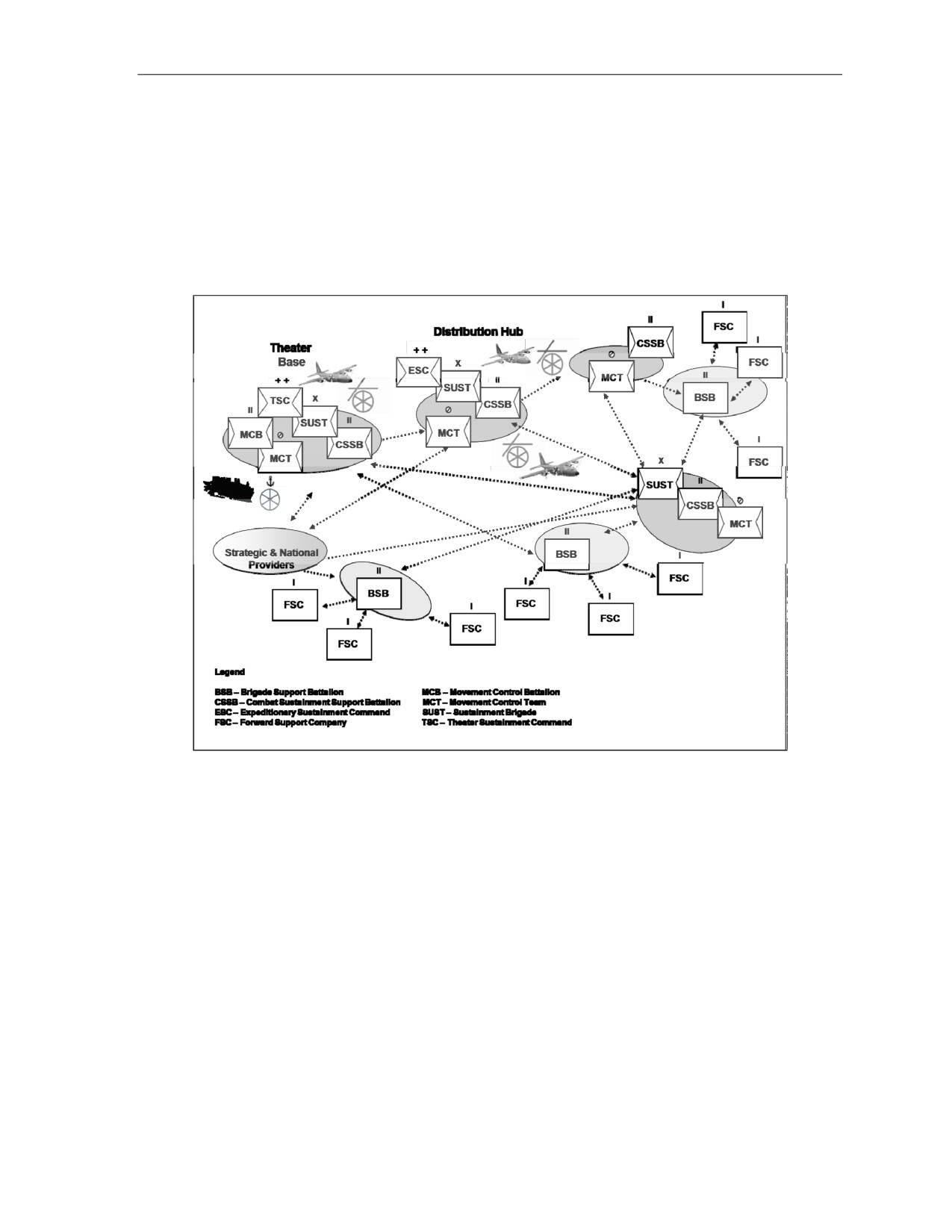
4-66. In general, the TSC establishes a network of distribution hubs and supply support activities in order to
effectively support requirements and maximize the efficiency of the intratheater distribution system. The use of
throughput from theater ports of entry to supply support activities and/or end users is maximized to reduce
customer wait time (CWT). Figure 4-4 provides a simplified view of a notional intratheater distribution system.
4-67. An integral component of the intratheater distribution system is the central receiving and shipping point
(CRSP). The TSC establishes CRSPs at distribution hubs, selected transportation nodes, and sustainment
brigades that provide area support to facilitate onward movement and ITV of supplies and equipment. This
capability also enables TSC distribution managers to more effectively schedule movements and maximize asset
utilization.
4-12
FM 4-94
12 February 2010
Support Operations
4-68. TSC distribution managers interface with USTRANSCOM, DLA, JDDOC and JTF-PO to ensure the
efficient and coordinated flow of units, supplies, equipment, and materiel from theater points of entry to final
destinations in a theater of operations or AO/JOA. In addition to providing for a seamless interface between the
strategic and operational levels, this coordination optimizes the utilization of common-user land transportation
(CULT) assets and other modes of transportation to maximize distribution, force deployment, and sustainment.
4-69. As a result of this joint interface and an integrated intratheater ITV network, combatant commanders at
all echelons have the capability to see units and sustainment in motion, permitting them to effectively make
decisions and implement action. These same capabilities give logisticians a COP that enables control
throughout the distribution system.
Figure 4-4. Simplified View of a Notional Intratheater Distribution System
CONVOY PLANNING
4-70. The TSC and its subordinate commands conduct detailed mission planning assessments in preparation
for long haul and local convoy movements. As demonstrated by recent combat operations in Iraq, logistics units
face a number of asymmetrical threats as they conduct convoy operations on a noncontiguous battlefield. In
today’s operational environments there is no such thing as an administrative move.
4-71. Convoys may be exposed to a variety of threats that range from vehicle-borne improvised explosive
devices to complex ambushes employing improvised explosive devices (IED), rocket-propelled grenades, and
small arms to artillery barrages and enemy aircraft. Detailed mission analysis mitigates risk and increases the
probability of mission success. FM 4-01.45, Tactical Convoy Operations, provides detailed information on
tactical convoy operations.
4-72. In general, the TSC, in coordination with the supporting maneuver enhancement brigade (MEB), joint
security coordination center (JSCC), or other Army forces, selects convoy routes by identifying, evaluating, and
comparing those factors which tend to facilitate convoy movement and control—movement restrictions, route
classification, traffic flow, choke points, and rest halts. Implicit in this task, is the requirement to develop a
thorough understanding of the current enemy situation along the route to include the identification of danger
12 February 2010
FM 4-94
4-13
Chapter 4
areas and potential ambush sites. Depending on the level of threat, the supporting MEB or local terrain manager
may provide a convoy escort or it may establish a movement corridor that provides for coordinated responses to
Level I and Level II threats.
4-73. For the TSC, convoy operations are routinely conducted on a changing basis to provide an increased
measure of operational security. This is especially true in known danger areas where sniper and IED incidents
may occur. Other convoy protection measures include planning for and coordinating aircraft or UAS route
reconnaissance, close air support by fixed- and rotary-wing aircraft, fire support, and electronic
countermeasures to help defeat IED threats.
4-74. Unarmed contractors and third country nationals (TCN) may be part of a convoy. When this occurs,
additional protection measures may include assigning additional security force personnel and/or dispersing
civilian vehicles throughout the convoy (due to limited communications capabilities) to enhance C2. The use of
contractors and TCNs may generate additional requirements for rehearsals and interpreters prior to convoy
movement.
SECTION IV: PROVIDE MATERIEL MANAGEMENT
4-75. The TSC provides the ASCC with a centralized materiel management capability that provides increased
efficiencies and effectiveness by reducing redundant materiel management layers, centralizing materiel
management functions, and employing a theater-wide view of resources. The result of which is responsive
support to Army requirements and reduced CWT.
4-76. The TSC performs materiel management for all classes of supplies (less medical—CL VIII materiel
management is provided by the MDSC) and maintenance management for those activities for which the TSC
has control and responsibility. TSC personnel perform the day-to-day planning for operations; providing the
theater interface between strategic and operational-level support. TSC materiel management responsibilities
include managing, cataloging, requirements determination, requirements validation and prioritization for
procurement, distribution, redistribution of excess, and retrograde of materiel. The TSC performs these
functions within the parameters of policies, plans, priorities, and allocations developed in coordination with the
ASCC G-4.
Note. Inherent in TSC maintenance management responsibilities is the requirement to integrate
sustainment maintenance activities in support of the ASCC to include coordinating with USAMC or
other elements that may control or have over sight of these entities.
4-77. In accordance with ASCC support priorities, the TSC provides direction for receiving, storing, and
issuing theater stocks. When the required stocks are not available or stock replenishment is required, the TSC
passes requirements to the appropriate CONUS national inventory control point (NICP). For requirements
being considered for local procurement, the TSC validates the requirement prior to forwarding it to the local
procuring activity.
4-78. Requisitions flow from the requesting unit directly to systems controlled by TSC materiel managers in
accordance with standard operating procedures. The corps/theater automatic data processing service center
(CTASC) then directs a sustainment brigade to fill the requirement based upon that brigade’s ability to support
the requirement or passes the requirement to the appropriate NICP. This streamlined process permits the TSC to
reach across TSC theater-wide resources and capabilities to satisfy Army requirements. Enabled by asset
visibility, this approach not only reduces but also minimizes the level of stocks required to be stored throughout
the theater.
4-79. This centralized materiel management is not exclusive. ESCs, if deployed, as well as sustainment
brigades have unique roles in materiel management (see Figure 4-5). Typically, ESC materiel management
capabilities are focused on maintaining situational awareness of order status that enables effective distribution
management within a region, theater of operations, or AO/JOA. In a similar manner, sustainment brigade
materiel management capabilities are focused on the management of subordinate supply support activities
(SSAs) that support the brigade’s area support mission.
4-14
FM 4-94
12 February 2010
Support Operations
THEATER SUSTAINMENT COMMAND:
•
Theater Focused.
•
Manages all classes of supply except Class VII & Class X.
•
Controls corps/theater automatic data processing center parameters.
•
Coordinates with National providers.
•
Issues materiel directives to sustainment brigades.
•
Conducts manager review file management.
•
Generates over-age repairable item list report.
•
Assists Brigade Support Battalion in establishing authorized stockage list storage requirements.
EXPEDITIONARY SUSTAINMENT COMMAND:
•
Area of operations/joint operations area focused.
•
As directed by the TSC, performs materiel management of specified classes of supply.
•
Assists in expediting critical supplies.
SUSTAINMENT BRIGADE:
•
Area support focused.
•
Monitors, advises, and coordinates distribution of supplies in support of units in the area of operations.
•
Manages Combat Sustainment Support Battalion inventory.
•
Executes materiel directives from Theater Sustainment command.
•
Manages bulk commodities and Class V.
Figure 4-5. TSC, ESC, and Sustainment Brigade Materiel Management Functions
4-80. TSC materiel managers develop plans, policies, programs, and procedures involving supply activities;
maintain liaison with supported and supporting units; and recommend allocation of resources and materiel
management functions to support mission requirements. TSC materiel managers:
• Execute theater management of Class I, II, III, IV, V, VI, VII, and IX.
• Recommend cross leveling of general and aviation repair parts.
• Establish and manage CTASC parameters.
• Assist in expediting critical commodities.
• Provide customer service regarding problems with managed commodities.
• Coordinate with the distribution integration and mobility branches for status on the distribution of
commodities they manage.
• Direct the receipt, storage, and issue of theater stocks in accordance with the ASCC support priorities.
• Pass requirements to the appropriate national inventory control point.
• Validate the local procurement requirements prior to submission to the local procuring activity.
• Identify items requiring retrograde; issue directives for depot level repairables.
• Track the flow of items in the retrograde system.
4-81. The standard Army retail supply system (SARSS) is the primary STAMIS used for materiel management
purposes; supporting materiel management functions for supply classes II, IIIP, IV, VII, and IX. Table 4-1
below lists the theater-level SARSS functions TSC materiel managers routinely perform.
12 February 2010
FM 4-94
4-15

Chapter 4
Table 4-1. TSC Materiel Management Functions—SARSS
Function
Materiel Manager Role
Maintain current status of high priority/high dollar
Track requisitions; provide status report. Liaison with
requisitions.
national level providers for theater requirements.
Perform miscellaneous management tasks as required.
Perform end of year closeout tasks; serial number tracking;
relation table updates; supply discrepancy reports; monthly
readiness reports; etc., in accordance with local procedures.
Manage authorized stockage list files.
Conduct demand retention analysis; manager stockage level
updates; account balance file clean up; etc., in accordance
with local procedures.
Maintain maintenance workload file.
Monitor operations, report status, conduct trend analysis,
and recommend workload alternatives as required.
Maintain catalog information.
Update catalog information in accordance with local
procedures.
Manage critical items list.
Consolidate theater critical items lists; provide status;
liaison with national level providers.
Provide customer service assistance.
Analyze problems. Provide recommended solutions.
Maintain document history files.
Research/review transactions.
Maintain local purchase manager review and suspense files.
Review transactions and validate financial requirements in
accordance with local policies.
Maintain manager review file.
Review transactions, validate financial requirements.
Maintain over-aged repairable item list.
Produce, purge, monitor, and report status in accordance
with local policies.
Establish parameter settings and maintain Department of
Establish parameter settings and update/purge Department
Defense activity address codes of supported Army forces.
of Defense activity address codes in accordance with local
policies.
Prepare performance reports.
Produce reports in accordance with local policies, provide
analysis, and recommend corrective measures.
Manage retrograde and referral actions.
Produce reports, enforce retrograde priorities, direct referral
actions, and monitor compliance/flow.
Update SARSS access.
Perform password maintenance in accordance with local
procedures.
Perform supervisory tasks.
Perform quality control checks of subordinate unit materiel
manager activities.
4-82. TSC materiel managers use the standard Army ammunition system—materiel management center
(SAAS-MMC) (a component of standard Army ammunition system—modernization [SAAS-MOD]) to provide
Class V conventional ammunition management and visibility throughout the theater. SAAS-MOD effectively
automates and integrates ammunition management functions among storage sites and theater managers;
providing TSC materiel managers with the capability to produce accurate, timely, and near real-time Class V
information concerning facility resources, reference data, ammunition requirements, authorizations, and assets
within the theater, theater of operations, or JOA.
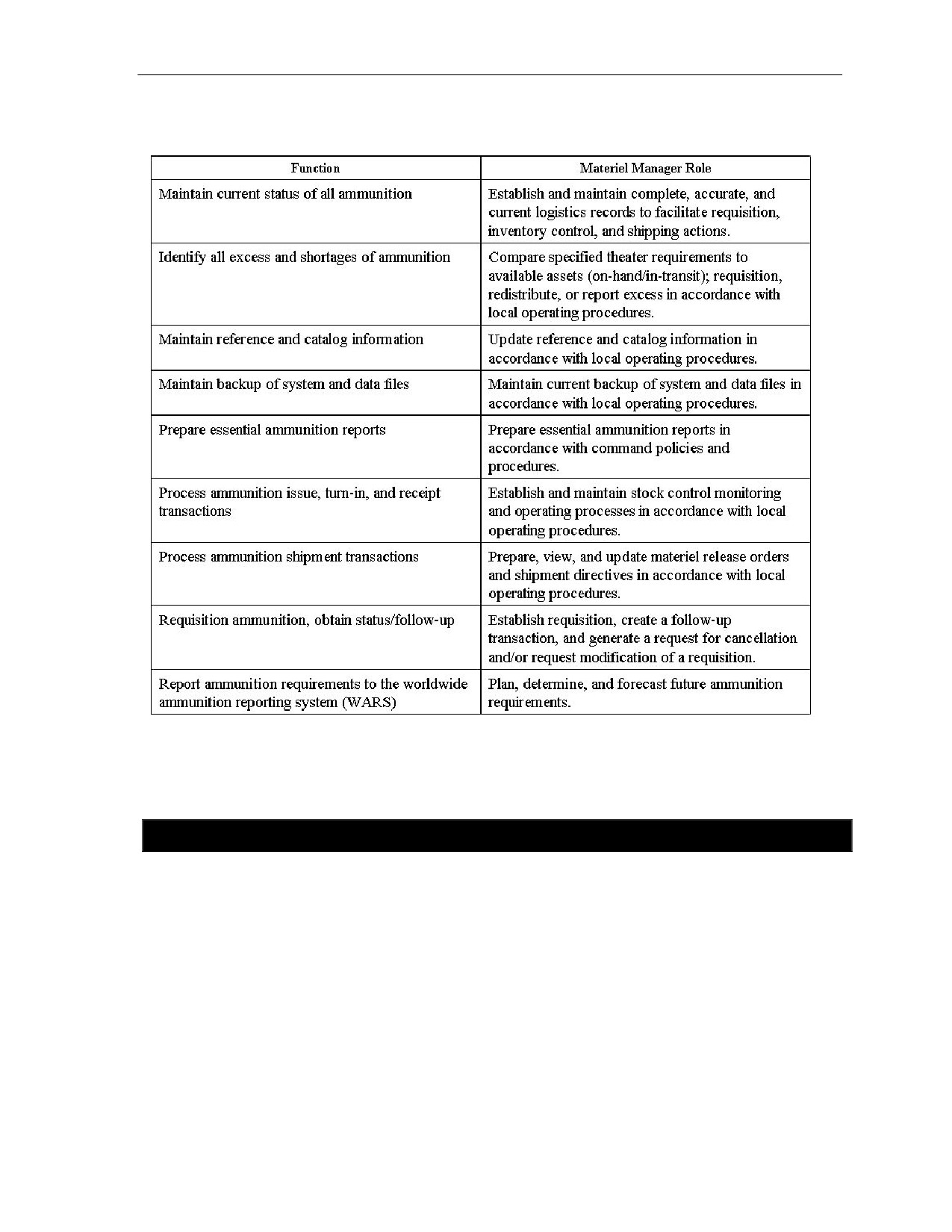
4-83. TSC Class V materiel manager functions relate to the overall management of authorizations,
requirements, and redistribution of ammunition assets within the theater. Table 4-2 lists the critical theater-level
functions TSC Class V materiel managers perform.
4-16
FM 4-94
12 February 2010
Support Operations
Table 4-2. Critical TSC Materiel Management Functions—SAAS-MMC
4-84. Commodities not supported by a STAMIS are Class I and Class III (B). TSC materiel managers use unit
strength figures as the basis for determining Class I requirements. Class III (B) requirements are based on
customer generated logistics reports and forecasted using historical consumption data and projected planned
operations.
SECTION V: PROVIDE MOVEMENT CONTROL
4-85. The TSC C2s operational-level movement control and multimodal operations in the theater. It is
responsible for developing plans, policies, and programs that support the efficient use of Army transportation
assets and the efficient flow of supplies, personnel, equipment, and units throughout the intratheater distribution
system. The TSC accomplishes this, in part, through effective coordination with the JDDOC to maintain
situational awareness of the global distribution system and joint requirements for CULT assets.
4-86. The TSC manages intratheater movements through its subordinate MCB(s); implementing priorities
established by the ASCC in support of the GCC concept of operations. Critical TSC tasks include:
• Balancing existing transportation capabilities of the distribution system with the day-to-day and
projected operational requirements.
• Preparing estimates, plans, policies, and procedures for movement control, mode operations, and
terminal operations.
12 February 2010
FM 4-94
4-17
Chapter 4
• Managing transportation flow capacity by maintaining visibility of resources that are being
transshipped at transshipping nodes.
• Coordinating the movement of major units.
• Developing policies and procedures to control, regulate, and expedite the movement of intermodal
assets (i.e. leased containers, flatracks, and 463L pallets) within the theater.
• Maintaining liaison with JDDOC, JTF-PO, and HN transportation agencies, mode operators, and
supported units.
• Protecting movement control assets.
4-87. In order to more efficiently control movements within the theater, the TSC may decide to divide the
theater into transportation movement regions. This approach permits centralized control by the TSC and
decentralized execution of movement control functions by subordinate MCBs.
4-88. In addition to facilitating the synchronized flow of units, supplies, equipment, and materiel along main
and alternate supply routes, the MCB, through its subordinate movement control teams, performs movement
control functions at APODs, SPODs, distribution hubs, and other critical nodes to expedite port clearance and
provide for the uninterrupted flow of resources and capabilities in support of Army requirements.
4-89. Operating in accordance with TSC plans and policies, the MCB is responsible for managing the use of
trailers, containers, air pallets, and flatracks located throughout the intratheater distribution system. Included in
this responsibility is the requirement to coordinate with users to expedite return of these assets to the
distribution system. Lessons learned during Operation Desert Storm/Desert Shield (ODS) and Operation Iraqi
Freedom (OIF) demonstrate that inter-modal operations are critically affected by the manner in which container
management policies are enforced and container management is subsequently executed. Therefore, it is vital to
TSC distribution operations that visibility and control of containers be maintained. Adherence to TSC policies
will ensure adequate numbers of containers are available to support intratheater distribution system
requirements.
SECTION VI: PROVIDE SUSTAINMENT
SUPPLY
4-90. Sustainment requirements are influenced by factors such as deployment timelines, troop density,
infrastructure, geography, and theater policies. The TSC staff considers these factors as well as others when
developing a concept of support to meet ASCC requirements. Inherent in this is an understanding of the
supported commander’s priorities and status of available resources.
4-91. Typically, during the early stages of an operation, the TSC will push certain classes of supplies (I, IIIB,
and V) to subordinate sustainment brigades and supported units based upon an analysis of the applicable
supported plan, supported commander’s priorities, and planning factors. The TSC may rely upon Army pre-
positioned stocks (APS) to meet initial surge requirements for sustainment. As distribution capabilities expand,
a pull system, based upon anticipated/actual requirements, is implemented to achieve greater effectiveness and
efficiencies.
4-92. The TSC provides all classes of supply (less Class VIII) and related services necessary to sustain Army
forces throughout a major operation - in the quantities and at the time and place needed. This capability
includes requesting, receiving, producing, procuring, storing, protecting, relocating, and issuing the necessary
supplies and services. It also includes building the necessary stockage levels in staging areas for conducting an
operation and collecting, providing, and processing ITV data.
4-93. Based on parameter settings established by the TSC, the CTASC determines if the requested item is
available from within the theater and directs a materiel release order to the sustainment brigade capable of
satisfying the requirement. If the item is not available, the CTASC passes the requisition to the appropriate
NICP for fill. In most instances, the actions described above are performed by the CTASC automatically in
accordance with TSC-controlled parameter settings that include referral tables. This application of centralized
4-18
FM 4-94
12 February 2010
Support Operations
control and decentralized execution enables responsive and agile support throughout the theater, effectively
minimizing CWT.
4-94. In most instances, the TSC will maximize the use of military capabilities and resources to sustain combat
operations in high intensity environments. However, in lower threat environments, the TSC will typically
maximize the use of contractors, TCNs, and HNS to sustain Army forces.
SERVICES
4-95. The TSC is responsible for planning, resourcing, monitoring, and analyzing field services support to
deployed Army forces. TSC field services operations include field laundry, showers, light textile repair, force
provider, mortuary affairs, aerial delivery support, and coordination with DLA for hazardous waste removal.
4-96. Services, such as shower and laundry support, are provided on an area basis throughout the theater and
may be called forward to support brigade combat team sustainment operations.
4-97. Force provider assets may be employed at major nodes within the theater to provide life support services
to units flowing into or out of the theater. Force provider amenities include a dining facility, showers, laundry,
and a place to sleep, rest, and relax.
4-98. The TSC, usually in coordination with the joint mortuary affairs office, determines the requirement for
and placement of theater MA assets. Requirement and placement considerations include casualty estimates from
the ASCC G-3, force structure, and the MA concept of support. MA matrices and overlays, which are part of
the COP, and RFID-ITV technology, enable units to expedite remains evacuation. Regardless of the MA
subprogram in effect, units evacuate remains through a series of collection points, located throughout the
theater, to the theater mortuary evacuation point. In some cases the theater mortuary affairs evacuation point
may be bypassed and the remains are then transported directly to the CONUS military mortuary. Commanders
and authorized personnel at brigade level and above are able to access the Defense Casualty Information
Processing System to track evacuation status.
4-99. TSC planning must ensure sufficient capacity to retrograde personal effects, not only for killed in action,
but also wounded in action, separations, incarcerations, and other unanticipated theater departures.
4-100. TSC planners integrate the use of aerial delivery capabilities with other multimodal methods of
distribution to expedite the flow of personnel, supplies and materiel throughout the theater, theater of
operations, AO, or JOA. Aerial delivery operations may include fixed-wing, rotary-wing, air-land, airdrop, and
sling-load. This range of aerial delivery capabilities provides TSC planners with the means to not only
coordinate aerial delivery from strategic distances directly to forward locations but also to provide rapid and
responsive intratheater support.
MAINTENANCE
4-101. The TSC is the fleet maintenance manager for Army forces deployed in a theater, theater of operations,
AO, or JOA. It is in this capacity that the TSC collects, analyzes, and monitors readiness data of subordinate
and supported units. This enables the TSC to effectively manage maintenance support to units and systems in
accordance with ASCC priorities. Systemic issues, beyond TSC capabilities, are passed to the appropriate
national level maintenance manager via the Army field support brigade (AFSB) (OCONUS) for resolution.
4-102. As the fleet maintenance manager for deployed Army forces, the TSC develops plans, policies,
programs, and procedures involving the maintenance of ground missile and aviation equipment in accordance
with requirements established by the ASCC. The intent of which is to maximize combat readiness through the
effective application of field and sustainment maintenance capabilities.
4-103. To this end, TSC maintenance managers work closely with the AFSB (OCONUS) to ensure effective
sustainment maintenance support to Army forces; analyzing readiness data for both systemic problems and
those associated with the unique aspects of the specific operational environment, such as, environmental
conditions and usage levels. This coordination and collaboration also provides the basis for the effective
employment of USAMC sustainment maintenance capabilities throughout the theater, theater of operations,
AO, or JOA.
12 February 2010
FM 4-94
4-19
Chapter 4
4-104. TSC field maintenance activities involve the collection and analysis of maintenance data and reports;
enabling the TSC to enforce ASCC priorities relating to the repair of specific types of equipment or support of
specific units. These same activities provide the means to identify significant trends and deviations from
established standards; enabling TSC maintenance managers to take action to ensure the maximum number of
combat systems remain fully mission capable. TSC actions may include disseminating technical information
and the allocation or reallocation of resources and capabilities to support maintenance requirements.
OPERATIONAL CONTRACT SUPPORT
4-105. Operational contract support plays an ever increasing role in operations and is an integral part of the
overall process of obtaining support across the spectrum of conflict. Today, and for the foreseeable future,
contract support will often be used to augment other support capabilities by providing an additional source for
required supplies and services. These supplies and services include all classes of supply (Class VIII, subject to
approval by medical personnel, and Class IX may be limited); labor; mortuary services (within specific
parameters); laundry; showers; dining facility services; sanitation; transportation; and port operations (if not
under the control of SDDC or Air Mobility Command [AMC]). Other contracted services may include billeting,
maintenance and repair, printing and copier support, equipment leasing, and access to communication
networks, temporary real property leasing, and limited minor construction. Currently, there are three broad
types of contracted support: theater support, external support, and system support.
• Theater Support. Theater support contracts support deployed operational forces under prearranged
contracts, or contracts awarded from the mission area, by contracting officers under the C2 of the
contracting support brigade (CSB). Theater-support contracts are utilized to acquire goods, services,
and minor construction support, usually from local commercial sources, to meet the immediate needs
of operational commanders. Theater support contracts are the type of contract support that is typically
associated with contingency contracting.
• External Support. External support contracts provide a variety of support to deployed forces. External
support contracts may be prearranged contracts or contracts awarded during the contingency itself to
support the mission and may include a mix of U.S. citizens, TCNs and local national subcontractor
employees. The largest and most commonly used external support contract is the logistics civilian
augmentation program (LOGCAP). This Army program is commonly used to provide life support,
transportation support and other support functions to deployed Army forces and other elements of the
joint force.
• System Support. System support contracts are pre-arranged contracts by the USAMC life cycle
management commands (LCMC) and separate Assistant Secretary of the Army (Acquisition, life cycle
Logistics, and Technology) program executive and product/project management offices. Supported
systems include, but are not limited to, newly fielded weapon systems, C2 infrastructure, such as the
Army Battle Command System (ABCS) and STAMIS, and communications equipment. System
contractors, made up mostly of U.S. citizens, provide support in garrison and may deploy with the
force to both training and real-world operations. They may provide either temporary support during
the initial fielding of a system, called interim contracted support, or long-term support for selected
materiel systems, often referred to as contractor logistics support.
4-106. Because of the importance and unique challenges of operational contract support, the TSC commander
and staff need to fully understand their role in planning for and managing contract support in the theater. For
example, the TSC will often be the requiring activity (the unit requesting the support) for theater support
contract actions. Similarly, depending upon METT-TC factors, the TSC will often serve as the requiring
activity for external support - i.e. mission related LOGCAP support requirements. If designated by the ASCC
as the lead requiring activity for LOGCAP support, the TSC would normally be augmented by a USAMC
logistics support officer (LSO) from Team LOGCAP-Forward. The AFSB has the lead for planning and
coordinating system support contract actions.
4-107. The CSB commander/principal assistant responsible for contracting (PARC) works closely with the
TSC SPO to ensure that the theater and external support contracting is integrated into the concept of support.
CSB and subordinate unit missions include:
4-20
FM 4-94
12 February 2010
Support Operations
• Providing theater support and contingency contracting capabilities to deployed Army forces as well as
other military forces, governmental agencies and/or non-governmental agencies as required.
• Developing contracting support plans, normally at the ASCC level. These plans include mission
specific LOGCAP support information.
• Assisting in the coordination of LOGCAP actions to ensure that this support is not in competition with
existing or planned theater support contracts.
• In close coordination with the supporting AFSB, provide contractor management advice and planning
assistance to senior commanders.
4-108. The CSB, operating in accordance with established priorities and the contract support plan (CSP),
plans and executes the day-to-day theater support contracting requirements of the ASCC; interfacing with the
TSC SPO to synchronize contracting operations with on-going and anticipated operations in support of the
ASCC commander’s concept of operations.
4-109. The TSC is the senior Army headquarters responsible for supporting ASCC deployment and
sustainment requirements (less health service support). As such, the TSC plays a central role in the planning,
execution, and monitoring of theater support contracting. Key responsibilities include, but are not limited to:
• Membership on the acquisition review board (ARB). The ARB reviews requirements for contracting
support against the CSP and priorities established by the combatant commander, subordinate joint
commands, and/or ASCC.
• Contributing to the development of the contracting support plan in coordination with the ASCC G-4,
the CSB commander/PARC, and AFSB (OCONUS).
• Integrating the CSP into the overall support plan for the theater, theater of operations, AO, or JOA.
• Requirements determination, validation, and prioritization for theater contracting in coordination with
the ASCC G-4, CSB commander/PARC, ARFOR, and AFSB (OCONUS).
• Nominating commodities for theater-controlled procurement.
• Contractor integration planning and execution, to include tracking, in coordination with the ASCC G-
3/4, ARFOR G-3, CSB commander/PARC, and AFSB (OCONUS).
4-110. For the TSC, the major challenge is ensuring theater support and external contract support (primarily
LOGCAP related support) actions are properly incorporated and synchronized with the overall concept of
support. It is imperative the TSC SPO, with or without LSO augmentation, closely works with the ASCC G4,
the CSB, and the supporting Team LOGCAP-Forward. When faced with major operational contract support
management tasks, the TSC commander may choose to organize an ad hoc contract management cell within the
G4 and/or SPO to ensure these tasks are properly accomplished. Routine TSC operational contract support staff
tasks include:
• Developing In-Theater Requirements. The TSC must to be prepared to develop “acquisition ready”
requirement packets for submission to the supporting contracting activity. The packets must include a
detailed performance work statement (PWS) (sometimes referred to as a statement of work) for service
requirements or detailed item description(s)/capability for a commodity requirement. In addition to the
PWS, these requirements packets must include an independent cost estimate along with an O-6 level
and resource manager staff approved Department of the Army (DA) Form 3953 (Purchase Request
and Commitment). Depending upon ASCC or JFC policies, certain items or specific dollar amount
requests may require formal ARB packet review.
• Assisting the Contract Management Process. One of the most important TSC and subordinate TSC
command contract management tasks is to nominate and track contracting officer representatives
(COR) (sometimes referred to as contract officer technical representatives) for every service contract
and LOGCAP task order as directed. The TSC and subordinate commands will often also be required
to provide receiving officials for supply contracts. Quality COR and receiving official support is key
to ensuring contractors provide the service or item in accordance with the contract.
12 February 2010
FM 4-94
4-21
Chapter 4
• Assisting in Contract Close Out. The TSC is responsible for completing receiving reports; certifying
the goods or services contracted for were received by the Army. The contracting officer shall receive a
copy of the receiving report from the TSC so the contract can be closed out and the contractor can be
paid.
• Participating in Award Fee and Performance Evaluation Boards. TSC and/or its subordinate units will
often be required to provide formal input to LOGCAP award fee and performance evaluation boards.
4-111. In long-term operations, as seen in OIF and Operation Enduring Freedom (OEF), the TSC will need to
ensure direct coordination and transfer of operational contract support related information prior to relief in
place/transfer of authority. Additionally, when advance elements arrive in the theater, it is essential that
designated unit personnel actively seek out current information on local contract support capabilities, policies
and procedures. These individuals must be prepared to coordinate the formal hand over of existing contract
management responsibilities with the redeploying unit. For more information on operational contract support
see FM 4-92 (FM 100-10-2) and FM 3-100.21.
Note. For more specific postings of questions and discussions of operational contract support issues,
see the Combined Arms Support Command battle command knowledge system on LOGNET -
https://lognet.bcks.army.mil/. Click on “Battlefield Contracting.” For online training covering basic
contracting familiarization, go to https://scoe.learn.army.mil/webapps/portal/frameset.jsp , browse the
course catalogues, select “SCOE courses,” and enroll in “151-CAF-DL, Contractors Accompanying
the Force.”
FINANCIAL MANAGEMENT SUPPORT
4-112. The integration of financial management capabilities with those of the TSC provides the basis for
coordinated and synchronized financial management support to operations throughout the theater; ensuring
consistency of financial management support and the most efficient use of all available financial management
resources and services.
4-113. Financial management facilitates the effective execution of sustainment operations by providing
essential financial management support that includes: negotiations with HN banking facilities, advising
commanders on the use of local currency, and coordination with national providers such as the U.S. Treasury,
Defense Finance and Accounting Service
(DFAS), and United States Army Finance Command
(USAFINCOM). Financial management also provides a resource management capability that is an integral
component of its overall capability to provide full spectrum fiscal support, from acquisition of funds to
expenditure of funds, in support of on-going and anticipated operations. Financial management capabilities are
performed and coordinated by the financial management center (FMC) and the TSC assistant chief of staff, G-
8. Financial management core competencies are procurement support; limited pay support; disbursing support;
accounting support; banking and currency support; identify, acquire, distribute, and control funds; develop
resource requirements; and track, analyze, and report budget execution. The paragraphs below provide a
description of each core competency.
PROVIDE PROCUREMENT SUPPORT
4-114. A large percentage of the financial management mission is to support the procurement process and
provide oversight. Oversight is critical in preventing improper or illegal payments. By coordinating with the
contracting officer and the staff judge advocate (SJA) regarding local business practices, financial managers
greatly reduce the probability of improper or illegal payments. Procurement support includes two areas:
contracting support and commercial vendor services support.
• Contracting support involves payment to vendors for goods and services. This includes all classes of
supply, laundry operations, bath operations, transportation and maintenance.
• Commercial vendor services provides for the immediate needs of the force. This service usually
includes payments of cash (U.S. or local currency). Cash payments are usually for day laborers,
4-22
FM 4-94
12 February 2010
Support Operations
Class I supplements (not otherwise on contract), and the purchase of construction material not readily
available through the contract or supply system.
4-115. The FMC will also coordinate Class A agent training with the supporting CSB to ensure that this
training is properly synchronized with field ordering officer training provided by CSB personnel.
PROVIDE LIMITED PAY SUPPORT
4-116. Financial managers provide travel support, casual payments, check cashing and currency exchanges to
Soldiers and civilians in permanent change of station and temporary duty status, noncombatant evacuation
operations travel advances, non-U.S. pay support
(enemy prisoners of war, host nation employees, day
laborers) and receive deposits to the savings deposit program.
PROVIDE DISBURSING SUPPORT
4-117. Disbursing support includes training and funding paying agents, administering the stored value card,
supporting rewards programs, making claims and solatium payments, cashing negotiable instruments, receiving
collections, making payments on prepared and certified vouchers, making foreign currency conversions,
funding financial management units, determining the need for currency
(U.S. and foreign) and its
replenishment, and receiving and controlling all currencies and precious metals.
PROVIDE ACCOUNTING SUPPORT
4-118. Financial managers maintain appropriated and non-appropriated funds (NAF) accounting records and
report the status of funds distributed or collected.
PROVIDE BANKING AND CURRENCY SUPPORT
4-119. Banking relationships and procedures are established with the banking industry of the HN. Activities
include establishing local depository accounts, establishing limited depository accounts to cover current
contract payments and foreign currency re-supply and coordinating with the local U.S. Embassy,
USAFINCOM, DFAS and/or the U.S. Treasury Department when negotiating with HN banking facilities.
IDENTIFY, ACQUIRE, DISTRIBUTE AND CONTROL FUNDS
4-120. Financial managers identify the sources of funds available from various Department of Defense (DoD)
and other federal agencies; acquire the funds and distribute funds to subordinate elements to support on-going
and anticipated mission requirements.
4-121. Determining what financial resources are required and available to support mission requirements is a
key FMC capability that is essential to achieving GCC objectives and providing effective support to Army
forces throughout the theater. Contracting, transportation, multinational support, support to other agencies and
international organizations, foreign humanitarian and civic assistance, and force sustainment are areas that
routinely generate resource requirements that require financial management support.
4-122. FMC resource development activities include the following:
• Preparing the financial management annex to the TSC operations plan and order.
• Developing budgets.
• Determining and validating costs to accomplish the mission.
• Determining when resources are needed throughout the fiscal year(s).
• Making resources available at the time and in the amount needed.
12 February 2010
FM 4-94
4-23
Chapter 4
• Coordinating fiscal issues associated with joint, interagency, and multinational (JIM) operations,
federal agencies, and nongovernmental organizations (NGO).
TRACK, ANALYZE, AND REPORT BUDGET EXECUTION
4-123. Financial managers establish procedures to track costs in order to determine obligation rates and
conduct analyses on use of funds in support of operational requirements. Financial managers also identify
trends to predict resourcing challenges; and submit reports as required by DFAS, Assistant Secretary of the
Army for Financial Management and Comptroller (ASA [FM&C]), and ASCC/GCC policy.
4-124. Regardless of the scale or scope of operations, financial management support plays a key role in
providing responsive, agile support to deployed forces across the spectrum of conflict. Each of these operations
must be fully integrated and synchronized with all other facets of operations in order to effectively and
efficiently sustain the force. FM 1-06 provides detailed information on financial management operations.
HUMAN RESOURCES SUPPORT
4-125. The human resources sustainment center (HRSC) plans, integrates, and coordinates human resources;
casualty operations; reception, replacement, return to duty, rest and recuperation, and redeployment (R5)
operations; and postal operations support of Army forces within the theater, theater of operations, AO, or JOA;
coordinates and synchronizes human resources (HR) capabilities with those of the TSC SPO, and supports the
ASCC G-1.
4-126. The integration of HR capabilities with those of the TSC SPO provides the basis for coordinated and
synchronized HR support to operations throughout the theater. When executed properly, integrated HR support
is a combat multiplier.
4-127. Key HRSC tasks that require synchronization and coordination with the TSC SPO include but are not
limited to:
• Developing deployment/redeployment of plan.
• Determining, in coordination with the TSC G-3 and SPO, the number, type, and location of HR
resources.
• Assessing the current situation and forecasting HR requirements.
• Directing action to apply HR resources and support at decisive points and time.
• Coordinating the execution of transportation support for mail movement to include enemy prisoner of
war mail.
• Conducting HR casualty operations.
• Coordinating the execution of transportation support to move transiting personnel within the theater,
theater of operations, AO, or JOA.
• Coordinating the execution of life support for arriving replacements and transiting personnel.
4-128. The end product of this integration effort is synchronized and coordinated HR support to Army forces
that sustains operational readiness; and a unity of effort that reduces the HR impact on logistics resources.
FM 1-0 provides detailed information on HR support.
4-129. Of special interest is the requirement for HR planning and execution to support theater opening
operations. Theater opening HR support is critical to the success of the RSOI process as well as compliance
with Title 10 United States Code (USC) requirements. In order to ensure initial HR capabilities are established
prior to the arrival of the main flow of forces, HR support elements are included as part of the early entry
element of the sustainment brigade assigned the theater opening mission. Planning requirements include the
planned placement and number of HR elements/units within the theater, theater of operations, AO, or JOA. HR
support responsibilities for early entry elements include the following:
4-24
FM 4-94
12 February 2010
Support Operations
• Initiate and establish theater personnel accountability and personnel tracking.
• Establish and operate the casualty assistance center (CAC) and conduct casualty operations.
• Establish, operate, and maintain the theater personnel database.
• Coordinate and synchronize the establishment of a military mail terminal (MMT) to support postal
operations for the theater.
4-130. Additional theater gateway R5 teams and MMT teams with corresponding HR companies/platoons will
be required if more than one intertheater APOD is used for RSOI and postal flows.
SECTION VII: PROVIDE ARMY SPECIAL OPERATIONS FORCES SUPPORT
4-131. Logistics support of ARSOF units is the responsibility of the Army except where otherwise provided
for by support agreements or other directives.
4-132. The integration of ARSOF support cell capabilities with those of the TSC SPO facilitates synchronized
and tailored support to specific ARSOF mission requirements and provides sufficient flexibility to respond to
changing requirements. Additionally, the resulting coordination and synchronization between the ARSOF
support cell and TSC provides the means for the TSC to leverage logistics resources and achieve greater
operating efficiencies. This is particularly true in the case of demands for CULT assets.
4-133. ARSOF units are supported in the same manner as conventional forces for common items and common-
user support—on an area basis, through limited HN support, and contracting. Unique special operations items
are resourced through special operations channels.
SECTION VIII: PROVIDE COMMON-USER LOGISTICS SUPPORT
4-134. GCCs are required to coordinate an integrated distribution and support system from origin to
destination during joint contingency operations with DOD supporting agencies, other agencies, Service
component commanders, subordinate joint force commands or joint task forces
(JTF), and supporting
combatant commands such as USTRANSCOM. The best option available is the use of the common-user
logistics designation. There are two key considerations the GCCs may use to designate common-user
responsibilities. These are the dominant user and the most capable force available. See JP 4-07 for additional
information on common-user logistics (CUL) support.
Note. The TSC is usually the dominate user and most capable logistics C2 headquarters in theater.
4-135. When establishing CUL responsibilities within a subordinate joint force, the combatant commander
must take into account existing CUL-related, DOD directed executive agencies as well as any existing CUL-
related agreements. When CUL support is used, Service component commands retain overall responsibility for
logistics support of their forces except when there are valid agreements or directives for the provision of CUL
support outside of the normal Service component channels.
4-136. The TSC, as the ASCC’s senior sustainment headquarters, plays a major role in optimizing resources
and synchronizing materiel support to the joint force per geographic combatant commander’s CUL guidance,
approved executive agency responsibilities, inter-Service support agreements, and acquisition and cross-
servicing agreements. When tasked to perform specified CUL responsibilities, the TSC must:
• Participate in the overall joint LPT effort in order to identify and gain access to key terrain, facilities,
etc.
• Identify specific lead CUL responsibilities and CUL execution parameters.
• Review all service support requirements as they relate to determining CUL requirements.
• Coordinate CUL support in accordance with tasking assigned.
12 February 2010
FM 4-94
4-25
Chapter 4
• Determine the source of support (military, civilian, HN, or other).
• Establish, maintain, and change priorities based on the operational situation and the combatant
commander’s guidance.
• Monitor critical classes of supply support capabilities for the purpose of mission tasking, economy of
resources, and cross leveling of critical common-item resources in accordance with combatant
commander directives for logistics.
• Coordinate requirements for agreements for inter-Service supply and support, local procurement and
controls, and allocated indigenous facilities and logistics resources available within the theater.
• Coordinate transactions and implementing instructions for U.S. and multinational support logistics
exchange issues with the appropriate Service component, agency, and/or multinational points of
contact.
• Prioritize the theater distribution and logistics effort by phase or operation.
• Manage intratheater movements.
• Allocate critical distribution and CUL resources in order to provide effective and efficient support.
• Establish a theater-wide capability to capture and maintain asset visibility of common-user materiel
and services in accordance with the GCC’s theater ITV and asset visibility data capture plan.
• Participate in functional boards or centers, if established, to centrally manage critical assets and more
effectively react to unforeseen circumstances.
4-137. Managing the competing requirements of CUL and support to Army forces is a primary concern for
TSC distribution managers. However, these managers must abide by the priorities established by the GCC and
develop appropriate metrics to measure delivery objectives when executing CUL responsibilities. Above all,
distribution managers must recognize that CUL offers greater economy and facilitates the rapid buildup of
combat power by minimizing strategic lift requirements. However, the need to economize must be balanced
with the requirement of timely delivery of supplies and materiel in support of GCC priorities.
SECTION IX: CONDUCT REDEPLOYMENT OPERATIONS
4-138. Redeployment operations are complex events that require detailed planning and synchronized
execution. Decisions made concerning withdrawal timetables, residual forces, and materiel to remain in the host
country will influence the pace and nature of the redeployment. Redeployment operations are conducted in
accordance with the GCC redeployment operations plan (OPLAN) or GCC redeployment policy.
4-139. The ASCC redeployment OPLAN provides specific guidance to Army organizations preparing for
redeployment; specifying the sequence for redeployment of units, individuals, and materiel. The plan also
provides guidance on the support network, security requirements, and APS turn-in procedures.
4-140. The TSC supports effective and efficient redeployment operations through its C2 of the intratheater
distribution system by maintaining situational awareness of system capacity and leveraging joint capabilities.
While many of the procedures used to rapidly build combat power—i.e. support RSOI, draw APS, and operate
the intratheater distribution system, apply to the redeployment process, two factors in particular complicate
redeployment operations.
• First, the same elements that operate and manage the intratheater distribution system during
deployment and sustainment operations perform similar roles during redeployment. When
redeployment and deployment/sustaining operations occur simultaneously, the TSC may find it
necessary to rebalance its forces or change the missions of subordinate organizations in order to
effectively support simultaneous operations.
• Second, requirements vary widely depending on the scale and scope of redeployment operations,
theater infrastructure, and other METT-TC considerations. For example, redeployment operations may
range from personnel only to entire units and their equipment. Depending upon the political/military
4-26
FM 4-94
12 February 2010
Support Operations
strategy, unit rotations may occur while decisive operations continue unabated or during operational
transitions. Key TSC considerations include but are not limited to: size of the force
redeploying/deploying; infrastructure requirements/limitations; security requirements; traffic
circulation; staging areas; distribution system capacity; competing requirements for available
resources; quantities of supplies and materiel to be redistributed; agricultural inspections; and
establishing and maintaining accountability of retrograde cargo. The challenge, for the TSC, is
effective coordination and synchronization, vertically and horizontally, to ensure responsive
simultaneous support to not only on-going sustainment operations throughout the theater but also
redeployment.
4-141. The TSC SPO provides staff oversight of TSC efforts in support of Army redeployment operations;
coordinating and synchronizing unit movements to designated assembly areas in accordance with the ASCC
redeployment OPLAN. Redeployment operations at the assembly areas are controlled and supervised by the
TSC; supervising the actions necessary to prepare units for movement.
4-142. Key TSC planning considerations include the identification and allocation units, equipment, and
supplies—to include HN and contractor support, required to support the redeployment operation. Coordination
for medical support and other support functions such as communications, materiel handling equipment, and
port of embarkation (POE) support is essential to mission success.
4-143. Close coordination with the ASCC, JDDOC and national/strategic partners facilitates the redeployment
process. For example, coordination with the ASCC establishes the overall framework for the orderly
sequencing of Army forces for redeployment. Issues such as responsibilities, reporting requirements, movement
constraints, and resource allocation are addressed in a collaborative manner. Coordination with the JDDOC
provides the TSC with updates to sequencing the flow of forces and equipment to designated aerial ports of
embarkation
(APOE) and seaports of embarkation
(SPOE). Coordination with USAMC facilitates the
regeneration and resetting of redeploying Army equipment and the reset of APS. See JP 3-35 and FMI 3-35 for
additional information concerning redeployment operations.
12 February 2010
FM 4-94
4-27
Chapter 5
Strategic and Joint Interfaces
Effective interfaces between the theater sustainment command (TSC) and national strategic-level and
joint partners are essential to providing responsive agile support throughout the theater. Through
collaboration and coordination, the TSC is able to achieve unity of effort in sustaining tempo and
continuity of operations throughout a major operation. The following paragraphs describe some of the
strategic and joint interfaces that must occur in order to achieve geographic combatant commander
(GCC) objectives.
SECTION I: STRATEGIC INTERFACES
DEFENSE LOGISTICS AGENCY CONTINGENCY SUPPORT TEAM
5-1. Defense Logistics Agency contingency support teams (DCST) are established to provide a single point
of contact for Defense Logistics Agency (DLA) matters in a theater, area of operations (AO), or joint
operations area (JOA). They may be deployed in support of the GCC, a subordinate joint force commander
(JFC), or Service component commanders. Multiple DCSTs may be deployed to a theater to provide a variety
of support functions based on the supported commander’s requirements.
5-2. DCSTs are comprised of an initial response team, a command support element, and three functional
elements (fuel support, materiel management, and disposal) that can be tailored to meet specific requirements.
Accordingly, DCST team composition may change as operational requirements change. A DCST will normally
redeploy once DLA-focused expertise is no longer required.
5-3. DCSTs are responsible for providing a variety of logistics, acquisition, and technical services. These
services include inventory management, procurement, warehousing, and distribution for all classes of supply
(except Classes V and VI); and reutilization and disposal of excess military materiel.
5-4. DCSTs maintain a close working relationship with supported commanders and staffs to ensure that the
support being provided meets operational requirements, is synchronized, and fully integrated. To accomplish
this, a DCST may establish several strategic support locations throughout an AO or JOA in order to provide
responsive support. This is particularly true with respect to Class I, bulk Class III, and disposal operations.
5-5. TSC distribution managers work closely with the DCST to coordinate supply, distribution, onward
movement and in-transit visibility (ITV) of essential supplies throughout the theater, AO, or JOA. In some
circumstances, ITV data may require manual input or depend upon movement control team (MCT) reporting
capabilities to maintain visibility along main supply routes (MSR). For example, movements originating in or
passing through another country may be prohibited from using ITV and radio frequency identification (RFID)
capabilities to track movements by that government.
DEFENSE LOGISTICS AGENCY DEPLOYABLE DISTRIBUTION
CENTER
5-6. The Deployable Distribution Center (DDC) is an integral component of DLA’s integrated distribution
strategy designed to provide responsive support to the Soldier. Comprised of three components, the strategy
provides for land-based forward stocks, continental United States
(CONUS) depots, and a deployable
distribution center for expeditionary operations. (See Figure 5-1.) CONUS-based DDCs provide a deployable
DLA materiel management and warehouse capability to support GCC operational requirements from within a
12 February 2010
FM 4-94
5-1
Chapter 5
theater. Fixed base forward stock locations and DLA CONUS depots are potential sources of supply for the
DDC.
5-7. The DDC provides an in-theater DLA face to the GCC and Service component logistics headquarters,
such as the TSC, that enables better control, management, and visibility of materiel flowing from national
sources to the theater and ultimately the end user. The DDC is scaleable to GCC requirements; capable of
supporting troop densities up to 120,000 troops. It provides distribution, forward stocking, and information
management capabilities over class I, II, IIIP, IV, VIII, and IX supplies. In addition to forward positioning
selected DLA managed items, the DDC may also stock selected fast-moving Service and General Services
Administration managed items.
5-8. The forward deployment of the DDC reduces the friction that normally occurs at seams in the global
distribution system. By placing this capability forward, DLA’s supporting to supported role takes on added
significance and makes it a stakeholder in theater distribution operations.
5-9. Specific DDC capabilities include a forward stocking capability; break bulk operations; theater
consolidation shipping point operations; in-theater distribution expertise; receipt, storage, and issue of
wholesale supplies; and materiel visibility. By positioning this capability forward, DLA is able to reduce
overall customer wait time (CWT), improve joint theater logistics capabilities, and reduce requirements for
scarce strategic lift resources.
5-10. TSC distribution managers work closely with the DDC to throughput supplies to end users in accordance
with GCC priorities. Similar coordination occurs between the TSC and DDC for the retrograde of unused
consumables, items marked for disposal, empty shipping containers, pallets, and unserviceable repair parts.
ARMY SUSTAINMENT COMMAND
5-11. The Army Sustainment Command (ASC) is the Army’s operational logistics organization responsible for
integrating logistics support with joint and strategic partners and is the linchpin that links the national
sustainment base with the expeditionary Army. Its responsibilities include contingency contracting, and supply
and maintenance management, and representing United States Army Materiel Command (USAMC) life cycle
management commands (LCMCs) to the field. As such, it coordinates Army requirements with joint and
strategic partners to streamline and accelerate logistics support to Army forces.
5-12. Through collaboration and coordination with the ASC, the TSC is able to maintain a continuous flow of
critical commodities, such as Class V, to the theater. The ASC also has a key role in resourcing and
downloading Army pre-positioned stocks (APS) in support of Army operations. A number of ASC capabilities,
in the form of an Army field support brigade (AFSB), deploy forward and collocate with the TSC in order to
provide responsive sustainment maintenance, logistics assistance program support, and accountability of
specified Army contractor personnel who accompany the force.
5-13. Additionally, the ASC plays a critical role in support of the Army force regeneration process. In this role,
the ASC works closely with USTRANSCOM and the TSC to ensure the timely delivery of retrograde materiel
to Army depots to support the reset mission.
SECTION II: JOINT INTERFACES
GEOGRAPHIC COMBATANT COMMANDER
5-14. When the TSC is selected by the GCC as the option to use to control the planning and execution of joint
logistics for the theater, the GCC should delineate clearly the command relationships between the combatant
command staff, particularly the J-4, all other components of the force, and the joint force land component
commander (JFLCC) and his logistics staff.
5-15. Understanding that the TSC will be under the command of the Army Service component command
(ASCC), the delineation of lanes of responsibilities between them is absolutely essential and must particularly
address how the commands will deal with Army issues and joint issues. Together with the establishment of the
command relationships, the GCC must specify clearly the authorities being delegated to the TSC to facilitate
5-2
FM 4-94
12 February 2010
Strategic and Joint Interfaces
the execution of the assigned joint functions. Establishing clear command relationships and authorities is also
applicable when the GCC creates subordinate joint force headquarters or joint task forces (JTF).
5-16. When advising the GCC on the establishment of command relationships and authorities the TSC or
expeditionary sustainment command (ESC) commander should use as a minimum the following considerations:
• The mission.
• Prevalent domain in which the operation is to be conducted (land, air, sea, or space).
• TSC or ESC capabilities.
• Time/distance factors.
• Geography and physical infrastructure within the operational area.
• The planning requirements to properly execute the mission. Particularly, how logistics planning is to
be integrated with operational planning and which organization is to conduct commitment,
contingency, and orientation planning.
5-17. GCC command relationship options for planning and executing joint logistics operations are operational
control (OPCON), tactical control (TACON), or a supporting to supported relationship. Once the command
relationships between the forces are clarified then decisions must be made to assure the proper authorities are
delegated to the TSC or ESC to execute the joint functions. This delegation should include applicable directive
authority for logistics
(DAFL) provisions and the method in which these provisions will be executed if
required. For additional information on joint staff responsibilities, especially the J4, see JP 4-0, Chapter 5. For
additional information on joint logistic boards, offices, centers, cells, and groups with which the TSC might
have to interface, see JP 4-0, Appendix C.
12 February 2010
FM 4-94
5-3
Chapter 6
TSC Protection Warfighting Function Responsibilities
The protection warfighting function is an integral component of all military operations. The
protection warfighting function encompasses those measures taken to protect personnel (combatants
and noncombatants), physical assets, and information in all locations and situations. It is
accomplished through the planned, synchronized, and integrated application of the twelve tasks and
systems of the protection warfighting function: air, and missile defense; personnel recovery,
information protection, fratricide avoidance, operational area security, antiterrorism, survivability,
force health protection; chemical, biological, radiological, and nuclear (CBRN) operations, safety,
operations security, and explosive ordnance disposal.
The theater sustainment command (TSC) plans and executes protection measures in accordance with
geographic combatant commander (GCC) and Army Service component command (ASCC) directives
and guidance. Protection measures include identifying and reducing vulnerability to hostile acts
within the TSC operational area through the use of multi-layered defenses that include integrated base
cluster defenses coordinated and synchronized with higher, lower, and adjacent commands. The TSC
also employs physical security measures to deter, detect, and defend critical facilities, information,
and systems against threats from terrorists, criminals, and unconventional forces. Physical security
measures may include fencing and perimeter stand-off distance, lighting and sensors, vehicle barriers,
blast protection, access control, and patrols.
This chapter specifically discusses the protection warfighting function in the context of TSC
headquarters responsibilities. Section I describes the protection process. Section II describes
protection tasks.
SECTION I: PROTECTION PROCESS
6-1. The protection warfighting function is not a stand-alone function. Commanders must synchronize and
integrate protection tasks and systems with on-going and anticipated operations; continually striving to improve
protection measures in order to ensure continuity of operations. In order to accomplish this, systems must be
linked to facilitate communication and to share a common operational picture (COP).
6-2. The ASCC protection cell and protection working group integrate the tasks and systems of the protection
warfighting function. Not every task or system is used at all times. For each operation, the protection cell
analyzes specified, implied, and mission-essential protection tasks. Using measures of performance or measures
of effectiveness, the ASCC protection cell assesses whether the task has achieved the desired effect and is
meeting the commander’s intent. If the task has not, the cell measures whether the commander should assume
risk or commit additional resources to the protection task.
6-3. The ASCC protection working group coordinates the activities and systems that preserve and protect the
force. This is done primarily by developing the critical asset list and defended asset list for approval by the
commander. The ASCC protection cell integrates protection functions using the composite risk management
process.
6-4. TSC protection measures are integrated and synchronized with the protection measures of the ASCC.
The TSC accomplishes protection tasks and functions directed by the ASCC; incorporating their efforts into an
established protection framework developed by the ASCC staff. Although no protection cell exists in the TSC,
protection is normally the responsibility of the G-3.
12 February 2010
FM 4-94
6-1
Chapter 6
SECTION II: PROTECTION TASKS
AIR AND MISSILE DEFENSE
6-5. The commander and staff analyze the threat and identify possible counter measures for each
vulnerability. This analysis leads to the implementation of selected passive air defense measures. For example,
if enemy air activity is likely to occur during the day, most movement should occur during hours of limited
visibility.
6-6. In accordance with TSC commander guidance, the G-3 recommends critical TSC assets and nodes for
priority air and missile defense consideration by the ASCC protection cell and provides staff oversight of
passive defensive measures. The G-3 is responsible for ensuring air and missile defensive measures are
synchronized and integrated with on-going and anticipated TSC missions to include integrating and
synchronizing responses to early warning and air defense warnings.
PERSONNEL RECOVERY
6-7. The G-3 is responsible for developing and implementing a plan for personnel recovery. The personnel
recovery plan specifies reporting procedures and actions to be taken in the event Soldiers are reported isolated,
missing, detained, or captured (IMDC).
6-8. Pre-established and rehearsed command and control (C2) procedures are essential to the recovery of
IMDC personnel. Personnel recovery may include search and rescue; survival, evasion, resistance, and escape;
and the coordination of negotiated as well as forcible recovery operations.
INFORMATION PROTECTION
6-9. The G-6 is responsible for implementing active and passive information protection measures that protect
and defend information and TSC information systems. Responsibilities include identifying threats to the
information system; implementing measures to protect computers and networks from disruption, denial,
degradation, or destruction; and protecting personnel, facilities, and equipment from the effects of electronic
warfare - friendly or enemy. (See FM 3-13.)
6-10. The G-6 is also responsible for disseminating the information operations condition (INFOCON) to
subordinate units and the staff. INFOCON messages describe operating status and the associated risk levels;
and provide a coordinated approach to defend against attacks on computers, networks, and information
systems.
FRATRICIDE AVOIDANCE
6-11. Commanders are responsible for preventing fratricide. Simplicity and ease of understanding are key
considerations when developing fratricide avoidance measures for the command. Control measures such as
realistic mission rehearsals; fire support coordination; an up-to-date COP; the identification of hazards - i.e.
unexploded explosive ordnance; positive identification tactics, techniques, and procedures—i.e. infrared
markers; and rules of engagement assist commanders in preventing fratricide.
OPERATIONAL AREA SECURITY
6-12. Operational area security is the sum of measures taken to protect critical TSC assets throughout the
TSC’s area of operations. In most instances, the TSC operational area is part of a larger designated joint
operations area with a designated joint security coordinator (JSC) who establishes and maintains operational
area security.
6-13. In coordination with the JSC, the TSC and its subordinate units are integrated into bases and base
clusters for mutual defense purposes. Subordinate commanders of the TSC may be designated as base or base
cluster commanders.
6-2
FM 4-94
12 February 2010
TSC Protection Warfighting Function Responsibilities
6-14. One of the fundamental considerations in planning and executing base and base cluster security
operations is the resolution of command authority. If command relationships and responsibilities for base and
base cluster security are not clearly identified, a conflict of interest may occur between tactical and functional
requirements.
6-15. The joint force commander (JFC), normally through a designated JSC and the existing Service chains of
command, ensures that appropriate command relationships among subordinate area, base, and base cluster
commanders are established and understood by all affected commands.
6-16. In order to effectively direct actions to prevent or mitigate hostile actions against Soldiers, resources,
facilities, and critical information, the JFC will direct all tenant units in a specified geographical area to be
responsible to the commander of that area for base and base cluster security. It follows then, that an area
commander has tactical control (TACON) over tenant units for conducting base and base cluster security
operations.
6-17. TSC subordinate commanders, who are designated as base or base cluster commanders, must also be
cognizant of the fact that there may be non-TSC units in their base or base cluster, to include multinational
forces. All units assigned to a base or base cluster are TACON to the commander of that base or base cluster
when an emergency or tactical situation requires the implementation of base security measures unless
specifically exempted by order of the area commander.
6-18. During multinational operations, the commander of a specified geographic area establishes relationships
between the subordinate forces of different countries occupying the same geographical area. This structure
unifies the different forces to the maximum degree feasible. Language, doctrinal, and philosophical differences
may be resolved by:
• Recognizing national affinities and permitting homogenous elements to operate together.
• Combining units of different nationalities only where a clear requirement exists.
• Cross-assigning liaison personnel to improve understanding.
• Organizing area responsibilities along national lines.
• Establishing a mutually supporting warning system.
Threat Levels
6-19. Threat activities are generally divided into three levels. These levels provide a general description and
categorization of threat activities, identify the defense requirements to counter them, and establish a common
reference for planning guidelines. Each level or any combination of levels may exist in an operational area,
independently or simultaneously.
• Level I Threat. A level I threat is a small enemy force that can be defeated by a unit’s organic
resources. Level I threats include enemy agents and terrorists whose primary missions include
espionage, sabotage, and subversion. Enemy activity and individual terrorist attacks may include
random or directed killings of military and civilian personnel, kidnapping, and/or guiding special-
purpose individuals or teams to targets.
• Level II Threat. A Level II threat is enemy activity that requires the commitment of a reaction force to
defeat it. A typical response force is a military police element; however, it could also be a maneuver
element. Level II threats consist of enemy special operations teams, long-range reconnaissance units,
mounted or dismounted combat reconnaissance teams, and small combat units.
• Level III Threat. A Level III threat is beyond the defensive capability of both the base and base cluster
and any local reserve or response force and requires the commitment of a tactical combat force to
defeat it. It normally consists of a mobile enemy force.
12 February 2010
FM 4-94
6-3
Chapter 6
Base and Base Cluster Defense
6-20. TSC subordinate commanders functioning as base and base cluster commanders develop and implement
comprehensive defense plans to protect their support capability. The defense plan includes measures to detect,
minimize, or defeat Level I and Level II threats. To maximize mutual support and prevent fratricide, base and
base cluster commanders coordinate defense plans with adjacent base and base clusters and joint, multinational,
and host nation (HN) forces.
6-21. Commanders should plan to use only the minimum firepower required to accomplish the base security
mission. While the right to self defense is never denied, it may be limited in some manner. For example,
unlimited use of firepower that negatively affects civilians in the secured area may cause them to embrace the
enemy’s cause or withhold support to the friendly force. Soldiers must understand this and follow strict rules of
engagement when conducting operations.
6-22. A combination of base and base cluster defense forces, designated response forces, and tactical combat
forces (TCF), are used to provide the required security for base and base cluster defense. A description of each
capability follows.
•
Base Defense Force. Base commanders establish a base defense force (BDF) as a security element to
provide local security to their base. The BDF normally consists of the combined security assets
provided by each unit on the base to meet the ongoing security requirements of the base. These assets
include crews, weapon systems, and radios of combat vehicles temporarily located on the base for
maintenance or other reasons. Normally organized as provisional security platoons, the mission of the
BDF is to conduct reaction operations to deter, resist, or destroy an enemy Level I force attacking the
base. The base commander may appoint a BDF commander to assist in executing base defense
functions.
•
Base Cluster Defense Force. The base cluster commander can direct the employment of BDFs within
the base cluster to counter Level II threats within the geographical area of the base cluster. However,
the more normal course of action is to have a response force engage these Level II threats.
•
Response Force. The area commander will designate a response force to deal with Level II threats. A
response force usually consists of military police forces supported by available fire support and Army
aviation assets. They are usually either platoon- or company-size forces. Other possible response force
options include engineer units, chemical units, transiting combat units, elements of the reserve, or HN
assets.
•
Tactical Combat Force. As part of the area commander’s organization for joint security operations
(JSO), a TCF is designated to counter Level III threats. The TCF is normally a composite force,
comprised of ground maneuver, Army aviation, and field artillery units under the command and
control of the senior maneuver unit headquarters. The actual size of the TCF depends on intelligence
preparation of the battlefield and mission, enemy, terrain and weather, troops and support available,
time available, and civil considerations (METT-TC) and the degree of risk the area commander is
willing to accept. The TCF is not normally committed until the area commander determines that both
base and base cluster defense forces and/or response forces are unable to counter the threat. The TCF
conducts direct coordination with maneuver enhancement brigade (MEB) or other response forces
regarding the exchange of reconnaissance information, battle handoff procedures, and contingency
plans for TCF operations.
ANTITERRORISM
6-23. The G-3 is responsible for integrating and synchronizing defensive measures that reduce the
vulnerability of individual Soldiers, units, and critical assets to terrorist acts.
Note. Army Regulation
525-13 establishes eight antiterrorism critical tasks that commanders
implement in order to deter incidents, employ counter measures, mitigate effects, and conduct incident
recovery.
6-4
FM 4-94
12 February 2010
TSC Protection Warfighting Function Responsibilities
6-24. Defensive measures include assessing the threat and applying the appropriate force protection condition;
assessing vulnerabilities of critical assets, recommending perimeter and internal security policy and procedures,
implementing physical security measures, and monitoring incident response capabilities.
6-25. Terrorists are among the most difficult threats to neutralize and destroy; their actions span the spectrum
of conflict. Agents, sympathizers, and terrorists attempt to create confusion, fear, or panic and become
significant threats to U.S. and multinational operations. They attempt to cause delays by disrupting command
post (CP) operations and communications and automation networks. Sophisticated cameras, listening devices,
or long-range secure radios may be used to gain information for exploiting vulnerabilities. Individual agents or
small terrorist cells may conduct random attacks to sabotage support operations.
6-26. High-priority C2 targets may include the TSC CP and its subordinate command headquarters. Petroleum
and ammunition supply points as well as supply points that receive, store, or issue Class VII items present
lucrative targets for sabotage. Materiel handling equipment may also represent a priority target.
SURVIVABILITY
6-27. No single solution exists for enhancing survivability of high value targets—except large area smoke
screens. Therefore, commanders should develop their camouflage, concealment, and decoy plans based on
situational understanding of the operational environment and an awareness of the detectable electromagnetic
signatures emitted by high value targets under their command.
6-28. In addition to employing camouflage, concealment, and deception to protect Soldiers and critical assets,
the TSC may use hardening or mobility as a means to mitigate friendly losses to hostile actions or
environments. The actual methods used by the TSC depend on the type of anticipated threat.
6-29. Hardening measures protect resources from blast, direct and indirect fire, heat, radiation, or electronic
warfare. Hardening is accomplished by using barriers, walls, shields, berms, or some other type of physical
protection to defeat or negate the effects of an attack. Engineer support may be required to accomplish
hardening tasks.
6-30. A number of operational-level logistics sites may remain static during the conduct of operations.
However, they must maintain the capability to move. The ability to move increases survivability.
FORCE HEALTH PROTECTION
6-31. The TSC surgeon, in coordination with the supporting medical deployment support command (MDSC),
is responsible for planning and implementing force health protection operations to counter the medical threat.
To counter the medical threat, comprehensive medical surveillance activities, occupational and environmental
health surveillance activities, preventive medicine measures, and field hygiene and sanitation are instituted and
receive command emphasis. These measures along with personal protective measures are essential in
maintaining the health of the command. (See FM 4-02 for more information.)
CHEMICAL, BIOLOGICAL, RADIOLOGICAL, AND NUCLEAR DEFENSE
6-32. The commander directs the establishment of coordinated CBRN protection requirements through the
preparation of a CBRN defense plan. The plan, based on the CBRN threat assessment, details requirements for
dispersing and networking available detectors, designating warning and reporting requirements, and
implementing periodic sampling and analysis.
6-33. The plan also identifies passive defensive measures that must be taken in order to reduce the
vulnerability of personnel and equipment and minimize the effects of weapons of mass destruction used against
critical sustainment nodes and ports of embarkation and debarkation. (See FM 3-11 for more information on
CBRN passive defense.)
SAFETY
6-34. Safety is a key responsibility of command. The commander implements safe practices and procedures
through his safety program. The first step in developing and implementing a vigorous safety program is to
12 February 2010
FM 4-94
6-5
Chapter 6
identify what the command’s safety goals should be and how best to achieve those goals. Each organization
within the command provides input into the goal setting process. By determining the overall strategy, resources
can be more efficiently managed.
6-35. Leaders at all levels are responsible for conducting continuous, vigorous efforts to reduce the risk of
death or injury to Soldiers and damage to vehicles, equipment, and property due to accidents. The safety officer
monitors the safety posture of the command; conducts risk analysis of operations, and provides risk
management recommendations to reduce risk to acceptable levels.
OPERATIONS SECURITY
6-36. The G-3 is responsible for integrating and synchronizing operations security (OPSEC) measures within
the command. In addition to implementing OPSEC measures in accordance with GCC and ASCC guidance, the
G-3 leads the TSC OPSEC assessment effort to identify, control, and protect unclassified information
associated with sensitive operations and activities. Information related to timing; logistics capabilities, to
include limitations; movements; and host nation support arrangements are examples of sensitive but
unclassified information that could be exploited by an adversary. (See JP 3-13.3.)
6-37. It is important to note that the process of identifying essential elements of friendly information is only
one part of a defense-in-depth approach to securing friendly information. To be effective, other security
measures such as physical security, computer network security, and limited authorized access must complement
OPSEC efforts.
EXPLOSIVE ORDNANCE DISPOSAL
6-38. Explosive ordnance disposal (EOD) is the responsibility of the supporting EOD unit. These units
identify, render safe for recovery, and dispose of explosive ordnance. These hazards consist of conventional
munitions, CBRN and associated materials, and improvised explosive devices.
6-39. TSC standing operating procedures establish reporting procedures and actions to be taken upon
encountering an item that is deemed a possible improvised explosive device (IED).
6-6
FM 4-94
12 February 2010
Glossary
SECTION I: ACRONYMS AND ABBREVIATIONS
ABCS
Army Battle Command System
ADCON
administrative control
AFSB
Army field support brigade
AFSBn
Army field support battalion
AHRW
Army human resource workstation
AHS
Army health support
AIS
automated information system
AIT
automated identification technology
ALE
Army special forces liaison element
ALT
acquisition, life cycle logistics, and technology
AMC
Air Mobility Command
AMDF
Army master data file
AO
area of operations
APOD
aerial port of debarkation
APOE
aerial port of embarkation
APS
Army pre-positioned stocks
AR
Army regulation
ARB
acquisition review board
ARFOR
Army forces
ARSOF
Army special operations forces
ASA FM&C
Assistant Secretary of the Army for Financial Management and
comptroller
ASC
Army sustainment command
ASCC
Army Service component command
BCCS
battle command common service
BCS3
Battle Command Sustainment Support System
BCT
brigade combat team
BDF
base defense force
C2
command and control
CAC
Casualty Assistance Center
CAISI
combat service support automated information system interface
CBRN
chemical, biological, radiological, and nuclear
CBRNE
chemical, biological, radiological, nuclear, and high-yield explosive
CCBN
contingency contracting battalion
CCIR
commander’s critical information requirement
CCT
contingency contracting team
12 February 2010
FM 4-94
Glossary-1
Glossary
CENTRIXS
combined enterprise regional information exchange system
C-LAN
coalition-local area network
CMOC
civil-military operations center
COA
course of action
COCOM
combatant command (command authority)
CONUS
continental United States
COP
common operational picture
COR
contracting officer representative
COS
chief of staff
COTS
commercial off-the-shelf
CP
command post
CPOF
command post of the future
CRSP
central receiving and shipping point
CSB
contracting support brigade
CSM
command sergeant-major
CSP
contract support plan
CSSB
combat sustainment support battalion
CSS VSAT
combat service support very small aperture terminal
CTASC
corps/theater automatic data processing service center
CUL
common-user logistics
CULT
common-user land transportation
CWT
customer wait time
C-WAN
coalition-wide area network
DA
Department of the Army
DAFL
directive authority for logistics
DA PAM
Department of the Army pamphlet
DCGS-A
Distributed Common Ground System-Army
DCMA
Defense Contract Management Agency
DCST
Defense Logistics Agency contingency support team
DDC
deployable distribution center
DDOC
deployment and distribution operations center
DESC
Defense Energy Support Center
DFAS
Defense finance and Accounting Service
DLA
Defense Logistics Agency
DMC
distribution management center
DOD
Department of Defense
DODAAC
Department of Defense activity address code
DODI
Department of Defense instruction
DRMS
Defense Reutilization and Marketing Service
DS
direct support
EECP
early entry command post
Glossary-2
FM 4-94
12 February 2010
Glossary
EOD
explosive ordnance disposal
EPS
essential personnel services
ESC
expeditionary sustainment command
FBCB2
Force XXI Battle Command Brigade and Below
FHP
force health protection
FM
field manual
FMC
financial management center
FMI
field manual interim
FMTP
financial management tactical platform
FRAGO
fragmentary order
FSC
forward support company
G-1
assistant chief of staff, personnel
G-2
assistant chief of staff, intelligence
G-3
assistant chief of staff, operations
G-4
assistant chief of staff, logistics
G-5
assistant chief of staff, plans
G-6
assistant chief of staff, network operations
G-8
assistant chief of staff, financial management
GCC
geographic combatant commander
GIG
global information grid
GS
general support
GTN
global transportation network
HAZMAT
hazardous material
HN
host nation
HNS
host nation support
HR
human resources
HRSC
human resource sustainment center
HSS
health service support
IED
improvised explosive device
IG
inspector general
IGO
intergovernmental organization
ILAP
integrated logistics analysis program
IMDC
isolated, missing, detained, or captured
INFOCON
information operations condition
ISO
International Organization for Standardization
ISR
intelligence, surveillance, and reconnaissance
ITV
in-transit visibility
J-2
intelligence directorate of a joint staff
J-4
logistics directorate of a joint staff
JAGC
Judge Advocate General Corps
JDDE
joint deployment distribution enterprise
12 February 2010
FM 4-94
Glossary-3
Glossary
JDDOC
joint deployment distribution operations center
JDPO
joint deployment process owner
JFC
joint force commander
JFLCC
joint force land component commander
JIM
joint, interagency, and multinational
JLSB
joint line of communications security board
JMC
Joint Munitions Command
JNN-N
joint network node-network
JOA
joint operations area
JPO
joint petroleum office
JRSOI
joint reception, staging, onward movement, integration
JSC
joint security coordinator
JSCC
joint security coordination center
JSO
joint security operations
JSOTF
joint special operations task force
JTF
joint task force
JTF-PO
joint task force - port opening
LCMC
life cycle management command
LIDB
logistics integrated data base
LIW
logistics information warehouse
LOC
line of communications
LOGCAP
logistics civilian augmentation program
LOGNET
logistics data network
LOGSA
logistics support activity
LOGSTAT
logistics status report
LPT
logistics preparation of the theater
LSE
logistics support element
LSO
logistics support officer
LWN
landwarnet
MA
mortuary affairs
MC4
medical communication for combat casualty care
MCB
movement control battalion
MCT
movement control team
MDSC
medical deployment support command
MEB
maneuver enhancement brigade
METL
mission-essential task list
METT-TC
mission, enemy, terrain and weather, troops and support available, time
available, civil considerations
MJLC
multinational joint logistics center
MLMC
medical logistics management center
MMT
military mail terminal
Glossary-4
FM 4-94
12 February 2010