FM 4-94 THEATER SUSTAINMENT COMMAND (February 2010) - page 2
Chapter 2
• Tracks and reports costs of battlefield operations to support efforts of reimbursement of costs initially
paid from available training and readiness funds.
• Obtains guidance on fund citations and funding levels and provides to tactical financial managers and
supporting finance elements.
• Provides fund control, monitors fund execution, tracks and reports costs and obligations.
• Performs analysis, planning, administration, and control of human, fiscal, financial, material, and other
DOD resources.
• Establishes the aggregate levels of fiscal support to be allocated and imposes directed resource
constraints.
• Provides input to the program objective memorandums.
• Prepares budget schedules, adjusts budgets based on program budget decisions.
• Accounts for DOD real estate, equipment, supplies, personnel, other assets, and funds in accordance
with established policy.
SECTION III: COMMAND POSTS
2-53. Doctrinally, the TSC headquarters operates from fixed facilities in sanctuary and is collocated with the
ASCC in order to most effectively perform its C2 functions. In many situations, the TSC headquarters will
remain static. When required, the TSC employs ESCs as forward deployed command posts. The TSC may
employ an ESC in this capacity to provide a forward C2 presence; improve span of control; or C2 a specified
function. However, given the realities on the ground today, stationing and ESC deployment timelines may not
meet TSC C2 requirements and the TSC headquarters may be required to relocate.
2-54. A primary consideration for this relocation is continuity of C2. A TSC commander will typically
maintain C2 continuity by echeloning elements of the headquarters. Echeloning provides the commander with
the capability to place minimum C2 capabilities forward while continuing to support the force. This lead
element is commonly referred to as an early entry command post (EECP). Once the EECP is in place and
communications with all nodes are established, the balance of the TSC headquarters moves forward by
echelon.
2-55. In addition to continuity of C2 considerations, the TSC commander is concerned with the
organizational design of the echeloning elements; specifically establishing functional groupings and
establishing functional responsibilities. Identification of responsibilities and authority for each echeloning
element provides clarity and direction with respect to the exercise of authority and continuity in the conduct of
on-going operations.
2-56. TSC contingency planning should also consider the requirement to deploy an ad hoc TSC headquarters
C2 element on a long-term basis for split-based operations. The EECP would be the basis for such an element
and the overall structure and manning would be based on existing missions, tasks, and resources available.
Commanders must consider mission requirements, organize the force, and allocate resources appropriately
while maintaining a balance to support both locations effectively. This ad hoc element would remain in place
for the time needed to mobilize and station an ESC in the area.
SECTION IV: PLANNING HORIZONS
2-57. A natural tension exists between how far ahead commanders can plan effectively without preparation
and coordination becoming irrelevant. Planning too far into the future may overwhelm the capabilities of
planning staffs, especially subordinate staffs. Conversely, not planning far enough ahead may result in losing
the initiative and being unprepared. Understanding this tension is essential to ensuring the command is focused
on the right planning horizon.
2-16
FM 4-94
12 February 2010
Mission and Organization
2-58. In general, planning horizons are points in time the TSC commander uses to focus the organization’s
planning efforts to shape future events. TSC planning horizons are measured from weeks or months for
operational-level requirements to hours and days for supporting tactical-level requirements.
2-59. The TSC often plans within several different horizons simultaneously. To guide their planning efforts,
TSC commanders use three planning horizons—commitment planning (short-range), contingency planning
(mid-range), and orientation planning (long-range).
Note. ESC commanders generally use two planning horizons—commitment planning (short-range)
and contingency planning (mid-range). ESCs are not yet resourced to conduct orientation planning
(long-range).
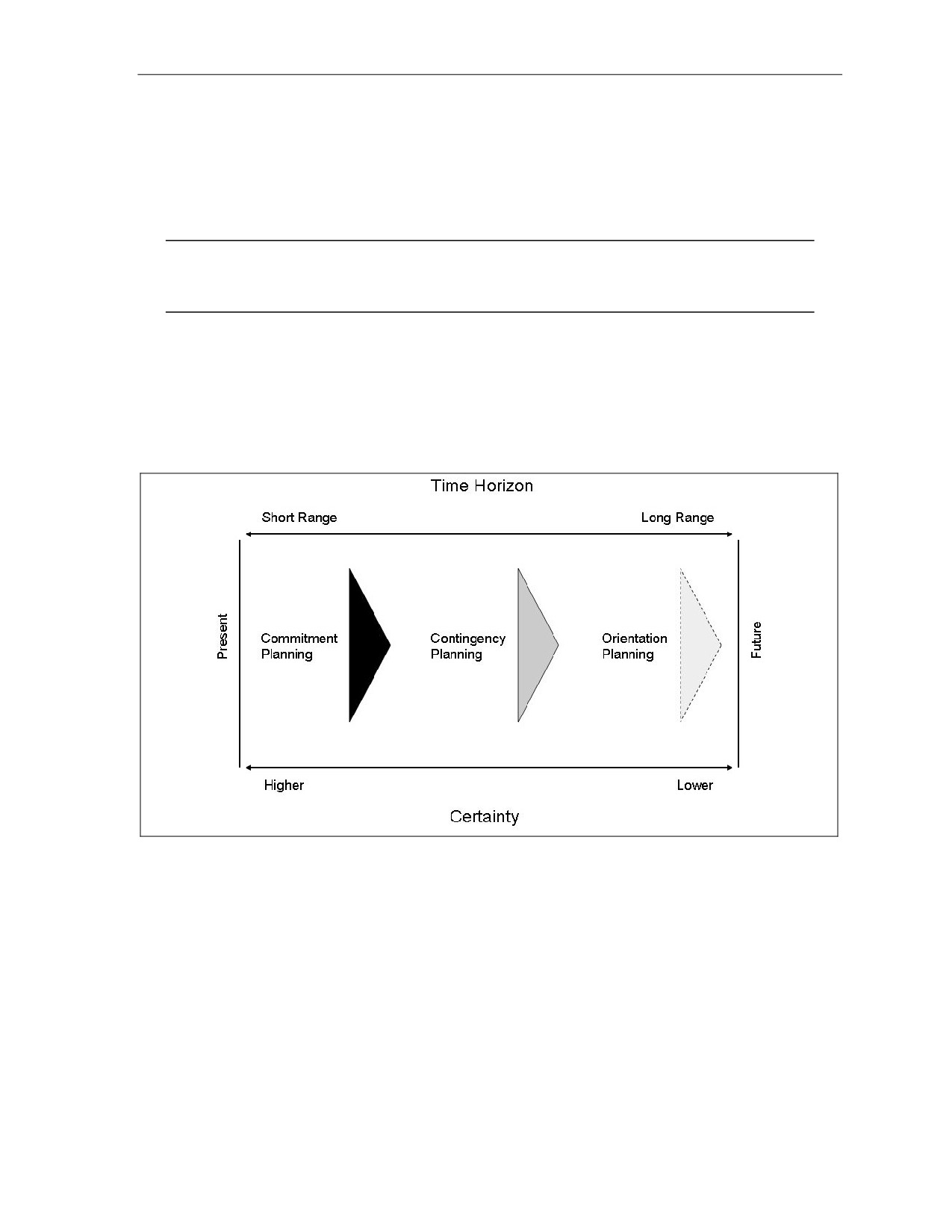
2-60. Figure 2-2 provides one way to visualize planning horizons. The variable commanders use to focus
subordinate planning efforts is certainty. As indicated in Figure 2-2, a high degree of relative certainty provides
the means for commanders and staffs to develop a conceptual basis for action, assign resources, and commit to
a particular plan. Typically, the further away in time the event is, the lower the degree of certainty. In situations
involving lower degrees of certainty, commanders focus on planning for several different possibilities.
Resources are programmed but not committed to a particular course of action or plan. See FM 5-0 for more
information on planning horizons.
Figure 2-2. Planning Horizons
COMMITMENT PLANNING
2-61. Commitment planning is short-range focused under conditions of relative certainty. Short-range planning
focuses on the immediate future. This may be hours or days. Commitment planning occurs when TSC/ESC
commanders believe they can reasonably forecast events; assign resources, and commit to a particular plan.
Commitment planning directs the physical preparations necessary for action such as staging supplies, task
organizing, and positioning of logistics resources for execution. It may involve representatives from all
warfighting functions or include only selected staff members and the commander. Who participates depends on
the problem’s complexity and available time. Commitment planning results in an OPORD or fragmentary order
(FRAGO).
12 February 2010
FM 4-94
2-17
Chapter 2
CONTINGENCY PLANNING
2-62. Contingency planning is mid-range focused under conditions of moderate certainty. Contingency
planning occurs when TSC/ESC commanders plan for several different possibilities without committing to any
one. Units and resources are programmed—but not physically committed—for several projected circumstances
under conditions of moderate certainty. Developing branches and sequels is normally the focus of contingency
planning.
Note. Distinguishing between commitment and orientation planning horizons and assigning staff
responsibilities for them is relatively straightforward. The planning horizon between them poses a
greater challenge. Contingency planning addresses contingencies within the current phase. Its time
horizon may reach out days, weeks, or months, depending on the type of operation. Contingency
planning includes branch planning and refinement of orientation planning products, such as branches
in concept form.
ORIENTATION PLANNING
2-63. Beyond the contingency planning horizon, the situation is too uncertain to plan for specific
contingencies. TSC commanders develop broad concepts addressing a number of different circumstances over a
longer time period. This orientation planning allows them to respond quickly and flexibly to a broad variety of
circumstances. Developing OPLANs in concept form for several scenarios in the distant future is an example of
orientation planning.
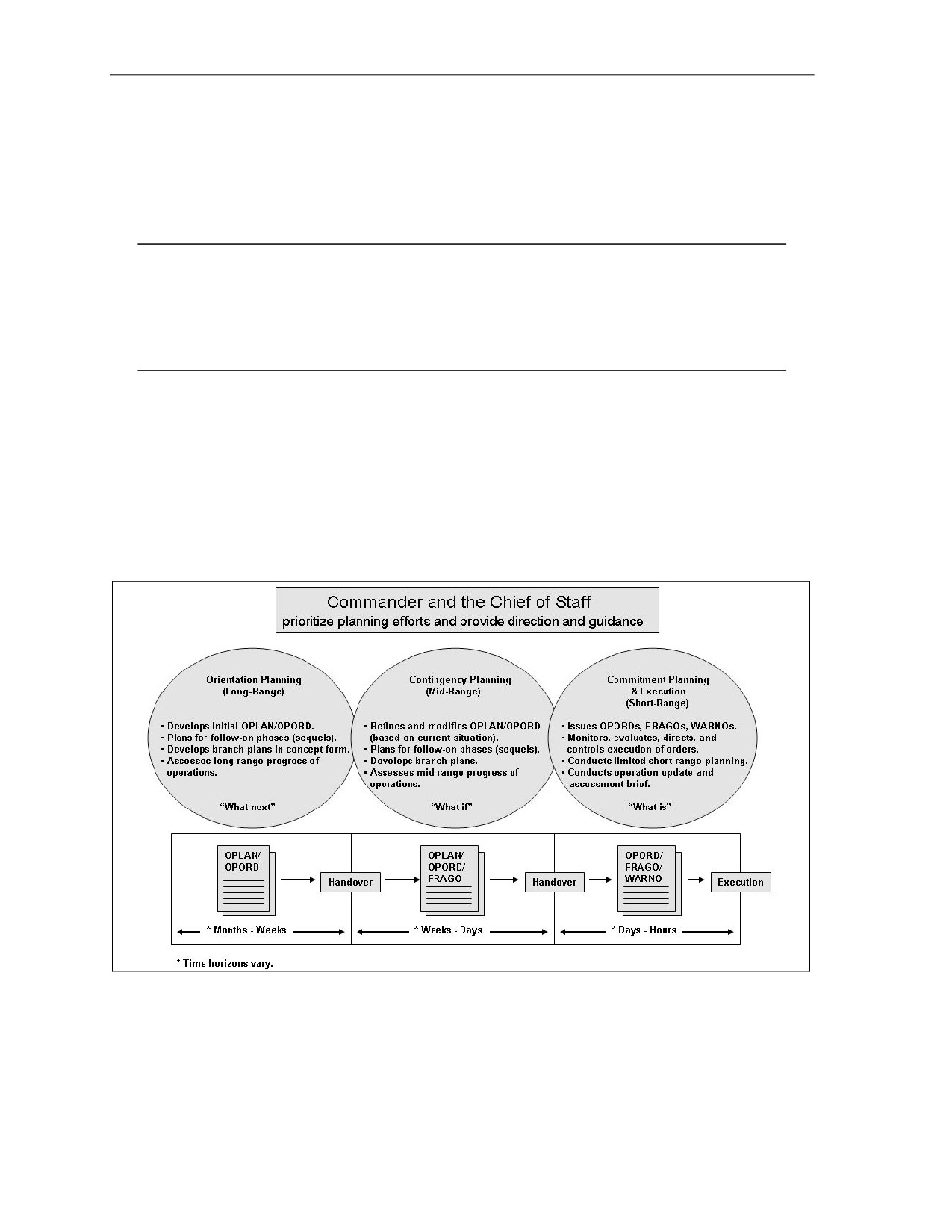
2-64. TSC commanders assign responsibility for planning based upon the degree of certainty or uncertainty.
Figure 2-3 captures the essence of TSC plans and operations synchronization.
Figure 2-3. TSC Plans and Operations Synchronization
2-18
FM 4-94
12 February 2010
Mission and Organization
SECTION V: EXPEDITIONARY SUSTAINMENT COMMAND (ESC)
ESC MISSION AND TASKS
MISSION
2-65. The ESC, attached to a TSC, provides C2 for attached units in an area of operation as defined by the
TSC. As a deployable command post for the TSC, the ESC provides operational reach and span of control. The
ESC plans and executes sustainment, distribution, theater opening, and reception, staging, and onward
movement for Army forces within the spectrum of conflict. The ESC may serve as the basis for an
expeditionary joint sustainment command when directed by the combatant commander or his designated
coalition/ joint task force (JTF) commander.
TASKS
2-66. ESC tasks are derived from the TSC METL and may include the following UJTL operational (OP) tasks:
•
OP 1 Conduct Operational Movement and Maneuver. (Selected sub-tasks.)
OP 1.1 Conduct Operational Movement.
OP 1.1.3 Conduct Joint Reception, Staging, Onward Movement, and Integration (JRSOI) in the
Joint Operations Area.
OP 1.2 Conduct Operational Maneuver and Force Positioning.
•
OP 2 Provide Operational Intelligence, Surveillance, and Reconnaissance. (Selected sub-tasks.)
OP 2.2 Collect and Share Operational Information.
OP 2.2.4 Determine Logistical Capability of the Joint Operations Area.
OP 2.4.1 Evaluate, Integrate, Analyze, and Interpret Operational Information.
•
OP 4 Provide Operational Logistics and Personnel Support. (Selected sub-tasks.)
OP 4.1 Coordinate Supply of Arms, Munitions, and Equipment in the Joint Operations Area.
OP 4.2 Synchronize Supply of Fuel in the Joint Operations Area.
OP 4.3 Provide for Maintenance of Equipment in the Joint Operations Area.
OP 4.4 Coordinate Support for Forces in the Joint Operations Area.
OP 4.5 Manage Logistics Support in the Joint Operations Area.
OP 4.6 Build and Maintain Sustainment Bases in the Joint Operations Area.
OP 4.7 Provide Politico-Military Support to Other Nations, Groups, and Government Agencies.
OP 4.8 Acquire, Manage, and Distribute Funds.
•
OP 5 Provide Operational Command and Control. (Selected sub-tasks.)
OP 5.1 Acquire and Communicate Operational Level Information and Maintain Status.
OP 5.2 Assess Operational Situation.
OP 5.3 Prepare Plans and Orders.
OP 5.4 Command Subordinate Operational Forces.
OP 5.7 Coordinate and Integrate Joint/Multinational and Interagency Support.
•
OP 6 Provide Operational Force Protection. (Selected sub-tasks.)
OP 6.3 Protect Systems and Capabilities in the Joint Operations Area.
OP 6.5 Provide Security for Operational Forces and Means.
•
OP 7 Counter Chemical, Biological, Radiological, Nuclear, and high yield Explosive (CBRNE)
weapons in the Joint Operations Area. (Selected sub-tasks.)
OP 7.2 Coordinate Active CBRNE Defense in the Joint Operations Area.
OP 7.3 Coordinate Passive CBRNE Defense in the Joint Operations Area.
12 February 2010
FM 4-94
2-19
Chapter 2
ESC ROLES, FUNCTIONS, AND ORGANIZATION
ESC ROLE
2-67. The role of the ESC is to provide forward-based C2 of assigned units. It normally deploys to the
AO/JOA and provides command and control when multiple sustainment brigades are employed or when the
TSC determines that a forward command presence is required. This capability provides the TSC commander
with the regional focus necessary to provide effective operational-level support to Army or JTF missions. The
TSC may employ multiple ESCs within the theater.
2-68. The forward deployment of the ESC facilitates agile and responsive support by placing the ESC in
relative proximity of the supported force and its operational environment. Positioned to provide a regional
focus, the ESC is optimally placed to refine that portion of the TSC logistics preparation of the theater
assessment applicable to the JTF area of operations and to array logistics forces accordingly.
2-69. Depending on the command structure within the theater, ESCs may be employed to support specific
Army forces within a specific AO/JOA; or to support other ESCs or sustainment brigades with theater opening
or theater distribution capabilities.
2-70. As described in the modular force logistics concept, the ESC role in supporting a JTF is less about
supply and more about physical distribution and readiness. Its purpose is to build and sustain JTF combat
power through agile and responsive JOA-wide support. It achieves its purpose through the effective
synchronization and execution of TSC plans and directives in support of JTF operational requirements;
executing distribution management responsibilities for its specified AO/JOA; establishing a command climate
where close coordination and collaboration with the JTF enables decisive action when unanticipated events
rapidly occur in a specific operational environment.
2-71. The ESC provides essentially the same range of support staff capabilities but not to the scale and scope
of the TSC. It lacks orientation planning and full scale materiel management capabilities.
2-72. The ESC is focused on synchronizing operational-level sustainment operations to meet the day-to-day
and projected operational requirements of the JTF or supported force. It accomplishes this, in part, by
establishing commitment and contingency planning horizons that are derived from the JTF OPLAN,
commander’s intent, CCIR, operational tempo, and distribution system capacity.
ROLE OF THE ESC COMMANDER
2-73. The ESC commander’s role is to establish a positive command climate, prepare the command for
operations, direct it during operations, and continually assess subordinates. ESC commanders visualize the
nature and design of operations through running estimates and input from subordinates. They describe
operations in terms of time, space, resources, purpose, and action; employing intent, commander’s critical
information requirements, and mission orders to direct planning, preparation, and mission execution.
2-74. The ESC commander may choose to C2 forces using either detailed or mission command or a
combination of the two processes. Typically, mission command is preferred because it provides subordinate
commanders with the greatest degree of freedom to exercise disciplined initiative within the TSC/ESC
commander’s intent; enabling decentralized execution. See FM 6-0 for more information on detailed and
mission command.
Commander’s Critical Information Requirements (CCIR)
2-75. ESC commanders use CCIR to focus information collection on what they need to support critical
decisions. CCIR enable commanders to make informed decisions during planning and course of action (COA)
selection. During preparation and execution, CCIR address information commanders require to make informed
decisions associated with decision points.
2-20
FM 4-94
12 February 2010
Mission and Organization
Mission Orders
2-76. ESC commanders direct with mission orders. Mission orders enable subordinate commanders to
understand the situation, their commander’s mission, concept of operations, and intent, and their own mission;
and begins the mission command process which is the Army’s preferred method for exercising C2. The
TSC/ESC commander’s intent and concept of operations set guidelines that provide unity of effort while
allowing subordinate commanders to exercise initiative in planning, preparing, and executing deployment and
sustainment operations. Mission orders stress not only the tasks required of subordinates but also understanding
their context and purpose.
ROLE OF THE ESC DEPUTY COMMANDER
2-77. The ESC deputy commander serves as the second in command to the ESC commander. His role,
responsibilities, and authority vary, based on the commander’s desires, the ESC mission, and the scope and
complexity of operations. The relationship between the deputy commander and the staff is unique to each ESC.
2-78. The ESC deputy commander has important responsibilities in the following circumstances:
• Temporary absence of the commander.
• Succession of command.
• Delegation of authority.
2-79. The ESC deputy commander may assume duties, to include command duties, as delegated by the
commander, either explicitly or by standard operating procedures, when the commander is temporarily absent
from the command.
2-80. Because ESC deputy commanders must be able to assume command at any time, they always keep
abreast of the situation. Commanders inform their deputy commanders of any changes in the commander’s
visualization or commander’s intent. The chief of staff keeps the deputy commander informed of staff actions.
2-81. ESC commanders typically delegate authority to their deputy commanders to act in their name for
specific fields of interest and responsibility. Doing this reduces the burden of commanders’ responsibilities and
allows them to focus on particular areas or concerns while their deputy commanders concentrate on others.
ROLE OF THE ESC STAFF
2-82. ESC staffs provide commanders with relevant information in usable forms that help commanders achieve
accurate situational understanding. Situational understanding enables commanders to make well informed and
timely decisions and allows staffs to rapidly synchronize and integrate actions in accordance with the
commander’s intent.
2-83. Each ESC staff section accomplishes this essential function by processing information, employing
decision support aids, and conducting comparative analyses in order to quickly turn information into
knowledge, create situational understanding, and share a COP.
ESC FUNCTIONS
2-84. By design, ESC operations are limited in scale and scope when compared to the TSC. The ESC employs
reach capabilities to provide the entire spectrum of support in accordance with TSC plans, policies, programs,
and mission guidance.
2-85. When supporting a JTF, the ESC establishes control of decentralized operations conducted in support of
JTF operations. It executes operational control of TSC forces and orchestrates the effective and efficient flow
of logistics and deploying units to, and retrograde and redeploying units from, the JTF; synchronizing
operational-level multi-nodal, multi-modal distribution operations with the maneuver force’s battle rhythm.
The ESC maintains multiple means of communication with the TSC DMC to facilitate effective coordination
for intertheater and intratheater deliveries to the JTF and materiel management functions not performed by the
ESC.
12 February 2010
FM 4-94
2-21
Chapter 2
ESC ORGANIZATION
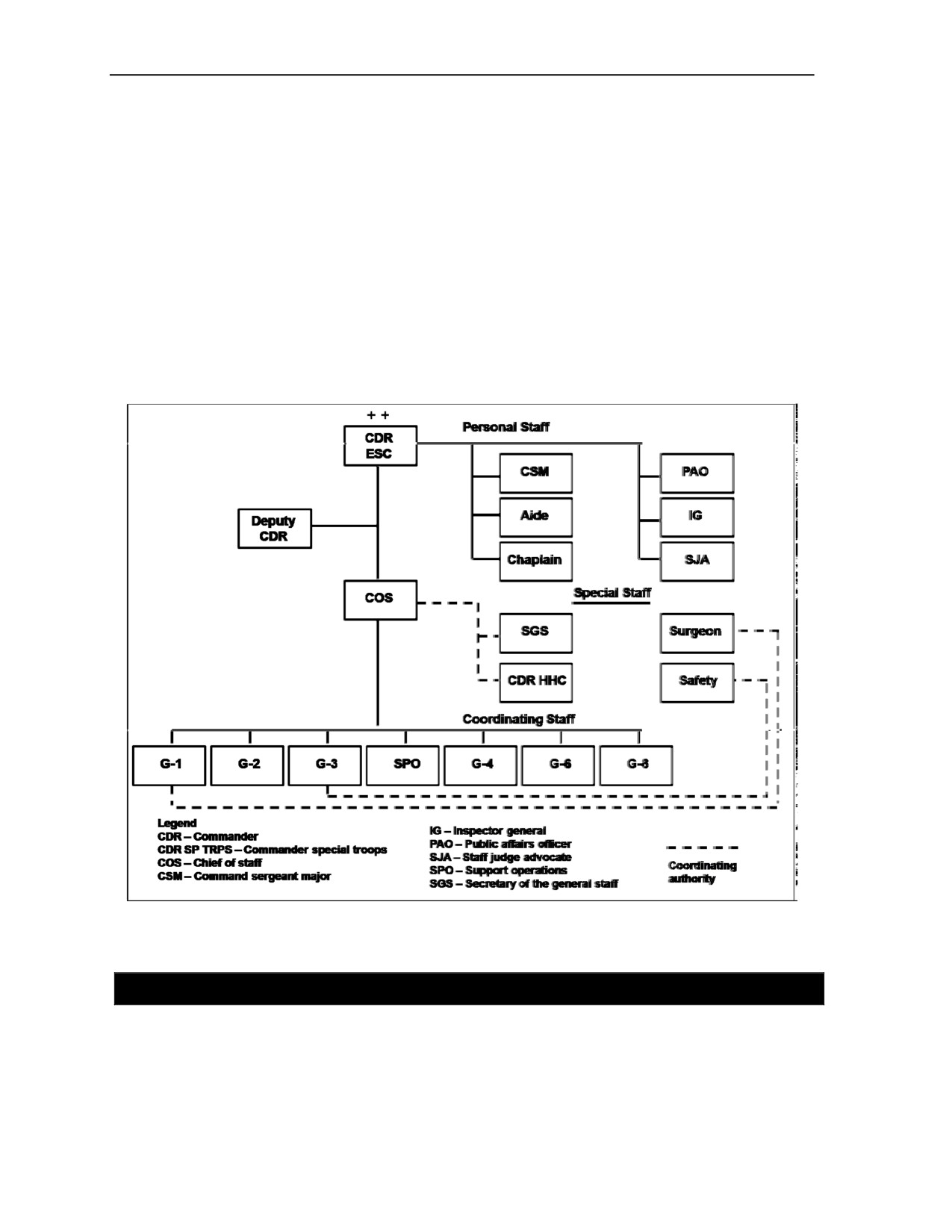
2-86. The ESC organizational structure is a near-mirror image of the TSC structure (see Figure 2-4). The ESC
is organized with a personal, special, and a coordinating staff comprised of a G-1-G-4, SPO, G-6, and G-8. In
addition to their common staff functions, the ESC staff develops policies and plans for their respective areas of
responsibility and provides guidance, priorities, and allocations to subordinate commands/units. They also
review the plans of counterpart staff elements and those of subordinate units.
2-87. For the most part, the significant difference between TSC and ESC capabilities is scale and scope.
Although they are structured following the same organizational design, the ESC is organized at a troop level
approximately 55 percent of that of the TSC. The ESC scope is also different. The TSC is concerned with
supporting ASCC/joint requirements from a theater-wide perspective, whereas the ESC is concerned with
supporting ASCC/joint requirements from a regionally focused theater of war, theater of operations, AO or
JOA perspective. There are other differences in capabilities such as orientation planning and materiel
management. METT-TC considerations determine the number of ESCs required to C2 TSC deployment and
sustainment operations theater-wide.
Figure 2-4. Expeditionary Sustainment Command TOE Staff Organization
SECTION VI: SUBORDINATE ORGANIZATIONS
2-88. This section discusses the functional and multifunctional organizations routinely assigned to the TSC as
subordinate commands or elements thereof. Subordinate C2 relationships and force tailoring decisions are
determined by the TSC based upon METT-TC considerations.
2-22
FM 4-94
12 February 2010
Mission and Organization
MOVEMENT CONTROL BATTALION
2-89. The MCB controls the movement of all U.S. forces, their equipment, materiel, and sustainment into,
within, and out of its assigned AO. It commands between four and ten movement control teams (MCT) and is
responsible to the TSC/ESC for the execution of the TSC movement program and performance of the theater
transportation system. The MCB provides transportation asset visibility and coordinates the use of common-
user transportation assets, intermodal container assets such as ISO containers, 463L pallets, and flatracks. The
MCB also provides in-transit visibility of unit moves and convoy movements.
2-90. The MCB may be tasked to provide subject matter expertise to the theater JDDOC for the purpose of
providing a force tracking capability.
MOVEMENT CONTROL TEAMS
2-91. MCTs are attached to the MCB in order to provide decentralized execution of MCB movement
responsibilities throughout a specified AO. MCTs may be employed on an area basis or at critical nodes in
order to facilitate effective movement control. Four types of MCTs are used to support operations. They are
port movement, area movement, movement regulating, and cargo documentation. See FM 4-01.30 for more
information on movement control and MCT roles and functions.
ORDNANCE GROUP (EXPLOSIVE ORDNANCE DISPOSAL)
2-92. The ordnance group (explosive ordnance disposal) (EOD) conducts operations throughout the theater in
support of combatant commanders or other government agencies to counter CBRNE and weapons of mass
destruction threats. The EOD group provides C2 and staff planning for two to six EOD battalions.
2-93. EOD battalions provide the capability to render safe and dispose of U.S. and foreign conventional and
unconventional unexploded ordnance (UXO), improvised explosive devices (IED), and CBRNE/weapons of
mass destruction and associated materiel that present a threat to operations, installations, personnel and/or
materiel. Routine clearing and rapid breaching of foreign or U.S. minefields are the responsibility of Army
engineers. As part of the protection warfighting function, EOD provides the expeditionary Army with a rapidly
deployable support package for rendering safe UXO and IEDs in any operational environment. Army EOD
forces equip, train, and organize to support tactical land forces across the spectrum of conflict and provide
theater and subordinate commanders with UXO and IED intelligence analyses to enhance U.S. and
multinational force protection. ATTP 4-32 (FM 4-30.50) contains information on EOD operations.
2-94. The GCC's planning staff develops the theater-level concept of EOD support. The ASCC staff tailors
EOD forces to support specified operations down to brigade combat team level. Responsibilities of EOD
commanders at all levels include:
• Recommending policy and distributing EOD assets.
• Monitoring EOD support missions and establishing workload priorities.
• Serving as point of contact for technical intelligence coordination.
• Coordinating general support (GS) and general support-reinforcing EOD support.
• Ensuring each EOD unit establishes provisions for communications at each level to support EOD
operations.
• Supplementing other theater force protection procedures to meet the existing threat.
• Coordinating administrative and logistics support, as required, from the supported command(s).
QUARTERMASTER GROUP (PETROLEUM)
2-95. The quartermaster group (petroleum) is responsible for inland bulk fuel distribution at the operational
level; managing theater petroleum stocks; providing a base petroleum products laboratory for quality assurance;
and coordinating petroleum procurement with its supporting joint area petroleum office. When required, the
12 February 2010
FM 4-94
2-23
Chapter 2
group oversees the construction of petroleum facilities in a theater. It C2s petroleum pipeline and terminal
operating battalions and petroleum supply battalions. These units operate and maintain petroleum distribution
facilities that support the theater petroleum mission.
PETROLEUM PIPELINE AND TERMINAL OPERATING BATTALION
2-96. Petroleum pipeline and terminal operating battalions are assigned to the TSC and are normally attached
to a petroleum group. Petroleum pipeline and terminal operating battalions are responsible for the operation and
maintenance of a military petroleum distribution system that may include ports of entry, pipelines, tank farms,
and tactical marine terminals. Their core capabilities include scheduling and directing the flow of bulk
petroleum products through multiproduct military pipelines and coordinating the movement of bulk petroleum
products by barge, rail, and truck.
2-97. Petroleum pipeline and terminal operating battalions are also responsible for implementing a quality
assurance program and may operate a base petroleum products laboratory.
PETROLEUM SUPPLY BATTALION
2-98. Petroleum supply battalions are assigned to the TSC and are normally attached to a petroleum group.
Under certain METT-TC conditions, they may be attached to a sustainment brigade. In such cases, they serve as
the link between the pipeline systems and direct support (DS) supply units in their specified AOs.
2-99. Petroleum supply battalions are capable of providing both DS and GS petroleum supply. They may also
store a portion of theater petroleum (reserve) stocks.
2-100. Petroleum supply battalions receive bulk petroleum via pipeline, rail, truck, or barge from terminals
operated by a petroleum pipeline and terminal operating battalion. They may also receive deliveries from
Defense Logistics Agency (DLA), Defense Energy Support Center (DESC) and commercial sources/contracts.
These battalions receive, store, and transfer bulk petroleum to DS supply units. They operate 5,000- or 7,500-
gallon tankers and, when feasible, rail cars or barges to distribute bulk fuels. When required, they can also
provide bulk and retail supply point distribution. Petroleum supply battalions provide technical and operational
supervision for the storage and distribution of petroleum products within their specified area of operations.
SUSTAINMENT BRIGADE
2-101. Sustainment brigades consolidate selected functions previously performed by corps and division
support commands and area support groups into a single operational echelon and provide C2 of theater
opening, theater distribution, and sustainment operations. Greater detail on these missions and organization of
the sustainment brigade is provided in FMI 4-93.2. Combat sustainment support battalions (CSSB) are the
building blocks of the sustainment brigades. Their headquarters’ designs are standardized and they can consist
of up to eight companies. CSSBs are modular and task organized to support theater opening, theater
distribution, area sustainment, or life support missions.
2-102. Sustainment brigades provide C2 and staff supervision of life support activities, and distribution
management to include movement control as an integral component of the theater distribution system. With
augmentation, they are capable of performing theater opening functions. METT-TC considerations determine
the mix of functional and multifunctional subordinate battalions under their control.
2-103. Sustainment brigades are an integral component of the joint and Army battlefield communications
network; employing satellite and network-based communications that enable C2; visibility of the distribution
system; and identification of support requirements.
2-104. The sustainment brigade materiel management effort is focused on the management of its supply
support activities (SSA) in accordance with TSC plans, programs, policies, and directives. The sustainment
brigade may also provide materiel management of bulk supplies through oversight of stockage areas such as
bulk fuel and ammunition storage areas. The sustainment brigade coordinates and controls supply functions,
including the redistribution of intratheater excess, to meet the operational requirements of the TSC and its
supported units, employing near real-time situational awareness of stock records and asset visibility to provide
2-24
FM 4-94
12 February 2010
Mission and Organization
responsive and agile support. Analysis of stock status and mission requirements enables the sustainment
brigade to effectively manage its workload and control potential backlogs or bottlenecks generated by
competing requirements and/or priorities.
2-105. Based on parameter settings established by the TSC, the CTASC determines if the requested item is
available from within the theater and directs a materiel release order to the sustainment brigade capable of
satisfying the requirement. If the item is not available, the CTASC passes the requisition to the appropriate
national inventory control point (NICP) for fill. In most instances, the actions described above are performed by
the CTASC automatically in accordance with TSC-controlled parameter settings that include referral tables.
This application of centralized control and decentralized execution enables responsive and agile support
throughout the theater, effectively minimizing customer wait time (CWT).
Note. Customer wait time measures the speed and efficiency of the logistics community’s ability to
support the Soldier in the field.
TRANSPORTATION THEATER OPENING ELEMENT
2-106. The transportation theater opening element (TTOE) is attached to a sustainment brigade when that
brigade is assigned the mission of early entry and establishment of an area of operation’s logistics base. The
TTOE provides an additional 54 transportation personnel and allows the brigade to function as a seaport
operator and distribution manager. With this capability, the brigade establishes the initial surface distribution
system for an area of operations.
2-107. TTOE capabilities provide a sustainment brigade with the staff augmentation and functional expertise
necessary to efficiently and effectively conduct theater opening operations (less health service support) that
include RSOI of deploying Army forces. RSOI functions include coordinating, synchronizing, and clearing of
aerial ports of debarkation/sea ports of debarkation
(APOD/SPOD) holding areas, staging areas, and
marshalling areas; personnel and unit equipment integration; life support; and the multi-modal onward
movement of units and/or supplies to tactical assembly areas (TAA) and/or distribution hubs. The execution of
RSOI functions require close coordination with supported commanders, the TSC, joint partners, and the HN.
2-108. Other TTOE functions include:
• Evaluating and ensuring that the appropriate mode is employed and fully integrated with materiel
distribution requirements.
• Providing advice on the use and implementation of assigned, attached, contracted, and HN motor
transport assets.
• Providing guidance on positioning of motor transport, air, and rail assets throughout the AO.
• Monitoring and maintaining the status of all modal transportations assets in the AO and ensuring
proper tasking.
• Providing advice on the use and implementation of assigned, contracted, and HN terminal and
watercraft operations.
• Providing terminal infrastructure assessment.
• Monitoring and coordinating operations and positioning of all terminal operations in the AO, to
include motor, rail, inter-modal, air and sea.
• Monitoring and maintaining status of terminal assets in the AO to ensure they are properly employed
and not over-tasked.
2-109. At some point along the deployment-employment-sustainment continuum the TTOE may be attached
to the ESC to facilitate theater-level movements in accordance with the TSC movement program and support
ongoing deployment/redeployment operations.
12 February 2010
FM 4-94
2-25
Chapter 2
COMBAT SUSTAINMENT SUPPORT BATTALION
2-110. The CSSB is the building block upon which TSC sustainment capabilities are developed. Typically
attached to a sustainment brigade, the CSSB is tailored to meet specific mission requirements. Attached
capabilities, drawn from the force pool, may include transportation, maintenance, ammunition, supply,
mortuary affairs, airdrop, field services, water, and petroleum.
2-111. Employed on an area basis, the CSSB plans, coordinates, synchronizes, monitors, and controls
sustainment operations (less health service support) within a specified AO; supporting units in or passing
through its geographic area.
MOTOR TRANSPORTATION BATTALION
2-112. Motor transportation battalions are assigned to the TSC and are normally attached to sustainment
brigades conducting theater distribution missions. A motor transportation battalion’s core capabilities include
motor transport operations and terminal operations (less seaport). It C2s three to seven motor transport or cargo
transfer companies.
2-113. The motor transportation battalion staff translates mission orders from the sustainment brigade into
specific requirements; operationally controlling the operation of truck terminals, trailer transfer points, and
trailer relay operations within its assigned AO.
TRANSPORTATION TERMINAL BATTALION
2-114. Transportation terminal battalions are assigned to the TSC and are normally attached to sustainment
brigades. A transportation terminal battalion’s core capabilities include terminal and inland waterway
operations. Terminal operations include truck, rail, air, and marine terminals.
2-115. A transportation terminal battalion C2s three to seven transportation terminal operations or watercraft
companies. The transportation terminal battalion staff translates mission orders from the sustainment brigade
into specific requirements; enabling the effective and efficient flow of materiel and personnel into and out of
the theater.
ORDNANCE BATTALION (AMMUNITION)
2-116. Ordnance battalions (ammunition) are assigned to the TSC and are normally attached to sustainment
brigades. An ordnance battalion is typically employed to provide C2 of modular ammunition units operating
theater storage areas at the operational level; providing technical supervision of subordinate unit ammunition
operations, except for inventory management functions performed by the TSC.
2-117. Subordinate ammunition units receive munitions from the national level; maintain theater stocks;
conduct operational-level reconfiguration; and distribute munitions to forward storage areas located throughout
the theater.
FINANCIAL MANAGEMENT CENTER
2-118. The financial management center (FMC) functions as a staff element of the TSC and asserts technical
coordination over all Army financial management companies and detachments in theater. The FMC Director, in
coordination with the TSC G-8 or Support Operations, is the principal advisor to the ASCC commander and
ASCC G-8 on all aspects of financial management operations. The FMC provides technical oversight of all
Army financial management operations in the theater to include negotiations with HN banking facilities,
advising unit commanders on the use of local currency, and coordination with national providers (U.S.
Treasury, Defense Finance and Accounting Service [DFAS], Assistant Secretary of the Army for Financial
Management and Comptroller [ASA FM&C] and United States Army Finance Command [USAFINCOM]) to
establish financial management support requirements. The FMC sustains Army, joint and multinational
operations by providing timely contractual and procurement payments and a theater disbursing capability. FMC
functions include:
2-26
FM 4-94
12 February 2010
Mission and Organization
•
Planning, coordinating, integrating, and synchronizing the procurement and use of local currency in
support of maneuver commander’s operational and tactical plans—to include advising unit
commanders on the use of local currency in the conduct of personal affairs.
•
Developing financial management policy and procedures for theater implementation, in coordination
with the ASCC G-8.
•
Preparing financial management annexes in support of TSC plans and orders, in coordination with the
TSC G-8 and Support Operations.
•
Providing advice regarding the interpretation and dissemination of financial management directives,
policy, and guidance developed by the national providers.
•
Identifying financial management force structure requirements, in coordination with the TSC G-3, and
playing a key role in the force flow of financial management units.
•
Implementing and enforcing internal control measures.
•
Performing both appropriated and non-appropriated fund (NAF) accounting for the theater.
•
Maintaining accounting records and reporting the status of appropriated and NAF funds distributed to
the supported commands.
•
Collecting and reporting NAF accounting data, disbursing NAF, and preparing NAF instrumentalities
payrolls.
•
Funding (U.S. and foreign) currency for the theater.
•
Coordinating with host nation and military banking facilities to provide currency to financial
management units and other Services or allied forces in accordance with inter-Service and inter-
governmental agreements.
•
Coordinating the establishment of local depository accounts in theater.
•
Establishing and maintaining the financial management information network in coordination with
theater signal providers.
•
Coordinating the installation of software and hardware updates to the financial management tactical
platform (FMTP).
•
Ensuring system integrity against computer viruses by enforcing appropriate system security measures.
HUMAN RESOURCES SUSTAINMENT CENTER
2-119. The human resources sustainment center (HRSC) functions as a staff element of the TSC. The HRSC
provides theater-level support to the ASCC G-1 and enables the TSC Commander to plan, integrate and execute
HR support to the theater. The TSC is the key linkage between the ASCC G-1 who provides the policy,
direction, and guidance for HR support to the theater and the HRSC, which executes the HR support mission
for postal, casualty, R5 and PASR. The HRSC has a defined role to ensure that the theater HR support plan is
developed and then supported with available resources within the TSC. The HRSC is the technical link to HR
organizations which execute postal, R5, and casualty operations, and personnel accountability support
functions.
2-120. The HRSC is a multifunctional, modular organization that integrates and ensures execution of HR
support throughout the theater as defined by the policies and priorities established by the ASCC G-1 in postal,
casualty, R5 and personnel accounting and strength reporting (PASR) core competencies. The HRSC provides
planning and operations technical support to the TSC DMC. The HRSC provides technical guidance to the HR
operations branch in sustainment brigades and ESCs, and HR companies and teams. The HRSC’s flexible,
modular and scalable design increases the HRSC director’s ability to recommend HR support based upon the
number of units and Soldiers supported and METT-TC. The HRSC’s ability to directly coordinate needed
sustainment resources with the TSC DMC to support postal and R5 operations is critical to mission success.
12 February 2010
FM 4-94
2-27
Chapter 2
2-121. The HRSC provides technical guidance and ensures execution of the personnel accounting, postal, R5,
and casualty core competencies performed by HR (Standard Requirements Code [SRC] 12) elements, including
theater gateway R5 teams, military mail terminal, HR Companies, platoons, teams and the HR operations
branches in the sustainment brigades and ESCs. The HRSC provides operational planning, and current and
future operations management. It coordinates support for the TSC and ASCC G-1, ensures connectivity and
resource support for postal, R5 and casualty units, integrates personnel data when necessary, and participates in
the TSC distribution management process. HRSC responsibilities include:
• Providing timely, accurate, relevant and reconciled information to the ASCC G-1 that enables the
decision making process.
• Planning, coordinating, integrating and executing HR support as defined by the ASCC commander and
TSC commander (especially in the core competencies of personnel accounting, postal, R5, and
casualty operations).
• Providing technical guidance and support to subordinate HR branches, HR Companies and their
subordinate platoons, and in some areas, supported G-1 and S-1 sections.
• Executing personnel accountability, data access/reporting/analysis, casualty operations, postal and R5
operations executed by SRC12 organizations in accordance with ASCC G-1 policy.
• Establishing the deployed theater casualty assistance center (CAC) linked to the casualty and mortuary
affairs operations center at Human Resources Command.
• Establishing the infrastructure supporting the theater deployed personnel database, currently supported
by the deployed theater accountability system. Operates and maintains the deployed theater
accountability system database.
• Establishing linkages to continental United States (CONUS)-based postal national-level agencies such
as the Military Postal Service Agency and the Joint Military Postal Activity
(New York,
San Francisco).
• Providing policy recommendations, through the TSC to the ASCC G-1, for inclusion in the
Department of the Army (DA) G-1 personnel policy guidance which is routinely updated to reflect
requirements for deployed forces.
SECTION VII: ATTACHMENTS
2-122. The term “Attachments” as used in the Section VII heading does not reflect a specified command
relationship. The organizations described below reflect capabilities that may be provided to the TSC based
upon supporting to supported agreements with strategic providers and/or METT-TC considerations within the
theater, theater of operations, or JOA. Appropriate command relationships are attached, OPCON, or tactical
control (TACON).
SUSTAINMENT BRIGADE (SPECIAL OPERATIONS) (AIRBORNE)
2-123. The Sustainment Brigade (Special Operations) (Airborne), (SB [SO] [A]), when deployed acts as the
single logistics command element for a joint special operations task force (JSOTF). The SB (SO) (A) plans,
integrates, and assesses Army common and special operations forces (SOF) peculiar logistics to sustain SOF
across the spectrum of conflict. The brigade is designed to serve as an early entry element to C2 one CSSB in
support of a conventional force subordinate to the JSOTF. The brigade monitors and updates the COP;
synchronizes and manages sustainment and distribution operations; determines and anticipates sustainment
requirements; plans, coordinates, and synchronizes both current and future sustainment operations for deployed
SOF units. The brigade integrates Army special operations forces (ARSOF) support requirements into the
ASCC support plan and ensures a timely response to ARSOF logistics requirements. It can operate as a stand
alone SOF logistics command post or as a lateral staff agency to augment a TSC and can provide continuous,
24-hour operations for all SOF sustainment requirements.
2-28
FM 4-94
12 February 2010
Mission and Organization
2-124. If deployed, the SB (SO) (A) is intended to remain an interim capability and any one of the following
triggers would cause a transfer of the logistics C2 mission to a conventional Army logistics C2 capability: C2 of
more than one CSSB; geographical dispersion beyond the capability of the SB (SO) (A); operations longer than
six months in duration; more than one major logistics node and more than one brigade combat team (BCT)
deployed. After being relieved in place, the brigade would then employ an ARSOF support cell embedded with
a conventional sustainment brigade, the ESC, or the TSC, to coordinate, monitor, and synchronize logistics
support for JSOTF operations, other ARSOF operations, and for joint/multinational SOF where the Army is the
lead Service for logistics.
2-125. The brigade has the capability to provide technical supervision, utilizing its ARSOF liaison element
(ALE) and ARSOF support cell, to assist the ASCC/TSC and theater special operations command (TSOC) in
the planning and execution of logistics and HSS/FHP supporting SOF requirements.
Note. The SB (SO) (A)’s ALE, a multifunctional logistics element, is the logistics planning and
coordination link between the geographic combatant command, TSOC, SB (SO) (A), and the ARSOF
command structure. ALEs are assigned to United States Army Special Operations Command SB (SO
[A]), but habitually attached to a TSOC that coordinates logistical support provided by the ASCC to
deployed SOF.
ARSOF SUPPORT CELL
2-126. The ARSOF support cell is a task organized deployable team comprised of multi-functional logisticians
from within the SB (SO) (A) distribution management center. Its mission is to coordinate, monitor, and
synchronize logistics support for the JSOTF operations, other ARSOF operations, and for joint/combined SOF
where the Army is the lead Service for logistics.
2-127. To facilitate this support, an ARSOF support cell can be employed in the following four scenarios: to
reinforce the group support battalion of special forces groups acting as a JSOTF by providing C2 of theater
opening/theater distribution modules in an austere theater; to serve as the initial command post for a deployed
SB (SO) (A) or, with augmentation from the SB (SO) (A), to serve as an interim sustainment C2 capability in
support of an ARSOF-led JTF until a theater logistics infrastructure can be developed; to coordinate and
monitor Army common and SOF-peculiar sustainment and HSS/FHP in support of ARSOF by collocating with
deployed ESCs and TSCs. When not deployed, the ARSOF support cell personnel man the home station
operations center and provide reach support to the ALE.
MEDICAL LOGISTICS MANAGEMENT CENTER SUPPORT TEAM
2-128. A medical logistics management center (MLMC), a subordinate unit of the MDSC, provides for the
centralized management of medical materiel and maintenance throughout a theater. The MLMC is capable of
deploying forward support teams while maintaining base operations within CONUS. MLMC support teams
provide centralized management of medical materiel, primary medical items, medical maintenance, and
coordination of the distribution of Class VIII materiel throughout a theater, theater of operations, or JOA.
2-129. MLMC support teams have the capability to deploy an early entry element to support theater opening
operations. In most scenarios, the early entry element will deploy and establish initial operations. As the theater
base expands, a follow-on element deploys and the two elements merge to form a single MLMC support team
that is collocated with the TSC.
2-130. The MLMC has two forward support teams. One team is deployed per theater and collocates with the
TSC in order to facilitate the integrated and synchronized flow of Class VIII materiel throughout the theater,
theater of operations, or JOA. The MLMC support team accomplishes this by:
• Executing liaison functions between forward deployed medical units and CONUS-based strategic
assets.
• Coordinating distribution of Class VIII materiel with TSC support operations.
12 February 2010
FM 4-94
2-29
Chapter 2
• Developing and executing medical maintenance programs.
• Performing centralized management functions for critical medical items.
• Providing technical expertise in resolving medical maintenance problems within the theater.
2-131. When the Army is designated, by the GCC, as the single integrated medical logistics manager (SIMLM)
for joint operations, the MLMC support team will execute the information management and distribution
management portion of the SIMLM mission.
2-30
FM 4-94
12 February 2010
Chapter 3
Command, Control, Automation and Communications
Chapter 3 describes command and control (C2) and the automated logistics systems the TSC relies
upon to provide operational-level support to the operational Army , from source of supply to a point
of need within the theater. Section I describes C2 and support relationships; and the Army C2 systems
the TSC employs or interfaces with to conduct operations across the spectrum of conflict. Section II
describes standard Army management information systems (STAMIS) and information systems that
provide the TSC with the capability to efficiently manage resources and effectively support Army
forces. Section III describes the STAMIS and information system enablers that provide the basis for
situational awareness and understanding. Section IV describes the theater network support structure
and services used to enable C2.
SECTION I: COMMAND AND CONTROL
COMMAND AND SUPPORT RELATIONSHIPS
3-1. Lessons learned during Operation Desert Shield/Desert Storm (ODS) and relearned during Operation
Iraqi Freedom (OIF) and Operation Enduring Freedom (OEF) clearly document the need for centralized C2 of
support operations in order to provide the right support, at the right place, at the right time, and in the right
quantities. The combination of centralized C2 and a supporting to supported relationship with maneuver forces
provides this capability.
3-2. Inherent in these command and support relationships is a clear understanding of the roles of each
commander. The establishing commander, typically the geographic combatant commander (GCC), will define
the supporting to supported relationship, the degree of authority the supported commander has, and the overall
priorities.
3-3. In general, the supported commander identifies his support requirements in terms of priority, location,
timing, and duration. The supporting commander determines the forces, methods, and procedures to be
employed in providing the support. If the supporting commander, subject to his existing capabilities and other
assigned tasks, cannot fulfill the supported commander’s requirements, then the establishing commander is
responsible for determining a solution - i.e. a change in overall priorities or allocation of resources.
3-4. The supporting to supported relationship provides the TSC with the control it requires to effectively and
efficiently conduct theater opening, sustainment operations, and operate the intratheater segment of the
distribution system while simultaneously providing responsive support to Army and joint forces. From a
supported commander’s perspective, this relationship provides the means to gain increased access to required
capabilities.
3-5. Forces allocated to the TSC, i.e. expeditionary sustainment commands (ESC), sustainment brigades,
battalions, and companies, are normally attached. The TSC is responsible for task organizing forces,
establishing command relationships and priorities of support, and allocating resources, as necessary, to support
mission requirements. In almost all instances, companies and battalions will be further attached to subordinate
sustainment C2 headquarters during employment. The command relationship between the Army Service
component command (ASCC) and TSC is assigned.
12 February 2010
FM 4-94
3-1
Chapter 3
Note. When commanders establish command relationships they determine if the command relationship
includes administrative control
(ADCON). ADCON is equivalent to administration and support
responsibilities identified in Title 10 United States Code (USC). This is the authority necessary to
fulfill military department statutory responsibilities for administration and support. Attachment orders
normally state whether the parent unit retains ADCON of the unit. If it does not, the attachment order
specifically states that the gaining unit has ADCON. For operational control (OPCON) and tactical
control (TACON), parent units retain ADCON. See FM 3-0 for additional information.
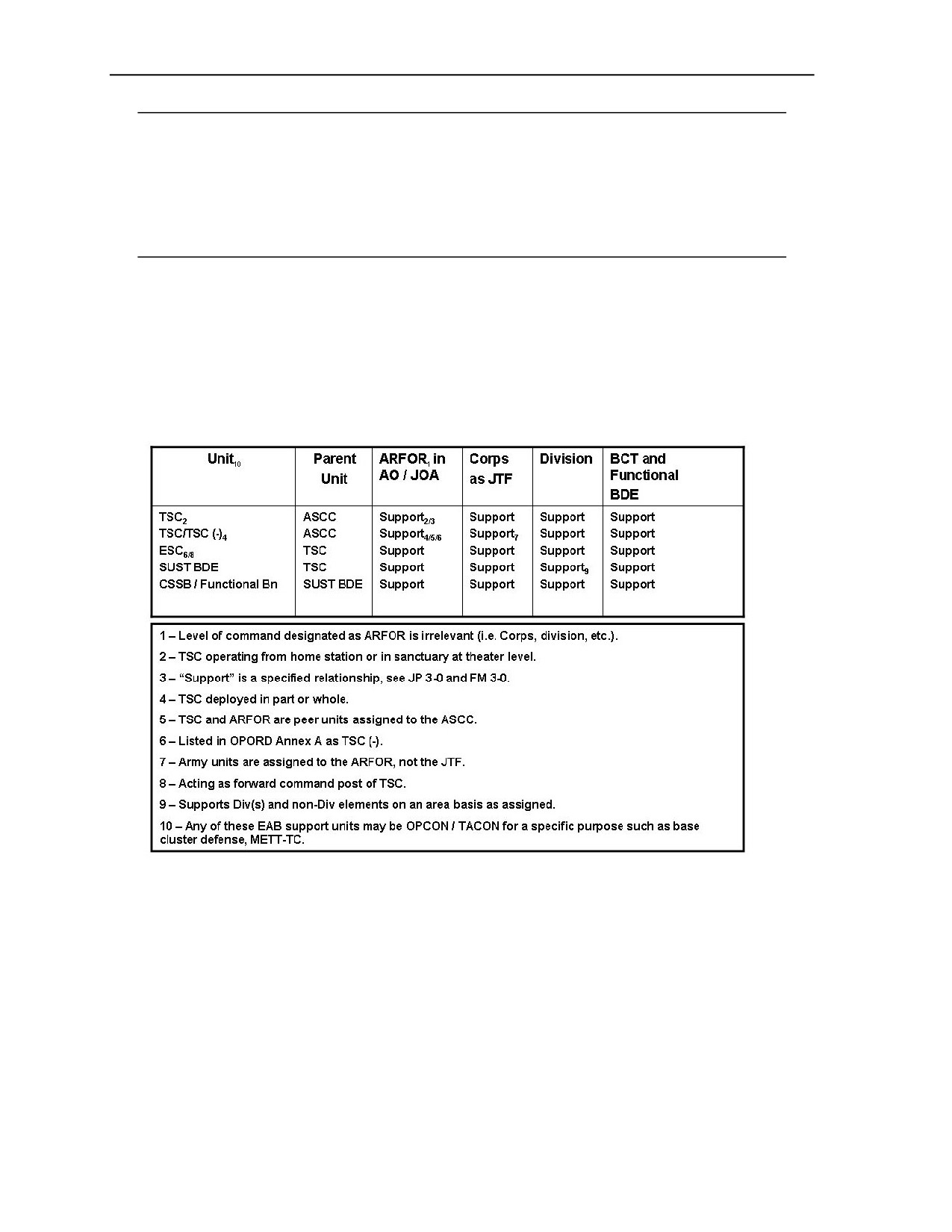
3-6. The typical relationship between TSC organizations and supported forces is support. (See Figure 3-1.)
However, under certain mission, enemy, terrain and weather, troops and support available, time available, and
civil consideration
(METT-TC) conditions, TACON or OPCON may be appropriate. [For example, in a
smaller-scale contingency or during support operations where a division is the senior Army headquarters and a
sustainment brigade is the senior sustainment command in the AO/JOA.] Regardless of the formal command
and control relationship, the TSC executes its C2 function and maintains situational awareness through
command reporting enabled by logistics STAMIS, the Army Battle Command System (ABCS), and other
mechanisms as established by the GCC/ASCC.
Figure 3-1. Command and Support Relationships
3-7. Of special interest is the command relationship between the TSC and ESC. In order to fully understand
the relationship between the TSC and ESC, and the ESC role, one must view the relationship from two
perspectives: table of organization and equipment (TO&E) and doctrine.
3-8. Doctrinally, the ESC functions as an extension of the TSC rather than exclusively as a separate echelon
of command. This approach is consistent with transformation efforts that led to the elimination of redundant
capabilities at corps and division levels; and centralized control of sustainment operations (less health service
support) at echelons above brigade.
3-9. The ESC is organized in accordance with TO&E 63702G100 and the TSC is organized in accordance
with TO&E 63702G000 which necessitates a formal command relationship between the two organizations. The
typical command relationship between the TSC and ESC is assigned. Although a near-mirror image of the TSC,
3-2
FM 4-94
12 February 2010
Command, Control, Automation and Communications
the ESC does not possess the same degree of capabilities as the TSC; primarily due to differences in manning
levels.
3-10. When an ESC is deployed into an area of operations (AO)/joint operations area (JOA), its role is to
provide forward-based C2 of TSC forces; providing the TSC commander with the regional focus necessary to
provide effective operational-level support to Army forces or joint task force (JTF) missions. In this case, the
ESC commander is dual-hatted as a deputy TSC commander and a supporting sustainment force is task
organized to support mission requirements. The ESC commander/deputy TSC commander exercises OPCON of
TSC resources allocated to the mission.
Note. Under certain METT-TC conditions the ESC may be OPCON to a JTF and function as a joint
support control element. In this scenario, the TSC - ESC relationship is supporting to supported; the
JTF - ESC relationship is OPCON; and the ESC - Army forces relationship is supporting to
supported. Joint augmentation is required.
3-11. Concerned with maximizing the effectiveness of distribution-based logistics operations, the ESC
commander/deputy TSC commander has the authority and control necessary to effectively employ TSC
resources while synchronizing the execution of TSC plans and directives with ARFOR/JTF operational
requirements. For example, the ESC commander/deputy TSC commander may organize and employ forces,
assign tasks, designate objectives, and provide authoritative direction necessary to accomplish the mission.
3-12. The TSC commander employs either detailed or mission command, or a combination of the two C2
methods, depending on the complexity of the action or task to be performed and other METT-TC
considerations. Mission command provides subordinate commanders with the greatest degree of flexibility to
exploit opportunities and respond to threats by exercising disciplined initiative within TSC commander intent to
accomplish the mission. Conversely, detailed command centralizes information and decision-making authority.
Plans and orders are detailed and explicit, and successful execution depends on strict obedience by
subordinates, with minimal decision-making and initiative on their part. Because of these disadvantages,
mission command is preferred in almost all cases. See FM 6-0 for more information on detailed and mission
command.
3-13. Essential to the seamless flow of supplies, materiel, and personnel throughout the theater is the parallel
and collaborative planning that occurs between the TSC and ESC. Parallel and collaborative planning promotes
situational understanding, enables unity of effort, and is essential for the successful execution of mission
command. TSC plans officers work within several different planning horizons simultaneously - from a theater-
wide perspective; anticipating requirements before they occur rather than responding to events as they unfold.
Mission orders, that provide the “what” and “why” but leave the “how” for subordinate commanders to
develop, provide the basis for ESC planning efforts.
3-14. The ESC may also engage in parallel planning with its supported ARFOR in its specified AO/JOA. This
planning is then coordinated with TSC headquarters planners in order to ensure synchronized support to the
maneuver commander.
3-15. This parallel and collaborative planning effort provides ESC plans officers enough time to adequately
develop regionally-focused supporting and/or contingency plans for their AO/JOA; and permits the TSC
commander to focus decision making on broader theater-wide issues.
TSC COMMAND AND CONTROL SYSTEM
3-16. The TSC commander executes centralized C2 through a C2 system that enables effective
synchronization of the actions of subordinate units located throughout the theater with those of supported forces
to achieve unity of effort and accomplish GCC/ASCC objectives.
3-17. The TSC C2 system is comprised of personnel, procedures, information management, and equipment
and facilities that are essential to planning, preparing for, executing, and assessing support operations. The TSC
C2 system consisting of the ABCS that includes the Force XXI Battle Command Brigade and Below System
(FBCB2) and the Battle Command Sustainment Support System (BCS3); provides commanders and staffs with
12 February 2010
FM 4-94
3-3
Chapter 3
a common operational picture (COP) of the GCC or ASCC operational environment. The means to visualize a
COP come from BCS3, in-transit visibility (ITV) data, logistics status reports (LOGSTAT), and the various
STAMIS employed by the TSC. A brief description of each element of the TSC C2 system follows.
PERSONNEL
3-18. The most important element of the C2 system is people—Soldiers who assist the commander and
exercise control on his behalf. TSC personnel comprising the C2 system include the staff and deputy
commander(s). The staff provides relevant information and analysis, makes running estimates and
recommendations, prepares plans and orders, and monitors execution. Other C2-system elements exist to serve
the personnel and the commander.
3-19. The staff operates the commander’s C2 system; establishing and maintaining a high degree of
coordination and cooperation with staffs of higher, lower, supporting, supported, and adjacent units. This
relationship is based on mutual respect, developed through a conscientious, determined, and helpful approach
focused on solving problems. Anything less undermines the confidence and trust required for mission command
at all levels.
PROCEDURES
3-20. The TSC staff develops standardized procedures to govern actions within the C2 system in order to
prioritize, direct, redirect, integrate, and coordinate sustainment functions effectively and efficiently. The use of
standardized procedures and reporting processes reduces decision action cycle time; and enables the efficient
use of constrained resources in support of rapidly changing operational requirements.
INFORMATION MANAGEMENT
3-21. Information management is the process of providing relevant information to the right person at the right
time in a usable form to facilitate situational understanding and decision making. It uses procedures and
information systems to collect, process, store, display, and disseminate information. It consists of relevant
information and information systems. The computers (hardware and software) and communications directly
involved in C2 constitute the information system.
EQUIPMENT AND FACILITIES
3-22. The equipment and facilities element of the TSC C2 system provides sustainment and a work
environment for the other elements of the C2 system. Equipment and facilities include all C2-support
equipment other than information systems. They must meet Soldiers’ physiological needs—shelter, rest,
sanitation, food, and water.
ARMY BATTLE COMMAND SYSTEM (ABCS)
3-23. The ABCS integrates Army warfighting functions to link strategic, operational, and tactical
headquarters. It provides commanders and staffs at theater and below a COP through improved situational
awareness and battlefield digitization.
3-24. The ABCS is comprised of the following subsystems: Advanced Field Artillery Tactical Data System,
Air and Missile Defense Planning and Control System, Battle Command Sustainment Support System, Combat
Terrain Information System, Distributed Common Ground System-Army, Command Post of the Future, Force
XXI Battle Command Brigade and Below System, Joint Network Node, Maneuver Control System, and the
Tactical Airspace Integration System.
3-25. Of the ABCS subsystems identified above, the TSC relies upon the Battle Command Sustainment
Support System (BCS3), Command Post of the Future (CPOF), Distributed Common Ground System-Army
(DCGS-A), and Force XXI Battle Command, Brigade-and-Below (FBCB2) to synchronize and integrate
operations throughout the theater in accordance with ASCC priorities and intent. These ABCS subsystems
3-4
FM 4-94
12 February 2010
Command, Control, Automation and Communications
provide the TSC commander and staff with the primary means to maintain situational awareness through a
COP. A description of TSC ABCS subsystems is provided below.
BATTLE COMMAND SUSTAINMENT SUPPORT SYSTEM
3-26. BCS3 is the Army’s logistics C2 system—the fusion center, from theater to brigade. As the sustainment
element of ABCS, it is a windows-based, lightweight, portable system that is highly platform independent.
BCS3 provides battle command services including commodity tracking, convoy operations and tracking, and
management of reception, staging, onward movement, and integration
(RSOI). BCS3 also provides a
sustainment COP.
3-27. BCS3 aligns sustainment, in-transit, and force data to provide actionable information that aids the
commander in making critical decisions. BCS3 also gives logisticians and other personnel access to the latest
available information on a map-centric view with logistics common data, in-transit visibility alert features, and
input to combat power computations.
3-28. BCS3 enables commanders and logisticians to plan, rehearse, integrate, and sustain missions utilizing
the same system. The following is a list of current BCS3 functional capabilities:
• Operates on classified as well as unclassified networks.
• Provides near-real time maneuver sustainment C2 on a map-based display.
• Provides flexible situational assessment products in response to queries from sustainment brigades and
combat sustainment support battalions which are made available via secret internet protocol router
network (SIPRNET).
• Provides reports and input forms for units, supply points, echelon status, and combat power.
• Enables dynamic unit task organization to reflect changing organizational relationships and full color
mapping.
• Provides RSOI visibility and status.
• Accommodates electronic messaging and data exchange with ABCS.
• Provides access to critical items roster and command selected items roster (unit-selected items flagged
for monitoring).
• Enables distribution management.
• Provides combat power data to maneuver control system.
COMMAND POST OF THE FUTURE
3-29. First introduced as a transformational technology in support of OIF, CPOF is a software capability
hosted on a computer system that currently provides collaboration and visualization for Army division and
brigade commanders and staff. The CPOF software provides a collaborative operating environment, voice over
internet protocol, a highly intuitive, graphical user interface and enhanced briefing capabilities. CPOF allows
commanders from battalion level and higher to feed real-time situational awareness into the system and have
that information available in text and graphic representation immediately by fellow commanders and staffs at
all levels. Inside the CPOF system network, operators can visualize the commander’s intent and COP as well as
manipulate tactical data in a collaborative manner alone or with other operators. The system is a valuable
planning and management tool that allows commanders to access real-time situational intelligence. It eliminates
the need for a physical tactical operations center (TOC) by providing a rich enough virtual TOC through
collaboration in a distributed operating environment.
3-30. CPOF provides new capabilities for improving decision making by operational commanders by
providing dynamic tailored visualization and collaboration tools for improved situation awareness and course-
of-action (COA) development and dissemination. CPOF also enables a new concept for future command
12 February 2010
FM 4-94
3-5
Chapter 3
environments, namely, the elimination of the fixed command post that will be replaced by battle command on
the move.
DISTRIBUTED COMMON GROUND SYSTEM-ARMY
3-31. DCGS-A is a single integrated intelligence, surveillance, and reconnaissance (ISR) ground processing
system that serves as the primary Army system for tasking, processing, correlating, exploiting, and
disseminating ISR assets and information. DCGS-A provides operational commanders with access to data,
information, and intelligence collected by national, joint, other Services, multinational, and Army intelligence
as well as non-intelligence sensors and systems.
3-32. DCGS-A facilitates the development of situational understanding by allowing operational commanders
to visualize, analyze, and understand the threat and other conditions of their operational environment, predict
threat intentions, execute targeting, conduct ISR integration, and support information operations.
FORCE XXI BATTLE COMMAND, BRIGADE-AND-BELOW
3-33. FBCB2 provides situational awareness and C2 from brigade to Soldier/platform level. Functional
capabilities include:
• Real-time situational awareness.
• Shared COP of the specific operational environment.
• Graphical displays, with friendly and enemy unit locations.
• Communications/electronics interfaces with host platforms.
SECTION II: STAMIS AND SUPPORTING INFORMATION SYSTEMS
ARMY HUMAN RESOURCE WORKSTATION
3-34. The Army Human Resource Workstation (AHRW) is a commercial-off-the-shelf (COTS) laptop which,
when linked to the global information grid (GIG)/non-secure internet protocol router network (NIPRNET),
provides an automation capability that supports Army human resource functions across the theater. AHRW
provides commanders at each echelon with visibility of personnel accounting and strength reporting/personnel
readiness management/personnel information management (PASR/PRM/PIM) data. This visibility is vital for
determining unit readiness and planning future operations.
FINANCIAL MANAGEMENT TACTICAL PLATFORM
3-35. The Financial Management Tactical Platform (FMTP) is a deployable, modular local area network
configured hardware platform that supports finance and resource management (RM) operations and functions
across the spectrum of conflict. FMTP functionality includes vendor services, disbursing, accounting, travel,
and RM software packages. FMTP improves internal control, reducing loss of funds and accountability risk,
and complies with congressional/Department of Defense (DOD) mandated financial management reporting
requirements.
MEDICAL COMMUNICATION FOR COMBAT CASUALTY CARE
3-36. Medical Communication for Combat Casualty Care
(MC4) is the single information
management/information technology system for automation and digitization efforts for Army medical forces.
MC4 seamlessly links medical care throughout the theater; streamlining the collection, processing, storage, and
transmission of medical information in the theater.
3-37. The MC4 system, using the theater medical information program, will automatically provide
commanders medical situational awareness at all echelons within the AO.
3-6
FM 4-94
12 February 2010
Command, Control, Automation and Communications
PROPERTY BOOK UNIT SUPPLY ENHANCED
3-38. Property Book Unit Supply-Enhanced (PBUSE) accomplishes the functions of property accountability
required by Army regulations (AR) 710-2 and 735-5 and Department of the Army Pamphlet (DA PAM) 710-2-
1. PBUSE processes sensitive but unclassified information in the system’s high-level mode, which uses
permission control to manage who has access to what data. The system is accessed through user identifications
and passwords; operates over the NIPRNET and internet connections.
3-39. PBUSE processes include formal property accountability (to include sub-hand receipts and component
listings); requests for supplies, including an interactive catalog; document register maintenance; unit load
management; financial capabilities; and asset visibility.
3-40. PBUSE uses the combat service support automated information system interface (CAISI) to interface
with supply support activities, standard Army retail supply system (SARSS), two levels of standard Army
maintenance system-enhanced (SAM-E), and the federal logistics record (FEDLOG). PBUSE also provides
property book related data to the logistics information warehouse (LIW).
STANDARD ARMY RETAIL SUPPLY SYSTEM
3-41. SARSS provides stock control and supply management to the Army retail level. SARSS also provides
supply-related data to the LIW. SARSS supports the accountability, requisition, storage, issue, and management
of supply Classes II, III (P), IV, VII, and IX. SARSS supports split-based operations that provide supply
management functions to all elements within a sustainment domain. Within the modular force, SARSS is
comprised of three subsystems: SARSS-1, SARSS-2AC/B, and SARSS gateway.
3-42. SARSS-1 operates at the brigade support battalion and combat sustainment support battalion (CSSB)
levels. SARSS-1 maintains accountable records and performs supply functions such as receipt, storage, and
issue of supplies. Major functions executed in SARSS-1 include processing of customer requests for issue,
cancellation, or modification; replenishment; excess identification; inventory; and location survey.
3-43. SARSS-2AC/B supports materiel management functions performed by the TSC and can also be found in
ESCs and sustainment brigades. SARSS-2AC/B also maintains a custodial availability balance file that is
updated by SARSS-1. This function provides the TSC with visibility of assets in all SARSS-1 activities
throughout the theater. SARSS-2AC/B processes include management support, financial adjustment,
Department of Defense activity address code
(DODAAC) parameter maintenance, general system
administration, and supports Army war reserves, materiel rebuild programs, and major item acquisitions.
SARSS-2AC/B capabilities also include non time-sensitive functions such as catalog, document history, and
demand history.
3-44. SARSS-Gateway provides a near real time mechanism to process unfilled requirements directly to Army
wholesale level supply systems.
3-45. SARSS interfaces with several systems for data transfer. It supports the exchange of information using
local area networks, modems, wireless CAISI, and very small aperture terminal capabilities.
STANDARD ARMY AMMUNITION SYSTEM-MODERNIZATION
3-46. The Standard Army Ammunition System-Modernization
(SAAS-MOD) is an automated logistics
information system designed to provide centralized information management to support TSC ammunition
management functions throughout the theater. A multi-level automated ammunition management, reporting,
and accounting system, SAAS-MOD automates all retail Class V management life-cycle functions.
3-47. SAAS-MOD automates the receiving, storing, and issuing processes at ammunition supply activities
located throughout the theater (theater storage areas, ammunition supply points, and ammunition transfer
holding points). It also enables the TSC to maintain ITV by incorporating the latest automated information
technology to read and write radio frequency identification (RFID) tags. RFID tags provide the means for the
ITV system to report munitions movements throughout the intratheater distribution system.
3-48. SAAS-MOD provides the TSC distribution management center with the capability to:
12 February 2010
FM 4-94
3-7
Chapter 3
• Maintain the current status of all ammunition storage sites.
• Requisition from the national inventory control point (NICP).
• Support ad hoc query, including data imported and exported to other systems.
• Maintain and calculate the status of controlled supply rate.
• Recommend redistribution of assets.
• Support quality assurance and stockpile management.
• Forecast future requirements.
3-49. SAAS-MOD interfaces with the following automation systems: commodity command standard system,
worldwide ammunition reporting system (WARS), and total ammunition management information system.
TRANSPORTATION COORDINATOR’S AUTOMATED
INFORMATION FOR MOVEMENT SYSTEM II
3-50. The Transportation Coordinator’s Automated Information for Movement System II (TC-AIMS II) is a
joint automated information system for unit move and installation transportation office and transportation
management office functionality. It provides an integrated traffic management capability and supports
deployment, redeployment, and sustainment of U.S. forces. The system ultimately will be integrated with unit,
installation, and depot-level supply systems to manage inbound and outbound movement, shipment,
documentation, and requisition information. TC-AIMS II replaces TC-AIMS, Department of the Army
Movement Management System—Redesign, and Transportation Coordinator—Automated Command and
Control Information System.
Note. The United States (U.S.) Army is the proponent for TC-AIMS II.
3-51. TC-AIMS II enhances TSC capabilities to effectively and efficiently conduct theater opening operations
in a theater of operations by:
• Supporting the joint deployment process for movement related aspects of RSOI and theater movement
activities.
• Providing improved theater movement management functionality.
• Improving and expediting unit movement and transportation management actions.
• Providing an initial automated capability for port movement control elements to gain visibility of
inbound units and cargo.
• Providing an automated capability for TSC early entry command and control elements to task available
assets, and schedule, manage, and track multiple convoy movements.
• Providing additional reporting capability.
3-52. TC-AIMS II provides the TSC with an automated capability to forecast the arrival of personnel and
intertheater cargo and containerized shipments, and to maintain visibility of command interest cargo en route to
the theater. Thereby enhancing TSC capabilities to maintain the intratheater segment of the distribution system
in balance and operating efficiently.
3-53. TC-AIMS II provides TSC distribution managers the capability to coordinate and provide transportation
services to shippers, carriers, and receiving activities located throughout the theater. Automated functions
include documenting transportation movement requests, tasking mode operators, forecasting, and reporting
container and cargo movements throughout the distribution system. Other capabilities include scheduling and
deconflicting convoy movements, maintaining unit personnel location manifesting data, and maintaining in-
transit cargo and asset movement visibility.
3-8
FM 4-94
12 February 2010
Command, Control, Automation and Communications
3-54. TC-AIMS II provides mode operators an automated capability to receive commitments, conduct mission
planning, task available assets, and maintain fleet asset status data.
STANDARD ARMY MAINTENANCE SYSTEM (SAMS)
3-55. There are three versions of SAMS: SAMS-1, SAMS-2, and SAMS-E which will eventually replace
SAMS-1, SAMS-2, and ULLS-G. SAMS-1 is an automated maintenance management system used at the
support maintenance company and component repair company found in the sustainment brigades and in the
BSB’s field maintenance company and FSC. The system automates work order registration and document
registers, inventory control and reorder of shop and bench stock, as well as automating work order parts and
requisitioning. It produces pre-formatted and ad hoc reports and allows extensive online inquiry.
3-56. SAMS provides the capability for automated processing of field and sustainment maintenance shop
production functions, maintenance control work orders, and key supply functions. Requisitions are prepared
automatically and an automatic status is received from SARSS-1. It also provides completed work order data to
the logistics support activity (LOGSA) for equipment performance and other analyses.
3-57. SAMS-1 automates maintenance documentation and information gathering and transmittal. It also
provides the following:
• Management of work orders and work order tasks.
• Allows transfer of repairs and/or due-ins between work orders and shop stock.
• Accounts for direct, indirect, and nonproductive man-hours.
• Simplifies and standardizes collecting and using maintenance data.
3-58. SAMS-1 improves readiness management and visibility by providing equipment status and asset data:
raises the quality and accuracy of performance, and lower cost and backlog through improved maintenance
management. SAMS-1 uses commercial off the shelf (COTS) hardware.
3-59. The SAMS-2 is an automated maintenance management system used at the SPO section of the
sustainment brigade, CSSBs, and BSB. Field commanders use SAMS-2 to collect and store equipment
performance and maintenance operations data. They use this data to determine operator and maintenance
guidance to give to their subordinate maintenance units. SAMS-2 also provides the capability of monitoring
equipment non-mission capable status and controlling/coordinating maintenance actions and repair parts
utilization to maximize equipment availability. SAMS-2 receives and processes maintenance data to meet
information requirements of the manager and to fulfill reporting requirements to customers, higher maintenance
and readiness managers, and the wholesale maintenance level. Management can access data instantly to control,
coordinate, report, analyze, and review maintenance operations. SAMS-2 also:
• Maintains equipment status by line number and unit within the command.
• Maintains a record of critical repair parts and maintenance problem areas.
• Provides visibility of backlog and planned repair requirements.
• Provides maintenance performance and cost evaluation tools.
3-60. SAM-2 provides maintenance and management information to each level of command from the user to
the DA level. SAMS-2 collects, stores, and retrieves maintenance information from SAMS-1 sites and allows
managers to coordinate maintenance workloads. SAMS-2 passes key maintenance and supply information to
higher commands for maintenance engineering and readiness reporting requirements. SAMS-2 operates on
COTS hardware.
3-61. SAMS-Enhanced is the replacement system that combines the functionality of SAMS-2, SAMS-2, and
ULLS-G. This gives the FSCs, SPOs, and TSC one common operating system that simplifies automation repair
and management.
12 February 2010
FM 4-94
3-9
Chapter 3
SECTION III: STAMIS AND SUPPORTING INFORMATION SYSTEM
ENABLERS
LOGISTICS INFORMATION WAREHOUSE
3-62. LIW consists of data management and business intelligence capabilities resulting from the merger of
national and tactical logistics information. By integrating the logistics integrated data base (LIDB) with the
integrated logistics analysis program (ILAP) under one organization, the Army’s national and tactical data
sources are harmonized to provide:
• One authoritative source of logistics information.
• One accurate view of the Army’s materiel posture.
• Further reductions in unique and duplicative data stores.
3-63. LIW provides a re-engineered single sign-on web access to the existing capabilities of LIDB, ILAP, and
a host of logistics support activity (LOGSA)/Army logistics tools. A query and reports capability provides
commanders and managers a search capability for data maintained in the LIW. Data mining is accomplished by
using search criteria such as national item identification number (NIIN), line item number, DODAAC, unit
identification code, or serial/registration number.
3-64. A valid LIW account is required to access LIW databases. If you do not have an account, one can be
requested by completing a system access request. The system access request may be found at:
https://www.logsa.army.mil.
3-65. LIW provides TSC materiel managers, other logisticians, and commanders with an authoritative source
for decision support and analysis. For example, TSC materiel managers use LIW and other LOGSA databases
as their primary source of maintenance and readiness management data essential to sustainment. A brief
description of selected LIW capabilities follows.
SUPPLY
3-66. The supply module provides TSC materiel managers with the capability to view asset quantities and
locations for all items in the Army inventory. Search by NIIN for asset balance file assets, Defense Logistics
Agency (DLA) asset manager position, and non-major asset storage locations. DLA asset visibility allows
materiel managers to input a NIIN to gain visibility of the DLA item manager’s asset position. The query
response also provides a drill down capability to view current Army master data file (AMDF) and source of
supply address information.
CATALOG
3-67. The catalog module provides a source for common logistics information. Catalog functionality also
provides the capability to submit price challenges and AMDF discrepancy reports.
LIW PARTS TRACKER
3-68. The parts tracker module provides TSC materiel managers, other logisticians, and commanders the status
of a requisition throughout the supply process as well as visibility of the requested item as it moves through the
military or commercial transportation systems. Access to RFID tag information identifies the location of parts
traveling through the Defense Transportation System. Parts tracker also provides location information from
commercial shippers by using a document number to track the item.
LIW WEB LOGISTICS INTEGRATED DATA BASE PIPELINE
3-69.
“Pipeline” is a centralized database that provides TSC materiel managers, other logisticians, and
commanders visibility of supply and transportation actions for requisitions placed on the wholesale system. As
materiel moves to Army customers worldwide, the automated supply and transportation systems provide
3-10
FM 4-94
12 February 2010
Command, Control, Automation and Communications
“pipeline” with the current location of the materiel in near real-time. The “pipeline” provides a quick reference
to requisition status, shipping information, and receipt of materiel requisitioned. “Pipeline” is also the database
for reporting Army distribution management and customer wait time (CWT) performance.
INTEGRATED LOGISTICS ANALYSIS PROGRAM
3-70. ILAP is the management tool, used by the Army to collect, integrate, and display logistics and financial
data. ILAP gathers data daily, weekly, and monthly from multiple STAMIS at tactical, operational, and
strategic levels, as well as from the Defense Finance and Accounting Service (DFAS). Supply, maintenance,
and financial data are integrated, aggregated, and displayed at levels of aggregation appropriate for each
management level to provide summary decision support views and detailed drilldown capabilities for document
level details.
3-71. As a decision support application, ILAP produces informational management reports in an easy-to-
understand, readable format that assists TSC materiel managers, other logisticians, and commanders in the
decision-making process by integrating data from numerous sources.
AUTOMATED IDENTIFICATION TECHNOLOGY
3-72. Automated identification technology (AIT) is a family of data-capturing devices designed to provide
rapid and accurate retention and retrieval of source data. AIT includes a variety of read-and-write data storage
technologies used to process asset identification information. These technologies include linear and two-
dimensional bar codes, magnetic strips, integrated circuit or “smart” cards, optical memory cards, contact
memory buttons, RFID technology and data collection devices, and magnetic storage media. AIT, largely in the
form of RFID technology, is the primary method of achieving in-transit visibility and a key component of
DLA’s asset visibility system.
Note. Micro-Electrical Mechanical Systems integrated with RFID technologies are being incorporated
into the radio frequency - in-transit visibility (RF-ITV) infrastructure by Product Manager, Joint-
Automatic Identification Technology. This added capability provides visibility of materiel condition
(temperature, humidity, light, and intrusion detection).
3-73. In-transit visibility is a critical element of TSC capabilities to effectively and efficiently manage the
intratheater segment of the distribution system. To maintain near-real-time visibility of shipping containers,
vehicles, equipment, and pallets moving throughout the theater, the TSC relies upon a RF-ITV system. This
system provides near-real-time accurate tracking information of shipments and their contents as they travel
across the distribution system. The asset visibility gained from this tracking and location system is essential for
ensuring the right materiel is delivered to the right location when and where it is needed.
3-74. In order to track RFID tagged shipments across the intratheater segment of the distribution system, a
network of interrogators is established at supply support activities, air and sea ports, and at critical points along
main supply routes (MSR). As RFID tagged shipping containers, vehicles, equipment, and pallets pass these
interrogator locations, the interrogator reads the RFID tags and transmits the data to a regional ITV server
which updates the RF-ITV global network. The ITV server provides a mechanism for the TSC (and others) to
query shipment status and location information. This asset visibility provides the TSC with a near real-time
location of assets.
BATTLE COMMAND COMMON SERVICES
3-75. Battle Command Common Services (BCCS) is a suite of servers that forms the hub for the network of
ABCS systems. It provides the tactical battle command and enterprise servers, services and large-volume data
storage for commanders and staffs at battalion through ASCC levels, attached to the tactical local-area network
via ethernet and joint network node topologies. Interoperability between and among the various ABCS systems
is facilitated through the use of publish and subscribe services (PASS)/PASS shell/data dissemination services
and the tactical services gateway. Essential enterprise services include email, asynchronous collaboration and
12 February 2010
FM 4-94
3-11
Chapter 3
file storage, and data-basing. Data residing on the tactical local-area network is stored in a fabric attached
storage device that is part of the BCCS server suite.
COMBAT SERVICE SUPPORT AUTOMATED INFORMATION
SYSTEMS INTERFACE (CAISI)
3-76. CAISI is COTS technology, integrated for Army use, which provides logisticians with a dedicated
logistics communications capability. It enables any COTS system to securely network within brigade support
areas and supply support activities, and to electronically exchange information via tactical or commercial
communications with higher headquarters and the TSC.
3-77. The latest configuration of CAISI incorporates an improved COTS wireless technology enabling CAISI
to communicate in tactical environments over much longer line of communication (LOC).
COMBAT SERVICE SUPPORT VERY SMALL APERTURE
TERMINAL
3-78. CSS Very Small Aperture Terminal (CSS VSAT) is a software-driven terrestrial based station used for
the reliable transmission of logistics data via satellite. Routinely used in conjunction with CAISI, it permits the
transmission of data via the NIPRNET from anywhere in the world to anyplace in the world with appropriate
reception capability. Together with the CAISI, the CSS VSAT has given the TSC the visibility it needs to
manage and C2 support across the theater.
SECTION IV: THEATER NETWORK SUPPORT
SIGNAL COMMAND (THEATER)
3-79. A Signal Command (Theater) (SC [T]) or senior signal brigade provides signal support to the ASCC and
Army elements, such as the TSC headquarters, operating at the operational level. Most often this means
installing and operating large-scale, non-mobile network infrastructures, tactical gateways, heavy network
systems, nodes and hubs necessary for increased bandwidth, range extension, and theater reach capabilities.
Theater signal operations often provide large-scale connections between tactical networks and the GIG.
3-80. The SC (T) is organized, equipped, and manned to plan, engineer, integrate, manage, and defend the
Army’s portion of the GIG. The SC (T) is the primary network provider for theater landwarnet (LWN). It
exercises C2 over strategic and tactical signal organizations, the theater network operations and security center
(TNOSC), visual information resources, wire and cable, and commercial infrastructures, and theater signal
maintenance. Operational-level information services mesh seamlessly with those of the sustaining base, which
may be located within the continental United States (CONUS) or another theater. Signal assets connect to the
defense information system network through various methods and provide a reach capability for split-based
operations. These signal assets provide:
• Access to the commercial and host nation (HN) infrastructure, when available.
• Connectivity with JTF/joint force land component command headquarters.
• Defense information systems network services.
• Connectivity with logistics support activities, and home stations node.
• Connectivity with joint and multinational forces.
LANDWARNET
3-81. LWN is the connecting point that makes the Army an integral part of any joint force. It includes
computers, software, architecture, security communications, programs, and facilities; and provides the
capability to process, store, transport, and stage information over a seamless network. It includes all Army
3-12
FM 4-94
12 February 2010
Command, Control, Automation and Communications
networks, from sustaining bases to forward-deployed forces. LWN integrates the Army’s warfighting, business,
intelligence, and network domains and provides access to the GIG.
THEATER SERVICES
NON-SECURE INTERNET PROTOCOL ROUTER NETWORK
3-82. NIPRNET is a network of government-owned internet protocol routers used to exchange sensitive
unclassified information. It provides access to specific DOD network services and supports a wide variety of
applications such as electronic mail, web-based collaboration, information dissemination, and connectivity to
the worldwide internet. Access to the NIPRNET is obtained through a standardized tactical entry point site or
teleport and is then distributed through an unclassified theater network. NIPRNET enables a myriad of other
reach functions from deployed forces to the sustaining base and lateral collaboration among deployed elements.
SECRET INTERNET PROTOCOL ROUTER NETWORK
3-83. The SIPRNET supports critical C2 applications and intelligence functions. It operates in a manner
similar to the NIPRNET, but as a secure network. As with the NIPRNET, the SIPRNET provides access to
many web-based applications, as well as the ability to send and receive classified information up to United
States (U.S.) secret. These applications and capabilities enable the effective planning and execution of plans in
a secure environment. The SIPRNET also enables a myriad of reach logistics functions from deployed forces to
the sustaining base and lateral collaboration among deployed elements.
COALITION-LOCAL AREA NETWORK (C-LAN) AND COALITION-WIDE AREA NETWORK
(C-WAN)
3-84. Coalition networks are established to support coordination and collaboration among U.S. and non-U.S.
forces in the operational environment. C-LAN and C-WAN services support planning and execution of
operations involving coalition forces. C-LANs and C-WANs operate at both sensitive but unclassified and
classified levels. C-LANs and C-WANs may operate as local or limited regional entities, or they may connect
to and extend the services of the combined enterprise regional information exchange system (CENTRIXS). The
CENTRIXS is a standing classified-capable coalition network.
SECURE AND NON-SECURE VOICE
3-85. Secure and non-secure voice remains a significant user requirement in all networks. Switched voice
service allows connections between and among home station and theater locations. The service includes long-
haul switched voice, facsimile, and conference calling. Secure voice connections may also be used for facsimile
traffic. More networks are now incorporating and employing secure voice over internet protocol instead of the
traditional switched circuit requirements. Non-secure voice provides the essential day-to-day connections used
in common, routine business, but also includes requirements to provide connectivity to civilian telephone
networks in the sustaining base and host nation. Additionally, the non-secure voice network, the defense
switched network, can be extended to joint and multinational subscribers.
VIDEO TELECONFERENCING
3-86. Video teleconferencing (VTC) is a mainstay collaboration tool in deployed environments. It provides the
best available technical alternative to face-to-face meetings that provide users with human-factor feedback and
interaction when they must collaborate from separate locations. VTC also better facilitates online collaboration
and coordination with various automation tools and applications.
CURRENT AND EMERGING NETWORKS
3-87. OEF and OIF showed that the mobile subscriber equipment
(MSE) and Tri-Service Tactical
Communications Program (TRI-TAC) systems, based largely on terrestrial radio relay, were not able to keep
pace with fast-moving maneuver forces operating over huge expanses of terrain. The voice switch network was
12 February 2010
FM 4-94
3-13
Chapter 3
also incapable of handling the increased amount of digital data being passed by automated battle command and
business systems. To provide communications support for battle command on the move and at the quick halt, a
net-centric multipoint satellite network was developed. The joint network node-network
(JNN-N) was
integrated into the Army network architecture as an interim to bridge MSE and TRI-TAC systems prior to
warfighter information network-tactical
(WIN-T) fielding. The JNN-N primarily employs satellite
communication links, enabling rapid installation and relocation of communications support as forces maneuver.
Using COTS equipment, the JNN-N has introduced internet protocol capabilities to the battlefield and
dramatically increased the capacity for moving data at corps, division, brigade, and battalion levels.
Note. With the advent of the LWN and the increase in satellite communications-based and on-the-
move data capable systems, the Army and other Services must still employ existing current technology
and legacy systems to fill any gaps until the joint network transport capability-spiral to WIN-T fully
fields across all Services and all components.
JOINT NETWORK NODE-NETWORK
3-88. The JNN-N system is a suite of communications equipment that is housed at fixed strategic locations and
in tactical transportable shelters and associated transit cases. The system will facilitate effective control over
communication links, trunks, and groups within a deployed network. The JNN-N system consists of three major
communications elements:
• Regional hub node.
• Joint network node.
• Command post node.
3-89. The JNN-N is designed to interface with current technologies via the JNN. The JNN is deployed at both
the division and brigade level. The JNN capabilities can provide joint and multinational connectivity and allow
for interfacing to current networking communications systems through:
• Standardized tactical entry points.
• Beyond line of site.
• Line of site.
3-90. The JNN is also interoperable with commercial networks and current force communications networks,
i.e., MSE and TRI-TAC. For more detailed information on the JNN-N system, refer to the Field Manual Interim
(FMI) 6-02.60.
TRI-SERVICE TACTICAL COMMUNICATIONS
3-91. The TRI-TAC networks are node-based, digital, circuit-switched voice and data networks supporting
tactical users in the theater. TRI-TAC is an interoperable communications system that permits communications
among all the armed services. TRI-TAC employs more fiber based and satellite communications systems to
meet larger bandwidth requirements at theater level. While TRI-TAC shares the same basic principle
architecture as MSE, it does not employ mobile subscriber radiotelephone terminal communications systems.
AREA COMMON USER SYSTEM/MOBILE SUBSCRIBER EQUIPMENT
3-92. MSE is a voice-centric system designed to provide limited on-the-move and limited data capability. MSE
also utilizes secure radiotelephone systems to extend the range for on-the-move voice users. MSE architecture
is based on an area node system. Node centers provide the entire area network with connectivity and switching
capability with some support to command post subscribers. The node centers serve as hubs for the entire nodal
system with user extensions coming from the large extension nodes and small extension nodes. The extension
nodes provide voice, data, and facsimile communications to area users. Satellite communications and line of
sight ultrahigh frequency radio links provide connectivity among node centers and from node centers to the
network extensions. This architecture furnishes all MSE subscribers with automatic switching.
3-14
FM 4-94
12 February 2010
Command, Control, Automation and Communications
3-93. MSE is part of a three-tier communications network. It ties into the TRI-TAC tier supporting the theater
switched network provided by the TRI-TAC system. MSE also provides combat net radio users with an
interface to the area common user system via a secure digital net radio interface. This capability links single
channel ground and airborne radio system users with telephone subscribers that provide added communications
for maneuver units.
COMBAT NET RADIO
3-94. Traditional echelons above corps operations rely little on combat net radio systems for C2 compared to
the voice requirements employed by divisions, brigades, and battalions engaged in the close fight. With
asymmetrical warfare and the concept of deploying integrated theater signal battalions or expeditionary signal
battalions to support a corps, division, or brigade combat team (BCT), the need for combat net radio as a viable
C2 and communications system still exists. Combat net radio throughout the theater will see trends as follows:
• Higher reliance on organic high frequency, satellite communications, very high frequency/frequency
modulation, and Joint Tactical Radio Systems.
• More use of commercial systems such as Iridium, international maritime satellite, and multi-band
inter/intra team radios.
• Integration of developing on-the-move capability.
3-95. Range extension for combat radio nets, especially the single-channel ground and airborne radio system,
is normally accomplished by retransmission employed at the tactical and operational level by division and
legacy corps organizations. Within the theater, there are increasing needs for embedded range extension
capabilities to cover extended distances within the JOA. Tactical necessity will see more organic combat net
radio retransmission or satellite communications-based range extension. With the advent of the Joint Tactical
Radio Systems, meshed nets and range extension will become an embedded capability within each platform.
FEDERATION OF NETWORKS
3-96. Logistics Data Network (LOGNET) and MC4 (discussed earlier in this chapter) belong to a federation of
networks. Though not fully integrated under the LWN, these specified “stovepipe” networks operate as a
federation of networks until fully integrated into a single contiguous enterprise. Stovepipe network designs
normally serve only a narrow community of users or a specific function and have limited or no interoperability
with other systems or communities. As the Army continues to equip JNN-N throughout its forces, the signal
commands will be better equipped to provide those interfaces to today’s stovepipes to begin the transformation
from the current “federation of networks” to an integrated Service network known today as the LWN.
LOGISTICS DATA NETWORK
3-97. LOGNET supports TSC sustainment requirements by capitalizing on efficiencies gained by specific
technology insertion. LOGNET enables direct access to joint NIPRNET networks and information systems.
LOGNET is a satellite communications-based design that supports the ability to employ multifunctional and
tailored C2 capabilities to operational forces regardless of the mission or task organization. The resulting
standardization of capabilities delivered through the use of the same COTS communications equipment and
technologies as joint, Service, and commercial partners enhances the Army’s ability to keep pace with
constantly evolving commercial information technology. TSC sustainment units operate primarily in an
unclassified environment. The business enterprise architecture allows the TSC to connect to the NIPRNET both
at home station and while deployed by the same means. This capability dramatically improves continuity of
support and better enables the TSC to conduct operational-level sustainment operations. It also fulfills the
Army’s Title 10 USC requirements of the wartime executive agency, the North Atlantic Treaty Organization’s
(NATO) standardization agreements, and the acquisition and cross-servicing agreement requirements for the
ASCC.
12 February 2010
FM 4-94
3-15
Chapter 4
Support Operations
Within the spectrum of conflict, theater sustainment commands (TSC) and other Army forces operate
as part of a joint force and often within a multinational or interagency environment. Chapter 4
describes how the TSC sustains operations across the spectrum of conflict; leveraging joint and
sustaining base capabilities to provide efficient, effective support throughout the theater. Primary TSC
operational-level focus areas include: distribution management, materiel management, movement
control, financial management, and human resources. Section I provides an overview of the Army
Service component command (ASCC)/TSC command relationship as well as a description of the
theater construct. Section II discusses reception, staging, onward movement, and integration (RSOI).
Section III describes TSC distribution management capabilities, functions and retrograde. Section IV
describes materiel management responsibilities, functions and retrograde. Section V describes
movement control. Section VI describes the provision of sustainment. Section VII discusses Army
special operations forces
(ARSOF) support. Section VIII discusses the TSC role in providing
common-user logistics support to the joint force. Section IX discusses redeployment. Other TSC
operational-level focus areas - not discussed in this chapter—include positioning of facilities and
reconstitution.
SECTION I: OVERVIEW
4-1. Army forces within a unified theater are supported by the ASCC’s theater sustainment command. The
ASCC normally retains command and control (C2) of TSC assets in order to effectively and efficiently
integrate and synchronize operations across the entire theater. There are situations, however, in which TSC
assets may be under the tactical control (TACON) or operational control (OPCON) of a supported Army
forces.
4-2. Military operations within a theater may range from stable peace to general war. When armed conflict
does occur, it may involve only a portion of the theater. In situations such as this, the geographic combatant
commander (GCC) may designate the region in conflict as a theater of war and/or theater of operations. When a
theater of operations, or subsequent area of operations (AO), is established within a theater, the ASCC
commander establishes support priorities in accordance with ARFOR requirements to achieve GCC objectives.
A support to supported relationship is established between the ARFOR and the TSC which permits the TSC to
employ theater-wide resources to provide timely, responsive support to the ARFOR.
4-3. With the exception of joint special operations task force (JSOTF) and ARSOF support elements and
United States Transportation Command
(USTRANSCOM) single port manager units, the TSC C2s all
echelons-above-brigade sustainment operations (less health service support) in a theater; achieving unity of
command and operational flexibility to ensure the uninterrupted flow of personnel, equipment, and supplies.
4-4. The TSC support structure is based upon detailed mission analysis and other METT-TC considerations.
Required capabilities may vary from theater to theater or by phase of the operation. Modular unit designs
provide the means to effectively build required capabilities as operational requirements change. Additionally,
TSC planners consider the use of host nation support (HNS), contracted support, and support from other
Services as alternatives to adding force structure to the TSC. The structure in Figure 4-1 represents a notional
TSC support structure.
12 February 2010
FM 4-94
4-1
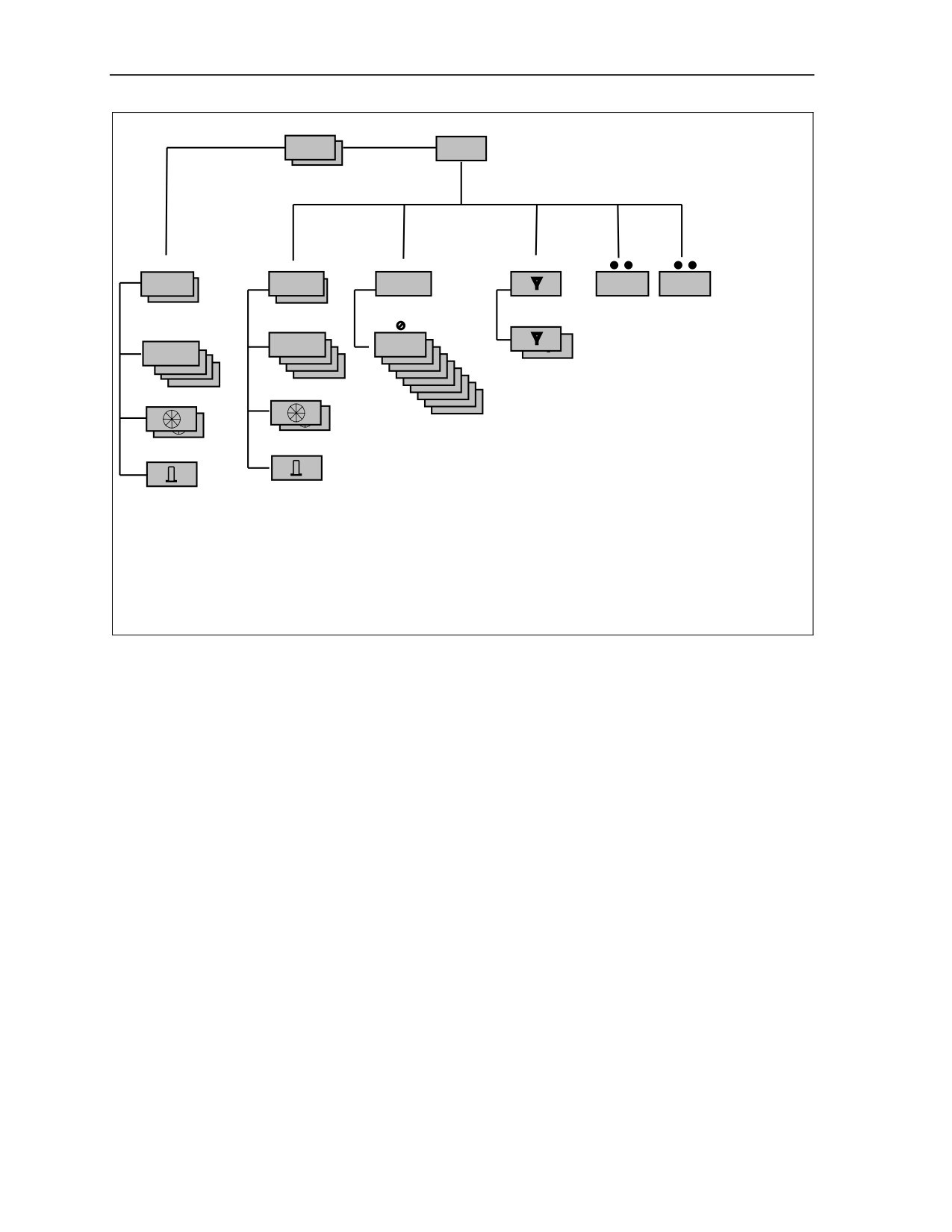
Chapter 4
+ +
+ +
ESC
TSC
I
III
X
X
SUST
SUST
MCB
HRS
FMC
II
II
II
CSSB
MCT
CSSB
I
I
I
I
Legend
MCT - Movement Control Team
CSSB - Combat Sustainment Support Battalion SUST - Sustainment Brigade
ESC - Expeditionary Sustainment Command
FMC - Financial Management Center
HRSC - Human Resources Sustainment Center TSC - Theater Sustainment Command
MCB - Movement Control Battalion
* ESC functions as a deployable command post of the TSC headquarters; provides forward-based C2.
Figure 4-1. Notional TSC Structure
4-5. A TSC may very well be required to simultaneously synchronize and integrate deployment and
sustainment operations across a theater that contains multiple theaters of operations (see Figure 4-2). In
situations such as this, the TSC may employ multiple expeditionary sustainment commands (ESC) to provide a
forward C2 presence in order to provide responsive support to multiple Army forces. In this case, the ESC
commanders are dual-hatted as deputy TSC commanders and exercise OPCON of TSC attached forces.
4-6. The TSC staff’s primary role in the mission command process is the development of plans and mission
orders. Effective parallel and collaborative planning produces plans and mission orders that:
• Foster mission command by clearly conveying the commander’s intent.
• Assign tasks and purposes to subordinates.
• Contain the minimum coordinating measures necessary to synchronize the operation.
• Allocate or reallocate resources.
• Directs preparation activities and establishes times or conditions for execution.
4-7. Mission command requires a common understanding of the situation. Theater-wide situational awareness
is essential to maintaining the intratheater segment of the distribution system in balance and operating in
harmony with the global distribution system. In part, this is accomplished through collaboration and
coordination with Army and joint partners at the strategic, operational, and tactical levels. A critical component
of which is the TSC capability to establish and maintain a common operational picture (COP). The means to
visualize a COP come from the battle command sustainment support system (BCS3), in-transit visibility (ITV)
data, logistics status
(LOGSTAT) reports, and various standard Army management information systems
(STAMIS) employed by the TSC.
4-2
FM 4-94
12 February 2010
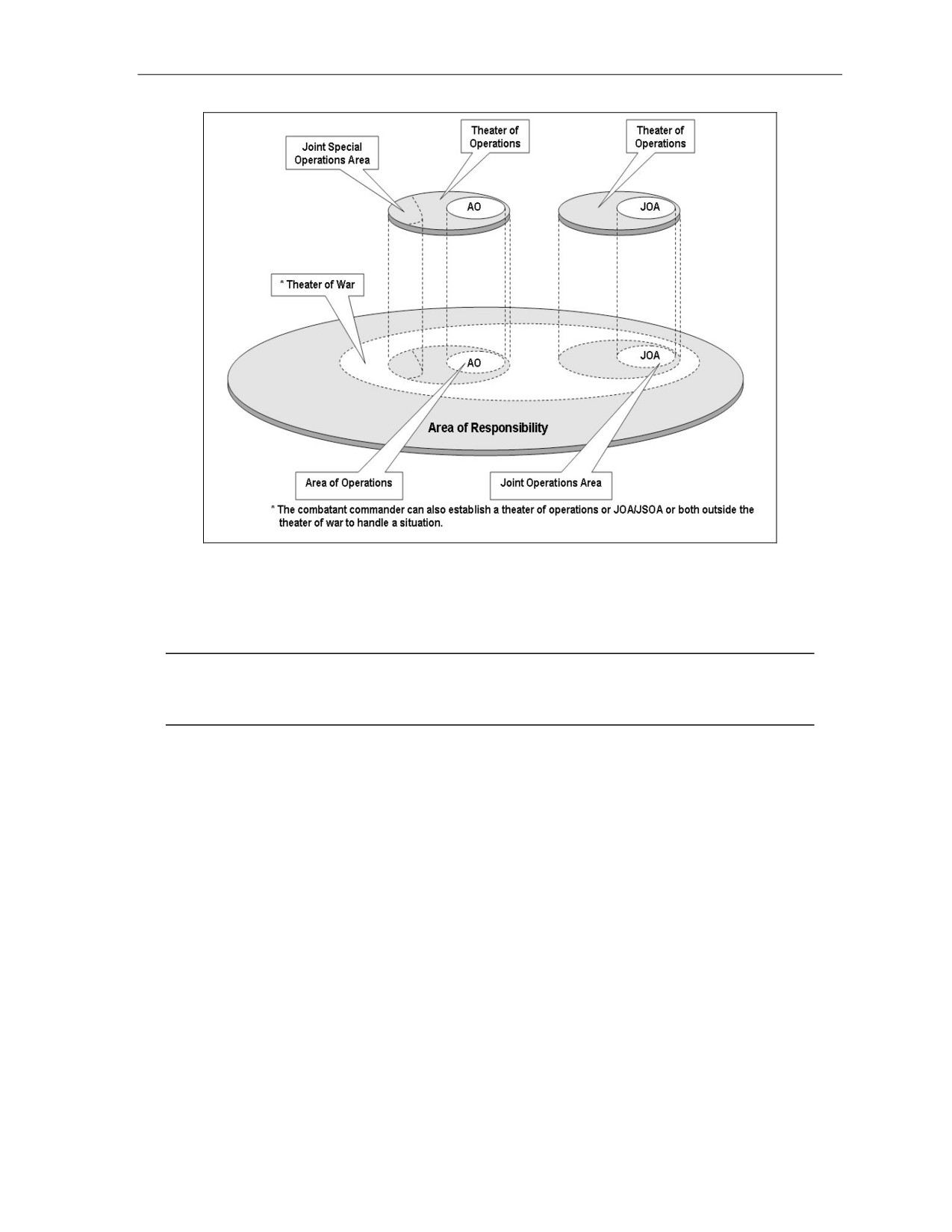
Support Operations
Figure 4-2. Notional Theater Construct
4-8. A key factor in maintaining situational awareness and enabling unity of effort is TSC participation in
GCC and subordinate joint force commander (JFC)-level boards and centers. Established on an as required
basis, boards and centers establish policies and set priorities; provide for improved synchronization and
integration; and enable the effective flow of resources in support of operational objectives.
Note. Under certain METT-TC conditions, the TSC may be responsible for chairing certain boards or
centers. Boards and centers are resourced from the internal assets of the participating organizations—a
necessity that may cause manning issues for the participating organizations.
4-9. Although all TSC staff sections play an important role in supporting mission requirements, it is the
support operations (SPO) section (see Figure 4-3) that is the TSC center of gravity. It is within the support
operations section that materiel and distribution management occurs; enabling synchronized and integrated
operational-level sustainment support throughout the theater.
4-10. The support operations section, and in particular the distribution management center
(DMC), is
augmented as required by METT-TC or in accordance with supporting to supported agreements in order to
synchronize requirements and employ constrained resources more effectively and efficiently. For example,
theater-level inventory management of Class VIII is accomplished by a medical logistics management center
(MLMC) support team that collocates with the TSC DMC; providing the medical deployment support
command (MDSC) with visibility and control of all Class VIII theater inventory and the capability to integrate
Class VIII distribution requirements with those of the TSC controlled intratheater distribution system.
4-11. The TSC SPO serves as the focal point for coordination on all matters pertaining to sustainment for:
• Supported units and major commands.
• Other Services or multinational partner forces.
• Other Army major commands (to include specialized commands).
12 February 2010
FM 4-94
4-3
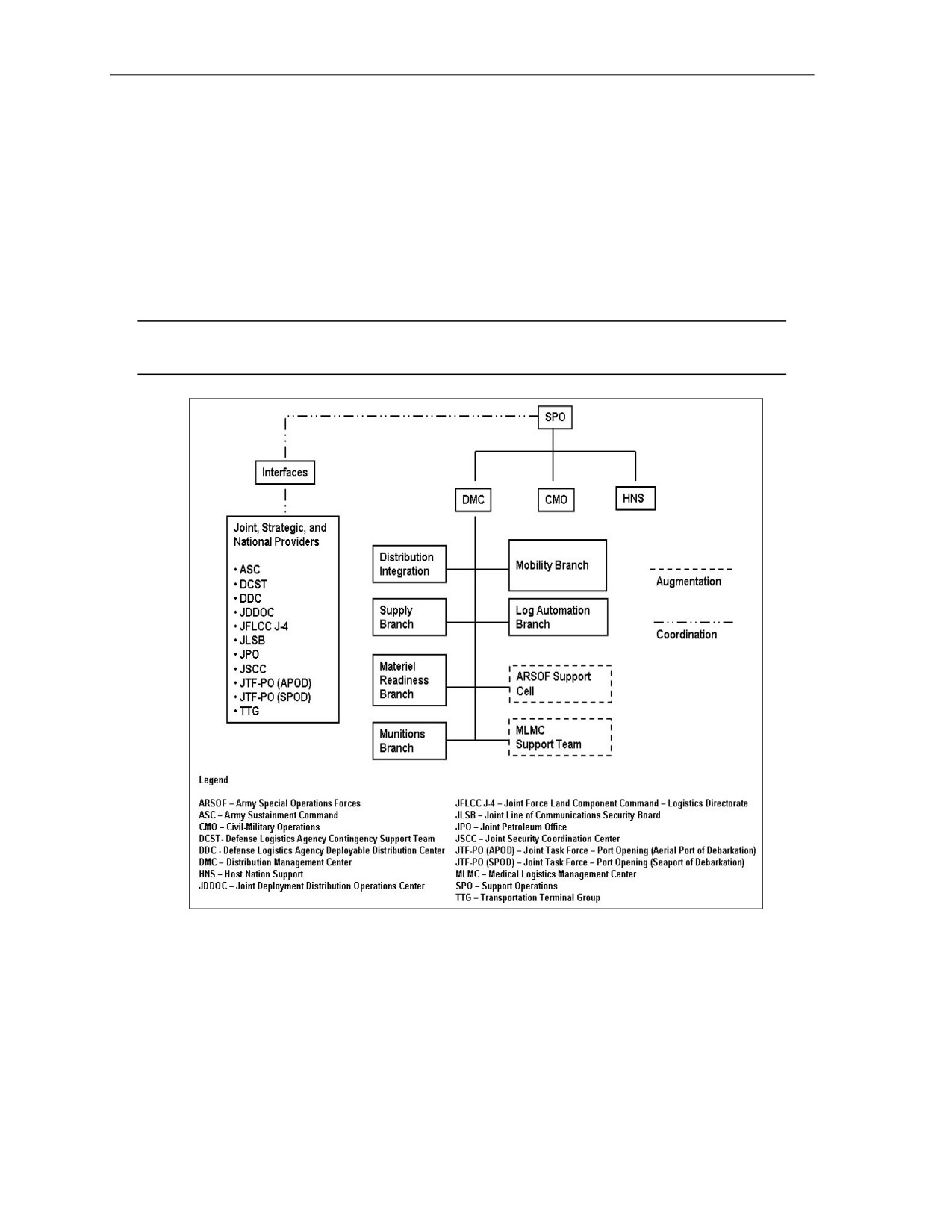
Chapter 4
• Strategic-level organizations providing support in the theater.
• Joint boards, centers, and bureaus.
4-12. Coordination is essential for the following reasons:
• Ensuring a thorough understanding of the commander’s intent.
• Ensuring complete and coherent staff actions.
• Avoiding conflict and duplication by adjusting plans or policies before implementation.
• Considering all factors affecting the situation.
Note. Additional information on the key organizations that the TSC interfaces with to provide
synchronized and integrated support to Army and Joint forces may be found in Chapters 1 and 5.
Figure 4-3. TSC Support Operations Section
4-13. The SPO is the link between planning and execution of strategic-to-operational level deployment and
sustainment operations. The SPO, by exercising staff supervision over the DMC, maintains visibility, capacity,
and control of the distribution system. Through the coordinated efforts of its internal branches, the DMC,
exercises control using current and emerging information technologies that enable the DMC to accurately
monitor support from the strategic to tactical level in near real-time.
4-14. To ensure the continuous flow of support, the DMC maintains staff supervision over all materiel
managers and movement controllers. The distribution integration branch of the DMC coordinates and
synchronizes the movement of all personnel, equipment, and supplies into and out of the theater. To do this job
4-4
FM 4-94
12 February 2010
Support Operations
effectively, the distribution integration branch relies on coordination and information exchange between the
supply and the mobility branches. A COP, provided by current and emerging information technologies, enables
the DMC to optimize resources and task subordinate organizations in support of on-going and future
operations.
4-15. The supply branch provides staff supervision over all supply operations except Class V and Class VIII.
The munitions branch provides staff supervision and visibility of conventional ammunition. The materiel
readiness branch provides staff supervision over maintenance issues impacting force readiness. The mobility
branch provides staff supervision of all allocated transportation assets and coordinates directly with the
movement control battalion (MCB) assigned to either the TSC or ESC. The mobility branch also coordinates
with joint and strategic partners (i.e. Joint deployment distribution operations center [JDDOC] and the Military
Surface Deployment and Distribution Command [SDDC]) in order to synchronize intertheater and intratheater
deployment and distribution efforts; and optimize intratheater distribution by employing all transportation
modes available in theater. The MCB coordinates all movement in the theater. The log automation branch
maintains regional servers for logistics STAMIS systems and provides log automation support to subordinate
and supported units.
SECTION II: CONDUCT RECEPTION, STAGING, ONWARD MOVEMENT, AND
INTEGRATION OPERATIONS
4-16. RSOI is a set of complex processes involving the GCC and his Service component commands, and
strategic and joint partners such as USTRANSCOM. In order to conduct efficient and effective RSOI
operations, a seamless strategic-to-theater interface is required. Three essential elements—unity of command,
synchronization, and balance—are the means by which the GCC achieves a seamless strategic-to-theater
interface and a rapid build-up of combat power.
4-17. Unity of command produces a well-synchronized flow of personnel, supplies, and units through ports of
debarkation; enabling the rapid build-up of combat power by transitioning deploying forces into forces capable
of meeting GCC operational requirements. This is accomplished, in part, through a thorough understanding of
C2 and supporting to supported relationships. It also involves the employment of a robust communications
network that effectively links all elements together and provides the means to access relevant information and
data.
4-18. Synchronization is the process that links personnel, supplies, and units in a timely manner.
Synchronization requires detailed and continuous planning, predictable air and sea flows, ITV of assets moving
through the distribution system, and the ability to adjust schedules. A well-synchronized flow helps to avoid
bottlenecks at critical nodes and along main supply routes
(MSR) and maintain balance throughout the
distribution system.
4-19. Balance is central to the relationship between deployment and theater distribution. To achieve balance,
the flow of units, equipment, and materiel in the intertheater and intratheater systems must be regulated to allow
for a continuous and controlled flow of units, equipment, and materiel. To accomplish this, the supported GCC
maintains overall responsibility for planning RSOI operations. Responsibility for execution, however, may be
assigned to a joint headquarters or Service component command. In either case, the ASCC is heavily involved
in RSOI operations due to dominant user and Army executive agency responsibilities.
4-20. The TSC, as the senior Army command responsible for deployment and sustainment in the theater,
enables efficient and effective RSOI by building a theater infrastructure—from a combination of existing and
deployable assets, capable of supporting the deployment process and rapid force generation. It relies upon
subordinate sustainment brigades, augmented by theater opening elements, to conduct port of debarkation
support operations; provide life support; and execute theater distribution operations. Army health support is
provided by the MDSC. Under certain METT-TC conditions, the TSC may also employ one or more ESCs to
provide a forward-based C2 presence that provides oversight of RSOI/or theater distribution operations.
4-21. Within the TSC, the SPO provides staff oversight of TSC RSOI efforts; coordinating and synchronizing
reception, staging, and onward movement activities with subordinate commands and strategic/joint
headquarters to maintain a balanced flow of supplies, personnel, equipment, and units consistent with strategic
lift capabilities and ASCC/GCC priorities.
12 February 2010
FM 4-94
4-5