FM 4-94 THEATER SUSTAINMENT COMMAND (February 2010) - page 1
*FM 4-94
Field Manual
Headquarters
Department of the Army
No. 4-94
Washington, DC, 12 February 2010
Theater Sustainment Command
Contents
Page
CHAPTER 1
THE THEATER SUSTAINMENT COMMAND ROLE IN FULL SPECTRUM
OPERATIONS
1-1
Section I: Operational Environment
1-1
Section II: Theater Structure
1-2
Geographic Combatant Command
1-2
Army Service Component Command
1-3
Army Forces
1-4
Section III: National Strategic-Level Support Organizations
1-4
Defense Logistics Agency
1-4
Defense Contract Management Agency
1-5
Defense Finance and Accounting Service
1-5
United States Joint Forces Command
1-5
United States Transportation Command (USTRANSCOM)
1-6
United States Army Materiel Command
1-8
Human Resources Command
1-10
United States Army Finance Command
1-10
Section IV: Support to Joint and Multinational Operations
1-11
Lead Service Responsibilities
1-11
Executive Agency
1-11
Directive Authority for Logistics
1-12
Multinational Support
1-12
Intergovernmental Organizations (IGO), Nongovernmental Organizations
(NGO), and International Agency Cooperation
1-14
Chapter 2
MISSION AND ORGANIZATION
2-1
Section I: TSC Mission and Tasks
2-1
Mission
2-1
Tasks
2-2
Distribution Restriction: This manual is approved for public release; distribution is unlimited.
*This publication supersedes FM 4-93.4, Theater Support Command, 15 April 2003.
i
Contents
Section II: TSC Roles, Functions, and Organization
2-3
Role of the Commander
2-3
Role of the Deputy Commander
2-3
Role of the Staff
2-4
TSC Organization
2-4
Section III: Command Posts
2-16
Section IV: Planning Horizons
2-16
Section V: Expeditionary Sustainment Command (ESC)
2-19
ESC Mission and Tasks
2-19
ESC Roles, Functions, and Organization
2-20
Section VI: Subordinate Organizations
2-22
Movement Control Battalion
2-23
Ordnance Group (Explosive Ordnance Disposal)
2-23
Quartermaster Group (Petroleum)
2-23
Sustainment Brigade
2-24
Financial Management Center
2-26
Human Resources Sustainment Center
2-27
Section VII: Attachments
2-28
Sustainment Brigade (Special Operations) (Airborne)
2-28
ARSOF Support Cell
2-29
Medical Logistics Management Center Support Team
2-29
CHAPTER 3
COMMAND, CONTROL, AUTOMATION AND COMMUNICATIONS
3-1
Section I: Command and Control
3-1
Command and Support Relationships
3-1
TSC Command and Control System
3-3
Army Battle Command System (ABCS)
3-4
Section II: Stamis and Supporting Information Systems
3-6
Army Human Resource Workstation
3-6
Financial Management Tactical Platform
3-6
Medical Communication for Combat Casualty Care
3-6
Property Book Unit Supply Enhanced
3-7
Standard Army Retail Supply System
3-7
Standard Army Ammunition System-Modernization
3-7
Transportation Coordinator’s Automated Information for
Movement System II
3-8
Section III: Stamis and Supporting Information System Enablers
3-10
Logistics Information Warehouse
3-10
Automated Identification Technology
3-11
Battle Command Common Services
3-11
Combat Service Support Automated Information Systems
Interface (CAISI)
3-12
Combat Service Support Very Small Aperture Terminal
3-12
Section IV: Theater Network Support
3-12
Signal Command (Theater)
3-12
LandWarNet
3-12
Theater Services
3-13
ii
FM 4-94
12 February 2010
Contents
Current and Emerging Networks
3-13
Federation of Networks
3-15
CHAPTER 4
SUPPORT OPERATIONS
4-1
Section I: Overview
4-1
Section II: Conduct Reception, Staging, Onward Movement, and
Integration Operations
4-5
Section III: Provide Distribution Management
4-6
TSC/ESC Distribution Management Roles
4-6
Distribution Management Fundamentals
4-7
Components of Distribution Management
4-7
Functions of Distribution Management
4-11
Distribution Planning
4-11
Intratheater Distribution System
4-12
Convoy Planning
4-13
Section IV: Provide Materiel Management
4-14
Section V: Provide Movement Control
4-17
Section VI: Provide Sustainment
4-18
Supply
4-18
Services
4-19
Maintenance
4-19
Operational Contract Support
4-20
Financial Management Support
4-22
Human Resources Support
4-24
Section VII: Provide Army Special Operations Forces Support
4-25
Section VIII: Provide Common-User Logistics Support
4-25
Section IX: Conduct Redeployment Operations
4-26
CHAPTER 5
STRATEGIC AND JOINT INTERFACES
5-1
Section I: Strategic Interfaces
5-1
Defense Logistics Agency Contingency Support Team
5-1
Defense Logistics Agency Deployable Distribution Center
5-1
Army Sustainment Command
5-2
Section II: Joint Interfaces
5-2
Geographic Combatant Commander
5-2
CHAPTER 6
TSC PROTECTION WARFIGHTING FUNCTION
RESPONSIBILITIES
6-1
Section I: Protection Process
6-1
Section II: Protection Tasks
6-2
GLOSSARY
Glossary-1
INDEX
..................................................................................................................... Index-1
12 February 2010
FM 4-94
iii
Contents
Figures
Figure 2-1. Theater Sustainment Command TOE Staff Organization
2-4
Figure 2-2. Planning Horizons
2-17
Figure 2-3. TSC Plans and Operations Synchronization
2-18
Figure 2-4. Expeditionary Sustainment Command TOE Staff Organization
2-22
Figure 3-1. Command and Support Relationships
3-2
Figure 4-1. Notional TSC Structure
4-2
Figure 4-2. Notional Theater Construct
4-3
Figure 4-3. TSC Support Operations Section
4-4
Figure 4-4. Simplified View of a Notional Intratheater Distribution System
4-13
Figure 4-5. TSC, ESC, and Sustainment Brigade Materiel Management Functions
4-15
Tables
Table 4-1. TSC Materiel Management Functions—SARSS
4-16
Table 4-2. Critical TSC Materiel Management Functions—SAAS-MMC
4-17
iv
FM 4-94
12 February 2010
Preface
This publication provides fundamental guidance for the employment of the theater sustainment command
(TSC) and expeditionary sustainment command (ESC) to command and control Army deployment and
sustainment operations conducted in support of joint and multinational operations across the spectrum of
conflict.
PURPOSE
Field Manual (FM) 4-94 establishes Army doctrine for operational-level deployment and sustainment by
providing overarching doctrinal direction for Army operations conducted in support of full spectrum operations
detailed in other Army manuals. FM 4-93.4 also provides a foundation for the development of appropriate
tactics, techniques, and procedures.
SCOPE
FM 4-94 is comprised of six chapters. Chapter 1 discusses the TSC’s role in full spectrum operations through
discussions of the operational environment, theater structure, strategic level support organizations, and support
to joint and multinational operations. Chapter 2 discusses the mission and organization of the TSC, the ESC,
and subordinate organizations
(including attached units). Chapter
3 discusses the automation and
communication systems used to command and control operations. Chapter 4 discusses support operations to
include distribution and materiel management, movement control, sustainment, and common-user logistics
support. Chapter 5 discusses the strategic and joint interfaces that are required to optimize theater distribution.
Chapter 6 discusses the TSC’s role in protection.
APPLICABILITY
FM 4-94 provides operational guidance for commanders and staffs assigned to a numbered Army, an Army
Service Component Command, a TSC headquarters and their subordinate units. This publication applies to the
Active Army, the Army National Guard (ARNG)/the Army National Guard of the United States (ARNGUS),
and the United States Army Reserve (USAR) unless otherwise stated.
ADMINISTRATIVE INFORMATION
Headquarters, U.S. Army Training and Doctrine Command, is the proponent for this publication. The preparing
agency is the Training and Doctrine Development Directorate, U.S. Army Combined Arms Support Command
and SCoE, ATTN: ATCL-TDD, Fort Lee, Virginia, 23831. Send written comments and recommendations on
DA Form 2028 (Recommended Changes to Publications and Blank Forms) to Commander, U.S. Army
Combined Arms Support Command, ATTN: ATCL-CDD, Fort Lee, Virginia 23801.
12 February 2010
FM 4-94
v
Chapter 1
The Theater Sustainment Command (TSC) Role within the
Spectrum of Conflict
The spectrum of conflict is a complex, interconnected, and increasingly global operational
environment encompassing air, land, maritime, and space domains and the information environment.
It is within this setting that the theater sustainment command (TSC) commands and controls Army
operational-level support of a joint or multinational force; providing centralized command and control
(C2) and decentralized operations throughout the theater. The TSC and its subordinate units are
assigned to an Army Service component command (ASCC). This chapter discusses the operational
environment, theater structure, strategic-level support organizations, and support to joint and
multinational operations.
SECTION I: OPERATIONAL ENVIRONMENT
1-1. Understanding a given operational environment is essential to the successful execution of deployment
and sustainment operations conducted in support of geographic combatant commander (GCC) objectives.
Analysis of a specific operational environment is framed in the context of political, military, economic, social,
information, infrastructure, physical environment, and time
(PMESII-PT) relationships. This PMESII-PT
analysis provides relevant information essential to understanding any given operational environment, including
that of a particular GCC. Commanders can apply the understanding gained from this analysis to a mission
analysis more narrowly focused on mission, enemy, terrain and weather, troops and support available, time
available and civil considerations
(METT-TC). Understanding their operational environment allows TSC
commanders to effectively and efficiently employ capabilities throughout the theater.
1-2. A range of factors will affect ground force operations in an era of persistent conflict. These factors
include the evolving war on terrorism, globalization of economies, climate change and natural disasters, failed
or failing states, and proliferation of weapons of mass destruction. At the same time, it is envisioned the United
States
(U.S.) will become increasingly involved in ambiguous conflicts involving non-state adversaries
operating in complex environments. As a result of a changing operational environment, logisticians must be
prepared to conduct support operations in a variety of vastly different operational environments. The specific
operational environments may be characterized by:
• A complex, non-contiguous battlefield, where boundaries may not be clearly defined.
• A threat scenario in which potential adversaries are not readily identifiable.
• Simultaneous, geographically dispersed operations that may result in long lines of communication.
• Increased coordination between organizations and functions to achieve desired effects.
• Joint or single Service organizations operating in a collaborative or interdependent joint environment.
• Joint, single Service and multinational force interaction with intergovernmental organizations (IGO),
non-governmental organizations (NGO), and contractors.
12 February 2010
FM 4-94
1-1
Chapter 1
SECTION II: THEATER STRUCTURE
GEOGRAPHIC COMBATANT COMMAND
1-3. GCCs exercise combatant command (COCOM) authority over all forces to accomplish the missions
assigned to the command. COCOM cannot be delegated or transferred. Operational control (OPCON) is
inherent in COCOM and may be delegated within the combatant command by the GCC.
1-4. GCCs develop plans for the purpose of achieving strategic and theater objectives through unified action.
The plan is the central organizing document for joint warfare; establishing subordinate commands, assigning
responsibilities, establishing appropriate command relationships and support priorities, and establishing
coordinating instructions for component commanders.
1-5. GCCs have the authority to organize forces, as required, to accomplish assigned missions. Accordingly,
a GCC may designate a Service component commander as a joint force functional component commander to
improve span of control and provide for unity of effort. The GCC may also establish one or more joint force
commands to improve span of control.
1-6. The geographic combatant command logistics directorate (J-4) is responsible for developing logistics
plans, formulating policies that ensure effective logistics support for all forces in the command, and
coordinating execution of the commander’s policies and guidance. The coordination and supervision of
deployment and distribution, supply, maintenance, logistics services, operational contract support, and
engineering are integral to providing effective logistics support across the spectrum of conflict. Because many
of the issues confronting this directorate are of a single-Service nature, close coordination and collaboration
with the Service component commands or their designated representatives are necessary for achieving unity of
effort.
1-7. Unity of effort is also achieved through the synchronization and integration capabilities of the Joint
deployment distribution operations center (JDDOC). Resourced by the GCC and augmented by United States
Transportation Command (USTRANSCOM), Defense Logistics Agency (DLA), the Services, and other
national partners, the JDDOC enables a seamless transition between the strategic deployment and distribution
processes and operational-level functions; enabling optimum use of available resources to achieve improved
efficiency and effectiveness. JDDOC capabilities are discussed below and in Chapter 5.
JOINT DEPLOYMENT DISTRIBUTION OPERATIONS CENTER
1-8. The JDDOC is a joint capability designed to support GCC operational objectives by synchronizing and
integrating strategic and multimodal theater resources to maximize deployment, distribution, and sustainment.
Its goal is to maximize GCC combat effectiveness through improved total asset visibility, enabling more
effective deployment and distribution. (See JP 3-35.)
1-9. The JDDOC, under the control and direction of the GCC, directs, coordinates, and synchronizes
deployment and redeployment (including withdrawal) execution, and distribution operations to enhance the
GCC’s ability to effectively and efficiently build, sustain, and redeploy combat power.
1-10. The JDDOC is an integral component of the GCC staff, normally under the staff supervision of the
geographic combatant command Director of Logistics (J-4). However, GCC’s can place the JDDOC at any
location required or under the operational control of another entity in the GCC area of responsibility, to include
the TSC.
1-11. The JDDOC provides the GCC with the capability to:
• Exercise centralized control for strategic deployment and distribution that reliably and rapidly
communicates, as well as satisfies, logistics requirements.
• Provide effective management of the transition between strategic and intratheater segments of the
distribution system.
1-2
FM 4-94
12 February 2010
The Theater Sustainment Command (TSC) Role within the Spectrum of Conflict
• Effectively link deployment and distribution process owners within the Services and other agencies in
order to better shape support and services for military operations. (See JP 3-35.)
• Provide a link between the theater and the joint deployment distribution enterprise (JDDE).
ARMY SERVICE COMPONENT COMMAND
1-12. Each GCC has a Service component commander from each Service-level organization (Army, Air Force,
Marine Corps, Navy, and Coast Guard). In order to fulfill its requirement to provide a Service component
commander, the Army uses an ASCC headquarters table of organization and equipment (TOE) structure (TOE
51600G000). These ASCC headquarters are apportioned one to each unified and selected sub unified
combatant command. The ASCC assigned to each GCC supports all areas required under Title 10 United States
Code (USC).
1-13. The ASCC is the senior Army command in a theater. It includes the Service component commander and
all Army personnel, organizations, units, and installations that have been assigned to the combatant command
to which the ASCC is assigned.
1-14. The ASCC commander serves as the principal advisor to the GCC for supporting and employing Army
forces in theater. The ASCC accomplishes this by participating in mid- and long-range planning to support the
GCC theater strategy and plan. In addition to fulfilling its Service-specific responsibilities, the ASCC may be
tasked to play a joint role during military operations. For example, the GCC may designate the ASCC as the
joint force land component commander (JFLCC). With augmentation, the ASCC is also capable of providing a
joint task force (JTF) capable headquarters to serve as the joint headquarters for smaller-scale contingencies.
1-15. The ASCC commander performs three strategic and operational level tasks that provide the necessary
capabilities required of Army forces assigned or attached to a joint force. They are:
• Establish linkages and coordinate with the joint force headquarters and other Service component
commanders.
• Conduct operations.
• Conduct support operations to deploy and sustain the Army Forces assigned or attached to the theater.
1-16. ASCC responsibilities within a theater are complex. Part of this complexity involves a wide array of
deployment, movement, and sustainment functions. Its focus is on theater support operations (force generation,
force sustainment, and redeployment) for Army forces and other Services, nations, and agencies when the
ASCC has lead Service responsibility. Key responsibilities include:
• Reception, staging, onward movement, and integration (RSOI) of units, personnel, supplies, and
equipment.
• Distribution management.
• Movement control.
• Allocating, managing, and redeploying units and Soldiers.
• Managing and conducting in-theater contracting to acquire supplies and services to support the
mission.
• Reconstituting capabilities in accordance with GCC priorities.
• Sustainment maintenance of Army theater assets that support the supply system.
• Establishing and managing medical treatment facilities, medical materiel management, providing
veterinary support, and functioning as the single integrated medical logistics manager (SIMLM) when
directed.
• Providing personnel services functions.
• Plan, integrate and provide government oversight support for operational contract support actions.
12 February 2010
FM 4-94
1-3
Chapter 1
• Planning, coordinating, managing, and supervising the redistribution of intratheater excess property
and shortage items.
• Planning, coordinating, managing, and supervising ARFOR redeployment, reconstitution, and
retrograde activities within the theater.
• Coordinating with Department of Army G-4 and G-8 regarding retrograde and reset requirements.
• In accordance with GCC policies, and in conjunction with DLA, planning and implementing
hazardous waste management and disposal policies and procedures.
1-17. The ASCC commander is responsible for providing the necessary capabilities required of ARFOR
assigned to a joint force. The Army support structure enables a phased expansion of capabilities and functions
linked to mission requirements.
ARMY FORCES
1-18. As part of his support to the GCC, the ASCC commander designates a commander, ARFOR, to support
each joint force commander (JFC)/JTF. If an Army commander is designated as the JTF commander, then the
next senior Army commander in the joint operations area (JOA) is designated as the ARFOR commander. The
ARFOR commander executes those Title 10 USC Service-specific responsibilities that the ASCC commander
assigns in support of the JFC/JTF.
1-19. Only the ASCC commander can transfer ARFOR commander responsibilities. This is because the ASCC
commander is ultimately responsible to the Department of the Army (DA) for the Army’s lead Service and Title
10 USC support to the GCC. Routine ARFOR command functions include those regular communications
through ASCC and DA channels that facilitate the provision of ARFOR to the JFC and their sustainment in the
area of operations (AO). Non-routine ARFOR command functions would likely include military-political
issues, serious incidents, and certain disciplinary matters. The ASCC commander determines the criteria for
routine and non-routine functions.
1-20. When an AO/JOA is established within a theater, the ASCC commander establishes support priorities in
accordance with ARFOR requirements to achieve GCC objectives. A supporting to supported relationship is
established between the ARFOR and the TSC which permits the TSC to employ theater-wide resources to
provide timely, responsive operational-level support to the ARFOR.
SECTION III: NATIONAL STRATEGIC-LEVEL SUPPORT ORGANIZATIONS
DEFENSE LOGISTICS AGENCY
1-21. DLA is the Department of Defense (DOD) strategic logistics provider. DLA supports each GCC with a
DLA contingency support team (DCST) as its focal point for coordinating DLA activities throughout the
theater. It integrates materiel management support of DLA common commodities such as subsistence, clothing
and other general supplies, package/bulk petroleum, and medical materiel. The DCST provides disposal support
as appropriate including the disposal of hazardous waste. The DCST also provides contract administration
services and support through attached DCMA elements.
1-22. DLA is responsible for providing a variety of supply, acquisition, and technical services to the military
Services. These services include inventory management, procurement, warehousing, and distribution for all
classes of supply (except Classes V and VI); administration of all military Service weapon systems acquisition
contracts; and provides disposal support through the Defense Reutilization and Marketing Service (DRMS) as
appropriate. In general, DLA eliminates logistical redundancy within the Services and standardizes common
supplies.
1-23. In the theater, DLA, through the DRMS, provides reutilization and marketing services. It establishes
theater-specific procedures for the reuse, demilitarization, or disposal of foreign excess personal property
including equipment, supplies, and hazardous materiel (HAZMAT) and waste.
1-4
FM 4-94
12 February 2010
The Theater Sustainment Command (TSC) Role within the Spectrum of Conflict
DEFENSE CONTRACT MANAGEMENT AGENCY
1-24. DCMA may be directed to provide administrative contract services for contracts awarded by all DOD
components and other designated federal and state agencies, and foreign governments. DCMA is responsible
for assuring that procured materiel and services are satisfactory and delivered when and where needed. DCMA
is a separate combat support agency under DOD and deploys its own command structure when supporting
contingency operations The services performed by DCMA may include:
• Contract management.
• Pre-award survey.
• Contractor payment.
• Support to small business and labor surplus areas.
• Transportation and packaging assistance.
• Acquisition planning support services.
• Financial services.
• Engineering support services.
• Property management.
• Quality assurance and product acceptance.
• Software acquisition management.
• Specialized safety.
DEFENSE FINANCE AND ACCOUNTING SERVICE
1-25. The Defense Finance and Accounting Service (DFAS) is responsible for the delivery and responsive
accounting and financial management services for DOD. They provide timely and useful business intelligence
to decision-makers who, with the right information, can more effectively manage their resources in support of
our troops at home and abroad. DFAS is an agency supporting the Office of the Under Secretary of Defense,
Comptroller, the principal advisor to the Secretary of Defense for budgetary and fiscal matters. As such, it is the
responsibility of DFAS to coordinate and collaborate with all civilian defense agencies, the military Services
and combatant commands.
UNITED STATES JOINT FORCES COMMAND
1-26. United States Joint Forces Command (USJFCOM) supports deployment operations as the lead joint
force integrator, leader of joint concept development, lead agent for joint force training, and the primary
conventional joint force provider to combatant commanders, which includes serving as the DOD joint
deployment process owner (JDPO). As JDPO, USJFCOM is responsible for maintaining the global capability
for rapid and decisive military force power projection. As the JDPO, USJFCOM is also responsible for leading
the collaborative efforts of the joint planning execution community to improve the joint deployment and
redeployment processes, while maintaining their overall effectiveness so that all supported joint force
commanders and supporting DOD components can execute military force power projection more effectively
and efficiently. (See JP 3-35.)
Note. A process owner is the head of a DOD component assigned responsibility by the Secretary of
Defense when process improvement involves more than one DOD component. The process owner has
the responsibility for coordinating, sustaining, and improving processes, coordinating the creation of
new processes, where appropriate; and being accountable for their outcomes. Process owners advocate
improvements for and across all DOD components for effectiveness, efficiency, and alignment
relevant to a particular process.
12 February 2010
FM 4-94
1-5
Chapter 1
UNITED STATES TRANSPORTATION COMMAND (USTRANSCOM)
USTRANSCOM is a functional combatant command responsible for providing and managing strategic
common-user airlift, sealift, and terminal services worldwide. USTRANSCOM’s deployment distribution
operation center (DDOC) is USTRANSCOM’s single focal point for all combatant command and major
shipper customers, including the Office of the Secretary of Defense, Joint Staff, Army and Air Force Exchange
Service, DLA, and the Services. The DDOC monitors the status of planned and ongoing movements in the
defense transportation system through the global transportation network (GTN). The DDOC interfaces with the
GCC’s JDDOC.
1-27. Additionally, as the distribution process owner, USTRANSCOM is responsible for integrating and
synchronizing strategic and theater deployment execution and distribution operations within each GCC’s area
of responsibility. It also provides personnel augmentation to the GCC’s JDDOC.
1-28. USTRANSCOM’s Service components include: the U.S. Air Force’s Air Mobility Command (AMC) for
airlift, the U.S. Navy’s Military Sealift Command (MSC) for sealift, and the U.S. Army’s Military Surface
Deployment and Distribution Command (SDDC) for terminal services worldwide.
1-29. The TSC coordinates through the JDDOC for visibility of strategic distribution and deployment. A
JDDOC may be located in the TSC distribution management center (DMC) to facilitate this effort. The TSC
also establishes links with SDDC, MSC, and AMC to coordinate seaport and aerial port operations,
respectively, and to maintain in-transit visibility of movements in and throughout a GCC’s specified theater.
AIR MOBILITY COMMAND
1-30. AMC is the U.S. Air Force airlift component of the USTRANSCOM and serves as the single port
manager (SPM) for air mobility. AMC aircraft provide the capability to deploy the Army’s armed forces
anywhere in the world and help sustain them in conflict or peace. As follow-on forces to USTRANSCOM’s
joint task force-port opening (JTF-PO) (aerial port of debarkation) (APOD), AMC performs single port
management functions necessary to support the strategic flow of the deploying forces’ equipment and supplies
from the aerial port of embarkation (APOE) to the theater.
1-31. APOEs and APODs are usually designated joint aerial complexes and managed by AMC. Where
designated, AMC is also the operator of common-use APOEs and/or APODs. The operation of a joint aerial
complex can be divided into two parts: air terminal operations and air terminal support operations. Air terminal
operations are run by AMC. The TSC typically has responsibility for air terminal support operations (less
health service support) that facilitate RSOI of deploying forces and materiel to designated tactical assembly
areas (TAAs) to include redeployment operations.
1-32. Air terminal operations include supervising cargo documentation, cargo loading and unloading,
providing clearance, movement operations, and security. As SPM, AMC and the TSC work together to provide
a seamless strategic/theater interface in order to provide for the efficient RSOI of forces and supplies to and
from the theater.
1-33. Air terminal support operations include port clearance, operation of holding and marshalling areas,
postal operations, personnel processing, movement control, onward movement, security, and life support. The
TSC may perform some of these functions at locations other than the joint aerial complex.
1-34. A host nation (HN) may limit the APOE/APOD to military use or the military may share the facility with
commercial activities. In the latter case, commercial carriers, governmental and non-governmental agencies,
and the military often compete for the use of limited resources.
MILITARY SURFACE DEPLOYMENT AND DISTRIBUTION COMMAND
1-35. SDDC is the Army surface transportation component of USTRANSCOM and is DOD’s SPM at the
seaport of embarkation (SPOE) and the seaport of debarkation (SPOD). USTRANSCOM exercises combatant
command of SDDC forces. SDDC is also a major subordinate command of the United States Army Materiel
Command (USAMC) who has administrative control (ADCON) for Title 10 functions. SDDC’s relationship
with a specified GCC is supporting to supported (unless otherwise specified by the Secretary of Defense).
1-6
FM 4-94
12 February 2010
The Theater Sustainment Command (TSC) Role within the Spectrum of Conflict
1-36. SDDC performs SPM functions necessary to support the strategic flow of the deploying forces’
equipment and supplies to and from the theater. In carrying out this responsibility, SDDC works closely with
the JDDOC, TSC, and MSC to coordinate the arrival, discharge, or loading of vessels in accordance with GCC
priorities. As SPM, SDDC and the TSC work together to provide a seamless strategic/theater interface in order
to provide for the efficient RSOI of unit equipment and supplies to and from the theater. SDDC is also
responsible for providing management of all port operations within the port to include coordinating workload
requirements, water-side port security, and port support activities.
1-37. Continuous coordination and collaboration between SDDC units and the TSC facilitates integrated and
synchronized operations throughout the distribution system. This interface with joint partners will enable local
direction and control of critical resources essential to achieving unity of effort.
MILITARY SEALIFT COMMAND
1-38. MSC is the Navy’s sea transportation component of USTRANSCOM. The mission of the MSC is to
provide ocean transportation of equipment, fuel, supplies, and ammunition to sustain U.S. forces worldwide
during peacetime and in war for as long as operational requirements dictate.
1-39. MSC provides sealift with a fleet of government-owned and chartered U.S.-flagged ships. MSC executes
voluntary intermodal sealift agreement contracts for chartered vessels. Sealift ships principally move unit
equipment from the U.S. to theaters of operation all over the world. In addition to sealift ships, MSC operates a
fleet of prepositioned ships strategically placed around the world and loaded with equipment and supplies to
sustain Army, Navy, Marine Corps, Air Force and DLA operations. These ships remain at sea; ready to deploy
on short notice, which significantly reduces the response time for the delivery of urgently needed equipment
and supplies to a theater, theater of operation, or JOA.
JOINT TASK FORCE - PORT OPENING (AERIAL PORT OF DEBARKATION)
1-40. The JTF-PO (APOD) is a joint capability provided by USTRANSCOM that is designed to rapidly
establish and initially operate an APOD, establish a distribution node, and facilitate port throughput within a
theater of operations. The JTF-PO (APOD) is not a standing task force, but is a jointly trained, ready set of
forces constituted as a joint task force at the time of need. Army elements of a JTF-PO (APOD) will normally
include a transportation detachment (rapid port opening), movement control teams, cargo transfer units, and
transportation truck units.
1-41. The JTF-PO (APOD) facilitates joint reception, staging, onward movement, and integration (JRSOI) and
theater distribution by providing an effective interface with the theater JDDOC for initial APOD operations. Its
capabilities include:
• Performing APOD assessment.
• Conducting APOD opening and initial operations.
• Providing movement control to include coordination for onward movement of arriving cargo and
passengers.
• Establishing joint in-transit visibility and radio frequency identification network.
• Establishing in-transit visibility from APOD to first forward destination.
1-42. The JTF-PO (APOD) is designed to deploy and operate for 45-60 days. As follow-on theater logistics
capabilities arrive, the JTF-PO (APOD) will begin the process of transferring mission responsibilities to
arriving forces or contracted capabilities to ensure the seamless continuation of airfield and distribution
operations.
JOINT TASK FORCE - PORT OPENING (SEAPORT OF DEBARKATION)
1-43. The JTF-PO (SPOD) is a joint capability provided by USTRANSCOM that is designed to rapidly
establish and initially operate an SPOD, establish a distribution node, and facilitate port throughput within a
theater of operations. Its design and capabilities are similar to those of the JTF-PO (APOD).
12 February 2010
FM 4-94
1-7
Chapter 1
1-44. The JTF-PO (SPOD) enables and facilitates JRSOI by providing an effective interface with the theater
JDDOC for initial SPOD operations; bridging distribution and onward movement gaps between strategic and
operational levels; and enabling the coordinated handoff of SPOD operations to follow-on forces. Its
capabilities include:
• Performing SPOD assessment.
• Rapidly establishing SPOD and forward distribution node operations.
• Managing port support activities for discharge operations.
• Establishing joint in-transit visibility and radio frequency identification network.
• Providing movement control to include coordination for onward movement of arriving cargo and
passengers.
• Establishing in-transit visibility from SPOD to first forward destination.
• Establishing staging areas.
1-45. The JTF-PO (SPOD) is a modular and scalable capability that can be tailored to support a specific
theater requirement. It is designed to deploy and operate for 45-60 days. As follow-on theater logistics
capabilities arrive, the JTF-PO (SPOD) will begin the process of transferring mission responsibilities to arriving
forces or contracted capabilities to ensure the seamless continuation of seaport and distribution operations.
UNITED STATES ARMY MATERIEL COMMAND
1-46. USAMC provides support to deployed Army forces through its subordinate Army sustainment command
(ASC), life cycle management commands (LCMC), Army Contracting Command, and other subordinate
activities to provide a seamless approach to linking the national sustainment base with deployed Army forces.
1-47. In addition to supporting deployed Army forces, USAMC assets within a theater may also provide
acquisition, life cycle logistics, and technology (ALT) support to joint, interagency, and multinational (JIM)
forces as directed by the ASCC commander.
ARMY SUSTAINMENT COMMAND
1-48. In its supporting to supported role to deployed Army forces, the ASC is responsible for assisting the
Army’s logistics information warehouse (LIW) in maintaining visibility and assisting in the management of the
Army’s materiel management system from the national sustainment base to the geographic theater. The ASC
also optimizes the USAMC Logistics Assistance Program in support of contingency operations.
1-49. The ASC works closely with key DOD strategic partners, specifically USTRANSCOM and DLA to
ensure the Army national sustainment base is properly integrated into the JDDE and that the national supply
system effectively supports deployed Army forces.
Army Field Support Brigade (Outside Continental United States)
1-50. The Army field support brigade (AFSB) (outside continental United States) (OCONUS) provides
integrated and synchronized ALT support to deployed Army forces. The AFSB is regionally aligned to an
ASCC and focused to serve as Army sustainment command’s (ASC) bridge between the generating force and
the operational force. The AFSB is responsible for the integration of ALT capabilities in support of operational
and tactical level commanders across the spectrum of conflict. This includes coordinating for ALT strategic
reach capabilities via a technical reach or call-forward process. When deployed, the AFSB support relationship
with a TSC or ESC is DS.ombatant commanders.
1-51. The AFSB (OCONUS) is the primary point of contact for ALT support within the theater. Key functions
include:
• Maintaining accountability of specified Army contractor personnel who accompany the force as well
as visibility of specified Army contracts.
1-8
FM 4-94
12 February 2010
The Theater Sustainment Command (TSC) Role within the Spectrum of Conflict
• Providing direct reach to the national sustainment base to include expert advice and call forward
assistance regarding readiness and sustainment.
• Responsible for Army science and technology functions as well as all materiel fielding organizations
providing new equipment training.
• Coordinating system contract support as defined in AR 715-9 to new or partially fielded systems.
• Coordinating Army pre-positioned stocks (APS) to include off-loading and property accountability.
• Providing C2 and management of the logistics assistance program through attached Army field
support battalions (AFSBn), logistics support elements (LSE), and other U.S. Army materiel command
(USAMC) logistics organizations called forward.
• Providing C2 of sustainment maintenance organizations deployed to the theater. These organizations
include forward repair activities, theater aviation sustainment maintenance group, component repair
companies, combat vehicle evaluation teams, and equipment support activities.
• Identifying, storing, and coordinating the redistribution of intratheater excess repair parts in
accordance with theater policies and procedures.
• In coordination with the contracting support brigade
(CSB) commander, integrating the ASCC
developed contracting support plan (CSP) into the overall AFSB support plan and providing oversight
of system support contracting elements.
ARMY CONTRACTING COMMAND
1-52. Recent Headquarters, Department of the Army directed modular force actions have led to the
consolidation of all theater support contracting capabilities into separate table of organization and equipment
(TOE) units that are assigned to, and receive contracting authority from, the new U.S. Army Contracting
Command (USACC). USACC is a major subordinate command of USAMC.
1-53. USACC responsibilities include contracting, C2, and management authority over theater support
contracting and the Logistics Civil Augmentation Program
(LOGCAP). This new contracting structure
represents a fundamental change in the C2, support, and coordination relationships from previous theater
support and LOGCAP related contracting organizational structures. As a result of this consolidation, the ASCC
principal assistant responsible for contracting (PARC) staff has been transformed into an operational command
called the contracting support brigade (CSB) that C2s subordinate theater support contracting elements. The
CSB support relationship with the TSC is direct support (DS).
1-54. Additionally, corps, divisions and brigade combat teams (BCT) no longer have dedicated contracting
staffs as part of their assigned support command TOEs. In the modular force, these tactical-level theater support
contracting staffs have been transformed into separate contingency contracting battalions (CCBN), senior
contingency contracting teams (SCCT), and contingency contracting teams (CCT).
Contracting Support Brigade/Principal Assistant Responsible for Contracting
1-55. The CSB is an O-6 level TOE USAMC unit assigned to the Expeditionary Contracting Command, a
subordinate unit of the USACC. The CSB is an Army modular force initiative that consolidates all theater
support contracting capabilities into one command. Contracting functions once performed by the contracting
directorate of the theater support command now reside with the CSB commander. Like the ASFB, the CSB is
regionally aligned and provides theater support contracting and operational contract support planning assistance
(to include LOGCAP planning) in support of the ASCC, Army Forces, and their major subordinate commands.
1-56. The CSB prepares contracting support plans for every ASCC operation plan (OPLAN) and contingency
plan; enabling synchronized and integrated contingency contracting support throughout a theater, theater of
operations, AO, or JOA.
12 February 2010
FM 4-94
1-9
Chapter 1
1-57. CSBs are aligned to the geographically focused ASCCs. When deployed, the CSB has a direct support
relationship with the ARFOR headquarters in the area of operation and executes its contracting mission under
the direction and contracting authority of the Expeditionary Contracting Command. The ARFOR commander
may further delegate this DS relationship per mission, enemy, terrain, troops, time available, civil
considerations (METT-TC) factors.
1-58. The CSB leads the development of the ASCC Contract support integration plan (CSIP), and through
coordination with major subordinate commands, ensures subordinate operational forces are supported in their
CSIP development efforts. CSIP development must be tied directly to ASCC/TSC logistics preparation of the
theater efforts in order to provide the most effective method of providing support that will not overwhelm the
sustainment system.
1-59. Key CSB functions include:
• Serving as the ASCC theater support contracting authority.
• When designated by the GCC, serving as the lead Service contracting command.
• Providing operational contract support advice and contracting planning assistance
(to include
LOGCAP planning) to the ASCC and TSC.
• Enforcing ASCC contracting procedures within the theater.
• Performing contract administration for contracts executed under CSB authority.
• Establishing and maintaining liaison with other deployed contracting support elements that operate
under the contracting authority of their parent organization - i.e. U.S. Army Corps of Engineers.
• Providing C2 of subordinate contingency contracting battalions
(CCBN), senior contingency
contracting teams (SCCT), and contingency contracting teams (CCT).
JOINT MUNITIONS COMMAND
1-60. The Joint Munitions Command (JMC) serves as the DOD field operating agency for the single manager
for conventional ammunition mission. The JMC manages the production, storage, issue and demilitarization of
conventional ammunition for all U.S. military Services—Army, Navy, Marine Corps, Air Force, and Coast
Guard. JMC is the logistics integrator for life-cycle management of ammunition; providing a global presence of
technical support to U.S. forces.
HUMAN RESOURCES COMMAND
1-61. The Human Resources Command is the Army G-1’s field operating agency responsible for executing
personnel process policies. Process policy execution focuses on developing business rules and procedures to
deal with current and anticipated functional processes. The execution activity links the supportive
organizational operations to personnel strategy and measures overall progress towards established goals.
1-62. Although no formal command relationship exists between the Human Resources Command and the TSC/
Human Resources Sustainment Center (HRSC), a supporting to supported relationship provides for the efficient
and effective management of assigned active-duty and Army Reserve Soldiers.
UNITED STATES ARMY FINANCE COMMAND
1-63. The U.S. Army Finance Command (USAFINCOM) is an operating agency of the Assistant Secretary of
the Army (Financial Management & Comptroller) (ASA [FM&C]). USAFINCOM provides advice and
management information to the ASA(FM&C) and interacts between the Army Staff, Army major commands,
units, and DFAS on matters concerning finance and accounting policy, systems, procedures and reporting.
1-64. A supporting to supported relationship between USAFINCOM and the TSC/financial management
center (FMC) provides the means to effectively interpret, disseminate, and implement financial management
directives, policy, and guidance developed by national providers to include USAFINCOM.
1-10
FM 4-94
12 February 2010
The Theater Sustainment Command (TSC) Role within the Spectrum of Conflict
SECTION IV: SUPPORT TO JOINT AND MULTINATIONAL OPERATIONS
LEAD SERVICE RESPONSIBILITIES
1-65. The GCC assigns lead Service common-user logistics (CUL) responsibilities, normally through the
contingency planning process, in order to achieve efficiencies and eliminate redundancies. He usually assigns
lead Service responsibilities to the dominant user and/or most capable Service for a particular common supply
item or service. In many cases, the lead Service for CUL and other support within a joint or multinational Force
is an Army responsibility. These lead Service support functions may include:
•
Supply management for Class I, II (common), III (B), and IV.
•
Production, packaging, storage, and distribution of bulk water.
•
Receipt, storage, and issue of Class VIII items in theater.
•
Common-user land transportation (CULT) and movement control.
•
Rotary aircraft and vehicular medical evacuation.
•
Transportation engineering for highway movements.
•
Facility construction and repair.
•
Financial management support.
•
Legal support.
•
Explosive ordnance disposal (EOD) support.
•
Airdrop equipment and systems.
•
Billeting, medical, and food service support for transient personnel during other than unit moves.
•
Environmental management, to include handling HAZMAT.
•
Mortuary affairs support.
•
Postal operations support.
•
Casualty liaison.
•
Retrograde.
•
Reception, staging, and on-ward movement.
1-66. The TSC executes many of the Army’s support responsibilities to other Services. The TSC assists the
ASCC assistant chief of staff, logistics section’s, planners in identifying all lead Service support requirements
(to include joint, multinational, and interagency requirements) so that scarce resources can be distributed
throughout the force. The TSC synchronizes those support responsibilities falling to other Army theater-level
commands with applicable portions of the distribution plan.
EXECUTIVE AGENCY
1-67. The Secretary of Defense designated the Army as the executive agent for numerous DOD common
support requirements. These DOD-level executive agent requirements relate to lead Service responsibilities, but
they are not one and the same. Executive agency refers to Secretary of Defense Directives and instructions to
one Service department to provide specific categories of support to other Service departments. Executive
agency reduces redundancy across the DOD and assists the Services in programming, planning, and budgeting.
The term “executive agent” does not refer to any specific ASCC (or TSC) supporting a GCC; however, Service
department executive agency is considered when assigning lead Service responsibilities within a particular joint
12 February 2010
FM 4-94
1-11
Chapter 1
operation. In many cases, lead Service requirements will be closely related to the DOD executive agent
requirements.
DIRECTIVE AUTHORITY FOR LOGISTICS
1-68. In addition to the capabilities provided by lead Service and executive agency, a GCC will exercise
directive authority for logistics (DAFL). DAFL is the combatant commander authority to issue directives to
subordinate commanders, including peacetime measures, necessary to ensure the effective execution of
approved operation plans. Essential measures include the optimized use or reallocation of available resources
and prevention or elimination of redundant facilities and/or overlapping functions among the Service
component commands. Combatant Commanders use DAFL in consonance with the common-user
responsibilities assigned to the Service components and those DOD originated executive agent designated
responsibilities for agencies and commands operating within the theater.
MULTINATIONAL SUPPORT
1-69. First, and foremost, logistics support is a national responsibility. However, to require each nation to
perform all logistics functions separately would be inefficient, expensive, and hinder the multinational force
commander’s (MNFC) ability to influence operations. Accordingly, the U.S. is a member of various alliances
and multinational forums that have developed doctrine and procedures, such as implementing agreements and
international standardization agreements for combined efforts to support multinational logistics operations.
When participating in multinational operations, U.S. Forces will conform to previously approved international
agreements.
1-70. When the military operation requires the involvement of nations that are not members of a formal
alliance or multinational forums, logistics planners must be involved in the initial planning to help define the
terms for coalition support. The importance of commencing this planning process as soon as possible cannot be
overstated.
1-71. For multinational operations to be successful, the MNFC must be given sufficient authority over logistics
resources to ensure that operational priorities can be effectively supported. The degree of authority the MNFC
has will depend upon existing agreements and ad hoc arrangements negotiated with participating nations based
on the operational environment and/or as specified in the operations plan.
1-72. The main logistics tasks of the MNFC are to develop the overall logistics concept for the operation,
including concepts for specific logistics functions; and to mange common logistics support of the multinational
force (MNF) within the scope of authorities granted by nations.
1-73. For relatively small MNF operations, MNFCs typically form multinational deployment and sustainment
staff sections to facilitate coordination and support multinational operations. In the case of larger, more
complex MNF operations requiring more coordination and common support, the MNFC may establish a
multinational joint logistics center (MJLC) and/or multinational integrated logistics unit to plan and coordinate
MNF logistics activities. Essential planning considerations include:
• MNF composition.
• Compatibility.
• HN support limitations.
• Overall infrastructure conditions in the area of operations (AO).
• Budget limitations.
• Contracting.
• Information exchange agreements.
1-74. The MJLC may consist of various functional coordination centers that provide centralized coordination
of common support services, such as movement control, contracting, host nation support, and the provision of
1-12
FM 4-94
12 February 2010
The Theater Sustainment Command (TSC) Role within the Spectrum of Conflict
bulk fuel and rations. In addition to functional coordination tasks, the MJLC may be assigned the responsibility
for coordinating the efforts of logistics units provided by nations to serve at the theater/operational-level for
common support of the entire MNF.
1-75. In the case of U.S.-led multinational operations, the JFC may opt to expand upon the tools available for
managing joint logistics operations and adapt them to the multinational environment. Options include: using a
predominant Service organization as the nucleus operational logistics activity to manage common requirements;
or using the lead Service to provide CUL support to multinational forces. Regardless of the approach used,
MNF augmentation is required to support multinational logistics activities.
Note. MJLC is a North Atlantic Treaty Organization
(NATO) concept/term. For U.S.-led
multinational operations, the “MJLC” may be referred to as the Combined/Joint Logistics Center and
operate under the staff supervision of the C/J-4.
1-76. Although logistics is a national responsibility, varying degrees of CUL support in multinational
operations can be expected in order to achieve economy of effort and avoid duplication. Just as for U.S.
Services, allies and multinational partners can delineate responsibilities among themselves based on theater
requirements and the ability of each country to provide materiel and services. Unity of effort among
multinational partners is essential. Selected CUL support, to include limited multinational cooperation, is
possible for some logistics functions, such as providing bulk fuel, water, class I, movement and movement
control, port arrangements/operations, contingency contracting, engineering, and sharing of facilities such as
distribution and warehousing, and organizational options based on METT-TC and force command structure.
1-77. In operations where the U.S. is a significant contributing nation, the combatant command may designate
the U.S. force as the lead nation for selected CUL support to the entire multinational force and/or as the role
specialist nation for a specific common item. A role specialist nation is a nation that has agreed to assume
responsibility for providing a particular class of supply or service for all or part of a multinational force.
Routinely, the Army component of the U.S. force conducts these CUL-related missions. In which case, the TSC
will play a major role in providing CUL support to multinational forces.
Note. Currently, DRMS is prohibited from providing disposal support, including hazardous waste
disposal support, to other nations.
1-78. Supporting multinational operations is a major challenge. Potential problem areas include language,
cultural differences, differences in doctrine, terminology and definitions, methods for computing requirements,
mobility, interoperability, infrastructure, competition among Services and alliance and/or multinational
members for common support, environmental considerations, and national resource limitations. In addition,
multinational support is subject to U.S. fiscal constraints. An accounting system may be required to ensure the
appropriate nation or international agency is properly billed for the logistics it receives. The TSC must
recognize these potential problem areas, harmonize them when realistically possible, and account for them
during planning and execution.
1-79. The relationship between the TSC and the MNF is supporting to supported. In general, the MNFC
identifies his support requirements in terms of priority, location, timing, and duration. The TSC commander
determines the forces, methods, and procedures to be employed in providing the support. If the TSC
commander, subject to his existing capabilities and other assigned tasks, cannot fulfill the MNFC’s
requirements, then the establishing commander, as established by formal or implementing agreements, is
responsible for determining a solution—i.e. a change in overall priorities or allocation of resources.
1-80. This command relationship provides the TSC with the control it requires to effectively and efficiently
operate the intratheater segment of the distribution system while simultaneously providing responsive support
to Army, joint, and multinational forces.
1-81. Parallel and collaborative planning between TSC and the MJLC is essential to providing responsive and
flexible CUL support to multinational forces. It is also an imperative for maintaining the intratheater segment of
the distribution system in balance; and the effective allocation and utilization of constrained CUL resources.
12 February 2010
FM 4-94
1-13
Chapter 1
1-82. Many of the same mechanisms that work with joint operations will work in multinational operations;
however, one aspect that requires special attention in multinational operations is contractor support. Each
nation, and each Service representing each nation, can obtain contracted support. The TSC planners must work
with their multinational counterparts to plan for the sharing of theater support and HN contracts to minimize
competition for contracted support; and to ensure that contracted support is reasonably available to all
participants.
INTERGOVERNMENTAL ORGANIZATIONS (IGO),
NONGOVERNMENTAL ORGANIZATIONS (NGO), AND
INTERNATIONAL AGENCY COOPERATION
1-83. Within the theater, the GCC is the focal point for planning and implementing regional military strategies
that require IGO, NGO, and international agency coordination.
1-84. Normally, the GCC will form a civil-military operations center (CMOC) to facilitate coordination with
other agencies, organizations, and the HN. Achieving unity of effort is essential to mission success and
mitigating human suffering. Key CMOC tasks include:
• Carrying out GCC guidance and decisions regarding civil-military operations.
• Providing a partnership forum for military and other participating organizations to meet the needs of
the populace.
• Receiving, validating, and coordinating requests for routine and emergency military support from
IGOs, NGOs, and international agencies.
1-85. U.S. agencies, IGOs, NGOs, and international agencies provide for their own logistics support.
However, U.S. military logistics capabilities are frequently requested and provided to these organizations. This
support may include intertheater and intratheater airlift; ground transportation of personnel, equipment and
supplies; airfield control groups; and port and railhead operations groups as authorized by Title 10 U.S. Code.
1-14
FM 4-94
12 February 2010
Chapter 2
Mission and Organization
Chapter 2 describes the theater sustainment command (TSC) mission, organization, roles, functions,
and support structure that will typically be used to provide support within the spectrum of conflict.
The TSC will include a standardized headquarters organization with modular subordinate units
capable of providing deployment and sustainment support. The TSC headquarters is geographically
focused and globally employable. The combination of these capabilities gives the TSC commander
the ability to organize and provide tailored support such as theater opening, distribution and
sustainment support to theater forces, and support for redeployment, and retrograde of forces as
directed by the Army Service component command
(ASCC) in accordance with geographic
combatant commander (GCC) directives and priorities.
SECTION I: TSC MISSION AND TASKS
MISSION
2-1. The mission of the TSC is to plan, prepare, rapidly deploy, and execute operational-level logistics
operations within an assigned theater. The TSC is capable of planning, controlling, and synchronizing
operational-level Army deployment and sustainment for the ASCC or joint force commander (JFC). It provides
a centralized logistics command and control (C2) structure for the theater Army; simultaneously supporting
deployment, movement, sustainment, redeployment, reconstitution, and retrograde.
2-2. The TSC executes its mission through the use of modular forces, to include expeditionary sustainment
commands (ESC), sustainment brigades, combat sustainment support battalions, and other modular sustainment
formations. Sustainment brigades, functional groups, combat sustainment support battalions, and functional
sustainment units serve as the building blocks of the force structure designed to execute TSC missions within
the theater.
2-3. As the senior logistics headquarters for the Army, the combatant commander may designate the TSC as a
joint command for logistics. When exercising this option the combatant commander must specify the control
and tasking authorities bestowed on the TSC as well as the command relationships it will have with the Service
components.
2-4. As required by mission, enemy, terrain and weather, troops and support available, time available, and
civil considerations (METT-TC), the TSC may extend its operational reach by deploying multiple ESCs or
sustainment brigades into specified areas of operations (AO)/ joint operational areas (JOA) in order to more
effectively provide responsive support to Army forces. ESCs can serve as forward headquarters of the TSC and
provide C2 for theater opening, theater distribution, and theater sustainment on an area basis within and
between specified AOs/JOAs.
2-5. Depending on the command structure within the theater, ESCs and sustainment brigades may be
employed to support specific Army forces within a specific AO/JOA; or to support other ESCs or sustainment
brigades with theater opening, theater distribution, and/or theater sustainment capabilities.
2-6. The TSC may be required to provide interim tactical-level support to early deploying Army elements.
The TSC also executes those lead Service common-user logistics (CUL) support requirements assigned to the
ASCC by the GCC.
12 February 2010
FM 4-94
2-1
Chapter 2
TASKS
2-7. The Full Spectrum Operations Mission Essential Task List (FSO METL) represents the minimum
fundamental doctrinal tasks that the TSC was designed to perform in any operational environment. The
Commander will use HQDA approved, standardized FSO METL when published to focus collective
training within the command. The FSO METL is augmented only when the unit is assigned a mission it
was not designed to perform. If the assigned mission is outside of the unit’s core function/designed
capabilities, the commander will analyze the assigned mission, identify the mission essential tasks, and if
necessary, add additional mission essential tasks to the FSO METL as a temporary modification to
accommodate the assigned mission. See Field Manual (FM) 7-0, Training in Full Spectrum Operations, for
additional guidance on FSO METL.
2-8. FSO METL is compatible with the operational tasks (OP) of the Universal Joint Task List (UJTL)
(Chairman of the Joint Chiefs of Staff manual
3500.04D). FSO METL can be cross walked to
corresponding operational tasks within the UJTL to support mission training when the TSC is operating in
a joint environment. Examples of the UJTL operational (OP) tasks that are supported by FSO METL are
cited below:
z
OP 1 Conduct Operational Movement and Maneuver. (Selected sub-tasks.)
OP 1.1 Conduct Operational Movement.
OP 1.1.3 Conduct Joint Reception, Staging, Onward Movement, and Integration (JRSOI) in
the Joint Operations Area.
OP 1.2 Conduct Operational Maneuver and Force Positioning.
z
OP 2 Provide Operational Intelligence, Surveillance, and Reconnaissance. (Selected sub-tasks.)
OP 2.2 Collect and Share Operational Information.
OP 2.2.4 Determine Logistical Capability of the Joint Operations Area.
OP 2.4.1 Evaluate, Integrate, Analyze, and Interpret Operational Information.
z
OP 4 Provide Operational Logistics and Personnel Support. (Selected sub-tasks.)
OP 4.1 Coordinate Supply of Arms, Munitions, and Equipment in the Joint Operations
Area.
OP 4.2 Synchronize Supply of Fuel in the Joint Operations Area.
OP 4.3 Provide for Maintenance of Equipment in the Joint Operations Area.
OP 4.4 Coordinate Support for Forces in the Joint Operations Area.
OP 4.5 Manage Logistics Support in the Joint Operations Area.
OP 4.6 Build and Maintain Sustainment Bases in the Joint Operations Area.
OP 4.7 Provide Politico-Military Support to Other Nations, Groups, and Government
Agencies.
OP 4.8 Acquire, Manage, and Distribute Funds.
z
OP 5 Provide Operational Command and Control. (Selected sub-tasks.)
OP 5.1 Acquire and Communicate Operational Level Information and Maintain Status.
OP 5.2 Assess Operational Situation.
OP 5.3 Prepare Plans and Orders.
OP 5.4 Command Subordinate Operational Forces.
OP 5.7 Coordinate and Integrate Joint/Multinational and Interagency Support.
z
OP 6 Provide Operational Force Protection. (Selected sub-tasks.)
OP 6.3 Protect Systems and Capabilities in the Joint Operations Area.
OP 6.5 Provide Security for Operational Forces and Means.
z
OP 7 Counter Chemical, Biological, Radiological, Nuclear, and high yield Explosive (CBRNE)
weapons in the Joint Operations Area. (Selected sub-tasks.)
OP 7.2 Coordinate Active CBRNE Defense in the Joint Operations Area.
OP 7.3 Coordinate Passive CBRNE Defense in the Joint Operations Area.
2-2
FM 4-94
12 February 2010
Mission and Organization
SECTION II: TSC ROLES, FUNCTIONS, AND ORGANIZATION
ROLE OF THE COMMANDER
2-9. The commander’s role is to establish a positive command climate, prepare the command for operations,
direct it during operations, and continually assess subordinates. Battle command is the doctrinal term used to
describe the commander’s role in the operations process. Commanders visualize the nature and design of
operations through running estimates and input from subordinates. They describe operations in terms of time,
space, resources, purpose, and action; employing intent, commander’s critical information requirements, and
mission orders to direct planning, preparation, and mission execution. Commanders employ a C2 system - (a
combination of people, organizations, technological means and resources, and procedures)—to allocate
resources and direct the execution of operations.
2-10. The TSC commander may choose to C2 forces using either detailed or mission command or a
combination of the two processes. Typically, mission command is preferred because it provides subordinate
commanders with the greatest degree of freedom to exercise disciplined initiative within the TSC commander’s
intent; enabling decentralized execution. The result is flexible and responsive support to supported forces. See
FM 6-0 for more information on detailed and mission command.
COMMANDER’S CRITICAL INFORMATION REQUIREMENTS (CCIR)
2-11. Commanders use CCIR to focus information collection on what they need to support critical decisions.
CCIR enable commanders to make informed decisions during planning and course of action (COA) selection.
During preparation and execution, CCIR address information commanders require to make informed decisions
associated with decision points.
MISSION ORDERS
2-12. Commanders direct with mission orders. Mission orders enable subordinate commanders to understand
the situation, their commander’s mission, concept of operations, and intent, and their own mission; and begins
the mission command process which is the Army’s preferred method for exercising C2. The commander’s
intent and concept of operations set guidelines that provide unity of effort while allowing subordinate
commanders to exercise initiative in planning, preparing, and executing deployment and sustainment
operations. Mission orders emphasize the tasks required by subordinate commands as well as the context and
purpose of the tasking.
ROLE OF THE DEPUTY COMMANDER
2-13. The TSC deputy commander serves as the second in command to the TSC commander. His role,
responsibilities, and authority vary, based on the commander’s desires, the TSC mission, and the scope and
complexity of operations. The relationship between the deputy commander and the staff is unique to each TSC.
2-14. The deputy commander has important responsibilities in the following circumstances:
• Temporary absence of the commander.
• Succession of command.
• Delegation of authority.
• C2 of sustainment operations in a forward area—i.e. AO/JOA.
2-15. The deputy commander may assume duties, to include command duties, as delegated by the commander,
either explicitly or by standard operating procedures, when the commander is temporarily absent from the
command.
12 February 2010
FM 4-94
2-3
Chapter 2
2-16. Because deputy commanders must be able to assume command at any time, they always keep abreast of
the situation. Commanders inform their deputy commanders of any changes in the commander’s visualization
or commander’s intent. The chief of staff keeps the deputy commander informed of staff actions.
2-17. TSC commanders typically delegate authority to their deputy commanders to act in their name for
specific fields of interest and responsibility. Doing this reduces the burden of commanders’ responsibilities and
allows them to focus on particular areas or concerns while their deputy commanders concentrate on others.
ROLE OF THE STAFF
2-18. Staffs provide commanders with relevant information in usable forms that help commanders achieve
accurate situational understanding. Situational understanding enables commanders to make well informed and
timely decisions and allows staffs to rapidly synchronize, integrate, and fuse actions in accordance with the
commander’s intent.
2-19. Each staff section accomplishes this essential function by processing information, employing decision
support aids, and conducting comparative analyses in order to quickly turn information into knowledge, create
situational understanding, and share a common operational picture (COP).
TSC ORGANIZATION
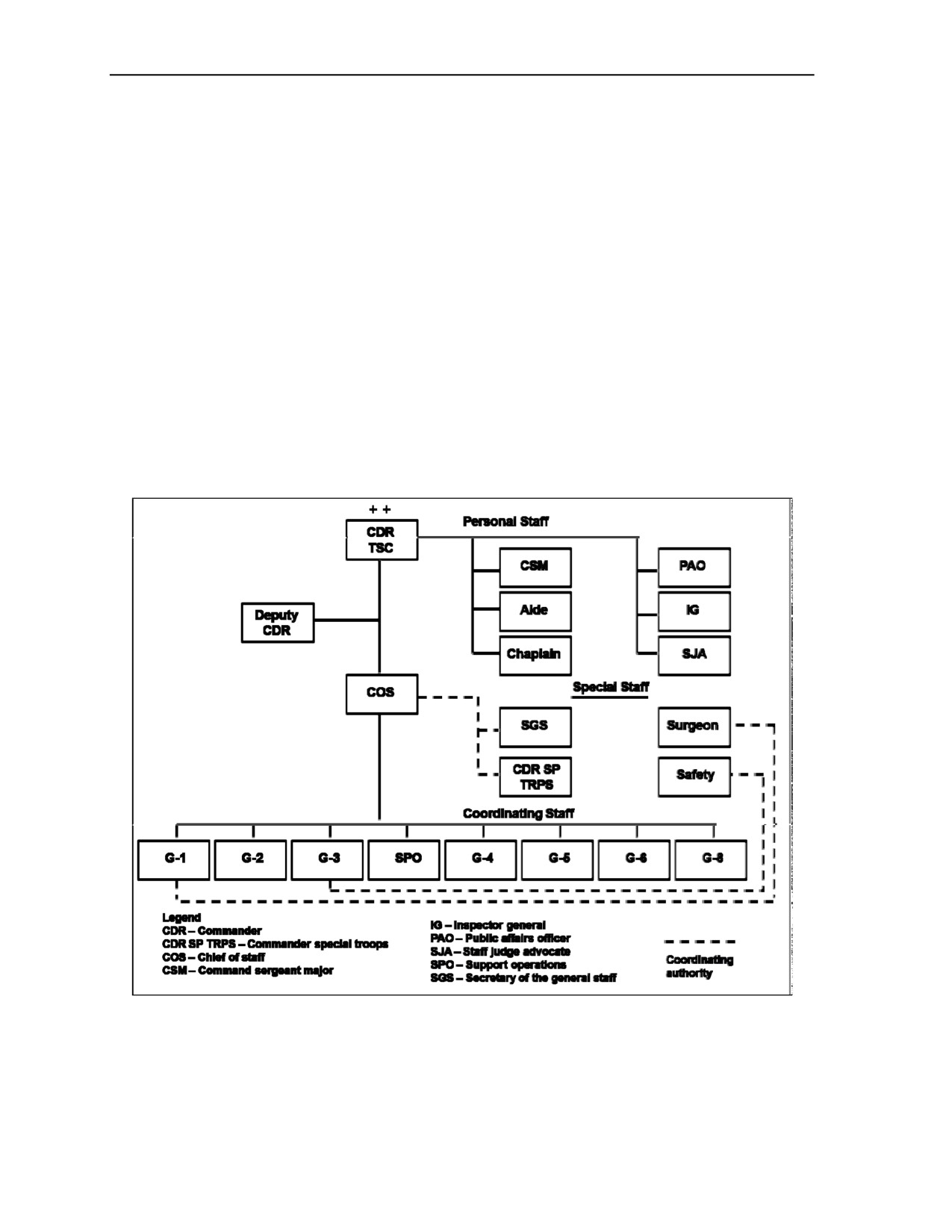
2-20. The TSC consists of three staff elements: personal, special, and coordinating. (See Figure 2-1.)
Figure 2-1. Theater Sustainment Command TOE Staff Organization
The command sergeant major, aide-de-camp, staff judge advocate, inspector general, chaplain, and public
affairs officer comprise the personal staff. The special staff is comprised of the special troops commander,
safety officer, surgeon, and the secretary of the general staff. Special staff officers provide technical advice and
planning assistance to the TSC commander and staff. The coordinating staff is comprised of the G-1- G-6, G-8,
2-4
FM 4-94
12 February 2010
Mission and Organization
and support operations (SPO). The coordinating staff develops TSC plans and policies in their respective areas
and provides guidance, priorities, and allocations to subordinate commands/units. A synopsis of the TSC
organizational structure and functions follows.
CHIEF OF STAFF
2-21. The TSC chief of staff (COS) is the TSC commander’s principal assistant for directing, coordinating,
supervising, and training the special and coordinating staffs, except in those areas the commander reserves for
himself. The TSC commander delegates the necessary executive management authority to the COS in order to
free himself from routine command activities. The COS passes pertinent data, information, and insights from
the staff to the commander and from the commander to the staff.
2-22. The COS anticipates events and shares with the commander his view of operations, events, and
requirements. The COS understands the commander’s personality, style, and instincts as they affect the
commander’s intent. The COS communicates the commander’s intent to the staff, as well as to subordinate
commanders as necessary. Staff members inform the COS of any recommendations or information they pass
directly to the commander, or of instructions they receive directly from the commander.
2-23. COS duties and responsibilities vary according to the commander’s specific desires. However, normal
duties include: directing the efforts of coordinating and special staff members, and ensuring the staff integrates
and coordinates its activities internally, vertically
(with higher headquarters and subordinate units), and
horizontally (with adjacent units).
PERSONAL STAFF
2-24. Personal staff officers work under the immediate control of the commander and therefore have direct
access to the commander. The TSC commander establishes guidelines or gives specific guidance to the personal
staff officer to inform, or coordinate with, the COS or other members of the staff on issues. A synopsis of the
TSC personal staff structure and its functions follows.
Command Sergeant Major
2-25. The command sergeant major (CSM) is the senior noncommissioned officer (NCO) of the command.
The CSM is responsible for providing the commander with personal, professional, and technical advice on
enlisted Soldier matters and the NCO corps. The CSM’s duties and responsibilities vary according to the
commander’s specific desires; however, his general duties are to provide advice and recommendations to the
commander and staff in matters pertaining to enlisted personnel.
Aide-de-Camp
2-26. The aide-de-camp serves as a personal assistant to the commanding general. The aide-de-camp provides
for the commander’s well-being and security, and relieves him of routine and time-consuming duties. The aide-
de-camp supervises other personal staff members (secretaries, assistant aides, enlisted aides, and drivers) and
coordinates protocol activities.
Chaplain
2-27. The chaplain advises the commander on religion, morale, and moral and ethical issues. The chaplain is
responsible for implementing and supervising the commander’s religious program. In coordination with the
civil-military operations section, the chaplain advises the commander and staff on impact of indigenous
religious groups in the TSC area of operations.
Public Affairs Officer
2-28. The public affairs officer (PAO) is a personal staff member that advises the commander/staff on all
public affairs operations. The PAO serves as the TSC spokesperson. As such, the PAO develops public affairs
12 February 2010
FM 4-94
2-5
Chapter 2
policy, plans, annexes, and guidance for the TSC. The PAO also coordinates and monitors Department of
Defense (DOD) media, embedded media, and national, international, and local media requirements.
Inspector General
2-29. The inspector general (IG) advises the commander on the overall welfare, climate, and state of discipline
of the command. The IG serves the commander and the command by executing four IG functions - teaching
and training, inspections, assistance, and investigations
- for the purpose of enhancing the command’s
discipline, readiness, and operational warfighting capability. The IG also conducts surveys and studies in
accordance with the commander’s guidance.
Staff Judge Advocate
2-30. The staff judge advocate (SJA) is a member of the commander’s personal staff. The SJA communicates
directly with the commander to provide legal advice for all matters affecting morale, good order, and discipline
of the command. The SJA oversees the provision of legal services throughout the command.
2-31. The SJA, as a field representative of The Judge Advocate General
(TJAG), provides technical
supervision over all Judge Advocate General’s Corps (JAGC) personnel and legal services in the command.
This includes planning legal support, requesting resources, conducting and evaluating training, and assigning
and professionally developing JAGC personnel assigned to the command. The SJA may also use the legal
technical channel to communicate with TJAG and other supervisory judge advocates.
SPECIAL STAFF
2-32. Special staff officers help the TSC commander and members of the staff in their professional or technical
specialized areas. The commander assigns responsibilities to specific coordinating staff officers for each of the
special staff functions. Although special staff personnel are not integral to a coordinating staff section, there are
usually areas of common interest and habitual association. Therefore, a coordinating staff officer might be
responsible for coordinating a special staff's actions.
2-33. The COS has coordinating staff responsibility for the commander of special troops, and the secretary of
the general staff. A synopsis of the TSC special staff structure and its functions follows.
Secretary of the General Staff
2-34. The secretary of the general staff (SGS) acts as executive officer for the COS. Besides his common staff
responsibilities, the SGS plans and supervises conferences chaired by the commander, deputy commander, or
COS. The SGS directs the activities associated with distinguished visitors to the headquarters. The SGS is also
responsible for monitoring the preparation and execution of all official social events and ceremonies involving
the commander, deputy commander, and COS.
Commander of Special Troops
2-35. The commander of special troops is responsible for Soldiers assigned to the TSC headquarters that are
not assigned or attached to subordinate commands. In addition to his common responsibilities, the commander
of special troops is responsible for, among other tasks, developing the TSC headquarters occupation plan and
providing for local headquarters security.
Surgeon
2-36. The TSC surgeon is responsible for advising the commander on the health of the TSC as well as the
effects of the health threat. He coordinates Army health support (AHS) for both health service support (HSS)
and force health protection (FHP). He ensures that all AHS functions are considered and included in operation
plans (OPLANs) and operation orders (OPORDs). The TSC surgeon also maintains a technical relationship
with the medical deployment support command (MDSC) commander and helps establish medical policy for the
theater.
2-6
FM 4-94
12 February 2010
Mission and Organization
2-37. The TSC surgeon’s HSS duties and responsibilities may include:
•
Planning and coordinating HSS for TSC units (including but not limited to casualty care, which
includes medical treatment (area support), hospitalization, the treatment aspects of dental support,
preventive medicine, combat and operational stress control/behavioral health, and clinical laboratory
support.
•
Developing and coordinating the HSS portion of AHS operation plans to support the TSC
commander’s decisions, planning guidance, and intent for support within the spectrum of conflict.
(See FM 4-02.12 and FM 8-55.)
•
Determining the medical workload requirements (patient estimates).
•
Advising the TSC commander on policy regarding the eligibility of care for non-United States (U.S.)
military personnel.
•
Maintaining situational understanding by coordinating for current HSS information with surgeons of
the next higher, adjacent, and subordinate headquarters. Coordinating with other functional component
and Service component command surgeons.
•
Recommending task organization of medical units/elements in support to TSC units to satisfy all HSS
mission requirements.
•
Monitoring troop strength of medical personnel and their use.
•
Coordinating, and synchronizing health consultation services.
•
Evaluating and interpreting medical statistical data.
•
Monitoring medical regulating and patient tracking operations for TSC personnel. (See FM 4-02.2.)
•
Determining TSC training requirements for first aid and for maintaining wellness of the command.
•
Ensuring field medical records are maintained on each Soldier assigned to the TSC at their primary
care medical treatment facility per Army Regulation (AR) 40-66 and FM 4-02.4.
•
Ensuring individual informed consent is established before administering investigational new drugs as
described in Executive Order 13139.
•
Ensuring plans are developed and practiced for the management of mass casualty situations.
2-38. The TSC surgeon's duties and responsibilities for FHP may include:
• Identifying potential medical-related commander’s critical information requirements
(priority
intelligence requirements and friendly force information requirements) as they pertain to the health
threat; ensuring they are incorporated into the command’s intelligence requirements.
• Coordinating for veterinary support for food safety, animal care, and veterinary preventive medicine.
• Planning for and implementing FHP operations to counter health threats. (See FM 4-02.17.) Force
health protection operations may include:
Planning for and accomplishing predeployment and post deployment health assessments.
Establishing and executing a medical surveillance program. (Refer to Department of Defense
Instructions [DODI] 6490.03, AR 40-5, AR 40-66, Department of the Army Pamphlet (DA PAM)
40-11, and FM 4-02.17 for an in-depth discussion.)
Establishing and executing occupational environmental health surveillance program. (See DODI
6490.03, FM 3-100.4, AR 40-5, DA Pam 40-11, and FM 4-02.17.)
Recommending combat and operational stress control, behavioral health, and substance abuse
control programs. (See FM 4-02.51.)
Ensuring the health threat and medical intelligence considerations are integrated into AHS support
operation plans and orders.
12 February 2010
FM 4-94
2-7
Chapter 2
Advising commanders on FHP chemical, biological, radiological, and nuclear (CBRN) defensive
actions, such as immunizations, use of chemoprophylaxis, pretreatments, and barrier creams.
Identifying health threats and medical-related commander’s critical information requirements.
• Submitting to higher headquarters those recommendations on medical problems/conditions that require
research and development.
• Maintaining situational understanding by coordinating for current FHP information with surgeons of
the next higher, adjacent, and subordinate headquarters.
Safety Officer
2-39. The safety officer conducts risk analysis of TSC operations and provides risk management
recommendations to the commander. The safety officer maintains an information management system
providing an audit trail of all accidents, injuries, and illnesses within the command and their causes. The safety
officer represents the commander in meetings with host nation (HN) officials concerning matters of safety to
Soldiers, local nationals, and property.
COORDINATING STAFF
Assistant Chief of Staff, G-1
2-40. The assistant chief of staff, G-1 establishes, monitors, directs, and assesses human resources support for
units assigned or attached to the TSC. This staff section provides advice and assistance to subordinate unit S-1
sections on human resource matters, monitors personnel readiness of the TSC, implements human resource
policies, and directs human resources systems and support to commanders and Soldiers. It analyzes and advises
the commander on the TSC personnel readiness posture. It establishes, maintains, and manages the command
personnel distribution program. It accounts for assigned personnel, and reports command unit strength. It
collects, summarizes, and analyzes information for preparing personnel estimates, projecting replacement
requirements, and recommending replacement priorities. It synchronizes the TSC personnel network, ensuring
activities support the commander’s desired end-state.
2-41. The G-1 staff section is comprised of three branches: personnel accounting and strength
reporting/personnel readiness management / personnel information management (PASR/PRM/PIM), plans and
operations, and personnel services. The branches perform the following functions:
• G-1 PASR / PRM / PIM Branch.
Provides for the manning of the command.
Tracks personnel readiness of the command.
Coordinates PRM and PIM requirements for the command.
Monitors and analyzes strength reports.
Conducts and manages strength reporting for the command.
Monitors TSC specific reception, replacement, return to duty, rest and recuperation, redeployment
(R5) operations.
• G-1 Plans and Operations Branch.
Prepares TSC specific human resource (HR) plans, annexes, and estimates.
Monitors and influences current and future HR operations for TSC assigned or attached units.
Identifies theater opening HR requirements.
Conducts TSC casualty operations.
Conducts and manages postal and morale, welfare, and recreation operations for TSC assigned or
attached units.
• G-1 Personnel Services Branch.
Provides for essential personnel services (EPS) in support of the command (those EPS actions
which require the approval or recommendation of the TSC commander).
2-8
FM 4-94
12 February 2010
Mission and Organization
Develops HR policy for the command.
Provides technical oversight of HR support for the command.
Assistant Chief of Staff, G-2
2-42. The assistant chief of staff, G-2 provides the commander relevant intelligence for current operations and
future plans. Directs, supervises, and coordinates the planning, collection, evaluation, fusion, analysis,
production, and dissemination of all-source intelligence. Conducts counterintelligence liaison for security and
force protection. Coordinates for external intelligence, meteorological and oceanographic weather, and terrain
product support as required. Facilitates intelligence training and readiness for alerted/rotational forces.
Exercises oversight of sensitive compartmented information (SCI).
2-43. The G-2 staff section is comprised of a single branch: current operations. Its functions include the
following:
• Produces intelligence products in support of TSC operations plan /orders.
• Prepares logistics intelligence preparation of the battlefield.
• Conducts intelligence analysis in support of all TSC missions.
• Recommends priority intelligence requirements to the commander.
• Exercises oversight of SCI reception, transmission, and storage.
• Manages the command security program.
• Manages property book accountability records of all classified communications security items of the
TSC headquarters.
• Provides a terrain visualization mission folder on the effects of terrain on friendly and enemy
operations.
• Provides specialized maps and maintains the digital terrain database.
Assistant Chief of Staff, G-3
2-44. The assistant chief of staff, G-3 is responsible for preparing broad planning guidance, policies, and
programs for command organizations, operations, and functions. Maintains primary responsibility for plans,
operations, security, force development, force protection, and countering CBRNE activities. The G-3 staff
section is comprised of two branches: force development and current operations. Their functions include the
following:
• G-3 Force Development Branch.
Develops and maintains troop basis plans to ensure that the proper number and types of units
needed to support mission requirements are assigned, attached, or under the TSC’s operational
control (OPCON).
Responsible for force accounting, including processing procedures for activation, inactivation,
and reorganization.
Responsible for allocating manpower resources to subordinate commands within established
ceilings and guidance.
Maintains liaison with ASCC joint operation planning and execution system cell.
Responsible for unit movements of TSC and subordinate headquarters.
• G-3 Current Operations Branch.
Monitors and assesses current situation.
Maintains unit readiness status of each unit assigned, attached, or OPCON to the TSC.
Authenticates and publishes administrative and logistics plans and orders, OPLANs and OPORDs.
Coordinates displacement of subordinate commands/units.
12 February 2010
FM 4-94
2-9
Chapter 2
Coordinates/assigns facilities and areas.
Develops, coordinates, and monitors base and base cluster security.
Coordinates area damage control activities with supporting maneuver enhancement brigade
(MEB).
Conducts consequence management planning.
Advises the commander and staff on all matters concerning CBRNE activities.
Develops, coordinates, implements, and monitors the command training program.
Assistant Chief of Staff, Support Operations
2-45. The assistant chief of staff, support operations
(SPO) focuses on detailed planning support for
deployment and establishing and maintaining the Army portion of the theater distribution system. The SPO is
also responsible for sustaining the force in accordance with ASCC/GCC priorities and intent. This staff section
supervises supply, maintenance, hazardous waste management, field services, transportation, and movement
control activities associated with support to the force. It also integrates transportation and movement of units,
supplies, and materiel into, within, and out of theater. It provides this support through a distribution
management center (DMC) comprised of six subordinate branches: distribution integration, supply, material
readiness, munitions, mobility, and log automation; a civil-military operations section; and a host nation
support section. Medical supply and Army special operations forces (ARSOF) support cell augmentation is
based on METT-TC. A description of SPO functions follows:
•
Support Operations.
Translates the commander’s operational priorities into priorities of sustainment support across the
spectrum of conflict.
In coordination with the ASCC, develops theater concept of support.
Prepares annexes to the TSC OPLAN/OPORD.
Establishes strategic and joint interfaces to facilitate synchronization and integration efforts.
Develops estimates and monitors operational readiness.
Verifies overall requirements for the supported force.
Develops, coordinates, and monitors plans, policies, procedures, and programs for supply,
transportation, maintenance, and field services.
Coordinates and supervises implementing policies and directives relative to supporting current
and future operations.
Balances capabilities to requirements.
Manages cross-leveling of logistics resources for mission support.
Monitors theater stocks.
Provides staff oversight of human resources sustainment center (HRSC) planning, coordination,
and execution in order to facilitate integrated and synchronized postal, casualty, and R5
operations.
Develops plans to control hazardous materiel/waste.
•
Distribution Management Center (DMC).
Develops the distribution plan.
Establishes direct liaison with the theater Joint deployment distribution operations center
(JDDOC).
Maintains liaison with higher, lower, joint, and multinational headquarters.
Utilizes all possible means to establish and maintain a common operating picture.
Maximizes strategic, operational, and tactical reach.
Maximizes readiness through the effective use of maintenance resources.
Manages all facets of transportation, to include air, land, and sea transportation assets and
common-user land transportation (CULT) support.
Coordinates and manages all aspects of intermodal container use.
2-10
FM 4-94
12 February 2010
Mission and Organization
Oversees operation of the in-transit visibility (ITV) system.
Provides materiel management.
Coordinates and monitors contracting and host nation support requirements.
Note. The functions listed above for Support Operations and the DMC represent higher level functions
that when completed are the sum of related subordinate branch functions.
•
DMC Distribution Integration Branch.
Plans, establishes, and maintains the Army portion of the theater distribution system to include
visibility, capacity management, and control of system operations.
Examines current sustainment operations to ensure logistics and personnel services contribute to
the desired effects of the supported commander.
Enforces theater sustainment priorities established by the ASCC and supported combatant
commander.
Monitors and facilitates unit deployment/redeployment and reception, staging, onward movement,
and integration (RSOI) activities.
Maintains situational awareness.
Synchronizes supported commander requirements with distribution capabilities and tracks
commodities to their final destination.
Oversees operation of the ITV system.
•
DMC Supply Branch.
Provides direction for receiving, storing, and issuing theater stocks in accordance with
ASCC/GCC support priorities.
Establishes and manages corps/theater automated data processing service center
(CTASC)
parameters for applicable classes of supply.
Executes theater management of Class I, II III (B), III (P), IV, VI, VII, IX, water and field service
operations (airdrop, mortuary affairs, and shower, laundry, and bath).
Performs as the expeditor and problem solver on all issues involving the commodities it manages.
Coordinates with the distribution integration and mobility branches for status on the distribution
of commodities it manages.
Passes requirements to the appropriate national inventory control point.
Validates requirements being considered for local procurement.
Provides theater on-hand visibility and recommends priority of issue for major end items.
Coordinates Class IX for the theater.
Recommends cross-leveling of ground and aviation repair parts.
Identifies and tracks retrograde.
•
DMC Materiel Readiness Branch.
Performs integrated materiel management for automotive equipment, tactical wheeled vehicles,
general-purpose vehicles, construction equipment, materiel handling equipment, electronic
maintenance, and aviation maintenance.
Coordinates the development of maintenance policy and programs.
Exercises staff supervision of sustainment maintenance operations and enforce priorities
established by ASCC/GCC.
Advises TSC commander on readiness.
Assists in determining appropriate positioning of maintenance assets.
Conducts analysis of maintenance capabilities and requirements, and makes recommendations to
the commander.
Provides maintenance data and reports.
12 February 2010
FM 4-94
2-11
Chapter 2
Supervises equipment modernization plan execution.
Exercises staff supervision over test, measurement, and diagnostic activities to include
management of theater-wide calibration efforts.
Exercises staff supervision over aviation maintenance activities.
Provides assistance on cross-leveling aviation equipment in the theater.
•
DMC Munitions Branch.
Maintains stock control visibility on all Class V supplies in theater.
Establishes and manages Class V CTASC parameters.
Monitors requisitions for stockage objectives, establishes mandatory stockage levels, and verifies
accuracy of unit basic loads.
Advises the TSC commander and staff on Class V status and coordinates munitions actions on
both available and in-transit stocks.
Recommends controlled supply rates for different combat situations to ASCC G-3.
Coordinates special transportation and airdrop requirements for munitions.
Responds to requests for statistical analysis and management by exception actions and requests.
•
DMC Mobility Branch.
Provides guidance, plans, policies, and staff supervision for movements.
Coordinates with supply and distribution integration branches for distribution management of all
commodities, passenger, and unit movements (RSOI, redeployment, and retrograde).
Provides primary input to the theater movement plan.
Functions as the executive agent for movement control by overseeing the development and
implementation of the movement program executed by the movement control battalion (MCB).
Provides mission planning for strategic deployment, sustainment, and redeployment.
Manages all facets of transportation information related to planning, coordinating, and evaluating
all methods of transportation, movement control, and logistical support.
Develops theater highway regulation, traffic circulation, and maneuver and mobility support
OPLANS.
Provides supplemental modal movement management for personnel and materiel, except bulk
Class III by pipeline, within, into, or out of theater.
Manages U.S. and host nation common-user transportation assets.
Serves as executive agent for container, flat rack, and air pallet management.
Coordinates all aspects of intermodal container use.
Manages container operations to include synchronizing support to retrograde operations with
priority being return of International Organization for Standardization (ISO) shipping containers,
aerial delivery platforms, and flatracks to the distribution system.
Provides theater level liaison to host nation(s) and for contracted assets.
Enforces priorities for air transportation established by the ASCC and the supported combatant
commander.
Enforces priorities for land transportation, both road and rail, established by the ASCC and the
supported combatant commander.
Enforces priorities for water transportation, both sea and inland waterways, established by the
ASCC and the supported combatant commander.
Optimizes intratheater multimodal distribution.
•
DMC Log Automation Branch.
In conjunction with the assistant chief of staff, G6, establishes standard Army management
information system (STAMIS) automation policy and provides guidance for all subordinate unit
combat service support automation management offices.
2-12
FM 4-94
12 February 2010
Mission and Organization
Acts as the focal point for and provides support for all STAMIS enablers, including combat
service support automated information systems interface (CAISI), combat service support very
small aperture terminal
(CSS VSAT), automated identification technology (AIT), and radio
frequency in-transit visibility (RF-ITV) equipment.
Plans, establishes, and maintains the CSS VSAT/CAISI network to include domain management.
Provides services of a technical/functional nature common to all elements of the TSC and its
customers to establish and maintain automation connectivity, data transmission accuracy, and
software management.
Acts as the focal point for all new STAMIS fielding, software changes, engineer change
proposals, and any other actions requiring coordination between agencies.
Controls software and applications updates to STAMIS.
Provides STAMIS support to all customer units.
Ensures all STAMIS systems are on the current system change package.
Provides STAMIS training for customer units.
•
Civil-Military Operations Section.
Plans, coordinates, and supervises civil military operations in support of TSC mission objectives.
Exercises staff supervision over attached civil affairs teams and units.
Monitors and assesses the impact of ongoing military operations on the civilian environment.
Coordinates other TSC staff interactions with civilians and helps these staff sections procure
resources, supplies, facilities, and other forms of civilian support for military operations.
Coordinates with the contracting support brigade for commercial forms of civilian support for
military operations—i.e. logistics civilian augmentation program
(LOGCAP), U.S., or other
sources.
Maintains situational awareness of LOGCAP capabilities and requirements throughout the theater.
•
Host Nation Support Section.
Develops plans, programs, policies, and procedures involving host nation support (HNS).
Maintains liaison with supported units and HN civil and military authorities.
Recommends allocation of host nation resources to support mission requirements.
Monitors and reviews current and projected HNS requirements according to the tactical situation
and plans.
Coordinates delivery of HN supplies and services.
Maintains status of HNS assets available to support mission requirements.
Assistant Chief of Staff, G-4
2-46. The assistant chief of staff, G-4 develops, coordinates, and monitors plans, policies, procedures, and
programs for supply, transportation, maintenance, field services, and facilities for the command’s subordinate
units. It determines logistics requirements for subordinate units, monitors the logistics posture of subordinate
units, and establishes support priorities in accordance with the commander’s priorities and intent. This staff
section provides staff supervision of subordinate unit field feeding and subsistence operations; monitors and
analyzes subordinate unit equipment readiness status. It is also responsible for planning and management of
fixed facilities, and coordination of construction, utilities, and real estate for the command. The G-4 staff
section is comprised of two branches: logistics support and construction support. A description of their
functions follows:
• G-4 Logistics Support Branch.
Responsible for executing strategic movement of TSC units and personnel.
Provides staff supervision and overall coordination for logistics support (supply, maintenance,
transportation, and field services) of subordinate units of the TSC.
Provides technical staff supervision over TSC food service programs and subsistence operations.
12 February 2010
FM 4-94
2-13
Chapter 2
Develops plans, policies, and procedures involving receiving, storing, and distributing
subsistence.
Conducts assistance and inspection visits to subordinate food service areas and to subsistence
storage and distribution points.
• G-4 Construction Support Branch.
Responsible for planning, managing, and coordinating fixed facilities, construction, utilities, and
real estate for the TSC.
Coordinates with the theater engineer command or senior engineer headquarters in theater for
engineering support. See FM 3-34, JP 3-34, and JP 4-0. Develops plans to control hazardous
materiel/waste.
Monitors environmental issues.
Assistant Chief of Staff, G-5
2-47. The assistant chief of staff, G-5 is responsible for synchronizing contingency and orientation planning
efforts of the TSC to include assessing the status of on-going logistics operations in relationship to objectives
and planning the next phase of the operation (to include sequels). This staff section has contingency and
orientation planning horizons based upon degrees of certainty/uncertainty. This staff section:
• Develops OPLANS/OPORDS.
• Monitors the strategic situation.
• Assesses the operational situation.
• Ensures strategic planning integration with supported ASCC and JFCs.
• Conducts mission analysis in support of long range planning.
• Develops and coordinates courses of action.
• Prepares running estimates.
• Plans for the integration of multinational support capabilities.
• Determines number and location of sustaining bases in theater.
• Develops plans to control hazardous materiel/waste.
Assistant Chief of Staff, G-6
2-48. The assistant chief of staff, G-6 is responsible for the integration and management of the TSC C2
networks in the theater; coordinates with the signal command (theater) (SC [T]) and theater network operations
and security center (TNOSC) to ensure TSC interoperability with Army special operations forces (ARSOF),
and other joint, interagency, and multinational networks. The G-6 is also responsible for managing,
implementing, and distributing signal operating instructions, as required.
2-49. Comprised of two divisions, plans and operations and information management, this staff element is
responsible for synchronizing and coordinating the implementation of ASCC communications security policies
and guidance throughout the command; providing staff supervision of new communications and information
technology system fielding activities throughout the command; providing information management
(less
logistics related support) to the command, and operating the information management help desk.
2-50. G-6 Plans and Operations Division. The G6 plans and operations division provides direction and
oversight of network plans, network operations, and information assurance in support of TSC operations. The
division is comprised of three branches: plans, operations, and information assurance. A description of branch
functions follows:
• Plans Branch.
Responsible for planning, engineering, and integrating TSC command and control networks.
2-14
FM 4-94
12 February 2010
Mission and Organization
Validates all requirements for new services and information system requirements.
• Operations Branch.
Provides network technical and configuration control.
Coordinates with signal command (theater) (SC (T)) and theater network operations and security
center (TNOSC) to ensure TSC interoperability with joint and multinational networks.
• Information Assurance Branch.
Designs, engineers, and reviews architectures to support C2 requirements in the theater.
Monitors implementation of DOD theater level information assurance vulnerability assessments.
2-51. G-6 Information Management Division. The G-6 information management division provides information
management support (less logistics related) throughout the TSC headquarters. The division is comprised
of two branches: communications systems support and information service support. A description of
branch functions follows:
• Communications Systems Support Branch.
Installs and maintains C2 equipment for the headquarters.
Provides secure telephone subject matter expertise and management for the headquarters.
• Information Service Support Branch.
Provides all administrative support to the G-6.
Provides official mail and distribution services for the headquarters.
Assistant Chief of Staff, G-8
2-52. The assistant chief of staff, G-8 is responsible for preparation, resource management analysis, and
implementation of the budget for units assigned or attached to the TSC. This staff element supervises the
development, synchronization, evaluation, defense, and execution of the command budget estimate and the
program objective memorandum; establishes, controls, and audits all financial management systems; and
advises the commander on matters pertaining to programming/budgeting, finance and accounting, cost analysis,
and management practices. A description of section functions follows:
• Provides advice to commanders on financial management implications and cost of preparing for and
conducting operations.
• Coordinates with support operations for funding actions required for contracted capabilities.
• Prepares financial management annexes in support of OPLANs/OPORDs.
• Prepares contingency cost estimates.
• Provides policy and fiscal guidance for contingency planning.
• Establishes responsibilities and monitors execution of management’s internal control program.
• Coordinates and synchronizes resource requirements identification and fulfillment methods by
identifying types and sources of funding.
• Estimates, tracks, and reports costs for specific operations to support requests to the U.S. Congress for
appropriation.
• Identifies and manages funds available for immediate expenses.
• Provides planning, programming, and budgeting support, budget analysis, management services, and
force management support.
• Captures operations costs via standard accounting systems and the management of the operating
systems that pay personnel and providers (contractors, host-nation, suppliers, etc.).
12 February 2010
FM 4-94
2-15
///////////////////////////////////////