FMI 5-0.1 THE OPERATIONS PROCESS (March 2006, March 2008) - page 3

Execution
Table 4-1. Examples of decision indicators by warfighting function
• Identification of enemy main effort.
• UAS launch.
• Identification of enemy reserves or
• Identification of HPT/HVT.
counterattack.
• Answer to a PIR.
• Indications of unexpected enemy
Intelligence
• Enemy electronic attack use.
action or preparation.
• Enemy rotary-wing or UAS use.
• Identification of an IR.
• Identification of threats from within
• Insertion of manned surveillance
civilian population.
teams.
• Success or failure of a subordinate
• Modification of an ACM.
unit task.
• Answer to an FFIR.
• Success or failure in breaching
Movement and
• Numbers of refugees sufficient to affect
operations.
friendly operations.
Maneuver
• Capture of significant numbers of
• Damages to civilian infrastructure
EPWs, enemy CPs, supply points, or
affecting friendly mobility.
artillery units.
• Receipt of an air tasking order.
• Identification of an IR.
• Battle damage assessment results.
• Execution of planned fires.
Fires
• Unplanned repositioning of firing units.
• Modification of a FSCM.
• Success or lack thereof in offensive
• Effective enemy counterfire.
information operations.
• Identification of HPT/HVT.
• Significant loss of capability in any
• Civilian mass casualty event beyond
class of supply.
capability of HN resources.
• Identification of significant incidences
• Identification of significant shortage in
of disease and nonbattle injury
any class of supply.
Sustainment
casualties.
• Aeromedical evacuation launch.
• Mass casualties.
• Answer to an FFIR.
• Receipt of significant resupply.
• Changes in availability of HN support.
• Contact on a supply route.
• NBC 1 report or other indicators of
• Identification of threats to
enemy CBRNE use.
communications or computer systems.
• Report or other indicators of enemy
• Reports of enemy targeting critical HN
improvised explosive device use.
infrastructure.
Protection
• Indicators of coordinated enemy
• Increased criminal activity in a given
actions against friendly forces.
sector.
• Identification of threat to base or
sustainment facilities.
• Answer to a CCIR.
• Jamming.
Command and
• Identification of an IR.
• Receipt of a fragmentary order or
Control
warning order from higher
• Loss of contact with a CP or
headquarters.
commander.
ACM
airspace control measure
HN
host nation
CBRNE
chemical, biological, radiological, nuclear, and
HPT
high-priority target
high-explosives
HVT
high-value target
CCIR
commander’s critical information requirement
IR
information requirement
CP
command post
NBC
nuclear, biological, and chemical
EPW
enemy prisoner of war
PIR
priority intelligence requirement
FFIR
friendly forces information requirement
UAS
unmanned aircraft system
FSCM
fire support coordinating measure
4-33. Staff members constantly compare the current situation to their expectations to identify variances.
Likewise, as the time for an anticipated execution decision approaches, staff members assess the situation
in their area of expertise. Doing this allows them to confirm that the decision will produce the planned ef-
fects. It “jump-starts” the RSDP, essentially bypassing recognition and allowing the staff to discover small
changes in conditions that might otherwise go unnoticed.
31 March 2006
FMI 5-0.1
4-7
Chapter 4
DEVELOP A RESPONSE
4-34. If the variance requires an adjustment, the leader and affected CP cell chiefs begin developing
COAs. They use the following control measures from the order to screen possible COAs:
z
Mission.
z
Commander’s intent.
z
Concept of operations, especially the decisive operation.
z
CCIRs.
4-35. The COAs must not violate the commander’s intent. They may alter the concept of operations and
CCIRs if the change remains within the intent. However, the commander must approve CCIR changes.
4-36. Functional cell chiefs and other staff section leaders identify areas that may be affected within their
area of expertise by proposed changes to the order. Considerations include but are not limited to those
shown in table 4-2 (below).
4-37. Commanders have two options for an adjustment decision: make the decision personally or delegate
it. In general, commanders should focus on decisions only they must or can make and delegate the rest.
4-38. If time is available, commanders normally direct the plans or future operations cells to develop a new
COA, using the MDMP. They may also direct the current operations cell to issue a fragmentary order set-
ting conditions for executing the new COA. When time is not sufficient to perform the MDMP, command-
ers make an immediate adjustment decision—using intuitive decision making—in the form of a focused
COA. (See FM 6-0, paragraph 6-118.) Developing the focused COA often proceeds from mental wargam-
ing commanders perform until they reach an acceptable COA.
REFINE AND VALIDATE THE COA
4-39. Once the commander has described the COA, the current operations cell analyzes it. It validates the
COA for suitability, feasibility, and acceptability. If it finds something rendering the COA unacceptable,
the G-3/S-3 informs the commander. If the COA is acceptable, it is refined to resynchronize the WFFs
enough to generate the needed combat power.
4-40. The validation and refinement is done very quickly. In many cases, the G-3/S-3 conducts a mental
simulation. The G-3/S-3 considers potential enemy reactions, the unit’s counteractions, and secondary ef-
fects that might affect the force’s synchronization. When time allows, the G-3/S-3 assembles CP cell chiefs
and performs this refinement and validation in an open forum. Staff members consider the following:
z
Does this action affect my area of expertise?
Does it require changing my information requirements?
Are any of my information requirements CCIRs?
What actions within my area of expertise does this change require?
Will it require changing objectives or targets nominated by the staff section?
z
What other CP cells and elements does this action affect?
z
What are potential enemy reactions?
z
What are the possible friendly counteractions?
Does this counteraction affect my area of expertise?
Will it require changing my information requirements?
Are any of my information requirements CCIRs?
What actions within my area of expertise does this counteraction require?
Will it require changing objectives or targets nominated by the staff section?
What other CP cells and elements does this counteraction affect?
4-8
FMI 5-0.1
31 March 2006

Execution
Table 4-2. Synchronization considerations
• Assigning new objectives.
• Revising or refining the intelligence, surveillance, and reconnaissance plan.
• Assigning new tasks to subordinate units.
Movement
• Adjusting terrain management.
and
• Modifying airspace control measures.
Maneuver
• Unit boundary changes.
• Emplacing obstacles.
• Clearing obstacles.
• Modifying priority intelligence requirements and other intelligence
requirements.
• Modifying the intelligence synchronization plan.
Intelligence
• Updating the event template.
• Updating named areas of interest and targeted areas of interest.
• Confirming or denying threat courses of action.
• Modifying the high-payoff target list and attack guidance matrix.
• Delivering fires against targets or target sets.
Fires
• Modifying radar zones.
• Modifying fire support coordinating measures.
• Modifying priorities.
• Modifying distribution.
Sustainment
• Repositioning logistic assets.
• Prioritizing medical evacuation assets.
• Repositioning and prioritizing general engineering assets.
C4 Operations
• Moving communications nodes.
• Enhancing survivability through engineer support.
• Employing smoke.
• Establishing decontamination sites.
• Conducting chemical, biological, radiological, and nuclear reconnaissance.
Protection
• Changing air defense weapons control status.
• Moving air defense weapons systems.
• Modifying of aerial coverage.
• Moving command posts.
• Synchronizing and adjusting information operations (IO) to support the new
decision.
• Modifying IO priorities.
G-7/S-7
• Modifying and submitting IO target recommendations to the targeting process.
• Synchronizing psychological operations, electronic warfare, operations
security, military deception, and, where permitted, computer network
operations and other supporting IO capabilities with the operation.
• Revising advice to commanders on military effects of operations on civilians to
reflect new operations decisions.
• Recommending modifications of civil-military operations (CMO), including
employment of civil affairs and other units to perform CMO tasks.
• Adjusting measures for minimizing civilian interference with operations.
G-9/S-9
• Revising recommended protected targets to fire support coordinator.
• Coordinating with provost marshal to adjust civilian traffic control measures.
• Identifying and adjusting use of host nation and other resources available from
civil authorities.
31 March 2006
FMI 5-0.1
4-9
Chapter 4
4-41. The validation and refinement show if the COA will acceptably resolve the situation. If it does not,
the G-3/S-3 modifies it through additional analysis or develops a new COA. The G-3/S-3 informs the
commander of any changes made to develop an acceptable solution.
IMPLEMENT
4-42. When the COA is acceptable, the G-3/S-3 implements it if delegated that authority (most execution
decisions) or recommends approval to the commander (for all other decisions). The staff then implements
the decision. The most important staff actions are resynchronizing the WFFs and disseminating changes to
control measures.
Collaborative Synchronization
4-43. After the analysis is complete, CP cell chiefs update decision support templates and synchronization
matrices. When time is available, the G-3/S-3 continues this analysis through to the end of the operation to
complete combat power integration. Staff members begin synchronization needed to implement the deci-
sion. This synchronization involves collaboration with other CP cells and subordinate staffs. Staff members
determine how actions in their areas of expertise affect others. They coordinate those actions to eliminate
undesired effects that might cause friction. This collaborative synchronization requires staff members to
exercise subordinates’ initiative. Situational understanding for staff members includes being able to visual-
ize how actions in their area of expertise affect other areas and what is required to synchronize them.
4-44. Collaborative synchronization also occurs among commanders. Commanders establish relations with
higher, adjacent, and subordinate commanders. These relationships and networked information systems
lead to collaboration. They enhance the effectiveness of eavesdropping and cross-talk over command
channels during execution.
4-45. The commander’s intent, planning guidance, and CCIRs guide subordinates—staff and subordinate
commanders—in synchronizing operations. They are also essential to achieving collaborative synchroniza-
tion. Collaborative synchronization occurs without direction from higher headquarters or commanders. It
requires subordinates to inform other affected staff sections or commanders of their decisions and actions.
It also requires monitoring their counterparts’ decisions for implications that affect their areas of expertise.
Doing this allows subordinates to resynchronize their activities with their counterparts’. This exercise of
subordinates’ initiative results in collaborative synchronization of the force.
4-46. Leaders aim to achieve the minimum synchronization needed to generate enough combat power to
implement the decision while preserving flexibility. Spending too much time synchronizing results in too
slow a response, less flexibility in execution, and lost opportunities. Deciding how much synchronization is
enough requires an accurate situational understanding by commanders and subordinates. It requires apply-
ing experience gained through training to situational awareness and the courage to act amid uncertainty.
Control Measures
4-47. Once the commander decides on a COA, the current operations cell issues a fragmentary order di-
recting implementing actions. It may be written or verbal. Common revisions to control measures needed
to effect adjustments include the following:
z
Updated enemy situation, including the situational template.
z
Revised CCIRs.
z
Updated ISR execution (retask assets).
z
Updated scheme of maneuver and tasks to maneuver units, including an execution matrix and
decision support matrix/template.
z
Updated scheme of fires, including the fire support execution matrix, high-payoff target list, and
attack guidance matrix.
z
Updated civil-military operations tasks.
4-10
FMI 5-0.1
31 March 2006
Execution
4-48. If the decision does not affect the overall operation, this directive may be released by a CP cell chief
as an update (after coordination). Updates address such areas as—
z
Delivery on of fires targets or target sets.
z
Modification of radar zones.
z
Updates to information requirements.
z
Modifications of air defense weapons control status.
4-49. If time permits, leaders verify that subordinates understand critical tasks. Methods for doing this in-
clude the confirmation brief and backbrief. (See FM 6-0, paragraphs F-7 and F-8.) This is done both be-
tween commanders and within staff elements to ensure mutual understanding.
Cautions
4-50. Leaders consider the following when using the RDSP.
4-51. Validating and refining actions is normally not a formal process but an intuitive one. (When avail-
able, automated decision support tools can help refine the decision). It should be done quickly and not
drawn out. The focus is on speed to maintain the tempo and minimum necessary synchronization. The
RDSP is not designed to mass maximum combat power but to make the minimum coordination needed to
generate enough combat power to prevail.
4-52. Most decisions during execution are made at a relatively low level by CP cell chiefs. They refine
execution of the order; they do not change it significantly. However, even small changes can affect other
staff sections. Given time, any changes should be coordinated in open forum. When time does not allow
this, the staff element making the change advises all affected elements immediately.
4-53. Maximizing combat power requires avoiding unneeded actions. During execution, it is essential to
keep decision support tools current. Delete targets from target lists and CCIRs and priority intelligence re-
quirements from the ISR plan when they no longer affect the operation. This frees assets for other priori-
ties. All staff members continually monitor targets they nominated and information requirements they
submitted. When these no longer are needed, requestors act to delete them.
4-54. Follow the principle of economy of force in all cases. When reallocating resources or priorities, as-
sign only minimum essential assets to shaping operations. Use all other assets weight the decisive opera-
tion. This principle applies when allocating resources for the overall operation or within a WFF. It pertains
to ISR assets, combat power, and sustainment.
4-55. Execution is multilayered. The answer to a CCIR or priority intelligence requirement may result in a
new target or objective. If so, the current operations cell evaluates the target or objective to determine its
relative importance. A priority needs to be assigned to it and resources allocated based on that priority.
Base the priority on the contributions of the target or objective to the concept of operations, especially the
decisive operation. If it is a higher priority than existing targets or objectives, reallocate assets to attack it.
This may require reallocating ISR assets to develop the information needed for the attack.
4-56. Conversely, attack of a newly identified target may require diverting assets from other targets. If an
attack is unsuccessful, it may require reallocation of combat power for reattack. It may also require tasking
ISR assets to determine the extent of failure and develop the information for a successful reattack. If an at-
tack is successful, it may render collection against or attack of other targets unnecessary. For example, en-
emy counterfire radars may be rendered useless if the firing units they support are destroyed. This might
change the requirement to attack such radars or collect against them.
4-57. For the RDSP to work, it must be done continuously, not tied to cyclical events or the battle rhythm.
Cyclical events (such as targeting working groups) can be used to review an entire process or evaluate the
entire ISR or targeting plan; however, the RDSP cannot be tied to them or it loses its effectiveness. The
key is to be able to act and react in real time as events occur, not at predetermined points. Only in this way
can Army forces operate within the enemies’ decision cycles at a tempo they cannot match.
31 March 2006
FMI 5-0.1
4-11
Chapter 5
Assessment
Assessment is integral to the operations process. It enables commanders and staffs to
effectively plan, prepare, and execute operations. This chapter expands on assessment
doctrine in FM 6-0. It describes the use and role of assessment during each operations
process activity. It discusses assessment tools and techniques, including how to de-
velop and use measures of effectiveness and performance to evaluate progress.
CONCEPT OF ASSESSMENT
5-1. Assessment is the continuous monitoring and evaluation of the current situation and progress
of an operation. (This definition replaces the one prescribed in FM 3-0.) It involves deliberately compar-
ing forecasted outcomes to actual events to determine the overall effectiveness of force employment. Com-
manders and staffs base assessment on their situational understanding. They achieve and maintain situ-
ational understanding to identify opportunities for more effective mission accomplishment, threats to the
force, and gaps in information.
5-2. Many aspects of military operations are quantifiable. Examples include movement rates, fuel con-
sumption, and weapons effects. While not easy, assessing physical aspects of operations can be straight-
forward. However, the dynamic interactions among friendly forces, adaptable enemies, and populations
make assessing many aspects of operations difficult. This is especially true of operations in which stability
and reconstruction operations predominate. For example, assessing the results of planned actions to change
human behavior is very challenging. In these instances, assessment relies on understanding trends and indi-
cators over time to make judgments concerning the success of given actions.
5-3. Assessment is conducted at all echelons and levels of war. It is essential to the successful conduct of
operations. It is continuous throughout planning, preparation, and execution. Assessment precedes, accom-
panies, and follows all operations. It helps commanders determine whether executed missions and tasks are
creating the desired results (effects) envisioned by the commander and expressed in the order. Put simply,
assessment helps commanders determine what is and is not working. It provides insight into how to do
things better.
5-4. Commanders drive assessment at all echelons. Some commander’s critical information requirements
(CCIRs) support assessment. Commanders establish CCIRs that help them determine whether specific de-
cisions are succeeding or if they must adjust the operation. Sources of information for assessment include
liaison personnel, reconnaissance units, intelligence analysts, and other staff specialists. The G-2/S-2 and
G-9/S-9 are especially important in assessing civil-military operations and stability and reconstruction op-
erations.
5-5. As a rule, the higher the echelon, the more formal the assessment process. For example, a joint task
force headquarters may have a dedicated assessment command post cell, formalized assessment plan, and
structured assessment progress, including assessment working groups and boards. Assessment at battalion
level is usually less formal, often relying on the judgment of commanders and staff officers. (FM 6-0,
paragraphs 2-13-2-18 and 2-76-2-106, discusses judgment and intuition.)
5-6. Understanding the contributions and effects of other elements of the joint force is essential to as-
sessment. This is true today at lower levels than previously because of greater mobility, longer weapons
and sensor ranges, and larger areas of operations. Many nonmilitary agencies—governmental and nongov-
ernmental—prepare their own assessments, especially in stability and reconstruction operations. Some of
these assessments can contribute to the commander’s assessment of the operation’s success. The U.S.
31 March 2006
FMI 5-0.1
5-1
Chapter 5
Agency for International Development and the country team can help commanders understand issues con-
cerning the various agency assessments.
5-7. Situational understanding during planning forms the basis for the initial commander’s visualization.
Commanders understand the general situation before planning begins; receiving a mission focuses their at-
tention on a specific purpose. During preparation and execution, an accurate situational understanding al-
lows commanders to assess the operation’s progress, continuously update their visualization, and make ra-
tional decisions. Keeping CCIRs current focuses efforts to gather information commanders need to make
expected decisions. Throughout an operation, intelligence provides products that contribute to the situ-
ational awareness and situational understanding needed for assessment and decision making.
5-8. Assessing consists of two tasks:
z
Monitoring the current situation and operation’s progress.
z
Evaluating operations against measures of effectiveness and measures of performance.
Based on their assessment, commanders adjust the order to accomplish the mission more effectively. Sub-
ordinate commanders assess their unit’s progress by comparing it with their mission and higher com-
mander’s intent (one and two levels up). They adjust their actions as required.
MONITORING
5-9. Monitoring is continuous observation of the current situation to identify opportunities for the
force, threats to the force, gaps in information, and progress according to the plan or order. (This
definition replaces the one prescribed in FM 3-0.) Monitoring is the foundation of situational awareness,
which leads to situational understanding. During planning, commanders and staffs focus their monitoring
on the facts and assumptions that underlie the plan. They monitor these to ensure they remain valid and to
identify new ones that will affect the plan. During preparation and execution, commanders and staffs con-
tinue to validate facts and assumptions but focus their monitoring on the current situation, identifying vari-
ances and gaps in relevant information.
5-10. At lower levels, reports required by standing operating procedures are often adequate for monitoring.
Sometimes simple reports or communications through liaison teams are enough. However, the complexities
of operations at higher echelons require a monitoring plan. The monitoring plan assigns responsibility for
monitoring specific actions.
EVALUATION
5-11. Evaluate is to compare relevant information on the situation or operation against criteria to
judge success or progress. (This definition replaces the one prescribed in FM 6-0.) Evaluation allows
commanders to identify variances, confirm or invalidate assumptions, and forecast trends. It uses the com-
mon operational picture (COP) to measure, analyze, and report the performance of forces against criteria
commanders establish. Staff sections and command post cells incorporate assessments based on evalua-
tions into their running estimates. They use these to make adjustments within their delegated authority or
present recommendations to the commander. Commanders consider these recommendations, make a deci-
sion, and direct actions.
5-12. Commanders and staffs continuously evaluate the current and projected situations to identify deci-
sions needed to accomplish the mission or better achieve the commander’s intent. One aid to evaluation is
the following list of questions. These questions may also serve as a basis for designating or revising the
CCIRs or identifying relevant information for running estimates. However, they must be converted to ad-
dress the specific situation before they suffice for CCIRs. Many answers to these questions can serve as a
way to assess an operation’s success:
z
Can the force achieve the commander’s intent?
z
Where is the enemy? Doing what? How?
z
Where are friendly forces? Doing what? How?
z
What is the enemy force’s posture now? What will it be at the time being considered (for exam-
ple, an anticipated decision time)?
5-2
FMI 5-0.1
31 March 2006
Assessment
z
Where will the friendly force be at the time being considered?
z
What are the enemy force’s problems? How can the force exploit them?
z
What are friendly force’s problems? How can they be corrected?
z
What are the enemy force’s opportunities? How can the force deny them?
z
What are friendly force opportunities? How can they be exploited?
z
Are any changes needed to the concept of operations? Task organization? Mission?
z
What is the disposition of the local populace? What impact do they have on the operation? What
impact does the operation have on them?
By evaluating the answers to questions such as these, commanders and staffs can determine variances and
their significance.
ASSESSMENT IN PLANNING
5-13. During planning, staffs achieve situational understanding based on the mission analysis and the
COP. From this, they develop and evaluate courses of action (COAs), and identify opportunities, threats,
and information gaps. Assessing includes establishing initial measures of effectiveness and performance to
evaluate COAs. (See paragraphs 5-23-5-36.) Commanders and staff develop these criteria during the COA
analysis and use them for COA comparison. They then use these criteria for evaluating during preparation
and execution. Intelligence preparation of the battlefield is a key tool for assessing the enemy situation, en-
vironment, and civil considerations. It begins during planning and continues during all operations process
activities. Running estimates also begin during planning and are key tools for all staff sections.
5-14. Operation orders include provisions for assessment. At minimum, paragraph 5 should include where
the commander, deputy commanders, and key staff officers will be positioned during the operation. (See
figure 2-5, page 2-17, above.) One useful assessment technique is the “directed telescope.” (See FM 6-0,
paragraphs 3-102-3-105.)
5-15. The plan for assessment is particularly important during early deployment stages and initial opera-
tions. An expeditionary force—with its fast arrival, early employment, and varying task organization—
requires particularly accurate means of assessing its own and the enemy’s situations. That means assess-
ment measures and collection means have to be understood early and in place when deployment starts.
5-16. A formal assessment plan may be included in the coordinating instructions of the basic order. If it is
complex, a full annex may be needed. Operations complex enough to require a formal, written assessment
plan usually occur at higher echelons. However, in longer-term operations, lower echelons may require a
formal assessment plan. Synchronization matrices and decision support templates provide starting points
for developing assessment plans. They show key events and outcomes to assess. The end state in the com-
mander’s intent and the conditions defining success in it also contain aspects of the operation to assess.
ASSESSMENT IN PREPARATION
5-17. Assessing during preparation focuses on determining changes in the friendly force’s readiness to
execute the operation. It also considers changes to the situation that the plan or order was based on. Com-
manders continue to receive information about the enemy, terrain, weather, and civil considerations. Staff
sections integrate new information into their running estimates and assess its effects against the order. This
allows them to understand the factors of METT-TC in relation to each other (and not in isolation) and their
impact on achieving the end state. They compare the actual information against expectations to determine
variances and their significance. Assessing during preparation includes confirming or invalidating assump-
tions made during planning and any threats or opportunities that might require the
commander to adjust the order. Continuously updating running estimates facilitates an accurate situation-
al understanding and predictive analysis. These estimates contribute to revising and refining the plan and
issuing new orders to modify subordinates’ tasks if necessary.
31 March 2006
FMI 5-0.1
5-3
Chapter 5
ASSESSMENT IN EXECUTION
5-18. During execution, assessment involves a deliberate comparison of forecasted outcomes to the current
situation using criteria to judge progress toward the end state. Assessing during execution focuses on iden-
tifying variances and their nature and magnitude. Significant variances prompt adjustments. During execu-
tion, running estimates continue to assess the current situation against possible future operations and the
end state.
5-19. Commanders use their situational understanding to assess the operation. The most important question
when assessing during execution is whether the order is still valid and the force will achieve the end state.
Assessment in execution emphasizes identifying opportunities and threats. Once identified, commanders
exploit the opportunities and solve or mitigate the problems that the threats create. Commanders make exe-
cution decisions if the plan is still valid. They make adjustment decisions if the situation requires altering
the plan. Altering the plan requires enough resynchronization to effectively apply combat power while af-
fording maximum flexibility to subordinates. As commanders develop an assessment, they describe their
conclusions to their staffs and subordinates. After commanders make a decision, staffs transmit the neces-
sary orders. When necessary, it adjusts the order—to include adjusting the measures of effectiveness and
performance if required. The focus then returns to executing and assessing.
ASSESSMENT CONSIDERATIONS
5-20. Assessing may be formal or less formal based on the situation. Quarterly training briefings and unit
status reports, for example, are formal assessments. In fast-paced operations, however, a formal assessment
process may not be possible. Commanders may rely on the COP, personal observations, and periodic op-
erational and assessment briefings from the staff and subordinate commanders as their assessment mecha-
nisms.
5-21. Commanders balance time and staff resources allocated for assessing against other requirements just
as they do for other operations process activities. To help balance the time and staff resources devoted to
assessment, commanders and staffs address the following questions:
z
What will be assessed and to what detail?
z
How will a particular task, activity, or effect be assessed? What criteria will be used?
z
Who in the staff has primarily responsibility for assessing a particular area?
z
What information requirements are needed to support a particular assessment?
Example. In stability and reconstruction operations, a brigade combat team may have an area of operations
with several large towns damaged by combat operations. The commander tasks subordinate commanders to
restore essential services to those towns and provides them the needed resources. This task may take
months and require the higher commander to continuously assess its progress.
In this example, a common construct describing “essential services” must be developed and under-
stood throughout the command. This construct would focus the efforts of subordinate commanders and the
assessment efforts. A report providing the information necessary to assess progress in restoring essential
services should be developed. In addition, a principal staff officer should be designated to collect this in-
formation and provide a comprehensive assessment to the commander.
5-22. Commanders must be careful, however, not to overassess. Staffs can easily become bogged down
developing formal assessment procedures for numerous tasks and effects. They might smother subordinate
commanders and staffs with requirements for numerous reports, questions, and information requirements.
Often, standard reports, returns, and updates by commanders are sufficient. The chief of staff/executive of-
ficer helps the commander achieve the right balance.
5-4
FMI 5-0.1
31 March 2006
Assessment
MEASURES OF EFFECTIVENESS AND MEASURES OF
PERFORMANCE
5-23. To support assessment, commanders and staff develop measures of effectiveness (MOEs) and meas-
ures of performance (MOPs). Not all criteria can be reduced to MOEs or MOPs. Commanders should not
use MOEs or MOPs when they are inappropriate. In those exceptional cases, commanders should develop
criteria that fit the situation.
5-24. A measure of effectiveness is a criterion used to assess changes in system behavior, capability,
or operational environment that is tied to measuring the attainment of an end state, achievement of
an objective, or creation of an effect. MOEs focus on the results or consequences of friendly actions
taken. They answer the question, Is the force doing the right things, or are additional or alternative actions
required? Often an effect cannot be measured directly. If direct measurement is not possible, then indica-
tors of achieving the effect are measured. Staffs then apply analysis and judgment to develop conclusions
about achieving the effect. Measuring indirectly requires great care in selecting and measuring indicators.
5-25. A measure of performance is a criterion to assess friendly actions that is tied to measuring task
accomplishment. MOPs answer the question, Was the task or action performed as the commander in-
tended? MOPs confirm or deny that the task has been correctly performed.
5-26. MOEs and MOPs give commanders and staffs a basis to evaluate the contributions military efforts
make toward achieving the end state. They are indicators used collectively to identify trends that can affect
future actions, influence decisions, identify transitions, and determine termination points. MOEs and MOPs
help commanders determine when all or part of the mission has been accomplished, permitting reallocation
of resources. The criteria used depend on the situation. They often require readjustment as the situation
changes and objectives evolve.
5-27. At lower levels, it may be impractical to use of a large number of MOEs and MOPs. The level of de-
tail depends on the operation’s nature and headquarters’ staffing level. In stability and reconstruction op-
erations, limited use of MOEs and MOPs may be possible down to battalion level. In general, units without
a staff cannot perform assessments to such a level of detail. Consequently, higher echelon staffs ensure that
their numerous MOEs and MOPs do not overly burden lower echelons—especially battalion and below.
5-28. When crafting MOEs and MOPs ensure they have the following characteristics:
z
Measurable.
z
Discrete.
z
Relevant.
z
Responsive.
MEASURABLE
5-29. MOEs and MOPs require quantitative or qualitative standards that can be used to measure them.
Quantitative measures are generally preferable, as they are usually more objective than qualitative meas-
ures. When qualitative measures are required, clear measurement criteria must be established and dissemi-
nated to prevent misinterpretation and useless information.
DISCRETE
5-30. Although forces can measure any given task or desired impact with multiple MOEs and MOPs, care
is required to ensure that each criterion measures a distinct aspect of the operation. This eliminates redun-
dant efforts. Excessive numbers of MOEs and MOPs become unmanageable. At that point, the cost of col-
lection efforts outweighs the value of assessing.
31 March 2006
FMI 5-0.1
5-5
Chapter 5
RELEVANT
5-31. MOEs and MOPs must be relevant to measured task’s outcome. Developing relevant MOPs is usu-
ally fairly simple. Relevant MOEs are more difficult. The key is visualizing the desired result or outcome
and identifying the most accurate and simplest indicator of it.
RESPONSIVE
5-32. MOEs and MOPs must detect situation changes quickly enough for commanders to respond immedi-
ately and effectively.
5-33. A measure is a data point that depicts the degree to which an entity possesses an attribute. This de-
gree is expressed by a unit of measure. Although measures are informative, commanders and staffs are
most interested in patterns and trends. Once two or more measures are taken, they can be plotted to deter-
mine patterns and trends. These reveal whether an attribute is more or less prevalent at different times.
Commanders and staffs also develop a standard or baseline against which they compare measures and
trends. Once established, this baseline remains a fixed reference point. From this information and analysis
of why a trend is up or down, staffs can identify trouble spots and plan operations to reverse negative
trends. They can also capitalize on positive trends by determining what is causing the positive increase and
apply those tactics, techniques, and procedures more broadly.
5-34. The following examples illustrate the difference between MOEs and MOPs.
Example 1. Assume a unit supporting disaster relief is tasked to establish a refugee camp (task) in order to
provide shelter to displaced civilians (purpose).
An example of an MOP for this refugee camp would be the number of tents erected. This measures the
level of task accomplishment.
An example of an MOE for this refugee camp would be the number of people within supporting dis-
tance of the refugee camp without shelter. This measures the desired result of establishing the refugee
camp. The baseline for this MOE would be the number of people without shelter before the disaster. This
provides a natural-state standard against which the unit can measure their results. Tracked over time, these
measures produce trends that the unit can focus their efforts around until they reach the baseline.
Notice that MOPs generally measure performance of the task while MOEs generally measure accom-
plishment of the purpose.
Example 2. Assume a fires brigade is given the task, Neutralize enemy force 1 vicinity Objective Alpha
(task) to enable 1st Brigade Combat Team’s unimpeded movement along Route X (purpose).
MOPs for this task would include the number and type of rounds fired, when they were fired, and
where they hit.
An MOE for this task would be, Is enemy force 1 able to impede 1st Brigade Combat Team’s move-
ment along Route X?
Again, the MOPs generally relate to accomplishing the task and MOEs generally relate to accomplish-
ing the purpose.
5-35. Commanders and staffs should exercise caution and judgment when using numerical and statistical
indicators. These indicators may vary widely in interpretation. They may be valid only for a specific time,
place, or group of people. They may not have a direct correlation to effectiveness. MOEs and quantitative
MOPs may not capture qualitative changes.
5-36. MOEs and MOPs may be placed in the coordinating instructions subparagraph of operation order
paragraph 3. If the discussion is too long, they may be placed in an annex. Usually, this annex includes the
assessment plan. In stability and reconstruction operations, assessing focuses on the state of civil security
and civil control (including governance) and the state of essential services for the civilian population.
5-6
FMI 5-0.1
31 March 2006
Appendix A
Considerations for Stability and Reconstruction
Operations and Civil Support Operations
This appendix addresses considerations for stability and reconstruction and civil sup-
port operations within the context of full spectrum operations. It discusses the nature
of simultaneity and the complementary effects of each of the major types of opera-
tions. The appendix expands the doctrinal discussion of transitions and links opera-
tional art and executing transitions. Finally, this appendix discusses using lines of op-
erations to support planning considerations for stability and reconstruction and civil
support operations during operational design.
INTRODUCTION
A-1. Contemporary operations require a force able to simultaneously conduct purposeful combinations of
the types of operations, shifting the emphasis of the predominant type as necessary. In an unpredictable en-
vironment where the level of violence is subject to sudden, unexpected change, Army forces must retain
the capability to maneuver against and destroy enemies in close combat, seize and hold terrain, and control
populations. Physical destruction of enemy forces is but a means to an end.
A-2. Breaking the will of the enemy does not necessarily end a campaign. Ultimately, Americans fight for
a better peace. Security must be established, services restored, and the foundation for a lasting peace estab-
lished. After major combat operations, Army forces continue to conduct full spectrum operations, with sta-
bility and reconstruction operations predominating. Forces with the inherent ability to rapidly transition be-
tween types of operations are ideally suited to conduct operations in today’s operational environment.
FULL SPECTRUM OPERATIONS
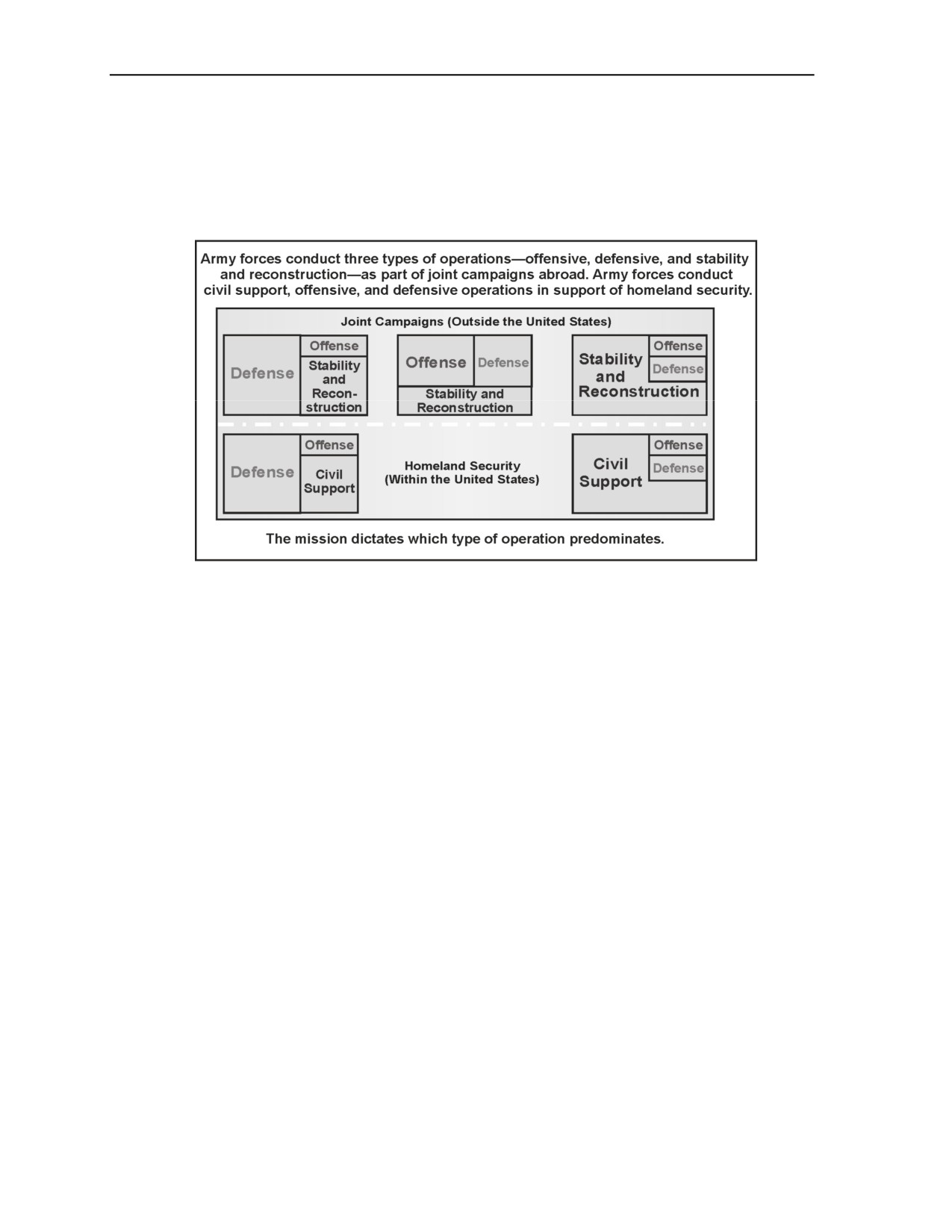
A-3. Full spectrum operations are characterized by the conduct of simultaneous combinations of the types
of Army operations (offense, defense, and stability and reconstruction or civil support) across the spectrum
of conflict (peace, crisis, and war). Stability and reconstruction operations are executed only outside the
homeland, while civil support operations are conducted domestically. (See figure A-1, page A-2, below.)
A-4. Army forces employ landpower across the range of military operations. Effective employment of
landpower relies upon the purposeful combination of the types of operations, integrated and synchronized
through operational art and design, to seize, retain, and exploit the initiative. Simultaneity is a vital compo-
nent to the joint effort to disrupt, dislocate, and destroy an enemy force. It is fundamental to Army opera-
tional doctrine. Campaigns normally consist of several overlapping major operations, each with a different
emphasis and different weight of effort applied to each type of operation. Army forces plan, prepare, exe-
cute, and assess simultaneous and sequential combinations of offensive, defensive, and stability and recon-
struction or civil support operations as part of an integrated joint force. Typically, one category of opera-
tions predominates and gives the operation or phase its overall character.
SIMULTANEITY IN OPERATIONS
A-5. Simultaneity is a key attribute of full spectrum operations. Full spectrum operations shatter the en-
emy’s coherence by seizing, retaining, and exploiting the initiative with speed, shock, surprise, depth,
simultaneity, and endurance. Simultaneous operations distributed throughout the area of operations (AO)
generate the swift and violent engagements that disrupt the enemy’s coherence and capitalize on Army
31 March 2006
FMI 5-0.1
A-1
Appendix A
forces’ leadership, cohesion, and superior training. Continuous exploitation accelerates enemies’ deteriora-
tion and ultimately collapses their will. Major combat operations are characterized by Army forces execut-
ing dynamic combinations of offensive and defensive operations while simultaneously conducting stability
and reconstruction operations. Full spectrum operations and their inherent simultaneity are vital to creating
conditions for a lasting peace, preventing the civilian population from becoming disaffected, and providing
for their essential needs.
Figure A-1. Full spectrum operations
A-6. Throughout operations, commanders constantly adapt. Combat operations entail simultaneous and
continuous combinations of offensive, defensive, and stability and reconstruction operations. Commanders
adjust their individual command and control systems, change force composition, and balance the emphasis
placed on offensive, defensive, and stability and reconstruction or civil support tasks.
A-7. Simultaneity within full spectrum operations also creates complementary operational effects. For ex-
ample, the ability of Army forces to attack and destroy enemy forces supports the efforts of forces engaged
in stability and reconstruction operations by deterring potential threats. Conversely, effective stability and
reconstruction operations influence civilians in the AO not to join or support enemy efforts, reducing de-
fensive and offensive requirements. Ultimately, the same capabilities that enhance the ability of forces to
conduct simultaneous full spectrum operations enable those same forces to dominate in an environment
characterized by the ambiguities and complexities present in stability and reconstruction or civil support
operations.
A-8. The ability to conduct simultaneous combinations of offense, defense, and stability and reconstruc-
tion operations in campaigns outside the United States while supporting homeland security domestically is
central to full spectrum operations. Based on the mission, commander’s intent, and planning guidance, one
of the three types of operations predominates, but the potential to transition between them is never absent.
Commanders shift the predominant type of operation based on the current situation, phase, and their as-
sessments as they shape the environment and set the conditions to achieve the end state. The ability of
commanders to simultaneously conduct different types of operations to accomplish the mission is funda-
mental to full spectrum operations.
TYPES OF OPERATIONS
A-9. Army forces conduct four types of operations: offense, defense, stability and reconstruction, and
civil support. Full spectrum operations focus on seizing, retaining, and exploiting the initiative, a funda-
mental principle of the operational concept. Army forces conduct full spectrum operations outside the
homeland by executing offensive, defensive, and stability and reconstruction operations as part of inte-
A-2
FMI 5-0.1
31 March 2006
Considerations for Stability and Reconstruction Operations and Civil Support Operations
grated joint, interagency, and multinational teams. Army forces within the United States and its territories
conduct full spectrum operations by combining civil support, offensive, and defensive operations to sup-
port homeland security. These operations, whether executed domestically or abroad, occur concurrently.
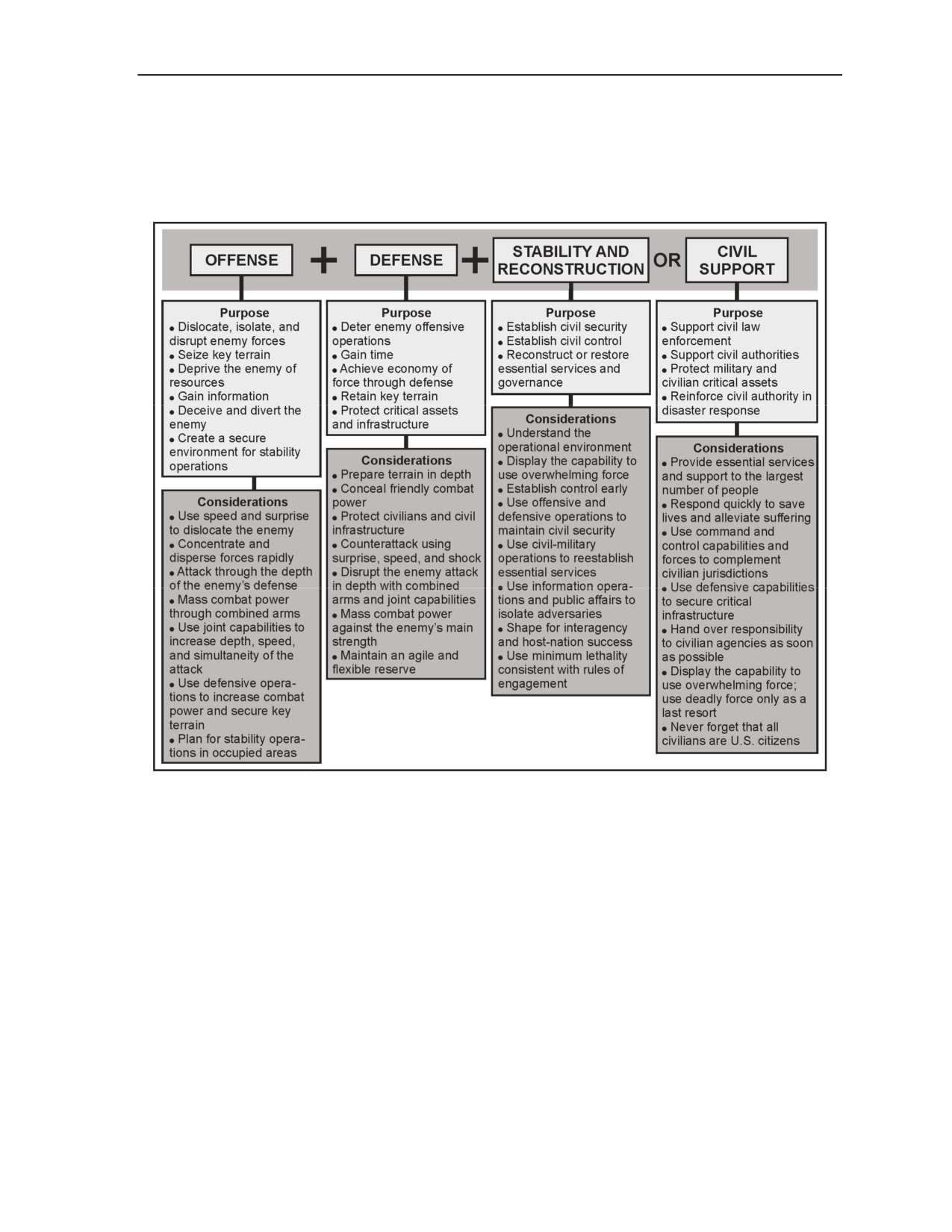
The types of operations are different, each with its own purpose and considerations. (See figure A-2, be-
low.)
Figure A-2. Purposes and considerations for the types of operations
Offensive and Defensive Operations
A-10. Offensive operations carry the fight to enemies by closing with and destroying their forces, seizing
territory and vital resources, and imposing the commander’s will on them. This active imposition of land-
power makes the offense the decisive type of military operation, whether undertaken against irregular
forces or the armed forces of a nation state. Additionally, the physical presence of land forces enhances
stability and reconstruction operations through threat of offensive action in areas they occupy.
A-11. Defensive operations counter enemy offensive operations. They defeat attacks, destroying as many
attackers as necessary. The defense preserves physical dominance over land, resources, and populations.
Defensive operations retain terrain and protect populations and key resources. The defense buys time and
economizes forces to allow the conduct of offensive operations elsewhere. Defensive operations alone nor-
mally cannot achieve a decision. Their purpose is to create conditions for counteroffensive operations that
regain the initiative or establish the conditions for unimpeded stability and reconstruction operations.
31 March 2006
FMI 5-0.1
A-3
Appendix A
Stability and Reconstruction Operations
A-12. Stability and reconstruction operations establish, retain, and exploit security and control over areas,
populations, and resources in order to employ military capabilities to restore essential services and facili-
tate the reestablishment of civil order and authority. Stability and reconstruction operations involve both
coercive and cooperative actions. They occur before, during, and after offensive and defensive operations.
Stability and reconstruction operations are conducted in situations in which a legitimate civil authority is
unable to provide the necessary security and control for the local population. This situation usually results
from—
z
Offensive and defensive actions within an AO.
z
Regime change through U.S. military action.
z
Support to one or more states in which the legitimate civil authority has been rendered ineffec-
tive through war or natural disaster.
z
An international request to assist a failed state.
A-13. By providing security and control to stabilize the environment, stability and reconstruction opera-
tions provide an effective foundation for gradually transitioning control to the other instruments of national
power—diplomatic, informational, and economic. Once this transition is successfully completed, opera-
tional focus for each of the instruments of national power is on transferring regional control to a legitimate
civil authority in accordance with the desired national end state.
A-14. As an integral component of full spectrum operations, stability and reconstruction operations may
complement offensive and defensive operations, or they may be the decisive operation within a phase of a
campaign or major combat operation. During hostilities, stability and reconstruction operations help pre-
vent armed conflict from spreading while securing the support of local populations in unstable areas.
Forces engaged in an operation where stability and reconstruction predominates may have to conduct of-
fensive and defensive operations to defend themselves or destroy forces seeking to undermine the effec-
tiveness or credibility of the stability and reconstruction mission. Following hostilities, forces may conduct
stability and reconstruction operations to provide a secure environment for civil authorities as they work to
achieve reconciliation, rebuild lost infrastructure, and resume vital services.
A-15. Stability and reconstruction operations promote and protect U.S. national interests by influencing the
diplomatic, informational, military, and, economic dimensions of the operational environment through a
combination of peacetime developmental, cooperative activities and coercive actions in response to crisis.
Regional security is supported by a balanced approach that enhances regional stability and economic pros-
perity.
A-16. As populated areas are cleared of hostile forces during offensive operations, a portion of the force
secures urban areas and critical infrastructure, defeats bypassed force remnants and unconventional ele-
ments, and eventually returns territory to the control of civil authorities. Above all else, effective stability
and reconstruction operations focus on the essential needs of the populace. This produces an essential sec-
ondary effect of preventing the populace from becoming disillusioned and offering support and sanctuary
to enemy forces. Properly focused and effective stability and reconstruction operations prevent urban
population centers from evolving into fertile recruiting areas for insurgencies, opposition movements, and
civil unrest.
A-17. During the conduct of stability and reconstruction operations, Army forces retain the ability to re-
sume offensive or defensive operations. Future campaigns may place greater emphasis on the dynamic in-
teraction among the types of operations, particularly as rapid, decisive offensive operations create the con-
ditions for protracted stability and reconstruction operations.
Civil Support Operations
A-18. Army forces support homeland security within the United States and its territories. Homeland secu-
rity provides the Nation strategic flexibility by protecting its citizens and infrastructure from conventional
and unconventional threats. It has two components. The first is homeland defense. If the United States
comes under direct attack or is threatened by hostile armed forces, Army forces under joint command con-
A-4
FMI 5-0.1
31 March 2006
Considerations for Stability and Reconstruction Operations and Civil Support Operations
duct offensive and defensive missions to defend the homeland. The other is civil support, which constitutes
the fourth type of Army operation.
A-19. Civil support operations address the consequences of manmade or natural accidents and incidents
beyond the capabilities of civil authorities. Fundamental to employing military forces in civil support op-
erations is recognizing that civil authorities have the primary authority and responsibility for domestic op-
erations. Within the United States, military operations are limited by law. When authorized, Army forces
conduct civil support operations, providing Army resources, expertise, and capabilities in support of the
lead agency. This expertise and capability is limited to supporting civil authorities and law enforcement
agencies, and preventing civil disturbance.
A-20. Defensive capabilities are employed in such homeland security missions as protecting key infrastruc-
ture during a crisis. The ability to conduct offensive operations, though largely maintained only as a poten-
tial capability, is present nonetheless. That potential, simultaneously employed with defensive and civil
support operations, complements the execution of domestic support tasks. Similarly, effective and efficient
civil support operations reduce the need to conduct offensive or defensive operations to quell civil unrest
or protect infrastructure. Discipline, endurance, and unit cohesion developed during training prepare Sol-
diers and units to deal effectively with the ambiguities and complexities of executing stability and recon-
struction or civil support operations.
A-21. The guiding principle of full spectrum operations is a recognition that the ultimate purpose of mili-
tary operations is to create an environment where peaceful processes dominate. However, the complex na-
ture of the operational environment requires commanders to conduct operations across the spectrum of
conflict. To meet this requirement, the Army provides forces with balanced capabilities and capacities, yet
retains the ability to conduct major combat operations while simultaneously executing day-to-day smaller-
scale contingencies.
TRANSITIONS
A-22. Transitions mark the intervals between ongoing operations and execution of branches and sequels.
Transitions also mark the change in predominance between types of operations, such as from offensive to
stability and reconstruction. Transitions are significant sources of operational tension, as forces must adapt
to changes in mission, situation, and the environment. Transitions between types of operations may be the
most difficult to anticipate, plan, prepare for, and execute.
A-23. Addressed early in planning, transitions represent a major consideration during course of action de-
velopment. During execution, transitions may create unexpected opportunities for Army forces, enemies,
or adversaries. Such opportunities must be recognized quickly and acted upon immediately. Typically, the
command structure evolves to meet changing situations, but transition planning must also account for
changes in mission focus and staff organization. Commanders must remain flexible to changes in the situa-
tion and environment, adjusting the composition and mission focus of deployed forces as necessary.
A-24. When the predominant type of operation changes from offense to stability and reconstruction, the
types of units initially deployed may not be ideally suited for the associated tasks. These forces have been
tailored for combat operations. As emphasis shifts from offensive to stability and reconstruction operations,
commanders task-organize existing forces to meet the requirements and constraints of the environment. At
the conclusion of a campaign, the deployed force—tailored for stability and reconstruction operations—
may only superficially resemble the force that initiated operations.
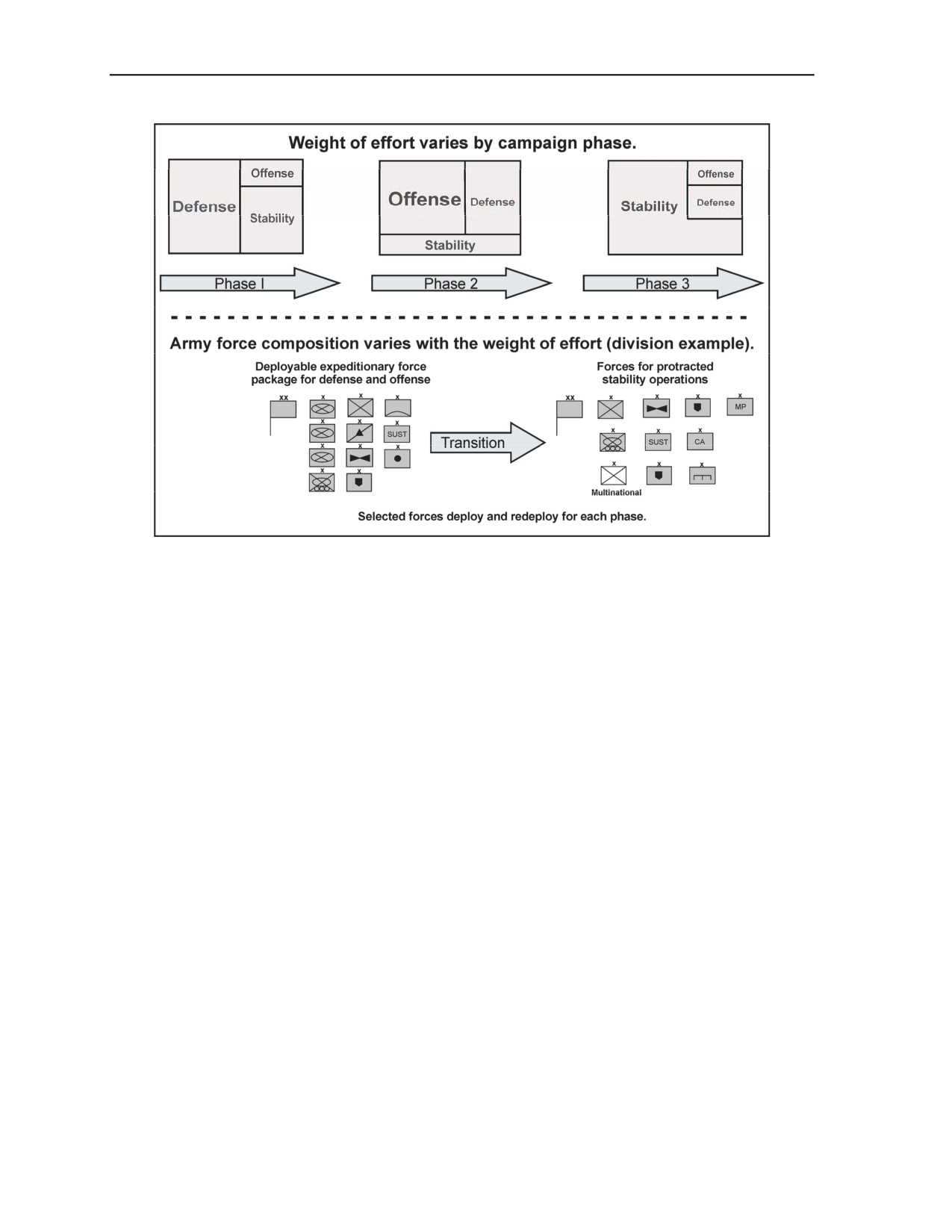
A-25. Figure A-3 (page A-6, below) illustrates this common dilemma. During the course of a campaign, a
force optimized for operations must transition from major combat operations to operations predominated
by stability and reconstruction tasks. While the force is flexible enough to adapt to the evolving nature of
the tasks involved in the transition, it remains one designed primarily for combat operations. During this
transition, some forces optimized for offensive operations must shift missions and execute stability and re-
construction operations, although they are neither designed nor optimized for them. Drawing on experi-
ence, judgment, and intuition, commanders must task-organize their forces appropriately to transition be-
tween phases of the campaign, yet retain the capability to conduct full spectrum operations. Mastery of the
operational art is required to accomplish this.
31 March 2006
FMI 5-0.1
A-5
Appendix A
Figure A-3. Force tailoring throughout a campaign
A-26. Similar to this type of transition is the transfer of authority between a force conducting a stability and
reconstruction operation and another instrument of national power or a legitimate civil authority. As with
the transition from major combat operations to stability and reconstruction operations, the force may not be
ideally suited to the tasks associated with the evolving mission requirements. An increased emphasis on
governance, economic development, or social action may characterize this transition. Commanders must be
prepared to tailor forces optimized for stability-and-reconstruction-related tasks to assume the changing re-
quirements of the mission.
A-27. Historically, considerable planning and changes to task organization were necessary to transition be-
tween types of operations. Force tailoring anticipates likely changes to the task organization needed to exe-
cute transitions. Division and corps commanders practice military art in the continuous tailoring and task-
organizing of forces and timing of operations. Commanders cycle forces and orchestrate capabilities to
maintain pressure. The goal is to effect the change in emphasis without incurring an operational pause.
A-28. Army forces do not transition abruptly between phases. Nevertheless, a phase change may occur
abruptly with a significant change in task organization, mission, or rules of engagement. The overall com-
position of the force, however, might not change. This requires commanders to continuously adapt the or-
ganization, basing, and distribution of forces to conditions in the AO.
LINES OF OPERATIONS
A-29. As commanders perform operational design, they may use lines of operations to describe how vari-
ous decisive points are linked to operational and tactical objectives. A line of operations is a line that de-
fines the orientation of the force in time and space, or purpose in relation to an enemy or objective.
Commanders define the military conditions and end state that need to be achieved within their AOs. Sub-
ordinate commanders then develop lines of operations intended to create complementary conditions that
support achieving the desired end state. Subordinate commanders adjust the level of effort and missions
within their AOs along each line of operations.
A-30. Commanders may describe an operation along lines of operations that are tangible, conceptual, or a
combination of both. Physical lines of operations define the directional orientation of the force in time and
A-6
FMI 5-0.1
31 March 2006
Considerations for Stability and Reconstruction Operations and Civil Support Operations
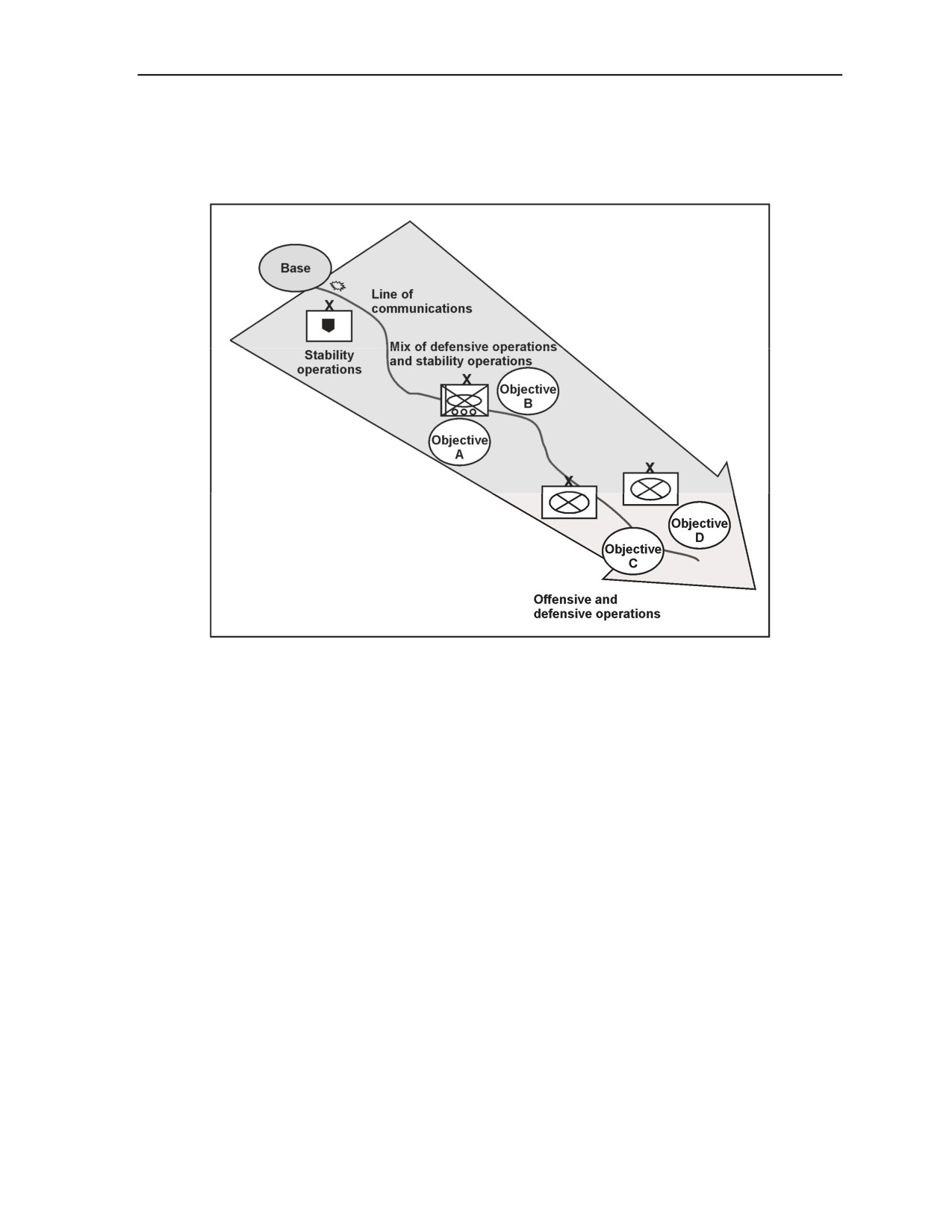
space in relation to the enemy. They connect a series of decisive points that, over time, lead to control of a
geographic objective or enemy force. Physical lines of operations link the force with its base of operations
and objectives. (See figure A-4, below.) Operations designed using physical lines of operations generally
consist of a series of cyclic, short-range events conducted across a well-defined, finite time line.
Figure A-4. Physical lines of operations
A-31. Major combat operations are typically designed using physical lines of operations. These tie offen-
sive and defensive operations to the geographic and positional references of the AO. Multiple and com-
plementary lines of operations work through a series of objectives. Commanders synchronize activities
along multiple lines of operations to attain the end state. Physical lines of operations are formulated during
course of action development and refined through continual assessment.
A-32. Logical lines of operations define the operational design when positional reference to an adversary
has little relevance (See figure A-5, page A-8, below.) Operations designed using logical lines of opera-
tions typically consist of an extended, event-driven time line. This time line combines the complementary,
long-range effects of civil-military operations as well as the cyclic, short-range events characteristic of
combat operations.
A-33. Logical lines of operations are formulated and coordinated with related processes of the operations
process during course of action development. Beginning with the broadly defined end state and supporting
conditions, staffs analyze the situation and environment to determine the objectives necessary to set those
conditions. These objectives are organized using a geographic or purpose-based methodology to ensure
unity of effort. Decisive points offering significant leverage against the objectives are identified, ensuring a
greater degree of success. Finally, objectives and related decisive points are graphically represented along a
line of operations that links these design elements with the conditions and desired end state. Under the
G-3’s/S-3’s direction, the operational design, including the lines of operations, is translated into objectives,
missions, and tasks. These, in turn, are assigned to subordinate commanders.
31 March 2006
FMI 5-0.1
A-7
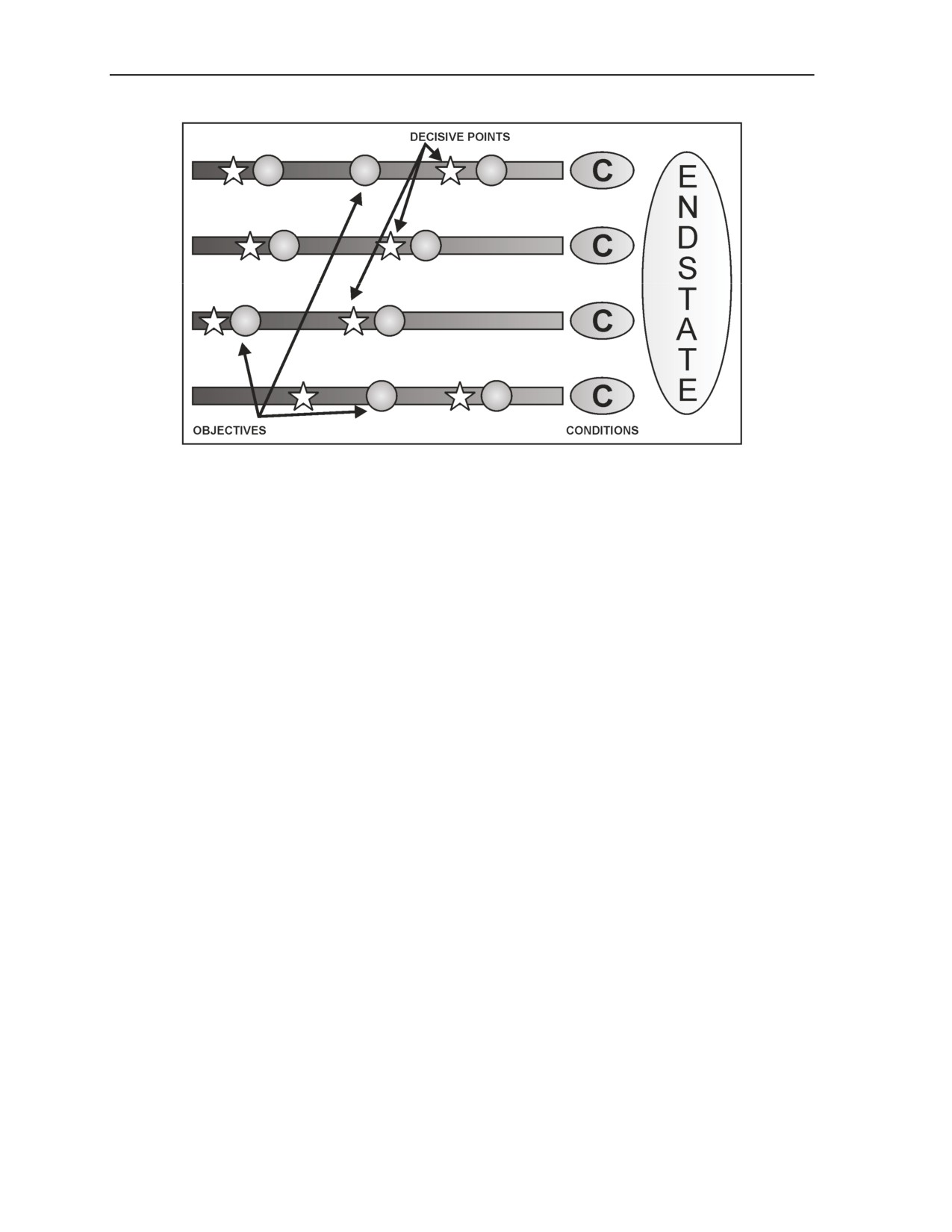
Appendix A
Figure A-5. Logical lines of operations
A-34. In stability and reconstruction or civil support operations, when positional reference to an enemy of-
ten has little relevance, commanders typically visualize operations along logical lines of operations. Com-
manders link multiple objectives and actions with the logic of purpose—cause and effect. Logical lines of
operations also help commanders visualize how military means can support nonmilitary instruments of na-
tional power.
A-35. During a campaign or major operation, the operational design may comprise primarily physical lines
of operations or a combination of physical and logical lines of operations. The use of physical lines of op-
erations reflects the more traditional linkage among decisive points, objectives, and the end state. This
practice is more tangible but does not project the operational design beyond the defeat of the enemy force
at the operational level. By combining physical and logical lines of operations, commanders project opera-
tional design into subsequent phases of a campaign. This approach considers the less tangible aspects of
civil security, civil control, and civil action. In doing so, commanders use operational art to visualize, de-
scribe, and direct operations from a more conceptual perspective. The resulting operational design reflects
the thorough integration of full spectrum operations into the overall campaign.
A-36. An operational design composed of both physical and logical lines of operations reflects the charac-
teristics of each as well. Certain aspects of the operation are executed along a finite time line, while other
elements are executed with a focus on the long-range stability of the region. With this approach, it is vital
for commanders to nest the lines of operations, both geographically and with respect to the desired effects.
This ensures that the lines of operations converge on a well-defined, commonly understood end state that
comprises the conditions outlined in the commander’s intent.
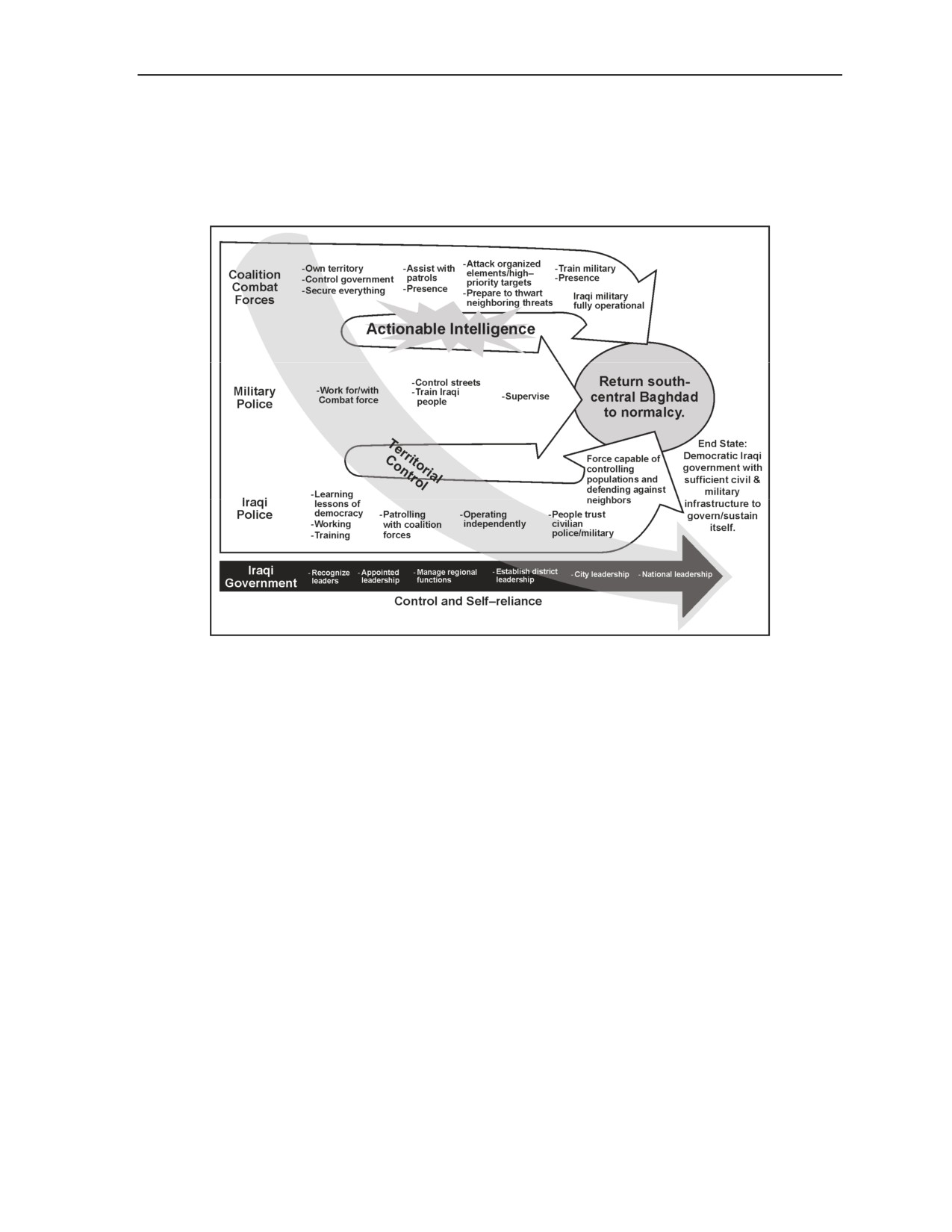
A-37. Figure A-6 (below)—an operational design tool used by coalition forces in Operation Iraqi Free-
dom—illustrates the use of parallel logical lines of operations to unify and focus the actions of forces and
agencies toward a common end state. In this example, operational-level logical lines of operations are used
to link the effects and objectives of coalition forces, military police, and the Iraqi police. These actions,
which contribute toward territorial and civil control, ensure the conditions that support the desired strategic
end state are established.
A-38. Using logical lines of operations, tactical commanders develop missions, allocate resources, and as-
sess the effectiveness of the operation. Commanders may specify which logical line of operations is the de-
cisive operation and which are shaping operations. Commanders synchronize activities along multiple logi-
cal lines of operations to achieve the desired military condition or an end state within an AO.
A-39. Logical lines of operations are mutually supportive among echelons as well as adjacent organiza-
tions. For example, similar logical lines of operations between brigade combat teams produce complemen-
A-8
FMI 5-0.1
31 March 2006
Considerations for Stability and Reconstruction Operations and Civil Support Operations
tary effects, while their collective set of conditions reinforce the conditions and end state at the division
level. Logical lines of operations are normally used at brigade and higher levels, where the staff is suffi-
ciently robust enough to manage multiple lines of operations. Below brigade level, logical lines of opera-
tions have less utility, since organizations are less likely to conduct different types of operations simultane-
ously.
Figure A-6. Example logical lines of operations (operational)
A-40. Within a civil support operation, logical lines of operations normally focus on support to civil au-
thorities, support of law enforcement, critical asset protection, and restoration of essential services. Each
operation, however, is different, and logical lines of operations are developed and modified according to
the situation.
31 March 2006
FMI 5-0.1
A-9
This page intentionally left blank.
Appendix B
Mission Statements and Tasks to Subordinate Units
An important aspect of command and control is communicating instructions to sub-
ordinates. Clearly communicated instructions help subordinates understand what to
do and why. Army doctrine for planning, command and control, and tactics describes
how to develop mission statements and tasks to subordinate units. The introduction of
effects and effects-based planning in joint doctrine does not change Army doctrine.
This appendix elaborates on existing techniques for developing mission statements
and tasks to subordinate units. It is framed around the military decision making proc-
ess; however, these techniques apply to targeting and general problem solving as
well.
RECEIPT OF MISSION AND MISSION ANALYSIS
B-1. Upon receipt of a mission, commanders and staffs take the steps necessary to begin planning. These
include gathering tools, updating running estimates, and performing an initial assessment. This assessment
includes determining the available planning time.
B-2. In mission analysis, commanders and staffs analyze the relationships among the factors of mission,
enemy, terrain and weather, troops and support available, time available, and civil considerations (METT-
TC). They seek to understand—
z
The operational environment, including enemies, adversaries, terrain, and civil considerations.
z
The desired end state of their higher and next higher headquarters.
z
Their mission and how it is nested within those of their higher and next higher headquarters.
z
The forces, capabilities, and resources available.
B-3. In determining their unit’s mission, commanders and staffs identify their specified and implied tasks.
Staffs analyze the higher headquarters order and the higher commander’s guidance to determine these. A
task is a clearly defined and measurable activity accomplished by individuals and organizations. Tasks are
specific activities that contribute to the accomplishment of encompassing missions or other requirements
(FM 7-0). A specified task is a task specifically assigned to a unit by its higher headquarters (FM 5-0).
While specified tasks can be assigned anywhere in an operation order or plan, most are stated in paragraph
3, execution.
B-4. An implied task is a task that must be performed to accomplish a specified task or mission but is not
stated in the higher headquarters order (FM 5-0). Implied tasks are derived from a detailed analysis of the
higher headquarters order and the factors of METT-TC. Instructions in joint orders may be written as ef-
fects to achieve; for example, “Population X in area of operations B participates in the national election.”
In this case, commanders and staffs would consider the many implied tasks needed to achieve this effect.
These could range from informing the population on the election process to providing polling station security.
B-5. Once staff members have identified specified and implied tasks, they ensure they understand each
task’s requirements and purpose. Then they determine the essential tasks. An essential task is a specified or
implied task that must be executed to accomplish the mission. Essential tasks are always included in the
unit’s mission statement (FM 5-0). The staff presents the essential tasks to the commander for approval
during the mission analysis briefing.
31 March 2006
FMI 5-0.1
B-1
Appendix B
DEVELOPING A RESTATED MISSION
B-6. An essential step in mission analysis is developing a restated mission based on analysis of the unit’s
specified, implied, and essential tasks. The chief of staff/executive officer or operations officer prepares a
recommended mission statement based on the mission analysis. The unit’s mission statement is presented
to the commander for approval, normally during the mission analysis brief. A mission statement is a short
sentence or paragraph describing the unit’s essential task (or tasks) and purpose that clearly indicate the ac-
tion to be taken and the reason for doing so. It contains the elements of who, what, when, where, and why,
and the reasons thereof, but seldom specifies how (FM 5-0). The five elements of a mission statement an-
swer the following questions:
z
Who will execute the operation (unit/organization)?
z
What is the unit’s essential task or tasks (stated as an intended effect [such as, fix, neutralize, in-
fluence] or an action by a friendly force [such as, link up, consolidate, or disengage])?
z
When will the operation begin (by time or event), or what is the duration of the operation?
z
Where will the operation occur (area of operations [AO], objective, or grid coordinates)?
z
Why will the force conduct the operation (for what purpose or reason)?
B-7. The unit mission statement along with the commander’s intent and concept of operations, provide the
primary focus for subordinate actions throughout the operation. The following are two examples of a mis-
sion statement.
Example 1. Not later than 220400Z August 2005 (when), 1st (U.S.) Armored Division (who) fixes ele-
ments of the 22d Division Tactical Group (what/task) in AO New York (where) to enable 3d (U.S.) Infan-
try Division’s unimpeded attack west to seize Objective Carol (why/purpose).
Example 2. 1-505th Parachute Infantry Regiment (who) seizes (what/task) Jackson International Airport
(where) not later than D-day, H+3 (when) to allow follow-on forces to air-land into AO Slammer (why/
purpose).
B-8. The mission statement may have more than one essential task. The following example shows a mis-
sion statement for a phased operation with a different essential task for each phase.
Example. 1/509th Parachute Infantry Regiment (who) seizes (what/task) Jackson International Airport
(where) not later than D-day, H+3 (when) to allow follow-on forces to air-land into AO Slammer
(why/purpose). On order (when), secure (what/task) Objective Gold (where) to prevent the 2d Pandor
Guards Brigade from crossing the Blue River and disrupting operations in Airhead Slammer (why/pur-
pose).
B-9. Additionally, commanders may include the type or form of the operation in the mission statement.
While mission statements seldom contain how, including the type or form of the operation provides an
overarching doctrinal description of how the commander wants the task accomplished. In the example be-
low, the commander includes “infiltrates” for emphasis and to synchronize the force. This directive limits
subordinates to a specific form of maneuver (infiltration) that the entire force will use to seize Objective
Bravo.
Example. At 021100Z August 2004 (when) 1st Brigade, 25th (U.S.) Infantry Division (Light) (who) infil-
trates (form of maneuver) to seize (what/task) Objective Bravo (where) to prevent enemy forces from in-
terfering with the rapid crossing of 3d (U.S.) Infantry Division over the Blue River (why).
B-2
FMI 5-0.1
31 March 2006

Mission Statements and Tasks to Subordinate Units
B-10. The who, where, and when of a mission statement are straightforward. The what and why are more
challenging to write and can confuse subordinates if not stated clearly. The what is a task and is expressed
in terms of action verbs (for example, contain, destroy, or isolate). These tasks are measurable and can be
grouped as “actions by friendly forces” or “effects on enemy forces.” The why puts the task into context by
describing the reason for performing it.
B-11. The what in a mission statement is a task to be accomplished. It is expressed in terms of an intended
effect or an action by a friendly force. Commanders should use tactical mission tasks or other doctrinally
approved tasks contained in combined arms field manuals or mission training plans in mission statements.
These tasks have specific military definitions that are different from dictionary definitions. They are meas-
urable and often describe results or effects in relationship to the enemy, terrain, and friendly forces. Using
them simplifies orders. A tactical mission task is the specific activity performed by a unit while executing a
form of tactical operation or form of maneuver. It may be expressed in terms of either actions by a friendly
force or effects on an enemy force (FM 3-90). Table B-1 (below) lists the tactical mission tasks. FM 3-90,
appendix B, describes each one. Commanders and planners should carefully choose the task that best de-
scribes the commander’s intent and guidance.
Table B-1. Tactical mission tasks
Effects on Enemy Forces
Actions by Friendly Forces
• Block
• Assault
• Follow and
assume
• Canalize
• Attack-by-fire
• Follow and
• Contain
• Breach
support
• Defeat
• Bypass
• Linkup
• Destroy
• Clear
• Occupy
• Disrupt
• Conduct personnel
• Reconstitute
recovery
• Fix
• Reduce
• Consolidate and
• Interdict
reorganize
• Retain
• Isolate
• Control
• Secure
• Neutralize
• Counterrecon-
• Seize
• Penetrate
naissance
• Support-by-fire
• Turn
• Disengage
• Suppress
• Exfiltrate
*Conduct personnel recovery replaces combat search and rescue. See FM 3-50.1
B-12. Table B-2 (below) lists selected additional tasks available to commanders and the field manuals that
discuss them. These tasks are stated in terms of the effects they produce.
Table B-2. Other tactical tasks
Offensive Information Operations
Defensive Information Operations
(See FM 3-13)
(See FM 3-13)
• Destroy
• Deceive
• Protect
• Disrupt
• Exploit
• Detect
• Degrade
• Influence
• Restore
• Deny
• Respond
Obstacles (See FM 3-34)
Fires (See FM 6-20)
• Block
• Fix
• Destroy
• Suppress
• Contain
• Turn
• Neutralize
• Harass
• Disrupt
B-13. The why of a mission statement provides the mission’s purpose—the reason the unit is to perform the
task. It is extremely important to mission command and mission orders. The purpose is usually stated as a
descriptive phrase and is often more important then the task. Normally, the staff completes a task statement
31 March 2006
FMI 5-0.1
B-3
Appendix B
by adding the phrase “in order to” and stating the task’s purpose. Table B-3 (below) shows sample purpose
verbs for “in order to” phrases.
Table B-3. Sample purpose verbs
• Allow
• Divert
• Prevent
• Cause
• Enable
• Protect
• Create
• Envelop
• Support
• Deceive
• Influence
• Surprise
• Deny
• Open
B-14. Including the purpose in the mission statement clarifies the tasks it contains and supports the exer-
cise of subordinates’ initiative. The following example shows a mission statement that includes a purpose.
Example. Not later than 031100Z July 2003 (when) 1st Brigade Combat Team (who) secures (what/ task)
Objective Bravo (where) to prevent enemy forces from crossing the Blue River (why/purpose).
B-15. In the above example, if the enemy chooses to cross the Blue River at a fording site two kilometers
west of Objective Bravo, subordinates would know to notify higher headquarters and quickly reposition to
prevent the enemy from establishing a fording site. If they did not know their mission’s purpose, they
would have to ask their higher headquarters for instructions. The delay involved would cede the initiative
to the enemy. Here is an example of a mission statement without a purpose.
Example. At H-hour, D-day, 3-75 Ranger Regiment seizes Jackson International Airport (vicinity grid
GL900231).
B-16. The purpose for seizing the airport in this example is unclear. Subordinates cannot determine if this
mission’s purpose is to prevent enemy use of the airfield or to gain control of the airfield for friendly use.
The mission’s purpose affects the approach subordinates may take to accomplish this mission. It should be
included in mission statements.
PLANNING GUIDANCE AND COURSE OF ACTION DEVELOPMENT
B-17. Following mission analysis, commanders approve the unit’s mission statement, and issue their initial
commander’s intent and planning guidance. These are based on their commander’s visualization. They de-
scribe how the commander envisions the operation’s end state and conditions necessary to achieve it. The
initial commander’s intent focuses the rest of the planning process.
B-18. Thinking in terms of desired and undesired effects helps commanders develop and issue planning
guidance. It also helps staff members develop courses of action (COAs). The Army defines an effect as a
result, outcome, or consequence of an action. All actions create effects—some desired, others undesired.
Desired effects are results that support accomplishment of an objective or the mission. Undesired effects
could adversely impact accomplishment of an objective or the mission.
B-19. For example, a commander may state, “Key to stability in the unit’s AO is that a certain community
in city B no longer supports the insurgency.” A COA to create this effect may include two activities: psy-
chological operations messages to discourage insurgent support, and infrastructure development projects as
rewards for shifting support. In addition, this COA may call for a limited military presence in the city to
avoid the perception of occupation. Staff analysis should identify possible undesired effects associated with
each COA. For example, the limited military presence might produce increased insurgent activity and sup-
port due to a perception of friendly force weakness. Thinking this way helps commanders and staffs thor-
oughly examine ways to best achieve desired effects while mitigating undesired effects.
B-4
FMI 5-0.1
31 March 2006
Mission Statements and Tasks to Subordinate Units
DEVELOPING TASK STATEMENTS
B-20. The staff translates the commander’s planning guidance and approved COA into tasks to subordinate
units. For example, a commander states in the planning guidance and part of a COA that the “enemy re-
serve does not interfere with the seizure of Objective Dog by 1st Brigade Combat Team.” The staff then
plans a series of actions or tasks to subordinate units to achieve the effects stated in the commander’s guid-
ance. In this example, actions may include any of the following or a combination of them:
z
Nominating the enemy reserve for destruction by air attack.
z
Assigning the aviation and fires brigades to neutralize the enemy reserve with fires.
z
Deceiving the enemy reserve with a feint.
z
Blocking the enemy reserve with a force or obstacle.
B-21. When developing tasks to subordinate units, staffs use the same task/purpose (what/why) construct
as they did to develop the unit’s restated mission. Staffs develop tasks to subordinate units the same way
they developed the unit’s restated mission. Each task statement follows the mission statement format and
contains the same five elements. (See paragraph B-6.)
B-22. As with mission statements, task statements normally do not specify how. However, there may be
occasions when commanders want to specify an activity (for example, raid, ambush, infiltrate) that pro-
vides an overarching doctrinal description of how the to accomplish a task.
31 March 2006
FMI 5-0.1
B-5
Glossary
The glossary lists terms with Army and joint definitions. Where Army and joint defi-
nitions are different, (Army) follows the term. Terms for which this FMI is the propo-
nent manual (the authority) are marked with an asterisk (*). The proponent manual
for other terms is listed in parentheses after the definition. Terms for which the Army
and Marine Corps have agreed on a common definition are followed by (Army-
Marine Corps).
SECTION I - ACRONYMS AND ABBREVIATIONS
AO
area of operations
AR
Army regulation
BCT
brigade combat team
C2
command and control
C4OPS
command, control, communications, and computer operations
CCIR
commander’s critical information requirement
COA
course of action
COP
common operational picture
COS
chief of staff
CP
command post
EBO
effects-based operations
EECP
early-entry command post
FFIR
friendly forces information requirement
FM
field manual; frequency modulation
FMI
field manual-interim
FRAGO
fragmentary order
FUOPS
future operations
G-1
assistant chief of staff, personnel
G-2
assistant chief of staff, intelligence
G-3
assistant chief of staff, operations
G-4
assistant chief of staff, logistics
G-5
assistant chief of staff, plans
G-6
assistant chief of staff, command, control, communications, and computer
operations (C4OPS)
G-7
assistant chief of staff, information operations
G-8
assistant chief of staff, financial management
G-9
assistant chief of staff, civil affairs
IPB
intelligence preparation of the battlefield
31 March 2006
FMI 5-0.1
Glossary-1
Glossary
ISR
intelligence, surveillance, and reconnaissance
JFC
joint force commander
JP
joint publication
MCG
mobile command group
MDMP
military decision making process
METT-TC
mission, enemy, terrain and weather, troops and support available, time
available, civil considerations
MOE
measure of effectiveness
MOP
measure of performance
MTOE
modification table of organization and equipment
PIR
priority intelligence requirement
RFC
revised final coordination
RDSP
rapid decision making and synchronization process
S-1
personnel staff officer
S-2
intelligence staff officer
S-3
operations staff officer
S-4
logistics staff officer
S-5
plans staff officer
S-6
command, control, communications and computer operations (C4OPS)
officer
S-7
information operations officer
S-8
financial management officer
S-9
civil-military operations officer
SOP
standing operating procedure
TAC CP
tactical command post
U.S.
United States
USJFCOM
United States Joint Forces Command
WFF
warfighting function
XO
executive officer
SECTION II - TERMS
adjustment decision
During preparation and execution, the selection of a course of action that
modifies the order to respond to unanticipated opportunities or threats.
(FM 6-0)
*Army positive control
A technique of regulating forces that involves commanders and leaders
actively assessing, deciding, and directing them.
*Army procedural
A technique of regulating forces that relies on a combination of orders,
control
regulations, policies, and doctrine (including tactics, techniques, and pro-
cedures).
Glossary-2
FMI 5-0.1
31 March 2006
Glossary
*assessment
(Army) The continuous monitoring and evaluation of the current situation
and progress of an operation.
*battle rhythm
The sequencing of command and control activities within a headquarters
and throughout the force to facilitate effective command and control.
*board
A temporary grouping of selected staff representatives delegated decision
authority for a particular purpose or function.
calculated risk
An exposure to chance of injury or loss when the commander can visualize
the outcome in terms of mission accomplishment or damage to the force,
and judges the outcome as worth the cost. (FM 6-0)
*center
A command and control facility established for a specific purpose.
cell
See command post cell.
civil considerations
The influence of manmade infrastructure, civilian institutions, and attitudes
and activities of the civilian leaders, populations, and organizations within
an area of operations on the conduct of military operations. (FM 6-0)
combat assessment
(joint) The determination of the overall effectiveness of force employment
during military operations. Combat assessment is composed of three major
components: (a) battle damage assessment;
(b) munitions effectiveness
assessment; and (c) reattack recommendation. (JP 1-02)
combined arms
The synchronized or simultaneous application of several arms—such as
infantry, armor, field artillery, engineers, air defense, and aviation—to
achieve an effect on the enemy that is greater than if each arm were used
against the enemy separately or in sequence. (FM 3-0)
*command
(Army) The authority that a commander in the military service lawfully
exercises over subordinates by virtue of rank or assignment. Command
includes the leadership, authority, responsibility, and accountability for
effectively using available resources and planning the employment of,
organizing, directing, coordinating, and controlling military forces to
accomplish assigned missions. It includes responsibility for unit readiness,
health, welfare, morale, and discipline of assigned personnel.
command and control
(Army) The exercise of authority and direction by a properly designated
commander over assigned and attached forces in the accomplishment of a
mission. Commanders exercise command and control through a command
and control system. (FM 6-0)
command and control
(Army) The arrangement of personnel, information management, pro-
system
cedures, and equipment and facilities essential for the commander to con-
duct operations. (FM 6-0)
*command and control
The related tasks and systems that support the commander in exercising
warfighting function
authority and direction.
commander’s critical in-
(Army) Elements of information required by commanders that directly
formation requirements
affect decision making and dictate the successful execution of military
operations. (FM 3-0)
*commander’s intent
(Army) A clear, concise statement of what the force must do and the
conditions the force must meet to succeed with respect to the enemy,
terrain, and civil considerations that represent the operation’s desired end
state.
*commander’s
The mental process of developing situational understanding, determining a
visualization
desired end state, and envisioning how the force will achieve that end state.
31 March 2006
FMI 5-0.1
Glossary-3
Glossary
*command group
The commander and selected staff members who accompany commanders
and enable them to exercise command and control away from a command
post.
command post
(Army) A unit headquarters where the commander and staff perform their
activities. (FM 6-0)
*command post cell
A grouping of personnel and equipment by warfighting function or purpose
to facilitate command and control during operations.
*control
(Army) The regulation of forces and warfighting functions to accomplish
the mission in accordance with the commander’s intent.
*control measure
A means of regulating forces or warfighting functions.
decision making
Selecting a course of action as the one most favorable to accomplish the
mission. (FM 6-0)
*early-entry command
A command and control facility containing tailored portions of the unit’s
post
headquarters for a specific mission over a specific period. It normally in-
cludes members of the tactical command post and additional planners,
intelligence analysts, liaison officers, and others as required.
*effect
(Army) A result, outcome, or consequence of an action.
element
See staff element.
essential elements of
(Army) Critical aspects of a friendly operation that, if known by the enemy,
friendly information
would subsequently compromise, lead to failure, or limit success of the op-
eration, and therefore must be protected from enemy detection. (FM 3-13)
essential task
A specified or implied task that must be executed to accomplish the
mission. Essential tasks are always included in the unit’s mission statement.
(FM 5-0)
*evaluate
To compare relevant information on the situation or operation against
criteria to judge success or progress.
exceptional information
Information that would have answered one of the commander’s critical
information requirements if the requirement for it had been foreseen and
stated as one of the commander’s critical information requirements.
(FM 6-0)
execute
To put a plan into action by applying combat power to accomplish the
mission and using situational understanding to assess progress and make
execution and adjustment decisions. (FM 6-0)
execution decision
The selection, during preparation and execution, of a course of action anti-
cipated by the order. (FM 6-0)
*fire support
The related tasks and systems that provide collective and coordinated use of
warfighting function
Army indirect fires, joint fires, and offensive information operations.
friendly forces informa-
Information the commander and staff need about the forces available for the
tion requirements
operation. (FM 6-0)
*graphic control
A symbol used on maps and displays to regulate forces and warfighting
measure
functions.
information
The provision of relevant information to the right person at the right time in
management
a usable form to facilitate situational understanding and decision making. It
uses procedures and information systems to collect, process, store, display,
and disseminate information. (FM 3-0)
Glossary-4
FMI 5-0.1
31 March 2006
Glossary
information systems
(Army) The equipment and facilities that collect, process, store, display,
and disseminate information. This includes computers—hardware and
software —and communications, as well as policies and procedures for
their use. (FM 3-0)
intelligence
The plan the intelligence officer uses, with staff input, to synchronize the
synchronization plan
entire collection effort, to include all assets the commander controls, assets
of lateral units and higher echelon units and organizations, and intelligence
reach to answer the commander’s critical information requirements.
FM 2-0)
*intelligence warfight-
The related tasks and systems that facilitate understanding of the enemy,
ing function
terrain, weather, and civil considerations.
intuitive decision
(Army-Marine Corps) The act of reaching a conclusion that emphasizes
making
pattern recognition based on knowledge, judgment, experience, education,
intelligence, boldness, perception, and character. This approach focuses on
assessment of the situation vice comparison of multiple options. (FM 6-0)
*line of operations
(Army) A line that defines the orientation of the force in time and space, or
purpose in relation to an enemy or objective.
*main command post
A command and control facility that contains the portion of the unit
headquarters in which the majority of planning, analysis, and coordination
occurs.
*measure of
(Army) A criterion used to assess changes in system behavior, capability, or
effectiveness
operational environment that is tied to measuring the attainment of an end
state, achievement of an objective, or creation of an effect. (This is the
Army definition until the revised JP 3-0 is approved. The Army will use the
joint definition in JP 3-0 when JP 3-0 is approved.)
*measure of
A criterion to assess friendly actions that is tied to measuring task accom-
performance
plishment. (This is the Army definition until the revised JP 3-0 is approved.
The Army will use the joint definition in JP 3-0 when JP 3-0 approved.)
*military decision
A process that integrates the activities of the commander, staff, and subord-
making process
inate commanders in developing an operation plan or order. It establishes
procedures for analyzing a mission; developing, analyzing, and comparing
courses of action; selecting the best course of action; and producing an
operation plan or order.
mission
(joint) The task, together with the purpose, that clearly indicates the action
to be taken and the reason therefore. (JP 1-02)
mission command
The conduct of military operations through decentralized execution based
upon mission orders for effective mission accomplishment. Successful mis-
sion command results from subordinate leaders at all echelons exercising
disciplined initiative within the commander’s intent to accomplish missions.
It requires an environment of trust and mutual understanding. (FM 6-0)
mission orders
A technique for completing combat orders that allows subordinates
maximum freedom of planning and action in accomplishing missions and
leaves the “how” of mission accomplishment to subordinates. (FM 6-0)
mission statement
A short sentence or paragraph describing the unit’s essential task (or tasks)
and purpose that clearly indicate the action to be taken and the reason for
doing so. It contains the elements of who, what, when, where, and why, and
the reasons thereof, but seldom specifies how. (FM 5-0)
31 March 2006
FMI 5-0.1
Glossary-5
Glossary
*monitoring
(Army) Continuous observation of the current situation to identify
opportunities for the force, threats to the force, gaps in information, and
progress according to the plan or order.
*movement and maneu-
The related tasks and systems that move forces to achieve a position of
ver warfighting function
advantage in relation to the enemy.
*operations process
The major command and control activities performed during operations:
planning, preparation, execution, and continuous assessment. These
activities occur continuously throughout an operation, overlapping and
recurring as required.
*planning
The process by which commanders (and staff if available) translate the
commander’s visualization into a specific course of action for preparation
and execution, focusing on the expected results.
preparation
Activities by the unit before execution to improve its ability to conduct the
operation including, but not limited to, the following: plan refinement,
rehearsals, reconnaissance, coordination, inspections, and movement.
(FM 3-0)
priority intelligence
(joint) Those intelligence requirements for which the commander has an
requirements
anticipated and stated priority in planning and decision making. (JP 1-02)
*protection warfighting
The related tasks and systems that preserve the force so the commander can
function
apply maximum combat power.
relevant information
All information of importance to commanders and staffs in the exercise of
command and control. (FM 3-0)
*running estimate
A staff section’s continuous assessment of current and future operations to
determine if the current operation is proceeding according to the
commander’s intent and if future operations are supportable.
*situational awareness
Knowledge of the immediate present environment, to including knowledge
of the factors of METT-TC.
situational
The product of applying analysis and judgment to the common operational
understanding
picture to determine the relationships among the factors of METT-TC.
(FM 3-0)
*staff element
A component of a staff section or command post cell.
staff estimate
See running estimate.
*staff section
A grouping of staff members by area of expertise under a coordinating,
special, or personal staff officer.
subordinates’ initiative
The assumption of responsibility for deciding and initiating independent
actions when the concept of operations or order no longer applies or when
an unanticipated opportunity leading to the accomplishment of the com-
mander’s intent presents itself. (FM 6-0)
*sustainment
The related tasks and systems that provide support and services to ensure
warfighting function
freedom of action, extend operational reach, and prolong endurance.
synchronization
(joint) The arrangement of military actions in time, space, and purpose to
produce maximum relative combat power at a decisive time and place.
(JP 1-02)
*tactical command post
A command and control facility containing a tailored portion of a unit head-
quarters designed to control current operations.
Glossary-6
FMI 5-0.1
31 March 2006
Glossary
task
(Army) A clearly defined and measurable activity accomplished by individ-
uals and organizations. Tasks are specific activities that contribute to the
accomplishment of encompassing missions or other requirements.
(FM 7-0)
tempo
(Army) The rate of military action. (FM 3-0)
variance
A difference between the actual situation during an operation and what the
plan forecasted the situation would be at that time or event. (FM 6-0)
*warfighting function
A group of tasks and systems (people, organizations, information, and pro-
cesses) united by a common purpose that commanders use to accomplish
missions and training objectives.
*working group
A temporary grouping of predetermined staff representatives who meet to
coordinate and provide recommendations for a particular purpose or
function.
31 March 2006
FMI 5-0.1
Glossary-7
This page intentionally left blank.
References
REQUIRED PUBLICATIONS
These documents must be available to intended users of this publication.
FM 1. The Army. 14 Jun 2005.
FM 1-02 (101-5-1). Operational Terms and Graphics. 21 Sep 2004.
FM 3-0. Operations. 14 Jun 2001.
FM 5-0 (101-5). Army Planning and Orders Production. 20 Jan 2005.
FM 6-0. Mission Command: Command and Control of Army Forces. 11 Aug 2003.
JP 1-02. Department of Defense Dictionary of Military and Associated Terms. 4 Dec 2001.
Available< http://www.dtic.mil/doctrine/jel/doddict/>
RELATED PUBLICATIONS
These sources contain relevant supplemental information.
AR 20-1. Inspector General Activities and Procedures. 29 Mar 2002.
AR 27-1. Judge Advocate Legal Services. 30 Sep 1996.
AR 165-1. Chaplain Activities in the United States Army. 25 Mar 2004.
AR 360-1. The Army Public Affairs Program. 15 Sep 2000.
CJCSM 3500.04C. The Universal Joint Task List. 1 Jul 2002.
DOD Directive 3000.05. “Military Support for Stability, Security, Transition, and Reconstruction
(SSTR) Operations. 28 Nov 2005.
FM 3-13 (100-6). Information Operations: Doctrine, Tactics, Techniques, and Procedures.
28 Nov 2003.
FM 3-34 (5-100). Engineer Operations. 2 Jan 2004.
FM 3-50.1. Army Personnel Recovery. 10 Aug 2005.
FM 3-90. Tactics. 4 Jul 2001.
FM 5-102. Countermobility. 14 Mar 1985.
FM 6-20. Fire Support in the AirLand Battle. 17 May 1988.
FM 7-15. The Army Universal Task List. 31 Aug 2003.
FM 22-100. Army Leadership. 31 Aug 1999.
FM 34-130. Intelligence Preparation of the Battlefield. 8 Jul 1994.
FM 101-5-2. U.S. Army Reports and Message Formats. 29 Jun 1999.
FMI 3-90.6. Heavy Brigade Combat Team. 15 Mar 2005. Expires 15 Mar 2007.
JP 3-0. Doctrine for Joint Operations. 10 Sep 2001.
JP 3-0 (Revised Final Coordination) Doctrine for Joint Operations. 23 Dec 2005.
JP 3-31. Command and Control for Joint Land Operations. 23 Mar 2004.
JP 5-0. Doctrine for Planning Joint Operations. 13 Apr 1995.
JP 5-00.2. Joint Task Force Planning Guidance and Procedures. 13 Jan 1999.
31 March 2006
FMI 5-0.1
References-1