FMI 5-0.1 THE OPERATIONS PROCESS (March 2006, March 2008) - page 1
FMI 5-0.1
Field Manual Interim
Headquarters
Department of the Army
No. 5-0.1
Washington, DC, 31 March 2006
Expires 31 March 2008
THE OPERATIONS PROCESS
Contents
Page
PREFACE
iv
INTRODUCTION
vi
Chapter 1
COMMAND AND CONTROL
1-1
Section I - How Army Forces Fight
1-1
Combined Arms and Combined Arms Organizations
1-1
Joint Interdependence
1-2
Mission Command
1-2
Full Spectrum Operations
1-3
Section II - Major Keystone Doctrine Changes
1-5
Warfighting Functions and Elements of Combat Power
1-5
Effects and Effects-related Concepts
1-7
Military Decision Making
1-11
Operations Process Activities
1-13
Section III - The Command and Control System
1-16
Command
1-16
Control
1-17
Role of the Commander
1-18
Chapter 2
COMMAND POSTS AND STAFF OPERATIONS
2-1
Background
2-1
Staff Organization
2-1
Command Post Organization
2-2
Command Post Cell Duties and Responsibilities
2-10
Command Post Organization Considerations
2-11
Command Post Operations
2-13
Chapter 3
EXERCISING COMMAND AND CONTROL
3-1
Enhancing the Operations Process
3-1
Integrating in the Operations Process
3-6
Distribution Restriction: Approved for public release; distribution is unlimited.
i
Contents
Chapter 4
EXECUTION
4-1
Introduction
4-1
Concept of Execution
4-2
Rapid Decision Making and Synchronization Process
4-5
Chapter 5
ASSESSMENT
5-1
Concept of Assessment
5-1
Assessment Considerations
5-4
Measures of Effectiveness and Measures of Performance
5-5
Appendix A
CONSIDERATIONS FOR STABILITY AND RECONSTRUCTION OPERATIONS
AND CIVIL SUPPORT OPERATIONS
A-1
Introduction
A-1
Full Spectrum Operations
A-1
Transitions
A-5
Lines of Operations
A-6
Appendix B
MISSION STATEMENTS AND TASKS TO SUBORDINATE UNITS
B-1
Receipt of Mission and Mission Analysis
B-1
Developing a Restated Mission
B-2
Planning Guidance and Course of Action Development
B-4
Developing Task Statements
B-5
GLOSSARY
Glossary-1
REFERENCES
References-1
INDEX
Index-1
Figures
Figure 1-1. Full spectrum operations
1-4
Figure 1-2. Elements of combat power
1-6
Figure 1-3. Systems perspective of the operational environment
1-8
Figure 1-4. Operations process
1-13
Figure 1-5. Commander’s role in command and control
1-19
Figure 1-6. Cognitive hierarchy
1-20
Figure 2-1. Basic staff structure and coordinating authorities
2-3
Figure 2-2. Command post organization
2-7
Figure 2-3. Sample SOP for a division civil-military operations working group
2-9
Figure 2-4. Example shift-change briefing
2-15
Figure 2-5. Format for operation order paragraph 5
2-18
Figure 2-6. Battle rhythm example for a stability operation
2-18
Figure 3-1. Operations process expanded
3-2
Figure 3-2. Example of two operations with a transition
3-3
Figure 3-3. Time horizons and planning responsibilities
3-4
Figure 3-4. Operations process activities distribution
3-6
ii
FMI 5-0.1
31 March 2006
Contents
Figure 4-1. Decisions in execution
4-4
Figure 4-2. Rapid decision making and synchronization process
4-6
Figure A-1. Full spectrum operations
A-2
Figure A-2. Purposes and considerations for the types of operations
A-3
Figure A-3. Force tailoring throughout a campaign
A-6
Figure A-4. Physical lines of operations
A-7
Figure A-5. Logical lines of operations
A-8
Figure A-6. Example logical lines of operations (operational)
A-9
Tables
Introductory table 1. New Army terms
vii
Introductory table 2. Modified and rescinded Army terms
vii
Table 2-1. Modular command post design by echelon
2-4
Table 4-1. Examples of decision indicators by warfighting function
4-7
Table 4-2. Synchronization considerations
4-9
Table B-1. Tactical mission tasks
B-3
Table B-2. Other tactical tasks
B-3
Table B-3. Sample purpose verbs
B-4
31 March 2006
FMI 5-0.1
iii
Preface
Doctrine provides a military organization with unity of effort and a common philosophy, language, and pur-
pose. This FMI provides doctrine for the exercise of command and control throughout the conduct (planning,
preparing, execution, and assessment) of full spectrum operations.
PURPOSE
This FMI reinforces fundamental principles in FMs 3-0, 5-0, and 6-0. It clarifies, emphasizes, or expands upon
those fundamentals based on changes in Army structure and lessons learned from ongoing operations. It pro-
vides commanders with doctrinal considerations for organizing their individual command and control (C2) sys-
tems and putting them into action to accomplish missions. It also replaces the battlefield operating systems de-
scribed in FM 3-0 with the six warfighting functions.
This FMI establishes the Army’s position on how the joint effects-based approach to joint operations affects
Army forces and Army C2 doctrine. This FMI also is a guide for further refining battalion through corps head-
quarters design and developing branch and echelon manuals concerning C2 in operations.
SCOPE
FMI 5-0.1 has an introduction and five chapters. It augments but does not replace the planning doctrine in FM
5-0 and the C2 doctrine in FM 6-0. It expands C2 doctrine regarding decision making, assessment, and exercis-
ing C2 during execution.
• The introduction expands upon the manual’s purpose and summarizes the doctrinal changes it con-
tains.
• Chapter 1 discusses the Army’s operational concept and describes several keystone doctrine changes.
It provides a doctrinal position on how the effects-based approach to joint operations affects the con-
duct of operations by Army forces.
• Chapter 2 provides doctrine for organizing C2 systems for operations. It provides a taxonomy for
command post (CP) structure and general guides for the role and functions of CPs and cells within
CPs.
• Chapter 3 expands the operations process. It discusses how several processes integrate during the
planning, preparing, executing, and assessment activities of an operation. It reinforces the com-
mander’s role in exercising C2 and the staff’s role in supporting the commander and subordinate
commanders.
• Chapter 4 broadens the doctrine for exercising C2 during execution established in FM 6-0. It intro-
duces the rapid decision making and synchronization process.
• Chapter 5 provides doctrine for assessment, including tactics, techniques, and procedures for assessing
operations.
• Appendix A expands doctrine on full spectrum operations, to include planning considerations for sta-
bility and reconstruction operations and civil support operations.
• Appendix B provides doctrine for crafting mission and task statements that clearly describe the com-
mander’s intended effects.
APPLICABILITY
FMI 5-0.1 applies to Army headquarters from battalion through corps. It applies to all Army leaders, especially
trainers, educators, force designers, and doctrine developers.
iv
FMI 5-0.1
31 March 2006
Preface
Army headquarters serving as a headquarters for a joint force land component or joint task force should refer to
appropriate joint doctrine, policies, and regulations.
This publication applies to the Active Army, Army National Guard of the United States, and U.S. Army Re-
serve unless otherwise stated.
DESCRIPTION OF FIELD MANUALS-INTERIM
An FMI is a Department of the Army publication that provides expedited delivery of urgently needed doctrine
the proponent has approved for use without placing it through the standard development process. Unless an
FMI is rescinded, information it disseminates is incorporated into a new or revised field manual. FMIs expire
after two years unless superseded or rescinded.
ADMINISTRATIVE INFORMATION
Terms that have joint or Army definitions are identified in both the glossary and the text. The glossary lists
most terms used in FMI 5-0.1 that have joint or Army definitions. Terms for which FMI 5-0.1 establishes defi-
nitions are indicated with an asterisk in the glossary and printed in boldface in the text. For other definitions in
the text, the term is italicized and the number of the proponent field manual follows the definition.
Headquarters, U.S. Army Training and Doctrine Command, is the proponent for this publication. The preparing
agency is the Combined Arms Doctrine Directorate, U.S. Army Combined Arms Center. Send written com-
ments and recommendations on DA Form 2028 (Recommended Changes to Publications and Blank Forms) to
Commander, U.S. Army Combined Arms Center and Fort Leavenworth, ATTN: ATZL-CD
(FMI
5-0.1),
201 Reynolds Avenue, Fort Leavenworth, KS
66027-2337; by e-mail to web-
cadd@leavenworth.army.mil; or submit on an electronic DA Form 2028.
31 March 2006
FMI 5-0.1
v
Introduction
THE ROLE OF DOCTRINE
Doctrine is the concise expression of how Army forces contribute to campaigns, major operations, battles, and
engagements. It provides a common frame of reference across the Army. Rather than establishing a set of hard-
and-fast rules, the objective of doctrine is to foster initiative and creative thinking. Doctrine provides a menu of
practical options based on experience from which Army leaders can create solutions to tactical problems.
Doctrine facilitates unity of effort by providing a common philosophy and language. This common understand-
ing of how Army forces fight and the doctrinal terms used to describe this understanding facilitate rapid team-
building, tailoring, and task-organizing among units and Soldiers. It helps standardize operations and aids
readiness by establishing common ways of accomplishing military tasks. Well-established terms and graphics
and commonly accepted practices allow for shorter orders. They also facilitate their rapid production, dissemi-
nation, and understanding.
The Army is a learning organization. Its doctrine is not static. It continuously revises doctrine based on the
ever-changing security environment and lessons from operations. FM 1 and FM 3-0 are the Army’s two cap-
stone field manuals. They provide the fundamental principles for employing landpower. Among many things,
these manuals provide overarching doctrinal direction for the conduct of full spectrum operations.
The revision of Army capstone and several keystone doctrinal manuals has begun with the publication of the
June 2005 edition of FM 1. FM 1 establishes the Army’s operational concept and refines the principle of full
spectrum operations. Additionally, the Army is currently revising FMs 3-0 and its two keystone command and
control (C2) manuals, FMs 5-0 and 6-0. This is a parallel effort with the revisions of JPs 3-0 and 5-0.
EMERGING DOCTRINAL REQUIREMENTS
Since the publication of the 2001 edition of FM 3-0, there have been significant changes in the security envi-
ronment (for example, the War on Terrorism) and organizational changes in the operational Army (transforma-
tion to the modular force). Lessons from ongoing operations and transformation initiatives have revealed sev-
eral doctrinal, training, and leader development requirements. Doctrinal needs include—
• Expanding full spectrum operations doctrine to better describe how to plan, prepare, execute, and as-
sess stability and reconstruction operations simultaneously with offensive and defensive operations.
• Better describing how to integrate several integrating processes (the military decision making process
[MDMP], targeting, intelligence preparation of the battlefield, intelligence synchronization, and risk
management) with each other and throughout the operations process.
• Better describing the roles and functions of command posts, cells within command posts, and the du-
ties and responsibilities of key staff officers.
• Describing the applicability of the effects-based operations/effects-based approach concept to Army
operations.
The deliberate process of incorporating these needs into doctrine is underway with the revisions of FMs 3-0,
5-0, and 6-0. This effort, however, will take up to two years to complete. It involves ensuring that Army doc-
trine nests with joint doctrine and is coordinated with organizational design, training, and leader development
initiatives. It also requires acceptance by the Army—especially the operational force. It requires staffing, coor-
dination, and resolution of differences. Ongoing operations and continuing work in Army transformation, how-
ever, requires immediate implementation of the doctrinal changes this FMI contains.
vi
FMI 5-0.1
31 March 2006
Introduction
FMI 5-0.1 establishes interim doctrine to clarify, expand, or adjust current doctrine related to the exercise of C2
during operations. Feedback from this doctrine will inform the further development of FMs 3-0, 5-0, and 6-0
and guide branch and echelon manual development.
SUMMARY OF CHANGES
The following paragraphs summarize the doctrinal changes made by this FMI.
NEW, MODIFIED, AND RESCINDED TERMS
Introductory tables 1 and 2 (below) list changes to Army terms made by this FMI.
Introductory table 1. New Army terms
This FMI adds the following terms to Army doctrine:
• Army positive control
• effect
• protection warfighting
function
• Army procedural control
• fire support warfighting
function
• situational awareness
• battle rhythm
• graphic control measure
• staff element
• board
• intelligence warfighting
• staff section
• command post cell
function
• sustainment warfighting
• center
• measure of effectiveness
function
• command and control
• measure of performance
• warfighting function
warfighting function
• movement and maneuver
• working group
• early-entry command post
warfighting function
Introductory table 2. Modified and rescinded Army terms
This FMI modifies the following Army terms:
• assessment
• control measure
• monitoring
• command
• evaluate
• operations process
• commander’s intent
• line of operations
• planning
• commander’s visualization
• main command post
• running estimate
• command group
• military decision making
• tactical command post
process
• control
This FMI rescinds the following Army terms:
• air defense battlefield
• criteria of success
• mobility, countermobility,
operating system
survivability battlefield
• fire support battlefield
operating system
• battlefield operating system
operating system
• positive control*
• combat service support
• intelligence battlefield
battlefield operating system
operating system
• procedural control*
• command and control
• maneuver battlefield
• staff estimate
battlefield operating system
operating system
*The joint terms and definitions for positive control and procedural control remain in effect.
31 March 2006
FMI 5-0.1
vii
Introduction
CHANGES BY CHAPTER
The following paragraphs summarize the doctrinal changes by chapter.
Chapter 1 - Command and Control
Chapter 1 makes the following changes:
•
Describes how the Army’s operational concept expressed in FM 1 affects current C2 doctrine.
•
Replaces the battlefield operating systems with the warfighting functions (intelligence, movement
and maneuver, fire support, protection, sustainment, and command and control).
•
Retains the fundamental of combat power but changes the elements of combat power to the six war-
fighting functions tied together by leadership.
•
Summarizes how joint forces use an effects-based approach in the conduct of joint operations.
Provides guidance on how this joint methodology impacts on Army forces, to include defining the
term effect for Army use.
•
Reinforces Army doctrine on mission command and mission orders, to include emphasizing the use
of the Army’s who, what (task), where, when, and why (purpose) construct when issuing instructions
to subordinates to accomplish objectives and missions.
•
Modifies the definition of military decision making process prescribed in FM 5-0 to account for the
interaction among the commander, staff, and subordinate commanders during planning.
•
Modifies the definition of the operations process prescribed in FM 6-0 to provide a more complete
definition of the term.
•
Modifies the definition of assessment prescribed in FM 3-0 to provide a clearer definition of the term.
•
Combines the terms staff estimate (FM 5-0) and running estimate (FM 6-0) into a single term, run-
ning estimate. It also revises the definition of running estimate. The change emphasizes that there is
only one type of continuous estimate.
•
Rescinds the term criteria of success and adds the terms measure of effectiveness and measure of
performance to enhance doctrine on assessment.
•
Modifies the definition of control measure and adds the term graphic control measure to account
for the various forms of Army positive and Army procedural controls.
•
Modifies the definition of commander’s visualization prescribed in FM 6-0 to provide a more clear
definition of the term.
•
Adds the term situational awareness to account in doctrine for a term commonly used throughout the
Army. Within the cognitive hierarchy, situational awareness is at the knowledge level. Commanders,
leaders, and staff members apply judgment to situational awareness to achieve situational understanding.
•
Modifies the definition of command for the Army. The definition now includes leadership.
•
Modifies the definition of commander’s intent prescribed in FM 3-0 to account for civil considera-
tions that may be a part of the commander’s envisioned end state.
•
Adds the word “Army” in front of the terms positive control and procedural control to prevent con-
fusion between the Army’s command and control terms and the joint terms that refer to means of con-
trolling airspace. Changes the definition of Army procedural control to reflect that doctrine includes
tactics, techniques, and procedures.
viii
FMI 5-0.1
31 March 2006
Introduction
Chapter 2 - Command Posts and Staff Operations
Chapter 2 makes the following changes:
•
Provides a common doctrinal taxonomy for CP organization by establishing and defining the terms
staff section, center, command post cell, and staff element. A center is a C2 node similar to a CP but
with a narrower focus. The cells within a CP are functional cells (intelligence; movement and maneu-
ver; fire support; protection; sustainment; and command, control, communications, and computer op-
erations) and integrating cells (current operations, future operations, and plans). Provides doctrine for
the overall function of each functional and integrating cell.
•
Retitles the staff section G-5/S-5, civil-military operations, to G-5/S-5, plans, to better align Army and
joint staff structures. The civil-military operations staff section is now the G-9/S-9. Establishes a G-8,
financial management, staff section. The financial management section is lead by the financial man-
agement officer, formerly called the resource management officer/comptroller.
•
Purposely does not retitle the fire support coordinator the “effects coordinator” or title the fire sup-
port cell the “fire and effects cell.” Using these terms has added to confusion in the duties and respon-
sibilities of staff officers and cells, and implied that Army doctrine includes the effects-based opera-
tions concept.
•
Shortens the definition of command group prescribed in FM 1-02.
•
Establish common functions for tactical CPs and main CPs.
•
Modifies the definition of tactical command post prescribed in FM 1-02 by deleting the CP’s location
(well forward on the battlefield).
•
Modifies the definition of main command post prescribed in FM 1-02 to provide a more accurate defini-
tion of the term.
•
Defines an early-entry command post, providing a definition for the term used in the transformed di-
vision and corps headquarters.
•
Establishes and defines the terms working group and board. Provides doctrine on typical working
groups used by commanders to exercise C2.
•
Provides planning considerations (effectiveness factors and survivability factors) for organizing CPs
for operations.
•
Establishes and defines the term battle rhythm to account in doctrine for a term commonly used through-
out the Army.
•
Modifies the format of paragraph 5 of the operation order prescribed in FM 5-0 to better account
for CP employment.
Chapter 3 - Exercising Command and Control
Chapter 3 makes the following changes:
• Expands the discussion of the exercise of C2 during all operations process activities. Describes how
several integrating processes (the MDMP, targeting, intelligence preparation of the battlefield, intel-
ligence synchronization, and risk management) and continuing activities (intelligence, surveillance,
and reconnaissance operations; security operations; protection; liaison and coordination; terrain man-
agement; information operations; and Army airspace command and control) are synchronized
throughout operations.
• Establishes more precisely the synchronization requirements for planning and current operations
by CP and CP cells.
• Provides doctrine on time horizons (short-, mid-, and long-range) as a construct for assigning respon-
sibilities to CPs and CP cells.
31 March 2006
FMI 5-0.1
ix
Introduction
Chapter 4 - Execution
Chapter 4 makes the following changes:
• Expands upon the Army’s operational concept established in FM 1. Provides considerations for
commanders on how to seize, retain, and exploit the initiative during execution by continuously ex-
ploiting opportunities and countering threats to achieve the operation’s end state.
• Expands the doctrine on decision making during execution described in FM 6-0. It introduces the
rapid decision making and synchronization process (RDSP)—a tool available to leaders when time
is short or it is inappropriate to conduct a full MDMP.
• Provides guidelines for collaborative synchronization during execution.
Chapter 5 - Assessment
Chapter 5 makes the following changes:
• Expands doctrine on assessment described in FM 6-0.
• Modifies the definition of monitoring prescribed in FM 6-0. Expands the definition to include more
than the common operational picture.
• Provides techniques for crafting measures of performance and measures of effectiveness.
Appendix A - Considerations for Stability and Reconstruction Operations and Civil Support
Operations
Appendix A makes the following changes:
• Expands the discussion of stability and reconstruction operations and civil support operations within
the context of full spectrum operations. Provides an increased emphasis on the simultaneous nature
of operations and the complementary effects of each on the types of operations (offense, defense,
stability and reconstruction, and civil support).
• Expands the doctrinal discussion of transitions between operations and phases of operations. Links
operational art and the execution of transitions.
• Modifies the definition of lines of operations prescribed in FM 3-0 to account for logical lines of op-
erations within the definition.
• Provides an expanded discussion of the use of logical lines of operations during operational design to
support planning considerations for stability and reconstruction and civil support operations.
Appendix B - Mission Statements and Tasks to Subordinate Units
Appendix B reinforces doctrine on developing mission statements and tasks to subordinate units. It dis-
cusses using the who, what (task), when, where, and why (purpose) construct to clearly articulate desired effects or
results.
x
FMI 5-0.1
31 March 2006
Chapter 1
Command and Control
The exercise of command and control (C2) during the conduct (planning, preparation,
execution, and continuous assessment) of operations is based on the fundamentals of
full spectrum operations and mission command. This chapter modifies these funda-
mentals based on doctrinal revisions in FM 1 (2005), lessons learned from recent op-
erations, and Army transformation. In some instances, it expands upon current doc-
trine; in others, it changes it. This chapter is divided into three sections. Section I
discusses the Army’s operational concept (established by FM 1) and its supporting
fundamentals. Section II introduces the warfighting functions, modifies the elements
of combat power, and discusses the relationship of emerging effects-based concepts
used by joint forces with Army C2 doctrine. Section III summarizes changes to C2
fundamentals established in FM 6-0. This chapter revises the definitions of several
terms related to C2 and the conduct of operations.
SECTION I - HOW ARMY FORCES FIGHT
1-1. The Army is a critical component of the joint team. Army forces provide prompt, sustained, and de-
cisive land power in concert with air and naval power. This ensures a synergy that gives joint forces capa-
bilities well beyond the sum of their parts. The Army provides joint force commanders (JFCs) with distinct
and complementary capabilities across the spectrum of conflict. These include the following:
z
Supporting civil authorities at home and abroad.
z
Providing expeditionary forces.
z
Reassuring multinational partners.
z
Dissuading and deterring adversaries.
z
Decisively defeating enemies should deterrence fail.
z
Winning the peace as part of an integrated, interagency, postconflict effort aimed at achieving
enduring victory.
1-2. FM 1 established the Army’s operational concept as seizing, retaining, and exploiting the initiative
with speed, shock, surprise, depth, simultaneity, and endurance. Four fundamentals—combined arms, joint
interdependence, mission command, and full spectrum operations—underlie the operation concept. These
fundamentals define the way Army forces conduct full spectrum operations. The operational concept repre-
sents the core statement of Army doctrine. It guides the way Army forces conduct engagements, battles,
and major operations within a joint, interagency, and multinational environment.
COMBINED ARMS AND COMBINED ARMS ORGANIZATIONS
1-3. Combined arms is the synchronized or simultaneous application of several arms—such as infantry,
armor, field artillery, engineers, air defense, and aviation—to achieve an effect on the enemy that is greater
than if each arm were used against the enemy separately or in sequence (FM 3-0). It is a function of both
organizational design and temporary associations for particular missions. Commanders achieve it by task-
organizing elements of different branches into highly integrated tactical organizations. The strengths of
each branch complement and reinforce those of the others, making combined arms teams stronger than the
sum of their parts.
31 March 2006
FMI 5-0.1
1-1
Chapter 1
1-4. The Army is transitioning from a division-based to a brigade-based force to improve its ability to
conduct combined arms operations. In the past, brigade task forces were built by attaching supporting arms
(such as artillery, engineer, and signal) from divisional units to infantry and armored brigades. Doctrine
stressed flexibility in brigade organization. However, establishing habitual relationships between maneuver
brigades and their supporting units led to de facto fixed organizations. Army leaders recognized the value
of stable relationships at brigade level. Many of these relationships are permanent in the new brigade com-
bat team (BCT) design.
1-5. BCTs are now the Army’s primary tactical organizations. They have three standard designs: heavy
BCT, infantry BCT, and Stryker BCT. BCTs include battalion-sized, combined arms maneuver, fires, re-
connaissance, and sustainment units. Cross-attaching companies between battalions is the exception, not
the rule. This practice increases battalion cohesiveness. Commanders augment BCTs and combined arms
battalions with additional units, capabilities, and resources, based on the situation.
1-6. The BCT staff is also significantly enhanced. Army of Excellence brigades relied heavily on their
higher headquarters’ planning and coordination capabilities. Many of these capabilities are organic to the
BCT headquarters. This change facilitates mission command and the use of mission orders by division and
corps commanders.
JOINT INTERDEPENDENCE
1-7. Joint interdependence describes the complementary use of Army forces with those of other Services
as part of the joint force. It is the purposeful reliance on other Service capabilities to maximize their total
complementary and reinforcing effects while minimizing their relative vulnerabilities. Joint interdepend-
ence reinforces and complements the effects of Army combined arms operations. It makes Army forces
more effective than they would be otherwise.
1-8. JFCs reinforce land or Army forces with additional capabilities. These include intelligence, surveil-
lance, and reconnaissance (ISR); maneuver; fires; protection; sustainment; and command and control (C2).
Army forces also provide a range of capabilities to JFCs and other Services, including inland sustainment
and control or protection of areas and resources. Effective joint integration requires an understanding of
joint interdependence at all echelons. Throughout an operation, commanders and staffs constantly consider
and request joint capabilities to help them accomplish missions.
MISSION COMMAND
1-9. Mission command is the Army’s preferred C2 method. (See FM 6-0, paragraphs 1-67-1-87.) It em-
phasizes the following:
z
Timely decision making.
z
Subordinates’ understanding of the commander’s intent.
z
Subordinates’ clear responsibility to exercise initiative within that intent.
Mission command is well suited, if not essential, to achieving success in uncertain and fluid environments.
1-10. Military operations are complex endeavors.
They involve struggles between opposing human
Mission command is the conduct of military opera-
wills. Land combat adds to the complexity of op-
tions through decentralized execution based upon
erations. It involves destroying or defeating an
mission orders for effective mission accomplish-
ment. Successful mission command results from
enemy force or taking objectives that reduce the
subordinate leaders at all echelons exercising disci-
enemy’s will to fight. Land operations occur
plined initiative within the commander’s intent to
among populations. This requires commanders to
accomplish missions. It requires an environment of
conduct stability and reconstruction operations
trust and mutual understanding.
simultaneously with offensive and defensive op-
FM 6-0
erations.
1-11. Within the land environment, commanders face thinking and adaptive enemies. They cannot accu-
rately predict how enemies or populations will act and react, or how events will develop. Friction makes
even friendly actions difficult to predict.
1-2
FMI 5-0.1
31 March 2006
Command and Control
1-12. Time is a critical factor in all operations. It adds to the complex and uncertain nature of operations.
Both sides attempt to exploit it. Friendly forces seek to conduct operations fast enough to stay ahead of
enemies or changing conditions. Commanders address problems related to civil considerations before situa-
tions deteriorate or inaction affects the population’s perceptions. Commanders who understand how time
and uncertainty affect enemies, friendly forces, and populations develop better plans and accomplish mis-
sions more effectively.
1-13. Mission command accepts that land operations are inherently uncertain. It requires commanders to
act based on available information rather than waiting for desired information. When practicing mission
command, commanders allow subordinates freedom of action and require initiative on their part. Higher
commanders make fewer decisions, allowing them to focus on the most important ones. Mission command
tends to be decentralized and flexible. Orders and plans are as brief, clear, and simple as possible. They
provide only the instructions essential to synchronize forces and warfighting functions (WFFs). (Para-
graphs 1-23-1-30 discuss the WFFs.) Commanders rely on subordinates’ ability to coordinate and under-
stand with minimal verbal exchange. The elements of mission command are—
z
Commander’s intent.
z
Subordinates’ initiative.
z
Mission orders.
z
Resource allocation.
1-14. Mission orders is a technique for completing combat orders that allows subordinates maximum free-
dom of planning and action in accomplishing missions and leaves the “how” of mission accomplishment to
subordinates (FM 6-0). Mission orders follow the five-paragraph operation order format. (See FM 5-0,
page G-18.) They include the following:
z
Task organization.
z
Commander’s intent.
z
Unit mission.
z
Concept of operations.
z
Subordinates’ missions and tasks.
z
Essential coordinating instructions.
Missions and tasks assigned to subordinates include all normal elements (who, what, when, where, and
why). However, commanders and staffs emphasize the purpose (why) of tasks (what) to facilitate under-
standing the desired results. (See appendix B.) Along with the commander’s intent and concept of opera-
tions, the emphasis on purpose guides subordinates’ initiative.
FULL SPECTRUM OPERATIONS
1-15. Full spectrum operations involve the conduct of simultaneous combinations of the four types of
Army operations across the spectrum of conflict. FM 1 modified the types of Army operations described in
FM 3-0. It replaced the term stability operations with stability and reconstruction operations, and support
operations with civil support operations.* Below is a summary of the types of operations and a discussion
of how these operations are combined in full spectrum operations.
1-16. Offensive operations carry the fight to the enemy by closing with and destroying enemy forces, seiz-
ing territory and vital resources, and imposing the commander’s will on the enemy. They focus on seizing,
retaining, and exploiting the initiative.
1-17. Defensive operations counter enemy offensive operations. They defeat attacks, destroying as many
attackers a necessary. Defensive operations preserve control over land, resources, and populations. They
retain terrain, guard populations, and protect key resources.
1-18. Stability and reconstruction operations sustain and or establish civil security and control over areas,
populations, and resources. They employ military capabilities to reconstruct or restore essential services
*Stability and reconstruction operations will be redesignated stability operations when FM 3-0 is republished to com-
ply with DOD Directive 3000.05.
31 March 2006
FMI 5-0.1
1-3
Chapter 1
and governance, and provide support to civilian agencies. Stability and reconstruction operations involve
both coercive and cooperative actions. They may occur before, during, and after offensive and defensive
operations; however, they also occur separately, usually at the low end of the spectrum of conflict. Stability
and reconstruction operations lead to an environment in which, in cooperation with a legitimate govern-
ment, the other instruments of national power can predominate.
1-19. Civil support operations address the consequences of manmade or natural accidents and incidents
beyond the capabilities of civilian authorities within the United States and its territories. Army forces con-
duct civil support operations to support homeland security. Homeland security provides the Nation strate-
gic flexibility by protecting its citizens and infrastructure from conventional and unconventional threats. It
has two components. The first is homeland defense. If the United States comes under direct attack or is
threatened by hostile armed forces, Army forces under joint command conduct offensive and defensive op-
erations to defend the homeland. The other is civil support, which constitutes the fourth type of Army op-
erations. Civil support operations take the following forms:
z
Support to civil authorities.
z
Support to civil law enforcement.
z
Protection of military and civilian critical assets.
z
Response and recovery.
1-20. Commanders combine and sequence the types of operations to form their overall operational design
for major operations. Army forces conduct full spectrum operations abroad by executing offensive, defen-
sive, and stability and reconstruction operations as part of integrated joint, interagency, and multinational
teams. Army forces within the United States and its territories conduct full spectrum operations by combin-
ing civil support, offensive, and defensive operations to support homeland security. Operations at home
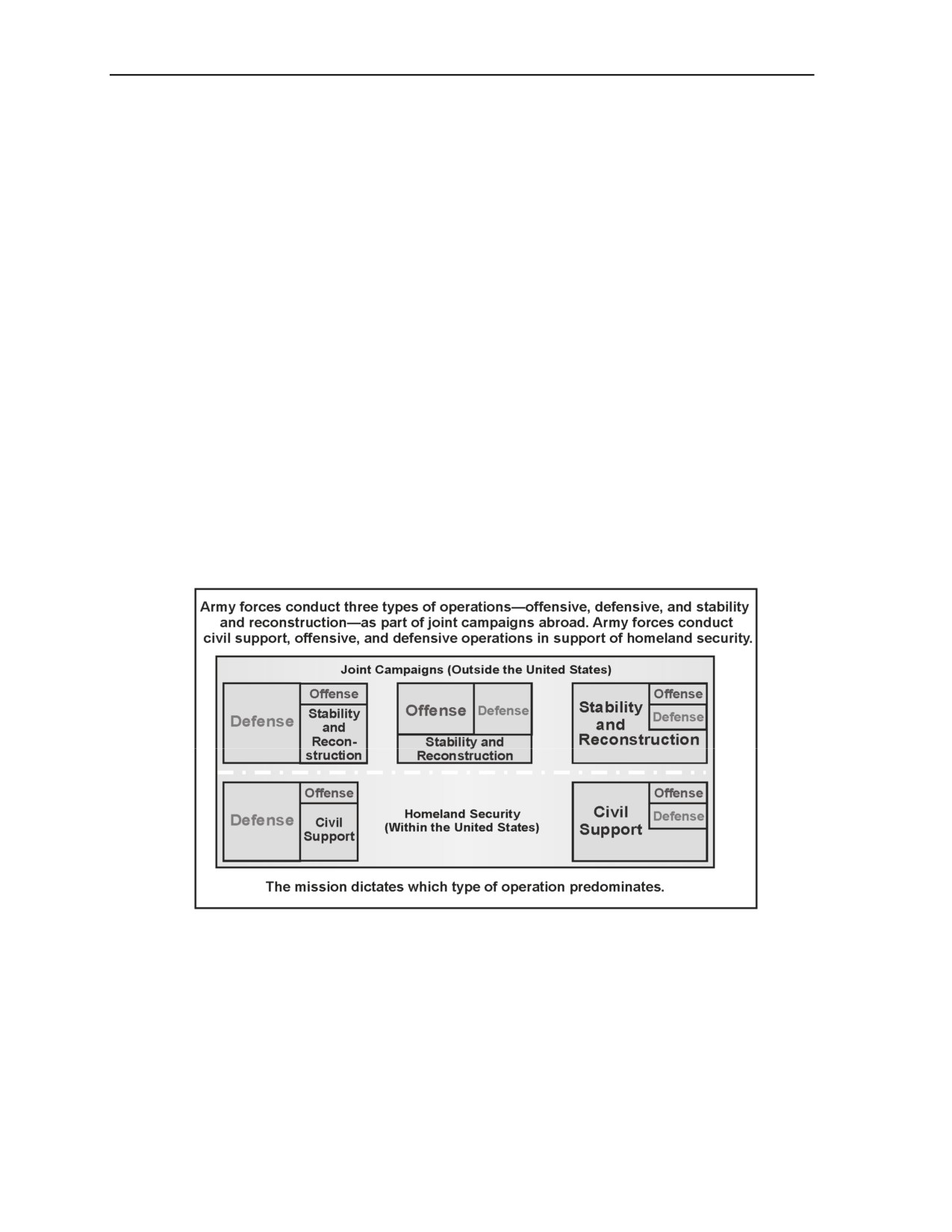
and abroad occur concurrently at the strategic level. (See figure 1-1, below.)
Figure 1-1. Full spectrum operations
1-21. Understanding the Army’s operational concept and its four fundamentals is important in exercising
C2 during operations. It provides a framework commanders use when visualizing, describing, directing,
and leading. This framework helps commanders design operations, especially in developing their
commander’s intent and structuring the concept of operations. It also helps frame commanders’ thinking
when adjusting their design throughout execution.
1-4
FMI 5-0.1
31 March 2006
Command and Control
SECTION II - MAJOR KEYSTONE DOCTRINE CHANGES
1-22. Lessons from recent operations and Army transformation have identified three doctrinal require-
ments:
z
A better construct for grouping related activities Army forces perform during operations and
training.
z
An explanation of how Army C2 doctrine relates to emerging effects-based concepts.
z
Enhanced tactics, techniques, and procedures for military decision making and the operations
process.
This section establishes doctrine for these three requirements.
WARFIGHTING FUNCTIONS AND ELEMENTS OF COMBAT
POWER
1-23. This FMI replaces the battlefield operating systems found in FM 3-0 with the warfighting functions:
intelligence, movement and maneuver, fire support, protection, sustainment, and command and control. A
warfighting function is a group of tasks and systems (people, organizations, information, and proc-
esses) united by a common purpose that commanders use to accomplish missions and training objec-
tives. Commanders visualize, describe, direct, and lead operations in terms of the WFFs. Decisive, shaping,
and sustaining operations combine all the WFFs to generate combat power. No WFF is exclusively deci-
sive, shaping, or sustaining.
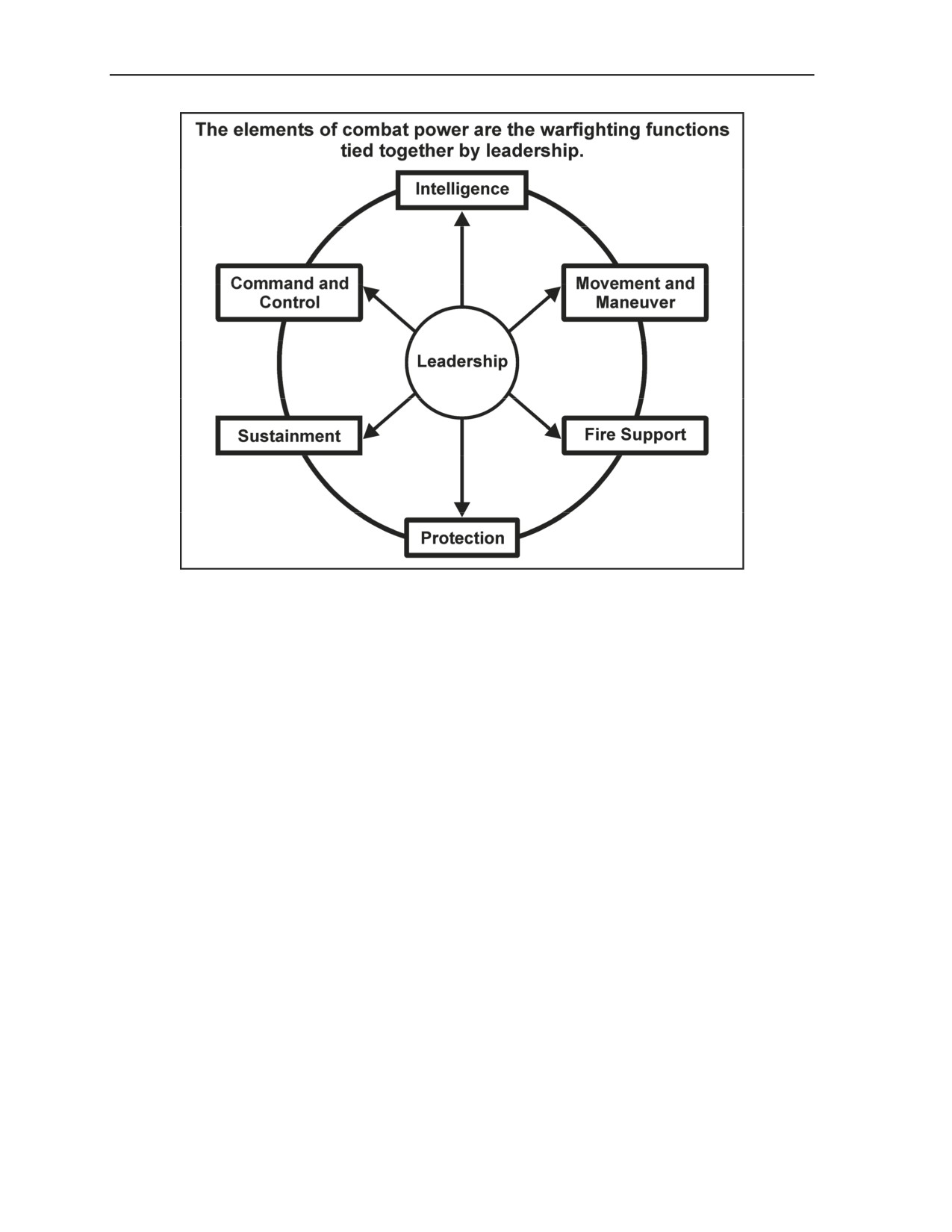
1-24. This FMI also modifies the elements of combat power described in FM 3-0. The principle of combat
power and its use are retained. However, the individual elements have changed. They are now the WFFs
tied together by leadership. (See figure 1-2, page 1-6, below.)
1-25. The intelligence warfighting function is the related tasks and systems that facilitate understand-
ing of the enemy, terrain, weather, and civil considerations. It includes tasks associated with ISR. It is a
flexible, adjustable architecture of procedures, personnel, organizations, and equipment. These provide
relevant information and products relating to the threat, civil populace, and environment to commanders.
The intelligence WFF focuses on four primary tasks:
z
Support to situational understanding.
z
Support to strategic responsiveness.
z
Conduct ISR.
z
Provide intelligence support to targeting.
1-26. The movement and maneuver warfighting function is the related tasks and systems that move
forces to achieve a position of advantage in relation to the enemy. It includes those tasks associated
with employing forces in combination with direct fire or fire potential (maneuver), force projection
(movement), mobility, and countermobility. Movement and maneuver are the means by which commanders
mass the effects of combat power to achieve surprise, shock, momentum, and dominance.
1-27. The fire support warfighting function is the related tasks and systems that provide collective
and coordinated use of Army indirect fires, joint fires, and offensive information operations. It in-
cludes tasks associated with integrating and synchronizing the effects of these types of fires with the other
WFFs to accomplish operational and tactical objectives. Lethal and nonlethal fires, including offensive in-
formation operations, are integrated into the concept of operations during planning and targeting based on
the targeting guidance. The three components of the fire support WFF are—
z
Fire support command and control.
z
Target acquisition systems and assets.
z
Fire support assets and resources.
31 March 2006
FMI 5-0.1
1-5
Chapter 1
Figure 1-2. Elements of combat power
1-28. The protection warfighting function is the related tasks and systems that preserve the force so
the commander can apply maximum combat power. Preserving the force includes protecting personnel
(combatant and noncombatant), physical assets, and information of the United States and multinational
partners. It includes the following task areas:
z
Safety.
z
Fratricide avoidance.
z
Survivability.
z
Air and missile defense.
z
Antiterrorism.
z
Counterproliferation and consequence management actions associated with chemical, biological,
radiological, nuclear, and high-yield explosive (CBRNE) weapons.
z
Defensive information operations.
z
Force health protection.
1-29. The sustainment warfighting function is the related tasks and systems that provide support and
services to ensure freedom of action, extend operational reach, and prolong endurance. It includes
those tasks associated with—
z
Maintenance.
z
Transportation.
z
Supply.
z
Field services.
z
Explosive ordnance disposal.
z
Human resources support.
z
Financial management.
z
Health service support.
1-6
FMI 5-0.1
31 March 2006
Command and Control
z
Religious support.
z
Band support.
z
Related general engineering.
Sustainment facilitates uninterrupted operations through means of adequate logistic support. It is accom-
plished through supply systems, maintenance, and other services that ensure continuous support throughout
an operation.
1-30. The command and control warfighting function is the related tasks and systems that support
commanders in exercising authority and direction. It includes those tasks associated with acquiring
friendly information, managing all relevant information, and directing and leading subordinates. Command
and control has two components: the commander and the C2 system. Information systems—including com-
munications systems, intelligence-support systems, and computer networks—form the backbone of each
commander’s C2 system. They allow commanders to lead from anywhere in their area of operations. The
C2 system supports the commander’s ability to make informed decisions, delegate authority, and synchro-
nize the WFFs. Moreover, the C2 system supports the commander’s ability to adjust plans for future opera-
tions, even while focusing on the current fight. Staffs work within the commander’s intent to direct units
and control resource allocations. They also are alert for enemy or friendly situations that require command
decisions and advise commanders concerning them. Through C2, commanders initiate and integrate all sys-
tems and WFFs toward mission accomplishment.
EFFECTS AND EFFECTS-RELATED CONCEPTS
1-31. This discussion provides background on the effects-based operations (EBO) concept, provides a
summary of how JP 3-0 (revised final coordination [RFC]) has incorporated aspects of EBO, and clarifies
several doctrinal questions associated with Army force use of EBO.
BACKGROUND
1-32. For several years, the joint community has experimented with using effects to better link higher-level
objectives to tactical actions. These efforts produced the EBO concept. The proponent for EBO is the U.S.
Joint Forces Command (USJFCOM). EBO is designed to improve the planning, preparation, execution,
and assessment activities of joint forces at the strategic and operational levels of war. However, EBO is not
part of joint or Army doctrine. As defined by USJFCOM, it is not designed for use by Army tactical forces.
1-33. One difficulty with understanding EBO is the lack of consensus as to what it is and how to use it.
There are numerous joint, Service, and Army nondoctrinal publications that describe different versions of
EBO. Some are consistent with each other; others are not. Although EBO is designed for joint force head-
quarters use, some Army tactical commanders, including some at brigade and below, have incorporated
versions of EBO into their C2 practices. In some cases, this has aided mission accomplishment. In others, it
has caused confusion between the commander and staff, among echelons, and between Services and multi-
national forces.
1-34. How to incorporate EBO into joint doctrine is a major issue of the ongoing revision of JP 3-0. Ex-
pected for release in mid-2006, the revised JP 3-0 will provide joint capstone doctrine for using effects in
conducting joint operations. Until then, the following description of an effects-based approach to joint
planning and assessment is provided for background information. It is based on JP 3-0 (RFC). It is neither
joint nor Army doctrine. When published, JP 3-0 will supersede the material in paragraphs 1-35 to 1-51.
INCORPORATING EFFECTS INTO JOINT DOCTRINE
1-35. Before describing how Army forces incorporate aspects of the EBO concept into operations, an un-
derstanding of how effects-related concepts are being incorporated into joint doctrine is required. This
discussion summarizes JP 3-0 (RFC)’s discussion of how joint forces use effects in conducting operations.
Army force headquarters serving as a component of a joint force participate in joint planning and assess-
ment. Additionally, Army divisions and corps routinely serve as the base for joint task forces. Such situa-
tions require Army headquarters to understand how joint forces use effects during joint operations.
31 March 2006
FMI 5-0.1
1-7
Chapter 1
1-36. JP 3-0 (RFC) discusses effects in the context of operational art and design. JFCs use operational art
to visualize employment of military forces, their sustainment, and arranging their efforts in time, space, and
purpose. This includes fundamental methods associated with synchronizing and integrating military forces
and capabilities. Operational art governs the deployment of forces, their commitment to or withdrawal from
a joint operation, and the arrangement of battles and major operations to achieve operational and strategic
objectives. Among many considerations, operational art requires JFCs to answer the following questions:
z
What objectives, when achieved, attain the desired national strategic end state (ends)?
z
What effects, when created, support achievement of objectives (conditions)?
z
What sequence of actions is most likely to create those effects (ways)?
z
What joint force resources are required to accomplish that sequence of actions (means)?
z
What is the likely cost to the joint force in performing that sequence of actions (risk)?
Systems Perspective of the Operational Environment
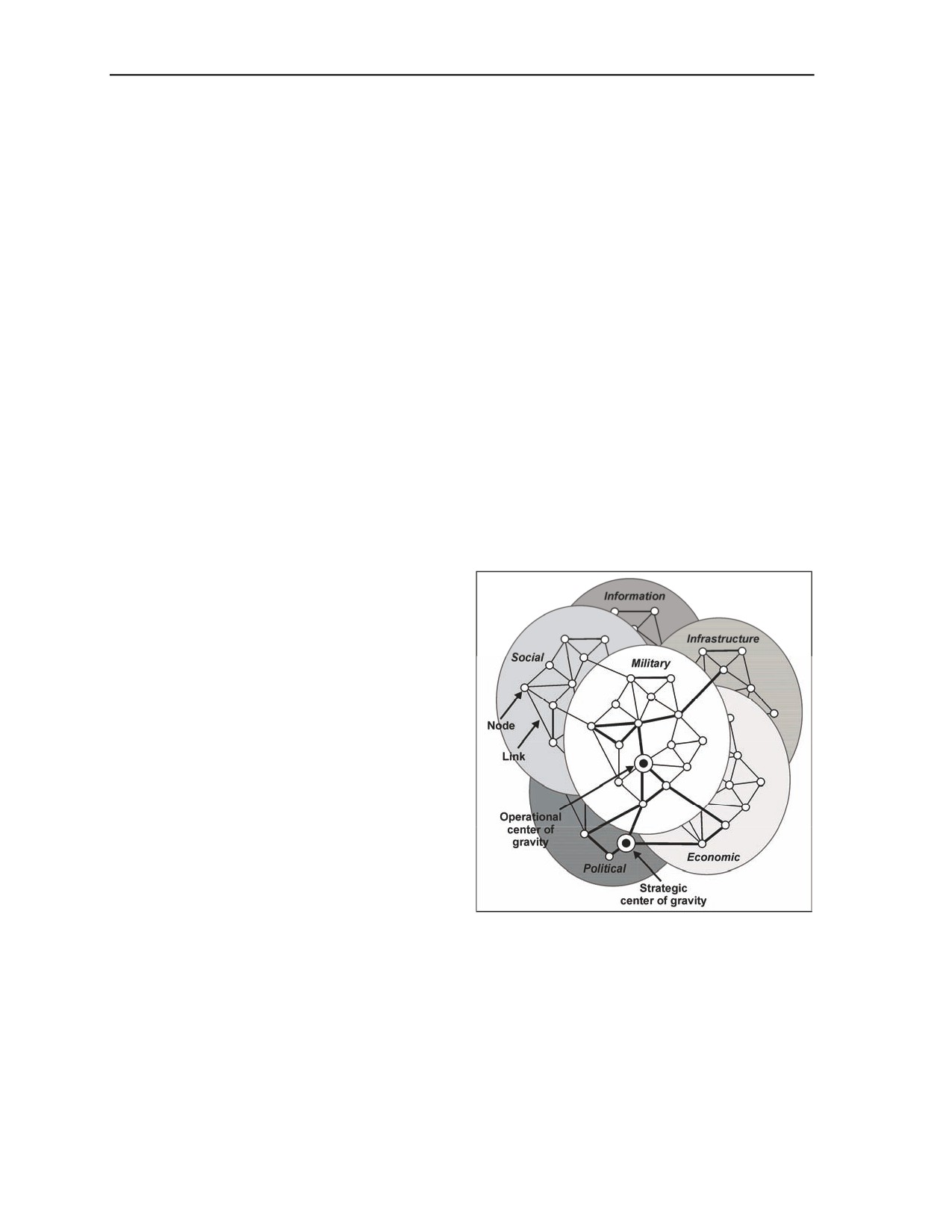
1-37. In designing operations, JFCs and staffs use a systems perspective to understand the operational en-
vironment. A systems view considers more that just an enemy’s military capabilities, order of battle, and
tactics. It strives to provide a perspective of the interrelated systems that make up the operational environ-
ment. A system is a functionally related group of elements forming a complex whole. Major systems that
JFCs and staffs commonly consider and analyze are political, military, economic, social, information, and
infrastructure (PMESII). Understanding these systems, their interaction with each other, and how system
relationships change over time helps JFCs understand how actions on one system element can affect others.
(See figure 1-3, below.)
1-38. The joint force intelligence directorate is responsible for managing the analysis and development of
products that provide a systems understanding of the operational environment. Using an effects-based ap-
proach, this analysis identifies a number of
nodes—specific physical, functional, or behavioral
entities of each system. Nodes can include people,
facilities, individual systems, forces, information,
and other system components. It then tries to
identify links—behavioral, physical, or functional
relationships among nodes. This analysis requires
collaborative
relationships
with
various
intelligence organizations, other governmental
agencies, and nongovernmental groups and
organizations.
1-39. A systems perspective helps staffs identify
potential sources on which to focus indications and
warning activities. Identifying nodes in each
system, the links among them, and potential
decisive points also helps with center of gravity
analysis and operational design. It lets JFCs and
staffs consider a broader set of options and identify
desired and undesired effects to achieve objectives.
Figure 1-3. Systems perspective of the
operational environment
Designing Joint Operations
1-40. Mission analysis helps JFCs develop and understand strategic objectives, the joint force’s mission,
and the operational environment in systems terms. From this understanding, JFCs and staffs continue plan-
ning, including course of action (COA) development. They use the elements of operational design to help
them visualize the arrangement of joint capabilities in time, space, and purpose to accomplish their mis-
sion.
1-8
FMI 5-0.1
31 March 2006
Command and Control
1-41. To help JFCs connect strategic and operational object-
tives to tactical tasks, JP 3-0 (RFC) introduces “effects” as a
Objectives prescribe friendly goals.
new element of operational design. It defines an effect as the
Effects describe system behavior in
physical or behavioral state of a system that results from an
the operational environment.
action, a set of actions, or another effect. A desired effect
Tasks direct friendly action.
represents a condition for achieving a strategic or operational
objective. Undesired effects are those that may adversely impact achieving strategic or operational objec-
tives.
1-42. JP 3-0 (RFC) states that identifying desired and undesired effects within the operational environment
provides a method of connecting strategic and operational objectives with tactical tasks. For example, a
strategic objective may be, “A secure and stable government is established in country X.” The JFC may
identify several strategic and operational effects needed to achieve this strategic objective. Possible effects
include the following:
z
Country X security forces maintain internal and boarder security.
z
Country X’s population votes in nationwide elections.
1-43. These examples are statements about the behavior of systems in country X necessary for country X
to have a secure and stable government. Creating only these effects would likely not be enough to achieve
the strategic objective. The JFC would establish other desired effects and identify undesired effects. The
full set of desired effects represents the conditions for achieving the strategic objective of a secure and sta-
ble government of country X.
1-44. An understanding of systems and their behavior in the operational environment supports an effects-
based approach to planning. JFCs help guide the initial systems analysis by describing desired strategic and
operational objectives and desired/undesired effects. This, along with the JFC’s intent and planning guid-
ance, helps the staff identify potential tasks for the joint force components. For example, a possible task for
a subordinate joint task force or joint force component could be, “Train and equip country X security
forces capable of conducting independent internal and border security operations at the brigade level.”
1-45. JP 3-0 (RFC) states that thinking in terms of desired and undesired effects helps JFCs and staffs do
the following:
z
Amplify strategic and operational objectives.
z
Understand the conditions necessary for success.
z
Determine the best sequence of actions to create these conditions.
z
Develop more precise assessment measures of the progress of operations.
Staffs continue to develop and refine desired effects throughout planning. Monitoring progress toward at-
taining effects is part of assessment. It begins during planning and continues throughout preparation and
execution.
Assessing Joint Operations and Effects Assessment
1-46. JP 3-0 (RFC) would expand joint doctrine on assessing the progress of joint operations. Assessment
is used to measure joint force progress toward mission accomplishment. Commanders continuously assess
the operational environment and the progress of operations, and compare them to their initial vision and
commander’s intent. JFCs adjust operations based on their assessment to ensure objectives are met and the
desired end state is achieved. The joint assessment process is continuous and directly tied to the com-
mander’s decisions throughout the conduct of operations. Staffs help JFCs by monitoring the numerous
factors that can influence the outcome of operations and provide them timely information needed for
decisions. The commander’s critical information requirements (CCIRs) are linked to the assessment proc-
ess by the JFC’s need for timely information to make decisions.
1-47. JFCs and staffs consider assessment during planning, preparation, and execution. They focus their
assessment on identified effects and specified tasks issued to subordinates. Generally, the level at which a
specific operation, task, or action is directed should be the level at which it is assessed. This reduces re-
dundancy and enhances the efficiency of the overall assessment process.
31 March 2006
FMI 5-0.1
1-9
Chapter 1
1-48. Assessment at the strategic and operational levels focuses on effects assessment. Effects assessment
measures effects that support strategic and operational objectives. Strategic- and operation-level assess-
ment concentrates on broader tasks, effects, objectives, and progress toward the desired military end state
of the campaign or major operation. The joint force operations directorate, assisted by the intelligence di-
rectorate, coordinates assessment activities for the JFC.
1-49. The joint assessment process uses measures of effectiveness (MOEs) and measures of performance
(MOPs) to determine progress toward achieving objectives and the desired military end state. MOEs are
generally associated with measuring changes in the operational environment (assessing effects). They help
answer such questions as the following: Is the force doing the right things? Are its actions producing the
desired effects? Are alternative actions required? MOPs are closely associated with task accomplishment
(assessing tasks). MOPs help answer questions like these: Was the action taken? Were the tasks completed
to standard? How much effort was involved? Well-devised measures can help JFCs and staffs understand
the causal relationship between specific tasks and desired effects.
1-50. JFCs and staffs derive assessment measures during planning. They consider assessment measures
during mission analysis and refine them in the initial planning guidance and estimates. They war-game the
measures during COA development. MOEs and MOPs are included in the approved plan or order and re-
evaluated continuously throughout preparation and execution.
1-51. JFCs use MOEs and MOPs as assessment tools throughout an operation. Well-devised MOEs and
MOPs, supported by effective management of available information, help JFCs and staffs understand links
between tasks, desired effects, and the JFC’s objectives and end state. They help to determine progress to-
ward creating desired effects, achieving objectives, and attaining the military end state. They also contrib-
ute to identifying needed adjustments the plan.
EFFECTS AND ARMY DOCTRINE
1-52. Army forces conduct operations according to Army capstone and keystone doctrine. The methods
joint force headquarters use to analyze the environment, develop plans, or assess operations does not
change this. During operations, joint force headquarters send senior Army headquarters a campaign plan,
operation plan, or operation order. Army headquarters then perform the military decision making process
(MDMP) to develop their own plan or order. (See FM 5-0, chapter 3.)
1-53. While portions of the joint plan or order may be articulated in terms of effects to achieve or assess-
ment tasks with specified MOEs and MOPs, this does not change or require a new planning method for
Army forces. Upon receipt of a joint order, Army forces begin mission analysis to understand the relation-
ship of the factors of mission, enemy, terrain and weather, troops and support available, time available, and
civil considerations (METT-TC). Among many planning requirements, Army force commanders and their
staffs identify specified and implied tasks, discern the restated mission, and develop a concept of opera-
tions. From the concept of operations, commanders and staffs develop tasks to subordinate units and essen-
tial coordinating instructions that synchronize forces and WFFs to accomplish missions.
1-54. Army forces will not adopt the joint systems analysis of the operational environment, an effects-
based approach to planning, or effects assessment as described in JP 3-0 (RFC). These planning and as-
sessment methods are designed for the strategic and operational levels of war and for use by a properly re-
sourced joint staff. However, joint interdependence requires Army headquarters to understand joint doc-
trine that addresses these methods when participating in joint operation planning or assessment. When
published, JPs 3-0 and 5-0 will establish this doctrine.
Defining Effects
1-55. JP 3-0 (RFC) defines effect in two ways:
z
An effect is the physical or behavioral state of a system that results from an action, a set of ac-
tions, or another effect.
z
An effect is a result, outcome, or consequence of an action.
1-10
FMI 5-0.1
31 March 2006
Command and Control
1-56. The first definition relates to a systems perspective of the operational environment, an effects-based
approach to planning, and effects assessment—C2 methods used by joint forces. Army doctrine generally
uses the word effect within the context of the second definition. For example, FM 3-0 states, “In land op-
erations, commanders combine and apply the elements of combat power to produce overwhelming effects.”
FM 3-90 categorizes certain tactical mission tasks as having an “effect on the enemy” (for example, con-
tain, delay, or destroy). Thus, this FMI establishes the second definition as the Army definition of effect.
All actions create effects—some desired, others undesired. Desired effects are results that support accom-
plishment of an objective or the mission. Undesired effects could adversely impact accomplishment of an
objective or the mission.
Doctrinal Implications
1-57. Incorporating the term effect and describing and assessing operations in terms of effects does not
fundamentally change Army doctrine. The Army’s fundamentals of full spectrum operations and mission
command include the idea of focusing all efforts toward achieving the operation’s end state. They also re-
quire commanders to focus on results. Proper task performance alone does not accomplish missions.
Rather, the results of executing a task or combinations of tasks for a specific purpose lead to it.
1-58. All WFFs generate effects. For example, the movement and maneuver WFF creates the effects of de-
struction, delay, seizure of terrain, and defeat of enemy forces. The protection WFF creates effects that in-
clude defeat of enemy air attacks and protection of critical assets. Since all WFFs create effects, no single
staff officer is designated as the “effects coordinator” and no single staff section or command post (CP)
cell is assigned responsibility for “effects.” The names and responsibilities of staff sections remain as des-
ignated in FM 6-0 except as changed in this FMI.
MILITARY DECISION MAKING
1-59. While there are many aspects of C2, decision making is at the forefront. Decision making is selecting
a course of action as the one most favorable to accomplish the mission (FM 6-0). All military decisions re-
sult from a combination of intuitive and analytic decision making techniques. Factors affecting the combi-
nation of the two techniques include the leader’s experience and the amount and quality of available infor-
mation. However, the most important factor is usually the time available to make the decision. FM 6-0
provides overarching doctrine on decision making. FM 5-0, chapter 1, provides doctrine on decision mak-
ing and planning.
INTUITIVE AND ANALYTIC DECISION MAKING
1-60. Intuitive decision making is the act of reaching a conclusion that emphasizes pattern recognition
based on knowledge, judgment, experience, education, intelligence, boldness, perception, and character.
This approach focuses on assessment of the situation vice comparison of multiple options (FM 6-0). Intui-
tive decision making is neither “flying by the seat of the pants” nor decision making by guesswork. Often,
experienced commanders can rapidly and almost unconsciously assess a situation, fit it into a pattern they
recognize, and produce a very good solution without comparing options. A decision based on such reason-
ing is not a guess but a reasoned action based on experience.
1-61. Analytic decision making approaches a problem methodically. Leaders analyze a problem, generate
several possible solutions, analyze and compare them to a set of criteria, and select a solution. Analytic de-
cision making aims to select the best solution from those identified. This approach is systematic and allows
the breakdown of tasks into recognizable elements. It serves well for decision making in complex or unfa-
miliar situations. It ensures that commanders and staffs consider, analyze, and evaluate all relevant factors.
It may help inexperienced leaders by giving them a methodology to compensate for their lack of experi-
ence.
1-62. Military decision making combines intuitive and analytic techniques. Intuitive techniques predomi-
nate when time is short or speed of decision is important. They emphasize assessing the situation rather
than comparing multiple COAs. The result is a faster decision but requires accepting some risk. Intuitive
decision making relies on a leader’s ability to do three things:
31 March 2006
FMI 5-0.1
1-11
Chapter 1
z
Recognize the key elements and implications of a particular problem or situation.
z
Reject impractical COAs.
z
Select an adequate (rather than the optimal) COA.
This ability is a factor of experience.
1-63. However, “intuitive” decisions have an analytic component, and “analytic” decisions rely to an ex-
tent on intuitive factors. For any decision, leaders evaluate the quality of available information and com-
pare the decision with the commander’s intent. The preponderance of analytical factors increases with
echelon. At higher echelons, most major decisions are based on the military decision making process
(MDMP), an analytic process that requires applying intuitive factors throughout.
THE MILITARY DECISION MAKING PROCESS
1-64. The Army has two planning processes: the MDMP and troop leading procedures. Troop leading pro-
cedures are used by leaders at company and below. (See FM 5-0, chapter 4.) The MDMP applies to all
Army units with a staff and during all operations. Following it helps commanders and staffs organize their
thinking. It helps them apply thoroughness, clarity, sound judgment, logic, and professional knowledge to
reaching decisions and developing plans.
1-65. The military decision making process is a process that integrates the activities of the com-
mander, staff, and subordinate commanders in developing an operation plan or order. It establishes
procedures for analyzing a mission; developing, analyzing, and comparing courses of action; select-
ing the best course of action; and producing an operation plan or order. (This definition replaces the
definition in FM 5-0.) The MDMP is much more than simply selecting a particular COA. It results in a se-
ries of products, including updated running estimates, intelligence products, and the control measures
needed to execute the operation. (This FMI changes the definition and use of control measure. See para-
graphs 1-103-1-105.)
1-66. Every decision does not require the full MDMP. In fact, the MDMP is often inappropriate for mak-
ing decisions during execution. The MDMP produces a plan or order that establishes numerous instructions
to help control a specific operation. These instructions and control measures are based on coordination
done during the MDMP. Many control measures remain unchanged throughout an operation. However,
commanders change them when necessary to keep an operation directed toward the end state. When the
situation requires a major adjustment to the order, the staff often performs the MDMP in time-constrained
environment to change the plan and resynchronize the operation. (See FM 5-0, paragraphs 3-203-3-240.)
In other instances, commanders and staffs may not have enough time to perform the MDMP. In these in-
stances commanders, supported by the staff, make a decision and develop a quick plan of action. (See
chapter 4.)
DECISIONS DURING PREPARATION AND EXECUTION
1-67. Commanders make two basic types of decisions during preparation and execution: execution deci-
sions and adjustment decisions.
Execution Decisions
1-68. An execution decision is the selection, during preparation and execution, of a course of action antici-
pated by the order (FM 6-0). The most basic form of an execution decision is applying resources or
activities as outlined in the plan or within minor deviations from the plan. Commanders often delegate
many execution decisions to subordinates.
Adjustment Decisions
1-69. An adjustment decision is, during preparation and execution, the selection of a course of action that
modifies the order to respond to unanticipated opportunities or threats (FM 6-0). These decisions are rarely
delegated to subordinates. When commanders adjust the order, it normally requires resynchronizing opera-
tions across the WFFs. Commanders may have to describe their visualization of the adjustment and provide
1-12
FMI 5-0.1
31 March 2006
Command and Control
guidance on affected control measures. Staff members take necessary actions within their areas of expertise
to implement the decision.
OPERATIONS PROCESS ACTIVITIES
1-70. The operations process consists of the major command and control activities performed during
operations: planning, preparation, execution, and continuous assessment. These activities occur con-
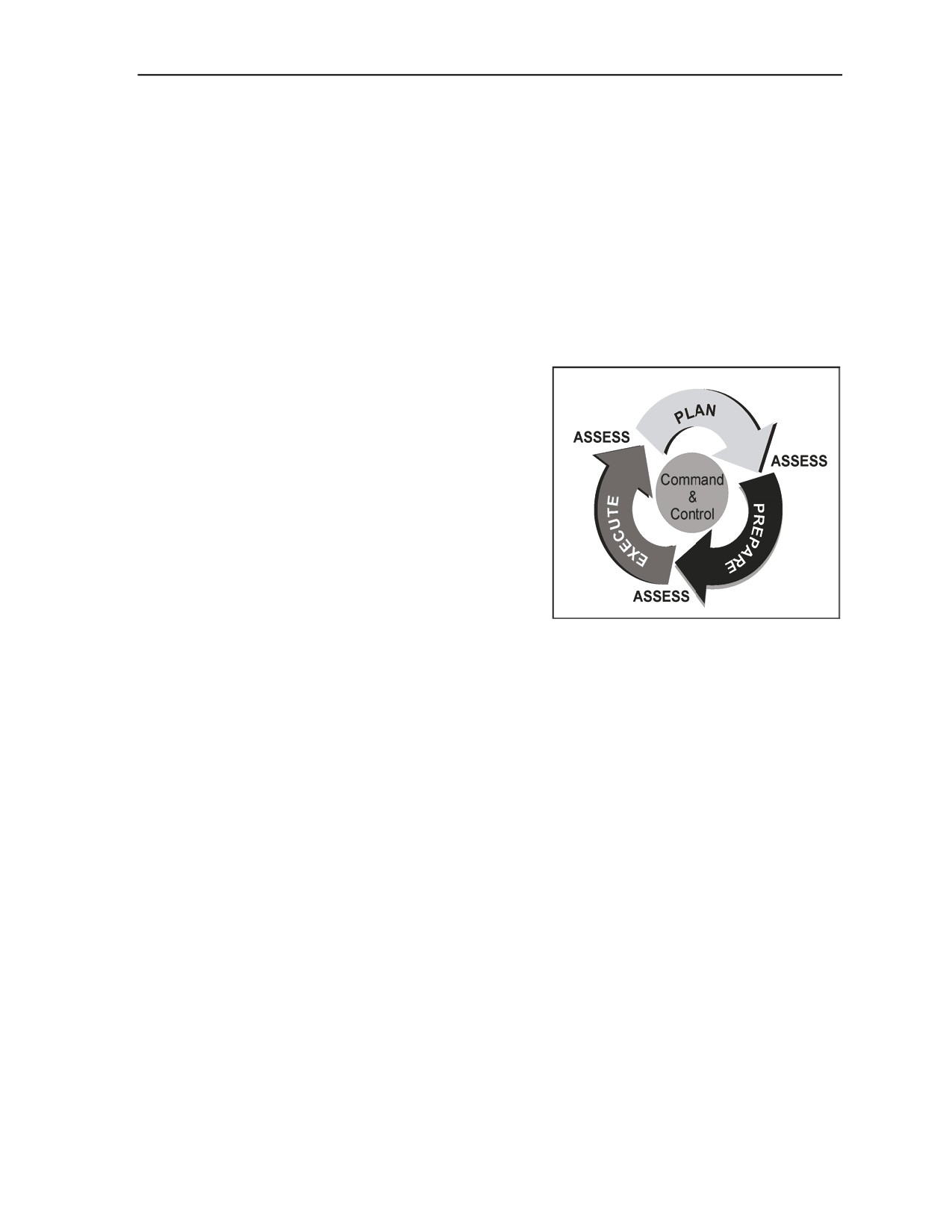
tinuously throughout an operation, overlapping and recurring as required. (See figure 1-4, below.
This definition replaces the definition in FM 6-0.) The operations process serves two important functions
for commanders:
z
It provides a framework that describes the exercise of C2.
z
It provides a framework for organizing the C2 system and using it to conduct operations.
Chapter 3 describes new fundamentals for using the operations process to exercise C2. The reminder of
this discussion revises several definitions related to the op-
erations process.
1-71. For organizational purposes, doctrine describes the
exercise of C2 by each operations process activity. How-
ever, planning, preparing, executing, and assessing occur
continuously and concurrently throughout operations.
Units train to perform all four activities simultaneously.
For example, while executing one operation, units always
plan or prepare to execute a branch, sequel, or subsequent
operation. Subordinate units of a command may be per-
forming different activities simultaneously. For example,
during a mobile defense, the striking force prepares to
counterattack while the fixing force executes a defense.
Figure 1-4. Operations process
1-72. The operations process provides an organizing construct that shows how commanders synchronize
WFFs, integrating processes, ongoing activities, and control measures to accomplish missions. (Chapters 3
and 4 discuss how commanders do this.) It helps commanders determine when and where to perform such
leadership actions as making decisions, issuing guidance, and providing command presence.
1-73. The operations process also helps commanders organize their individual C2 systems. (Section III
discusses C2 systems.) Each commander organizes his or her C2 system to meet the C2 requirements of an
operation. Commanders organize their personnel and equipment into facilities called CPs. (Chapter 2 dis-
cusses how to do this.)
1-74. Commanders set information management priorities that ensure they get the relevant information
they need to make timely decisions. They establish procedures and control measures for synchronizing
units and WFFs. In short, they allocate resources (time and staff) to accomplish the mission. They adjust
the resources allocated to each activity based on the situation. The operations process provides a frame-
work that helps commanders think through how to do this. The following paragraphs discuss each opera-
tions process activity.
PLANNING
1-75. Planning is the process by which commanders (and staff if available) translate the com-
mander’s visualization into a specific course of action for preparation and execution, focusing on the
expected results. (This definition replaces the definition prescribed in FM 3-0.) It distinguishes planning
(discussed in FM 5-0) from commander’s visualization (discussed in FM 6-0).
1-76. Planning involves envisioning a desired end state and describing effective methods to achieve it. It
includes formulating one or more COAs to accomplish the mission. Planners consider the consequences
and implications of each COA. Once commanders select a COA, planning continues to complete the plan
31 March 2006
FMI 5-0.1
1-13
Chapter 1
or order. Planning does not stop, however, with the order’s publication. Planning is continuous. It includes
modifying the original order and branch and sequel development.
1-77. Planning is the art and science of envisioning a desired future and laying out effective ways of bring-
ing it about. It includes thinking through consequences to estimate whether certain actions will bring the
force closer to the end state. While planning is a form of decision making, it involves much more than
making decisions. Once the commander decides on a COA, planning continues to develop a fully synchro-
nized plan or order.
PREPARATION
1-78. Preparation consists of activities by the unit before execution to improve its ability to conduct the
operation including, but not limited to, the following: plan refinement, rehearsals, reconnaissance, coordi-
nation, inspections, and movement (FM 3-0). (Chapter 3 discusses preparation activities.)
1-79. Preparation creates conditions that improve friendly forces’ chances for success. It facilitates and
sustains transitions, including those to branches and sequels. Several preparation activities—especially re-
connaissance operations, security operations, and force protection—begin in planning and occur through-
out the operation.
1-80. Preparation continues during execution. Staffs continue to prepare for branches and sequels. Un-
committed forces prepare for identified contingencies and look to the operation’s next phase or branch.
Committed units revert to preparation when they reach their objectives, occupy defensive positions, or pass
into reserve.
EXECUTION
1-81. Execution is putting a plan into action by applying combat power to accomplish the mission and us-
ing situational understanding to assess progress and make execution and adjustment decisions (FM 6-0).
(Chapter 4 expands on execution doctrine prescribed in FM 6-0, chapter 6.)
1-82. Operations are dynamic. Therefore, commanders must make and implement decisions during execu-
tion. As an operation unfolds, its dynamics initiate an action-reaction-counteraction series of responses be-
tween friendly and enemy commanders. As one gains an advantage, the other acts to counter it. The first
commander then decides what to do to address the new situation and directs the required actions. Even a
successful action or reaction may require issuing an order to exploit it.
1-83. Similar dynamics occur in stability and reconstruction and civil support operations. Instead of an ac-
tion-reaction-counteraction between opposing commanders, this dynamic usually occurs between com-
manders and changing environmental conditions. Commanders continuously assess these changes and di-
rect the actions needed to control the situation.
ASSESSMENT
1-84. Assessment is the continuous monitoring and evaluation of the current situation and progress
of an operation. (This definition replaces the one prescribed in FM 3-0.) Assessment involves deliberately
comparing forecasted outcomes to actual events to determine the overall effectiveness of force employ-
ment. Commanders and staffs continuously assess an operation’s progress. They monitor the situation and
evaluate the operation’s progress to determine if the current order is still valid or if there are better ways to
achieve the end state. Assessments by staff sections form the foundation of running estimates. Assessments
by commanders allow them to keep an accurate situational understanding and revise their visualization
based on it.
Types of Criteria
1-85. Critical to effective assessment is developing criteria for evaluating the degree of success in accom-
plishing the mission. Criteria can be expressed as measures of effectiveness or measures of performance.
1-14
FMI 5-0.1
31 March 2006
Command and Control
z
A measure of effectiveness is a criterion used to assess changes in system behavior, capabil-
ity, or operational environment that is tied to measuring the attainment of an end state,
achievement of an objective, or creation of an effect.
z
A measure of performance is a criterion to assess friendly actions that is tied to measuring
task accomplishment.
1-86. MOEs and MOPs generate information requirements that, when met, support the overall assessment
of an operation. They replace the term criteria of success, which will no longer be used.
Running Estimates
1-87. A running estimate is a staff section’s continuous assessment of current and future operations
to determine if the current operation is proceeding according to the commander’s intent and if fu-
ture operations are supportable. (This definition replaces the definition in FM 6-0. The term staff run-
ning estimate in FM 5-0 will no longer be used.) In their running estimates, staff sections continuously
consider the effect of new information and update the following:
z
Facts.
z
Assumptions.
z
Friendly force status.
z
Enemy activities and capabilities.
z
Civil considerations.
z
Conclusions and recommendations.
A section’s running estimate assesses the following:
z
Friendly force capabilities with respect to ongoing and planned operations.
z
Enemy capabilities as they affect the staff section’s area of expertise for current operations and
future plans.
z
Civil considerations as they affect the staff section’s area of expertise for current operations and
future plans.
z
Environment’s effect on current and future operations from the staff section’s perspective.
1-88. Running estimates provide the basis for action. When an estimate reveals a variance that requires
correction, staff representatives act within their authority to correct it. (Paragraph 4-12 discusses vari-
ances.) When the decision required is outside their authority, they present the situation to the staff officer
delegated the authority to act or to the commander. When the estimate reveals information that answers an
information requirement, especially a CCIR, staff representatives send that information to the section re-
quiring it. Staff representatives do more than collect and store information; they process it into knowledge
and apply judgment to get that knowledge to those requiring it. The section’s running estimate is one prod-
uct of this effort.
1-89. Staff sections maintain their running estimates to identify when decisions are needed and to help the
commander make them. When the commander is considering a decision, an estimate’s presentation always
ends with a recommendation. Sometimes the recommendation is implied. For example, when the estimate
is presented as part of a situation update, the implicit recommendation is to continue operations according
to the present order unless the presenter recommends otherwise. Each staff section maintains only one es-
timate. That section’s representatives to the CP’s cells and working groups base their
assessments and recommendations on that single running estimate. (See chapter 2 for how commanders or-
ganize CPs into cells.)
1-90. Staff sections maintain their running estimates between operations, even when not deployed. At
minimum, they maintain situational awareness of friendly force capabilities within their areas of expertise.
(Situational awareness is defined in paragraph 1-112.) Some running estimates, such as the intelligence es-
timate, also monitor the capabilities of enemies or adversaries. Assignment of a mission focuses staff as-
sessments. Staff sections build the running estimates that result on the foundation of preparations made be-
forehand.
31 March 2006
FMI 5-0.1
1-15
Chapter 1
1-91. Commanders are rarely briefed on the contents of every staff section’s running estimate. Staff repre-
sentatives brief the part of the estimate that applies to the situation and the issue or decision being ad-
dressed. The focus of an estimate presented by a representative in the plans cell is different from one pre-
sented by a representative in current operations. However, both representatives base their presentation on
the single running estimate maintained by their parent staff section.
1-92. During operations, running estimates are usually presented orally, especially during preparation and
execution. Written estimates may be prepared to support contingency planning during peacetime. Even
then, they are normally prepared only at higher-level headquarters. Written estimates follow the format in
FM 5-0, figure E-1.
SECTION III - THE COMMAND AND CONTROL SYSTEM
1-93. Command and control is the exercise of authority and direction by a properly designated commander
over assigned and attached forces in the accomplishment of a mission. Commanders exercise command
and control through a command and control system (FM 6-0). Each commander establishes a single C2
system to support his or her requirements.
1-94. A command and control system is the arrangement of personnel, information management, proce-
dures, and equipment and facilities essential for the commander to conduct operations (FM 6-0). Com-
manders organize their personnel and equipment into facilities called CPs linked by communications. CPs
use procedures to help commanders control operations. (Chapter 2 discusses CPs. Chapters 3, 4, and 5 dis-
cuss basic C2 procedures.) An effective C2 system allows commanders to—
z
Exercise C2 anywhere within the area of operations (AO).
z
Delegate authority to subordinate commanders and staff to allow decentralized execution of op-
erations.
z
Synchronize actions throughout the AO.
z
Focus on critical actions instead of details.
1-95. Their individual C2 systems help commanders exercise C2 in three primary ways. First the C2 sys-
tem helps the commander achieve and maintain situational awareness and facilitates situational understand-
ing. It does this by using information management to create the common operational picture (COP) and
disseminate it throughout the force. Commanders apply judgment to their situational awareness to achieve
situational understanding. Second, it helps the commander regulate forces and WFFs. It does this by sup-
porting the commander’s decision making during planning, preparation, and execution. Third, it allows the
force to adapt to change. It does this by providing commanders access to the information needed for con-
tinuous assessment throughout the operation and by disseminating the orders required to regulate the force.
1-96. C2 is unique among the WFFs in that it integrates the activities of the other WFFs. Given the nature
of operations, effective C2 is characterized by the ability to—
z
Forecast or identify changes in the situation and react to them.
z
Provide continuous reciprocal interaction and influence among the commander, staff, and
forces.
z
Reduce chaos, lessen uncertainty, and operate effectively despite the remaining uncertainty.
1-97. Command and control are interrelated. Command resides with commanders. It consists of authority,
decision making, and leadership. Control is how commanders execute command. It resides with both
commanders and staffs. Commanders cannot exercise command effectively without control. Conversely,
control has no purpose without command to focus it.
COMMAND
1-98. Command is the authority that a commander in the military service lawfully exercises over
subordinates by virtue of rank or assignment. Command includes the leadership, authority, respon-
sibility, and accountability for effectively using available resources and planning the employment of,
organizing, directing, coordinating, and controlling military forces to accomplish assigned missions.
1-16
FMI 5-0.1
31 March 2006
Command and Control
It includes responsibility for unit readiness, health, welfare, morale, and discipline of assigned per-
sonnel. (This definition replaces the definition of command in JP 1-02 for the Army.)
1-99. Commanders are the key to effective C2. They exercise it by combining the art of command, includ-
ing leadership, with the science of control. They create a positive command climate, which includes foster-
ing trust and mutual understanding. They train their subordinates in C2 and use their individual C2 systems
to direct operations. Commanders are the focal point for penetrating or coping with the fog and friction of
operations. Commanders’ knowledge, experience, and personality determine how they interact with their
commands. They decide what to do and the best method to achieve the end state. Then they instill in Sol-
diers the will to win and lead their commands to mission accomplishment.
CONTROL
1-100. Control is the regulation of forces and warfighting functions to accomplish the mission in ac-
cordance with the commander’s intent. (This definition replaces the one prescribed in FM 6-0.) Control
includes information management—the provision of relevant information to the right person at the right
time in a usable form to facilitate situational understanding and decision making. It uses procedures and in-
formation systems to collect, process, store, display, and disseminate information (FM 3-0).
1-101. Aided by staffs, commanders exercise control over all forces in their AO. Staffs provide their
greatest support in providing control and keeping commanders informed. However, effective control re-
quires commanders to actively participate in its exercise.
FORMS OF CONTROL
1-102. FM 6-0 describes two basic forms of control used by Army forces—procedural and positive. Mili-
tary operations require both forms to offset the weaknesses of each. They complement each other and en-
hance executing operations. Commanders balance the two based on the people and circumstances of each
situation. (The terms procedural control and positive control in FM 6-0 are redesignated Army procedural
control and Army positive control to prevent confusion with the joint terms used to control airspace).
z
Army procedural control is a technique of regulating forces that relies on a combination of
orders, regulations, policies, and doctrine (including tactics, techniques, and procedures).
Army procedural control requires no intervention by the higher headquarters once it is estab-
lished.
z
Army positive control is a technique of regulating forces that involves commanders and
leaders actively assessing, deciding, and directing them. Army positive control is more re-
strictive in that subordinates require permission to act once it is established.
Commanders, assisted by their staffs, exercise both Army procedural and Army positive control through
control measures.
CONTROL MEASURES
1-103. A control measure is a means of regulating forces or warfighting functions. (This definition
replaces the definition prescribed in FM 5-0.) Control measures are established under the authority of a
commander. However, staff officers and subordinate leaders can establish them within the authority com-
manders delegate. Control measures assign responsibilities, coordinate actions between forces, or impose
restrictions. They can be permissive or restrictive. Permissive control measures allow something to happen.
Restrictive control measures limit how something is done.
1-104. Control measures may be used to exercise either Army procedural or Army positive control. They
may be complex (such as a corps operation order) or simple (such as a checkpoint). This FMI discusses
control measures most important to the exercise of C2 by commanders of units with a staff. Control meas-
ures include but are not limited to the following:
z
Laws and regulations.
z
Commander’s intent.
z
Planning guidance.
31 March 2006
FMI 5-0.1
1-17
Chapter 1
z
CCIRs.
z
Delegation of authority.
z
Assignment of missions and tasks to subordinates.
z
Plans and orders, including—
Unit mission.
Task organization.
Concept of operations.
Target lists.
Rules of engagement.
Intelligence synchronization matrix.
Service support plans.
z
Graphic control measures (including fire support coordinating measures and airspace control
measures).
z
Unit standing operating procedures (SOPs) to include reports and returns.
z
Information requirements.
Certain control measures belong to the commander alone and may not be delegated. These include the
commander’s intent, unit mission statement, planning guidance, and CCIRs.
1-105. Unit SOPs specify many control measures. An operation plan or order modifies them and adds ad-
ditional ones for a specific operation. Commanders, assisted by their staffs, modify them to adapt to chang-
ing situations throughout all operations.
GRAPHIC CONTROL MEASURES
1-106. Some control measures may be graphical. A graphic control measure is a symbol used on maps
and displays to regulate forces and warfighting functions. Examples include boundaries, coordinating
altitudes, air defense areas, and minefields. Commanders establish them to regulate maneuver, movement,
airspace, fire support, and other aspects of operations. In general, all graphic control measures should be
easily identifiable on the ground.
1-107. Graphic control measures are a form of shorthand. Each has a specific meaning. Properly used,
they portray a lot of information very simply. Well-thought-out control measures established in advance
facilitate subordinates’ freedom of action and reduce the need to ask higher headquarters for guidance dur-
ing operations. Joint interoperability and the use of digital information systems make using standard
graphic control measures essential. They contribute to massing combat power most effectively while pre-
venting fratricide.
1-108. Effectively using graphic control measures requires commanders and staffs to understand the pur-
pose and ramifications of each. FM 1-02, chapters 7 and 9, shows each graphic control measure and dis-
cusses the rules for drawing them.
ROLE OF THE COMMANDER
1-109. The commander’s role in exercising C2 involves the following:
z
Visualizing the environment.
z
Describing their commander’s visualization to subordinates.
z
Directing actions to achieve results.
z
Leading the command to accomplish the mission.
The commander’s role of visualizing, describing, directing, and leading is continuous and drives the opera-
tions process. (See figure 1-5, below.)
1-18
FMI 5-0.1
31 March 2006
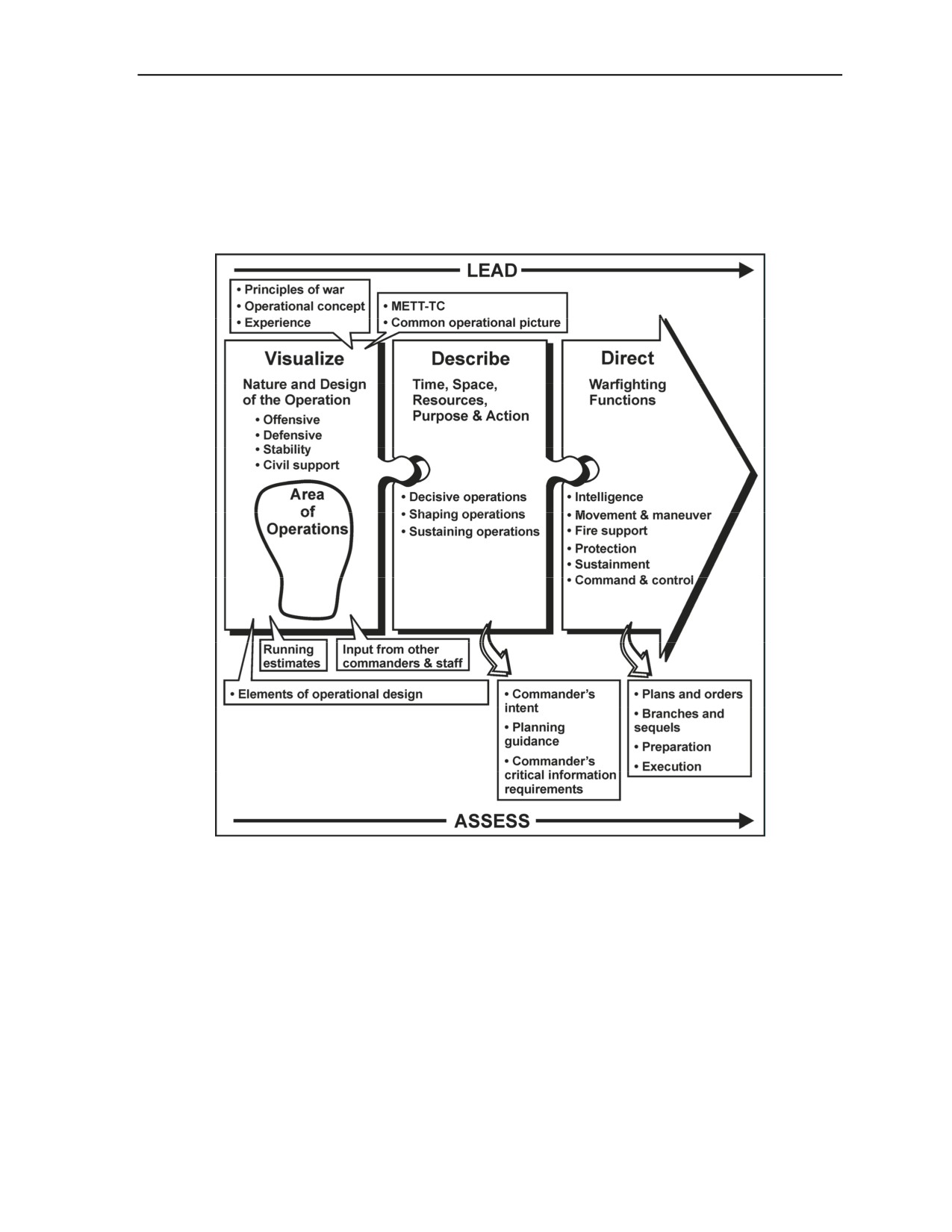
Command and Control
VISUALIZE
1-110. Commander’s visualization is the mental process of developing situational understanding, de-
termining a desired end state, and envisioning how the force will achieve that that end state. (This
definition replaces the one prescribed in FM 6-0.) Many activities are required of commanders. However,
visualizing an operation from start to finish and describing that visualization to the staff and subordinate
commanders is the means commanders use to establish their will for the conduct of an operation.
Figure 1-5. Commander’s role in command and control
1-111. Visualizing the desired outcome requires commanders to clearly understand the situation. What is
the mission? What are the enemy’s capabilities and likely actions? What are the characteristics of the AO?
How much time is available? What sustainment factors are important? What role do civil considerations
play? This framing of the situation in terms of relationships among the factors of METT-TC begins during
mission analysis. Staff sections analyze the situation within their areas of expertise in terms of the factors
of METT-TC to maintain their running estimates. Running estimates provide the relevant information
commanders need to understand the situation.
1-112. Commanders normally begin their visualization with situational awareness. Situational awareness is
knowledge of the immediate present environment, including knowledge of the factors of METT-TC.
More simply, it is knowing what is happening around you now. In the context of the cognitive hierarchy,
situational awareness is at the knowledge level. (See figure 1-6, page 1-20, below. FM 6-0, appendix B,
discusses the cognitive hierarchy and details each factor of METT-TC.) Situational awareness occurs in
31 March 2006
FMI 5-0.1
1-19
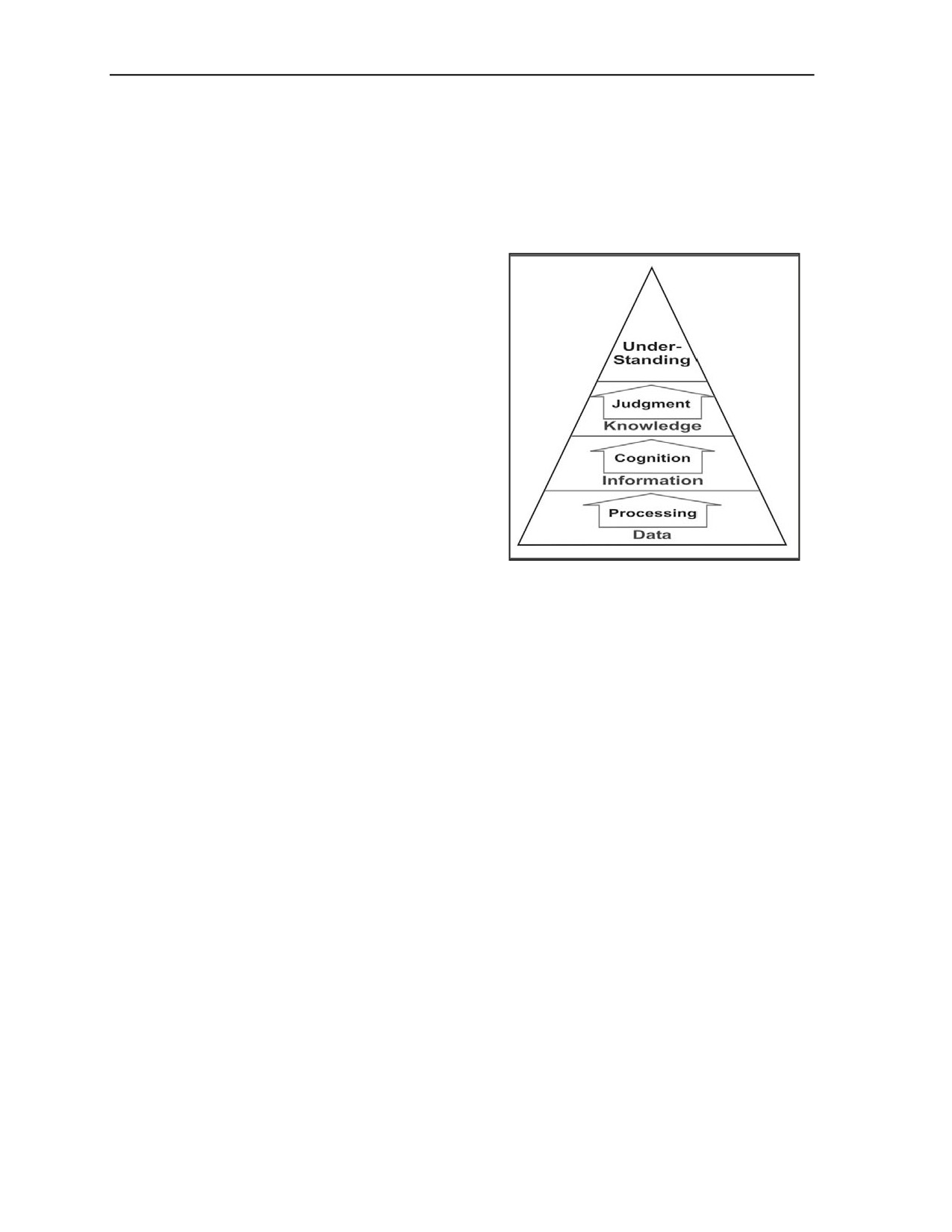
Chapter 1
Soldiers’ minds. It is not a display or the COP but the interpretation of displays or the actual observation of
a situation.
1-113. Upon receipt of a mission (either directed or derived from an ongoing operation), commanders
form a clear situational awareness. They base it on information and such knowledge products as the COP
and running estimates. Staffs support them in this. During mission analysis, commanders apply judgment
to their situational awareness to arrive at situational understanding. Situational understanding is the prod-
uct of applying analysis and judgment to the common operational picture to determine the relationships
among the factors of METT-TC (FM 3-0). It enables
commanders to determine the implications of what is
happening and forecast what may happen.
1-114. There is a difference between situational aware-
ness and situational understanding. Situational under-
standing is more than knowledge of the factors of
METT-TC. It includes understanding the present rela-
tionships among them and forecasting them into the fu-
ture. Such forecasts allow staff representatives to see
how actions in their area of expertise might affect other
areas. Acting on this knowledge is part of subordinates’
initiative. Ideally, the commander’s situational under-
standing increases as the operation proceeds. Informa-
tion management, including priorities commanders set
by establishing and continuously updating their CCIRs,
support commanders’ achieving and maintaining an ac-
curate situational understanding.
Figure 1-6. Cognitive hierarchy
DESCRIBE
1-115. Commanders describe their commander’s visualization through the commander’s intent, planning
guidance, and CCIRs. These three control measures belong to the commander. They are used to guide the
conduct of operations.
1-116. Commanders describe an operation in terms suited to their experience and nature of the mission.
They use an operational framework and the elements of operational design to describe the relationship of
decisive, shaping, and sustaining operations to time and space. (See FM 3-0, paragraphs 4-69-4-99 and 5-23-
5-56.) They emphasize how this combination relates to achieving the end state. They outline how to com-
bine or sequence offense, defense, and stability and reconstruction or civil support operations to accom-
plish the mission. Commanders continue to describe throughout operations. This includes issuing planning
guidance for branches and sequels and providing targeting guidance.
Commander’s Intent
1-117. Commanders express their visualization in their commander’s intent. The commander’s intent is
a clear, concise statement of what the force must do and the conditions the force must meet to suc-
ceed with respect to the enemy, terrain, and civil considerations that represent the operation’s de-
sired end state. (This definition replaces the definition prescribed in FM 3-0.) It defines success as achiev-
ing the end state. It also establishes conditions commanders consider when describing it. In this context, a
condition is a specific situation with respect to circumstances that, when achieved, describes one aspect of
the desired end state.
1-118. There is no format for a commander’s intent. However, its components are purpose, key tasks, and
end state. (See FM 5-0, paragraphs 3-16-3-20.) Commanders develop their intent personally. The com-
mander’s intent is short and concise. Soldiers must be able to understand and remember it two levels down.
During planning, the commander’s intent drives the MDMP. The staff uses it to develop COAs that con-
form to how the commander wants to achieve the end state. During execution, the commander’s intent en-
1-20
FMI 5-0.1
31 March 2006
Command and Control
ables subordinates’ initiative. (See FM 6-0, paragraphs 2-83-2-92.) It links the unit’s mission, concept of
operations, and tasks to subordinate units by establishing the overall conditions that represent mission ac-
complishment. Subordinates use the commander’s intent to decide what to do when facing unforeseen op-
portunities and threats, and in situations where the concept of operations no longer applies.
Planning Guidance
1-119. Commanders develop planning guidance for the staff from their visualization. Planning guidance
may be as broad or detailed as circumstances require. However, it must convey the essence of the com-
mander’s visualization. Commanders use their experience and judgment to add depth and clarity to the
planning guidance. They ensure their staffs understand the broad outline of their visualization while still
permitting the necessary latitude to explore different options.
1-120. FM 5-0, appendix D, provides guidelines for planning guidance. Planning guidance ranges from
the type of order to issue to COAs not to consider. It states in broad terms when, where, and how the com-
mander intends to employ the WFFs in the decisive operation to accomplish the mission within the higher
commander’s intent. Planning guidance contains priorities for the WFFs. It includes how the commander
visualizes shaping and sustaining operations contributing to the concept of operations. This guidance pro-
vides the basis for the concept of operations without dictating the plan’s details.
Commander’s Critical Information Requirements
1-121. One aspect of the commander’s visualization is the information commanders do not know but
deem critical for decision making. Commander’s critical information requirements are elements of infor-
mation required by commanders that directly affect decision making and dictate the successful execution of
military operations (FM 3-0). CCIRs serve as control measures for information management by establish-
ing collecting, processing, and disseminating priorities. They help screen the type and amount of informa-
tion reported directly to commanders. CCIRs may include a latest time information of value (LTIOV) to
indicate time sensitivity. CCIRs are—
z
Specified by commanders for each operation.
z
Applicable only to the commander who specifies them.
z
Situation-dependent—directly linked to current and future missions.
z
Focused on predictable events or activities.
z
Time-sensitive—answers to CCIRs must be immediately reported to the commander by any
means available.
z
Always promulgated by an order or plan.
1-122. Commanders decide what information requirements to designate as CCIRs based on their—
z
Anticipated decisions.
z
Individual cognitive abilities.
z
Commander’s visualization.
During planning, staffs recommend information requirements for commanders to designate as CCIRs based
on mission analysis. During preparation and execution, they recommend changes to CCIRs based on as-
sessment.
1-123. Commanders limit CCIRs to a useable number (usually 10 or fewer). Designating a small number
of CCIRs highlights the information the commander needs to make near-term decisions. It helps staffs and
subordinates to quickly identify information the commander needs immediately. CCIRs may support one or
more decisions. In all cases, the fewer the CCIRs, the better the staff can focus its efforts and allocate
scarce resources.
1-124. CCIRs are not static. Commanders add, delete, adjust, and update them throughout an operation
based on the information they need to make specific decisions. When commanders make a decision, they
do the following:
z
Review their CCIRs.
31 March 2006
FMI 5-0.1
1-21
Chapter 1
z
Remove those no longer needed.
z
Designate new ones to support the next anticipated decision.
During planning, CCIRs often focus on information needed to determine which COA to choose. During
preparation and execution, CCIRs focus on information needed to validate the selected COA or determine
when to initiate critical events, such as a branch or sequel.
1-125. Commanders determine their own CCIRs or select them from staff nominations in the form of rec-
ommended priority intelligence requirements (PIRs) or recommended friendly force information require-
ments (FFIRs). Once approved, CCIRs consist of two components: PIRs and FFIRs.
Priority Intelligence Requirements
1-126. Priority intelligence requirements are those intelligence requirements for which the commander
has an anticipated and stated priority in planning and decision making (JP 1-02). PIRs identify the informa-
tion about the enemy, terrain, weather, and civil considerations that the staff considers most important to
the commander for decision making. PIRs concern both the enemy (including the time available to the en-
emy) and the environment (terrain, weather, and civil considerations). All staff sections submit PIRs. The
G-2/S-2 manages PIRs for the commander.
1-127. PIRs are most often considered information requirements concerning enemy forces, the weather,
and terrain. However, lessons from recent operations show that civil considerations are often critical to de-
cisions during operations. Thus, staff sections should recommend information about civil considerations as
PIRs.
Friendly Forces Information Requirements
1-128. Friendly forces information requirements are information the commander and staff need about the
forces available for the operation (FM 6-0). They consist of information on the mission, troops and support
available, and time available for friendly forces. In coordination with the staff, the unit’s G-3/S-3 manages
them for the commander.
DIRECT
1-129. Commanders direct during all operations process activities. Their directions take different forms
during planning, preparation, and execution. Commanders make decisions and direct actions based on their
situational understanding. They keep their situational understanding current by continuously assessing the
situation. Chapters 3 and 4 discuss how commanders direct in planning, preparation, and execution.
1-22
FMI 5-0.1
31 March 2006
Chapter 2
Command Posts and Staff Operations
The staff’s primary function is to help the commander and subordinate commanders
exercise control. Commanders organize their individual command and control (C2)
systems into command posts (CPs). By doing this, commanders disperse their staff
and C2 capabilities. This enhances the commander’s ability to exercise C2 and makes
the C2 system more survivable. This chapter begins by identifying coordinating, spe-
cial, and personal staff sections. Next it describes how commanders organize their C2
system into CPs. This chapter provides a common taxonomy for CP organization. It
describes the key functions of each type of CP and CP cell for the transforming Army.
Next, this chapter provides organizational principles and guidelines. The chapter con-
cludes with several tactics, techniques, and procedures for CP operations, including
battle rhythm and CP administration. This chapter applies at battalion through corps
level. CPs, however, vary widely among types of units and echelons. Refer to eche-
lon manuals for specifics of CP design. This chapter supplements material in FM 6-0,
paragraphs 5-111-5-115.
BACKGROUND
2-1. Headquarters have existed throughout military history as the organizational structure through which
commanders exercise command and control (C2). In the nineteenth century, Napoleon recognized that a
headquarters providing the planning and analytic capability for a campaign was too large to use in battle.
He exercised C2 through a smaller grouping brought from the larger headquarters but with communica-
tions to it for coordinating and planning. By World War II, Army doctrine divided headquarters into for-
ward and rear elements. Under the Army of Excellence design, maneuver battalions through corps are
structured to command and control operations through a command group and three primary command
posts (CPs):
z
Tactical CP (TAC CP).
z
Main CP.
z
Rear CP.
2-2. While some headquarters are still under the Army of Excellence design, Army transformation initia-
tives have changed the headquarters CP construct. Brigade combat teams through modular corps headquar-
ters are no longer resourced for a rear CP. Many of the rear CP functions have been moved to subordinate
units or incorporated into the main CP. Additionally, the roles, functions, and relationships among CPs
have changed. This chapter focuses on the modular force and describes these changes. Units that have not
transformed should continue to refer to their appropriate current echelon field manual.
STAFF ORGANIZATION
2-3. Commanders cannot exercise control alone except in the simplest and smallest of units. The staff’s
primary function is to help the commander and subordinate commanders exercise control. Control allows
commanders to direct the execution of operations. Unlike command functions, which remain relatively
similar among echelons of command, control functions increase in complexity at each higher echelon.
2-4. Staffs at every echelon are structured differently; however, all staffs are similar. A staff includes a
chief of staff (COS) or executive officer (XO), and various staff sections.
31 March 2006
FMI 5-0.1
2-1
Chapter 2
2-5. A staff section is a grouping of staff members by area of expertise under a coordinating, spe-
cial, or personal staff officer. (See figure 2-1, below.) The number of coordinating, special, and personal
staff officers and their corresponding staff sections varies with different command levels. FM 6-0, appen-
dixes C and D, details the duties and responsibilities of staff officers. Unless specifically stated in this FMI,
FM 6-0 remains the doctrinal source for staff officers’ duties and responsibilities. Staffs are organized
based on three considerations:
z
Mission.
z
Areas of expertise.
z
Regulations and laws.
MISSION
2-6. The mission determines which tasks and activities to accomplish. These activities determine how
commanders organize, tailor, or adapt their staffs to accomplish the mission. The mission also determines a
staff’s size and composition. For example, a division headquarters may serve as the base for a joint task
force headquarters. Based on the factors of METT-TC, the division staff would be augmented with addi-
tional staff members and C2 capabilities to accomplish the mission.
AREAS OF EXPERTISE
2-7. Regardless of mission, every commander divides staff duties and responsibilities along common ar-
eas of expertise. Grouping related activities this way gives commanders an effective span of control. It also
facilitates unified effort by the staff. Areas of expertise may vary slightly, depending on the command
echelon, mission, and environment. For example, there is normally no financial management officer at bat-
talion level and certain logistic units combine the intelligence and operations areas.
2-8. Army modular organizations have added staff sections and changed some staff sections’ areas of ex-
pertise. Staffs now include a separate sections for plans (the G-5/S-5) and financial management (the G-8/S-
8). The civil-military operations section is redesignated the G-9/S-9. The G-5/S-5 performs duties related to
planning listed in FM 6-0, paragraph D-59. The G-8/S-8 performs duties listed in FM 6-0, paragraphs D-91
and D-96. The G-9/S-9 performs duties listed in paragraphs D-71-D-73. Some staffs also include a per-
sonnel recovery section. See FM 3-50.1, paragraphs 2-22-2-30, for this section’s responsibilities.
REGULATIONS AND LAWS
2-9. Army regulations and laws establish special relationships between certain staff officers and the
commander. For example, ARs 20-1, 27-1, 165-1, and 360-1 require the inspector general, staff judge ad-
vocate, chaplain, and public affairs officer to be members of the commander’s personal staff.
2-10. Each military unit has an authorization document that states a unit’s approved structure and re-
sources. It is the basis and authority for personnel assignments and equipment requisitions. This document
is the modification table of organization and equipment (MTOE).
2-11. Doctrine and a unit’s MTOE provide commanders a starting point for organizing their staff into CPs.
Each operation is different, depending on the factors of METT-TC. As commanders organize their force
for an operation, they organize their individual C2 systems for effective C2.
COMMAND POST ORGANIZATION
2-12. A command post is a unit headquarters where the commander and staff perform their activities (FM 6-
0). CPs are the principal facilities commanders use to control operations. Each facility is a CP, regardless
of whether the commander is present. When necessary, commanders personally control the battle from
other locations. In all cases, the commander alone exercises command, whether in the CP or elsewhere.
2-2
FMI 5-0.1
31 March 2006
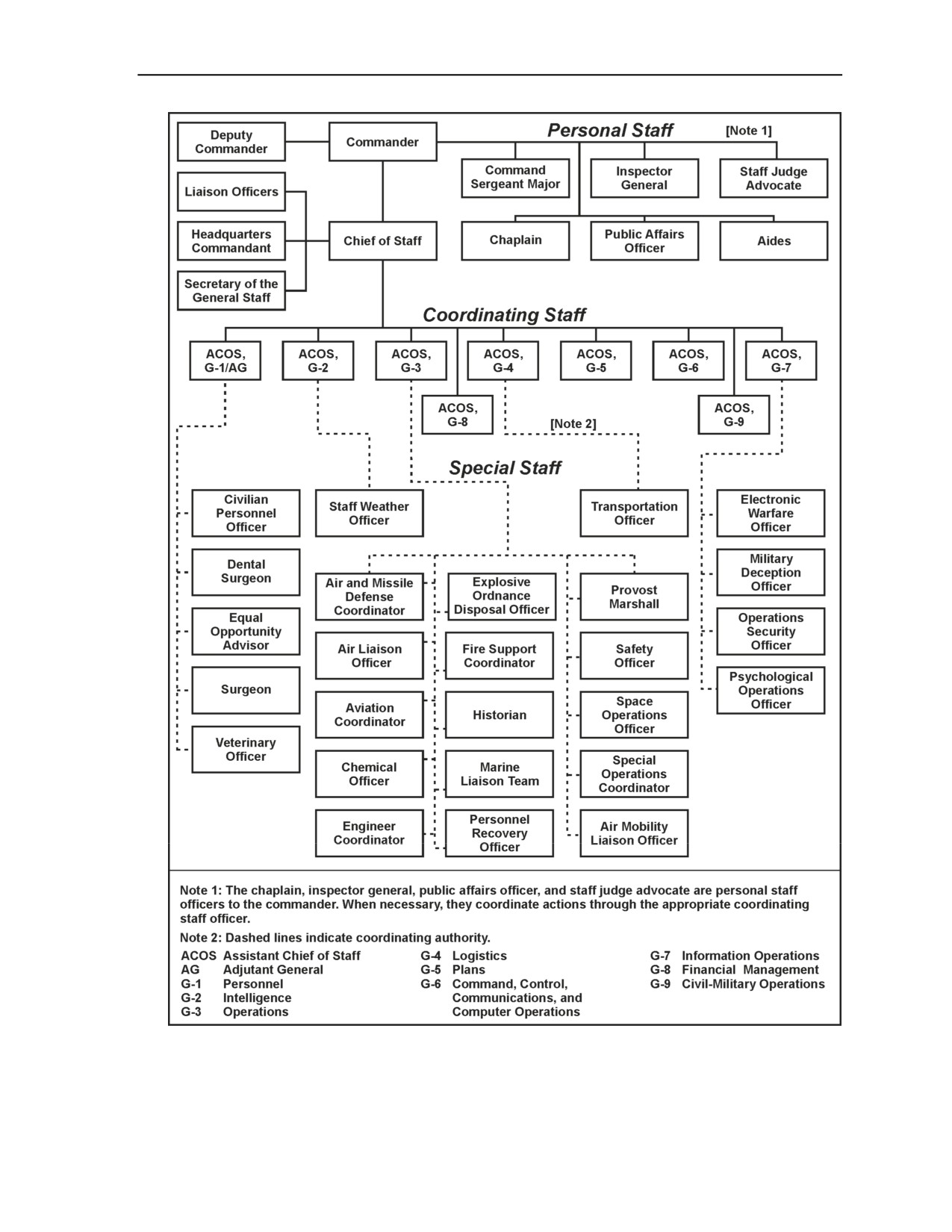
Command Posts and Staff Operations
Figure 2-1. Basic staff structure and coordinating authorities
31 March 2006
FMI 5-0.1
2-3

Chapter 2
2-13. Commanders organize CPs to meet changing situations and the requirements of different operations.
CPs help commanders control operations by coordinating and synchronizing the warfighting functions
(WFFs). Activities common to all CPs include—
z
Maintaining running estimates and the common operational picture.
z
Information management. (See FM 3-0, paragraphs 11-28-11-48; FM 6-0, appendix B.)
z
Developing and disseminating orders. (See FM 5-0.)
z
Controlling operations. (See chapter 4.)
z
Assessing operations. (See chapter 5.)
z
Coordinating with higher, lower, and adjacent units.
z
CP administration.
Displacing.
Providing security.
Organizing for operations.
Maintaining continuity of operations.
TYPES OF COMMAND POSTS
2-14. The number and types of CPs of a given headquarters vary by echelon. (See table 1-1, below.) This
section provides a definition of each CP type and describes its primary purpose. Not depicted in table 2-1 is
an early-entry command post (EECP). Division and corps may form an ad hoc, temporary EECP based on
the factors of METT-TC. (See paragraphs 2-23-2-24.)
Table 2-1. Modular command post design by echelon
Army Service
Combined
Brigade
Division
Corps
Component
Arms Battalion
Combat Team
Command
Mobile Command
Mobile Command
Mobile Command
Command Group
Command Group
Group
Group
Group
TAC CP
Operational
TAC CP
TAC CP
TAC CP
(2 per division)
Command Post
Main CP
Main CP
Main CP
Main CP
Main CP
Combat Trains CP
Field Trains CP or
Support Area CP
Command Group
2-15. The command group consists of the commander and selected staff members who accompany
commanders and enable them to exercise command and control away from a command post. The
command group is organized and equipped to suit the commander’s decision making and leadership re-
quirements while ensuring he or she can accomplish critical C2 functions anywhere in the area of opera-
tions (AO). The command group consists of critical staff officers the commander needs to directly influ-
ence the operation. It normally includes the capability to provide local security and personal assistance for
the commander.
2-16. Divisions and corps headquarters have a mobile command group (MCG). MCGs allow commanders
to exercise battle command on the move. They include ground and air components. The ground component
contains vehicles configured with Army Battle Command System multifunctional displays and communi-
cations equipment. The air component includes UH-60A/L helicopters equipped with Army Airborne
2-4
FMI 5-0.1
31 March 2006
///////////////////////////////////////