FMI 5-0.1 THE OPERATIONS PROCESS (March 2006, March 2008) - page 2
Command Posts and Staff Operations
Command and Control System information systems. The commander selects MCG members based on
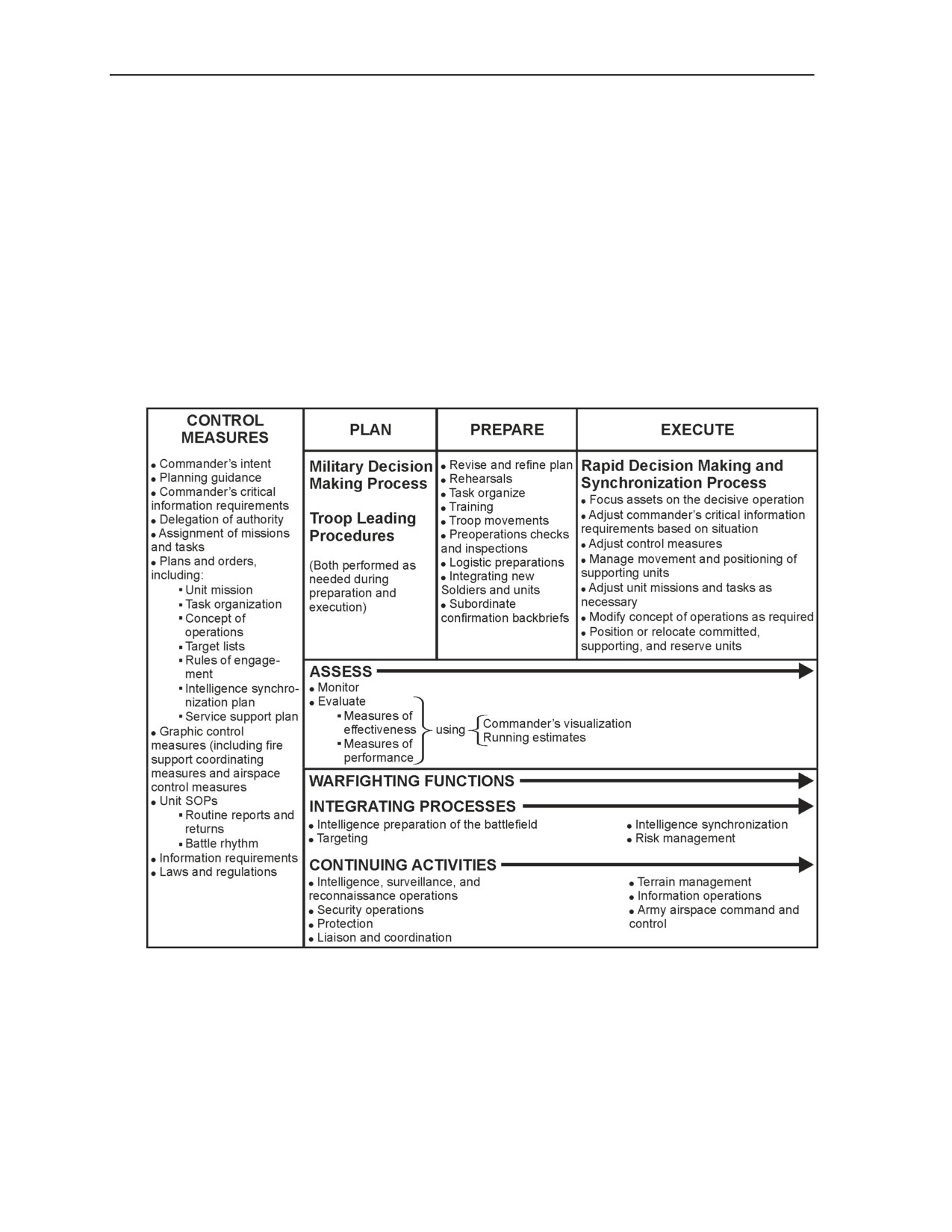
METT-TC.
2-17. Whether ground or air based, the MCG is highly mobile. It allows commanders to move to the point
of decision. Commanders normally position their MCG where they can observe the decisive operation
while communicating with the entire force.
Tactical Command Post
2-18. The tactical command post is a command and control facility containing a tailored portion of a
unit headquarters designed to control current operations. (This definition replaces the definition in FM
1-02.) The TAC CP includes representatives of all the WFFs. Depending on the echelon, commanders em-
ploy one or two TAC CPs. (When published, FMI 3-91 will discuss the two-TAC-CP design and employ-
ment.) Commanders can use the TAC CP to control execution of discrete tasks, like river crossings. A
TAC CP can also control a special task force.
2-19. The TAC CP is fully mobile. As a rule, it includes only the Soldiers and equipment essential to con-
trol current operations. The TAC CP relies on the main CP for planning, detailed analysis, and coordina-
tion. A deputy commander or the G-3/S-3 leads the TAC CP. They are assisted by a chief of operations or
assistant S-3 (depending on the echelon) and a senior noncommissioned officer.
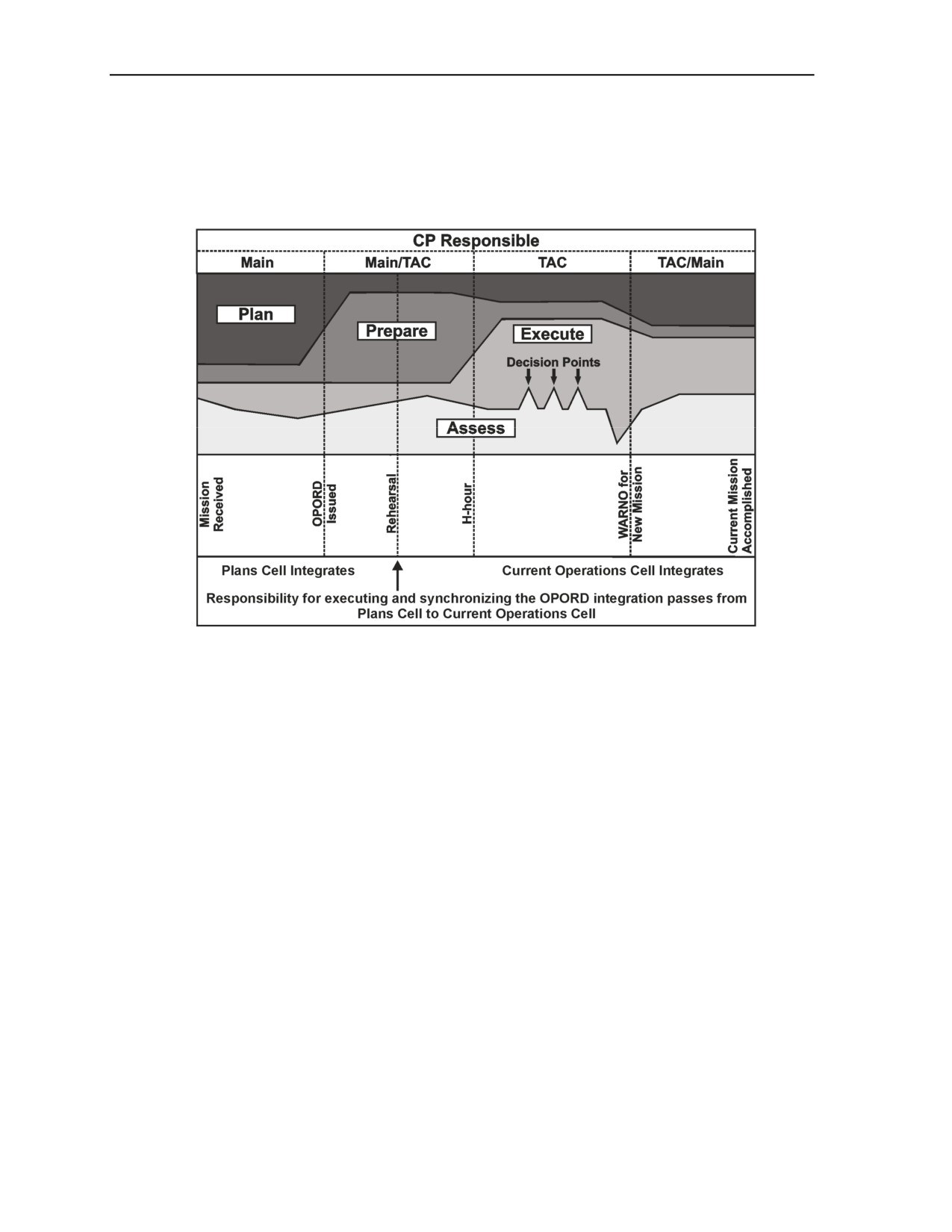
2-20. Normal TAC CP functions include the following:
z
Control current operations, to include resynchronizing forces and WFFs.
z
Provide information to the common operational picture.
z
Monitor and assess the progress of operations.
z
Monitor and assess the progress of higher and adjacent units.
z
Perform targeting for current operations.
z
Perform short-range planning.
z
Provide input to future operations planning.
z
Provide a facility for the commander to control operations, issue orders, and conduct rehearsals.
Main Command Post
2-21. The main command post is a command and control facility that contains the portion of the unit
headquarters in which the majority of planning, analysis, and coordination occurs. (This definition
replaces the definition in FM 1-02.) The main CP includes representatives of all staff sections. It is larger
in size and personnel and less mobile than the TAC CP. The main CP controls current operations when the
TAC CP cannot or is not employed. The COS/XO leads and provides staff supervision of the main CP. He
or she is assisted by the chief of operations/assistant S-3 and a senior noncommissioned officer.
2-22. Normal functions of the main CP include the following:
z
Planning future operations.
z
Performing detailed analysis.
z
Developing intelligence.
z
Performing mid- to long-range assessment of the overall conduct of an operation.
z
Conducting detailed coordination.
z
Assessing the progress of operations.
z
Assessing the progress of higher and adjacent units.
z
Controlling current operations for short periods, based on METT-TC.
z
Providing a facility for the commander to control operations, issue orders, and conduct rehearsals.
Early-Entry Command Post
2-23. An early-entry command post is a command and control facility containing tailored portions of
the unit’s headquarters for a specific mission over a specific period. It normally includes members of
31 March 2006
FMI 5-0.1
2-5
Chapter 2
the tactical command post and additional planners, intelligence analysts, liaison officers, and others
as required. The EECP is a temporary arrangement of personnel and equipment to help the commander
command and control a deployment and initial operations. It is not included in unit tables of organization
and equipment and not intended to be a permanent part of a unit’s CP structure.
2-24. Commanders configure an EECP to deploy rapidly. Normally, they form an EECP around a TAC
CP. Liaison officers, planners, intelligence analysts, and others from the main CP are added, based on
METT-TC. The EECP performs the main and TAC CPs’ functions until the headquarters is operational. A
deputy commander, G-3/S-3, chief of operations/assistant S-3, and senior noncommissioned officer lead
and provide staff supervision of an EECP.
CENTERS
2-25. A center is a command and control facility established for a specific purpose. Centers are similar
to command posts in that they are facilities with staff members, equipment, and a leadership component.
However, centers have a more narrow focus (for example, movement control) and are normally formed
around a subordinate unit headquarters.
2-26. Centers are more common at operational echelons. (Examples include the joint interrogation and de-
briefing center of a joint task force, and the theater materiel management center of an Army service com-
ponent command.) But centers are also formed by Army tactical commanders. For example, a civil affairs
battalion under the operational control of a division normally establishes a civil-military operations center.
The civil-military operations center may not locate with a division CP.
STAFF SECTIONS, COMMAND POST CELLS, AND STAFF ELEMENTS
2-27. Staffs are organized into staff sections by areas of expertise. (See figure 2-1, page 2-3, above.) Com-
manders organize CPs into functional and integrating cells. These cells contain elements from staff sec-
tions.
Staff Sections
2-28. Doctrine and tables of organization and equipment assign portions of each staff section (coordinat-
ing, special, and personal) to CPs and to cells and elements within CPs. For example, in a modular divi-
sion, G-2 elements are assigned to the main and TAC CPs. Within each CP, G-2 elements are allocated
among several cells.
2-29. Some staff sections do not normally provide elements to CP cells. The inspector general section is an
example. Others—for example the G-7 and G-9 sections—operate primarily as staff sections, sending ele-
ments to CP cells as required.
Command Post Cells
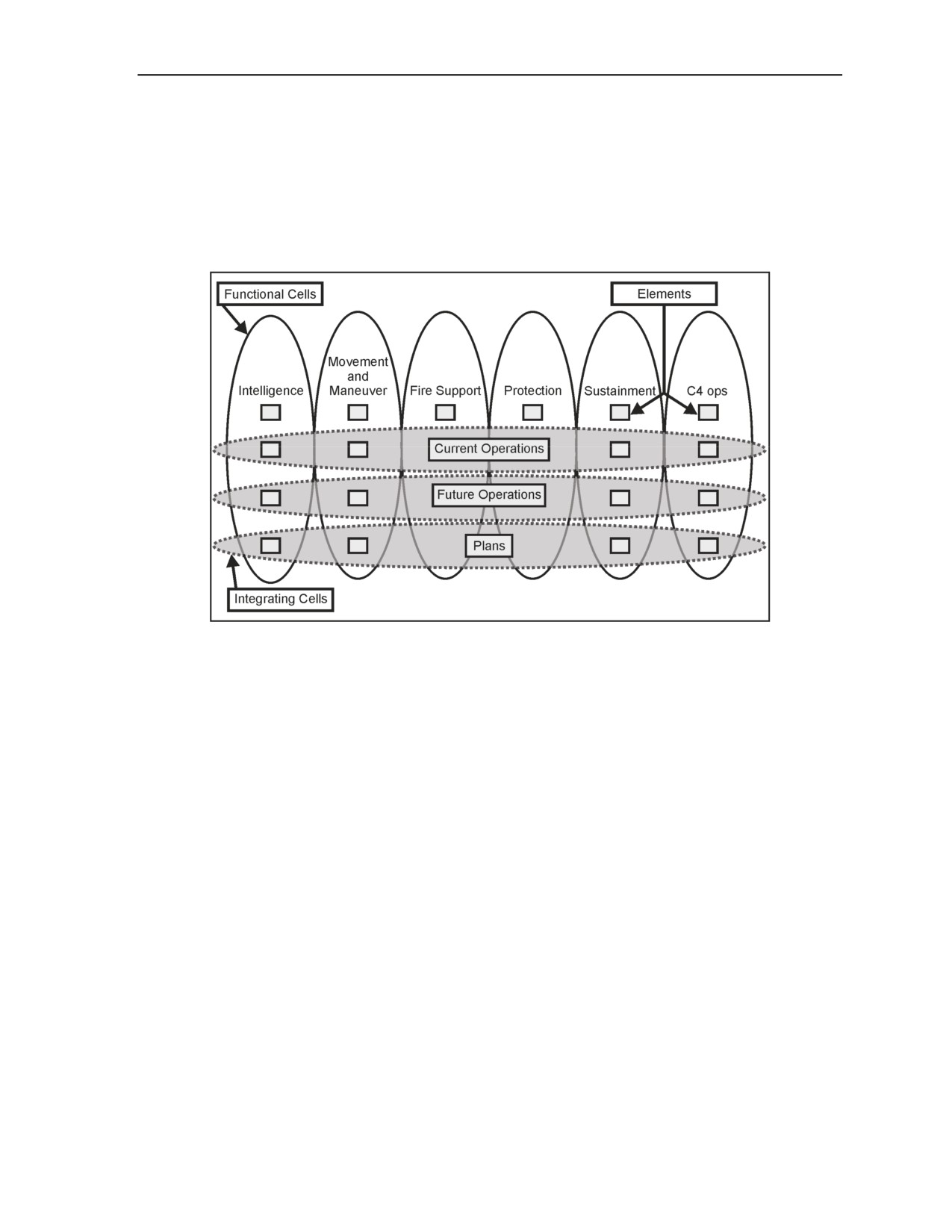
2-30. A command post cell is a grouping of personnel and equipment by warfighting function or pur-
pose to facilitate command and control during operations. There are two types of CP cells, functional
and integrating. (See figure 2-2, below.) Functional cells group personnel and equipment by WFF. Inte-
grating cells group personnel and equipment to integrate functional cell activities. Integrating cells nor-
mally focus on different time horizons. For example, the plans cell focuses on the long-range time horizon,
while the current operations cell focuses on the short-range time horizons. (Paragraphs 3-11-3-25 discuss
time horizons.)
2-31. This is not to say that the functional cells do not integrate. The sustainment cell integrates numerous
logistic areas and services. The fire support cell integrates Army indirect fires and joint fires. It also inte-
grates the contributions of all WFFs to targeting through the targeting working group. (Working groups are
discussed in paragraphs 2-38-2-42, below.) This integration, however, generally focuses on maximizing
the effects of a single WFF. Integrating cells focus the efforts of functional cells on planning, preparing
for, or executing the overall operation within a time horizon.
2-6
FMI 5-0.1
31 March 2006
Command Posts and Staff Operations
2-32. Functional cells and integrating cells are not single staff sections. In a sense, they are combined arms
staff components. For example, in a corps main CP, G-2 section personnel often form elements of the intel-
ligence, fires, current operations, and plans cells.
2-33. Not all cells depicted in figure 2-2 are in every CP. A battalion or brigade TAC CP, for example, is
usually not divided into cells: the entire TAC CP is the current operations cell. It comprises representatives
from various staff sections. A corps TAC CP, in contrast, normally has all cells listed in figure 2-2 except
for plans.
Figure 2-2. Command post organization
Staff Elements
2-34. A staff element is a component of either a staff section or a command post cell. Tables of organi-
zation and equipment normally specify element composition. However, commanders may alter these based
on METT-TC.
2-35. CP cells include elements from staff sections whose areas of expertise affect the cell’s work. Using
the example from paragraph 2-28, the portion of the G-2 assigned to the division TAC CP current opera-
tions cell is called the “G-2 current operations element.” The current operations cell contains numerous
elements. These may include fire support, Army airspace command and control, civil-military operations,
and provost marshal elements.
MEETINGS, WORKING GROUPS, AND BOARDS
2-36. Periodically or as required, ad hoc groupings form to solve problems and coordinate actions. These
groups include representatives from within or outside a CP. Their composition depends on the issue. These
groups are called meetings, working groups, and boards. Each is a control measure for regulating a specific
action, process, or function. (See JP 5-00.2 for joint force headquarters design options. It addresses the
boards, bureaus, and centers used by joint force commanders.)
Meetings
2-37. Meetings (sometimes called huddles) are informal gatherings used to present and exchange informa-
tion. CP cell chiefs and staff section representatives hold meetings as needed to synchronize their activities.
31 March 2006
FMI 5-0.1
2-7
Chapter 2
Working Groups
2-38. A working group is a temporary grouping of predetermined staff representatives who meet to
coordinate and provide recommendations for a particular purpose or function. Some working groups
may be thought of as ad hoc CP cells. Others are forums used to synchronize contributions of multiple cells
to a process. For example, the targeting working group brings together representatives of all staff sections
concerned with targeting. It synchronizes the contributions of the entire staff to the work of the fire support
cell. It also synchronizes fires with current and future operations. Working groups may be held at a central
location, by teleconference, by video teleconference, or by a combination of these. They are formed as
needed or when the commander directs.
2-39. Typical working groups and the lead cell or staff section at division and corps headquarters in-
clude—
z
Operations synchronization (current operations cell).
z
Plans (plans cell).
z
Targeting (fire support cell).
z
Information operations (G-7 staff section).
z
Intelligence, surveillance, and reconnaissance (ISR) (current operations cell).
z
Intelligence synchronization (intelligence cell).
z
Protection (protection cell).
z
Logistics synchronization (sustainment cell).
z
Movements (sustainment cell).
z
Civil-military operations (G-9 staff section).
z
Information management (C4OPS cell).
2-40. The number of and subjects working groups address depend on the situation and echelon. For exam-
ple, a corps CP may form working groups to address enemy improvised explosive device tactics or refugee
return and resettlement. Battalion and brigade headquarters normally have fewer working groups than
higher echelons. Working groups there are often less formal. Groups may gather daily, weekly, or monthly,
depending on the subject, situation, and echelon.
2-41. Working groups form a major part of a CP’s battle rhythm. (Battle rhythm is discussed in paragraphs
2-89-2-92, below.) The COS/XO oversees the battle rhythm and working group scheduling. Each meeting
or working group should be logically sequenced so that one group’s outputs are available as another’s in-
puts when needed. COSs/XOs balance the time required to plan, prepare for, and hold working groups with
other staff duties and responsibilities. They also critically examine attendance requirements. Some staff
sections and CP cells may not have enough personnel to attend all working groups. COSs and cell leaders
constantly look for ways to combine working groups and eliminate unproductive ones. Figure 2-3 (below)
shows a sample standing operating procedure (SOP) for a working group.
2-42. Unit SOPs should address the following for each working group:
z
Purpose.
z
Frequency.
z
Composition (chair and attendees).
z
Inputs and expected outputs.
z
Agenda.
Boards
2-43. A board is a temporary grouping of selected staff representatives delegated decision authority
for a particular purpose or function. Boards are similar to working groups. When the process or activity
being synchronized requires command approval, a board is the appropriate forum. Typical boards address
targeting, planning, sustainment, and movement. Commanders determine the subjects boards address and
those delegated to working groups. Unit SOPs establish the following for each board:
2-8
FMI 5-0.1
31 March 2006

Command Posts and Staff Operations
z
Purpose.
z
Frequency.
z
Required inputs.
z
Expected outputs.
z
Attendees.
z
Agenda.
Purpose:
• Establish policies, procedures, priorities, and overall direction for all civil-
military operations (CMO) projects.
• Provide update on ongoing CMO projects.
Purpose/Frequency
• Identify needs within the area of operations.
• Present suggested future projects.
Frequency: Weekly.
Chair: G-9
Attendees:
• Civil affairs battalion
• Psychological operations
representative.
company representative.
• G-2 planner.
• Provost marshal/force protection
representative.
• G-3 operations representative.
• Special operations forces liaison
Composition
• G-5 planner.
officer.
• G-7 representative.
• Surgeon.
• Staff judge advocate
• Chaplain.
representative.
• Project manager and contractor
• Psychological operations planner.
representatives.
• Host-nation liaison officers.
• Brigade combat team and Marine
• Engineer planner.
force liaison officers.
Inputs:
Outputs:
• Intelligence synchronization
• Updated project status matrix.
working group.
• Proposed project matrix.
• Project management status.
• Long-range CMO plan
Inputs/Outputs
• Information operations working
adjustment.
group (last week’s).
• Targeting board.
• Higher headquarters operation
order.
• G-2 update/assessment.
• Staff judge advocate concerns.
• Operations update.
• Discussion/issues.
Agenda
• Public perception update.
• Approval of information
operations working group inputs.
• Civil affairs project update.
• Engineer project update.
Figure 2-3. Sample SOP for a division civil-military operations working group
31 March 2006
FMI 5-0.1
2-9
Chapter 2
COMMAND POST CELL DUTIES AND RESPONSIBILITIES
2-44. Doctrine provides overarching duties and responsibilities of CP members and cells. Commanders
further define them to meet their particular needs in their SOPs. The following discussion addresses each
CP cell type’s duties and responsibilities. It includes considerations for assigning leadership and supervi-
sory responsibilities.
FUNCTIONAL CELLS
2-45. Functional cells are organized by WFF except for the command, control, communications, and com-
puter operations (C4OPS) cell. (See figure 2-2, page 2-7, above.) The C4OPS cell is different from the C2
WFF. The C2 WFF is broader, including the commander and the C2 system.
Intelligence
2-46. The intelligence cell coordinates activities and systems that facilitate understanding the enemy, ter-
rain, weather, and civil considerations. This includes tasks associated with intelligence preparation of the
battlefield and ISR. The unit’s G-2/S-2 leads this cell.
Movement and Maneuver
2-47. The movement and maneuver cell coordinates activities and systems that move forces to achieve a
position of advantage in relation to the enemy. This includes tasks associated with employing forces in
combination with direct fire or fire potential (maneuver), force projection (movement), mobility, and coun-
termobility. The movement and maneuver cell may also form the base of the current operations cell. The
unit’s G-3/S-3 or a deputy G-3/S-3 leads this cell.
Fire Support
2-48. The fire support cell coordinates activities and systems that provide collective and coordinated use of
Army indirect fires and joint fires. This includes tasks associated with targeting and the targeting process.
The fire support cell integrates lethal and nonlethal fires, including offensive information operations,
through the targeting process. The unit’s fire support coordinator leads this cell.
Protection
2-49. The protection cell coordinates the activities and systems that preserve the force. This includes pro-
tecting personnel, physical assets, and information of the United States and multinational partners. It also
performs the tasks listed in paragraph 1-28. Commanders normally select this cell’s leader from among the
air and missile defense coordinator, chemical officer, engineer coordinator, and provost marshal.
Sustainment
2-50. The sustainment cell coordinates activities and systems that provide support and services to ensure
freedom of action, extend operational reach, and prolong endurance. It includes the tasks listed in para-
graph 1-29. The commander normally selects this cell’s leader from among the G-1/S-1, G-4/S-4, and
G-8.
Command, Control, Communications, and Computer Operations
2-51. The C4OPS cell coordinates activities and systems that provide support to continuous and assured
communications. This includes tasks associated with C4 operations, network operations, and information
systems support to information management. The unit’s G-6/S-6 leads this cell.
2-10
FMI 5-0.1
31 March 2006
Command Posts and Staff Operations
INTEGRATING CELLS
2-52. Integrating cells group personnel and equipment to integrate functional cell activities. CPs normally
include current operations, future operations (FUOPS), and plans cells. The plans cell is normally located
in the main CP. The current operations and FUOPS cells are normally located in the TAC CP.
Current Operations
2-53. The current operations cell is responsible for assessing the current situation while regulating forces
and WFFs in accordance with the commander’s intent. Normally, all staff sections are represented in the
current operations cell. The unit’s G-3/S-3, supported by the chief of operations or an assistant S-3, leads
this cell. Members of the movement and maneuver cell are normally also members of the current opera-
tions cell.
2-54. Staff representatives in the current operations cell actively assist subordinate units. They provide
them information, synchronize their activities, and coordinate their support requests. The current opera-
tions cell solves problems and acts within the authority delegated by the commander. It also performs
short-range planning using the military decision making process (MDMP) in a time-constrained environ-
ment or makes decisions and resynchronizes operations as described in chapter 4.
Future Operations
2-55. The FUOPS cell is responsible for planning and assessing operations for the mid-range time horizon.
This includes preparing branches. Corps and Army service component commands have a FUOPS cell. Bat-
talion through division headquarters are not resourced for one; the plans and current operations cells share
its responsibility. The FUOPS cell uses the MDMP or the MDMP in a time-constrained environment to de-
velop plans and orders. The cell consists of a core group of planners led by the deputy G-3 (chief of future
operations). All staff sections assist as required.
Plans
2-56. The plans cell is responsible for planning operations for the mid- to long-range time horizons. It de-
velops plans, orders, branches, and sequels. This cell is also responsible for long-range assessment of an
operation’s progress. It consists of a core group of planners and analysts led by the G-5/S-5. All staff sec-
tions assist as required.
COMMAND POST ORGANIZATION CONSIDERATIONS
2-57. Planning considerations for CP organization can be categorized as—
z
Those contributing to effectiveness.
z
Those contributing to survivability.
In many cases these factors work against each other; therefore, neither can be optimized. Trade-offs are
made to acceptably balance survivability and effectiveness.
EFFECTIVENESS FACTORS
2-58. CP staff and equipment are arranged to facilitate coordination, smooth exchange of information, and
rapid decision making. CPs must be able to effectively communicate with all subordinate units. They are
organized to quickly deploy throughout the unit’s AO. Five factors contribute to CP effectiveness: design,
standardization, continuity, deployability, and capacity and range.
31 March 2006
FMI 5-0.1
2-11
Chapter 2
Command Post Design and Fusion of Command and Staff Efforts
2-59. Many design considerations affect CP effectiveness. At minimum, CP cells and staff elements should
be positioned to facilitate communication and coordination. Other design considerations include—
z
Ease of information flow.
z
User interface with communications systems.
z
Positioning information displays for ease of use.
z
Integrating complementary information on maps and displays.
z
Adequate workspace for the staff and commander.
z
Ease of displacement (setup, tear-down, and mobility).
2-60. Well-designed CPs integrate command and staff efforts. Meeting this requirement requires matching
the CP’s manning, equipment, information systems, and procedures against its internal layout and utilities.
Organizing the CP into functional and integrating cells promotes efficiency and coordination.
Standardization
2-61. Standardization increases efficiency and eases CP personnel training. Commanders develop detailed
SOPs for all aspects of CP operations during all operations process activities. Standardizing CP layouts,
battle drills, and reporting procedures increases efficiency. These SOPs must be followed and revised
throughout training. Using the standardized procedures must be reinforced constantly. Doing this makes
many C2 processes routine. Staffs then effectively execute them in demanding, stressful times.
Continuity
2-62. CPs exercise C2 continuously for long periods. They must be manned, equipped, and organized to
control operations without interruptions by enemies, environmental conditions, or actions.
2-63. The CP’s personnel, information systems, and equipment must be able to support 24-hour opera-
tions. However, duplicating every staff member within a CP is unnecessary. Commanders carefully con-
sider the primary role and functions assigned to each CP and resource it accordingly. Internal CP SOPs
should address shifts, rest plans, and other CP activities important to operating continuously. Leaders
should enforce these provisions.
2-64. SOPs should address providing C2 continuity when communications are lost with the commander,
subordinates, and or a particular CP. Maintaining C2 continuity during displacement or catastrophic loss
requires designating alternate CPs and procedures for passing control between them. Continuity of com-
mand requires commanders to designate seconds in command and inform them of all critical decisions.
Primary staff officers should also designate alternates.
Deployability
2-65. CPs must deploy efficiently and move within the AO as the situation requires. Determining the ca-
pabilities, size, and the sequence of CPs in the deployment flow requires careful consideration. Modular
CP elements can be configured as an EECP based on the situation. Commanders can add or subtract ele-
ments to the EECP as the situation requires. CP size directly affects deployment and employment.
Capacity and Range
2-66. CPs should be organized to manage the information needed to operate effectively. The capacity to
conduct (plan, prepare, execute, and continuously assess) operations concerns both staffing and informa-
tion systems. So does the ability to manage relevant information. CP personnel must have the necessary
tactical and technical proficiency. CPs must be able to communicate with all higher and lower headquar-
ters, including those outside the force’s AO.
2-12
FMI 5-0.1
31 March 2006
Command Posts and Staff Operations
SURVIVABILITY FACTORS
2-67. CP survivability is vital to mission success. Survivability is often obtained at the price of effective-
ness. CPs need to remain small and highly mobile. They should be able to operate on the move or disperse
into cells. These capabilities enhance CPs’ survivability. Most CPs are easily acquired and targeted when
concentrated. However, it is difficult to maintain a coordinated staff effort when CPs are dispersed.
2-68. The details of a commander’s C2 system depend on the command’s level and nature. However, the
following survivability considerations are useful when developing C2 SOPs and organizing headquarters
into CPs for operations.
Dispersion
2-69. Dispersing CPs enhances survivability. Commanders place minimum resources forward and keep
more elaborate facilities back. This makes it harder for enemies to find and attack them. It also decreases
support and security requirements forward. Most of the staff resides in the main CP; the TAC CP contains
only the staff and equipment essential to controlling current operations. Commanders disperse and harden
CP components as well.
Size
2-70. A CP’s size affects its deployability, mobility, and survivability. Large CPs ease face-to-face coordi-
nation. However, they are vulnerable to multiple acquisition and attack means. Smaller CPs may be easier
to hide but unable to control all force elements. The key is striking the right balance to provide a respon-
sive yet agile organization. For example, commanders require information for decisions; they do not need
every subject matter expert located with them. Commanders identify necessary elements and eliminate un-
necessary ones.
Redundancy
2-71. Reducing CP size reduces signature and enhances deployability and mobility. However, some per-
sonnel and equipment redundancy is required for continuous operations. Inevitably, in combat some C2 as-
sets are lost or fail under stress. Redundancy allows CPs to continue operating when that happens.
Mobility
2-72. CP mobility is important, especially at lower echelons. Lower-echelon CPs and those employed for-
ward in the combat zone may need to move quickly and often. Small size and careful transportation plan-
ning allow CPs to displace rapidly.
COMMAND POST OPERATIONS
2-73. The operations process is dynamic and all its activities occur continuously. However, commanders
must establish a consistent pattern to this process throughout a command. They use the following control
measures to do this: SOPs, plans and orders, and battle rhythm.
COMMAND AND CONTROL SOPS
2-74. Command and control SOPs increase C2 effectiveness. These SOPs serve two purposes. First, inter-
nal SOPs standardize each CP’s internal operations. Second, external SOPs developed for the entire force
standardize interactions among CPs and between subordinate units and CPs. For SOPs to be effective, all
must know their provisions and train to their standards.
31 March 2006
FMI 5-0.1
2-13
Chapter 2
Internal SOP Requirements
2-75. Each CP should have SOPs that address the following:
z
Organization and setup.
z
Staffing and shifts.
z
Continuous operations, including eating and sleeping plans.
z
Physical security and defense.
z
Priorities of work.
z
Loading plans and equipment checklists.
z
Orders production and dissemination procedures.
z
Journals and log maintenance.
z
Equipment and vehicle maintenance.
Shift-change Briefings
2-76. During continuous operations, CPs normally operate in shifts. To ensure uninterrupted operations,
staffs execute a briefing when shifts change. Depending on the situation, it may be formal or informal and
include the entire staff or selected members. Normally it is done face-to-face among key CP leaders. The
COS/XO oversees the briefing, with participants briefing their areas of expertise. The briefing’s purpose is
to inform the incoming shift of—
z
Current unit status.
z
Significant activities that occurred during the previous shift.
z
Significant decisions and events anticipated during the next shift.
The commander may attend. This may change the focus of the briefing. If the commander issues guidance
or makes a decision, issuing a fragmentary order may be necessary.
2-77. The shift-change briefing format and emphasis change based on the situation. For example, the for-
mat for a force supporting civil authorities in a disaster area differs from one for a force conducting offen-
sive operations abroad. To facilitate a quick but effective shift-change briefing, unit SOPs should contain
its format and sequence. (See figure 2-4, below.)
2-14
FMI 5-0.1
31 March 2006
Command Posts and Staff Operations
Current mission and commander’s intent (COS/XO).
Enemy situation (G-2/S-2).
• Significant enemy actions during the last shift.
• Current enemy situation and changes in the most likely enemy courses of actions.
• Changes in priority intelligence requirements (PIRs).
• Limited visibility and weather update.
• Changes to collection priorities and updates to the intelligence synchronization plan.
• Disposition and status of selected intelligence, surveillance, and reconnaissance (ISR) units and capabilities.
Civil situation (G-9/S-9).
• Significant actions by the population during the last shift.
• Current civil situation.
• Disposition and status of civil affairs units and capabilities.
• Significant activities involving the population anticipated during the next shift.
Friendly situation (G-3/S-3).
• Significant friendly actions during the last shift.
• Subordinate units’ disposition and status.
• Higher and adjacent units’ disposition and status.
• Major changes to the task organization and tasks to subordinate units that occurred during the last shift.
• Answers to commander’s critical information requirements (CCIRs) and changes in CCIRs.
• Changes to the ISR plan.
• Disposition and status of selected ISR units and capabilities.
• Answers to friendly forces information requirements (FFIRs) and changes in FFIRs.
• Significant activities and decisions scheduled for next shift (review of the decision support matrix).
• Anticipated planning requirements.
Running estimate summaries by warfighting function and staff section.
Briefers include—
• Fire support coordinator.
• Chemical officer.
• Air liaison officer.
• Provost marshal.
• Aviation coordinator.
• G-1/S-1.
• Air and missile defense coordinator.
• Surgeon.
• G-7/S-7.
• G-4/S-4.
• Engineer coordinator.
• G-6/S-6.
Briefings include—
• Any significant activities that occurred during the last shift.
• Disposition and status of units within their area of expertise.
• Any changes that have staffwide implications (for example, “higher headquarters changed the controlled
supply rate for 120mm HE, so that means…”).
• Upcoming activities and anticipated changes during the next shift.
CP operations and administration (headquarters commandant or senior operations noncommissioned
officer).
• CP logistic issues.
• CP displacement plan and proposed new locations.
• CP security.
• Priority of work.
COS/XO guidance to the next shift, including staff priorities and changes to the battle rhythm.
Figure 2-4. Example shift-change briefing
2-78. The shift-change briefing provides a mechanism to formally exchange information periodically
among CP members. However, CP members share information throughout the shift. They coordinate ac-
tivities and inform each other continuously. Information that answers a CCIR and exceptional information
is given to the commander immediately. (See FM 6-0, paragraphs B-60-B-62, for a discussion of excep-
tional information.) Information that answers a PIR or FFIR is routed to the appropriate coordinating staff
officer. Information that can potentially affect the entire force is disseminated to the commander, higher
31 March 2006
FMI 5-0.1
2-15
Chapter 2
headquarters, and subordinate units as the situation dictates. Situational understanding for CP members in-
cludes knowing who needs what relevant information and why they need it. CP members exercise subordi-
nates’ initiative when they ensure relevant information gets to people who need it.
Command Post Battle Drills
2-79. Each CP requires procedures to react to a variety of situations. Specific actions taken by a CP should
be defined in its SOPs and rehearsed during training and operations. Typical CP battle drills include—
z
React to an air attack.
z
React to a ground attack.
z
React to a chemical attack.
z
React to indirect fire.
z
React to jamming or suspected communications compromise.
z
Execute time-sensitive targets.
z
Execute a close air support or joint fires mission.
z
React to a mass casualty incident.
z
React to a civil riot or incident.
z
React to significant collateral damage.
z
React to a misinformation incident.
External SOP Requirements
2-80. Procedures for how CPs interact with each other and how subordinate units interact with CPs are
also required. Key areas include—
z
Standardized reports and returns.
z
Operation update and assessment briefing.
z
Procedures for transferring control of operations between CPs.
Reports and Returns
2-81. A unit’s reporting system facilitates timely and effective information exchange among CPs and
higher, lower, and adjacent headquarters. An established SOP for reports and returns is key to effective in-
formation management. These SOPs include—
z
Who is required to submit each report.
z
The frequency and time reports are due.
z
The recipient of each report.
Changes to the unit SOP involving reports are normally reflected in the command information management
plan. This is normally a stand alone plan and not part of an operation order.
Operation Update and Assessment Briefing
2-82. An operation update and assessment briefing may occur daily or anytime the commander calls for
one. It is similar in content to the shift-change briefing but has a different audience. The staff presents it to
the commander and subordinate commanders. Its purpose is to provide all key personnel a common situ-
ational awareness. Often commanders require this briefing shortly before an operation begins to summarize
changes made during preparation, including changes resulting from ISR efforts.
2-83. During the briefing, staff sections present their running estimates. Subordinate commanders brief
their current situation and planned activities. This briefing is rarely conducted face-to-face. Various com-
munications means are used; among them, FM-voice, joint network node conference call, and video tele-
conference. All CPs and subordinate commanders participate. The briefing follows a sequence and format
specified by SOP. That keeps transmissions short, ensures completeness, and eases note-taking. This brief-
ing normally has a format similar to a shift-change briefing. However, it omits CP administrative informa-
tion and includes presentations by subordinate commanders in an established sequence.
2-16
FMI 5-0.1
31 March 2006
Command Posts and Staff Operations
Transferring Control of Operations between Command Posts
2-84. The employment and use of CPs are important decisions reflected in the operation order. Often, a
particular CP may control part of the operation or control the operation for a specific time. Effectively
transferring control between CPs requires a well-understood SOP.
2-85. While all CPs have some ability to perform C2 on the move, they lose many capabilities they have
when stationary. Therefore, CPs normally control operations from a static location. During moves, control
responsibilities are transferred to another CP. Transfer of control requires notifying subordinates and many
network operations changes to route information to the new controlling CP. SOPs establish these require-
ments to minimize interruptions when transferring control.
Establishing Command Post Locations and Responsibilities
2-86. When planning operations, staffs develop a C2 plan that addresses each CP’s initial and subsequent
position. The plan also includes the command group’s composition and how the commander plans to em-
ploy it. The C2 plan establishes which CP controls specific parts of the operation. This is especially impor-
tant for modular divisions, which have two TAC CPs.
2-87. The C2 plan is published in paragraph 5 of the operation order. Areas of that have not changed from
the unit’s SOP are not addressed.
2-88. This FMI modifies paragraph 5 of the operation order to better account for the above requirements.
Figure 2-5, page 2-18 (below), shows the revised format for paragraph 5.
Battle Rhythm
2-89. A key control measure commanders use to establish a CP operations pattern is a unit’s battle rhythm.
Battle rhythm is the sequencing of standardized command and control activities within a headquar-
ters and throughout the force to facilitate effective command and control. The COS usually controls
the battle rhythm.
2-90. Battle rhythm establishes the time, frequency, and type of meetings, working groups, boards, and
other events, and who attends them. Reports, briefings, meetings, and working groups all require input and
preparation. Additionally, the outputs of certain working groups are inputs for other working groups. The
battle rhythm accounts for such requirements. Staff officers and subordinate units require a schedule to pre-
pare for each C2 event.
2-91. The battle rhythm changes as operations progress. For example, early in the operation a commander
may require a plans update briefing each morning. As the situation changes, the commander may only re-
quire this update every three days. Many factors help determine a unit’s battle rhythm. Some of these fac-
tors are the staff’s proficiency, higher headquarters’ battle rhythm, and current mission.
31 March 2006
FMI 5-0.1
2-17
Chapter 2
5. Command and Control.
a. Command.
(1) Location of the commander. (State where the commander plans to be, including the mobile command
group’s location. If the operation is phased, state the location of the commander by phase.)
(2) Succession of command. (State the succession of command, if not covered in unit’s SOP.)
(3) Special instructions for deputy commanders. (Specify responsibilities of deputy commanders and
associated CPs, by phase if necessary.)
b. Control.
(1) Scheme of CP employment. (State each CP’s location and how each CP will be used. State which CP is
the primary controlling CP for the operation. If the operation is phased, state this scheme by phase.)
(2) Special instructions for CPs. (State special tasks or additional instructions for each CP not detailed
elsewhere. These might include movement of key staff officers between CPs and movement of functional cells. List
these by phase if necessary).
(3) Liaison requirements. (Provide instruction for liaison to higher, lower, and adjacent commands.)
c. C4 Operations (See Annex H.)
(1) Network operations. (Include network control procedures for network administration and management.)
(2) Signal Operating Instructions. (Current SOI in effect.)
(3) Information management procedures. (Special requirements under the command information
management plan.)
(4) Recognition and identification instructions. (Special instructions not included in the SOP, friendly
recognition signals, vehicle markings, and so forth.)
Figure 2-5. Format for operation order paragraph 5
2-92. Battle rhythm must remain flexible. Some missions require more time and effort to plan and prepare,
than others. Additionally, battle rhythm must not keep commanders from exploiting opportunities. In a pro-
tracted stability operation, a division’s battle rhythm may look something like figure 2-6 (below). In fast-
paced offensive or defensive operation, the division battle rhythm would be quite different.
0700- Shift-change briefing (chief of staff/CP members).
0800-Operation update and assessment briefing (commander, staff, subordinate commanders).
0900-G-5 plans update (chief of staff and plans cell).
1000-Logistic synchronization conference call.
1100-Movement synchronization meeting.
1300-Operation synchronization meeting (G-3, chief of operations, and section and cell chiefs).
1700-Corps operation update and assessment briefing.
1900-Shift-change briefing (chief of staff/CP members).
2000-Working groups.
• Interagency working group (Monday).
• Targeting working group (Tuesday, Thursday, Saturday).
• Information operations working group (Wednesday).
• Civil-military operations working group (Friday).
• Assessment working group (Sunday).
Figure 2-6. Battle rhythm example for a stability operation
2-18
FMI 5-0.1
31 March 2006
Chapter 3
Exercising Command and Control
This chapter expands the scope of the operations process established in the current
FM 3-0. It describes enhancements to the operations process to make it more com-
prehensive. It expands the operations process to incorporate several existing integrat-
ing processes, continuing activities, and control measures. It introduces patterns of
operations. It expands doctrine on time horizons and operations process activities dis-
tribution. The integration responsibilities of the plans and current operations cells are
more precisely established. All refinements emphasize the commander’s central role
in visualizing, describing, directing, and leading operations. They reinforce mission
command. At the same time, they contribute to better describing the staff’s role in
helping commanders exercise command and control. Since these processes require a
staff, this discussion applies only to battalion and above.
ENHANCING THE OPERATIONS PROCESS
3-1. As specialization within command posts (CPs) has grown, doctrine has not provided guidance for
synchronizing integrating processes with each other and the overall operation. This chapter fills that void.
3-2. The operations process does not consist of distinct, sequential tasks, but of four continuous, overlap-
ping activities (plan, prepare, execute, and assess) performed throughout an operation in varying propor-
tions. There is also a requirement to coordinate integrating processes and continuing activities to synchro-
nize the warfighting functions (WFFs) throughout an operation. Commanders and staffs develop and use
control measures to do this. For doctrine to portray the integrated effort required in combined arms opera-
tions, the operations process now incorporates four existing integrating processes and several continuing
activities. (See figure 3-1, page 3-2, below.)
INTEGRATING PROCESSES
3-3. The following integrating processes occur during all operations process activities. They must be syn-
chronized with each other as well as integrated into the overall operation:
z
Intelligence preparation of the battlefield (IPB).
z
Targeting.
z
Intelligence synchronization.
z
Risk management.
In addition, commanders use the military decision making process (MDMP) and troop leading procedures
to integrate activities during planning and, when required, during preparation and execution. They use the
rapid decision making and synchronization process (RDSP; see chapter 4) to integrate activities during
execution when circumstances do not require the MDMP or troop leading procedures. The unit’s battle
rhythm is a key control measure for managing integration efforts.
31 March 2006
FMI 5-0.1
3-1
Chapter 3
CONTINUING ACTIVITIES
3-4. The following continuing activities occur during all operations process activities. They must be syn-
chronized with each other as well as integrated into the overall operation:
z
Intelligence, surveillance, and reconnaissance operations.
z
Security operations.
z
Protection.
z
Liaison and coordination.
z
Terrain management.
z
Information operations.
z
Army airspace command and control.
3-5. The integrating processes and continuing activities are related within the operations process as
shown in figure 3-1 (below). Figure 3-1 also includes the control measures identified in chapter 1.
Figure 3-1. Operations process expanded
3-6. This chapter provides doctrine for synchronizing these aspects of operations during all operations
process activities. While they appear to be sequential in figure 3-1, they actually occur continuously
throughout all operations. Command and control includes identifying and employing the control measures
the situation or operation requires. Much synchronization under mission command will be collaborative.
(See chapter 4.) Synchronization involves more than arranging military actions; it requires an all-pervading
unity of effort throughout the force.
3-2
FMI 5-0.1
31 March 2006
Exercising Command and Control
PATTERNS OF OPERATIONS
3-7. No two operations are ever the same; nevertheless, some patterns may be discerned. The operations
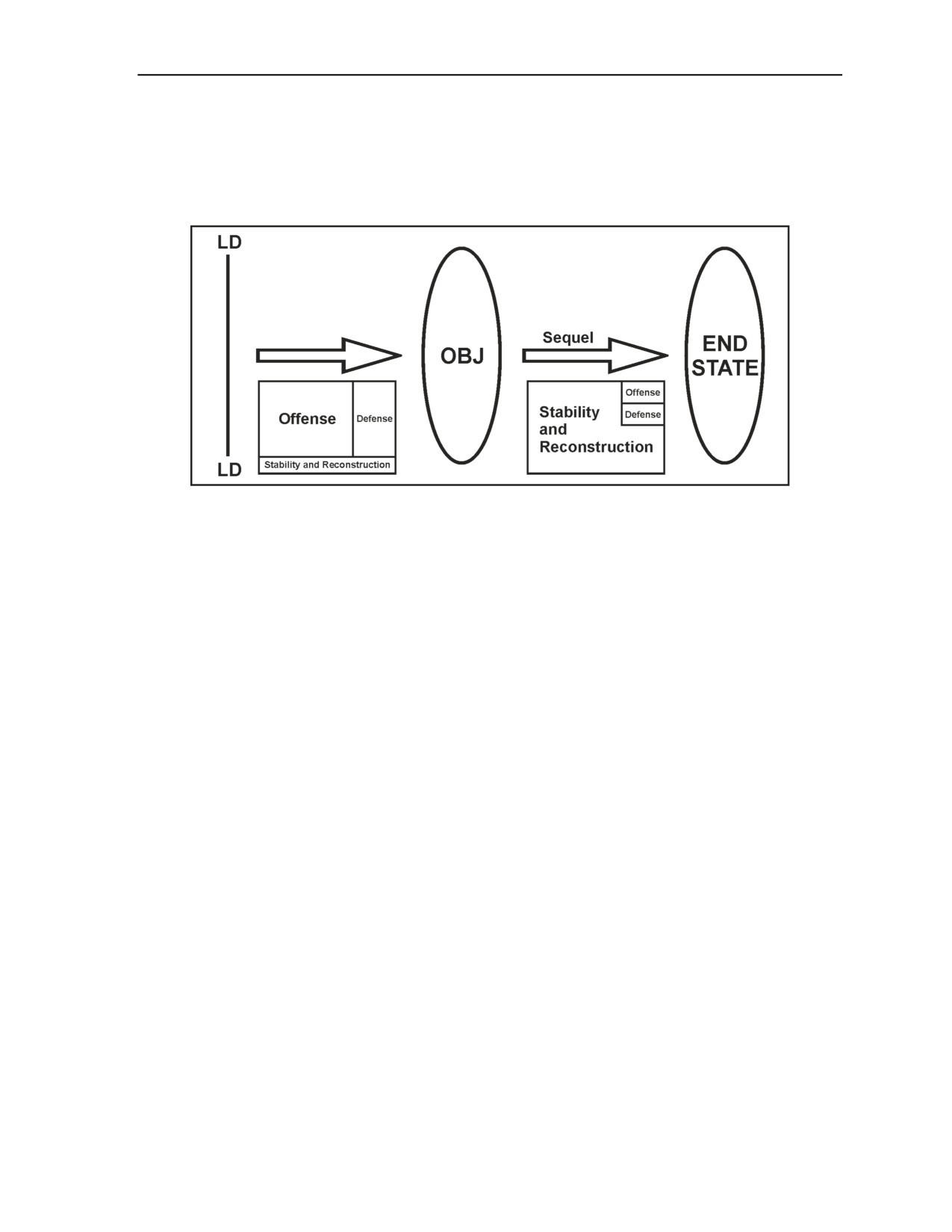
process applies to all of them. Figure 3-2 (below) shows how an operation might take place. Although it
depicts the operation in a linear fashion, the actual conduct of full spectrum operations resembles multiple
iterations of varying combinations of the types of operations.
Figure 3-2. Example of two operations with a transition
3-8. Figure 3-2 shows an operation beginning as an offensive one, with a specific line of departure and
objective as well as a finite end state. Even with its focus on offense and defense, the operation includes
some stability and reconstruction operations; considerations of stability and reconstruction operations are
included from the beginning of planning and continue through preparation and execution. As the initial op-
eration concludes successfully, the higher headquarters directs a sequel with stability and reconstruction
operations predominating. The sequel cannot be executed successfully unless stability and reconstruction
operations to set conditions for it were executed during the previous operation.
3-9. During long-term operations, a higher headquarters may require a force to conduct a short-term op-
eration that supports the higher headquarters’ end state but diverts the force from its original mission. Usu-
ally this situation occurs during operations where stability and reconstruction operations predominate.
These short-term operations have distinct starting and ending points. An example is an offensive operation
to clear an insurgent cell from a geographic objective. These operations may or may not be anticipated dur-
ing predeployment planning. They normally require a separate order.
3-10. In addition, unanticipated events that require an immediate solution also occur. Commanders address
these contingencies as they would any emergency. As with planned operations, conducting them may or
may not contribute to achieving the unit’s short-range objectives or end state. Commanders keep their in-
tent in mind while resolving them. That helps them posture their force to resume the original mission.
TIME HORIZONS
3-11. Commanders also face the tension of how far ahead to plan without planning becoming irrelevant to
preparation and execution. Planning too far in advance may overwhelm staff capabilities, especially at
lower echelons. However, not planning far enough ahead may result in losing the initiative and being un-
prepared.
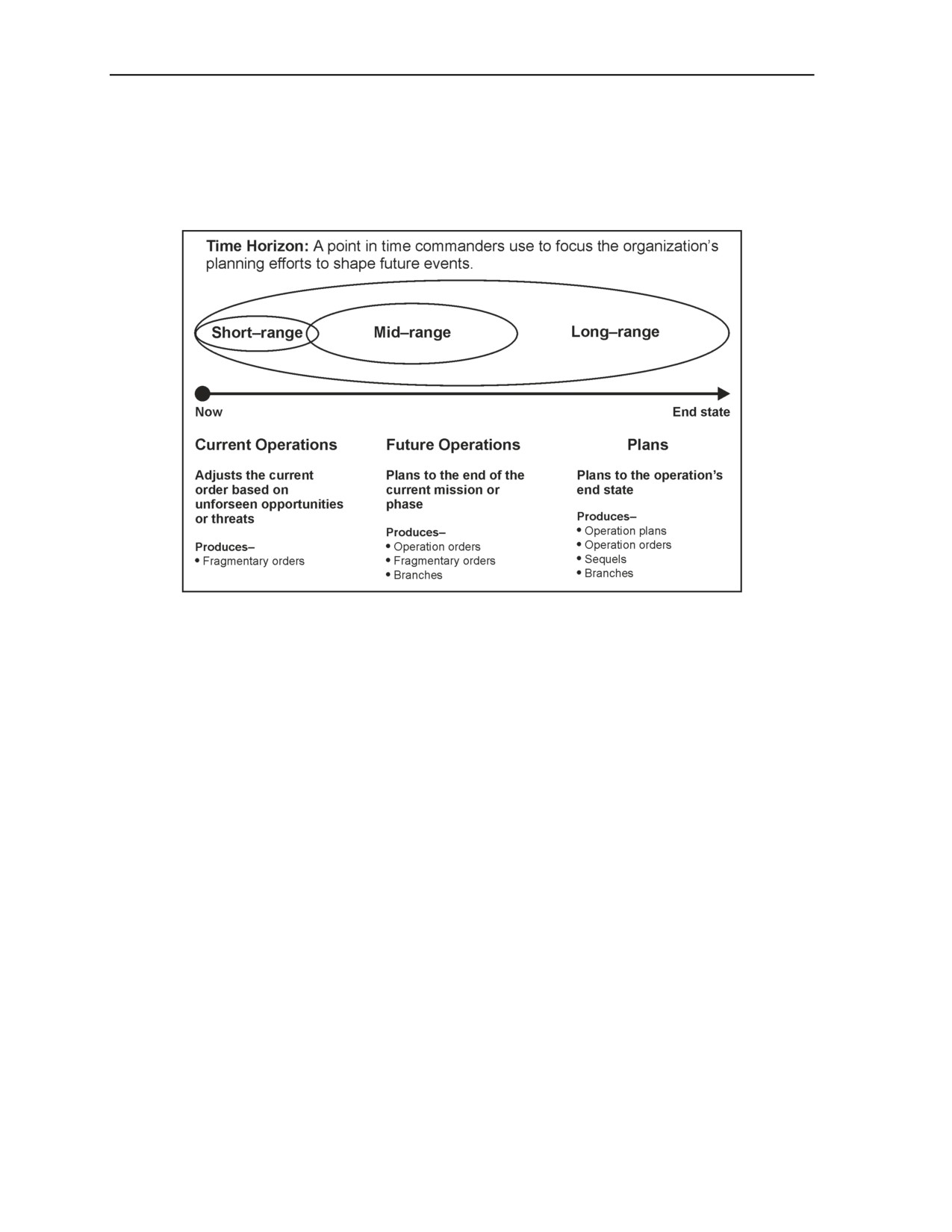
3-12. Time horizons can help commanders organize and resource their planning efforts. A time horizon is
a point in time commanders use to focus the organization’s planning efforts to shape future events. Time
horizons are situation dependent; they can range from weeks and months to hours and days. As a rule, the
higher the echelon, the more distant the time horizon it is concerned with. Because planning occurs con-
tinuously, commanders consider time horizons during preparation and execution.
3-13. Commanders assign planning responsibilities by specific periods based on METT-TC and tempo.
For example, a division plans cell may focus on operations 96 hours out during conventional operations. In
31 March 2006
FMI 5-0.1
3-3
Chapter 3
contrast, brigades and divisions conducting long-term stability and reconstruction operations routinely plan
operations months in advance.
3-14. A useful way to use time horizons is to associate general periods (based on the situation) with the
planning effort’s purpose. The planning efforts are long-range, mid-range, and short-range. (See figure
3-3, page 3-4, below.)
Figure 3-3. Time horizons and planning responsibilities
Long-range
3-15. Operations begin with an overarching design that guides forces from their current state to the end
state. Long-range planning may consider contingencies weeks to months out. As such, it may produce both
plans and orders. At the start of a campaign or major operation, long-range planning normally addresses
shaping operations to set conditions for success. It might involve selecting and prioritizing targets with the
joint target coordination board. Plans and orders describe the following:
z
Operation’s end state.
z
Conditions necessary to achieve it.
z
Force objectives.
z
Broad schemes for achieving them.
They provide the starting point for an operation, including the initial task organization, resource allocation
plan, and other control measures.
3-16. During campaigns that include multiple deployments, long-range planning at lower levels may focus
on an end-of-tour end state that represents success for the tour. Setting end-of-tour end states is more
common in campaigns involving large-scale stability and reconstruction operations than in those involving
major combat operations.
3-17. When operations are phased, the design for initial phases is normally more developed than that for
later ones. After an order is issued, planning continues. Planners refine later phases, refine or develop
branches, and develop sequels.
3-18. Long-range planning occurs in the plans cell using the military decision making process (MDMP).
The plans cell develops solutions to problems and passes them to the current operations cell if a fragmen-
tary order (FRAGO) is needed. If a full operation order is required, the plans cell performs the MDMP as
3-4
FMI 5-0.1
31 March 2006
Exercising Command and Control
time allows and prepares the order. The G-3 authenticates all orders, including FRAGOs. The plans cell
conducts a plans-to-current-operations handover briefing when responsibility for integrating the order
passes to the current operations cell. Normally, this occurs after the rehearsal. However, the situation and
unit standing operating procedures (SOPs) determine when integration responsibility is transferred. The
plans cell may perform mid- and short-range planning by exception.
Short-range
3-19. During execution, commanders and staffs perform short-range planning to modify the current order
based on the commander’s assessment of changes in the situation. Short-range planning focuses on the
immediate future. This may be hours or days but is normally 24 hours out. Short-range planning addresses
the same time horizon the targeting working group uses for current operations targeting.
3-20. Short-range planning produces a FRAGO. It may involve representatives from all WFFs or include
only selected staff members and the commander. Who participates depends on the problem’s complexity
and available time. The current operations cell normally performs short-range planning. Other functional
and integrating cells contribute. The plans cell may perform short-range planning in exceptional situations;
however, this detracts from the organization’s long-range planning capability.
3-21. Short-range planning is normally done in a time-constrained environment. The staff may use the
MDMP modified for time-constrained conditions. (See FM 5-0, paragraph 3-203-3-240.) Or it may use a
less formal process like those described in chapter 4. Short-range planning addresses situations arising out-
side the normal decision or assessment cycles that demand immediate action. These include opportunities
and threats that commanders must exploit or counter. Failure to recognize such situations and act may re-
sult in lost opportunities or destruction of the force.
3-22. These situations are a particular challenge to commanders and staffs. First, they must recognize that
a situation outside the normal decision or assessment cycle exists. Forecasts in running estimates aid such
recognition. Then they must swiftly organize CP resources to perform planning and implement the decision
for resolving it. Often, the current operations cell leads this team, although plans support it.
3-23. For short-range requirements requiring more than a FRAGO, commanders of units authorized a fu-
ture operations (FUOPS) cell can task it. If a FUOPS cell is not authorized, a standby FUOPS working
group may be established. Members of the plans, current operations, and other cells may be part of it.
Mid-range
3-24. Distinguishing between long-range and short-range time horizons and assigning staff responsibilities
for them is relatively straightforward. The time horizon between them poses a greater challenge. Mid-range
planning addresses contingencies within the current phase. Its time horizon may range out days, weeks, or
months, depending on the type of operation. Mid-range planning includes branch planning and refinement
of long-range planning products, such as branches in concept form.
3-25. Corps and Army service component commands have a FUOPS cell responsible for mid-range planning.
Battalion through division headquarters are not allocated a FUOPS cell. Their commanders decide where to
assign responsibility for mid-range planning based on METT-TC. Different commanders address this issue
differently. Some make the plans cell be responsible for mid-range decision making and planning. Others
assign this responsibility to a team formed from the current operations and plans cells. The G-3/S-3 is re-
sponsible for deciding what horizon the situation represents and recommending solutions to the com-
mander.
OPERATIONS PROCESS ACTIVITIES DISTRIBUTION
3-26. Planning, preparing, executing, and assessing occur simultaneously throughout an operation. (See
figure 3-4, page 3-6, below.) They may occur sequentially during part of an operation, especially when a
new mission starts. However, planning, preparing, and executing always overlap somewhat. An example is
when a unit receives an on-order, short-range mission while executing a long-range mission.
31 March 2006
FMI 5-0.1
3-5
Chapter 3
3-27. The activities may also overlap when planning for a branch, sequel, or new mission is required dur-
ing preparation or execution. Assessment is continuous; it overlaps all other activities. In addition, subor-
dinate units may perform different activities simultaneously. For example, one may be executing while an-
other is preparing. Finally, the activities overlap during execution if the organization has received a
mission for a sequel or a new mission that it must plan for while executing the current operation.
Figure 3-4. Operations process activities distribution
3-28. In operations where stability and reconstruction operations predominate, the operations process ac-
tivities overlap more than when other types of operations predominate. Coordinating responsibility for syn-
chronizing integrating processes between the plans and current operations cells (and the FUOPS cell, if it
exists) becomes even more difficult. The patterns depicted in figure 3-4 (above) become less regular than
shown, as there may be several operations in progress simultaneously, based on how many of the various
decision thresholds have occurred.
INTEGRATING IN THE OPERATIONS PROCESS
3-29. Integrating processes and continuing activities both contribute to the overall operations process.
Their number and the complexity of their interaction make it necessary to discuss integration within each
activity separately. Assessing is discussed first because it provides input to all other processes and activi-
ties. The discussion of each activity addresses how assessing contributes to it.
3-30. Commanders direct during all operations process activities. Their directions take different forms dur-
ing planning, preparation, and execution. Commanders make decisions and direct actions based on their
situational understanding. They keep their situational understanding current by continuously assessing the
situation.
ASSESS
3-31. Commanders and staffs collect relevant information for the common operational picture (COP) as
they monitor the situation. They evaluate data and information by comparing them to criteria—either
measures of effectiveness (MOEs) and measures of performance (MOPs). Assessing leads to achieving
situational understanding. During planning, assessing focuses on understanding the situation; it also con-
3-6
FMI 5-0.1
31 March 2006
Exercising Command and Control
siders progress in achieving planning goals. During preparation and execution, it emphasizes evaluating the
operation’s progress, identifying variances, and determining the significance of those variances. (A vari-
ance is a difference between the actual situation during an operation and what the plan forecasted the situa-
tion would be at that time or event. [FM 6-0].)
3-32. The primary tools for assessing are the commander’s visualization and running estimates. The visu-
alization serves as part of the commander’s personal decision making methodology. Commanders use it to
evaluate the nature of the situation or the operation’s progress. Each staff section maintains a running esti-
mate. These provide information, conclusions, and recommendations from the section, based on the COP.
Its running estimate represents a staff section’s situational understanding.
Running Estimates
3-33. In their running estimates, staff sections continuously consider the effect of new information. They
update assumptions, friendly force status, effects of enemy activity and effects of civil considerations based
on it. They analyze this information to produce conclusions and recommendations. A running estimate as-
sesses the following for current and future operations:
z
Friendly force capabilities.
z
Enemy capabilities and intentions.
z
Effects of terrain and weather.
z
Effects of civil considerations.
z
Effect of time available.
3-34. The staff provides updated conclusions and recommendations to the commander as the situation or
the commander require. Updated conclusions proceed from determining the significance of variances de-
tected using MOEs and MOPs. (See chapters 4 and 5.) Updated recommendations are based on conclusions
about the significance of these variances—whether they indicate an opportunity, a threat, or are within ac-
cepted tolerances. Identifying significant variances may well be intuitive and instantaneous, especially with
respect to timeliness for seizing an opportunity or blunting an enemy threat. Running estimates also contain
forecasts of possible or probable future events and their implications for decision making and planning.
Integrating Processes’ Contributions to Assessment
3-35. Assessing develops the knowledge to which commanders apply judgment to obtain situational un-
derstanding and make decisions. It also determines achievement of any effects commanders specify in their
planning guidance. All staff sections route relevant information to the section responsible for managing it.
The plans or current operations cell—whichever is responsible for integration—integrates the results into a
whole for the commander and staff.
3-36. Of the integrating processes, IPB and intelligence synchronization—with their focus on the enemy,
terrain, weather, and civil considerations—are most directly related to assessing three of the six factors of
METT-TC. The intelligence cell oversees these functions. The other functional cells assess the other
METT-TC factors. Assessing involves active reconnaissance and surveillance missions as part of intelli-
gence, surveillance, and reconnaissance operations. Reachback capabilities to obtain information from
higher-echelon resources also support assessing throughout the operations process.
3-37. Intelligence synchronization supports assessing by managing assets collecting against intelligence
requirements. In addition, it supports assessment through the intelligence synchronization plan.
3-38. Friendly forces information is easier to collect than enemy and civil information. Normally, informa-
tion about the mission, troops and support available, and time is acquired through normal reports and re-
turns. However, other means may be needed to supplement them.
3-39. Targeting requires assessment during all operations process activities. Assessing contributes to ac-
complishing the initial decide function during planning and its update throughout the operation. The decide
function also requires assessing to determine the results of fires and to support reattack recommendations.
31 March 2006
FMI 5-0.1
3-7
Chapter 3
3-40. Before receiving a mission, all staff members continually assess the situation from the perspective of
their area of expertise based possible contingencies. For example, intelligence staff members use contin-
gency plans to focus assessment on possible areas of commitment. Likewise, logistic staff members assess
logistic readiness and actions needed to achieve it by contingency plan. These assessments support overall
unit planning. Receipt or development of a mission focuses assessing on a purpose; staff members then as-
sess the situation with respect to the new mission. For some areas of expertise, relevant information is al-
ready largely available, but the operation against which it is assessed has changed. In such circumstances,
staff members refine their assessment as needed to meet the new mission requirements.
PLAN
3-41. The MDMP guides planning at echelons with a staff. The integrating processes begin during plan-
ning or, if ongoing, are revised when the MDMP begins for a new order. The plans cell uses the MDMP to
synchronize the integrating processes during planning. (See FM 5-0, chapter 3.)
3-42. Planning is more than choosing a course of action (COA). The result of planning is a plan or order
that provides the instructions and control measures needed to synchronize forces and resources in time,
space, and purpose. A few of the products that result from planning include—
z
Intelligence synchronization plans.
z
Movement plans.
z
Frequency management instructions.
z
Medical evacuation plans.
z
Execution matrices.
z
Decision support matrices.
z
Commander’s critical information requirements (CCIRs).
z
Tasks to subordinate units.
z
Operation overlays.
3-43. Moving a division from the United States, positioning it in an area of operations, and conducting an
operation against an enemy as part of a joint force requires hundreds of decisions and detailed coordina-
tion. These decisions take place during the MDMP to produce a plan or order that is the basis for making
decisions during execution. Depending on the complexity of the problem and time available, commanders
devote a significant amount of time and staff to planning.
3-44. Commanders issue planning guidance, make decisions, and establish control measures during plan-
ning. While the MDMP requires these actions at set points, commanders are not limited to acting only at
those times. The MDMP belongs to commanders; commanders act whenever necessary to keep it on track.
3-45. The MDMP produces the control measures needed to prepare for and execute the operation as well
as assess progress toward the end state. Under mission command, the MDMP results in a base order that is
relatively brief. It contains a short commander’s intent, a concept of operations that allows subordinates as
much latitude as circumstances permit, and ten or fewer CCIRs. The control measures needed to regulate
the operation are contained in annexes when the unit SOPs do not address them.
Assessment During Planning
3-46. Assessment during planning focuses on three tasks:
z
Developing situational understanding.
z
Establishing assessment criteria for the mission, normally—but not exclusively—MOEs and
MOPs.
z
Evaluating COAs for the commander’s decision.
It describes the situation and its implications for the mission. It also assesses the progress of planning itself
to ensure it meets established time lines and quality.
3-47. Mission analysis, the second MDMP step, is an assessment tool for understanding the situation. The
commander’s visualization drives the staff. However mission analysis provides commanders with the tools
3-8
FMI 5-0.1
31 March 2006
Exercising Command and Control
to begin their visualization. IPB, along with other running estimates, provides commanders with the con-
text through which to begin their visualization and begin to express their planning guidance. Planning
guidance usually drives the staff to clarify information further.
3-48. During planning, commanders formulate their visualization, and staff sections update their running
estimates. Commanders never have perfect a visualization of the operation; they need to continually refine it.
3-49. The staff assesses COAs during COA analysis and evaluation. During the COA analysis, MOEs and
MOPs—as well as other criteria for evaluation during the operation—are developed. During COA evalua-
tion, the staff applies these criteria to recommend a COA to the commander for approval.
3-50. MOEs and MOPs provide the framework for an assessment plan. Higher echelons may prepare a
formal assessment plan because they have the resources to employ one. Lower echelons develop an infor-
mal assessment plan. This involves tasking staff members to monitor certain MOEs, MOPs, or other criteria.
Integrating Processes During Planning
3-51. IPB, targeting, and intelligence synchronization are prominent during planning.
Intelligence Preparation of the Battlefield
3-52. IPB is a systematic, continuous process of analyzing the threat and environment, which includes ter-
rain, weather, and civil considerations. It supports the commander’s visualization, running estimates, and
the MDMP. IPB—
z
Defines the operational environment.
z
Describes the environment’s effects.
z
Produces an evaluation of the threat.
z
Develops possible enemy COAs.
IPB is critical to the success of planning. It takes a well-trained staff to perform it successfully.
3-53. Although the G-2/S-2 leads IPB, it involves the entire staff and incorporates information from each
section’s area of expertise. The G-9/S-9 contributes to developing information on civil considerations, es-
pecially those that do not concern enemies. These contributions are especially important after the force is
employed. Information provided by each staff section allows the commander and staff to develop a better
understanding of the enemy and environment. It also develops products that benefit planning and enable
decision making.
3-54. IPB remains the same for all types of military operations; however, its focus may change depending
on the predominant type of operation or the unit’s primary focus. Products required to portray the informa-
tion may also change based on the type of operation. Doctrinal and situation templates used to portray con-
ventional threats differ from those used to portray asymmetric threats. In addition, civil considerations have
assumed an importance on a par with the enemy and environment for all types of operations. IPB products
must provide enough detail for commanders and staffs to make informed decisions.
Targeting
3-55. While targeting, like the other integrating processes, occurs continuously throughout an operation, it
begins during planning. Its steps mirror planning, preparing, executing, and assessing. During planning for
a new operation, however, it is primarily the decide function that is performed.
3-56. From the targeting standpoint, the fire support, intelligence, and operations estimates are interrelated
and must be closely coordinated. Key staff products influencing targeting include IPB and target value
analysis. The G-3/S-3, G-2/S-2, and fire support coordinator participate in COA analysis and collabora-
tively develop the following decide function products:
z
High-payoff target list. The high-payoff target list is a prioritized list of targets by target set
whose loss to an enemy will contribute to the success of the mission.
z
Targeting input to the intelligence synchronization plan. The intelligence synchronization
plan is the plan the intelligence officer uses, with staff input, to synchronize the entire collection
31 March 2006
FMI 5-0.1
3-9
Chapter 3
effort, to include all assets the commander controls, assets of lateral units, and higher echelon
units and organizations, and intelligence reach to answer the commander’s critical information
requirements (FM 2-0).
z
Target selection standards. Target selection standards establish criteria for deciding when tar-
gets are located accurately enough to act upon.
z
Attack guidance matrix. The attack guidance matrix lists which targets or target sets to act on,
how and when to act on them, and the desired effects.
z
Target synchronization matrix. The target synchronization matrix combines data from the
high-payoff target list, intelligence synchronization plan, and the attack guidance matrix. It lists
high-payoff targets by category and the agencies responsible for detecting them, attacking them,
and assessing the effects of the attacks.
3-57. The decide function gives a clear picture of which targets will produce the greatest payoff (maximum
effect) and then applies priorities to the following:
z
Tasking target acquisition assets.
z
Information processing about targets.
z
Selection of attack means for identified types of targets.
3-58. The fire support coordinator chairs the targeting working group. The targeting working group in-
cludes members from across the staff, (such as the G-7/S-7, Air Force, and staff judge advocate).
Intelligence Synchronization
3-59. The integrating processes—especially targeting and IPB—produce information requirements related
to the environment and threat. Making the most effective use of available information and collection assets
requires managing these requirements. In most cases, the number of requirements exceeds the unit’s proc-
essing and collection capability. The collection manager tracks and manages all intelligence requirements
until they are answered or become irrelevant. The intelligence synchronization process ensures that the ap-
propriate staff section or collection asset is tasked to collect the required information. It also ensures the
optimal collector is tasked and the highest priorities satisfied first. Moreover, to preclude wasting limited
resources, tasking multiple collection assets against a requirement or target should be a conscious decision.
3-60. To integrate intelligence synchronization into the MDMP, the collection manager participates in mis-
sion and COA analysis. Doing this helps the collection manager obtain a thorough understanding of the
commander’s intent and concept of operations, and develop a better collection strategy. The commander
and staff prioritize information requirements as CCIRs, priority intelligence requirements, and remaining
intelligence requirements. The collection manager analyzes each requirement and develops specific infor-
mation requirements. Some of these requirements can be answered from existing information and requests
for information. Those that cannot are converted into reconnaissance tasks and surveillance tasks, and as-
signed for collection. Based on reconnaissance tasks and surveillance tasks, the collection manager evalu-
ates resources and prepares the intelligence synchronization plan. This plan provides a collection method-
ology to synchronize requirements with resources.
3-61. The G-3/S-3, in coordination with the G-2/S-2, uses the intelligence synchronization plan to prepare
the reconnaissance and surveillance plan. The G-3/S-3 orders execution of reconnaissance and surveillance
operations, often during planning and preparation. The information collected contributes to integrating
processes as well as the overall plan.
3-62. Integrating friendly, civil, and enemy information into a useable COP occurs initially in the plans
cell as part of the MDMP. However, it includes the current operations cell, which assumes integration re-
sponsibility during preparation. When collection occurs during planning, the current operations cell super-
vises the mission. The intelligence cell analyzes the collected information, fuses it with other information
to produce intelligence, and returns the results to the plans cell for integration.
3-10
FMI 5-0.1
31 March 2006
Exercising Command and Control
PREPARE
3-63. Preparation includes the following:
z
Revising and refining the order or plan.
z
Rehearsals.
z
Task-organizing.
z
Training.
z
Troop movements.
z
Preoperations checks and inspections.
z
Logistic preparations. (During execution, this includes recovery and rearming.)
z
Integrating new Soldiers and units.
z
Subordinate confirmation briefs and backbriefs.
3-64. Preparation creates conditions within which friendly forces improve their chances for success. It fa-
cilitates and sustains transitions, including those to branches and sequels. Several preparation activities—
especially reconnaissance operations, security operations, and force protection—begin in planning and
continue throughout the operation.
3-65. Preparation continues during execution. Uncommitted forces prepare for identified contingencies
and look to the operation’s next phase or branch. Committed units revert to preparation when they reach
their objectives, occupy defensive positions, or pass into reserve.
3-66. During preparation, commanders continue to use the visualize-describe-direct-lead methodology to
exercise command and control. They update and validate their visualization as they receive relevant infor-
mation and assessments from running estimates. Commanders’ situational awareness changes as they re-
ceive new information. Assumptions may prove true or false. Intelligence may confirm or deny enemy ac-
tions and conditions in the environment. The status of friendly forces may change. As their situational
awareness changes, commanders apply judgment to determine the significance of the changes and their
possible effects on the operation. This produces a new situational understanding that either validates their
commander’s visualization or prompts them to change it. Significant new information requires command-
ers to make one of three assessments with respect to the order:
z
The new information validates the order with no further changes.
z
The new information requires adjusting the order.
z
The new information invalidates the order.
3-67. The earlier the commander identifies the need for modifications, the easier it is to incorporate them
into the order and resynchronize it. Commanders use their updated commander’s visualization to balance
the loss of synchronization and coordination caused by a change against the consequences of continuing a
course that no longer fits the situation. When they decide a change is required, they describe their view of
its implications and direct the changes to control measures needed to effect the necessary adjustments.
Continuing Activities and Preparation Activities
3-68. The continuing activities and preparation activities listed in figure 3-1 (page 3-2, above) occur dur-
ing preparation. However, four require special mention.
Reconnaissance and Surveillance Operations
3-69. Reconnaissance and surveillance operations often begin during planning to fill information gaps
identified during mission analysis and support the integrating processes. Such operations are evaluated
against operations security considerations so friendly operations are not compromised.
31 March 2006
FMI 5-0.1
3-11
Chapter 3
Revising and Refining the Order or Plan
3-70. Plan refinement consists primarily of revising the plan based on changes in the situation and com-
mand and staff visits to subordinate elements.
Coordination and Liaison
3-71. Coordination of the integrating processes, as well as internal and external coordination, continues af-
ter planning to synchronize them. Battle rhythm is a control measure that assists with synchronizing the
continuing activities and integrating processes during preparation. It establishes a schedule for command-
ers and staffs that synchronizes routine meetings, working groups, and reports.
Rehearsals
3-72. Rehearsals are the commander’s tool for ensuring staffs and subordinates understand the com-
mander’s intent and concept of operations. (See FM 6-0, appendix F.) They focus on synchronization and
coordination. Rehearsals help commanders accomplish the following:
z
Synchronize and integrate integrating processes.
z
Identify key points and times requiring coordination.
z
Update synchronization matrixes.
z
Solve previously unidentified coordination problems.
However, the commander or chief of staff may direct accomplishment of these tasks during another event.
3-73. Uncommitted units rehearse during execution if time allows. Reserves practice their movements to
attack or defensive positions. Units defending in depth rehearse their movements and engagements.
Assessment During Preparation
3-74. Assessing during preparation has two focuses:
z
Determining the friendly force readiness to execute the operation.
z
Determining changes in the threat and civil considerations from those developed for planning.
3-75. Commanders continue to receive information about the enemy, terrain, weather, and civil considera-
tions. Staffs integrate this information so commanders understand these factors in relation to each other
rather than in isolation. Assessing during preparation includes confirming or disproving assumptions made
during planning. Its results may influence revisions and refinements to the order.
Integrating Processes During Preparation
3-76. IPB, targeting, and intelligence synchronization remain prominent during preparation. Integration re-
sponsibility is passed from the plans cell to the current operations cell at a point set by the unit SOP.
Intelligence Preparation of the Battlefield
3-77. During preparation staffs continue to update and refine products produced during planning. IPB fo-
cuses on providing an updated picture of the environment and threat based on new information gathered
through collection and friendly reporting. Staffs also ensure the products are available and disseminated to
subordinate units, which often do not have the resources available to higher headquarters.
Targeting
3-78. Targeting continues but emphasizes the detect function. The collection manager supervises collect-
ing information to answer targeting requirements. Target priorities from planning determine the targeting
requirements that collection assets focus on. Suspected targets are tracked until they are validated and at-
tacked. The detect function continues through execution.
3-79. Target acquisition assets gather information and report their findings to their controlling headquar-
ters, which passes pertinent information to the tasking agency. Some collection assets provide actual
3-12
FMI 5-0.1
31 March 2006
Exercising Command and Control
targets; others must have their information processed to produce them. Not all reported information bene-
fits targeting; however, it may contribute to developing the overall situation. Target priorities are used to
expedite target processing. Situations arise where the attack of a target upon location and identification is
either impossible (for example, out of range) or undesirable (moving toward a better location for the at-
tack). Critical targets that are not attacked are tracked to ensure they are not lost.
3-80. Tracking suspected targets keeps them in view while they are validated. Assets used for target track-
ing may be unavailable for target acquisition. As targets are developed, appropriate attack systems are
tasked per the attack guidance and the system’s location requirements.
Intelligence Synchronization
3-81. Intelligence synchronization continues to coordinate collection of prioritized requirements and dis-
semination of information to those needing it. As requirements are satisfied, the collection manager re-
evaluates intelligence requirements and available assets. The collection manager then coordinates with the G-
2/S-2 and G-3/S-3 and recommends retaskings. The G-3/S-3 ensures new requirements are integrated into
the current order and tasks units to fill them (usually with a FRAGO). Based on previous guidance, the col-
lection manager may retask collection assets, provided the new requirement does not require extensive
planning.
3-82. Reconnaissance and surveillance operations continue to help confirm or deny enemy COAs and es-
timates of enemy capabilities and combat effectiveness. Reconnaissance and surveillance also confirm or
deny assumptions about the environment and threat made during planning. Depending on the requirement’s
nature, collected information is either immediately disseminated or exploited before dissemination. The
broadcast or point-to-point dissemination method is used, depending on the information type.
Transition of Responsibility for Integration
3-83. During preparation, responsibility for process integration for the plan being developed remains with
the plans cell until the plans-to-current-operations handover occurs. It may be before or after the rehearsal,
depending on the situation and unit SOPs. If there is an ongoing operation, the current operations cell inte-
grates the processes for it. The current operations cell also integrates processes for operations executed to
support planning, such as reconnaissance missions. Normally, the plans cell conducts the rehearsal in coor-
dination with the current operations cell. The plans cell revises synchronization and integration to correct
shortcomings identified during the rehearsal and prepares any FRAGOs needed to modify the order to
comply with rehearsal decisions. The plans cell also executes the plans-to-current-operations handover
briefing when integration responsibility is transferred to the current operations cell. After this point, the
current operations cell becomes responsible for the order’s integration, synchronization, and execution.
EXECUTE
3-84. This discussion addresses principles for process integration during execution. It addresses the fol-
lowing:
z
Assessing during execution.
z
Activities specific to execution.
z
Integrating processes during execution.
z
Decision making during execution.
Chapter 4 provides more detail on execution.
3-85. Execution is more than putting a decision into action. It involves monitoring the situation, assessing
the operation, and adjusting the order as needed. Throughout execution, commanders continuously assess
the operation’s progress based on information from the COP and running estimates. Assessment keeps
their situational awareness current and allows commanders to continuously update their situational under-
standing and validate their visualization. When the situation varies from the assumptions the order was
based on, commanders direct adjustments to exploit opportunities and counter threats.
31 March 2006
FMI 5-0.1
3-13
Chapter 3
3-86. Commanders do not restrict their visualization to the current operation. As their situational under-
standing evolves, they incorporate considerations for the operation’s next phase or a sequel into their visu-
alization. They begin to visualize how to transition from the current operation to the next one. Based on
this visualization, commanders direct actions to posture the force for the transition. As they visualize the
implications of events and their solutions, commanders describe their conclusions to staff and subordinates
through updated CCIRs and planning guidance. This guidance may be to develop a branch or change the
main effort to exploit success. Commanders direct adjustments when necessary, primarily through FRA-
GOs but verbally when needed.
3-87. As commanders assess an operation, they determine when decisions are required. Orders usually
identify some decision points; however, unanticipated enemy actions or conditions often present situations
that require unanticipated decisions. Commanders act when these decisions are required; they do not wait
for a set time in the battle rhythm.
3-88. A commander’s visualization based on an accurate, current situational understanding allows com-
manders to rapidly and effectively adjust control measures to adapt to changing situations—whether pre-
cipitated by the enemy, changes in friendly force status, or civil considerations. Commanders do not hesi-
tate to modify the order or scrap it altogether if they think it necessary to accomplish the mission, better
achieve the higher commander’s intent, or save the force. Adhering to a plan when the situation changes
significantly wastes resources and opportunities. It may risk defeat.
3-89. Sustaining the operation is important during execution. Without it, other decisions become irrele-
vant. During execution, sustainment tasks depend on a high level of anticipation. Logisticians project when
and where support will be required to ensure constant pressure on enemy forces and continuous operations
by friendly ones. Finally, sustainment must anticipate support required for follow-on operations.
Assessing During Execution
3-90. Assessing during execution focuses on identifying variances and their nature and magnitude. Vari-
ances prompt decision making. During execution, running estimates continue to assess the friendly and en-
emy situations against current and future operations.
3-91. During execution, commanders continually assess the operation’s progress. They act to ensure sub-
ordinate units execute actions appropriate to the actual situation. They adjust the disposition of forces,
tasks assigned to subordinates, and priorities of support to achieve the greatest effect at minimum cost.
They modify some tasks, even if the operation unfolds as expected. A major part of the art of command is
knowing when to change the order and determining which control measures to change to assure success.
Critical to command is determining which MOEs or MOPs indicate needed changes and deciding which
changes will obtain the maximum contribution to achieving the higher commander’s intent.
3-92. Just as commanders dedicate resources to planning, they also commit resources to current operations
activities. These include assessing the current situation while directing and regulating forces and WFFs in
accordance with the commander’s intent.
Execution Activities
3-93. To execute an operation, commanders synchronize the integrating processes and continuing activi-
ties. This integration is complex, but necessary. In addition, they perform the following activities specific
to execution:
z
Focus assets on the decisive operation.
z
Adjust CCIRs based on the situation.
z
Adjust control measures.
z
Manage movement and positioning of supporting units.
z
Adjust unit missions and tasks as necessary.
z
Modify the concept of operations as required.
z
Position or relocate committed, supporting, and reserve units.
3-14
FMI 5-0.1
31 March 2006
Exercising Command and Control
Integrating Processes During Execution
3-94. IBP, targeting, and intelligence synchronization continue during execution.
Intelligence Preparation of the Battlefield
3-95. During execution, staffs continue to collect and evaluate information received from collection re-
quirements and friendly reports. They use this information to update IPB products, which contribute to the
commander’s and staff’s situational understanding. IPB produces an integrated picture of the environment
and terrain. It supports production of predictive intelligence. The intelligence cell evaluates the ongoing
operation against the current picture produced by IPB. It forecasts what, when, where, and how changes in
the operational environment will occur based on this evaluation. The current operations cell integrates the
IPB products, including forecasts of changes and implications for future operations, with other relevant in-
formation into the operations running estimate. Commanders use it and other running estimates to refine
their visualization, assess the situation, and direct adjustments. Significant or forecast changes in the envi-
ronment or threat may result in changes to the order (adjustments).
3-96. Updated IPB products and their associated reports also feed targeting. As enemy forces adapt to
friendly operations, they may pursue new COAs, and current friendly tactics may not have the desired ef-
fects. Changes to environmental factors also affect how friendly and enemy forces operate. These changes
are evaluated during targeting to determine the best way to defeat them.
Targeting
3-97. The deliver function of targeting begins in earnest with execution, However, the full targeting proc-
ess—decide, detect, deliver, assess—continues throughout execution. The targeting process provides speed
and efficiency in the delivery of fires on targets. Within the deliver function, the attack system or combina-
tion of systems selected during planning is employed. During stability and reconstruction operations, of-
fensive information operations, particularly psychological operations, may be the predominant type of
fires. The executing agency (for example, a fires brigade) develops the technical solution for the targets.
Technical solutions include—
z
Identifying attack units.
z
Determining the ordnance type or other influence means.
z
Setting the attack time.
z
Coordinating instructions.
3-98. After delivery, effects are assessed using combat assessment. Combat assessment is the determina-
tion of the overall effectiveness of force employment in military operations. Combat assessment is
composed of three major components: battle damage assessment, munitions effectiveness assessment, and
reattack recommendation (JP 1-02). Intelligence normally provides battle damage assessments. Fire sup-
port specialists provide munitions effects assessments. However, combat assessment, especially reattack
recommendations, involves not only the targeting working group but also the current operations cell. The
reattack recommendation is developed from the attack guidance matrix as updated by the most recent tar-
geting working group. The reattack recommendation provides guidance to the fire support cell for the de-
cide function, thus continuing the targeting process.
3-99. If combat assessment reveals that attacks have not achieved the effects the commander’s guidance
calls for, the detect and deliver functions continue to focus on the targets involved. This feedback may re-
sult in changing original decisions made during planning. These changes are provided to subordinate units
because they affect continued execution of the order. If combat assessment reveals the commander’s guid-
ance has been met, assets to attack high-priority targets not originally scheduled due to limited resources
become available. This is an iterative process. After each attack, the fire support cell evaluates its effects. It
then recommends reattack or retasks assets against the next priority target for which they are appropriate.
31 March 2006
FMI 5-0.1
3-15
Chapter 3
Intelligence Synchronization
3-100. During execution, intelligence synchronization continues the following tasks:
z
Oversee collection requirements.
z
Evaluate the information.
z
Update priorities.
z
Retask collection.
Collection tasks linked to decision points play a critical part in the operation. The reconnaissance and sur-
veillance plan must ensure that information tied to decision points reaches the commander and staff in time
to support the decision.
3-101. The intelligence synchronization plan is continually updated during execution. Changes to the
friendly or enemy situation may require changes in collection priorities and the reconnaissance and surveil-
lance plan. Also failure to answer a priority requirement may require tasking additional or different re-
sources against the requirement or reassessing the situation. The collection manager maintains a current
status of all collection assets. This supports timely recommendations that allow the staff to make informed
collection decisions.
3-102. The reconnaissance and surveillance plan also ties directly into the targeting process. Collection
assets often detect targets. The collector’s information triggers the deliver function. After delivery, the
same collector may provide information to assess the attack. If not, a different asset is tasked to do this.
3-103. Throughout execution, intelligence synchronization supports both decision making and targeting.
While the collection manager directly oversees it, staff integration of this process is essential to synchro-
nize collection and maneuver.
Decision Making During Execution
3-104. Decision making continues throughout execution, but its form changes. Commanders rely more on
intuitive or naturalistic forms of decision making than on analytic decision making processes. The MDMP
is not designed to address the time-sensitive decisions required to execute operations. Operations never un-
fold the way planners envision them. Many factors (the fog and friction of operations) disrupt the operation
and synchronization of force elements. These include enemy actions, friendly mistakes, and unforeseen en-
vironmental conditions.
3-105. Decision making during execution occurs continuously. It is not tied to a cycle or battle rhythm,
although some parts of it may be. Being able to act when events occur, not at a predetermined point, is key
to its effectiveness. Only in this way can commanders operate within the enemy’s decision cycle at a tempo
the enemy cannot match. Effective decision making during execution meets certain criteria:
z
It is a comprehensive, integrated combined arms process, not a series of stovepiped processes.
z
It relates all actions to the commander’s intent and concept of operations to ensure they support
the decisive operation.
z
It relies heavily on intuitive decision making by commanders and staffs to make rapid adjust-
ments.
z
It is continuous and can react immediately to any opportunity or threat.
z
It accommodates cyclical process requirements but is not tied to them.
3-106. An important aspect of decision making during execution is determining the type of decision re-
quired. Execution decisions involve COAs anticipated in the order. Adjustment decisions modify the order.
The decision type establishes the decision authority. It may also determine the extent of participation by the
current operations cell. Tactics, techniques, and procedures for execution are discussed in chapter 4.
Execution Decisions
3-107. Execution decisions include normal decisions needed to keep the operation within the parameters
of the order. These normally occur as part of the battle rhythm. Events such as operation update and
3-16
FMI 5-0.1
31 March 2006
Exercising Command and Control
assessment briefings, shift-change briefings, and resynchronizations provide opportunities to make these
decisions. These decisions are important but less urgent than most others.
3-108. The current operations cell makes execution decisions within the authority the commander dele-
gates. It oversees the synchronization of integrating processes needed to implement them. In this context,
operation update briefings and assessments are useful to inform the staff of the action and allow the com-
mander to address everyone together.
Adjustment Decisions
3-109. Often, the most difficult aspect of decision making during execution is recognizing the need for a
decision. Recognizing the more subtle requirements for adjustment decisions is particularly difficult.
Threats that require changing the plan may not appear until they are serious and require immediate action.
Recognizing adjustment decisions needed to respond to opportunities may be even harder. In both cases,
forecasting or anticipation may be required for an effective decision.
3-110. The current operations cell recommends adjustment decisions to the commander based on its on-
going assessment and running estimate. It also oversees synchronization of the integrating processes
needed to implement them. When adjustments fall within the mid- to long-term time horizon, planning for
adjustment decisions is passed to the FUOPS or plans cell. When time does not allow this, the current op-
erations cell performs the planning.
31 March 2006
FMI 5-0.1
3-17
Chapter 4
Execution
FM 6-0 provides principles and a framework for exercising command and control
during execution. This chapter expands on that doctrine. It discusses how command-
ers seize, retain, and exploit the initiative during execution by continuously exploit-
ing opportunities and countering threats to better achieve the operation’s end state. It
discusses the nature of decision making in execution and introduces the rapid deci-
sion making and synchronization process. The rapid decision making and synchroni-
zation process is a tool commanders, other leaders, and staffs use to make decisions
and rapidly resynchronize forces and warfighting functions during execution.
INTRODUCTION
4-1. Execution is putting a plan into action by applying combat power to accomplish the mission and us-
ing situational understanding to assess progress and make execution and adjustment decisions (FM 6-0).
This definition applies to any combination of offensive, defensive, stability and reconstruction, and civil
support operations throughout an operation. Doctrine for execution also supports the Army’s operational
concept of seizing, retaining, and exploiting the initiative with speed, shock, surprise, depth, simultaneity,
and endurance. (See FM 1, chapter 3.)
SEIZE, RETAIN, AND EXPLOIT THE INITIATIVE
4-2. Operation plans and orders incorporate the Army’s operational concept by establishing how initiative
will be seized and retained. They do this by providing instructions on synchronizing the warfighting func-
tions (WFFs) and assigning tasks to subordinate units. An order alone, however, does not seize and retain
the initiative, let alone exploit it. Fully seizing, retaining, and exploiting the initiative depends on com-
manders doing the following:
z
Taking action.
z
Creating and exploiting opportunities.
z
Continuously assessing the situation and taking calculated risks.
z
Applying sound tactics.
z
Employing joint capabilities.
Opportunities are events or conditions that offer better ways to achieve success. However, every opportu-
nity for greater success carries some elements of risk, if only that of temporarily desynchronizing the op-
eration. Thus, execution requires adjusting and resynchronizing operations to meet changing conditions.
Doing this enables commanders to seize, retain, and exploit the initiative. (FM 6-0, paragraph 2-94, ad-
dresses calculated risks.)
4-3. Execution also requires commanders to build and maintain momentum. Commanders and staffs do
this by continuously assessing and synchronizing operations. Commanders build and maintain momentum
by constantly pressuring the enemy. They control tempo to present enemies with new problems before they
can solve current ones. Forecasting and anticipation helps keep up pressure. Perceived requirements for
synchronizing can slow momentum; however, the enemy force’s condition dictates the level of synchroni-
zation required.
4-4. To fully achieve the end state, commanders must exploit success. This requires making refinements
during execution to take advantage of success when it occurs. Exploitation also depends on assessing and
31 March 2006
FMI 5-0.1
4-1
Chapter 4
understanding the impact of sustainment. Ultimately, however, only initiative that contributes to achieving
the end state counts.
SYNCHRONIZATION AND COMBINED ARMS
4-5. Executing synchronized combined arms operations requires extensive planning, preparation, and
training. Synchronization is the arrangement of military actions in time, space, and purpose to produce
maximum relative combat power at a decisive time and place (JP 1-02). In full spectrum operations, it also
includes achieving a balance among offensive, defensive, and stability and reconstruction or civil support
operations to accomplish the mission in accordance with the commander’s intent. It requires mastery of the
tactical art. (See FM 3-90, paragraphs 1-12-1-19.) Control by higher headquarters reduces risk and ensures
various units remain closely linked by schedule, position, and action. However, excessively centralized
control, while contributing to a highly synchronized operation, stifles subordinates’ initiative. It may result
in missed opportunities. Commanders balance control and flexibility. Careful task-organizing reduces the
span of control and permits greater tactical flexibility. (See FM 6-0, paragraphs 5-100-5-105.)
4-6. Effective synchronization is collaborative as well as directive. Modern technological tools help
achieve this collaborative synchronization; however, synchronization starts with Soldiers exercising subor-
dinates’ initiative. Situational understanding for staff members entails knowing how factors in their area of
expertise affect other areas. It underlies the collaborative synchronization needed to effectively exploit op-
portunities commanders discern. Staff work at brigade, division, and corps entails sustaining synchroniza-
tion over time as movement, casualties, and enemy actions affect original arrangements. It also entails
achieving unity of effort with larger joint, interagency, and multinational operations. This requires under-
standing other agencies’ capabilities and agendas as well as establishing measures for coordination and de-
confliction.
TRANSITION TO EXECUTION
4-7. The Army has a time-proven process for planning: the military decision making process (MDMP).
The MDMP produces a plan or order that provides the initial guide for actions during execution and con-
trol measures for regulating them. These measures include schemes of maneuver and fires; an intelligence,
surveillance, and reconnaissance (ISR) plan; tasks to subordinate units; and various schemes of support.
The most important control measures provide guidelines for exercising subordinates’ initiative. These are
the commander’s intent, mission, and concept of operations.
4-8. Operations never unfold the way the planners envision them. Enemy actions, friendly mistakes, un-
foreseen environmental conditions, and many other factors conspire to disrupt the synchronized application
of combat power envisioned in the order. The MDMP is not designed to address the many decisions neces-
sary during execution. To fight as intended in the operational concept, Army forces require execution doc-
trine that facilitates flexibility. The rest of this chapter addresses this requirement.
CONCEPT OF EXECUTION
4-9. The Army’s operational concept envisions executing operations at a tempo enemies cannot match by
acting or reacting faster than they can adapt. To achieve this type of flexibility, commanders use mission
command to focus subordinate commanders’ initiative. Subordinates exercising initiative within the com-
mander’s intent can significantly increase tempo; however they also may desynchronize the unit’s WFFs.
This may reduce commanders’ ability to mass the effects of combat power. Even relatively minor, planned
actions by command post (CP) cells affect other cells’ areas of expertise, affecting the operation’s overall
synchronization.
4-10. Under mission command, commanders accept some risk in synchronization as the price of seizing,
retaining, and exploiting the initiative. The commander’s intent and mission orders focus every level of the
organization on executing the concept of operations. Collaborative synchronization—enabled and
expected by mission command—uses subordinates’ initiative to achieve resynchronization continuously.
Subordinates’ successes may offer opportunities within the concept or develop advantages that make a new
concept practical. In either case, the commander’s intent keeps the force acceptably focused and synchro-
4-2
FMI 5-0.1
31 March 2006
Execution
nized. Subordinates need not wait for top-down synchronization. Mission command is especially appropri-
ate for operations in which stability and reconstruction operations predominate. It allows subordinates to
exploit information about enemies, adversaries, events, and trends without direction from higher echelons.
4-11. During execution, the current operations cell strives to keep the WFFs synchronized and balanced
between subordinates’ initiative and synchronized activities as the situation changes. The current opera-
tions cell follows and provides its own level of collaborative synchronization. It considers the following
outcomes when making synchronization decisions or allowing others’ collaborative synchronization to
proceed:
z
Combined arms integration.
z
Responsiveness—both proactive and reactive.
z
Timeliness.
This lets commanders mass the effects of combat power at decisive times and places.
VARIANCES
4-12. A variance is a difference between the actual situation during an operation and what the plan fore-
casted the situation would be at that time or event (FM 6-0). Staffs ensure information systems display
relevant information that allows them to identify variances. When a variance emerges, the commander and
staff evaluate it. If necessary, the staff updates its running estimates and recommends a course of action
(COA) to the commander, who directs the necessary action. There are two forms of variances: opportuni-
ties and threats.
Opportunities
4-13. The first form of variance is an opportunity to accomplish the mission more effectively. Opportuni-
ties result from forecasted or unexpected successes. When they recognize an opportunity, commanders al-
ter the order to exploit it if the change achieves the end state without incurring unacceptable risk. Exploit-
ing a forecasted opportunity usually involves executing a branch or sequel. When exploiting an
opportunity, the concept of operations may change, but the commander’s intent usually remains the same.
Threats
4-14. The second form of variance is a threat to mission accomplishment or survival of the force. When a
threat is recognized, the commander adjusts the order to eliminate the enemy advantage, restore the
friendly advantage, and regain the initiative. Not all threats to the force or mission involve hostile or neu-
tral persons. Disease, toxic hazards, and natural disasters are examples of other threats that may arise.
4-15. Victory in battle requires commanders to recognize and evaluate opportunities and threats—current
and projected—in time to direct effective actions that exploit or counter them. Commanders use their visu-
alization based on the common operational picture as their primary evaluation method. Staffs use their run-
ning estimates, derived from their understanding of the common operational picture, to evaluate the situa-
tion and provide recommendations.
TYPES OF DECISIONS
4-16. Current doctrine designates decisions made during execution as either execution decisions or ad-
justment decisions. Execution decisions involve COAs anticipated in the order. Adjustment decisions mod-
ify the order. (See figure 4-1, page 4-4, below.) The decision type establishes the decision authority. It may
also determine how the current operations cell participates.
Execution Decisions
4-17. Execution decisions implement a planned action under circumstances anticipated in the order. Staff
members or the chief of staff/executive officer make most execution decisions. In their most basic form,
execution decisions apply resources or implement activities as outlined in the order or within minor toler-
31 March 2006
FMI 5-0.1
4-3
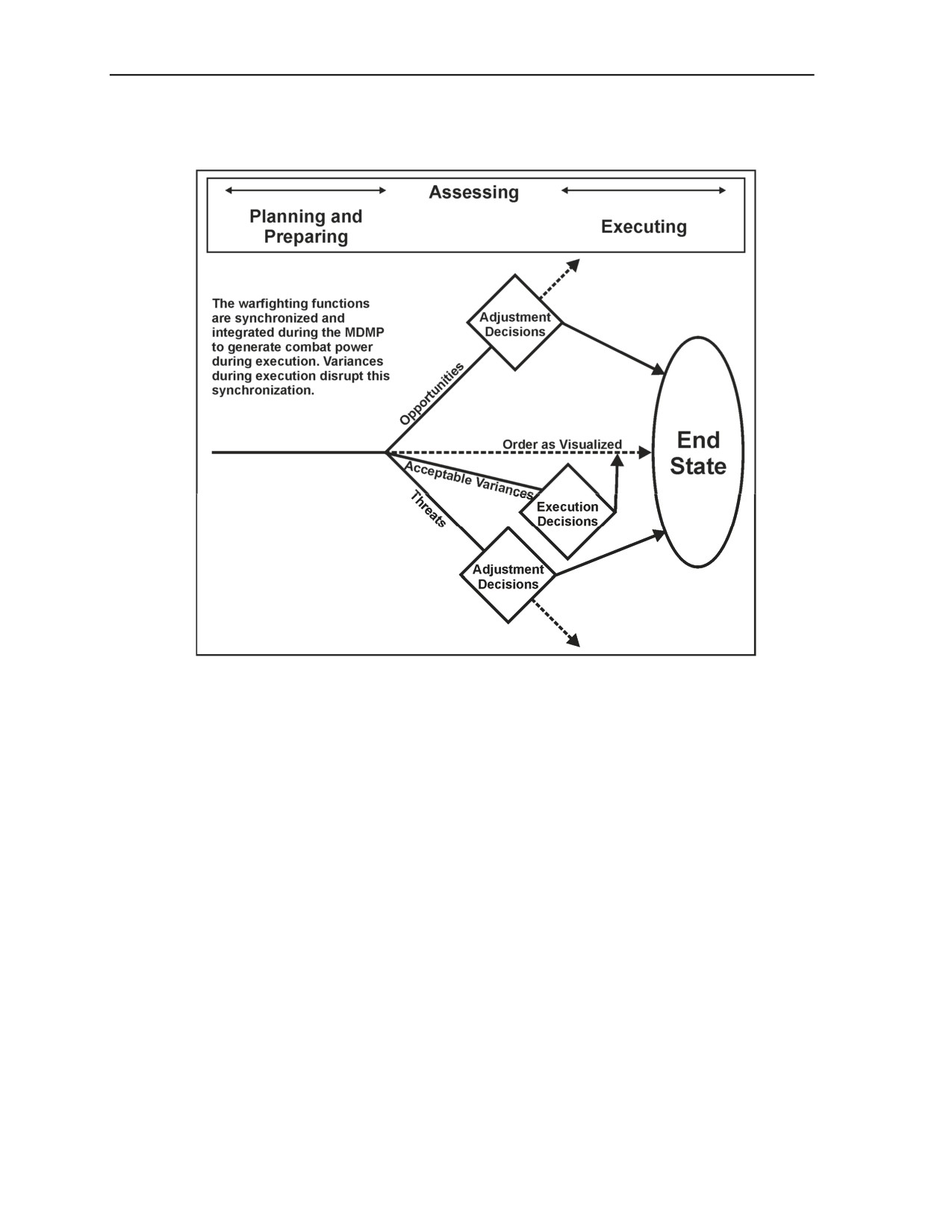
Chapter 4
ances. For example, transitioning between phases and executing a branch or sequel are execution decisions.
Commanders normally make decisions concerning branches and sequels.
Figure 4-1. Decisions in execution
4-18. Decisions made to support the plan within the execution activities are also execution decisions.
Other execution decisions are made to maintain tactical coherence and synchronization, often through col-
laborative synchronization. Execution activities are routine occurrences designed to limit variances and
prevent them from becoming a threat to success. These functions include those identified in chapter 3:
z
Focus assets on the decisive operation.
z
Adjust commander’s critical information requirements (CCIRs) based on the situation.
z
Adjust control measures.
z
Manage movement and positioning of supporting units.
z
Adjust unit missions and tasks as necessary.
z
Modify the concept of operations as required.
z
Position or relocate committed, supporting, and reserve units.
Adjustment Decisions
4-19. Adjustment decisions modify the plan to respond to opportunities and threats. They often require
completely resynchronizing the WFFs. Commanders make these decisions unless they explicitly delegate
them. Adjustment decisions generally take one of three forms:
z
Unanticipated resource or priority reallocation.
z
Changing the concept of operations.
z
Changing the mission.
4-4
FMI 5-0.1
31 March 2006
Execution
4-20. After adjustment decisions have been made, commanders and staffs make execution decisions to re-
synchronize operations. They employ collaborative synchronization as much as possible. Perfect synchro-
nization in these situations cannot be attained; commanders do not expect it. Major combat operations and
operations in which stability and reconstruction operations predominate require collaborative synchroniza-
tion by subordinates—commanders and staffs—to maintain the synchronization necessary to accomplish
the mission.
RAPID DECISION MAKING AND SYNCHRONIZATION PROCESS
4-21. This section introduces the rapid decision making and synchronization process (RDSP). The RDSP
is a decision making and synchronization technique for commanders and staffs to use during execution.
While identified here with a specific name and methodology, the basic process is not new; it has always
been used by successful commanders.
4-22. The RDSP applies to both execution and adjustment decisions. Leaders can use it to complement the
focused COA and recognition decision techniques. (See FM 6-0, paragraphs 6-116-6-121.) The RDSP is
based on research in intuitive decision making. It helps leaders focus on executing rather than planning.
The RDSP facilitates continuously integrating and synchronizing the WFFs to address ever-changing situa-
tions. It meets the following criteria for making effective decisions during execution:
z
It is comprehensive, integrating all WFFs. It is not stovepiped by WFF.
z
It ensures all actions support the decisive operation by relating them to the commander’s intent
and concept of operations.
z
It allows rapid changes to the order.
z
It is continuous, allowing commanders to react immediately to opportunities and threats.
z
It accommodates but is not tied to cyclical processes, such as targeting.
4-23. The RDSP focuses on synchronizing actions and understanding relationships within staffs as well as
among commanders. It applies to all leaders. Although this discussion describes staff duties within the
RDSP, leaders can use it with or without a staff. It also applies in multinational and interagency environ-
ments.
4-24. One significant difference between the RDSP and the MDMP is that the RDSP is based on an exist-
ing order. Control measures in the order identify the commander’s priorities. The most important of these
control measures are the commander’s intent, concept of operations, and CCIRs. Leaders use these priori-
ties as criteria for making decisions.
4-25. A second difference between the RDSP and the MDMP is that the RDSP seeks an acceptable solu-
tion, while the MDMP seeks the optimal (most desirable) one. Using the RDSP lets leaders avoid the time-
consuming requirements of developing decision criteria and comparing COAs. METT-TC factors continu-
ally change during execution. This often makes COAs and decision criteria obsolete before leaders can
make a decision. Under the RDSP, leaders combine their experience and intuition with situational aware-
ness to quickly reach situational understanding. Based on this, they develop and refine workable COAs.
While these decisions may not have included explicit consideration of multiple COAs, they can be consid-
ered optimal. They may even improve the original concept of operations. In any event, the RDSP supports
timely decisions. Timeliness is essential to obtaining the speed of action needed to seize fleeting opportunities.
4-26. Implementing the RDSP requires three skills. First, leaders must be able to recognize when a vari-
ance requires an adjustment. Second, they must be able to visualize several possible COAs and quickly se-
lect an acceptable one. Third, they must know what actions are feasible in the time available. Developing
these leader skills requires training and experience.
4-27. The RDSP includes five steps. (See figure 4-2, page 4-6, below.) The first two may be performed in
any order, including concurrently. The last three are performed interactively until an acceptable COA is
identified.
31 March 2006
FMI 5-0.1
4-5
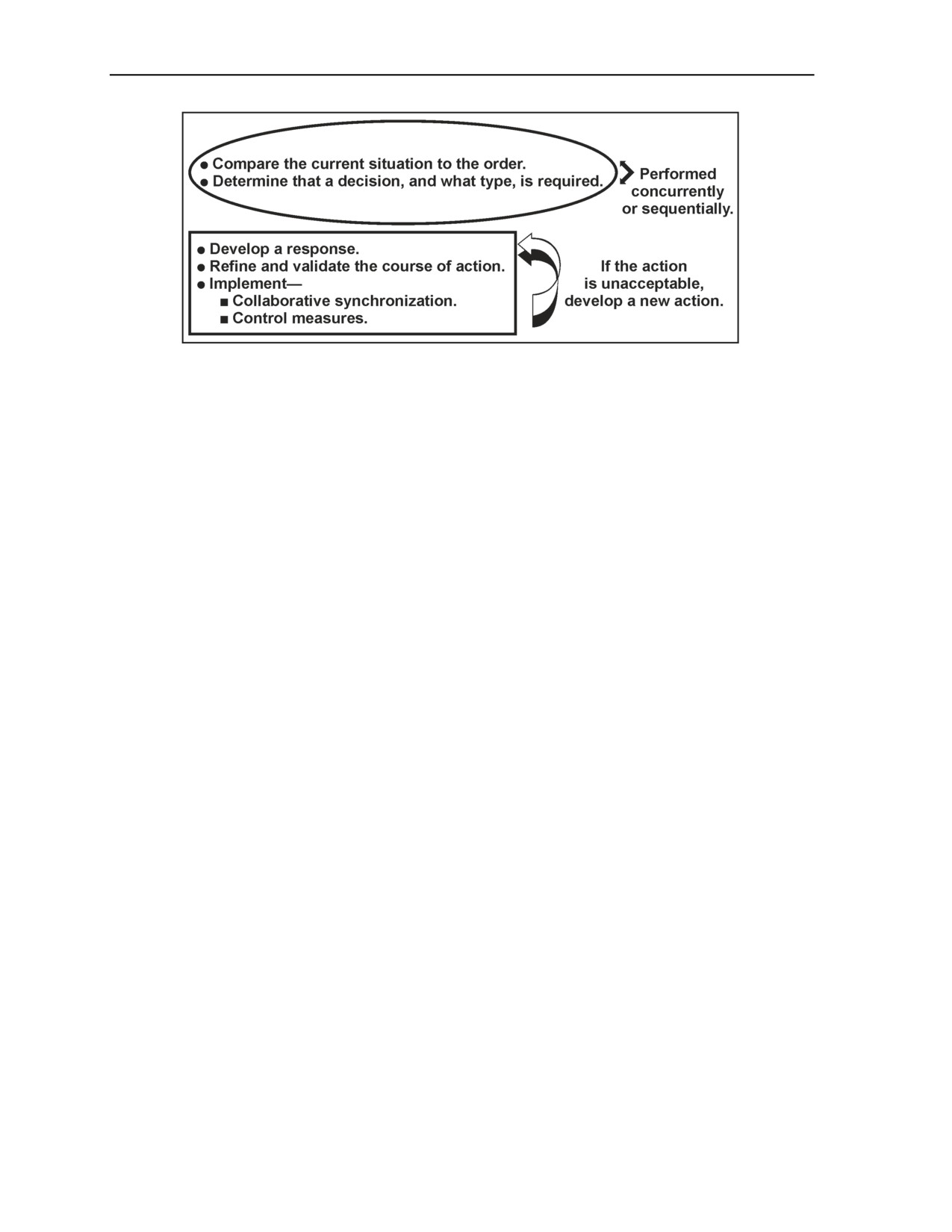
Chapter 4
Figure 4-2. Rapid decision making and synchronization process
COMPARE THE CURRENT SITUATION TO THE ORDER
4-28. Leaders monitor the situation to identify variances. Staff members look for indicators of variances
that affect their areas of expertise. (See table 4-1, below, for examples of indicators organized by WFF.)
The commander, chief of staff, and CP cell chiefs look for indicators of variances that affect the overall
operation. While these indicators may come from any source, they will often come from ISR efforts or re-
ports from units executing the operation.
4-29. Staff members are particularly alert for answers to CCIRs; commanders need them to make execu-
tion decisions. They also watch for exceptional information. Exceptional information is information that
would have answered one of the commander’s critical information requirements if the requirement for it
had been foreseen and stated as one of the commander’s critical information requirements (FM 6-0). Ex-
ceptional information usually reveals a need for an adjustment decision.
DETERMINE THAT A DECISION, AND WHAT TYPE, IS REQUIRED
4-30. When a variance is identified, leaders quickly compare the current situation to the expected situation.
This assessment accomplishes the following:
z
Describes the variance.
z
Determines if the variance provides a significant opportunity or threat.
z
Determines if an adjustment decision is needed by identifying if the variance—
Directly threatens the decisive operation’s success.
Indicates an opportunity that can be exploited to accomplish the mission faster or with
fewer resources.
Threatens a shaping operation such that it may threaten the decisive operation directly or in
the near future.
Can be addressed within the commander’s intent and concept of operations. (If so, deter-
mine what execution decision is needed.)
4-31. For minor variances, leaders determine whether changes to control measures are needed. If so, they
determine how those changes affect other WFFs. They direct changes within their authority (execution de-
cisions) after coordinating with staff elements the changes affect.
4-32. If a decision exceeding their authority is required, staff members notify the decision authority ac-
cording to the appropriate procedure. That leader determines how much of the staff should be involved. If
it does not require more than one or two CP cells, the action is directed to the appropriate cell chief.
Otherwise, the leader assembles the appropriate cell chiefs and proceeds to the next step. When an adjust-
ment decision is necessary, the leader contacts the commander for guidance.
4-6
FMI 5-0.1
31 March 2006