FM 3-81 MANEUVER ENHANCEMENT BRIGADE (APRIL 2014) - page 3
Maneuver Support Operations
CONDUCT CHEMICAL, BIOLOGICAL, RADIOLOGICAL, AND NUCLEAR OPERATIONS
4-47. CBRN operations include integrated CBRN and EOD tasks that may also require collaborative
coordination with engineers. The MEB staff includes a CBRN cell to integrate CBRN and EOD tasks and
units into CBRN operations. EOD actions are often also integrated with engineer operations.
4-48. The MEB can integrate or conduct most CBRN operations using the principles of CBRN defense
(contamination avoidance, protection, and decontamination), CBRN information management (CBRN
Warning and Reporting System and hazard modeling and prediction), and CBRN consequence
management in support of decisive action. CBRN operations may include offensive operations (raids to
secure sensitive sites), active defense measures (active air defense), and passive defense measures to
prevent and defend against attack by CBRN weapons and their effects, and to survive and sustain combat
operations in a CBRN environment. CBRN passive defense measures dominate the MEB. CBRN passive
defense measures include the avoidance of CBRN hazards, protection of personnel and equipment from
unavoidable CBRN hazards, and decontamination. An effective CBRN defense deters belligerent threats
and attacks by minimizing vulnerabilities, protecting friendly forces, and maintaining an operational tempo
that complicates targeting. By denying or countering any advantages that the enemy may accrue from using
CBRN weapons, Army forces and their multinational partners significantly deter their use (see FM 3-11).
4-49. CBRN passive defense measures include: CBRN reconnaissance and surveillance, CBRN asset
support to weapons of mass destruction elimination operations as required, CBRN warning and reporting,
CBRN hazard modeling and prediction, CBRN protection for personnel, equipment, and installations, and
CBRN decontamination. CBRN CONSEQUENCE MANAGEMENT includes activities to plan, prepare,
respond, and recover from intentional or accidental incidents involving CBRN hazards. The MEB also may
have CBRN units capable of providing large area obscuration in its task organization to support friendly
forces.
PROVIDE EXPLOSIVE ORDNANCE DISPOSAL SUPPORT
4-50. The MEB staff has no unique capabilities to conduct this protection supporting task unless assigned
or reinforced with EOD assets. Explosive ordnance and hazards are ever-present dangers in most areas of
operation. They limit mobility, deny the use of critical assets, and potentially injure or kill Soldiers and
civilians. EOD forces have the capability to render-safe and destroy explosive ordnance and hazards across
the range of military operations. EOD units are specifically trained in render-safe procedures and the
disposal of explosive ordnance, explosive hazards, and CBRN munitions (see ADRP 3-37).
4-51. The MEB will coordinate with the higher headquarters protection staff and any EOD unit in a
command or support relationship to the MEB to provide EOD support, within the MEB AO. Key EOD
tasks may include develop EOD disposal support plan, coordinate EOD disposal support, supervise EOD
operations, and respond to improvised explosive device incidents. As an example, an EOD battalion may
be attached to an Army division and the division may further establish a command or support relationship
with the particular subunits of a division. An EOD company may be allocated to those subordinate
headquarters within a division that are assigned an AO (BCTs and MEBs). EOD elements in the division
that are not allocated to a headquarters assigned an AO typically receive their planning and execution
guidance from the division through their EOD battalion or task force headquarters. The MEB only
exercises control over EOD operations within their AO while BCTs control their own EOD assets.
COORDINATE AIR AND MISSILE DEFENSE
4-52. The MEB staff includes an air space management section and an air operations section to coordinate
actions during support area operations or when the MEB is assigned an AO. The MEB may include air and
missile defense units (see chapter 3).
CONDUCT DETENTION OPERATIONS
4-53. When assigned or reinforced with detention assets, the MEB will have a capability to coordinate or
conduct detention operations for the supported command. This may include providing detainee facilities
(see FM 3-39.40).
21 April 2014
FM 3-81
4-11
Chapter 4
4-54. This is primarily a military police task that could require combined arms. The general engineering
construction support may be required to construct or modify facilities. Military intelligence and CA staff
augmentation or task-organized capabilities are integrated as required.
4-55. The MEB can facilitate the development and the provide mission command of detention operations
to support the onward momentum of combat forces or to control the dispersion of displaced populations.
Organic legal personnel and assigned military police can operate temporary detainee holding areas until
dedicated functional, theater, or joint capabilities can expedite the evacuation of detainees to a theater
detention facility or strategic detention facility. Assigned engineer assets are capable of modifying,
preparing, or constructing facilities and they can develop the life support infrastructure necessary. The
MEB may also provide support for the construction or security of a theater detention facility positioned
within a division AO.
CONDUCT RESETTLEMENT OPERATIONS
4-56. When assigned or reinforced with resettlement assets, the MEB will have the capability to coordinate
or conduct resettlement operations for the supported command. This may include providing resettlement
facilities. Resettlement operations for dislocated civilians may also require the wholesale movement,
resettlement, and subsequent sustainment of populations for their protection or to increase the combat
power potential of the force (see FM 3-39.40).
ESTABLISH A MOVEMENT CORRIDOR
4-57. A movement corridor is a designated area established to protect and enable ground movement
along a route. Units establish a movement corridor to set the conditions to protect and enable movement of
traffic along a designated surface route. Units conduct synchronized operations within the movement
corridor such as reconnaissance, security, mobility, and information collection for forces that require
additional mission command, protection, and support to enable their movement. A movement corridor may
be established to facilitate the movement of a single element or be established for a longer period of time to
facilitate the movement of a number of elements along a given route. The owner of an AO may establish a
movement corridor within their AO along an established MSR or a route designated for unit movement.
The movement corridor would typically include the airspace above it to allow the establishing unit to
conduct aerial reconnaissance and fires.
4-58. One way to apply protection to movement is by planning for maneuver support operations during the
operations process. The unit commander or convoy commander is responsible for a base level of security
during movement. Most support brigades and functional units have a need for more security that they can
organically provide during their movement and receive little support from maneuver units to provide
additional required security. Units owning an AO may provide additional security support to units moving
through or present in their AOs to include the ability to provide fires. Several tasks and tactics, techniques,
and procedures can be integrated within an AO to set conditions to help secure individual unit movement,
to include—
z
Support to situational understanding.
z
Conduct tactical maneuver (performed by the AO owner or assigned maneuver unit).
z
Conduct route and convoy security operations.
z
Conduct antiterrorism activities.
z
Conduct CBRN operations.
z
Conduct survivability operations.
z
Hand off security responsibility when crossing AO borders or at nearest secure
area/facility/base.
z
Integrate fires.
z
Coordinate logistics support.
z
Conduct tactical troop movement.
z
Employ combat patrols.
z
Conduct counterambush actions.
4-12
FM 3-81
21 April 2014
Maneuver Support Operations
z
Employ obscurants.
z
Provide tactical overwatch.
4-59. The MEB routinely controls the enablers and has the staff necessary to establish a movement
corridor and integrate operations within it. Chapter 3 discusses MEB support to movement within the
assigned support AO. This paragraph discusses support to movement beyond the MEB initially assigned
support area by using the technique of movement corridors. There are several techniques that the MEB may
use to support movement beyond its assigned support area. Where an MSR passes from the MEB support
area AO through a division-controlled area directly into a BCT AO, the division could designate an AO
around the MSR and assign it to the MEB as part of the support area. The MEB could create a movement
corridor from the MEB original AO to the BCT AO. In this case, the MEB would be responsible for all
actions within the movement corridor. The division would provide the required information collection and
fires support. The MEB would coordinate with higher headquarters and the unit conducting the movement
to provide the required maneuver support operations. The MEB would transfer responsibility for units
moving along the corridor to the BCT at their boundary. The BCT could extend the movement corridor
within their AO to their brigade support area or to their other boundary if the MSR passes through the AO.
MEB support to movement that does not move on an MSR could also be provided within a movement
corridor. A movement corridor that does not use an established MSR may require additional information
collection and other maneuver support effort to set conditions. The MEB can perform the key supporting
tasks discussed below to conduct movement corridor operations.
SUSTAINMENT
4-60. The MEB conducts its’ primary tasks to support sustainment. These supporting tasks are reflected in
the engineer construction support tasks.
4-61. This is primarily an engineer effort and is focused on general engineering. The capability of the MEB
to conduct engineer construction support may require staff augmentation and will primarily depend on
task-organized unit capabilities. The construction support could include assessments, estimates, project
management, and vertical and horizontal construction. Project site security may be provided by
nonengineer units to maximize the engineer effort.
4-62. The MEB integrates engineer staff augmentation to provide a wide array of engineer construction
capability and support. The MEB staff can integrate the tasks that are necessary to repair infrastructure;
restore, repair; and maintain lines of communications; provide base camp sustainment, site preparation,
ongoing operational and recovery support: or restore areas damaged by environmental hazards, natural and
man-made disasters, or threat action. Firefighting, facilities, vertical construction, and repair are included in
this capability. Using task-organized units, the MEB is capable of developing and maintaining electric
power generation, distribution, and management in a tactical environment. The MEB engineer section is
also capable of conducting engineer assessments and inspections of routes, structures, facilities, or other
infrastructure (see FM 3-34 and FM 3-34.170).
EMPLOYMENT
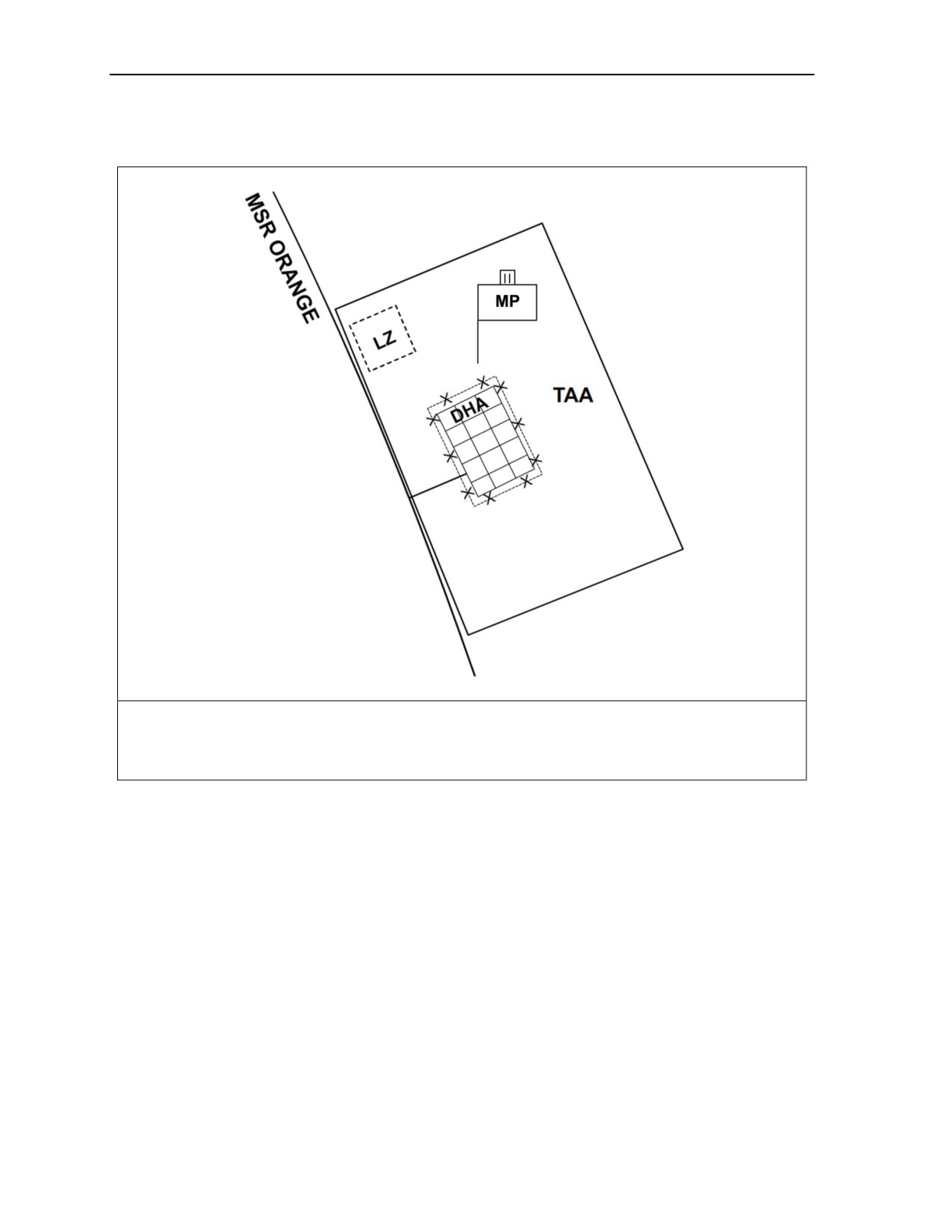
4-63. An example of a MEB performing maneuver support operations is shown in figure 4-4, page 4-14.
This example depicts maneuver support incorporating tasks from mission command, sustainment,
protection, and area support operations. In this example the tactical assembly area from the division support
area was included in the AO assigned to a MEB is shown in detail. The example includes primarily
examples of general engineering and internment/resettlement support. In this example, the MEB is required
to construct and mission the detainee holding area within the tactical assembly area. This includes the
internal structure of the detainee holding area, the security fence and measures, the road connecting it to
MSR ORANGE, and an improved rotary wing landing zone. The MEB creates a military police task force
that is task-organized with a military police team
(that includes a military police internment and
resettlement company and a transportation section to allow for initial movement of personnel to the
detainee holding area) and an engineer construction company. The MEB has assigned the tactical assembly
area to the military police task force and they have designated subordinate areas for their subordinate
elements to occupy while the detainee holding area is being constructed. Once the detainee holding area is
constructed, the MEB will change the task organization and the military police battalion will assign the
21 April 2014
FM 3-81
4-13
Chapter 4
detainee holding area mission to the military police internment and resettlement company. The task
organization may then change to include military intelligence and/or CA capabilities.
Legend:
DHA
detainee holding area
MSR
main supply route
LZ
landing zone
TAA
tactical assembly area
MP
military police
Figure 4-4. Example of a MEB performing maneuver support
INTELLIGENCE
4-64. This section discusses the limited MEB ability to support intelligence. When the MEB is task-
organized with CBRN, military police, and engineer capabilities, their intelligence capability is
significantly increased; site exploitation is an example
SITE EXPLOITATION
4-65. The MEB can enable site exploitation. Site exploitation is systematically searching for and collecting
information, material, and persons from a designated location and analyzing them to answer information
requirements, facilitate subsequent operations, or support criminal prosecution (ATTP 3-90.15). Support to
site exploitation is an example of the how maneuver support could support the intelligence warfighting
function. Site exploitation is primarily a reconnaissance effort, but could result in an incident that requires
CBRN consequence management. Using attached or OPCON units, the MEB may form a task force or
company team to conduct site exploitation. CBRN unit capabilities provide detection, reconnaissance,
identification; hazard prediction and assessment capability for CBRN related sites or incidents.
4-14
FM 3-81
21 April 2014
Maneuver Support Operations
Conventional CBRN elements can assess and preserve items collected while technical CBRNE forces
continue the preservation of the items collected and have the added capability to characterize, exploit and
disable or neutralize (see ATTP 3-11.23). Military police assets can assist by isolating and securing the site
by establishing a restricted perimeter, restrict access to prevent evidence destruction, conduct detainee
operations, evidence collection, provide military working dog teams with explosive detection, narcotic
detection, or specialized search dog capabilities, and can coordinate for investigation through the U.S.
Army Criminal Investigation Command who can assist with site evaluation and collection of forensic
evidence. Engineers conduct military searches and may conduct operations to isolate, protect, or demolish
sensitive sites as necessary. EOD integrates with CBRN units and engineers to facilitate the render safe and
disposal of explosive ordnance and improvised explosive devices.
CAPABILITIES
4-66. The MEB has minimal organic intelligence assets within the S-2 intelligence cell of the HHC. When
augmented the MEB has additional capability to provide support for the intelligence warfighting function
tasks.
MANEUVER SUPPORT OPERATIONS AND THE OPERATIONS
PROCESS
4-67. Commanders and staff use continuing activities to synchronize operations throughout the operations
process (plan, prepare, execute, and assess). They use military decisionmaking processes and troop-leading
procedures to integrate activities during planning (see ADP 6-0).
4-68. The MEB uses maneuver support operations to integrate and synchronize selected tasks with the
continuing activities and into the overall operation to generate combat power and mission success.
Maneuver support operations are integrated during all operations process activities and are required in all
decisive action. During planning and assessing, maneuver support operations provide predictive and
proactive capabilities and a better understanding of the operational environment. During preparing and
execute, maneuver support operations provide initiative, flexibility, protection, and proactive operational
environment shaping capabilities.
4-69. The MEB and other selected headquarters use their battle rhythm as a key control measure for
managing their integration of tasks within maneuver support operations, across the warfighting functions,
and with supported and higher headquarters.
PLAN
4-70. The integration of maneuver support operations is continuous and must be included in offense,
defense, stability, or DSCA. The staff determines how these tasks can best be grouped. The staff may
determine that some tasks are best performed by functionally pure units. The staff would then propose task
force or company team formations and assign tasks to them or to functional unit headquarters. The task
forces or company teams would execute most grouped tasks using combined arms formations, but may also
perform some functionally pure tasks. The staff may be asked to recommend the command or support
relationship between the MEB forces or functional units and the supported headquarters. The staff
continually assesses to update required tasks, integration, and changes to the task organization. The staff
also synchronizes the maneuver support effort within all the warfighting functions at the brigade and with
higher and supported headquarters. A maneuver support operations synchronization matrix can be used to
integrate complementary and reinforcing efforts within and across the warfighting functions.
4-71. Occasionally, the MEB may conduct the decisive operation for a higher headquarters. The purpose of
the operation would define whether to think of the effort as shaping or sustaining. For example emplacing
an obstacle to deny an enemy the freedom of maneuver against a BCT conducting an attack would be a
shaping operation. Emplacing the same obstacle as part of a base entry control point to protect a guard
tower would be viewed as a protection task. The building of the same obstacle may be general engineering
and considered as a sustainment task.
21 April 2014
FM 3-81
4-15
Chapter 4
4-72. Planners should use these maneuver support planning considerations:
z
Integrate operations, tasks, and new units.
z
Integrate with supported headquarters.
z
Analyze when to transfer efforts to functional organizations.
z
Analyze when to form combined arms task forces and company teams.
z
Phase task organization of attachments and detachments; ensure sustainment.
z
Deliberately apply protection to movement.
z
Balance support area operations efforts and maneuver support operations.
z
Reachback to augment expertise.
z
Mitigate the effects of the complex environment.
4-73. Planners also—
z
Analyze tasks where a maneuver support combined arms approach is a better way to conduct
tasks than a pure functional effort. Some examples may include gap (wet or dry) crossing,
reconnaissance, route clearance, convoy protection/security, and movement corridors.
z
Keep the tasks under brigade control that it takes a brigade staff to mission command.
z
Assign the task force and company team the tasks they are resourced to perform.
z
Assign other tasks to subordinate pure functional units.
z
Provide MEB units and capabilities to others with a command or support relationship if they are
best done by one unit or capability under the supported unit mission command.
4-74. When the MEB and one or more functional brigades support a BCT, the brigade headquarters
coordinates the efforts. If no MEB is available, a functional (engineer, or military police brigade (or
battalion) may be required to integrate efforts to conduct maneuver support operations.
PREPARE
4-75. Once a task organization has been approved, the staff can issue a warning order to the subordinate
MEB units to allow them to reorganize and synchronize movement and rehearsals with supported
headquarters.
4-76. The MEB must orient assigned units to understand how they contribute to maneuver support
operations and how they operate as part of maneuver support combined arms teams. There will be cases
where MEB units provide purely functional support.
4-77. The MEB forms task forces and company teams as necessary to accomplish its missions. The MEB
must build mutual trust quickly with units that have been task-organized to them and verify that all
formations are combat ready.
4-78. When units from the MEB are required to support other units, the MEB may provide battalion task
forces, company teams, or functional units to the BCT. The gaining unit integrates and synchronizes task
organization of these resources (if the command and support relationship allows that) until the mission is
completed. The provided resources will then be returned to the MEB or tasked to provide mission support
in another AO.
4-79. The MEB will conduct key rehearsals. When assigned an AO or conducting the tasks associated with
a movement corridor, rehearsals may include—fires, commitment of the MEB reserve, or commitment of a
TCF.
EXECUTE
4-80. The MEB assists its higher headquarters to conduct the integration of maneuver support operations.
It also supports operational movement and maneuver of units during deployment.
4-81. Although the MEB may frequently attach and detach more units than other support brigades, it must
also continually provide integrated and synchronized services like the other support brigades. The MEB
must not be viewed as an intermediate force pool or force provider.
4-16
FM 3-81
21 April 2014
Maneuver Support Operations
4-82. The MEB provides mission command over key mobility areas within its AO or as tasked to support
within a BCT AO. Based on reconnaissance, topographical, and terrain analysis, the MEB validates and
further develops the supported headquarters modified combined obstacle overlay in its assigned AO. When
necessary to ensure the mobility of the force, the MEB directs necessary actions to eliminate, neutralize, or
reduce physical and potential inhibitors to friendly movement and maneuver. The MEB develops
information requirements essential to maintaining a maneuver-focused situational awareness that
contributes to the commander’s common operational picture. This focused awareness enables the
acceleration of friendly maneuver decisions and the prevention of enemy countermobility efforts.
4-83. Based on an analysis of METT-TC and commander’s guidance from the higher headquarters, the
MEB will tailor forces for maneuver support operations, structure support assignments and forces, and
provide support from within its task organization to the remainder of the force. The MEB has a wide array
of capabilities with which to defeat enemy threats in its assigned AO. These capabilities consist of direct
fires of assigned, attached, OPCON, or TACON forces and the ability to leverage Army and joint lethal and
nonlethal precision fire assets, and Army and joint aviation assets (see ADRP 3-90).
ASSESS
4-84. The MEB must continually assess the operational environment to predict and detect impediments to
operations and adjust maneuver support operations to mitigate impediments. It must assess the progress and
effectiveness all MEB operations to shift resources across those operations as required. It must assess the
effects of maneuver support operations on enemy the freedom of action and the freedom of action provided
for the echelon headquarters that it is supporting.
4-85. The staff can use the measures from FM 7-15 to assess measures of performance or measures of
effectiveness to address some of the maneuver support operation tasks, or develop additional measures of
performance or measures of effectiveness.
21 April 2014
FM 3-81
4-17
Chapter 5
Stability
The specialized organization and training focus of the MEB makes it an important
contributor to stability. The MEB may be required to conduct some stability tasks for
its supported echelon within an assigned AO while concurrent large-scale combat is
occurring in the larger AO of the headquarters they are supporting. In this case, the
MEB would effectively perform in an economy of force role in one area with the
relative weight of their effort on stability tasks as other units focus the relative weight
of their effort in offensive or defensive tasks in another area. The MEB may be
required to conduct stability tasks simultaneously with support area operations and
maneuver support operations.
(See ADRP 3-0 and ADRP 3-07 for additional
information on stability tasks.)
TASKS AND PURPOSES
5-1. Stability tasks aim to strengthen legitimate governance, restore or maintain the rule of law, support
economic and infrastructure development and foster a sense of national unity to achieve a sustainable peace
and security and create the conditions that will enable the host nation to assume responsibility for civil
administration.
5-2. Stability tasks are conducted as part of operations outside the United States in coordination with
other instruments of national power to maintain or reestablish a safe and secure environment and provide
essential governmental services, emergency infrastructure reconstruction, and humanitarian relief. Primary
Army stability tasks include—
z
Establish civil security (including security force assistance).
z
Establish civil control.
z
Restore essential services.
z
Support to governance.
z
Support to economic and infrastructure development.
5-3. The MEB can conduct or support stability tasks; however, they have little unique capability to
conduct the primary Army stability tasks: supporting to governance and economic development. The MEB
does have the capability to support infrastructure development. These tasks are conducted in a
complementary, reinforcing, and concurrent manner with other agencies or multinational forces. While the
stability tasks are essential for success, without complementary inform and influence efforts that explains
these actions to the population, success may be unattainable. The MEB could be the primary military unit
conducting selected stability tasks in an environment with a low level of violence or following a natural
disaster. However, it would more likely conduct stability tasks concurrently in support of other Army or
joint forces. The MEB may conduct stability tasks within their assigned AO. The brigade may also provide
forces in a command or support relationship when commanders of other AOs require MEB capabilities.
5-4. The MEB and its subordinate elements may support host nation or other civilian agencies. When the
host nation or other agencies cannot provide basic government functions, MEB forces may be required to
do so directly. The MEB conducts coercive and constructive actions. The brigade has the capability to
provide mission command for many of the types of units needed to establish and maintain stability. The
MEB establishes fusion cells to integrate intelligence from all organizations. It assesses requirements and
conducts operations integrated and synchronized with others to shape the civil conditions. The MEB
interacts with the populace and civil authorities and conducts maneuver support operations to provide the
full freedom of movement for friendly forces while denying it to the enemy. They can use reachback
21 April 2014
FM 3-81
5-1
Chapter 5
capabilities or staff augmentation to better conduct these tasks. (See ADRP 3-07 for a discussion of primary
stability tasks, subordinate stability tasks, and supporting inform and influence tasks.) The MEB may be
called upon to conduct any of their key tasks in the conduct of stability operations.
5-5. During stability, in particular, commanders maximize interactions with the local populace,
nongovernmental organizations, and others through frequent Solder and leader engagement. There can be a
large range of small-unit technical or constructive tasks along several lines of operation that the commander
must integrate and synchronize. This makes the environment complex and suited to the MEB staff
capabilities and probable task organization of CBRN, EOD, and engineer units, especially if major
offensive or defensive actions are not required in the MEB AO or are small enough to be conducted by the
MEB with a task-organized maneuver battalion.
ESTABLISH CIVIL SECURITY
5-6. The MEB provides major capabilities through maneuver support operations to establish civil security
and can conduct support area operations. The objective is to provide a safe and secure environment to
create conditions for political, economic, and humanitarian activities to succeed. Civil security involves
protecting individuals, infrastructure, and institutions from external and internal threats. Ideally, Army
forces defeat external threats posed by enemy forces that can attack population centers. Simultaneously,
they assist host nation police and security elements as the host nation maintains internal security against
criminals and small, hostile groups. In some situations, there is no adequate host nation capability for civil
security and Army forces may provide most of it while developing host nation capabilities. Civil security is
required for the other stability tasks to be effective. Responsibility is transferred to competent and
legitimate local authorities when they can perform the task. Stability subordinate tasks may include—
z
Enforcing cessation of hostilities, peace agreements, and other agreements.
z
Determining disposition of constitution and national armed and intelligence services.
z
Conducting disarmament, demobilization, and reintegration.
z
Conducting border control, boundary security, and the freedom of movement.
z
Supporting identification programs.
z
Protecting key personnel and facilities.
z
Clearing explosives hazards.
5-7. MEB key supporting tasks may include coordinating interface and liaison between U.S. military
forces and local authorities and nongovernmental organizations, conducting area security operations,
planning host nation police-building operations, and planning security operations.
ESTABLISH CIVIL CONTROL
5-8. The MEB provides major capabilities through maneuver support operations to establish civil control.
The objectives of civil control are to establish civil administration and provide for social reconciliation.
Building host nation capacity for civil control is paramount to establishing the foundation for lasting civil
order. Civil control regulates selected behavior and activities of individuals and groups. This control
reduces risk to individuals or groups and promotes security. Civil control channels the population’s
activities to allow the establishment of security and essential services. Civil control may be required while
coexisting with a military force conducting operations. The MEB may use military police, engineer, CBRN
or CA units, or a combat force to impose curfews, conduct information collection, or close borders.
Stability subordinate tasks may include—
z
Establishing public order and safety.
z
Supporting law enforcement and police reform.
z
Supporting human rights initiatives.
z
Supporting corrections reform.
z
Supporting public outreach and community rebuilding programs.
5-9. MEB key supporting tasks may include planning populace and resource control operations, planning
civil disturbance operations, and performing a variety of military police tasks.
5-2
FM 3-81
21 April 2014
Stability
RESTORE ESSENTIAL SERVICES
5-10. The MEB provides major capabilities through maneuver support operations to restore essential
services. The objective is to provide immediate and essential humanitarian relief in coordination with
nongovernmental organizations and international government organizations. Normally, Army forces
support other government, intergovernmental, and host nation to establish or restore the most basic services
and protect them until a civil authority or the host nation can provide them. This military stability task
includes programs conducted to relieve or reduce the results of natural or man-made disasters or other
endemic conditions such as human suffering, disease, or privation that might represent a serious threat to
life or that can result in great damage to, or loss of, property. When the host nation or other agency cannot
perform its role, MEB Army forces may provide the basics directly. The MEB has the staff to assess most
needs and plan for the provision of most essential services. They can use reachback or staff augmentation
to better plan and control some tasks. Stability subordinate tasks may include—
z
Conducting movement and resettlement of dislocated civilians.
z
Performing tasks related to civilian dislocation.
z
Supporting humanitarian demining.
z
Supporting public health programs.
5-11. MEB key supporting tasks may include coordinating support with host nation and multinational
representative(s), performing an initial infrastructure assessment, installing prime power generation
equipment, and other general engineering tasks.
SUPPORT GOVERNANCE
5-12. The MEB has no special capabilities to support governance. The short-term objective may be to
establish a military government, support an interim or host nation government, and create an environment
conducive to stable governance. The objective is to support legitimate authorities, assess formal and
informal power arrangements, encourage dialogue among leaders, and work with local leaders in
coordination with interagency objectives. The MEB can help establish conditions that enable interagency
and host nation actions to succeed. Stability subordinate tasks may include—
z
Supporting transitional administrations.
z
Supporting development of local governance.
z
Supporting anticorruption initiatives.
z
Supporting elections.
SUPPORT ECONOMIC AND INFRASTRUCTURE DEVELOPMENT
5-13. The MEB provides capabilities through maneuver support operations and some pure-functional
engineer tasks to support infrastructure development. Without staff augmentation, the MEB has no major
capabilities to support economic development, except to support economic generation by conducting local
infrastructure projects and providing security and protection. The objective is to prevent infrastructure from
further deterioration and decay, rebuild infrastructure, provide basic services to the populace, and restore
the functioning of economic production and distribution. Civilian agencies have the lead for this task.
Support to economic and infrastructure development helps a host nation develop capability and capacity in
these areas. It may involve direct and indirect military assistance to local, regional, and national entities.
Infrastructure has four major subsystems: utilities, transportation, industry, and public facilities. The CA,
CBRN, engineer, EOD, and capabilities typically task-organized to a MEB are often needed in the support
of economic and infrastructure development. Infrastructure reconnaissance will be an important piece of
this support.
(For more information on infrastructure reconnaissance, see FM
3-34.170.) Stability
subordinate tasks may include—
z
Supporting private sector development.
z
Protecting national resources and the environment.
z
Supporting agricultural development.
z
Restoring transportation infrastructure.
21 April 2014
FM 3-81
5-3
Chapter 5
z
Restoring telecommunications infrastructure.
z
Supporting general infrastructure reconstruction programs.
CONSIDERATIONS
5-14. During the conduct of stability tasks, the MEB has the considerations discussed below by activities
of the operations process.
PLAN
5-15. The MEB considerations for stability planning are very similar for DSCA planning because the
supporting tasks outlined in chapter 2 are similar. The MEB will normally plan stability. The MEB will
typically conduct maneuver support and support area operations during stability. The MEB may need to
plan to conduct or support each of the military stability tasks. MEB leaders must understand the Army
doctrine in ADRP 3-07 to conduct or support stability.
5-16. The MEB must understand any linkage to the Department of State stability sectors (see ADRP 3-07).
The MEB must be involved in the early stages of stability support planning to ensure higher-level planners
understand the capabilities and limitations of the MEB and effect force tailoring. The MEB staff must
understand the conditions and objectives to achieve the strategic and military end states to develop the
MEB operations. The end state can evolve, and the MEB must adjust operations.
5-17. A stability mechanism is the primary method through which friendly force focus affects civilians in
order to attain conditions that support the establishment a lasting stable peace. As commanders and their
staffs frame an operation, they determine an appropriate combination of stability mechanisms to contend
with the civilian population and civil considerations required for successful operations. The situation may
require a combination of defeat
(dislocation, isolation, destruction, and disintegration) and stability
mechanisms and sets in motion the process that will ultimately create the conditions that define the desired
end state (see ADRP 3-0). The four stability mechanisms are—
z
Compel.
z
Control.
z
Influence.
z
Support.
5-18. CA operations are fundamental to executing stability tasks. CA operations are those activities that
establish and maintain relations among U.S. military forces, host nations, nongovernmental organizations,
Department of State agencies, other U.S. governmental agencies, and the civilian populace. CA units
provide commanders with the means to shape their operational environment with regard to these significant
factors and to synchronize their actions with those of the military force. Additionally, CA units perform
important liaison functions between the military force and the local civil authorities, international
organizations, and nongovernmental organizations. The MEB plans CA operations nested within the use of
stability mechanisms to attain conditions (see FM 3-57).
5-19. Planning considerations and necessary interagency coordination for stability tasks are discussed in
ADRP 3-07 along with the stages of stability tasks and the necessary interaction with other agencies.
Within its AO, the MEB must—
z
Understand the drivers of conflict.
z
Coordinate actions with other agencies.
z
Enhance the capabilities and legitimacy of the host nation.
z
Empower at the lowest feasible levels.
z
Project a credible force.
z
Act decisively to prevent escalation.
z
Apply force selectively and discriminately.
z
Provide essential support to the largest number of people with focus on the most vulnerable.
z
Collaborate on measures of effectiveness.
5-4
FM 3-81
21 April 2014
Stability
z
Hand over to civilian agencies as soon as possible.
z
Conduct all operations in as transparent a manner as possible.
z
Be flexible and adaptable.
5-20. Army tactical tasks for stability are those tasks that must be performed to establish or maintain order
when civilians cannot do so. Successfully performing these tasks can help secure a lasting peace and
facilitate the timely withdrawal of U.S. and foreign forces (see ADRP 3-0 and ADRP 3-07).
5-21. Stability tasks require the absence of major threats to friendly forces and the populace. The MEB
must plan to secure critical infrastructure and populated areas, and provide essential services to minimize
and relieve civilian suffering. The MEB will plan to minimize the effects of combat on the populace. As
civil security is established, the force returns territory to civil authorities’ control as they are prepared to
accept control. Transitions to civil authority require the coordination and integration of civilian
organizations and military efforts. Unified action is crucial.
5-22. To ensure a unified effort, MEB commanders and their staff coordinate plans and actions with their
higher headquarters and adjacent units and with government and nongovernmental organizations present in
the AO. Use of liaison officers is vital for this requirement. The MEB may work with a variety of
organizations and CA will be critical to the success of its operations. JP 3-57 and FM 3-57 contain CA
doctrine.
5-23. The MEB augments its communications abilities to effect long-range communications, access to
civilian telephones and data links, and proper liaison with necessary organizations. Commanders and their
staff consider equipment compatibility, data encryption, information sharing, and security measures when
working with special operations forces, joint forces, and multinational forces.
5-24. Stability tasks involve numerous legal, religious, and cultural issues. The MEB Chaplain, CA,
brigade judge advocate, and military information support operations staff will play key roles in the
planning and execution of stability tasks in these areas. All staff members must incorporate these
considerations in their planning and running estimates as they apply to each staff section. Legal
implications will be largely the staff focus of the Brigade Judge Advocate and the religious and culture
implications will typically be the focus of the Chaplain, CA officer, and military intelligence support
operations officer.
5-25. Stability tasks are normally long-term endeavors requiring the commitment of forces and resources
to achieve a lasting success. To account for this, the commander must develop a vision for the operation
from initiation to the desired end state. The commander must guard against a tendency to expand the stated
mission in an effort to accomplish more than is appropriate. The commander and staff should not expand
their mission unless the accomplishment of additional tasks is critical to accomplishing the stated mission
and achieving the desired end state.
5-26. Commanders and their staff analyze the current political and socioeconomic situation in the AO, the
friendly situation, and the higher headquarters’ order to determine the MEB mission and requirements.
Developing and articulating a desired end state in terms of the military and political socioeconomic
conditions that have the greatest potential for lasting stability in the area is a commander’s responsibility.
For commanders of the MEB, much of this guidance will typically be provided by a higher headquarters.
Commanders and their staff determine the required sequence of tasks and objectives that must be
accomplished to meet the end state. The most critical tasks that normally provide at least a temporary
suspension of violence, suffering, and chaos are undertaken immediately. These often include actions that
separate the warring factions, restore basic security, and provide immediate relief to suffering people. Other
critical actions include moving into the AO and the establishment of a base of operation and sustainment
base for the MEB. As the immediate situation stabilizes, follow-on actions are taken to restore order, assist
local governments, assist in repairing infrastructure, remove weapons, disarm factions, and enforce
specified military aspects of political agreements. The commander and staff assign objectives and AOs to
subordinate forces. They allocate forces and establish control measures for subordinate forces to
accomplish their missions.
5-27. To maintain focus during this type of long-term operation, it is vital that commanders and their staff
develop a concept of the operation that establishes objectives and timelines that meet the desired end state.
21 April 2014
FM 3-81
5-5
Chapter 5
The concept should cover the entire duration of the operation from deployment to the end state, defining
how the MEB will accomplish its assigned mission. Fragmentary orders and subsequent operation orders
are used to control the execution of each phase of operation and various missions as required.
Command and Support Relationships
5-28. With the exception of military forces under the command of a geographic combat commander, the
ambassador to the country is responsible for U.S. civilian and military operations. The ambassador heads a
country team that interfaces with civilian and military agencies. The term country team describes
interdepartmental coordination among the members of the U.S. diplomatic mission within a specific
country. Examples of team members include the—
z
Economics officer.
z
Director of the U.S. Agency for International Development.
z
Commercial attaché.
z
Agriculture attaché.
z
Military attaché.
z
Department of State.
z
Chief, Security Assistance Office.
5-29. The U.S. area military commander is not a member of the diplomatic mission. The joint task force
interfaces with the senior military defense representative on the country team. If there is no joint task force,
a division or MEB headquarters may be responsible for interface with the country team and host nation.
(See ADRP 3-07 for a discussion of working with country team.)
Fires
5-30. Although fire support planning for stability tasks is the same as for traditional large-scale combat
operations, there will likely be additional limitations or restrictions on the use of certain indirect fire assets.
The ROE and munitions restrictions may be established to prevent fratricide and decrease collateral
damage.
5-31. MEB commanders integrate fire support into their tactical plans in accordance with the ROE and any
restrictions imposed within the AO (no-fire or restrictive fire areas, presence of noncombatants). Special
considerations include—
z
Procedures for the rapid clearance of fires (more complex due to avoidance of collateral damage
and fratricide of noncombatants).
z
Close communication and coordination with host country officials.
z
Increased security for indirect firing positions.
z
Restricted use of certain munitions, such as dual-purpose, improved conventional munitions or
scatterable mines.
z
Integration of nonlethal effects.
Inform and Influence Activities
5-32. Inform and influence activities help commanders use information and actions to shape the
operational environments to multiply the effects of friendly successes. Commanders and staffs use inform
and influence lines of effort to secure the trust and confidence of various audiences to reinforce desired
behaviors and to dispel adversary and enemy information. The MEB may not have every information-
related capability elements attached, but these capabilities can be requested from higher Headquarters to
accomplish the required mission. Accurate integration and synchronization of information related
capabilities within the two line of effort is critical in stability tasks where inform and influence can be one
of a commander’s primary efforts. Information-related capabilities are—
z
Public affairs.
z
Military information support operations.
z
Combat camera.
5-6
FM 3-81
21 April 2014
Stability
z
Soldier and leader engagement.
z
CA operations.
z
Civil and cultural considerations.
z
Operations security.
z
Military deception.
z
Organic capabilities, which include but are not limited to—
Cyberelectromagnetic activities, including electronic warfare, cyberspace operations, and
electromagnetic spectrum management operations.
Special technical operations.
Presence, posture, and profile.
Physical attack.
Physical security.
5-33. Information operations in multination operations will require the MEB commander and staff to
understand that multinational partners recognize a variety of information concepts and possess
sophisticated doctrine, procedures, and capabilities. It is essential to resolve potential conflicts as soon as
possible and integrate multinational partners into information operations planning as early as possible to
gain agreement on integration and coordination of objectives in the information environment. Coordination
in a multination environment will include—
z
Clarifying all multinational partner objectives in the information environment.
z
Understanding all multinational partner employment of information-related capabilities.
z
Establishing procedures to avoid conflicting messages.
z
Identifying multinational force vulnerabilities.
z
Developing a strategy to mitigate multinational force vulnerabilities.
z
Identifying multinational force information-related capabilities.
Sustainment
5-34. The MEB ability to sustain itself in the AO depends on theater maturity, the sustainment structure,
and the time flow of forces. Engineering support plays a critical role in delivering sustainment by
enhancing its capabilities. General principles to consider when planning sustainment for stability tasks
include—
z
Ability to implement logistical support in any stability task area.
z
Ability of the MEB to provide its own support.
z
Ability of higher headquarters to provide support.
z
Availability of local supplies, facilities, utilities, services, and transportation support systems by
contract or local purchase.
z
Availability of local facilities, such as lines of communication, ports, airfields, and
communications systems.
z
Local capabilities for self-support to facilitate the eventual transfer of responsibilities to the
supported nation for development or improvement.
z
Availability of resources.
5-35. The primary sustainment challenges of stability tasks are to anticipate needs and to integrate assigned
units and sources of supply into the operation. Informational needs include—
z
Resources available in the AO.
z
Nature and condition of the infrastructure.
z
Capabilities of general reconstruction units.
z
Overall material readiness of the MEB.
z
Contracting. (In some cases, contracting can augment organic sustainment.)
z
Liaison with civil authorities.
z
Additional liaison teams.
21 April 2014
FM 3-81
5-7
Chapter 5
Note. Close coordination with civil authorities and nonstandard supporting relationships demand
the use of digitized liaison teams to assure their greatest usefulness. They can also require the
creation of additional liaison teams that may have to operate without the mission command
information systems.
Army Health System Support
5-36. In stability tasks, the MEB BSB could be augmented with a medical company area support.
Additional health service support augmentation could include a forward surgical team, a forward support
medical platoon (from the general aviation support battalion), and hospital augmentation may be required.
(See AR 40-3 for information on emergency medical treatment for local national civilians during stability
tasks.) Army Health System support for the MEB in stability tasks depends upon the specific type of
operations, anticipated duration of the operations, and number of personnel deployed, evacuation policy,
medical troop ceiling, and anticipated level of violence. Additional force health protection requirements
could include veterinary services, preventive medicine, laboratory, combat and operational stress control,
and preventive dentistry support.
PREPARE
5-37. The MEB may conduct stability operations in its own AO or in support of other AOs within the
larger AO of the unit that it is supporting. When deploying from home station the MEB will need to deploy
and move into the AO.
Deployment and Movement into the Area of Operations
5-38. The commander and staff must plan, synchronize, and control the movement of forces into the AO to
maintain the proper balance of security and flexibility. In coordination with the movement control team and
movement control battalion, commanders must decide the sequence in which their forces will enter the AO.
The MEB must consider the number of suitable routes or lift assets available to meet the movement
requirements of its subordinate elements. Other considerations include—
z
Road and route improvement and maintenance.
z
Route construction.
z
Obstacles clearance.
z
Bridge and culvert repair.
z
Bridging rivers or dry gaps.
z
Establishment of security along routes.
z
Traffic control to permit the freedom of or restrict civilian movements along routes.
z
Communications architecture.
5-39. If the AO does not have the infrastructure to support the operation, it might be necessary to deploy an
advance party heavy with logistical and engineering support into the AO. If the threat level is high, security
elements will be a critical consideration. In other circumstances, it may be necessary for the commander or
deputy commander and a small group of specialized key personnel such as CA, public affairs, or the
Brigade Judge Advocate to lead the advance party. These personnel will set the groundwork for the rest of
the force by conducting face-to-face coordination with local civilian or military leaders. In all cases, a well-
developed movement order is essential. Infrastructure reconnaissance (to include the use of geospatial
products) may be critical to early success.
Use of Force in Stability
5-40. When using force, restraint is as important in stability missions as applying overwhelming force is in
offensive and defensive operations. In stability, commanders at every level emphasize that violence not
precisely applied is counterproductive. Speed, surprise, and shock are vital considerations in lethal actions;
perseverance, legitimacy, and restraint are vital considerations in stability and civil support operations. The
ROE may include procedures for warnings and the employment of lethal and nonlethal force. During
5-8
FM 3-81
21 April 2014
Stability
preparation, all subordinate units must understand completely how to comply with the ROE. (See ADRP
3-07.)
5-41. Commanders address the apprehension caused by the presence of heavily armed Soldiers operating
among the local populace. Discipline and strict adherence to the ROE are essential but not sufficient to
reassure the population.
5-42. Generally, stability tasks require a greater emphasis on nonlethal actions. Often the mere presence of
military force is enough to maintain stability and compel behavior. However, some belligerents may
provoke forces conducting stability tasks into an overreaction that can be further exploited through
propaganda.
Nature of Stability Actions
5-43. The MEB may execute stability at any point across the range of military operations from stable peace
to general war. Stability tasks by nature are often decentralized in execution. Subordinate units (often at the
company and platoon level) carry out the vast majority of critical tasks and must possess a complete
understanding of the commander’s intent. The MEB must maintain the ability to conduct coordinated
small-scale operations over great distances quickly and securely. Subordinate units may conduct a wide
range of tasks to support the stability subordinate tasks including, but not limited to—
z
Battalion level and below offensive tasks such as attacks, search and attack, and ambushes.
z
Defensive tasks such as area defense.
z
Cordon and search operations.
z
Humanitarian assistance.
z
Environmental assistance, which may include environmental clean up or environmental services.
z
Operational area security.
z
Reconnaissance operations.
z
Controlling civil disturbances.
5-44. Due to the multiple and unique demands of these operations, MEB forces must remain responsive
and flexible. Task organization of units may change many times during the course of the operation. The
MEB must ensure adequate support for its subordinate units and take active measures to create the
conditions for its subordinates to succeed. The MEB focuses the majority of its efforts towards
coordinating and supporting subordinate’s actions, assigning subordinate objectives and responsibilities
that support the concept of operations, and controlling all efforts to ensure they are working towards the
brigade’s overall objectives.
Complex and Uncertain Situations
5-45. Stability tasks often take place in political, military, and cultural situations that are highly fluid and
dynamic. Unresolved political issues, an unclear understanding, or description of a desired end state, or
difficulty in gaining international consensus may cause ambiguity. Complexity in these actions may also
arise from—
z
Troops dispersed throughout the AO.
z
Difficulty in discriminating between combatants and noncombatants or between the many
parties of a dispute.
z
Undisciplined factions, uncontrolled by a central authority and unwilling to consent to the
agreement.
z
Absence of basic law and order.
z
Violations of human rights.
z
Widespread destruction or decay of physical and social infrastructure and institutions; collapse
of civil infrastructure.
z
Environmental considerations (damage, hazmat).
z
Threats of disease or epidemics.
21 April 2014
FM 3-81
5-9
Chapter 5
z
Presence of many displaced persons.
z
Presence and involvement of nongovernmental organizations, media, and other civilians.
5-46. Stability requires detailed interagency planning and coordination. The Army response to crises will
have to address several components, such as political, diplomatic, humanitarian, economic, and security.
5-47. After the MEB has moved into its AO and established a base for future operations, a continuation of
the stability effort commences. To successfully execute the mission, commanders at all levels must clearly
understand the mission and the higher commander’s concept of operation and intent. This knowledge
enables the commander to prioritize tasks, begin stability tasks, and allow subordinates to take initiative.
Tactical tasks executed during the stability operation depend upon the factors of METT-TC. These tactical
tasks include—
z
Establishment of zones of separation.
z
Combat operations, including raids, checkpoints, patrols, and reconnaissance.
z
Support to the host nation.
z
Security operations.
z
Treaty compliance inspections.
z
Negotiation or mediation.
End State of Stability
5-48. The MEB can terminate stability operations in four ways:
z
The MEB may be relieved of its mission and conduct a mission handover of the operation to a
follow-on force. This force could be another MEB, functional brigade, BCT, a United Nations
force, or a nonmilitary organization.
z
The situation could become stabilized and not necessitate the continuance of operations. In this
case, the host nation or domestic community assumes responsibility for stability.
z
The MEB could be redeployed with no follow-on forces and without the area being stabilized. A
condition such as this would place the MEB in a vulnerable situation. Security must be intense
and the protection of the force during its exit must be well planned and executed.
z
The MEB could transition to large-scale combat. The commander must always ensure the MEB
maintains the ability to transition quickly and forcefully. (See ADRP 3-07 for more discussion
on transitions during humanitarian response and between various stability missions.)
ASSESS
5-49. The MEB must continually assess the operational environment to maintain situational awareness.
Running estimates are continuously updated to ensure the commander is provided with accurate data and
staff assessments to make necessary decisions. Assessing stability tasks requires a long-range horizon,
coordinated short-term goals, and great flexibility to include out-of-the-box thinking. The MEB must
consider their assessments and variances from planning goals and variances from the assessments provided
by supported civil authorities. The MEB has the ability to assess infrastructure, security requirements,
mobility requirements, host nation police capabilities, internment and resettlement requirements, general
engineering requirements, and CBRN materials. (See ADRP 3-07 and FM 7-15 for possible measures of
effectiveness and measures of performance related to stability.)
5-50. The MEB CA staff can provide detailed, on-the-ground assessments to validate intelligence
preparation of the battlefield and assess progress. Every Soldier must be trained and able to collect and
report information of value. (See FM 3-57 for more information on the role of CA in stability tasks.)
SPECIALIZED CAPABILITIES
5-51. The MEB has a broad range of capabilities to conduct stability. With adequate resources, the MEB
can conduct stability tasks in its AO while simultaneously supporting offensive or defensive operations
being conducted by its higher headquarters. The unique breadth and capabilities of the MEB staff and likely
5-10
FM 3-81
21 April 2014
Stability
mix of units with constructive capabilities could make it the preferred headquarters to conduct some
stability tasks rather than use a BCT or other functional headquarters.
5-52. In some stability tasks, the employment of a MEB rather than a BCT may prove less provocative and
a much more effective alternative. MEB elements are suited to helping set the conditions for postconflict
recovery in areas where active combat operations are not underway. Commanders may choose to use a
MEB and its task-organized elements in lower-risk areas to economize combat power for decisive
operations being conducted elsewhere in the supported echelon AO.
5-53. A MEB is typically task-organized with assets (such as CBRN, CA, engineer, EOD, and military
police) that are capable of performing many of the essential stability tasks. These resources may come from
higher-echelon Army or joint, interagency, or multinational sources and must be integrated into MEB
operations for successful use. Assets conducting stability tasks include components capable of security
operations, engineering support, information-related capabilities (such as CA operations, Soldier and leader
engagement, and other lethal and nonlethal, information-related capabilities), police intelligence operations,
hazard neutralization, and other capabilities required to meet the unique situations encountered in stability.
MISSION COMMAND
5-54. The MEB headquarters allows it to deploy with a staff that is trained to conduct a wide range of
technical and combat missions. With specific staff augmentation, it can better use other, more specialized
assets in its AO. It can readily accept augmentation and quickly task-organize to create the needed task
forces and teams to conduct complex stability missions.
5-55. The MEB may be required to conduct stability operations in its own AO, while other units are
conducting large-scale combat in their AOs. Depending on task organization, the MEB could
simultaneously conduct maneuver support operations for its higher headquarters.
SUSTAINMENT
5-56. With its organic BSB, the MEB has the baseline ability to integrate its sustainment in austere and
undeveloped areas. This baseline ability allows it to rapidly integrate additional sustainment capability into
the concept of support.
COMMUNICATIONS
5-57. With its organic signal network support company, the MEB can communicate with most
organizations. With augmentation, it can interface with and support civil communications.
SUPPORT AREA OPERATIONS
5-58. The MEB may conduct support area operations in support of stability tasks. The ability to control
terrain is key in most stability tasks. It will likely require information collection assets and fire support if
there is a significant threat since these are not organic to the brigade.
MANEUVER SUPPORT OPERATIONS
5-59. The MEB may conduct maneuver support operations in support of stability tasks. Improving mobility
in the AO of the supported unit or within the MEB AO will almost certainly be a part of the unit mission in
stability tasks. The freedom to move and maneuver is essential to the conduct of stability. The MEB may
be tailored and task-organized with a variety of engineer or other mobility assets. Providing protection
support will also typically be required and will depend heavily on military police and other assets (Army,
joint, multinational, host nation, and potentially other contracted security).
5-60. The MEB has a staff that routinely integrates unit capabilities to conduct maneuver support
operations that enhance the freedom of movement needed to conduct stability tasks. Maneuver support
operations can support military forces or civil authorities. The MEB has a staff that routinely fuses
intelligence and plans and conducts operations to provide many aspects of protection to create a safe and
secure environment.
21 April 2014
FM 3-81
5-11
Chapter 5
EMPLOYMENT
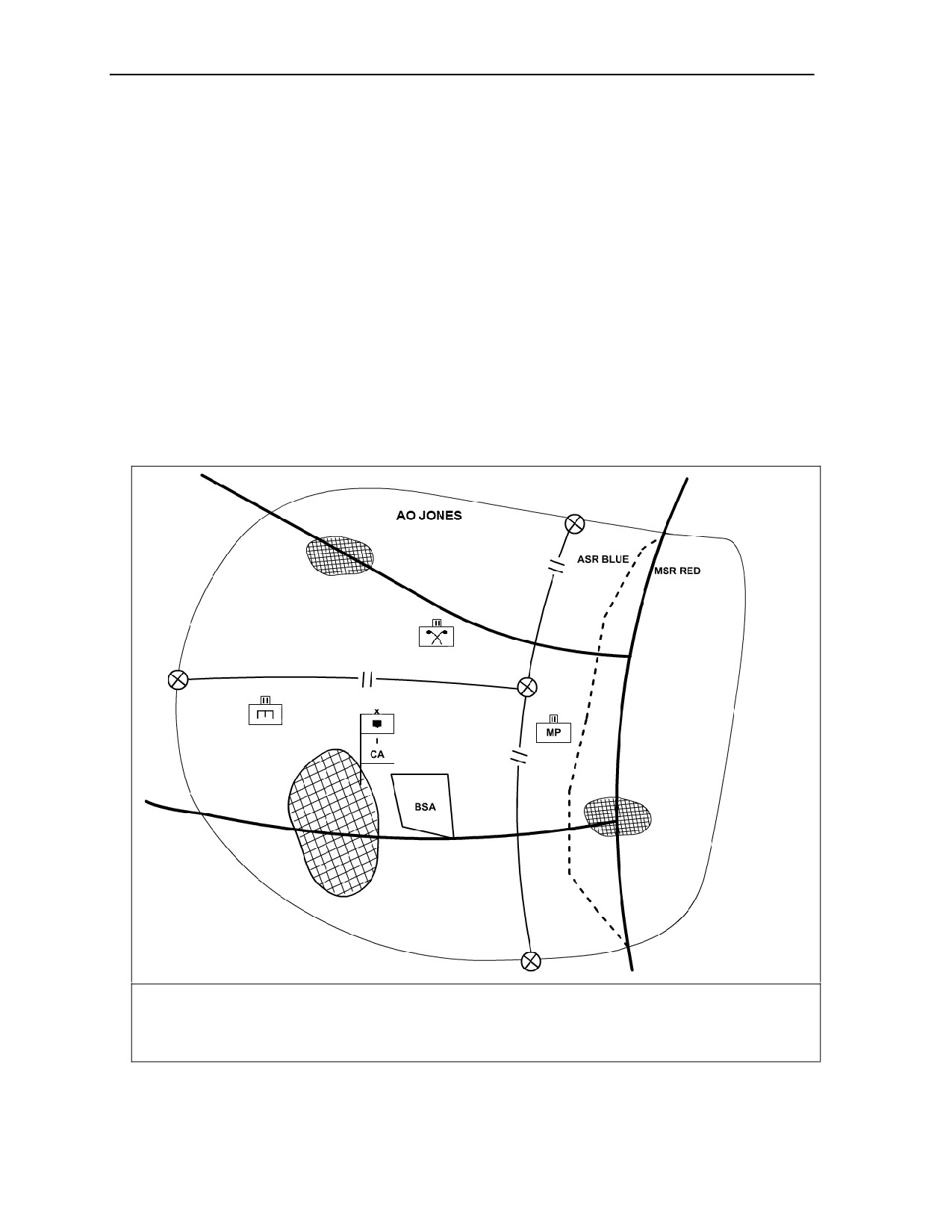
5-61. One example of a MEB conducting stability is shown in figure 5-1. In this example, the MEB is
assigned to conduct stability tasks primarily within AO JONES. The stability tasks require the MEB to
establish civil security, civil control, and restore essential services. The MEB is task-organized with a
chemical, engineer, and military police battalion; and a CA company; and EOD company. Based on
METT-TC, the MEB creates three battalion task forces task-organized based on the primary tasks within
their assigned boundaries. The military police task force has responsibility for the MSR RED and the
construction of ASR BLUE to improve movement within the AO and bypass the built-up area. Attachments
to the military police task force include an engineer company and a CA team, and it has a detached
company and platoon. The chemical battalion task force has toxic industrial chemical and toxic industrial
material concerns and responsibility for the smaller built-up area. Attachments to the CBRN battalion task
force include a military police platoon, and a CA team. The engineer task force has responsibility for the
largest built-up area, general engineering support to the BSB, and the largest area of demand to restore
essential services. Attachments to the engineer task force include a military police company and a CA team
and it has a detached company to the military police task force. The MEB and CA headquarters are
collocated within the largest built-up area to coordinate with and assist the regional civil authority. The
MEB locates the brigade support area within a partially destroyed, existing base near the built-up area due
to sources of local supplies and access to the road connecting to MSR RED.
Legend:
AO
area of operations
CA
civil affairs
ASR
alternate supply route
MP
military police
BSA
brigade support area
MSR
main supply route
Figure 5-1. Example of a MEB conducting stability
5-12
FM 3-81
21 April 2014
Chapter 6
Sustainment
Sustainment is the provision of logistics, personnel services, and health service
support necessary to maintain operations until successful mission completion
(ADP 4-0). The endurance of Army forces is primarily a function of their
sustainment. Sustainment enables the operational reach of Army operations. It is
essential to retaining and exploiting the initiative. Sustainment provides the support
necessary to maintain operations until mission accomplishment (ADRP 4-0). MEB
commanders use their assets to maintain the momentum of operations and enhance
the capabilities of their forces. This chapter discusses sustainment of the MEB, not
the conduct of sustainment tasks, as a part of maneuver support operations. Further
information on sustainment operations can be found in ADP 4-0, ADRP 4-0, and FM
4-90. Information on operational contract support can be found in ATTP 4-10. (See
FM 3-34 or FM 3-34.400 for information on general engineering support [part of
logistics].)
PLANNING
6-1. The sustainment warfighting function is the related tasks and systems that provide support and
services to ensure the freedom of action, extend operational reach, and prolong endurance (ADRP 3-0).
Sustainment encompasses the elements of logistics, personnel services, and health service support required
to support operations for mission accomplishment. Logistics is planning and executing the movement and
support of forces. It includes the aspects of military operations that deal with design and development,
acquisition or construction, storage, movement, distribution, maintenance, evacuation and disposition of
material. It is also the acquisition or construction, maintenance, operation, and disposition of facilities and
acquisition or furnishing of services. Army Health System support consists of all measures taken by
commanders, leaders, individual Soldiers, and the military health system to promote, improve, conserve, or
restore the mental and physical well-being of Soldiers.
6-2. This chapter discusses how the MEB sustains itself when assigned a BSB. MEB is a unique
organization, which can expand to employ a wide range of capabilities, each with their own sustainment
needs. Operational planners must ensure that MEB sustainment planning is conducted as early as possible,
and continue to monitor as the mission changes in order to effectively sustain the MEB throughout the
operation. If the MEB does not have a BSB, prior to deployment, the planning staffs of the higher-echelon
headquarters and the sustainment command headquarters must conduct a METT-TC analysis and provide
the MEB required sustainment support to ensure their mission success. When the MEB is assigned a
support area mission, they should have an assigned BSB. The BSB must synchronize sustainment
requirements and capabilities with the supporting sustainment brigade so that a seamless support structure
can exist as the MEB receives attached units and operates within its assigned AO.
6-3. The MEB staff synchronizes operations across all six warfighting functions to generate and maintain
combat power. It plans tactical logistics. The sustainment warfighting function is synchronized with the
higher-echelon staff and supporting sustainment brigade. The BSB support operations officer assists the
brigade staff in its’ planning efforts. A movement control team supporting the AO and other sustainment
brigade assets may be located in the MEB brigade area. The MEB S-4, S-1, brigade surgeon, and chaplain
are the principal sustainment planners for the MEB. The BSB is the principal sustainment executer.
Logistics synchronization for the brigade is done between the primary staff sections and the BSB support
operations officer. The MEB commander designates who will oversee logistics synchronization for the
brigade. Normally, this position will be the BSB commander, who is the senior logistician in the brigade.
21 April 2014
FM 3-81
6-1
Chapter 6
The MEB commander may elect to use the deputy commanding officers, the executive officer, or the
brigade S-4 to oversee logistics synchronization for the brigade in the absence of a BSB commander. The
MEB obtains the logistics preparation of the theater information and products from the supporting
sustainment brigade and the higher-echelon headquarters concept of operations and integrates this with
their intelligence preparation of the battlefield. The S-4, S-1, and BSB support operations officer maintain a
continuous sustainment estimate during all operations. They use the logistics estimate to determine
sustainment capabilities, anticipate support requirements, identify and resolve shortfalls, and develop
support plans. They integrate into all planning what is needed to develop and synchronize sustainment with
maneuver and fire plans. Sustainment commanders and planners must thoroughly understand the mission,
tactical plans, and the MEB commander’s intent.
6-4. The MEB must know—
z
Mission, task organization, and concept of operations for all subordinate battalions and
attachments under MEB control.
z
Higher headquarters sustainment plans.
z
Known and anticipated branch plans and sequels.
z
Density of personnel and equipment of each subordinate unit.
z
Known and anticipated enemy situation and capabilities.
z
Capabilities and limitations of subordinate units.
z
Host nation support and contract capabilities.
z
Size and capabilities of local population civil infrastructure.
z
Capacity and capability of local government and nongovernmental agencies.
6-5. The BSB supports the MEB sustainment and maintenance of organic and attached units. The BSB is
a fixed organization, which provides direct support to the MEB. The BSB integrates specific logistics
capability that is not organic to the BSB or additional capacity to support the BSB. The BSB support
operations officer coordinates with subordinate and supporting organizations on what organic support they
have or are bringing with them. The support operations officer will array those capabilities on the
battlefield so that they are integrated with the BSB capabilities. The MEB BSB has an HHC, distribution
company, and maintenance company as organic assets. Unlike other BSBs, the MEB BSB does not have an
assigned medical company or assigned forward support company. This poses a challenge for the BSB in
how it supports subordinate elements. Subelements like an engineer battalion have assigned forward
support companies in their modified table of organization and equipment. This makes support straight
forward by coordinating with battalion forward support companies directly. Other units like Military police
and CBRN do not have forward support companies in their force structure, but do have sustainment assets
down to their company level organizations. Because the MEB BSB does not have a medical company, it
receives it receives Role 2 Army Health System support from medical units in area support of the AO. It
task-organizes as needed to support multiple simultaneous or sequential operations, conducts sustainment
for current operations and sets conditions for future operations. The BSB may command nonlogistics units
when necessary. The BSB maintains visibility of the distribution system, theater infrastructure, and MSRs
to provide the flexible support when and where it is needed.
6-6. The MEB establishes a brigade support area. The brigade support area could be a perimeter
established by the BSB within the AO of the supported unit, a base commanded by the BSB, or an area or
base within the MEB support AO. The MEB operations may require split based sustainment operations.
The BSB may conduct replenishment operation within the MEB support AO or within the AO of a unit that
the MEB is supporting. The MEB may establish an area within the support AO to support mission staging
operations for the MEB or support a BCT to establish an area for them in their AO or in the supported AO.
6-7. Logistics planners must understand the MEB current and projected sustainment capabilities. They
use information collected from personnel and logistics reports and operational reports to determine the
personnel, equipment, and supply status of each unit within the MEB. They consider the disposition and
condition of all supporting sustainment units and individual unit level capabilities. They analyze this data
and the current situation to determine the MEB logistical capabilities and limitations.
6-8. Sustainment planners must anticipate and understand support requirements of a tactical plan or
course of action. The S-1, S-4, and the BSB commander/BSB support operations officer analyze all courses
6-2
FM 3-81
21 April 2014
Sustainment
of action and modifications to current plans. They assess their sustainment feasibility, identify support
requirements, and determine requirements for synchronization. The S-1 and S-4, like the commander, must
visualize how the operation will unfold to determine critical requirements for each sustainment element.
They consider the requirements for each sustainment element during all phases of an operation. They
analyze each course of action and consider the following:
z
Type and duration of the operation.
z
Task organization, tasks, and sustainment requirements of subordinate forces.
z
Medical and maintenance profile of units to be assigned or attached.
z
Ramifications of tactical operations such as gap
(river) crossings, tactical pauses, long
movements, preparatory fires, or defenses.
z
Need for special equipment, supplies, or service.
z
Requirements to separate, disassemble, configure, uncrate, or trans-load supplies above normal
requirements.
z
Requirements for reconstitution.
z
Required varieties and quantities of all classes of supplies (especially Class III, V, and IX).
z
Requirements for support of reconnaissance forces, security operations, or deception efforts.
z
Need for Class IV/V obstacle material.
z
Positioning of combat trains and other supporting logistics elements.
z
Casualty numbers and likely locations.
z
Large-scale decontamination operations in support of BCTs or CBRN mass casualty
decontamination operations.
z
Area damage control preparations and response.
z
Minimal essential stability tasks to support the operation.
6-9. The S-4/support operations officer’s analysis also includes estimated attrition based on likely
outcomes of subordinate missions. Analysis of estimated attrition primarily focuses on critical systems. The
S-1 assists by projecting potential personnel losses. To perform this analysis, current unit personnel and
equipment densities, standard planning factors, operations logistics software, and historical data are used in
conjunction with operations logistics plan. When analyzing courses of action, this projection helps the
commander understand the potential losses and associated risks of each course of action.
6-10. To understand the MEB capabilities and determine support requirements, logistics planners apply a
METT-TC analysis to the operation. Table 6-1, page 6-4, gives an example of general sustainment
consideration for tactical operations.
6-11. The S-4 and BSB support operations officer must balance support requirements and priorities with
available sustainment capabilities. They consider existing stock, anticipated receipts, capacities, and
capabilities. They must assess the status of all logistics functions required to support the MEB and compare
them to available capabilities. They identify potential shortfalls then take or recommend actions to
eliminate or reduce their effect on the operation.
6-12. When a logistics shortfall is identified, the sustainment planners take every action available to
eliminate or reduce its effect. They must understand its potential impact on the force, the risk that it
presents to mission accomplishment, the duration, and which requirement exceeded the unit capabilities.
They analyze the shortfall to determine its cause such as battle losses, supply availability, resource
availability
(equipment, man-hours), or distribution shortfall. They consider the following actions to
resolve a shortfall:
z
Shifting supplies or assets by phase of the operation.
z
Requesting support or additional assets from higher headquarters.
z
Using alternative distribution methods.
z
Considering the use of host nation support.
z
Considering pre-positioning supplies or attaching additional sustainment capabilities to
subordinate forces.
z
Modifying the course of action or plan.
21 April 2014
FM 3-81
6-3
Chapter 6
Table 6-1. Logistics considerations for tactical operations
MEB mission and commander’s intent.
Concept of operations.
Higher headquarters mission and concept of operations.
Mission
Higher headquarter concept of support.
Type and duration of operation.
Required supply rate.
Controlled supply rate.
Enemy capabilities and tactics that could threaten sustainment operations.
Enemy
Enemy unconventional tactics that could threaten sustainment operations.
Anticipated amount of detainees.
MEB task organization to include supporting logistics units.
Location and condition of all units, including sustainment units.
Troops
Current and projected status of personnel, equipment, and classes of supply.
Availability and status of services.
Unit level sustainment capabilities.
Effects of weather and terrain on sustainment operations.
Terrain and Weather
Additional sustainment requirements of the MEB due to weather and terrain.
Condition of infrastructure such as roads and bridges.
Impact on the ability to build-up supplies and replenish units.
Time Available
Planning and preparation time for sustainment units.
Impacts of time on support requirements and distribution methods.
Host nation support and contract services.
Impact of civilian and refugee movements.
Civil Considerations
Potential for hostile reactions by civilians against sustainment operations.
Potential detainee or resettlement requirements.
Provision of minimum essential stability tasks.
Legend:
MEB
maneuver enhancement brigade
6-13. Based on the logistics estimate, the sustainment planners develop support plans. The overall
sustainment plan is briefly described in the concept of support. The concept of support provides
commanders and staffs with a general understanding of the commander’s priorities and how the operation
will be logistically supported. Detailed sustainment plans are outlined in Annex F (Sustainment) to the
MEB operation order or as part of a fragmentary order. BSB commanders also issue an operation order to
all units under their control. BSB commanders in conjunction with the S-4 and executive officer closely
monitor the implementation of the sustainment plan. They adjust sustainment operations, or shift resources
to account for changing situations, changes in priorities (such as shifting the main effort), or to replace lost
sustainment capabilities.
6-14. The MEB staff plans for sustainment of a frequently changing task organization with augmentation
from other Army, joint, interagency, and multinational forces. Attachments to the MEB should arrive with
their appropriate sustainment capability. When a company, team, or detachment is attached to the MEB, the
BSB support operations officer integrates their sustainment into the MEB support system. The attachment
orders must clearly state who will provide medical, maintenance, and recovery services, and provide
support for Class III, V, and IX supplies. When receiving attachments, sustainment planners require some
basic information from the S-4 of the sending unit to anticipate development of a synchronized concept of
6-4
FM 3-81
21 April 2014
Sustainment
support. When the unit is detached, the MEB assists by forwarding on-hand supplies or equipment to the
gaining unit. Some considerations are the—
z
Number and type of vehicles, personnel (by military occupational specialty), and weapons
systems and their current status.
z
Organic medical and maintenance capabilities.
z
Attachment is effective and for how long.
z
Support assets that are coming with each attachment to the MEB.
z
Linkup will occurrence, and who is responsible for linkup.
FUNCTIONAL RESPONSIBILITIES AND LIMITATIONS
6-15. This section discusses the sustainment functional responsibilities and limitations of the MEB.
LOGISTICS
6-16. Logistics is primarily the responsibility of the MEB S-4 and provided primarily by the MEB organic
BSB. Logistics includes maintenance, transportation, supply, field services, distribution, operational
contract support, and general engineering. General engineering and detainee operations are primarily
planned by the S-3 staff and not discussed in this chapter. Field services will be discussed further and
include mortuary affairs, shower and laundry capabilities, field feeding, and water purification. Operational
contract support is discussed in greater detail since much of this information is new or emerging doctrine.
Maintenance
6-17. How maintenance is accomplished in the MEB is dependent on individual unit capabilities. Most
units, are organic or attached to the MEB, have some organic field maintenance capabilities. The BSB field
maintenance company provides field maintenance for organic MEB units and supplemental field
maintenance support to other units attached to the MEB that may be required above their own capability
(see ATTP 4-33).
Transportation
6-18. The MEB HHC, BSB, and signal company have 100 percent mobility of their table of organization
and equipment and supplies in a single lift using organic equipment. If MEB assigned and attached units
require additional lift support they will request it through channels to the BSB support operations section.
The BSB support operations section acts as the distribution management center for the MEB (see FM
55-1).
Supply
6-19. Supply is the process by which required materials and equipment are made available to supported
units to help them accomplish the mission. This includes all classes of supply to include Class VIII. MEB
resupply to subordinate elements is coordinated through the BSB support operations officer. Supplies are
provided through the distribution processes established below (see FM 4-40).
Field Services
6-20. This section discusses the logistics field services responsibilities and limitations of the MEB.
Shower and Laundry
6-21. There is no organic laundry or shower capability in the MEB. Support must be coordinated by the
support operations officer with the sustainment brigade in general support of the MEB.
21 April 2014
FM 3-81
6-5
Chapter 6
Field Feeding
6-22. Field feeding for the MEB is dependent on the individual units assigned/attached to the MEB. The
MEB HHC has its’ own food service section. The BSB HHC food service section will feed itself, the
distribution company, and the MEB signal network company. In addition, they have the capability for an
additional 350 personnel. Most assigned units will have organic food service capabilities. Examples are the
forward support company food service section in the engineer battalions or the food service sections in the
military police companies. The MEB senior food service advisor in the brigade S-4 is responsible for
coordinating food service support in the brigade.
Water
6-23. The BSB has the organic capability to produce, store, and transport purified water to meet the MEB
support requirements. When the MEB gains supporting units, water production and distribution capacities
will quickly exceed the organic ability to produce, store, and distribute. A continuous logistics status report
to the supporting sustainment brigade must be made so that shortfalls are avoided.
Mortuary Affairs
6-24. The MEB is dependent on augmentation for collection, processing, and evacuation of remains. A
mortuary affairs team from the theater sustainment brigade provides mortuary services support to the MEB.
The team operates from the brigade support area and is responsible for processing remains. The team has
no transportation capabilities and coordinates with the support operations officer for evacuation back to the
theater mortuary evacuation point. Internal to the MEB, handling teams are predesignated at the unit level.
It is the responsibility of the unit to evacuate remains to the brigade support area.
Distribution
6-25. Distribution is the primary means to prolong endurance. Distribution is the operational process of
synchronizing all elements of the logistic system to deliver the right things to the right place at the right
time to support the geographic combatant commander. Additionally, it is the process of assigning military
personnel to activities, units, or billets (JP 4-0).
6-26. The BSB supports the MEB by providing or coordinating Class I, II, III, III, IV, V, VII, and IX
supplies. The BSB distributes these supplies normally through unit distribution or supply point distribution.
6-27. In unit distribution, supplies are configured in unit sets (battalion/company/platoon, depending on the
level of distribution) and delivered to one or more central locations. This technique makes maximum use of
the capacity of BSB truck assets by minimizing delivery and turnaround time (see FM 4-90).
6-28. Supply point distribution requires unit transportation assets to move to a supply point to pick up their
supplies. Supply point distribution is most commonly by means of a logistics release point. The logistics
release point may be any place on the ground where unit vehicles return to pick up supplies and take them
forward to their units. The logistics release point can be the brigade support area itself.
Operational Contract Support
6-29. The Army has consolidated its theater support contracting capabilities into separate table of
organization and equipment units. These units include the contracting support brigade, contingency
contracting battalions, senior contingency contracting teams, and contingency contracting teams. The
contracting support brigade and the primary mission of its subordinate unit include—
z
Providing theater support contracting capabilities to deployed Army forces, and to other military
forces, governmental agencies, and/or nongovernmental agencies, as directed.
z
Assisting theater Army and Army forces staffs in developing operational contract support plans
(Annex W of the operation plan). These plans will include mission specific contracting and
contractor-specific integration, synchronization and management information.
z
Coordinating execution of planned theater support contracts and coordination with the
supporting Army field support battalion.
6-6
FM 3-81
21 April 2014
Sustainment
6-30. Contracting support brigades are regionally aligned to a specific theater Army. When deployed, the
contracting support brigade has a direct-support relationship with the Army Forces commander in the
operational area and executes its contracting mission under the direction and contracting authority of the
expeditionary contracting command. The Army forces commander may further delegate this direct-support
relationship per METT-TC factors. Theater support contracting actions in support to the MEB will be
executed in a general-support manner.
6-31. Contracting is a key source of support for deployed armed forces in unified land operations. Because
of the importance and unique challenges of operational contract support, the MEB commander and staff
need to fully understand their role in planning and managing contracted support in the AO. Current doctrine
describes three broad types of contracted support:
z
Theater support. Theater support contracts are contracts awarded by contingency contracting
officers deployed to the operational area that provide the ability to rapidly contract for logistics
support within a theater of operations. Theater support contractors acquire goods, services, and
minor construction support, usually from the local commercial sources, to meet the immediate
needs of operational commanders. Theater support contracts are the type of contract typically
associated with contingency contracting. MEBs will often be the requiring activity for theater
support contract support actions related to internal and external missions. Theater support
contracts in support of the MEB missions are normally executed on a regional aligned basis.
z
External support. External support contracts provide a variety of mission support to deployed
forces. External support contracts may be prearranged contracts or contracts awarded during the
contingency itself to support the mission and may include a mix of U.S. citizens, third country
nationals, and local national subcontractor employees. The largest and most commonly used
external support contract is the Logistics Civilian Augmentation Program). This Army program
is commonly used to provide life support, transportation support, and other supporting functions
to deployed Army forces and other elements of the joint force as well. In most operations, the
MEB is a supported unit, but not the requiring activity when it comes to the Logistics Civilian
Augmentation Program support.
z
Systems support. Systems support contracts are contracts are prearranged contracts awarded by
and funded by acquisition program executive officers and project/product management officers.
These contracts provide technical support, maintenance support and, in some cases, Class IX
support for a variety of nontype classified and selected other Army weapon and support systems.
System contractors, made up of U.S. citizens, provide support in garrison, and may deploy with
the force to training and real-world operations. They may provide temporary support during the
initial fielding of a system, called interim contracted support, or long-term support for selected
materiel systems, often referred to as contractor logistic support. The MEB does not normally
have a significant role to play in planning or coordinating system support contracts other than
coordinating and executing support of system support contract related personnel.
6-32. For the MEB, the major challenge is ensuring operational contracting support actions are properly
incorporated and synchronized with the overall MEB support effort. The MEB S-4 and BSB support
operations officer staff will be trained on their roles in the operational contract support planning and
execution process as described below:
z
Contract management. The MEB will nominate a contracting officer representative
(sometimes referred to as contract officer technical representative) for every service contract and
a receiving official for all supply contracts. Quality contracting officer representative (approved
by the supporting contracting office) and receiving-official support is key to ensuring contractors
provide the service or item according to the contract. The MEB must also manage funding for
each contract and request funds in advance of depletion of current funds or all contract work will
stop until adequate funds are available.
z
Contract closeout. The MEB is responsible for completing receiving reports, certifying that
contracted goods or services were received by the Army, and submitting the receiving report to
the contracting officer so the contract can be closed out and the contractor paid.
Note. For more information on operational contract support see ATTP 4-10.
21 April 2014
FM 3-81
6-7
Chapter 6
PERSONNEL SERVICES
6-33. Personnel services complement logistics by planning for and coordinating efforts that provide and
sustain personnel. Personnel services are an integral part of unit readiness. The MEB S-1 is the staff officer
responsible for personnel services. MEB capabilities include human resources support, financial
management, legal support, and religious support.
Human Resources Support
6-34. Human resources support is an important component of sustainment. The MEB S-1 is responsible for
providing or coordinating the operational and tactical level human resources support that sustains the
combat potential of the force, and the morale and welfare of Soldiers. Human resource support is also
found at the sustainment brigade level on a general-support or an area basis. They provide human resource
companies, which can provide planning and coordination for human resource operations, as well as liaison
and technical support to their customers and supported units.
6-35. The MEB S-1 section serves as a conduit between subordinate units and the higher-echelon human
resources organization. Because of distances and communications capabilities, all reports are submitted
through the MEB S-1 for forwarding to the appropriate agency. Initial personnel data is submitted by
subordinate and attached units of the MEB by using digital technology. The MEB S-1 also provides
information to subordinate units on status of evacuated/hospitalized personnel and adjusts personnel
requirements accordingly.
6-36. Human resource support includes personnel accountability, strength reporting, personnel information
management, personnel readiness management, casualty operations management, essential personnel
services, personnel support, postal operations, and morale welfare and recreation and community support.
Personnel Accountability
6-37. The brigade S-1 is responsible for coordinating and managing personnel accountability in the MEB.
Personnel accountability is the process for recording by-name data on Soldiers when they arrive and depart
from the command.
Strength Reporting
6-38. Replacement companies under mission command of replacement battalions at theater or corps level
receive, support, and process replacements. They coordinate movement with the appropriate movement
control element. The division replacement section coordinates with the assistant chief of staff, logistics and
higher headquarters transportation officer for movement to the brigade support area. The MEB S-1
processes and assigns replacements to battalions. The battalion S-1 further assigns replacements to
company level.
Peronnel Information Management
6-39. Personnel information management encompasses the collection, processing, storage, display, and
dissemination of information about Soldiers, units, and civilians. Personnel information management is
controlled by the brigade S-1 through the battalion S-1s within the command.
Personnel Readiness Management
6-40. The purpose of the personnel readiness management system is to distribute Soldiers to units based on
documented requirements or authorizations to maximize mission preparedness and provide the manpower
needed. Personnel accounting is the system for recording by-name data on Soldiers when they arrive in and
depart from units, when their duty status changes (such as from duty to hospital), and when their grade
changes. Strength reporting is a numerical end product of the accounting process. It starts with
strength-related transactions submitted at unit level and ends with a database update through all echelons to
the Total Army Personnel Database. Personnel readiness managers, casualty managers, and replacement
managers all utilize a personnel information database when performing their missions.
6-8
FM 3-81
21 April 2014
Sustainment
Casualty Operations Management
6-41. The casualty reporting system is a by-name personnel accounting system that begins at unit level
with the person who knows that a casualty has occurred. DA Form 1156 (Casualty Feeder Card) is
forwarded as soon as possible. Reports are prepared using the Army Casualty Information Processing
System-Light and are sent directly to Headquarters, Department of the Army (DA), with copies furnished
to other higher headquarters, as appropriate. Patient evacuation, mortality reports and treatment, and
disposition logs are provided daily to the MEB S-1 from the area support medical company.
Essential Personnel Services
6-42. Essential personnel operations will be coordinated with subordinate commands and higher command
G-1(Assistant Chief of Staff, Personnel). This will include providing the MEB with timely and accurate
personnel services that efficiently update Soldier status, readiness, and quality of life. This allows
commanders to effectively manage the force, including actions supporting individual career advancement
and development, proper identification documents for security and benefits entitlements, recognition of
achievements and service (see ADRP 4-0).
Personnel Support
6-43. Personnel support encompasses command interest/human interest programs, and retention functions.
Personnel support also includes substance abuse and prevention programs, enhances unit cohesion, and
sustains the morale of the force (see ADRP 4-0).
Postal Operations
6-44. The brigade S-1 is responsible for coordinating and providing postal operations support with
subordinate units of the brigade. The MEB has no dedicated postal support capability and must perform this
function with on-hand assets. The Military Postal Service serves as an extension of the U. S. Postal Service;
therefore, services are regulated by public law and federal regulation. Postal operation requires significant
logistics and planning for transportation and mail handling (see ADRP 4-0).
Morale, Welfare, and Recreation
6-45. The brigade S-1 will coordinate morale, welfare, and recreation support with subordinate commands
in the MEB. This will include providing Soldiers and other authorized personnel with recreation and fitness
activities, goods, and services.
Financial Management
6-46. The MEB has no special financial management capability. The MEB S-3 coordinates for support
from mobile financial management teams. Financial management organizations provide support to the
MEB units and individual Soldiers on an area basis. During deployments, mobile teams from corps level
financial management organizations provide support to forward units. Financial management support units
are also found at the sustainment brigade level on a general-support or an area basis. They provide financial
management services, which include paying of limited U.S. and non-U.S. pay, preparing certified vouchers,
receiving collections, establishing financial management control processes, track commitments and
obligations, and provide vendor support and accounting and establishment of disbursing station number and
local depository.
Legal Support
6-47. The brigade legal section provides and supervises legal support to MEB mission command,
sustainment, and support operations. The brigade legal section provides and coordinates all legal support
for the MEB. Paralegal Soldiers in the MEB and subordinate battalions provide paraprofessional and
ministerial support for legal actions. The U.S. Army Trial Judiciary and U.S. Army Trial Defense Service
are independent organizations that provide military judge and trial defense services to the MEB.
21 April 2014
FM 3-81
6-9
Chapter 6
Religious Support
6-48. The MEB chaplain is the personal staff officer responsible for implementing the commander’s
religious support program. Included in this program are worship opportunities, administration of
sacraments, rites and ordinances, pastoral care and counseling, religious education, ministry to casualties to
include support of combat operational stress reaction casualty treatment, and development and management
of the unit ministry team. The chaplain advises the commander and staff on matters of morals, morale as
affected by religion, the impact of local religion on the military mission, and the ethical impact of
command decisions. The unit ministry team is composed of at least one chaplain and one enlisted chaplain
assistant. The chaplain assistant is an active member of the noncommissioned officer support channel. The
assistant assesses the well being of Soldiers and other authorized personnel (see FM 1-05).
ARMY HEALTH SYSTEM
6-49. This section discusses the Army Health System responsibilities and limitations of the MEB.
Health Service Support
6-50. Health service support includes limited organic medical support and relies on area medical support.
The MEB has limited medical logistics planning capability. The MEB surgeon ensures that all Army
Health System support functions are considered and included in operation plans and operation orders. The
MEB surgeon is a full-time special staff officer answering directly to the MEB commander on matters that
pertain to the health of the command. The MEB surgeon coordinates Army Health System support. The
MEB surgeon coordinates health service support operations with the higher-echelon surgeon and Army
Health System mission command elements and establishes medical guidelines for the MEB. The duties and
responsibilities of the MEB surgeon include health service support and force health protection functions.
6-51. The MEB surgeon’s duties and responsibilities for health service support may include—
z
Advising the commander on the health of the MEB units.
z
Planning and coordinating for health service support for MEB units (including but not limited to
medical treatment, medical logistics, medical evacuation, hospitalization, dental support,
preventive medicine, behavioral health, and clinical medical laboratory support).
z
Developing and coordinating the health service support portion of Army Health System
operation plans to support the MEB commander’s decisions, planning guidance, and intent in
support of unified land operations (see FM 4-02).
z
Recommending task organization of medical units/elements in support to MEB units to satisfy
all health service support mission requirements.
z
Monitoring troop strength of medical personnel and their utilization.
z
Evaluating and interpreting medical statistical data.
z
Monitoring medical logistics and blood management operations in the theater (see FM 4-02.1).
z
Monitoring medical regulating and patient tracking operations for MEB personnel (see FM
4-02.2).
z
Determining MEB training requirements for first aid and for maintaining wellness of the
command.
z
Recommending disposition instructions for captured enemy medical supplies and equipment.
z
Submitting to higher headquarters those recommendations on medical problems/conditions that
require research and development.
z
Coordinating, and synchronizing—
Health education and combat lifesaver training for the MEB.
Mass casualty plan developed by the S-3.
Medical care of enemy prisoners of war, detainees, and civilians in the MEB operations
area.
Treatment of sick, injured, or wounded Soldiers.
6-10
FM 3-81
21 April 2014
Sustainment
z
Performing medical evacuation, including use of the dedicated medical evacuation platforms (air
and ground) of the Army.
z
Coordinating medical logistics, including Class VIII resupply, blood management, and medical
maintenance.
z
Creating health-related reports and battlefield statistics.
z
Collecting and analyzing operational data for on-the-spot adjustments in the medical support
structure and for use in postoperations combat and materiel development studies.
Casualty Care
6-52. The brigade surgeon section assists the surgeon with responsibilities listed above. The brigade
surgeon section monitors and tracks operations with medical communications for combat casualty care for
applicable automated systems (see FM 4-02.21) and provides updated information to the surgeon and the
support operations officer chief for building capabilities to meet the MEB medical requirements identified
by the surgeon. Other functions include—
z
Planning for the Army Health System support for the MEB units.
z
Identifying and coordinating through the division surgeon section and as authorized directly with
medical brigade elements to support requirements of the MEB.
z
Coordinating and managing medical evacuation and treatment capabilities.
z
Coordinating and managing Class VIII resupply capabilities and ensuring medical support is
integrated and synchronized with the MEB operational support plan.
6-53. The brigade surgeon section is normally staffed with medical operations officers (0-4, area of
concentration 70H00) and a medical operations noncommissioned officer (E-7, military occupational
specialty 68W40). The primary function of this brigade surgeon section is medical planning to ensure that
adequate Army Health System support is available and provided in a timely and efficient manner for the
MEB and its attached units. This brigade surgeon section coordinates with the division surgeon section and,
as authorized, with medical brigade for the placement and support requirements of medical units and
elements located in the MEB operations area. For additional information on medical staff planning, see FM
8-55.
6-54. The medical treatment team is assigned to the brigade surgeon section and supports the MEB
headquarters. The team provides Role 1 Army Health System support for MEB headquarters personnel.
The medical treatment leader is a physician assistant and works under the supervision of the MEB surgeon.
Medical Evacuation
6-55. Medical evacuation provides en route care and emergency medical care. En route medical care
enhances the Soldier’s prognosis, reduces long-term disability, and provides a vital linkage between the
roles of care necessary to sustain the patient during transport (ADRP 4-0). Most units assigned/attached to
the MEB will have organic ground evacuation capability. The MEB sustainment medical operations officer
will need to coordinate medical evacuation for those units assigned or attached to the MEB that do not have
an organic evacuation capability.
Medical Logistics
6-56. The MEB surgeon coordinates medical logistics support with the supported higher-echelon surgeon
and the medical brigade providing general support to the AO. This will include planning and executing all
Class VIII supply support, along with contract support, medical hazardous waste disposal, and distribution
of medical gases.
21 April 2014
FM 3-81
6-11
Chapter 6
Force Health Protection
6-57. The MEB surgeon’s duties and responsibilities for force health protection may include—
z
Identifying potential medical-related commander’s critical information requirements (priority
intelligence requirements and friendly force information requirements) as they pertain to the
health threat; ensuring they are incorporated into the command’s intelligence requirements.
z
Coordinating for veterinary support for food safety, animal care, and veterinary preventive
medicine to include zoonotic diseases that are transmissible to man.
z
Planning for and implementing force health protection operations to counter health threats (see
FM 4-02.17).
z
Planning for and accomplishing redeployment and postdeployment health assessments.
z
Establishing and executing a medical surveillance program (refer to AR 40-5, AR 40-66, and
FM 4-02.17 for an in-depth discussion).
z
Establishing and executing an occupational and environmental health surveillance program (see
FM 3-34.5).
z
Recommending combat and operational stress control, behavioral health, and substance abuse
control programs (see FM 4-02.51).
z
Ensuring the general threat, health threat, and medical intelligence considerations are integrated
into Army Health System support operation plans and orders.
z
Advising MEB commanders on force health protection CBRN defensive actions, such as
immunizations, use of chemoprophylaxis, pretreatments, and barrier creams.
z
Maintaining situational understanding by coordinating for current force health protection
information with surgeon staffs of the next higher, adjacent, and subordinate headquarters.
z
Coordinating and synchronizing:
Combat and operational stress control program with the division surgeon section and
supporting medical brigade.
Preventive medicine services to include identification of health threats.
Preventive dentistry support program for the prevention of cavities and gum disease.
Support of area medical laboratories to include the identification of biological and chemical
environmental hazards, as required.
6-58. The health threat to Soldiers comes from enemy action and environmental situations. Effective and
timely force health protection initiatives are essential factors in sustaining combat power during continuous
operations. The MEB first line of protection is the use of preventive medicine measures and the units’ field
sanitation teams. For additional support, the MEB subordinate units coordinate through their medical
treatment team or the brigade surgeon section for preventive medicine support. The preventive medicine
and mental health elements from the medical brigade provide direct support as required that includes—
z
Preventive medicine advice and consultation in the areas of disease and nonbattle injury,
environmental sanitation, epidemiology, entomology, medical surveillance, limited sanitary
engineering services, and pest management. (See FM 4-02.17 for definitive information on
preventative medicine.)
z
Training and advice in the promotion of positive combat and operational stress behaviors; the
mental health element can provide early identification, handling, and management of misconduct
stress behavior and Soldiers with combat and operational stress reactions. It assists and counsels
personnel with personal, behavioral, or psychological problems and may refer suspected
neuropsychiatric cases for evaluation. (See FM 4-02.51 and FM 6-22.5 for definitive information
on Combat/Operational Stress Control.)
6-12
FM 3-81
21 April 2014
Glossary
The glossary lists acronyms and terms. Terms for which FM 3-81 is the proponent are
marked with an asterisk (*).
SECTION I - ACRONYMS AND ABBREVIATIONS
ADP
Army doctrine publication
ADRP
Army doctrine reference publication
AO
area of operations
AR
Army regulation
ASR
alternate supply route
ATP
Army techniques publication
ATTN
attention
ATTP
Army tactics, techniques, and procedures
BCT
brigade combat team
BSB
brigade support battalion
CA
civil affairs
CBRN
chemical, biological, radiological, and nuclear
CBRNE
chemical, biological, radiologial, nuclear, and high-yield explosives
CP
command post
DA
Department of the Army
DC
District of Columbia
DOD
Department of Defense
DSCA
defense support of civil authorities
EAD
echelons above division
EOD
explosive ordnance disposal
FM
field manual
G-1
Assistant Chief of Staff, Personnel
GTA
graphic training aid
HHC
headquarters and headquarters company
J-3
Joint Staff, Operations
JP
joint publication
MEB
maneuver enhancement brigade
METT-TC
mission, enemy, terrain and weather, troops and support available, time
available, and civil considerations
MO
Missouri
MSCoE
Maneuver Support Center of Excellence
MSR
main supply route
No.
number
OPCON
operational control
ROE
rules of engagement
S-1
personnel staff officer
21 April 2014
FM 3-81
Glossary-1
Glossary
S-2
intelligence staff officer
S-3
operations staff officer
S-4
logistics staff officer
S-6
signal staff officer
TACON
tactical control
TCF
tactical combat force
U.S.
United States
USC
United States Code
SECTION II - TERMS
*maneuver support operations
Integrate the complementary and reinforcing capabilities of mobility, countermobility, protection , and
sustainment tasks to enhance decisive action.
*movement corridor
Adesignated area established to protect and enable ground movement along a route.
Glossary-2
FM 3-81
21 April 2014
References
REQUIRED PUBLICATIONS
These are the sources quoted or paraphrased in this publication.
ADRP 1-02. Terms and Military Symbols. 24 September 2013.
JP 1-02. Department of Defense Dictionary of Military and Associated Terms. 8 November 2010.
RELATED PUBLICATIONS
These documents contain relevant supplemental information.
ARMY
ADP 3-0. Unified Land Operations. 10 October 2011.
ADP 3-07. Stability. 31 August 2012.
ADP 3-28. Defense Support of Civil Authorities. 26 July 2012.
ADP 3-37. Protection. 31 August 2012.
ADP 4-0. Sustainment. 31 July 2012.
ADP 5-0. The Operations Process. 17 May 2012.
ADP 6-0. Mission Command. 17 May 2012.
ADRP 3-0. Unified Land Operations. 16 May 2012.
ADRP 3-07. Stability. 31 August 2012.
ADRP 3-28. Defense Support of Civil Authorities. 14 June 2013.
ADRP 3-37. Protection. 31 August 2012.
ADRP 3-90. Offense and Defense. 31 August 2012.
ADRP 4-0. Sustainment. 31 July 2012.
ADRP 5-0. The Operations Process. 17 May 2012.
ADRP 6-0. Mission Command. 17 May 2012.
AR 40-3. Medical, Dental, and Veterinary Care. 23 April 2013.
AR 40-5. Preventive Medicine. 25 May 2007.
AR 40-66. Medical Record Administration and Health Care Documentation. 17 June 2008.
ATP 3-37.10. Base Camps. 26 April 2013.
ATP 3-37.34. Survivability Operations. 28 June 2013.
ATP 4-16. Movement Control. 5 April 2013.
ATTP 3-11.23. Multi-Service Tactics, Techniques, and Procedures for Weapons of Mass Destruction
Elimination Operations. 10 December 2010.
ATTP 3-39.20. Police Intelligence Operations. 29 July 2010.
ATTP 3-90.4. Combined Arms Mobility Operations. 10 August 2011.
ATTP 3-90.15. Site Exploitation Operations. 8 July 2010.
ATTP 4-10. Operational Contract Support Tactics, Techniques, and Procedures. 20 June 2011.
ATTP 4-33. Maintenance Operations. 18 March 2011.
FM 1-05. Religious Support. 5 October 2012.
FM 2-01.3. Intelligence Preparation of the Battlefield/Battlespace. 15 October 2009.
FM 2-22.2. Counterintelligence. 21 October 2009.
FM 3-09.12. Tactics, Techniques, and Procedures for Field Artillery Target Acquisition. 21 June 2002.
21 April 2014
FM 3-81
References-1
References
FM 3-11. Multiservice Doctrine for Chemical, Biological, Radiological, and Nuclear Operations.
1 July 2011.
FM 3-11.21. Multiservice Tactics, Techniques, and Procedures for Chemical, Biological,
Radiological, and Nuclear Consequence Management Operations. 1 April 2008.
FM 3-13. Inform and Influence Activities. 25 January 2013.
FM 3-16. The Army in Multinational Operations. 20 May 2010.
FM 3-34. Engineer Operations. 4 August 2011.
FM 3-34.5. Environmental Considerations. 16 February 2010.
FM 3-34.170. Engineer Reconnaissance. 25 March 2008.
FM 3-34.400. General Engineering. 9 December 2008.
FM 3-36. Electronic Warfare. 9 November 2012.
FM 3-39. Military Police Operations. 26 August 2013.
FM 3-39.40. Internment and Resettlement Operations. 12 February 2010.
FM 3-52. Airspace Control. 8 February 2013.
FM 3-55. Information Collection. 3 May 2013.
FM 3-57. Civil Affairs Operations. 31 October 2011.
FM 3-60. The Targeting Process. 26 November 2010.
FM 3-90-1. Offense and Defense Volume I. 22 March 2013.
FM 3-90-2. Reconnaissance, Security, and Tactical Enabling Tasks Volume 2. 22 March 2013.
FM 4-02. Army Health System. 26 August 2013.
FM 4-02.1. Army Medical Logistics. 8 December 2009.
FM 4-02.17. Preventative Medicine Services. 28 August 2000.
FM 4-02.2. Medical Evacuation. 8 May 2007.
FM 4-02.21. Division and Brigade Surgeons’ Handbook (Digitized) Tactics, Techniques, and
Procedures. 15 November 2000.
FM 4-02.51. Combat and Operational Stress Control. 6 July 2006
FM 4-40. Quartermaster Operations. 22 October 2013.
FM 4-90. Brigade Support Battalion. 31 August 2010.
FM 5-19. Composite Risk Management. 21 August 2006.
FM 5-102. Countermobility. 14 March 1985.
FM 55-1. Transportation Operations. 3 October 1995.
FM 6-01.1. Knowledge Management Operations. 16 July 2012
FM 6-22.5. Combat and Operational Stress Control Manual for Leaders and Soldiers. 18 March 2009.
FM 7-15. The Army Universal Task List. 27 February 2009.
FM 8-55. Planning for Health Service Support. 9 September 1994.
FM 27-10. The Law of Land Warfare. 18 July 1956.
GTA 90-01-001. Improvised Explosive Device (IED) and Vehicular Borne Improvised Explosive
Device (VBIED) Smart Card. 17 September 2007.
JOINT
JP 2-0. Joint Intelligence. 22 October 2013.
JP 3-0. Joint Operations. 11 August 2011.
JP 3-08. Interorganizational Coordination During Joint Operations. 24 June 2011.
JP 3-10. Joint Security Operations in Theater. 3 February 2010.
References-2
FM 3-81
21 April 2014
References
JP 3-28. Defense Support of Civil Authorities. 31 July 2013.
JP 3-31. Command and Control for Joint Land Operations. 29 June 2010.
JP 3-41. Chemical, Biological, Radiological, and Nuclear Consequence Management. 21 June 2012.
JP 3-52. Joint Airspace Control. 20 May 2010.
JP 3-57. Civil-Military Operations. 11 September 2013.
JP 4-0. Joint Logistics. 16 October 2013.
JP 5-0. Joint Operation Planning. 11 August 2011.
OTHER SOURCES
National Response Framework, Second Edition. May 2013. Available online at
1246/final_national_response_framework_20130501.pdf>. Accessed on 18 December 2013.
10 USC. Armed Forces.
22 USC. Foreign Relations and Intercourse.
32. USC. National Guard.
RECOMMENDED READINGS
ADP 3-90. Offense and Defense. 31 August 2012.
ADP 7-0. Training Units and Developing Leaders. 23 August 2012.
ADRP 2-0. Intelligence. 31 August 2012.
ADRP 7-0. Training Units and Developing Leaders. 23 August 2012.
AR 525-13. Antiterrorism. 11 September 2008.
ATP 3-28.1. Multi-Service Tactics Techniques, and Procedures for Defense Support of Civil
Authorities and Integrating With National Guard Civil Support. 11 February 2013.
ATP 4-91. Army Field Support Brigade. 15 December 2011.
ATP 4-93. Sustainment Brigade. 9 August 2013.
FM 3-53. Military Information Support Operations. 4 January 2013.
FM 4-30.31. Recovery and Battle Damage Assessment and Repair. 19 September 2006.
PRESCRIBED FORMS
None.
REFERENCED FORMS
DA Form 1156. Casualty Feeder Card.
DA Form 2028. Recommended Changes to Publications and Blank Forms.
WEB SITES
Army Knowledge Online, Doctrine and Training Publications Web site,
Army Publishing Directorate, Army Publishing Updates Web site,
21 April 2014
FM 3-81
References-3