FM 3-81 MANEUVER ENHANCEMENT BRIGADE (APRIL 2014) - page 1
*FM 3-81 (FM 3-90.31)
Field Manual
Headquarters
Department of the Army
No. 3-81 (3-90.31)
Washington, DC, 21 April 2014
Maneuver Enhancement Brigade
Contents
Page
PREFACE
iv
INTRODUCTION
v
Chapter 1
MISSION AND ORGANIZATION
1-1
Capabilities
1-1
Primary and Subordinate Tasks
1-2
Organization
1-3
Headquarters and Headquarters Company
1-4
Supported Commands
1-8
Mission Command
1-12
Chapter 2
SUPPORT TO DECISIVE ACTION
2-1
Commander and Staff Considerations
2-1
Offense
2-2
Defense
2-3
Stability
2-4
Defense Support of Civil Authorities
2-4
Chapter 3
SUPPORT AREA OPERATIONS
3-1
Definitions
3-2
Principles
3-2
Responsibilities
3-3
Considerations
3-5
Terrain Management
3-8
Information Collection
3-10
Movement Control
3-11
Operational Area Security
3-12
Support of Base Camp Security and Defense
3-14
Response Force
3-16
Airspace Management
3-17
Fire Support Coordination
3-17
Area Damage Control
3-18
Distribution Restriction: Approved for public release; distribution is unlimited.
*This publication supersedes FM 3-90.31, 26 February 2009.
21 April 2014
FM 3-81
i
Contents
Chapter 4
MANEUVER SUPPORT OPERATIONS
4-1
Framework
4-1
Assured Mobility
4-2
Movement and Maneuver
4-2
Protection
4-3
Maneuver Support Integration
4-3
Freedom of Action
4-5
Mobility and Countermobility
4-5
Protection
4-8
Intelligence
4-14
Maneuver Support Operations and the Operations Process
4-15
Chapter 5
STABILITY
5-1
Tasks and Purposes
5-1
Considerations
5-4
Specialized Capabilities
5-10
Chapter 6
SUSTAINMENT
6-1
Planning
6-1
Functional Responsibilities and Limitations
6-5
GLOSSARY
Glossary-1
REFERENCES
References-1
INDEX
Index-1
Figures
Figure 1-1. A possible MEB task organization
1-4
Figure 1-2. MEB HHC
1-5
Figure 1-3. Sample division organization
1-10
Figure 1-4. Sample MEB organization
1-11
Figure 3-1. Example of a MEB conducting support area operations
3-19
Figure 3-2. Example of a MEB performing area damage control
3-21
Figure 4-1. MEB and maneuver support operations
4-3
Figure 4-2. Increased functional capabilities
4-4
Figure 4-3. Example of a MEB supporting a movement corridor
4-7
Figure 4-4. Example of a MEB performing maneuver support
4-14
Figure 5-1. Example of a MEB conducting stability
5-12
ii
FM 3-81
21 April 2014
Contents
Tables
Introductory table-1. Modified Army terms
vi
Table 1-1. MEB general considerations
1-3
Table 6-1. Logistics considerations for tactical operations
6-4
21 April 2014
FM 3-81
iii
Preface
FM 3-81 provides the maneuver enhancement brigade (MEB) doctrine. The manual is linked to joint and Army
doctrine to ensure that it is useful to joint and Army commanders and staffs. To comprehend the doctrine
contained in this manual, readers must first understand the nature of unified land operations as described in
ADP 3-0 and ADRP 3-0. In addition, readers must fully understand the fundamentals of the operations process
that is contained in ADP 5-0 and ADRP 5-0, the principles of mission command that are described in ADP 6-0
and ADRP 6-0, the stability tasks that are discussed in ADP 3-07 and ADRP 3-07, the execution of defense
support of civil authorities (DSCA) that is discussed in ADP 3-28 and ADRP 3-28, the tactics that are contained
ADRP 3-90, and the protection tasks that are discussed in ADP 3-37 and ADRP 3-37.
The principal audience for FM 3-81 is commanders and staff elements at all echelons and MEB units that are
primarily tasked with conducting support area operations and maneuver support operations. Trainers and
educators throughout the Army will also use this manual. The other intended audience for this manual is leaders
and staff sections within units that will employ a MEB or may operate under the mission command of the MEB.
This manual should also be used to guide joint, interagency, and multinational higher headquarters commanders
and staff on MEB employment.
Commanders, staffs, and subordinates ensure that their decisions and actions comply with applicable United
States (U.S.), international and, in some cases, host nation laws and regulations. Commanders at all levels
ensure that their Soldiers operate according to the law of war and the rules of engagement (ROE) (see FM
27-10).
Unless this publication states otherwise, masculine nouns and pronouns do not refer exclusively to men.
FM 3-81 uses joint terms where applicable. Selected joint and Army terms and definitions appear in the
glossary and the text. Terms for which FM 3-81 is the proponent (the authority) are marked with an asterisk (*)
in the glossary. Definitions for which FM 3-81 is the proponent publication are boldfaced in the text. For other
definitions shown in the text, the term is italicized and the number of the proponent publication follows the
definition.
FM 3-81 applies to the Active Army, Army National Guard/Army National Guard of the United States, and
U.S. Army Reserve unless otherwise stated.
The proponent of FM 3-81 is the Maneuver Support Center of Excellence (MSCoE). The preparing agency is
the MSCoE Capabilities Development and Integration Directorate; Concepts, Organizations, and Doctrine
Development Division; Doctrine Branch. Send comments and recommendations on DA Form
2028
(Recommended Changes to Publications and Blank Forms) to Commander, MSCoE, ATTN: ATZT-CDC,
14000 MSCoE Loop, Suite
270, Fort Leonard Wood, MO
65473-8929, or by e-mail to
<usarmy.leonardwood.mscoe.mbx.cdidcoddddoc@mail.mil>; or submit an electronic DA Form 2028.
iv
FM 3-81
21 April 2014
Introduction
This FM provides doctrine for the tactical MEB employment and operations. It provides the MEB with a unity
of effort and a common philosophy, language, and purpose. As one of the multifunctional support brigades of
the Army, the MEB is designed to support division operations (also echelons above division [EAD] operations
within Army, joint, and multinational structures) and to respond to state or federal authorities as a part of
DSCA. The MEB is a mission command headquarters with a robust multifunctional brigade staff that is
optimized to conduct support area operations and maneuver support operations.
This manual discusses how MEBs enable commanders to achieve their objectives in support of unified land
operations through the unique capabilities of the MEB to conduct support area operations and maneuver support
operations within the joint security area and Army division and corps support areas. A MEB is a combined arms
organization that is task-organized based on mission requirements. The MEB is not a maneuver brigade,
although it can be assigned an area of operations (AO) and control terrain. MEBs provide capabilities to
enhance the freedom of mobility for operational and tactical commanders. The manual also addresses the broad
capability of the MEB to support the similar tasks of stability and DSCA.
This revision is based on the successful training and employment of MEB units. This manual builds on the
collective knowledge and wisdom that was gained through recent operations, lessons learned, doctrine
revisions, and the analysis of the requirements for divisions and corps to control support areas. This doctrine has
been adjusted to accommodate new technologies and organizational changes.
There are proposed changes to the force structure of the MEB that may affect all or some of the MEBs in the
force. In particular, some or all of the MEBs could lose the brigade support battalion (BSB) and the signal
company, leaving only the headquarters and headquarters company (HHC) as habitually assigned to the MEB.
If approved, these changes will have an impact on dependencies and require additional mission analysis for the
MEB when determining an area support concept requirement by sustainment assets of the supporting
sustainment brigade. Also, action will be needed to mitigate the degradation in signal support capability.
FM 3-81 describes how MEB commanders, staffs, and subordinate leaders plan, prepare, execute, and assess
MEB operations in support of Army forces that are conducting unified land operations within the framework of
joint operations. It removes the MEB primary task of conducting consequence management and moves
discussion under MEB capabilities to support stability and DSCA tasks. It increases the emphasis on the MEB
to conduct support area operations while supporting decisive action—offensive, defensive, stability, or DSCA
tasks.
The following is a brief introduction and summary of changes by chapter:
z
Chapter 1. Chapter 1 discusses the capabilities, the primary and subordinate tasks of the MEB
headquarters, the MEB organization, and the MEB role in division support and EAD. This chapter
highlights the special role of the MEB in conducting support area operations and maneuver support
operations. It discusses mission command within the MEB; the relationships to task-organized
forces; and the relationships of the MEB to the division, other units within the division, and EAD. It
describes the general MEB consideration to integrate and synchronize its conduct of operations using
the Army operations process. It discusses the task organization of a variety of capabilities that the
MEB may receive to perform its missions and augmentation to meet dependencies or perform some
tasks.
z
Chapter 2. Chapter 2 describes the MEB support to the decisive action tasks of offensive, defensive,
and DSCA (stability is discussed in chapter 5).
z
Chapter 3. Chapter 3 discusses the primary MEB task of support area operations.
z
Chapter 4. Chapter 4 discusses the primary MEB task of maneuver support operations.
21 April 2014
FM 3-81
v
Introduction
z
Chapter 5. Chapter 5 discusses the primary MEB task of stability operations.
z
Chapter 6. Chapter 6 discusses the sustainment of capabilities within the MEB and its subordinate
elements. This chapter describes the integrated sustainment effort required to support MEB
operations.
The MEB doctrine that is provided in this manual, together with related chemical, biological, radiological, and
nuclear (CBRN); engineer; and military police doctrine will support the actions and decisions of commanders at
all levels. This manual is not meant to be a substitute for thought and initiative among MEB leaders and
Soldiers. No matter how robust the doctrine or how advanced the MEB capabilities and systems, it is the MEB
units and Soldiers who must understand the operational environment, recognize shortfalls, and use their
professional judgment to adapt to the situation on the ground.
Based on current doctrinal changes, certain terms for which FM 3-81 is the proponent have been modified for
the purposes of this manual (see introductory table-1). The glossary contains acronyms and defined terms.
Introductory table-1. Modified Army terms
Term
Remarks
Maneuver support operations
Modified definition
vi
FM 3-81
21 April 2014
Chapter 1
Mission and Organization
The MEB is a unique, multifunctional, mission command headquarters that is
organized to perform support area operations for the echelon that it supports. It also
has the Army capability to perform maneuver support operations. Each MEB
headquarters begins with the same basic organization structure, staffing, and
capabilities. Task organization is based on identified mission requirements for the
echelon that it is supporting. It may be placed in support of Army, joint, interagency,
or multinational headquarters. The headquarters is staffed and optimized to conduct
combined arms operations integrating a wide range of maneuver support-related
technical branches and combat forces. This chapter discusses mission command and
MEB general operation process activities. The MEB may include a mix of engineer,
military police, CBRN, civil affairs (CA), and a tactical combat force (TCF). The
number and type of organizations that are task-organized to a MEB are driven by
mission requirements. Peacetime task organization may vary due to stationing and the
type of units that are colocated under the MEB for mission command.
CAPABILITIES
1-1. The MEB is designed to provide mission command of forces from multiple branches, but especially
those that conduct support area and maneuver support operations for the force. It employs them to conduct
decisive action in support of Army division; EAD; and joint, interagency, or multinational headquarters.
More than one MEB may be assigned to a higher headquarters.
1-2. The MEB conducts operations to shape the operational environment and mitigate its effects on
friendly operations. The MEB can simultaneously support (complement or reinforce) offense, defense,
stability, and DSCA in support of a higher echelon or focus on a single task during a phase of a larger
operation or within a specific. The capability to synchronize support area operations and maneuver support
operations under the MEB has the capabilities to synchronize to other Army, joint, and multinational
elements. The MEB can enable the decisive operation or lead shaping or sustaining operations with a focus
on general engineering. In special situations, the MEB may conduct the decisive operation.
1-3. The MEB is not a maneuver brigade; however, it is normally assigned an AO and controls terrain.
This capability makes the MEB the best organization in the Army to perform support area operations for
the division and corps. The MEB capability to conduct support area operations in the assigned echelon
support area provides added security and defense for other units and enhances the freedom of mobility for
the supported echelon. The only maneuver that the MEB is capable of is defensive maneuver and very
limited offensive maneuver by employing its reserve or TCF to counter or spoil a threat. The MEB can
provide mission command for assigned forces to defeat Level I, II, and III threats within an assigned AO.
The MEB requires a TCF to defeat a Level III threat. The MEB is designed to be assigned an AO and to
provide mission command; higher headquarters are designated tactical control (TACON) for the security
and defense of tenant units (see chapter 3).
1-4. The MEB shares the following characteristics with other support brigades:
z
Tailorable. The MEB is task-organized based on the factors of mission, enemy, terrain and
weather, troops and support available, time available, and civil considerations (METT-TC).
z
Modular. The MEB easily attaches or detaches subordinate units.
z
Expeditionary. The MEB can be quickly deployed in modules.
z
Networked. The MEB has an organic signal company to link with other headquarters or forces.
21 April 2014
FM 3-81
1-1
Chapter 1
z
Joint interdependent. The MEB uses and contributes to other Service capabilities.
z
Agile. The MEB can reinforce other brigades with subordinate capabilities.
z
Multifunctional. The headquarters employs multiple branch capabilities to accomplish multiple
mission tasks.
1-5. Unlike other support or functional brigades, the MEB is staffed and trained to manage an assigned
AO and to control terrain. In this regard, it is similar to a brigade combat team (BCT), without the inherent
BCT maneuver capability. The MEB conducts less offensive and defensive tasks than the BCT, but in some
cases, more stability and DSCA tasks. Force-tailored MEB capabilities can provide critical nonlethal
capabilities to conduct or support stability or DSCA. It has the added staff to perform the tasks that are
needed to operate an AO, including conducting selected combat operations within that AO. Many of the
units not staffed to control terrain become tenants within the assigned MEB AO (especially if the AO is the
echelon support area). (See chapter 3 for information on conducting support area operations.) The MEB can
also conduct close combat (up to the battalion level) within its AO when assigned a TCF. It provides an
economy of force capability so that BCTs or maneuver units can focus on combat operations.
1-6. The MEB has limited organic structure and depends on other organizations for additional capabilities
(see Table of Organization and Equipment 37300R00). Detailed mission analysis and running estimates
identify these requirements. This is mission-critical when submitting for MEB subordinate functional unit
requirements. Examples of MEB dependencies include fires (counterfire radar and target acquisition
assets), area sustainment medical company area support, air medical evacuation, signal, and information
collection capability (unmanned aircraft system, military intelligence units, and geospatial staff). The MEB
also depends on the supported command for legal, financial management, personnel, and administrative
services.
PRIMARY AND SUBORDINATE TASKS
1-7. The MEB primary tasks can be performed individually or simultaneously. The primary tasks include
the following:
z
Conduct Support Area Operations (see chapter 3), including—
Terrain management.
Information collection.
CA operations.
Air and ground movement control.
Clearance of fires.
Protection, including personnel recovery, coordination of base camp/base cluster defense,
and response force operations.
Liaison.
Operational area security.
Area damage control.
z
Conduct Maneuver Support Operations (see chapter 4), including—
Mobility.
Protection.
Sustainment.
z
Conduct DSCA (see chapter 2), including support to—
Domestic disasters.
Domestic CBRN incidents.
Domestic civilian law enforcement agencies.
Other support as required.
z
Conduct Stability (see chapter 5), including—
Civil security (including security force assistance).
Civil control.
1-2
FM 3-81
21 April 2014
Mission and Organization
Essential services restoration.
Governance support.
Economic and infrastructure development support.
1-8. The MEB primary tasks are the same or similar across operations. The general considerations or
context may differ in the why, where, who, legal constraints, and doctrinal construct that affect the task
conditions and standards (see table 1-1).
Table 1-1. MEB general considerations
Department of Defense (joint forces, Army, self or other units)
Who the task supports?
U.S. civil authorities (federal, state, and local)
Foreign governments, militaries, and people
Domestic (within the United States and its territories)
Where the task is conducted?
Foreign (outside the United States)
Decisive action (offensive, defensive, stability, or defense
support of civil authorities)
Why the task is conducted (strategy,
objective, purpose, doctrinal
Humanitarian assistance
construct)?
Support area operations
Maneuver support operations
ORGANIZATION
1-9. The MEB has an organic staff that is optimized to provide mission command and conduct its primary
tasks. It uses attached and operational control (OPCON) units to conduct support area operations and
maneuver support operations in its AO and within the broader AO of the organization that it supports. The
brigade may conduct combat operations up to the level of a maneuver battalion when task-organized with a
TCF or other maneuver forces. The compact size of the organic elements of the MEB facilitate rapid
deployment that enables strategic responsiveness while maintaining enough capability to provide mission
command and the functional expertise that is necessary for rapid tailoring. The unique MEB staff provides
the MEB with the capability to conduct the other key tasks in ways that no other brigade can. Beyond its
three organic units (HHC, network support company, and BSB), the MEB has no fixed structure. When
assigned or attached in support of a theater-specific operation, operation order, operation plan, or concept
plan, the brigade staff will conduct a mission analysis to determine the capabilities, recommend task
organization, and command and support the relationships that are necessary to accomplish the mission. The
organization is tailored to respond to the METT-TC elements. It receives a mix of modular units from
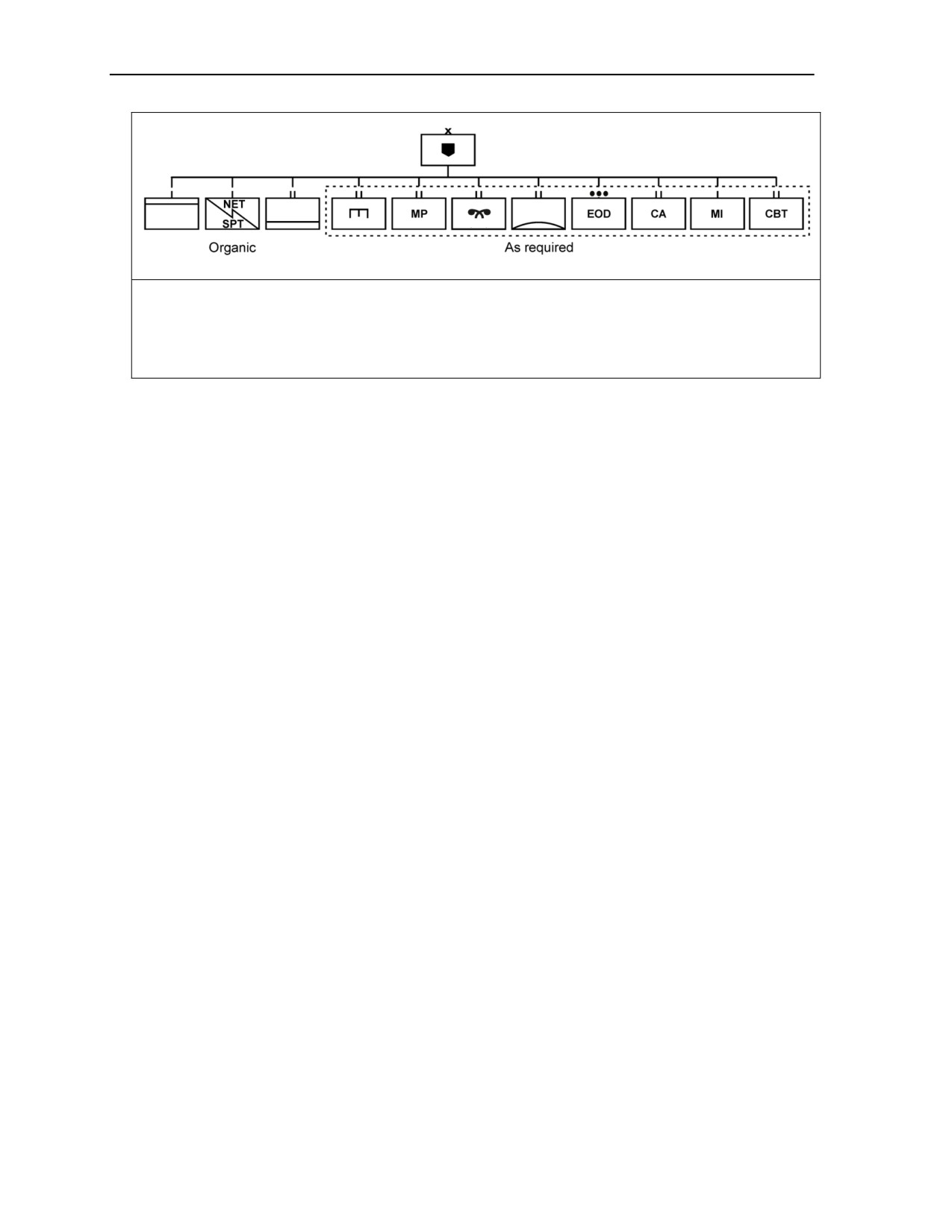
detachments to battalions. Figure 1-1, page 1-4, depicts possible units that are task-organized to the MEB
for a specific mission. In many cases, the broad geographic responsibilities and extensive functional
capabilities that the MEB represents will require a variety of subordinate, functionally based formations
that are mission-tailored for the supported echelon element.
Note. There are proposed changes to the MEB force structure that may affect all or some of the
MEBs in the force. In particular, some or all of the MEBs could lose the BSB and the signal
company, leaving only the HHC as organic to the MEB. If approved, these changes will have an
impact on dependencies and require additional mission analysis for the MEB when determining
an area support concept requirement by sustainment assets of the supporting sustainment
brigade. Also, action will be needed to mitigate the degradation in signal support capability.
21 April 2014
FM 3-81
1-3
Chapter 1
Legend:
CA
civil affairs
MP
military police
CBT
combat
NET
network
EOD
explosive ordnance disposal
SPT
support
MI
military intelligence
Figure 1-1. A possible MEB task organization
1-10. The MEB requires tailoring or task organization for every mission that it performs. Capability
requirements should be identified early in the planning process and constantly reevaluated to ensure that the
MEB is able to perform all of the specified and implied tasks that are necessary to achieve mission success.
Some of the MEB dependencies are also discussed in this chapter.
1-11. It will be a challenge for the MEB to integrate task-organized units and employ them as cohesive
tactical formations the way units with organic subunits, leaders, and Soldiers can. The trust and teamwork
that is required to conduct close combat with combined arms formations (technical, functional, and
maneuver) is difficult to develop quickly. The Army force generation collective-training events and
continuous in-theater training will be essential to prepare the unit, develop trust and teamwork, and certify
leaders.
HEADQUARTERS AND HEADQUARTERS COMPANY
1-12. The primary mission is to provide mission command capabilities for the MEB to support the range of
military operations. This is accomplished by core staff from the MEB HHC and their associated signal
support.
1-13. The MEB staff is unique in its capabilities. No other brigade level organization has such a large and
complete organic staff with the capabilities that are required to conduct support area operations and
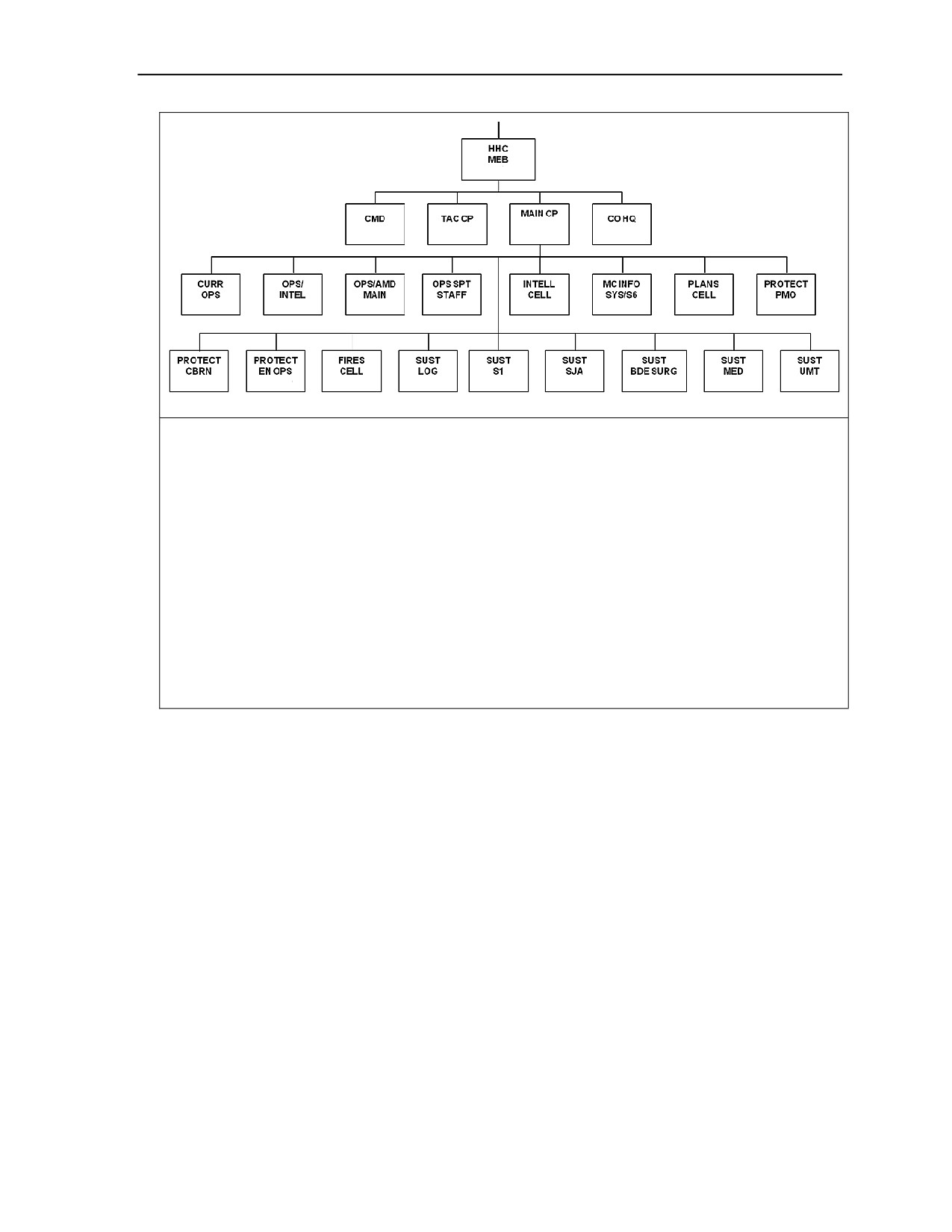
maneuver support operations (see figure 1-2). The MEB staff may need to be augmented with additional
personnel from CA when CA units are task-organized under the MEB for mission command.
1-14. The command section contains the commander and deputy commanding officer and provides
continuous command presence at one location or the ability to provide mission command for split-based
operations. The command sergeant major and enlisted members complete the command group.
1-15. The headquarters company contains the company commander, the first sergeant, other personnel (a
food management team, supply personnel, an equipment repair parts noncommissioned officer). The
headquarters company provides sustainment support for the MEB headquarters and staff.
1-16. The tactical command post (CP) contains a tailored portion of the MEB headquarters to control
current operations. The tactical CP is established when the commander must be positioned away from the
main CP location for an extended time period, when METT-TC factors do not permit the commander
access to the main CP, and when the main CP is moving. The tactical CP focuses on assisting the
commander with the mission command of current operations. The tactical CP is commander-focused and
execution-centric. The MEB operations staff officer (S-3) is responsible for the tactical CP, according to
the commander’s guidance.
1-4
FM 3-81
21 April 2014
Mission and Organization
Legend:
AMD
air and missile defense
LOG
logistics
BDE
brigade
MC
mission command
CBRN
chemical, biological, radiological,
MEB
maneuver enhancement brigade
and nuclear
MED
medical
CMD
command
OPS
operations
CO
company
PMO
provost marshal office
CP
command post
S-1
personnel staff officer
CURR
current
S-6
signal staff officer
EN
engineer
SJA
staff judge advocate
HHC
headquarters and headquarters
SPT
support
company
SURG
surgeon
HQ
headquarters
SUST
sustainment
INFO SYS
information systems
TAC
tactical
INTEL
intelligence
UMT
unit ministry team
Figure 1-2. MEB HHC
1-17. The main CP contains the portion of the MEB headquarters in which the majority of the planning,
analysis, and coordination occurs. The main CP is the commander’s primary mission command facility.
The MEB executive officer normally supervises the main CP staff activities and functions. The main CP
operates from a relatively secure location and moves as required to maintain the mission command of the
operation. The main CP integrates and synchronizes MEB operations and the staff mission functions of
information collection, planning, sustainment, mission command, communications, and computers.
1-18. The main CP operations airspace management section includes airspace control, electronic warfare
system operator, and tactical airspace integration system operator staff to provide the MEB with the ability
to control Army airspace within its assigned AO.
1-19. The fires cell includes a fire support officer and an abbreviated fires section that is capable of fire
support into the planning effort. The MEB depends on indirect fires and counterfire radar support within its
assigned AO. The MEB must request forward observers as needed; however, properly trained Soldiers can
provide the minimum standard that is required for a call for fire. Lasing a target is required when using
laser- and precision-guided munitions and should be requested when planning precision fires. Based on
METT-TC, the MEB may have an artillery element that is in a command or support relationship to provide
indirect fires in support of its AO.
21 April 2014
FM 3-81
1-5
Chapter 1
1-20. The S-3 section is unique due to the depth and breadth of its capabilities. This section contains the
following cells that provide a staff designed to integrate and synchronize support area and maneuver
support operations:
z
Engineer. The engineer operations cell includes combat engineer, reconnaissance, terrain data,
and power system technician staffs that provides the MEB with the ability to conduct most
engineer operations.
z
Military police. The provost marshal office operations cell includes maneuver and mobility
support, protective services, and detainee operations expertise that provides the MEB with the
ability to provide mission command for most military police operations.
z
CBRN. The CBRN operations cell includes intelligence, CBRN, and explosive ordnance
disposal (EOD) staff to provide the ability to provide mission command for many CBRN
operations.
1-21. The capabilities described in the above bullets allow the staff to perform some of the tasks that are
associated with decisive action in a more complete manner than other brigade level staffs.
1-22. The typical sustainment personnel staff officer (S-1), brigade surgeon section, medical treatment
team, unit ministry team, staff judge advocate, sustainment logistics section, and organic BSB provide the
MEB with sustainment capability.
1-23. The intelligence staff officer (S-2) cell includes vulnerability assessment, intelligence analysis, and
criminal investigation staff members. If there is a significant threat, the MEB must be augmented or task-
organized with an information collection capability.
1-24. The plans cell performs planning functions to support MEB operations and develops immediate,
intermediate, and long-range plans for the MEB and subordinate units. It provides consolidated and
coordinated running estimates and related products that are required for the development of operation plans
and orders within the MEB.
1-25. The mission command information system operations/S-6 section and the organic signal network
support company provide the MEB with communications connectivity that most functional brigades do not
have.
1-26. The sections within the headquarters will be organized according to the METT-TC factors to support
the organization and CP operation. The MEB will normally field two CPs (a main CP and a tactical CP).
The brigade will also have the capability to deploy command groups for short- or limited-duration
requirements as CPs. The MEB can also use the tactical CP as an early-entry CP (see chapter 3).
1-27. Key command and staff positions within the MEB organization are uniquely identified as requiring
the special skills of the CBRN, engineer, or military police branches. The staff must synchronize and
integrate many unique functional branches into brigade level operations. The range of employment options
requires the staff to have an understanding of joint operations.
NETWORK SUPPORT COMPANY
1-28. The network support company establishes organic communications for the MEB and provides the
following communication capabilities:
z
The Force XXI Battle Command Brigade and Below (a tactical Internet supporting information
system) for situational awareness and mission command data exchange capabilities to maneuver,
logistics, and mission command elements.
z
Combat net radio retransmission of voice using a—
Single-channel, ground and airborne radio system.
Improved high-frequency radio.
Single-channel, tactical satellite for mission command.
Note. The network support company has a secondary role of data retransmission where enhanced
position location reporting system, tactical Internet, or Army Common User System capabilities
do not exist for the MEB.
1-6
FM 3-81
21 April 2014
Mission and Organization
z
Multichannel tactical satellite to extend the MEB communications services range.
z
MEB mission command network management.
z
Establishment of primary CP voice and video MEB capabilities.
z
Plans for matters that concern MEB signal operations, automation, management, and
information security.
Note. There is a proposed force structure change that would eliminate the signal company from
units that are habitually assigned to the MEB. As with elimination of the BSB, signal company
elimination will have an impact on the capabilities, dependencies, and requirements for
additional mission analysis by MEB staff. To help compensate for signal company elimination,
the proposed force structure change calls for adding assets to the MEB HHC S-6 section. These
assets, previously found in the signal company, will help mitigate the elimination of signal force
structure.
BRIGADE SUPPORT BATTALION
1-29. The BSB provides logistics support to the MEB. The BSB is an organic organization that supports
the MEB by providing and coordinating all supply classes, field maintenance and limited transportation
support. It consists of a headquarters and headquarters detachment, distribution company, and field
maintenance company. Like the network support company, it is an organization that is designed to meet the
needs of all of the organic elements of the MEB and selected task-organized units. As the task organization
of the MEB exceeds BSB capabilities, the BSB must be task-organized with commensurate sustainment
structure, which is normally requested through the MEB to the supporting sustainment brigade.
1-30. The headquarters and headquarters detachment, BSB provides mission command for units that are
organic or attached to the BSB. The BSB is normally located where it can best support the MEB based on
METT-TC. As a general planning factor, the BSB has the capability to provide area support to units that
are operating within the AO over unspecified distances, via a combination of unit distribution and supply
point distribution methods. The BSB may require additional capabilities based on the logistics estimate that
is prepared to determine sustainment capabilities, anticipate support requirements, identify and resolve
shortfalls, and develop support plans. It requires the BSB to coordinate area support through the
sustainment brigade when supported battalions exceed MEB BSB support capabilities. Additional Army
Health System support is provided on an area basis by Army Health System elements.
1-31. The distribution company is employed from the brigade support area that is providing distribution
support to the brigade.
1-32. The field maintenance company headquarters provides mission command, control, administrative,
and logistical support for a maintenance control section, service and recovery section, field maintenance
section, and maintenance platoon in support of the MEB. The number and type of modules that are attached
to the field maintenance company may fluctuate based on METT-TC.
1-33. The BSB has the following capabilities:
z
Headquarters and headquarters detachment, including the—
Mission command of subordinate elements that provide logistics support.
BSB support operations officer who synchronizes distribution operations for the BSB for all
units that are assigned or attached to the brigade. The BSB support operations officer is
responsible for coordinating support requirements with the sustainment brigade.
Readiness oversight with linkages to the organic distribution company Class IX section.
Field feeding for the headquarters and headquarters detachment, distribution company, and
signal network support company and field feeding support for additional transient
personnel.
21 April 2014
FM 3-81
1-7
Chapter 1
Sustainment automation support management office that provides data automation support
to the brigade and the support operations section. This office also provides customer support
in sustaining and operating the logistics automation systems, including sustainment
software, limited hardware, user-owned communication devices, user training programs
monitoring, and new equipment fielding.
z
Distribution company, including the—
Management of supply distribution points, transportation, and fuel and water support to the
MEB.
Daily receipt, temporary storage, and issuance of all classes of supply (less Class VIII) to
the MEB.
Fuel section, which receives, temporarily stores, and issues bulk petroleum to the BCT. The
section has no static storage capability and has the ability to displace whenever necessary.
Water operations in the distribution company, including water purification, forward mobile
storage and distribution within the brigade, and water purification support from the
sustainment brigade.
z
Field maintenance company (with assigned platoons), including the—
Management of subordinate elements that perform field maintenance functions.
Consolidated unit administration, maintenance, and supply.
Maintenance control, shop stock, and wheeled-vehicle recovery capability.
Field maintenance of small arms, armament, and wheeled vehicles.
Field maintenance of utilities equipment, power generators, quartermaster, and CBRN
equipment.
Field maintenance for communications, surveillance radars, special electronic devices, and
wire system equipment and repair and return of specific test equipment.
Note. There is a proposed force structure change that would eliminate the BSB from units that
are habitually assigned to the MEB. If approved, this change will have an impact on the
capabilities, the dependencies, and the requirement for additional mission analysis by the MEB
staff, particularly the logistics staff officer (S-4). The loss of the distribution company, field
maintenance company, and support operations officer in the HHC will require changes in the
sustainment operational concept of support for the MEB. Having no habitual assets, the MEB
would become dependent on the supporting sustainment brigade, with its assigned combat
service support battalion having distribution and field maintenance capabilities to provide
sustainment support on an area coverage basis. The planning and coordination of sustainment
support, previously performed by the BSB support operations officer, will fall to the MEB S-4
section.
SUPPORTED COMMANDS
1-34. The MEB is primarily designed to provide support to the division, but is capable of supporting EAD
organizations. The division is the primary tactical warfighting headquarters for mission command of up to
six BCTs, support brigades (including the MEB), and other functional brigades. The division shapes the
operation for subordinate brigades; resources them for assigned missions; and coordinates, synchronizes,
and sequences their operations. The MEB provides the division with the ability to shape operations and
provide selected sustainment.
DIVISION AND ECHELON ABOVE DIVISION SUPPORT
1-35. The division uses BCTs to fight battles and engagements and uses its attached support brigades
primarily for shaping and sustaining operations and to complement or reinforce the BCTs. The MEB is
normally assigned an AO by the division that is focused on support area activities. This AO may contain all
or part of a division supporting a sustainment brigade and other tenant units or headquarters positioned in
support of the division. The MEB conducts support area operations when given this role by the division
(see chapter 3).
1-8
FM 3-81
21 April 2014
Mission and Organization
1-36. A joint force commander may place a MEB in support of another Service or multinational forces,
such as the senior Army headquarters that is attached to a Marine air ground task force to provide mission
command to Army units and capabilities that are assigned, attached, or made available to a Marine
formation during operations. As such, the MEB commander would serve as the senior Army commander
and advisor responsible to the Marine commander and remain responsible to the Army force commander
for internal Army issues.
1-37. Each MEB is uniquely tailored and task-organized. Of special note is the ability to conduct
operations within a movement corridor (see chapter 4). As part of its support to a division, the MEB may
simultaneously be supporting the BCT while conducting other decisive action tasks in its assigned AO or
division area. MEB operations must be simultaneous and continuous to facilitate the actions and the desired
operational tempo of the supported commander. The proper task organization of the necessary MEB assets
must occur early in the planning process and provide the necessary flexibility of employment and the
necessary transitions that will occur in operations.
1-38. The MEB could participate in, or may be required to provide, support to any of the processes of force
projection. These processes are—
z
Mobilization.
z
Deployment.
z
Employment.
z
Sustainment.
z
Redeployment.
1-39. The operations discussed in this manual focus on employment and sustainment. When required, the
MEB may conduct operations to support deployment or redeployment.
1-40. The key tasks that are associated with the MEB cover a broad range of potential support to the
division or other echelon that is being supported. Depending on the types and numbers of elements that are
assigned, the MEB can perform a significant portion of the functional or combined arms missions or tasks
that are typically associated with CA, CBRN, engineer, EOD, and military police forces. The MEB is also
capable of providing mission command to other forces, including a TCF.
1-41. While capable of performing multiple, simultaneous tasks, a higher headquarters must ensure that the
MEB does not exceed the span of control with the number and types of missions that are given to the MEB.
When the amount of functional missions challenges MEB ability to perform its multifunctional role,
functional brigades may need to be task-organized to the division. For example, a MEB that is responsible
for a complex AO is not able to also perform as a headquarters supporting a major division gap-crossing
operation within the division AO and another MEB or an engineer brigade would need to support the
division to provide the necessary mission command headquarters. Multiple MEBs may be assigned to a
division or higher echelon. The MEB has the ability to provide mission command for up to seven
battalions.
1-42. When assigned the mission of supporting EAD, joint, or multinational forces, the MEB could be
task-organized with other Service or national units and integrate staff augmentation to provide mission
command for a variety of elements necessary to support those forces. The MEB may be assigned its own
AO in such a role. The MEB could conduct operations to support the corps or joint command. When
assigned to a joint command, the MEB may provide mission command of the joint security area. In this
case, the MEB commander may be designated as the joint security coordinator by a joint force commander.
The MEB may be required to establish or support a theater level joint security coordination center. (See JP
3-10 for additional information on a MEB serving as a Joint Security Coordination center for a joint
security area.) The MEB can also support functional component commands, a joint force, or another
Service.
OTHER BRIGADE SUPPORT
1-43. The MEB could be tasked to provide support to other divisional units to include BCTs, functional
brigades, or other support brigades. The division may task the MEB to conduct certain operations in
general support to the division with selected tasks that require direct support. When providing general
21 April 2014
FM 3-81
1-9
Chapter 1
support, the other brigades in the division would coordinate their requirements with the division staff and
the MEB. Based on the division commander’s intent, the MEB would recommend priorities, provide task
organization, and provide directed support, refining specific details through collaboration with the BCTs
and other support brigades to accomplish missions.
1-44. MEBs can support BCT operations in a variety of ways. In general, the division may task-organize
parts of the MEB to the BCTs for a specific mission or the MEB may complement or reinforce the BCT
with forces under MEB control that are performing selected missions or tasks within the BCT AO.
Examples include—
z
Assisting in BCT initial detainee collection point construction.
z
Assisting in defensive-position construction.
z
Building a bridge over a gap.
z
Performing decontamination at a site within a BCT AO.
z
Performing other tasks that are temporary and specific in nature.
1-45. Elements out of the MEB may also provide specific CBRN or engineer reconnaissance capability to
a BCT. Military police may secure a sensitive site within a BCT AO. CBRN, engineer, EOD, and military
police forces may provide a wide range of support to the BCT or other brigades within a division AO.
1-46. The MEB may also support mission-staging operations where a BCT rests, refits, and receives large
quantities of supplies. This may occur with the MEB having been assigned the AO within which the
mission-staging operations will occur or in another AO with the MEB providing support through maneuver
support operations.
EMPLOYMENT
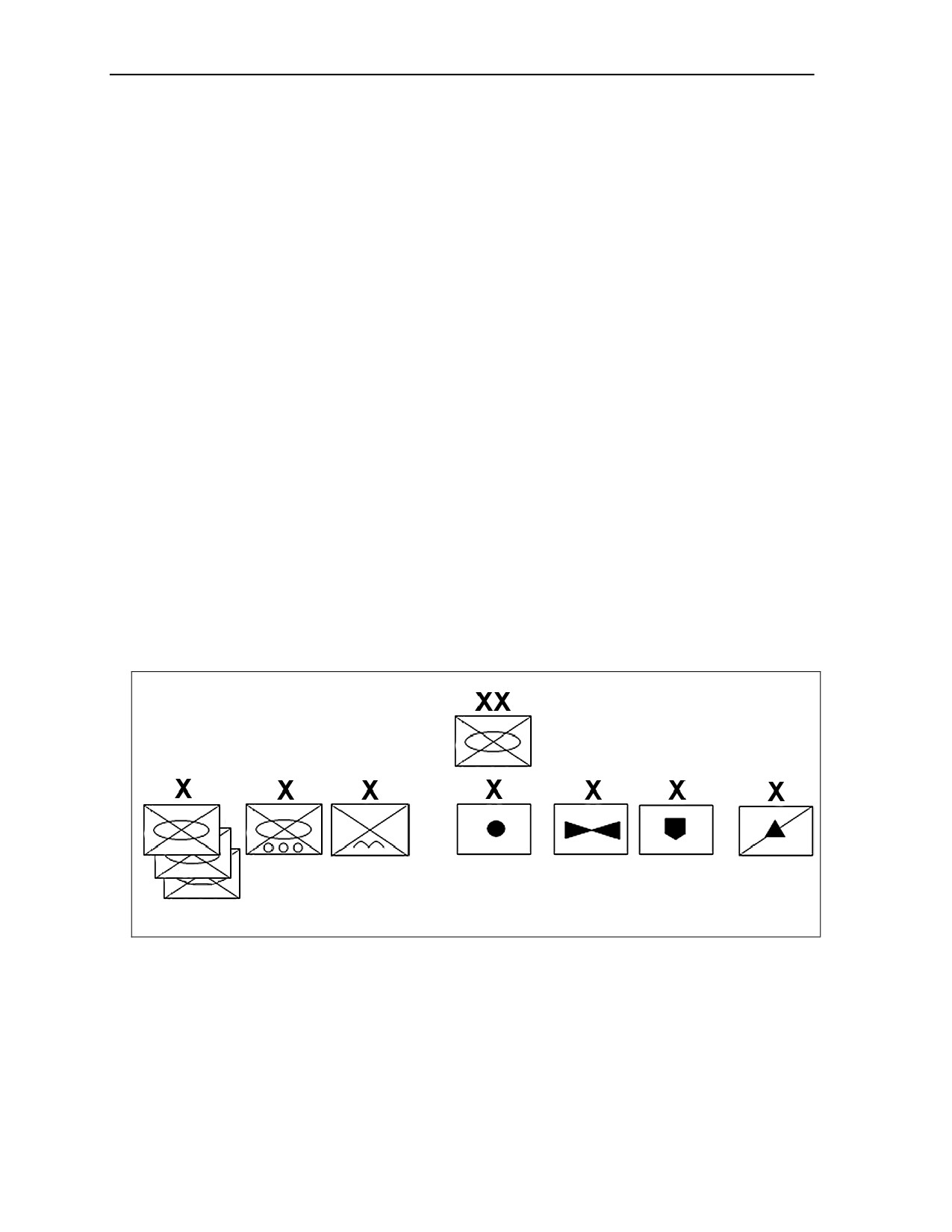
1-47. Figure 1-3 is an example of a division task organization that contains a single MEB. This particular
example does not provide the division with any functional brigades. Units that might be found in functional
CBRN, engineer, military police, or other brigades would likely be task-organized to the MEB. Support
that might be drawn from a functional brigade would likely come from the MEB if the necessary assets
have been task-organized to the MEB.
Figure 1-3. Sample division organization
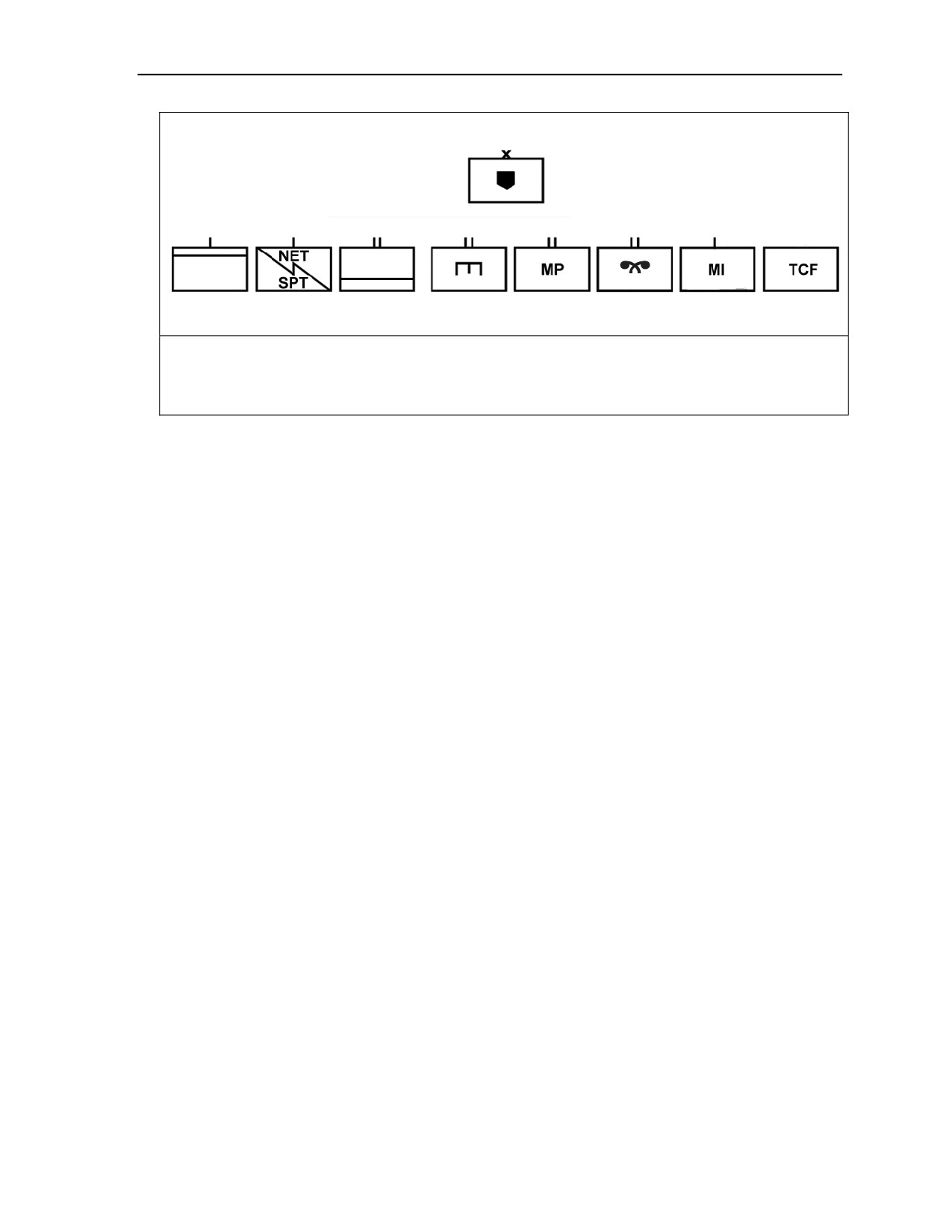
1-48. Figure 1-4 provides an example of the MEB organic units and forces that may be assigned or
attached to the MEB in support of a division. This is only one of the many possible task organizations for
the MEB. In special situations, the MEB may also have EOD and CA units assigned or attached to it.
1-10
FM 3-81
21 April 2014
Mission and Organization
Legend:
MI
military intelligence
SPT
support
MP
military police
TCF
tactical combat force
NET
network
Figure 1-4. Sample MEB organization
1-49. The effectiveness and success of the MEB depends on the synergy that is leveraged from integrating
and synchronizing contributions from attached or OPCON units. Depending on the METT-TC factors,
MEBs can task-organize assigned units into combined arms task forces and company teams. These
combined arms elements can then perform pure functional tasks and maneuver support collective tasks
more effectively and efficiently. The military intelligence unit reflected in figure
1-4 would be
task-organized to the MEB when the METT-TC factors associated with a particular AO require this
augmentation of the MEB, similar to the organic military intelligence companies that are found in all
BCTs. The TCF shown in figure 1-4 could be made up of a variety of maneuver forces, and its actual size
and composition would be based on the Level III threat that it would be focused against. The MEB is not
designed to provide mission command for multiple maneuver battalions.
RELATIONSHIP TO FUNCTIONAL AND OTHER SUPPORT BRIGADES
1-50. Functional brigades and the MEB mostly provide different capabilities to the supported headquarters,
and sometimes both units are required. Mission planning for large operations may determine the need for
functional brigades and one or more MEBs. A functional brigade would be needed with large and complex
functional tasks that require three or more functional battalions. A MEB would be needed to perform
support area operations for the supported headquarters or to perform a multifunctional mission that requires
two or less of each type of functional battalion. For example, when a support area is extremely large, has
brigade level functional requirements, or has a threat that requires a military police brigade, the military
police brigade may be needed to help the MEB secure the support area. The MEB would conduct support
area operations. A similar example would require an engineer brigade to provide mission command for
major construction requirements throughout the support area that is assigned to the MEB.
1-51. The MEB bridges a capability gap between the limited functional units (CBRN, engineer, and
military police) of the BCTs and the more capable functional brigades. This headquarters provides more
functional staff capability than BCTs, but usually less than a functional brigade. The key difference
between the MEB and the functional brigades is the breadth and depth of the MEB multifunctional staff.
The MEB provides complementary and reinforcing capabilities. Based on its task organization and mission,
the MEB can detach functional modular units or combined arms elements (task forces or company teams)
to support the BCTs and, potentially, other multifunctional brigades, providing functional and combined
arms support across the higher headquarters AO.
1-52. The MEB is normally employed when there is a requirement to provide mission command for
combined arms operations that are focused on the primary tasks of conducting support area, maneuver
support operations, DSCA, and stability operations. When the situation changes to require a purely
functional approach or exceeds the MEB mission command, selected functional missions should be
21 April 2014
FM 3-81
1-11
Chapter 1
transferred to functional brigades. Missions that are better performed by functional brigades could
include—
z
Complex CBRN decontamination operations.
z
Major, focused combat and or general engineering operations.
z
Large-scale detainee or resettlement operations (brigade level).
z
Major, integrated military police operations.
1-53. The presence of a CBRN, engineer, or military police brigade does not negate the need for a MEB to
perform other function-related missions within its own AO or potentially at other selected locations within
the division AO.
1-54. The MEB can provide mission command for units in transition as they arrive in the division AO or
are in between task organizations and detach these units to provide added support to BCTs or functional
brigades when needed. The MEB capability to support reception, staging, onward movement, and
integration enables the modular Army to employ assets when and where they are required.
1-55. The MEB may control the terrain where other support or functional brigades are located. They will
synchronize their operations with the other tenant support brigades. The MEB may require capabilities in a
command or support relationship from the other support brigades. The MEB will have some mission
command authority over the tenant organizations within the MEB AO to conduct security and defense; this
may be TACON for security and defense (see chapter 5).
1-56. The MEB complements or reinforces the other support brigades. For example, the MEB can be
expected to coordinate or provide protection of designated sustainment packages or convoys from the
sustainment brigade to the BCTs or other brigades (functional or support) that are in support of the echelon
that the MEB is supporting. The MEB is also dependent on the other support brigades to fill capability gaps
that were identified during mission planning.
MISSION COMMAND
1-57. Mission command is the exercise of authority and direction by the commander using mission orders
to enable disciplined initiative within the commander’s intent to empower agile and adaptive leaders in the
conduct of unified land operations (ADP 6-0). Mission orders leave the how of mission accomplishment to
the subordinates by allowing them maximum freedom of planning and action to accomplish missions.
Successful mission command results from subordinate leaders exercising disciplined initiative to
accomplish missions within the commander’s intent. Mission command requires an environment of trust
and mutual understanding.
1-58. MEB commanders allocate appropriate resources to subordinates to enable them to accomplish their
missions. When conditions change, commanders may change the—
z
Priorities.
z
Tasks to subordinates.
z
Task organization.
z
Resource allocation.
1-59. If commanders determine that they lack sufficient resources, they request additional support. If
additional resources are not available, commanders execute sequential operations. Commanders must also
consider information a resource and share it through all levels of their command using personal leadership
and the unit information systems.
1-60. Each MEB headquarters begins with the same basic organization structure, staffing, and capabilities.
The personality of the commander, experience of the staff, mission, task-organized units, and staff
augmentation will require each MEB to exercise mission command with some variations. This chapter
discusses the principles and operational concepts of mission command for the MEB. Some procedures for
the MEB must still be developed or refined by units in the field and shared with new MEBs as those units
are formed and prepared for employment. Mission command is applied as described in ADRP 5-0 and
ADRP 6-0. The MEB mission command system supports the commander as the MEB conducts operations.
1-12
FM 3-81
21 April 2014
Mission and Organization
ROLE OF THE COMMANDER
1-61. Commanders are the key to mission command (ADRP 3-0). Commanders assess the situation, make
decisions, and direct actions (ADRP 6-0). The MEB commander’s knowledge, experience, and personality
determine how they interact with their units through mission command. Commander’s understand,
visualize, describe, direct, lead, and assess. Mission command describes the commander’s role in the
operations process. Commanders decide what they need to do and the best method to use. They lead their
units through the operations process. Commanders drive the process through mission command.
1-62. MEB commanders establish a command climate for units, prepare them for operations, command
them during operations, and continually assess subordinates. Commanders use the warfighting functions to
help exercise mission command.
Plans
1-63. The MEB routinely conducts planning with higher, lower, adjacent, supported, and supporting
headquarters and interagency organizations. The commanders and staff ensure that the MEB plans are
properly synchronized with the other organizations.
1-64. Commanders should look for disconnects or disagreements between their staff and the other staffs.
These frequently occur due to different situational understanding and perspectives. The executive officer
should try to resolve these differences, and then the commander should discuss them with the other
headquarters commander or leader as the two staffs work together to develop plans and orders.
Risk
1-65. Commanders may assess, evaluate, and decide when to accept prudent risk to create opportunities to
achieve decisive results. Risk is an element of operational art (see ADRP 5-0). The MEB will often be
required to accept operational or tactical risk somewhere to increase support elsewhere—to balance effort
between support area operations and maneuver support operations. The MEB can mitigate this risk by
developing branches and sequels and by providing subordinate commanders. Missions must be prepared so
that the MEB is better prepared to react to planned and unplanned events and opportunities and changing
mission priorities. The be-prepared planning effort increases the mental and organizational agility needed
to respond to inevitable changes.
1-66. The MEB can mitigate some tactical risks by shifting resources, changing priorities, phasing or
sequencing operations, reducing subordinate unit assigned tasks or AO size, and deciding where to assume
risk when required. (See ADRP 3-90, ADRP 6-0, and FM 5-19 for more information on risk management.)
1-67. The MEB must be proficient in mission command and the supporting tasks that are part of the
operations process, which include—
z
Planning.
z
Preparing.
z
Executing.
z
Assessing.
MISSION COMMAND SYSTEM
1-68. The mission command system enhances the commander’s ability to conduct operations.
Commanders organize a mission command system to—
z
Support the commander’s decisionmaking.
z
Collect, create, and maintain relevant information and prepare knowledge products to support
the commander’s understanding and visualization.
z
Prepare and communicate directives.
21 April 2014
FM 3-81
1-13
Chapter 1
z
Establish the means by which commanders communicate, collaborate, and facilitate the team
functions.
z
Provide the following:
Personnel.
Networks.
Information systems.
Processes and procedures.
Facility and equipment.
Note. See ADRP 6-0 for a detailed description of the components of a mission command system.
1-69. The maneuver control system supports the commander by performing three functions, which
include—
z
Creating and maintaining the common operational picture.
z
Supporting decisionmaking by improving its speed and accuracy.
z
Supporting preparation and communication of information.
1-70. The MEB headquarters may be used as an additional division CP or to reinforce one. The breadth
and depth of the MEB mission command system provides it with the capability to be colocated or linked
with a division command group and control some division operations. An example would be a deliberate
division gap (river) crossing operation under the mission command of a deputy commanding general using
the mobile command group and the MEB main CP. A similar example would be a complex passage of
lines. Depending on the operation complexity, this may be the only mission that the MEB could support
during that time frame.
1-71. The commander decides how to use the MEB deputy commanding officer and executive officer.
Considerations include the personalities, individual strengths and weaknesses, and the unit mission. The
commander uses the deputy commanding officer to help command, giving the MEB the ability to have the
commander continuously available in the main CP or to command a separate operation. The commander
may use the deputy commanding officer to provide mission command-specific areas within the MEB so
that the commander may focus elsewhere. The executive officer normally performs the role of chief of staff
in the main CP.
Personnel
1-72. This section includes organization of the staff for mission command. The staff operates the
commander’s mission command system (see ADRP 6-0). The MEB staff sections are normally distributed
among the following mission command organizations:
z
Command groups.
z
Tactical CP.
z
Main CP.
1-73. The MEB commander organizes the staff within each CP to perform essential staff functions to aid
them with planning and controlling operations. Enhanced CP capabilities allow the commander to maintain
CP functionality, regardless of the spatial positioning of the staff. The modularized design of each function
(maneuver, maneuver support, protection, information collection) provides commanders with the flexibility
to tailor their CPs based on their assessment of the current and future situation.
1-74. These mission command organizations are normally positioned within the MEB AO to maintain
flexibility, redundancy, survivability, and mobility. The BSB CP, while not a MEB level CP, performs
functions that have a significant impact on MEB operations. Accordingly, the BSB staff is often closely
involved in parallel or collaborative planning with the MEB CPs.
1-14
FM 3-81
21 April 2014
Mission and Organization
Command Post Organizations
1-75. The MEB commander may organize command groups, tactical CPs, and a main CP as follows:
z
The command section consists of the commander and selected staff members who accompany
commanders to enable them to exercise mission command away from a CP.
z
A unit or subunit headquarters where the commander and the staff perform their activities is a
command post. The CPs are the principal facilities that commanders use to control operations;
they are CPs regardless of whether commanders are present.
1-76. The MEB may use command groups to observe critical events and direct the mission command of
MEB operations. The command groups are not permanent organizations and are organized based on
mission requirements.
Command Section
1-77. Command Group 1 is for the commander, and Command Group 2 is for the deputy commanding
officer organization. The command groups are formed anytime the MEB commander or deputy commander
relocates to control the operation. They will be equipped to operate separately from a CP when
commanders or their deputy commanders must locate to influence operations with rapid decisions and
orders. The commander will determine the command group location.
1-78. The commander chooses how often to control operations with the command group and positions it at
the decisive point to observe, influence, sense, and ensure communications. The deputy commanding
officer’s command group complements the commander’s command group in the direction of MEB mission
command. Command Group 2 is organized as the MEB commander requires it to control an operation or if
the commander needs an additional senior leader presence to influence the operations with rapid decisions
and orders. The deputy commanding officer uses the same considerations as commanders in positioning
their command groups in the AO.
1-79. The commander may control operations from the command group and locates near the most critical
event, normally with the main effort CP. From this location, the commander is better able to observe
critical events, maintain communications, and sense operations. Despite the increased capability provided
by the maneuver control system, command remains a personal endeavor and often requires a commander’s
on-site assessment and leadership. Commanders should leverage the maneuver control system to allow
adequate capabilities within the CP physical view of subordinates and terrain without affecting their
decisionmaking ability. Commanders consider the following in determining their location in the AO:
z
Maneuver control system network linkage to make timely decisions, including the ability to
judge force progress, condition, and morale. Within technical limitations, communications
systems adapt to the needs of the commander, not vice versa.
z
Time and location of critical events and decision points that have the greatest impact on mission
accomplishment. Ideally, commanders select a location where they can observe the conditions
that aid in making a critical decision.
z
Command group security, including the commander’s personal protection.
Tactical Command Post
1-80. The tactical CP contains a tailored portion of the MEB headquarters to control current operations.
When METT-TC factors do not permit the commander access to the main CP and the main CP is moving,
the tactical CP is established when the commander must be positioned away from the main CP location for
an extended period. The tactical CP focuses on assisting the commander with the mission command of
current operations. It is commander focused and execution-centric. The MEB S-3 is responsible for the
tactical CP according to the commander’s guidance.
1-81. Tactical CP functions depend on connectivity to the main CP. The organization of the tactical CP is
smaller and more austere than the main CP. Its connectivity to the more robust main CP by way of the
maneuver control system suite of systems allows for efficient collaboration to ensure that it gets the
required information necessary for the commander’s decisionmaking process. The tactical CP can execute
21 April 2014
FM 3-81
1-15
Chapter 1
collaborative, distributed, and simultaneous decisionmaking to translate the decision to action. This allows
rapid decisionmaking that is focused on current operations.
Main Command Post
1-82. The main CP contains the portion of the MEB headquarters in which the majority of planning,
analysis, and coordination occurs. The main CP is the commander’s primary mission command facility.
The MEB executive officer normally supervises the staff activities and functions of the main CP. It
operates from a relatively secure location and moves as required to maintain mission command of the
operation. The main CP integrates and synchronizes the conduct of MEB operations and the staff mission
functions of—
z
Information collection.
z
Planning.
z
Sustainment.
z
Mission command, communications, and computers.
1-83. The main CP monitors operations, coordinates with higher and adjacent units, and provides an in-
depth analysis of information and intelligence to provide recommendations to the commander. If the
tactical CP is not employed, the main CP controls tactical operations. The main CP is the focal point for
intelligence operations in the MEB and provides situational understanding to the commander. The main CP
monitors and anticipates the commander’s decision points and critical information requirements.
Early-Entry Command Post
1-84. An early-entry CP contains tailored portions of the MEB headquarters for a specific mission over a
specific time. It normally includes members of the tactical CP and additional planners, intelligence
analysts, liaison officers, and others as required. The MEB modified table of organization and equipment
does not provide the unit with a stand-alone, early-entry CP. Since the brigade may be one of the first to
deploy into an AO, it should consider establishing an early-entry CP.
1-85. The early-entry CP allows a small part of the headquarters to deploy early into the AO, establish an
initial mission command presence, link up with other organizations, assess the situation on the ground to
refine plans, and prepare for brigade arrival. The early-entry CP would allow continuous mission command
of the MEB mission as the brigade deployed into the AO. The early-entry CP could accept mission
command of other early-entry units that will be part of the MEB as they enter the AO. The early-entry CP
is typically an ad hoc and temporary mission command arrangement.
Brigade Support Battalion Command Post
1-86. The BSB CP synchronizes sustainment support for the MEB. Improved capabilities (such as the
Combat Support System-Very Small Aperture Telecommunication Satellite System, Sustainment Mission
Command System, and Movement Tracking System) allow the battalion to manage sustainment across the
battlefield. The BSB CP allows seamless communication and provides a common operational picture for
the MEB commander and staff and the supporting sustainment brigade. If necessary, MEB sustainment
staff (S-1, S-4, and surgeon), may locate portions of their sections with the BSB CP.
1-87. The BSB CP performs the following functions for the MEB:
z
Battle tracking to anticipate support requirements.
z
Convoy movement within the brigade area and coordination of movement with other units of the
brigade.
z
Organization of casualty evacuation, retrograde serviceable and unserviceable equipment, and
provides sustainment support to detainees.
z
Coordination with the sustainment brigade for mortuary affairs support.
z
Replenishment operations with the sustainment brigade.
z
Sustainment support to detainee operations.
z
Liaison, as required, to the main CP to support the logistics section.
1-16
FM 3-81
21 April 2014
Mission and Organization
Liaison Officer
1-88. The MEB provides liaison, when required, to designated division, corps, and special operations
forces and joint, interagency, and multinational units in the AO to ensure effective coordination between
the designated unit and the MEB. The liaison officers convey information and its meaning and context
through interpretation and explanation. It is essential to have a liaison officer at the immediate higher
headquarters during plan and order development to help their staff fully understand the MEB capabilities
and limitations and how to best employ it. After the higher headquarters is more familiar with the MEB, the
liaison officer can be reassigned. At times, the MEB may need to provide a liaison officer to a unit that
receives significant assets from the MEB in a command or support relationship. Other units in the MEB
AO may need to provide liaison officers to the MEB to coordinate their operations. As the MEB lacks
dedicated liaison officers, officers and noncommissioned officers from staff sections will need to be
detailed to the liaison officer duties when required.
Succession of Command
1-89. The succession of command occurs automatically on the death, capture, or evacuation of the brigade
commander. It also occurs when communications are lost with the commander for an extended period of
time. The brigade must treat the succession of command as a type of drill. The MEB should establish a
standing operating procedure and consider METT-TC factors and other relevant considerations when
determining the succession of command.
1-90. All leaders must understand the procedures that are required for a quick, smooth succession. The
following is a logical succession of command:
z
Brigade commander.
z
Deputy commanding officer.
z
BSB commander.
z
Brigade S-3.
System Functions and Organization
1-91. Commanders cannot exercise mission command alone. The mission command system enhances the
commander’s ability to conduct operations. Commanders organize a mission command system to support
the commander’s decisionmaking by—
z
Collecting, creating, and maintaining relevant information and preparing knowledge products.
z
Preparing and communicating directives.
z
Establishing the means by which commanders and leaders communicate, collaborate, and
facilitate teams.
z
Supporting the commander’s decisionmaking.
1-92. To provide these overlapping functions, commanders arrange the following components of their
mission command system:
z
Personnel.
z
Networks.
z
Information systems.
z
Processes and procedures.
z
Facilities and equipment.
Note. See ADRP 6-0 for more information on functions.
1-93. The Army supports information operations through inform and influence activities and cyber
electromagnetic activities and the integration of information-related capabilities. Cyber electromagnetic
activities are considered information-related capabilities when leveraged to influence a cognitive outcome
and they must be synchronized and integrated with inform-and-influence activities. The MEB conducts the
21 April 2014
FM 3-81
1-17
Chapter 1
staff tasks of inform and influence activities and cyber electromagnetic activities in the mission command
warfighting function (see FM 3-13).
1-94. Information management uses procedures and information systems to collect, process, store, display,
and disseminate information. (ADRP 6-0). It is a continuing activity that the MEB must perform.
1-95. Proper information management ensures that MEB commanders receive the information they need to
make timely decisions. It consists of relevant information from the mission command system. The
commander and staff must understand how to avoid potential information overload while developing
situational understanding within the MEB. Well-structured standing operating procedures assist the
commander and staff by rapidly conveying the necessary information within the MEB.
1-96. The executive officer is responsible for information management within the MEB. The executive
officer outlines responsibilities and supervises staff performance in collecting and processing relevant
information. During operations, the executive officer ensures that staff members understand and support the
commander’s critical information requirements. The executive officer ensures that staff members
understand the requirements, review incoming and outgoing information traffic, and understand the
procedures for informing the commander and other designated staff officers of critical or exceptional
information.
Note. The MEB uses the Army operations process to conduct operations. See the section below
and chapters 3 through 5 for more information.
1-97. The MEB typically develops standardized battle drills to respond to episodic events during CP
operations. The MEB develops standing operating procedures for integrating task-organized units and staff
augmentees and highlights those tasks that are associated with support area, maneuver support, and
stability.
1-98. The MEB uses the maneuver control system. The CP is established using organic equipment in a
field environment or within fixed facilities if available.
EXERCISE OF MISSION COMMAND
1-99. The MEB commander must place the maneuver control system into action. Exercising mission
command is dynamic throughout the operations process, as shown in the following:
z
The MEB must prepare to perform all four actions simultaneously, with the commander at the
center of the process. Planning, preparing, executing, and assessing mission command occur
continuously in operations, but it is not necessary that they occur sequentially.
z
The operations process is execution-focused rather than planning-focused. The maneuver control
system compresses planning to allow more time to focus on execution. The maneuver control
system does this in two ways.
The maneuver control system allows better collaborative and parallel planning among
echelons within the MEB.
The maneuver control system provides a more accurate common operational picture,
allowing forces to execute faster with less detailed planning.
OPERATIONS PROCESS
1-100. The MEB uses the operations process, which consists of the major mission command activities
performed during operations (planning, preparing, executing, and continuously assessing the operation)
(see ADRP 5-0). The operations process supports the MEB requirement to balance efforts across what will
likely be multiple missions. Some of these missions are conducted sequentially, while others are conducted
simultaneously. Changes in the scope and focus of each operation are likely to occur during mission
execution, and the MEB must be prepared to transition to support the unit needs of the unit to which it is
attached or OPCON.
1-18
FM 3-81
21 April 2014
Mission and Organization
Note. The MEB uses Army planning processes. The standard Army planning processes and staff
functions are contained in ADP 6-0, ADRP 5-0, and ADRP 6-0; and they apply to all operations.
MEB operations demand an integrated combined arms approach. The MEB performs tactical
level planning even when attached or OPCON to an operational-level headquarters.
1-101. The MEB should understand joint planning processes when their controlling headquarters is a joint
task force and the national planning processes occur during DSCA. When a MEB is directly subordinate to
a joint task force, it may participate in joint operations planning and receives joint formatted orders. The
MEB could also support joint planning under a division or corps supporting a joint task force, but it would
use the Army planning process and the five-paragraph field order format for its internal orders (see ADP
6-0). The MEB staff may participate in joint contingency or crisis action planning. MEB leaders should
understand the joint planning process and be familiar with the joint format for plans and orders (see JP 5-0
for additional guidance on joint operations planning and the preparation of joint plans and orders).
1-102. The MEB conducts operations to shape the operational environment, lower the violence level, set
favorable conditions for conducting subsequent operations and tasks, and enhance the freedom of action for
the supported force.
Military Decisionmaking Process
1-103. The MEB uses the operations process to critically think about how to conduct its operations. The
MEB routinely conducts parallel and collaborative planning with subordinates and higher headquarters (see
ADRP 5-0). Throughout the planning process, the MEB staff may need to advise supported commanders
and their staffs about MEB capabilities, employment methods, and possible capabilities shortfalls. The
MEB may also need to provide planning support to units without embedded functional staff capabilities
(such as construction engineering) and are resident in the MEB staff that might otherwise only be available
through reachback. The MEB staff will use the automated tools and systems of their functional areas.
1-104. The large number of essential tasks that are developed during the military decisionmaking process
for the MEB may be grouped into larger, doctrinally approved tasks in the restated mission. Any
nondoctrinal terms used must be defined to reduce confusion. The commander’s intent and concept of the
operation can provide details (see ADRP 5-0).
1-105. Intelligence preparation of the battlefield remains the same for all types of military operations;
however, its focus may change depending on the predominant type of operation or primary focus of the
unit. The required products for portraying the information may also change based on the type of operation
or unit focus. In addition, civil considerations have assumed an importance on a par with the enemy and
environment for all types of operations. Intelligence preparation of the battlefield products must provide
enough detail for commanders and staffs to make informed decisions.
1-106. Because of the current limited organic information collection capabilities of the MEB, the staff
must carefully develop the information collection plan and set priorities to gain critical information first.
Additional assets may be attached or provided to the MEB to accomplish the information collection
mission when the MEB is responsible for an echelon support area.
1-107. The MEB may use planning in a time-constrained environment as a tool to make decisions and
rapidly resynchronize forces and warfighting functions when presented with opportunities or threats during
execution (see ADP 6-0). Planning in a time-constrained environment seeks an acceptable solution, while
the military decisionmaking process seeks the optimal one.
1-108. The MEB staff balances the time to plan at the brigade level and allows subordinates time to plan
and prepare. Parallel planning, collaborative planning, and warning orders help subordinate units and staffs
prepare for new missions by providing them with maximum time. MEB subordinate units without staffs use
troop-leading procedures to prepare for a mission (see ADP 6-0).
Operational and Mission Variables
1-109. The MEB analyzes the Army operational variables to frame operational problems and to
understand the context of how the MEB conducts its operations and how it complements the application of
21 April 2014
FM 3-81
1-19
Chapter 1
combat power for other units. The information from the operational variables analysis is used during MEB
mission analysis. The variables analysis uses mission variables as a framework for detailed mission
analysis. When used together, mission and operational variables help commanders visualize their situation.
Based on mission variables analysis, the MEB will be task-organized with additional capabilities to meet
mission requirements. If assigned units and tasks exceed the organic capability of the MEB staff, staff
augmentation may be necessary to provide mission command for the mix of units and capabilities that are
task-organized to the MEB.
Considerations
1-110. This section discusses the general considerations that apply to MEB operations. Detailed
considerations are discussed in chapters 3 through 5.
Plan
1-111. The MEB must conduct its operations in collaboration with higher, lower, and adjacent units. The
MEB conducts a broad range of tasks in decisive actions, with a broad range of task-organized units and
capabilities. This requires the MEB to conduct integrated, synchronized planning and to balance the effort
across several operations. It must integrate several major simultaneous operations. It must integrate the
functions, activities, processes, staffs, and the units, tasks, systems, and capabilities of numerous Army
branches and joint, interagency, and multinational forces (often into combined arms teams) to conduct
complex operations. The MEB must integrate planning with its higher headquarters, planning processes,
staff sections, warfighting functions, directorates, centers, and boards. It must integrate with supported
units. It must integrate plans, measures, actions, and activities. The MEB commander, staff, and liaison
officers contribute to this integrated-planning effort.
1-112. MEB systems are joint-interdependent, and the brigade routinely employs joint capabilities. The
MEB integrates joint capabilities that complement Army assigned capabilities to accomplish tactical
objectives. The MEB can integrate Joint fires when augmented with a tactical air control party. In the
absence of a tactical air control party, the MEB can plan for joint fires; however, these must be nominated
to the higher-echelon fires plan for support within the air tasking officer cycle.
1-113. ADRP 5-0 and ADRP 6-0 discuss integration in its various forms and the many things that must be
integrated during planning. ADRP 3-0 discusses the integrating processes to synchronize operations during
operations process activities. The integrating processes and continuing activities must be synchronized with
each other and integrated into the overall operation, to include—
z
Intelligence preparation of the battlefield (see FM 2-01.3).
z
Targeting (see FM 3-60).
z
Information collection (see FM 3-55).
z
Risk management (see FM 5-19).
z
Knowledge management (see FM 6-01.1).
z
Inform and influence activities (see FM 3-13).
z
Cyber electromagnetic activities (see FM 3-36).
1-114. The MEB commander considers mutual support when task-organizing forces, assigning AOs, and
positioning units. Mutual support is that support which units render each other against an enemy, because
of their assigned tasks, their position relative to each other and to the enemy, and their inherent capabilities.
(JP 3-31). In Army doctrine, mutual support is a planning consideration that is related to force disposition,
not a command relationship. The concept of mutual support is useful to plan maneuver support operations
and to support area operations. Mutual support can be between MEB units, between units in the echelon
support area, or between MEB units and supported units (see ADRP 3-0). The MEB uses mutual support
between base camps to conduct base cluster security and defense when assigned the responsibility for an
echelon support area (see chapter 3).
1-20
FM 3-81
21 April 2014
Mission and Organization
Prepare
1-115. Backbriefs and rehearsals occur during preparation. They are essential to ensure that those
responsible for execution have a clear understanding of the mission, commander’s intent, and concept of
operations. Most MEB operations are executed at the battalion level and below. However, some operations
may require a MEB level rehearsal. The MEB conducts the brigade combined arms, sustainment
information collection, and fire support rehearsals (when assigned an AO) after subordinate battalions or
base camp and base cluster commanders have had an opportunity to issue operation orders. These
rehearsals ensure that subordinate plans are synchronized with those of other units and that subordinate
commanders understand the intent of the higher headquarters. Usually, the MEB commander, deputy
commanding officer, executive officer, primary staff, and subordinate battalion commanders and their S-3s
attend the rehearsals. Based on the type of operation, the commander can modify the audience, such as the
brigade attachments. (See ADP 6-0 for a detailed discussion on rehearsals.)
1-116. The MEB must establish and disseminate clear, concise ROE or rules for the use of force as
required before deploying to the AO. Classes and other training sessions, backbriefs, and rehearsals help
ensure that everyone understands the ROE and rules for use of force since small-unit leaders and individual
Soldiers must make ROE and rules for the use of force decisions promptly and independently.
1-117. Key preparation activities (see ADP 6-0) include—
z
Assessment.
z
Reconnaissance operations.
z
Security operations.
z
Protection.
z
Plan revising and refining.
z
Coordination and liaison.
z
Rehearsals.
z
Task organizing.
z
Training.
z
Movement.
z
Preoperations checks and inspections.
z
Logistic preparations.
z
New Soldiers and units integration.
Execute
1-118. Execution is putting a plan into action by applying combat power to accomplish the mission (ADP
5-0). Execution uses situational understanding to assess progress and make and adjust decisions. It focuses
on concerted action to seize, retain, and exploit the initiative. The Army operational concept emphasizes
executing operations at a tempo in which enemies cannot match by acting or reacting faster than they can
adapt. To achieve this type of flexibility, commanders use mission command to focus subordinate
commanders’ initiative. Subordinates who exercise initiative within the commander’s intent can
significantly increase tempo. Even relatively minor, planned actions by CP cells affect other cell areas of
expertise, affecting the overall synchronization of the operation.
1-119. Collaborative synchronization—enabled and expected by mission command—uses individual
initiative to achieve resynchronization continuously. The success of subordinates may offer opportunities
within the concept or develop advantages that make a new concept practical. The commander’s intent
keeps the force acceptably focused and synchronized. Subordinates need not wait for top-down
synchronization. Mission command enables subordinates to develop the situation. Through disciplined
initiative in dynamic conditions within the commander’s intent, subordinates adapt and act decisively.
1-120. The current operations cell follows and provides its own level of collaborative synchronization. To
assist commanders in massing the effects of combat power at decisive times and places, the current
21 April 2014
FM 3-81
1-21
Chapter 1
operations cell considers the following outcomes when making synchronization decisions or allowing
others collaborative synchronization to proceed:
z
Combined arms integration.
z
Responsiveness—proactive and reactive.
z
Timeliness.
1-121. Execution involves monitoring the situation, assessing the operation, and adjusting the order as
needed. Throughout execution, commanders continuously assess operation progress based on information
from the common operational picture, running estimates, and assessments from subordinate commanders.
When the situation varies from the assumptions that the order was based on, commanders direct
adjustments to exploit opportunities and counter threats.
1-122. The MEB unit commander’s staff and the subordinate commander’s staff assist the commander in
execution through the integration processes and continuing activities during execution (see ADRP 3-0). In
addition, commanders who are assisted by the staff perform the following execution-specific activities:
z
Focus assets on the decisive operation.
z
Adjust commander’s critical information requirements based on the situation.
z
Adjust control measures.
z
Manage the movement and positioning of supporting units.
z
Adjust unit missions and tasks as necessary.
z
Modify the concept of operations as required.
z
Position or relocate committed, supporting, and reserve units.
z
Determine the commitment of the MEB reserve (becomes the main effort and decisive point of
the brigade).
1-123. Key execution activities (see ADRP 6-0) include—
z
Assessing the current situation and forecasting progress of the operation—monitor operations
and evaluate progress.
z
Making execution and adjustment decisions to exploit opportunities or counter threats.
z
Directing actions to apply combat power at decisive points and times—synchronize and maintain
continuity.
z
Balancing effort and risk among competing tasks.
Assess
1-124. Assessment is the continuous monitoring and evaluation of the current situation, particularly about
the enemy and operation progress. Assessment occurs during planning, preparation, and execution. Initial
assessments are made during planning and continually updated. Assessment involves monitoring and
evaluating the operational environment and the progress of operations using measures of effectiveness.
Continuous assessment involves situational understanding, monitoring, and evaluating (see ADRP 6-0).
(See ADP 6-0 for tactics, techniques, and procedures to assess operations and for a discussion on
monitoring and evaluating.)
1-125. The running estimate is a staff section’s continuous assessment of current and future operations to
determine if the current operation is proceeding according to the commander’s intent and if future
operations are supportable. The running estimate format parallels the steps of the military decisionmaking
process and serves as the primary tool for recording assessments, analyses, and recommendations for a staff
section.
1-126. The commander and staff perform an initial assessment of mission variables at the start of planning
and continuously update the assessment and support it with running estimates maintained by each staff
section.
1-127. The commander and staff assess operation progress, new information, and condition changes to
revise plans. On-site assessments are essential to validate intelligence preparation of the battlefield, assess
subordinate understanding of orders, progress, preparations, and combat readiness. The MEB anticipated
1-22
FM 3-81
21 April 2014
Mission and Organization
branches and sequels, initially formulated during the planning stage, are assessed and updated for possible
execution. The staff can adjust the plan within their area of expertise.
1-128. Assessment precedes and guides every activity in the operations process and concludes each
operation or phase of an operation. It involves a comparison of forecasted outcomes to actual events, using
measures of effectiveness and measures of performance to judge progress toward success. It entails two
distinct tasks—continuously monitoring the situation and progress of the operation toward the
commander’s desired end state and evaluating the operation against measures of effectiveness and
performance as defined below:
z
A measure of effectiveness is a criterion used to assess changes in system behavior, capability, or
operational environment that is tied to measuring the attainment of an end state, achievement of
an objective, or creation of an effect (JP 3-0). Measures of effectiveness focus on the results or
consequences of friendly actions taken. Measures of effectiveness determine if the rights right
things are being done, or are additional or alternative actions required.
z
A measure of performance is a criterion used to assess friendly actions that is tied to measuring
task accomplishment (JP 3-0). Measures of performance confirm or deny that things have been
done correctly. Measures of performance determine if the task or action was performed as the
commander intended.
TRANSITIONS
1-129. Transitions between missions and operations have the potential to be challenging. The design of
the MEB optimizes its ability to deal with transitions. The design of the staff and the typical augmentation
that is received by the MEB are those elements that are critical to performing maneuver support operations
and the tasks associated with stability or DSCA.
1-130. The MEB may hand over all or some of its AO to other military forces, governmental agencies,
nongovernmental organizations, or local authorities as stability is achieved. This transfer is similar to a
relief and must be carefully planned, coordinated, and executed with the relieving force or agency. The
MEB may also transition only some sectors to local authorities.
1-131. Transitions may be a continuation of an ongoing operation, an execution of a completely new
tactical mission, or a logistics resupply operations. Increased flexibility and agility are afforded by
improved situational awareness, and collaborative mission command tools facilitate transitions to the next
mission without halting to conduct extended decisionmaking processes. With increased capability to affect
the enemy over a larger area of influence, the MEB can begin setting the conditions for the next
engagement during the transition from the last mission.
1-132. The MEB facilitates rapid transition between operations for the unit that it is supporting. The
ability of the MEB to rapidly transition denies the enemy an opportunity to recover, regroup, and conduct
preparations. Similarly, it allows commanders to quickly deal with consequences that arise out of tactical
action, precluding its growth into a separate operational requirement. The MEB normally conducts combat
replenishment operations as part of transitional activities. This series of tactical sustainment operations will
continue until the supported commander’s cycle of operations accommodates a transition to a mission
staging operation and a subsequent MEB mission change.
TASK ORGANIZATION AND STAFF AUGMENTATION
1-133. The MEB may receive staff augmentation, units, and capabilities based on task requirements
identified during mission analysis; or it may receive units that require temporary mission command. The
units that require temporary mission command may not be needed during the current phase of the
operation. These units may be task-organized to another unit for employment and task-organized back to
the MEB while awaiting their next mission.
1-134. The MEB commander is responsible for ensuring that the organic and task-organized forces of the
brigade are combat-ready and properly integrated into existing MEB formations. The MEB should develop
standing operating procedures for attaching and detaching units and small teams.
21 April 2014
FM 3-81
1-23
Chapter 1
1-135. Task organization may be a more significant effort for the MEB than most units. This is due to the
large number and range of specified and implied tasks for the MEB; the lack of organic units; the wide
range of assigned, attached, or OPCON units; and the variety of operations that it must conduct (see ADRP
5-0).
1-136. Based on METT-TC, the MEB may form battalion task forces and company teams (see chapter 3
and chapter 4) or employ functional units. Some considerations for MEB task organization include—
z
A mission with a broad range of tasks (multifunctional), and uncertain or quickly changing
requirements, that are geographically spread out with a desire to minimize unit travel to mission
sites may be better performed by a battalion task force or company team.
z
A mission with mostly functional task requirements and a long duration. A mission that is
conducted within a smaller area and where other capabilities may be integrated without changing
the task organization may be better performed by functional units rather than a battalion task
force or company team. (See ADRP 3-0 for further discussion on supporting range and distance.)
Decide what to retain under MEB control and what to allocate to each subordinate based on
METT-TC.
z
Forces that are under brigade control give the commander flexibility to shift or mass resources
without affecting forces that are task-organized to subordinates.
z
The assigned command and support relationships increase responsiveness to subordinate or
supported units or limit the MEB commander’s flexibility or agility in shifting resources.
z
Considerations should be made on weighing the MEB decisive operation and support the higher
headquarters decisive operation.
z
Considerations should be made on response times to detach forces, attach forces, and prepare
forces for new tasks when directing the execution of the task organization changes to
subordinates.
z
It is much easier to change task organization upon immediate mission completion or changes in
operation phases.
z
The MEB should expect to change task organization frequently and rapidly to meet changes that
are based on METT-TC.
Training Attachments
1-137. Because the MEB has few organic units, there is a high-frequency requirement to train attached
units and small teams and occasionally augment staff expertise to understand the units or capabilities it will
be receiving, plan for their integration, and provide mission command for their use and sustainment within
the MEB. The MEB staff must also be trained to properly conduct operations that employ the capabilities
that are provided by these attachments. The MEB staff may also require augmentation to accomplish
nonstandard missions. Successful maneuver support operations depend on MEB ability to integrate
functionally organized units, task-organize them as needed, and employ them during unified land
operations. The MEB must train on requesting and leveraging pooled Army and joint capabilities as
necessary.
1-138. The MEB provides training to assigned, attached, and OPCON units on the MEB standing
operating procedures; maneuver support operations; and security and defense tactics, techniques, and
procedures. Units within the MEB AO that are attached or TACON for security will be trained on security
tactics, techniques, and procedures and incorporated into MEB defensive plans.
Planning
1-139. The MEB optimizes the employment of assigned, attached, OPCON, or TACON Army forces and
joint, interagency, and multinational assets by ensuring that the respective staffs integrate plans and
operations. The MEB staff procedures must include continuous communications with the augmentation
formations to ensure that they understand the commander’s intent. The unity of command, planning, and
standardized communications procedures are essential to successfully execute mission command. The
MEB must plan how it will integrate Army forces and joint, interagency, and multinational assets into its
1-24
FM 3-81
21 April 2014
Mission and Organization
mission command system; share a common operational picture; and achieve high levels of shared
situational awareness.
1-140. The networking interfaces between the MEB and the integration of Army or joint, interagency, and
multinational units require coordination with gaining units and configuration management controls. The
MEB requires established legacy wave forms; a single-channel, ground and airborne radio system, an
enhanced position location reporting system; high-frequency and ultra high-frequency, communications
security keying; and signal operating instructions requirements to maintain voice networks. Internet
protocol routing and server interoperability requires coordinated network configuration management to
ensure the passage of information between the different networks. The use of communication elements
must be coordinated between the MEB and its attached OPCON, TACON, and supported elements.
1-141. In addition, logistics and personnel issues must be coordinated between the MEB and its attached
elements. Personnel and materiel resupply sources must be understood and considered in planning for MEB
operations by elements under its control.
OTHER CONSIDERATIONS
1-142. Joint, interagency, and multinational resources that support the MEB will have different
organizational and operational cultures and procedures. The MEB commander, staff, and units must be
aware of these differences to ensure successful operations. With U.S., joint, and interagency assets, the
differences between the MEB commander and staff culture may not be as great as with multinational
participants, but those differences still require consideration. Other services and civilian agencies may have
different definitions of similar-seeming terms. Common operational expectations and understandings must
be ensured before planning and operations begin.
1-143. With multinational augmentation, the need for ensuring common operational expectations and
understanding increases. The MEB leaders and Soldiers should respect the culture, religions, customs, and
principles of multinational forces. The MEB leaders and Soldiers should also show understanding and
consideration of their ideas to solidify the working relationship. Respect builds confidence, while a lack of
respect leads to friction that may jeopardize mission accomplishment. The MEB personnel must be
proactive in building a mutually beneficial relationship.
1-144. If the MEB is part of a multinational force, the MEB commander must immediately establish
rapport with the senior commanders of the multinational force. Effective liaison is essential to overcome
misunderstandings and misconceptions. Using liaison teams, horizontally and vertically, eliminates
confusion and cannot be overemphasized. Commanders and staffs must learn and understand the
capabilities of multinational forces. Differences in languages and customs may create barriers and tension
that lead to fractures in a multinational force.
1-145. The MEB must develop procedures to share common operational picture information with
multinational forces. While some multinational members may possess the technology to digitally share
information, others may not. Disseminating classified common operational picture information to
multinational partners requires detailed coordination to establish proper protocols. Before sharing
information, the MEB must establish procedures for processing and sharing data. Units must anticipate
what information and intelligence can be exchanged and then obtain the necessary authorizations. When
necessary, intelligence should be sanitized to facilitate dissemination. (See FM 3-16 for working with
multinational forces. See JP 3-08 for working with international organizations.)
COMPLEMENTARY AND REINFORCING CAPABILITIES
1-146. The MEB provides complementary and reinforcing capabilities across the warfighting functions
with support that is primarily focused on the protection, movement and maneuver, and selected sustainment
functions. The MEB uses combined arms to generate combat power and applies it to operations. It routinely
supports divisions and EAD and their subordinate headquarters to generate and maintain combat power.
Based on METT-TC, the MEB may create combined arms battalion task forces or company teams from its
assigned CBRN, engineer, and military police battalions and other units to facilitate operations within its
own AO and in support of other units within the higher headquarters to which it is assigned.
21 April 2014
FM 3-81
1-25
Chapter 1
1-147. Combined arms use complementary and reinforcing capabilities. Complementary capabilities
protect the weaknesses of one system or organization with the capabilities of a different warfighting
function. Reinforcing capabilities combine similar systems or capabilities within the same warfighting
function to increase the overall capabilities of the function. The MEB may use task-organized CBRN,
EOD, engineer, and military police elements
(task forces or company teams) to conduct route
reconnaissance and use military police, engineer, CBRN, and EOD elements to perform various tasks that
are primarily subordinate to the movement and maneuver, protection, and sustainment warfighting
functions. In these examples, the combined arms applications of these elements are complementary and
reinforcing and provide maneuver support operations support to the force as a whole and, specifically, to
the echelon headquarters that they are supporting.
1-26
FM 3-81
21 April 2014
Chapter 2
Support to Decisive Action
Army forces conduct and sustain land operations through the simultaneous
combination of offensive, defensive, and stability tasks or DSCA appropriate to the
mission and environment (see ADP 3-0). This chapter discusses how the MEB
provides support to decisive action and some of the considerations that may be more
important to the MEB than other organizations as mission command activities are
performed during the operation process. This chapter discusses the activities of the
operation process for the decisive action tasks of offense, defense, and DSCA. (See
chapter 5 for information stability tasks.)
COMMANDER AND STAFF CONSIDERATIONS
2-1. The MEB commander and staff use mission command and the operations process defined in ADRP
5-0 to perform the major mission command activities that are performed during operations. Decisive
follows a cycle of planning, preparation, execution, and continuous assessment, with the commander
driving the operations process.
PLANNING
2-2. The MEB uses the operations process to synchronize tasks across the warfighting functions within
the brigade and with its supported higher headquarters. The MEB commander uses the warfighting
functions to assist in exercising mission command.
2-3. The MEB must continually maintain a balance of effort across the decisive action tasks to ensure the
success of the supported headquarters. The MEB must initially allocate resources against the required tasks.
The MEB can request additional capabilities to meet identified shortfalls. When brigade assets will not
allow the simultaneous conduct of all tasks, the MEB must sequence or phase tasks or operations or assume
risk on some tasks by executing them with less than ideal resources. Through continuous assessment, the
MEB adjusts the balance of effort across operations by changing task organization, resource allocation, and
priorities. The MEB can use uncommitted resources to add combat power as necessary. One tool the MEB
can use to maintain balance is a synchronization matrix that tracks MEB resources against the warfighting
functions, operations, tasks, or similar categories. Any tool or process that is used by the brigade to
maintain balance must be flexible and adaptive to continually identify emerging requirements, weigh them
against ongoing efforts, and make necessary changes. The MEB must be responsive when conducting tasks,
assessing risk, and shifting effort between competing requirements. Contingency plans, branches, and
sequels and prepared missions help provide responsiveness. The MEB must develop other techniques or
processes to maintain balance and share lessons learned.
PLANNING CONSIDERATIONS
2-4. The MEB normally conducts support area operations and maneuver support operations in support of
decisive-action operations. The MEB performs tactical-level planning even when attached or OPCON to an
operational-level headquarters. The MEB conducts assessment during planning, to include—
z
Monitoring the operational environment.
z
Monitoring the measures of performance and measures of effectiveness.
z
Evaluating courses of action for their operations and supporting headquarters planning.
21 April 2014
FM 3-81
2-1
Chapter 2
2-5. The commander and staff visualize how to creatively arrange forces and group missions to provide
maneuver support operations in the most effective manner. Maneuver support operations are a combined
arms activity (see chapter 4). The MEB may use lines of effort to help visualize stability and DSCA tasks.
2-6. The MEB must balance support across competing mission areas. The MEB must balance between
detailed and mission command orders (see ADRP 6-0). The support area operations orders may be more
detailed while maneuver support operations orders may be more mission command-oriented (see chapter
1).
2-7. The MEB uses mission variables
(see chapter
1) to support the analysis of the operational
environment and conditions in their designated AO. (See ADRP 3-07 for a more complete discussion of the
relevance of each of these variables to stability tasks.) The initial assessment conducted by the MEB is
continuously updated and supported by running estimates that are maintained by each staff section.
2-8. A major operation is a series of tactical actions (battles, engagements, strikes) that are conducted by
combat forces of a single Service or several Services, coordinated in time and place, to achieve strategic or
operational objectives in an operational area. These actions are conducted simultaneously or sequentially
according to a common plan and are controlled by a single commander.
OPERATIONS PROCESS
2-9. The MEB uses the operations process to critically think about how to conduct its operations. The
MEB routinely conducts parallel and collaborative planning with subordinates and higher headquarters (see
ADP 6-0 and ADRP 5-0). Throughout the planning process, the MEB staff may need to advise supported
commanders and their staffs about MEB capabilities, methods of employment, and possible capabilities
shortfalls. The MEB may also need to provide planning support to those units without embedded functional
staff capabilities (such as construction engineering) that are resident in the MEB staff that might otherwise
only be available through reachback.
OFFENSE
2-10. Operation process activities for offensive tasks are discussed below. Important MEB considerations
are highlighted.
PLAN
2-11. The MEB plans to support division and BCT offensive operations. Routine support may include
support area operations and maneuver support operations. They also may plan limited MEB-controlled
offensive tasks (such as counter or spoiling attacks) as part of defending while conducting support area
operations (see chapter 3).
2-12. The MEB follows ADRP 3-90 when conducting limited offensive tasks within their assigned AO and
is familiar with how the BCT conducts offensive tasks to plan MEB support. The MEB is not structured to
conduct offensive tasks as a brigade. The MEB would provide mission command for offensive tasks
performed by assigned maneuver units and a TCF.
2-13. During offensive tasks, the initial focus of the MEB is typically on movement and maneuver tasks
and then on support to protection tasks and selected sustainment tasks based on the intent and priorities of
the supported forces. The MEB may conduct reconnaissance with their task-organized units or capabilities
as part of maneuver support operations to support the offensive actions of the BCTs. The MEB may also
conduct or provide support to a movement corridor in support of troop movement and logistics
preparations.
2-14. The MEB can form task forces or company teams to support the offensive operations of its supported
headquarters. These organizations may be attached or placed OPCON to BCTs or employed by the MEB to
complement or reinforce maneuver forces across the AO of higher headquarters. The fluid nature of
offensive operations may require adjustments to the initial task organization. Due to the difficulty of linkup
and integration, changes in task organization are best made at battle conclusion or at the end of an operation
phase.
2-2
FM 3-81
21 April 2014
Support to Decisive Action
2-15. The MEB distributes its resources across operations to best meet the supported commander’s intent.
The MEB also distributes its resources across the warfighting functions within an operation. For example,
the MEB will—
z
Allocate resources to provide protection during movement.
z
Enhance the supported BCT mobility within the movement and maneuver warfighting function.
PREPARE
2-16. Detached elements from the MEB must link up and integrate into supported maneuver force combat
formations. The MEB conducts preoperations checks and inspections to ensure readiness before the
detachment of these elements. These detached MEB forces participate in the rehearsals of the supported
forces.
EXECUTE
2-17. The MEB conducts support area operations in the division or EAD support area. The MEB executes
maneuver support operations to support the maneuver commander’s intent. When required, the MEB
conducts DSCA or stability in support of forces that are conducting offensive tasks.
ASSESS
2-18. The MEB continually assesses the balance of effort between mobility and survivability if shaping
operations are setting the intended conditions and the balance between supporting division and corps
offensive tasks and MEB responsibilities within the MEB AO.
2-19. The MEB assesses the offensive tasks, anticipates changes in task organization and priorities, and
balances resource allocation between the tasks to support the decisive operation.
DEFENSE
2-20. This section discusses the activities of the operations process defense tasks. This section highlights
important MEB considerations.
PLAN
2-21. The MEB plans to support division and BCT defensive tasks. Routine support may include support
area operations, maneuver support operations, and incident management. They also may plan limited MEB
controlled defensive tasks as part of the conduct of support area operations or when defending themselves
(see chapter 3).
2-22. The MEB follows the doctrine in ADRP 3-90 when conducting defensive tasks and is familiar with
how BCTs conduct defensive tasks to plan MEB support.
PREPARE
2-23. If the MEB is supporting a division level defense, MEB focus is on defensive operations within its
AO as discussed in chapter 4 of this manual. It is also prepared to provide task-organized assets to support
BCTs in their defensive tasks.
2-24. During defensive tasks, the initial focus of the MEB is typically on protection and then on support to
movement and maneuver and selected sustainment based on the intent and priorities of the supported
forces. The MEB may conduct reconnaissance operations to support the defense. The MEB prepares to
execute area damage control. Depending on the situation, the MEB will continually improve defensive
positions within its AO or relocate some or all of its activities if required by the higher headquarters
defensive plans.
21 April 2014
FM 3-81
2-3
Chapter 2
EXECUTE
2-25. The MEB executes defensive tasks to achieve the supported commander’s intent. The MEB provides
support to the division/EAD defensive tasks and conducts support area operations when assigned an AO.
2-26. When required, the MEB executes incident management operations and area damage control in
support of the supported division or corps conducting the defense.
ASSESS
2-27. The MEB continually assesses its effort to support the defensive efforts of its supported division or
corps, including—
z
The commitment of the MEB reserve or an assigned TCF.
z
The balance of effort between support to movement and maneuver, protection, and sustainment.
z
The balance of effort between self-defense and mission support.
2-28. Each staff section updates the running estimate to ensure that the latest information is available for
the commander to support decisionmaking.
STABILITY
2-29. Stability tasks are tasks that are conducted as part of operations outside the United States in
coordination with other instruments of national power to maintain or reestablish a safe and secure
environment and provide essential governmental services, emergency infrastructure reconstruction, and
humanitarian relief. (See chapter 5 for MEB involvement in stability tasks.)
DEFENSE SUPPORT OF CIVIL AUTHORITIES
2-30. Army DSCA operations are subordinate to, and in support of, domestic civil authorities as they
respond to qualifying disasters and emergencies. The DSCA is defined as support that is provided by U.S.
Federal military forces, Department of Defense
(DOD) civilians, DOD contract personnel, DOD
component assets, and National Guard forces (when the Secretary of Defense, in coordination with the
Governors of the affected States, elects and requests to use those forces in Title 32, U.S. Code, status) in
response to requests for assistance from civil authorities for domestic emergencies, law enforcement
support, and other domestic activities, or from qualifying entities for special events (ADP 3-28).
PLAN
2-31. The roles and responsibilities of the Army for DSCA fall under the following primary tasks:
z
Task 1. Provide support for domestic disasters.
z
Task 2. Provide support for domestic CBRN incidents.
z
Task 3. Provide support for domestic civilian law enforcement agencies.
z
Task 4. Provide other support as required.
2-32. These DSCA tasks can overlap. For example, providing Army support of civil law enforcement
agencies can occur during disaster response or its aftermath. In most cases, a MEB may provide support for
Tasks 1, 2, and 3. The MEB may provide assistance as a unit or as part of a joint task force in support of
lead civil authorities for DSCA (see JP 3-28). The U.S. laws carefully limit the actions that military forces
conduct within the United States, its territories, and its possessions (see ADP 3-28 for information on laws).
The MEB complies with these laws while assisting affected citizens.
2-33. Doctrine on CBRN consequence management is contained in JP 3-0 and JP 3-41. This chapter uses
the task Respond to CBRN Incident for DSCA and area damage control. (Tactical-level doctrine on CBRN
consequence management operations is contained in FM 3-11.21.)
2-34. The MEB is well suited to provide support to civil authorities because it has the most complete
multifunctional staff of any Army brigade. The MEB also has the skills needed to provide mission
command for units that are frequently needed by civil authorities. The MEB is designed to integrate many
2-4
FM 3-81
21 April 2014
///////////////////////////////////////