FM 3-81 MANEUVER ENHANCEMENT BRIGADE (APRIL 2014) - page 2
Support to Decisive Action
of the types of units that have the greatest applicability in support to DSCA (CBRN, engineer, EOD, and
military police). The MEB has the broadest multifunctional capability and training for DSCA tasks of any
brigade. The MEB may be the ideal brigade to respond to certain incidents because of its capability to
provide mission command, be assigned an AO, and perform other related requirements. The brigade is
trained to provide mission command for airspace and conduct interface with others that control airspace.
This is particularly important in large-scale disasters requiring DOD aviation support. The MEB can
conduct or support most DSCA tasks depending on the nature of the incident and its task organization. The
MEB may be called upon to function as the on-site DOD or Army headquarters or to complement or
support another headquarters (such as a joint task force or the chemical, biological, radiological, nuclear,
and high-yield explosives [CBRNE] operational headquarters to respond to specific missions). The MEB
can provide area damage control as part of support area (see chapter 3) or maneuver support operations (see
chapter 4) performed in support of its higher headquarters and assigned units.
2-35. The MEBs in the Army National Guard could be among the first military forces to respond on behalf
of state authorities. Planning DSCA tasks is similar to planning stability tasks (see chapter 5); they both
interact with the populace and civil authorities to provide essential services. The MEB tasks are similar, but
the environment is different (domestic versus foreign). The specialized capabilities of the MEB to conduct
stability tasks apply to DSCA, primarily for Tasks 1 and 3. However, the MEB supports the lead civil
authority for DSCA. A civil authority is in the lead for DSCA, while the task force or joint task force
(hence MEB) supports the lead civil authority.
2-36. The MEB uses Army planning procedures for DSCA, but must be able to participate and integrate its
planning with the planning of organizations at the U.S., state, tribal, or local level as discussed in the next
section. Soldiers receive their orders in an Army format, but these orders must be consistent with the
overall shared objectives for the response. These orders are aligned with the specific guidance that other
on-the-ground responders from other civilian and military organizations are receiving. Soldiers exercise
individual initiative to establish and maintain communication at all levels. Based upon the type of support
provided, MEB leaders, staff, and Soldiers need to be familiar (to varying degrees) with the terminology,
doctrine, and procedures that are used by first responders to ensure the effective integration of Army
personnel and equipment. This ensures that citizens who are affected by the disaster receive the best care
and service possible.
2-37. When the MEB conducts DSCA tasks, a lead federal or state government agency has the overall
responsibility depending on the MEB status as a 10 USC or 32 USC Title 10 or Title 32 organizations. The
MEB status as a state or federal asset will determine which documents it should look to as legal authorities
when conducting operations. If the MEB is a state asset, it reports to the state National Guard chain of
command. If the MEB is a 10 USC asset (Regular Army), it reports to its federal chain of command.
Note. The military chain of command is not violated while the MEB supports the lead federal
agency to assist citizens who are affected by a disaster.
2-38. The MEB leaders and staff may help support the emergency preparedness planning that is conducted
at the national, state, or local level. The MEB may conduct contingency, crisis response, or deliberate
planning. The MEB leaders and staff must understand the following documents from the Department of
Homeland Security:
z
National level civil disaster and emergency response doctrine contained within the National
Incident Management System.
z
National Response Framework documents.
Note. The MEB leaders must understand the doctrine in JP 3-28.
2-39. The National Response Framework organizational structure includes emergency support function
annexes. There are currently fifteen emergency support function annexes. The emergency support functions
are used to help identify who has what type of resources to provide as part of a disaster response.
21 April 2014
FM 3-81
2-5
Chapter 2
2-40. Possible considerations for MEB support to DSCA planning include—
z
Assisting with interorganizational planning.
z
Assisting with initial needs assessment.
z
Providing logistics support for civil authorities.
z
Providing sustainment in a damaged austere environment.
z
Assisting the lead civil agency to define and share courses of action.
z
Soliciting agency understanding of roles.
z
Developing measurable objectives.
z
Assisting in the coordination of actions with other agencies to avoid duplicating effort.
z
Planning to hand over to the operation civilian agencies as soon as feasible. The end state and
transition are based on the—
Ability of civilian organizations to carry out their responsibilities without military
assistance.
Need to commit Army forces to other operations or the preparation for other operations.
z
Providing essential support to the largest possible number of people.
z
Knowing the legal restrictions and rules for the use of force.
z
Establishing funding and document expenditures (see National Incident Management System
procedures).
z
Identifying and overcoming obstacles, including—
Planning media operation and coordinating with local officials.
Maintaining information assurance.
Establishing liaison with the lead federal agency.
PREPARE
2-41. Commanders should prepare for DSCA by understanding the appropriate laws, policies, and
directives that govern the military during response and planning and preparing with the agencies and
organizations they will support before an incident. There may be little or no time to prepare for a specific
DSCA mission. When possible, the commander helps develop contingency plans and standing operating
procedures for potential natural and man-made disasters. The MEB may plan, receive units, and deploy
within hours. It is possible that the MEB would link up with units on-site during execution as they arrive
from across a state or region.
2-42. Based on METT-TC factors, training before deployment for DSCA aids in preparing for and
executing the necessary tasks. Many stability tasks correlate with DSCA tasks. When possible, the MEB
leaders and staff train with civil authorities.
2-43. The notification for DSCA employment usually requires rapid reaction to an emergency, but
sometimes may allow for deliberate preparation. After notification, the MEB commander and staff leverage
the mission command system to coordinate and synchronize their operations with civilian authorities.
2-44. The deployment may be within a state or anywhere within the United States or its territories. The
MEB should develop standing operating procedures for the various methods and locations of deployment.
Based on METT-TC, the MEB task-organizes to conduct DSCA. The MEB may deploy an advanced party
with additional staff augmentation as an early-entry CP to provide on-site assessment and an immediate
mission command presence. Deployment is affected whether the DSCA mission warrants the entire MEB
or one or more task forces from the MEB. The MEB task organization may change periodically as the need
for particular services and support changes. A MEB involved in DSCA operations normally will be task-
organized with CBRN, engineer, medical, military police, public affairs and, potentially, units from other
Services. Throughout the coordination effort, it is important for the commander and staff to understand and
inform interagency personnel of the MEB capabilities and limitations.
2-45. Due to nonhabitual supporting relationships and dissimilar equipment, the MEB and the lead
governmental organization must ensure that there is close coordination in all areas. The MEB may colocate
its headquarters with the lead agency to improve coordination. The MEB headquarters may be established
2-6
FM 3-81
21 April 2014
Support to Decisive Action
in tactical equipment or fixed facilities. By using liaison teams, the commander and staff work closely with
interagency and other military elements.
2-46. A defense coordinating officer and assigned staff may not suffice for a complex disaster. When
required, the MEB headquarters can control capabilities that the lead authority requires from the DOD.
Depending on the complexity of the operation, some staff augmentation may be required. The previously
existing task organization of the MEB may require reinforcement with additional functional units to
accomplish assigned missions. The MEB commander task-organizes available assets for the mission and
requests reinforcement as necessary.
2-47. The MEB leaders must understand the complex environment in which the brigade conducts its
mission. The MEB must integrate its activities into the planning effort of the supported civilian agency,
understand support requirements, and be aware of the supported agency’s capabilities and limitations. This
leader understanding creates an atmosphere that permits shared communications and forges a unified effort
between elements. Integrating the MEB mission command system into the mission command systems of
the lead governmental agency and local first responders may be a challenge. The extent to which the MEB
mission command system is able to integrate into the supported agency mission command system depends
on the communications/network compatibility/capability of the supported agency.
2-48. Oftentimes, an agency possesses data that, in its original form, creates compatibility issues with the
MEB format and the common operational picture. It is incumbent upon the MEB to facilitate the exchange
of information with the lead agency. During planning and execution, the MEB can deploy liaison officers
to the lead agency. The network-centric environment of the MEB serves as the conduit for rapidly
communicating information, while stationary or while moving en route to the geographical site for support
operations.
2-49. When the MEB works closely with an agency, the problem sets can be complex and diverse. The
MEB and the agency must leverage their skill sets and resources to better inform leaders and maximize
their greatest potential when preparing to conduct a DSCA operation. By eliminating redundancies and
identifying shortfalls in corresponding capabilities, the MEB creates the conditions for a unified effort. The
MEB must always protect its information, leverage its information collection capabilities and the
communications network to enhance situational awareness, and verify the lead governmental agencies
capability to fuse data.
EXECUTE
2-50. The MEB will do what is required to accomplish its mission when conducting of DSCA, even though
task organizations may need to be changed. The MEB will execute support area operations for the division
and may do so for others. The MEB may not be assigned an AO. The MEB may conduct the below tasks
for DSCA.
Respond to Chemical, Biological, Radiological, and Nuclear Incidents
2-51. Depending on the nature of the incident and initial assessment, the task organization of the MEB may
need to be changed frequently. The controlling headquarters may also change the command or support
relationship of the MEB as additional units or organizations respond to the incident. Key response tasks
may include assessing a CBRN hazard, conducting risk management, responding to a CBRN hazard,
planning and preparing for CBRN consequence management support, and providing mass casualty
decontamination support. CBRN response addresses the short-term, direct effects of a CBRN incident.
Major functions performed are safeguarding lives, preserving health and safety, securing and eliminating
the hazard, protecting property, preventing further damage to the environment, and maintaining the public’s
confidence in the government’s ability to respond to a CBRN incident.
Provide Support to Law Enforcement
2-52. The MEB conducts this task in domestic and foreign locations and is governed by applicable laws
and policies (see ADRP 3-28). The efforts are similar to the stability tasks: Establish Civil Security and
Establish Civil Control. Key law enforcement tasks may include, Conducting Law and Order Operations,
21 April 2014
FM 3-81
2-7
Chapter 2
Providing Guidance on Military Police Operations, Planning Police Operations, and Providing
Operational Law Support.
Conduct Postincident Response
2-53. The MEB organic staff has many of the skills required to conduct most postincident response tasks.
MEB requirements could include many of the tasks from stability and DSCA to include tasks from support
area operations and maneuver support operations. Some DSCA would require the MEB to conduct airspace
control, unmanned aircraft system employment, debris removal, medical care, and the employment of
specialized search and rescue teams. The MEB can provide mission command for most search and rescue
tasks on land but may require augmentation and task-organized capabilities depending on the mission. In a
domestic incident, United States Northern Command and United States Pacific Command have a capability
area of protection that includes search and rescue. The United States Army Corps of Engineers provides
organic and contracted land based search and rescue capabilities.
2-54. Executing DSCA must occur within the guidelines laid out by the lead civil agency. When requested
and within the legal limits of federal and state law, the MEB may leverage attached/OPCON information
collection assets and network by positioning sensors, robotics, or forces in a manner that provides rapid and
accurate data flow to lead governmental agencies, which enables them to assess the situation and the status
of objectives. The civil agency may require an adjustment to the plan and the MEB must be ready to
modify its ongoing operations. The information processes the MEB has in place, because of its
communication network, will allow for rapid dissemination of potential issues to the lead agency for
resolution.
2-55. When executing DSCA, MEB leaders and staff must—
z
Be familiar with the incident command system and be able to follow unified command system
procedures for the integration and implementation of each system.
z
Know how the systems integrate and support the incident.
z
Be familiar with the overall operation of the two command systems and be able to assist in
implementing the unified command system if needed.
z
Know how to develop an Incident Action Plan and identify assets available for controlling
weapons of mass destruction and hazardous material events.
z
Coordinate these activities with the on-scene incident commander.
z
Be familiar with steps to take to assist in planning operational goals and objectives that are to be
followed on site in cooperation with the on-scene incident commander.
z
Know how to interface with and integrate requisite emergency support services and resources
among the emergency operations center management and the incident or unified command on-
scene incident management team.
z
Be familiar with the coordination functions and procedures that are to be conducted by and with
the emergency operation center in support of on-scene emergency response activities.
2-56. The tasks of Soldiers are similar to many of the tasks in stability tasks. In most cases, they do not
need to have as much knowledge of the incident command system.
2-57. While DSCA operations vary greatly in every mission, the MEB can expect events to follow a
pattern of planning, preparation, response, and recovery. Military support for DSCA will be provided
through Commander, United States Northern Command; Commander, United States Southern Command;
or Commander, United States Pacific Command depending upon the location of the incident.
2-58. The Joint Director of Military Support in the J-3(Joint Staff, Operations), Joint Staff serves as the
action agent for the Assistant Secretary of Defense-Homeland Defense and America’s Security Affairs who
has the executive agent responsibility delegated by the Secretary of Defense. The Joint Director of Military
Support plans for and coordinates the DOD civil support mission and is the primary DOD contact for all
federal departments and agencies during DOD involvement in most domestic operations.
2-59. If DSCA is provided concurrently with homeland defense, the MEB must be prepared to transition to
support the offensive and defensive operations of other military forces.
2-8
FM 3-81
21 April 2014
Support to Decisive Action
PREPARATION
2-60. The MEB preparation for disaster response depends upon priority of other missions. If the MEB is a
10 USC unit, mission priorities may dictate minimal planning and preparation for DSCA operations. On the
other hand, a 22 USC MEB may have enough time to plan and prepare for DSCA with other civil and
military organizations.
2-61. Preparation implements approved plans and relevant agreements to increase readiness through a
variety of tasks. Such tasks may include, but are not limited to—
z
Developing common standing operating procedures and tactics, techniques, and procedures with
expected supported and supporting elements.
z
Task-organizing to fill any gaps in duties and responsibilities.
z
Train personnel and leaders on nonmilitary terminology and procedures used for DSCA (such as
the incident command system).
z
Obtaining (through training) the proper credentials for key personnel.
z
Exercising and refining plans with military and civilian counterparts.
z
Obtaining the proper equipment to provide the required capability.
z
Developing, requesting, and maintaining logistics packages for follow-on resupply and
maintenance of all classes of supplies in support of extended operations.
z
Preparing and maintaining medical records for all personnel to ensure that they are up to date.
z
Ensuring that communications equipment, communications security, and controlled
cryptographic items are serviceable and ready to deploy.
RESPONSE
2-62. As part of a response, the MEB subordinate units and/or liaison teams enter the affected area and
make contact with relief organizations. They relay pertinent information about the effort of these
organizations up through their military chain of command. The military chain of command relays this
information to the lead civil authority. Planning for the operation, staging CPs into the area, establishing
security, deploying the MEB subordinate units, and initiating contact with supported activities and other
parts of the relief force occur during this phase of operations.
2-63. The commander considers leading with liaison teams and urgent relief assets, such as debris
clearance, law enforcement, search and rescue, food, and water. The mission command system of the lead
unit gives the MEB units robust early ability to communicate and coordinate with each other and that
organization with which the mission command information systems are compatible. Further, the ability to
reconnoiter and gather information makes MEB units useful in the initial efforts by civil and other
authorities to establish situational awareness, control the area, and oversee critical actions.
RECOVERY
2-64. Once DSCA is underway, recovery begins. With initial working relationships between all
organizations in place, the MEB maintains steady progress in relieving the situation throughout this phase
of operations. The MEB work includes coordination with its higher headquarters, supported groups, and
other relief forces and the daily allocation of its own assets to recovery tasks.
2-65. The MEB task organization is likely to change periodically as the need for particular services and
support changes. Security, maintenance, the effective employment of resources, and Soldier support all
need continuing attention. The brigade surgeon advises and assists the MEB commander in counteracting
the psychological effects of disaster relief work and exposure to human suffering on the MEB Soldiers
throughout the operation.
RESTORATION
2-66. Restoration is the return of normality to the area. In most cases, the MEB disengages before
restoration begins. The Federal Emergency Management Agency is in charge of restoration operations for
DSCA.
21 April 2014
FM 3-81
2-9
Chapter 2
2-67. The DSCA ends in different ways. Crises may be resolved or the MEB may hand off a continuing
DSCA to a replacement unit, a relief agency, a police force, or other civil authority. Missions of short
duration or narrow scope may end with the completion of the assigned task.
ASSESS
2-68. The MEB mission command system is essential to support the interagency overall assessment. The
MEB network-centric environment provides for a robust exchange of information. A common problem that
the MEB or a nonmilitary agency may encounter is information overload or a different perception on how
an operation is progressing. Commanders share the common operational picture their interpretation of the
situation with their civil agency counterpart and to ensure a unified effort. Liaison should occur to
demonstrate this capability and verify the method in which information sharing will occur.
2-69. MEB commanders gauge unit readiness for DSCA missions by assessing proficiency in the tasks of
mission command, sustainment, protection, support area operations, maneuver support operations, and
emergency/incident response or the specified tasks assigned to an Army National Guard unit for planning.
The requirement to deploy into a domestic operational environment—often with little warning—and to
operate requires mission command that can adapt systems and procedures for a noncombat, civilian-led
structure.
2-70. The MEB leverages its mission command system capabilities and supports a degraded or destroyed
civilian mission command/communications system. The MEB brings its mobile network and augments
and/or replaces a devastated civil infrastructure. Most first responder communications are wireless, using
tower-based repeating which is powered by the grid. The MEB augments local law enforcement,
emergency medical, fire services, and other first responder communications with the mission command
network to restore vital services to the AO.
EMPLOYMENT
2-71. One example of a MEB conducting DSCA is a plane that has crashed into a major industrial site and
mass casualties have resulted. A CBRN incident has occurred with downwind prediction that affects a
built-up area and state Highway 5, and there is an environmental hazard of runoff into the river that
provides water to a built-up area downstream.
2-72. The local officials responded, but were overwhelmed. The state governor declared a state of
emergency, directed the state emergency management agency to take over incident command,
management, and response and requested support from a neighboring state. That state has an Army
National Guard MEB ready to respond to the mission based on an existing support agreement.
2-73. The Army National Guard MEB immediately deploys the deputy commanding officer with an
early-entry CP to colocate with the state emergency management agency on-site CP, while the rest of the
MEB mobilizes and moves to the incident site. The MEB is task-organized with one engineer battalion, two
military police battalions, a CA battalion, two CBRN battalions, and one mechanized infantry battalion.
The state emergency management agency also put their state medical battalion, rotary-wing squadron, local
and state search and rescue teams, and a volunteer local construction company OPCON to the MEB. The
state emergency management agency assigned the MEB an area to control, in which they will conduct the
operations. The key tasks include conducting risk management, responding to a CBRN incident, providing
support to law enforcement, conducting postincident response, conducting maneuver support operations,
improving movement, and supporting area security in and around the industrial site. Finally, they are to
conduct sustainment support operations (general engineering to construct a berm to control surface runoff)
and other critical requirements that may be identified.
2-10
FM 3-81
21 April 2014
Chapter 3
Support Area Operations
The MEB is the primary Army unit for conducting division and corps support area
operations. Therefore, the MEB must be staffed, equipped, and trained to plan,
prepare, execute, and assess support area operations. This chapter discusses the MEB
execution of operational area security, and the conduct of defensive tasks, and limited
offensive and stability tasks when required within the higher headquarters support
area assigned to the MEB as an AO. The other units operating with the MEB AO
must understand this manual to protect, secure, and defend themselves; to support
other units when needed; and to operate within the support area. This FM will not
discuss the detailed procedures for base camp security and defense or the detailed
standards for base construction
(see ATP
3-37.10, FM
3-34.400, and GTA
90-01-001). Further information on offensive and defensive tasks within an AO can
be found in ADRP 3-90. The support area is where most sustainment functions occur.
The owner of the support area conducts supports area operations. Support area
operations do not include missions and tasks conducted by other units located in the
support area. The MEB is specifically designed and staffed to conduct support area
operations. The key MEB capability required for support area operations is the
capability to control terrain and be assigned an AO. It also has the capabilities to
provide mission command for the type units, key functions, and tasks required to
conduct support area operations. The division and corps are the primary Army
echelons that should assign their support areas to the MEB. The higher headquarters
echelons are also responsible for conducting METT-TC analysis and resourcing the
MEB for mission success. The MEB conducts support area operations within the
echelon support area to assist the supported headquarters in retaining the freedom of
action within areas not assigned to maneuver units. When conducting support area
operations, the MEB is in the defense, regardless of the form of maneuver or the
major operation of the higher echelon. Defensive doctrine, tasks, tactics, techniques,
and procedures provide a clear framework to conduct area security and defense. The
MEB uses ADRP 3-90, FM 3-90-1, and FM 3-90-2 as constructs for how to think
about, structure, and conduct support area security operations and defensive
operations in the support area. The challenge for the MEB is integrating the actions
of, and providing for, units of varying defensive capabilities operating under multiple
chains of command and focused on their primary missions as they occupy terrain
inside the echelon support area assigned to the MEB.
21 April 2014
FM 3-81
3-1
Chapter 3
DEFINITIONS
3-1. To understand the fundamentals of support area operations, the staff of the MEB must first
understand the following terms and their definitions and the fundamental principles common to support
areas:
z
Area damage control is the measures taken before, during, or after hostile action or natural or
man-made disasters, to reduce the probability of damage and minimize its effects (JP 3-10).
z
Base is 1. A locality from which operations are projected or supported. 2. An area or locality
containing installations, which provide logistic or other support. 3. Home airfield or home
carrier. (JP 4-0). (See ATP 3-37.10 and FM 3-90-1 for guidance on protecting military bases.)
z
Base camp is an evolving military facility that supports military operations of a deployed unit
and provides the necessary support and services for sustained operations (ATP 3-37.10).
z
Base cluster, in base defense operations, is a collection of bases, geographically grouped for
mutual protection and ease of command and control (JP 3-10).
z
Base cluster operations center is a command and control facility that serves as the base cluster
commander’s focal point for defense and security of the base cluster (JP 3-10).
z
Base defense is the local military measures, both normal and emergency, required to nullify or
reduce the effectiveness of enemy attacks on, or sabotage of, a base, to ensure that the maximum
capacity of its facilities is available to U.S. forces (JP 3-10).
z
Base defense operations center is a command and control facility, with responsibilities similar to
a base cluster operations center, established by the base commander to serve as the focal point
for base security and defense. It plans, directs, integrates, coordinates, and controls all base
defense efforts. (JP 3-10).
z
Mobile security force is a dedicated security force designed to defeat Level I and II threats on a
base and/or base cluster. (JP 3-10). The mobile security force shapes the fight with Level III
threats until a TCF arrives.
z
Quick response force is a dedicated force on a base with adequate tactical mobility and fire
support designated to defeat Level I and Level II threats and shape Level III threats until they
can be defeated by a tactical combat force or other available response forces. (ATP 3-37.10).
z
Reserve is that portion of a body of troops, which is withheld from action at the beginning of an
engagement, in order to be available for a decisive movement. (ADRP 3-90).
z
Response force is a mobile force with appropriate fire support designated, usually by the area
commander to deal with Level II threats in the operational area. (JP 3-10). It usually consists of
military police forces supported by available fire support and Army aviation assets. Other
possible response force options include engineer units, chemical units, transiting combat
elements, elements of the reserve, or host nation assets (see FM 3-90-1).
z
Support area, in contiguous areas of operations, in an area for any command that extends from
its rear boundary forward to the rear boundary of the next lower level of command (ADRP 3-0).
z
Tactical combat force is a combat unit, with appropriate combat support and combat service
support assets that is assigned the mission of defeating Level III threats.
(JP
3-10)
(See
ADRP 3-90.)
PRINCIPLES
3-2. There are fundamental principles that are common to all support areas. Support areas may be
designated by any Army echelon or by operational necessity, but are usually associated with organizations
that are capable of synchronizing and integrating continuing activities necessary to control terrain. A joint
force would designate a joint security area. (See JP 3-10 for a discussion of joint security area, joint
security coordinator, and joint security coordination center.) For each echelon, the support area is annotated
with the echelon size. The use of the Army term AO applies when an Army unit is assigned responsibility
for the joint security area.
3-3. Support area operations are conducted by the assigned area owner and tenants to prevent or minimize
interference with mission command and support operations and to provide unimpeded movement of
3-2
FM 3-81
21 April 2014
Support Area Operations
friendly forces; protection; operations to find, fix, and destroy enemy forces or defeat threats; and area
damage control. Key functions performed in the support area include terrain management, movement,
protection, base camp security, sustainment, security, and defense. The support area may provide critical
infrastructure and secondary mission command nodes. In this chapter, sustainment will only be discussed
with respect to sustaining the MEB. Support area operations as discussed in this chapter do not include the
mission support operations conducted by tenants within the support area.
3-4. Support area operations are often conducted as economy-of-force operations. The higher
headquarters assesses and assumes risk in the support area to be able to maximize combat power in other
AOs. During planning, the higher headquarters and assigned support area commander conduct their initial
assessment and adjust resources as the situation changes. Based on METT-TC, any unit assigned the
support area will normally require augmentation to successfully complete the mission. A MEB
headquarters would require the least augmentation to successfully complete the support area mission.
3-5. Support areas achieve the economy of force by having properly staffed headquarters control terrain
so that combat forces can conduct operations in other AOs. The MEB conducts battles and engagements
within the support area when needed to defend. Due to the MEB having limited organic capabilities, the
higher headquarters provides resources for the MEB or assists them in defeating threats that are expected in
the support area. This is most appropriately done by task-organizing the MEB with a TCF. At division
level, the assigned support area headquarters performs as the land owner. However, sustainment functions
are the responsibility of the sustainment brigade.
3-6. When a division support area is designated, the MEB, in most cases, will be given responsibility for
it. In this case, the division support area becomes the MEB AO. The MEB commander conducts operations
within the AO for the echelon headquarters it is supporting in a similar fashion to what a BCT does within
its AO. The higher headquarters remains responsible for all unassigned areas within its AO that are not
assigned to subordinate units. If the supported echelon has more than one MEB assigned, then the support
area may be split into two or more AOs, one for each MEB. At times, a single MEB may be assigned two
noncontiguous AOs and conduct split-based operations for a short period of time, but this is not the desired
situation. This may require the MEB to conduct extensive air operations or conduct or support intermittent
movement corridors to link the two AOs.
3-7. When further resourced, the MEB may conduct maneuver support operations within the echelon rear
area. Depending on the scope of requirements or METT-TC, a second MEB or a functional brigade may
need to be assigned the mission to conduct maneuver support operations within the echelon rear area.
3-8. Units in the support area will be assigned to an established base camp or directed to establish their
own perimeter security and provide mutual support to a base cluster. Their assignment or direction will be
from higher headquarters or the MEB.
RESPONSIBILITIES
3-9. Units that are assigned an AO have the following responsibilities within the boundaries of that AO:
z
Terrain management.
z
Information collection.
z
Inform and influence activities.
z
Air and ground movement control.
z
Targeting.
z
Clearance of fires.
z
Security.
z
Personnel recovery.
z
Environmental considerations.
z
Minimum-essential stability tasks.
3-10. Within an assigned support area the MEB also has these responsibilities:
z
Support to base camp and base cluster defense.
z
Liaison and coordination.
21 April 2014
FM 3-81
3-3
Chapter 3
z
Infrastructure development.
z
Integrate host nation support.
z
Area damage control.
3-11. Support area operations include area damage control. The higher headquarters is responsible for area
damage control and delegates this responsibility to the AO commander. Incident response and area damage
control follow established battle drills and standing operating procedures. These drills allow effective
action against fear, panic, and confusion that follows an attack.
3-12. Units within an AO have responsibility for unit self-defense and unit self-defense should be
integrated into the security operations plan, base defense plan, and base cluster defense plan (see ATP
3-37.10).
3-13. The MEB commander may designate subordinate AOs and base camp and base cluster commanders.
Units may establish their own defensive perimeters or be assigned to operate within an established base.
The MEB commander can group units with their own defensive perimeters or established base camps into a
base cluster for mutual support. The higher headquarter or the MEB commander will designate the senior
commander as the base camp or base cluster commander who will establish a base defense operations
center or base cluster operations center to provide mission command for the operations among the base
camps close to each other. The base defense operations center or base cluster operations center will be
staffed and equipped from units within the base or cluster. Unless the AO, base camp, or base cluster
commander has assets to secure and defend the AO or base camp and staff and equip the base defense
operations center or base cluster operations center, the commander may task other tenant units to support
these collective tasks. The base camp and base cluster commanders will submit requests for other support
to conduct support area operations to the MEB commander. The MEB commander provides the support or
coordinates for it.
3-14. When a higher headquarters assigns the MEB an AO, it also may assign them the authority to
command or task units operating within the AO. This is essential for a unity of command and effort. The
higher headquarters or MEB commander may designate base camp and base cluster commanders. The
MEB commander, normally by order of the echelon commander, will typically have TACON of all units
within the AO for security and defense and specified broader TACON over base camp and base cluster
commanders within the AO (this could include the aspect of protection, security, defense, movement
control, or terrain management). The base camp/base cluster commanders have TACON over their tenant
and transient units unless the higher headquarters orders otherwise. The tenant or transient units may be
tasked to support security, antiterrorism/force protection, defense, guard, and response force requirements
within the limits of their capability. The conduct of these operations will challenge all units to closely
assess the troops-to-tasks, and other mission priorities. Each unit commander in the support area will have
to decide on acceptable risk level as they apportion effort between security and defensive tasks and conduct
their primary mission. The MEB commander will designate a minimum level of effort that each unit must
provide to security and defensive tasks. The higher headquarters may establish a TACON relationship of
other forces to the MEB. The AO commanders, subordinate AO commanders, base cluster commanders, or
base camp commanders ensure the unity of effort regardless of mission command relationships. This
requires coordinated, integrated, and synchronized planning, preparation, execution, and assessment.
3-15. The MEB commander’s operations center establishes communications and coordinates directly with
higher headquarters, the subordinate AO commanders, base cluster commanders, and base camp
commanders. The AO commander will provide mission command for AO collective efforts and support the
individual unit tactical operations in the AO.
3-16. The MEB commander determines the support area commander’s intent; tasks and responsibilities;
and issues the orders for movement, protection, area security, and defense, as does each individual base
commander. If the MEB is responsible for a base that is located outside the support area, it may need to
conduct split-based operations for a short time.
3-17. Each base camp has a base defense operations center to maintain situational awareness and make
timely decisions, coordinate base defense, provide mission command for counter strikes, and coordinate
incident response and area damage control. The base defense operations center is a contributor to the
information collection process. The AO commander, base camp, and base cluster commanders designate
3-4
FM 3-81
21 April 2014
Support Area Operations
quick-reaction force, base cluster defense force, mobile security force, response force, TCF, and a reserve
as needed. Depending on the threat assessment, the MEB may form a TCF from assigned, attached, or
OPCON units to handle a less mobile threat Level III. If the threat assessment indicates a continually
present more mobile or armored force, then the MEB should be assigned a maneuver TCF to defeat this
threat. The AO, base camp, and base cluster commanders should use liaison teams to coordinate operations.
The higher level commander may direct the base cluster, base camp or tenant unit to provide a liaison
member.
3-18. Following an attack, the AO commander and headquarters may assist the higher-echelon commander
to provide mission command for the mission support of the units in the support area if their chain of
command or mission command systems are disrupted. This assistance would be temporary until the higher
headquarters reestablishes the chain of command or mission command systems or the unit completes
reorganization.
CONSIDERATIONS
3-19. This section uses the operations process activities (plan, prepare, execute, and assess) to discuss
considerations that are important to the MEB in conducting support area operations.
PLAN
3-20. The MEB plans for support area operations within an assigned support area. The AO responsibilities
of the MEB require it to plan decisive, shaping, and sustaining operations within the AO. Securing host
nation population and critical infrastructure must also be planned for support area operations. It must
integrate numerous units and headquarters elements to conduct support area operations. Even if the MEB is
not assigned an AO, it still must plan support area operations to operate its own brigade support area.
3-21. The division or corps could assign their support area to a BCT (depending on its size, maneuver
requirements, and threat) but normally, that would be a waste of resources. Support area operations are
nontraditional missions for a BCT. Normally, the best unit to be assigned a division or corps support area is
the MEB since it is organically able to control terrain and is trained to conduct support area operations and
tasks. A less desirable and inefficient use of organic resources would be to assign the support area to a
functional or support brigade since they would require augmentation, mission command systems, and
training to control terrain and perform other support area tasks. The MEB is the ideal headquarters that is
capable of conducting support area operations. However, depending on its organic capabilities and
METT-TC analysis, the MEB will need to be augmented when assigned a large AO or one with significant
threats.
3-22. Echelon planners must analyze METT-TC to determine what capabilities and units the MEB needs to
successfully accomplish the support area mission. A troop-to-task analysis must be done during mission
analysis to determine the required capabilities. The commander must then assess the level of risk and
apportion the minimum resources to the unit that is assigned the support area mission. In some tactical
situations, the commander may accept additional risk in the support area, but then plan to apportion
additional combat power to the support area to improve the tactical situation in the AO. Failure to do so
could result in unit loss of control of the sustainment area and jeopardize the sustainment of the units in all
AOs. Depending on the tactical situation in the higher headquarters AO, the unit assigned the support area
may be an economy-of-force mission and the unit could be last in priority of support for some phases of the
operation. If control of the support area is lost, the unit assigned the support may need to be provided a
higher priority of support or possibly further augmentation to be able to generate the combat power
required to regain control of the support area.
3-23. The corps and division operational areas are normally subdivided and assigned as subordinate unit
AO; corps AOs to divisions and brigades, and division AOs to brigades (see ADRP 3-0). At corps and
division levels, METT-TC analysis may not support an option to assign the echelon support area to a single
unit. The area retained by the echelon may be easy to secure and control so that it can all be assigned as the
echelon support area to the MEB with minor augmentation. As the operation progresses and the situation
changes, the size of the echelon support area controlled by the echelon and the course of action used to
secure and control them may change. If the area retained by the echelon is large or more difficult to secure
21 April 2014
FM 3-81
3-5
Chapter 3
and control, the echelon could increase the augmentation to the MEB, and adjust the size of its AO. It
may—
z
Assign the remaining unassigned area as an AO to a functional brigade.
z
Designate other subordinate unit AOs to reduce the area controlled by the echelon headquarters.
3-24. The higher headquarters order should establish command and support relationships within the AO
and give the MEB commander clear authority to alleviate the MEB commander from having to request or
negotiate with units for their compliance, or support. Within this authority and that inherent in being
assigned the AO, the MEB commander directs, tasks, and provides oversight of tenant and transient units
within the AO. The MEB must be able to have positive control of all tactical actions and movements within
the AO. Other support and functional brigades within the support area provide necessary support to the
MEB for the conduct of support area operations within the support AO. The rest of this chapter will focus
on the situation when the support area is assigned as the MEB AO.
3-25. When the operational environment or particular missions require a high degree of certainty and order,
compliance, or centralization, the MEB may adjust the degree of control. Examples are in terrain
management with the positioning and design of bases. This is often needed for base-inherent defensibility,
clustering of bases for mutual support, the employment of base and base cluster response forces, and the
MEB reserve. Some units that are tenants within the MEB AO will not have the staff to conduct detailed
intelligence preparation of the battlefield and defense planning and preparation needed to execute a
decentralized mission command type operation. This requires the MEB to conduct operations in a level of
detail not normally done by other brigades.
3-26. The MEB develops plans to support its operations. When it has been given an AO, it must also
integrate the actions of tenant units, to include base and base cluster commanders. Responsibilities may
include protection, information collection, security, defense, movement control, fires, air support, air and
missile defense, incident response, and area damage control. The brigade coordinates decentralized
execution by its assigned unit, base, and base cluster commanders. It integrates the actions of tenant units to
include base and base cluster commanders. The MEB may also need to coordinate area damage control
support to functional brigades, the sustainment brigade, or the sustainment command. The brigade reviews
and coordinates the supporting base camp and base cluster defense plans, develops plans to employ the
TCF, reserve, and fires; and coordinates for host nation, joint, interagency, and multinational assets.
3-27. The MEB coordinates with the higher headquarters to establish priorities, develop plans, and decide
when and where to accept risk in the AO. The MEB can use several levels of vulnerability assessments and
the risk management process discussed in FM 5-19.
3-28. The higher headquarters would need to provide the MEB with additional task organization, to
include information collection support, additional security forces, or additional fires and other forces. The
increased span of control might be excessive for the MEB and require the higher headquarters to deal with
more area not assigned to subordinates within its larger AO, commit a second MEB or another unit that is
capable of providing mission command for another portion of those unassigned areas if that is feasible, or
accept risk in another fashion.
3-29. The MEB usually will command one of the base camps within the support area and may designate
the BSB commander or an assigned battalion-size unit as the base camp defense commander. The MEB
may assign subordinate unit boundaries within the AO.
3-30. The MEB may use several boards or working groups during planning and execution. For example,
multifunctional members of the protection working group ensure that all aspects of protection are
considered, assessed, and incorporated.
3-31. The MEB may perform CA activities within their AO. Commanders use CA activities to mitigate
how the military presence affects the populace and vice versa. Conducting CA activities is a task under the
mission command warfighting function (see ADRP 6-0). The MEB CA staff works with assigned CA
forces, higher headquarter CA staff, the division CA battalion and, if required, the corps level CA assets to
develop civil considerations assessments and plan CA operations. The CA units can establish liaison with
civilian organizations to enhance relationships and integrate their efforts as much as possible with MEB
operations.
3-6
FM 3-81
21 April 2014
Support Area Operations
3-32. Although the MEB was not designed to be a maneuver headquarters, some of its subunits must be
capable of maneuver and enabled with capabilities to enhance their freedom of maneuver when required.
The MEB may be assigned a maneuver unit as a TCF (designed to combat Level III threats) or may
potentially form a response force short of a TCF from other attached or OPCON units such as combat
engineers or military police units. The MEB would control the maneuver of the TCF or response force as
they employ maneuver and fires to defeat threats. The discussion of maneuver in this chapter is within this
limited context. The MEB will initially fight any size threat operating in the AO and must plan to employ
all fires, Army aviation, and close air support. When counterfire radars are attached, OPCON, or TACON
the MEB is responsible for and plans where to locate and use counterfire radars to effectively deny
effective enemy fire.
PREPARE
3-33. During initial entry, the MEB assigns units to AOs or existing base camps or, if required, directs the
designated base camp commanders to prepare their individual base camps according to standards directed
by the combatant commander. If the support area is established in an initially secure area, then contractors
alone or assisted by military units may construct the bases. A technique may be to have the MEB or
functional units construct turn-key base camps within their AO. Turn-key would include planning,
designing, siting, constructing, and securing against Level II or III threats as required. There may be
situations in which the MEB takes control of base camps and facilities that are not constructed to
acceptable standards and must be upgraded.
3-34. The MEB can conduct maneuver support operations to prepare the support AO defensive plan and
prepare for area damage control. This includes mobility, countermobility, and survivability; obstacles;
structures; and antiterrorism. The MEB will conduct initial reconnaissance of their AO to verify and refine
intelligence preparation of the battlefield. The proper location selection, design, construction, and manning
of base camps and base clusters can help to reduce the need for a maneuver TCF.
3-35. The MEB will establish standing operating procedures to ensure protection, security, defense, and the
ability to perform area damage control within their AO. These standing operating procedures allow the
MEB to use more mission command orders. The MEB will ensure the base camp security and defense
forces are trained, rehearsed, and ready. Important rehearsals include commitment of base camp response
forces, commitment of cluster response forces, commitment of the MEB reserve, battle handover, and fire
plan rehearsals.
EXECUTE
3-36. The MEB conducts support area operations within the assigned support AO. The MEB staff will
ensure close, continuous coordination with the higher headquarters staff, AO tenant, and transient units to
ensure security, protection, movement, continuous support, and defense. The MEB will aggressively
execute detection, early warning, and rapid response to threats and coordinate responsive area damage
control to minimize effects.
3-37. The MEB will synchronize security operations, conduct information collection, and develop the
common operational picture and share it with all units in the AO. The MEB will coordinate the collective
defense within the AO. The MEB may direct and employ transiting combat forces with the approval of
higher headquarters. The MEB will defeat Level III threats or conduct battle handover to other combat
forces.
ASSESS
3-38. The MEB must fuse the assessments from the commander, staff, subordinates, supporting units and
tenant units to monitor and evaluate the current situation and progress. The MEB conducts base threat and
vulnerability assessments. Key areas the staff assesses include security, base camp defense preparations,
and area damage control preparations. The MEB commander and staff share their assessment with their
higher headquarters commander and staff. Based on the assessments they share responsibility to adjust
tasks, resources, or risk. This is a dynamic process, which will need to be redone as conditions and the risk
21 April 2014
FM 3-81
3-7
Chapter 3
change. The staff can use measures of effectiveness and measures of performance from FM 7-15 to help it
develop METT-TC measures for the assigned support area and required detailed tasks.
TERRAIN MANAGEMENT
3-39. The higher headquarters may position a number of other support brigades; functional brigades;
smaller units; various higher headquarters; contractors; and joint, interagency, and multinational
organizations within the MEB AO. Regardless of commander’s rank or size of units, the MEB commander
has some mission command responsibilities over those in their AO. The MEB commander retains final
approval authority for the exact placement of units and facilities within its AO, unless placement is directed
by the MEB higher headquarters. The commander must deconflict operations, control movement, and
prevent fratricide.
3-40. Terrain management involves allocating terrain by establishing AOs and other control measures, by
specifying unit locations, and by deconflicting activities that may interfere with operations. Indirect fires
and air corridors must be planned congruently to ensure deconfliction in time and space. Control trigger,
elevation, and azimuths should be considered when planning airspace deconfliction and synchronized with
Division or Corps and adjacent unit plans. It includes grouping units into bases and designating base
clusters as necessary for common defense. A technique is for the MEB to designate subordinate task force
AOs to increase the ability of unit leaders to develop improved relationship with local officials. Terrain
management should facilitate current and future operations. Poor terrain management can result in
congestion, interruption of tactical traffic patterns, and degradation of support operations. The failure to
follow basic rules of coordination can cause disruption and create combat identification hazards. Good
terrain management will enhance operations. This section establishes procedures for terrain management in
the MEB support AO.
3-41. Having an AO assigned restricts and facilitates the movement of units and the use of fires. It restricts
units that are not assigned responsibility for the AO from moving through the AO without coordination. It
also restricts outside units from firing into or allowing the effects of its fires to affect the AO. Both of these
restrictions can be relaxed through coordination with the owning unit. It facilitates the movement and fires
of the unit assigned responsibility for, or owning, the AO. In selected situations, subordinate AOs may be
created to facilitate the movement of sustainment convoys or maneuver forces through the support AO. The
MEB can conduct operations as discussed in chapter 4.
3-42. Within its support AO, the MEB conducts the tactical coordination and integration of land and air
units while employing firepower and maneuvering forces for positional advantage in relation to the enemy.
Beyond the inherent responsibilities for adjacent unit coordination, the area operations section within the
MEB deconflicts terrain coordination issues by collaborating with adjacent, passing, and supported units to
reduce the likelihood of combat identification errors and trafficability problems and to enhance situational
understanding, security, and defense. Airspace management is also planned, coordinated, and monitored
from the airspace management cell in the area operations section. Firepower integration and coordination,
to include fires from rotary wing aircraft, is conducted by the MEB fire support element through the
targeting process. Effects are assessed against the supporting mission requirements.
OPERATIONS SECTION PROCEDURES
3-43. The MEB S-3 operations section functions as the overall terrain manager for the brigade and assigns
and reassigns AOs based on mission requirements to subordinate units. The brigade manages and is
responsible for any terrain in its AO not assigned to a subordinate unit. Within the MEB the area operations
section serves as primary terrain manager for the brigade and reports directly to the S-3. The S-3 is
responsible for overall AO surveillance and reconnaissance plans and integrates subordinate unit and base
plans.
3-44. The MEB performs a detailed intelligence preparation of the battlefield for their AO and shares it
with all tenants. The detailed terrain analysis is key to MEB terrain management. The MEB must consider
the defensibility of the terrain and primary units missions when constructing new bases and assigning units
to existing bases. The MEB considers the military aspect of terrain and other applicable aspects (see the
Joint Force Operations Base Handbook and ATP 3-37.34). The MEB S-3 will engage the entire staff,
3-8
FM 3-81
21 April 2014
Support Area Operations
particularly the S-2, the engineer, military police, and the CBRN operations officer when analyzing factors
essential to assigning territory and locating bases and facilities within its AO. These factors include—
z
Locating bases on the best defensible terrain. The S-2, S-3, terrain analysis team, engineer, and
maneuver commander (if a TCF is assigned) collaborate on this effort. This will significantly
reduce the resources need to effectively defend them.
z
Locating the sustainment brigade (if in the AO) with access to transportation infrastructure.
z
Constructing a base defense can be viewed as constructing a strong point (360-degree defense).
3-45. These factors also include an assessment of—
z
Drop zones or landing zone availability that is protected from the observation and fire of the
enemy, which is a main consideration in selecting and organizing the location.
z
Geographical boundaries.
z
Concept of the operation.
z
Mission requirements.
z
Mission priority.
z
Tactical maneuver plans.
z
Likely enemy avenues of approach.
z
Direct and indirect fire weapons capabilities.
z
Deconfliction of fires (fire control measures and fire control plan) and airspace coordinating
measures.
z
Equipment density.
z
Incident response.
z
Accessibility for sustainment.
z
Storage space for supply units.
z
Indigenous civil considerations.
z
Trafficability (ideally level, well drained, and firm ground).
z
Access to the main supply route (MSR), roads, transportation infrastructure.
z
Available facilities.
z
Environmental considerations.
z
Room for dispersion.
z
Natural obstacles and canalized areas.
z
Cover, concealment, and camouflage (natural or man-made structures).
z
Security and mutual support.
z
Ease of evacuation.
z
Key facilities.
z
Weapons of mass destruction research, production, and storage sites.
z
Toxic industrial material hazard sites and areas.
z
Decontamination sites.
3-46. MEB elements may be tasked to conduct traffic regulation enforcement for major unit movements in
the division or EAD AO in general, or they may be tasked to enforce a specific circulation, control, or
movement plan. For example, the division or EAD provost marshal’s office, in conjunction with the
division transportation office, generally develops and disseminates a battlefield circulation plan of some
type.
OTHER KEY STAFF INPUT TO TERRAIN MANAGEMENT
3-47. The MEB engineer cell supports the planning, integration, and assessment of engineer capabilities
supporting the maneuver support and terrain management functions for the brigade. The brigade engineer
cell plans and synchronizes engineer support for infrastructure development tasks in the MEB AO.
Competing requirements at every echelon will drive commanders to carefully prioritize and synchronize
21 April 2014
FM 3-81
3-9
Chapter 3
engineer tasks and efforts to maximize their effectiveness consistent with the mission, threats and hazards,
and time. Additional support includes—
z
Identifying and coordinating with the area operations section for unit-specific terrain
requirements that may require engineer preparation.
z
Assisting the S-3 in analyzing terrain for placement of units.
z
Assisting in coordination of assembly areas or other facilities in the MEB AO for incoming
units.
z
Assisting the intelligence section in the intelligence preparation of the battlefield process that
supports the terrain management effort.
z
Conducting engineer reconnaissance to facilitate terrain use and trafficability.
z
Assessing facilities and bases and making recommendation on repair or upgrade.
z
Designing and planning construction and security features of base camps and facilities.
Note. Infrastructure development applies to all fixed and permanent installations, fabrications, or
facilities that support and control military forces. Infrastructure development focuses on facility
security modifications and includes area damage control and repairs.
3-48. The MEB CBRN officer considers the vulnerability of facilities, equipment, and supplies to the
CBRN threat. They recommend ways to mitigate these vulnerabilities and the effects of the hazard that can
result from these threats.
3-49. The MEB assists in AO vulnerability assessments and security requirements
(the MEB may
designate the senior military police as provost marshal). The provost marshal recommends allocation of
assessment to protect critical facilities and high-value targets.
INFORMATION COLLECTION
3-50. The MEB develops an information collection plan that capitalizes on organic and assigned
information collection capabilities to develop information, which answers the commander’s critical
information requirements. These activities of information collection support the commander’s
understanding and visualization of the operation by identifying gaps in information, aligning assets and
resources against them, and assessing the collected information and intelligence to inform the commander’s
decisions. They also support the staff’s integrating processes during planning and execution. The direct
result of the information collection effort is a coordinated plan that supports the operation. The MEB
requests information collection support from the higher headquarters. This support could be provided
through counterintelligence, human intelligence, signal intelligence, unmanned aircraft system, or ground
surveillance systems. When the MEB is deployed in an AO, the MEB will typically be augmented and
perhaps task-organized with information collection capabilities.
3-51. Counterreconnaissance is also inherent in all security operations. It is the sum of all actions taken to
counter the enemy reconnaissance and surveillance efforts. The focus is to deny the enemy information and
destroy or repel enemy reconnaissance elements. Security forces operate offensively or defensively when
executing counterreconnaissance.
3-52. The MEB tasks units that it has a command or support relationship with within its AO to conduct
parts of the information collection plan. The MEB must know enemy capabilities and intentions. It must
anticipate, and receive, and provide early warning of emerging threats in the AO. This requires access to
all-source intelligence. Based on intelligence the MEB commander locates facilities and units and applies
combat power to defeat threats early in the AO and, if required, relocate units at risk.
3-53. The MEB and base commanders use observation posts and patrols to gain intelligence and improve
security. Base and base cluster commanders have an inherent responsibility to gather information and share
intelligence with the MEB. Surveillance is inherent and continuous in all security operations.
3-54. Counterintelligence is information gathered and activities conducted to protect against espionage,
other intelligence activities, sabotage, or assassinations conducted by or on behalf of foreign governments
or elements thereof, foreign organizations, or foreign persons, or international terrorist activities. (JP 2-0)
3-10
FM 3-81
21 April 2014
Support Area Operations
Counterintelligence includes all actions taken to detect, identify, track, exploit, and neutralize the
multidiscipline intelligence activities of adversaries. It is a key intelligence community contributor to
protect U.S. interest and equities
(FM 2-22.2). The MEB S-2 will coordinate all counterintelligence
measures and operations with the counterintelligence coordinating authority of the higher headquarters.
MOVEMENT CONTROL
3-55. Movement control is the dual process of committing allocated transportation assets and regulating
movements according to command priorities to synchronize distribution flow over lines of communications
to sustain land forces. (ADRP 4-0). The component of the movement control process that the MEB
supports is regulating movements and a key aspect of regulating movements is route synchronization.
Route synchronization is the planning, routing, and scheduling of movement on ground supply routes and is
a control measure that regulates the flow of movement supporting military operations. Route
synchronization is executed by commanders with the responsibility to provide order, prevent congestion,
and enforce movement priorities for the ground supply routes in their operational area (ATP 4-16). ATP
4-16 discusses movement planning and control measures.
3-56. The MEB commander regulates movement throughout the MEB assigned AO. If the movement is
conducted on MSRs or alternate supply routes (ASRs) designated by higher headquarters, the MEB
commander regulates movement in coordination with the division transportation office/movement control
battalion/movement control teams. The MEB does provide movement coordination and regulation on
MSRs and ASRs. Units may not move through ground lines of communication within the designated AO
without clearance from the MEB. The MEB designates, maintains, secures, and controls movement along
the routes within the AO unless the higher headquarters directs otherwise. Most routine movement on
MSRs/ASRs is handled by the unit conducting the movement or the supporting headquarters. The MEB
must assert control when security conditions require it and stop, reroute, or delay movement even if
coordinated or approved by others.
3-57. The echelon that designates the support area must provide clear guidance on the roles and
responsibilities for movement control, protection, and defense of forces moving through the AO or
originating in the support area AO that move into other AOs. Active participation with higher headquarters
planners will help to ensure proper guidance is provided. The MEB has responsibility for movement
control, protection, and defense within its AO, and may have a role within the higher headquarters AO as it
conducts maneuver support operations for other units and forces. The higher headquarters, through its
movement control battalion and movement control teams, has primary responsibility for movement control
within the theatre. The convoy commander has primary responsibility for convoy protection, security, and
defense. The MEB may be assigned TACON (JP 3-10 uses TACON in joint security area operations while
units are moving within the AO).
3-58. When a unit wants to move within the designated AO, it coordinates with the base defense operations
center or base cluster operations center. The base defense operations center or base cluster operations
center will coordinate with the MEB to obtain movement support: intelligence updates, additional security,
fires, and final approval. When the unit plans to leave the support AO, the MEB will coordinate with the
supporting movement control team as required to obtain movement clearance for use of the MSRs and
ASRs. The base camp or base cluster commander adjusts perimeter security after a unit loads out for
movement or integrates a new unit into existing plans to ensure a comprehensive security posture.
3-59. When a unit moves through the support AO, it coordinates with the supporting movement control
team and the MEB. The MEB will provide needed support as it does for convoys originating within the
support AO.
3-60. The division or EAD assistant chief of staff, operations or assistant chief of staff, logistics or their
supporting sustainment brigade may establish control points and measures. These may include the first
destination reporting points, a periodic movement control board, or the sustainment brigade mobility
branch, to control the movement of forces into the division or EAD AO in a predictable or deliberate
manner. The MEB may want to consider placing a liaison officer at the higher headquarters movement
control board. The responsible movement control team coordinates all sustainment movement into and out
of the MEB AO. The MEB area operations section may have reporting, regulating, or response force
21 April 2014
FM 3-81
3-11
Chapter 3
responsibilities to major movements and convoys in coordination with the responsible provost marshal’s
office and division transportation officer while supporting division or EAD movement priorities. For major
movements, the MEB may establish a movement control board to coordinate with higher headquarters
assistant chief of staff, logistics, movement control staffs, the sustainment brigade, convoy commanders,
and AO owners that the movement will transit.
3-61. The MEB staff plans and conducts the required maneuver support operations to support movement.
The CBRN officer determines likely areas for enemy use of CBRN, and designates decontamination sites
for restoring contaminated units. The CBRN officer also coordinates with task-organized CBRN assets to
position chemical detection sensors and to establish the corresponding process for receiving, validating, and
disseminating chemical alerts, precautions, and downwind messages to subordinate, adjacent, and higher
units. The engineer coordinates mobility support, monitoring route status and directing required route
maintenance. The EOD staff, in coordination with the engineer and S-2, monitors and conducts trend
analysis within the support AO. The military police coordinates traffic control and directs required military
police security. The signal staff officer (S-6) ensures that the required codes, loads, administrative data, and
procedures for accessing dedicated communication nets or networked systems are current, available,
operational, and packaged for dissemination by the operations section to organic, tenant or passing units.
They coordinate with subordinate electronic warfare officers to ensure that electronic counter measure
devices and equipment are properly installed, tested, and deconflicted with noncomplementary devices of
similar purpose within the support AO.
OPERATIONAL AREA SECURITY
3-62. When assigned an AO the MEB is responsible for security. The MEB may perform any required
security task within their assigned AO but primarily conducts operational area security as discussed in
ADRP 3-37. The MEB must understand the security operations tasks discussed in ADRP 3-90 and FM
3-90-2. This discussion focuses on the MEB conducting echelon support area security. The MEB
commander is responsible for the security of all units operating with the support AO. Each unit commander
retains responsibility for their local security of the unit. The MEB supports the base camp commanders
within the support area to conduct base camp security and defense. (See ATP 3-37.10 for a discussion of
base camp security and defense.)
3-63. The MEB conducts area security to protect the force. They provide time and maneuver space in
which to react to the enemy and develop the situation. Security operations include—
z
Conducting reconnaissance to reduce terrain and enemy unknowns.
z
Gaining and maintaining contact with the enemy to ensure continuous information.
z
Providing early and accurate reporting of information to the protected force.
3-64. Security is an essential part of operations. Security operations are those operations undertaken by a
commander to provide early and accurate warning of enemy operations, to provide the force being
protected with time in which to react to the enemy, and to develop the situation to allow the commander to
effectively use the protected force. The ultimate goal of security operations is to protect the force from
surprise and reduce the unknowns in any situation. Units employ local security at all times, because the
battlefield offers many opportunities for small enemy elements to move undetected. The MEB commander
does have to conduct area security operations throughout their AO, but must except risk in some areas to
ensure adequate security for the more critical assets. This may occur with a large AO and noncontiguous
bases. They must provide security forces to prevent surprise and provide time for units within the AO to
effectively respond. The MEB commander must inform tenants and transients of their security plans and
capabilities.
3-65. When assigned the responsibility for the support area AO, the MEB commander defines
responsibilities for the security of units within that echelon support area. The MEB would be responsible
for defensive planning and risk mitigation within that area. The MEB can designate tenant units within the
support area as base camp and base cluster commanders. Those base camp and base cluster commanders
are responsible for the local security for their respective base camp and base clusters. The MEB can also
designate protection standards and defensive readiness conditions for tenant units and units transiting
through the area. Higher protection standards may impact the ability of those supporting sustainment units
3-12
FM 3-81
21 April 2014
Support Area Operations
to perform their primary mission in support of the operations. The MEB coordinates to mitigate the effects
of security operations on units in the support area (ADRP 3-90).
3-66. Successful security operations are planned and performed using the following fundamentals (see FM
3-90-2) of security:
z
Orient on defended assets.
z
Perform continuous reconnaissance.
z
Provide early and accurate warning.
z
Provide reaction time and maneuver space.
z
Maintain enemy contact.
3-67. There are five primary types of security—screen, guard, cover, area security, and local security. The
MEB would not be assigned a screen, guard, or cover mission by a higher headquarters, but can use all
except guard and cover as part of their conduct of support AO security operations.
3-68. A screen unit is tasked to maintain surveillance; provide early warning to the MEB or base camp; or
impede, destroy, and harass enemy reconnaissance without becoming decisively engaged. Depending on
the screening unit capabilities, they may be able to impede and harass the enemy force with indirect and/or
direct fires. A screen may be static or moving. Any subordinate element that can maneuver can be given a
screening mission. The assigned maneuver unit should be trained on these doctrinal tasks. The engineer and
military police units may need training to perform these security missions.
3-69. Area security is a form of security that includes reconnaissance and security of designated personnel,
airfields, unit convoys, facilities, MSRs, lines of communications, equipment, and critical points. An area
security force neutralizes or defeats enemy operations in a specified area. It screens, reconnoiters attacks,
defends, and delays as necessary to accomplish the mission. The MEB conducts area security to deny the
enemy the ability to influence friendly actions in a designated area or to deny the enemy use of an area for
their own purposes. Area security often entails route security, convoy security, and checkpoint operations.
3-70. Local security consists of low-level security operations conducted near a unit to prevent surprise by
enemy forces. All units of the MEB are capable of, and required to, conduct local security operations as an
inherent part of self-protection and mission assurance measures.
3-71. Area and high-value assets security is a form of security that includes reconnaissance and security of
designated personnel, airfields, unit convoys, facilities, MSRs, lines of communications, and other critical
points. An area security force neutralizes or defeats enemy operations in a specified area. It screens,
reconnoiters attacks, defends, and delays as necessary to accomplish the mission. The MEB performs area
security missions to prevent the enemy from influencing friendly actions in a designated area, or to deny
the enemy use of an area for its own purposes. Area security often entails route security, convoy security,
and checkpoint operations. The MEB support AO security operations will involve both these forms of
security.
3-72. The MEB conducts route security missions to prevent enemy ground maneuver forces or
unconventional forces from coming within direct fire range of the protected route. Military police or
reconnaissance units execute this mission as part of battlefield circulation and may require augmentation
during small scale contingency or large-scale combat. A route security force operates on and to the flanks
of a designated route. Route security operations are defensive in nature and, unlike guard operations, are
terrain oriented. A route security force prevents an enemy force from impeding, harassing, containing,
seizing, or destroying traffic along the route.
3-73. The MEB conducts convoy security operations when insufficient friendly forces are available to
continuously secure lines of communications in an AO. They also may be conducted in conjunction with
route security operations. A convoy security force operates to the front, flanks, and rear of a convoy
element moving along a designated route. Convoy security operations are offensive in nature and orient on
the force being protected. A convoy security mission has certain critical tasks that guide planning and
execution
21 April 2014
FM 3-81
3-13
Chapter 3
SUPPORT OF BASE CAMP SECURITY AND DEFENSE
3-74. A MEB will conduct base camp and base cluster security and defense when it is necessary to defend
in all directions, when it must hold critical terrain in areas where the defense is not tied in with adjacent
units, or when it has been bypassed and isolated by the enemy, and must defend in place. Within a support
area, the MEB normally must defend in all directions and prepares perimeter base camp security and
defense. Forward operating bases may be used by the BCTs or MEBs. The MEB continually conducts base
camp security and base camp defense within its AO.
3-75. The MEB is responsible for area security, base camp and base cluster security and defense within its
AO. The designated base camp commanders within the MEB AO should be TACON to the MEB. The
elements operating within the individual base camps should be under OPCON or TACON of the base camp
commander. The MEB tasks units within their AO to conduct collective information collection, security,
and defense operations. (See ATP 3-37.10 for details on base camp security and defense.)
3-76. The MEB integrates the base camp and base cluster security and self-defensive plans. The MEB
commander designates tenant commanders as base camp commanders. The base camp commanders
perform this additional responsibility under the oversight of the MEB commander. The MEB can mass
forces, capabilities, or systems from several base camps or base clusters to integrate, synchronize, and mass
combat power at a decisive point where the threat exceeds a single base camp’s security or defensive
capabilities.
OUTER SECURITY AREA
3-77. Typically each base camp or base cluster has a boundary established beyond their perimeter to at
least direct fire range (may be 3 to 5 kilometers) to execute their fire plans and within their ability to
control; this is their security area. The MEB is responsible for the security of the area not assigned to a
subordinate unit within the MEB AO. This security area should be wide enough to preclude enemy use of
mortars and allow adequate time to detect enemy threats and engage with direct fire weapons. The
commander clearly defines the objective of the security area. Operation orders state the tasks of the security
force(s) in terms of time required or expected to maintain security.
3-78. Early warnings of pending enemy actions ensure the commander time to react to any threat. The S-2
analyzes likely routes and methods the enemy could use to conduct reconnaissance. He templates likely
locations and activities of enemy observation posts, patrols
(mounted and dismounted), and other
reconnaissance assets. Named areas of interest are established at these locations to focus
counterreconnaissance activities. Security forces use observation posts, combat outposts, patrols, sensors,
target acquisition radars, and aerial surveillance to locate high potential targets, and to confirm or deny the
commander’s critical information requirements. This is a vital step in disrupting the enemy plan and getting
inside their decision.
DEFENSE IN DEPTH
3-79. The depth extends from the range of the threat’s indirect weapons, to the individual Soldier’s
response to threats inside the perimeter. The MEB commander can mass combat power at any of the base
camps or direct the response forces, reserve, or TCF to fight from one of the base camps. The commander
plans fires throughout the support area up to the maximum planning range of available weapons. He may
place portable obstacles around critical locations within the AO or base camp perimeters during periods of
reduced visibility to disrupt the enemy plan based on visual reconnaissance and add depth to the defense.
3-80. The base camps formed into base clusters provide mutual support to each other. The MEB can
coordinate mutual support between base camps and between base clusters. This provides a series of
integrated defensive positions that adds to defense in depth.
STRONG POINT
3-81. In hostile fire areas, most base camps are planned, prepared, and executed as modified strong points
since their focus is not primarily antiarmor. Normally the modified strong point must defeat personnel, car
3-14
FM 3-81
21 April 2014
Support Area Operations
or truck bombs, and indirect fires. If the base camp is designated a strong point, then the MEB has sited and
planned it based on a detailed analysis of the terrain to best use its defensive potential.
COMBAT OUTPOSTS
3-82. A combat outpost is a reinforced observation post that is capable of conducting limited combat
operations. While the factors of METT-TC determine the size, location, and number of combat outposts
established by a unit, a reinforced platoon typically occupies a combat outpost. Mounted and dismounted
forces can employ combat outposts. Combat outposts are usually located far enough in front of the
protected force to preclude enemy ground reconnaissance elements from observing the actions of the
protected force. Considerations for employing combat outposts—
z
Allow security forces to be employed in restrictive terrain that precludes mounted security forces
from covering the area.
z
Can be used when smaller observation posts are in danger of being overrun by enemy forces
infiltrating into and through the security area.
z
Enable a commander to extend the depth of his security area.
z
Should not seriously deplete the strength of the main body.
3-83. Forces manning combat outposts can conduct aggressive patrolling, engage and destroy enemy
reconnaissance elements, and engage the enemy main body before their extraction. The commander should
plan to extract his forces from the combat outpost before the enemy has the opportunity to overrun them.
PENETRATIONS
3-84. The MEB must develop plans to find, fix, and destroy enemy forces in the AO. This is accomplished
throughout the MEBs AO and in the outer security area or within the base camps when there is a
penetration. Each base camp commander or unit assigned an AO is responsible for identifying enemy
forces. Enemy threats may originate within the support area or be a larger element that penetrates the
support area or a base camp perimeter.
3-85. If a base camp is threatened with a penetration, the MEB commander may take the following actions
in order of priority:
z
Allocate immediate priority of all available indirect fires, including attack aviation or close air
support, or coordinate for reinforcing fires from higher or adjacent commands to support of the
threatened unit. This is the most rapid and responsive means of increasing the combat power of
the threatened unit.
z
Direct and reposition adjacent units to engage enemy forces that are attacking the threatened
unit. This may not be possible if adjacent units are already decisively engaged.
z
Commit the TCF (if available) to defeat the Level III threat.
z
Commit the reserve to reinforce the threatened unit.
z
Commit the reserve to block, contain, or destroy the penetrating enemy force.
3-86. The MEB or base camp commander can use the following steps to counter a penetration:
z
Maintain contact with the penetrating enemy force. Forces may be able to delay the
penetrating force, with which to maintain contact. The commander seeks to determine the size,
composition, direction of attack, and rate of movement of the penetrating enemy force. Forces in
contact must also sustain fires and close air support against the enemy to disrupt, delay, or divert
his attack.
z
Take immediate actions to hold the advance or expansion of the penetration. This may
require changing task organization, adjusting adjacent boundaries and tasks, executing
situational or reserve obstacles, or shifting priority of fires.
z
Move threatened units. Based on the direction of enemy attack, units may need to move away
from the penetration. These movements must be controlled to ensure they do not interfere with
counterattack plans or movements of combat forces.
21 April 2014
FM 3-81
3-15
Chapter 3
z
Determine where and how to engage the penetrating enemy force. Based on the size,
composition, and direction of enemy attack, the commander selects the best location to engage
the enemy. The reserve may counterattack into the flank of the enemy, or it may establish a
defensive position in depth to defeat or block the enemy. The staff establishes control measures
for the attack of the reserve. The reserve can use an engagement area or objective to orient itself
to a specific location to engage the enemy. A battle position can be used to position the reserve
along defensible terrain. The commander and staff develop a concept of fires and consider
required adjustments to fire support coordination measures. They also decide on the commitment
of directed, reserve, or situational obstacles to support the action. Traffic control is especially
critical. Sufficient routes must be designated for the reserve to use, and provisions such as the
use of Military police and combat engineers must be taken to ensure those routes remain clear.
z
Plan effectively. A simple, well thought-out plan, developed during the initial planning process,
greatly improves the ability of subordinates to react effectively.
3-87. The MEB commander must keep his higher headquarters informed of any enemy penetrations and
the base camp commanders must keep the MEB commander informed. The higher headquarters or MEB
commander might reinforce the base camp commander with additional fires, attack aviation, security
forces, or maneuver forces. Normally, in the case of a base camp penetration, the commander positions
with the response force or reserve due to the criticality of the counterattack.
COUNTERATTACK
3-88. The MEB and base camp commanders use counterattacks to destroy an enemy within the AO or base
camp perimeter. The units seek to slow the rate of penetration, weaken the enemy, and reduce his maneuver
options, momentum, and initiative, then counterattack with all available force. Timing is critical to a
counterattack. Assuring the mobility of the counterattacking force is critical.
3-89. Ideally, the response force or reserve must be given warning time to prepare and maneuver. A quick
verbal warning order or monitoring the command net can give the response force or reserve some warning
and allow them to begin immediate movement toward their attack position to begin a counterattack. The
response force or reserve would issue situation reports and oral fragmentary orders on the move. Planning
and preparation to a battle drill standard are needed. Within the support area, a successful defense is the
defeat of enemy forces within the security area or the main battle area, if designated.
FIRES
3-90. The MEB must plan for Army and joint fires: indirect fires, attack aviation, and close air support.
The commander must consider the risk and advantages of observed and unobserved fires, and then
incorporate this into the attack guidance and target selection standards of the concept of fires and targeting
criteria.
RESPONSE FORCE
3-91. Each designated base camp commander is responsible for organizing and preparing a response force.
The response force can be assigned, attached, or OPCON units or supporting or reinforcing combat forces
directed to conduct combat operations in support of the unit. These forces operate under control of the base
defense operations center to defeat Level I and some Level II threats and delay Level III threats until the
MEB responds with their reserve or a TCF. A base cluster commander is also responsible for organizing
and preparing a response force, for Level II threats, from the assets available in assigned base camps.
3-92. When needed, the base camp response force assembles and counterattacks by fire and maneuver to
eliminate the threat. The base camp commander commits the response force, reconstitutes the response
force, and notifies the base cluster commander, if assigned, or the MEB commander. This notification
becomes the warning order for the base cluster or MEB reserve.
3-93. The commitment of a response force or reserve becomes a significant mission command and
potential fratricide problem that rehearsals and standing operating procedures can mitigate. Since the two
3-16
FM 3-81
21 April 2014
Support Area Operations
friendly forces may converge, typically the higher commander assumes mission command of the
engagement.
RESERVE
3-94. When assigned an AO the MEB dedicates a reserve. The reserve is a dedicated force withheld from
action and committed at a decisive moment. The reserve provides the commander flexibility to exploit
success or deal with a tactical setback. The force is not committed to perform any other task.
3-95. The reserve is positioned to respond quickly to unanticipated missions. A reserve maintains
protection from enemy fires and detection by maximizing covered and concealed positions, wide
dispersion, and frequent repositioning.
3-96. When resources (or METT-TC) permit, the MEB may begin defensive operations with a company
reserve, and allocate additional forces to the reserve as operations progress. In other cases, the MEB initial
reserve force might be as small as a platoon.
3-97. A reserve usually is assigned an assembly area or base camp. Maintaining and positioning a reserve
is a key requirement for achieving depth within the defense. The commander and staff determine the size
and position of the reserve based on the accuracy of knowledge about the enemy and the ability of the
terrain to accommodate multiple enemy courses of action. When the MEB has good knowledge about the
enemy and the maneuver options of the enemy are limited, the MEB can maintain a smaller reserve. If
knowledge of the enemy is limited and the terrain allows the enemy multiple courses of action, then the
MEB needs a larger reserve. This gives the MEB the required combat power and reaction time to commit
the reserve effectively.
3-98. To employ the reserve the MEB must be able to track the threat, assess information, and employ and
control fires. The MEB may need air surveillance assets to look at named areas of interest and targeted
areas of interest not under routine surveillance by base camp, base clusters, or units in provide mission
command of movement corridors.
TACTICAL COMBAT FORCE
3-99. The MEB defeats Level I, II, and III (if assigned a TCF) threats within their AO. Tennant units
defeat Level I and some II threats within their assigned base camps. The MEB employs a response force
(may be engineer units and military police units) within their AO to assist tenants or convoy commanders
to defeat Level II threats when they are not capable of doing it themselves. The MEB employs a TCF as the
designated MEB reserve, to defeat Level III threats.
AIRSPACE MANAGEMENT
3-100. The MEB is staffed to conduct airspace command and control to synchronize use of airspace and
enhance mission command of forces using airspace (see FM 3-52 and JP 3-52). The MEB manages the
airspace over its assigned AO to include identification, coordination, integration, and regulation of airspace
users. The MEB coordinates with the higher headquarters airspace command and control staff, the joint air
operations center, or the theater airspace control authority as required to deconflict and integrate by using
airspace within the MEB AO. The airspace management section has digital connectivity to theater level
with the tactical airspace integration system. When assigned an AO, the MEB commander approves,
disapproves, or denies airspace combat operations. Fires and airspace use is deconflicted in the fires cell
and air defense artillery cell. The MEB can use control measures such as an unmanned aircraft system
holding area, base defense zone, restricted operations area, and restricted operations zone. Key tasks may
include coordinating manned and unmanned Army aviation support.
FIRE SUPPORT COORDINATION
3-101. The MEB has the authority to determine surface targets and perform clearance of fires within their
AO. The MEB integrates fires with security and defense plans and rehearses their employment. Within its
AO, the MEB may employ any direct or indirect fire system without further clearance. ADRP 3-90 lists
21 April 2014
FM 3-81
3-17
Chapter 3
three exceptions: munitions effects extend beyond the AO, restricted munitions, and restrictive fire support
coordination measures. Detailed coordination is required of fire support planning and measures to apply
fires to and from adjacent Division or Corps systems in accordance with their targeting and fires priorities,
Cross boundary fires should be strictly coordinated , and if time allows, thoroughly rehearsed.
3-102. The MEB must conduct detailed fires planning in order to allocate resources to be used down to
the company level while integrating and coordinating fires within the AO. The MEB must integrate fire
support planning) and targeting. The MEB staff will coordinate fires with the higher headquarters, base
camp, and base clusters staffs. The MEB could provide fires if the TCF is task-organized with artillery or
mortar systems. Much of the time, the MEB will receive fire support from a fires battalion. The MEBs must
develop targeting and counter-fire standing operating procedures (see FM 3-60 and FM 3-09.12).
3-103. An example of a MEB conducting support area operations is shown in figure 3-1. In this example,
the division support area was assigned to the MEB as AO BILL. Based on the company team mechanized
armor threat, the division task-organized an OPCON battalion TCF to the MEB. The MEB located them in
an area within the base camp closest to the threat. The division established TACON for the aviation and
sustainment brigade to the MEB. The MEB designated the aviation brigade and chemical battalion
commanders as base camp commanders. The sustainment brigade designated one of its battalion
commanders as a base camp commander. The MEB designated the sustainment brigade as base cluster
commander and established TACON for the MEB military police company team assigned to a small base
camp within the sustainment brigade’s outer security area. The division located its headquarters in a base
camp commanded by the aviation brigade. The MEB task-organized an military police battalion task force
to run the division tactical assembly area, a proposed detainee holding areas and landing zone. The MEB
also task-organized an engineer battalion task force to the sustainment brigade. The MEB established a
movement corridor from the sustainment brigade through division area not assigned to a subordinate along
MSR WHITE to a BCT AO not shown to the left side of the sketch. Within the movement corridor, the
MEB established an air corridor and air control points to their current AO boundary. The MEB prepared
information collection and fires plans and designated named areas of interest.
AREA DAMAGE CONTROL
3-104. The MEB performs area damage control before, during, or after incidents within the assigned
support area (see JP 3-10). ADC is performed to reduce the probability of damage and minimize its effects.
To help minimize its effects Area damage control includes actions to recover immediately, resume
operations, and maintain and restore order (see ADRP 3-37). Area damage control involves centralized
planning and decentralized execution. Commanders assess their ability to withstand hostile action, man-
made, or natural disasters and then allocate area damage control resources to mitigate the hazards in
consonance with their importance to the mission.
3-105. Following an enemy attack, the MEB or base camp commander may need to reorganize while
transitioning from defensive to routine operations. Reorganization is all measures taken by the commander
to maintain unit combat effectiveness or return it to a specific level of combat capability (FM 3-90-1).
3-106. Incident management plans and area damage control are key components to a successful protection
plan. The area damage control plan includes subordinate and support area or base camp tenant
responsibilities that include the specific actions to be taken before, during, and after incidents. The area
damage control plan is synchronized and coordinated with the defensive and protection plans (includes
survivability and antiterrorism plans). The intelligence preparation of the battlefield process and safety
techniques are used to identify and assess hazards and make recommendations to prevent or mitigate the
effects of those hazards. Training and rehearsals assist in the ability to respond immediately to damage.
Assessment teams advise the commander on the extent of damage and estimated time for recovery.
3-107. Area damage control is a tiered response. As a part of area security operations, all commanders
conduct area damage control to prevent, respond, and recover from the negative effects of enemy or
adversary action that can diminish combat power with their local assets and resources. The base camp
provider is the next level of area damage control response with their capabilities. Each base camp defense
plan includes an area damage control plan. The MEB coordinates area damage control within the support
area in accordance with the area damage control plan, additional support from higher headquarters, or
3-18
FM 3-81
21 April 2014
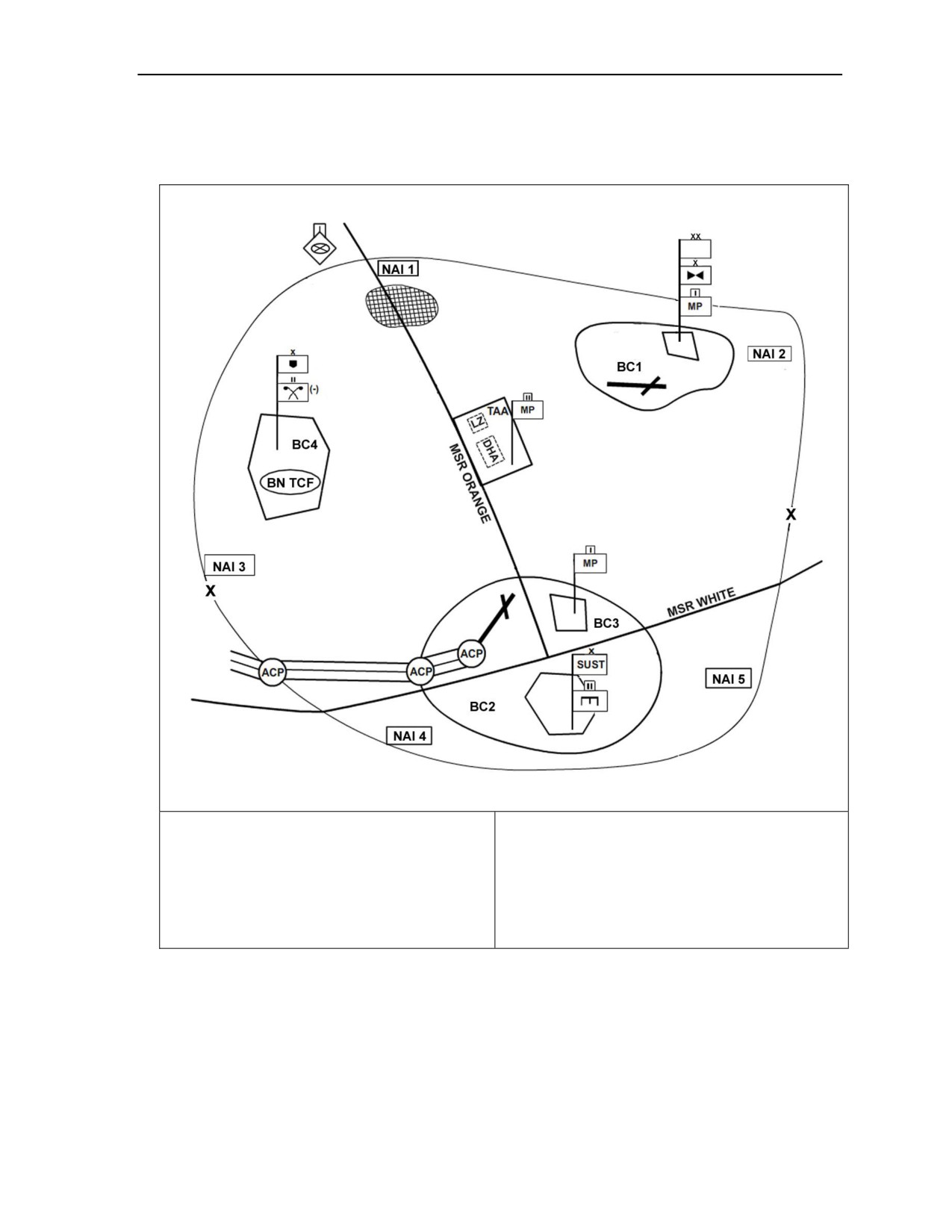
Support Area Operations
specialized units. Within an assigned AO, the MEB may keep centralized control of some area damage
control assets to permit allocation at the critical point and time.
Legend:
ACP
air control point
MSR
main support route
BC
base camp
NAI
named area of interest
BN
battalion
SUST
sustainment
DHA
detainee holding area
TAA
tactical assembly area
LZ
landing zone
TCF
tactical combat force
MP
military police
Figure 3-1. Example of a MEB conducting support area operations
3-108. Area damage control may include such measures as—
z
Establishing fire breaks and lanes.
z
Hardening structures.
z
Dispersing of key capabilities and resources.
z
Coordinating with higher headquarters and CA to use host nation support for area damage
control.
21 April 2014
FM 3-81
3-19
Chapter 3
z
Locating, isolating, and containing the incident.
z
Isolating danger or hazard areas.
z
Mitigating personnel and material losses.
z
Reestablishing security.
z
Assessing the situation and damage.
z
Supporting decontamination operations.
z
Searching and rescuing entrapped personnel.
z
Eliminating pockets of enemy resistance.
z
Providing civil control.
z
Removing and exposing of explosive ordnance.
z
Clearing ruble.
z
Clearing tree blow down.
z
Providing electrical power services.
z
Providing fire protection services.
z
Controlling flood damage.
z
Reorganizing or reconstituting a response force or reserve.
z
Repairing facilities.
z
Improving security or defenses.
z
Capturing lessons learned.
z
Replacing or shifting information collection assets and observers.
z
Recovering and repairing damaged equipment.
z
Repairing critical facilities, routes, or lines of communications within the AO.
3-109. One example of MEB performing area damage control is shown in figure 3-2. In this example, the
BCT area from the movement corridor employment example is shown in more detail. An enemy rocket
attack destroyed the bridge on MSR BLACK and produced a CBRN incident. The BCT requested area
damage control support from the division to allow the BCT to focus their capabilities on an expected
enemy attack on their base. The MEB task-organized and prepared a chemical battalion task force, which
included the chemical battalion, an engineer construction company, a bridging company, and two military
police companies. The division detached the task force from the MEB and placed it in direct support to the
BCT. The BCT created a new unit boundary and placed the task force within it to allow the BCT to mass
their organic capabilities on the expected ground attack. The task force is required to conduct area
reconnaissance, area security, highway regulation, decontamination, construction of ASR INDIGO, and
emplacement of a bridge upstream from the contaminated and destroyed bridge.
3-20
FM 3-81
21 April 2014
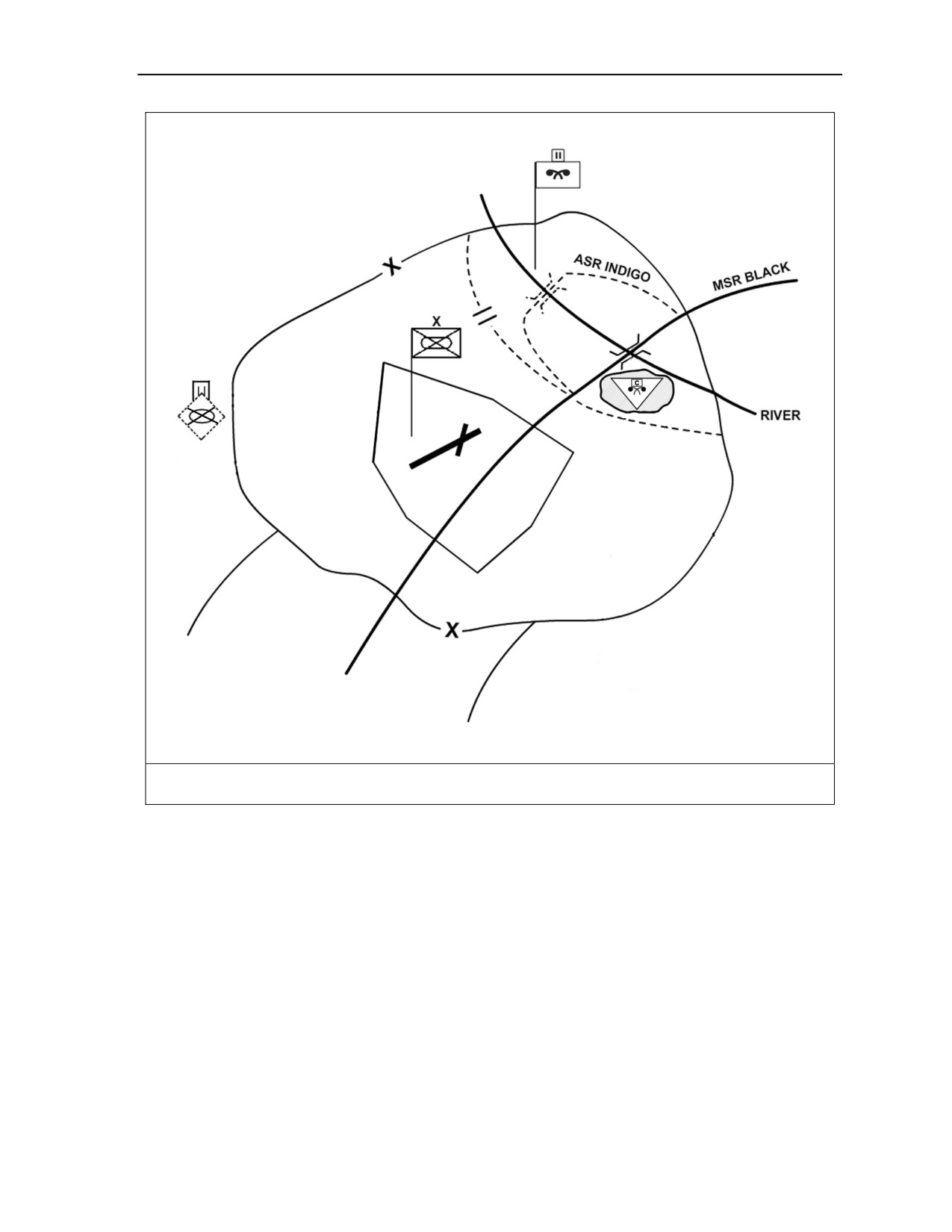
Support Area Operations
Legend:
ASR
alternate supply route
MSR
main supply route
Figure 3-2. Example of a MEB performing area damage control
21 April 2014
FM 3-81
3-21
Chapter 4
Maneuver Support Operations
This chapter discusses the integration of mobility, countermobility, protection, and
sustainment tasks and the continuous integration of these major areas of maneuver
support operations. It discusses how to think differently about combined arms
operations to support mobility, countermobility, and apply some aspects of protection
to movement as part of maneuver support operations. The MEB is designed with a
staff that is optimized to conduct maneuver support operations. The integration of
maneuver support operations is typically a continuous process. This chapter discusses
the fundamentals of maneuver support operations and looks at the typical tasks
associated with maneuver support operations. (See ADP 3-0 and ADRP 3-90 for
further discussion of the tasks associated with movement and maneuver. See ATTP
3-90.4 and FM 5-102 for a discussion of mobility and countermobility operations.
For further discussion of selected protection supporting tasks, see ADRP 3-37, FM
3-39, and FM 3-11. For a further discussion of sustainment tasks, see ADRP 4-0 and
FM 3-34.)
FRAMEWORK
4-1. Maneuver support operations integrate the complementary and reinforcing capabilities of
mobility, countermobility, protection, and sustainment tasks to enhance decisive action. An overview
of maneuver support operations was provided and its typical supporting subordinate tasks were identified in
chapter 1. This chapter further develops the discussion of what maneuver support operations are and how
they may be implemented. The following is a framework to think systematically about maneuver support
operations.
4-2. Maneuver support operations integrate the complementary and reinforcing capabilities of tasks
within the primary warfighting functions of movement and maneuver, protection, and sustainment and
synchronizes them across all of the Army warfighting functions. Conduct mobility and countermobility
operations is a task within the movement and maneuver warfighting function. The MEB has less capability
applied to the intelligence warfighting function, with selected application within the fires warfighting
function. The MEB conducts maneuver support operations to enhance all decisive-action tasks. Maneuver
support actions occur throughout the operations process (plan, prepare, execute, and assess).
4-3. Rather than the independent performance of functional tasks, maneuver support operations are
usually combined arms activities. Combined arms is the synchronized and simultaneous application of arms
to achieve an effect greater than if each arm was used separately or sequentially (ADRP 3-0). Many units
may conduct specific tasks that complement or reinforce mobility, countermobility, protection, and
sustainment. However, when MEB units perform these tasks in an integrated fashion, it is viewed as
maneuver support operations, rather than a branch function, operation, or task. It is often more efficient and
more effective when all members of the supporting units provide the creative thinking to identify tasks best
performed by task-organized subordinate headquarters to increase the teamwork, synergy, and efficient use
of forces. For example, a similar task common for many units is Conduct Reconnaissance. When multiple
task-organized MEB units perform these similar reconnaissance tasks as a team to complement mobility,
countermobility, protection, or sustainment, they may be conducting maneuver support operations. This
teamwork reduces security requirements, economizes the use of manpower and equipment, improves
operations security, improves information collection integration, and increases the combat power of the
formation performing the tasks.
21 April 2014
FM 3-81
4-1
Chapter 4
4-4. The MEB integrates task-organized organizations and units, capabilities, tasks, and systems to
conduct maneuver support operations. CBRN, engineer, and military police units constitute the core body
of MEB units that contribute to maneuver support operations. The MEB conducts maneuver support
operations while a functionally pure battalion or company may perform a branch task. If METT-TC
determines that required support can be performed better by integrating branch pure units, then the MEB
may create a battalion task force or company team and assign them a maneuver support operations task and
purpose. The task force or company team may still perform some purely functional tasks.
4-5. Maneuver support operations can shape the operational environment and help protect the force. MEB
mobility and countermobility support can modify the physical environment, and help dominate terrain.
MEB protection support can protect the force and physical assets. The MEB conducts maneuver support
operations to support the higher headquarters and its assigned units.
ASSURED MOBILITY
4-6. Assured mobility is a framework—of processes, actions, and capabilities—that assures the ability of
a force to deploy, move, and maneuver where and when desired, without interruption or delay, to achieve
the mission (ATTP 3-90.4). Mobility and countermobility operations are equal components of assured
mobility, are a subordinate task within the movement and maneuver warfighting function, and are
complementary opposites. (See FM 5-102 for a discussion of countermobility operations.) MEBs may
provide limited support to the movement and maneuver of BCTs by complementing or reinforcing the
functional units supporting the BCT. MEBs support assured mobility through the conduct of combined
arms mobility and countermobility operations within an assigned support area. The MEB support to assured
mobility primarily assures operational mobility within the support area and may support strategic mobility
while the units, in direct support of maneuver units, primarily assures tactical mobility.
MOVEMENT AND MANEUVER
4-7. Movement and maneuver is an element of combat power and a warfighting function. The movement
and maneuver warfighting function is the related tasks and systems that move and employ forces to achieve
a position of advantage over to the enemy and other threats (ADRP 3-0). Direct fire is inherent in maneuver
as in close combat.
4-8. Maneuver is the employment of forces in the operational area through movement in combination
with fires to achieve a position of advantage in respect to the enemy (JP 3-0). Maneuver is a means by
which commanders mass the effects of combat power to achieve surprise, shock, and momentum. When a
unit maneuvers, it moves and fires, which provides an inherent level of protection. Any other move may be
referred to as movement, categorized as tactical ground movement, air movement, and administrative
movement. Movement may be necessary to disperse and displace the force as a whole; this movement helps
provide and enhance protection.
4-9. Movement is necessary to disperse and displace the force as a whole. Movement helps provide and
enhance protection.
4-10. Unlike a BCT that can move and maneuver, most units move without maneuver. The movement of
units not conducting maneuver does not have this inherent level of protection. The opposite is true; they
become more vulnerable and may need added protection. Protection must often be applied to units that are
conducting movement and are not capable of effective maneuver. Maneuver support operations applies
protection to movement and is initially integrated though the operation process. Depending on the threat,
the effective movement of nonmaneuver units also requires planning and resourcing for maneuver support
operations.
4-11. The integration and synchronization of maneuver support-related tasks shape the environment to
provide mobility and countermobility, provide or enhance other movement and maneuver tasks, and expand
the freedom of action of friendly forces while denying it to the enemy. Maneuver support operations
directly enable the movement and maneuver warfighting function. The movement and maneuver
warfighting function does not include administrative movements of personnel and materiel. These
movements fall under the sustainment warfighting function.
4-2
FM 3-81
21 April 2014
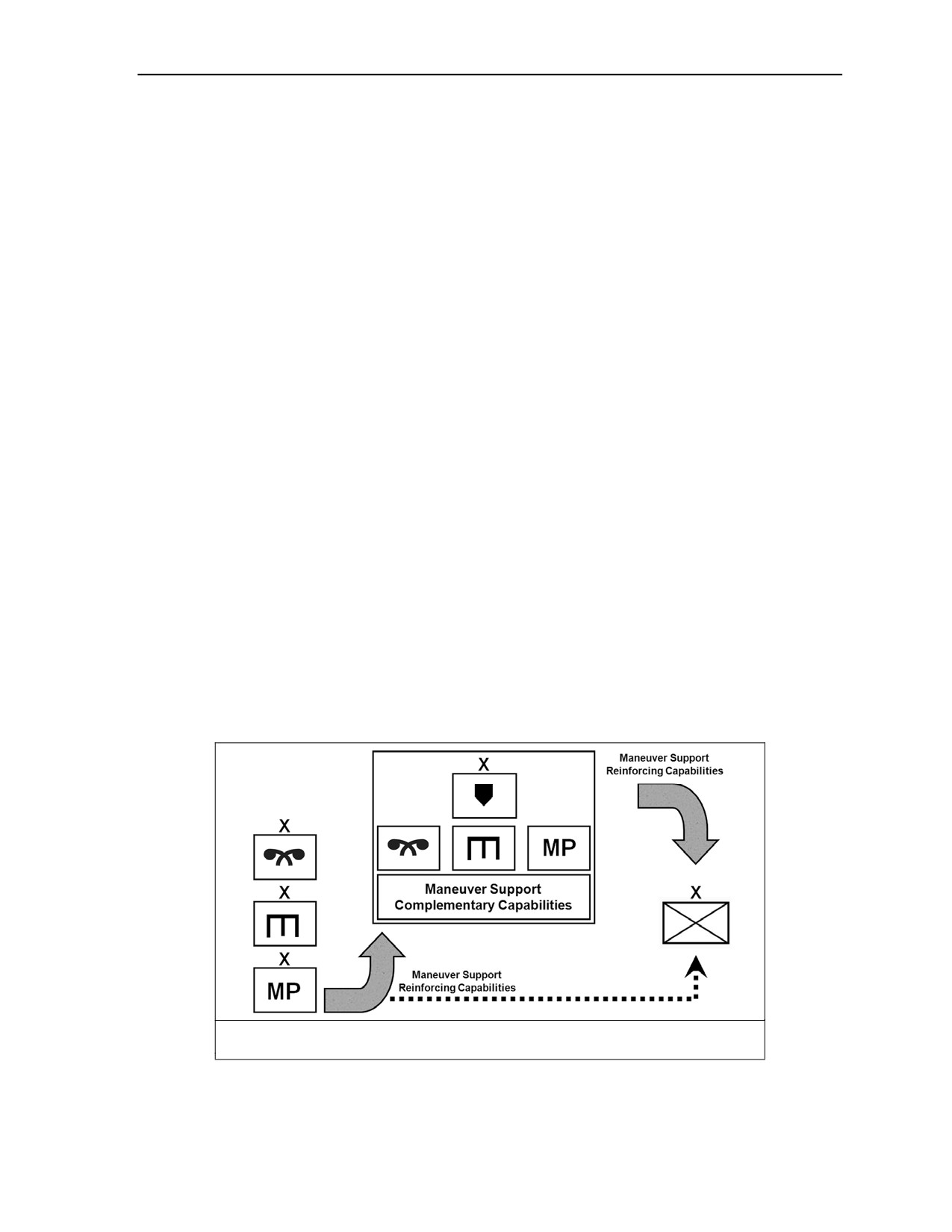
Maneuver Support Operations
PROTECTION
4-12. Protection is the preservation of the effectiveness and survivability of mission-related military and
nonmilitary personnel, equipment, facilities, information, and infrastructure deployed or located within or
outside the boundaries of a given operational area (JP 3-0). Protection is an overarching concept that is
inherent to command within all military operations. The Army includes protecting personnel (combatants
and noncombatants) within the protection warfighting function (see ADRP 3-37).
4-13. Protection tasks are conducted or supported by a mix of support and functional brigades. Protection
may require a significant commitment of resources that can limit a formation’s freedom of action if not
integrated deliberately. Maneuver support operations integrate some capabilities and protection tasks to
complement or reinforce mobility, countermobility, and sustainment. Maneuver support primarily applies
some aspects of protection to movement.
SUSTAINMENT
4-14. Maneuver support operations primarily integrate the capabilities and tasks of general engineering to
complement or reinforce mobility, countermobility, and protection. The other sustainment tasks are not part
of maneuver support.
MANEUVER SUPPORT INTEGRATION
4-15. Maneuver support operations represent combined arms operations that typically require the MEB to
integrate key capabilities within and across the warfighting functions in a complementary or reinforcing
manner to achieve the effect of enhancing freedom of action within the supported division or higher
echelons. The MEB conducts maneuver support in a scalable manner necessary to extend and maintain
tactical momentum and operational reach. For example, the MEB reinforces the movement and maneuver
function with mobility, countermobility, and obscuration capabilities to enable an operational tempo that
threat forces cannot maintain. Similarly, the MEB complements the sustainment function when it applies
protection to transportation through the conduct of convoy escort. However, movement corridor operations
reflect an expansion of security tasks within the protection function and, therefore, are considered
reinforcing capabilities to route and area security operations.
4-16. Functional brigades (such as CBRN, engineer, or military police) may provide complementary
functional capabilities to the MEB or reinforcing force capabilities to a BCT. The MEB may provide
maneuver support reinforcing capabilities to a BCT (figure 4-1).
Legend:
MP
military police
Figure 4-1. MEB and maneuver support operations
21 April 2014
FM 3-81
4-3
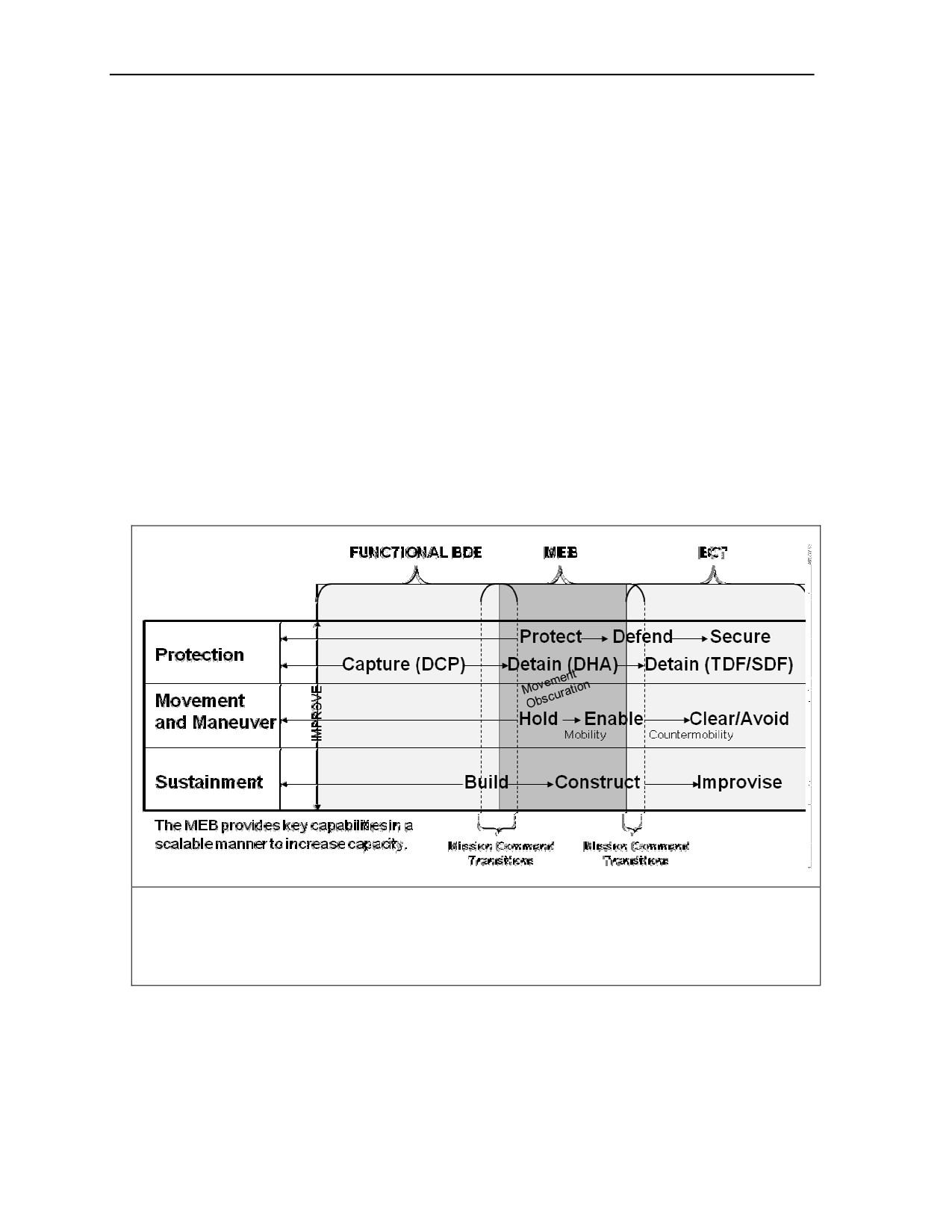
Chapter 4
4-17. The composition and size of the MEB headquarters staffed with CBRN, engineer, military police,
fire support, intelligence, and aviation expertise makes it uniquely capable among other support or
functional brigades when integrating these capabilities. The combination of the significant expertise
resident in the CBRN, engineer, and military police functional areas enable a level of detail, precision, and
integration in all facets of the operations process (prepare, plan, execute, assess). Not possible in the BCTs
or the functional brigades without augmentation. The MEB staff is trained and organized to provide
mission command for maneuver support operations.
4-18. Typically, maneuver support operations at division and above are best conducted by the MEB rather
than other potential headquarters because the MEB has the highest concentration of staff capabilities
required for its integration and synchronization. Another formation may be tasked with conducting
maneuver support operations if deliberately augmented with functional expertise from across the required
functional units required for the specific purpose of providing freedom of action for a supported force.
4-19. Determining whether the MEB will provide complementary or reinforcing capabilities to the force
supports decisionmaking and serves as a point of departure when task-organizing formations or
recommending command and support relationships. The complementary and reinforcing character of the
capabilities that the MEB typically provides permits the scalable expansion of key tasks and functions
along a range or continuum of functional capability. This is significant because some warfighting functions
do not maintain the same character as operations transition across decisive action among the levels of
military action (strategic, operational, tactical) or as resources are applied to solve the tactical problem. The
Protection and Movement and Maneuver warfighting functions provide good examples of this. Figure 4-2
shows MEB contributions across three of the warfighting function.
Legend:
BCT
brigade combat team
MEB
maneuver enhancement brigade
BDE
brigade
SDF
strategic detention facility
DCP
detainee collection point
TDF
theater detention facility
DHA
detainee holding area
Figure 4-2. Increased functional capabilities
4-20. Typically, the MEB simultaneously reinforces maneuver with mobility operations or tasks while
complementing the movement with protection coordination. The MEB staff continually analyzes and
examines how specific functions are affected as they expand along a capability scale to meet the changing
requirements of the operational environment. Consequently, the MEB adjusts it mission profile, task
4-4
FM 3-81
21 April 2014
Maneuver Support Operations
organization, and mission command arrangement to accommodate those scalable effects. For example, the
MEB could simultaneously reinforce the BCT engineer capability with mobility operations or tasks while
complementing movement with protection capabilities.
FREEDOM OF ACTION
4-21. An overview of freedom of action is provided in chapter 1. Freedom of action allows the commander
to seize, retain, and exploit operational initiative. Army forces gain and preserve the freedom of action,
reduce vulnerability, and exploit success through maneuver (see ADRP 3-0). Freedom of action includes
the ability of commanders to exercise their wills to complete the mission, achieve the objective, affect
movement, or protect the force. Maneuver support operations enhance maneuver and help protect forces
that typically do not conduct maneuver. This contributes to enhancing freedom of action for the force.
4-22. The MEB increases freedom of action by shaping the operational environment, providing protection,
and reducing impediments to operations. Maneuver support operations deny the enemy the freedom of
action. Regardless of when they occur, maneuver support operations enhance the freedom of action of the
commander.
4-23. Maneuver support operations enhance the freedom of action for the supported commander, similarly
to the sustainment warfighting function that provides support and services to ensure the freedom of action.
Maneuver support operations are multifunctional and typically performed throughout all types of
operations. The MEB conducts mobility and countermobility operations to enhance the freedom of
maneuver. The brigade also performs protection support coordination, movement corridor operations, and
selected sustainment operations to enhance the freedom of movement.
MOBILITY AND COUNTERMOBILITY
4-24. The MEB performs primary supporting tasks as a part of mobility and countermobility support.
These primary supporting tasks are highlighted below.
CONDUCT MOBILITY OPERATIONS
z
Mobility operations are those combined arms activities that mitigate the effects of natural and
man-made obstacles to enable the freedom of movement and maneuver (ATTP 3-90.4). The
MEB directs, integrates, and controls the capabilities necessary to clear an area, location, or line
for communication of obstacles or impediments that could hazard or hinder friendly movement
and maneuver or the occupation of a location. The MEB may conduct this operation in its own
AO to support movement corridors, rapid runway repair, and horizontal construction. The MEB
may support combat operations of a BCT such as breaching operations, and gap crossings. Key
mobility tasks (see FM 3-34 and FM 3-39) may include—
z
Plan engineer mobility operations.
z
Plan gap (river) crossing operations.
z
Conduct security and mobility support.
z
Plan breaching operations.
z
Direct.
z
Overcome barriers, obstacles, and mines.
z
Enhance movement and maneuver.
z
Negotiate a tactical AO (see FM 7-15).
CONDUCT COUNTERMOBILITY OPERATIONS
4-25. Countermobility operations are combined arms activities that use or enhance the effects of natural or
man-made obstacles to deny an adversary the freedom of movement or maneuver. The MEB directs,
integrates, and controls the capabilities necessary to alter the mobility of adversaries. The MEB may
conduct this operation in its own AO as part of security and defense. The MEB may support combat
21 April 2014
FM 3-81
4-5
Chapter 4
operations of a BCT such as defense and use terrain reinforcement or directed targets. Key countermobility
tasks may include (see FM 5-102)—
z
Plan engineer countermobility operations.
z
Prepare an obstacle plan.
z
Site obstacles.
z
Construct, emplace, or detonate obstacles.
z
Mark, report, and record obstacles.
z
Maintain obstacle integration.
EMPLOY BATTLEFIELD OBSCURATION
4-26. The MEB may employ its CBRN units to employ battlefield obscuration effects to include large area
or long duration effects. Military applications include protection, marking, and deception. The CBRN staff
and units conduct the planning, coordination, and synchronization and use tactical and technical
considerations to provide battlefield obscuration. They plan for obscurants to achieve and maintain
obscuration, denying adversaries’ access to select portions of the electromagnetic spectrum while leaving
other portions open for U.S. forces to attack and suppress or destroy adversaries, contributing to the
protection of forces while enhancing maneuver and firepower. Key tasks may include plan smoke
operations.
CONDUCT INFORMATION COLLECTION
4-27. Information collection conducted within the movement corridor provides support to the
commander’s informational understanding and targeting. This may include complementary route and area
reconnaissance and ground and aerial reconnaissance. These actions may help identify the decision points,
high-payoff targets, and high-value targets that are linked to the threat’s actions within the movement
corridor. The MEB employs the information collection capabilities of assigned, attached or OPCON units
and produces a common operational picture for the movement corridor.
CONDUCT OPERATIONAL AREA SECURITY
4-28. Operational area security may include route security operations, observation posts, check points,
antiterrorism activities, security of convoy support facilities, and convoy security operations. Convoy
security operations protect convoys. Units conduct convoy security operations any time there are not
enough friendly forces to continuously secure lines of communications in an AO and there is a danger of
enemy ground action against the convoy. Convoy security operations are defensive in nature and orient on
the protected force (see ADRP 3-90). The MEB may be tasked to enhance convoy security operations
through the technique of creating and supporting a movement corridor.
4-29. Route
(including highway, pipeline, rail, and water) security operations protect lines of
communications and friendly forces moving along them. Units conduct route security missions to prevent
enemy ground forces from moving into direct fire range of the protected route. Route security operations
are defensive in nature and terrain-oriented (see ADRP 3-90).
CONDUCT POLICE INTELLIGENCE OPERATIONS
4-30. Police intelligence operations is a military police function, integrated within all military police
operations, that supports the operations process through analysis, production, and dissemination of
information collected as a result of police activities to enhance situational understanding, protection, civil
control, and law enforcement. This information is gathered during the conduct of military police operations
and, on analysis, may contribute to commander’s critical information requirements; intelligence-led, time-
sensitive operations; or policing strategies necessary to forecast, anticipate, and preempt crime or related
disruptive activities to maintain order. Continuous integrated police intelligence operations activities
provide police information and police intelligence to military police commanders and staffs to support
ongoing military police operations throughout the collection, analysis, and production activities.
4-6
FM 3-81
21 April 2014
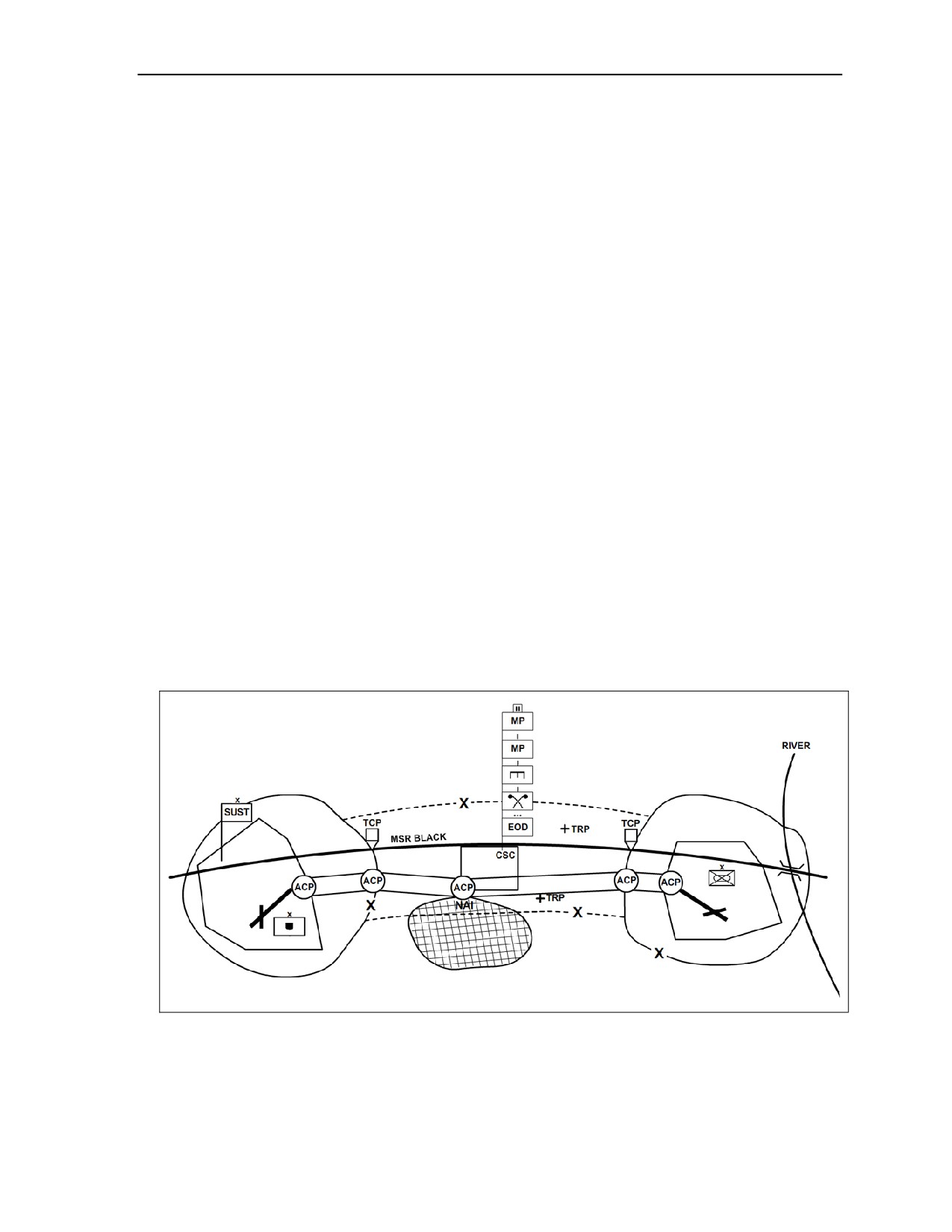
Maneuver Support Operations
Simultaneously, police intelligence operations continually feed information to the operations process and
its three integrating processes (see ADRP 3-0 and ADRP 5-0).
4-31. Police intelligence operations address the reality that in some operational environments the threat is
more criminal than conventional in nature. In those environments, it is not uncommon for members of
armed groups, insurgents, and other belligerents to use or mimic established criminal networks, activities,
and practices to move contraband, raise funds, or generally or specifically further their goals and
objectives. Assessing the impact of criminal activity on military operations and deconflicting that activity
from other threat or environmental factors can be essential to leverage host nation police, security
organizations, and the local population in support of operations in movement corridors, effective targeting,
and mission success (see ATTP 3-39.20).
EMPLOYMENT
4-32. One example of a MEB establishing and conducting operations in a movement corridor is shown in
figure 4-3. In this example, the MEB AO and the BCT AO are connected by MSR BLACK. Based on
METT-TC, the division needs to secure movement between the brigade AOs and has tasked the MEB to
expand its existing AO to include an area that runs about 4 kilometers on each side of the MSR and
establish a movement corridor. The MEB may establish a security area along the northern and southern
boundaries of the movement corridor. The MEB is required to conduct reconnaissance, clear, and secure
the new area; support the sustainment brigade to establish the convoy support center and conduct
movement regulation and traffic control; and to maintain the MSR in its expanded AO. Due to the
complexity of the requirement, the MEB has assigned the mission to a military police task force (shown
with its headquarters in the convoy support center), but retained control of the movement corridor as part of
its AO. The MEB has developed an initial information collection plan. The task force military police
conducts police engagement to leverage host nation or multinational police assets to enhance security. The
brigade has also established traffic control points along the MSR, an air corridor, and air control points in
conjunction with the division headquarters and the BCT to regulate ground traffic and control rotary wing
and unmanned aircraft system traffic between the MEB and BCT airfields. The air control point near the
convoy support center supports air traffic to and from the convoy support center and respond to the named
areas of interest in the built-up area. The MEB develops an initial fires plan for convoy and convoy support
center security and defense with target reference points as shown in figure 4-3.
Figure 4-3. Example of a MEB supporting a movement corridor
21 April 2014
FM 3-81
4-7
Chapter 4
Legend:
ACP
air control point
NAI
named area of interest
CSC
convoy support center
SUST
sustainment
EOD
explosive ordnance disposal
TCP
traffic control point
MP
military police
TRP
target reference point
MSR
main supply route
Figure 4-3. Example of a MEB supporting a movement corridor (continued)
PROTECTION
4-33. When resourced and tasked, the MEB can best integrate, provide combined arms augmentation, or
conduct the following tasks to support protection:
z
Conduct operational area security.
z
Employ safety techniques, including fratricide avoidance.
z
Implement operations security.
z
Provide intelligence support to protection.
z
Implement physical security procedures.
z
Conduct police operations.
z
Conduct personnel recovery.
z
Apply antiterrorism measures.
z
Conduct survivability operations.
z
Provide force health protection.
z
Conduct CBRN operations.
z
Provide EOD and protection support.
z
Coordinate air and missile defense.
z
Conduct detention operations.
z
Conduct resettlement operations.
z
Establish a movement corridor.
4-34. Some protection warfighting function supporting tasks frequently require support or augmentation
from the MEB or another support or functional brigade. The MEB only coordinates the integration of some
protection supporting tasks with the higher headquarters protection staff, cells, or directorates. The MEB
may conduct all protection supporting tasks for themselves. Most units can generally conduct the other
supporting tasks included in the protection warfighting function with minimal support.
CONDUCT OPERATIONAL AREA SECURITY
4-35. Many parts of the MEB staff contribute to the MEB capability to conduct operational area security,
typically performed when the MEB is assigned an AO
(see chapter
3). At the operational level,
survivability and area and base security contribute to protection and preserves combat power (see ADRP
3-37). Commanders should consider—
z
Sites, accommodations, and defensive positions. Precautions should be taken to protect
positions, headquarters, support facilities, and accommodations. These may include obstacles
and shelters. Units must also practice alert procedures and develop drills to rapidly occupy
positions. A robust engineer force can provide support to meet survivability needs. Units should
maintain proper camouflage and concealment based on METT-TC. Additional information on
precautions is provided in ATP 3-37.34.
z
Roadblocks. Military police forces may establish and maintain roadblocks. If military police
forces are unavailable, other forces may assume this responsibility. Roadblocks can be used not
only to restrict traffic for security purposes but also to control the movement of critical cargo in
support of humanitarian operations. As a minimum, the area should be highly visible and
defensible with an armed overwatch.
4-8
FM 3-81
21 April 2014
Maneuver Support Operations
z
Personnel vulnerabilities. Forces are always vulnerable to personnel security risks from local
employees and other personnel subject to bribes, threats, or compromise. The threat from local
criminal elements is also a constant threat and protection consideration.
z
Personal awareness. An effective measure for survivability is individual awareness by Soldiers
in all circumstances. Soldiers must look for things out of place and patterns preceding
aggression. Commanders should ensure that Soldiers remain alert and do not establish a routine.
z
Sniper threats. In stability tasks and DSCA, the sniper can pose a significant threat. Counters
include rehearsed responses, reconnaissance and surveillance, battlefield obscuration, and cover
and concealment. ROE should provide specific instructions on how to react to sniper fire, to
include restrictions on weapons to be used. Units can use specific weapons, such as sniper rifles,
to eliminate a sniper and reduce collateral damage.
z
Security measures. Security measures are METT-TC dependent and may include the full range
of active and passive measures such as patrolling, reconnaissance and surveillance, and use of
reaction forces. Every Army leader has the inherent responsibility to secure their formation or
position and must do so with the organic capabilities and the means at hand.
z
Coordination. Commanders should coordinate security with local military and civil agencies
and humanitarian organizations when possible.
EMPLOY SAFETY TECHNIQUES
4-36. The MEB staff has no unique capabilities to conduct this protection supporting task but could
support a unit safety program with the MEB processes and procedures designed to protect the force and
avoid fratricide. Safety techniques are used to identify and assess hazards to the force and make
recommendations on ways to prevent or mitigate the effects of those hazards (see FM 5-19). Commanders
have the inherent responsibility to analyze the risks and implement control measures, to mitigate them. The
MEB staff and commanders factor into their analysis how their execution recommendations could
adversely affect Soldiers. Incorporating protection within the risk management integrating process is key. It
ensures a thorough analysis of risks and implements controls to mitigate their effects (see ADRP 3-37).
IMPLEMENT OPERATIONS SECURITY
4-37. Operations security is inherent in unit operations, with the MEB staff having no unique capabilities
to conduct this protection supporting task.
PROVIDE INTELLIGENCE SUPPORT
4-38. The MEB staff has no unique capabilities to conduct this protection supporting task, but could
support unit measures with MEB assets.
IMPLEMENT PHYSICAL SECURITY PROCEDURES
4-39. The MEB staff has no unique capabilities to conduct this protection supporting task, but could
support unit procedures with MEB assets.
CONDUCT POLICE OPERATIONS
4-40. Police operations are conducted across the range of military operations and encompass the associated
law enforcement activities to control and protect populations and resources to facilitate the existence of a
lawful and orderly environment. Military police conduct police operations—
z
To maintain good order and discipline. Police operations are focused internally at policing our
own Soldiers and civilians and deterring, mitigating, and preventing criminal and terrorist
threats.
z
To establish and maintain civil security and civil control while enabling the rule of law.
This application of the police operations is focused externally at policing the local population in
an operational environment where host nation policing and security capability are nonexistent or
21 April 2014
FM 3-81
4-9
Chapter 4
inadequate. The goal of any police operation within a host nation is to enable the rule of law and
to eventually transition all policing functions to host nation control.
z
During times of crisis in DSCA. National Guard military police elements regularly support
their respective state governors in this function while operating as state assets under 32 USC.
U.S. Army Reserve and active duty military police elements, including federalized National
Guard Soldiers, are generally prohibited from direct participation in law enforcement.
CONDUCT PERSONNEL RECOVERY
4-41. The MEB staff has no unique capabilities to conduct this protection supporting task, but could
support unit personnel recovery efforts with the MEB assigned, attached, or OPCON units. Personnel
recovery is one task that the MEB performs when assigned an AO. The Army defines personnel recovery
as the sum of military, diplomatic, and civil efforts to prepare for and execute the recovery and
reintegration of isolated personnel (ADRP 3-37).
APPLY ANTITERRORISM MEASURES
4-42. Antiterrorism is the defensive measures used to reduce the vulnerability of individuals and property
to terrorist acts, to include limited response and containment by local military and civilian forces. Terrorism
may well be the most likely threat that Army forces will face when conducting stability tasks and DSCA.
Commanders have an inherent responsibility for conducting antiterrorism measures to provide for the
security of the command (see ADRP 3-37).
4-43. Antiterrorism support from the MEB could include assisting in unit and installation threat and
vulnerability assessments, establishing special-reaction teams and protective services, establishing civil-
military partnerships for CBRN crisis and consequence management, supporting survivability operations,
area damage control, and security of key locations and personnel.
CONDUCT SURVIVABILITY OPERATIONS
4-44. Survivability operations are those military activities that alter the physical environment to provide or
improve cover, concealment, and camouflage (ATP 3-37.34). Key tasks also include protecting against
enemy hazards in the AO conducting related security operations, and conducting actions to control
pollution and hazmat. The MEB engineer operations cell and engineer units may conduct survivability
operations in their AO or as part of maneuver support operations. Other cells and units (to include the
CBRN cell and CBRN units) may also participate in survivability operations (see ATP 3-37.34).
4-45. The MEB is optimized to conduct a host of survivability-related tasks and operations in support of
decisive action. Plans and procedures are developed by the MEB to provide immediate protection to the
units residing in the brigade AO, based on threat assessments, intelligence summaries, and unit reporting.
Individuals, equipment, facilities, communications, infrastructure, and other mission-essential materials
will be safeguarded, prepared, or hardened to prevent damage, casualties, or mission failure. The MEB area
security section considers the dispersal of tenant units within the brigade AO while conducting terrain
management and allocating terrain. Most units attached, OPCON, or TACON to the MEB conduct
operations that contribute to the survivability of the force as they protect information and execute security
operations. The MEB can be configured to contain and control hazardous material incidents or to defend
against CBRN attacks in the brigade AO. Key survivability tasks may include direct survivability
construction, construct earthen walls and berms, and construct vehicle protective positions.
PROVIDE FORCE HEALTH PROTECTION
4-46. The MEB has no unique capability to conduct force health protection. The brigade surgeon can
establish processes and procedures for the units assigned, attached, or OPCON to the command that will
promote and improve the mental and physical well-being of Soldiers.
4-10
FM 3-81
21 April 2014