FM 3-11 MULTI-SERVICE DOCTRINE FOR CHEMICAL, BIOLOGICAL, RADIOLOGICAL, AND NUCLEAR OPERATIONS (JULY 2011) - page 2
Chapter 3
Nonproliferation Activities
Nonproliferation activities are actions that are taken to prevent the proliferation of
WMD by dissuading or impeding access to, or distribution of, sensitive technologies,
material, and expertise. Examples of nonproliferation activities include diplomacy,
arms control, multilateral agreements, threat reduction assistance, export controls,
and WMD interdiction.
OVERVIEW
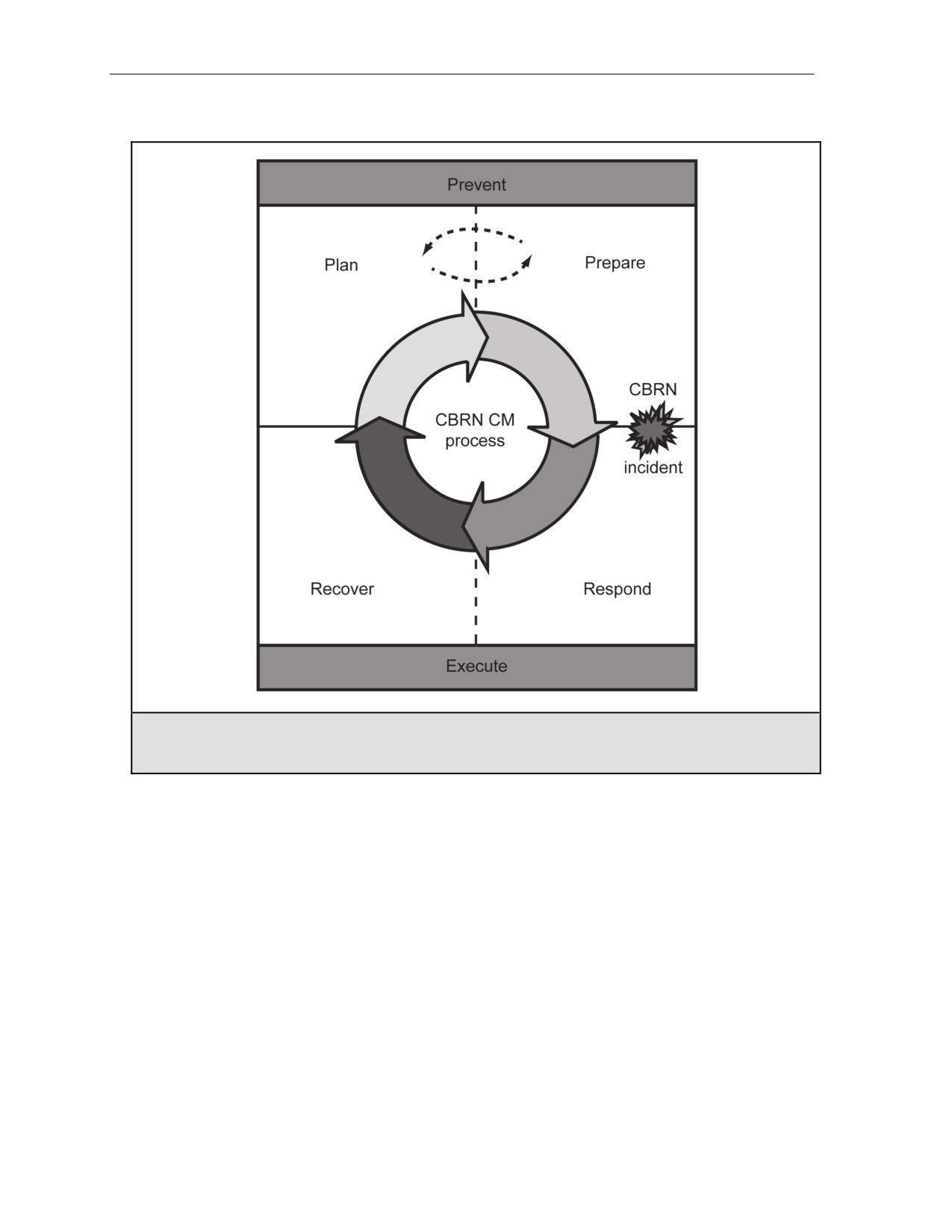
3-1. In recent years, the prevention of WMD proliferation has become much more complex and
challenging due to the greater availability of components, technologies, expertise, and information.
Proliferation is the transfer of CBRN-related weapons, materials, technology, and expertise from suppliers
to hostile states or nonstate actors. This availability stems from the willingness of various state suppliers or
companies within those states to sell materials and an explosion of more readily accessible information
from academic and commercial sources or the Internet. Weakened security at some key CBRN-related
facilities in the former Soviet Union, the search for employment by unemployed scientists and technicians
associated with active or formerly active Soviet programs, and the transfer or sharing of technology among
states trying to develop programs have also contributed to the proliferation of this sensitive information.
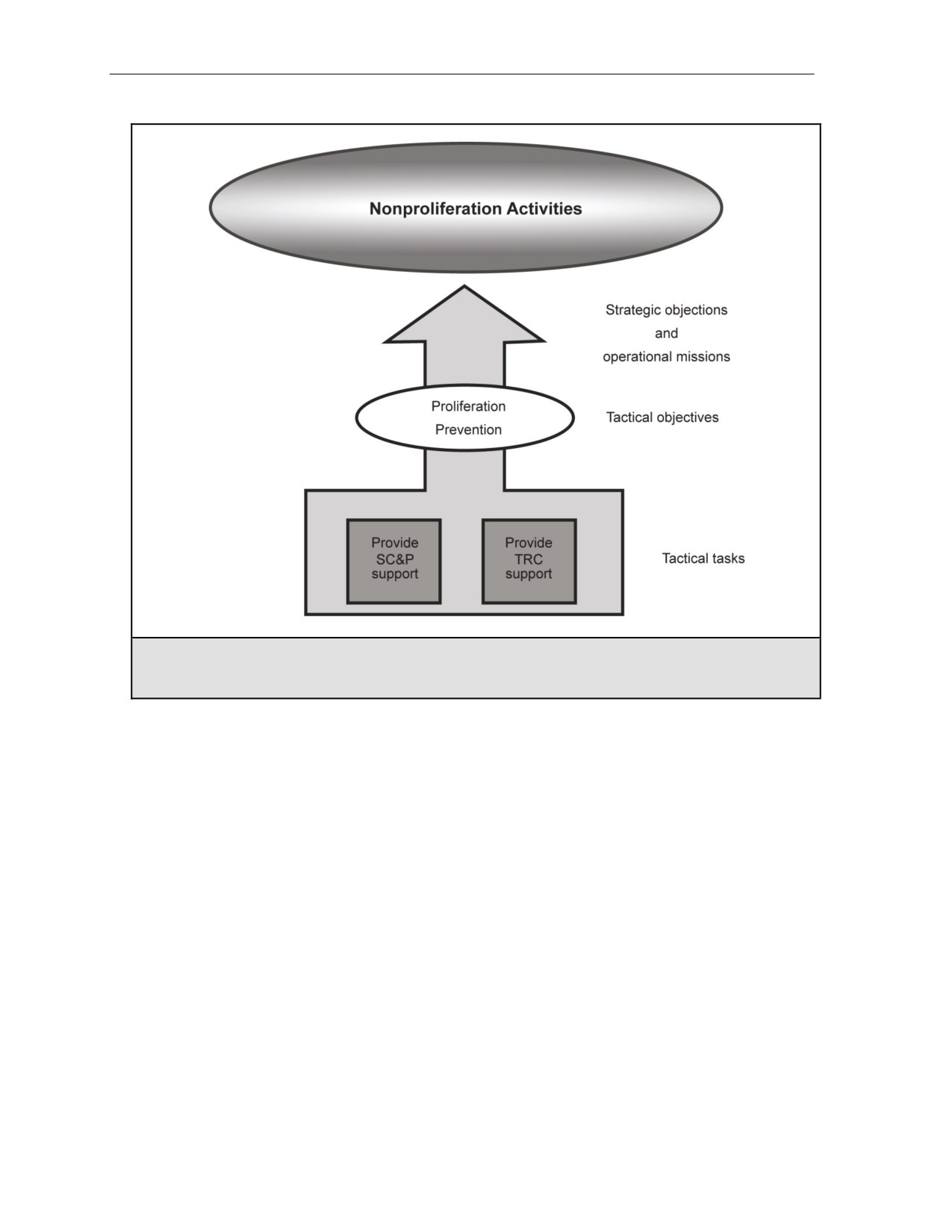
3-2. At the tactical level, nonproliferation activities should focus on proliferation prevention as the
tactical objective and focus on WMD security cooperation and partner activities and threat reduction
cooperation military mission areas as the means. The tactical tasks necessary for the commander to assist in
proliferation prevention and dissuade the use of WMD as part of an integrated military objective are
conducted in support of the mission areas. A tactical mission task is a specific activity performed by a unit
while executing a form of tactical operation or maneuver. It may be expressed in terms of action by a
friendly force or effects on an enemy force. CBRN operations supporting nonproliferation are shown in
figure 3-1, page 3-2, and discussed in this chapter.
Note. The eight military mission areas of CWMD are not conducted sequentially and discretely
in the prosecution of tactical-level military operations. They will occur independently or
simultaneously in response to the CBRN threat or hazard, depending on whether tactical units
are conducting CBRN operations while supporting CWMD objectives.
PROLIFERATION PREVENTION
3-3. Proliferation prevention is the tactical-level implementation of the strategic-level nonproliferation
pillar. The goal of proliferation prevention is to exert an early influence in the adversary’s decision cycle
that discourages their interest in, or decision to seek or acquire, CBRN materials, WMD precursors,
sensitive technologies, or expertise that could be used against the United States or its allies. Commanders
supporting nonproliferation activities at the tactical level should ensure that forces are trained, equipped,
and available to conduct essential tasks that meet the nonproliferation objectives. Tactical tasks include
providing support to security cooperation and partner activities and supporting threat reduction cooperation
and may include conducting interdiction operations that sustain the military strategic objectives of
prevent/dissuade/deny.
1 July 2011
FM 3-11/MCWP 3-37.1/NWP 3-11/AFTTP 3-2.42
3-1
Chapter 3
Legend:
SC&P
security cooperation and partner activities
TRC
threat reduction cooperation
Figure 3-1. CBRN operations supporting nonproliferation
3-4. The first line of nonproliferation defense is provided by the global nonproliferation treaties—the
Nuclear Nonproliferation Treaty, Chemical Weapons Convention, and Biological Weapons Convention.
These treaties have established widely accepted norms for the restriction of WMD acquisition, stockpiling,
and proliferation; and they continue to advance dialogue and cooperation among nations. Although these
treaties have established strong global norms, their ability to prevent WMD acquisition is only as strong as
the signatories’ willingness to comply with their treaty-based obligations and the resolve of compliant
parties to hold others to their obligations. Experience with North Korea, Libya, Iraq, and Iran provides
significant lessons learned regarding noncompliance. The United States may take the following measures to
support nonproliferation:
z
Pursue active nonproliferation diplomacy by dissuading supplier states from cooperating with
proliferant states and inducing states to end their WMD and missile programs.
z
Support and seek to improve the effectiveness of existing nonproliferation and arms control
regimes.
z
Pursue nonproliferation and threat reduction cooperation programs, including the Defense
Against WMD Act of 1998, designed to address the proliferation threat stemming from the large
quantities of Soviet-legacy, WMD- and missile-related expertise and materials.
z
Seek to discourage the worldwide accumulation of separated plutonium, minimize the use of
highly enriched uranium, and work in collaboration with international partners to develop
recycling and fuel treatment technologies that are more proliferation-resistant.
3-2
FM 3-11/MCWP 3-37.1/NWP 3-11/AFTTP 3-2.42
1 July 2011
Nonproliferation Activities
z
Strive to ensure that U.S. export controls further nonproliferation and other national security
goals while removing unnecessary barriers in the global marketplace.
Note. Additional details concerning individual treaties are provided in Appendix B.
3-5. United Nations Security Council Resolution (UNSCR)1540 is the latest in a series of internationally
directed, concrete measures aimed at preventing WMD proliferation and, most particularly, preventing and
countering terrorist acquisition and use of these deadly weapons.
3-6. The multilateral export control regimes—the Nuclear Suppliers Group, Zangger Committee, Missile
Technology Control Regime, Australia Group, and Wassenaar Arrangement—are a second, important layer
of nonproliferation defense. Each of these export control regimes plays a critical role in identifying key
WMD- and missile-related material and technology and appropriate approaches to control access to such
items. Limited-membership, export control regimes in the Zangger Committee, Nuclear Suppliers Group,
and Australia Group have given greater specificity to items of concern under the Nuclear Nonproliferation
Treaty and Chemical Weapons Convention and have broadened the number and variety of controlled
materials and technologies.
Note. See Appendix B for detailed information on policies and treaties for the CBRN aspects of
CWMD.
SECURITY COOPERATION AND PARTNER ACTIVITIES
3-7. Tactical commanders provide support to security cooperation and partner activities to pursue CWMD
objectives. The security cooperation and partner activities mission is a collection of interrelated day-to-day
activities to deny, dissuade, and prevent potential adversaries from obtaining or proliferating WMD. DOD
plays a significant, but often overlooked, role in this mission. Activities include traditional export control
regimes and nonproliferation treaties that allow partner nations to contribute to stemming the proliferation
of WMD materials and components. Nonproliferation initiatives such as the Missile Technology Control
Regime and the Nuclear Suppliers Group create international norms regarding proliferation and give
visibility to export control problems that could otherwise lead to the spread of WMD technology and
materials.
3-8. Security cooperation and partner activities are incorporated into the day-to-day military role.
Commanders must develop CWMD programs that integrate all DOD security cooperation activities,
including multinational exercises, security assistance, multinational training, multinational education,
multinational experimentation, defense and military contacts, foreign humanitarian assistance, and Office
of the Secretary of Defense-managed threat reduction measures. These actions are conducted to deter,
defeat, and respond to WMD threats in areas of responsibility.
3-9. Security cooperation is the primary capability used by the U.S. military to build partner capacity to
combat proliferation. Security cooperation allows the transfer of technology and know-how to partners and
allows direct observation and interaction to ensure that equipment and training are used properly.
3-10. Partner activities also support other mission areas as the primary tool for building partner capacity.
For example, initiatives such as the NATO Multinational CBRN Defense Battalion and Proliferation
Security Initiative address such mission areas as defense against WMD attack and interdiction. The U.S.
military is uniquely equipped with capabilities that are readily applicable to border security and can be
transferred rapidly. Three DOD programs worth noting are the Cooperative Threat Reduction Program,
Proliferation Prevention Initiative, and International Counterproliferation Program. Together, they provide
the resources to train and equip foreign militaries and civilians to secure WMD facilities and enhance
border security.
Note. See Chapter 2 and Appendix B for more information on CWMD-related policies, treaties,
and agreements.
1 July 2011
FM 3-11/MCWP 3-37.1/NWP 3-11/AFTTP 3-2.42
3-3
Chapter 3
3-11. Theater security cooperation and partner activities integrate and synchronize the large variety of
theater security activities being conducted in an area of responsibility. Tactical commanders provide
support to the security cooperation effort to prevent, dissuade, and deny proliferation or possession along
with the ability to reduce, destroy, or reverse possession of WMD programs. The following
organizations/activities directly or indirectly support the security cooperation and partner activities
objectives:
z
NATO Multinational CBRN Defense Battalion.
z
NATO Joint CBRN Defense Center of Excellence.
z
NATO WMD Center of Excellence.
z
Exchange programs.
Student.
Liaison.
Equipment.
z
Multinational training activities and exercises.
New equipment.
Counterterrorism.
Counterproliferation.
Counterdrug.
Consequence management.
z
Multinational support to humanitarian assistance/stability.
THREAT REDUCTION
3-12. Threat reduction cooperation includes those activities undertaken with the consent and cooperation of
host nation authorities in a permissive environment to enhance physical security and to reduce, dismantle,
redirect, and/or improve the protection of a state’s existing WMD program, stockpiles, and capabilities.
Tactical commanders provide threat reduction cooperation activities in support of CWMD objectives. The
principle purpose of these activities is to deny rogue states and terrorists access to weapons, material, and
expertise. Other states may need assistance with more discrete requirements to dismantle or destroy WMD
in excess of defense needs; to comply with international treaty obligations (such as the Chemical Weapons
Convention); or to impose export control, border control, law enforcement, and antismuggling capabilities.
3-13. Threat reduction cooperation also responds to opportunities to roll back or eliminate a state’s WMD
programs and capabilities on cooperative terms; for example, Libya’s decision to voluntarily dismantle its
WMD programs. Another challenge is the safety and security of WMD inventories of friendly or nonhostile
states. Existing security arrangements may be viewed as inadequate to prevent theft, sabotage, or accidental
release. Threat reduction cooperation occurs in a permissive environment, and while not primarily a
combatant commander responsibility, combatant commands must maintain visibility of these efforts to
ensure that theater security cooperation plans and security measures are consistent with threat reduction
initiatives. The following military tasks directly or indirectly support threat reduction cooperation in a
permissive environment:
z
Provide security for current WMD, related materials, and systems from theft, sabotage, or
unauthorized use.
z
Support efforts to ensure the safety of WMD and delivery systems from accidental or inadvertent
release.
z
Maintain situational awareness of WMD safety and security issues, and communicate concerns
to senior leaders.
z
Integrate commander’s safety/security concerns and threat prioritization with operational-level
guidance.
z
Assign responsibilities for threat reduction cooperation, and coordinate efforts with other
commands.
3-14. Tactical nonproliferation activities are not conducted sequentially and discretely in the prosecution of
tactical-level military operations, but will occur independently or simultaneously in response to security
3-4
FM 3-11/MCWP 3-37.1/NWP 3-11/AFTTP 3-2.42
1 July 2011
Nonproliferation Activities
cooperation and partner activities and threat reduction cooperation. Tactical commanders should be
prepared to provide short-notice support to cooperative WMD threat reduction efforts. Supporting tasks
that are directly or indirectly related to cooperative WMD threat reduction efforts include emplacing
sensors and conducting monitoring, detection, and security operations.
SUMMARY
3-15. This chapter outlined two of the eight military mission areas in support of nonproliferation activities.
These activities are conducted in permissive environments and directed toward the prevention of
proliferation. In the event that an adversary decides to proliferate in a permissive, hostile, or uncertain
environment, CWMD activities may transition from nonproliferation to counterproliferation activities when
diplomacy fails.
Note. Counterproliferation activities are discussed in Chapter 4.
1 July 2011
FM 3-11/MCWP 3-37.1/NWP 3-11/AFTTP 3-2.42
3-5
Chapter 4
Counterproliferation Activities
Counterproliferation includes actions that are taken to defeat the threat and/or use of
WMD against the United States and its military forces, friends, and allies. The full
range of Service capabilities will be required to counter the threat and use of WMD.
The objective of counterproliferation operations is to deter, interdict, defend against,
and eliminate the WMD threat across the full range of possible WMD acquisition,
development, and employment scenarios.
OVERVIEW
4-1. CWMD has taken on greater national security importance in recent years and has been accorded a
higher priority in defense planning. Proliferation networks are diverse and operate globally. Additionally,
these networks share many characteristics and even operate in conjunction with terrorist networks. The
CWMD challenges demonstrate the need to use a broad construct to combat WMD. To overcome these
challenges, the military must work in concert with other elements of national power and leverage actions of
other government agencies and multinational partners to achieve coordinated strategic, operational, and
tactical effects to combat WMD.
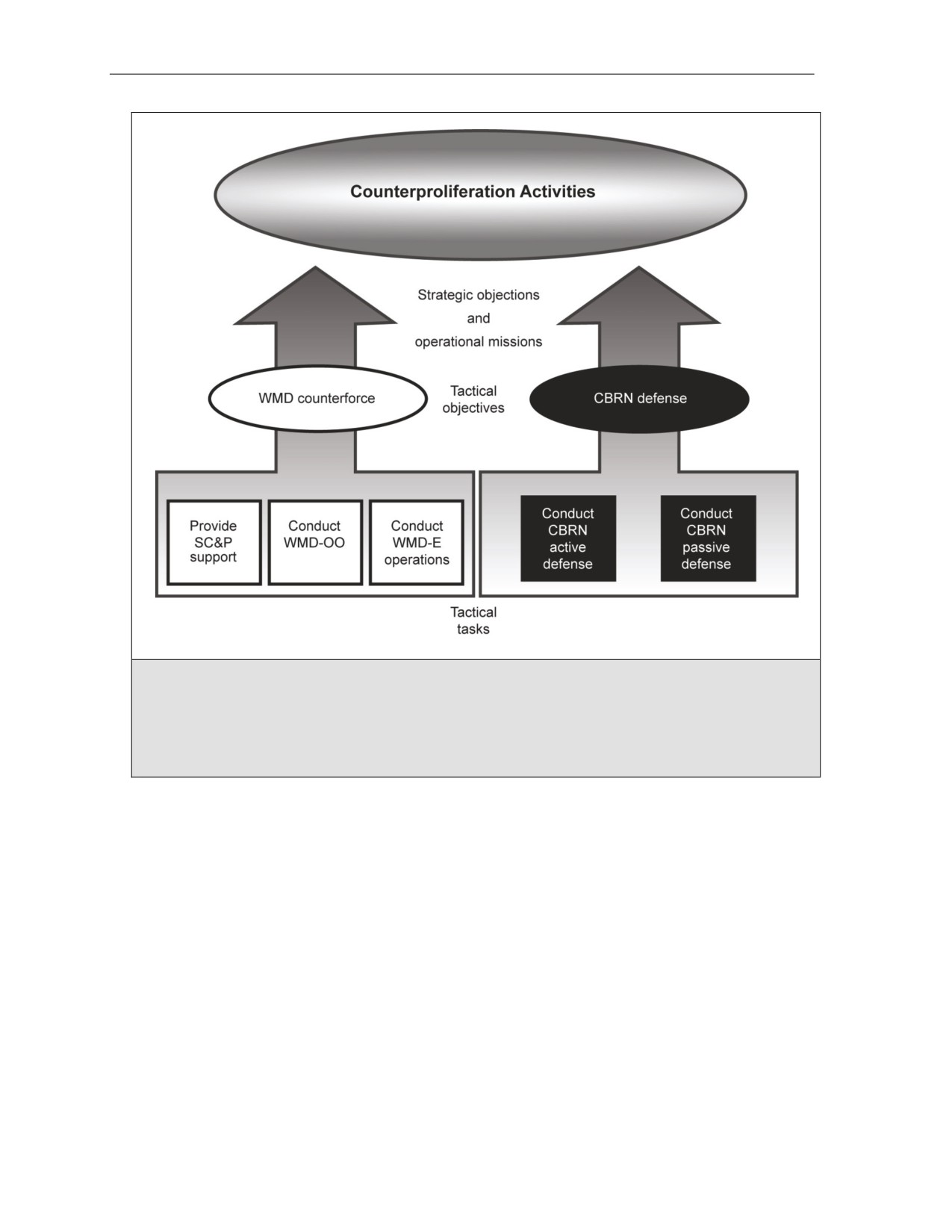
4-2. Counterproliferation activities are focused on WMD counterforce and CBRN defense. The
architecture supporting counterproliferation is outlined in figure 4-1, page 4-2. Tactical commanders will
primarily focus on the five mission areas that support WMD counterforce and CBRN defense objectives
(WMD interdiction, WMD offensive operations, WMD elimination, CBRN active defense, and CBRN
passive defense). They will develop the ability to execute the tasks necessary to successfully accomplish
missions associated with counterproliferation. This does not preclude the use of tactical units to assist in
WMD security cooperation and partner activities and CBRN consequence management to prevent
proliferation or mitigate the effects of a CBRN event.
Note. The eight military mission areas of CWMD are not conducted sequentially and discretely
in the prosecution of tactical-level military operations. They will occur independently or
simultaneously in response to the CBRN threat or hazard, depending on whether tactical units
are conducting CBRN operations while supporting CWMD objectives.
WEAPONS OF MASS DESTRUCTION COUNTERFORCE
4-3. WMD counterforce is a tactical objective to defeat the full range of CBRN threats before they can be
employed as weapons. WMD counterforce refers to tactical offensive operations to strike adversary CBRN
weapons and associated production, transportation, and storage facilities prior to use. WMD counterforce
includes the tasks of conducting WMD interdiction, WMD offensive operations, and WMD elimination
operations, encompassing the detection, deterrence, denial, degradation, and/or destruction of an
adversary’s WMD assets, means of delivery, and facilities.
1 July 2011
FM 3-11/MCWP 3-37.1/NWP 3-11/AFTTP 3-2.42
4-1
Chapter 4
Legend:
CBRN
chemical, biological, radiological, and nuclear
SC&P
security cooperation and partner activities
WMD
weapons of mass destruction
WMD-E
weapons of mass destruction elimination
WMD-OO
weapons of mass destruction offensive operations
Figure 4-1. CBRN operations supporting counterproliferation
4-4. Associated WMD counterforce capabilities include the ability to find, fix, track, target, engage, and
assess attacks against WMD targets and the ability to defeat or neutralize CBRN material, weapons, and
equipment before they can be brought to bear in the area of responsibility, while limiting collateral effects.
Targeting is an important consideration that links WMD counterforce objectives to tactical actions and
tasks.
4-5. Targeting matches the commander’s objectives, guidance, and intent with inputs from each Service
and staff element to identify forces and effects necessary to achieve the objectives. Targeting operations are
intended to deter or defeat a WMD threat or subsequent use and to reduce the level of threats that are dealt
with by CBRN active or CBRN passive defense. WMD targets are integrated into commanders’ existing
targeting processes and boards, and service publications provide detailed guidance for targeting.
4-2
FM 3-11/MCWP 3-37.1/NWP 3-11/AFTTP 3-2.42
1 July 2011
Counterproliferation Activities
4-6. The following vignette provides an example of counterforce operations.
Iraq is one country that has suffered repeated counterforce strikes as other states have attempted to destroy
its WMD capabilities. Starting with the Israeli strike on Iraq’s French-supplied nuclear reactor at Osiraq in
June 1980 and ending with Operation Desert Fox in December 1998, numerous attacks have been made on
Iraq’s WMD infrastructure in an attempt to disarm and/or disrupt these threatening programs. While the
aerial campaign during the Gulf War represented the most sustained and intensive of these efforts, other
selective attacks in response to various UNSCOM [United Nations Special Commission] crises during the
1990s also targeted Iraq’s WMD programs.
In 2002, the CIA [Central Intelligence Agency] identified Libya, Syria, Egypt, Sudan, Iran, and Iraq as
countries actively seeking to develop WMD. The threat in the Gulf seems particularly high, especially the
threat posed to forward-deployed U.S. forces in Kuwait, Saudi Arabia, Bahrain, Qatar, the United Arab
Emirates, and Oman. In Iraq, counterforce operations delayed and complicated Saddam’s efforts to develop
and maintain WMD capabilities.
Counterforce (dependent on intelligence for targeting) is but one tool available to the United States to deal
with the emerging threat environment, but it must be employed within the context of a broader campaign
using a variety of means to disarm a hostile state’s WMD.
WEAPONS OF MASS DESTRUCTION INTERDICTION OPERATIONS
4-7. WMD interdiction consists of operations to track, intercept, search, divert, seize, or otherwise stop
the transit of WMD, its delivery systems, or related materials, technologies, and expertise. WMD
interdiction is also called counterproliferation interdiction. The transit of WMD-related weapons,
materials, or expertise may occur in many combinations—from state-to-state, state-to-nonstate, nonstate-to-
state, and nonstate-to-nonstate actors. Commanders must be prepared to intercept and deny or prevent
WMD-related materials or expertise from moving to its destination.
4-8. Interdiction may occur more frequently in noncombat situations than during combat operations at
sea, on land, or in the air, especially in permissive and uncertain environments. Stopping a terrorist who is
en route to transfer WMD material to a hostile government official is one example of interdiction
operations. Commanders must be prepared to coordinate with other agencies and multinational partners to
execute and support interdiction operations in their area of responsibility.
4-9. Operations to deny and interdict proliferation-related shipments assist the disruption and
dismantlement of proliferation networks. These operations track, intercept, search, divert, seize, or stop the
trafficking of WMD, delivery systems, related materials, technologies, and expertise from adversaries.
Associated activities may include intercepting, identifying, securing, disposing of, or rendering safe suspect
WMD-related materials.
4-10. If interdiction results in the seizure of WMD or related material, the commander may be required to
reduce the threat by securing and removing (neutralize or transport) the WMD and related material. If there
is an accidental release of CBRN in a permissive or uncertain operational environment, the commander
may also be required to execute consequence management operations.
4-11. The focus of WMD interdiction and CBRN active defense operations differ. While CBRN active
defense focuses on weapons en route to a target, WMD interdiction focuses on stopping the transit of
WMD capabilities. For example—
z
If a complete nuclear weapon is being delivered to a buyer, WMD interdiction and CBRN active
defense are applicable.
z
If nuclear weapon pieces and/or parts are being shipped to a buyer, WMD interdiction is
applicable.
z
If the destination port is the target of nuclear weapon, CBRN active defense is applicable.
1 July 2011
FM 3-11/MCWP 3-37.1/NWP 3-11/AFTTP 3-2.42
4-3
Chapter 4
4-12. Examples of tactical WMD interdiction tasks include—
z
Developing a synchronization plan for joint, tactical air/land/sea interdiction operations.
z
Characterizing WMD implications of the tactical situation.
z
Conducting tactical WMD interdiction target analysis.
z
Issuing tactical WMD interdiction planning guidance to subordinate component forces.
z
Developing tactical intelligence for WMD interdiction requirements.
z
Exercising C2 in preparation for, and conduct of, WMD interdiction operations.
z
Coordinating joint/multinational and interagency support.
z
Conducting tactical-level risk assessment to support WMD interdiction operations.
z
Establishing CBRN defense information integration and connectivity.
z
Diverting, disrupting, delaying, or destroying the enemy’s WMD capability before it can be used
effectively.
z
Integrating CBRN defense capabilities (sampling, monitoring, identification, and
reconnaissance).
WEAPONS OF MASS DESTRUCTION OFFENSIVE OPERATIONS
4-13. WMD offensive operations consist of actions to disrupt, neutralize, or destroy a WMD threat before
it can be used or to deter the subsequent use of such weapons. WMD offensive operations include raids,
strikes, and operations designed to locate and take action against the threat of WMD use.
4-14. In hostile or uncertain environments where interdiction efforts have been unsuccessful in halting
rogue behavior, the President or Secretary of Defense can direct the commander to execute offensive
operations in order to destroy the WMD network’s ability to produce, deploy, or employ WMD. The
commander may use WMD offensive operations to attack targets (using lethal means), or he may conduct
engagements on targets using nonlethal means. WMD offensive operations are led by the military and
encompass the detection, identification, disruption, and destruction of an adversary’s WMD assets, delivery
means, associated facilities, and other high-value targets.
4-15. The WMD offensive operations mission area is largely the domain of the DOD, albeit interagency
cooperation will increase as operational strike capabilities progress toward attacks against WMD targets.
Since offensive strike operations against WMD targets may result in the release of hazmat, increased
political and legal scrutiny is normally necessary. This mission area also requires maintaining a capability
to locate, secure, and recover/destroy stolen WMD.
4-16. In the event that an adversary attempts to use WMD, WMD offensive operations may help disrupt
and weaken a WMD attack, increasing the effectiveness of other complementary elements of CWMD, such
as CBRN active defense, passive defense, and consequence management. These operations impose
substantial cost upon the WMD actor and require substantial refined intelligence.
4-17. The operational distinctions between WMD offensive operations and WMD elimination operations
lie in the overall end state of the actions associated with the military mission areas. While WMD
elimination operations focus on the systematic elimination of the entire WMD program, WMD offensive
operations focus only on distinct targets or nodes of the WMD program or capabilities.
4-18. WMD offensive operations can support WMD elimination operations, but WMD elimination
operations do not support WMD offensive operations because the end states differ. Examples of tactical
tasks that support WMD offensive operations include—
z
Conducting raids to destroy a specific node or target, but not the entire WMD program.
z
Conducting air strikes to deny enemy access to, or use of, WMD delivery systems.
z
Conducting operations to board and seize control of, or totally destroy, an enemy’s nuclear
submarine.
z
Using special artillery equipment to conduct surveillance operations to detect the enemy’s
WMD-related activities.
4-4
FM 3-11/MCWP 3-37.1/NWP 3-11/AFTTP 3-2.42
1 July 2011
Counterproliferation Activities
z
Gathering intelligence related to the use of WMD through the interrogation of captured
personnel or exploitation of material.
z
Defeating, degrading, destroying, disrupting, neutralizing, securing, seizing, or denying the
enemy’s WMD capability before it can be used effectively.
z
Integrating CBRN defense capabilities (sampling, monitoring, identification, and
reconnaissance).
WEAPONS OF MASS DESTRUCTION ELIMINATION OPERATIONS
4-19. WMD elimination operations consist of those actions undertaken in a hostile or uncertain
environment to systematically locate, characterize, secure, disable, or destroy WMD programs and related
capabilities. The United States may decide to conduct military operations within the territory of a WMD
possessor state or against terrorist programs that are operating within a state during WMD elimination
operations. Expedient WMD elimination operations may be required to ensure the safety of troops, secure
the freedom of action for combat operations, or protect noncombatants.
4-20. To an increasing degree, hostile nations and nonstate enemies are developing WMD for potential
deterrence against the United States and/or to threaten other opponents. More ominously, enemies may
regard the use of such weapons as politically or militarily expedient. Deterrence strategies may prove
ineffective against irrational actors. Therefore, completely eliminating an enemy’s capability to acquire,
store, and employ these weapons becomes a crucial component of any future campaign’s end state.
Eliminating enemy WMD may be the principal objective of a campaign; the defeat or destruction of the
enemy’s other military capability would be a necessary step to achieve the larger goal.
4-21. WMD elimination operations must focus, initially, on the immediate tasks of security (securing sites
and preventing the looting or capture of WMD and related materials) and the disablement or destruction of
weapons, materials, agents, and delivery systems that pose an immediate or direct threat to forces and the
civilian population. The next priority is the exploitation of program experts (for intelligence purposes) and
previously secured weapons and material to secure, exploit, and disable WMD production capabilities and
advance the elimination process prior to transitioning elimination operations to an international or host
nation body.
4-22. WMD capabilities that are candidates for WMD elimination operations include, but are not limited
to—
z
Weapon systems and associated stockpiles.
z
Raw material/agents or precursor stockpiles.
z
Artillery/rocket delivery systems, such as mortars, howitzers, multiple rocket launch systems,
motor vessels, missiles and missile systems, aircraft, unmanned aircraft systems, and other
unconventional delivery systems.
z
Dual-use facilities, such as commercial nuclear power facilities, research reactors, research and
development facilities, laboratories, production facilities, radioisotope thermoelectric generators,
pharmaceutical/formulation programs, agriculture and fertilizer facilities, and food irradiation
facilities.
z
Dual-use expertise, including personnel and documents associated with research, production,
testing, storage, or proliferation networks or operations.
4-23. WMD elimination operations employ many of the same counterforce operations capabilities as
offensive operations to—
z
Reduce the immediate threat (secure and destroy/remove WMD and related material/resources).
z
Lay the groundwork to transition the long-term destruction, redirection, and monitoring
activities of remaining elements of the WMD program to threat reduction cooperation.
4-24. WMD elimination operations also seek to locate and secure key personnel in the program. Since
WMD elimination requires some U.S. physical control of the infrastructure to establish attribution, the
commander must provide CBRN passive defense for the executing force elements.
1 July 2011
FM 3-11/MCWP 3-37.1/NWP 3-11/AFTTP 3-2.42
4-5
Chapter 4
4-25. WMD elimination and threat reduction cooperation are two military mission areas that are habitually
linked, but very different. The difference comes down to the consent and cooperation of the host nation and
the operational environment in which the missions take place. While the ultimate goal may be the same—to
characterize and reduce or eliminate the threat of WMD—the operational aspects are very different. Threat
reduction cooperation activities occur in a permissive environment. Since WMD elimination operations are
conducted in hostile or uncertain environments, they require intense intelligence efforts to penetrate the
program. WMD elimination operations may ultimately transition to threat reduction cooperation activities
as the operational environment changes. WMD elimination tasks may include—
z
Issuing tactical WMD interdiction planning guidance to subordinate component forces.
z
Conducting a course-of-action assessment of a CBRN/toxic industrial material incident for the
WMD mission force.
z
Moving forces in support of the WMD elimination mission.
z
Searching facilities/spaces during the WMD elimination mission.
z
Detecting WMD-related material during the WMD elimination mission.
z
Characterizing WMD-related material during the WMD elimination mission.
z
Containing suspect WMD-related material for further disposition.
z
Gathering forensic evidence in support of the WMD elimination mission.
z
Performing the immediate decontamination of WMD elimination force personnel and
equipment.
z
Conducting medical surveillance based on syndromic information/data.
z
Maintaining the control of materials related to the WMD elimination mission.
z
Initiating medical prophylactic measures to counter CBRN/toxic industrial material effects.
z
Transporting WMD-related material for further disposition.
z
Training for WMD elimination operations.
z
Conducting WMD elimination target analysis.
CHEMICAL, BIOLOGICAL, RADIOLOGICAL, AND NUCLEAR
DEFENSE
4-26. CBRN defense is measures taken to minimize or negate the vulnerabilities and effects of a CBRN
incident. The combination of active and passive defense measures reduces the effectiveness or success of
CBRN weapon employment. It is imperative that all commanders integrate CBRN defense into their
mission planning, regardless of the mission type.
ACTIVE DEFENSE OPERATIONS
4-27. CBRN active defense comprises measures taken to defeat an attack with CBRN weapons by
employing actions to divert, neutralize, or destroy those weapons or their means of delivery while en
route to their target. CBRN active defense operations to defend against conventionally and
unconventionally delivered WMD include, but are not limited to—
z
Missile defense (ballistic and cruise).
z
Air defense.
z
Special operations.
z
Security operations.
4-28. There is a difference between CBRN active defense and WMD interdiction operations. The goal of
active defense operations is to achieve a layered capability to defeat the full scope of delivery means in
defense of the homeland, expeditionary forces, and other assets and interests in forward regions. However,
WMD interdiction operations focus on stopping the transit of WMD capabilities. Examples of CBRN
active defense tasks include—
z
Destroying CBRN-capable artillery battery using counterbattery fires, air strikes, or missiles
directly on an enemy position. The destruction leverages lethal and nonlethal means.
z
Destroying enemy aircraft armed with WMD through air-to-air or ground-to-air engagements.
4-6
FM 3-11/MCWP 3-37.1/NWP 3-11/AFTTP 3-2.42
1 July 2011
Counterproliferation Activities
z
Delivering air strikes on trucks that are loaded with ammunition while they are en route to the
detonation location.
z
Diverting the enemy’s intent to position WMD for delivery.
z
Detecting planned terrorist actions. For example, detect a suicide bomber and neutralize him or
her before detonation is possible. Maximize the use of intelligence assets to discover who, what,
when, where, and how.
z
Intercepting, engaging, neutralizing, or destroying WMD en route to a target by using surface-to-
air missiles. This includes disrupting enemy theater missile operations (ballistic missiles; air-to-
surface missiles; and air-, land-, and sea-launched cruise missiles) through an appropriate mix of
mutually supportive passive missile defense, active missile defense, attack operations, combat
air patrol, and supporting information systems.
PASSIVE DEFENSE OPERATIONS
4-29. CBRN passive defense includes measures taken to minimize or negate the vulnerability to, and
effects of, CBRN attacks. This mission area focuses on maintaining the joint force’s ability to continue
military operations in a CBRN environment. CBRN passive defense measures enable air and ground
military operations to be sustained in a CBRN environment. Success depends on the effective integration of
equipment; CBRN training; and proven tactics, techniques, and procedures.
Note. Appendix C provides basic standards of proficiency for individuals and organizations and
additional standards of proficiency for selected personnel, CBRN defense specialists, medical
personnel, and commanders.
4-30. If an adversary succeeds in launching a CBRN attack and CBRN active defense measures fail to
eliminate the delivery vehicle and/or weapons, CBRN passive defense measures become critical. These
passive defense measures are designed to mitigate the immediate effects of a CBRN incident and to protect
U.S. forces who are conducting military missions in a CBRN environment.
4-31. CBRN passive defense has historically been based on three general principles that specifically
address the hazards created by CBRN incidents or accidents. The application of the following principles
helps minimize vulnerabilities, protects friendly forces, and maintains the force’s operational tempo in
order to achieve objectives:
z
CBRN contamination avoidance of CBRN hazards.
z
CBRN protection of individuals, units, and equipment from unavoidable CBRN hazards.
z
CBRN decontamination to restore operational capability.
Note. Although C2 is not one of the CBRN principles, it is the mechanism that integrates.
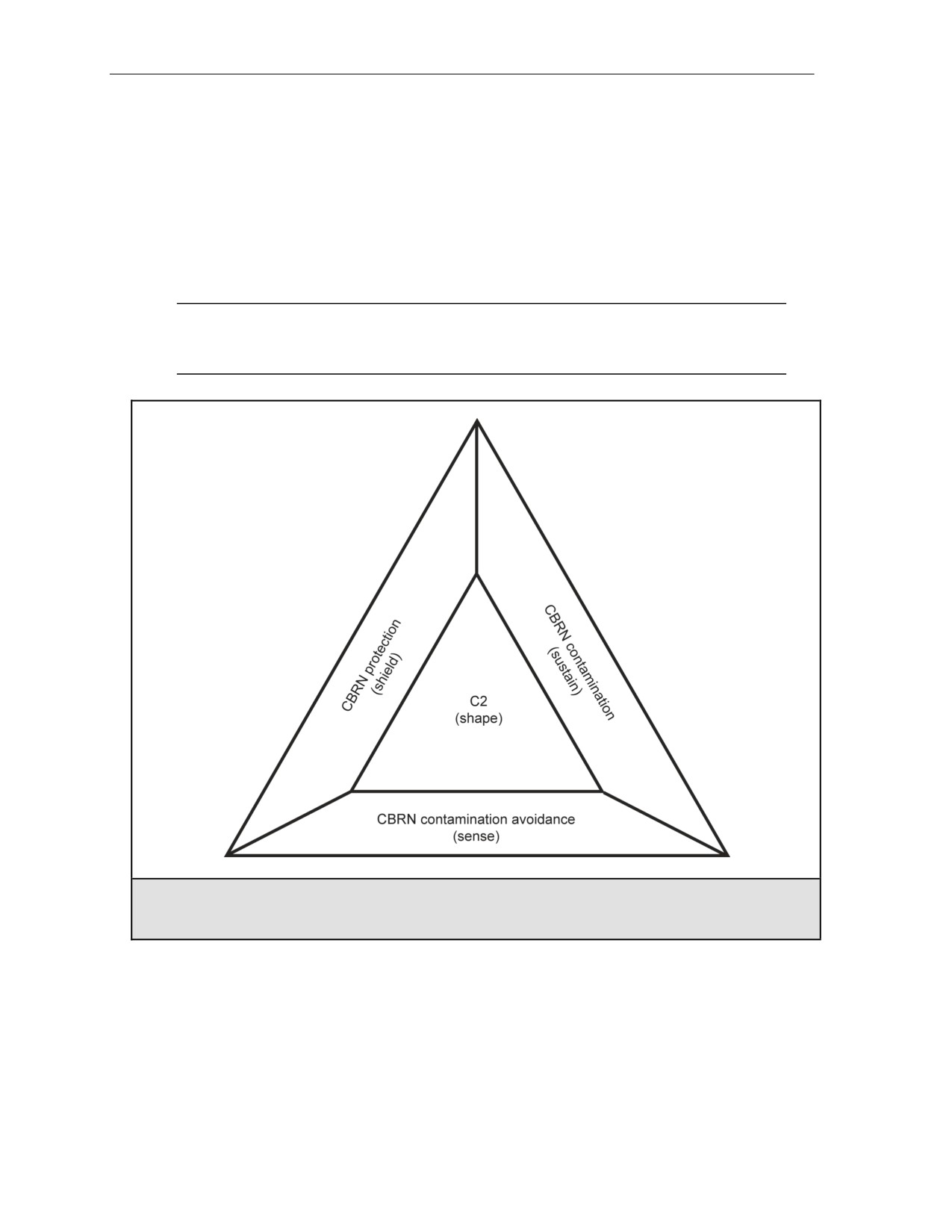
4-32. Within the DOD, principles associated with CBRN passive defense are organized under the four
CBRN operational elements:
z
Sense.
z
Shape.
z
Shield.
z
Sustain.
4-33. These elements are linked with and provide the capabilities to support the principles of CBRN
passive defense as outlined in figure 4-2, page 4-8.
1 July 2011
FM 3-11/MCWP 3-37.1/NWP 3-11/AFTTP 3-2.42
4-7
Chapter 4
Contamination Avoidance
4-34. Successful contamination avoidance prevents disruption to operations and organizations by
eliminating unnecessary time in cumbersome protective postures and decontamination requirements.
Avoiding contamination requires the ability to detect and report the presence of CBRN hazards.
4-35. The CBRN sense function is a capability to achieve CBRN contamination avoidance. CBRN sense is
defined as activities that continually provide CBRN threat and hazard information and intelligence in a
timely manner to support the common operational picture. CBRN sense is key to contamination avoidance
because it is intended to continually provide critical information about potential or actual CBRN hazards in
a timely manner through early detection, identification, and determination of the scope of hazards.
Note. See Multiservice Tactics, Techniques, and Procedures for Chemical, Biological,
Radiological, and Nuclear Contamination Avoidance for a more detailed discussion of
contamination avoidance.
Legend:
C2
command and control
CBRN
chemical, biological, radiological, and nuclear
Figure 4-2. Principles of CBRN passive defense
Chemical, Biological, Radiological, and Nuclear Protection
4-36. CBRN protection includes those measures that are taken to keep CBRN threats and hazards from
having an adverse effect on personnel, equipment, and critical assets and facilities. Commanders must
implement protective measures that are appropriate to all anticipated threats, including terrorists and the use
of WMD or other CBRN hazards. CBRN protection often requires capabilities from CBRN active and
passive defense and also requires the planning, preparation, training, and execution of physical defenses to
4-8
FM 3-11/MCWP 3-37.1/NWP 3-11/AFTTP 3-2.42
1 July 2011
Counterproliferation Activities
negate the effects of CBRN weapons and hazards on personnel and materiel. CBRN protection conserves
the force by providing individual and collective protection postures and capabilities. CBRN shield
comprises the individual and collective protection measures that are essential to mitigating the effects of
CBRN hazards. Protecting the force from CBRN hazards may include hardening systems and facilities,
preventing or reducing individual and collective exposures, or applying medical prophylaxes.
Note. See Multiservice Tactics, Techniques, and Procedures for Nuclear, Biological, and
Chemical (NBC) Protection for a more detailed discussion of CBRN protection.
Decontamination
4-37. Decontamination is the process of absorbing, destroying, neutralizing, making harmless, or removing
chemical and biological agents or removing radioactive material that is around or clinging to a person,
object, or area in order to make it safe . Decontamination is a key component of the overarching concept of
contamination control and supports the postattack restoration of forces and operations to a near-normal
capability. Decontamination and contamination control are intended to minimize the time required to return
personnel and mission-essential equipment to a mission-capable state. Commanders must prioritize
requirements and decontaminate only what is necessary because assets are limited and decontamination is
often labor-intensive.
Note. See Multiservice Tactics, Techniques, and Procedures for Chemical, Biological,
Radiological, and Nuclear Decontamination for a more detailed discussion of decontamination.
4-38. Contamination control addresses—
z
Controlling contaminated waste.
z
Establishing contaminated-equipment holding and exclusion areas.
z
Minimizing the levels of contamination where it cannot be avoided.
z
Conducting split mission-oriented protective posture (MOPP) operations. (Split MOPP is the
concept of maintaining heightened protective posture only in those areas or zones that are
contaminated, allowing personnel in uncontaminated areas to continue operations in a reduced
protective posture.)
4-39. CBRN sustain comprises the decontamination and medical activities conducted to restore combat
power and continue operations. Mitigation includes planning, initiating, and continuing operations, despite
threats from CBRN materials, by conducting contamination control and medical countermeasures that
enable the quick restoration of operational capability.
Note. See Multiservice Tactics, Techniques, and Procedures for Installation Chemical,
Biological, Radiological, and Nuclear Defense for a more detailed discussion of contamination
control.
Command and Control
4-40. C2 is associated with the CBRN shape function. As information is characterized, commanders are
able to make decisions that will support the CRBN principles to—
z
Plan, conduct, and integrate CBRN defense with other defenses.
z
Optimize the capability to operate in a CBRN environment.
z
Minimize negative psychological effects.
4-41. CBRN shape is the C2 activities that integrate the CBRN sense, shield, and sustain operational
elements to characterize CBRN hazards and threats and employ necessary capabilities to counter their
effects.
1 July 2011
FM 3-11/MCWP 3-37.1/NWP 3-11/AFTTP 3-2.42
4-9
Chapter 4
Note. See Multiservice Tactics, Techniques, and Procedures for Chemical, Biological,
Radiological, and Nuclear Aspects of Command and Control.
SUMMARY
4-42. This chapter outlined WMD counterforce, CBRN defense, and five of the eight military mission
areas in support of counterproliferation activities. These activities are conducted in nonpermissive
environments and directed toward defeating the threat or toward the use of WMD against the United States
and our forces, friends, and allies. WMD counterforce and CBRN defense activities may transition from
counterproliferation to consequence management activities when CWMD programs fail.
Note. Consequence management activities are discussed in Chapter 5.
4-10
FM 3-11/MCWP 3-37.1/NWP 3-11/AFTTP 3-2.42
1 July 2011
Chapter 5
Consequence Management Activities
CBRN consequence management consists of actions taken to plan, prepare,
respond to, and recover from CBRN incidents that require force and resource
allocation beyond passive defense capabilities. CBRN consequence management
activities performed by U.S. military forces encompass actions taken to mitigate the
consequences from deliberate and inadvertent releases of CBRN agents or substances
and assist in the restoration of essential operations and services at home and abroad.
Properly executed CBRN consequence management mitigates the effects of the event
and serves as a deterrent for future attacks.
Note. See Multiservice Tactics, Techniques, and Procedures for Chemical, Biological,
Radiological, and Nuclear Consequence Management Operations for detailed
information.
OVERVIEW
5-1. The counterproliferation activities of WMD counterforce and CBRN defense actions may not
eliminate or reduce the effects of deliberate and inadvertent releases of CBRN agents and material that
have the potential to cause high casualties and large levels of destruction. As technology becomes
increasingly available, terrorists seek new ways to acquire, manufacture, weaponize, and deploy CBRN
agents and materials. Addressing the impact of an accidental, intentional, or natural release of CBRN
material is the basis for the CBRN consequence management activities performed at the tactical level.
5-2. CBRN consequence management is normally managed at the strategic and operational levels (U.S. or
host nation government), with DOD providing support as directed. During combat operations, DOD leads
the operational response in reaction to an incident involving U.S. forces and allies. When directed or
authorized by the President, the Secretary of Defense may authorize civil support operations. Abroad, when
requested by a host nation, the President may authorize, and the Secretary of Defense may direct, DOD
support to U.S. Government foreign consequence management operations.
5-3. The DOD conducts CBRN consequence management in support of civil authorities to mitigate the
effects of accidental or intentional CBRN event, usually in support of a primary agency. CBRN
consequence management operations occur in foreign and domestic settings. DOD must be prepared to
conduct CBRN consequence management operations when called upon. The Department of Homeland
Security is the primary agency for a continental United States (CONUS) WMD event. On foreign territory,
the Department of State is the primary agency for coordinating responses to host nation requests for
support. DOD leads the operational response for an incident involving U.S. forces and allies.
5-4. The primary goals of CBRN consequence management are to—
z
Save lives.
z
Prevent injury.
z
Provide temporary critical life support.
z
Protect critical infrastructure, property, and the environment.
z
Contain the event.
z
Preserve national security.
5-5. Currently, U.S. forces may conduct consequence management operations in a designated joint
operations area to sustain operations, mitigate undesired effects (such as the release of CBRN hazards), and
1 July 2011
FM 3-11/MCWP 3-37.1/NWP 3-11/AFTTP 3-2.42
5-1
Chapter 5
manage the consequences of such effects. By demonstrating the ability to deny the benefits of WMD use,
consequence management capabilities can also influence adversary decisions to employ WMD.
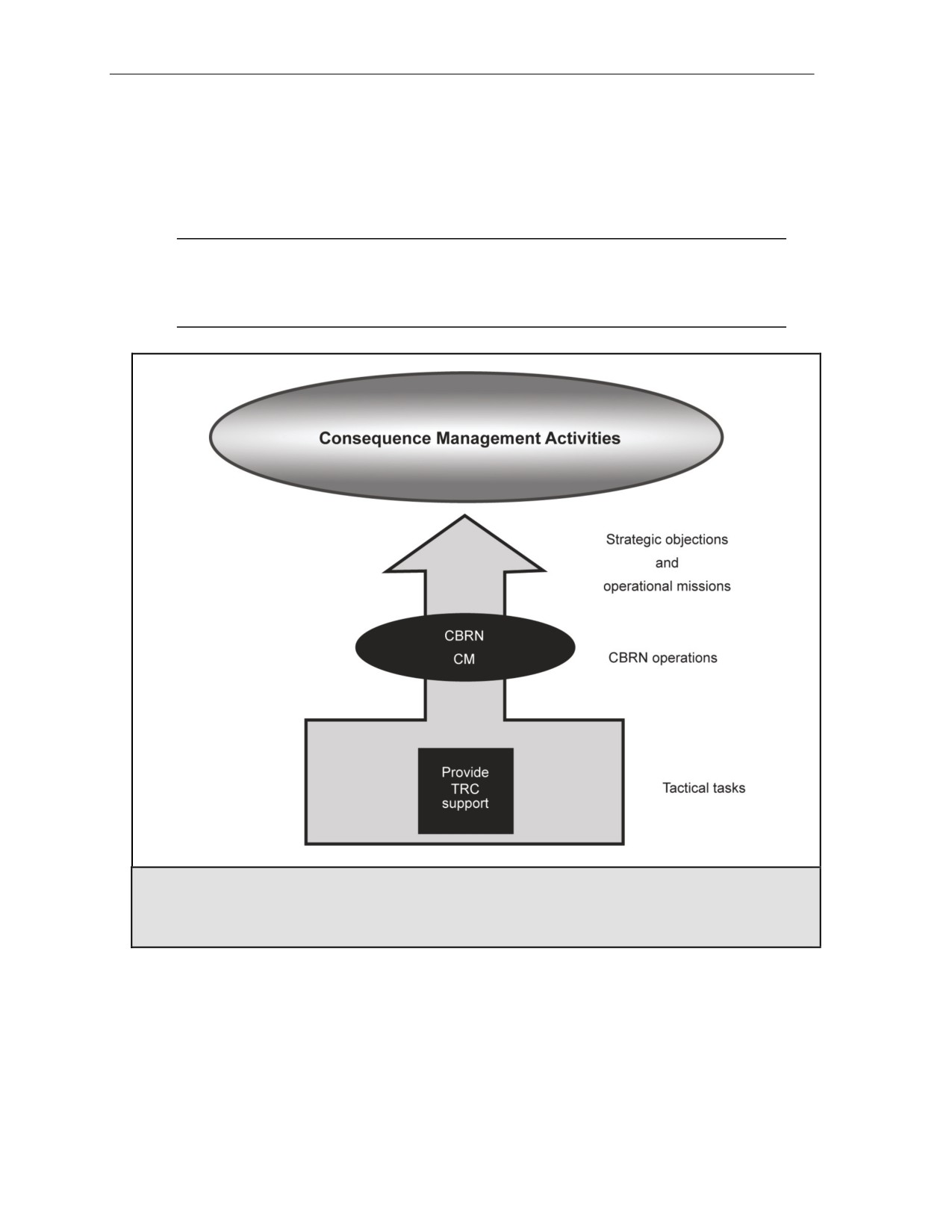
5-6. CBRN consequence management tasks at the tactical level support strategic and operational
objectives and must be tailored to make the preservation of life a priority. This is a significant shift in
mind-set for commanders, staff, and CBRN consequence management planners. CBRN consequence
management operations supporting consequence management activities are outlined in figure 5-1.
Note. The eight military mission areas of CWMD are not conducted sequentially and discretely
in the prosecution of tactical-level military operations. The missions will occur independently or
simultaneously in response to the CBRN threat or hazard, depending on whether tactical units
are conducting CBRN operations while supporting CWMD objectives.
Legend:
CBRN
chemical, biological, radiological, and nuclear
CM
consequence management
TRC
threat reduction cooperation
Figure 5-1. CBRN operations supporting CBRN consequence management
5-2
FM 3-11/MCWP 3-37.1/NWP 3-11/AFTTP 3-2.42
1 July 2011
Consequence Management Activities
PROCESS
5-7. CBRN consequence management goals focus the conduct of DOD operations and provide a common
understanding of the purpose of CBRN consequence management. The method of response will use
standing contingency plans and procedures to determine what forces and capabilities are required and
committed in support of requests for assistance.
5-8. CBRN consequence management includes planning, preparing for, responding to, and recovering
from the consequences of CBRN incidents, no matter what their causes. Accidents may occur at chemical
plants, nuclear power plants, or other facilities that have the potential for releasing CBRN material or
during the transport of toxic industrial material. Intentional acts include the use of WMD by adversaries
(global, regional, or nonstate), sabotage, and other acts of terrorism. CBRN materials present immediate
and delayed hazards. In some instances, the delayed effects can cause greater problems for joint forces and
may alter CBRN consequence management response activities.
5-9. CBRN consequence management planning and preparation activities support the National Response
Framework prevention efforts, while the response and recovery actions support the National Response
Framework mitigation efforts. The four CBRN consequence management activities are (see figure 5-2,
page 5-4)—
z
Plan. Planning involves the assessment of the operational environment and enables commanders
to identify minimum standards for training, organizing, equipping, and protecting resources. The
response unit’s planning process drives preparation and facilitates response and recovery
operations.
z
Prepare. Preparation implements the approved plan and relevant agreements to increase
readiness through training, exercises, and certification. Vulnerability reduction measures are
initiated by the response unit to support prevention and mitigation functions.
z
Respond. The respond process addresses the short-term, direct effects of an incident. Response
measures initiated by the response unit include those actions taken to save lives, prevent human
suffering, protect property, and establish control.
z
Recover. The response unit initiates the recover process, focusing on restoring mission
capability and essential public and government services interrupted by the incident. The
recovery phase also includes completing the mitigation of the immediate hazard.
CONSEQUENCE MANAGEMENT OPERATIONS
5-10. An operational environment is a composite of the conditions, circumstances, and influences that
affect the employment of capabilities and bear on the decisions of the commander. DOD conducts CBRN
consequence management operations in three operational environments:
z
Defense support of civil authorities during a domestic response. This response includes
assisting federal agencies within the United States and its territories and possessions according
to guidance in the National Response Framework. DOD supports operations, within its
capabilities, through liaison with the incident commander.
z
Defense support to a foreign request. DOD supports the Department of State with operations
originating from a foreign request. Tasks originate from the host nation through the Department
of State. However, DOD commanders may take appropriate action in life-threatening situations
while awaiting DOD or Department of State tasking.
z
DOD-led operations. DOD leads the operational response for an incident involving U.S. forces
and its allies across the operational environment. This also includes responding on a DOD
installation.
5-11. Depending on the threat and the political and physical environments of the consequence management
response location, the operational environments may be further characterized as permissive, uncertain, or
hostile. Given the nature of their actions, most consequence management response operations are
conducted in a permissive environment.
1 July 2011
FM 3-11/MCWP 3-37.1/NWP 3-11/AFTTP 3-2.42
5-3
Chapter 5
Legend:
CBRN
chemical, biological, radiological, and nuclear
CM
consequence management
Figure 5-2. CBRN consequence management process
RESPONDERS
5-13. CBRN responders are DOD military and civilian personnel who are trained to respond to
CBRN incidents and certified to operate safely at the awareness, operations, technician, or
installation level according to Section 120, Part 1910, Title 29, Code of Federal Regulations and
National Fire Protection Association 472. They may be responsible for tactical planning and the conduct
of CBRN consequence management operations in domestic, foreign, or theater operational environments,
including military installations. The levels of CBRN responders are—
z
Awareness. Awareness level responders witness or discover a CBRN agent or hazmat release
and are trained to initiate an emergency response sequence. They take no further action beyond
notifying the authorities.
z
Operations. Operations level responders react to releases or potential releases of CBRN agents
or hazmat as part of the initial response to the site for the purpose of protecting nearby persons,
property, or the environment from the effects of the release. They are trained to respond in a
defensive fashion without actually trying to stop the release.
5-4
FM 3-11/MCWP 3-37.1/NWP 3-11/AFTTP 3-2.42
1 July 2011
Consequence Management Activities
z
Technician. Technician level responders react to releases or potential releases of CBRN or
hazmat for the purpose of mitigation.
z
Installation. Installation level responders provide technical level expertise to the installation
commander. They coordinate with internal and external agencies (including local, federal, and
host nation governments) to provide emergency support for the installation.
5-14. The incident commander is responsible for all aspects of an emergency response, to include quickly
developing incident objectives, managing incident operations, applying resources, and assuming
responsibility for persons involved. The incident commander sets priorities and defines the organization of
the response teams and the overall incident action plan. The incident commander role may be assumed by a
senior or higher-qualified officer upon his or her arrival or as the situation dictates. Even if subordinate
positions are not assigned, the incident commander position is always designated or assumed.
SUMMARY
5-15. This chapter outlined CBRN consequence management tasks conducted in support of consequence
management activities. CBRN consequence management operations are conducted when CWMD programs
fail.
1 July 2011
FM 3-11/MCWP 3-37.1/NWP 3-11/AFTTP 3-2.42
5-5
Chapter 6
Installation Emergency Management
Installation CBRN protection consists of measures taken to anticipate, recognize,
warn, evaluate, control, respond to, and recover from CBRN events in order to
preserve life, prevent human suffering, mitigate an incident, protect critical assets,
and maintain critical missions. The key elements of installation CBRN protection are
detecting, assessing, warning, defending, and recovering.
OVERVIEW
6-1. Since 11 September 2001, installation protection has been a topic of increasing concern for the DOD.
The overarching goal is to maintain DOD warfighting capabilities when under attack or after disruption.
Department of Defense Instruction (DODI) 2000.18 states “The Combatant Commanders and Services
shall develop Service-wide scenarios designed to establish baseline capabilities needed to allow installation
emergency responders to protect personnel and infrastructure, facilities, other assets, and identify
vulnerabilities.”
6-2. Historically, terrorist acts against U.S. interests have been committed abroad. However, the
bombings of the World Trade Center in 1993 and the Murrah Federal Building in 1995, the attacks of
September 2001, and the anthrax letter s of 2001 demonstrate the willingness of terrorists to also commit
acts of violence against U.S. interests on American soil. In response, the DOD has begun to implement
additional measures to address threats to the U.S. homeland and to U.S. military installations at home and
abroad.
6-3. The installation CBRN protection process relies on the persistent detection of threats in an integrated,
shared understanding of the operational environment and timely dissemination of accurate decisions,
warnings, and tasking that enable DOD installations and facilities to protect themselves against specific
attacks and threats. Some installation CBRN protection capability requirements are—
z
Detect and identify CBRN incidents on an installation.
z
Issue a warning and report a CBRN attack and the presence of contamination.
z
Protect personnel, maintain critical military missions, and resume essential operations.
z
Provide appropriate medical protection, diagnosis, and treatment for CBRN effects.
z
Be compatible with existing installation power and communication systems.
z
Employ decision support tools.
z
Ensure that all installation emergency response personnel are trained to respond to a terrorist
CBRN attack.
Note. Memorandums of understanding and agreement will determine the appropriate policy.
6-4. Installations may not have the resources to support a separate, independent program developed
exclusively for preparing for, responding to, and recovering from CBRN incidents. Therefore, installation
CBRN protection must fit into the framework of an installation all-hazards emergency management
program to be effective. Additionally, the ability to receive emergency support from, and provide mutual
aid to, the local community depends on common response and incident management protocols developed
for all hazards. Employing an all-hazards approach encourages interoperability; enables the effective use of
resources; and protects critical operations, personnel, assets, and the environment during likely emergency
events. An all-hazards approach to CBRN installation protection also facilitates the coordination of
programs and resources resulting in rapid, effective response and hazard mitigation.
1 July 2011
FM 3-11/MCWP 3-37.1/NWP 3-11/AFTTP 3-2.42
6-1
Chapter 6
Note. See Multiservice Tactics, Techniques, and Procedures for Installation CBRN Defense for
more information on installation CBRN protection.
INSTALLATION OPERATIONAL ENVIRONMENT
6-5. The installation operational environment is a composite of the conditions, circumstances, and
influences that affect the employment of capabilities and bear on the decisions of the commander. Some
examples are—
z
Permissive environment. An operational environment in which host country military and law
enforcement agencies have the control, intent, and capability necessary to assist operations that a
unit intends to conduct.
z
Uncertain environment. An operational environment in which host government forces, whether
opposed or receptive to operations that a unit intends to conduct, do not have totally effective
control of the territory and population in the intended operational area.
z
Hostile environment. An operational environment in which hostile forces have the control,
intent, and capability necessary to effectively oppose or react to the operations that a unit intends
to conduct.
6-6. U.S. military installations support operational forces in domestic and foreign environments. The
particular location of the installation is critical in determining the laws and regulations that must be applied
and the level of military authority that the installation commander may have in determining response
actions, including the level of personal protection for the response force.
6-7. DODI 2000.21 defines foreign locations as any geographic area not reflected in the definition of
domestic locations, and it lists the following as domestic locations:
z
CONUS.
z
Alaska.
z
Hawaii.
z
Commonwealth of Puerto Rico.
z
U.S. Virgin Islands.
z
U.S. territories of Guam.
z
American Samoa.
z
Jarvis Island.
z
Commonwealth of the Northern Marianas Islands.
z
Freely Associated States of Micronesia.
z
Republic of Palau.
z
Republic of the Marshall Islands.
z
U.S. possessions of Wake Island.
z
Midway Island.
z
Johnston Island.
z
Baker Island.
z
Howland Island.
z
Palmyra Atoll.
z
Kingman Reef.
6-2
FM 3-11/MCWP 3-37.1/NWP 3-11/AFTTP 3-2.42
1 July 2011
Installation Emergency Management
6-8. An installation is a grouping of facilities that are located in the same vicinity and support particular
functions. Installations may include, but are not limited to—
z
Posts or bases.
z
Ports (sea or air).
z
Airfields.
z
Base clusters.
z
Staging areas.
z
C2 nodes.
z
Logistics nodes.
z
Other facilities or fixed sites, including expeditionary bases and camps.
6-9. An emergency management program consists of the following phases that can occur sequentially or
simultaneously:
z
Planning.
z
Preparation.
z
Response.
z
Recovery.
6-10. As discussed in Chapter 5, the U.S. military (due to its unique capabilities and resources) may also be
asked to provide temporary, short-duration support to civil authorities during an emergency when local and
state resources are overwhelmed.
INSTALLATION COMMAND AND STAFF RESPONSIBILITIES
6-11. The installation commander is responsible for establishing the installation CBRN defense plan,
including threat assessment, vulnerability analysis and reduction, emergency response, and immediate
recovery operations across the range of possible CBRN hazards. A summary of tasks is provided in table
6-1, page 6-4.
COORDINATION
6-12. Responding to a CBRN emergency on an installation may require all first and emergency responder
assets and may exceed the consequence management capabilities of organic installation resources.
Installation commanders may require extensive federal, state, local, other Service, and/or private or host
nation support to effectively respond to, and recover from, a CBRN emergency. Close liaison with these
agencies and departments is essential before an emergency to ensure that civil authorities are responsive in
protecting DOD resources.
6-13. Each installation emergency operations center should be a National Incident Management System-
compliant, multiagency coordination system that uses the incident/unified command system’s
organizational structure to provide a collaboration point and operations center for the installation staff. The
emergency operations center supports the execution of the installation emergency management and
antiterrorism plans, defense support of civil authorities, operational/contingency plans of assigned unit
commanders, National Response Framework, and other supporting plans.
1 July 2011
FM 3-11/MCWP 3-37.1/NWP 3-11/AFTTP 3-2.42
6-3
Chapter 6
Table 6-1. Commander and staff responsibilities
Responsibilities of Installation Commanders in CONUS
Develop a comprehensive installation CBRN defense plan.
Train, rehearse, and exercise the CBRN defense plan.
Allocate installation activities and resources to support the installation CBRN defense plan.
Continuously assess and improve the installation CBRN defense plan.
Inspect and assess installation CBRN readiness and preparedness.
Execute applicable memorandums of understanding and agreement with activities that will provide
mutual aid.
Additional Responsibilities of Installation Commanders
in Foreign Operational Environments
Integrate installation and host nation emergency response capabilities to support the sustainment
of installation capabilities and readiness.
Coordinate installation CBRN defense measures with respective area or base cluster commanders
if applicable.
Identify interoperability requirements and mitigation measures to help meet emergency response
requirements.
Monitor or support negotiations, memorandums of understanding implementation, and defense
and emergency response assistance.
Coordinate training opportunities with supporting host nation resources that will periodically
exercise existing memorandums of understanding and agreement.
Review and approve scenarios for CBRN exercises that are consistent with the regional threat
assessment.
Responsibilities of Installation Staffs
Develop, implement, and supervise the organizational CBRN defense program.
Coordinate with the appropriate command intelligence section(s) to provide a continuous CBRN
threat assessment.
Conduct CBRN vulnerability assessments.
Develop, coordinate, and assess CBRN defense training execution.
Integrate installation CBRN emergency response initiatives into installation resource planning, and
coordinate with local authorities to ensure that the installation CBRN emergency response plan is
integrated with local emergency response plans.
Identify roles for tenant and transient units.
Ensure that point, standoff, and medical CBRN reconnaissance and surveillance assets support
the common operational picture.
Coordinate with supporting medical and nonmedical laboratory(s) for sample analysis.
6-14. Emergency management plans and emergency responses are typically based on mutual assistance
between the respective agencies and departments. Under the CBRN passive defense operational elements
of CBRN sense, shape, shield, and sustain, the coordination of installation CBRN and emergency
management resources includes—
z
Fixed detection and surveillance systems.
Fixed chemical detection units.
Fixed biological particle collectors.
Radiation monitoring portals.
z
Individual and collective protection systems.
Level A, B, and C personal protection suits and respiratory protection devices.
Escape hoods.
Structural collective protection systems
(employment is consistent with the threat and
installation protection plan).
6-4
FM 3-11/MCWP 3-37.1/NWP 3-11/AFTTP 3-2.42
1 July 2011
Installation Emergency Management
z
Portable detection and sampling systems.
Handheld radiation isotope identifiers and chemical vapor survey meters.
Chemical-agent detector paper and handheld test kits.
Personal dosimeters and radiation monitors.
Handheld assays and biosampling kits.
Toxic industrial chemical sampling and testing equipment.
z
Decontamination systems.
Man-portable, wash-down systems.
Handheld equipment decontamination kits.
Personal skin decontamination kits.
Hazmat spill containment kits.
z
Medical systems.
Mass casualty decontamination systems.
Medical surveillance systems.
Various pharmaceuticals for the treatment of chemical, biological, or radiological exposure.
Installation protection medical treatment solutions
(provided for exclusive populations,
including critical-mission and limited, essential-operations personnel).
z
Information management systems.
Decision support system applications, including Defense Threat Reduction Agency
reachback services coordinated through the Joint Program Manager Guardian.
Technical reference material for incident response and management personnel.
Sensor management systems.
Warning and notification systems.
Note. Information management systems provided under installation protection focus primarily
on providing critical information to installation decisionmakers and do not include automated
reporting to higher command authorities. Information management system components provided
under installation protection are intended to leverage preexisting telecommunications
infrastructures at installations for connectivity.
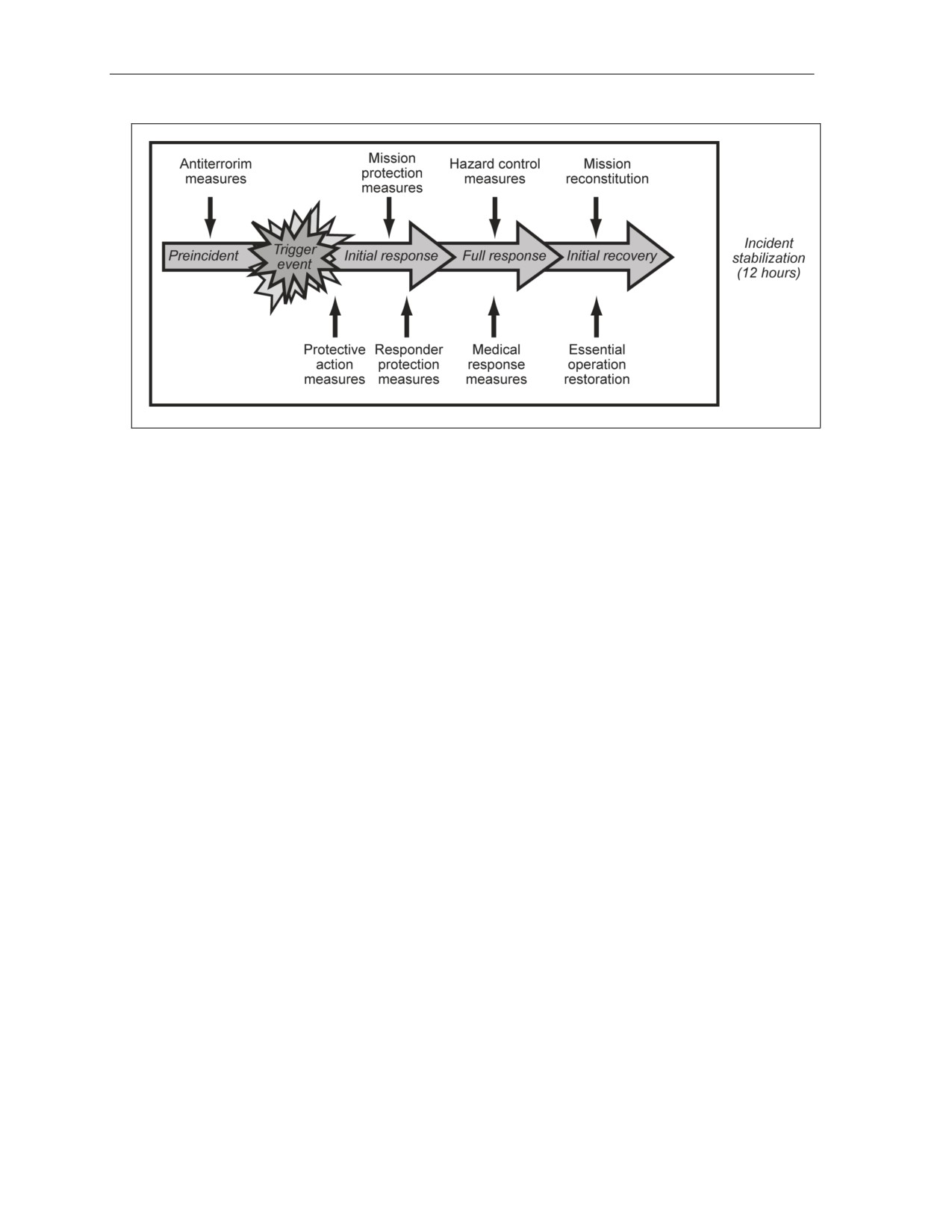
6-15. Figure 6-1, page 6-6, is a simplified, notional sequence of CBRN incident phases that illustrates
when CBRN mitigation measures and supporting installation protection solutions would be implemented.
Terrorist incidents involving CBRN hazards that occur within the United States, including those occurring
on DOD installations and facilities, are addressed in the appropriate incident annexes of the National
Response Framework.
6-16. The incident annexes of the National Response Framework describe the concept of operations to
address specific contingency or hazard situations that require emergency response. For installation
emergency management purposes, the definition of an incident will be based on the appropriate National
Response Framework definition.
6-17. Installation CBRN protection solutions enhance mission assurance and consequence management
efforts during the first 12 hours of a CBRN incident. It is assumed that the response and recovery activities
of installations after the initial
12 hours will be supported largely by resources of national response
organizations—which may not arrive at an affected installation until 6 to 12 hours after incident reporting.
The response time depends on the time required for the resources to be mobilized, the location of the
affected installation, and other situational factors.
1 July 2011
FM 3-11/MCWP 3-37.1/NWP 3-11/AFTTP 3-2.42
6-5
Chapter 6
Figure 6-1. CBRN incident phases and mitigating measures
6-18. The coordination of installation emergency management and CBRN solutions aims to improve the
abilities of affected installations to stabilize attack effects for the short term, followed by the provision of
national assistance to facilitate long-term community recovery. Emergency management solutions are not
intended to facilitate the full recovery of installations to preincident conditions.
COORDINATION ACTIVITIES WITH THE SERVICES
6-19. Coordination activities between the installation emergency management staff, tenant commands, and
representatives of organizations directly or indirectly supporting the installation commander focus on
developing an installation level concept of operations and complementary protection concepts. Installation
level, concept-of-operations development activities will aim to develop installation level emergency
operations plan templates that are interoperable and leverage the capabilities of each Service colocated on
an installation.
COORDINATION ACTIVITIES WITH DEPARTMENT OF DEFENSE AGENCIES AND JOINT
ORGANIZATIONS
6-20. Installation emergency management staff members will liaise with DOD agencies who are managing
programs and providing services to installations that are related to protection and CBRN consequence
management, including—
z
Defense Threat Reduction Agency for technical and operational reachback services.
z
Defense Information Systems Agency for the development of complementary relationships with
area security operations C2 applications and the certification and accreditation of installation
information systems.
z
Assistant Secretary of Defense for homeland defense.
z
Office of the Assistant Secretary of Defense for Health to address the provision of
pharmaceutical items to installations.
z
Joint program management offices, such as the Joint Requirements Office and the Joint Project
Manager for Information Systems for program management.
6-6
FM 3-11/MCWP 3-37.1/NWP 3-11/AFTTP 3-2.42
1 July 2011
Installation Emergency Management
COORDINATION ACTIVITIES WITH CIVILIAN GOVERNMENT AGENCIES
6-21. Members of the installation emergency management staff will work with non-DOD agencies such as
the Department of Homeland Security and local government agencies, where applicable, to leverage
services provided through federal programs and existing consequence management capabilities of
communities in proximity to installations. Specific activities with federal agencies include information
sharing with—
z
Domestic Nuclear Detection Office for radiation portal monitor testing and evaluation.
z
Federal Emergency Management Agency for disaster management interoperability service to
installations.
z
Federal Bureau of Investigation for sample and evidence handling procedures.
EMERGENCY MANAGEMENT PROGRAM
6-22. Emergency management, as a subset of incident management, concerns the coordination and
integration of activities that are necessary to build, sustain, and improve the capability to prepare
for, protect against, respond to, recover from, or mitigate threatened or actual natural disasters, acts
of terrorism, or other manmade disasters. Consequence management involves actions that are taken to
maintain or restore essential services and manage and mitigate problems resulting from disasters and
catastrophes, including natural, manmade, or terrorist incidents.
6-23. The National Incident Management System and the National Response Framework provide
overarching guidance for federal, state, and local governments to work effectively and efficiently to prepare
for, respond to, and recover from domestic incidents, regardless of cause, size, or complexity. The
construction of the National Incident Management System and National Response Framework focuses on
the importance of a nationally mandated incident management system. Within the construct, the
multiagency coordination system establishes nationally recognized coordination procedures that DOD
emergency management entities use in partnership with local, state, and other federal agencies. The intent
is to gain a higher level of cooperation between local, state, and federal (when required) assets.
Note. Further information on the National Incident Management System and National Response
6-24. The ongoing threat of terrorist attacks on U.S. soil and the lessons learned as the nation has
responded to multiple, large-scale natural disasters, such as Hurricane Katrina in 2005, have reinforced the
need to fully coordinate and integrate military and civilian consequence management at all levels of
government. While cooperative arrangements between civilian and military agencies are commonplace,
there is a need for improved coordination and integration of emergency management planning.
6-25. Installation emergency management incorporates a number of existing civilian standards and
guidelines, many of which are statutory, nonnegotiable, and applicable to disaster preparedness/emergency
management and the specific issue of DOD installation CBRN incident response.
6-26. In foreign settings, the Department of State is the primary agency for U.S. government foreign
consequence management operations, unless otherwise directed by the President. Host nation requests for
assistance and U.S. Government offers of assistance are made through the primary agency. The DOD
recognizes that it may be directed to act as the primary agency for U.S. Government foreign consequence
management operations by the President.
Note. See Multiservice Tactics, Techniques, and Procedures for Chemical, Biological,
Radiological, and Nuclear Consequence Management Operations and Multiservice Tactics,
Techniques, and Procedures for Installation CBRN Defense for additional information and
specific guidance for handling CBRN incidents on an installation.
1 July 2011
FM 3-11/MCWP 3-37.1/NWP 3-11/AFTTP 3-2.42
6-7
Chapter 6
SUMMARY
6-27. This chapter outlined installation CBRN protection, command and staff responsibilities for
installation protection, and emergency management activities to protect DOD facilities worldwide, while
integrating support from other government agencies. Installation CBRN protection also requires the
integration of various support functions, including a CBRN defense plan that provides the “what” and
“how” that define “when,” “where,” by “whom,” and in “what” manner that specific CBRN defense
measures are conducted and coordinated.
6-8
FM 3-11/MCWP 3-37.1/NWP 3-11/AFTTP 3-2.42
1 July 2011
Chapter 7
Military Health System
The military health system is a complex system of interdependent and interrelated
systems that require synchronization and coordination at all levels of command. It is
the primary intent of this chapter to enhance mission success by providing
information for use by commanders who are responsible for the military health
system in a CBRN environment.
Note. See Multiservice Tactics, Techniques, and Procedures for Health Service Support in
a Chemical, Biological, Radiological, and Nuclear Environment for more information.
OVERVIEW
7-1. The military health system is responsible for the operational management of health service support
and force health protection missions for training, predeployment, deployment, and postdeployment
operations in a CBRN environment:
z
Health service support. Health service support encompasses all services performed, and
support provided or arranged, to promote, improve, conserve, or restore the mental and physical
well-being of personnel.
z
Force health protection. Force health protection encompasses preventive measures to promote,
improve, or conserve the mental or physical well-being of Service members. These include
preventive measures performed by dental, preventive medicine, behavioral health, and veterinary
services. These measures enable a healthy and fit force, prevent injury and illness, and protect
the force from health hazards, including CBRN effects.
HEALTH SERVICE SUPPORT
7-2. Commanders are responsible for maintaining the health of their commands to ensure mission
accomplishment in the event of CBRN attacks. Maintaining the physiological and psychological health of
military forces is a basic requirement for combat effectiveness. All commanders are faced with the
possibility that any operation may have to be conducted in a CBRN environment.
7-3. The component command surgeons are responsible for guiding and integrating all military health
system capabilities available to the command to support mission accomplishment in a CBRN environment.
In planning for health service support in potential CBRN environments, preparations should consist of
planning for the effective quantification of contingency requirements for medical personnel; medical
materiel stockpiles; patient transport or evacuation capabilities; and facilities needed for patient
decontamination, triage, treatment, and supportive care applicable to the entire force
(multinational,
interagency, and civilian participants).
FORCE HEALTH PROTECTION PLANNING
7-4. Medical personnel must include the unique characteristics and effects of CBRN weapons/agents in
their health service support and force health protection plans. Assessment and vulnerability reduction must
also address the dangers posed by toxic industrial materials, including radiological contamination and other
environmental contamination from industrial operations within the commander’s operational area.
Particular care must be taken when identifying the nature of such hazards because, in many cases, standard
military CBRN individual protective equipment will not provide the necessary protection. In some
instances, avoiding the hazard may be the most effective or only course of action. In all circumstances, the
1 July 2011
FM 3-11/MCWP 3-37.1/NWP 3-11/AFTTP 3-2.42
7-1
Chapter 7
commander should act to minimize immediate and long-term effects of toxic hazards, including low-level
hazards, to health and mission objectives.
7-5. Medical personnel should be trained to treat CBRN casualties and to operate in a CBRN
environment. Force health protection measures are usually initiated before an attack and become
vulnerability reduction measures.
7-6. Force health protection against CBRN threats involves integrated intelligence, reconnaissance, and
surveillance support from nonmedical units and the effective implementation of preventive medicine,
health surveillance, and clinical programs. Pre- and postdeployment health assessment surveys provide a
baseline and identify personnel who require long-term follow-up.
7-7. Medical units and personnel must be afforded physical protection, such as individual protective
equipment and collective protection systems, to shield them from exposure so that they can sustain the
force through medical treatment.
7-8. Medical countermeasures (such as vaccines, barrier creams, and other medical CBRN defense
materiel) are identified based on the threat. These items help protect the force from injury or provide
immediate life-saving treatment.
7-9. Another often-overlooked force health protection measure is psychological preparedness. Training,
information, and confidence can reduce the number of casualties caused by CBRN combat operations.
MEDICAL INTELLIGENCE
7-10. Accurate and timely all-source intelligence is a critical health service support tool for planning,
preparing, executing, assessing, and sustaining military operations. A clear and commonly shared
assessment of adversary CBRN capabilities and U.S., multinational, and host nation health service support
capabilities and limitations in countering adversary CBRN use are of great importance. Therefore, a
supporting intelligence element should exist in the medical unit chain of command.
7-11. The health threat is a composite of ongoing or potential enemy actions; adverse environmental,
occupational, geographic, and meteorological conditions; and endemic diseases that have the potential to
affect the short- or long-term health
(including psychological health) of personnel. Weapons or
environmental conditions that produce qualitatively different wound or disease processes are also major
health threats. Added to the combat operational, disease, and nonbattle injury health threats are the
adversary’s use of the CBRN weapons, agents, and devices described in Chapter 1 and Appendix A.
Medical readiness provides the means to mitigate these threats. Information provided by ongoing
comprehensive health surveillance is critical to counter CBRN threats and supports passive defense and
tactical surveillance for casualty prevention.
7-12. The National Center for Medical Intelligence responds to requests from the U.S. armed forces for
emergency, up-to-date medical intelligence assessments. It is the nation’s premier producer and coordinator
of all-source medical intelligence. The National Center for Medical Intelligence produces intelligence for
global and homeland health protection to safeguard U.S. interests worldwide and is an integral part of the
Defense Intelligence Agency.
7-13. The following specialized DOD organizations provide expert information resources on medical
aspects of CBRN threats, casualty prevention, sample and specimen collections, and medical care and
management of casualties:
z
Defense Threat Reduction Agency.
z
Armed Forces Radiobiology Research Institute.
z
Naval Medical Research Center.
z
U.S. Army Medical Research Institute of Infectious Diseases.
z
U.S. Army Medical Research Institute for Chemical Defense.
z
U.S. Army Nuclear and Combating Weapons of Mass Destruction Agency.
z
U.S. Army Center for Health Promotion and Preventive Medicine.
7-2
FM 3-11/MCWP 3-37.1/NWP 3-11/AFTTP 3-2.42
1 July 2011
Military Health System
7-14. Accurate medical intelligence aids in the risk and vulnerability assessment processes by identifying
hazards and developing measures to mitigate vulnerability. The fusion of medical intelligence with all-
source intelligence and other data sources enhances the integrated early warning of CBRN attacks.
Note. For more information on medical intelligence, see the National Center for Medical
Intelligence Web site at <http://afmic.detrick.army.mil> and the U.S. Army Center for Health
Promotion and Preventive Medicine at <http://chppm-www.apgea.army.mil>.
MEDICAL ESTIMATES
7-15. Medical planner estimates (such as casualty, logistics, evacuation, and personnel cross leveling) must
be modified for the CBRN environment. New decision support tools are under development and have
various levels of capability to estimate the number and types of casualties from CBRN events. The data
from these models can be used to develop medical estimates. Information such as the units affected,
number of casualties, severity, and course of illness can be obtained in order to estimate the medical force
structure and Class VIII supply (medical materiel) requirements and to develop and war-game medical
support courses of action.
7-16. The joint tool approved for calculating medical requirements is the joint medical analysis tool, which
provides the capability to generate medical requirements for CBRN casualties. The Services are responsible
for generating their respective casualty estimates and tracking casualty rates for contingency operations.
Note. CBRN medical workload estimates can be found in NATO Standardization Agreements
(STANAGs) 2475, 2476, 2477, and 2478.
COMPREHENSIVE HEALTH SURVEILLANCE
7-17. Health surveillance is the regular or repeated collection, analysis, and interpretation of health-related
data and the dissemination of information to monitor the health of a population and to identify potential
risks to health, thereby enabling timely interventions to prevent, treat, or control disease and injury. It
includes occupational and environmental health surveillance and medical surveillance. Deployment health
surveillance includes identifying the deployed population at risk, recognizing and assessing potentially
hazardous health exposures and conditions, employing specific preventive countermeasures, monitoring
real-time health outcomes daily, and reporting disease and injury data appropriately.
7-18. Medical surveillance is the ongoing, systematic collection, analysis, and interpretation of data that is
derived from medical care or evaluation. It includes the reporting of population-based information for
characterizing and countering threats to a population’s health, well-being, and performance (such as disease
and nonbattle injury reporting).
7-19. Occupational and environmental health surveillance is the regular or repeated collection, analysis,
archiving, interpretation, and dissemination of occupational and environmental health-related data (such as
air monitoring for the detection of contaminants) that may impact the health of a population. It includes
timely intervention to prevent, treat, or control the occurrence of disease or injury as necessary.
Note. For more information, see Department of Defense Directive (DODD) 6490.02E, DODI
6490.03, and Chairman of the Joint Chiefs of Staff (CJCS) memorandum MCM 0028-07.
7-20. Regardless of who conducts CBRN monitoring and sampling, the results must be documented and
submitted via the Defense Occupational and Environmental Health Readiness System data portal. It is
imperative that suspected CBRN-related results be reported to the appropriate chains of command. Prompt
epidemiological investigations must begin and preventive measures must be implemented to control the
disease, start chemoprophylaxis, or reduce the number of cases. If required to submit information to
Service-specific data collection systems, do so according to Service-specific instructions. Newly identified
significant risks should be communicated to all appropriate organizations, including the Defense
Intelligence Agency through the National Center for Medical Intelligence, joint task forces, combatant
1 July 2011
FM 3-11/MCWP 3-37.1/NWP 3-11/AFTTP 3-2.42
7-3
Chapter 7
commanders, Services, and Service occupational and environmental health centers. As operations allow,
report sample results and risk assessments as quickly as possible to local medical units and the joint task
force surgeon according to the theater policy (see DODI 6490.03, table E4.T4).
7-21. The determination of unit-specific rates of illness and injuries of public health significance (including
related CBRN casualties) is the foundation of these health surveillance programs. Disease, nonbattle injury,
and battle injury rates are important risk management tools at the unit level. Abnormal rates and trends
indicate that a problem may exist and negatively impact mission readiness; additional preventive medicine
countermeasures may need to be implemented. Surveillance is closely integrated with the timely
dissemination of data to those who are responsible for the prevention and control of disease and injury.
Notes.
1. Implementing guidance is found in DODI 6490.03.
2. The establishment of uniform and standardized health surveillance and readiness procedures
for all deployments is contained in DODD 6490.02E, DODI 6025.19, DODI 6490.03, and MCM
0028-07.
7-22. Combatant commanders must ensure compliance with the deployment health policy (for example,
DODI 6490.03 and MCM 0028-07) as it relates to personnel exposed to CBRN hazards. The key aspects of
policy requirements include—
z
Identifying CBRN hazards and assessing personnel exposures using the military operational risk
management process.
z
Ensuring the communication of health risks to the population.
z
Ensuring the reporting and archiving of exposure data and related medical information (disease
and injury, reportable medical events, occupational and environmental health surveillance data).
SAMPLING
7-23. The collection of environmental and food samples is conducted by preventive medicine detachments,
CBRN specialists, veterinary services personnel, public health officers, bioenvironmental engineers, or
technical intelligence collection teams. Medical personnel in a clinic or hospital setting will collect
radiation exposure information and clinical specimens (serum, blood, and other body fluids) and provide
them to the laboratory for analysis. The collection team transports samples between the collection site and
the laboratory analysis site. The laboratory team provides consultation, as needed, regarding the types and
sources of samples/specimens to collect.
7-24. Clinical specimen collection and laboratory analysis must be integrated into the sample analysis plan
to aid in the rapid identification of CBRN agents. These procedures must also be regularly exercised.
LABORATORY ANALYSIS
7-25. Various types of laboratories in CONUS and outside the continental United States (OCONUS) will
use CBRN identification analysis systems, although in somewhat different ways, depending on the role and
capabilities of the individual laboratory. Precisely which organizations will process which samples will be
determined by the joint force commander, medical command, or medical treatment facility.
PATIENT DECONTAMINATION AND TRIAGE
7-26. Medical personnel must include the unique characteristics and effects of CBRN weapons/agents in
their health service support and force health protection plans. Most essential medical care is rendered in a
nontactical environment that is outside the area of immediate combat; however, triage, patient
decontamination, and initial resuscitative care are necessary in the combat area. With the employment of
CBRN weapons/agents, a mass casualty situation can present itself at any time and during any role of care.
Treatment is often limited to life- or limb-saving care, and triage must be conducted within strict
7-4
FM 3-11/MCWP 3-37.1/NWP 3-11/AFTTP 3-2.42
1 July 2011
Military Health System
guidelines. All casualties are decontaminated as far forward as the situation permits and must be
decontaminated before they are admitted into a clean medical treatment facility.
Note. See Multiservice Tactics, Techniques, and Procedures for Health Service Support in a
Chemical, Biological, Radiological, and Nuclear Environment and Multiservice Tactics,
Techniques, and Procedures for Chemical, Biological, Radiological, and Nuclear (CBRN)
Decontamination for detailed information on patient decontamination and triage.
MEDICAL TREATMENT
7-27. The identification of chemical warfare agents greatly assists in the diagnosis and treatment of
chemical injuries. Medical management consists of those procedures that optimize medical care to ensure
the maximum return to duty on the battlefield, including triage, basic medical treatment, decontamination,
emergency medical treatment, advanced trauma management, evacuation, and the continued protection of
chemical warfare agent casualties.
7-28. The impact of biological warfare agents on health service support may be as simple as a few
casualties with diarrhea or as complex as a mass casualty situation. Biological warfare agents will most
likely be delivered covertly and by aerosol. Compared with chemical warfare agents, most biological
warfare agents have a long incubation period from exposure to the onset of clinical symptoms. Therefore,
the first indication of a biological warfare attack will most likely be casualties arriving at a medical
treatment facility with an illness. The treatment depends on the biological warfare agent used.
7-29. The management of military casualties injured by the immediate effects of nuclear weapons (flash,
blast, thermal) is the same as for conventional battlefield injuries, although the injury severity may be
greater. First aid (self-aid, buddy aid, and combat lifesaver aid) is performed for lacerations, broken bones,
and burns.
Notes.
1. See Multiservice Tactics, Techniques, and Procedures for Treatment of Chemical Agent
Casualties and Conventional Military Chemical Injuries for additional information on the
treatment procedures for chemical warfare agent casualties.
2. See Treatment of Biological Warfare Agent Casualties for more information on the treatment
procedures for biological warfare agent casualties.
3. See Treatment of Nuclear and Radiological Casualties for more information on the treatment
procedures for nuclear and radiation casualties.
PATIENT EVACUATION
7-30. Patient treatment, patient evacuation, and the protection of medical staffs from exposure to CBRN
agents are the core missions of medical personnel during a CBRN incident. A CBRN environment forces
unit leaders to consider the extent of medical evacuation asset commitment to the contaminated area. The
movement of CBRN-contaminated casualties can spread the contamination to clean areas. If the unit or task
force is operating in a contaminated area, most or all of the organic medical evacuation assets will operate
there. However, efforts should be made to keep some evacuation assets free of contamination.
7-31. After the presence of CBRN agent/exposure has been confirmed and areas of contamination
identified, subordinate commanders must decide the extent of medical evacuation assets that are not already
contaminated during the attack. Depending on the situation, there may already be adequate numbers of
vehicles, watercraft, and aircraft operating within the affected areas to transport the casualties. The full use
of medical evacuation assets should be made, while keeping the safety and operational exposure of the
personnel operating them in mind. All patients must be decontaminated before aeromedical evacuation.
7-32. Patient movement in combat areas uses organic assets (personnel, surface vehicles, and aircraft) and
is normally a Service responsibility. Due to the likelihood of mass casualties, the use of nonmedical
1 July 2011
FM 3-11/MCWP 3-37.1/NWP 3-11/AFTTP 3-2.42
7-5
Chapter 7
evacuation assets must be planned. The combatant commander, with advice from the command surgeon, is
responsible for moving patients within the theater and deciding the extent of evacuation asset commitment
to contaminated areas. The commander of the U.S. Transportation Command establishes, operates, trains,
and maintains a common-user, aeromedical evacuation system for intratheater and intertheater patient
movement. The U.S. Transportation Command provides aeromedical evacuation support to operations.
However, in a contaminated environment, the U.S. Transportation Command may limit the transportation
of contagious/contaminated casualties. The commander of the U.S. Transportation Command, in
consultation with the Secretary of Defense and the combatant commander, has waiver authority on the
movement of contaminated/contagious patients. At this time, there is limited capability to move
contaminated/contagious patients without undue risks to medical personnel and aircrew members. In the
case of a contagious disease, it is DOD policy to move treatment forward to prevent the spread of disease.
Note. See Multiservice Tactics, Techniques, and Procedures for Health Service Support in a
Chemical, Biological, Radiological, and Nuclear Environment for more information on CBRN
and conventional medical evacuation operations.
MORTUARY AFFAIRS OPERATIONS
7-33. If CBRN activity is suspected or present, commanders and health service support planners must have
procedures in place for CBRN fatality management and must request mortuary affairs decontamination
collection point support to perform recovery operations and the subsequent decontamination of remains.
The joint mortuary affairs office acts as the theater central point of contact for coordination with the
mortuary affairs decontamination collection point.
7-34. Mortuary affairs personnel are responsible for coordinating the disposition of contaminated remains,
including the decontamination of remains when required. In CBRN environments, medical personnel will
coordinate with mortuary affairs personnel for the transport of contaminated remains from the medical
treatment facility and the morgue. In coordination with appropriate CBRN and operational elements,
preventive medicine personnel should help determine if remains are safe for normal processing or if they
pose a residual CBRN hazard.
7-35. Human remains from a CBRN environment may not be contaminated. Contamination depends on the
type and form of agent, the conditions of the release, and/or the results from available monitoring
equipment. Preventive medicine personnel should go through established military channels for reachback
preventive medicine subject matter expertise (for example, U.S. Army Center for Health Promotion and
Preventive Medicine) to ascertain the most current guidance and criteria for decontamination verification.
Medical personnel will monitor mortuary affairs personnel for any adverse health effects during mortuary
affairs decontamination collection point operations.
Note. The effective care and management of CBRN fatalities requires planning to process
contaminated remains as discussed in Multiservice Tactics, Techniques, and Procedures for
Health Service Support in a Chemical, Biological, Radiological, and Nuclear Environment.
SUMMARY
7-36. This chapter outlined the military health system support and challenges in a CBRN environment.
Force health protection and health service support include emphasis on fitness, preparedness, and
preventive measures; improvements in the monitoring and surveillance of threats and forces engaged in
military operations; and personnel awareness of the health threat before it affects the force. Maintaining the
physiological and psychological health of military forces is a basic requirement for combat effectiveness.
7-6
FM 3-11/MCWP 3-37.1/NWP 3-11/AFTTP 3-2.42
1 July 2011
Appendix A
Chemical, Biological, Radiological, and Nuclear Hazards
CBRN hazards exist in all operational environments, and commanders must decide
the best course of action to cope with hazards that will place Service members in
immediate danger. In biological and chemical warfare, “persistency” is the agent
characteristic that pertains to the duration of its effectiveness under determined
conditions after its dispersal. Persistency of the agent is critical to the duration and
effects of chemical hazards. Other considerations include the type of agent used, the
weather effects on the agent, and the agent affects on personnel and the environment.
The commander’s first step in preparing for CBRN hazards is to complete a threat
vulnerability assessment. The start point is intelligence reporting, which assesses the
capability and intent of the adversary to deliver CBRN weapons for a given
operational environment. Intelligence gathering, warning, and reporting are the tools
that allow a commander to take action against CBRN attacks and avoid hazards
associated with such attacks. As with any military operation, commanders must
assess the situation in terms of the event and the level of personnel readiness to
mitigate the effects of CBRN hazards.
CHEMICAL HAZARDS
A-1. Chemical hazards of concern to the military can be divided into the following categories:
z
Chemical warfare agents. These are specific agents
(such as nerve or blister) that are
developed as military weapons and designed to kill or severely incapacitate personnel. Chemical
warfare agents are generally considered lethal.
z
Military chemical compounds (other than chemical warfare agents). These are chemical
compounds that are developed, in part, for military use (riot control agents, smokes, obscurants),
but not as weapons. Toxic properties are primarily associated with improper use.
z
Toxic industrial chemicals. These are widely available, commercial chemicals that are acutely
toxic and pose a risk of direct and immediate harm to personnel. These same chemicals are
considered plausible candidates for terrorist activities. In general, the risk of a toxic industrial
chemical being used as a weapon depends on the severity of effects that it may cause and the
probability that it may be obtained and released in large quantities.
A-2. U.S. forces frequently operate in environments where toxic materials are present, particularly toxic
industrial chemicals, which can significantly interfere with campaigns. Toxic industrial chemicals may be
released as gases, liquids, liquefied gases, or solids. The greatest concern to military operations is large
numbers of personnel being exposed to a release of a significant vapor/gas plume of an acutely toxic
industrial chemicals. The emission rate of a vapor/gas to the atmosphere largely depends on its physical
state at the time of release. Toxic industrial chemicals that are stored/transported as liquefied gases are a
key concern since a release typically involves large quantities of material and the resulting plume amount
will be greater than that for liquids or compressed gases. The dissemination characteristics of toxic
industrial chemicals are similar to those described for chemical agents. High concentrations may remain in
buildings, woods, or any area that has low air circulation. Explosions may create and spread liquid hazards,
and vapors may condense to liquids in cold air.
A-3. If time and mission requirements permit, immediate evacuation outside the path of the hazard will
eliminate or minimize the impact of the release. The greatest risk from a large-scale toxic chemical release
occurs when personnel are unable to escape the immediate area and are overcome by vapors or blast
1 July 2011
FM 3-11/MCWP 3-37.1/NWP 3-11/AFTTP 3-2.42
A-1