FM 3-11 MULTI-SERVICE DOCTRINE FOR CHEMICAL, BIOLOGICAL, RADIOLOGICAL, AND NUCLEAR OPERATIONS (JULY 2011) - page 1
*FM 3-11
MCWP 3-37.1
NWP 3-11
AFTTP 3-2.42
Field Manual
Headquarters, Department of the Army
No. 3-11
Washington, DC
Marine Corps Warfighting Publication
Marine Corps Combat Development Command
No. 3-37.1
Quantico, VA
Navy Warfighting Publication
Navy Warfare Development Command
No. 3-11
Norfolk, VA
Air Force Tactics, Techniques, and Procedures
Headquarters, Air Force Civil Engineer Support
No. 3-2.42
Agency
Tyndall Air Force Base, FL
1 July 2011
Multi-Service Doctrine
for
Chemical, Biological, Radiological, and
Nuclear Operations
Contents
Page
PREFACE
v
INTRODUCTION
viii
Chapter 1
CHEMICAL, BIOLOGICAL, RADIOLOGICAL, AND NUCLEAR THREATS AND
HAZARDS
1-1
Overview
1-1
Threats
1-1
Hazards
1-6
Summary
1-12
Chapter 2
U.S. POLICY AND STRATEGY
2-1
Overview
2-1
Distribution Restriction: Approved for public release; distribution is unlimited.
*This publication supersedes FM 3-11, 10 March 2003.
i
Contents
Policy
2-2
National Strategies
2-2
Strategic Context
2-5
Operational Context
2-6
Tactical Context
2-10
Summary
2-13
Chapter 3
NONPROLIFERATION ACTIVITIES
3-1
Overview
3-1
Proliferation Prevention
3-1
Security Cooperation and Partner Activities
3-3
Threat Reduction
3-4
Summary
3-5
Chapter 4
COUNTERPROLIFERATION ACTIVITIES
4-1
Overview
4-1
Weapons of Mass Destruction Counterforce
4-1
Weapons of Mass Destruction Interdiction Operations
4-3
Weapons of Mass Destruction Offensive Operations
4-4
Weapons of Mass Destruction Elimination Operations
4-5
Chemical, Biological, Radiological, and Nuclear Defense
4-6
Summary
4-10
Chapter 5
CONSEQUENCE MANAGEMENT ACTIVITIES
5-1
Overview
5-1
Process
5-3
Consequence Management Operations
5-3
Responders
5-4
Summary
5-5
Chapter 6
INSTALLATION EMERGENCY MANAGEMENT
6-1
Overview
6-1
Installation Operational Environment
6-2
Installation Command and Staff Responsibilities
6-3
Coordination
6-3
Emergency Management Program
6-7
Summary
6-8
Chapter 7
MILITARY HEALTH SYSTEM
7-1
Overview
7-1
Health Service Support
7-1
Force Health Protection Planning
7-1
Medical Intelligence
7-2
Medical Estimates
7-3
Comprehensive Health Surveillance
7-3
Sampling
7-4
Laboratory Analysis
7-4
Patient Decontamination and Triage
7-4
Medical Treatment
7-5
Patient Evacuation
7-5
Mortuary Affairs Operations
7-6
ii
FM 3-11/MCWP 3-37.1/NWP 3-11/AFTTP 3-2.42
1 July 2011
Contents
Summary
7-6
Appendix A CHEMICAL, BIOLOGICAL, RADIOLOGICAL, AND NUCLEAR HAZARDS... A-1
Appendix B TREATIES AND AGREEMENTS
B-1
Appendix C BASIC STANDARDS OF PROFICIENCY
C-1
SOURCE NOTES
Source Notes-1
GLOSSARY
Glossary-1
REFERENCES
References-1
INDEX
Index-1
Figures
Figure 1-1. CBRN operations and the WMD proliferation continuum
1-3
Figure 1-2. CBRN threats and hazards
1-7
Figure 2-1. Hierarchy of national strategy
2-3
Figure 2-2. Strategic context for CWMD
2-5
Figure 2-3. Enabling functions of the National Military Strategy to Combat Weapons
of Mass Destruction
2-6
Figure 2-4. Operational context for CWMD
2-8
Figure 2-5. Tactical context for CBRN operations
2-12
Figure 3-1. CBRN operations supporting nonproliferation
3-2
Figure 4-1. CBRN operations supporting counterproliferation
4-2
Figure 4-2. Principles of CBRN passive defense
4-8
Figure 5-1. CBRN operations supporting CBRN consequence management
5-2
Figure 5-2. CBRN consequence management process
5-4
Figure 6-1. CBRN incident phases and mitigating measures
6-6
Figure B-2. Chemical Weapons Convention extracts
B-3
Figure B-3. Biological Weapons Convention text
B-5
Figure B-4. Treaty on the Non-Proliferation of Nuclear Weapons extracts
B-8
Figure B-5. Executive Order 11850
B-12
1 July 2011
FM 3-11/MCWP 3-37.1/NWP 3-11/AFTTP 3-2.42
iii
Contents
Tables
Table 6-1. Commander and staff responsibilities
6-4
Table A-1. Chemical hazards and potential employment
A-2
Table A-2. Biological agents
A-6
Table A-3. Nuclear weapons effects
A-8
Table B-1. Articles of the Chemical Weapons Convention
B-2
Table C-1. Individual standards of proficiency
C-2
Table C-2. Additional standards of proficiency for selected personnel
C-3
Table C-3. Additional standards of proficiency for CBRN defense specialists
C-4
Table C-4. Additional standards of proficiency for medical personnel
C-5
Table C-5. Additional standards of proficiency for commanders
C-6
Table C-6. Basic standards of proficiency for organizations
C-6
iv
FM 3-11/MCWP 3-37.1/NWP 3-11/AFTTP 3-2.42
1 July 2011
Preface
SCOPE
This publication provides tactical-level commanders and staffs with keystone doctrine for operations to prevent,
counter, defend, and mitigate the entire range of chemical, biological, radiological, and nuclear (CBRN) threats,
hazards, and effects—including support to combating weapons of mass destruction (CWMD) activities in all
operational environments. It addresses operational concepts, principles, fundamentals, planning, operational
considerations, and training and support functions.
Note. While certain domestic response plans address high-yield explosives, this publication does
not include high-yield explosives as a specific CBRN threat or hazard per Joint Publication (JP)
3-41.
PURPOSE
The purpose of this publication is to guide tactical commanders and staffs while they are conducting operations
to shape the CBRN threat and hazard, facilitate the larger joint force mission, and serve military and national
strategy. This includes two important objectives:
• To enhance mission effectiveness by preparing personnel, equipment, and facilities to react to, survive,
and recover from hazard conditions.
• To prevent, counter, defend, and mitigate to enable deployed forces to continue mission-critical
operations under CBRN hazard conditions.
This publication serves as a foundation for developing multi-Service and Service-specific manuals, standing
operating procedures, and response standards and for refining existing training support packages, mission
training plans, training center and unit exercises, and Service school curricula. It drives the examination of
organizations and materiel developments applicable to the military support of CBRN operations. At a minimum,
this manual—
• Serves as the overarching and integrating doctrinal bridge to all supporting CBRN multi-Service
tactics, techniques, and procedures (MTTP) publications and their application in support of CWMD at
the tactical level.
• Provides a link between CBRN operations multi-Service doctrine and the appropriate joint doctrine,
namely JP 3-11, JP 3-40, and JP 3-41.
• Provides a reference summary of relevant strategic and operational guidance for CWMD contained
within national security and national military policy, strategy, and treaties.
• Introduces and summarizes the challenges associated with global CBRN threats and hazards.
APPLICATION
This publication applies to the Active Army, the Army National Guard (ARNG)/Army National Guard of the
United States (ARNGUS), and the United States Army Reserve (USAR) unless otherwise stated. This
publication is designed for use at the tactical level and supports military and nonmilitary commanders and
staffs.
4 April 2011
FM 3-11/MCWP 3-37.1/NWP 3-11/AFTTP 3-2.42
v
Preface
IMPLEMENTATION PLAN
Participating Service command offices of primary responsibility will review this publication, validate the
information, and reference and incorporate it into Service and command manuals, regulations, and curricula as
follows:
• Army. The U.S. Army (USA) will incorporate the procedures in this publication into USA training and
doctrinal publications as directed by the Commander, U.S. Army Training and Doctrine Command.
Distribution is according to Department of the Army (DA) Form 12-99-R (Initial Distribution [ID]
Requirements for Publications).
• Marine Corps. The U.S. Marine Corps (USMC) will incorporate the procedures in this publication
into training and doctrinal publications as directed by the Deputy Commandant for Combat
Development and Integration. Distribution is according to the USMC publications distribution system.
• Navy. The U.S. Navy (USN) will incorporate the procedures in this publication into training and
doctrinal publications as directed by the Commander, Navy Warfare Development Command.
Distribution is according to Naval Supply (NAVSUP) Publication 409.
• Air Force. The U.S. Air Force (USAF) will incorporate the procedures in this publication into USAF
training and doctrinal publications as directed by the Air Staff. Distribution is according to the USAF
publications distribution system.
SUMMARY OF CHANGE
This revision aligns with Service capstone and joint doctrine, as applicable, by integrating current guidance,
lessons learned, and new concepts and technologies that have been fielded since the previous edition was
published.
USER INFORMATION
CBRN defense specialists from the four Services collectively developed this publication under the leadership of
the U.S. Army Chemical, Biological, Radiological, and Nuclear School.
The United States Army proponent for this manual is the United States Army Chemical, Biological,
Radiological, and Nuclear School (USACBRNS). Send United States Army comments and recommendations
on the Department of the Army (DA) Form 2028 (Recommended Changes to Publications and Blank Forms) to
the Commandant, USACBRNS, ATTN: ATZT-CDC, 320 MANSCEN Loop, Suite 270, Fort Leonard Wood,
MO 65473-8929.
We encourage recommended changes for improving this publication. Please reference changes by specific page
and paragraph and provide a rationale for each recommendation. Send comments and recommendations directly
to—
• Army.
Commandant
U.S. Army Chemical, Biological, Radiological, and Nuclear School
ATTN: ATZT-CDC
320 MANSCEN Loop, Suite 270
Fort Leonard Wood, MO 65473-8929
DSN 676-7364; Commercial (573) 563-7364
Web site: <https://www.us.army.mil/>
• Marine Corps.
Deputy Commandant for Combat Development and Integration
ATTN: MCCDC CDD MID DCB C116
3300 Russell Road, Suite 204
Quantico, VA 22134-5021
DSN 278-6233; Commercial (703) 784-6233
Web site: <https://www.doctrine.usmc.mil/>
vi
FM 3-11/MCWP 3-37.1/NWP 3-11/AFTTP 3-2.42
1 July 2011
Preface
z
Navy.
Commander
Navy Warfare Development Command
ATTN: N5
1530 Gilbert Street, Suite 2128
Norfolk, VA 23511-2723
DSN 341-4199; Commercial (757) 341-4199
Web site: <https://ndls.nwdc.navy.mil>
• Air Force.
Headquarters Air Force Civil Engineer Support Agency
ATTN: CEXR
139 Barnes Drive, Suite 1
Tyndall AFB, FL 32403-5319
DSN 523-6173; Commercial (850) 283-6173
Web site: <www.e-publishing.af.mil>
Terms for which this manual is the proponent publication (the authority) are in boldfaced text and have an
asterisk in the glossary.
Unless this publication states otherwise, masculine nouns and pronouns do not refer exclusively to men.
1 July 2011
FM 3-11/MCWP 3-37.1/NWP 3-11/AFTTP 3-2.42
vii
Introduction
This manual—
• Addresses CBRN threats and hazards.
• Defines CBRN operations and how they support U.S. policy and strategy through weapons of mass
destruction
(WMD) proliferation prevention, WMD counterforce, CBRN defense, and CBRN
consequence management.
• Introduces installation CBRN protection.
• Introduces military health system support in a CBRN environment.
This revision of the March 2003 Multiservice Tactics, Techniques, and Procedures for Nuclear, Biological, and
Chemical Defense Operations into Multiservice Doctrine for Chemical, Biological, Radiological, and Nuclear
Operations represents a significant change to our key tactical level doctrine for military operations conducted in
environments where potential, threatened, or actual CBRN hazards may be present.
This edition includes several key changes that were necessary to transform former nuclear, biological, and
chemical defense doctrine into the broader range of CBRN operations, which are consistent with the current and
future operational environments. At the national level, this was recognized by the National Strategy to Combat
Weapons of Mass Destruction and by the corresponding National Military Strategy to Combat Weapons of
Mass Destruction. Joint concepts and doctrine have also been updated to reflect the operational environment
and the current and projected guidance for conducting military operations.
The publication begins with an overview of CBRN threats and hazards. It explicitly distinguishes between
threats (associating them with WMD) and other CBRN hazards, including toxic industrial materials and weapon
effects. This deliberate separation of WMD from toxic industrial materials is one of the key underlying themes
for this doctrinal update. Adversarial intent in the use of WMD was the traditional defense concern for military
operations in the past, but a broader range of hazard potential from toxic industrial materials has proven to be
tactically significant during recent military operations. Further, an understanding of the WMD proliferation
continuum allows us to address the unique challenges for successful military operations in these and related
environments.
From this baseline understanding of CBRN threats and hazards and the nature of the operational environment,
we can then turn our attention to U.S. policy and strategy. This manual provides a brief overview of national
policy and strategy and related military strategies, policies, and doctrine. From these strategic and operational
implications, we then present a current framework for CBRN operations, including a tactical level task
taxonomy to support commanders. This framework for CBRN operations represents a major shift from the
former, passive defense nature against nuclear, biological, and chemical weapons to a broader, active, and
preventive approach toward a wider range of CBRN threats and hazards.
It is important to implement a fundamental framework that is employed in support of tactical, operational
objectives. This revision presents a CBRN operations framework that is consistent with strategic themes and
presents operational level tasks in a series of chapters that translate them into tactical level tasks for the armed
forces. These tactical tasks include activities that directly or indirectly support strategic objectives in an effort to
prevent WMD proliferation or to counter WMD proliferation once it has occurred and resulted in the potential
or actual employment. The tasks also include consequence management activities that are necessary to mitigate
the effects of CBRN hazards, whether or not they are intentionally employed. This material represents a
significant doctrinal shift from “reactive” to “proactive” military capabilities. These actions are being performed
at the tactical level, perhaps, now more than ever.
This publication also introduces emergency management doctrine for DOD installations to address protection
from CBRN and other threats and hazards. Our Services frequently combine CBRN operations with an all-
hazard approach to protect DOD installations and related locations such as bases, base camps, and key
activities.
viii
FM 3-11/MCWP 3-37.1/NWP 3-11/AFTTP 3-2.42
1 July 2011
Introduction
Finally, this manual introduces common themes for the military health system support in CBRN operational
environments. These measures enable protection and preservation of the force from health hazards associated
with the effects of CBRN hazards.
There are three supporting appendixes that provide supplemental material which is fundamental to
understanding the nature of CBRN operations. An appendix that addresses CBRN hazards provides additional
details (description, physiological actions, and effects) for each of the four hazard types. There is also an
appendix with an introduction to key treaties and policies so that the reader may better understand the
operational environment in which other nations are involved. The last appendix includes the basic standards of
proficiency for multinational operations in CBRN environments as agreed upon by a North Atlantic Treaty
Organization (NATO) standardization agreement.
PROGRAM PARTICIPANTS
The following commands and agencies participated in the development of this publication:
JOINT
Joint Requirements Office-Chemical, Biological, Radiological, and Nuclear Defense, 401 MANSCEN Loop,
Suite 1309, Fort Leonard Wood, Missouri 65473
ARMY
U.S. Army Training and Doctrine Command, Fort Monroe, Virginia 23651
MARINE CORPS
U.S. Marine Corps Combat Development Command, 3300 Russell Road, Suite 204, Quantico, Virginia 22134-
5021
U.S. Marine Corps CBRN Defense School, 1273 Iowa Ave, Fort Leonard Wood, Missouri 65473
NAVY
Navy Warfare Development Command, Newport, Rhode Island 02841-1207
AIR FORCE
Headquarters Air Force Civil Engineer Support Agency, Tyndall Air Force Base, Florida 32403-5319
1 July 2011
FM 3-11/MCWP 3-37.1/NWP 3-11/AFTTP 3-2.42
ix
Chapter 1
Chemical, Biological, Radiological, and Nuclear Threats
and Hazards
This chapter discusses CBRN threats and hazards within the construct of the WMD
proliferation continuum and describes how key players, such as state and nonstate
actors, attempt to acquire WMD-related materials. Understanding the difference
between CBRN threats and hazards; the terms threat reduction cooperation,
contamination avoidance, and chemical warfare; and the relationships between
individuals and groups that may seek to harm the United States is critical to
supporting the nation’s strategy to combat WMD.
OVERVIEW
1-1. CBRN operations include the employment of tactical capabilities that counter the entire range
of CBRN threats and hazards through WMD proliferation prevention, WMD counterforce, CBRN
defense, and CBRN consequence management activities. CBRN operations support operational and
strategic objectives to combat WMD and operate safely in a CBRN environment. A CBRN
environment consists of conditions found in an area resulting from immediate or persistent effects of
CBRN attacks or unintentional releases. The following definitions are provided:
z
WMD. WMD are CBRN weapons that are capable of causing a high order of destruction or
mass casualties and exclude the means of transporting or propelling the weapon if such means
are a separate, divisible part of the weapon.
z
Threat reduction cooperation. Threat reduction cooperation consists of activities that are
undertaken with the consent and cooperation of host nation authorities in a permissive
environment to enhance physical security and to reduce, dismantle, redirect, and/or improve the
protection of a state’s existing WMD program, stockpiles, and capabilities.
z
Contamination avoidance. Contamination avoidance is individual and/or unit measures that are
taken to reduce the effects of CBRN hazards.
z
Chemical warfare. Chemical warfare is all aspects of military operations involving the
employment of lethal and incapacitating munitions/agents and the warning and protective
measures associated with such offensive operations. Since riot control agents and herbicides are
not considered to be chemical warfare agents, they will be referred to separately or under the
broader term of chemical, which will be used to include all types of chemical munitions/agents
collectively.
1-2. It is important to understand that not all terrorist incidents are CBRN incidents and not all CBRN
incidents are terrorist incidents. For a terrorist incident to be categorized as a CBRN incident, a CBRN
element that results in a high level of destruction must be involved. This definition omits incidents that
involve the use of only high-yield explosives. This publication does not include high-yield explosives in the
definition of CBRN and would, therefore, not categorize events involving only high-yield explosives as
CBRN incidents. However, certain domestic response plans do address high-yield explosives.
THREATS
1-3. Hostile state and nonstate actors, including terrorists and supporters of terrorists, seeking to acquire
WMD materials may pose a threat to the United States and its allies. CBRN threats include the
intentional employment of, or intent to employ, weapons or improvised devices to produce CBRN
hazards.
1 July 2011
FM 3-11/MCWP 3-37.1/NWP 3-11/AFTTP 3-2.42
1-1
Chapter 1
PROLIFERATION
1-4. Proliferation refers to the transfer of WMD-related materials, technology, and expertise from
suppliers to hostile state or nonstate actors. The proliferation of WMD and supporting technologies and the
expansion of terrorism have made the potential use of these weapons against the United States and its allies
more likely. In some cases, the entire CBRN development process can be accomplished in hard and deeply
buried targets/underground facilities, making it more difficult to generate the intelligence to locate,
identify, and characterize CBRN infrastructures.
1-5. The proliferation continuum illustrates how hostile states and terrorists may seek to acquire WMD-
related materials in attempts to threaten the United States and its allies and cause chemical, biological, or
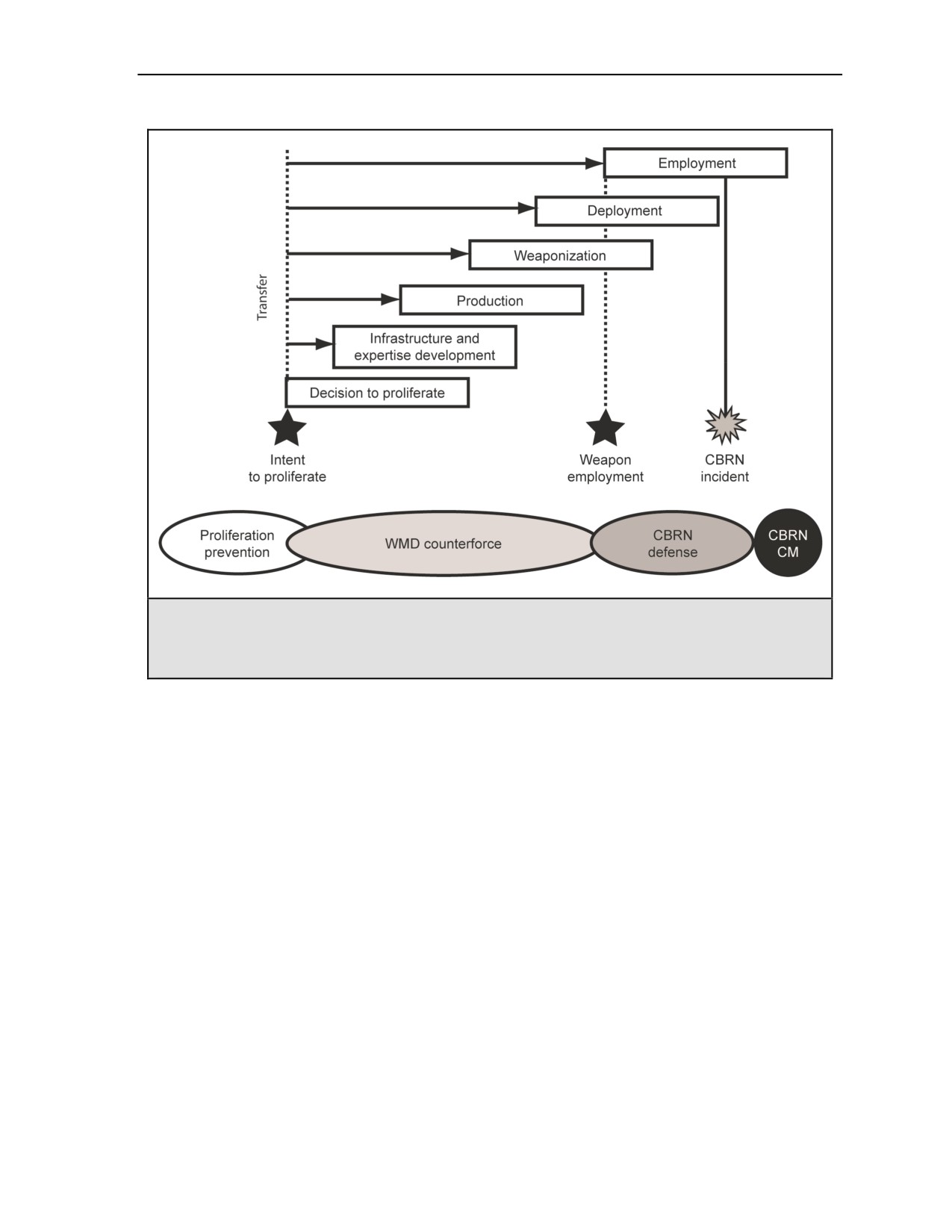
radiological contamination in military operational areas. The proliferation continuum refers to a series of
activities that adversaries may execute to develop and/or acquire WMD. The generic activities of
proliferation include the decision to proliferate, infrastructure and expertise development, production,
weaponization, deployment, and employment (see figure 1-1). This continuum may be encountered in a
nonsequential fashion; for example, an adversary may buy a weapon system that is ready for immediate
employment and bypass stages such as production and weaponization.
1-2
FM 3-11/MCWP 3-37.1/NWP 3-11/AFTTP 3-2.42
1 July 2011
Chemical, Biological, Radiological, and Nuclear Threats and Hazards
Legend:
CBRN
chemical, biological, radiological, and nuclear
CM
consequence management
WMD
weapons of mass destruction
Figure 1-1. CBRN operations and the WMD proliferation continuum
1-6. A proliferant group or nation requires the will, equipment, technical knowledge, people, money, and
time to successfully develop and sustain this process. Completely halting proliferation is impossible, but
restricting it is vitally important and achievable. To that end, the DOD is playing an active role in
technology transfer and export controls and in the implementation of arms control and nonproliferation
regimes.
GLOBALIZATION
1-7. The proliferation of missile technology has enabled many states to acquire delivery systems that can
range well outside their immediate regions. A number of states have systems that can strike targets within
the United States. Long-range WMD delivery systems enable an adversary to deter U.S. action, deny access
to its territory or intermediate staging bases, preempt a pending operation, strike U.S. allies to affect U.S.
policy, or simply coerce the United States to alter its policy.
1-8. U.S. forces have global reach and are capable of engaging threats, influencing potential adversaries,
assuring friends, and promoting peace and stability with a variety of capabilities. However, global reach
and influence are not just the purview of nation-states. Globalization and emerging technologies allow
small transnational groups to use asymmetric approaches (including criminal activity, terrorism, or armed
aggression with international reach) with relative ease and little cost.
1 July 2011
FM 3-11/MCWP 3-37.1/NWP 3-11/AFTTP 3-2.42
1-3
Chapter 1
1-9. A program is considered to be a WMD program if it is funded and developed for that purpose and
has a process or procedure designated strictly for WMD development. A program need not be sufficiently
advanced to yield a weapon or device to be considered a WMD program since it takes years or decades to
fully develop that type of program—depending on technology; engineering; funds; materials; and the
determination of a state actor, nonstate actor, or terrorist group. The United States acknowledges that some
nations have a WMD program. However, when WMD programs are developed by adversaries who may use
them to threaten the United States and its allies, the United States and its forces may take actions to disrupt,
prevent, deny, dissuade, reverse, reduce, or destroy WMD and related programs through interdiction,
elimination, or offensive operations.
1-10. The presence of WMD poses a great challenge within a region. It disrupts U.S. and international
efforts to foster stability and curtail proliferation activity. Additionally, the perceived imbalance in power
can lead to active proliferation among neighboring states (such as Pakistan and India), delivering a severe
blow to ongoing nonproliferation, counterproliferation, or other diplomatic and economic efforts. The
challenges of states possessing WMD, even short of employment (presence, proliferation, and stability
disruption), may prove to be the most challenging and dangerous to U.S. interests. The growing availability
of WMD-related technologies, precursors, and expertise and the sophistication of these technologies
compound the threat. Precursors are any chemical reaction that takes place at any stage in the production of
a toxic chemical by whatever method, including key components and multicomponent chemical systems.
STATE AND NONSTATE ACTORS
1-11. Threats from the proliferation of WMD come from state and nonstate actors. State actors may have
incentives to acquire CBRN weapons in spite of their adherence to international agreements and treaties
forbidding such actions, and nonstate groups may not consider themselves bound by such agreements and
treaties. State and nonstate actors may have incentives to operate outside the norms of acceptable
international behavior, especially when important interests are involved.
1-12. There are no official definitions for state and nonstate actors. However, a state actor can be described
as a person or persons who are acting on behalf of a governmental body. Nonstate actors are individuals or
groups on the international level who are not governmental representatives; they may reside within a
governing state, but they are not recognized by the state. Examples of state and nonstate actors are shown
below:
z
State actors.
United States.
Germany.
Argentina.
z
Nonstate actors.
Terrorist organizations (such as al-Qaida).
Militias.
Warlords.
Rebel opposition forces.
Drug cartels.
Criminals.
Nongovernmental organizations (as part of civil society and generally harmless, but having
internal governing powers).
1-13. Key states may assist rogue nations who are attempting to acquire the ability to proliferate WMD
through materials, technology, and expertise. However, individuals may also contribute illicitly to the
proliferation efforts, despite a state’s disapproval or lack of knowledge of such actions occurring; for
example, the actions of Pakistani scientist Abdul Qadeer Khan. The following vignette demonstrates how
networking across borders (possibly without government knowledge) and operating through black markets
have placed nuclear materials and technology into the hands of adversaries who will attempt to threaten the
United States and its allies if their nuclear program becomes weaponized.
1-4
FM 3-11/MCWP 3-37.1/NWP 3-11/AFTTP 3-2.42
1 July 2011
Chemical, Biological, Radiological, and Nuclear Threats and Hazards
A.Q. Khan Proliferation Network
The Khan network was, first and foremost, an elaborate and highly successful illicit procurement network
that Khan created in the 1970s to supply Pakistan’s gas centrifuge program. The developing program aimed
to make highly enriched uranium for nuclear weapons. He built his centrifuge procurement network on an
extensive collection of sensitive information that he stole or otherwise acquired in Europe in the middle and
late 1970s. In addition, he was involved in acquiring overseas nuclear weapon technology for Pakistan and
procuring equipment and materials for this endeavor.
Because of Pakistan’s weak industrial infrastructure, it was unable to develop gas centrifuges or nuclear
weapons without extensive foreign assistance. Khan relied on the support of many foreign businessmen and
experts and on the supply of goods and technologies from foreign countries, especially Europe. Pakistan’s
nuclear weapons program still depends on the foreign supply of spare parts, special materials, and
instruments.
Khan and his associates slowly expanded their import operation into a transnational illegal network that
exported (mostly to Muslim countries) whole gas centrifuges, production capabilities, and designs for nuclear
weapons. By the late 1990s, the Khan network had evolved into an organization that could provide “one stop
shopping” for the wherewithal to produce weapons grade uranium and for nuclear weapon designs and
instructions. The motive was to turn a profit while providing additional business for their international
collaborators. In addition to money, Khan was also motivated by pan-Islamism and its hostility to Western
controls on nuclear technology.
Khan has admitted that his main customers were Iran, Libya, and North Korea. Reports indicate that other
countries (including Egypt, Iraq, and Syria) were offered assistance, but they purportedly turned down the
offers. However, investigators are still trying to verify these claims and determine exactly what assistance
each country accepted or refused. In addition, questions remain as to whether members of the Khan
network, including Khan himself, offered nuclear weapon assistance to terrorists in Afghanistan prior to the
fall of the Taliban.
1-14. Identifying the potential threats of state and nonstate actors is a continual challenge for the United
States and its allies, given the elusive nature of adversaries and the ever-increasing speed of global
communications, adversarial adaptability, enhanced networking, and intelligence resources.
TERRORISTS
1-15. The term terrorism is defined in JP 1-02 as the calculated use of unlawful violence or threat of
unlawful violence to inculcate fear; intended to coerce or to intimidate governments or societies in the
pursuit of goals that are generally political, religious, or ideological. A critical factor in the understanding
of terrorism is the importance of the emotional impact of the terrorist act on an audience other than the
victim.
1-16. The National Security Strategy of the United States of America (more commonly known as the
National Security Strategy) highlights the threat from adversaries possessing WMD. It emphasizes the need
to be “prepared to stop rogue states and their terrorist clients before they are able to threaten or use WMD
against the United States and our allies and friends” and discusses preemptive options against such
adversaries.
1-17. The National Strategy to Combat Weapons of Mass Destruction asserts, “We will not permit the
world’s most dangerous regimes and terrorists to threaten us with the world’s most destructive weapons.
We must accord the highest priority to the protection of the United States, our forces, and our friends and
allies from the existing and growing WMD threat.” Protection is the preservation of the effectiveness and
survivability of mission-related military and nonmilitary personnel, equipment, facilities, information, and
infrastructure deployed or located within or outside the boundaries of a given operational area.
1-18. A terrorist group’s selection of targets and tactics is a function of the group’s affiliation, level of
training, organization, and sophistication. Security forces generally categorize terrorist groups according to
their operational traditions:
z
National. National groups operate within the boundaries of a single nation.
z
Transnational. Transnational groups operate across international borders.
1 July 2011
FM 3-11/MCWP 3-37.1/NWP 3-11/AFTTP 3-2.42
1-5
Chapter 1
z
International. International groups operate in two or more nations and are usually assumed to
receive direction and support from a foreign government.
INCIDENTS
1-19. A CBRN incident is any occurrence involving the emergence of CBRN hazards resulting from the
use of CBRN weapons or devices, the emergence of secondary hazards arising from counterforce targeting,
or the release of toxic industrial material into the environment. A CBRN incident is characterized on the
basis of the intent, opportunity, and capability of the occurrence. There are three basic reasons why a
CBRN incident happens, regardless of the type and nature:
z
Intentional. An intentional CBRN incident may include—
Criminal acts such as the deliberate dumping or release of hazmat to avoid regulatory
requirements.
Malicious acts such as the poisoning of one or more individuals.
Terrorist acts that involve serious violence to persons or property for a political, religious, or
ideological purpose and/or that are a matter of national interest.
z
Accidental. An accidental CBRN incident is an event caused by human error or natural or
technological reasons. Accidental incidents are usually referred to as hazmat accidents and may
include—
Spills.
Releases.
Leakages.
z
Natural. A natural CBRN incident is a second- or third-order effect from a natural disaster.
Examples include—
Toxic chemical release.
Biological waste.
1-20. Intent is the distinguishing difference between the three reasons that CBRN incidents happen. To
ensure proper assessment when filtering through the information pertaining to an incident, it is important to
know the intent category.
Note. A CBRN weapon is a fully engineered assembly that is designed for employment to cause
the release of a chemical or biological agent or radiological material onto a chosen target or to
generate a nuclear detonation.
HAZARDS
1-21. CBRN elements that could cause an adverse effect through accidental or deliberate release,
dissemination, or impacts are called CBRN hazards. CBRN hazards are often present in conjunction with
the incident effects of a WMD device.
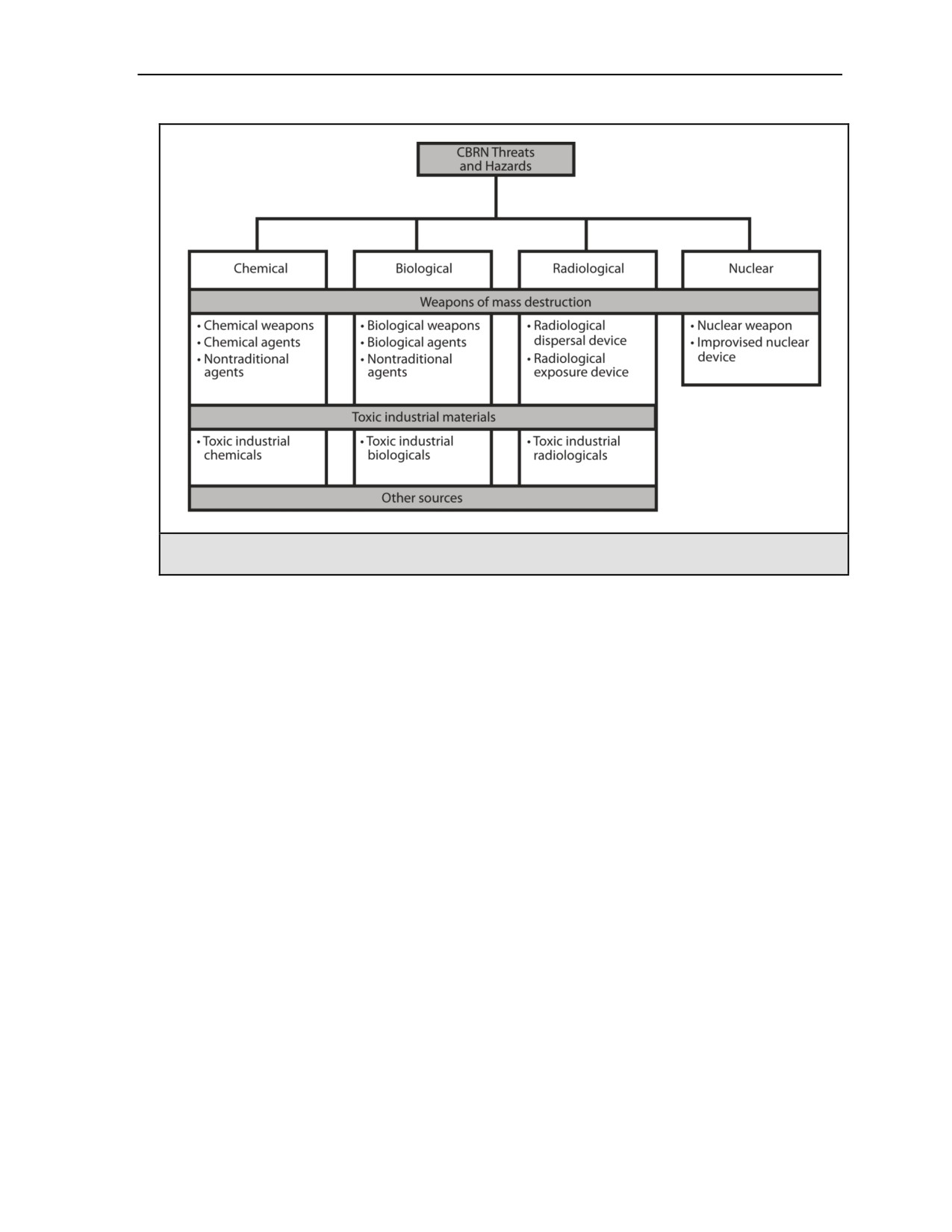
1-22. CBRN hazards include those created from accidental or intentional releases of toxic industrial
materials, biological pathogens, and radioactive matter. Toxic industrial material is a generic term for toxic
or radioactive substances in solid, liquid, aerosolized, or gaseous form that may be used or stored for
industrial, commercial, medical, military, or domestic purposes. Toxic industrial material may be chemical,
biological, or radiological and are described as toxic industrial chemicals, toxic industrial biologicals, or
toxic industrial radiologicals. Figure 1-2 shows the sources of CBRN hazards.
1-6
FM 3-11/MCWP 3-37.1/NWP 3-11/AFTTP 3-2.42
1 July 2011
Chemical, Biological, Radiological, and Nuclear Threats and Hazards
Legend:
CBRN
chemical, biological, radiological, and nuclear
Figure 1-2. CBRN threats and hazards
1-23. CBRN hazards may result from WMD employment. The key distinction between WMD and CBRN
hazards is that WMD refers to the actual weapon, while CBRN refers to the contamination or effects
resulting from the employment of WMD and from the dispersal of CBRN materials. When DOD
capabilities are called upon to conduct WMD consequence management activities, they will essentially be
responding to CBRN hazards or contamination, such as—
z
The deposit, absorption, or adsorption of radioactive material or a biological or chemical agent
on or near a structure, area, person, or object.
z
Food and/or water that is unfit for consumption by humans or animals due to the presence of
environmental chemicals, radioactive elements, bacteria or organisms, the byproduct of the
growth of bacteria or organisms, decomposing material (includes the food substance itself), or
waste in the food or water.
CHEMICAL HAZARDS
1-24. Historically, chemical hazards of military concern were limited to a small group of uniquely
manufactured chemical weapons referred to as chemical warfare agents. However, the types of chemical
hazards of concern to the military have expanded tremendously over the last decade and now include a
large number of toxic industrial chemicals. Chemical hazards are any chemicals (manufactured, used,
transported, or stored) that can cause death or other harm through the toxic properties of those materials.
This includes chemical weapons (prohibited under the Chemical Weapons Convention), chemical agents,
and toxic industrial chemicals.
1 July 2011
FM 3-11/MCWP 3-37.1/NWP 3-11/AFTTP 3-2.42
1-7
Chapter 1
Chemical Weapons
1-25. Together or separately, chemical weapons include―
z
A toxic chemical and its precursors, except when intended for a purpose not prohibited under the
Chemical Weapons Convention.
z
A munition or device, specifically designed to cause death or other harm through the toxic
properties of the above chemicals, which would be released as a result of the employment of
such munition or device.
z
Any equipment specifically designed for use directly in connection with the employment of
munitions or devices specified above.
Chemical Agents
1-26. A chemical agent is a chemical substance that is intended for use in military operations to kill,
seriously injure, or incapacitate, mainly through physiological effects. The term excludes riot control agents
when used for law enforcement purposes, herbicides, smoke, and flame. Chemical agents are classified
according to—
z
Physical state. Agents may exist as a solid, liquid, or vapor.
z
Physiological action. According to their physiological effects, there are nerve, blood, blister,
choking, and incapacitating agents. (See Appendix A for detailed information.)
z
Use. The terms persistent and nonpersistent describe the time an agent stays in an area. An
adversary may have to expend large quantities of chemical agents in order to cause mass
casualties or achieve area denial.
Persistent agent. A chemical agent that, when released, can cause casualties for more than
24 hours to several days or weeks.
Nonpersistent agent. A chemical agent that, when released, dissipates and/or loses its
ability to cause casualties after 10 to 15 minutes.
Toxic Industrial Chemicals
1-27. Toxic industrial chemicals are chemicals that are developed or manufactured for use in industrial
operations or research by industry, government, or academia. Examples include pesticides, petrochemicals,
fertilizers, corrosives, explosives, and poisons. These chemicals are not primarily manufactured for the
specific purpose of producing human casualties or rendering equipment, facilities, or areas dangerous for
human use. For example, hydrogen cyanide, cyanogen chloride, phosgene, and chloropicrin are industrial
chemicals that can also be military chemical agents.
1-28. Toxic industrial chemicals can pose significant toxic hazards and can damage the human body and
equipment. Many industrial chemicals are corrosive, flammable, explosive, or combustible; these hazards
may pose greater short-term challenges than the immediate toxic effects. Most toxic industrial chemicals
will be released as vapor or highly volatile liquid and can have short- and long-term health effects. The
release of large volumes of hazardous industrial chemicals can also produce environmental damage.
Other Sources
1-29. Riot control agents, herbicides, and substances that generate smoke and flame are excluded from
classification contained in the Chemical Weapons Convention and when used for law enforcement
purposes. (See Appendix A for more details on riot control agents and herbicides.) Defoliants are chemicals
that are sprayed or dusted onto plants, causing the leaves to fall off prematurely. Unlike herbicides,
defoliants do not totally destroy plants.
1-8
FM 3-11/MCWP 3-37.1/NWP 3-11/AFTTP 3-2.42
1 July 2011
Chemical, Biological, Radiological, and Nuclear Threats and Hazards
BIOLOGICAL HAZARDS
1-30. Biological hazards pose unique challenges because they are relatively easy to produce and difficult to
detect; their production facilities have no unique signature. A biological hazard is an organism or substance
derived from an organism that poses a threat to human or animal health. This can include medical waste or
samples of a microorganism, virus, or toxin (from a biological source) that can impact human health.
Biological Weapons
1-31. A biological weapon projects, disperses, or disseminates a biological agent, including arthropod
vectors. Militarily significant characteristics for biological aspects of operations in CBRN environments
include a normally vulnerable target population, infectious or toxic agents with highly lethal or
incapacitating properties, agent availability or adaptability for scaled-up production, agent stability, and
agent suitability for aerosol dispersion. Limiting factors include biological properties (particularly rapid
decay), environmental factors, and dissemination methods.
Biological Agents
1-32. A biological agent is a microorganism that causes disease in people, plants, or animals or causes the
deterioration of materiel. Biological agents are microorganisms that are capable of spreading disease
through humans and agriculture. They are categorized as—
z
Pathogens. Pathogens are disease-producing microorganisms (bacteria, viruses, fungi, rickettsia)
that directly attack human, plant, or animal tissue and biological processes.
z
Toxins. Toxins are poisonous substances that are produced naturally (bacteria, plants, fungi,
snakes, insects, and other living organisms), but may also be produced synthetically. Naturally
occurring toxins are nonliving byproducts of cellular processes that can be lethal or highly
incapacitating.
1-33. Biological agents pose a singular threat due to five factors:
z
Small doses can produce lethal or incapacitating effects over an extensive area.
z
They are difficult to detect in a timely manner.
z
They are easy to conceal.
z
They can be covertly deployed.
z
The variety of potential biological agents significantly complicates effective preventative or
protective treatment.
These factors—combined with small employment signatures; delayed onset of symptoms; detection,
identification, and verification difficulties; agent persistence; and communicability—can confer
important advantages to adversaries who use biological agents.
1-34. Toxic industrial biologicals include any biological material manufactured, used, transported, or
stored for industrial, medical, or commercial processes that could pose an infectious or toxic threat. The
release of toxic industrial biological hazards can occur following an incident, attack, or damage at a facility
that handles, produces, stores, or recycles biological material. Examples include hospitals, medical
facilities, agricultural facilities, and facilities that recycle biological materials for medical, pharmaceutical,
or agricultural industries.
Other Sources
1-35. Other biological-related hazards are pandemics and naturally occurring diseases. Pandemics may
include Ebola and West Nile viruses or diseases that are widespread and associated with affecting a large
portion of the population within a geographic region.
RADIOLOGICAL HAZARDS
1-36. Radiological hazards are an emerging threat to U.S. military operations. These hazards can arise from
many sources other than nuclear weapons and can be dispersed in a variety of ways.
1 July 2011
FM 3-11/MCWP 3-37.1/NWP 3-11/AFTTP 3-2.42
1-9
Chapter 1
1-37. Radiological hazards include any electromagnetic or particulate radiation that is capable of producing
ions to cause damage, injury, or destruction. Radiological material causes physiological damage through
the ionizing effects of neutron, gamma, beta, or alpha radiation. These types of radiation are referred to as
ionizing radiation. Radiological materials can be found in a number of military and civilian environments
(nuclear power plants, hospitals, universities, construction sites).
Note. For the purpose of this publication, the term radiation denotes ionizing radiation unless
otherwise stated.
1-38. Radiological hazards also include toxic industrial radiologicals
(radiological material that is
manufactured, used, transported, or stored for industrial, medical, or commercial processes). Possible
sources of toxic industrial radiologicals that are capable of producing radioactive hazards are civil nuclear
production, research, recycling, and storage facilities; nuclear waste containment sites; industrial and
medical nuclear sources; nuclear materials and sources in transit; stolen or smuggled nuclear weapons
grade material; medical and fossil fuel manufacturing and waste processing plants; and other industrial
sources.
1-39. Adversaries could disperse radioactive material in a number of ways, such as arming the warhead of
a missile with radioactive material from a nuclear reactor, releasing low-level radioactive material intended
for use in industry or medicine, or disseminating material from a research or power-generating nuclear
reactor. Unless radioactive sources are thoroughly shielded, improvised devices employing these materials
will more than likely have a significant radiological signature that can be detected before detonation,
dispersal, or deployment. The dispersal of radioactive material represents an inexpensive capability that
requires limited resources and technical knowledge.
Radiological Dispersal Device
1-40. A radiological dispersal device is an improvised assembly or process, other than a nuclear explosive
device, that is designed to disseminate radioactive material in order to cause destruction, damage, or injury.
Radiological Exposure Device
1-41. A radiological exposure device is a radioactive source that is placed to cause injury or death. A
radiological exposure device that remains undetected may increase the potential dose to the intended target.
NUCLEAR WEAPONS AND EFFECTS
1-42. A nuclear weapon refers to a complete assembly (implosion, gun, or thermonuclear) in its intended
ultimate configuration. Upon completion of the prescribed arming, fusing, and firing sequence, a nuclear
weapon is capable of producing the intended nuclear reaction and energy release. With regard to the risk of
proliferation and use by terrorists, the gun type weapon is a relatively simple design and is a concern
because it does not require as much fine engineering or manufacturing as the other methods. With enough
highly enriched uranium, nations or groups with relatively low levels of technological sophistication could
create an inefficient, though still quite powerful, nuclear weapon. A nuclear weapon can be detonated in
space, in the atmosphere above the earth’s surface, on the surface, or below the surface. The data in this
chapter focuses on air bursts. When the detonation occurs in the atmosphere, the primary radiation products
(X-rays, gamma rays, and neutrons) interact with the surrounding air molecules and are absorbed and
scattered as they radiate from the point of detonation.
1-10
FM 3-11/MCWP 3-37.1/NWP 3-11/AFTTP 3-2.42
1 July 2011
Chemical, Biological, Radiological, and Nuclear Threats and Hazards
1-43. Nuclear weapon effects are qualitatively different from biological or chemical weapon effects. The
nature and intensity of nuclear detonation effects are determined by the type of weapon, its yield, and the
physical medium in which the detonation occurs. Some characteristics of nuclear weapon effects include—
z
The distribution of energy and the relative effects of blast, heat, and radiation depend largely on
the weapon, the altitude at which it is detonated, and features of the target.
z
A typical nuclear weapon releases most of its energy as thermally generated X-rays at the point
of detonation.
z
The amount of fallout depends on the weapon yield, weapon type, and height of burst.
z
The area affected depends heavily on the wind.
z
Surface bursts produce the most fallout.
z
The hazard to personnel depends on the level of radiation present and the duration of exposure.
z
Weather conditions affect fallout immensely.
1-44. The effects of nuclear detonations include—
z
Blast and shock. The blast produces shock waves, high overpressures, and severe winds.
Personnel suffering critical injuries from blast and shock effects would likely suffer lethal
radiation exposure as well.
z
Thermal radiation. Thermal radiation is the heat and light produced by a nuclear explosion. It
can cause burns over substantial distances. Secondary fires from blast and heat are additional
hazards. Thermal effects can also disrupt operation plans due to fire and melting snow and ice
impeding movement.
z
Electromagnetic pulse. The interaction of gamma radiation with the atmosphere can cause a
short pulse of electric and magnetic fields that may damage and interfere with the operation of
electrical and electronic equipment and can cause widespread disruption. The effects of
electromagnetic pulse can extend to hundreds of kilometers, depending on the height and
strength of the nuclear burst. High-altitude, electromagnetic pulse can generate significant
disruptive field strengths over a continental-size area. The portion of the frequency spectrum
most affected by electromagnetic pulse and high-altitude, electromagnetic pulse is the
communications band.
z
Transient radiation. These effects are generally short-lived and can be extremely hazardous to
aircraft and other electronically dense pieces of equipment.
z
Ionizing radiation. Ionizing radiation includes particulate
(alpha, beta, and neutron) and
electromagnetic (X-ray and gamma) radiation of sufficient energy to displace electrons from
atoms, producing ions. The initial radiation is a significant threat to personnel and materiel,
including optical, mechanical, and electronic components. Gamma rays and neutrons have a long
range in the air and are highly penetrating. Alpha and beta radiation may cause a hazard to
personnel following a nuclear detonation.
z
Potassium iodine. Potassium iodine may be used to protect the thyroid from radioactive iodine
in the event of an accident or attack at a nuclear power plant or another nuclear attack, especially
where volatile radionuclides (which contain significant amounts of iodine 131) are released into
the environment. Radioiodine is a dangerous radionuclide because the body concentrates it in the
thyroid gland. Potassium iodine cannot protect against other causes of radiation poisoning or
provide protection against a dirty bomb unless it contains radioactive iodine.
z
Fallout. In addition to the initial thermal and ionizing radiation and electromagnetic pulse, a
nuclear detonation produces residual radiation that results from the dispersal of radioactive
materials in the target area and downwind. Fallout may be a lingering, widespread hazard that
severely limits military operations in the contaminated area.
(See Appendix A for further
details.)
1 July 2011
FM 3-11/MCWP 3-37.1/NWP 3-11/AFTTP 3-2.42
1-11
Chapter 1
SUMMARY
1-45. Depending on the adversary’s specific objectives, widespread or limited methods may be used to
create CBRN hazards. These hazards present physical and psychological effects well beyond the immediate
target area. The preceding subparagraphs described the characteristics and effects of CBRN hazards and
selected toxic materials. Appendix A provides additional information on CBRN hazard considerations.
1-12
FM 3-11/MCWP 3-37.1/NWP 3-11/AFTTP 3-2.42
1 July 2011
Chapter 2
U.S. Policy and Strategy
This chapter briefly discusses policies and strategies that seek to prevent and limit the
proliferation of CBRN capabilities through international agreements and treaties,
multilateral initiatives, and unilateral actions in which the DOD plays a significant
role. This chapter also provides an overview of military objectives that support the
U.S. government’s political, economic, and diplomatic efforts to carry out the three
strategic pillars of CWMD
(nonproliferation, counterproliferation, and WMD
consequence management) as highlighted in the National Security Strategy:
z
Nonproliferation. Actions taken to prevent the proliferation of WMD by
dissuading or impeding access to, or distribution of, sensitive technologies,
material, and expertise.
z
Counterproliferation. Actions taken to defeat the threat and/or use of WMD
against the United States and its forces, allies, and partners.
z
Consequence management. Actions authorized by the President of the
United States or the Secretary of Defense to mitigate the effects of a WMD
attack or event and provide temporary essential operations and services at
home and abroad.
OVERVIEW
2-1. The deadly, destructive, and disruptive effects of CBRN weapons pose serious challenges to U.S.
military operations worldwide and merit continuous consideration by commanders. Conflict situations may
emerge in the international security environment to challenge U.S. interests. Additionally, commanders
should be aware that interagency and international considerations dealing with WMD may outweigh
military considerations and that they may be assigned to support an interagency or international CWMD
operation, even during a major contingency.
2-2. National strategic objectives and tactical actions are not unique or different for CWMD. In
operations involving WMD, action or inaction at the tactical level can have profound strategic
repercussions. While there has been greatly increased emphasis on WMD and CWMD, it is important for
commanders and planners to understand that WMD is not an adversary. It is a capability that an adversary
may use to coerce or deter actions or to achieve effects during operations. Thus, CWMD operations should
not be considered a special or distinct set of activities or a separate mission area to be used only under
certain conditions. Rather, commanders must consider CBRN operations as part of their operational
planning.
2-3. CBRN operations involve the employment of tactical capabilities that counter the entire range of
CBRN threats and hazards through WMD proliferation prevention, WMD counterforce, CBRN defense,
and CBRN consequence management activities in support of operational and strategic objectives to combat
WMD and operate safely in CBRN environments.
1 July 2011
FM 3-11/MCWP 3-37.1/NWP 3-11/AFTTP 3-2.42
2-1
Chapter 2
POLICY
2-4. Current U.S. policy is to deter enemy CBRN use through a strong nuclear force in tandem with
conventional capabilities that include WMD proliferation prevention, WMD counterforce, CBRN defense,
and CBRN consequence management to enable U.S. forces to survive, fight, and win in a CBRN
environment. Prevention efforts must be global, regional, and country-specific and directed at—
z
Shaping international opinion on WMD.
z
Stigmatizing proliferation.
z
Influencing the decisions of those seeking, possessing, or supplying WMD.
z
Minimizing or eliminating associated CBRN threats and hazards.
z
Closing proliferation pathways.
2-5. Military activities must be closely integrated with supporting interagency efforts. Security
cooperation is often vitally important in shaping proliferation incentives and fostering cooperation in
prevention efforts to dissuade or prevent state and nonstate actors from acquiring or proliferating WMD
and to deny them access to WMD-relevant capabilities.
2-6. U.S. policies and strategies aim to prevent and limit the proliferation of CBRN capabilities through
deterrence. If deterrence fails, the United States will pursue war to a successful conclusion.
2-7. The United States may use nuclear weapons to terminate a conflict or war at the lowest acceptable
level of hostilities. The employment of nuclear weapons by the United States is governed by guidance to
the joint force commander as contained in strategic-level directives. The United States is party to treaties
and international agreements that limit proliferation, testing, and possession of nuclear weapons.
2-8. The United States will never use chemical weapons. The Chemical Weapons Convention (ratified by
the United States on 29 April 1997) bans the acquisition, development, production, retention, stockpiling,
transfer, and use of chemical weapons.
2-9. The United States will never use biological weapons. Under the terms of the Biological and Toxin
Weapons Convention (more commonly known as the Biological Weapons Convention), which was ratified
by the United States on 26 March 1975, parties agreed not to develop, produce, stockpile, or acquire
biological agents or toxins of types and in quantities that have no justification other than for prophylactic,
protective, or other peaceful purposes.
2-10. The United States does not consider herbicides and riot control agents to be chemical agents, but has
adopted policies concerning their use during an armed conflict. The use of herbicides and riot control
agents is covered by different policies than those governing chemical warfare agents. Executive Order
Number 11850 renounces the first use of herbicides in war (except for specified defensive use) and the first
use of riot control agents in war (except for defensive military modes to save lives).
Note. See Appendix B for more information on treaties and agreements.
NATIONAL STRATEGIES
2-11. This keystone publication links multi-Service CBRN doctrine to national strategies. National
strategies are documents that are periodically prepared for Congress by the Executive Branch. National
strategies outline the major national security concerns of the United States and summarize how the
administration plans to deal with them.
2-12. The National Security Strategy identifies “preventing our enemies from threatening us, our allies,
and our friends with WMD” as an essential task for ensuring national security. To achieve this goal, the
National Security Strategy sets forth an active strategy to counter transnational terror networks, rogue
nations, and aggressive states that possess, or are working to acquire, WMD. It notes that the United States
must advance this strategy through strengthened alliances, the establishment of new partnerships, the
innovative use of military forces, modern technologies, and increased emphasis on intelligence collection
and analysis. The National Security Strategy highlights nonproliferation concerns in its examination of the
Treaty on the Non-Proliferation of Nuclear Weapons
(more commonly known as the Nuclear
2-2
FM 3-11/MCWP 3-37.1/NWP 3-11/AFTTP 3-2.42
1 July 2011
U.S. Policy and Strategy
Nonproliferation Treaty) and its special emphasis on stemming the spread of materials necessary to
develop WMD. Counterproliferation activities are included in the National Security Strategy’s focus for
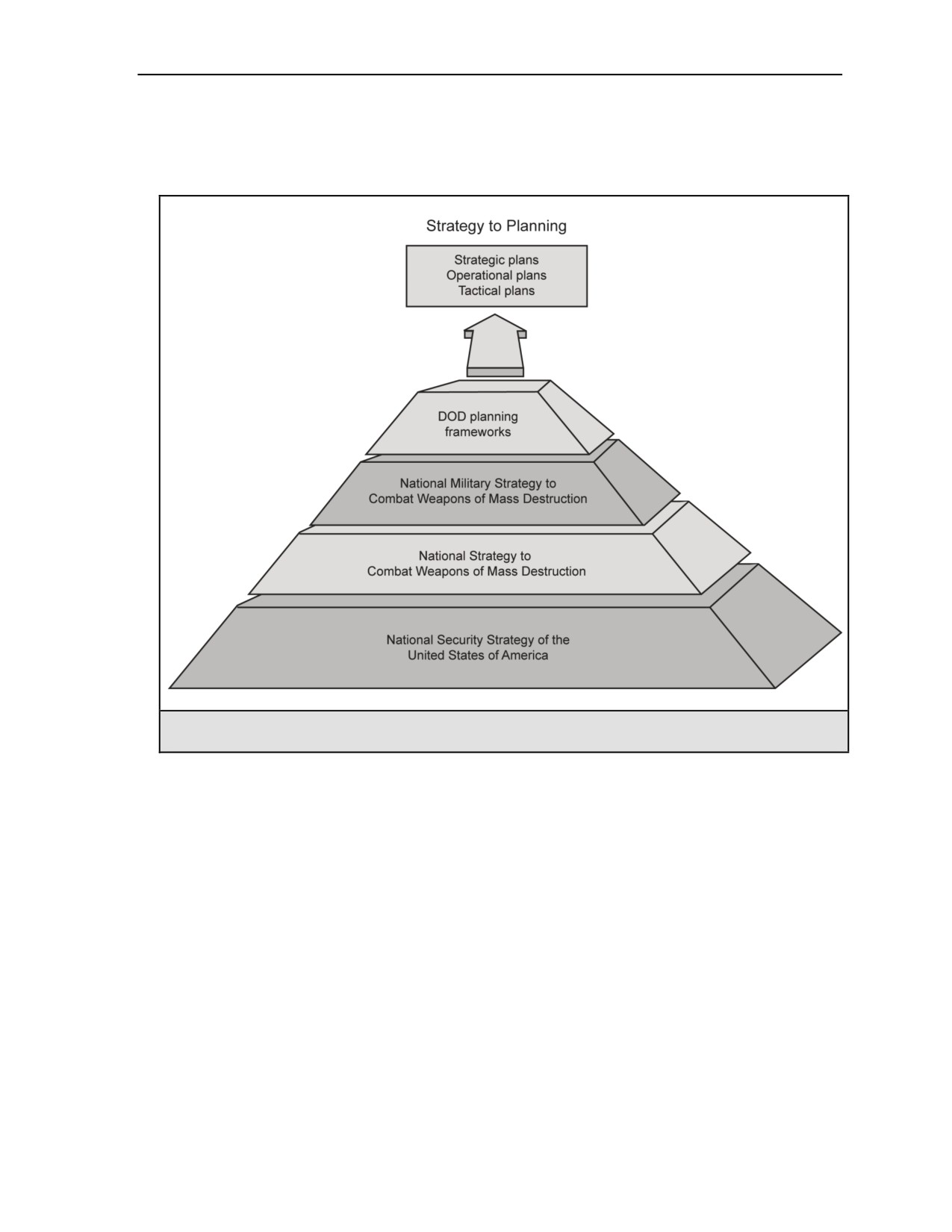
disrupting terrorist networks who are seeking to use WMD against U.S. interests. Figure 2-1 outlines the
hierarchy of national strategies to DOD planning constructs.
Legend:
DOD
Department of Defense
Figure 2-1. Hierarchy of national strategy
2-13. The National Strategy to Combat Weapons of Mass Destruction builds on the National Security
Strategy; articulates a proactive, comprehensive strategy; and guides all U.S. Government activities to
combat WMD. It states that nuclear, biological, and chemical weapons in the possession of hostile states
and terrorists represent one of the greatest security challenges facing the United States and that we must
pursue a comprehensive strategy to counter this threat in all of its dimensions. The National Strategy to
Combat Weapons of Mass Destruction is built on three principal pillars:
z
Strengthened nonproliferation to combat WMD proliferation.
z
Counterproliferation to combat WMD use.
z
Consequence management to restore essential operations and services at home and abroad after
WMD use.
1 July 2011
FM 3-11/MCWP 3-37.1/NWP 3-11/AFTTP 3-2.42
2-3
Chapter 2
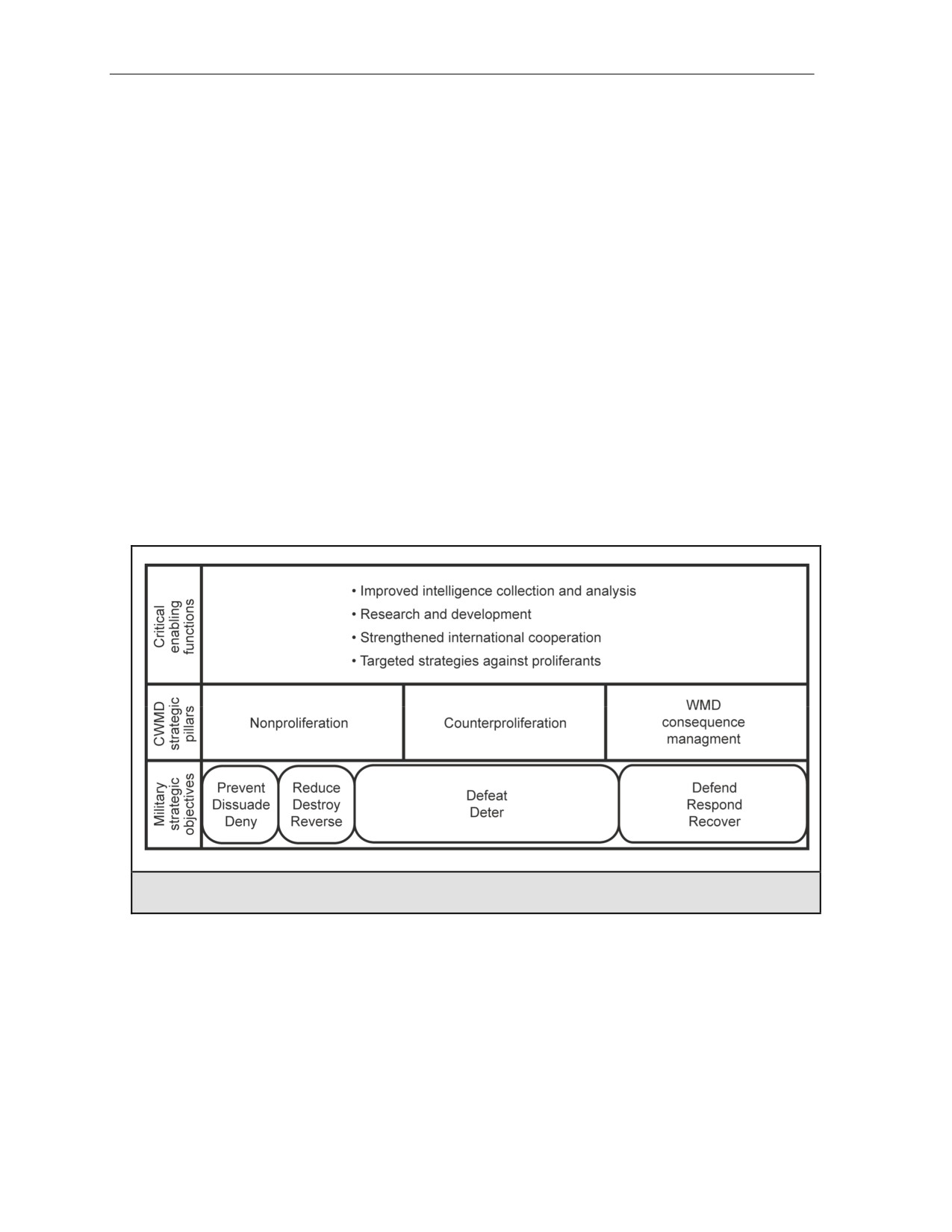
2-14. These pillars form a common framework for the interagency conduct of CWMD activities that
support the critical enabling functions of improved intelligence collection and analysis, research and
development, strengthened international cooperation, and targeted strategies against proliferants while
providing a strategic foundation for military operations.
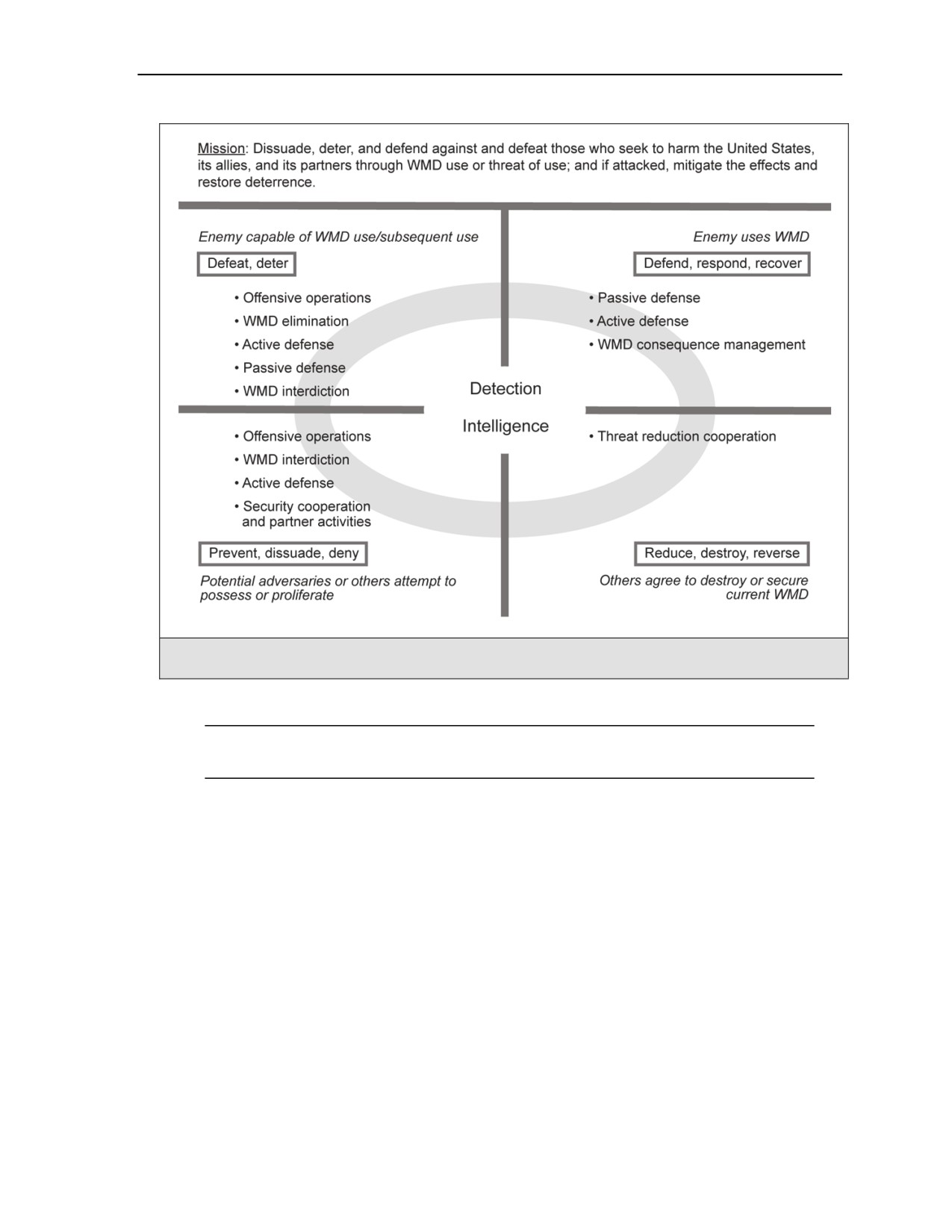
2-15. The National Military Strategy to Combat Weapons of Mass Destruction defines military strategic
objectives and the means to achieve them through the eight mission areas that are conducted across the
CWMD continuum. The National Military Strategy to Combat Weapons of Mass Destruction supports the
National Security Strategy by applying the missions across the four pillars to achieve military strategic
objectives and accomplish the DOD mission to dissuade, deter, defend against, and defeat those who seek
to harm the United States, its allies, and its partners through WMD use (see figure 2-2). The pillars are—
z
Defeat and deter WMD use and subsequent use. Adversaries must believe that they will
suffer severe consequences and that their objectives will be denied if they threaten or resort to
the use of WMD.
z
Defend, respond, and recover from WMD use. The purpose of this objective is to respond to
an adversary who has used WMD on the battlefield or against strategic U.S. interests. To defend
and recover from WMD use, U.S. armed forces will execute passive defense measures and be
prepared to conduct WMD consequence management activities.
z
Prevent, dissuade, or deny WMD proliferation or possession. To prevent, dissuade, or deny
adversaries or potential adversaries from possessing or proliferating WMD, U.S. armed forces
will be prepared to conduct offensive operations. The military must also support interdiction
efforts, security cooperation, and nonproliferation efforts.
z
Reduce, destroy, or reverse WMD possession. To reverse WMD programs and reduce WMD
and related material stockpiles, the U.S. armed forces will support threat reduction cooperation
and be prepared to assist in cooperative stockpile destruction activities.
2-4
FM 3-11/MCWP 3-37.1/NWP 3-11/AFTTP 3-2.42
1 July 2011
U.S. Policy and Strategy
Legend:
WMD
weapons of mass destruction
Figure 2-2. Strategic context for CWMD
Note. The military activities associated with each of the pillars are discussed in more detail in
Chapters 3 through 5.
STRATEGIC CONTEXT
2-16. Historically, WMD have been used when conventional munitions were unable to provide the
necessary advantage to one side or the other. The use of WMD requires the capability and the political will
to use them. For a nation, that decision has high potential for significant retribution. WMD in the hands of
an adversary poses a grave danger to the United States, at home and abroad.
2-17. Today, we describe the employment of WMD as an asymmetrical approach used by hostile state and
nonstate actors to counter the qualitative superiority of the U.S. military. The events of 11 September 2001
heightened the concern of DOD leaders for the increased threat of terrorists and rogue nations employing
WMD. They recognize the need to integrate CWMD into DOD planning frameworks to ensure more
effective command and control (C2), problem solving, and capabilities-based planning.
2-18. One of the most difficult challenges that we face is to prevent, deter, and defend against the
acquisition and use of WMD by terrorist groups. The strategic military framework to combat WMD
consists of ends (the military strategic goal and associated end state), ways (military strategic objectives),
and means (combatant commands, military departments, and support agencies) applied across the pillars of
the National Military Strategy to Combat Weapons of Mass Destruction. Forces adapt to the requirements
of the operational environment and conduct operations within it by using synchronized action, joint
1 July 2011
FM 3-11/MCWP 3-37.1/NWP 3-11/AFTTP 3-2.42
2-5
Chapter 2
interdependent capabilities, and mission command. The pillars do not stand alone, but rather come together
as seamless elements of a comprehensive approach. Underlining that point, figure 2-3 outlines how the
National Military Strategy to Combat Weapons of Mass Destruction identified four cross-cutting, critical
enabling functions (improved intelligence collection and analysis, research and development, strengthened
international cooperation, and targeted strategies against proliferants) that are critical to integrating the
three pillars of CWMD (nonproliferation, proliferation, and consequence management).
2-19. The following are some strategic issues:
z
The proliferation of WMD is a global problem that routinely crosses the regional boundaries of
combatant commands.
z
The increasing availability of highly destructive technology, combined with a variety of
weapons and means of delivery from state and nonstate actors will challenge military operations
in the future.
z
An adversary’s threat or use of WMD will be a likely condition of war, and the proliferation of
WMD programs will continue to challenge commanders at all levels.
z
WMD programs have the potential to severely disrupt and damage the United States; its forces,
allies, and coalition partners; and civilian populations.
z
Future adversaries may use WMD to inflict casualties on civilian populations, degrade military
effectiveness, or counter U.S. conventional military superiority. Current and future adversaries
are state and nonstate actors.
z
The nature of the War on Terrorism and the operational realities of terrorist threats mean that the
military aspects of the operational environment will be less distinctly defined than in operational
environments for other types of operations.
Legend:
WMD
weapons of mass destruction
Figure 2-3. Enabling functions of the National Military Strategy to Combat Weapons of
Mass Destruction
OPERATIONAL CONTEXT
2-20. The DOD CBRN mission has expanded to address the immense complexities of the strategic context
in which we would perform CWMD missions. The war against those adversaries who would use CBRN
weapons to inflict massive harm on the United States and its military forces and international allies is a
protracted fight that will require a strategic offensive.
2-6
FM 3-11/MCWP 3-37.1/NWP 3-11/AFTTP 3-2.42
1 July 2011
U.S. Policy and Strategy
2-21. Commanders should harness all capabilities
(including those related to information operation
capabilities
[public affairs, defense support to public diplomacy, civil-military operations], military
diplomacy, and interagency coordination) to implement a synergistic operational CWMD effort.
2-22. Effective operational CWMD capabilities will ensure maximum impact on the adversary’s selection
of CBRN targets, capitalize on CBRN intelligence, and exploit enemy intent.
2-23. The geographic combatant commanders’ comprehensive joint, interagency, and host nation efforts in
support of sustained CWMD operations should include innovative methods of coordination to effectively
deal with the complexities of interdependence. Cohesive operations conducted within the framework of
U.S. policy and strategies for CWMD and associated CBRN threats and hazards will ensure that members
of the U.S. military are able to operate as a single team and, ultimately, defeat the efforts of our enemies.
2-24. Support to joint force commanders is based on the following tenets:
z
Clearly identified supporting and supported combatant commander roles facilitate the effective
interface with the interagency community which is required for operational planning efforts that
will reduce vulnerability and minimize the effects of WMD employed against key host nation
installations; U.S. installations and facilities; ports of embarkation and debarkation; and the
United States and its military forces and international allies.
z
Lethal/nonlethal efforts to eliminate the WMD threat, deter the use of WMD and, when
necessary, respond to the use of WMD are largely the domain of DOD. In the CWMD context,
force applications (from conventional to nuclear and from nonlethal to special operations) are
within the operations span of several different DOD communities that have responsibilities and
activities relevant to the mission areas.
z
WMD counterforce operations require specialized capabilities to defeat WMD targets; therefore,
operational concepts must rely heavily on precise, persistent, and timely intelligence to locate
and identify targets, understand the characteristics of the effects of CBRN threats and hazards on
structures, optimize munitions delivery to minimize collateral effects, and assess combat
effectiveness.
z
Lead combatant commanders, in conjunction with other key stakeholders, must think and plan
strategically to promulgate measures that must be taken to prevent the conventional and
unconventional delivery of WMD. These measures include the detection, diversion, and
destruction of adversary WMD and delivery systems while en route to their targets.
z
The role of nonlethal and special operations force capabilities must be synchronized with
combatant command plans related to CWMD.
2-25. The joint force commander does not execute military operations in isolation. Unified action requires
the synchronization, coordination, and/or integration of government activities (U.S. Government, allied,
and partner) and nongovernment entities with military operations. The joint force commander employs
resources through the layered and integrated execution of eight military mission areas to influence the
decisions of WMD actors, allies, and partners; to defeat and deter actions of multiple networks of WMD
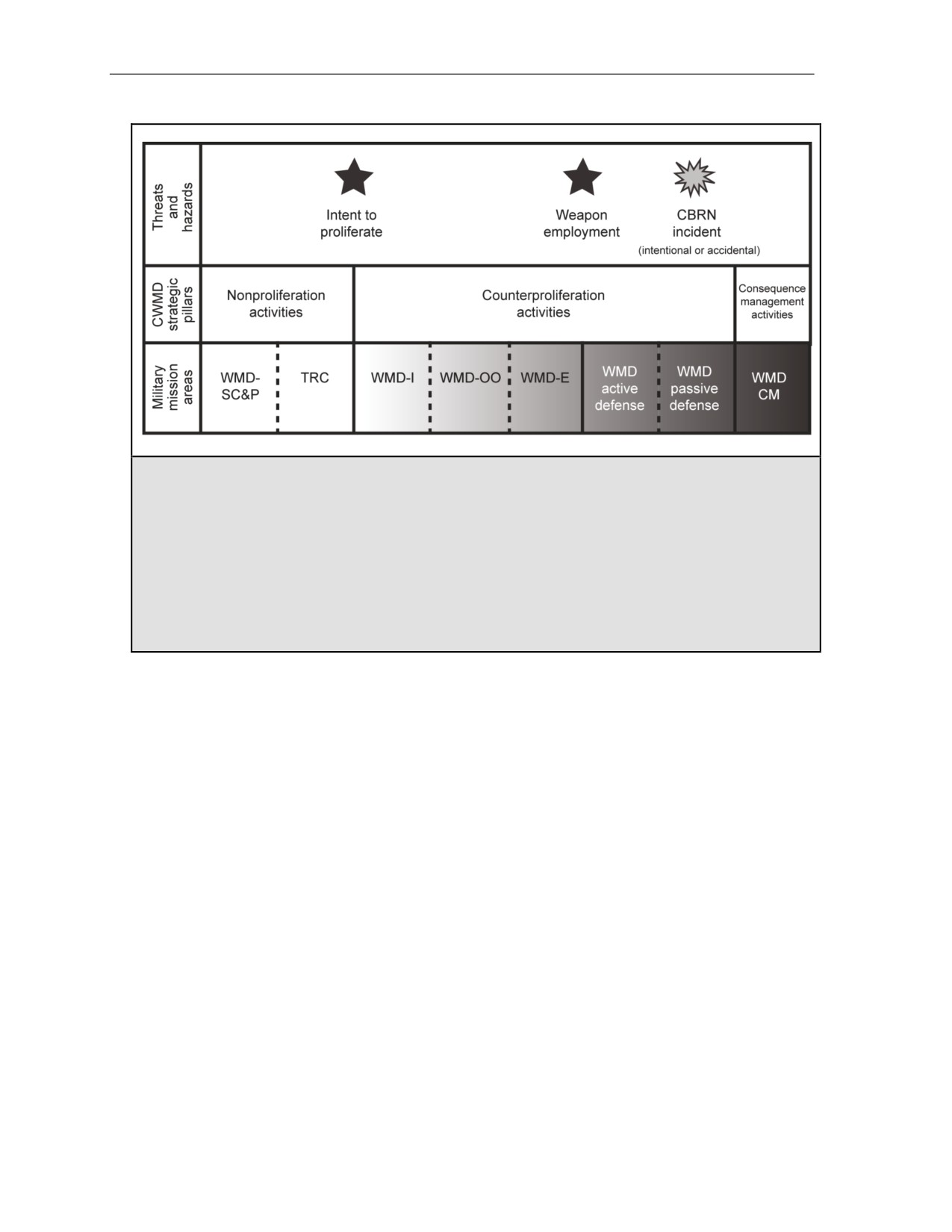
actors; and to mitigate the effects of WMD employment (see figure 2-4). The joint force commander directs
actions at critical vulnerabilities (tangible and intangible) within the WMD network, combining direct and
indirect effects to render the network incapable or unwilling to perform its WMD-enabling function. As the
campaign progresses, the joint force commander must be prepared to execute other branches of strategy as
the WMD actor takes unexpected actions or makes unanticipated advances in capability development and
employment.
1 July 2011
FM 3-11/MCWP 3-37.1/NWP 3-11/AFTTP 3-2.42
2-7
Chapter 2
Legend:
CBRN
chemical, biological, radiological, and nuclear
CM
consequence management
CWMD
combating weapons of mass destruction
TRC
threat reduction cooperation
WMD
weapons of mass destruction
WMD-E
weapons of mass destruction elimination
WMD-I
weapons of mass destruction interdiction
WMD-OO
weapons of mass destruction offensive operations
WMD-SC&P
weapons of mass destruction security cooperation and partner activities
Figure 2-4. Operational context for CWMD
2-26. CWMD operational objectives require synchronization between the three strategic pillars in the form
of eight military mission areas defined below. JP 3-40 establishes doctrine for the integration of the eight
military mission areas and the National Military Strategy to Combat Weapons of Mass Destruction.
WEAPONS OF MASS DESTRUCTION SECURITY COOPERATION AND PARTNER ACTIVITIES
2-27. WMD security cooperation and partner activities improve partner and allied capacity to combat
WMD across the eight mission areas through military-to-military contact, burden sharing arrangements,
combined military activities, and support to international activities. These operations support international
efforts and promote improved partnership capacity to combat WMD. Activities include support to treaties
and agreements, support to operations and exercises intended to foster capability development, common
threat awareness, coalition building, and interoperability. They may be military-led or in support to DOD or
other government agencies. These activities also influence adversary decisions through the demonstration
of U.S. and partner capabilities to impose cost or deny benefits of WMD development or use. WMD
security cooperation and partner activities are conducted in a permissive environment.
THREAT REDUCTION COOPERATION
2-28. Threat reduction cooperation activities are undertaken with the consent and cooperation of host
nation authorities to enhance physical security and to reduce, dismantle, redirect, and/or improve the
protection of a state’s existing WMD program, stockpiles, and capabilities. This military mission area is the
desired successor to the integrated application of other military mission areas that cause WMD actors to
renounce WMD. Although not a primary combatant commander responsibility, these activities impact other
combatant command operations; and combatant commanders must maintain visibility that is consistent
2-8
FM 3-11/MCWP 3-37.1/NWP 3-11/AFTTP 3-2.42
1 July 2011
U.S. Policy and Strategy
with these efforts. In some cases, the joint force commander may provide some politico-military support to
reduce threat operations that will unequivocally eliminate the WMD networks and programs. For example,
the WMD actor may require assistance in securing infrastructure, delivery means, or WMD-related
material. The joint force commander might also provide arms control support or support to remove this
material to isolate the targeted WMD program and ensure that the actor does not resurrect it. This task is
primarily strategic in nature and may include tasks such as inspections, monitoring, verification, and
enforcement support for treaties. Threat reduction cooperation activities are conducted in a permissive
environment.
WEAPONS OF MASS DESTRUCTION INTERDICTION
2-29. WMD interdiction operations track, intercept, search, divert, seize, or otherwise stop the transit of
WMD, its delivery systems, or related materials, technologies, and expertise. If shaping and deterrence
operations are not successful in influencing adversaries to stop proliferating, the President or the Secretary
of Defense may direct the joint force commander to employ or support WMD counterforce operations to
stop the transit of WMD materiel, expertise, or enabling resources and to delay WMD development. The
joint force commander may attack operational targets (using lethal means) or conduct engagements on
operational targets using nonlethal means. This interdiction will likely be nonlethal and may be executed by
someone other than the joint force. As the WMD actor comes closer to obtaining a WMD employment
capability, many nonlethal capabilities will be less effective and lethal interdiction by the joint force is
much more likely. If such interdiction results in the seizure of WMD or related material, interdiction may
require the joint force commander to reduce the threat by securing and removing (neutralize or transport)
WMD and related material. If a CBRN hazard occurs as a result of an accidental release in a permissive or
uncertain operational environment, it may be necessary for the joint force commander to execute
consequence management operations. Interdiction operations increase the cost and time of WMD
acquisition and proliferation to the actor.
Note. See Chapter 4 for more information on WMD counterforce operations.
WEAPONS OF MASS DESTRUCTION OFFENSIVE OPERATIONS
2-30. WMD offensive operations disrupt, neutralize, or destroy a WMD threat before it can be used or
deter the subsequent use of WMD. In hostile or uncertain environments where interdiction efforts have not
been successful in halting rogue behavior, the President or the Secretary of Defense may direct the joint
force commander to execute WMD counterforce operations to destroy the WMD network’s ability to
produce, deploy, or employ WMD. Offensive operations are military-led and may be lethal and/or
nonlethal operations. They encompass the detection, identification, disruption, and destruction of an
adversary’s WMD assets, delivery means, associated facilities, and other high-value targets. If an adversary
attempts to use WMD, offensive operations may help disrupt and weaken the attack, thereby increasing the
effectiveness of other complementary elements of CMWD such as active and passive defense measures and
consequence management. These operations impose substantial cost upon the WMD actor. For nonstate
actors with smaller, more centralized WMD production capabilities, offensive operations may result in
complete destruction of the program. Offensive operations taken against a WMD program, production, or
platform require reliable credible intelligence.
WEAPONS OF MASS DESTRUCTION ELIMINATION
2-31. WMD elimination operations are undertaken in a hostile or uncertain environment to systematically
locate, characterize, secure, disable, or destroy WMD programs and related capabilities. Elimination
operations employ many of the same WMD counterforce operation capabilities as offensive operations to
reduce the immediate threat and to lay the groundwork to transition the long-term destruction, redirection,
and monitoring activities of any remaining elements of the WMD program to the threat reduction
cooperation military mission area. These operations also seek to locate and secure key personnel in the
program. Since elimination requires some U.S. physical control of the infrastructure to establish attribution,
the joint force commander must provide passive defense for executing force elements. The joint force
1 July 2011
FM 3-11/MCWP 3-37.1/NWP 3-11/AFTTP 3-2.42
2-9
Chapter 2
commander also provides arms control support to unified action to isolate the targeted WMD program and
ensure that the actor does not resurrect it.
WEAPONS OF MASS DESTRUCTION ACTIVE DEFENSE
2-32. WMD active defense measures defeat an attack with CBRN weapons by employing actions to divert,
neutralize, or destroy them or their means of delivery while en route to their target. Throughout the
campaign, the joint force commander also employs active defense capabilities. These are military-led
activities to defend against conventionally and unconventionally delivered WMD. Initially, these
capabilities present benefit denial aspects to the WMD actor and can influence decisions to pursue or
employ WMD. These capabilities also represent benefits to allies and partners and can influence their
support.
WEAPONS OF MASS DESTRUCTION PASSIVE DEFENSE
2-33. WMD passive defense measures minimize or negate the vulnerability to, and effects of, CBRN
attacks. This mission area focuses on maintaining joint force ability to continue military operations in a
CBRN environment. Throughout the campaign, the joint force commander employs passive defense
capabilities to reduce or negate U.S. and partner vulnerabilities and minimize the effects of WMD use.
Passive defense protects U.S. military interests, installations, and critical infrastructure. These capabilities
also represent benefits to allies and partners and can influence their support.
WEAPONS OF MASS DESTRUCTION CONSEQUENCE MANAGEMENT
2-34. The joint force commander employs consequence management capabilities to sustain operations, to
mitigate undesired effects such as the release of WMD-related material, and to manage the consequences of
such unintended effects. By demonstrating the ability to deny the benefits of WMD use, consequence
management capabilities can also influence adversary decisions to employ WMD.
TACTICAL CONTEXT
2-35. CBRN operations include the employment of tactical capabilities that counter the entire range of
CBRN threats and hazards through WMD proliferation prevention, WMD counterforce, CBRN defense,
and CBRN consequence management activities in support of operational and strategic objectives to combat
WMD and operate safely in CBRN environments. CBRN operations include tactical capability
employments that support operational and strategic objectives for CWMD. Understanding the tactical
context requires defining the tactical construct and identifying what the eight military mission areas mean
to military personnel at the tactical level of war.
2-36. It is not feasible to develop a comprehensive approach to CWMD without addressing tactical-level
capabilities. CBRN operations employ service-unique capabilities to achieve the CWMD objectives for a
given military mission area. For example, the USA or USMC might not have the level of expertise required
to conduct dismantling activities during WMD eliminations operations. Commanders at the tactical level
are concerned with how the eight military mission areas relate to one another and the joint campaign, and
then they determine whether they are supporting the eight military mission areas in CWMD objectives
conducting CBRN operations.
2-37. Activities in the eight military mission areas are not necessarily conducted sequentially and
discretely in the prosecution of tactical-level military operations; they will occur independently or
simultaneously in response to a CBRN threat or hazard, depending on whether tactical units are conducting
CBRN operations or supporting CWMD objectives. Figure 2-5 shows the relationship among tactical tasks,
tactical objectives, CWMD strategic pillars, and threats and hazards.
2-10
FM 3-11/MCWP 3-37.1/NWP 3-11/AFTTP 3-2.42
1 July 2011
U.S. Policy and Strategy
2-38. The tactical tasks support the eight military mission areas and the strategic objectives. There are four
tactical objectives (proliferation prevention, WMD counterforce, CBRN defense, and CBRN consequence
management). If a CWMD program is successful, adversaries are prevented from acquiring WMD;
however, successive CWMD program failures may ultimately culminate in a CBRN incident that requires
mitigation.
WEAPONS OF MASS DESTRUCTION PROLIFERATION PREVENTION
2-39. WMD proliferation prevention is the employment of tactical level capabilities to support
operational and strategic nonproliferation objectives of combating WMD. The goal of proliferation
prevention is to exert an early influence in the adversary’s decision cycle that discourages an interest in (or
the decision to seek or acquire) CBRN materials, WMD precursors, sensitive technologies, or expertise that
could be used against the United States or our allies. If our proliferation prevention efforts fail and the
adversary decides to move forward with the intent of WMD acquisition, the U.S. response options escalate
into WMD counterforce (interdiction, offensive operations, and WMD elimination operations).
WEAPONS OF MASS DESTRUCTION COUNTERFORCE
2-40. WMD counterforce is a tactical objective to defeat the full range of CBRN threats before they
can be employed as weapons. WMD counterforce operations aim to prevent, dissuade, deny, or defeat
adversary CBRN capabilities, including research and development, production and storage facilities,
fielded forces, and related C2. These operations are intended to deter or defeat a CBRN threat or the
subsequent use of WMD and reduce the level of threats to be dealt with by CBRN active or passive
defenses.
Note. Chapter 4 discusses WMD counterforce operations in more detail.
CHEMICAL, BIOLOGICAL, RADIOLOGICAL, AND NUCLEAR DEFENSE
2-41. CBRN defense consists of measures that are taken to minimize or negate the vulnerabilities and/or
effects of a CBRN incident. CBRN defense operations are proactive tactical capabilities that contain
reactive characteristics:
z
CBRN active defense operations attempt to intercept CBRN weapons en route to their targets.
z
CBRN passive defense operations improve the ability to survive and sustain in a contaminated
environment through proper planning, training, risk assessment, and vulnerability and hazard
mitigation. CBRN passive defense includes measures to minimize or negate the vulnerability to,
and minimize effects of, WMD use against U.S. and partner/allied forces and U.S. military
interests, installations, and critical infrastructure.
Note. Chapter 4 discusses CBRN defense operations in more detail.
1 July 2011
FM 3-11/MCWP 3-37.1/NWP 3-11/AFTTP 3-2.42
2-11
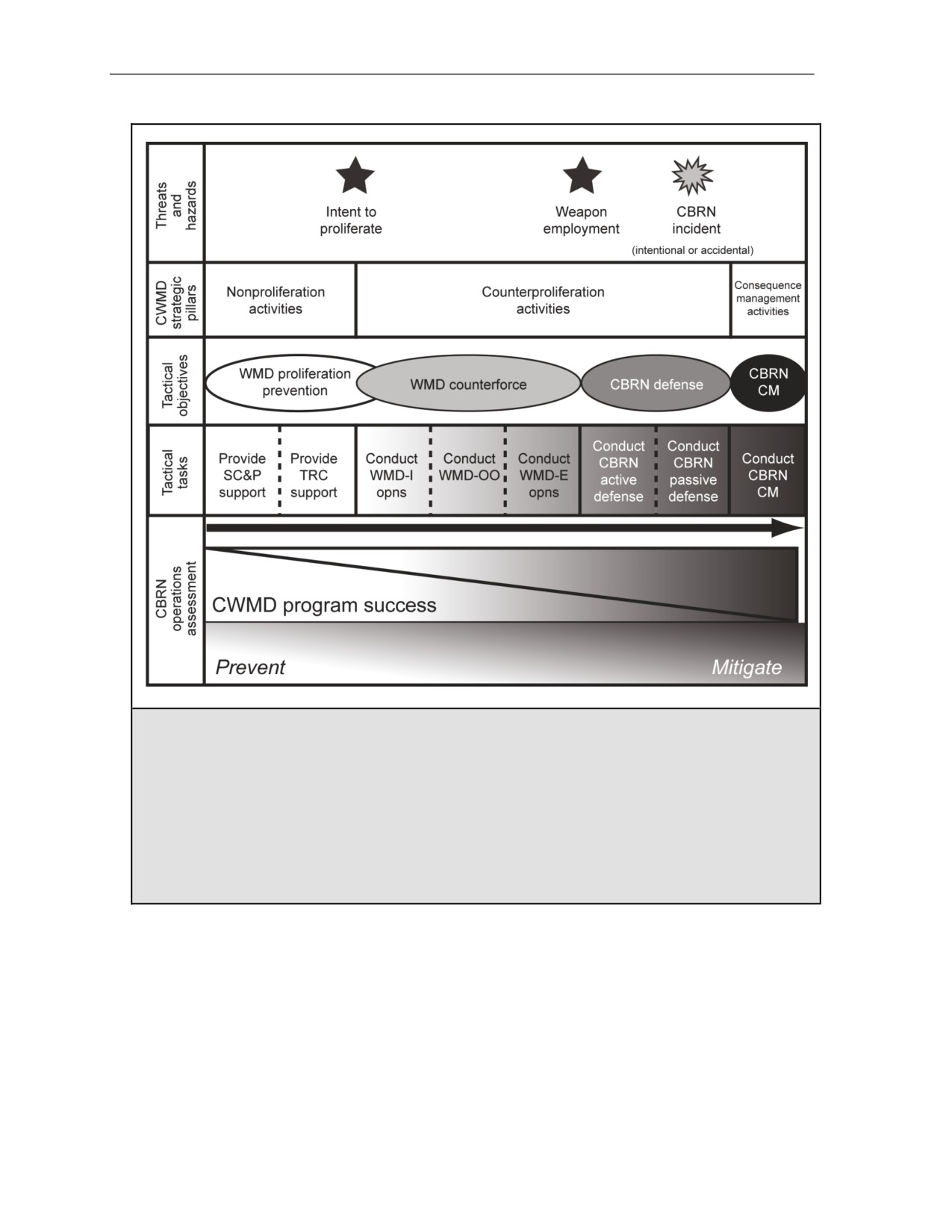
Chapter 2
Legend:
CBRN
chemical, biological, radiological, and nuclear
CM
consequence management
CWMD
combating weapons of mass destruction
SC&P
security cooperation and partner activities
TRC
threat reduction cooperation
WMD
weapons of mass destruction
WMD-E
weapons of mass destruction elimination
WMD-I
weapons of mass destruction interdiction
WMD-OO
weapons of mass destruction offensive operations
Figure 2-5. Tactical context for CBRN operations
CHEMICAL, BIOLOGICAL, RADIOLOGICAL, AND NUCLEAR CONSEQUENCE MANAGEMENT
2-42. Consequence management activities are actions that are taken to maintain or restore essential
services and manage and mitigate problems that may result from disasters and catastrophes, including
natural, man-made, or terrorist incidents. CBRN consequence management activities serve to reduce the
effects of a CBRN attack or event and assist in the restoration of essential operations and services at home
and abroad in a permissive environment. Consequence management includes actions taken to—
2-12
FM 3-11/MCWP 3-37.1/NWP 3-11/AFTTP 3-2.42
1 July 2011
U.S. Policy and Strategy
z
Respond to, and mitigate the effects of, a WMD attack or event against our homeland and
deployed forces or U.S. interests abroad.
z
Provide military assistance to civilian authorities to restore essential operations and services.
Note. Chapter 5 discusses CBRN consequence management operations in more detail.
2-43. CBRN operations at the tactical level must be integrated into all military operations to support the
National Military Strategy to Combat WMD, which requires the synchronization of the following tactical
tasks:
z
Providing security cooperation and partner activity support.
z
Providing threat reduction cooperation support.
z
Conducting WMD interdiction, offensive, and elimination operations.
z
Conducting CBRN active defense, passive defense, and consequence management operations.
SUMMARY
2-44. U.S. policies and strategies seek to prevent and limit the proliferation of CBRN capabilities. The
National Strategy to Combat Weapons of Mass Destruction articulates a proactive and comprehensive
strategy built upon the three pillars of nonproliferation, counterproliferation, and consequence
management. DOD awareness, responsibility, and focus have shifted to expand the planning, preparation,
and execution activities in support of the CWMD mission. The eight military mission areas provide the
framework for ensuring CWMD program success. This multi-Service doctrine provides principles for
conducting CBRN operations.
1 July 2011
FM 3-11/MCWP 3-37.1/NWP 3-11/AFTTP 3-2.42
2-13
///////////////////////////////////////