FM 3-36 ELECTRONIC WARFARE IN OPERATIONS (February 2009) - page 3
Electronic Warfare Capabilities
Corps enterprise network. It is co-located with the Marine Corps forces computer network defense, the
component to the joint task force for computer network operations, and the Marine Corps computer
incident response team. This relationship provides a strong framework for integrated network management
and defense.
NATIONAL SECURITY AGENCY
7-11. The National Security Agency/Central Security Service is America’s cryptologic organization. This
organization protects U.S. government information systems and produces foreign signals intelligence
information. Executive Order 12333, 4 December 1981, describes the responsibility of the National
Security Agency/Central Security Service in more detail. The resources of National Security
Agency/Central Security Service are organized for two national missions:
z
The Information Assurance Mission provides the solutions, products, and services, and conducts
defensive information operations, to achieve information assurance for information
infrastructures critical to U.S. national security interests.
z
The Signals Intelligence Mission allows for an effective, unified organization and control of all
the foreign signals collection and processing activities of the United States. The National
Security Agency is authorized to produce signals intelligence in accordance with objectives,
requirements, and priorities established by the Director of National Intelligence in consultation
with the President's Foreign Intelligence Advisory Board.
7-12. The Director, National Security Agency is the principal signals intelligence and information security
advisor to the Secretary of Defense, Director of National Intelligence, and the Chairman of the Joint Chiefs
of Staff. The Director, National Security Agency provides signals intelligence support to combatant
commanders and others in accordance with their expressed formal requirements.
SUMMARY
7-13. This chapter and appendix E provide a sampling of available joint and Service EW capabilities,
activities, and agencies that support ground force commanders in full spectrum operations. To leverage
these capabilities for EW support, Army EW officers acquire a working knowledge of the capabilities
available and the procedures for requesting support. Additionally, appendix F provides information on
available EW related tools and other resources.
25 February 2009
FM 3-36
7-3
Appendix A
The Electromagnetic Environment
Electromagnetic energy is both a natural and manmade occurrence. This energy, in
the form of electromagnetic radiation, consists of oscillating electric and magnetic
fields and is propagated at the speed of light. Electromagnetic radiation is measured
by the frequency of its wave pattern’s repetition within a set unit of time. The
standard term for the measurement of electromagnetic radiation is the hertz (Hz), the
number of repetitions (cycles) per second. The electromagnetic spectrum refers to the
range of frequencies of electromagnetic radiation.
OVERVIEW OF THE ELECTROMAGNETIC ENVIRONMENT
A-1. The electromagnetic environment is the resulting product of the power and time distribution, in
various frequency ranges, of radiated or conducted electromagnetic emission levels. Within their intended
operational environment, a military force, system, or platform may encounter these emissions while
performing tasks during operations. The electromagnetic environment is the sum of—
z
Electromagnetic interference.
z
Electromagnetic pulse.
z
Hazards of electromagnetic radiation to personnel, ordnance, and volatile materials.
z
Natural phenomena effects of lightning and precipitation static. (Precipitation static is charged
precipitation particles that strike antennas and gradually charge the antenna, which ultimately
discharges across the insulator, causing a burst of static [JP 3-13.1]).
25 February 2009
FM 3-36
A-1
Appendix A
THE ELECTROMAGNETIC SPECTRUM
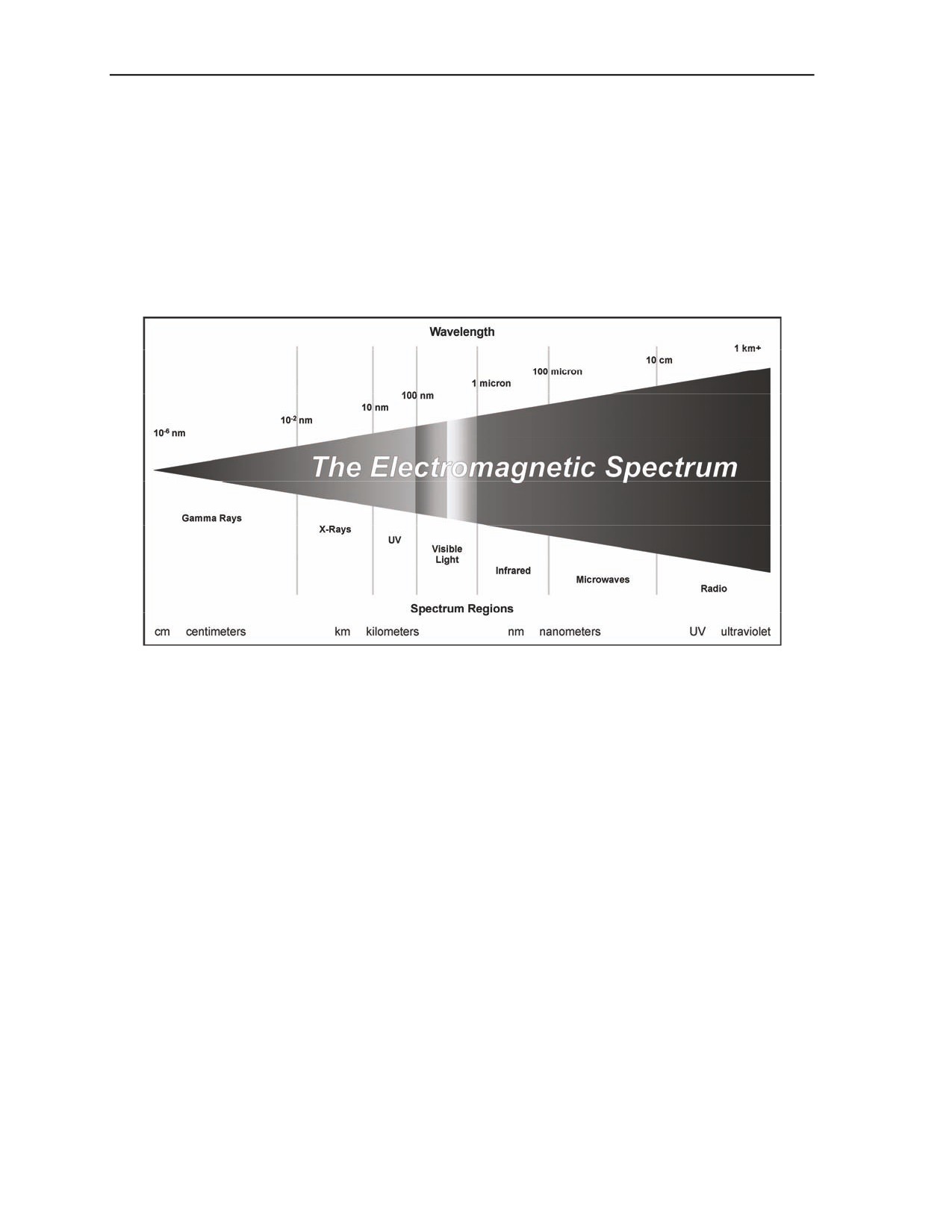
A-2. The electromagnetic spectrum is the range of frequencies of electromagnetic radiation from zero to
infinity. It is divided into 26 alphabetically designated bands (JP 1-02). The spectrum is a continuum of all
electromagnetic waves arranged according to frequency and wavelength. The electromagnetic spectrum
extends from below the frequencies used for modern radio (at the long-wavelength end) through gamma
radiation (at the short-wavelength end). It covers wavelengths from thousands of kilometers to a fraction of
the size of an atom. Figure A-1 shows the spectrum regions and wavelength segments associated with the
electromagnetic spectrum.
Figure A-1. The electromagnetic spectrum
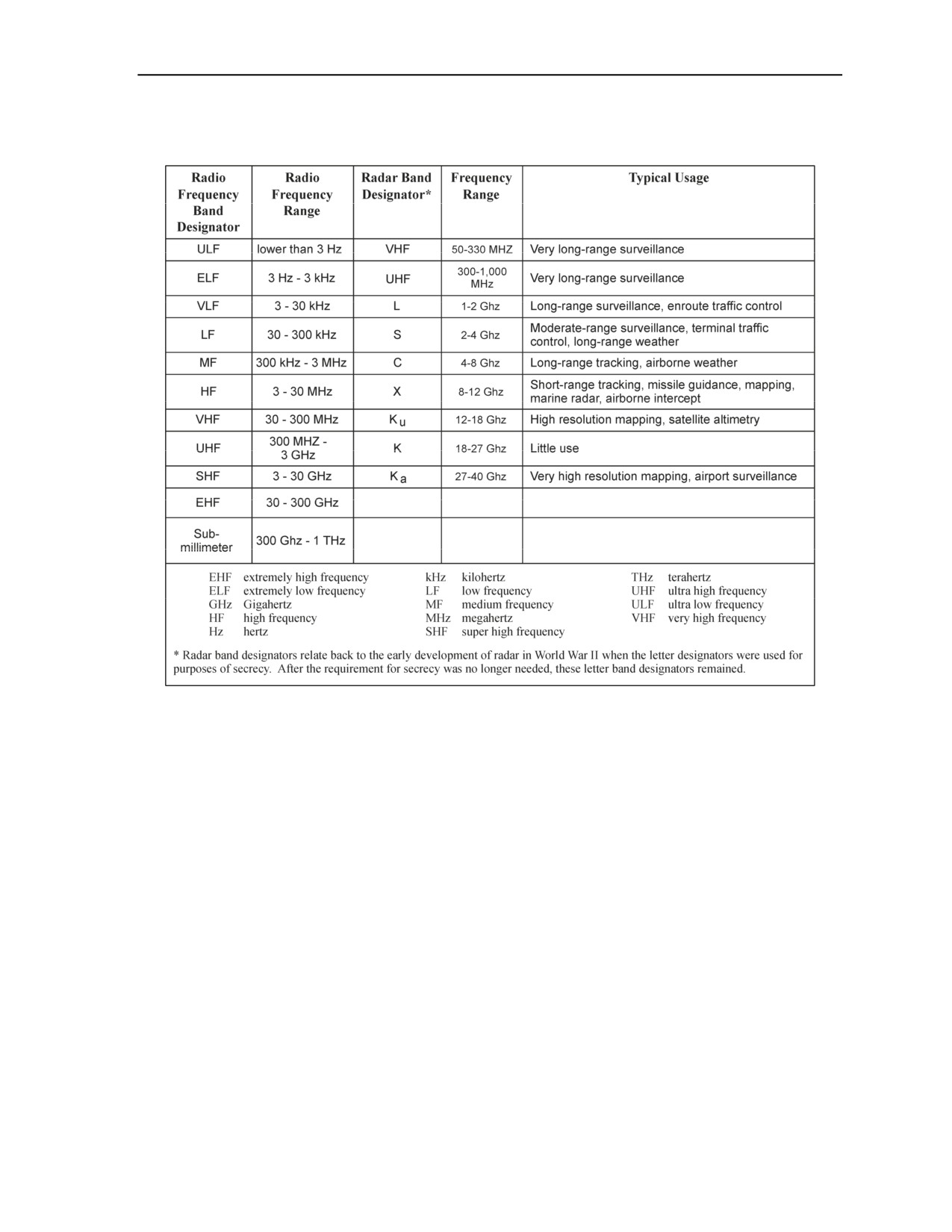
A-3. Included within the radio and microwave regions of the electromagnetic spectrum are the radio
frequency and radar bands. These bands are routinely referred to by their band designators. For example,
high frequency radios are HF radios and K-band radars are radars that operate between 18 and 27
gigahertz. Civilian agencies and military forces throughout the world use several different designator
systems, which can result in confusion. Table A-1 shows the radio frequency band designators and their
associated frequency ranges. It also shows radar band designators, associated frequency ranges, and typical
usage. These are standard designations used by the United States.
A-2
FM 3-36
25 February 2009
The Electromagnetic Environment
Table A-1. Radio and radar designators and frequency bands
MILITARY OPERATIONS AND THE ELECTROMAGNETIC
ENVIRONMENT
A-4. The impact of the electromagnetic environment upon the operational capability of military forces,
equipment, systems, and platforms is referred to as electromagnetic environmental effects. Electromagnetic
environmental effects encompass all electromagnetic disciplines, including—
z
Electromagnetic compatibility and electromagnetic interference.
z
Electromagnetic vulnerability.
z
Electromagnetic pulse.
z
Electronic protection.
z
Hazards of electromagnetic radiation to personnel, ordnance, and volatile materials (such as
fuels).
z
Natural phenomena effects of lightning and precipitation static.
A-5. Electromagnetic vulnerability consists of the characteristics of a system that cause it to suffer a
definite degradation (incapability to perform the designated mission) as a result of having been subjected to
a certain level of electromagnetic environmental effects (JP 3-13.1). Electronic warfare support plays a key
role in identifying the electromagnetic vulnerability of an adversary’s electronic equipment and systems.
Friendly forces take advantage of these vulnerabilities through electronic warfare operations.
25 February 2009
FM 3-36
A-3
Appendix A
DIRECTED ENERGY
A-6. Directed energy refers to technologies that produce of a beam of concentrated electromagnetic
energy or atomic or subatomic particles (see chapter 1). Directed-energy warfare is military action
involving the use of directed-energy weapons, devices, and countermeasures to either cause direct damage
or destruction of enemy equipment, facilities, and personnel, or to determine, exploit, reduce, or prevent
hostile use of the electromagnetic spectrum through damage, destruction, and disruption. It also includes
actions taken to protect friendly equipment, facilities, and personnel and retain friendly use of the
electromagnetic spectrum (JP 1-02). A directed-energy weapon is a system using directed energy primarily
as a direct means to damage or destroy enemy equipment, facilities, and personnel (JP 1-02). In addition to
destructive effects, directed-energy weapons can also support area denial, crowd control, and obscuration.
A-7. The application of directed energy includes lasers, radio-frequency weapons, and particle-beam
weapons. As directed-energy weapons evolve, the tactics, techniques, and procedures for their use also
evolve to ensure their safe, effective employment. In electronic warfare, most directed-energy applications
fit into the category of electronic attack. However, other applications can be categorized as electronic
protection or even electronic warfare support. Examples include the following:
z
Applications used for electronic attack, which may include—
A laser designed to blind or disrupt optical sensors.
A millimeter wave directed-energy weapon used for crowd control.
A laser-warning receiver designed to initiate a laser countermeasure to defeat a laser
weapon.
A millimeter wave obscuration system used to disrupt or defeat a millimeter wave system.
A device used to counter radio-controlled improvised explosive devices.
z
A laser-warning receiver designed solely to detect and analyze a laser signal is used for
electronic warfare support.
z
A visor or goggle designed to filter out the harmful wavelength of laser light is used for
electronic protection.
A-8. As the use of destructive directed-energy weapons grows, Army forces require the capability to
collect information on them. Additionally, Army forces require tactics, techniques, and procedures to
mitigate directed-energy weapon effects. Currently, the definitions and terms relating to directed energy are
articulated within electronic warfare doctrine. As the technologies related to directed energy expand, joint
and Army doctrine may discuss employing directed energy under other doctrinal subjects.
A-4
FM 3-36
25 February 2009
Appendix B
Electronic Warfare Input to Operation Plans and Orders
This appendix discusses electronic warfare input to Army and joint plans and orders.
ARMY PLANS AND ORDERS
B-1. This paragraph lists the electronic warfare (EW) information required for Army operation plans and
orders. (See figure B-1 on page B-2 for the EW appendix format.) This discussion is based on current
doctrine from FM 5-0. When it is republished, FM 5-0 will state where to place EW-related information in
the revised plans and orders format. In addition to the appendix 4 (Electronic Warfare) to Annex P
(Information Operations), the following components of operation plans and orders may require EW input:
z
Base order or plan:
Sub-subparagraph (2) (Fires) to subparagraph a (Concept of Operations) to paragraph 3
(Execution).
Sub-subparagraph (7) (Information Operations) to subparagraph a (Concept of Operations)
to paragraph 3 (Execution).
z
Annex D (Fire Support):
Sub-subparagraph (4) (Electronic Warfare) to subparagraph b (Air Support) to paragraph 3
(Execution)
Appendix 1 (Air Support).
z
Annex L (Intelligence, Surveillance, and Reconnaissance):
Sub-subparagraph (2) (Fires) to subparagraph a (Concept of Operations) to paragraph 3
(Execution).
Sub-subparagraph (7) (Information Operations) to subparagraph a (Concept of Operations)
to paragraph 3 (Execution).
z
Annex N (Space): Sub-subparagraph (10) (Electronic Warfare) to subparagraph b (Space
Activities) to paragraph 3 (Execution).
z
Annex P (Information Operations):
Sub-sub-subparagraph (d) (Electronic Warfare) to sub-subparagraph (8) to subparagraph a
(Concept of Support) to paragraph 3 (Execution).
Sub-subparagraph (3) (List of Tasks to Electronic Warfare Units) to subparagraph b (Tasks
to Subordinate Units) to paragraph 3 (Execution).
25 February 2009
FM 3-36
B-1
Appendix B
Figure B-1. Appendix 4 (Electronic Warfare) to annex P (Information Operations) instructions
JOINT PLANS AND ORDERS
B-2. If required to provide EW input to portions of a joint order, the primary areas for input are the
following:
z
Paragraph 3 (Execution) to appendix 3 (Information Operations) to Annex C (Operations).
z
Tab B (Electronic Warfare) to appendix 3 (Information Operations) to Annex C (Operations).
B-3. See CJCSM 3122.03C for the Joint Operations Planning and Execution System format.
B-2
FM 3-36
25 February 2009
Appendix C
Electronic Warfare Running Estimate
This appendix discusses the electronic warfare running estimate. A running estimate
is a staff section’s continuous assessment of current and future operations to
determine if the current operation is proceeding according to the commander’s intent
and if future operations are supportable (FM 3-0).
C-1. The electronic warfare (EW) running estimate is used to support the military decisionmaking process
during planning and execution. During planning, the EW running estimate provides an assessment of the
supportability of each proposed course of action from an EW perspective. The format of the EW running
estimate closely parallels the steps of the military decisionmaking process. It serves as the primary tool for
recording the EW officer’s assessments, analyses, and recommendations for EW operations. The EW
officer and staff in the EW working group are responsible for conducting the analysis and providing
recommendations based on the EW running estimate.
C-2. A complete EW running estimate should contain the information necessary to answer any question
the commander may pose. If there are gaps in the EW running estimate, the staff identifies the gaps as
information requirements and submits them to the intelligence cell. The EW running estimate can form the
basis for EW input required in other applicable appendixes and annexes within operation plans and orders.
Figure C-1 on page C-2 provides a sample EW running estimate for use during planning.
25 February 2009
FM 3-36
C-1
Appendix C
Figure C-1. Example of an electronic warfare running estimate
C-3. Once the commander approves the order, the EW running estimate is used to inform current and
future operations. During execution the EW running estimate is used to help determine if current EW
operations are proceeding according to plan and if future EW operations are supportable. Figure C-2, page
C-3, shows a sample of the information that might be used to update the EW running estimate during
execution. The EW officer and supporting staff members within the EW working group produce and
update the running estimate.
C-2
FM 3-36
25 February 2009
Appendix D
Electronic Warfare-Related Reports and Messages
This appendix provides information and references for electronic warfare and
electronic warfare-related reports and message formats.
MESSAGES AND SUMMARIES
D-1. The following messages and summaries are associated with the planning, synchronization,
deconfliction, and assessment of EW operations.
ELECTRONIC ATTACK DATA MESSAGE
D-2. An electronic attack data message reports an electronic attack strobe from an affected or detecting
unit’s position to an aircraft emitting an electronic attack. It is used to determine the location of a hostile or
unknown aircraft emitting an electronic attack. The detecting unit reports its detection to all units using a
given network when the data link is degraded or not operational.
D-3. Upon receipt of several messages, the source of enemy electronic attack can be determined by
comparing lines of bearing from the different origins (triangulation).
D-4. See FM 6-99.2, page 83, for the format.
ELECTRONIC ATTACK REQUEST FORMAT
D-5. Electronic fires fall within three categories: preplanned, preplanned on-call, and immediate.
Requesting airborne electronic attack support for ground operations is similar to requesting close air
support. Requests for an electronic attack are sent via the normal joint air request process. Requesters use
either a joint tactical air strike request or joint tactical air support request. (See FM 3-09.32 for a sample.)
A theater-specific electronic attack request format may complement a joint tactical air strike request.
D-6. When submitting the request, the following information must be provided in the remarks section
(section 8):
z
Target location.
z
Prioritized target description and jam frequencies.
z
Time on target (window).
z
Joint terminal attack controller.
z
Jamming control authority call sign and frequency.
z
Friendly force disposition (for example, troop movement route).
z
Friendly frequency restrictions.
z
Remarks.
ELECTRONIC WARFARE FREQUENCY DECONFLICTION MESSAGE
D-7. An EW frequency deconfliction message promulgates a list of protected, guarded, and taboo
frequencies. This list allows friendly forces to use the frequency spectrum without adverse impact from
friendly electronic attack. (See FM 6-99.2, page 86, for the format.)
25 February 2009
FM 3-36
D-1
Appendix D
ELECTRONIC WARFARE MISSION SUMMARY
D-8. The EW mission summary summarizes significant EW missions and reports the status of offensive
EW assets. EW and electronic-attack-capable surface and air units use it to provide information on EW
operations. Service components use it to report significant events for subsequent analysis. (See FM 6-99.2,
page 87, for the format.)
ELECTRONIC WARFARE REQUESTING TASKING MESSAGE
D-9. Joint task force commanders use the electronic warfare requesting tasking message to task
component commanders to perform EW operations in support of the joint EW plan and to support
component EW operations. Component commanders use this message to request EW support from sources
outside their command.
JOINT TACTICAL AIR STRIKE REQUEST OR JOINT TACTICAL AIR SUPPORT REQUEST
D-10. Use a joint tactical air strike request or joint tactical air support request to request electronic attack.
These requests require the information listed in paragraph D-6. Organizations without an automated
capability submit these requests using DD Form 1972 (Joint Tactical Air Strike Request). See JP 3-09.3
and FM 3-09.32 for more information.
JOINT SPECTRUM INTERFERENCE RESOLUTION
D-11. The joint spectrum interference resolution program replaced the DOD meaconing, intrusion,
jamming, and interference program in June, 1992. Follow guidance in CJCSI 3320.02C to report incidents
of spectrum interference.
JOINT RESTRICTED FREQUENCY LIST
D-12. Operational, intelligence, and support elements use the joint restricted frequency list to identify the
level of protection desired for various networks and frequencies. The list should be limited to the minimum
number of frequencies necessary for friendly forces to accomplish objectives.
D-13. See Annex A to appendix B to JP 3-13.1 for the joint restricted frequency list format. The format is
used by the joint automated communications-electronics operations instruction system. The format is
unclassified but should show the proper classification of each paragraph when filled in. (See CJCSI
3320.01B and JP 3-13.1 for additional information.)
COUNTER-IMPROVISED-EXPLOSIVE-DEVICE ACTIVITIES
D-14. Certain reports and references are associated with counter-improvised-explosive-device activities.
Most of these reports include information pertinent to counter-radio-controlled improvised-explosive-
device EW activities. EW working groups have the responsibility to monitor these reports to assess
planned counter-radio-controlled improvised-explosive-device EW operations and to support future
operations. These reports typically use formats established in FM 6-99.2 modified to include improvised
explosive device considerations and current operations. See GTA 90-10-046 for examples of reports and
references applicable to counter-radio-controlled improvised-explosive-device EW operations.
D-2
FM 3-36
25 February 2009
Appendix E
Army and Joint Electronic Warfare Capabilities
This appendix provides information on Army and other Service electronic warfare
capabilities. It is not an all-inclusive list. Due to the evolving nature of electronic
warfare equipment and systems, this information is perishable and should be
augmented, updated, and maintained by the unit electronic warfare officer.
ARMY
E-1. The Army is currently expanding its electronic warfare (EW) capability. It maintains several EW
systems in its inventory. Currently, all units whose sole purpose is to conduct EW operations are assigned
to 1st Information Operations Command. When requested, these capabilities are provided to combatant
commands for employment at corps and lower echelons.
COUNTER-RADIO-CONTROLLED IMPROVISED-EXPLOSIVE-DEVICE EW SYSTEMS
E-2. Counter-radio-controlled improvised-explosive-device EW systems form a family of electronic
attack systems. Army forces use these systems to prevent improvised explosive device detonation by radio
frequency energy. The Army maintains both a mounted and dismounted counter-radio-controlled
improvised-explosive-device EW capability to protect personnel and equipment. For a detailed description
of these systems, see appendix F.
AIRCRAFT SURVIVABILITY EQUIPMENT
E-3. Aircraft survivability equipment aims to reduce aircraft vulnerability, thus allowing aircrews to
accomplish their immediate mission and survive. Army aviation maintains a suite of aircraft survivability
equipment that provides protection against electronic attack. This protection can include radio frequency
warning and countermeasures systems, a common missile warning system, information requirement
countermeasures systems, and laser detection and countermeasure systems. For a detailed description of
aircraft survivability equipment EW-related systems, see appendix F.
INTELLIGENCE SYSTEMS
E-4. The intelligence community maintains many systems that provide data for use in EW operations.
Signals intelligence systems provide most of this required data. These assets are dual use. Usually the data
collected is categorized as signals intelligence. It is maintained within sensitive compartmented information
channels and governed by the National Security Agency/Central Security Service. The data sometimes
support EW or, more specifically, electronic warfare support. Paragraphs E-5 through E-7 illustrate some
intelligence systems that (when tasked) can provide electronic warfare support data to support electronic
attack and electronic protection actions. For a detailed description of other intelligence and EW-support-
related systems, see appendix F.
25 February 2009
FM 3-36
E-1
Appendix E
Guardrail Common Sensor
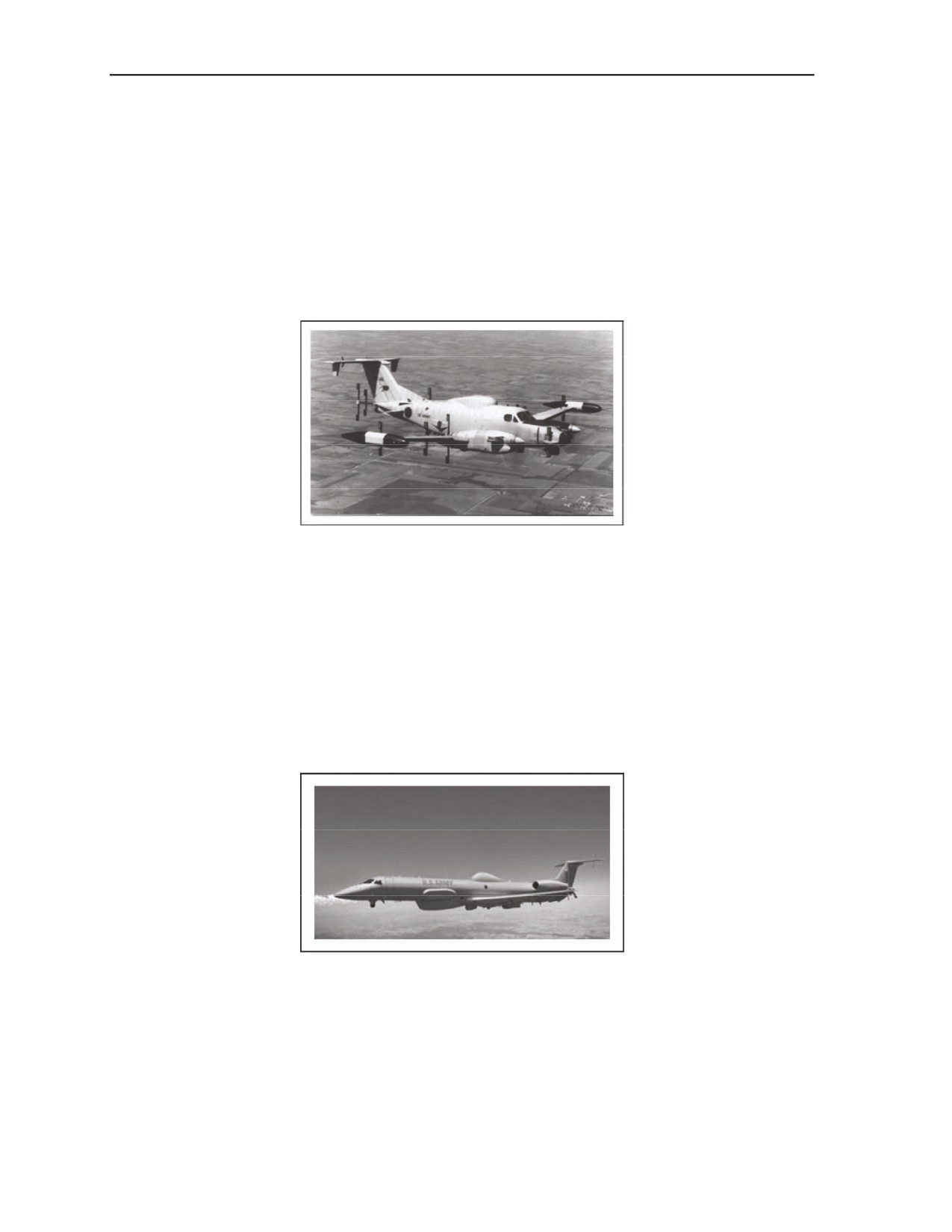
E-5. The Guardrail common sensor is a corps-level airborne signals intelligence collection and location
system. (See figure E-1.) It provides tactical commanders with near real-time targeting information. Key
features include the following: integrated communications intelligence and electronic intelligence
reporting, enhanced signal classification and recognition, near real-time direction finding, precision emitter
location, and an advanced integrated aircraft cockpit. Preplanned product improvements include frequency
extension, computer-assisted online sensor management, upgraded data links, and the capability to exploit
a wider range of signals. The Guardrail common sensor shares technology with the ground-based common
sensor, airborne reconnaissance-low, and other joint systems.
Figure E-1. Guardrail common sensor
Aerial Common Sensor
E-6. The aerial common sensor is the Army's programmed airborne intelligence, surveillance, and
reconnaissance system. (See figure E-2.) It will replace the current RC-7 airborne reconnaissance-low and
Guardrail common sensor programs. The aerial common sensor uses the operational and technical legacies
of the airborne reconnaissance-low and Guardrail common sensor systems as well as some technological
improvements. This sensor will then provide a single, effective, and supportable multiple-intelligence
system for the Army. The aerial common sensor will include a full multiple-intelligence capability,
including carrying signals intelligence payloads, electro-optic and infrared sensors, radar payloads, and
hyperspectral sensors.
Figure E-2. Aerial common sensor (concept)
E-2
FM 3-36
25 February 2009
Army and Joint Electronic Warfare Capabilities
Prophet
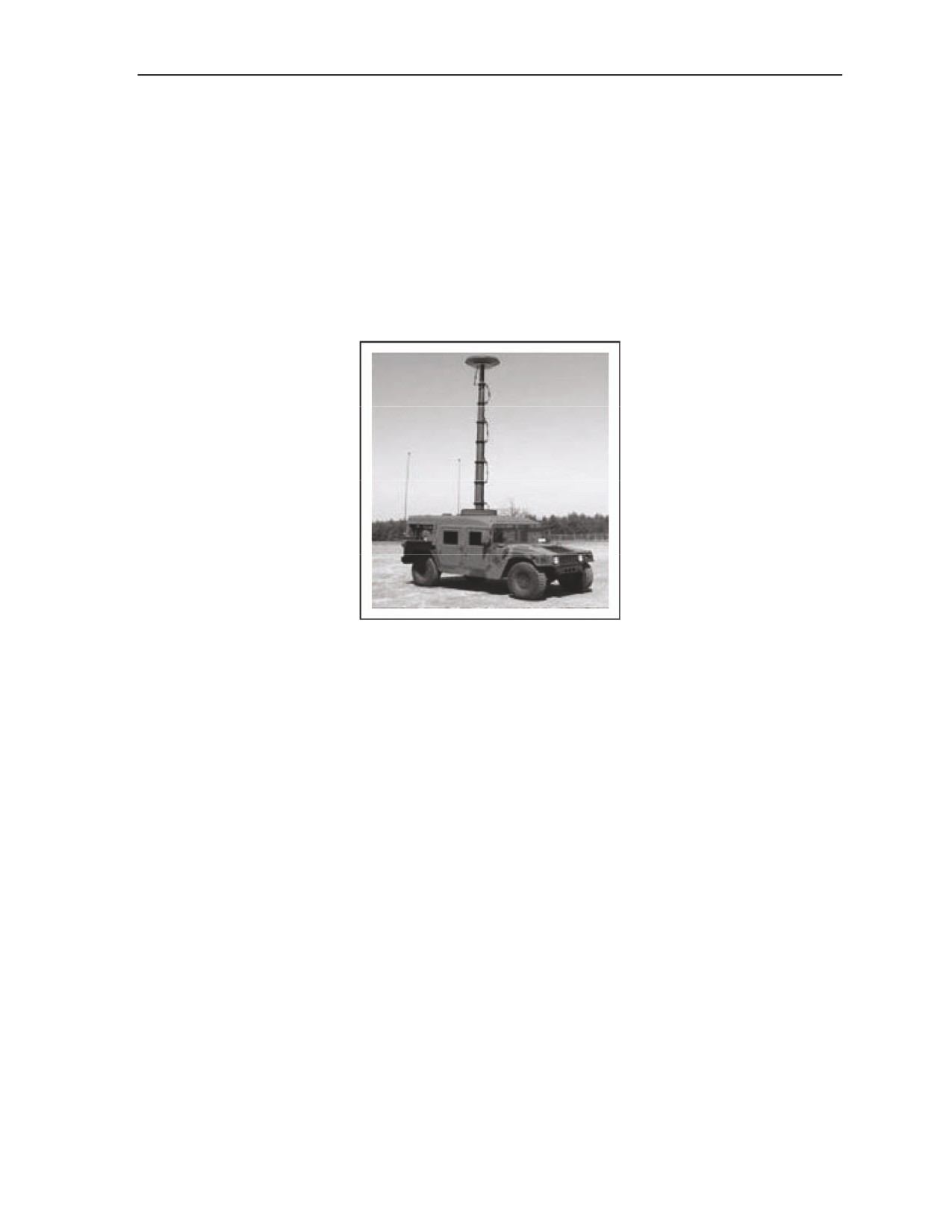
E-7. The Prophet system is the division, brigade combat team, and armored cavalry regiment principal
ground tactical signals intelligence and EW system. (See figure E-3.) Prophet systems will also be assigned
to the technical collection battalion of battlefield surveillance brigades. Prophet detects, identifies, and
locates enemy electronic emitters. It provides enhanced situational awareness and actionable 24-hour
information within the unit’s area of operations. Prophet consists of a vehicular signals intelligence
receiver mounted on a high mobility multipurpose wheeled vehicle, plus a dismounted-Soldier-portable
version. The dismounted Soldier portable version is used for airborne insertion or early entry to support
rapid reaction contingency and antiterrorist operations. Future Prophet systems are planned to include an
electronic attack capability.
Figure E-3. Prophet (vehicle-mounted)
MARINE CORPS
E-8. The Marine Corps has two types of EW units: radio battalions (often called RADBNs), and Marine
tactical EW squadrons (referred to as VMAQs). Paragraphs E-9 through E-24 discuss the units’ missions,
their primary tasks, and capabilities currently being employed. (For further information on the Marine
Corps EW units and systems, see MCWP 2-22.)
RADIO BATTALION
E-9. Radio battalions are the Marine Corps’ tactical level ground-based EW units. During operations,
teams from radio battalions are most often attached to the command element (or senior headquarters) of
Marine expeditionary units. Each radio battalion has the following mission, tasks, and equipment.
25 February 2009
FM 3-36
E-3
Appendix E
Mission and Tasks
E-10. The mission of the radio battalion is to provide communications security monitoring, tactical signals
intelligence, EW, and special intelligence communication support to the Marine air-ground task force
(MAGTF). The radio battalion’s tasks include—
z
Executing interception; radio direction finding; recording and analysis of communications and
noncommunications signals; and signals intelligence processing, analysis, production, and
reporting.
z
Conducting EW against enemy or adversary communications.
z
Helping protect MAGTF communications from enemy exploitation by conducting
communications security monitoring, analysis, and reporting on friendly force communications.
z
Providing special intelligence communications support and cryptographic guard (personnel and
terminal equipment) in support of the MAGTF command element. Normally, the
communications unit supporting the MAGTF command element provides communications
connectivity for special intelligence communications.
z
Providing task-organized detachments to MAGTFs with designated signals intelligence, EW,
special intelligence communication, and other required capabilities.
z
Exercising technical control and direction over MAGTF signals intelligence and EW operations.
z
Providing radio reconnaissance teams with specialized insertion and extraction capabilities (such
as combat rubber raiding craft, fast rope, rappel, helocast, and static-line parachute) for specified
signals intelligence and limited electronic attack support during advance force, preassault, or
deep postassault operations.
z
Coordinating technical signals intelligence requirements and exchanging technical information
and material with national, combatant command, joint, and other signals intelligence units.
z
Providing intermediate, third, and fourth echelon maintenance of the radio battalion’s signals
intelligence and EW equipment.
Equipment
E-11. The following illustrate EW capabilities a radio battalion uses to accomplish the mission and
perform the tasks in support of the MAGTF:
AN/ULQ-19(V)2 Electronic Attack Set
E-12. The AN/ULQ-19(V)2 electronic attack set allows operators to conduct spot or sweep jamming of
single-channel voice or data signals. To provide the required jamming, the system must be employed and
operated from a location with an unobstructed signal line of sight to the target enemy’s communications
transceiver.
AN/MLQ-36 Mobile Electronic Warfare Support System
E-13. The AN/MLQ-36 mobile electronic warfare support system provides a multifunctional capability
that gives signals intelligence and EW operators limited armor protection. This equipment can provide
signals intelligence and EW support to highly mobile mechanized and military operations in urban terrain
where maneuver or armor protection is critical. This system is installed in a logistic variant of the Marine
Corps’s light armored vehicle. It consists of the following:
z
Signals intercept system.
z
Radio direction finding system.
z
Electronic attack system.
z
Secure communication system.
z
Intercom system.
E-4
FM 3-36
25 February 2009
Army and Joint Electronic Warfare Capabilities
AN/MLQ-36A Mobile Electronic Warfare Support System (Product Improved)
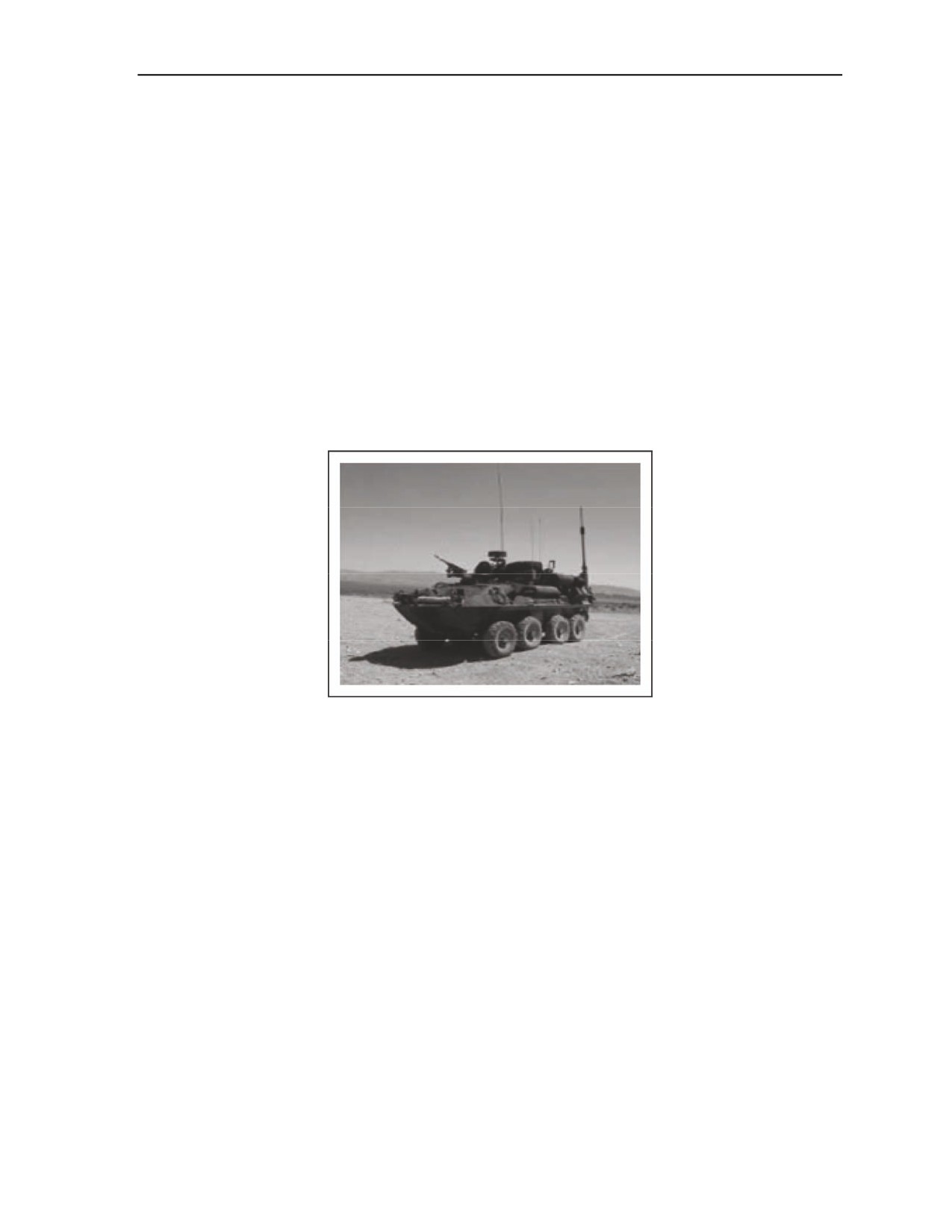
E-14. The product-improved AN/MLQ-36A mobile electronic warfare support system (sometimes called
the AN/MLQ-36A MEWSS PIP) is an advanced signals intelligence and EW system integrated into the
Marine Corps’s light armored vehicle. (See figure E-4.) This system replaces the equipment in the
AN/MLQ-36.
E-15. The AN/AMLQ-36A has the following capabilities:
z
Detect and evaluate enemy communications emissions.
z
Detect and categorize enemy noncommunications emissions (such as battlefield radars).
z
Determine lines of bearing.
z
Degrade enemy tactical radio communications.
When mission-configured and working cooperatively with other AN/MLQ-36As, the system can provide
precision location of battlefield emitters.
E-16. This system and its future enhancements will provide the capability to exploit new and sophisticated
enemy electronic emissions and conduct electronic attack in support of existing and planned national,
combatant command, fleet, and MAGTF signals intelligence and EW operations.
Figure E-4. AN/MLQ-36A mobile electronic warfare support system
MARINE TACTICAL ELECTRONIC WARFARE SQUADRON
E-17. Marine tactical electronic warfare squadrons are the Marine Corps’s airborne tactical EW units.
Each squadron has the following mission, tasks, and capabilities.
Mission and Tasks
E-18. The mission of the electronic warfare squadron is to provide EW support to the MAGTF and other
designated forces. The squadron conducts tactical jamming to prevent, delay, or disrupt the enemy’s ability
to use the following kinds of radars: early warning, acquisition, fire or missile control, counterfire, and
battlefield surveillance. Tactical jamming also denies and degrades enemy communication capabilities. The
squadron conducts electronic surveillance operations to maintain electronic orders of battle. These include
both selected emitter parameters and nonfriendly emitter locations. The squadron also provides threat
warnings for friendly aircraft, ships, and ground units. Squadron tasks include—
z
Providing airborne electronic attack and EW support to the aviation combat element and other
designated operations by intercepting, recording, and jamming threat communications and
noncommunications emitters.
z
Processing, analyzing, and producing routine and time-sensitive electronic intelligence reports
for updating and maintaining enemy electronic order of battle.
25 February 2009
FM 3-36
E-5
Appendix E
z
Providing liaison personnel to higher staffs to assist in squadron employment planning.
z
Providing an air EW liaison officer to the MAGTF EW coordination cell.
z
Conducting electronic attack operations for electronic protection training of MAGTF units.
E-19. The squadron’s EW division supports EA-6B Prowler tactical missions with intelligence, the tactical
electronic reconnaissance processing and evaluation system (TERPES), and the joint mission planning
system. All systems support premission planning and postmission processing of collected data, and
production of pertinent intelligence reports. Working with squadron intelligence, these systems provide
required electronic intelligence and electronic order of battle intelligence products to the aviation combat
element, MAGTF, and other requesting agencies.
Equipment
E-20. Marine tactical electronic warfare squadrons maintain the following equipment:
z
EA-6B Prowler.
z
Joint mission planning system.
z
Tactical electronic reconnaissance processing and evaluation system.
EA-6B Prowler
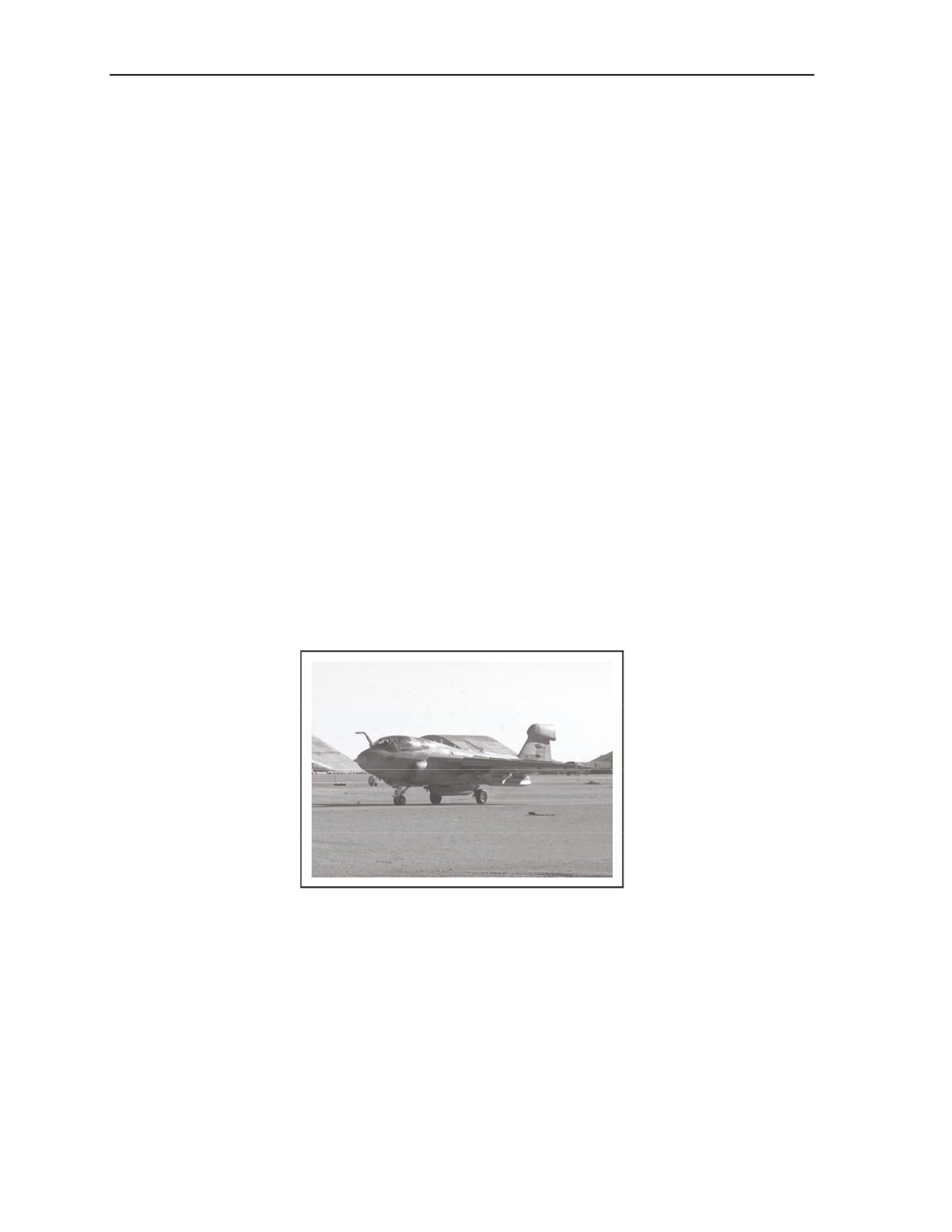
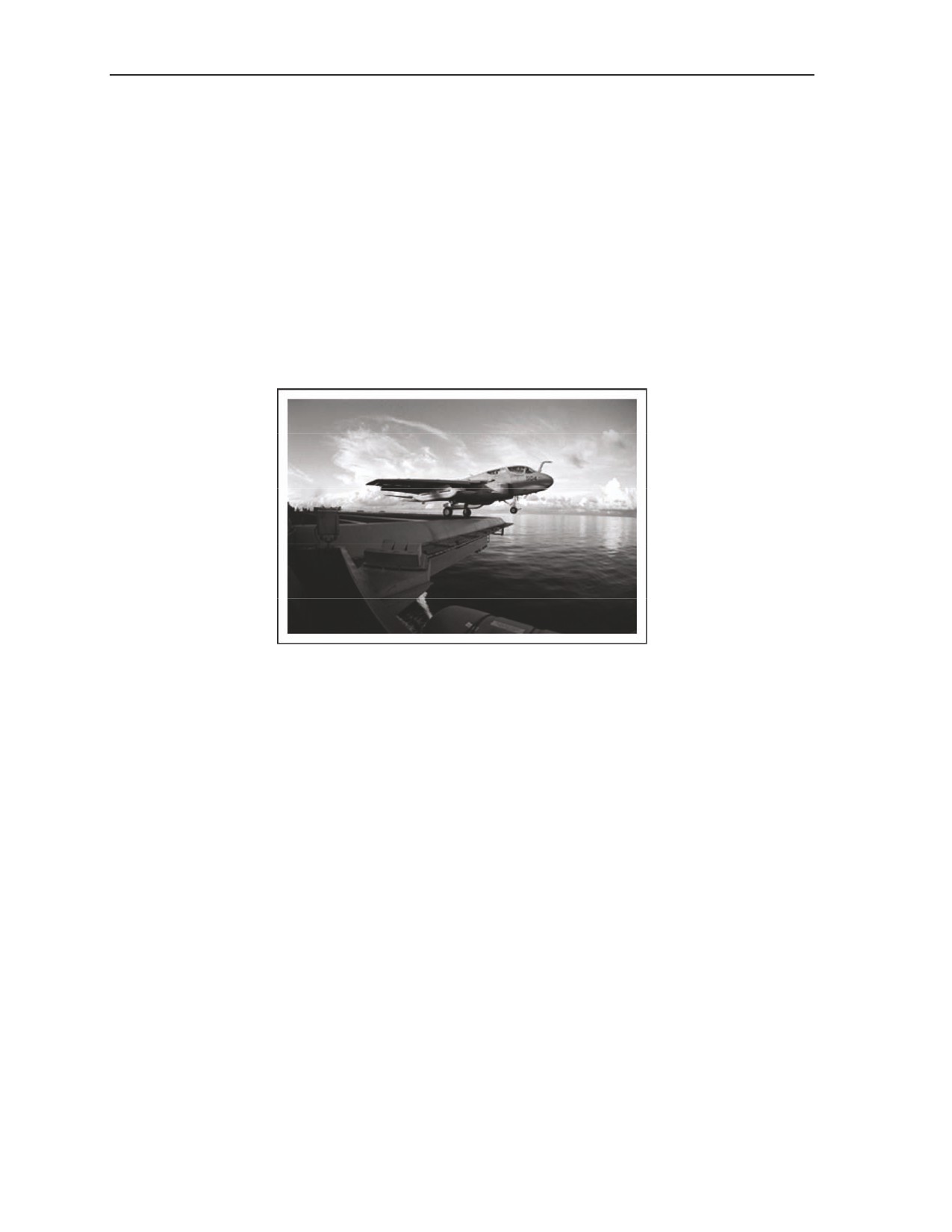
E-21. The EA-6B Prowler is a subsonic, all-weather, carrier-capable aircraft. (See figure E-5.) The crew
consists of one pilot and three electronic countermeasure officers. The EA-6B has two primary missions.
One is collecting and processing designated threat signals of interest for jamming and subsequent
processing, analysis, and intelligence reporting. The other is employing the AGM-88 high-speed
antiradiation missile against designated targets. The EA-6B’s AN/ALQ-99 tactical jamming system
incorporates receivers for the reception of emitted signals and external jamming pods for the transmission
of energy to jam targeted radars (principally those associated with enemy air defense radars and associated
command and control). In addition to the AN/ALQ-99, the EA-6B also employs the USQ-113
communications jammer to collect, record, and disrupt threat communications.
Figure E-5. EA-6B Prowler
E-6
FM 3-36
25 February 2009
Army and Joint Electronic Warfare Capabilities
Joint Mission Planning System
E-22. The joint mission planning system helps the EA-6B aircrew plan and optimize receivers, jammers,
and high-speed antiradiation missiles. This system allows an operator to—
z
Maintain area of operations emitter listings.
z
Edit emitter parameters.
z
Develop mission-specific geographic data and electronic order of battle to—
Tailor or create high-speed antiradiation missile direct attack libraries, or manually modify
entries or new threat cards.
Plan target selection.
z
Perform postflight mission analysis to—
Identify electronic emitters using various electronic parameter databases and electronic
intelligence analytical techniques.
Localize emitters by coordinates with a certain circular error of probability for each site.
Correlate new information with existing data.
Gather postflight high-speed antiradiation missile information. This information includes
aircraft launch parameters, predicted seeker footprint, and the onboard system detection of a
targeted signal at impact.
AN/TSQ-90 Tactical Electronic Reconnaissance Processing and Evaluation System
E-23. The TERPES (AN/TSQ-90) is an air and land transportable, single-shelter electronic intelligence
processing and correlation system. Each of the four Marine tactical electronic warfare squadrons includes a
TERPES section.
E-24. A TERPES section consists of Marines, equipment, and software. The section identifies and locates
enemy radar emitters from data collected by EA-6B aircraft and those received from other intelligence
sources. It processes and disseminates EW data rapidly to MAGTF and other intelligence centers and
provides mission planning and briefing support. Section support areas include operational support,
intelligence analysis support, data fusion, fusion processing, and intelligence reporting. The section
provides the following operational support:
z
Translates machine-readable, airborne-collected, digital data into human- and machine-readable
reports (such as paper, magnetic tape, secure voice, plots, and overlays).
z
Receives and processes EA-6B mission tapes.
z
Accepts, correlates, and identifies electronic emitter data from semiautomatic or automatic
collection systems using various electronic parameter databases and various analysis techniques.
z
Provides tactical jamming analysis.
25 February 2009
FM 3-36
E-7
Appendix E
AIR FORCE
E-25. The Air Force has two primary platforms that provide EW capability: the EC-130H Compass Call
and RC-135V/W Rivet Joint. (For further information on Air Force EW equipment, see AFDD 2-5.1.)
EC-130H COMPASS CALL
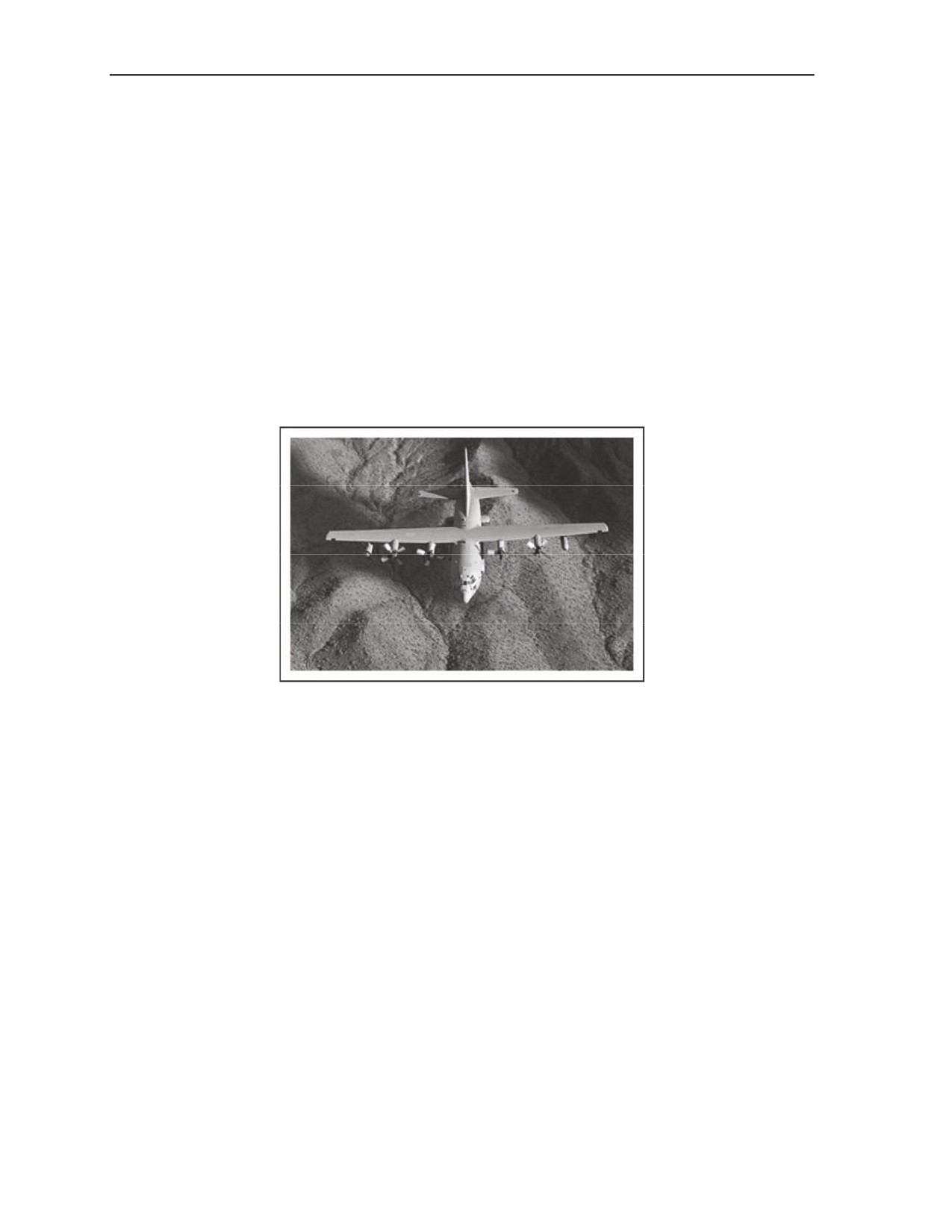
E-26. The EC-130H Compass Call is an airborne tactical weapon system. (See figure E-6.) Paragraphs E-
27 through E-31 discuss the EC-130H missions, primary tasks, and capabilities.
Mission and Tasks
E-27. The EC-130H’s mission is to disrupt enemy command and control information systems and limit the
coordination essential for force management. The EC-130H’s primary task is to employ offensive
counterinformation and electronic attack capabilities in support of U.S. and multinational tactical air,
surface, and special operations forces.
Figure E-6. EC-130H Compass Call
Capabilities
E-28. The EC-130H is designed to deny, degrade, and disrupt adversary command and control information
systems. This includes denial and disruption of enemy surveillance radars; denial and disruption of hostile
communications being used in support of enemy ground, air, or maritime operations; and denial and
disruption of many modern commercial communication signals that an adversary might employ.
E-8
FM 3-36
25 February 2009
Army and Joint Electronic Warfare Capabilities
Compass Call During Operation Iraqi Freedom
During Operation Iraqi Freedom, much speculation appeared in the press about why
Iraqi forces failed to ignite the oil facilities they had wired for destruction. During the
coalition’s seizure of Al Faw, Compass Call disrupted the Iraqi regime’s control of its
troops by jamming its communications. Instead of receiving orders to detonate the oil
terminals, Iraqi troops heard only the ratcheting static of Compass Call jamming until
coalition ground troops had secured the area. In addition to the conquest of the Al
Faw Peninsula, successful military operations supported by Compass Call in
Operation Iraqi Freedom included the seizure of four airfields; two successful
prisoner of war rescues; and the ground offensive from Basrah to Nasariyah, Najaf,
Baghdad, and Tikrit. In all these instances, Compass Call jamming prevented a
trained, experienced enemy from coordinating actions against coalition forces.
“EC-130H Compass Call: A textbook example of Joint Force integration at its best”, Electronic Warfare
Working Group, U.S. House of Representatives, Issue Brief
#17,
11 Mar
2004.
(Available at
RC-135V/W RIVET JOINT
E-29. Paragraphs E-30 through E-31 discuss the missions, primary tasks, and capabilities of the RC-135V
platforms.
Mission and Tasks
E-30. The RC-135V/W Rivet Joint is a combatant-command-level surveillance asset that responds to
national-level taskings.
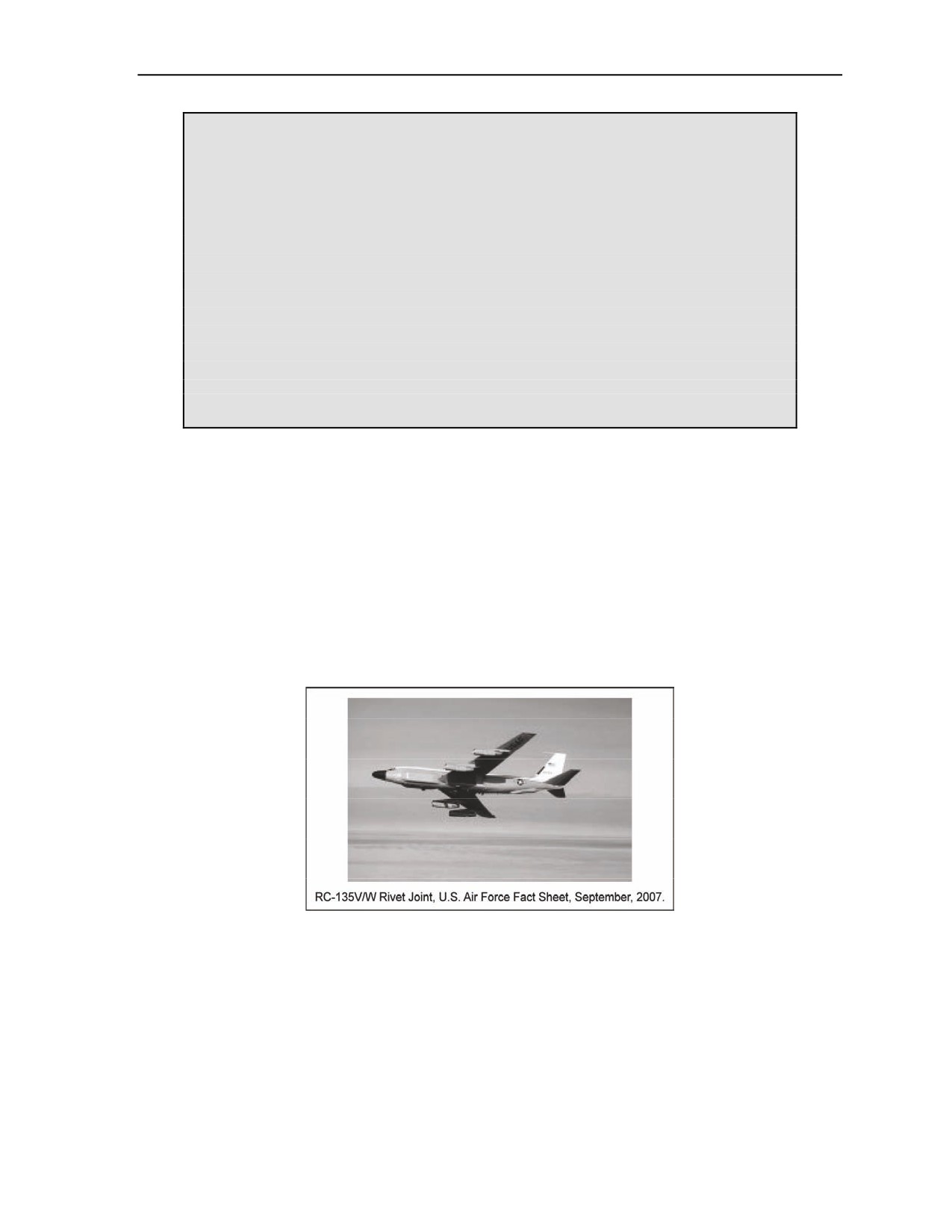
(See figure E-7.) Its mission is to support national consumers, combatant
commanders, and combat forces with direct, near real-time reconnaissance information and electronic
warfare support. It collects, analyzes, reports, and exploits information from enemy command and control
information systems. During most contingencies, it deploys to the theater of operations with the airborne
elements of the theater air control system.
Figure E-7. RC-135V/W Rivet Joint
Capabilities
E-31. The RC-135V/W is equipped with an extensive array of sophisticated intelligence gathering
equipment that enables monitoring of enemy electronic activity. The aircraft is integrated into the theater
air control system via data links and voice (as required). Refined intelligence data can be transferred from
Rivet Joint to an Airborne Warning and Control System platform through the tactical digital information
link. Alternatively, this data can be placed into intelligence channels via satellite and the tactical
information broadcast service (a near real-time combatant command information broadcast). The aircraft
25 February 2009
FM 3-36
E-9
Appendix E
has secure ultrahigh frequency, very high frequency, and high frequency (commonly known as UHF, VHF,
and HF respectively) as well as satellite communications. It can be refueled in the air.
NAVY
E-32. The Navy’s primary airborne EW platforms are the EA-6B Prowler and its planned replacement, the
E/A-18G Growler. E/A-18G fielding is scheduled to begin in 2009 and is scheduled to replace the Navy’s
carrierborne EA-6B aircraft. The Navy also maintains both surface and subsurface EW shipboard systems
for offensive and defensive missions in support of the fleet. (For further information on Navy missions and
equipment, see NWP 3-13.)
EA-6B PROWLER
E-33. Paragraphs E-34 through E-39 discuss the missions, primary tasks, and capabilities of the Navy’s
EA-6B Prowler platforms. (See figure E-8.)
Figure E-8. Navy EA-6B Prowler
Mission and Tasks
E-34. The mission of the Navy’s EA-6B Prowler is to ensure survivability of U.S. and multinational forces
through suppression of enemy air defenses
(using the radar-jamming AN/ALQ-99 tactical jamming
system), lethal suppression (using the AGM-88 high-speed antiradiation missile), and communications
jamming (using the USQ-113 radio countermeasures set). Prowlers have supported U.S. and multinational
forces operating from various expeditionary sites throughout the world while maintaining full presence on
all Navy aircraft carriers.
Capabilities
E-35. The Navy’s EA-6B Prowlers are outfitted with either the improved capability II or improved
capability III systems. The following lists the major capability upgrades these systems provide.
Improved Capability II
E-36. The improved capability II program was initiated in the 1980s. It was completed across the fleet of
EA-6B aircraft (including U.S. Marine Corps aircraft) in the 1990s. The program incorporated incremental
capability improvements that include communications, navigation, and computer interface upgrades; a
high-speed antiradiation missile capability; and improved jamming pods. Several system interfaces were
also upgraded in preparation for the improved capability III improvements.
E-10
FM 3-36
25 February 2009
Army and Joint Electronic Warfare Capabilities
Improved Capability III
E-37. The improved capability III program incorporates a highly evolved receiver system and provides
upgraded EA-6B aircraft with increased signal detection, geolocation capability, a new selective reactive-
jamming capability, and better reliability. High-speed antiradiation missile employment is also improved
due to the speed of the receiver and its geolocation accuracy. Increased battlefield situational awareness of
joint forces is also provided through Link-16. The improved capability III program provides a new ALQ-
218 receiver system, integration of the USQ-113 and the multifunctional information distribution system
(often called MIDS). This system incorporates Link-16 and various connectivity avionics into the Prowler.
The major EW-related subsystems are the AN/ALQ-99 (V) tactical jamming countermeasures set and
AN/USQ-113 (V) radio countermeasures set.
E-38. The AN/ALQ-99 (V) tactical jamming countermeasures set has upgraded receivers and processors to
provide the following:
z
Improved frequency coverage.
z
Direction-of-arrival determination capability.
z
Narrower frequency discrimination to support narrowband jamming.
z
Enhanced interface with onboard systems.
E-39. The AN/USQ-113 (V) radio countermeasures set will enhance the aircraft’s jamming capability
through its integration with the tactical display system. This will enable the crew to display AN/USQ-113
communications jamming data as well as control AN/USQ-113 operations through the tactical display
system.
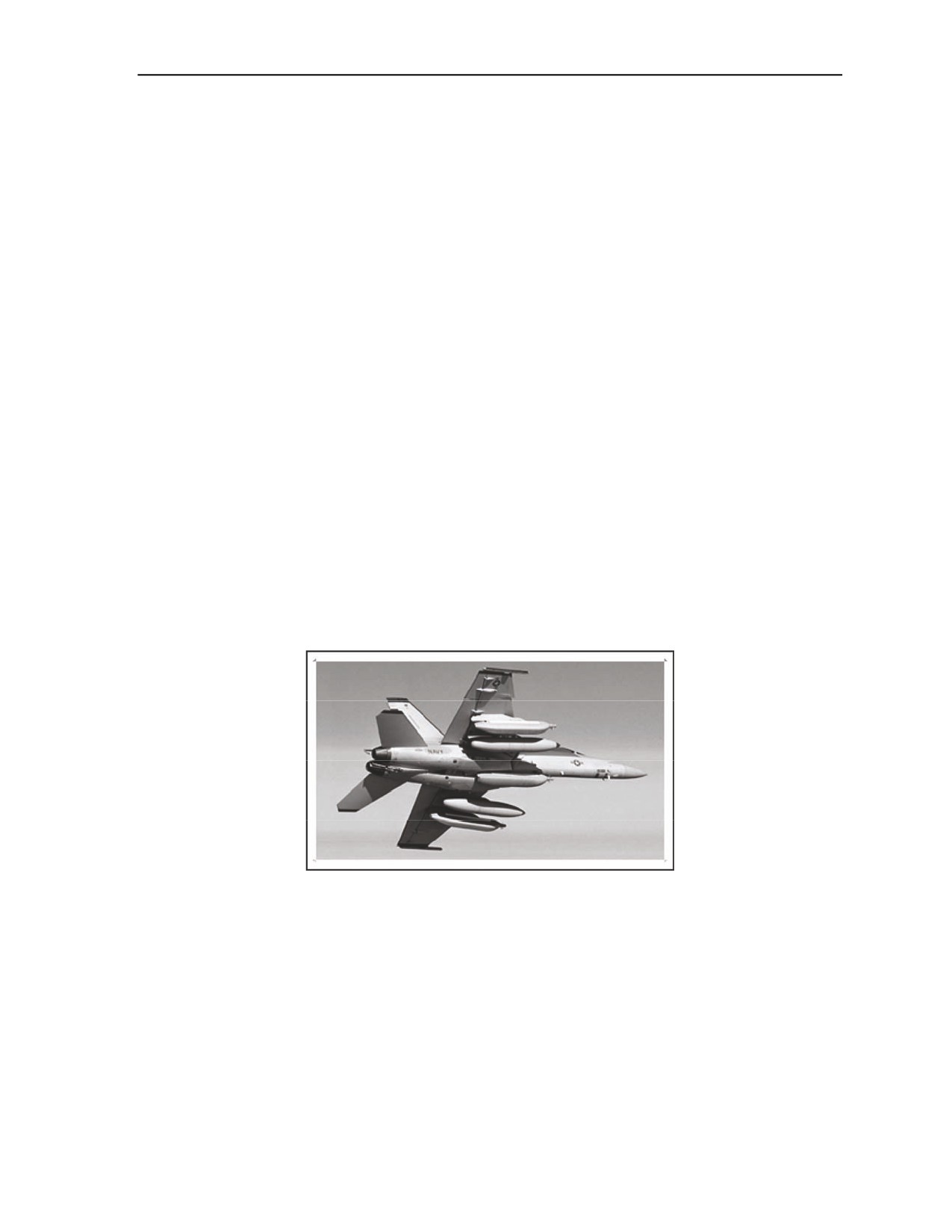
E/A-18G GROWLER
E-40. The E/A-18G Growler is the Navy’s replacement aircraft for the EA-6B Prowler. Paragraphs E-41
and E-42 discuss the missions, primary tasks, and capabilities of the Navy’s E/A-18G Growler. (See figure
E-9.) E/A-18G fielding began in 2008. The first operational E/A-18G deployment will occur in 2009, as
the Navy begins to replace its carrierborne EA-6B aircraft.
Figure E-9. EA-18 Growler
Mission and Tasks
E-41. The EA-18G can detect, identify, locate, and suppress hostile emitters. It will provide enhanced
connectivity to national, combatant command, and strike assets. Additionally, the EA-18G will provide
organic accurate emitter targeting using on-board suppression weapons, such as the high-speed
antiradiation missile.
25 February 2009
FM 3-36
E-11
Appendix E
Capabilities
E-42. The following is a list of the E/A-18G’s general capabilities:
z
Suppression of enemy air defenses. The EA-18G will counter enemy air defenses using both
reactive and preemptive jamming techniques.
z
Stand-off and escort jamming. The EA-18G will be highly effective in the traditional stand-off
jamming mission, but with the speed and agility of a Super Hornet, it will also be effective in the
escort role.
z
Integrated air and ground airborne electronic attack. Enhanced situational awareness and
uninterrupted communications will enable the EA-18G to achieve a higher degree of integration
with ground operations than previously.
z
Self-protect and time-critical strike support. With its active electronically scanned array radar,
digital data links, and air-to-air missiles, the EA-18G will be able to protect itself and effectively
identify and prosecute targets.
z
Growth. High commonality with the F/A-18E and F/A-18F, nine available weapon stations, and
modern avionics enable cost-effective synergistic growth, setting the stage for continuous
capability enhancement.
E-43. The following is a list of the E/A-18G’s airborne electronic attack capabilities:
z
Entire spectrum. The EA-18G’s ALQ-218 wideband receiver combined with the ALQ-99
tactical jamming system will be effective against any surface-to-air threat.
z
Precision airborne electronic attack. Selective-reactive technology enables the EA-18G to
rapidly sense and locate threats much more accurately than before. This improved accuracy
enables greater concentration of energy against threats.
z
Advanced communication countermeasures. Its modular communication countermeasure set
enables the EA-18G to counter a wide range of communication systems and is readily adaptable
to an ever changing threat spectrum.
z
Interference cancellation system. This system dramatically enhances aircrew situational
awareness by enabling uninterrupted communications during jamming operations.
E-12
FM 3-36
25 February 2009
Army and Joint Electronic Warfare Capabilities
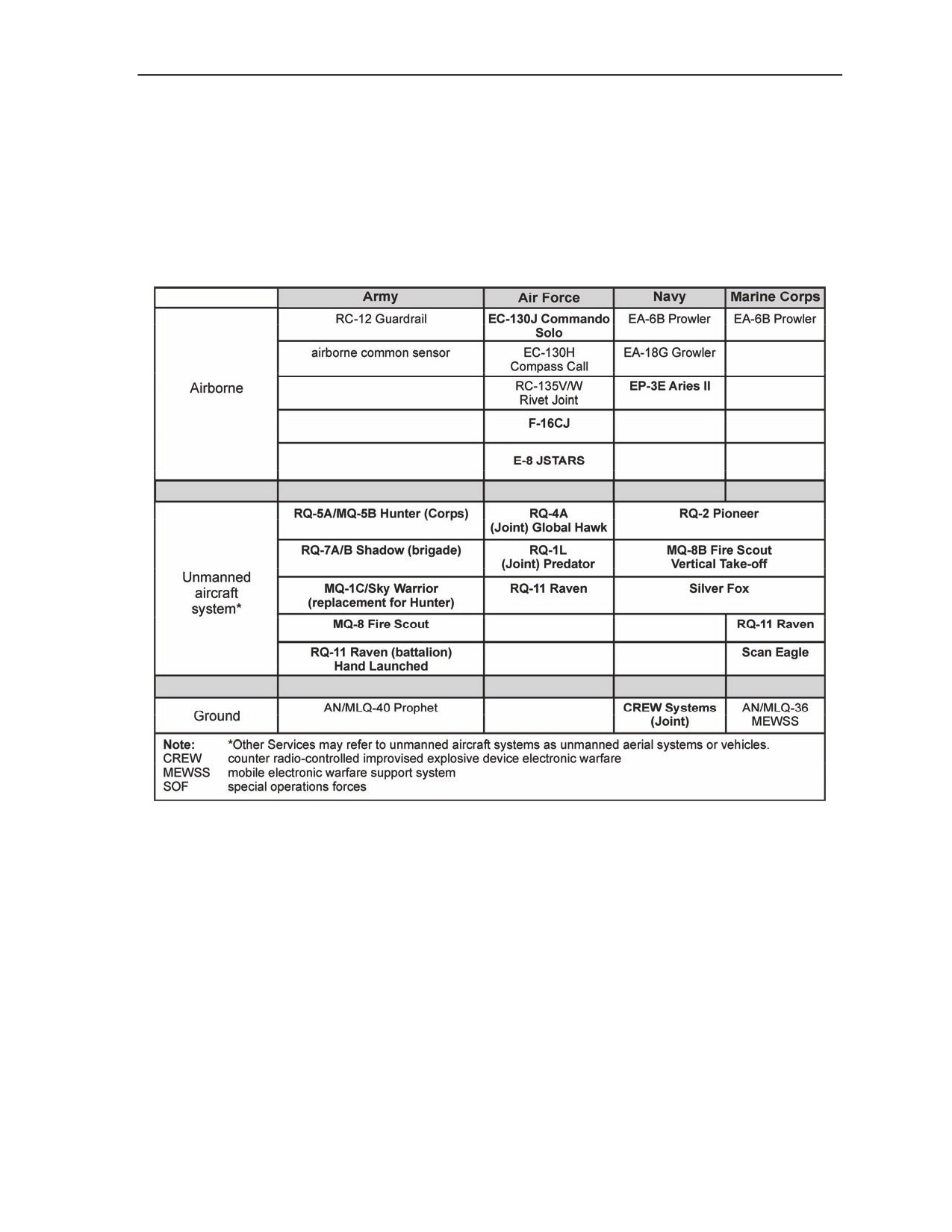
CAPABILITIES SUMMARY
E-44. Table E-1 lists Army and joint EW capabilities. (Bold text indicates capabilities not described in the
preceding paragraphs.) EW officers, noncommissioned officers, and supporting staff members should be
familiar with these capabilities and how they can support Army operations. Additional information on the
EW capabilities listed in table E-1 is found in the Web sites listed in table E-2, page E-12.
Table E-1. Army and joint electronic warfare capabilities
25 February 2009
FM 3-36
E-13
Appendix F
Tools and Resources Related to Electronic Warfare
This appendix provides information on tools and reachback resources related to
electronic warfare. Electronic warfare officers, noncommissioned officers, and
supporting staff members should be familiar with these tools and resources and how
to use them to support electronic warfare operations. Some tools and resources
require an approved user account prior to being granted access.
ARMY REPROGRAMMING ANALYSIS TEAM
F-1. The Army Reprogramming Analysis Team (ARAT) supports tactical commanders. It provides timely
reprogramming of any Army-supported software used for target acquisition, target engagement,
measurement and signature intelligence, and vehicle and aircraft survivability (including that operated by
other Services). The team provides software changes not readily possible by operator input to respond to
rapid deployments or changes in the operational environment. See their Web site at
F-2. ARAT provides reprogramming support to counter-radio-controlled improvised-explosive-device
(IED) electronic warfare (EW) (sometimes referred to as CREW), and other electronic systems.
F-3. The team is accessible via the Army Reprogramming Analysis Team’s Warfighter Survivability
Software Support Portal. A secure Internet protocol router network (SIPRNET) account is required to
access the portal.
NATIONAL GROUND INTELLIGENCE CENTER
F-4. The National Ground Intelligence Center provides all-source analysis of the threat posed by IEDs
produced and used by foreign terrorist and insurgent groups. The center supports U.S. forces during
training, operational planning, deployment, and redeployment.
F-5. The center maintains a counter-IED targeting program (often called CITP) portal on its SIPRNET
site. This portal provides information concerning IED activities and incidents as well as IED assessments.
ELECTRONIC ORDER OF BATTLE
F-6. An electronic order of battle details all known combinations of emitters and platforms in a particular
area of responsibility. It consists of several reachback resources:
z
National Security Agency-Electronic Intelligence Parameter Query.
z
U.S. electromagnetic systems database.
z
National Ground Intelligence System parametric information relational intelligence tool
database.
z
Military equipment parametrics and engineering database.
E-SPACE
F-7. E-Space is a Department of Defense (DOD) entity housed in the National Security Agency. It
provides intelligence assistance (primarily signals intelligence) to deployed EW officers. E-Space is a
reachback capability available to EW officers and spectrum managers that can be leveraged to provide all-
source intelligence products and answers to requests for information and spectrum interference questions.
25 February 2009
FM 3-36
F-1
Appendix F
JOINT ELECTRONIC WARFARE CENTER
F-8. The Joint Electronic Warfare Center is DOD’s only joint EW center of expertise. It provides EW
subject matter expertise from a range of backgrounds, including people with current multi-Service
operational experience. The center has a limited capability to perform modeling and simulation studies and
EW red team support. It can deploy in a support role if approved by the U.S. Strategic Command.
JOINT IMPROVISED EXPLOSIVE DEVICE DEFEAT
ORGANIZATION
F-9. The Joint Improvised Explosive Device Defeat Organization (known as JIEDDO) leads, advocates,
and coordinates all DOD actions in support of efforts by combatant commanders and their joint task forces
to defeat IEDs as weapon of strategic influence.
JOINT SPECTRUM CENTER
F-10. The Joint Spectrum Center ensures DOD effectively uses the electromagnetic spectrum in support of
national security and military objectives. The center serves as DOD’s center of excellence for
electromagnetic spectrum management matters in support of the combatant commands, military
departments, and DOD agencies in planning, acquisition, training, and operations.
F-11. The center maintains databases and provides data about friendly force command and control
information system locational and technical characteristics. This information is used to plan electronic
protection measures. These databases provide EW planners with information covering communication,
radar, navigation, broadcast, identification, and EW systems operated by the DOD, other government
agencies, and private businesses and organizations.
F-12. The center provides information on a quick-reaction basis in various formats and media to support
EW planners and spectrum managers.
KNOWLEDGE AND INFORMATION FUSION EXCHANGE
F-13. The Knowledge and Information Fusion Exchange
(sometimes called KnIFE) is a program
sponsored by U.S. Joint Forces Command. It provides Soldiers with observations, insights, and lessons
from operations around the world.
ADDITIONAL INFORMATION
F-14. Further information on the above tools and resources can be accessed through Army Knowledge
Online. The links to these Web sites can be viewed by first accessing the “Army Operational Electronic
clicking on Folders >Links>EW links.
F-2
FM 3-36
25 February 2009
Glossary
SECTION I - ACRONYMS AND ABBREVIATIONS
ARAT
Army Reprogramming Analysis Team
C-3
operations directorate of a multinational (combined) staff
CJCSI
Chairman of the Joint Chiefs of Staff instruction
CJCSM
Chairman of the Joint Chiefs of Staff manual
COA
course of action
DD
Department of Defense (official forms only)
DOD
Department of Defense
DODI
Department of Defense Instruction
EW
electronic warfare
FM
field manual
FMI
field manual, interim
G-2
assistant chief of staff, intelligence
G-3
assistant chief of staff, operations
G-5
assistant chief of staff, plans
G-6
assistant chief of staff, signal
G-7
assistant chief of staff, information engagement
GTA
graphic training aid
HF
high frequency
Hz
hertz
IED
improvised explosive device
IO
information operations
IPB
intelligence preparation of the battlefield
ISR
intelligence, surveillance, and reconnaissance
J-2
intelligence directorate of a joint staff
J-3
operations directorate of a joint staff
J-5
plans directorate of a joint staff
J-6
communications system directorate of a joint staff
JFMO
Joint Frequency Management Office
JIOWC
Joint Information Operations Warfare Center
JP
joint publication
MAGTF
Marine air-ground task force
MC
Military Committee (NATO)
MCWP
Marine Corps warfighting publication
MDMP
military decisionmaking process
25 February 2009
FM 3-36
Glossary-1
Glossary
NATO
North Atlantic Treaty Organization
S-2
intelligence staff officer
S-3
operations staff officer
S-6
signal staff officer
S-7
information engagement staff officer
SIPRNET
SECRET Internet Protocol Router Network
STANAG
standardization agreement (NATO)
TERPES
tactical electronic reconnaissance processing and evaluation system
U.S.
United States
SECTION II - TERMS
communications security
(joint) The protection resulting from all measures designed to deny unauthorized persons information
of value that might be derived from the possession and study of telecommunications, or to mislead
unauthorized persons in their interpretation of the results of such possession and study. (JP 6-0)
computer network operations
(joint) Comprised of computer network attack, computer network defense, and related computer
network exploitation enabling operations. (JP 3-13)
directed energy
(joint) An umbrella term covering technologies that relate to the production of a beam of concentrated
electromagnetic energy or atomic or subatomic particles. (JP 3-13.1)
electromagnetic environment
(joint) The resulting product of the power and time distribution, in various frequency ranges, of the
radiated or conducted electromagnetic emission levels that may be encountered by a military force,
system, or platform when performing its assigned mission in its intended operational environment. It is
the sum of the electromagnetic interference; electromagnetic pulse; hazards of electromagnetic
radiation to personnel, ordnance, and volatile materials; and natural phenomena effects of lightning
and precipitation static. (JP 3-13.1)
electromagnetic environmental effects
The impact of the electromagnetic environment upon the operational capability of military forces,
equipment, systems, and platforms. It encompasses all electromagnetic disciplines, including
electromagnetic compatibility and electromagnetic interference; electromagnetic vulnerability;
electromagnetic pulse; electronic protection, hazards of electromagnetic radiation to personnel,
ordnance, and volatile materials; and natural phenomena effects of lightning and precipitation static.
(JP 3-13.1)
electromagnetic spectrum
(joint) The range of frequencies of electromagnetic radiation from zero to infinity. It is divided into 26
alphabetically designated bands. (JP 1-02)
electromagnetic vulnerability
(joint) The characteristics of a system that cause it to suffer a definite degradation (incapability to
perform the designated mission) as a result of having been subjected to a certain level of
electromagnetic environmental effects. (JP 1-02)
Glossary-2
FM 3-36
25 February 2009
Glossary
electronic attack
(joint) Division of electronic warfare involving the use of electromagnetic energy, directed energy, or
antiradiation weapons to attack personnel, facilities, or equipment with the intent of degrading,
neutralizing, or destroying enemy combat capability and is considered a form of fires. (JP 3-13.1)
electronic protection
(joint) Division of electronic warfare involving actions taken to protect personnel, facilities, and
equipment from any effects of friendly or enemy use of the electromagnetic spectrum that degrade,
neutralize or destroy friendly combat capability. (JP 3-13.1)
electronic warfare
(joint) Military action involving the use of electromagnetic and directed energy to control the
electromagnetic spectrum or to attack the enemy. Electronic warfare consists of three divisions:
electronic attack, electronic protection, and electronic warfare support. (JP 3-13.1)
electronic warfare support
(joint) Division of electronic warfare involving actions tasked by, or under direct control of, an
operational commander to search for, intercept, identify, and locate or localize sources of intentional
and unintentional radiated electromagnetic energy for the purpose of immediate threat recognition,
targeting, planning, and conduct of future operations. (JP 3-13.1)
emission control
(joint) The selective and controlled use of electromagnetic, acoustic, or other emitters to optimize
command and control capabilities while minimizing, for operations security: a. detection by enemy
sensors; b. mutual interference among friendly systems; and/or c. enemy interference with the ability
to execute a military deception plan. (JP 1-02)
joint restricted frequency list
(joint) A time a geographically-oriented listing of TABOO, PROTECTED, and GUARDED functions,
nets, and frequencies. It should be limited to the minimum number of frequencies necessary for
friendly forces to accomplish objectives. (JP 3-13.1)
working group
(Army) A temporary grouping of predetermined staff representatives who meet to coordinate and
provide recommendations for a particular purpose or function. (FMI 5-0.1)
25 February 2009
FM 3-36
Glossary-3
References
REQUIRED PUBLICATIONS
These documents must be available to intended users of this publication.
FM 1-02 (101-5-1). Operational Terms and Graphics. 21 September 2004.
JP 1-02. Department of Defense Dictionary of Military and Associated Terms. 12 April 2001. (As
amended through 4 March 2008.)
JP 3-13.1. Electronic Warfare. 25 January 2007.
FM 3-0. Operations. 27 February 2008.
FM 5-0 (101-5). Army Planning and Orders Production. 20 January 2005.
FM 6-0. Mission Command: Command and Control of Army Forces. 11 August 2003.
FMI 5-0.1. The Operations Process. 31 March 2006.
RELATED PUBLICATIONS
These documents contain relevant supplemental information.
JOINT AND DEPARTMENT OF DEFENSE PUBLICATIONS
Most joint publications are available online: <http://www.dtic.mil/doctrine/jpcapstonepubs.htm.>
CJCSI 3320.01B Electromagnetic Spectrum Use in Joint Military Operations. 01 May 2005
CJCSI 3320.02C. Joint Spectrum Interference Resolution (JSIR). 27 January 2006 (with change 1 as
of 25 February 2008).
CJCSI 3320.03A Joint Communications Electronics Operation Instructions. 11 June 2005.
CJCSM 3122.03C. Joint Operation Planning and Execution System Volume II, Planning Formats and
Guidance. 17 August 2007.
CJCSM 3320.01B Joint Operations in the Electromagnetic Battlespace. 25 March 2006.
CJCSM 3320.02A Joint Spectrum Interference Resolution (JSIR) Procedures. 16 February 2006.
DODI 4650.01. Policy and Procedures for Management and Use of the Electromagnetic Spectrum. 09
January 2009.
JP 2-0. Joint Intelligence. 22 June 2007.
JP 2-01. Joint and National Intelligence Support to Military Operations. 07 October 2004.
JP 3-0. Joint Operations. 17 September 2006.
JP 3-09. Joint Fire Support. 13 November 2006.
JP 3-09.3. Joint Tactics, Techniques, and Procedures for Close Air Support (CAS). 03 September
2003.
JP 3-13. Information Operations. 13 February 2006.
JP 3-13.3. Operations Security. 29 June 2006.
JP 3-13.4 (JP 3-58). Military Deception. 13 July 2006.
JP 3-60. Joint Targeting. 13 April 2007.
JP 6-0. Joint Communications System. 20 March 2006.
25 February 2009
FM 3-36
References-1
References
ARMY PUBLICATIONS
Most Army doctrinal publications are available online:
FM 2-0 (34-1). Intelligence. 17 May 2004.
FM 3-09.32. JFIRE: Multi-Service Tactics, Techniques, and Procedures for the Joint Application of
Firepower. 20 December 2007.
FM 3-13 (100-6). Information Operations: Doctrine, Tactics, Techniques, and Procedures.
28 November 2003.
FM 3-13.10 (3-51.1). Multi-Service Tactics, Techniques, and Procedures for the Reprogramming of
Electronic Warfare and Target Sensing Systems. 22 January 2007.
FM 5-19 (100-14). Composite Risk Management. 21 August 2006.
FM 6-20-10. Tactics, Techniques, and Procedures for the Targeting Process. 8 May 1996.
FM 6-99.2 (101-5-2). U.S. Army Report and Message Formats. 30 April 2007.
FM 34-130. Intelligence Preparation of the Battlefield. 8 July 1994.
FMI 2-01. Intelligence, Surveillance, and Reconnaissance (ISR) Synchronization. 11 November 2008.
GTA 90-10-046. MNC-I Counter IED Smart Book. September 2008.
NATO PUBLICATIONS
Allied Joint Publication 3.6. Allied Joint Electronic Warfare Doctrine. December 2003.
MC 64. NATO Electronic Warfare (EW) Policy. 26 April 2004.
STANAG 5048 C3 (Edition 5). The Minimum Scale of Convectivity for Communications and
Information Systems for NATO Land Forces. 16 February 2000.
OTHER PUBLICATIONS
AFDD 2-1.9. Targeting. 8 June 2006.
AFDD 2-5.1. Electronic Warfare. 5 November 2002.
Executive Order 12333. United States Intelligence Activities. 4 December 1981.
MCWP 2-22 (2-15.2). Signals Intelligence. 13 July 2004.
NWP 3-13. Navy Information Operations. June 2003.
SOURCES USED
Electronic Warfare Working Group, U.S. House of Representatives, Issue Brief #17. “Compass Call
During Operation Iraqi Freedom.” 11 March 2004. Available online at
PRESCRIBED FORMS
None
REFERENCED FORMS
DA Forms are available on the APD website (www.apd.army.mil. DD forms are available on the OSD
DA Form 2028. Recommended Changes to Publications and Blank Forms.
DD Form 1972. Joint Tactical Air Strike Request.
References-2
FM 3-36
25 February 2009