FM 3-36 ELECTRONIC WARFARE IN OPERATIONS (February 2009) - page 2
Chapter 4
THE MILITARY DECISIONMAKING PROCESS
4-2. EW planning minimizes fratricide and optimizes operational effectiveness during execution.
Therefore, EW planning occurs concurrently with other operational planning during the MDMP. The
MDMP synchronizes several processes, including intelligence preparation of the battlefield (IBP) (see FM
34-130), the targeting process (see FM 6-20-10), and risk management (see FM 5-19). These processes
occur continuously during operations.
4-3. Depending on the organizational echelon, the staff EW officer leads EW planning through the EW
working group. (The EW working group at echelons above brigade is sometimes referred to as an EW
coordination cell.) An EW working group is normally supported by representatives from the G-2 or S-2,
G-3 or S-3, G-6 or S-6, and other staff as required. Other staff representatives can include the fire support
coordinator or fire support officer, spectrum manager, air liaison officer, space officer, and liaison officers.
Paragraphs 4-5 through 4-33 outline key EW contributions to the processes and planning actions that occur
during the seven steps of the MDMP. (FM 5-0 discusses the MDMP.)
RECEIPT OF MISSION
4-4. Commanders begin the MDMP upon receiving or anticipating a new mission. During this first step,
commanders issue their initial guidance and initial information requirements or commander’s critical
information requirements.
4-5. Upon receipt of a mission, the staff EW officer alerts the staff members supporting the EW working
group. The EW officer and support staff begin to gather the resources required for mission analysis.
Resources might include a higher headquarters operation order or plan, maps of the area of operations,
electronic databases, required field manuals and standing operating procedures, current running estimates,
and reachback resources (see appendix F). The EW officer also provides input to the staff’s initial
assessment and updates the EW running estimate. As part of this update, the EW officer identifies all
friendly EW assets and resources and their status. The EW officer also provides this information
throughout the operations process. This includes monitoring, tracking, and seeking out information relating
to EW operations to assist the commander and staff.
MISSION ANALYSIS
4-6. Planning includes a thorough mission analysis. Both the process and products of mission analysis
help commanders refine their situational understanding and determine their restated mission. (See FM 5-0
for more details.) The EW officer and supporting members of the EW working group contribute to the
overall mission analysis by participating in IPB and through the planning actions discussed in paragraphs
4-7 through 4-14. (Paragraphs 4-35 to 4-40 discuss EW input to IPB during operations.)
4-7. The EW officer and EW working group members—
z
Convene the appropriate EW working group.
z
Determine known facts, status, or conditions of forces capable of EW operations as defined in
the commander’s planning documents, such as a warning order or operation order.
z
Identify EW planning support requirements and develop support requests as needed.
4-8. The EW officer and EW working group members support the G-2 and S-2 in IPB by—
z
Determining the threat’s dependence on the electromagnetic spectrum.
z
Determining the threat’s EW capability.
4-2
FM 3-36
25 February 2009
Electronic Warfare and the Operations Process
z
Determining the threat’s intelligence system collection capability.
z
Determining which threat vulnerabilities relate to the electromagnetic spectrum.
z
Determining how the operational environment affects EW operations using the operational
variables and mission variables as appropriate.
z
Initiating, refining, and validating information requirements and requests for information.
4-9. The EW officer and EW working group members—
z
Determine facts and develop necessary assumptions relevant to EW such as the status of EW
capability at probable execution and time available.
z
Analyze the commander’s mission and intent from an EW perspective.
z
Identify constraints relevant to EW—
Actions EW operations must perform.
Actions EW operations cannot perform.
Other constraints.
z
Analyze mission, enemy, terrain and weather, troops and support available, time available and
civil considerations from the EW perspective.
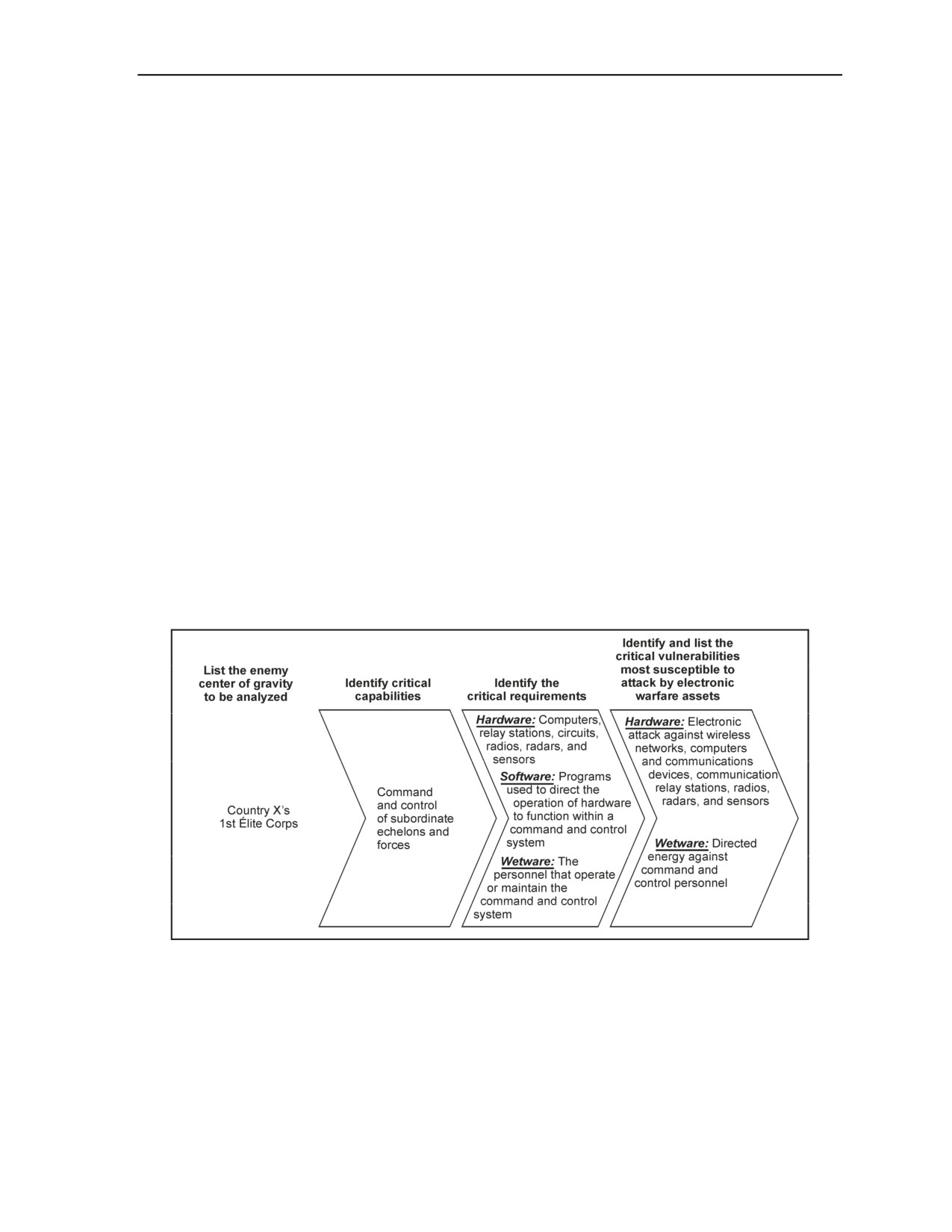
4-10. The EW officer and EW working group members determine enemy and friendly centers of gravity
and list their critical capabilities, requirements, and vulnerabilities from an EW perspective.
(They
determine how EW capabilities can best attack an enemy’s command and control system.) The center of
gravity analysis process outlined in figure 4-2 helps identify and list the critical vulnerabilities of enemy
centers of gravity. The EW officer and EW working group members also list the critical requirements
associated with the identified command and control critical capability (or command and control nodes) and
then identify the critical vulnerabilities associated with the critical requirements. Through this process, the
EW officer and EW working group members help determine which vulnerabilities can be engaged by EW
capabilities to produce a decisive outcome.
Figure 4-2. Example of analysis for an enemy center of gravity
4-11. Additionally, the EW officer and EW working group members determine how EW can help protect
friendly centers of gravity. The center of gravity analysis process as outlined in figure 4-2 can also be used
help identify critical vulnerabilities of friendly centers of gravity. The EW officer and EW working group
members list the critical requirements associated with the identified friendly command and control critical
capability. Then, the EW officer and EW working group members identify the critical vulnerabilities
associated with the critical requirements. These vulnerabilities can help determine how to best use EW
25 February 2009
FM 3-36
4-3
Chapter 4
capabilities to defend or protect friendly centers of gravity from enemy attack. Key to this portion of the
analysis is to assess the potential impact of EW operations on friendly information systems such as
electromagnetic interference.
4-12. The EW officer and EW working group members identify and list—
z
High-value targets that can be engaged by EW capabilities.
z
Tasks that EW forces perform according to EW subdivision (electronic attack, electronic
warfare support, and electronic protection) in support of the warfighting functions. These
include—
Determining specified EW tasks.
Determining implied EW tasks.
4-13. The EW officer and EW working group members—
z
Conduct initial EW force structure analysis to determine if sufficient assets are available to
perform the identified EW tasks. (If organic assets are insufficient, they draft requests for
support and augmentation.)
z
Conduct an initial EW risk assessment and review the risk assessment done by the entire
working group.
z
Provide EW perspective in the development of the commander’s restated mission.
z
Assist in development of the mission analysis briefing for the commander.
4-14. By the conclusion of mission analysis, the EW officer and EW working group members generate or
gather the following products and information:
z
The initial information requirements for EW operations.
z
A rudimentary command and control nodal analysis of the enemy.
z
The list of EW tasks required to support the mission.
z
A list of assumptions and constraints related to EW operations.
z
The planning guidance for EW operations.
z
EW personnel augmentation or support requirements.
z
An update of the EW running estimate.
z
EW portion or input to the commander’s restated mission.
COURSE OF ACTION DEVELOPMENT
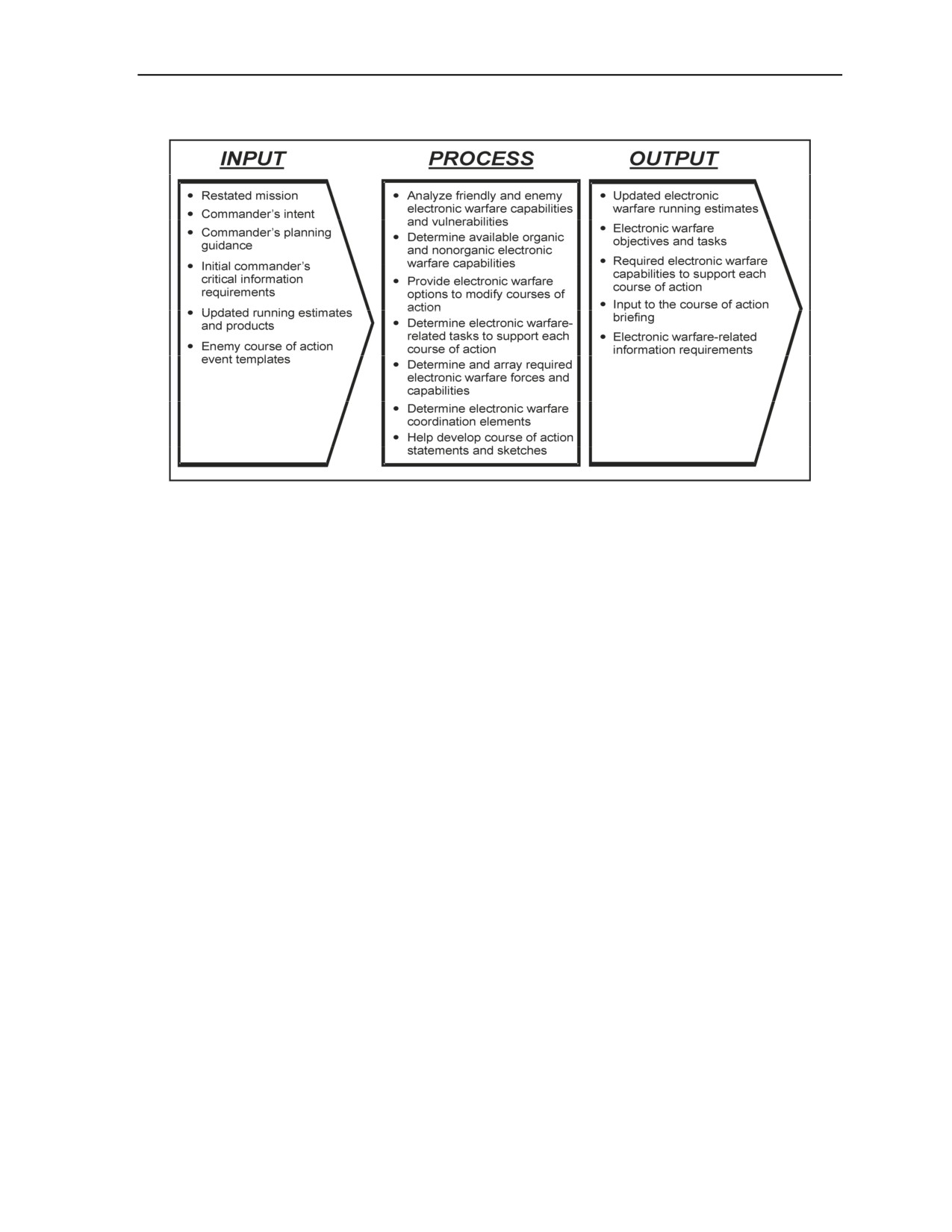
4-15. After receiving the restated mission, commander’s intent, and commander’s planning guidance, the
staff develops courses of action (COAs) for the commander’s approval. Figure 4-3 depicts the required
input to COA development and identifies the key contributions made by the EW officer and EW working
group members during the process and output stages (center and right of figure 4-3). The actions the EW
officer and EW working group members perform to support COA development are discussed in more
detail in paragraphs 4-16 through 4-20.
4-4
FM 3-36
25 February 2009
Electronic Warfare and the Operations Process
Figure 4-3. Course of action development
4-16. The EW officer and EW working group members contribute to COA development through the
following planning actions—
z
Determining which friendly EW capabilities are available to support the operation, including
organic and nonorganic capabilities for planning.
z
Determining possible friendly and enemy EW operations, including identifying friendly and
enemy vulnerabilities.
4-17. Additionally, the EW officer and EW working group members help develop initial COA options
by—
z
Identifying COA options that may be feasible based on their functional expertise
(while
brainstorming of COAs).
z
Providing options to modify a COA to enable accomplishing a requirement within the EW area
of expertise.
z
Identifying information (relating to EW options) that may impact other functional areas and
sharing that information immediately.
z
Identifying the EW-related tasks required to support the COA options.
4-18. The EW officer and EW working group members determine the forces required for mission
accomplishment by—
z
Determining the EW tasks that support each COA and how to perform those tasks based on
available forces and capabilities.
(Available special technical operations capabilities are
considered in this analysis.)
z
Providing input and support to proposed deception options.
z
Ensuring the EW options provided in support of all possible COAs meet the established
screening criteria.
4-19. The EW officer and EW working group members identify EW supporting tasks and their purpose in
supporting any decisive, shaping, and sustaining operations as each COA is developed. These EW tasks
include those—
z
Focused on defeating the enemy.
z
Required to protect friendly force operations.
25 February 2009
FM 3-36
4-5
Chapter 4
4-20. The EW officer and EW working group members assist in developing the COA briefing as required.
By the conclusion of COA development, the EW officer and EW working group members generate or
gather the following products and information:
z
A list of EW objectives and desired effects related to the EW tasks.
z
A list of EW capabilities required to perform the stated EW tasks for each COA.
z
The information and intelligence requirements for performing the EW tasks in support of each
COA.
z
An update to the EW running estimate.
COURSE OF ACTION ANALYSIS (WAR-GAMING)
4-21. The COA analysis allows the staff to synchronize the elements of combat power for each COA and
to identify the COA that best accomplishes the mission. It helps the commander and staff to—
z
Determine how to maximize the effects of combat power while protecting friendly forces and
minimizing collateral damage.
z
Further develop a visualization of the battle.
z
Anticipate battlefield events.
z
Determine conditions and resources required for success.
z
Determine when and where to apply force capabilities.
z
Focus IPB on enemy strengths and weaknesses as well as the desired end state.
z
Identify coordination needed to produce synchronized results.
z
Determine the most flexible COA.
Paragraphs 4-22 to 4-23 discuss actions the EW officer and EW working group members perform to
support COA analysis. (See FM 5-0 for more information on war-gaming.)
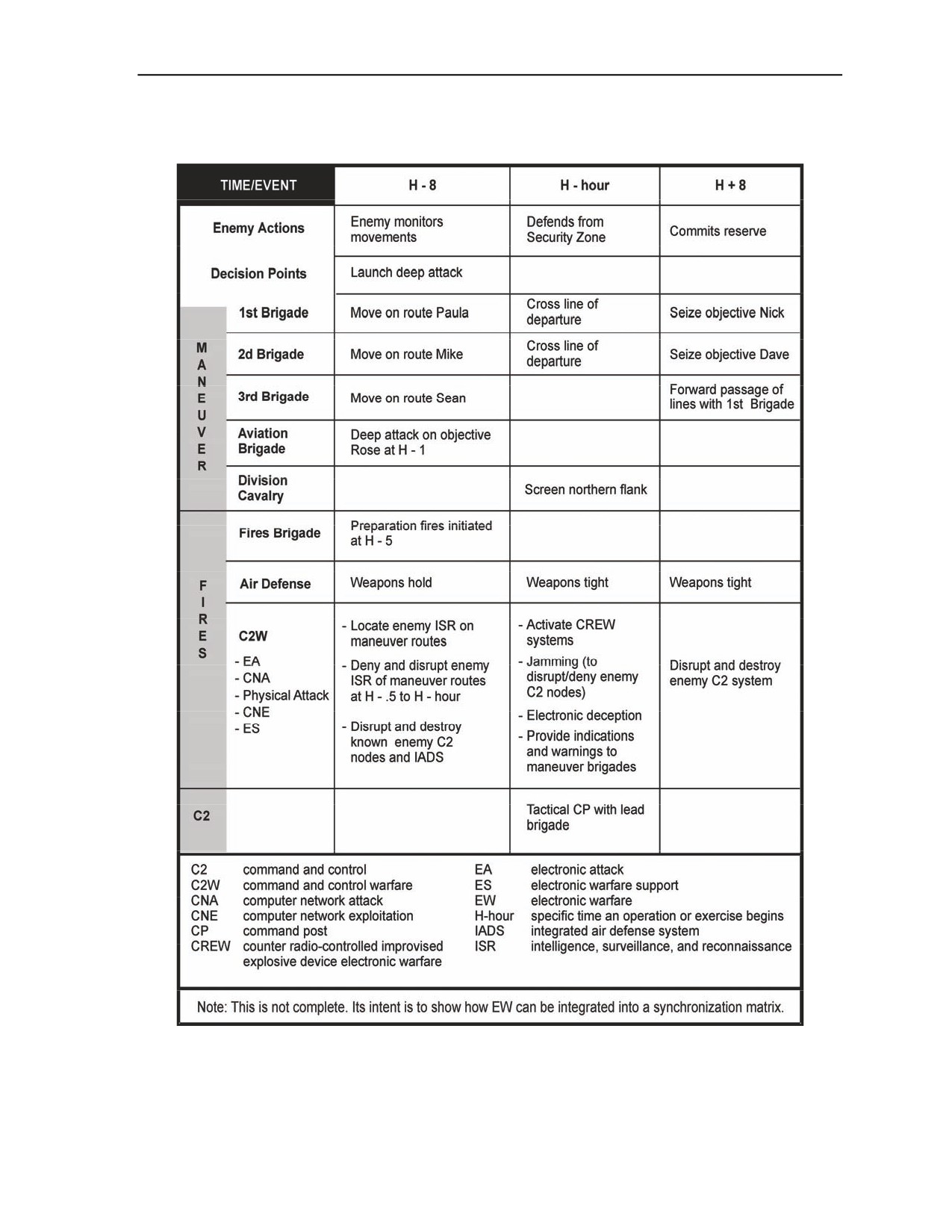
4-22. During COA analysis, the EW officer and EW working group members synchronize EW actions and
assist the staff in integrating EW capabilities into each COA. The EW officer and EW working group
members address how each EW capability supports each COA. They apply these capabilities to associated
time lines, critical events, and decision points in the synchronization matrix (see table 4-1). During this
planning phase, the EW officer and EW working group members aim to—
z
Analyze each COA from an EW functional perspective.
z
Recommend any EW task organization adjustments.
z
Identify key EW decision points.
z
Provide EW data for synchronization matrix.
z
Recommend EW priority intelligence requirements.
z
Identify EW supporting tasks to any branches and sequels.
z
Identify potential EW high-value targets.
z
Assess EW risks created by telegraphing intentions, allowing time for enemy to mitigate effects,
unintended effects of electronic attack, and the impact of asset or capability shortfalls.
4-23. By the conclusion of COA analysis (war-gaming), the EW officer and EW working group members
generate or gather the following products and information:
z
The EW data for the synchronization matrix.
z
The EW portion of the branches and sequels.
z
A list of high-value targets related to EW.
z
A list of commander’s critical information requirements related to EW.
z
The risk assessment for EW operations in support of each COA.
z
An update to the EW running estimate.
4-6
FM 3-36
25 February 2009
Electronic Warfare and the Operations Process
Table 4-1. Sample input to synchronization matrix
25 February 2009
FM 3-36
4-7
Chapter 4
COURSE OF ACTION COMPARISON
4-24. COA comparison starts with all staff members analyzing and evaluating the advantages and
disadvantages of each COA from their perspectives. Staff members present their findings for the others’
consideration. Using the evaluation criteria developed during COA analysis, the staff outlines each COA,
highlighting its advantages and disadvantages. Comparing the strengths and weaknesses of the COAs
identifies their advantages and disadvantages with respect to each other. (See FM 5-0 for further discussion
of COA comparison).
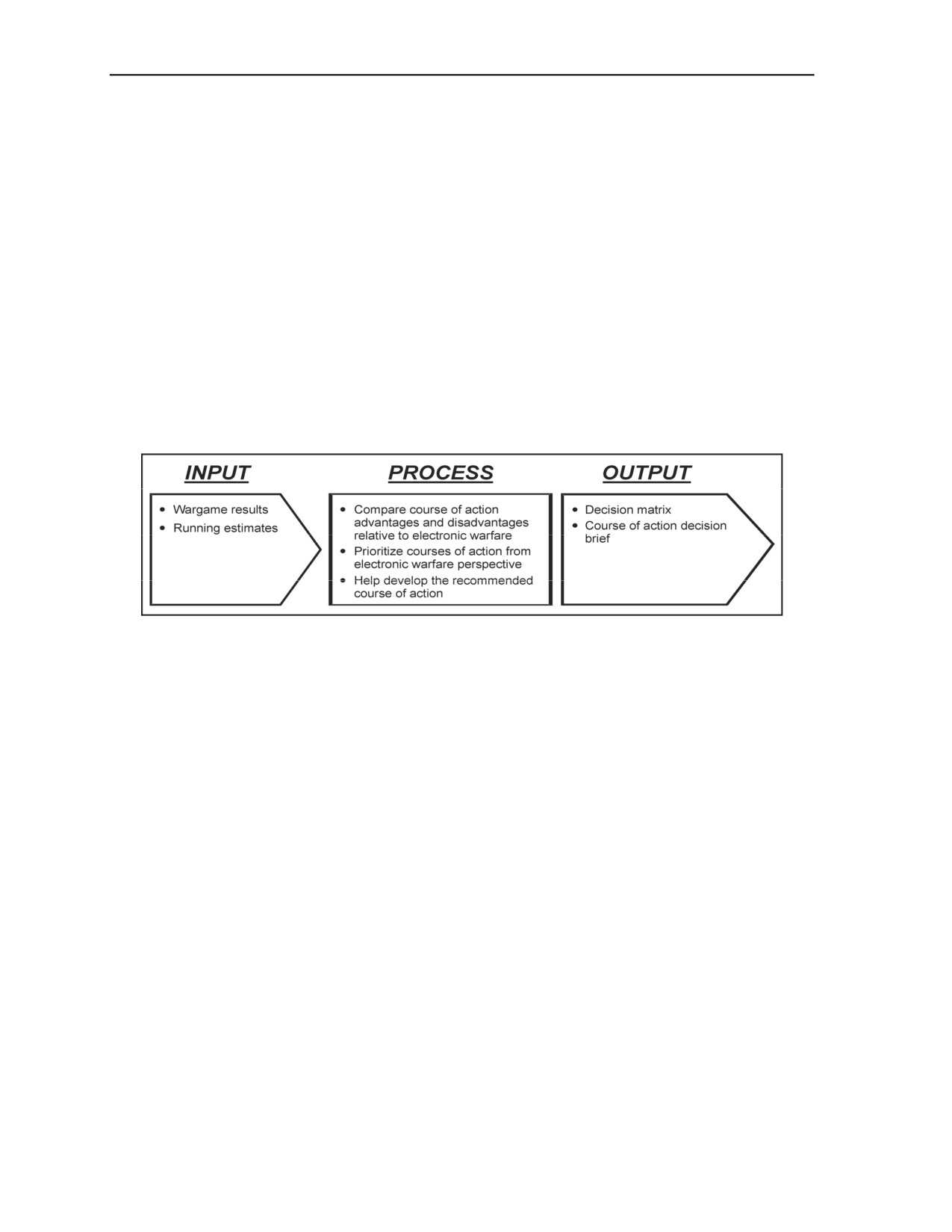
4-25. During COA comparison, the EW officer and EW working group members compare COAs based on
the EW-related advantages and disadvantages (see center of figure 4-4). Typically, planners use a matrix to
assist in the COA comparisons. The EW officer may develop an EW functional matrix to compare the
COAs or to use the decision matrix developed by the staff. Regardless of the matrix used, the evaluation
criteria developed prior to war-gaming are used to compare the COAs. Normally, the chief of staff or
executive officer weights each criterion used for the evaluation based on its relative importance and the
commander’s guidance. (See FM 5-0 for more information on COA comparison and a sample decision
matrix.)
Figure 4-4. Course of action comparison
4-26. By the conclusion of COA comparison, the EW officer and EW working group members generate or
gather the following products and information:
z
A list of the pros and cons for each COA relative to EW.
z
A prioritized list of the COAs from an EW perspective.
z
An update to the EW running estimate if required.
COURSE OF ACTION APPROVAL
4-27. The COA approval process has three components. First, the staff recommends a COA, usually in a
decision briefing. Second, the commander decides which COA to approve. Lastly, the commander issues
the final planning guidance.
4-28. During COA approval, the EW officer supports the development of the COA decision briefing and
the development of the warning order as required. If possible, the EW officer attends the COA decision
briefing to receive the commander’s final planning guidance. If unable to attend the briefing, the EW
officer receives the final planning guidance from the G-3 or S-3. The final planning guidance is critical in
that it normally provides—
z
Refined commander’s intent.
z
New commander’s critical information requirements to support the execution of the chosen
COA.
z
Risk acceptance.
z
Guidance on priorities for the elements of combat power, orders preparation, rehearsal, and
preparation.
4-8
FM 3-36
25 February 2009
Electronic Warfare and the Operations Process
4-29. After the COA decision has been made, the EW officer and EW working group members generate or
gather the following products and information:
z
An updated command and control nodal analysis of the enemy relevant to the selected COA.
z
Required requests for information to refine the enemy command and control nodal architecture.
z
Latest electronic order of battle tailored to the selected COA.
z
Any new direction provided in the refined commander’s intent.
z
A list of any new commander’s critical information requirements that can be used in support of
EW operations.
z
The warning order to assist developing EW operations required to support the operation order or
plan.
z
Refined input to the initial intelligence, surveillance, and reconnaissance
(ISR) plan,
including—
Any additional specific EW information requirements.
Updated potential collection assets for the unit’s ISR plan.
ORDERS PRODUCTION
4-30. Orders production consists of the staff preparing the operation order or plan by converting the
selected COA into a clear, concise concept of operations. The staff also provides supporting information
that enables subordinates to execute and implement risk controls. They do this by coordinating and
integrating risk controls into the appropriate paragraphs and graphics of the order.
4-31. During orders production, the EW officer provides the EW operations input for several sections of
the operation order or plan. See appendix B for the primary areas for EW operations input within an Army
order or plan. The primary areas for EW input in a joint order, if required, also are shown in appendix B.
(See CJCSM 3122.03C for the Joint Operation Planning and Execution System format).
DECISIONMAKING IN A TIME-CONSTRAINED ENVIRONMENT
4-32. In a time-constrained environment, the staff might not be able to conduct a detailed MDMP. The
staff may choose to abbreviate the process as described in FM 5-0. The abbreviated process uses all seven
steps of the MDMP in a shortened and less detailed manner.
4-33. The EW officer and core members of the EW working group meet as a regular part of the unit battle
rhythm. However, the EW officer calls unscheduled meetings if situations arise that require time-sensitive
planning. Regardless of how much they abbreviate the planning process, the EW officer and supporting
members of the EW working group always—
z
Update the EW running estimate in terms of assets and capabilities available.
z
Update essential EW tasks with the requirements of the commander’s intent.
z
Coordinate support requests and intelligence requirements with appropriate staff elements and
outside agencies.
z
Provide EW input to fragmentary orders through the G-3 or S-3 as necessary to drive timely and
effective EW operations.
z
Deconflict planned EW actions with other uses of the spectrum, such as communications.
z
Synchronize electronic attack and EW support actions.
z
Synchronize other intelligence collection in support of EW requirements.
z
Deconflict EW activities specifically with aviation operations.
z
Synchronize EW support to the command and control warfare and information protection
information tasks.
25 February 2009
FM 3-36
4-9
Chapter 4
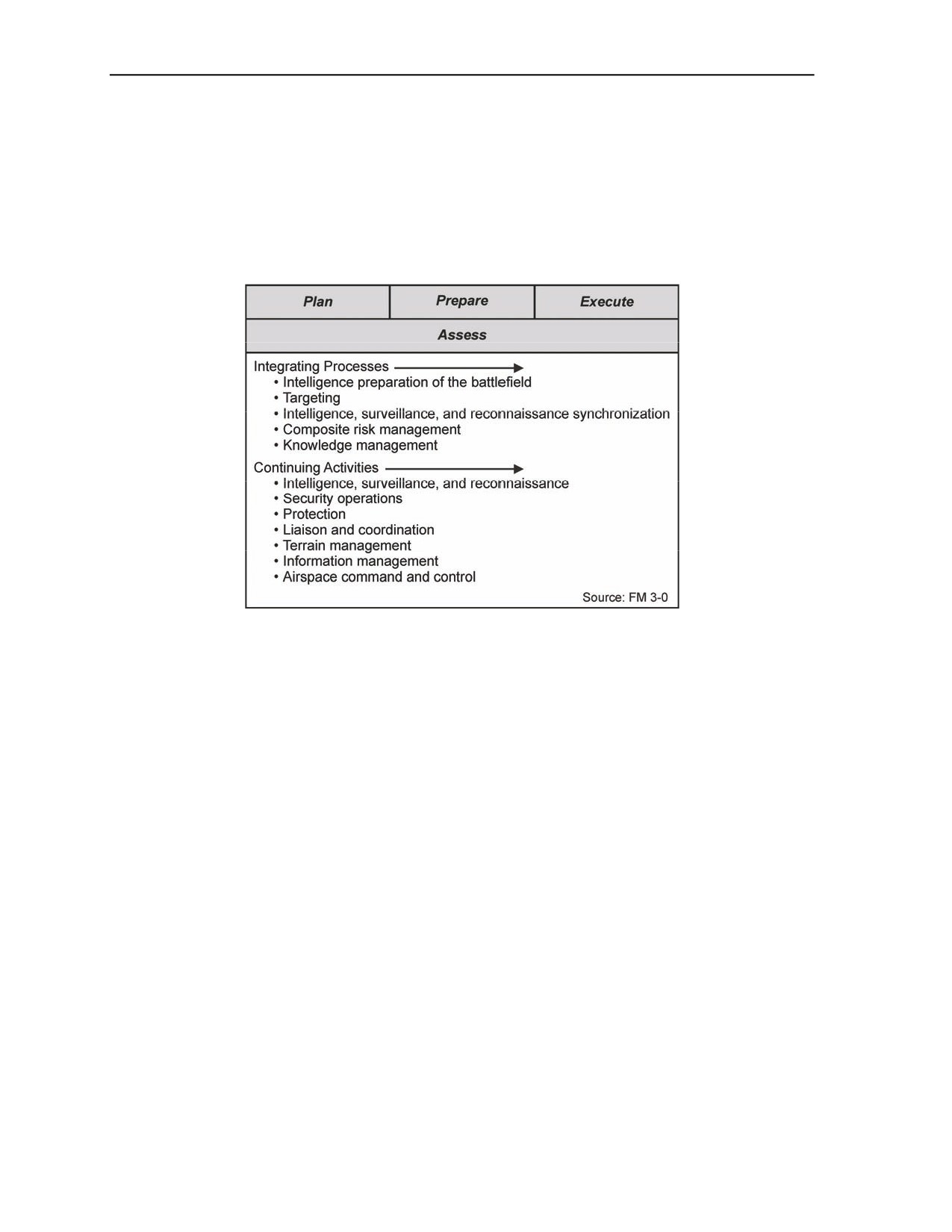
THE INTEGRATING PROCESSES AND CONTINUING ACTIVITIES
4-34. Commanders use several integrating processes and continuing activities to synchronize operations
throughout the operations process. (See figure 4-5.) The EW officer ensures EW operations are fully
synchronized and integrated within these processes and continuing activities. Other staff members
supporting the EW working group assist the EW officer. Paragraphs 4-35 through 4-52 outline some key
integrating processes and continuing activities. These processes and activities require EW officer
involvement throughout the operations process.
Figure 4-5. Integrating processes and continuing activities
INTELLIGENCE PREPARATION OF THE BATTLEFIELD
4-35. Intelligence preparation of the battlefield is the systematic, continuous process of analyzing the
threat and environment in a specific geographic area. Intelligence preparation of the battlefield is designed
to support the staff estimate and military decisionmaking process. Most intelligence requirements are
generated as a result of the intelligence preparation of the battlefield process and its interrelation with the
decisionmaking process (FM 34-130). The G-2 or S-2 leads IPB planning with participation by the entire
staff. This planning activity is used to define and understand the operational environment and the options it
presents to friendly and adversary forces. Only one IPB planning activity exists within each headquarters;
all affected staff cells participate. (FM 2-0 provides more information on IPB.) Paragraphs 4-36 through
4-40 discuss how the EW officer and the EW working group support IPB during operations.
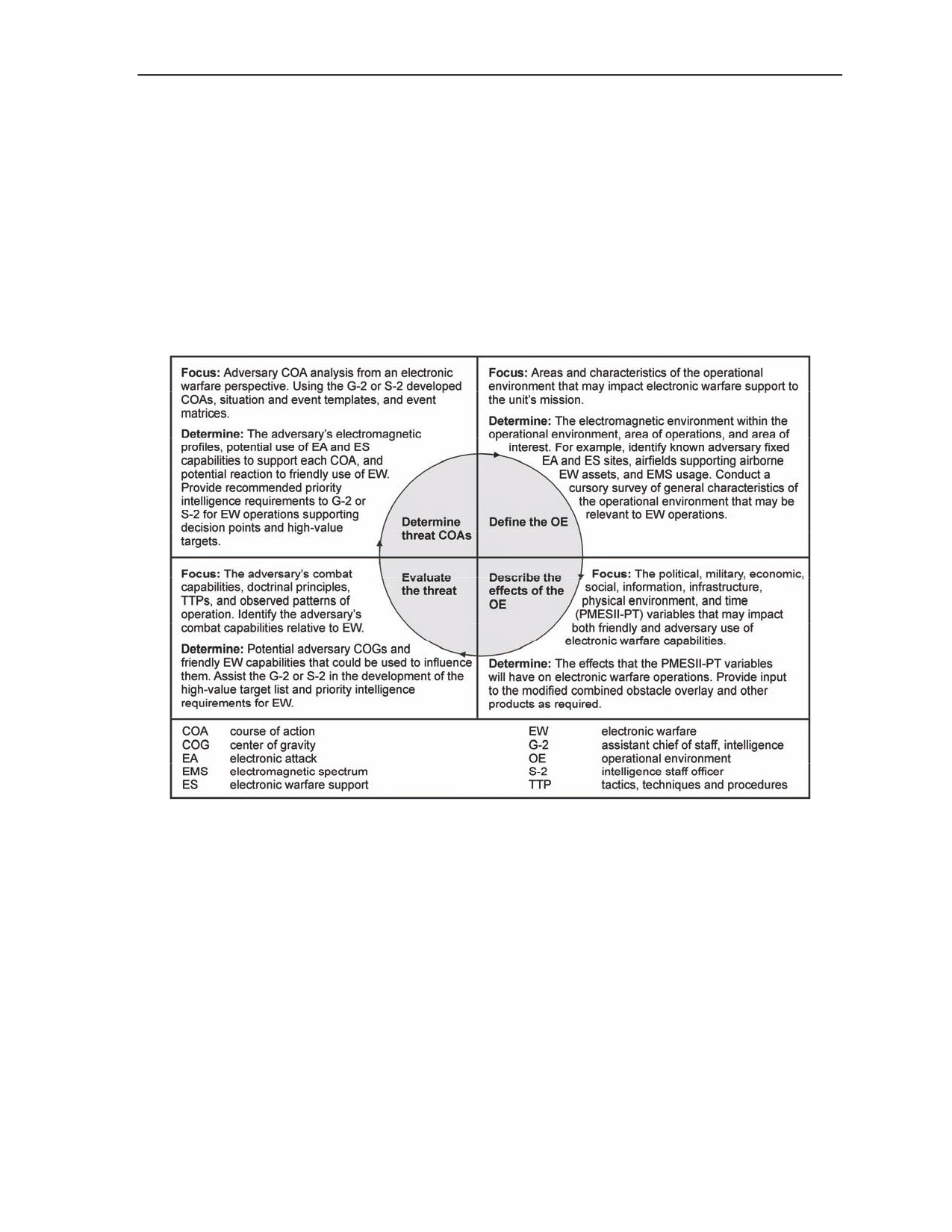
4-36. In addition to the input provided to the initial IPB (during step 2 of mission analysis), the EW officer
supports IPB throughout the operations process by providing input related to EW operations. (See figure 4-
6.) This input includes (but is not limited to) the following EW considerations:
z
Evaluating the operational environment from an EW perspective.
z
Describing how the effects of the operational environment may impact EW operations.
z
Evaluating the threat’s capabilities; doctrinal principles; and tactics, techniques, and procedures
from an EW perspective.
z
Determining threat COAs.
4-10
FM 3-36
25 February 2009
Electronic Warfare and the Operations Process
4-37. When evaluating the operational environment from an EW perspective, the EW officer—
z
Determines the electromagnetic environment within the defined physical environment:
Area of operations.
Area of influence.
Area of interest.
z
Uses electronic databases to identify gaps.
z
Identifies adversary fixed EW sites such as EW support and electronic attack sites.
z
Identifies airfields and installations that support, operate, or house adversary EW capabilities.
z
In coordination with the G-2 or S-2 and G-6 or S-6, helps identify enemy electromagnetic
spectrum usage and requirements within the area of operations and area of interest.
Figure 4-6. Electronic warfare support to intelligence preparation of the battlefield
4-38. When describing how the variables of the operational environment may impact EW operations, the
EW officer—
z
Focuses on characteristics of both the land and air domains using the factors of observation and
fields of fire, avenues of approach, key and decisive terrain, obstacles, and cover and
concealment.
z
Identifies key terrain that may provide protection for communications and target acquisition
systems from exploitation or disruption.
z
Identifies how terrain affects line of sight, including effects on both communications and non-
communications emitters.
z
Evaluates how vegetation affects radio wave absorption and antenna height requirements.
z
Locates power lines and their potential to interfere with radio waves.
z
Assesses most likely and most dangerous avenues of approach (air, ground) and where EW
operations would likely be positioned to support these approaches.
25 February 2009
FM 3-36
4-11
Chapter 4
z
If operating within urban terrain, considers how the infrastructure—power plants, power grids,
structural heights, and communications and media nodes—may restrict or limit EW capabilities.
z
Assists the G-2 or S-2 with the development of a modified combined obstacle overlay.
z
Determines how weather—visibility, cloud cover, rain, and wind—may affect ground-based and
airborne EW operations and capabilities (for example, no-go weather conditions at an airborne
EW launch and recovery base).
z
Considers all other relevant aspects of the operational environment that affect EW operations,
using the operational variables (PMESII-PT—political, military, economic, social, information,
infrastructure, physical environment, and time) and mission variables (METT-TC—mission,
enemy, terrain and weather, troops and support available, time available, and civil
considerations).
4-39. When evaluating enemy capabilities, the EW officer and supporting staff examine doctrinal
principles; tactics, techniques and procedures; and observed patterns of operation from an EW perspective.
The EW officer—
z
Uses the operational variables
(PMESII-PT) and mission variables
(METT-TC) to help
determine the adversary’s critical nodes.
z
Collects the required data—operational net assessments, electronic order of battle, and
electronic databases—to template the command and control critical nodes and the systems
required to support and maintain them.
z
Assists the G-2 in determining the adversary’s EW-related threat characteristics (order of battle)
by identifying—
Types of communications equipment available.
Types of noncommunications emitters.
Surveillance and target acquisition assets.
Technological sophistication of the threat.
Communications network structure.
Frequency allocation techniques.
Operation schedules.
Station identification methods.
Measurable characteristics of communications and noncommunications equipment.
Command, control, and communications structure of the threat.
Tactics from a communication perspective. Examples are how the enemy deploys
command, control, and communications assets; whether or not communications systems are
remote; and the level of discipline in procedures, communications security, and operations
security.
Electronic deception capabilities.
Reliance on active or passive surveillance systems
Electromagnetic profiles of each node.
Unique electromagnetic spectrum signatures.
z
Assists the G-2 or S-2 in center of gravity analysis. Helps identify the critical system nodes of
the center of gravity and determines what aspects of the system should be engaged, exploited, or
attacked to modify the system’s behavior or to achieve a desired effect.
z
Identifies organic and nonorganic EW capabilities available to achieve desired effects on
identified high-value targets.
z
Submits initial EW-related requests for information that describe the intelligence support
required to support EW operations.
z
Obtains the high-value target list, threat templates, and initial priority intelligence requirements
list to assist in follow-on EW planning.
4-12
FM 3-36
25 February 2009
Electronic Warfare and the Operations Process
4-40. When determining adversary COAs, the EW officer—
z
Assists the G-2 or S-2 in development of adversary COAs.
z
Provides EW input to the situation templates.
z
Ensures event templates include EW named areas of interests.
z
Assists in providing EW options for target areas of interest.
z
Assists in providing EW options to support decision points.
z
Provides EW input to the event template and event matrix.
TARGETING
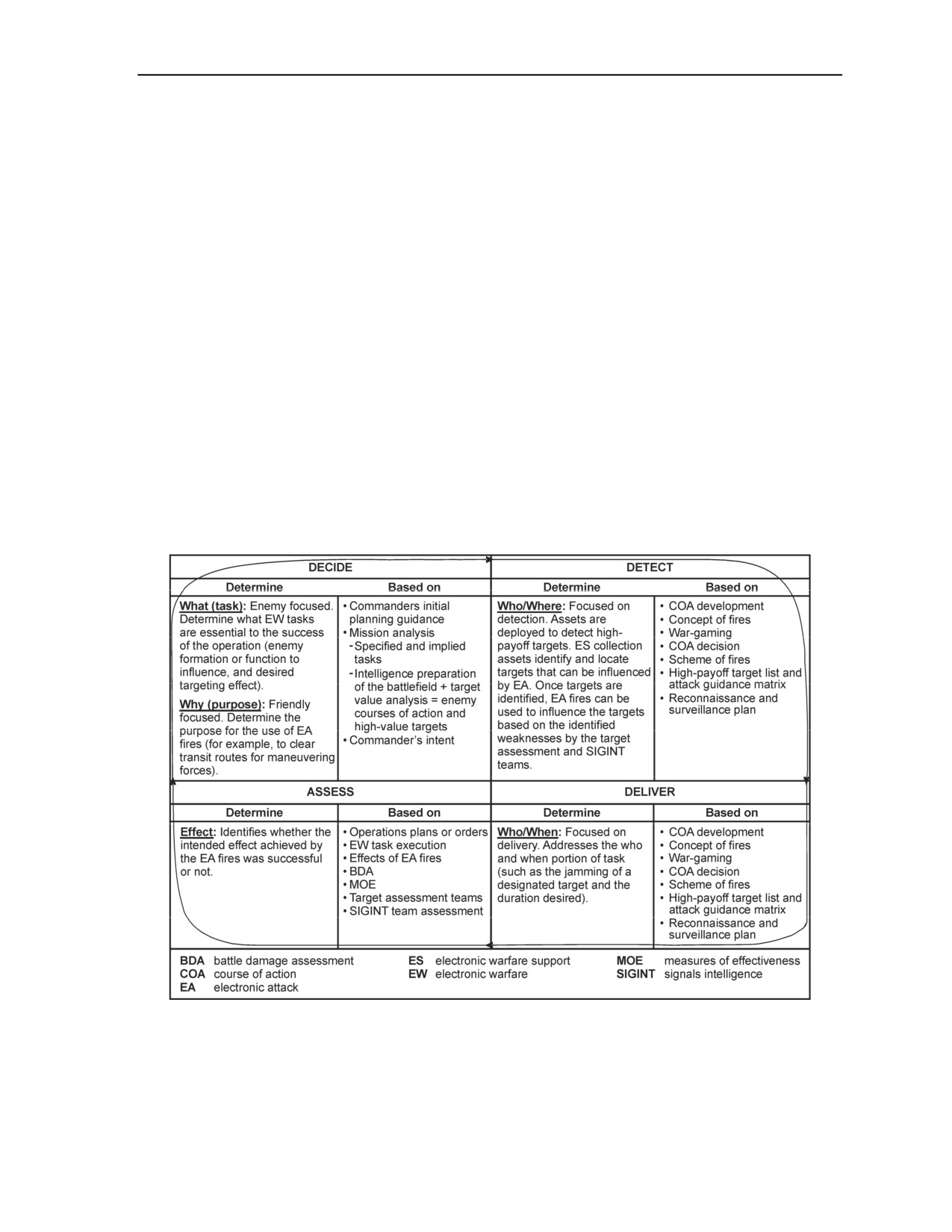
4-41. Targeting is the process of selecting and prioritizing targets and matching the appropriate response
to them, considering operational requirements and capabilities (JP 3-0). A decide, detect, deliver, and
assess methodology is used to direct friendly forces to attack the right target with the right asset at the right
time. (See figure 4-7.) Targeting provides an effective method to match the friendly force capabilities
against targets. Commander’s intent plays a critical role in the targeting process. The targeting working
group strives to thoroughly understand the commander’s intent to ensure the commander’s intended effects
on targets are achieved.
4-42. An important part of targeting is identifying potential fratricide situations and performing the
coordination measures to manage and control the targeting effort positively. The targeting working group
and staff incorporate these measures into the coordinating instructions and appropriate annexes of the
operation plans and orders. (FM 6-20-10 has more information on targeting.)
Figure 4-7. Electronic warfare in the targeting process
25 February 2009
FM 3-36
4-13
Chapter 4
4-43. The EW officer thoroughly integrates electronic attack in the targeting process and integrates
electronic attack fires into all appropriate portions of the operation plan, operation order, and other
planning products. In support of EW targeting, the EW officer—
z
Helps the targeting working group determine electronic attack requirements against specific
high-payoff targets and high-value targets.
z
Ensures electronic attack can meet the desired effect (in terms of the targeting objective).
z
Coordinates with the signals intelligence staff element through the collection manager to satisfy
EW support and electronic attack information requirements.
z
Prepares the EW tab and the EW portion of the command and control warfare tab to the fires
appendix.
z
Provides electronic attack mission management through the tactical operations center or joint
operations center and the tactical air control party (for airborne electronic attack).
z
Provides electronic attack mission management as the jamming control authority for ground or
airborne electronic attack when designated.
z
Prepares and coordinates the EW annex for operation plans and operation orders.
z
Determines and requests theater Army electronic attack support.
z
Recommends to the G-3 or S-3 and the fire support coordinator or fire support officer whether
to engage a target with electronic attack.
z
Expedites electromagnetic interference reports to the targeting working group. (See appendix D
for information on electromagnetic interference reporting.)
Decide
4-44. Decide is the first step in the targeting process. This step provides the overall focus for fires, a
targeting plan, and some of the priorities for intelligence collection. As part of the staff in the fires cell, the
EW officer assists the targeting working group in planning the target priorities for each phase and critical
events of the operation. Initially, the targeting working group does not develop electronic attack targets
using any special technique or separately from targets for physical destruction. However, as the process
continues, these targets are passed through intelligence organizations and further planned using ISR
procedures. The planned use of electronic attack is integrated into the standard targeting products (graphic
or text-based). Products that involve electronic attack planning may include—
z
High-payoff target list.
z
Attack guidance matrix.
z
Appendix 4 (Electronic Warfare) to Annex P (Information Operations) of the operation order.
(At the time this manual was written, this was the current doctrine for operation orders. This
appendix will be revised upon publication of the revised FM 5-0.)
Detect
4-45. Based on what the targeting working group identified as high-payoff targets during the decide step,
collection assets are then deployed to detect them. The intelligence enterprise pairs assets to targets based
on the collection plan and the current threat situation. When conducting electronic attack operations in
support of command and control warfare, ISR units perform EW support tasks linked to and working
closely with the electronic attack missions. Electronic warfare support units (with support from the target
assessment and signals intelligence staff elements) provide the data—location, signal strength, and
frequency of the target—to focus electronic attack assets on the intended target. These assets also identify
the command and control system vulnerabilities open to attack by electronic attack assets.
Deliver
4-46. Once friendly force capabilities identify, locate, and track the high-payoff targets, the next step in the
process is to deliver fires against those targets. Electronic attack assets must satisfy the attack guidance
developed during the decide step. Close coordination between those conducting EW support and electronic
4-14
FM 3-36
25 February 2009
Electronic Warfare and the Operations Process
attack is critical during the engagement. The EW officer facilitates this coordination and ensures electronic
attack fires are fully synchronized and deconflicted with other fires. The EW officer remains aware of the
potential for unintended effects between adjacent units when conducting electronic attack. The EW officer
continually coordinates with adjacent unit EW officers to mitigate and deconflict these effects during
cross-boundary operations. Normally, the G-3, S-3, or fire support coordinator provides requirements and
guidance for this coordination and synchronization in the attack guidance matrix, intelligence
synchronization matrix, spectrum management plan, and the EW input to the operation plan or operation
order annexes and appendixes.
Assess
4-47. Once the target as been engaged, the next step is to assess the engagement’s effectiveness. This is
done through combat assessment, which involves determining the effectiveness of force employment
during military operations. It consists of three elements:
z
Munitions effects assessment.
z
Battle damage assessment.
z
Re-attack recommendations.
4-48. The first two elements, munitions effects assessment and battle damage assessment, are used to
inform the commander on the effects achieved against targets and target sets. From this information, the G-
2 or S-2 continues to analyze the threat’s ability to further conduct and sustain combat operations
(sometimes articulated in terms of the effects achieved against the threat’s centers of gravity). The last
element involves the assessment and recommendation whether or not to re-attack the targets.
4-49. The assessment of a jamming mission used against an enemy’s command and control system is
unlike fires that can be observed visually. The signals intelligence staff element and units executing the
electronic attack mission coordinate continuously to assess mission effectiveness. Close coordination
between sensor and shooter allows instant feedback on the success or failure of the intended jamming
effects. It also can quickly provide the necessary adjustments to produce desired effects.
INTELLIGENCE, SURVEILLANCE, AND RECONNAISSANCE SYNCHRONIZATION
4-50. Intelligence, surveillance, and reconnaissance synchronization is the task that accomplishes the
following: analyzes information requirements and intelligence gaps; evaluates available assets internal and
external to the organization; determines gaps in the use of those assets; recommends intelligence,
surveillance, and reconnaissance assets controlled by the organization to collect on the commander’s
critical information requirements; and submits requests for information for adjacent and higher collection
support
(FM 3-0). ISR synchronization considers all assets—both internal and external to the
organization. It identifies information gaps and the most appropriate assets for collecting
information to fill them.
4-51. Planning for ISR operations begins during mission analysis. Although led by the G-3 or S-3, it is
supported by the entire staff, subordinate units, and external partners. ISR operations collect, process,
store, display, and disseminate information from a multitude of collection sources. The staff thoroughly
understands, integrates, and synchronizes the ISR plan across all echelons.
4-52. The EW officer ensures the ISR plan supports the EW-related information requirements determined
during the planning process. The EW officer coordinates these requirements with the signals intelligence
staff element through the G-2 or S-2.
EMPLOYMENT CONSIDERATIONS
4-53. EW has specific ground-based, airborne, and functional
(electronic attack, electronic warfare
support, or electronic protection) employment considerations. The EW officer ensures EW-related
employment considerations are properly articulated early in the operations process. Each capability
employed has certain advantages and disadvantages. The staff plans for all of these before executing EW
operations.
25 February 2009
FM 3-36
4-15
Chapter 4
GROUND-BASED ELECTRONIC WARFARE CONSIDERATIONS
4-54. Ground-based EW capabilities support the commander’s scheme of maneuver. Ground-based EW
equipment can be employed by a dismounted Soldier or on highly mobile platforms. Due to the short-range
nature of tactical signals direction finding, electronic attack assets are normally located in the forward areas
of the battlefield, with or near forward units.
4-55. Ground-based EW capabilities have certain advantages. They provide direct support to maneuver
units
(for example, through counter-radio-controlled improvised-explosive-device EW and
communications or sensor jamming). Ground-based EW capabilities support continuous operations and
respond quickly to EW requirements of the ground commander. However, to maximize the effectiveness of
ground-based EW capabilities, maneuver units must protect EW assets from enemy ground and aviation
threats. EW equipment should be as survivable and mobile as the force it supports. Maneuver units must
logistically support the EW assets, and supported commanders must clearly identify EW requirements.
4-56. Ground-based EW capabilities have certain limitations. They are vulnerable to enemy attack and can
be masked by terrain. They are vulnerable to enemy electromagnetic deceptive measures and electronic
protection actions. In addition, they have distance or propagation limitations against enemy electronic
systems.
AIRBORNE ELECTRONIC WARFARE CONSIDERATIONS
4-57. While ground-based and airborne EW planning and execution are similar, they significantly differ in
their EW employment time. Airborne EW operations are conducted at much higher speeds and generally
have a shorter duration than ground-based operations. Therefore, the timing of airborne EW support
requires detailed planning.
4-58. Airborne EW requires the following:
z
A clear understanding of the supported commander’s EW objectives.
z
Detailed planning and integration.
z
Ground support facilities.
z
Liaisons between the aircrews of the aircraft providing the EW support and the aircrews or
ground forces being supported.
z
Protection from enemy aircraft and air defense systems.
4-59. Airborne EW capabilities have certain advantages. They can provide direct support to other tactical
aviation missions such as suppression of enemy air defenses, destruction of enemy air defenses, and
employment of high-speed antiradiation missiles. They can provide extended range over ground-based
assets. Airborne EW capabilities can provide greater mobility and flexibility than ground-based assets. In
addition, they can support ground-based units in beyond line-of-sight operations.
4-60. The limitations associated with airborne EW capabilities are time-on-station considerations,
vulnerability to enemy electronic protection actions, electromagnetic deception techniques, and limited
assets (support from nonorganic EW platforms need to be requested).
ELECTRONIC ATTACK CONSIDERATIONS
4-61. Electronic attack includes both offensive and defensive activities.
(Chapter
1 provides a full
definition of electronic attack). These activities differ in their purpose. Defensive electronic attack protects
friendly personnel and equipment or platforms. Offensive electronic attack denies, disrupts, or destroys
enemy capability. In either case, certain considerations are involved in planning for employing electronic
attack:
z
Friendly communications.
z
Intelligence collection.
z
Other effects.
z
Nonhostile local electromagnetic spectrum use.
4-16
FM 3-36
25 February 2009
Electronic Warfare and the Operations Process
z
Hostile intelligence collection.
z
Persistency of effect.
4-62. The EW officer, the G-2 or S-2, the G-3 or S-3, the G-6 or S-6, the spectrum manager, and the G-7
or S-7 coordinate closely to avoid friendly communications interference that can occur when using EW
systems on the battlefield. Coordination ensures that electronic attack systems frequencies are properly
deconflicted with friendly communications and intelligence systems or that ground maneuver and friendly
information tasks are modified accordingly.
4-63. The number of information systems, EW systems, and sensors operating simultaneously on the
battlefield makes deconfliction with communications systems a challenge. The EW officer, the G-2 or S-2,
the G-6 or S-6, and the spectrum manager plan and rehearse deconfliction procedures to quickly adjust
their use of EW or communications systems.
4-64. Electronic attack operations depend on EW support and signals intelligence to provide targeting
information and battle damage assessment. However, EW officers must keep in mind that not all
intelligence collection is focused on supporting EW. If not properly coordinated with the G-2 or S-2 staff,
electronic attack operations may impact intelligence collection by jamming or inadvertently interfering
with a particular frequency being used to collect data on the threat, or by jamming a given enemy
frequency or system that deprives friendly forces of that means of collecting data. Either can significantly
deter intelligence collection efforts and their ability to answer critical information requirements.
Coordination between the EW officer, the fire support coordinator, and the G-2 or S-2 is prevents this
interference. In situations where a known conflict between the intelligence collection effort and the use of
electronic attack exists, the EW working group brings the problem to the G-3 or S-3 for resolution.
4-65. Other forms of effects rely on electromagnetic spectrum. For example, psychological operations may
plan to use a given set of frequencies to broadcast messages, or a military deception plan may include the
broadcast of friendly force communications. In both examples, the use of electronic attack could
unintentionally interfere or disrupt such broadcasts if not properly coordinated. To ensure electronic attack
does not negatively impact planned operations, the EW officer coordinates between fires, network
operations, and other functional or integrating cells as required.
4-66. Like any other form of electromagnetic radiation, electronic attack can adversely affect local media
and communications systems and infrastructure. EW planners consider unintended consequences of EW
operations and deconflict these operations with the various functional or integrating cells. For example,
friendly jamming could potentially deny the functioning of essential services such as ambulance or fire
fighters to a local population. EW officers routinely synchronize electronic attack with the other functional
or integrating cells responsible for the information tasks. In this way, they ensure that electronic attack
efforts do not cause fratricide or unacceptable collateral damage to their intended effects.
4-67. The potential for hostile intelligence collection also affects electronic attack. A well-equipped enemy
can detect friendly EW capabilities and thus gain intelligence on friendly force intentions. For example, the
frequencies Army forces jam could indicate where they believe the enemy’s capabilities lie. The EW
officer and the G-2 or S-2 develop an understanding of the enemy’s collection capability. Along with the
red team (if available), they determine what the enemy might gain from friendly force use of electronic
attack. (A red team is an organizational element comprised of trained and educated members that provide
an independent capability to fully explore alternatives in plans and operations in the context of the
operational environment and from the perspective of adversaries and others. [JP 2-0])
4-68. The effects of jamming only persist as long as the jammer itself is emitting and is in range to affect
the target. Normally this time frame is a matter of seconds or minutes, which makes the timing of such
missions critical. This is particularly true when jamming is used in direct support of aviation platforms. For
example, in a mission that supports suppression of enemy air defense, the time on target and duration of the
jamming must account for the speed of attack of the aviation platform. They must also account for the
potential reaction time of enemy air defensive countermeasures. The development of directed-energy
weapons may change this dynamic in the future. However, at present (aside from antiradiation missiles),
the effects of jamming are less persistent than effects achieved by other means.
25 February 2009
FM 3-36
4-17
Chapter 4
ELECTRONIC PROTECTION CONSIDERATIONS
4-69. Electronic protection is achieved through physical security, communications security measures,
system technical capabilities
(such as frequency hopping and shielding of electronics), spectrum
management, and emission control procedures. The EW officer and EW working group members must
consider the following key functions when planning for electronic protection operations:
z
Vulnerability analysis and assessment.
z
Monitoring and feedback.
z
Electronic protection measures and how they affect friendly capabilities.
Vulnerability Analysis and Assessment
4-70. Vulnerability analysis and assessment forms the basis for formulating electronic protection plans.
The Defense Information Systems Agency operates the Vulnerability Analysis and Assessment Program,
which specifically focuses on automated information systems and can be very useful in this effort.
Monitoring and Feedback
4-71. The National Security Agency monitors communications security. Their programs focus on
telecommunications systems using wire and electronic communications. Their programs can support and
remediate the command’s communications security procedures when required.
Electronic Protection Measures and Their Effect on Friendly Capabilities
4-72. Electronic protection measures include any measure taken to protect the force from hostile electronic
attack actions. However, these measures can also limit friendly capabilities or operations. For example,
denying frequency usage to counter-radio-controlled improvised-explosive-device EW systems on a given
frequency to preserve it for a critical friendly information system could leave friendly forces vulnerable to
certain radio-controlled improvised explosive devices. The EW officer and the G-6 or S-6 carefully
consider these second-order effects when advising the G-3 or S-3 regarding electronic protection measures.
ELECTRONIC WARFARE SUPPORT CONSIDERATIONS
4-73. The distinction between whether a given asset is performing a signals intelligence or EW support
mission is determined by who tasks and controls the assets, what they are tasked to provide, and the
purpose for which they are tasked. Operational commanders task assets to conduct EW support for the
purpose of immediate threat recognition, targeting, planning the conduct of future operations, and other
tactical actions (such as threat avoidance and homing). The EW officer coordinates with the G-2 or S-2 to
ensure all EW support needed for planned EW operations is identified and submitted to the G-3 or S-3 for
approval by the commander. This ensures that the required collection assets are properly tasked to provide
the EW support. In cases where planned electronic attack actions may conflict with the G-2 or S-2
intelligence collection efforts, the G-3, S-3, or commander decides which has priority. The EW officer and
the G-2 or S-2 develop a structured process within each echelon for conducting this intelligence gain-loss
calculus during mission rehearsal exercises and predeployment work-ups.
ELECTRONIC WARFARE REPROGRAMMING CONSIDERATIONS
4-74. Electronic warfare reprogramming refers to modifying friendly EW or target sensing systems in
response to validated changes in enemy equipment and tactics or the electromagnetic environment. (See
paragraph 1-40 for the complete definition.) Reprogramming EW and target sensing system equipment
falls under the responsibility of each Service or organization through its respective EW reprogramming
support programs. It includes changes to self-defense systems, offensive weapons systems, and intelligence
collection systems. During joint operations, swift identification and reprogramming efforts are critical in a
rapidly evolving hostile situation. The key consideration for EW reprogramming is joint coordination. Joint
coordination of Service reprogramming efforts ensures reprogramming requirements are identified,
4-18
FM 3-36
25 February 2009
Electronic Warfare and the Operations Process
processed, and implemented consistently by all friendly forces. During joint operations, EW
reprogramming coordination and monitoring is the responsibility of the joint force commander’s EW staff.
(For more information on EW reprogramming, see FM 3-13.10).
SECTION II — ELECTRONIC WARFARE PREPARATION
4-75. Preparation consists of activities performed by units to improve their ability to execute an operation.
Preparation includes, but is not limited to, plan refinement; rehearsals; intelligence, surveillance, and
reconnaissance; coordination; inspections; and movement (FM 3-0). Preparation creates conditions that
improve friendly forces’ opportunities for success. It facilitates and sustains transitions, including those to
branches and sequels.
4-76. During preparation, the EW officer and members of the EW working group focus their actions on
the following activities:
z
Revising and refining the EW estimate, EW tasks supporting command and control warfare, and
EW support to the overall plan.
z
Rehearsing the synchronization of EW support to the plan (including integration into the
targeting process, request procedures for joint assets, deconfliction procedures, and asset
determination and refinement).
z
Synchronizing the collection plan and intelligence synchronization matrix with the attack
guidance matrix and EW input to the operation plan or order annexes and appendixes.
z
Assessing the planned task organization developed to support EW operations, including liaison
officers and organic and nonorganic capabilities required by echelon.
z
Coordinating procedures with ISR operational elements
(such as signals intelligence staff
elements).
z
Training the supporting staff members of the EW working group during mission rehearsal
exercises.
z
Completing precombat checks and inspections of EW assets.
z
Completing sustainment preparations for EW assets.
z
Coordinate with the G-4 or S-4 to develop EW equipment reporting formats.
z
Completing briefbacks by subordinate EW working groups on planned EW operations.
z
Refining content and format for the EW officer’s portion of the battle update assessment and
brief.
SECTION III — ELECTRONIC WARFARE EXECUTION
4-77. Execution is putting the plan into action by applying combat power to accomplish the mission and
using situational understanding to assess progress and make execution and adjustment decisions (FM 3-0).
Commanders focus their subordinates on executing the concept of operations by issuing their intent and
mission orders.
4-78. During execution, the EW officer and EW working group members—
z
Serve as the EW expert for the commander.
z
Maintain the running estimate for EW operations.
z
Monitor EW operations and recommend adjustments during execution.
z
Recommend adjustments to the commander’s critical information requirements based on the
situation.
z
Recommend adjustments to EW-related control measures and procedures.
z
Maintain direct liaison with the fires and network operations cells and the command and control
warfare working group (if formed) to ensure integration and deconfliction of EW operations.
z
Coordinate and manage EW taskings to subordinate units or assets.
z
Coordinate requests for nonorganic EW support.
25 February 2009
FM 3-36
4-19
Chapter 4
z
Continue to assist the targeting working group in target development and recommend targets for
attack by electronic attack assets.
z
Receive, process, and coordinate subordinate requests for EW support during operations.
z
Receive and process immediate support requests for suppression of enemy air defense or EW
from joint or multinational forces; coordinate through fire support officer and fire support
coordinator with the battlefield coordination detachment and joint or multinational liaisons for
support request.
z
Coordinate with airspace control section on all suppression of enemy air defense or EW
missions.
z
Provide input to the overall assessment regarding effectiveness of electronic attack missions.
z
Maintain, update, and distribute the status of EW assets.
z
Validate and disseminate cease-jamming requests.
z
Coordinate and expedite electromagnetic interference reports with the analysis and control
element for targeting and the spectrum manager for potential deconfliction.
z
Perform jamming control authority function for ground-based EW within the assigned area of
operations (when designated by the jamming control authority).
SECTION IV — ELECTRONIC WARFARE ASSESSMENT
4-79. Assessment is the continuous monitoring and evaluation of the current situation, particularly the
enemy, and progress of an operation (FM 3-0). Commanders, assisted by their staffs, continuously assess
the current situation and progress of the operation and compare it with the concept of operations, mission,
and commander’s intent. Based on their assessment, commanders direct adjustments, ensuring that the
operation remains focused on the mission and commander’s intent.
4-80. As depicted in figure 4-5 (page 4-10), assessment occurs throughout every operations process
activity and includes three major tasks:
z
Continuously assessing the enemy’s reactions and vulnerabilities.
z
Continuously monitoring the situation and progress of the operation towards the commander’s
desired end state.
z
Evaluating the operation against measures of effectiveness and measures of performance.
4-81. The EW officer and supporting members of the EW working group make assessments throughout
the operations process. During planning and preparation activities, assessments of EW are made during the
MDMP, IPB, targeting, ISR synchronization, and composite risk management integration.
4-82. The EW officer, in conjunction with the G-5 or S-5, helps develop the measures of performance and
measures of effectiveness for evaluating EW operations during execution. A measure of performance is a
criterion used to assess friendly actions that is tied to measuring task accomplishment (JP 3-0). A measure
of effectiveness is a criterion used to assess changes in system behavior, capability, or operational
environment that is tied to measuring the attainment of an end state, achievement of an objective, or
creation of an effect (JP 3-0). In the context of EW, an example of a measure of performance is the
percentage of known enemy command and control nodes targeted and attacked by electronic attack means
(action) versus the number of enemy command and control nodes that were actually destroyed or rendered
inoperable for the desired duration (task accomplishment). Measures of effectiveness are used to determine
the degree to which an EW action achieved the desired result. This is normally measured through analysis
of data collected by both active and passive means. For example, effectiveness is measured by using radar
or visual systems to detect changes in enemy weapons flight and trajectory profiles.
4-20
FM 3-36
25 February 2009
Electronic Warfare and the Operations Process
4-83. During execution, the EW officer and members of the EW working group participate in combat
assessments within the fires cell to determine the effectiveness of electronic attack employment in support
of operations. Combat assessment consists of three elements: munitions effects assessment, battle damage
assessment, and reattack recommendations. (Paragraphs 4-47 to 4-49 discuss combat assessment.)
SUMMARY
4-84. The EW officer and staff members supporting the EW working group ensure the successful
integration of EW capabilities into operations. The EW officer leads the EW integration effort throughout
the operations process. The EW officer must be familiar with and participate in the applicable integrating
processes and continuing activities discussed within this chapter.
25 February 2009
FM 3-36
4-21
Chapter 5
Coordination, Deconfliction, and Synchronization
Once the commander approves an operation plan or order and preparations are
complete, the electronic warfare officer and supporting staff turn to coordinating,
deconflicting, and synchronizing the electronic warfare efforts. They ensure
electronic warfare actions are carried out as planned or are modified in response to
current operations. This chapter discusses major areas and activities that require
continuous coordination, deconfliction, and synchronization by the electronic warfare
officer and supporting staff of the electronic warfare working groups.
COORDINATION AND DECONFLICTION
5-1. A certain amount of coordination is part of the planning process. However, once a plan is approved
and an operation begins, the electronic warfare
(EW) staff effort shifts to the coordination and
deconfliction necessary to ensure units carry out EW actions as planned or modify actions to respond to the
dynamics of the operation.
5-2. The EW officer and members of the EW working group continuously monitor several key areas.
These include EW coordination across organizations (higher, lower, and adjacent units), support request
coordination, electromagnetic spectrum management, EW asset management, functional coordination
between EW subdivisions, EW reprogramming, and EW deconfliction. Normally, EW personnel on watch
in the operations center monitor and coordinate activities of these key areas. They alert the EW officer or
other EW support personnel to address the required actions.
COORDINATION ACROSS ORGANIZATIONS
5-3. At the joint level, the information operations division of the J-3 performs EW coordination. The EW
section of the information operations staff engages in all EW functions. This section performs peacetime
contingency planning, completes day-to-day planning and monitoring of routine theater EW activities, and
crisis action planning for contingencies as part of emergent joint operations. The EW section coordinates
closely with other appropriate staff sections and other larger joint planning groups as required. (JP 3-13.1
discusses joint EW coordination.)
5-4. In the early stages of contingencies, the joint force commander’s EW staff assesses the staffing
requirements for planning and execution. This staff also coordinates EW planning and course of action
development with the joint force commander’s components. Services begin component EW planning and
activate their EW working groups per combatant command or Service guidelines. When the scope of a
contingency becomes clearer, the command EW officer may request that the joint force commander
establish a joint EW coordination cell. If a joint EW coordination cell is formed, it normally requires
additional augmentation from the Service or functional components. Depending on the size of the force,
EW personnel from the division, corps, or theater are expected to augment the joint EW coordination cell
to form a representative EW planning and execution organization. The senior Army organization’s staff
EW officer anticipates this requirement and prepares to support the augmentation if requested.
5-5. Coordination occurs through established EW working groups from theater level to battalion level.
Within Army organizations, the coordination of EW activities occurs both horizontally and vertically. At
every level, the staff EW officer ensures the necessary coordination. Normally, coordination of EW
activities between the Army and joint force air component commander flows through the battlefield
25 February 2009
FM 3-36
5-1
Chapter 5
coordination detachment at the joint air operations center. EW staffs at higher echelons monitor EW-
related activities and resolve conflicts when necessary.
5-6. Normally the senior Army headquarters
(ARFOR) G-3 or S-3 coordinates with external EW
organizations, unless direct liaison is authorized at lower echelons. Other components requesting Army
EW support coordinate their support requirements with the EW officer located at the ARFOR headquarters
or tactical operations center. Often, a liaison from the requesting organization completes these requests. If
other Service or functional components have an immediate need for Army EW support, they send the
request to the operational fires directorate or fires cell and the senior headquarters EW working group
(sometimes referred to as an EW coordination cell) via the Global Command and Control System or Global
Command and Control System-Army. In support of external EW coordination, the staff EW officer within
the J-3, G-3, or S-3—
z
Provides an assessment of EW capabilities to other component operation centers.
z
Coordinates preplanned EW operations with other Service components (within prescribed time
lines).
z
Updates preplanned EW operations in coordination with other components as required.
SUPPORT REQUEST COORDINATION
5-7. Units requesting electronic attack support forward requests to the appropriate EW working group.
(See appendix D for the electronic attack request format.) Each EW working group prioritizes the requests
and forwards them to the higher headquarters. The commander who owns the capability when the
requested support is needed approves the requests. The technical data required to support the execution of
the request is passed through EW channels at the appropriate level of classification.
5-8. Electronic warfare support requests are prioritized and passed from the EW working groups through
G-2 or S-2 channels and are approved by the commander who owns the capability. New EW support
requests are integrated into the intelligence synchronization process. If they are approved, they appear in
the intelligence synchronization plan and the unit intelligence, surveillance, and reconnaissance plan. See
FMI 2-01 for details on the intelligence synchronization process. The technical data required to support
EW support requests passes via signals intelligence channels within the G-2 or S-2 by classified means.
ELECTROMAGNETIC SPECTRUM MANAGEMENT
5-9. The electromagnetic spectrum is a finite resource. Once apportioned, this resource must be managed
efficiently to maximize the limited spectrum allocated to support military operations. Electromagnetic
spectrum operations aim to enable electronic systems to perform their functions in the intended
environment without causing or experiencing unacceptable interference. Electromagnetic spectrum
operations deconflict all military, national, and host-nation systems being used in the area of operations,
including electronic protection systems, communications systems, sensors, and weapon systems.
5-10. Spectrum management involves planning, coordinating, and managing use of the electromagnetic
spectrum through operational, engineering, and administrative procedures. Primarily, it involves
determining what specific activities will occur in each part of the available spectrum. For example, some
frequencies are assigned to the counter radio-controlled improvised-explosive-device EW systems
operating in the area of operations. These frequencies then are deconflicted with ground tactical
communications. The spectrum manager ensures all necessary functions that require use of the
electromagnetic spectrum have sufficient allocation of that spectrum to accomplish their purpose. Where a
conflict (two or more functions require the same portion of the spectrum) exists, the spectrum manager
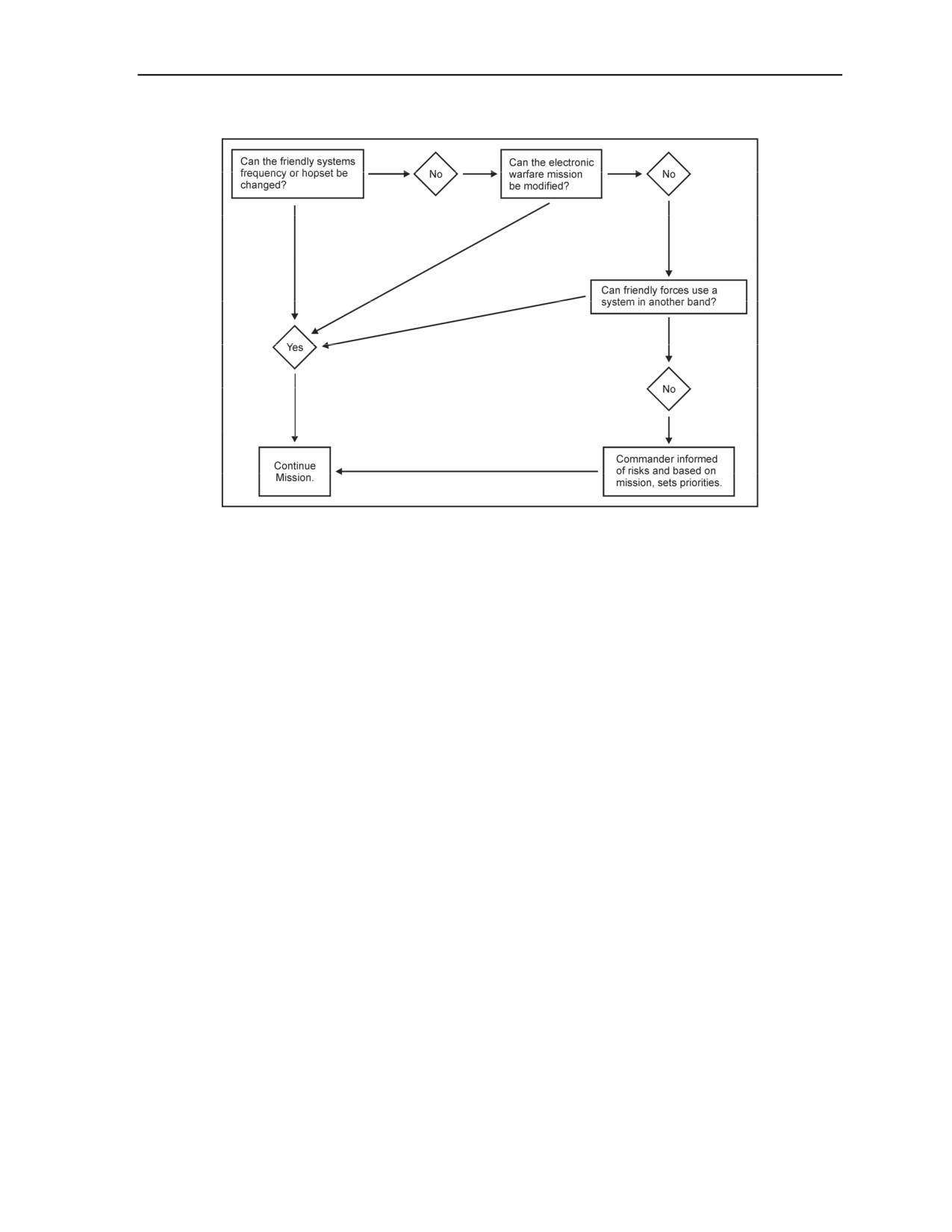
resolves the conflict through direct coordination. Figure 5-1 shows the basic procedures the spectrum
manager follows to deconflict spectrum use.
5-2
FM 3-36
25 February 2009
Coordination, Deconfliction, and Synchronization
Figure 5-1. Spectrum deconfliction procedures
5-11. The spectrum manager is a member of the G-6 or S-6 section that has staff responsibility for
spectrum management in the unit. The spectrum manager is a member of the unit’s EW working group.
Conflicts regarding spectrum use and allocation that cannot be resolved through direct coordination by the
spectrum manager are referred to the G-3 or S-3 for resolution.
JAMMING CONTROL AUTHORITY
5-12. Depending on the operational situation, an Army headquarters may be designated as the jamming
control authority. This authority serves as the senior jamming control authority in the area of operations. It
establishes guidance for jamming on behalf of the joint force commander. If designated as the jamming
control authority, the senior staff EW officer normally is tasked with the following responsibilities:
z
Participating in development of and ensuring compliance with the joint restricted frequency list.
z
Validating and approving or denying cease-jamming requests.
z
Maintaining situational awareness of all jamming-capable systems in the area of operations.
z
Acting as the joint force commander’s executive agent for developing EW intelligence gain-or-
loss recommendations when electronic attack or electronic warfare support conflicts occur.
z
Coordinating jamming requirements with joint force components.
z
Investigating unauthorized jamming events and implementing corrective measures.
See JP 3-13.1 for further information on jamming control authority.
ASSET MANAGEMENT
5-13. Regardless of echelon, the EW officer monitors and tracks the organization’s EW assets and their
status. The EW officer makes recommendations to the G-3 or S-3 concerning EW asset allocation and
reallocation when required. The EW officer monitors and tracks EW asset status within the EW working
group and reports this information to higher echelons via the Army battle command system.
25 February 2009
FM 3-36
5-3
Chapter 5
OTHER COORDINATING ACTIONS
5-14. In addition to the functional considerations listed in chapter 4, several coordinating actions must also
take place between the EW working groups (at all echelons) and the other planning and execution cells
within the headquarters. These actions include—
z
Detailed coordination between the EW activities and the intelligence activities supporting an
operation.
z
Coordination of EW systems reprogramming.
z
Coordination with the working groups or cells coordinating the command and control warfare
and information protection tasks.
Coordination Between EW Activites and Intelligence Activities
5-15. Most of the intelligence effort, before and during an operation, relies on collection activities targeted
against various parts of the electromagnetic spectrum. Electronic warfare support depends on the timely
collection, processing, and reporting of intelligence and combat information to alert EW operators and
other military activities about intelligence collected in the electromagnetic spectrum. The EW officer and
G-2 or S-2 ensure EW collection priorities and EW support collection assets are integrated into a complete
intelligence collection plan. This plan ensures that units maximize the use of scarce intelligence and
collection assets to support the commander’s objectives.
Coordination of EW Systems Reprogramming
5-16. The EW officer and G-2, at division and corps levels, track and coordinate EW systems
reprogramming input submitted by lower echelons. This input is then forwarded to the Army Service
component command headquarters for submission to the Army Reprogramming Analysis Team. EW
officers ensure this input is promptly submitted to ensure urgent reprogramming actions are completed for
assigned systems. See FM 3-13.10 for detailed procedures for reprogramming EW and target sensing
systems.
Coordination Between EW, Command and Control Warfare, and Information Tasks
5-17. EW working groups coordinate their supporting actions with the elements responsible for the Army
information tasks—information engagement, command and control warfare, information protection,
operations security, and military deception. Although EW plays a major role in supporting command and
control warfare and information protection, it also enhances or provides direct support to other information
tasks. For example, enemy radio and television broadcasts can be disrupted or replaced with friendly radio
and television messages as part of larger psychological operations in support of information engagement.
Electronic deception capabilities can support and enhance an overall military deception operation.
DECONFLICTION
5-18. Friendly forces depend on electromagnetic energy and the electromagnetic spectrum to sense,
process, store, measure, analyze, and communicate information. This dependency creates the potential for
significant interference between various friendly systems. Without proper deconfliction, interference could
damage friendly capabilities or lead to operational failure. This is especially true with regard to EW
systems. EW deconfliction includes—
z
Friendly electromagnetic spectrum use for communications and other purposes
(such as
navigation systems and sensors) with electronic attack activities
(such as counter-radio-
controlled improvised-explosive-device EW systems).
z
Electronic attack activities with electronic warfare support activities (potential electromagnetic
interference of collection assets).
5-4
FM 3-36
25 February 2009
Coordination, Deconfliction, and Synchronization
z
Electronic attack and electronic warfare support activities with information tasks involving
electromagnetic emissions (such as counter-radio-controlled improvised-explosive-device EW
systems interfering with a psychological-operations radio broadcast).
z
Electronic attack activities with host-nation electromagnetic spectrum users (such as commercial
broadcasters, emergency first responders, and law enforcement).
5-19. The forum for deconfliction is the unit’s EW working group. As such, the specific composition of
the working group may expand to include more than the standard staff representation described in
chapter 3. Regardless of echelon, to perform its critical deconfliction function, the EW working group
retains knowledgeable representation from and ready access to decisionmakers. The EW working group
also retains knowledge of and access to higher headquarters assistance and reachback capabilities available
(See appendix F for more information).
SYNCHRONIZATION
5-20. EW, particularly in electronic attack, can produce both intended and unintended effects. Therefore,
units thoroughly synchronize its use with other forms of fires and with friendly systems operating in the
electromagnetic spectrum. Through synchronization, units avoid negative effects such as communications
fratricide by jammers. The EW officer ensures all EW activities are integrated into the appropriate sections
of plans—fires, information protection, command and control warfare, and military deception plans. This
officer also synchronizes EW activities for maximum contribution to the commander’s desired effects
while preventing EW from inhibiting friendly force capabilities. The primary forum for this
synchronization is the unit’s EW working group. The EW officer attends the regular targeting meetings in
the fires cell and may also participate (perhaps as a standing member) in other functional or integrating
cells and working groups. These may include fires, information engagement, network operations, or future
operations. The EW officer’s participation in these other cells and working groups helps to synchronize
EW operations.
SUMMARY
5-21. EW capabilities yield many advantages for the commander. The EW working group’s sole purpose
is to facilitate the integration, coordination, deconfliction, and synchronization of EW operations to ensure
advantages are achieved. This effort requires constant coordination with the unit’s other functional cells
and working groups. As conflicts are identified during the planning and execution of operations, the EW
officer and supporting staff members coordinate solutions to those conflicts within the EW working group.
25 February 2009
FM 3-36
5-5
Chapter 6
Integration with Joint and Multinational Operations
Joint warfare is team warfare. It requires the integrated and synchronized application
of all appropriate capabilities. During joint operations, Services work together to
accomplish a mission. In multinational operations, forces of two or more nations
work together to accomplish a mission. During both joint and multinational
operations, forces operate under established organizational frameworks and
coordination guidelines. This chapter describes the joint and multinational
operational frameworks and guidelines for integrating electronic warfare capabilities.
JOINT ELECTRONIC WARFARE OPERATIONS
6-1. One strength of operating as a joint force is the ability to maximize combat capabilities through
unified action. However, the ability to maximize the capabilities of a joint force requires guidelines and an
organizational framework that can be used to integrate them effectively. JP
3-13.1 establishes the
guidelines and organizational framework for joint electronic warfare (EW) operations.
6-2. Joint task forces are task-organized. Therefore, their composition varies based on the mission.
Normally the EW organization within a joint force centers on the—
z
Component commands.
z
Supporting joint centers.
z
Joint force staff.
z
Joint force commander’s EW staff, joint electronic warfare coordination cell, or information
operations (IO) cell.
The supporting centers for EW operations may include the joint operations center, joint intelligence center,
Joint Frequency Management Office (JFMO), and joint targeting coordination board.
JOINT FORCE PRINCIPAL STAFF FOR ELECTRONIC WARFARE
6-3. In EW, the principal staff consists of the J-2, J-3, and J-6. The J-2 collects, processes, tailors, and
disseminates all-source intelligence for EW. The J-3 has primary staff responsibility for EW activity. This
director also plans, coordinates, and integrates joint EW operations with other combat disciplines in the
joint task force. Normally, the joint force commander’s EW staff or a joint EW coordination cell and an IO
cell assist the J-3. The joint force staff network operations director (in the J-6) coordinates electromagnetic
spectrum use for information systems with electromagnetic-dependent weapons systems used by the joint
force. The IO officer is the principal IO advisor to the J-3. This officer is the lead planner for integrating,
coordinating, and executing IO. The command EW officer is the principal EW planner on the J-3 staff.
This officer coordinates with the IO cell to integrate EW operations fully with other IO core, supporting,
and related capabilities (see JP 3-13.1 for further information)
JOINT FORCE COMMANDER’S ELECTRONIC WARFARE STAFF
6-4. A joint force commander’s EW staff supports the joint force commander in planning, coordinating,
synchronizing, and integrating joint force EW operations. The joint force commander’s EW staff ensures
that joint EW capabilities support the joint force commander’s objectives. The joint force commander’s
EW staff is an element within the J-3. It consists of representatives from each component of the joint force.
25 February 2009
FM 3-36
6-1
Chapter 6
An EW officer appointed by the J-3 leads this element. The joint force commander’s EW staff includes
representatives from the J-2 and J-6 to facilitate intelligence support and EW frequency deconfliction.
6-5. On many joint staffs, the intra-staff coordination previously accomplished through a joint force
commander’s EW staff is now performed by an IO cell or similar organization. An IO cell, if established,
coordinates EW activities with other IO activities to maximize effectiveness and prevent mutual
interference. If both a joint force commander’s EW staff and an IO cell exist, a joint force commander’s
EW staff representative may be assigned to the IO cell to facilitate coordination. For more information
about the organization and procedures of the joint IO cell, see JP 3-13.
JOINT ELECTRONIC WARFARE COORDINATION CELL
6-6. The decision to form a joint EW coordination cell depends on the anticipated role of EW in an
operation. When EW is expected to play a significant role in the joint force commander’s mission, a
component command’s EW coordination organization may be designated as the joint EW coordination cell
to handle the EW aspects of the operation. The joint EW coordination cell may be part of the joint force
commander’s staff, be assigned to the J-3 directorate, or remain within the designated component
commander’s structure. The joint EW coordination cell plans operational-level EW for the joint force
commander. (JP 3-13.1 discusses the joint EW coordination cell in more detail.)
JOINT TASK FORCE COMPONENT COMMANDS
6-7. Joint task force component commanders exercise operational control of their EW assets. Each
component is organized and equipped to perform EW tasks in support of its basic mission and to provide
support to the joint force commander’s overall objectives. If a component command (Service or functional)
is designated to stand up a joint EW coordination cell, it executes the responsibilities and functions
outlined in JP 3-13.1.
6-8. A major consideration for standing up a joint EW coordination cell at the component command level
is access to a special compartmented information facility to accomplish the cell’s required coordination
functions. Optimal joint EW coordination cell staffing dictates including special technical operations
personnel cleared to coordinate and deconflict special technical operations issues. Special technical
operations are associated with the planning and coordination of advanced special programs and the
integration of new capabilities into operational units.
6-9. Under current force structure, the special technical operations requirement limits the activation of a
joint EW coordination cell to organizations at corps and above levels. Organizations below corps level
require significant joint augmentation to meet the special technical operations requirement.
JOINT FREQUENCY MANAGEMENT OFFICE
6-10. Joint policy tasks each geographic combatant commander to establish a structure to manage
spectrum use and establish procedures that support ongoing operations. This structure must include a
JFMO. The JFMO may be assigned from the supported combatant commander’s J-6 staff, from a
component’s staff, or from an external command such as the Joint Spectrum Center. The JFMO
coordinates the information systems use of the electromagnetic spectrum, frequency management, and
frequency deconfliction. The JFMO develops the frequency management plan and makes recommendations
to alleviate mutual interference.
6-11. The G-6 or S-6 coordinates the Army’s use of the electromagnetic spectrum, frequency management,
and frequency deconfliction with the JFMO through the network operations cell. If established,
coordination with the joint spectrum management element is required. (See figure 6-1.)
6-2
FM 3-36
25 February 2009
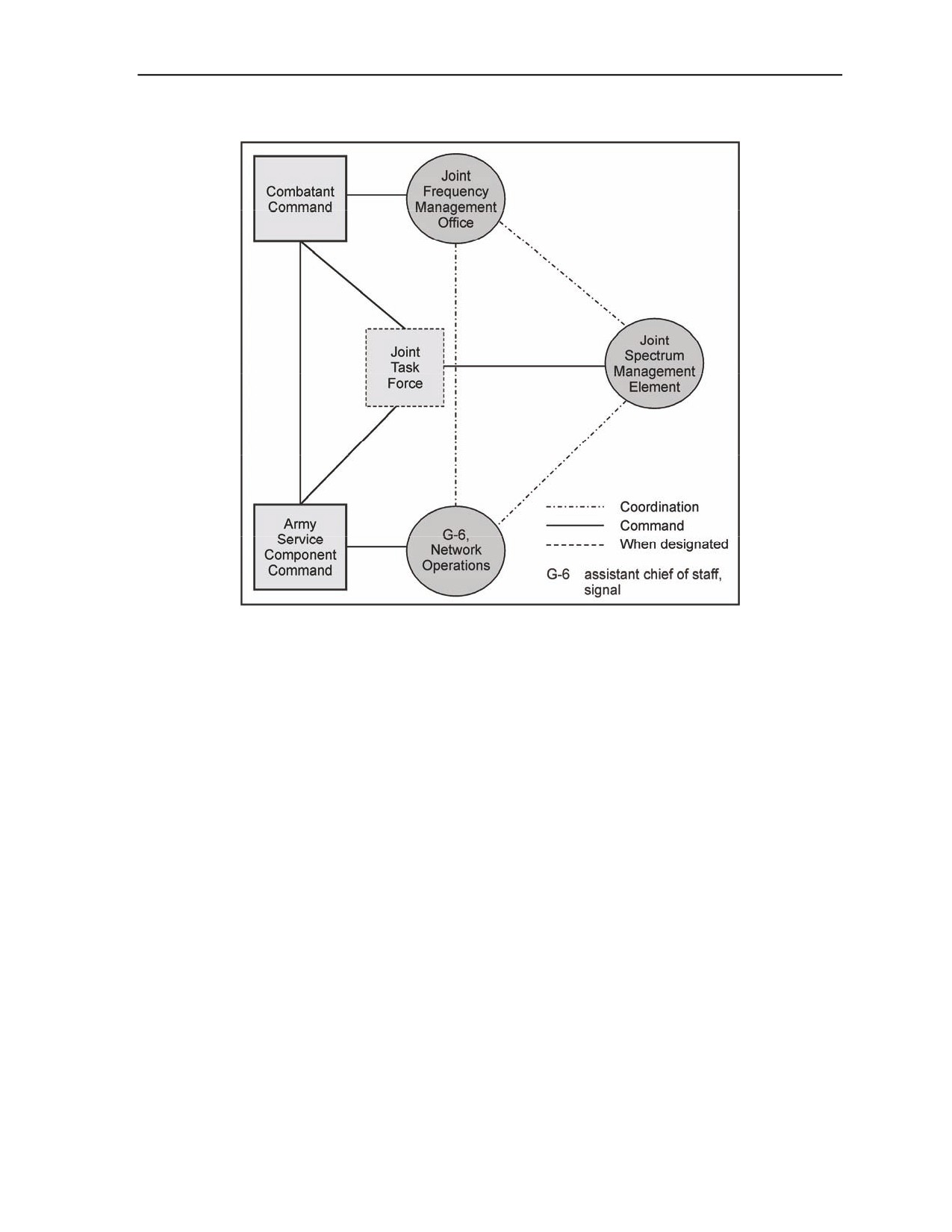
Integration with Joint and Multinational Operations
Figure 6-1. Joint frequency management coordination
JOINT INTELLIGENCE CENTER
6-12. The joint intelligence center is the focal point for the intelligence structure supporting the J-2.
Directed by the J-2, the joint intelligence center communicates directly with component intelligence
agencies and monitors intelligence support to EW operations. This center can adjust intelligence gathering
to support EW missions. Within the G-2, EW support requests are coordinated through the requirement cell
and then forwarded to the requirements division within the joint intelligence center. (See figure 6-2, page
6-4.)
25 February 2009
FM 3-36
6-3
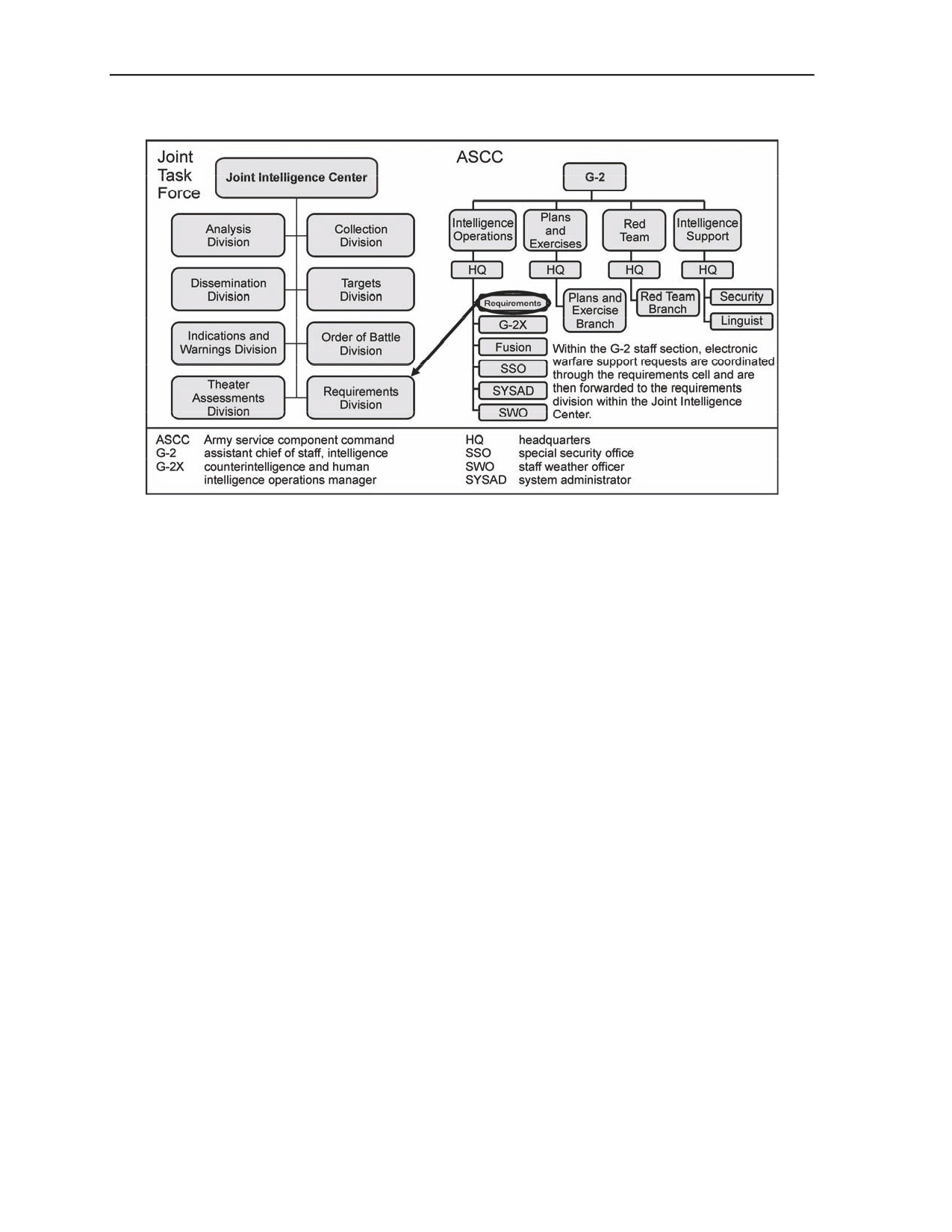
Chapter 6
Figure 6-2. Electronic warfare support request coordination
6-13. The composition and focus of each joint intelligence center varies by theater. However, each can
perform indications and warning as well as collect, manage, and disseminate current intelligence. Through
the joint intelligence center, the ARFOR (Army Service component) headquarters coordinates support from
the Air Force, Navy, and Marine Corps and national, interagency, and multinational sources. In addition to
its other functions, the joint intelligence center coordinates the acquisition of national intelligence for the
joint task force and the combatant command’s staff.
JOINT TARGETING COORDINATION BOARD
6-14. The joint targeting coordination board focuses on developing broad targeting priorities and other
targeting guidance in accordance with the joint force commander’s objectives as they relate operationally.
The joint targeting coordination board remains flexible enough to address targeting issues without
becoming overly involved in tactical-level decisionmaking. Briefings conducted at the joint targeting
coordination board focus on ensuring that intelligence, operations (by all components and applicable staff
elements), fires, and maneuver are on track, coordinated, and synchronized. For further information on the
joint targeting coordination board, see JP 3-60.
MULTINATIONAL ELECTRONIC WARFARE OPERATIONS
6-15. EW is an integral part of multinational operations (sometimes referred to as combined operations).
U.S. planners integrate U.S. and multinational EW capabilities into a single, integrated EW plan. U.S.
planners provide multinational forces with information concerning U.S. EW capabilities and provide them
EW planning and operational support. However, the planning of multinational force EW is difficult due to
security issues, differences in levels of training, language barriers, and terminology and procedural issues.
U.S. and North Atlantic Treaty Organization (NATO) EW doctrine provide commonality and a framework
for using EW in NATO operations. (See Allied Joint Publication 3.6 for specific information.)
MULTINATIONAL FORCE COMMANDER
6-16. The multinational force commander provides guidance for planning and conducting EW operations
to the multinational force through the C-3 and the EW coordination cell. The EW coordination cell is
6-4
FM 3-36
25 February 2009
Integration with Joint and Multinational Operations
located at multinational force headquarters. An IO cell may also be established to coordinate all IO-related
activities, including related EW operations.
JOINT OPERATIONS STAFF SECTION
6-17. Within the multinational staff, the joint operations section has primary responsibility for planning
and integrating EW activities. A staff EW officer is designated with specific responsibilities. These include
integrating multinational augmentees, interpreting or translating EW plans and procedures, coordinating
appropriate communications connectivity, and integrating multinational force communications into a joint
restricted frequency list.
MULTINATIONAL ELECTRONIC WARFARE COORDINATION CELL
6-18. In multinational operations, the multinational force commander uses an EW coordination cell as the
mechanism for coordinating EW resources within the area of operations. This cell is an integral part of the
multinational joint force headquarters J-3 staff, at whatever level is appropriate. It provides an effective
means of coordinating all EW activities by the multinational force. The multinational force EW
coordination cell plans and coordinates all in-theater EW activities in close liaison with the J-2, J-5, and
J-6.
ELECTRONIC WARFARE MUTUAL SUPPORT
6-19. Electronic warfare mutual support is the timely exchange of EW information to make the best use of
the available resources. It is facilitated by the use of an agreed reference database called the NATO emitter
database. Electronic warfare mutual support procedures developed during EW planning include—
z
A review of friendly and enemy information data elements that may be exchanged.
z
Mechanisms leading to the exchange of data during peace, crisis, and war.
z
Development of peacetime exercises to practice the exchange of data.
z
Establishment of EW points of contact with adjacent formations and higher and subordinate
headquarters for planning purposes, regardless of whether EW resources exist or not.
z
Initial acquisition and maintenance of multinational force EW capabilities.
z
Exchange of EW liaison teams equipped with appropriate communications.
z
Establishment and rehearsal of contingency plans for the exchange of information on friendly
and enemy forces.
z
Development of communications protocols in accordance with NATO Standardization
Agreement (STANAG) 5048.
z
Provision of secure, dedicated, and survivable communications.
OTHER CONSIDERATIONS
6-20. EW in multinational operations addresses other considerations. Soldiers must consider—
z
Exchange of EW information.
z
Exchange of signals intelligence information.
z
Exchange of the electronic order of battle.
z
Electronic warfare reprogramming.
6-21. Army forces participating in multinational EW operations must exchange EW information with other
forces. They must help develop joint information exchange protocols and use those protocols for
conducting operations.
6-22. Exchanging signals intelligence information requires care to avoid violating signals intelligence
security rules. The policy and relationship between EW and signals intelligence within NATO are set out
in NATO Military Committee (MC) 64.
25 February 2009
FM 3-36
6-5
Chapter 6
6-23. In peacetime, before forming a multinational force, the exchange of electronic order of battle
information is normally achieved under bilateral agreement. During multinational operations, a
representative of the joint EW coordination cell, through the theater joint analysis center or the joint
intelligence center, ensures the maintenance of an up-to-date electronic order of battle. The inclusion of
multinational forces is based on security and information exchange guidelines agreed upon by the
participating nations.
6-24. Electronic warfare reprogramming is a national responsibility. However, the joint EW coordination
cell remains aware of reprogramming efforts being conducted within the multinational force. FM 3-13.10
guides the Army’s reprogramming effort.
SUMMARY
6-25. Every joint or multinational operation is uniquely organized to accomplish the mission. Army EW
officers integrate EW forces and capabilities with the organizations and agencies outlined in this chapter.
To coordinate Army EW operations with joint and multinational forces, Army EW officers must
understand fully the organizational frameworks, policies, and guidelines established for joint and
multinational EW operations.
6-6
FM 3-36
25 February 2009
Chapter 7
Electronic Warfare Capabilities
Electronic warfare capabilities consist of high-demand, low-density assets across the
Services. Hence, the conduct of electronic warfare operations requires joint
interdependence. This complex interdependence extends beyond the traditional
Service capabilities. It includes national agencies—such as the Central Intelligence
Agency, National Security Agency, and Defense Intelligence Agency—that
constantly seek to identify, catalog, and update the electronic order of battle of
enemies and adversaries. To support the joint force commander, the subject matter
expertise and unique capabilities provided by each Service, agency, and branch or
proponent are integrated with all available electronic warfare capabilities.
SERVICE ELECTRONIC WARFARE CAPABILITIES
7-1. Each Service maintains electronic warfare (EW) capabilities to support operational requirements.
During operations, the Army is dependent on organic and nonorganic EW capabilities from higher
echelons, joint forces, and national agencies. Army EW planners leverage all available EW capabilities to
support Army operations. Although not all-inclusive, appendix E provides a listing of current Army,
Marine Corps, Navy, and Air Force EW capabilities and references.
EXTERNAL SUPPORT AGENCIES AND ACTIVITIES
7-2. Army EW planners routinely use and receive support from external organizations to assist in
planning and integrating EW operations. Support from these organizations may include personnel
augmentation, functional area expertise, technical support, and planning support.
BIG CROW PROGRAM OFFICE
7-3. The Big Crow Program Office was established in 1971 to provide testing environments for U.S.
military radio frequency sensor, communication, and navigation systems. Today, the Big Crow Program
Office provides customers with joint, multifunctional support for testing communications, sensors,
information operations, and related weapon systems in support of Department of Defense (DOD), the
individual Services, the National Aeronautics and Space Administration, the National Reconnaissance
Office, and others. This support includes replicating information operations and EW threat environments as
well as providing telemetry recording, technology prototyping, proof-of-concept demonstrations, and
information operations and EW training. Big Crow’s mission and capabilities now span the
electromagnetic spectrum, encompassing EW, telemetry, radar, and electro-optical systems. Mobile and
worldwide deployable, the Big Crow Program Office offers a variety of capabilities.
DEFENSE INFORMATION SYSTEMS AGENCY
7-4. The Defense Information Systems Agency is a combat support agency. It plans, develops, fields,
operates, and supports command, control, communications, and information systems. These systems serve
the President, the Secretary of Defense, the Joint Chiefs of Staff, the combatant commanders, and other
DOD components. The Defense Information Systems Agency also operates the Vulnerability Analysis and
Assessment Program. This program specifically focuses on automated information systems.
25 February 2009
FM 3-36
7-1
Chapter 7
JOINT COMMUNICATIONS SECURITY MONITOR ACTIVITY
7-5. The Joint Communications Security Monitor Activity was created in 1993 by a memorandum of
agreement between the Services’ operations deputies, Directors of the Joint Staff, and the National Security
Agency. The Joint Communications Security Monitor Activity monitors (collects, analyzes, and reports)
communications security of DOD telecommunications and automated information systems as well as
related noncommunications signals. Its purpose is to identify potentially exploitable vulnerabilities and to
recommend countermeasures and corrective actions. The Joint Communications Security Monitor Activity
supports real world operations, joint exercises, and DOD systems monitoring.
JOINT INFORMATION OPERATIONS WARFARE COMMAND
7-6. The Joint Information Operations Warfare Command
(JIOWC) was activated in
2006 as a
functional component to the United States Strategic Command (USSTRATCOM). JIOWC integrates joint
information operations into military plans, exercises, and operations across the spectrum of conflict. It is a
valuable resource for commanders during the planning and execution of joint information operations.
JIOWC deploys information operations planning teams when the commander of USSTRATCOM approves
a request for support. This center delivers tailored, highly skilled support and sophisticated models and
simulations to joint commanders and provides information operations expertise in joint exercises and
contingency operations.
7-7. JIOWC also fields the Joint Electronic Warfare Center. This center provides specialized expertise in
EW. It is an innovation center for existing and emerging EW capabilities and tactics, techniques, and
procedures via a network of units, labs, test ranges, and academia. The Joint Electronic Warfare Center
also has EW reprogramming oversight responsibilities for the Joint Staff. This oversight includes
organizing, managing, and exercising joint aspects of EW reprogramming and facilitating the exchange of
joint EW reprogramming data. The actual reprogramming of equipment, however, is a Service
responsibility.
JOINT SPECTRUM CENTER
7-8. The Joint Spectrum Center was activated in 1994 under the direction of the joint staff’s J-6. The
Joint Spectrum Center assumed all the missions and responsibilities previously performed by the
Electromagnetic Compatibility Center plus additional responsibilities. Personnel in the Joint Spectrum
Center are experts in spectrum planning, electromagnetic compatibility and vulnerability, electromagnetic
environmental effects, information systems, modeling and simulation, operations support, and system
acquisition. The Joint Spectrum Center provides complete, spectrum-related services to combatant
commanders, Services, and other government agencies. The Joint Spectrum Center deploys teams in
support of the combatant commanders and serves as the DOD focal point for supporting spectrum
supremacy aspects of information operations. It assists Soldiers in developing and managing the joint
restricted frequency list and helps to resolve operational interference and jamming incidents. The Joint
Spectrum Center can also provide databases of friendly force command and control systems for use in
planning electronic protection. The Joint Spectrum Center is a field office within the Defense Spectrum
Organization under the Defense Information Systems Agency.
JOINT WARFARE ANALYSIS CENTER
7-9. The Joint Warfare Analysis Center is a Navy-sponsored joint command under the J-3 established in
1994. The Joint Warfare Analysis Center assists the Chairman of the Joint Chiefs of Staff and combatant
commanders in preparing and analyzing joint operational plans. It provides analysis of engineering and
scientific data and integrates operational analysis with intelligence.
MARINE CORPS INFORMATION TECHNOLOGY AND NETWORK OPERATIONS CENTER
7-10. The Marine Corps Information Technology and Network Operations Center is the Marine Corps’
enterprise network operations center. The Marine Corps Information Technology and Network Operations
Center is the nerve center for the central operational direction and configuration management of the Marine
7-2
FM 3-36
25 February 2009