FM 3-90-2 RECONNAISSANCE, SECURITY, AND TACTICAL ENABLING TASKS, Volume 2 (MARCH 2013) - page 3
Chapter 4
z
Ammunition and equipment incompatibility may make exchanging assets more difficult.
z
Impact of civilians on the operations.
4-32. Reliefs in place during the conduct of operations centering on the stability element or defense
support of civil authorities element of decisive action involve many of the planning, preparation, and
execution considerations mentioned above. This is often the case in the current operational environment.
Time is not normally such an important factor and most reliefs in place or transfers of authority in these
types of operations are deliberate and may occur over an extensive time period.
4-6
FM 3-90-2
22 March 2013

Chapter 5
Passage of Lines
A commander conducts a passage of lines to continue an attack or conduct a
counterattack, retrograde security or main battle forces, and any time one unit cannot
bypass another unit’s position. The conduct of a passage of lines potentially involves
close combat. It involves transferring the responsibility for an area of operations
(AO) between two commanders. That transfer of authority usually occurs when
roughly two-thirds of the passing force has moved through the passage point. If not
directed by higher authority, the unit commanders determine—by mutual
agreement—the time to pass command. They disseminate this information to the
lowest levels of both organizations.
GENERAL CONSIDERATIONS OF A PASSAGE OF LINES
5-1. Passage of lines is an operation in which a force moves forward or rearward through another force’s
combat positions with the intention of moving into or out of contact with the enemy. A passage may be
designated as a forward or rearward passage of lines (JP 1-02).The commander’s reasons for conducting a
passage of lines are to—
z
Sustain the tempo of an offensive operation.
z
Maintain the viability of the defense by transferring responsibility from one unit to another.
z
Transition from a delay or security operation by one force to a defense.
z
Free a unit for another mission or task.
The headquarters directing the passage of lines is responsible for determining when the passage starts and
finishes.
5-2. A passage of lines occurs under two conditions. A forward passage of
lines occurs when a unit passes through another unit’s positions while moving
toward the enemy (ADRP 3-90). A rearward passage of lines occurs when a
unit passes through another unit’s positions while moving away from the
enemy (ADRP 3-90). Ideally, a passage of lines does not interfere with
conducting the stationary unit’s operations. Figure 5-1 shows the tactical
mission graphic for both a forward and a rearward passage of lines. The arrow
goes in the direction the passing unit is moving.
ORGANIZATION OF FORCES FOR A PASSAGE
OF LINES
Figure 5-1. Forward
5-3. A unit may participate in a passage of lines as either the passing or
and rearward passage
stationary force. Except for co-locating command posts and providing for
of lines tactical
guides by the stationary force, conducting a passage of lines does not require a
mission graphic
special task organization. Both the passing force and the stationary force
maintain their previous combat organization during the passage. Usually, if the stationary unit has the
capability, it is responsible for conducting operations against uncommitted enemy forces. However,
operations directed against uncommitted enemy forces may be the responsibility of a higher echelon,
depending on the echelon at which the passage takes place.
22 March 2013
FM 3-90-2
5-1
Chapter 5
5-4. A forward passing unit’s order of march is generally reconnaissance and security elements first. The
ground combat force moves next, followed by functional and multifunctional support and sustainment
units. The commander integrates artillery and engineers into the order of march in accordance with the
mission variables of mission, enemy, terrain and weather, troops and support available, time available, and
civil considerations (METT-TC). The passing unit reverses this order of march in a rearward passage of
lines. The stationary unit normally provides the moving unit with guides to expedite the passage. Attack
reconnaissance helicopters and armed unmanned aerial systems (UASs) are useful in providing security.
CONTROL MEASURES FOR A PASSAGE OF LINES
5-5. Control measures associated with a passage of lines are generally restrictive to prevent friendly fire
incidents. As a minimum, they include the AO, assembly areas (AAs), attack positions, battle handover line
(BHL), contact points, passage points, passage lanes, routes, gaps, phase lines, and recognition signals. The
headquarters directing the passage designates or recommends contact points, passage lanes, AAs, routes,
and start and end times for the passage. The commander may also use start points, release points, fire
support coordination measures, such as coordinated fire lines (CFLs), and other control measures as
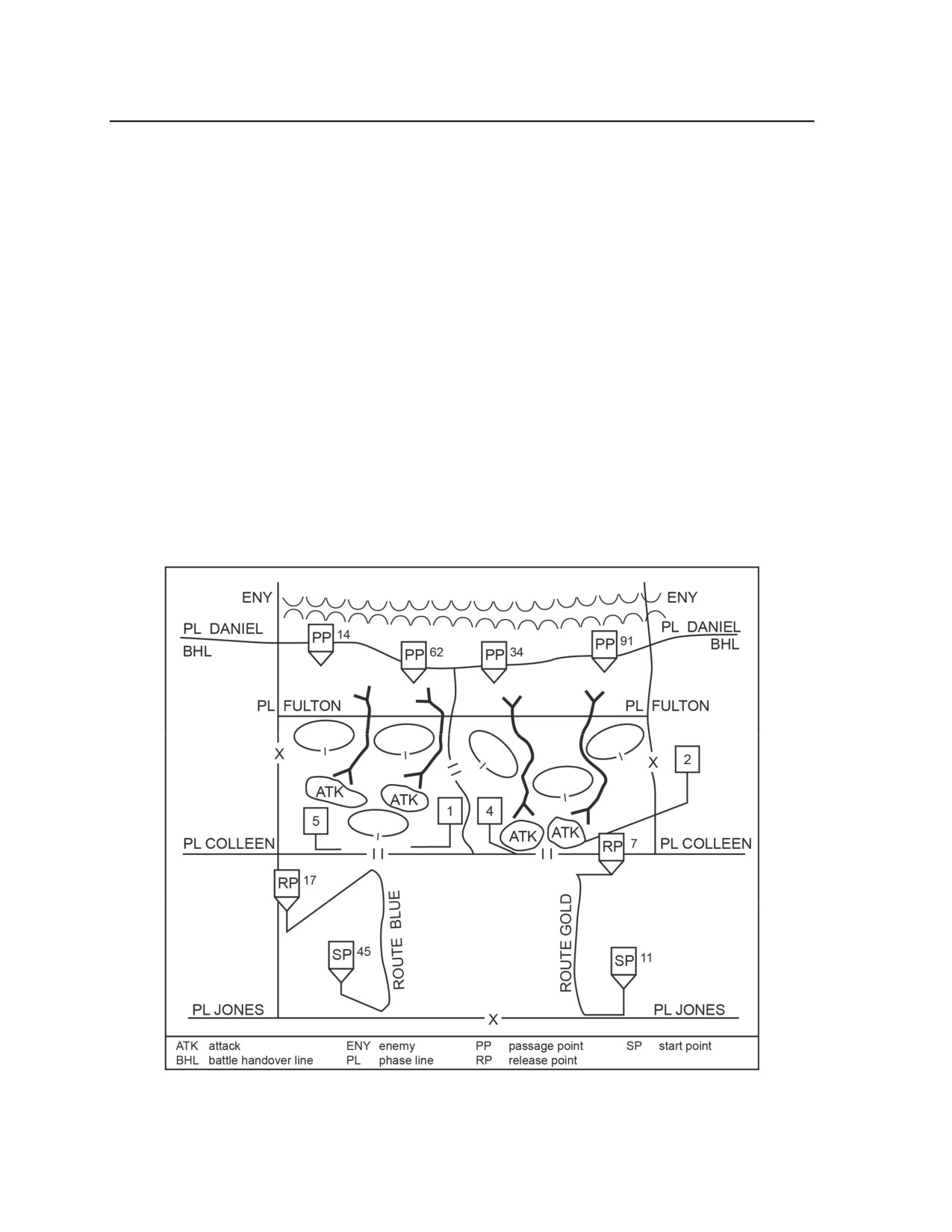
necessary to conduct this task. (See figure 5-2.) Unless the higher headquarters of the two units establishes
the necessary graphic control measures, the stationary unit establishes them for the passage. However, the
stationary unit commander coordinates them with the passing unit commander. The stationary unit
establishes these measures because it controls the terrain, it knows where the obstacles are, and it knows the
tactical plan. If the control measures dictated by the higher headquarters are not sufficient—because they
do not contain enough passage points, lanes, and so forth—the two units can agree to add the necessary
measures.
Figure 5-2. Control measures associated with a forward passage of lines
5-2
FM 3-90-2
22 March 2013

Passage of Lines
5-6. A passage point is a specifically designated place where the passing units pass
through the stationary unit. The location of this point is where the commander wants
subordinate units to physically execute a passage of lines. In a forward passage of
lines, the passage point marks the location where the passing unit is no longer bound
by the restrictions placed on it by the stationary force. On the other hand, in a rearward
passage of lines, the passage point marks the location where the stationary unit can
restrict the movement and maneuver of the passing force. Between the contact point
and the passage point, the stationary unit controls the passing force’s movement.
Figure 5-3.
Figure 5-3 depicts the graphic control measure for passage point 7.
Passage point
7
5-7. A passage lane is a lane through an enemy or friendly obstacle that provides
safe passage for a passing force. The lane may be cleared, including being reduced
and proofed, as part of a breach operation, or it may be included as part of the design of
a friendly obstacle. It is a clear route all the way through an obstacle. Passage lanes
normally end where a route begins. That route should allow the passing unit to move
rapidly through the stationary unit’s area. Figure
5-4 depicts the graphic control
measure for a lane.
5-8. A gap is an area free of armed mines or obstacles whose width and direction
allow a friendly force to pass through the area containing obstacles while dispersed in a
Figure 5-4.
tactical formation
(ADRP
1-02). The presence of gaps prevents inadvertent
Passage lane
concentrations of Soldiers and equipment around the entry points of lanes. Figure 5-5
depicts the graphic control measure for a gap.
PLANNING A PASSAGE OF LINES
5-9. As with any activity involving transferring combat responsibility from one unit to
another, the complex nature of a passage of lines involves risk. As with other
operations, a passage of lines may be categorized as deliberate or hasty. During a
Figure 5-5.
passage of lines, the commander normally maintains the established tempo. Sustaining
Gap
that established tempo requires detailed planning and preparations for a deliberate
passage of lines. In this case, both the stationary and moving force have time to—
z
Publish written orders.
z
Exchange plans, intelligence information, databases, and liaison personnel.
z
Conduct briefings and detailed reconnaissance.
z
Conduct rehearsals.
The commander uses oral and fragmentary orders to conduct a hasty passage of lines.
5-10. In a passage of lines, the headquarters directing the passage is responsible for designating—
z
Subsequent missions for both forces.
z
When and under what conditions passage of command takes place.
z
Start and finish times for the passage.
z
Contact points between the units involved.
z
Common maneuver control measures and graphics.
The directing headquarters normally establishes this information in either the warning order or the order
directing the passage. In the absence of higher-echelon guidance, close coordination and understanding
between the commanders and staffs of the two units are essential to a smooth passage.
5-11. The unit commanders plan the passage of lines to maintain enemy contact and provide constant fires
on the enemy. Commanders reduce risk and ensure synchronization through detailed planning and
decentralized execution. With forces intermingling during the passage, the need for positive control
increases. The passage requires close coordination, clearly understood control measures, liaison between all
headquarters and echelons involved in the passage, and clear identification of the moment or event that
causes one force to assume responsibility for the AO from another.
22 March 2013
FM 3-90-2
5-3
Chapter 5
5-12. After receiving the warning order that directs a passage of lines, the passing unit’s commander and
key staff representatives generally co-locate with the command post of the stationary unit to facilitate in
planning the passage and establishing common situational understanding. If the passing unit cannot
co-locate one of its command posts to help plan the passage, it conducts extensive liaison with the
stationary unit. The planning focus for both the passing unit and the stationary unit is on operations
following the passage. While this occurs, the two units involved coordinate the following:
z
The exchange of intelligence and combat information.
z
Current friendly dispositions and tactical plans, especially military deception and obstacle plans.
z
Direct and indirect fires and close air support plans.
z
Any necessary maneuver control measures and graphics not directed by the higher headquarters,
such as boundary changes, the BHL, emergency sustainment points, and AA and firing positions
for artillery, air defense, and other units.
z
Long-range and short-range recognition symbols and vehicle markings to reduce the probability
of fratricide.
z
When and under what conditions control of the AO transfers from one headquarters to the other.
z
Provisions for movement control, including contact points, start and release points, primary and
alternate routes, route selection, priorities for using routes and facilities, passage points, and
provision for guides.
z
Reconnaissance by elements of the passing unit.
z
Signal operating instruction details, such as call signs, frequencies, and recognition signals.
z
Populate icons in blue force tracker to reduce the probability of friendly fire incidents.
z
Security measures during the passage, including nuclear, biological, and chemical
reconnaissance or biological detection systems.
z
Fires, obscurants, and any other maneuver and functional and multifunctional support, and
sustainment provided by the stationary unit.
z
Measures to reduce both units’ vulnerability to attack by enemy weapons of mass destruction.
z
Operations security measures required before or during the passage.
z
Allocation of terrain for use by the passing force.
z
Air defense cover—up to and forward of the BHL.
z
Logistics support for the passing unit provided by the stationary unit, especially fuel,
maintenance, and medical treatment.
5-13. The fires cell of both the stationary and the passing unit agree on allocating firing positions. The AO
commander controls the allocation of firing positions in case of disagreement. These positions must be far
enough forward to support the operation without having to redeploy during critical stages of the battle. The
fire support elements normally position in areas not identified by the enemy.
5-14. Detailed air defense planning is essential for a passage of lines. Moving units tend to move slowly
and often in some type of column formation during the passage. Vehicle congestion presents lucrative
targets to enemy aircraft. In most cases, the echelon above corps stationary air and missile defense elements
protect the passing force. Dissemination of early warning and airspace command and control information
reduces the risk of fratricide to friendly aviation assets while increasing the probability of the timely
detection of enemy aircraft. Strict adherence to identification and friend-or-foe procedures among pilots
and air defense fire units is critical, especially during periods of limited visibility. Local air superiority also
reduces the vulnerability of the two forces when they cannot avoid congestion on the ground.
5-15. Once a passage of lines begins, it occurs quickly. Where possible, the operation takes place when the
enemy has the least capability to detect it, such as at night or during periods of reduced visibility. In any
passage of lines, the commander considers using smoke to screen friendly movement, even at night.
5-16. The passing unit prefers to conduct the passage through a gap in the stationary unit’s positions rather
than through a lane or a route that traverses those positions. This reduces the vulnerability that results from
5-4
FM 3-90-2
22 March 2013
Passage of Lines
concentrating forces when one unit passes directly through the occupied positions of another unit. It also
avoids the danger of concentrating the passing unit into passage lanes.
5-17. In a forward passage of lines, when there are no gaps through the stationary unit’s positions, each
battalion task force normally needs at least two passage lanes. In a rearward passage of lines, each battalion
needs at least one passage lane. In both cases, a brigade combat team (BCT) needs at least one additional
lane for its tactical vehicles. The routes and lanes provide cover, concealment, and rapid movement of the
passing force. The commander may designate alternative routes and lanes for elements of the moving force
that are contaminated. They do not disrupt the combat capability of the stationary unit. The commander
seeks additional lanes to speed the process, if the terrain and enemy situation allow.
5-18. The passing unit normally has priority of route use to and in the stationary unit’s AO. Clearing and
maintaining passage routes up to the BHL are responsibilities of the stationary force. The stationary force
provides an obstacle overlay of its obstacles. The passing unit prepares to help maintain these routes, and it
positions its engineer equipment accordingly. The stationary unit controls traffic in its AO, until the passing
unit assumes control. During the passage, the passing unit augments the traffic control capability of the
stationary unit as required.
5-19. Based on the commander’s concept and intent, the passing force focuses its planning effort on two
general areas: coordination with the stationary force and guidance to subordinate units conducting the
passage. These planning efforts occur simultaneously. If the enemy attacks during the passage, the plan
probably requires modification to prevent hampering friendly maneuver.
5-20. Executing a passage of lines successfully requires effective communication between the two units.
The commanders build redundancy of communication signals and means into their passage plans, such as
using blue force tracker, enhanced position location and reporting system, and other mission command
systems. The commanders also designate contact points to ensure effective communication between the
two forces at the lowest tactical level.
FORWARD PASSAGE OF LINES
5-21. The purpose of a forward passage of lines is to move forces forward to conduct operations. It ensures
the maintenance of enemy contact while allowing the relief of previously committed forces. The stationary
force controls and secures the AO far enough to its front that the moving force can pass through the
stationary force and reform into a combat formation before contact with an enemy force. Generally, the
stationary unit supports the passing unit, until the passing unit masks the stationary unit’s direct fires. The
stationary unit continues to support the passing force with its fire support systems, until the passing unit
moves beyond the supporting range of the stationary force. The stationary unit is also responsible for the
security of the line of departure of the forward passing unit, until it is able to assume that responsibility.
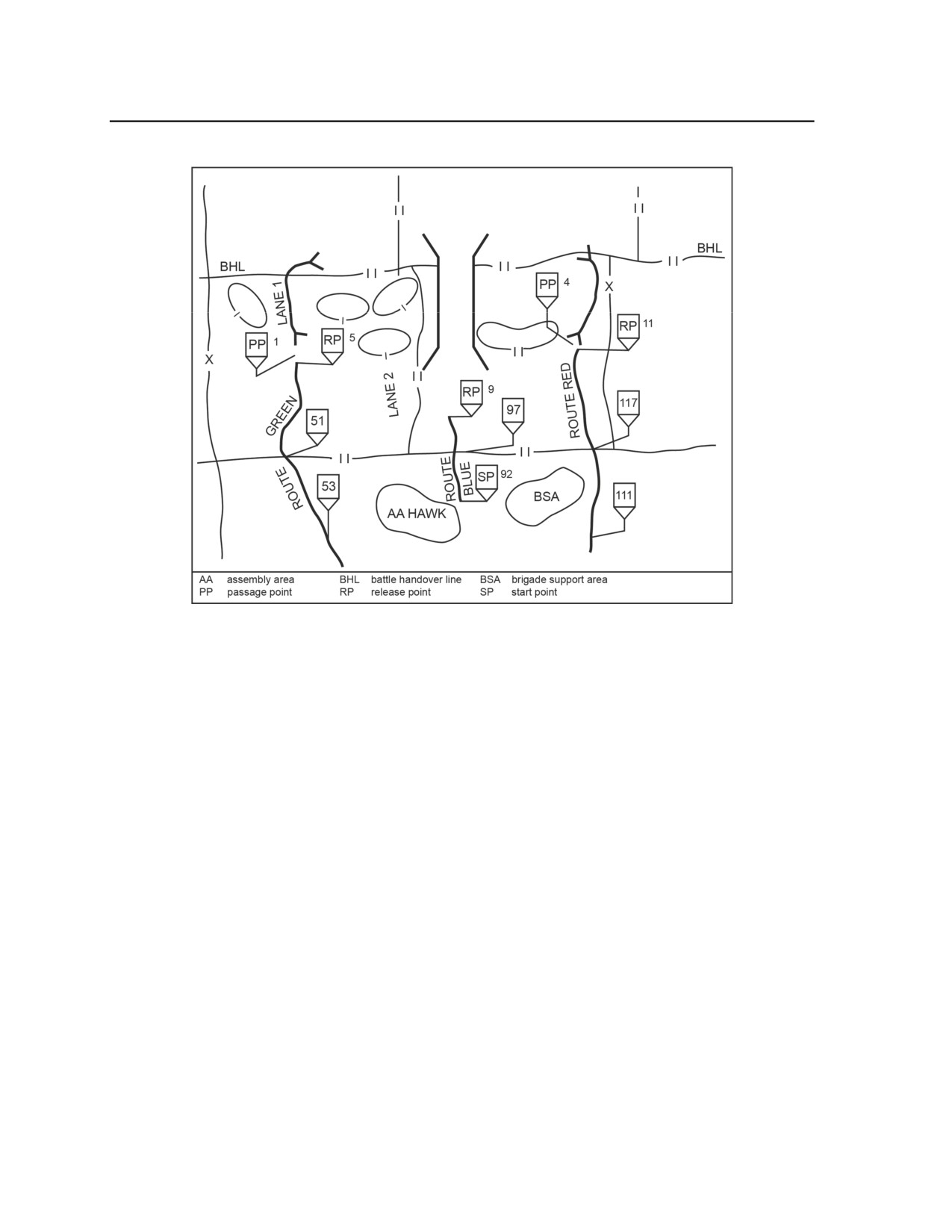
The boundaries of the forward passing force after it completes its passage do not have to coincide with the
boundaries of the stationary force. (See figure 5-6 on page 5-6.)
PREPARING A FORWARD PASSAGE
5-22. The passing unit conducts reconnaissance from its current location to its designated AAs, which are
generally located to the rear of the stationary unit. After completing its reconnaissance, the passing unit
occupies these AAs.
5-23. The commander organizes the passing force for its subsequent mission before initiating the forward
passage of lines. The passing force avoids regrouping in forward AAs or attack positions.
22 March 2013
FM 3-90-2
5-5
Chapter 5
Figure 5-6. Forward passage of lines
EXECUTING A FORWARD PASSAGE
5-24. When the passing force moves forward, it moves without a halt through the stationary unit while
deployed in a combat formation. That minimizes the time the two forces are concentrated in the forward
area, making them less vulnerable to enemy attack.
5-25. Support by the stationary force ends when the combat elements of the moving force, including the
reserve, have moved beyond direct-fire range. However, artillery, air defense, and other long-range systems
may remain to support the passing unit until a previously designated event occurs or a higher headquarters
directs another mission.
5-26. When executing the forward passage, the passing unit’s reconnaissance elements operate forward of
the release points and establish a screen in front of the passing unit. The stationary unit conducts aggressive
security operations throughout the passage of lines. The movement of main body forces begins from their
AAs to attack positions, where the passing unit conducts its final preparations for the passage of lines and
the attack. The passing unit moves to and occupies attack positions when enemy observation is unlikely.
The stationary unit clears any obstacles from designated passage gaps, lanes, or routes, and guides elements
of the passing unit from the contact point through the passage points.
5-27. The direct and indirect-fire assets of the stationary unit normally support the movement of the
passing unit. Electronic warfare—especially electronic attack—directed against enemy command and
control nodes disrupt the enemy’s dissemination of information and ability to react effectively to friendly
operations. Any preparatory or covering fires coincide with the passing unit’s movement from the attack
position to the passage lanes. After the forward moving unit commander assumes responsibility for the AO,
that commander coordinates all fire support. Depending on the situation, the passing commander may
continue to use only the fire support assets of the stationary force until the passage of lines is complete.
This allows the passing unit’s fire support assets to move forward, in the case of artillery, or remain
5-6
FM 3-90-2
22 March 2013
Passage of Lines
available to support the passing unit’s forward movement, in the case of attack helicopters conducting close
combat attack and close air support. On passage of command, the passing commander also assumes control
of fires forward of the BHL. For example, the passing commander moves the CFL forward to conform to
the movement of forward security elements.
5-28. The superior headquarters of the forces involved exercises overall mission command of the passage.
In a forward passage, the commander of the passing force normally assumes responsibility for conducting
operations beyond the BHL once the attack begins. In practice, however, it is useful to complete the
transfer of responsibility, including fire support, just before starting the operation. During the passage, two
parallel chains of command are operating in one area simultaneously, and the possibility of confusion
exists. A successful passage of lines requires clear mission command responsibilities. The passing unit’s
command post passes through the lines as soon as possible after the lead elements complete their passage
and locates where it can best control operations.
5-29. The stationary unit furnishes the passing unit with any previously coordinated or emergency logistics
assistance within its capabilities. These typically include—
z
Evacuating casualties and enemy prisoners of war.
z
Controlling dislocated civilians.
z
Using areas and facilities such as water points and medical facilities.
z
Controlling routes and traffic management.
z
Recovering disabled vehicles and equipment.
The passing force normally assumes full responsibility for its sustainment forward of the BHL.
5-30. When dissimilar units, such as light infantry and mounted forces, are involved in a passage of lines,
the principles involved are the same; however, the execution is different. For example, the type and amount
of support provided by the stationary unit will change. In some cases, the higher headquarters ordering the
passage needs to provide assets to support the passage.
REARWARD PASSAGE OF LINES
5-31. A rearward passage of lines is similar in concept to a forward passage of lines. It continues the
defense or retrograde operation, maintaining enemy contact while allowing for recovery of security or other
forward forces. This operation may or may not be conducted under enemy pressure. Counterintelligence
analysis provides an assessment of enemy collection against friendly forces, specified by gaps and
vulnerabilities, and countermeasures to enemy collection. Additionally, that analysis provides the
commander with a view into the enemy’s decisionmaking and intelligence cycles and the time period in
which the enemy may discover the movement.
PLANNING A REARWARD PASSAGE
5-32. Planning procedures for a rearward passage of lines closely resemble the planning procedures for a
forward passage of lines. However, rearward movement is likely to be more difficult because of the
following:
z
The enemy probably has the initiative, which tends to reduce the time available to conduct
liaison and reconnaissance and make detailed plans.
z
If the rearward moving force has been in action, its Soldiers are tired and possibly disorganized.
z
The enemy may be applying pressure on the passing force.
z
Friendly forces may be more difficult to recognize because enemy forces may be intermixed
with them.
5-33. Close coordination between the two commanders is crucial to successfully executing the rearward
passage and subsequent transfer of responsibility. This requirement for close coordination is even more
critical when the tactical situation results in a staggered or incremental rearward passage across an AO. The
passing commander relinquishes control of subordinate elements remaining in contact at the time of the
22 March 2013
FM 3-90-2
5-7
Chapter 5
transfer of responsibility to the stationary commander. Generally, the stationary unit assumes control of the
AO forward of the BHL after two-thirds of the passing force’s combat elements move through the passage
points.
5-34. After receiving the warning order, the passing unit begins coordination and establishes
communication with the stationary unit. The commanders of these units coordinate the same details as
those outlined for a forward passage of lines. For example, the stationary commander coordinates for fires
to support the rearward passing force. The two staffs coordinate those control measures necessary to
support retrograde operations and their associated rearward passage of lines. (See paragraphs 5-5 through
5-8.) The commanders establish a probable time to initiate passage. The stationary commander assigns
responsibility for closing and executing obstacles.
5-35. The stationary unit identifies multiple routes through its AO and across its rear boundary to AAs.
The passing unit begins reconnaissance of these routes as soon as possible. The stationary unit must
physically show all obstacles and routes and gaps through them to the passing unit. It provides guides for
the passing unit—especially through obstacles—and mans contact points and passage points. The passing
unit begins to reconnoiter its routes to the established contact points with the stationary unit’s troops. The
stationary unit establishes a security area in which responsibility transitions from the moving force to the
stationary force. Normally, a BHL designates the forward edge of this area. The BHL is in direct-fire range
and observed indirect-fire range of the stationary force.
Preparing a Rearward Passage
5-36. The command posts of both units involved move to a position where they can co-locate as part of the
preparations for the rearward passage. This co-location reduces the risk associated with a passage because
it makes it easier to coordinate between the two units. If circumstances prevent the units’ command posts
from co-locating, they exchange liaison teams to ensure thorough coordination. If necessary, fire support
assets from the stationary force occupy positions forward of their primary positions to give maximum
coverage of forces to the rearward moving unit.
EXECUTING A REARWARD PASSAGE
5-37. The passing unit maintains command of its subordinate elements throughout the retrograde and
rearward passage. The normal order of march in a rearward passage of lines is sustainment elements, main
command post, functional and multifunctional support elements, tactical command post, and combat units.
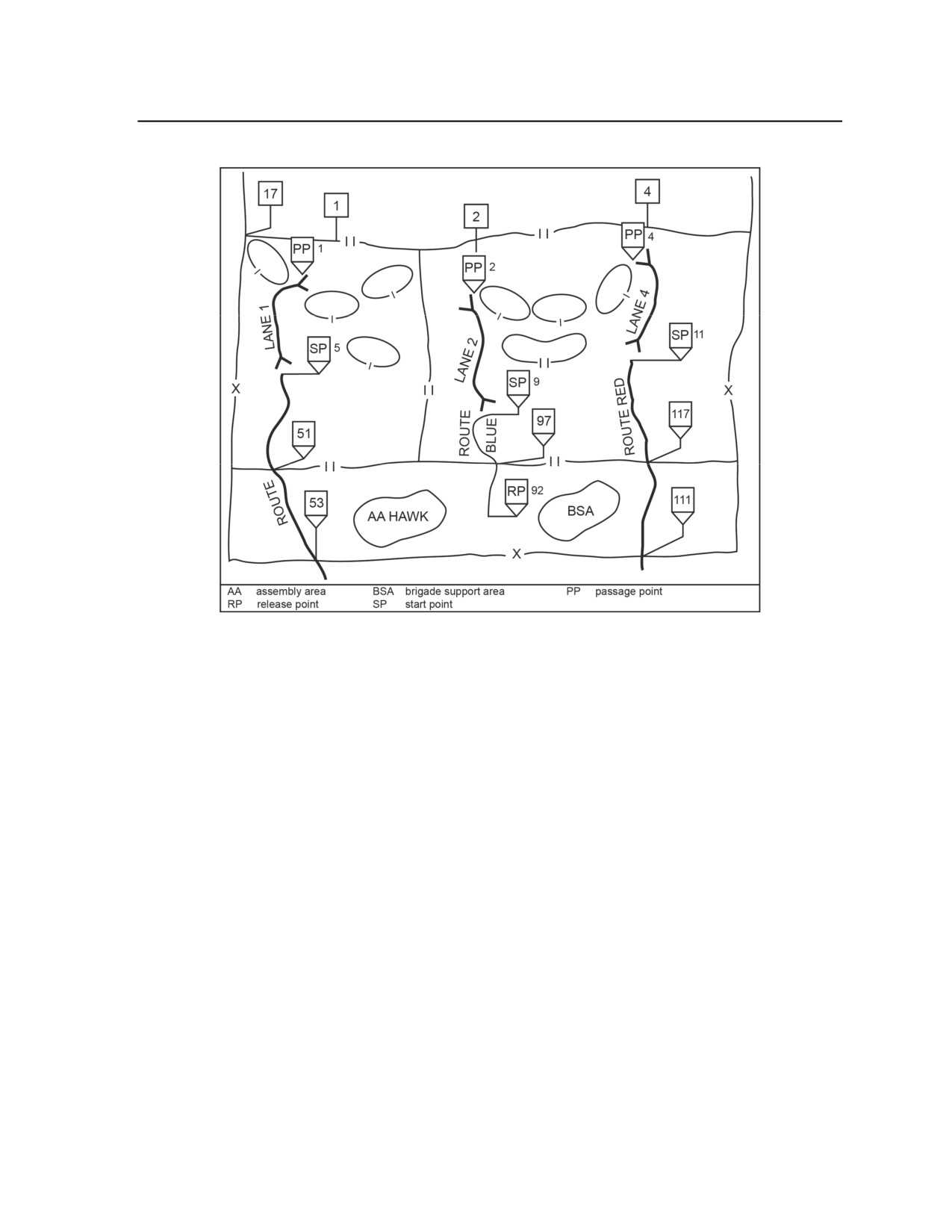
The passage point marks the location where the passing unit comes under the control of restrictions placed
by the stationary unit. (See figure 5-7.) The unit on the far right does not have a passage point because of
the gap existing at that location. If the enemy force continues to press its attack during the passage, the
passing unit controls the battle from collocated command posts while the stationary unit monitors and
controls the passage of lines until battle handover occurs. The passing unit’s command post passes through
the lines as soon as possible after the lead elements complete their passage. On passage of command, the
stationary unit assumes the defense of the AO.
5-38. The stationary unit provides the passing unit with as much assistance as possible. The stationary
unit’s providing indirect and direct fire support to the passing unit is crucial for the success of the passage.
This is especially important in covering the withdrawal of elements left in contact during a delay. The
stationary unit’s fire support assets answer calls for fire from the passing unit until battle handover occurs.
The passing unit’s fire support assets echelon rearward to provide continuous fire support for the passing
unit until it successfully disengages. Once the passing unit hands over control of the battle to the stationary
unit, the stationary unit initiates and clears calls for all fires forward of its location. The same procedure
applies to the dedicated air defense assets of the passing and stationary units.
5-39. The stationary unit’s engineer assets provide support to prepare the defense and execute the passage.
The commander ensures that the passing unit is able to move through passage lanes around the stationary
unit’s defensive positions. The commander shifts forces to close these passage lanes once the passing unit
and any security elements disengage and withdraw through the security area and obstacles.
5-8
FM 3-90-2
22 March 2013
Passage of Lines
Figure 5-7. Rearward passage of lines
5-40. The stationary unit provides the passing unit with the previously coordinated sustainment as far
forward as possible. The stationary unit concentrates on providing the passing unit with emergency
medical, recovery, and fuel supplies to enable the passing unit to rapidly move through the stationary unit’s
positions.
22 March 2013
FM 3-90-2
5-9
Chapter 6
Encirclement Operations
A unit can conduct offensive encirclement operations designed to isolate an enemy
force or conduct defensive encirclement operations as a result of the unit’s isolation
by the actions of an enemy force. Encirclement operations occur because combat
operations involving modernized forces are likely to be chaotic, intense, and highly
destructive, extending across large areas containing relatively few units as each side
maneuvers against the other to obtain positional advantage.
OFFENSIVE ENCIRCLEMENT OPERATIONS
6-1. Encirclement operations are operations where one force loses its freedom of maneuver because an
opposing force is able to isolate it by controlling all ground lines of communications and reinforcement
(ADRP 3-90).The commander conducts offensive encirclements to isolate an enemy force. Typically,
encirclements result from penetrations and envelopments, or are extensions of exploitation and pursuit
operations. As such, they are not a separate form of offensive operations but an extension of an ongoing
operation. They may be planned sequels or result from exploiting an unforeseen opportunity. They usually
result from the linkup of two encircling arms conducting a double envelopment. However, they can occur
in situations where the attacking commander uses a major obstacle, such as a shoreline, as a second
encircling force. Although a commander may designate terrain objectives in an encirclement, isolating and
defeating enemy forces are the primary goals. Ideally, an encirclement results in the surrender of the
encircled force. This minimizes friendly force losses and resource expenditures.
ORGANIZATION OF FORCES FOR AN OFFENSIVE ENCIRCLEMENT
6-2. An encirclement operation usually has at least two phases—the actual encirclement and actions taken
against the isolated enemy. The commander considers adjusting subordinate units’ task organizations
between phases to maximize unit effectiveness in each phase. The first phase is the actual encirclement that
results in the enemy force’s isolation. The organization of forces for an encirclement is similar to that of a
movement to contact or an envelopment. The commander executing an encirclement operation organizes
encircling forces into a direct pressure force and one or more encircling arms. Armor, mechanized and
motorized infantry, aviation, air assault, and airborne units are especially well suited for use as an
encircling arm since they have the tactical mobility to reach positions that cut enemy lines of
communications (LOCs). Bypassed and encircled enemy forces on the flanks and rear of advancing
friendly forces require all-around security, which includes local security measures and security forces.
6-3. One commander should direct the encirclement effort. However, there must also be unity of command
for each encircling arm. The encircling force headquarters may name one of its subordinate units as the
headquarters for an encircling arm. Alternatively, that force headquarters may create a temporary command
post from organic assets, such as its tactical command post, to control one or more arms of the
encirclement. If that encircling arm has subordinate inner and outer arms, each of them also requires
separate subordinate commanders. The missions and spatial orientation between the inner and outer
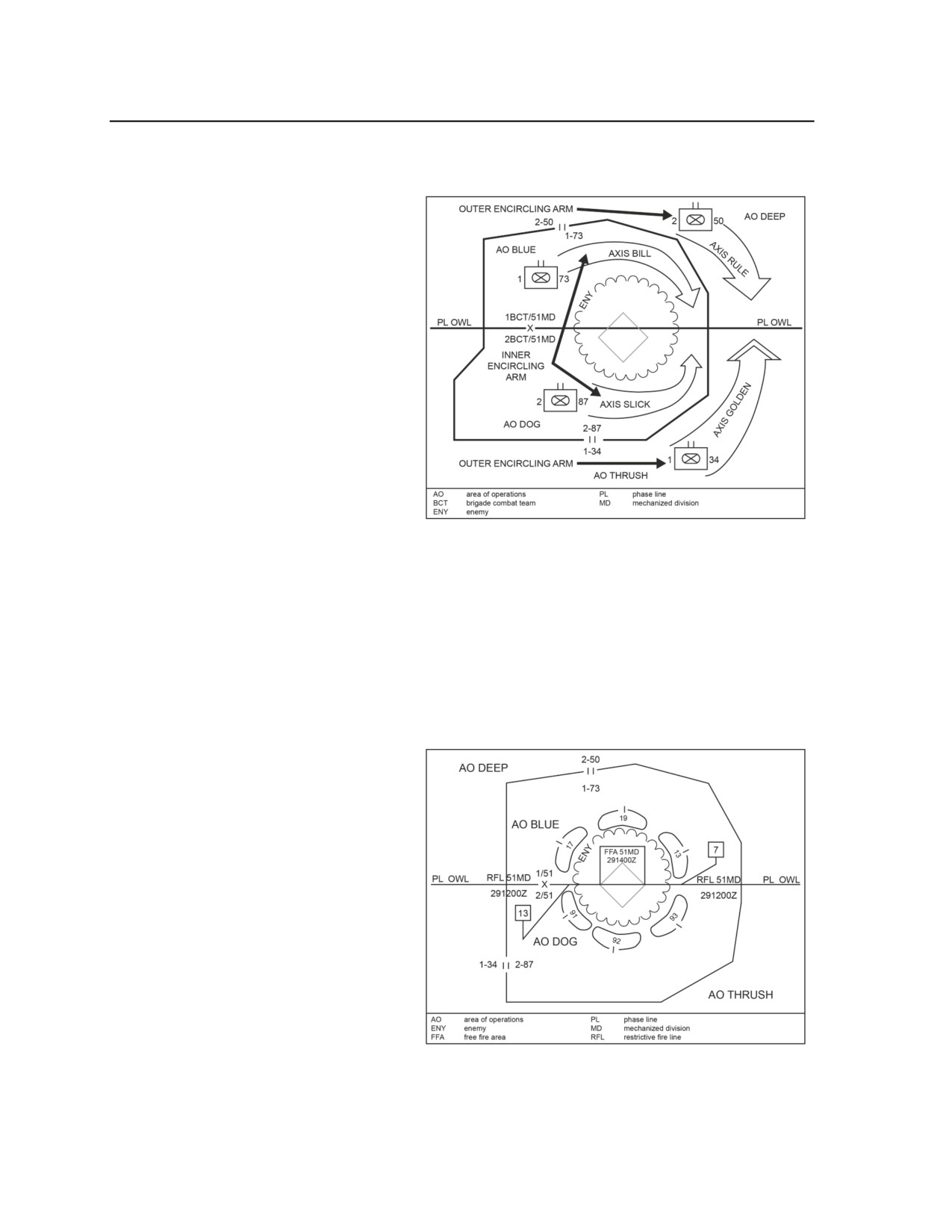
encircling arms are sufficiently different; therefore, one force cannot act in both directions at once. (See
figure 6-1 on page 6-2.)
6-4. The commander organizes only an inner encircling arm if there is no possibility of the encircled
forces receiving relief from enemy forces outside the encirclement. If there is danger of an enemy relief
force reaching the encircled enemy force, the commander organizes both inner and outer encircling arms.
The commander assigns the outer encircling arm a security mission, an offensive mission to drive away any
22 March 2013
FM 3-90-2
6-1
Chapter 6
enemy relief force, or a defensive mission to prevent the enemy relief force from making contact with the
encircled enemy force. Once the encirclement is complete, these inner or outer encircling arms form a
perimeter.
6-5. The second phase of an encirclement
operation involves actions taken against
an isolated enemy. The commander’s
decision to fix, contain, or destroy
isolated enemy forces affects the task
organization of subordinate units, as do
enemy attempts to break out from the
encirclement or linkup with the encircled
force. All these possible outcomes require
resources in terms of units and supplies,
but some require more resources than
others do. If the commander’s mission is
to contain or fix an isolated enemy, the
commander organizes subordinate forces
for defensive action and arranges them
around the enemy’s perimeter. If the
commander’s mission is to reduce or
destroy that same enemy, subordinate
forces are organized for offensive action. A
Figure 6-1. Inner and outer arms of an encirclement
higher commander often assigns either
mission to the commander of a
follow-and-support force.
6-6. Regardless of whether the commander decides to fix, contain, or destroy the enemy, the unit conducts
reconnaissance to maintain contact and monitor enemy actions in response to the encirclement. This allows
the commander to respond effectively to any enemy movement. The most effective reconnaissance
combines ground, aerial, and surveillance systems to provide constant coverage and multiple assessments
of enemy activities throughout the encircled area.
OFFENSIVE ENCIRCLEMENT CONTROL MEASURES
6-7. Control
measures
for
an
encirclement are similar to those of other
offensive operations, especially an
envelopment, but with a few additional
considerations.
(See figure
6-2.) If the
commander uses both an inner and an
outer encircling arm, the commander must
establish a boundary between them. The
commander places the boundary so that
each element has enough space to
accomplish the mission. The inner force
requires enough space to fight a defensive
battle to prevent the encircled force from
breaking out. The outer force requires
adequate terrain and depth to its area of
operations (AO) to defeat any attempt to
relieve the encircled force.
6-8. The commander who controls both
Figure 6-2. Encirclement control measures
converging forces establishes a restrictive
fire line (RFL) between them. The commander may also establish a free fire area (FFA), which encloses the
6-2
FM 3-90-2
22 March 2013
Encirclement Operations
area occupied by a bypassed or encircled enemy forces. (Appendix A of FM 3-90-1 discusses the use of
RFLs, FFAs, and other fire support coordination measures.) The commander may also establish contact
points.
PLANNING AN ENCIRCLEMENT
6-9. Encirclement operations may require allocating large forces and significant resources. They take a
great deal of time and usually slow an advance. If the mission of the encircling force is to maintain contact
with a bypassed enemy force, the following general planning considerations apply:
z
Determine the best available assets that gain and maintain contact with the enemy.
z
Keep the enemy isolated and incapable of receiving intelligence, logistics, and fire support from
enemy formations outside of the encirclement.
z
Use reconnaissance and surveillance assets so that the commander knows the capabilities of the
encircled force and, as much as possible, its commander’s intentions.
z
Retain freedom of maneuver.
z
Control of fires and fields of fire to avoid fratricide.
6-10. The commander applies the general defensive planning considerations outlined in chapter 6 of
FM 3-90-1 if the mission is to contain or fix the encircled enemy force in a specific location. If the mission
is to attack and destroy the encircled enemy force, the commander applies the planning considerations
outlined in chapters 1 and 3 of FM 3-90-1. Commanders plan to rotate the forces involved in reducing the
encircled pocket to maintain constant pressure on the enemy.
6-11. Every encircled enemy unit reacts differently. Initially, some become demoralized and cannot offer
any serious resistance. However, if left undisturbed, most enemy units recover and attempt to break out and
regain contact with their main force or attack the flank and rear of advancing friendly units. The encircling
force must plan for the enemy’s most probable reactions.
6-12. If the enemy force is not reduced, and it can be resupplied, or it has access to considerable supply
stocks, it continues to be a serious threat to the commander in future operations. The encircling force must
be approximately equal in size to this type of encircled force to fix or contain it. This situation occurred
when German forces occupied various fortified French ports after Allied armies liberated the rest of France
in 1944. Each encircled German division took approximately one Allied division to maintain its isolation.
Conversely, an enemy force isolated without adequate supplies either surrenders or faces containment by
considerably smaller forces. This situation occurred in Egypt during the 1973 Arab-Israeli War when an
Israeli division isolated the Egyptian 3rd Army. Planning considerations for the linkup of encircling forces,
such as command and support relationships, are outlined in paragraphs 6-76 through 6-82.
EXECUTING AN ENCIRCLEMENT
6-13. When feasible, the encircling force advances parallel to the enemy’s direction of movement. It
attempts to reach defiles, bridges, and other critical points before the main enemy force reaches them.
When the encircling force cannot outdistance the enemy, it engages the enemy force’s flanks to force the
enemy to fight under the most unfavorable conditions possible, ultimately in two or more directions
simultaneously. Engineer units rapidly breach obstacles in the path of the encircling force. Friendly forces
emplace obstacle complexes, supported by fires, to block probable avenues of escape, as they counter
attempted enemy breakouts from encirclement. The commander may use air assault and airborne forces to
seize defiles or other critical terrain objectives to cut enemy LOCs. The encircling force completes the
encirclement when all enemy ground LOCs are cut. This generally occurs when the two arms of a double
envelopment complete their linkup.
6-14. A commander usually creates intervals between the advancing units of an enveloping force to
provide protection from enemy chemical, biological, radiological, and nuclear (CBRN) weapons. They can
also occur during combat operations as the result of different rates of advance by combat formations that
face dissimilar degrees of enemy resistance and different terrain. The encircled enemy attempts to discover
intervals and take advantage of them as the encircled enemy force tries to escape from or breakout of the
22 March 2013
FM 3-90-2
6-3
Chapter 6
encirclement. Once the enveloping force completes the linkup that actually creates the encirclement, it must
close these intervals as quickly as possible to prevent the enemy from exploiting them.
6-15. The enemy force may attempt to cut off the encircling force and extend its flank beyond the area of
the friendly attack. If the commander attempts to outflank such a hostile extension, it may lead to the
overextension of the enveloping force or to a dangerous separation of the enveloping force from support. It
is usually better to take advantage of the enemy’s extension and subsequent weakness by penetrating the
thinly held front of an enemy force rather than risk the overextension of the enveloping force in an effort to
completely outflank the enemy’s positions. Alternatively—in response to the unfolding encirclement—the
enemy may attempt a frontal, spoiling attack. In this case, the friendly force in contact defends itself or
engages in a delaying operation, while the enveloping force continues the envelopment or moves directly
toward the enemy force in a counterattack.
6-16. The commander of a highly mobile force forming the inner encircling arm may choose not to
establish a continuous series of positions around an encircled enemy. The commander may order
subordinate forces to occupy only key terrain from which they can strike at the encircled enemy forces to
prevent them from concentrating forces and to further isolate them. To effectively isolate the enemy, a
commander who adopts this technique must be able to detect enemy attempts to breakout and concentrate
sufficient combat power against these attempts to thwart them. The commander of the outer encircling arm
prevents additional enemy forces from reinforcing the isolated enemy force or interfering with the activities
of the inner encircling arm.
6-17. Other operations may result in the encirclement of enemy forces. These include offensive operations
that bypass large enemy forces to maintain the momentum of the force. Reconnaissance and security
missions conducted by the main body must focus on detecting and reporting bypassed units. The main body
conducts these missions not only to its flanks, but also to its rear to discover if enemy forces move in
behind it. Unit reconnaissance and surveillance assets watch for measures taken by the enemy’s main body
to relieve or assist its bypassed or encircled forces.
6-18. Once the commander decides to destroy an encircled enemy force, that enemy force is reduced as
rapidly as possible to free resources for use elsewhere. The reduction of an encircled enemy force continues
without interruption, using the maximum concentration of forces and fires, until the encircled enemy
force’s complete destruction or surrender. A commander may destroy encircled enemy forces by fires alone
or by a combination of fire and movement. The five main methods for reducing an encircled enemy are fire
strike, squeeze, hammer and anvil, wedge, and escape route.
6-19. A fire strike is the massed, synchronized, and nearly simultaneous delivery of primarily
terminally guided indirect fire and area munitions. It is the preferred method for destroying an encircled
enemy force. These fires may engage both point and area targets. Terminally guided munitions, such as the
global positioning system (GPS)-enabled Excalibur 155mm round and the guided multiple launch rocket
system munitions are used against well-located targets; laser-guided rounds are used against both well
located targets and moving targets that present the greatest danger to the encircling force, such as the
enemy’s CBRN weapons, command posts, fire support and air defense systems, and field fortifications.
However, the commander’s ability to use terminally-guided munitions in mass may be limited by the
ability of the sustainment system to supply them. Indirect fire weapons typically engage poorly located or
area targets with area munitions that are unable to correct for unanticipated ballistic conditions en route to
the target or dispense point. Fixed-wing, rotary-wing, and tilt-rotor aircraft play an important role in the
destruction of encircled forces by close air support (CAS), close combat attack (CCA), and forming joint
air attack teams (JAAT) to locate and attack high-payoff targets and targets of opportunity. Fire strikes by
indirect fires and CAS, CCA, and JAAT may occur alone or concurrently during the destruction of the
enemy force.
6-20. The commander also conducts Army information tasks—such as electronic warfare—against the
encircled enemy force. In some situations, fire strikes result in the rapid destruction of the encircled enemy.
However, destruction is not guaranteed. In most cases, reducing the enemy pocket requires using ground
maneuver forces.
6-4
FM 3-90-2
22 March 2013
Encirclement Operations
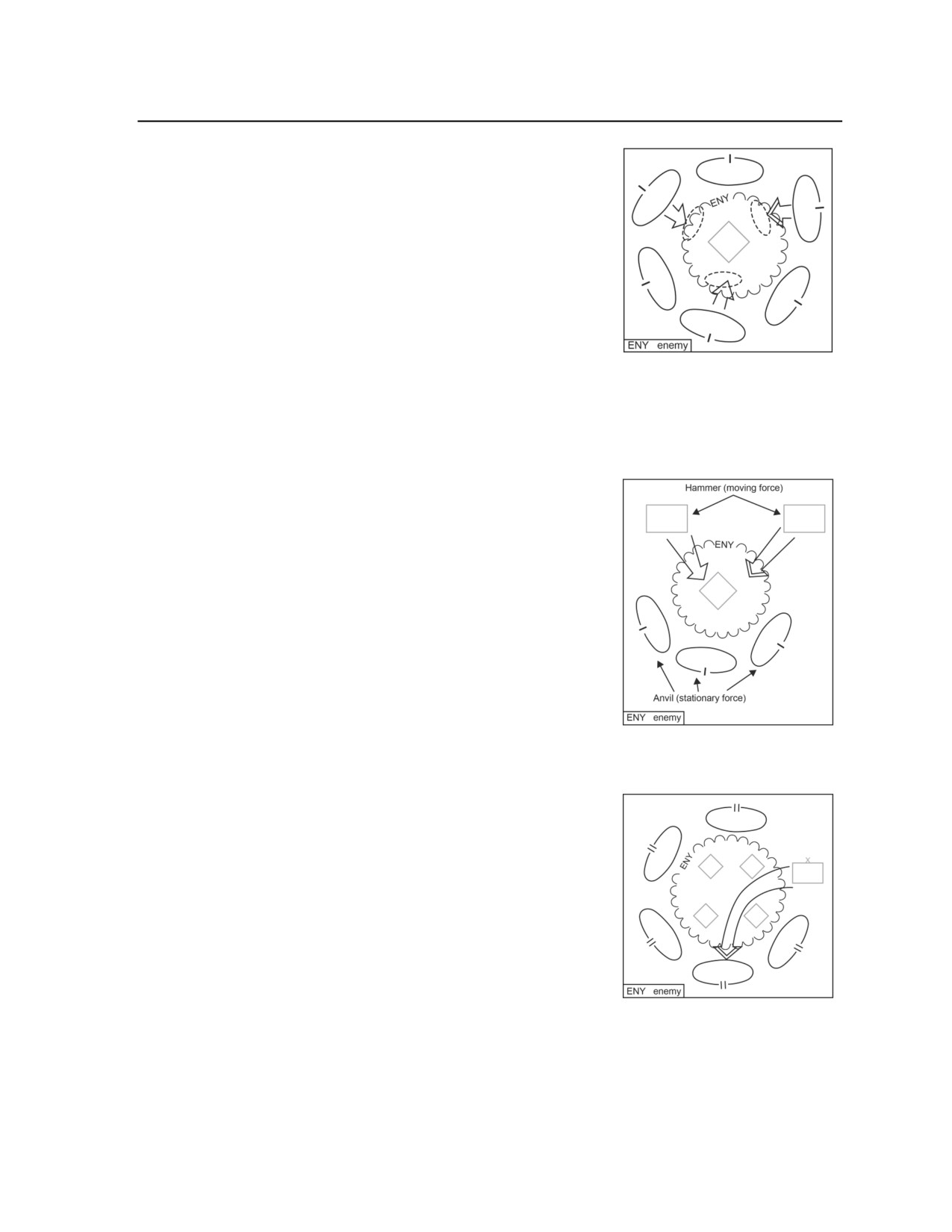
6-21. The squeeze technique uses simultaneous, coordinated blows
on the enemy from various directions. (See figure 6-3.) Following the
initial encirclement, the capture or destruction of the enemy force is
methodical and thorough. The commander uses fire and movement
together in a controlled contraction of the encirclement. As the
enemy’s perimeter contracts, the commander removes units from the
inner perimeter and adds them to the reserve depending on the terrain
and other mission variables of mission, enemy, terrain and weather,
troops and support available, time available, and civil considerations
(METT-TC). This technique is effective against battalion or smaller
groups of encircled enemy forces.
6-22. The squeeze technique promotes the enemy’s confusion and
rapid dispersion of combat power and prevents the enemy
Figure 6-3. Squeeze technique
commander from using the enemy’s reserves in a decisive manner.
The commander shapes the operation by initially concentrating on destroying enemy command nodes, air
defense systems, artillery systems, and sustainment capabilities. These sustainment capabilities include any
drop zones, landing zones, or airstrips available to the enemy that would allow the enemy to receive
support from outside the encirclement.
6-23. The hammer and anvil technique employs a stationary
blocking force as an anvil on one or more sides of the inner
perimeter, while other elements of the encircling force use offensive
action as a hammer to force the encircled enemy force against the
blocking force. (See figure 6-4.) Either the anvil or the hammer can
destroy the enemy. Usually the hammer, as the attacking element,
accomplishes this task. This technique is most effective when the
blocking force is located on or to the rear of a natural terrain
obstacle. On favorable terrain, an airborne or air assault force can be
used as an anvil or a blocking element.
6-24. The wedge technique uses a unit to divide enemy forces in the
pocket while the rest of the encircling force remains in place. (See
figure 6-5.) This technique allows the commander to concentrate
against a small portion of the encircled enemy. However, the
Figure 6-4. Hammer and anvil
encircling force maintains pressure on other encircled enemy forces
technique
to prevent them from reinforcing or supporting the threatened area.
The unit dividing the pocket conducts sudden and swift attacks
immediately after the end of supporting preparatory fires.
6-25. The escape route technique involves leaving one or more gaps
in the inner encircling arm to entice the enemy to attempt a breakout.
Once the enemy force starts moving, and is no longer sheltered in
defensive positions, that moving enemy force is more vulnerable to
acquisition, attack, and destruction. A commander using this
technique should use military information support operations (MISO)
and constant offensive action to demoralize the escaping enemy
force.
6-26. The negative aspect of these techniques is that they require
considerable forces and supplies, which are not always available.
Therefore, at times the encircling force has to limit itself to less
Figure 6-5. Wedge technique
decisive measures. These include temporarily containing or fixing
bypassed enemy forces until resources become available to enable the encircling force to destroy the
enemy. Continued isolation of the encircled force can only be guaranteed when the enemy cannot
strengthen its forces by inserting additional units and supplies by air. Even total, long-term isolation does
22 March 2013
FM 3-90-2
6-5
Chapter 6
not necessarily lead to decisive defeat of the encircled enemy. It is a temporary measure designed to
provide the attacking force additional time.
DEFENDING ENCIRCLED
6-27. An encircled force can continue to defend encircled, conduct a breakout, exfiltrate toward other
friendly forces, or attack deeper into enemy-controlled territory. The commander’s form of maneuver once
becoming encircled depends on the senior commander’s intent and the mission variables of METT-TC,
including the—
z
Availability of defensible terrain.
z
Relative combat power of friendly and enemy forces.
z
Sustainment status of the encircled force and its ability to be resupplied, including the ability to
treat and evacuate wounded Soldiers.
z
Morale and fighting capacity of the Soldiers.
6-28. Encirclement of a friendly force is likely to occur during highly mobile and fluid operations, or when
operating in restrictive terrain. A unit may find itself encircled as a result of its offensive actions, as a
detachment left in contact, when defending a strong point, when occupying a combat outpost, or when
defending an isolated defensive position. The commander anticipates becoming encircled when assigned a
stay-behind force mission, or when occupying either a strong point or a combat outpost. The commander
then makes the necessary preparations.
6-29. The senior commander in an encirclement assumes command over all encircled forces and takes
immediate action to protect them. In the confusion leading to an encirclement, it may be difficult to even
determine what units are being encircled, let alone identify the senior commander. However, the senior
commander must be determined as quickly as possible. When that commander determines the
commander’s unit is about to be encircled, the commander must decide quickly what assets stay and what
assets leave. The commander immediately informs higher headquarters of the situation. Simultaneously, the
commander directs the accomplishment of the following tasks:
z
Establish security.
z
Reestablish a chain of command.
z
Establish a viable defense.
z
Maintain morale.
6-30. The commander positions security elements as far forward as possible to reestablish contact with the
enemy and provide early warning. Vigorous patrolling begins immediately. Each unit clears its position to
ensure that there are no enemy forces in the perimeter. Technical assets, such as Joint Surveillance Target
Attack Radar System (JSTARS) and electronic warfare (EW) systems, augment local security and locate
those areas along the perimeter where the enemy is deploying additional forces.
6-31. The commander reestablishes unity of command. The commander reorganizes any fragmented units
and places Soldiers separated from their parent units under the control of other units. The commander
establishes a clear chain of command throughout the encircled force, reestablishes communications with
units outside the encirclement, and adjusts support relationships to reflect the new organization.
ORGANIZATION OF FORCES FOR AN ENCIRCLED DEFENDER
6-32. The commander of the encircled force establishes a perimeter defense. (Chapter 6 of FM 3-90-1
discusses the conduct of a perimeter defense.) The commander knows the specific capabilities and
limitations of the different friendly units isolated in the encirclement. Therefore, the commander designs
the defense to maximize the capabilities of available forces. Forward units establish mutually supporting
positions around the perimeter and in depth along principal avenues of approach. Units occupy the best
available defensible terrain. It may be necessary to attack to seize key or decisive terrain so that it is
incorporated into the perimeter defense. Once the commander assigns defensive AOs and battle positions,
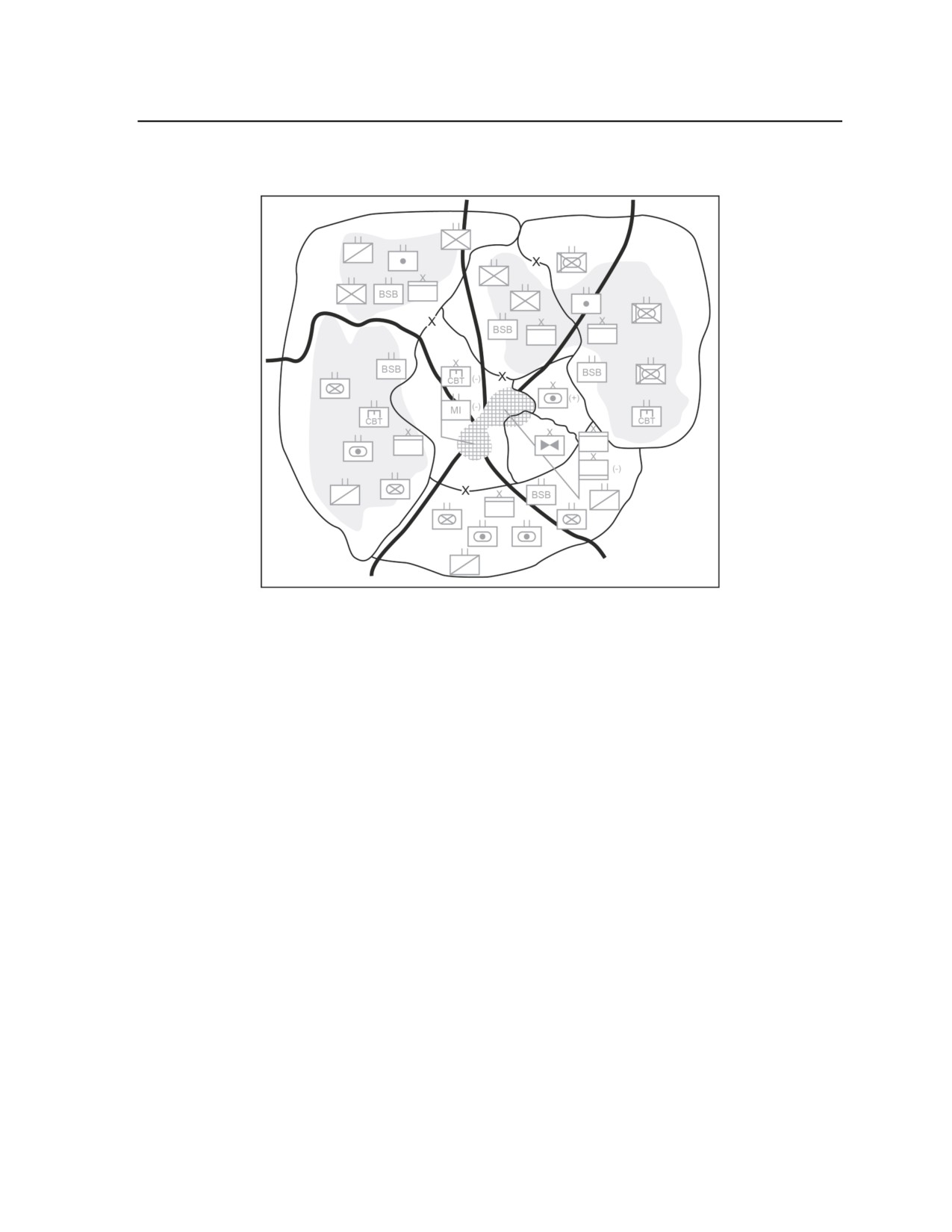
preparations are the same as in the defense. (See figure 6-6.) Encircled units make their defensive positions
6-6
FM 3-90-2
22 March 2013
Encirclement Operations
as strong as possible given time and resource constraints. The commander anticipates that the enemy will
attempt to split the defenses of the encircled force and defeat it in detail.
Figure 6-6. Encircled division’s perimeter defense
6-33. The encircled force commander establishes a reserve that is mobile enough to react quickly to events
anywhere along the perimeter. Therefore, given the availability of sufficient fuel, the commander
constitutes a reserve using some of any available armored, mechanized, and Stryker units. The commander
centrally positions this mobile reserve to take advantage of interior lines, which exist if the encircled force
commander can maneuver the reserve or reinforce threatened positions on the perimeter faster than the
enemy can shift location or reinforce. The commander can achieve interior lines through a central position
(with operations diverging from a central point), from superior lateral LOCs, or greater tactical mobility. If
only dismounted infantry forces are available, the commander establishes small local reserves to react to
potential threats. The commander organizes a mobile anti-armor element from the best available anti-armor
systems. If possible, subordinate echelons also retain a reserve.
6-34. While defending encircled, the commander may use the reserve to limit penetrations along the
perimeter. It may conduct spoiling attacks or vigorous counterattacks. The commander initiates a
counterattack at the decisive moment and location as the enemy force attempts to penetrate the defensive
positions.
WARFIGHTING FUNCTIONAL CONSIDERATIONS FOR AN ENCIRCLED DEFENDER
6-35. Divisions and corps may consider relocating aviation systems from any attached combat aviation
brigades to locations that are not in danger of being encircled. Aviation assets can rapidly bring additional
firepower to bear on the encircling enemy force or rapidly move reaction forces to threatened locations
along the defensive perimeter. Generally, aviation assets fly out of the encirclement when it becomes small
enough to allow the enemy’s artillery to range throughout the area.
6-36. The commander centrally controls fire support systems, such as artillery, to provide support at
numerous points along the perimeter and mass fires. The commander designates the senior field artillery
staff officer, such as the chief of fires or brigade fire support officer, to control fire support. At the brigade
combat team (BCT), the fires battalion commander also advises the commander. At lower levels,
22 March 2013
FM 3-90-2
6-7
Chapter 6
commanders my collocate mortars from various units under centralized control, especially if there are
insufficient artillery assets.
6-37. Generally, engineers concentrate first on countermobility, then survivability, and then mobility. An
encircled force is particularly vulnerable to the enemy’s use of CBRN weapons. Dispersal is difficult in a
perimeter-type defense; therefore, the next best alternative is position hardening by constructing field
fortifications.
6-38. Encircled units must closely monitor their sustainment assets, especially if they cannot be resupplied
for an extended period. Commanders conserve and centrally control available resources. The commander
may force units on the perimeter to cease all vehicle movement to allocate remaining fuel assets to the
reserve. The commander retains essential sustainment capabilities to sustain defensive operations. They fall
under the control of a senior sustainment operator or commander. When possible, the commander positions
these units and their assets out of the reach of potential penetrations in protected and concealed locations.
The commander may incorporate other sustainment units into defensive positions in depth or around key
facilities. The commander may choose to use Soldiers from sustainment units as fillers for combat units,
although this action may affect the sustainment capabilities of the encircled force.
6-39. Casualty evacuation and mortuary affairs pose particular challenges for the encircled force. The
commander evacuates wounded from the encirclement whenever possible for humanitarian reasons. This
also reduces the logistic burden of providing long-term medical care to wounded Soldiers.
6-40. Soldiers have an inherent fear of being encircled by the enemy. Unchecked, this fear can lead to a
degradation in morale and discipline. When encircled, Soldiers under the firm control of their leaders can
withstand the mental strain. Discipline can disintegrate rapidly in an encirclement. Officers and
noncommissioned officers must uphold the highest standards of discipline. Their personal conduct sets the
example. The commander must be seen frequently by Soldiers and display a calm and confident manner.
6-41. Soldiers in the encirclement must not regard their situation as desperate or hopeless. Commanders
and leaders at all levels maintain the confidence of Soldiers by resolute action and a positive attitude. They
must keep their Soldiers informed to suppress rumors and counter enemy propaganda.
BREAKOUT FROM AN ENCIRCLEMENT
6-42. A breakout is an operation conducted by an encircled force to regain freedom of movement or
contact with friendly units. It differs from other attacks only in that a simultaneous defense in other areas of
the perimeter must be maintained (ADRP 3-90). A breakout is both an offensive and a defensive operation.
An encircled force normally attempts to conduct breakout operations when one of the following four
conditions exist:
z
The commander directs the breakout or the breakout falls within the intent of a higher
commander.
z
The encircled force does not have sufficient relative combat power to defend itself against
enemy forces attempting to reduce the encirclement.
z
The encircled force does not have adequate terrain available to conduct its defense.
z
The encircled force cannot sustain itself long enough to be relieved by forces outside the
encirclement.
ORGANIZATION OF FORCES FOR A BREAKOUT
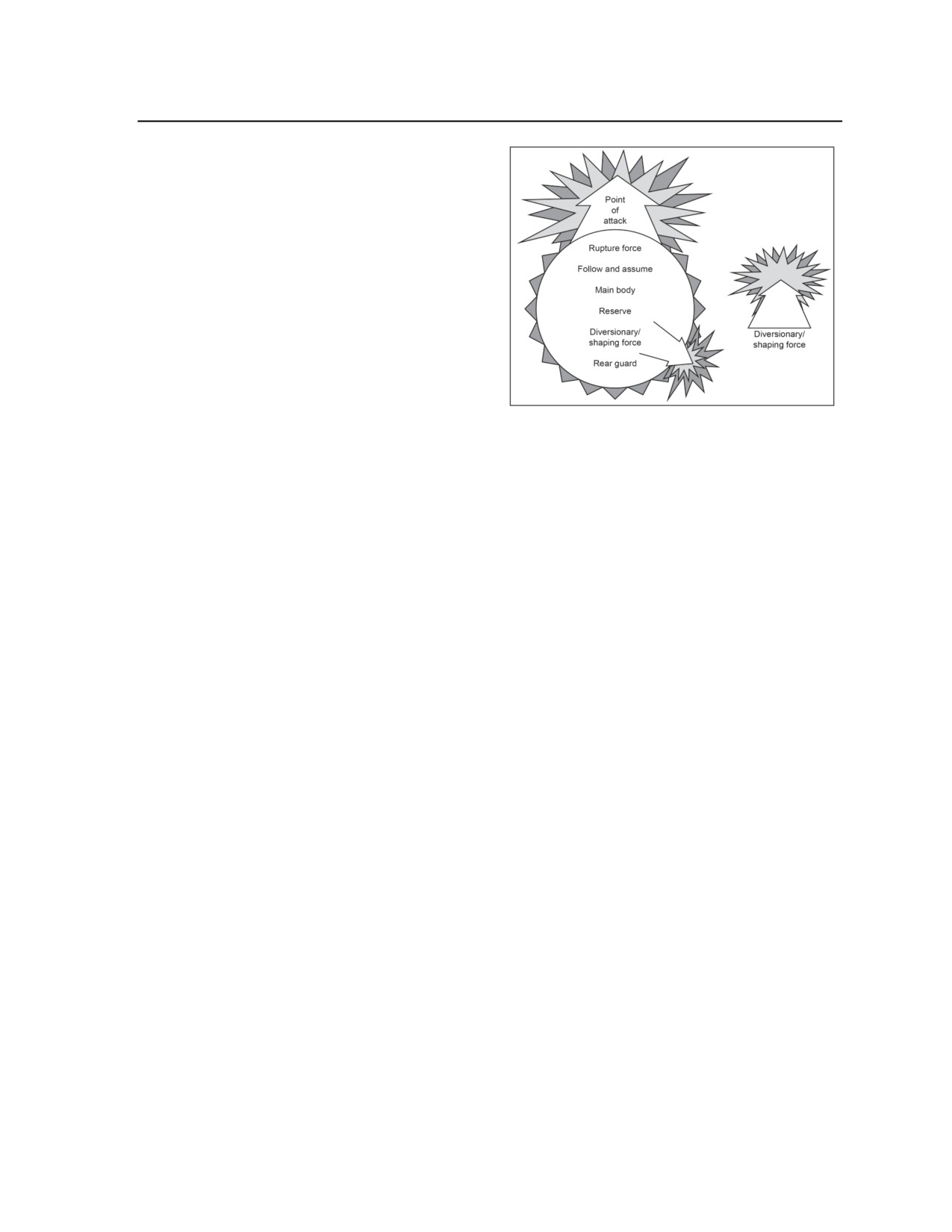
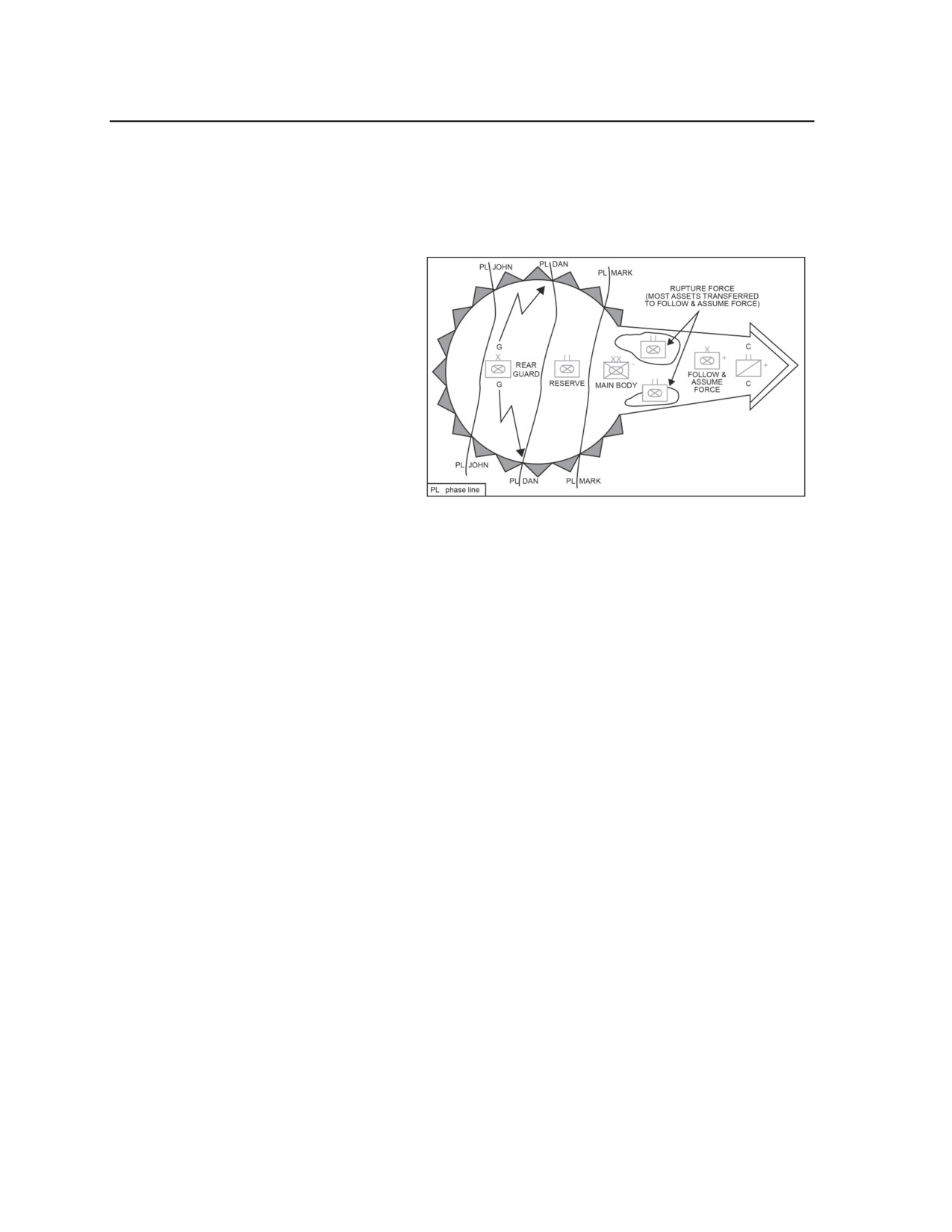
6-43. Units typically task organize to conduct rupture, follow-and-assume, main body, and rear guard
missions to conduct a breakout attack. (See figure 6-7). If sufficient forces exist in the encirclement, the
commander organizes a reserve and a separate diversionary force. Some encircled units will be weakened,
and if sufficient combat power does not exist to resource each of these forces, the commander must
prioritize which ones to resource. Normally, the commander’s first priority is to resource the force with the
rupture mission. The commander typically assigns multiple missions to subordinate forces because there
are not typically enough forces in the encirclement to have separate forces for each required mission. For
6-8
FM 3-90-2
22 March 2013
Encirclement Operations
example, the follow-and-assume force could
receive a be-prepared mission to help extract the
rear guard, a mission generally given to the
reserve. Forces located outside the encirclement
assist the breakout by conducting shaping
operations. Above all, the encircled force maintains
the momentum of the breakout attack; otherwise, it
is more vulnerable to destruction than it was before
the breakout attempt.
6-44. The force reorganizes based on available
resources to conduct the breakout. Without
resupply, armored, mechanized, and motorized
infantry units may not be able to move all of their
vehicles during the breakout attack. Priority of
support may be limited to the rupture force and the
rear guard, with the remaining force keeping only
Figure 6-7. Organization of forces for a
sufficient transportation assets to move the
breakout operation.
wounded and critical assets and supplies. The
breakout plan outlines the commander’s destruction criteria for equipment or supplies left behind. All
vehicles, critical munitions, supplies, and equipment (except medical supplies) that cannot be moved
should be destroyed as soon as possible.
6-45. An encircled force attacks using the rupture force to penetrate the enemy defensive positions in at
least one location. The commander produces overwhelming combat power at each breakout point. The
commander assigns the rupture force, which varies in size from one-third to two-thirds of the total encircled
force, the mission to penetrate the enemy’s encircling position, widen the gap, and hold the shoulders of the
gap until all other encircled forces can move through. The rupture force must have sufficient strength to
penetrate the enemy line. This force must use surprise, mobility, and firepower to achieve a favorable
combat power ratio over the enemy at the point of attack. (Chapter 1 of FM 3-90-1 discusses the
penetration as a form of maneuver.)
6-46. Initially, the rupture force is the decisive operation. The attack occurs where the commander
anticipates a successful rupture of the enemy’s inner ring, which facilitates subsequent operations by
enabling the commander to attack enemy units from their flanks and rear. The rupture force commander
probably has additional attached assets, such as additional maneuver forces and engineers. The commander
should integrate these assets to achieve the rupture.
6-47. The follow-and-assume force follows the rupture attack and is committed to maintain the momentum
of the attack and seize objectives past the rupture. After the rupture force seizes a gap in the enemy
encirclement, the follow-and-assume force normally conducts the decisive operation until completing
linkup operations with another friendly force. When a unit receives a follow and assume mission in a
breakout, its commander must coordinate closely with the rupture force commander regarding the location
of the gap, the enemy situation at the rupture point, and the enemy situation, if known, along the direction
of attack past the rupture point. The commander does not assign this force supporting shaping tasks, such as
clear routes and fix bypassed enemy forces, if those tasks dissipate its available combat power. If executing
these support tasks is vital to the success of the breakout and resources permit, the commander designates a
separate follow and support force to perform these tasks.
6-48. The main body consists of the main command post, the bulk of encircled sustainment assets, the
unit’s casualties, and some functional and multifunctional support assets. It contains combat forces not
required for other missions and has sufficient combat power to protect itself. The commander places one
individual in charge of the various elements of the main body to ensure orderly movement. Typically, the
main body establishes a flank security force that deploys once the main body passes through the point of
penetration and performs flank screen or a guard mission for the main body.
22 March 2013
FM 3-90-2
6-9
Chapter 6
6-49. The rear guard consists of Soldiers and equipment left on the perimeter to provide protection for the
rupture attack and any shaping operations, such as diversionary forces. Forces left in contact must conduct
a vigorous delaying operation on the perimeter, so that no portion of the rear guard gets cut off. Under a
single commander, the rear guard protects the main body from attack, while it moves from the area. In
addition to providing security, the rear guard deceives the enemy about the intentions of the encircled force,
simulating its activities until the main body clears the gap.
6-50. The primary purpose of a reserve is to retain flexibility through offensive action. The commander
makes every attempt to keep a small portion of the encircled force uncommitted, so it can be employed at
the decisive moment to ensure the breakout’s success. The commander may be unable to establish a
separate reserve force because of the need to resource either the rupture force, the follow-and-assume force,
or the rear guard. In this event, the commander assigns and prioritizes various be-prepared missions to the
follow-and-assume force.
6-51. A successful diversion is important to the success of any breakout operation. If the diversion fails to
deceive the enemy commander regarding the intentions of the encircled force, the enemy commander could
direct the enemy’s full combat power at the rupture point. On the other hand, the diversionary force may
rupture the enemy’s lines. If a rupture occurs, the diversion force commander follows the intent of the
commander of the encircled force. The encircled force commander may choose to exploit the success of
forces conducting a diversion, or the commander may have to disengage them for use elsewhere in the
breakout attempt.
CONTROL MEASURES FOR A BREAKOUT
6-52. As a minimum, a commander uses boundaries; a line of departure (LD) or line of contact; time of the
attack; phase lines; axis of advance or direction of attack; objectives; and a limit of advance (LOA) to
control and synchronize the breakout. (Appendix A of FM 3-90-1 discusses the use of boundaries, phase
lines, axis of advance, direction of attack, objectives, line of departure or line of contact, LOA, and time of
attack.) The commander only imposes the control measures necessary to synchronize operations.
PLANNING A BREAKOUT
6-53. The commander initiates a breakout attack as quickly as possible after the enemy encircles the force.
While detailed combat information about the enemy’s disposition is probably not available, the enemy is
normally disorganized at that time and is least likely to respond in a coordinated manner. The enemy has
not yet brought in sufficient combat power to encircle the friendly force in strength, and weak points exist
in the enemy’s perimeter. However, sometimes the commander will not attempt a breakout until all other
options fail.
6-54. Early in an encirclement, there are gaps between or weaknesses in the enemy’s encircling forces.
The commander uses available reconnaissance and surveillance assets, including available joint systems, to
provide information that increases the accuracy of the commander’s situational understanding and
determines enemy weak points. The commander’s plans for the breakout attack will capitalize on those
identified weak points. Although the resulting attack may be along a less direct route or over less favorable
terrain, it is the best course of action (COA) because it avoids enemy strength and increases the chance for
surprise.
6-55. An encircled force may be operating under adverse conditions and may not have all of its normal
suite of intelligence systems. This forces the commander to operate with low levels of intelligence
regarding enemy strengths, weaknesses, and intentions. Within this environment, the encircled commander
conducts aggressive reconnaissance to gather information on the enemy. The commander also obtains
information from joint assets, long-range surveillance units, stay behind units, and special operations forces
in the area. If the enemy is in close contact, the commander may be forced to conduct a reconnaissance in
force to ascertain enemy strengths. In any case, the commander quickly selects a COA and develops a plan
accordingly.
6-10
FM 3-90-2
22 March 2013
Encirclement Operations
6-56. A shaping operation, such as a diversionary attack, assists a breakout by diverting enemy attention
and resources away from the rupture effort. The force conducting shaping operations may be located either
inside or outside the encirclement area. The enemy must regard the efforts of this force as credible and a
threat to the continuity of the enemy’s maneuver plan. The commander directs the force’s efforts to a point
where the enemy might expect a breakout or relief effort. The diversionary force is as mobile as available
vehicles, fuel stocks, and trafficability allow, so it can reposition to take part in the breakout or maneuver
elsewhere to support the breakout. Mobile, self-propelled weapons systems suit the needs of forces
conducting shaping operations. Additionally, the probability of a successful breakout increases measurably
if another friendly force attacks toward the encircled force as it attempts to breakout.
6-57. The commander conducts Army inform and influence and cyber electromagnetic activities tasks to
assist the breakout attempt. Military deception operations mislead the enemy about the intentions of the
encircled force, especially the location of the breakout attempt. For example, unmanned aircraft can
concentrate their activities in an area away from where the rupture effort will occur to deceive the enemy as
to the exact location of the rupture. If it is not possible to breakout immediately, the commander attempts to
deceive the enemy regarding the time and place of the breakout by concealing friendly breakout
preparations and changing positions. The commander can also make it appear that the encircled force will
make a resolute stand and await relief.
6-58. The commander can use dummy radio traffic for the enemy to monitor or landlines that the enemy
might be able tap to convey false information. The breakout should not be along the obvious route toward
friendly lines, unless there is no other alternative. In this respect, the preparations for a breakout mirror the
preparations for any other offensive task. As in other offensive actions, secrecy, military deception, and
surprise allow for success. The other planning considerations for the breakout are the same as for any other
attack.
EXECUTING A BREAKOUT
6-59. The commander exploits darkness and limited visibility during a breakout, if friendly encircled
forces have superior night-vision capabilities. The concealment provided by darkness, fog, smoke, or
severe weather conditions favor the breakout because the encircling enemy weapons are normally less
effective then. The enemy has difficulty following the movements of the breakout force during conditions
of limited visibility. However, if the encircled force commander waits for darkness or limited visibility, the
encircling enemy may have time to consolidate containment positions. If friendly forces have air
superiority, they may initiate a daylight breakout attack to fully exploit the capabilities of close air support.
6-60. The unit takes all possible precautions to deceive the enemy about the location of the decisive
operation. The rupture force minimizes occupation of attack positions before starting the breakout. A
commander may require one or more shaping operations to assist the rupture force in penetrating enemy
positions and expanding the shoulders. The encircled commander may use feints and demonstrations to
deceive the enemy concerning the location and time of the decisive operation. However, diversionary
attacks need not always occur first.
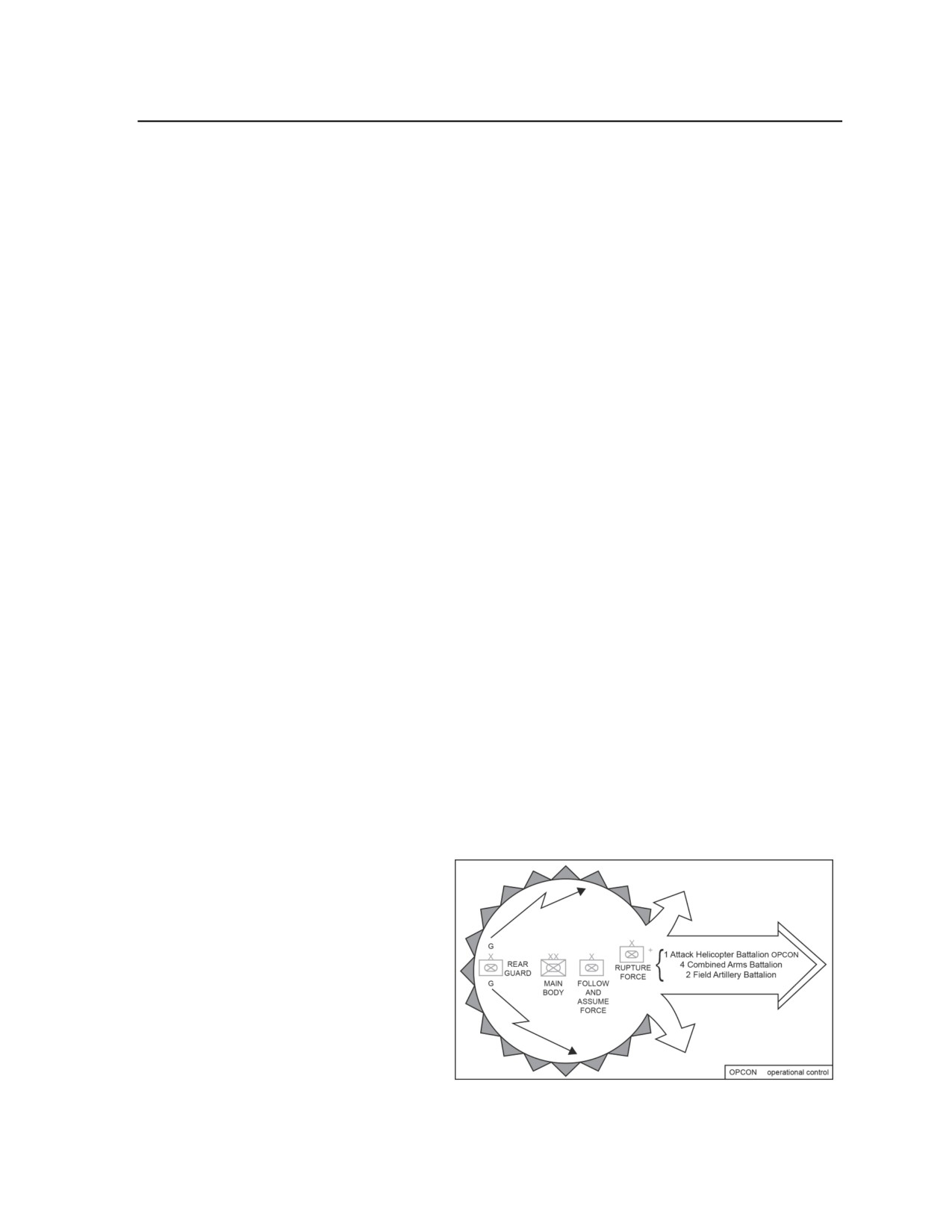
6-61. The commander organizes and
controls the rupture force in the same
manner as during an attack or movement
to contact. (See figure 6-8.) The rupture
force generates overwhelming combat
power at the point of penetration and
rapidly overwhelms enemy positions and
expands the penetration. A commander
unable to generate sufficient combat
power for both the rupture force and the
perimeter defense can thin the defensive
perimeter in certain areas by using a
detachment left in contact in conjunction
Figure 6-8. Breakout by an encircled division
22 March 2013
FM 3-90-2
6-11
Chapter 6
with a withdrawal before executing the attack. The commander may also shorten the perimeter’s length,
which reduces the size of the area occupied by the encircled force.
6-62. The rupture forces applies the breaching fundamentals of suppress, obscure, secure, reduce, and
assault to ensure its success at the point of penetration. These fundamentals always apply, but their
application will vary based on the prevailing mission variables of METT-TC.
6-63. The commander orders the rupture
force to hold the shoulders of the
penetration while the follow-and-assume
force moves forward, if enemy forces at
the penetration point have roughly the
same combat power as the rupture force.
The actions of the follow-and-assume
force then become the decisive operation.
(See figure
6-9.) The commander may
have the rupture force continue its attack,
if the enemy is not strong. If there are no
identified enemy forces beyond the
penetration, the rupture force may
transition to a movement to contact. After
the encircled friendly force breaks out, it
Figure 6-9. Continued breakout by an encircled
moves toward other friendly forces and
division
links up with them. Paragraphs
6-76
through 6-82 address considerations associated with conducting a linkup.
6-64. Initially, the follow-and-assume force passes through the gap created by the rupture force. This force
continues to move rapidly from the encircled area toward its final objective. If the follow-and-assume force
becomes the encircled commander’s decisive operation, it cannot allow itself to become bogged down.
Preparatory fires by artillery, Army aviation, close air support, and air interdiction help the
follow-and-assume force in maintaining momentum out of the encircled area.
6-65. Once the breakout attack starts, the rear guard and any diversion forces disengage or delay toward
the area of the rupture. Perimeter forces integrate smoothly into the rear of the breakout column. Once the
breakout succeeds, the commander shifts priority of fires as required by the mission variables of
METT-TC.
6-66. As other encircled units support or move through the area of penetration, the rear guard commander
must spread forces over an extended area. The rear guard requires flexibility and mobility. The rear guard
maintains the perimeter against enemy pressure. If the enemy succeeds in destroying or encircling the
original rear guard in the breakout process, the commander must reconstitute a new rear guard.
6-67. The main body follows the follow-and-assume force. It moves rapidly on multiple routes in an
approach march or road march formation immediately behind the follow-and-assume force, protected on its
flanks by security elements. It contains sufficient combat power to protect itself and reinforce the flank or
rear security forces, if they come under attack.
6-68. Normally, the rear guard initially conducts a withdrawal to break contact with the enemy forces
around the perimeter. It contracts the perimeter as it delays behind the main body. If the enemy closely
pursues the breakout force, the efforts of the rear guard may become the decisive operation for the
encircled force. The commander should position the reserve where it can also support the rear guard.
6-69. Initially, the priority for fire support is with the rupture force and should focus on suppressing and
obscuring the point of penetration. Fire support assets move as part of the main body and rear guard so
security forces have adequate fire support. Target identification difficulties resulting from close proximity
and intermixing of forces, as well as the rapidly changing ground situation during the execution of a
breakout, make close air support difficult.
6-12
FM 3-90-2
22 March 2013
Encirclement Operations
6-70. Engineers with the rupture force focus on mobility operations. Engineers with the
follow-and-assume force or the reserve improve routes as necessary. Engineers supporting flank security
elements focus on conducting countermobility operations. The rear guard must also have enough engineers
to conduct countermobility operations.
6-71. The commander prioritizes supporting air and missile defense assets to protect the rupture force, the
rear guard, and the main body. This support may come from outside the encircled perimeter. The rear guard
is second in priority of protection to help prevent it from being overrun by an enemy targeting the main
body.
6-72. The commander can relieve sustainment shortfalls by using aerial resupply, ordering external forces
to establish support areas, and by using captured supplies. All units and vehicles carry the maximum
supplies possible, with emphasis on carrying petroleum, oils, and lubricants (POL) and ammunition. The
encircled force only takes vehicles it can support. It may be possible for the higher headquarters of the
encircled force to establish an intermediate staging base as the breakout attack moves toward a linkup.
EXFILTRATION
6-73. If the success of a breakout attack appears questionable, or if it fails and a relief operation is not
planned, one way to preserve a portion of the force is through organized exfiltration. (Appendix B of
FM 3-90-1 describes exfiltration as a tactical mission task.)
ATTACKING DEEPER INTO ENEMY TERRITORY
6-74. A COA that the enemy is not likely to expect from an encircled force is to attack deeper to seize key
terrain. It involves great risk, but it may offer the only feasible COA under some circumstances. Attacking
may allow the encircled unit to move to a location where it can be extracted by other ground, naval, or air
forces. It is only feasible if a unit can sustain itself while isolated, although that sustainment can come from
aerial resupply and enemy supply stocks.
6-75. When the enemy is attacking, an encircled friendly force that attacks deeper into the enemy rear may
disrupt the enemy’s offense and provide an opportunity for linkup from another direction. If the enemy is
defending and the attacking force finds itself isolated through its own offensive action, it may continue the
attack toward its assigned objective or a new objective located on more favorable defensive terrain.
LINKUP
6-76. A linkup is a meeting of friendly ground forces, which occurs in a variety of circumstances
(ADRP 3-90). It happens when an advancing force reaches an objective area previously seized by an
airborne or air assault, when an encircled element breaks out to rejoin friendly forces, or when a force
comes to the relief of an encircled force, and when converging maneuver forces meet. Both forces may be
moving toward each other, or one may be stationary. Whenever possible, joining forces exchange as much
information as possible before starting an operation.
6-77. The headquarters ordering the linkup establishes—
z
A common operational picture using available mission command systems, such as blue force
tracker.
z
Command relationship and responsibilities of each force before, during, and after linkup.
z
Coordination of fire support before, during, and after linkup, including control measures.
z
Linkup method.
z
Recognition signals and communication procedures, including pyrotechnics, armbands, vehicle
markings, gun-tube orientation, panels, colored smoke, lights, and challenge and passwords.
z
Operations to conduct following linkup.
22 March 2013
FM 3-90-2
6-13
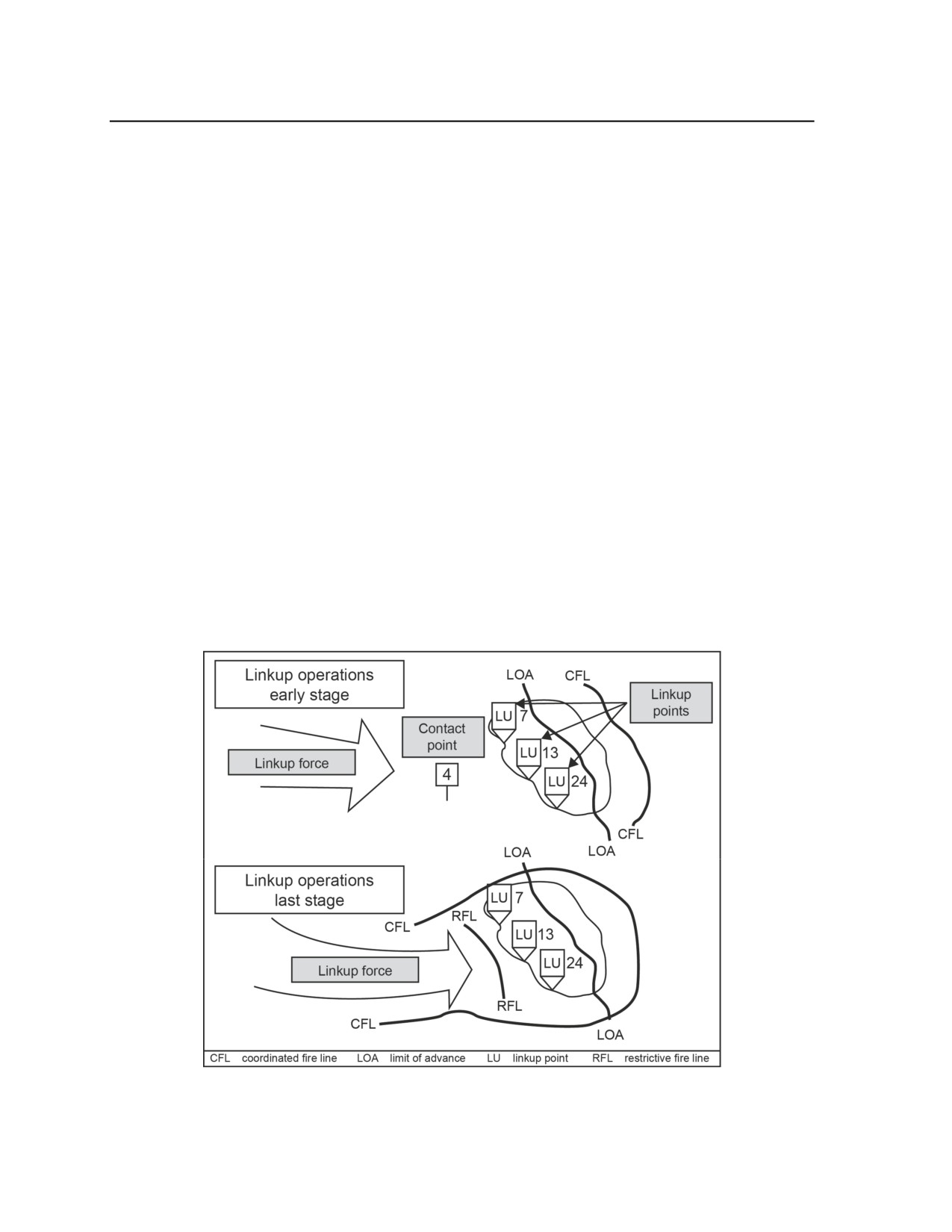
Chapter 6
LINKUP CONTROL MEASURES
6-78. The commander establishes minimum control measures for units conducting a linkup. The
commander assigns each unit an AO defined by lateral boundaries and a RFL that also acts as a LOA. The
commander establishes a no-fire area around one or both forces and establishes a coordinated fire line
beyond the area where the forces linkup. The commander establishes a no-fire area to ensure that uncleared
air-delivered munitions or indirect fires do not cross either the RFL or a boundary and impact friendly
forces. The coordinated fire line allows available joint fires to expeditiously attack enemy targets
approaching the area where the linkup is to occur. The linkup forces use the linkup points established by
the commander to initiate physical contact. The commander designates alternate linkup points, since enemy
action may interfere with the primary linkup points. Such control measures are adjusted during the
operation to provide for freedom of action as well as control of moving units and employment of fires.
LINKUP EXECUTION
6-79. There are two linkup methods. The preferred method is when the moving force has an assigned LOA
near the other force and conducts the linkup at predetermined contact points. Units then coordinate further
operations. The commander uses the other method during highly fluid mobile operations when the enemy
force escapes from a potential encirclement, or when one of the linkup forces is at risk and requires
immediate reinforcement. In this method, the moving force continues to move and conduct long-range
recognition via radio or other measures, stopping only when it makes physical contact with the other force.
6-80. When one of the units involved is stationary, the commander usually locates the linkup points near
the RFL or LOA. (See figure 6-10.) The linkup points are also located near the stationary force’s security
elements. Stationary forces assist in the linkup by opening lanes in minefields, breaching or removing
selected obstacles, furnishing guides, and designating assembly areas. When a moving force is coming to
relieve an encircled force, it brings additional sustainment assets to restore the encircled unit’s combat
effectiveness.
Figure 6-10. Linkup of a moving force and a stationary force
6-14
FM 3-90-2
22 March 2013
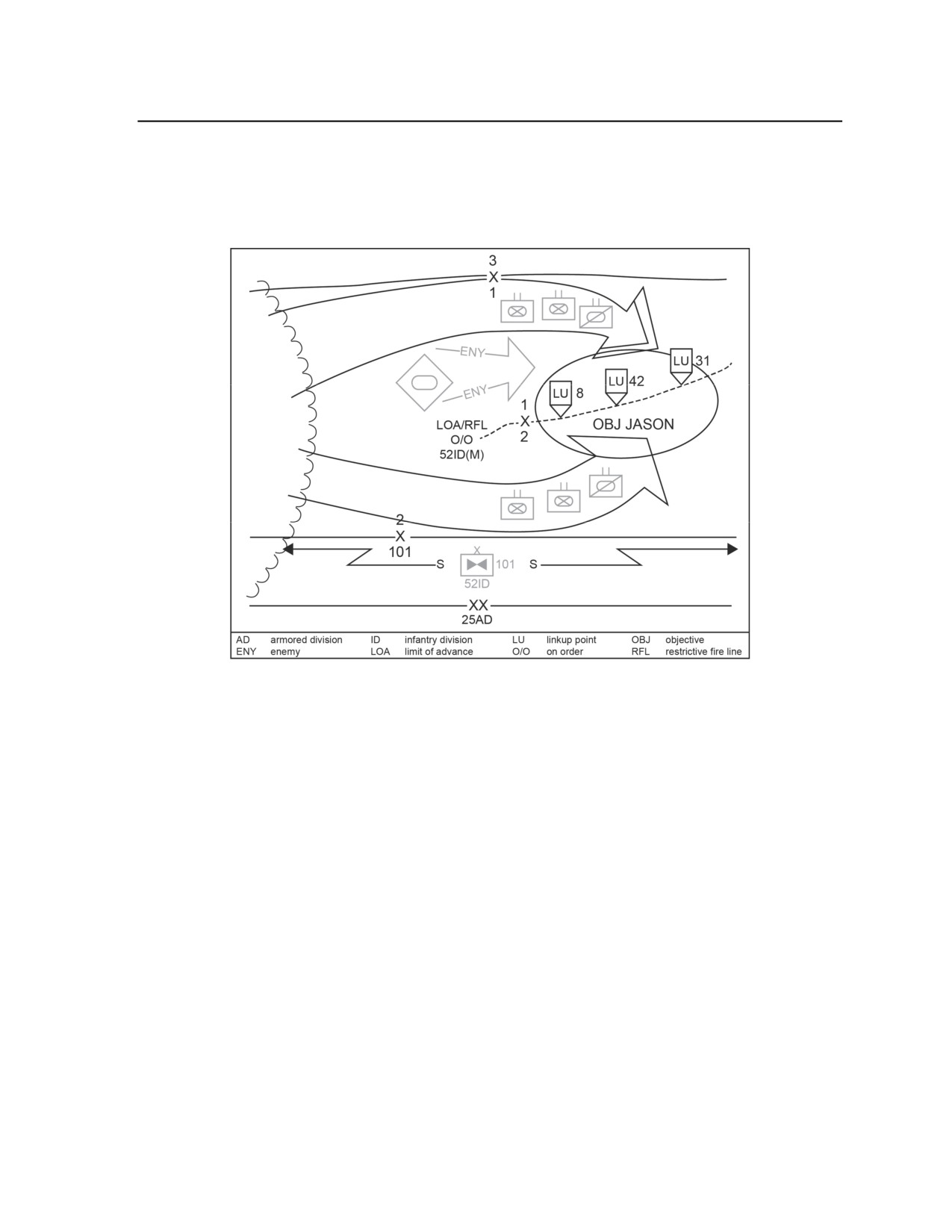
Encirclement Operations
6-81. Linkup between moving units is one of the most difficult operations. The commander establishes a
LOA to prevent friendly fire incidents. Primary and alternate linkup points are established for the moving
forces near the LOA. Fire support considerations are similar to when a stationary and moving force linkup.
Leading elements of each force exchange liaison teams and communicate on a common radio net. (See
figure 6-11.)
Figure 6-11. Linkup of two moving forces
6-82. The commander carefully coordinates linkup operations with forces of other nations. This is
especially true if the two armies are not both members of an alliance with established internationally
standardized procedures, or if the units involved have not previously established the necessary procedures.
22 March 2013
FM 3-90-2
6-15
Glossary
The glossary lists acronyms and terms with Army, multi-Service, or joint definitions,
and other selected terms. Where Army and joint definitions are different, (Army)
follows the term. Terms for which FM 3-90 is the proponent publication
(the
authority) are marked with an asterisk (*). The proponent publication for other terms
is listed in parentheses after the definition.
SECTION I - ACRONYMS AND ABBREVIATIONS
AA
assembly area
ADP
Army doctrine publication
ADRP
Army doctrine reference publication
AO
area of operations
ARFOR
Army forces
ATP
Army techniques publication
ATTP
Army tactics and techniques publication
BCT
brigade combat team
BFSB
battlefield surveillance brigade
BHL
battle handover line
BP
battle position
CAS
close air support
CBRN
chemical, biological radiological, and nuclear
CBRNE
chemical, biological, radiological, nuclear, and high-yield explosives
CCA
close combat attack
CCIR
commander’s critical information requirement
CFL
coordinated fire line
CI
counterintelligence
COA
course of action
COLT
combat observation and lasing team
EW
electronic warfare
FEBA
forward edge of the battle area
FFA
free-fire area
FLOT
forward line of own troops
FM
field manual
G-2
assistant chief of staff, intelligence
G-3
assistant chief of staff, operations
G-4
assistant chief of staff, logistics
G-9
assistant chief of staff, civil affairs operations
GPS
global positioning system
HUMINT
human intelligence
IPB
intelligence preparation of the battlefield
22 March 2013
FM 3-90-2
Glossary-1
Glossary
JAAT
joint air attack team
JP
joint publication
JSTARS
Joint Surveillance Target Attack Radar System
LD
line of departure
LP
listening post
LOA
limit of advance
LOC
line of communication
MBA
main battle area
METL
mission-essential task list
METT-TC
mission, enemy, terrain and weather, troops and support available, time
available, and civil considerations
MI
military intelligence
MISO
military information support operations
MSR
main supply route
MTOE
modified table of organization and equipment
NAI
named area of interest
OP
observation post
OPORD
operations order
OPSEC
operations security
PIR
priority information requirements
PL
phase line
POL
petroleum, oils, and lubricants
RFL
restrictive fire line
RIF
reconnaissance in force
RP
release point
S-2
intelligence staff officer
S-3
operations staff officer
S-4
logistics staff officer
S-9
civil-military operations officer
SOF
special operations forces
SOP
standard operating procedure
SP
start point
TAI
targeted area of interest
TCP
trafic control point
UAS
unmanned aircraft system
UGS
unattended ground sensors
Glossary-2
FM 3-90-2
22 March 2013
Glossary
SECTION II - TERMS
*administrative movement
A movement in which troops and vehicles are arranged to expedite their movement and conserve time
and energy when no enemy ground interference is anticipated.
*air movements
(Army) Operations involving the use of utility and cargo rotary-wing assets for other than air assaults.
approach march
The advance of a combat unit when direct contact with the enemy is intended. (ADRP 3-90)
area reconnaissance
A form of reconnaissance that focuses on obtaining detailed information about the terrain or enemy
activity within a prescribed area. (ADRP 3-90)
area security
A security task conducted to protect friendly forces, installations, routes, and actions within a specific
area. (ADRP 3-90)
*bounding overwatch
A movement technique used when contact with enemy forces is expected. The unit moves by bounds.
One element is always halted in position to overwatch another element while it moves. The
overwatching element is positioned to support the moving unit by fire or fire and movement.
breakout
An operation conducted by an encircled force to regain freedom of movement or contact with friendly
units. It differs from other attacks only in that a simultaneous defense in other areas of the perimeter
must be maintained. (ADRP 3-90)
*combat outpost
A reinforced observation post capable of conducting limited combat operations.
cover
(Army) 1. Protection from the effects of fires. (ADRP 1-02) 2. A security task to protect the main body
by fighting to gain time while also observing and reporting information and preventing enemy ground
observation of and direct fire against the main body. (ADRP 3-90)
*covering force
(Army) A self-contained force capable of operating independently of the main body, unlike a screening
or guard force to conduct the cover task.
*covering force area
The area forward of the forward edge of the battle area out to the forward positions initially assigned to
the covering force. It is here that the covering force executes assigned tasks.
*cueing
The integration of one or more types of reconnaissance or surveillance systems to provide information
that directs follow-on collecting of more detailed information by another system.
*dismounted march
Movement of troops and equipment mainly by foot, with limited support by vehicles. Also called foot
march.
encirclement operations
Operations where one force loses its freedom of maneuver because an opposing force is able to isolate
it by controlling all ground lines of communication and reinforcement. (ADRP 3-90)
22 March 2013
FM 3-90-2
Glossary-3
Glossary
*fire strike
The massed, synchronized, and nearly simultaneous delivery of primarily terminally guided indirect
fire and area munitions.
forward passage of lines
Occurs when a unit passes through another unit’s positions while moving toward the enemy.
(ADRP 3-90)
gap
(Army) An area free of armed mines or obstacles whose width and direction allow a friendly force to
pass through the area containing obstacles while dispersed in a tactical formation. (ADRP 1-02)
guard
(Army) A security task to protect the main body by fighting to gain time while also observing and
reporting information and preventing enemy ground observation of and direct fire against the main
body. Units conducting a guard mission cannot operate independently because they rely upon fires and
functional and multifunctional support assets of the main body. (ADRP 3-90)
light line
A designated line forward of which vehicles are required to use blackout lights during periods of
limited visibility. (ADRP 1-02)
linkup
A meeting of friendly ground forces, which occurs in a variety of circumstances. (ADRP 3-90)
local security
A security task that includes low-level security activities conducted near a unit to prevent surprise by
the enemy. (ADRP 3-90)
*march column
A march column consists of all elements using the same route for a single movement under control of a
single commander.
*march serial
A major subdivision of a march column that is organized under one commander who plans, regulates,
and controls the serial.
*march unit
A subdivision of a march serial. It moves and halts under the control of a single commander who uses
voice and visual signals.
*mixing
Using two or more different assets to collect against the same intelligence requirement.
movement control
The planning, routing, scheduling, and control of personnel and cargo movements over lines of
communications; includes maintaining in-transit visibility of forces and material through the
deployment and/or redeployment process. (JP 4-01.5)
movement corridor
A designated area established to protect and enable ground movement along a route. (FM 3-90.31)
*mounted march
The movement of troops and equipment by combat and tactical vehicles.
*observation post
A position from which military observations are made, or fire directed and adjusted, and which
possesses appropriate communications. While aerial observers and sensor systems are extremely
useful, those systems do not constitute aerial observation posts.
Glossary-4
FM 3-90-2
22 March 2013
Glossary
*passage lane
A lane through an enemy or friendly obstacle that provides safe passage for a passing force.
passage of lines
An operation in which a force moves forward or rearward through another force’s combat positions
with the intention of moving into or out of contact with the enemy. A passage may be designated as a
forward or rearward passage of lines. (JP 1-02)
*passage point
A specifically designated place where the passing units pass through the stationary unit.
*quartering party
A group of unit representatives dispatched to a probable new site of operations in advance of the main
body to secure, reconnoiter, and organize an area before the main body’s arrival and occupation.
rearward passage of lines
Occurs when a unit passes through another unit’s positions while moving away from the enemy.
(ADRP 3-90)
reconnaissance
A mission undertaken to obtain, by visual observation or other detection methods, information about
the activities and resources of an enemy or adversary, or to secure data concerning the meteorological,
hydrographic, or geographic characteristics of a particular area. (JP 2-0)
* reconnaissance by fire
A technique in which a unit fires on a suspected enemy position to cause the enemy forces to disclose
their presence by movement or return fire.
reconnaissance in force
(Army) A deliberate combat operation designed to discover or test the enemy’s strength, dispositions,
and reactions or to obtain other information. (ADRP 3-90)
reconnaissance objective
A terrain feature, geographic area, enemy force, adversary, or other mission or operational variable,
such as specific civil considerations, about which the commander wants to obtain additional
information. (ADRP 3-90)
*reconnaissance-pull
Reconnaissance that determines which routes are suitable for maneuver, where the enemy is strong and
weak, and where gaps exist, thus pulling the main body toward and along the path of least resistance.
This facilitates the commander’s initiative and agility.
*reconnaissance-push
Reconnaissance that refines the common operational picture, enabling the commander to finalize the
plan and support shaping and decisive operations. It is normally used once the commander commits to
a scheme of maneuver or course of action.
*redundancy
Using two or more like assets to collect against the same intelligence requirement.
*release point
A location on a route where marching elements are released from centralized control.
relief in place
An operation in which, by direction of higher authority, all or part of a
unit is replaced in an area by the incoming unit and the responsibilities of the replaced
elements for the mission and the assigned zone of operations are transferred to the
incoming unit. (JP 3-07.3)
22 March 2013
FM 3-90-2
Glossary-5
Glossary
route reconnaissance
A directed effort to obtain detailed information of a specified route and all terrain from which the
enemy could influence movement along that route. (ADRP 3-90)
screen
A security task that primarily provides early warning to the protected force. (ADRP 3-90)
security operations
Those operations undertaken by a commander to provide early and accurate warning of enemy
operations, to provide the force being protected with time and maneuver space within which to react to
the enemy, and to develop the situation to allow the commander to effectively use the protected force.
(ADRP 3-90)
special reconnaissance
Reconnaissance and surveillance actions conducted as a special operation in hostile, denied, or
politically sensitive environments to collect or verify information of strategic or operational
significance, employing military capabilities not normally found in conventional forces. (JP 3-05)
*start point
A location on a route where the marching elements fall under the control of a designated march
commander.
tactical road march
A rapid movement used to relocate units within an area of operations to prepare for combat operations.
(ADRP 3-90)
*trail party
The last march unit in a march column and normally consists of primarily maintenance elements in a
mounted march.
*traveling overwatch
A movement technique used when contact with enemy forces is possible. The lead element and trailing
element are separated by a short distance which varies with the terrain. The trailing element moves at
variable speeds and may pause for short periods to overwatch the lead element. It keys its movement to
terrain and the lead element. The trailing element over-watches at such a distance that, should the
enemy engage the lead element, it will not prevent the trailing element from firing or moving to
support the lead element.
troop movement
The movement of troops from one place to another by any available means. (ADRP 3-90)
zone reconnaissance
A form of reconnaissance that involves a directed effort to obtain detailed information on all routes,
obstacles, terrain, and enemy forces within a zone defined by boundaries. (ADRP 3-90)
Glossary-6
FM 3-90-2
22 March 2013
References
Field manuals and selected joint publications are listed by new number followed by
old number.
REQUIRED PUBLICATIONS
These documents must be available to intended users of this publication.
ADRP 1-02. Operational Terms and Military Symbols. 31 August 2012.
JP 1-02. Department of Defense Dictionary of Military and Associated Terms. 8 November 2010.
RELATED PUBLICATIONS
These documents contain relevant supplemental information.
JOINT AND DEPARTMENT OF DEFENSE PUBLICATIONS
Most joint publications are available online: <http://www.dtic.mil/doctrine/new_pubs/jointpub.htm >.
JP 2-0. Joint Intelligence. 22 June 2007.
JP 3-05. Special Operations. 18 April 2011.
JP 3-07.3. Peace Operations. 1 August 2012.
JP 4-01.5. Joint Tactics, Techniques, and Procedures for Transportation Terminal Operations. 9 April
2002.
ARMY PUBLICATIONS
Most Army doctrinal publications are available online: <http://www.apd.army.mil/ >. Army regulations
are produced only in electronic media and available at the same link.
ADP 3-0 (FM 3-0). Unified Land Operations. 10 October 2011.
ADP 3-07. Stability. 31 August 2012.
ADP 3-28. Defense Support of Civil Authorities. 26 July 2012.
ADP 3-37. Protection. 31 August 2012.
ADP 3-90. Offense and Defense. 31 August 2012.
ADP 5-0. The Operations Process. 17 May 2012.
ADRP 2-0. Intelligence. 31 August 2012.
ADRP 3-0. Unified Land Operations. 16 May 2012.
ADRP 3-07. Stability. 31 August 2012.
ADRP 3-09. Fires. 31 August 2012.
ADRP 3-37. Protection. 31 August 2012.
ADRP 3-90. Offense and Defense. 31 August 2012.
ADRP 5-0. The Operations Process. 17 May 2012.
FM 2-01.3. Intelligence Preparation of the Battlefield/Battlespace. 15 October 2009.
FM 3-04.113. Utility and Cargo Helicopter Operations. 7 December 2007.
FM 3-13 (FM 100-6). Inform and Influence Activities. 25 January 2013.
FM 3-34.170 (FM 5-170). Engineer Reconnaissance. 25 March 2008.
FM 3-39 (FM 3-19.1). Military Police Operations. 16 February 2010.
FM 3-55. Information Collection. 23 April 2012.
22 March 2013
FM 3-90-2
References-1
References
FM 3-57 (FM 3-05.40). Civil Affairs Operations. 31 October 2011.
FM 3-90-1. Offense and Defense. 22March 2013.
FM 3-90.31. Maneuver Enhancement Brigade Operations. 26 February 2009.
FM 4-01.30. Movement Control. 1 September 2003.
FM 21-18. Foot Marches. 1 June 1990.
FM 27-10. The Law of Land Warfare. 18 July 1956.
NORTH ATLANTIC TREATY ORGANIZATION PUBLICATION
Allied Tactical Publication-3.2.1. Allied Land Tactics. 9 November 2009.
PRESCRIBED FORMS
None
REFERENCED FORMS
DA Form 2028. Recommended Changes to Publications and Blank Forms.
References-2
FM 3-90-2
22 March 2013