FM 3-90-2 RECONNAISSANCE, SECURITY, AND TACTICAL ENABLING TASKS, Volume 2 (MARCH 2013) - page 1
FM 3-90-2
Field Manual
Headquarters
Department of the Army
No. 3-90-2
Washington, DC, 22 March 2013
Reconnaissance, Security, and Tactical
Enabling Tasks
Volume 2
Contents
Page
PREFACE
v
INTRODUCTION
vi
Chapter 1
RECONNAISSANCE
1-1
General Considerations of Reconnaissance
1-1
Reconnaissance Objective
1-1
Reconnaissance Fundamentals
1-2
Characteristics of Reconnaissance Assets
1-4
Forms of Reconnaissance
1-5
Planning Reconnaissance
1-12
Executing Reconnaissance
1-14
Recuperation and Reconstitution of Reconnaissance Assets
1-16
Chapter 2
SECURITY OPERATIONS
2-1
Security Operations Tasks
2-1
Fundamentals of Security Operations
2-2
General Considerations for Security Operations
2-3
Screen
2-10
Guard
2-14
Cover
2-19
Area Security
2-23
Local Security
2-24
Combat Outposts
2-24
Chapter 3
TROOP MOVEMENT
3-1
General Considerations of Troop Movement
3-1
Tactical Road March
3-2
Distribution Restriction: Approved for public release; distribution is unlimited.
i
Contents
Approach March
3-6
Movement Techniques
3-7
Planning a Troop Movement
3-9
Preparing a Troop Movement
3-11
Executing a Troop Movement
3-12
Movement Control
3-12
Chapter 4
RELIEF IN PLACE
4-1
General Considerations of a Relief in Place
4-1
Organization of Forces for a Relief in Place
4-1
Control Measures for a Relief in Place
4-2
Planning a Relief in Place
4-2
Preparing a Relief in Place
4-4
Executing a Relief in Place
4-4
Chapter 5
PASSAGE OF LINES
5-1
General Considerations of a Passage of Lines
5-1
Organization of Forces for a Passage of Lines
5-1
Control Measures for a Passage of Lines
5-2
Planning a Passage of Lines
5-3
Forward Passage of Lines
5-5
Rearward Passage of Lines
5-7
Chapter 6
ENCIRCLEMENT OPERATIONS
6-1
Offensive Encirclement Operations
6-1
Defending Encircled
6-6
Breakout from an Encirclement
6-8
Exfiltration
6-13
Attacking Deeper into Enemy Territory
6-13
Linkup
6-13
GLOSSARY
Glossary-1
REFERENCES
References-1
INDEX
Index-1
Figures
Figure 1-1. Route reconnaissance control measures
1-7
Figure 1-2. Zone reconnaissance control measures
1-8
Figure 1-3. Area reconnaissance control measures
1-10
Figure 2-1. Common security control measures
2-3
Figure 2-2. Security force crossing the LD separately from the main body to establish
a flank screen
2-9
Figure 2-3. Security force continuing to cross the LD separately from the main body
to establish a flank screen
2-10
ii
FM 3-90-2
22 March 2013
Contents
Figure 2-4. Second technique used by a moving flank security force to establish a
moving flank screen
2-10
Figure 2-5. Third technique used by a moving flank security force to establish a flank
guard or cover
2-10
Figure
2-6. Control measures used in a screen mission
2-12
Figure
2-7. Moving flank screen
2-13
Figure
2-8. Displacement methods for a flank screen
2-14
Figure
2-9. More displacement methods for a flank screen
2-14
Figure
2-10. Guard locations
2-14
Figure
2-11. Advance guard for a division shaping attack
2-15
Figure
2-12. Multiple security forces
2-16
Figure
2-13. Stationary flank guard
2-17
Figure
2-14. Moving flank guard control measures
2-18
Figure
2-15. Attack using a covering force
2-20
Figure
2-16. Depiction of defensive cover
2-22
Figure
2-17. Combat outposts
2-24
Figure
3-1. Tactical road march
3-3
Figure
3-2. Example overlay with route control measures
3-4
Figure
3-3. Example strip map
3-4
Figure
3-4. Start point
3-4
Figure
3-5. Release point
3-5
Figure
3-6. Light line
3-5
Figure
3-7. Approach march
3-6
Figure
3-8. Movement Techniques
3-7
Figure
3-9. Traveling
3-8
Figure
3-10. Traveling overwatch
3-8
Figure
3-11. Bounding overwatch using alternate bounds
3-9
Figure
3-12. Bounding overwatch using successive bounds
3-9
Figure
3-13. Corps movement control
3-12
Figure
4-1. Tactical mission graphic for a relief in place
4-1
Figure
4-2. Overlay of a brigade relief in place
4-2
Figure
5-1. Forward and rearward passage of lines tactical mission graphic
5-1
Figure
5-2. Control measures associated with a forward passage of lines
5-2
Figure
5-3. Passage point 7
5-3
Figure
5-4. Passage lane
5-3
Figure
5-5. Gap
5-3
Figure
5-6. Forward passage of lines
5-6
Figure
5-7. Rearward passage of lines
5-9
Figure
6-1. Inner and outer arms of an encirclement
6-2
Figure
6-2. Encirclement control measures
6-2
Figure
6-3. Squeeze technique
6-5
22 March 2013
FM 3-90-2
iii
Contents
Figure 6-4. Hammer and anvil technique
6-5
Figure 6-5. Wedge technique
6-5
Figure 6-6. Encircled division’s perimeter defense
6-7
Figure 6-7. Organization of forces for a breakout operation
6-9
Figure 6-8. Breakout by an encircled division
6-11
Figure 6-9. Continued breakout by an encircled division
6-12
Figure 6-10. Linkup of a moving force and a stationary force
6-14
Figure 6-11. Linkup of two moving forces
6-15
Tables
Table 1-1. Typical reconnaissance and surveillance assets available
1-4
Table 1-2. Dedicated reconnaissance units and forms of reconnaissance
1-6
Table 2-1. Typical size of security forces for a given mission and echelon
2-5
Table 2-2. Screen movement methods
2-13
iv
FM 3-90-2
22 March 2013
Preface
Field Manual (FM) 3-90-2 contributes to the Army and joint community by providing guidance on the
conduct of reconnaissance, security, and other tactical enabling tasks. It provides guidance in the form of
combat-tested tactics and procedures for tactical enabling tasks modified to exploit emerging Army and
joint offensive and defensive capabilities. FM 3-90-2 expounds on the doctrinal fundamentals established
in Army Doctrine Reference Publication (ADRP) 3-90. ADRP 3-90 and FM 3-90-1 must be read before
reading FM 3-90-2, since that is where the doctrine and tactics for the conduct of offensive and defensive
tasks and the art and science of tactics is found. FM 3-90-2 addresses the basic tactics associated with the
conduct of tactical enabling tasks.
The principal audience for FM 3-90-2 is all members of the profession of arms. Commanders and staffs of
Army headquarters serving as a joint task force or multinational headquarters should also refer to
applicable joint or multinational doctrine concerning the range of military operations and joint or
multinational forces. Trainers and educators throughout the Army will also use this publication.
FM 3-90-2 focuses on the organization of forces, minimum essential control measures, and general
planning, preparation, and execution considerations for each tactical enabling task not the subject of its own
publication. It is the common reference for those tactical enabling tasks that it addresses for all students of
the art and science of tactics, both in the field and the Army school system. The considerations in this
publication apply to small tactical units, such as companies and battalions, even though most of the figures
in this publication use the division and the brigade combat team (BCT) echelons to illustrate points in the
text. Echelon-specific field manuals and Army techniques publications address the specifics of how each
tactical echelon conducts these tactical enabling tasks.
FM 3-90-2 implements standardization agreement (STANAG) Allied Tactical Publication-3.2.1.
Commanders, staffs, and subordinates ensure their decisions and actions comply with applicable U.S.,
international, and, in some cases, host-nation laws and regulations. Commanders at all levels ensure their
Soldiers operate in accordance with the law of war and the rules of engagement. (See FM 27-10.)
FM 3-90-2 uses joint terms where applicable. Selected joint and Army terms and definitions appear in both
the glossary and the text. Terms for which FM 3-90-2 is the proponent publication (the authority) are
marked with an asterisk (*) in the glossary. Definitions for which FM 3-90-2 is the proponent publication
are boldfaced in the text. For other definitions shown in the text, the term is italicized and the number of the
proponent publication follows the definition.
FM 3-90-2 applies to the Active Army, the Army National Guard/the Army National Guard of the United
States, and the U.S. Army Reserve unless otherwise stated.
The proponent of FM 3-90-2 is the United States Army Combined Arms Center. The preparing agency is
the Combined Arms Doctrine Directorate, U.S. Army Combined Arms Center. Send comments and
recommendations on a DA Form 2028 (Recommended Changes to Publications and Blank Forms) to
Commander, U.S. Army Combined Arms Center and Fort Leavenworth, ATTN: ATZL-MCK-D
(FM 3-90-2),
300 McPherson Avenue, Fort Leavenworth, KS
66027-2337; by e-mail to
usarmy.leavenworth.mccoe.mbx.cadd-org-mailbox@mail.mil; or submit an electronic DA Form 2028.
22 March 2013
FM 3-90-2
v
Introduction
To understand FM 3-90-2, the reader must understand the doctrinal fundamentals contained in Army
Doctrine Publication (ADP) 3-0 and ADP 3-90 and Army Doctrine Reference Publication (ADRP) 3-0 and
ADRP 3-90. The reader should understand how the activities described in ADPs and ADRPs 3-07 and 3-28
carry over and impact the conduct of tactical enabling tasks and vice versa. The reader should understand
the operations (plan, prepare, execute, and assess) process and how that process relates to the Army’s
military decisionmaking process and troop-leading procedures described in ADP 5-0 and ADRP 5-0. The
reader should also understand the intelligence preparation of the battlefield
(IPB) process found in
ADRP 2-0 and the targeting process described in ADRP 3-09.
The combined arms tactics contained in this volume are based on the Army’s historical lessons learned.
However, our enemies and adversaries read U.S. doctrine and tactics to learn how to best counter our
combined arms team. The Army of the future must prove itself as capable of quickly adapting to new and
unexpected situations as it has in the past. Implementing change in the midst of combat is a difficult
process. Commanders must ensure the rapid dissemination of new tactics, techniques, and procedures
developed to counter or take advantage of these new circumstances regardless of the sources of the
solutions, from junior Soldiers on patrol or staff officers in Army command headquarters.
There have been several changes in the organization and contents of this publication when compared with
its predecessor, the 2001 edition of FM 3-90, Tactics. Chapter 1, The Art of Tactics, and the common
tactical concept half of chapter 2 of the previous edition is now found in ADRP 3-90. The graphic control
measures discussion in the previous version’s chapter 2 is now appendix A of FM 3-90-1. The Army
branch discussion from the previous version’s appendix A has been deleted as redundant with information
contained in Department of the Army 600-series pamphlets. The Army tactical echelon discussion from the
previous version’s appendix A has been moved to chapter 2 of ADRP and expanded on down to the fire
team level. Appendix C, Airborne and Air Assault Operations, of the 2001 version of FM 3-90 has been
deleted. The Army contributions to the joint task of forcible entry by vertical envelopment are now
addressed in FM 3-99. Appendix D, Encirclement Operations, is now chapter 6 of FM 3-90-2. Appendix E,
Rear Area and Base Security, is now addressed in the protection series of publications (ADP 3-37, ADRP
3-37, and subordinate publications).
This volume contains six chapters. The text of FM 3-90-2 focuses on combined arms tactics used to
conduct the tactical enabling tasks that units employ to win in combat. Those tactics require judgment in
application. FM 3-90-2 provides a common discussion of how commanders from the battalion task force
level through the division echelon conduct these tactical enabling tasks. The tactics and considerations
discussed in this publication focus on the Army core competencies of employing combined arms in lethal
combat operations. Their application must be tempered by the obligation to protect the civilian population
in the area of operations in the conduct of the stability element of decisive action. This publication is not
prescriptive, but it is authoritative.
• Chapter 1 addresses the conduct of reconnaissance.
• Chapter 2 addresses the conduct of security.
• Chapter 3 addresses the conduct of troop movement.
• Chapter 4 addresses the conduct of a relief in place.
• Chapter 5 addresses the conduct of a passage of lines.
• Chapter 6 address the conduct of encirclement operations.
The reader must understand the organizational considerations, control measures, planning, preparation, and
execution considerations for the conduct of offensive and defensive tasks addressed in FM 3-90-1 for the
tactics addressed in this publication to make sense. This is because the tactics and procedures discussion in
FM 3-90-1 is not repeated in this volume to avoid lengthening the publication. For example, chapter 1 of
vi
FM 3-90-2
22 March 2013
Introduction
FM 3-90-1 addresses the sustainment considerations within the context of the offense. That information is
not repeated in this volume.
The tactics, techniques, and procedures discussed in this publication are only examples of a way to conduct
a specific tactical enabling task. Collectively they provide a set of tools that commanders employ in
accordance with the exact tactical situation that they face at any one given time. The tactical situation is
defined as the mission variables of mission, enemy, terrain and weather, troops and support available, time
available, and civil considerations (METT-TC).
The existing rules of engagement in a specific situation will control the actual application of the tactics,
techniques, and procedures discussed in this publication. Readers of FM 3-90-2 should be aware that rules
of engagement are constantly evolving. Criteria for allowing weapons systems employment during the
conduct of major operations are significantly different than the criteria used during the conduct of irregular
warfare or peace operations. Commanders must understand where they currently are on the range of
military operations continuum and be able to switch quickly between different places along that continuum
to protect their units and Soldiers while still accomplishing their mission. A commander should seek legal
guidance concerning currently applicable U.S. and multinational rules and policies regarding the
employment of lethal and non-lethal weapons before directing their employment.
This volume contains only a few historical references. Such references are important in illustrating the
impact of combat on Soldiers and the art of command. Successful commanders, staff officers, and Soldiers
of all ranks study military history. This study should include the experiences of other armies and precedents
from classical, medieval, and recent historical periods, in addition to Army and Marine Corps recent
experiences in Iraq and Afghanistan. Military professionals should also study politics, diplomacy,
economics, and ways of influencing others—the other instruments of national power. While history never
exactly repeats itself, on many occasions it closely parallels previous developments. In addition, war
remains a human endeavor. What motivated or influenced our military forbearers will probably motivate or
influence today’s Soldiers to one degree or another, once adjustments are made to account for technological
and social changes.
22 March 2013
FM 3-90-2
vii
Chapter 1
Reconnaissance
Reconnaissance primarily relies on the human dynamic rather than technical means.
Reconnaissance is a focused collection effort. It is performed before, during, and
after other operations to provide information used in the intelligence preparation of
the battlefield (IPB) process, as well as by the commander in order to formulate,
confirm, or modify a course of action (COA). Units and Soldiers need appropriately
tailored detailed intelligence products to adequately plan and prepare for their
offensive and defensive missions. The collection of the information needed to prepare
those intelligence products by reconnaissance is the subject of this chapter. The five
forms of reconnaissance are route, zone, area, reconnaissance in force, and special
reconnaissance.
GENERAL CONSIDERATIONS OF RECONNAISSANCE
1-1. Reconnaissance is a mission undertaken to obtain, by visual observation or other detection methods,
information about the activities and resources of an enemy or adversary, or to secure data concerning the
meteorological, hydrographical, or geographic characteristics of a particular area (JP 2-0). Reconnaissance
identifies terrain characteristics, enemy and friendly obstacles to movement, and the disposition of enemy
forces and civilian population, so commanders can maneuver their forces freely and rapidly. It also collects
information about the indigenous population needed to answer intelligence requirements, primarily those
related to civil considerations. Reconnaissance before unit movements and occupation of assembly areas is
critical to protecting the force and preserving combat power. Reconnaissance of the indigenous population
primarily results in information commanders use to conduct stability tasks. It also keeps the force free from
contact as long as possible, so that it can concentrate on its decisive operation. Commanders and leaders at
every echelon, during every phase of an operation, must emphasize the importance of reporting to every
Soldier and rapidly updating command information systems to reflect friendly, enemy, and neutral
activities.
RECONNAISSANCE OBJECTIVE
1-2. Commanders orient their reconnaissance assets by identifying a reconnaissance objective in the area
of operations (AO). The reconnaissance objective is a terrain feature, geographic area, enemy force,
adversary, or other mission or operational variable, such as specific civil considerations, about which the
commander wants to obtain additional information (ADRP 3-90). The reconnaissance objective clarifies the
intent of the reconnaissance effort by specifying the most important result to obtain from the
reconnaissance effort. Every reconnaissance mission specifies a reconnaissance objective. The commander
assigns a reconnaissance objective based on priority information requirements (PIR) resulting from the IPB
process and the reconnaissance asset’s capabilities and limitations. The reconnaissance objective can be
information about a specific geographical location, such as the cross-country trafficability of a specific
area, a specific enemy or adversary activity to be confirmed or denied, or a specific enemy or adversary
unit to be located and tracked. When the reconnaissance unit does not have enough time to complete all the
tasks associated with a specific form of reconnaissance, it uses the reconnaissance objective to guide it in
setting priorities.
1-3. A commander may need to provide additional detailed instructions beyond the reconnaissance
objective, such as the specific tasks and their priorities. The commander issues additional guidance to the
reconnaissance unit or specifies these instructions in tasks to subordinate units in a warning order,
fragmentary order, or the operations order. For example, if, based on all technical sensors and human
intelligence (HUMINT) sources, a division assistant chief of staff, intelligence (G-2) concludes that the
1-1
FM 3-90-2
22 March 2013
Chapter 1
may decide not to conduct a detailed area or zone reconnaissance effort before to moving subordinate
brigades into that area. The commander may direct the division’s attached battlefield surveillance or
combat aviation brigade to conduct a zone reconnaissance mission with guidance to move rapidly and
report by exception terrain obstacles that will significantly slow the movement of subordinate brigade
combat teams. Alternatively, when the reconnaissance objective is to locate an enemy force, additional
guidance would be to conduct only that terrain reconnaissance necessary to find the enemy and develop the
situation.
RECONNAISSANCE FUNDAMENTALS
1-4. There are seven fundamentals of successful reconnaissance. Commanders—
z
Ensure continuous reconnaissance.
z
Do not keep reconnaissance assets in reserve.
z
Orient on the reconnaissance objective.
z
Report information rapidly and accurately.
z
Retain freedom of maneuver.
z
Gain and maintain enemy contact.
z
Develop the situation rapidly.
ENSURE CONTINUOUS RECONNAISSANCE
1-5. Effective reconnaissance is continuous. The commander conducts reconnaissance before, during, and
after all operations. Before an operation, reconnaissance fills gaps in information about the enemy, the
terrain, and civil considerations. During an operation, reconnaissance provides the commander with
updated information that verifies the enemy’s composition, dispositions, and intentions as the battle
progresses. This allows the commander to verify which potential COA the enemy is attempting to execute
and determine if the friendly plan is still valid based on events in the AO. However, the commander may
have some reconnaissance elements determine and report civilian activities in population nodes during
operations. The commander may have reconnaissance elements report friendly unit locations, status, and
sustainment requirements during chaotic situations, such as after a chemical, biological, radiological,
nuclear, or high-yield explosive (CBRNE) event. After an operation, reconnaissance elements maintain
contact with the enemy to determine the enemy’s next move and collect information, including terrain and
civil considerations, necessary for planning subsequent operations. When current operational information is
adequate, reconnaissance elements gather information for branches and sequels to current plans. As a
minimum, reconnaissance is conducted continuously as part of all security missions, including the conduct
of local security for forces not in contact. As operations transition from a focus on one element of
operations to another, the nature of the PIR and information requirements being collected against will
change. It is important that all Soldiers act as sensors and report their observations in a timely manner to a
competent authority.
1-6. Reconnaissance over extended distances and times may require pacing reconnaissance assets to
maintain the effort, or rotating units to maintain continuous coverage. The human and technical assets used
in the reconnaissance effort must be allowed time for rest, resupply, troop leading procedures, additional
and refresher training, and preventive maintenance checks and services. The commander must determine
not only where, but also when, the maximum reconnaissance effort is required and pace the commitment of
available reconnaissance assets to ensure that adequate assets are available at those critical times and
places.
DO NOT KEEP RECONNAISSANCE ASSETS IN RESERVE
1-7. Reconnaissance assets, like artillery assets, are never kept in reserve. When committed,
reconnaissance assets use all of their resources to accomplish the mission. This does not mean that all
assets are committed all the time. The commander uses available reconnaissance assets based on their
capabilities and the mission variables of mission, enemy, terrain and weather, troops and support available,
time available, and civil considerations (METT-TC) to achieve the maximum coverage needed to answer
the commander’s critical information requirements (CCIR). At times, this requires the commander to
withhold or position reconnaissance assets to ensure that they are available at critical times and places.
1-2
FM 3-90-2
22 March 2013
Reconnaissance
Commanders do not recover and sustain reconnaissance assets by placing them in the reserve. Commanders
consider all reconnaissance assets as committed assets with specific missions at all times. Commanders
may keep units with multiple roles—specifically the three types of brigade combat teams (BCTs)—that can
conduct reconnaissance, security, and other combat missions in an economy-of-force role as a reserve for
security or combat missions.
ORIENT ON THE RECONNAISSANCE OBJECTIVE
1-8. The commander uses the reconnaissance objective to focus reconnaissance efforts. Commanders of
subordinate reconnaissance elements remain focused on achieving this objective, regardless of what their
elements encounter during the mission. When time, unit limitations, or enemy action prevents a unit from
accomplishing all the tasks normally associated with a particular form of reconnaissance, the unit uses the
reconnaissance objective to focus the reconnaissance effort.
REPORT INFORMATION RAPIDLY AND ACCURATELY
1-9. Reconnaissance assets acquire and report accurate and timely information on the enemy, terrain, and
civil considerations of the area over which operations are conducted. Information may quickly lose its
value. Reconnaissance units report exactly what they see and, if appropriate, what they do not see.
Seemingly unimportant information may be extremely important when combined with other information.
Reports of no enemy activity are as important as reports of enemy activity. Failing to report tells the
commander nothing. The echelon information management plan ensures that the echelon’s reconnaissance
assets have the proper communication equipment to support the echelon integrated reconnaissance and
surveillance plan.
RETAIN FREEDOM OF MANEUVER
1-10. Reconnaissance assets must retain battlefield mobility to successfully complete their missions. If
these assets are decisively engaged, reconnaissance stops and a battle for survival begins. Reconnaissance
assets must have clear engagement criteria that support the commander’s intent. They must employ proper
movement and reconnaissance techniques, use overwatching fires, and follow standard operating
procedures (SOPs). Initiative and knowledge of both the terrain and the enemy reduce the likelihood of
decisive engagement and help maintain freedom of movement. Before initial contact, the reconnaissance
unit adopts a combat formation designed to gain contact with the smallest possible friendly element. This
provides the unit with the maximum opportunity for maneuver and enables it to avoid having the entire unit
become decisively engaged. The IPB process can identify anticipated areas of likely contact to the
commander. Using indirect fires to provide suppression and obscuration as well as destroy point targets is a
method reconnaissance assets use to retain their freedom of maneuver.
GAIN AND MAINTAIN ENEMY CONTACT
1-11. Once a unit conducting reconnaissance gains contact with the enemy, it maintains that contact unless
the commander directing the reconnaissance orders otherwise or the survival of the unit is at risk. This does
not mean that individual scout and reconnaissance teams cannot break contact with the enemy. The
commander of the unit conducting reconnaissance is responsible for maintaining contact. That contact can
range from surveillance to close combat. Surveillance, combined with stealth, is often sufficient to maintain
contact and is the preferred method. Units conducting reconnaissance avoid combat unless it is necessary to
gain essential information, in which case the units use maneuver (fire and movement) to maintain contact
while avoiding decisive engagement.
DEVELOP THE SITUATION RAPIDLY
1-12. When a reconnaissance asset encounters an enemy force or an obstacle, it must quickly determine
the threat it faces. For an enemy force, it must determine the enemy’s composition, dispositions, activities,
and movements and assess the implications of that information. For an obstacle, it must determine the type
and extent of the obstacle and whether it is covered by fire. Obstacles can provide the attacker with
information concerning the location of enemy forces, weapon capabilities, and organization of fires. In
22 March 2013
FM 3-90-2
1-3

Chapter 1
most cases, the reconnaissance unit developing the situation uses actions on contact. (See chapter 2 of
FM 3-90-1, for a discussion of actions on contact.)
CHARACTERISTICS OF RECONNAISSANCE ASSETS
1-13. The responsibility for conducting reconnaissance does not reside solely with specifically organized
units. Every unit has an implied mission to report information about the terrain, civilian activities, and
friendly and enemy dispositions. This is regardless of its location and primary function. Troops in close
combat and reconnaissance patrols of maneuver units at all echelons collect information on enemy units
with which they are in contact. In echelon support areas, reserve maneuver forces, functional and
multifunctional support and sustainment elements, other governmental agencies, and multinational forces
observe and report civilian and enemy activity and significant changes in terrain trafficability. Although all
units conduct reconnaissance, those specifically trained in reconnaissance tasks are aviation attack
reconnaissance units, scouts, long-range reconnaissance units, and Special Forces. Some branches, such as
the Corps of Engineers, Civil Affairs, and the Chemical Corps, have specific reconnaissance tasks to
perform that complement the force’s overall reconnaissance effort. However, BCT, division, and corps
commanders primarily use their organic or attached reconnaissance elements—ground or air—and
intelligence elements to conduct reconnaissance.
1-14. At battalion level and above, the commander assigns missions to reconnaissance and surveillance
assets based on their organization, equipment, and training. The commander knows the capabilities and
limitations of available reconnaissance assets to ensure the employment of these assets within their
capabilities and on missions for which they have been trained and equipped. Table 1-1 shows the typical
nesting of reconnaissance and surveillance assets available at different echelons.
Table 1-1. Typical reconnaissance and surveillance assets available
Platoon
CO/TM
BN/TF
BCT
Division
Corps
Observation post
XXX
XXX
XXX
XXX
XXX
XXX
Reconnaissance patrol
XXX
XXX
XXX
XXX
XXX
XXX
Combat outpost
AAA
AAA
XXX
XXX
XXX
XXX
Scout platoon
AAA
AAA
XXX
XXX
Reconnaissance troop
AAA
AAA
XXX
XXX
Brigade combat team reconnaissance squadron
AAA
AAA
XXX
AAA
Chemical reconnaissance
AAA
XXX
XXX
XXX
XXX
Artillery combat observation and lasing team
AAA
AAA
XXX
XXX
Artillery target acquisition systems
AAA
AAA
XXX
XXX
Air defense target acquisition systems
AAA
AAA
XXX
XXX
Ground surveillance radars
AAA
XXX
XXX
Other military intelligence collection systems
AAA
XXX
XXX
XXX
Attack reconnaissance squadron
AAA
XXX
XXX
Unmanned aircraft systems
AAA
AAA
AAA
XXX
XXX
XXX
Long-range surveillance unit
AAA*
XXX
Special forces/ranger
AAA
AAA
Battlefield surveillance brigade
XXX
XXX
Technical surveillance platforms
AAA
AAA
AAA
AAA
XXX = Echelon controls or routinely tasks the asset.
AAA = Echelon can routinely expect the information from that source to be made available to it.
*Found in infantry brigade combat team and battlefield surveillance brigade reconnaissance squadrons.
CO/TM company/team
BN/TF battalion task force
BCT brigade combat team
1-4
FM 3-90-2
22 March 2013
Reconnaissance
1-15. A commander primarily conducts reconnaissance with a combination of manned ground and air
assets supported by technical systems. Acting in concert, these assets create a synergy, using the strengths
of one system to overcome the weaknesses of another. To produce this synergy, the commander must
delineate reporting procedures for all units to pass on information gathered during the conduct of
reconnaissance. This facilitates rapid mission accomplishment.
1-16. Commanders can easily over task and overextend dedicated reconnaissance assets. The commander
uses all available resources, not just reconnaissance units, to satisfy existing information requirements.
Ground reconnaissance can involve assets not specifically tailored for the mission. Engineer reconnaissance
teams collect terrain information regarding trafficability and obstacle intelligence (see Maneuver Support
Center of Excellence publications addressing engineer reconnaissance). Chemical, biological, radiological,
and nuclear (CBRN) reconnaissance teams can determine the presence, absence, and extent of CBRN
contamination. Joint forward observers, fire support teams, and combat observation and lasing teams
(COLTs) report combat information as they observe the battlefield. Any air defense units in the
commander’s AO observe and report enemy aircraft and air corridors in use and supplement the radars
found in the division headquarters battalion.
1-17. Ground reconnaissance elements are generally limited in the depth to which they can conduct
reconnaissance. However, they can operate under weather conditions that prohibit aerial reconnaissance.
Reconnaissance conducted by manned and unmanned aviation platforms complements ground
reconnaissance by increasing the speed and depth with which reconnaissance can be conducted over an
area. Air reconnaissance operates over terrain that hinders ground operations, such as swamps, extremely
rugged terrain, or deep snow. Aviation assets can operate at a considerable depth, far in advance of
dedicated ground reconnaissance elements focused on the close fight. Thus, they provide the commander
with additional time to react to the enemy. Attack reconnaissance helicopters use their optics, video,
thermal imaging, electronic sensors, and communications capabilities to detect and report enemy activities.
All types of aviation units generate pilot reports when conducting their primary missions. These reports are
often a source of valuable combat information.
1-18. While several technical systems can perform reconnaissance, most of these systems are considered
surveillance platforms. Surveillance complements reconnaissance by cueing the commitment of
reconnaissance assets against specific locations or specially targeted enemy units.
1-19. Military intelligence
(MI) units conduct both surveillance and reconnaissance missions. They
provide electronic intercept, unmanned aircraft systems
(UASs) sensor feeds, and HUMINT,
counterintelligence
(CI), and downlinks from theater of operations and national assets. Theater of
operations and national reconnaissance and surveillance systems provide broadcast dissemination of
information and intelligence to the commander and provide near real-time imagery as a part of an
integrated intelligence effort. Artillery and air defense target acquisition radars complement MI
surveillance systems as a part of that effort. HUMINT collection occurs through face-to-face interrogation
of captured enemy soldiers, screening of the civilian population, and debriefing of friendly Soldiers, such
as scouts and special operations forces (SOF).
FORMS OF RECONNAISSANCE
1-20. The five forms of reconnaissance are—
z
Route reconnaissance.
z
Zone reconnaissance.
z
Area reconnaissance.
z
Reconnaissance in force (RIF).
z
Special reconnaissance.
1-21. Table 1-2 on page 1-6 shows what types of Army dedicated reconnaissance units are typically
assigned the missions of conducting the first four forms of reconnaissance. SOF conduct special
reconnaissance.
22 March 2013
FM 3-90-2
1-5

Chapter 1
Table 1-2. Dedicated reconnaissance units and forms of reconnaissance
Troop/
Air
Reconnaissance
Brigade
Special
Scout
company
cavalry
squadron/
combat
Division
operations
platoon
team
troop
battalion
team
forces
Route
X
X
X
Zone
X
X
X
X
X
Area
X
X
X
X
X
Reconnaissance
X
X
in force
Special
X
ROUTE RECONNAISSANCE
1-22. Route reconnaissance is a directed effort to obtain detailed information of a specified route and all
terrain from which the enemy could influence movement along that route (ADRP 3-90). That route may be
a cross-country mobility corridor. It provides new or updated information on route conditions, such as
obstacles and bridge classifications, and enemy and civilian activity along the route. The commander
normally assigns this mission when wanting to use a specific route for friendly movement.
Organization of Forces
1-23. The commander assigns a route reconnaissance as a separate mission or as a specified task for a unit
conducting a zone or area reconnaissance. A scout platoon conducts a route reconnaissance over only one
route at a time. For larger organizations, the number of scout platoons available directly influences the
number of routes that can be covered at one time. Integrating ground, air, and technical assets assures a
faster and more complete route reconnaissance.
1-24. A ground reconnaissance effort is essential if the mission is to conduct detailed reconnaissance of
the route or the mission requires clearing the enemy from an AO that includes the route and the adjacent
terrain. The commander sufficiently mans and equips forces conducting ground reconnaissance to enable
them to respond to enemy forces in the AO. If the commander expects them to make contact with enemy
forces possessing more combat power than that typically found in enemy reconnaissance elements, the
commander ensures that forces conducting ground reconnaissance have rapid access to fire support and
other combat multipliers. If the commander requires detailed information on the route, engineer
reconnaissance assets can determine the classification of critical points along the route more quickly and
accurately than scouts can. If the commander anticipates significant obstacles, combat engineers are
included as part of the force. If CBRN contamination is expected, CBRN reconnaissance assets accompany
the force conducting ground reconnaissance because they can detect and determine the extent of
contamination more accurately and quickly than scouts can. Air reconnaissance can be used if the
reconnaissance mission must be completed quickly. However, aerial reconnaissance can rarely clear an
enemy force from a location where it can affect movement on the route and aircraft cannot breach
obstacles. When time is limited, air reconnaissance is essential to determine which areas are clear of enemy
forces and obstacles, and to cue ground reconnaissance regarding where to focus its efforts.
Control Measures
1-25. Control measures for a route reconnaissance create an AO for the unit conducting the
reconnaissance. (See figure 1-1 on page 1-7.) The commander places lateral boundaries on both sides of the
route, far enough out to allow reconnaissance of all terrain from which the enemy could dominate the route.
The line of departure (LD) is drawn with reference to the location on the battlefield where enemy contact is
possible. Generally this falls before and perpendicular to the route being reconnoitered, allowing adequate
space for the unit conducting the reconnaissance to deploy into formation. The LD creates the rear
boundary of the AO. The commander places a limit of advance (LOA) far enough beyond the route’s
release point (RP), including any terrain from which the enemy could dominate the route. A start point (SP)
and a RP define that section of the route where the unit collects detailed information. The commander may
1-6
FM 3-90-2
22 March 2013
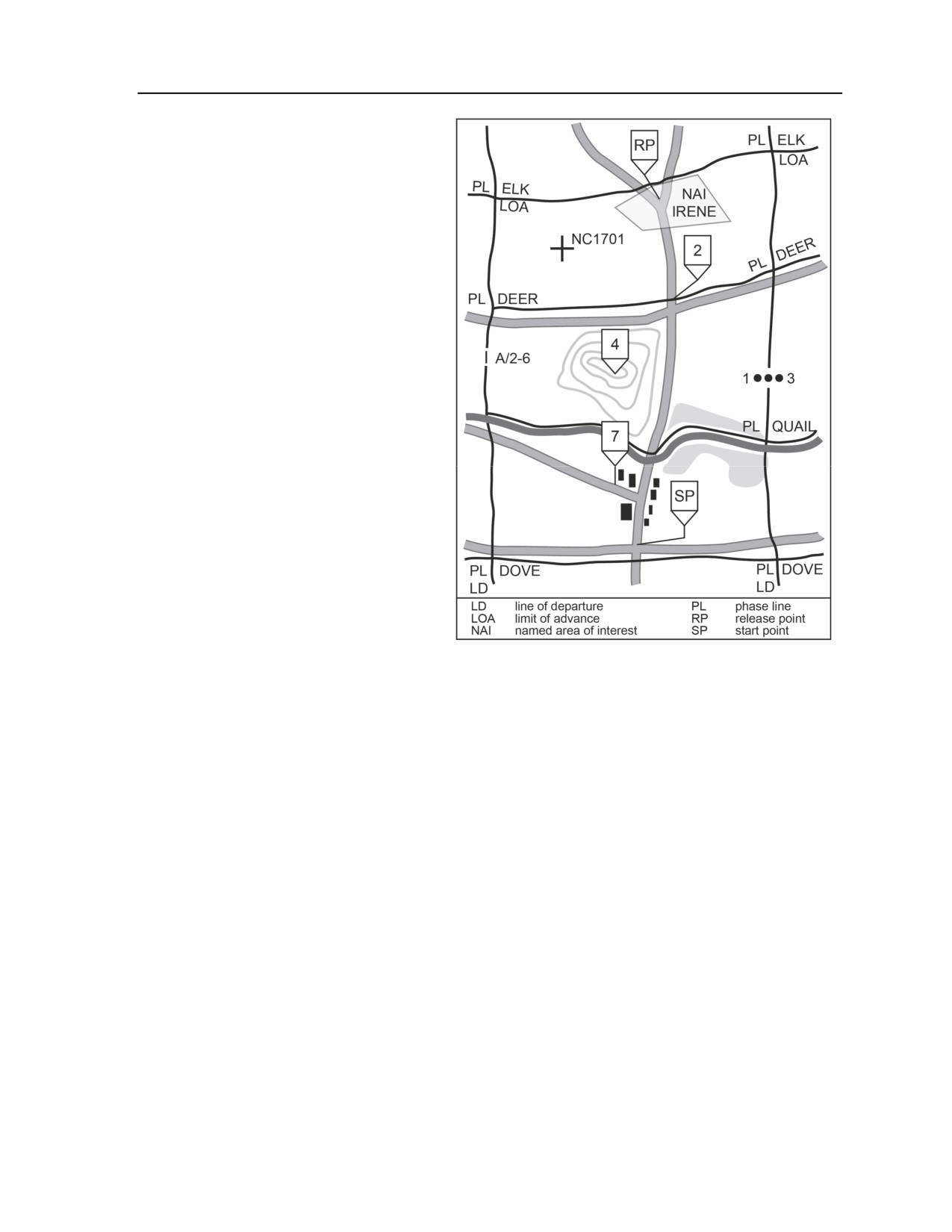
Reconnaissance
add phase lines (PLs) and checkpoints to
coordinate
reconnaissance,
control
movement, or designate critical points.
Commanders place additional control
measures on terrain features identifiable
from both the ground and the air to
coordinate indirect and direct fire and
assist in air-to-ground coordination.
Tasks
1-26. Unless the commander orders
otherwise, the unit conducting a route
reconnaissance performs specific tasks. If
a unit does not have the time or resources
to complete all of these tasks, it must
inform the commander assigning the
mission. The commander then issues
further guidance on which tasks the unit
must complete or the priority of each task,
which is usually clear from the
reconnaissance objective. If, after starting
the reconnaissance, the unit determines
that it cannot complete an assigned task,
such as clearing the enemy or reducing
obstacles to create lanes to support the
main body’s maneuver along the route, it
reports and awaits further instructions.
1-27. Route reconnaissance tasks include
the following:
z Find, report, and—based on
Figure 1-1. Route reconnaissance control measures
engagement
criteria—clear
within capabilities all enemy
forces that can influence movement along the route.
z Determine the trafficability of the route; can it support the friendly force?
z Reconnoiter all terrain that the enemy can use to dominate movement along the route, such as
choke points, ambush sites, and pickup zones, landing zones, and drop zones.
z Reconnoiter all built-up areas, contaminated areas, and lateral routes along the route.
z Evaluate and classify all bridges, defiles, overpasses, underpasses, and culverts along the route.
z Locate any fords, crossing sites, or bypasses for existing and reinforcing obstacles (including
built-up areas) along the route.
z Locate all obstacles and create lanes as specified in execution orders.
z Report the above route information to the headquarters initiating the route reconnaissance
mission, to include providing a sketch map or a route overlay.
(See FM 3-34.170 for additional information concerning route reconnaissance.)
ZONE RECONNAISSANCE
1-28. Zone reconnaissance is a form of reconnaissance that involves a directed effort to obtain detailed
information on all routes, obstacles, terrain, and enemy forces in a zone defined by boundaries
(ADRP 3-90). Obstacles include existing and reinforcing, as well as areas with CBRN contamination. The
commander assigns a zone reconnaissance mission when the commander needs additional information on a
zone before committing other forces in the zone. It is appropriate when the enemy situation is vague,
22 March 2013
FM 3-90-2
1-7
Chapter 1
existing knowledge of the terrain is limited, or combat operations have altered the terrain. A zone
reconnaissance may include several route or area reconnaissance missions assigned to subordinate units.
1-29. A zone reconnaissance is normally a deliberate, time-consuming process. It takes more time than any
other reconnaissance mission, so the commander must allow adequate time to conduct it. A zone
reconnaissance is normally conducted over an extended distance and starts from a line of departure. It
requires all ground elements executing the zone reconnaissance to be employed abreast of each other.
However, when the reconnaissance objective is the enemy force, a commander may forgo a detailed
reconnaissance of the zone and focus assets on those named areas of interest (NAI) that would reveal
enemy dispositions and intentions. A reconnaissance unit cannot disregard terrain when focusing on the
enemy. However, it minimizes its terrain reconnaissance to that which may influence an NAI.
Organization of Forces
1-30. Considerations for organizing a zone reconnaissance are the same as for organizing a route
reconnaissance except that several subordinate units, rather than just one unit, operate abreast during the
zone reconnaissance. If the commander expects significant enemy forces in the zone, the commander
provides the force conducting the zone reconnaissance with a reserve. This reserve should have adequate
combat power to extract elements of the reconnaissance force from a decisive engagement. A tank
company normally performs this role for a combined arms battalion of an armored brigade combat team. If
a unit conducts a zone reconnaissance beyond supporting range of the main body, the commander ordering
the zone reconnaissance provides the reconnaissance unit with adequate fire support assets that can move
with the reconnaissance unit.
Control Measures
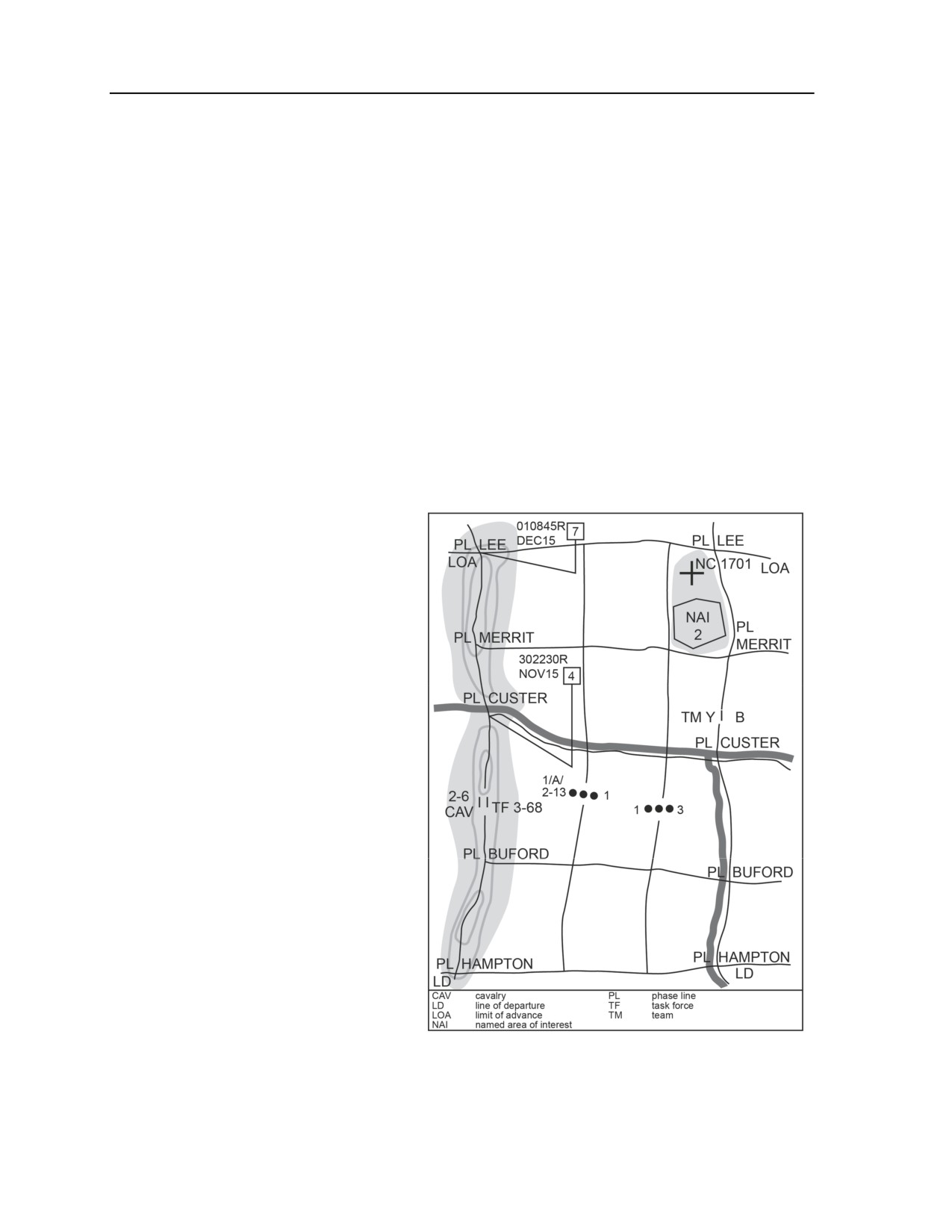
1-31. The commander controls a zone
reconnaissance by assigning an AO to the
unit conducting the reconnaissance. (See
figure 1-2.) The lateral boundaries, a LD,
and a LOA define this AO. Within the
AO, the force conducting the zone
reconnaissance further divides the AO
with additional lateral boundaries to
define subordinate unit AOs. Subordinate
AOs are not necessarily the same size.
Phase lines and contact points, located
where the commander determines that it is
necessary for adjacent units to make
physical contact, are used to coordinate
the movement of elements operating
abreast. The commander may further
designate the time that this physical
contact takes place. Checkpoints indicate
critical terrain features and help to
coordinate air-ground integration. The
commander may use fire support
coordination measures to control direct
and indirect fires and use additional
control measures as necessary. In
addition, the commander assigning the
zone reconnaissance mission must specify
the route the reconnaissance unit uses to
enter the AO. All control measures are on
Figure 1-2. Zone reconnaissance control measures
recognizable terrain when possible.
1-8
FM 3-90-2
22 March 2013
Reconnaissance
Tasks
1-32. Unless the commander orders otherwise, a unit conducting a zone reconnaissance performs the tasks
listed in paragraph 1-33. If a unit does not have the time or resources to complete all of these tasks, it
informs the commander assigning the mission. The commander then issues further guidance on which tasks
the unit must complete or the priority of tasks, which is usually clear from the reconnaissance objective.
After starting the reconnaissance, if the unit determines that it cannot complete an assigned task, such as
clear enemy or reduce obstacles in zone to create lanes as required to support the main body’s maneuver, it
reports and awaits further instructions.
1-33. Zone reconnaissance tasks include the following:
z
Find and report all enemy forces in the zone.
z
Based on engagement criteria, clear all enemy forces in the designated AO within the capability
of the unit conducting reconnaissance.
z
Determine the trafficability of all terrain in the zone, including built-up areas.
z
Locate and determine the extent of all contaminated areas in the zone.
z
Evaluate and classify all bridges, defiles, overpasses, underpasses, and culverts in the zone.
z
Locate any fords, crossing sites, or bypasses for existing and reinforcing obstacles (including
built-up areas) in the zone.
z
Locate all obstacles and create lanes as specified in execution orders.
z
Report the above information to the commander directing the zone reconnaissance, to include
providing a sketch map or overlay.
AREA RECONNAISSANCE
1-34. Area reconnaissance is a form of reconnaissance that focuses on obtaining detailed information
about the terrain or enemy activity within a prescribed area (ADRP 3-90). This area may include a town, a
ridgeline, woods, an airhead, or any other critical operational feature. The area may consist of a single
point, such as a bridge or an installation. The primary difference between an area reconnaissance and a
zone reconnaissance is that in an area reconnaissance units conducting the reconnaissance first move to the
area in which the reconnaissance will occur. In a zone reconnaissance the units conducting the
reconnaissance start from a line of departure. Areas are normally smaller than zones and are not usually
contiguous to other friendly areas targeted for reconnaissance. Because the area is smaller, an area
reconnaissance typically takes less time to complete than a zone reconnaissance.
Organization of Forces
1-35. Considerations for the organization of forces for an area reconnaissance are the same as for
organizing a zone reconnaissance. (See paragraph 1-30.)
Control Measures
1-36. The commander assigning an area reconnaissance specifies the area for reconnaissance with a single
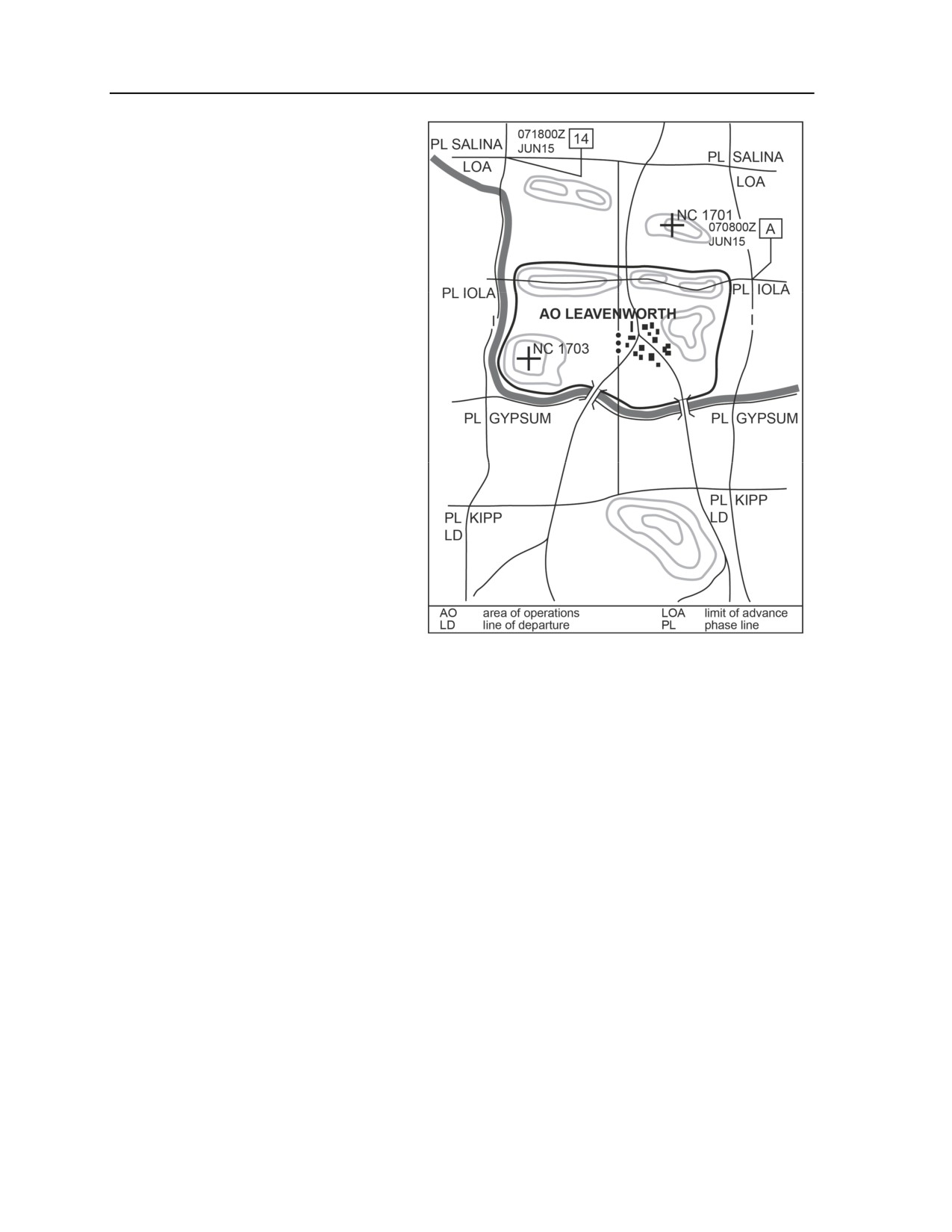
continuous line to enclose the area to reconnoiter. Alternatively, the commander may designate the area by
marking lateral boundaries, a LD, and a LOA. An area reconnaissance mission specifies the route to take in
moving to the area. Upon completion of the area reconnaissance, the unit normally departs the area on a
different route. The commander of the unit conducting the area reconnaissance mission uses control
measures for a zone reconnaissance in the AO to control subordinate element operations. (See figure 1-3 on
page 1-10.)
Tasks
1-37. The tasks for an area reconnaissance are the same as for a zone reconnaissance. (See paragraph
1-33.)
22 March 2013
FM 3-90-2
1-9
Chapter 1
RECONNAISSANCE IN FORCE
1-38. A reconnaissance in force is a
deliberate combat operation designed to
discover or test the enemy’s strength,
dispositions, and reactions or to obtain
other
information
(ADRP
3-90).
Battalion-sized task forces or
larger
organizations
usually
conduct
a
reconnaissance
in force
(RIF). A
commander assigns a RIF when the
enemy is operating in an area and the
commander cannot obtain adequate
intelligence by any other means. A unit
may also conduct a RIF in restrictive
terrain where the enemy is likely to
ambush smaller reconnaissance forces. A
RIF is an aggressive reconnaissance,
conducted as an offensive operation with
clearly stated reconnaissance objectives.
The overall goal of a RIF is to determine
enemy weaknesses that can be exploited.
It
differs
from other forms of
reconnaissance because it is normally
conducted only to gain information about
the enemy and not the terrain. The
commander plans for the extrication of the
force or the exploitation of success in
advance.
Organization of Forces
Figure 1-3. Area reconnaissance control measures
1-39. While specifically trained and
equipped units usually conduct the other forms of reconnaissance, any maneuver force can conduct a RIF.
The commander directing the RIF organizes the force as if it is conducting offensive operations. However,
the lack of enemy information dictates that the force be large and strong enough to develop the situation,
protect itself long enough to be supported by other friendly assets, cause the enemy to react, and put the
enemy at some risk. The less known about the enemy, the stronger the force conducting the RIF must be.
Because of the lack of information about the enemy, a commander normally conducts a RIF as a movement
to contact or a series of frontal attacks across a broad frontage.
Control Measures
1-40. The control measures for a RIF are the same as for offensive operations. The operation is conducted
as a movement to contact with limited objectives. (FM 3-90-1 discusses the conduct of a movement to
contact.)
Tasks
1-41. A unit conducting a RIF performs the following tasks. If a unit does not have the time or resources to
complete all of these tasks, it must inform the commander assigning the mission. The commander must
then issue further guidance on which tasks the unit must complete or the priority of tasks, which is usually
clear from the reconnaissance objective. After starting the RIF, if the unit determines that it cannot
complete an assigned task, it must report and await further instructions. Reconnaissance in force tasks
are—
z
Penetrating the enemy’s security area and determining its size and depth.
z
Determining the location and disposition of enemy main positions.
1-10
FM 3-90-2
22 March 2013
Reconnaissance
z
Attacking enemy main positions and attempting to cause the enemy to react by using local
reserves or major counterattack forces, employing fire support assets, adjusting positions, and
employing specific weapons systems.
z
Determining weaknesses in the enemy’s dispositions to exploit.
z
Locating obstacles and creating lanes as specified in the execution order.
SPECIAL RECONNAISSANCE
1-42. Special Reconnaissance includes reconnaissance and surveillance actions conducted as a special
operation in hostile, denied, or politically sensitive environments to collect or verify information of
strategic or operational significance, employing military capabilities not normally found in conventional
forces (JP 3-05). These actions provide an additional capability for commanders and supplement other
conventional reconnaissance and surveillance actions. Even with long-range sensors and overhead
platforms, some information can be obtained only by visual observation or other collection methods in the
target area. SOF capabilities for gaining access to denied and hostile areas, worldwide communications,
and specialized aircraft and sensors enable them to conduct special reconnaissance against targets
inaccessible to other forces or assets. The reconnaissance that determined Osama bin Laden’s location in
Abbotabad, Pakistan was an example of special reconnaissance. Special reconnaissance activities include—
z Environmental reconnaissance.
z Armed reconnaissance.
z Target and threat assessment.
z Post strike reconnaissance.
(For additional information on these special reconnaissance activities see JP 3-05.)
PLANNING RECONNAISSANCE
1-43. The conduct of reconnaissance contributes significantly to a commander’s battlefield visualization.
Reconnaissance assets support the integrated intelligence annex to the overall plan, which in turn supports
the commander’s decisionmaking process.
1-44. The commander must make judicious, yet aggressive, use of available reconnaissance assets.
Reconnaissance planning ensures that available reconnaissance assets produce the greatest results. Because
there are never enough assets to accomplish all tasks, the commander must set priorities. Generating many
unfocused missions rapidly wears down assets, making them ineffective. Improperly using assets can also
leave an enemy vulnerability undiscovered.
1-45. The commander ensures the coordination and synchronization of the reconnaissance effort at all
subordinate echelons. Since the need for information gained by reconnaissance is integral to all elements of
operations and warfighting functions, reconnaissance demands an integrated approach to planning,
preparation, and execution. The two habitual participants in the reconnaissance planning process are the
echelon operations and intelligence staff officers. The echelon operations staff officer
(G-3/S-3) has
primary staff responsibility for reconnaissance planning, allocating, and tasking resources. Normally, the
echelon operations staff officer is responsible for ground and air reconnaissance assets, which includes
engineers, CBRN, and artillery. The echelon intelligence staff officer (G-2/S-2) has primary responsibility
for ground surveillance systems and special electronics mission aircraft. The echelon civil affairs staff
officer (G-9/S-9) has primary responsibility for civil reconnaissance and integration of civil information
into the common operational picture. The commander ensures these two staff elements adopt an integrated
combined arms approach to planning, preparing, executing, and assessing reconnaissance.
INFORMATION COLLECTION PLAN
1-46. The commander closely integrates reconnaissance and surveillance missions with other higher and
lateral reconnaissance and surveillance efforts to ensure that each asset is used effectively. The echelon
staff, primarily the intelligence staff officer, identifies gaps in available intelligence, based on the initial
IPB and the situationally dependent CCIR. The IPB process helps determine factors that impact on the
reconnaissance effort, such as—
22 March 2013
FM 3-90-2
1-11
Chapter 1
z
Avenues of approach that support friendly movement and exploit enemy weaknesses.
z
Key terrain, choke points, obstacles, and hazard areas.
z
Enemy positions, especially flanks that can be exploited.
z
Observation points.
The reconnaissance effort and the IPB process are interactive and iterative, each feeding the other. (See
ADRP 2-0 for more information on the intelligence cycle. FM 2-01.3 addresses the IPB process.)
1-47. The intelligence staff officer develops an initial synchronization plan to acquire information to help
answer those PIR based on the available reconnaissance and surveillance assets. The plan assigns specific
intelligence acquisition tasks to specific units for action. It integrates surveillance and reconnaissance into
the overall intelligence annex.
1-48. The echelon operations staff officer uses the synchronization plan as basis for preparing the
intelligence annex to the operation order. When completed, the intelligence annex provides for the flexible
execution of reconnaissance tasks, including providing for adequate mission command, indirect fires, and
sustainment. (ADRP 5-0 discusses reconnaissance within the military decisionmaking process.)
1-49. The echelon assistant chief of staff, civil affairs operations
(G-9/S-9) staff officer plans civil
reconnaissance and does so similar to how the echelon intelligence cell plans intelligence gathering. Civil
reconnaissance requires planning that considers mission variables and or operational variables. The most
important consideration is to develop civil reconnaissance which updates the civil component of the
common operational picture, in order to further update the civil affairs activities running estimate which
informs decisionmaking in support of the commander’s intent. A civil reconnaissance concept of operations
will consider the quality of the area assessments and civil information databases that exist, and prioritize
information gathering to support filling information gaps. (See FM 3-55 for more information on the
development and use of the information collection plan. For additional information on the conduct of civil
reconnaissance see FM 3-57.)
RECONNAISSANCE-PULL VERSUS RECONNAISSANCE-PUSH
1-50. Reconnaissance-pull is reconnaissance that determines which routes are suitable for maneuver,
where the enemy is strong and weak, and where gaps exist, thus pulling the main body toward and
along the path of least resistance. This facilitates the commander’s initiative and agility. In
reconnaissance-pull, the commander uses the products of the IPB process in an interactive and repetitive
way. The commander obtains combat information from available reconnaissance assets to determine a
preferred COA for the tactical situation presented by the mission variables of METT-TC.
Reconnaissance-push is reconnaissance that refines the common operational picture, enabling the
commander to finalize the plan and support shaping and decisive operations. It is normally used once
the commander commits to a scheme of maneuver or course of action. In reconnaissance-push, the
commander uses the products of the IPB process in an interactive way with combat information from
reconnaissance assets in support of a COA. The chief reason for preferring one method over the other is the
time available.
1-51. The time required to develop a COA can give the enemy enough time to recover and prepare so that
taking an objective may cause higher casualties than necessary. Commanders balance the time needed to
develop a COA with the need to act rapidly and decisively on the battlefield. There is no available model
that a commander can use to determine how much is enough; that determination is part of the tactical art.
RECONNAISSANCE MANAGEMENT
1-52. No single reconnaissance asset can answer every intelligence requirement, and there are rarely
enough reconnaissance assets to cover every requirement. The echelon staff uses as mix of reconnaissance
management methods, such as cueing, mixing, redundancy, and task organizing, in an attempt to use
limited assets most effectively and collect the most critical information with the fewest assets as quickly as
possible.
1-53. Cueing is the integration of one or more types of reconnaissance or surveillance systems to
provide information that directs follow-on collecting of more detailed information by another system.
1-12
FM 3-90-2
22 March 2013
Reconnaissance
Cueing helps to focus limited reconnaissance assets, especially limited ground reconnaissance assets, which
can rarely examine every part of a large area closely. Electronic, thermal, visual, audio, and other technical
assets with wide-area surveillance capabilities, often working from aerial platforms, can quickly determine
areas of enemy concentration or areas where there is no enemy presence. These assets may cue ground and
air reconnaissance assets to investigate specific areas to confirm and amplify information developed by
technical assets. For example, Joint Surveillance Target Attack Radar System
(JSTARS) and
Guardrail-equipped aircraft can cover large areas and cue ground reconnaissance or unmanned aircraft once
they identify an enemy force. The commander may dispatch ground reconnaissance or unmanned aircraft to
verify the information and track the enemy for targeting purposes. Similarly, a ground reconnaissance asset
can cue surveillance assets. Commanders use reconnaissance assets based on their capabilities and use the
complementary capabilities of other assets to verify and expand information.
1-54. Mixing is using two or more different assets to collect against the same intelligence
requirement. Employing a mix of systems not only increases the probability of collection, but also tends to
provide more complete information. For example, a JSTARS aircraft may detect and locate a moving
enemy tactical force, while the G-2 analysis and control element uses organic and supporting assets to
determine its identity, organizational structure, and indications of future plans. Employing a mix of systems
is always desirable if the situation and available resources permit. Mixing systems can also help uncover
military deception attempts by revealing discrepancies in reports from different collectors.
1-55. Redundancy is using two or more like assets to collect against the same intelligence
requirement. Based on the priority of the information requirement, the commander must decide which
NAI justifies having more than one asset covering it. When more than one asset covers the same NAI, a
backup is available in the event that one asset cannot reach the NAI in time, the first asset suffers
mechanical failure, or the enemy detects and engages the first asset. Redundancy also improves the chances
of information collection.
1-56. To increase the effectiveness and survivability of a reconnaissance asset, the commander may task
organize it by placing additional assets under the unit’s control. For example, to conduct an area
reconnaissance of possible river crossing sites at extended distances from a division’s current location, a
ground reconnaissance troop of an attached armored brigade combat team can be task-organized with a
COLT, a signal retransmission element, an engineer reconnaissance element, and a mechanized infantry
platoon. The engineers provide additional technical information on proposed crossing sites; the signal
retransmission elements allow the reconnaissance troop’s combat net radios to reach the division main
command post. The COLT provides additional observation, lazing, and fire coordination capabilities. Last,
the infantry platoon provides additional combat capabilities and protection for the reconnaissance troop.
(See FM 3-55 for additional information on the management of information collection assets.)
SUSTAINMENT
1-57. Sustaining reconnaissance assets before, during, and after their commitment is a vital part of
maintaining reconnaissance capabilities. Because the way that a commander deploys reconnaissance assets
depends on the mission variables of METT-TC, the methods employed to sustain those assets are also
situationally dependent. The commander must address them as part of the planning process for each
reconnaissance operation.
1-58. Reconnaissance elements frequently operate in locations distant from their sustaining base. In this
event, reconnaissance elements either carry a large enough basic load or are task organized with those
assets necessary to ensure their sustainment until they can be relieved. With either COA, commanders
carefully plan for casualty evacuation. An alternative solution is to plan and coordinate sustainment from
units near operating locations.
EXECUTING RECONNAISSANCE
1-59. Reconnaissance is characterized as either stealthy or aggressive. A key factor in executing
reconnaissance is the time available to conduct the mission. The commander recognizes the increased risk
to both the reconnaissance element and the main body when accelerating the pace of reconnaissance. This
risk can be somewhat offset by employing air reconnaissance and technical means to cover open terrain or
22 March 2013
FM 3-90-2
1-13
Chapter 1
areas of lower threat. Depending on how they are employed, attack reconnaissance helicopters and other
aerial platforms, as well as mounted and dismounted ground reconnaissance, are characterized as either
stealthy or aggressive.
1-60. Stealthy reconnaissance emphasizes avoiding enemy detection and engagement. It takes more time
than aggressive reconnaissance. Stealthy reconnaissance takes maximum advantage of cover and
concealment and the reduced battlefield signatures associated with units that typically conduct stealthy
reconnaissance, such as dismounted scouts. However, stealth cannot be guaranteed. As a result, units
attempting to conduct stealthy reconnaissance must also be drilled to react correctly once the enemy makes
contact, and they must have immediate access to supporting fires.
1-61. The speed and manner in which the reconnaissance force develops the situation once it makes
contact with an enemy force characterize aggressive reconnaissance. A unit conducting aggressive
reconnaissance uses both direct- and indirect-fire systems and movement to rapidly develop the situation. A
unit requires firepower, aggressive exploitation of actions on contact, operations security, and training to
survive and accomplish its mission when conducting aggressive reconnaissance. Mounted reconnaissance
is normally characterized as aggressive.
1-62. The commander considers the mission variables of METT-TC to determine whether to conduct
mounted or dismounted reconnaissance. Conditions that may result in a decision to conduct mounted or
aerial reconnaissance include—
z
Time is limited.
z
Detailed reconnaissance is not required.
z
Air units are available to perform coordinated reconnaissance with the ground assets.
z
The IPB process has provided detailed information on the enemy.
z
Terrain is relatively open.
z
Environmental conditions permit this type of reconnaissance.
(Deep snow and muddy or
swampy terrain greatly hinder mounted reconnaissance.)
z
Dismounted reconnaissance cannot complete the mission within existing time constraints, while
mounted reconnaissance can.
1-63. The following conditions may cause a commander to direct a dismounted reconnaissance effort:
z
Time is available.
z
Detailed reconnaissance is required.
z
Stealth is required.
z
The IPB process indicates close proximity to enemy positions.
z
The reconnaissance force encounters danger areas.
z
Restrictive terrain limits the effectiveness of mounted reconnaissance.
(Maneuver Center of Excellence publications address small tactical units, such as the infantry rifle platoons
and squads, and describe dismounted patrolling in detail.)
1-64. Typically, air reconnaissance operates closely with ground reconnaissance units. (Friendly ground
forces in an area offer additional security to aircrews.) Aviation units can insert surveillance teams at
observation posts. Aircrews can observe and provide security on station for extended times using rotation
techniques, if they have detailed requirements in advance. Dismounting an aircrew member to evaluate
bridges, fords, or crossing sites is a last alternative because of the danger to the aircrew and the aircraft.
Before resorting to this, the aircrew uses the observation and surveillance systems on the aircraft to avoid
risk and to avoid drawing attention to the area of interest.
1-65. Reconnaissance by fire is a technique in which a unit fires on a suspected enemy position to
cause the enemy forces to disclose their presence by movement or return fire. This technique is
appropriate when time is critical and stealthy maneuver to further develop the situation is not possible. The
fires may be either direct, indirect, or a combination of both. The advantage of indirect fire is that it does
not give away friendly locations and usually causes the enemy to displace from the impact area. However,
reconnaissance by fire may not cause a seasoned or prepared enemy force to react. Reconnaissance by fire
is characterized as aggressive.
1-14
FM 3-90-2
22 March 2013
Reconnaissance
1-66. Smoke and battlefield obscuration, fog, rain, and snow produce reduced visibility. Generally,
reconnaissance during limited visibility conditions takes more time than during periods of normal visibility.
However, these conditions provide for better stealth and enhance the survivability of reconnaissance assets.
A commander frequently employs dismounted reconnaissance patrols at night. These patrols use light
amplification and thermal observation devices, electronic surveillance devices, and surveillance radars to
compensate for reduced visibility conditions.
1-67. In limited visibility, mounted reconnaissance tends to focus on road networks. The enemy can detect
engine and track movement noises of friendly mounted reconnaissance elements at considerable distances
at night, which makes them susceptible to ambush. Strict sound and light discipline, along with masking
sounds, such as artillery fires, helps mounted reconnaissance forces avoid compromise or ambush.
1-68. High winds, extreme temperature, loose topsoil, or sand may adversely affect aerial reconnaissance.
Air reconnaissance units plan their missions in much the same way as ground units. They use the same type
of operations graphics and consider the same critical tasks. The air reconnaissance commander organizes
aviation assets to accomplish the mission by considering the same IPB aspects as ground forces. The
commander focuses on air hazards to navigation and anticipated enemy air defense capabilities. (The
effects of weather and atmosphere conditions are discussed in FM 2-01.3.)
RECUPERATION AND RECONSTITUTION OF RECONNAISSANCE
ASSETS
1-69. When a commander employs a small unit continuously for an extended period of time, it can become
ineffective. When this occurs, restoring the unit to an acceptable level of effectiveness may require either
recuperation or reconstitution. Recuperation—a short break for rest, resupply, and maintenance—is often
sufficient to return the unit to the desired degree of combat effectiveness. Leaders in reconnaissance units
probably need more rest than their subordinates. If the commander extends the recuperation period, it can
also be used to conduct refresher training, new equipment training, or any required specialized training for
the next mission.
1-70. Units and systems performing reconnaissance are vulnerable to detection, engagement, and
destruction by the enemy. When this occurs and the unit can no longer perform its primary mission, the
commander must determine whether to reconstitute, by either regenerating or reorganizing the unit. (See
Sustainment Center of Excellence publications for additional information concerning reconstitution.)
1-71. Regenerating a unit requires significant resources. The organization two echelons above the unit
being regenerated directs the regeneration procedure and coordinates for the necessary personnel,
equipment, and supplies from the appropriate theater sustainment command supporting organization, if that
headquarters does not have organic, assigned, or attached sustainment assets. For example, a BCT can
regenerate a reconnaissance troop. In the regeneration process, the BCT could use a combination of
weapons systems replacement operations, battle damage assessment and repair, normal replacement
operations, and medical returnees to provide the needed resources. These resources, combined with
training, could be used to regenerate the degraded reconnaissance troop. Alternatively, the commander
could designate a line company to perform the duties of the reconnaissance troop. This approach has
significant training implications and requires adjustments to the line company’s table of organization and
equipment.
1-72. Unit commanders can reorganize their units with the approval of their next higher commander. For
example, a mechanized infantry company commander in an armored brigade combat team could reorganize
the company’s three rifle platoons, each having four M-2 Bradley infantry fighting vehicles, into four
platoons of three M-2’s with the approval of the squadron commander, if that individual was faced with the
necessity of securing four different locations. Alternatively, if combat losses included both a platoon leader
and a platoon sergeant with their vehicles, the commander could temporarily reorganize the three rifle
platoons into two platoons with five M-2’s each. This approach to reconstitution also requires training time
and other equipment resources to ensure the combat effectiveness of the resulting composite organization.
22 March 2013
FM 3-90-2
1-15
Chapter 2
Security Operations
The ultimate goal of security operations is to protect the force from surprise and
reduce the unknowns in any situation. That force being protected may be the civilian
population, civil institutions, and civilian infrastructure in the unit’s area of
operations (AO). A commander may conduct security operations to the front, flanks,
or rear of the friendly force. The main difference between the conduct of security and
reconnaissance is that the conduct of security orients on the force or facility being
protected, while reconnaissance is enemy and terrain oriented. Security operations
are shaping operations. As a shaping operation, economy of force is often a condition
of tactical security operations.
SECURITY OPERATIONS TASKS
2-1. Security operations are those operations undertaken by a commander to provide early and accurate
warning of enemy operations, to provide the force being protected with time and maneuver space within
which to react to the enemy, and to develop the situation to allow the commander to effectively use the
protected force
(ADRP 3-90). Security operations encompass five tasks—screen, guard, cover, area
security, and local security.
z
Screen is a security task that primarily provides early warning to the protected force
(ADRP 3-90).
z
Guard is a security task to protect the main body by fighting to gain time while also observing
and reporting information and preventing enemy ground observation of and direct fire against
the main body. Units conducting a guard mission cannot operate independently because they rely
upon fires and functional and multifunctional support assets of the main body (ADRP 3-90).
z
Cover is a security task to protect the main body by fighting to gain time while also observing
and reporting information and preventing enemy ground observation of and direct fire against
the main body (ADRP 3-90).
z
Area security is a security task conducted to protect friendly forces, installations, routes, and
actions within a specific area (ADRP 3-90).
z
Local security is a security task that includes low-level security activities conducted near a unit
to prevent surprise by the enemy (ADRP 3-90).
2-2. The screen, guard, and cover security tasks, respectively, contain increasing levels of combat power
and provide increasing levels of security for the main body. However, more combat power in the security
force means less for the main body. Area security preserves the commander’s freedom to move reserves,
position fire support means, provide for mission command, and conduct sustaining operations. Local
security provides immediate protection to the friendly force.
2-3. All maneuver forces are capable of conducting security operations. All three types of Army brigade
combat teams (BCTs)—armored, infantry, and Stryker—have conduct security operations as part of their
mission essential task list (METL). No BCT has the cover, guard, and screen security tasks as part of their
Army METL. A commander should ensure that subordinate units perform those specific security tasks
required by the situation. Habitual support relationships with attachments and standard operating
procedures (SOPs) are required to obtain proficiency in the conduct of these tasks.
2-4. A maneuver force commander normally designates the security area in which the security force
operates. In this chapter, the force (or facility) being secured is called the main body. When discussing
22 March 2013
FM 3-90-2
2-1
Chapter 2
security tasks, the terms stationary and moving describe the actions of the main body, not the security
force.
2-5. All forces, regardless of whether they are maneuver or functional and multifunctional support and
sustainment forces, are responsible for their own local security. Local security consists of observation posts
(OPs), local security patrols, perimeter security, and other measures to provide close-in security for a force.
The amount of training on these later tasks and the resources devoted to conducting them in an AO depends
on the mission variables of mission, enemy, terrain and weather, troops and support available, time
available, and civil considerations (METT-TC). This chapter focuses on security tasks that are conducted
by one force or a subordinate element of a force that provides security for the larger force—screen, guard,
and cover. ADRP 3-37 discusses area security. Echelon-specific Army publications discuss local security.
FUNDAMENTALS OF SECURITY OPERATIONS
2-6. Successful security operations depend on properly applying five fundamentals:
z
Provide early and accurate warning.
z
Provide reaction time and maneuver space.
z
Orient on the force or facility to be secured.
z
Perform continuous reconnaissance.
z
Maintain enemy contact.
PROVIDE EARLY AND ACCURATE WARNING
2-7. The security force provides early warning by detecting the enemy force quickly and reporting
information accurately to the main body commander. The security force operates at varying distances from
the main body based on the mission variables of METT-TC. As a minimum, it should operate far enough
from the main body to prevent enemy ground forces from observing or engaging the main body with direct
fires. The earlier the security force detects the enemy, the more time the main body has to assess the
changing situation and react. The commander positions ground security, aerial scouts, and unmanned
aircraft systems (UASs) to provide long-range observation of expected enemy avenues of approach. The
commander reinforces and integrates them with available intelligence collection systems, such as
unattended ground sensors (UGS), surveillance systems, and moving target indicators to maximize warning
time.
PROVIDE REACTION TIME AND MANEUVER SPACE
2-8. The security force provides the main body with enough reaction time and maneuver space to
effectively respond to likely enemy actions by operating at a distance from the main body and by offering
resistance to enemy forces. The commander determines the amount of time and space required to
effectively respond from information provided by the intelligence preparation of the battlefield (IPB)
process and the main body commander’s guidance regarding time the main body requires to react to enemy
courses of action (COA) based on the mission variables of METT-TC. The security force that operates
farthest from the main body and offers more resistance provides more time and space to the main body. It
attempts to hinder the enemy’s advance by acting within its capabilities and mission constraints.
ORIENT ON THE FORCE OR FACILITY TO BE SECURED
2-9. The security force focuses all its actions on protecting and providing early warning to the secured
force or facility. It operates between the main body and known or suspected enemy units. The security
force must move as the main body moves and orient on its movement. The security force commander must
know the main body’s scheme of maneuver to keep the security force between the main body and the
enemy. The value of terrain occupied by the security force hinges on the protection it provides to the main
body commander.
2-2
FM 3-90-2
22 March 2013
Security Operations
PERFORM CONTINUOUS RECONNAISSANCE
2-10. The security force aggressively and continuously seeks the enemy and reconnoiters key terrain. It
conducts active area or zone reconnaissance to detect enemy movement or enemy preparations for action
and to learn as much as possible about the terrain. (In stability-focused operations that terrain includes
information on the civil population.) The ultimate goal is to determine the enemy’s COA and assist the
main body in countering it. Terrain information focuses on its possible use by the enemy or the friendly
force, either for offensive or defensive operations. Stationary security forces use combinations of OPs,
aviation, patrols, intelligence collection assets, and battle positions
(BPs) to perform reconnaissance.
Moving security forces perform zone, area, or route reconnaissance along with using OPs and BPs to detect
enemy movements and preparations.
MAINTAIN ENEMY CONTACT
2-11. Once the security force makes enemy contact, it does not break contact unless the main force
commander specifically directs it. However, the individual security asset that first makes contact does not
have to maintain that contact, if the entire security force maintains contact with the enemy. The security
force commander ensures that subordinate security assets hand off contact with the enemy from one
security asset to another in this case. The security force must continuously collect information on the
enemy’s activities to assist the main body in determining potential and actual enemy COAs and to prevent
the enemy from surprising the main body. This requires the security force to maintain continuous visual
contact, to be able to use direct and indirect fires, and to freely maneuver, which requires the security force
have depth in space and time.
GENERAL CONSIDERATIONS FOR SECURITY OPERATIONS
2-12. There are a number of general considerations when conducting security operations. These apply to
all forms of security operations but are most applicable to screen, guard, and cover missions.
COMMON SECURITY CONTROL
MEASURES
2-13. Security operations are depicted on
overlays using a lightning bolt on either
side of the symbol representing the unit
conducting the security operation and are
labeled with the letter S, G, or C to denote
screen, guard, or cover. The end of the
lightning bolt has arrowheads that touch
the designated operational graphics, which
define the left and right limits of the
security operation. (See figure 2-1.)
2-14. The screen, guard, and cover have
many common control measures, starting
with boundaries defining the security area.
The main body commander establishes the
security area. For a security force
operating to the front of the main body,
the lateral boundaries of the security area
Figure 2-1. Common security control measures
are normally an extension of the lateral
boundaries of the main body. The security
force’s rear boundary is normally the battle handover line (BHL).
2-15. To establish a screen to the rear of a force, the lateral boundaries are also an extension of the
boundaries of the main body, and the screening force’s rear boundary is the rear boundary of the entire
22 March 2013
FM 3-90-2
2-3
Chapter 2
force. For a flank screen, the lateral boundaries of the security area are an extension of the rear boundary of
the main body and its forward edges of the battle area (FEBA) or forward line of own troops (FLOT). The
rear boundary of a flank screen is the lateral boundary of the main body. The rear boundary or another
phase line (PL) may serve as a BHL between the security force and the main body to control the passing of
responsibility for the enemy to the main body. Normally, the responsibility of the flank security force
begins at the trail element of the advance security force or the lead combat element in the main body. It
ends at the rear of the main body or the lead element of the rear security force. The main body commander
clarifies responsibilities as necessary.
2-16. Either the main body or the security force commander designates additional PLs to control the
operation. These PLs may serve as subsequent screen or delay lines. Each element of the security force
must report when crossing or occupying them. Displacement to these subsequent PLs is event-driven. The
approach of an enemy force, relief of a friendly unit, or movement of the protected force dictates the
movement of the security force. The security force commander normally assigns additional lateral
boundaries in the security area to delineate the AOs for subordinate units.
2-17. The commander uses checkpoints and named areas of interest (NAIs) to indicate specific areas of
interest and to coordinate movement and surveillance. The commander uses contact points to facilitate
coordination with flank units during front and rear security missions or between elements of a security
force in the security area. Units conducting flank security for a moving force physically contact the main
body at contact points. If the security force commander wants to ensure coverage of a specific NAI or
avenue of approach, the security force commander establishes OPs to observe those locations.
PLANNING CONSIDERATIONS FOR SECURITY MISSIONS
2-18. In addition to the planning considerations applicable to other types of operations discussed in this
publication, such as control of key terrain and avenues of approach, the commander assigning a security
mission and the security force commander must address the following special considerations:
z
Force to be secured.
z
Location and orientation of the security area.
z
Initial observation post locations.
z
Types of OPs established.
z
Time to establish the security force.
z
Criteria for ending the security mission.
z
Augmentation of security forces.
z
Intelligence support to security operations.
z
Special requirements or constraints.
z
Fire planning.
z
Integration of ground and air operations.
z
Use of movement corridors.
z
Planning the engineer effort.
z
Reporting.
z
Positioning of mission command and sustainment assets.
z
Sustainment concept of support.
Force to Be Secured
2-19. The main body commander must designate the exact force to secure. This designation determines the
limits of the security force’s responsibilities. The security force must orient on the force it is securing. If the
main body moves, the security force also moves to maintain its position in relation to the main body. Table
2-1 on page 2-5 shows the typical size of security forces at various echelons. The limited capabilities of
most maneuver platoons prohibit them from having a mission separate from their parent company. Scout
platoons are the exception to this rule.
2-4
FM 3-90-2
22 March 2013

Security Operations
Table 2-1. Typical size of security forces for a given mission and echelon
Security mission
Echelon
Screen
Advance guard
Flank/rear guard
Cover
Battalion/task force
Platoon
CO/TM
CAB (+)/
Brigade combat team
CO/TM
BN TF
CO/TM
BN TF(+)
BFSB recon
BFSB recon
BFSB recon
BFSB recon
Division
squadron
squadron (+)
squadron (+)
squadron (+)
CAB/BN TF
BCT
CAB/BN TF
BCT(+)
CBT AV BDE
Division
Division
Division (+)
Corps
CAB/BN TF
ABCT/SBCT
ABCT/SBCT
ABCT (+)
BCT
CAB/BN TF
Echelons above corps
(joint force land
CBT AV BDE
Division (+)
CBT AV BDE
Division (+)
component/numbered
ABCT/SBCT
corps
ABCT/SBCT
corps
Army)
ABCT armored brigade combat team
BFSB battlefield surveillance brigade
AV aviation
CAB combined arms battalion
BCT brigade combat team
CBT combat
BDE brigade
CO/TM company/team
BN TF battalion task force
SBCT Stryker brigade combat team
Location and Orientation of the Security Area
2-20. The main body commander determines the location, orientation, and depth of the security area where
the security force will operate. The commander identifies specific avenues of approach and NAIs to be
covered. Depth in the security area provides the main body with time to react to approaching enemy ground
units. Occupying a deep security area allows the security force to destroy enemy reconnaissance assets
without compromising critical OPs or positions. It also prevents the enemy from penetrating the security
area too easily and prevents gaps from occurring when OPs or units displace or are lost. The wider the area
to secure, the less the security force can take advantage of the increased depth because it will have fewer
forces to position in depth. A very shallow security area may require the commander to resource the
security force to conduct the guard task to provide needed reaction time.
2-21. The security force commander conducts a detailed analysis of the terrain in the security area. That
commander establishes the security force’s initial dispositions (usually a screen line) as far forward as
possible on terrain that provides good observation of avenues of approach. Next, the commander assigns
clear responsibility for identified avenues of approach and designated NAIs. When conducting screen or
guard tasks, the initial screen line must be within supporting range of the main body, yet provide the
desired amount of early warning.
Initial Observation Post Locations
2-22. An observation post is a position from which military observations are made, or fire directed
and adjusted, and which possesses appropriate communications. While aerial observers and sensor
systems are extremely useful, those systems do not constitute aerial observation posts. The security
force commander determines tentative initial OP locations along or behind the screen line to ensure
effective surveillance of the sector and designated NAIs. The unit or asset that occupies each OP may shift
its exact location to achieve the commander’s intent. A commander may place more than one OP along a
high-speed avenue of approach to allow an enemy contact to be tracked from one OP to another, thus
22 March 2013
FM 3-90-2
2-5
Chapter 2
maintaining enemy contact without requiring security forces to displace. The security force commander
tasks subordinate units to perform reconnaissance and combat patrols to cover gaps between OPs. To
prevent fratricide, the commander places a restrictive fire support coordination measure around OP
locations.
Types of Observation Posts
2-23. OPs may be either mounted or dismounted. Mounted OPs can use their vehicular optics, weapons
systems, and tactical mobility to rapidly displace when necessary. However, an enemy can detect them
more readily than dismounted OPs. Dismounted OPs provide maximum stealth but lack the speed of
displacement, optics, and weapons of mounted OPs. It takes a minimum of two Soldiers to man an OP, and
then they can only operate that OP effectively for no more than 12 hours. OPs manned for more than 12
hours require, as a minimum, an infantry squad or scout section to ensure continuous operation. The
screening force patrols dead space and the area between OPs, conducts resupply operations, and rests or
sustains its personnel. In addition, under limited visibility conditions, OPs can be established as listening
posts (LPs) to take advantage of Soldier increased auditory acuteness when their vision is degraded under
those conditions.
Time the Security Force Must Be Established
2-24. The main body commander must determine when to establish the security force. The main body
commander decides this based on the activity of the main body and expected enemy activity. The main
body commander must allow enough time for the security force to move into and occupy the security area
to prevent enemy forces from penetrating the security area undetected. The mission variables of METT-TC
influence how the security force deploys to and occupies the screen line. If the security mission is the result
of a current reconnaissance mission, the security force is already positioned to begin its mission. This
occurs frequently when a reconnaissance mission halts at a designated PL. Analyzing the mission variables
of METT-TC determines which deployment technique meets mission requirements.
Criteria for Ending the Security Mission
2-25. Security missions are usually time- or event-driven. The criteria for ending a security mission can be
an action by the main body (such as completing a specific mission), a fixed-time period (for example, not
allowing enemy penetration of a PL for two hours), or criteria based on the enemy force (such as its size).
To terminate its security mission, the security force commander normally requires the permission of the
main body commander to withdraw behind the security area’s rear boundary.
Augmentation of Security Forces
2-26. The main body commander is responsible for reinforcing the security force. When the security area is
large, the main body commander may place additional maneuver and functional and multifunctional
support assets under the operational control or in support of the security force commander to reinforce the
security force’s organic combat power. Any unique mission requirement may require assets not organic to
the security force. Commanders commonly attach ground surveillance radars, engineers, and chemical
reconnaissance elements at the company or troop level.
Intelligence Support to Security Operations
2-27. Intelligence assets greatly enhance security operations. These assets conduct rapid surveillance of
large areas to detect enemy presence. Remote sensors, unmanned aircraft systems sensors, UGS, signals
intelligence systems, and downlinks from theater of operations and national assets expand the area under
surveillance and cue the security force. Advanced rotary-wing aircraft, such as the OH (observation
helicopter)-58D Kiowa Warrior and the AH (attack helicopter)-64D Longbow, detect and report enemy
forces at extended ranges with thermal imaging and other advanced detection equipment. This permits the
security force commander to concentrate the security force on likely enemy avenues of approach, NAIs,
targeted areas of interest (TAIs), and restrictive terrain that degrades sensor performance. The commander
2-6
FM 3-90-2
22 March 2013
Security Operations
uses reconnaissance and surveillance assets to detect enemy movements. This gains time to reposition the
security force and mass other assets to counter enemy actions. The main body commander increases the
capability of the security force’s intelligence assets to access higher echelon intelligence systems to reduce
the risk, if the main commander cannot anticipate sufficient advance warning from the security force’s
organic or direct support intelligence assets.
Special Requirements or Constraints
2-28. The main body commander may impose special requirements or constraints, including engagement,
disengagement, and bypass criteria. The main body commander may order the security force not to become
decisively engaged or fall below a certain combat strength. The main body commander may be willing to
accept a lesser degree of security, which results from either the loss of more terrain or reduced preparation
time by the main body, to preserve the security force for later use.
Fire Planning
2-29. The main body commander positions fire support assets to support screen and guard forces. The main
body commander allocates additional artillery to support a covering force. If the security force is assigned a
wide AO, the commander may have to position fire support assets to provide effective coverage of only the
most likely enemy avenues of approach. This is particularly important for a screen because often the screen
force relies on indirect fire to delay or disrupt the enemy. Providing adequate indirect fire support to the
security force may require the main body to position its artillery well forward in its formation.
Integration of Ground and Air Operations
2-30. Integrating ground and air operations is critical to the success of many security missions. Aviation
units assist in reconnaissance of the security area as the ground element of the security force moves
forward. They can perform the following tasks:
z
Extend the screen in front of the flank security element’s screen line.
z
Screen forward of the ground security force.
z
Conduct reconnaissance of areas between ground maneuver units.
z
Assist in maintaining contact between the security force and the main body.
z
Assist in clearing the area between the flank security element and the main body during moving
flank security missions.
z
Assist in disengaging ground units, especially when conducting battle handover and passage of
lines with the main body.
z
Monitor terrain that is hard to reach or would require too much time to cover with ground
reconnaissance assets.
Planning the Engineer Effort
2-31. Countermobility plays a critical role in the security area. With properly integrated obstacles, the
security force can maintain a mobility advantage over the enemy. The commander may mass engineer
support in the security area initially and then shift support to the main battle area (MBA) once those units
are prepared to begin developing engagement areas. They also enhance the mobility of the security force by
identifying repositioning routes and task organizing engineers to provide breaching capabilities. However,
the senior commander must consider the impact of prioritizing the countermobility effort in the security
area rather than in the MBA or at the decisive point. In the offense, a commander can employ situational
obstacles, covered by fire, on the flanks of an advancing force to provide additional security.
Reporting
2-32. The security force reports enemy activities to the main body. The main body headquarters is
responsible for disseminating that information to other affected friendly forces. The main body commander
ensures that the security force has access to all pertinent intelligence and combat information obtained by
22 March 2013
FM 3-90-2
2-7
Chapter 2
the main body. This supplements the security force’s capabilities. By continuously exchanging information,
both the security force commander and the main body commander have time to choose a suitable COA.
Force digitization greatly assists commanders in maintaining a common operational picture.
Sustainment
2-33. The unit sustainment staff embeds the security element sustainment requirements in the unit’s
sustainment chain and sustainment orders and annexes. A key component in security element sustainment
is developing, maintaining, and using standard operating procedures (SOPs). Sustainers and operators use
SOPs and are involved in developing them. Commanders exercise and test SOPs during training and make
changes as needed. The commander ensures that the staff includes the sustainment of these security
elements in the unit’s sustainment rehearsal.
2-34. The security element commander designates the individual in the security element who is responsible
for sustaining the element. This is normally the senior noncommissioned officer in platoons and companies
assigned security tasks. For example, the platoon sergeant of a scout platoon establishing a flank screen for
a battalion task force coordinates with the first sergeant of the adjacent company team to include the scout
platoon’s sustainment requirements in the company team’s logistics package. Likewise, the first sergeant of
a reconnaissance troop accomplishing a screening mission away from the rest of the reconnaissance
squadron coordinates directly with the BCT logistics staff officer (S-4), the S-4 and forward support
company of the maneuver battalion closest to the troops AO, and the brigade support battalion staff for
resupply and medical treatment. This individual must have access to the appropriate communication
networks to coordinate logistic support and casualty evacuation.
2-35. The individual responsible for sustaining the element coordinates with the appropriate supporting
sustainment points of contact as soon as possible after receiving the security mission warning order.
Coordination includes such items as the mission of the security element, the AO assigned to the security
element, the routes it will take to that area from its current location, and movement times. The security
element commander gives the exact sustainment requirements for the security element—including any
specialized items of supply required by the mission, such as cratering charges—to the supporting
sustainment element. The commander of the security element ensures that the supporting sustainment
element establishes communication links with the security element and receives a copy of the supported
security element’s sustainment overlay.
2-36. The commander places special attention on treating and evacuating casualties for security elements
operating away from normal medical support because of time, terrain, or distance factors, or a need for the
security element to remain undetected by the enemy. For this reason, the security element should include as
many Soldiers trained as combat lifesavers as possible. The more combat lifesavers in the security element,
the more prepared it is for casualties.
Positioning of Security Force Command Post and Combat Trains
2-37. The security force commander moves to where that individual can best control the operation. This is
often where the security force commander can observe the most dangerous enemy avenue of approach. The
security force commander positions the security force’s command post to provide continuous control and
reporting during initial movements. The security force’s combat trains position themselves behind masking
terrain but remain close enough to the combat elements of the security force to provide rapid response.
Commanders position them along routes that provide good mobility laterally and in-depth.
Movement into Security Areas for Stationary Security Missions
2-38. All stationary security missions are established in a similar manner. In deploying into the security
area, the security force must address competing requirements: to establish the security area quickly to meet
mission requirements, and to provide the necessary level of security for itself. The security force moves
into the security area using one of three methods: tactical road march, movement to contact, or zone
reconnaissance.
2-8
FM 3-90-2
22 March 2013
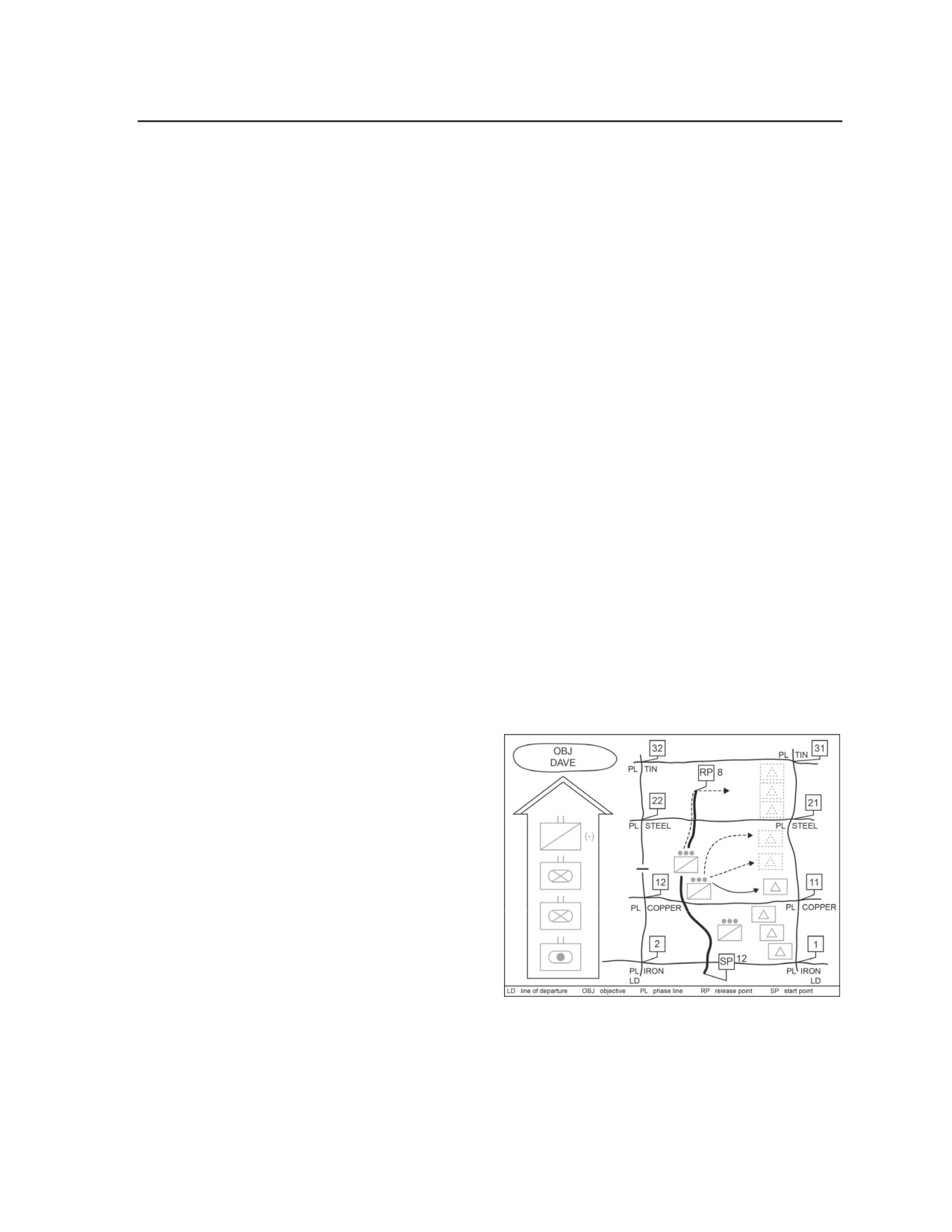
Security Operations
2-39. The fastest but least secure method of deploying is a tactical road march from the rear boundary of
the security area to the initial positions. The security force moves to a release point on the rear boundary.
From the release point, subordinate elements deploy to occupy initial positions, moving by the quickest
means possible. This method is appropriate when enemy contact is not expected, time is critical, or an
aviation unit is conducting a zone reconnaissance forward of the ground element and has found no enemy
in the security area.
2-40. In the second method, the security force conducts a movement to contact from a line of departure
(usually the rear boundary of the security area) to the initial positions. This method is slower than a tactical
road march but more secure. It is appropriate when enemy contact is likely, time is limited, terrain
reconnaissance is not needed, or an aviation unit is conducting zone reconnaissance forward of the ground
element and enemy forces have been detected in the security area.
2-41. The most secure method for moving to the initial positions is for the security force to conduct a zone
reconnaissance from the security area rear boundary to its initial security line positions or the forward limit
of the security area. Given adequate time, this method is preferred because it allows the security force to
clear the security area and become familiar with the terrain that it may have to defend. The security force
reconnoiters potential subsequent positions and fire support system firing positions as it moves to its initial
positions. A zone reconnaissance is appropriate when time is available and information about the enemy or
terrain is unknown. While this technique provides information of tactical value on the enemy and terrain in
the area, it may also be time consuming. Using air reconnaissance forward of the ground units increases the
speed and security of the movement.
Movement During Moving Flank Security Missions
2-42. There are three techniques of occupying and moving in a flank security area for moving security
missions based on how the security force crosses the line of departure:
z
Security force crosses the line of departure (LD) separately from the main body and deploys to
perform the mission.
z
Security force crosses the LD separately from main body; lead elements conduct a movement to
contact.
z
Security force crosses the LD with the main body and conducts a zone reconnaissance out to the
limit of the security area.
2-43. The commander should not require the
security force to make its own penetration when it
faces prepared enemy defenses. This may prevent
or significantly delay the security force from
assuming its duties. These three techniques are
often combined.
2-44. In the first technique, illustrated in figure
2-2 and figure 2-3 (on page 2-10), the security
force crosses the LD separately from the main
body and deploys to perform the mission. The
security force then conducts a tactical road march,
an approach march, or tactical movements parallel
to the main body and drops off OPs or occupies
BPs along the flank of the main body. This
technique keeps the two forces from interfering
Figure 2-2. Security force crossing the LD
with each other during deployment. It is
separately from the main body to establish a
appropriate when another force penetrates the line
flank screen
of contact, the main body is not in contact with the
enemy and is moving quickly, the LD is uncontested, and the IPB process indicates that enemy contact is
not likely in the area through which the security force is moving. It is the fastest but least secure technique.
22 March 2013
FM 3-90-2
2-9
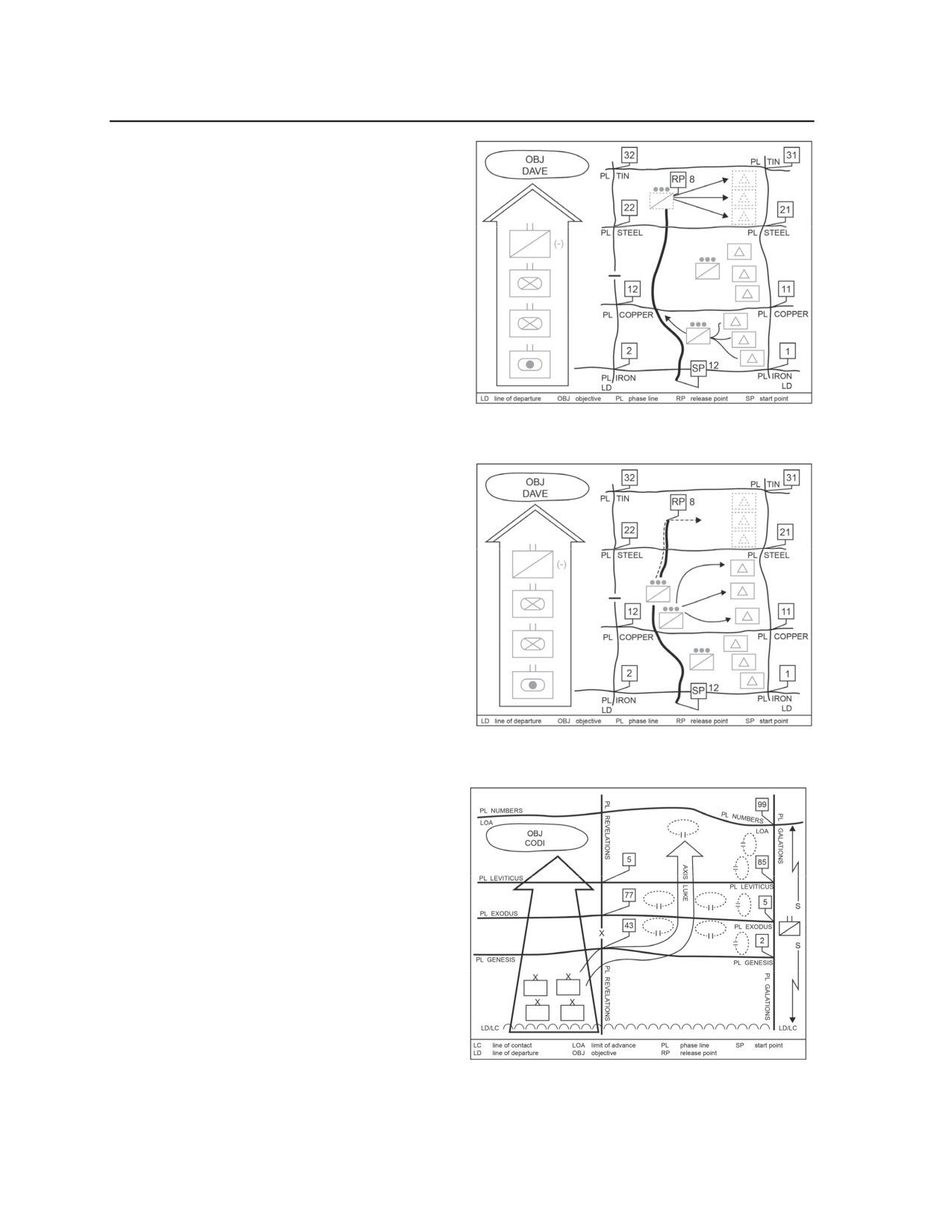
Chapter 2
2-45. In the second technique, the security force
crosses the LD separately from the main body,
and its lead elements conduct a movement to
contact. Follow-on elements occupy positions as
they reach them. (See figure 2-4.) This technique
is appropriate when the main body is moving
slower than in the first method, the LD is
uncontested, and the IPB process indicates
possible enemy contact. It is slower than the
previous technique but provides better security.
2-46. Finally, in the third technique, the security
force crosses the LD with the main body and
conducts a zone reconnaissance out to the far limit
of the security area.
(See figure
2-5.) This
technique is appropriate when the LD is also the
Figure 2-3. Security force continuing to cross
line of contact, the main body makes its own
the LD separately from the main body to
penetration of the enemy defenses along the line
establish a flank screen
of contact, the main body is moving slowly, and
the enemy situation is not clearly understood. The
security force may follow the lead element of the
main body through the gap and deploy when the
situation permits. This technique provides
increased security for both the security force and
the main body; it is also the most time-consuming.
SCREEN
2-47. A unit performing a screen observes,
identifies, and reports enemy actions. Generally, a
screening force engages and destroys enemy
reconnaissance elements in its capabilities—
augmented by indirect fires—but otherwise fights
only in self-defense. The screen has the minimum
Figure 2-4. Second technique used by a
combat power necessary to provide the desired
moving flank security force to establish a
early warning, which allows the commander to
moving flank screen
retain the bulk of the main body’s combat power
for commitment at the decisive place and time. A
screen provides the least amount of protection of
any security mission; it does not have the combat
power to develop the situation.
2-48. A screen is appropriate to cover gaps
between forces, exposed flanks, or the rear of
stationary and moving forces. The commander
can place a screen in front of a stationary
formation when the likelihood of enemy action is
small, the expected enemy force is small, or the
main body needs only limited time, once it is
warned, to react effectively. Designed to provide
minimum security with minimum forces, a screen
is usually an economy-of-force operation based
on prudent risk. If a significant enemy force is
Figure 2-5. Third technique used by a moving
expected or a significant amount of time and
flank security force to establish a flank guard
space is needed to provide the required degree of
or cover
2-10
FM 3-90-2
22 March 2013
///////////////////////////////////////