FM 3-90-2 RECONNAISSANCE, SECURITY, AND TACTICAL ENABLING TASKS, Volume 2 (MARCH 2013) - page 2
Security Operations
protection, the commander assigns and resources a guard or cover mission instead of a screen. The security
element forward of a moving force must conduct a guard or cover because a screen lacks the combat power
to defeat or contain the lead elements of an enemy force.
2-49. A security force normally conducts a screen by establishing a series of OPs and patrols to ensure
adequate surveillance of the assigned area. The commander uses reconnaissance patrols
(mounted,
dismounted, and aerial), relocates OPs, and employs technical assets to ensure continuous and overlapping
surveillance. The commander also employs terrain data base analytical support systems to ensure the
integration of friendly reconnaissance and surveillance assets to provide that necessary coverage.
CRITICAL TASKS FOR A SCREEN
2-50. Unless the commander orders otherwise, a security force conducting a screen performs certain tasks
within the limits of its capabilities. A unit can normally screen an avenue of approach two echelons larger
than itself, such as a battalion scout platoon screening a battalion-sized avenue of approach or a cavalry
troop screening a regimental or brigade-sized avenue of approach. If a security force does not have the time
or other resources to complete all of these tasks, the security force commander must inform the assigning
commander of the shortfall and request guidance on which tasks must be completed and their priority. After
starting the screen, if the security unit commander determines that the security unit cannot complete an
assigned task, such as maintain continuous surveillance on all avenues of approach into an AO, the
commander reports that fact to the main body commander and awaits further instructions. Normally, the
main force commander does not place a time limit on the duration of the screen, as doing so may force the
screening force to accept decisive engagement. Screen tasks are to—
z
Allow no enemy ground element to pass through the screen undetected and unreported.
z
Maintain continuous surveillance of all avenues of approach larger than a designated size into
the area under all visibility conditions.
z
Destroy or repel all enemy reconnaissance patrols within its capabilities.
z
Locate the lead elements of each enemy advance guard and determine its direction of movement
in a defensive screen.
z
Maintain contact with enemy forces and report any activity in the AO.
z
Maintain contact with the main body and any security forces operating on its flanks.
z
Impede and harass the enemy within its capabilities while displacing.
ORGANIZATION OF FORCES
2-51. A screen normally requires the subordinate elements of the security force to deploy abreast. A screen
force normally organizes itself into a number of OPs determined by the number of avenues of approach into
the main force and any additional NAIs it must cover, as specified by the main force commander. The
screening force may retain a small reaction force or reserve to extract endangered OPs.
2-52. The size of the avenue of approach kept under surveillance varies by echelon. Normally, a unit
maintains observation over avenues of approach used by operationally significant enemy forces. These are
normally avenues of approach used by enemy forces one echelon smaller than the friendly unit. For
example, a battalion maintains surveillance over enemy company-sized avenues of approach, while the
corps maintains surveillance over division-sized avenues of approach. The situation may require the unit to
maintain surveillance over mobility corridors that can be used by enemy units two echelons smaller than
the friendly force.
22 March 2013
FM 3-90-2
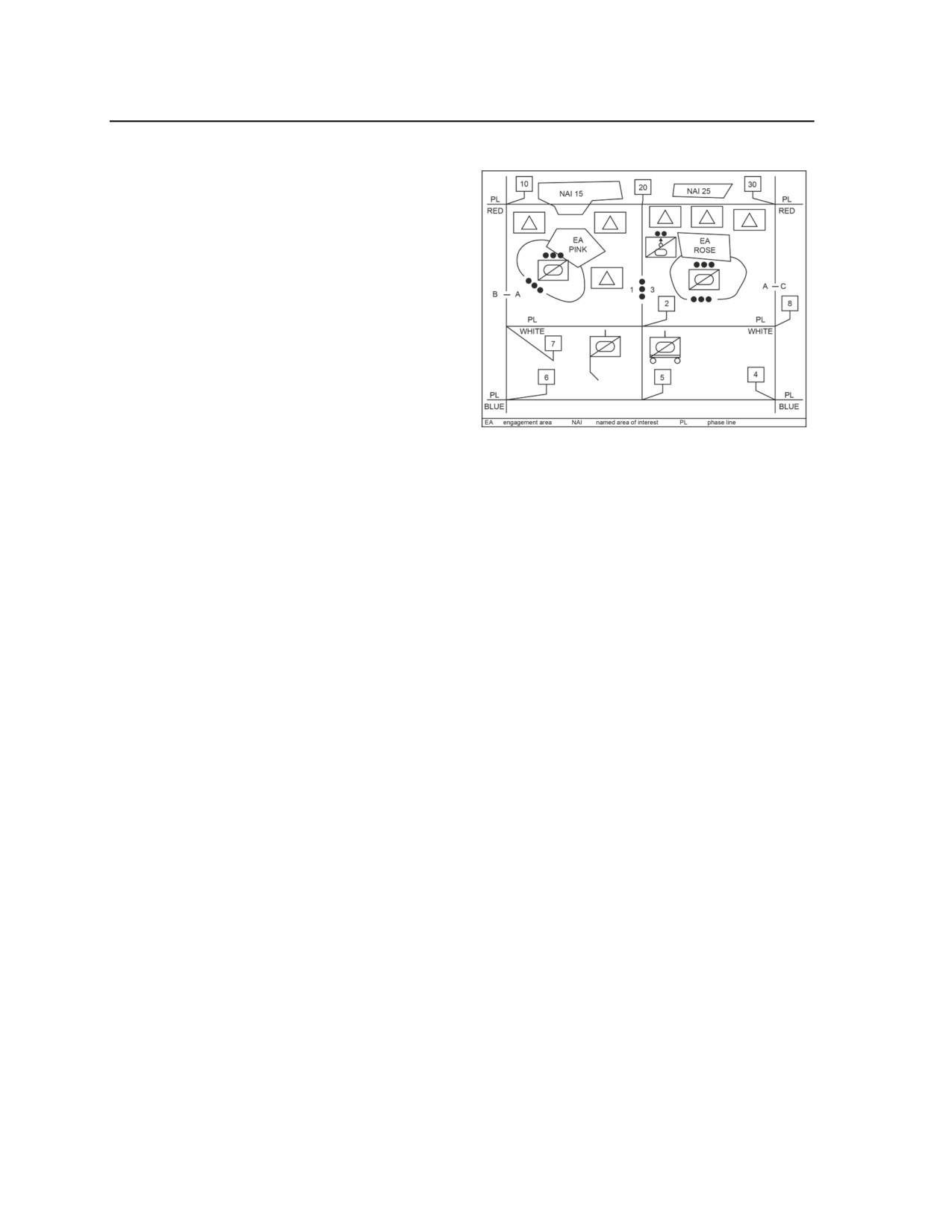
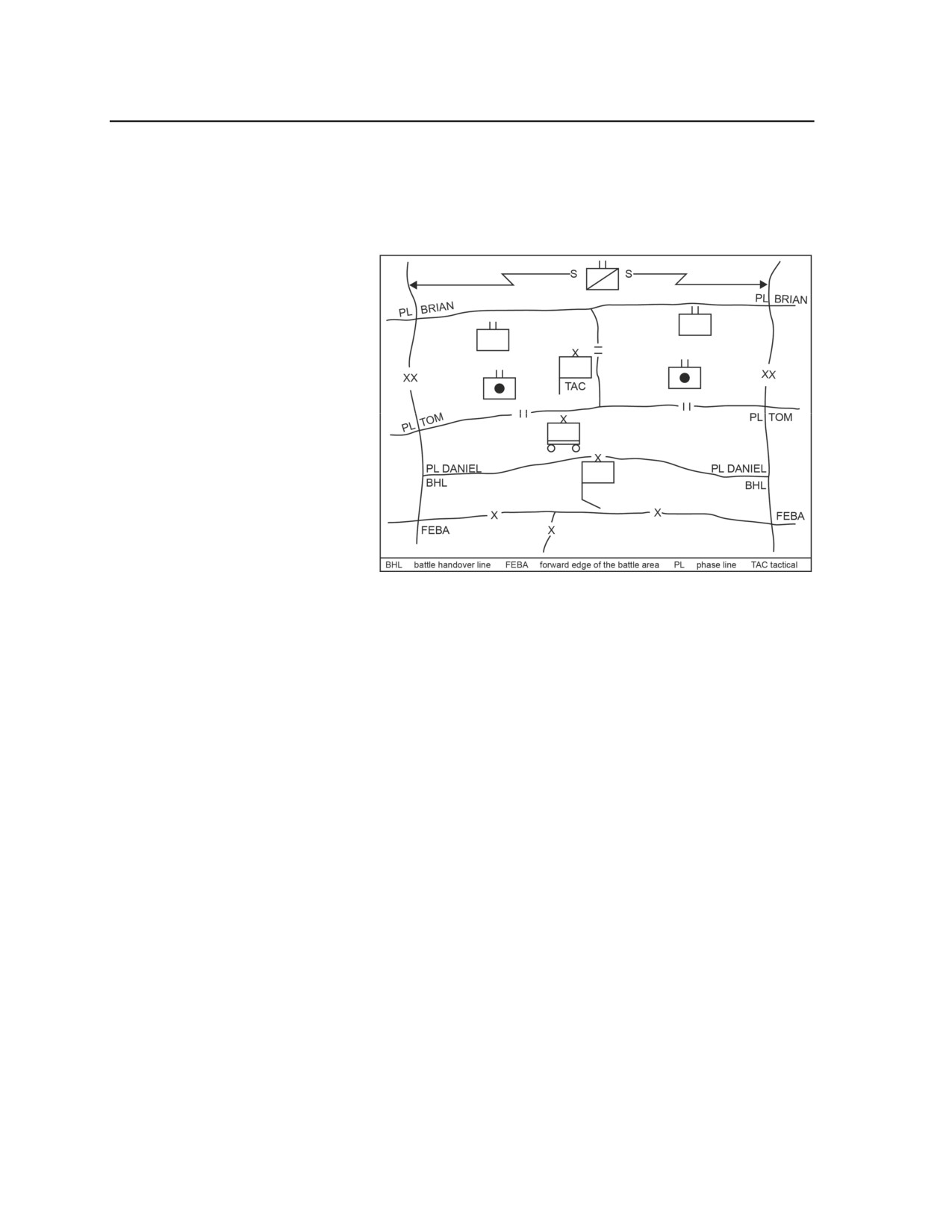
2-11
Chapter 2
SCREEN CONTROL MEASURES
2-53. The control measures necessary to conduct a
screen are in this chapter under common security
control measures in paragraphs
2-13 to
2-17.
(Figure 2-6 displays examples of control measures
associated with a screen.)
EXECUTING A STATIONARY SCREEN
2-54. In setting up the screen, the screening force
establishes OPs with overlapping fields of
observation. The screen commander adjusts the
location of subordinate screening elements to take
advantage of established links with higher-echelon
sensors and collection assets. Patrols reconnoiter
areas that OPs cannot observe. The force retains a
Figure 2-6. Control measures used in a
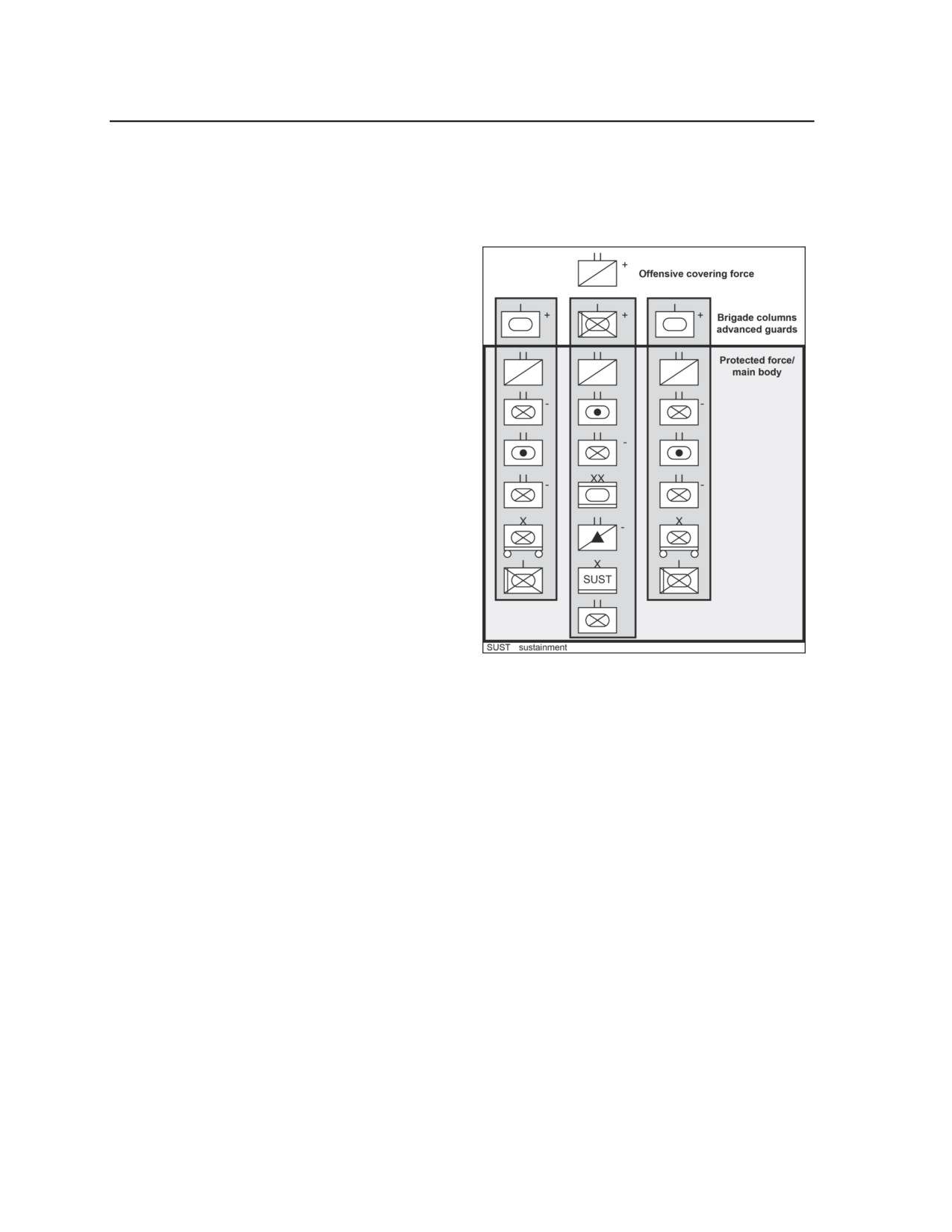
small reserve, if possible. If forces are available
screen mission
and the depth of the security area allows, the screening force establishes OPs in-depth on high-speed
avenues of approach. The commander plans routes between the initial and subsequent screen lines to
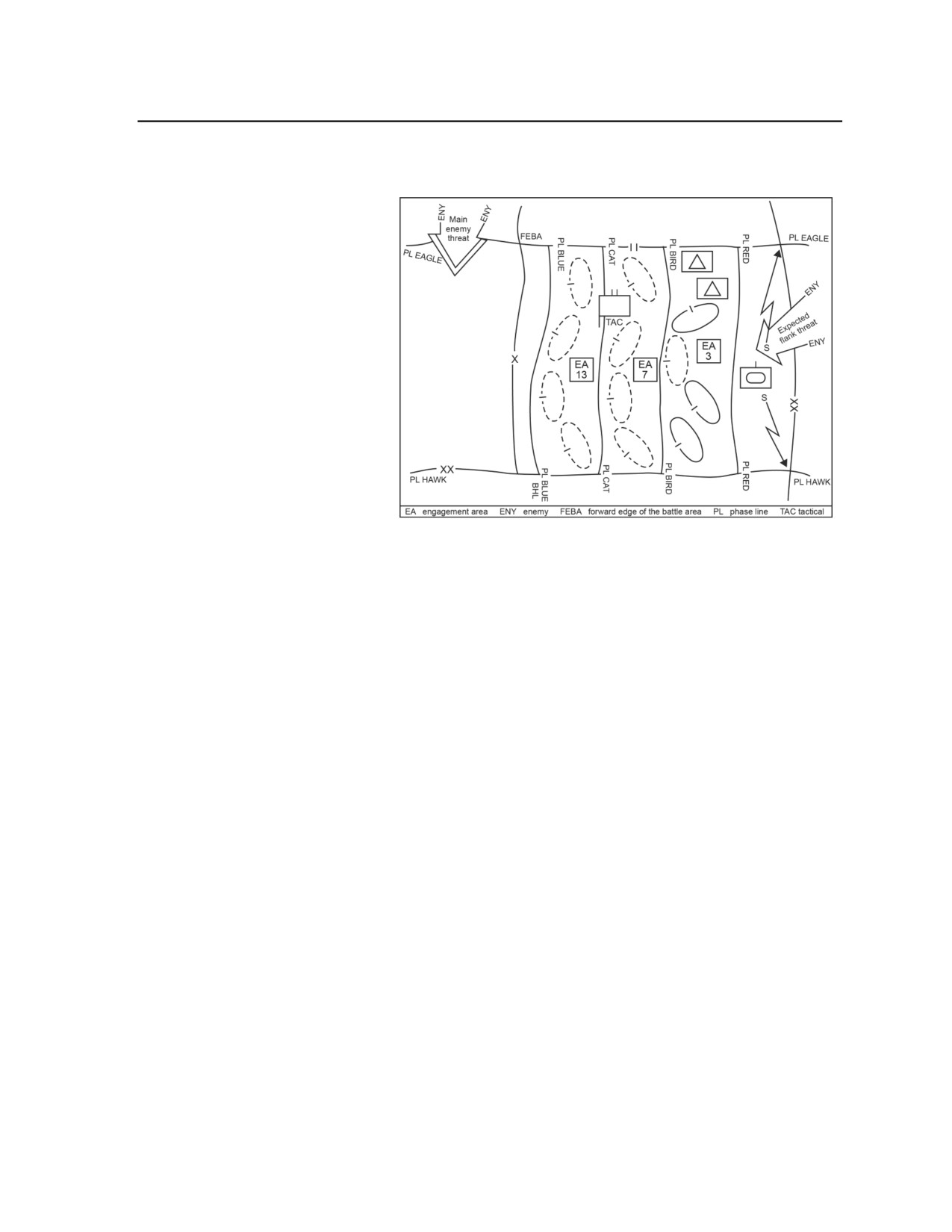
facilitate rapid occupation of subsequent screen lines. The screening force reserve deploys in-depth and
positions itself to react to contingencies that develop during the screen. The screening force takes
advantage of its surveillance, target acquisition, and night-observation equipment and information provided
by higher-level systems to expand the area and quality of security provided.
2-55. OPs remain undetected while those manning them report the presence of enemy elements. Prompt,
accurate reporting is essential to keep the assets constituting the screen from being overrun or unknowingly
bypassed. Once the enemy is detected, the OP uses fire support channels to direct engagement of the enemy
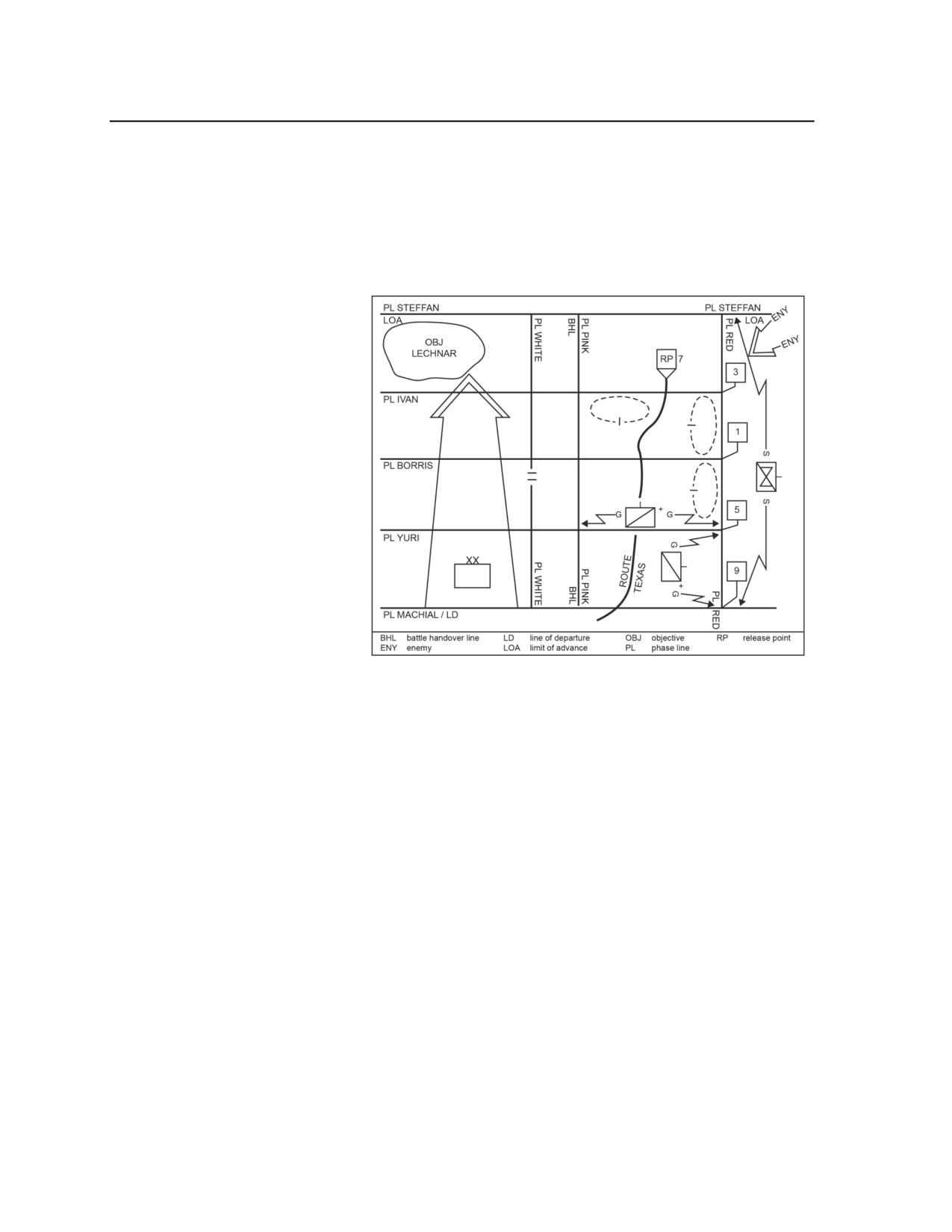
at maximum range. This helps the OP avoid detection and prevents the enemy from penetrating the screen
line. The screening force may destroy enemy reconnaissance assets with direct fire, if indirect fire cannot
accomplish this task. It also attempts to slow the movement of other enemy elements, primarily using
indirect fires and close air support.
2-56. As enemy pressure threatens the security of the OP, the unit reports and requests to move to the next
screen line. The commander establishes criteria that allow the screening force to displace to subsequent
screen lines, based on certain enemy or friendly actions. These criteria allow subordinates to use their
initiative when conducting operations. When displacing from one screen line to another, the screening force
emphasizes rapid movement while maintaining contact with the enemy. This ensures that any gaps that
occur during movement are quickly closed. The screen’s mission command elements displace as required
to maintain control and keep from being overrun. The force repeats this procedure as often as necessary.
2-57. The screening force commander decides when to move from one screen line to another. However, the
main body commander decides when the screening force can move behind the PL that designates the rear
boundary of the security area and hand off the battle to the main body.
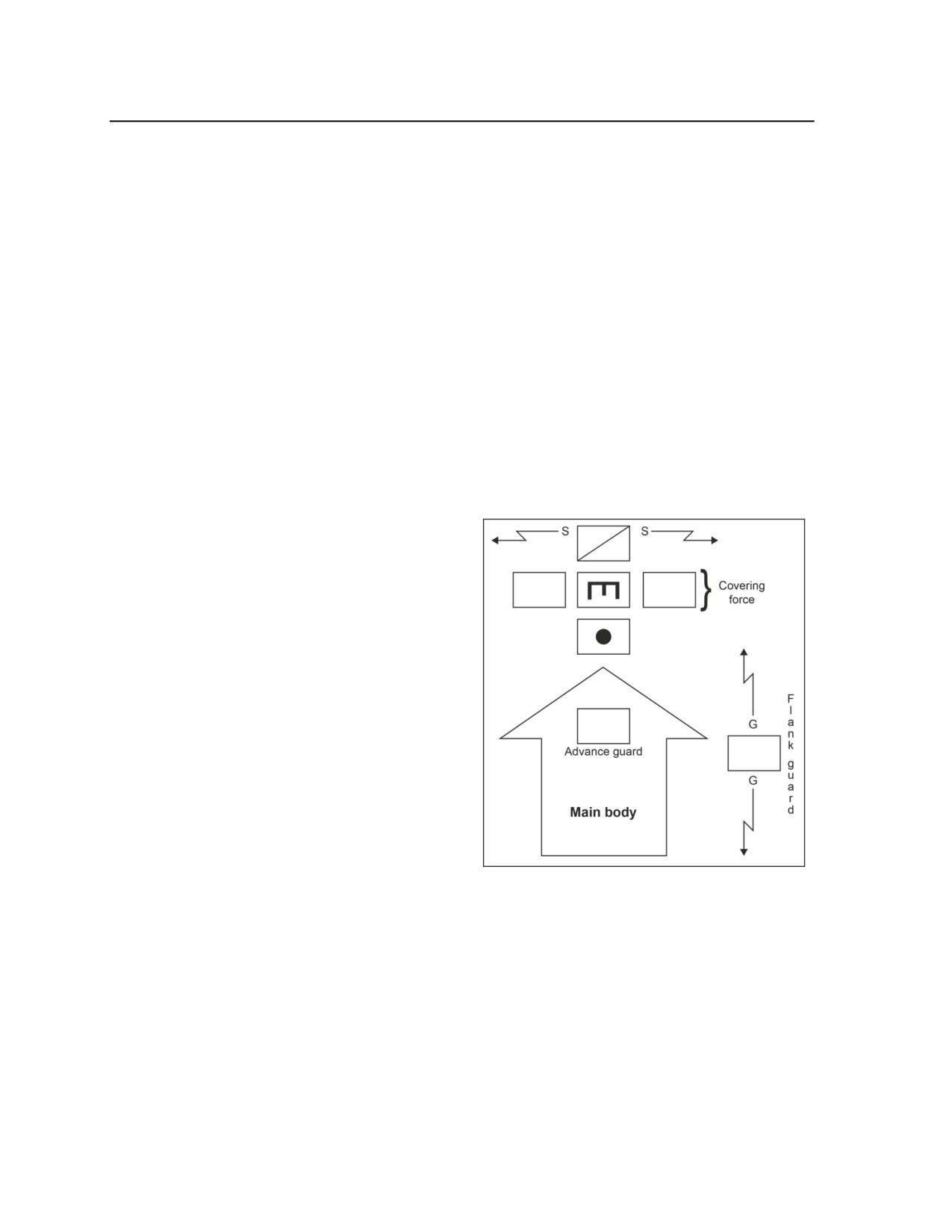
EXECUTING A MOVING SCREEN
2-58. The screening force may use several methods to move the screen as the protected force moves. Table
2-2 summarizes each method’s advantages and disadvantages.
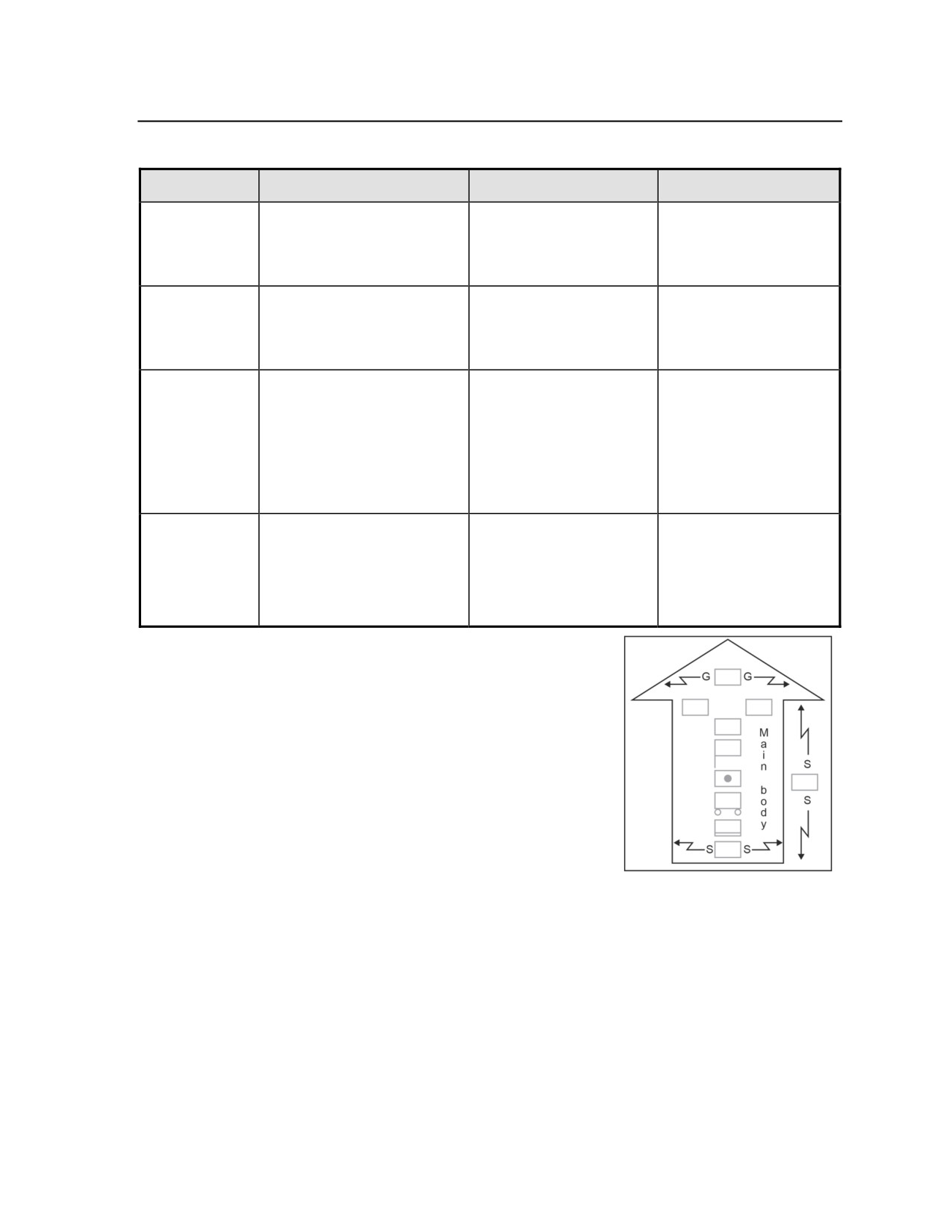
2-59. A screening force maintains a moving screen along the flanks and rear of the protected force. The
screen movement is keyed to time and distance factors associated with the main body’s movement. (See
figure 2-7.) Responsibilities for a moving flank screen begin at the front of the main body’s lead combat
element and end at the rear of the protected force. They do not include front and rear security forces. A
force executes a moving screen in the same way it conducts a stationary screen, except for the movement
techniques.
2-12
FM 3-90-2
22 March 2013
Security Operations
Table 2-2. Screen movement methods
Method
Characteristics
Advantages
Disadvantages
•
Main body moves faster.
• Very secure method.
Alternate bounds
•
Conducted by platoon,
• Maintains maximum
•
Execution takes time.
by observation
company, or troop.
surveillance over the
•
Disrupts unit integrity.
posts
•
Contact is possible.
security area.
•
Conducted from rear to front.
•
Main body moves faster.
• Execution does not take a
•
Conducted by platoon,
great deal of time.
Alternate bounds
•
May leave temporary gaps
company, or troop.
• Maintains good surveillance
by units
in coverage.
•
Contact is possible.
over the security area.
•
Conducted from rear to front.
• Maintains unit integrity.
•
Main body is moving slowly.
•
Conducted by platoon,
•
Execution takes the most
company, or troop.
time.
• Most secure method.
•
Contact is possible.
•
Unit is less secure when all
Successive
• Maintains maximum
•
Conducted simultaneously or in
elements are moving
bounds
surveillance.
succession.
simultaneously.
• Maintains unit integrity.
•
Unit should maintain an air
•
Simultaneous movement
screen during ground
may leave temporary gaps.
movement.
•
Main body is moving relatively
quickly.
•
Performed as a route
• Observation posts displace
Continuous
reconnaissance.
quickly.
•
Least secure method.
marching
•
Enemy contact is not likely
• Maintains unit integrity.
•
Unit should maintain an air
screen on the flank
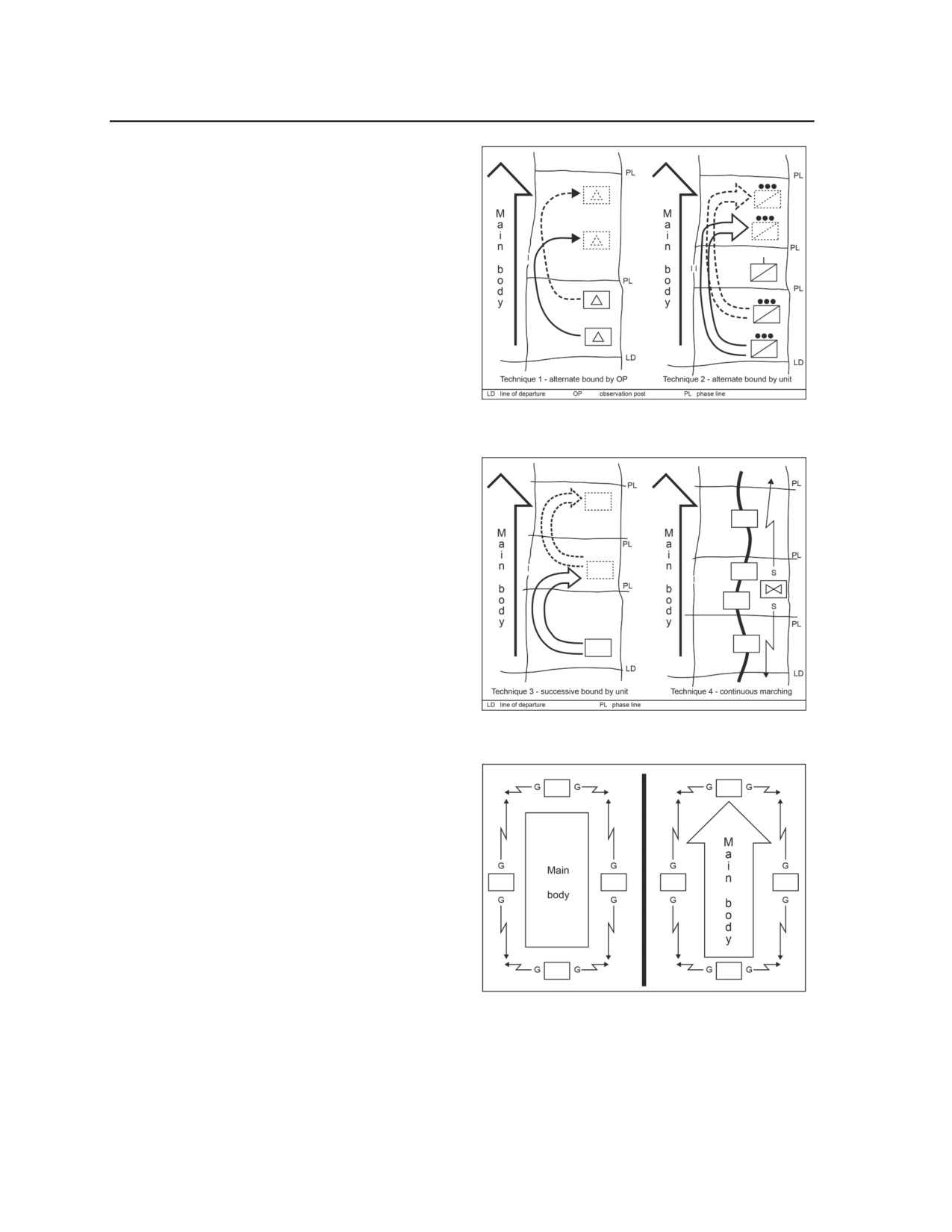
2-60. The commander considers the mission variables of METT-TC
when deciding which movement method to employ. Figures 2-8 and
2-9 on page 2-14 illustrate four methods of controlling movement
along a screen line:
z
Alternate bounds by individual OPs from the rear to the
front. (This method is usually employed at the company or
troop level and below.)
z
Alternate bounds by subordinate units from the rear to the
front.
z
Successive bounds by units along the screen line.
z
Continuous marching along the route of advance.
SCREENING OPERATIONS DURING LIMITED VISIBILITY
Figure 2-7. Moving flank
2-61. Limited visibility often affects the screening force’s ground and
screen
air observation. During limited visibility, the screening force uses all
available night and thermal observation devices and electronic surveillance devices. Although the screening
force can use technical reconnaissance and surveillance assets to offset limited visibility, it should also
adjust its techniques and procedures to the conditions. For example, the commander of a screening force
may need to adjust the number and location of OPs in limited-visibility conditions. The screening force
commander can establish more OPs to cover avenues of approach that become masked in these conditions.
That individual plans for indirect illumination and uses it when necessary. The screening force commander
closely coordinates the force’s combat and reconnaissance patrols to prevent misidentification and friendly
fire incidents. Rigorous noise and light discipline prevents compromise and potential bypass of OPs by
enemy reconnaissance forces. Near OPs and along dismounted avenues of approach, the screening force
can use trip flares, protective minefields, and mechanical devices, such as noisemakers integrated into
22 March 2013
FM 3-90-2
2-13
Chapter 2
tanglefoot obstacles, to detect and warn of the
enemy’s dismounted approach. Additional OPs
along enemy avenues of approach can provide
depth to facilitate detecting enemy forces that may
have eluded forward security elements.
GUARD
2-62. A guard differs from a screen in that a guard
force contains sufficient combat power to defeat,
cause the withdrawal of, or fix the lead elements of
an enemy ground force before it can engage the
main body with direct fire. A guard force routinely
engages enemy forces with direct and indirect fires.
A screening force, however, primarily uses indirect
fires or close air support to destroy enemy
Figure 2-8. Displacement methods for a
reconnaissance elements and slow the movement of
flank screen
other enemy forces. A guard force uses all means
at its disposal, including decisive engagement, to
prevent the enemy from penetrating to a position to
observe and engage the main body. It operates
within the range of the main body’s fire support
weapons, deploying over a narrower front than a
comparable-sized screening force to permit
concentrating combat power.
2-63. The three types of guard operations are
advance, flank, and rear guard. A commander can
assign a guard mission to protect either a stationary
or a moving force. (See figure 2-10.)
2-64. A unit conducting a guard performs certain
tasks within its capabilities unless ordered
otherwise. If a unit does not have the time or other
Figure 2-9. More displacement methods for
resources to complete all of these tasks, it must
a flank screen
inform the commander assigning the mission of the
shortfall and request guidance on which tasks to
complete or the priority of tasks. After starting the
guard, if the unit determines that it cannot complete
an assigned task, such as cause deployment of the
enemy advance guard, it must report this to the
commander and await further instructions. Guard
tasks are to—
z
Destroy the enemy advance guard.
z
Maintain contact with enemy forces and
report activity in the AO.
z
Maintain continuous surveillance of
avenues of approach into the AO under
all visibility conditions.
Figure 2-10. Guard locations
z
Impede and harass the enemy within its
capabilities while displacing.
z
Cause the enemy main body to deploy, and then report its direction of travel.
z
Allow no enemy ground element to pass through the security area undetected and unreported.
2-14
FM 3-90-2
22 March 2013
Security Operations
z
Destroy or cause the withdrawal of all enemy reconnaissance patrols.
z
Maintain contact with its main body and any other security forces operating on its flanks.
2-65. A commander employs a guard when the expected enemy contact requires additional security beyond
that provided by a screen. The multiple requirements of the guard mission are often performed
simultaneously over relatively large areas. While the guard force’s exact size is determined by prevailing
mission variables of METT-TC, table 2-1 on page 2-5 provides general guidance on the size of an
echelon’s guard force.
ORGANIZATION OF A GUARD FORCE
2-66. Whether the guard is for a stationary (defending) or moving (attacking) force, the various types of
guard missions and knowledge of the terrain and enemy dictate the specific task organization of the guard
force. The guard force commander normally conducts the guard mission as an area defense (see chapter 7
of FM 3-90-1), a delay (see chapter 9 of FM 3-90-1), a zone reconnaissance (see chapter 1), or a movement
to contact (see chapter 2 of FM 3-90-1) mission in the security area.
CONTROL MEASURES
2-67. The commander uses control measures to control the operations of the guard force in the security
area. The mission also influences the size of the AO the commander gives to subordinate elements. For
example, a movement to contact normally occurs across a narrower unit frontage than a zone
reconnaissance to allow adequate concentration of combat power.
2-68. The guard force commander may task subordinate elements to conduct screen missions to the front
and flanks of the guard force. This provides early warning of enemy forces and helps maintain contact with
flank forces and any higher-echelon security force. An example of the latter is a corps covering force
operating in front of a division advance guard. The presence of a higher-echelon security force also
influences how the guard force commander organizes available forces and conducts operations. It
specifically impacts the areas of fire support and sustainment.
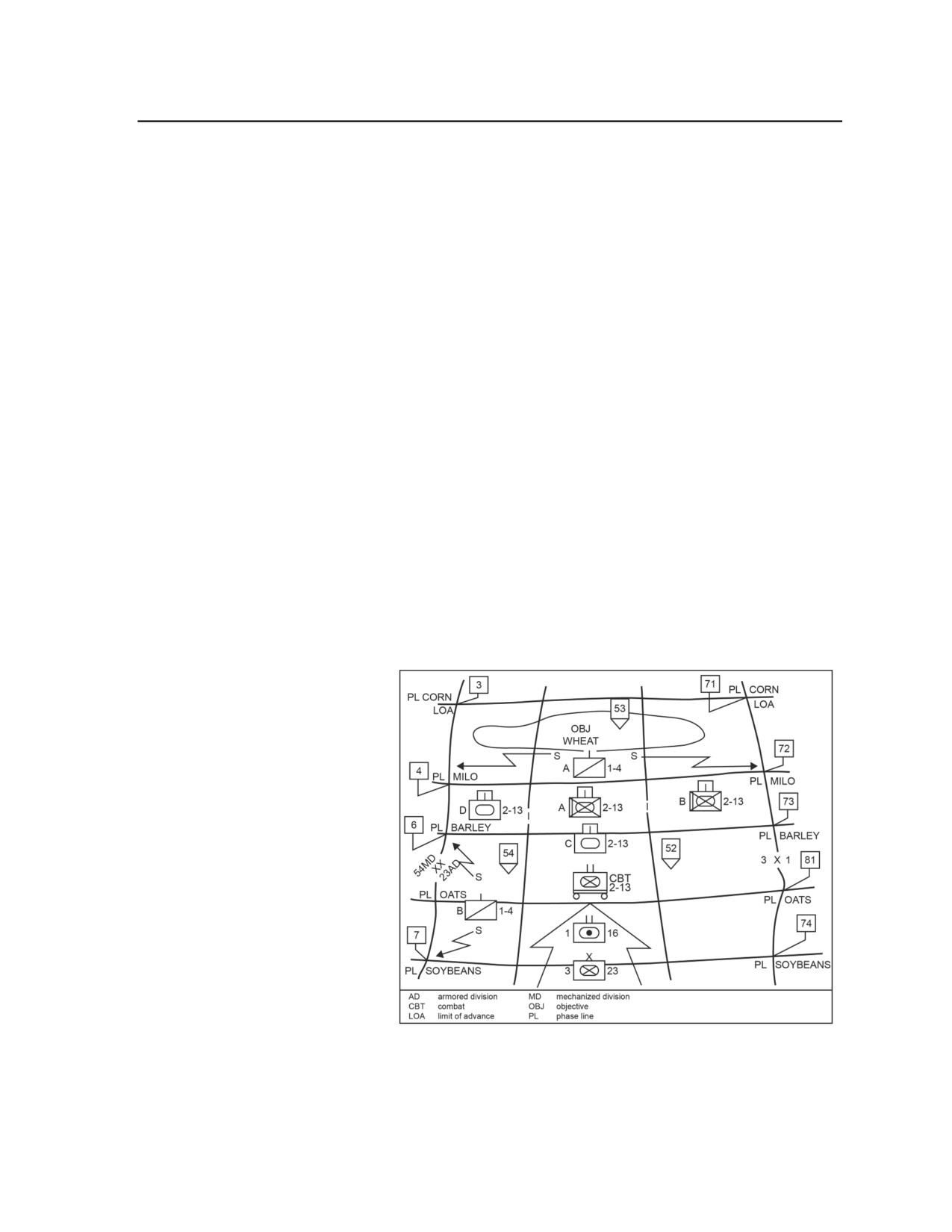
ADVANCE GUARD
2-69. An advance guard for a
stationary
force
operates
defensively. It defends or delays
in accordance with the main
body commander’s intent. An
advance guard for a moving
force operates offensively.
(See
figure 2-11.) The advance guard
develops the situation, so the
main body can use its combat
power to the greatest effect. The
commander does not dissipate
the main body’s combat power
through piecemeal commitment.
The full combat power of the
main body must be available
immediately to defeat the main
enemy force.
Figure 2-11. Advance guard for a division shaping attack
2-70. An advance guard for a moving force normally conducts a movement to contact. It organizes and
uses the control measures typically associated with the conduct of a movement to contact. (See chapter 2 of
22 March 2013
FM 3-90-2
2-15
Chapter 2
FM 3-90-1.) Ground subordinate elements of a guard are normally deployed abreast to cover the axis of
advance or the main body’s AO.
2-71. The advance guard clears the axis of advance or designated portions of the AO of enemy elements.
This allows the main body to move unimpeded, prevents the unnecessary delay of the main body, and
defers the deployment of the main body for as long as possible.
2-72. The advance guard may operate behind the
security force of a higher echelon. For example, a
division may use a heavily reinforced
reconnaissance squadron from its attached
battlefield surveillance brigade
(BFSB) as an
offensive covering force, while each subordinate
brigade column organizes one of its combined arms
battalions or battalion task forces into an advance
guard. (See figure 2-12.) In these situations, the
higher-echelon security force will initially develop
the situation. A commander may task the advance
guard to—
z
Coordinate and conduct the rearward
passage of lines of the covering force.
z
Reduce obstacles to create lanes or
improve existing lanes as required to
support the movement and maneuver of
the main body.
z
Eliminate enemy forces bypassed by the
covering force.
z
Coordinate and conduct a forward
passage of lines through the covering
force and fix enemy forces in the
Figure 2-12. Multiple security forces
enemy’s main defensive positions to
allow the friendly main body to
maneuver.
2-73. The movement of multiple security forces and the handoff of a detected enemy force from the
higher-echelon security force to the lower-echelon security force are controlled using checkpoints, contact
points, PLs, BHLs, and disengagement criteria, in addition to other graphic control measures. As a
minimum, the covering force has a rear boundary that is also the forward boundary of the advance guard.
2-74. The advance guard engages in offensive operations when necessary to accomplish the mission. After
the guard makes enemy contact, the commander determines whether the guard mission requires an attack, a
defense, or a delay based on the mission variables of METT-TC. For example, if the guard force has
sufficient combat power to defeat an enemy, it conducts a hasty attack or defends from its current location.
The guard force will not assault strong enemy positions from the front if it can avoid this. The advance
guard then destroys the withdrawing enemy force as it exposes itself by moving to other positions. If the
advance guard encounters an enemy force that it cannot stop from interfering with the movement of the
main body, the security force reports its presence to the main body. It then establishes a defense, continues
conducting reconnaissance, and prepares to pass elements of the main body forward while facilitating the
deployment of the main body.
2-75. If the guard force does not have enough combat power to defeat an approaching enemy, and the
depth of the security area permits, the commander can delay rearward one or more positions before
becoming decisively engaged. This reduces the enemy’s combat power. Unless the commander relieves the
security force of the guard mission, it accepts decisive engagement to prevent enemy ground forces from
using direct fires to engage the main body.
2-16
FM 3-90-2
22 March 2013
Security Operations
FLANK GUARD
2-76. A flank guard protects an
exposed flank of the main body.
A flank guard is similar to a
flank screen except that the
commander plans defensive
positions in addition to OPs.
2-77. The commander of the
main body designates the general
location of the flank guard’s
positions.
The commander
assigns an AO to each flank
guard that is sufficiently deep to
provide early warning and
reaction time. However, each
flank guard must remain in
supporting range of the main
body. To determine the guard
force’s exact initial positions, the
flank
guard
commander
Figure 2-13. Stationary flank guard
considers the front and rear of the
flank of the main body, the axis taken by the main body, the enemy’s capabilities, and the available
avenues of approach.
2-78. The flank guard moves to its initial positions using one of the movement techniques previously
discussed in this chapter. On reaching its initial positions, the flank guard establishes defensive positions in
assigned BPs or in its assigned AO and establishes a screening element forward of these positions. (See
figure 2-13.) In situations where knowledge about the enemy is vague, the flank guard maintains a larger
reserve than in situations where the enemy’s actions are more predictable.
2-79. Once the flank guard makes contact with the enemy, it can attack, defend to defeat, or fix enemy
ground forces in their current positions before they can engage the main body or conduct a delay as the
situation requires.
2-80. When conducting a moving flank guard, a commander addresses additional considerations beyond
those applying to a moving flank screen. Instead of occupying a series of OPs, the security force plans a
series of BPs. The tasks associated with a guard mission apply to a moving flank guard. However, the
number and location of echelon-specific avenues of approach over which the security force maintains
continuous surveillance change as the main body moves. The security force monitors potential enemy
avenues of approach for as long as they threaten the main body.
2-81. The lead element of a moving flank guard must perform three tasks. It maintains contact with the
protected force’s main body, reconnoiters the area between that main body and the flank guard’s routes of
advance, and reconnoiters the flank guard’s route. It performs these tasks by conducting a zone
reconnaissance. The speed of the main body determines how thoroughly it can carry out the
reconnaissance. The exact size of the AO for any unit conducting a guard depends on the mission variables
of METT-TC. For example, on typical central European terrain, a commander does not assign an AO wider
than 10 kilometers from the guard line to the boundary of the main body to a company or troop. This size
organization cannot match the movement of the main body. When the distance from the guard line to the
main body boundary exceeds 10 kilometers, the commander of the flank security element uses two or more
company-sized elements abreast. This ensures that the element making contact with the main body is not
over tasked and can match the tempo of the main body. An attack reconnaissance troop may maintain
contact with the main body, or a following ground element may perform route reconnaissance along the
22 March 2013
FM 3-90-2
2-17
Chapter 2
flank guard’s route of advance. Under these conditions, the lead security element does not reconnoiter BPs
or occupy them unless required when making contact.
2-82. The rest of the flank guard marches along the route of advance and occupies BPs as necessary. The
criteria for the route is the same as in a moving flank screen. The commander designates company-sized
BPs parallel to the axis of the main body. The flank guard commander places these BPs outside the flank
guard’s route of advance and along avenues of approach into the flank guard. The flank guard occupies
OPs along a screen line forward of these BPs.
2-83. Since the flank guard is
moving in one direction and
orienting on providing protection
to the secured force in another
direction,
the flank guard
commander
plans
control
measures to facilitate this dual
orientation.
These
control
measures are normally associated
with the moving screen, as well
as PLs that run parallel to the
direction of movement of the
main body. The commander uses
these PLs to control the delay or
defense, if the enemy attacks
from the protected flank.
(See
figure
2-14.) The main body
commander may also assign the
flank guard an objective that
secures the flank for the main
body’s objective or otherwise
serves to orient its security
Figure 2-14. Moving flank guard control measures
efforts.
2-84. The flank guard regulates its movement along the route of advance by the pace of the main body, the
distance to the objective, and the enemy situation. The three methods of movement are successive bounds,
alternate bounds, or continuous marching. (See chapter 3.) If the main body stops, the flank guard occupies
blocking positions. As the speed of the main body changes, the flank guard changes its movement methods.
The guard commander must not allow the force to fall behind the main body or present a lucrative target by
remaining stationary along the route.
2-85. If the flank guard becomes overextended, the guard commander informs the main body commander
and recommends one of the following COAs:
z
Reinforce the flank guard.
z
Reduce the size of the flank guard’s AO.
z
Screen a portion of the area and guard the rest.
REAR GUARD
2-86. The rear guard protects the exposed rear of the main body. This occurs during offensive operations
when the main body breaks contact with flanking forces or during a retrograde. The commander may
deploy a rear guard behind both moving and stationary main bodies. The rear guard for a moving force
displaces to successive BPs along PLs or delay lines in depth as the main body moves. The nature of enemy
contact determines the exact movement method or combination of methods used in the displacement
(successive bounds, alternate bounds, and continuous marching).
2-18
FM 3-90-2
22 March 2013
Security Operations
2-87. During a retrograde, the rear guard normally deploys its ground maneuver elements abreast, behind
the main body’s forward maneuver units, generally across the entire AO. After the main body conducts a
rearward passage of lines, the rear guard accepts battle handover and then defends or delays. Alternatively,
the rear guard may conduct a relief in place as part of a military deception plan or to take advantage of the
best defensive terrain. In both cases, the rear guard establishes passage points and assists the rearward
passage of the main body, if necessary. The rear guard accomplishes its defensive mission in the same way
as any other guard operation after the main body clears the security area. As the main body moves, the rear
guard moves to subsequent PLs in depth. Contact with the enemy force may eventually be lost if it does not
follow the retrograding friendly force. Fighting a defense or a delay is necessary if the enemy detects the
movement and attacks. (Chapter 9 of FM 3-90-1 discusses retrograde operations.)
COVER
2-88. The covering force’s distance forward of the main body depends on the main body commander’s
intentions and instructions, the terrain, the enemy location and strength, and the main body and covering
force’s rates of march. The width of the covering force area is the same as the AO of the main body. The
covering force area is the area forward of the forward edge of the battle area out to the forward
positions initially assigned to the covering force. It is here that the covering force executes assigned
tasks.
2-89. In Army doctrine, a covering force is a self-contained force capable of operating independently
of the main body, unlike a screening or guard force, to conduct the cover task. A covering force, or
portions of it, often becomes decisively engaged with enemy forces. Therefore, the covering force must
have substantial combat power to engage the enemy and accomplish its mission. A covering force develops
the situation earlier than a screen or a guard force. It fights longer and more often and defeats larger enemy
forces.
2-90. While a covering force provides more security than a screen or guard force, it also requires more
resources. Before assigning a cover mission, the main body commander determines if there is sufficient
combat power to resource a covering force and the decisive operation. When the commander lacks the
resources to support both, the main body commander must assign the security force a less
resource-intensive security mission, either a screen or a guard.
2-91. A covering force performs all the tasks of screening and guard forces. A covering force for a
stationary force performs a defensive mission, while a covering force for a moving force generally
conducts offensive actions. A covering force normally operates forward of the main body in the offense or
defense, or to the rear for a retrograde operation. Unusual circumstances could dictate a flank covering
force, but this is normally a screen or guard mission.
ORGANIZATION OF A COVERING FORCE
2-92. Whether the cover is for a stationary (defending) or moving (attacking) force, the various types of
cover missions, as well as knowledge of the terrain and enemy, dictate the specific task organization of the
covering force. The covering force commander normally plans to conduct the cover mission as an area
defense (see chapter 7 of FM 3-90-1). The covering force will also normally employ tactics associated with
the conduct of a delay (see chapter 9 of FM 3-90-1), a zone reconnaissance (see chapter 1), and a
movement to contact (see chapter 2 of FM 3-90-1).
2-93. The commander normally assigns subordinate units one of these missions or the mission of screen or
guard. The covering force uses those organizations and control measures associated with these missions. In
addition, the commander establishes those control measures necessary for conducting the covering force’s
passage of lines (forward and rearward). (See chapter 5.)
2-94. Although the commander can deploy any mobile force as a covering force, the corps covering force
is normally built around an armored BCT or a division. Both have the control structures necessary for the
forces involved and the capability to cover the geographical area typically required in a cover security
mission. The corps commander tailors this unit to be self-contained by reinforcing it with assets such as
22 March 2013
FM 3-90-2
2-19
Chapter 2
available joint fires, attack helicopters, field artillery, engineers, air defense, tank, and infantry units with
appropriate sustainment to sustain the resulting force. A covering force is usually allocated additional
artillery and engineer support beyond that normally given to a force of its size because it is operating
beyond the main body’s supporting range. The covering force commander normally maintains a sizable
reserve to conduct counterattacks in the defense and to defeat enemy counterattacks in the offense.
2-95. A division covering force is normally a reinforced BCT, and it performs reconnaissance or other
security missions. If the division AO is narrow enough, an adequately reinforced combined arms battalion,
reconnaissance battalion, or Stryker battalion may perform a cover mission. At both corps and division
echelons, the amount of reinforcement provided to the covering force determines the distance and time it
can operate away from the main body. These reinforcements typically revert to their parent organizations
on passage of the covering force. BCTs and battalions typically organize a guard force instead of a
covering force because their resources are limited.
2-96. Since one task of the covering force is to deceive the enemy commander into thinking that enemy
forces have found the main body, the commander should supply the covering force with combat systems
that are representative of the main body. For example, if the main body has organic or reinforcing systems,
such as the M270 multiple launch rocket system, available to it, the commander should organize the
covering force with the same systems.
OFFENSIVE COVER
2-97. An offensive covering force seizes the
initiative early for the main body commander,
allowing the main body commander to attack
decisively. Figure 2-15 shows an attacking main
body with an advance covering force and a flank
guard.
2-98. Unless the commander orders otherwise, an
offensive covering force performs specific tasks
within its capabilities. If a unit does not have the
time or other resources to complete all of these
tasks, it must inform the commander assigning the
mission of the shortfall and request guidance on
which tasks to complete or the priority of tasks.
After starting the mission, if the unit determines
that it cannot complete an assigned task, such as
destroying or repelling enemy reconnaissance and
security forces in the enemy security area, it must
report this to the commander and await further
instructions. Offensive covering force tasks
include—
Figure 2-15. Attack using a covering force
z
Performing zone reconnaissance along
the main body’s axis of advance or in
the AO.
z
Clearing or bypassing enemy forces in the AO in accordance with bypass criteria.
z
Denying the enemy information about the strength, composition, and objective of the main body.
2-99. Covering tasks against a defending enemy include—
z
Penetrating the enemy’s security area to locate enemy main defensive positions.
z
Determining enemy strengths and dispositions.
z
Locating gaps or weaknesses in the enemy’s defensive scheme.
z
Defeating or repelling enemy forces as directed by the higher commander.
2-20
FM 3-90-2
22 March 2013
Security Operations
z
Deceiving the enemy into thinking the main body has been committed and causing the enemy to
launch counterattacks prematurely.
z
Fixing enemy forces to allow the main body to maneuver around enemy strengths or through
weaknesses.
2-100. In a meeting engagement, covering tasks include-
z
Destroying enemy reconnaissance, the advance guard, and the lead elements of the main body.
z
Determining the location of enemy assailable flanks.
z
Fixing enemy forces to allow the main body to maneuver around enemy strengths or through
weaknesses.
2-101. Planning for offensive covering force operations is similar to planning for zone reconnaissance or
movement to contact. Mission analysis using the products of the IPB process helps determine the width of
the area to cover and areas (NAIs and TAIs) or routes of special importance. The commander determines
specific missions for subordinate elements and assigns boundaries. The covering force commander retains a
reserve that is ready to deploy anywhere in the covering force area. This reserve may be centrally located;
the commander typically locates it on the most dangerous or critical avenue of approach in the security
area.
2-102. The covering force advances on a broad front, normally with its subordinate ground maneuver
elements abreast (except for the reserve). This force clears the enemy’s security area of small combat
elements while penetrating the enemy’s main defenses. Attack reconnaissance aircraft normally reconnoiter
forward of advancing ground covering force elements. On enemy contact, the attack reconnaissance
aircrews report the enemy’s location to the appropriate ground unit and maintain contact. Once attack
reconnaissance aircraft make contact, the covering force rapidly develops the situation. It reports enemy
dispositions immediately to the main body commander, so that the main body can exploit enemy
weaknesses. The covering force fixes encountered enemy forces and destroys them using fire and
movement. The covering force does not bypass enemy forces without the permission of the main body
commander.
2-103. If the covering force discovers a gap in the enemy’s defenses, it prepares to exploit the weakness
and disrupt the integrity of that defense. The covering force commander immediately reports this to the
main body commander, so the main body commander can divert main body follow-on forces to support the
penetration. The main body commander synchronizes the covering force’s penetration with the other
arriving maneuver units, functional and multifunctional support units, and sustainment units to prevent
counterattacking enemy forces from isolating and destroying the penetrating elements of the covering
force.
2-104. When the covering force cannot advance, it defends and prepares to assist the forward passage of
lines of main body units. It continues to perform reconnaissance of enemy positions to locate gaps or
assailable flanks. The covering force may guide main body units as they attack through or around the
covering force. If the covering force has accomplished its mission, the main body commander attacks the
enemy’s weak point with previously uncommitted main body forces at the appropriate time.
FLANK COVER
2-105. When the main body commander perceives a significant threat to a flank, the main body
commander normally establishes a flank covering force. That force conducts its mission in much the same
way as a flank guard performs its mission. The main differences between the two missions are the scope of
operations and the distance the covering force operates away from the main body.
2-106. Just as in a flank guard, the flank covering force must clear the area between its route of advance
and the main body. It must also maintain contact with an element of the main body specified by the main
body commander. This element is normally part of the advance guard for the flank unit of the main body.
22 March 2013
FM 3-90-2
2-21
Chapter 2
DEFENSIVE COVER
2-107. A defensive covering force prevents the enemy from attacking at the time, place, and combat
strength of the enemy’s choosing. (See figure 2-16 on page 2-22.) Defensive cover gains time for the main
body, enabling it to deploy, move, or prepare defenses in the MBA. It accomplishes this by disrupting the
enemy’s attack, contesting the enemy’s possession of the initiative, and establishing the conditions for
friendly decisive operations. The
covering force makes the enemy
deploy repeatedly to fight through
the covering force and commit the
enemy’s reserve or follow-on
forces to sustain momentum.
2-108. Unless the commander
orders otherwise, a defensive
covering force performs certain
tasks within its capabilities. If a
unit does not have the time or
other resources to complete all of
these tasks, it must inform the
commander assigning the mission
of the shortfall and request
guidance on which tasks to
complete or the priority of tasks.
After starting the mission, if the
unit determines that it cannot
Figure 2-16. Depiction of defensive cover
complete an assigned task, such as
defeat enemy advance guard
formations, it must report this to the commander and await further instructions. A defensive covering force
emphasizes the following tasks:
z
Prevent the main body from being surprised and becoming engaged by direct-fire weapons.
z
Defeat enemy advance guard formations.
z
Maintain continuous surveillance of high-speed avenues of approach into the security area.
z
Defeat all enemy reconnaissance formations before they can observe the main body.
z
Cause the deployment of the enemy main body.
z
Determine the size, strength, composition, and direction of the enemy’s main effort.
z
Destroy, defeat, or attrit enemy forces within its capacity.
z
Deprive the enemy of fire support and air defense umbrellas, or require the enemy to displace
these systems before attacking into the friendly MBA.
z
Deceive the enemy regarding the location of main body and main defensive positions.
z
Avoid being bypassed.
2-109. The defensive covering force may be required to defend, delay, or counterattack. If the covering
force area is not occupied, the force may have to reconnoiter and clear the area before establishing the
cover. As in offensive operations, aerial reconnaissance is necessary to extend the covered area. Aviation
units can screen less threatened areas and rapidly reinforce with their fires when other elements of the
covering force are heavily engaged.
2-110. Whatever the command relationships are at the outset, as the defensive covering force battle
progresses, the covering force will be forced back toward the MBA. At this time, some or all of the
covering force units fall under the control of the brigades charged with defending the MBA. Once the
defensive covering force completes its mission, ground maneuver task forces reinforcing the covering force
can do one of three things, separately or in combination. They can take up positions in the MBA, undergo
reconstitution, or become part of the echelon reserve. The commander may use reconnaissance elements
2-22
FM 3-90-2
22 March 2013
Security Operations
from the covering force as flank or rear security forces. Alternatively, the commander may use them to
locate and follow the movement of the enemy’s follow-on forces. They only establish BPs in the MBA as a
last resort.
2-111. The conduct of a rearward passage of lines is part of a defensive cover with its associated
requirement to transfer responsibility for the battle between units. The commander thoroughly plans this
complex task as an integral part of the covering force mission. Passage of lines may not occur
simultaneously for all covering force units. As some units begin passage, others may still be taking
advantage of offensive opportunities in other parts of the security area. The covering force commander
prepares to continue fighting in those portions of the security area where friendly subordinate forces are
successful to set up offensive opportunities for the main body.
2-112. The covering force commander exercises caution when issuing orders within the covering force.
Commanders at each echelon will have a different perspective of the battle. This is never truer than in a
covering force action. For example, while the covering force commander may be told to delay forward of a
river line for 72 hours, the covering force commander may tell subordinate task force commanders to
defend in certain BPs, perhaps for a specified period of time. Once the period expires, the covering force
should not automatically retire from the covering force area. It must create enough resistance to force the
enemy commander to deploy the enemy’s main forces. Commanders at each echelon must precisely state
the mission to their subordinate commanders without telling them how to do it. (See ADRP 6-0 for doctrine
on mission command.) All too often, a small-unit commander, when told to delay, yields to an urge to
shoot too little, pull back too early, and move back too far. Thus, it is imperative that each commander
conveys to subordinates precisely what their mission is in the context of the overall mission.
AREA SECURITY
2-113. Area security operations occur regardless of which element of operations is currently dominant.
They focus on the protected force, installation, route, or area. Protected forces range from echelon
headquarters through artillery and echelon reserves to the sustaining base. Protected installations can also
be part of the sustaining base, or they can constitute part of the area’s infrastructure. Areas to secure range
from specific points (bridges and defiles) and terrain features (ridge lines and hills) to large civilian
population centers and their adjacent areas. Population-centric area security missions are common across
the range of military operations, but are almost a fixture during irregular warfare. These population-centric
area security operations typically combine aspects of the area defense and offensive tasks to eliminate the
efficacy of internal defense threats.
2-114. Operations in noncontiguous AOs require commanders to emphasize area security. During
offensive and retrograde operations, the speed at which the main body moves provides some measure of
security. Rapidly moving units in open terrain rely on technical assets to provide advance warning of
enemy forces. In restrictive terrain, security forces focus on key terrain such as potential choke points.
2-115. A commander executes echelon support area and base security as part of an echelon’s sustaining
operations responsibilities. (Base security and route and convoy security operations are the subject of
ADRP 3-37.) During conventional operations, area security operations are normally economy-of-force
measures ensuring the continued conduct of sustaining operations to support the echelon’s decisive and
shaping operations. All area security operations take advantage of the local security measures performed by
all units regardless of their location in the AO.
2-116. Since civilians are normally present in the AO, a unit restrains its use of force when conducting
area security operations. However, a commander remains responsible for protecting the force and considers
this responsibility when establishing rules of engagement. Restrictions on conducting operations and using
force must be clearly explained and understood by everyone. Soldiers must understand that their actions, no
matter how minor, may have far-reaching positive or negative effects. They must realize that media (either
hostile or neutral) and adversaries can quickly exploit their actions, especially the way they treat the
civilian population.
22 March 2013
FM 3-90-2
2-23
Chapter 2
2-117. Sometimes area security forces must retain readiness over long periods of time without contact with
the enemy. This occurs most often during area security operations, when the enemy commander knows that
enemy special purpose forces or insurgents are seriously overmatched in available combat power. In this
case, the enemy commander normally tries to avoid engaging friendly forces unless it is on terms favorable
to the enemy. These favorable terms include the use of mines and booby traps. Forces conducting area
security should not develop a false sense of security, even if the enemy appears to have ceased operations
in the secured area. The commander must assume that the enemy is observing friendly operations and is
seeking routines, weak points, and lax security for the opportunity to strike with minimum risk. This
requires small-unit leaders to maintain vigilance and discipline in their Soldiers to preclude that opportunity
from developing.
LOCAL SECURITY
2-118. Local security includes any local measure taken by units against enemy actions. It involves
avoiding enemy detection or deceiving the enemy about friendly positions and intentions. It also includes
finding any enemy forces in the immediate vicinity and knowing as much about their positions and
intentions as possible. Local security prevents a unit from being surprised, and it is an important part of
maintaining the initiative. The requirement for maintaining local security is an inherent part of all
operations. Units perform local security when conducting all operations, including tactical enabling
operations.
2-119. Units use both active and passive measures to provide local security. Active measures include—
z
Using OPs and patrols.
z
Establishing specific levels of alert in the unit. The commander adjusts those levels based on the
mission variables of METT-TC.
z
Establishing stand-to times. (A unit’s SOPs detail its activities during the conduct of a stand-to.)
2-120. Passive local security measures include using camouflage, movement control, noise and light
discipline, and proper communications procedures. They also include employing available sensors,
night-vision devices, and daylight sights to maintain surveillance over the area immediately around the unit.
COMBAT OUTPOSTS
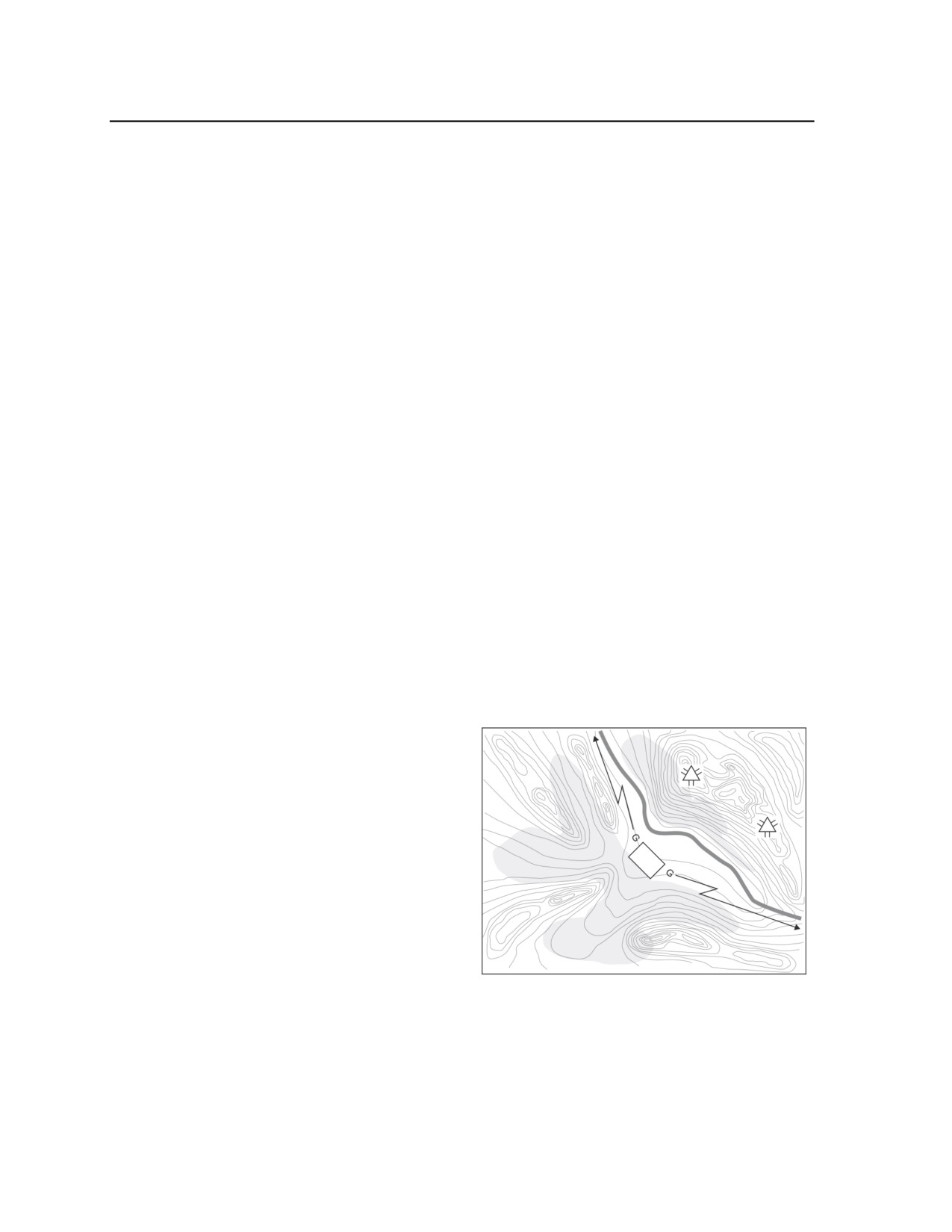
2-121. A combat outpost is a reinforced
observation post capable of conducting limited
combat operations.
(See figure
2-17.) Using
combat out-posts is a technique for employing
security forces in restrictive terrain that precludes
mounted security forces from covering the area.
They are also used when smaller OPs are in danger
of being overrun by enemy forces infiltrating into
and through the security area. The commander uses
a combat outpost to extend the depth of the security
area, to keep friendly forward OPs in place until
they can observe the enemy’s main body, or to
secure friendly forward OPs that will be encircled
by enemy forces. Both mounted and dismounted
forces can employ combat outposts.
Figure 2-17. Combat outposts
2-122. While the mission variables of METT-TC
determine the size, location, and number of combat outposts a unit establishes, a reinforced platoon
typically occupies a combat outpost. A combat outpost must have sufficient resources to accomplish its
designated missions, but not so much as to seriously deplete the strength of the main body. It is usually
located far enough forward of the protected force to preclude enemy ground reconnaissance elements from
observing the actions of the protected force.
2-24
FM 3-90-2
22 March 2013
Security Operations
2-123. The commander organizes a combat outpost to provide an all-around defense to withstand a
superior enemy force. When the enemy has significant armored capability, the commander may give a
combat outpost more than the standard allocation of antitank weapons. Forces manning combat outposts
can conduct aggressive patrolling, engage and destroy enemy reconnaissance elements, and engage the
enemy main body before their extraction. The commander plans to extract friendly forces from the outpost
before the enemy overruns them.
22 March 2013
FM 3-90-2
2-25
Chapter 3
Troop Movement
The ability of a commander to posture friendly forces for a decisive or shaping
operation depends on the commander’s ability to move that force. The essence of
battlefield agility is the capability to conduct rapid and orderly movement to
concentrate combat power at decisive points and times. Successful movement places
troops and equipment at their destination at the proper time, ready for combat. The
three types of troop movement are administrative movement, tactical road march, and
approach march.
GENERAL CONSIDERATIONS OF TROOP MOVEMENT
3-1. Troop movement is the movement of troops from one place to another by any available means
(ADRP 3-90). Troop movements are made by different methods, such as dismounted and mounted marches
using organic combat and tactical vehicles and motor transport air, rail, and water means in various
combinations. The method employed depends on the situation, the size and composition of the moving unit,
the distance the unit must cover, the urgency of execution, and the condition of the troops. It also depends
on the availability, suitability, and capacity of the different means of transportation. Troop movements over
extended distances have extensive sustainment considerations. When necessary, dismounted and mounted
marches can be hurried by conducting a forced march.
DISMOUNTED MARCHES
3-2. A dismounted marches are movements of troops and equipment, mainly by foot, with limited
support by vehicles. Also called foot march. Dismounted marches increase the commander’s maneuver
options. Their positive characteristics include combat readiness (all Soldiers can immediately respond to
enemy attack without the need to dismount), ease of control, adaptability to terrain, and independence from
the existing road network. Their limitations include a slow movement rate and increased personnel fatigue.
Soldiers carrying heavy loads over long distances or large changes in elevation get tired. A unit conducts a
dismounted march when the situation requires stealth, the distance to travel is short, transport or fuel is
limited, or the situation or terrain precludes using a large number of vehicles. (FM 21-18 has more
information on the techniques and procedures for conducting dismounted marches.)
MOUNTED MARCHES
3-3. A mounted march is the movement of troops and equipment by combat and tactical vehicles.
Armored and mechanized units routinely conduct mounted marches. The speed of the march and the
increased amounts of supplies that can accompany the unit characterize this march method. Armored and
Stryker maneuver units are normally self-sufficient to conduct mounted marches over short distances. Light
infantry maneuver units and most functional and multifunctional support and sustainment units are not one
hundred percent mobile with organic truck assets and need assistance from transportation elements to
conduct mounted marches. Considerations for mounted marches over extended distances include—
22 March 2013
FM 3-90-2
3-1
Chapter 3
z
The ability of the route network to support the numbers, sizes, and weights of the tactical and
combat vehicles assigned to or supporting the unit making the move.
z
Available refueling and maintenance sites and crew-rest areas.
z
The need for recovery and evacuation assets.
z
Available spill kits, personal protective equipment, and spill cleanup waste disposal equipment.
(FM 4-01.30 discusses route synchronization and movement planning.)
ARMY AIR MOVEMENTS
3-4. Army air movements are operations involving the use of utility and cargo rotary-wing assets for
other than air assaults. The commander conducts air movements to move troops and equipment, to
emplace systems, and to transport ammunition, fuel, and other high-value supplies. The commander may
employ air movements as a substitute for ground tactical movements. Air movements are generally faster
than ground tactical movements. The same general considerations that apply to air assault operations also
apply to Army air movements. (See FM 3-04.113 for additional information concerning air movement.)
ARMY RAIL AND WATER MOVEMENTS
3-5. Operating forces can use rail and water modes to conduct troop movement, if they are available in an
area of operations (AO). Their use can provide flexibility by freeing other modes of transport for other
missions. Their use normally involves a mixture of military and commercial assets, such as defense freight
railway interchange railcars pulled by privately owned diesel-electric engines to transport tanks along
railroad right of ways from one rail terminus to another. Responsibility for coordinating the use of railroads
and waterways resides in the Army forces
(ARFOR) headquarters in the theater of operations.
(Transportation publications produced by the Sustainment Center of Excellence provide additional
information concerning these two transportation modes.)
FORCED MARCHES
3-6. In cases of tactical necessity, a unit can accelerate its rate of movement by conducting a forced march
so that it arrives at its destination quickly. Armored, Stryker, and infantry units can conduct a forced march.
Forced marches require speed, exertion, and an increase in the number of hours marched or traveled by
vehicles each day beyond normal standards. Soldiers cannot sustain forced marches for more than a short
period. In a forced march, a unit may not halt as often or for as long as recommended for maintenance, rest,
feeding, and fuel. The commander must understand that immediately following a long and fast march,
Soldiers and combat vehicles experience a temporary deterioration in their physical condition. The combat
effectiveness and cohesion of the unit also temporarily decreases. The plan must accommodate the presence
of stragglers and address increased maintenance failures.
ADMINISTRATIVE MOVEMENT
3-7. Administrative movement is a movement in which troops and vehicles are arranged to expedite
their movement and conserve time and energy when no enemy ground interference is anticipated.
The commander only conducts administrative movements in secure areas. Examples of administrative
movements include rail and highway movement in the continental United States. Once units deploy into a
theater of war, commanders normally do not employ administrative movements. Since these types of
moves are nontactical, the echelon assistant chief of staff, logistics (G-4/S-4) usually supervises them.
(FM 4-01.30 discusses route synchronization planning.)
TACTICAL ROAD MARCH
3-8. A tactical road march is a rapid movement used to relocate units within an area of operations to
prepare for combat operations (ADRP 3-90). Units maintain security against enemy air attack and prepare
to take immediate action against an enemy ambush, although they do not expect contact with enemy ground
3-2
FM 3-90-2
22 March 2013
Troop Movement
forces. (If the moving unit anticipates making contact with significant enemy ground forces then it will use
a mix of combat formations and movement techniques.)
3-9. The primary consideration of the tactical road march is rapid movement. However, the moving force
employs security measures, even when contact with enemy ground forces is not expected. Units conducting
road marches may or may not be organized into a combined arms formation. During a tactical road march,
the commander is always prepared to take immediate action if the enemy attacks. (See figure 3-1.)
ORGANIZATION FOR A TACTICAL ROAD
MARCH
3-10. The organization for a tactical road march is
the march column. A march column consists of all
elements using the same route for a single
movement under control of a single commander.
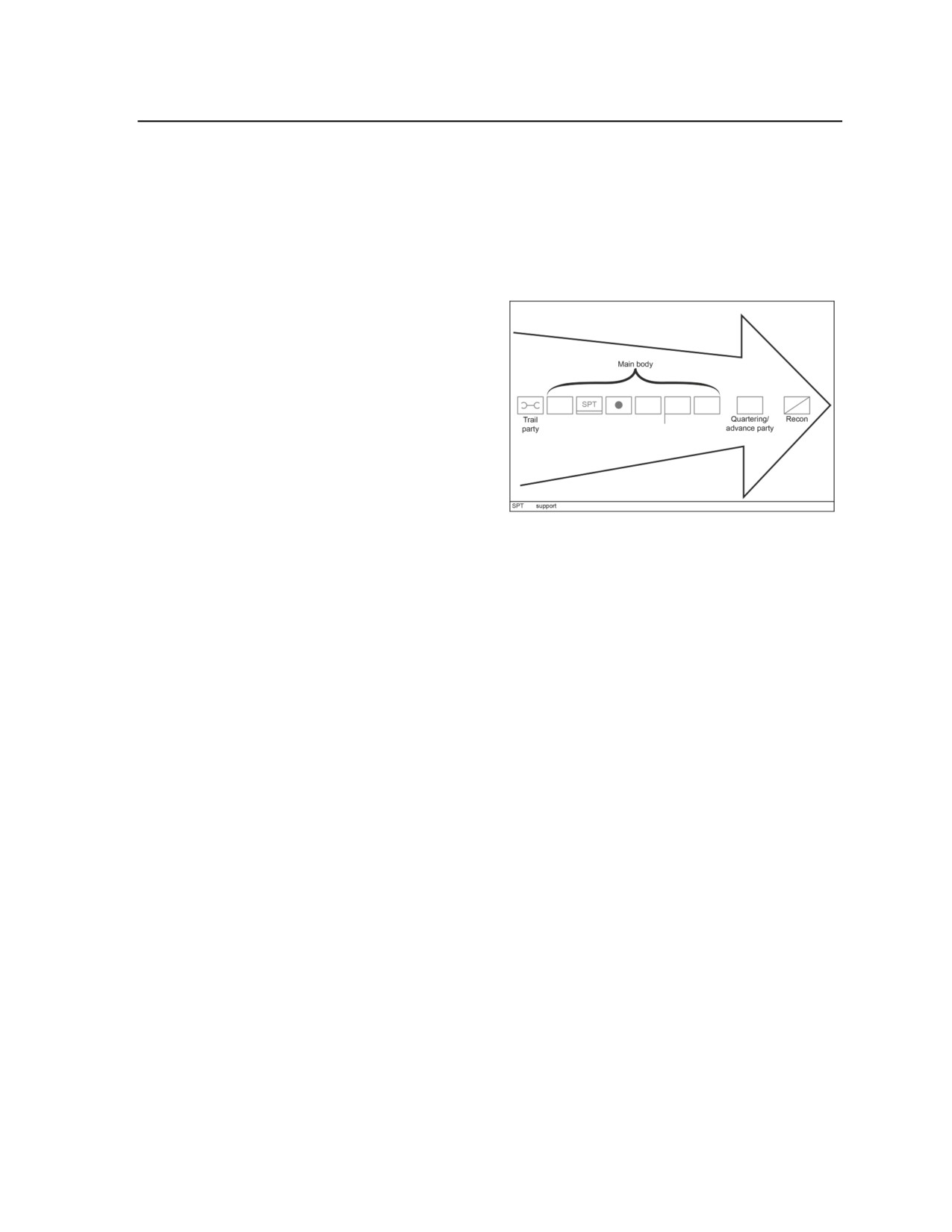
The commander organizes a march column into
four elements: reconnaissance, quartering party,
main body, and trail party. A brigade conducting a
tactical road march is an example of a march
column. The subordinate elements of a march
column are a march serial and a march unit. A
march serial is a major subdivision of a march
column that is organized under one commander
Figure 3-1. Tactical road march
who plans, regulates, and controls the serial. An
example is a battalion serial formed from a brigade-sized march column. A march unit is a subdivision of
a march serial. It moves and halts under the control of a single commander who uses voice and visual
signals. An example of a march unit is a company from a battalion-sized march serial.
3-11. A march column provides excellent speed, control, and flexibility, but sacrifices flank security. It
provides the ability to deploy forces to the front of the column. The commander uses a march column when
speed is essential and enemy contact is unlikely. However, the commander spaces functional and
multifunctional support elements, such as air defense and engineers, throughout the column to protect and
support the movement. Reconnaissance elements augmented by engineer, chemical, biological,
radiological, and nuclear reconnaissance, and other functional and multifunctional support assets, as
appropriate, conduct a route reconnaissance of the march routes. This reconnaissance confirms and
supplements the data obtained from map studies and other headquarters.
3-12. A quartering party is a group of unit representatives dispatched to a probable new site of
operations in advance of the main body to secure, reconnoiter, and organize an area before the main
body’s arrival and occupation. The main body is the principal part of a tactical command or formation. It
does not include detached elements of the command, such as advance guards, flank guards, covering forces,
or a tactical command post displacing to a location from which it can assume control of current operations
while the main command post displaces. A unit quartering party usually accompanies the route
reconnaissance effort to the designated assembly area (AA). Unit standing operating procedures (SOPs)
establish the exact composition of the quartering party and its transportation, security, communications
equipment needs, and specific duties. However, it is small enough to move quickly while still maintaining a
significant self-defense capability. The leader of the quartering party is empowered by the commander of
the main body to make tactical decisions. The quartering party secures, reconnoiters, and organizes an area
for the main body’s arrival and occupation. It typically reconnoiters and confirms the tentative locations
selected by the commander of its parent element, based on a map reconnaissance. When necessary, the
quartering party changes previously assigned unit locations in the AA. The quartering party guides the
main body into position from the release point (RP) to precise locations in the AA. (Some organizations use
the term “advance party” interchangeably with the term “quartering party.” However, the term “advance
party” is primarily used in the operational and strategic deployment process.)
22 March 2013
FM 3-90-2
3-3
Chapter 3
3-13. The main body of the march column consists of the remainder of the unit, including attachments
minus the trail party. The trail party is the last march unit in a march column and normally consists of
primarily maintenance elements in a mounted march. It maintains communications with the main body.
The function of the trail party is to recover
disabled vehicles or control stragglers in a
dismounted march. If the trail party
cannot repair a disabled vehicle
immediately, it tows the disabled vehicle
and moves its crew and passengers to a
unit maintenance collection point located
at a secure area near the movement route.
GRAPHIC CONTROL MEASURES
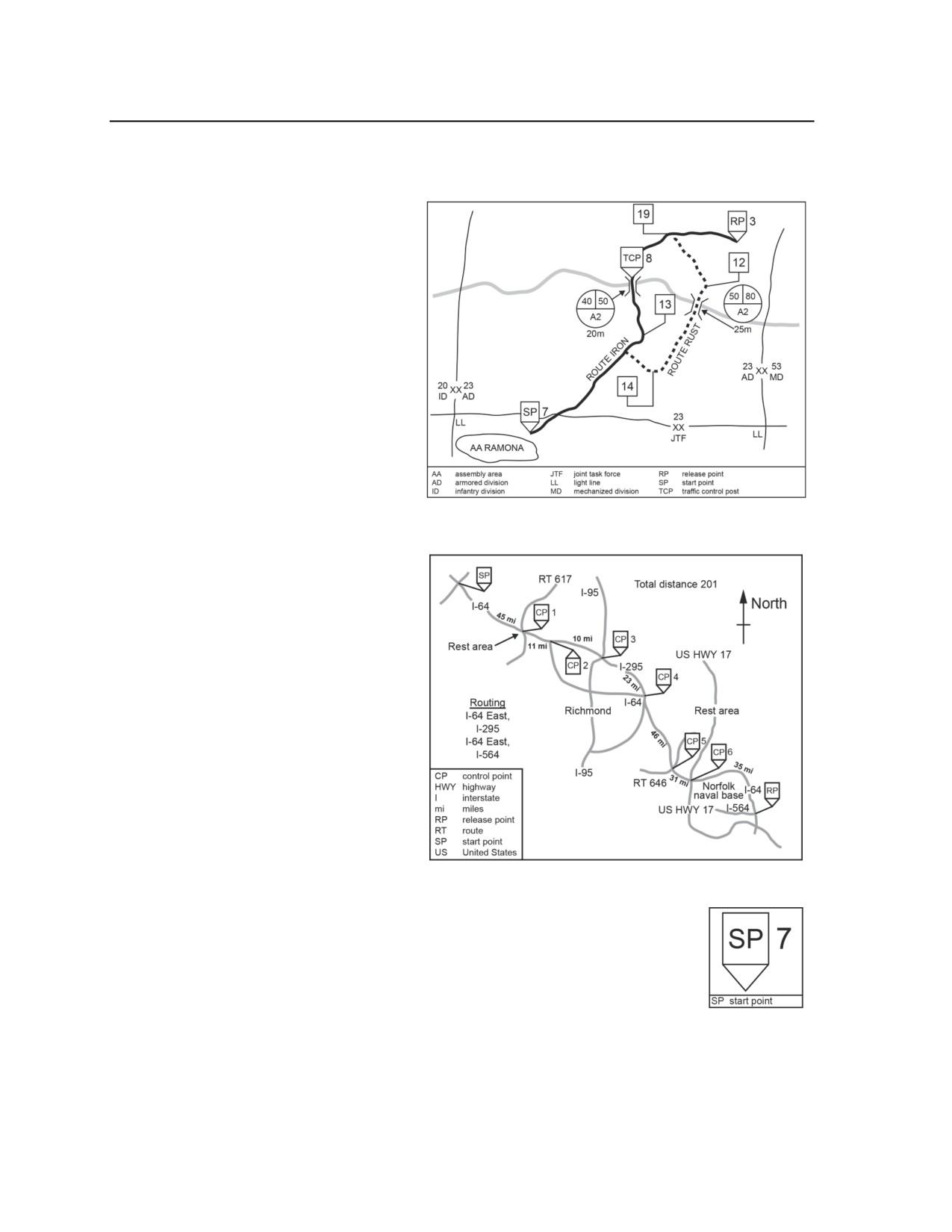
3-14. The commander directing a tactical
road march often uses a strip map or
overlay to graphically depict critical
information
about the
route
to
subordinates. The overlay or strip map
should show the route of march, start
points
(SPs), RPs, checkpoints, critical
Figure 3-2. Example overlay with route control
points
(such as bridges), light line, and
measures
traffic control points (TCPs). (Figure 3-2
shows an example overlay. Figure
3-3
shows an example strip map.) Other
graphic control measures include AAs and
phase lines.
3-15. The start point is a location on a
route where the marching elements fall
under the control of a designated
march commander. Figure 3-4 shows SP
7. All routes have a designated SP, and it
is easily recognizable on the map and on
the ground, such as a road junction. It is
far enough from the AA to allow units to
organize and move at the prescribed speed
and interval when they reach the SP.
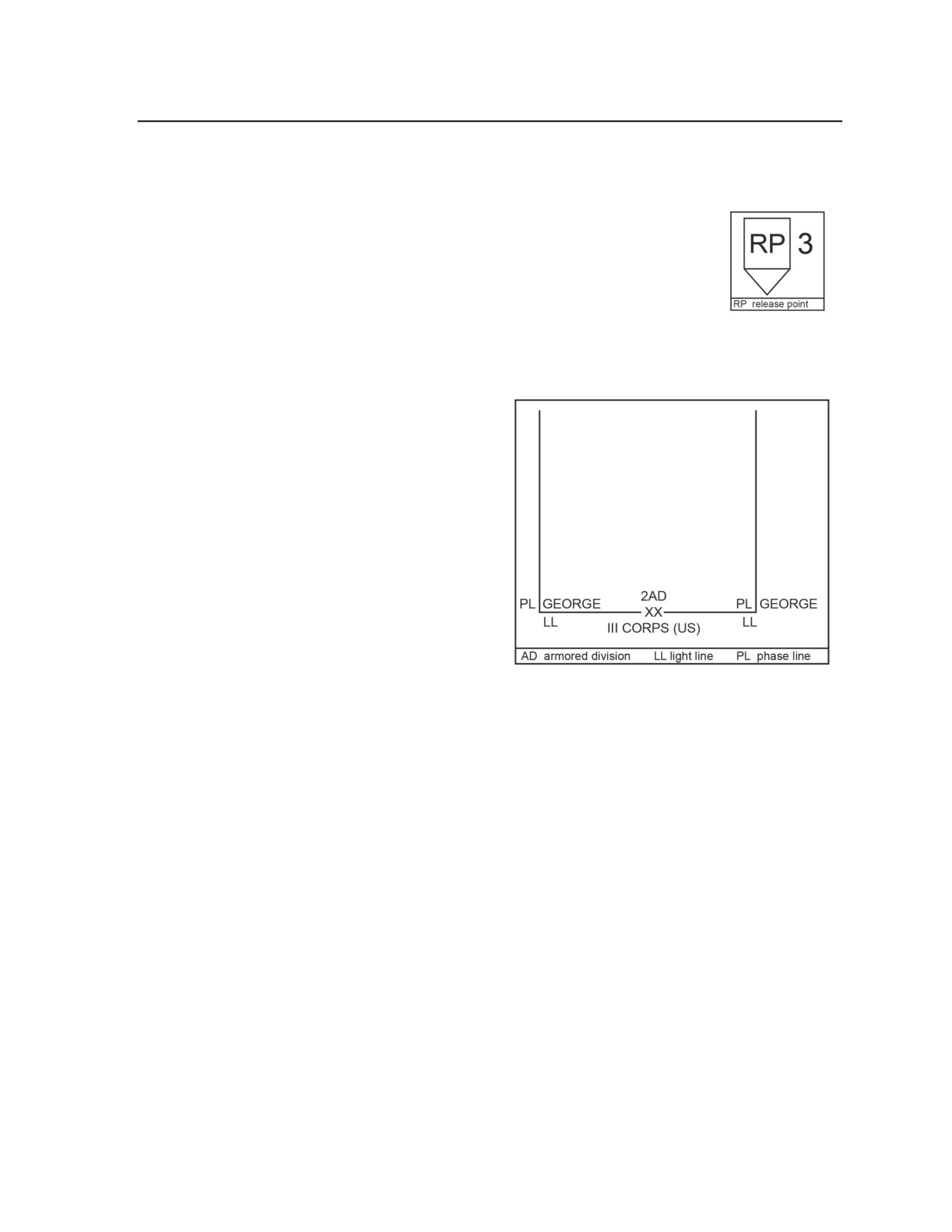
3-16. A release point is a location on a
route where marching elements are
released from centralized control.
Figure 3-5 on page 3-5 shows RP 3. Each
Figure 3-3. Example strip map
SP must have a corresponding RP, which
must also be easy to recognize on the ground. Marching units do not stop at the RP;
instead, as they move through the RP, unit guides meet each march unit and lead it to
AAs.
3-17. The commander designates checkpoints along the route to assist marching units
in complying with the timetable. Also, the movement overlay identifies critical points
along the route where interference with movement might occur. The commander
positions TCPs along the route to prevent congestion and confusion. They may be
Figure 3-4.
manned by military police (MP) or unit personnel. These Soldiers report to the
Start point
appropriate area movement control organization when each convoy, march column,
and march serial arrives at and completes passage of their location.
3-4
FM 3-90-2
22 March 2013
Troop Movement
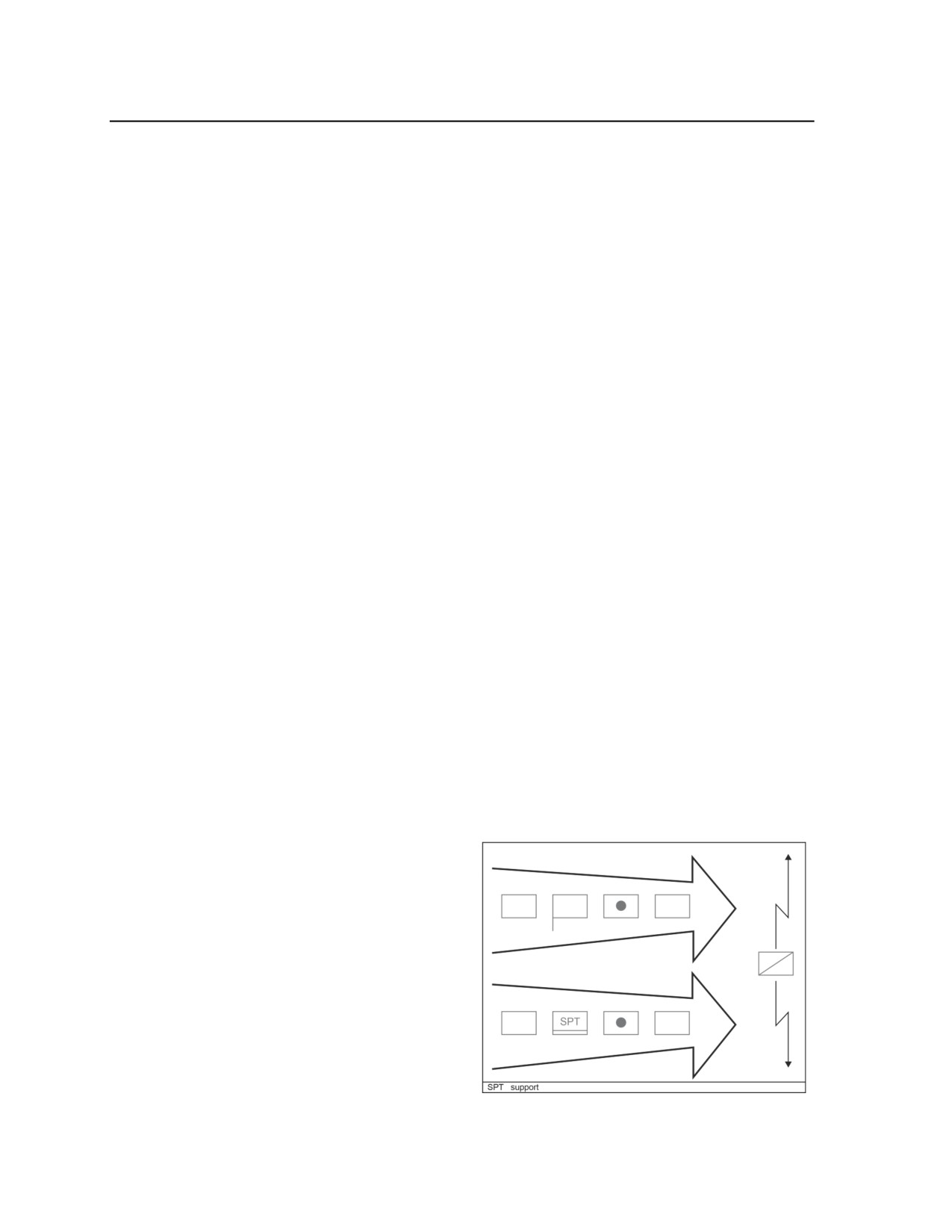
3-18. A light line is a designated line forward of which vehicles are required to use blackout lights during
periods of limited visibility (ADRP 1-02). Commanders at either corps or division echelon establish it
based on the risk that the enemy will be able to detect moving vehicles using white
light. Figure 3-6 depicts the light line for the 2nd Armored Division as the division
rear boundary. (FM 3-34.170 prescribes the format of signs posted at bridges and key
locations along routes.)
3-19. A movement corridor is a designated area established to protect and enable
ground movement along a route (FM 3-90.31). Units establish a movement corridor to
set the conditions to protect and enable movement of traffic along a designated
surface route. Units conduct synchronized operations in the movement corridor such as
Figure 3-5.
reconnaissance, security, mobility, and inform and influence activities for forces that
Release point
require additional mission command, protection, and support to enable their
movement. A commander may establish a
movement corridor to facilitate the movement of a
single element or for a longer period of time to
facilitate the movement of a number of elements
along a route. The commander of an AO may
establish a movement corridor in an AO along an
established main supply route (MSR) or a route
designated for a unit’s movement. The movement
corridor typically includes the airspace above it to
allow the establishing unit to conduct aerial
reconnaissance and fires. (Appendix A of FM 3-
90-1 contains an example of a movement corridor.)
TACTICAL MARCH TECHNIQUES
3-20. Units conducting tactical road marches
employ three tactical march techniques: open
column, close column, and infiltration. Each of
Figure 3-6. Light line
these techniques uses scheduled halts to control
and sustain the road march. The mission variables of mission, enemy, terrain and weather, troops and
support available, time available, and civil considerations (METT-TC) require adjustments in the standard
distances between vehicles and dismounted Soldiers. During movement, elements in a column may
encounter many different types of routes and obstacles simultaneously. Consequently, parts of the column
may be moving at different speeds, which can produce an undesirable accordion effect. The movement
order establishes the order of march, rate of march, interval or time gaps between units, column gap, and
maximum catch-up speed. Unless the commander directs them not to do so for security reasons, march
units report when they have crossed each control point. Throughout the move, the commander maintains air
and ground security.
Open Column
3-21. In an open column, the commander increases the distance between vehicles and dismounted Soldiers
for greater dispersion. The vehicle distance varies from 50 to 100 meters, and may be greater if required.
The distance between dismounted Soldiers varies from two to five meters to allow for dispersion and space
for marching comfort. Any distance that exceeds five meters between dismounted Soldiers increases the
length of the column and hinders control. The open column technique is normally used during daylight. It
may also be used at night with infrared lights, blackout lights, or passive night-vision equipment. Using an
open column roughly doubles the column’s length and thereby doubles the time it takes to clear a point
when compared to a close column moving at the same speed. The open column is the most common
movement technique because it offers the most security while still providing the commander with a
reasonable degree of control. In an open column, vehicle density varies from 15 to 20 vehicles per
22 March 2013
FM 3-90-2
3-5
Chapter 3
kilometer. A single light infantry company, with intervals between its platoons, occupies roughly a
kilometer of road or trail.
Close Column
3-22. In a close column, the commander spaces vehicles about 20 to 25 meters apart. At night, vehicles are
spaced so each driver can see the two lights in the blackout marker of the vehicle ahead. The commander
normally employs a close column for marches during darkness under blackout driving conditions or for
marches in restricted terrain. This method of marching takes maximum advantage of the traffic capacity of
a route but provides little dispersion. Normally, vehicle density is from 40 to 50 vehicles per kilometer
along the route in a close column.
3-23. The dismounted equivalent to the close column is a limited visibility march. The distance between
individual Soldiers is reduced to one to three meters to help maintain contact and facilitate control. Limited
visibility marches are characterized by close formations, reconnaissance, a slow rate of march, and good
concealment from enemy observation and air attack.
Infiltration
3-24. The commander dispatches vehicles in small groups, or at irregular intervals, at a rate that keeps the
traffic density down and prevents undue massing of vehicles during a move by infiltration. Infiltration
provides the best possible passive defense against enemy observation and attack. It is suited to tactical road
marches when there is enough time and road space and when the commander desires the maximum
security, military deception, and dispersion. The disadvantages of an infiltration are that more time is
required to complete the move, column control is nearly impossible, and recovery of broken-down vehicles
by the trail party is more protracted when compared to vehicle recovery in close and open columns.
Additionally, unit integrity is not restored until the last vehicle arrives at the destination, complicating the
unit’s onward deployment. Infiltration during troop movement should not be confused with infiltration as a
form of maneuver as discussed in FM 3-90-1.
3-25. During extended road marches, halts are necessary to rest personnel, service vehicles, and adjust
movement schedules. The march order or unit SOP regulates when to take halts. In motor movements, the
commander schedules short halts for every two to three hours of movement and halts may last up to an
hour. Long halts occur on marches that exceed 24 hours and last no more than 2 hours. Long halts are not
scheduled at night, which allows maximum time for night movement. During halts, each unit normally
clears the march route and moves to a previously selected AA to prevent route congestion and avoid being
a lucrative target. Units establish security and take other measures to protect the force. Unit leaders
promptly notify commanders of the time and approximate length of unscheduled halts.
3-26. The commander emphasizes security during halts. Once a unit stops moving, there is a natural
tendency for Soldiers to let their guard down and
relax their vigilance. The commander addresses
this by defining in the SOP unit actions for various
types of halts, such as maintenance halts, security
halts, and unexpected halts.
APPROACH MARCH
3-27. An approach march is the advance of a
combat unit when direct contact with the enemy is
intended (ADRP 3-90). (See figure 3-7.) However,
it emphasizes speed over tactical deployment. Both
armored, Stryker, and infantry forces conduct
tactical road marches and approach marches.
3-28. The commander employs an approach
march when the enemy’s approximate location is
Figure 3-7. Approach march
3-6
FM 3-90-2
22 March 2013
Troop Movement
known, since it allows the force to move with greater speed and less physical security or dispersion.
Commanders task-organize units conducting an approach march before the march begins to allow them to
transition to an on-order or a be-prepared mission without making major organizational adjustments. For
example, artillery units march in their supported unit’s columns, while engineer units are well forward to
facilitate mobility. The approach march terminates in a march objective, such as an attack position, AA, or
assault position, or it can be used to transition to an attack. Follow-and-assume and reserve forces may also
conduct an approach march forward of a line of departure (LD).
3-29. Based on the products of the intelligence preparation of the battlefield (IPB) process, the overall
commander assigns an AO or an axis of advance in combination with routes to a unit conducting an
approach march. These routes, AOs, or axes facilitate the force’s movement and maximize its use of
concealment. Within the approach march, the commander assigns the force conducting the decisive
operation and forces conducting each shaping operation separate routes, AOs, or axes of advance unless an
individual sub-unit has the task of either follow-and-assume or follow-and-support.
3-30. As the approach march nears areas of likely enemy interference, the commander divides the unit’s
main body into smaller, less vulnerable columns that move on additional multiple routes or cross-country
while continuing to employ security elements. The commander takes advantage of successful
reconnaissance and security operations to increase the distance traveled before the main body transitions to
a tactical formation. As discussed in chapter 2, the advance and any flank guards remain within supporting
distance of the main body, which stays in these smaller columns to facilitate rapid movement.
3-31. Commanders use tactical road marches and approach marches in a theater of war when contact with
the enemy is possible or anticipated. This style of movement emphasizes tactical considerations such as
security and de-emphasizes efficiency and ease of movement. The commander organizes the unit to
conduct combat operations in a tactical movement. A unit generally maintains unit integrity throughout its
movement. It plans for enemy interference either en route to or shortly after arrival at its destination. Units
conducting either a tactical road march or an approach march use formations and techniques consistent with
the mission variables of METT-TC. The unit may conduct them over unsecured routes, if there are no
friendly forces between the foremost elements of the moving force and the enemy. The echelon assistant
chief of staff, operations (G-3/S-3) is the primary staff officer responsible for planning these tactical
movements, with input from other staff members.
3-32. There are several differences between an approach march and a tactical road march. A force
conducting an approach march employs larger security forces because of its greater exposure to enemy
attack. Commanders arrange units conducting approach marches into combined arms organizations. An
approach march allows the commander to disperse the task-organized force into a tactical formation
without being constrained to existing roads and trails. On the other hand, road marches can organize their
columns for administrative convenience; for example, vehicles of similar type, speed, and cross-country
capabilities move together. Units conducting an approach march establish appropriate tactical intervals
between vehicles; they do not normally employ a close column. They also use more routes than units
conducting road marches.
MOVEMENT TECHNIQUES
3-33. The commander uses the combat formations
described FM 3-90-1 in conjunction with three movement
techniques: traveling, traveling overwatch, and bounding
overwatch. Figure 3-8 illustrates when a unit is most likely
to use each technique.
3-34. Movement techniques limit the unit’s exposure to
enemy fire and position it to react to enemy contact. The
commander selects the appropriate movement technique
based on the chance of enemy contact. While moving,
individual Soldiers and vehicles use the terrain to protect
Figure 3-8. Movement Techniques
themselves when enemy contact is possible or expected.
22 March 2013
FM 3-90-2
3-7
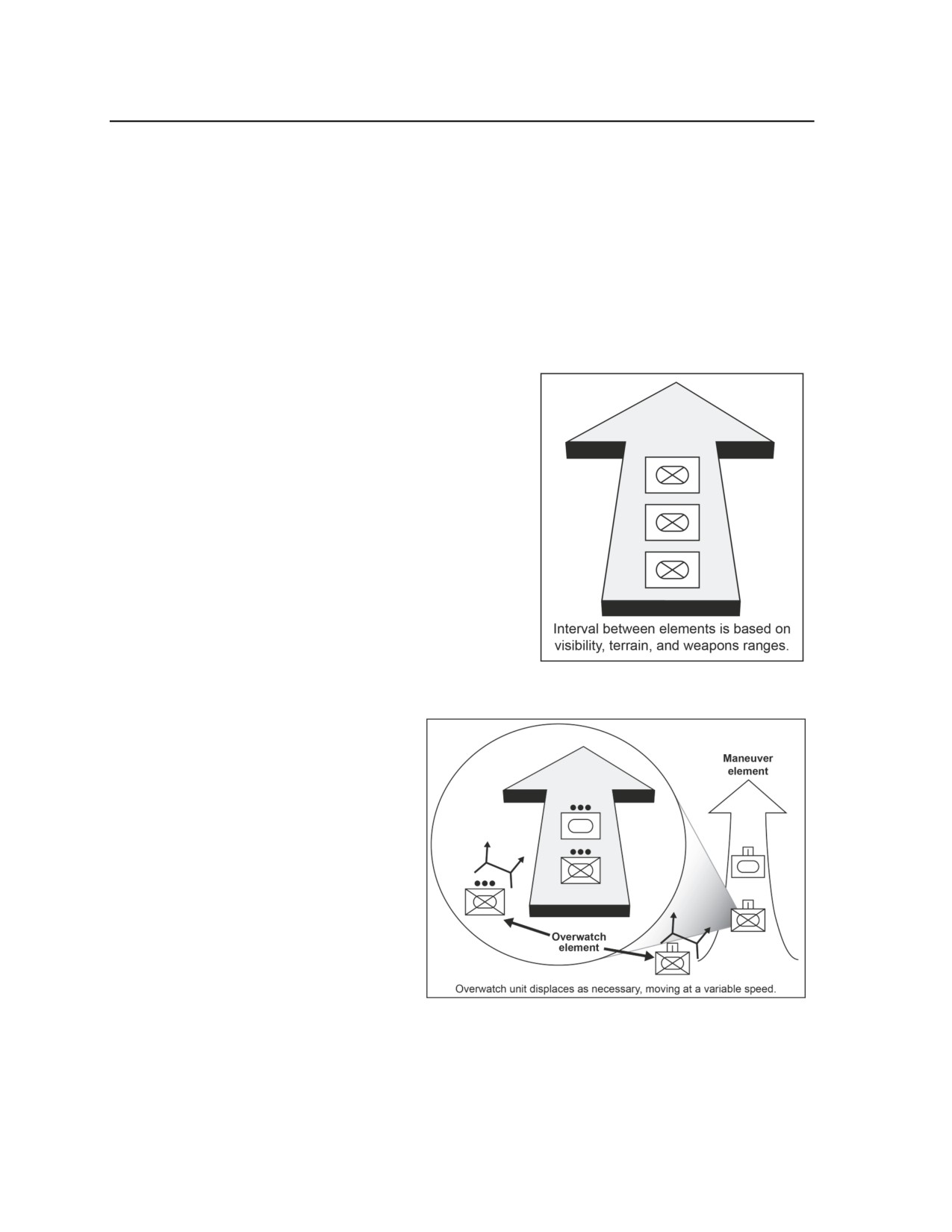
Chapter 3
They use natural cover and concealment to avoid enemy fires. The following rules apply to Soldiers and
vehicle crews using terrain for protection:
z
Do not silhouette yourself against the skyline.
z
Cross open areas quickly.
z
Do not move directly forward from a concealed firing position.
z
Avoid possible kill zones because it is easier to cross difficult terrain than fight the enemy on
unfavorable terms.
z
Avoid large, open areas, especially when they are dominated by high ground or by terrain that
can cover and conceal the enemy.
z
Take active countermeasures, such as using smoke and direct and indirect fire, to suppress or
obscure suspected enemy positions.
TRAVELING
3-35. The commander uses the traveling movement
technique when speed is necessary and contact with enemy
forces is not likely. All elements of the unit move
simultaneously. The commander or small-unit leader is
located where that individual can best control the situation.
Trailing elements may move in parallel columns to shorten
the column and reaction time. (See figure 3-9.)
TRAVELING OVERWATCH
3-36. The commander uses the traveling overwatch
movement technique when contact with enemy forces is
possible, but speed is important. The traveling overwatch is
a movement technique used when contact with enemy
forces is possible. The lead element and trailing element
are separated by a short distance which varies with the
Figure 3-9. Traveling
terrain. The trailing element moves at variable speeds
and may pause for short periods to
overwatch the lead element. It keys its
movement to terrain and the lead
element. The trailing element over-
watches at such a distance that, should
the enemy engage the lead element, it
will not prevent the trailing element
from firing or moving to support the
lead element. (See figure 3-10.)
BOUNDING OVERWATCH
3-37. Bounding overwatch is
a
movement technique used when contact
with enemy forces is expected. The unit
moves by bounds. One element is
always halted in position to overwatch
another element while it moves. The
Figure 3-10. Traveling overwatch
overwatching element is positioned to
support the moving unit by fire or fire and movement. The commander uses the bounding overwatch
movement technique when expecting to make contact with enemy forces. There are two variations of this
technique: alternate bounds and successive bounds. In both cases, the overwatching elements cover the
bounding elements from covered, concealed positions with good observation and fields of fire against
3-8
FM 3-90-2
22 March 2013
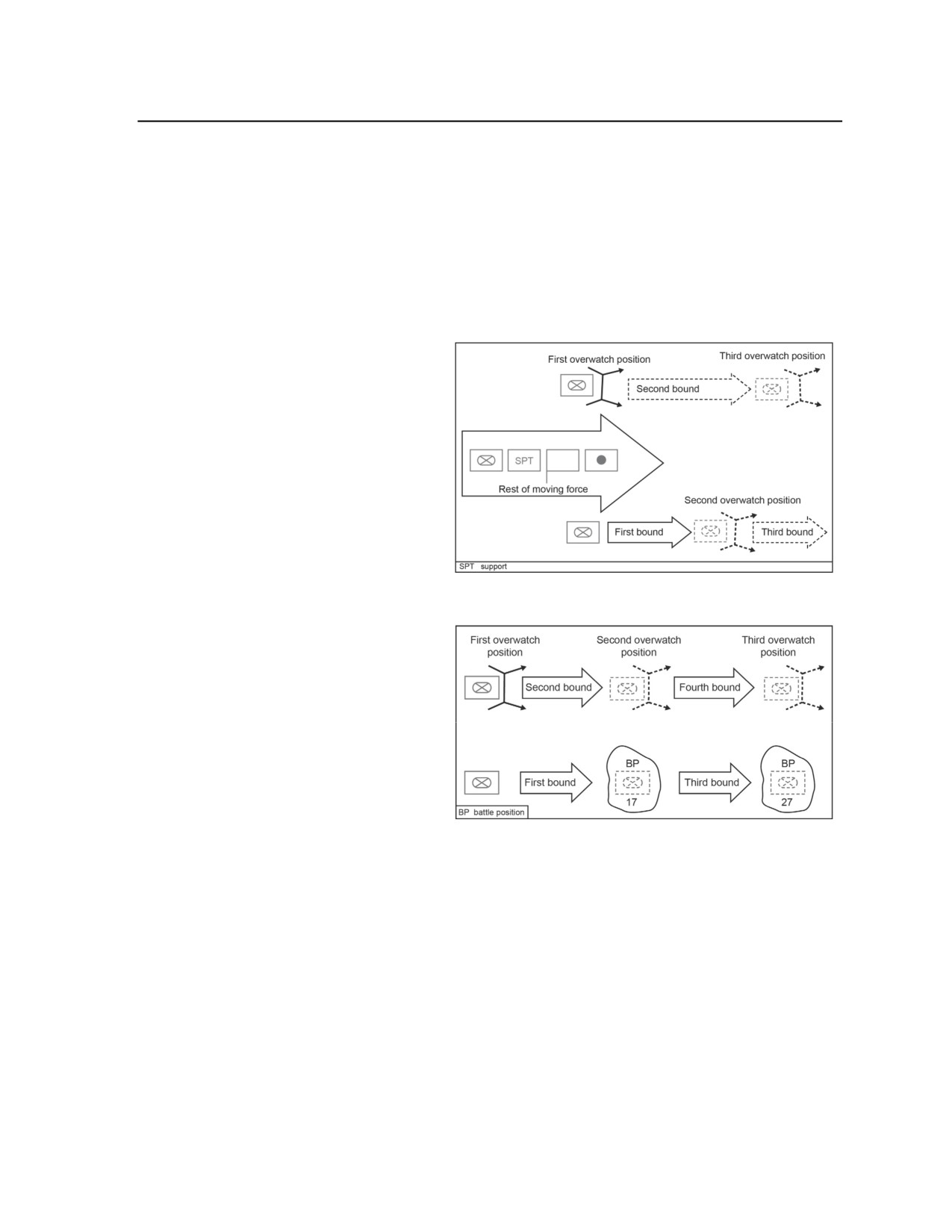
Troop Movement
possible enemy positions. They can immediately support the bounding elements with maneuver or fires, if
the bounding elements make contact. Unless they make contact en route, the bounding elements move via
covered and concealed routes into the next set of support by fire positions. The length of the bound is based
on the terrain and the range of overwatching weapons. The commander can use the uncommitted part of the
force whenever it is needed as part of an immediate and controlled reaction to any threat to the bounding
force. In bounding overwatch, movement is based on the next support by fire position, which offers at least
some of the following advantages:
z
Cover and concealment.
z
Good observation and fields of fire.
z
Protection for stationary weapon platforms.
3-38. If the unit uses alternate bounds,
the lead element moves forward, halts,
and occupies a support by fire position
that is covered at all times by the rear
overwatching element. That former rear
overwatching element advances past the
former lead element and takes an
overwatch position. The initial lead
element then advances past the initial trail
element and occupies a new support by
fire position. One element moves at a
time. This method is usually more rapid
than successive bounds. (See figure 3-11.)
3-39. If the unit uses successive bounds,
Figure 3-11. Bounding overwatch using alternate
the lead element, covered by the trail
bounds
element, advances and occupies a support
by fire position. The trail element
advances to a support by fire position
abreast of the lead element and halts. The
lead element moves to the next position
and the move continues. Only one element
moves at a time, and the trail element
avoids advancing beyond the lead
element. (See figure 3-12.)
PLANNING A TROOP
MOVEMENT
Figure 3-12. Bounding overwatch using successive
bounds
3-40. The commander plans, prepares,
executes, and assesses troop movements to ensure the organized and uninterrupted flow of tactical units
throughout the AO. The objective of a successful move is for the unit to arrive at its destination in a
condition suitable to its probable employment. The goal of all movement planning is to retain flexibility to
execute a variety of plans to meet ever-changing conditions. The commander ensures that the unit’s
movement SOP contain specifics, and the commander conducts rehearsals to ensure that the unit’s Soldiers
and subordinate leaders understand them. The SOP uses a standard task organization to simplify planning,
provide flexibility, and allow greater responsiveness. Such SOPs allow for smoother cooperation by
establishing habitual relationships between the unit’s subordinate elements and outside supporting
elements.
3-41. The movement order is the end result of the commander’s planning process. The Army movement
order is prepared as Tab C-Transportation, of Annex F-Sustainment to an operations order (OPORD) or as
a separate OPORD. Prepared in five-paragraph format, Tab C provides critical information needed by a
unit to plan and execute movement. Information normally found in Tab C includes the destination, routes,
22 March 2013
FM 3-90-2
3-9
Chapter 3
orders of march, rates of march, times that each serial (or march element for serial movement orders) will
arrive and clear its SP, intervals, speeds, scheduled maintenance halts, communications, and location of the
commander. The commander also identifies logistics sites and services in Tab C. Information and
procedures contained in the unit’s movement SOP are not included. The movement order should include a
strip map or overlay.
3-42. The movement order discusses procedures for succession of command in the march unit, march
serial, and march column, if those procedures vary from the unit’s established SOP. It addresses the
procedures for disseminating succession information throughout the organization. It also addresses how
changes in command location are communicated, including the activation of alternate mission command
nodes. It addresses alternate means of communications within and external to each march unit, such as
hand and arm signals and pyrotechnics where they vary from established SOPs. It also addresses who has
the authority to activate alternative routes.
3-43. The commander bases the movement order on the best available information on the mission
variables of METT-TC. This plan establishes how the unit will move from its current location to the
desired location. The integration of and support from maneuver and functional and multifunctional
support—such as artillery, intelligence, military police, and engineers—are critical for a successful tactical
movement. The commander’s operations staff develops the detailed movement order, with the assistance of
the commander’s sustainment staff, in accordance with established priorities.
3-44. The movement order and unit SOP address the possibility of ambushes, indirect fires, and air attacks.
A small-unit SOP includes drills for reacting to these circumstances. Passive measures mitigating an air
attack include route selection, vehicle intervals, and movement during limited visibility. In case of attack,
the commander has a casualty evacuation plan. This plan takes into account SOP items, such as using
combat lifesavers and dispersing medical evacuation assets throughout the convoy.
3-45. For units that are not completely mobile with organic vehicles, such as an Army division
headquarters and many sustainment units, the commander can either conduct a shuttle with organic vehicles
or request assistance from transportation units. Shuttling requires transporting troops, equipment, and
supplies by a series of round trips with the same vehicles. Units may also shuttle by carrying successive
parts of a load for short distances while the remaining Soldiers continue on foot.
3-46. The higher headquarters sustainment staff normally coordinates the provision of sustainment to
moving units, although units carry sufficient fuel and lubricants in their unit trains to conduct local
movements. In coordination with the engineers, the sustainment staff ensures that routes are adequate for
the types and numbers of vehicles and supplies projected. The commander knows the load-carrying
capability of each route and the distances over which forces can be supported. Sustainment operators
determine if any sustainment assets displace to support the mission. The commander also establishes halts
for refueling as part of the movement plan. Halt times should be long enough and locations large enough to
allow the entire march unit to refuel.
3-47. The simplest troop movement scenario to plan and conduct is one where the commander directing
the movement controls the entire AO. In this situation, the commander can use the unit’s normal mission
command system. The headquarters ordering the tactical road march schedules the movement times and
approves the routes, while its movements control organization allocates the required space and time on the
approved routes. If the movement results in a unit going outside its parent headquarters’ AO, coordination
through various movement control centers is required. Otherwise, a higher headquarters must plan and
control the movement.
3-48. Whenever possible, the commander should use multiple routes to move the unit. This reduces the
length of columns, the vulnerability to enemy air attack, and the amount of time the routes are unavailable
to other units. Multiple routes provide the commander with the flexibility to react to unexpected situations
and permit more rapid concentration of combat power. The two primary disadvantages of using multiple
routes are difficulty in exercising mission command, and the unit may not have enough resources to
provide logistic and maintenance support on all routes.
3-10
FM 3-90-2
22 March 2013
Troop Movement
3-49. The echelon transportation officer uses route classification components, such as route widths, route
types, military load classifications, overhead clearance, route obstructions and special conditions, to
determine the traffic circulation plan. A supporting geospatial engineer team provides most of this
information. Engineer reconnaissance obtains necessary information not contained in existing geospatial
databases.
3-50. The staff depicts the echelon traffic circulation plan on overlays using transportation control
measures. The traffic circulation plan considers—
z
The most restrictive route features and route designations.
z
Direction of movement over each route.
z
Location of boundaries, units, highway regulation points, TCPs, and principal supply points.
z
Major geographic features and light lines, if applicable.
z
Routes designated for one-way traffic.
z
Separate routes for sustainment and tactical units.
z
Current data on traffic regulation and control restrictions, obstructions, detours, defiles,
capacities, surface conditions, and enemy activities that affect the highway net.
3-51. From information contained in the traffic circulation plan, a traffic control plan is prepared—usually
by the provost marshal—from information contained in the traffic circulation plan. The traffic control plan
normally is prepared in the form of an overlay. The commander primarily uses available aviation,
movement regulating teams, and MP units to assist in traffic control, but the commander can assign this
mission to other units, such as battalion scout platoons.
PREPARING A TROOP MOVEMENT
3-52. Reconnaissance precedes unit movement. Before a unit starts any march, a reconnaissance element
from that unit reconnoiters the route from its current location to the SP and determines how long it will take
the unit to reach the SP. This reconnaissance element continues beyond the start point and carefully
examines the route’s trafficability, including the impact of weather, such as ice, snow, and rain. This
reconnaissance also includes alternative routes and choke points, such as defiles, bridges, and fords, which
could slow the march. This reconnaissance element complements map and technical reconnaissance and
provides the commander with important information about the terrain, obstacles, and potential enemy
forces in the AO. The commander then establishes TCPs at critical locations along the route or marks the
route where it becomes confusing.
3-53. A quartering party often accompanies reconnaissance elements to mark routes and battle positions.
The party may also secure new positions with observation posts or limited forces until the unit conducting
the movement arrives.
3-54. The unit begins a tactical movement, such as a road march, fully supplied. The unit refuels at every
opportunity, such as at halts and on arrival at the final destination. The transportation of fuel and the
security of existing stockpiles are major factors in any mounted road march. The commander may choose
to conduct a refuel on the move to extend the range of the unit’s vehicles. Refuel on the move is a
technique in which the commander positions tankers just off the route of the march to refuel combat and
tactical vehicles rapidly, but only in the previously established quantities necessary to extend their range to
the desired length.
3-55. Based on the form of movement selected and the march and movement techniques adopted, the
commander may have to pre-position sustainment assets to conduct rapid and efficient refueling and
resupply. Generally, a column formation is the easiest movement technique to support. Any other formation
requires increased sustainment planning. Night movements require special preparation because not all
Soldiers have night vision devices. These special preparations include marking vehicles and equipment for
easy identification by friendly forces and repositioning vehicles and Soldiers closer together so they can
detect each others’ movement.
22 March 2013
FM 3-90-2
3-11
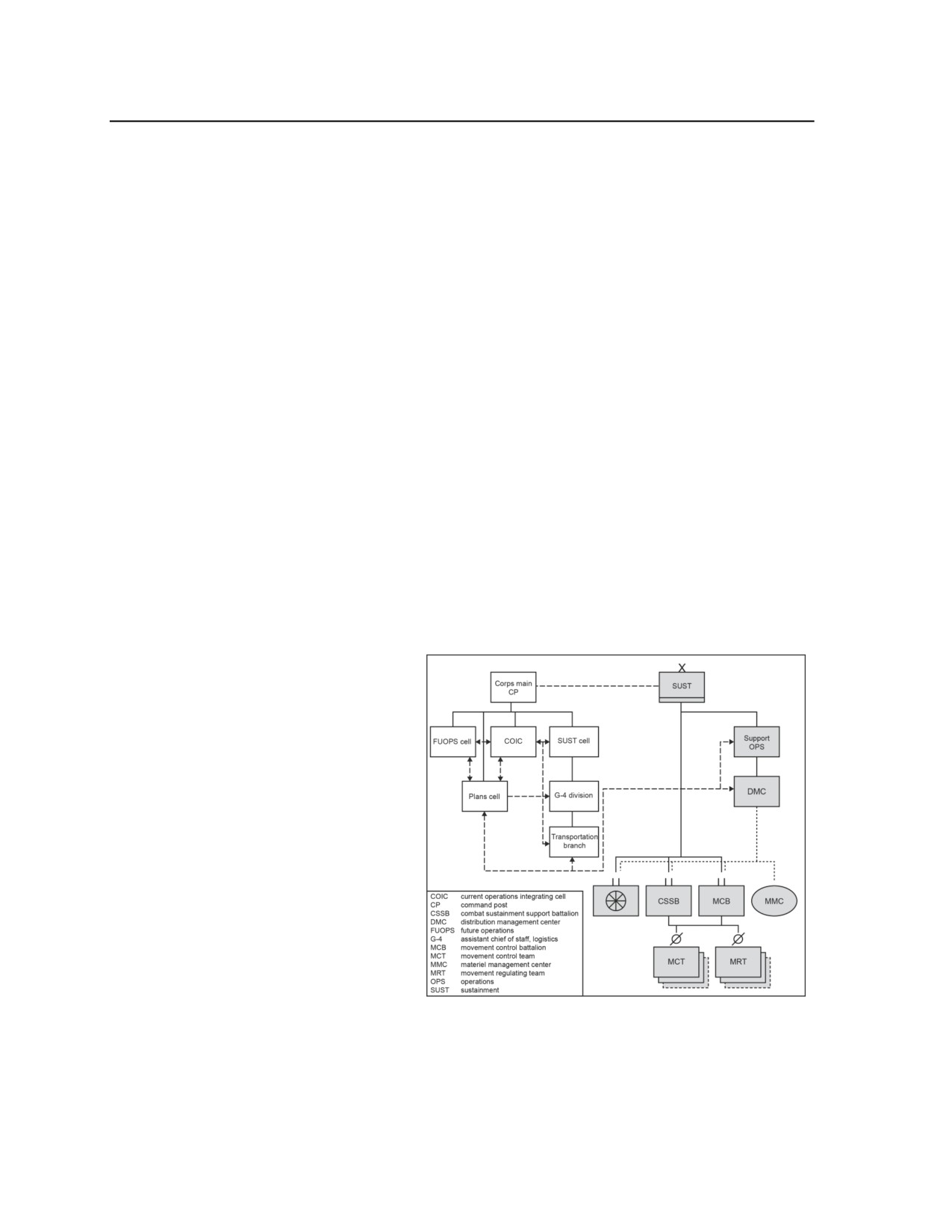
Chapter 3
EXECUTING A TROOP MOVEMENT
3-56. A unit’s ability to move depends on its march discipline and ability to maintain required movement
standards and procedures as prescribed by its movement SOP and movement order. This includes staying
on the route and maintaining start, passage, and clear times. March discipline is absolutely essential
throughout the movement. Any deviation from the movement order may interfere with the movements of
other units and may have serious consequences. However, march discipline can only be maintained when
the plan matches conditions and the unit’s ability to move.
3-57. The strength and composition of the moving unit’s security elements vary, depending on the mission
variables of METT-TC. The commander employs organic assets and any supporting security assets to
protect subordinate forces from enemy activities. The commander positions them to the front, rear, and
flanks of subordinates’ formations while moving and at the halt to provide all-around security for the main
body. The commander can also enhance security by adopting a march formation and movement technique
that facilitate applying combat power in the direction from which enemy contact is expected.
3-58. Higher echelon sustainment organizations may support some tactical movements. When the situation
permits, sustainment organizations establish maintenance, ambulance exchange, and supply points along
the movement route of a support tactical maneuver unit. While procedures, amounts, and types of external
support vary among major commands, each sustainment organization ensures that these sites are
operational at the designated times and locations. External sustainment along the route may include
aeromedical evacuation, maintenance, water, and petroleum, oils, and lubricants (POL). Maintenance sites
generally consist of unit maintenance collection points where disabled vehicles can be moved for limited
maintenance and Class IX supplies. Vehicles unable to continue the movement remain at a unit
maintenance collection point and join their parent organization when repaired. The troop movement is
complete when the last march unit clears the RP.
MOVEMENT CONTROL
3-59. Movement control is the planning,
routing, scheduling, and control of
personnel and cargo movements over lines
of communications
(JP
4-01.5). It is a
continuum that involves coordinating and
integrating
logistics,
movement
information, and programs that span the
strategic, operational, and tactical levels
of war. The balancing of requirements
against
capabilities
and assigning
resources based on the commander’s
priorities guides the conduct of movement
control. Movement control gives the
commander the ability to deconflict the
movement of units—troop movement—
and the distribution of supplies and
services inherent in sustainment. It is a
complicated system as figure 3-13 shows
by the number of different agencies
involved in corps movement control.
3-60. Units may not move across
Figure 3-13. Corps movement control
boundaries into another unit’s area of
operations without receiving clearance
from the unit owning the AO. The designation, maintenance, route security, and control of movement along
routes in an AO are the responsibility of the owning unit unless the higher echelon’s coordinating
instructions otherwise direct. An example is that one or more routes will be reserved for the exclusive use
3-12
FM 3-90-2
22 March 2013
Troop Movement
of a combined arms battalion operating forward of a brigade combat team as a guard force. A reserved
route is a control measure, and it is used to facilitate the conduct of an operation. There are five control
measure designations: open route, supervised route, dispatch route, prohibited route and reserved route.
Each route’s designation will vary based on the factors of METT-TC. (See FM 4-01.30 for a more detailed
discussion on movement control and the establishment of route synchronization measures.)
22 March 2013
FM 3-90-2
3-13
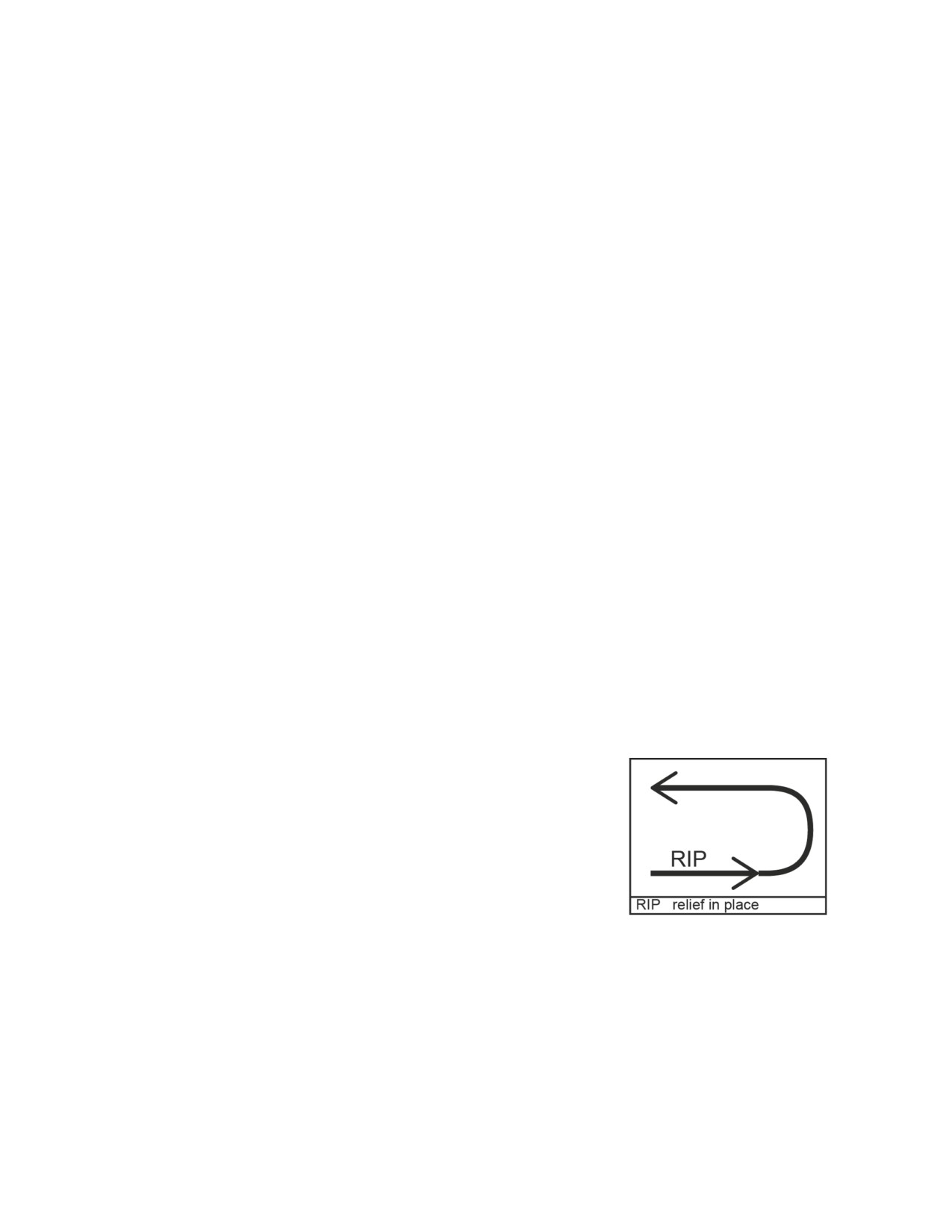
Chapter 4
Relief in Place
A commander conducts a relief in place as part of a larger operation, primarily to
maintain the combat effectiveness of committed units. The higher headquarters
directs when and where to conduct the relief and establishes the appropriate control
measures. Normally, during the conduct of major combat operations, the unit relieved
is defending. However, a relief may set the stage for resuming offensive operations. A
relief may also serve to free the relieved unit for other tasks, such as
decontamination, reconstitution, routine rest, resupply, maintenance, or specialized
training. Sometimes, as part of a larger operation, a commander wants the enemy
force to discover the relief, because that discovery might cause it to do something in
response that is prejudicial to its interest, such as move reserves from an area where
the friendly commander wants to conduct a penetration.
GENERAL CONSIDERATIONS OF A RELIEF IN PLACE
4-1. A relief in place is an operation in which, by direction of higher authority, all or part of a unit is
replaced in an area by the incoming unit and the responsibilities of the replaced elements for the mission
and the assigned zone of operations are transferred to the incoming unit. (JP 3-07.3) There are three
techniques for conducting a relief: sequentially, simultaneously, or staggered. A sequential relief occurs
when each element in the relieved unit is relieved in succession, from right to left or left to right, depending
on how it is deployed. A simultaneous relief occurs when all elements are relieved at the same time. A
staggered relief occurs when the commander relieves each element in a sequence determined by the tactical
situation, not its geographical orientation. Simultaneous relief takes the least time to execute, but is more
easily detected by the enemy. Sequential or staggered reliefs can occur over a significant amount of time.
These three relief techniques can occur regardless of the operational theme in which the unit is
participating.
4-2. A relief can be characterized as either deliberate or hasty,
depending on the amount of planning and preparations associated
with the relief. The major differences are the depth and detail of
planning and, potentially, the execution time. Detailed planning
generally facilitates shorter execution time by determining exactly
what the commander believes needs to be done and the resources
needed to accomplish the mission. Deliberate planning allows the
commander and staff to identify, develop, and coordinate solutions to
most potential problems before they occur and to ensure the
availability of resources when and where they are needed. The
Figure 4-1. Tactical mission
tactical mission graphic for a relief in place is depicted in figure 4-1.
graphic for a relief in place
ORGANIZATION OF FORCES FOR A RELIEF IN PLACE
4-3. Both units involved in a relief in place should be of similar type—such as mounted or dismounted—
and task organized to help maintain operations security (OPSEC). The relieving unit usually assumes as
22 March 2013
FM 3-90-2
4-1
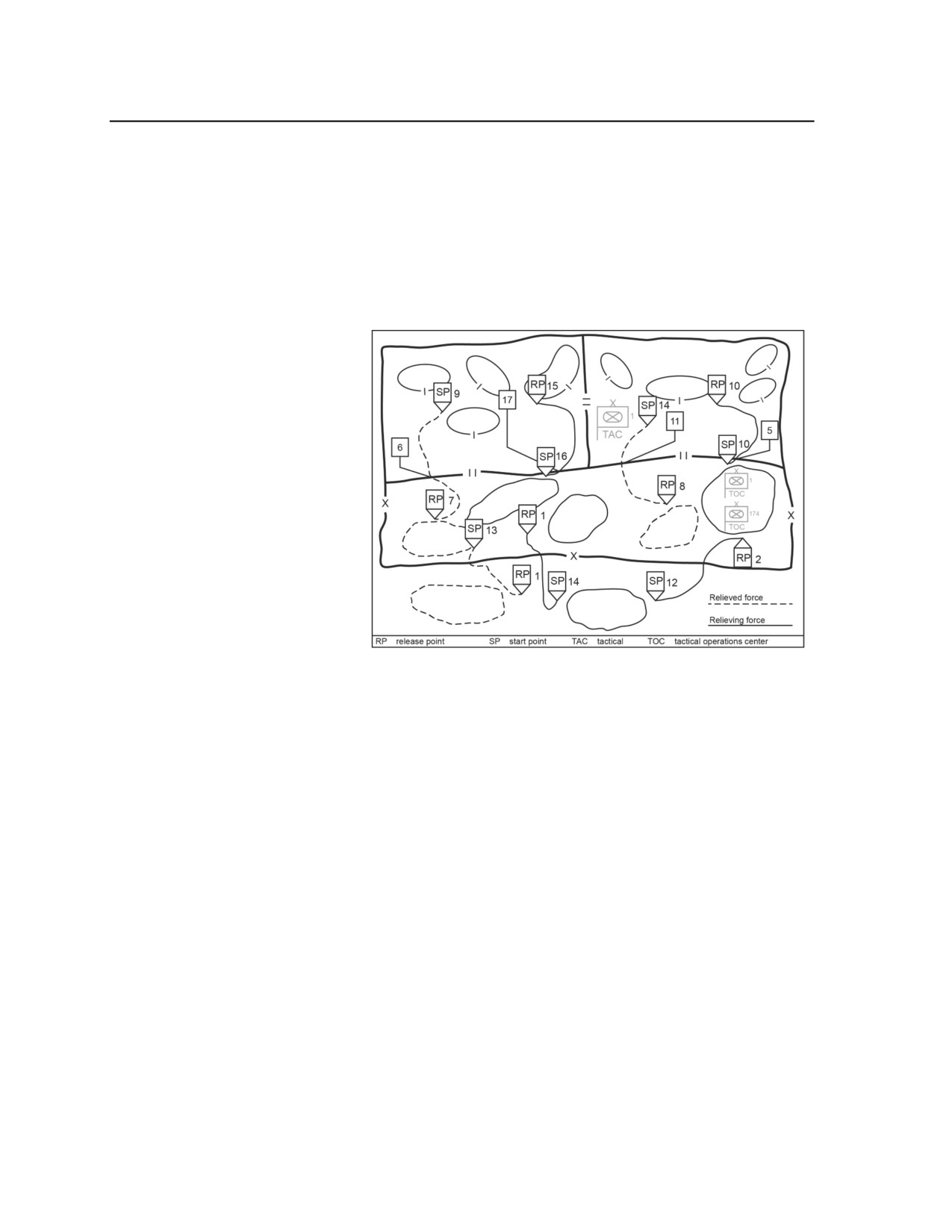
Chapter 4
closely as possible the same task organization as the unit being relieved. It assigns responsibilities and
deploys in a configuration similar to the relieved unit.
4-4. The relieving unit establishes advance parties to conduct detailed coordination and preparations for
the operation, down to the company level and possibly to the platoon level. These advance parties infiltrate
forward to avoid detection. They normally include the echelon’s tactical command post, which co-locates
with the main command post of the unit being relieved. The commander may also attach additional liaison
personnel to subordinate units to ensure a smooth changeover between subordinate units.
CONTROL MEASURES FOR A RELIEF IN PLACE
4-5. Control
measures
associated with a relief in place
are generally restrictive to
prevent
fratricide.
As a
minimum, these control measures
include the area of operations
(AO) with its associated
boundaries, battle positions,
contact points, start points,
routes, release points, assembly
areas
(AAs), fire support
coordination
measures, and
defensive direct fire control
measures, such as target
reference points and engagement
areas. (See figure 4-2.) Expanded
discussions of all these control
measures appear elsewhere in
this publication. A commander
Figure 4-2. Overlay of a brigade relief in place
may use any control measure
necessary to conduct the relief in place.
PLANNING A RELIEF IN PLACE
4-6. Once ordered to conduct a relief in place, the commander of the relieving unit contacts the
commander of the unit to be relieved. The co-location of unit command posts also helps achieve the level
of coordination required. If the relieved unit’s forward elements can defend the AO, the relieving unit
executes the relief in place from the rear to the front. This facilitates movement and terrain management.
4-7. In a deliberate relief, units exchange plans and liaison personnel, conduct briefings, perform detailed
reconnaissance, and publish orders with detailed instructions. In a hasty relief, the commander abbreviates
the planning process and controls the execution using oral and fragmentary orders. In both cases, the
relieved unit designates liaison personnel from its combat, functional, and multifunctional support and
sustainment elements to remain with the relieving unit until completing the necessary plans. The relieving
unit receives current intelligence, operations, and sustainment information from the unit being relieved, as
well as from common higher headquarters, adjacent units, and subordinate elements. The complexity of a
relief in place requires extensive liaison and reconnaissance. Exchanging information about the enemy and
civilian situations, friendly dispositions, terrain analysis, and fire support and obstacle plans, coupled with
reconnaissance, helps the relieving commander plan and execute the mission.
4-8. The relief is a tactically vulnerable operation. The units involved must concentrate on security while
preparing for and executing the operation. The intent of the operation is to complete the relief without
discovery by the enemy. Consequently, commanders typically plan reliefs for execution during periods of
reduced visibility, such as night or fog. Concealment of the relief from the enemy is a primary concern
when the unit is conducting the relief as part of an economy of force measure to free forces for other
4-2
FM 3-90-2
22 March 2013
Relief in Place
operations. The enemy should perceive only one unit’s command structure in operation—that of the unit
being relieved—until the operation is complete. This requires a detailed knowledge of friendly
vulnerabilities. A counterintelligence assessment of enemy collective capabilities directed against the
friendly forces involved in the relief can provide that detailed knowledge.
4-9. Generally, as soon as the mutual higher headquarters issues the warning order, the commander of the
relieving unit co-locates a command post—main or tactical—with the main command post of the unit being
relieved. As a minimum, the relieving unit establishes communications and liaison with the unit being
relieved. The warning order designates the time of relief, relieving and relieved units, and sequence of
events. It specifies the future missions of the relieved force, route priorities, any restrictions on advance
parties, any extraordinary security measures, and the time and place for issuing the complete order.
4-10. During a relief, commanders and leaders from the relieving unit conduct a reconnaissance of the area
for which they will assume responsibility. This leaders’ reconnaissance includes the lowest-echelon leader
allowed by the tactical situation. The reconnaissance focuses on the route into the positions the unit is to
occupy, the positions themselves, the current disposition of the unit being relieved, and any obstacles that
could affect troop movement.
4-11. The two commanders must decide on a time or an event that initiates the passage of command. This
allows the smooth transition of mission command from one commander to another. Normally, this occurs
when the frontline subordinate commanders have assumed responsibility for their respective AOs and the
incoming commander has sufficient communication facilities in operation to control the operation.
Regardless of their parent organization, all units in the AO come under the operational control of the AO
commander, if the AO comes under attack or when a specified event occurs during the relief.
4-12. The fire support coordinators coordinate fire support coordination measures and identify those
artillery and other fire support units that are available to support the relief. The relieving unit adopts the fire
plan of the unit being relieved. The fire support assets of both units support the relief. This maintains fire
support if the enemy detects the relief and tries to exploit the situation. Units plan their fires to deceive the
enemy and expedite the relief. Units maintain normal activity patterns. For example, a unit continues to
expend the same average number of artillery rounds per day during the relief that it expended before the
initiation of the relief. The commander does not relieve fire support and functional and multifunctional
support and sustainment units at the same time as the maneuver units they support. The commander
relieves these organizations at other times.
4-13. The relief plan specifies the method used in relieving artillery units. If terrain allows, relieving
artillery units do not occupy previously used firing positions. Instead, relieving firing units establish firing
positions near those firing positions of the relieved unit and carefully integrate their fire with that of the
relieved unit. Occupying firing positions at night or during periods of poor visibility enhances OPSEC.
4-14. Units conducting a relief in place coordinate with the area air defense commander, normally through
the Army forces (ARFOR) headquarters to obtain air and missile defense protection of identified choke
points, battle positions, routes to conduct the operation, and AAs. The commander coordinates with the air
and missile defense unit providing area coverage of the relieving force to obtain air intelligence preparation
of the battlefield information, rules of engagement, current air activity, present air and missile defense fire
unit positions, airspace command and control information, and the area air and missile defense operation
plan. Obtaining local air superiority reduces the vulnerability of the forces during the relief in place when
the units involved cannot avoid congestion on the ground.
4-15. The relieving unit verifies the obstacle records of the unit being relieved. Handover of obstacles is a
complex procedure. Initially, the engineer priority is on mobility to get the relieving unit into the AO. It
focuses on those routes and lanes leading into the AO. Once the relief occurs, priority of the mobility and
survivability effort transitions to support the relieving unit’s continuing mission. The commander may
require supporting engineers to assist with survivability tasks to support the relieving force.
4-16. Force intermingling, which is inherent in a relief, places an increased burden on mission command
information systems. The consequences of mutual interference between the units and the complexity
associated with such areas as traffic control, fire support coordination, obstacle plans, and communications
22 March 2013
FM 3-90-2
4-3
Chapter 4
require close coordination between all headquarters involved. Commanders establish early liaison between
the stationary and the relieving forces. The relief plan also addresses the relief in place of these mission
command information systems.
4-17. The relieving unit is responsible for all sustainment operations. As the support elements of the unit
being relieved displace, they leave the relieving unit supply stocks according to previously coordinated
arrangements. If the units conducting the relief have different modified tables of organization and
equipment (MTOEs), the commander must conduct mission analysis to determine how the relieving unit
will meet all of its responsibilities and what weapons systems will be used. The unit staff must determine
any special support requirements the relieving unit will have and address supporting those requirements
with the available supporting sustainment organizations. The unit sustainment staff ensures that both
commanders know of any sustainment constraints that might affect the relieving unit. The headquarters of
the relieved unit coordinates traffic movement into and out of the AO.
PREPARING A RELIEF IN PLACE
4-18. The commander conceals the relief from the enemy for as long as possible. At the first indication
that a relief is necessary, which is usually the warning order for the relieving unit, both the relieved unit and
the relieving unit review their OPSEC plans and procedures. Commanders may use military deception
measures when conducting a relief in place to maintain secrecy. To maintain security during the relief in
place, the relieving unit makes maximum use of the relieved unit’s radio nets and operators. Both units
involved in the relief operate on the command frequencies and encryption variables of the combat net
radios of the relieved unit at all levels. The relieved unit’s signal officer is in charge of communications
throughout the relief operation.
4-19. To enhance security, commanders impose light and noise discipline and electromagnetic emission
control measures, such as radio silence or radio-listening silence. In joint and multinational operations, the
senior commander specifies the frequency bands and equipment types affected. Radio silence is a condition
when the commander turns off all or specific radio equipment. Radio-listening silence is a situation in
which combat net radios remain turned on and monitored, with strict criteria governing when a station on
the radio network is allowed to break silence. An example of radio-listening silence would be, “Maintain
radio-listening silence until physical contact with the enemy is made.”
4-20. The units conduct rehearsals to discover any weaknesses in the plan and familiarize all elements of
both forces with the plan. Finding time for rehearsals requires commanders and staffs to focus on time
management.
4-21. Reconnaissance elements of the relieving unit precede its movement with a route reconnaissance to
the AA. They conduct reconnaissance of the routes leading from the AAs to the positions of the unit being
relieved. The commander of the relieving unit normally conducts a leader’s reconnaissance before starting
the operation.
4-22. The commander allocates time to construct individual vehicle fighting positions, if an armored or
Stryker unit is relieving an infantry unit. In a similar fashion, preparations for a tank company to relieve a
mechanized infantry company must include expanding individual vehicle fighting positions to
accommodate the larger tanks.
4-23. While the units involved plan, prepare, and execute the relief in place, their common higher
headquarters and other units continue actions to mask the relief. These include using demonstrations, feints,
smoke, and harassing and interdiction fires. The common higher headquarters executes operations to attack
and disrupt the enemy’s uncommitted and reserve forces during the relief. Its intent is to fix or distract the
enemy, so that the enemy does not detect or interfere with the relief.
EXECUTING A RELIEF IN PLACE
4-24. In situations where the commander desires to conceal the relief from the enemy, such as during a
sequential or staggered relief, the relieving unit may occupy the same positions as the unit it relieves.
4-4
FM 3-90-2
22 March 2013
Relief in Place
Alternatively, the relieving unit may establish more favorable positions in the vicinity of the relieved unit’s
location. Occupying different positions makes early discovery by the enemy more likely. Any increase in
activity in forward positions can reveal the relief to the enemy. Friendly information collection systems
attempt to detect if the enemy can discover the relief before its completion.
4-25. The enemy usually detects a relief effort from the increased activity resulting from the movement of
Soldiers and equipment out of position by the relieved unit and into position by the relieving unit.
Additionally, after any period of combat, there are differences in the types and amount of equipment
between the relieving unit and the relieved unit, even if they have the same MTOEs. These differences can
also reveal the relief to the enemy. The two units establish guidelines for exchanging compatible equipment
and supplies to limit these differences. In addition, it may be necessary to exchange certain weapons,
supplies, equipment, and occasionally, vehicles between units. When major differences in the number of
combat systems between the units exist—for example, a tank-heavy task force relieves a mechanized
infantry-heavy task force—inoperable equipment or visual simulators may assist in hiding the change of
units.
4-26. In a simultaneous relief, the relieving unit begins moving from its current location to AAs in the AO
of the unit being relieved. Once the relief begins, all elements involved execute the relief as quickly as
possible. Both units are vulnerable to enemy attack because of the concentration, movement, and
intermingling of forces in a simultaneous relief. Any unnecessary delay during execution provides the
enemy additional time to acquire and engage the forces involved. All units in the AO come under the
operational control of the relieving unit commander at the time or triggering event previously established
by the plan for the operation.
4-27. As the first relieving element arrives from the AA to assume the position, it establishes a screen of
the relieved unit’s positions as the tactical situation permits. The remainder of the relieving unit moves
forward to positions behind the unit being relieved. The relieving unit may use the relieved unit’s alternate
and supplementary defensive positions to take advantage of any previous defensive preparations. At the
previously established time or event, passage of command takes place. At that point, if possible, the
commander of the relieving unit informs all units involved in the relief of the passage of command.
4-28. The relieved unit continues to defend. The relieving unit’s advance parties coordinate procedures for
the rearward passage of the relieved unit. On order, the relieved unit begins withdrawing through the
relieving unit and moves to AAs. Crew-served weapons are usually the last elements relieved after
exchanging range cards. The relieving unit replaces them on a one-for-one basis to the maximum extent
possible to maintain the illusion of routine activity. The relieved unit’s functional and multifunctional
support and sustainment assets assist both the relieved unit and the relieving unit during this period.
4-29. A relief does not normally require artillery units to relieve weapon system for weapon system, unless
the terrain limits the number of firing positions available. Generally, the relieved unit’s artillery and other
fire support assets remain in place until all other relieved elements displace and are available to reinforce
the fires of the relieving unit in case the enemy tries to interfere. If the purpose of the relief is to continue
the attack, the artillery of both forces generally remains in place to support the subsequent operation.
4-30. Multiple main supply routes that allow only one-way traffic can simplify the forward and rearward
movement of both units. The relieving unit’s rear command post controls both units’ military police and
any other traffic management assets. (The main command post performs these functions if the echelon does
not have a rear command post.) The commander uses these assets to help control unit and convoy
movement on lines of communications, main supply routes, and movement routes throughout the AO.
4-31. In the future, it is likely that conflicts will involve the relief of an allied or coalition multinational
force. The commander should consider the following additional points when such reliefs occur:
z
Dissimilar unit organizations may require special adjustments in assigned areas.
z
Control of fire support may require special liaison.
z
Language difficulties may require an increased use of guides and translators.
z
Using relieved unit communications requires special signal arrangements and additional
operators.
22 March 2013
FM 3-90-2
4-5