The Scout Handbook (2012) - part 2
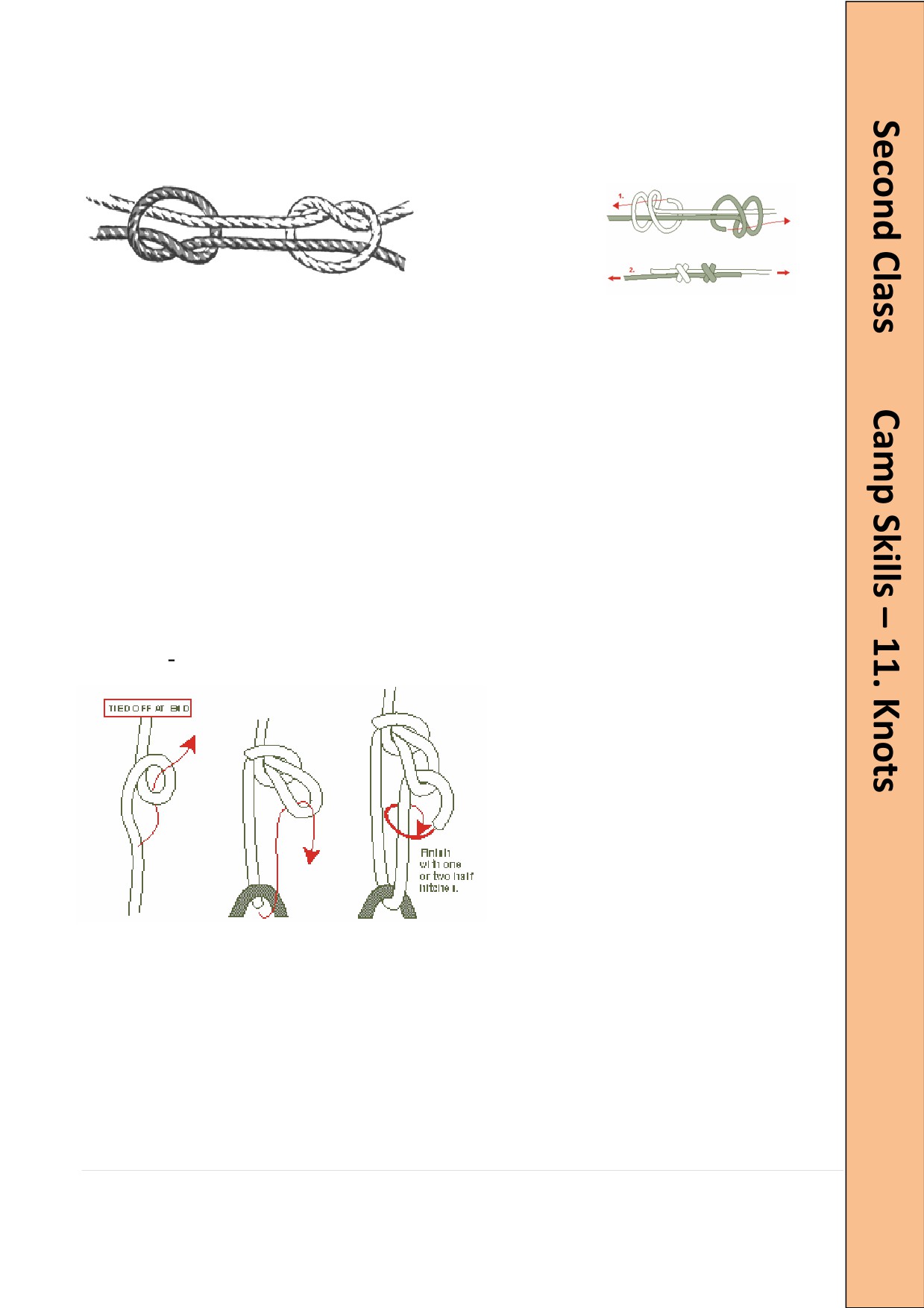
Fisherman’s knot
Double Fisherman’s Knot
This is a very simple knot also known as the angler’s knot, English knot, Englishman’s knot or bend, true-
lover’s bend or knot, halibut knot or waterman’s knot but should not be confused with the fisherman’s bend.
It can be used to join two lines of equal thickness, but it is not suitable for two ropes of large or uneven
diameter. It is widely used by anglers to join fishing line.
To tie the knot lay the two lines parallel to each other, with the working ends facing in opposite directions.
Pick up the lower working end and tie an overhand knot around the other line.
Then take the upper working end and tie an overhand knot around the lower line.
The two overhand knots can now be pulled together.
For a more secure knot the double fisherman’s knot is also illustrated here.
Harvester’s hitch
This hitch is also known as the trucker’s or
waggoner’s hitch. It is used to lash down loads
securely and is still used by truck drivers,
wherever rope lashings have not been
superseded by webbing straps and mechanical
tensioning and locking devices.
Attach one end of the rope to an anchorage point
on the far side of the vehicle/ trailer, then bring it
over the load to the nearside.
Cast an anticlockwise over hand loop in the rope.
Make a bight in the standing part of the rope and tuck it up, from the back to the front, through the over hand
loop.
Then pass the standing part of the rope through an anchorage point on the nearside of the vehicle and back
through the loop resulting from the tucked bight.
Tie off with two half hitches.
40 | P a g e
12. Demonstrate square and diagonal lashings by constructing a trestle of scout staves.
When joining two or more spars together this is the way to do it - at this stage
you only need to know two lashings to open up the possibility to have great fun
building all sorts of things. Practice making your lashings really tight, and really
neat and tidy - lashings that look no good, generally are no good. As you build
bigger and bigger pioneering projects you will learn that the quality of your
lashings is what will keep you safe.
The other thing to remember is to use natural rope materials rather than
synthetic - they will grip the wood tighter, and for most projects sisal is perfectly
adequate - you don’t need to use massive ropes, they are just more difficult to
get tight. The assault course shown in this picture only used sisal.
Square lashing
So called because the turns of the rope make a square and it is used to
fasten any two spars crossing one another, whether they are at right
angles or not, so long as they are in contact with each other.
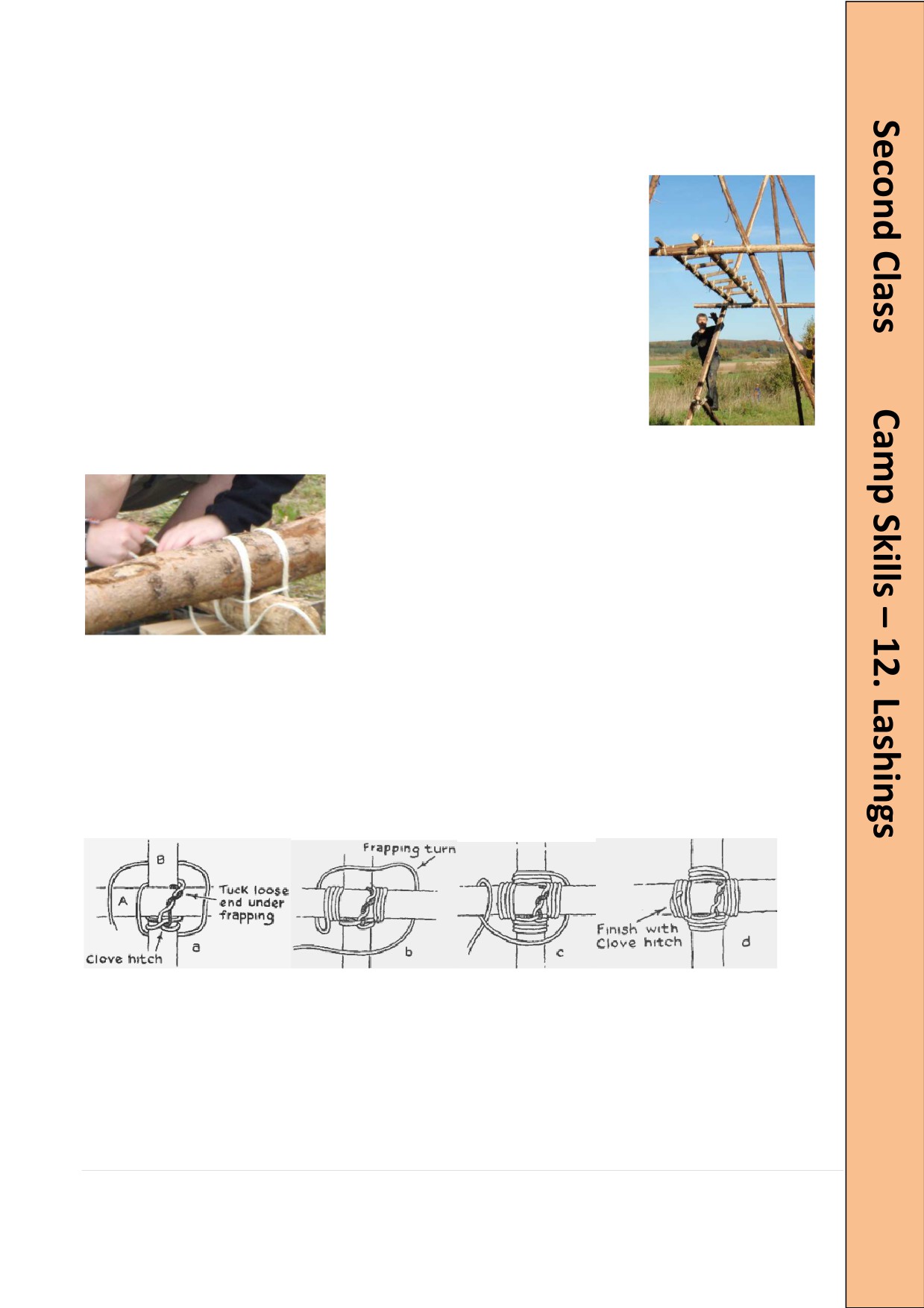
Start with a clove hitch round one spar at the place where the other spar
will be crossing it and on the side which the strain will come when the
spars are in use.
Twist the end of your lashing rope or cord round the standing part to
prevent the clove hitch slipping and to avoid having a loose end hanging down.
Start binding the two spars by winding the lashing round; being sure each turn is tight. Continue until you have
completed three turns. Then you bind these together by making three complete frapping turns between the
spars.
These frapping turns must be very tight, and then finish off with a clove hitch on the opposite spar to which
you started. If you still have some cord over do not cut it off, but "lose it" by continuing to make half hitches
round the same spar until it is all used up.
Diagonal lashing
This lashing is used when two spars have to be pulled together; it gets its name from the fact that the
lashing makes a diagonal form at the intersection of the two spars which it joins together.
Start with a timber hitch round both spars, pull against the loop, and make three turns round the two spars
opposite to the line of the timber hitch. Then round the spars on the other diagonal, as before, seeing that
each turn is tight, although you will not be able to make it as tidy as you did with the square lashing.
41 | P a g e
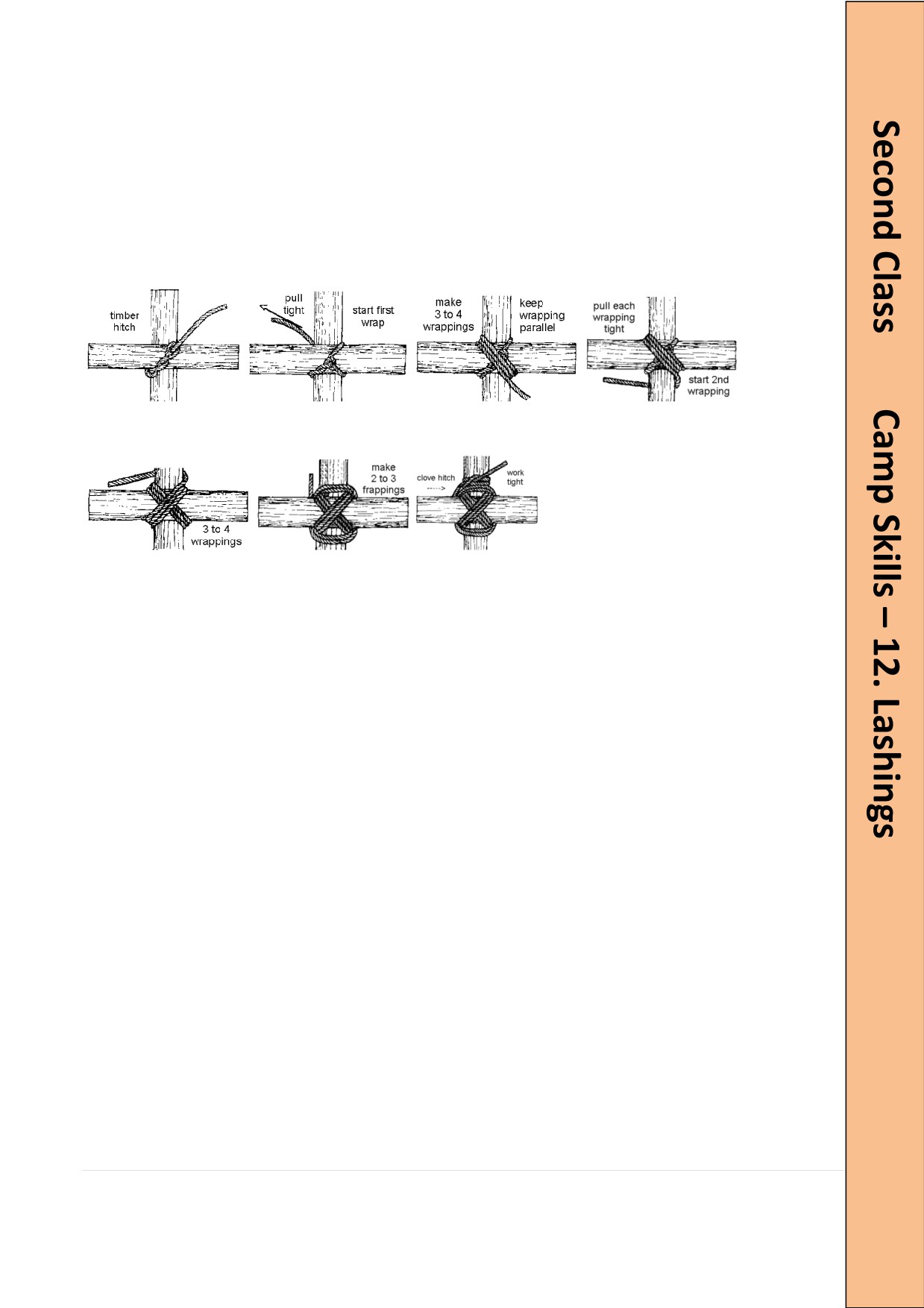
Then apply three frapping turns, weaving them between the two spars, each turn as tight as possible, as the
safety of the lashing depends on this. Finish off with a clove hitch, as you did with the square lashing, and use
up the end of the cordage with half hitches.
If it has been properly put on, you should find it almost impossible to twist or slide the spars in any direction.
That is the test of a good lashing.
Trestle
The most important thing to remember about lashings is that they must hold tight and not slacken off in use,
so it is better to take a little longer in making, if by doing so we are sure they will hold. When using heavy
timber it will be necessary to use some form of lever to pull each turn tight and to have a special kind of mallet
to use on the frapping turns, but you will not have to use these tools for a light trestle such as you are now
going to make.
Gear required is six Scout staffs and nine light lashings, about 3 metres in length. The latter are better too
long than too short.
Take the two stoutest for the legs and make the thicker ends the butts or bottoms.
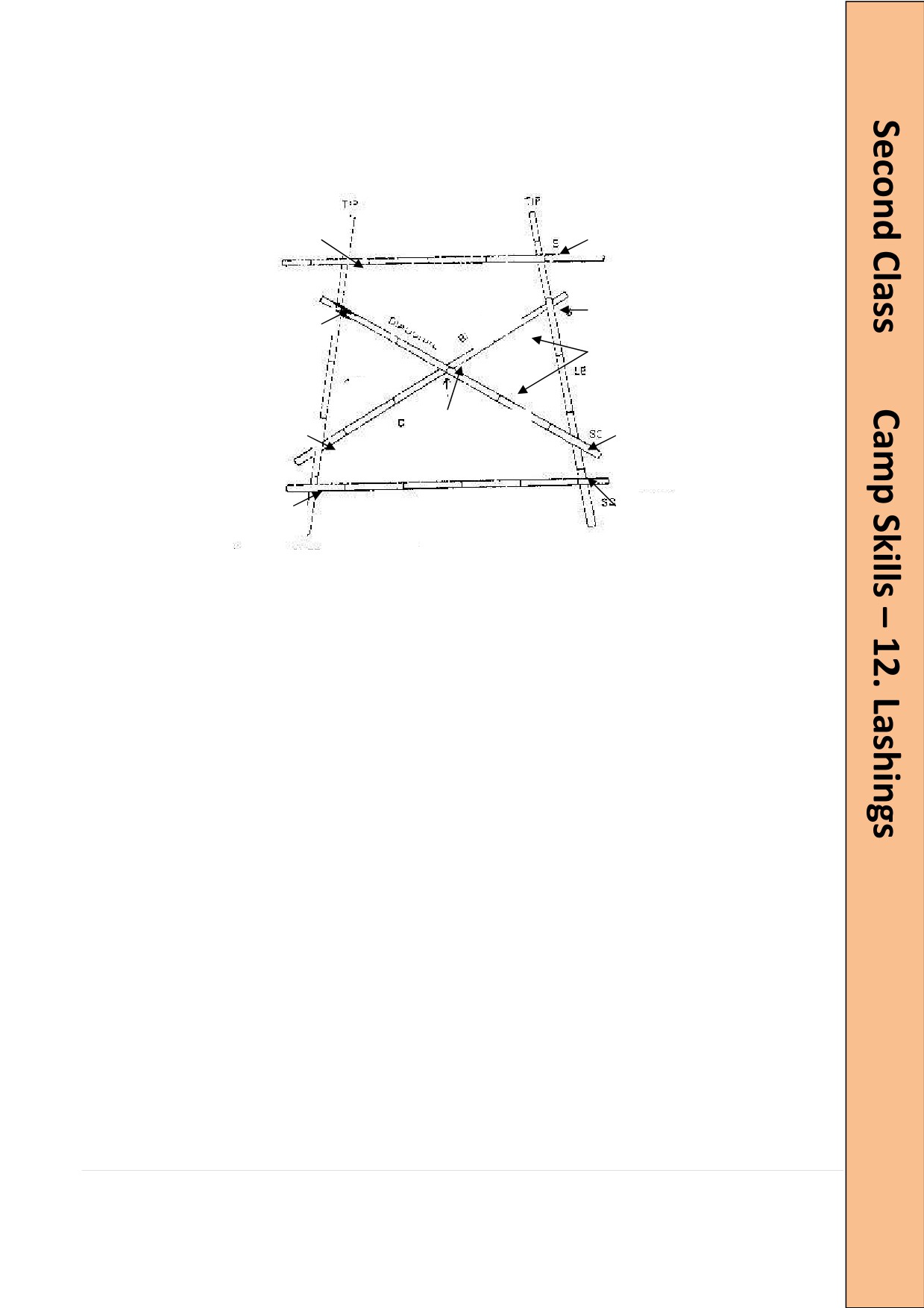
Decide on the positions for the transom and ledgers and make both legs. The sketch shows the transom 20 -
25cm down from the tips and the ledgers 20 - 25cm from the butts.
Then mark the transom and ledgers so that when they are lashed each leg will slope inwards 1 in 6, that is
5cm for every 30cm of its length.
Use the next strongest staff for the transom as it would have to take most of the weight if it were used in
constructing a bridge.
These can now be lashed together, using square lashings, then add the diagonal braces fastening them to the
legs, exactly as shown in the sketch below. All these are fastened with square lashings and finally the
diagonal braces are lashed together using a diagonal lashing.
42 | P a g e
Tip
Tip
Square Lashing
Square Lashings
Transom
Square
Square
Leg
Leg
Diagonal
Square
Square
Lashing
Square Lashing
Square Lashing
Butt
Butt
43 | P a g e
13. At camp, construct a useful gadget using natural materials, and demonstrating good use of
knots and lashings.
Baden-Powell once said “Any fool can be uncomfortable at camp” but he also said “A Scout is no fool”.
Camp gadgets are a way of us creating useful things that will make our life more comfortable, and they can
include all sorts of things:
• A tripod to hang a cooking pot over a fire, or to hang a lamp on
• A mug tree
• A stand to hold a washing up bowl
• A table and seats
• A draining board and billie rack
• A covered wood store
• A rubbish sack holder
• A clothes line
And just for fun we also like to build camp gateways, so that you can welcome visitors to your campsite in
style.
Here are some photos of gadgets made by Scouts - what can you make?
44 | P a g e
14. Know the safety rules and care of a hand-axe, bow saw and knife. Demonstrate how to sharpen
a knife and hand-axe.
Axes, saws and knifes can be very dangerous if you don’t use them and look after them properly, but they are
absolutely essential tools which will help you enjoy Traditional Scouting. Use them properly and they will be
your best friends.
Safety when using a hand-axe
Common Sense
This is the most important rule to remember — if what you are doing with the axe, or what someone is doing
in the vicinity of the axe is dangerous, or does not make sense, then the axe should not be used UNDER ANY
CIRCUMSTANCES.
Clothing
This is also important, especially with regard to footwear, and any loose clothing you may be wearing.
FOOTWEAR; should be of a strong nature (i.e. boots, or strong shoes), so that, should the axe slip, it will not
penetrate the foot.
LOOSE CLOTHING; must be either fastened, or removed, so that things like neckerchiefs don’t get tangled
up and affect your control.
Branches
Don’t chop in an area where overhanging branches could get caught in the axe and affect your control.
Weather
This is an important factor in axemanship, especially when it is wet. A wet axe on wet wood will invariably slip;
if you use the axe when it is raining, you cannot properly see what you are doing; if the haft is wet, you will
lose your grip; on the other hand, if the weather is too hot, you will sweat, and again tend to lose your grip; if
you face the sun you will tend to be blinded.
Others
When you are using an axe, it is MOST important that you are not disturbed by conversation, or distractions of
any kind, as this will cause lack of concentration, and consequently accidents.
Also, there should be nobody at all in front of you, or within two axe-lengths to the side, or behind you. The
reason is that should you by accident let go of the axe, or the head fly off the haft, there is less chance that
anyone will be hit. AN AXE LENGTH is the distance from your neck to the eye of the axe when the arm is held
out straight, holding the axe haft at the foot end.
Your Body
Do not use an axe when you are tired or feeling unwell.
These are some of the safety rules; but if you want to add some more of your own, by all means do, so long
as you remember these.
45 | P a g e
• Always use your common sense.
• Check the axe before you start
• Tighten or discard loose clothing
• Wear strong shoes or boots
• Clear overhanging, or protruding branches
• Never chop in the rain
• Do not chop when the wood is wet
• Do not chop facing the sun
• Always concentrate on the axe while in use
• Don't talk while chopping
• Keep other people at TWO axe lengths distance
• When you are tired, stop.
• If you're ill, don't start!!!
• Aim the axe and use it properly
• Never chop live timber, without permission
• Use a chopping block
• Mask the axe in it when you finish
• Never chop in poor light
• Never mask an axe in the floor
An axe can be a camper's most prized possession, and one of his most useful tools, but, like fire, it is a good
slave, but poor master!
There is just one rule that I have so far left out, and it is perhaps, the most important of all:
NEVER PLAY AROUND WITH AN AXE
An axe is a lethal weapon, and because of its weight and momentum, once
you have started your swing at the log, you will not be able to stop the axe in
mid air. Also, should you let go of the axe in mid swing, it will travel a long,
long way, before it eventually lands in the earth or tree, or other obstruction.
So NEVER wield an axe at anybody, play with one, leave it un-masked, or
even run when carrying one, as that is asking for trouble.
When you have finished with the axe, even for a short period, you must mask
it, so that other people cannot hurt themselves on it.
46 | P a g e
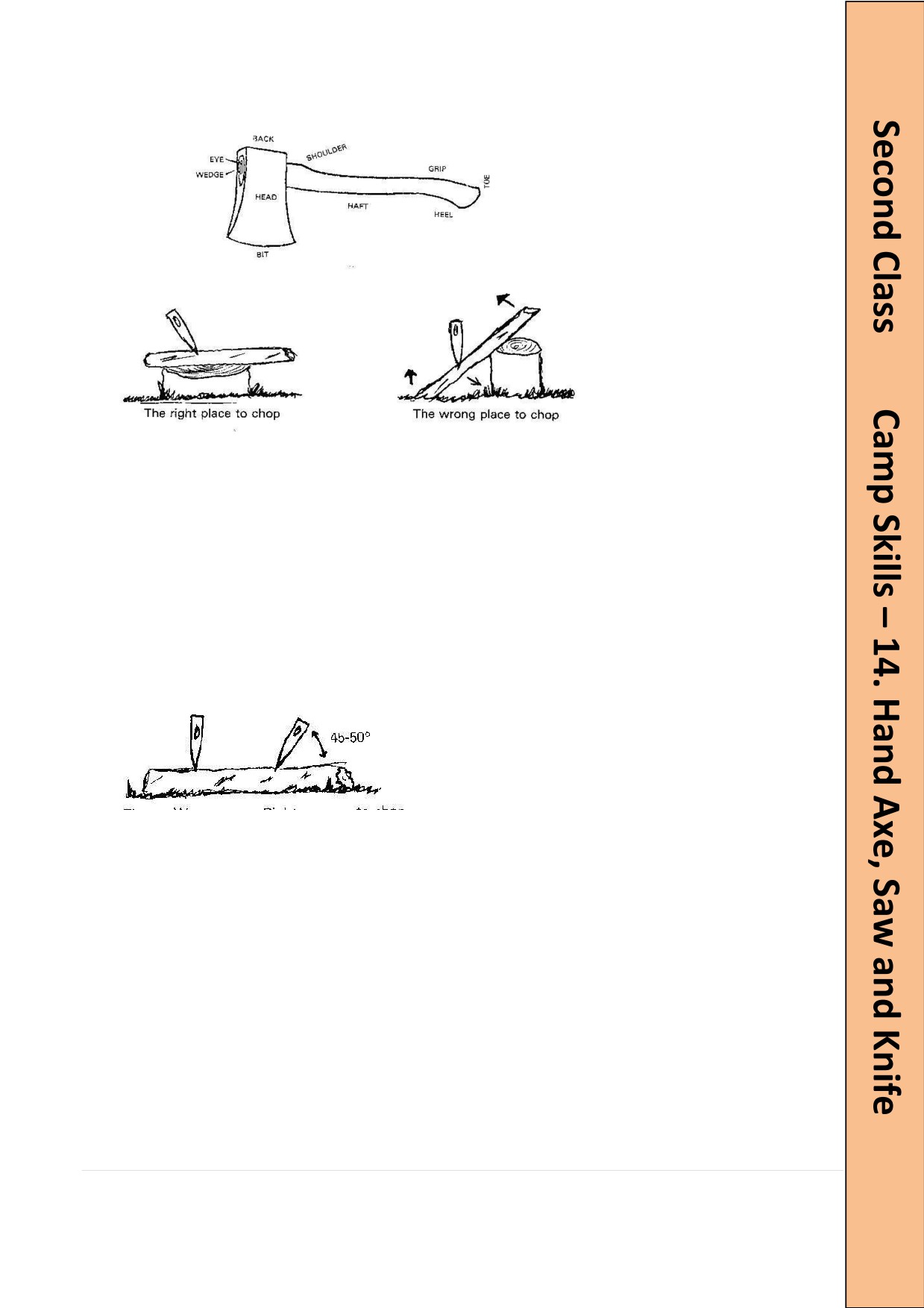
The right hand picture above shows what not to do. Just use your imagination for a minute, and imagine that
the axe has come to the end of its downward travel, and has landed on the piece of wood. There is nothing
under the wood to stop the axe from carrying on any further, which it promptly does. It twists as it hits the
wood, so breaking it instead of cutting it. However, because you are holding the grip of the axe tightly, it
cannot turn as easily as the head, so the haft can easily break (usually by the shoulder). Also, as the wood
breaks, the end which is resting against the wood leaves the block under the force of the axe, and will fly
away in the direction of the arrow. Just imagine what would happen if your head was in the way at that time!
Now look at the picture above, and you will it see that it portrays a large log lying on the ground. The axe is
pictured on it in two different positions. In the first it has landed straight down on the log, while in the second it
has come down at a slight angle. You will waste an awful lot of time, effort and energy, by using the axe in the
first of the two, as it will never cut very deep or remove the wood chippings in the cut.
To use the axe as in the second part, the axe will easily cut the wood (providing the axe is sharp), and when
reversed for the second stroke, will not only chop easily again, but will also clear the chip from between the
two cuts. Remember though that if the angle of the axe is too shallow, it will tend not to bite into the wood at
all, but slide along the top. A blunt axe will cut flesh but perhaps not wood.
You should always be a comfortable distance away from the wood to be cut, but not so far as to miss the
wood, and hit your foot as this could be rather painful!
47 | P a g e
As for the swing, and the way to hold the axe, it is best to get your Scout Master, or one of the other Scouters
to show you how, and for them to watch you as you use the axe for the first few times until you have passed
your test. But still take the same care after you have passed, as you used before! Also, do not forget that the
more you use it, the better you will get.
When handing over an axe to your friend, hold the head on your upturned palm, and rest the haft along your
arm. Your friend will then be able to pick it up off your hand, and will have a good hold of it.
Knife
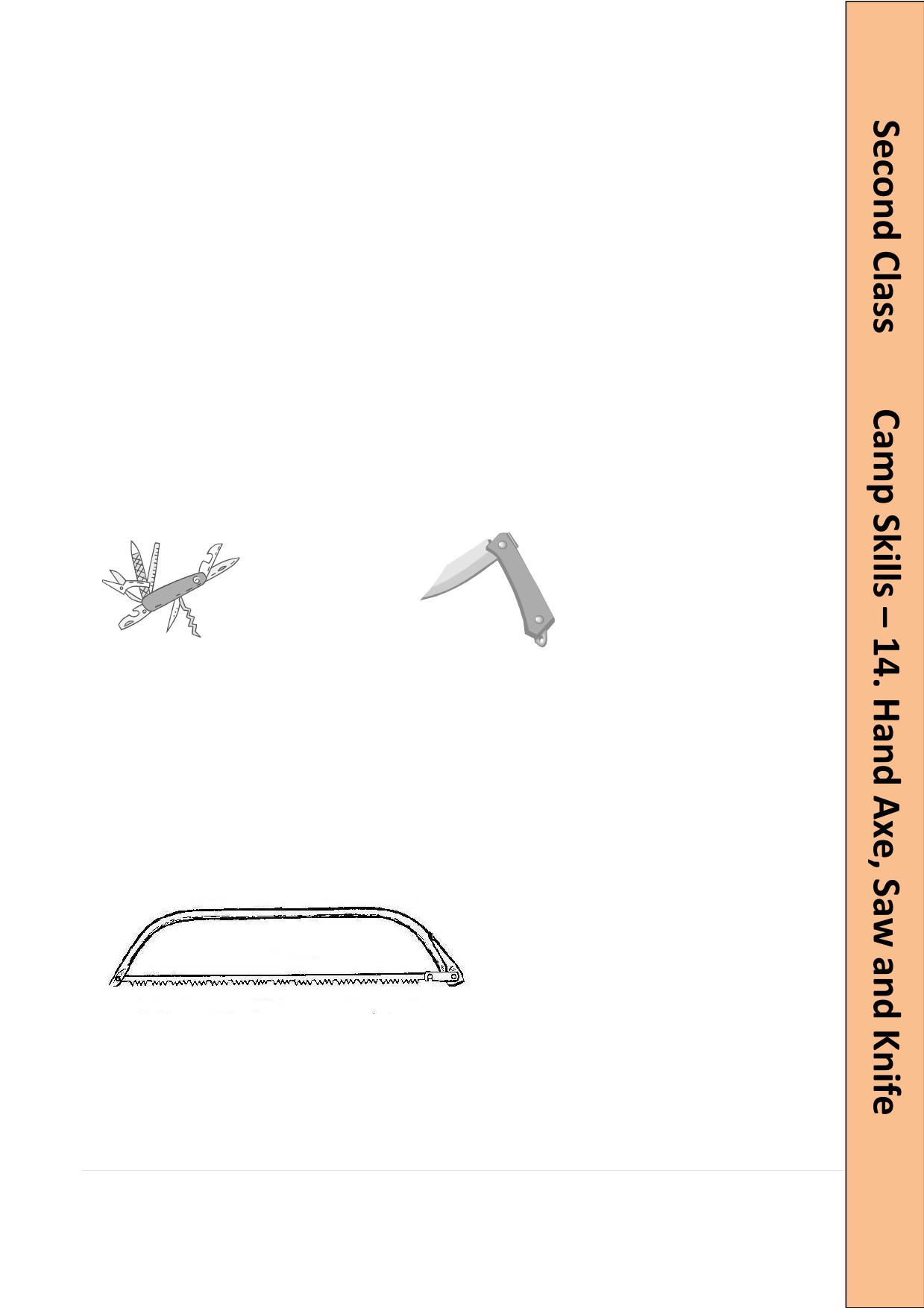
Now, your knife. If used incorrectly, or when blunt, can be just as dangerous as an axe.
Firstly, if you use a knife, be it a clasp knife, or a sheath knife, always cut away from you, and anybody else
who might be near you. This is in case you slip, it will do far less harm that way.
When you hand over a sheath knife, you hold the blade between the thumb and fore finger (at the hilt), with
the rest of the blade in your palm, the sharp edge overhanging your fingertips.
A clasp knife, you hand over CLOSED.
Saws
The bush saw is a rather less messy method of cutting wood and the less mess that is left the less there is to
clear up afterwards.
When using a saw always keep your hand, which is not holding the saw well away from the saw cut as they
have springy blades and give you a nasty cut.
Do not try to sharpen saw blades when they become blunt, replace them with a new one.
Sharpening Knives and Axes
There are various recognised methods of sharpening both, but these are the ways that I use for the knife and
the axe respectively.
48 | P a g e
First the knife. This will have a reasonable edge on it when you buy it, but will soon have to be re-sharpened.
This will never be too difficult, providing that you do not let it become too blunt in the first place!! You hold the
knife firmly in one hand, and the stone in the other. The stone should have a fine layer of oil or water on it.
Then firmly rub the stone over the blade of the knife, until a partial edge has been formed on the blade. Next,
turn the blade over, and do the same on the other side. This should leave you with a reasonable edge to your
knife, and a quick rub across the other side of the blade will remove any burr there might be. The stone should
always be moved in a circular direction, as otherwise you will sharpen grooves into the blade, and also
sharpen the blade un-evenly.
With the axe, the system is very similar, although it will need grinding by an experienced person to get a
decent edge on it in the first place, or if the edge has been left to get really bad (which, of course, it should
not). However, your axe being usually much harder than your knife, will take a lot more work.
It is always advisable to re-sharpen both immediately after use, as then it is ready for when you need it next.
49 | P a g e
15. Demonstrate how to make and store firewood.
Having a fire at camp is one of the delights of Scouting - it will keep you warm, it allows you to cook fabulous
meals (if you get it right, it’s a lot easier than using a gas stove), and at the end of the day it is great to sit
round the fire with your Patrol and chat, to remember the wonderful things the day has brought, and look
forward to tomorrow.
But to have a great fire you must first learn how to collect, chop and store firewood so that it’s always ready
when you need it.
As you work your way through Scouting, you will find out that certain woods burn far better than others -
section 21 will give you more information about recognising trees, and understanding which woods are good
in different situations.
First collect enough wood to last you all day, and for breakfast tomorrow - its far better to be prepared.
When you have collected the wood, you can chop, saw or break it to size. You will need four different piles, for
different purposes:
• Firstly you will need tinder, in many ways this is the most important material - it’s what catches first
and allows your fire to grow. You will need a ball of tinder about the size of a grapefruit to get your fire
started - it must be absolutely dry. Keep your eyes open and stuff your pockets with good tinder
whenever you see it. Natural materials include really dry grass, dry dead bracken, sheep’s wool, the
fluffy seed down from clematis plants and birch bark. Also keep any little bits of sisal that you trim -
this needs to be un-wound and fluffed up, and of course bits of paper, the ends of candles and
anything else that will light from a match.
• Your second pile will be kindling, this is dead brittle dry wood no thicker than a pencil. If it doesn’t
snap easily then it isn’t dry enough! Look under hedges where little twigs stay dry even in wet
weather, and look for dead twigs on trees - particularly hawthorn - if it snaps off easily it is dead, and
you won’t harm the tree. But remember never cut live wood from trees - it won’t burn anyway.
• Your third pile will be small fuel, thicker than a pencil but not much thicker than your thumb. This
should also be dead and dry and easy to snap. This will be the fuel that establishes your fire, or gives
you a quick burst if you need to revive the fire from embers.
• Your fourth and biggest pile will be main fuel, this should be no wider than the palm of your hand. It is
best to split branches and logs so that you have more flat surfaces and edges, than rounds - these
are better for burning
Make you wood pile between your chopping area and fire. Not
too close to either you need to keep it safe from people using
axes, and away from the fire so it doesn’t catch by accident.
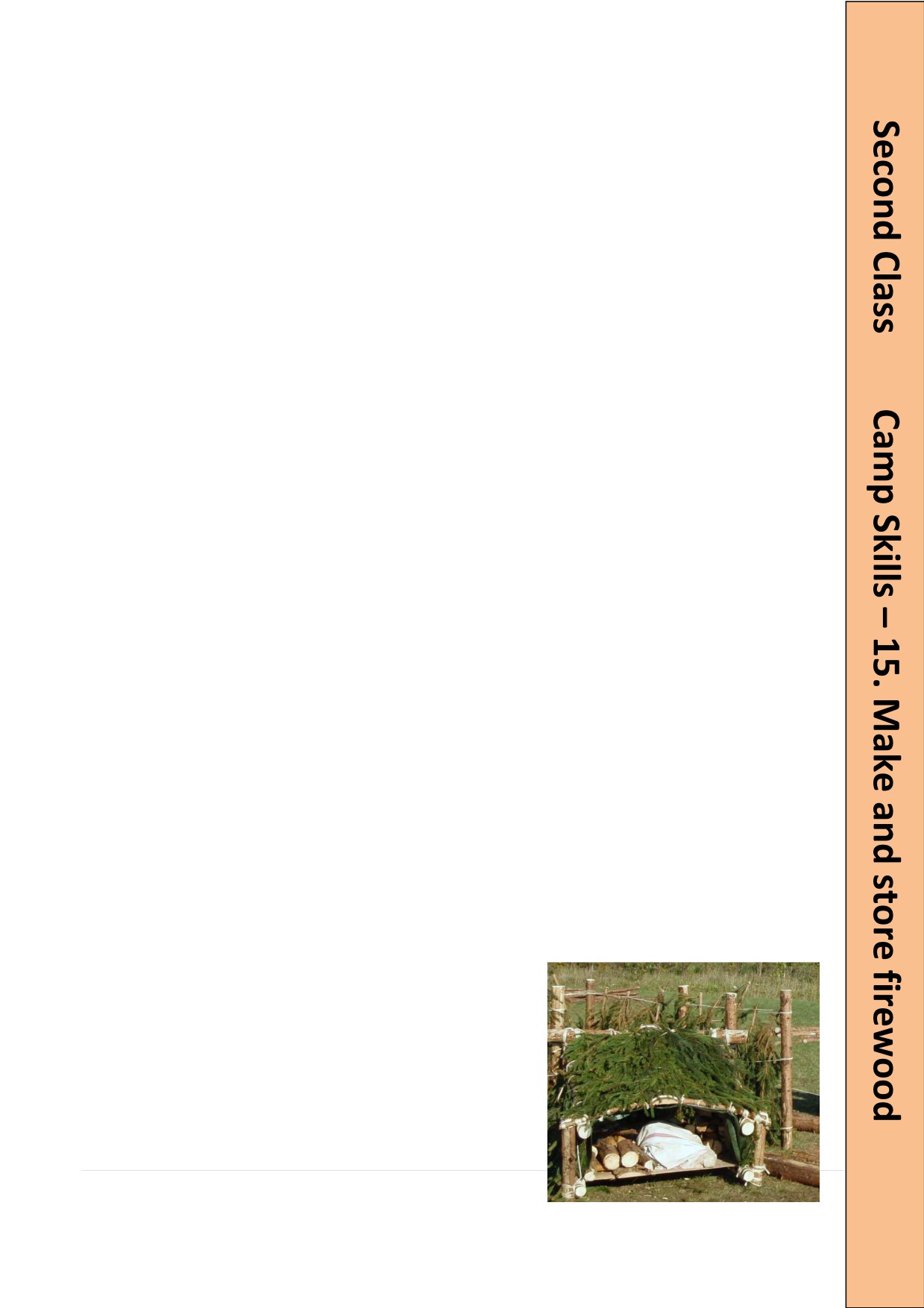
This wood MUST be kept dry, so overnight cover it with a
tarpaulin or build a covered wood pile. Its also a good idea to
keep your prepared wood off the ground, so stack it across a
couple of small logs.
50 | P a g e
16. Lay and light a fire out of doors with natural materials.
There are all sorts of different styles of fire, and you can practice them and see which you like best for
different jobs, bust first some basics:
As you are a Scout, you DO NOT DO lay a fire on top of grass, as you have to leave the site the way you
found it, or better.
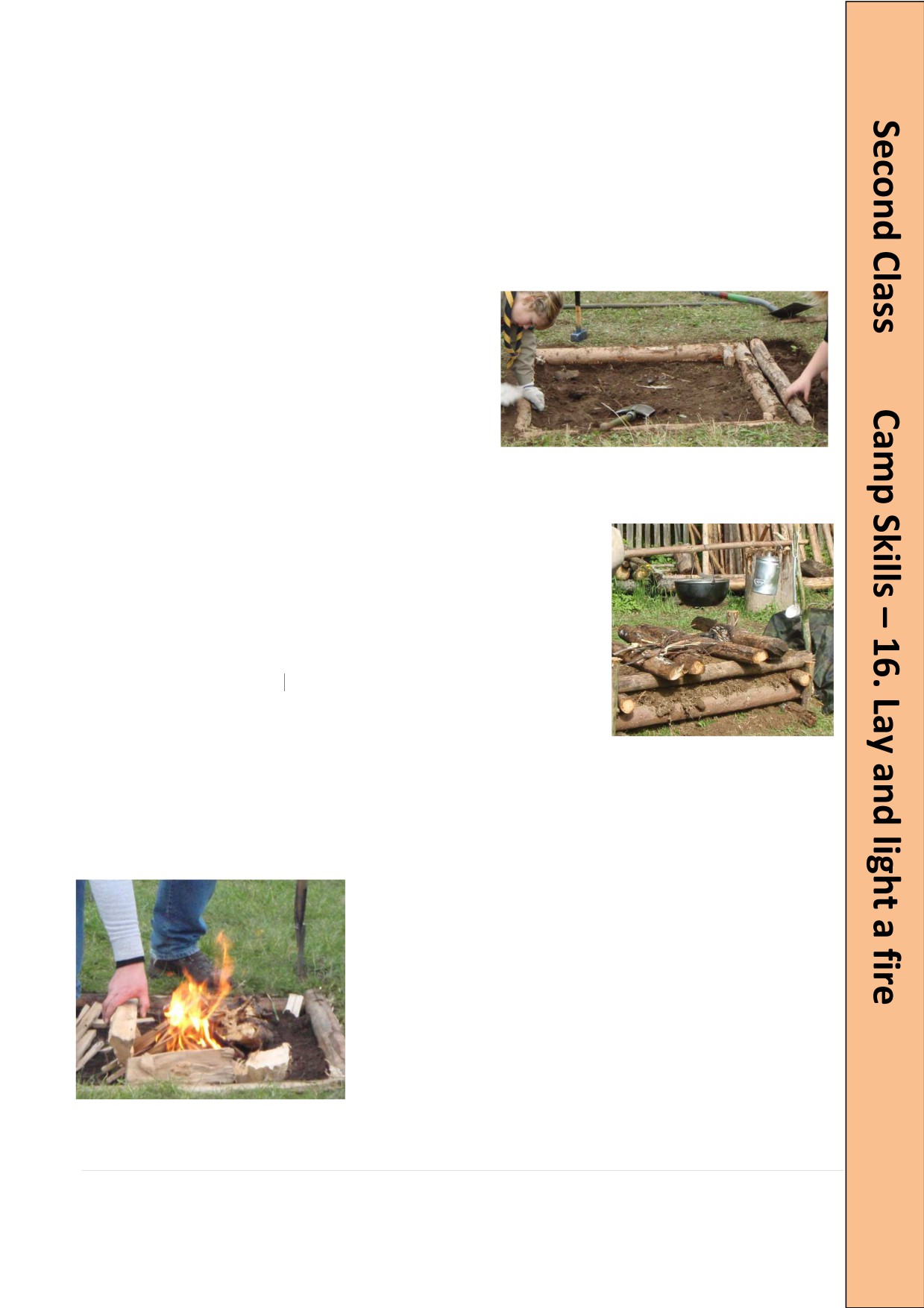
Therefore, the first thing you have to do is remove the
grass. This you do with a spade, by cutting a pattern in
the grass two spades wide, and three spades long. The
spade is then pushed for 5 to 10 cms down, then
underneath the grass, until the turf has been completely
loosened, then you lift it off, and lay it down in a safe
place until you put it back in place. You keep doing this
until a large enough area has been uncovered for your needs. You will find that it is advisable to cut the turf
back from the actual fire for a short distance, so that the edges of what you leave do not burn, or you can line
the pit with cut logs like shown here.
Look after the turf you have removed and water it from time to time, so
that it will grow back just as good when you replace it at the end of camp.
The fire-trench is then dug out, to no more than half a spade's depth, and
sloping up at the ends. The trench lies along the direction of the prevailing
wind, to help the fire to burn. Be sure the landowner will allow you to dig a
fire trench. If not you will need to raise your fire off the ground on an altar
fire, or lay your fire on a specially provided concrete base.
Lighting your fire
Start with a ball of tinder - grapefruit size - and cover this with some of your smallest kindling wood in the
centre of the fireplace, with the driest, and most combustible material at the bottom, so that, when you light
the fire, the flames have to go through the rest before showing themselves.
On top of the kindling, you place some of the smallest pieces from the small fuel pile. These are stood up on
end, to form a pyramid shape. Around this, in the same manner, you put some of the larger bits from that pile.
You can now apply a match. This, when it has been lit, is placed as
near to the centre of the fire as is possible, so it is wise to leave a
passage-way to the centre when you start to build.
Once the Kindling has caught, it will set the twigs on fire, and so on.
Now you can start putting some of the bigger wood from the small fuel
pile on, again in the Pyramid shape. All the time build up the size of
the wood, but do it slowly. Leave the fire for a while without putting
more wood on, so that it has a chance to catch light properly.
When the fire is burning, put some more wood on, this time from the
thinner end of the main fuel pile, and eventually just from your main
fuel pile.
51 | P a g e
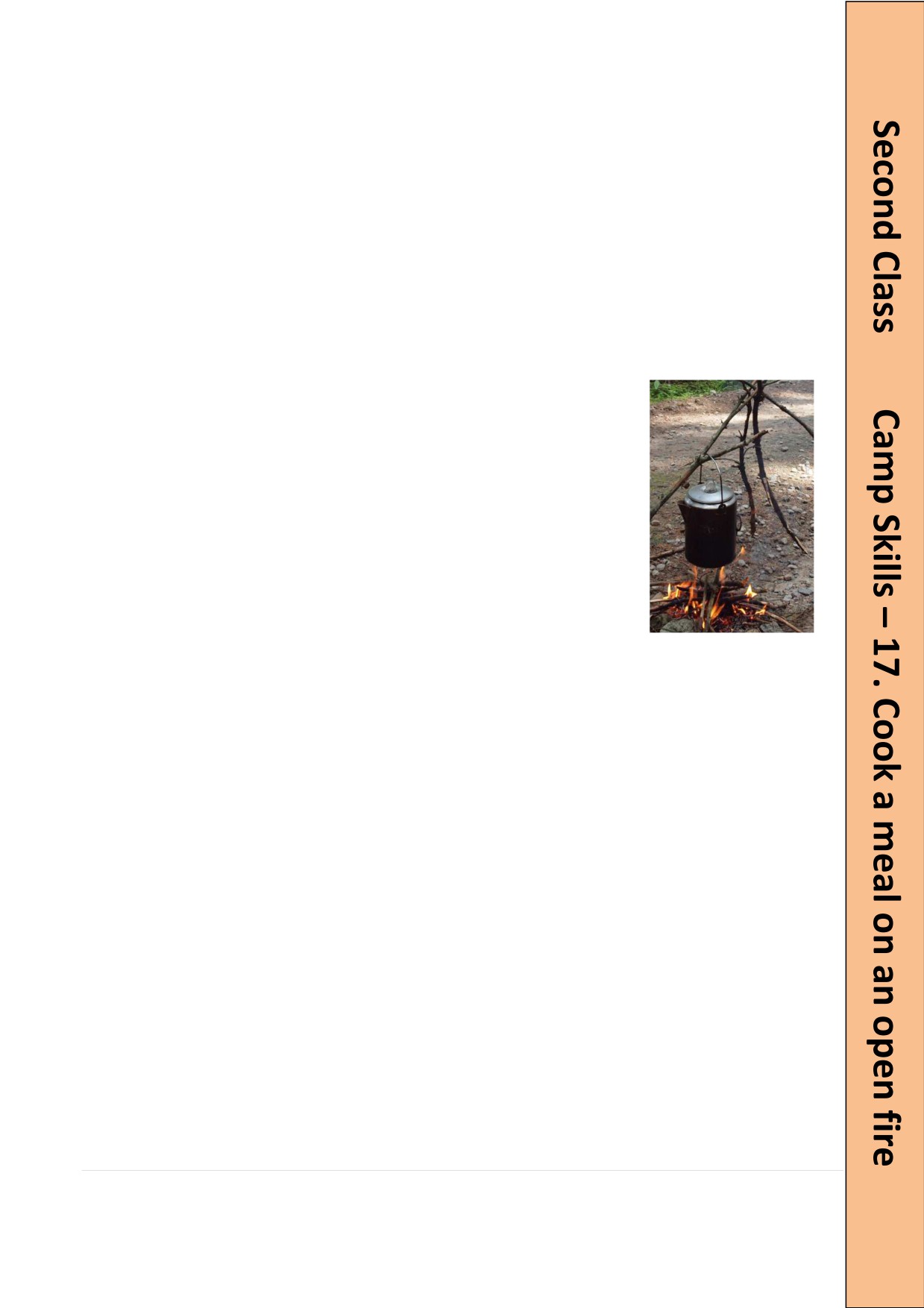
After a while the fire will settle down to good hot embers — the fire is now ready for cooking.
17. Cook over an open fire a simple meal, make a hot drink and wash up afterwards.
And so on to the cooking . . . trust me some of the best food you have ever tasted will be cooked over an open
fire at camp, and there is almost nothing that you can cook at home, that you can’t cook on an open fire. I’ve
even made ice cream at camp - but that’s another story.
I trust that while the fire was being made, somebody thought to prepare the meat, and peel the spuds, as
otherwise, you're going to waste both time and wood. Now, when cooking, the various foods take different
times to cook - you’ll soon get the hang of what needs to go on first, but if you are not sure an older Scout or
adult will give you some help.
If you cut your potatoes fairly small and just cover them with boiling water, they
will cook quicker than putting them on whole. Sausages will cook quicker than a
pork chop, which needs to be cooked slowly. Find out at home, from your Patrol
Leader or Scout Master how long the various items you intend to prepare are
going to take.
Flapjacks, Dampers and Twists
To find out about these you can read Scouting for Boys, Camp Fire Yarn 9.
To make the mixture you need self-raising flour, salt and water.
Make a little mountain of about a handful of flour, put your finger in the centre
(after washing your hands please), and make a small hole. Add a pinch of salt.
Now add the water a small amount at a time; you can mix it with your hands, a little messy, but great fun.
You'll find it helps to stop the mixture sticking to your hands if you cover them lightly with flour first. When the
mix is just firm and not tacky it is ready to cook.
Flapjacks
Shape the mixture into flat cakes about 80mm across and 20mm thick. Heat some oil or butter or lard in a
frying pan and wait until the fat is smoking hot. Drop (carefully) your cakes into the hot fat and sizzle them until
golden brown. Serve with butter and jam. You could try sprinkling them with brown sugar or currants.
Twists
Take a green stick thinner than your little finger (this is the only time you can cut live wood from a tree) and 1
metre long, peel off the bark. Roll your mixture into a snake and wind it around the stick, leaving a space
between each turn for it to cook and expand. Hold your stick closely over a fire of glowing embers (not
flames). Keep rotating the stick until your snake has gone a dark golden brown. You can test to see if it is
cooked by sticking a knife blade into the snake, if it drags or comes out sticky, more cooking is needed. When
cooking is complete, your twist will slide off the stick, cut it open, spread with butter and jam and keep eating.
Baden-Powell used this recipe. Firstly it saved in weight, just carrying a small bag of each of the ingredients
and secondly he could enjoy hot fresh bread every day.
Dampers
Use the same mixture and cook on a hot stone next to the fire.
52 | P a g e
18. With another Scout, pitch, strike and pack a hike tent within a reasonable time.
For the pitching and striking of a hike tent you will get the best advice from your Patrol Leader or Scoutmaster,
because they will be able to show you with the type of tents which are used in your troop.
Hike tents come in different shapes and sizes. They may also be used with sewn in groundsheets or separate
groundsheets. Some may be used with external poles, often called 'A' poles or with poles inside the tent.
Generally speaking, you unpack the tent and lay out the parts, canvas and groundsheet, poles and pegs, on
dry ground.
Make sure the doors of the tent are zipped or fastened together, then if you have a separate groundsheet, lay
it on the ground and peg it down securely. This establishes the base and shape. Fit together the poles and
suspend the tent from them. You should now peg out the main guy-lines, usually with the heaviest duty pegs
provided. Do not worry too much about the shape of the tent or the tautness of the guys at this time.
Put in the remaining pegs and then go round tightening up the guys and adjusting the angle and position of
the pegs.
When you are more experienced, you will probably get them right first time. Remember, do not over tighten
the guys and make sure they run in line or parallel with the seams. If it rains heavily, you will need to slacken
the lines, particularly if they are not nylon, because they shrink and thus would tighten more and could
eventually tear your tent.
When you are using the tent make sure that you store the tent and peg bags away in the tent in the dry ready
for when you strike. Try not to touch the walls of the tent especially when it is raining as this may permit water
to enter. If the tent has a sewn-in groundsheet, take your shoes or boots off before you go stomping about,
the groundsheet is to keep water out from below, not to be used as a doormat.
When you come to strike the tent try to do so when it has dried out either from the morning dew or overnight
rain. This of course is not always possible.
Striking
Reverse the procedure outlined above and try to wash or scrape clean all the pegs before you pack them
away and count them to make sure you have got them all.
If you have had to pack the tent away wet, ensure that you set it up again or hang it up to dry before it is finally
put back in store.
If there is any problems or things missing from the tent tell your Quarter Master before returning the tent to the
store.
53 | P a g e
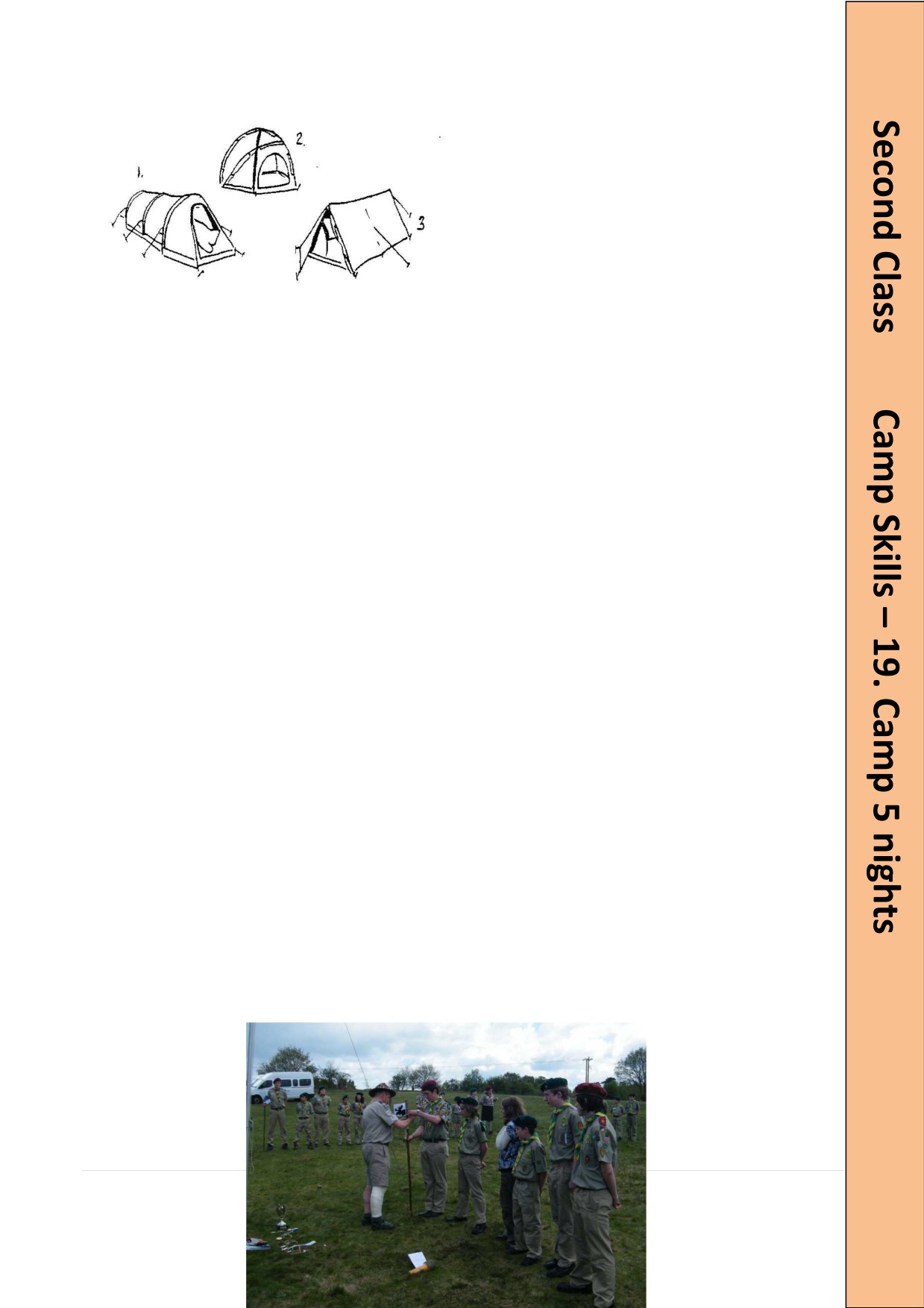
1. Hoop tent
2. Dome tent
3. Ridge tent
19. Camp for a minimum of 5 nights as a Scout
For most Scouts camping is the most special part - it is a chance to live in harmony with nature, and prove
that you can be happy and comfortable away from all the luxuries of a modern house.
You may go to different sorts of camp, and it would be good if you could get a variety of different experiences
to pass this test.
Some different Scout Camps are:
• Troop camp - often for a week, and normally in the summer holidays. Most Troops will camp with
each Patrol in a separate area, looking after their own cooking
• Patrol camp - just your Patrol camping on their own, working together to have fun
• Activity camps - quite often a weekend camp, where the main focus is on a special activity, and
sometimes cooking will be done centrally by Scoutmasters or a duty Patrol
• Hike camps - normally when you are working on your First Class, carrying all your gear for more than
a day, and camping overnight in a hike tent
• Area camps - sometimes these are competitions, and sometimes they are based around activities
• National camps - every Troop is invited to two national camps each year, one is a fun competition to
see who has got the best camping skills, and the other is a badge bonanza where you can take
badges that you can’t always do in the Troop. Look for details on the B-PSA website
• International camps - we are very lucky to be members of the World Federation of Independent
Scouts, WFIS, and once every four years they hold a European Jamboree - the next Eurocamp is in
Italy in 2014 it’s your chance to meet thousands of traditional Scouts from all over Europe, and make
new friends from overseas - look for details on the WFIS website
For this test, the five
nights need to be camps
that you have
undertaken under canvas
with Scouts (not Cub
camps), and camps with
your family don’t
count either - they can be
great fun, but they
are not quite the same.
54 | P a g e
opyright B-PSA 2012
•
20. Kim's game. A test in observation to remember 16 out of 24 well assorted articles, following 1
minutes observation, or, Follow a trail containing not less than 30 woodcraft signs.
The thing to remember is that most of the objects will have a pair. By this, we mean that there will be common
items, like a pen, and a pencil, where if you can remember one, it will help you to remember the other. In
some cases a whole series can be formed, like Pen, Pencil, Rubber, Pencil Sharpener, Paper, Biro, Ink, etc.
All these have the same common root — they are used when writing. So the more you can connect, the
easier it should be.
One of the best ways of getting used to Kim's game, is to walk slowly past a shop window, looking at all there
is on display. Go past, write it down (or describe it to a friend who is looking in the window at the time), and go
back and check the list. The more you do it, the easier it will become.
Read the stories of Kimball O'Hara and the Elsdon murder at the beginning of Scouting for Boys.
You may not be good at this test to start with because you have to train yourself. Remember you also have
other senses which need training.
Alternatively follow a trail containing not less than 30 woodcraft signs.
You will have learnt several woodcraft signs for your Tenderfoot test and you probably followed a short trail.
Now for Second Class this should be a test of observation. The trail may be marked by leaves or twigs placed
in strange positions i.e. an oak leaf may be stuck among some horse chestnut leaves, or pieces of coloured
wool may be draped over bushes or on the bark of trees.
Remember that the trail should only be obvious to Scouts and should be cleared away once it is finished with.
55 | P a g e
21. Be able to recognise and name 6 common trees and know the value of their wood for burning
Wherever you live in this country, you will find that there are far more than just six types of tree around, quite a
number of which, you will find that you can name.
A lot you will know by just thinking; such trees as the Holly, Oak, Beech, Birch, Pine, Ash, Hawthorn, Horse
Chestnut -there, in fact, are more than six already!
So you see, there is nothing particularly difficult about that part of the test. The next part, though, is slightly
more difficult, as you have probably not come across the need to know the burning qualities of them.
Here, you will find a list of trees, and the burning qualities of their woods, and in some cases, their barks.
Birch bark
Excellent for starting the fire, as both the wood, but especially the bark burns very
easily. However, it burns very quickly.
Conifers
Very good for taking over after Birch, but again, burns fairly quickly.
The logs usually make the basis of the centre of the campfire.
Holly
This makes a good fuel for really getting the fire going.
Crab Apple & Cherry Good burners, useful for the preparation of the cooking fire.
Ash & Beech
These are perhaps one of the best woods to use as they are easy to prepare, and
burn well for a reasonable time.
Yew, Hazel, Hawthorn Very good for cooking, dry twigs on bushes are excellent for starting a fire on a wet
day. These burn very well, especially when dry.
Lime, Sycamore &
Difficult to light, but once burning gives off a good heat, which is useful for items
Plane
which do not require a lot of flame.
Oak
Another wood difficult to light, but again, when once alight, will give a good heat, and
last a long time. Useful when bedding down the fire at night, to keep it until morning.
Hornbeam
Very hard to split and prepare, but will burn well.
Horse chestnut, Elder All woods to be avoided, as they either do not burn well
You may find this rhyme useful.
These hard woods burn well and slowly,
Ash, Beech, Hawthorn, Oak and Holly,
Soft woods blaze up quick and fine,
Birch, Fir, Hazel, Larch and Pine,
Elder and Willow you'll regret
Chestnut green and Sycamore wet.
56 | P a g e
22. Know and follow the Country code
Be Safe - Plan Ahead and Follow Any Signs
Refer to up-to-date maps or guidebooks.
You're responsible for your own safety and for others in your care, so be prepared for changes in weather and
other events.
Check weather forecasts before you leave, and do not be afraid to turn back, it shows good leadership
qualities to do this and to know the limitations of your party.
Part of the appeal of the countryside is that you can get away from it all. You may not see anyone for hours
and there are many places without clear mobile-phone signals, so let someone else know where you are
going and when you expect to return.
Footpath waymark
Bridleway waymark
Byeway waymark
National trails
57 | P a g e
Leave Gates and Property as You Find Them
Please respect the working life of the countryside, as our actions can affect people's livelihoods, our heritage,
and the safety and welfare of animals and ourselves.
A farmer will normally leave a gate closed to keep livestock in, but may sometimes leave it open so they can
reach food and water. Leave gates as you find them or follow instructions on signs; if walking in a group,
make sure the last person knows how to leave the gates.
In fields where crops are growing, follow the paths wherever possible.
Follow paths across land that has crops growing on it, wherever possible.
Use gates and stiles wherever possible - climbing over walls, hedges, gates and fences can damage them
and increase the risk of farm animals escaping.
Our heritage belongs to all of us - be careful not to disturb ruins and historic sites. Leave machinery and
livestock alone - do not interfere with animals even if you think they are in distress. Try to alert the farmer
instead.
Protect Plants and Animals, and Take Your Litter Home
We have a responsibility to protect our countryside now and for future generations, so make sure you do not
harm animals, birds, plants or trees.
Litter and leftover food does not just spoil the beauty of the countryside, it can be dangerous to wildlife and
farm animals and can spread disease - so take your litter home with you. Dropping litter and dumping rubbish
are criminal offences.
Discover the beauty of the natural environment and take special care not to damage, destroy or remove
features such as rocks, plants and trees. They provide homes and food for wildlife, and add to everybody's
enjoyment of the countryside.
Wild animals and farm animals can behave unpredictably if you get too close, especially if they are with their
young - so give them plenty of space.
Fires can be as devastating to wildlife and habitats as they are to people and property - so be careful not to
drop a match or smouldering cigarette at any time of the year. Sometimes, controlled fires are used to
manage vegetation, particularly on heaths and moors between October and early April, so please check that a
fire is not supervised before calling 999.
Keep Your Dog Under Close Control
The countryside is a great place to exercise dogs, but it is every owner’s duty to make sure their dog is not a
danger or nuisance to farm animals, wildlife or other people.
58 | P a g e
By law, you must control your dog so that it does not disturb or scare farm animals or wildlife. You must keep
your dog on a short lead on most areas of open country and common land between 1 March and 31 July, and
at all times near farm animals.
You do not have to put your dog on a lead on public paths as long as it is under close control. But as a
general rule, keep your dog on a lead if you cannot rely on its obedience. By law, farmers are entitled to
destroy a dog that injures or worries their animals.
If a farm animal chases you and your dog, it is safer to let your dog off the lead - don’t risk getting hurt by
trying to protect it.
Take particular care that your dog does not scare sheep and lambs or wander where it might disturb birds that
nest on the ground and other wildlife - eggs and young will soon die without protection from their parents.
Everyone knows how unpleasant dog mess is and it can cause infections - so always clean up after your dog
and get rid of the mess responsibly. Also, make sure your dog is wormed regularly.
You can also find out more by phoning the Open Access Helpline on 0845 100 3298.
Consider Other People
Showing consideration and respect for other people makes the countryside a pleasant environment for
everyone - at home, at work and at leisure.
Busy traffic on small country roads can be unpleasant and dangerous to local people, visitors and wildlife - so
slow down and, where possible, leave your vehicle at home, consider sharing lifts and use alternatives such
as public transport or cycling. For public transport information, phone Traveline on 0870 608 2608.
Respect the needs of local people - for example, do not block gateways, driveways or other entry points with
your vehicle.
By law, cyclists must give way to walkers and horse riders on bridleways.
Keep out of the way when farm animals are being gathered or moved and follow directions from the farmer.
Support the rural economy - for example, buy your supplies from local shops.
59 | P a g e
23. Know the general rules for healthy living.
The important rules to remember for healthy living are:
• A healthy diet
• Good personal hygiene
• Lots of exercise
Diet
A healthy diet contains lots of fruit and vegetables; is based on starchy foods such as wholegrain bread,
pasta and rice; and is low in fat (especially saturated fat), salt and sugar.
Meat, fish, eggs and pulses;
For most people, a healthy diet means eating only moderate amounts of meat, fish and alternatives such as
lentils, nuts, beans and eggs, and choosing lower fat versions when you can.
Meat such as bacon and salami, and meat products such as sausages, beef burgers and pâté are all
relatively high fat choices, so try to keep these to a minimum.
Beans, such as tinned baked beans and pulses, are a good low-fat source of protein.
Aim to eat at least two portions of fish a week because fish are a good source of protein, vitamins and
minerals, and they are low in saturated fat. You can choose from fresh, frozen or canned fish.
Oily fish are a healthy choice because they also contain omega 3 fatty acids. These include mackerel,
salmon, pilchard, herring, trout, sardines and fresh tuna. Canned tuna does not count as an oily fish, but it is
still a good source of protein and some vitamins.
Fats and sugars Fats and sugars;
A healthy diet means consuming less of these sorts of food.
What's included?
Food containing fat:
Margarine, butter, other spreading fats and low fat spreads, cooking oils, oil-based salad dressings,
mayonnaise, cream, chocolate, crisps, biscuits, pastries, cakes, puddings, ice cream, rich sauces and gravies.
Food and drinks containing sugar:
Soft drinks, sweets, jam and sugar, as well as foods such as cakes, puddings, biscuits, pastries and ice
cream.
What are the main nutrients?
As well as fat, including some essential fatty acids, foods containing fat also provide some vitamins. Some
products also contain salt or sugar.
Some food and drinks containing sugar also provide minerals and some provide fat.
How much should I be eating?
Eat foods containing fat sparingly and look out for the low fat alternatives. Foods and drinks containing sugar
should not be eaten too often as they can contribute to tooth decay.
60 | P a g e
Fruit and Vegetables;
Most people know that we should be eating more fruit and vegetable, but most of us aren’t eating enough. Did
you know that we should be eating at least five portions of fruit and vegetables every day?
You can choose from fresh, frozen, tinned, dried or juiced, but remember that potatoes do not count because
they are a starchy food.
Salt;
We all need to eat some salt, but most of us are eating too much. Salt is present naturally in food and we also
use it to flavour and preserve foods.
We tend to add more salt at the table or when we are cooking. But on average, three-quarters of the salt we
eat comes from processed food.
Bread and cereals;
Base your meals on these sorts of foods, which should make up about a third of your diet.
Try to eat a variety and remember you can choose from all these: bread, breakfast cereals, chappattis, oats,
pasta, noodles, rice, potatoes, sweet potatoes, yams, dishes made from maize millet and cornmeal, plantains,
green bananas, beans and lentils.
Choose wholegrain, wholemeal, brown or high fibre varieties wherever possible.
How much do I need?
Lots! Eat more of this food group, because we eat less than we should. These foods should make up a big
part of our diet. Try serving larger portions of these foods at mealtimes by, for example, having more rice or
potatoes.
Can eating these foods make me fat?
People often think that starchy foods are particularly fattening. This is not true, but starchy foods can become
fattening if they are either served or cooked with fat. For example, it is the margarine or butter we spread on
bread, the cream or cheese sauce we add to pasta or the oil that we use for frying that makes them fattening.
So try cutting down on added fats.
Dairy foods;
For a healthy diet, most people should eat dairy foods such as milk, cheese, yoghurt and fromage frais in
moderate amounts. If you want to cut down on fat, choose lower fat versions whenever you can.
Personal hygiene
Body Odour
Our bodies produce two kinds of sweat: eccrine and apocrine. Actually, neither of these liquids has an odour.
Eccrine is found all over our bodies. It helps to regulate the body's temperature. Apocrine is the body-odour
culprit. It is found in the groin and underarm areas. That well-known sweaty smell occurs only after apocrine
reacts with the bacteria on our skin.
61 | P a g e
Controlling Body Odour
Some of us are cursed with bigger and more active apocrine glands than others, and some of us simply are
not as successful as others in getting rid of the bacteria on our skin.
Try these tips:
Bath or shower at least once daily with an antibacterial soap.
If the problem does not soon clear up, you could try a prescription soap.
Some people recommend using benzoyl peroxide or an antibacterial ointment. There should be no problem
with short term use of such remedies except perhaps some drying of the skin.
Use a deodorant with aluminium or zinc. Either of these metals should kill odour-causing bacteria.
Extremely heavy sweaters should use an antiperspirant or deodorant containing aluminium chloride.
Wash clothing regularly.
Dental hygiene
It is important to clean your teeth at least twice a day. Once in the morning after your breakfast and before you
go to bed at night, and it does no harm to brush after every meal.
You need to brush your teeth thoroughly with toothpaste to prevent tooth decay and smelly breath.
62 | P a g e
24. Demonstrate a knowledge of and how and when to summon adult help
It is very important to remember the 3 basic principles of 1st Aid - sometimes known as the 3Ps
• Preserve Life
• Prevent deterioration
• Promote cure
The 1st Aid training you will do at Scouts can help with all three of these, but you must remember that it
doesn’t qualify you as a paramedic, a doctor or a nurse. So for anything more serious than the minor ailments
we look at in test 26, your first priority should be to get adult help, and if in doubt call the emergency services.
Call 999 (or 112)
You can get to all the emergency services by calling 999 - they include: fire, police, ambulance, coastguard,
mine, mountain and cave rescue.
• You will be asked which service you require - if there are casualties always ask for
ambulance, they will automatically ask for fire or police service assistance if needed.
• Keep calm and try to be clear and concise
• You will be asked for the number you are calling from, this will enable them to call you
back if you get cut off
• It will help if you have a full address and postcode to give - the call centre may well not
be in your town, so using local slang names like “cemetery junction” will not help them
• If you don’t have full details stay on the line, your call can be traced
• They will ask you for details of the suspected injury, make sure that if the injuries you
suspect include head or spine, or possible heart attack that you make this clear very early
- that will make your call a priority. The operator may well give you advice on what to do
next with the casualty
• You will also be asked for the number, age and gender of casualties and a description of
the incident - this will help them to assess their response
• You may also be asked if there are any hazards - like gas, fuel leaks from vehicles or
adverse weather
While you wait for the emergency services to arrive, you should concentrate on the first two Ps - the
ambulance operator may help you with advice.
25. Treat shock. (not electric).
When people are injured they often go into shock - their bodies send the blood supply to the vital organs, and
they may appear pale, sweaty and feel giddy.
If none of their injuries prevent you from moving them, help them to lie down on something warm like a
blanket if possible, raise and support their legs above the level of their heart - just popping a rucsac under
their ankles would do.
Keep the casualties head low, and undo tight clothing around the neck, chest and waist.
Keep the casualty warm - put a blanket or more clothes over them.
Do not give the casualty anything to eat or drink, and don’t try to warm them with any direct heat like a hot
water bottle.
63 | P a g e
26. Know how to deal with the following common minor ailments:
• Minor cuts and scratches
• Bleeding from the nose.
• Stings and bites.
• Burns and scalds.
• Know how to avoid sunburn.
Cuts and scratches
Prompt fist aid can help nature heal small wounds and prevent infection. But you must seek medical advice if:-
• there is an object embedded in the wound
• the wound is at special risk of infection such as a dog bite or a puncture by a dirty object
• an old wound shows signs of becoming infected
Before treating the wound, wash your hands well in soap and water. Put on disposable non powdered latex
gloves.
If the wound is dirty, clean it by rinsing lightly under running water pat dry with a clean gauze swab.
Temporarily cover the wound with sterile gauze.
Elevate the wounded part above the level of the heart if possible avoid touching the wound directly with
fingers. Support the affected limb
Clean the surrounding area with water, pat dry and remove the covering apply an adhesive dressing.
Once the dressing has been placed in position, it should be kept clean and renewed periodically, especially in
camp, until the wound has healed.
Bleeding from the nose
These most commonly occur when blood vessels inside the nostrils are ruptured, either by a blow to the nose
or as a result of sneezing, or picking or blowing the nose. Infection such as a cold or flu makes the blood
vessels in the nose more fragile. Nosebleeds may also occur as a result of high blood pressure. Nosebleeds
are usually merely unpleasant, but they can be dangerous if the casualty loses a lot of blood. Where a
nosebleed follows a head injury, the blood may appear thin and watery, if this is the case seek medical advice
immediately.
• Sit the patient down with head well forward.
• Advise patient to breath through mouth and not to sniff
• Get the patient to pinch nose at joint of hard and soft parts.
• Release pressure on nose after about 10 minutes, if the bleeding
persists for more than 30 minutes take the casualty to hospital
• Gently clean around the nose with warm water, rest quietly and
avoid exertion and blowing nose for 2-3 hours.
64 | P a g e
Stings and bites
Bee, wasp, and hornet stings are usually painful rather than dangerous. An initial sharp pain is followed by
mild swelling and soreness, which first aid can relieve. Some people are allergic to stings and can rapidly
develop the serious condition (anaphylactic shock), medical assistance must be sought immediately in this
case. Multiple stings can also be dangerous. Stings in the mouth or throat are serious, as the swelling they
cause can obstruct the airway.
If the sting is still in the wound pluck out firmly with fine tweezers. Apply a cold compress to relieve pain and
minimise swelling.
For a sting in the mouth give the casualty ice to suck or cold water to sip to minimise the swelling. If the pain
and swelling persist seek medical help.
The only poisonous snake native to mainland Britain is the adder and its bite is rarely fatal, however many
exotic snakes are kept as pets. Wash the snake bite well and pat dry with clean swabs. Take the casualty to
hospital, if possible make a note of the snake’s appearance this may help the correct anti venom to be given
to the casualty.
Dog and animal bites need to be cleaned thoroughly as these wounds are very vulnerable to infection. Wash
with warm water pat dry and cover with an adhesive dressing. Advise the casualty to see a doctor in case
inoculation is needed.
Burns and scalds
When the skin is burned, the small blood vessels within the skin leak fluid. This fluid either gathers in tissue
spaces to form blisters or it leaks through the skins surface. If a burn is over 2-3 cm in diameter, medical
assistance is required. If the burn is on a limb, the fluid may accumulate in the tissues, causing swelling and
pain this is particularly dangerous if the limb is being constricted, for example, by clothing or footwear.
How burns are caused -
Dry burn
cause
Flames, contact with hot objects, friction (example rope burns)
Scald
cause
Steam, hot liquids such as tea, coffee or fat,
Flood the injured part with cold running water for at least ten minutes to stop the burning and relieve the pain.
Ask the casualty if they can gently remove any jewellery, watches, belts or constricting clothing from the
injured area before it begins to swell.
Cover the area with a sterile dressing or any clean, non-fluffy material and bandage loosely in place. A clean
plastic bag or clean kitchen film makes a good temporary covering.
DO NOT - break blisters or interfere with the injured area
DO NOT - apply adhesive dressings
DO NOT - apply lotions, ointments or creams
65 | P a g e
Sunburn
This is caused by overexposure to the sun. Most sunburn is superficial, however in severe cases, the skin is
lobster red and blistered and the casualty may suffer from heat stroke.
To avoid sunburn and heat stroke it is important to cover yourself up when out in the sun for prolonged
periods, always wear a sun hat, apply lots of a high factor sun block regularly and drink plenty of water.
The treatment is to cover the patients skin with a towel or clothes and get him into the shade. You can cool
skin by sponging with cold water or by soaking the affected areas in cold water for 10 minutes.
If there is extensive blistering, skin damage or pain then seek medical advice.
66 | P a g e
27. Know how to suitably dress and support minor cuts and sprains.
Applying dressings and bandages is an important part of good first aid practice. Wounds usually require a
gauze dressing, and almost all injuries will benefit from the support that bandages can give.
Dressings
Dressings cover a wound, prevent infections from entering it and help the blood clotting process.
•
The dressing pad should always extend well beyond the wounds edges
•
Place dressings directly on a wound, do not slide them on from the side, and replace any that
slip out of place
•
If blood seeps through a dressing, do not remove it instead apply another dressing over the top
•
If there is only one sterile dressing use this to cover the wound and use other clean materials as
top dressings
Roller bandage
A roller bandage may be used to hold a dressing in place or to provide support to wrists, elbows, knees or
ankles that have been sprained or strained. Support bandages should extend well beyond the joint to provide
pressure over the injured area.
These are made of cotton, gauze or linen and applied in spiral turns.
There are three main types:
1. Open-weave bandages, which are used to hold light dressings in place; because of their loose
weave, they allow good ventilation, but cannot be used to exert pressure on the wound or to give
support to joints.
2. Conforming bandages, which mould to the body shape, are used to secure dressings and lightly
support injuries.
3. Crepe bandages, which are used to give firm support to joints.
There are several ways in which to secure a roller bandage; specialised clips, safety pins or adhesive tape
and if you have none of those a simple tuck should keep the end of the bandage in place.
To apply a roller bandage there are some general rules to follow:
• When the bandage is partly unrolled, the roll is called the head, and the unrolled part the
tail. Keep the head of the bandage uppermost when bandaging
• Position yourself towards the front of the casualty, at the injured side.
• While you are working, ask the casualty to support the injured part in the position in which
it will remain after bandaging.
• Check the circulation beyond the bandage; especially when using conforming and crepe
bandages; these mould to the shape of the limb, and may become tighter if the limb
swells.
Tubular bandages can sometimes be useful to hold dressings into place or provide support.
67 | P a g e
Triangular Bandages
These are sold in sterile packs, but can also be made by cutting or folding a square metre of fabric diagonally
in half or by using your neckerchief. They can be used:
• Folded into broad-fold bandages; to immobilise and support limbs and bulky dressings.
• Folded into narrow-fold bandages; to immobilise feet and ankles and hold dressings in
place.
• Straight from the pack as an improvised sterile dressing.
• Open, as slings to support an injured limb, or to hold a hand, foot, or scalp dressing in
place.
There are two types of sling:
• Arm sling, which supports the arm with the forearm horizontal or slightly raised, used for
injured upper arm, wrist or forearm, or a simple rib fracture.
• Elevation sling, which supports the upper limb with the hand in a well raised position. It is
used for some fractures, to help control bleeding from wounds in the forearm, to reduce
swelling in burn injuries and for complicated rib fractures.
Improvised Slings
As well as using a square of cloth or your neckerchief as an improvised sling you can also use other various
items of clothing such as:
• Jacket, undo the jacket, and turn the hem up and over the injured arm. Pin the hem to the
jacket breast with a large safety pin.
• Button-up Jacket, undo a button of the jacket or coat and place the injured arm inside
the fastening.
• Long-Sleeved Shirt, pin the cuff of the casualties sleeve, of the injured arm, to the
opposite breast of his shirt.
• Short-Sleeved Shirt, use a belt, tie or a pair of braces or tights to make a collar and cuff
sling.
• The patient can also hold the injured limb in a comfortable position if he is happy to do so.
Circulation
You must check the circulation in the hand or foot immediately after bandaging a limb or using a sling, and
again every ten minutes until you reach medical help.
Rechecking the circulation is vital because limbs swell following an injury, and a bandage can quickly become
too tight and impede the circulation. The symptoms will change, as first the veins in the limb, and then the
arteries supplying the limb, become impeded.
After bandaging there may be:
• A swollen limb.
• Blue skin with prominent veins.
• An increased feeling of pain.
68 | P a g e
Later there may be:
• Pale, waxy skin and a cold numbness.
• Tingling, followed by deep pain.
• Inability to move fingers or toes.
To check the circulation you press one of the nails, or skin of the hand or foot, until it is pale. If, on releasing
the pressure, the colour does not return, or returns slowly, the bandage may be too tight.
Loosen tight bandages by unrolling just enough for warmth and colour to return to the extremity. The casualty
may feel a tingling sensation. Re-apply the bandage as necessary and keep rechecking for circulation.
69 | P a g e
28. Know how to choose items of suitable personal clothing and equipment for outdoor activities,
including camps.
Clothing
The best way to protect your self from the elements is by using a layer system. This works on the principle
that air is an excellent insulator, therefore the more layers of air you trap the greater the degree of insulation.
This is why two thin jumpers are better then one thick one.
Inner Layer - The major role of the layer that comes into contact with your skin is to wick (draw) moisture
away from the skin to leave a dry layer next to the body. Of the modern materials available at the moment the
best is probably 100% polypropylene, which is what most good quality thermal underwear is currently made
of. Of the more traditional materials wool and silk are unbeatable, although most people find wool to itchy to
wear in direct contact with the skin.
Thermal Layer - The purpose of this layer is to form an insulating barrier between you and the outside
elements. Wool again is a good choice, which as the added advantage of being a good insulator even when
wet. (Wet wool can actually emit a small amount of heat due to a chemical reaction). However wool is heavy
and bulky and becomes even heavier when wet and takes a long time to dry. Wool has now been largely
replaced by fleece materials, which too retains its insulation properties when wet, but they are weight for
weight warmer than wool, and generally less bulky.
Outer Shells/ Coats - Gone are the days where it is necessary to carry a separate wind proof and water proof
coats as nowadays a single garment can comfortably perform both functions. When looking for a coat it is
important to make sure it has taped seams and a strip of material (baffle) to cover the zips to prevent wind
blowing straight through them. If it has a detachable hood make sure that when it is attached there is no way
of wind or water running down your neck. Whichever type of coat you choose the water proofing will not last
forever so they will need reproofing.
Footwear
There are many types of footwear available for various outdoor activities.
The most important thing is that they are the right size and comfortable. They can be made of leather or
material, both of which can be waterproof so long as you treat them in the correct manner. Whether you wear
one pair of socks or two is up to you and whatever you feel most comfortable with.
The thing you need to remember is to use your common sense and choose the correct footwear for the
activity you are undertaking.
Sleeping bag
There are hundreds of different types of sleeping bags available in the shops today ranging from a £10 in a
super market to £250 + in an outdoors shop. In general, as with most things, you get what you pay for. So you
need to decide what time of year you do your camping and what the temperature is going to be like. In
outdoor shops most sleeping bags are labelled with a number of “seasons”, a one season sleeping bag being
suitable for summer use (providing it is warm or you are sleeping in a hut or caravan) and a four season
sleeping bag being suitable for all year round use. You can also purchase a liner to increase the warmth of
your sleeping bag and it saves you from washing your sleeping bag so often.
70 | P a g e
Rucksack
Here, again, there are many types to choose from. Rucksack capacity is measured in litres so you need to
decide how much you want to carry and then look at rucksacks in that size range. If you are planning on
walking a long way carrying your rucksack it is important that it has adjustable waist and chest loops and
adjustable padded straps so that you can fit it to you comfortably and distribute the weight evenly.
Good outdoor shops will help you choose and fit a rucksack, it is worth taking time to get something that fits
your body properly, as it will make carrying loads on hikes very much easier.
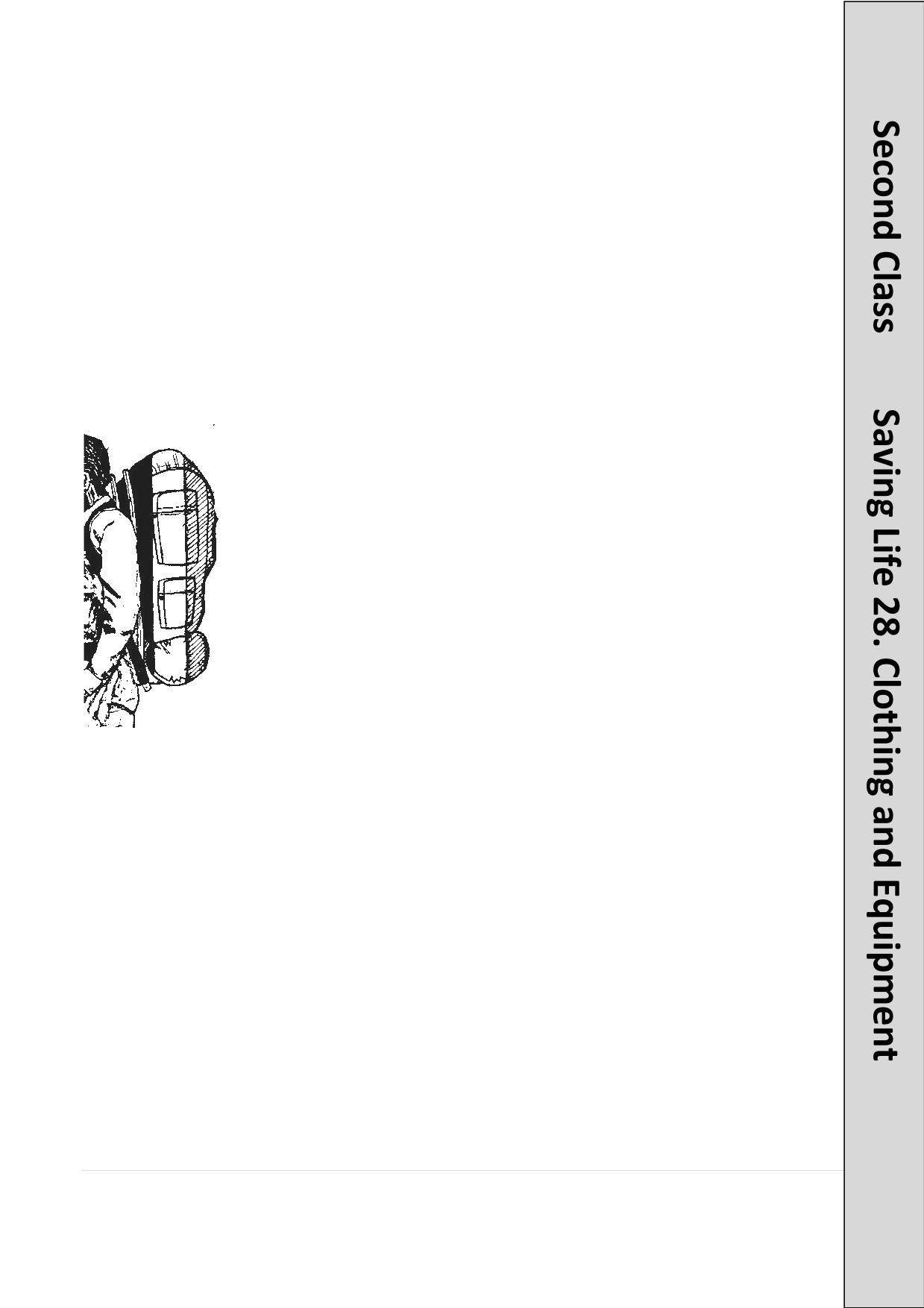
Black Zone
This area closest to your centre of gravity should be filled with objects of greatest density.
White Zone
This middle area further away from your centre of gravity, should be filled with the medium density objects.
Shaded Zone
This area, the furthest away from your centre of gravity, should be filled with the lightest things as this is the
place where any excess weight tries to pull you over backwards.
When loading your bag, place it in a horizontal position leaning forward at the top. Black Zone is now on the
bottom. Place the most dense objects in the bag, keeping them up towards the mouth of the bag. When you
have filled Black Zone, fill White Zone with the next most dense objects. Last, fill Shaded Zone with the
lightest things.
71 | P a g e
General Advice
Before you buy any of these expensive items talk to other Scouts in your patrol and to your Scoutmaster.
Sometimes you might be able to get a better buy second hand. Study the catalogues issued by the
manufacturers. Try testing the warmth in various sleeping bags by putting somebody inside with a
thermometer. Try carrying someone’s rucksack when it is loaded.
Whilst on camp or on outdoor activities denim or other loose weave materials should be avoided. These
become very heavy when wet and allow the wind to blow through them.
Lined trousers should be avoided near water as if you fall in wearing these the water gets trapped between
the layers and can pull you down.
72 | P a g e
29. Have no less than nine months service as a Scout.
Gaining your second class isn’t something to be rushed through, just to get the badge - these are the basic
skills of Scouting, that will last you a lifetime and you may need to practice some of them a few times before
your Scoutmaster feels that you have enough knowledge and experience.
I’ve often heard Scouts say “oh we’ve done that before” but then when asked to demonstrate the skill they
can’t remember how to do it - having a tick in a box won’t be much help when you need to tie a bowline in an
emergency!
30. Make regular contact with a Scout from a different Group, and share Scouting experiences.
You are part of the largest worldwide youth organisation - and you share the same values as over 30 million
people. You may make friends and contacts for life within your own Patrol and Troop, but it is always nice to
extend that to other Groups - either in your own Area or further afield.
You will get an opportunity to meet other Scouts at Area events, and National events - take the chance to
chat to them.
Talk to your Scoutmaster and parents about the best way to keep in contact - it may be through emails,
facebook, SMS, or letters and postcards.
And finally:
Re-pass the Tenderfoot tests. This test will be taken last.
73 | P a g e
First Class
Wearing the First Class badge shows that you have achieved the skills of a true Scout. Many
more adventures await you.
Scoutcraft and Chivalry
Page
1. Discuss with a Scouter the behaviours and attitudes that make a good Scout, and
how to set an example to younger Scouts, and demonstrate them consistently
for a period of not less than 6 months.
2. Understand the role of The Court of Honour, and contribute to its running for a
period of 3 months.
Exploration
3.
Use improvised equipment to estimate 3 distances and 3 heights not more than
30 metres. In each case, the estimate to be within ten per cent error above or
below the actual distance or height.
4.
Be able to estimate distance walked by time, or pacing over distances up to and
including 1 km, both on roads / tracks and open countryside.
5.
Be able to read and use Ordnance Survey maps. Explain spot heights, contours
and trig points. Be able to use an OS 1:25,000 map to correctly locate a point
described by a six figure grid reference.
6.
Understand and demonstrate the uses of a compass. Point out compass
directions by day and night without the aid of a compass. Undertake a short
compass journey by night.
7.
Understand how to prepare a route card and use it in conjunction with an OS
map as an aid to navigation.
8.
Describe how different weather conditions may impact on the planning of a
journey, and what actions may need to be taken if weather conditions change
during a journey.
9.
Go on foot, with other Scouts on a 24 hour journey of at least 25 kilometres. In
the course of the journey, cook your own meals (one of which must include meat
(or substitute). This test is to be completed last.
The Scout is responsible for planning the journey. All aspects of the journey to be
checked at least 28 days prior to the expedition taking place by a person holding
a Safety on The Hills Certificate (examiner) issued by The B-PSA. A completed log
74 | P a g e
of the journey will be submitted to the examiner within 28 days of the completion
of the journey. The log, along with the recommendations of the examiner to be
passed to the Area Council, to enable the badge to be awarded.
Camp Skills
10. Have camped as a Scout, for a total of ten nights, which need not be
consecutive.
11. Demonstrate the following: Sheer-lashing, Back and Eye splice, Rolling hitch and
a Handy billy.
12. Tie the following knots and know their uses:- Figure of eight, Prussick.
13. Use a suitable axe for felling or trimming light timber. Log up a piece of timber
and demonstrate the theory of felling a tree. Use a bush saw, wedges or log
splitter safely and correctly to prepare timber for burning. Demonstrate the use
and care of this equipment.
14. Know how to care for and maintain camping equipment. This should include
storage and simple repairs. Assist the Group Quartermaster for a period of not
less than 3 months.
15. Know how to select, plan and set up a campsite for a Patrol, where possible
acting as Patrol Leader during a Troop or Patrol camp.
16. Plan a balanced menu for a Patrol for 24 hours, and prepare a budgeted
shopping list.
17. Be able to operate and maintain stoves and lamps, identify different fuels, and
know the safety requirements.
18. Cook a two course meal on a camping stove.
19. Build and sleep out in a bivouac and cook a backwoods meal.
Observation
20. Read a series of simple tracks made in sandy or other suitable ground.
Woodcraft
21. Be able to recognise and name 8 common plants, 8 common birds and 8 native
wild animals.
22. Describe three endangered native plants, birds or animals in the UK, and what
practical actions can be taken to assist in the survival of one of them.
Health and Fitness
75 | P a g e

23. Swim 50metres and know the water safety code and the use of the buddy
system for swimming.
24. Explain the principles of good nutrition and a balanced diet and how these
should be modified in adventurous activities.
Saving Life
25. Know what to do in the following emergencies: fire, drowning, ice breaking and
electric shock
26. Know precautions necessary before undertaking adventurous activities. This
must include exposure and mountain safety.
27. Gain the Scout First Aid proficiency badge.
Citizenship
28. Have no less than two years experience as a Scout.
29. Make regular contact with a Scout from a different Area or Country, and share
Scouting experiences
The First Class Badge is granted by the Area Council on the recommendation of the A.C.
(in accordance with area policy)The Scout Master is responsible for seeing that the Scout
is examined in all the tests other than the journey.
76 | P a g e
Scout Cord
This is the highest award that you can earn as a Scout.
Before reaching the age of 15, and before being
invested as a Senior Scout, the Scout will be required to
have completed:
• The First Class
• The Citizenship badge
• At least 3 proficiency badges from the list
below:
o Backwoodsman
o Camper
o Camp Cook
o Explorer
o Pioneer
o Tracker
o Starman
o Weatherman
o Woodcraftsman
77 | P a g e