The Scout Handbook (2012) - part 1
The Scout
Handbook
All you need to know to grow from
Tenderfoot to 1st Class Scout
and to gain your Scout Cord
Throughout the text, the word “him” or “he” shall be taken to infer both male or female.
1 | P a g e
Welcome to Scouting, an adventure that will take you from being a ten or eleven year
old Tenderfoot to becoming a First Class Scout and beyond.
The Baden-Powell Scouts’ Association is proud to maintain the Traditional Scouting
skills and values that our founder believed in, but we are equally proud of our ability to
mix those skills and values with some thoroughly modern adventures.
This handbook will guide you through your progression and development in Scouting
and will give you links to other resources that will help you. You have probably just
come from the Wolf Cub Pack - you are now at the start of a journey of fun, adventure
and learning and maybe you will end up being a Patrol Leader and wearing the Scout Cord, the highest
award a Scout can get before they are fifteen - I hope that’s what you are going to aim for.
There are tests to be completed at each stage as you progress to gaining your Scout Cord, but they are not
like school tests - your Patrol Leader, fellow Scouts and your leaders will help you learn the skills and when
you can show that you have mastered them they will sign off your record card.
The tests are grouped like this:
• Tenderfoot - some simple tests to complete before you are invested as a Scout - if you have gained
your Leaping Wolf you have already completed all the Tenderfoot tests.
• Second Class - these are the basic skills that you will need to enjoy the wonderful outdoor life of a
Scout
• First Class - these skills prepare you for adventures where you take far more personal responsibility,
until you can go on your first class journey
• Scout Cord - the highest award, to be gained before you are 15 and move to Senior Scouts.
Baden-Powell wrote a series of articles called Scouting for Boys which excited young people over 100 years
ago, and they started to form Scout Patrols and Troops. He wrote those articles under eight headings and we
still use similar headings today, and you will see them throughout this handbook:
• Scoutcraft and Chivalry
• Exploration
• Camp Skills
• Observation
• Woodcraft
• Health and Fitness
• Saving Life
• Citizenship
Enjoy Scouting, I look forward to meeting you during your adventures
Jay
Headquarters Commissioner for Scouts
2 | P a g e
Tenderfoot
This is the most important badge you will ever be awarded as a Scout.
There will be other badges that prove that you have learned more skills and had more
adventures, but this badge shows that you have made a solemn promise in front of
other Scouts, and you are going to do your best to obey the Scout Law.
Scoutcraft and Chivalry
Page
1. Understand the history of Scouting, the Baden-Powell Scout Association and the World
4
Federation of Independent Scouts. Know about the life and achievements of Lord Baden-
Powell, our Founder.
2. Know about the Scout section progressive award scheme and how it is structured.
5
3. Know the Scout Law and Promise, and their meaning in accordance with age.
6
4. Know the use and demonstrate the salute, sign, handshake and motto as explained in Camp
6
Fire Yarn 3 of ‘Scouting for Boys'.
5. Take part in a Patrol or Troop activity.
6
Camp Skills
6. Demonstrate with ropes how to tie the following knots: Reef knot, Sheet bend, Clove hitch,
7
Bowline, Round turn and two half hitches, Sheepshank. Explain their uses.
7. Whip the end of a rope.
8
Observation
8. Demonstrate and follow the woodcraft signs given in Camp Fire Yarn 4 of ‘Scouting for
9
Boys'.
Citizenship
9. Know the history and composition of the Union Flag and demonstrate how to hoist, break
10
and fly it.
3 | P a g e
1. Understand the history of Scouting, the Baden-Powell Scout Association and the World Federation
of Independent Scouts. Know about the life and achievements of Lord Baden-Powell, our Founder.
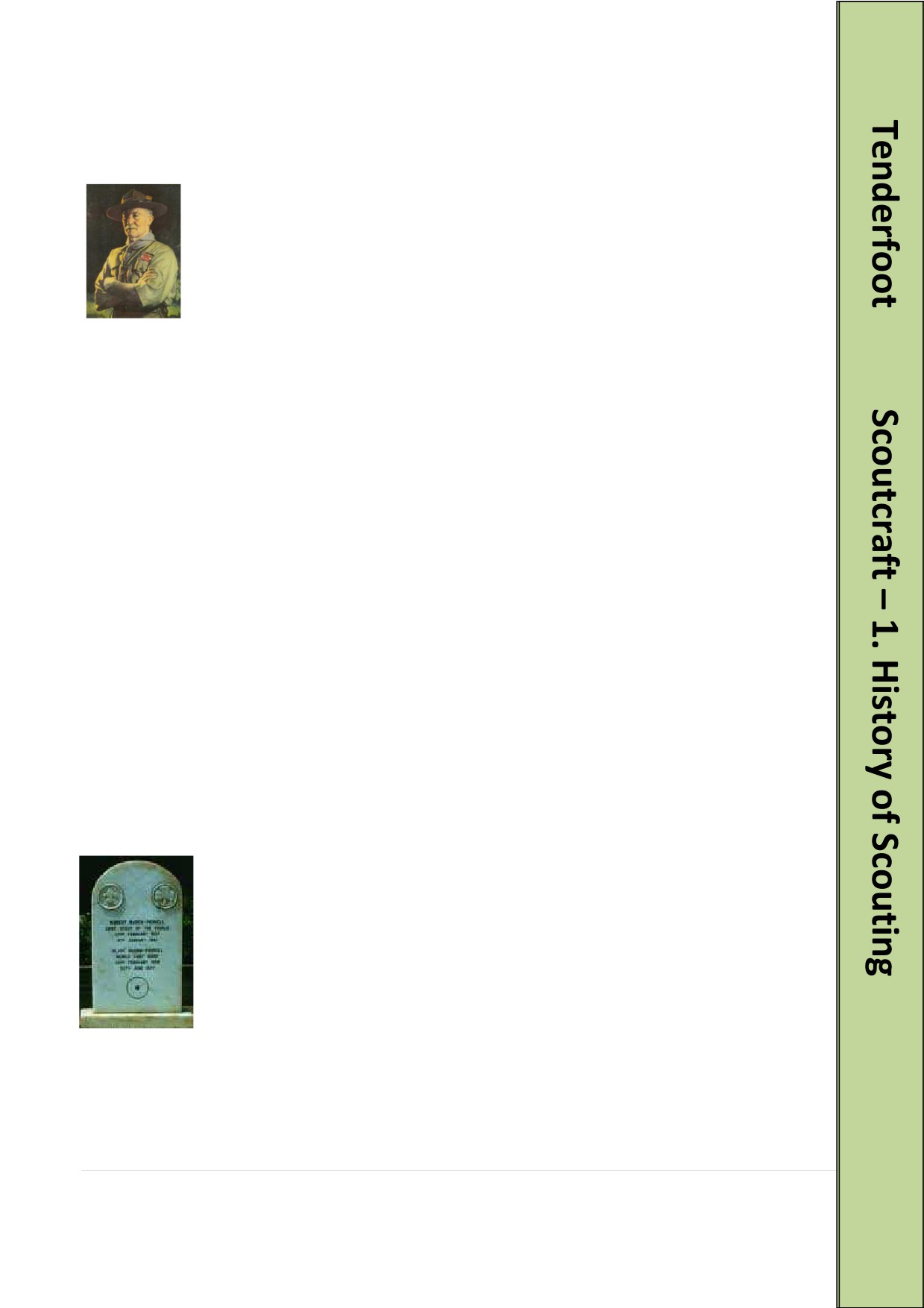
Robert Stephenson Smyth Baden-Powell was the founder of Scouting. He was Born on
22 Febuary 1857.
B-P’s father died when he was three years old, and his early education was at home,
where his mother encouraged him to learn about animals, plants and birds. B-P soon
discovered he could draw very well using either hand, and he became expert at imitating
bird calls.
B-P attended Rose Hill School, in Tunbridge Wells and then won a Scholarship to Charterhouse School in
London. It was here that he explored his interest of wood-craft and learned lots of his scouting skills.
Although officially off limits, he would sneak out into the wood surrounding his school where he learned
to move silently to avoid detection. He also caught and cooked rabbits and other animals, being careful
not to give his position away with smoke.
After school, at the age of 19 B-P, joined the army and did so well in his entrance exams that he was
immediately posted as an officer with the 13th Hussars in India. He gained rapid promotion and had
many famous victories, making him a hero to the British public.
During the Boer War in Africa, Colonel Baden-Powell decided to tie up large numbers of Boer Troops by
holding the strategically important town of Mafeking in South Africa, and the Siege of Mafeking
became one of the most important actions of the war. B-P’s book called 'Aids to Scouting' sold well both
to the military and public at large, and particularly appealed to teenage boys.
In 1907 B-P re-wrote 'Aids to Scouting', to aim it at a younger audience and called it 'Scouting for Boys'.
Later that year he ran an experimental camp with 22 boys from different backgrounds, on Brownsea
Island, Poole Harbour, Dorset to try out his ideas. In 1908 B-P republished his book as “Scouting for
Boys”, in 6 fortnightly instalments, boys started to buy this and create their own Patrols. Troops were
then formed and Scouting began. From there it spread all over the world. B-P ran a camp for another
group of Boy Scouts in Humshaugh, Northumbria - this was the first true Scout camp.
In the next ten years Girl Guides, Wolf Cubs and Rover Scouts started, and Scout Rallies were held in the
major cities of Great Britain. In 1920 the first international Scout Jamboree was held and B-P was named
Chief Scout of the world.
In the following ten years B-P visited many countries to establish Scouting across the
world. Gilwell Park was presented to the Movement for the Woodcraft training of
Scouters.
B-P died on January 8th 1941 and was buried in Nyeri at the base of Mount Kenya.
He had the remarkable experience of seeing the movement grow from the tiny acorn of
a small group of children camped on Brownsea Island into a Brotherhood and
Sisterhood which embraces almost the whole world.
The Baden-Powell Scout's Association was formed in 1970, following moves by the Scout Association in
the mid 1960s to modernise their image. Founders of our Association felt that rest of the Scout
Movement was abandoning the traditions and intentions set out by B-P. The Baden-Powell Scouts retain
4 | P a g e
the belief that essence of the movement should be based on outdoor activities related to the skills of
explorers and backwoodsmen.
It is a voluntary, educational charity movement for young people. It is independent, non-political, non-
military, and open to all without distinction of origin, race, creed or gender, in accordance with the purpose,
principles and method conceived by Robert Baden-Powell.
As an independent Scout Association, B-PSA are members of the the World Federation of
Independent Scouts (WFIS). The WFIS was formed in 1996 and is a world body that recognises
Independent Scouts Associations which teach traditional Scouting values, in countries across the
globe.
Notable Scouting Dates
1907
Brownsea Island - Experimental Camp
1908
Scouting for Boys. First Scout Camp - Humshaugh
1909
Boy Scouts of America. An American businessman, William Boyce, was visiting London, and lost his
way in the fog. A small boy offered to show him the right way. Mr. Boyce wanted to pay him for his
trouble, but the boy refused to accept the money, saying “A Scout does not take money for doing a
Good Turn”. Mr. Boyce was amazed that the boy should refuse, and wanted to find out more about
Scouts. Next day he sought out the office and took back books about Scouting to his home in
America. He thought it was such a good way of training boys that he started the movement over
there.
Crystal Palace Rally
1916
Wolf Cubs formed.
1918
Rover Scouts formed.
1919
Gilwell Park opened.
1920
The first World Jamboree at Olympia.
1924
The Second World Jamboree at Copenhagen.
1929
The Third World Jamboree at Birkenhead (Liverpool) (B-P created Lord Baden-Powell of Gilwell)
1931
First World Rover Moot
1932
The First Gang Show
1933
The Fourth World Jamboree at Godollo (Hungary)
1937
The Fifth World Jamboree at Vogelensang (Netherlands)
1941
Death of Baden-Powell. 8th January.
1946
Senior Scouts formed.
1957
Bi-Centenary Jamboree, Sutton Park, Birmingham.
1970
Baden-Powell Scouts Association formed.
1982
Beaver Scouts officially formed in the UK.
2007
B-PSA celebrate 100 years of Scouting at Camp Cricket and visit Brownsea Island
2008
B-PSA celebrate the 100th anniversary of the Humshaugh camp, by camping near the original site
5 | P a g e
2. Know about the Scout section progressive award scheme and how it is structured.
There are tests to be completed at each stage as you progress through the Scout section, but they are not
like school tests - your Patrol Leader, fellow Scouts and your leaders will help you learn the skills and when
you can show that you have mastered them they will sign off your record card.
The tests are grouped like this, and are described in detail later in this handbook:
• Tenderfoot - some simple tests to complete before you are invested as a Scout - if you have gained
your Leaping Wolf you have already completed all the Tenderfoot tests. You should normally
complete these within three months of starting in the Scout Section.
• Second Class - these are the basic skills that you will need to enjoy the wonderful outdoor life of a
Scout. It will probably take you a year or so to gain these skills, but you will of course also be going
on camps and outings at the same time, and working on proficiency badges for your favourite
activities.
• First Class - these skills prepare you for adventures where you take far more personal responsibility,
until you can go on your first class journey. It may well take you a while to gain all these skills, and at
the same time you will be helping younger Scout’s gain their skills. You will start to be given more
freedom to take care of yourself on camp and expeditions and take even more proficiency badges.
• Scout Cord - the highest award before you go to Senior Scouts, and must be completed before your
15th birthday. It will need you to complete proficiency badges from a special list, and to have your 1st
Class.
6 | P a g e
3. Know the Scout Law and Promise, and their meaning in accordance with age.
The Scout Law & Promise are very important in the move from being someone who goes along to Scout
meetings, to becoming a Scout. There are ten Laws which you will need to learn, however, is not enough just
to be able to repeat the Laws, you are going to promise to do your best to obey them, and that is a big
undertaking.
Behind each Law lies a great depth of meaning, talk to other Scouts, Senior Scouts and Rover Scouts, to
Akela and your Scout Leaders about what the Laws mean to them, and how they try to live by them - they
have all promised to obey the same Laws as you.
The Law:
1. A Scouts' honour is to be trusted
A true Scout can be recognised because he lives this Law, he can be trusted to speak the truth, and never
go back on his word. He can always be trusted to carry out any job to the best of his ability.
2. A Scout is loyal to The Queen, His Country, His Scouters, His Parents, His Employers and to those
under Him
Loyalty means that you don’t let people down, and they can rely on you, and that doesn’t just apply to
people that you look up to. If you become a Patrol Leader, you will have to earn the respect of the
members of your Patrol, and be faithful to them especially.
3. A Scouts' duty is to be useful and help others
A Scout should do their duty first. In order to understand their duty, B-P suggested that a Scout should
consider,
"Which is my duty?" that is, "Which is best for other people?" - and do that one.
A Scout should Be Prepared to do a good turn every day and help people, without seeking reward for
being helpful.
4. A Scout is a friend to all, and a brother to every other Scout, no matter to what Country, Class or
Creed the other may belong
When meeting another Scout, we should treat each other as we would expect to be treated. A Scout
should offer help & support and must never look down upon the other. A Scout accepts the other as
they find them.
Start by practising this in your Patrol, then your Troop, then with Scouts you meet from other Troops,
and eventually if you are lucky with Scouts from other countries. Nearly 50 million people in almost 200
countries are involved in Scouts and Guides. You are now part of that worldwide brotherhood for peace
and good.
5. A Scout is courteous
A Scout should be polite to everyone, no matter how the other person treats you, or speaks to you.
6. A Scout is a friend to animals
A Scout should be kind to all animals and save them as far as possible from pain, and should not kill any
animal unnecessarily.
7. A Scout obeys orders of His parents, Patrol Leader, or Scout Master without question
7 | P a g e
A Scout should carry out reasonable orders given to him immediately, even if he is unsure about the
intention. He can later discuss or query those orders. That is discipline.
This does not mean that a Scout should break the law of the land or carry out an act which would
contravene a moral or ethical code, or endanger his safety.
If you become a Patrol Leader you will expect the members of your Patrol to work to your orders, but
remember that they also need to trust and respect you, so make sure you don’t abuse your position.
8. A Scout smiles and whistles under all difficulties.
You will find that life throws all sorts of difficulties at you, things that you don’t want to do, or make you
feel frightened or uncomfortable. Moaning and grumbling about these will just make you miserable, and
will probably make those around you miserable or angry. See what happens when you tackle every day
with a smile on your face - you’ll find it’s infectious.
9. A Scout is thrifty
Thrift means carefulness to avoid waste - it applies to money, property and time. Think carefully in a
world where we are wasting valuable resources how you can make a difference.
10. A Scout is clean in thought, word and deed.
Scouts should not let themselves give way to temptation, either to think, talk or do anything which
would be considered unacceptable.
There is a useful little rhyme to help you remember the key words for each Law their order:
Trusty, Loyal, Helpful,
Brotherly, Courteous, Kind,
Obedient, Smiling, Thrifty,
Clean in word, deed and mind.
The Scout Promise
On My Honour I promise,
That I will do my best,
To do My Duty to God and The Queen,
To help other people at all times, and to obey The Scout Law.
This is the solemn promise that you make when you are invested, and is the same promise that all Senior
Scouts, Rover Scouts and Leaders make. You will make this promise in front of the other Scouts in your
Troop, and they will trust you to do your best to keep it. Later when you are present for a new Scout being
invested you should take the opportunity to remind yourself of the things you promised to do.
You are at an age now, when you can make up your own mind about what the word God means to you, it
may be a religious deity, or it may be a set of personal values and beliefs - the important thing is that you
hold true to your beliefs, and respect the beliefs of others.
8 | P a g e
4. Know the use and demonstrate the salute, sign, handshake and motto as explained in Camp Fire Yarn
3 of ‘Scouting for Boys'.
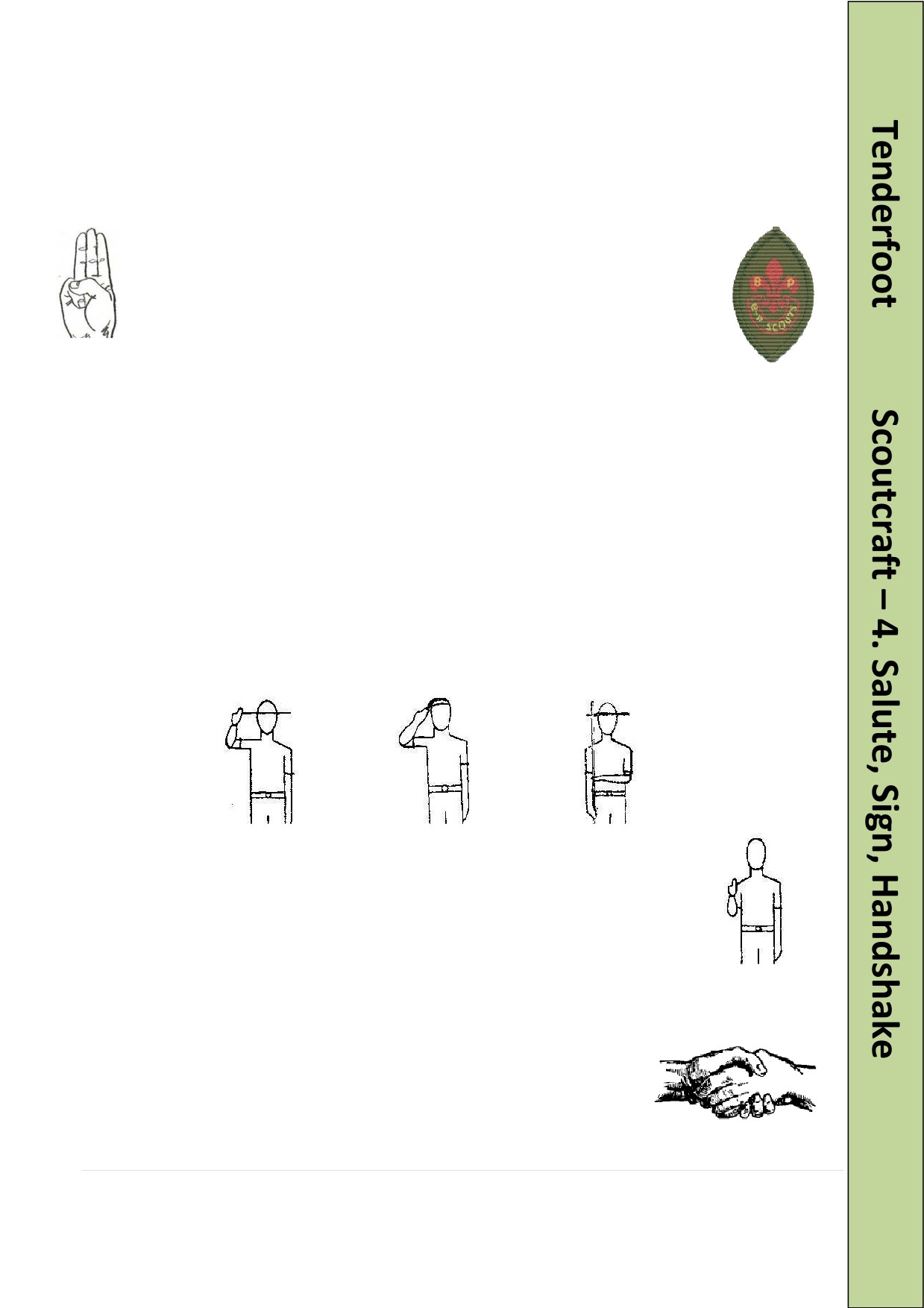
The three fingers held up like the three points of the Scout badge remind a Scout of the three parts of his
promise:
• His duty to God and the Queen (his country)
• To help others
• To obey the Scout Law
The thumb over the little finger reminds a Scout that the strong, protect the weak.
Salute
The salute and the badge also look like the arrow head on an old compass - always pointing in the right
direction.
The salute is made with the right hand, which is brought to a position just in front and above the right ear,
when a hat or beret is worn the fingers should just touch the edge of the hat. For a smart salute the hand is
brought up into position slowly, in a wide arc and then at the end of the salute straight down by your side
(longest way up, shortest way down).
When parading with a Scout stave, the salute is made with the left hand and the stave in the right hand.
Bend the left elbow at a right angle, and with the palm downwards just touch the fingertips to the stave.
Sign
The Scout sign is identical to the salute, but instead of touching the hat, it is made next
to your right shoulder, with the palm facing forward. The sign is used by all invested
Scouts who are present at the investiture ceremony of a new Scout, it is also used
when Scouts great each other - especially if they aren’t wearing hats.
Handshake
When Scouts shake hands they use their left hands. This is a sign of trust and friendship. Warriors used to
carry their spears in their right hand and their shields in their left hand. To offer your shield hand to another
person leaves you open to attack, and to do so is a great sign of trust.
It is also said that your left hand is closer to your heart, and that may also be a
sign of friendship.
9 | P a g e
Scouts all over the world shake with their left hands, in some places they also bend their little finger into the
palm, as a secret sign of Scouting friendship.
Motto
The Scout Motto is Be Prepared. You can see these words under the Scout symbol
of the fleur de Lys - the three points of this also remind us of the three parts of
our Promise. The words are contained in an upturned scroll, which might remind
you of a smile - how your mouth should look as you do your duty.
B-P chose this motto, because he believed that through observation, training and
awareness a Scout should always be prepared to tackle any situation - nothing
should catch you by surprise.
5. Take part in a Patrol or Troop activity.
This is your opportunity to experience the fun of Scouting and get to know your Patrol before you are
invested.
This may be arranged by Akela, Skip or by your Patrol Leader. Ideally it should be more than just coming to a
weekly Scout meeting, it should involve working together with your new Patrol in something like a hike, a
short camp, or on a pioneering project.
10 | P a g e
6. Demonstrate how to tie the following knots: Reef knot, Sheet bend, Clove hitch, Bowline, Round turn
and two half hitches, Sheepshank. Explain their uses.
Tying knots is a key skill for Scouts, and you will use your knot tying skills in many Scouting activities
including camping, pioneering, climbing, boating, and fishing. It’s important to know which knot to use
when, as selecting the right one will often be a safety requirement.
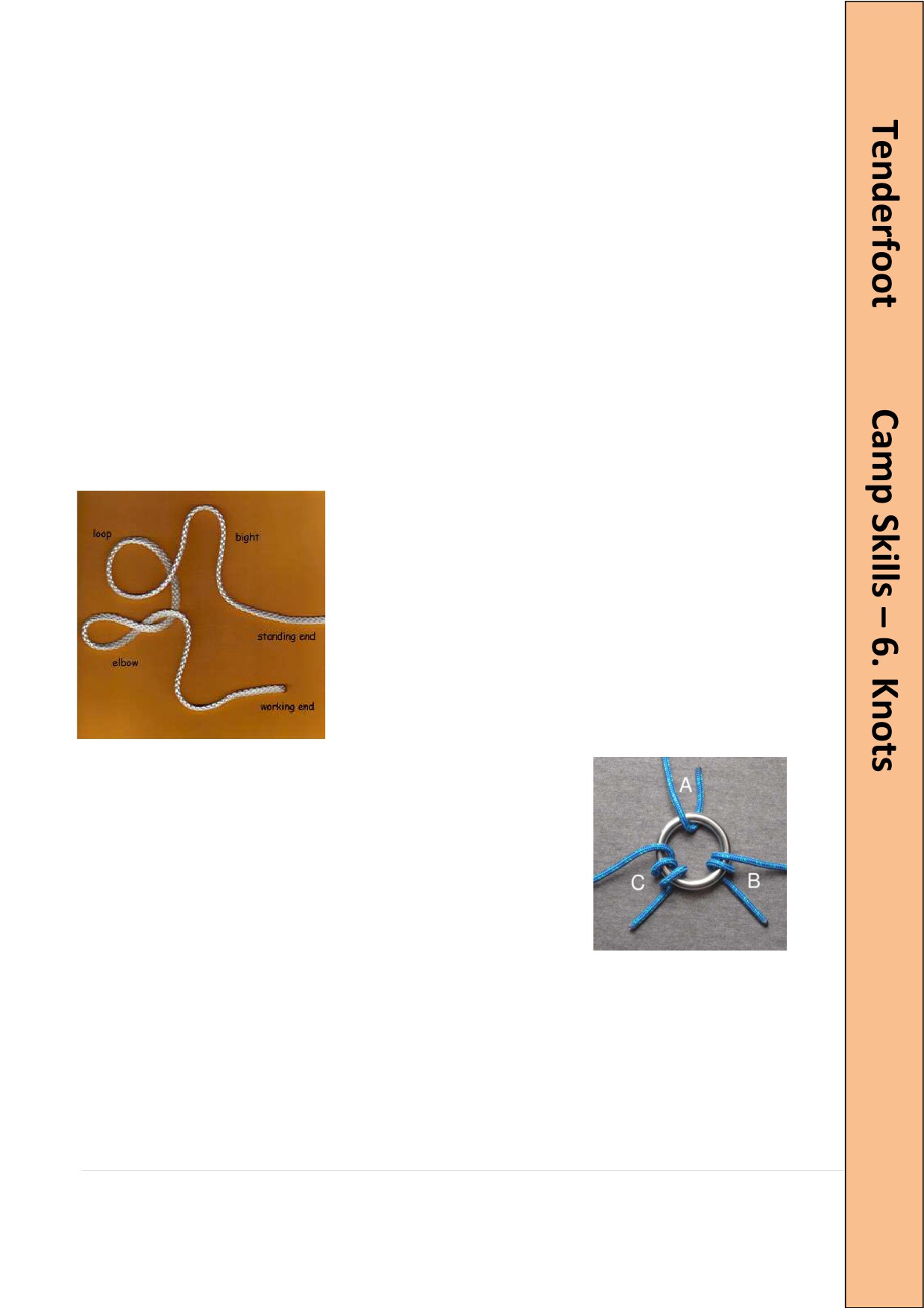
Let’s start by getting some words right, so that we all have the same understanding, there are some strange
words, but if we all use them to mean the same thing we shouldn’t get confused:
Rope This is the manufactured material, before it is given a specific use.
Line Once rope is purposely sized, cut, spliced, or simply assigned a function, it is referred to as a line.
Now let’s look at the words that describe the parts of a knot:
Bight Any curved section, or slack part between the ends of a line.
Loop A full circle formed by passing the working end over itself.
Elbow Two crossing points created by an extra twist in a loop.
Standing end is the longer end of the line not involved in the knot,
often shown as unfinished. It is often (but not always) the end of the
line under load after the knot is complete. For example, when a clove
hitch ties a boat to a pier, the end going to the boat is the standing end.
The standing part is the section of line between knot and the standing
end.
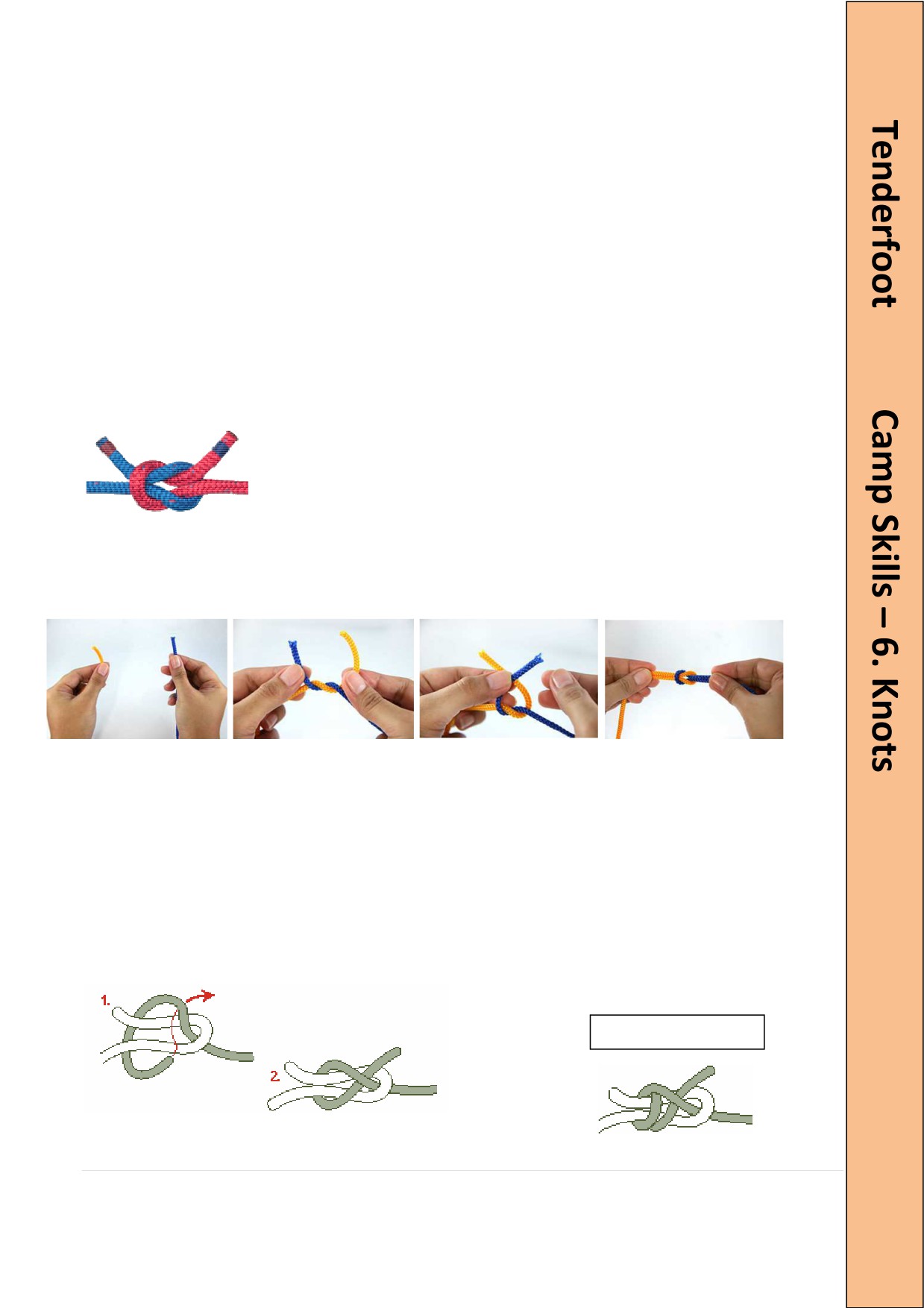
Turn
A single turn is a single pass behind or through an object (A).
A round turn is the complete encirclement of an object; requires two
passes (B).
Two round turns circles the object twice; requires three passes (C).
Working end is the active end of a line used in making the knot and may also be called the 'running end'.
There are many categories of different knots for different purposes, and some knots may belong to more
than one category.
Bend A knot uniting two lines.
Binding A knot that restricts object(s) by making multiple winds.
11 | P a g e
Hitch A knot tied to a post, cable, ring, or spar.
Lashing A knot used to hold (usually) poles together.
Loop A knot used to create a closed circle in a line.
Splice A knot formed by interweaving strands of rope rather than whole lines.
Stopper A knot tied to hold a line through a hole.
Whipping A binding knot used to prevent another line from fraying.
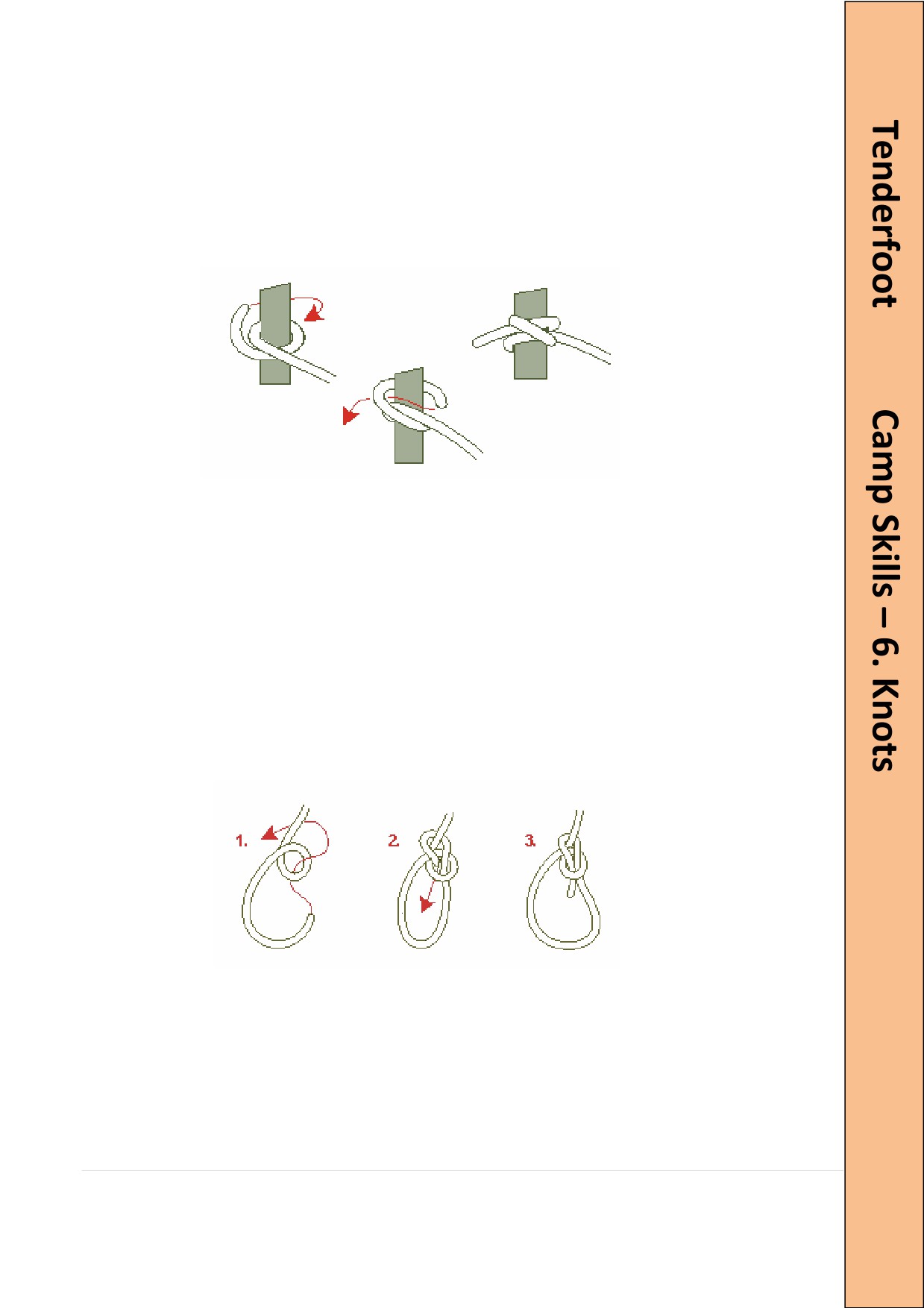
The Reef Knot (or square knot)
This is the most common Scouting knot, but should never be used as a bend (to tie
two lines together, as it comes undone very easily).
It’s great as your first practice knot, and is useful for tying parcels, tying bandages
and slings (because it lies flat) and for its original use which was tying down sails on sailing boats - which is
called reefing.
To see how to tie it click this link Tying a reef knot
Sheet
Bend
The
sheet bend is used for tying two lines of unequal thickness together, but is also actually better than the reef
knot for tying two lines of equal thickness. To make it secure you need to ensure that the two working ends
finish up on the same side of the knot.
This can be made even more secure by converting it to a double sheet bend. Always work with the thinner of
the two lines.
The first place you will need to use this knot in Scouting is when you tie the halyard (that’s the special name
for a line that raises and lowers something, like a flag or a sail) to the loop at the bottom of the Union flag -
but more about this in test 9.
Double Sheet Bend
12 | P a g e
Clove Hitch
You will use the clove hitch in lots of different applications, for example for starting a square lashing (this is
part of second class), and for tying things to poles, rings or spars. It is very quick to tie, and useful because
the length of the standing part can be adjusted very easily.
It is used very widely in sailing and boating as well as pioneering.
Bowline
This is widely regarded as the best knot for forming a secure loop in a line, which can be untied easily even
after it has been under great pressure. It is commonly used for tying boats to quaysides, and if you imagine
the weight of a heavy boat, constantly tugging at it’s mooring you need a knot that can be untied easily
afterwards. The bowline used to be common in mountaineering and as a rescue knot, and it is useful for you
to learn to tie it around your waist, but other better knots are more commonly used for these purposes now.
The structure is actually the same as the sheet bend, the bowline just makes a loop in the end of one line. If
you can tell what a sheet bend looks like when you have tied it correctly, you will be able to recognise a
correctly tied bowline too.
13 | P a g e
Round turn and two half hitches
Another really useful knot for tying things to poles, spars
or rings. You will remember that the round turn is shown
in this picture as B.
Adding the two half hitches is a simple way of making it secure.
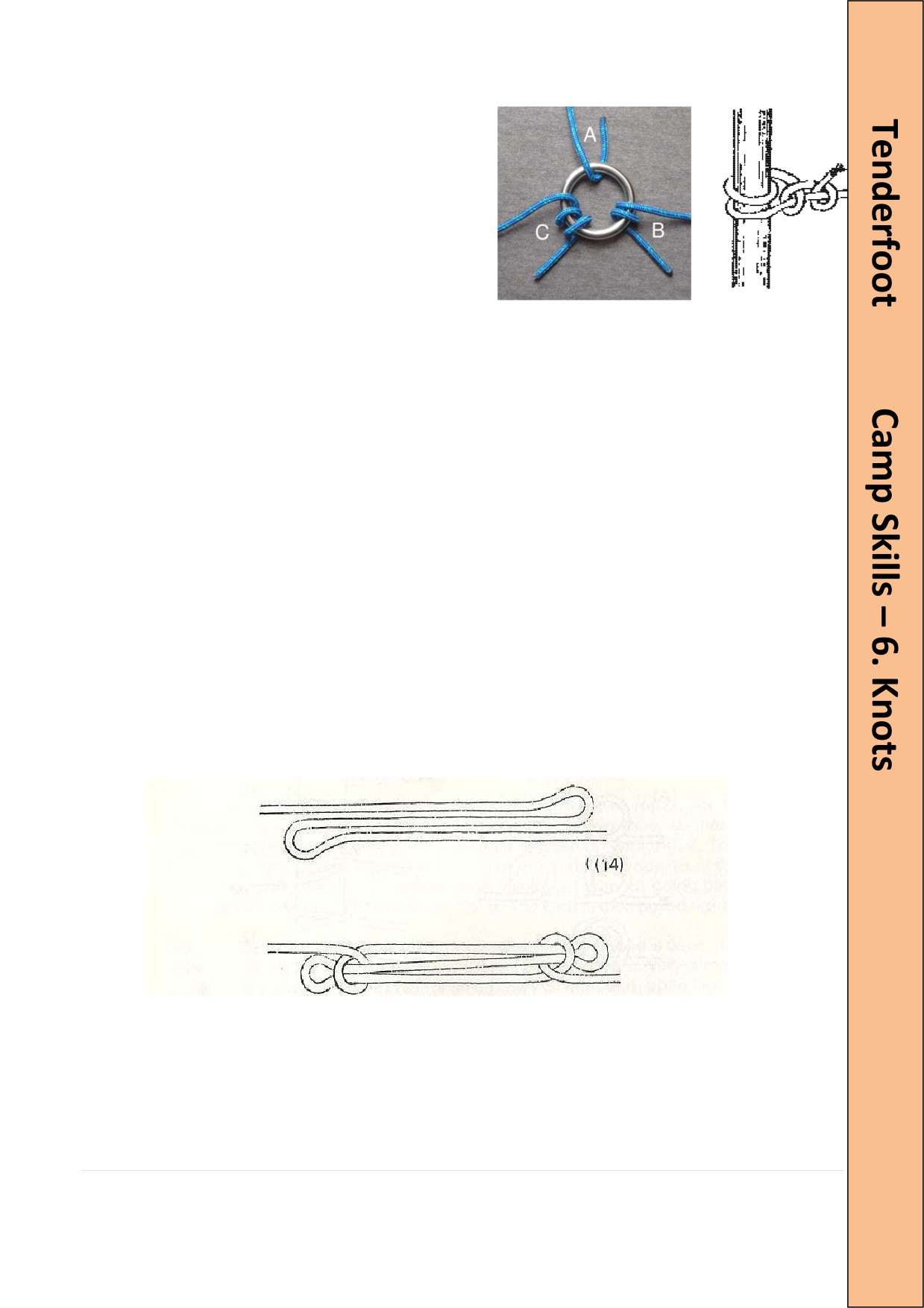
Sheepshank
There are times when a piece of line needs to be shorter, but we don’t want to cut it and make it
permanently shorter. A good example of this is shortening the guy line for a tent - we may want it short this
time, but need the whole length the next time we put the tent up.
The sheepshank can also be used to protect a weak part of the line temporarily, before we get round to
repairing or replacing it.
To start with, the rope must be folded into three layers. (If the knot is used for protection of a weak part, the
weak part should be in the centre of the middle layer).
Next, a "half hitch" is put round the end of the knot, so as to hold the remaining two ropes tightly together.
The same is repeated at the other end.
The two ends are then pulled tight, and the knot is finished.
14 | P a g e
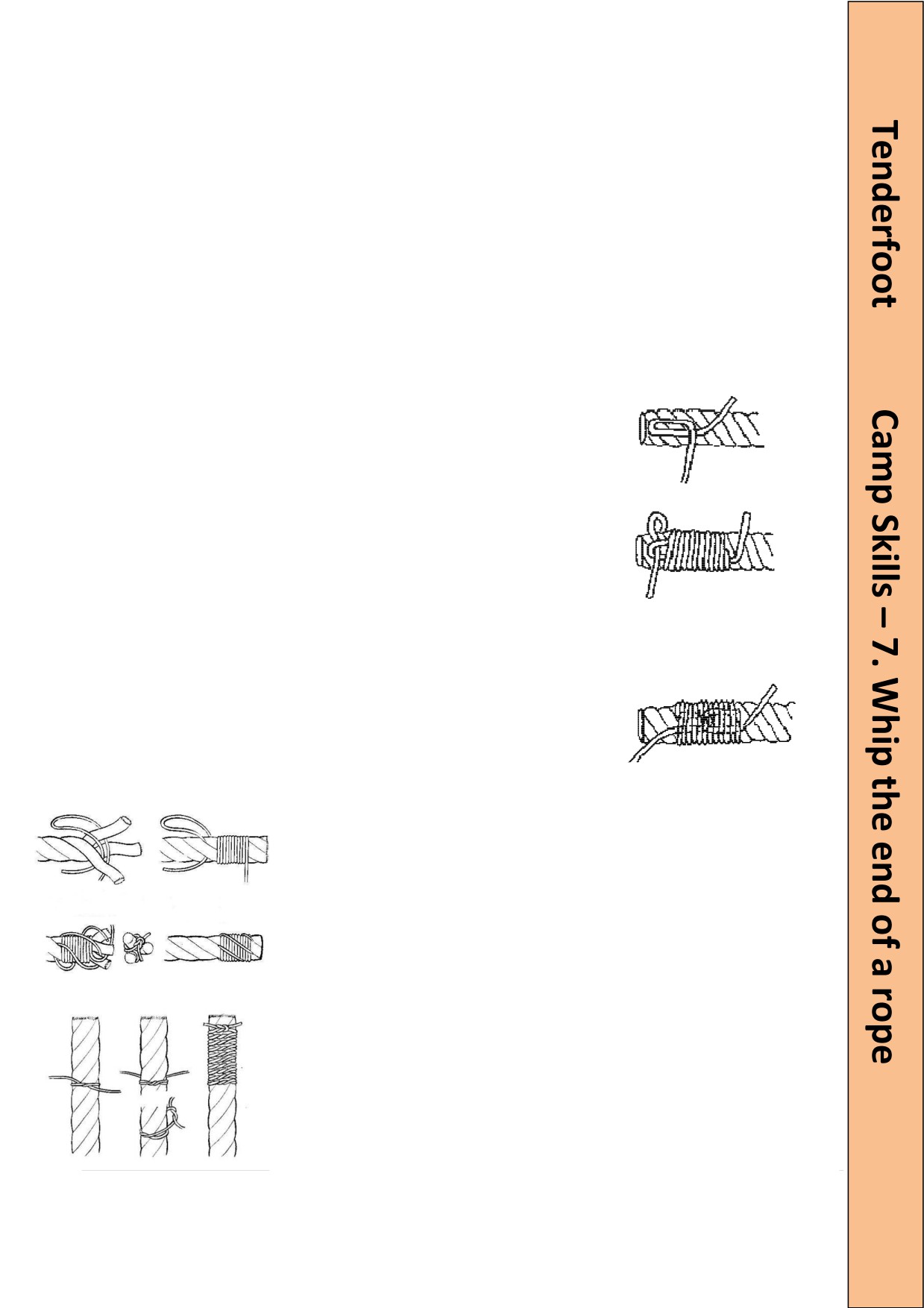
7. Whip the end of a rope
Ropes are traditionally made by twisting smaller strands together - this gives the finished rope greater
strength and reliability. Whipping is a method of ensuring that the end of the rope doesn’t fray and become
useless - it is best used on ropes made of natural materials like hemp, sisal or jute.
We are showing three different methods here, but as long as you can do one correctly that is fine - you may
like to experiment with the others in the future. The important thing for all three is that the final whipping is
tight and neat, it will then have a very long useful life.
Common or Simple
The whipping twine is laid on the rope in the form of a loop. This loop must
be longer
than the intended length of the whipping, and the end must be left long
enough
to be able to pull.
Next, the twine is wrapped round the rope, so as to make the finished
whipping only slightly larger in diameter than the rope itself. A good
whipping should not be more than about 10mm long as otherwise it will
tend to open up, and eventually come undone. As the twine is wound
round the rope, each turn must lie hard against the previous one.
When enough of the twine has been wound round the rope, tightly to your satisfaction, the loose end is
pushed through the loop at the end of the rope.
Finally the end of the loop is pulled, pulling the other end actually into the
whipping. When the knot has reached the centre point of the whipping,
both ends are cut off, and the whipping is finished.
Sailmaker’s Whipping
1. Open lay of the rope and place loop of twine round one strand. Re-lay rope.
2. Hold loop down with left hand, leaving short end free. With the long end
whip towards rope end.
3. Raise loop and slip it over end of strand it embraces. Pull short end to
tighten. Join ends of twine with reef knot.
4. Trim end of rope with sharp knife and rub with wax if desired.
West Country Whipping
This is probably the simplest form of whipping.
First tie a thumb knot a few cm from the end of the rope. Then tie thumb knot
at back. Continue to within 5mm of the end. Finish off with a reef knot. Trim
end with sharp knife.
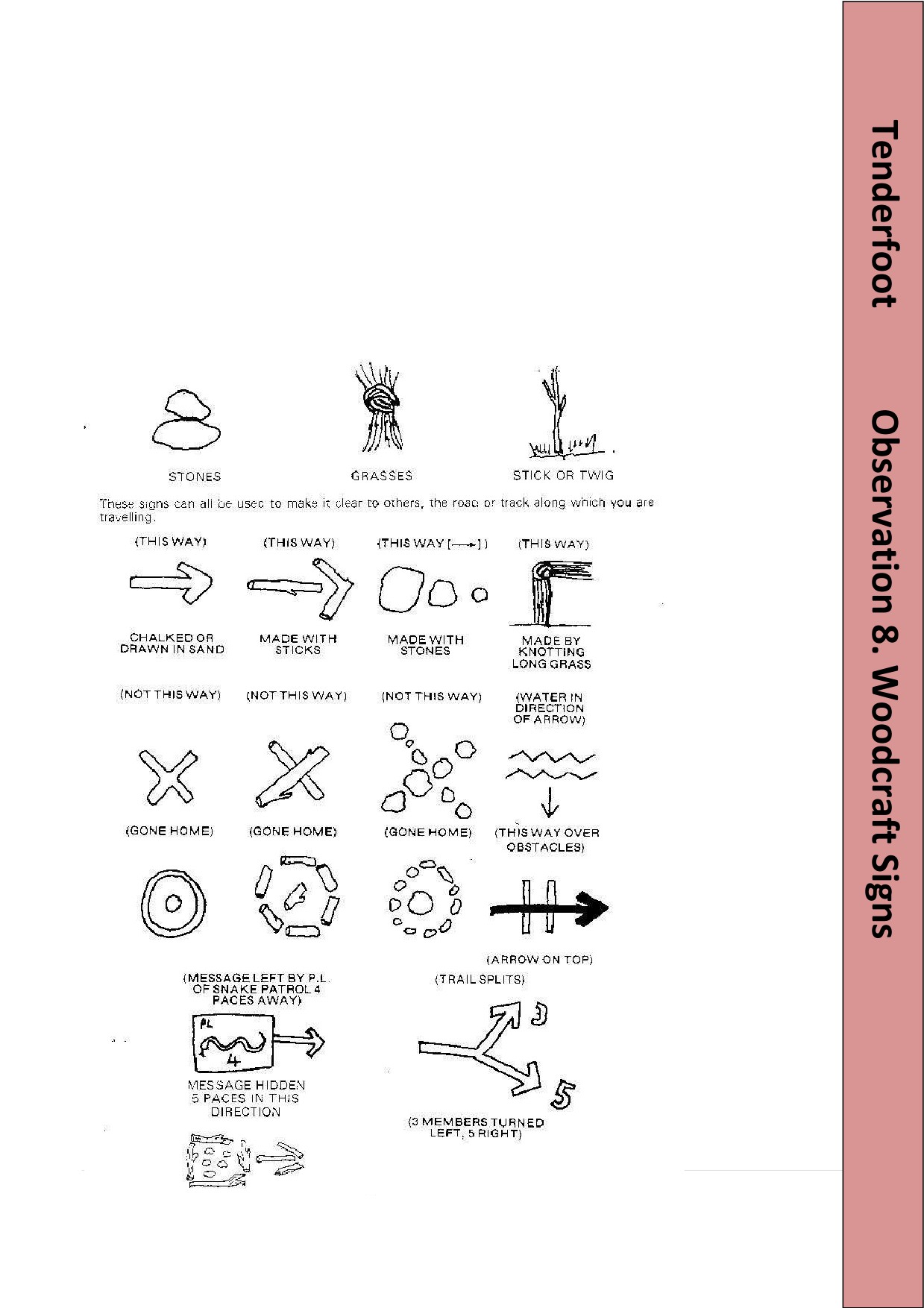
8. Demonstrate and follow the woodcraft signs given in Camp Fire Yarn 4 of ‘Scouting for Boys'.
Scout trail signs should be made on or close to the ground. If they are made on a road or track they should
be laid close to the edge on the right hand side.
They should never be made where they will damage or disfigure private property.
Woodcraft signs are a great way for you to communicate secretly with other members of your Patrol or
Troop, but you will need to practice your observation skills so that you get the whole message.
1
ht B-PSA 2012
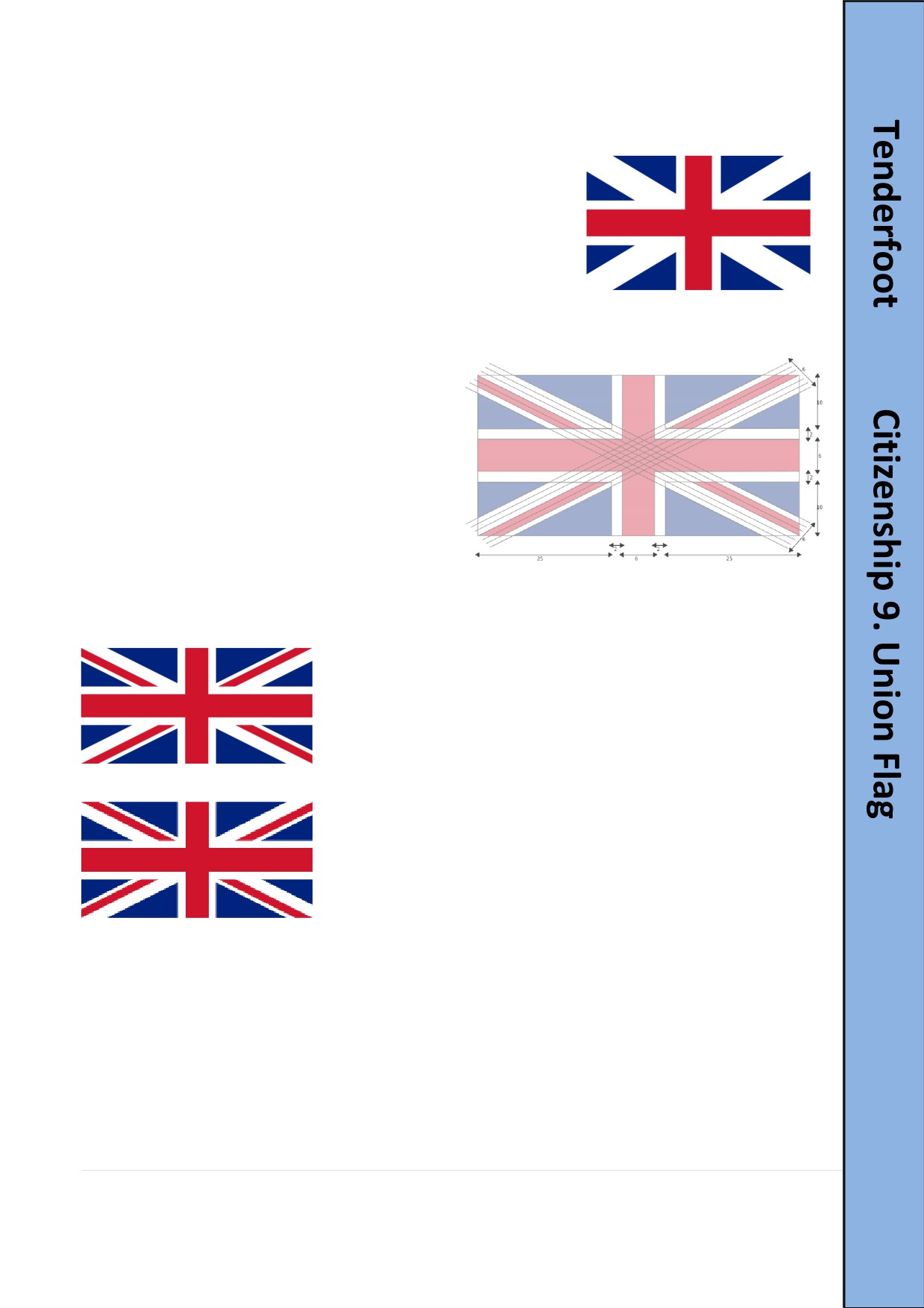
9. Know the history and composition of the Union Flag and demonstrate how to hoist, break and fly it.
The first flag representing Britain was introduced on the proclamation
of King James I in 1606 and was made up of just the Scottish and
English flags, when he became King of both nations. The Welsh
dragon does not appear on the flag because Wales was already united
with England from the 13th century. This meant that Wales was a
Principality instead of a Kingdom and as such could not be included.
In 1800 during the rule of King George III, Acts of Parliament united the Kingdom of Great Britain and the
Kingdom of Ireland to create the United Kingdom of
Great Britain and Ireland. The union came into
effect on 1 January 1801 and the Union Flag as we
now know it was created.
The Union Flag is normally twice as long as it is wide
and has very precise specifications about the size of
each element, these are shown here. As you can see
this means that the broad white diagonal is wider in
some places than others. The flag is the right way up
when the broad white stripe is at the top, on the
side closest to the flagpole.
Right way up if the flagpole is assumed to be on the left.
Upside down if the flagpole is assumed to be on the left. This is normally
regarded as a sign of distress, or assistance being required.
When someone of national importance has died, the flag is flown at half mast. This doesn’t literally mean
half way down the flagpole. The flag should be hoisted slowly to the top of the pole, and then lowered to
leave a gap the same height as the flag itself. When the flag is taken down, it should first be hoisted to the
top of the pole, and then reverently lowered.
Remember never to let the flag touch the ground - that is considered to be very disrespectful.
17 | P a g e
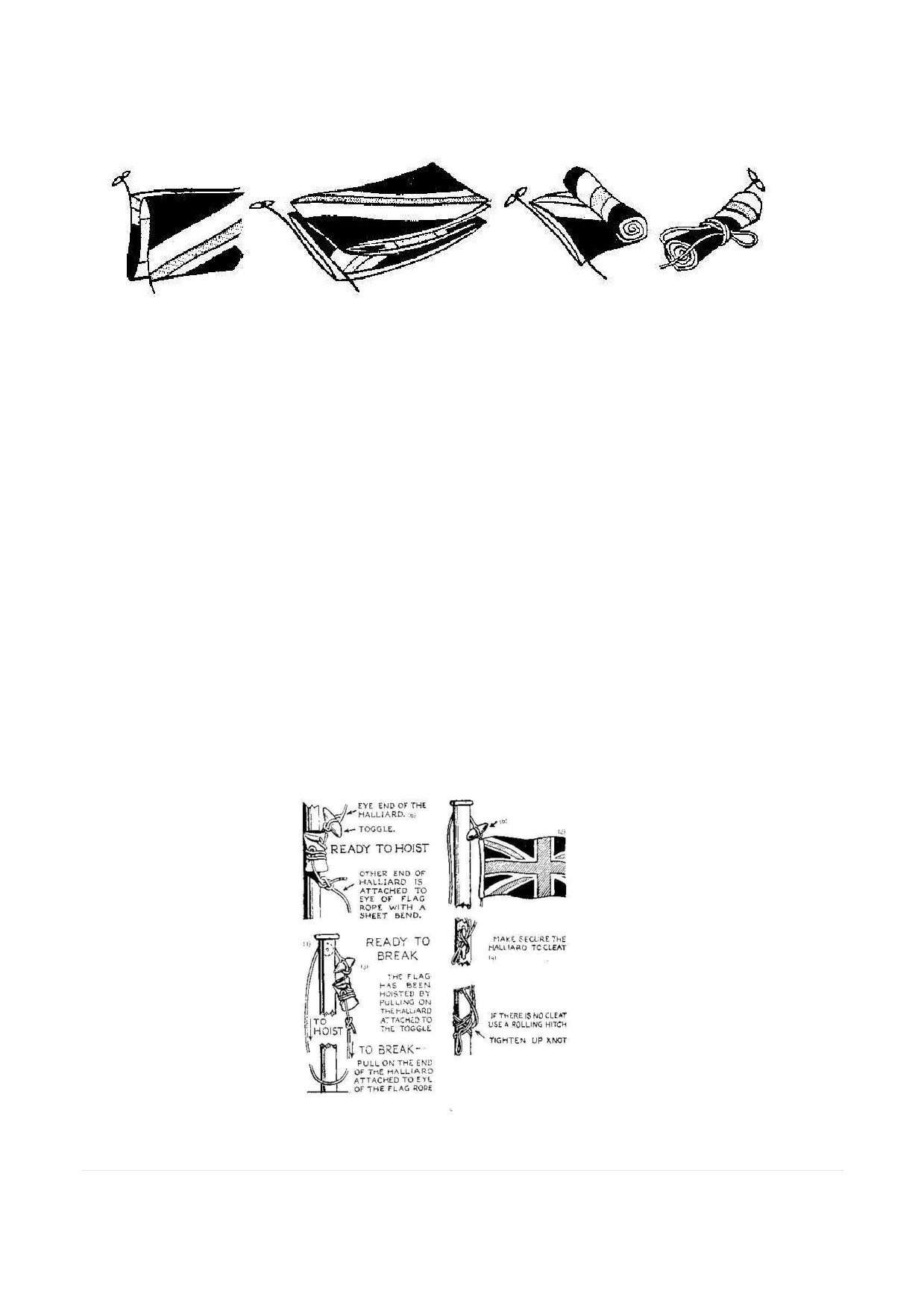
When preparing a flag for breaking, remember to fold it in such a way that it can be broken.
One method of folding the flag is to begin by laying the flag open on a flat surface, or held between two
Scouts. The flag is then folded into three in such a manner that both the original top and bottom edges are
still visible i.e. they are folded onto opposite sides of the centre.
The flag is then folded in half length-wise.
Next, concertina or roll the flag to the stage where enough is left at the hoist end to wrap round once. This is
then done.
Lastly, the line attached to the bottom of the flag is wrapped round the flag, and tucked under itself, in the
form of a loop, to secure the folded flag.
There are many different ways to fold the flag, you may use a different one to this in your Group.
When hoisting the flag up to the top of the pole, the halyard is fastened to the flag in two different ways.
First, there will be a loop in one end of the halyard, and this is placed over the toggle on the flag. The other
end of the halyard is then fastened to the loop of the rope on the flag with a sheet bend, or double sheet
bend. The flag is then hoisted to the top of the pole, and the halyard secured to the bottom of the pole to
prevent the flag from falling.
If the flag has been folded properly, it will, when the halyard is given a pull, unfold in the required manner. If
this does not happen, the flag will have to be brought down, broken by hand and hoisted.
18 | P a g e
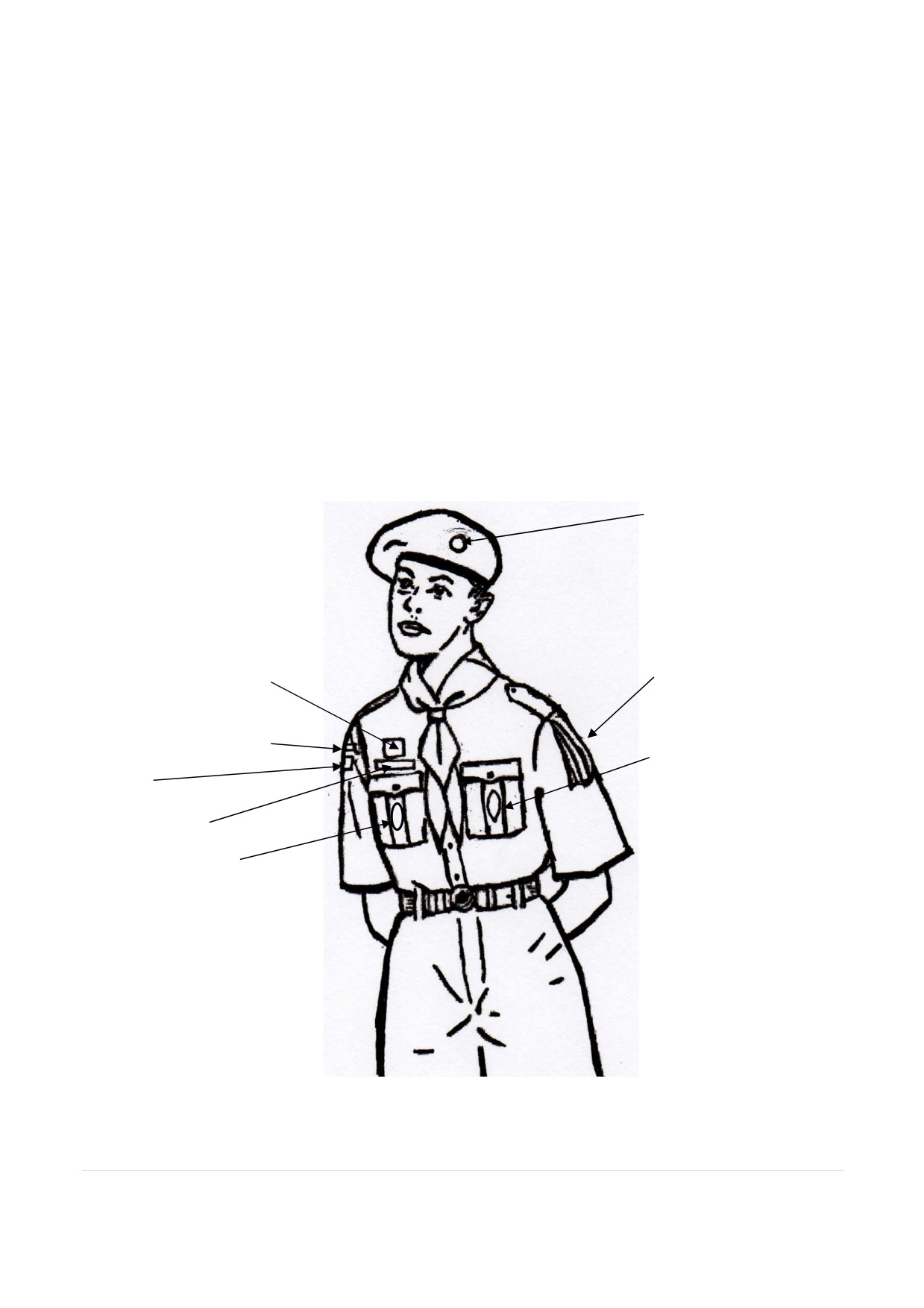
Congratulations you have completed your Tenderfoot and are now ready
to be invested in to the Troop.
After you are invested you can use the diagram below to help you to sew your badges in to the correct
places on your uniform. Be careful not to sew your shirt pockets shut.
Metal Beret Badge
Leaping Wolf (until First Class
Patrol Shoulder Knot
achieved)
Group and Area Name Tapes
Promise Badge
Area Badge
Baden Powell Strip
WFIS membership badge
19 | P a g e
Second Class
When you are awarded this badge you have learnt the basic skills of Scouting,
you will need them to enjoy the wonderful outdoor life. Once you have these
skills, you will start to be given more and more responsibility for looking after
yourself, and helping your younger Scouting brothers.
Scoutcraft and Chivalry
Page
1. Know the Patrol sign, call and colours for the Patrol into which they are invested.
2. Take responsibility for a weekly duty within the Patrol for a minimum of 3 months
3. Discuss with Patrol Leader or Second how the Scout Law and Promise applies to their
daily life
Exploration
4. Know how to use a compass and how to set a map.
5. Using OS 1:50,000 or 1:25,000 maps show an understanding of conventional map
signs, scales and the use of map references.
6. Show that you understand the Highway Code (particularly the sections for pedestrians,
cyclists and sign and markings).
7. Show the ability to use a telephone and demonstrate knowledge of your locality by:
• using local bus and railway timetables.
• knowing local landmarks, through-road routes, public transport facilities and utilities
serving your area.
8. If you have the use of a bicycle, demonstrate that it is kept properly maintained and
you are able to effect minor repairs.
9. Know where to find up to date weather forecasts, whilst at home and in camp.
10. Go by day, on foot, with other Scouts on a journey of 10 - 15 kms. The journey will
have a route laid down by the Scout Officer and a simple objective will be given.
Take responsibility for leading and navigating at least 2 km of the journey. A verbal
report, from notes, must be made on your return. (Normally to be taken toward the
20 | P a g e
end of 2nd Class)
Camp Skills
11. Tie the following knots and know their uses: Timber hitch, Killick hitch, Fisherman's
knot and Harvester's hitch.
12. Demonstrate square and diagonal lashings by constructing a trestle of scout staves.
13. At camp, construct a useful gadget using natural materials, and demonstrating good
use of knots and lashings.
14. Know the safety rules and care of a hand-axe, bow saw and knife. Demonstrate how to
sharpen a knife and hand-axe.
15. Demonstrate how to make and store firewood.
16. Lay and light a fire out of doors with natural materials.
17. Cook over an open fire a simple meal, make a hot drink and wash up afterwards.
18. With another Scout, pitch, strike and pack a hike tent within a reasonable time.
19. Camp for a minimum of 5 nights as a Scout
Observation
20. Kim's game. A test in observation to remember 16 out of 24 well assorted articles,
following 1 minutes observation, or, Follow a trail containing not less than 30
woodcraft signs.
Woodcraft
21. Be able to recognise and name 6 common trees and know the value of their wood for
burning
22. Know and follow the Country code
Health and Fitness
23. Know the general rules for healthy living.
21 | P a g e
Saving Life
24. Demonstrate a knowledge of and how and when to summon adult help
25. Treat shock. (not electric).
26. Know how to deal with the following common minor ailments:
• Minor cuts and scratches
• Bleeding from the nose.
• Stings and bites.
• Burns and scalds.
• Know how to avoid sunburn.
27. Know how to suitably dress and support minor cuts and sprains.
28. Know how to choose items of suitable personal clothing and equipment for outdoor
activities, including camps.
Citizenship
29. Have no less than nine months service as a Scout.
30. Make regular contact with a Scout from a different Group, and share Scouting
experiences.
Re-pass the Tenderfoot tests. This test will be taken last.
1. Know the Patrol sign, call and colours for the Patrol into which they are invested.
Camp Fire Yarn No 4 in Scouting for Boys gives a full list of Patrol names, calls and colours. The colours are
represented in the shoulder knot you wear on your left shoulder.
You should know about your Patrol and it’s history, but firstly you need to know a little bit about why Scout
Troops are formed of two or more Patrols.
In Scouting for Boys, B-P said:
“Each Troop is divided into Patrols of about eight boys, and the main object of the Patrol system is to give
real responsibility to as many boys as possible, with a view to developing their character. If the Scoutmaster
gives his Patrol Leader real power, expects a great deal from him and leaves him a free hand in carrying out
his work, he will have done more for that boy’s character expansion than any amount of school training
could ever do.”
22 | P a g e
Every Troop is named after the place where it belongs, and within it each Patrol is named after a native
animal or bird - it’s best to make that name relevant to the place where you live too. So a Troop near the
sea may have a Seagull Patrol and a Gannet Patrol, and a city Troop may have a Bulldog and a Fox Patrol.
Each Patrol Leader should carry a stave of straight natural wood (Hazel is good), on top of which is the Patrol
Pennant. Pennants can be made in cotton, canvas or leather, and are normally made in one of the heraldic
shapes shown here. They always carry a silhouette design of your Patrol name, and may be in your Patrol
colours - the ones you wear on your shoulder knot.
At some Area and National events your Patrol may be awarded a small trophy in a tournament, this can be
attached to your Patrol pennant, and becomes part of the history which will be passed on from one Patrol
Leader to the next.
You may want to have a Patrol motto - something that links to your Patrol name, like “Alert and Wise” for
the Owl Patrol, or “Soar high” for the Owl Patrol. You should also have a call that is similar to the call of the
bird or animal your Patrol is named after - this could be a useful secret call in Patrol games.
23 | P a g e
2. Take responsibility for a weekly duty within the Patrol for a minimum of 3 months
You should be proud of the Patrol of which you are a member, and want it to be the best it can be. That
means that from the moment you join your Patrol you should be taking some small responsibility for making
it work as a team.
Your Patrol Leader is your team leader, and he is responsible for the smartness and effectiveness of your
Patrol, he will select a Second to help him and take over when he is not there.
Your PL will try to find a job for you that suits your age, knowledge and skills - one that suits your talents.
The jobs which need to be done each week in the Patrol vary between Troops, but here are some ideas of
jobs that might need doing:
• Look after all the Patrol’s equipment and make sure it is always ready for any eventuality (Patrol
Quartermaster)
• Collect the subs each week, record who has paid and pass the money to the PL or Skip (Patrol
Treasurer)
• Record the decisions made by the Patrol in Council, that’s a meeting where everyone in the Patrol
gets to discuss important issues (Patrol Secretary)
• Keep a Patrol register of who attends each week
• Be responsible for communicating messages from your PL to every member of the Patrol in between
meetings, that could be by email or phone
• Train other Scouts in a skill which you are really good at
• Check the uniform of all members of your Patrol before inspection, to make sure that it is complete
and smart
3. Discuss with Patrol Leader or Second how the Scout Law and Promise applies to their daily life
I suggest you leave this until you have nearly completed your Second Class, by then you will have had some
experience of trying to keep the Promise you made when you were invested.
Your Patrol Leader and Second should have been setting you an example by their actions as Scout’s this is a
chance to discuss what you have learned from them, and what you think you could do differently to become
a better Scout.
But remember none of us are perfect, you have made a promise to do your best, and that is all anyone can
ask of you.
24 | P a g e
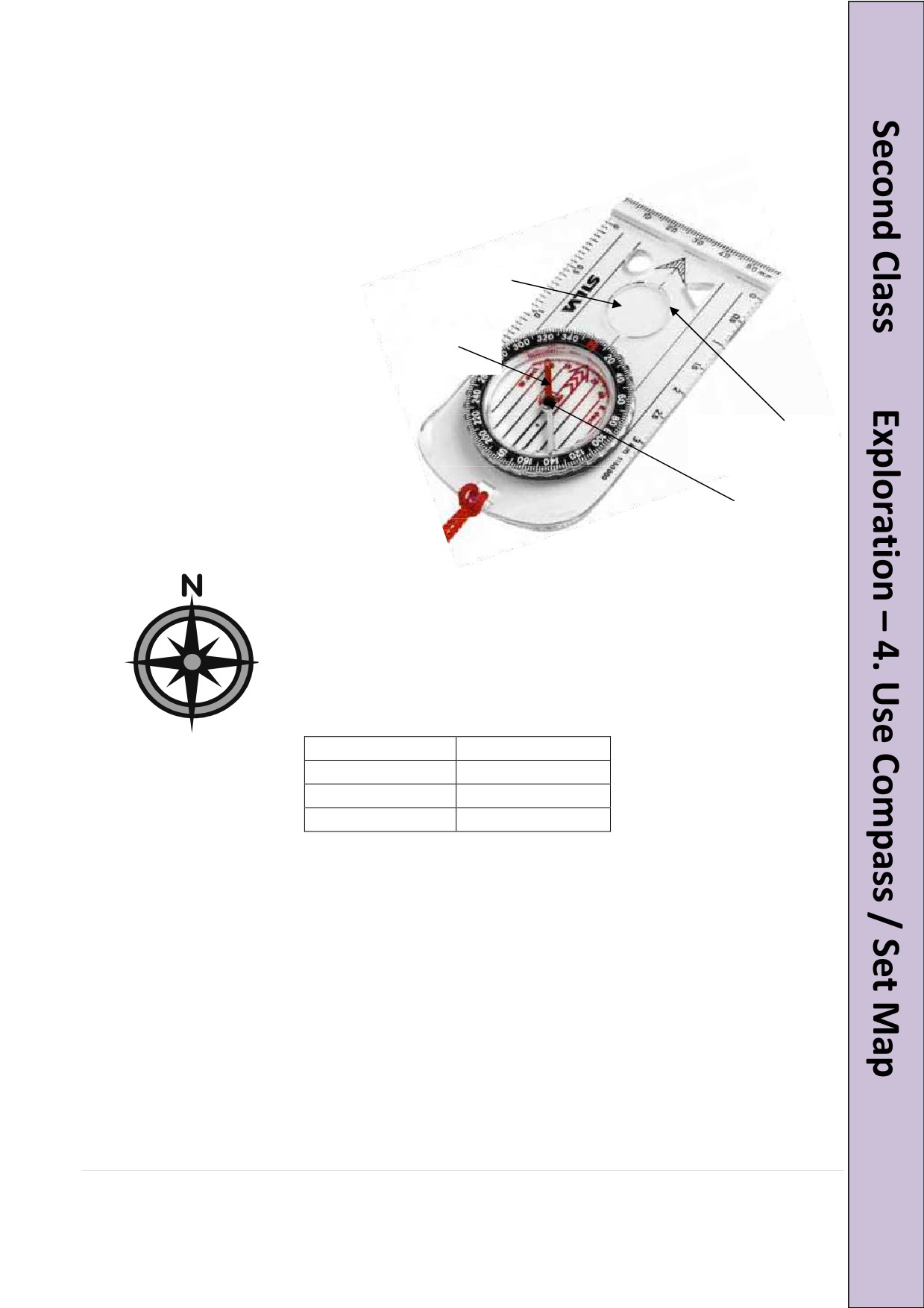
4. Know how to use a
compass and how to set a
map.
The first thing to remember is that
your compass is a very important
Baseplate
piece of safety equipment, and it is
worth buying a good reliable brand.
Dial
That doesn’t mean that you have to
spend a lot of money. Silva make
very good compasses designed for
schools and youth organisations that
Direction of travel
cost between £10 and £20.
arrow
The compass has three main parts, a
baseplate, dial and magnetic needle.
Magnetic needle
As well as the four cardinal points you know well, the compass dial is
W
E
marked with the degrees of a circle, with every 200 numbered, and every 20
marked with a white line. The ones you should remember are:
North = 00 or 3600
North East = 450
S
East = 900
South East = 1350
South = 1800
South West = 2250
West = 2700
North West = 3150
When using a compass, keep it well clear of magnetic metallic objects like knives, belt buckles, cars or
overhead power lines (magnetic fields) as this will affect the direction in which the compass points.
Setting a map
To set or orient the map, turn the map around until the North or top of the map is pointing towards the actual
North, and so that the features on the map are shown in relation to their position on the ground, you can set
the map by either using a compass of looking at features around you.
In the right hand margin of every Ordnance Survey map are three arrows. One points to magnetic North, one
to true North (the north pole) and one to grid North. The angle between magnetic North and grid North is
known as magnetic variation - which will be covered in more detail in First Class.
25 | P a g e
To set your map, using the compass, firstly line up the red arrow on the dial with the direction of travel arrow.
Then place the compass on the map with the edge of the baseplate running along one of the blue gridlines,
with the direction of travel arrow pointing to the top of the map. Now rotate the map until the red magnetic
needle lines up with the red arrow on the dial . Now you know which way you are facing, the direction of
North, and you can start to try and identify points on the ground from the map, or vice-versa.
You can set the map without using a compass by simply turning the map till it coincides with the ground
before you. This may mean that the map is sideways, or upside down, to you - do not worry. You can still
read it like that, and it means that the objects on the ground, which can not move, will still appear in the
correct place and where you expect them. Many people go wrong when map reading because they hold the
map like a book, with the writing the right way up, and turn left when they should be turning right, or spend
hours looking in the wrong direction for landmarks. Get the map set on your position and, as you move, keep
it that way.
26 | P a g e
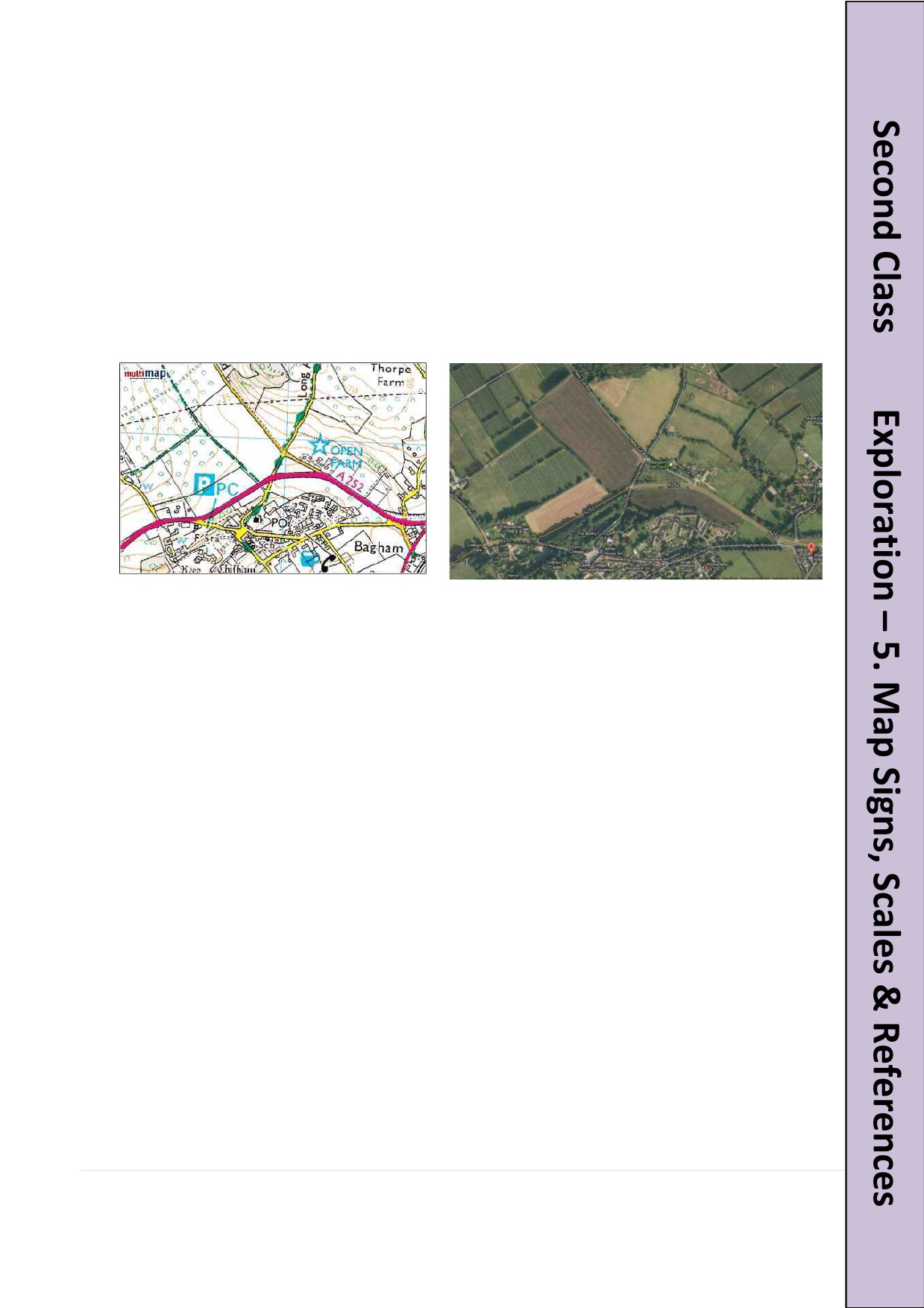
5. Using OS 1:50,000 or 1:25,000 maps show an understanding of conventional map signs, scales
and the use of map references.
All maps have a key, which tells you what all the symbols on the map are. Here is an example of how different
rights of way are shown on an OS 1:25,000 map. You will need to learn the most common symbols, and you
can play all sorts of games with the Scouts in your Patrol to help you remember them.
Maps are designed to show you in symbolic form all the things that you would see on the ground if you were
looking down at it, like transferring an aerial photograph into a set of shapes and symbols. See if you can find
a satellite view of your home on the internet, and then match that up to an OS map of the same
area.
Scale
To get all that detail onto a piece of paper, everything has to be shrunk down in proportion to the real world.
When we say the map is made on the scale of 1:50 000 (one to fifty thousand) it means that one unit on the
map represents 50,000 units on the ground - that means 1cm on the map will equal 50,000cms (or 500
metres) on the ground.
All maps have scales but the maps you will use most commonly during your time at Scouts are Ordnance
Survey maps with either a 1:25,000 or 1:50,000 scale. On these maps one grid square is equal to one
kilometre and the scale is printed on the bottom of the map.
Map References
Map or grid references are usually given in six-figure numbers, representing the grid square, and a particular
point within that square.
1:25 000 and 1:50 000 maps are divided into 1km grid squares by horizontal and vertical lines; each line is
identified by a two-figure number, and these give you the first of the numbers for the six-figure reference -
two vertical numbers and two horizontal numbers.
The vertical lines are known as “Eastings”, for although they run, individually, up and down the map, they
advance across the map from left to right, or heading from West to East - hence “Eastings”. The same applies
to the horizontal lines which advance in series up the map, from South to North, and are called “Northings”.
Where the two lines intersect you have a grid point, and you can express this by giving the numbers of the
grid lines, first the easting and then the northing, for example the highlighted square containing the church will
have the four figure reference 04 88. That defines a one kilometre square.
27 | P a g e
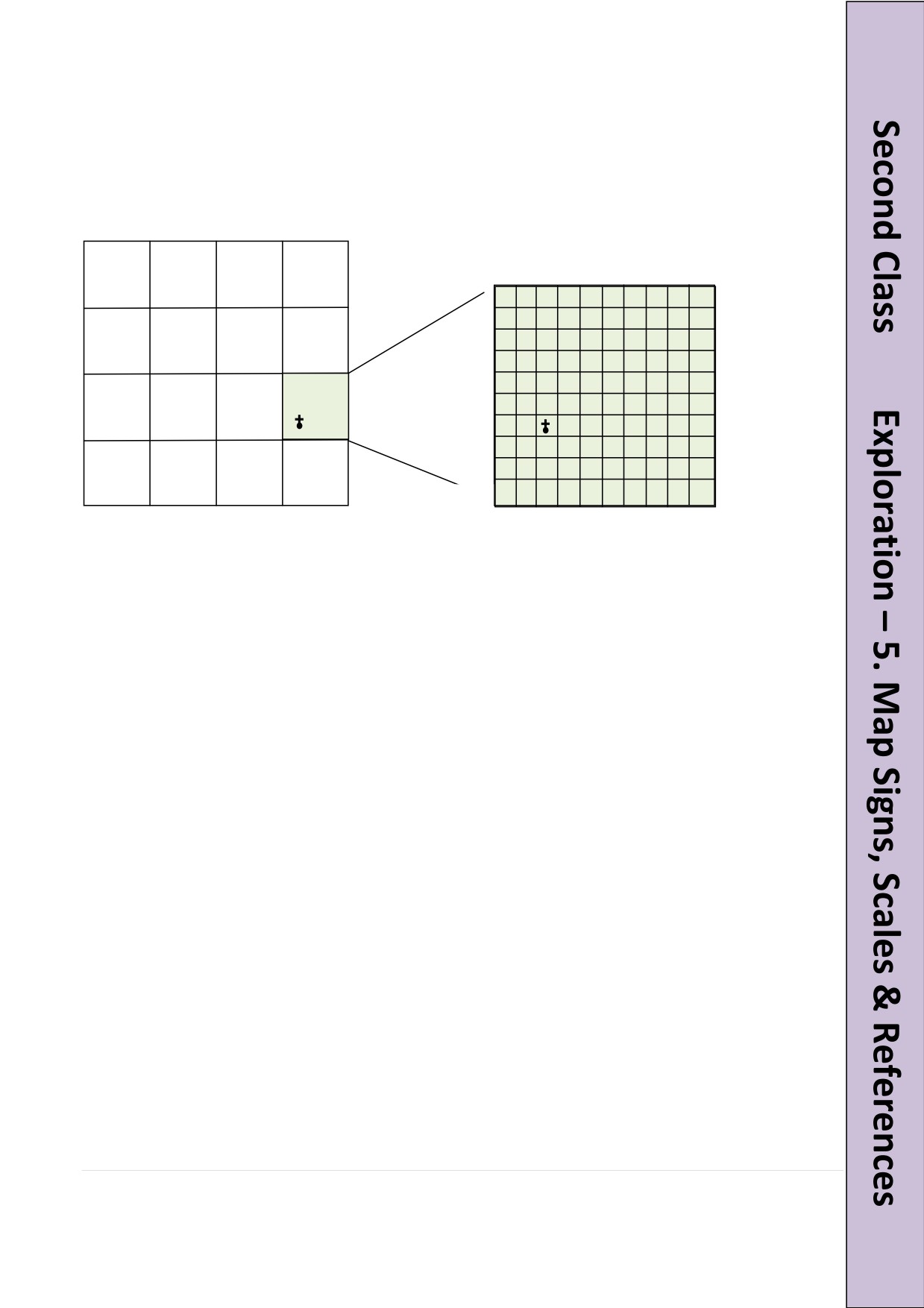
If you wanted to give the position of the church more accurately to find the point you require within that square
you divide the “Easting” and “Northing” lines into ten imaginary lines and pinpoint the spot by referring to the
intersection of the imaginary lines which would cut it. So the church is located at grid reference 042 883, and
that gives a far more accurate 100 metre square. Use the scale on the side of your compass to estimate these
imaginary lines quickly and accurately.
90
89
88
88
01
02
03
04
04
28 | P a g e
6. Show that you understand the Highway Code (particularly the sections for pedestrians, cyclists
and sign and markings).
The Highway Code covers all users of public highways not just people who are driving cars or other vehicles.
In this section are a few of the rules that apply to pedestrians and cyclists but you can get more information by
visiting www.highwaycode.gov.uk or going to your local library and looking at a copy of the Highway Code.
Walking
• Where there is a pavement or footpath, walk on it. Keep as far away from traffic as possible.
• Where there is no footpath, walk on the right hand side of the road to face the traffic coming towards
you. Walk one behind the other at bends in the road or at night or if there is a lot of traffic. Take
special care at right hand bends.
• If you are looking after somebody younger than you are, always hold their hand when using the road.
Be Safe, Be Seen
• It is difficult for a driver to see you in the dark or in bad weather. When you have to be out then,
always wear light-coloured or bright clothing. Fluorescent materials show up in daylight and at dusk.
Always wear or carry something reflective at night.
The Green X Code
First find a safe place to cross, then stop.
• It is safer to cross at subways, footbridges, islands, Zebra and Pelican crossings, or where there is a
police officer, school crossing patrol or traffic warden.
• If you cannot find any good crossing places like these, choose a place where you can see clearly
along the roads in all directions. Try not to cross between parked cars. Move to a clear space and
always give drivers a chance to see you clearly.
• Always STOP at the kerb and give yourself lots of time to have a good look all round.
o Stand on the pavement near the kerb.
o Do not stand too near the edge of the pavement. Stand a little way back from the kerb - where
you will be away from traffic, but where you can still see if anything is coming. If there is no
pavement, stand back from the edge of the road but where you can still see traffic coming.
o Look all round for traffic and listen.
o Traffic may be coming from any direction, so take care to look along every road, and listen
too, because you can sometimes hear traffic before you can see it.
• If traffic is coming, let it pass. Look all round again.
• When there is no traffic near, walk straight across the road.
o Do not cross unless there is a safe gap and you are sure there is plenty of time. If you are not
sure, don't cross. Always walk across quickly, don't run.
• Keep looking and listening for traffic while you cross.
Crossing at a Pelican crossing
• When there is a Pelican crossing, use it. Do not cross on the zigzag lines. At these crossings, traffic
lights control the traffic. Press the button and wait. When the red man signal is showing, do not cross.
29 | P a g e
The lights will soon change and a green man signal will appear. Look to make sure the traffic has
stopped, then cross carefully.
• When the green man signal begins to flash, you should not start to cross. However, if you have
already started, you will have time to finish crossing safely.
• Pelican crossing which goes straight across the road is one crossing, even if there is a central island.
Traffic must stop for you when the green man is showing. Some crossings do not go straight across
the road. Here you must press the button again on the central island to get the green man signal.
• At some Pelicans, there is a bleeping sound to tell blind people when the green man signal is
showing.
Crossing at a Zebra crossing
• If there is a Zebra crossing, use it. Do not cross on the zigzag lines - only on the black and white
stripes.
• Drivers need plenty of time to slow down and stop. Wait on the pavement near the kerb until all the
traffic has stopped before you start to cross.
• Remember, vehicles need more time to slow down if the road is wet or slippery.
• After traffic has stopped, walk across. Keep looking all round and listening in case a driver has not
seen you. Watch out for overtaking vehicles.
• If there is an island in the middle of the crossing, stop on it. Look all round and listen, and after the
traffic has stopped, walk across.
Crossing where there is an island in the road
• Use the Green Cross Code to cross to the island. Stop there and use the Code again to cross the
second half of the road. Remember to look all round and listen.
Crossing at a junction
• If you have to cross at a road junction, look out and listen for traffic turning the corner, especially from
behind you.
Crossing at traffic lights
• At some traffic lights there are red and green signals for pedestrians that tell you when to cross.
Always obey them.
Crossings controlled by police, traffic wardens or school crossing patrols
• When school crossing patrols, police officers or traffic wardens are controlling the traffic, wait until
they signal to you to cross the road. Always cross in front of them.
Crossing one-way streets
• Use the Green Cross Code. Check which way the traffic is going. Remember that in one-way streets
there will usually be more than one traffic lane going in the same direction. Do not cross until it is safe
to cross all the lanes of traffic.
Parked vehicles
30 | P a g e
• Try not to cross between parked cars. However, if there is nowhere else to cross, choose a place
where there is a space between two cars. Make sure neither car is about to move off. Walk to the
outside edge of the cars and stop.
• Here you can be seen by drivers and you can look all round for traffic. Use the Green Cross Code.
When it is clear, cross, still looking and listening as you go.
Crossing bus lanes
• In these lanes, buses may go faster than other traffic. Sometimes they go in the opposite direction.
Cyclists and taxis may also be using them so take special care when crossing.
Guard rails
• Guard rails are there to protect you. If you need to cross the road walk to the gap in the guard rails
and use the Green Cross Code. Never climb over or walk outside them.
Railway level crossings
• There are many kinds of crossings - all can be dangerous. They may have gates, barriers, or even no
barriers at all. There may also be warning lights or bells. You must never cross when red lights flash
or when you can hear warning sounds. Always stop behind the STOP line. Never go past a barrier
that is down. Remember, if the lights continue to flash after a train has gone, another train is coming.
It is not safe to cross until the lights go out.
• If there are no flashing red lights, warning sounds or gates, you should still stop, look and listen to
make sure it is safe to cross.
• You must always obey the instructions shown at crossings.
Cycling
• Riding a cycle which is too big or too small for you can affect your balance - make sure yours is the
right size for you.
• Make sure your cycle is safe to ride. The brakes must work properly and tyres should be in good
condition and pumped up. The chain should be correctly adjusted and oiled and a bell should be
fitted. Wear a cycle helmet - it will help to protect you if you have an accident.
• When you have to carry anything on your cycle, use a bike bag or panniers. Carrying things on your
handlebars makes steering difficult - they could also catch in the front wheel. Make sure that your
clothing does not get caught in the chain or wheels.
• Make sure that other road users can see you. Wear fluorescent materials in daylight and at dusk, and
something reflective at night. A cycle spacer may be helpful as a warning to other drivers. At night you
must have front and rear lights which work well, and a clean rear reflector. Spoke and pedal reflectors
are also useful.
• You should not ride on the pavement unless there are special signs allowing you to do so.
• Wheel your cycle to the edge of the kerb and, if safe, place it in the road. Get on your cycle and look
all round for traffic even if you have a mirror fitted. When it is safe to move off, signal with your right
arm if necessary. Then, with both hands on the handlebars, cycle away.
• Ride far enough from the edge of the road to avoid drains and gutters.
• Always keep both hands on the handlebars unless you are signalling.
• If riding with others on busy or narrow roads, you should ride one behind the other. Never ride more
than two side by side on any road.
31 | P a g e
•
Even if you are wheeling your cycle in the road, you must still obey traffic light signals and road signs.
You must also obey the signals made by police officers, traffic wardens or school crossing patrols.
•
Never hold onto any vehicle or another cyclist.
•
You must not carry a passenger on your cycle.
•
You should never lead an animal whilst cycling.
•
Before starting off, turning right or left, overtaking, or stopping, you must look behind and make sure it
is safe. Give a clear arm signal to show what you intend to do.
•
When turning from one road into another, look out for pedestrians who are crossing that road. Give
way to them.
•
If you want to turn right from a busy road, moving to the middle of the road may be difficult and
dangerous. It is often safer to stop on the left hand side before or after the junction and wait for a safe
gap in the traffic before walking with your cycle across the road. This is especially important in the
dark.
•
Watch out for traffic that may suddenly stop, turn left in front of you, emerge from a side turning or pull
away from the kerb. Long vehicles need room to turn so do not ride up beside them when they do so.
•
Only overtake when you are certain it is safe to do so. If you are overtaking parked vehicles, watch
out for them starting off while you are doing so. Look for car doors opening and for pedestrians
darting out into the road in front of you.
•
You should not wear a personal stereo whilst cycling. You can't hear the other traffic if you do, and
riding on the road needs your full attention.
•
Always park your cycle sensibly so that it is not in the way of other people. Lock it to prevent it being
stolen and have the frame stamped with your postcode.
•
You must stop for pedestrians on Zebra crossings.
•
Be ready to stop for the red light at Pelican crossings. When the amber light flashes, you may
continue if there is no body on the crossing.
•
Only ride in bus lanes if there is a cycle shown on the sign.
•
Be careful when cycling near horses and other animals. Give them plenty of room as you go by.
Animals are easily frightened by sudden noises so do not use your bell.
•
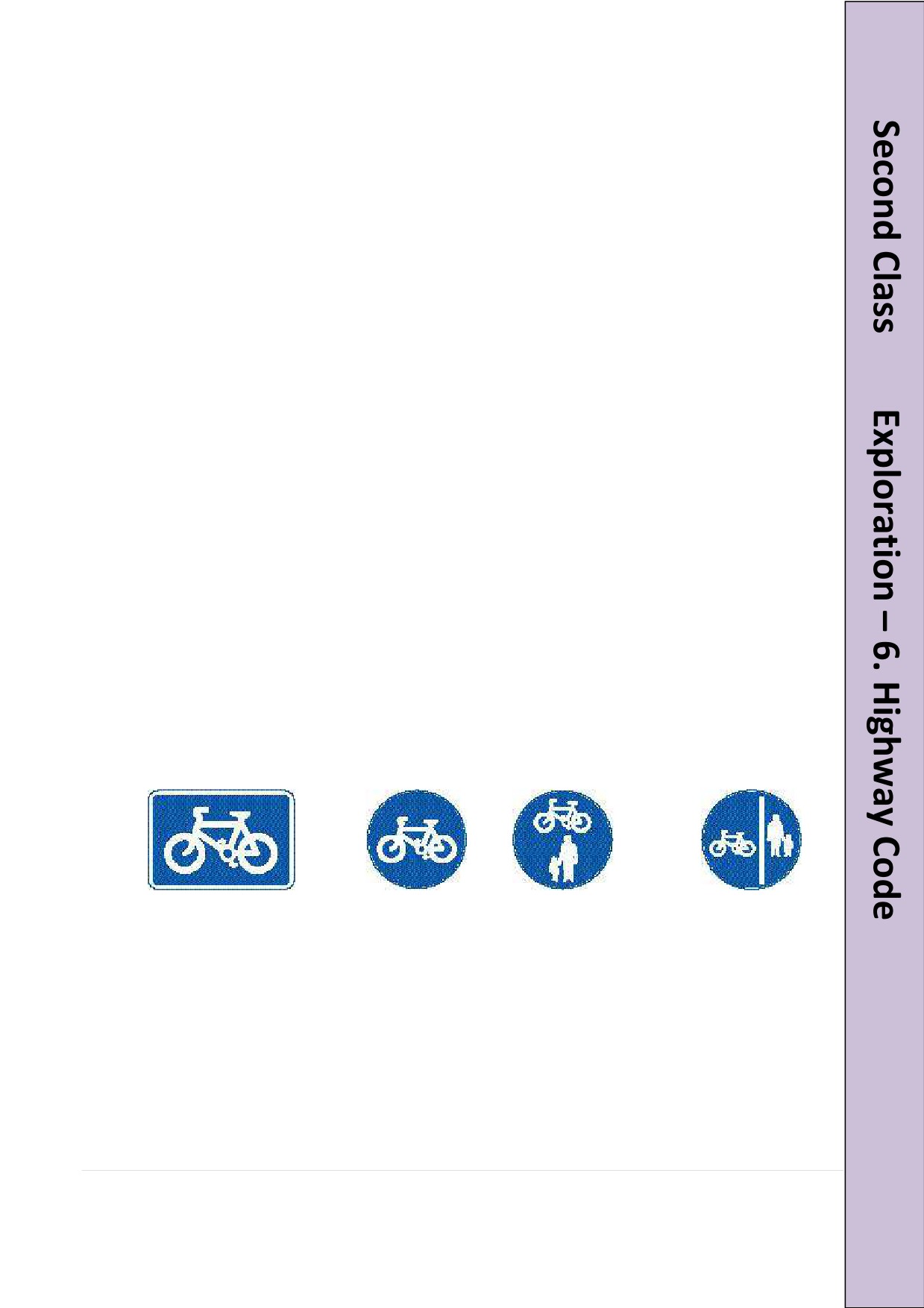
In some areas special cycle routes and paths are provided. You will see the following signs to show
the different paths. Always use them.
Recommended route for pedal
Cycles only
Shared with
Separate cycle and
cycles
pedestrians
pedestrians
• Roundabouts can be difficult for cyclists to use safely. If you are not sure it is safe, get off your cycle
and walk. When riding into a roundabout you must give way to traffic coming from your right. Look out
for vehicles which may turn in front of you.
• When cycling in the dark or at dusk, you must have a white front lamp, a red rear lamp and a red
reflector. Wear something reflective and fit spoke reflectors. If you have dynamo lighting, remember
the lights go out when you stop. When other vehicles are using their lights, use yours too.
32 | P a g e
• If you want to turn right, it is more difficult and dangerous to move to the middle of the road when it is
dark.
• Stop on the left hand side and wait for a gap in the traffic before you turn.
Riding in Cars
• When you get in or out of the car, use the door nearer the pavement. Make sure the doors are shut
properly. Only get out when you are told to do so and when you are sure it is safe.
• Seat belts or safety harnesses must be worn at all times. Lap belts must only be used of all other seat
belts are in use.
• Keep your hands away from door handles while the car is moving. Only open doors or windows after
being given permission.
• Never lean or wave out of the window or do anything to distract or offend other drivers. Do not throw
or hang anything out either.
• A driver uses the mirror to see the traffic behind. Do not block the view.
Using Buses
• When you wait for a bus, stand on the pavement well back from the traffic. Make sure there is room
for other people to walk along. It is dangerous to play around at bus stops.
• Wait for people to get off the bus before you get on.
• Drivers are responsible for your safety. Always do what they tell you and do not distract them with bad
behaviour.
• If you have to cross the road after getting off a bus, wait for it to move away. You will then be able to
see traffic clearly and drivers will be able to see you.
33 | P a g e
7. Show the ability to use a telephone and demonstrate knowledge of your locality by:
• using local bus and railway timetables.
• knowing local landmarks, through-road routes, public transport facilities and utilities
serving your area.
Many of you will have a landline telephone in your house and you may well have your own mobile phone. The
main difference when dialling a number from these two different phones is that when;
• Dialling from a mobile you always have to insert the area code first.
• Whereas if you make a call from a landline you only insert an area code before the phone number
if you are making a telephone call to someone living in a different area.
• U.K. area and international codes are found in the front of your local phone book and you just dial
this number before the number of the person you want to phone.
Here are some examples;
• If you wish to call Manchester from London the code is 0161
• Birmingham is 0121
• Glasgow is 0141
• If however you wanted to call the U.K. from abroad you would have to insert 00 or + (the
international access code) then 44 for the U.K. and drop the 0 from the area code.
Remember if you are using your phone to contact the emergency services:
• The UK number of 999 doesn’t work abroad - you will need to check what the code is in the
country you are in
• You don’t need to have any credit on your mobile phone to call the emergency services
• A call to the emergency services will hunt across all networks to give you the best possible signal,
and will often work even if your phone shows that it has no signal.
Bus and rail time tables
• You will be able to get hold of a copy of these by going to your local bus, train station or library or
by looking on the internet.
• You should know where the major roads go from and to, and their names. Where the nearest
railway stations are, and the services that operate, and the destinations of the buses that pass
through your town or village, and their respective bus stops.
• Know the whereabouts of the police, fire and ambulance stations, the local library and telephone
boxes, and the nearest hospital, doctor, dentist and vets. A good Scout would also know places of
local interest, such as museums, parks, cinemas and other leisure sites.
34 | P a g e
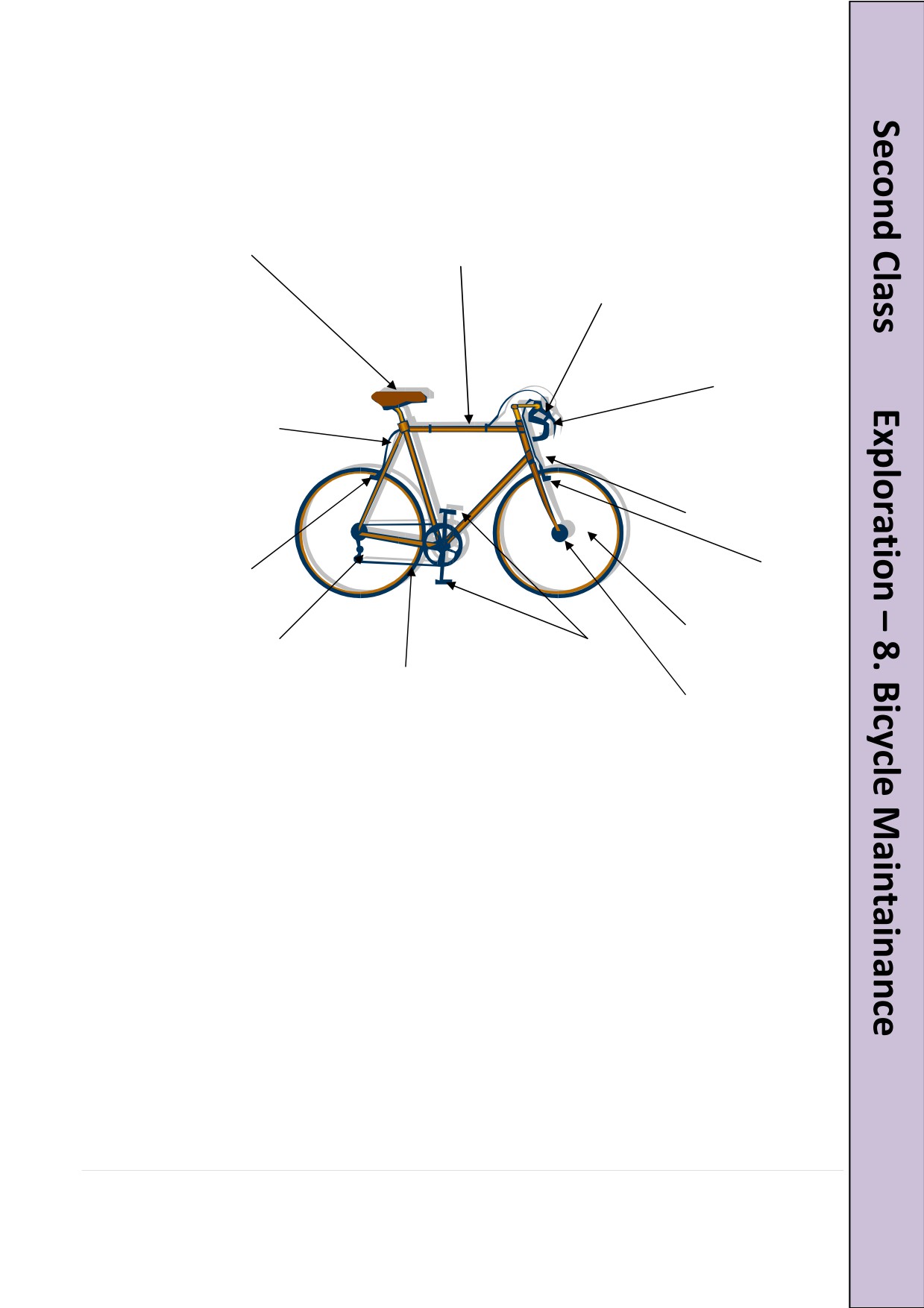
8. If you have the use of a bicycle, demonstrate that it is kept properly maintained and you are
able to effect minor repairs.
Saddle
Frame
Handle Bars
Brake Lever
Rear Brake Cable
Front Brake Cable
Rear Brake Pad
Front Brake Pad
Front Spoke
Pedals
Derailleur
Chain
Front Wheel Nut
When using a bike it is important that you follow the Highway Code and that you wear a helmet and visible
clothing at all times.
When riding your bike at dusk, dawn in the dark you need to have a white front light and red rear light fixed to
your bike and you need to wear reflective clothing.
It is also vital that you keep your bike well maintained so it is safe to ride. You need to make sure that:
• The chain is well oiled.
• Tyres are inflated to the correct pressure.
• Brake cables are undamaged and tight enough to be effective.
• The saddle and handle bars are fixed securely and at the right height for you to ride the bike.
• Front and rear wheel nuts are securely fastened.
• Front (white) and rear (red) reflectors are attached to bike and clean.
The most common repair you will need to carry out on your bike is repairing punctures. Puncture repair kits
are available from most petrol stations and bike shops.
35 | P a g e
To repair a puncture you need to:
• Remove the wheel from the bike by turning both wheel nuts anti-clockwise at the same time in
opposite directions.
• Then remove the tyre using tyre levers, being careful not to cause any more damage to the inner
tube.
• Unscrew nut holding inner tube valve in place and remove inner tube.
• Inflate inner tube and place in bowl of water to locate the hole, mark with a wax crayon.
• Follow manufactures instructions for applying repair patch to inner tube.
• Check repair has worked by checking for leaks with a bowl of water.
• Check the inside of tyre for any sharp objects still lodged in rubber that may have caused the
puncture, and remove them.
• Replace deflated inner tube back into wheel and screw valve back into place.
• Attach tyre back to wheel using tyre levers, again being careful not to damage inner tube.
• Attach wheel to bike and inflate tyre to the correct pressure.
36 | P a g e
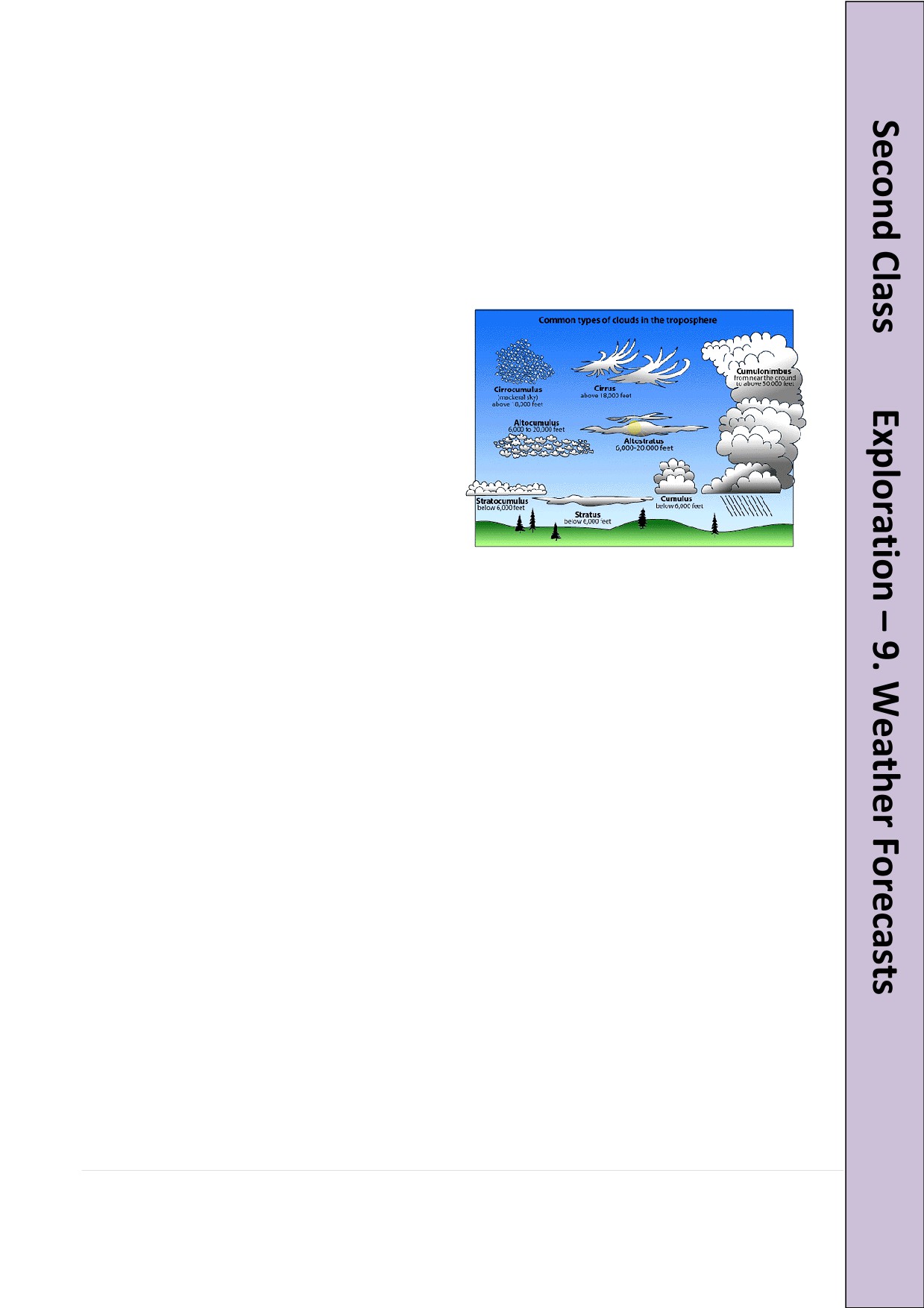
9. Know where to find up to date weather forecasts, whilst at home and in camp.
The Norwegians have a saying “There is no such thing as bad weather, just the wrong sort of clothes”, and
believe me the Norwegians experience all sorts of weather, so they should know.
This also applies to us as Scouts, as long as we are prepared and dress correctly we should be able to carry
on with most Scouting activities whatever the weather. So knowing what the weather forecast is, will help us
be prepared:
• To wear the right clothing
• To keep our wood dry for the fire
• To pack the right kit for a hike
• To close up our tents before it rains
• To build our fire in the right place so the
smoke blows away from our sleeping tent
• To pitch our tents in an area that won’t flood
• To wear sunscreen and a hat
For Second Class you don’t need to be able to understand weather maps - you just need to know what is
forecast for the area that you are in.
The main sources of forecasts are:
• TV - look for the regional forecasts not the national ones
• Radio - tend to be more general than TV, unless you listen to local radio
• Newspapers - these don’t normally go into much detail
• The internet - the BBC website gives excellent forecasts by time of day for most major towns, and
this is probably the best source if you have internet access.
• Phone weather services - normally premium rate, but good local detail
At camp it is obviously more difficult to get reliable information, and phone, radio and newspapers may be
your best - in some tourist areas the tourist information office or other shops will display a forecast, as do
some campsites.
37 | P a g e
10. Go by day, on foot, with other Scouts on a journey of 10 - 15 kms. The journey will have a route
laid down by the Scout Officer and a simple objective will be given. Take responsibility for
leading and navigating at least 2 km of the journey. A verbal report, from notes, must be made
on your return. (Normally to be taken toward the end of 2nd Class)
Your journey should be taken when you have done most of the rest of your 2nd Class training, that means that
you will have already learned about how to navigate with a map and compass safely, and that you know
enough first aid to treat any small injuries.
For this, you will have to ask your Scout Master for the route you are to follow, and sort
out who is going with you (there must be at least four of you in the group, but probably
no more that six). You will have an objective to go to, or do, and this must be completed
to the best of your ability. Sometimes it will be a church, on which you will be asked
questions, or a good turn, which you will have to prove that you have done. Either way,
the questions you will be asked will not be the obvious ones for the situation, so keep
your eyes and ears open. Take photos - you may discover some fascinating things as
you walk.
This may be the first time that you have ever walked this far without an adult with you. Enjoy the adventure,
and make sure that you follow your Scout Master’s instructions about where they will meet you at checkpoints
to make sure you are safe. Normally you will agree a time that you will meet at a checkpoint, if you get there
early just wait until the adult that is meeting you arrives - it’s a good chance to have a rest and snack and plan
the next bit of your route. If you are running late for some reason, keep going and get to your checkpoint as
soon as you can - it won’t be the first time that Skip has had to wait for Scouts who have got a bit lost.
Don’t worry if you do get a little bit lost - the important thing is to realise quickly, and work out how to get back
on route. You should be able to do that by using all the clues on your map - its normally far more reliable than
asking a nice person out walking their dog!
Even though you are taking turns at being the leader and doing the navigating, that doesn’t mean that you can
just be a “follower” for the rest of the time. Keep track of where you are, and check that you are going in the
right direction - and if you think that you are going wrong, speak up - have a team discussion and agree on
what to do next. Every one will be happy if you help them avoid walking 2 kms in the wrong direction.
You will have arranged with Skip how to make contact if you have a problem, and you will also have agreed
that in some situations you may return to your last checkpoint, or to a road where you can be easily found.
Whatever arrangements you have made - stick to them, and stick together.
When you return, and give your report to your Scout Master, try to make it interesting; don't forget that he may
have to listen to several in quick succession, and they can get boring, do not miss anything out. If you fell in
the river, instead of crossing it by the bridge, put it into the report, and give your Scout Master a laugh. If you
lose your woggle, make another one, and tell your Scout Master how you came to lose it, how long you looked
for it, and what you did about it when you could not find it. It makes the report more realistic and do not forget
to take notes of the objective.
Remember to take along a compass, the correct map of the area, emergency rations and a first-aid kit.
38 | P a g e
11. Tie the following knots and know their uses: Timber hitch, Killick hitch, Fisherman's knot and
Harvester's hitch.
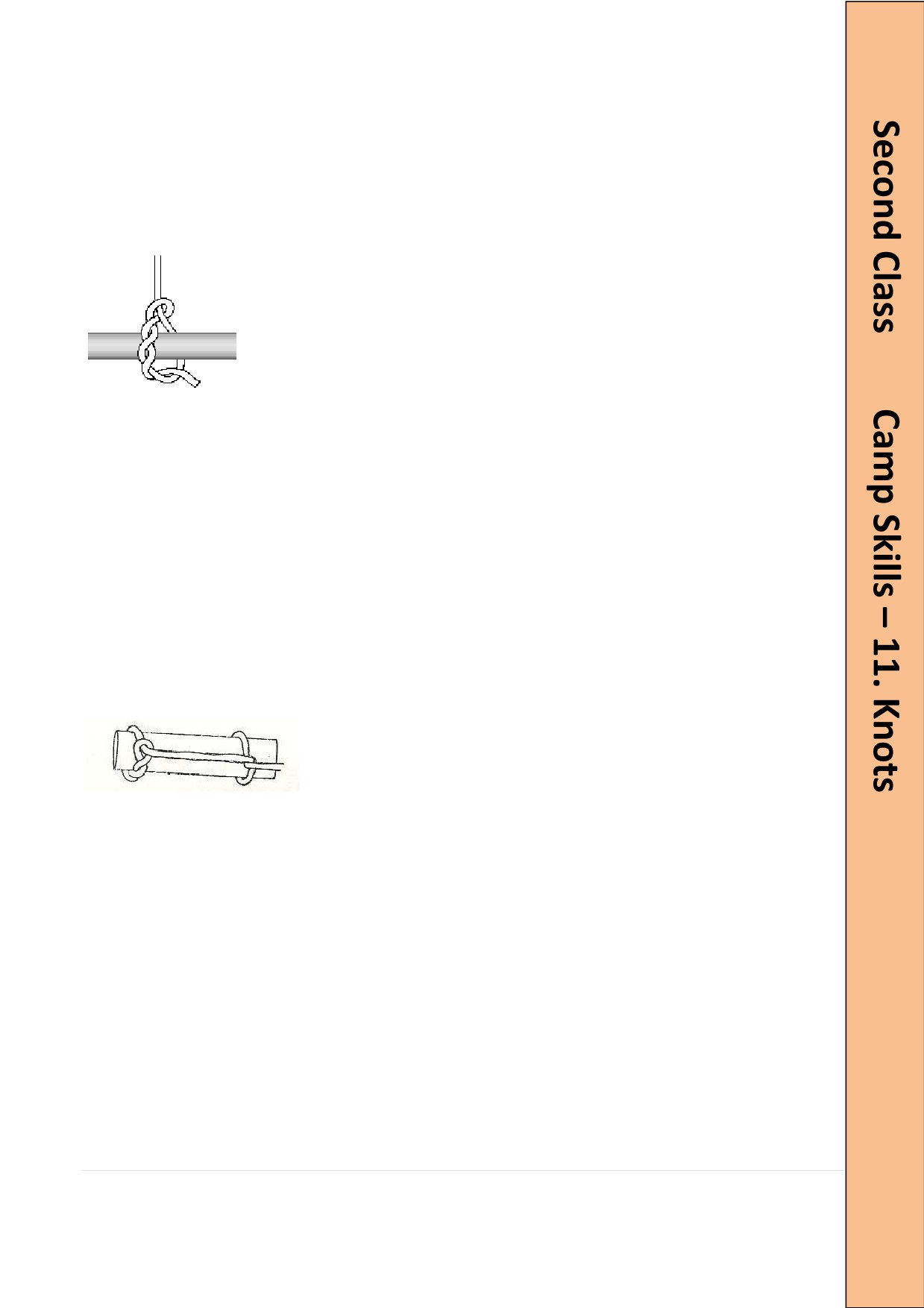
Timber Hitch & Killick Hitch
This is one of the few classical hitches that is truly useful and reliable. Its security is
admirable and it always unties without trouble after use. Just remember that a true
timber hitch must have at least three tucks trapped against the object.
Beware of using this hitch around a very large object that might keep the tucks from
being clamped down securely. In such case you might have to put tucks of rope
further back to ensure that three tucks stay clamped no matter what happens. Of
course, if you decide to use the timber hitch for any lengthwise pull, you should make sure that any sliding
motion will cause your tucks to tighten, not loosen.
The one bad thing about this hitch is that it is so simple, that some do not take the time to really study and
memorise it, and will sometimes wrap the rope around the wrong leg, which will not result in anything but
junk. Remember to wrap the rope back around the leg from where it just came (left side as shown above). If
you did, it should form an eye for the standing part to run through.
The knot, as with the clove hitch, can be used for fastening the rope to a spar. The official use, however, is for
tying together a bundle of poles, so as to be tight enough for transportation. Also, when the knot is undone, it
can be easily pulled out, which is not always the case with other knots.
Firstly, the rope is pulled under the bundle of poles. It then takes a turn round itself, to go back the way it
came. However, instead of going straight back round the bundle, it wraps round and round itself.
Killick hitch
The rope can then be laid along the wood in the direction of eventual pull,
and a half hitch is thrown round the end of the poles. The knot is then known
as a killick hitch.
When the bundle of poles is consequently either lifted, or pulled, the knot pulls tight against the poles, trapping
the twisted part of the rope between the wood, and the original turn round it. The knot will easily fall apart
when need be.
39 | P a g e
///////////////////////////////////////