Snowmobile Arctic Cat (2007 year). Instruction - part 33
 

  Index      Snowmobiles / ATV     Snowmobile Arctic Cat - instruction 2007 year


Search            


Content   ..  31  32  33  34   ..


Snowmobile Arctic Cat (2007 year). Instruction - part 33


3-10

0740-111

0741-837

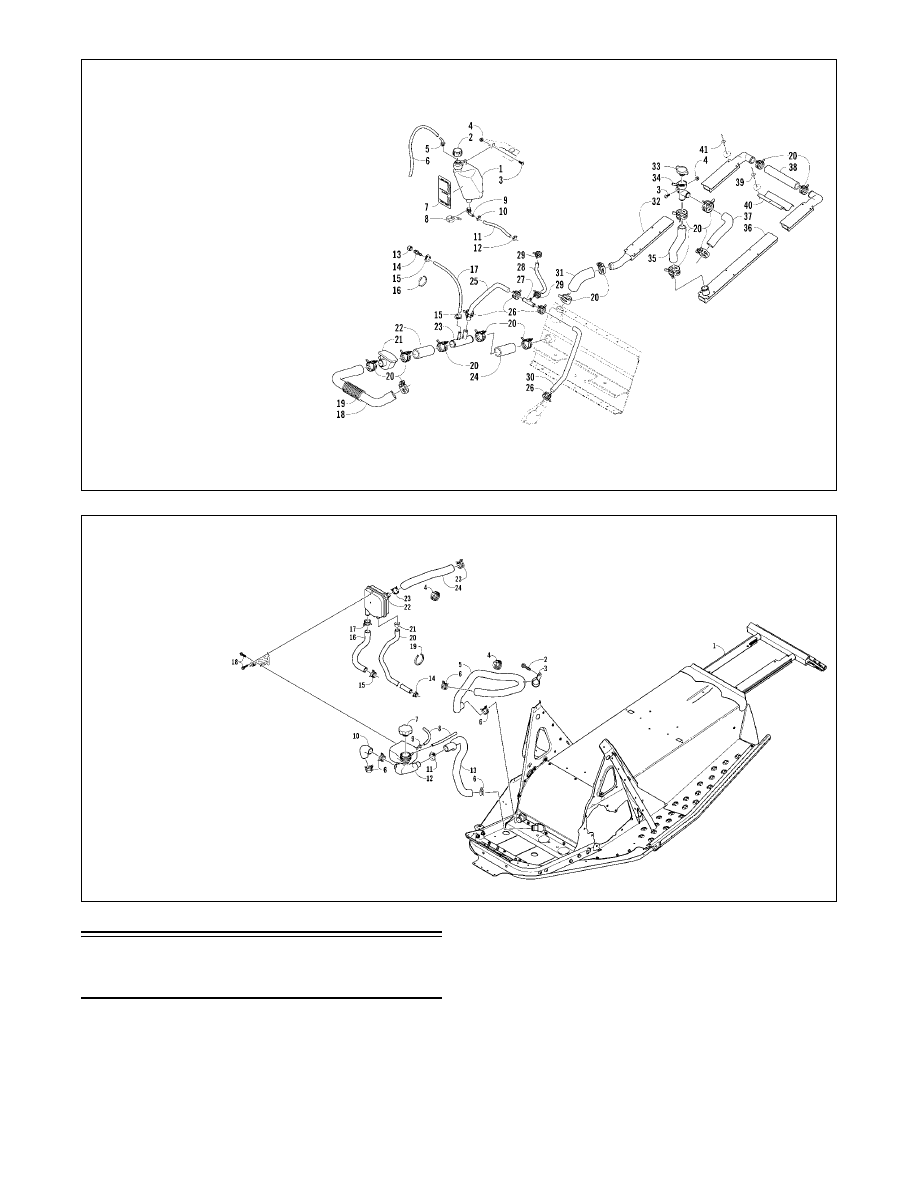
Liquid Cooling 

System 

(660 cc)

The liquid cooling system consists of heat exchang-

ers, water pump, and thermostat. The system should

be inspected for leaks or damage whenever an over-

heating problem is experienced.

DRAINING COOLING SYSTEM

„ NOTE: On the turbo models to drain the coolant,
remove the two flange nuts securing the inter-
cooler to the bracket, remove  the five springs
securing the exhaust resonator, and lift up on the
intercooler and remove the exhaust resonator.
Route the drain hose out of the exhaust outlet in
the belly pan.

KEY

1. Coolant Tank

2. Cap

3. Machine Screw

4. Lock Nut

5. Vent Fitting

6. Vent Hose

7. Decal

8. Teflon Tape

9. Elbow Fitting

10. Clamp

11. Hose

12. Clamp

13. Plug

14. Fitting

15. Clamp

16. Cable Tie

17. Hose

18. Hose

19. Protector

20. Clamp

21. Inline Heater

22. Hose

23. T-Fitting

24. Hose

25. Hose

26. Clamp

27. Y-Fitting

28. Hose

29. Clamp

30. Hose

31. Hose

32. Heat Exchanger

33. Filler Neck Cap

34. Filler Neck

35. Hose

36. Heat Exchanger

37. Hose

38. Hose

39. Rivet

40. Guard

41. Rivet

T660 Turbo Trail

KEY

1. Heat Exchanger

2. Cap Screw

3. Hose Bracket

4. Cable Tie

5. Engine/Heat 

Exchanger Hose

6. Hose Clamp

7. Cap

8. Hose

9. Hose Clamp

10. Coolant Tank/Engine 

Hose

11. Hose Clamp

12. Coolant Tank

13. Heat Exchanger Hose

14. Hose Clamp

15. Hose Clamp

16. Breather Hose

17. Hose Clamp

18. Cap Screw

19. Cable Tie

20. Breather Hose

21. Hose Clamp

22. Separator Tank

23. Hose Clamp

24. Breather Hose

Jaguar Z1

3-11

3

AO359

AO360

1. Place a drain pan under the right-side belly pan

and position the pan in front of the chain case. 

2.  On non-turbo models, locate and disconnect the

air silencer drain hose from the fitting at the bot-

tom of the belly pan in front of the chain case;

then cut the cable tie that secures the coolant

drain hose to the engine coolant hose on the tim-

ing cover side of the engine compartment.

AO175

3. Using a suitable clamping device, pinch off the

coolant drain hose and remove the drain plug.

AO176

4. On non-turbo models using a length of 1/2 in.

I.D. hose, slide it over the end of the coolant

drain hose; then attach the other end to the air

silencer drain hose fitting located in the bottom

of the belly pan.

AO177

5. Remove the radiator cap and install non-pressur-

ized Coolant Cap (p/n 0644-156).

AO178

6. Apply 5-8 psi to the coolant system through the

coolant overflow tube and continue until the

coolant stops draining from the system.

3-12

AO179

7. Install the drain plug; then remove clamping

device.

8. On non-turbo models, connect and secure the air

silencer drain hose.

„ NOTE: On the turbo models, route the drain hose
out of the exhaust outlet, install and secure the
exhaust resonator with the five springs, and
secure the intercooler to the bracket with the two
flange nuts.

FILLING COOLING SYSTEM

1. Elevate the front of the snowmobile 20-25 cm

(8-10 in.).

2. Remove the coolant tank cap, add recommended

coolant, and check coolant level. The coolant

tank should be filled to the coolant level line.

„ NOTE: Mix coolant for a temperature of -36°C
(-33°F). Follow mixing recommendations of the
manufacturer of the coolant.

3. Install the coolant tank cap; then start the

engine. Run the engine at 3000-3500 RPM for

five minutes or until the bottom heat exchangers

become hot to the touch. Stop the engine and

allow the system to cool.

4. Loosen the plug on the purge tank (located in

front of the valve cover) and allow any trapped

air to escape.

AO371A

5. Lower the front of the snowmobile. 

6. Check the coolant level. Add coolant as required

to the coolant tank (coolant tank should be filled

to coolant level line). Repeat procedure until

coolant level stabilizes in the coolant tank. 

„ NOTE: It may be necessary to apply a small
amount of pressure to the system with a pressure
tester to help purge air from the system.

INSPECTING COOLANT HOSES 
AND CLAMPS

All coolant hoses and connections should be

checked annually for deterioration, cracks, and

wear.

All coolant hoses and clamps should be replaced

every four years.

INSPECTING THERMOSTAT

1. Inspect the thermostat for corrosion, wear, or

spring damage.

2. Using the following procedure, inspect the ther-

mostat for proper operation.

a. Suspend the thermostat in a container filled

with water.

b. Heat the water and monitor the temperature

with a thermometer.

c. The thermostat should open at 85°C (185°F).

Once the thermostat starts to open, IMMEDI-

ATELY remove the thermostat as it will lock

in the open position if allowed to open fully.

! CAUTION

Be sure the cooling system is throughly filled using
the following procedure.

! CAUTION

It is extremely important that the Filling Cooling Sys-
tem procedure is followed very closely and the cool-
ing system is properly filled. If the system isn’t
properly filled, piston damage will occur.

3-13

3

„ NOTE: The thermostat is of the lock-open type. If
the thermostat is ever allowed to fully open, it will
remain open and replacement will be necessary.

Liquid Cooling 

System 

(1100 cc Z1)

The liquid cooling system consists of a heat

exchanger, water pump, and thermostat. The system

should be inspected for leaks or damage whenever

an overheating problem is experienced.

DRAINING COOLING SYSTEM

1. Open the right-side access panel.

2. Remove the hairpin clip and springs securing

the exhaust resonator to the chassis; then

remove the resonator.

3. Remove the hose clamp from the coolant hose

(A) connecting the water pump to the right side

of the oil cooler. Clamp off the coolant hose;

then with a drain pan positioned under the cool-

ant hose, remove the hose from the water pump

and tip the hose downward allowing the coolant

to drain completely.

ZJ101A

4. Apply 5-8 psi to the coolant system through the

coolant overflow tube and continue until the

coolant stops draining from the system.

FILLING COOLING SYSTEM

1. Elevate the front of the snowmobile 30 cm (2

in.).

2. Remove the coolant tank cap, add recommended

coolant, and check coolant level. The coolant

tank should be filled to the coolant level line.

„ NOTE: Mix coolant for a temperature of -36°C
(-33°F). Follow mixing recommendations of the
manufacturer of the coolant.

3. Loosen the coolant bleed screw located between

the exhaust ports of the cylinder head; then with

no more visible signs of air, tighten the bleed

screw.

4. Install the coolant tank cap; then start the

engine. Run the engine at 3000-3500 RPM for

five minutes or until the bottom heat exchangers

become hot to the touch. Stop the engine and

allow the system to cool.

5. Lower the front of the snowmobile. 

6. Check the coolant level. Add coolant as required

to the coolant tank (coolant tank should be filled

to coolant level line). Repeat procedure until

coolant level stabilizes in the coolant tank.

„ NOTE: It may be necessary to apply a small
amount of pressure to the system with a pressure
tester to help purge air from the system.

INSPECTING COOLANT HOSES 

AND CLAMPS

All coolant hoses and connections should be

checked annually for deterioration, cracks, and

wear.

All coolant hoses and clamps should be replaced

every four years.

INSPECTING THERMOSTAT

1. Inspect the thermostat for corrosion, wear, or

spring damage.

2. Using the following procedure, inspect the ther-

mostat for proper operation.

a. Suspend the thermostat in a container filled

with water.

b. Heat the water and monitor the temperature

with a thermometer.

c. The thermostat should open at 85°C (185°F).

Once the thermostat starts to open, IMMEDI-

ATELY remove the thermostat as it will lock

in the open position if allowed to open fully.

! CAUTION

Be sure the cooling system is thoroughly filled using
the following procedure.

! CAUTION

It is extremely important that the Filling Cooling Sys-
tem procedure is followed very closely and the cool-
ing system is properly filled. If the system isn’t
properly filled, piston damage will occur.


Content   ..  31  32  33  34   ..