Snowmobile Polaris Rush (2010 year). Instruction - part 21
 

  Index      Snowmobiles / ATV     Snowmobile Polaris Rush - instruction 2010 year


Search            


Content   ..  19  20  21  22   ..


Snowmobile Polaris Rush (2010 year). Instruction - part 21


85

MAINTENANCE

Cooling System

Coolant

The coolant supplied in the system at the factory is a 50/50 mixture of 

ethylene-glycol and distilled water, which will provide adequate freeze 

protection under most conditions. If the vehicle will be stored or oper-

ated at extremely low temperatures, greater protection may be required. 

Please see your Polaris dealer. 
When adding or changing coolant, Polaris recommends using Premium 

60/40 anti-freeze coolant, which is already premixed and ready to use. 

Do not dilute with water. Never exceed a 60% antifreeze/40% water 

mixture.   See page 110 for Polaris products.
Never add tap water to the cooling system. Minerals cause deposits and 

may react adversely with the metals in the engine and cooling system.

n

Coolant Level

The engine coolant level is controlled by the recovery system. The 

recovery system components are:
• Coolant bottle/overflow tank
• Pressure cap
• Connecting hoses
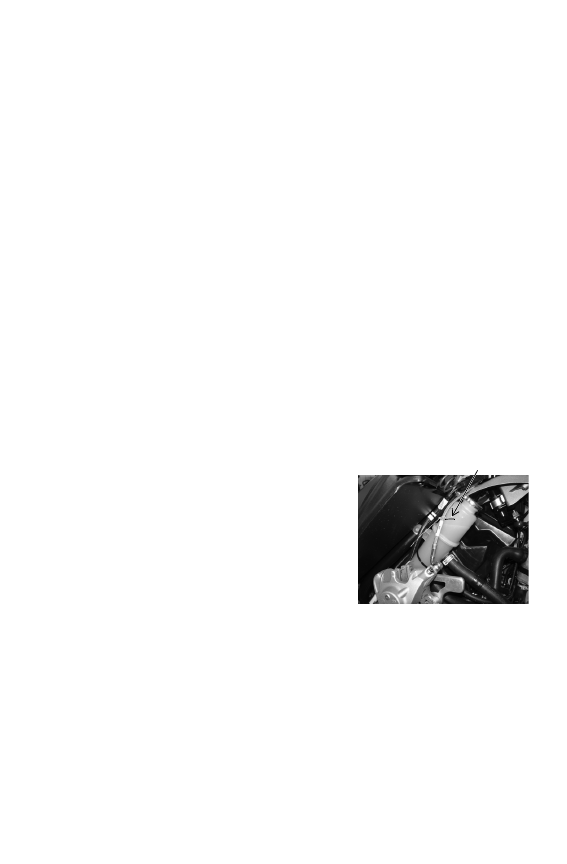
Always maintain the coolant level at or 

slightly above the FULL COLD mark on 

the coolant bottle (when the engine is 

cold).
1. Stop the engine. 
2. Open the right side panel. 
3. View the coolant level in the coolant 

bottle. 

4. Add coolant as needed.

NOTICE: Operating the snowmobile with insufficient coolant will result in over-

heating and serious engine damage. Always maintain the coolant 

level as recommended.

“Full Cold” Mark

86

MAINTENANCE

Cooling System

Engine Overheating

The over-temperature indicator on the 

instrument cluster will illuminate when the 

engine is overheating. The indicator will 

flash when engine temperature reaches 

critical levels. 
Illuminated Indicator
Take action to cool the engine:
• Drive in loose snow.
• View the coolant level. Do not open the 

pressure cap while the engine is hot

Add coolant if the level is low.

• Stop the engine and allow it to cool down.
If you must continue to operate while the indicator light is illuminated

drive slowly and stop the engine frequently to allow it to cool down.
Flashing Indicator
If the indicator flashes, continued operation could result in serious 

engine damage. The system will automatically reduce engine power and 

create a misfire condition. Stop the engine immediately. Allow the 

engine to cool down.
If engine overheating seems to be caused by something other than poor 

cooling conditions, see your dealer for service.

Flushing the Cooling System

To ensure that the coolant maintains its ability to protect the engine, 

drain the system completely every two years and add a fresh mixture of 

antifreeze and distilled water. This service must be performed when the 

engine is cold. Ask your Polaris dealer to check the coolant when he 

performs the fall tune-up on your snowmobile.

87

MAINTENANCE

Cooling System

Bleeding the Cooling System 

CAUTION! Steam and hot liquids will cause burns to your skin. Never bleed the 

cooling system or remove the pressure cap when the engine is warm or hot.

Use of a non-standard pressure cap will not allow the recovery system to 

function properly. If the pressure cap needs replacement, contact your 

dealer for the correct part.

NOTICE: If coolant flow becomes restricted or plugged, coolant loss, air lock or 

engine damage may result.

1. Position the vehicle so that the top of the tunnel is level. Elevate the 

front of the vehicle slightly if necessary.

2. Make sure the engine is cold before continuing.
3. Remove the right side panel. 
4. Fill the coolant bottle with properly mixed coolant to the maximum 

mark. Do not install the pressure cap at this time.

5. Remove the bleed screw from the water outlet manifold and/or the 

thermostat housing. Allow the coolant to bleed through the system 

until it runs out the bleed holes. Reinstall the bleed screw into the 

manifold.

6. Add coolant to the coolant bottle to the maximum mark.
7. Reinstall the side panel. Always ensure that the hood and side pan-

els are securely in place before starting the engine.

8. Start the engine and run at a fast idle for two to three minutes. 

Loosen the bleed screw occasionally to purge any trapped air.

TIP: Engine temperature should reach 130

_

 F (54

_

 C) before continuing. 

9. Stop the engine and check the coolant bottle level. Add coolant as 

needed. Reinstall the side panel.

10. Carefully and briefly touch the top of the tunnel cooler under the 

seat. If the system is bled properly, the cooler will be warm to the 

touch. If not, repeat step 8. Lift the front of the snowmobile slightly 

to assist in the bleeding.

11. Remove the side panel. Reinstall the pressure cap. Reinstall the side 

panel.

12. Carefully lower the front end of the snowmobile.

88

MAINTENANCE

Exhaust System

Check the exhaust system for wear or damage at approximately 2000 

miles (3200 km). Always allow the engine and exhaust system to cool 

completely before inspecting. 

CAUTION! Hot exhaust system parts can cause burns. Allow adequate time for 

the exhaust system to cool. Never perform this procedure with the engine 

running.

1. Open the side panels and remove the hood. See page 77.
2. Inspect the muffler and pipes for cracks or damage.
3. Check for weak or missing retaining springs or damper/support 

grommets.

4. Check for loose clamps on the pipe covers.


Content   ..  19  20  21  22   ..