Snowmobile Polaris Rush (2010 year). Instruction - part 22
 

  Index      Snowmobiles / ATV     Snowmobile Polaris Rush - instruction 2010 year


Search            


Content   ..  20  21  22  23   ..


Snowmobile Polaris Rush (2010 year). Instruction - part 22


89

MAINTENANCE

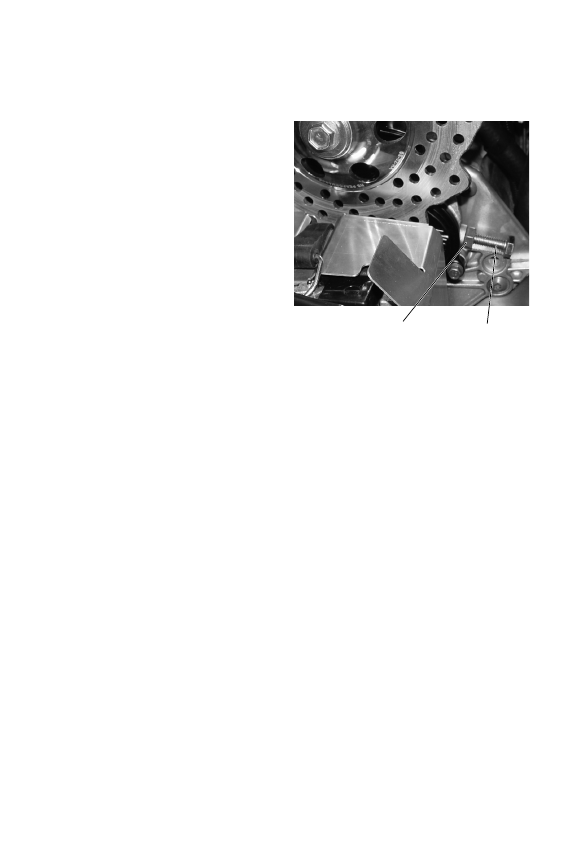
Drive Chain Tension

Check drive chain tension weekly and before each long trip. 
1. Remove the side panels.
2. Rotate the driven clutch 

counter-clockwise to move all 

chain slack to the tensioner 

side. Lock the brake lever 

lock, or have an assistant hold 

the brake lever firmly.

3. Loosen the adjuster bolt jam 

nut.

4. Finger tighten the adjuster bolt 

until it can no longer be 

adjusted by hand, then back 

off 1/4 turn.

5. Tighten the jam nut while 

holding the adjuster bolt. 

Torque to 21 ft. lbs. (28 Nm).

6. Reinstall the side panels.
7. Release the brake lever lock.

Jam 

Nut

Adjuster 

Bolt

90

MAINTENANCE

Brakes

Hydraulic Brake Inspection

Inspect the brake lever reserve before each use of the snowmobile. See 

page 55.
Brake pads must be replaced when the brake pad material becomes thin-

ner than the backing plate (approximately 1/16I). A kit is available for 

replacing brake pads. See your dealer.

WARNING! Brake failure during operation can result in serious injury or death. 

Properly functioning brakes are vital to your safety. Be sure the brake pads do 

not drag on the disc and that brake lever travel is not excessive. Always replace 

brake pads when the brake pad material becomes thinner than the backing plate 
(approximately 1/16

I

).

Brake Components

1. Brake Caliper
2. Brake Disc
3. Brake Pad Material (Replace 

when thickness is less than 1/

16I/1.5 mm).

Excessive Lever Travel

Hydraulic brakes are self-adjust-

ing, but if excessive brake pad 

clearance develops, bring the 

snowmobile to an authorized 

Polaris dealer for inspection and 

adjustment.

2

1

3

91

MAINTENANCE

Brakes

Brake Fluid

The brake fluid level can be seen through a plastic sight glass in the 

brake reservoir. If the fluid is sufficient, the sight glass will be black. If 

the sight glass is any color other than black, add brake fluid.
Replace brake fluid at least every two years with Polaris DOT 4 high 

temperature brake fluid. See page 110 for the part numbers of Polaris 

products.

WARNING! After opening a bottle of brake fluid, always discard any unused 

portion. Never store or use a partial bottle. Brake fluid is hygroscopic, meaning it 

rapidly absorbs moisture from the air. The moisture causes the boiling 

temperature of the brake fluid to drop, which can lead to early brake fade and 

the possibility of accident or serious injury.
WARNING! Keep the master cylinder cover free of dirt and debris. The vent slits 

allow for diaphragm movement, and if they become plugged, movement of 

brake fluid below the diaphragm may be restricted, altering brake function.
NOTICE: Brake fluid will damage labels, paint and some plastics. Always wipe 

up spills immediately.

92

MAINTENANCE

Brakes

Bleeding the Hydraulic Brake System

Air in the hydraulic brake system will cause spongy brake lever action. 

Bleed the system before operating the snowmobile.

WARNING! Operating the vehicle with a spongy brake lever can result in loss of 

brakes, which could cause an accident and lead to serious injury or death. 

Never operate the vehicle with a spongy-feeling brake lever.

During the bleeding procedure, keep the brake handle as level as possi-

ble. The reservoir must be in this position to minimize the possibility of 

air entering the system through the reservoir vent.
1. Remove the brake master cylinder reservoir cover and gasket.
2. Fill the master cylinder reservoir to between the MIN and MAX 

marks or 1/4-5/16I (.6-.8 cm) below the lip of the reservoir open-

ing. Reinstall the gasket and cover.

3. Slip a rubber tube over the ball of the bleeder valve and direct the 

flow of fluid into an approved container.

4. Squeeze the brake lever a full stroke. Then unscrew the bleeder 

valve 3/4 of a turn to release air.

5. Close the bleeder valve and release the brake lever.
6. Repeat steps 4 and 5 until fluid flows from the bleeder valve in a 

solid stream free of air bubbles.

WARNING! Overfilling the master cylinder leaves no room for fluid expansion 

and may cause the brakes to lock, resulting in serious injury or death. Always 

add brake fluid to the fill line as recommended.

7. After bleeding is complete, refill the reservoir to the proper level. 

See page 91. 

8. Reinstall the gasket and cover.


Content   ..  20  21  22  23   ..