CANADA. LAND OPERATIONS (ENGLISH, 2008) - page 4
Land Operations
(3)
Mobility of the force available for the spoiling attack should be equal to or
exceed that of the adversary force.
(4)
Deep operations may be necessary to ensure the success of the spoiling
attack.
3.
Reserves in the Mobile Defence. If the commander decides to conduct a mobile
defence he will still need to designate a reserve. It may be called upon to carry out any of the
above tasks in order to help the fixing forces shape the battlefield. Attack helicopters may be
ideal for this role. The striking force is then committed to strike a decisive blow.
4.
Commitment of the Reserve. The decision on how and when a reserve is to be
committed is one of the most important a commander must make. Reserves should be located
where they are best able to react when they are required. Routes may need to be planned and
prepared to cover likely deployment options. The commander will designate his decision criteria
to assure the timely commitment of his reserves. These will need to be updated as the battle
progresses and the adversary's intentions become more apparent. When it is committed, the
reserve action may well become the formation’s main effort. The success of the reserve action
is likely to depend upon its timely commitment, mass, surprise, speed and boldness.
765. GENERAL CONSIDERATIONS FOR THE DEFENSIVE BATTLE
1.
Preparations. Preparations for the defence should take place concurrently at all levels
and include such important activities as:
a.
reconnaissance and counter-reconnaissance within the formation's area of
operations;
b.
planning and shaping the battlefield through the integration of natural and
artificial obstacles;
c.
planning the coordination of direct and indirect fire support;
d.
deciding the employment of AD;
e.
establishing liaison between flanking and subordinate formations;
f.
continuous refinement of the plan by war-gaming, if time permits;
g.
rehearsals of all activities such as battle handover and counter-moves, if time
permits; and
h.
production of intelligence in order to determine the time that the adversary will
attack, his main effort, and locations of his C2 systems.
2.
Deep Operations and Shaping Operations. Considerations:
a.
Throughout the battle, adversary forces in depth will be attacked to prevent or
delay their deployment. Indeed, deep, close and rear operations will be fought
simultaneously and there is a requirement, therefore, for the commander to
assign priorities, particularly for combat support and CSS. Likewise, shaping,
decisive and sustaining operations may be conducted simultaneously.
7-60
B-GL-300-001/FP-001
The Conduct of Land Operations
b.
The commander must prevent the adversary from concentrating an
unacceptable level of combat power at any given point by pre-emptive,
systematic and sustained attacks on adversary echeloned forces. Adversary
forces not yet in contact will be monitored throughout the commander's area of
interest and engaged throughout the depth of his area of influence. In so doing,
the commander intends not only to destroy and delay the adversary force, but
also to disrupt the adversary commander's plan and seize the initiative. This
attack on the adversary's forces in depth is complementary to both the covering
force and main defence battles. Integration of the available combat support
assets to conduct this disruption requires extensive and continuous coordination
between air and ground commanders, but will yield a significant capability to see
and strike deep targets, and is vital to the successful conduct of deep
operations.
3.
Siting. Battle positions should, whenever possible, be mutually supporting. They
should be sited such that they are hidden from direct adversary observation and fire. The
defender should avoid positions that are easily identifiable and easy to engage, such as forward
edges of woods, isolated villages, and other obvious features. Battle positions should dominate
the local area by direct fire. Such positions provide a framework for mobile forces operating
between them.
4.
Strongpoints. A strongpoint is a fortified battle position. It is essentially a concentration
of direct fire weapons, particularly anti-armour, that cannot be easily overrun or bypassed. The
adversary may defeat a strongpoint, but only with the expenditure of much time and
overwhelming forces. It will be located on a terrain feature critical to the defence, or one that
must be denied to the adversary and can be used to shape or contain the attacker. Extensive
engineer support may be required in the preparation of strongpoints.
5.
Obstacles. Whatever the form of defence, the skilful use of natural and artificial
obstacles will be essential to success. Their purpose is to enhance the tactical commander's
own plans by denying the adversary the freedom of manoeuvre he requires in order to gain and
maintain the initiative. The integration of obstacles with firepower will be used to support the
commander's manoeuvre plan and to shape and restrict the adversary's manoeuvre options.
Artificial obstacles will be used to shape the battlefield. The principles to be observed are:
a.
Barrier control measures must be coordinated at all levels, but subordinate
commanders will confirm detailed siting.
b.
Obstacles must complement and not dictate the design for battle. As such, the
commander's intent for obstacles, that is, to fix, disrupt, turn or block, must be
clearly enunciated.
c.
Wherever possible, obstacles must be covered by direct fire. When this is not
achievable, observers able to call for indirect fire must at least cover them.
d.
Artificial obstacles must not hinder the ability of forces to operate.
Counterattacks and the rearward passage of covering forces must be granted
particular attention.
B-GL-300-001/FP-001
7-61
Land Operations
6.
Killing Zones. Killing zones are designated by commanders at all levels based upon
their mission and the analysis of the terrain and adversary. They are areas where the terrain,
reinforced with artificial obstacles, allows the defender to fix and destroy adversary forces that
have been forced to concentrate. As such, they are an integral part of the close, deep and rear
battles, and their purpose and location must reflect the commander's plan and the ability of the
terrain to support the shaping of the battlefield, the fixing of the adversary, and the concentration
of the required combat power.
7.
Direct Fire Planning. When planning the layout of a defensive position, direct fire
weapons, 170 particularly those that will defeat an adversary’s armoured force, are the first to be
considered and sited. The remainder of the defensive position is then built around them. The
commander himself must coordinate the plan. The following points should be applied when
siting direct fire assets:
a.
Depth. The various ranges in the family of direct fire weapons provide an
opportunity to have depth in the killing zone with over-lapping arcs of fire. In
addition, so the mobile systems may have multiple engagements against an
attacking force that is not destroyed in the initial engagements, the anti-armour
and support weapon plan should have depth deployment positions on all likely
adversary approaches.
b.
Mutual Support. The anti-armour plan should ensure that a force attacking any
position could be engaged with support weapon direct fire from adjacent and
mutually supporting positions. Thus, the availability of positions for this mutual
support should be a consideration in the selection of battle positions.
Coordination of all weapon systems in battle positions is a constant requirement.
Direct fire weapons are employed in pairs or groups to allow for mutual support
in providing local protection, observation and covering fire, as well as to allow
disengagement and movement. Note that the systems themselves do not have
to be co-located, but the effects they achieve (e.g., beaten zone) should be
paired.
c.
Security. In battalion and BG AOs, mobile direct fire support weapons normally
operate outside of the company battle positions. They must therefore provide
their own local protection and have the ability to react to an adversary. Although
weapon systems have small crews, they do have good surveillance capabilities
and good mobility. Hence, they not only enhance their own protection, but also
contribute to the security of the AO and the forces within it. Direct fire weapon
sections can be used to patrol or picket areas instead of reconnaissance troops.
Their sighting systems, firepower and mobility will allow them to be used as
screen, guard or cover forces. Furthermore, when not manning their battle
positions, mobile direct fire systems should be held back in hides, on suitable
notice-to-move footings.
170 Direct fire weapons refer to support weapons, including anti-armour weapons. Within the
contemporary operating environment (COE), direct fire weapons will engage a wide array of targets, and
ideally, weapons with an anti-armour capability will also be able to provide other supporting fires, such as
wall breaching.
7-62
B-GL-300-001/FP-001
The Conduct of Land Operations
d.
Integration of Direct Fire Weapons. Direct fire weapons must be carefully
integrated with all the other means of achieving the destructive effects against
adversary forces. In this way, the integrated use of all weapon systems
enhances the effectiveness of each to produce a greater net effect. For
example, the combination of anti-armour weapons firing into killing zones, with
minefields to canalize and inhibit movement, supported with artillery and mortars
to keep the armour closed down and thus their observation restricted, coupled
with smoke to further reduce their visibility, and with aviation to engage from
unexpected approaches, enhanced by dismounted troops in defensive positions,
produces a significantly better overall effectiveness than the employment of
each system alone. It also degrades the adversary's ability to defeat our
systems that would be vulnerable if employed alone. Short-range direct fire
weapons should be integrated with other weapon systems in battle positions.
Furthermore, direct fire weapons should be integrated into the surveillance and
target acquisition plan both to contribute to observation capability and to receive
information about the location, type and number of targets. Since direct fire
weapons rely greatly upon their redeployment capability, the anti-armour plan
should be coordinated with the barrier and movement plans to ensure they are
compatible.
e.
Concentration. The anti-armour plan should allow for the concentration of
sufficient killing power at the locations and times that provide the greatest
advantages. This must be accomplished without the adversary being able to
detect and counter the concentration. A coordinated plan, secure
communications, covered approaches, speed of movement, good drills and
rapid dispersion are some of the requirements for effective concentration of
direct fire systems. The uses of tank hunting patrols and of helicopter insertion
of dismounted direct fire weapons are means of achieving concentrations at
unexpected places or times. By concentrating selectively on one of the
adversary's critical assets, such as his armoured personnel carriers, his
engineer vehicles or his C2 vehicles, it is most likely that his cohesion will be
degraded.
SECTION 12
FORCES AND TASKS FOR THE DEFENCE
766.
GENERAL
1.
The concept of the defence to be adopted will be influenced to a great extent by the type
of combat forces, armoured or non-armoured, available. The adversary, the terrain and the
weather may in themselves further dictate the number and type of forces to be used. Time may
also be a major factor as non-armoured forces usually require more time than armoured forces
to prepare defensive positions, and unless they are airmobile, more time to move between
them.
767. ARMOURED FORCES
1.
Where the majority of the forces available are armoured, the defence can be conducted
with greater flexibility and full use can be made of mobility. Operations will include defence from
selected positions, delaying actions and counterattacks, all of which can be conducted in
B-GL-300-001/FP-001
7-63
Land Operations
defensive sectors of greater depth and width than in a defence with non-armoured forces.
Armoured combat troops have a high degree of protection from adversary fire, and
consequently are capable of going into action rapidly and effectively even in a CBRN
environment. This makes them highly suitable for use as reserves.
2.
Armoured forces use defilade positions to strike the adversary in the flank, forcing him to
canalize so that he may be destroyed by the full weight of the firepower of the defence. In
addition, armoured troops can manoeuvre to delay the advance of strong adversary forces and
then immediately change from a mobile to a more static form of action, or to conduct offensive
action. Due to their importance in defence, armoured combat forces will always be primary
targets for adversary air attacks. Skilful use of cover, concealment, dispersion and local air
support can considerably reduce the effect of this threat, and wherever possible, AD forces
should be assigned to cover operations by armoured units.
768. NON-ARMOURED FORCES
1.
Non-armoured forces are capable of staging an effective defence only from prepared
positions, therefore, will be employed primarily in a more static role. Their defensive positions
should make the best use of barriers and be located where the terrain offers scope to employ
the firepower and the full range of their anti-armour weapons. They are, therefore, particularly
suitable for use in close country. The positions selected should be covered from observed fire
for as long as possible, thus enabling them to retain their effectiveness. In most cases, they
must be well supported by armoured and combat support resources.
769. ARMED AVIATION
1.
Air manoeuvre in defensive operations is very similar in character to air manoeuvre in
offensive operations. Helicopters have, however, an important role in defensive operations by
causing early attrition of the adversary in the deep battle and by disrupting, delaying and
shaping the adversary for the close battle. Helicopters can be effectively employed where a
commander does not wish to irrevocably commit ground forces; forward of a reserved
demolition or obstacle for example.
2.
Armed aviation can be effective in closing gaps in a defence plan, possibly in
conjunction with pre-planned joint fires prior to relief by ground forces. Helicopters are also able
to counter adversary activity in the rear area, and in particular, airborne or airmobile forces.
Some helicopters may be equipped for air-to-air combat. Provided weather and visibility
conditions allow, their mobility, firepower and independence from the ground will make them a
useful means for:
a.
operations against adversary penetration;
b.
containment of adversary attacks;
c.
support of counterattacks; and
d.
support of airmobile operations.
7-64
B-GL-300-001/FP-001
The Conduct of Land Operations
770. ARTILLERY
1.
The artillery commander prepares and executes the fire plan in accordance with the
mission and with his commander’s CONOPS, coordinating artillery fire with the operations of
combat troops, helicopters, air support and with the barrier plan.
2.
In view of its long ranges and the high flexibility of its fire, artillery is a powerful weapon
to assist in neutralizing an adversary attack. In order to be fully effective, however, it must have
the link to sensors that will acquire targets in-depth.
3.
In defence, the tasks of artillery are:
a.
During all phases of the defence, give fire support to troops in contact.
b.
Attack adversary forces in depth before they can be committed to the main
battle.
c.
To coordinate fire support to maximize combat power. Fire support will also be
coordinated with influence activities.
d.
More specific tasks include:
(1)
support of the covering force;
(2)
disruption of adversary preparations for attack;
(3)
separation of attacking adversary tanks from dismounted infantry;
(4)
attacking adversary artillery and forward AD elements;
(5)
covering barriers, gaps and open areas;
(6)
neutralizing or isolating adversary forces that have penetrated the
defensive area and impeding the movement of adversary reserves;
(7)
supporting counterattacking forces;
(8)
assisting in battlefield surveillance and target acquisition;
(9)
as a last resort, defending own gun positions by direct fire; and
(10)
the use of scatterable mines to block adversary approach routes.
771.
AIR SUPPORT
1.
Air ISTAR Operations. Air reconnaissance is extremely important in all phases of the
defence, particularly during the early stages, to help determine the strength and direction of the
adversary advance.
B-GL-300-001/FP-001
7-65
Land Operations
2.
Counter-air Operations. Counter-air operations are conducted to destroy, disrupt or
limit adversary air power as close to its source as possible and to assist in reducing the air
threat against friendly land forces. Ground forces may aid these operations by suppressing
adversary forward air defences.
3.
Close Air Support. Close air support (CAS) will be vital to a defending force, for both
immediate threats and for those in depth. It is more economical and effective to locate and
attack adversary forces while they are concentrated in depth preparing for an attack or
advancing along LOC, than when they are deployed in the battle area. CAS, if properly planned
however, allows the commander to concentrate fire rapidly on targets in depth and in proximity.
As much pre-planning as possible should occur in order that commanders may determine and
request the exact number of sorties required.
772. SUPPORT HELICOPTERS
1.
In defence reconnaissance, utility and transport helicopters can support ground force
operations through their employment in:
a.
airmobile operations;
b.
C2 tasks;
c.
reconnaissance and target acquisition missions; and
d.
logistic support, including casualty evacuation.
773. AIR DEFENCE
1.
Priorities for the allocation of AD artillery resources will be based upon the commander’s
estimate of the situation. In addition to airspace management, AD artillery will be required to
protect important areas and points. It is normally used to cover the following:
a.
troops in forward areas;
b.
C2 facilities;
c.
supply facilities;
d.
critical assets and vital points;
e.
airfields;
f.
reserve forces; and
g.
demolitions.
774. ENGINEERS
1.
There will seldom, if ever, be sufficient engineer resources to meet all the requirements
of a defence plan. The commander must therefore establish priorities in accordance with the
determination of his main effort, and apply his limited resources as necessary. Engineers will
be assigned a wide range of tasks:
7-66
B-GL-300-001/FP-001
The Conduct of Land Operations
a.
Counter-mobility Tasks. Counter-mobility tasks serve to disrupt, turn, fix or
block adversary forces. They will be carried out in conjunction with combat
forces and be coordinated with direct and indirect fire weapons to deny the
adversary the mobility he requires and to cause casualties to his attacking
forces. Counter-mobility measures must be covered by fire and closely
coordinated with fire support assets. Counter-mobility tasks include:
(1)
Barriers. The maximum effect is obtained from barriers when as many
minefields and other obstacles as possible are employed in combination,
and when they are kept under surveillance and covered by fire. Barriers
are likely to include the use of natural and man-made obstacles; they
must be coordinated with host nation advisors when appropriate and
comply with Host Nation Agreements. The barrier plan is part of the
overall defence plan that will require continuous adjustment as barriers
are improved and supplemented, as time permits, and as the battle
proceeds. Barrier restricted areas may be declared in order to retain the
required freedom of movement. The restriction may involve time, location
or type of obstacle.
(2)
Demolitions. The system for the control of demolitions must be
conducted in accordance with agreed standards and procedures. The
number of reserved demolitions must be kept to a minimum, as they tie
down large numbers of combat troops as demolition guards and
engineers in firing parties.
b.
Survivability Tasks. The avoidance of detection and destruction will require
frequent movement and rapid terrain preparation (this includes digging and use
of cover, concealment and camouflage to enhance survivability). Survivability
can be enhanced by the use of concealment, deception, dispersion and
fortification. Engineer protection or survivability tasks will include assistance to
other arms in:
(1)
Field Fortifications. Engineer work in this area includes the use of
equipment to assist in the preparation and construction of such
fortifications as trenches, command post shelters, artillery fire positions,
and anti-tank weapon and armoured combat vehicle positions.
Additionally, fields of fire can be cleared for all weapon systems.
Engineers also assist in the construction of strongpoints, which are
heavily fortified positions that cannot be overrun quickly or bypassed
easily by adversary forces.
(2)
Protection of Combat Supplies. Combat supplies should be protected
in particular against blast, shrapnel, incendiaries and CBRN
contamination. By giving advice to the logistic management on the
selection of the most suitable storage sites, the requirements for engineer
support can be considerably reduced.
(3)
Camouflage, Concealment and Deception. Major positions, facilities
and operational sites may require special camouflage stores and
measures that could be undertaken by engineers. Deception measures
often include the use of camouflage, and special engineer deception
B-GL-300-001/FP-001
7-67
Land Operations
measures can include the construction of dummy positions and decoys,
which must be carefully planned and coordinated within the framework of
the tactical plan and real positions.
c.
Mobility Tasks. During preparations for defensive activities, engineers will
reconnoitre, improve and open routes for use during battle, in preparation for the
withdrawal of covering forces, the main body’s withdrawal, and for the use of
reserve forces and counterattacks. During the main defensive battle itself,
mobility tasks include:
(1)
Routes. The maintenance and improvement of routes will be a major
engineer task as the defensive position is subjected to fire from adversary
artillery and air. This may necessitate the deployment well forward of
assault bridging, trackway and engineer heavy equipment.
(2)
Minefield Gaps and Lanes. Careful coordination will be necessary to
ensure that the required lanes or gaps are left in minefields for the
redeployment of troops.
(3)
Support to Countermoves. Close support engineers will be required in
support of offensive operations to overcome obstacles produced by the
adversary.
(4)
Counterattacks. Gaps must have been left in major obstacles for the
passage of counterattack forces.
d.
Electronic Warfare. EW has the following functions in support of defensive
activities:
(1)
Its primary function will be to continue gathering information on the
adversary and to update information databases. EW resources will thus
concentrate on the provision of vital information on the adversary's:
(a)
intentions;
(b)
grouping, location, and axes of advance of its lead elements, main
body, supporting artillery and engineer units, and forces in depth;
(c)
CBRN delivery means; and
(d)
AD systems.
(2)
As the adversary closes to the MDA, jamming resources will be
concentrated on the neutralization of adversary fire control, and target
acquisition and intelligence gathering systems, while information-
gathering resources continue to provide intelligence and steerage for own
jamming systems.
(3)
EW resources will also attempt to locate adversary jamming assets so
they may be eliminated by physical destruction.
7-68
B-GL-300-001/FP-001
The Conduct of Land Operations
775. COMMAND AND CONTROL MEASURES IN THE DEFENCE
1.
In planning the defensive operations, commanders should reconnoitre the area of
responsibility or review the terrain analysis before he determines his CONOPS and plans the
layout. Furthermore, he should maintain personal contact with his subordinates. In times of
stress, a visit or a person-to-person conversation will do much to instil confidence and to
impress the commander’s personality upon his command.
2.
Close liaison and good communications are prerequisites to a successful defence. The
following should be noted:
a.
Coordination points will be designated and liaison established at key levels.
b.
In coalition operations, it is particularly important that commanders of
temporarily assigned units make personal contact with their superior
commander as soon as the situation permits. Higher echelons must be
prepared to provide communications detachments to subordinate HQs from
other nations in order to provide a secure communications link.
c.
Before contact is made with the adversary, electronic emissions must be kept to
a minimum. Forces not in contact with the adversary should be on radio silence.
Nevertheless, alternative communications must be maintained at all levels.
d.
In situations in which there is an EW adversary, cable and radio relay
communications are a vital means of communication. After adversary contact
and the relaxation of radio silence, radio communications will become
significant, but traffic should still be kept to a minimum.
3.
The following control measures may be employed in defensive operations:
a.
boundaries and control lines, such as the handover line and phase lines;
b.
fire support coordination measures;
c.
airspace control measures;
d.
coordination points;
e.
barrier restricted areas;
f.
battle positions, blocking positions and assembly areas;
g.
killing zones; and
h.
controlled routes.
B-GL-300-001/FP-001
7-69
Land Operations
SECTION 13
COMBAT SERVICE SUPPORT IN THE DEFENCE
776.
GENERAL
1.
The CSS plan must be flexible. Particular points of note are:
a.
In the defence, it should be possible to preposition stocks and maintenance
resources and to establish medical facilities beforehand, and it is from these
resources that troops may be supported in the first days of combat. In this way,
provision is made for supplies to be available in the event of a surprise
adversary attack. Possible delay in establishing CSS due to the length of LOC
may impose, upon commanders, a special responsibility to exercise economies
until the resupply chain is established.
b.
CSS facilities are usually further to the rear than in offensive operations, both to
avoid interfering with tactical operations and to obtain a degree of protection,
although delivery should be as far forward as possible.
c.
Consideration must be given to the location and security of service support
areas and traffic control within these areas.
d.
Planning must take into account the requirements of a transition to the offence.
Mobility and flexibility in CSS operations must be maintained to support
subsequent counterattack and other offensive operations.
777.
SPECIFIC CONSIDERATIONS
1.
Specific consideration should be given to the following points:
a.
Rear area security and protection.
b.
The high consumption of ammunition, particularly artillery rounds, may
necessitate special delivery programmes. Bulk ammunition should be delivered
as far forward as possible.
c.
Fuel should be transported, as far as practicable, by pipeline, rail, and road
tanker or by inland waterways.
d.
Repair should be conducted within defensive positions if possible, in order to
minimize movement.
e.
The siting of medical resources, including evacuation facilities, should be as far
forward as is practicable to ensure the rapid treatment and evacuation of
casualties. However, to avoid collateral damage, they should not be located
near to likely targets (e.g., other logistics installations).
f.
Coordination of CSS in multinational operations.
7-70
B-GL-300-001/FP-001
The Conduct of Land Operations
g.
The location of supplies should emphasize dispersion, good access to supply
routes, and stock levels, and should be conducive to resupply defensive
operations.
h.
The priority of supplies assists in allocating scarce transportation assets.
778. SUMMARY
1.
The defence plan must be carefully conceived to ensure that the adversary’s attack can
be halted and that an opportunity be found to seize the initiative and undertake offensive
operations. The importance of cohesion to the overall effectiveness of the defence is
particularly significant if the defence is to remain viable. The commander must be prepared to
adjust the layout and the manoeuvre plan in order to meet changes in the adversary.
SECTION 14
THE PLANNING AND EXECUTION OF THE DELAY
779. PURPOSE AND CONCEPT OF THE DELAY
1.
delaying operation is: “an operation in which a force under pressure trades space for
time by slowing down the enemy's momentum and inflicting maximum damage without, in
principle, becoming decisively engaged.”171 It is usually conducted in advance of a defensive
position in order to give the forces the needed time to prepare the position, mass forces, and to
attrite the advancing adversary forces.
2.
The delaying force commander is normally given a mission of imposing a stated amount
of delay upon the adversary and/or a specific amount of attrition upon the adversary. He may
also be ordered to preserve a specific portion of his own combat power. The delay will often
end with a breaking of contact, a battle handover to an in-place defending force, and a rearward
passage of lines.
3.
The delay is likely to be carried out in less than ideal conditions. The air situation may
well be unfavourable and the initiative will tend to be with the adversary. Nevertheless, in order
to enhance the chances of success, every opportunity should be taken to initiate aggressive
action, to seize the initiative from the adversary, and to force him to adopt a defensive posture.
This type of operation is arguably the most difficult to conduct and needs to be thoroughly
understood by all involved.
4.
Delaying operations can be conducted independently or within other operations,
principally as a prelude to a defensive battle. A covering force can conduct a delay. It is also
possible that enabling activities will be involved, the most likely being a withdrawal and a
rearward passage of lines. It is also conceivable that other enabling activities, such as a
meeting engagement, could occur.
5.
A delaying operation is likely to be conducted in one of the following circumstances:
171 NATO AAP-6.
B-GL-300-001/FP-001
7-71
Land Operations
a.
as a covering force for defending or withdrawing main bodies;
b.
the advance guard or covering force when encountering superior forces;
c.
an economy of force operation conducted to hold an adversary attack on a less
critical avenue of approach;
d.
a deception measure to set up a counterattack; and
e.
as part of a mobile defence.
780. PRINCIPLES OF WAR IN THE DELAY
1.
In a delay, a commander attempts to inflict heavy losses on the adversary while
preserving the combat power of his own forces. No decision is sought, as the commander is
attempting to gain time. In doing so, he must always determine whether the time to be gained
justifies the reduction of his combat power. The following principles of war are of particular
concern in the delay:
a.
Offensive Action. In order to force the adversary to deploy, to delay him and to
attrite him, offensive action must be taken. It will be required not only to force
the adversary to deploy, but likely will be required to disengage with the
adversary and to cover the withdrawal to subsequent battle positions. The
delaying force should create and seize opportunities for offensive action.
Adversary forces that overreach themselves or expose a flank are particularly
vulnerable. Limited attacks are undertaken when losses or damage can be
inflicted on the adversary with low risk.
b.
Security. The commander must preserve his force throughout the delay, firstly
in order to be capable of causing the required attrition and delay, and secondly,
retain sufficient combat power to fulfil subsequent tasks following the force’s
handover and withdrawal. Thus, security of his force will be a constant concern,
and measures and precautions must be constantly taken to ensure that the
force can break contact and avoid envelopment by the advancing adversary.
781. FUNDAMENTALS OF DELAY OPERATIONS
1.
In addition to the principles of war that merit special consideration, there are several
fundamental elements that must be applied in the planning and conduct of a delay:
a.
Manoeuvre. A delaying force uses manoeuvre so that maximum fire can be
applied at long range to surprise and confuse the adversary and to make him
pause and deploy. Such fire imposes caution and causes casualties without
revealing the disposition of the delaying forces. A delaying force also uses
manoeuvre to disengage and move to new positions when the adversary
concentrates superior combat power.
b.
Balance. The force must be organized so that it can deal with unexpected
situations. This requires a judicious balance amongst those troops maintaining
surveillance, conducting reconnaissance, engaging and delaying the adversary,
withdrawing to new delay positions, and acting as reserves.
7-72
B-GL-300-001/FP-001
The Conduct of Land Operations
c.
Maintenance of Contact. A delaying force must maintain contact with the
adversary to avoid surprise, estimate his rate of advance and determine his
main point of effort. This can be done by reconnaissance forces, or by target
acquisition means giving real-time information “feeds,” such as unmanned aerial
vehicles.
d.
Use of Terrain. A delaying force must use the terrain to enhance its
engagement, add to its security, and cause the adversary to conduct time-
consuming and costly operations in order to advance. The terrain selected
should have natural or easily improved obstacles that can be used to canalize
the adversary or slow him down. It should also offer good observation and fields
of fire and allow easy disengagement.
e.
Time and Space. A commander should know either the minimum length of time
that he must delay based upon the requirement of friendly forces to prepare
positions, the percentage of adversary forces that must be destroyed, or the
percentage of his force that he must preserve based upon his subsequent tasks.
The area allocated must have sufficient depth to allow for the conduct of
delaying operations; otherwise, the duration of the delay must be shortened, the
strength of the force increased, or risk decisive engagement with the high
potential for losses. A lack of sufficient manoeuvre space may cause the
delaying force to become decisively engaged.
f.
Security and Protection. Security and protection are vital to preserve the force
to allow it to meet its task. They are achieved through concealment,
camouflage, deception, COMSEC, EW, CI, and the protection of bridges,
crossing sites and critical points along axis required for rearward movements.
782.
CONCEPT OF OPERATIONS FOR THE DELAY
1.
The delay does not fit neatly into a series of stages. Rather, it comprises a series of
coordinated offensive and defensive actions, each being broken off when the adversary presses
too hard and close to the point where the delaying forces are at risk of being decisively
engaged. Forces manoeuvring to engage the adversary from previously selected positions in
depth, and then disengaging and moving to the next position before the adversary can
concentrate sufficient combat power to overrun or bypass friendly forces, fight the action. High
tempo is particularly significant in delaying actions. The delaying action ends with the final
disengagement and breaking of contact by the delaying force at the handover line. An in-place
force may have to assist in achieving disengagement.
2.
In a delaying operation, a commander faces several conflicting requirements. He
attempts to inflict heavy losses on the adversary, but seeks to preserve the combat power of his
own forces. He attempts to gain time, but seeks to avoid decisive engagement. He must
constantly determine whether the time to be gained justifies the reduction of his combat power.
To make these decisions, he must be told either the minimum length of time that he must delay
the adversary, or the percentage of his force that he must preserve based upon his subsequent
tasks. As stated previously, the area allocated must have sufficient depth to allow delaying
operations to be conducted; otherwise, the duration of the delaying operation must be
shortened, the strength of the force increased, or risk decisive engagement with the high
potential for losses.
B-GL-300-001/FP-001
7-73
Land Operations
3.
A delaying operation is conducted by a combination of defensive and offensive action.
Initially, a commander establishes contact with the adversary across the front using
reconnaissance elements. At the same time, he prepares a series of delay positions in depth to
the extent that time permits. Depending upon the mission, forces occupying the delaying
positions should be sufficiently strong in combat power to mislead the adversary into believing
that he has encountered the battle positions of a MDA and must be sufficiently strong to cause
the desired delay. In the selection of delaying positions and the organization of the delaying
force, the commander will consider creating opportunities for offensive action.
4.
The delay is conducted through a series of successive battle positions sited to be
mutually supporting. As the adversary pushes the reconnaissance elements back, he is
engaged with maximum fire at long range from elements of the delaying force that manoeuvre in
the first line of delay positions. This fire is applied to surprise and confuse the adversary, to
make him pause and deploy, to impose caution and cause casualties, and to compel him to
make time-consuming and costly preparations for an attack. While the adversary is engaged at
long range, other elements of the delaying force may conduct countermoves, especially against
forces that have overreached themselves or exposed a flank. Limited attacks are undertaken
when losses can be inflicted on the adversary at low risk.
5.
When a decisive engagement is imminent, the commander manoeuvres to disengage or
to fight his way back to the next line of delay positions. Contact is re-assumed by the
reconnaissance elements, which in the meantime have been repositioned for the task, or is
maintained by the forces fighting their way back. Contact must be maintained in order to avoid
surprise, to estimate the adversary's rate of advance, and to determine his main effort.
Crossing sites, particularly bridges, and other critical points along routes or axis required for
rearward movement should be protected.
6.
The same general sequence of activity is repeated until the mission is accomplished. At
the handover line, the delaying force attempts to break contact and the in-place force assumes
responsibility for dealing with the adversary. The in-place force must site itself and task forces
to assist with the delaying force’s breaking of contact.
783. ORGANIZATION OF THE TERRAIN
1.
In the delay, the delineation of the AO is similar to that of the defence. The difference is
the fact that the rear boundary is defined by a handover line where responsibility for the
adversary is passed to another force. Unit and formation frontages will tend to be larger than in
the defence. The commander of the delaying force has to decide which parts of the assigned
AO he will use, which parts he may abandon earlier than others, and which ones need only be
monitored.
2.
Flank boundaries between elements of the delaying force must be clearly delineated, but
elements of the force must be prepared to give mutual support across boundaries. The delay
and the terrain over which it will occur will be broken into a number of battle positions from
which the engagements will occur. The battle positions will be manned on order and will act as
the key control measure for the conduct. They must be mutually supporting. Ideally,
commanders will have time to reconnoitre the battle positions beforehand and plan each
engagement and disengagement in detail.
3.
A delaying force will not only make use of the depth of the area assigned but it will also
attack the adversary in his depth. If there is no opportunity to attack the adversary's flank or
rear, it may be sufficient to position combat troops so that they can engage the adversary along
7-74
B-GL-300-001/FP-001
The Conduct of Land Operations
his most likely approaches. Gaps must be kept under surveillance and provision must be made
for quick reaction, should the adversary decide to utilize them for his advance.
784. DELAY TACTICS
1.
The commander must take into account that he may not always have a clear picture of
the adversary and that the situation may change frequently and rapidly. He must therefore
ensure that he has a continuous flow of sound and timely intelligence, well-organized
reconnaissance, uninterrupted communications and a strong reserve. By these means, the
commander can ensure that he maintains his freedom of action. He must utilize the forces and
means available to him in such a way that the adversary is repeatedly faced with unexpected
situations. This requires flexibility and agility, as well as strong reliance upon the subordinate
commanders’ capabilities to determine on the spot the most suitable action to be taken.
Combat troops will normally conduct the delay by a combination of techniques, both offensive
and defensive.
2.
The commander will employ a range tactics to impose delay upon the adversary and
preserve his own forces, including the following:
a.
To slow down the adversary's advance by inflicting casualties, which reduce his
offensive capability, in order to gain time for subsequent operations.
b.
To manoeuvre the adversary into areas where he is vulnerable to
attacks/counterattacks, thereby gaining the initiative.
c.
To avoid combat under undesirable conditions.
d.
To determine the adversary's main effort.
3.
The tactical plan must focus on control measures and the effects to be imposed upon
the adversary, be it delay, attrition or both. The plan must include a clearly articulated intent, a
detailed CONOPS, measures to be taken to cover gaps and flanks, and detailed control and
coordination measures. While a main effort is designated, it may change during the delay
depending upon the adversary’s intentions.
SECTION 15
PLANNING AND PREPARATION FOR THE DELAY
785. PLANNING
1.
Before a commander can make his estimate of the situation for a delay he must be very
clear of the intention of his superior commander and what he wishes to achieve by deploying
the delaying force. Once this is understood he will make his estimate of the situation, develop
his CONOPS and prepare his plan to cover the entire action from initial deployment to its
termination. The CONOPS and the plan will pay particular attention to:
a.
Tasks. The allocation of tasks to the forces available. In the delay, tasks must
reflect the integral firepower and mobility of the forces considered.
b.
Phasing. The separation of the activity into phases, all parts of which must be
completed before another phase can start, where this is necessary.
Indiscriminate use of phasing can unnecessarily slow operations.
B-GL-300-001/FP-001
7-75
Land Operations
c.
Terrain. The selection of battle positions from which to delay the adversary will
be key to success. The terrain must be selected in order to maximize the long-
range fires and mobility of the delaying elements and to restrict the mobility of
the adversary (e.g., natural choke points, defiles, etc.). Selected terrain should
also facilitate an easy break and withdrawal for the delaying forces.
d.
Barriers. Planning should exploit natural barriers and select best positions for
artificial barriers that will achieve maximum benefit with the least amount of
required work.
e.
Fire Support. The use of long-range fire to inflict early casualties on the
adversary and avoid decisive engagement.
f.
Covering of Gaps. Gaps are a feature of operations. However, commanders
must be aware of their existence and plan to ensure that they do not pose an
unnecessary threat.
g.
Flank Security and Protection. Flank security and protection will be a
constant concern for delaying forces. The commander must try to select
positions that offer natural flank protection, or establish as a minimum, flank
security that will allow early enough notification to allow withdrawal. Flank
protection may be essential to maintain the battle positions that will impose the
required amount of delay upon the adversary.
h.
Deployment in Depth. The force must also be deployed in-depth to counter
penetration between the forward units, and to guard against airborne or
helicopter-borne assaults on defiles and reserved routes.
i.
Control of Fire and Movement. Report and phase lines are used to control the
movement of forces. Orders can be given to fill any gaps or to adjust the lines
should there be a danger of a breakthrough.
j.
Coordination. Careful coordination between adjacent units, including
measures to avoid fratricide.
k.
Demolition Control. The need to carry out demolitions early can hamper the
deployment of friendly forces. It is, therefore, essential that the planning,
particularly for preliminary demolitions, minefield gaps and reserved demolitions,
is closely coordinated with movement and manoeuvre.
l.
Denial Measures. The denial plan will be closely coordinated with host nation
authorities.
m.
Surveillance. The maintenance of surveillance coverage of the entire area of
intelligence responsibility is normally a considerable undertaking that
encompasses imagery, EW and all human collection resources. It requires
careful planning and coordination.
n.
Combat Service Support. The support of highly mobile operations conducted
over considerable distances requires foresight and flexibility.
7-76
B-GL-300-001/FP-001
The Conduct of Land Operations
2.
The amount of delay to be ordered will depend upon the commander's estimate of the
situation, the requirements for the main defensive position, and the overall objectives and aims.
The duration of the delay to be obtained is then laid down in the mission.
3.
Additionally, or in place of a delay time, the mission may entail a certain percentage of
destruction that must be imposed upon the adversary as part of the delay operation.
SECTION 16
FORCES AND TASKS
786. GENERAL
1.
Given the nature of the delay, the forces best suited to delay operations will be those
that possess integral firepower, protection and mobility. In selecting and grouping the delay
force, the balance between these characteristics will depend upon the type of adversary to be
delayed and the terrain. It will likely require some sort of all-arms grouping with integral long-
range fire support and CSS assets.
2.
All commanders to the lowest level possible will benefit greatly from detailed
reconnaissance of the route to be used and the assigned battle positions from which the delay
will be imposed. Rehearsals will be essential, as will close coordination, particularly for all arms
groups not accustomed to working together.
787. EMPLOYMENT OF MANOEUVRE FORCES
1.
Armoured Forces. Forces composed of tanks, armoured infantry and armoured
reconnaissance elements are highly suitable for delaying operations in most types of terrain.
Their firepower permits them to engage the adversary effectively at long ranges; their mobility
permits them to move quickly between successive positions or to a flank, while the protection
afforded by their vehicles facilitates disengagement. Similarly, their mobility, firepower and
superior communications give them the capability of launching counterattacks when
opportunities exist.
2.
Mechanized or Light Armoured Forces. Mechanized or light armoured forces will be
suitable for delay operations depending upon the adversary faced and the terrain. Their
employment characteristics and CONOPS will be similar to the employment of armoured forces
in the delay; however, they will likely hold their vehicles, depending upon the type of vehicle, to
the rear of their battle positions in order that they do not loose them to adversary direct fire.
They may be forced to engage for shorter periods of time in order to ensure a successful
withdrawal from battle positions. They will likely require extensive barrier plans and intimate
support from armed aviation.
3.
Non-armoured Forces. Non-armoured combat forces only have a limited capability to
carry out delaying operations except in broken, close or built-up terrain with extensive use of
barriers. They will fight from a succession of suitably prepared defensive positions, in each
case forcing the adversary to deploy for a coordinated attack before they withdraw to their next
position. Their lack of protection will demand greater attention to the operations of
disengagement and movement between positions, which should be carried out under cover of
fire support and using routes that are concealed from the adversary. Similarly, non-armoured
troops are not particularly suitable for conducting a fighting withdrawal. However, such an
B-GL-300-001/FP-001
7-77
Land Operations
activity is feasible against a dismounted adversary in close terrain, which offers cover for
movement and is favourable for ambushes and raids. Non-armoured forces can also participate
in stay-behind operations.
4.
Airmobile Forces. Airmobile forces can be employed in delaying operations although
they face the same restrictions and problems as other non-armoured forces. They are capable,
however, of rapid deployment and redeployment, permitting quick concentration of combat
power at key locations. Similarly, they are capable of rapid dispersal to reduce vulnerability.
They can also be used as a reserve force to permit the commander to commit a larger part of
his other forces to the operation, as well as acting as flank protection. The selection and
reconnaissance of landing and pick-up sites will be essential to their employment.
5.
Airborne Forces. Airborne forces have a more limited capability in delaying operations
than airmobile forces because of their lack of mobility and firepower once on the ground and the
need for assistance in extrication. They can, however, be employed in area interdiction
operations with the aim of preventing or hindering adversary operations in a specific area.
Terrain that is heavily wooded, hilly or dominated by a river or other obstacles, and which
hinders the adversary's off-road mobility, is best suited to this type of operation.
6.
Armed/Attack Aviation. Air manoeuvre in delaying operations is very similar in
character to air manoeuvre in offensive operations. Helicopters play an important role by
disrupting the adversary's progress through the use of rolling ambushes that produce a fluid and
mobile defence throughout the adversary's depth, which will delay and shape the adversary for
the close battle. Armoured attack helicopters can effectively support delaying ground forces by
engaging adversary armour, preferably from the flanks or long range. They may be used to
achieve rapid deployment of the anti-armour defence, including deep attacks to cover the
disengagement of combat forces and to achieve surprise. Helicopters can also be effectively
employed where a commander does not wish to irrevocably commit ground forces to the delay,
such as forward of a reserve demolition or obstacle.
788. EMPLOYMENT OF COMBAT SUPPORT FORCES
1.
Artillery. Considerations:
a.
Artillery can make a major contribution to delaying operations by striking the
adversary with concentrated fire at maximum range. Its capability to defeat a
wide variety of targets in a short time and to deliver scatterable minefields
should not only be used to inflict casualties and weaken the adversary's
offensive capabilities, but also to create situations which permit aggressive
manoeuvre of combat forces. Interdiction fire against follow-on forces can
restrict the immediate battle to the adversary's committed forces.
b.
Artillery will be key to allowing delaying forces to break contact with the
advancing adversary and to break clean at the handover line.
c.
By providing immediate and accurate support, the artillery can halt the leading
elements of an adversary attack, and by delivering suppressive fire during the
disengagement of friendly forces, it can prevent the adversary from closing with
the delaying force.
7-78
B-GL-300-001/FP-001
The Conduct of Land Operations
d.
The artillery must be organized and positioned so that it can provide
uninterrupted fire support throughout the delaying operation.
2.
Air. Air operations contribute to overcoming the adversary's initial advantage in freedom
of action in the following ways:
a.
ISTAR. ISTAR operations contribute to identifying the adversary’s strength and
disposition at an early stage, allowing the commander to concentrate his forces
in favourable positions.
b.
Counter-air Operations. It may be necessary to gain local air superiority to
enable delaying forces to move.
c.
Interdiction and Close Air Support. Interdiction and CAS, particularly at
defiles and crossings, can delay, destroy or neutralize adversary follow-on
forces on their approach routes, and thereby assist in gaining time to defeat the
adversary's leading elements. Often, it is only through the employment of
aircraft that adversary penetration through an area or gaps can be delayed until
ground forces can be moved to engage them. CAS in certain situations will
make it possible to create an additional concentration of fire. In this, as with all
forms of tactical air support, close cooperation with all airspace users must be
assured. CAS will also assist in the breaking of contact as forces prepare to
abandon a battle position.
d.
Aviation. Armed or attack aviation can provide intimate support to ground
manoeuvre forces and be key to the destruction of lead adversary armour and
other forces. Reconnaissance, utility and transport helicopters can play an
important part in delaying operations by:
(1)
providing command, control and communications facilities;
(2)
providing reconnaissance, surveillance and target acquisition;
(3)
moving demolition guards, firing parties and barrier munitions;
(4)
lifting non-mechanized infantry, particularly before the delaying activity
and during their disengagement;
(5)
laying scatterable mines;
(6)
evacuating casualties; and
(7)
moving supplies, spare parts and maintenance working parties.
3.
Air Defence. Delaying activities are likely to be conducted in conditions of an air threat.
Good coordination and close liaison between manoeuvre and AD forces is the key for
successful protection against attacks during delaying operations. Movement through choke
points and the reception of the delaying force are critical. Detailed planning is required to
ensure the timely provision of AD for these actions. There are unlikely to be sufficient AD
resources available to provide adequate cover throughout the AO. Priorities of tasks, therefore,
must be established and redeployment planned to ensure there is effective AD at critical times
and points.
B-GL-300-001/FP-001
7-79
Land Operations
4.
Engineers. Considerations:
a.
Engineers support delaying operations primarily by preparing barriers including
minefields and demolitions. Situational minefields with a predetermined
effective time in combination with anti-tank weapons contribute decisively to
reducing the adversary's offensive potential. Difficult terrain may make it
necessary to give some priority to improving and maintaining routes for the
manoeuvre of the delaying force.
b.
Engineers are employed on request of the combat forces. They should be given
the maximum time to plan and accomplish their tasks.
c.
The responsibility for barriers must be carefully laid down in orders to include
the detailed arrangements for their security and closure. All delaying forces
must know which gaps through barriers and crossing sites will be kept open for
their use, and the commander responsible for the closure must be clearly
designated.
d.
Engineers will also be required to give advice and help in the preparation of
defensive positions and in the clearance of fields of fire, particularly in built-up
areas.
e.
Armoured engineers should move with the troops closest to the adversary to
undertake route denial, fire demolitions, and lay or scatter mines.
5.
Electronic Warfare. The delaying force should employ EW resources to disrupt and
confuse the advancing adversary; using jamming and deception against reconnaissance
elements, command nets and fire control nets. These actions should be carried out in all
phases of a delay and they may greatly assist in supporting disengagement, counterattacks and
relief of forces. EW resources will continue to provide information on the adversary.
789. COMMAND AND CONTROL MEASURES
1.
In spite of the adverse characteristics of a delaying operation, the frequent and fast
manoeuvre of troops, the frequently changing types of combat, the unclear air situation, and at
least the initial freedom of action of the adversary, the commander must focus on the superior
commander's intent and planned end state. To this end, the following must be noted:
a.
The commander must command his forces so as to maintain a coherent,
cohesive operation. This will require continuous direction to restore critical
situations and to try to gain the initiative. Good communications will be
essential.
b.
There is a requirement for centralized, coordinated planning, but decentralized
control of the execution.
c.
Arrangements must be made by the formations in the rear for the control of the
movement back from the handover line by the delaying elements.
2.
The following control measures may be employed in delay operations:
a.
boundaries and control lines, such as handover lines and phase lines;
7-80
B-GL-300-001/FP-001
The Conduct of Land Operations
b.
fire support coordination measures;
c.
air space coordination measures;
d.
movement control measures, such as routes and check points;
e.
barrier coordination measures;
f.
battle positions, blocking positions and assembly areas for reserves;
g.
objectives;
h.
timings;
i.
liaison measures; and
j.
denial measures.
790. EXECUTION OF THE DELAY
1.
Reconnaissance. The delaying force requires timely and continuous information about
the adversary. This necessitates the employment of reconnaissance elements that immediately
establishes and maintains contact. These elements should be of sufficient strength that they
cannot be easily brushed aside by the adversary, and that it can provide security through the
conduct of counter-reconnaissance. At the start of hostilities, these forces may be the only
elements on the ground that can provide accurate information to identify adversary activities.
As the battle develops, a part of the reconnaissance element may be used to provide security
and protection of flanks and the gaps between the main elements of the delaying force.
2.
Conduct. The delay should be executed along the following lines:
a.
At the earliest opportunity, the delaying force will engage the adversary, inflicting
casualties by providing maximum fire in combination with mobile actions,
including quick and limited counterattacks against adversary troops who have
overextended themselves or have exposed an open flank. Opportunities are
most likely to occur when the adversary has just crossed an obstacle or is
temporarily separated from his follow-up troops.
b.
Every advantage offered by the terrain should be exploited. The rapid advance
of the adversary, particularly along roads, should be impeded, causing him to
bunch and offer himself as target. Every opportunity must be taken to surprise
him and to ambush him, avoiding becoming decisively engaged, by timely
manoeuvre.
c.
Even if elements of the delaying force are in danger of being overrun, or
seriously outflanked, they will not disengage unless ordered or unless it is in
accordance with the commander’s intent. However, it is an important
responsibility of the commander, through timely disengagement, to prevent parts
of his force from being cut off and destroyed.
d.
The fluid situation prevailing during delaying operations will necessitate constant
and close coordination between adjacent units to ensure that:
B-GL-300-001/FP-001
7-81
Land Operations
(1)
positions and manoeuvre of own troops is known;
(2)
mutual support of fire is possible;
(3)
beginning and end of specific operations are known; and
(4)
awareness of the situation and probable intention of the adversary are
known.
3.
Disengagement. Troops withdrawing from a position must attempt to break contact
with the adversary. Withdrawing through a position occupied by another unit, or suddenly
breaking off the engagement when the adversary is unable to immediately follow-up, can
achieve this. The important decision is to judge the correct moment when to withdraw from
each position. The withdrawal must not occur too early, as it would result in a failure to achieve
maximum delay; and not too late to risk unnecessary casualties or of being overrun.
Counterattacks may be necessary to achieve disengagement.
4.
Breaking Contact. The final disengagement from the adversary will be the complete
breaking of contact to occur upon the move of the delaying force into an area where another
force takes over responsibility. This is a critical operation, especially if the delaying force
experiences difficulty in breaking clean from the adversary. The overall commander will specify
a handover line. If a defence is following the delaying operation, elements from the defending
force may have to be deployed to assist the delay force in breaking contact. The adversary
should be given as little indication as possible of the intention to break contact. The move back
into the MDA must be planned and coordinated in detail as a rearward passage of lines. The
withdrawing force must provide timely information to in-place force on its planned withdrawal
and on the battle situation. Liaison elements will be detached to the in-place force to identify
withdrawing units as they approach and pass through.
5.
Employment of Reserves. Reserves are important for the maintenance of the
cohesion and continuity of delaying operations, particularly where the adversary has been able
to outflank or to penetrate through gaps between delaying force elements. In order to maintain
flexibility over varying terrain, it will often be necessary to establish local reserves rather than
relying upon one concentrated reserve force. At a lower level, reserves will be minimal or
simply consist of the employment of an element of the force that is not actively engaged. At
higher echelons, forces may be specifically designated as reserves. Tasks for reserves may
include:
a.
Blocking. Containing the adversary in the area where insufficient forces have
previously been deployed.
b.
Counterattacks. Normally, these will have limited objectives. It may be
necessary to use reserves to counterattack into gaps or to achieve the
disengagement of heavily committed forces.
c.
Covering Actions. Reserves may also be used in prepared positions to cover
withdrawing forces to enable them to continue the engagement in more
favourable terrain.
7-82
B-GL-300-001/FP-001
The Conduct of Land Operations
791. COMBAT SERVICE SUPPORT IN THE DELAY
1.
CSS considerations for delaying operations are similar to those for the defence and
include the following:
a.
Support elements and stocks should be echeloned rearward on successive
positions; whenever possible, supplies should be kept mobile. Careful
consideration should be given to the OPLAN before stocks are deployed in pre-
positioned dumps.
b.
The evacuation of supplies and equipment that have been pre-positioned should
be planned as early as possible; those, which cannot be moved, should be
destroyed. Medical support must provide for the rapid evacuation of casualties
to rear area medical facilities. Medical supplies and equipment, in accordance
with the Geneva Conventions, must be marked as such and left in place if they
cannot be evacuated.
c.
Maintenance should be concentrated on the equipment required to conduct
delaying operations and withdrawal. Unserviceable equipment that cannot be
repaired immediately should be evacuated to rear areas. Recovery vehicles
should be positioned at critical locations to keep routes open.
d.
Transportation priorities should be given to the movement of combat troops and
their supplies, the movement of material used to impede the adversary, and the
evacuation of casualties and repairable equipment.
2.
A major consideration is to sequence and coordinate the movement of CSS to ensure
that the delaying force has continuity of support. After crossing the handover line the delaying
force will often need to be refurbished.
792. SUMMARY
1.
To delay is a common tactic to gain time. It is a difficult operation to undertake,
particularly over a wide area with limited assets available to carry it out. Every opportunity must
be taken, however, to seize the initiative from the adversary and to force him to proceed with
caution and endure attrition, thus slowing him and achieving the time required to prepare the
main defensive position.
SECTION 17
STABILITY OPERATIONS
793. DEFINITION AND PURPOSE
1.
Stability operations are defined as “tactical operations conducted by military forces in
conjunction with other agencies to maintain, restore and establish a climate of order within
which responsible government can function effectively and progress can be achieved.”172
172 Army Terminology Panel approved October 2005.
B-GL-300-001/FP-001
7-83
Land Operations
2.
The fundamental premise underpinning the continuum of operations (see Chapter 3) is
that military forces are likely to be simultaneously engaged in a range of tactical activities—
offensive, defensive, and stability. Together, they constitute the range of military tactical
operations that will be conducted by military forces within a campaign.
3.
Long term security and stability are impossible without meeting the immediate needs of
local populations, such as the provision of essential services, humanitarian aid and responsible
governmental institutions. Thus, there is an enormous role for other elements of the JIMP
framework to assume these lines of operations on the path to operational and strategic
objectives and end states. This will involve a combination of governments, regional
organizations, multilateral bodies, international institutions and non-governmental organizations
(NGOs). There is therefore the requirement for these disparate organizations to define
responsibilities, to develop a shared understanding, reduce redundancy, maximize resources
and synchronize activities, all within a single campaign, to achieve a strategic objective and end
state. In short, they must be linked by a unifying theme. The application of an effects-based
approach at all planning levels will identify the operational objectives, the effects through which
they are realized, and the tactical tasks needed to create those effects.
4.
Multi-agency involvement in campaigns is impossible without adequate security and the
provision of a permissive environment for their operation and freedom to work. A lack of
security will hamper and even preclude the activities of those lines of operation conducted by
other agencies: humanitarian work; infrastructure reconstruction and development; economic
development; and governmental development. This required security is provided by military
operations.
5.
The purpose of stability operations173 is to establish and maintain the conditions for
normal civic activity and responsible government. It provides the security and control over
areas to allow this development and the freedom of manoeuvre for other elements of the JIMP
framework to bring lasting security, particularly for local governments and populations. The
security and control provide freedom of manoeuvre for a local populace so that normal civil
activities such as local markets may take place.
6.
In certain campaigns or at the early stages of many campaigns, the military may be the
only organization capable of operating in the security environment. Yet the need for
reconstruction, humanitarian aid, policing and other such activities will exist. Thus, the military
may have to assume initial tactical responsibility, with their existing organization, for some lines
of operation that are best conducted by civilian organizations. It is therefore essential that such
situations are planned, force packaged, trained for in advance, and coordinated with other
agencies so that initial military efforts are complementary to longer term plans.
7.
In due course, these responsibilities should be assumed by other elements of the JIMP
framework best suited to conduct them. Even if military forces first initiate these lines of
operation and constituent activities, their planning and design should be done in conjunction
with those other agencies that will eventually assume responsibility for them. This will ensure a
unifying theme and overall guidance, and allow the initial military efforts to be complementary to
later efforts by other JIMP elements.
173 It must be remembered that the term “stability operations” does not describe a campaign theme. It is,
however, the group of tactical operations that will predominate in such campaigns as peace support and
counter-insurgency. Even during major combat operations, there will be a requirement to undertake
some stability operations.
7-84
B-GL-300-001/FP-001
The Conduct of Land Operations
8.
Stability activities will create effects on the moral and physical planes. The delivery of
humanitarian aid, the reconstruction of essential services and the provision of public safety
through framework patrols will not only create physical effects, but will improve the confidence
and security of the populace, and thus their acceptance of the military forces and their mission.
9.
Stability operations and their associated tactical activities will play a role in all campaign
themes, even in major combat. For example, following a major offensive, there will be a need to
establish security for a local civilian populace, stop any looting and provide emergency
humanitarian relief. The import and emphasis placed upon stability operations will vary with the
campaign and within each campaign. Stability operations will drive the predominant tactical
activities within the campaign themes short of major combat.
10.
The military should be engaged at all levels at the earliest stage possible of both the
planning and conduct of the campaign in order to ensure that a security vacuum is not allowed
to develop. Therefore, at the tactical level the military must, in cooperation with other agencies,
conduct planning to ensure that security is enforced and maintained through a balance of
tactical activities relevant to the adversary. Failure to do this opens a window of opportunity for
destabilizing elements to disrupt progress towards the strategic end state that underpins the
campaign.
11.
The development and maintenance of a safe, secure and stable environment remains
the underlying reason to conduct stability operations.
794. STABILITY OPERATIONS—TACTICAL ACTIVITIES
1.
A comprehensive approach will be applied to campaigns to include all elements of the
JIMP framework, working within a unifying theme, to consider and address the full range of
influences and factors in a destabilized environment. The military strategic end state is likely to
aim to promote and maintain a safe and secure environment. Stability operations are
conducted throughout all campaigns in conjunction with offensive and defensive operations. In
achieving order, security and control, the range of operations is likely to involve both coercive
and cooperative actions.
2.
Stability operations include a wide range of tactical activities. The chief activity relates to
security and control so that the military and other agencies may freely operate and undertake
additional activities, and so that civilian populaces and local governments are free to undertake
the normal activities of a civic society. It will allow the other instruments of power—diplomatic
and economic—to predominate. In short, the tactical activities all seek to set the conditions for
good governance and long-term stability.
3.
Stability operations consist of the following tactical activities:
a.
Security and Control. The provision of general security and control allows the
civilian populace and other elements of the JIMP framework the freedom and
safety to conduct normal civic activities and to build institutions that support a
lasting stability.
b.
Support to Demobilization, Disarmament and Reintegration. This activity,
referred to as DDR, involves the standing down of former combat forces and
their reintegration to civil society or a newly structured military force. It will
require the involvement of a range of agencies and ideally will include
B-GL-300-001/FP-001
7-85
Land Operations
programmes to avoid the creation of a large mass of unemployed, possibly
embittered, former soldiers. Military forces will have a key role in assisting and
securing the process. It is important to note that the DDR process may only
apply to a portion of a military (e.g., conscripts), while the remainder may
undergo security sector reform (SSR).
c.
Support to Security Sector Reform. SSR is a key aspect for the long-term
stability and development of a nation. It is the reformation of the various
elements of a nation’s security sector, and like DDR, will involve a multi-agency
approach with other governmental and international agencies dealing with the
judiciary and police forces. The military will have a key role in
reforming/developing the nation’s military capabilities.
d.
Support to Civilian Infrastructure and Governance. Ideally, the
reconstruction of essential services and the provision of governance will fall to
JIMP agencies other than the military. In the early stages of a campaign, the
military may have to fill the void until the security situation improves.
Additionally though, the military may wish to pursue some of these tasks,
particularly on the tactical levels, in order to engender ongoing support from
local populaces, that is, create effects on the moral plane.
e.
Assistance to Other Agencies. At times, military forces may choose to, or be
required to, provide assistance to other agencies. These are likely to be “P”
elements of the JIMP framework, to include NGOs, public volunteer
organizations (PVOs), and international commercial organizations. The
provision of such assistance should be done with the aim of creating desired
effects on both the physical and moral planes.
4.
These tactical activities are realized through a series of tactical tasks, which are
discussed in detail further on in this chapter.
795. PRINCIPLES OF WAR IN STABILITY OPERATIONS
1.
Although all the principles of war may be applied to the conduct of stability operations,
the following are of particular relevance:
a.
Cooperation. Stability operations will likely be carried out in conjunction with
other agencies in the JIMP framework, and often in direct support to them. A
spirit of cooperation will be vital and should be done in line with the unifying
theme that brings all lines of operation towards the desired objectives and end
state. Because the non-military members of the other agencies will likely have
little understanding of military means and methods, the onus will be on the
military commander to ensure sound cooperation between military and civilian
agencies, particularly when along a shared line of operation.
b.
Security. The conduct of stability operations will see military elements working
amongst civilian populations, likely in urban areas, at the lowest tactical levels,
spread thinly over vast AOs. They are vulnerable, as are other elements of the
JIMP framework. Stability operations, particularly those requiring the assistance
of non-military agencies, must be conducted in an environment that is
reasonably safe from attack. This security framework may be imposed through
7-86
B-GL-300-001/FP-001
The Conduct of Land Operations
a robust posture, with adversaries against stability countered in a timely manner
utilizing precision and the most suitable means. In many campaigns, such as
peace support or COIN, the fundamental of “minimum use of force” must still be
followed. Furthermore, the need for security must be balanced with the need to
work amongst populations, collect information and conduct info ops.
c.
Selection and Maintenance of the Aim. A strategically driven campaign plan
defining the theme, clear end state, objectives, measures of success, expected
tactical operations, and dedicated resources will be needed to ensure that the
aim is clearly identified from the outset and can be maintained throughout the
campaign. The campaign plan should identify the types of stability operations
envisioned to help reach the operational objectives. Training and required
resources to undertake these activities will be identified.
d.
Economy of Effort. Stability operations, particularly the need to provide a
continuous framework security presence and the defence of vital areas, are
demanding in terms of personnel and time. Best efforts must be made to
reduce tasks and allow other agencies to assume them whenever possible.
796.
FUNDAMENTALS FOR STABILITY OPERATIONS
1.
The fundamentals for the conduct of stability operations are:
a.
Unity of Purpose. It is vital that all military and non-military agencies working in
the theatre are linked in unity of purpose and coherency of action. This should
exist between military, political and civilian agencies. Ideally, it will be
articulated in the commander’s intent by way of a unifying theme. It should
reflect the comprehensive approach taken to create the desired effects on the
moral and physical planes, working towards the operational objectives. The
conditions and mindsets for this unity must be established at the outset of
campaign planning.
b.
Effective Synchronization with other Tactical Operations. Stability
operations must be effectively synchronized and integrated with offensive and
defensive operations. Efforts and resources will shift as required during the
campaign in order to reach the desired end state. An imbalance of resources
towards one type of tactical operation will preclude long-term success. For
example, a continual attempt to engage insurgents in a COIN, while ignoring the
root causes of the insurgency and the needs of the populace, will lead to
campaign failure. Likewise, the poor synchronization of tactical operations will
jeopardize overall success. For example, the failure to quickly repair collateral
damage following offensive actions will lose public support for the campaign.
c.
Legitimacy. Stability operations must be taken from a position of legitimacy.
The operations must be legitimate in terms of meeting justifiable campaign
objectives, and they must be seen to be legitimate by the local populace. A
well-planned info op will be required to support this position.
B-GL-300-001/FP-001
7-87
Land Operations
d.
Effective Coordination and Synchronization of Indigenous Security
Infrastructures and Forces. Ideally, many tactical stability operations will be
conducted in conjunction with local security forces. This will add to the
legitimacy of the operations and the military forces; add to the legitimacy of the
local security forces (if they are not completely supported by the local populace);
and, act as a training venue for the indigenous forces. This synchronization and
coordination with indigenous security forces, the reason for it and the limitations
to it, and the limit of their capabilities must be understood at the lowest levels.174
Even if the indigenous forces cannot complete the tasks to the same standard
as the campaigning forces, the long-term effects of giving them ownership of the
tasks will be more important.
797. TACTICAL TASKS FOR STABILITY OPERATIONS
1.
Each of the tactical activities that constitute stability operations will be comprised of a
wide variety of tactical tasks that can be assigned at the unit and subunit level. Just as the
attack within offensive operations will be realized through tactical tasks (e.g., destroy, secure,
support by fire, etc.), the conduct of stability operations will be realized through a collection of
associated tactical tasks. By way of illustration, Figure 7-9 offers a breakdown of the three
categories of operations and links them to their parallel tactical operations and tasks. The list of
tactical tasks is not all encompassing.
174 In many cases, the indigenous security forces will be operating in conjunction with sections and
platoons. The commanders, therefore, must understand the reasons for the joint operations and the
limitations and capabilities of the local security forces, including OPSEC concerns.
7-88
B-GL-300-001/FP-001
The Conduct of Land Operations
Tactical Ops
Offensive Ops
Defensive Ops
Stability Ops
Attack Attack by Fire
Defence
Security and Control
Operation
Raid Ambush
Delay
Support to
s consist
Demobilization,
of tactical
Exploitation
Disarmament and
activities
Reintegration (DDR)
Pursuit
Support to Security
Tactical Activities
Break-out
Sector Reform (SSR)
Feint
Support to Civilian
Infrastructure and
Demonstration
Governance
Assistance to other
Activities are
Agencies
realized
through the
Destroy
Block
Cordon and Search
assignment of
tasks and
Seize
Occupy
Observe/Monitor
effects.
Secure
Counterattack
Vehicle Check Points
Support by Fire
Guard
Framework Patrols
Tactical Tasks and Effects
Fix
Humanitarian Aid
Delivery
(Not Inclusive List)
Retain
Train Indigenous
Security Forces
Notes:
1.
Security and control refers to the establishment of a safe and secure environment, in which other non-
military agencies may operate and assist in the operational and strategic objectives.
2.
Support to civilian infrastructure and governance will see military forces, at least initially, conducting tasks
that (re)build civilian infrastructure, and conduct or assist with certain aspects of governance, such as provision of
health care, rules of enforcement and humanitarian aid.
3.
Assistance to other agencies refers to military assistance to specific agencies, helping them to reach
operational objectives. For example, military forces may be allocated to assist election organizers with security and
logistical support.
4.
Mission statements relating to stability activities and tasks will use the transient verb “conduct” to assign
the activity, such as “...will conduct security and control in order to…”. This would then be allocated as tactical tasks
and effects to subordinates, such as vehicle check points (VCPs), framework patrols, etc. At the lower tactical
levels, the tactical tasks may only appear in the mission statement, but again continue to use the verb “conduct,”
such as, “…will conduct framework patrols in order to…,” or “…will conduct humanitarian aid delivery in order to…”.
In this manner, they are similar to mission statements for enabling operations. See B-GL-331-002/FP-000 Staff
Duties in the Field for further details.
Figure 7-9: Tactical Operations, Activities and Constituent Tasks and Effects
B-GL-300-001/FP-001
7-89
Land Operations
2.
The various tactical tasks that constitute stability operations will apply to more than one
type of operation. For example, a rifle company will use vehicle check points (VCPs) in
controlling civilian movement in the search for insurgents and will employ them when providing
security for civic elections.
3.
The tactics, techniques and procedures (TTP) for the tactical tasks will vary and are
published in other doctrine. The tactical tasks are often planned and conducted using the
principles from offensive and defensive operations. For example, a VCP is planned and sited
using the principles of the defence, such as depth and mutual support. The manner in which
stability operations and their associated tasks are conducted will be a command decision based
upon the assessment of the general situation, level of adversary, and most importantly, the
effect ultimately required.
4.
It is the results that these types of tactical tasks have on the development of security that
is vital to transitioning between campaign themes. The sensible domination and control of
areas provides reassurance to populations when seen to be legitimate and conducted in an
impartial manner. All operations will be supported by info ops, thus internally and externally
reinforcing the legitimacy and providing acceptance of the operation.
798. SECURITY AND CONTROL
1.
During a campaign, military forces will be responsible for the provision of an overall
security framework in which other agencies and the public may operate. This will require the
military to conduct tactical operations that will provide security and control over routes and
areas. This will help stabilize the security situation and allow for the normalcy of daily civic
activities. Indigenous security forces may be able to assist.
2.
An aspect of a secure environment may be the requirement to exercise a degree of
control over an indigenous population, their security forces or former warring factions. This may
be conducted by tactical measures such as checkpoints, curfews, movement restrictions and
the like.
3.
This security framework is manpower intensive and sees military forces conducting low-
level tactical operations in a virtually pervasive sense, while maintaining the ability to react
quickly to adversaries against the stability of the situation, normally by use of reserves, possibly
as a quick reaction force (QRF).
4.
The requirement to provide general security and control will decrease as operations are
undertaken and the causes of instability are defeated, disrupted, dislocated or solved. In terms
of removing physical adversaries against stability, the situation will likely improve initially during
daylight hours, but security during hours of darkness will take more effort.
5.
The conduct of control and security tasks is an excellent opportunity for the collection of
HUMINT since soldiers are likely in constant contact with the civilian populace. All efforts
should be made to transfer responsibility for maintaining security to the indigenous security
forces as they become available and competent. This will reduce dependency and support the
legitimacy of such forces. A period of transition will likely be required with forces mentoring
indigenous forces through joint operations.
6.
Security and control operations will require the tactical tasks tabled at Figure
7-10, and supported by relevant TTP.
7-90
B-GL-300-001/FP-001
The Conduct of Land Operations
Tactical Tasks:
Framework Patrolling
Separation of Hostile Forces
Security
Route Control (Vehicle Check Point [VCPs])
Observation
and Control
Curfew
Cordon and Search
Crowd Confrontation Operations (CCO)
Enforcement of Restricted
Areas
Figure 7-10: Tactical Tasks for Security and Control (Not an all-inclusive List)
799. SUPPORT TO DISARMAMENT, DEMOBILIZATION AND REINTEGRATION
1.
The DDR of armed elements—be they formal military forces, gangs, para-military
militias, etc.—will rely upon strategic direction and detailed OPLANs. It will be a multi-agency
endeavour, but the military forces will have a key role to play, particularly in the early stages.
The DDR process may apply to military, police and para-military forces, but most likely and most
immediately to illegitimate factions such as insurgent groups, criminal gangs, private armies and
the like.
2.
In many instances, established military forces should not go through a DDR process as
they provide a source of recognized security or control for a populace. Although conscripts
called up for a particular conflict may undergo the DDR process, the standing army of a nation
should likely go through a process of reform (i.e., SSR).
3.
DDR is discussed more fully in Annex A. In general, military forces supporting a DDR
process can expect to undertake some or all of the tasks tabled at Figure 7-11. Other partners
within the JIMP environment will be responsible for long-term reintegration of the former
combatants.
Tactical Tasks:
Disarmament of security forces, militias and/or illegally armed groups.
Weapons collection and accounting.
Support to
DDR
Weapons destruction.
Protection, escort and transportation of demobilized personnel.
Assistance in the selection of a new security service.
Figure 7-11: Tactical Tasks for Support to DDR (Not an all-inclusive List)
B-GL-300-001/FP-001
7-91
Land Operations
7100. SUPPORT TO SECURITY SECTOR REFORM
1.
SSR flows from strategic direction and will require an operational level plan that will
incorporate the roles of multiple agencies addressing the various aspects of the entire security
sector. It will include, but is not limited to, the future military forces to be developed, policing,
penal and judiciary reform, border security, customs control, and other such aspects of the
overall security structure. The military will have a supporting role in some undertakings and a
lead role in others, specifically in the training and organization of new military forces.
2.
SSR is discussed more fully in Annex B. In general, military forces supporting an SSR
process can expect to undertake some or all of the tasks tabled at Figure 7-12.
Tactical Tasks:
Selection and recruitment of future security force personnel.
Support to SSR
Allocation and control of equipment and infrastructure.
Training, mentoring and transfer of responsibility to indigenous military,
and in the short term, other security forces such as police and border
guards.
Figure 7-12: Tactical Tasks for Support to SSR (Not an All-Inclusive List)
SECTION 18
SUPPORT TO CIVILIAN INFRASTRUCTURE AND GOVERNANCE175
7101. GENERAL
1.
Depending upon the situation and the adversary, military forces may be required to
undertake tactical tasks to support civilian infrastructure and governance. These are effectively
information operations tasks, in that they seek to influence the populace by providing long-
term benefit and stability. They will help ensure that the local populace remains supportive of
the military campaign and detract from the growth of dissatisfaction with, and resistance to, the
campaign itself. Commanders and their staff are responsible for identifying and assessing the
infrastructure and governance requirements, and they are enabled through civil-military
cooperation (CIMIC) resources.
2.
These tactical activities may include reconstruction of essential civil services and
infrastructures (or even construction if they did not exist in the first place), such as the provision
of water sources, essential medical assistance, and repairs to roads, ports and airports.
175 Governance is defined as the “action or manner of governing.” To govern is defined as “control of the
laws and affairs of a state, organisation or community” (Concise Oxford Dictionary, 10th Ed). Governance
is sometimes referred to as “nation building” although the term governance should be used.
7-92
B-GL-300-001/FP-001
The Conduct of Land Operations
3.
In terms of governance, military forces may be required to fill, temporarily, a void in
certain areas of civil governance. For example, military forces may have to assume low-level
economic development, school establishment and management, border security, the
management of essential health services and key humanitarian aid. Governance may be
defined in the broadest sense and include aspects of economic institutions (both public and
private) and educational institutions.
4.
Initially, military forces may be the only agency able to work in the security situation. In
such a case, very limited infrastructure and governance activities can be undertaken and will
focus on life-essential services, such as the delivery of humanitarian aid and the provision of
clean water. In other circumstances, civilian agencies may be available to assume some
operations, but may well be supporting an overall military lead.
5.
As the security situation improves and non-military agencies and departments arrive and
are capable of assuming and expanding infrastructure and governance activities, the military
forces move to a supporting role. As the situation continues to improve, the demand for military
resources and security will decline and other agencies and departments will assume most, and
ideally all, of these infrastructure and governance activities. It must be remembered that even
when other agencies and departments begin to assume responsibilities and governance, they
may not bring sufficient resources and personnel. Thus, the military may continue to provide
infrastructure and governance until sufficient personnel and resources are imported, or are
developed domestically.
7102. SUPPORT TO INFRASTRUCTURE
1.
Support to infrastructure includes the initial restoration of essential services and facilities.
Although it will be undertaken to varying degrees by all arms, it is primarily the domain of military
engineers and medical services. Support to infrastructure may be conducted for two reasons.
Firstly, they may be done in support of our own troops, such as route and airfield repair to enable
mobility, or the provision of street lighting to help minimize troop levels needed to maintain security at
night. Secondly, they are conducted to improve the quality of life of the local population and thus
create beneficial effects on the moral and physical planes for the local population and other agencies.
The former will assist short-term tactical support; however, the latter reason will support long-term
success and stability, and thus operational and strategic end states.
2.
Effects may include helping to “fix” the population and influence its support for the
mission and the mandate. This can be done through such means as the provision of safe
drinking water at specified locations, the delivery of humanitarian aid, the restoration of electrical
power, and minimizing political problems through the avoidance of humanitarian disasters.
Initial restoration to infrastructure may be temporary and improvised, in advance of a more
permanent solution by contractors or others in the JIMP framework, in the medium or longer
term. In general, military forces providing support to infrastructure restoration can expect to
undertake some or all of the tasks tabled at Figure 7-13.
B-GL-300-001/FP-001
7-93
Land Operations
Tactical Tasks for Infrastructure Restoration:
Provision of mobility on roads, railways and waterways.
Restoration of airfields, harbours and ports.
Provision of essential water, fuel and power.
Support to Infrastructure
& Governance
Restoration of essential health and public buildings and
services; including sewage and waste.
Limited medical assistance/advice.
Enabling of humanitarian aid.
Securing key national infrastructure.
Figure 7-13: Tactical Tasks for Support to Infrastructure Restoration (Not an all-inclusive List)
3.
Support to infrastructure tasks may include the preparation of an emergency
infrastructure plan and the securing and safeguarding of discrete national infrastructure assets,
such as oilfields, which will be vital to the economic viability of the nation.
4.
Infrastructure restoration will be costly in terms of resources and manpower. Wherever
security allows, maximum use should be made of the skills and knowledge of local workers and
contractors in restoring and running local infrastructure in order to ease the burden on the
military, as well as in helping to develop the local economy.
5.
Such tactical activities will not only be planned at the operational level, but will be
conducted at the lower tactical levels as well. Units and subunits will undertake low-level tasks,
such as repairs to school well pumps or repairs to a local orphanage, not only for the altruistic
reasons, but also for the sake of engendering support amongst the local officials and populace.
The provision of CIMIC funds at the tactical level will benefit this practice.
6.
Ultimately, support to infrastructure will contribute to the longer-term campaign
objectives of allowing the nation to recover and become self-sustaining in terms of stability.
TACTICAL LEVEL SUPPORT TO INFRASTRUCTURE RESTORATION—
OP HALO 2004
During operations in Haiti in early 2004, 8 Regiment, USMC undertook garbage removal
from the main MSRs [main supply routes] of Port au Prince. The main reason for the
task was to clear the MRSs for the mobility of the coalition forces. Secondarily,
however, it assisted the local population and helped return the situation to its normal
conditions. Although the regiment used its own resources, it also contracted local trucks
and workers, and provided security for them. The task was conducted only during the
hours of darkness, which avoided upsetting the daytime activities of the local populace
and provided an additional security presence at night.
Extracted from the Op HALO After-Action Report of I Coy, 2 RCR
7-94
B-GL-300-001/FP-001
The Conduct of Land Operations
7103. SUPPORT TO GOVERNANCE
1.
Military expertise may be sought to support various governance activities. In the early
stages of a campaign the military may be the only agency capable of assuming such
responsibility due to its innate ability to operate in a non-permissive environment, to assist in
planning and management, and to provide communications, command and leadership. Indeed,
certain campaigns may require a distinct line of operation dealing with governance. This type of
stability activity is difficult to categorize and will depend upon the situation and the requirements.
Ideally, planning and the conduct of governance related tasks will be done in conjunction with
those other JIMP agencies that hold an expertise in these areas.
2.
Governance operations provide leadership and management for basic public services
while helping to develop an effective, participatory local public management capacity.
Governance operations at the local level set the conditions for national-level projects and the
transition to other agencies, and ultimately, to civil authority.
3.
Specifically, governance involves a unique set of public management tasks and
competencies that do not normally reside within a conventional military organization. They
require blending interagency capabilities through integrated civil-military planning, supported by
effective societal intelligence.176 The introduction of competent civilian agencies to assume
governance tasks should be done as early as possible.
4.
Requirements for interim governance by military forces may include the following:
a.
commercial support and economic institutions (e.g., establishment of local
markets, banks and village business cooperatives);
b.
public transportation nodes, such as ports and airports;
c.
management of essential services and industries;
d.
educational institutions and infrastructure;
e.
public civil service institutions, to include refuse, health, customs, media, etc.;
f.
political institutions, particularly at the local, municipal level, such as a mayor’s
office and support staff;
g.
humanitarian assistance and aid distribution;
h.
enabling political negotiation at local level;
i.
providing pan-agency C2 framework;
j.
rule of law implementation, specifically policing duties against criminal activity
and border control; and
k.
support to elections.
176 Major Troy Thomas, US Air Force, “Governance Operations in Future Conflict,” Military Review
(January-February 2006).
B-GL-300-001/FP-001
7-95
Land Operations
5.
It is unlikely that the military will completely run these institutions, but it will have to
assume a leadership, organizational and mentoring role for the local populace employed in such
institutions.
7104. PLANNING AND IMPLEMENTATION FOR SUPPORT TO INFRASTRUCTURE AND
GOVERNANCE
1.
Ideally, the requirement for support to infrastructure and governance will be foreseen in
the campaign planning process. In conducting such operations, the military must ensure:
a.
That the operations be planned and conducted within the available resources
and that appropriate priorities and additional requirements are identified.
b.
That they are planned within the JIMP framework to be in concert with the
agencies that will assume ultimate responsibility.
c.
That they not encourage a dependency. They should be conducted with a view
to enabling the domestic populace to take control of the activity.
d.
That promises are not made that cannot be kept or that are significantly delayed
in their fulfilment. This will only undermine the campaign, undermine the
population’s support for the campaign and cause great resentment, even to the
point of creating active resistance to the campaign.
2.
Infrastructure and governance activities can be better realized through a unified
command structure; that is, with all agencies working to a single commander. In the earliest
stages, this single commander may be a military authority. As civilian authorities arrive and
assume responsibilities, overall command may be passed to a civilian agency lead, and then
ideally to a domestic lead.
During Op IRAQI FREEDOM, a US Army Battalion commander assumed the role of
interim major of the city of NAJAF. During this period, the commander was placed within
two chains of command: his military chain of command and the command of the Central
Provisional Authority (CPA). At times, orders were contradictory and caused conflict and
confusion. Ideally, a single chain of command would have existed. The transition plan
would have ideally seen the military commander hand-over the mayor responsibilities to
a CPA authority, and then to a domestic authority, who would, along with subordinate
civilians, have undergone a mentoring process with the CPA.
Taken from USMC Joint Urban Warrior Conference, 03 April 2006
7105. ASSISTANCE TO OTHER AGENCIES
1.
Within the JIMP framework, there will be agencies operating that may require military
assistance. This assistance may include the provision of transport and security to select NGOs
or other such assistance to their operations. This assistance must be clearly linked to the info
ops being conducted concurrently to ensure a unified message and effect are created. They
must be inline with operational and strategic objectives. They also provide additional
opportunity for information collection and the development of situational awareness.
7-96
B-GL-300-001/FP-001
The Conduct of Land Operations
7106. PLANNING FOR STABILITY OPERATIONS AS PART OF CAMPAIGN PLANNING
1.
Planning for any campaign must give consideration to the requirement to conduct
stability operations. The emphasis given will depend upon the type of campaign envisioned, but
it must be remembered that even major combat will see a requirement for stability operations
that will only grow over time.
2.
In planning, lines of operation will be formulated that will consist mainly of stability
activities and their constituent tasks. These lines of operation will be shared between military
and civilian forces, with ideally, the latter assuming complete responsibility in due course for
these lines of operation. Thus, it is vital that these other elements of the JIMP framework be
involved in the planning from the outset.
3.
Planning will require careful analysis to define the nature of the problem and the
remedial action to be taken. The population’s needs in various areas should be considered177
and other agencies will be of great assistance in ascertaining those needs. The challenge in
effecting lasting changes to improve stability in these circumstances further reinforces the
requirement for a harmonized response, coordinated between the political, economic, military,
security sector, and the potential plethora of supporting agencies from the international arena.
Coordinated activities to improve the security and control of a state are likely to be similar
whether disruptive influences have developed or not. Such activities are conducted within a
context dominated by the following factors, which should be considered in the planning process:
a.
the environment (e.g., urban, rural, urban/rural interface, infrastructure, media);
b.
the adversary (e.g., lack of law and order, any insurgents’ aims, capabilities and
degree of support from the population);
c.
the political situation (e.g., stable, fluid, transitional, democratic);
d.
historical and social linkages (including past alliances, religion, demographics
and economic dependency);
e.
the cultural norms (e.g., the education or employment of women in some
societies may be more of a destabilizing rather than stabilizing effect).;
f.
the economic and social situation (e.g., full employment, acceptable standard of
living, or poor conditions providing fertile ground for the recruitment of activists);
and
g.
the security environment (e.g., active, effective and respected civil police,
functioning judiciary and penal system).
4.
Consideration of the above factors will identify areas where external support will be
required to assist in the restoration of stability in pursuance of the strategic end state. Such
analysis will provide guidance on the cultural aspects relevant to operations at all levels, and will
provide direction for information and intelligence strategies and operations.
177 While this is a complicated analysis, consideration of Maslow’s theory might be a suitable start point.
B-GL-300-001/FP-001
7-97
Land Operations
5.
During the targeting process consideration should be given to the degree to which
infrastructure may be affected and a careful review should be conducted to:
a.
Avoid, where possible, targeting infrastructure that will be required to restore the
nation.
b.
Minimize the long-term damage to any infrastructure that must be targeted in
order to achieve the required effect during offensive or defensive operations.
c.
Protect infrastructure that may be vulnerable to other adversaries, yet will be
required to restore the nation.
6.
The level of instability will relate to the adversary, conventional or unconventional, and
potentially include disorder, criminality, acts of terrorism, and the existence or development of
an insurgency. Consideration of the state of the existing political situation and indigenous
security apparatus will determine the need for the application of military forces. This will dictate
the task organization of the military component and the initial lead instrument determining
whether the military are supported or in a supporting role.
7.
Consideration should be given during the planning process to those tasks that will be
conducted within the JIMP framework when the security situation allows. This will ensure the
correct allocation of responsibilities and funding to assist in future plans for transition. For
example, the provision of initial medical assistance without a guarantee of another organization
eventually accepting responsibility may see a dependency develop which would have an
adverse effect on the disengagement of the military. The consideration of responsibility and
plans for transfer of responsibility is a vital planning consideration at all levels of command
requiring close liaison between agencies.
8.
As with all operations the situation must be constantly monitored and assessed, and
measures of effectiveness employed to determine where, when and how progress is being
made. Security and control are easily affected by adversarial forces, or by the general attitude
and reaction of the population to events or a perceived overly aggressive posture by military
forces. Situational changes will require re-evaluation and potentially significant changes in
posture, force level and type of operations and tactics.
9.
Finally, planners must remember that promises made to civilian populations and their
governments, in terms of support and infrastructure development, that are not kept will only lead
to resentment and even hostility to the campaign. Early and continuous commitment of
resources to stability operations will be vital to securing a lasting security.
SECTION 19
APPLICATION OF STABILITY OPERATIONS IN CAMPAIGNS
7107. MAJOR COMBAT CAMPAIGNS
1.
The majority of operations conducted in a campaign where major combat is the
predominant theme, are likely to be a combination of offensive and defensive. In the
achievement of success in a major combat phase, strategic planning will consider the
pursuance of those subsequent objectives leading eventually to “stability.” To that end, major
combat operations may be planned with a view to minimizing civilian casualties and damage
that will require later reconstruction; however, these considerations must not detract from the
7-98
B-GL-300-001/FP-001
The Conduct of Land Operations
achievement of the combat objectives. Stability operations, planned for at the operational level
and anticipated and conducted at the tactical level, should therefore, be conducted primarily
after success of the offensive operations, and must be considered during the planning process
from the outset.
2.
Stability operations planned and conducted at the operational and tactical level during
major combat will simply sow the seeds of transition towards the strategic end state. Effective
stability operations will produce positive results, upon which success can be built, rather than
antagonize populations and create adversarial feelings.
3.
The manner in which seized areas are controlled is vital to providing an initial feeling of
legitimized security to a population. This does not mean that future offensive operations are not
mounted if the need arises, or that strict controlling methods such as segregation or curfew are
not applied. But, if such measures are implemented, then the populace should consider them
as legitimate control measures put in place for sound reasons. They will have to be supported
by sound info ops.
4.
Furthermore, it is vital that the basic expectations of the populace be met, such as
security of criminal activities and emergency humanitarian aid. Failure to meet basic
expectations will only undermine support and legitimacy and frustrate long-term goals.
5.
The DDR of prisoners and detainees is another function that immediately follows
offensive success. The manner in which defeated soldiers are treated can have significant
effect. Bad treatment, or simply failing to deal with them efficiently, could produce willing
insurgents in the future and discredit the security force. Proper treatment initially and eventual
reintegration could be the precursor stage for future SSR activity. Particular care must be taken
when dealing with civilian suspects. Poor treatment may polarize large segments of the
population into passive or active resistance.
6.
While civil reconstruction is unlikely during major combat operations it is probable that
limited activities such as humanitarian assistance may be conducted. It also facilitates the
coordination of effort between agencies, brings credit to the military forces and supports
effective information operations.
7.
Effective stability operations within major combat enable a defeated adversary, if
required, to be effectively disarmed, with a view to their eventual reintegration. Furthermore,
they should ensure that the population within the area secured understand the legitimacy of the
action, appreciate the levels of security provided and have hope for future development.
7108. COUNTER-INSURGENCY CAMPAIGNS
1.
In an insurgency, the focus for tactical level operations will be to support a COIN
campaign theme in line with the appropriate principles. In order to separate the insurgent from
his support, insurgents should be denied information, logistics, recruits, safe bases and popular
support. This can be achieved through physical separation and developing governmental
control from a firm base through a series of expanding secure areas. Stability operations,
supported by info ops, will assist in isolating the insurgent on both the physical and moral
planes.
B-GL-300-001/FP-001
7-99
Land Operations
2.
Neutralizing the insurgent is key to a successful COIN campaign, particularly the
neutralization of the insurgent leadership. Methods include killing, capturing, demoralizing,
deterring and promoting desertions. Stability operations, particularly as control and security
activities, will pre-empt, disrupt and dislocate the insurgent and his operations.
3.
While offensive operations may have a significant impact on insurgents, real success in
a COIN will be achieved through a predominance of stability operations. The continued
prosecution of stability operations to improve security by control of areas and routes, the
development of indigenous security forces by investment in SSR, and the initiation of
improvement by reconstruction and governance activities, will enhance legitimacy and support
efforts to isolate any insurgents. The opportunities for offensive action in a COIN must be
balanced against the need to maintain an acceptable level of security and individual freedoms
for the population.
4.
The fundamental of “minimum use of force” must be respected. Furthermore, during an
insurgency the interest of the national and international media will be sharply focussed,
reinforcing the requirement for operations to be legitimate. The application of stability
operations will assist in both these concerns.
7109. PEACE SUPPORT CAMPAIGNS
1.
Stability operations will play a key role in a peace support campaign, and apart from
some force protection activities, may be the only tactical operations undertaken. However, the
ability, real and perceived, of military forces to switch to effective offensive operations will be
vital to ensuring the continuance of the peace process and a permissive environment. Military
presence can act as a deterrent to potential destabilizing elements, and if required, can be
employed in support of other security sector agencies if in existence, or in isolation, should the
need develop. Military presence will continue to provide security and confidence that
encourages participation in political and social activity.
2.
In addition to providing the overarching security framework, the military may have a role
to play in ensuring that any emerging (indigenous) military force is properly organized and
trained. This falls within the requirement of SSR and the military should prepare for this
throughout any demobilization and disarmament process. The reintegration aspect of DDR is
the future employment of demobilized soldiers either into the security sector or back into a
regenerated civilian economy. All such operations will require a comprehensive approach
incorporating various JIMP agencies in addition to military forces.
3.
While most military forces should not normally be expected to take on major rebuilding
tasks due to lack of civil engineering experience and resources, this does not preclude the
military from becoming involved in civil-military projects that utilize expertise and adds legitimacy
to their continued presence. This has relevance at both the tactical and operational levels.
Further, the military organizational, logistic and communications resources are often essential to
providing an overarching C2 framework for the initial stages of inter-agency coordination.
4.
Most peace support campaigns will see a wide range of JIMP agencies operating
throughout the battlespace, particularly as the campaigns mature. Apart from working together
in a comprehensive approach to bringing lasting peace to a region, the military forces will be
expected to undertake the defence of other JIMP agencies should the security situation
deteriorate.
7-100
B-GL-300-001/FP-001
The Conduct of Land Operations
5.
Having achieved an enduring permissive environment where political and civilian
agencies can continue to contribute to the enduring tasks to bolster both political and economic
stability, the military presence can be reduced or withdrawn.
7110. PEACETIME MILITARY ENGAGEMENT
1.
Peacetime military engagement (PME) can vary from the permanent presence of
personnel in a training and advisory role to infrequent joint exercises or liaison. Given the
overall security situation in such campaigns, other stability activities such as infrastructure and
governance development will likely be conducted by other members of the JIMP framework.
2.
Permanent positioning of forces and embedding personnel in training or advisory roles
allows a close level of observation and influence over the military. Further, the commitment of
forces through permanent posting or joint exercise sends a positive message to the population.
It demonstrates continued interest in both their national and regional stability.
7111. LIMITED INTERVENTION
1.
The military’s deployment for a limited intervention may require little or even no conduct
of stability operations, or may be solely dedicated to stability operations. This will depend
entirely upon the type of mission undertaken and the objectives.
2.
A mission, such as a non-combatant evacuation operation (NEO), will only focus on
securing an expatriate population for evacuation from a particular region. It may involve
emergency aid, including medical assistance, but will be very limited in both scope and duration.
Other missions, such as a disaster relief mission, will consist mainly of stability operations,
including emergency food and water delivery, rescue of victims from dangerous situations, and
the construction of temporary accommodations. Coordination with civilian agencies and NGOs
will be a key feature of most limited interventions.
7112. FORCE EMPLOYMENT FOR STABILITY ACTIVITIES
1.
It is anticipated that stability activities will occur at the same time as offensive and
defensive combat activities. Hence, while one element of a unit or formation is conducting
offensive or defensive activities, other elements may be conducting stability activities, such as
the distribution of emergency humanitarian aid to, or providing security and stopping looting
amongst, those recently freed from an adversary occupation.
2.
All military forces will be employed in the conduct of stability activities. Combat forces
not immediately involved in offensive or defensive activities can expect to undertake emergency
stability activities (e.g., local security, distribution of humanitarian aid) in order to support overall
objectives. These may occur immediately following the completion of offensive or defensive
activities, or they may be carried out independently should there be no requirement for the other
tactical activities at that given point in time.
3.
No military force should expect to deploy to a campaign and conduct only stability
activities. Even during campaigns, such as low-threat peace support campaigns in which there
is not a great expectation of a requirement for offensive, defensive and enabling activities, and
the main effort is on stability activities, military forces must be prepared to conduct offensive and
B-GL-300-001/FP-001
7-101
Land Operations
defensive activities. The nature of the campaign may unexpectedly change and a threat to the
forces or indigenous population may require the conduct of increased defensive and even
offensive activities.
SECTION 20
ALLOCATION OF MILITARY FORCES TO STABILITY ACTIVITIES
7113. GENERAL
1.
All forces can expect to be employed in the conduct of stability activities, but no military
force should be structured and trained only for the conduct of stability activities. They must be
prepared and capable of conducting FSO and their role in offensive and defensive activities, be
it combat, combat support or CSS. However, some forces are more suited to the conduct of
certain aspects of stability activities (e.g., engineers for reconstruction).
2.
In planning and execution, stability activities must be considered, planned and targeted
using the same processes and with the same operations staff as for offensive and defensive
activities. There will, of course, be additional requirements when planning stability activities to
conduct liaison and cooperation with other agencies and local authorities.
7114. FORCE EMPLOYMENT IN STABILITY ACTIVITIES
1.
Certain types of forces, particularly those specialized in construction and material
management and support to infrastructure, will be in high demand during those campaigns that
require large scale stability activities. There will be a heavy reliance upon the ability to repair
and reconstruct, and even construct, services and facilities for indigenous populations and their
local authorities.
2.
Despite the requirement for specialist forces, combat and combat support forces will still
play a valuable role in stability activities. The majority of tasks for the creation of local security
and control will fall to combat and combat support forces. However, combat and combat
support forces may assume low-level reconstruction tasks within their AO and provide
manpower to support specialists in the conduct of larger scale reconstruction tasks. It should be
remembered that combat units deployed amongst indigenous populations will be a good source
of information regarding the expectations and requirements of different sectors of the local
environment.
3.
As security situations improve, other non-military agencies will assume responsibilities
and military forces should expect to work in cooperation with such agencies in the conduct of
stability activities.
4.
Land force units may be employed along the following lines to execute stability activities:
a.
Combat Forces. Combat forces can perform a range of functions in support of
stability activities:
(1)
Security and control over areas and routes, and for the security and
stability of indigenous populations, will be a common responsibility for
combat forces not employed in offensive or defensive activities. Such
7-102
B-GL-300-001/FP-001
The Conduct of Land Operations
security provides manoeuvre capability for other agencies and local
authorities.
(2)
Non-infantry forces such as armour, combat engineers or artillery may be
employed in dismounted infantry-type roles should their core capabilities
not be required at any given time. They will assist in meeting the demand
for troop concentrations in such activities as security in an urban area.
(3)
They may provide point security for other forces conducing stability
activities such as local security for a medical clinic held to assist the local
population.
(4)
They may undertake low-level reconstruction projects such as assisting a
local school to rebuild. Although such undertakings do not make
enormous differences in the overall situation and welfare of an indigenous
population, they do support the info ops objectives of providing legitimacy
and support for the campaign.
(5)
Tasks will be assigned in support of the SSR and DDR processes. This
could include the provision of security to disarming former combatants
(particularly those who have disarmed before other former combatants),
control of demobilized weapons and equipment, and the provision of
training teams, mentors and advisors for the reform and development of
indigenous military and security forces.
(6)
Security and assistance for other agencies, such as convoy escort for
humanitarian NGOs and assistance in the conduct of elections.
b.
Combat Support Forces. Combat support elements can assume a large range
of stability activities. Some of their unique skill sets make them suitable for
specific requirements:
(1)
Engineer forces can expect to play a major role in stability activities, and
in particular, in reconstruction tasks to include:
(a)
airports and airfields;
(b)
seaports;
(c)
repairs and maintenance to municipal services such as water
supply and electricity;
(d)
road repair and construction;
(e)
emergency supply of potable water using integral resources;
(f)
infrastructure construction such as the building or repair of
schools;
(g)
training and mentoring of local security forces in the conduct of
engineer related tasks; and
B-GL-300-001/FP-001
7-103
Land Operations
(h)
leading mine, improvised explosive device (IED), and unexploded
explosive ordnance (UXO) clearance teams, and training and
monitoring indigenous forces or others in this role.
(2)
Communications and signals units will support stability activities through a
number of means, but their expertise in communication nodes and links
may be exploited to assist indigenous populations with the establishment
of local communications networks.
c.
Combat Service Support Forces. The integral capabilities of CSS units will
render them valuable to the conduct of a wide range of stability activities. The
contribution of these forces will be most valuable in the info ops goals,
specifically in terms of engendering support from the local populations and their
leaders, and in influencing their opinions and actions. CSS units will support
stability activities along the following lines:
(1)
Assistance in the delivery of humanitarian aid.
(2)
Security and control in the rear areas or in areas around their own
operating bases.
(3)
Training and mentoring of indigenous CSS forces and of their HQ CSS
staff.
(4)
Military police will assist with local control and security duties, and will
assist in the training and mentoring of indigenous security forces,
particularly civilian police and military police. Ideally, the training of
civilian constabularies can be passed to other agencies specifically
qualified for such roles.
(5)
Assist with civilian transport routes and control measures, including air
traffic control and support to harbour operations.
(6)
Medical units may provide emergency medical care for an indigenous
population, and conduct clinics for the population. Such interactions with
the local populace and the favourable conditions they create are good
opportunities for HUMINT teams to exploit in terms of cultivating casual
contacts and information.
(7)
Other CSS units will provide advice and expertise in the governance of
local institutions, such as hospitals, schools and other governmental
services. Military officials may even hold positions of governmental
authority until local authorities are prepared to install their own leaders.
d.
CIMIC Advisor/Commander. Staff conversant in CIMIC matters or CIMIC
element commanders will provide the liaison and cooperation function that will
support and enable many of the stability activities. Supported by the intelligence
staff, they will enable stability activities in the following manner:
(1)
identify the local leaders and power holders, and advise on linkages in
power structures;
7-104
B-GL-300-001/FP-001
The Conduct of Land Operations
(2)
coordinate infrastructure and governance requirements with the local
auhtorities;
(3)
assess needs independent of the claims of local authorities;
(4)
recommend priorities for the conduct of stability activities in terms of
reconstruction and governance;
(5)
gather information regarding potential threats;
(6)
identify and assess other agencies including NGOs and IOs in the area,
and their capabilities and requirements for military support and protection;
and
(7)
facilitate coordination with NGOs and IOs, and help ensure
complementary activities and tasks are being conducted.
e.
PSYOPS Advisor/Commander. Staff officers and PSYOPS element
commanders should be able to support and enhance the conduct of stability
activities. They will, for example, implement public announcements regarding
the activities and will advertise their benefits to indigenous populations through
various media means.
f.
Targeting Cell. The planning and targeting processes for stability activities are
done concurrently with those for all other tactical activities in a holistic,
comprehensive manner, and by the same staff and commanders in the pursuit
of the objectives. For example, if an offensive activity such as an attack is
planned in an area in which civilians live, and in which a valuable natural
resource is located, the plans for the attack must be considered along with the
plans to provide aid and security for the civilian population, and with the plans to
immediately remediate any damage done by a withdrawing adversary (such as
fires caused to oil wells).
7115.
INTERAGENCY COOPERATION IN BUILDING INDIGENOUS CAPACITY
1.
General. In order to facilitate the building of indigenous capability, particularly through
interim governance and restoration of essential services, there will be a significant requirement
for close cooperation with the civil agencies within the AO.
2.
Civil-military Organizations. In order to coordinate the activities of the military and
other agencies, commanders may either be directed to form or assist in the formation of civil-
military bodies, or they may create an ad hoc organization. Depending upon the campaign and
local situation, these civil-military groupings will aim to build indigenous capacity in infrastructure
and civil institutions. The lead of such bodies will be dependent upon the situation. It may be
military, it may be civil, or it may simply be a cooperative structure.
B-GL-300-001/FP-001
7-105
Land Operations
SECTION 21
COMMAND AND CONTROL FOR STABILITY ACTIVITIES
7116. GENERAL
1.
The command and control of forces as they conduct stability activities will differ little from
any other activity. The allocation of tasks will result from the same sort of planning and estimate
process, albeit the tasks will obviously differ.
2.
Notwithstanding the altruistic reasons that may exist for the conduct of stability activities,
they are planned and conducted with the aim of creating effects on the moral plane; that is, they
seek to influence individuals and groups to think and act in a particular manner, namely to
support the campaign and to reject support to the adversary.
3.
During the conduct of stability activities, commanders must ensure that due
consideration is given to the prevailing threat and that the stability activities themselves will
likely be targeted when faced with an unconventional threat. The massing of civilians at certain
stability activities, such as the conduct of a medical clinic, will present an attractive target to
some adversaries. Therefore, planning for stability activities must always include consideration
of the need for local security and intelligence assessment.
7117. UNIFIED COMMAND AND COORDINATION
1.
Successful, long term stability activities that meet the expectations and eventual
demands of an indigenous population will only be met through the work of non-military agencies
who have the expertise, resources, funding and ultimate mandate for such activities. While the
military forces may begin stability activities at the outset of a campaign, all effort must be made
to quickly encourage and incorporate non-military agencies into the campaign plan.
2.
While the responsibility for certain stability activities, such as security and control and
training of indigenous military forces will always remain the remit of military forces, other stability
activities, such as infrastructure development and governance activities (e.g., judiciary reform,
hospital management, etc.), will best be conducted by other, non-military agencies. The military
may continue to support and assist, but responsibility for their conduct must be passed as
quickly as possible.
3.
This is part of the comprehensive approach in which all agencies work in harmony and in
a complementary fashion to achieve common objectives and a common end state. This
comprehensive approach can be better realized through a unified command structure; that is,
with all agencies, military and non-military, working to a single commander. In the earliest
stages, this single commander may be a military authority. As civilian authorities arrive and
assume responsibilities, overall command may be passed to a civilian agency lead, and then
ideally to an indigenous lead.
4.
Such a unified command structure will take some time to develop and in many
campaigns it never will materialize. However, the underlying philosophy of cooperation in
achieving complementary and reinforcing effects to realize shared objectives can still be
practised. The onus may rest with military commanders who through their personal intervention
facilitate the maximum amount of interagency cooperation possible to ensure that activities are
coordinated and complementary. Additionally, efforts may have to be made in situations in
7-106
B-GL-300-001/FP-001
The Conduct of Land Operations
which NGOs or other agencies have little experience with or understanding of military
operations, and may even distrust the military’s intent.
5.
Much of this relationship development, even done informally, will be facilitated through
CIMIC staff cells. Joint coordination centres for interagency cooperation and coordination may
be established so that best use may be made of available resources, and military forces may be
made aware of the security concerns of non-military agencies.
6.
Such cooperation should prove to provide much valuable information and intelligence to
military planners regarding the overall security situation, the adversary’s intentions and
influences, power structures within the indigenous population, and the opinions and attitudes of
the local populace.
7118. MEASURES OF EFFECTIVENESS
1.
Measures of effectiveness (MOE) are the criteria used to determine if activities
conducted are creating the desired effects. It tells commanders if they are doing the right things
to achieve the desired objectives and end state. They are the real measure of progress in terms
of moving the campaign to the lower end of the spectrum of conflict.
2.
MOE must be carefully selected and regularly assessed in order to ascertain the value of
time and resource intensive stability activities. For example, if military forces are conducting
security and control related activities in order to allow a civilian populace to return to normal
civic routine, commanders must ensure that an assessment is continually done to ensure that
this effect is being achieved through the issued tasks. For example, if local markets open and
remain open without attacks, then the effect has been achieved. Should the same markets
close at night for fear of attacks, the commander must adjust his plan to conduct more security
activities during the hours of darkness.
3.
MOE are subjective for the most part and will vary with each situation and desired effect.
7119. TRANSITION OF STABILITY OPERATIONS
1.
The transition between campaign themes is difficult to determine with precision. As
adversaries are defeated or causes for instability addressed, levels of violence and instability
should decrease and campaign themes should transition appropriately. This shift should be
reflected in less of a requirement for offensive and defensive operations and an increase in
opportunity and need for stability operations.
2.
Stability operations themselves will assist in moving a campaign down the spectrum of
conflict, and thus improve the overall security situation. As the situation becomes more
permissive, military forces will reduce offensive operations and defensive operations to the
maintenance of security. Such a reduction of offence and defensive operations will see stability
operations expand and the increased sharing of those stability operations with other agencies.
This should include support to reconstruction and governance, DDR, SSR and overall control
and security. Eventually, civilian and governmental agencies and indigenous security forces will
assume the majority of stability activities. See Figure 7-14.
3.
The decrease in violence and the creation of stability will allow other agencies to assume
an increased portion of stability operations and to expand nation-building activities. The
B-GL-300-001/FP-001
7-107
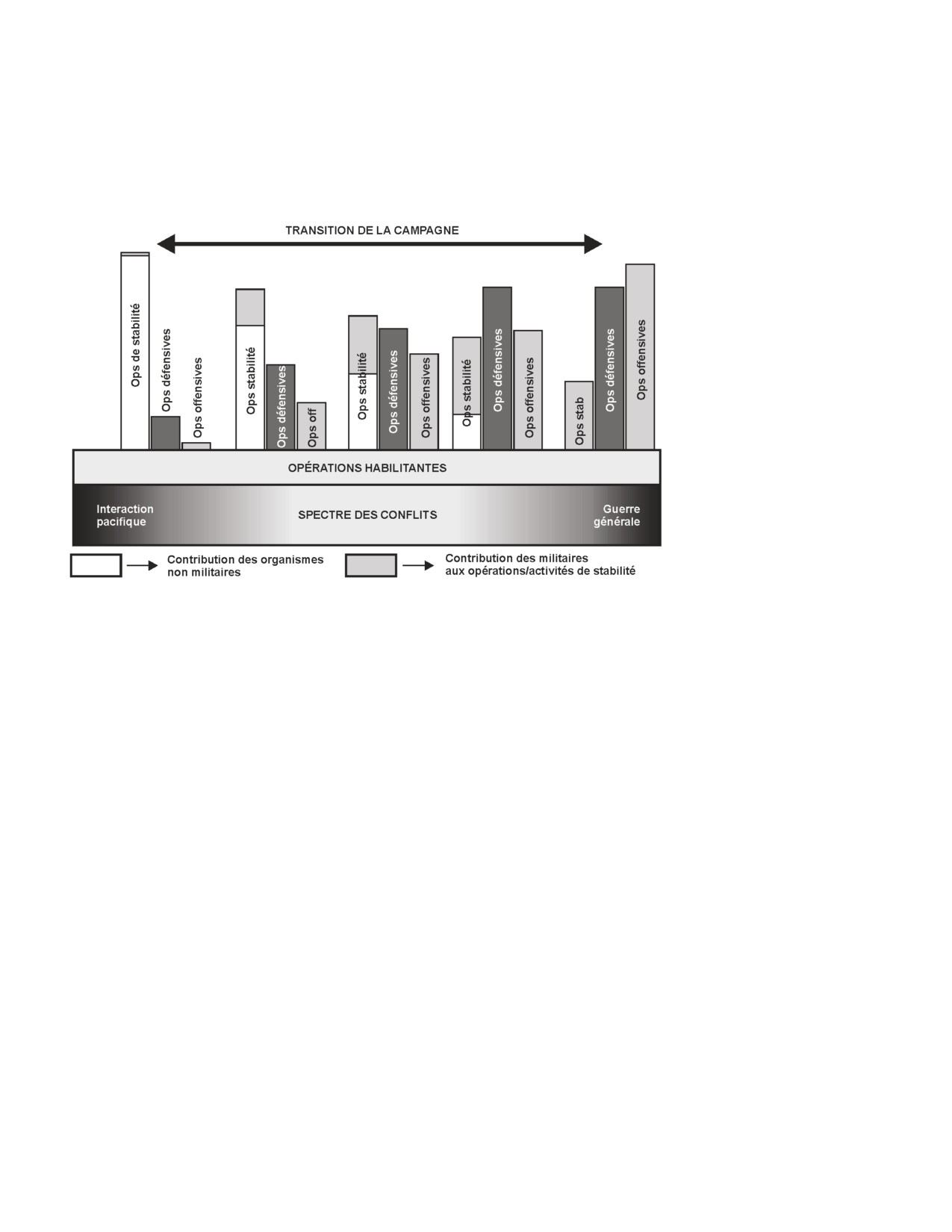
Land Operations
planning and conduct of all military reconstruction and assistance to other agencies must
consider the manner in which military activity is complementary to future civilian work, and must
plan for handover to those other JIMP members. As this occurs with improved security, military
involvement and support should decrease.
Figure 7-14: Transition of Stability Operations Between Campaign Themes
SECTION 22
ENABLING OPERATIONS
7120. GENERAL
1.
Enabling operations link other operations and support the transition between different
types of tactical activities. They may be conducted to make or break contact with the adversary
or they may be conducted out of contact. An enabling activity is never carried out in its own
right. Its execution must lead to the active prosecution of another type of tactical operation.
The successful and rapid execution of these activities relies upon such factors as the devolution
of decision-making, the co-location of HQ, liaison and a simple plan.
2.
The effective execution of enabling activities will help ensure the following:
a.
the ability to make a transition between phases without a loss in tempo;
b.
the forces taking over the battle having the most up-to-date information;
c.
fluid movement;
d.
fire control so as to use all weapons to further the aim and to avoid fratricide;
and
e.
quick regrouping.
7-108
B-GL-300-001/FP-001
The Conduct of Land Operations
3.
Enabling operations consist of the following activities:
a.
reconnaissance;
b.
security;
c.
advance to contact;
d.
tactical movement;178
e.
meeting engagement;
f.
link-up;
g.
withdrawal;
h.
retirement; and
i.
relief of troops in combat and encircled forces.
7121. RECONNAISSANCE
1.
Reconnaissance operations are those activities undertaken to obtain information about
the adversary, terrain, or the indigenous population of a particular area. Area, point and route
reconnaissance are common tasks.
2.
Doctrine concerning the conduct of reconnaissance activities is contained in a wide
range of supporting publications. Tasking of reconnaissance forces must be done with care.
They normally execute their missions while planning is ongoing for the forthcoming mission and
are then re-tasked to support follow-on missions with little or no opportunity for recovery.
3.
The employment of reconnaissance forces must be closely tied to the intelligence cycle.
Key is the rapid dissemination of information gained, particularly to those units in contact or
potential contact.
7122. SECURITY
1.
Security operations provide early and accurate warning of the adversary’s dispositions
and operations. Depending upon their mission and structure, they may provide an element of
protection for a main body force or gain time for the preparation of other deliberate operations.
Security operations are normally conducted as part of a larger enabling operation or in support
of another type of tactical operations such as the defence.
2.
Security operations consist of screen, guard and cover, and are defined as follows:
178 Tactical movement refers to the movement of forces from one location to another, but is not an
advance to contact. Although moving forces do not expect contact, they move in a tactical fashion that
ensures they are prepared to counter and defeat any contacts.
B-GL-300-001/FP-001
7-109
Land Operations
a.
Screen Force. A screen force is defined as: “a security element whose primary
task is to observe, identify and report information and which only fights in self-
defence.179” A screen force will normally consist of reconnaissance elements,
possibly supported by indirect and tactical air fire support controllers. It will be
key to finding the adversary for subsequent fixing and striking. A flank screen
may also provide security180 for a main body against a flanking or surprise
attack.
b.
Guard Force. A guard force is defined as: “a security element whose primary
task is to protect the main force by fighting to gain time, while also observing
and reporting information.”181 Apart from gaining time for the commitment of the
main body, the guard force, depending upon the circumstances, may contribute
to the attrition of an adversary, may conduct counter-reconnaissance tasks, or
may fix an adversary element for striking by the main force. Guard forces may
also deploy to the flank of a main body to provide protection.
c.
Covering Force. A covering force is defined as: “a force operating apart from a
main body for the purpose of intercepting, engaging, delaying, disorganizing and
deceiving the enemy before he can attack the covered force.”182 Based upon
the definition and the intent of deploying a covering force, the force must consist
of enough combat power to meet the commander’s intent. A covering force may
be required to fight a delay battle in support of a main defensive position.
3.
The composition of any security force will be determined by its mission and the intent
that the commander has in terms of effects to be created by its commitment.
SECTION 23
ADVANCE TO CONTACT
7123. PURPOSE
1.
The advance to contact seeks to gain or re-establish contact with an adversary under
the most favourable conditions. To achieve this, forces may be employed in both supporting
security and reconnaissance missions. The advance to contact is normally executed in
preparation for a subsequent offensive operation and therefore ends when the main force is
positioned for the subsequent operation. The mission assigned to the main force will determine
subsequent operations. This may also be determined from the posture of the main body when
contact is made with the adversary.
179 NATO AAP-6. A second definition provided by AAP-6: “any body or detachment of troops that
provides security for a larger force by observation, reconnaissance, attack, or defence, or by any
combination of these methods.” Either definition may be applied depending upon the circumstances and
commander’s intent.
180 There is a key difference between security and protection. A force that is providing security will only
be able to give warning of an adversary’s activity. It can do little to pre-empt or disrupt it. A force that is
tasked to provide protection must be able to alert the main body to the adversary, and must be capable of
defeating or disrupting the adversary force long enough for the main force to take appropriate action.
181 NATO AAP-6.
182 Ibid.
7-110
B-GL-300-001/FP-001
The Conduct of Land Operations
2.
By advancing to contact, the force seizes and maintains the initiative. The operation
may involve destroying or forcing the withdrawal of an adversary’s elements and seizing ground
of tactical importance.
7124. CONDUCT
1.
Planning. The primary consideration in planning for an advance to contact is
anticipating actions that may occur during the operation and the requirements for manoeuvre
and fire support when contact is made. Contingency plans should be issued prior to
commencement that anticipate possible contact and required actions. During the advance to
contact, the commander will need to analyze the situation continually using current reports and
intelligence from all sources. The mission, particularly the anticipated employment of combat
forces, dictates the positions of units and groupings in the formation. CSS units are integrated
with the movement of combat forces to provide support but without interfering with tactical
movement.
2.
Situational Awareness. While reconnaissance forces and other ISTAR capabilities
(such as forward deployed UAVs) will provide a good deal of situational awareness, the
advance to contact will never be conducted with full situational awareness. This is particularly
true in close terrain and situations involving unconventional adversaries. The commander will
adjust plans such as the speed of advance and formations used, depending upon the level of
awareness provided, the adversary, and the overall amount of risk he is willing to accept.
3.
Scheme of Manoeuvre. The commander will task, array and commit his forces as
demanded by his assessment of the situation:
a.
Covering Force Action. The advance to contact will be led by a covering force
that normally contains reconnaissance forces. The covering force will assist in
finding the adversary and other information to support subsequent fixing and
striking. Whenever possible, the axis of advance should be given in the most
general terms to the leading elements. The axis of advance should be allowed
to develop as the battle unfolds so that success can be exploited. Possible
tasks of the covering force may include the following:
(1)
Locate and determine the strength of the adversary’s positions.
(2)
Find and exploit gaps so as to provide information on possible routes for
enveloping or bypassing action by the main body.
(3)
Obtain information on routes, obstacles, terrain conditions affecting
movement, as well as civilian population distributions.
(4)
Conduct deep penetration either to disrupt adversary communications
and logistic units or possibly to seize a crossing site, in particular a bridge
or defile. Integral engineer support will be required to “make safe” and
remove any demolitions on the crossing, and the main force must follow
very quickly.
(5)
Provide security for the advance guard and main body by conducting
counter-reconnaissance.
B-GL-300-001/FP-001
7-111
Land Operations
(6)
Support subsequent operations such as an attack by securing lines of
departure, identifying attack positions and fire bases, etc.
b.
Advance Guard and Main Body. An advance guard may be deployed to
provide additional security for the main body, to counter unexpected situations
and to fix adversary forces for subsequent striking by the main body. The
tactical handling of the advance guard and the main body will depend upon the
number of routes available. The rate of advance will vary across the front and
will depend upon the terrain, the location and strength of adversary positions
and the possibility of bypassing the opposition. Advances through urban areas
will be particularly slow if advancing across a wide frontage or using an urban
saturation technique.183 The grouping within the main body must be sufficiently
flexible to allow elements to:
(1)
Assume the advance guard role.
(2)
Change direction or route of any of the elements of the main body either
to bypass adversary positions or to take advantage of better routes.
(3)
Deal with the adversary that has been bypassed or is holding up the main
force.
c.
Flank Guards and Rearguards. The deployment of the flank guards and
rearguards will depend upon the assessment of the adversary. Flank guards
normally travel on routes parallel to the route of the main body, moving either
continuously or by successive or alternating bounds to occupy key positions on
the flanks. In some situations, flank protection may be provided by a flanking
formation. Armoured reconnaissance units are suitable for flank protection of
the advancing force by moving on a route parallel to the main axis of advance,
or by picketing likely adversary approach routes. These reconnaissance forces
are unlikely to be able to deal with a strong adversary force, but will give early
warning of an adversary approach, which can then be dealt with by reserves.
Attack or armed helicopters are particularly effective in this instance. Mobile AD
units are particularly effective against the helicopter adversary. The rearguard
follows the main body.
d.
Action on Contact. On contact, speed of manoeuvre and initiative may
overcome the adversary before he can react. The sequence of action on
contact may be as follows:
(1)
Within its capabilities, the covering force destroys adversary forces that
can interfere with the movement of the main body and pickets or blocks
those that it cannot destroy. It should be prepared to handover quickly to
the advance guard and to resume its assigned tasks.
183 For a detailed discussion of tactical operations in an urban terrain, see B-GL-322-008-FP-001 Urban
Operations—A Tactical Guide to Urban Operations.
7-112
B-GL-300-001/FP-001
The Conduct of Land Operations
(2)
The covering force should develop the adversary picture and inform the
commander of the main body of terrain that will support a subsequent
offensive action, such as positions for attack and the fire base.
(3)
Elements of the advance guard or of the main body may be committed to
reduce pockets of resistance contained or bypassed by the covering
force.
(4)
Any elements of the covering force tasked with containing such pockets
initially are relieved as rapidly as possible and rejoin the covering force to
avoid dissipating its strength.
(5)
The commander monitors the progress of the leading and engaged
combat forces and anticipates their requirements. When resistance is
encountered, he commits forces from the main body in order to maintain
the momentum of the advance.
e.
Maintenance of Momentum and Subsequent Actions. It is of the utmost
importance that the momentum of the advance be maintained. Whenever
possible, adversary positions should be outflanked. The commander must lay
down whether they are to be bypassed and cleared by follow-up forces, or to be
taken by the leading elements. A commander may well decide that a hasty
attack by troops in contact is to his advantage, while another part of the force
continues the advance. In either case, if the adversary established a continuous
front and the strength and width of his positions preclude an outflanking move,
an attack may be mounted to force a gap.
f.
Bypassing Policy. The bypassing policy must be carefully considered and
clearly specified. It will always be extremely difficult to determine the exact
strength of a position, and much will depend upon accurate reconnaissance and
intelligence.
g.
Routes. Once routes have been opened it may be necessary to employ forces
to ensure their security, particularly if small pockets of adversary have been
bypassed and remain to the rear of friendly forces. If possible, routes used for
logistic traffic should be kept separate from those used by combat forces.
These routes are especially vulnerable to adversary action and require security
against land and air attack. CSS assets may require planned convoy security
particularly when dealing with a non-contiguous battlespace and an
unconventional adversary.
h.
Airmobile and Airborne Forces. Airmobile or airborne forces achieve surprise
and maintain momentum by being deployed ahead of the covering force to seize
key terrain, including defiles, bridges and crossing sites, and to overcome
obstacles. The ground force can then link up with them and continue the
advance without the need to undertake an operation that may slow the
momentum of the advance. Such forces must not be deployed too far ahead
and against targets that they are unable to overcome, as they may be lost
before assistance arrives, and momentum will suffer.
B-GL-300-001/FP-001
7-113
Land Operations
i.
Transition to Other Operations. The advance to contact ends either when the
intended posture is achieved or when adversary action requires the deployment
and the coordinated effort of the main body.
7125. COMBAT SUPPORT IN AN ADVANCE
1.
Artillery. Immediate and effective fire support will enable the force to engage the
adversary, retaining freedom of action to bypass or to attack. A heavy volume of fire will reduce
the need to deploy troops in contact with the adversary. As the nature of the advance to contact
is one of sustained movement, a high degree of fire support coordination is required. Artillery,
mortars and ships providing naval gunfire must move in such a way that maximum support is
available at all times. Forward observers must accompany leading elements and units on
exposed flanks.
2.
Air and Close Air Support. Tactical air support is required in the advance to contact to:
a.
assist in protecting advancing units from adversary air attack;
b.
provide information and intelligence about the adversary;
c.
provide close air support to supplement artillery, particularly when it is not
possible to concentrate its fire; and
d.
interdict adversary units attempting to withdraw or reinforce.
3.
Aviation. Helicopter support is used mainly for the following purposes:
a.
surveillance and reconnaissance;
b.
flank protection;
c.
exercise of command and control;
d.
seizure of critical points and key terrain features; and
e.
resupply and medical evacuation.
4.
Air Defence. AD weapons must keep up with the advance. To achieve this, ground
based AD must have a priority for road movement. Likely tasks will include the protection of
vulnerable points on the route and cover for critical operations such as an attack, river crossing
or breaching operation.
5.
Engineers. The main role of engineers in the advance is to open and maintain routes
using specialist engineer equipment. They also have the tasks of assisting the leading troops to
overcome obstacles and to clear mines, and of helping in the protection of the flanks.
Engineers and their heavy equipment should be positioned so that they can be deployed quickly
when required. An engineer reconnaissance element must move with the leading troops and
engineer resources may have to be well forward.
6.
Electronic Warfare. Emphasis will be placed on the employment of passive EW
(intercept and direction finding) resources in order to detect and locate the adversary.
7-114
B-GL-300-001/FP-001
The Conduct of Land Operations
7126. COMMAND AND CONTROL OF AN ADVANCE
1.
Commanders should move well forward so that they can quickly influence the battle and
make the most of fleeting opportunities. Distances and rapid movement will strain normal
command arrangements. Command posts will be on the move, particularly at lower levels, as
follows:
a.
As the main body normally moves on radio silence the problem of maintaining
coordination along the routes will require special arrangements and may also
cause a restriction on the use of AD assets.
b.
Special arrangements may be required to provide additional radios for relay
purposes.
c.
Extensive use will have to be made of liaison elements.
d.
Coordination with supporting air forces will present special problems.
e.
The command responsibilities for each route and for traffic control must be
established.
f.
Traffic control systems should be able to:
(1)
easily rearrange the order of march on routes allocated;
(2)
improve measures to keep routes open; amd
(3)
assist in regulating the flow of traffic to help units reach their destinations
in a timely manner.
g.
The command relationship between the various elements of the force must be
established beforehand.
7127.
COMBAT SERVICE SUPPORT IN AN ADVANCE
1.
CSS must provide for the requirements of the advance and for the anticipated
requirements of any subsequent mission. The support problem in the advance is that of
sustaining forces that are moving and thus extending the supply lines. Because there will
seldom be sufficient transport, a careful calculation of anticipated requirements must be made
and priorities established.
2.
At the start of the operation, units should be as self-contained as possible and
arrangements made so that they can be refuelled during the move. Engineer stores for bridging
and route repair are likely to be a large transport commitment. It is important that maintenance
and recovery resources and traffic control are deployed to keep routes open and assist units.
3.
Medical units should move with the force and be able to provide immediate treatment
during movement. When contact is made with the adversary they should rapidly establish
second line (Role 2) medical facilities. As the LOC may become extended, helicopters should
be available for the evacuation of high priority casualties.
B-GL-300-001/FP-001
7-115
Land Operations
7128. TACTICAL MOVEMENT
1.
Tactical movement is an enabling activity that involves tactical movement between
locations by combat and other forces, without the expectation or seeking of adversary contact,
albeit prepared for contact.
2.
It differs from an advance to contact in that forces conducting the march are prepared to
counter adversary activities, but are not expecting nor seeking to make contact en route.
3.
Forces moving from one location to conduct other tactical activities, such as stability
activities in a given area, may use tactical movement. It is generally used in non-linear, non-
contiguous battlespaces in which the adversary is unlikely to be located in a fixed location.
During the march, forces do not actively seek contact but are prepared for adversary contact.
The greatest threats to forces on the march will be ambushes and IEDs.
4.
Movement is done tactically and schemes of manoeuvre and the use of security
activities will reflect the tactical situation and adversary’s profile.
5.
The conduct and planning considerations for the advance to contact may be applied to
the planning and conduct of tactical movement. Given the possibility of contact during the
march, the commander will assess the need for the security of the force throughout the activity,
and will take the necessary precautions, such as the deployment of security forces and the
clearing of defiles and danger areas.
SECTION 24
MEETING ENGAGEMENT
7129. PURPOSE
1.
The meeting engagement is a combat action that may occur when opposing forces seek
to fulfil their mission by offensive action. It will often occur during an advance to contact and
can easily lead to a hasty attack. In offensive, defensive or delaying operations it will often mark
a moment of transition in that the outcome may well decide the nature of subsequent
operations. For theses reasons, a meeting engagement is described as a transitional phase.
Even when the main part of a force is attacking, defending or delaying, individual elements may
find themselves in situations that have the characteristics of a meeting engagement.
2.
The meeting engagement differs from the advance to contact in that it occurs
unexpectedly, whereas in the advance to contact the commander is deliberately seeking to
establish contact with the adversary.
3.
A meeting engagement may occur in various circumstances:
a.
When a force that is moving makes contact with an adversary about whom the
friendly force has little or no information.
b.
When both sides become aware of the each other and decide to attack without
delay in an attempt to obtain positional advantage, gain ground of tactical
importance, maintain momentum, or assert dominance over the other.
c.
When one force deploys hastily for defence while the other attempts to prevent it
from doing so.
7-116
B-GL-300-001/FP-001
The Conduct of Land Operations
7130. CONDUCT
1.
It will not be possible to plan in detail for a meeting engagement. However, a force that
is properly deployed in accordance with recognized tactical principles will be poised to react to
most situations. Meeting engagements will invariably force a commander to reconsider and
often adjust his plans. The basic principle is to seize and retain the initiative. This will give the
commander the freedom of action he needs, whether to accomplish his mission as he originally
intended or to change his plan to suit the new situation. High tempo is at a premium and
success depends, to a large extent, upon the speed of reaction of the commander and his
forces. The commander can then decide how to develop the meeting engagement into a
subsequent offensive or defensive action.
2.
While commanders can make no firm plans, they should make use of the IPB process.
In particular, they should study the terrain and the map to deduce areas that are favourable to a
meeting engagement. Additionally, they should take particular note of the latest situation or
intelligence reports and assessments concentrating on likely adversary capabilities, objectives,
and avenues of advance, movement, and natural obstacles.
3.
Meeting engagements are such that there will not normally be enough time for a
complete battle procedure to take place as the two opposing forces close. Assuming a
reasonable balance of forces, victory will go to the side with the higher tempo. The commander,
who reacts more quickly, strikes the first blow and keeps the adversary off balance. In the
planning stage, this implies careful reconnaissance, balanced grouping, forward command, and
responsive indirect fire support on call. Planning in this type of battle should never be so
detailed as to lead a commander into a preconceived course of action, as a plan is not a
substitute for initiative and bold leadership that overturn material superiority.
4.
The commander whose forces make contact with the adversary in a meeting
engagement must immediately decide how he wants to fight the battle. In deciding on a course
of action he must not lose sight of his original mission and of his superior commander’s intent.
On the other hand, he must not shirk his responsibility to act independently. He must notify his
superior commander immediately of his decision.
5.
One of the commander's first tasks in a meeting engagement is to determine the
adversary's strengths and dispositions. In particular, he should ascertain the situation on the
adversary's flanks. The identification of, and an attack on an assailable flank, will generally
disclose the adversary's dispositions more rapidly than a frontal attack, and will give more
opportunity for tactical surprise and decisive results.
6.
Often, it may not be immediately possible to use all the forces that the commander may
wish to deploy. In this case, he must establish an order of priority for deployment early in the
operation. Throughout the operation, he must keep a clear picture of the location and status of
all elements of his force.
7.
The commander’s decision on how to continue a meeting engagement should, wherever
possible, be based upon his personal assessment of the situation. However, he must not
sacrifice valuable time to obtain detailed information. He must realize that he is in a race with
the adversary commander for time and space. It is, therefore, extremely important that before
the operation starts the commander evaluates possible routes for movement and assesses any
area of terrain that may be useful, and that he keeps these in mind while his force is moving.
B-GL-300-001/FP-001
7-117
Land Operations
8.
The speed of reaction and considerable firepower of armed/attack helicopters, allows the
force to be committed very quickly against the adversary in a meeting engagement. In
particular, early deployment of reconnaissance and AH in a combat, as opposed to a combat
support role, will nearly always give a commander an advantage.
7131. COMBAT SUPPORT IN A MEETING ENGAGEMENT
1.
Artillery. The amount of initial fire support available to the forces that become involved
in a meeting engagement depends upon the organization for movement laid down by the
commander. It is, therefore, particularly important that there is fire support available to support
the leading elements of a moving force. Forward artillery observers must be allocated to the
leading elements of a combat force. A meeting engagement is also an ideal situation in which
to make use of scatterable mines to restrict the adversary’s freedom of manoeuvre.
2.
Air Defence. AD weapons should be positioned along adversary air avenues of
approach to over-watch forces on the move. Adversary ground forces will often be supported
by armed helicopters, or they may approach under air cover, or by air transport.
3.
Engineer. The rapid deployment of engineers can be crucial in transitional phases of
the battle. Engineer reconnaissance must be well forward, as must armoured engineers.
Combat engineers must be readily available for mobility or counter mobility tasks. An
appropriate and quick employment of engineer equipments can ensure freedom of movement
and deny it to the adversary. Engineer planning of scatterable mines, for example, can provide
responsive counter-mobility support if the assets are available.
4.
Electronic Warfare. EW (intercept and direction finding) resources will provide
additional information on the adversary. Once battle is joined, jamming of adversary C2 and fire
support communications will assist the commander in achieving his aim.
7132. COMMAND AND CONTROL OF A MEETING ENGAGEMENT
1.
A meeting engagement will create a number of challenges for a commander in terms of
command and control:
a.
Initially, he will have little intelligence on the strength, location and intention of
the adversary. It may even be necessary for him to confirm the locations of his
own forces. Immediate and clear situation reports from lower commanders are
essential to allow him to make his plan.
b.
The HQ may be on the move, and therefore, its effectiveness may be restricted.
The staff may be dispersed or the commander separated from them.
Characteristically, units will be moving in radio silence and it will take time to
activate communications between HQs.
c.
If a meeting engagement is likely, therefore, it is vital that commanders are well
forward and able to speak to each other, even if their HQs temporarily cannot.
7-118
B-GL-300-001/FP-001
The Conduct of Land Operations
7133. COMBAT SERVICE SUPPORT IN A MEETING ENGAGEMENT
1.
CSS must enable the commander to seize and maintain the initiative and must be
capable of responding quickly to the rapid changes in plans. Because of the limited information
available when a meeting engagement occurs CSS commanders must be ready for the
unexpected. Ensuring that combat supplies and materiel levels are maintained at the maximum
practical level is one means of achieving this readiness.
2.
In a meeting engagement, speed is the major criterion and CSS planning is
subordinated to achieving that. At the level above that which is in contact, CSS should
concentrate on directing its efforts on the formation or unit involved both during and after the
battle. This may include:
a.
ammunition for the battle if there is time, and certainly after reorganization;
b.
refuelling after reorganization;
c.
move forward of medical support and the development of a casualty evacuation
plan;
d.
ensuring maximum availability of equipment during the engagement and in
preparation for subsequent operation; and
e.
planning for the recovery of battle-winning equipments.
SECTION 25
LINK-UP
7134. PURPOSE
1.
Link-up is conducted to join two friendly forces in adversary-controlled territory. It may
therefore be necessary to destroy the adversary between these forces before a link-up is
established. It is followed by another operation such as a forward passage of lines, a
withdrawal or a relief. Both forces may be moving towards one another, or one may be
stationary or encircled. They may have the same or different missions. A link-up operation
could occur under the following circumstances:
a.
A link-up between two forces engaged in converging attacks may take place
when each force captures adjacent objectives, thus completing encirclement.
b.
A link-up with encircled or cut-off forces may take place on the perimeter of the
defensive position established by that force. When the link-up is combined with
a breakout action, it may take place at another designated objective. The
encircled force should try to breakout, or at least mount some form of
diversionary action in order to ease the task of the relieving force by diverting
the adversary’s attention.
c.
A link-up operation with an air delivered or infiltrated force may take place on the
perimeter of its defensive position. In this case, the link-up is normally followed
by a passage of lines or by a relief of the forces involved.
B-GL-300-001/FP-001
7-119
Land Operations
7135. CONDUCT
1.
The requirement for the link-up may be part of the CONOPS from the outset.
Alternatively, a link-up may become necessary in the course of an operation and must be
planned as the situation develops. In any event, details of the plans must be passed to all
concerned in due time, without undermining security.
2.
Link-up operations are generally offensive in nature. The requirements of the link-up as
well as those of the subsequent mission will determine the size and composition of the force.
3.
The mission to carry out a link-up operation should always be given in the context of a
subsequent mission for the forces involved. It will normally state the location where the link-up
will take place. Frequently, a time will be stipulated for the link-up.
4.
When planning a link-up operation, particular attention should be paid to:
a.
the coordination of manoeuvre forces involved;
b.
command relationships;
c.
communications; and
d.
control measures.
5.
Link-up operations may occur when one force is moving to link-up with a stationary force
or when both forces are moving. The following planning and execution considerations and
procedures apply:
a.
A major consideration in this type of activity is speed in establishing the link-up
in order to reduce the possibility of adversary reaction and to minimize the
period of vulnerability.
b.
For the moving force in a link-up, the operation may involve deliberate attacks,
or if circumstances permit, the more rapid movement of an advance to contact
deployment.
c.
Ground link-up points must be coordinated at locations where the axis of
advance of the moving force intersects with the security elements of the
stationary force.
d.
Restrictive fire control measures are required to coordinate fire from the
converging forces.
e.
During the last phase of the link-up operation the speed of advance of the forces
must be carefully controlled; reconnaissance elements must seek to establish
contact with the other force as early as possible, and additional information will
be obtained to confirm/adjust earlier plans.
f.
When the link-up is made, the moving force may join the stationary force or pass
through or around and continue to attack the adversary. If they join to continue
activities, a single commander for the overall force must be designated.
7-120
B-GL-300-001/FP-001
The Conduct of Land Operations
Subsequent activities must be launched as quickly as possible to exploit the
success achieved by the link-up.
g.
Primary and alternative link-up points are established on the boundaries where
the two forces are expected to converge.
h.
As they move closer to one another, the need for positive control to avoid
incidents of fratricide is important and must be coordinated to ensure that the
adversary does not escape between the two forces.
i.
The leading elements of each force should monitor a common radio net.
7136. DIRECT AND INDIRECT FIRE SUPPORT DURING A LINK-UP
1.
To avoid losses, fire control must be carefully exercised until a link-up has been
achieved. Link-up forces will use normal fire control measures. Specific coordination must be
established, however, for any phase when the fire of one force may affect the operations of the
other.
2.
Particular attention must be given to the control of CAS/AH in the link-up area between
the forces as they approach.
7137. ENGINEERS
1.
In link-up operations, it is critical to provide mobility support to the forces that are moving
to link-up. Clearing of routes and adversary barriers is essential for the timely completion of the
operation.
7138. ELECTRONIC WARFARE
1.
Employment of EW must be carefully coordinated in order to avoid mutual interference
and duplication of tasks.
7139. COMMAND AND CONTROL OF A LINK-UP
1.
The convergence of friendly forces in the area of the link-up may present particular
problems that require the appointment of a single commander in the area. This procedure will
also be normal when there is a significant difference in the size of the two forces taking part in
the operation. Where this is the case, this commander must be designated beforehand and in
sufficient time to allow for concerted action to be planned. The time or conditions under which
command is assumed must be clearly stated.
2.
The following control measures require emphasis:
a.
axis of advance or boundaries for the link-up;
b.
objectives to be held and/or to be captured by each of the forces taking part;
c.
the locations where contact between the two forces will be established;
B-GL-300-001/FP-001
7-121
Land Operations
d.
the timings of the operation for the forces involved; and
e.
fire coordination lines to avoid fratricide, particularly as the two forces are
converging.
3.
Liaison between the forces taking part and with the overall commander is very important.
Communications in these circumstances can normally be maintained by radio only. The
majority of detail for liaison and communications will be laid down in the overall commander’s
plan; where that is not possible, these arrangements must be judiciously expedited on the
initiative of the two forces carrying out the link-up operation. The measures include:
a.
liaison teams;
b.
passwords and visual identification signs;
c.
measures for combat identification;
d.
report lines and reference points; and
e.
contact frequencies, radio authentication procedures and codes.
7140. COMBAT SERVICE SUPPORT DURING A LINK-UP
1.
Apart from taking account of the requirements of the link-up force itself, the commander
has to consider the need to provide CSS for the force with which it is intended to link-up. In
principle, CSS considerations are generally the same as those for offensive operations.
7141. LINK-UP OF A MOVING FORCE WITH A STATIONARY FORCE
1.
In an operation where one force is moving to link-up with a stationary force, the following
planning procedures apply:
a.
A major consideration in this type of operation is speed in establishing the link-
up to reduce the possibility of adversary reaction and to minimize the period of
vulnerability.
b.
Ground link-up points must be coordinated at locations where the axis of
advance of the moving force intersects with the security elements of the
stationary force.
c.
A restrictive fire line (RFL) is required to coordinate fire from the converging
forces.
d.
For the moving force in a link-up, the operation may involve deliberate attacks,
or if circumstances permit, the more rapid movement of an advance to contact.
e.
When the link-up is made, the moving force may join the stationary force or pass
through or around and continue to attack the adversary. If they join up to
continue operations, a single commander for the overall force must be
7-122
B-GL-300-001/FP-001
The Conduct of Land Operations
designated. Subsequent operations must be launched as quickly as possible to
exploit the success achieved by the link-up.
7142. LINK-UP OF TWO MOVING UNITS
1.
Link-up between two moving forces is a difficult operation to successfully conduct and is
normally undertaken to complete the encirclement of an adversary force. Primary and
alternative link-up points are established on the boundaries where the two forces are expected
to converge. During the last phase of the link-up operation, reconnaissance elements must
seek to establish contact with the other force as early as possible, and additional information will
be obtained to confirm/adjust earlier plans. As they move closer to one another, the need for
positive control to avoid incidents of fratricide is important and must be coordinated to ensure
that the adversary does not escape between the two forces. Leading elements of each force
should monitor a common radio net.
SECTION 26
WITHDRAWAL
7143. PURPOSE
1.
A withdrawal occurs when a force disengages from an adversary force in accordance
with the will of its commander. It seeks to disengage its combat forces from the adversary
although contact may be maintained through other means such as indirect fire, reconnaissance
or surveillance. The withdrawal may be followed by another specific operation such the defence
in a new location.
2.
The order to withdraw will not normally be given by the commander without the
agreement or direction of his superior commander. A withdrawal may be undertaken for the
following reasons:
a.
If the objective of the operation cannot be achieved and the force is faced with
defeat.
b.
The objective is achieved and there is no further requirement to maintain
contact.
c.
To avoid battle in unfavourable tactical conditions.
d.
To draw the adversary into an unfavourable posture, for example, to extend his
LOC.
e.
To conform to the movements of adjacent friendly forces.
f.
To allow for the use of the force or parts of the force elsewhere.
g.
For CSS reasons; that is, the force can no longer be sustained.
3.
The withdrawal should be conducted so as to minimize adversary interference and
preserve fighting power. The ability to move rapidly to offensive or defensive operations should
always be retained.
B-GL-300-001/FP-001
7-123
Land Operations
4.
The withdrawal will take place either in or out of contact with the adversary. Whichever
the case, the commander's primary concerns in planning and conduct will be:
a.
to disengage;
b.
to retain an intact frontline by the deployment of strong covering troops;
c.
to safeguard withdrawal routes; and
d.
to maintain balance throughout the operation.
5.
Success will depend upon the maintenance of morale, tight control and secrecy. A
commander must also be ready to take the offensive if the opportunity arises, albeit with only
limited objectives.
6.
The commander's mission will normally be to disengage his force. If the mission is the
deliberate intention of a higher commander, the mission will be included in a complete OPORD.
If, on the other hand, the decision has been forced upon the commander by highly unfavourable
circumstances, the order to withdraw may contain nothing more than the authority to do so and
give only minimal direction.
7.
The scheme of manoeuvre must be simple and normal organizations should be retained
as far as possible. Regrouping during the operation should be avoided. Particular attention
should also be paid to:
a.
surprise and deception, possibly including noise coverage by artillery;
b.
maximum use of cover and concealment to achieve protection; and
c.
allocation of routes and an appropriate movement control system.
7144. ORGANIZATION OF THE WITHDRAWAL
1.
A withdrawing force should normally be organized into:
a.
a protective element that covers the withdrawal; and
b.
a main body protecting itself with advance, rear and flank guards.
2.
The withdrawing force’s subsequent mission will have an influence on its organization
and on the sequence of the withdrawal. Depending upon the subsequent tasks, there will likely
be a requirement to send an advance party, often under the command of a second-in-
command, in order to conduct the reconnaissance and planning for the next task.
3.
Forces not required for immediate operations, including CSS elements and the
wounded, should be moved out early to keep routes clear and allow for a rapid withdrawal.
7145. PLANNING
1.
The commander’s estimate of the situation should consider:
7-124
B-GL-300-001/FP-001
The Conduct of Land Operations
a.
The distance to be moved.
b.
The weather/ground conditions and the degree and duration of darkness. To
maintain secrecy, achieve surprise and reduce casualties from the air,
withdrawals are generally better carried out at night, although, against an
adversary with a good surveillance capability, darkness will not hide movement.
Bad weather conditions, however, such as heavy rain, mist or fog, may enable a
withdrawal to be carried out effectively by day. Difficult ground conditions may
make a withdrawal in daylight the only practical way to avoid loss of control.
c.
Possibilities of impeding the adversary’s mobility, particularly by barriers.
d.
Adversary ground strength.
e.
The situation on both flanks.
f.
The mobility of the force.
g.
The air situation.
h.
CSS.
2.
The scheme of manoeuvre must cover the entire operation. It must be simple and
normal organizations should be retained as far as possible. Regrouping during the activity
should be avoided. Particular attention should also be paid to:
a.
The plan being simple to permit flexibility.
b.
Grouping for the withdrawal remaining the same, if possible, throughout the
operation.
c.
Surprise and deception, possibly including noise coverage by artillery.
d.
The maximum use of cover and concealment to achieve protection.
e.
Allocation of routes and an appropriate traffic control system.
3.
The withdrawal is coordinated and controlled through key timings:
a.
The time at which thinning-out may occur.
b.
The time until when the position must be denied. This is the main coordinating
timing of the withdrawal plan.
c.
The time to be clear of the current position.
d.
The time to be clear of any specific coordination line. This will be needed for the
coordination of supporting fires; and
e.
The time by which the subsequent task (such as manning a new defensive
position) is to be completed.
B-GL-300-001/FP-001
7-125
Land Operations
4.
The preparation of demolitions and other obstacles along the withdrawal routes must be
carried out as early as possible. This is particularly important for preliminary demolitions, which
must be carefully coordinated with the plan for the withdrawing force. The preparation of denial
measures should be carried out as soon as possible and their execution carefully coordinated
with the plan for the withdrawing force.
5.
Along boundaries, the appropriate higher-level commander should coordinate the
preparation of denial measures. Execution should be carried out carefully and in accordance
with the plan of the withdrawing force. The higher commander will make the final decision on
the execution of any denial measures after consultation with adjacent commanders.
6.
A withdrawal will either be conducted directly to a new main position, or indirectly
through one or more intermediate positions. The decision to use intermediate positions will
depend upon the distance, the strength of the force, the state of the adversary and the delay
required to prepare the new position. In this case, a rearward passage of lines will be required
in order to check the adversary at the intermediate position.
7.
Considerations when planning and selecting intermediate positions are:
a.
They must be strong enough to force the adversary to deploy early and to
undertake time consuming preparations for an attack. This will mean selecting
positions that incorporate natural obstacles and deploying long range direct and
indirect weapon systems.
b.
They should be far enough from one position to the other to force the attacker to
move his artillery each time to engage.
c.
The time before which there will be no rearward movement except for normal
traffic and reconnaissance parties.
d.
The time up to which the position has to be denied to the adversary.
e.
The time at which troops may start thinning-out equipment and supplies to the
rear.
f.
The time by which all troops will be clear of a line behind the position. This will
be needed for the coordination of supporting fires.
7146. CONDUCT—SCHEME OF MANOEUVRE AND SEQUENCE OF WITHDRAWAL
1.
Based upon the timings issued in the superior’s orders (for such activities as thinning-
out, time the position must be denied, and time for the crossing of any coordination lines), the
sequence for the withdrawal from a position may be:
a.
Reconnaissance parties move back and all non-essential vehicles and
equipment are cleared from the position.
b.
Covering forces take up station behind the position and reserves move to the
appropriate locations.
7-126
B-GL-300-001/FP-001
The Conduct of Land Operations
c.
Troops on the position withdraw through the covering troops. By night, when
surprise is easier to achieve and a commander considers a disengagement
possible, rear elements should pull out first leaving those forces deployed
forward until later. Where disengagement is not possible, forward troops will
move first covered by those in depth.
d.
The task of the protective force is to prevent the adversary from engaging the
main body.
e.
The main body withdraws on order. At the lower tactical levels, the plan must
include a staggered withdrawal of one element moving while covered by another
element until a clean break with any adversary has been achieved.
f.
As soon as the main body has disengaged and is at a safe distance, the
protective elements start their disengagement, although they could remain in
their original position until the adversary attacks in force, so as to achieve the
maximum deception and delay. If the adversary launches a strong attack, they
will continue their protective task with a delaying operation. If the distance to be
moved is great and the adversary is expected to react quickly, a portion of the
protective force may occupy a number of intermediate defensive positions in the
rear of the position being abandoned before the withdrawal of the main body.
g.
If the protective element is not able to disengage or to prevent the adversary
from closing in on the main body, it must either be reinforced by elements from
the main body, or the overall commander must commit the majority, or all, of this
force. In this event, the withdrawal must be resumed at the earliest possible
time. If the protective element has disengaged, it will follow the main body and
continue to provide security. In this case, it will maintain surveillance of the
adversary until ordered to break contact completely or until this task is taken
over by another force.
h.
This sequence is repeated at each intermediate position. The withdrawal is
terminated when a force is ready to assume its next task.
7147.
COMBAT SUPPORT IN THE WITHDRAWAL
1.
Artillery. Artillery must be organized and deployed so that it can cover the entire
operation. Long-range artillery will be withdrawn early and placed far enough back so that it can
cover the withdrawal. Artillery elements remaining with the protective elements will endeavour
to maintain the previous fire support cover for as long as possible.
2.
Air Support. Air interdiction and CAS may play an important part in harassing the
adversary following up the withdrawal or attempting to bypass the withdrawal forces. CAS will
be particularly useful, especially where withdrawing artillery causes a reduction of, or
interruption to, indirect fire support. Forward air controllers (FACs) will be required with the
protective element. Defensive counter air (AD) effort may be needed for protection against
adversary ground attack aircraft.
3.
Aviation. Transport helicopters can enhance the speed with which withdrawal
operations can be carried out. Helicopters in a reconnaissance role may be used to observe
adversary activity during the withdrawal. Helicopters can also be used to extract stay-behind
forces. Armed/attack aviation may be used to provide a covering force to assist with
disengagement and a delay of any advancing adversary.
B-GL-300-001/FP-001
7-127
Land Operations
4.
Air Defence. There are unlikely to be sufficient organic AD resources available to
provide comprehensive cover throughout the AO, so priorities of tasks must be established.
The deployment plan of AD units should ensure that they are effective at critical periods to cover
locations where the withdrawing forces are likely to be particularly vulnerable, or areas that the
adversary may select as landing sites for air delivered forces.
5.
Engineers. Engineers will be heavily committed in the withdrawal. Many will be used in
preparing a new defensive position to which forces are withdrawing. Some, however, may
remain to assist with the withdrawal in the following ways:
a.
Mobility. Withdrawal routes must be cleared and maintained. The main body
and rear echelon elements are assisted in breaching unforeseen obstacles and
crossing restrictive terrain.
b.
Counter-mobility. Demolitions and obstacles are prepared to delay adversary
forces near the withdrawing forces.
6.
Electronic Warfare. EW assets will be particularly useful in executing the deception
plan, as well as in disrupting adversary C2 communications.
7148. COMMAND AND CONTROL OF A WITHDRAWAL
1.
Control measures of particular importance in the withdrawal are:
a.
liaison elements;
b.
routes/axes;
c.
report/phase lines;
d.
traffic control measures;
e.
check points; and
f.
timings as required for critical phases or sequences.
2.
The purpose of the operation must be understood by the whole force in order to maintain
morale. During the withdrawal, every opportunity should be taken to maintain morale.
3.
Good communications are vital, and the policy for radio and electronic silence must be
clearly stated. Communications links, methods of operation and density of communications
traffic should remain unchanged for as long as possible to avoid disclosing, to the adversary,
the intention to disengage. The creation of radio traffic by forces remaining in contact will add to
the overall deception of the adversary. Elements, which have disengaged from the adversary,
will normally be ordered to keep radio silence.
7149. COMBAT SERVICE SUPPORT IN THE WITHDRAWAL
1.
General. The CSS plan should ensure that the requirements of the withdrawing force
are met and that useful materiel, particularly fuel, does not fall into the adversary’s hands. It
may take considerable time to evacuate stocks. The supply of ammunition to protective
elements and artillery must be guaranteed.
7-128
B-GL-300-001/FP-001
The Conduct of Land Operations
2.
Planning Considerations. The adversary must be denied the use of the military
equipment and supplies of own forces, other than medical equipment and supplies (see para
460). Maintenance is to be concentrated on the readiness of materiel required to conduct the
operation. Recovery equipment is to be marshalled at critical locations to keep routes open and
to recover all materiel possible.
3.
Supply. Before rearward movement begins, the forward stocks will be reduced by
stopping forward supply, and when possible, back-loading any unnecessary forward stocks.
Mobile distribution points should be established to meet urgent needs and changes in the
OPLAN. Losses of equipment may exceed normal wastage rates and special arrangements for
replacements may have to be made.
4.
Medical. Primary concern should be given to the evacuation of casualties. Visible
evidence that casualty evacuation is operating effectively will help maintain morale.
5.
Military Denial of Equipment and Stocks. This must be coordinated with the timings
used in the OPLAN so that tactical security is not prejudiced. The plan should provide for the
denial of any equipment or dumps that cannot be back-loaded. However, under the Geneva
Conventions it is not permitted for medical equipment to be destroyed.
6.
Traffic Control. To expedite rearward movement military police may be deployed at
critical junctions and potential defiles.
7150. RETIREMENT
1.
A retirement is different from a withdrawal. It is a movement away from the adversary by
a force out of contact with the adversary. It is completed in generally the same manner as a
withdrawal, however, since the force is out of contact, it is unlikely that there will be a
requirement for a robust covering force.
SECTION 27
RELIEF
7151. PURPOSE
1.
When combat activities are taken over by one force from another, this is referred to as
the conduct of relief operations. Relief operations are undertaken when forces:
a.
are unable to continue with their mission;
b.
are required for operations in another area;
c.
have accomplished their mission;
d.
are due for rotation to avoid exhaustion; and
e.
are not suitable to accomplish the new task.
2.
The types of relief are as follows:
B-GL-300-001/FP-001
7-129
Land Operations
a.
Relief in Place. A relief in place (RIP) is a relief in which all or part of a force is
replaced in a sector by an incoming unit. In certain circumstances, the force
being relieved may be encircled by adversary forces and unable to breakout.
b.
Forward Passage of Lines. A forward passage of lines is a relief in which a
force advances or attacks through another that is in contact with the adversary.
c.
Rearward Passages of Lines. A rearward passage of lines is a relief in which
a force effecting a movement to the rear passes through the sector of a unit
occupying a defensive position. Normally, a delay force would be expected to
conduct a rearward passage of lines.
3.
A relief is normally undertaken in order to sustain the overall level of combat power.
Inherent is the transfer of operational responsibility for a combat mission. The requirement is
that this transfer should take place while maintaining the required level of operational capability.
Commanders normally co-locate to affect the handover.
4.
The commander’s intentions, the type of operation the force has been engaged in, the
type of adversary force involved, and its anticipated course of action will determine the mission.
5.
During any relief, there is a period when congestion increases the vulnerability of the
forces involved. The possibility of confusion is inherent, as two parallel command systems will
be operating in one area at the same time. The complexity should not be underestimated, but
by contrast, the beneficial and possibly decisive effects to be gained from successful
synchronization of the combat power of both forces should not be forgotten.
7152. INTEROPERABILITY
1.
It is quite possible that a relief operation will involve forces of different nationalities. In
this instance, the following additional points should be considered:
a.
dissimilar unit organizations may require special adjustments in some areas,
particularly during an RIP;
b.
control of fire support may require special liaison;
c.
language difficulties may require the increased use of guides/interpreters; and
d.
special communications arrangements may be required including additional
liaison teams and communications detachments.
7153. GENERAL PLANNING FOR A RELIEF
1.
In planning for any relief, the following should be considered:
a.
Security and Protection. The intention to conduct a relief must be concealed
from the adversary. Deception measures should include the continuation of
normal patterns of activity. Additional protection may be required due to the
increased vulnerability during such operations.
7-130
B-GL-300-001/FP-001
The Conduct of Land Operations
b.
Early Liaison. Close cooperation and coordination are required at all levels
and at an early stage between the troops in position and those that are moving.
As much detailed reconnaissance as the tactical situation allows must be made
by the incoming force.
c.
Allocation of Routes for Movement. Incoming and outgoing forces should,
where possible, be allocated separate routes.
d.
Allocation of Areas. This will include the allocation of areas for staging and
deployment, including areas for artillery.
e.
Timings. The detailed timing of the operation will be made within the guidelines
set by the overall commander.
2.
Fire Support. The in-place force will always provide fire support for the moving force.
7154. RELIEF IN PLACE
1.
Circumstances. An RIP is normally conducted in defensive operations and may occur
in the following circumstances:
a.
when the existing force is depleted or exhausted and needs to be replaced;
b.
when troops of one capability or role need to be replaced by troops of a different
role; and
c.
for routine rotation of troops.
2.
Mission Transfer. The incoming force normally assumes the mission of the relieved
force, usually within the same boundaries, and at least initially, with a similar disposition,
assuming the types of formation are the same. The transfer should take place without a loss in
operational capability.
3.
Planning. Once begun, all RIP operations take place as quickly as possible. Where
possible, the operations should take place at night or during periods of reduced visibility.
Detailed planning and preparation for an RIP is preferable if the operation is to be conducted
successfully. The incoming force should conduct a thorough reconnaissance if time permits. If
time is limited, the RIP is planned and executed from oral or FRAGOs. The liaison personnel
are left by the outgoing formation to assist with the coordination. Personnel from combat,
combat support and CSS units remain with the incoming force until barrier, fire support,
counterattack and CSS plans are coordinated.
4.
Timings. The detailed timings of the operation will be made within the guidelines set by
the superior commander commencing with a timely warning order. Ideally, sufficient time must
be allowed at all levels for detailed handovers of essential information including:
a.
current tactical situation and intelligence assessment;
b.
current OPORDs and OPLANs, including the deception plan;
c.
organization of the area and location of facilities and routes;
B-GL-300-001/FP-001
7-131
Land Operations
d.
CSS plan;
e.
sequence of the RIP;
f.
location of other units that will not be replaced;
g.
timings, particularly the time of the transfer of command; and
h.
details of the intelligence collection plan and location of sources where
appropriate.
5.
Execution. After the planning is completed at formation level, execution can be
decentralized. The RIP then consists of a series of relief operations conducted by formations
and monitored by the respective superior HQ:
a.
The RIP depends essentially upon the time available and the local conditions. It
can take place simultaneously over the entire width of the sector, or it can be
decentralized and staggered across the formation with regard to time and place.
If forces are relieved simultaneously over the entire width, a shorter time is
required, but the readiness of the defence is considerably reduced and the
adversary is more likely to be able to detect the higher level of movement. By
contrast, a relief staggered with regard to time and place takes longer, but a
larger element of the outgoing forces is combat ready at all times and
concealment is easier.
b.
Combat support troops should not be relieved at the same time as combat
troops.
c.
In general, night and limited visibility will be exploited for the relief, particularly
when close to the adversary. If possible, the advance parties of the incoming
unit will conduct a reconnaissance in daylight. If this is not possible, or if the
incoming unit needs assistance from the outgoing unit to quickly familiarize itself
with the local conditions, rear parties of the relieved unit will carry out the
orientation.
d.
Communications links must be maintained, unaltered if possible, for the entire
duration of the relief.
e.
CSS troops of the outgoing unit will be sent back as early as practicable. Pre-
positioned common user bulk supplies and barrier materiel will normally be
taken over by the incoming unit.
f.
The relief then consists of a series of relief activities conducted by formations
and monitored by respective superior HQs. Once the relief has started,
commanders and staffs are concerned with:
(1)
timings and the movement of formations and units;
(2)
coordination of transportation resources;
(3)
movement control;
7-132
B-GL-300-001/FP-001
The Conduct of Land Operations
(4)
current activities;
(5)
having constant surveillance and intelligence collection capability;
(6)
having a coordinated AD plan involving air, aviation, AD and all arms AD
resources; and
(7)
the availability and notice to move of reserves.
6.
Route Allocation. Careful route planning and movement control are essential to avoid
congestion. The movement control plan must be simple in concept, but in sufficient detail to
ensure that it meets the aim. Movements in opposite directions will be conducted on separate
roads and tracks if possible, and lateral movements will be avoided. Where possible, incoming
and outgoing formations and units should make shared use of transport allocated for the
operation.
7.
Defence Plan Review. The assumption of responsibility for an existing defensive
position and barrier may force the new commander to fight the previous commanders plan,
unless significant adjustments are made. A full review of the barrier plan, fire support plan and
manoeuvre plan must be conducted to ensure that the new commander's intent may be met.
7155. RELIEF OF ENCIRCLED FORCES
1.
The purpose of relieving encircled forces is to break through adversary positions to
reach an encircled force, thus restoring its freedom of action. In such a situation, it is unlikely
that the encircled force will have the combat power necessary to breakout of the encirclement,
even with support from another force. The break through will result from a deliberate attack,
followed by a link-up operation with the in-place, encircled force, and then the relief.
7156. EXTENDED RELIEF IN PLACE
1.
During campaigns that are short of major combat (such as peace support operations and
COIN campaigns), an RIP being conducted between units or formations may be conducted over
an extended period of time. They still follow the same procedures and principles, but will
require additional time for incoming commanders to learn and understand the complexities of
the AO, such as its key political leaders, persons of influence, power structures, aims and
desires of local populations and tribes, cultural habits, and conventional and unconventional
adversaries. In short, the RIP will include a handover of the knowledge base that considers all
aspects of the AO that influence the achievement of the operational and strategic end states.
2.
Incoming commanders must gain an understanding of the end states and objectives
sought, and the current lines of operation driving towards those objectives. During the period of
relief, they will be able to reflect upon the prosecution of these lines of operation and begin to
make an assessment as to how they may be adjusted if necessary.
3.
Much of the information that will support an RIP may be passed to the incoming/moving
force by the in-place force during the period leading up to the relief as part of the battle
procedure of the incoming force. The in-place force can also dispatch trainers and advisors to
the relieving force in order to assist in their battle procedure and training.
B-GL-300-001/FP-001
7-133
Land Operations
7157. FORWARD PASSAGE OF LINES
1.
Purpose. During a forward passage of lines, a moving force passes through an in-place
force in order to assume the latter’s mission or a new mission. The force in contact (in-place
force) remains in place and must provide the advancing force with as much assistance as
possible including tactical and logistical support. A forward passage of lines will be used when:
a.
An attack is to be continued with fresh or more suitable forces.
b.
A moving force is required to pass through an area held by another force, such
as a bridgehead or crossing site.
c.
The advancing force has to take possession of suitable terrain in order to
continue the battle.
2.
Planning. The planning procedures for a forward passage of lines are similar to those
for an RIP, although less physical reconnaissance may occur. The plans for the moving force
take priority. Upon receipt of the warning order, the commander and staff of the moving force
establish liaison with the in-place force. The moving formation/unit will normally co-locate its
tactical or main HQ with that of the in-place force. All levels of command should exchange
liaison personnel.
3.
Responsibilities. Responsibilities for the various planning requirements will be split
between the different HQs involved in the operation. They are detailed below. The list is not
exhaustive and any given operation may require a different allocation of responsibilities:
a.
Controlling Headquarters:
(1)
Overall plan including timings, control lines, routes and rendezvous
points.
(2)
Arrangements for liaison, reconnaissance and advance parties.
(3)
Fire support coordination including tactical air support.
(4)
Deception plans, including emission control (EMCON) and EW, and
restriction on forward reconnaissance.
(5)
Movement.
(6)
Airspace control measures and coordination of AD.
(7)
CSS including criteria for handover of equipment, combat supplies and
medical support.
b.
In-place Force:
(1)
Intelligence, including adversary dispositions and topographical
information. This will also include information concerning the local
populace, key figures, attitudes, aims, intentions and power structures.
7-134
B-GL-300-001/FP-001
The Conduct of Land Operations
(2)
Coordination of reconnaissance.
(3)
Liaison where required. Normally the moving force provides liaison to the
in-place force.
(4)
Security of the line of departure (LD) of the moving force. Selection of the
LD should be done in line with the plans of the moving force.
(5)
Selection, security and maintenance of routes and movement control.
(6)
Allocation of terrain for the moving force, such as harbours, hides and
waiting areas.
(7)
Provision of AD cover, essentially up to the LD, and desirably, forward of
it.
(8)
Guides.
(9)
Fire support until the pre-H hour fire plan starts. Thereafter, the provision
of fire support while still in range. Ideally, the in-place force will be able to
position assets to support the moving force across the LD.
(10)
Forward replenishment, especially fuel, after the move forward and before
the commitment of the moving force.
c.
Moving Force:
(1)
Provision of a HQ, to be co-located with the HQ of the in-place force.
There should be representatives from the staff, and artillery and engineer
advisors.
(2)
Timings for the move forward and control of movement.
(3)
Agreement with the existing force over the provision of terrain, especially
for gun areas, concentration/assembly areas and attack positions.
(4)
Liaison officers to subordinate HQs or units of the in-place force.
(5)
Assistance with movement control.
4.
Timings. The detailed timings of the operation will be made within the guidelines set by
the superior commander commencing with a timely warning order. Time must be allowed for:
a.
planning, initially at force level and then at subordinate levels;
b.
movement and co-location of command elements;
c.
movement of reconnaissance, advance and combat support elements;
d.
battle procedure; and
e.
movement of the main body.
B-GL-300-001/FP-001
7-135
Land Operations
5.
Scheme of Manoeuvre. The following guidelines apply:
a.
General. The moving force will take advantage of the security provided by the
in-place force to deploy for the attack. The entire movement from the rear
through the in-place force should be completed as a single fluid movement in
order to avoid congestion. The indirect fire support elements of the attacking
force may be deployed in the in-place force's area prior to the arrival of the
manoeuvre force.
b.
Grouping. Whenever possible, regrouping should be carried out before the
move forward. Regrouping in a forward assembly area should be avoided. The
moving force will be organized so that the mission can be carried out/continued
after the passage of lines.
c.
Order of March. The order of march will generally be reconnaissance
elements, followed by combat support units, which may have to move early in
order to support the move of the combat units, followed by combat units. The
combat support elements may initially lead and deploy amongst the in-place
force to support the crossing of the LD and the launch of the moving force.
d.
Forward Assembly Area. A forward assembly area may be necessary for the
replenishment of vehicles, rest for crews and any final orders on regrouping.
7158.
REARWARD PASSAGE OF LINES
1.
Purpose. The rearward passage of lines is an operation in which one force passes
through the static position of an in-place force. It normally passes back, rearward from the
direction of orientation, through a defensive position. Although there may appear to be little
difference between this operation and a withdrawal, the distinction is that in a rearward passage
of lines a force passes through another, whereas in a withdrawal this does not happen. A
rearward passage of lines may occur for various reasons including the following:
a.
As the final phase of a delaying operation in which the moving force has
completed the delay, breaks clean from adversary contact and passes through
an in-place force manning a defensive position.
b.
As a means of changing the type of force facing the adversary.
c.
When terrain can be abandoned.
d.
As a means of relieving a force unable to continue with its mission.
e.
As part of a withdrawal operation. Forces withdrawing may have to conduct a
rearward passage of lines when moving back through new or intermediate
positions manned by other forces.
2.
Planning. The planning procedures of forward and rearward passage of lines are
similar although movement to the rear is likely to be more difficult because:
a.
The desire for speed and lack of troops will make detailed liaison,
reconnaissance and recognition of friendly troops difficult.
7-136
B-GL-300-001/FP-001
The Conduct of Land Operations
b.
If the moving force has been in action, its soldiers and units will be tired and
possibly disorganized.
c.
The adversary may be pressing the moving force hard, trying to overtake or cut
it off from withdrawing.
3.
Responsibilities. The planning responsibilities of the various HQs are:
a.
Controlling Headquarters. The orders for the passage of lines issued by the
controlling HQ will determine, as a rule:
(1)
The location of the crossing areas or points.
(2)
Task organization and mission of the in-place force in relation to support
for the moving force and for subsequent tasks and intentions.
(3)
The time by which the force's defences are to be ready.
(4)
Control lines (including the handover line), areas at which the moving
force will assemble or deploy, and the allocation of sufficient routes for
the moving force.
(5)
The responsibility for the closure and activation of barriers.
(6)
The passage of command for the conduct of operations and new
command relationships.
(7)
Communications, identification and recognition signals.
(8)
The subsequent employment of the moving force.
b.
Moving Forces and In-place Forces:
(1)
Plans must be coordinated for fire in support of the moving force. If
necessary, the in-place force must occupy gun positions forward of their
main position in order to give maximum coverage and help guarantee a
clean break for the moving force from adversary contact. In any event,
the in-place force will be prepared to provide fire support for the moving
force.
(2)
The in-place force must physically show all obstacles, and the routes and
gaps through them, to the moving force. They must also be prepared to
provide guides and movement control.
(3)
Control of movement to the rear of the handover line is the responsibility
of the in-place force. The number of routes back should be considered
against the requirements for dispersion and the need to close routes to
improve the effectiveness of barriers.
(4)
The moving force requires information about routes, obstacles and fire
support, whereas the in-place force requires information on the
adversary.
B-GL-300-001/FP-001
7-137
Land Operations
(5)
The moving force provides liaison detachments at all crossing sites that
will see elements of the moving force coming through the in-place force.
(6)
Planning must include mutually agreed recognition measures for day and
night. This must include passwords, visual and audio signals, and the
exchange of liaison personnel.
(7)
There should be checkpoints for the moving force to enable tight
movement control to be exercised and to inform commanders of when the
passage of lines is complete. If possible to avoid congestion, there
should be no pause by the moving force in the forward areas.
4.
Scheme of Manoeuvre. The following guidelines apply:
a.
The moving force must be prepared to disengage from the adversary, and move
through the in-place force to a new concentration or deployment. Movement
should be at night or in conditions of poor visibility if at all possible. Before the
operation starts, casualties, non-essential vehicles, equipment and supplies
should be evacuated early so that routes are kept clear for the movement of the
main force.
b.
The first elements to move will normally be CSS units that must clear the
forward area at an early stage. Vulnerability to adversary attack is reduced by
selecting areas or points of passage that permit the moving formation to pass
around the flanks of the formation in position and by designating release points
well to the rear of these positions. The moving formation must have priority on
an adequate number of roads and facilities to ensure its rapid movement
through the defended area.
c.
The in-place force must be deployed so that it can carry out its task when it
assumes responsibility for the continuation of the mission. It must ensure that
its elements in location to cover the handover line are of sufficient strength to
conduct a temporary defence and to hold open crossing sites, passages and
other defiles until the rearward passage of lines is completed.
d.
Protective elements in position must be of sufficient strength to conduct a
temporary defence until the rearward passage of lines is completed.
e.
It may be necessary for elements of the moving force to be placed under
operational control (OPCON) of the in-place force to deal with a critical situation
caused by adversary action. Additionally, it must facilitate the disengagement of
the moving force by providing routes, guides and traffic control.
f.
The movement across the handover line, where responsibility changes, must be
without interruption.
g.
The commander of the moving force is responsible for identifying the last of his
forces as it passes through the in-place force, and for reporting his force clear to
his formation’s commander and to the in-place force's commander.
7-138
B-GL-300-001/FP-001
The Conduct of Land Operations
7159. COMBAT SUPPORT IN A RELIEF OPERATION
1.
Artillery. Firing positions of incoming artillery should be sited so that further
redeployment is not necessary. They should not be in positions that have already been located
by the adversary. In a forward passage of lines, the fire support units of the outgoing force
should not normally redeploy as long as they can provide support from their positions.
2.
Air. Local air superiority will reduce the vulnerability of the forces during periods when
congestion cannot be avoided on the ground. For RIP operations, there will be situations where
CAS could assist the successful completion of operations.
3.
Aviation. Helicopters may be required to save time in the deployment of liaison and
reconnaissance parties. Otherwise, they are used in their normal operational role.
4.
Engineers. Whether conducting a forward or rearward passage, the in-place force has
the responsibility to provide mobility for the passing unit along cleared routes or corridors
through its sector. Creating lanes through the in-place units’ obstacles requires permission from
the force commander who is in command of both the stationery and moving forces. Tasks will
include:
a.
Relief in Place. Assistance with survivability tasks and the takeover of the
existing barrier plan.
b.
Forward Passage of Lines. Opening and maintaining routes, including the
crossing of obstacles.
c.
Rearward Passage of Lines. The maintenance of routes and counter-mobility
tasks, including the closure of routes and the destruction of crossing points to
impede the adversary.
5.
Air Defence. The unavoidable concentration of units during relief operations will
increase vulnerability to air attack. This may require the adjustment of the AD posture.
6.
Electronic Warfare. EW assets will support the deception plan, as well as continuing to
provide information on adversary locations and intentions.
7.
CBRN Defence. CBRN defence units will monitor units passing to the rear for
contamination and to conduct decontamination operations to prevent the spread of
contamination.
SECTION 28
COMMAND AND CONTROL OF A RELIEF OPERATION
7160. RESPONSIBILITIES
1.
Relief in Place. The outgoing commander is responsible for the defence of the sector
until command passes. The moment when command is to pass is determined by mutual
agreement between the two formation/unit commanders within the overall direction of the
superior commander. Both commanders should be co-located throughout the operation.
Following the passing of command, the incoming commander will assume the appropriate
B-GL-300-001/FP-001
7-139
Land Operations
control of all elements of the outgoing unit that have not yet been relieved. The change of
command will be reported to the overall commander.
2.
Forward Passage of Lines. The overall C2 of the operation should be with the superior
HQs of the forces involved. Normally, the commander of the incoming forces assumes
responsibility for the conduct of the operation beyond the LD at the time the attack begins.
3.
Rearward Passage of Lines. The following responsibilities apply:
a.
The movement control of elements of the outgoing force will be in accordance
with the higher commander’s direction and will normally be the responsibility of
the incoming force.
b.
The actual transfer of responsibility will normally be agreed between the two
commanders executing the operation. This can be carried out most effectively if
they are co-located. Where appropriate, as the operation progresses lower level
commanders may also be co-located.
c.
The incoming commander reports the change of responsibility.
d.
The commander of the outgoing force will report when the rearward passage of
his forces is completed.
e.
During a rearward passage of lines, liaison is to be established from the
outgoing (moving) to the incoming (in-place) force.
7161.
COORDINATION
1.
In general, the higher HQ directing a relief operation will stipulate the following details:
a.
the time frame in which the operation is to be conducted;
b.
designation of control lines and routes;
c.
arrangement for liaison, reconnaissance and advance parties;
d.
fire support;
e.
tactical air support of land operations;
f.
deception plans;
g.
airspace control means;
h.
AD; and
i.
CSS including criteria for handover of equipment and combat supplies.
7162.
COMMUNICATIONS
1.
In order to conceal the presence of another force from the adversary, the
communications plan must support the deception plan.
7-140
B-GL-300-001/FP-001
The Conduct of Land Operations
2.
The communications plan should include all those details that the two involved forces
will require for coordinated operations. Equipment incompatibility will have to be overcome
through the use of liaison teams.
7163. COMBAT SERVICE SUPPORT IN A RELIEF OPERATION
1.
During a relief operation, the in-place force should assist, whenever possible, with
casualty evacuation, traffic control, vehicle recovery, fuel and ammunition. A force taking over
responsibility for further operations should be fully replenished.
2.
The higher commander may direct that the outgoing force handover stocks that are not
required for their subsequent mission. Stocks must be checked for interoperability prior to any
such operations as this may influence the plan.
3.
CSS units may have to move early to be in location upon arrival of the combat forces.
Alternatively, if CSS units are following, plans will have to take account of a reduction or
discontinuity in sustainment; in both cases logistic coordination is essential.
4.
Conclusion. A rearward passage of lines is difficult to execute well. If the forces are
not well balanced and well supported, an alert adversary may be able to outflank or overrun
formations and units, or severely disrupt operations by the use of nuclear or chemical means.
Careful planning and reconnaissance and clear directives and orders will be necessary to
ensure that the operation proceeds smoothly. C2 must be of the highest order if confusion and
casualties are to be minimized. Early liaison by those in authority is crucial. The plan for the
changeover of command must be clear and known to both formations.
SECTION 29
CROSSING AND BREACHING OF OBSTACLES
7164. INTRODUCTION
1.
An obstacle is a natural or man-made restriction to movement that will normally require
special equipment or munitions to overcome it. A coordinated series of obstacles is known as a
barrier. The crossing and breaching of obstacles is considered an enabling operation.
However, it involves a large variety of tactical tasks that are offensive in nature.
2.
Forces require an ability to cross obstacles in order to continue movement in support of
operations. Although crossings normally occur during offensive operations, they may also be
necessary during defensive or delaying operations. They can occur throughout the combat
zone and along LOC further to the rear. Often they involve a passage of lines.
7165. TYPES OF OBSTACLES AND THEIR CHARACTERISTICS
1.
Inland Areas of Water or Waterways:
a.
Areas of water are normally obstacles after the destruction of fixed bridges.
b.
Detours are not normally possible.
B-GL-300-001/FP-001
7-141
Land Operations
c.
The need for crossing operations can normally be foreseen from existing
geographical data and confirmed by ISTAR assets.
d.
Assault boats and some other types of vehicles may cross without engineer
assistance.
e.
Crossing difficulty will depend upon climatic and terrain conditions.
2.
Minefields:
a.
Normally cause attrition.
b.
Are covered by observation and fire.
c.
Detours/bypassing may be possible.
d.
The need for a breach may not be anticipated.
e.
Normally engineer assistance is required for a breach.
3.
Other Obstacles:
a.
Rough, soft or marshy ground, terrain covered by deep snow.
b.
Craters and ditches.
c.
Vertical steps and slopes.
d.
Contaminated areas.
e.
Abatis, extended wire entanglements, debris, including collateral damage from
the effects of weapons.
f.
Existing and reinforcing obstacles including craters, mines, landfalls and
avalanches. Bypass will almost always be difficult or impossible.
g.
Artificially induced flooding and inundation.
7166.
TYPES OF CROSSING AND BREACHING
1.
Hasty Crossing/Breaching. A hasty crossing/breaching takes place from the line of
march, with little preparation, using resources immediately available. The intent of conducting
such an operation is to execute a crossing before the adversary has the opportunity to fully
prepare his defensive position.
2.
Deliberate Crossing/Breaching. A deliberate crossing/breaching requires thorough
reconnaissance, detailed planning, extensive preparations, rehearsals, and heavy or special
engineer equipment. It is conducted because of the complexity of the obstacle, or when a hasty
crossing/breaching has failed.
3.
Assault Breaching. This type of breaching operation provides a force with the mobility
it needs to gain a foothold in an adversary defence and to exploit success by continuing the
assault through the objective. The assault breach allows a force to penetrate an adversary's
protective obstacles and destroy the defender comprehensively.
7-142
B-GL-300-001/FP-001
The Conduct of Land Operations
4.
Covert Breaching. The covert breach is a special breaching operation used by
dismounted forces in conjunction with an infiltration during limited visibility. It is carried out
silently to achieve surprise and to minimize casualties.
SECTION 30
GENERAL PLANNING CONCEPTS AND FACTORS
7167. CONCEPT
1.
Any obstacle can be overcome given sufficient resources and time. A commander
should aim to seize a crossing site or minefield lane or gap intact, or to conduct a hasty
crossing/breaching of the obstacle before the adversary has time to react.
2.
Bypassing an obstacle is often more expeditious, even if forces have to travel greater
distances. On the other hand, bypassing an obstacle may comply with the intentions of the
adversary.
3.
If obstacles cannot be bypassed, it may be useful to overcome them in places where the
adversary does not expect it. Combined with deception measures, it may be possible to
surprise the adversary and to avoid losses.
4.
The movement of troops and equipment across the obstacle and their deployment on
the far side must be strictly controlled to maintain momentum, avoid congestion, provide
flexibility and establish sufficient force to defeat any adversary counter-action.
5.
Limited visibility creates favourable conditions for overcoming obstacles while impeding
observed adversary fire. The protective effect of limited visibility may be reduced by modern
surveillance and fire control means, while our use of night vision aids allows for use of periods
of limited visibility with an advantage; speed, situational awareness and ability to conduct
operations may be greatly improved.
6.
If the obstacle is defended, successful breaching must be proceeded by the suppression
of adversary fire, obscuration of the adversary or screening friendly movement, and securing the
breach/crossing site by either fire or force as necessary.
7168. PLANNING FACTORS
1.
The following factors are applicable to all crossing and breaching operations:
a.
Adequate and timely intelligence and reconnaissance will:
(1)
Confirm the existence and nature of any obstacles.
(2)
Assist the commander’s decision to bypass or mount a hasty or deliberate
operation. From this decision, the requirement for any deployment of
engineer equipment and other forces will be established.
b.
Effective movement control measures including timings.
c.
Maximum use of deception to achieve surprise.
B-GL-300-001/FP-001
7-143
Land Operations
d.
Adequate AD and fire support, particularly tactical air support and counter-
battery fire.
e.
Adequate CBRN defence measures must be undertaken.
f.
Adequate logistics support for clearing/breaching the obstacle.
SECTION 31
CONDUCT OF WATER CROSSING OPERATIONS
7169. PLANNING CONSIDERATIONS
1.
General. Water crossing procedures are fully described in various publications and
reference should be made to them.184
2.
Phases. Once the near side of the obstacle has been secured, a crossing of a water
obstacle is be done in three phases:
a.
Assault. To gain a lodgement on the far side of the obstacle. This phase is not
required for an unopposed crossing.
b.
Build-up. To extend the lodgement into a bridgehead.
c.
Consolidation. To establish a firm base within the bridgehead from which to
breakout and continue the overall operation.
3.
Crossing Sites. If possible, crossings should be conducted on a broad front with
multiple crossing sites. Areas selected for the crossing of obstacles should have, either
naturally or through engineer development, the following features:
a.
A suitable number of crossing sites, with alternatives, which are dispersed to
reduce vulnerability and to provide flexibility. The number of crossing sites
established is normally twice that required by the desired traffic flow. This is
necessary, as time does not normally allow other sites to be started, should the
initial ones fail. In addition, the threat may dictate moving to another site.
b.
Cover from observation.
c.
Routes to and from crossing sites, to include lateral routes that have the
required load classification and capacity.
d.
Waiting areas that provide cover for units and subunits.
e.
Sufficient space for the establishment of a bridgehead.
f.
Locations for elements providing support by direct fire and observed indirect fire.
184 NATO standards and procedures for the conduct of water crossing operations are contained in
Standardization Agreement (STANAG) 2395.
7-144
B-GL-300-001/FP-001
The Conduct of Land Operations
g.
Assembly areas located some distance from the obstacle where forces wait to
move to the crossing site. The assembly areas need to be dispersed, have
good routes to the crossing sites, and good cover and concealment.
4.
Selection of a Bridgehead. The bridgehead is secured on the far (adversary) side of
the obstacle by the assault crossing forces. In selecting areas for the establishment of a
bridgehead, the following should be considered:
a.
Defensible terrain of sufficient extent that the adversary cannot seriously
interfere with the crossing. The bridgehead should be sited so as to remove all
adversaries from positions of direct fire and observation onto the crossing site
and bridgehead area.
b.
Sufficient crossing and movement facilities to avoid congestion.
c.
A base for the continuation of the overall operation.
5.
Crossing Area. The tactical commander—generally the commander of a brigade or
higher formation—will order a crossing area only if the tactical situation or the nature of the
obstacle requires it. The depth of the crossing area is normally not very great. However, its
depth will depend upon the size of the obstacle and the terrain. The area’s near and far
boundaries should be positioned within the closest lateral routes approximately 3 km from the
water, or on easily recognizable terrain features that run parallel to the obstacle. There may be
a number of crossing locations, or sites, within the crossing area.
6.
Equipment Reserve. Selected items of equipment must be held in reserve, ready for
short notice replacement or to maintain crossing sites and equipment. Once a crossing is
completed, equipment must be recovered for reuse or replaced with permanent equipment as
soon as possible.
7.
Liaison. The tactical commander must keep the engineer commander informed of his
intentions and plans. Thus, the engineer commander is able to make his estimate of the
situation and advise on the resources available, the number and location of suitable crossing
sites, the assistance needed from other elements, and the time required for preliminary work.
Additionally, this allows the crossing area commander and the crossing site commander to
operate away from each other in times of reduced communications or changes in the situation
or threat.
7170. EXECUTION
1.
Forces and Tasks. Normally a force conducting a crossing must pass through an in-
place force that has cleared and secured the near side of the obstacle. A crossing force
consists of a bridgehead force and a breakout force:
a.
In-place Force. The in-place force secures the near or friendly side of the
obstacle in order to support a forward passage of lines and the assault onto the
far side of the obstacle. It provides fire and other support to the bridgehead
force during the crossing. Within its area, it has normal responsibilities
regarding security, including defence of the obstacle and the home bank (near
or friendly side).
B-GL-300-001/FP-001
7-145
Land Operations
b.
Bridgehead Force. The bridgehead force consists of an assault echelon and
a main body. Its mission is to seize or to control ground in order to permit the
continuous embarkation, landing or crossing of troops and materiel. It will also
provide the manoeuvre space needed for subsequent operations:
(1)
The assault echelon is tasked to gain the lodgement, normally seizing
intermediate objectives. This must be done so as to prevent adversary
ground observation and direct fire onto the obstacle, and thus allow
crossing sites and equipment to be prepared and operated with minimum
interference to bring the main body and breakout force to the far side.
(2)
The main body of the bridgehead force conducts the build-up, including
the seizure of the objectives on the bridgehead line, and consolidation.
Within its area, the bridgehead force has normal responsibilities for
security, including the defence of the far side of the obstacle.
c.
Breakout Force. The breakout force is tasked with the continuation of the
operation. In some situations this may be an additional task for the bridgehead
force.
2.
Assault Phase. Once the near bank is secured, and plans for the assault crossing and
preparatory movements completed, the bridgehead force may commence the conduct of the
assault phase.
a.
The assault echelon of the bridgehead force establishes a lodgement on the
far side of the obstacle to eliminate adversary direct fire and observation of the
crossing sites. The lodgement is achieved either by:
(1)
infiltration;
(2)
boating, swimming, fording or snorkelling a force; or
(3)
air lifting.
b.
At H-hour, the assault echelon crosses the LD, which is normally the near bank,
and proceeds across the obstacle. Fire and other support are provided by
elements of the in-place force on the near side of the obstacle. Normally this
support includes direct and indirect fire support and the protection of crossing
sites from air attack and from attacks along the obstacle by divers, sabotage
squads, vessels, mines or drifting objects.
3.
Build-up Phase. The build-up phase is achieved as follows:
a.
Once the assault echelon is across the obstacle and secure on the objectives,
the tactical commander orders the crossing area into effect. Engineers
complete their preparation of crossing sites and means, and movement control
elements complete their deployment and control the move of the main body
across the obstacle, in accordance with the crossing plan.
b.
The crossing area organization must be flexible, for once the adversary detects
a crossing site, it is extremely vulnerable. Equipment, such as bridging, may
7-146
B-GL-300-001/FP-001
The Conduct of Land Operations
have to be dispersed at short notice and alternative means and sites may have
to be used. In some cases, it may be necessary to split a bridge into rafts, or
alternatively, use smoke to obscure the site.
c.
Once across the obstacle, the lead elements of the main body pass through or
around the assault echelon and carry on to secure the final objectives in the
bridgehead. Once these have been secured, the bridgehead is established.
4.
Consolidation Phase. This phase is an extension of the build-up phase. Adversary
pockets of resistance are eliminated and the remainder of the main body and assault elements
of the breakout force are moved across the obstacle. Crossing sites are improved and
preparations are made for the breakout and the continuation of the overall operation, which
must be resumed as quickly as possible.
7171. WATER CROSSINGS AS PART OF THE DELAY BATTLE
1.
During a delay battle, there may be a requirement to withdraw back across a water
obstacle once the required amount of delay has been imposed. The delaying force will, once
the delay objective has been reached, cross back over an obstacle and conduct a rearward
passage of lines with a friendly force on the home bank, likely manning a deliberate defensive
position. This home bank or in-place force will support the delaying force in breaking contact
with the adversary as follows:
a.
Preliminary Withdrawal and Rearward Passage of Lines. During a delay
battle, those units and forces not required to actually conduct the delay should
be withdrawn over the crossing as early as possible. Maximum use should be
made during this phase of existing bridges (if these are available) as directed by
the tactical commander. Bridges or ferries may be ordered as part of the
withdrawal plan.
b.
Delaying Battle and Withdrawal of Delaying Force. Once the desired delay
has been imposed or the delaying force is ordered to do so, the delaying force
with break contact with the advancing adversary, withdraw and cross the
obstacle to conduct a rearward passage of lines. The forces engaged on the
adversary bank are withdrawn under cover of supporting fire from armoured and
infantry elements on the home bank. The tactical commander would coordinate
his phase. The rate of crossing is dependent upon the pressure from the
adversary: the commander may risk employing all the crossing means available
concentrating on those bridges which are best concealed. By the end of this
phase, all bridges should, if possible, have been withdrawn or dismantled, or
destroyed.
c.
Withdrawal Phase. During this phase, obstacles to movement on either side of
the crossing are improved or activated. The last vehicles are withdrawn by
ferries or on pontoons, or by swimming or snorkelling (if the river bed and banks
are suitable). An infantry screen supported by artillery and mortars provides
protection. The last troops are transported by boat, helicopter or any available
means.
B-GL-300-001/FP-001
7-147
Land Operations
7172. COMBAT SUPPORT IN AN OBSTACLE CROSSING
1.
Artillery Support. Artillery and mortars are usually positioned so that they can provide
continuous support during all phases of a crossing. The primary task of both these weapons is
to provide supporting fire to troops in the bridgehead. They should also mask adversary
observation of the crossing sites and employ counter-battery fire to neutralize adversary forces
defending the obstacle. Deception fire can also be used in order to draw the adversary’s
attention away from the actual crossing site.
2.
Air. As it may be possible to achieve only local air superiority for a limited period, the
time and location of the crossing must be carefully coordinated with air support.
3.
Aviation. Helicopter forces could have much to contribute to obstacle crossing, as
armed/attack helicopters and other helicopters can be used to secure the approach to the
obstacle during the assault phase. AH also provide the commander with additional and flexible
fire support.
4.
Air Defence. Forces conducting a crossing present a particularly attractive target to the
adversary. Although each force is responsible for its own AD, special arrangements may be
made for the actual crossing sites, and the routes to them, because of their importance.
5.
Engineer Support. Nearly all crossings require engineer support. The main task of the
engineers is to enable the bridgehead force to cross the obstacle. As a secondary task, they
may be required to prepare obstacles to protect the flanks of the crossing force. Usually most
personnel and equipment committed to both of these tasks are drawn from forces not involved
in the crossing or subsequent operations, as these forces require their own engineers for the
assault and tasks in and beyond the bridgehead. Operations may be restricted by the amount
of specialized crossing equipment available. Additionally, engineers are required to support the
follow-on forces.
6.
Electronic Warfare. EW support to crossing operations will be based initially on
passive measures to aid intelligence gathering. Electronic deception and jamming may be used
to support the main operation.
7173. COMBAT SERVICE SUPPORT IN AN OBSTACLE CROSSING
1.
Replenishment. The assault echelon commander should ensure that his force is self-
sufficient in combat supplies, as during the assault phase his force will be temporarily separated
from its full CSS. Provision should be made for emergency replenishment, possibly by
helicopter. Within the crossing plan, it is important that ammunition and fuel replenishment
vehicles cross early to ensure timely replenishment.
2.
Repair and Recovery. Repair and recovery resources must be included in the
movement control plan to ensure that routes, particularly at defiles and crossing sites, are kept
open. Resources should be positioned on both sides of crossing sites. Special consideration
must be given to the arrangements for the repair and recovery of vehicles in the process of
crossing the obstacle.
3.
Medical. The movement control plan must include medical arrangements, particularly
for the evacuation of casualties. Medical facilities with casualty evacuation assets should be
7-148
B-GL-300-001/FP-001
The Conduct of Land Operations
established each side of the water obstacle crossing, and there may be a need to deploy a
medical holding facility on the other side of the obstacle. Aviation is particularly useful in this
situation.
4.
Provost. Traffic control will be vital at crossing points and defiles to prevent them from
being congested with static and exposed vehicles.
7174. COMMAND AND CONTROL OF AN OBSTACLE CROSSING
1.
The need for a clear command organization, which plans and executes a complete but
simple crossing plan, is paramount in all water crossing operations. The controlling HQ must
provide a flexible organization and make the best use of the resources available to react to any
changes in the crossing flow and the tactical situation.
2.
The basic requirements for control are:
a.
a crossing control organization with clearly defined responsibilities;
b.
a movement control organization; and
c.
a command and control communications network.
7175. CONSIDERATIONS FOR THE COMMANDER OF THE OBSTACLE CROSSING
1.
The commander has overall responsibility for C2 of the crossing operation and will issue
the Crossing Plan:
a.
In certain areas, particularly in rear areas, the commander may be a national
territorial area commander, not part of the NATO, UN or coalition command
chain. In operating the movement control net, he exercises control for the
movement of deploying formations based upon priorities.
b.
In areas in which tactical operations are occurring, the commander is normally
the overall tactical commander. His task is to guarantee the movement of any
unit/formation in or through his area of responsibility. He will likely exercise
OPCON for this particular operation.
7176. DIRECTION
1.
The commander may select, determine and allocate the following:
a.
crossing areas;
b.
crossing sites;
c.
assembly and waiting areas; and
d.
deployment routes.
B-GL-300-001/FP-001
7-149
Land Operations
2.
The commander may also issue special instructions for the crossing and times, and if
necessary, the organization of convoys.
7177. CONTROLLING HEADQUARTERS
1.
The commander for a major crossing operation may form a special controlling HQ, at
which the following elements will be represented:
a.
movement control; and
b.
engineers.
2.
It may also be necessary to have the following represented:
a.
logistics;
b.
communications and EW; and
c.
liaison elements from the crossing formation/units.
3.
For major crossings, a Crossing Area HQ and several Crossing Site HQs may be
required.
7178. ENGINEER COMMANDER RESPONSIBILITIES
1.
Each level of command in an obstacle crossing operation will have an engineer who is
responsible for the technical aspects of executing the crossing.
2.
Engineer commanders are responsible at their respective levels of command for:
a.
giving advice on all engineer matters;
b.
ensuring that there is an adequate communications network for engineers
involved in the operation; and
c.
assigning crossing site commanders.
7179. CROSSING SITE COMMANDER AND HEADQUARTERS
1.
The Crossing Site Commander is normally an engineer appointed by the appropriate
level of command who will normally provide the crossing site HQ. The Crossing Site
Commander has the following responsibilities:
a.
to develop and maintain the crossing site including entrances and exits;
b.
to construct, operate and maintain the means of crossing;
c.
movement across the water at his or her crossing site, including the giving of
orders to troops during the crossing;
7-150
B-GL-300-001/FP-001
The Conduct of Land Operations
d.
advice to the Waiting Area Controller on movement to his or her crossing site;
and
e.
all technical aspects of maintaining the survivability of his or her crossing site
and crossing equipment.
7180. CROSSING FORMATIONS AND UNITS
1.
When a force is required to conduct a move that is controlled and supported by another
authority (e.g., a Command or Nation), it is mandatory for this force to liaise as early as possible
at its respective level of command within that authority. The purpose of this liaison is to
exchange relevant documents and to be briefed on:
a.
the movement control organization;
b.
organization and procedures of any water crossings;
c.
reporting details for movement and for water crossings; and
d.
status of convoy commanders and drivers of isolated vehicles.
7181.
CROSSING PLAN
1.
The crossing plan should include the following items:
a.
tactical situation;
b.
commander's intentions, special directives and any arrangements for delegating
control;
c.
protection, security, reaction to adversary attacks, and instructions for denying
the crossing;
d.
designation of crossing sites, alternative crossing sites, and routes leading to
and from them;
e.
the grouping and tasks for the engineers;
f.
the boundaries of the crossing area;
g.
the movement control plan, to include routes to and from the obstacle, lateral
routes, movement control posts and waiting areas;
h.
a crossing schedule that provides a timetable for the crossing as well as:
(1)
movement credits per unit; and
(2)
priorities for the crossing.
B-GL-300-001/FP-001
7-151
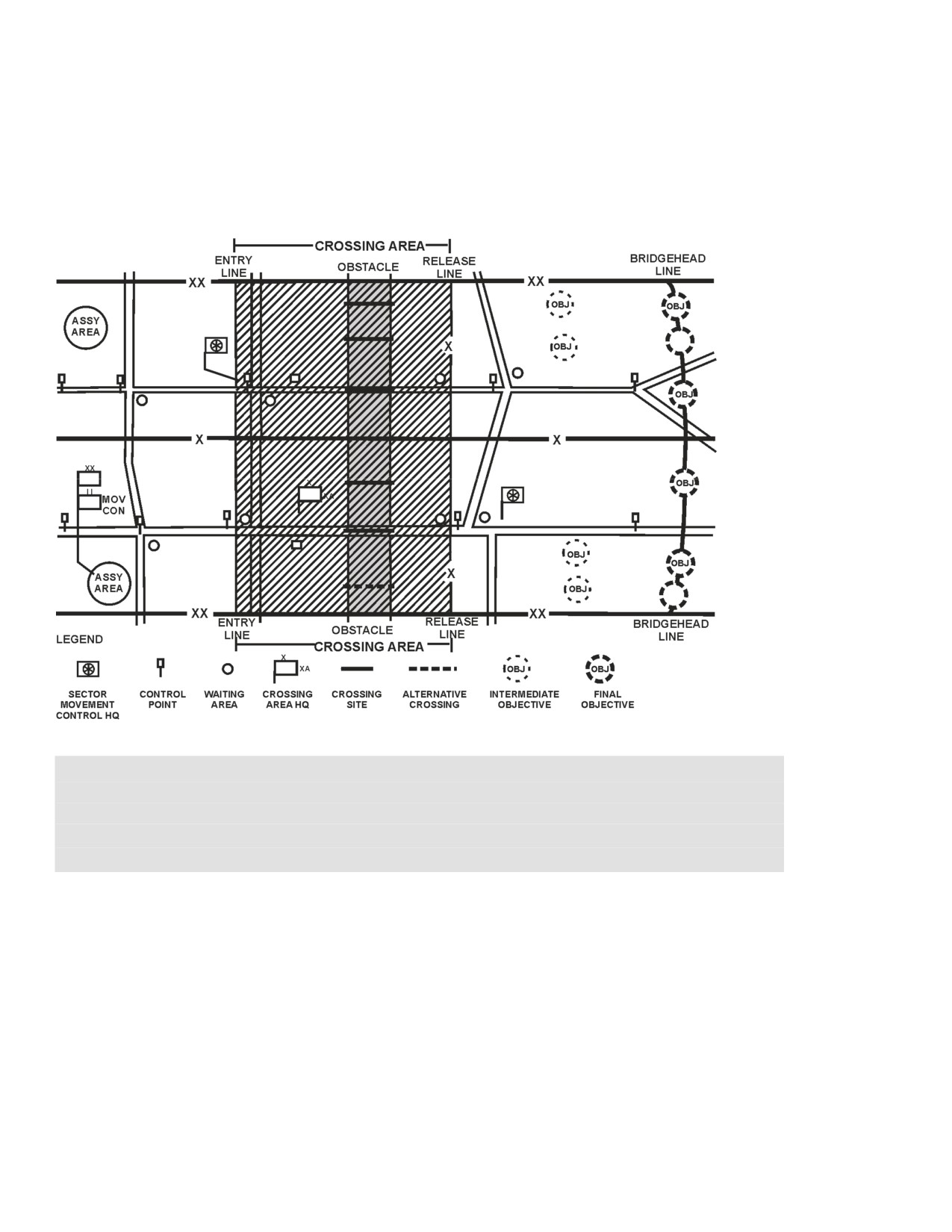
Land Operations
i.
any limitations such as the capacity, speed and military load classification
(MLC); and
j.
nicknames for each crossing site.
2.
The detailed layout of an obstacle crossing area and sites is illustrated in Figure 7-15.
Figure 7-15: A Schematic Diagram of a Divisional Crossing Plan
Notes:
1. The tactical commander will normally be at the crossing control organization HQ, which is co-
located with the Movement Control HQ. This is represented as the Divisional HQ.
2. The commander may deploy forward to the Crossing Area HQ.
3. Crossing site HQs are not shown.
SECTION 32
CONDUCT OF BREACHING OPERATIONS
7182. GENERAL
1.
The breaching of a minefield or other man-made obstacles and barrier plans will be
conducted in a manner similar to that of the deliberate crossing of a water obstacle.
7-152
B-GL-300-001/FP-001
The Conduct of Land Operations
7183. PLANNING
1.
Seizure of minefield lanes intact or any opportunity for a hasty breaching must be
exploited. If this fails, a deliberate breaching will be necessary.
2.
For breaching to have a reasonable chance of success the minimum information
required is the minefield depth, its front and rear edges, and details of adversary weapons
covering the minefield.
3.
The aim must always be to breach paths and lanes through adversary minefields from
the very beginning in order to enable dismounted infantry and combat vehicles to cross the
barrier. Whether paths may be prepared in advance will depend upon the situation, terrain, type
of barrier and breaching equipment available. Paths are to be enlarged rapidly to form lanes.
As many lanes as possible should be breached. As a minimum, two breaches should be
attempted.
7184. EXECUTION
1.
For adversary obstacles, reconnaissance should include, if possible, the breaching of a
patrol path or lane through the minefield.
2.
If the adversary situation allows, dismounted troops cross the minefield and establish a
lodgement on the far side, although this may not always be possible. In either case, it is
necessary to form a breaching force to open lanes for the personnel and vehicles of the assault
echelon.
3.
If friendly forces have prepared the minefield, it is crossed using existing gaps or lanes,
or newly breached lanes.
4.
Once lanes are open, traffic control posts at both ends of the lanes are required. In
addition, recovery posts will be established at the approaches to all lanes, and occasionally, on
both sides of the minefield.
5.
With the assault echelon across the minefield and secure, engineers complete their
preparation of breaching sites to include marking. Movement control elements complete their
deployment to control the movement of the main body across the minefield. Complete
clearance of barriers requires a considerable amount of time and resources. Therefore, usually
complete clearance can only be justified if operationally necessary.
7185. COMBAT SERVICE SUPPORT IN BREACHING OPERATIONS
1.
Similar considerations to those required for water crossings apply. The scale of support
for breaching operations tends to be lower than that for water crossing.
7186. COMMAND AND CONTROL OF BREACHING OPERATIONS
1.
The level of command is likely to be lower than for water crossing. Minefield breaching
may involve a number of independent simultaneous actions each with its own commander,
B-GL-300-001/FP-001
7-153
Land Operations
whereas water crossing is a centralized operation. The breaching commander is the
commander who has the tactical responsibility for operations in that area.
7187. CONDUCT OF OTHER OBSTACLE CROSSING
1.
Considerations. The considerations that apply to the conduct of other obstacle
crossings are the same as those for water crossing operations and minefield breaching. The
major difference is normally one of scale. Therefore, the crossing of other types of obstacles is
conducted at lower tactical levels. Nevertheless, the tactical commander must ensure the
appropriate engineer support is available to maintain his mobility.
SECTION 33
CONCLUDING THE CAMPAIGN
7188. GENERAL
1.
Military operations are conducted in accordance with the strategic objectives and end
state. Knowing when to end a campaign and how to preserve the end state are vital aspects of
operational art. Since campaigns are conducted for political aims, it is only successful when
such aims, or end states, are achieved. Success within the battlespace does not always lead to
success in conflict. Ensuring that it does requires the close collaboration of political and military
leaders and clearly understood strategic goals.
2.
In many campaigns, the achievement of the strategic aims will also require close
collaboration with other members of the joint, interagency, multinational and public (JIMP)
framework. In some cases, a military end state will be reached before the ultimate strategic end
state is realized. Consequently, the non-military elements of the JIMP framework may continue
the work while the military scales back its participation and eventually withdraws. The timing
and method of transition from military forces to non-military forces and elements will require
careful consideration and planning as part of the operational art.
3.
It is always possible that for political, diplomatic or economic reasons the campaign may
be terminated before the originally envisaged military end state and strategic end state are
reached. The commander must consider the consequences of a premature termination and
advise his superiors of the long-term ramifications from his perspective.
7189. CAMPAIGN TRANSITION AND CONCLUSION
1.
Rarely will forces fight a major conflict and then withdraw from the theatre. Military
forces may be the only source of stability in the area and may have to restore communications
facilities, essential services, and provide humanitarian relief. The operational commander may
have to be the conduit for negotiations with the belligerent political and military leaders as part
of the initial conflict termination process. Although many of these tasks may have occurred
during major conflict as part of full-spectrum operations (FSO) within the continuum of
operations, the military, following major combat, will come to focus on such stability activities.
Thus, a campaign involving major combat will likely transition to a campaign of peace support
until such time as a new government is firmly established, new security forces are prepared to
assume duties, and immediate humanitarian needs are satisfied.
2.
Rarely will the transition between campaign themes occur simultaneously throughout a
theatre of operations. It will likely be much more phased; with one area of a theatre transiting to
7-154
B-GL-300-001/FP-001
The Conduct of Land Operations
focus on stability operations while other areas of the theatre remain focused on major combat.
Anticipation and appropriate planning during earlier stages will smooth the transition during the
critical period immediately after the fighting ends. Planning should also consider the use of
information operations (info ops), especially civil-military cooperation (CIMIC), public affairs (PA)
and psychological operations (PSYOPS), to assist in the transition to post-conflict activities and
the cementing of operational and strategic objectives.
3.
Despite the fact that military forces are well suited to the conduct of stability operations,
the conclusion of a campaign and the attainment of the military end state will only be achieved
through the handover of many of these responsibilities to civilian agencies and other members
of the JIMP framework.
4.
In an ideal situation, the responsibilities of a military force will eventually reduce to those
that only a military force can accomplish, such as framework security where necessary and the
training of newly formed indigenous security forces. See Figure 7-14.
5.
The transition of stability operations activities to civilian and other governmental
agencies may be a slow and difficult process depending upon the situation. It may not be
uniform throughout a theatre or across all functions. For example, some governmental
agencies may be prepared to assume a role creating a new indigenous government and civil
service immediately following major combat or while an insurgency is ongoing, but non-
governmental organizations (NGOs) or international organizations (IOs) may not be willing to
assume responsibilities until the overall level of violence is lowered and a level of lasting stability
has been created. In such cases, the military may have to continue to fulfil certain stability
operation activities.
6.
In other situations, the military may be able to handover most stability operations to other
agencies, but will still be required to maintain a significant presence to ensure a framework of
security, even if the majority of destabilizing influences have dissipated. Continuous efforts
should be made under security sector reform (SSR) to create competent indigenous security
forces capable of defeating possible adversaries to security and stability.
7.
Ideally, a campaign will reach a military end state when the necessity for combat
operations has ceased, all stability operations have been turned over to civilian or other
governmental agencies, and the indigenous security forces are capable of dealing with any
current or near term adversaries to stability.
7190. REDEPLOYMENT
1.
At the campaign's end, the operational commander must consider the redeployment of
the force. Redeployment should not be considered as a final activity, but merely as a transition
to future operations. Formation and unit integrity should be maintained during redeployment
whenever possible, and the commander should always keep in mind the reconstitution process
for the next operation. This will include finalization of post operation reports and submission of
observations as potential lessons learned.
2.
Consideration must also be made for the reintroduction of troops into a peaceful society
and domestic setting following their service in war-torn areas where they witnessed widespread
pain, suffering and death. The efforts spent to build and preserve cohesion within a force prior
to and during operations must be continued after redeployment. Commanders at all levels are
responsible for the successful integration of their troops into post-conflict routine.
B-GL-300-001/FP-001
7-155
PAGE INTENTIONALLY LEFT BLANK
Land Operations
ANNEX A TO CHAPTER 7
DISARMAMENT, DEMOBILIZATION AND REINTEGRATION OPERATIONS
SECTION 1
DEFINITION AND BACKGROUND
1.
Disarmament, demobilization and reintegration (DDR) process is often undertaken
following a major combat campaign or as part of a campaign to secure a failing state or region.
It is effectively, the dismembering of a military force and its return to other aspects of society
(which may include to a certain extent, integration with a newly formed military force). Note that
in many instances, a standing army should be allowed to remain intact, as a potential force for
stability in a developing nation. Conscripts may be demobilized, but many elements of a
standing army and other legitimate security forces may move straight to a reform process.
2.
DDR is a multi-agency undertaking and will likely be a significant operational objective of
a campaign plan. The military forces’ involvement is classified as a type of stability operation
and the military will likely be assigned specific tactical tasks to assist in the DDR process.
3.
DDR is defined as:
A stability operation that involves the handing over of arms and equipment,
the disbanding of military structures, and the return to civilian life of military and
paramilitary personnel. Note: This process marks the beginning of long-term
transformation processes, demilitarizing economies, communities and lives.185
4.
The end-state of this process is the enhancement of peace, security, stability, and
economic growth, at the regional, national, and local levels. At the completion of DDR, former
combatants are fully reintegrated into mainstream society and conditions are set for successful
peace building and Security Sector Reform (SSR).
5.
The constituent parts of the DDR process are defined as follows:
a.
Disarmament. Disarmament is the controlled process of taking weapons away
from military forces. (Demilitarization and disarmament usually take place within
the framework of demobilization operations).186
b.
Demobilization. Demobilization consists of those operations that are
undertaken by a Coalition Task Force to reduce the number of factions’ forces
and their equipment in the area of operations to the level as agreed in the peace
agreement.187
185 New draft definition submitted for Army Terminology Panel approval May 06. It is somewhat narrower
than the draft ABCA Armies Programme draft definition: A series of major operational tasks that occur
following a conflict, peace support campaign, or national crisis that move a standing military, paramilitary,
and other combatant forces from an active combatant status to a state of reintegration into the community
186 AJP 3.4.1 Glossary
187 AJP 3.4.1 Glossary. At times, there may not be a formal peace agreement in place.
B-GL-300-001/FP-001
7A-1
Land Operations
c.
Reintegration. Reintegration is the process of returning former combatants and
other selected non-combatants to a civilian identity within the social, economic,
political, and psychological life within the community. 188
6.
The DDR plan may be a key aspect within the overall campaign plan to realizing the
desired end-state. Its success necessitates a comprehensive approach. DDR is a multi-agency
function with the military conducting many of the tactical tasks in support of it, along with other
agencies. It will include a number of decisive points relating to various issues, including military,
political, economic, security and communications. Coordination and cooperation amongst
relevant organizations is therefore a fundamental requirement.
7.
Coalition forces should be prepared to accept lead agency role, especially in the initial
stages. It is highly likely that they will support another lead agency in the DDR process. Military
forces are not normally resourced and structured to complete the entire DDR process. Initially,
the military will likely take the lead, beginning with such basic aspects as Prisoner of War (PW)
handling. Eventually, particularly at the point of reintegration, other agencies will assume the
lead whilst military forces provide the security framework.
8.
Key to success will be the support of the host nation (HN) or newly established regime.
Early recognition of roles, responsibilities and tasks will not only contribute to the mission
success and the achievement of operational end-states, it will also assist in the transition of
authority from the military, Coalition or Lead Agency to HN resources. In this respect, military
forces will play a key role, as a critical precursor for the conduct of DDR (dependant as it is on
inter-agency involvement and non-military effort), requires the establishment and maintenance
of a permissive security environment
9.
Support to the DDR process is a key aspect in the conduct of stability operations. For
example, effective stability operations (in this case DDR) within the context of MCO enable a
defeated enemy, if required, to be effectively disarmed, with a view taken towards their eventual
reintegration. Furthermore, they should ensure that the population within the area secured
understands the legitimacy of the action, have appreciated the levels of security provided and
have hope for future development. In the achievement of such success in a major combat
phase, strategic planning will consider the pursuance of those subsequent objectives leading
eventually to ‘stability’. This reinforces the requirement to plan early and in harmony with
campaign objectives.
SECTION 2
PRINCIPLES
1.
The guiding principles for Stability Operations apply to the successful conduct of DDR.
These principles, with appropriate amplification specific to DDR as appropriate, are outlined
below in priority order:
a.
A strategically driven Campaign Plan defining the theme, clear end-state,
objectives, measures of success, and with dedicated resources:
188 This description was developed within ABCA Armies Programme March 2006. Note that some
selected members of the demobilized military may be returned to a newly formed military.
7A-2
B-GL-300-001/FP-001
Annex A
(1)
Political will and tangible economic support for reintegration is required.
Soldiers who have been demobilized should not be returning to their
communities with no hope for employment or support.
(2)
The overall DDR and its ways and means should be supported by
information operations to encourage voluntary compliance.
(3)
There should be sufficient means of incentive for disarmament and
reintegration.
(4)
There should be credible levels of expectation for both the DDR agencies
and for those personnel being demobilized.
(5)
There must be perseverance through the resolute and persistent pursuit
of objectives (which may be of a longer-term social, economic and
political nature).
b.
Unity of purpose and coherency of action between the military, political and
civilian agencies:
(1)
The military will likely take a lead role at the outset of disarmament and
demobilization.
(2)
Supporting plans (e.g. economic) must be realistic, progressive and
achievable, with a clear delineation of responsibilities.
(3)
Reintegration is the desired end-state and therefore must be planned
from the outset, including other agencies—diplomatic/political,
economic—that need to clearly articulate their desired end-state.
(4)
The initial reintegration may include basic work in support of
reconstruction projects that will assist both economic stimulus and re-
establishment of societal structures.
(5)
The plan must be supported by the HN authority.
c.
A position of legitimacy:
(1)
It is vital that the DDR process has the advertised support of the HN and
respected members of the civil society. The process must be transparent
and supported by information operations.
(2)
Flexibility at the operational and tactical levels is needed in successfully
supporting the change management process.
(3)
Success must reflect the expectations of the civil populace.
d.
Imposition of security through a robust posture with threats to stability countered
in a timely manner utilizing precision and the most suitable means:
(1)
This security will extend to the protection of other agency personnel and
equipment.
B-GL-300-001/FP-001
7A-3