CANADA. LAND OPERATIONS (ENGLISH, 2008) - page 2
Land Operations
a.
conduct of operations;
b.
coordination of fires;
c.
control of movement;
d.
development and maintenance of installations;
e.
terrain management, to include installations;
f.
force protection security;
g.
maintenance of the common operating picture (COP); and
h.
area of intelligence responsibility (AIR).52
4.
When assigning an AO/AOR to a subordinate, the higher commander must ensure that
the subordinate unit or formation has the means to influence the situation in that area in order to
achieve the desired effects and objectives. Higher commanders will often specify constraints,
restraints, and limitations when assigning an AO/AOR to a subordinate. These may be depicted
as graphic control measures or tasks.53
5.
Commanders use graphic control measures to regulate manoeuvre, movement,
airspace, fire support, and other aspects of operations within the AO/AOR. They are also a part
of the combat identification construct. In general, all graphic control measures should be easily
identifiable on the ground. It should also be noted that control measures will shift over time and
should be continually monitored to ensure they reflect tactical requirements. Graphic control
measures are specified in B-GL-331-003/FP-001 Military Symbols for Land Operations.
6.
Many campaigns and operations will present significant geographical challenges. Many
situations and AOs/AORs will not allow for a linear and/or contiguous deployment.
Coordination, cooperation and mutual support between elements may be difficult. Mission
command and the use of well-practised reserves at all levels become increasingly important
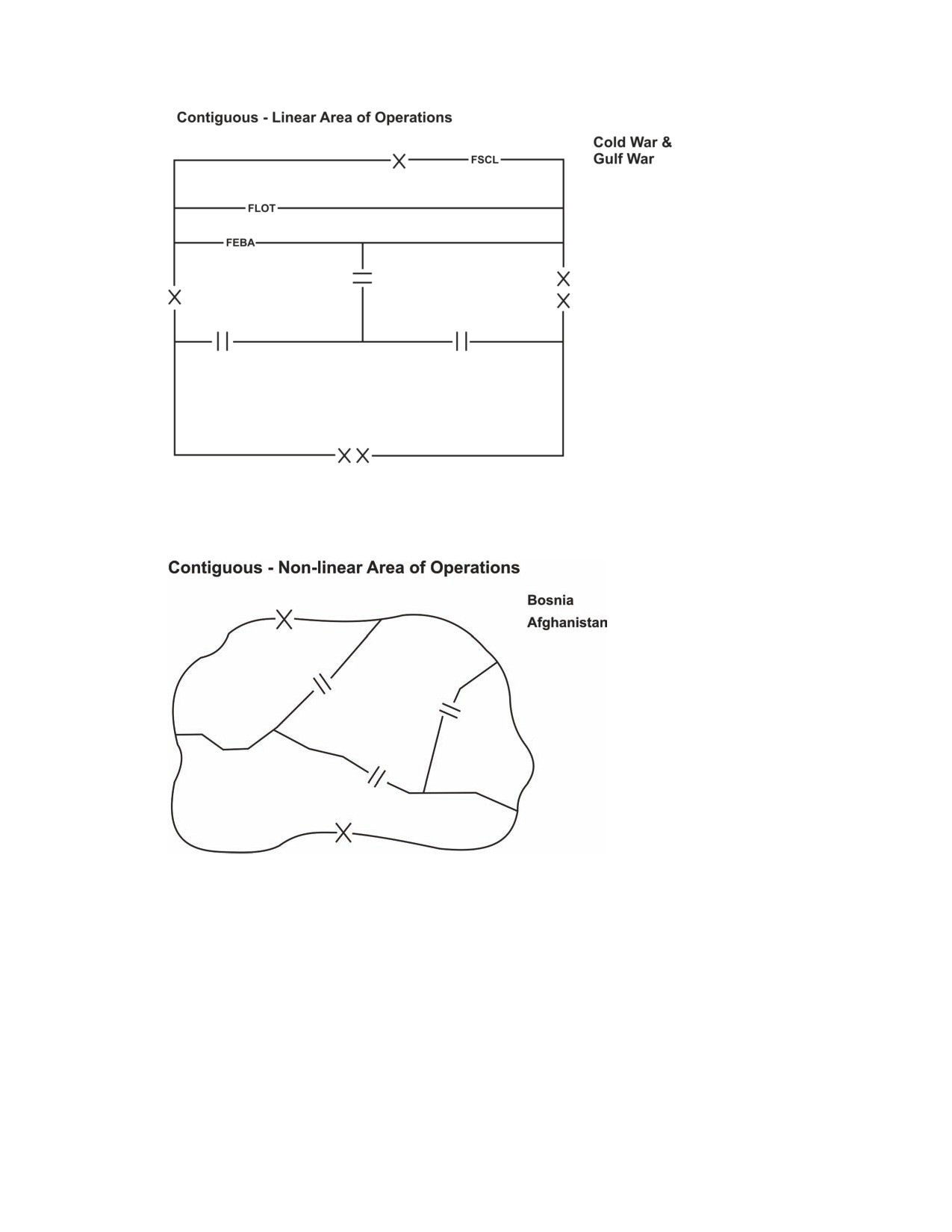
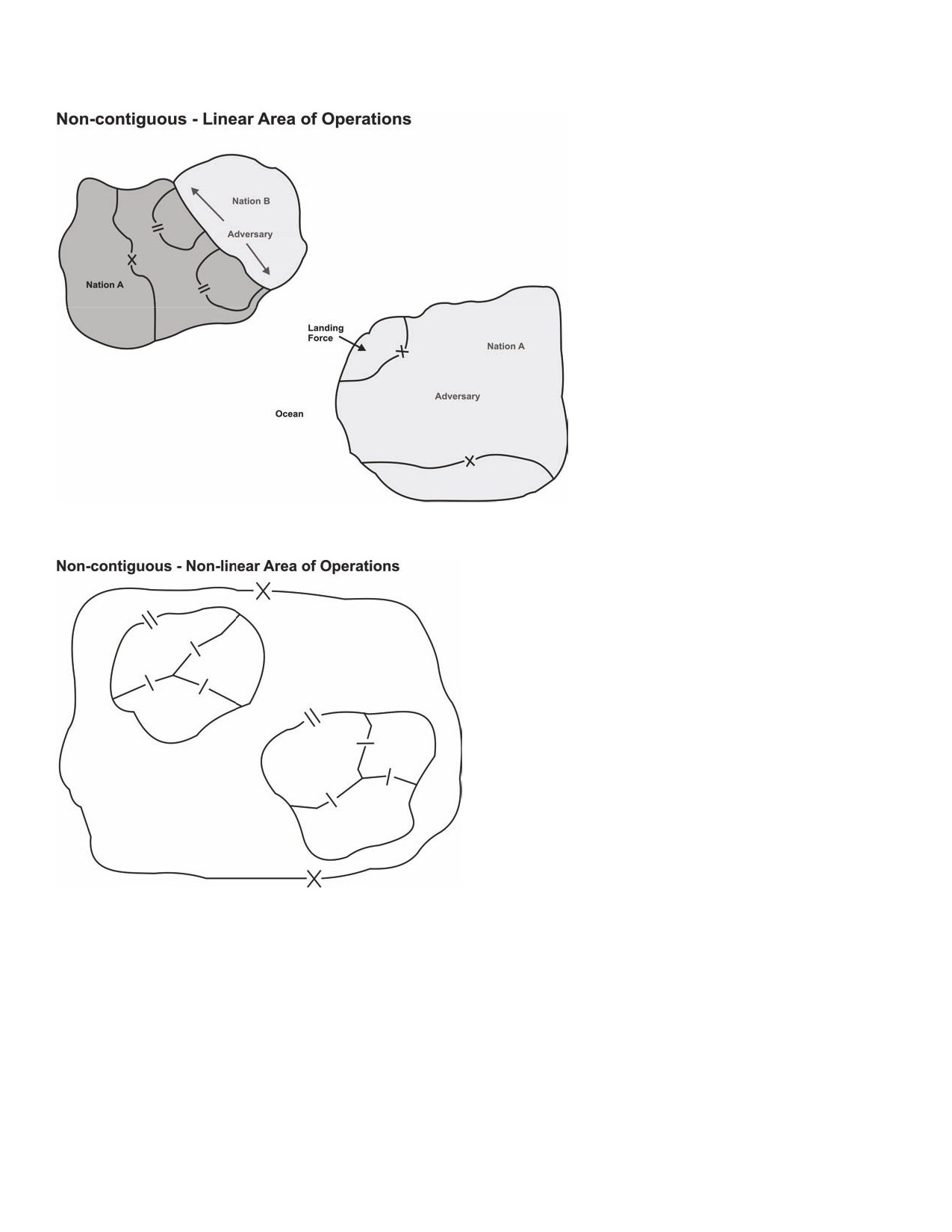
under such circumstances. Referring to Figures 4-4 to 4-7, the four recognized types of
AOs/AORs are:
a.
contiguous, linear;
b.
contiguous, non-linear;
c.
non-contiguous, linear; and
d.
non-contiguous, non-linear.
7.
The label of an AO as linear is decided in relation to a located and identifiable adversary.
52 NATO Allied Administrative Publication 6 (AAP-6), Glossary of Terms and Definitions (2006). Area of
intelligence responsibility (AIR) is defined as: “an area allocated to a commander, in which he is responsible for
the provision of intelligence, within the means at his disposal.”
53 Graphic control measures are used at all echelons and by all Services and are defined as: “a symbol
used on maps and overlays to regulate forces and operational functions.” Refer to B-GL-331-003/FP-001
Military Symbols for Land Operations.
4-12
B-GL-300-001/FP-001
The Application of Combat Power
Figure 4-4: Contiguous, Linear AO
Abbreviations: FSCL = fire support coordination line; FLOT = forward line of own troops; and
FEBA = forward edge of the battle area.
Figure 4-5: Contiguous, Non-linear AO
B-GL-300-001/FP-001
4-13
Land Operations
Figure 4-6: Non-contiguous, Linear AO
Figure 4-7: Non-contiguous, Non-linear AO
8.
A commander will be assigned an AO/AOR within his higher formation’s AO. His
estimate process will lead him to decide the configuration of his own AO/AOR, which may differ
from the configuration of the higher commander’s. For example, a battle group (BG)
commander may assign his manoeuvre subunits AORs such that he has a contiguous AOR.
Following an estimate, one of the combat team commanders may assign each of his platoons
separate AORs centred on specific villages with unassigned areas in between. He has thus
created a non-contiguous AOR within the BG commander’s contiguous AOR, but the combat
team commander remains responsible for the areas not assigned to his sub-subunits.
4-14
B-GL-300-001/FP-001
The Application of Combat Power
9.
Factors affecting the assignment of AOs/AORs will vary by mission. Apart from
geography, there are a wide range of factors that must be considered in the delineation and
allocation:
a.
Mission.
b.
Targets and desired effects on those targets.
c.
Capabilities of own troops to create desired effects and conduct required
activities.
d.
Assigned and implied tasks.
e.
Terrain.
f.
Threat.
g.
Time and space (particularly in terms of the size of AO, threat and movement
capabilities).
h.
Cultural boundaries.
i.
Linguistic boundaries.
j.
Political and/or judicial boundaries and social power structures.
k.
Tribal, historic, ethnic and/or religious boundaries.
l.
Need for an economy of force.
m.
Presence of other agencies in the JIMP framework with which cooperation is
planned.
408.
AREAS UNASSIGNED
1.
In non-contiguous AOs there will be areas that are not assigned to subordinate
commanders. An area unassigned is the space not assigned to subordinate units within a
higher headquarters AO/AOR. The commander remains responsible for these areas and for
operations within them. He determines what resources he will assign to monitor these areas
and to conduct activities in them when required. This may be done with reconnaissance forces
in an economy of force concept.
409. AREA OF INFLUENCE
1.
An area of influence (A of I) is defined as: “a geographical area wherein a commander is
directly capable of influencing operations, by manoeuvre or fire support systems normally under
his command or control.”54 It is the physical volume of space within which a commander can
directly influence the situation by manoeuvre, fire support systems that are under his command
or control, and through information operations55 that affect understanding, perceptions and will
of target audiences.
54 NATO Allied Administrative Publication 6 (AAP-6), Glossary of Terms and Definitions (2006).
55 Information Operations refer solely to influence activities such as public affairs, CIMIC related activities,
profile and posture of forces and PSYOPS.
B-GL-300-001/FP-001
4-15
Land Operations
2.
The ability to influence, that is, create effects within the area of influence, exists on both
the physical and psychological planes. The physical area of influence is measured by the limit
of the physical effects that a commander may deliver such as the range of his weapon systems
included electronic warfare (EW) means. These are first order effects on the physical plane and
can be termed fires.
3.
The targets and audiences that may be psychologically affected by a commander’s
decisions and activities, that is, psychological effects of influence, may not be physically within
the AO or adjacent geographical area. They may be physically removed from his immediate AO
and local environment and located in another area. For example, activities to undermine or
support a particular ethnic group in the AO may influence the behaviour of other audiences of
the same ethnic group in another region or part of the world. Thus, although effects on the
physical plane will be within the physical boundaries of an area of influence, the effects created
on the psychological plane may be wide ranging in both space and time. It is this linkage to
psychological effects that in many cases will bind tactical level activities to operational
and strategic effects.
4.
The area of influence has different connotations at the tactical, operational, and strategic
levels:
a.
Tactical. At the tactical level, the area of influence includes the physical space
that a commander can influence with the means at his disposal. Operations
within tactical areas of influence are synchronized within the functional
framework through the higher commanders intent and operational plan.
b.
Operational. At the operational level, the area of influence includes the joint
operations area that can be influenced by the military operations within the
entire assigned area. Military operations and activities within operational areas
of influence are synchronized along lines of operation and within a JIMP
framework (particularly across multiple agencies) in order to create supporting
effects and achieve operational objectives and end states.
c.
Strategic. At the strategic level, the area of influence can be global due to the
ability to create psychological effects that are rapidly spread through information
technology.
410. DEEP, CLOSE, AND REAR—OPERATIONS IN SPACE AND TIME
1.
Within the battlefield framework, the concept of deep, close, and rear areas56 and
operations exist. They describe the placement of forces and the conduct of operations and
activities in terms of space and time. These are described as follows:
a.
Deep Operations. Deep operations are: “operations conducted against forces
or resources not engaged in close operations. They expand the battle area in
time and space, help to shape the close battle, make it difficult for the enemy to
concentrate fighting power without loss, and diminish the coherence and tempo
56 Previously, deep, close and rear operations were considered part of the operational framework.
However, they are linked to time and space and thus have been placed under the battlespace framework.
4-16
B-GL-300-001/FP-001
The Application of Combat Power
of his operations.”57 Deep operations are those operations conducted at long
range and over a protracted time scale against adversary forces or resources
not currently engaged in close operations. They may be decisive operations,
but in general they will be shaping. For example, a deep target engagement
may reduce the combat effectiveness of the adversary’s reserve force prior to a
main attack. At each level of command, the extent of the deep operations and
related area is dependent upon the commander’s means of acquiring
information and engaging targets. Deep operations include three principle
activities: information operations; surveillance and target acquisition; and
interdiction. They may be conducted on the physical and psychological planes,
the latter seeking to create long term influences in a target audience. This may
include, for example, delivering PSYOPS leaflets to conscripts in enemy reserve
units, or building civil infrastructure so that subsequent generations of a region
are better educated and more stable.
b.
Close Operations. Close operations are: “operations conducted at short range,
in close contact and in the immediate timescale.”58 Close operations are those
that involve friendly forces in direct contact with the adversary or operations in
which commanders anticipate direct contact taking place. The means used in
close combat could range from physical destruction with lethal weapons, to
arrest of detainees. They may be shaping, decisive, and even sustaining
operations of forces in contact. Combined arms coordination is the hallmark of
close operations. Close operations will normally occur on the physical plane,
although there may be instances when they will occur on the psychological
plane, independently or in addition to the physical plane. For example, a
firepower demonstration may convince a belligerent commander not to
manoeuvre his forces from a cantonment site, and a medical clinic for the local
populace will immediately engender good will and local support.
c.
Rear Operations. Rear operations are defined as: “operations which establish
and maintain one's own forces in order to generate the freedom of action to
allow for the conduct of close and deep operations.”59 Rear operations are the
largely administrative and logistic activities that occur out of contact with
adversary forces, that is, behind the area in which close operations are
occurring. Rear operations require security, particularly in campaigns involving
an asymmetric, non-conventional adversary. In non-contiguous and/or non-
linear battlespaces (that is, in areas with no identifiable rear area), there is a
need to secure the lines of communications and critical centres. Rear area
operations including the security and force protection aspect are normally
sustaining operations (in terms of the effects framework).
2.
Deep and close operations may also be identified in terms of time, for both execution
and planning purposes. Normally, close operations will occur against adversary forces that will
be encountered within 48 hours. Operations against adversaries that will be encountered by the
forward line of troops not before 48 to 72 hours will normally be considered deep operations,
depending upon the level of engagement. When operating to create effects on the
57 NATO Allied Administrative Publication 39 (AAP-39), Glossary of Land Military Terms and Definitions.
58 Ibid.
59 Ibid.
B-GL-300-001/FP-001
4-17
Land Operations
psychological plane, the scope of understanding and employment of the spatial, temporal, and
purpose descriptors must be expanded. Deep operations may be conducted for months to
years before they result in a close operation, if ever at all. For example, operations seeking to
improve a local education system may create immediate support for a campaign, but they will
not provide a result in terms of a cultural shift and social improvement for a number of years.60
SECTION 3
THE FUNCTIONAL FRAMEWORK: OPERATIONAL
FUNCTIONS AND CORE FUNCTIONS
411. GENERAL
1.
Fighting power is applied through functional capabilities and activities. The operational
functions are: Command, Sense, Act, Shield, and Sustain. In organizing and applying fighting
power through the operational functions, forces conduct activities known as core functions.
Core functions are: find, fix, and strike, with exploit an implied function. Together, these two
functional groupings comprise the functional framework. The functional framework is effectively
the plan for an operation. It is a framework for manoeuvre of both physical activities (fires)
and influence activities.
412. THE OPERATIONAL FUNCTIONS61
1.
The operational functions describe the functional capabilities of a military force,
regardless of the type of unit or formal operational role. They apply to all levels of warfare, the
tactical, operational, and strategic. The operational functions stem from the intellectual
(doctrine) component, but our realized through the integration of all three components—
physical, moral, and intellectual.
2.
Fighting power is applied through the organization and application of the operational
functions. The relative balance given to each function will dictate the nature of the effects
created. The operational functions operate on both the physical and psychological plans. The
operational functions are listed as: Command, Sense, Act, Shield, and Sustain.
413. COMMAND
1.
Command is the operational function that integrates all the operational functions into a
single comprehensive strategic, operational or tactical level concept. It provides vertical and
60 Operations under the NATO Stabilization Force (SFOR) in Bosnia included the distribution of a NATO
forces newspaper for the local population. One edition contained a children’s essay competition that
asked the contestants to describe how they would welcome a child from a different culture or region
moving into their neighbourhood. This was a deep operation, seeking to shape the future generation.
61 The operational functions (Command, Sense, Act, Shield and Sustain) are proper nouns. Through an
interim period from 1997 to 2001 using six combat functions (command, information operations,
manoeuvre, firepower, protection, and sustainment), they have replaced the common eleven tactical level
orientated combat functions used prior to 1997 (command and control; information systems; intelligence;
electronic warfare; close combat; aviation; fire support; engineer support and mine warfare; nuclear,
biological and chemical warfare; air defence; and, combat service support), and now better speak to
activities and effects on both the physical and psychological planes. All capabilities contained in the
combat functions are inherent to the operational functions. Note, however, that while ABCA has adopted
the five operational functions, in NATO doctrine, the combat functions have been retained.
4-18
B-GL-300-001/FP-001
The Application of Combat Power
horizontal integration through the planning, direction, coordination and control of military forces
and other elements as allocated. It provides the means to unify and integrate the activities of
the other functions in the finding, fixing and striking62 of adversaries or other targets.
2.
The central component of the Command function is a philosophy emphasizing the
importance of formulating and communicating the commander’s intent. A thorough
understanding of the intent guides decision-making at all levels, and encourages both initiative
and speed of action. It provides for a unity of purpose and effort on the vertical and horizontal
planes and even between the military and other elements of the JIMP framework.
3.
Command support processes are reliant upon robust communications, good intelligence,
and an effective battle procedure process. Commanders will need the skills to operate in a fast-
paced and highly technical environment while still ensuring personal dominance of the
operations and decision-making process.
414. SENSE
1.
Sense is the operational function that provides the commander with knowledge. This
function integrates those assets that collect information and then provide the analysis to
produce information and knowledge, which is then disseminated. By design, it leverages all
sources of information. Sensor management and fusion must be centralized to gain full
advantage of disparate systems found in the modern battlespace.
2.
This operational function is inherently modular, capable of integrating additional systems
and capabilities at every level: tactical, operational or strategic. The scope of the Sense
function must be broad in order to firstly provide the commander with a broad and deep
knowledge base of the operational environment, and secondly, to assess the effects of activities
across all elements within the environment.
3.
This view of the environment must not only include the physical characteristics of
weather and terrain, but also the broad range of other systems, entities and power structures
that exist and operate in the environment. The interrelated elements and systems of an
environment that must be assessed in the broad knowledge base are the political, military,
economic, social (including aspects of culture and religion), infrastructure, and information.
These elements must not only be assessed by the Sense capabilities, but the effects of our
activities upon them must be predicted to the greatest accuracy possible and then analyzed to
ensure that the desired effects and objectives are being achieved.
415. ACT
1.
Act is the operational function that integrates manoeuvre, firepower, and information
operations (influence activities) to achieve the desired effects. It integrates fires and influence
activities. The synchronization of manoeuvre, firepower, (fires) and influence is at the heart of
manoeuvre warfare and allows the decisive concentration of effects against adversaries, other
targets, and centres of gravity. Fracturing these centres of gravity will dislocate the adversary,
breaking cohesion and the will to resist.
62 Find, fix, and strike are the core functions in the application of combat power and are discussed in the
following section.
B-GL-300-001/FP-001
4-19
Land Operations
2.
Act functions engage a wide variety of targets in addition to an adversary. Information
operations (that is, influence activities) such as civil-military cooperation (CIMIC) reconstruction
or PSYOPS may be used to influence target audiences to support a campaign or to convince
elements of an adversary to surrender. Thus, the functions inherent in Act are conducted on the
physical and psychological planes in order to achieve desired effects. It is the complete
combination of fires and influence activities synchronized and harmonized through manoeuvre
and battlespace management.
416. SHIELD
1.
Shield is the operational function that provides for the protection of a force’s survivability
and freedom of action. Shield facilitates the friendly forces’ freedom of action. Shielding, at the
strategic level, particularly in terms of the asymmetric threat to domestic populations, is a joint
function that stretches from the theatre of operations to the domestic population.
2.
At the tactical level, Shield includes protective measures through air defence, counter-
mobility and survivability, such as the construction of defensives and the hardening of
structures.
3.
Shielding will become increasingly difficult as forces operate dynamically and are
dispersed over an extended area in the face of an increased adversary ability to see and strike,
or against a threat that utilizes asymmetric tactics and takes refuge amongst civilian
populations.
4.
The function of Shield also includes force protection measures, which is the
responsibility of all forces and their commanders.
417. SUSTAIN
1.
Sustain is the operational function that integrates strategic, operational and tactical
levels of support to generate and maintain force capability. Sustain ideally takes an anticipatory
approach that enables support services to be provided commensurate with an increased tempo
in manoeuvre operations. Thus, it will move towards an intelligence push system based upon
situational awareness and asset visibility.
2.
The supply-based support system, centred on stockpiling within echelons, may evolve in
certain campaigns to a distribution-based system where supplies are held within a “pipeline” and
delivered on as required basis. The utility and effectiveness of an echelon system will remain
extant.
3.
Sustain function also incorporates health care and welfare systems and procedures.
418. THE SHARED FUNCTIONAL ASPECT
1.
Certain military arms and services are more inclined by the nature of their inherent
capabilities to operate predominately within a single operational function. However, most arms
and services will operate across a number of operational functions. As examples: infantry
forces, in addition to being an Act manoeuvre element, may be assigned a Shield function of
convoy protection; reconnaissance (recce) forces, while mainly employed in a Sense role, may
4-20
B-GL-300-001/FP-001
The Application of Combat Power
be used at times to support manoeuvre with fire or to secure lines of communication; and,
engineers, although mainly employed in Shield functions, will often support the Act function of
manoeuvre.
419. THE CORE FUNCTIONS—FIND, FIX, AND STRIKE
1.
Activities that seek to attack an adversary’s cohesion, or to affect the will of the
adversary and other targets, are executed through three core dynamic functions. These are:
find, fix, and strike. The need to be prepared to exploit is implicit. Finding and fixing the
adversary or any other target will contribute to shaping. Striking and exploiting have the
potential to be decisive.63 The function of fixing should not be limited to the tactical task “fix,” or
confined to defensive operations to protect the force. Defensive or offensive operations
designed to fix the target may set the conditions for offensive action to strike him. Likewise, the
ability of an adversary to conduct information operations and influence elements of a population
may be “fixed” through aggressive PSYOPS and public affairs (PA) activities. These core
functions are normally carried out through the Sense and Act operational functions and their
inherent capabilities.
2.
Where circumstances permit, operations designed primarily to find, fix, or strike the
adversary should be exploited. Operational experience indicates that finding, fixing, striking and
exploiting should be conducted concurrently, or at least through seamless transition achieved
from one to another.
3.
The core functions have wide utility across the continuum of operations in all campaigns.
In a counter-insurgency (COIN) campaign, non-military and paramilitary adversaries are found
by information gathering by the intelligence services, covert and overt elements of armed forces,
and other government agencies. The uniformed military forces and the police, combined with
diplomatic efforts and information operations, fix the insurgents and their influence on the
populace through a combination of activities that have physical and/or psychological effects,
such as security patrols and leaflets urging locals to report insurgents. Locally raised forces can
also help to find and fix opponents, and have been employed in numerous campaigns to good
effect. Special forces, military and police units, and the legal system contribute to striking
insurgents. Influence activities such as PSYOPS and public affairs may strike at the legitimacy
of insurgents. Exploitation involves taking advantage of a developing situation in accordance
with the superior commander’s intent. In the COIN example, local tactical successes against
insurgents may enable exploitation through the pursuit by military forces. It may be exploited by
PSYOPS and PA messages, and further exploited for long term benefit, through the freedom of
movement for civilian police, government officials and humanitarian workers, and thus allow
these other agencies to begin long term solutions in economic and political development.
420. FIND
1.
Finding the adversary or a potential target is a basic function that endures throughout an
operation and is continually applied and assessed. It includes locating, identifying, tracking, and
assessing the target, be it an adversary or otherwise. Forces may be directed specifically to
fight for information, particularly in the opening stages of an operation. This will normally be a
63 The concepts of shaping and decisive effects are part of the effects framework and are fully discussed
below.
B-GL-300-001/FP-001
4-21
Land Operations
sound investment when the situation is confused and seemingly chaotic. Whatever its source,
information is never wholly reliable. It should be verified or corroborated with other sources.
2.
A commander cannot know everything. Intelligence, surveillance, target acquisition, and
recce (ISTAR) systems can produce so much information that they could overload a
commander or analyst who tries to assimilate its vast amount, and it becomes a point of friction.
These problems can be overcome by setting clear and succinct priorities for intelligence
gathering, and directing ISTAR elements accordingly. This will be key in the “direction” step of
the intelligence cycle.
3.
Finding demands far more physical and intellectual effort than simply locating the
adversary. A commander is far more likely to succeed if he knows the organization, location,
and strength of an adversary force, its intentions, how it fights, and how it may react to friendly
action. It is equally important to establish where the threat is not located, and to determine what
he is unlikely to do within a given time, as this may provide opportunities for surprise and
exploitation. Receiving information from a wide variety of sources contributes to the quality of
the intelligence picture that helps a commander formulate his plan.
4.
Within the battlespace and environment, the finding function includes identifying and
analyzing those elements, other than an adversary, that affect a situation and may play a role in
realizing the successful conclusion to a campaign. These include key players and elements in
the environment, such as cultural influences, social ties, and religious and political leaders and
clan groups, that may have to be engaged in pursuit of enduring campaign objectives and end
states. The “find” analysis should indicate the role these environmental characteristics,
individuals and groups play in the environment, their aims, and the ways in which they may be
influenced to support the campaign.
5.
In short, a holistic approach must be taken to the “find” function so that all key elements
within the environment are found and analyzed for their role in achieving campaign success.
6.
Although technological means will prove helpful in locating and assessing an adversary
or other target, human analysis and experience is still required to assess likely intentions. It
must be remembered that soldiers and others in contact with the adversary and local populace
are sources of information, and often very accurate sources of information. Thus, key
intelligence needs should be widely disseminated throughout the force, down to the lowest
levels as appropriate, as standing priority information requirements.
421. FIX
1.
To fix an adversary or another target is to deprive it freedom of action. This can be done
by denying the adversary or target his goals, distracting the adversary from his goals, or by
denying him information needed to obtain his goals. This may be done on the either the
physical or psychological plane, or on both. For example, security presence patrols may fix an
insurgent to operating within a limited area while electronic warfare (EW) assets block insurgent
radio messages, yet allow alternative media messages to fix the spread of insurgent
propaganda, thus fixing the insurgent’s ability to influence a population.
2.
Fixing in physical terms involves the use of combat forces to hold ground against an
adversary’s attack, to hold or fix an adversary in one location by firepower and/or manoeuvre, or
to hold vital points by protecting against adversary intervention. Its object is to restrict an
adversary’s freedom of movement and increase our own ability to manoeuvre. The fixing of
manoeuvre forces may be done through a combination of shaping attacks, blocking positions
4-22
B-GL-300-001/FP-001
The Application of Combat Power
and deception, while the use of presence patrols, searches, and vehicle check points will help
fix an insurgent force. Distracting and fixing the adversary is further achieved by embroiling him
in subsidiary actions that divert him from his main purpose.
3.
Deception and surprise is key to fixing adversary manoeuvre forces. Denying the
adversary the opportunity to achieve his goals and putting him in a reactive frame of mind
enhances our freedom of action. Resulting in distraction, this is done by deceiving, luring and
surprising the adversary. When an adversary is deceived, he is certain how to react, but his
decision is wrong. When he is lured, he is invited to take a course of action that will make him
vulnerable. When he is surprised, he becomes uncertain how to react to ambiguous information
until it is too late. Given such uncertainty, the adversary can be forced to cover all options,
thereby dissipating his force and being distracted from his purpose. He is thus fixed.
4.
Fixing on the psychological plane involves disrupting and preventing the adversary’s
ability to influence the understanding and will of other elements in an environment, namely
elements in a population and their leaders. The object is to restrict his manoeuvre on the
psychological plane, that is, in shaping the perceptions, will, and behaviour of others. This is
mainly done through information operations and may include, for example, the issue of timely
media statements explaining the actual facts of an engagement before the adversary can issue
propaganda seeking to undermine friendly force legitimacy.
5.
Physical activities may have secondary effects to fix a target on the psychological plane.
For example, the destruction or jamming of an adversary’s propaganda radio station will remove
a capability and prevent the influence of the local populace.
6.
The fixing of an adversary force will often be planned as a shaping effect in support of a
simultaneous or subsequent decisive action.
7.
Fixing an adversary with manoeuvre operations can quickly consume one’s own fighting
power. Thus, a balance must be struck to ensure that the resources allocated to fixing do not
unnecessarily reduce those required for striking. Likewise, on the psychological plane, the use
of friendly PSYOPS and PA messages to fix those activities of the adversary must not reduce
significantly the ability to produce one’s own messages and the means to influence target
audiences.
422. STRIKE
1.
Striking the adversary is achieved by attack and other offensive activities on the physical
or psychological planes, or ideally, a combination of both. Striking activities may be decisive or
shaping.
2.
Striking in physical terms involves the attack on adversary forces to: seize or capture
ground; destroy equipment, vital points, and installations; kill adversary personnel; or, gain a
position of advantage. The objective is to manoeuvre forces or concentrate and deliver
firepower to gain leverage over an adversary. Success, particularly in critical capabilities or
areas, will lead to secondary psychological effects on the adversary, such as a decrease in
morale and cohesion. Thus, striking activities should be aimed at the adversary’s weak points
in order to gain positions of advantage and undermine his morale and confidence.
3.
To strike and create first order effects on the psychological plane is to attack or engage
a target’s understanding, perception, and will. Much of this striking, be it against an adversary
or some other target group, will be done through information operations, that is, influence
activities. A PSYOPS activity for example, may attack the support of conscripts following a
B-GL-300-001/FP-001
4-23
Land Operations
lengthy artillery battle that shaped the situation, and thus convince them to flee the battlefield.
While security presence patrols may have fixed an insurgent force in a particular urban centre,
the arrival of non-governmental organizations (NGOs) and the reconstruction of essential
services may strike to affect the perceptions and will of the local populace and convince them to
support the campaign. Striking an adversary on the psychological plane through influence
activities requires good intelligence, sound analysis, specialist advice, and thorough
coordination.
4.
Ideally, activities strike the adversary simultaneously on the physical and psychological
planes in a complementary fashion. It will involve selective attack upon his key capabilities, his
understanding, and his morale and legitimacy within the environment. This would be a
synchronized combination of fires and influence activities. Thus, striking will combine
manoeuvre forces, special forces, EW, with PSYOPS, PA, CIMIC and other influence activities
to create complementary effects in pursuit of the objective. The adversary should see his key
capabilities destroyed, his position out-manoeuvred and untenable, his ability to command,
control and sustain reduced, and his ability to influence other elements of the environment
including leaders and populations neutralized.
5.
The combination of physical and psychological effects in striking the adversary must be
complementary. If not carefully considered in comprehensive planning and targeting, the
effects of physical activities may undermine those of influence activities generated through
information operations. For example, if PSYOPS is used to convince conscripts or others to
surrender, but manoeuvre forces close too quickly, which does not set the conditions to allow
mass surrender or creates too much collateral damage, the effectiveness of the plan will be
undermined and the legitimacy of the campaign and its forces will be reduced.
423. EXPLOITATION
1.
Exploitation is the seizure of an opportunity to achieve a higher commander’s objective,
or to fulfil part of his intent, directly. Opportunistic exploitation requires action beyond the given
mission. To achieve the overall intent, therefore, it may be necessary to supplant the task
stated in orders. For example, a commander ordered to neutralize an adversary covering the
approaches to his commander’s objective may find an approach that is not covered and simply
move directly to the objective. Opportunities can occur at any time while finding, fixing, or
striking.
2.
Striking the adversary is intended to achieve the purpose of the mission. To turn
success into a greater achievement, one needs the audacity and determination to seize fleeting
opportunities. Exploitation relies upon offensive action, surprise and flexibility, along with a
commander’s initiative and understanding of his superior’s intent. It should be supported by the
concept and philosophy of mission command.
3.
Recce is a key enabler for exploitation. Recce should be extensive, expansive, and
continuous in order to find the opportunities for exploitation. Where recce forces are not strong
enough to strike, they fix the threat, limiting his freedom of manoeuvre and permitting him to be
struck by other elements. Recce forces should be prepared to lead any exploitation.
4.
In seeking to tactically exploit a situation, commanders must keep in mind that tactical
exploitation may have to be delayed or even sacrificed in order to support the overall
operational objective. For example, forces may have to permit a fleeing adversary to escape in
4-24
B-GL-300-001/FP-001
The Application of Combat Power
order to secure an area or a populace affected by the recent engagement, thus supporting the
operational objective of safeguarding the populace, preventing lawlessness, or securing vital
sites.
5.
Exploitation may occur on the psychological plane through influence activities of
information operations. A successful attack against an adversary’s position may be exploited
through PSYOPS and PA messages that undermine the public image and capability and
legitimacy of the adversary and his supporters. Any such information operations messages
must be carefully crafted so that they do not appear to be gloating or exaggerated.
424. COMBINING THE CORE FUNCTIONS AT ALL LEVELS AND ACROSS AGENCIES
1.
Conflict includes the constant interaction of the core functions to find, fix, and strike on
both the physical and psychological planes. They are not effective in isolation and must be
coordinated by commanders. Although the capabilities employed may vary, these functions
apply equally from section through to multinational joint forces. Finally, conduct of the core
functions may be executed through other agencies in conjunction with military forces. Other
security forces, the judiciary, and even agencies for reconstruction and development can fix and
strike, not only an adversary and his capabilities, but also fix and strike the factors that motivate
the adversary and allow him to influence others and engender support from a populace. For
example, while security forces are fixing an insurgent force physically, his influence over the
grievances of a population may be defeated through social and economic improvements.
SECTION 4
THE EFFECTS FRAMEWORK:
SHAPING, DECISIVE, AND SUSTAINING OPERATIONS
425. GENERAL
1.
The effects framework is used to describe and link tactical operations through the
commander’s scheme of manoeuvre. The framework refers to the conduct of operations and
their related results, and may be used at all levels of command to conceive the conduct of
operations. It is the tool by which a commander may synchronize the activities of his forces, in
the AO, by purpose over time and space. Hence, it is the arrangement of effects in the
battlespace.
2.
The effects framework provides a means of conceiving and articulating activities by
purpose. The activities may be described in terms of purpose as: shaping, decisive, or
sustaining.
3.
Concepts of the effects framework, like those of the battlespace framework, should be
described in relation to decisive points and lines of operation. For example, along a line of
operation, there will be a number of shaping and decisive operations the lead to decisive points
and progress along the line of operation. It must be remembered that the concept of shaping,
decisive, and sustaining applies to both the physical plane and psychological plane.
B-GL-300-001/FP-001
4-25
Land Operations
426. DECISIVE, SHAPING, AND SUSTAINING OPERATIONS
1.
Every tactical operation has one of three purposes: decisive, shaping, or sustaining.
The commander will define and express his intent64 and his scheme of manoeuvre in terms of
decisive, shaping, and sustaining operations. This framework allows formations and units to
understand the relationship of their missions and tasks to those of other formations and units
through the synchronization of all operations contributing to the higher mission.
2.
Decisive, shaping, and sustaining are defined as:
a.
Decisive Operations. Decisive operations are those activities that will directly
achieve the commander’s intent. Decisive operations conclusively determine
the outcome of operations or battles. There is only one decisive activity for any
operation or battle. During phased operations, the main effort can change
phase by phase, but there remains only one decisive operation. When the
decisive operation is launched it should become the main effort.
b.
Shaping Operations. Shaping operations are those activities that favourably
shape the adversary and battlespace for the decisive operation. They make an
adversary or other target vulnerable to attack or another decisive action, and
help dictate the time and place for decisive actions. Shaping operations can be
phased to occur prior to, or simultaneous with, the decisive operation. Success
of shaping operations is measured by the creation of specific desired effects that
set the conditions for the decisive operation. Shaping operations can take time
to have an effect, particularly if they are conducted as activities and effects on
the psychological plane.
c.
Sustaining Operations. Sustaining operations are those operations that
ensure that the force has adequate resources to project fighting power
throughout and beyond the accomplishment of the decisive operation and any
following exploitation. They include combat service support (CSS), force
protection, establishment and protection of operating bases, and support for and
protection of civilians and civilian establishments. They must be focussed to
support the commander’s intent and follow his main effort. Unity of command is
essential to coordinate the many functions of sustaining operations. The
concept of sustaining operations may be extended to include the sustainment of
support and legitimacy of a campaign from the local populace.
3.
Identification of the main effort is a key component and aspect of the concept of
operations within an operational order. Within the framework of shaping, sustaining, and
decisive operations, commanders designate and shift the main effort.
64 For more detail regarding the commander’s intent, see B-GL-300-003/FP-000 Command. Note that the
intent does not include a lengthy, detailed method or scheme of manoeuvre. The intent may be
described by a single descriptor that details the effect to be created.
4-26
B-GL-300-001/FP-001
The Application of Combat Power
SECTION 5
INTEGRATION OF THE ORGANIZATIONAL
FRAMEWORKS: BATTLESPACE, FUNCTIONAL, AND EFFECTS FRAMEWORKS
427. GENERAL
1.
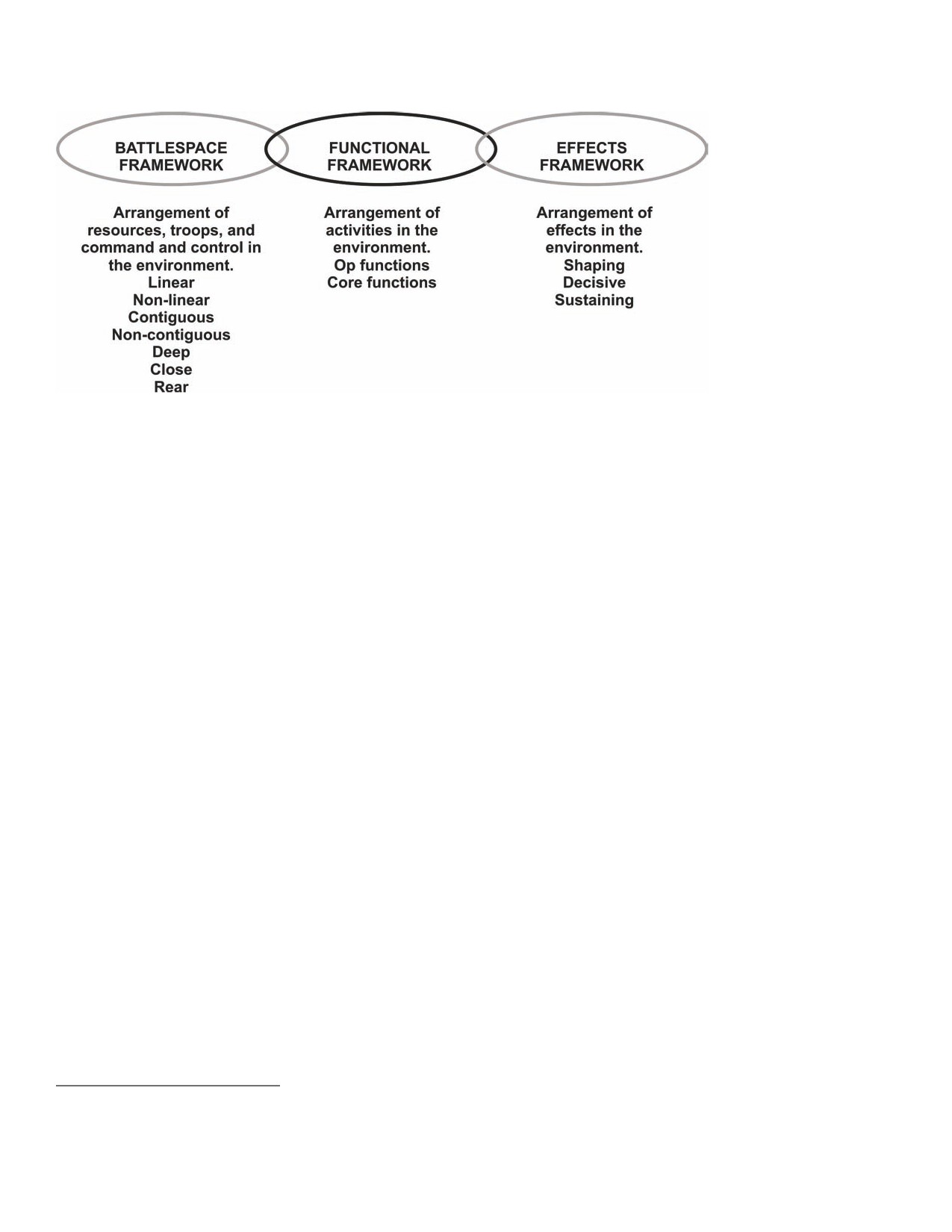
The three frameworks—battlespace, functional and effects—are combined in the
operational plan and scheme of manoeuvre to link the following:
a.
Arrangement of resources and command and control in the environment
(battlespace framework).
b.
Arrangement of activities in the environment (functional framework).
c.
Arrangement of effects in the environment (effects framework).
2.
The functional framework is the arrangement of activities in the environment. It
incorporates the operational functions (Command, Sense, Act, Shield, and Sustain) and their
constituent elements, along with the core functions (find, fix, and strike) in a coordinated
fashion, or in other words, into an operational plan. It balances and arranges the application of
fighting power through these functions. The functional framework links the battlespace
framework to the effects framework. In other words, it links the troops, units, and resources to
the planned and organized effects, through the activities that are to be conducted by the
resources to achieve those effects. Thus, the functional framework will have some forces
manoeuvring, thus striking and exploiting, some providing fire support, thus fixing, some
conducting an intelligence function, thus finding, some resupplying, and some protecting. The
effects created by these activities will be shaping, decisive or sustaining, and are
organized as an effects framework.
3.
The integration of the frameworks occurs at all levels from operational design to
operational and tactical level planning. These three frameworks together reflect the model for
the application of fighting power. See Figure 4-8.
4.
These conceptual frameworks apply to both the physical and psychological planes in a
simultaneous and complementary fashion. Just as the battlespace will include the social and
political structures and populations within defined areas, the elements of the functional
framework can be applied on the psychological plane to target audiences in order to create the
desired outcomes of the effects framework. For example, based upon the operational
objectives of a campaign, a particular group within a battlespace along with their aims can be
identified (sense and find functions) and then can be fixed (undermined or supported depending
upon their aims) by the application of forces or resources to influence them, and thus shaping
that aspect of the situation. In another example, both preparatory fires and PSYOPS will shape
the enemy commander and troops before a deliberate attack to strike them in a decisive
operation. Likewise, presence patrols to stop adversary interference within a populated area
may shape the situation, before decisive CIMIC activities take place to re-establish essential
services.
B-GL-300-001/FP-001
4-27
Land Operations
Figure 4-8: Integration of the Organizational Frameworks
SECTION 6
THE ELEMENTS OF INTEGRATION OF THE FRAMEWORKS
428. GENERAL
1.
Fighting power is applied in activities through the integration of the operational and core
functions. The balance in emphasis placed in an operational plan on the various activities and
forces will change over time and will dictate the nature of an operation at any given time. The
operational functions are integrated carefully to maximize fighting power in the execution of the
core functions. Operational and core functions are integrated in time and space through the
designation of a main effort and the use of synchronization and tempo.
429. MAIN EFFORT
1.
The main effort is defined as: a concentration of forces or means, in a particular area
and time, where a commander seeks to bring about a decision.65 The main effort is the activity
that the commander considers crucial to the success of his mission at that time. Designation of
a main effort is a clear and simple method of enabling the commander to direct the desired
weight of his fighting power to one purpose. By focussing his efforts to strike hard at one of the
adversary’s weak points or critical vulnerabilities, it can overthrow the adversary who may be, in
total strength, more powerful.
2.
Commanders will weight the main effort to ensure its success. The most common
means of weighting the main effort is to allocate additional assets to the main effort
(e.g., surveillance, fires, manoeuvre support, recce, sustainment, etc.)
3.
The statement of main effort in orders allows a subordinate commander to focus his
activities and resources on the commander's aim, while giving him flexibility in achieving it. It is
not a point on a map. The main effort is the activity the commander wants to use to achieve a
decision. It should be qualified by location, time, and the force(s) directly involved. For ease of
65 NATO Allied Administrative Publication 39 (AAP-39), Glossary of Land Military Terms and Definitions.
4-28
B-GL-300-001/FP-001
The Application of Combat Power
comprehension, the designated force is referred to as being “on the main effort.” Designation
of the main effort helps to ensure that in the absence of detailed orders commanders can still
act decisively within the framework of the higher commander’s intent, while clearly
understanding the priority of effort.
4.
There may be a different main effort for different phases of an operation. Initially, for
example, the main effort may be fixing the threat as part of a deep operation, using part of the
force. It may then switch to striking the threat in a close operation, involving the main body.
Although the main effort for supporting forces must always reinforce the main effort of the unit or
formation they are supporting, they will not necessarily coincide. For example, the main effort
for sustainment forces may be the establishment of forward bases to support a subsequent
exploitation of tactical success by forces currently out of contact.
5.
The commander can reinforce his main effort through narrowing the AO, grouping extra
combat power on the main effort, allocating priority for firepower, sustainment, mobility or
information operations support, and planning options for reserve forces to support the main
effort. Once defined at one level, main efforts should be designated at every subordinate level.
430. SYNCHRONIZATION
1.
Synchronization is defined as: “the arrangement of military actions in time, space and
purpose to produce maximum relative combat power at a decisive place and time.”66 It is used
to overload the adversary commander and his ability to suitably react. He is attacked or
threatened from so many angles at once that he is denied the ability to concentrate on one
problem at a time or to establish priorities. Facing menacing dilemmas about how and where to
react, he is torn in different directions. Even if not totally paralysed, he finds it hard to respond
coherently and in a timely manner.
2.
If the effect is repeated simultaneously against enough levels of command, a cumulative
effect on cohesion is felt throughout the adversary. His problems are compounded so that the
response to one form of attack makes him vulnerable to others, or it exacerbates a different
problem. In this way, the commander can, in the words of the US Civil War General William T.
Sherman, put the enemy on the horns of a dilemma.” For example, the adversary may have his
use of the electromagnetic spectrum curtailed, and he may be attacked simultaneously using
firepower from artillery and the air at ranges he is unable to match. When this is synchronized
with the manoeuvre of friendly forces, the adversary can be forced into a position from which he
can neither fight effectively nor escape.
3.
Synchronization is not useful for its own sake, but should be seen through the eyes of
the adversary and judged by its effect on his actions. Over-control to achieve synchronization
can stifle initiative and interfere with the desired tempo of operations.
4.
Synchronization of activities on both the physical and psychological planes is essential
to ensure that activities and effects are complementary, reinforcing and supportive of long-term
objectives. For example, a tactical ground manoeuvre success against an adversary in a
populated urban area must be quickly followed by emergency aid to support the local
population, additional troops to secure and reassure the population, and an immediate
restoration of essential services in order to maintain the support of that local populace and
legitimacy of the campaign.
66 Ibid.
B-GL-300-001/FP-001
4-29
Land Operations
431. TEMPO
1.
Tempo is defined as: the rate of military action relative to the enemy.67 Tempo consists
of three elements: speed of decision, speed of execution, and the speed of transition from one
activity to another. Tempo reflects the competitive nature of operations. The commander
adjusts his tempo to ensure that he acts and reacts faster then the adversary. The commander
may also have to measure and adjust his tempo to ensure that he can continue to support and
sustain elements of his force.
2.
The tempo of operations may not always occur in very short periods of time. In certain
campaigns, such as a COIN, tempo may be considered over an extended period of time.
3.
Tempo relates to the temporal integration of the operational and core functions to
maximize combat power. Within tempo, the ability to reconstitute quickly is paramount.
Therefore, forces should be organized to achieve a high tempo of operations by grouping, when
necessary, at each level of command for independent action to the greatest extent possible.
The ability to group and regroup quickly as required will enhance tempo.
4.
Tempo seeks to keep the adversary off balance by posing new and different threats, so
that the situation the adversary believes he is facing is repeatedly changed and his responses
are inappropriate. This can be done by speeding up or by slowing down, or changing the type
of activity. It can also be achieved not only by attacking the adversary, but also by attacking his
plan and his decision-action cycle.
IMPORTANCE OF TEMPO IN CAMPAIGN PLANNING
During the “Hundred Days” campaign of WW 1, the Canadian Corps found that after the
first day of a successful attack, the infantry outran the artillery support; communications
could not be maintained; and tank support faded resulting in erosion of physical
cohesion. The lack of artillery support led to high casualties against the deep German
defence as the attack slowly ground to a halt. In response to this, commanders decided
to slow the tempo of the attack by inserting a pre-planned 4-6 hour delay to bring up
artillery and tanks, re-establish communications and conduct re-supply and battle
procedure. In this way the Canadians, and not the enemy, dictated the tempo of
operations and were therefore able to preserve the cohesion of the attack and retain the
initiative.
5.
Tempo applies to activities across both the physical and psychological planes. Just as a
manoeuvre unit commander will try to achieve key terrain before the enemy can achieve it and
therefore create other threats to the adversary, a commander will seek to create better and
more timely effects through CIMIC, PSYOPS and media messages, all synchronized with one
another.
6.
In all forms of conflict, each party assesses the situation, decides and acts, then
reassesses to see what effect his actions have had. This is a decision-action cycle. This is the
competitive nature of operations and he who consistently completes the cycle faster gains an
advantage that increases with each repetition. The adversary’s actions become less and less
appropriate to the real situation until he loses the cohesion needed to continue to fight. The
adversary should be made to see that his situation is not only deteriorating, but also doing so at
an ever-increasing and unstoppable rate. The ultimate goal is panic and paralysis, resulting in
erosion of the adversary’s will to resist.
67 Ibid.
4-30
B-GL-300-001/FP-001
The Application of Combat Power
7.
Decentralization of decision-making authority consistent with the commander’s intent
can also be used to increase tempo. This allows decisions to be made quickly and at the lowest
practical level. If observations need to be passed up the chain of command before a decision is
made, and the orders transmitted back down the chain, the decision-action cycle is going to be
slow. This is true for both the physical and psychological planes. For example, a commander
given the executive authority to issue PSYOPS messages within set parameters, but without the
need to refer the message to higher echelons, can react quickly to an adversary’s propaganda.
8.
Clear, simple and short orders that clearly state the mission, the commander’s intent,
and the main effort can also help increase tempo. Well-known and understood doctrine and
practised standing operating procedures will greatly assist in the transmission, understanding,
and execution of orders. However, they should not be used to restrict initiative, but viewed as
multipurpose tools that can be adapted to changing circumstances.
9.
Tempo can be increased by avoiding battle unless absolutely necessary, consistent with
the commander’s intent. Preparation, conduct, and recovery from battle all consume valuable
time and disrupt the tempo of friendly forces. The aim should be to give battle only when
success contributes directly to the operational end state, and the conditions to achieve success
have been established.
The soundest strategy in any campaign is to postpone battle, and the soundest tactics to
postpone attack, until the moral dislocation of the enemy renders the delivery of a
decisive blow practicable.
Sir Basil Liddell-Hart
10.
Above all, to operate at a quicker tempo than the threat, the friction, chaos and
uncertainty of the battlefield must be accepted. Fluidity of operations should be embraced as
the norm.
11.
To avoid having the adversary cut inside the commander's decision-action cycle,
patterns and formulas are to be avoided. The adversary should not be able to predict friendly
actions and adapt his responses accordingly. New, imaginative, quick, and unexpected
solutions are always required.
432. SUMMARY
1.
Fighting power is the essence of a military force. It is founded upon three components—
conceptual, physical, moral—that are applied through the integration of three organizational
frameworks: battlespace framework, functional framework, and effects framework. The
elements of these frameworks are integrated through main effort, synchronization, and tempo.
Lastly, fighting power uses the core functions of find, fix, and strike to conduct activities to
achieve effects on the physical and psychological planes with respect to the capabilities,
understanding, perceptions, will, and the behaviour of various elements, individuals, groups,
and systems in the environment.
B-GL-300-001/FP-001
4-31
PAGE INTENTIONALLY LEFT BLANK
Land Operations
CHAPTER 5
THE APPLICATION OF COMBAT POWER
SECTION 1
INTRODUCTION
501. GENERAL
1.
Military capabilities and combat power are applied as part of a campaign plan in order to
reach operational objectives and to achieve a desired end state. In planning the campaign, the
application of capabilities must be considered with the aim of reaching enduring objectives and
end states that address the root causes of a conflict. While the application of violence against
an adversary will always be the purview of the military and other security forces, it must be done
in combination with a range of activities and other agencies to reach those enduring outcomes.
2.
Combat power and capabilities are applied in a harmonized and complementary manner
across all levels of command in order to achieve operational objectives, and in turn, strategic
end states. It is applied through a comprehensive approach that sees the cooperative
engagement, by all elements of power and agencies, of a wide variety of targets and systems
that influence the environment and are key to achieving the overall end state and lasting
solutions. Planning focuses on identifying and articulating desired effects that will lead to the
required objectives and end states. Activities are then directed through plans to create those
desired effects.
3.
Activities that lead to enduring end states are created by a wide range of agencies, in
addition to military forces, and together they address a wide range of systems and entities that
affect the environment and the conclusion of the campaign. Thus, the concept of a target is
greatly expanded to include any individual, element, adversary, system, or group that is
engaged with activity.
4.
The military working in harmonisation and synchronization with other elements of power
and agencies is a comprehensive approach. For its part, the land force uses a wide range of
capabilities to create desired effects. This includes physical activities that create obvious
physical effects on a target’s capability and thus affects the target’s behaviour. It also includes
activities that seek to influence a target to have psychological affects on understanding,
perception, and in turn will ultimately affect behaviour. Often these will seek to influence target
audiences other than an adversary to support operations, objectives, and end states. Thus,
capabilities and activities are applied on both the physical and psychological planes.
5.
The land force conducts its operations using an effect-based philosophy and process
that ensures tactical level activities are linked, through the effects they produce, to operational
objectives and the desired end state. This is supported through a manoeuvrist approach and
the philosophy of mission command.
6.
This chapter will explain in detail the substance of each of these concepts and how,
when applied in unison, they apply combat power in a holistic, comprehensive, and
complementary fashion that leads to enduring end states.
B-GL-300-001/FP-001
5-1
Land Operations
7.
In order to understand the concepts discussed herein, it is necessary to discipline the
use of the term “effects.” Effects are defined as: “changes as a result or consequence of
actions, circumstances or other causes.” 68 An effect is the consequence of one or more
activities that contributes to one or more objectives. In short, an effect is a result of an activity.
Effects are the physical, functional, or psychological outcome, result, or consequence that
results from military or non-military activities at the tactical, operational, and strategic levels.
They occur on the physical and psychological planes. While understanding this, it must be
remembered that an effect may be caused by inaction as well. For example, the failure to
protect a civilian populace from exploitation or targeting will result in a loss of legitimacy and
loss of popular support for the mission and force. At the tactical level, activities normally
constitute tactical level operations and are assigned in mission statements and tasks. In
simplest terms, an effect is a result, be it physical or psychological, of an activity or a
series of activities.
SECTION 2
PHYSICAL ACTIVITIES (FIRES), INFLUENCE ACTIVITIES,
AND EFFECTS ON THE PHYSICAL AND PSYCHOLOGICAL PLANES
502. GENERAL
1.
The object of conflict is the imposition of one's will on an opponent and to alter the
opponent’s behaviour. The organized application of violence by physical force against a target’s
capability is one means to that end and may be seen as a traditional application of combat
power. However, other activities may be undertaken that engage and affect an opponent’s or
another’s will to fight or to support a particular activity. These may include, for example,
psychological operations in the form of flyers aimed at convincing enemy conscripts to dessert
or to convince a population not to support an insurgent element. Thus, there is a combination of
physical activities and influence activities that may be undertaken in the prosecution of conflict.
Seen from this perspective, activities and their effects exist on two planes, the physical
and the psychological, and activities fall into two categories, physical activities and
influence activities.
503. THE PHYSICAL PLANE
1.
The physical plane comprises the physical objects, actions and effects in the
battlespace. It includes military forces, the electromagnetic spectrum, civilian populations,
armed factions, logistical resources and infrastructure, as well as geography, oceanography,
and meteorology.
2.
On the physical plane, conflict is often a clash between armed combatants. Activities on
the physical plane and their direct effects are tangible and measurable. The physical plane and
related activities have the following attributes:
68 UK Joint Doctrine Note 7/06 Incorporating and Extending the UK Military Effects-Based Approach.
Definition proposed to Army Terminology Panel September 2007.
5-2
B-GL-300-001/FP-001
The Application of Combat Power
a.
Each party in a conflict expends quantities of ammunition and other combat
supplies, and each is supported by the industrial and economic power of their
respective sides.
b.
Activities and effects on the physical plane can generally be easily observed,
understood, estimated, and measured with a degree of certainty over a short
time period. Of primary concern are the material support requirements for
manoeuvre and firepower. It is on this plane that the science of conflict
predominates, including those activities directly subject to the laws of physics,
chemistry, and like disciplines.
504. THE PSYCHOLOGICAL PLANE
1.
The psychological plane constitutes the perception, understanding, motivation,
conviction, emotions, commitment, and ultimately the will of individuals and groups. It may be
referred to as the moral plane or cognitive plane.69 It represents the will that changes
behaviour and enables individuals to overcome fear and adversity, as well as the cohesion that
holds them together. It includes psychological aspects such as belief in a cause, indoctrination
and judgement, as well as emotive responses such as patriotism, ethnicity, religious zeal, and
esprit de corps. It also involves issues of self-interest.
2.
On the psychological plane, activities create first order effects on the perceptions,
understanding, will, and ultimately the behaviour of target audiences. It may include a struggle
between opposing wills or a struggle for moral and intellectual support from a target audience.
These are difficult to grasp and quantify. They are manifest in such intangibles as the resolve of
adversaries, the support for a leader, the cohesion of a group, the willingness of a population to
support a movement or idea, to name but a few. It also includes the manner in which forces,
their commanders, other individuals, or various groups perceive and understand an environment
and situation.
3.
Activities on the psychological plane and their resulting effects may seek to: undermine
an adversary’s cohesion and will (e.g., PSYOPS); influence a commander’s perception of a
situation (e.g., deception); affect the perceptions and understanding of a populace and their
leaders (e.g., the profile of forces and CIMIC projects to gain campaign legitimacy); and, inform
a general public (public affairs). These activities may be termed influence activities, for they
have first order effects on the psychological plane.
4.
The psychological plane and related activities have the following attributes:
a.
Targets on the psychological plane will include more than simply an adversary.
The target or target audience may include adversaries, their commanders, other
individuals particularly leaders in a population, systems, and groups of people
within the environment.
69 Moral plane and psychological plan may be used interchangeably as long as their use speaks to
affecting a target’s perception, will, and in turn behaviour and actions. The use of the term “moral plane”
and its concepts of right and wrong may cause some conceptual or intellectual challenges when dealing
with different cultures, societies, and groups. The cognitive plane refers to knowledge and understanding
but in terms of logic only. Psychological refers to understanding and perceptions based on both logic and
emotion.
B-GL-300-001/FP-001
5-3
Land Operations
b.
Activities and effects on the psychological plane should follow a targeting
process identical to that used for activities on the physical plane. Targeting for
each should be done simultaneously to ensure activities and effects are
comprehensive and complementary.
c.
Activities on the psychological plane are more difficult and require the greater
investment in combat development and training. On this plane, the quality of
military leadership, the morale of the fighting troops, and their cohesion and
sense of purpose, are of primary importance. Secondly, intuitive judgement is
required to affect a target’s understanding and will. Here, the art of conflict is
dominant.
d.
Activities and their effects on the psychological plane may have subsequent
effects on the physical plane. For example, leaflets convincing adversary
conscripts to dessert will lesson the physical combat power of adversary
forces.70 These are second order effects.
505. PHYSICAL ACTIVITIES—FIRES
1.
Physical activities are those tangible undertakings that consume resources and produce
immediate, first order effects on the physical plane through force. They will focus on the
physical destruction, attrition, disruption, or denial of those things essential to adversaries
through the application of lethal and non-lethal fires and manoeuvre throughout the depth of the
joint operations area. They include all physical activities such as electronic warfare (EW).
Physical activities affect capability in order to affect an adversary’s behaviour.
2.
Physical activities may be termed fires. Fires are defined as: “the physical means
deliberately used to create or support the realization of physical effects as first order effects.
Note: They include lethal and non-lethal systems.” 71
3.
The goal of applying fires is to affect a target’s behaviour through physically affecting his
capability as a first order effect. It contributes to the defeat of opposing forces.
4.
Fires should be planned and conducted so that they also have second order effects on
the psychological plane, in terms of undermining will and shattering cohesion by denying the
adversary the physical means or opportunities needed to achieve his objective. Thus, fires
should aim to create first order effects on the physical plane, and second order effects on the
psychological plane. These latter effects may prove to be decisive. For example, an artillery
attack will reduce an adversary’s capability and affect his behaviour, and thus it has an effect on
the physical plane. It may have a secondary effect on the psychological plane by reducing the
morale and will of the adversary, and thus affect his behaviour.
70 Although much has been written regarding elements on an “informational plane,” this level of existence
has yet to be truly identified and defined as being distinct from either the physical or psychological
planes. Information that exists on information systems, on computer systems, or even in the form of
electrons belongs to the physical plane, for it can be blocked, destroyed, or otherwise physically altered.
Information that resides in an individual’s mind or in the collective opinion of a group of people, and thus
affects their perceptions, will, and behaviour, exists on the psychological plane. They too can be altered,
but through activities that seek to influence.
71 Approved by Army Terminology Panel, May 2007.
5-4
B-GL-300-001/FP-001
The Application of Combat Power
5.
Non-lethal fires may be used against non-adversaries, such as crowd confrontation
measures against violent demonstrators in order to maintain security and public order.
6.
Destruction may be pursued to undermine an adversary's ability to conduct operations,
but is often most effective when it is used to damage the adversary's morale, and increase his
feelings of fear, desperation and hopelessness. That is, fires are most effective when they
create significant second order effects on the psychological plane. Thus, fires affect an
adversary’s behaviour by attacking capability as a first order, and by affecting perception and
will, and ultimately behaviour as a second order. This is the essence of the manoeuvrist
approach to operations, that is, the shaping of understanding, the undermining of will, and the
shattering of cohesion as the ideal result of fires.
7.
Physical destruction may not in itself lead to success. The destruction, for example, of a
large number of insurgents will not solve the underlying causes of an insurgency and may
create new recruits to the movement. This would be a physical activity that leads to an
undesired second order effect. Additionally, targeting the adversary could cause unnecessary
collateral damage that in turn undermines the support of a neutral populace and the legitimacy
of a campaign, and creates new opposition. Success criteria that rely on destruction must take
into account the risk to public and political support that protracted and inconclusive battles and
engagements entail. Therefore, physical destruction of the adversary by itself is not a wholly
reliable means of achieving lasting success, even when it is aimed at secondary effects on the
psychological plane against the enemy’s will and behaviour.
506. INFLUENCE ACTIVITIES
1.
An influence activity is defined as: “an activity designed to affect the character or
behaviour of a person or a group as a first order effect. Note: It affects understanding,
perceptions and will, with the aim of affecting behaviour in a desired manner.”72
2.
Influence Activity seeks to predispose, persuade, convince, deter, disrupt, compel or
coerce target audiences to adopt a particular course of action or to assist, encourage and
reassure those that are following a desired course of action.
3.
Since defeating an adversary by fires and their related effects alone has limitations and
rarely leads to an enduring end state in many campaigns, land operations doctrine also
encompasses activities that seek to create a direct, first order effect of influencing target
audiences. These influence activities affect perception, understanding, and thus will, and
ultimately behaviour of the target or target audience. Consequently, influence activities create
first order effects on the psychological plane. In some cases, influence activities may create
second order effects on the physical plane. For example, psychological leaflets that convince
conscripts to flee an enemy position will, as a second order, reduce the combat power of the
enemy.
4.
Influence activities may be physical based psychological activities such as a feint or
demonstration to deceive an enemy commander, a firepower demonstration to dissuade a
former belligerent from violating a cease-fire, or the construction of infrastructure to engender
support and stability amongst a local population. They will include physical demonstrations of
commitment and credibility as reflected in civil-military cooperation (CIMIC) projects, such as the
reconstruction of infrastructure and social development, which are meant to demonstrate
72 Army Terminology Panel approved May 2007.
B-GL-300-001/FP-001
5-5
Land Operations
campaign legitimacy and gain support from political/social leaders and local populations. Even
though these examples have a physical aspect to them, they create a first order effect of
influencing perceptions and will.
5.
Psychological activities may be non-physical psychological activities. They use or
affect information to create perceptions, understanding and will, and behaviour. By way of
example, they include: the use of flyers and radio messages to convince adversary conscripts to
surrender, or to convince locals not to join an insurgency; the manner in which soldiers are
directed to behave and dress during security patrols in order to develop support and trust
amongst a populace; and, the release of media statements in order to provide information and
generate understanding by the public audiences.
6.
The key to employing influence activities is to decide the effect that is to be created.
Commanders must understand and select the influence effects that they wish to create and then
assign the activities required to create them. A wide range of activities will be used to influence
a target. In the main, influence activities include the following:
a.
Deception. Deception may be applied to adversary commanders and forces in
order to affect their perception of the threat and intent.
b.
Psychological Operations. Psychological operations (PSYOPS) use
controlled messages to influence understanding, perceptions and will of targeted
groups and individuals. Note that PSYOPS should never deceive or spread
untruths, otherwise it will loose credibility and undermine campaign legitimacy.
c.
Civil-Military Cooperation. Civil-military cooperation (CIMIC) is realized
through support to reconstruction of public services, social infrastructure,
creation of governance, and social development activities.
d.
Presence, Profile and Posture. The presence, profile, and posture of troops in
contact with a local populace will send a specific message. The manner (an
obvious sign of commitment) in which troops interact with a local populace will
send an important message to this audience, which will either undermine or
engender support. The message may change over time from one of serious
intent to one of approachable information collector.
e.
Public Affairs. Public Affairs (PA) is an influence activity in that PA activity
facilitates the flow of information to various audiences through the media with
the effect that information is provided and understanding is enhanced. Public
affairs must not be directly associated with PSYOPS activities. 73
7.
Influence activities focus on promoting perceptions, attitudes, and understanding that
influence will and affect the behaviour of governments, organizations, groups and individuals to
support the achievement of the objective and ultimately the end state.
73 PA must not be associated with PSYOPs, although messages must be coordinated through an Info
Ops forum such as an IOCC. The main difference between PA and PSYOPS is that PA does not control
the medium, of its messages while PSYOPS does.
5-6
B-GL-300-001/FP-001
The Application of Combat Power
8.
The target array or audiences for influence activities are wide in scope. They may be
elements of the adversary, such as weak-willed conscripts that can be encouraged to flee the
battlefield. Or possibly, they may include individual power holders, religious leaders, and
segments of a populace that could influence perceptions and gain support for the campaign and
its objectives. Such is the case in counter-insurgency (COIN) and peace support operations.
They may also include allies and friendly troops in order to counter adversary propaganda and
biased media coverage.74 In short, these target audiences will include adversary, friendly, and
neutral individuals and groups.
9.
In creating influence, selected activities convey information as well as physical evidence
and indications to target groups and individuals, with the aim of influencing their emotions,
attitudes, motives, perceptions, reasoning, and ultimately their will and behaviour. Although
influence activities are conducted on the psychological plane only, they may have secondary
results on the physical plane. For example, flyers that convince enemy conscripts to flee will
have the first order psychological effect of causing them to flee, and the second order effect on
the physical plane of reducing the adversary commander’s combat power. Moreover, it will
likely have a third order effect on the psychological plane of undermining the commander’s
confidence.
10.
The need to influence a target audience may be key to the long-term success of a
mission. For example, key to success in a COIN campaign is the need to separate the
insurgents from physical and moral support of the populace, and gain and maintain the support
of the populace for the campaign. Commanders at the lowest levels must be made to
understand the importance of such influence activities and the effects, positive and negative,
that may be gained from them. The conduct of individual soldiers will influence the perceptions
and support of local populations, and most notably, one incident of poor conduct can rapidly
undermine, in an exponential manner, many positive influences.
11.
Influence activities may be applied across the spectrum of conflict in any campaign.
Some examples are given as follows:
a.
A demonstration by forces supported by false radio traffic will affect the enemy
commander’s perception, influence him to incorrectly identify the main effort,
and move his forces away from the true intended area of attack, thus affecting
his behaviour, and secondly, his capabilities.
b.
A firepower demonstration during a peace support campaign may convince a
belligerent commander not to manoeuvre his forces.
c.
PSYOPS may be used in the form of a public radio station to bring accurate
news to a local populace and to encourage their support for a COIN campaign.
d.
CIMIC activities may assist in civil reconstruction to engender moral support
from a government and its populace, and to enhance the perception of the
campaign and its legitimacy amongst a local populace.
74 Although forces would unlikely use psychological operations on their own troops, they may launch
internal public affairs campaigns to counter biased media reports and adversary propaganda.
B-GL-300-001/FP-001
5-7
Land Operations
e.
PA messages may be issued to counter enemy propaganda, and to ensure local
and international understanding and support for the campaign and its
operations.
12.
Influence activities may be conducted to create their own independent effects, or they
may be conducted to support physical activities. For example, prior to a deliberate attack on an
enemy position, PSYOPS flyers may be dropped informing enemy soldiers of the means to
surrender and giving a promise of fair treatment.
13.
Influence activities are a key part of full-spectrum operations (FSO). Influence activities
are also a key component of information operations (see Section 4). Given their nature, their
scope, the necessary resources, and the timeframe required, much of influence activities,
particularly those related to CIMIC, will be created in conjunction with other agencies within the
joint, inter-agency, multinational, public (JIMP) 75 framework.
14.
In order to understand what activities are required to create influences and thus the
desired psychological effects and behaviour, a commander must understand the target
audience and the cultural and environmental influences, habits, motivations, and practices that
all affect the target’s psychological reasoning. In simple terms, he must understand how the
target audience thinks and reacts, and avoid making assumptions or predictions based upon his
own cultural viewpoint. Unless the target audience is properly considered, unintended negative
effects76 may occur and do enormous damage to the campaign, and great effort must be made
to avoid them. For example, the firepower demonstration conducted to convince a belligerent
commander not to manoeuvre his forces may only serve to embarrass him in front of his
supporters, and thus cause him to actually manoeuvre his forces. Likewise, activities taken to
instil fear or dissuasion in a target audience may only create hatred instead.77 During planning
and war-gaming processes, staff should play the role of target audiences in order to view the
plans from the standpoint of the intended target so that likely reactions may be gauged and
considered. Cultural and political experts will assist in such assessments.
15.
The concept of conducting activities to influence understanding and perceptions is not a
new concept, and has been colloquially articulated in the concept of winning hearts and minds,
or more correctly, minds and hearts, in which perceptions and understanding are influenced
(minds) in order to create a particular will and behaviour (hearts).
75 Joint, inter-agency, multinational public framework incorporates all actors whose power and influence
will be involved in reaching the strategic end state. They involve joint forces, allies, other governmental
departments and agencies, indigenous agencies and departments, non-governmental organizations
(NGOs), international organizations (IOs), and private enterprises. See Chapter 2.
76 Unintended effects can be positive or negative.
77 An observation from the United States Marine Corps (USMC) Joint Urban Warrior 2005 seminar war
game noted that when insurgents are killed or captured, local media coverage should be maximized to
dissuade members of the local populace from joining the insurgency in Iraq and Afghanistan. However,
consideration of the issue would lead one to believe that such a tactic could probably instil hatred, vice
fear, in many members of the local population, and thus undermine support for the campaign and even
encourage more to join the insurgents.
5-8
B-GL-300-001/FP-001
The Application of Combat Power
507. THE INTERACTION AND BALANCE OF ACTIVITIES ON THE TWO PLANES:
COMPREHENSIVE OPERATIONS
1.
As discussed above, military forces will conduct a combination of fires and influence
activities with resulting effects on the physical and psychological planes. Whereas, the fires and
their effects on the physical plane may be quantified with some measure of effectiveness,
influence activities and effects on the psychological plane are difficult to quantify and measure.
Notwithstanding the difficulty in assessing effects on the psychological plane, it is ultimately in
many campaigns that these effects will achieve the lasting objectives and end state. An
adversary force with a strong will and moral fibre may continue to fight even asymmetrically
once its material forces have been depleted; however, they will not continue to fight effectively
once their morale and will have been destroyed or motivations removed.
2.
Even when an adversary force is defeated in a physical sense, lasting peace will not
result unless there is a moral will to support it and the means for sustaining it. Thus, much effort
from the military and from other agencies will be expended seeking those lasting effects. Firstly,
there will be a great deal of influence activity to engender support for the campaign and its
objectives. Secondly, there will be much activity by the military, but ideally by other agencies, to
build institutions and capabilities amongst the indigenous society to secure lasting stability and
peace.
3.
This comprehensive construct can be summarized as follows:
a.
Fires will help defeat an adversary through destruction of his capability on the
physical plane. This will alter his behaviour for he cannot do what he wishes,
and support the campaign objectives. Well-planned physical activities that
destroy or threaten capability will, as a second order effect, alter the perceptions
and will of an enemy and thus affect his behaviour.
b.
Influence activities will have a first order effect on the psychological plane that
will influence perceptions, affect will, and thus the behaviour of a target
audience that will include individuals and groups, be they friendly, adversarial or
neutral. When aimed at leaders and local populaces, they may seek to
engender support for a campaign and its long-term objectives. Some influence
activities will have a second order effect on the physical plane, such as a
situation in which PSYOPS have convinced conscripts to flee, thus reducing the
fighting power of the adversary, or when deception causes the adversary
commander to dislocate his reserve force.
c.
Many of the influence activities will be undertaken by agencies other than the
military, but ideally in close cooperation with the military. These will seek to
create the support, institutions, and capabilities for long-term stability and peace.
4.
Therefore, physical and influence activities with first and second order effects on the
physical and psychological planes are conducted together to alter a target’s behaviour, and to
reach operational objectives. This is illustrated in the Figure 5-1 below.
B-GL-300-001/FP-001
5-9
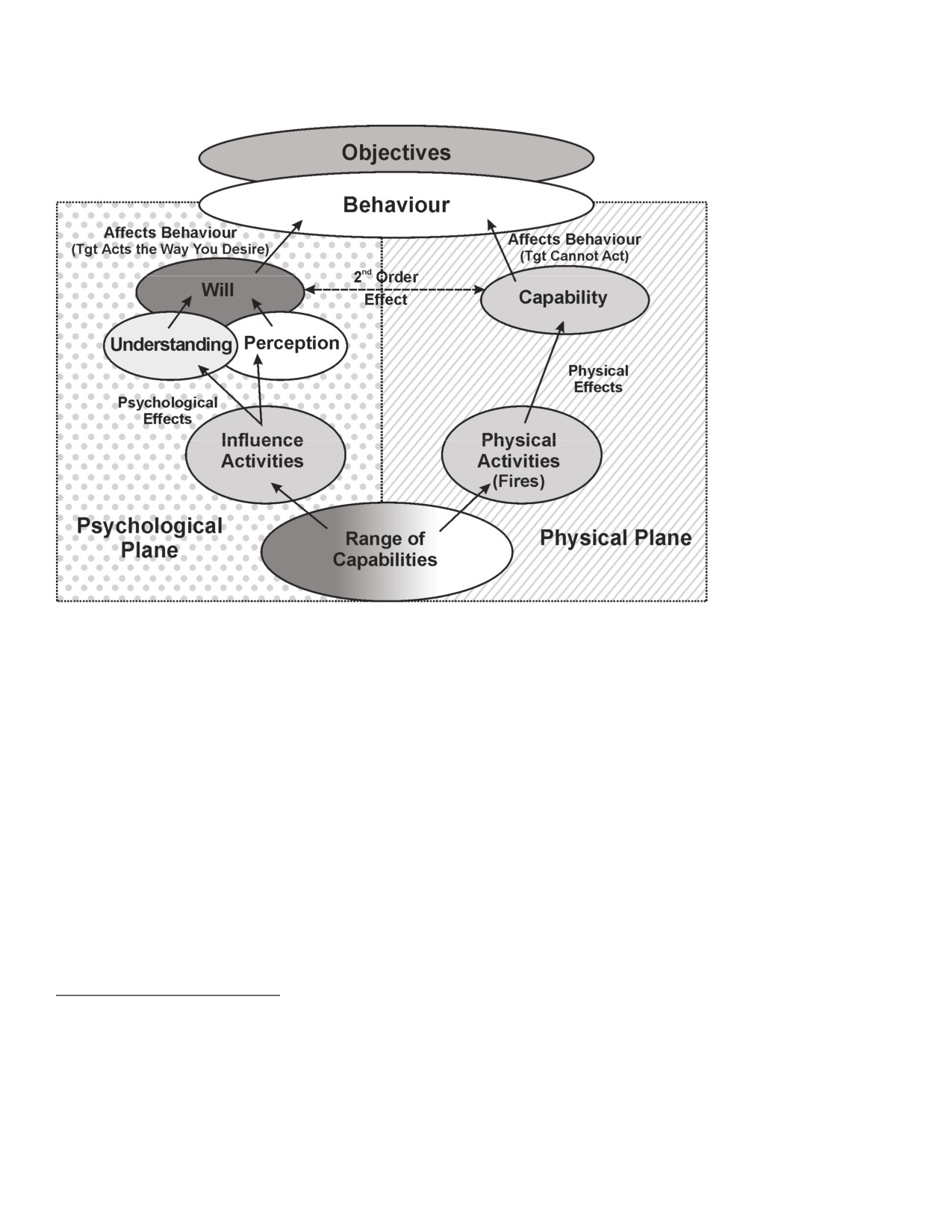
Land Operations
Figure 5-1: Simultaneous Conduct of Physical Activities (Fires)
and Influence Activities and Their Effects
5.
The conduct of physical and influence activities are planned, targeted, and conducted
simultaneously in a holistic, complementary fashion. Just as physical activities are conducted
and effects created through manoeuvre on the physical plane, influence activities are
conducted and effects created through a form of manoeuvre78 on the psychological plane.
Thus, just as a commander may wish to manoeuvre his forces to reach a piece of key terrain
and threaten the adversary’s position before the adversary reaches it, that same commander
may wish to issue a media statement, launch a PSYOPS message, or build emergency
infrastructure in a village before the adversary issues a propaganda statement, issues a false
media message, or intimidates the local population into giving support. Thus, a commander
creates desired effects through simultaneous manoeuvre on both planes. Together, they may
be considered comprehensive operations.
78 There are a number of definitions within NATO for manoeuvre, the most common of which is:
“Employment of forces on the battlefield through movement in combination with fire, or fire potential, to
achieve a position of advantage in respect to the enemy in order to accomplish the mission.” When
considering a concept of manoeuvre on the psychological plane, one must accept a colloquial meaning
for the word, but retain the idea of gaining a position of advantage.
5-10
B-GL-300-001/FP-001
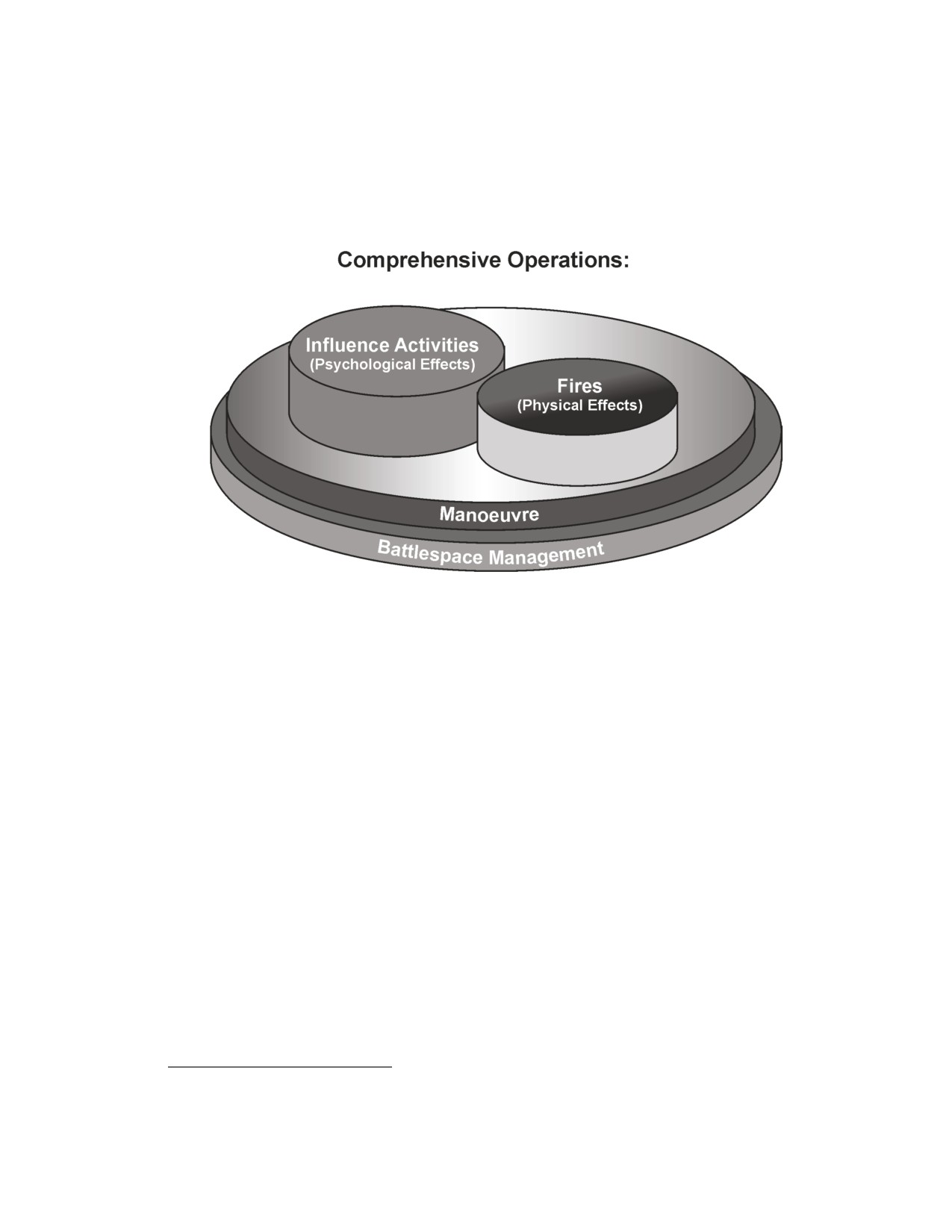
The Application of Combat Power
6.
Comprehensive operations are defined as: “the deliberate use and orchestration of
the full range of available capabilities and activities to realize desired effects.”79 In many ways,
this may be considered another conceptualisation for full-spectrum operations, but with the
focus on the effects, or the reason for their conduct. Fires and influence activities are planned,
targeted and conducted in a simultaneous and complementary fashion. They are organized and
coordinated through manoeuvre and battlespace management. (See Figure 5-2.)
Figure 5-2: Comprehensive Operations: Physical Activities and Influence Activities Conducted
Through Manoeuvre and Battlespace Management
7.
The balance between the two types of activities and resulting effects will be dictated by
the campaign theme, the principles by which the campaign is conducted, and the objectives
desired by the commander. For example, while a major combat campaign against a
conventional adversary will require mainly fires supported by some influence activities, such as
deception and PSYOPS, a COIN campaign may require only enough fires to neutralize the
insurgents while the military and other agencies work to gain the confidence and support of the
local populace through influence activities, such as infrastructure and economic development.
8.
The coordination as to time and space of the application of physical and influence
activities is accomplished through synchronized manoeuvre, on the physical and psychological
planes, and battlespace management.
9.
The application of the full range of capabilities to achieve desired objectives may be
summarised and mapped out in a logical sequence. Objectives and desired effects are the
basis for planning and will dictate the types of activities to be undertaken by allocated
capabilities and resources. (See Figure 5-3.) Note that the commander and staff planners must
always consider the second order effects of activities.
79 Army Terminology Panel approved May 2007.
B-GL-300-001/FP-001
5-11
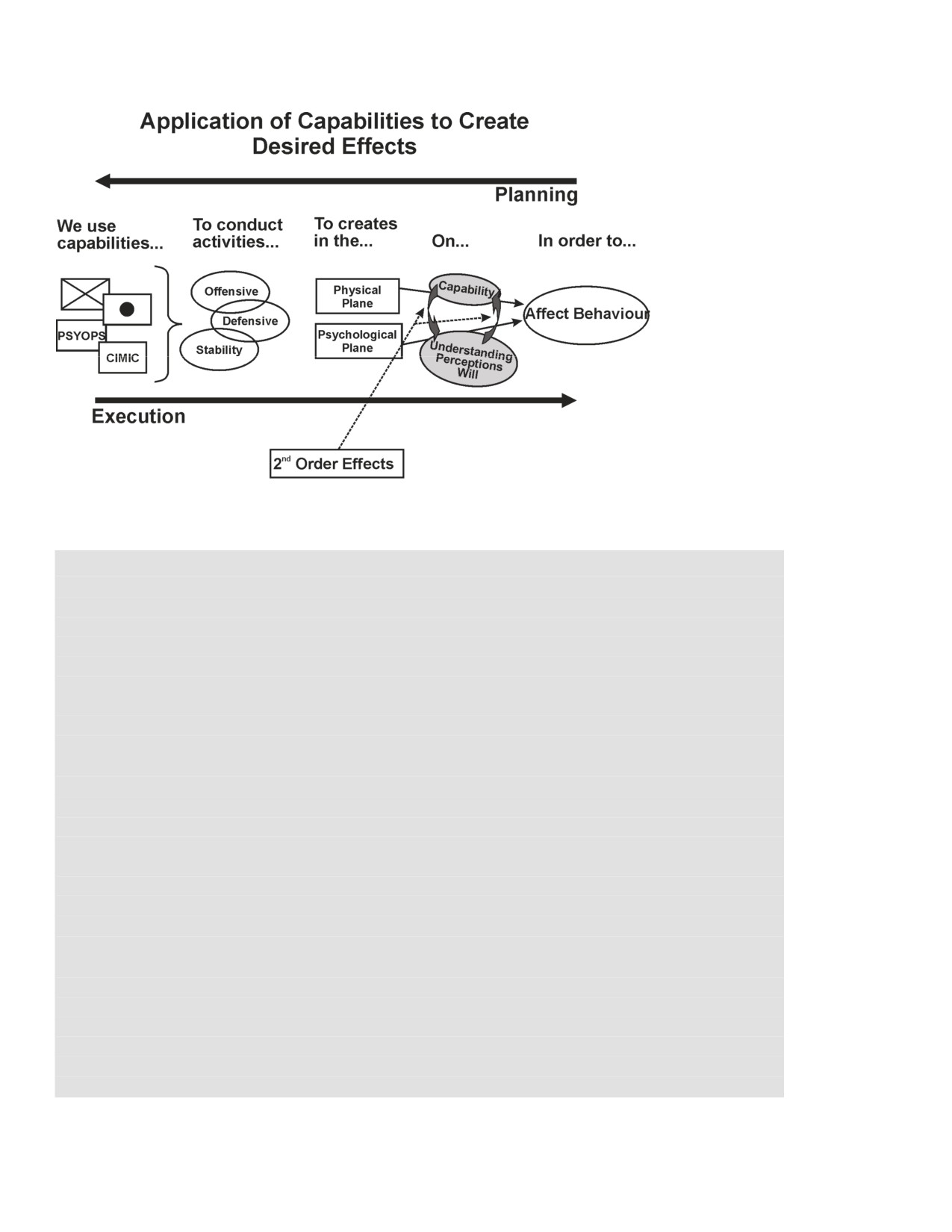
Land Operations
Figure 5-3: Application of Capabilities to Create Effects on the Physical and Psychological Planes
508. DEFINING SUCCESS THROUGH THE APPLICATION OF COMBAT POWER
APPLICATION OF ACTIVITIES TO DEFEAT AN ADVERSARY
To attack the adversary’s will to resist, an understanding of the nature of human will is
necessary. When an individual faces combat, the primary responses are to fight, flee, or
surrender. In most cases, an attack on the adversary's will to fight should be accompanied
by measures that encourage the adversary to surrender or flee. This can be accomplished
not only through fear generated by violent physical action such as massive firepower, but
also by surprising him with unexpected threats. It can also be supported by influence
activities such as the advertisement of fair treatment for prisoners and wounded, showing
respect for the law of armed conflict, offering honourable surrender terms, or pursuing other
methods that legitimize and encourage his surrender. If desirable, flight can be
encouraged by offering an open avenue of escape, such as when dispersing a riot.
An individual's will to resist is built on internal influences, those of the group, and those of
the leader. Internal influences include personal motivation and emotions, such as hatred or
revenge that motivate the individual to continue fighting even if alone. Often more
dominant are the influences of the small group. Battlefield studies have shown that the
primary reason individuals fight is the feeling of group loyalty or the fear of letting down
other members of the group. The individual, and in fact the group, are also affected by the
influence of leaders who can provide motivation and compulsion to fight and legitimize the
efforts of individuals. These individuals may be moral centres of gravity.
It is difficult to alter strongly held personal beliefs, and closely-knit small groups are difficult
to break up. Therefore, efforts aimed at attacking the adversary’s will to fight should focus
on two areas. The first is to attack the leaders' will to fight and the second is to disrupt the
bonds between larger groups, and shattering the links between leaders and followers. In
other words, the preferred method of attacking the will to fight is to render the adversary
incapable of resisting by shattering the physical and moral cohesion of his force. This may
be done by through overwhelming fires, and in part, through influence activities that attack
perception, legitimacy, understanding, and thus will of the adversary.
5-12
B-GL-300-001/FP-001
The Application of Combat Power
1.
In order to reach the desired lasting end state and thus the successful conclusion of a
campaign, a number of agencies will be involved in addition to the military. This will ensure that
all the elements of an environment that led to military intervention are addressed in order to
establish a lasting stability and peace.
2.
The primary roles of the military will to be to employ its monopoly on force, and to
counter threats of violence and military power posed by an adversary. The object of the use of
force or threat of force is to impose the force’s will upon specific targets. In many campaigns,
military capabilities will be employed to neutralize an enemy threat to allow other agencies to
undertake their activities in a secure environment, which will address long-term solutions to the
situation. In addition to this, military capabilities, in conjunction with those of other agencies and
elements, will be used to create effects and support objectives in relation to a local populace
and the supported government. For example, military forces may be used to build infrastructure
or to support other agencies in such efforts. These will be done to create a better, more stable
environment, and to engender support and stability from a populace and local authority; that is,
they will create effects on the psychological plane. Thus, the campaign will employ a
comprehensive approach that uses fires to deal with an enemy or potential adversary, and
influence activities to create campaign legitimacy and engender support from a government or
population, in a harmonized, complementary fashion, all in order to create enduring solutions to
a crisis or situation.
3.
Success is measured against predetermined criteria that support the decided end state.
The end state is the result that must be achieved at the end of a campaign to conclude the
conflict on favourable terms. The end state will likely have political, diplomatic, economic and
social/psychological, as well as military aspects, and hence will require a multi-agency,
comprehensive approach.
4.
In military terms, victory in a campaign may not see the outright surrender of an
opposing force. Rather than a pure military victory, the end state may often be defined in terms
such as reconciliation, acceptance of the status quo, or agreement to a peace plan. In many
campaigns such as a COIN, there may be no outright victory, but only a concession by the
insurgents to pursue peaceful means to reach their political goals, or the development of an
indigenous capability (physically and intellectually) to deal decisively with the insurgency on
their own. Success, in short, will occur through activities and effects on both the physical and
psychological planes.
SECTION 3
THE COMPREHENSIVE APPROACH TO OPERATIONS
509. GENERAL
1.
Environments and battlespaces are complex and consist of a variety of players and
entities that can be considered as interrelated systems that influence one another and the
overall environment. They may be grouped together under the headings of political, military,
economic, social (including culture and religion), infrastructure, and information (PMESII).
2.
Campaigns occur in complex situations that involve, to one degree or another, elements
of these systems: local populations; urban areas; complicated social and political structures;
informal, traditional power structures; and, extensive, interrelated problems that led to the need
for military intervention. The various systems and elements of an environment are affected by
the region’s history and culture. These must be understood if the environment and its
constituent elements are to be understood and engaged effectively.
B-GL-300-001/FP-001
5-13
Land Operations
3.
In order to reach successful and enduring outcomes, campaigns will have to deal with
these interrelated systems and various players of the battlespace. This of course will require
more than the application of military capabilities. Given the breadth of issues, and systems
involved, along with the root causes and standing grievances that led to a crisis, a successful
outcome in many campaigns will require the application of a wide array of agencies, elements of
power and capabilities. Thus the military will work in concert with these other agencies to reach
a successful conclusion. This multi-agency, coordinated method that addresses all issues and
systems in the environment—military and non-military—may be termed a comprehensive
approach.
510. COMPREHENSIVE APPROACH TO CAMPAIGNS AND OPERATIONS
1.
The comprehensive approach80 is defined as: “the application of commonly understood
principles and collaborative processes that enhance the likelihood of favourable and enduring
outcomes within a particular environment. Note: The comprehensive approach brings together
all the elements of power and other agencies needed to create enduring solutions to a
campaign.” 81
2.
The comprehensive approach is an overarching philosophy for the conduct of a
campaign. It recognises that crisis situations and their surrounding environments are
complicated and that an enduring solution cannot be reached by military forces alone, but
requires the use of a wide range of powers exercised through a variety of departments and
agencies in order to solve the root causes and aggravating grievances that led to the crisis. A
comprehensive approach seeks to incorporate all the elements of power and agencies, and
harmonize them, their capabilities, and their activities, in order to work to address the elements
and complexities present in an environment, and reach enduring strategic and operational end
states. Thus, it brings together all elements of power and applies them to engage all
systems within the environment.
3.
The comprehensive approach to campaigns and operations begins at the strategic level
through the JIMP framework and sees the military, other elements of power, and other agencies
working within a unifying theme to reach a common end state. In this way, the root causes of a
crisis and the various systems within the environment that will influence the outcome are
engaged to create operational objectives that build to the end state.
4.
It does not mean to imply that a military authority is in overall charge of a campaign, but
only seeks to ensure that military activities, effects, and objectives lead to the strategic end state
and are complementary to those of any lead agency and other elements of power and agencies.
A number of command structures or cooperative committee systems may be used to realise the
comprehensive approach.82 This approach brings together not only other government agencies,
but also other organizations, be they international, private or indigenous.
80 Some NATO allies describe the same concept with slightly different terminology. The United Kingdom
uses Comprehensive Approach; however, others, such as the United States, use Whole of Government
Approach, Integrated Operations and Unified Action to describe generally the same concept or aspects of
the comprehensive approach.
81 Army Terminology Panel approved May 2007.
82 For a more detailed discussion on possible command and cooperation structures across different
agencies, see B-GL-323-004/FP-003 Counter-Insurgency Operations.
5-14
B-GL-300-001/FP-001
The Application of Combat Power
5.
The comprehensive approach consists of three elements:
a.
Unifying Theme. In striving towards a strategic end state, the lead agency
should issue a unifying theme that is focused on long-term outcomes and end
states. For the military, this should be pervasive throughout the campaign plan.
It should be developed in the commander’s visualization of the campaign and
articulated in his intent.
b.
Collaborative Working. An effort is made to harmonize the activities, effects
and objectives of all the elements of power in the JIMP framework so that all
efforts are complementary and integrated towards common objectives and end
states. This may occur under formal or informal arrangements.
c.
Comprehensive Response. The activities and effects of all the elements of
power are to be applied in a holistic approach to the situation to all the relevant
elements, systems, and entities that are at work in the environment. This
includes political, military, civil and economic facets to an environment, along
with any other identified influences and systems. Furthermore, there occurs
continuous assessment as to how campaign activities will affect each of these
systems and entities, and how they will in turn affect one another as progress is
made towards the end state. This comprehensive response includes the
military’s role and the conduct of its comprehensive operations, that is, the
combination of fires and influence, guided by the unifying theme and operational
objectives. All activities at the lower operational and tactical levels of command
should reflect the comprehensive approach and it some cases see cooperation
between other agencies and the military at the subunit level. Many of the
influence activities under comprehensive operations may be conducted in
conjunction with other agencies.
6.
Between the operational and tactical level, the comprehensive approach is realized as
comprehensive operations. Here, tactical level fires are planned and conducted in a
complementary fashion with influence activities across all elements of power in order to create
the desired effects supporting operational objectives. Many of the influence activities,
particularly those related to reconstruction, governance, and security sector reform (SSR), will
be best conducted by other agencies with the military in support. (See Figure 5-4.)
B-GL-300-001/FP-001
5-15
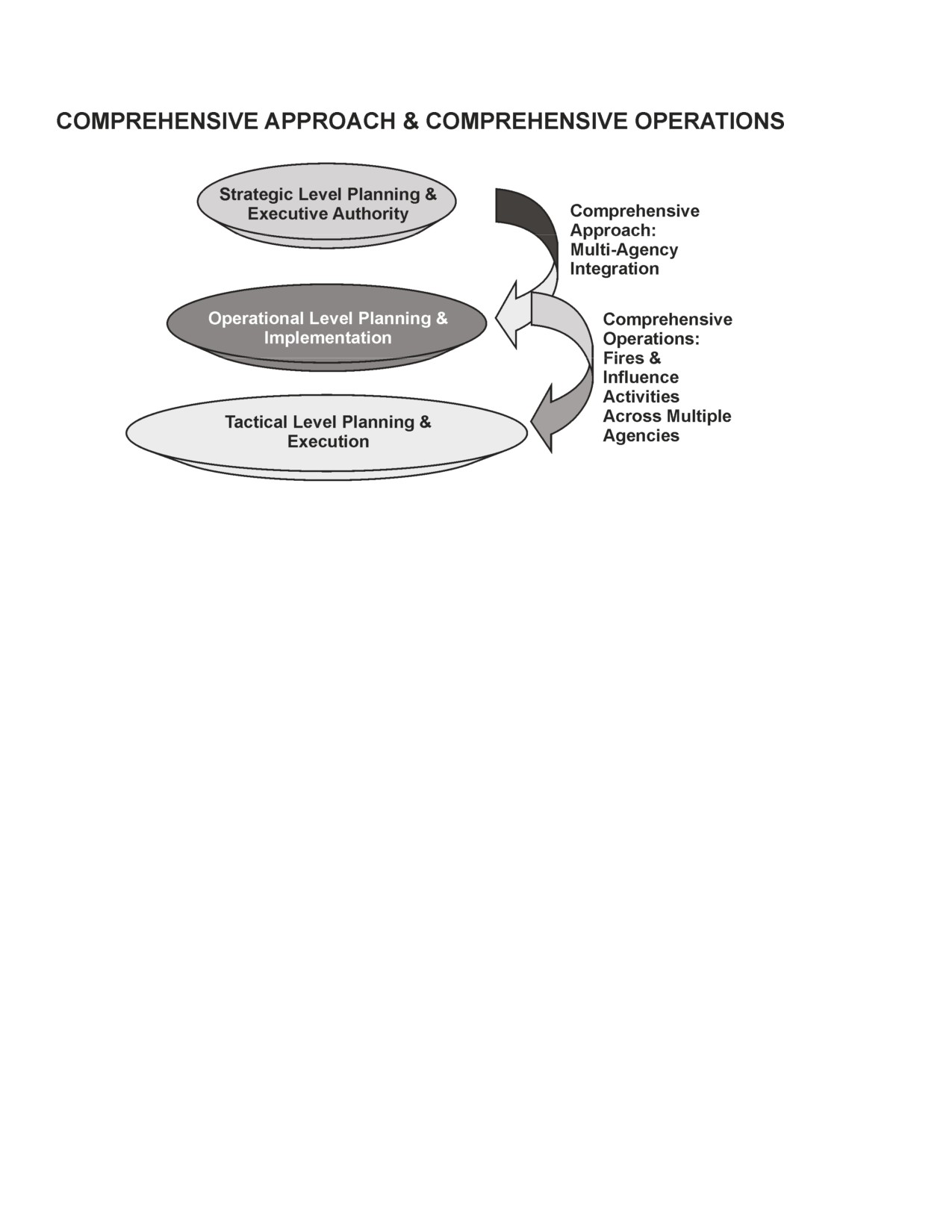
Land Operations
Figure 5-4: Comprehensive Operations Supporting a Comprehensive Approach
7.
While the military will focus on security and defeating, or at least neutralizing, an
adversary, other elements of power and agencies will address those elements and systems of
the environment that ensure lasting security for a populace—the political, social and economic
elements. Although this is done to meet the long-term objectives of a campaign, it is also
undertaken to ensure support from local populations and leaders who are likely key to long-term
success and stability.
8.
Thus, the campaign will consist of a number of operational objectives spanning all of
these areas, which in turn can be grouped into a number of lines or thematic grouping of
operations, such as security, economic/development, political, and social, to name some
possibilities. A good number of these lines of operation and their objectives will be best pursued
by non-military agencies. The military may be the lead or supported agency in some areas,
such as security. The military will be a supporting agency in other lines of operation, such as
reconstruction.
9.
During the early stages of a campaign, the security situation may only allow for the
military to undertake all aspects of the campaign. Hence, the military may undertake the initial
reconstruction, economic and political development, and the reform of security services (many
of these will be classified as Stability Operations—see Chapter 3). Once the security situation
improves, other agencies should be able to assume the lead in these non-martial
responsibilities. Eventually, the campaign may reach such a state that the military’s role will be
reduced to a minimum and indigenous forces will be able to handle any residual threat to
security. Indeed, the requirement for the military may end before the overall campaign is
complete.
10.
The campaign design may involve a formal unified structure with a lead agency and
commander, and all agencies, be they military or civil, working within a single chain of
command. Such constructs are ideal and work to ensure excellent harmony and cooperation
5-16
B-GL-300-001/FP-001
The Application of Combat Power
between agencies. However, such situations will be rare.83 Usually, informal arrangements will
have to be designed in order to ensure that all agencies work in a complementary manner
toward the attainment of agreed objectives and end states. Often there will be a major onus on
the military commander to ensure that genuine, cooperative and collaborative working
environments are developed between the military and other agencies, be they national,
international, local or unaligned non-governmental organizations (NGOs). Participants must
work proactively by sharing their understanding of the situations, and conduct planning and
activities on the basis of agreed favourable outcomes in the short, medium and long term.
Hence, the comprehensive approach will rely as much upon personal relationships as upon
formal arrangements.
11.
Processes and structures may need to be adapted to reflect specific circumstances and
situations. For example, a military headquarters (HQ) may have to accommodate the interface
with non-military organizations and take the lead in coordinating objectives and efforts. The
comprehensive approach must also consider actors and agencies beyond the government, such
as NGOs, international organizations (IOs), local agencies and leaders, and others, all of which
conduct activity and pursue objectives that have a bearing on the successful conclusion of the
campaign.
12.
By its very nature, the comprehensive approach should begin at the strategic level
where all the elements of power can be brought together for collaborative planning and
execution. Although the comprehensive approach begins at the strategic level, it should be
viewed and implemented pervasively throughout all levels of command. Hence, it will be
envisioned, designed, and ideally empowered, at the strategic level in order create strategic end
states, but implemented and practised at both the operational and tactical level.
13.
At the operational level, commanders will endeavour to ensure a holistic and
complementary integration of military and non-military agencies in order to address all systems
and elements within the environment, thus creating physical and psychological effects that
support operational objectives. This comprehensive approach should be replicated as
appropriate at the tactical level where unit and even subunit commanders will work with other
agencies to create effects that support enduring objectives.
14.
Through this comprehensive approach, the influence activities that create enduring
effects on the psychological plane will be created by both the military and other agencies. This
comprehensive approach uses all instruments of power to address all the systems—and the
groups in individuals that comprise them—that influence an environment and the root causes for
the crisis and campaign. Activities within an environment must be considered against more
than simply an adversary. All systems—PMESII—within the environment must be identified and
considered in terms of their power structures, interrelationships and influences on the desired
objectives and end states. Activities planned and taken by all agencies including the military
must be considered in terms of their effects on each of these systems in relation to the desired
outcomes. Only in this comprehensive manner—using multiple agencies in addition to
the military to address all the systems and elements in an environment—will long term
solutions to campaigns be reached.
83 Despite the rarity of such situations, examples of successful models include the British campaign in the
1950s/1960s Malaya, and the Australian experience in 2003 the Solomon Islands.
B-GL-300-001/FP-001
5-17
Land Operations
15.
Although an environment may be described as a collection of systems, they consist of
people—groups and individuals—who influence the situation and one another. These groups
will co-exist either peacefully or in competition with each other based upon religious, ethnic,
political, ideological, or clan/tribal lines. Human perceptions of issues of economy and security
will affect the behaviour and thinking of the population. Cultural factors are dynamic and
present both obstacles and opportunities. Knowing the groups, what relationships exist
between them, how they relate to the infrastructure, and how each group will respond to an
activity, is critical to success. Such information will be a key aspect to the broad knowledge
base formed through intelligence collection and assessment.
16.
In general, four principles should be considered in applying a comprehensive
approach:
a.
A Proactive Approach. Ad hoc relationships formed at short notice in
response to a developing crisis prove problematic, and although at times
unavoidable, do not produce the best results in the shortest order and prove
difficult in overcoming prejudices and previously held misconceptions. Rather, a
comprehensive approach should be supported by standing agreements and
strong personal and institutional relationships and early, shared analysis of an
environment and battlespace.
b.
Shared Understanding. A shared understanding of the strengths, limitations,
aims, and cultures of each element within the comprehensive approach will
allow a harmonized and complementary application of capabilities. Secondly, a
shared understanding of the operating environment and the threats to lasting
stability and security will again help ensure a harmonized and complementary
approach to the campaign across the various elements of power.
c.
Outcome or End-state-based Thinking. The unifying theme should serve to
focus the elements within the comprehensive approach and ensure that
activities conducted by all agencies are based and judged upon the
achievement of progress towards the agreed objectives and end state. Each
undertaking by an element of power should be considered against how it might
further progress towards the shared end state.
d.
Collaborative Working. The comprehensive approach demands that military
and non-military institutions—be they national or indigenous—work together with
trust, transparency, and personal investment in order to be successful. This
must be fostered at all levels. While some elements and their leaders,
particularly those not familiar with the military, will not be comfortable with a
collaborative or highly cooperative relationship, effort must be made to insure
that, at the very least, a coordinated and de-conflicted coexistence is
established, vice a mutually exclusive relationship. In such circumstances, the
onus may fall upon the military commander to foster and engender, through a
dynamic, engaging and generous personality, an atmosphere of cooperation.
17.
It should be noted that the levels of authority, experience, technical ability and
understanding of the personnel within these, largely civilian, organizations might not always
correspond to that of the land force. This will inevitably introduce frictions and uncertainties,
which may exacerbate personality and institutional difficulties. Nor will a formal command
relationship always exist between military and non-military agencies. The commander has a
5-18
B-GL-300-001/FP-001
The Application of Combat Power
key role to play in harmonizing these relationships. When collaboration is achieved, significant
advantages will include:
a.
More accurate, shared situational awareness.
b.
Easier identification of, and agreement about, outcomes.
c.
Earlier identification of emerging opportunities as an operation progresses.
d.
Improved capacity for mitigating undesirable consequences.
e.
More efficient use of resources.
f.
Increased legitimacy for the campaign and its conduct.
18.
Ideally, the comprehensive approach is applied pervasively in both spirit and practice so
that even tactical level commanders understand the need to work with other agencies, take
active measures to encourage it, and understand the effects that must be created to help realize
the objectives.
SECTION 4
AN EFFECTS-BASED APPROACH TO OPERATIONS
511. GENERAL
1.
Focus on end states and supporting objectives will be required to ensure appropriate
activities are undertaken to build towards those objectives. Lasting solutions will demand that
the root causes across all relevant systems will be addressed and therefore objectives and the
activities through which they are realised must consider and address all aspects of the
environment—political, military, social and economic. Furthermore, long-term success and
stability will only occur with the support of the majority of an indigenous population. To the end,
the Land Force follows an effects-based approach (EBA) in the planning, conduct, and
execution of campaigns and operations.
2.
An effects-based approach ensures that comprehensive operations—the combination of
fires and influence activities—are planned and conducted in order to directly support operational
objectives. It ensures the military’s role within a comprehensive approach is harmonised with
the shared end state and contributes to, rather than undermines, the operational objectives, end
state and campaign legitimacy.
3.
An effects-based approach to operations is defined as: “EBA is the way of thinking
and specific processes, integrated in both the physical and psychological plane, that focus on
outcomes (effects) rather than activities to enable both the integration and effectiveness of the
military contribution within a comprehensive approach and the realisation of operational and
strategic outcomes. The EBA process is the organization of activities to achieve planned,
desired and measurable effects that will realize objectives and ultimately meet the mission end
state.”
B-GL-300-001/FP-001
5-19
Land Operations
512. PHILOSOPHY AND PURPOSE
1.
The philosophy behind an effects-based approach to operations stems from the
premise and belief that successful campaigns require the holistic application of all instruments
of power on both the physical and psychological planes. Thus, the military must work in a unity
of purpose, and ideally effort, with other instruments of power and agencies in order to achieve
enduring solutions to both the symptoms and root causes of a situation requiring intervention.
2.
Additionally, it focuses on creating end states and supporting objectives before
consideration of lower level military activities. The purpose of an effects-based approach to
operations is to ensure that military operations and activities create the required effects in
support of enduring operational and strategic objectives and end states, in harmony with other
instruments of power, and in relation to all aspects of the environment.
3.
Consequently, it considers the whole environment and the influence that each system
has on the environment and the crisis at hand. It recognizes that the environment and its
elements are complex, interrelated, unpredictable and adaptive, and that they require constant
assessment and analysis in order to properly develop a plan and conduct operations in support
of the desired outcomes. The systems of the environment are focused on people, as individuals
and groups. This approach recognizes that enduring outcomes will require the support of
populations and their constituent groups.
4.
Based upon an understanding of the environment and the desired campaign outcomes,
an effects-based approach links end states and objectives to activities that create planned,
supporting effects (results) on both the physical and psychological planes. In order to ensure
that the right activities are creating the planned effects in support of the desired objectives and
end states, constant assessment and analysis and subsequent adjusting are required.
5.
In short, an effects-based approach addresses the situation as a whole and decides end
states and objectives in order to determine the required activities and effects on the physical
and psychological planes. Commanders must assess and plan the effects they wish to create,
through activities not only on the capability of an enemy (physical plane), but on the
perceptions, understanding, will (psychological plane), and ultimately behaviour of all elements
in the environment, namely individuals and groups. The effects-based approach sees all such
activities—fires and influence activities—planned and executed together, in harmony with other
agencies and instruments of power, and applied across the entire environment. It sees
comprehensive operations supporting a comprehensive approach.
6.
This effects-based approach does not introduce an entirely new method of conducting
campaigns and operations. It builds upon and provides a better articulation for extant concepts
such as mission command, the manoeuvrist approach, and a commander’s intuition, to improve
upon operational design and campaign execution at all levels of command in order to address
all aspects of an environment and to reach successful, enduring end states. It ensures that
individuals at all levels understand the context of their operations, are aware of the effects of
their activities, intended and unintended, and have the necessary guidance to contribute to the
desired objectives.
7.
As a general construct, the effects-based approach to operations may be summarized
as follows:
5-20
B-GL-300-001/FP-001
The Application of Combat Power
a.
A crisis that requires military intervention occurs in a complex environment
affected by a range of systems, made up of groups and individuals.
b.
A lasting solution must address the root causes of the crisis. Thus, a number of
facets of the environment must be engaged: political, economic, social, and civil.
This is best done through the military working in harmony with other agencies
and elements of power—diplomatic, civil, and economic. These may be
governmental, domestic, non-governmental, and/or private agencies.
c.
Campaigns are best planned with a focus on end states and supporting
objectives. These are realized through the assignment and conduct of activities,
which create effects (results) that support the objectives. These effects must
undergo constant assessment and analysis to ensure that the activities are
indeed leading to the desired objectives. Activities are conducted by all the
elements of power.
d.
Because the environment and its systems are comprised of individuals and
groups, their support is necessary for enduring end states. Thus, the military
must understand that it functions and creates effects on two planes: the physical
and the psychological through a combination of fires and influence activities.
8.
It is a philosophy supported by methodology, and is merely an improvement to previous
doctrine and concepts.
9.
In order to properly apply effects there is a requirement for an analytical approach, to the
greatest extent possible, using the coordinated application of the full range of military and non-
military capabilities, to undertake activities and create effects in support of objectives and
enduring end states. These effects are assessed and adjusted against predetermined
measures of effectiveness, which ask the question, “Are we doing the right things to create the
desired effects?” The effects, in turn, lead to objectives in achieving the desired end state.
Adjusting the effects and the activities used to create those effects, based upon the assessment
feedback, is vital to achieving campaign success.
10.
In planning operations and articulating outcomes, commanders must clearly understand
and express the following: the end state; the conditions needed to achieve it, that is, the
objective(s); the effect(s) required to achieve the objective(s); and those activities required to
create the effect(s) (see Figure 5-5.). Thus, in execution, activities are conducted to create
desired effects that realize objectives, which in turn, support desired end states. This should be
applied to all systems and facets of the environment. (See Figure 5-6.)
B-GL-300-001/FP-001
5-21
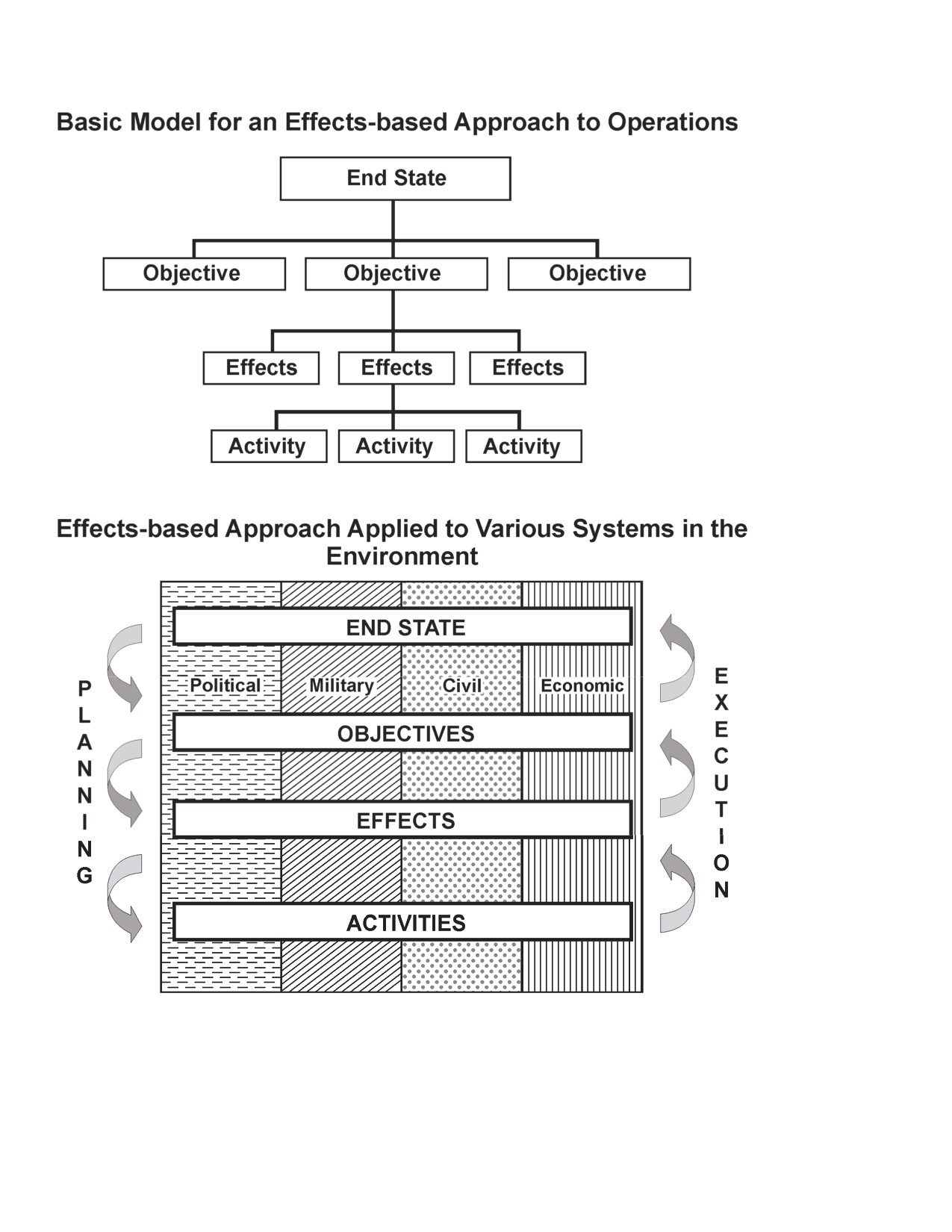
Land Operations
Figure 5-5: Basic Model for an Effects-based Approach to Operations
Figure 5-6: Application of an Effects-based Approach to Operations Across Environmental
Systems.
5-22
B-GL-300-001/FP-001
The Application of Combat Power
513. PRINCIPLES
1.
The application of an effects-based approach should be guided by the following
principles:
a.
Long-term View. Commanders and planners must take a long-term view of the
campaign and the situation to deal with the symptoms, and more importantly,
the underlying causes of the conflict and crisis. The solution to the root causes
will usually take a long time to create and secure. It is important that political
leaders understand this requirement as well. Ideally, this long-term approach
will be shared by other elements of power that will be required, perhaps longer
than the military element, to provide lasting solutions.
b.
Whole Environment. It must be realized that the environment in which a
situation and conflict occurs is complex, adaptive, and often unpredictable. The
environment must be viewed holistically, and the influence of all systems and
actors with respect to resolving the conflict must be assessed and considered in
planning. The interrelated nature of the environment in which the adversary,
neutral, and friendly elements interact must be considered. Commanders must
comprehend the relationships between activities and effects, particularly in
relation to the elements and systems of the environment. The systems in the
environment consist of individuals and groups, and this demands engagement
on both the physical and psychological planes.
c.
Focus on End State. Planning must focus on strategic end state and
objectives, and operational objectives and the conditions needed to realize
them. Activities that lead to the objectives through the effects they cause should
be planned last.
d.
Collaboration. All levels of command must work to create complementary
effects that work towards operational objectives. Even lower levels of command
must understand the effects, both desired and undesired, that their activities will
create in terms of achieving or undermining the objectives and end state.
e.
Complementary Application of the Instruments of Power. In order to reach
agreed objectives and end states, military activities must be harmonized with the
contributions of different instruments of power and agencies within the
battlespace and the environment. Planning and execution must be done within
the context of a comprehensive approach that brings together all elements of
power in a unity of purpose.
f.
Continuous Analysis and Assessment. Continuous analysis and assessment
must be done in a holistic, iterative fashion to deepen the understanding of the
environment and to modify the plan and execution as necessary to reach the
operational objectives. Staff and commanders must continually assess the
effectiveness of activities in creating the desired effects, and adapt accordingly.
B-GL-300-001/FP-001
5-23
Land Operations
514. KEY ELEMENTS OF AN EFFECTS-BASED APPROACH TO OPERATIONS
1.
An effects based-approach to operations acknowledges that conflicts and campaigns in
the operating environment involve a wide variety of sources and issues and require that
operational objectives address all facets concerned. To this end, a wide range of capabilities
and activities are required in order to influence and affect systems and actors, including the
indigenous population, in order to realise operational objectives.
2.
In order to implement an effects-based approach, the following are key elements are
required:
a.
Knowledge Base. An effects-based approach to operations is predicated on a
sound understanding of the battlespace and the actors, factors, and influences
within it. Information and intelligence collection must be expanded in order to
incorporate and assess the various elements and entities that interrelate within
an environment—the political, military, economic, social (including culture and
religion), infrastructure, and information entities84 (PMESII). This knowledge
base requires continuous analysis, in particular the manner in which the groups
and individuals who comprise these systems will react to our activities and
objectives.
b.
Comprehensive Approach. A comprehensive approach recognizes that more
than the military element of power is required to address the root causes of a
conflict and to establish enduring end states. It seeks to incorporate all the
elements of power working to reach the strategic end state and harmonize them,
their capabilities, and their activities. In doing so, it considers and addresses all
the systems and influences within an environment that may have in impact upon
long-term stability, and this is manifested in a range of lines or groupings of
operation. The military may have the lead in many of these initially, but over
time, should pass the lead to other elements of power in non-military lines of
operation. The comprehensive approach comprises a unifying theme,
collaborative working, and a comprehensive response.
c.
Long Term Campaign Plan Focused on End State and Objectives. The
campaign plan must take a long-term view and focus on the desired end state
and operational objectives. It should encompass and be developed with all the
elements of power required to address all facets of the crisis and its causes, and
to reach an enduring end state. The campaign will identify the supporting
effects required for each objective. Only then should the activities of the military
and other agencies be decided. The campaign plan is implemented through the
continual issue of operational plans and orders that assess and adjust the
implementation of the campaign on a regular basis to reflect progress made or
frustrations encountered.
84 The environment is often referred to as a collection of systems, identified by the acronym PMESII.
While all the elements represented by PMESII certainly exist within a society or environment, and they do
interrelate and affect one another, it is believed that there are too many variables, including individual
personalities, to allow a scientific “systems approach” to constantly and accurately predict exactly how
they will react.
5-24
B-GL-300-001/FP-001
The Application of Combat Power
d.
Measures of Effectiveness.85 A measure of effectiveness is defined as: “a
criterion used to evaluate how a task has affected selected system behaviour or
capabilities over time.”86 Measures of effectiveness indicate whether the right
things are being done in order to create the desired effects. They are generally
subjective and depend upon the situation and campaign. They are used to
confirm that the correct activities are being undertaken and to adjust activities as
necessary to achieve desired objectives.
e.
Application of an effects-based approach to operations simply expands upon the
current operational planning process and campaign prosecution in order to
incorporate a broader scope of information, elements of power, capabilities,
application, and assessment, all in order to reach enduring operational and
strategic end states in complex environments.
515. UNDERSTANDING EFFECTS
1.
General. To succeed in a complex environment, commanders must recognize that the
activities they undertake will create effects that cannot be viewed in isolation. Applying physical
force requires a precise ability to find, fix, and strike targets, while at the same time avoiding
unintended consequences that may be counter-productive, such as collateral damage. Many
campaigns require military commanders to consider activities in relation to more than simply an
enemy force. Success in a complex environment requires that they understand the creation of
effects and the range of elements and systems within the environment that affect the successful
conclusion of a campaign.
2.
End States and Objectives. At all levels, activities create effects that support desired
objectives and build towards end states:
a.
Strategic End State. The strategic end state is the desired situation derived
from policy direction. It is realized by the achievement of strategic objectives. A
strategic end state will be multi-faceted, and a military objective and its end
state—successful completion of the military contribution to strategic objectives—
will only be a part of it.
b.
Strategic Objective. A strategic objective is a constituent of the desired
strategic end state realized through the aggregation of agreed circumstances
and conditions, generally specific to a particular element of power. Once all
objectives are realized, the strategic end state will have been achieved.
c.
Military Operational End State. The military operational end state is the
desired and enduring military situation (within the joint operations area) derived
from strategic direction brought about by the campaign, which contributes to the
achievement of the strategic objectives and takes into account the end state and
objectives of the other instruments of power. It may be reached before the
overall strategic end state. Upon achieving it, the military involvement in a
campaign may cease or be reduced substantially.
85 Measures of effectiveness are done in conjunction with measures of performance. The latter measures
task accomplishment, that is, an assessment of whether or not the activity was done right.
86 Definition developed by the Army Terminology Panel, May 2006.
B-GL-300-001/FP-001
5-25
Land Operations
d.
Operational Objective. An operational objective is a constituent of the desired
operational end state realized through the aggregation of one or a number of
interrelated effects and circumstances.87 It may be described as a decisive
condition for the realization of the operational end state. Operational objectives
may be delivered by elements of power other than the military. Operational
objectives may be grouped into thematic lines of operation.
e.
Supporting Effect or Decisive Point. A supporting effect is a constituent part
of an operational objective. It is a change brought about by the interplay of
deliberate activities and dynamic circumstances that contribute to an operational
objective. Supporting effects are created by activities and link a range of
activities in time, space, and/or purpose. Using the taxonomy developed for
campaign planning in a major combat campaign, one may view supporting
effects as decisive points, for they build to the achievement of operational
objectives. The traditional definition of decisive points will have to be broadened
in order to conceive decisive points as being situations developed in time and
space that lead to the attainment of operational objectives.88
f.
Tactical End State. A tactical end state is the tactical situation once a tactical
mission, this is, activity, has been completed. For each specific mission, it is
described in the concept of operations paragraph of the tactical order.
g.
Tactical Objective. A tactical objective is a constituent part of the tactical end
state and the immediate aim of a tactical mission as described by the mission
statement. They result from the achievement of a tactical effect (result) or group
of effects resulting from tactical activities.
3.
Effects. Effects are changes as a result or consequence of actions, circumstances or
other causes. Simply put, an effect is a result of an activity. An effect may be a physical or
psychological result of an activity or series of activities, which may be conducted by a military or
non-military (other agency) element. Effects can be categorized as follows:
a.
Direct Effects. Direct effects are the first order consequence of activities (e.g.,
weapons employment results, populace informed through leaflets, etc.),
unaltered by intervening events or mechanisms. They are usually immediate
and easily recognizable. Direct effects occur within the same system or group
engaged.89
87 It should be noted that some influences would not be within the purview of the operational commander
to deliver, even if they may be necessary for the desired end state.
88 NATO Allied Administrative Publication 6 defines decisive points as: “A point from which a hostile or
friendly centre of gravity can be threatened. This point may exist in time, space or the information
environment.” In order to be termed to refer to a supporting effect, the concept must be expanded to
include a set of circumstances and perceptions that support an operational objective rather than simply a
geographical point.
89 The term “engaged” does not mean to imply physical engagement with weapons systems only.
Depending upon the target, the means, and the desired effect, it may mean engagement with PSYOPS,
public affairs, or any other influence activity that will create an effect on the psychological plane.
5-26
B-GL-300-001/FP-001
The Application of Combat Power
b.
Indirect Effects. Indirect effects are the consequences of an activity that are
removed in time or purpose from the initial point of application and target. They
occur in a target or system that was not the object of the activity. For example,
if a successful attack on a village occupied by insurgents convinces insurgents
in another village to withdrawal, the latter is an indirect effect. Indirect effects
may be difficult to recognize.
c.
Intended and Unintended Effects. Intended effects are those that are planned
in relation to the activities conducted and support the desired objective. They
may be direct or indirect. Unintended effects are those that were not foreseen
and/or desired by the related activities. They too, may be direct or indirect. If
they are undesired, they will likely undermine the attainment of the objective.
d.
Second, Third, and Subsequent Order Effects. Second order and
subsequent effects are consequences of a first order effect. As an example,
dropping leaflets has the direct effect of causing enemy soldiers to desert. The
intended second order effect is that the enemy’s fighting power is reduced or
becomes ineffective, and a third order effect is that the enemy commander
looses confidence and morale. Note that these subsequent effects cross
between the psychological and physical planes.
4.
Activities. Once the desired supporting effects have been decided, such as seizure of
key terrain or the creation of a trained indigenous security force, activities that will create the
effects may be issued to lower echelons. This is done through the creation of operation plans
(OPLANs) and the issue of corresponding operation orders (OPORDs). Activities are tactical
level undertakings, that is, missions assigned to formations and units and are realized through
tactical tasks and effects. In line with the continuum of operations construct, activities are
classified as offensive, defensive, stability, or enabling. The construct of a mission statement
clearly articulates the tactical level effects that are required by an activity.90
5.
Unpredictability of Effects. Note that effects are at times caused by circumstances
that are beyond the foresight or control of a military commander, and result from the
unpredictable dynamics of environmental systems and the individuals who comprise them.
Thus, in such situations, an effects-based approach demands that a commander simply work
through the situation and mitigate the unavoidable unforeseen undesired effects. Not all effects
can be foreseen and therefore best efforts must be made to war game through operational
plans in order to reduce uncertainty and avoid undesired outcomes.
90 For example, in the mission statement, “A Company will attack to seize Objective DOG by 1300 hours
in order to secure a line of departure for B Company,” the activity is to “attack” (often not stated in a
mission statement) and the first and second order effects are to “seize” and “secure.” Thus, the objective
is a secure line of departure and conditions to support B Company. The tactical end state will see A Coy
prepared to support B Coy and its forward passage of lines. See B-GL-331-002/FP-000, Staff Duties in
the Field, for more details.
B-GL-300-001/FP-001
5-27
Land Operations
SECTION 5
APPLYING AN EFFECTS-BASED APPROACH
516. GENERAL
1.
The concept and basic construct of an effects-based approach is applicable to all levels
of command, including the tactical. At the operational level, an effects-based approach provides
essential structure to the commander’s intuitive process so that operational design and
campaign planning are conducted logically, linking the end state through objectives and effects,
to corresponding activities.
2.
While the term “objective” has commonly been used to refer to a physical object against
which action is taken, in an effects-based approach an objective may be something far more
abstract, such as a set of conditions or circumstances that must be created, such as an
independent, self-sustaining and responsive security apparatus. It should be considered as a
goal to be attained or a decision condition to be created.
3.
Commanders and soldiers at all levels must appreciate and understand the effects that
are required to meet their immediate superior’s intent and the overall objectives, and then
undertake the activities that will create the desired effects. Secondly, they must realize that
their activities will affect all systems in the environment and the people who comprise them, and
that their activities will therefore result in effects on the psychological plane. Ideally, these are
planned and will support the operational objectives.
517. TACTICAL LEVEL APPLICATION OF AN EFFECTS-BASED APPROACH
1.
At the tactical level, the standard orders process and the principle of mission command
will remain relevant. The desired “effect” of a mission statement is issued in the tactical task
(often as a first order effect, e.g., “seize”) and in the purpose of the tactical task (in order to…),
which may be a second order effect.91 Mission command allows a subordinate commander to
assume tasks in support of achieving the desired effects and objectives. Indeed, an effects-
based approach helps to more clearly define the commander’s intent and to focus the force on
achieving it.
2.
The principles underlying the manoeuvrist approach remain appropriate at all levels and
are reinforced by an effects-based approach. As discussed earlier, fires and influence activities
are planned and conducted together and are enabled through simultaneous manoeuvre on the
physical and psychological planes, and through battlespace management. The effects-based
approach is applied at the tactical level through the manoeuvrist approach, with activities
occurring simultaneously on the physical and psychological planes and organized
through battlespace management and manoeuvre (in time and space). This combination of
fires and influence activities to create desired complementary effects on both planes is
comprehensive operations.
91 For a more detailed discussion on the construction of a mission statement, see B-GL-331-002/FP-000,
Staff Duties in the Field.
5-28
B-GL-300-001/FP-001
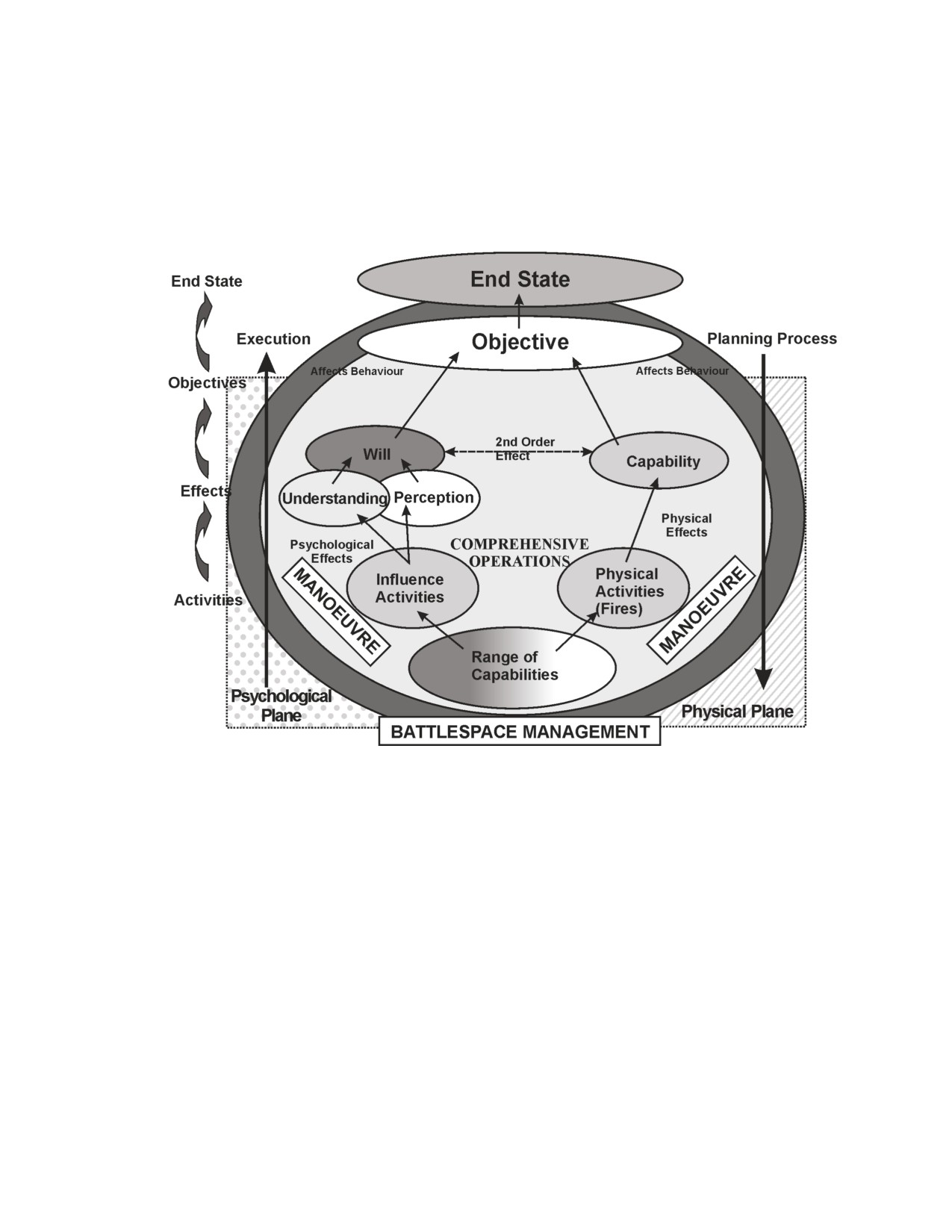
The Application of Combat Power
3.
The models of an effects-based approach, with planned activities creating desired
effects that build to objectives and end states, may be applied to the simultaneous execution of
fires and influence activities coordinated and enabled through manoeuvre and battlespace
management. (See Figure 5-7.) Note that the planning process begins with the desired end
state and flows through selected objectives, supporting effects, required activities and allocated
capabilities.
Figure 5-7: Comprehensive Operations: Fires and Influence Activities Organised Through
Manoeuvre and Battlespace Management
4.
It is important to note that activities on the physical plane may have an impact on the
psychological plane and vice versa. This emphasizes the need to understand both the first and
subsequent orders of effect, and to be aware of the possibility of undesired effects and the need
to work to avoid them. For example, while an assault on an insurgent element in village X has a
first order effect on the physical plane of the destruction of that force, the second order effect on
the psychological plane is the increase in security of the local populace and the increase in their
confidence and sense of legitimacy of the campaign. If, however, the attack resulted in civilian
deaths and significant destruction, then the undesired effects on the psychological plane will be
the loss of support for the campaign amongst the local populace, possibly better recruiting for
the insurgents, and a perceived loss of legitimacy for the campaign.
5.
The degree of risk acceptance imposed upon the commander, or that which he accepts,
will in some cases determine the types of activities the commander will apply to achieve his
desired end state. For example, the best means to defeat an opposing actor in area X may be
to improve the economic conditions of the local population. However, the risk to agencies that
B-GL-300-001/FP-001
5-29
Land Operations
can best affect this may be too high at that time. Therefore, offensive activities aimed at the
opposing force may have to precede actions by other agencies. In making this decision, the
commander must weigh the potential adverse effect of any collateral damage in conducting
offensive activities against the risk of casualties amongst the other agencies should they be
employed first. The sequencing and synchronization of activities and effects will be critical to
the overall attainment of operational objectives.
518. OPERATIONAL LEVEL APPLICATION OF THE EFFECTS-BASED APPROACH
1.
The effects-based approach is applied as a process at the operational level in order to
ensure that the military acts in harmony with the other elements of power, and that all assigned
activities support, through their effects, the operational objectives and end state. In campaign
planning, it ensures that the tactical level activities assigned through OPPLANs support the
operational objectives.
2.
In operational design, the commander must reflect the comprehensive approach ideally
begun at the strategic level, and incorporate to the greatest extent possible military activities
with those of the other elements of power. In operational design, the commander and staff will
assess the environment and identify what is needed to support the strategic end state.
Commanders must then identify the operational end state and the conditions or objectives
needed to create it, that is, the operational objectives.
3.
Once the operational objectives are determined, such as a self-sustaining security
apparatus, the supporting effects required for each objective may be chosen, such as Militia B
defeated or police training re-established. Once the supporting effects have been identified,
they may be realized through tactical activities assigned to the component commands by means
of OPLANS and OPORDs. (See Figure 5-8.)
4.
Although the construct of activities creating effects that lead to objectives is applicable at
all levels of command, the link between its application at operational and tactical levels is
through allocated missions in OPLANs and OPORDs. At the joint and operational level, the
following outline process will be applied:
a.
An operational end state will be identified.
b.
Operational objectives that support the end state will be identified. These are
more than geographical or physical objectives, but may be a set of conditions or
circumstances to be created. Once identified, they may be grouped into
thematic lines of operation, such as “security environment” or “governance.”
c.
Supporting effects will be articulated that once created, will help realize these
objectives. These supporting effects may be considered decisive points92 on
the way to reaching or achieving operational objectives.
92 Within NATO Allied Administrative Publication, decisive points are defined as: “a point from which a
hostile or friendly centre of gravity can be threatened. This point may exist in time, space or the
information environment.” This idea must be expanded to see a decisive point as a conceptual point to
reach in progress towards reaching or creating an operational objective.
5-30
B-GL-300-001/FP-001
The Application of Combat Power
d.
The activities required to create these supporting effects will be identified and
considered in light of ongoing factors analysis.
e.
Supporting effects and their corresponding activities will be articulated and
allocated to component commands (e.g., to the land component of the joint
force) in the form of OPLANs and OPORDs.
f.
The OPLANs will be executed through a series of activities assigned to
subordinate elements of the component command.
g.
Continuous assessment and analysis will allow activities and effects to be
assessed, so that subsequent OPLANs will ensure that activities and supporting
effects better meet the objectives.
5.
Throughout this planning process, a focus must be placed upon the key centres of
gravity within the environment and situation at hand. They will inform and shape the
development of end state, operational objectives and decisive points/supporting effects, and
even activities, depending upon the level being considered. For example, if the enemy’s
armoured reserve is an operational centre of gravity, an operational objective may be its
neutralisation so that it cannot manoeuvre; thus, a supporting effect of fixing may be allocated to
air and artillery attacks (activities). Likewise, if an operational objective is enduring security
situation in area X, a supporting effect may be the deterrence of a particular militia. This may be
created through a combination of fires and influence activities such as PSYOPS and
reconstruction to address grievances of the militia leadership.
B-GL-300-001/FP-001
5-31
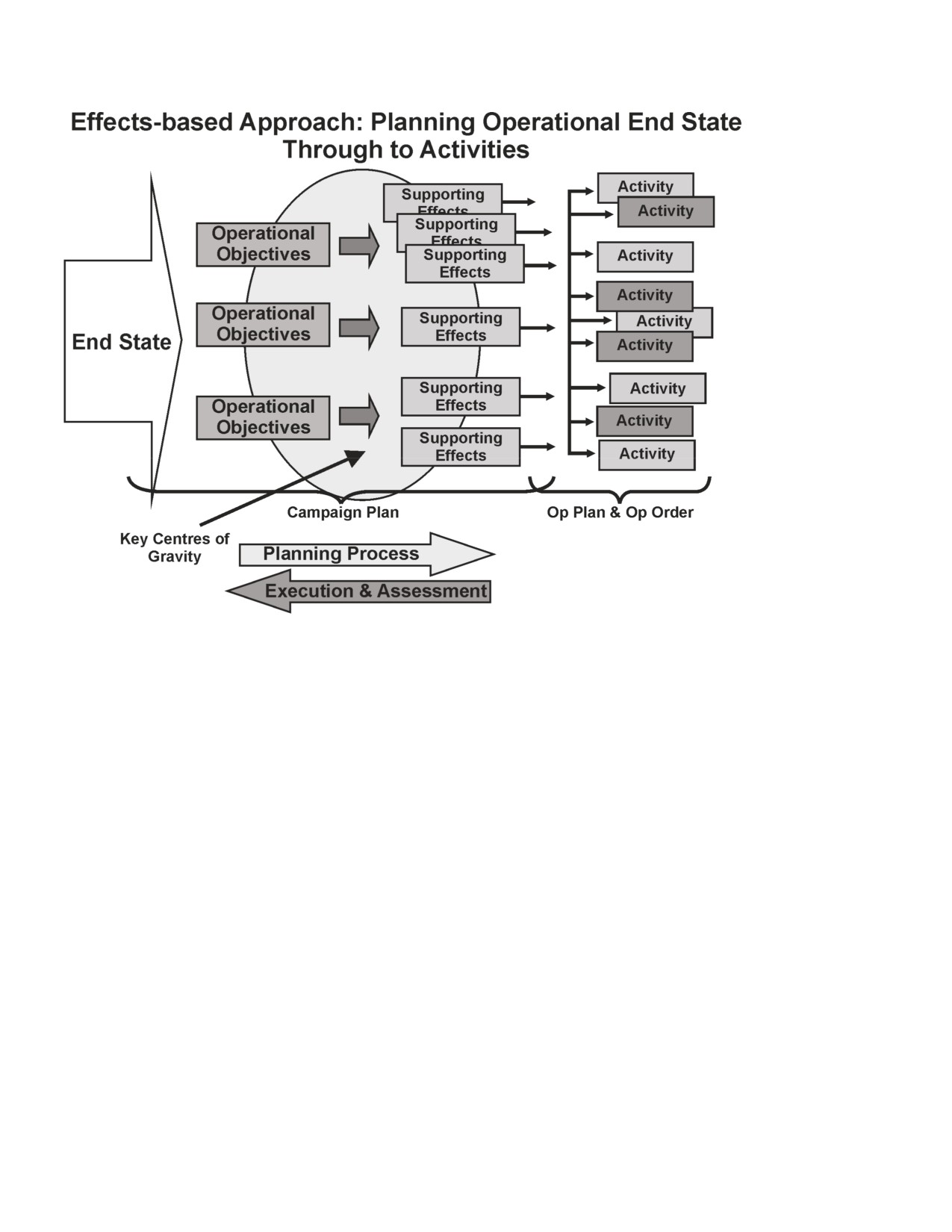
Land Operations
Figure 5-8: The Effects-based Approach Applied to Operational Campaign Planning
6.
The operational objectives and supporting effects will apply to a range of elements of
power and agencies. Some will be the sole remit of the military, while some will be the sole
remit of other elements of power that only need the secure environment provided by the military
in order to operate and meet their objectives. Others will require a combination of elements and
agencies in order to be successful. Operational objectives may be grouped into thematic lines
of operation. Within these groupings, the military may be in a supporting or a supported role
depending upon the nature of the objectives and supporting effects.
7.
Good commanders have intuitively understood and applied a wide range of effects
against all the elements in an environment that impact the overall objective. The Land Force
effects-based approach is exercised through a number of means:
a.
The adoption of campaign themes as articulated in the continuum of operations
that acts to focus operations on long-term outcomes and end states. The
campaign theme, along with the guiding principles for that particular type of
campaign, inform the commander as to the balance required between physical
activities and influence activities, that is, between effects on the physical plane
and effects on the psychological plane.
b.
The JIMP framework that harnesses the efforts and capabilities of other players
within the operating environment in order to reach common end states.
5-32
B-GL-300-001/FP-001
The Application of Combat Power
c.
Consideration of all the systems or entities that exist in a complex environment
that impact upon the overall situation and successful conclusion to the
campaign. These systems and entities, or at least their general classifications
along with the role they play in achieving enduring out comes, will help identify
thematic lines of operation for the campaign (e.g., economic development).
d.
Targeting considers the entire range of targets and target audiences within an
environment, and plans their engagement using the full range of capabilities and
activities, that is, comprehensive operations, to create complementary effects on
the physical and psychological planes. The targeting of fires and influence
activities together may be viewed as comprehensive targeting. It should
encompass all elements of power and agencies involved.
e.
The adoption of measures of effectiveness that allow for the continuous
assessments of progress across a wider range of campaign lines of operation.
With these tools, the commander conducts his operations in a more comprehensive manner
using the full resources available across the full breath of lines of operation.
8.
This concept of comprehensiveness in all aspects of the plan and its execution enables
commanders to more effectively address all aspects and influences of their battlespace and
environment by incorporating, in a synchronized and complementary fashion, operations on
both the psychological and physical planes to reach objectives and an enduring end state.
SECTION 6
EFFECTS-BASED APPROACH AS PART OF OPERATIONAL DESIGN AND CAMPAIGN
PLANNING
519. GENERAL
1.
In incorporating an effects-based approach to the extent that operational outcomes can
be translated into coherent tactical activity, an effects-based approach is complementary to
existing procedures, terminology, and practice at all levels of command. The significance of the
commander’s unifying theme provides the focus for the operational design and resulting
campaign plan.
2.
The application of an effects-based approach is pervasive at all levels throughout the
planning and execution of operations, from the campaign plan downwards. An effects-based
approach to campaigns and operations provides a better focus and measurable progress. It
provides just enough structure and process to the commander’s intuitive operational design and
planning to ensure that tangible products are produced, end states and objectives are
considered before activities, and the eventual activities link directly to desired objectives and
end states.
3.
Operational art, intuition, and command continue to have a major part to play, especially
in uncertain conditions and in those situations where there is a compelling need to act. In all
circumstances, operational freedom of action will be preserved and this is necessary for there
will always be gaps in knowledge, and a commander’s intuition will still be required. Indeed,
regardless of the lengths to which commanders and staff may go to anticipate all the actions
and reactions of the systems in an environment, there remain too many variables, not the least
B-GL-300-001/FP-001
5-33
Land Operations
of which are individual personalities and motives, to allow an accurate prediction of all cause-
and-effect relationships. Thus, a commander’s intuition and responsiveness to the unforeseen
will remain key to successful operations and campaigns.
4.
Terminology for campaign design will remain extant, but the application of it will have to
be conceptually expanded. The steps involved in an effects-based approach are the same as
those in any operational design and the operational planning process, however, the scope of
these planning processes will need to be broadened beyond a focus on the enemy to fully
encompass all the disparate, yet inter-connected systems and players pertinent to the situation.
In other words, the planning will focus on enduring outcomes and operational objectives over
the medium to long-term and involving all agencies and elements of power, vice focusing on
short-term activities only.93
5.
An effects-based approach to operational design and campaign planning will see the
longer-term view taken by planners with a focus on enduring outcomes. While the strategic
direction gives the long-term perspective, the campaign plan will provide the medium-term
framework focusing on operational end states, constituent operational objectives, and the
supporting effects required to reach the operational objectives.
6.
The near-term to medium-term timeframe is covered through OPLANS and OPORDs,
developed through the operational planning process. These OPPLANS and their OPORDs
detail the activities that create the desired supporting effects. These undergo continuous
assessment and analysis through measures of effectiveness (MoEs) and situational awareness.
They are adjusted regularly (e.g., every six months) to ensure that the activities and their effects
are leading to operational objectives and end states. Likewise, as the campaign progresses,
adjustments may have to be made to the campaign plan.
7.
Success in an effect-based approach to a campaign will likely be created through the
application of more than just the military element of power. The comprehensive approach that
begins at the strategic level is also exercised at the operational level, with all elements of power
and various agencies within the environment—military, security, international, coalition,
domestic, local—coming together, ideally in both planning and execution, to create the
objectives for an enduring end state. Note that their timelines for involvement may differ from
that of the military, but all agencies should be involved in planning from the outset.
(See
Figure 5-9.)
93 An effects-based approach to operations does not replace operational design or the operational
planning process, but enhancing them by understanding the various environmental systems that will
influence the campaign, using all agencies required to address the causes of the campaign and ensures
that tactical activities are logically linked to operational objectives.
5-34
B-GL-300-001/FP-001
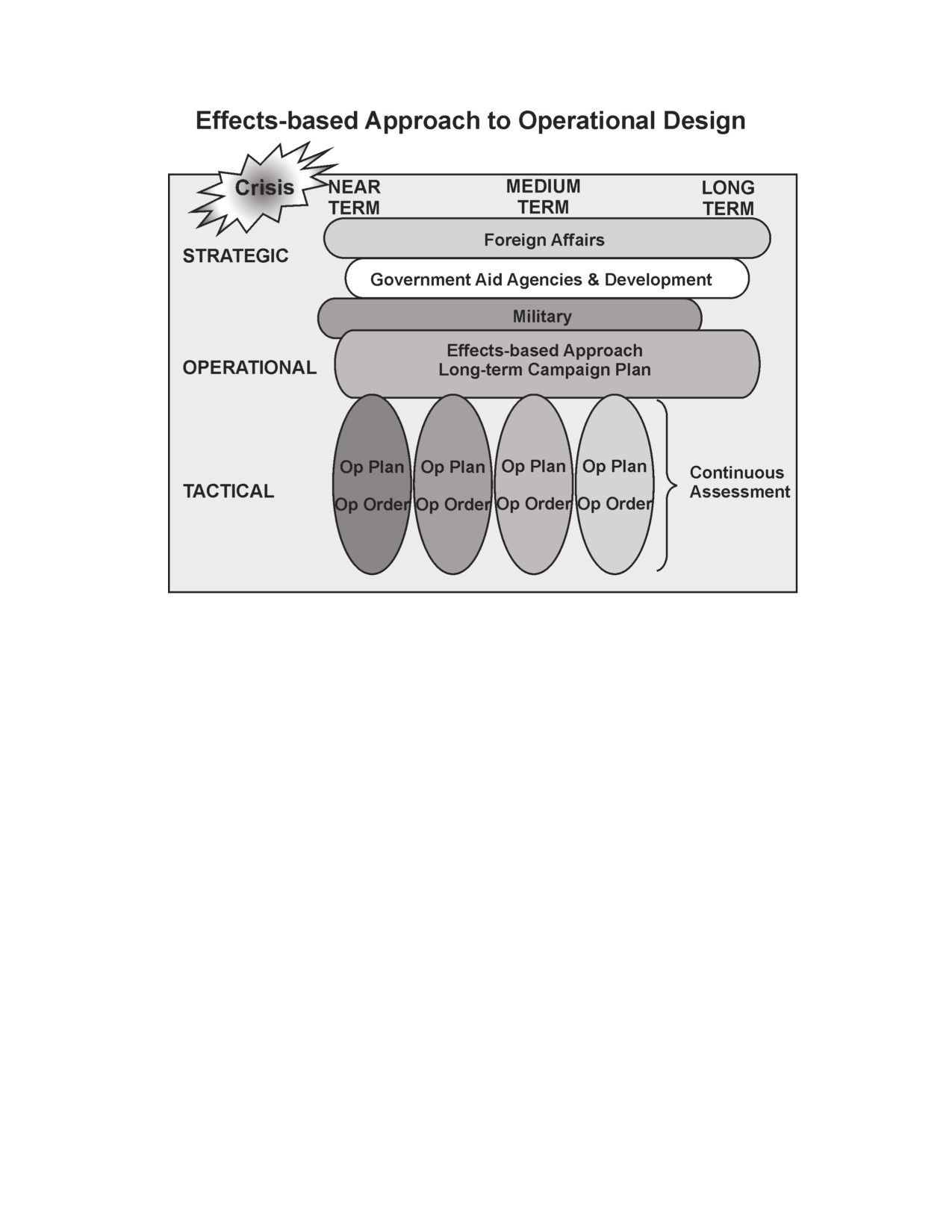
The Application of Combat Power
Figure 5-9: An Effects-based Approach Applied to Operational Design and Campaign Planning
SECTION 7
ASSESSMENT—MEASURES OF PERFORMANCE AND MEASURES OF EFFECTIVENESS
520. GENERAL
1.
Assessment is a key component in an effects-based approach and in the achievement of
enduring end states. Only through continuous assessment and analysis will commanders know
if they are conducting the correct activities in the correct manner to achieve the desired effects
and thus reach the desired objectives. Assessment and analysis that continually provides
feedback allows the commander and staff to adjust their plans and orders to ensure progress is
made towards a successful conclusion.
2.
Assessment and analysis remains the responsibility of intelligence staffs, however,
resources and time must be dedicated to assessing the effect of operations on all systems and
entities within an environment. Assessment of the effects on the psychological plane takes time
to measure, and changes may be incremental and occur over an extended period of time. (See
Figure 5-10.)
3.
During planning, the means of assessment and analysis are decided. The means of
assessment are classified as follows:
B-GL-300-001/FP-001
5-35
Land Operations
a.
Measure of Performance. A measure of performance (MoP) is defined as: “a
criterion used to evaluate the accomplishment of a task.”94 They ask the
question, “Are we doing the things (activities) right?” MoPs are tied to task and
task assessment. It assesses the quality of the conduct of the task itself, for
example, the conduct of an artillery fire mission or the conduct of a framework
security patrol.
b.
Measure of Effectiveness. A measure of effectiveness (MoE) is defined as: “a
criterion used to evaluate how a task has affected system behaviour or
capabilities over time.”95 They ask the question, “Are we doing the right things,
to create the desired effects?” MoEs are tied to effects and effects assessment.
4.
Even if activities are done correctly and MoPs indicate successful completion of those
activities, it will be for nought in terms of achieving objectives if those activities are not creating
the desired effects necessary to realize objectives. Indeed, it may be detrimental to the overall
attainment of objectives. The requirement of both types of assessment leads to the requirement
to establish a deliberate process designed to assess progress in the:
a.
Accomplishment of activities.
b.
Creation of desired results/effects.
c.
Achievement of operational objectives.
d.
Attainment of end state conditions.
94 Definition developed by the Army Terminology Panel, May 2006.
95 Ibid.
5-36
B-GL-300-001/FP-001
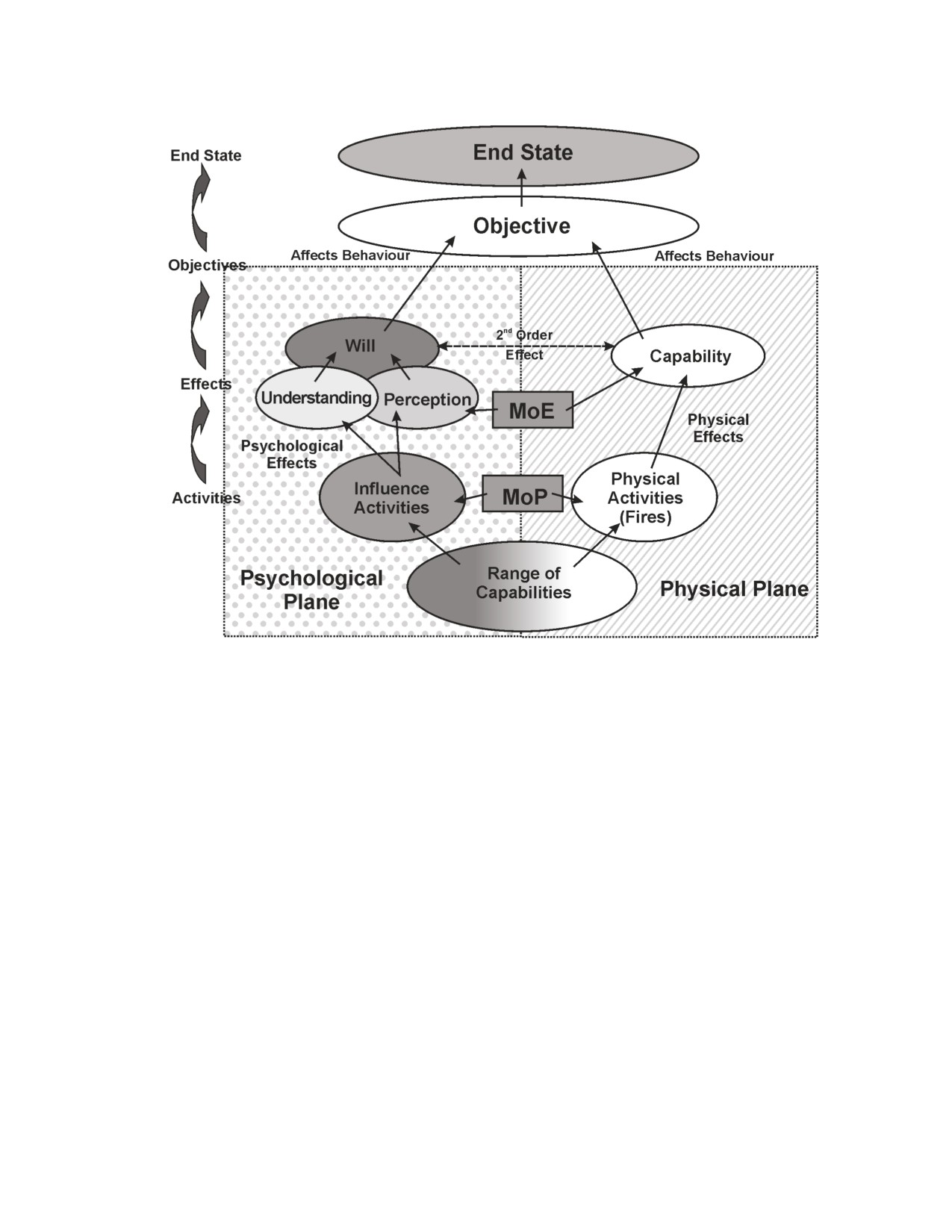
The Application of Combat Power
Figure 5-10: Application of the Measures of Performance and Measures of Effectiveness
521. MEASURES OF PERFORMANCE AND THEIR SELECTION
1.
MoPs are objective and relatively straightforward in their selection and application. They
remain the responsibility of commanders in assessing the performance of their subordinates.
Selection of MoPs is based upon battle task standards where applicable. MoPs are selected
based upon three principles: they must be objective; they must be measurable; and, they must
be directly linked to the activity.
2.
MoPs apply to fires and influence activities and the same considerations apply in both
cases. MoPs refer to the mechanisms of planning and execution. They assess how a task or
activity was planned and completed. In the case of fires, MoPs may include: reaction times;
accuracy of fire; performance of the technical equipment and ammunition; correct identification
and assessment of target; and, suitability of engagement means, to name a few. In terms of
MoPs for an influence activity, the same criteria may be used. In the case of a PSYOPS activity
for example, the criteria may include: reaction time for the message and product crafting, and
approval; correct identification of the target individual or audience; accuracy of the message;
and, suitability of the message and engagement means, such as the correct dialect and
broadcast range. MoPs are generally the purview of a commander to assess.
B-GL-300-001/FP-001
5-37
Land Operations
522. MEASURES OF EFFECTIVENESS AND THEIR SELECTION
1.
MoEs refer to the desired effects and whether or not the activities conducted have
created those effects, that is, results. They apply to both fires and influence activities.
2.
With respect to effects on the physical plane, MoEs remain relatively obvious. An attack
may have been conducted well, but if it failed to seize the assigned objective or failed to achieve
its purpose, then the MoEs were not met and the activity failed.
3.
In influence activities and effects on the psychological plane, MoEs are applied to
activities and the resulting changes in understanding, perception, the will, and the resulting
behaviour of the target audience. Given all of the individual and environmental variables in the
human decision-making process, developing MoEs for influence activities and effects on the
psychological plane may be one of the most daunting intellectual tasks facing a commander.
Influence activities seek to work through external and internal filters in order to affect
understanding and will. These filters are often culturally and socially based. Hence, the
planning and conduct of these activities is an art requiring the commander’s subjective feel for
their effect. The results of these influence activities require as defined a set of indicators as
possible in order to detect changes in perceptions, understanding, attitudes, and behaviours.
These indicators need to account for the effect of cultural and environmental influences.
4.
In applying MoEs to the desired effects, it is vital that the correct activities be assessed.
If for example, a joint fires strike is tasked to destroy 50% of an enemy armour reserve in order
to preclude a counter-attack, and despite a higher than 50% destruction rate the counter-attack
still occurs, the MoEs must be applied to the joint fires strike—which was effective in the first
order effect—and to the planning and assessment process that calculated the insufficient
requirement of 50% destruction to preclude the counter-attack—which was not effective.
5.
MoEs will vary significantly between missions and even within missions. Commanders
must clearly state the end state and ideally any milestones on the path to that end state. MoEs,
using whatever means are most appropriate, measure and indicate progress in the target
audience towards that end state. MoEs must be tailored to the specifics of not only the overall
change desired, but to the environment, and in particular, the commander’s battlespace.
6.
Because of the intangible factors involved and the subjective nature of influencing, the
MoEs will almost certainly be subjective, and because behaviour influence is the aim, they
require a significant amount of time to determine effectiveness. Therefore, they must be
assessed as a set routine to attempt to recognize changes, trends and slight, yet significant
indicators. The commander exercises judgement as to when an adjustment or change to an
activity against a target must be made in reaction to the measured effectiveness.
7.
A simple example may illustrate the application of MoPs and MoEs. During a COIN or
peace support campaign, military presence patrols may be conducted in order to increase public
security, return the society to normal activities, and engender support for the campaign amongst
the populace. MoPs may be applied to the conduct of the patrols to assess their planning,
timeliness, efficiency, and conduct of drills. MoEs assess the creation of the desired effects,
and in this example, the criteria may include: a decrease in crime; an increase in local market
activity; the reaction of locals to the presence of the soldiers; the flow of information and
intelligence from local sources to patrols and other elements; and, the stated opinions of the
local populace in informal and formal surveys.
5-38
B-GL-300-001/FP-001
The Application of Combat Power
8.
In order to overcome the difficulties in their selection and application, some basic
principles exist that can aid in the development of useful MoEs:
a.
Causality.96 A definitive cause and effect relationship must be established
between the activity and the effect attempting to be measured. Given the
cultural and other variables present, there has to be a reasonable likelihood that
the planned activity will create the desired effect. Secondly, commanders and
staff must be able to assess any other extant factors that may be causing the
effect other than their own activities. Likewise, they must ascertain if the
measured effect is merely coincidental.
b.
Quantifiable.97 A MoE that can be counted helps to remove some of the
subjectivity that plagues MoEs on the psychological plane. Quantification allows
accurate trend measurement.98
c.
Observable and Attributable. When drafting MoEs, consideration should be
given to the possibility that all of the variables influencing an activity and change
in behaviour cannot be observed. The MoEs must be able to recognize a trend
or change and confirm the connection or attribution to the activity. For example,
if the presence or absence of negative graffiti is being used as an informal
indicator of support for a campaign and military force in an urban area,
observers will ideally be able to ascertain: its timing, that is, when it was done;
its attribution to a particular group (e.g., political, criminal, military); their motive
and whether it represents a minority or majority viewpoint; its attribution in terms
of cause, particularly if it appears as a reaction to a specific event or action; and,
its location in relation to the cultural makeup of the local environment.
d.
Correlated to Effects, Objectives and End States. Just as activities are
planned to lead to specific effects and objectives within a line of operation,
MoEs should be selected to correlate to the achievement of each effect and be
reflective of the level of employment. The strategic and operational levels
require measures that occur throughout the length of a campaign and many
MoEs at the operational and tactical level will measure the incremental progress
through effects and objectives.
e.
Flexibility. Although MoEs should be drafted at the planning stage, they should
remain under regular review and commanders must be prepared to adjust them
as required. They must evolve as a mission progresses, particularly as the
consequence of their activities leads to the attainment of operational effects.
96 For a detailed discussion of causality see William S. Murray, “A Will to Measure,” Parameters, Vol. 31,
No. 3, Autumn 2001: 134-147.
97 The quantifiable, observable, and timeliness principles are adapted from LtCol. David Grohoski, Steven
Seybert, and Marc Romanych, “Measures of Effectiveness in the Information Environment,” Military
Intelligence Professional Bulletin Vol. 29, No. 3, July-September 2003: 12-16.
98 Colonel Ralph Baker, “The Decisive Weapon: A Brigade Commander’s Perspective on Information
Operations,” Military Review May-June 2006: 13-32. For example, during a tour in Iraq, 2 BCT,
1st Armored Division monitored and counted local and international media coverage of events in 2 BCT’s
area of operations as an MoE. This allowed positive and negative trends to be identified, which
contributed to discerning the effectiveness of ongoing activities.
B-GL-300-001/FP-001
5-39
Land Operations
Similarly, MoEs are likely not transferable from mission to mission. Even if a
mission takes place in the same AO, the passage of time will force
reconsideration of MoEs previously employed.
f.
Collection. The commander must possess the capabilities to collect the
intelligence necessary to apply a MoE and provide the direction and guidance to
do so. Plans must be made to collect and assess MoEs through all units in the
AO as part of the G2 information collection plan. Collection may be assisted by
other agencies, however, without a formal command relationship, this may have
to be done informally. Notwithstanding, other non-military agencies may prove
to be an effective gauge of progress in creating desired perceptions and will in a
target audience. For example, increased cooperation with NGOs or other
government departments (OGDs) may indicate a greater acceptance of the
campaign.
g.
Relativity. Improvements sought in a given environment must be relative to the
specific environment and to what is considered normal for that particular
environment and culture. Expectations for situational improvement must be
reasonable given the starting state and the normal state of that particular
environment. Improvements to a situation that will make it relatively normal for
that environment may come quickly; however, systemic improvements in
absolute terms may require cultural or social changes over a very long period of
time. Expectations for change and the related MoEs should be set as
incremental milestones so that improvement could be measured and
demonstrated as tangible progress over time. For example, a decrease in
criminal activity must be initially compared with the normal levels for the
environment that existed before the security situation demanded military
intervention.
9.
Developing appropriate MoEs to assess effects on the psychological plane is a very
difficult task. Willpower, perceptions, and beliefs are all less-than-completely-tangible variables
that defy simple measurement. Observing and measuring trends is one of the surest ways of
gauging a target audience’s attitude. Trends, however, require a definable baseline and this will
be difficult to identify. Assessment in terms of MoE should be considered as part of the
targeting process.
SECTION 8
THE KNOWLEDGE BASE AND THE SPECTRUM OF RELATIVE INTEREST
523. GENERAL
1.
An environment consists of a number of systems and other elements, each of which will
play a role to one extent or another in shaping and affecting the campaign and its outcomes. As
discussed above, a broad knowledge base that defines and analyzes all the elements, actors,
and systems within an environment that may influence the outcomes, is a key aspect of an
effects-based approach to operations.
5-40
B-GL-300-001/FP-001
The Application of Combat Power
2.
Noted earlier in the chapter, it must be remembered that the systems, often described as
political, military, economic, social (including culture and religion), infrastructure, and information
(PMESII), may be complicated to understand, but they consist of people, in groups and as
individuals. Therefore, each system may be affected physically and psychologically through the
activities of the campaign. In many campaigns, success will require the support or acceptance
of the campaign conduct and outcomes by the majority of the individuals within these
environmental systems.
3.
In order to understand the environment, its constituent systems, individuals and groups,
a broad knowledge base regarding the environment and its systems must be established. This
knowledge base must analyze each element of the society, along with the key members of each
element, and understand the role they play in the environment, their aims in relation to the
campaign and overall success, and the influence they have on other systems within the
environment. Only in this way, will the commander know what, who, and how to engage within
the campaign to move towards the desired objectives and end state.
4.
The systems or elements of each environment comprise the nation or society at hand.
As illustrated in Figure 5-11, they may be viewed as strands of a single rope that are closely
intertwined. Each strand must be considered individually and as part of a greater whole. Its
relationship with the other strands and the overall campaign end state must be assessed. At
the centre of each strand or system is the history and culture of the society that has helped
shape the strands. This must be understood and appreciated in terms of its influence on the
perceptions, understanding, and actions of the members of the society. It will affect how
individuals and groups view and interpret the campaign’s activities.
B-GL-300-001/FP-001
5-41
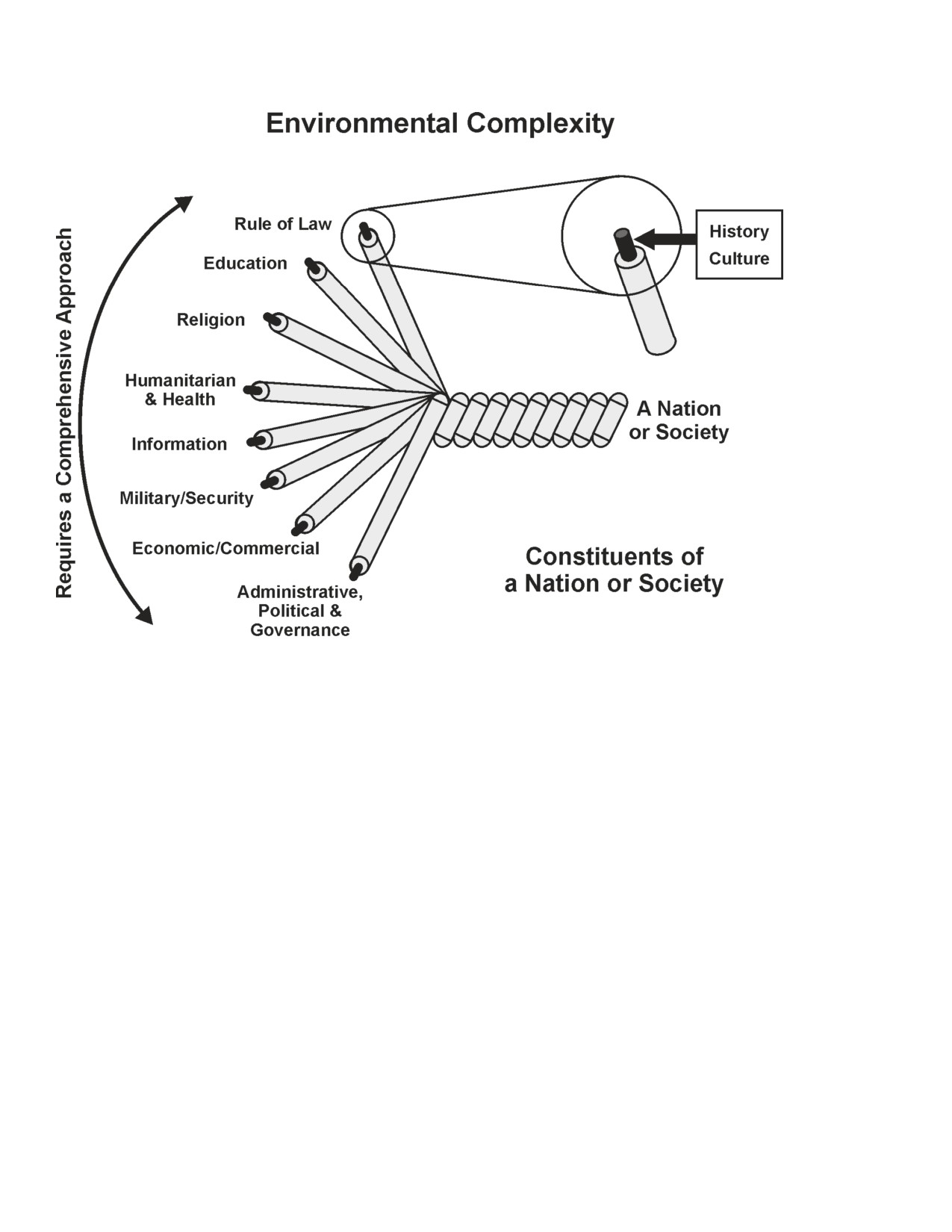
Land Operations
Figure 5-11: The Complexities of an Environment and Battlespace
5.
Only through a knowledge base that analyzes all these systems in the context of history
and culture will a commander be able to effectively engage targets on the psychological plane
within the society/environment to create the desired effects. The overall campaign and the
engagement of all such systems are conducted through a comprehensive approach that uses
all elements of power and multiple agencies in addition to the military to engage and create
effects across all systems of the environment.
6.
An effects-based approach is predicated on a sound understanding of the battlespace
and the actors and influences within it, that is, on a sound knowledge base. The knowledge
base facilitates an effects-based approach to campaigns and operations.
7.
The development of the knowledge base will take time and must be guided by an
intelligence preparation of the battlespace (IPB) process designed for the complexity of the
operating environment, and that includes modifying the way a campaign planner and tactical
commanders look at the adversary and all other factors, systems, and entities that affect the
environment and a successful conclusion to the campaign. Hence, it requires a broader
classification of all the actors, which range from the adversary through hostile and neutral to
friendly forces and allies within the battlespace, as they relate to the interests and objectives of
the friendly force. This has been labelled the spectrum of relative interest, and where these
actors fit along the spectrum in relation to the desired end state will weigh heavily on the
commander’s consideration of what activities and effects he will apply to modify their position
and align them with his interests. (See Figure 5-12.) Some of these effects will be physical, but
5-42
B-GL-300-001/FP-001
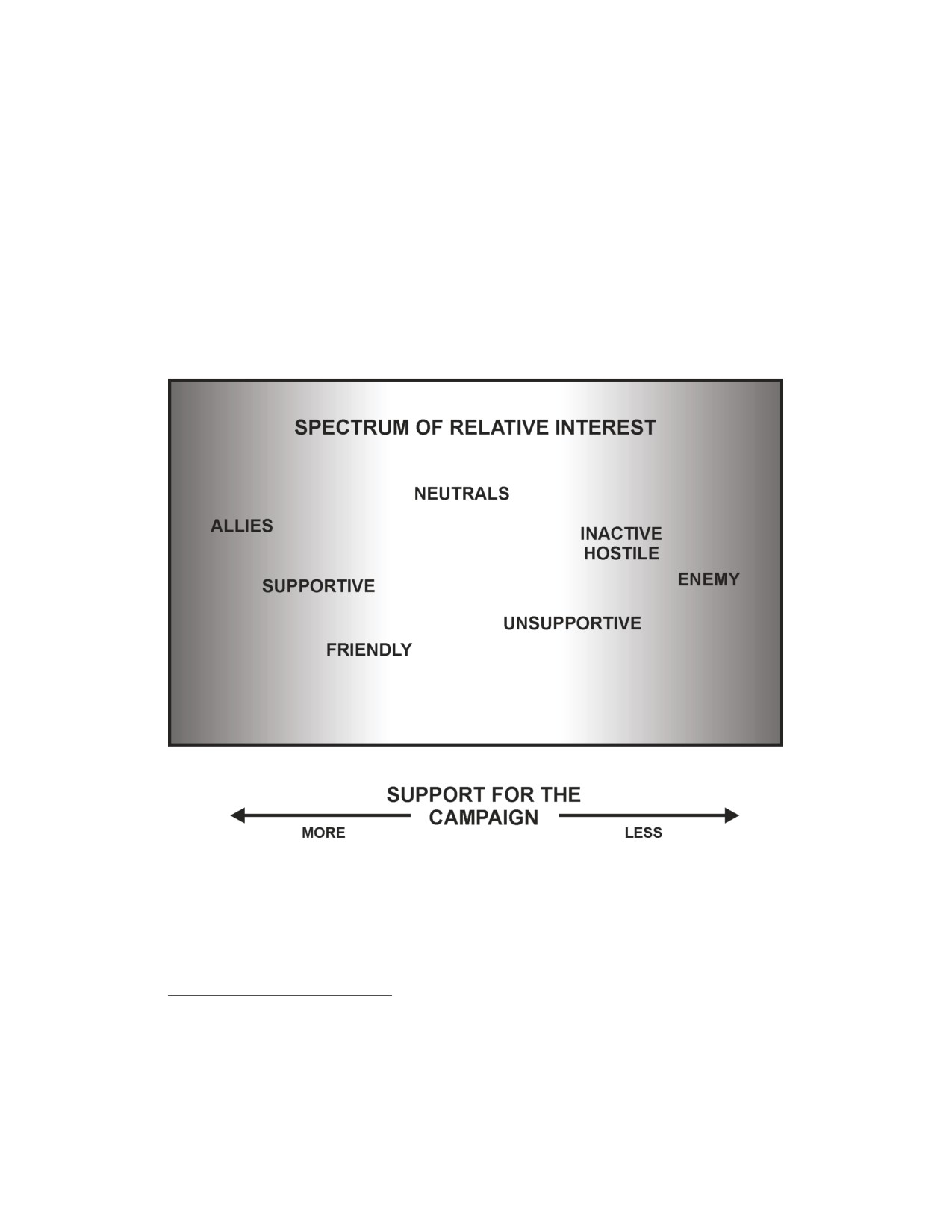
The Application of Combat Power
many others, specifically those seeking to engender support from the target, will be
psychological effects. They are all targets or target audiences for engagement, either on the
physical plane, the psychological plane, or both.99
8.
This approach requires a cultural understanding and stems in part from the need to
engender support from local populations and to engage other elements of an environment. In
order to support this approach, the knowledge base must gain insight into the psychological
plane and the intent, motivations, and relationships of elements in the battlespace in order to out
manoeuvre them or to move them, through an effect of influence to a position of acceptance,
cooperation, or even support. The assessment and analysis that leads to this categorization
supports the targeting process, for each of the audiences on the spectrum of relative interest is
assessed with respect to how they may be influenced and moved to a position of support or
acceptance.
Figure 5-12: The Spectrum of Relative Interest
9.
Each of the groups within an environment may be plotted along the spectrum of relative
interest, and an assessment may be made as to what activities are required to either maintain
their support or to move them to a position of support, that is, to produce psychological effects
on their perceptions, understanding and will, in support of the end states of the campaign.
99 With respect to the term “targets,” a broader understanding the term must be used. Targets will include
adversary elements, friendly and allied elements, and neutral audiences. Nothing nefarious is meant by
the term, but it should be viewed in the sense of a business advertisement “targeting” a particular
audience. Thus, all target engagements are considered together in a complementary and comprehensive
fashion.
B-GL-300-001/FP-001
5-43
Land Operations
10.
This approach must also recognize the paradigm shift in information acquisition. In
major combat operations, a significant part of the information required to establish
understanding by the commander might flow from national or higher echelon sources.
However, in peace support and COIN campaigns—campaigns in which the support of the
populace is crucial for success—this shifts towards an information flow model that is more
bottom-up, with soldiers in direct contact as the key source of information. In many such
circumstances, actionable intelligence regarding adversary targets and the motivations for their
support will come from contact with the local populace. Furthermore, such contact will provide
useful input for MoEs, particularly in terms of gauging the reaction of the local populace to the
campaign’s activities and conduct. Thus, an understanding and application of an effects-based
approach down to the lower tactical levels is critical to its overall success.
11.
This approach is also supported by the use of experts and advisors to the commander.
Just as commanders have used political advisors to help steer campaigns in the past, they may
also use advisors in the other environmental systems, particularly cultural, in order to better
understand the society and its constituent groups and individuals. Additionally, it must be
remembered that the need to influence an element or social group within an environment may
be done indirectly. Messages will be better received and more effective in terms of influencing
perceptions, understanding and will, if the messages are delivered through proxies, who are
trusted leaders within the society.
SECTION 9
INFORMATION OPERATIONS
524. INTRODUCTION
1.
Information operations (Info Ops) are defined as: “coordinated actions to create desired
effects on the will, understanding and capability of adversaries, potential adversaries and other
approved parties in support of overall objectives by affecting their information, information-
based processes and systems while exploiting and protecting one’s own.100”
2.
Info Ops are not an operation unto itself. Rather, the doctrinal construct is a coordinated
collection of capabilities related to maximizing the use of information while at the same time
denying it to the adversary. It includes a wide range of activities, both physical and cognitive.
They seek to affect the understanding, will and/or capabilities and ultimately behaviour of a
target or target audience. Thus, Info Ops include a wide range of activities spanning, for
example, from physical attacks against enemy command posts, to building schools, to issuing
media statements, to running a public radio station, all in order to affect information, capability,
perceptions, will, and ultimately behaviour.
3.
Info Ops doctrine has developed to include a wide and disparate collection of
capabilities, linked by a concept of information control and exploitation. It was motivated by
100 NATO Allied Administrative Publication 3.10 (AAP-3.10) Allied Joint Doctrine for Information
Operations, ratified by NATO nations in 2007. This definition is ideal for Canadian Land forces concept of
information operations construct. Note; the Information Operations Policy for CF International Operations
defines Information Operations as “actions taken in support of national objectives that influence an
adversary’s decision makers by affecting others information and/or information systems while exploiting
and protecting one’s own information and/or information systems and those of our friends and allies.”
5-44
B-GL-300-001/FP-001
The Application of Combat Power
rapid technological advances in information processes, but lacked a fathering and guiding
holistic philosophy and set of principles. Reconsideration of the doctrine has allowed it to be
refined and disciplined, with the focus on those activities that influence understanding,
perceptions, and affect motivations and behaviours.101
4.
This section outlines the broad Info Ops doctrine generally accepted across the NATO
alliance in order to place it in the perspective of coalition operations. While this section will
embrace the Counter Command Activity (CCA) and Information Protection Activity (IPA)
components of Info Ops Doctrine102, the main focus of land Info Ops is Influence Activity. This
new construct is the doctrinal construct for Canadian Land forces.
525. CORE ACTIVITY AREAS
1.
Info Ops are conducted in three core activity areas: influence activity, which is the
primary means of influencing will; counter-command activity, which counters information and
command related capability; and, information protection activity, which safeguards friendly
information, thereby inhibiting an adversary’s understanding. It is important to note that CCA,
IPA and IA are not necessarily stove piped as the arrows in Figure 5-13 portray. Rather, there
can be crossover effects for an activity. For example; CCA will certainly affect capability by
destroying an adversary’s communications, however, it will certainly degrade his situational
awareness (understanding) and as a consequence likely undermine his morale.(See
Figure 5-13.) These are summarised as follows:
a.
Influence Activity. Influence activity comprises any activity for which the
primary purpose is to influence the understanding, perception and will of the
target audience, be it friendly or hostile. It may include a wide range of diverse
activities such as demonstrative fires to indicate intent and the use of a
PSYOPS radio station to inform a local audience of the legitimacy of a
campaign. In either case, its first order effects are psychological. Influence
activities may be stand-alone activities seeking a particular effect, or they may
be supporting other activities. In short, these activities affect the information,
understanding and perception of adversaries and others, and thus affect their
will and behaviour in order to facilitate friendly force objectives.
b.
Counter-command Activity. Counter-command activity (CCA) seeks to
physically alter an adversary’s command and control (C2) capability. It affects
the flow of information to and from a decision-maker, thereby affecting
understanding or influencing will. CCA seeks, within rules of engagements
(ROE), to disrupt, degrade, usurp, deny, deceive, or destroy an adversary’s
information, command, propaganda, and associated systems, processes and
networks through kinetic or non kinetic activities. In targeting such systems,
commanders must assess the secondary and long-term effects as well foresee
and mitigate unintended negative effects.103
101 The ABCA Armies’ Program Capability Group Act, Information Operations Project Team paper,
October 2006.
102 Both CCA and IPA are frequently referred to collectively as the elements of Information Warfare to
obtain battlspace Information Superiority.
103 Long-term effects may include the removal of a command and control system that will be required by
coalition forces later, or by civilian populations.
B-GL-300-001/FP-001
5-45
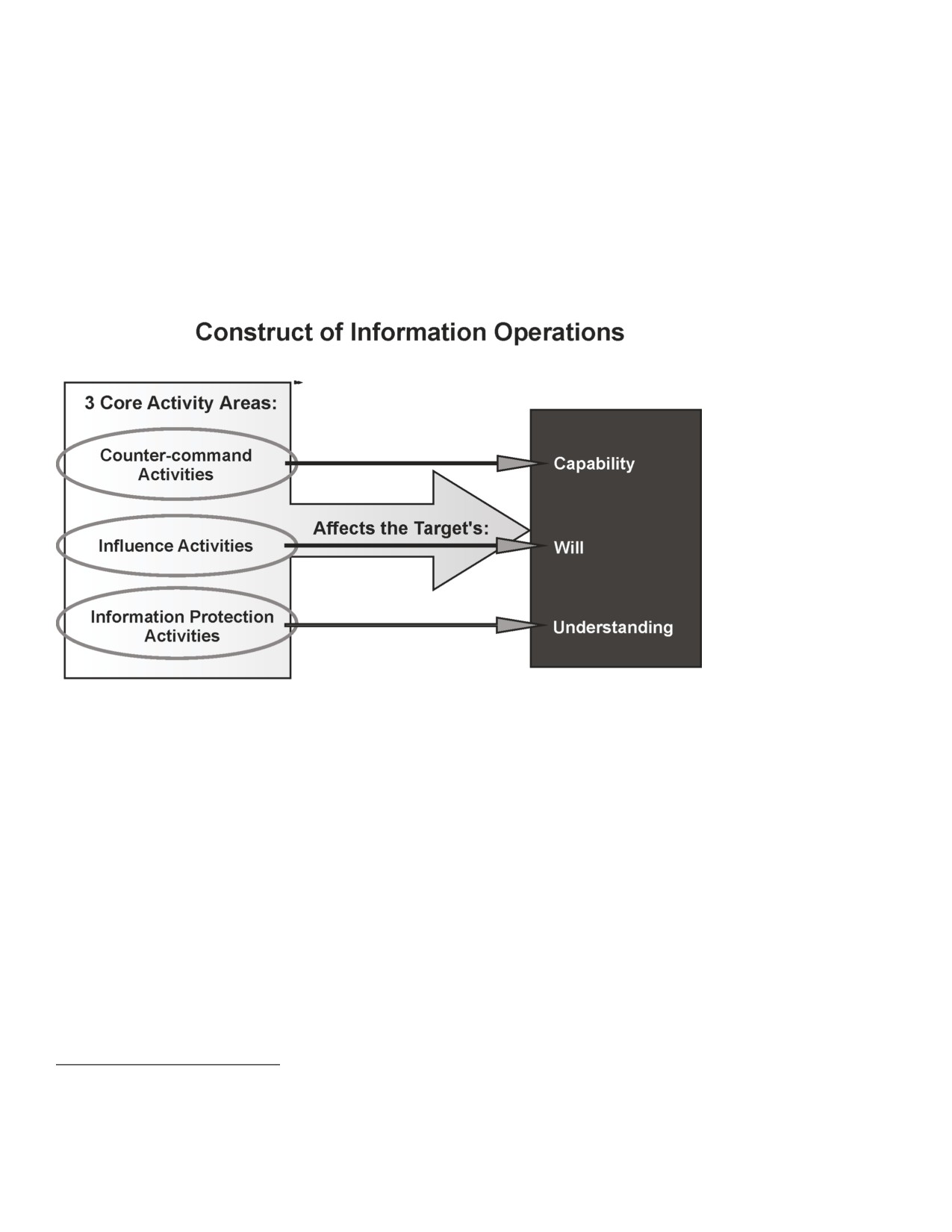
Land Operations
c.
Information Protection Activity. Information protection activity (IPA)
comprises any activity that prevents an adversary from gaining information
relating to friendly operations. IPA includes operations security (OPSEC),
counter-intelligence (CI), information security (INFOSEC), and counter-
intelligence, surveillance, target acquisition, and reconnaissance (C-ISTAR).
The C-ISTAR function includes the technical and non-technical elements of an
adversary’s information gathering capability, and may include preventing a third
party from receiving or relaying essential elements of friendly information (EEFI).
In short, these activities deny the adversary information and thus affect his
understanding and capabilities.
Figure 5-13: Three Core Activity Areas for Information Operations104
526. KEY ACTIVITIES WITHIN INFORMATION OPERATIONS
1.
Info Ops coordinates activity and is not a capability in its own right. The three core Info
Ops activity areas can make use of all or any capability or activity that can exert influence, affect
understanding, protect one’s own information, or have a counter-command effect against an
adversary. However, there are several capabilities, tools, and techniques that form the basis of
most Info Ops activity. They include PSYOPS, presence, posture and profile (PPP), OPSEC,
INFOSEC, deception, electronic warfare (EW), physical destruction, and computer network
operations (CNO). Clearly, many of these tools and techniques, such as physical destruction,
have a much wider application than Info Ops, but can be drawn upon by Info Ops. It is
important to note that only when tools and techniques are used directly to influence will, affect
understanding, or affect a decision-maker’s command, control, communications, computer,
intelligence, surveillance and reconnaissance (C4ISR) capability, they can be deemed part of
Info Ops activity. Furthermore, the activities are conducted based upon the desired effect. Not
every campaign will utilize all the tools available.
104 This has been taken from Allied Joint Publication (AJP) 3-10 (Study Draft 5 May 2003) NATO
Information Operations Doctrine.
5-46
B-GL-300-001/FP-001
The Application of Combat Power
2.
Note that the first five key activities are those influence activities that create first order
effects on the psychological plane. The remainder are those physical activities that concern
counter-command activities or information protection activities, that is, they have first order
effects on the physical plane:105
(See Figure 5-14.) Coordination of the following critical
components of Info Ops is crucial to the successful implementation of the commander’s
objectives. The coordination venue is normally the Information Operations Coordination Cell.
a.
Psychological Operations. The primary purpose of PSYOPS is to influence
the perceptions, attitudes, and behaviour of selected individuals or groups in
accordance with Info Ops objectives. Unlike public affairs (PA), PSYOPS
retains direct control over contents and dissemination, and focuses on a specific
audience(s). Effective PSYOPS requires timely provision of resources, analysis,
and planning. PSYOPS products will utilize a wide variety of means including
print, radio, television, loudspeakers, face-to-face contact, the Internet, faxes,
text messaging, pagers, and mobile telephones.
b.
Presence, Posture, and Profile. The appearance, presence and attitude of a
force and its soldiers may have significant impact on perceptions and attitudes,
particularly on neutral or potentially adversarial audiences. This PPP concept is
applicable at all command levels, and all elements of the force contribute to it. It
seeks to send or support a message by means of the manner in which troops
deal with the populace, and thus create a perception that supports that overall
objective. For example, the decision to wear berets instead of combat helmets
and body armour can make a considerable difference to the perceptions of both
the adversary and local people. The public profile of commanders at all levels
will impact on perceptions; therefore, the public role of the commander must be
carefully analyzed and opportunities used to transmit key messages.
Commanders must understand and assess the attendant risk, which
accompanies any decision regarding posture and profile, against the need to
send a particular message.
c.
Civil-military Cooperation. CIMIC106 is a coordination and liaison function that
facilitates operations in relation to civil authorities and non-military organizations.
CIMIC has moved from supporting operations under a G9 function, to being
operations, that is, conducting activities that deliver an effect in support of
objectives. CIMIC and the related activities (e.g., reconstruction, governance
development, etc.) are considered influence activities because of their ability to
inform, demonstrate, influence, and persuade. Thus, CIMIC and its resulting
activities are a key aspect of Info Ops. They provide information in the form of
physical evidence of psychological issues such as commitment and situational
improvement, and thus engender support from target audiences. CIMIC related
activities, therefore, need to be coordinated within the overall operational plan in
105 Even those activities that deal with information protection, electronic warfare, and computer networks
are classified as physical activities, for they use physical means that have primarily but not exclusively
physical effects.
106 Civil-military cooperation is defined as: “the coordination and cooperation, in support of the mission,
between commanders and civil actors, including the national population and local authorities, as well as
international, national and non-governmental organizations and agencies.” (NATO Allied Administrative
Publication 6 [AAP-6], Glossary of Terms and Definitions [2006]).
B-GL-300-001/FP-001
5-47
Land Operations
terms of impacts upon civil audiences and their leaders, in order to ensure that
activities work to support overall objectives.
d.
Public Information. The aim of PA or media operations is to protect the
credibility and legitimacy of operations and promote widespread understanding,
through the ensured distribution of truthful information, thereby gaining support
for military operations while not compromising EEFI. PA is a capability within a
unit and formation that delivers the effect of information provided and
understanding. It communicates and facilitates information to audiences
through the medium of local, national, and international media and other
communication means. PA is an activity that has an effect on the psychological
plan for it creates understanding in audiences. Hence, PA is a key aspect of the
operational plan. PA staff may work under the G3 and G5 to plan and conduct
operations; the PA officer and imagery technicians operate in the battlespace,
indeed, manoeuvre on the psychological plane in order to create this effect of
understanding. To avoid giving the false impression that the media are being
manipulated in any way, a distinction must be maintained between PSYOPS
and PA.107
e.
Deception. Deception involves measures designed to mislead adversaries by
manipulation, distortion or falsification. Operational Deception may be a
complex art, which demands considerable effort, a high level of security and
coordination, and a sound understanding of an adversary's way of thinking.
Operational Deception must be used sparingly and usually is used only once
decisively during a campaign, otherwise it will seriously undermine the credibility
of all subsequent Influence Activities. The aforementioned restriction should not
preclude the use of tactical deception, which includes basic measures such as
camouflage (e.g., measures taken to make an armoured vehicle blend into a
tree line). Operational Deception is normally used to dislocate the attention and
fighting power of an adversary, but may be used as part of information
protection, that is, to conceal friendly force intentions and capabilities.
Operational Deception will likely use a combination of physical means (e.g., a
feint or demonstration) supported by other information cues such as false radio
traffic.108
f.
Physical Destruction. Physical attacks on an adversary’s C2 systems will
affect the capability of an adversary, and thus, his understanding, perception
and behaviour. It should also be remembered that the use of force in certain
situations sends a strong psychological message, and consequently, will have
significant psychological impact as a second order effect. Carefully applied
force can play a major role in coercion and deterrence and in reducing an
adversary’s ability to exercise command. In using physical destruction, it must
107 In order to counter adversary propaganda and biased media reporting, internal public affairs may be
required.
108 A classic historical example of Operational Deception was Operation during World War II, which
deceived the German forces into believing that the imminent allied invasion would take place at Calais
vice the intended landing in Normandy. Thus diverting considerable amount of German combat capability
away form Normandy.
5-48
B-GL-300-001/FP-001
The Application of Combat Power
be remembered that undue collateral damage and unnecessary casualties will
have an adverse effect on public support. This must be considered, particularly
if the enemy is using civilian infrastructure to support his C2 requirements. If
physical destruction is required to achieve the desired effect, the commander
must consider and balance the potentially negative impact that it may cause with
the expected benefits, keeping in mind that negative impacts generally outlast,
in people’s memory, positive impacts.
g.
Operations Security. OPSEC is used to identify and protect information that is
critical to the success of the campaign, described as essential elements of
friendly information (EEFI).109 It aims to deny the identified EEFI to the
adversary decision-maker, thereby affecting understanding and capability. EEFI
will need to be protected throughout its lifecycle. Adversarial understanding and
capability are targeted to maintain the security of EEFI, using a combination of
passive and active techniques. It will include a wide range of physical activities
including counter-reconnaissance patrols, clearing patrols, and security
measures for HQ positions.
h.
Information Security. The goal of information security INFOSEC is to protect
the confidentiality, integrity, and availability of information through a variety of
procedural, technical, and administrative controls. INFOSEC includes a range
of measures that are applied on a routine basis under the auspices of security
policy to protect information. INFOSEC includes elements of physical security,
such as personnel and document security, and information assurance (IA). IA
includes a range of electronic techniques, such as computer network defence
and communications security (COMSEC) incorporating emission control
(EMCON), defensive monitoring and technical inspection techniques, counter-
eavesdropping, limited electronic sweeps and vulnerability analysis.
i.
Electronic Warfare. EW110 has wide application in military operations. The
effect of EW activity can be temporary or permanent and it has the potential to
minimize the use of force, hence, avoiding unnecessary casualties and collateral
damage. EW will be used to affect critical information of the adversary or the
systems by which it is transmitted. Electronic attack enables CCA and attacks
on information technology (IT). It also supports influence activity by enabling
deception and PSYOPS, including broadcasts to target audiences. Conversely,
EW can be used to defend systems and information. Electronic defence, in
conjunction with spectrum management, contributes by helping to counter an
adversary’s CCA and protecting friendly use of the electromagnetic spectrum.
Lastly, it has the capability to provide MOE feedback and adversary Info Ops
messaging to Info Ops.
109 EEFI is defined as: “critical aspects of a friendly force that, if known by the adversary, would
subsequently compromise, lead to failure, or limit success of the operation and therefore must be
protected from adversary detection.” (Army Terminology Panel)
110 EW is defined as: “Military action to exploit the electromagnetic spectrum encompassing: the search
for, interception and identification of electromagnetic emissions, the employment of electromagnetic
energy, including directed energy, to reduce or prevent hostile use of the electromagnetic spectrum, and
actions to ensure its effective use by friendly forces.” (AAP-6).
B-GL-300-001/FP-001
5-49
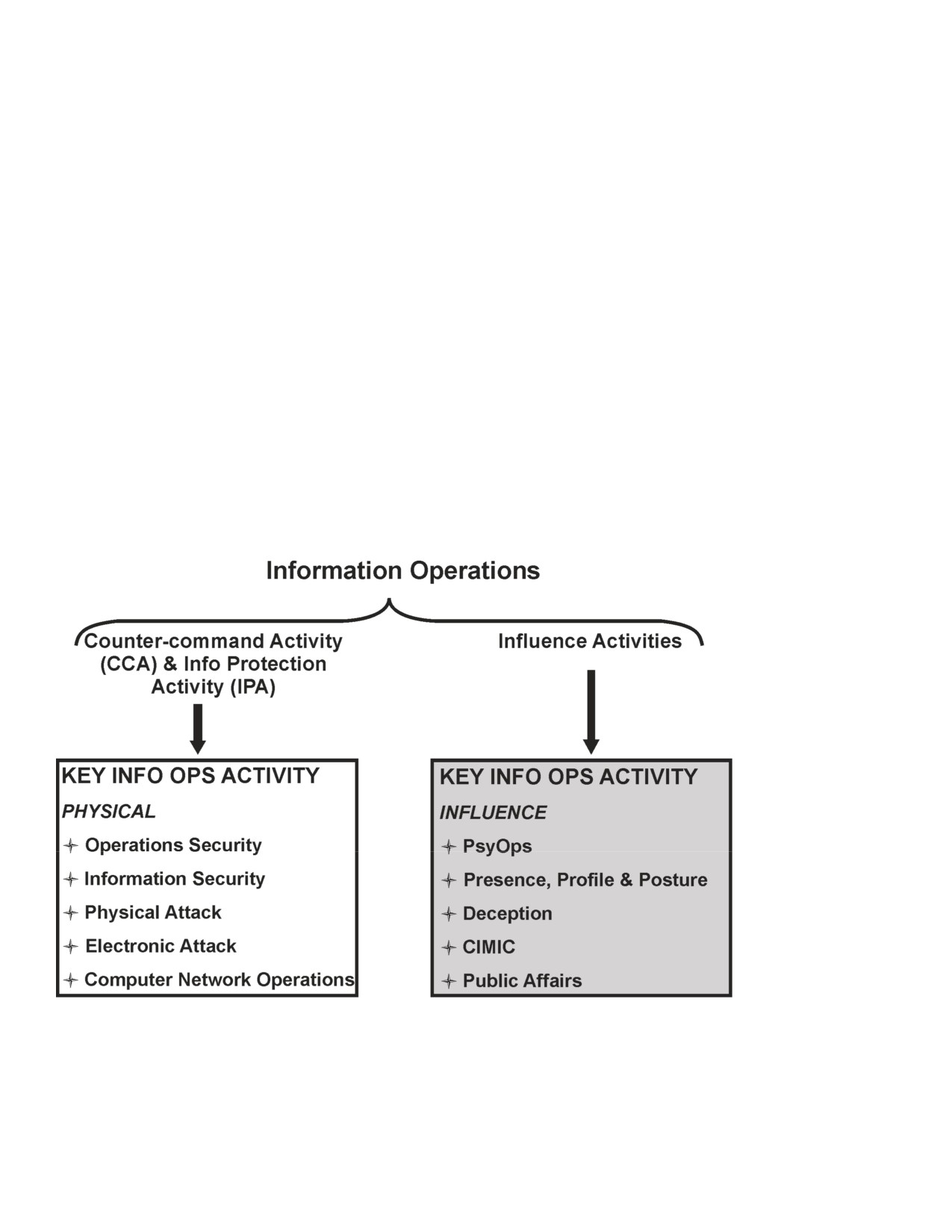
Land Operations
j.
Computer Network Operations. The opportunity for, and effectiveness of,
CNO is proportional to the adversary’s dependence upon IT. CNO comprises
attack, exploitation, and defence:
(1)
Computer Network Attack. Computer network attack (CNA) includes
the means to attack computer systems. Software and hardware
vulnerabilities allow computers, storage devices, and networking
equipments to be attacked through insertion of malicious codes, such as
viruses, or through more subtle manipulation of data, all in order to affect
the understanding and ultimately the actions of the adversary.
(2)
Computer Network Exploitation. Computer network exploitation (CNE)
supports Info Ops by the ability to get information about computers and
computer networks, and the adversary, by gaining access to hosted
information and the ability to make use of the information and the
computers and computer network itself.
(3)
Computer Network Defence. The purpose of computer network
defence (CND) is to protect against adversary CNA and CNE. CND is
action taken to protect against disruption, denial, theft, degradation, or
destruction of information resident in computers and computer networks,
or of the computers and networks. CND is essential to maintain
decision-making capability and confidence.
Figure 5-14: Key Info Ops Activities
527. TARGETS FOR INFORMATION OPERATIONS
1.
Based upon the above, the activities listed under Info Ops may be classified as either:
influence activities; counter-command activities; or as information protection activities. Influence
5-50
B-GL-300-001/FP-001
The Application of Combat Power
activities create effects amongst target audiences on the psychological plane in order to
influence understanding, perception, attitudes, will, and behaviour. Activities classified as either
counter-command activities or information protection activities are physical activities that create
effects primarily on the physical plane.111
2.
Targets for Info Ops may thus be grouped in accordance with the following table:
Influence Activities:
Counter-command Activities and
Information Protection Activities:
Targets on the Psychological Plane
Targets on the Physical Plane
Human:
Links:
Political leaders
Couriers and dispatch riders
Religious and social leaders
Land line
Groups of a population, such as
Radio and other informational
tribes or clans
links
Adversary leaders/commanders
Nodes:
Adversary troops and sub-groups
C2 Centres and command posts
such as conscripts
Physical plant, including radios,
Friendly troops and allies to
computers and other information
counter adversary propaganda
processing means
Satellites
Figure 5-15: Targets for Information Operations
528. INFLUENCE ACTIVITY
1.
Influence Activities are meant to influence and affect understanding, perceptions and
will, cannot be considered separately from other operations, for they themselves are operations,
that is, they are tactical activities undertaken to create desired effects. The deception of an
enemy commander, the use of flyers to convince conscripts to flee, the building of civilian
infrastructure to take support away from an insurgency and win the support of a populace, and
other such activities seeking psychological effects are all tactical activities that must be
conceived, planned, and targeted as part of an overall plan, simultaneous with and
complementary to fires. Like physical activities, they may be classified in the functional and
effects frameworks and described by their effects of shaping, decisive, or sustaining.
111 Although some debate has occurred regarding the “information plane,” and some segments of allied
doctrine refer to such a level of existence, all elements that may be considered under such a description
actually fall to either the physical or psychological planes. Information itself exists on the physical plane if
it can be attacked or physically affected (e.g., attacked, blocked by EW, etc.), or on the psychological
plane if it rests in an individual’s mind and thus affects perception and behaviour.
B-GL-300-001/FP-001
5-51
Land Operations
2.
As stated earlier land forces must be utilize the full spectrum of Info Ops, which includes
CCA, IPA and IA. However, the main effort of Land Ops Info Ops is the Influence Activity
spectrum. Accordingly, the following outline shall be considered the Influence Activity construct
for Canadian Land forces:
a.
Influence Activities consist of: PSYOPS; presence, profile and posture;
deception; CIMIC; and PA. These influence activities create first order effects
on the psychological plane. Other activities may be conducted for the purposes
of influencing a target audience, and thus may be considered Influence
Activities, so long as their first order effect is on the psychological plane.
b.
The following is a description Influence Activities: “coordinated activities to
create desired psychological effects on the understanding, perception, attitudes
and will of adversaries, potential adversaries and other approved parties in
support of overall objectives.”
112
c.
Influence Activities are to be considered operations just as fires, such as an
attack or a defence, are considered operations. Influence Activities are to be
planned, targeted, and executed in conjunction with any other activity in a
complementary and holistic fashion. Info Ops staff, led by a G3 Info Ops senior
officer, are to be completely integrated into G3 and G5 staff branches and
element commanders, and the Info Ops capabilities (PSYOPS, CIMIC, PA
detachments, teams, etc) are to be considered line elements.
d.
In formation HQs, the G3 and G5 staff branches may contain specialist staff
for operations and planning in such areas as PSYOPS, CIMIC, and PA. All
staff functions other than the G3 or G5 support and enable operations, but
do not conduct them. Thus, with Info Ops considered “operations,” no
specific staff branch other than the G3 or G5 have Info Ops responsibilities.
Staffs who have Info Ops responsibilities (PSYOPS, deception, CIMIC, and
PA) will come under the G3 and G5 branches for operations and planning
respectively but coordinated by the G3/G5 Info Ops senior officer. The G9
CIMIC staff branch, if used, is for purely liaison functions.113 In some HQs,
depending upon size, there may only be a G3/G5 Info Ops officer. He will
coordinate the planning and operations of all Info Ops activities, taking
advice from the various Info Ops related elements (team or detachment)
commanders.
e.
The PSYOPS, CIMIC and PA element commanders will be considered line
commanders. They and their capabilities (teams and detachments) will be
considered line elements, with their activities and effects occurring on the
psychological plane. Specialist advice to the commander in the constituent
areas of Info Ops will either be through the G3/G5 Info Ops Senior officer.
112 Army Terminology Panel approved May 2007.
113 When the G9 CIMIC branch was created, CIMIC functions supported operations in a major combat
construct. It concerned itself with support to offensive and defensive operations, such as liaison for
refugee control and the acquisition of civilian equipment for military purposes. However, with CIMIC
assuming a responsibility to actually conduct operations, mainly stability operations, then its planning and
operations must come under the G5/G3 staff branches, and the CIMIC detachment commanders must be
considered line unit commanders.
5-52
B-GL-300-001/FP-001
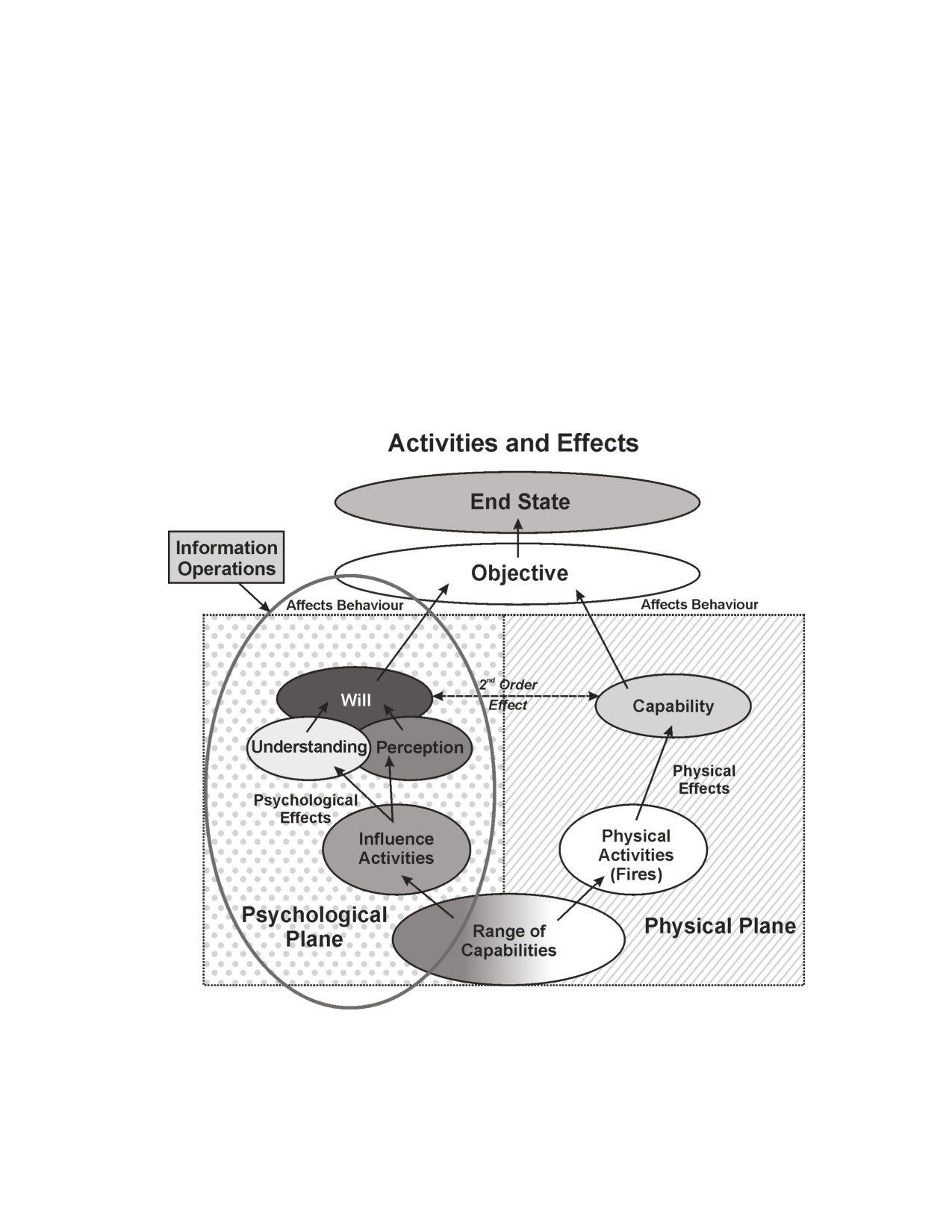
The Application of Combat Power
f.
At the lower tactical levels, such as battle group (BG), the detachment
commander may fulfil multiple roles, akin to the responsibilities of an anti-
armour platoon commander. Thus, the detachment commander will advise
the commanding officer, assist the staff with planning and orders, and then
command and manoeuvre his detachment or element.
g.
Influence activities are to be conceived, planned and conducted in unison
with fires. In some ways they will be shaping, such as the issue of PSYOPS
flyers to enemy forces just prior to an assault, encouraging them to
surrender, or the conduct of a feint to deceive the enemy. In other aspects,
they may be decisive, such as the re-establishment of key infrastructure to
secure the support of a populace.
3.
Influence activities, that is, those activities conducted to create first order effects on
the psychological plane, must be planned, coordinated and executed in conjunction and
harmony with fires. (See Figure 5-16)
Figure 5-16: Information Operations as Part of Comprehensive Operations
4.
Info Ops, that is, influence activities, and fires, along with their respective constituent
activities are all organised in a complementary fashion together through manoeuvre and
battlespace management. (See Figure 5-17.)
B-GL-300-001/FP-001
5-53
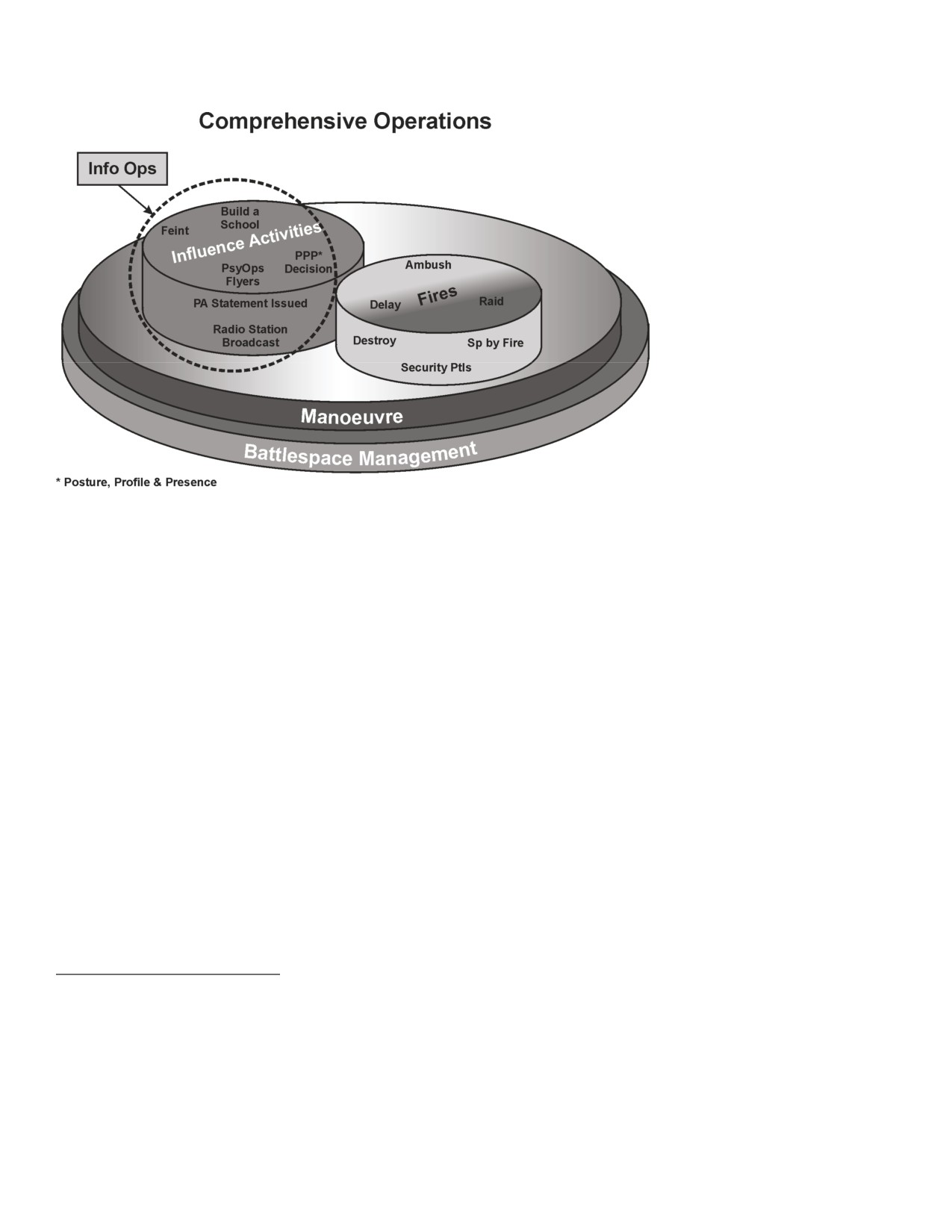
Land Operations
Figure 5-17: Constituent Activities of Influence Activities and Fires
5.
Although all units may play a role in creating influences (e.g., the posture of troops
conducting security presence patrolling or the use of EW to create deception), the manoeuvre
units for specific influence and psychological effects, that is, for manoeuvre on the
psychological plane, may be considered PSYOPS elements, CIMIC units and resources, and
PA teams. Manoeuvre on both planes must be considered together in the creation of
complementary effects and achievement of tactical and operational objectives. 114
529. INFORMATION OPERATIONS PHILOSOPHY115
1.
Land forces conduct activities to create effects in order to achieve assigned objectives.
Info Ops incorporate influence activities that focus on achieving a psychological effect on
individuals and groups by affecting their understanding, perception, will, and behaviour.
Although they create effects on the psychological plane, they are considered operations in the
same context as activities that create effects on the physical plane. They may be classified
using the same taxonomy: offensive, defensive, stability, and enabling. They are conceived,
planned and conducted simultaneously with activities that create physical effects, that is, fires.
Together, they may be considered comprehensive operations that consider the whole
environment. As operations, they come under the direct responsibility of the commander. This
is fundamental to an effects-based approach to operations and a comprehensive approach to
operations.
114 The formal concept of manoeuvre (movement supported by fire) must be expanded here to include the
obtainment of a position of advantage on the psychological plane. For example, forces may wish to issue
a public affairs statement before the adversary issues a propaganda message, thus gaining an advantage
in time over the adversary.
115 All doctrinal concepts begin with a philosophy, then broaden to a set of guiding principles, and then
develop as practices and procedures.
5-54
B-GL-300-001/FP-001
The Application of Combat Power
2.
Failure to incorporate fires and influence activities together, that is, effects on both the
physical and psychological planes, will preclude the conduct of full-spectrum operations (FSO).
3.
Many of the effects sought by influence activities will be beyond the capability and
capacity of military forces, at least for an extended period. Thus, the military will seek to
conduct influence activities within the JIMP framework so that activities, such as reconstruction
and economic development and the long-term solutions to a conflict, may be fully realized
through those elements of power best suited to conduct them.
530. OFFENSIVE AND DEFENSIVE INFORMATION OPERATIONS
1.
As discussed earlier, target types on the psychological plane can be defined along a
spectrum of relative interest as it relates to achieving the end state. This spectrum can be
broadly broken down into any number of groups that may be generally described along the
following lines: the adversaries; the inactive hostile; the unsupportive; the neutral; the friendly
but uncommitted; the supportive; and, allies. The boundaries between these groups may be
blurred. Each group may be influenced in different ways using different activities. The amount
of effort and type of activity needed to influence them will depend upon the situation, the relative
size of the target audience, the disposition of the audience on the spectrum (i.e., supportive to
hostile), and the importance of ensuring popular support for the success of the campaign.
2.
The actual influence activity undertaken as part of Info Ops may fall under any of the
three tactical operations: offensive, defensive, and stability. Although activities such as CIMIC
will be classified as stability operations, deception through feints and demonstrations are part of
offensive operations, and a PSYOPS message may be incorporated into the defensive battle.
3.
With regard to creating the effect of influencing the understanding, perceptions, and will
of target audiences, Info Ops activities may be viewed as being either of an offensive nature or
of a defensive nature. Info Ops will seek to defend or sustain the support of those target
audiences that are supportive of the campaign. These may be considered defensive Info Ops.
On the other hand, some Info Ops will seek to create an influence on target audiences that are
not supportive of a campaign. The activities may seek to persuade them towards, or dissuade
them away from, a particular behaviour or course of action. Info Ops activities against these
target audiences may be considered offensive Info Ops. (See Figure 5-18.)
B-GL-300-001/FP-001
5-55
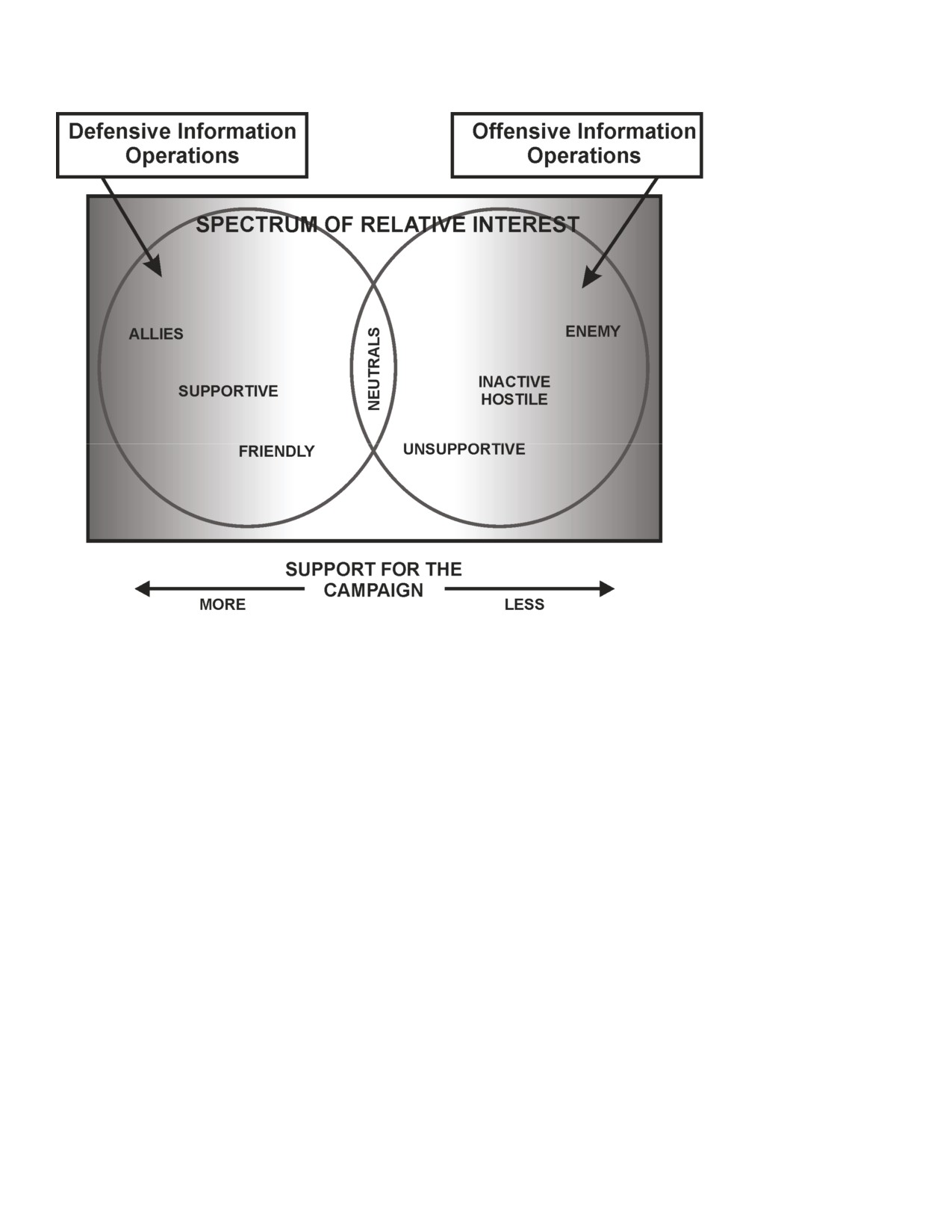
Land Operations
Figure 5-18: Offensive and Defensive Information Operations
531. PRINCIPLES IN THE APPLICATION OF INFORMATION OPERATIONS
1.
As with all types of military activities, information operations should be planned and
conducted based upon certain key principles:
a.
Commander’s Direction and Personal Involvement. The commander’s
personal involvement drives Info Ops and exercises control over all Info Ops
activity, through the G3, within a framework of timely decision-making and
consultation up and down the chain of command. Without the clear guidance of
the commander’s unifying theme and intent, the Info Ops effort will lack focus
and not achieve the desired effects in harmony with other activities.
b.
Close Coordination and Sequencing. The very nature of Info Ops and the
large, diverse target set means that there needs to be very close integration,
vertically and horizontally, within a command in terms of creating
complementary effects in support of common objectives. Contradictory
messages or inaccurate information will undermine credibility and legitimacy. All
Info Ops plans and activities must be closely coordinated in relation to other
activities throughout the echelons and ideally across multiple agencies. This is
the responsibility of the commander, assisted by targeting staff, advisors, and
subordinate commanders.
5-56
B-GL-300-001/FP-001
The Application of Combat Power
c.
Accurate Intelligence and Information. Successful Info Ops must be founded
upon good intelligence support and the development of a deep and broad
knowledge base in which all elements, systems, and entities within an
environment may be assessed. This intelligence must include timely, accurate,
and relevant information about potential adversaries, the other approved parties,
and the operating environment. Assessment must be made with respect to how
targets will view, interpret, or perceive activities. The Info Ops staff and element
commanders should work closely with the intelligence staff to define
requirements necessary to plan, execute, and assess the effectiveness of Info
Ops. IPB should include analysis of human factors—culture, religion,
languages, etc.—decision-making infrastructure and power structures. As
intelligence staff are closely involved in battle damage estimates on the physical
plane, so too must they be closely involved in measures of effectiveness on the
psychological plane.
d.
Centralized Planning and Decentralized Execution. Due to the requirement
for close coordination of Info Ops activity, the principle of centralized planning
and decentralized execution applies to Info Ops at all command levels.
However, centralized execution may be required for certain types of targeted
information activities when all involved force elements are required to adhere
rigidly to a plan, or when strategic assets are used. The approval level and
process for PSYOPS messages must be as low and as streamlined as possible
to ensure messages are timely and relevant to the environment at hand. Ideally
the approval level should be vested with the Info Ops Officer who can ensure
that the task force commander’s arcs of fire are adhered to and all influence
messages are synchronized while providing timely approval.
e.
Comprehensive and Integrated Planning and Targeting. At the operational
level, planning and targeting starts with a detailed understanding of the
operational environment, its constituent systems and entities, and the
commander’s objectives. Commanders and staff identify the Info Ops effects
required to achieve the desired objectives and a range of activities that, when
integrated into the overall OPLAN, will achieve those effects. It is important to
realize that any element of targeting activity may influence a range of target
audiences and create unintended effects. The targeting staff, therefore, has to
analyze the impact of such activity and propose appropriate measures to avoid
or mitigate negative unintended effects. Info Ops planning and targeting must
not be done separately from the planning and targeting of physical activities and
effects, but in conjunction with them so that the effects are complementary.
Thus, Info Ops staff is attributed to the G3 and G5 staff branches. Ideally, the
fires officer and the Info Ops officer would synchronize and execute physical
and psychological effects through a targeting venue after a comprehensive and
integrated planning process.
f.
Early Involvement and Timely Preparation. Info Ops planning must start
early because both planning and execution take time and results can be slow to
emerge. Hence, a commander’s intent and direction must be viewed right from
the start in relation to Info Ops capabilities and maintained throughout the
planning process. Planning and targeting staff and advisors need to be fully
involved in the planning process to integrate Info Ops into the overall plan.
B-GL-300-001/FP-001
5-57
Land Operations
g.
Monitoring and Effects Assessment. The successful prosecution of Info Ops
relies upon continuous monitoring and assessment of the short and long-term
effects of interrelated activities. This is achieved by the collection of all-source
intelligence and other feedback on the Info Ops activities. MoEs must be
included in the Info Ops plan and are integrated in the intelligence collection
activities.
h.
Establishing and Maintaining Credibility. In order for Info Ops to be
successful in creating effects on the psychological plane, the source of the Info
Ops must have significant credibility in the eyes of the target audience. This
credibility must be built on a foundation of truthful messages from all of the
influence enablers. Over time target audiences will come to rely on these
messages as an accurate source of information. In this context, influence
enablers will be able to leverage the truth through synchronized messages to
achieve the desired effects. The credibility of a force may have to be
established in a planned, incremental fashion and will take time. If lacking
credibility, a force will require the engagement of indigenous proxies such as
social or religious leaders, who have established credibility with target
audiences, in order to spread the desired messages.
i.
Timely Counter-information Operations. Even the most effective Info Ops
plans will be frustrated in execution if deliberate activities are not taken to
counter the Info Ops actions of the adversary and neutral parties. With respect
to influence activities, the advent of real-time communications technologies
forces the commander to constantly observe and counter the enemy’s attempts
to influence target audiences, locally and internationally. There are numerous
examples, from Kosovo to Lebanon to Afghanistan, of a militarily weaker
opponent effectively conducting an Info Ops campaign that has influenced
foreign and indigenous populations. Failure to adequately counter the contrived
story in a timely and credible fashion can undermine not only a public’s morale,
but it can also bolster an adversary’s popularity, and rally public opinion against
the campaign. Info Ops planning must dedicate resources to monitoring
adversary Info Ops and remain flexible enough to counter erroneous
information. Timeliness is paramount, and in terms of PA, the first side to get
their story out into the public domain often holds the public high ground.
532.
TARGET AUDIENCE FILTERS AND INNATE PERCEPTIONS: EXTERNAL
INFLUENCES AND INTERNAL PERCEPTIONS
1.
To create effects on target audiences in terms of understanding, perceptions, will, and
behaviour, there is a need to understand the target audiences on the psychological plane and the
filters through which a message to the target will pass.116 This includes the external influences, such
as culture and religion, and individual internal perceptions, such as personal biases, through which
they view and interpret activities. Understanding of these filters helps to determine the activities
needed to create the desired effects and the manner in which they should be conducted. This is far
more difficult on the psychological plane than on the physical plane.
116 On the psychological plane, targets are people, either individuals or groups. They include national and
regional leaders, military commanders, social and religious leaders, troops, and segments of a
population.
5-58
B-GL-300-001/FP-001
The Application of Combat Power
2.
It is important to appreciate that targets on the psychological plane will act according to
their own interests, shaped by perspectives and values, which may be significantly different
from one’s own. As well, every activity on the psychological plane will have a different response
time and a different set of information filters that can (potentially) alter the interpretation of the
message (see Figure 5-16 below). These filters will differ with each situation and target, and will
be a result of the target’s external influences and internalized individual traits and perceptions.
3.
Commanders and planners, with the help of cultural advisors, must understand the
manner in which these filters will affect the target’s interpretation of the planned activity. Once
this understanding is gained to the greatest extent possible, then activities may be conducted,
avoided, or conducted in a certain manner or by a certain element so that the desired message
is sent and the desired influence or effect is gained.
INFORMATION FILTERS
Collective External Influences:
Individual Internal Perceptions:
Cultural Bias and Values
Values
Social Pressures
Beliefs
Family
Experiences
Religious Institution and Constructs
Hopes
Media
Emotions
Group Dynamics
Government Institutions
Political Influences
Decision-making Processes
o Individual
o Group
Figure 5-19: Information Filters for a Target: Individual and Collective
4.
External filter variables include culture, society, family, media, government institutions,
and decision-making processes.117 External filters, therefore, include variables that limit
behaviour to what is socially, culturally, and legally acceptable, informed by information sources
such as media, government, group, and informal communications networks. Individual internal
filter variables include personal values, beliefs, hopes, fears, and experiences. Without an
understanding of these filters and their effects, messages or activities may provoke unintended
actions.
5.
Additionally, a decision-making process may be unique to an individual or group. What
appears to be a rational process to one person may seem irrational to another. The rationale
may have a cultural or religious basis, or it may be unique to that one particular personality trait.
117 Randal A. Dragon, Wielding the Cyber Sword: Exploiting the Power of Information Operations (Carlisle
PA: US Army War College, March 2001) 11.
B-GL-300-001/FP-001
5-59
Land Operations
6.
All the filters modify information input to the target audience. Targeting must be
sophisticated enough to understand and manipulate, or at least work through, these variables to
achieve the desired effect on the intended target. They are a key consideration for Red
Teaming118 during the planning and war gaming process. Activities seeking to influence must
specifically focus on what and how the target perceives something within the environment, and
be adjusted to suit it to achieve the desired effect. For example, a message delivered or an
action taken by a military leader in a society distrustful of those in uniform may not be effective.
However, the same message delivered by a religious leader or a civilian of similar cultural
background may gain the desired effect. Therefore, significant effort should focus on altering
the environment or influencing perception through means specifically tailored to the
environment. The impact of influence activities is their ultimate effect on decision-making
processes.119
7.
Care must be taken in deciding the activities to be undertaken to create desired effects.
For example, measures taken to intimidate may simply result in animosity and hatred by the
leaders or local populations. Such reactions will be difficult to gauge, but a study of both
external and internal filters may help predict and mitigate such reactions.
8.
In order for commanders and staff to plan activities to create the desired effects, it is
important that they make use of cultural advisors and experts. Just as commanders have
employed political advisors (POLADs) in the past, they must consider the employment of
experts in social, cultural and economic fields as well.
533. THE MESSAGES AND MESSENGERS
1.
Info Ops is based in influencing by sending a message by means of some sort of
messenger. Not only will the message be judged, but the target audience will judge the chosen
messenger as well. How the target audience perceives the messenger will affect how they
perceive and accept the message. The following points should be considered with regard to the
way Info Ops are conducted:120
a.
Influencing a target audience requires “delivering the goods” not simply sending
the message. Thus, if a promise is made, it must be kept. If a message is sent,
it must be fulfilled.
b.
Cultural awareness is vital, and the adversary often has more cultural credibility.
Ideally, key individuals or groups within a target audience receive the message,
accept it, and then deliver it or spread it through the larger audience. This will
add credibility to the message.
c.
Maintain message discipline and do not be thrown off by erratic media reports.
In short, the message has to be sustained to be believed and must be
consistent over time and across different levels of command and across
different activities.
118 Red Teaming is utilized to provide counter-intuitive or counter-factual perspectives in campaign
analysis and war gaming, regarding the reactions of neutrals, aligned and non-aligned actors, as well as
the traditional focus on the adversary.
119 Adopted from Dragon, Wielding the Cyber Sword: Exploiting the Power of Information Operations, 18.
120 Adapted from Professor Dennis Murphy, Information Operations and Winning the Peace: Wilding the
Information Element of Power in the Global War on Terrorism, (Carlisle PA: US Army War College,
Centre for Strategic Leadership Issue Paper, Vol. 14-05, December 2005).
5-60
B-GL-300-001/FP-001
The Application of Combat Power
d.
A central strategic theme is essential, however, subordinate themes and
messages (and deeds that reflect the message content) must be categorized,
assigned, and tracked against different target audiences. In the ubiquitous
media environment at least two cultures must be addressed: that of the
adversary/indigenous population, and that of committed friendly forces.
e.
Mounting casualties puts additional stress on troops and may lead to mistakes
in conducting Info Ops. They must be anticipated and handled proactively.
Risks may have to be taken in order to support messages and to keep them
constant.
f.
Whichever news story breaks first will be pre-eminent, at least initially; therefore,
publicize anything that highlights the legitimacy to the campaign.
OFFENSIVE INFORMATION OPERATIONS: OP ARCHER, AFGHANISTAN, 2006
A crucial component of COIN efforts in Afghanistan is persuading local populations that
the authority of the Central government is legitimate and that the role of coalition forces is
one of security, not occupation. Islam plays a pivotal role in Afghan culture and society.
Furthermore, tribal and village elders occupy a central cultural and religious leadership
position in Afghan society and power structures. Thus, offensive information operations
in Afghanistan must target tribal and village elders while being mindful of the role of Islam
in the day-to-day lives of the local populace.
In the spring of 2006 the CF incorporated a Muslim imam who is also a member of the CF
in select meetings with village and tribal leaders. Through recitation of Koranic verse and
Islamic prayers, the military imam used religious language to persuade Afghans that the
Taliban do not hold the moral high ground, that the Islamic government in Kabul is worthy
of support, and that the Western forces in their midst are not occupiers, but operate with
the goal of establishing security and peace within the parameters of an Islamic society.
The unique use of an imam to influence societal and religious leaders in Afghanistan by
the CF is a superb example of an offensive information operation conducted on the
psychological plane. Undermining Taliban claims of moral superiority based on religious
piety was assessed by many as a critical step in defeating the insurgency, particularly in
the Taliban’s former strongholds in Southern Afghanistan.
Source: Graeme Smith, The Globe and Mail 12 June 2006: A13.
Note. It should also be noted that the CF imam in this case was of Turkish decent.
Before his insertion into operations with local leaders occurred, an assessment would
have been necessary regarding the views of local Afghans with respect to those of
Turkish heritage in order to confirm that the target audience would receive the message
in a positive light.
534. ASSESSMENT—MEASURES OF PERFORMANCE AND EFFECTIVENESS
1.
As with any military activity, the results of Info Ops are assessed using MoPs—are
things done right—and MoEs—are the right things being done—to create the desired effects?
2.
MoPs for Info Ops refer to the mechanisms of planning and implementation. They can
be viewed in the same manner as the delivery of indirect fire: reaction times, quality of product,
correct identification and assessment of target, and suitability of engagement means, to name a
few.
B-GL-300-001/FP-001
5-61
Land Operations
3.
MoEs refer to the desired effects and whether or not the activities conducted have
created those effects, that is, modified will and behaviour. Many MoEs will be subjective and
take a considerable amount of time to measure. The results of these influence activities require
as defined a set of indicators as possible, in order to detect changes in perceptions, attitudes,
and behaviours. Some attempt may be made to use quantifiable MoEs. For example, if
activities have been undertaken to increase the population’s sense of security, measurements
may be used to evaluate an increase in the number of locals on the streets at night, or the level
of activity at the local market. Other measures may be more subjective and seek to ascertain
attitudes directly. Thus, the level of interaction of locals with soldiers on patrol and a survey of
their attitudes may be used as MoEs.
4.
Deliberate procedures may be undertaken to apply and analyze MoEs. At other times,
MoEs may be standing information requirements (IRs) issued to patrols and other elements of
the forces, such as, “What is the reaction of locals in area X to the presence of patrols and is
there a change over time?” The intuition of commanders at all levels will play a role in creating
MoEs based upon their daily interactions with leaders and those in daily contact with the
populace.
INFORMATION OPERATIONS: OP ARCHER, AFGHANISTAN, 2006
The absence of domestic or international support for a mission can undermine both the legitimacy of a
mission as well as the morale of CF personnel. Therefore, one of the tasks in-theatre commanders may
be called upon to undertake is the education of the domestic and international publics, most likely through
the media. It may become necessary to clarify policy or inform the public about a mission or a specific
component of that mission in order to explain its reasoning and to bolster support for the desired end-
state.
One of the dilemmas that confronted the Canadian government and military from the outset of operations
in Afghanistan was the disposition and disposal of enemy personnel captured during combat. The typical
foe encountered by the CF in Afghanistan does not meet the definition of “members of armed forces” as
established by the 1949 Geneva Conventions, in that most do not carry arms openly, do not abide
international laws and customs of war, and are not readily identifiable by the wearing of a uniform or
distinctive insignia.
On 18 December 2005 the Government of Canada signed an agreement with the Government of
Afghanistan concerning the transfer of enemy captured in Afghanistan by the CF. Five months later,
Ottawa declared that captured al-Qaeda and Taliban fighters would not be afforded formal PW status as
defined by the 1949 conventions.
This policy, combined with concerns that detainees transferred to Afghan custody would not always be
treated in accordance with international human rights standards, caused the Canadian media, some
experts, and members of the general public to express concern that Canada’s policies abrogated
international law.
Despite declarations in parliament and in the media by the Prime Minister and Minister of Defence,
Brigadier-General David Fraser, Commander Multi-National Brigade for Regional Command South in
Afghanistan, felt compelled to clarify government policy by granting an interview to a member of the
Canadian media only days after the detainee policy was announced. Brigadier Fraser covered all
aspects of the Canadian detainee policy to include: the role of the Afghan government; the fact that the
spirit of the 1949 Conventions was to be followed in dealing with detainees; and, the role of respected
international organisations such as the ICRC [International Committee of the Red Cross] to oversee the
handling. All this reinforced that Canadian policy conformed to international law.
The actions of General Fraser involved a complex legal, policy, and moral issue, targeted both the
undecided and friendly components of the influence spectrum, and simultaneously emphasised the
sovereignty of the nascent democratic government of Afghanistan.
Sources:
Paul Koring, “Troops Told Geneva Rules Don’t Apply,” The Globe and Mail 31 May 2006.
Graeme Smith, “General Defends Detainee Policy,” The Globe and Mail 3 June 2006.
5-62
B-GL-300-001/FP-001
The Application of Combat Power
5.
The assessment and analysis of MoEs is a G2 staff branch function. Certain Info Ops
elements, particularly PSYOPS, will have their own analysis teams. If deemed appropriate,
these may be incorporated into G2 and intelligence staffs in order to collate assessment and
share analysis tools.
INFORMATION OPERATIONS: OPERATION IRAQI FREEDOM, BAGHDAD,
IRAQ 2003-2004
To be effective, offensive Info Ops must target an appropriate audience, be focused on a
limited number of themes, and be timely. Technology allows almost immediate diffusion of
information and minutes can make a difference in countering or pre-empting enemy Info
Ops.
Colonel Ralph Baker, USA, commanded the 2nd Brigade Combat Team of the 1st Armored
Division in 2003-2004. 2 BCT’s AO encompassed the Karkh and Karada districts of
Baghdad. The operational environment in this AO was extremely complex, given that the
resident population is an amalgam of Shiite, Sunni, Christian, secular business and
academic elites, and the diplomatic district of the Iraqi capital. Moreover, the AO
encompassed Saddam Hussein’s hometown of Kaddamiya, where a sizable pro-Baathist
element continued to lurk. A final complicating variable was the rumour-centric nature of
Iraqi society.
Once it became apparent that US forces were facing a full-blown insurgency, Col. Baker
quickly realized that “IO (sic) is critical to successfully combating an insurgency. It fights
with words, symbols, and ideas, and it operates under the same dynamics as all combat
operations.” The greatest problem facing 2 BCT with regards to Info Ops was that the
insurgents consistently dominated activities on the psychological plane, successfully
shaping the environment before US elements could respond. Without fail, the various
insurgent groups were able to engage the most important mediums (television & internet)
through the most important media outlets in a rapid and effective manner, often before US
or coalition Info Ops teams could even begin to respond.
The Info Ops staff of 2 BCT took a number of steps to rectify the Info Ops deficiency in the
AO. In the first place, three broad categories of Iraqi citizens were identified to lend greater
focus to targeting. The groups were: those who would never accept the coalition’s
presence; those who accepted the coalition’s presence; and, “the vast majority of Iraqi’s who
were undecided.” It was this last group that was the specific target of the majority of 2 BCT
Info Ops, firstly because those in this group were generally more susceptible to influence,
and secondly, because a successful insurgency only requires the acquiescence of a
population, not outright support. A final group that was targeted was 2 BCT’s own
personnel, who were at times demoralized by “inaccurate [and] slanted news” from US
media outlets.
Once targets were identified and prioritised, two broad themes were adopted to focus the
information and messages that were critical to a successful mission outcome: discredit
insurgents and terrorists, and highlight the economic, political, social, and security efforts of
the coalition forces. Next, synchronization of all available brigade Info Ops assets was
pursued to end counter-productive and often conflicting messages (Info Ops fratricide).
Specific groups of targets within the “undecided” category of Iraqis were identified so that
they would in turn spread the message. These groups were the local and international
media, local imams and religious leaders, tribal and clan leaders, governmental officials, and
university and lower-level school leadership. This last point is particularly important, for it is
far more effective that someone from the target audience spread the desired message
because it is much more likely to be accepted and trusted.
B-GL-300-001/FP-001
5-63
Land Operations
Finally, 2 BCT identified a number of measures of effectiveness (MoE) by which the
progress of brigade Info Ops could be evaluated. The MoEs are necessarily subjective and
lack rigorous quantification. Given that Info Ops on the psychological plane seek to
influence people’s attitudes, this should not be surprising. Nevertheless, some MoE is
required. For 2 BCT, these included the number of accurate/positive stories published or
aired by all media sources, the number of negative press, the number of tips provided by the
local populace, the “wave” factor (who and how many local residents waved to coalition
troops during patrols), observance of the tone of graffiti in the AO, the tenor of sermons at
local mosques, and the willingness of the local populace to openly work with coalition forces.
Although lacking an effective Info Ops doctrine, Col. Baker and his brigade Info Ops team
quickly developed an effective plan to counter and pre-empt enemy Info Ops.
Understanding that an effective Info Ops plan was critical to a successful COIN operation,
Baker and 2 BCT rapidly implemented Info Ops doctrine that enabled the tactical leader, by
providing a clear commander’s intent and end state goals. From their experiences, Col.
Baker drew a number of essential observations relevant to all Info Ops:
1.
Info Ops must tailor themes and messages to a specific target.
2.
The press must be engaged; you have no influence if you do not talk to them.
3.
Credibility and the ability to improve the quality of life of the local residents is directly
related.
4.
Developing trust and confidence between your forces and local residents should be a
primary Info Ops goal. Hence, messages must be based on the truth.
5.
Commander’s vision and intent must be clear and concise.
6.
Messages must be few, simple, and repetitive.
Source: Colonel Ralph Baker, “The Decisive Weapon: A Brigade Commander’s Perspective On
Information Operations,” Military Review May-June 2006: 13-32.
SECTION 10
MANOEUVRE WARFARE
535. MANOEUVRE DOCTRINE AND ITS APPLICATION
1.
The concept of manoeuvre warfare is defined as:
A war fighting philosophy and approach to operations that seeks to defeat the
enemy by shattering his moral and physical cohesion—his ability to fight as an
effective, coordinated whole—rather than by destroying him physically through
incremental attrition.
(NATO Allied Administrative Publication 39 [AAP-39],
Glossary of Land Military Terms and Definitions).121
2.
Manoeuvre warfare is often referred to as the manoeuvrist approach. It is realized
through the following activities and effects against an adversary:
121 The manoeuvrist approach is defined in similar manner in other NATO sources, such as Allied Joint
Publication 3.2 Allied Joint Doctrine for Land Operations (Ratification draft May 2007): “An approach to
operations in which shattering the enemy’s overall cohesion and will to fight is paramount. It calls for an
attitude of mind in which doing the unexpected, using initiative and seeking originality, is combined with a
resolute determination to succeed.”
5-64
B-GL-300-001/FP-001
The Application of Combat Power
a.
shaping understanding;
b.
attacking and undermining will; and
c.
shattering cohesion.
3.
Cohesion is seen as the glue that solidifies individual and group will under the command
of leaders. Cohesion allows military forces to endure hardship and retain the physical and
moral strength to continue fighting to accomplish their mission.
4.
This manoeuvrist approach122 to operations seeks to attack the adversary’s will to fight,
and thus undermine and even shatter his cohesion, usually but not necessarily, by avoiding
trials of strength and targeting the adversary’s vulnerabilities or weakness. An adversary’s will,
and thus cohesion, may also be affected by the shaping of his understanding. For example, if
the adversary’s C2 ability is neutralized, he will fail to understand his environment, or he will
misunderstand his environment and thus lose his will and cohesion. Likewise, if conscripts are
convinced to surrender or flee, the will and cohesion of the entire adversary force are affected.
5.
As a result, the focus is to defeat the threat by shattering its moral and physical
cohesion, his ability to fight as an effective coordinated whole, rather than by destroying him
physically through incremental attrition. It is equally applicable to all types of campaigns from
peace support through major combat.
6.
The manoeuvrist approach is not only applied through physical activities (fires) that
effect will and cohesion as second order effects. It is also applied through psychological
activities that may affect the will and cohesion as first order effects. That it, it is applied through
a combination of fires and influence activities. For example, PSYOPS radio messages to a
defending adversary may encourage conscripts to flee the battlefield, thus affecting the enemy’s
cohesion directly. Deception through a demonstration of forces and false radio traffic will
confuse the enemy and undermine his confidence, will, and cohesion. The manoeuvrist
approach is therefore conducted simultaneously on the physical and psychological
planes in a complementary fashion. For example, just as a commander may wish to reach a
piece of vital ground in order to make the enemy’s defence untenable, and thus undermine the
enemy’s will and cohesion, the same commander may wish to issue highly effective PSYOPS
messages to undermine conscripts, provide emergency aid to locals suffering occupation, and
issue accurate and timely PA statements, all in order to out-manoeuvre the enemy in time,
space and influence.
7.
The manoeuvrist approach traditionally incorporates three core activities and effects:
shaping understanding, undermining will, and shattering cohesion. In applying the manoeuvrist
approach to both the physical and psychological planes, a wider conceptualization must occur.
In understanding this application, it must be remembered that when applied to certain target
audiences, such as a friendly, neutral or unsupportive audience, activities may be undertaken to
inform, assist understanding, and shape perceptions, but in an effort to strengthen will and
122 The manoeuvrist approach must not be confused with tactical or operational “manoeuvre,” which is an
element of the Act operational function and is defined as: “employment of forces on the battlefield through
movement in combination with fire, or fire potential, to achieve a position of advantage in respect to the
enemy in order to accomplish the mission.” (AAP-6).
B-GL-300-001/FP-001
5-65
Land Operations
enhance cohesion (particularly of campaign supporters). It sees the idea of manoeuvring, in
competition with the adversary and others, on both the physical and psychological planes and
applied to a wider range of targets other than simply adversaries. Thus, for example, a COIN
campaign plan may envision attacking key insurgent strongholds in order to undermine his will
and cohesion (i.e., manoeuvrist approach on the physical plane) while providing better
economic and social development for the local populace, and advertising these activities quickly
in the local media (i.e., manoeuvre on the psychological plane to shape understanding and
engender support from the populace). (See Figure 5-20.)
8.
In many campaigns, the manoeuvrist approach is applied in dealing with a wide array of
targets that includes more than simply an adversary. There will be individuals and groups who
support the campaign, those who are neutral or undecided, those who oppose the campaign,
and those who are even hostile to it. In all cases, influence activities (i.e., manoeuvre on the
psychological plane) will be applied against these targets to shape understanding. (See Figure
5-20.) In some cases though, particularly for those groups that support the campaign, the aim
of the activities will be to strengthen will and reinforce cohesion. This will likely be achieved
through defensive Info Ops. Such activities can be summarized as follows:
a.
Against an adversary and his supporters, the manoeuvrist approach uses fires
and influence activities (and thus effects on the physical and psychological
planes) to shape understanding and attack will and shatter cohesion.
b.
With respect to other target audiences, particularly those who support or
potentially support the campaign, the manoeuvrist approach uses influence
activities and their psychological effects to shape understanding, strengthen will,
and reinforce cohesion.
c.
Activities with respect to all target audiences are planned and conducted
simultaneously, with a common objective in mind, so that activities seeking to
shatter the will and cohesion of an adversary, do not negatively affect the will
and cohesion of those groups that support the campaign. Thus, while attacking
an adversary, the legitimacy of the campaign must be maintained in the eyes of
the supporters and potential supporters.
d.
Depending upon the campaign theme, it may be possible to influence some of
the adversaries and opponents to become supporters of the campaign. This will
necessitate activities that address the root causes of the crisis and conflict itself,
the complementary application of activities on the physical and psychological
planes, and the considered and judicious use of physical violence.
5-66
B-GL-300-001/FP-001
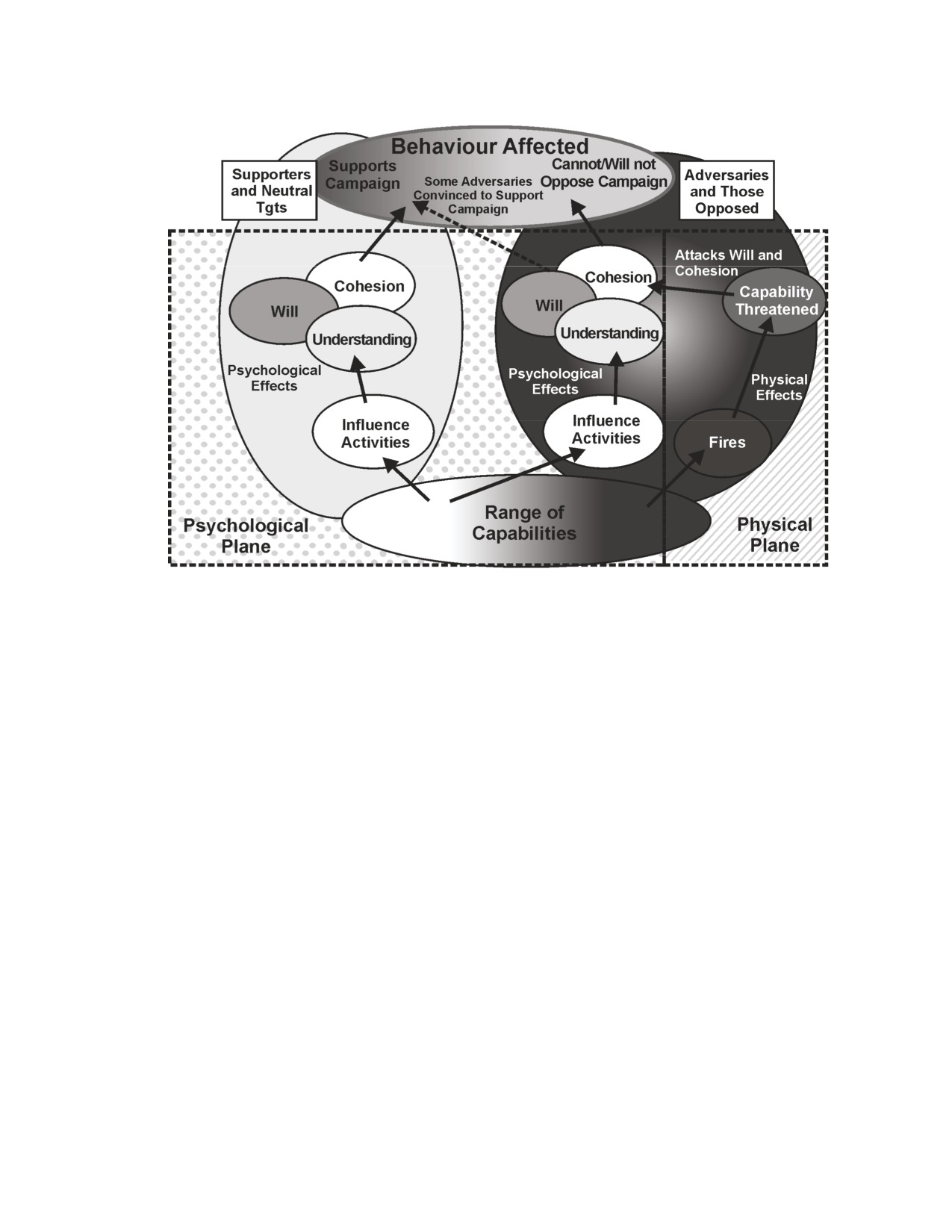
The Application of Combat Power
Figure 5-20: Manoeuvrist Approach Applied to Adversaries and Supporters on Physical and
Psychological Planes
9.
The manoeuvrist approach is most effective when applied against a conventional
adversary. In some campaigns, such as a COIN, involving a fanatical insurgent movement, the
manoeuvrist approach in terms of fires will have little effect. No amount of force or threat of
force will convince the core insurgents to surrender, or to break their will and cohesion. Indeed,
martyrdom becomes an ideal situation for them and only acts to stiffen their resolve. In such
cases, the manoeuvrist approach on the psychological plane will be the only real manner in
which to realize an enduring outcome. The majority of the populace and the less fanatical
members of the adversary must be persuaded through influence activities not to support the
insurgency. Thus, activities must counter adversary propaganda and media operations; they
must build legitimacy and confidence in the campaign; and they must address the root causes
of any reason for support to be given to the adversary. Eventually, the adversary will become
so isolated that he cannot operate effectively in the environment, and his appeal to any group or
system will be removed.
SECTION 11
APPROACHES TO ATTACKING WILL AND COHESION
536. GENERAL
1.
Attacking the adversary’s cohesion, on both the physical and psychological planes, is
the key to manoeuvre warfare. It is done using both fires and influence activities. There are
three approaches to attacking will and cohesion, in order of preference: pre-emption,
dislocation, and disruption.
B-GL-300-001/FP-001
5-67
Land Operations
537. PRE-EMPTION
1.
To pre-empt the adversary is to seize an opportunity, often fleeting, before he does, and
deny him an advantageous course of action. Pre-emption relies upon surprise above all, and
requires good intelligence and an ability to understand and anticipate the adversary’s actions.
Its success lies in the speed with which the situation can subsequently be exploited. The
purpose of pre-emptive action is to prevent the adversary from gaining his objective or
establishing his influence. Pre-emption is used to produce a sufficient and suitably located
threat to the adversary that: causes confusion and doubt; destroys confidence by foiling his
plans; and, makes his intended course of action irrelevant. Pre-emption denies initiative to the
adversary.
2.
Whether offensive or defensive, pre-emption demands a keen awareness of time and a
willingness to take calculated risks that offer a high payoff. These risks may be reduced with
the benefit of intelligence derived from real-time sensors that provide a more accurate
assessment of the adversary’s true situation. Pre-emption can also be achieved by allowing
subordinates at all levels the initiative, consistent with the commander’s intent, to seize
opportunities as they arise. This applies to activities on both the physical and psychological
planes.
3.
Establishing air superiority or establishing control of the electromagnetic spectrum at the
start of operations can achieve pre-emption. On the psychological plane, the threat can be pre-
empted by use of a proactive PA programme. This may also include actions to secure the
support or neutrality of third parties before the adversary can do so.
538. DISLOCATION
1.
To dislocate the adversary is to deny him the ability to bring his strength to bear. Its
purpose is much wider than disruption, and goes beyond the frustration of the adversary's
plans. Its purpose is to render the strength of elements of the force irrelevant. It seeks to avoid
fighting the adversary on his terms. This is done by avoiding and neutralizing his strengths so
they cannot be used effectively. A dislocating move is usually supported by actions to distract
the adversary and fix his attention.
It is through ‘distraction’ of the commander’s mind that the distraction of his forces follows.
The loss of freedom of action is the sequel to the loss of his freedom of conception.
Captain Liddell-Hart
2.
Envelopments or deep penetrations into the operational depth of an adversary, even by
small military forces, may cause dislocation of adversary elements by attacking reserves, lines
of communications, and C2 networks.
3.
In terms of influence activities, deception can be used to lure the adversary into making
incorrect deployments, inappropriate use of reserves, and inadequate preparations for
operations. Furthermore, on the psychological plane, actions may be taken to dislocate the
influence of the adversary amongst a local populace if this is a key aspect of the campaign. The
adversary’s means of propaganda may be shut down, or his psychological hold on a populace
may be dislocated through friendly force actions that address the root causes of the conflict and
remove the motivations for supporting the adversary, so that a moral superiority may be seen
with the campaigning forces.
5-68
B-GL-300-001/FP-001
The Application of Combat Power
539. DISRUPTION
1.
To disrupt is to attack the adversary selectively to break apart and throw into confusion
the assets that are critical to the employment and coherence of his fighting power. It is a
deliberate act that requires sound intelligence. The purpose is to rupture the integrity of the
adversary's fighting power and reduce it to less than the total of its constituent parts. Identifying
and locating the most critical assets may not be easy. Key strategic and military targets might
include command centres, high-value base facilities, air defence systems, weapons of mass
destruction, choke points, and critical logistics and industrial facilities. These can be disrupted
by getting into the adversary’s lines of communication, seizing or neutralizing what is important
to him, surprising and deceiving him, presenting him with unexpected situations, using
PSYOPS, and attacking his plans and preparations.
2.
In many campaigns, such as a COIN, it will be important to disrupt the influence and
intimidation that the adversaries have over a populace or sector of the populace. This must be
done early. It may be accomplished, at least initially, through simply establishing a continuous
presence of troops amongst the populace in order to protect them and increase their sense of
security. It should be complemented by influence activities that encourage support for the
campaign and undermine the legitimacy and capability of the adversary. In time, this disruption
will offer opportunities to dislocate the adversary from the populace by taking actions that
demonstrate the legitimacy of the campaign and address the root causes of the conflict.
HISTORICAL PERSPECTIVE
OPERATION OVERLORD, 6 JUNE 1944
During the initial stages of the landings in Normandy, the Allies' main fear was a rapid
and concentrated German counter-attack before the beachhead was secured. Actions
were taken to break the cohesion of the German response by pre-emption, disruption,
and dislocation.
Pre-emption
Allied troops were parachuted into German rear areas and on the flanks of the landings
to seize bridges and other points vital to both sides. This denied mobility to the German
troops moving to repel the invaders. At the same time, Ranger and Commando units
were employed to seize key emplacements that dominated the landings.
Dislocation
Part of Operation OVERLORD was the construction of the First United States Army
Group (FUSAG) under Gen George S. Patton. This army, an elaborate fake, helped
deceive the Germans into believing that the Normandy landings were a feint. The plan
used a minimal number of Allied troops to hold German reserves in the Pas de Calais
region. This dislocated the main component of the Axis reserves so that their full
strength was not brought to bear against the Allied invasion.
Disruption
French resistance forces, carefully coordinated with Operation OVERLORD, destroyed
key portions of the railway net in France. At the same time, Allied air forces bombed
other targets on the lines of communications. This disrupted the German transport
system, and damaged the ability of the Axis commanders to redeploy their forces to
meet the Allied invasion, and to supply their forces in the field.
B-GL-300-001/FP-001
5-69
Land Operations
540. APPLICATION OF MANOEUVRE DOCTRINE: MAINTAINING COHESION AND
ATTACKING THE ADVERSARY’S COHESION
1.
Cohesion is unity and it is derived from all three components of fighting power: the
physical, the intellectual, and the moral. It is the quality that binds together constituent parts of
a military organization and brings a measure of quality to its fighting power. With a cohesive
force, a commander can maintain unity of effort in imposing his will on the adversary or other
target audiences. Cohesion comprises the general identification with a common aim or purpose
(conceptual component), the means to concentrate force in a coordinated and timely manner
(physical component) and the maintenance of high morale (moral component). Cohesion
reflects the unity of effort in the force. It includes the influence of a commander's intent
focussed at a common objective, the motivation and esprit de corps of the force, and also the
physical components necessary to integrate and apply combat power. Cohesion, therefore, has
both moral and physical components.
2.
A breakdown in cohesion will lead to isolation, fear, confusion, and a loss of the will to
fight. The adversary will be unable to apply his full combat power and his component parts can
be defeated in detail. Ideally, the result is an adversary made up of a collection of individuals
and small groups lacking motivation, direction, and purpose. This loose collection can be more
easily defeated since its ability to fight effectively as a force has been eliminated.
3.
Although a focus on attacking the adversary’s will and cohesion is vital for a successful
campaign, a commander must also focus on building and maintaining the will and cohesion of
his own force, both the physical and moral cohesion. Additionally, many campaigns will focus
on maintaining the will and cohesion of elements that are required to support the campaign,
mainly key groups within the environment’s populace.
4.
Manoeuvre warfare plays as much upon the adversary’s will to fight and his ability to
react to a changing situation, as upon his material ability to do so. It is an approach through
fires and influence activities that emphasizes an indirect and direct targeting of the adversary’s
will and cohesion, rather than simply his physical component. It requires a flexible and positive
attitude of mind by commanders who must seek opportunities to exploit adversary
vulnerabilities, both physically and psychological ly, while maximizing their own strengths. The
focus is the adversary’s centre(s) of gravity, the source of his freedom of action, physical
strength or will to fight, and how best to attack, neutralize, or destroy it. It focuses on objectives
and end states rather than actions and their immediate physical results.
5.
The physical application of violence is still critical, but is conducted selectively. Rather
than conducting an operation as a toe-to-toe slugging match between two boxers, it should be
fought like a bullfight where a stronger opponent can be worn down, confused, and disoriented
by the picadors and the elusive and flexible cape of the matador until the latter delivers the final
blow with a thrust to the heart.
6.
Physical cohesion can be attacked by separating commanders from their subordinates
by severing, disrupting, or jamming communications, attacking lines of communications,
destroying elements of the force, and interfering with control measures.
7.
To attack the adversary’s moral cohesion, components of the adversary force should be
isolated from their C2. Opposing commanders should be cut off from their sources of
information. The lack of information will force bad decisions and cause a loss of credibility,
motivation, and the will to fight for a “losing” commander. This creates a lack of faith in
5-70
B-GL-300-001/FP-001
The Application of Combat Power
adversary leaders, so that their effectiveness and competence, as well as the legitimacy of their
cause, will come into question. This takes away the adversary’s sense of purpose and induces
fear. The ultimate goal is to produce panic and paralysis by presenting the adversary with
sudden, unexpected and dangerous change, or a series of such changes to which he cannot
adjust.
8.
The adversary’s cohesion may also be directly attacked on the psychological plane by
undermining his moral justification and his legitimacy, in his own eyes, and in the eyes of
potential supporters. The cohesion may be attacked directly through PSYOPS and PA
operations that attack the legitimacy of the adversary, his leaders and his cause, and his
influence over the populace. The target audience for such activities will be supporters of the
adversary, his own members, and potential supporters.
9.
Breaking the adversary's cohesion, however, may only be a temporary or transitory
effect, and the adversary could regroup and recover if pressure is not maintained. Where
physical and moral cohesion is shattered and resistance continues, such as by fanatical
individuals or groups, physical destruction may be the only alternative. This, however, should
be seen as a last resort. In the end it may be enough to simply make such fanatics irrelevant
and completely isolated, both physically and morally.
10.
Operations under a manoeuvrist approach should be dynamic and multi-dimensional. It
requires a balance between mass, time, and space across both the physical and psychological
planes. By speed of action, commanders attempt to pre-empt adversary plans, dislocate
adversary forces, and disrupt their movement and their means of C2. Combat forces are pitted
against the adversary's strength only if this is required to hold and neutralize the adversary’s
forces, or to set up the conditions for decisive action against a critical vulnerability. Normally,
combat power is directed against adversary weakness, particularly any vulnerabilities in his
cohesion.
11.
Where possible, existing weak points are exploited. Failing that, they must be created.
Weak points may be physical, for example, an undefended boundary or approach. They may
also be less tangible, such as vulnerability in passage of information. They are often produced
when an adversary is over-extended or suffering the effects of a high tempo of operations.
They may exist on the psychological plane, such as the adversary’s inability to claim legitimacy
or to represent all groups of the environment’s populace. Exploiting weak points requires agility,
flexibility and anticipation, and low-level freedom of action.
12.
Tactical battles are not an end in of themselves, but only a building block within the
framework of a larger campaign that uses surprise, deception, manoeuvre, and firepower to
break the adversary's will to fight, primarily through attacking moral and physical cohesion.
13.
The concepts of manoeuvre warfare apply equally to activities and effects on the
psychological plane. The effects should shape an adversary’s understanding, undermine his
will, and shatter his cohesion. Manoeuvre through information operations, for example, may
undermine the support that an insurgent or belligerent military commander receives from the
local populace or media. This, in turn, will affect the adversary’s will and cohesion.
14.
At the same time, manoeuvre on the psychological plane must seek to reinforce the will
and cohesion of those groups that support the campaign and oppose the adversary. This
includes activities undertaken to pre-empt, dislocate and disrupt adversary propaganda aimed
at the local populace, the international media, and one’s own troops. This is vitally important in
campaigns that rely upon the will of the majority of a populace or a particular group for success.
B-GL-300-001/FP-001
5-71
Land Operations
15.
Activities, be they fires or influence activities, must be done in a complementary fashion
with all other activities. Operations are planned and targeted together in a harmonized,
simultaneous fashion. For example, actions taken to defeat an adversary must be planned with
an understanding as to how the actions will be interpreted by those elements of the populace
whose support is required.
16.
In summary, combat power must be applied through activities, with a view to shattering
the adversary’s moral and physical cohesion, while bolstering that of the allies and neutral
elements. In order to accomplish this, activities must be undertaken on both the physical and
psychological planes in a complementary and synchronized fashion. Commanders manoeuvre
simultaneously against a wide range of targets on both the physical and psychological planes.
Much of the manoeuvre on the psychological plane will be conducted through Info Ops that
seek to influence target audiences and create desired psychological effects. This psychological
manoeuvre will be used to pre-empt, dislocate and disrupt the Info Ops and psychological
manoeuvre of the adversary.
17.
All forms of manoeuvre, physical and psychological, are considered operations and are
therefore the direct responsibility of the commander and his G3 staff branch. The commander
will strike the correct balance between fires and influence activities, that is, between manoeuvre
on the two planes based upon the campaign theme, its guiding principles, and the need to
create effects that will realize enduring objectives and end states.
18.
In keeping with this concept, it must be remembered that the manner and principles by
which tactical activities are conducted, should not violate the overarching principles of the
campaign. For example, an attack on an insurgent stronghold may follow the principles of
offensive operations, but its conduct should not contradict the principles of a COIN campaign.
Any collateral damage resulting from such an attack, for example, must be minimized or
repaired immediately in order to maintain the support of the local population. This combination
of fires and influence activities, applied to all targets and target audiences, is comprehensive
operations.
541. ENABLERS FOR THE MANOEUVRIST APPROACH
1.
The manoeuvrist approach to operations is enabled through:
a.
A comprehensive and effects-based approach to operations that provides a
unifying theme and purpose, expressed as the commander’s intent to all the
elements in a JIMP framework, to address all the threats and consider all
influences faced in the operating environment (political, military, economic,
social, etc.) and a clear articulation of the end state and the objectives required
to realize that end state.
b.
Identification of the weaknesses and vulnerabilities of the adversary and his
supporters.
c.
Identification of the vulnerabilities of the campaign and its supporters or neutral
parties to the adversary’s influence activities (propaganda).
d.
Identification of the adversary’s centre(s) of gravity and its/their relative
importance to reaching the desired end state.
5-72
B-GL-300-001/FP-001
The Application of Combat Power
e.
The commander’s ability to conceptualize and direct the harmonization of the
operational functions in order to apply combat power on both the psychological
and physical planes in a mutually complementary and supporting manner.
f.
Comprehensive targeting that considers the complementary and synchronized
application of fires and influence activities.
g.
Mission command.
h.
A unity of effort across all forces and agencies created through the shared
understanding of superior commanders’ intent, two levels higher.
542. PRINCIPLES OF MANOEUVRE WARFARE
1.
Manoeuvre warfare is a mindset for applying combat power and the resources to defeat
adversaries, build and reinforce the cohesion of the campaign, and address sources of conflict.
There is no prescribed formula, however, certain principles can provide guidance:
a.
Concentrate on the Adversary’s Vulnerabilities. With the objective being to
attack the adversary’s will to fight and cohesion, activities and their effects
should be planned against vulnerabilities, vice strengths. Plans should focus on
exploiting the adversary's vulnerabilities and not on seizing and holding the
ground. The purist application of manoeuvre warfare is to disarm or neutralize
an adversary before the fight. Vulnerabilities must be identified and attacked on
the psychological plane as well, mainly through aggressive Info Ops, in order to
sow seeds of doubt and discord amongst the adversary and his supporters.
b.
Mission Type Orders. Mission type orders focus on the effects to be achieved.
This involves de-centralizing decision-making and letting decisions be taken at
the lowest possible level. It is essential that commanders know and fully
understand their commander’s intent two levels up. Subordinates must
understand what is on their commander's mind, his vision of the battlefield, and
what end state is desired. Mission orders allow commanders, at all levels, to
react to situations and to capitalize on opportunities as they arise. The
commander directs and controls his operation through clear intent, tasks and
desired effects, rather than detailed supervision and control measures or
restrictions.
c.
Agility. Agility enables a commander to seize the initiative and dictate the
course of operations that is acting quicker than the adversary can react.
Eventually, the adversary is overcome by events, and his cohesion and ability to
influence the situation are destroyed. Agility is the liability of the commander to
change faster than the adversary can anticipate. Quickness and intellectual
acuity are the keys to effective agility. Commanders must be quick to make
good decisions and to exploit developments on both the physical and
psychological planes. Commanders and units must be able to respond quickly
to physical and psychological developments. Just as a unit will move to exploit
a sudden gap on the battlefield before the adversary can reposition to close it, a
commander must be quick to exploit through Info Ops a public relations error
made by an insurgent force. Getting inside the adversary's decision cycle is the
essence of tempo. Well-rehearsed battle drills and standing operating
procedures enhance the agility of a formation. Agility also allows a commander
B-GL-300-001/FP-001
5-73
Land Operations
to quickly counter the adversary’s Info Ops and his attempts to undermine the
legitimacy of, and support for, the campaign.
d.
Focus on Main Effort. The main effort focuses combat power and resources
on the vital element of the plan and allows subordinates to make decisions that
will support the commander's intent without constantly seeking advice. This
way, the commander is successful in achieving his goal and each subordinate
ensures his actions support the main effort. It is the focus of all, generally
expressed in terms of a particular friendly unit, activity or effect. While each unit
is granted the freedom to operate independently, everyone serves the ultimate
goal, which unifies their efforts. In certain campaigns, the main effort may be
focused on influence activities in the psychological plane, while activities on the
physical plane are supporting and may seek only to maintain a secure
environment for other elements and forces.
e.
Exploit Tactical Opportunities. Commanders continually assess the situation
(mission analysis) and then exercise the necessary freedom of action to be able
to react to changes more quickly than the adversary. Reserves are created,
correctly positioned and grouped to exploit situations that have been formed by
shaping the battle to conform to friendly concepts of operations.
f.
Act Boldly and Decisively. Commanders at all levels should be able to deal
with uncertainty and act with audacity, initiative, and inventiveness in order to
seize fleeting opportunities within their higher commanders' intent. They not
only accept confusion and disorder, they generate it for the adversary. Failure
to make a decision surrenders the initiative to the adversary. Risk is calculated,
understood and accepted. In doing so, commanders must keep in the foremost
of their minds the overall objective. It must be remembered that at times tactical
success may have to be sacrificed in order to meet or maintain the overarching
operational objective.
g.
Command from a Position to Influence the Main Effort. Commanders place
themselves where they can influence the main effort and ensure that the desired
effects are created to realize the desired objectives. If the main effort of a
campaign rests with influence activities that seek to engender security and
support from a populace, then the commander must position himself to influence
the unity of effort between all the available elements of power and within the
local populace.
SECTION 12
MISSION COMMAND
543.
DEFINITION AND TENETS
1.
Mission command is defined as “The philosophy of command that promotes unity of
effort, the duty and authority to act, and initiative to subordinate commanders.”123
123 For this definition and a full discussion of mission command, see B-GL-300-003/FP-000 Command.
5-74
B-GL-300-001/FP-001
The Application of Combat Power
2.
Mission command focuses on decentralised command and is intended for situations that
are complex, dynamic and adversarial. It allows for and accepts that the successful application
of surprise, shock and high operational tempo against an adversary is best executed through
rapid and timely decision-making at all levels of command in response to the unexpected or
fortuitous occurrence of both threats and opportunities.
3.
Mission command supports an effects-based approach to operations as applied to
activities on both the physical and psychological planes. An objective may be reached through
fires, influence activities, or through a combination of both. While the term objective has
commonly been used to refer to a physical object against which action is taken, in an effects-
based approach an objective may be something far more abstract, particularly if it is on the
psychological plane or a set of circumstances or conditions to be created.
4.
Mission command underpins manoeuvre warfare and the effects-based approach with
three tenets:
a.
The importance of understanding a superior commander’s intent.
b.
A clear responsibility on the part of subordinates to fulfil that intent.
c.
Timely decision making.
5.
While subordinates must exercise initiative under mission command, it is imperative that
they understand the higher-level objectives that must be obtained and the influence, positive or
negative, that their actions will have on the attainment of those objectives. There is little sense
in commanders achieving short-term tactical success, even if it supports the immediate
objectives of his superior, if it will undermine the legitimacy of the campaign and the
achievement of operational objectives and end state.
544. CREATING A MISSION COMMAND ATMOSPHERE
1.
Under the mission command philosophy, commanders must:
a.
Give orders in a manner that ensures that subordinates understand intent, their
own tasks, and the context of those tasks.
b.
Tell subordinates what effect(s) they are to achieve by their tasks and the
reason why or purpose, which may be a second order effect or objective.
Examples include: “seize in order to…”or“ conduct security patrols in order to…”.
c.
Provide those orders and tasks within the context of a unity of effort that is
shared horizontally and vertically within the formation, and across other
elements of power. This reflects a pervasive comprehensive approach.
d.
Ensure subordinate commanders, as appropriate, understand the operational
objectives applicable to their line of operation and the overarching campaign
principles, both of which their tactical activities should not undermine or violate.
e.
Allocate appropriate resources to carry out missions and tasks.
B-GL-300-001/FP-001
5-75
Land Operations
f.
Use a minimum of control measures so as not to limit unnecessarily the freedom
of action of subordinates.
g.
Allow subordinates to decide within their delegated freedom of action how best
to achieve their missions, tasks, and planned effects.
2.
Mission command applies to activities on both the physical and psychological planes. At
its essence is freedom of action, trust, and confidence. When all else goes awry and
subordinates cannot obtain new direction for the changing situation, they can always use the
commander’s clearly stated intent, with the desired effect and end state, to guide their decisions
and actions.
545. UNITY OF EFFORT AND COMMON INTENT
1.
Balanced against the tenets of freedom of action and decentralized decision-making is
the requirement to harmonize all activities and effects within a unity of effort. Unity of effort is
vital for a force as it harmonizes the actions of the constituent elements of force, at times both
military and non-military.
2.
Unity of effort stems from a number of interrelated means: the commander’s ability to
articulate a unifying theme through clear intent and mission statements; the use of common
doctrine, tactics, techniques and procedures; a common language of command; a high standard
of collective training and teamwork; and the designation of main effort.124 In short, together they
generate a common understanding across a force, and indeed, across other elements of power
as well, and harmonize and coordinate their actions, particularly at times of confusion and
disorientation.
3.
Within an operation, unity of effort is enhanced when subordinates understand the
intentions of their immediate superiors and of those two levels up. This vertical integration
allows subordinates to nest their own plans and activities within those of their superiors. The
unity of effort shared amongst subordinates gives horizontal integration and allows subordinates
to understand how their missions interact with those of others. A well-established unity of effort
also supports the manoeuvrist approach to operations.
4.
Ideally, unity of effort is shared through the commander’s unifying theme with other
elements of power so that all together they may address the root causes of a crisis, engender
support and commitment from indigenous populations, and create enduring end states.
5.
Unity of effort is largely based upon a commander’s explicit (stated) intent. It is
understood in the context of a common doctrine, language and training. However, complete
unity of effort and mission command implementation must be based upon the establishment and
maintenance of common intent: the sum of shared explicit intent as expressed in a
commander’s verbal or written statement, plus operationally relevant shared implicit intent.
Implicit intent is understood through a web of shared connotations, that is, a common
understanding of doctrine, shared values and beliefs (culture), and social norms and
124 Main effort is defined as: a concentration of forces or means, in a particular area, where a commander
seeks to bring about a decision. (B-GL-300-003/FP-000 Command). It works to achieve a unity of effort
across all subordinate and supporting forces and maximizes combat power.
5-76
B-GL-300-001/FP-001
The Application of Combat Power
expectations. In other words, it stems from the intellectual and moral components of fighting
power and should enhance the unity of effort by binding activities on both the physical and
psychological planes.
546. SUMMARY
1.
Mission command is a key element of the manoeuvrist approach and therefore a key
element of the effects-based approach to operations at the tactical level. Expressed intent and
a unity of effort, combined with the effects-based approach planning process, will help to ensure
that tactical level activities support operational objectives.
2.
It is vital that in exercising mission command, subordinate commanders understand the
operational objectives and the principles of the applicable campaign theme, so that their
activities may be properly planned and conducted within those contexts.
B-GL-300-001/FP-001
5-77
PAGE INTENTIONALLY LEFT BLANK
Land Operations
CHAPTER 6
THE PLANNING OF LAND OPERATIONS
SECTION 1
INTRODUCTION
601. GENERAL
1.
Land operations are planned and conducted in accordance with doctrinal principles in
order to fulfil strategic and operational end states. They are realized through the conduct of
tactical level activities that create effects to meet the operational objectives and end states.
2.
It must be stressed that operations involve much more than opposing military forces.
Although there will remain a requirement for combat operations that only military forces are
capable of conducting, objectives will be met in many campaigns through a wide array of
activities, involving the joint, interagency, multinational and public (JIMP) framework, that is,
both military and non-military elements.
3.
This chapter will develop the understanding of the planning and execution of land
operations by explaining the process of operational design, planning and battle procedure.
602. CAMPAIGN AUTHORITY
1.
The authority of a force, whether military or a force consisting of multiple agencies, to
conduct a campaign is reflected in the perceived legitimacy of the force, its mission, the manner
in which the force conducts itself, and the manner in which it delivers expectations. A campaign
will generally have campaign legitimacy, and thus authority, if the population most directly
affected by the campaign supports it. In many campaigns, ultimate success will rest upon the
establishment and maintenance of popular support, and in turn, campaign legitimacy and
authority.
2.
Campaign authority is defined as: “the total perceived public legitimacy and authority of a
force to conduct a campaign. Note: It is measured through four criteria: perceived mandate; the
manner in which it is prosecuted; the consent of affected parties; and the management and
satisfaction of the expectations of the affected parties and other audiences. It may be
measured at international, national, regional and local levels.” 125
3.
The perceived campaign authority may be illustrated through relative measurement of
the four criteria.
(See Figure 6-1.) Changes over time may also be indicated.
125 Army Terminology Panel approved May 2007.
B-GL-300-001/FP-001
6-1