NATO ANTI–PIRACY MULTINATIONAL DOCTRINE (2008) - page 7
NATO-UNCLASSIFIED
AJP 3.1
officer present eligible to command will act as OTC. The OTC will normally be under the OPCON of
the MCC or RC. The OCA will provide direction that specifies the mission, tasking, and forces
assigned to the OTC, and will also delegate tactical C2 of those forces to the OTC. The OCA may
self-designate as the OTC of the constituted forces(s) or group(s), or the TF/TG commander, or
another command as appropriate. The OTC must design the C2 organization to accomplish the
assigned mission and effectively defend the force. Some functions arising from direction,
coordination, or control may be delegated to subordinates.
0218 Tactical Control
TACON is the detailed and usually local direction and control of movements or manoeuvres necessary
to accomplish missions or tasks assigned. The authority exercising OPCOM, OPCON, or TACON
grants this authority to a subordinate commander to assume some function concerning direction,
coordination, or control of movements, manoeuvres, and actions relative to a specific task for a limited
period of time. The officer exercising TACON is also responsible for the safety of assigned units.
TACON is subordinate to TACOM.
0219 Spare
2-9
CHANGE 1
NATO-UNCLASSIFIED
NATO-UNCLASSIFIED
AJP 3.1
SECTION III — SPECIFIC COMMAND CONSIDERATIONS
0220 Commanders of Allied Forces
When allied task forces of units of two or more nations are formed, the commander shall be named in
the order creating them. The commanders of national units joining an allied task force at sea should
not displace the designated Allied commander by virtue of their national seniority or date of
commission unless specifically so directed by the senior in the chain of allied command.
0221 National Caveats
When allocating forces to NATO, nations may specify restrictions on their employment,
notwithstanding the formal definition of command state in force. This may include ROE related issues
or instructions to maintain national task group integrity. Such restrictions may have an impact upon
commanders’ flexibility of employment.
0222 Command during Task Force Operations
Potential threats to freedom of the seas and/or operations executed in the littorals may dictate the use
of a TF instead of a single TG. For example, power projection operations against a significant threat
may require multiple aircraft carriers (CV/CVN) and amphibious forces acting in concert. In a TF, C2
is more complex, and some of the procedures described in Articles 0230-0233 are modifications to
cope with the increased complexity and take advantage of the opportunities offered by additional
assets. Guidelines for other TF operations are presented in Article 0234.
0223 Command of Maritime Air Operations
Maritime air operations are an integral part of the maritime component and are used to support the
maritime campaign. The MCC will provide the ACC with an air operations directive feeder, which
includes the priorities and objectives for maritime air operations. Excess maritime air sorties are
offered to the ACC for tasking. The MCC retains OPCON of maritime air and delegates
TACOM/TACON as appropriate.
0224 Command in Submarine Operations
Traditionally, submarine operations have been conducted independent of aircraft and surface ships,
and have required a centralised command system. Improvements in submarine communication
capabilities along with refocusing of maritime objectives have brought about much closer cooperation
and interoperability of submarines and other maritime forces. In all types of operations, submarines
remain under the OPCON of the SUBOPAUTH. TACOM, in cases of integrated operations, and
TACON, for direct support, would be delegated as appropriate to the mission. If one or more
submarines are operating in support of surface forces, a submarine-qualified officer (e.g., a submarine
element coordinator) and submarine advisory team should be embarked as part of the TF/TG
commander’s staff.
0225 Command of Naval Cooperation and Guidance for Shipping
The naval commander responsible within a specified geographic area for NCAGS is the OCA.
a. Naval Cooperation and Guidance for Shipping Commander. When NCAGS is
implemented, the OCA is the naval commander designated as NCAGS commander
2-10
CHANGE 1
NATO-UNCLASSIFIED
NATO-UNCLASSIFIED
AJP 3.1
(NCAGSC) and is responsible for cooperation with merchant shipping while they are in the
NCAGS area.
b. Naval Supervision of Shipping (NSS). The naval commander exercises NSS when
mandatory routing of merchant shipping is introduced. This requires the commander
responsible for each sea area to undertake the functions of the OCA.
c. Implementation of Naval Cooperation and Guidance for Shipping. In time of
crisis, NCAGS will be the responsibility of the authority nominated by the SC as the
NCAGSC. This can be either a shore-based commander or the MCC afloat. The choice of
which commander will be dictated by the location of the crisis area and the type of crisis.
Given that the NCAGS area will not accord with any existing boundaries, it is important that
appropriate liaison with other commanders is maintained. In the event that NSS is
established, control will be compulsory and exercised by the OCA.
0226 - 0229 Spare
2-11
CHANGE 1
NATO-UNCLASSIFIED
NATO-UNCLASSIFIED
AJP 3.1
SECTION IV — COMMAND DURING SUPPORT OPERATIONS
0230 Support Situations
Occasions may arise when one force provides support to another force. The commander ordering the
support will specify the degree, manner, and duration of support which forces provide each other. The
supporting force OTC should be provided with the necessary information concerning the situation, and
the mission of the force in need of support, at the time when the support is needed. The commander
ordering the support will indicate which of the following relationships apply.
a. Situation A. The supporting force is to join and integrate with the other force. The
senior officer present, or the officer to whom TACOM is delegated, is to become the OTC of
the combined force.
b. Situation B. The supporting force does not integrate. Unless otherwise ordered, the
senior OTC of the two forces is to coordinate the tactical operations of the two forces.
c. Situation C. The supporting force commander has discretion how best to provide
support. This situation may be ordered when, for example:
(1) There is requirement for a force to provide simultaneous support to more than one
force, or to provide support to any number of forces entering a designated area.
(2) When the majority of ships or aircraft are under the OPCON or TACOM of the
supporting commander.
0231 Support Operations — Situation A
The following considerations are applicable under Situation A:
a. Delegation of Tactical Command. The OTC of the overall force may delegate
TACOM or TACON of designated forces to subordinate commanders for the execution of
assigned tasks.
b. Tasking of Forces. The OTC of the overall force will issue tasking directives, specify
reporting requirements, establish tactical communication circuits, order overall force
dispositions, and issue other direction as required by the situation.
0232 Support Operations — Situation B
Under the conditions of Situation B, the coordination between forces will depend upon the following
considerations:
a. Distance between forces.
b. Whether the supporting force is providing craft for overall force defence.
c. Whether only surface support is afforded.
d. Communications requirements and capabilities.
2-12
CHANGE 1
NATO-UNCLASSIFIED
NATO-UNCLASSIFIED
AJP 3.1
e. Threat.
f. Weather.
g. Sensor capabilities and limitations.
h. Cover and deception plans.
0233 Support Operations — Situation C
The following considerations are applicable under Situation C:
a. General Support. Situation C differs from Situations A and B in that the missions of
the respective forces may be different. When the supporting force commander is ordered to
support a particular force under Situation C, the supporting force commander will decide
what support can be provided as dictated by the constraints of the assigned mission.
Coordination between respective OTCs is required to eliminate mutual interference and
enhance conservation of resources.
b. Location of Operations. When the supporting force commander is ordered to support
a particular force under the conditions of Situation C, the commander should decide whether:
(1) To operate in a central location and thus be better placed to meet any expected
commitments, or
(2) To move close to the particular force. Taking into consideration the circumstances
above, it may be decided to adopt Situation A or Situation B.
c. Duration of Support. The duration of the support is to be decided by the supporting
force commander in the absence of orders to the contrary. If the OTC of the force being
supported wishes to retain the supporting force beyond this time, approval of appropriate
authorities must be obtained.
d. Support in a Designated Area. The supporting force commander may be ordered to
provide support in a designated area through which a number of forces may be passing. If the
forces are not simultaneously in the same area, the supporting force commander may adopt
the procedures in subparagraph b.
0234
Other Support Operations
Individual units may be assigned to provide support to forces at sea. This support may be in one of
four forms:
a. Area Operations. Area operations are normally conducted in a geographic area, not
related to the protection of a specific force. Areas may be related to the protection of
maritime forces scheduled to enter the area, or to provide defence in depth to distant forces.
TACOM of units conducting area operations remains with the assigning authority.
b. Associated Support. A unit assigned in associated support operates independently of
the supported force, but may be tasked to provide contact information to, and receive
intelligence from, the OTC who is being supported. The designated unit operates under the
2-13
ORIGINAL
NATO-UNCLASSIFIED
NATO-UNCLASSIFIED
AJP 3.1
TACON of the assigning authority who coordinates the tasking and movement of the
supporting unit in response to the supported OTC’s requirements.
c. Direct Support. The support provided by a unit or formation not attached or under
command of the supported unit or formation, but required to give priority to the support
required by that unit or formation. A unit assigned in direct support will operate under the
TACON of the OTC who is being supported. OPCON and TACOM remain with the
assigning authority. The direct support unit will report to the designated controlling authority
for employment.
d. Integrated Operations (Submarines only). Upon receiving TACOM, the OTC
assumes the responsibility for all operations and safety of assigned submarines, including
local waterspace management and prevention of mutual interference for their designated
area. (See ATP-18, Allied Manual of Submarine Operations.)
0235 - 0239 Spare
2-14
ORIGINAL
NATO-UNCLASSIFIED
NATO-UNCLASSIFIED
AJP 3.1
SECTION V — TACTICAL COMMAND AT SEA
0240 Introduction
1.
General. The OTC will always be responsible for accomplishing the mission. The OTC may
delegate authority for the execution of various activities in some or all of the areas of maritime warfare
(e.g., ASUW, ASW and AAW) to designated subordinate warfare commanders and/or coordinators.
Requirements for air coordination, EW coordination, and surveillance coordination concern more than
one area of warfare and so assume particular importance in the devising of a command structure.
2.
Development of Command Structure. In the development of a command structure at
sea, the OTC must identify the activities that will be required by the assigned task and determine who
will be accountable for their execution. For the purposes of this publication, the following conventions
have been adopted for describing the activities in the OTC’s chain of command.
a. Responsibility. The obligation placed upon an individual for correct and timely
execution of a task assigned by a superior that cannot be delegated. Responsibility also
entails accountability for the exercise of the authority delegated when tasking was assigned.
Responsibility cannot be delegated and thus accountability cannot be shifted. When a duty is
assigned, the fact that some tasking can be delegated further down the chain will not lessen
the obligation of the holder of the intermediate authority to a superior. The term
responsibility is also used to describe an activity that is specific to a duty and cannot be
delegated further.
b. Duty. An identified block of related functions within a larger command structure
assigned to a single subordinate. Assignment automatically delegates the requisite authority
for the C2 required to fulfil the tasking. With the delegation of authority comes the inherent
responsibility of the subordinate to the assigning superior for execution of the task in
accordance with known orders and procedures.
c. Function. A defined activity that may be delegated to subordinates through specific
assignment or as part of a duty within the force command structure. Functions are listed and
grouped by warfare area in Tables 1-1 thru 1-11 of ATP-1 Volume I. When any function is
delegated, it is assumed that the necessary authority for command, control, direction or
coordination required for the execution of that function has also been delegated.
0241 Command of Large Forces
A fundamental component of command effectiveness is the ability of the commander and commanded
units to communicate. This is particularly so in the case of large or dispersed forces. If there are
inadequacies in the communications capabilities of individual units, these must be identified and
assessed before a disposition is ordered. There will thus be occasions when the communications
capability of a force will impact upon the OTC’s concept of operations.
0242 Delegation of Command Functions
A centralised command is the most direct way of allowing a commander to make use of his experience
and ability. However, circumstances and command facilities can make delegation necessary. Some
factors are:
2-15
ORIGINAL
NATO-UNCLASSIFIED
NATO-UNCLASSIFIED
AJP 3.1
a. Mission.
b. The threat.
c. Need for quick action or reaction.
d. Necessity to carry out many actions in different places at the same time.
e. Practical inability of the commander to exercise all functions because of excessive
workload or the requirements of some actions for specific knowledge of facilities.
f. Lack of appropriate display and communications facilities.
g. Force size and composition.
0243 Command and Control Options
The OTC is always responsible for formulating and promulgating policy; however, other functions,
including warfare functions, may be delegated to subordinates within the constraints of stated policy
and the ROE in force. (For existing approved doctrine on ROE, refer to Chapter 3, AJP-01, Allied
Joint Doctrine, and MC 362.)
The OTC has the following options for the three principal warfare areas:
a. The OTC retains command in the principal areas of warfare by retaining all the warfare
functions.8
b. The OTC delegates to one subordinate commander one or more warfare functions.
c. The OTC delegates to more than one subordinate commander several warfare functions.
d. The OTC delegates to subordinates within geographic areas (or sectors) warfare functions
relevant to that area, but may retain any part of the overall function for himself. A principal
warfare commander (PWC) can use this form of delegation as well.
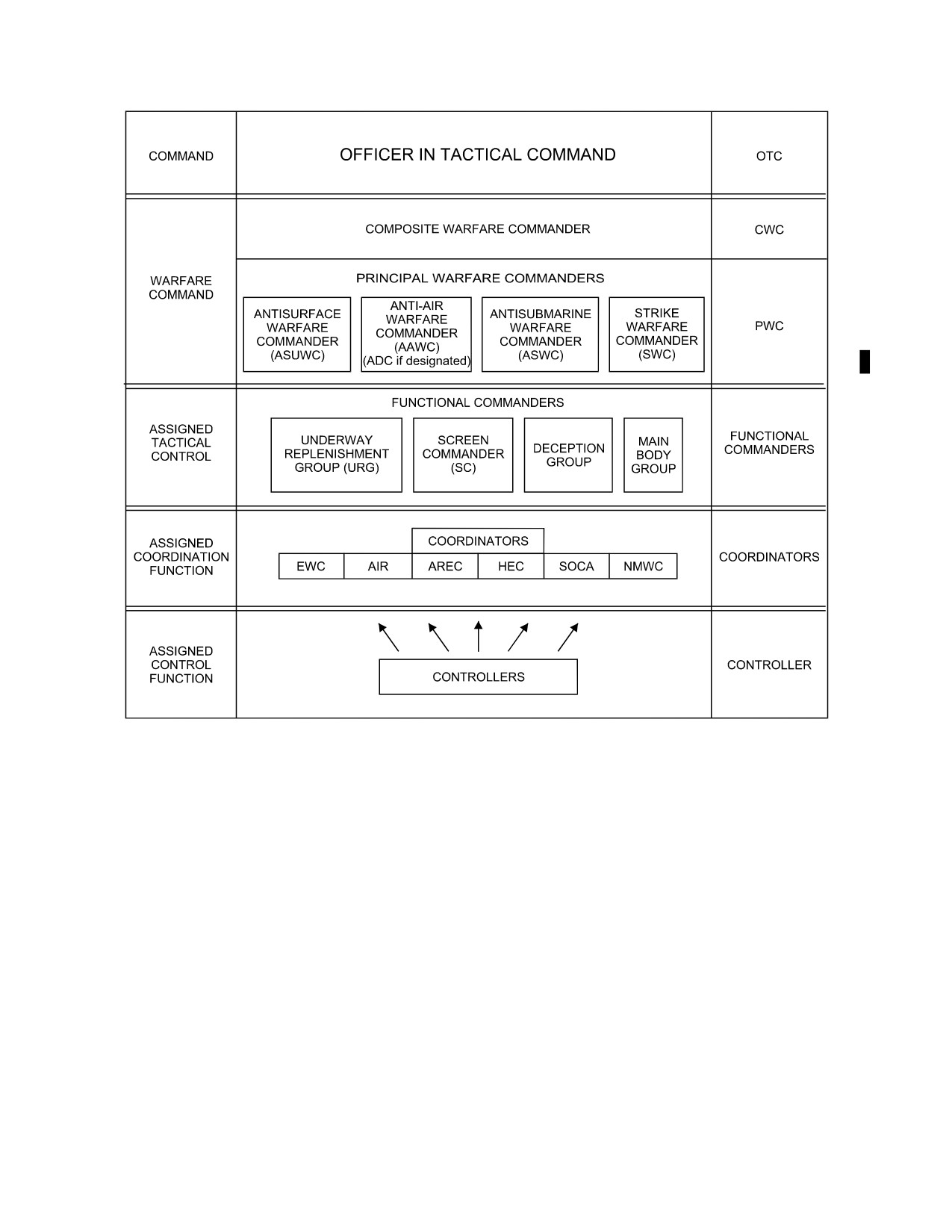
e. A special form of delegation as described in item b. is that the OTC of a large force may
allocate all warfare functions for the defence of a force to a CWC, while retaining overall
responsibility for the mission. The CWC may, in turn, delegate some or all warfare functions
as described above. Figure 2-3 illustrates the CWC organization.
8 Article 0243, subparagraph a, describes centralised command while subparagraphs b thru e describe forms of decentralised
command.
2-16
ORIGINAL
NATO-UNCLASSIFIED
NATO-UNCLASSIFIED
AJP 3.1
Figure 2-3. Levels of Command and Control within the OTC Warfare Organization
0244 Officer in Tactical Command Responsibilities
1.
OTC Responsibilities. The OTC has overall responsibility for accomplishing the mission
of the force and executing defence. The OTC’s policy and procedure for succession of command
authority, as well as designation of the standby OTC, should be specified by orders in advance of
the operation. The chain of command between the OTC and, when designated, the CWC, PWC,
coordinators, supporting commanders, and the forces under their TACOM/TACON, shall be
specified by the OTC. This may be done by task number designation or by stipulating which task
groups, units, or elements are designated for each commander. The OTC’s responsibilities cannot be
delegated. ATP-1 Volume I, lists detailed responsibilities for mission execution and defence of the
force by the OTC.
2-17
CHANGE 1
NATO-UNCLASSIFIED
NATO-UNCLASSIFIED
AJP 3.1
2.
Principal Warfare Area Responsibilities.
a. In exercising command, the OTC must consider both the threat to the force and the units
that are available to counter the threat. However, no single threat may be considered in
isolation; consequently, no tactic to counter a specific threat may be employed without
considering its effect on the security of the force from other threats which may subsequently
materialize. A detailed list of the OTC’s functions are found in ATP-1 Volume I, and are
divided into two categories:
(1) Those functions of the OTC that may be delegated to a CWC.
(2) Those functions which may be delegated to warfare commanders, coordinators, or
others to control assets and take action necessary to execute the promulgated policy.
b. The PWC will be responsible for the collection of information in particular areas and the
dissemination to the OTC and forces of evaluated information in those areas. Warfare
commanders will maintain continuous liaison with each other to ensure timely flow of
mutually supporting information and avoid mutual interference. Some warships have
weapons systems with effective ranges that extend beyond the local area in which the ship is
operating. Since warfare commanders are normally assigned authority to employ these
weapons, this may cause situations in which one commander has TACON of a ship and
another has control of that ship’s force weapons systems. If firing the weapon does not
interfere with the tasking of the ship, there is generally no problem. However, if significant
manoeuvring is required, coordination between the appropriate warfare commanders is vital
in prosecuting the threat. A temporary shift of TACON might be required, but C2 should
remain clear. The OTC (or CWC if designated) should resolve disagreement between the
warfare commanders.
3.
Coordination Responsibilities. Coordinators are asset and resource managers. They carry
out
the policies of the OTC and respond to the specific tasking of the warfare commanders.
Coordinators may also exercise control of specified assets.
4.
Air Coordination. The OTC is responsible for coordinating all friendly air movement within
the force air coordination area
(FACA). To ensure coordination, deconfliction and to prevent
fratricide, maritime air missions should be published on the air tasking order (ATO). The OTC is to
ensure that airspace requirements such as FACA, missile engagement zone, entry gates etc. are
coordinated with the ACA and that airspace control means and/or airspace control orders, issued by
the ACA, are adhered to. These coordination functions may be delegated to an air coordinator.
a. The Air Coordinator. The air coordinator exercises coordination within the FACA.
This duty may be collocated with the AAWC, air resource element coordinator (AREC),
helicopter element coordinator (HEC), or antisubmarine warfare commander (ASWC).
b. The Air Resource Element Coordinator. The AREC is a resource manager. The
AREC may, under certain circumstances, exercise TACON for particular aircraft (e.g., for
aircraft projecting power ashore), but the AREC’s primary role remains that of asset
allocation and of informing the warfare commander of the status of these assets, the results
achieved by them, and the information gained from their sensors.
c. The Helicopter Element Coordinator. When two or more ships other than an
aircraft carrier are helicopter equipped, a central scheduling authority for flight operations
2-18
CHANGE 1
NATO-UNCLASSIFIED
NATO-UNCLASSIFIED
AJP 3.1
from these ships is useful. In a multi-threat environment, the assets controlled by this
coordinator may be in demand by any of the PWCs. The HEC’s functions, therefore, will in
many ways parallel those of the AREC, with whom the HEC should coordinate, concerning
helicopters. The OTC will delegate the HEC functions generally to the senior commanding
officer of helicopter-equipped ships. These coordinating functions will normally not apply to
amphibious force and logistic helicopters. Requests for helicopters embarked in other than
aircraft carrier, amphibious and logistic ships will be directed to the HEC. The OTC must be
made aware of helicopter scheduling, tasking, and flight operations in order to be able to
resolve potential requirement conflicts. The HEC should promulgate a daily flight schedule.
5.
Electronic and Acoustic Warfare Coordination. The OTC is responsible for determining
and promulgating EAW policies for the force. Force EAW functions may be delegated to the
electronic warfare coordinator (EWC). However, the planning and execution of these functions must
take overall joint force EAW issues into account; thus strong linkages must exist with the electronic
warfare coordination cell, which operates at the joint force level. The EWC is the principal advisor to
the OTC in all matters pertaining to the employment and exploitation of the electromagnetic and
acoustic spectrum. Accordingly, the EWC has broad responsibilities, which impact upon task group
planning as well as the management and control of all active and passive weapons, sensors, and
electronic communications equipment which operate in, or target the electromagnetic
spectrum/environment to include: ESM, ECM, EPM, EMCON, operational deception (OPDEC),
operations security
(OPSEC), SIGINT (which includes COMINT and ELINT), signals security
(SIGSEC), and communications and electronic security (COMSEC)/(ELSEC). The extent, to which
the EWC exercises actual control over assets is scenario dependent, should be clearly stated by the
OTC, and understood by the PWCs. The EWC’s planning and management responsibilities encompass
several areas.
a. The EWC ensures that force assets are employed to support the requirements of the OTC
and PWC. Coordination between the EWC and the PWC is vital to ensure that all assets with
ESM, ECM, and EPM capabilities are managed effectively.
b. The EWC is the principal manager of the electromagnetic and acoustic spectrums. The
EWC formulates, promulgates, controls, and monitors the EMCON plan based upon the
OTC’s emission policy. The ASWC operates force acoustic emitters within the effective
EMCON plan. The ASWC has the authority to break acoustic EMCON in defence of the
force. The ASWC must, however, notify the EWC of this action.
c. The EWC ensures that the force deception plan and assets are employed in a manner that
facilitates the mission and policy of the OTC.
d. The EWC ensures that cryptologic assets, both organic and nonorganic, are employed in a
manner that facilitates responsiveness to the AAW, ASW, ASUW, and EW information needs
of the OTC.
6.
Surveillance. The OTC is responsible for establishing the surveillance areas for each area of
maritime warfare within the overall guidelines of the general picture compilation plan. Surveillance
functions may be delegated to warfare commanders.
7.
Naval Mine Warfare Coordination. The OTC is responsible for formulating and
promulgating the naval mine warfare
(NMW) policy. NMW functions may be delegated to a
designated naval mine warfare coordinator (NMWC). The NMWC is the principal advisor to the OTC
on matters pertaining to NMW. The NMWC is responsible for coordinating the laying of sea
2-19
CHANGE 1
NATO-UNCLASSIFIED
NATO-UNCLASSIFIED
AJP 3.1
minefields in support of the OTC and the efforts of supporting MCM forces, which are usually not
under the direct command or control of the OTC/CWC. Specific functions of the NMWC include:
a. Employment of tactical sea mining against targets of opportunity, using force assets.
b. Coordination with appropriate commanders for the laying of tactical sea minefields and
the execution of sea mining plans.
c. Tasking of MCM forces assigned to the TACOM of the OTC/CWC.
d. Coordination with appropriate local commanders for response to enemy mining of
chokepoints, safe havens, or operating areas, and for the execution of MCM plans.
e. Maintaining and disseminating a plot of relevant NMW information to the force.
8.
Accompaniment. NCAGS can recommend accompaniment which is a voluntary arrangement
in which participating merchant ships may be organised for passage through a specific area of increased
risk in company with military assets. It should be noted that the escorting military units might not be in a
legal position, according to international law and the ROE in force, to actively protect merchant ships
under attack. Their response may be possible under the international law pertaining to the defence of self
and others. Sailing in accompaniment does not suspend the master‘s responsibility for the safe navigation
of the ship. The merchant ships will not be under military command or control of maritime units, but will
receive navigational advice and threat information by the OTC if applicable during the entire
accompaniment period.
9.
Convoys. Convoys are only authorised under naval supervision of merchant shipping and are
the ultimate measure of NCAGS exercised by naval authorities of mandatory routeing and/or convoy
organization of merchant ships. It does not include the employment or active protection of such ships.
This will be implemented only with North Atlantic Council (NAC)/Defence Planning Committee (DPC)
approval.
0245 Delegation of Authority
The OTC may retain TACOM and TACON authority or may delegate some of that authority (i.e.,
TACON) to subordinate commanders and coordinators. Such delegation does not mean that the OTC
relinquishes authority over subordinates. It does mean that the subordinate is given some or all of that
same authority over forces assigned by the OTC.
0246 Delegation Considerations
1.
General. The following general considerations are provided for selection and location of
warfare commanders:
a. Availability of interoperable data link and access to required displays.
b. Sufficiency and interoperability of communications equipments.
c. Availability of sufficient skilled personnel and state of training (staff augmentation if
necessary).
d. Living/working space available in units.
2-20
CHANGE 1
NATO-UNCLASSIFIED
NATO-UNCLASSIFIED
AJP 3.1
e. No undue limitations imposed by electromagnetic radiation hazards restrictions.
f. Level of tension/state of hostilities.
g. Threat assessment.
h. Area of operations and formation/disposition required.
i. Emission policy including need for silence on unique emitters.
j. Compatibility of unit force weapons and sensors employment with proposed warfare
command functions.
k. The desirability of delegating all functions in a single warfare area to a single subordinate.
2.
Specific Anti-air Warfare Commander Considerations.
a. Availability of communication systems and space for coordination with the
ACC/ACA/ADC and sector AAWCs; adequate voice and data communications for
coordination with and direct control of support aircraft. (Staff augmentation will normally be
required.)
b. Easy access to EW information.
c. Possibility of using AEW aircraft as sector or standby AAWC.
d. Access to air defence planning information such as: air navigation charts, radar
performance data, current atmospheric data, mutual interference planning tools, AEW/air
defence aircraft availability information, etc.
3.
Specific Antisubmarine Warfare Commander Considerations.
a. Availability of communication systems and space required for coordination with support
submarines and the SUBOPAUTH. (Staff augmentation will normally be required.)
b. Availability of air ASW expertise.
c. Requirement for specialised oceanographic expertise.
4.
Specific Antisurface Warfare Commander Considerations.
a. Access to aircrew post mission debriefs.
b. Access to AEW and strike warfare expertise.
c. Access to adequate targeting data.
5.
Authority and Responsibility. In deciding what degree of control is to be delegated, and
when, the OTC must observe one cardinal principle: To operate effectively, each unit and command
must know in detail its obligation to the OTC, warfare commanders and coordinators, and other units.
To achieve this, it is essential that the OTC clearly specify the chain of command. Although control of
2-21
CHANGE 1
NATO-UNCLASSIFIED
NATO-UNCLASSIFIED
AJP 3.1
different force weapons systems in a single ship may be delegated to different warfare commanders,
only one commander may exercise control over the movements of an individual unit at any one time.
Should it be necessary to change TACON to meet specific circumstances, the OTC must clearly
specify under what circumstances, and when such change is to take place. Should another commander
wish to move a unit to better carry out duties in a warfare field, the order must go through the
commander having TACON of that ship or unit, as specified in the task organization, with the OTC or
CWC adjudicating any differences.
0247 - 0249 Spare
2-22
CHANGE 1
NATO-UNCLASSIFIED
NATO-UNCLASSIFIED
AJP 3.1
SECTION VI — COMMAND AND CONTROL OF AMPHIBIOUS FORCES
0250 Command of Amphibious Forces
1.
Operation. An amphibious operation is a military operation launched from the sea by a naval
and landing force embarked in ships and craft, with the principal purpose of projecting the LF ashore
tactically into an environment ranging from permissive to hostile. Types of amphibious operations
include demonstrations, raids, assaults and withdrawals.
2.
Force. An amphibious force is a naval and landing force together with supporting forces that
are trained, organised and equipped for amphibious operations. In naval usage, it is the administrative
title of the amphibious type command of a fleet (i.e., national amphibious capability).
a. An amphibious task force (ATF) is the task organization formed to conduct an amphibious
operation. An ATF always includes a Navy force and LF, with their organic aviation, and
may include maritime ships and air forces when appropriate.
b. A LF is a task organization of ground and aviation units assigned to an amphibious
operation.
3.
Unity of Command. The JFC ensures unity of effort in achieving amphibious objectives by
establishing unity of command over amphibious forces. The JFC may establish unity of command by
retaining OPCON over the forces executing the amphibious operation, or by delegating OPCON,
TACOM, or TACON to a subordinate commander. Forces, not command relationships, may be
transferred between commands. When forces are transferred, the command relationship that the
gaining commander will exercise (and the losing commander will relinquish) must be specified.
4.
Operational Level of Command and Control. C2 of amphibious operations will be as
directed in the initiating directive issued by the cognizant operational commander. The directive
designates the commander, amphibious task force (CATF), commander landing force (CLF), and other
commanders involved in the operation. It would also state what command relationships are to apply
following termination of the amphibious operation. Commanders of subordinate task groups within an
ATF, if they were not named in the initiating directive, would be designated by the CATF or CLF as
appropriate. If air forces are assigned to the amphibious operation, the command relationships should
be specified in the initiating directive. The initiating directive may take the form of a campaign plan,
an operation plan or order (OPLAN or OPORD), a letter of instruction, or an order to execute an
existing plan.
5.
OPCON of amphibious operations could be based upon one of three models.
a. The CATF and CLF are under OPCON of the MCC. This is the most conventional model.
b. The CATF is also the MCC. This may occur when the sole or primary maritime operation
is the amphibious operation.
c. The CATF is under OPCON of the JFC vice MCC. This may be appropriate when it is
R
impractical for the MCC to exercise OPCON of the CATF. In this case, C2 arrangements
between the CATF and other component commanders must be clearly defined to ensure
effective execution and coordination of operations within the battlespace.
2-23
CHANGE 1
NATO-UNCLASSIFIED
NATO-UNCLASSIFIED
AJP 3.1
6.
Command Authority Options. The command relationships established among the
CATF, CLF, and other designated commanders within the amphibious force is an important decision.
The type of relationship chosen by the common superior commander for the amphibious force
should be based on mission, nature and duration of the operation, force capabilities, C2 capabilities,
and recommendations from subordinate commanders.
0251 Parallel Chains of Command in the Amphibious Task Force
Elements of the ATF may be embarked for what could be extended periods of time on the same
platforms, but responsible to different or parallel chains of command. Such parallel chains of
command create special requirements for coordination. Except in emergencies, no significant decision
contemplated by a commander in the chain of command, that affects the plans, disposition or
intentions of a corresponding commander in another chain of command, will be made without
consultation with the commander concerned. In emergency situations, the commander making an
emergency decision will notify corresponding commanders of action taken at the earliest practicable
time.
0252 Designation of Commanders
The CATF and CLF are designated in the initiating directive. Commanders of subordinate TGs within
the amphibious force, if they have not been named in the initiating directive, are designated by the
CATF or CLF as appropriate. Should air forces be assigned, their commander will also be designated
in the initiating directive.
0253 Relationships during Planning of Amphibious Operations
Regardless of the command relationships, when the order initiating planning for the amphibious
operation is received (i.e., the initiating directive), unique relationships are observed during the planning
phase. The commanders designated in the initiating directive are coequal in planning matters and
decisions. All decisions must be reached on the basis of common understanding of the mission,
objectives, and procedures and on a free exchange of information. If a change in the mission occurs after
the commencement of amphibious operations, or if an amphibious operation is initiated from a posture
afloat, coequal planning relationships (either as described above or as specified in the initiating directive)
will apply to any subsequent planning.
0254 Command during Amphibious Operations
1.
The CATF, upon the commencement of amphibious operations, assumes responsibility for the
entire ATF and for the operation, and is vested with the commensurate authority to ensure success of
the amphibious operation.
2.
The CATF exercises command authority through the commanders of the task organization.
These commanders, in turn, exercise their authority through their chains of command.
3.
Within the amphibious objective area (AOA), the CATF is given specific command authority
as prescribed by the commander having overall authority for the operation. The CATF will exercise
control, as prescribed in the initiating directive, over forces not a part of the ATF, when such forces
are operating within the AOA after the arrival of the advance force or the ATF. When such forces are
merely passing through the AOA, control will be exercised only to the extent of preventing or
minimising mutual interference.
2-24
CHANGE 1
NATO-UNCLASSIFIED
NATO-UNCLASSIFIED
AJP 3.1
4.
Subject to the overall authority of the CATF, the CLF has responsibility for the conduct of
operations ashore, and for the security of all personnel and installations located within the area of
operations.
0255 Consultation between Commanders
In the exercise of command authority, the CATF obtains and considers the opinion of appropriate
commanders, particularly in cases involving a decision requiring the use of professional judgement in
their operational fields. This practice in no way limits the CATF’s command authority.
0256 - 0259 Spare
2-25
ORIGINAL
NATO-UNCLASSIFIED
NATO-UNCLASSIFIED
AJP 3.1
INTENTIONALLY BLANK
2-26
ORIGINAL
NATO-UNCLASSIFIED
U.S. NAVY
NWP 1-14M
U.S. MARINE CORPS
MCWP 5-12.1
U.S. COAST GUARD
COMDTPUB P5800.7A
THE COMMANDER’S
HANDBOOK ON THE LAW
OF NAVAL OPERATIONS
EDITION JULY 2007
URGENT CHANGE/ERRATUM RECORD
DISTRIBUTION RESTRICTION:
APPROVED FOR PUBLIC RELEASE;
NUMBER
DATE
ENTERED BY
DISTRIBUTION IS UNLIMITED.
PRIMARY REVIEW AUTHORITY:
PRESIDENT, U.S. NAVAL WAR COLLEGE
(INTERNATIONAL LAW DEPARTMENT)
DEPARTMENT OF THE NAVY
OFFICE OF THE CHIEF OF NAVAL OPERATIONS AND
HEADQUARTERS, U.S. MARINE CORPS,
DEPARTMENT OF HOMELAND SECURITY AND
U.S. COAST GUARD
0411LP1064830
1
JUL 2007
NWP 1-14M
INTENTIONALLY BLANK
2
JUL 2007
NWP 1-14M/MCWP 5-12.1/COMDTPUB P5800.7A
DEPARTMENT OF THE NAVY
NAVY WARFARE DEVELOPMENT COMMAND
NEWPORT RI 02841-1207
MARINE CORPS COMBAT DEVELOPMENT COMMAND
QUANTICO VA 22134-5001
DEPARTMENT OF HOMELAND SECURITY
COMMANDANT, UNITED STATES COAST GUARD
WASHINGTON, DC 20593-0001
June 2007
LETTER OF PROMULGATION
1. NWP 1-14M/MCWP 5-12.1/COMDTPUB P5800.7A, THE COMMANDER’S HANDBOOK ON
THE LAW OF NAVAL OPERATIONS, is UNCLASSIFIED. Handle in accordance with the
administrative procedures contained in NTTP 1-01.
2. NWP 1-14M/MCWP 5-12.1/COMDTPUB P5800.7A is effective upon receipt and supersedes
NWP 1-14M/MCWP 5-2.1/COMDTPUB P5800.7 dated October 1995. Destroy superseded material
without report.
3. NWP 1-14M/MCWP 5-12.1/COMDTPUB P5800.7A is intended for use by operational commanders
and supporting staff elements at all levels of command. It is designed to provide officers in command
and their staffs with an overview of the rules of law governing naval operations in peacetime and during
armed conflict.
4. NWP 1-14M/MCWP 5-12.1/COMDTPUB P5800.7A is approved for public release; distribution is
unlimited.
3
JUL 2007
NWP 1-14M
INTENTIONALLY BLANK
4
JUL 2007
NWP 1-14M
July 2007
PUBLICATION NOTICE
ROUTING
1. NWP 1-14M, THE COMMANDER’S HANDBOOK ON THE LAW OF NAVAL
OPERATIONS (JUL 2007), is available in the Navy Warfare Publications Library. It
is effective upon receipt.
2. Summary. This revision expands the treatment of neutrality, targeting, and weapons;
addresses land mines, maritime law enforcement, and land warfare. This revision also
responds to the Navy strategy set forth in “…From the Sea” and its focus on littoral warfare.
Navy Warfare Library Custodian
Navy Warfare Library publications must be made readily
available to all users and other interested personnel within
the U.S. Navy.
Note to Navy Warfare Library Custodian
This notice should be duplicated for routing to cognizant personnel to keep them informed of changes to this
publication.
5
JUL 2007
NWP 1-14M
INTENTIONALLY BLANK
6
JUL 2007
NWP 1-14M
CONTENTS
Page
No.
CHAPTER 1 — LEGAL DIVISIONS OF THE OCEANS AND AIRSPACE
1.1
INTRODUCTION
1-1
1.2
U.S. OCEANS POLICY
1-1
1.3
GENERAL MARITIME REGIMES UNDER CUSTOMARY INTERNATIONAL LAW AS
REFLECTED IN THE 1982 LOS CONVENTION
1-2
1.3.1
Internal Waters
1-2
1.3.2
Territorial Seas
1-2
1.3.3
Contiguous Zones
1-2
1.3.4
Exclusive Economic Zones (EEZ)
1-2
1.3.5
High Seas
1-2
1.4
MARITIME BASELINES
1-2
1.4.1
Low-Water Line
1-2
1.4.2
Straight Baselines
1-3
1.4.3
Bays, Gulfs, and Historic Bays
1-5
1.4.4
River Mouths
1-7
1.4.5
Reefs
1-7
1.4.6
Harbor Works
1-7
1.5
NATIONAL WATERS
1-7
1.5.1
Internal Waters
1-7
1.5.2
Territorial Seas
1-7
1.5.3
Islands, Rocks, and Low-Tide Elevations
1-7
1.5.4
Archipelagic Waters and Sea Lanes
1-8
1.6
INTERNATIONAL WATERS
1-9
1.6.1
Contiguous Zones
1-9
1.6.2
Exclusive Economic Zones
1-9
1.6.3
High Seas
1-9
1.6.4
Coastal Security Zones
1-9
1.7
CONTINENTAL SHELVES
1-10
1.8
SAFETY ZONES
1-10
1.9
AIRSPACE
1-10
1.10
OUTER SPACE
1-10
CHAPTER 2 — INTERNATIONAL STATUS AND NAVIGATION OF WARSHIPS,
NAVAL CRAFT, AND MILITARY AIRCRAFT
2.1
SOVEREIGN IMMUNITY
2-1
2.1.1
Sovereign Immunity Defined
2-1
2.1.2
Sunken Warships, Naval Craft, Military Aircraft, and Government Spacecraft
2-1
7
JUL 2007
NWP 1-14M
Page
No.
2.2
WARSHIPS
2-1
2.2.1
Warship Defined
2-1
2.2.2
Warship International Status
2-1
2.2.3
Crew Lists
2-2
2.2.4
Nuclear-Powered Warships
2-2
2.3
OTHER NAVAL CRAFT
2-2
2.3.1
Auxiliary Vessels
2-2
2.3.2
Military Sealift Command (MSC) Vessel Status
2-2
2.3.3
Small Craft Status
2-2
2.3.4
Unmanned Surface Vehicles Defined
2-2
2.3.5
Unmanned Underwater Vehicles Defined
2-3
2.3.6
Unmanned Service Vehicles/Unmanned Underwater Vehicles Status
2-3
2.4
MILITARY AIRCRAFT
2-3
2.4.1
Military Aircraft Defined
2-3
2.4.2
Military Aircraft International Status
2-3
2.4.3
Auxiliary Aircraft
2-3
2.4.4
Unmanned Aerial Vehicles Defined/Status
2-3
2.5
NAVIGATION IN AND OVERFLIGHT OF NATIONAL WATERS
2-4
2.5.1
Internal Waters
2-4
2.5.2
Territorial Seas
2-4
2.5.3
International Straits
2-6
2.5.4
Archipelagic Waters
2-7
2.6
NAVIGATION IN AND OVERFLIGHT OF INTERNATIONAL WATERS
2-9
2.6.1
Contiguous Zones
2-9
2.6.2
Exclusive Economic Zones
2-9
2.6.3
High Seas Freedoms and Warning Areas
2-10
2.6.4
Declared Security and Defense Zones
2-10
2.6.5
Polar Regions
2-11
2.6.6
Nuclear-Free Zones
2-11
2.7
AIR NAVIGATION
2-12
2.7.1
National Airspace
2-12
2.7.2
International Airspace
2-12
2.7.3
Open Skies Treaty
2-14
2.8
EXERCISE AND ASSERTION OF NAVIGATION AND OVERFLIGHT RIGHTS
AND FREEDOMS
2-14
2.9
RULES FOR NAVIGATIONAL SAFETY FOR VESSELS AND AIRCRAFT
2-15
2.9.1
International Rules
2-15
2.9.2
National US Inland Rules
2-15
2.9.3
Navigational Rules for Aircraft
2-15
2.10
MILITARY AGREEMENTS AND COOPERATIVE MEASURES TO PROMOTE AIR
AND MARITIME SAFETY
2-15
2.10.1
United States-Union of Soviet Socialist Republic Agreement on the Prevention of
Incidents On and Over the High Seas
2-15
8
JUL 2007
NWP 1-14M
Page
No.
2.10.2
United States-Union of Soviet Socialist Republic Agreement on the Prevention of
Dangerous Military Activities
2-16
2.10.3
U.S.-China Military Maritime Consultative Agreement
2-17
2.11
MILITARY ACTIVITIES IN OUTER SPACE
2-17
2.11.1
Outer Space Defined
2-17
2.11.2
The Law of Outer Space
2-17
2.11.3
International Agreements
2-18
2.11.4
Rescue and Return of Astronauts
2-18
2.11.5
Return of Outer Space Objects
2-19
CHAPTER 3 — PROTECTION OF PERSONS AND PROPERTY AT SEA AND MARITIME LAW
ENFORCEMENT
3.1
INTRODUCTION
3-1
3.2
RESCUE, SAFE HARBOR, AND QUARANTINE
3-1
3.2.1
Assistance to Persons, Ships, and Aircraft in Distress
3-1
3.2.2
Safe Harbor/Innocent Passage
3-2
3.2.3
Quarantine
3-2
3.3
ASYLUM AND TEMPORARY REFUGE
3-2
3.3.1
Asylum
3-2
3.3.2
Temporary Refuge/Termination or Surrender
3-3
3.3.3
Inviting Requests for Asylum or Refuge
3-4
3.3.4
Protection of U.S. Citizens
3-4
3.4
RIGHT OF APPROACH AND VISIT
3-4
3.5
REPRESSION OF PIRACY
3-5
3.5.1
U.S. Law
3-5
3.5.2
Piracy Defined
3-5
3.5.3
Use of Naval Forces to Repress Piracy
3-6
3.6
PROHIBITION OF THE TRANSPORT OF SLAVES
3-6
3.7
SUPPRESSION OF UNAUTHORIZED BROADCASTING
3-6
3.8
SUPPRESSION OF INTERNATIONAL NARCOTICS TRAFFIC
3-6
3.9
RECOVERY OF GOVERNMENT PROPERTY LOST AT SEA
3-7
3.10
PROTECTION OF PRIVATE AND MERCHANT VESSELS AND AIRCRAFT,
PRIVATE PROPERTY, AND PERSONS
3-7
3.10.1
Protection of U.S. Flag Vessels and Aircraft, U.S. Nationals, and Property
3-7
3.10.2
Protection of Foreign Flag Vessels and Aircraft and Persons
3-8
3.10.3
Noncombatant Evacuation Operations (NEO)
3-8
3.11
MARITIME LAW ENFORCEMENT
3-8
3.11.1
Jurisdiction to Proscribe
3-9
3.11.2
Jurisdiction to Enforce
3-10
3.11.3
Limitations on the Exercise of Maritime Law Enforcement Jurisdiction
3-13
9
JUL 2007
NWP 1-14M
Page
No.
3.11.4
Counterdrug Operations
3-15
3.11.5
Use of Force in Maritime Law Enforcement
3-15
3.11.6
Other Maritime Law Enforcement Assistance
3-16
3.12
HOMELAND SECURITY VS. HOMELAND DEFENSE
3-16
3.13
PROLIFERATION SECURITY INITIATIVE
3-16
3.14
UNITED NATIONS CONVENTION FOR THE SUPPRESSION OF UNLAWFUL ACTS
AGAINST THE SAFETY OF MARITIME NAVIGATION (SUA)
3-17
CHAPTER 4 — PROTECTING NATIONAL SECURITY INTERESTS IN THE MARITIME
ENVIRONMENT DURING PEACETIME
4.1
INTRODUCTION
4-1
4.2
CHARTER OF THE UNITED NATIONS
4-1
4.3
NONMILITARY MEASURES
4-2
4.3.1
Diplomatic
4-2
4.3.2
Judicial
4-2
4.3.3
Economic
4-3
4.4
MILITARY MEASURES
4-3
4.4.1
Naval Presence
4-3
4.4.2
Interception of Intruding Aircraft
4-4
4.4.3
The Right of Self-Defense
4-4
4.4.4
Maritime Interception Operations (MIO)
4-6
4.4.5
Proliferation Security Initiative
4-8
4.4.6
Antiterrorism/Force Protection
4-9
4.4.7
Maritime Warning Zones
4-9
4.4.8
Maritime Quarantine
4-9
4.5
U.S. MARITIME ZONES AND OTHER CONTROL MECHANISMS
4-10
4.5.1
Safety Zones
4-10
4.5.2
Security Zones
4-10
4.5.3
Naval Vessel Protection Zones (NVPZs)
4-11
4.5.4
Outer Continental Shelf Facilities
4-11
4.5.5
Other Areas
4-11
4.6
DETAINEES AT SEA DURING PEACETIME
4-12
CHAPTER 5 — PRINCIPLES AND SOURCES OF THE LAW OF ARMED CONFLICT
5.1
WAR AND THE LAW
5-1
5.1.1
Law Governing When Nations Can Legally Use Force
5-1
5.1.2
Law Governing How Armed Conflict is Conducted
5-1
5.2
THE LAW OF ARMED CONFLICT AND ITS APPLICATION
5-2
5.3
GENERAL PRINCIPLES OF THE LAW OF ARMED CONFLICT
5-2
5.3.1
Principle of Military Necessity
5-2
10
JUL 2007
NWP 1-14M
Page
No.
5.3.2
Principle of Distinction
5-3
5.3.3
Principle of Proportionality
5-3
5.3.4
Principle of Unnecessary Suffering
5-3
5.4
PEOPLE IN THE OPERATIONAL ENVIRONMENT
5-3
5.4.1
Combatants
5-4
5.4.2
Noncombatants
5-4
5.4.3
Civilians
5-4
5.5
SOURCES OF THE LAW OF ARMED CONFLICT
5-4
5.5.1
Customary Law
5-4
5.5.2
International Agreements
5-5
5.6
THE LAW OF ARMED CONFLICT, INTERNATIONAL HUMANITARIAN LAW, AND
HUMAN RIGHTS LAW
5-6
CHAPTER 6 — ADHERENCE AND ENFORCEMENT
6.1
ADHERENCE TO THE LAW OF ARMED CONFLICT
6-1
6.1.1
Adherence by the United States
6-1
6.1.2
Policies
6-1
6.1.3
Command Responsibility
6-2
6.1.4
Individual Responsibility
6-2
6.2
ENFORCEMENT OF THE LAW OF ARMED CONFLICT
6-2
6.2.1
The Protecting Power
6-3
6.2.2
The International Committee of the Red Cross
6-3
6.2.3
DOD Requirements for Reporting Contact with the ICRC
6-3
6.2.4
Reprisal
6-4
6.2.5
Reciprocity
6-4
6.2.6
War Crimes under International Law
6-5
6.3
REPORTABLE VIOLATIONS
6-7
CHAPTER 7 — THE LAW OF NEUTRALITY
7.1
INTRODUCTION
7-1
7.2
NEUTRAL STATUS
7-1
7.2.1
Neutrality under the Charter of the United Nations
7-1
7.2.2
Neutrality under Regional and Collective Self-Defense Arrangements
7-2
7.3
NEUTRAL TERRITORY
7-2
7.3.1
Neutral Lands
7-2
7.3.2
Neutral Ports and Roadsteads
7-2
7.3.3
Neutral Internal Waters
7-3
7.3.4
Neutral Territorial Seas
7-3
7.3.5
The 12-Nautical-Mile Territorial Sea
7-4
7.3.6
Neutral International Straits
7-4
7.3.7
Neutral Archipelagic Waters
7-4
7.3.8
Neutral Exclusive Economic Zone
7-5
7.3.9
Neutral Airspace and Duties
7-5
11
JUL 2007
NWP 1-14M
Page
No.
7.4
NEUTRAL COMMERCE
7-5
7.4.1
Contraband
7-6
7.4.2
Certificate of Noncontraband Carriage
7-7
7.5
ACQUIRING ENEMY CHARACTER
7-7
7.5.1
Acquiring the Character of an Enemy Warship or Military Aircraft
7-7
7.5.2
Acquiring the Character of an Enemy Merchant Vessel or Civil Aircraft
7-8
7.6
VISIT AND SEARCH
7-8
7.6.1
Procedure for Visit and Search of Merchant Vessels
7-8
7.6.2
Visit and Search of Merchant Vessels by Military Aircraft
7-9
7.6.3
Visit and Search of Civilian Aircraft by Military Aircraft
7-9
7.7
BLOCKADE
7-9
7.7.1
General
7-9
7.7.2
Criteria for Blockades
7-9
7.7.3
Special Entry and Exit Authorization
7-10
7.7.4
Breach and Attempted Breach of Blockade
7-10
7.7.5
Contemporary Practice
7-11
7.8
BELLIGERENT CONTROL OF THE IMMEDIATE AREA OF NAVAL OPERATIONS
AND NEUTRAL COMMUNICATION AT SEA
7-11
7.9
EXCLUSION ZONES AND WAR ZONES
7-12
7.10
CAPTURE OF NEUTRAL VESSELS AND AIRCRAFT
7-12
7.10.1
Destruction of Neutral Prizes
7-13
7.10.2
Personnel of Captured Neutral Vessels and Aircraft
7-13
7.11
BELLIGERENT PERSONNEL INTERNED BY A NEUTRAL GOVERNMENT
7-13
CHAPTER 8 — THE LAW OF TARGETING
8.1
PRINCIPLES OF LAWFUL TARGETING
8-1
8.2
MILITARY OBJECTIVES
8-1
8.2.1
Lawful Combatants
8-1
8.2.2
Unlawful Combatants
8-1
8.2.3
Hors de combat
8-2
8.2.4
Noncombatants
8-2
8.2.5
Objects
8-3
8.3
CIVILIANS AND CIVILIAN OBJECTS
8-3
8.3.1
Incidental Injury and Collateral Damage
8-3
8.3.2
Civilians in or on Military Objectives
8-3
8.4
ENVIRONMENTAL CONSIDERATIONS
8-4
8.5
DISTINCTION BETWEEN MILITARY OBJECTIVES AND PROTECTED PERSONS
AND OBJECTS
8-4
8.5.1
Protective Signs and Symbols
8-4
12
JUL 2007
NWP 1-14M
Page
No.
8.5.2
Protective Signals
8-9
8.5.3
Identification of Neutral Platforms
8-9
8.6
SURFACE WARFARE
8-9
8.6.1
Enemy Warships and Military Aircraft
8-9
8.6.2
Enemy Merchant Vessels and Aircraft
8-10
8.6.3
Enemy Vessels and Aircraft Exempt from Destruction or Capture
8-11
8.7
SUBMARINE WARFARE
8-12
8.7.1
Interdiction of Enemy Merchant Shipping by Submarines
8-12
8.7.2
Enemy Vessels and Aircraft Exempt From Submarine Interdiction
8-13
8.8
AIR WARFARE AT SEA
8-13
8.9
BOMBARDMENT
8-14
8.9.1
General Rules
8-14
8.9.2
Warning before Bombardment
8-15
8.10
LAND WARFARE
8-15
8.10.1
Targeting in Land Warfare
8-15
8.10.2
Special Protection
8-15
8.11
INFORMATION OPERATIONS
8-16
8.11.1
General IO Targeting Considerations
8-16
8.11.2
Physical Attack/Destruction
8-16
8.11.3
Psychological Operations (PSYOPs)
8-16
8.11.4
Computer Network Attack (CNA)
8-17
CHAPTER 9 — CONVENTIONAL WEAPONS AND WEAPONS SYSTEMS
9.1
INTRODUCTION
9-1
9.1.1
Unnecessary Suffering
9-1
9.1.2
Indiscriminate Effect
9-1
9.2
NAVAL MINES
9-2
9.2.1
Current Technology
9-2
9.2.2
Peacetime Mining
9-2
9.2.3
Mining during Armed Conflict
9-3
9.3
LAND MINES
9-3
9.4
TORPEDOES
9-4
9.5
CLUSTER AND FRAGMENTATION WEAPONS
9-4
9.6
BOOBY TRAPS AND OTHER DELAYED-ACTION DEVICES
9-4
9.7
EXPLOSIVE REMNANTS OF WAR
9-4
9.8
INCENDIARY WEAPONS
9-5
13
JUL 2007
NWP 1-14M
Page
No.
9.9
DIRECTED-ENERGY DEVICES
9-5
9.10
OVER-THE-HORIZON WEAPONS SYSTEMS
9-5
9.11
NONLETHAL WEAPONS
9-5
CHAPTER 10 — NUCLEAR, CHEMICAL, AND BIOLOGICAL WEAPONS
10.1
INTRODUCTION
10-1
10.2
NUCLEAR WEAPONS
10-1
10.2.1
General
10-1
10.2.2
Treaty Obligations
10-1
10.3
CHEMICAL WEAPONS
10-3
10.3.1
Treaty Obligations
10-3
10.3.2
Riot Control Agents (RCAs)
10-3
10.3.3
Herbicidal Agents
10-4
10.4
BIOLOGICAL WEAPONS
10-4
10.4.1
Treaty Obligations
10-4
10.4.2
U.S. Policy Regarding Biological Weapons
10-4
CHAPTER 11 — TREATMENT OF DETAINED PERSONS
11.1
INTRODUCTION
11-1
11.2
HUMANE TREATMENT
11-1
11.3
COMBATANTS
11-2
11.3.1
Lawful Combatants
11-2
11.3.2
Unlawful Combatants
11-3
11.4
NONCOMBATANTS
11-4
11.5
CIVILIANS
11-4
11.6
HORS DE COMBAT
11-4
11.7
QUESTIONING AND INTERROGATION OF DETAINED PERSONS
11-4
11.8
QUESTIONING OF PRISONERS OF WAR
11-5
CHAPTER 12 — DECEPTION DURING ARMED CONFLICT
12.1
GENERAL
12-1
12.1.1
Permitted Deceptions
12-1
12.1.2
Prohibited Deceptions
12-1
12.2
IMPROPER USE OF PROTECTIVE SIGNS, SIGNALS, AND SYMBOLS
12-1
12.3
NEUTRAL FLAGS, INSIGNIA, AND UNIFORMS
12-1
14
JUL 2007
NWP 1-14M
Page
No.
12.3.1
At Sea
12-1
12.3.2
In the Air
12-1
12.3.3
On Land
12-2
12.4
THE UNITED NATIONS FLAG AND EMBLEM
12-2
12.5
ENEMY FLAGS, INSIGNIA, AND UNIFORMS
12-2
12.5.1
At Sea
12-2
12.5.2
In the Air
12-2
12.5.3
On Land
12-2
12.6
FEIGNING DISTRESS
12-2
12.7
FALSE CLAIMS OF NONCOMBATANT OR CIVILIAN STATUS
12-2
12.8
SPIES
12-3
12.9
LEGAL STATUS
12-3
APPENDIX A — HYDROLANT 597/03 (54,56) EASTERN MEDITERRANEAN SEA.
(202135Z MAR 2003)
APPENDIX B — MARITIME LIAISON OFFICE (MARLO) BAHRAIN MARLO ADVISORY
BULLETIN 06-03 20 MARCH 2003
APPENDIX C — HYDROPAC 795/2004 (62). PERSIAN GULF. (030850Z MAY 2004)
15
JUL 2007
NWP 1-14M
INTENTIONALLY BLANK
16
JUL 2007
NWP 1-14M
LIST OF ILLUSTRATIONS
Page
No.
CHAPTER 1 — LEGAL DIVISIONS OF THE OCEANS AND AIRSPACE
Figure 1-1.
Legal Boundaries of the Oceans and Airspace
1-3
Figure 1-2.
Straight Baselines
1-4
Figure 1-3.
The Semicircle Test
1-5
Figure 1-4.
Bay with Islands
1-6
Figure 1-5.
Bay with Mouth Exceeding 24 Nautical Miles
1-6
Figure 1-6.
Territorial Sea of Islands and Low-Tide Elevations
1-8
CHAPTER 2 — INTERNATIONAL STATUS AND NAVIGATION OF WARSHIPS, NAVAL CRAFT,
AND MILITARY AIRCRAFT
Figure 2-1.
A Designated Archipelagic Sea Lane
2-8
CHAPTER 8 — THE LAW OF TARGETING
Figure 8-1a.
The Red Cross
8-5
Figure 8-1b.
The Red Crescent
8-6
Figure 8-1c.
Red Crystal, symbol of medical and religious activities
8-6
Figure 8-1d.
The Red Star of David
8-6
Figure 8-1e.
Three Red Stripes
8-6
Figure 8-1f.
Symbols for Prisoner of War Camps
8-7
Figure 8-1g.
Civilian Internment Camps
8-7
Figure 8-1h.
Cultural Property under the 1954 Hague Convention
8-7
Figure 8-1i.
The Roerich Pact
8-7
Figure 8-1j.
Works and Installations Containing Dangerous Forces
8-8
Figure 8-1k.
Civil Defense Activities
8-8
Figure 8-1l.
The 1907 Hague Sign
8-8
17
JUL 2007
NWP 1-14M
INTENTIONALLY BLANK
18
JUL 2007
NWP 1-14M
PREFACE
SCOPE
This publication sets out those fundamental principles of international and domestic law that govern U.S. naval
operations at sea. Part I, Law of Peacetime Naval Operations, provides an overview and general discussion of the
law of the sea, including definitions and descriptions of the jurisdiction and sovereignty exercised by nations over
various parts of the world’s oceans; the international legal status and navigational rights of warships and military
aircraft; protection of persons and property at sea; and the safeguarding of national interests in the maritime
environment. Part II, Law of Naval Warfare, sets out those principles of law of special concern to the naval
commander during any period in which U.S. naval forces are engaged in armed conflict. Although the primary
emphasis of Part II is upon the rules of international law concerned with the conduct of naval warfare, attention is
also directed to relevant principles and concepts common to the whole of the law of armed conflict.
PURPOSE
This publication is intended for the use of operational commanders and supporting staff elements at all levels of
command. It is designed to provide officers in command and their staffs with an overview of the rules of law
governing naval operations in peacetime and during armed conflict. The explanations and descriptions in this
publication are intended to enable the naval commander and his staff to comprehend more fully the legal
foundations upon which the orders issued to them by higher authority are premised and to understand better the
commander’s responsibilities under international and domestic law to execute his mission within that law. This
publication sets forth general guidance. It is not a comprehensive treatment of the law nor is it a substitute for the
definitive legal guidance provided by judge advocates and others responsible for advising commanders on the
law.
Officers in command of operational units are encouraged to utilize this publication as a training aid for assigned
personnel.
APPLICABILITY
Part I of this publication is applicable to U.S. naval operations during time of peace. Part I also complements the
more definitive guidance on maritime law enforcement promulgated by the U.S. Coast Guard.
Part II applies to the conduct of U.S. naval forces during armed conflict. It is the policy of the United States to
apply the law of armed conflict to all circumstances in which the armed forces of the United States are engaged in
combat operations, regardless of whether such hostilities are declared or otherwise designated as “war.” Relevant
portions of Part II are, therefore, applicable to all hostilities involving U.S. naval forces irrespective of the
character, intensity, or duration of the conflict. Part II may also be used for information and guidance in situations
in which the United States is a nonparticipant in hostilities involving other nations. Part II complements the more
definitive guidance on land and air warfare promulgated, respectively, by the U.S. Army and U.S. Air Force.
STANDING RULES OF ENGAGEMENT
The President and the Secretary of Defense or their duly deputized alternates or successors approve and the
Chairman of the Joint Chiefs of Staff promulgates standing rules of engagement (SROE) for US forces (Chairman
of the Joint Chiefs of Staffs Instruction 3121.01B). These rules delineate the circumstances under which forces
will initiate and/or continue engagement with other forces encountered. Combatant commanders may augment the
SROE as necessary to reflect changing political and military policies, threats, and missions specific to their area
of responsibility. Such augmentations to the standing rules are approved by the President and/or Secretary of
Defense and promulgated by the Joint Staff, J-3, as annexes to the SROE.
19
JUL 2007
NWP 1-14M
This publication provides general information, is not directive, and does not supersede guidance issued by such
commanders or higher authority.
INTERNATIONAL LAW
For purposes of this publication, international law is defined as that body of rules that nations consider binding in
their relations with one another. International law derives from the practice of nations in the international arena
and from international agreements. International law provides stability in international relations and an
expectation that certain acts or omissions will effect predictable consequences. If one nation violates the law, it
may expect that others will reciprocate. Consequently, failure to comply with international law ordinarily involves
greater political and economic costs than does observance. In short, nations comply with international law
because it is in their interest to do so. Like most rules of conduct, international law is in a continual state of
development and change.
Practice of Nations
The general and consistent practice among nations with respect to a particular subject, which over time is
accepted by them generally as a legal obligation, is known as customary international law. Customary
international law is the principal source of international law and is binding upon all nations.
International Agreements
An international agreement is a commitment entered into by two or more nations that reflects their intention to be
bound by its terms in their relations with one another. International agreements, whether bilateral treaties, executive
agreements, or multilateral conventions, are the second principal source of international law. However, they bind only
those nations that are party to them or that may otherwise consent to be bound by them. To the extent that multilateral
conventions of broad application codify existing rules of customary law, they may be regarded as evidence of
international law binding upon parties and nonparties alike.
U.S. Navy Regulations
U.S. Navy Regulations, 1990, require U.S. naval commanders to observe international law. Article 0705,
Observance of International Law, states:
At all times, a commander shall observe, and require their commands to observe, the principles of international law.
Where necessary to fulfill this responsibility, a departure from other provisions of Navy Regulations is authorized.
Throughout this publication, references to other publications imply the effective edition.
Report administrative discrepancies by letter, message, or e-mail to:
COMMANDER
NAVY WARFARE DEVELOPMENT COMMAND
ATTN: N5
686 CUSHING ROAD
NEWPORT RI 02841-1207
fleetpubs@nwdc.navy.mil
ORDERING DATA
Order printed copies of a publication using the Print on Demand system. A command may requisition a
publication using standard military standard requisitioning and issue procedures or the Naval Supply Systems
Command website called the Naval Logistics Library (https://nll1.ahf.nmci.navy.mil). An approved requisition is
forwarded to the specific site at which the publication’s electronic file is officially stored. Currently, two copies
are printed at no cost to the requester.
20
JUL 2007
NWP 1-14M
CHANGE RECOMMENDATIONS
Procedures for recommending changes are provided below.
WEB-BASED CHANGE RECOMMENDATIONS
Recommended changes to this publication may be submitted to the Navy Warfare Development Doctrine
Discussion Group, accessible through the Navy Warfare Development Command (NWDC) website at:
URGENT CHANGE RECOMMENDATIONS
When items for changes are considered urgent (as described in Paragraph 3.4.2), send this information by
message to the Primary Review Authority, info NWDC. Clearly identify and justify both the proposed change and
its urgency. Information addressees should comment as appropriate. See accompanying sample for urgent change
recommendation format on page 23.
ROUTINE CHANGE RECOMMENDATIONS
Submit routine recommended changes to this publication at any time by using the accompanying routine change
recommendation letter format on page 24 and mailing it to the address below, or posting the recommendation on
the NWDC Doctrine Discussion Group site.
COMMANDER
NAVY WARFARE DEVELOPMENT COMMAND
DOCTRINE DIRECTOR (N5)
686 CUSHING ROAD
NEWPORT RI 02841-1207
CHANGE SYMBOLS
Revised text in changes is indicated by a black vertical line in either margin of the page, like the one printed next
to this paragraph. The change symbol indicates added or restated information. A change symbol in the margin
adjacent to the chapter number and title indicates a new or completely revised chapter.
WARNINGS, CAUTIONS, AND NOTES
The following definitions apply to warnings, cautions, and notes used in this manual:
An operating procedure, practice, or condition that may result in injury or death if not carefully
observed or followed.
An operating procedure, practice, or condition that may result in damage to equipment if not carefully
observed or followed.
21
JUL 2007
NWP 1-14M
Note
An operating procedure, practice, or condition that requires emphasis.
WORDING
Word usage and intended meaning throughout this publication is as follows:
“Shall” indicates the application of a procedure is mandatory.
“Should” indicates the application of a procedure is recommended.
“May” and “need not” indicate the application of a procedure is optional.
“Will” indicates future time. It never indicates any degree of requirement for application of a procedure.
22
JUL 2007
NWP 1-14M
FM ORIGINATOR
TO NAVAL WAR COLLEGE NEWPORT RI//JJJ//
INFO COMNAVWARDEVCOM NEWPORT RI//N5//
NAVY JAG ALEXANDRIA VA//10//
CLASSIFICATION//N03510//
MSGID/GENADMIN/(Organization ID)//
SUBJ/URGENT CHANGE RECOMMENDATION FOR NWP 1-14M COMDTPUB P5800.7//
REF/A/DOC/NTTP 1-01//
POC/(Command Representative)//
RMKS/
1. IAW REF A URGENT CHANGE IS RECOMMENDED FOR NWP 1-14M COMDTPUB P5800.7
2. PAGE ______ ART/PARA NO ______ LINE NO ______ FIG NO ______
3. PROPOSED NEW TEXT (Include classification)
4. JUSTIFICATION
Message provided for subject matter; ensure that actual message conforms to MTF requirements.
23
JUL 2007
Routine Change Recommendation Letter Format
24
JUL 2007
NWP 1-14M
CHAPTER 1
Legal Divisions of the Oceans and Airspace
1.1 INTRODUCTION
The oceans of the world traditionally have been classified under the broad headings of internal waters, territorial
seas, and high seas. Airspace has been divided into national and international airspace. In the latter half of the 20th
century, new concepts evolved, such as the exclusive economic zone and archipelagic waters, that dramatically
expanded the jurisdictional claims of coastal and island nations over wide expanses of the oceans previously
regarded as high seas. The phenomenon of expanding maritime jurisdiction and the rush to extend the territorial
sea to 12 nautical miles and beyond were the subject of international negotiation from 1973 through 1982 in the
course of the Third United Nations Conference on the Law of the Sea. That conference produced the 1982 United
Nations Convention on the Law of the Sea (1982 LOS Convention), which came into effect on 16 November
1994.
In 1983, the United States announced that it would neither sign nor ratify the 1982 LOS Convention due to
fundamental flaws in its deep seabed mining provisions. Further negotiations resulted in an additional Agreement
regarding Part XI, which replaced the original deep seabed mining provisions. This Agreement contains legally
binding changes to the 1982 LOS Convention and is to be applied and interpreted together with the Convention as
a single treaty.
On 7 October 1994, the President of the United States submitted the 1982 LOS Convention and the Part XI
Agreement reforming its deep seabed mining provisions to the Senate for its advice and consent to accession and
ratification, respectively. In February 2004, the Senate Foreign Relations Committee unanimously recommended
Senate advice and consent. As of the date of this publication the Senate has not acted on this recommendation.
1.2 U.S. OCEANS POLICY
Although the United States is not a party to the 1982 LOS Convention, it considers the navigation and overflight
provisions therein reflective of customary international law and thus acts in accordance with the 1982 LOS
Convention, except for the deep seabed mining provisions. President Reagan’s 10 March 1983 Oceans Policy
Statement provides:
First, the United States is prepared to accept and act in accordance with the balance of interests relating
to traditional uses of the oceans [in the 1982 LOS Convention]—such as navigation and overflight. In
this respect, the United States will recognize the rights of other States in the waters off their coasts, as
reflected in the Convention, so long as the rights and freedoms of the United States and others under
international law are recognized by such coastal States.
Second, the United States will exercise and assert its navigation and overflight rights and freedoms on
a worldwide basis in a manner that is consistent with the balance of interests reflected in the
Convention. The United States will not, however, acquiesce in unilateral acts of other States designed
to restrict the rights and freedoms of the international community in navigation and overflight and
other related high seas uses.
1-1
JUL 2007
NWP 1-14M
1.3 GENERAL MARITIME REGIMES UNDER CUSTOMARY INTERNATIONAL LAW AS
REFLECTED IN THE 1982 LOS CONVENTION
The legal classifications (“regimes”) of ocean and airspace areas directly affect maritime operations by
determining the degree of control that a coastal nation may exercise over the conduct of foreign merchant ships,
warships, and aircraft operating within these areas. The nature of these regimes, particularly the extent of coastal
nation control exercised in those areas, is set forth in the succeeding paragraphs of this chapter. The Department
of Defense (DOD) 2005.1-M, Maritime Claims Reference Manual contains a listing of the ocean claims of coastal
nations and may be accessed at www.dtic.mil/whs/directives/corres/html/20051m.htm.
While the legal classifications are thoroughly discussed in the remainder of this chapter, the below represents a
brief summary of the primary zones affecting navigation and overflight (Figure 1-1).
1.3.1 Internal Waters
Internal waters are landward of the baseline from which the territorial sea is measured.
1.3.2 Territorial Seas
The territorial sea is a belt of ocean that is measured seaward up to 12 nautical miles from the baseline of the
coastal nation and subject to its sovereignty. Ships enjoy the right of innocent passage in the territorial sea.
Innocent passage does not include a right for aircraft overflight of the territorial sea.
1.3.3 Contiguous Zones
A contiguous zone is an area extending seaward from the baseline up to 24 nautical miles in which the coastal
nation may exercise the control necessary to prevent or punish infringement of its customs, fiscal, immigration,
and sanitary laws and regulations that occur within its territory or territorial sea. Ships and aircraft enjoy high seas
freedoms, including overflight, in the contiguous zone.
1.3.4 Exclusive Economic Zones (EEZ)
An Exclusive Economic Zones (EEZ) is a resource-related zone adjacent to the territorial sea—where a State has
certain sovereign rights (but not sovereignty) and may not extend beyond 200 nautical miles from the baseline.
Ships and aircraft enjoy high seas freedoms, including overflight, in the EEZ.
1.3.5 High Seas
The high seas include all parts of the ocean seaward of the EEZ.
1.4 MARITIME BASELINES
The territorial sea and all other maritime zones are measured from baselines. In order to calculate the seaward
reach of claimed maritime zones, it is first necessary to comprehend how baselines are drawn.
1.4.1 Low-Water Line
Unless other special rules apply, the normal baseline from which maritime claims of a nation are measured is the
low-water line along the coast as marked on the nation’s official large-scale charts.
1-2
JUL 2007
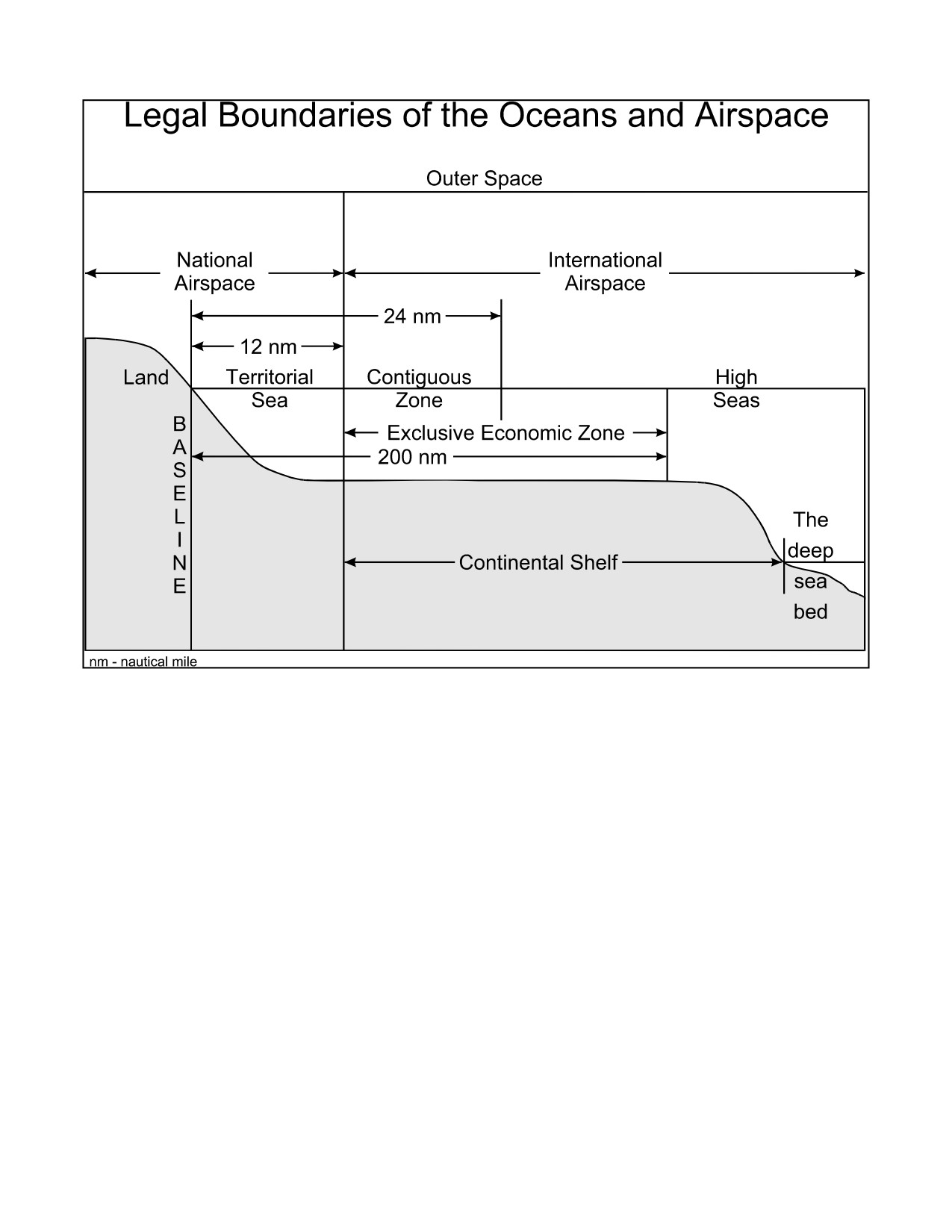
NWP 1-14M
Figure 1-1. Legal Boundaries of the Oceans and Airspace
1.4.2 Straight Baselines
Where the coastline is deeply indented or where there is a fringe of islands along the coast in its immediate
vicinity, the coastal nation may employ straight baselines. The general rule is that straight baselines must not
depart from the general direction of the coast, and the sea areas they enclose must be closely linked to the land
domain. A coastal nation that uses straight baselines must either clearly indicate them on its charts or publish a list
of geographical coordinates of the points joining them together (Figure 1-2). The United States does not employ
this practice and restrictively interprets its use by others.
1.4.2.1 Unstable Coastlines
Where the coastline is highly unstable due to natural conditions, e.g., deltas, straight baselines may be established
connecting appropriate points on the low-water line. These straight baselines remain effective, despite subsequent
regression or accretion of the coastline, until changed by the coastal nation.
1.4.2.2 Low-Tide Elevations
A low-tide elevation is a naturally formed land area surrounded by water and that remains above water at low tide
but is submerged at high tide. As a rule, straight baselines may not be drawn to or from a low-tide elevation unless
a lighthouse or similar installation, which is permanently above sea level, has been erected thereon.
1-3
JUL 2007
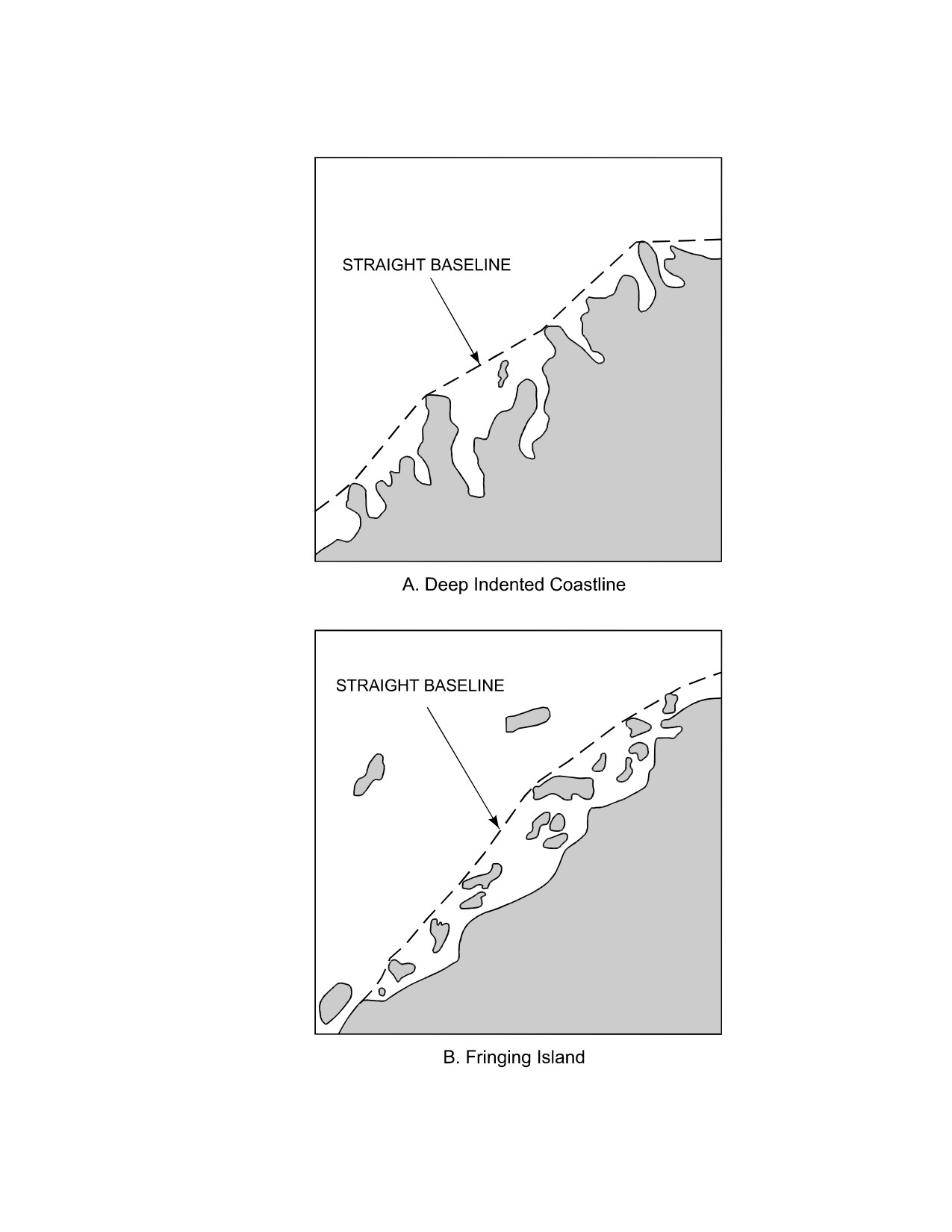
NWP 1-14M
Figure 1-2. Straight Baselines
1-4
JUL 2007
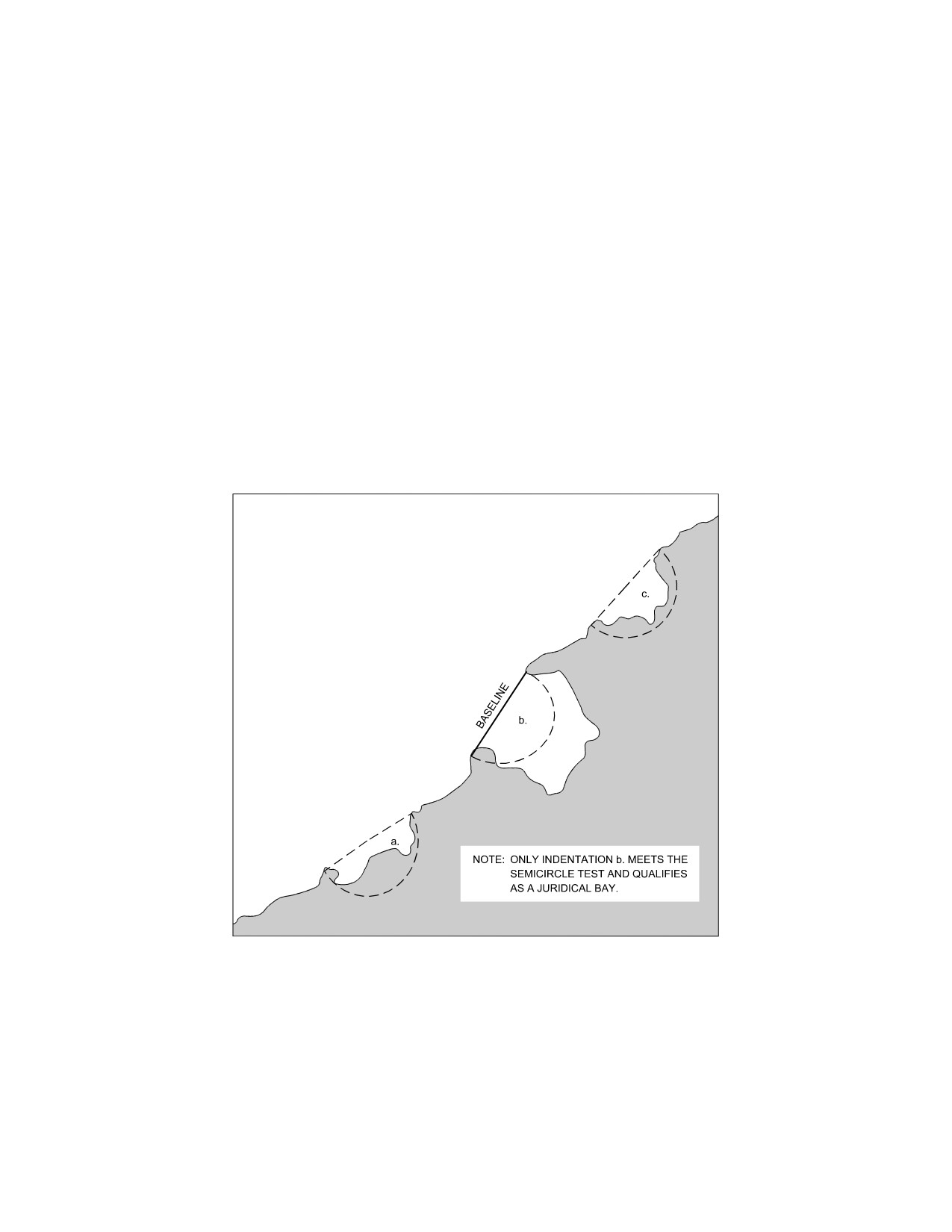
NWP 1-14M
1.4.3 Bays, Gulfs, and Historic Bays
There is a complex formula for determining the baseline closing the mouth of a legal bay or gulf. For baseline
purposes, a “bay” is a well-marked indentation in the coastline of such proportion to the width of its mouth as to
contain landlocked waters and constitute more than a mere curvature of the coast. The water area of a “bay” must
be as large as or larger than that of a semicircle whose diameter is the length of the line drawn across the mouth
(Figure 1-3). Where the indentation has more than one mouth due to the presence of islands, the diameter of the
test semicircle is the sum of the lines across the various mouths (Figure 1-4).
The baseline across the mouth of a bay may not exceed 24 nautical miles in length. Where the mouth is wider
than 24 nautical miles, a baseline of 24 nautical miles may be drawn within the bay so as to enclose the maximum
water area (Figure 1-5). Where the semicircle test has been met, and a closure line of 24 nautical miles or less
may be drawn, the body of water is a “bay” in the legal sense.
So-called historic bays are not determined by the semicircle and 24-nautical mile closure line rules described
above. To meet the international standard for establishing a claim to a historic bay, a nation must demonstrate its
open, effective, long-term, and continuous exercise of authority over the bay, coupled with acquiescence by
foreign nations in the exercise of that authority. The United States has taken the position that an actual showing of
acquiescence by foreign nations in such a claim is required, as opposed to a mere absence of opposition.
Figure 1-3. The Semicircle Test
1-5
JUL 2007
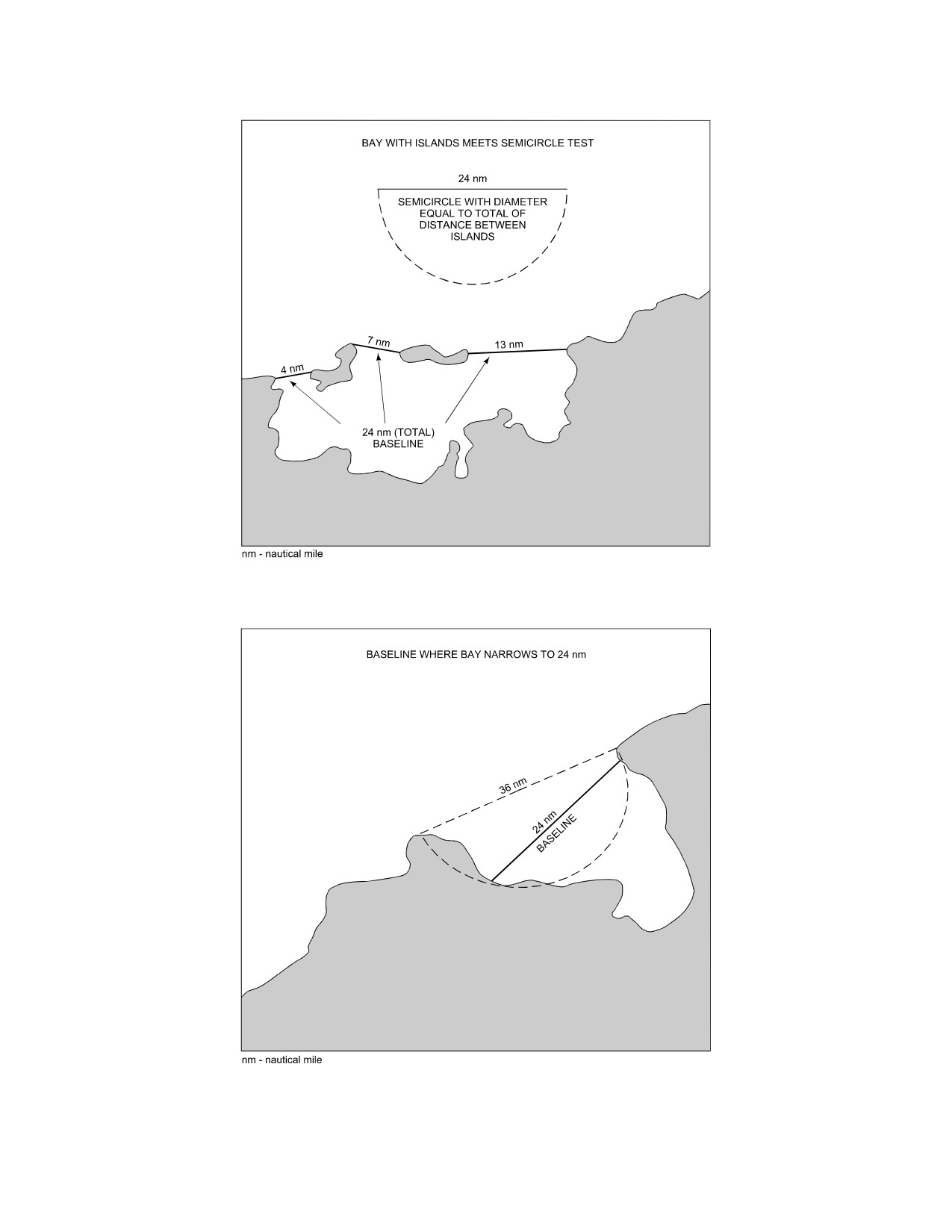
NWP 1-14M
Figure 1-4. Bay with Islands
Figure 1-5. Bay with Mouth Exceeding 24 Nautical Miles
1-6
JUL 2007
NWP 1-14M
1.4.4 River Mouths
If a river flows directly into the sea, the baseline is a straight line across the mouth of the river between points on
the low-water line of its banks.
1.4.5 Reefs
The low-water line of a reef may be used as the baseline for islands situated on atolls or having fringing reefs.
1.4.6 Harbor Works
The outermost permanent harbor works, which form an integral part of the harbor system, are regarded as forming
part of the coast for baseline purposes. Harbor works are structures, such as jetties, breakwaters and groins,
erected along the coast at inlets or rivers for protective purposes or for enclosing sea areas adjacent to the coast to
provide anchorage and shelter.
1.5 NATIONAL WATERS
For operational purposes, the world’s oceans are divided into two parts. The first includes internal waters,
territorial seas, and archipelagic waters. These national waters are subject to the territorial sovereignty of coastal
nations, with certain navigational rights reserved to the international community. The second part includes
contiguous zones, waters of the exclusive economic zone, and the high seas. These are international waters in
which all nations enjoy the high seas freedoms of navigation and overflight. International waters are discussed
further in paragraph 1.6.
1.5.1 Internal Waters
Internal waters are landward of the baseline from which the territorial sea is measured. Lakes, rivers, some bays,
harbors, some canals, and lagoons are examples of internal waters. From the standpoint of international law,
internal waters have the same legal character as the land itself. There is no right of innocent passage in internal
waters, and, unless in distress (see paragraph 2.5.1), ships and aircraft may not enter or overfly internal waters
without the permission of the coastal nation. Where the establishment of a straight baseline drawn in conformity
with the 1982 LOS Convention has the effect of enclosing as internal waters areas that had previously not been
considered as such, a right of innocent passage exists in those waters.
1.5.2 Territorial Seas
The territorial sea is a belt of ocean measured seaward from the baseline of the coastal nation and subject to its
sovereignty. The United States claims a 12-nautical-mile territorial sea and recognizes territorial sea claims of
other nations up to a maximum breadth of 12 nautical miles.
1.5.3 Islands, Rocks, and Low-Tide Elevations
Each island has its own territorial sea and, like the mainland, has a baseline from which it is calculated. An island
is defined as a naturally formed area of land, surrounded by water, which is above water at high tide. Rocks are
islands that cannot sustain human habitation or economic life of their own. Provided they remain above water at
high tide, they too possess a territorial sea determined in accordance with the principles discussed in the
paragraphs on baselines. Rocks, however, have no exclusive economic zone or continental shelf. A low-tide
elevation (above water at low tide but submerged at high tide) situated wholly or partly within the territorial sea
may be used for delimiting the territorial sea as though it were an island. Where a low-tide elevation is located
entirely beyond the territorial sea, it has no territorial sea of its own (Figure 1-6).
1-7
JUL 2007
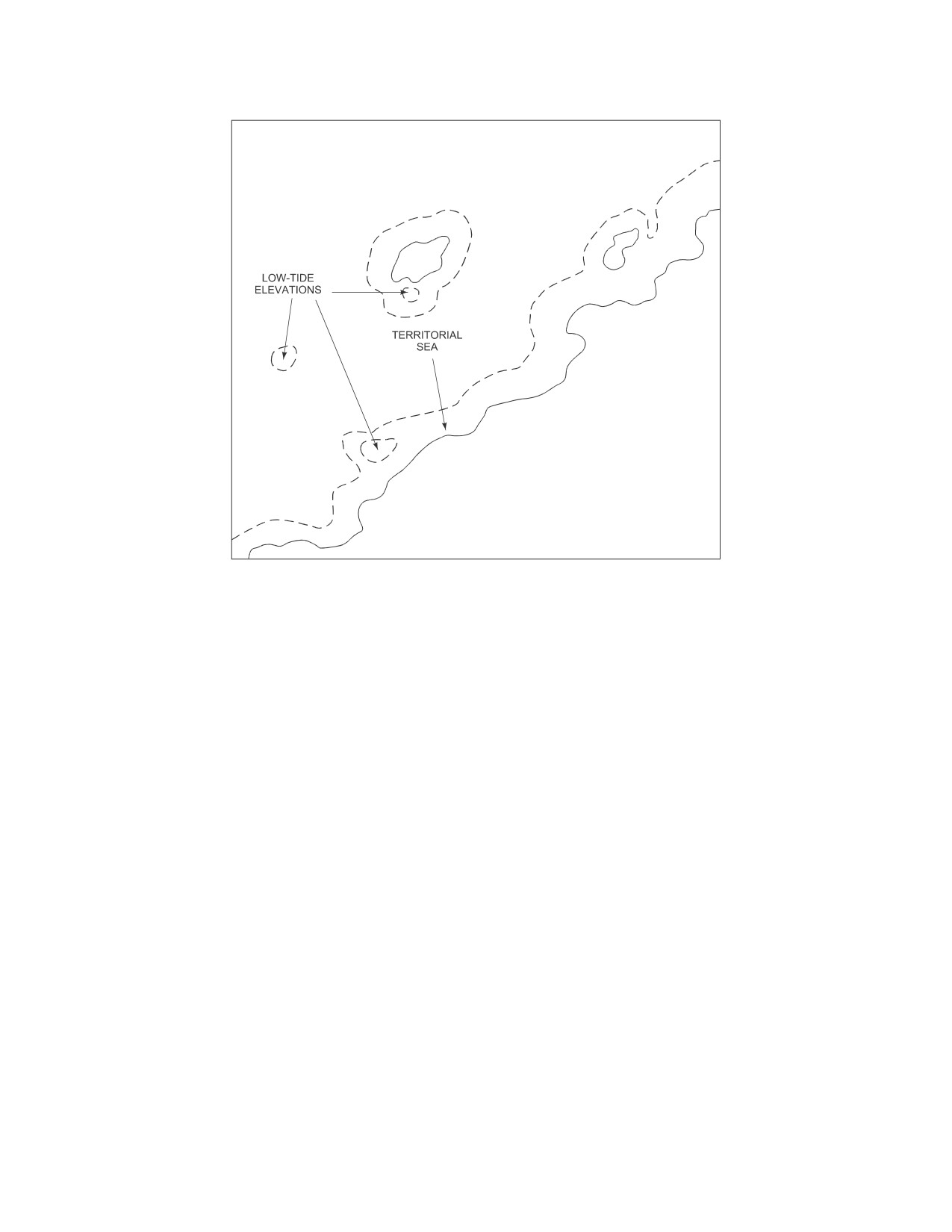
NWP 1-14M
Figure 1-6. Territorial Sea of Islands and Low-Tide Elevations
1.5.3.1 Artificial Islands and Off-Shore Installations
Artificial islands and off-shore installations have no territorial sea of their own (see, however, paragraph 1.8).
1.5.3.2 Roadsteads
Roadsteads normally used for the loading, unloading, and anchoring of ships, and which would otherwise be
situated wholly or partly beyond the outer limits of the territorial sea, are included in the territorial sea.
Roadsteads must be clearly marked on charts by the coastal nation.
1.5.4 Archipelagic Waters and Sea Lanes
An archipelagic nation is a nation that is constituted wholly of one or more groups of islands. Such nations may
draw straight archipelagic baselines joining the outermost points of their outermost islands, provided that the ratio
of water to land within the baselines is between 1:1 and 9:1. The waters enclosed within the archipelagic baselines
are called archipelagic waters. (The archipelagic baselines are also the baselines from which the archipelagic
nation measures seaward its territorial sea, contiguous zone, and exclusive economic zone.) The United States
recognizes the right of an archipelagic nation to establish archipelagic baselines enclosing archipelagic waters
provided the baselines are drawn in conformity with the 1982 LOS Convention. (See paragraph 2.5.4 regarding
navigation and overflight of archipelagic waters.)
Archipelagic nations may designate archipelagic sea lanes through their archipelagic waters suitable for
continuous and expeditious passage of ships and aircraft. All normal routes used for international navigation and
overflight are to be included. If the archipelagic nation does not designate such sea lanes, the right of archipelagic
sea lanes passage may nonetheless be exercised by all nations through routes normally used for international
navigation and overflight. If the archipelagic nation makes only a partial designation of archipelagic sea lanes, a
vessel or aircraft must adhere to the regime of archipelagic sea lanes passage while transiting in the established
1-8
JUL 2007
NWP 1-14M
archipelagic sea lanes but retains the right to exercise archipelagic sea lanes passage through all normal routes
used for international navigation and overflight through other parts of the archipelago.
1.6 INTERNATIONAL WATERS
For operational purposes, international waters include all ocean areas not subject to the territorial sovereignty of
any nation. All waters seaward of the territorial sea are international waters in which the high seas freedoms of
navigation and overflight are preserved to the international community. International waters include contiguous
zones, exclusive economic zones, and high seas.
1.6.1 Contiguous Zones
A contiguous zone is an area extending seaward from the territorial sea to a maximum distance of 24 nautical
miles from the baseline. In that zone, the coastal nation may exercise the control necessary to prevent or punish
infringement of its customs, fiscal, immigration, and sanitary laws and regulations that occur within its territory or
territorial sea (but not for purported security purposes; see paragraph 1.6.4.). The United States claims a 24-
nautical-mile contiguous zone.
1.6.2 Exclusive Economic Zones
An EEZ is a resource-related zone adjacent to the territorial sea. An EEZ may not extend beyond 200 nautical
miles from the baseline. As the name suggests, its central purpose is economic. The United States recognizes the
sovereign rights of a coastal nation to prescribe and enforce its laws in the exclusive economic zone for the
purposes of exploration, exploitation, management, and conservation of the natural resources of the waters,
seabed, and subsoil of the zone, as well as for the production of energy from the water, currents, and winds. The
coastal nation may exercise jurisdiction in the zone over the establishment and use of artificial islands,
installations, and structures having economic purposes; over marine scientific research (with reasonable
limitations); and over some aspects of marine environmental protection (including implementation of
international vessel-source pollution control standards). (For a discussion of marine scientific research,
hydrographic surveys and military surveys in the EEZ, see paragraphs 2.6.2.1 and 2.6.2.2.) In the EEZ all nations
enjoy the right to exercise the traditional high seas freedoms of navigation and overflight, of the laying of
submarine cables and pipelines, and of all other traditional high seas uses by ships and aircraft that are not
resource related. The United States established a 200-nautical mile EEZ by Presidential Proclamation 5030 on 10
March 1983.
1.6.3 High Seas
The high seas include all parts of the ocean seaward of the exclusive economic zone. When a coastal nation has
not proclaimed an exclusive economic zone, the high seas begin at the seaward edge of the territorial sea.
1.6.4 Coastal Security Zones
Some coastal nations have claimed the right to establish military security zones, beyond the territorial sea, of
varying breadth in which they purport to regulate the activities of warships and military aircraft of other nations
by such restrictions as prior notification or authorization for entry, limits on the number of foreign ships or aircraft
present at any given time, prohibitions on various operational activities, or complete exclusion. International law
does not recognize the right of coastal nations to establish zones during peacetime that would restrict the exercise
of nonresource-related high seas freedoms beyond the territorial sea. Accordingly, the United States does not
recognize the validity of any claimed security or military zone seaward of the territorial sea that purports to
restrict or regulate the high seas freedoms of navigation and overflight. (See paragraph 2.5.2.3 for a discussion of
temporary suspension of innocent passage in territorial seas. See also paragraph 4.4 for a further discussion of
declared security and defense zones in time of peace and paragraph 7.9 for a discussion of exclusion zones and
war zones during armed conflict.)
1-9
JUL 2007
NWP 1-14M
1.7 CONTINENTAL SHELVES
The juridical continental shelf of a coastal nation consists of the seabed and subsoil of the submarine areas that
extend beyond its territorial sea to the outer edge of the continental margin or to a distance of 200 nautical miles
from the baseline used to measure the territorial sea where the continental margin does not extend to that distance.
The continental shelf may not extend beyond 350 nautical miles from the baseline of the territorial sea or 100
nautical miles from the 2,500-meter isobath, whichever is greater. Although the coastal nation exercises sovereign
rights over the continental shelf for purposes of exploring and exploiting its natural resources, the legal status of
the superjacent water is not affected. Moreover, all nations have the right to lay submarine cables and pipelines on
the continental shelf.
1.8 SAFETY ZONES
Coastal nations may establish safety zones to protect artificial islands, installations, and structures located in their
internal waters, archipelagic waters, territorial seas, and exclusive economic zones, and on their continental
shelves. In the case of artificial islands, installations, and structures located in the exclusive economic zones or on
the continental shelf beyond the territorial sea, safety zones may not extend beyond 500 meters from the outer
edges of the facility in question, except as otherwise authorized by generally accepted international standards.
1.9 AIRSPACE
Under international law, airspace is classified as either national airspace (that over the land, internal waters,
archipelagic waters, and territorial seas of a nation) or international airspace (that over contiguous zones,
exclusive economic zones, the high seas, and territory not subject to the sovereignty of any nation). Subject to a
right of overflight of international straits (see paragraph 2.5.3) and archipelagic sea lanes (see paragraph 2.5.4.1),
each nation has complete and exclusive sovereignty over its national airspace. Except as nations may have
otherwise consented through treaties or other international agreements, the aircraft of all nations are free to
operate in international airspace without interference by other nations.
1.10 OUTER SPACE
The upper limit of airspace subject to national jurisdiction has not been authoritatively defined by international
law. International practice has established that airspace terminates at some point below the point at which
artificial satellites can be placed in orbit without free-falling to earth. Outer space begins at that undefined point.
All nations enjoy a freedom of equal access to outer space and none may appropriate it to its national airspace or
exclusive use.
1-10
JUL 2007
NWP 1-14M
CHAPTER 2
International Status and Navigation of
Warships, Naval Craft, and Military Aircraft
2.1 SOVEREIGN IMMUNITY
2.1.1 Sovereign Immunity Defined
As a matter of customary international law, all vessels owned or operated by a state, and used, for the time being,
only on government noncommercial service are entitled to sovereign immunity. This means that such vessels are
immune from arrest or search, whether in national or international waters. Such vessels are also immune from
foreign taxation, exempt from any foreign state regulation requiring flying the flag of such foreign state either in
its ports or while passing through its territorial sea, and are entitled to exclusive control over persons onboard
such vessels with respect to acts performed on board. The privilege of sovereign immunity includes protecting the
identity of personnel, stores, weapons, or other property on board the vessel. The United States asserts the
privilege of sovereign immunity for all United States ship (USS) and United States Coast Guard cutter (USCGC)
vessels described below.
2.1.2 Sunken Warships, Naval Craft, Military Aircraft, and Government Spacecraft
Sunken warships, naval craft, military aircraft, and government spacecraft retain their sovereign immune status
and remain the property of the flag nation until title is formally relinquished or abandoned, whether the cause of
the sinking was through accident or enemy action (unless the warship or aircraft was captured before it sank). As
a matter of policy, the U.S. government does not grant permission to salvage sunken U.S. warships or military
aircraft that contain the remains of deceased service personnel or explosive material. Requests from foreign
countries to have their sunken warships or military aircraft, located in U.S. national waters, similarly respected by
salvors, are honored.
2.2 WARSHIPS
2.2.1 Warship Defined
International law defines a warship as a ship belonging to the armed forces of a nation bearing the external
markings distinguishing the character and nationality of such ships, under the command of an officer duly
commissioned by the government of that nation and whose name appears in the appropriate service list of
officers, and manned by a crew that is under regular armed forces discipline (the mere presence of a number of
civilians onboard a warship does not alter the status of the vessel). In the U.S. Navy, those ships designated
“USS” are “warships” as defined by international law. U.S. Coast Guard vessels designated “USCGC” under the
command of a commissioned officer are also “warships” under international law.
2.2.2 Warship International Status
As a matter of customary international law, warships enjoy sovereign immunity from interference by the
authorities of nations other than the flag nation. Police and port authorities may board a warship only with the
permission of the commanding officer. A warship cannot be required to consent to an onboard search or
inspection, nor may it be required to fly the flag of the host nation. Although warships are required to comply
with coastal nation traffic control, sewage, health, and quarantine restrictions instituted in conformance with the
2-1
JUL 2007
NWP 1-14M
1982 LOS Convention, a failure of compliance is subject only to diplomatic complaint or to coastal nation orders
to leave its territorial sea immediately. Moreover, warships are immune from arrest and seizure, whether in
national or international waters, and are exempt from foreign taxes and regulation and exercise exclusive control
over all passengers and crew with regard to acts performed on board. U.S. Navy policy requires warships to assert
the rights of sovereign immunity.
2.2.3 Crew Lists
It is US policy that providing a list of crew members (to include military and nonmilitary personnel) or any other
passengers on board a USS or USCGC vessel as a condition of entry into a port or to satisfy local immigration
officials upon arrival is prohibited. For more information concerning US policy in this regard see CNO
WASHINGTON DC 101814Z Nov 05 (NAVADMIN 288/05).
2.2.4 Nuclear-Powered Warships
Nuclear-powered warships and conventionally powered warships enjoy identical international legal status.
2.3 OTHER NAVAL CRAFT
2.3.1 Auxiliary Vessels
Auxiliary vessels are vessels, other than warships, that are owned by or under the exclusive control of the armed
forces. Because they are State owned or operated and used for the time being only on government noncommercial
service, auxiliary vessels enjoy sovereign immunity. This means that, like warships, they are immune from arrest
and search, whether in national or international waters. Like warships, they are exempt from foreign taxes and
regulation, and exercise exclusive control over all passengers and crew with respect to acts performed on board.
U.S. Navy, U.S. Coast Guard and U.S. Army vessels that, except for the lack of a commissioned officer as
commanding officer would be warships, are also auxiliary vessels.
2.3.2 Military Sealift Command (MSC) Vessel Status
The Military Sealift Command (MSC) Force includes: (1) United States Naval Ships (USNS) (i.e., U.S. owned
vessels or those under bareboat charter, and assigned to MSC); (2) the National Defense Reserve Fleet (NDRF) and
the Ready Reserve Force (RRF) (when activated and assigned to MSC); (3) privately owned vessels under time
charter assigned to the Afloat Prepositioned Force (APF); and (4) those vessels chartered by MSC for a period of
time or for a specific voyage or voyages. All USNS, APF, NDRF and RRF vessels are entitled to full rights of
sovereign immunity. As a matter of policy, however, the U.S. claims only freedom from arrest and taxation for those
MSC Force time and voyage charters not included in the APF. The United States, also as a matter of policy, does not
currently claim sovereign immunity for MSC foreign flagged voyage or MSC foreign flagged time-chartered
vessels. For more information concerning MSC Sovereign Immunity Policy, to include information concerning the
provision of crew lists, see CNO WASHINGTON DC 101814Z Nov 05 (NAVADMIN 288/05).
2.3.3 Small Craft Status
US Navy and US Coast Guard motor whale boats and other small boats deployed from larger vessels are
sovereign immune craft whose status is not dependent upon the status of the launching platform.
2.3.4 Unmanned Surface Vehicles Defined
Unmanned surface vehicles (USVs) are water craft that are either autonomous or remotely navigated and may be
launched from surface, subsurface, or aviation platforms. The anticipated stealth, mobility, flexibility of
employment, and network capabilities of USVs are expected to make them extremely valuable as force
multipliers, particularly in the littoral environment. Potential missions envisioned for USVs include laying
2-2
JUL 2007
NWP 1-14M
undersea sensor grids, antisubmarine warfare (ASW) prosecution, barrier operations, sustainment of carrier
operating areas, mine countermeasures (MCM), intelligence, surveillance, and reconnaissance (ISR), bottom
mapping and survey, and special operations support.
2.3.5 Unmanned Underwater Vehicles Defined
Unmanned underwater vehicles (UUVs) are underwater craft that are either autonomous or remotely navigated
and may be launched from surface, subsurface, or aviation platforms. Towed systems, hard-tethered devices,
systems not capable of fully submerging such as USV, semi-submersible vehicles, or bottom crawlers are not
considered UUVs. The sea services may employ UUVs for a wide variety of missions, including, but not limited
to: ISR, MCM, ASW, Surveillance, Inspection/Identification, oceanography, communication/navigation network
nodes, payload delivery, information operations (IO), time critical strike, barrier patrol (homeland defense,
antiterrorism/force protection), and barrier patrol (sea base support).
2.3.6 Unmanned Service Vehicles/Unmanned Underwater Vehicles Status
USVs and UUVs engaged exclusively in government, noncommercial service are sovereign immune craft.
USV/UUV status is not dependent on the status of its launch platform.
2.4 MILITARY AIRCRAFT
2.4.1 Military Aircraft Defined
Military aircraft include all aircraft operated by commissioned units of the armed forces of a nation bearing the
military markings of that nation, commanded by a member of the armed forces, and manned by a crew subject to
regular armed forces discipline, as well as unmanned aerial vehicles (see paragraph 2.4.4).
2.4.2 Military Aircraft International Status
Military aircraft are “State aircraft” within the meaning of the Convention on International Civil Aviation of 1944
(the “Chicago Convention”), and, like warships, enjoy sovereign immunity from foreign search and inspection.
Subject to the right of transit passage, archipelagic sea lanes passage, and entry in distress (see paragraph 2.5.1),
State aircraft may not enter national airspace (see paragraph 1.9) or land in the sovereign territory of another
nation without its authorization. Foreign officials may not board the aircraft without the consent of the aircraft
commander. Should the aircraft commander fail to certify compliance with local customs, immigration or
quarantine requirements, the aircraft may be directed to leave the territory and national airspace of that nation
immediately.
2.4.3 Auxiliary Aircraft
Auxiliary aircraft are State aircraft, other than military aircraft, that are owned by or under the exclusive control of
the armed forces. Civilian owned and operated aircraft, the full capacity of which has been contracted by the DOD
and used in the military service of the United States, qualify as “auxiliary aircraft” if they are designated as “State
aircraft” by the United States. In those circumstances they too enjoy sovereign immunity from foreign search and
inspection. As a matter of policy, however, the United States normally does not designate Air Mobility
Command-charter aircraft as State aircraft.
2.4.4 Unmanned Aerial Vehicles Defined/Status
Unmanned aerial vehicles (UAVs) are pilotless aircraft that are either autonomous or remotely piloted and may be
launched from surface or aviation platforms or land bases. Per DOD Directive 4540.1, use of Airspace by US
Military Aircraft and Firing Over the High Seas, manned and unmanned aircraft and remotely piloted vehicles are
to be considered “military aircraft.” UAVs have been integrated into all levels of military operations and offer an
unprecedented reconnaissance and intelligence capability.
2-3
JUL 2007
NWP 1-14M
All UAVs operated by the DOD shall be considered “military aircraft” and retain the overflight rights under
customary international law as reflected in the LOS Convention. Since DOD-operated UAVs are considered
“military aircraft,” all domestic and international law pertaining to “military aircraft” is applicable. This includes
all conventions, treaties, and agreements relating to “military aircraft,” “auxiliary aircraft,” “civil aircraft” and
“civilian airliners.”
2.5 NAVIGATION IN AND OVERFLIGHT OF NATIONAL WATERS
2.5.1 Internal Waters
As discussed in the preceding chapter, coastal nations exercise the same jurisdiction and control over their internal
waters and superjacent airspace as they do over their land territory. Because most ports and harbors are located
landward of the baseline of the territorial sea, entering a port ordinarily involves navigation in internal waters.
Because entering internal waters is legally equivalent to entering the land territory of another nation, that nation’s
permission is required. To facilitate international maritime commerce, many nations grant foreign merchant
vessels standing permission to enter internal waters, in the absence of notice to the contrary. Warships and
auxiliaries, and all aircraft, on the other hand, require specific and advance entry permission, unless other bilateral
or multilateral arrangements have been concluded.
Exceptions to the rule of nonentry into internal waters without coastal nation permission, whether specific or
implied, arise when rendered necessary by force majeure or by distress, or when straight baselines established in
accordance with customary international law as reflected in the 1982 LOS Convention have the effect of
enclosing, as internal waters, areas of the sea previously regarded as territorial seas or high seas. In the latter
event, international law provides that the right of innocent passage (see paragraph 2.5.2.1) or that of transit
passage in an international strait (see paragraph 2.5.3) may be exercised by all nations in those waters.
2.5.2 Territorial Seas
2.5.2.1 Innocent Passage
International law provides that ships (but not aircraft) of all nations enjoy the right of innocent passage for the
purpose of continuous and expeditious traversing of the territorial sea or for proceeding to or from internal waters.
Innocent passage includes stopping and anchoring, but only insofar as incidental to ordinary navigation, or as
rendered necessary by force majeure or by distress. Passage is innocent so long as it is not prejudicial to the
peace, good order, or security of the coastal nation. Activities considered to be prejudicial to the peace, good
order, or security of the coastal nation, and therefore inconsistent with innocent passage, are:
1. Any threat or use of force against the sovereignty, territorial integrity, or political independence of the
coastal nation, or in any other manner in violation of the principles of international law embodied in the
Charter of the United Nations
2. Any exercise or practice with weapons of any kind
3. Any act aimed at collecting information to the prejudice of the defense or security of the coastal nation
4. Any act of propaganda aimed at affecting the defense or security of the coastal nation
5. The launching, landing, or taking on board of any aircraft
6. The launching, landing, or taking on board of any military device
7. The loading or unloading of any commodity, currency or person contrary to the customs, fiscal,
immigration or sanitary laws, and regulations of the coastal nation
8. Any act of willful and serious pollution contrary to the 1982 LOS Convention
2-4
JUL 2007
NWP 1-14M
9. Any fishing activities
10. The carrying out of research or survey activities
11. Any act aimed at interfering with any systems of communication or any other facilities or installations of
the coastal nation
12. Any other activity not having a direct bearing on passage.
Foreign ships, including warships, exercising the right of innocent passage are required to comply with the laws
and regulations enacted by the coastal nation in conformity with established principles of international law and, in
particular, with such laws and regulations relating to the safety of navigation. Innocent passage does not include a
right of overflight. A vessel does not enjoy the right of innocent passage if, in the case of a submarine, it navigates
submerged, or if, in the case of any ship, it engages in an act aimed at collecting information to the prejudice of
the defense or security of the coastal nation.
While the 1982 LOS Convention does not prohibit noninnocent passage, such as overflight of or submerged
transit in the territorial sea, the coastal state may take affirmative actions in and over its territorial sea to prevent
passage that is not innocent, including, where necessary, the use of force. If a foreign ship or aircraft enters the
territorial sea or the airspace above it and engages in noninnocent activities, the appropriate remedy, consistent
with customary international law, which includes the right of self-defense, is first to inform the ship or aircraft of
the reasons the coastal nation questions the innocence of the passage, and to provide the vessel a reasonable
opportunity to clarify its intentions or to correct its conduct in a reasonably short period of time. (See paragraph
2.5.2.4 as to warships.)
2.5.2.2 Permitted Restrictions
For purposes such as resource conservation, environmental protection, and navigational safety, a coastal nation
may establish certain restrictions upon the right of innocent passage of foreign vessels. Such restrictions upon the
right of innocent passage through the territorial sea are not prohibited by international law, provided that they are
reasonable and necessary; do not have the practical effect of denying or impairing the right of innocent passage;
and do not discriminate in form or in fact against the ships of any nation or those carrying cargoes to, from, or on
behalf of any nation. Further, these restrictions cannot prohibit transit or otherwise impair the rights of innocent
and transit passage of nuclear-powered sovereign vessels. The coastal nation may, where navigational safety
dictates, require foreign ships exercising the right of innocent passage to utilize designated sea lanes and traffic
separation schemes.
2.5.2.3 Temporary Suspension of Innocent Passage
A coastal nation may suspend innocent passage temporarily in specified areas of its territorial sea when it is
essential for the protection of its security. Such a suspension must be preceded by a published notice to the
international community and may not discriminate in form or in fact among foreign ships.
2.5.2.4 Warships and Innocent Passage
All warships enjoy the right of innocent passage on an unimpeded and unannounced basis. If a warship does not
comply with coastal nation regulations that conform to established principles of international law and disregards a
request for compliance that is made to it, the coastal nation may require the warship immediately to leave the
territorial sea in which case the warship shall do so immediately.
2-5
JUL 2007
NWP 1-14M
2.5.2.5 USV/UUV and Navigational Rights
Customary international law as reflected in the 1982 LOS Convention gives vessels of all nations the right to
engage in innocent passage as well as in transit passage and archipelagic sea lanes passage. The size, purpose, or
type of cargo is irrelevant. The same rules apply to USV and UUV transit and navigation. USVs and UUVs retain
independent navigation rights and may be deployed by larger vessels as long as their employment complies with
the navigational regimes of innocent passage, transit passage, archipelagic sea lanes passage as applicable.
2.5.2.6 Assistance Entry
All ship and aircraft commanders have an obligation to assist those in danger of being lost at sea. See paragraph
3.2.1. This long-recognized duty of mariners permits assistance entry into the territorial sea by ships or, under
certain circumstances, aircraft without permission of the coastal nation to engage in bona fide efforts to render
emergency assistance to those in danger or distress at sea. This right applies only when the location of the danger
or distress is reasonably well known. It does not extend to entering the territorial sea or superjacent airspace to
conduct a search, which requires the consent of the coastal nation.
2.5.3 International Straits
2.5.3.1 International Straits Between One Part of the High Seas/EEZ and Another Part of the
High Seas/EEZ
Straits that are used for international navigation between one part of the high seas or an exclusive economic zone
and another part of the high seas or an exclusive economic zone are subject to the legal regime of transit passage.
Transit passage exists throughout the entire strait (shoreline-to-shoreline) and not just the area overlapped by the
territorial sea of the coastal nation(s). Under international law, the ships and aircraft of all nations, including
warships, auxiliary vessels, and military aircraft, enjoy the right of unimpeded transit passage through such straits
and their approaches.
Transit passage is defined as the exercise of the freedoms of navigation and overflight solely for the purpose of
continuous and expeditious transit in the normal modes of operation utilized by ships and aircraft for such
passage. Ships and aircraft, while exercising the right of transit passage, shall: (a) proceed without delay through
or over the strait; (b) refrain from any threat or use of force against the sovereignty, territorial integrity, or
political independence of States bordering the strait and, (c) refrain from any activities other than those incident to
their normal modes of continuous and expeditious transit unless rendered necessary by force majeure or by
distress. Surface warships may transit in a manner consistent with sound navigational practices and the security of
the force, including the use of their electronic detection and navigational devices such as radar, sonar and depth-
sounding devices, formation steaming, and the launching and recovery of aircraft. Submarines are free to transit
international straits submerged, since that is their normal mode of operation.
Transit passage through international straits cannot be hampered or suspended by the coastal nation for any
purpose during peacetime. This principle of international law also applies to transiting ships (including warships)
of nations at peace with the bordering coastal nation but involved in armed conflict with another nation.
Coastal nations bordering international straits overlapped by territorial seas may designate sea lanes and prescribe
traffic separation schemes to promote navigational safety. However, such sea lanes and separation schemes must
be approved by the competent international organization (the International Maritime Organization (IMO)) in
accordance with generally accepted international standards. Merchant ships and government-operated ships
operated for commercial purposes must respect properly designated sea lanes and traffic separation schemes.
Warships, auxiliaries and government ships operated on exclusive government service, i.e., sovereign-immune
vessels (see paragraph 2.1) are not legally required to comply with such sea lanes and traffic separation schemes
while in transit passage. Sovereign immune vessels, however, must exercise due regard for the safety of
navigation. Warships and auxiliaries may, and often do, voluntarily comply with IMO-approved routing measures
in international straits where practicable and compatible with the military mission. When voluntarily using an
2-6
JUL 2007
NWP 1-14M
IMO-approved traffic separation scheme, such vessels must comply with applicable provisions of the 1972
International Regulations for Preventing Collisions at Sea (72 COLREGS).
2.5.3.2 International Straits Not Completely Overlapped by Territorial Seas
Ships and aircraft transiting through or above straits used for international navigation that are not completely
overlapped by territorial seas and through which there is a high seas or exclusive economic zone corridor suitable
for such navigation, enjoy the high seas freedoms of navigation and overflight while operating in and over such a
corridor. Accordingly, so long as they remain beyond the territorial sea, all ships and aircraft of all nations have
the unencumbered right to navigate through and over such waters subject only to due regard for the right of others
to do so as well. In international straits not completely overlapped by territorial seas, all vessels enjoy high seas
freedoms while operating in the high seas corridor beyond the territorial sea. If the high seas corridor is not of
similar convenience (e.g., to stay within the high seas corridor would be inconsistent with sound navigational
practices), such vessels enjoy the right of unimpeded transit passage through the strait.
2.5.3.3 International Straits Between a Part of the High Seas/EEZ and the Territorial Seas of a
Coastal State
The regime of innocent passage (see paragraph 2.5.2.1), rather than transit passage, applies in straits used for
international navigation that connect a part of the high seas or an exclusive economic zone with the territorial sea
of a coastal nation. There may be no suspension of innocent passage through such straits. Additionally, warships,
auxiliaries, and ships operated on exclusive government service, i.e., sovereign-immune vessels (see paragraph
2.1), are not legally required to comply with sea lanes and traffic separation schemes while conducting innocent
passage but must exercise due regard for the safety of navigation.
2.5.4 Archipelagic Waters
2.5.4.1 Archipelagic Sea Lanes Passage
All ships and aircraft, including warships and military aircraft, enjoy the right of archipelagic sea lanes passage
while transiting through, under, or over archipelagic waters and adjacent territorial seas via all routes normally
used for international navigation and overflight. Archipelagic sea lanes passage is defined under international law
as the exercise of the freedom of navigation and overflight for the sole purpose of continuous, expeditious and
unobstructed transit through archipelagic waters, in the normal modes of operations, by the ships and aircraft
involved. This means that submarines may transit while submerged and that surface warships may carry out those
activities normally undertaken during passage through such waters, including activities necessary to their security,
such as formation steaming and the launching and recovery of aircraft as well as operating devices such as radar,
sonar, and depth-sounding devices. The right of archipelagic sea lanes passage is substantially identical to the
right of transit passage through international straits (see paragraph 2.5.3.1). When archipelagic sea lanes are
properly designated by the archipelagic nation, the following additional rules apply:
1. Each such designated sea lane is defined by a continuous axis line from the point of entry into the
territorial sea adjacent to the archipelagic waters, through those archipelagic waters, to the point of exit
from the territorial sea beyond.
2. Ships and aircraft engaged in archipelagic sea lanes passage through such designated sea lanes are required
to remain within 25 nautical miles either side of the axis line and must approach no closer to the coastline
than 10 percent of the distance between the points on islands bordering the sea lane and the axis line
(Figure 2-1).
The right of archipelagic sea lanes passage, through designated sea lanes as well as through all normal routes,
cannot be hampered or suspended by the archipelagic nation for any purpose. In situations where an archipelagic
state has only partially designated sea lanes, the navigational regime of archipelagic sea lanes passage applies to
those lanes. However, vessels and aircraft retain the right to use all normal routes for transits through areas of
archipelagic waters where there are no designated sea lanes.
2-7
JUL 2007
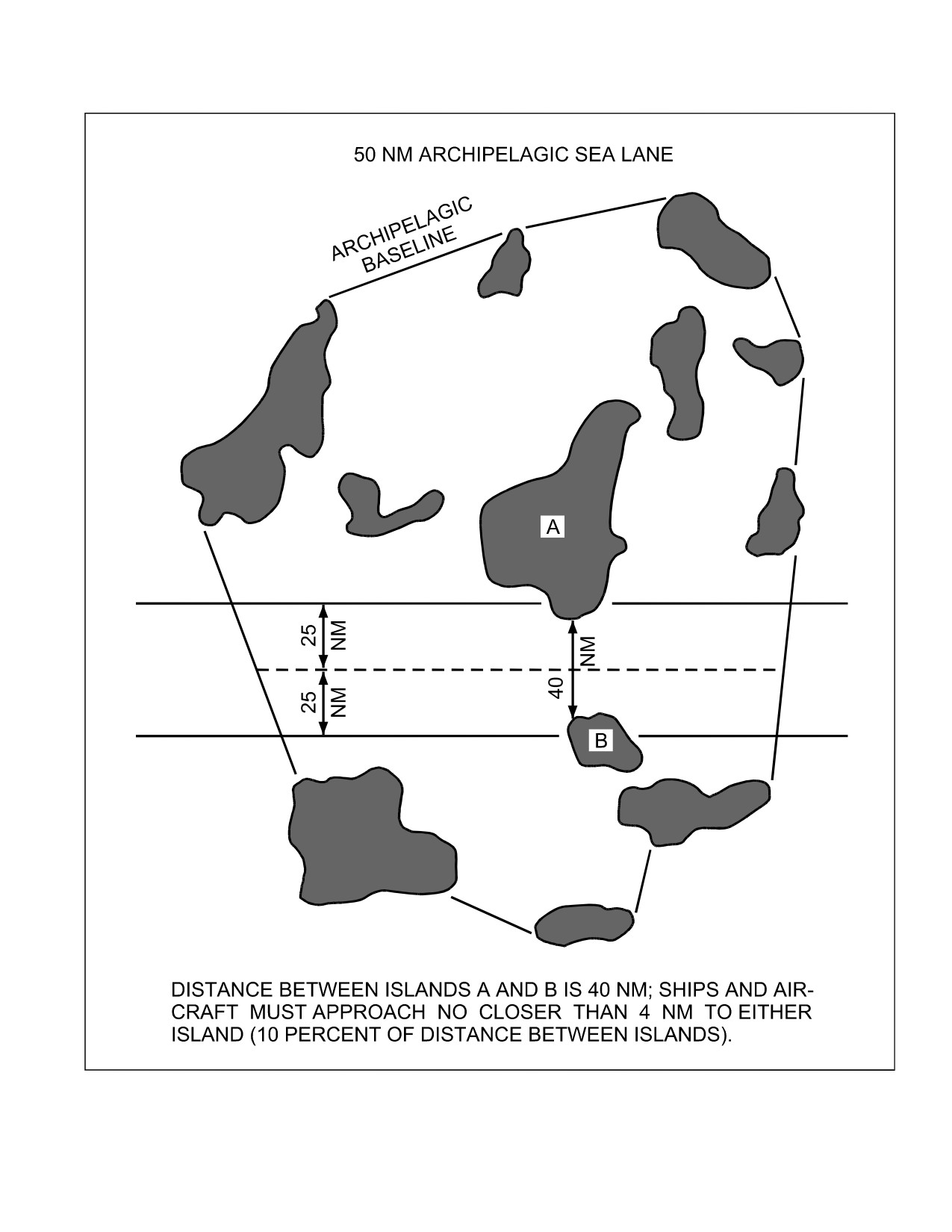
NWP 1-14M
Figure 2-1. A Designated Archipelagic Sea Lane
2-8
JUL 2007
NWP 1-14M
2.5.4.2 Innocent Passage
Outside of archipelagic sea lanes, all ships, including warships, enjoy the more limited right of innocent passage
throughout archipelagic waters just as they do in the territorial sea (see paragraph 2.5.2.1). Submarines must
remain on the surface and fly their national flag. Any threat or use of force directed against the sovereignty,
territorial integrity, or political independence of the archipelagic nation is prohibited. Launching and recovery of
aircraft are not allowed, nor may weapons exercises be conducted. The archipelagic nation may promulgate and
enforce reasonable restrictions on the right of innocent passage through its archipelagic waters for reasons of
navigational safety and for customs, fiscal, immigration, fishing, pollution, and sanitary purposes. Innocent
passage may be suspended temporarily by the archipelagic nation in specified areas of its archipelagic waters
when essential for the protection of its security, but it must first promulgate notice of its intentions to do so and
must apply the suspension in a nondiscriminating manner. There is no right of overflight through airspace over
archipelagic waters outside of archipelagic sea lanes.
2.6 NAVIGATION IN AND OVERFLIGHT OF INTERNATIONAL WATERS
2.6.1 Contiguous Zones
The contiguous zone is comprised of international waters in and over which the ships and aircraft, including
warships and military aircraft, of all nations enjoy the high seas freedoms of navigation and overflight as
described in paragraph 2.6.3. Although the coastal nation may exercise in those waters the control necessary to
prevent and punish infringement of its customs, fiscal, immigration, and sanitary laws that may occur within its
territory (including its territorial sea), it cannot otherwise interfere with international navigation and overflight in
and above the contiguous zone.
2.6.2 Exclusive Economic Zones
The coastal nation’s jurisdiction and control over the exclusive economic zone are limited to matters concerning
the exploration, exploitation, management, and conservation of the resources of those international waters. The
coastal nation may also exercise in the zone jurisdiction over the establishment and use of artificial islands,
installations, and structures having economic purposes; over marine scientific research (with reasonable
limitations); and over some aspects of marine environmental protection. Accordingly, the coastal nation cannot
unduly restrict or impede the exercise of the freedoms of navigation in and overflight of the exclusive economic
zone. Since all ships and aircraft, including warships and military aircraft, enjoy the high seas freedoms of
navigation and overflight and other internationally lawful uses of the sea related to those freedoms (see paragraph
2.6.3), in and over those waters, the existence of an EEZ in an area of naval operations need not, of itself, be of
operational concern to the naval commander.
2.6.2.1 Marine Scientific Research
Coastal nations may regulate marine scientific research conducted in marine areas under their jurisdiction. This
includes the EEZ and the continental shelf. Marine scientific research includes activities undertaken in the ocean
and coastal waters to expand general scientific knowledge of the marine environment for peaceful purposes, and
includes: physical and chemical oceanography, marine biology, fisheries research, scientific ocean drilling and
coring, geological/geophysical scientific surveying, as well as other activities with a scientific purpose. The
results of marine scientific research are generally made publicly available. It is the policy of the United States to
encourage freedom of marine scientific research. Accordingly, the United States does not require that other
nations obtain its consent prior to conducting marine scientific research in the U.S. EEZ.
2.6.2.2 Hydrographic Surveys and Military Surveys
Although coastal nation consent must be obtained in order to conduct marine scientific research in its EEZ, the
coastal nation cannot regulate hydrographic surveys or military surveys conducted beyond its territorial sea, nor
can it require notification of such activities.
2-9
JUL 2007
NWP 1-14M
A hydrographic survey is the obtaining of information in coastal or relatively shallow areas for the purpose of
making navigational charts and similar products to support safety of navigation. A hydrographic survey may
include measurements of the depth of water, configuration and nature of the natural bottom, direction and force of
currents, heights and times of tides and water stages, and hazards to navigation.
A military survey is the collecting of marine data for military purposes and, whether classified or not, is generally
not made publicly available. A military survey may include collection of oceanographic, hydrographic, marine
geological, geophysical, chemical, biological, acoustic, and related data.
OPNAVINST 3128.9 (series), Subj: Diplomatic Clearance for U.S. Navy Marine Data Collection Activities in
Foreign Jurisdictions, provides guidance for determining requirements and procedures for marine data collection
activities by Department of the Navy marine data collection assets. Marine data collection is a general term used
when referring to all types of survey or marine scientific activity, i.e., military surveys, hydrographic surveys, and
marine scientific research.
2.6.3 High Seas Freedoms and Warning Areas
All ships and aircraft, including warships and military aircraft, enjoy complete freedom of movement and
operation on and over the high seas. For warships, this includes task force maneuvering, flight operations, military
exercises, surveillance, intelligence gathering activities, and ordnance testing and firing. All nations also enjoy the
right to lay submarine cables and pipelines on the bed of the high seas as well as on the continental shelf beyond
the territorial sea, with coastal nation approval for the course of pipelines on the continental shelf. All of these
activities must be conducted with due regard for the rights of other nations and the safe conduct and operation of
other ships and aircraft.
Any nation may declare a temporary warning area in international waters and airspace to advise other nations of
the conduct of activities that, although lawful, are hazardous to navigation and/or overflight. The United States
and other nations routinely declare such areas for missile testing, gunnery exercises, space vehicle recovery
operations, and other purposes entailing some danger to other lawful uses of the seas by others. Notice of the
establishment of such areas must be promulgated in advance, in the form of a special warning to mariners, notice
to mariners (NOTMAR), notice to airmen (NOTAM), Hydro Altantic/Hydro Pacific (HYDROLANT/HYDROPAC)
messages, and the Global Maritime Distress and Safety System.
Ships and aircraft of other nations are not required to remain outside a declared warning area, but are obliged to
refrain from interfering with activities therein. Consequently, ships and aircraft of one nation may operate in a
warning area within international waters and airspace declared by another nation, collect intelligence and observe
the activities involved, subject to the requirement of due regard for the rights of the declaring nation to use
international waters and airspace for such lawful purposes. The declaring nation may take reasonable measures
including the use of proportionate force to protect the activities against interference. (See paragraph 4.3.7 for a
discussion of the establishment of warning zones during periods of heightened tensions not rising to the level of
international armed conflict.)
2.6.4 Declared Security and Defense Zones
As a general rule, international law does not recognize the peacetime right of any nation to restrict the navigation
and overflight of foreign warships and military aircraft beyond its territorial sea. Although several coastal nations
have asserted claims that purport to prohibit warships and military aircraft from operating in so-called security
zones extending beyond the territorial sea, such claims have no basis in international law in time of peace, and are
not recognized by the United States.
The Charter of the United Nations and general principles of international law recognize that a nation may exercise
measures of individual and collective self-defense against an armed attack or imminent threat of armed attack.
Those measures may include the establishment of “defensive sea areas” or “maritime control areas” in which the
threatened nation seeks to enforce some degree of control over foreign entry into those areas. Historically, the
establishment of such areas extending beyond the territorial sea has been restricted to periods of war or to
2-10
JUL 2007
NWP 1-14M
declared national emergency involving the outbreak of hostilities. International law does not determine the
geographic limits of such areas or the degree of control that a coastal nation may lawfully exercise over them,
beyond laying down the general requirement of reasonableness in relation to the needs of national security and
defense. (See paragraphs 7.8 and 7.9 for further discussions of the establishment and limitations of such zones in
the course of an international armed conflict.)
2.6.5 Polar Regions
2.6.5.1 Arctic/Antarctica Regions
The United States considers that the waters, ice pack, and airspace of the Arctic region beyond the lawfully claimed
territorial seas of littoral nations have international status and are open to navigation by the ships and aircraft of all
nations. Although several nations have, at times, attempted to claim sovereignty over the Arctic on the basis of
discovery, historic use, contiguity (proximity), or the so-called “sector” theory, those claims are not recognized in
international law. Accordingly, all ships and aircraft enjoy the freedoms of high seas navigation and overflight on,
over, and under the waters and ice pack of the Arctic region beyond the lawfully claimed territorial seas of littoral
states.
A number of nations have asserted conflicting and often overlapping claims to portions of Antarctica. These
claims are premised variously on discovery, contiguity, occupation and, in some cases, the “sector” theory. The
United States does not recognize the validity of the claims of other nations to any portion of the Antarctic area.
2.6.5.2 The Antarctic Treaty of 1959
The United States is a party to the multilateral treaty of 1959 governing Antarctica. Designed to encourage the
scientific exploration of the continent and to foster research and experiments in Antarctica without regard to
conflicting assertions of territorial sovereignty, the 1959 accord provides that no activity in the area undertaken
while the treaty is in force will constitute a basis for asserting, supporting, or denying such claims.
The treaty also provides that Antarctica “shall be used for peaceful purposes only,” and that “any measures of a
military nature, such as the establishment of military bases and fortifications, the carrying out of military
maneuvers, as well as the testing of any type of weapons” shall be prohibited. All stations and installations, and
all ships and aircraft at points of discharging or embarking cargo or personnel in Antarctica, are subject to
inspection by designated foreign observers. Therefore, classified activities are not conducted by the United States
in Antarctica, and all classified material is removed from U.S. ships and aircraft prior to visits to the continent. In
addition, the treaty prohibits nuclear explosions and disposal of nuclear waste anywhere south of 60o South
Latitude. The treaty does not, however, affect in any way the high seas freedoms of navigation and overflight in
the Antarctic region. The United States recognizes no territorial, territorial sea or territorial airspace claims in
Antarctica.
On 14 January 1998, the 1991 Protocol on Environmental Protection to the Antarctic Treaty, to which the United
States is a party, entered into force. The protocol designates Antarctica as a natural reserve, devoted to peace and
science, and sets forth basic principles and detailed mandatory rules applicable to human activities in Antarctica,
including obligations to accord priority to scientific research.
2.6.6 Nuclear-Free Zones
The 1968 Nuclear Weapons Non-Proliferation Treaty, to which the United States is a party, acknowledges the
right of groups of nations to conclude regional treaties establishing nuclear-free zones. Such treaties or their
provisions are binding only on parties to them or to protocols incorporating those provisions. To the extent that
the rights and freedoms of other nations, including the high seas freedoms of navigation and overflight, are not
infringed upon, such treaties are not inconsistent with international law. The 1967 Treaty for the Prohibition of
Nuclear Weapons in Latin America (Treaty of Tlatelolco) is an example of a nuclear-free zone arrangement that is
fully consistent with international law, as evidenced by U.S. ratification of its two Protocols. This in no way
2-11
JUL 2007
NWP 1-14M
affects the exercise by the United States of navigational rights and freedoms within waters covered by the Treaty
of Tlatelolco.
2.7 AIR NAVIGATION
2.7.1 National Airspace
Under international law, every nation has complete and exclusive sovereignty over its national airspace, that is,
the airspace above its territory, its internal waters, its territorial sea, and, in the case of an archipelagic nation, its
archipelagic waters. There is no right of innocent passage of aircraft through the airspace over the territorial sea
or archipelagic waters analogous to the right of innocent passage enjoyed by ships of all nations. Accordingly,
unless party to an international agreement to the contrary, all nations have complete discretion in regulating or
prohibiting flights within their national airspace (as opposed to a flight information region (FIR)—see paragraph
2.7.2.2), with the sole exceptions of overflight of international straits pursuant to transit passage and archipelagic
sea lanes pursuant to archipelagic sea lanes passage. Foreign aircraft wishing to enter national airspace must
identify themselves, seek or confirm permission to land or to transit, and must obey all reasonable orders to land,
turn back, or fly a prescribed course and/or altitude. Pursuant to the Convention on International Civil Aviation of
1944 (the Chicago Convention), civil aircraft in distress are entitled to special consideration and should be
allowed entry and emergency landing rights. Customary international law recognizes that foreign State aircraft in
distress, including military aircraft, are similarly entitled to enter national airspace and to make emergency
landings without prior coastal nation permission. The crew of such aircraft are entitled to depart expeditiously and
the aircraft must be returned. While on the ground under such circumstances, State aircraft continue to enjoy
sovereign immunity (see paragraph 2.4.2). (Concerning the right of assistance entry, see paragraph 2.5.2.6. For
jurisdiction over aerial intruders, see paragraph 4.3.2.)
2.7.1.1 International Straits Between One Part of the High Seas/EEZ and Another Part of the
High Seas/EEZ
All aircraft, including military aircraft, enjoy the right of unimpeded transit passage through the airspace above
international straits overlapped by territorial seas. Such transits must be continuous and expeditious, and the
aircraft involved must refrain from the threat or the use of force against the sovereignty, territorial integrity, or
political independence of the nation or nations bordering the strait. The exercise of the right of overflight by
aircraft engaged in the transit passage of international straits cannot be impeded or suspended in peacetime for
any purpose.
In international straits not completely overlapped by territorial seas, all aircraft, including military aircraft, enjoy
high seas freedoms while operating in the high seas corridor beyond the territorial sea. (See paragraph 2.7.2 for a
discussion of permitted activities in international airspace.) If the high seas corridor is not of similar convenience
(e.g., to stay within the high seas corridor would be inconsistent with sound navigational practices), such aircraft
enjoy the right of unimpeded transit passage through the airspace of the strait.
2.7.1.2 Archipelagic Sea Lanes
All aircraft, including military aircraft, enjoy the right of unimpeded passage through the airspace above
archipelagic sea lanes. The right of overflight of such sea lanes is essentially identical to that of transit passage
through the airspace above international straits overlapped by territorial seas.
2.7.2 International Airspace
International airspace is the airspace over the contiguous zone, the exclusive economic zone, the high seas, and
territories not subject to national sovereignty (e.g., Antarctica). All international airspace is open to the aircraft of
all nations. Accordingly, aircraft, including military aircraft, are free to operate in international airspace without
interference from coastal nation authorities. Military aircraft may engage in flight operations, including ordnance
testing and firing, surveillance and intelligence gathering, and support of other naval activities. All such activities
must be conducted with due regard for the rights of other nations and the safety of other aircraft and of vessels.
2-12
JUL 2007
NWP 1-14M
(Note, however, that the Antarctic Treaty prohibits military maneuvers and weapons testing in Antarctic airspace.)
These same principles apply with respect to the overflight of high seas or EEZ corridors through that part of
international straits not overlapped by territorial seas.
2.7.2.1 Convention on International Civil Aviation
The United States is a party to the 1944 Convention on International Civil Aviation (as are most nations). That
multilateral treaty, commonly referred to as the “Chicago Convention,” applies to civil aircraft. It does not apply
to military aircraft or U.S. government charter aircraft designated as “State aircraft” (see paragraph 2.4.2), other
than to require that they operate with “due regard for the safety of navigation of civil aircraft.” The Chicago
Convention established the International Civil Aviation Organization (ICAO) to develop international air
navigation principles and techniques and to “promote safety of flight in international air navigation.”
Various operational situations do not lend themselves to ICAO flight procedures. These include military
contingencies, classified missions, politically sensitive missions, or routine aircraft carrier operations. Operations
not conducted under ICAO flight procedures are conducted under the “due regard” standard. (For additional
information see DOD Directive 4540.1, Use of Airspace by US Military Aircraft and Firings Over the High Seas,
and OPNAVINST 3770.4, Use of Airspace by US Military Aircraft and Firing Over the High Seas, and
Commandant, United States Coast Guard Instruction COMDTINST M3710.1, Coast Guard Air Operations
Manual.)
2.7.2.2 Flight Information Regions
A Flight Information Region (FIR) is a defined area of airspace within which flight information and alerting
services are provided. FIRs are established by ICAO for the safety of civil aviation and encompass both national
and international airspace. Ordinarily, but only as a matter of policy, U.S. military aircraft on routine point-to-
point flights through international airspace follow ICAO flight procedures and utilize FIR services. As mentioned
above, exceptions to this policy include military contingency operations, classified or politically sensitive
missions, and routine aircraft carrier operations or other training activities. When U.S. military aircraft do not
follow ICAO flight procedures, they must navigate with “due regard” for civil aviation safety.
Some nations, however, purport to require all military aircraft in international airspace within their FIRs to
comply with FIR procedures, whether or not they utilize FIR services or intend to enter national airspace. The
United States does not recognize the right of a coastal nation to apply its FIR procedures to foreign military
aircraft in such circumstances. Accordingly, U.S. military aircraft not intending to enter national airspace should
not identify themselves or otherwise comply with FIR procedures established by other nations, unless the United
States has specifically agreed to do so.
2.7.2.3 Air Defense Identification Zones in International Airspace
International law does not prohibit nations from establishing air defense identification zones (ADIZ) in the
international airspace adjacent to their territorial airspace. The legal basis for ADIZ regulations is the right of a
nation to establish reasonable conditions of entry into its territory. Accordingly, an aircraft approaching national
airspace can be required to identify itself while in international airspace as a condition of entry approval. ADIZ
regulations promulgated by the United States apply to aircraft bound for U.S. territorial airspace and require the
filing of flight plans and periodic position reports. The United States does not recognize the right of a coastal
nation to apply its ADIZ procedures to foreign aircraft not intending to enter national airspace nor does the United
States apply its ADIZ procedures to foreign aircraft not intending to enter U.S. airspace. Accordingly, U.S.
military aircraft not intending to enter national airspace should not identify themselves or otherwise comply with
ADIZ procedures established by other nations, unless the United States has specifically agreed to do so.
It should be emphasized that the foregoing contemplates a peacetime or nonhostile environment. In the case of
imminent or actual hostilities, a nation may find it necessary to take measures in self-defense that will affect
overflight in international airspace.
2-13
JUL 2007
NWP 1-14M
2.7.3 Open Skies Treaty
Initially proposed by President Eisenhower in 1955 to foster mutual and cooperative aerial observation among
NATO and Warsaw Pact nations, the 1992 Open Skies Treaty entered into force on 1 January 2002. The Treaty
obligates each of its member nations to accept overflight of its entire national territory by other member nations
using unarmed aircraft equipped with mutually agreed sensors. Overflight quotas are scaled to the physical size of
the participating nations with the United States and Russia/Belarus (a multiple nation entity permitted for this
purpose) each being obliged to accept up to 42 such flights annually.
Although the European security environment has changed dramatically since the Treaty was negotiated in 1992, it
remains a useful element in the European security framework providing a further means for transparency, mutual
understanding, and cooperation among its members. Member nations are Belarus, Belgium, Bulgaria, Canada,
Czech Republic, Denmark, France, Georgia, Germany, Greece, Hungary, Iceland, Italy, Luxembourg, the
Netherlands, Norway, Poland, Portugal, Romania, Russia, Slovak Republic, Spain, Turkey, Ukraine, the United
Kingdom, and the United States.
Department of the Navy guidance on the implementation of the Open Skies Treaty is reflected in Secretary of the
Navy Instruction (SECNAVINST) 5710.26, Compliance and Implementation of the Treaty on Open Skies.
Department of the Navy policy is to comply with all provisions of the Open Skies Treaty while also complying
with Navy and Marine Corps safety and security directives. When conducting an overflight, Open Skies aircraft
have priority in air traffic control systems over all other air traffic except declared emergencies or actual
emergency aircraft. Open Skies aircraft are allowed to overfly the entire national territory of a signatory state,
regardless of airspace restrictions except for safety of flight issues. Open Skies aircraft are permitted access to the
airspace above all Department of the Navy and other military facilities, bases, and programs, as well as to any
other airspace in U.S. territory.
2.8 EXERCISE AND ASSERTION OF NAVIGATION AND OVERFLIGHT RIGHTS AND FREEDOMS
As announced in the president’s United States Oceans Policy statement of 10 March 1983:
The United States will exercise and assert its navigation and overflight rights and freedoms on a
worldwide basis in a manner that is consistent with the balance of interests reflected in the [1982 LOS]
convention. The United States will not, however, acquiesce in unilateral acts of other states designed to
restrict the rights and freedoms of the international community in navigation and overflight and other
related high seas uses.
When maritime nations appear to acquiesce in excessive maritime claims and fail to exercise their rights actively
in the face of constraints on international navigation and overflight, those claims and constraints may, in time, be
considered to have been accepted by the international community as reflecting the practice of nations and as
binding upon all users of the seas and superjacent airspace. Consequently, it is incumbent upon maritime nations
to protest diplomatically all excessive claims of coastal nations and to exercise their navigation and overflight
rights in the face of such claims. The president’s Oceans Policy Statement makes clear that the United States has
accepted this responsibility as a fundamental element of its national policy.
Since the early 1970s, the United States, through DOD Instruction C2005.1 Freedom of Navigation (FON)
Program (U), has reaffirmed its long-standing policy of exercising and asserting its freedom of navigation and
overflight rights on a worldwide basis. Under the FON Program, challenges of excessive maritime claims of other
nations are undertaken both through diplomatic protests by the Department of State and by operational assertions
by US Armed Forces. U.S. Freedom of Navigation Program assertions are designed to be politically neutral as
well as nonprovocative and have encouraged nations to amend their claims and bring their practices into
conformity with the Convention. Commanders and commanding officers should refer to combatant commander
theater-specific guidance and appropriate operational orders (OPORDs) for specific guidance on the planning and
execution of FON operations in a particular area of operations.
2-14
JUL 2007
NWP 1-14M
2.9 RULES FOR NAVIGATIONAL SAFETY FOR VESSELS AND AIRCRAFT
2.9.1 International Rules
Most rules for navigational safety governing surface and subsurface vessels, including warships, are contained in
the International Regulations for Preventing Collisions at Sea, 1972, known informally as the or 72 COLREGS
informally as the “International Rules of the Road.” These rules apply to all international waters (i.e., the high
seas, exclusive economic zones, and contiguous zones) and, except where a coastal nation has established
different rules, in that nation’s territorial sea, archipelagic waters, and inland waters as well. The 1972 COLREGS
have been adopted as law by the United States. (See Title 33, US Code (USC), Sections 1601 to 1606 (33 USC
1601 and 1606).) US Navy Regulations, 1990 Article 1139, directs that all persons in the naval service
responsible for the operation of naval ships and craft “shall diligently observe” the 72 COLREGS. In accordance
with COMDTINST M5000.3, Coast Guard Regulations, Coast Guard personnel must comply with all Federal law
and regulatations.
2.9.2 National US Inland Rules
Many nations have adopted special rules for waters subject to their territorial sovereignty (i.e., internal waters,
archipelagic waters, and territorial seas). Violation of these rules by U.S. government vessels, including warships,
may subject the United States to lawsuit for collision or other damage, provide the basis for diplomatic protest,
result in limitation on U.S. access to foreign ports, or prompt other foreign action.
The United States has adopted special inland rules applicable to navigation in US waters landward of the
demarcation lines established by US law for that purpose. (See COMDTINST M16672.2D, Navigation Rules,
International — Inland; Title 33, Code of Federal Regulations, part 80; and 33, USC 2001 to 2073.) The 72
COLREGS apply seaward of the demarcation lines in US national waters, in the US contiguous zone and EEZ,
and on the high seas.
2.9.3 Navigational Rules for Aircraft
Rules for air navigation in international airspace applicable to civil aircraft may be found in Annex 2 (Rules of the
Air) to the Chicago Convention, DOD Flight Information Publication (FLIP) General Planning, and
OPNAVINST 3710.7 (series) Naval Air Training and Operating Procedures Standaridzations (NATOPS) General
Flight and Operating Instructions. The same standardized technical principles and policies of ICAO that apply in
international and most foreign airspace are also in effect in the continental United States. Consequently, US pilots
can fly all major international routes following the same general rules of the air, using the same navigation
equipment and communication practices and procedures, and being governed by the same air traffic control
services with which they are familiar in the United States. Although ICAO has not yet established an
“International Language for Aviation,” English is customarily used internationally for air traffic control.
2.10 MILITARY AGREEMENTS AND COOPERATIVE MEASURES TO PROMOTE AIR AND
MARITIME SAFETY
2.10.1 United States-Union of Soviet Socialist Republic Agreement on the Prevention of
Incidents On and Over the High Seas
In order better to assure the safety of navigation and flight of their respective warships and military aircraft during
encounters at sea, the United States and the former Union of the Soviet Republics (USSR) in 1972 entered into
the US-USSR agreement on the Prevention of Incidents On and Over the High Seas. This Navy-to-Navy
agreement, popularly referred to as the “Incidents at Sea” or “INCSEA” agreement, has been highly successful in
minimizing the potential for harassing actions and navigational one-upmanship between United States and former
Soviet Union units operating in close proximity at sea. Although the agreement applies to warships and military
aircraft operating on and over the “high seas,” it is understood to embrace such units operating in all international
waters and international airspace, including that of the exclusive economic zone and the contiguous zone.
2-15
JUL 2007
NWP 1-14M
Principal provisions of the INCSEA agreement include:
1. Ships will observe strictly both the letter and the spirit of the 72 COLREGS.
2. Ships will remain well clear of one another to avoid risk of collision and, when engaged in surveillance
activities, will exercise good seamanship so as not to embarrass or endanger ships under surveillance.
3. Ships will utilize special signals for signaling their operation and intentions.
4. Ships of one party will not simulate attacks by aiming guns, missile launchers, torpedo tubes, or other
weapons at the ships and aircraft of the other party, and will not launch any object in the direction of
passing ships nor illuminate their navigation bridges.
5. Ships conducting exercises with submerged submarines will show the appropriate signals to warn of
submarines in the area.
6. Ships, when approaching ships of the other party, particularly those engaged in replenishment or flight
operations, will take appropriate measures not to hinder maneuvers of such ships and will remain well clear.
7. Aircraft will use the greatest caution and prudence in approaching aircraft and ships of the other party, in
particular ships engaged in launching and landing aircraft, and will not simulate attacks by the simulated
use of weapons or perform aerobatics over ships of the other party nor drop objects near them.
The INCSEA agreement was amended in a 1973 protocol to extend certain of its provisions to include nonmilitary
ships. Specifically, the 1973 protocol provided that U.S. and Soviet military ships and aircraft shall not make
simulated attacks by aiming guns, missile launchers, torpedo tubes, and other weapons at nonmilitary ships of the
other party nor launch or drop any objects near nonmilitary ships of the other party in such a manner as to be
hazardous to these ships or to constitute a hazard to navigation.
The agreement also provides for an annual review meeting between Navy representatives of the two parties to
review its implementation. The INCSEA agreement continues to apply to U.S. and Russian ships and military
aircraft and is also in force between the United States and Ukraine.
OPNAVINST 5711.96 (series), US/USSR Incidents At Sea and Dangerous Military Activities Agreements,
provides information on and issues procedures concerning the INCSEA Agreement including the Table of
Supplementary Signals authorized for use during communications between US and Russian Federation units
under the INCSEA agreement.
2.10.2 United States-Union of Soviet Socialist Republic Agreement on the Prevention of
Dangerous Military Activities
To avoid dangerous situations arising between their respective military forces when operating in proximity to
each other during peacetime, the United States and the former Soviet Union in 1990 entered into the U.S.-
U.S.S.R. Agreement on the Prevention of Dangerous Military Activities. The agreement, commonly referred to as
the “DMA agreement,” addresses four specific activities:
1. Unintentional or distress (force majeure) entry into the national territory of the other party;
2. Use of lasers in a manner hazardous to the other party;
3. Hampering operations in a manner hazardous to the other party in a “special caution area”; and
4. Interference with command and control networks in a manner hazardous to the other party.
2-16
JUL 2007
NWP 1-14M
The DMA agreement continues to apply to US and Russian Federation armed forces. OPNAVINST 5711.96B
provides implementing guidance for the DMA agreement to Navy department units.
2.10.3 U.S.-China Military Maritime Consultative Agreement
Established on 19 January 1998 by an agreement between the US Secretary of Defense and the Minister of
National Defence of the People’s Republic of China (PRC), the Military Maritime Consultative Agreement
(MMCA) provides a forum for conducting military exchanges between the United States and PRC to strengthen
maritime and air safety. The MMCA does not establish legally binding procedures between the countries but,
rather, provides a mechanism to facilitate consultations between their respective maritime and air forces. The
MMCA forum addresses such measures to promote safe maritime practices as:
1. Search and rescue activities
2. Communications procedures when ships encounter each other
3. Interpretations of the International Rules of the Road
4. Avoidance of accidents at sea.
2.11 MILITARY ACTIVITIES IN OUTER SPACE
2.11.1 Outer Space Defined
As noted in paragraph 1.9, each nation has complete and exclusive control over the use of its national airspace.
Except when exercising transit passage or archipelagic sea lanes passage, overflight in national airspace by
foreign aircraft is not authorized without the consent of the territorial sovereign. However, man-made satellites
and other objects in earth orbit may overfly foreign territory freely. Although there is no legally defined boundary
between the upper limit of national airspace and the lower limit of outer space, international law recognizes
freedom of transit by man-made space objects at earth orbiting altitude and beyond. A generally acceptable
definition is that outer space begins at the undefined upper limit of the earth’s airspace and extends to infinity.
2.11.2 The Law of Outer Space
International law, including the Charter of the United Nations, applies to the outer space activities of nations.
Outer space is open to exploration and use by all nations. However, it is not subject to national appropriation, and
must be used for peaceful purposes. The term “peaceful purposes” does not preclude military activity. While acts
of aggression in violation of the Charter of the United Nations are precluded, space-based systems may lawfully
be employed to perform essential command, control, communications, intelligence, navigation, environmental,
surveillance, and warning functions to assist military activities on land, in the air, and on and under the sea. Users
of outer space must have due regard for the rights and interests of other users.
2.11.2.1 General Principles of the Law of Outer Space
International law governing space activities addresses both the nature of the activity and the location in space
where the specific rules apply. In general terms, outer space consists of both the earth’s moon and other natural
celestial bodies, and the expanse between these natural objects.
The rules of international law applicable to outer space include the following:
1. Access to outer space is free and open to all nations.
2. Outer space is free from claims of sovereignty and not otherwise subject to national appropriation.
3. Outer space is to be used for peaceful purposes.
2-17
JUL 2007
NWP 1-14M
4. Each user of outer space must show due regard for the rights of others.
5. No nuclear or other weapons of mass destruction may be stationed in outer space.
6. Nuclear explosions in outer space are prohibited.
7. Exploration of outer space must avoid contamination of the environment of outer space and of the earth’s
biosphere.
8. Astronauts must render all possible assistance to other astronauts in distress.
2.11.2.2 Natural Celestial Bodies
Natural celestial bodies include the earth’s moon, but not the earth. Under international law, military bases,
installations, and forts may not be erected nor may weapons tests or maneuvers be undertaken on natural celestial
bodies. Moreover, all equipment, stations, and vehicles located there are open to inspection on a reciprocal basis.
There is no corresponding right of physical inspection of man-made objects located in the expanse between
celestial bodies. Military personnel may be employed on natural celestial bodies for scientific research and for
other activities undertaken for peaceful purposes.
2.11.3 International Agreements
1. Outer Space Activities. The key legal principles governing outer space activities are contained in four
widely ratified multilateral agreements: the 1967 Outer Space Treaty; the 1968 Rescue and Return of
Astronauts Agreement; the Liability Convention of 1972; and the Space Objects Registration Convention
of 1975. A fifth, the 1979 Moon Treaty, has not been widely ratified. The United States is a party to all of
these agreements except the Moon Treaty.
2. Related. Several other international agreements restrict specific types of activity in outer space. The U.S.-
U.S.S.R. Anti-Ballistic Missile (ABM) Treaty of 1972, which is no longer in force, prohibited the
development, testing, and deployment of space-based ABM systems or components. Also prohibited was
any interference with the surveillance satellites both nations used to monitor ABM Treaty compliance. The
ABM Treaty was continued in force between the United States and Russia, the United States and Belarus,
the United States and Kazakhstan, and the United States and Ukraine. However, on 13 December 2001, the
United States provided notice of its withdrawal from the Treaty effective 13 June 2002.
a. The 1963 Limited Test Ban Treaty (a multilateral treaty) includes an agreement not to test nuclear
weapons or to carry out any other nuclear explosions in outer space.
b. The 1977 Environmental Modification Convention (also a multilateral treaty) prohibits military or other
hostile use of environmental modification techniques in several environments, including outer space.
c. The 1992 Constitution and Convention of the International Telecommunication Union and the
associated Radio Regulations govern the use of the radio frequency spectrum by satellites and the
location of satellites in the geostationary-satellite orbit.
2.11.4 Rescue and Return of Astronauts
Both the Outer Space Treaty and the Rescue and Return of Astronauts Agreement establish specific requirements
for coming to the aid of astronauts. The treaties do not distinguish between civilian and military astronauts.
Astronauts of one nation engaged in outer space activities are to render all possible assistance to astronauts of
other nations in the event of accident or distress. If a nation learns that spacecraft personnel are in distress or have
made an emergency or unintended landing in its territory, the high seas, or other international area (e.g.,
Antarctica), it must notify the launching nation and the secretary-general of the United Nations, take immediate
2-18
JUL 2007
NWP 1-14M
steps to rescue the personnel if within its territory, and, if in a position to do so, extend search and rescue
assistance if a high seas or other international area landing is involved. Rescued personnel are to be safely and
promptly returned.
Nations also have an obligation to inform the other parties to the Outer Space Treaty or the Secretary-General of
the United Nations if they discover outer space phenomena that constitute a danger to astronauts.
2.11.5 Return of Outer Space Objects
A party to the Rescue and Return of Astronauts Agreement must also notify the secretary-general of the United
Nations if it learns of an outer space object’s return to earth in its territory, on the high seas, or in another
international area. If the object is located in sovereign territory and the launching authority requests the territorial
sovereign’s assistance, the latter must take steps to recover and return the object if practicable. Similarly, such
objects found in international areas shall be held for or returned to the launching authority on request. Expenses
incurred in assisting the launching authority in either case are to be borne by the launching authority. Should a
nation discover that such an object is of a “hazardous or deleterious” nature, it is entitled to immediate action by
the launching authority to eliminate the danger of harm from its territory.
2-19
JUL 2007
NWP 1-14M
INTENTIONALLY BLANK
2-20
JUL 2007
NWP 1-14M
CHAPTER 3
Protection of Persons and Property at Sea
and Maritime Law Enforcement
3.1 INTRODUCTION
The protection of both U.S. and foreign persons and property at sea by U.S. naval forces in peacetime involves
international law, domestic U.S. law and policy, and political considerations. Vessels and aircraft on and over the
sea, and the persons and cargo embarked in them, are subject to the hazards posed by the ocean itself, by storm,
by mechanical failure, and by the actions of others such as pirates, terrorists, and insurgents. In addition, foreign
authorities and prevailing political situations may affect a vessel or aircraft and those on board by involving them
in refugee rescue efforts, political asylum requests, law enforcement actions, or applications of unjustified use of
force against them.
Given the complexity of the legal, political, and diplomatic considerations that may arise in connection with the
use of naval forces to protect civilian persons and property at sea, operational plans, operational orders, and, most
importantly, the standing rules of engagement (SROE) promulgated by the operational chain of command
ordinarily require the on-scene commander to report immediately such circumstances to a higher authority and,
whenever it is practicable under the circumstances to do so, to seek guidance prior to the use of armed force.
A nation may enforce its domestic laws at sea provided there is a valid jurisdictional basis under international law
to do so. Because U.S. naval commanders may be called upon to assist in maritime law enforcement actions, or to
otherwise protect persons and property at sea, a basic understanding of maritime law enforcement procedures is
essential.
3.2 RESCUE, SAFE HARBOR, AND QUARANTINE
Mishap at sea is a common occurrence. The obligation of mariners to provide material aid in cases of distress
encountered at sea has long been recognized in custom and tradition. A right to enter and remain in a safe harbor
without prejudice, at least in peacetime, when required by the perils of the sea or force majeure is universally
recognized. At the same time, a coastal nation may lawfully promulgate quarantine regulations and restrictions for
the port or area in which a vessel is located.
3.2.1 Assistance to Persons, Ships, and Aircraft in Distress
Customary international law has long recognized the affirmative obligation of mariners to go to the assistance of
those in danger of being lost at sea. Both the 1958 Geneva Convention on the High Seas and the 1982 LOS
Convention codify this custom by providing that every nation shall require the master of a ship flying its flag,
insofar as he can do so without serious danger to his ship, crew, or passengers, to render assistance to any person
found at sea in danger of being lost and to proceed with all possible speed to the rescue of persons in distress if
informed of their need of assistance, insofar as it can reasonably be expected of him. He is also to be required,
after a collision, to render assistance to the other ship, its crew, and its passengers and, where possible, to inform
the other ship of the name of his own ship, its port of registry, and the nearest port at which it will call. (See
paragraph 2.5.2.6 for a discussion of “Assistance Entry.”)
3-1
JUL 2007
NWP 1-14M
3.2.1.1 Duty of Masters
In addition, the United States is party to the 1974 London Convention on Safety of Life at Sea, which requires the
master of every merchant ship and private vessel not only to speed to the assistance of persons in distress, but to
broadcast warning messages with respect to dangerous conditions or hazards encountered at sea.
3.2.1.2 Duty of Naval Commanders
US Navy Regulations, 1990, Article 0925, requires that, insofar as he can do so without serious danger to his ship
or crew, the commanding officer or senior officer present, as appropriate, shall proceed with all possible speed to
the rescue of persons in distress if informed of their need for assistance (insofar as this can reasonably be expected
of him); render assistance to any person found at sea in danger of being lost; and, after a collision, render
assistance to the other ship, her crew and passengers, and, where possible, inform the other ship of his identity.
Article 4-2-5, COMDTINST M5000.3, US Coast Guard Regulations, Article 4-2-5, (series) imposes a similar
duty for the Coast Guard.
3.2.2 Safe Harbor/Innocent Passage
Under international law, no port may be closed to a foreign ship seeking shelter from storm or bad weather or
otherwise compelled to enter it in distress, unless another equally safe port is open to the distressed vessel to
which it may proceed without additional jeopardy or hazard. The only condition is that the distress must be real
and not contrived and based on a well-founded apprehension of loss of or serious damage or injury to the vessel,
cargo, or crew. In general, the distressed vessel may enter a port without being subject to local regulations
concerning any incapacity, penalty, prohibition, duties, or taxes in force at that port.
Innocent passage through territorial seas and archipelagic waters includes stopping and anchoring when incidental
to ordinary navigation, necessitated by force majeure or by distress. Stopping and anchoring in such waters for the
purpose of rendering assistance to others in similar danger or distress is also permitted by international law.
3.2.3 Quarantine
Article 0859, U.S. Navy Regulations, 1990, requires that the commanding officer or aircraft commander of a ship
or aircraft comply with quarantine regulations and restrictions. While commanding officers and aircraft
commanders shall not permit inspection of their vessel or aircraft, they shall afford every other assistance to
health officials, U.S. or foreign, and shall give all information required, insofar as permitted by the requirements
of military necessity and security. To avoid restrictions imposed by quarantine regulations, the commanding
officer should request free pratique in accordance with the sailing directions for that port.
3.3 ASYLUM AND TEMPORARY REFUGE
3.3.1 Asylum
International law recognizes the right of a nation to grant asylum to foreign nationals already present within or
seeking admission to its territory. The United States defines “asylum” as:
Protection and sanctuary granted by the United States Government within its territorial jurisdiction or
in international waters to a foreign national who applies for such protection because of persecution or
fear of persecution on account of race, religion, nationality, membership in a particular social group, or
political opinion.
Whether to grant asylum is a decision reserved to higher authority.
3-2
JUL 2007
NWP 1-14M
3.3.1.1 Territories under the Exclusive Jurisdiction of the United States and International
Waters
Any person requesting asylum in international waters or in territories and internal waters under the exclusive
jurisdiction of the United States (including the U.S. territorial sea, the Commonwealth of Puerto Rico, the
Commonwealth of the Northern Mariana Islands, territories under U.S. administration, and U.S. possessions), will be
received on board any U.S. Navy or Marine Corps aircraft, vessel, activity or station. Persons seeking asylum are to be
afforded every reasonable care and protection permitted by the circumstances. Under no circumstances will a person
seeking asylum in U.S. territory or in international waters be surrendered by the Navy or Marine Corps to foreign
jurisdiction or control, unless at the personal direction of the Secretary of the Navy or higher authority. With respect to
the Coast Guard, individuals seeking asylum will not be received on board Coast Guard units except in extreme
circumstances and in no case will they be received on board a Coast Guard aircraft. However, once such individuals are
received on board a Coast Guard unit, they will not be surrendered to foreign jurisdiction without Commandant
approval unless the commanding officer/officer-in-charge determines the risk to the unit or Coast Guard personnel has
become unacceptable or the individual voluntarily departs the unit. (See US Navy Regulations 1990, Article 0939;
SECNAVINST 5710.22A, Political Asylum and Temporary Refuge, and COMDTINST M16247.1, Coast Guard
Maritime Law Enforcement Manual, (MLEM), Appendix L, for specific guidance.)
3.3.1.2 Territories under Foreign Jurisdiction
Commanders of U.S. warships, military aircraft, and military installations in territories under foreign jurisdiction
(including foreign territorial seas, archipelagic waters, internal waters, ports, territories, and possessions) are not
authorized to receive on board foreign nationals seeking asylum. Such persons should be referred to the American
Embassy or nearest U.S. consulate in the country, foreign territory, or foreign possession involved, if any, for
assistance in coordinating a request for asylum with the host government insofar as practicable. Because warships
are extensions of the sovereignty of the flag nation and because of their immunity from the territorial sovereignty
of the foreign nation in whose waters they may be located, they have often been looked to as places of asylum.
The United States, however, considers that asylum is generally the prerogative of the government of the territory
in which the warship is located.
However, if exceptional circumstances exist involving imminent danger to the life or safety of the person,
temporary refuge may be granted. (See paragraph 3.3.2.)
3.3.1.3 Expulsion or Surrender
Article 33 of the 1951 Convention Relating to the Status of Refugees provides that a refugee may not be expelled
or returned in any manner whatsoever to the frontier or territories of a nation where his life or freedom would be
threatened on account of his race, religion, nationality, political opinion, or membership in a particular social
group, unless he may reasonably be regarded as a danger to the security of the country of asylum or has been
convicted of a serious crime and is a danger to the community of that country. This obligation applies only to
persons who have entered territories under the exclusive jurisdiction of the United States. It does not apply to
temporary refuge granted abroad.
3.3.2 Temporary Refuge/Termination or Surrender
International law and practice have long recognized the humanitarian practice of providing temporary refuge to
anyone, regardless of nationality, who may be in imminent physical danger for the duration of that danger. (See
Article 0939, U.S. Navy Regulations, 1990, SECNAVINST 5710.22 (series), and the Coast Guard’s MLEM.)
SECNAVINST 5710.22 defines “temporary refuge” as:
Protection afforded for humanitarian reasons to a foreign national in a DOD shore installation, facility,
or military vessel within the territorial jurisdiction of a foreign nation or [in international waters], under
conditions of urgency in order to secure the life or safety of that person against imminent danger, such
as pursuit by a mob.
3-3
JUL 2007
NWP 1-14M
It is the policy of the United States to grant temporary refuge in a foreign country to nationals of that country, or
nationals of a third nation, solely for humanitarian reasons when extreme or exceptional circumstances put in
imminent danger the life or safety of a person, such as pursuit by a mob. The officer in command of the ship,
aircraft (but not Coast Guard aircraft), station, or activity must decide which measures can prudently be taken to
provide temporary refuge. Temporary refuge shall not be granted on board a Coast Guard aircraft. When deciding
which measures may be prudently taken to provide temporary refuge, the safety of U.S. personnel and security of
the unit must be taken into consideration.
Although temporary refuge should be terminated when the period of active danger is ended, the decision to
terminate protection will not be made by the commander. Once a Navy or Marine Corps unit has granted
temporary refuge, protection may be terminated only when directed by the Secretary of the Navy or higher
authority. In the case of the Coast Guard, temporary refuge will not be terminated without commandant approval
unless the commanding officer/officer-in-charge determines the risk to the unit or Coast Guard personnel has
become unacceptable or the claimant voluntarily departs the unit. (See Article 0939, US Navy Regulations, 1990;
SECNAVINST 5710.22, A political Asylum and Temporary Refuge, and COMDTINST M16247.1, Coast Guard
Maritime Law Enforcement Manual (MLEM), Appendix L, for specific guidance.)
A request by foreign authorities for return of custody of a person under the protection of temporary refuge will be
reported in accordance with SECNAVINST 5710.22 (series). The requesting foreign authorities will then be
advised that the matter has been referred to higher authorities.
3.3.3 Inviting Requests for Asylum or Refuge
U.S. armed forces personnel shall neither directly nor indirectly invite persons to seek asylum or temporary
refuge.
3.3.4 Protection of U.S. Citizens
The limitations on asylum and temporary refuge are not applicable to U.S. citizens. See paragraph 3.10 and the
standing rules of engagement for applicable guidance.
3.4 RIGHT OF APPROACH AND VISIT
As a general principle, vessels in international waters are immune from the jurisdiction of any nation other than
the flag nation. However, under international law, a warship, military aircraft, or other duly authorized ship or
aircraft may approach any vessel in international waters to verify its nationality. Unless the vessel encountered is
itself a warship or government vessel of another nation, it may be stopped, boarded, and the ship’s documents
examined, provided there is reasonable ground for suspecting that it is:
1. Engaged in piracy (see paragraph 3.5);
2. Engaged in the slave trade (see paragraph 3.6);
3. Engaged in unauthorized broadcasting (see paragraph 3.7);
4. Without nationality (see paragraphs 3.11.2.3 and 3.11.2.4); or
5. Though flying a foreign flag, or refusing to show its flag, the vessel is, in reality, of the same nationality as
the warship.
The procedure for ships exercising the right of approach and visit is similar to that used in exercising the
belligerent right of visit and search during armed conflict described in paragraph 7.6.1. See OPNAVINST
3120.32C, Standard Organization and Regulations of the US Navy and COMDTINST M16247.1, Coast Guard
Maritime Law Enforcement Manuel (MLEM) for further guidance.
3-4
JUL 2007
NWP 1-14M
3.5 REPRESSION OF PIRACY
International law has long recognized a general duty of all nations to cooperate in the repression of piracy. This
traditional obligation is included in the 1958 Geneva Convention on the High Seas and the 1982 LOS Convention,
both of which provide:
[A]ll States shall cooperate to the fullest possible extent in the repression of piracy on the high seas or in any other
place outside the jurisdiction of any State.
3.5.1 U.S. Law
The U.S. Constitution (Article I, Section 8) provides that:
The Congress shall have Power… to define and punish piracies and felonies committed on the high
seas, and offences against the Law of Nations.
Congress has exercised this power by enacting 18 USC 1651, which provides that:
Whoever, on the high seas, commits the crime of piracy as defined by the law of nations, and is
afterwards brought into or found in the United States, shall be imprisoned for life.
U.S. law authorizes the president to employ “public armed vessels” in protecting U.S. merchant ships from piracy
and to instruct the commanders of such vessels to seize any pirate ship that has attempted or committed an act of
piracy against any U.S. or foreign flag vessel in international waters.
3.5.2 Piracy Defined
Piracy is an international crime consisting of illegal acts of violence, detention, or depredation committed for
private ends by the crew or passengers of a private ship or aircraft in or over international waters against another
ship or aircraft or persons and property on board. (Depredation is the act of plundering, robbing, or pillaging.)
3.5.2.1 Location
In international law piracy is a crime that can be committed only on or over international waters (including the
high seas, exclusive economic zone, and the contiguous zone), in international airspace, and in other places
beyond the territorial jurisdiction of any nation. The same acts committed in the internal waters, territorial sea,
archipelagic waters, or national airspace of a nation do not constitute piracy in international law but are, instead,
crimes within the jurisdiction and sovereignty of the littoral nation.
3.5.2.2 Private Ship or Aircraft
Acts of piracy can only be committed by private ships or private aircraft. A warship or other public vessel or a
military or other state aircraft cannot be treated as a pirate unless it is taken over and operated by pirates or unless
the crew mutinies and employs it for piratical purposes. By committing an act of piracy, the pirate ship or aircraft,
and the pirates themselves, lose the protection of the nation whose flag they are otherwise entitled to fly.
3.5.2.3 Mutiny or Passenger Hijacking
If the crew or passengers of a ship or aircraft, including the crew of a warship or military aircraft, mutiny or revolt
and convert the ship, aircraft or cargo to their own use, the act is not piracy. If, however, the ship or aircraft is
thereafter used to commit acts of piracy, it becomes a pirate ship or pirate aircraft and those on board voluntarily
participating in such acts become pirates.
3-5
JUL 2007
NWP 1-14M
3.5.3 Use of Naval Forces to Repress Piracy
Only warships, military aircraft, or other ships or aircraft clearly marked and identifiable as being on
governmental service and authorized to that effect, may seize a pirate ship or aircraft.
3.5.3.1 Seizure of Pirate Vessels and Aircraft
A pirate vessel or aircraft encountered in or over U.S. or international waters may be seized and detained by any
of the U.S. vessels or aircraft listed in paragraph 3.5.3. The pirate vessel or aircraft, and all persons on board,
should be taken, sent, or directed to the nearest U.S. port or airfield and delivered to U.S. law enforcement
authorities for disposition according to U.S. law. Alternatively, higher authority may arrange with another nation
to accept and try the pirates and dispose of the pirate vessel or aircraft, since every nation has jurisdiction under
international law over any act of piracy.
3.5.3.2 Pursuit of Pirates into Foreign Territorial Seas, Archipelagic Waters, or Airspace
If a pirate vessel or aircraft fleeing from pursuit by a warship or military aircraft proceeds from international
waters or airspace into the territorial sea, archipelagic waters, or superjacent airspace of another country, every
effort should be made to obtain the consent of the nation having sovereignty over the territorial sea, archipelagic
waters, or superjacent airspace to continue pursuit (see paragraphs 3.11.2.2. and 3.11.3.3). The inviolability of the
territorial integrity of sovereign nations makes the decision of a warship or military aircraft to continue pursuit
into these areas without such consent a serious matter. However, the international nature of the crime of piracy
may allow continuation of pursuit if contact cannot be established in a timely manner with the coastal nation to
obtain its consent. In such a case, pursuit must be broken off immediately upon request of the coastal nation, and,
in any event, the right to seize the pirate vessel or aircraft and to try the pirates devolves on the nation to which
the territorial seas, archipelagic waters, or airspace belong.
Pursuit of a pirate vessel or aircraft through or over international straits overlapped by territorial seas or through
archipelagic sea lanes or air routes, may proceed with or without the consent of the coastal nation or nations,
provided the pursuit is expeditious and direct and the transit passage or archipelagic sea lanes passage rights of
others are not unreasonably constrained in the process.
3.6 PROHIBITION OF THE TRANSPORT OF SLAVES
International law strictly prohibits use of the seas for the purpose of transporting slaves. The 1982 LOS
Convention requires every nation to prevent and punish the transport of slaves in ships authorized to fly its flag. If
confronted with this situation, commanders should maintain contact, consult the standing rules of engagement and
Coast Guard use of force policy, and request guidance from higher authority.
3.7 SUPPRESSION OF UNAUTHORIZED BROADCASTING
The 1982 LOS Convention provides that all nations shall cooperate in the suppression of unauthorized
broadcasting from international waters. Unauthorized broadcasting involves the transmission of radio or television
signals from a ship or off-shore facility intended for receipt by the general public, contrary to international
regulation. Commanders should request guidance from higher authority if confronted with this situation.
3.8 SUPPRESSION OF INTERNATIONAL NARCOTICS TRAFFIC
All nations are required to cooperate in the suppression of the illicit traffic in narcotic drugs and psychotropic
substances in international waters. International law permits any nation that has reasonable grounds to suspect that
a ship flying its flag is engaged in such traffic to request the cooperation of other nations in effecting its seizure.
International law also permits a nation that has reasonable grounds for believing that a vessel exercising freedom
of navigation in accordance with international law and flying the flag or displaying the marks of registry of
another nation is engaged in illegal drug trafficking to request confirmation of registry and, if confirmed, request
authorization from the flag nation to take appropriate action with regard to that vessel. Coast Guard personnel,
3-6
JUL 2007
NWP 1-14M
embarked on Coast Guard cutters or U.S. Navy ships, regularly board, search and take law enforcement action
aboard foreign-flagged vessels pursuant to such special arrangements or standing, bilateral agreements with the
flag state. (See paragraph 3.11.3.2 regarding utilization of U.S. Navy assets in the support of U.S. counterdrug
efforts.)
3.9 RECOVERY OF GOVERNMENT PROPERTY LOST AT SEA
The property of a sovereign nation lost at sea remains vested in that sovereign until title is formally relinquished
or abandoned. Aircraft wreckage, sunken vessels, practice torpedoes, test missiles, and target drones are among
the types of U.S. government property which may be the subject of recovery operations. Should such U.S.
property be recovered at sea by foreign entities, it is U.S. policy to demand its immediate return. Specific
guidance for the on-scene commander in such circumstances is contained in the standing rules of engagement and
applicable operation order. See also paragraph 2.1.2.2 for a similar discussion regarding the status of sunken
warships and military aircraft.
3.10 PROTECTION OF PRIVATE AND MERCHANT VESSELS AND AIRCRAFT, PRIVATE
PROPERTY, AND PERSONS
In addition to the obligation and authority of warships to repress international crimes such as piracy, international
law also contemplates the use of force in peacetime in certain circumstances to protect private and merchant
vessels, private property, and persons at sea from acts of unlawful violence. The legal doctrines of individual and
collective self-defense and protection of nationals provide the authority for U.S. armed forces to protect U.S. and,
in some circumstances, foreign flag vessels, aircraft, property, and persons from violent and unlawful acts of
others. U.S. armed forces should not interfere in the legitimate law enforcement actions of foreign authorities
even when directed against U.S. vessels, aircraft, persons or property. Consult the applicable standing rules of
engagement for detailed guidance.
3.10.1 Protection of U.S. Flag Vessels and Aircraft, U.S. Nationals, and Property
International law, embodied in the doctrines of self-defense and protection of nationals, provides authority for the
use of proportionate force by U.S. warships and military aircraft when necessary for the protection of U.S. flag
vessels and aircraft, U.S. nationals (whether embarked in U.S. or foreign flag vessels or aircraft), and their
property against unlawful violence in and over international waters. Standing rules of engagement promulgated by
the Chairman of the Joint Chiefs of Staff (CJCS) to the operational chain of command and incorporated into
applicable operational orders, operational plans, and contingency plans, provide guidance to the naval commander
for the exercise of this inherent authority. Those rules of engagement (ROE) are carefully constructed to ensure
that the protection of U.S. flag vessels and aircraft and U.S. nationals and their property at sea conforms with US
and international law and reflects national policy.
3.10.1.1 Foreign Internal Waters, Archipelagic Waters, and Territorial Seas
Unlawful acts of violence directed against U.S. flag vessels and aircraft and U.S. nationals within and over the
internal waters, archipelagic waters, or territorial seas of a foreign nation present special considerations. The
coastal nation is primarily responsible for the protection of all vessels, aircraft, and persons lawfully within its
sovereign territory. However, when that nation is unable or unwilling to do so effectively or when the
circumstances are such that immediate action is required to protect human life, international law recognizes the
right of another nation to direct its warships and military aircraft to use proportionate force in or over those waters
to protect its flag vessels, its flag aircraft, and its nationals. Because the coastal nation may lawfully exercise
jurisdiction and control over foreign flag vessels and aircraft and foreign nationals within its internal waters,
archipelagic waters, territorial seas, and national airspace, special care must be taken by the warships and military
aircraft of other nations not to interfere with the lawful exercise of jurisdiction by that nation in those waters and
superjacent airspace. U.S. naval commanders should consult the standing rules of engagement for specific
guidance as to the exercise of this authority.
3-7
JUL 2007
NWP 1-14M
3.10.1.2 Foreign Contiguous Zones and Exclusive Economic Zones and Continental Shelves
The primary responsibility of coastal nations for the protection of foreign shipping and aircraft off their shores
ends at the seaward edge of the territorial sea. Beyond that point, each nation bears the primary responsibility for
the protection of its own flag vessels and aircraft and its own citizens and their property. On the other hand, the
coastal nation may properly exercise jurisdiction over foreign vessels, aircraft, and persons; in and over its
contiguous zone to enforce its customs, fiscal, immigration, and sanitary laws; in its exclusive economic zone to
enforce its natural resource-related rules and regulations; and on its continental shelf to enforce its relevant seabed
resources-related rules and regulations. When the coastal nation is acting lawfully in the valid exercise of such
jurisdiction or is in hot pursuit (see discussion in paragraph 3.11.2.2) of a foreign vessel or aircraft for violations
that have occurred in or over those waters or in its sovereign territory, the flag nation should not interfere. U.S.
commanders should consult the standing rules of engagement for specific guidance as to the exercise of this
authority.
3.10.2 Protection of Foreign Flag Vessels and Aircraft and Persons
International law, embodied in the concept of collective self-defense, provides authority for the use of
proportionate force necessary for the protection of foreign flag vessels and aircraft and foreign nationals and their
property from unlawful violence, including terrorist or piratical attacks, at sea. In such instances, consent of the
flag nation should first be obtained unless prior arrangements are already in place or the necessity to act
immediately to save human life does not permit obtaining such consent. Should the attack or other unlawful
violence occur within or over the internal waters, archipelagic waters, or territorial sea of a third nation, or within
or over its contiguous zone or exclusive economic zone, the considerations of paragraphs 3.10.1.1 and 3.10.1.2,
respectively, would also apply. U.S. commanders should consult applicable standing rules of engagement for
specific guidance.
3.10.3 Noncombatant Evacuation Operations (NEO)
The Secretary of State is responsible for the safe and efficient evacuation of U.S. government personnel, their
family members and private U.S. citizens from foreign nations when their lives are endangered by war, civil
unrest, man-made or natural disaster. The Secretaries of State and Defense are assigned lead and support
responsibilities, respectively, and, within their general geographic areas of responsibility, the combatant
commanders are prepared to support the Department of State to conduct NEOs.
3.11 MARITIME LAW ENFORCEMENT
As noted in the introduction to this Chapter, U.S. naval commanders may be called upon to assist in the
enforcement of U.S. laws at sea, principally with respect to the suppression of the illicit traffic in narcotic drugs
and psychotropic substances into the United States. Activities in this mission area involve international law, U.S.
law and policy, and political considerations. Because of the complexity of these elements, commanders should
seek guidance from higher authority whenever time permits.
A wide range of US laws and treaty obligations pertaining to fisheries, wildlife, customs, immigration,
environmental protection, and marine safety are enforced at sea by agencies of the United States. Since these
activities do not ordinarily involve DOD personnel, they are not addressed in this publication. However, naval
commanders should consult Navy Warfare Publication (NWP) 4-11, Environmental Protection, for guidance on
environmental requirements to which the Navy is subject. NWP 4-11 provides environmental doctrine for
progressively demanding postures, from peacetime through war and it also integrates environmental planning into
the operational planning process by requiring that all operation plans/OPORDERs contain an environmental
protection annex (Annex L). Coast Guard commanders should likewise consult Commandant Publication
P5090.1A, Commanding Officer’s Environmental Guide, a desktop guide to federal environmental stewardship
requirements for commanding officers and officers in charge of Coast Guard shore units, vessels, and aircraft.
3-8
JUL 2007
NWP 1-14M
3.11.1 Jurisdiction to Proscribe
Maritime law enforcement action is premised upon the assertion of jurisdiction over the vessel or aircraft in
question. Jurisdiction, in turn, depends upon the nationality, the location, the status, and the activity of the vessel
or aircraft over which maritime law enforcement action is contemplated.
International law generally recognizes five bases for the exercise of criminal jurisdiction: (a) territorial, (b)
nationality, (c) passive personality, (d) protective, and (e) universal. It is important to note that international law
governs the rights and obligations between nations. While individuals may benefit from the application of that
body of law, its alleged violation cannot usually be raised by an individual defendant to defeat a criminal
prosecution.
3.11.1.1 Territorial Principle
This principle recognizes the right of a nation to proscribe conduct within its territorial borders, including its
internal waters, archipelagic waters, and territorial sea.
3.11.1.2 Objective Territorial Principle
This variant of the territorial principle recognizes that a nation may apply its laws to acts committed beyond its
territory which have their effect in the territory of that nation. So-called “hovering vessels” are legally reached
under this principle as well as under the protective principle. The extraterritorial application of U.S. anti-drug
statutes is based largely on this concept. (See paragraphs 3.11.2.2.2 and 3.11.4.1.)
3.11.1.3 Nationality Principle
This principle is based on the concept that a nation has jurisdiction over objects and persons having the nationality
of that nation. It is the basis for the concept that a ship in international waters is, with few exceptions, subject to
the exclusive jurisdiction of the nation under whose flag it sails. Under the nationality principle a nation may
apply its laws to its nationals wherever they may be and to all persons, activities, and objects on board ships and
aircraft having its nationality. As a matter of international comity and respect for foreign sovereignty, the United
States refrains from exercising that jurisdiction in foreign territory.
3.11.1.4 Passive Personality Principle
Under this principle, jurisdiction is based on the nationality of the victim, irrespective of where the crime occurred
or the nationality of the offender. U.S. courts have upheld the assertion of jurisdiction under this principle in cases
where U.S. nationals have been taken hostage by foreigners abroad on foreign flag ships and aircraft, and where
U.S. nationals have been the intended target of foreign conspiracies to murder. This principle has application to
the apprehension and prosecution of international terrorists.
3.11.1.5 Protective Principle
This principle recognizes the right of a nation to prosecute acts that have a significant adverse impact on its
national security or governmental functions. Prosecution in connection with the murder of a U.S. congressman
abroad on official business was based upon this principle. Foreign drug smugglers apprehended on non-U.S. flag
vessels on the high seas have been successfully prosecuted under this principle of international criminal
jurisdiction.
3.11.1.6 Universal Principle
This principle recognizes that certain offenses are so heinous and so widely condemned that any nation may
apprehend, prosecute, and punish that offender on behalf of the world community regardless of the nationality of
the offender or victim. Piracy and the slave trade have historically fit these criteria. More recently, genocide,
certain war crimes, hostage taking, and aircraft hijacking have been added to the list of such universal crimes.
3-9
JUL 2007
NWP 1-14M
3.11.2 Jurisdiction to Enforce
3.11.2.1 Over U.S. Vessels
U.S. law applies at all times aboard U.S. vessels as the law of the flag nation and is enforceable on U.S. vessels by
the U.S. Coast Guard anywhere in the world. As a matter of comity and respect of foreign sovereignty,
enforcement action is not undertaken in foreign territorial seas, archipelagic waters, or internal waters without the
consent of the coastal nation.
For law enforcement purposes, U.S. vessels are those which:
1. Are documented or numbered under U.S. law;
2. Are owned in whole or in part by a U.S. citizen or national (including corporate entities) and not registered
in another country; or
3. Were once documented under US law and, without approval of the US Maritime Administration have been
either sold to a non-US citizen or placed under foreign registry or flag.
3.11.2.2 Over Foreign Flag Vessels
The ability of a coastal nation to assert jurisdiction legally over nonsovereign immune foreign flag vessels
depends largely on the maritime zone in which the foreign vessel is located and the activities in which it is
engaged. The internationally recognized interests of coastal nations in each of these zones are outlined in Chapter
2.
Maritime law enforcement action may be taken against a flag vessel of one nation within the national waters of
another nation when there are reasonable grounds for believing that the vessel is engaged in violation of the
coastal nation’s laws applicable in those waters, including the illicit traffic of drugs. Similarly, such law
enforcement action may be taken against foreign flag vessels without authorization of the flag nation in the
coastal nation’s contiguous zone (for fiscal, immigration, sanitary, and customs violations), in the exclusive
economic zone (for all natural resources violations), and over the continental shelf (for seabed resource
violations). In the particular case of counter-drug law enforcement (of primary interest to the Department of
Defense), coastal nation law enforcement can take place in its internal waters, archipelagic waters, territorial sea,
or contiguous zone without the authorization of the flag nation. Otherwise, such a vessel is generally subject to
the exclusive jurisdiction of the nation of the flag it flies. Important exceptions to that principle are detailed in the
following paragraphs.
3.11.2.2.1 Hot Pursuit
Should a foreign ship fail to heed an order to stop and submit to a proper law enforcement action when the coastal
nation has good reason to believe that the ship has violated the laws and regulations of that nation, hot pursuit
may be initiated. The pursuit must be commenced when the foreign ship or one of its boats is within the internal
waters, the archipelagic waters, the territorial sea, or the contiguous zone of the pursuing nation, and may only be
continued outside the territorial sea or contiguous zone if the pursuit has not been interrupted. It is not necessary
that, at the time when the foreign ship within the territorial sea or the contiguous zone receives the order to stop,
the ship giving the order should likewise be within the territorial sea or the contiguous zone. If the foreign ship is
within a contiguous zone, the pursuit may only be undertaken if there has been a violation of the rights for the
protection of which the zone was established. The right of hot pursuit ceases as soon as the ship pursued enters the
territorial sea of its own nation or of a third nation. The right of hot pursuit may be exercised only by warships,
military aircraft or other ships or aircraft clearly marked and identifiable as being on government service and
authorized to that effect. The right of hot pursuit applies also to violations in the exclusive economic zone or on
the continental shelf, including safety zones around continental shelf installations, of the laws and regulations of
the coastal nation applicable to the exclusive economic zone or the continental shelf, including such safety zones.
3-10
JUL 2007
NWP 1-14M
1. Commencement of Hot Pursuit. Hot pursuit is not deemed to have begun unless the pursuing ship is
satisfied by such practicable means as are available that the ship pursued, or one of its boats or other craft
working as a team and using the ship pursued as a mother ship, is within the limits of the territorial sea,
within the contiguous zone or the exclusive economic zone, or above the continental shelf. Pursuit may
only be commenced after a visual or auditory signal to stop has been given at a distance that enables it to
be seen or heard by the foreign ship.
2. Hot Pursuit by Aircraft. Where hot pursuit is effected by aircraft:
a. The preceding provisions apply; and
b. The aircraft must do more than merely sight the offender or suspected offender to justify an arrest
outside the territorial sea. It must first order the suspected offender to stop. Should the suspected
offender fail to comply, pursuit may be commenced alone or in conjunction with other aircraft or ships.
3. Requirement for Continuous Pursuit. Hot pursuit must be continuous, either visually or through
electronic means. The ship or aircraft giving the order to stop must itself actively pursue the ship until
another ship or aircraft of or authorized by the coastal nation, summoned by the ship or aircraft, arrives to
take over the pursuit, unless the ship or aircraft is itself able to arrest the ship.
3.11.2.2.2 Constructive Presence
A foreign vessel may be treated as if it were actually located at the same place as any other craft with which it is
cooperatively engaged in the violation of law. This doctrine is most commonly used in cases involving mother
ships that use contact boats to smuggle contraband into the coastal nation’s waters. In order to establish
constructive presence for initiating hot pursuit, and exercising law enforcement authority, there must be:
1. A foreign vessel serving as a mother ship beyond the maritime area over which the coastal nation may
exercise maritime law enforcement jurisdiction;
2. A contact boat in a maritime area over which that nation may exercise jurisdiction (i.e., internal waters,
territorial sea, archipelagic waters, contiguous zone, EEZ, or waters over the continental shelf) and
committing an act subjecting it to such jurisdiction; and
3. Good reason to believe that the two vessels are working as a team to violate the laws of that nation.
3.11.2.2.3 Right of Approach and Visit
See paragraph 3.4.
3.11.2.2.4 Special Arrangements and International Agreements
International law has long recognized the right of a nation to authorize the law enforcement officials of another
nation to enforce the laws of one or both on board vessels flying its flag. The 1988 UN Convention Against Illicit
Traffic in Narcotic Drugs and Psychotropic Substances specifically recognizes and encourages such arrangements
and agreements to aid in the suppression of this illegal traffic. Special arrangements may be formalized in written
agreements or consist of messages or voice transmissions via diplomatic channels between appropriate
representatives of the requesting and requested nations. International agreements authorizing foreign officials to
exercise law enforcement authority on board flag vessels take many forms. They may be bilateral or multilateral;
authorize in advance the boarding of one or both nations’ vessels; and may permit law enforcement action or be
more limited. Typically, the flag nation will verify (or refute) the vessel’s registry claim, and authorize the
boarding and search of the suspect vessel. If evidence of a violation of law is found, the flag nation may then
authorize the enforcement of the requesting nation’s criminal law (usually with respect to narcotics trafficking) or
may authorize the law enforcement officials of the requesting nation to act as the flag nation’s agent in detaining
3-11
JUL 2007
NWP 1-14M
the vessel for eventual action by the flag nation itself. The flag nation may put limitations on the grant of law
enforcement authority and these restrictions must be strictly observed.
3.11.2.3 Over Stateless Vessels
Vessels that are not legitimately registered in any one nation are without nationality and are referred to as
“stateless vessels.” They are not entitled to fly the flag of any nation and, because they are not entitled to the
protection of any nation, they are subject to the jurisdiction of all nations. Accordingly, stateless vessels may be
boarded upon being encountered in international waters by a warship or other government vessel and subjected to
all appropriate law enforcement actions.
3.11.2.4 Over Vessels Assimilated to Statelessness
Vessels may be assimilated to a ship without nationality, that is, regarded as a stateless vessel, in some
circumstances. The following is a partial list of factors that should be considered in determining whether a vessel
is appropriately assimilated to stateless status:
1. No claim of nationality
2. Multiple claims of nationality (e.g., sailing under two or more flags)
3. Contradictory claims or inconsistent indicators of nationality (e.g, master’s claim differs from vessel’s
papers; homeport does not match nationality of flag)
4. Changing flags during a voyage
5. Removable signboards showing different vessel names and/or homeports
6. Absence of anyone admitting to be the master; displaying no name, flag or other identifying
characteristics
7. Refusal to claim nationality.
Determinations of statelessness or assimilation to statelessness usually require utilization of the established
interagency coordination procedures (see paragraph 3.11.3.4).
3.11.2.5 Other Actions
When operating in international waters, warships, military aircraft, and other duly authorized vessels and aircraft
on government service (such as auxiliaries), may also engage in the right of approach and perform a consensual
boarding, neither of which constitute an exercise of jurisdiction over the vessel in question. However, such actions
may afford a commander with information that could serve as the basis for subsequent maritime law enforcement
actions.
3.11.2.5.1 Right of Approach
See paragraph 3.4 for a discussion of the exercise of the right of approach preliminary to the exercise of the right
of visit.
3.11.2.5.2 Consensual Boarding
A consensual boarding is conducted at the invitation of the master (or person in charge) of a vessel that is not
otherwise subject to the jurisdiction of the boarding officer. The plenary authority of the master over all activities
related to the operation of his vessel while in international waters is well established in international law and
3-12
JUL 2007
NWP 1-14M
includes the authority to allow anyone to come aboard his vessel as his guest, including foreign law enforcement
officials. However, some nations do not recognize a master’s authority to assent to a consensual boarding.
The voluntary consent of the master permits the boarding, but it does not allow the assertion of law enforcement
authority. A consensual boarding is not, therefore, an exercise of maritime law enforcement jurisdiction per se.
The scope and duration of a consensual boarding may be subject to conditions imposed by the master and may be
terminated by the master at his discretion. Nevertheless, such boardings have utility in allowing rapid verification
of the legitimacy of a vessel’s voyage by obtaining or confirming vessel documents, cargo, and navigation records
without undue delay to the boarded vessel.
In cases where the vessel’s flag state is a party to a bilateral/multilateral agreement that includes a ship boarding
provision and there exists reasonable grounds to suspect that the vessel is engaged in the illicit activity that is the
subject of the agreement, boardings shall be conducted under the terms of that agreement vice seeking the
master’s consent. See 3.11.2.2.4.
3.11.3 Limitations on the Exercise of Maritime Law Enforcement Jurisdiction
Even where international and domestic U.S. law would recognize certain conduct as a criminal violation of U.S.
law, there are legal and policy restrictions on U.S. law enforcement actions that must be considered. Outside of
the United States, a commander’s greatest concerns will be: limitations on DOD assistance to civilian law
enforcement agencies; the requirement for coastal nation authorization to conduct law enforcement in that
nation’s national waters; and the necessity for interagency coordination. Similarly, a fourth restriction, the concept
of posse comitatus, limits U.S. military activities within the United States.
3.11.3.1 Posse Comitatus
Except when expressly authorized by the Constitution or act of Congress, the use of U.S. Army or U.S. Air Force
personnel or resources as a posse comitatus—a force to aid civilian law enforcement authorities in keeping the
peace and arresting felons—or otherwise to execute domestic law, is prohibited by the Posse Comitatus Act, 18
USC 1385. Additionally, 10 USC 375 required that DOD prescribe regulations to ensure that all DOD Services,
including the US Navy and US Marine Corps, do not directly participate in civilian law enforcement activities,
except where authorized by law. (See DOD Directive 5525.5, DOD Cooperation with Civilian Law Enforcement
Officials, and SECNAVINST 5820.7C.) Notably however, no such restrictions are applicable to the U.S. Coast
Guard, even when operating as a part of the Department of the Navy. Further, the Justice Department has opined
that the Posse Comitatus Act itself does not apply outside the territory of the United States. (Memorandum from
the Office of Legal Counsel to National Security Council re: Extraterritorial Effect of the Posse Comitatus Act
(Nov. 3, 1989).)
3.11.3.2 DOD Assistance
Although the Posse Comitatus Act forbids military authorities from enforcing, or being directly involved with the
enforcement of civil law, some military activities in aid of civil law enforcement may be authorized under the
military purpose doctrine. For example, indirect involvement or assistance to civil law enforcement
authorities which is incidental to normal military training or operations is not a violation of the Posse Comitatus
Act. Additionally, Congress has specifically authorized the limited use of military personnel, facilities, platforms,
and equipment to assist Federal law enforcement authorities in the interdiction at sea of narcotics and other
controlled substances and in certain circumstances to assist with domestic counterterrorism operations.
3.11.3.2.1 Use of DOD Personnel
Although Congress has enacted legislation in recent years expanding the permissible role of the Department of
Defense in assisting law enforcement agencies, DOD personnel may not directly participate in a search, seizure,
arrest or similar activity unless otherwise authorized by law. Permissible activities presently include training and
advising federal, state and local law enforcement officials in the operation and maintenance of loaned equipment.
3-13
JUL 2007
NWP 1-14M
DOD personnel made available by appropriate authority may also maintain and operate equipment in support of
civil law enforcement agencies for the following purposes:
1. Detection, monitoring, and communication of the movement of air and sea traffic
2. Aerial reconnaissance
3. Interception of vessels or aircraft detected outside the land area of the United States for the purposes of
communicating with them and directing them to a location designated by law enforcement officials
4. Operation of equipment to facilitate communications in connection with law enforcement programs
5. The transportation of civilian law enforcement personnel
6. The operation of a base of operations for civilian law enforcement personnel
7. The transportation of suspected terrorists to the United States for delivery to federal law enforcement
personnel.
3.11.3.2.2 Providing Information to Law Enforcement Agencies
The Department of Defense may provide federal, state or local law enforcement officials with information
acquired during the normal course of military training or operations that may be relevant to a violation of any law
within the jurisdiction of those officials. Present law provides that the needs of civilian law enforcement officials
for information should, to the maximum extent practicable, be taken into account in planning and executing
military training or operations. Intelligence information held by DOD and relevant to counterdrug or other civilian
law enforcement matters may be provided to civilian law enforcement officials, to the extent consistent with
national security.
3.11.3.2.3 Use of DOD Equipment and Facilities
The Department of Defense may make available equipment (including associated supplies or spare parts), and
base or research facilities to federal, state, or local law enforcement authorities for law enforcement purposes.
Designated platforms (surface and air) are routinely made available for patrolling drug trafficking areas with U.S.
Coast Guard law enforcement detachments (LEDETs) embarked. LEDET personnel on board any U.S. Navy
vessel have the authority to search, seize property, and arrest persons suspected of violating U.S. law.
3.11.3.3 Law Enforcement in Foreign National Waters
Law enforcement in foreign national waters may be undertaken only to the extent authorized by the coastal nation.
Such authorization may be obtained on an ad hoc basis or be the subject of a written agreement. (See paragraph
3.5.3.2 for exceptions related to the pursuit of pirates.)
3.11.3.4 Interagency Coordination
Presidential Directive 27 in Procedures for Dealing with Non-Military Incidents, requires coordination within the
executive branch of the government for nonmilitary incidents that could have an adverse impact on US foreign
relations. This coordination includes consultation with the Department of State and other concerned agencies prior
to taking actions that could potentially have such an impact. The Coast Guard has developed an internal
notification mechanism that results in the provision or denial of a statement of no objection from the appropriate
superior authority, which constitutes authorization to conduct the specific action requested. Interagency
coordination initiated for law enforcement actions on naval vessels will be made through appropriate law
enforcement agency channels by the embarked Coast Guard LEDET.
3-14
JUL 2007
NWP 1-14M
3.11.4 Counterdrug Operations
3.11.4.1 U.S. Law
It is unlawful for any person who is on board a vessel subject to the jurisdiction of the United States, or who is a
U.S. citizen or resident alien on board any U.S. or foreign vessel, to manufacture or distribute, or to possess with
intent to manufacture or distribute, a controlled substance. This law applies to:
1. U.S. vessels anywhere (see paragraph 3.11.2.1);
2. Vessels without nationality (see paragraph 3.11.2.3);
3. Vessels assimilated to a status without nationality (see paragraph 3.11.2.4);
4. Foreign vessels where the flag nation authorizes enforcement of U.S. law by the United States (see
paragraph 3.11.2.2.4);
5. Foreign vessels located within the territorial sea or contiguous zone of the United States (see paragraph
1.5); or
6. Foreign vessels located in the territorial seas or archipelagic waters of another nation, where that nation
authorizes enforcement of U.S. law by the United States (see paragraph 3.11.2.2.4).
3.11.4.2 DOD Mission in Counterdrug Operations
DOD has been designated by statute as lead agency of the federal government for the detection and monitoring of
aerial and maritime transit of illegal drugs into the United States, including its possessions, territories, and
commonwealths. DOD is further tasked with integrating the command, control, communications, and technical
intelligence assets of the United States that are dedicated to the interdiction of illegal drugs into an effective
communications network.
3.11.4.3 U.S. Coast Guard Responsibilities in Counterdrug Operations
The Coast Guard is the primary maritime law enforcement agency of the United States. It is also the lead agency
for maritime drug interdiction and shares the lead agency role for air interdiction with the U.S. Customs Service.
The Coast Guard may make inquiries, inspections, searches, seizures, and arrests upon the high seas and waters
over which the United States has jurisdiction, for the prevention, detection and suppression of violations of the
laws of the United States, including maritime drug trafficking. Coast Guard-commissioned warrant and petty
officers may board any vessel subject to the jurisdiction of the United States, address inquiries to those on board,
examine the ship’s documents and papers, and examine, inspect and search the vessel and use all necessary force
to compel compliance. When it appears that a violation of U.S. law has been committed, the violator may be
arrested and taken into custody. If it appears that the violation rendered the vessel or its cargo liable to fine or
forfeiture, the vessel or offending cargo may be seized.
Coast Guard-commissioned warrant and petty officers are also designated customs officers providing them
additional law enforcement authority.
3.11.5 Use of Force in Maritime Law Enforcement
In the performance of maritime law enforcement missions, occasions will arise where resort to the use of force
will be both appropriate and necessary. U.S. armed forces personnel engaged in maritime law enforcement actions
under Coast Guard operational or tactical control (OPCON or TACON) both outside and within territorial limits
of the United States will follow the Coast Guard Use of Force Policy for warning shots and disabling fire. DOD
forces under Coast Guard OPCON or TACON inside the territorial limits of the United States retain the right of
3-15
JUL 2007
NWP 1-14M
self-defense in accordance with the CJCS Instruction (CJCSI) 3121B.01, Standing Rules of Engagement/Standing
Rules for the Use of Force for US Forces, Enclosure L.
3.11.5.1 Standing Rules of Engagement and Standing Rules for the Use of Force for U.S. Forces
Distinguished
The standing rules of engagement and standing rules for the use of force by U.S. forces delineate fundamental
policies and procedures governing the actions to be taken by U.S. commanders during military operations,
contingencies, and routine military department functions, including AT/FP. (See paragraphs 4.3.3.2, 4.3.3.3 and
4.3.3.4.) However, Coast Guard units performing law enforcement duties, as well as DOD units supporting such
Coast Guard units, will be guided by the Coast Guard’s Use of Force Policy (found in Chapter 4 of the MLEM).
Neither the standing rules of engagement or the Coast Guard’s Use of Force Policy limit a commander’s inherent
authority and obligation to use all necessary means available and to take all appropriate action in self-defense of
the commander’s unit and other U.S. forces in the vicinity.
3.11.5.2 Warning Shots
A warning shot is a signal—usually to warn an offending vessel to stop or maneuver in a particular manner or risk
the employment of disabling fire or more severe measures. Under international law, warning shots do not
constitute a use of force. Disabling fire is firing under controlled conditions into a noncompliant vessel’s rudder,
propeller area/outboard engine, or engine room for the sole purpose of stopping it after warning shots or oral
warnings have gone unheeded. U.S. armed forces personnel employing warning shots and disabling fire in a
maritime law enforcement action will comply with the U.S. Coast Guard Use of Force Policy.
3.11.6 Other Maritime Law Enforcement Assistance
In addition to the direct actions and dedicated assistance efforts discussed above, the naval commander may
become involved in other activities supporting law enforcement actions, such as acting in support to the U.S.
Border Patrol. Activities of this nature usually involve extensive advance planning and coordination. DOD forces
detailed to other U.S. government-led federal agencies will operate under common mission-specific, rules for the
use of force approved by the Secretary of Defense and the lead federal agency. (See CJCSI 3121.01B, Standing
Rules of Engagement/Standing Rules for the Use of Force for US Forces, Enclosure L.
3.12 HOMELAND SECURITY VS. HOMELAND DEFENSE
The Coast Guard is the lead federal agency for homeland security in the maritime environment. Homeland
security is a concerted national effort to prevent terrorist acts within the US, reduce its vulnerability to terrorism,
and minimize the damage and recover from attacks that do occur. DOD contributes to homeland security through
its military missions overseas, homeland defense, and support to civil authorities. Homeland defense is the
protection of US sovereignty, territory, domestic population, and critical defense infrastructure against external
threats and aggression, or other threats as directed by the President. US Northern Command has the lead for
homeland defense for the air, land, and sea approaches and encompasses the continental United States, Alaska,
and the surrounding water out to approximately 500 nautical miles, the Gulf of Mexico, Puerto Rico, and the US
Virgin Islands. The defense of Hawaii and US territories and possessions in the Pacific remain the responsibility
of US Pacific Command. The Coast Guard acts in support of DOD theater commanders for homeland defense in
the maritime environment.
3.13 PROLIFERATION SECURITY INITIATIVE
Proliferation Security/Initiative (PSI) is a global effort that aims to stop shipments of weapons of mass destruction
(WMD), their delivery systems, and related materials worldwide. (See paragraph 4.3.5 for greater detail on PSI.)
3-16
JUL 2007
NWP 1-14M
3.14 UNITED NATIONS CONVENTION FOR THE SUPPRESSION OF UNLAWFUL ACTS AGAINST
THE SAFETY OF MARITIME NAVIGATION (SUA)
The 1988 UN convention, adopted in response to the 1986 hijacking of the Italian-flag cruise ship, Achille Lauro,
and the murder of an American tourist on board, filled a gap in international law by providing a legal regime
governing acts of violence on board or against ships engaged in maritime navigation and fixed platforms on the
continental shelf. In 2005, significant anti-terrorism and non-proliferation amendments were made to suppression
of unlawful acts (SUA). These amendments are an essential element of PSI (see paragraph 3.13), as they include a
comprehensive framework for boarding suspect vessels at sea. In addition, the amended SUA establishes
additional offenses, including using a ship to commit terrorist acts, nonproliferation offenses, the transport of
persons alleged to have committed an offense under 12 UN terrorism conventions (including SUA), attempts,
accomplice liability, and organizing or directing others to commit offenses.
3-17
JUL 2007
NWP 1-14M
INTENTIONALLY BLANK
3-18
JUL 2007
NWP 1-14M
CHAPTER 4
Protecting National Security Interests in the
Maritime Environment during Peacetime
4.1 INTRODUCTION
This chapter examines the broad principles of international law that influence the conduct of nations as they
endeavor to protect their interests in the maritime environment during peacetime. As noted in the preface, this
publication provides general information. It is not directive and does not supersede guidance issued by combatant
commanders, in particular any guidance they may issue that delineates the circumstances and limitations under
which the forces under their command will initiate and/or continue engagement with other forces encountered.
Historically, international law governing the use of force by nations has been divided into rules applicable in
peacetime and rules applicable in time of war. However, in the last half century, the concepts of “peace” and
“war” have become blurred to the extent that it is not always possible to draw neat distinctions between the two.
This chapter will focus specifically on safeguarding national interests in the maritime environment during those
times when the nation state whose interest is at stake is not involved in armed conflict with the entity threatening
its interest. The conduct of actual armed conflict involving US forces, irrespective of character, intensity, or
duration, is addressed in Part II: The Law of Naval Warfare.
4.2 CHARTER OF THE UNITED NATIONS
As nations endeavor to protect their national security interests in the maritime environment during peacetime they
are guided by international law, to include the Charter of the United Nations. As a starting point, Article 2,
paragraph 3, provides that:
All Members shall settle their international disputes by peaceful means in such a manner that
international peace and security, and justice, are not endangered.
Additionally, Article 2, paragraph 4, provides that:
All Members shall refrain in their international relations from the threat or use of force against the
territorial integrity or political independence of any state, or in any other manner inconsistent with the
Purposes of the United Nations.
In combination, these two provisions establish the fundamental principle of modern international law that nations
are proscribed from using force or the threat of force to impose their will on other nations or to otherwise resolve
their international differences. However, history has shown that nation states, as well as non-State actors, have at
times used force or the threat of force to accomplish their objectives. Anticipating that nations might resort to the
threat or use of force, Chapter VI of the Charter of the United Nations vests certain powers in the UN Security
Council. Pursuant to Article 39:
The Security Council shall determine the existence of any threat to the peace, breach of the peace, or
act of aggression and shall make recommendations, or decide what measures shall be taken in
accordance with Articles 41 and 42, to maintain or restore international peace and security.
4-1
JUL 2007
NWP 1-14M
Article 41 provides that:
The Security Council may decide what measures not involving the use of armed force are to be
employed to give effect to its decisions, and it may call upon its Members…to apply such measures.
These may include complete or partial interruption of economic relations and of rail, sea, air, postal,
telegraphic, radio, and other means of communication, and the severance of diplomatic relations.
And Article 42 provides that:
Should the Security Council consider that measures provided for in Article 41 would be inadequate or
have proved to be inadequate, it may take such action by air, sea, or land forces as may be necessary to
maintain or restore international peace and security. Such action may include demonstrations,
blockade, and other operations by air, sea, or land forces of Members…
These provisions do not, however, extinguish a nation’s right of individual and collective self-defense. Article 51
of the Charter provides that:
Nothing in the…Charter shall impair the inherent right of individual or collective self-defense if an
armed attack occurs against a Member of the United Nations, until the Security Council has taken
measures necessary to maintain international peace and security.
The following sections discuss some of the measures that nations, acting in conformity with the Charter of the
United Nations, may take in protecting their national interests during peacetime.
4.3 NONMILITARY MEASURES
Wholly apart from military measures designed to influence the conduct of States, insurgents, or terrorist groups
by force of arms, nations, to varying degrees, possess less compulsory means of exerting influence in order to
secure their own national interests. Such measures include diplomatic pressure, judicial intervention, economic
influence, and even certain military measures falling short of the actual use of force. Each of these measures is
examined in more detail in the sections that follow.
4.3.1 Diplomatic
As contemplated by the Charter of the United Nations, States generally rely on peaceful means to resolve their
differences and to protect their interests. Diplomatic measures include all those political actions taken by one
nation to influence the behavior of other States within the framework of international law. They may involve
negotiation, conciliation or mediation, and may be cooperative or coercive (e.g., severing of diplomatic relations).
The behavior of an offending nation may be curbed by appeals to world public opinion as in the General
Assembly or, if their misconduct endangers the maintenance of international peace and security, by bringing the
issue before the Security Council. Ordinarily, however, differences that arise between States are resolved or
accommodated through the normal day-to-day, give-and-take of international diplomacy. The key point is that
disputes between the United States. and other States arising out of conflicting interests are normally addressed and
resolved through diplomatic channels and do not involve resort to the threat or use of force.
4.3.2 Judicial
States may also seek judicial resolution of their peacetime disputes, both in national courts and before
international tribunals. A nation or its citizens may bring a legal action against another nation in its own national
courts, provided the court has jurisdiction over the matter in controversy (such as where the action is directed
against property of the foreign nation located within the territorial jurisdiction of the court) and provided the
foreign nation does not interpose a valid claim of sovereign immunity. Similarly, a nation or its citizens may bring
a legal action against another nation in the latter’s courts, or in the courts of a third nation, provided jurisdiction
can be found and sovereign immunity is not interposed.
4-2
JUL 2007
NWP 1-14M
States may also submit their disputes to the International Court of Justice for resolution. Article 92 of the Charter
of the United Nations establishes the International Court of Justice as the principal judicial organ of the United
Nations. No nation may bring another before the Court unless the latter nation first consents. That consent can be
general and given beforehand or can be given in regard to a specific controversy. States also have the option of
submitting their disputes to ad hoc or other established tribunals.
4.3.3 Economic
States often utilize economic measures to influence the actions of others. The granting or withholding of “most
favored nation” status to another country is an often used measure of economic policy. Similarly, trade
agreements, loans, concessionary credit arrangements and other aid, and investment opportunity are among the
many economic measures that States extend, or may withhold, as their national interests dictate. Examples of the
coercive use of economic measures to curb or otherwise seek to influence the conduct of other States include the
suspension of U.S. grain sales and the embargo on the transfer of U.S. technology to the offending nation, boycott
of oil and other export products from the offending nation, suspension of “most favored nation” status, and the
assertion of other economic sanctions.
4.4 MILITARY MEASURES
The goal of U.S. national security policy is to ensure the survival, safety, and vitality of the United States and to
maintain a stable international environment consistent with U.S. national interests. U.S. national security interests
guide global objectives of deterring, and if necessary, defeating armed attack or terrorist actions against the
United States, including U.S. forces, and, in certain circumstances, U.S. persons and their property, U.S.
commercial assets, persons in U.S. custody, designated non-U.S. military forces, and designated foreign persons
and their property.
In order to deter armed attack, U.S. military forces must be both capable and ready, and must be perceived to be
so by potential aggressors. Equally important is the perception of other States and non-State actors that, should the
need arise, the United States has the will to use its forces in individual or collective self-defense. The following
are military measures nations may employ in the maritime environment during peacetime in order to safeguard
their security interests.
4.4.1 Naval Presence
U.S. naval forces constitute a key and unique element of our national military capability. The mobility of forces
operating at sea combined with the versatility of naval force composition—from units operating individually to
multicarrier strike group formations—provide the President and Secretary of Defense with the flexibility to tailor
U.S. military presence as circumstances may require.
Naval presence, whether as a showing of the flag during port visits or as forces deployed in response to
contingencies or crises, can be tailored to exert the precise influence best suited to U.S. interests. Depending upon
the magnitude and immediacy of the problem, naval forces may be positioned near areas of potential discord as a
show of force or as a symbolic expression of support and concern. Unlike land-based forces, naval forces may be
so employed without political entanglement and without the necessity of seeking littoral nation consent. So long
as they remain in international waters and international airspace, U.S. warships and military aircraft enjoy the full
spectrum of the high seas freedoms of navigation and overflight, including the right to conduct naval maneuvers,
subject only to the requirement to observe international standards of safety, to recognize the rights of other ships
and aircraft that may be encountered, and to issue NOTAMs and NOTMARs as the circumstances may require.
Deployment of a carrier strike group into the vicinity of areas of tension and augmentation of U.S. naval forces to
deter interference with U.S. commercial shipping in an area of armed conflict provide graphic illustrations of the
use of U.S. naval forces in peacetime to deter violations of international law and to protect U.S. flag shipping.
4-3
JUL 2007
NWP 1-14M
4.4.2 Interception of Intruding Aircraft
All nations have complete and exclusive sovereignty over their national airspace (see paragraphs 1.9 and 2.5.1).
With the exception of overflight in transit passage of international straits and in archipelagic sea lanes passage
(see paragraphs 2.5.3 and 2.5.4.1), distress (see paragraph 3.2.1.1), and assistance entry to assist those in danger
of being lost at sea (see paragraph 2.5.2.6), authorization must be obtained for any intrusion by a foreign aircraft
(military or civil) into national airspace (see paragraph 2.5). That authorization may be flight-specific, as in the
case of diplomatic clearance for the visit of a military aircraft, or general, as in the case of commercial air
navigation pursuant to the Chicago Convention.
A state’s right to use force against an aircraft in flight during peacetime is based on the degree to which that
aircraft poses a threat to the vital interests of the state using force and the availability and effectiveness of lesser
measures. Military aircraft intruding into foreign airspace on a military mission may constitute a sufficient threat
to justify the use of force in self-defense. This appears true both for tactical military aircraft capable of directly
attacking the overflown state and for unarmed military aircraft capable of being used for intelligence-gathering
purposes. State practice also suggests that an aircraft with military markings may be presumed to be on a military
mission unless evidence is produced to the contrary by its state of registry. A state may not use weapons against
an aircraft with civil markings except in the exercise of self-defense. Absent compelling evidence to the contrary
from the overflown state, an aircraft with civil markings will be presumed to be engaged in nonmilitary
commercial activity.
Customary international law provides that a foreign civil aircraft entering national airspace without permission
due to distress or navigational error may be required to comply with orders to turn back or to land. In this
connection the Convention on International Civil Aviation of 7 December 1944 (Chicago Convention) has been
amended to provide, in effect:
1. That all nations must refrain from the use of weapons against civil aircraft, and, in the case of the
interception of intruding civil aircraft, that the lives of persons on board and the safety of the aircraft must
not be endangered. (This provision does not, however, detract from the right of self-defense recognized
under Article 51 of the Charter of the United Nations.)
2. That all nations have the right to require intruding aircraft to land at some designated airfield and to resort
to appropriate means consistent with international law to require intruding aircraft to desist from activities
in violation of the Convention.
3. That all intruding civil aircraft must comply with the orders given to them and that all States must enact
national laws making such compliance by their civil aircraft mandatory.
4. That all nations shall prohibit the deliberate use of their civil aircraft for purposes (such as intelligence
collection) inconsistent with the Convention.
The amendment was approved unanimously on 10 May 1984 and entered into force on 1 October 1998. The
Convention, by its terms, does not apply to intruding military aircraft. The United States takes the position that
customary international law establishes similar standards of reasonableness and proportionality with respect to a
nation’s response to military aircraft that stray into national airspace through navigational error or that are in
distress.
4.4.3 The Right of Self-Defense
The Charter of the United Nations, as reflected in Article 51, recognizes that all nations are vested with an
inherent right of individual and collective self-defense. US doctrine on self-defense, set forth in CJCSI 3121.01B,
Standing Rules of Engagement/Standing Rules for the Use of Force for US Forces, provides that the use of force
in self-defense against armed attack or the threat of imminent armed attack, rests upon two elements:
4-4
JUL 2007
NWP 1-14M
Necessity: The requirement that a use of force be in response to a hostile act or demonstration of hostile intent,
and;
Proportionality: The requirement that the use of force be in all circumstances limited in intensity, duration, and
scope to that which is reasonably required to counter the attack or threat of attack and to ensure the continued
safety of U.S. forces.
4.4.3.1 Anticipatory Self-Defense
Included within the inherent right of self-defense is the right of a nation to protect itself from imminent attack.
Imminent does not necessarily mean immediate or instantaneous. The determination of whether or not an attack is
imminent will be based on an assessment of all facts and circumstances known at the time. International law
recognizes that it would be contrary to the purposes of the Charter of the United Nations if a threatened nation
were required to absorb an aggressor’s initial and potentially crippling first strike before taking those military
measures necessary to thwart an imminent attack. Anticipatory self-defense involves the use of armed force where
attack is imminent and no reasonable choice of peaceful means is available.
4.4.3.2 The CJCS Standing Rules of Engagement (SROE)/Standing Rules for the Use of Force
(SRUF)
CJCSI 3121.01B, Standing Rules of Engagement/Standing Rules for the Use of Force for US Forces, establishes
fundamental policies and procedures governing the actions to be taken by U.S. commanders during military
operations, contingencies, and routine military department functions including AT/FP. At the national level, rules
of engagement are promulgated by the President and Secretary of Defense, through the Chairman of the Joint
Chiefs of Staff, to the combatant commanders to guide them in the employment of their forces toward the
achievement of broad national objectives. At the tactical level, rules of engagement are task-and mission-oriented.
At all levels, rules of engagement are consistent with the law of armed conflict.
Because rules of engagement also reflect operational and national policy factors, they often restrict combat
operations far more than do the requirements of international law. A full range of options is reserved to the
President and Secretary of Defense to determine the response that will be made to hostile acts and demonstrations
of hostile intent. The CJCSI 3121.01B, Standing Rules of Engagement/Standing Rules for the Use of Force for
US Forces, provides implementation guidance on the inherent right and obligation of self-defense and the
application of force for mission accomplishment. A principal tenet of U.S. SROE/SRUF is that commanders
always retain the inherent right and obligation to exercise unit self-defense in response to a hostile act or
demonstrated hostile intent. Unit self-defense includes defense of other U.S. military forces in the vicinity.
Individual self-defense is a subset of unit self-defense and can be limited by the unit commander.
4.4.3.3 Standing Rules of Engagement (SROE)
The SROE establish fundamental policies and procedures governing the actions to be taken by U.S. commanders
and their forces during all military operations and contingencies and routine Military Department functions
occurring outside U.S. territory (which includes the 50 states, the Commonwealths of Puerto Rico and Northern
Marianas, U.S. possessions, protectorates, and territories) and outside U.S. territorial seas. Routine military
department functions include antiterrorism/force protection duties. However, routine military department
functions exclude all law enforcement and security duties on DOD installations, and off installation while
conducting official DOD security functions, outside U.S. territory and territorial seas. The SROE also apply to air
and maritime homeland defense missions conducted within U.S. territory and territorial seas, unless otherwise
directed by the Secretary of Defense.
4.4.3.4 Standing Rules for the Use of Force (SRUF)
The SRUF establish fundamental policies and procedures governing the actions to be taken by U.S. commanders
and their forces during all DOD civil support (e.g., military assistance to civil authorities) and routine Military
Department functions (including AT/FP duties) occurring within U.S. territory or U.S. territorial waters. The
4-5
JUL 2007
NWP 1-14M
SRUF also apply to land homeland defense missions occurring within U.S. territory and to DOD forces, civilians,
and contractors performing law enforcement and security duties at all DOD installations (and off-installation
while conducting official DOD security functions), within or outside U.S. territory unless otherwise directed by
the Secretary of Defense.
4.4.3.5 Self-Defense Pursuant to the SROE
Unit commanders always retain the inherent right and obligation to exercise unit self-defense in response to a
hostile act or demonstrated hostile intent. Hostile intent is the threat of the imminent use of force against the
United States, U.S. forces, or other designated persons or property. The determination of whether or not an attack
is imminent will be based on an assessment of all facts and circumstances known to U.S. forces at the time and
may be made at any level. Unless otherwise directed by a unit commander military members may exercise
individual self-defense in response to a hostile act or demonstrated hostile intent. When individuals are assigned
and acting as part of a unit, individual self-defense should be considered a subset of unit self-defense. As such,
unit commanders may limit individual self-defense by members of their unit. Both unit and individual self-
defense includes defense of other U.S. military forces in the vicinity.
4.4.3.6 Self-Defense Pursuant to the SRUF
Unit commanders always retain the inherent right and obligation to exercise unit self-defense in response to a
hostile act or demonstrated hostile intent. Hostile intent is the imminent threat of the use of force against the
United States, U.S. forces, or other designated persons or property. Unless otherwise directed by a unit
commander military members may exercise individual self-defense in response to a hostile act or demonstrated
hostile intent. When individuals are assigned and acting as part of a unit, individual self-defense should be
considered a subset of unit self-defense. As such, unit commanders may limit individual self defense by members
of their unit. Both unit and individual self-defense includes defense of other U.S. military forces in the vicinity.
The determination of whether the danger of death or serious bodily harm is imminent will be based on an
assessment of all facts and circumstances known to DOD forces at the time and may be made at any level.
Individuals with the capability to inflict death or serious bodily harm and who demonstrate the intent to do so may
be considered an imminent threat. Per the SRUF, normally force is to be used only as a last resort, and the force
must be the minimum necessary. If force is required, nondeadly force is authorized and may be used to control a
situation when doing so is reasonable under the circumstances. Deadly force is to be used only when all lesser
means have failed or cannot be reasonably employed. See CJCSI 3121.01B for more detailed information
concerning the use of force in self-defense.
4.4.3.7 Warning Shots Pursuant to SRUF
When operating under SRUF, warning shots are not authorized within U.S. territory (including U.S. territorial
waters), except when in the appropriate exercise of force protection of U.S. Navy and naval service vessels within
the limits set forth in CJCSI 3121.01B, Standing Rules of Engagement/Standing Rules for the use of Force for US
Forces, Enclosure M and Navy Tactics, Techniques, and Procedures (NTTP) 3-07.2.1, Antiterrorism/Force
Protection, Appendix E.
4.4.4 Maritime Interception Operations (MIO)
Nations may desire to intercept vessels at sea in order to protect their national security interests. The act of
“intercepting” ships at sea may range from querying the master of the vessel to stopping, boarding, inspecting,
searching, and potentially even seizing the cargo or the vessel. As a general principle, vessels in international
waters are subject to the exclusive jurisdiction of their flag state. Moreover, interference with a vessel in
international waters violates the sovereign rights of the flag state unless that interference is authorized by the flag
state or otherwise permitted by international law. Finally, inside a coastal nation’s national waters, the coastal
nation exercises sovereignty, subject to the right of innocent passage and other international law. Given these
basic tenets of international law, commanders should be aware of the legal bases underlying the authorization of
MIO when ordered by competent authority to conduct such operations.
4-6
JUL 2007
NWP 1-14M
4.4.4.1 Legal Bases for Conducting MIO
There are several legal bases available to conduct MIO, none of which are mutually exclusive. Depending on the
circumstances, one or a combination of these bases can be used to justify permissive and nonpermissive
interference with suspect vessels. The bases for conducting lawful boardings of suspect vessels at sea were greatly
enhanced by the 2005 Protocols to the SUA Convention (see paragraph 3.14 for a discussion of SUA and the
2005 Protocols).
4.4.4.1.1 MIO Pursuant to a United Nations Security Council Resolution
One legal justification for maritime interception operations is authorization by the UN Security Council. Under
Article 41 of the Charter of the United Nations the Security Council may authorize the “complete or partial
interruption of economic relations and of rail, sea, air, postal, telegraphic, radio, and other means of
communication…” As such, the UN Security Council may authorize member nations to use naval forces to
intercept vessels and possibly board, inspect, search, and seize them or their cargoes as necessary to maintain or
restore international peace and security. On three separate occasions since 1990 the UN Security Council
authorized States to halt shipping into and out of Iraq, Haiti, and the Federal Republic of Yugoslavia, respectively,
to ensure strict implementation of other Security Council resolutions.
4.4.4.1.2 Flag State Consent
As a general rule ships are subject to the jurisdiction of their flag state (see paragraph 3.11.1.2). As such, the flag
state has the right to authorize officials of another nation to board vessels flying its flag. Similar to agreements in
the law enforcement realm (see 3.11.2.2.4) nations may negotiate bilateral or multilateral agreements to obtain
advance consent to board another nation’s vessels for other than law enforcement purposes. Alternatively,
commanders, via the chain of command, may seek consent to board a vessel from a particular nation. Care should
be taken to identify and comply with the limits of the flag nation’s consent. Consent to board a vessel does not
automatically extend to consent to inspect or search the vessel or to the seizure of persons or cargo. Commanders
need to be aware of the exact nature and extent of flag state consent prior to conducting interceptions at sea.
4.4.4.1.3 Master’s Consent
(See paragraph 3.11.2.5.2.)
4.4.4.1.4 Right of Visit
International law allows nonpermissive interference with ships where there are reasonable grounds to suspect that
the ship is engaged in, inter alia, piracy, slave trade, or unauthorized broadcasting. If a warship encounters a
foreign-flagged vessel on the high seas, it may board the ship without the flag or master’s consent if there are
reasonable grounds to suspect that the ship is engaged in one of these unauthorized activities.
4.4.4.1.5 Stateless Vessels
Vessels that are not legitimately registered in any one state are without nationality and are referred to as stateless
vessels. Such vessels are not entitled to fly the flag of any State and, because they are not entitled to the protection
of any state, they are subject to the jurisdiction of all states. Additionally, a ship that sails under more than one
flag, using them according to convenience, may not claim any of the nationalities in question and may be
assimilated to a ship without nationality. If a warship encounters a stateless vessel or a vessel that has been
assimilated to a ship without nationality on the high seas it may board and search the vessel without the consent of
the master.
4.4.4.1.6 Condition of Port Entry
Under international law, a coastal state may impose any condition on ships entering its ports or internal waters,
including a requirement that all ships (other than sovereign immune vessels) entering port will be subject to
4-7
JUL 2007
NWP 1-14M
boarding and inspection. A vessel intending to enter a nation’s port or internal waters can therefore be boarded
and searched without flag state consent provided the port state has imposed such a measure as a condition of port
entry on a nondiscriminatory basis. Such boardings and inspections need not wait until a ship enters port—they
can occur at any location, preferably when a ship enters the territorial sea.
4.4.4.1.7 Bilateral/Multilateral Agreements
Flag consent to board and search can be provided in advance using a bilateral or multilateral agreement. Such
agreements greatly expedite the process by which officials from one State can board suspect vessels of another
state.
4.4.4.1.8 Belligerent Rights Under the Law of Armed Conflict
(See paragraph 7.6.)
4.4.4.1.9 Inherent Right of Self-Defense
States can legally conduct MIO pursuant customary international law under circumstances that would permit the
exercise of the inherent right of individual and collective self-defense.
4.4.5 Proliferation Security Initiative
PSI is a global effort that aims to stop shipments of WMD, their delivery systems, and related materials
worldwide. The goal of PSI is to establish a more dynamic, creative, and proactive approach to preventing
proliferation to or from nation States and non-State actors of proliferation concern. This approach includes at-sea
interdiction by committed nations acting in support of PSI. As such, the PSI is a set of activities, not a formal
treaty-based organization. It is best understood as a set of partnerships that establishes the basis for cooperation on
specific activities, when the need arises. It does not create formal “obligations” for participating states, but does
represent a political commitment to establish “best practices” to stop proliferation-related shipments. PSI seeks to
use existing national and international legal authorities for such interdictions. In many cases, such legal authority
will be found in a bilateral agreement. In the event that no bilateral agreement exists, the PSI statement of
interdiction principles urges PSI participants and “all States concerned with this threat (PSI activity) to
international peace and security” to “seriously consider providing consent under appropriate circumstances to the
boarding and searching of its own flag vessels by other States and to the seizure of such WMD-related cargoes in
such vessels that may be identified by such States.”
PSI-interdiction training exercises and other operational efforts will help States work together in a more
cooperative, coordinated, and effective manner to stop, search, and seize shipments. The focus of PSI is on
establishing greater coordination among its partner states and a readiness to act effectively when a particular
action is needed. Actual interdictions will likely involve only a few PSI participants with geographic and
operational access to a particular PSI target of opportunity (see CJCSI 3520.02, Proliferation Security Initiative
(PSI) Activity Program).
PSI activities include:
1. Undertaking a review and providing information on current national legal authorities to undertake
interdictions at sea, in the air, or on land, and indicating willingness to strengthen authorities, where
appropriate
2. Identifying specific national “assets” that might contribute to PSI efforts (e.g., information sharing,
military, and/or law enforcement assets)
3. Providing points of contact for PSI-assistance requests and other operational activities, and establishing
appropriate internal government processes to coordinate PSI response efforts
4-8
JUL 2007
NWP 1-14M
4. Being willing to actively participate in PSI-interdiction training exercises and actual operations as
opportunities arise
5. Being willing to conclude relevant agreements (e.g., boarding arrangements) or otherwise to establish a
concrete basis for cooperation with PSI efforts.
4.4.6 Antiterrorism/Force Protection
When naval forces operate in the maritime environment during peacetime, a constant underlying mission is force
protection, both in port and at sea. Commanders possess an inherent right and obligation to defend their units and
other US units in the vicinity from a hostile act or demonstrated hostile intent. US naval doctrine provides tactics,
techniques, and procedures to deter, detect, defend against, and mitigate terrorist attacks (see NTTP 3-07.2.1
Navy Tactics, Techniques, and Procedures for Antiterrorism/Force Protection (Rev.A)). AT/FP actions are
designed to conserve the force’s fighting potential so it can be applied at the decisive time and place while
degrading opportunities for the enemy. Force protection does not include actions to defeat the enemy or protect
against accidents, weather, or disease.
4.4.7 Maritime Warning Zones
As nations endeavor to protect their interests in the maritime environment during peacetime they might employ
naval forces in geographic areas where various land, air, surface, and subsurface threats exist. Commanders are
then faced with ascertaining the intent of entities (e.g., small boats, low slow flyers (LSFs), jet skis, swimmers)
proceeding toward their units. Oftentimes ascertaining intent is a very difficult problem, especially when
operating in the littorals where air and surface traffic is heavy. Given an uncertain operating environment,
commanders may be inclined to establish some type of assessment, threat, or warning zone around their units in
an effort to help sort the common operational picture and ascertain the intent of inbound entities. This objective
may be accomplished during peacetime while adhering to international law as long as the navigational rights of
other ships, submarines, and aircraft are respected. Specifically, when operating in international waters,
commanders may assert notice (via NOTAMs and NOTMARs) that within a certain geographic area, for a certain
period of time, dangerous military activities will be taking place. Commanders may request that entities traversing
the area communicate with them and state their intentions. Moreover, such notice may include reference to the
fact that if ships and aircraft traversing the area are deemed to represent an imminent threat to U.S. naval forces
they may be subject to proportionate measures in self-defense. Ships and aircraft are not required to remain
outside such zones and force may not be used against such entities merely because they entered the zone.
Commanders may use force against such entities only to defend against a hostile act or demonstrated hostile
intent, including interference with declared military activities.
4.4.8 Maritime Quarantine
Maritime quarantine was invoked for the first and only time by the United States as a means of interdicting the
flow of Soviet strategic offensive weapons (primarily missiles) into Cuba in 1962 involving a limited coercive
measure on the high seas applicable only to ships carrying offensive weaponry to Cuba and utilizing minimum
force required to achieve its purpose. The quarantine was an action by the United States, which dealt with the
need to act in defense of western hemisphere interests and security while, to the greatest degree possible,
maintaining the rights of freedom of navigation in what was otherwise a peacetime environment.
Although it has been compared to and used synonymously with blockade, quarantine is a peacetime military
action that bears little resemblance to a true blockade. (For an in-depth discussion of blockade, see paragraph 7.7).
Quarantine is distinguished from blockade, in that:
1. Quarantine is a measured response to a threat to national security or an international crisis; blockade is an
act of war against an identified belligerent.
4-9
JUL 2007
NWP 1-14M
2. The goal of quarantine is de-escalation and return to the status quo ante or other stabilizing arrangement;
the goal of a blockade is denial and degradation of an enemy’s capability with the ultimate end-state being
capitulation in armed conflict.
3. Quarantine is selective in proportional response to the perceived threat; blockade requires impartial
application to all nations—discrimination by a blockading belligerent renders the blockade legally invalid.
Maritime quarantine is an action designed to address crisis-level confrontations during peacetime that present
extreme threats to U.S. forces or security interests, with the ultimate goal of returning conditions to a stable status
quo.
4.5 U.S. MARITIME ZONES AND OTHER CONTROL MECHANISMS
The United States employs maritime zones and other control mechanisms pursuant to both domestic and
international law. These are grounded in a coastal state’s right to exercise jurisdiction (to varying degrees
depending on purpose and exact location) over waters within and adjacent to their territorial land masses. In all
cases the statutory basis and implementing regulations and polices are consistent with international law, and in
particular the LOS convention. However, when deployed, commanders should be aware of similar sounding
maritime zones and control mechanisms declared by other nations that purport to be legitimate but are in fact
inconsistent with international law and the LOS convention and unlawfully impede freedom of navigation.
As many of these zones and other control mechanisms have as their primary purpose the restriction of access (for
assorted reasons), they can be used as tools by the military to enhance the security and safety of both maritime
and land-based units.
4.5.1 Safety Zones
Safety zones are areas comprised of water or shoreline, or a combination of both, to which access is limited for
safety and environmental purposes. No person, vessel, or vehicle may enter or remain within a safety zone unless
authorized by the Coast Guard. Such zones may be described by fixed geographical limits or they may be a
prescribed area around a vessel, whether at anchor, moored, or underway. In general, safety zones may be
established within the navigable waters of the United States seaward to 12 nautical miles from the baseline.
However, as explicitly permitted by Article 60 of the LOS Convention, safety zones may also be established to
promote the safety of life and property on an outer continental shelf facility, an attending vessel, or adjacent
waters. Such safety zones may extend up to 500 meters from the outer continental shelf facility.
4.5.2 Security Zones
Security zones are areas comprised of water or land, or a combination of both, to which access is limited for the
purposes of:
1. Preventing the destruction, loss, or injury to vessels, harbors, ports or waterfront facilities resulting from
sabotage or other subversive acts, accidents, or similar causes;
2. Securing the observance of the rights and obligations of the United States;
3. Preventing or responding to an act of terrorism against an individual, vessel, or structure that is subject to
the jurisdiction of the United States; or
4. Responding to a national emergency as declared by the president by reason of actual or threatened war,
insurrection or invasion, or disturbance or threatened disturbance of the international relations of the
United States.
In general, security zones can be established within the navigable waters of the United States seaward to 12
nautical miles from the baseline. However, security zones established to prevent or respond to an act of terrorism
4-10
JUL 2007
NWP 1-14M
against an individual, vessel, or structure may also be in the exclusive economic zone or on the outer continental
shelf, provided the individual, vessel, or structure is subject to the jurisdiction of the United States. Enforcement
of security zones is primarily the responsibility of the Coast Guard. Those convicted of security zone violations
are subject to civil and criminal penalties.
4.5.3 Naval Vessel Protection Zones (NVPZs)
Following the terrorist attacks on New York and Washington, D.C. in 2001, to provide for the safety and security
of United States naval vessels in the navigable waters of the United States, the U.S. Coast Guard established naval
vessel protection zones (NVPZs) under authority contained in 14 USC 91. NVPZs provide for the regulation of
traffic in the vicinity of U.S. naval vessels in the navigable waters of the United States. A U.S. naval vessel is any
vessel owned, operated, chartered, or leased by the U.S. Navy; any vessel under the operational control of the
U.S. Navy or a unified commander. As a result, the establishment and enforcement of NVPZs are a function
directly involved in and necessary to military operations and the safety and security of naval commanders and
personnel.
The official patrol may be a Coast Guard commissioned officer, a Coast Guard warrant or petty officer, the
Commanding Officer of a US naval vessel or his or her designee.
All vessels within 500 yards of a US naval vessel must operate at the minimum speed necessary to maintain a safe
course and proceed as directed by the official patrol.
Vessels are not allowed within 100 yards of a US naval vessel, unless authorized by the official patrol. Vessels
requesting to pass within 100 yards of a US naval vessel must contact the official patrol on VHF-FM channel 16.
Under some circumstances, the official patrol may permit vessels that can only operate safely in a navigable
channel to pass within 100 yards of a US naval vessel in order to ensure a safe passage in accordance with the
navigation rules.
Under similar conditions, commercial vessels anchored in a designated anchorage area may be permitted to
remain at anchor within 100 yards of passing naval vessels.
Though restrictive in nature, the effects of NVPZs have not been significant because the protection zones are
limited in size and the official patrol may allow access to the zone. Additionally, the naval vessel protection zones
will affect a given location for a limited time while the vessel is in transit, along with notifications made by the
Coast Guard so mariners can make adjustments.
4.5.4 Outer Continental Shelf Facilities
Safety zones may also be established on the continental shelf around offshore platforms pursuant to the Outer
Continental Shelf Lands Act (43 USC 1333). Outer continental shelf (OCS) safety zones may be established
around OCS facilities being constructed, maintained, or operated on the OCS to promote the safety of life and
property on the facilities, their appurtenances and attending vessels, and on the adjacent waters within the safety
zones. An OCS safety zone may extend to a maximum distance of 500 meters around the OCS facility measured
from each point on its outer edge or from its construction site, but may not interfere with the use of recognized sea
lanes essential to navigation. The following vessels are authorized to enter and remain in an OCS safety zone:
vessels owned or operated by the OCS facility, vessels under 100 feet in overall length not engaged in towing, and
vessels authorized by the cognizant Coast Guard commander.
4.5.5 Other Areas
For more information concerning regulated navigation areas, restricted waterfront areas, restricted areas, danger
zones, naval defensive sea areas, and other control mechanisms, see the COMDTINST M16247.1 Coast Guard
Maritime Law Enforcement Manual, (MLEM), Appendix O, for specific guidance.
4-11
JUL 2007
NWP 1-14M
4.6 DETAINEES AT SEA DURING PEACETIME
On occasion, circumstances may arise where naval commanders detain individuals at sea who are neither involved
in an armed conflict (see Chapter 11) nor violating domestic U.S. law (see paragraph 3.11). If this should occur,
all persons detained by naval forces during peacetime must be treated humanely under international law and U.S.
policy. (See DOD Directive 2310.01E, DOD the Department of Defense Detainee Program, for additional
guidance.)
4-12
JUL 2007