NATO ANTI–PIRACY MULTINATIONAL DOCTRINE (2008) - page 8
NWP 1-14M
CHAPTER 5
Principles and Sources of
the Law of Armed Conflict
5.1 WAR AND THE LAW
Historically, the application of law to war has been divided into two parts. The first addresses the legality of a
nation’s decision to engage in war. The second provides rules and guidance on how to conduct the war. Although
it is important for commanders to have some understanding of both these areas, as a general rule, the legality of
why a nation goes to war is primarily the responsibility of political leadership, while the legality of how the war is
conducted is the responsibility of political leadership, military commanders, and individual service members.
5.1.1 Law Governing When Nations Can Legally Use Force
Article 2(4) of the Charter of the United Nations provides:
All Members shall refrain in their international relations from the threat or use of force against the territorial
integrity or political independence of any State, or in any other manner inconsistent with the Purposes of the
United Nations.
The Charter of the United Nations does, however, provide two exceptions to this requirement. First, a State may
use force if authorized by a decision of the UN Security Council, typically documented in a United Nations
Security Council Resolution. Second, as recognized in customary international law and reflected in Article 51 of
the Charter of the United Nations, force may be used in individual or collective self-defense.
5.1.2 Law Governing How Armed Conflict is Conducted
No nation, regardless of its legal basis for using force, has the right to engage in armed conflict without limits.
The extent of these limits depends on the type of armed conflict in which States are engaged.
5.1.2.1 International Armed Conflict
International armed conflict is “declared war or any other armed conflict which may arise between two or more of
the High Contracting Parties, even if the state of war is not recognized by one of them” (see common Article 2 of
the Geneva Conventions of 1949). Generally speaking this is war between two nation states. The law governing
international armed conflict is known as the law of armed conflict or the law of war. These terms are used
synonymously in U.S. military publications. The law of armed conflict is comprised of all international law for
the conduct of hostilities that is binding on the United States or its individual citizens, including treaties and
international agreements to which the United States is a party, and applicable customary international law.
Additionally, commanders should be aware that some countries are bound by Additional Protocol I to the Geneva
Conventions of 1949. The United States has signed but not ratified Additional Protocol I and is not bound by it.
However, in coalition operations some partner nations may be obligated to follow Additional Protocol I.
5.1.2.2 Noninternational Armed Conflict
Noninternational armed conflict is defined in common Article 3 of the Geneva Conventions of 1949 as armed
conflict not of an international character occurring in the territory of one of the High Contracting Parties. In
5-1
JUL 2007
NWP 1-14M
general terms, this is civil war or other forms of domestic rebellion occurring within the territory of a nation state.
In cases of noninternational armed conflict, common Article 3 of the Geneva Conventions applies. Additionally,
for countries that have signed and ratified it, Additional Protocol II to the Geneva Conventions of 1949 also
applies to noninternational armed conflicts. The United States has signed but not ratified Additional Protocol II
and is not bound by it. Commanders should be aware that in coalition operations some partner nations may be
obligated to follow Additional Protocol II. It is also possible that customary international law may apply to
noninternational armed conflicts.
5.1.2.3 International Armed Conflict Between Nation States and Non-State Actors
Since 11 September 2001, a new type of armed conflict has emerged: international armed conflict between nation
States and non-State actors. The Global War on Terror is an example of this new type of conflict. International
armed conflict between nation States and non-State actors differs from international armed conflict in that it is not
between two or more high contracting parties (e.g. nation States). It also differs from noninternational armed
conflict in that it is international in character. What law applies in this type of conflict is still being settled. As a
matter of policy, however, all DOD personnel will comply with the law of armed conflict during all armed
conflict, however such conflicts are characterized, and in all other military operations (see paragraph 5.2).
5.2 THE LAW OF ARMED CONFLICT AND ITS APPLICATION
DOD Directive 2311.01E, DOD Law of War Program, defines the law of war (synonymous with the term law of
armed conflict) as that part of international law that regulates the conduct of armed hostilities. It is comprised of
all international law for the conduct of hostilities that is binding on the United States or its individual citizens,
including treaties and international agreements to which the United States is a party, and applicable customary
international law.
It is DOD policy to comply with the law of armed conflict during all armed conflict, however such conflicts are
characterized, and in all other military operations (see DOD Directive 2311.01 (series). Consistent with this policy, this
manual will apply the law of armed conflict to all three of the types of armed conflicts discussed above.
5.3 GENERAL PRINCIPLES OF THE LAW OF ARMED CONFLICT
The law of armed conflict seeks to minimize unnecessary suffering and destruction by controlling and mitigating
the harmful effects of hostilities through standards of protection to be accorded to combatants, noncombatants,
civilians and civilian property. (See paragraphs 5.4 and 11.1.) To achieve this goal, the law of armed conflict is
based on four general principles: military necessity, unnecessary suffering, distinction, and proportionality. These
principles must be considered collectively as they impact on and interrelate with each other. No one principle of
the law of war can be considered in isolation.
5.3.1 Principle of Military Necessity
The law of armed conflict is not intended to impede the waging of hostilities. Its purpose is to ensure that the
violence of hostilities is directed toward the enemy’s war efforts and is not used to cause unnecessary human
misery and physical destruction. The principle of military necessity recognizes that force resulting in death and
destruction will have to be applied to achieve military objectives, but its goal is to limit suffering and destruction
to that which is necessary to achieve a valid military objective. Thus it prohibits the use of any kind or degree of
force not required for the partial or complete submission of the enemy with a minimum expenditure of time, life,
and physical resources. It is important to note that the principle of military necessity does not authorize acts that
are otherwise prohibited by the law of armed conflict and that military necessity is not a criminal defense for acts
expressly prohibited by the law of armed conflict.
In applying the principle of military necessity a commander should ask whether the object of attack is a valid
military objective and, if so, whether the total or partial destruction, capture, or neutralization of the object of
attack will constitute a definite military advantage under the circumstances at the time of the attack. An object is a
valid military objective if by its nature (e.g., combat ships and aircraft), location (e.g., bridge over enemy supply
5-2
JUL 2007
NWP 1-14M
route), use (e.g., school building being used as an enemy headquarters), or purpose (e.g., a civilian airport that is
built with a longer than required runway so it can be used for military airlift in time of emergency) it makes an
effective contribution to the enemy’s war fighting/war sustaining effort and its total or partial destruction, capture,
or neutralization, in the circumstance at the time, offers a definite military advantage. Purpose is related to use,
but is concerned with the intended, suspected, or possible future use of an object rather than its immediate and
temporary use.
It is important to note that the principle of military necessity does not prohibit the application of overwhelming force
against enemy combatants, units and material consistent with the principles of distinction and proportionality.
5.3.2 Principle of Distinction
The principle of distinction is concerned with distinguishing combatants from civilians and military objects from
civilian objects so as to minimize damage to civilians and civilian objects. Commanders have two duties under the
principle of distinction. First, they must distinguish their forces from the civilian population. This is why
combatants wear uniforms or other distinctive signs. Second, they must distinguish valid military objectives from
civilians or civilian objects before attacking (see Chapter 8).
The principle of distinction, combined with the principle of military necessity, prohibits indiscriminate attacks.
Specifically, attacks that are not directed at a specific military objective (e.g., Iraqi SCUD missile attacks on
Israeli and Saudi cities during the Persian Gulf War), attacks that employ a method or means of combat that
cannot be directed at a specific military objective (e.g., declaring an entire city a single military objective and
attacking it by bombardment when there are actually several distinct military objectives throughout the city that
could be targeted separately), or attacks that employ a method or means of combat, the effects of which cannot be
limited as required by the law of armed conflict (e.g., bombing an entire large city when the object of attack is a
small enemy garrison in the city).
5.3.3 Principle of Proportionality
The principle of proportionality is directly linked to the principle of distinction. While distinction is concerned
with focusing the scope and means of attack so as to cause the least amount of damage to protected persons and
property, proportionality is concerned with weighing the military advantage one expects to gain against the
unavoidable and incidental loss to civilians and civilian property that will result from the attack. The principle of
proportionality requires the commander to conduct a balancing test to determine if the incidental injury, including
death to civilians and damage to civilian objects, is excessive in relation to the concrete and direct military
advantage expected to be gained. Note that the principle of proportionality under the law of armed conflict is
different than the term proportionality as used in self-defense (see paragraph 4.3.3).
5.3.4 Principle of Unnecessary Suffering
The law of armed conflict prohibits the use of arms, projectiles, or material calculated to cause unnecessary
suffering to combatants. Because this principle is difficult to apply in practice, it is usually addressed through
treaties or conventions that limit or restrict the use of specific weapons. DOD policy requires that before a new
weapon or weapons system is acquired, an authorized attorney must conduct a legal review to ensure the new
weapon is consistent with all applicable domestic laws and international agreements, treaties, customary
international law, and the law of armed conflict. The review need not anticipate all possible uses or misuses of a
weapon, however, commanders should ensure that otherwise lawful weapons or munitions are not being altered or
misused to cause greater or unnecessary suffering.
5.4 PEOPLE IN THE OPERATIONAL ENVIRONMENT
There are many categories and subcategories of people in the operational environment. The categories discussed
below are the major categories of people most commonly encountered. These categories are important as they
determine who can be targeted (see Chapter 8) and the treatment they are entitled to if detained (see Chapter 11).
5-3
JUL 2007
NWP 1-14M
5.4.1 Combatants
Combatants are persons engaged in hostilities during an armed conflict. Combatants can be lawful or unlawful.
The term “enemy combatant” refers to a person engaged in hostilities against the United States or its coalition
partners during an armed conflict. The term “enemy combatant” also includes both “lawful enemy combatants”
and “unlawful enemy combatants.”
5.4.1.1 Lawful Enemy Combatants
Lawful enemy combatants include members of the regular armed forces of a State party to the conflict; militia,
volunteer corps, and organized resistance movements belonging to a State party to the conflict, which are under
responsible command, wear a fixed distinctive sign recognizable at a distance, carry their arms openly, and abide
by the laws of war; and members of regular armed forces who profess allegiance to a government or an authority
not recognized by the detaining power. Lawful combatants are entitled to combatant immunity—that is, they
cannot be prosecuted for their lawful military actions prior to capture.
Lawful combatants also include civilians who take part in a levee en masse. A levee en masse is a spontaneous
uprising by the citizens of a nonoccupied territory who take up arms to resist an invading force without having
time to form themselves into regular armed units. Combatant immunity for a levee en masse ends once the
invading forces have occupied the territory.
5.4.1.2 Unlawful Enemy Combatants
Unlawful enemy combatants are persons not entitled to combatant immunity, who engage in acts against the
United States or its coalition partners in violation of the laws and customs of war during armed conflict.
5.4.2 Noncombatants
Noncombatants are those members of the armed forces who do not take direct part in hostilities because of their
status as medical personnel and chaplains.
5.4.3 Civilians
A civilian is a person who is not a combatant or noncombatant (see definitions above). Civilians are not entitled to
combatant immunity.
5.5 SOURCES OF THE LAW OF ARMED CONFLICT
As is the case with international law generally, the principal sources of the law of armed conflict are custom, as
reflected in the practice of nations, and international agreements.
5.5.1 Customary Law
The customary international law of armed conflict derives from the general practice of military and naval forces
on land, at sea, and in the air during hostilities. Customary law develops over time. Consequently, only when state
practice attains a degree of regularity and is accompanied by the general conviction among nations that behavior
in conformity with that practice is obligatory, can it be said to have become a rule of customary law binding upon
all nations. It is frequently difficult to determine the precise point in time at which a usage or practice of warfare
evolves into a customary rule of law. In a period marked by rapid developments in technology, coupled with the
broadening of the spectrum of conflict to encompass insurgencies and state-sponsored terrorism, it is not
surprising that nations often disagree as to the precise content of an accepted practice of armed conflict and its
status as a rule of law. This lack of precision in the definition and interpretation of rules of customary law has
been a principal motivation behind efforts to codify the law of armed conflict through written agreements (treaties
and conventions.) However, the inherent flexibility of law built on custom, and the fact that it reflects the actual—
5-4
JUL 2007
NWP 1-14M
albeit constantly evolving—practice of nations, underscores the continuing importance of customary international
law in the development of the law of armed conflict.
5.5.2 International Agreements
Whether codifying existing rules of customary law or creating new rules to govern future practice, international
agreements (treaties, conventions, and protocols) have played a major role in the development of the law of armed
conflict and are a major source of it. International agreements are binding only upon the contracting parties, and
then only to the extent required by the terms of the treaty, convention, or protocol itself as limited by the
reservations, if any, that have accompanied its ratification or adherence by individual nations. States that do not
express their consent to be bound by a treaty in the manner prescribed by the treaty through signature, ratification,
or accession, are not bound by its provisions. There are two exceptions: first, if a treaty is declaratory of
customary international law from its inception, then the rules embodied within the treaty are binding on both party
and nonparty States; second, to the extent that a treaty’s provisions come, over time, to represent a general
consensus among nations of their obligatory nature, they are binding upon party and nonparty nations alike.
Principal among the international agreements reflecting the development and codification of the law of armed
conflict are the Hague Regulations of 1907, the Gas Protocol of 1925, the Geneva Conventions of 1949 for the
Protection of War Victims, the 1954 Hague Cultural Property Convention, the Biological Weapons Convention of
1972, the Conventional Weapons Convention of 1980, and the Chemical Weapons Convention of 1993. Whereas
the 1949 Geneva Conventions and the 1977 Protocols Additional thereto address, for the most part, the protection
of victims of war, the Hague Regulations, the Geneva Gas Protocol, 1993 Chemical Weapons Convention, Hague
Cultural Property Convention, Biological Weapons Convention, and the Conventional Weapons Convention are
concerned, primarily, with controlling the means and methods of warfare.
There are international agreements that the United States has signed and ratified, signed but not ratified, and those
which are neither signed nor ratified. If the United States has signed and ratified an agreement, it is binding as
law. If the United States has signed but not ratified an agreement, it is not law, but the United States has a duty
not to defeat the object and purpose of the agreement until it shall have made its intention clear not to become a
party to the treaty. If the agreement is neither signed nor ratified, the agreement has no effect on the United States.
The United States is a party to the following agreements:
1. 1907 Hague Convention Respecting the Laws and Customs of War on Land (Hague IV)
2. 1907 Hague Convention Respecting the Rights and Duties of Neutral Powers and Persons in Case of War
on Land (Hague V)
3. 1907 Hague Convention Relative to the Laying of Automatic Submarine Contact Mines (Hague VIII)
4. 1907 Hague Convention Concerning Bombardment by Naval Forces in Time of War (Hague IX)
5. 1907 Hague Convention Relative to Certain Restrictions with Regard to the Exercise of the Right of
Capture in Naval War (Hague XI)
6. 1907 Hague Convention Concerning the Rights and Duties of Neutral Powers in Naval War (Hague XIII)
7. 1925 Protocol for the Prohibition of the Use in War of Asphyxiating, Poisonous, or Other Gases, and of
Bacteriological Methods of Warfare
8. 1936 London Protocol in Regard to the Operations of Submarines or Other War Vessels with Respect to
Merchant Vessels (Part IV of the 1930 London Naval Treaty)
9. 1949 Geneva Convention (I) for the Amelioration of the Condition of the Wounded and Sick in Armed
Forces in the Field
5-5
JUL 2007
NWP 1-14M
10. 1949 Geneva Convention (II) for the Amelioration of the Condition of Wounded, Sick, and Shipwrecked
Members of Armed Forces at Sea*
11. 1949 Geneva Convention (III) relative to the Treatment of Prisoners of War
12. 1949 Geneva Convention (IV) relative to the Protection of Civilian Persons in Time of War
13. 1972 Convention on the Prohibition of the Development, Production and Stockpiling of Bacteriological
(Biological) and Toxin Weapons and on their Destruction
14. 1980 Convention on Prohibitions or Restrictions on the Use of Certain Conventional Weapons which may
be Deemed to be Excessively Injurious or to have Indiscriminate Effects, Protocols I, II, and Amended II
(only)
15. 1980 Protocol I to the Convention on Certain Conventional Weapons—non-detectable fragments
16. 1980 Protocol II to the Convention on Certain Conventional Weapons—prohibitions or restrictions on the
use of mines, booby-traps and other devices
17. 1996 Protocol II Amended to the Convention on Certain Conventional Weapons—prohibitions or
restrictions on the use of mines, booby-traps and other devices as amended on 3 May 1996
18. 1993 Convention on the Prohibition of Development, Production, Stockpiling and Use of Chemical
Weapons and on their Destruction.
An asterisk (*) indicates that signature or ratification of the United States was subject to one or more reservations
or understandings.
The following are other law of armed conflict treaties that have been signed, but not yet ratified by the United
States. The United States is not a party to these treaties:
1. 1954 Hague Convention for the Protection of Cultural Property in the Event of Armed Conflict
2. 1977 Protocol I Additional to the Geneva Conventions of 12 August 1949, and Relating to the Protection
of Victims of International Armed Conflicts
3. 1977 Protocol II Additional to the Geneva Conventions of 12 August 1949, and Relating to the Protection
of Victims of Non-International Armed Conflicts
4. 1988 Protocol on Prohibitions or Restrictions on the Use of Incendiary Weapons (Protocol III).
5. 2005 Protocol III Additional to the Geneva Conventions of 12 August 1949, and Relating to the Adoption
of an Additional Distinctive Emblem.
5.6 THE LAW OF ARMED CONFLICT, INTERNATIONAL HUMANITARIAN LAW, AND HUMAN
RIGHTS LAW
Some countries and organizations refer to the law of armed conflict as “international humanitarian law.” The term
“international humanitarian law” is often confused with human rights law. The more traditional term “law of
armed conflict” eliminates this confusion. While there are some areas of overlap, the law of armed conflict and
human rights law are separate and distinct bodies of law. Compliance with the law of armed conflict and U.S.
domestic law will ensure compliance with human rights law.
5-6
JUL 2007
NWP 1-14M
CHAPTER 6
Adherence and Enforcement
6.1 ADHERENCE TO THE LAW OF ARMED CONFLICT
Nations adhere to the law of armed conflict not only because they are legally obliged to do so but for the very
practical reason that it is in their best interest to be governed by consistent and mutually acceptable rules of
conduct. The law of armed conflict is effective to the extent that it is obeyed. Occasional violations do not
substantially affect the validity of a rule of law, provided routine compliance, observance, and enforcement
continue to be the norm. Where repeated violations, however, do not result in protests, reprisals, or other
enforcement actions, this may, over time, indicate that a particular rule is no longer regarded as valid.
6.1.1 Adherence by the United States
The U.S. Constitution provides that treaties to which the United States is a party constitute a part of the “supreme
law of the land” with a force equal to that of law enacted by the Congress. Moreover, the U.S. Supreme Court has
consistently ruled that where there is no treaty and no controlling executive, legislative, or judicial precedent to
the contrary, customary international law is a fundamental element of U.S. national law. Accordingly, U.S.
service members are bound by the law of armed conflict as embodied in customary international law and all
treaties to which the United States is a party.
6.1.2 Policies
6.1.2.1 Department of the Navy
SECNAVINST 3300.1B, Law of Armed Conflicts (Law of War) Program to Ensure Compliance by the Naval
Establishment, states that the Department of the Navy will comply with the law of armed conflict in the conduct
of military operations and related activities in armed conflicts. Navy Regulations, 1990, Article 0705, Observance
of International Law, provides that:
At all times, commanders shall observe, and require their commands to observe, the principles of
international law. Where necessary to fulfill this responsibility, a departure from other provisions of
Navy Regulations is authorized.
DOD Directive 2311.01 (series), DOD Law of War Program, defines the law of war for U.S. personnel and
directs that all members of DOD Components and U.S. civilians and contractors assigned to or accompanying the
armed forces comply with the law of war during all armed conflicts, however such conflicts are characterized, and
in all other military operations. (The term law of war is synonymous with the law of armed conflict.) Combatant
commanders are responsible for the overall execution of the DOD Law of War Program within their respective
commands.
Alleged violations of the law of armed conflict, whether committed by or against U.S., allied, or enemy personnel,
are to be reported promptly through appropriate command channels. War crimes alleged to be committed by U.S.
personnel or its allies, must be investigated thoroughly, and where appropriate, remedied by corrective action.
War crimes committed by enemy personnel will be reviewed for appropriate responsive action.
6-1
JUL 2007
NWP 1-14M
All service members of the Department of the Navy, commensurate with their duties and responsibilities, must
receive, through publications, instructions, training programs and exercises, training and education in the law of
armed conflict.
Navy and Marine Corps judge advocates responsible for advising operational commanders are specially trained to
provide officers in command with advice and assistance in the law of armed conflict on an independent and
expeditious basis. The Chief of Naval Operations and the Commandant of the Marine Corps have directed officers
in command of the operating forces to ensure that their judge advocates have appropriate clearances and access to
information to enable them to carry out that responsibility.
6.1.2.2 Coast Guard
When operating as a service in the Department of the Navy, Coast Guard personnel are subject to the orders of the
Secretary of the Navy and fall within the purview of Department of the Navy policy set out in paragraph 6.1.2. At
all times, Coast Guard personnel are required to observe the law of armed conflict as a fundamental element of
U.S. federal law. Coast Guard judge advocates are also specially trained to provide law of armed conflict advice
and assistance to officers in command.
6.1.3 Command Responsibility
A naval commander may delegate some or all of his authority; however, he cannot delegate his accountability for
the conduct of the forces he commands. Under the law of armed conflict, a commander may be held criminally
responsible for ordering the commission of a war crime as well as be held responsible for the acts of subordinates
when the commander knew, or should have known, that subordinates under his control were going to commit or
had committed violations of the law of armed conflict and he failed to exercise properly his command authority or
failed otherwise to take reasonable measures to discover and correct violations that may occur.
6.1.4 Individual Responsibility
All members of the naval service have a duty to comply with the law of armed conflict and, to the utmost of their
ability and authority, to prevent violations by others. They also have an affirmative obligation to report promptly
violations of which they become aware. Members of the naval service, like military members of all nations, must
obey readily and strictly all lawful orders issued by a superior. Under both international law and U.S. law, an
order to commit an obviously criminal act, such as the wanton killing or torture of a prisoner, is an unlawful order
and will not relieve a subordinate of his responsibility to comply with the law of armed conflict. Only if the
unlawfulness of an order is not known by the individual, and he could not reasonably be expected under the
circumstances to recognize the order as unlawful, will the defense of obedience to an order protect a subordinate
from the consequences of violating the law of armed conflict.
6.2 ENFORCEMENT OF THE LAW OF ARMED CONFLICT
Various means are available to belligerents under international law for inducing compliance with the law of armed
conflict. To establish the facts, the belligerents may agree to an ad hoc inquiry. In the event of a clearly
established violation of the law of armed conflict, the aggrieved nation may:
1. Publicize the facts with a view toward influencing world public opinion against the offending nation.
2. Protest to the offending nation and demand that those responsible be punished and/or that compensation be
paid.
3. Seek the intervention of a neutral party, particularly with respect to the protection of prisoners of war and
other of its nationals that have fallen under the control of the offending nation.
4. Execute a belligerent reprisal action (see paragraph 6.2.3).
6-2
JUL 2007
NWP 1-14M
5. Punish individual offenders either during the conflict or upon cessation of hostilities.
6.2.1 The Protecting Power
Under the Geneva Conventions of 1949, the treatment of prisoners of war, interned civilians, and the inhabitants
of occupied territory is to be monitored by a neutral nation known as the protecting power. Due to the difficulty of
finding a nation which the opposing belligerents will regard as truly neutral, the parties to the Conventions have
authorized international humanitarian organizations, such as the International Committee of the Red Cross
(ICRC), to perform at least some of the functions of a protecting power.
6.2.2 The International Committee of the Red Cross
The ICRC is a private, nongovernmental, humanitarian organization based in Geneva, Switzerland. The ruling
body of the ICRC is composed entirely of Swiss citizens and the ICRC is staffed mainly by Swiss nationals. (The
ICRC is distinct from and should not be confused with the various national Red Cross societies such as the
American Red Cross.) Its principal purpose is to provide protection and assistance to the victims of armed
conflict. The Geneva Conventions recognize the special status of the ICRC and have assigned specific tasks for it
to perform, including visiting and interviewing prisoners of war, providing relief to the civilian population of
occupied territories, searching for information concerning missing persons, and offering its “good offices” to
facilitate the establishment of hospital and safety zones. Under its governing statute, the ICRC is dedicated to
work for the faithful application of the Geneva Conventions, to endeavor to ensure the protection of military and
civilian victims of armed conflict, and to serve as a neutral intermediary between belligerents.
6.2.3 DOD Requirements for Reporting Contact with the ICRC
Army Regulation (AR) 190-8/OPNAVINST 3461.6/Air Force Joint Instruction (AFJI) 31-304/Marine Corps
Order (MCO) 3461.1, Enemy Prisoner of War, Retained Personnel, Civilian Internees, and Detained Persons (a
multiservice regulation referenced as OPNAVINST 3416.1 and MCO 3461.1), requires DOD personnel to report
contacts with the ICRC.
1. All ICRC reports received by a military or civilian official of the DOD at any level shall, within 24 hours,
be transmitted to the Under Secretary of Defense for Policy (USD [P]) with information copies to the
Director, Joint Staff; the Assistant Secretary of Defense for Public Affairs; the DOD General Counsel; and
the DOD Executive Secretary. ICRC reports received within a combatant command area of operation shall
be transmitted simultaneously to the commander of the combatant command.
2. Oral ICRC reports shall be summarized in writing, and shall contain the following information:
a. Description of the ICRC visit or meeting to include the location and date-time group
DTG of the visit and what corrective action has been initiated (if warranted)
b. Identification of specific detainee(s) reported upon (if applicable)
c. Name of the ICRC representative
d. Identification of the U.S. official who received the report and identification of the U.S. official
submitting the report.
3. All ICRC communications shall be marked with the following statement: “ICRC communications are
provided to DOD as confidential restricted-use documents.” ICRC communications will be safeguarded in
the same manner as SECRET NODIS information using classified information channels. Dissemination of
ICRC communications outside of DOD is not authorized without the approval of the Secretary or Deputy
Secretary of Defense.
6-3
JUL 2007
NWP 1-14M
6.2.4 Reprisal
A belligerent reprisal is an enforcement measure under the law of armed conflict consisting of an act that would
otherwise be unlawful but which is justified as a response to the previous unlawful acts of an enemy. The sole
purpose of a reprisal is to induce the enemy to cease its illegal activity and to comply with the law of armed
conflict in the future. Reprisals may be taken against enemy armed forces, enemy civilians other than those in
occupied territory, and enemy property.
6.2.4.1 Requirements for Reprisal
To be valid, a reprisal action must conform to the following criteria:
1. Reprisal must be ordered by an authorized representative of the belligerent government.
2. It must respond to illegal acts of warfare committed by an adversary government, its military commanders,
or combatants for which the adversary is responsible. Anticipatory reprisal is not authorized.
3. When circumstances permit, reprisal must be preceded by a demand for redress by the enemy of its
unlawful acts.
4. Its purpose must be to cause the enemy to cease its unlawful activity. Therefore, acts taken in reprisal
should be brought to the attention of the enemy in order to achieve maximum effectiveness. Reprisal must
never be taken for revenge.
5. Reprisal must only be used as a last resort when other enforcement measures have failed or would be of no
avail.
6. Each reprisal must be proportional to the original violation.
7. A reprisal action must cease as soon as the enemy is induced to stop its unlawful activities and to comply
with the law of armed conflict.
6.2.4.2 Immunity From Reprisal
Reprisals are forbidden to be taken against:
1. Prisoners of war and interned civilians
2. Wounded, sick, and shipwrecked persons
3. Civilians in occupied territory
4. Hospitals and medical facilities, personnel, and equipment, including hospital ships, medical aircraft, and
medical vehicles.
6.2.4.3 Authority to Order Reprisals
The President alone may authorize the taking of a reprisal action by U.S. forces. Although reprisals are lawful
when the foregoing requirements are met, there is always the risk that such reprisals will trigger counter-reprisals
by the enemy. The United States has historically been reluctant to resort to reprisal for just this reason.
6.2.5 Reciprocity
Some obligations under the law of armed conflict are reciprocal in that they are binding on the parties only so
long as both sides continue to comply with them. A major violation by one side will release the other side from all
6-4
JUL 2007
NWP 1-14M
further duty to abide by that obligation. The concept of reciprocity is not applicable to humanitarian rules that
protect the victims of armed conflict, that is, those persons protected by the 1949 Geneva Conventions. The
decision to consider the United States released from a particular obligation following a major violation by the
enemy will be made by the president.
6.2.6 War Crimes under International Law
While there is not an exhaustive list of war crimes, they consist of serious and intentional violations of the law of
armed conflict, which are generally recognized as war crimes and may be committed during periods of
international or noninternational armed conflict. Acts constituting war crimes may be committed by combatants,
noncombatants, or civilians. States are obligated under international law to punish their own nationals, whether
members of the armed forces or civilians, who commit war crimes. International law also provides that States
have the right to punish enemy armed forces personnel and enemy civilians who fall under their control for such
offenses.
Grave breaches of the Geneva Conventions are a special type of war crime. The Geneva Conventions define grave
breaches and place duties on States to search for persons alleged to have committed grave breaches, bring them to
trial, and punish them if found guilty. This duty exists regardless of the nationality of the offender and includes
the right to punish enemy armed forces personnel and enemy civilians. For violations of the Conventions that do
not rise to the level of a grave breach, States are obligated to take measures necessary to suppress them. The
Geneva Conventions define grave breaches as:
acts committed against persons or property protected by the Conventions; willful killing, torture or
inhumane treatment, including biological experiments, willfully causing great suffering or serious
injury to body or health, and extensive destruction and appropriation of property, not justified by
military necessity and carried out unlawfully and wantonly.
The following acts, if committed intentionally, are examples of war crimes that could be considered grave
breaches:
1. Offenses against prisoners of war, including killing without just cause; torture or inhumane treatment;
subjection to public insult or curiosity; unhealthy, dangerous, or otherwise prohibited labor; and denial of
fair trial for offenses
2. Offenses against civilian inhabitants of occupied territory, including killing without just cause, torture or
inhumane treatment, forced labor, deportation, and denial of fair trial for offenses
3. Offenses against the sick and wounded, including killing, wounding, or mistreating enemy forces disabled
by sickness or wounds
4. Denial of quarter (i.e., killing or wounding an enemy unable to fight due to sickness or wounds or one who
is making a genuine offer of surrender) and offenses against combatants who have laid down their arms
and surrendered
5. Offenses against the survivors of ships and aircraft lost at sea, including killing, wounding, or mistreating
the shipwrecked; and failing to provide for the safety of survivors as military circumstances permit
6. Wanton destruction of cities, towns, and villages or devastation not justified by the requirements of
military operations; and bombardment, the sole purpose of which is to attack and terrorize the civilian
population
7. Deliberate attack upon medical facilities, hospital ships, medical aircraft, medical vehicles, or medical
personnel.
6-5
JUL 2007
NWP 1-14M
The following acts, if committed intentionally, are examples of acts that could be considered war crimes, but
would not be considered grave breaches of the Conventions:
1. Plunder and pillage of public or private property
2. Mutilation or other mistreatment of the dead
3. Employing forbidden arms or ammunition
4. Misuse, abuse, or firing on flags of truce or on the red cross device, and similar protective emblems, signs,
and signals
5. Treacherous request for quarter (i.e., feigning surrender in order to gain a military advantage).
6.2.6.1 Trials
Trials for war crimes and other unlawful acts committed by enemy personnel and civilians usually have taken
place after hostilities are concluded. Trials during hostilities might provoke undesirable actions from an enemy
and complicate humanitarian protections applicable to one’s own combatants and other nationals. There are
exceptions to this general rule however.
War crimes trials numbered in the thousands were held after World War II for crimes committed by Nazi and
Japanese personnel. However, for several decades after World War II, there was a general reluctance to undertake
such trials following other conflicts. This reluctance changed with the armed conflict in the former Yugoslavia
and genocide in Rwanda leading the UN Security Council to establish two ad hoc international tribunals in 1993
and 1994 to prosecute war crimes against humanity and genocide committed in both the former Yugoslavia and in
Rwanda. Additionally, a permanent international criminal court was created by the 1998 Rome Statute. The Rome
Statute entered into force in 2002 creating the International Criminal Court, and although the United States is not
a party to this treaty, the ICC purports to have jurisdiction over non-Party States, such as the United States, under
certain circumstances.
6.2.6.2 Jurisdiction over Offenses
The majority of prosecutions for violations of the law of armed conflict have involved the trial of a nation’s own
forces for breaches of military discipline. Violations of the law of armed conflict by persons subject to U.S.
military law will usually constitute violations of the Uniform Code of Military Justice (UCMJ) and, if so,
offenders will be prosecuted under that Code. Additionally, if war crimes are committed by U.S. civilians or
contractors assigned to or accompanying the armed forces, the War Crimes Act of 1996 provides jurisdiction. In
those cases where the offense does not rise to the level of a war crime, the Military Extraterritorial Jurisdiction
Act provides jurisdiction where the offense also is a violation of U.S. law punishable by more than one year
imprisonment. In times of congressionally declared war or during contingency operations, the UCMJ would apply
to civilians accompanying the force in the field.
For offenses committed in the United States, its territories and possessions, jurisdiction is not limited to offenses
by U.S. nationals, but also extends to offenses by persons of other nationalities. War crimes committed by enemy
nationals may be tried as offenses against international law, which forms part of the law of the United States.
Trials of enemy personnel may be held in U.S. federal courts, military courts, and military tribunals or
commissions. In occupied territories, trials are usually held under occupation law. Trials of such personnel have
been held in military courts, military commissions, provost courts, military government courts, and other military
tribunals. There is no statute of limitations on the prosecution of a war crime.
6.2.6.3 Fair Trial Standards
The law of armed conflict establishes minimum standards for the trial of foreign nationals charged with war
crimes. Failure to provide a fair trial for the alleged commission of a war crime is itself a war crime.
6-6
JUL 2007
NWP 1-14M
6.2.6.4 Defenses
6.2.6.4.1 Superior Orders
The fact that a person committed a war crime under orders of his military or civilian superior does not by itself
relieve him of criminal responsibility under international law. It may, however, be considered in mitigation of
punishment. To establish responsibility, the person must know (or have reason to know) that an act he is ordered
to perform is unlawful under international law. Such an order must be manifestly illegal. The standard is whether
under the same or similar circumstances a person of ordinary sense and understanding would know the order to be
unlawful. If the person knows the act is unlawful and only does it under duress, this circumstance may be taken
into consideration either by way of defense or in mitigation of punishment.
6.2.6.4.2 Military Necessity
The law of armed conflict provides that only that degree and kind of force, not otherwise prohibited by the law of
armed conflict, required for the partial or complete submission of the enemy with a minimum expenditure of time,
life, and physical resources may be applied. This principle, often referred to as “military necessity,” is a
fundamental concept of restraint designed to limit the application of force in armed conflict to that which is in fact
required to carry out a lawful military purpose. Too often it is misunderstood and misapplied to support the
application of military force that is excessive and unlawful under the misapprehension that the “military
necessity” of mission accomplishment justifies the result. While the principle does recognize that some amount of
collateral damage and incidental injury to civilians and civilian objects may occur in an attack upon a legitimate
military objective, it does not excuse the wanton destruction of life and property disproportionate to the military
advantage to be gained from the attack.
6.2.6.4.3 Acts Legal or Obligatory Under National Law
The fact that national law does not prohibit an act that constitutes a war crime under international law does not
relieve the person who committed the act from responsibility under international law. However, the fact that a war
crime under international law is made legal and even obligatory under national law may be considered in
mitigation of punishment.
6.2.6.5 Sanctions
Under international law, any punishment, including the death penalty, may be imposed on any person found guilty
of a war crime. U.S. policy requires that the punishment be deterrent in nature and proportionate to the gravity of
the offense.
6.3 REPORTABLE VIOLATIONS
DOD Directive 2311.01E, DOD Law of War Program is the DOD source for law of war reporting requirements.
This directive defines a reportable incident as “a possible, suspected, or alleged violation of the law of war, for
which there is credible information, or conduct during military operations other than war that would constitute a
violation of the law of war if it occurred during an armed conflict.” Such incidents must be “promptly reported,
thoroughly investigated, and, where appropriate, remedied by corrective action.”
All military and U.S. civilian employees and contractor personnel assigned to or accompanying a DOD
component shall report incidents through the chain of command. The commander of any unit that obtains
information about a reportable incident shall immediately report the incident through command channels to
operational and military department higher authorities. Reporting requirements are concurrent.
The following are examples of incidents that must be reported:
1. Offenses against the wounded, sick, survivors of sunken ships, prisoners of war, and civilian inhabitants of
occupied or allied territories including interned and detained civilians: attacking without due cause; willful
6-7
JUL 2007
NWP 1-14M
killing; torture or inhuman treatment, including biological, medical or scientific experiments; physical
mutilation; removal of tissue or organs for transplantation; any medical procedure not indicated by the
health of the person and which is not consistent with generally accepted medical standards; willfully
causing great suffering or serious injury to body or health or seriously endangering the physical or mental
health; and taking hostages
2. Other offenses against a detainee or prisoners of war: compelling a prisoner of war to serve in the armed
forces of the enemy; causing the performance of unhealthy, dangerous, or otherwise prohibited labor;
infringement of religious rights; and deprivation of the right to a fair and regular trial
3. Other offenses against survivors of sunken ships, the wounded or sick: when military interests do permit,
failure to search out, collect, make provision for the safety of, or to care for survivors of sunken ships, or to
care for members of armed forces in the field who are disabled by sickness or wounds or who have laid
down their arms and surrendered
4. Other offenses against civilian inhabitants, including interned and detained civilians of, and refugees and
stateless persons within, occupied or allied territories: unlawful deportation or transfer, unlawful
confinement, compelling forced labor, compelling the civilian inhabitants to serve in the armed forces of
the enemy or to participate in military operations, denial of religious rights, denaturalization, infringement
of property rights, and denial of a fair and regular trial
5. Attacks on individual civilians or the civilian population, or indiscriminate attacks affecting the civilian
population or civilian property, knowing that the attacks will cause loss of life, injury to civilians or
damage to civilian property that would be excessive or disproportionate in relation to the concrete and
direct military advantage anticipated, and that cause death or serious injury to body or health
6. Deliberate attacks upon medical transports including hospital ships, coastal rescue craft, and their lifeboats
or small craft; medical vehicles; medical aircraft; medical establishments including hospitals; medical
units; medical personnel or crews (including shipwrecked survivors); and persons parachuting from
aircraft in distress during their descent
7. Killing or otherwise imposing punishment, without a fair trial, upon spies and other persons suspected of
hostile acts while such persons are in custody
8. Maltreatment or mutilation of dead bodies
9. Willful or wanton destruction of cities, towns, or villages, or devastation not justified by military necessity;
aerial or naval bombardment whose sole purpose is to attack and terrorize the civilian population, or to
destroy protected areas, buildings or objects (such as buildings used for religious, charitable or medical
purposes, historic monuments or works of art); attacking localities which are undefended, open to
occupation, and without military significance; attacking demilitarized zones contrary to the terms
establishing such zones
10. Improper use of privileged buildings or localities for military purposes
11. Attacks on facilities—such as dams and dikes, which, if destroyed, would release forces dangerous to the
civilian population—when not justified by military necessity
12. Pillage or plunder of public or private property
13. Willful misuse of the distinctive emblem (red on a white background) of the Red Cross, Red Crescent or
other protective emblems, signs or signals recognized under international law
6-8
JUL 2007
NWP 1-14M
14. Feigning incapacitation by wounds/sickness that results in the killing, wounding, or capture of the enemy;
feigning surrender or the intent to negotiate under a flag of truce that results in the killing, capture, or
wounding of the enemy; and use of a flag of truce to gain time for retreats or reinforcement.
15. Firing upon a flag of truce
16. Denial of quarter, unless bad faith is reasonably suspected
17. Violations of surrender or armistice terms
18. Using poisoned or otherwise forbidden arms or ammunition
19. Poisoning wells, streams, or other water sources
20. Other analogous acts violating the accepted rules regulating the conduct of warfare.
Source: SECNAVINST 3300.1B, Law of Armed Conflict (Law of War) Program to Ensure Compliance by
the Naval Establishment.
6-9
JUL 2007
NWP 1-14M
INTENTIONALLY BLANK
6-10
JUL 2007
NWP 1-14M
CHAPTER 7
The Law of Neutrality
7.1 INTRODUCTION
The law of neutrality defines the legal relationship between nations engaged in an armed conflict (belligerents)
and nations not taking part in such hostilities (neutrals). The law of neutrality serves to localize war, to limit the
conduct of war on both land and sea, and to lessen the impact of war on international commerce.
Developed at a time when nations customarily issued declarations of war before engaging in hostilities, the law of
neutrality contemplated that the transition between war and peace would be clear and unambiguous. With the
advent of international efforts to abolish “war” coupled with the proliferation of collective security arrangements
and the extension of the spectrum of warfare to include insurgencies, counterinsurgencies and
terrorism/counterterrorism, armed conflict is now rarely, if ever, accompanied by formal declarations of war.
Consequently, it has become increasingly difficult to determine with precision the point in time when hostilities
become “war” and to distinguish belligerent nations from neutrals. Notwithstanding these uncertainties, the law of
neutrality continues to serve an important role in containing the spread of hostilities, in regulating the conduct of
belligerents with respect to nations not participating in the conflict, in regulating the conduct of neutrals with
respect to belligerents, and in reducing the harmful effects of such hostilities on international commerce.
For purposes of this publication, a belligerent nation is defined as a nation engaged in an international armed
conflict, whether or not a formal declaration of war has been issued. Conversely, a neutral nation is defined as a
nation that, consistent with international law, either has proclaimed its neutrality or has otherwise assumed neutral
status with respect to an ongoing conflict.
7.2 NEUTRAL STATUS
Customary international law contemplates that all nations have the option to refrain from participation in an
armed conflict by declaring or otherwise assuming neutral status. The law of armed conflict reciprocally imposes
duties and confers rights upon neutral nations and upon belligerents. The principal right of the neutral nation is
that of inviolability; its principal duties are those of abstention and impartiality. Conversely, it is the duty of a
belligerent to respect the former and its right to insist upon the latter. This customary law has, to some extent,
been modified by the Charter of the United Nations (see paragraph 7.2.1).
Neutral status, once established, remains in effect unless and until the neutral nation abandons its neutral stance
and enters into the conflict. Neutrals that violate their neutral obligations risk losing their neutral status.
7.2.1 Neutrality under the Charter of the United Nations
Article 2(4) of the Charter of the United Nations provides that “[a]ll Members shall refrain in their international
relations from the threat or use of force against the territorial integrity or political independence of any state, or in
any other manner inconsistent with the Purposes of the United Nations.” In the event of a threat to or breach of
the peace or act of aggression, the Security Council is empowered to take enforcement action on behalf of all
member nations, including the use of force, in order to maintain or restore international peace and security. Article
2(5) of the Charter of the United Nations provides that “[a]ll Members shall give the United Nations every
assistance in any action it takes in accordance with the present Charter, and shall refrain from giving assistance to
any state against which the United Nations is taking preventive or enforcement action.” Obligations pursuant to
the Charter of the United Nations override other obligations. Therefore, all member states must comply with the
7-1
JUL 2007
NWP 1-14M
terms of decisions taken by the Security Council under Chapter VII of the Charter of the United Nations.
Consequently, member states may be obliged to support a United Nations action at the expense of their pure
neutrality. However, absent a binding decision of the Security Council, each state is free to determine whether to
support the victim of an armed attack (invoking collective self-defense) or to remain neutral.
7.2.2 Neutrality under Regional and Collective Self-Defense Arrangements
The obligation in the Charter of the United Nations for member nations to refrain from the threat or use of force
against the territorial integrity or political independence of any state is qualified by the right of individual and
collective self-defense, which member nations may exercise until such time as the Security Council has taken
measures necessary to restore international peace and security. This inherent right of self-defense may be
implemented individually or collectively, on an ad hoc basis or through formalized regional and collective
security arrangements. The possibility of asserting and maintaining neutral status under such arrangements
depends upon the extent to which the parties are obligated to provide assistance in a regional action, or in the case
of collective self-defense, to come to the aid of a victim of an armed attack. The practical effect of such treaties
may be to transform the right of the parties to assist one of their number under attack into a duty to do so. This
duty may assume a variety of forms ranging from economic assistance to commitment of armed forces.
7.3 NEUTRAL TERRITORY
As a general rule of international law, all acts of hostility in neutral territory, including neutral lands, neutral
waters, and neutral airspace, are prohibited. A neutral nation has the duty to prevent the use of its territory as a
place of sanctuary or a base of operations by belligerent forces of any side. If the neutral nation is unable or
unwilling to enforce effectively its right of inviolability, an aggrieved belligerent may take such acts as are
necessary in neutral territory to counter the activities of enemy forces, including warships and military aircraft,
making unlawful use of that territory. Belligerents are also authorized to act in self-defense when attacked or
threatened with attack while in neutral territory or when attacked or threatened from neutral territory.
7.3.1 Neutral Lands
Belligerents are forbidden to move troops or war materials and supplies across neutral land territory. Neutral
nations may be required to mobilize sufficient armed forces to ensure fulfillment of their responsibility to prevent
belligerent forces from crossing neutral borders. Belligerent troops that enter neutral territory must be disarmed
and interned until the end of the armed conflict.
A neutral may authorize passage through its territory of wounded and sick belonging to the armed forces of either
side on condition that the vehicles transporting them carry neither combatants nor materials of war. If passage of
sick and wounded is permitted, the neutral nation assumes responsibility for providing for their safety and control.
Prisoners of war who have escaped their captors and made their way to neutral territory may be either repatriated
or left at liberty in the neutral nation, but must not be allowed to take part in belligerent activities while there.
7.3.2 Neutral Ports and Roadsteads
Although neutral nations may, on a nondiscriminatory basis, close their ports and roadsteads to belligerents, they
are not obliged to do so. In any event, Hague Convention XIII requires that 24-hour (or other time period as
prescribed by local regulations) notice to depart must be provided to belligerent warships located in neutral ports
or roadsteads at the outbreak of armed conflict. Thereafter, belligerent warships may visit only those neutral ports
and roadsteads that the neutral nation may choose to open to them for that purpose. Belligerent vessels, including
warships, retain a right of entry in distress whether caused by force majeure or damage resulting from enemy
action.
7.3.2.1 Limitations on Stay and Departure
In the absence of special provisions to the contrary in the laws or regulations of the neutral nation, belligerent
warships are forbidden to remain in a neutral port or roadstead in excess of 24 hours. This restriction does not
7-2
JUL 2007
NWP 1-14M
apply to belligerent warships devoted exclusively to humanitarian, religious, or nonmilitary scientific purposes.
Warships engaged in the collection of scientific data of potential military application are not exempt. Belligerent
warships may be permitted by a neutral nation to extend their stay in neutral ports and roadsteads on account of
stress of weather or damage involving seaworthiness. It is the duty of the neutral nation to intern a belligerent
warship, together with its officers and crew, that will not or cannot depart a neutral port or roadstead where it is
not entitled to remain.
A neutral nation may adopt laws or regulations governing the presence of belligerent warships in its waters
provided that these laws and regulations are nondiscriminatory and apply equally to all belligerents. Unless the
neutral nation has adopted laws or regulations to the contrary, no more than three warships of any one belligerent
nation may be present in the same neutral port or roadstead at any one time. When warships of opposing
belligerent nations are present in a neutral port or roadstead at the same time, not less than 24 hours must elapse
between the departure of the respective enemy vessels. The order of departure is determined by the order of
arrival unless an extension of stay has been granted. A belligerent warship may not leave a neutral port or
roadstead less than 24 hours after the departure of a merchant ship of its adversary (Hague XIII, art. 16(3)).
7.3.2.2 War Materials, Supplies, Communications, and Repairs
Belligerent warships may not make use of neutral ports or roadsteads to replenish or increase their supplies of war
materials or their armaments, or to erect or employ any apparatus for communicating with belligerent forces.
Although they may take on food and fuel, the law is unsettled as to the quantities that may be allowed. In practice,
it has been left to the neutral nation to determine the conditions for the replenishment and refueling of belligerent
warships, subject to the principle of nondiscrimination among belligerents and the prohibition against the use of
neutral territory as a base of operations.
Belligerent warships may carry out such repairs in neutral ports and roadsteads as are absolutely necessary to
render them seaworthy. The law is unsettled as to whether repair of battle damage, even for seaworthiness
purposes, is permitted under this doctrine. In any event, belligerent warships may not add to or repair weapons
systems or enhance any other aspect of their war fighting capability. It is the duty of the neutral nation to decide
what repairs are necessary to restore seaworthiness and to insist that they be accomplished with the least possible
delay.
7.3.2.3 Prizes
A prize (i.e., a captured neutral or enemy merchant ship) may only be brought into a neutral port or roadstead
because of unseaworthiness, stress of weather, or want of fuel or provisions, and must leave as soon as such
circumstances are overcome or cease to prevail. It is the duty of the neutral nation to release a prize, together with
its officers and crew, and to intern the offending belligerent’s prize master and prize crew, whenever a prize is
unlawfully brought into a neutral port or roadstead or, having entered lawfully, fails to depart as soon as the
circumstances that justified its entry no longer pertain.
7.3.3 Neutral Internal Waters
Neutral internal waters encompass those waters of a neutral nation that are landward of the baseline from which
the territorial sea is measured, or, in the case of archipelagic States, within the closing lines drawn for the
delimitation of such waters. The rules governing neutral ports and roadsteads apply as well to neutral internal
waters.
7.3.4 Neutral Territorial Seas
Neutral territorial seas, like neutral territory generally, must not be used by belligerent forces either as a sanctuary
from their enemies or as a base of operations. Belligerents are obliged to refrain from all acts of hostility in
neutral territorial seas except those necessitated by self-defense or undertaken as self-help enforcement actions
against enemy forces that are in violation of the neutral status of those waters when the neutral nation cannot or
will not enforce its inviolability.
7-3
JUL 2007
NWP 1-14M
A neutral nation may, on a nondiscriminatory basis, suspend passage of belligerent warships and prizes through
its territorial seas, except in international straits. When properly notified of its closure, belligerents are obliged to
refrain from entering a neutral territorial sea except to transit through international straits or as necessitated by
distress. A neutral nation may, however, allow the passage of belligerent warships and prizes through its territorial
seas. While in neutral territorial seas, a belligerent warship must also refrain from adding to or repairing its
armaments or replenishing its war materials. Although the general practice has been to close neutral territorial
seas to belligerent submarines, a neutral nation may elect to allow passage of submarines. Neutral nations
customarily authorize passage through their territorial sea of ships carrying the wounded, sick, and shipwrecked,
whether or not those waters are otherwise closed to belligerent vessels.
7.3.5 The 12-Nautical-Mile Territorial Sea
When the law of neutrality was codified in the Hague Conventions of 1907, the three-nautical-mile territorial sea
was the accepted norm, aviation was in its infancy, and the submarine had not yet proven itself as a significant
weapons platform. The rules of neutrality applicable to the territorial sea were designed primarily to regulate the
conduct of surface warships in a narrow band of water off neutral coasts. The 1982 LOS Convention provides that
coastal nations may lawfully extend the breadth of claimed territorial seas to 12 nautical miles. The United States
claims a 12-nautical-mile territorial sea and recognizes the right of all coastal nations to do likewise.
The law of neutrality, including the limitations on stay and departure, remains applicable in the 12-nautical-mile
territorial sea and airspace. Belligerents continue to be obliged to refrain from acts of hostility in neutral waters
and remain forbidden to use the territorial sea of a neutral nation as a place of sanctuary from their enemies or as a
base of operations. Should belligerent forces violate the neutrality of those waters and the neutral nation
demonstrate an inability or unwillingness to detect and expel the offender, the other belligerent retains the right to
undertake such self-help enforcement actions as are necessary to assure compliance by his adversary and the
neutral nation with the law of neutrality.
7.3.6 Neutral International Straits
Customary international law as reflected in the 1982 LOS Convention provides that belligerent and neutral
surface ships, submarines, and aircraft have a right of transit passage through, over, and under all straits used for
international navigation. Neutral nations cannot suspend, hamper, or otherwise impede this right of transit passage
through international straits. Belligerent forces transiting through international straits overlapped by neutral
waters must proceed without delay, must refrain from the threat or use of force against the neutral nation, and
must otherwise refrain from acts of hostility and other activities not incident to their transit. Belligerent forces in
transit may, however, take defensive measures consistent with their security, including the launching and recovery
of military devices, screen formation steaming, and acoustic and electronic surveillance, and may respond in self-
defense to a hostile act or hostile intent. Belligerent forces may not use neutral straits as a place of sanctuary or as
a base of operations, and belligerent warships may not exercise the belligerent right of visit and search in those
waters. (Note: The Turkish Straits are governed by special rules articulated in the Montreux Convention of 1936,
which limit the number and types of warships that may use the straits, both in times of peace and during armed
conflict).
7.3.7 Neutral Archipelagic Waters
The United States recognizes the right of qualifying island nations (see paragraph 1.5.3) to establish archipelagic
baselines enclosing archipelagic waters, provided the baselines are drawn in conformity with the 1982 LOS
Convention. Belligerent forces must refrain from acts of hostility in neutral archipelagic waters and from using
them as a sanctuary or a base of operations. Belligerent ships or aircraft, including surface warships, submarines
and military aircraft, retain the right of unimpeded archipelagic sea lanes passage through, under, and over neutral
archipelagic sea lanes. Belligerent forces exercising the right of archipelagic sea lanes passage may engage in
those activities that are incident to their normal mode of continuous and expeditious passage and are consistent
with their security, including formation steaming, acoustic and electronic surveillance, and the launching and
recovery of military devices. Visit and search is not authorized in neutral archipelagic waters.
7-4
JUL 2007
NWP 1-14M
A neutral nation may close its archipelagic waters, other than archipelagic sea lanes (whether formally designated
or not) to the passage of belligerent ships, but it is not obligated to do so. The neutral archipelagic nation has an
affirmative duty to police its archipelagic waters to ensure that the inviolability of its neutral waters is respected.
If a neutral nation is unable or unwilling effectively to detect and expel belligerent forces unlawfully present in its
archipelagic waters, the opposing belligerent may undertake such self-help enforcement actions as may be
necessary to terminate the violation of neutrality. Such self-help enforcement may include surface, subsurface,
and air penetration of archipelagic waters and airspace and the use of proportional force as necessary.
7.3.8 Neutral Exclusive Economic Zone
The United States recognizes the concept of EEZ as embodied in the 1982 United Nations Convention on the Law
of the Sea. (For a discussion of the rights and duties possessed by coastal and other states in the EEZ during
peacetime, see paragraphs 1.6.2, 2.6.2, and 2.6.3). A neutral State’s EEZ is equivalent to the high seas in terms of
belligerent rights to conduct hostilities therein.
7.3.9 Neutral Airspace and Duties
1. Neutral territory extends to the airspace over a neutral nation’s lands, internal waters, archipelagic waters
(if any), and territorial sea. Belligerent military aircraft are forbidden to enter neutral airspace with the
following exceptions:
a. The airspace above neutral international straits and archipelagic sea lanes remains open at all times to
belligerent aircraft, including armed military aircraft, engaged in transit or archipelagic sea lanes
passage. Such passage must be continuous and expeditious and must be undertaken in the normal mode
of flight of the aircraft involved. Belligerent aircraft must refrain from acts of hostility while in transit,
but may engage in activities that are consistent with their security and the security of accompanying
surface and subsurface forces.
b. Medical aircraft may, with prior notice, overfly neutral territory, may land therein in case of necessity,
and may use neutral airfield facilities as ports of call, subject to such restrictions and regulations as the
neutral nation may see fit to apply equally to all belligerents.
c. Belligerent aircraft in evident distress may be permitted to enter neutral airspace and to land in neutral
territory under such safeguards as the neutral nation may wish to impose. The neutral nation must
require such aircraft to land and must intern both aircraft and crew.
2. Neutral nations have an affirmative duty to prevent violation of neutral airspace by belligerent military
aircraft, to compel offending aircraft to land, and to intern both offending aircraft and crew. Should a
neutral nation be unable or unwilling to prevent the unlawful entry or use of its airspace by belligerent
military aircraft, belligerent forces of the other side may undertake such self-help enforcement measures as
the circumstances may require.
7.4 NEUTRAL COMMERCE
A principal purpose of the law of neutrality is the regulation of belligerent activities with respect to neutral
commerce. For purposes of this publication, neutral commerce comprises all commerce between one neutral
nation and another not involving materials of war or armaments ultimately destined for a belligerent nation, and
all commerce between a neutral nation and a belligerent that does not involve the carriage of contraband or
otherwise contribute to the belligerent’s war-fighting/war-sustaining capability. Neutral merchant vessels and
civil aircraft engaged in legitimate neutral commerce are subject to visit and search, but may not be captured or
destroyed by belligerent forces.
The law of neutrality does not prohibit neutral nations from engaging in commerce with belligerent nations;
however, a neutral government cannot itself supply materials of war or armaments to a belligerent without
violating its neutral duties of abstention and impartiality and risking loss of its neutral status. Although a neutral
7-5
JUL 2007
NWP 1-14M
government may forbid its citizens from carrying on nonneutral commerce with belligerent nations, it is not
obligated to do so. If it does so, however, it must treat all belligerents impartially. In effect, the law establishes a
balance-of-interests test to protect neutral commerce from unreasonable interference on the one hand and the right
of belligerents to interdict the flow of war materials to the enemy on the other.
7.4.1 Contraband
Contraband consists of goods destined for the enemy of a belligerent and that may be susceptible to use in armed
conflict. Traditionally, contraband has been divided into two categories: absolute and conditional. Absolute
contraband consisted of goods the character of which made it obvious that they were destined for use in armed
conflict, such as munitions, weapons, uniforms, and the like. Conditional contraband consisted of goods equally
susceptible to either peaceful or warlike purposes, such as foodstuffs, construction materials, and fuel.
Belligerents may declare contraband lists at the initiation of hostilities to notify neutral nations of the type of
goods considered to be absolute or conditional contraband, as well as those not considered to be contraband at all
(i.e., exempt or “free goods”). The precise nature of a belligerent’s contraband list may vary according to the
circumstances of the conflict.
The practice of belligerents during the Second World War collapsed the traditional distinction between absolute
and conditional contraband. Because of the involvement of virtually the entire population in support of the war
effort, the belligerents of both sides tended to exercise governmental control over all imports. Consequently, it
became increasingly difficult to draw a meaningful distinction between goods destined for an enemy government
and its armed forces and goods destined for consumption by the civilian populace. As a result, belligerents treated
all imports directly or indirectly sustaining the war effort as contraband without making a distinction between
absolute and conditional contraband. Though there has been no conflict of similar scale and magnitude since the
Second World War, post-World War II-practice indicates that, to the extent international law may continue to
require publication of contraband lists, the requirement may be satisfied by a listing of exempt goods.
7.4.1.1 Exemptions to Contraband—Free Goods
Certain goods are exempt from capture as contraband even though destined for enemy territory. Among these
items are free goods such as:
1. Articles intended exclusively for the treatment of wounded and sick members of the armed forces and for
prevention of disease;
2. Medical and hospital stores, religious objects, clothing, bedding, essential foodstuffs, and means of shelter
for the civilian population in general, and women and children in particular, provided there is not serious
reason to believe that such goods will be diverted to other purpose, or that a definite military advantage
would accrue to the enemy by their substitution for enemy goods that would thereby become available for
military purposes;
3. Items destined for prisoners of war, including individual parcels and collective relief shipments containing
food, clothing, medical supplies, religious objects, and educational, cultural, and athletic articles; and
4. Goods otherwise specifically exempted from capture by international convention or by special
arrangement between belligerents.
It is customary for neutral nations to provide belligerents of both sides with information regarding the nature,
timing, and route of shipments of goods constituting exceptions to contraband and to obtain approval for their safe
conduct and entry into belligerent owned or occupied territory.
7-6
JUL 2007
NWP 1-14M
7.4.1.2 Enemy Destination
Contraband goods are liable to capture at any place beyond neutral territory, if their destination is the territory
belonging to or occupied by the enemy. It is immaterial whether the carriage of contraband is direct, involves
transshipment, or requires overland transport. When contraband is involved, a destination of enemy owned or
occupied territory may be presumed when:
1. The neutral vessel is to call at an enemy port before arriving at a neutral port for which the goods are
documented;
2. The goods are documented to a neutral port serving as a port of transit to an enemy, even though they are
consigned to a neutral; or
3. The goods are consigned “to order” or to an unnamed consignee, but are destined for a neutral nation in the
vicinity of enemy territory.
These presumptions of enemy destination of contraband render the offending cargo liable to seizure by a
belligerent from the time the neutral merchant vessel leaves its home or other neutral territory until it arrives again
in neutral territory. Although conditional contraband is also liable to capture if ultimately destined for the use of
an enemy government or its armed forces, enemy destination of conditional contraband must be factually
established and cannot be presumed.
7.4.2 Certificate of Noncontraband Carriage
A certificate of noncontraband carriage is a document issued by a belligerent consular or other designated official
to a neutral vessel (navicert) or neutral aircraft (aircert) certifying that the cargo being carried has been examined,
usually at the initial place of departure, and has been found to be free of contraband. The purpose of such a
navicert or aircert is to facilitate belligerent control of contraband goods with minimal interference and delay of
neutral commerce. The certificate is not a guarantee that the vessel or aircraft will not be subject to visit and
search or that cargo will not be seized. (Changed circumstances, such as a change in status of the neutral vessel,
between the time of issuance of the certificate and the time of interception at sea may cause it to be invalidated.)
Conversely, absence of a navicert or aircert is not, in itself, a valid ground for seizure of cargo. Navicerts and
aircerts issued by one belligerent have no effect on the visit and search rights of a belligerent of the opposing side.
The acceptance of a navicert or aircert by a neutral ship or aircraft does not constitute “unneutral service.”
7.5 ACQUIRING ENEMY CHARACTER
All vessels operating under an enemy flag, and all aircraft bearing enemy markings, possess enemy character.
However, the fact that a merchant ship flies a neutral flag, or that an aircraft bears neutral markings, does not
necessarily establish neutral character. Any merchant vessel or civilian aircraft owned or controlled by a
belligerent possesses enemy character, regardless of whether it is operating under a neutral flag or bears neutral
markings. Vessels and aircraft acquiring enemy character may be treated by an opposing belligerent as if they are
in fact enemy vessels and aircraft. (Paragraphs 8.6.1 and 8.6.2 set forth the actions that may be taken against
enemy vessels and aircraft.)
7.5.1 Acquiring the Character of an Enemy Warship or Military Aircraft
Neutral merchant vessels and civil aircraft acquire enemy character and may be treated by a belligerent as enemy
warships and military aircraft when engaged in either of the following acts:
1. Taking a direct part in the hostilities on the side of the enemy
2. Acting in any capacity as a naval or military auxiliary to the enemy’s armed forces.
(Paragraph 8.6.1 describes the actions that may be taken against enemy warships and military aircraft.)
7-7
JUL 2007
NWP 1-14M
7.5.2 Acquiring the Character of an Enemy Merchant Vessel or Civil Aircraft
Neutral merchant vessels and civil aircraft acquire enemy character and may be treated by a belligerent as enemy
merchant vessels or civil aircraft when engaged in either of the following acts:
1. Operating directly under enemy control, orders, charter, employment, or direction
2. Resisting an attempt to establish identity, including resisting visit and search.
(Paragraph 8.6.2 describes the actions that may be taken against enemy merchant ships and civil aircraft.)
7.6 VISIT AND SEARCH
Visit and search is the means by which a belligerent warship or belligerent military aircraft may determine the
true character (enemy or neutral) of merchant ships encountered outside neutral territory, the nature (contraband
or exempt “free goods”) of their cargo, the manner (innocent or hostile) of their employment, and other facts
bearing on their relation to the armed conflict.
Warships are not subject to visit and search. The prohibition against visit and search in neutral territory extends to
international straits overlapped by neutral territorial seas and archipelagic sea lanes. Neutral vessels engaged in
government noncommercial service may not be subjected to visit and search. Neutral merchant vessels under
convoy of neutral warships of the same nationality are also exempt from visit and search, although the convoy
commander may be required to provide in writing to the commanding officer of an intercepting belligerent
warship information as to the character of the vessels and of their cargoes, which could otherwise be obtained by
visit and search. Should it be determined by the convoy commander that a vessel under his charge possesses
enemy character or carries contraband cargo, he is obliged to withdraw his protection of the offending vessel,
making it liable to visit and search, and possible capture, by the belligerent warship.
7.6.1 Procedure for Visit and Search of Merchant Vessels
In the absence of specific rules of engagement or other special instructions issued by the operational chain of
command during a period of armed conflict, the following procedure should be carried out by U.S. warships
exercising the belligerent right of visit and search of merchant vessels:
1. Visit and search should be exercised with all possible tact and consideration.
2. Before summoning a vessel to lie to, the warship should hoist its national flag. The summons is made by
firing a blank charge, by international flag signal (SN or SQ), or by other recognized means. The
summoned vessel, if a neutral merchant ship, is bound to stop, lie to, display her colors, and not resist. (If
the summoned vessel is an enemy ship, it is not so bound and may legally resist, even by force, but thereby
assumes all risk of resulting damage or destruction.)
3. If the summoned vessel takes flight, she may be pursued and brought to by forcible measures if necessary.
4. When a summoned vessel has been brought to, the warship should send a boat with an officer to conduct
the visit and search. If practicable, a second officer should accompany the officer charged with the
examination. The officer(s) and boat crew may be armed at the discretion of the commanding officer.
5. If visit and search at sea is deemed hazardous or impracticable, the neutral vessel may be escorted by the
summoning, or another, U.S. warship or by a U.S. military aircraft to the nearest place (outside neutral
territory) where the visit and search may be conveniently and safely conducted. The neutral vessel is not
obliged to lower her flag (she has not been captured) but must proceed according to the orders of the
escorting warship or aircraft.
7-8
JUL 2007
NWP 1-14M
6. The boarding officer should first examine the ship’s papers to ascertain her character, ports of departure
and destination, nature of cargo, manner of employment, and other facts deemed pertinent. Papers to be
examined will ordinarily include a certificate of national registry, crew list, passenger list, logbook, bill of
health clearances, charter party (if chartered), invoices or manifests of cargo, bills of lading, and on
occasion, a consular declaration or other certificate of noncontraband carriage certifying the innocence of
the cargo.
7. Regularity of papers and evidence of innocence of cargo, employment, or destination furnished by them
are not necessarily conclusive, and, should doubt exist, the ship’s company may be questioned and the ship
and cargo searched.
8. Unless military security prohibits, the boarding officer will record the facts concerning the visit and search
in the logbook of the visited ship, including the date and position of the interception. The entry should be
authenticated by the signature and rank of the boarding officer, but neither the name of the visiting warship
nor the identity of her commanding officer should be disclosed.
7.6.2 Visit and Search of Merchant Vessels by Military Aircraft
Although there is a right of visit and search by military aircraft, there is no established international practice as to
how that right is to be exercised. Ordinarily, visit and search of a vessel by an aircraft is accomplished by
directing and escorting the vessel to the vicinity of a belligerent warship, which will carry out the visit and search,
or to a belligerent port.
7.6.3 Visit and Search of Civilian Aircraft by Military Aircraft
The right of a belligerent military aircraft to conduct visit and search of a civilian aircraft to ascertain its true
identity (enemy or neutral), the nature of its cargo (contraband or “free goods”), and the manner of its
employment (innocent or hostile) is now well established in the law of armed conflict. If, upon interception
outside of neutral airspace, reasonable grounds exist for suspecting that the intercepted civilian aircraft is carrying
contraband cargo or that, despite its neutral markings, it is, in fact, enemy, it may be directed to proceed for visit
and search to a belligerent airfield that is both reasonably accessible and suitable for the type of aircraft involved.
Should such an airfield not be available, the intercepted civilian aircraft may be diverted from its declared
destination. Neutral civilian aircraft accompanied by neutral military aircraft of the same flag are exempt from
visit and search if the neutral military aircraft (1) warrants that the neutral civilian aircraft is not carrying
contraband cargo and (2) provides to the intercepting belligerent military aircraft upon request such information
as to the character and cargo of the neutral civilian aircraft as would otherwise be obtained in visit and search.
7.7 BLOCKADE
7.7.1 General
Blockade is a belligerent operation to prevent vessels and/or aircraft of all nations, enemy as well as neutral, from
entering or exiting specified ports, airfields, or coastal areas belonging to, occupied by, or under the control of an
enemy nation. While the belligerent right of visit and search is designed to interdict the flow of contraband goods,
the belligerent right of blockade is intended to prevent vessels and aircraft, regardless of their cargo, from
crossing an established and publicized cordon separating the enemy from international waters and/or airspace.
7.7.2 Criteria for Blockades
To be valid, a blockade must conform to the criteria in the following paragraphs.
7.7.2.1 Establishment
A blockade must be established by the government of the belligerent nation. This is usually accomplished by a
declaration of the belligerent government or by the commander of the blockading force acting on behalf of the
7-9
JUL 2007
NWP 1-14M
belligerent government. The declaration should include, as a minimum, the date the blockade is to begin, its
geographic limits, and the grace period granted neutral vessels and aircraft to leave the area to be blockaded.
7.7.2.2 Notification
It is customary for the belligerent nation establishing the blockade to notify all affected nations of its imposition.
Because knowledge of the existence of a blockade is an essential element of the offenses of breach and attempted
breach of blockade (see paragraph 7.7.4), neutral vessels and aircraft are always entitled to notification. The
commander of the blockading forces will usually also notify local authorities in the blockaded area. The form of
the notification is not material so long as it is effective.
7.7.2.3 Effectiveness
To be valid, a blockade must be effective—that is, it must be maintained by a surface, air, or subsurface force or
other legitimate methods and means of warfare that is sufficient to render ingress or egress of the blockaded area
dangerous. The requirement of effectiveness does not preclude temporary absence of the blockading force, if such
absence is due to stress of weather or to some other reason connected with the blockade (e.g., pursuit of a
blockade runner). Effectiveness does not require that every possible avenue of approach to the blockaded area be
covered.
7.7.2.4 Impartiality
A blockade must be applied impartially to the vessels and aircraft of all nations. Discrimination by the blockading
belligerent in favor of or against the vessels and aircraft of particular nations, including those of its own or those
of an allied nation, renders the blockade legally invalid.
7.7.2.5 Limitations
A blockade must not bar access to or departure from neutral ports and coasts. Neutral nations retain the right to
engage in neutral commerce that does not involve trade or communications originating in or destined for the
blockaded area. A blockade is prohibited if the sole purpose is to starve the civilian population or to deny it other
objects essential for its survival.
7.7.3 Special Entry and Exit Authorization
Although neutral warships and military aircraft enjoy no positive right of access to blockaded areas, the
belligerent imposing the blockade may authorize their entry and exit. Such special authorization may be made
subject to such conditions as the blockading force considers to be necessary and expedient. Neutral vessels and
aircraft in evident distress should be authorized entry into a blockaded area, and subsequently authorized to
depart, under conditions prescribed by the officer in command of the blockading force or responsible for
maintenance of the blockading instrumentality (e.g., mines). Similarly, neutral vessels and aircraft engaged in the
carriage of qualifying relief supplies for the civilian population and the sick and wounded should be authorized to
pass through the blockade cordon, subject to the right of the blockading force to prescribe the technical
arrangements, including search, under which passage is permitted.
7.7.4 Breach and Attempted Breach of Blockade
Breach of blockade is the passage of a vessel or aircraft through a blockade without special entry or exit
authorization from the blockading belligerent. Attempted breach of blockade occurs from the time a vessel or
aircraft leaves a port or airfield with the intention of evading the blockade, and for vessels exiting the blockaded
area, continues until the voyage is completed. Knowledge of the existence of the blockade is essential to the
offenses of breach of blockade and attempted breach of blockade. Knowledge may be presumed once a blockade
has been declared and appropriate notification provided to affected governments. It is immaterial that the vessel or
aircraft is at the time of interception bound for neutral territory, if its ultimate destination is the blockaded area.
There is a presumption of attempted breach of blockade where vessels or aircraft are bound for a neutral port or
7-10
JUL 2007
NWP 1-14M
airfield serving as a point of transit to the blockaded area. (Capture of such vessels is discussed in paragraph
7.10.)
7.7.5 Contemporary Practice
The criteria for valid blockades, as set out above in paragraph 7.7.2, are for the most part customary in nature,
having derived their definitive form through the practice of maritime powers during the nineteenth century. The
rules reflect a balance between the right of a belligerent possessing effective command of the sea to close enemy
ports and coastlines to international commerce, and the right of neutral nations to carry out neutral commerce with
the least possible interference from belligerent forces. The law of blockade is, therefore, premised on a system of
controls designed to effect only a limited interference with neutral trade. This was traditionally accomplished by a
relatively “close-in” cordon of surface warships stationed in the immediate vicinity of the blockaded area.
The increasing emphasis in modern warfare on seeking to isolate completely the enemy from outside assistance
and resources by targeting enemy merchant vessels as well as warships, and on interdicting all neutral commerce
with the enemy, is not furthered substantially by blockades established in strict conformity with the traditional
rules. In World Wars I and II, belligerents of both sides resorted to methods which, although frequently referred to
as measures of blockade, cannot be reconciled with the traditional concept of the close-in blockade. The so-called
long-distance blockade of both world wars departed materially from those traditional rules and were premised in
large measure upon the belligerent right of reprisal against illegal acts of warfare on the part of the enemy.
Moreover, developments in weapons systems and platforms, particularly submarines, supersonic aircraft, and
cruise missiles, have rendered the in-shore blockade exceedingly difficult, if not impossible, to maintain during
anything other than a local or limited armed conflict. Accordingly, the characteristics of modern weapon systems
will be a factor in analyzing the effectiveness of contemporary blockades.
Notwithstanding this trend in belligerent practices (during general war) away from the establishment of blockades
that conform to the traditional rules, blockade continues to be a useful means to regulate the competing interests
of belligerents and neutrals in more limited armed conflict. The experience of the United States during the
Vietnam conflict provides a case in point. The closing of Haiphong and other North Vietnamese ports,
accomplished by the emplacement of mines, was undertaken in conformity with traditional criteria of
establishment, notification, effectiveness, limitation, and impartiality, although at the time the mining took place
the term “blockade” was not used.
7.8 BELLIGERENT CONTROL OF THE IMMEDIATE AREA OF NAVAL OPERATIONS AND
NEUTRAL COMMUNICATION AT SEA
Within the immediate area or vicinity of naval operations, to ensure proper battle space management and self-
defense objectives, a belligerent may establish special restrictions upon the activities of neutral vessels and
aircraft and may prohibit altogether such vessels and aircraft from entering the area. The immediate area or
vicinity of naval operations is that area within which hostilities are taking place or belligerent forces are actually
operating. A belligerent may not, however, purport to deny access to neutral nations, or to close an international
strait to neutral shipping, pursuant to this authority unless another route of similar convenience remains open to
neutral traffic. (An example that fits this pattern—though the notice did not specifically refer to belligerent control
of the immediate area of naval operations as the legal rationale—is provided by HYDROLANT 597/03, March
20, 2003, at Appendix A.)
The commanding officer of a belligerent warship may exercise control over the communication of any neutral
merchant vessel or civil aircraft whose presence in the immediate area of naval operations might otherwise
endanger or jeopardize those operations. A neutral merchant ship or civil aircraft within that area that fails to
conform to a belligerent’s directions concerning communications may thereby assume enemy character and risk
being fired upon or captured. Legitimate distress communications should be permitted to the extent that the
success of the operation is not prejudiced thereby. Any transmission to an opposing belligerent of information
concerning military operations or military forces is inconsistent with the neutral duties of abstention and
impartiality and renders the neutral vessel or aircraft liable to capture or destruction.
7-11
JUL 2007
NWP 1-14M
7.9 EXCLUSION ZONES AND WAR ZONES
Belligerent control of an immediate area of naval operations is to be clearly distinguished from the belligerent
practice during World Wars I and II, the Falkland/Malvinas Conflict, and the Iran-Iraq War of establishing broad
ocean areas as “exclusion zones” or “war zones” in which neutral shipping was either barred or put at special risk.
The most extensive use of such zones occurred during World Wars I and II. These zones were initially established
by belligerents based on the right of belligerent reprisals against alleged illegal behavior of the enemy and were
used to justify the exercise of control over, or capture and destruction of, neutral vessels not otherwise permitted
by the rules of naval warfare.
Exclusion or war zones established by belligerents in the context of limited warfare that has characterized post-
World War II belligerency at sea, have been justified, at least in part, as reasonable, albeit coercive, measures to
contain the geographic area of the conflict or to keep neutral shipping at a safe distance from areas of actual or
potential hostilities. To the extent that such zones serve to warn neutral vessels and aircraft away from belligerent
activities and thereby reduce their exposure to collateral damage and incidental injury (see paragraph 8.3.1), and
to the extent that they do not unreasonably interfere with legitimate neutral commerce, they are undoubtedly
lawful; however, the establishment of such a zone does not relieve the proclaiming belligerent of the obligation
under the law of armed conflict to refrain from attacking vessels and aircraft that do not constitute lawful targets.
In short, an otherwise protected platform does not lose that protection by crossing an imaginary line drawn in the
ocean by a belligerent.
On 20 March 2003, the United States announced a special warning, asserting general belligerent rights in the
course of the maritime phase of Operation Iraqi Freedom. Though not announced as an exclusion zone asserting
belligerent rights in a specific area, the special warning served to advise neutral shipping of the heightened
application of unit self-defense within the specified general regions. A copy of this special warning is provided at
Appendix B. On 3 May 2004, after terrorists conducted suicide attacks in small boats against Iraqi oil terminals,
the United States announced warning zones around a number of oil terminals in the Persian Gulf. It also
announced exclusion zones around two oil terminals and the suspension of the right of innocent passage around
those oil terminals within Iraq’s territorial sea. A copy of this announcement is provided at Appendix C.
Because exclusion and war zones are not simply free fire zones for the warships of the belligerents, the
establishment of such a zone carries with it certain obligations for belligerents with respect to neutral vessels
entering the zone. Belligerents creating such zones must provide safe passage through the zone for neutral vessels
and aircraft where the geographical extent of the zone significantly impedes free and safe access to the ports and
coasts of a neutral state and, unless military requirements do not permit, in other cases where normal navigation
routes are affected. For this reason, the Total Exclusion Zone announced by the United Kingdom and the
Argentine declaration of the South Atlantic as a war zone during the Falklands/Malvinas conflict both were
problematic in that they deemed any neutral vessel within the zone without permission as hostile and thus liable to
attack. Likewise, the zones declared by both Iran and Iraq during the 1980s Gulf War appeared to unlawfully
operate as “free fire zones” for all vessels entering therein.
7.10 CAPTURE OF NEUTRAL VESSELS AND AIRCRAFT
Neutral merchant vessels and civil aircraft are liable to capture by belligerent warships and military aircraft if
engaged in any of the following activities:
1. Avoiding an attempt to establish identity
2. Resisting visit and search
3. Carrying contraband
4. Breaching or attempting to breach blockade
7-12
JUL 2007
NWP 1-14M
5. Presenting irregular or fraudulent papers; lacking necessary papers; or destroying, defacing, or concealing
papers
6. Violating regulations established by a belligerent within the immediate area of naval operations
7. Carrying personnel in the military or public service of the enemy
8. Communicating information in the interest of the enemy.
Captured vessels and aircraft are sent to a port or airfield under belligerent jurisdiction as a prize for adjudication
by a prize court. Ordinarily, a belligerent warship will place a prize master and prize crew on board a captured
vessel for this purpose. Should that be impracticable, the prize may be escorted into port by a belligerent warship
or military aircraft. In the latter circumstances, the prize must obey the instructions of its escort or risk forcible
measures. OPNAVINST 3120.32C, Standard Organization and Regulations of the U.S. Navy, Article 630.23 sets
forth the duties and responsibilities of commanding officers and prize masters concerning captured vessels.)
Neutral vessels or aircraft attempting to resist proper capture lay themselves open to forcible measures by
belligerent warships and military aircraft and assume all risk of resulting damage.
7.10.1 Destruction of Neutral Prizes
Every reasonable effort should be made to avoid destruction of captured neutral vessels and aircraft. A capturing
officer, therefore, should not order such destruction without being entirely satisfied that the prize can neither be
sent into a belligerent port or airfield nor, in his opinion, properly be released. Should it become necessary that the
prize be destroyed, the capturing officer must provide for the safety of the passengers and crew. In that event, all
documents and papers relating to the prize should be saved. If practicable, the personal effects of passengers
should also be safeguarded.
7.10.2 Personnel of Captured Neutral Vessels and Aircraft
The officers and crews of captured neutral merchant vessels and civil aircraft who are nationals of a neutral nation
do not become prisoners of war and must be repatriated as soon as circumstances reasonably permit. This rule
applies equally to the officers and crews of neutral vessels and aircraft that assumed the character of enemy
merchant vessels or aircraft by operating under enemy control or resisting visit and search. If, however, the
neutral vessels or aircraft had taken a direct part in the hostilities on the side of the enemy or had served in any
way as a naval or military auxiliary for the enemy, they thereby assumed the character of enemy warships or
military aircraft and, upon capture, their officers and crew may be interned as prisoners of war.
Enemy nationals found on board neutral merchant vessels and civil aircraft as passengers who are actually
embodied in the military forces of the enemy, who are en route to serve in the enemy’s armed forces, who are
employed in the public service of the enemy, or who may be engaged in or suspected of service in the interests of
the enemy may be made prisoners of war. All such enemy nationals may be removed from the neutral vessel or
aircraft whether or not there is reason for its capture as a neutral prize. Enemy nationals not falling within any of
these categories are not subject to capture or detention.
7.11 BELLIGERENT PERSONNEL INTERNED BY A NEUTRAL GOVERNMENT
International law recognizes that neutral territory, being outside the region of war, offers a place of asylum to
individual members of belligerent forces and as a general rule requires the neutral government concerned to
prevent the return of such persons to their own forces. The neutral nation must accord equal treatment to the
personnel of all the belligerent forces.
Belligerent combatants taken on board a neutral warship or military aircraft beyond neutral waters must be
interned. Belligerent civilians taken on board a neutral warship or military aircraft in such circumstances are to be
repatriated.
7-13
JUL 2007
NWP 1-14M
With respect to aircrews of nonmedical, belligerent aircraft that land in neutral territory, whether intentionally or
inadvertently, the neutral nation must intern them.
7-14
JUL 2007
NWP 1-14M
CHAPTER 8
The Law of Targeting
8.1 PRINCIPLES OF LAWFUL TARGETING
The legal principles underlying the law of armed conflict—military necessity, distinction, proportionality, and
unnecessary suffering (discussed in Chapter 5)—are the basis for the rules governing targeting decisions. The law
requires that only military objectives be attacked, but permits the use of sufficient force to destroy those
objectives. At the same time, excessive collateral damage must be avoided to the extent possible and, consistent
with mission accomplishment and the security of the force, unnecessary human suffering prevented. The law of
targeting, therefore, requires that all reasonable precautions must be taken to ensure that only military objectives
are targeted so that noncombatants, civilians, and civilian objects are spared as much as possible from the ravages
of war. Note that these principles, and their application to specific situations, presuppose the use of kinetic force
and are addressed in paragraphs 8.2 through 8.10.2.3. Information operations, which include targeting with non-
kinetic force such as psychological operations and computer network attack, are addressed in paragraph 8.11.
8.2 MILITARY OBJECTIVES
Only military objectives may be attacked. Military objectives are combatants (see Chapter 5), military equipment
and facilities (except medical and religious equipment and facilities), and those objects which, by their nature,
location, purpose, or use, effectively contribute to the enemy’s war-fighting or war-sustaining capability and
whose total or partial destruction, capture, or neutralization would constitute a definite military advantage to the
attacker under the circumstances at the time of the attack. Military advantage may involve a variety of
considerations, including the security of the attacking force.
8.2.1 Lawful Combatants
Lawful combatants (see paragraph 5.4.1.1) are subject to attack at anytime during hostilities unless they are hors
de combat (see paragraph 8.2.3).
8.2.2 Unlawful Combatants
Unlawful combatants (see paragraph 5.4.1.2) who are members of forces or parties declared hostile by competent
authority are subject to attack at anytime during hostilities unless they are hors de combat (see paragraph 8.2.3).
Unlawful combatants who are not members of forces or parties declared hostile but who are taking a direct part in
hostilities may be attacked while they are taking a direct part in hostilities, unless they are hors de combat. Direct
participation in hostilities must be judged on a case-by-case basis. Some examples include taking up arms or
otherwise trying to kill, injure, or capture enemy personnel or destroy enemy property. Also, civilians serving as
lookouts or guards, or intelligence agents for military forces may be considered to be directly participating in
hostilities. Combatants in the field must make an honest determination as to whether a particular person is or is not
taking a direct part in hostilities based on the person’s behavior, location and attire, and other information available
at the time.
8-1
JUL 2007
NWP 1-14M
8.2.3 Hors de combat
Combatants, whether lawful or unlawful, who are hors de combat are those who cannot, do not, or cease to
participate in hostilities due to wounds, sickness, shipwreck, surrender, or capture. They may not be intentionally
or indiscriminately attacked. They may be detained (see Chapter 11 on treatment of detainees).
8.2.3.1 Airborne Forces versus Parachutists in Distress
Parachutists descending from disabled aircraft may not be attacked while in the air unless they engage in
combatant acts while descending. Upon reaching the ground, such parachutists must be provided an opportunity to
surrender. Airborne troops, special warfare infiltrators, and intelligence agents parachuting into combat areas or
behind enemy lines are not so protected and may be attacked in the air as well as on the ground. Such personnel
may not be attacked, however, if they clearly indicate in a timely manner their intention to surrender.
8.2.3.2 Shipwrecked persons
Shipwrecked persons do not include combatant personnel engaged in amphibious, underwater, or airborne attacks
who are proceeding ashore, unless they are clearly in distress and require assistance. In the latter case they may
qualify as shipwrecked persons only if they cease all active combat activity and the enemy has an opportunity to
recognize their condition of distress.
8.2.3.3 Surrender
Combatants, whether lawful or unlawful, cease to be subject to attack when they have individually laid down their
arms and indicate clearly their wish to surrender. The law of armed conflict does not precisely define when
surrender takes effect or how it may be accomplished in practical terms. Surrender involves an offer by the
surrendering party (a unit or individual combatant) and an ability to accept on the part of the opponent. The latter
may not refuse an offer of surrender when communicated, but that communication must be made at a time when it
can be received and properly acted upon—an attempt to surrender in the midst of an ongoing battle is neither
easily communicated nor received. The issue is one of reasonableness. The mere fact that a combatant or enemy
force is retreating or fleeing the battlefield, without some other positive indication of intent, does not constitute an
attempt to surrender, even if such combatant or force has abandoned his or its arms or equipment.
8.2.4 Noncombatants
Noncombatants (see paragraph 5.4.2) may not be deliberately or indiscriminately attacked, unless they forgo their
protection by taking a direct part in hostilities.
8.2.4.1 Medical personnel
Medical personnel of the armed forces, including medical and dental officers, technicians and corpsmen, nurses,
and medical service personnel, have special protected status when engaged exclusively in medical duties. In
exchange for this protection, medical personnel must not commit acts harmful to the enemy. If they do, they risk
losing their protection as noncombatants and could be attacked. Medical personnel should display the distinctive
emblem of the Red Cross, Red Crescent, or Red Crystal, when engaged in their medical activities. Failure to wear
the distinctive emblem does not, by itself, justify attacking a medical person or chaplain, recognized as such.
Medical personnel may possess small arms for self-protection or for the protection of the wounded and sick in
their care against marauders and others violating the law of armed conflict. Medical personnel may not use such
arms against enemy forces acting in conformity with the law of armed conflict. They may be detained (see
Chapter 11 for treatment of detainees).
8-2
JUL 2007
NWP 1-14M
8.2.4.2 Religious personnel
Chaplains attached to the armed forces are entitled to respect and protection. Chaplains should display the
distinctive emblem of the Red Cross, Red Crescent, or Red Crystal, when engaged in their respective religious
activities. Failure to wear the distinctive emblem does not, by itself, justify attacking a chaplain, recognized as
such. They may be detained (see Chapter 11 for treatment of detainees).
8.2.5 Objects
Proper objects of attack include, but are not limited to, such military objectives as enemy warships and military
aircraft, naval and military auxiliaries, naval and military bases ashore, warship construction and repair facilities,
military depots and warehouses, petroleum/oils/lubricants storage areas, docks, port facilities, harbors, bridges,
airfields, military vehicles, armor, artillery, ammunition stores, troop concentrations and embarkation points, lines
of communication and other objects used to conduct or support military operations. Proper objects of attack also
include geographic features, such as a mountain pass, and buildings and facilities that provide administrative and
personnel support for military and naval operations such as barracks, communications and command and control
facilities, headquarters buildings, mess halls, and training areas.
Proper objects of attack also include enemy lines of communication, rail yards, bridges, rolling stock, barges,
lighters, industrial installations producing war-fighting products, and power generation plants. Economic objects
of the enemy that indirectly but effectively support and sustain the enemy’s war-fighting capability may also be
attacked.
8.3 CIVILIANS AND CIVILIAN OBJECTS
Civilians and civilian objects may not be made the object of deliberate or indiscriminate attack. Civilian
protection from deliberate attack is contingent on their nonparticipation in hostilities. The intentional destruction
of food, crops, livestock, drinking water, and other objects indispensable to the survival of the civilian population,
for the specific purpose of denying the civilian population of their use, is prohibited. Civilian objects consist of all
objects that are not military objectives. An object that meets the definition of a military objective may be attacked
even if the object, such as an electric power plant, also serves civilian functions, subject to the requirement to
avoid excessive incidental injury and collateral damage (see discussion in paragraph 8.3.1).
8.3.1 Incidental Injury and Collateral Damage
It is not unlawful to cause incidental injury to civilians, or collateral damage to civilian objects, during an attack
upon a legitimate military objective. The principle of proportionality requires that the anticipated incidental injury
or collateral damage must not, however, be excessive in light of the military advantage expected to be gained.
Naval commanders must take all reasonable precautions, taking into account military and humanitarian
considerations, to keep civilian casualties and damage to the minimum consistent with mission accomplishment
and the security of the force. In each instance, the commander must determine whether the anticipated incidental
injuries and collateral damage would be excessive, on the basis of an honest and reasonable estimate of the facts
available to him. Similarly, the commander must decide, in light of all the facts known or reasonably available to
him, including the need to conserve resources and complete the mission successfully, whether to adopt an
alternative method of attack, if reasonably available, to reduce civilian casualties and damage.
8.3.2 Civilians in or on Military Objectives
A party to an armed conflict has an affirmative duty to remove civilians under its control (as well as the wounded,
sick, shipwrecked, and prisoners of war) from the vicinity of objects of likely enemy attack. Deliberate use of
civilians to shield military objectives from enemy attack is prohibited. Although the principle of proportionality
underlying the concept of collateral damage continues to apply in such cases, the presence of civilians within or
adjacent to a legitimate military objective does not preclude attack of it. Such military objectives may be lawfully
targeted and destroyed as needed for mission accomplishment. In such cases, responsibility for the injury and/or
death of such civilians, if any, falls on the belligerent so employing them.
8-3
JUL 2007
NWP 1-14M
The presence of civilian workers, such as technical representatives aboard a warship or employees in a munitions
factory, in or on a military objective, does not alter the status of the military objective. These civilians may be
excluded from the proportionality analysis.
Civilians who voluntarily place themselves in or on a military objective as “human shields” in order to deter a
lawful attack do not alter the status of the military objective. While the law of armed conflict is not fully
developed in such cases, such persons may also be considered to be taking a direct part in hostilities or
contributing directly to the enemy’s warfighting/war-sustaining capability, and may be excluded from the
proportionality analysis. Attacks under such circumstances likely raise political, strategic, and operational issues
that commanders should identify and consider when making targeting decisions.
8.4 ENVIRONMENTAL CONSIDERATIONS
It is not unlawful to cause collateral damage to the natural environment during an attack upon a legitimate
military objective. However, the commander has an affirmative obligation to avoid unnecessary damage to the
environment to the extent that it is practicable to do so consistent with mission accomplishment. To that end, and
as far as military requirements permit, methods or means of warfare should be employed with due regard to the
protection and preservation of the natural environment. Destruction of the natural environment not necessitated by
mission accomplishment and carried out wantonly is prohibited. Therefore, a commander should consider the
environmental damage that will result from an attack on a legitimate military objective as one of the factors
during targeting analysis. See NWP 4-11, Environment Protection, for specific guidance on environmental
protection.
8.5 DISTINCTION BETWEEN MILITARY OBJECTIVES AND PROTECTED PERSONS AND
OBJECTS
In order to assist combatants with distinguishing between military objectives and protected persons and objects, a
number of agreed upon signs, symbols, and signals have been established.
8.5.1 Protective Signs and Symbols
8.5.1.1 The Red Cross, Red Crescent, and Red Crystal
A red cross on a white field (Figure 8-1a) is the internationally accepted symbol of protected medical and
religious persons and activities. Moslem countries utilize a red crescent on a white field for the same purpose
(Figure 8-1b). The third Protocol to the Geneva Conventions authorizes an additional distinctive emblem, a red
crystal (Figure 8-1c). The conditions for use of and respect for the third Protocol emblem are identical to those for
the red cross and red crescent. A red lion and sun on a white field, once employed by Iran, is no longer used.
Israel employs a red six-pointed star, which it reserved the right to use when it ratified the 1949 Geneva
Conventions (Figure 8-1d). The United States has not ratified the third Protocol nor agreed that the Israeli six-
pointed star is a protected symbol. Nevertheless, all medical and religious persons or objects recognized as being
such are to be treated with care and protection.
8.5.1.2 Other Protective Symbols
Other protective symbols specially recognized by international law include an oblique red band on a white
background to designate hospital zones and safe havens for noncombatants (Figure 8-1e). Prisoner-of-war camps
are marked by the letters “PW” or “PG” (Figure 8-1f); civilian internment camps with the letters “IC” (Figure 8-
1g). A royal-blue diamond and royal-blue triangle on a white shield is used to designate cultural buildings,
museums, historic monuments, and other cultural objects that are exempt from attack (Figure 8-1h). In the
western hemisphere, a red circle with triple red spheres in the circle, on a white background (the “Roerich Pact”
symbol) is used for that purpose (Figure 8-1i).
Two protective symbols established by the 1977 Protocol I Additional to the Geneva Conventions of 1949, to
which the United States is not a party, are described as follows for informational purposes only. Works and
8-4
JUL 2007
NWP 1-14M
installations containing forces potentially dangerous to the civilian population, such as dams, dikes, and nuclear
power plants, may be marked by three bright orange circles of equal size on the same axis (Figure 8-1j). Civil
defense facilities and personnel may be identified by an equilateral blue triangle on an orange background (Figure
8-1k).
8.5.1.3 The 1907 Hague Convention Symbol
A protective symbol of special interest to naval officers is the sign established by the 1907 Hague Convention
Concerning Bombardment by Naval Forces in Time of War (Hague IX). The 1907 Hague symbol is used to mark
sacred edifices, hospitals, historic monuments, cultural buildings, and other structures protected from naval
bombardment. The symbol consists of a rectangular panel divided diagonally into two triangles, the upper black,
the lower white (Figure 8-1l).
8.5.1.4 The 1954 Hague Convention Symbol
A more recent protective symbol was established by the 1954 Convention for the Protection of Cultural Property
in the Event of Armed Conflict. Cultural sites that are of artistic, historical, or archaeological interest, whether
religious or secular, may be marked with the symbol to facilitate recognition. The symbol may be used alone or
repeated three times in a triangular formation. It takes the form of a shield, pointed below, consisting of a royal-
blue square, one of the angles of which forms the point of the shield, and of a royal-blue triangle above the
square, the space on either side being taken up by a white triangle (Figure 8-1h).
8.5.1.5 The White Flag
Customary international law recognizes the white flag as symbolizing a request to cease-fire, negotiate, or
surrender. Enemy forces displaying a white flag should be permitted an opportunity to surrender or to
communicate a request for cease-fire or negotiation.
8.5.1.6 Permitted Use
Protective signs and symbols may be used only to identify personnel, objects, and activities entitled to the
protected status that they designate. Any other use is forbidden by international law.
Figure 8-1a. The Red Cross
8-5
JUL 2007
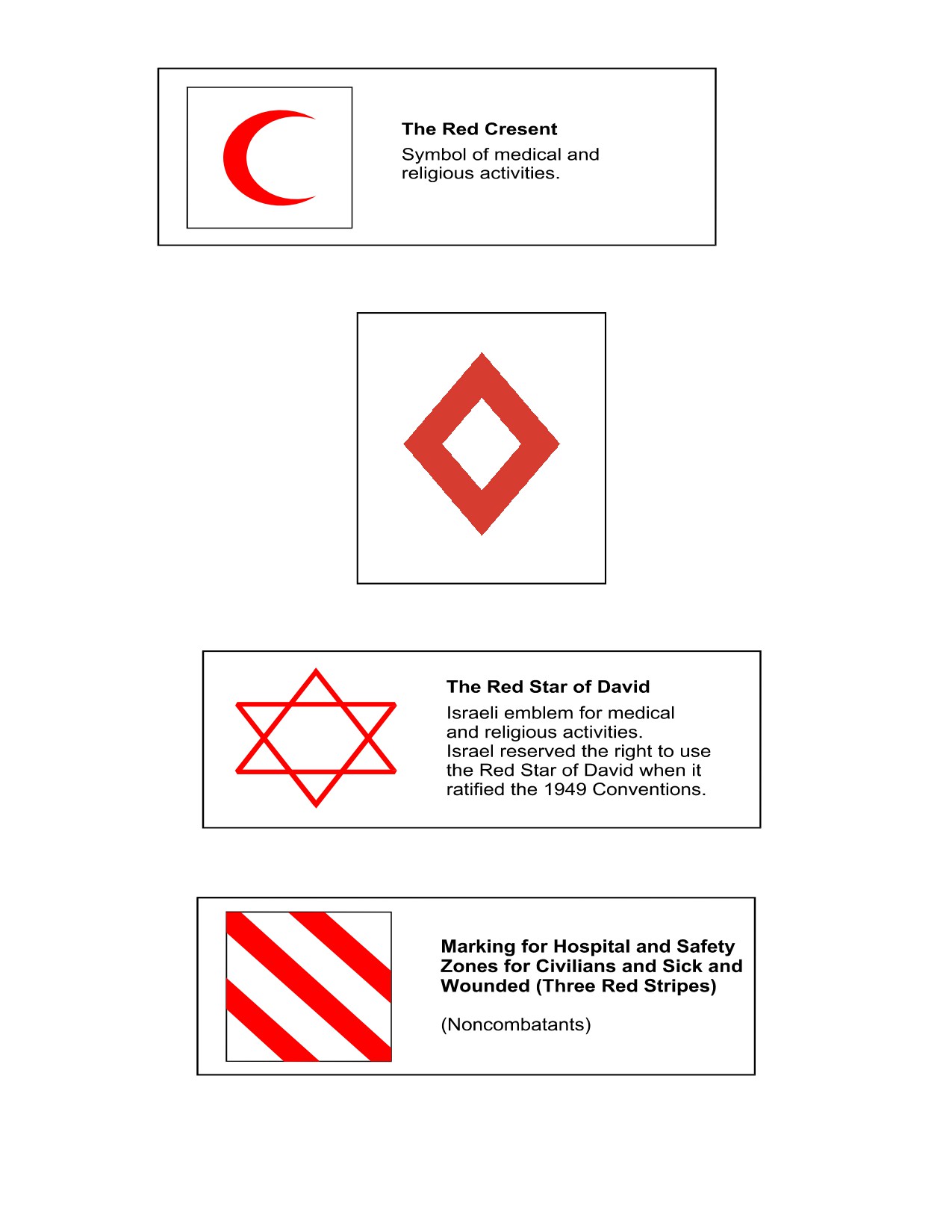
NWP 1-14M
Figure 8-1b. The Red Crescent
Figure 8-1c. Red Crystal, symbol of medical and religious activities
Figure 8-1d. The Red Star of David
Figure 8-1e. Three Red Stripes
8-6
JUL 2007
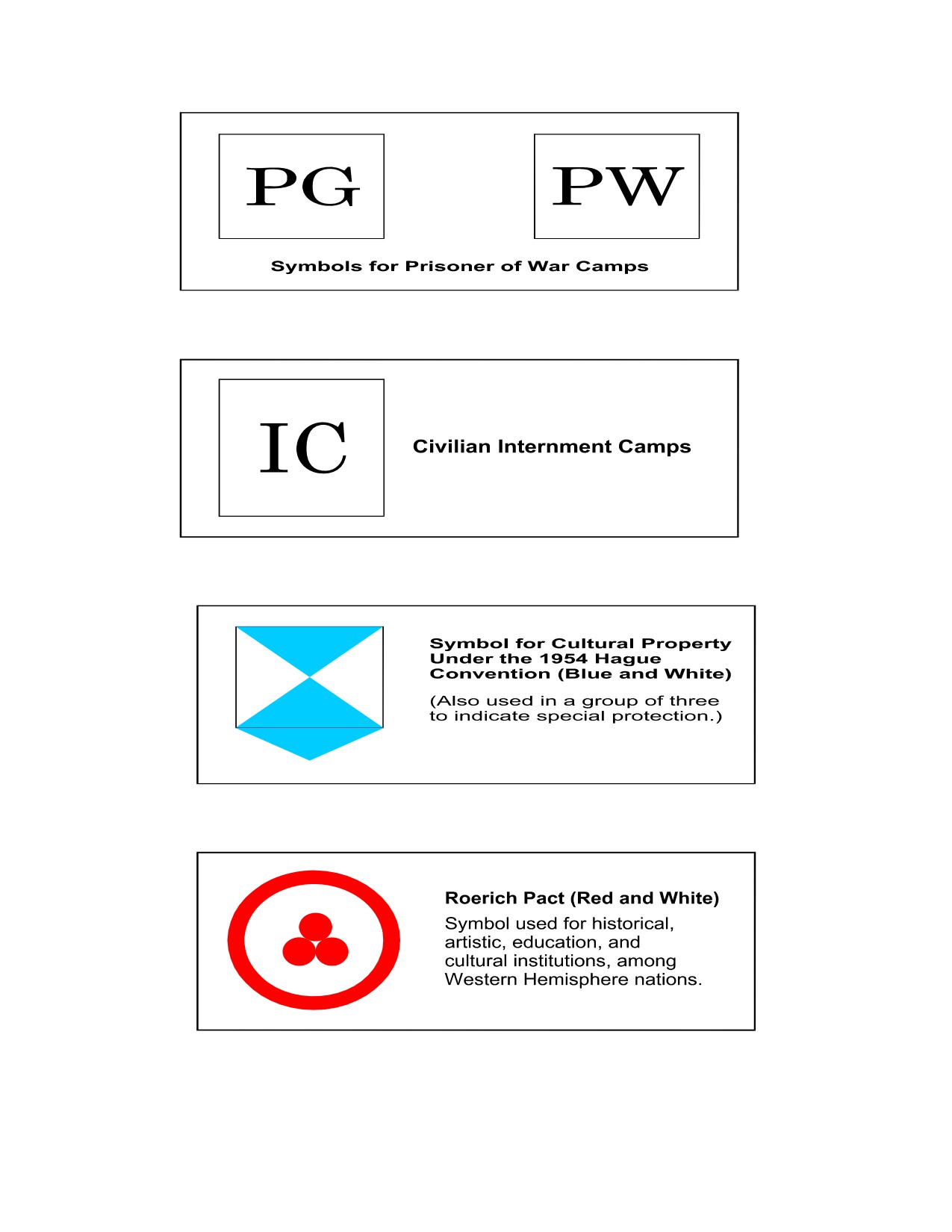
NWP 1-14M
Figure 8-1f. Symbols for Prisoner of War Camps
Figure 8-1g. Civilian Internment Camps
Figure 8-1h. Cultural Property under the 1954 Hague Convention
Figure 8-1i. The Roerich Pact
8-7
JUL 2007
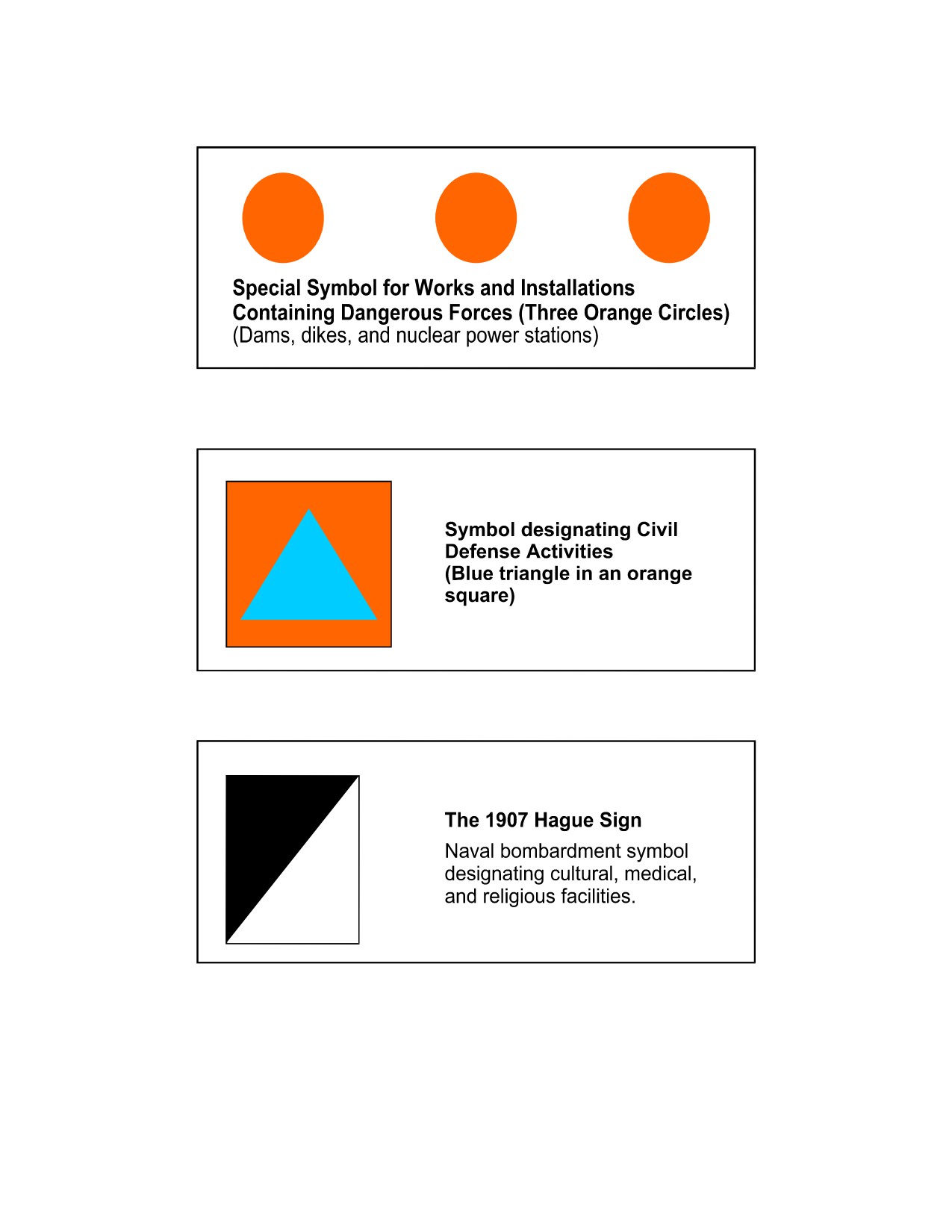
NWP 1-14M
Figure 8-1j. Works and Installations Containing Dangerous Forces
Figure 8-1k. Civil Defense Activities
Figure 8-1l. The 1907 Hague Sign
8-8
JUL 2007
NWP 1-14M
8.5.1.7 Failure to Display
When objects or persons are readily recognizable as being entitled to protected status, the lack of protective signs
and symbols does not render an otherwise protected object or person a legitimate target. Failure to utilize
internationally agreed protective signs and symbols may, however, subject protected persons and objects to the
risk of not being recognized by the enemy as having protected status.
8.5.2 Protective Signals
Three optional methods of identifying medical units and transports using protective signals have been created
internationally. United States hospital ships and medical aircraft do not use these signals, but other nations may.
8.5.2.1 Radio Signals
For the purpose of identifying medical transports by radio telephone, the words PAN PAN are repeated three
times followed by the word “medical” pronounced as in the French MAY-DEE-CAL. Medical transports are
identified in radio telegraph by three repetitions of the group XXX followed by the single group YYY.
8.5.2.2 Visual Signals
On aircraft, the flashing blue light may be used only on medical aircraft. Hospital ships, coastal rescue craft, and
medical vehicles may also use the flashing blue light. Only by special agreement between the parties to the
conflict may its use be reserved exclusively to those forms of surface medical transport.
8.5.2.3 Electronic Identification
The identification and location of medical ships and craft may be effected by means of appropriate standard
maritime radar transponders as established by special agreement to the parties to the conflict. The identification
and location of medical aircraft may be effected by use of the secondary surveillance radar (SSR) specified in
Annex 10 to the Chicago Convention. The SSR mode and code is to be reserved for the exclusive use of the
medical aircraft.
8.5.3 Identification of Neutral Platforms
Ships and aircraft of nations not party to an armed conflict may adopt special signals for self-identification,
location, and establishing communications. Use of these signals does not confer or imply recognition of any
special rights or duties of neutrals or belligerents, except as may otherwise be agreed between them.
8.6 SURFACE WARFARE
As a general rule, surface warships may attack enemy surface, subsurface, and air targets wherever located
beyond neutral territory. (Special circumstances in which enemy warships and military aircraft may be attacked in
neutral territory are discussed in Chapter 7.) The law of armed conflict pertaining to surface warfare is concerned
primarily with the protection of noncombatants through rules establishing lawful targets of attack. For that
purpose, all enemy vessels and aircraft fall into one of three general classes: warships and military aircraft,
merchant vessels and civilian aircraft, and exempt vessels and aircraft.
8.6.1 Enemy Warships and Military Aircraft
Enemy warships and military aircraft, including naval and military auxiliaries, are subject to attack, destruction,
or capture anywhere beyond neutral territory. It is forbidden, however, to target an enemy warship or military
aircraft that in good faith unambiguously and effectively conveys a timely offer of surrender. Once an enemy
warship has clearly indicated a readiness to surrender, such as by hauling down her flag, by hoisting a white flag,
by surfacing (in the case of submarines), by stopping engines and responding to the attacker’s signals, or by
taking to lifeboats, the attack must be discontinued. Disabled enemy aircraft in air combat are frequently pursued
8-9
JUL 2007
NWP 1-14M
to destruction because of the impossibility of verifying their true status and inability to enforce surrender.
Although disabled, the aircraft may or may not have lost its means of combat. Moreover, it still may represent a
valuable military asset. Accordingly, surrender in air combat is not generally offered. However, if surrender is
offered in good faith so that circumstances do not preclude enforcement, it must be respected. Officers and crews
of captured or destroyed enemy warships and military aircraft should be detained. (See paragraph 8.2.3.3 and
Chapter 11 for further discussion of surrender and treatment of detainees, respectively.) As far as military
exigencies permit, after each engagement all possible measures should be taken without delay to search for and
collect the shipwrecked, wounded, and sick and to recover the dead.
Prize procedure is not used for captured enemy warships because their ownership vests immediately in the
captor’s government by the fact of capture.
8.6.2 Enemy Merchant Vessels and Aircraft
8.6.2.1 Capture
Enemy merchant vessels and civil aircraft may be captured wherever located beyond neutral territory. Prior
exercise of visit and search is not required, provided positive determination of enemy status can be made by other
means. When military circumstances preclude sending or taking in such vessel or aircraft for adjudication as an
enemy prize, it may be destroyed after all possible measures are taken to provide for the safety of passengers and
crew. Documents and papers relating to the prize should be safeguarded and, if practicable, the personal effects of
passengers should be saved. Every case of destruction of a captured enemy prize should be reported promptly to
higher command.
Officers and crews of captured enemy merchant ships and civilian aircraft may be detained. (See paragraph
8.2.3.3 and Chapter 11 for further discussion of surrender and treatment of detainees, respectively.) Other enemy
nationals on board such captured ships and aircraft as private passengers are subject to the discipline of the captor.
Nationals of a neutral nation on board captured enemy merchant vessels and civilian aircraft should not be
detained unless they have participated in acts of hostility or resistance against the captor or are otherwise in the
service of the enemy.
8.6.2.2 Destruction
Prior to World War II, both customary and conventional international law prohibited the destruction of enemy
merchant vessels by surface warships unless the safety of passengers and crew was first assured. This requirement
did not apply, however, if the merchant vessel engaged in active resistance to capture or refused to stop when
ordered to do so. Specifically, the London Protocol of 1936, to which almost all of the belligerents of World War
II expressly acceded, provides in part that:
In particular, except in the case of persistent refusal to stop on being duly summoned, or of active
resistance to visit or search, a warship, whether surface vessel or submarine, may not sink or render
incapable of navigation a merchant vessel without having first placed passengers, crew and ship’s
papers in a place of safety. For this purpose the ship’s boats are not regarded as a place of safety unless
the safety of the passengers and crew is assured, in the existing sea and weather conditions, by the
proximity of land, or the presence of another vessel which is in a position to take them on board.
During World War II, the practice of attacking and sinking enemy merchant vessels by surface warships and
submarines without prior warning and without first providing for the safety of passengers and crew was
widespread on both sides. Rationale for these apparent departures from the agreed rules of the 1936 London
Protocol varied. Initially, such acts were justified as reprisals against illegal acts of the enemy. As the war
progressed, however, merchant vessels were regularly armed and convoyed, participated in intelligence collection,
and were otherwise incorporated directly or indirectly into the enemy’s war-fighting/war-sustaining effort.
Consequently, enemy merchant vessels were widely regarded as legitimate military targets subject to destruction
on sight.
8-10
JUL 2007
NWP 1-14M
Although the rules of the 1936 London Protocol continue to apply to surface warships, they must be interpreted in
light of current technology, including satellite communications, over-the-horizon (OTH) weapons, and antiship
missile systems, as well as the customary practice of belligerents that evolved during and following World War II.
Accordingly, enemy merchant vessels may be attacked and destroyed by surface warships, either with or without
prior warning, in any of the following circumstances:
1. Persistently refusing to stop upon being duly summoned to do so
2. Actively resisting visit and search or capture
3. Sailing under convoy of enemy warships or enemy military aircraft
4. If armed with systems or weapons beyond that required for self-defense against terrorist, piracy, or like
threats
5. If incorporated into, or assisting in any way, the intelligence system of the enemy’s armed forces
6. If acting in any capacity as a naval or military auxiliary to an enemy’s armed forces
7. If integrated into the enemy’s war-fighting/war-sustaining effort and compliance with the rules of the 1936
London Protocol would, under the circumstances of the specific encounter, subject the surface warship to
imminent danger or would otherwise preclude mission accomplishment.
Rules relating to surrendering and to the search for and collection of the shipwrecked, wounded, and sick and the
recovery of the dead, set forth in paragraph 8.6.1, apply also to enemy merchant vessels and civilian aircraft that
may become subject to attack and destruction.
8.6.3 Enemy Vessels and Aircraft Exempt from Destruction or Capture
Certain classes of enemy vessels and aircraft are exempt under the law of naval warfare from capture or
destruction provided they are innocently employed in their exempt category. These specially protected vessels and
aircraft must not take part in the hostilities, must not hamper the movement of combatants, must submit to
identification and inspection procedures, and may be ordered out of harm’s way. These specifically exempt
vessels and aircraft include:
1. Vessels and aircraft designated for and engaged in the exchange of prisoners of war (cartel vessels or aircraft).
2. Properly designated and marked hospital ships, medical transports, and medical aircraft. Names and
descriptions of hospital ships must be provided to the parties to the conflict not later than ten days before
they are first employed. Thereafter, hospital ships must be used exclusively to assist, treat, and transport
the wounded, sick, and shipwrecked. All exterior surfaces of hospital ships are painted white and the
distinctive emblem of the red cross or red crescent is displayed on the hull and on horizontal surfaces. In
the actual employment of hospital ships, the application of some previously well-established principles has
adapted to reflect the realities of modern circumstances. Traditionally, hospital ships could not be armed,
although crew members could carry light individual weapons for the maintenance of order, for their own
defense and that of the wounded, sick, and shipwrecked. However, due to the changing threat environment
in which the red cross symbol is not recognized by various hostile groups and actors as indicating
protected status, the United States views the manning of hospital ships with defensive weapons systems,
such as anti-missile defense systems or crew-served weapons to defend against small boat threats as
prudent AT/TP measures, analogous to arming crew members with small arms, and consistent with the
humanitarian purpose of hospital ships and duty to safeguard the wounded and sick. Further, Article 34,
Geneva Convention for the Amelioration of the Condition of Wounded, Sick and Shipwrecked Members
of Armed Forces at Sea of August 12,1949, provides that hospital ships may not use or possess “secret
codes” as means of communication so that belligerents could verify that hospital ships’ communications
systems were being used only in support of their humanitarian function and not as a means of
8-11
JUL 2007
NWP 1-14M
communicating information that would be harmful to the enemy. However, subsequent technological
advances in encryption and satellite navigation, while recognized as problematic, have not been
specifically addressed by treaty. As a practical matter, modern navigational technology requires that the
traditional rule prohibiting “secret codes” be understood to not include modern encryption communications
systems. However, such systems must not be used for military purposes in any way harmful to a potential
adversary. Medical aircraft, whether civilian or military, and whether permanently or temporarily so
employed, must be used exclusively for the removal and transportation of the wounded, sick, and
shipwrecked, or for the transportation of medical personnel or medical equipment. They may not be armed
nor may they be reconnaissance-configured. Medical aircraft should be clearly marked with the emblem of
the red cross or red crescent. Failure to so mark them risks having them not recognized as protected
platforms. Hospital ships, medical transports, and medical aircraft utilized solely for medical purposes and
recognized as such, whether or not marked with the appropriate emblem, are not to be deliberately
attacked.
3. Vessels charged with religious, nonmilitary scientific or philanthropic missions. (Vessels engaged in the
collection of scientific data of potential military application are not exempt.)
4. Vessels and aircraft guaranteed safe conduct by prior arrangement between the belligerents.
5. Small coastal (not deep-sea) fishing vessels and small boats engaged in local coastal trade. Such vessels
and boats are subject to the regulations of a belligerent naval commander operating in the area.
6. Civilian passenger vessels at sea and civil airliners in flight are subject to capture but are exempt from
destruction. Although enemy lines of communication are generally legitimate military targets in modern
warfare, civilian passenger vessels at sea, and civil airliners in flight, are exempt from destruction, unless
at the time of the encounter they are being utilized by the enemy for a military purpose (e.g., transporting
troops or military cargo) or refuse to respond to the directions of the intercepting warship or military
aircraft. Such passenger vessels in port and airliners on the ground are not protected from destruction.
If an enemy vessel or aircraft assists the enemy’s military effort in any manner, it may be captured or destroyed.
Refusal to provide immediate identification upon demand is ordinarily sufficient legal justification for capture or
destruction. All nations have a legal obligation not to take advantage of the harmless character of exempt vessels
and aircraft in order to use them for military purposes while preserving their innocent-appearance. For example,
the utilization by North Vietnam of innocent-appearing small coastal fishing boats as logistic craft in support of
military operations during the Vietnam conflict was in violation of this obligation.
8.7 SUBMARINE WARFARE
The law of armed conflict imposes essentially the same rules on submarines as apply to surface warships.
Submarines may employ their conventional weapons systems to attack enemy surface, subsurface, or airborne
targets wherever located beyond neutral territory. Enemy warships and military aircraft, including naval and
military auxiliaries, may be attacked and destroyed without warning. Rules applicable to surface warships
regarding enemy ships that have surrendered in good faith, or that have indicated clearly their intention to do so,
apply as well to submarines. To the extent that military exigencies permit, submarines are also required to search
for and collect the shipwrecked, wounded, and sick following an engagement. If such humanitarian efforts would
subject the submarine to undue additional hazard or prevent it from accomplishing its military mission, the
location of possible survivors should be passed at the first opportunity to a surface ship, aircraft, or shore facility
capable of rendering assistance.
8.7.1 Interdiction of Enemy Merchant Shipping by Submarines
The rules of naval warfare pertaining to submarine operations against enemy merchant shipping constitute one of
the least developed areas of the law of armed conflict. Although the submarine’s effectiveness as a weapons
system is dependent upon its capability to remain submerged (and thereby undetected) and despite its
vulnerability when surfaced, the London Protocol of 1936 (paragraph 8.6.2.2) makes no distinction between
8-12
JUL 2007
NWP 1-14M
submarines and surface warships with respect to attacks upon enemy merchant shipping. The London Protocol
specifies that except in case of persistent refusal to stop when ordered to do so, or in the event of active resistance
to capture, a warship “whether surface vessel or submarine” may not destroy an enemy merchant vessel “without
having first placed passengers, crew and ship’s papers in a place of safety.” The impracticality of imposing upon
submarines the same targeting constraints as burden surface warships is reflected in the practice of belligerents of
both sides during World War II when submarines regularly attacked and destroyed without warning enemy
merchant shipping. As in the case of such attacks by surface warships, this practice was justified either as a
reprisal in response to unlawful acts of the enemy or as a necessary consequence of the arming of merchant
vessels, of convoying, and of the general integration of merchant shipping into the enemy’s war-fighting/war-
sustaining effort.
The United States considers that the London Protocol of 1936, coupled with the customary practice of belligerents
during and following World War II, imposes upon submarines the responsibility to provide for the safety of
passengers, crew, and ship’s papers before destruction of an enemy merchant vessel unless:
1. The enemy merchant vessel persistently refuses to stop when duly summoned to do so.
2. It actively resists visit and search or capture.
3. It is sailing under convoy of enemy warships or enemy military aircraft.
4. It is armed with systems or weapons beyond that required for self-defense against terrorism, piracy, or like
threats.
5. It is incorporated into, or is assisting in any way the enemy’s military intelligence system.
6. It is acting in any capacity as a naval or military auxiliary to an enemy’s armed forces.
7. The enemy has integrated its merchant shipping into its war-fighting/war-sustaining effort, and compliance
with the London Protocol of 1936 would, under the circumstances of the specific encounter, subject the
submarine to imminent danger or would otherwise preclude mission accomplishment.
8.7.2 Enemy Vessels and Aircraft Exempt From Submarine Interdiction
The rules of naval warfare regarding enemy vessels and aircraft that are exempt from capture and/or destruction
by surface warships also apply to submarines. (See paragraph 8.6.3.)
8.8 AIR WARFARE AT SEA
Military aircraft may employ conventional weapons systems to attack warships and military aircraft, including
naval and military auxiliaries, anywhere beyond neutral territory. Enemy merchant vessels and civil aircraft may
be attacked and destroyed by military aircraft only under the following circumstances:
1. When persistently refusing to comply with directions from the intercepting aircraft
2. When sailing under convoy of enemy warships or military aircraft
3. When armed with systems or weapons beyond that required for self-defense against terrorism, piracy, or
like threats
4. When incorporated into or assisting in any way the enemy’s military intelligence system
5. When acting in any capacity as a naval or military auxiliary to an enemy’s armed forces
6. When otherwise integrated into the enemy’s war-fighting or war-sustaining effort.
8-13
JUL 2007
NWP 1-14M
To the extent that military exigencies permit, military aircraft are required to search for the shipwrecked,
wounded, and sick following an engagement at sea. The location of possible survivors should be passed at the
first opportunity to a surface vessel, aircraft, or shore facility capable of rendering assistance.
Historically, instances of surrender of enemy vessels to aircraft are rare. If, however, an enemy has surrendered in
good faith, under circumstances that do not preclude enforcement of the surrender, or has clearly indicated an
intention to do so, the enemy must not be attacked.
The rules of naval warfare regarding enemy vessels and aircraft that are exempt from capture and/or destruction
by surface warships also apply to military aircraft. (See paragraph 8.6.3.)
8.9 BOMBARDMENT
For purposes of this publication, the term “bombardment” refers to naval and air bombardment of enemy targets
on land with conventional weapons, including naval guns, rockets and missiles, and air-delivered ordnance. Land
warfare is discussed in paragraph 8.10. Engagement of targets at sea is discussed in paragraphs 8.6 to 8.8.
8.9.1 General Rules
The United States is a party to Hague Convention No. IX (1907) Respecting Bombardment by Naval Forces in
Time of War. That convention establishes the general rules of naval bombardment of land targets. These rules
have been further developed by customary practice in World Wars I and II, Vietnam, the Falkland/Malvinas
Conflict, the Arabian Gulf, and Operations Enduring Freedom and Iraqi Freedom. Underlying these rules are the
broad principles of the law of armed conflict that belligerents are forbidden to make noncombatants and civilians
the target of direct attack, that superfluous injury to, and unnecessary suffering of, combatants are to be avoided,
and that wanton destruction of property is prohibited. To give effect to these concepts, the following general rules
governing bombardment must be observed.
8.9.1.1 Destruction of Civilian Habitation
The wanton or deliberate destruction of areas of concentrated civilian habitation, including cities, towns, and
villages, is prohibited. A military objective within a city, town, or village may, however, be bombarded if required
for the submission of the enemy with the minimum expenditure of time, life, and physical resources. The
anticipated incidental injury to civilians, or collateral damage to civilian objects, must not be excessive in light of
the military advantage anticipated by the attack. (See paragraphs 8.3, 8.3.1, and 8.3.2.)
8.9.1.2 Terrorization
Bombardment for the sole purpose of terrorizing the civilian population is prohibited.
8.9.1.3 Undefended Cities or Agreed Demilitarized Zones
Belligerents are forbidden to bombard a city or town that is undefended and that is open to immediate entry by
their own or allied forces. A city or town behind enemy lines is, by definition, neither undefended nor open, and
military targets therein may be destroyed by bombardment. An agreed demilitarized zone is also exempt from
bombardment.
8.9.1.4 Medical Facilities
Medical establishments and units (both mobile and fixed), medical vehicles, and medical equipment and stores
may not be deliberately bombarded. Belligerents are required to ensure that such medical facilities are, as far as
possible, situated in such a manner that attacks against military targets in the vicinity do not imperil their safety. If
medical facilities are used for military purposes inconsistent with their humanitarian mission, and if appropriate
warnings that continuation of such use will result in loss of protected status are unheeded, the facilities become
subject to attack. The distinctive medical emblem, a red cross, red crescent, or red square on edge is to be clearly
8-14
JUL 2007
NWP 1-14M
displayed on medical establishments and units in order to identify them as entitled to protected status. Any object
recognized as being a medical facility may not be attacked whether or not marked with a protective symbol.
8.9.1.5 Special Hospital Zones and Neutralized Zones
When established by agreement between the belligerents, hospital zones and neutralized zones are immune from
bombardment in accordance with the terms of the agreement concerned.
8.9.1.6 Religious, Cultural, and Charitable Buildings and Monuments
Buildings devoted to religion, the arts, or charitable purposes; historic monuments; and other religious, cultural, or
charitable facilities should not be bombarded, provided they are not used for military purposes. It is the
responsibility of the local inhabitants to ensure that such buildings and monuments are clearly marked with the
distinctive emblem of such sites—a rectangle divided diagonally into two triangular halves, the upper portion
black and the lower white. (See paragraph 8.5.1.4.)
8.9.1.7 Dams and Dikes
Dams, dikes, levees, and other installations, which if breached or destroyed would release flood waters or other
forces dangerous to the civilian population, should not be bombarded if the anticipated harm to civilians would be
excessive in relation to the anticipated military advantage to be gained by bombardment. Conversely, installations
containing such dangerous forces that are used by belligerents to shield or support military activities are not so
protected. (See paragraph 8.5.1.2.)
8.9.2 Warning before Bombardment
Where the military situation permits, commanders should make every reasonable effort to warn the civilian
population located in close proximity to a military objective targeted for bombardment. Warnings may be general
rather than specific lest the bombarding force or the success of its mission be placed in jeopardy.
8.10 LAND WARFARE
The guidance in this paragraph provides an overview of the basic principles of law governing conflict on land. For
a comprehensive treatment of the law of armed conflict applicable to land warfare, see Army Field Manual (FM)
27-10, The Law of Land Warfare.
8.10.1 Targeting in Land Warfare
Targeting principles in land warfare are the same as in naval warfare (see paragraph 8.1); however, the
characteristics of land warfare, often involving intermingled military objectives and civilians and civilian objects,
can make the application of targeting decisions more difficult.
8.10.2 Special Protection
Under the law of land warfare, certain persons, places, and objects enjoy special protection against attack.
Protection is, of necessity, dependent upon recognition of protected status. Special signs and symbols are
employed for that purpose (see paragraph 8.5.1). Failure to display protective signs and symbols does not render
an otherwise protected person, place or object a legitimate target if that status is otherwise apparent (see paragraph
8.5.1.7). However, protected persons directly participating in hostilities lose their protected status and may be
attacked while so employed. Similarly, misuse of protected places and objects for military purposes renders them
subject to legitimate attack during the period of misuse.
8-15
JUL 2007
NWP 1-14M
8.10.2.1 Protected Status
Protected status is afforded the wounded, sick, and shipwrecked (see paragraph 8.2.3), certain parachutists (see
paragraph 8.2.3.1), and detainees (see Chapter 11). Civilians and noncombatants, such as medical personnel and
chaplains (see paragraph 8.2.4.1), not taking direct part in hostilities, and interned persons (see paragraph 11.5)
also enjoy protected status.
8.10.2.2 Protected Places and Objects
Protected places include undefended cities and towns and agreed demilitarized zones (see paragraph 8.9.1.3), and
agreed special hospital zones and neutralized zones (see paragraph 8.9.1.5). Protected objects include historic
monuments and structures, works of art, medical facilities and religious, cultural, and charitable buildings and
monuments (see paragraph 8.9.1.6).
8.10.2.3 The Environment
A discussion of environmental considerations during armed conflict is contained in paragraph 8.4. The use of
herbicidal agents is addressed in paragraph 10.3.3.
8.11 INFORMATION OPERATIONS
IO are actions taken to affect adversary information and information systems, while defending one’s own
information and information systems. There are two major subdivisions within IO: offensive IO and defensive IO.
For the purpose of this discussion on targeting considerations, major capabilities to conduct offensive IO are
physical attack/destruction, PSYOPs, and CNA. (See JP 3-13, Information Operations, for a broader discussion of
this subject.)
8.11.1 General IO Targeting Considerations
Legal analysis of intended wartime targets requires traditional law of war analysis. Offensive IO can target
human-decision processes (human factors), the information and information systems used to support decision
making (links), and the information and information systems used to process information and implement
decisions (nodes). Offensive IO efforts should examine all three target areas to maximize opportunity for success.
Human factors include national command authorities, commanders, forces, the populace as a whole, and/or
groups within the populace. In all cases, the selection of offensive IO targets must be consistent with U.S.
objectives, applicable international conventions, law of war principles, and ROE.
8.11.2 Physical Attack/Destruction
The legal requirement to attack only military objectives and to avoid excessive incidental injury/death and
collateral damage to noncombatants, civilians, and civilian objects applies when identifying targets for kinetic
attack as part of an offensive IO plan.
8.11.3 Psychological Operations (PSYOPs)
PSYOPs are planned operations to convey selected information and indicators to foreign audiences to influence
their emotions, motives, objective reasoning, and ultimately the behavior of foreign governments, organizations,
groups, and individuals. The purpose of psychological operations is to induce or reinforce foreign attitudes and
behavior favorable to the originator’s objectives. PSYOPs must not be confused with psychological impact.
Actions such as shows of force or limited strikes may have a psychological impact, but they are not PSYOPS
unless the primary purpose is to influence the emotions, motives, objective reasoning, decision making, or
behavior of the foreign target audience. PSYOPs that do not entail the risk of physical injury or death to protected
persons or damage to their property may be targeted at noncombatants and civilians.
8-16
JUL 2007
NWP 1-14M
8.11.4 Computer Network Attack (CNA)
CNA is defined as operations to disrupt, deny, degrade, or destroy information resident in computers and
computer networks or the computers and networks themselves. CNA can be accomplished by kinetic and
nonkinetic means. In employing nonkinetic means of CNA against a military objective, factors involved in
weighing anticipated incidental injury/death to protected persons can include, depending on the target, indirect
effects (for example, the anticipated incidental injury/death that may occur from disrupting an electricity-
generating plant that supplies power to a military headquarters and to a hospital).
8-17
JUL 2007
NWP 1-14M
INTENTIONALLY BLANK
8-18
JUL 2007
NWP 1-14M
CHAPTER 9
Conventional Weapons and Weapons
Systems
9.1 INTRODUCTION
This chapter addresses the legal considerations pertaining to the use of conventional weapons and weapons
systems. It is a fundamental tenet of the law of armed conflict that the right of nations engaged in armed conflict
to choose methods or means of warfare is not unlimited. This rule of law is expressed in the concept that the
employment of weapons, material, and methods of warfare that are designed to cause superfluous injury or
unnecessary suffering is prohibited. A corollary concept is that weapons, which by their nature are incapable of
being directed specifically against military objectives, and therefore that put civilians and noncombatants at
equivalent risk, are forbidden due to their indiscriminate effect. A few weapons, such as poisoned projectiles, are
unlawful no matter how employed. Others may be rendered unlawful by alteration such as by coating ammunition
with a poison. Still others may be unlawfully employed such as by setting armed contact naval mines adrift so as
to endanger innocent as well as enemy shipping. And finally, any weapon may be set to an unlawful purpose
when it is directed against noncombatants, civilians, and other protected persons and property. (See Chapter 8.)
Of particular interest to naval officers are law of armed conflict rules pertaining to naval mines, land mines,
torpedoes, cluster and fragmentation weapons, delayed-action devices, incendiary weapons, directed-energy
devices, and OTH weapons systems. Each of these weapons or systems will be assessed in terms of its potential
for causing unnecessary suffering and superfluous injury or indiscriminate effect.
9.1.1 Unnecessary Suffering
Antipersonnel weapons are designed to kill or disable enemy combatants and are lawful notwithstanding the
death, pain, and suffering they inflict. Weapons that are designed to cause unnecessary suffering or superfluous
injury are, however, prohibited because the degree of pain or injury, or the certainty of death they produce is
needlessly or clearly disproportionate to the military advantage to be gained by their use. Poisoned projectiles and
small arms ammunition intended to cause superfluous injury or unnecessary suffering fall into this category.
Similarly, using materials that are difficult to detect or undetectable by field x-ray equipment, such as glass or
clear plastic, as the injuring mechanism in military ammunition is prohibited, since they unnecessarily inhibit the
treatment of wounds. Use of such materials as incidental components in ammunition, e.g., as wadding or packing,
is not prohibited. Use of .50-caliber weapons against individual enemy combatants does not constitute a violation
of this proscription against unnecessary suffering or superfluous injury.
9.1.2 Indiscriminate Effect
Weapons that are incapable of being directed at a military objective are forbidden as being indiscriminate in their
effect. Drifting armed contact mines and long-range unguided missiles (such as the German V-1 and V-2 rockets
of World War II) fall into this category. A weapon is not indiscriminate simply because it may cause incidental or
collateral civilian casualties, provided such casualties are not foreseeably excessive in light of the anticipated
military advantage to be gained. An artillery round that is capable of being directed with a reasonable degree of
accuracy at a military target is not an indiscriminate weapon simply because it may miss its mark or inflict
collateral damage. Conversely, uncontrolled balloon-borne bombs, such as those released by the Japanese against
the west coast of the United States and Canada in World War II, lack that capability of direction and are,
therefore, unlawful.
9-1
JUL 2007
NWP 1-14M
9.2 NAVAL MINES
Naval mines have been effectively employed for area denial, coastal and harbor defense, antisurface and
antisubmarine warfare, and blockade. Naval mines are lawful weapons, but their potential for indiscriminate
effects has led to specific regulation of their deployment and employment by the law of armed conflict. The
extensive and uncontrolled use of naval mines by both sides in the Russo-Japanese War of 1904-5 inflicted great
damage on innocent shipping both during and long after that conflict, and led to Hague Convention No. VIII of
1907 Relative to the Laying of Automatic Submarine Contact Mines. The purpose of the Hague rules is to ensure,
to the extent practicable, the safety of innocent shipping. These rules require that naval mines be so constructed as
to become harmless should they break loose from their moorings or otherwise cease to be under the affirmative
control of the belligerents that laid them. The Hague rules also require that shipowners be warned of the presence
of mines as soon as military exigencies permit.
Although the Hague provisions date from 1907, they remain the only codified rules specifically addressing the
emplacement of conventional naval mines. Technological developments have created weapons systems obviously
not contemplated by the drafters of these rules. Nonetheless, the general principles of law embodied in the 1907
Convention continue to serve as a guide to lawful employment of naval mines.
9.2.1 Current Technology
Modern naval mines are versatile and variable weapons. They range from relatively unsophisticated and
indiscriminate contact mines to highly technical, target-selective devices with state-of-the-art homing guidance
capability. Today’s mines may be armed and/or detonated by physical contact, acoustic or magnetic signature, or
sensitivity to changes in water pressure generated by passing vessels and may be emplaced by air, surface, or
subsurface platforms. For purposes of this publication, naval mines are classified as armed or controlled mines.
Armed mines are either emplaced with all safety devices withdrawn, or are armed following emplacement, so as
to detonate when preset parameters (if any) are satisfied. Controlled mines have no destructive capability until
affirmatively activated by some form of arming order (whereupon they become armed mines).
9.2.2 Peacetime Mining
Consistent with the safety of its own citizenry, a nation may emplace both armed and controlled mines in its own
internal waters at any time with or without notification. A nation may also mine its own archipelagic waters and
territorial sea during peacetime when deemed necessary for national security purposes. If armed mines are
emplaced in archipelagic waters or the territorial sea, appropriate international notification of the existence and
location of such mines is required. Because the right of innocent passage can be suspended only temporarily,
armed mines must be removed or rendered harmless as soon as the security threat that prompted their
emplacement has terminated. Armed mines may not be emplaced in international straits or archipelagic sea lanes
during peacetime. Emplacement of controlled mines in a nation’s own archipelagic waters or territorial sea is not
subject to such notification or removal requirements.
Naval mines may not be emplaced in internal waters, territorial seas, or archipelagic waters of another nation in
peacetime without that nation’s consent. Controlled mines may, however, be emplaced in international waters
(i.e., beyond the territorial sea) if they do not unreasonably interfere with other lawful uses of the oceans. The
determination of what constitutes an “unreasonable interference” involves a balancing of a number of factors,
including the rationale for their emplacement (i.e., the self-defense requirements of the emplacing nation), the
extent of the area to be mined, the hazard (if any) to other lawful ocean uses, and the duration of their
emplacement. Because controlled mines do not constitute a hazard to navigation, international notice of their
emplacement is not required.
Armed mines may not be emplaced in international waters prior to the outbreak of armed conflict, except under
the most demanding requirements of individual or collective self-defense. Should armed mines be emplaced in
international waters under such circumstances, prior notification of their location must be provided. A nation
emplacing armed mines in international waters during peacetime must maintain an on-scene presence in the area
sufficient to ensure that appropriate warning is provided to ships approaching the danger area. All armed mines
9-2
JUL 2007
NWP 1-14M
must be expeditiously removed or rendered harmless when the imminent danger that prompted their emplacement
has passed.
9.2.3 Mining during Armed Conflict
Naval mines may be lawfully employed by parties to an armed conflict subject to the following restrictions:
1. International notification of the location of emplaced mines must be made as soon as military exigencies
permit.
2. Mines may not be emplaced by belligerents in neutral waters.
3. Anchored mines must become harmless as soon as they have broken their moorings.
4. Unanchored mines not otherwise affixed or imbedded in the bottom must become harmless within an hour
after loss of control over them.
5. The location of minefields must be carefully recorded to ensure accurate notification and to facilitate
subsequent removal and/or deactivation.
6. Naval mines may be employed to channelize neutral shipping, but not in a manner to deny transit passage
of international straits or archipelagic sea lanes passage of archipelagic waters by such shipping.
7. Naval mines may not be emplaced off the coasts and ports of the enemy with the sole objective of
intercepting commercial shipping, but may otherwise be employed in the strategic blockade of enemy
ports, coasts, and waterways.
8. Mining of areas of indefinite extent in international waters is prohibited. Reasonably limited barred areas
may be established by naval mines, provided neutral shipping retains an alternate route around or through
such an area with reasonable assurance of safety.
9.3 LAND MINES
Land mines are munitions placed on, under, or near the ground or other surface area and designed to be detonated
or exploded by the passage of time; the presence, proximity or contact of a person or vehicle; or upon command.
As with all weapons, to be lawful, land mines must be directed at military objectives. The controlled nature of
command-detonated land mines provides effective target discrimination. In the case of noncommand-detonated
land mines, however, there exists potential for indiscriminate injury to civilians. Accordingly, special care must
be taken when employing land mines to ensure civilians are not indiscriminately injured. International law
requires that, to the extent possible, belligerents record the location of all minefields in order to facilitate their
removal upon the cessation of hostilities. It is the practice of the United States to record the location of minefields
in all circumstances.
The 1997 Ottawa Convention imposes a ban on the use, stockpiling, production, and transfer of antipersonnel land
mines (APLs), which are designed to be exploded by the presence, proximity, or contact of a person and that will
incapacitate, injure, or kill one or more persons. This prohibition does not apply to command detonated weapons
(such as claymore mines in a nontripwire mode) or to antitank/vehicle landmines (AVLs), also referred to as
mines other than anti-personnel mines. The United States is not a party to the Ottawa Convention, however, many
of its allies and coalition partners are, and this may, depending on the circumstances at the time, impact
operational planning regarding shipment, resupply, and placement of landmines.
The United States is a party to Amended Protocol II to the Conventional Weapons Convention. This Protocol
does not ban APLs, but imposes requirements on State parties regarding use, maintenance, and removal of mines
and minefields. Overall, U.S. policy on landmine use recognizes that both APLs and AVLs are necessary and
effective weapons when properly employed, and that the primary danger of incidental and or indiscriminate injury
9-3
JUL 2007
NWP 1-14M
to noncombatants and civilians from landmines is a factor of whether or not a particular mine (whether APL or
AVL) is “persistent” or “nonpersistent” (i.e., designed to either automatically de-arm or self-destruct or capable of
being controlled). To that end, it is U.S. policy to:
1. Continue to develop nonpersistent APLs and AVLs that meet or exceed international standards for self-
destruction and self-deactivation.
2. Remove nondetectable mines of any type (APL and AVL) in its arsenal.
3. Stockpile persistent APLs only for use by the United States in fulfillment of treaty obligations to the
Republic of Korea.
4. Employ persistent AVLs outside the Republic of Korea only when authorized by the president, and only
until 2010. After 2010, the United States will not employ persistent landmines.
5. Begin the destruction of those persistent landmines that are not needed for the protection of Korea.
9.4 TORPEDOES
Torpedoes that do not become harmless when they have missed their mark constitute a danger to innocent
shipping and are therefore unlawful. All U.S. Navy torpedoes are designed to sink to the bottom and become
harmless upon completion of their propulsion run.
9.5 CLUSTER AND FRAGMENTATION WEAPONS
Cluster and fragmentation weapons are projectiles, bombs, missiles, submunitions, and grenades that are designed
to fragment upon detonation, thereby expanding the radius of their lethality and destructiveness. These weapons
are lawful when used against combatants. When used in proximity to civilians or civilian objects, their
employment should be carefully monitored to ensure that collateral damage and incidental injury is not excessive
in relation to the legitimate military advantage sought.
9.6 BOOBY TRAPS AND OTHER DELAYED-ACTION DEVICES
Booby traps and other delayed-action devices are not unlawful, provided they are not designed to cause
unnecessary suffering or employed in an indiscriminate manner. Devices that are designed to simulate items
likely to attract and injure noncombatants (e.g., medical supplies), and civilians (e.g., toys and trinkets) are
prohibited. Attaching booby traps to protected persons or objects, such as the wounded and sick, dead bodies, or
medical facilities and supplies, is similarly prohibited. Belligerents are required to record the location of booby
traps and other delayed-action devices in the same manner as land mines (see paragraph 9.3).
9.7 EXPLOSIVE REMNANTS OF WAR
Protocol V to the Conventional Weapons Convention defines explosive remnants of war (ERWs) as unexploded
ordnance and abandoned explosive ordnance. Unexploded ordnance is explosive ordnance (i.e., conventional
munitions containing explosives, with the exception of mines, booby traps, and other devices as defined in
Amended Protocol II of the convention) that has been primed, fused, armed, or otherwise prepared for use and
used in an armed conflict. It may have been fired, dropped, launched, or projected, and should have exploded but
failed to do so. Abandoned explosive ordnance means explosive ordnance that has not been used during an armed
conflict, that has been left behind or dumped by a party to an armed conflict, and which is no longer under control
of the party that left it behind or dumped it. Abandoned explosive ordnance may or may not have been primed,
fused, armed, or otherwise prepared for use.
Nations ratifying the protocol agree to maintain records regarding the use of ERW, and to mark, clear, remove, or
destroy ERW in affected territories under their control after the cessation of active hostilities, and as soon as
feasible. In territory that they do not control, nations that used explosive ordnance agree to assist with clearing,
9-4
JUL 2007
NWP 1-14M
removing, or destroying ERW. The protocol applies to land territory and internal waters. It does NOT apply to
ERW existing prior to ratification. As of the date of this instruction, the United States has not ratified the protocol.
9.8 INCENDIARY WEAPONS
Incendiary devices, such as thermite bombs, flame throwers, napalm, and other incendiary weapons and agents,
are lawful weapons. Where incendiary devices are the weapons of choice, they should be employed in a manner
that does not cause incidental injury or collateral damage that is excessive in light of the military advantage
anticipated by the attack.
9.9 DIRECTED-ENERGY DEVICES
Directed-energy devices, such as laser, high-powered microwave, particle-beam devices, and active-denial
systems using millimeter electromagnetic waves are not proscribed by the law of armed conflict. Lasers may be
employed as a rangefinder or for target acquisition, despite the possibility of incidental injury to enemy personnel.
Laser “dazzlers” designed to temporarily disorient may also be employed. As a matter of policy, U.S. military
forces will not employ laser weapons specifically designed to cause permanent blindness.
9.10 OVER-THE-HORIZON WEAPONS SYSTEMS
Missiles and projectiles with OTH or beyond-visual-range capabilities are lawful provided they are equipped with
sensors or are employed in conjunction with external sources of targeting data that are sufficient to ensure
effective target discrimination.
9.11 NONLETHAL WEAPONS
Weapons explicitly designed and primarily employed so as to incapacitate personnel or materiel, while
minimizing fatalities, permanent injury to personnel, and undesired damage to property and the environment, are
termed “nonlethal weapons” (NLWs). Unlike conventional (lethal) weapons, which utilize blast, penetration, and
fragmentation to destroy their targets, NLWs employ means other than gross physical destruction to accomplish
their purpose. The mere fact that one or more types of NLWs is in a unit’s authorized inventory does not mean
that the law requires that such weapons be employed prior to using conventional (lethal) weapons. They are
intended as another option for commanders to use, as appropriate, in exercising the right and obligation of self-
defense and in carrying out assigned missions.
Per DOD Directive 3000.3, Policy for Non-Lethal Weapons:
1. NLWs, doctrine, and concepts of operation shall be designed to reinforce deterrence and expand the range
of options available to commanders.
2. NLWs should enhance the capability of U.S. forces to accomplish the following objectives:
a. Discourage, delay, or prevent hostile actions.
b. Limit escalation.
c. Take military action in situations where use of lethal force is not the preferred option.
d. Better protect our forces.
e. Temporarily disable equipment facilities, and personnel.
9-5
JUL 2007
NWP 1-14M
3. NLWs should also be designed to help decrease the postconflict costs of reconstruction.
4. The availability of NLWs shall not limit a commander’s inherent authority and obligation to use all
necessary means available and to take all appropriate action in self-defense. (See paragraphs 4.3.3.5 and
4.3.3.6.)
5. Neither the presence nor the potential effect of NLWs shall constitute an obligation for their employment
or a higher standard for employment of force than provided for by applicable law. In all cases, the United
States retains the option for immediate use of lethal weapons, when appropriate, consistent with
international law.
6. NLWs shall not be required to have a zero probability of producing fatalities or permanent injuries.
However, while complete avoidance of these effects is not guaranteed or expected, when properly
employed, NLWs should significantly reduce them as compared with physically destroying the same
target.
7. NLWs may be used in conjunction with lethal weapon systems to enhance the latter’s effectiveness and
efficiency in military operations. This shall apply across the range of military operations to include those
situations where overwhelming force is employed.
9-6
JUL 2007
NWP 1-14M
CHAPTER 10
Nuclear, Chemical, and Biological Weapons
10.1 INTRODUCTION
Nuclear, chemical, and biological weapons, often referred to as WMD, and their delivery systems, present special
law of armed conflict problems due to their potential for indiscriminate effect. This chapter addresses legal
considerations pertaining to the development, possession, deployment, and employment of these weapons.
10.2 NUCLEAR WEAPONS
10.2.1 General
There are no rules of customary or conventional international law prohibiting nations from employing nuclear
weapons in armed conflict. In the absence of such an express prohibition, the use of nuclear weapons against enemy
combatants and other military objectives is not unlawful. Employment of nuclear weapons is, however, subject to
the following principles: the right of the parties to the conflict to adopt means of injuring the enemy is not unlimited;
it is prohibited to launch attacks against the civilian population as such; and distinction must be made at all times
between combatants and civilians to the effect that the latter be spared as much as possible. Given their destructive
potential, the decision to authorize employment of nuclear weapons should emanate from the highest level of
government. For the United States, that authority resides solely with the President.
10.2.2 Treaty Obligations
Nuclear weapons are regulated by a number of arms control agreements restricting their development, possession, de-
ployment, and use. Some of these agreements (e.g., the 1963 Limited Test Ban Treaty) may not apply during time of war.
10.2.2.1 Seabed Arms Control Treaty
This multilateral convention prohibits emplacement of nuclear weapons on the seabed and the ocean floor beyond
12 nautical miles from the baseline from which the territorial sea is measured. The prohibition extends to
structures, launching installations, and other facilities specifically designed for storing, testing, or using nuclear
weapons. This treaty prohibits emplacement of nuclear mines on the seabed and ocean floor or in the subsoil
thereof. It does not, however, prohibit the use of nuclear weapons in the water column, provided they are not
affixed to the seabed (e.g., nuclear armed depth charges and torpedoes).
10.2.2.2 Outer Space Treaty
This multilateral convention prohibits the placement in earth orbit, installation on the moon and other celestial
bodies, and stationing in outer space in any other manner, of nuclear and other weapons of mass destruction.
Suborbital missile systems are not included in this prohibition.
10.2.2.3 Antarctic Treaty
The Antarctic Treaty is a multilateral convention designed to ensure that Antarctica, defined to include the area
south of 60° south latitude, is used for peaceful purposes only. The treaty prohibits in Antarctica “any measures of
a military nature, such as the establishment of military bases and fortifications, the carrying out of military
maneuvers, as well as the testing of any type of weapons.” Nuclear explosions are specifically prohibited. Ships
10-1
JUL 2007
NWP 1-14M
and aircraft at points of discharging or embarking personnel or cargoes in Antarctica are subject to international
inspection. Ships operating on and under and aircraft operating over the high seas within the treaty area are not
subject to these prohibitions.
10.2.2.4 Treaty of Tlatelolco
This treaty is an agreement among the Latin American countries not to introduce nuclear weapons into Latin
America. The treaty does not, however, prohibit Latin American nations from authorizing nuclear-armed ships
and aircraft of nonmember nations to visit their ports and airfields or to transit through their territorial sea or
airspace. The treaty is not applicable to the means of propulsion of any vessel.
Protocol I to the Tlatelolco treaty is an agreement among non-Latin American nations that exercise international
responsibility over territory within the treaty area to abide by the denuclearization provisions of the treaty. France,
the Netherlands, the United Kingdom, and the United States are parties to Protocol I. For purposes of this treaty,
U.S.-controlled territory in Latin America includes Guantanamo Bay in Cuba, the Virgin Islands, and Puerto
Rico. Consequently the United States cannot maintain nuclear weapons in those areas. Protocol I nations retain,
however, competence to authorize transits and port visits by ships and aircraft of their own or other armed forces
in their Protocol I territories, irrespective of armament, cargo, or means of propulsion.
Protocol II to the Tlatelolco treaty is an agreement among nuclear-armed nations (China, France, Russia, the
United Kingdom, and the United States) to respect the denuclearization aims of the treaty, to not use nuclear
weapons against Latin American nations that are party to the treaty, and to refrain from contributing to a violation
of the treaty by Latin American nations.
10.2.2.5 Limited Test Ban Treaty
This multilateral treaty prohibits the testing of nuclear weapons in the atmosphere, in outer space, and underwater.
Over 100 nations are party to the treaty, including Russia, the United Kingdom, and the United States (France and
China are not parties). Underground testing of nuclear weapons is not included within the ban.
10.2.2.6 Nonproliferation Treaty
This multilateral treaty obligates nuclear-weapons nations to refrain from transferring nuclear weapons or nuclear
weapons technology to nonnuclear-weapons nations, and obligates nonnuclear-weapons nations to refrain from
accepting such weapons from nuclear-weapons nations or from manufacturing nuclear weapons themselves. The
treaty does not apply in time of war.
10.2.2.7 Bilateral Nuclear Arms Control Agreements
The United States and Russia (as the successor state to the U.S.S.R.) are parties to a number of bilateral agreements
designed to either restrain the growth or reduce the number of nuclear warheads and launchers and to reduce the risk of
miscalculation that could trigger a nuclear exchange. Among these agreements are the Hotline Agreements of 1963 and
1971, the Accidents Measures Agreement of 1971, the 1973 Agreement on Prevention of Nuclear War, the Threshold
Test Ban Treaty of 1974, the 1976 Treaty on Peaceful Nuclear Explosions, the Strategic Arms Limitation Talks
(SALT) Agreements of 1972 and 1977 (SALT I—Interim Agreement has expired; SALT II was never ratified), the
Intermediate Range Nuclear Forces Treaty of 1988, and the Strategic Arms Reduction Treaties (START) of 1991
(START I) and 1993 (START II). The START treaties initiated the process of physical destruction of strategic nuclear
warheads and launchers by the United States, Russia, Ukraine, Belarus and Kazakhstan (the latter four being
recognized as successor states to the U.S.S.R. for this purpose). On 14 June 2002, Russia announced its withdrawal
from START II. On 24 May 2002, the United States and Russia concluded the Strategic Offensive Reductions Treaty
(SORT) whereby they agreed to reduce and limit their respective strategic nuclear warheads to an aggregate number
not to exceed 1700-2000 for each party by 31 December 2012.
10-2
JUL 2007
NWP 1-14M
10.3 CHEMICAL WEAPONS
International law prohibits the use of chemical weapons in armed conflict.
10.3.1 Treaty Obligations
Prior to 1993, the 1925 Geneva Gas Protocol for the Prohibition of the use in War of Asphyxiating, Poisonous or
Other Gases, and of Bacteriological Methods of Warfare (“the 1925 Gas Protocol”) was the principle international
agreement in force relating to the regulation of chemical weapons in armed conflict. The far more comprehensive
1993 Convention on the Prohibition of Development, Production, Stockpiling and Use of Chemical Weapons and
on their Destruction (the “1993 Chemical Weapons Convention”) prohibits the development, production,
stockpiling and use of chemical weapons, and mandates the destruction of chemical weapons and chemical
weapons production facilities for all nations that are party to it. Specific chemicals are identified in three lists,
referred to as “Schedules.” The Chemical Weapons Convention does not, however, modify existing international
law with respect to herbicidal agents. The United States is a party to both treaties.
10.3.2 Riot Control Agents (RCAs)
The Chemical Weapons Convention defines RCAs as any chemical not listed in a schedule that can produce
rapidly in humans sensory irritation or disabling physical effects that disappear within a short time following
termination of exposure. States agreed not to use RCAs as a “method of warfare”; however, the Convention does
not define that term. The United States ratified the Chemical Weapons Convention subject to the understanding
that nothing in the Convention prohibited the use of RCAs in accordance with Executive Order 11850.
10.3.2.1 Riot Control Agents in Armed Conflict
Under Executive Order 11850, Renunciation of certain uses in war of chemical herbicides and riot control agents,
the United States renounced the first use of riot control agents in armed conflict except in defensive military
modes to save lives, in situations such as:
1. Riot control situations in areas under effective U.S. military control, to include control of rioting prisoners of war
2. Situations in which civilians are used to mask or screen attacks and civilian casualties can be reduced or avoided
3. Rescue missions involving downed aircrews or escaping prisoners or war
4. Protection of military supply depots, military convoys, and other military activities in rear echelon areas
from civil disturbances, terrorist activities, or paramilitary operations.
Such employment of riot control agents by U.S. forces in armed conflict requires presidential approval.
The United States considers that the prohibition on the use of RCAs as a “method of warfare” applies in
international and internal armed conflict, but that it does not apply in normal peacekeeping operations, law
enforcement operations, humanitarian and disaster relief operations, counterterrorist and hostage rescue
operations, noncombatant rescue operations, and any other operations not considered international or internal
armed conflict. CJCSI 3110.07B(S), Nuclear, Biological, and Chemical Defense: Riot Control Agent; and
Herbicides (U), provides further guidance.
10.3.2.2 Riot Control Agents in Time of Peace
Employment of riot control agents in peacetime is not proscribed by either the 1925 Gas Protocol or the 1993
Chemical Weapons Convention and may be authorized by the Secretary of Defense or in limited circumstances by
the commanders of the combatant commands. Circumstances in which riot control agents may be authorized for
employment in peacetime include:
10-3
JUL 2007
NWP 1-14M
1. Civil disturbances in the United States, its territories and possessions
2. Protection and security on U.S. bases, posts, embassy grounds, and installations overseas, including riot
control purposes
3. Law enforcement:
a. On-base and off-base in the United States, its territories and possessions,
b. On-base overseas, and
c. Off-base overseas when specifically authorized by the host government
4. NEO involving United States or foreign nationals.
10.3.3 Herbicidal Agents
Herbicidal agents are gases, liquids, and analogous substances that are designed to defoliate trees, bushes, or
shrubs, or to kill long grasses and other vegetation that could shield the movement of enemy forces. The United
States considers that use of herbicidal agents in wartime is not prohibited by either the 1925 Gas Protocol or the
1993 Chemical Weapons Convention but has formally renounced the first use of herbicides in time of armed
conflict except for control of vegetation within U.S. bases and installations or around their immediate defensive
perimeters. Use of herbicidal agents during armed conflict requires presidential approval. Use of herbicidal agents
in peacetime may be authorized by the Secretary of Defense or, in limited circumstances, by commanders of the
combatant commands. See CJCSI 3110.07B(S), Nuclear, Biological, and Chemical Defense Riot Control Agent;
and Herbicides (U), for further guidance.
10.4 BIOLOGICAL WEAPONS
International law prohibits all biological weapons or methods of warfare whether directed against persons,
animals, or plant life. Biological weapons include microbial or other biological agents or toxins whatever their
origin (i.e., natural or artificial) or methods of production.
10.4.1 Treaty Obligations
The 1925 Gas Protocol prohibits the use in armed conflict of biological weapons. The 1972 Convention on the
Prohibition of the Development, Production and Stockpiling of Bacteriological (Biological) and Toxin Weapons
and on their Destruction (the “1972 Biological Weapons Convention”) prohibits the production, testing, and
stockpiling of biological weapons. The Convention obligates nations that are a party thereto not to develop,
produce, stockpile, or acquire biological agents or toxins “of types and in quantities that have no justification for
prophylactic, protective, or other peaceful purposes,” as well as “weapons, equipment or means of delivery
designed to use such agents or toxins for hostile purposes or in armed conflict.” All such materials were to be
destroyed by 26 December 1975. The United States, Russia, and most other NATO and former Warsaw Pact
nations are parties to both the 1925 Gas Protocol and the 1972 Biological Weapons Convention.
10.4.2 U.S. Policy Regarding Biological Weapons
The United States considers the prohibition against the use of biological weapons during armed conflict to be part
of customary international law and thereby binding on all nations whether or not they are parties to the 1925 Gas
Protocol or the 1972 Biological Weapons Convention.
The United States has, therefore, formally renounced the use of biological weapons under any circumstance.
Pursuant to its treaty obligations, the United States has destroyed all its biological and toxin weapons and restricts
its research activities to development of defensive capabilities.
10-4
JUL 2007
NWP 1-14M
CHAPTER 11
Treatment of Detained Persons
11.1 INTRODUCTION
The law of armed conflict requires humane treatment for all persons who are detained. What treatment detained
persons receive above and beyond this minimum standard is dependant on their status at the time they are detained.
This chapter examines standards of treatment required for lawful combatants, unlawful combatants, noncombatants,
and civilians (see Chapter 5 for definitions).
11.2 HUMANE TREATMENT
All persons in the control of DOD personnel (military, civilian, or contractor employee) during armed conflict, or any
other military operation, must be treated humanely under international law and U.S. policy until their final release,
transfer, or repatriation. Humane treatment includes compliance with Common Article III of the Geneva Conventions
of 1949. Some persons who are detained may also qualify for prisoner-of-war status, which provides benefits beyond
the baseline humane treatment standard. If doubt exists as to how to treat a particular detainee, you should seek
guidance through your chain of command. Until this doubt has been resolved, you must provide the detainee the
protections of the Geneva Convention Relative to the Treatment of Prisoners of War of August 12, 1949.
The inhumane treatment of detainees is prohibited and is not justified by the stress of combat or deep provocations.
Humane treatment is at a minimum protection from unlawful threats or acts of violence and deprivation of basic human
necessities and will be afforded to all detained persons without adverse distinction based on race, color, religion or
faith, sex, birth or wealth, or any other similar criteria (see DOD Dir 2310.01E, DOD Law of War Program.
Specifically, the following acts are prohibited with respect to detainees in DOD custody and control:
a. Violence to life and person, in particular murder, mutilation, cruel treatment, and torture
b. Taking of hostages
c. Outrages upon personal dignity, in particular humiliating and degrading treatment
d. Passing sentences and carrying out executions without previous judgment pronounced by a regularly constituted
court, affording all the judicial guarantees that are recognized as indispensable by civilized peoples.
All detainees shall:
a. Receive appropriate medical attention and treatment
b. Receive sufficient food, drinking water, shelter, and clothing
c. Be allowed the free exercise of religion, consistent with the requirements for safety and security
d. Be removed as soon as practicable from the point of capture and transported to detainee collection
points, holding facilities, or other internment facilities operated by DOD Components
e. Have their person and their property accounted for and records maintained.
11-1
JUL 2007
NWP 1-14M
f. Be respected as human beings. They will not be subjected to medical or scientific experiments. They
will not be subjected to sensory deprivation.
The Secretary of the Army is the DOD Executive Agent for the administration of the DOD Enemy Prisoners of
War/Detainee Program. Accordingly, coordination with Army authorities should be initiated expeditiously. The
commander should have and be familiar with the following references in making any determinations or seeking
guidance relative to detainees. These are in addition to any applicable theater-specific operational orders:
a. DOD Directive 2310.1 (series) (Detainee Program)
b. DOD Directive 3115.09 (DOD Intelligence Interrogations, Detainee Debriefings, and Tactical
Questioning)
c. Joint Publication (JP) 3-63 (Detainee Operations)
d. Joint Publication 2-0 (Intelligence)
e. AR 190-8/OPNAVINST 3461.6/AFJI 31-304/MCO 3461.1, Enemy Prisoners of War, Retained
Personnel, Civilian Internees and Other Detainees (multi-service regulation) (In draft)
f. Army FM 19-40 (Enemy Prisoners of War, Civilian Internees, and Detained Persons) (In draft).
11.3 COMBATANTS
The standard of treatment for a combatant is determined by whether the combatant is lawful or unlawful. A lawful
combatant is entitled to prisoner of war status while an unlawful combatant is not.
11.3.1 Lawful Combatants
Lawful combatants (see paragraph 5.4.1.1) who are captured or detained are entitled to prisoner-of-war status.
Which detainees are entitled to prisoner of war status is determined by the capturing state applying the rules
provided in the Geneva Convention Relative to the Treatment of Prisoners of War of August 12, 1949 (GPW).
Before the issue of prisoner-of-war status even arises, however, the person must have been captured or detained
during international armed conflict as the GPW only applies during international armed conflict.
If there is any doubt as to whether a person is entitled to prisoner-of-war status, that individual must be accorded
prisoner-of-war treatment until a competent tribunal convened by the detaining power determines the status to
which that individual is entitled. This is generally known as an Article 5 tribunal based on Article 5, GPW. Also,
as a matter of policy a nation can grant prisoner-of-war status to individuals who do not qualify as a matter of law.
Prisoner-of-war status carries with it extensive rights and privileges. The GPW provides in detail the rights and
obligations of both prisoners and detaining powers and should be consulted if a commander is charged with the
care of prisoners-of-war. When prisoners of war are given medical treatment, no distinction among them will be
based on any grounds other than medical ones. Prisoners of war may be interrogated upon capture but are required
to disclose only their name, rank, date of birth, and military serial number. Torture, threats, or other coercive acts
are prohibited.
11.3.1.1 Trial and Punishment
Unlike unlawful combatants, lawful combatants who are captured may not be punished for hostile acts directed
against opposing forces prior to capture, unless those acts constituted violations of the law of armed conflict.
Prisoners of war prosecuted for war crimes committed prior to capture, or for serious offenses committed after
capture, are entitled to be tried by the courts that try the captor’s own forces and are to be accorded the same
procedural rights. At a minimum, these rights must include the assistance of lawyer counsel, an interpreter, and a
fellow prisoner.
11-2
JUL 2007
NWP 1-14M
Although prisoners of war may also be subjected to nonjudicial disciplinary action for minor offenses committed
during captivity, punishment may not exceed 30 days confinement. Prisoners of war may not be subjected to
collective punishment nor may reprisal action be taken against them.
11.3.1.2 Labor
Enlisted prisoners of war may be required to engage in labor having no military character or purpose.
Noncommissioned officers may be required to perform only supervisory work. Officers may not be required to
work.
11.3.1.3 Escape
Prisoners of war may not be judicially punished for acts committed in attempting to escape, unless they injure or
kill someone in the process. Disciplinary punishment may, however, be imposed upon them for the escape
attempt. Prisoners of war who make good their escape by rejoining friendly forces or leaving enemy-controlled
territory may not be subjected to such disciplinary punishment if recaptured. However, they remain subject to
punishment for causing death or injury in the course of their escape.
11.3.1.4 Temporary Detention of Prisoners of War, Civilian Internees, and Other Detained
Persons aboard Naval Vessels.
International treaty law expressly prohibits “internment” of prisoners of war other than in premises on land, but
does not address temporary stay on board vessels. U.S. policy permits detention of prisoners-of-war, civilian
internees, and detained persons on naval vessels as follows:
1. When picked up at sea, they may be temporarily held on board as operational needs dictate, pending a
reasonable opportunity to transfer them to a shore facility or to another vessel for evacuation to a shore
facility.
2. They may be temporarily held on board naval vessels while being transported between land facilities.
3. They may be temporarily held on board naval vessels if such detention would appreciably improve their
safety or health prospects.
Detention on board vessels must be truly temporary, limited to the minimum period necessary to evacuate such
persons from the combat zone or to avoid significant harm such persons would face if detained on land. Use of
immobilized vessels for temporary detention of prisoners of war, civilian internees, or detained persons is not
authorized without Secretary of Defense approval.
11.3.2 Unlawful Combatants
Unlawful combatants (see paragraph 5.4.1.2) do not have a right to engage in hostilities and do not receive
combatant immunity for their hostile acts. Additionally, they are not entitled to prisoner of war status if detained.
However, as with any person detained by the United States they are entitled to humane treatment as a matter of
law and U.S. policy (see paragraph 11.2).
Because unlawful combatants do not have combatant immunity, they may be prosecuted for their unlawful
actions. However, prosecution is not required and unlawful combatants may be detained until the cessation of
hostilities without being prosecuted for their acts. If prosecuted and convicted, unlawful combatants may be
detained for the duration of their sentence, even if it extends beyond the cessation of hostilities. Likewise, even if
their criminal sentence has been served but hostilities have not ceased, they may be held until the cessation of
hostilities. Regardless of the fact that hostilities have not ceased or the full sentence has not been served, a
detaining nation may release an unlawful combatant at any time. For example, a detaining nation may decide to
end detention before the cessation of hostilities if it determines the detained combatant no longer poses a threat.
11-3
JUL 2007
NWP 1-14M
11.4 NONCOMBATANTS
Noncombatants are those members of the armed forces who do not take a direct part in hostilities because of their
status as medical personnel or chaplains. Because they do not take a direct part in hostilities, noncombatants receive
special protections under the law of armed conflict. Medical personnel and chaplains falling into enemy hands do
not become prisoners of war. They are given a special status as retained persons and unless their retention by the
enemy is required to provide for the medical or religious needs of prisoners of war, medical personnel and
chaplains must be repatriated at the earliest opportunity.
11.5 CIVILIANS
In international armed conflict and any occupation that follows, the Geneva Convention Relative to the Protection
of Civilian Persons in Time of War of August 12, 1949 governs the treatment of civilians. Civilians of an enemy
nation falling under the control of the armed forces may be interned if security considerations make it absolutely
necessary to do so. Civilians sentenced for offenses committed in occupied territory may also be ordered into
internment in lieu of punishment. Civilians of an enemy nation may not be interned as hostages. Interned persons
may not be removed from the occupied territory in which they reside except as their own security or imperative
military considerations may require. All interned persons must be treated humanely (see paragraph 11.2) and may
not be subjected to reprisal action or collective punishment.
War correspondents, although civilians, may be accredited by the armed forces that they accompany. While war
correspondents are not combatants, their close proximity to combatants means that they may be incidentally killed
or injured during a lawful attack on a military objective. War correspondents are entitled to prisoner-of-war status
on capture provided they have been properly accredited by the armed forces they accompany.
11.6 HORS DE COMBAT
Combatants who have been rendered incapable of combat (hors de combat) by wounds, sickness, shipwreck,
surrender, or capture are entitled to special protections including assistance and medical attention if necessary.
Parties to the conflict must, after each engagement and without delay, take all possible measures to search for and
collect the wounded and sick on the field of battle, protect them from harm, and ensure their care. When
circumstances permit, a cease-fire should be arranged to enable the wounded and sick to be located and removed to
safety and medical care. Wounded and sick personnel falling into enemy hands must be treated humanely and cared
for without adverse distinction along with the enemy’s own casualties. Priority in order of treatment may only be
justified by urgent medical considerations. The physical or mental well-being of enemy wounded and sick personnel
may not be unjustifiably endangered, nor may the wounded and sick be subjected to any medical procedure not
called for by their condition or inconsistent with accepted medical standards.
Likewise, a similar duty extends to shipwrecked persons, whether military or civilian. Shipwrecked persons include
those in peril at sea or in other waters as a result of the sinking, grounding, or other damage to a vessel in which they
are embarked, or of the downing or distress of an aircraft. It is immaterial whether the peril was the result of enemy
action or nonmilitary causes. Following each naval engagement at sea, the belligerents are obligated to take all
possible measures, consistent with the security of their forces, to search for and rescue the shipwrecked.
The status of persons detained—lawful or unlawful combatant, noncombatant, or civilian—does not change as a
result of becoming incapacitated by wounds, sickness, shipwreck, surrender. Consequently, the decision to continue
detention of persons hors de combat and the status of such detainees will be determined by their prior classification.
11.7 QUESTIONING AND INTERROGATION OF DETAINED PERSONS
Commanders may order the tactical questioning of detained persons to the extent necessary and proper to
efficiently conduct military operations, including determining the strength and plans of opposing forces. Tactical
questioning is defined in DOD Directive 3115.09, DOD Intelligence Interrogations, Detainee Debriefings, and
Tactical Questioning, as “direct questioning by any DOD personnel of a captured or detained person to obtain
time-sensitive tactical intelligence, at or near the point of capture or detention and consistent with applicable law.”
11-4
JUL 2007
NWP 1-14M
Tactical questioning is not an interrogation, but a timely and expedient method of questioning by a
noninterrogator seeking information of immediate value. It may be conducted by any DOD personnel trained in
accordance with subparagraph 4.6.5 of DOD Directive 3115.09. Anyone conducting tactical questioning must
ensure all detained persons receive humane treatment. Additionally, if the detained person is entitled to prisoner-
of-war status additional restrictions on questioning apply, see paragraph 11.7.1.
If questioning beyond tactical questioning is necessary, it is considered interrogation and can only be conducted
by DOD-certified intelligence or counterintelligence personnel (DOD Directive 3115.09, paragraph 3.4.2).
Generally, masters at arms or other security personnel may not actively participate in interrogations, as their
function should be limited to security, custody, and control of the detainees. Interrogators may conduct debriefs of
the masters at arms or other security personnel regarding the detainees for whom they are responsible.
If interrogation is necessary, in addition to securing the services of certified interrogators, reference should be
made to the following:
a. Geneva Conventions Relative to the Treatment of Prisoners of War, of August 12, 1949
b. DOD Directive 3115.09 (DOD Intelligence Interrogations, Detainee Debriefings, and Tactical
Questioning)
c. JP 2-01.2 (Counterintelligence)
d. Army FM 2-22.3 (Human Intelligence Collector Operations).
11.8 QUESTIONING OF PRISONERS OF WAR
Detainees who are entitled to protections as set forth in the Geneva Conventions Relative to the Treatment of
Prisoners of War of 1949 cannot be denied rights or have rights withheld in order to obtain information.
Interrogators may offer incentives exceeding basic amenities in exchange for cooperation. Prisoners of war are
only required to provide name, rank, serial number (if applicable) and date of birth. Failure to provide these items
does not result in any loss of protections from inhumane or degrading treatment; a prisoner of war who refuses to
provide such information shall, however, be regarded as having the lowest rank of that force, and treated
accordingly. Prisoners of war who refuse to answer questions may not be threatened, insulted, or exposed to
unpleasant or disparate treatment.
11-5
JUL 2007
NWP 1-14M
INTENTIONALLY BLANK
11-6
JUL 2007
NWP 1-14M
CHAPTER 12
Deception during Armed Conflict
12.1 GENERAL
The law of armed conflict permits deceiving the enemy through stratagems and ruses of war intended to mislead
him, to deter him from taking action, or to induce him to act recklessly, provided the ruses do not violate rules of
international law applicable to armed conflict.
12.1.1 Permitted Deceptions
Stratagems and ruses of war permitted in armed conflict include such deceptions as camouflage; deceptive
lighting; dummy ships and other armament; decoys; simulated forces; feigned attacks and withdrawals; ambushes;
false intelligence information; electronic deceptions; and utilization of enemy codes, passwords, and countersigns.
12.1.2 Prohibited Deceptions
The use of unlawful deceptions is called “perfidy.” Acts of perfidy are deceptions designed to invite the
confidence of the enemy to lead him to believe that he is entitled to, or is obliged to accord, protected status under
the law of armed conflict, with the intent to betray that confidence. Feigning surrender in order to lure the enemy
into a trap is one example of an act of perfidy.
12.2 IMPROPER USE OF PROTECTIVE SIGNS, SIGNALS, AND SYMBOLS
Improperly using protective signs, signals, and symbols (see paragraphs 8.5.1 and 8.5.2) to injure, kill, or capture
the enemy is an act of perfidy. Such acts are prohibited because they undermine the effectiveness of protective
signs, signals, and symbols and thereby jeopardize the safety of noncombatants and the immunity of protected
structures and activities. For example, using an ambulance or medical aircraft marked with the red cross or red
crescent to carry armed combatants, weapons, or ammunition with which to attack or elude enemy forces is
prohibited. Similarly, use of the white flag to gain a military advantage over the enemy is unlawful.
12.3 NEUTRAL FLAGS, INSIGNIA, AND UNIFORMS
12.3.1 At Sea
Under the customary international law of naval warfare, it is permissible for a belligerent warship to fly false
colors and disguise its outward appearance in other ways in order to deceive the enemy into believing the vessel is
of neutral nationality or is other than a warship. However, it is unlawful for a warship to go into action without
first showing her true colors. Use of neutral flags, insignia, or uniforms during an actual armed engagement at sea
is forbidden.
12.3.2 In the Air
Use in combat of false or deceptive markings to disguise belligerent military aircraft as being of neutral
nationality is prohibited.
12-1
JUL 2007
NWP 1-14M
12.3.3 On Land
The law of armed conflict applicable to land warfare has no rule of law analogous to that which permits
belligerent warships to display neutral colors. Belligerents engaged in armed conflict on land are not permitted to
use the flags, insignia, or uniforms of a neutral nation to deceive the enemy.
12.4 THE UNITED NATIONS FLAG AND EMBLEM
The flag of the United Nations and the letters “UN” may not be used in armed conflict for any purpose without
the authorization of the United Nations.
12.5 ENEMY FLAGS, INSIGNIA, AND UNIFORMS
12.5.1 At Sea
Naval surface and subsurface forces may fly enemy colors and display enemy markings to deceive the enemy.
Warships must, however, display their true colors prior to an actual armed engagement.
12.5.2 In the Air
The use in combat of enemy markings by belligerent military aircraft is forbidden.
12.5.3 On Land
The law of land warfare does not prohibit the use by belligerent land forces of enemy flags, insignia, or uniforms
to deceive the enemy either before or following an armed engagement. Once an armed engagement begins, a
belligerent is prohibited from deceiving an enemy by wearing an enemy uniform, or using enemy flags and
insignia; combatants risk severe punishment if they are captured while displaying enemy colors or insignia or
wearing enemy uniforms in combat.
Similarly, combatants caught behind enemy lines wearing the uniform of their adversaries run the risk of being
denied prisoner-of-war status or protection and, historically, have been subjected to severe punishment. It is
permissible, however, for downed aircrews and escaping prisoners of war to use enemy uniforms to evade
capture, so long as they do not attack enemy forces, collect military intelligence, or engage in similar military
operations while so attired.
Captured enemy equipment and supplies may be seized and used. Enemy markings, however, should be removed
from captured enemy equipment before it is used in combat.
12.6 FEIGNING DISTRESS
It is unlawful to feign distress through the false use of internationally recognized distress signals such as SOS and
MAYDAY. In air warfare, however, it is permissible to feign disablement or other distress as a means to induce
the enemy to break off an attack. Consequently, there is no obligation in air warfare to cease attacking a
belligerent military aircraft that appears to be disabled. However, if one knows the enemy aircraft is disabled so as
to permanently remove it from the conflict (e.g., major fire or structural damage) there is an obligation to cease
attacking to permit evacuation by crew or passengers.
12.7 FALSE CLAIMS OF NONCOMBATANT OR CIVILIAN STATUS
It is a violation of the law of armed conflict to kill, injure, or capture the enemy by false indication of intent to
surrender or by feigning shipwreck, sickness, wounds, or civilian status (but see paragraph 12.3.1). A surprise
attack by a person feigning shipwreck, sickness, or wounds undermines the protected status of those rendered
incapable of combat. Similarly, attacking enemy forces while posing as a civilian puts all civilians at hazard. Such
12-2
JUL 2007
NWP 1-14M
acts of perfidy are punishable as war crimes. It is also prohibited to kill, injure, or capture an adversary by
feigning civilian or noncombatant status.
12.8 SPIES
A spy is someone who, while in territory under enemy control or the zone of operations of a belligerent force,
seeks to obtain information while operating under a false claim of noncombatant or friendly forces status with the
intention of passing that information to an opposing belligerent. Members of the armed forces who penetrate
enemy-held territory in civilian attire or enemy uniform to collect intelligence are spies. Conversely, personnel
conducting reconnaissance missions behind enemy lines while properly uniformed are not spies.
Crewmembers of warships and military aircraft engaged in intelligence collection missions in enemy waters or
airspace are not spies unless the ship or aircraft displays false civilian, neutral, or enemy marking.
12.9 LEGAL STATUS
Spying during armed conflict is not a violation of international law. Captured spies are not, however, entitled to
prisoner-of-war status. The captor nation may try and punish spies in accordance with its national law. Should a
spy succeed in eluding capture and return to friendly territory, he is immune from punishment for his past
espionage activities. If subsequently captured during some other military operation, the former spy cannot be tried
or punished for the earlier act of espionage.
12-3
JUL 2007
NWP 1-14M
INTENTIONALLY BLANK
12-4
JUL 2007
NWP 1-14M
APPENDIX A
HYDROLANT 597/03 (54,56)
EASTERN MEDITERRANEAN SEA.
(202135Z MAR 2003)
1. U.S. FORCES IN THE EASTERN MEDITERRANEAN HAVE ESTABLISHED A MARITIME
SAFETY ZONE AND ARE CONDUCTING COMBAT OPERATIONS IN INTERNATIONAL
WATERS THAT POSE A HAZARD TO NAVIGATION. ALL VESSELS ARE ADVISED TO
EXERCISE EXTREME CAUTION AND TO REMAIN CLEAR OF THE FOLLOWING DESIGNATED
OPERATION AREA BOUND BY 32-28.0N 033-22.0E, 31-40.0N 033-22.0E, 31-55.0N 032-20.0E, 32-
46.8N 032-20.0E.
2. ALL VESSELS SHOULD MAINTAIN A SAFE DISTANCE FROM U.S. FORCES SO THAT
INTENTIONS ARE CLEAR AND UNDERSTOOD BY U.S. FORCES. VESSELS THAT ENTER THE
MARITIME SAFETY ZONE WHICH ARE APPROACHING U.S. FORCES, OR VESSELS WHOSE
INTENTIONS ARE UNCLEAR ARE SUBJECT TO BOARDING AND VISIT BY U.S. FORCES. ALL
VESSELS APPROACHING U.S. FORCES ARE REQUESTED TO MAINTAIN RADIO CONTACT
WITH U.S. FORCES ON BRIDGE-TO-BRIDGE CHANNEL 16.
3. U.S. FORCES WILL EXERCISE APPROPRIATE MEASURES IN SELF-DEFENSE IF WARRANTED
BY THE CIRCUMSTANCES. VESSELS APPROACHING U.S. FORCES WILL HELP MAKE THEIR
INTENTIONS CLEAR AND AVOID UNNECESSARY INITIATION OF SUCH DEFENSIVE
MEASURES BY MAKING PRIOR CONTACT AS DESCRIBED ABOVE.
4. NOTHING IN THIS WARNING IS INTENDED TO LIMIT OR EXPAND THE INHERENT SELF-
DEFENSE RIGHTS OF U.S. FORCES. THIS WARNING IS PUBLISHED SOLELY FOR SAFETY OF
NAVIGATION AND TO WARN VESSELS AWAY FROM COMBAT ACTIVITIES.
A-1
JUL 2007
NWP 1-14M
INTENTIONALLY BLANK
A-2
JUL 2007
NWP 1-14M
APPENDIX B
Maritime Liaison Office (MARLO) Bahrain
MARLO Advisory Bulletin 06-03
20 March 2003
With the intention of providing widest distribution, MARLO is forwarding the following NOTICE TO
MARINERS in an attempt to ensure the maritime safety of crews and vessels operating in the Arabian Gulf. We
request you pass this information throughout your own commercial circles.
-----------------------------------------------------------
COALITION NAVAL FORCES MAY CONDUCT MILITARY OPERATIONS IN THE EASTERN
MEDITERRANEAN SEA, RED SEA, GULF OF ADEN, ARABIAN SEA, GULF OF OMAN, AND ARABIAN
GULF. THE TIMELY AND ACCURATE IDENTIFICATION OF ALL VESSELS AND AIRCRAFT IN
THESE AREAS IS CRITICAL TO AVOID THE INADVERTENT USE OF FORCE.
ALL VESSELS ARE ADVISED THAT COALITION NAVAL FORCES ARE PREPARED TO EXERCISE
APPROPRIATE MEASURES IN SELF-DEFENSE TO ENSURE THEIR SAFETY IN THE EVENT THEY
ARE APPROACHED BY VESSELS OR AIRCRAFT. COALITION FORCES ARE PREPARED TO
RESPOND DECISIVELY TO ANY HOSTILE ACTS OR INDICATIONS OF HOSTILE INTENT. ALL
MARITIME VESSELS OR ACTIVITIES THAT ARE DETERMINED TO BE THREATS TO COALITION
NAVAL FORCES WILL BE SUBJECT TO DEFENSIVE MEASURES, INCLUDING BOARDING, SEIZURE,
DISABLING, OR DESTRUCTION, WITHOUT REGARD TO REGISTRY OR LOCATION.
CONSEQUENTLY, SURFACE VESSELS, SUBSURFACE VESSELS, AND ALL AIRCRAFT
APPROACHING COALITION NAVAL FORCES ARE ADVISED TO MAINTAIN RADIO CONTACT ON
BRIDGE-TO-BRIDGE CHANNEL 16, INTERNATIONAL AIR DISTRESS (121.5 MHZ VHF) OR
MILITARY AIR DISTRESS (243.0 MHZ UHF).
VESSELS OPERATING IN THE MIDDLE EAST, EASTERN MEDITERRANEAN SEA, RED SEA, GULF OF
OMAN, ARABIAN SEA, AND ARABIAN GULF ARE SUBJECT TO QUERY, BEING STOPPED,
BOARDED AND SEARCHED BY U.S./COALITION WARSHIPS OPERATING IN SUPPORT OF
OPERATIONS AGAINST IRAQ. VESSELS FOUND TO BE CARRYING CONTRABAND BOUND FOR
IRAQ OR CARRYING AND/OR LAYING NAVAL MINES ARE SUBJECT TO DETENTION, SEIZURE
AND DESTRUCTION. THIS NOTICE IS EFFECTIVE IMMEDIATELY AND WILL REMAIN IN EFFECT
UNTIL FURTHER NOTICE.
B-1
JUL 2007
NWP 1-14M
INTENTIONALLY BLANK
B-2
JUL 2007
NWP 1-14M
APPENDIX C
HYDROPAC 795/2004 (62).
PERSIAN GULF. (030850Z MAY 2004)
1. ON 24 APR, TERRORISTS CONDUCTED SUICIDE ATTACKS IN SMALL BOATS AGAINST ABOT
AND A COALITION WARSHIP IN THE VICINITY OF KAAOT. THE TERRORISTS USED
ORDINARY DHOWS, FISHING BOATS AND SPEEDBOATS TO CONDUCT THE ATTACK IN
CONTRAVENTION OF THE LAW OF ARMED CONFLICT. THEIR UNLAWFUL ACTIONS ARE
INTENTIONALLY DESIGNED TO PUT INNOCENT PERSONS AT RISK.
2. ALL MARINERS ARE ADVISED TO REMAIN CLEAR OF COALITION MARITIME SECURITY
FORCES AND TO IDENTIFY THEMSELVES AND MAKE THEIR INTENTIONS KNOWN WHEN
OPERATING IN THE VICINITY OF COALITION WARSHIPS. IF QUERIED, MARINERS SHOULD
CLEARLY IDENTIFY THEMSELVES AND STATE THEIR INTENTIONS AND IF GIVEN
DIRECTIONS FROM COALITION WARSHIPS, THEY SHOULD PROMPTLY EXECUTE SUCH
DIRECTIONS SO AS TO MAKE THEIR INTENTIONS KNOWN. MARINERS ARE REMINDED
THAT COALITION WARSHIPS ARE PREPARED TO TAKE DEFENSIVE MEASURES,
INCLUDING IF NECESSARY THE USE OF DEADLY FORCE, AGAINST ANY CONTACT WHOSE
IDENTITY OR INTENTIONS ARE UNKNOWN AND WHICH POSES A THREAT.
3. EFFECTIVE IMMEDIATELY, WARNING ZONES ARE ESTABLISHED AROUND THE KHAWR
AL'AMAYA OIL TERMINAL (29-46.8N 048-48.5E) AND THE AL BASRA OIL TERMINAL,
FORMERLY KNOWN AS THE MINA AL BAKR OIL TERMINAL (29-40.8N 048-48.5E) AS
FOLLOWS:
4. KHAWR AL’AMAYA OIL TERMINAL (29-46.8N 048-48.5E). THE WARNING ZONE EXTENDS
3000 METERS FROM THE OUTER EDGE OF THE TERMINAL STRUCTURE, IN ALL
DIRECTIONS, CREATING A RACETRACK SHAPE 6990 METERS LONG BY 6107 METERS WIDE,
ORIENTED NORTHWEST TO SOUTHEAST, CENTERED ON THE TERMINAL. THIS WARNING
ZONE IS DISTINCT FROM AND IN ADDITION TO THE EXCLUSION ZONE ESTABLISHED
LATER IN THIS ADVISORY.
5. AL BASRA OIL TERMINAL, FORMERLY KNOWN AS THE MINA AL BAKR OIL TERMINAL (29-
40.8N 048-48.5E). THE WARNING ZONE EXTENDS 3000 METERS FROM THE OUTER EDGE OF
THE TERMINAL STRUCTURE, IN ALL DIRECTIONS, CREATING A RACETRACK SHAPE 7030
METERS LONG BY 6107 METERS WIDE, ORIENTED NORTHWEST TO SOUTHEAST,
CENTERED ON THE TERMINAL. THIS WARNING ZONE IS DISTINCT FROM, AND IN
ADDITION TO, THE EXCLUSION ZONE ESTABLISHED LATER IN THIS ADVISORY.
6. VLCC TRAFFIC TO THE TERMINALS HAS INCREASED DRAMATICALLY IN THE PAST SIX
MONTHS AND IS EXPECTED TO REMAIN AT HIGH LEVELS INDEFINITELY. IN ADDITION TO
BERTHING AND DEPARTING VLCCS AND ASSISTING TUGS, COALITION WARSHIPS
CONDUCTING MARITIME SECURITY PATROLS MANEUVER UNPREDICTABLY WITHIN THE
ZONE.
7. VESSELS ARE ADVISED TO REMAIN CLEAR OF THE WARNING ZONES FOR ALL BUT
ESSENTIAL TRANSITS. IF TRANSIT REQUIRES ENTRY INTO THE ZONE, VESSELS ARE
C-1
JUL 2007
NWP 1-14M
ADVISED TO CONTACT COALITION MARITIME SECURITY FORCES VIA MARINE VHF
CHANNEL 16, IDENTIFY THEMSELVES AND MAKE TRANSIT INTENTIONS KNOWN. IF
COALITION MARITIME SECURITY FORCES ADVISE A VESSEL TO DEPART THE WARNING
AREA, THE VESSEL SHOULD IMMEDIATELY DEPART. SUCH DIRECTION WILL BE GIVEN
ONLY WHEN NECESSARY TO KEEP THE VESSEL FROM STANDING INTO DANGER.
8. ADDITIONALLY, EFFECTIVE IMMEDIATELY, EXCLUSION ZONES ARE ESTABLISHED AND
THE RIGHT OF INNOCENT PASSAGE IS TEMPORARILY SUSPENDED IN ACCORDANCE WITH
INTERNATIONAL LAW AROUND THE KAAOT AND ABOT OIL TERMINALS WITHIN IRAQI
TERRITORIAL WATERS. THE EXCLUSION ZONES EXTEND 2000 METERS FROM THE OUTER
EDGES OF THE TERMINAL STRUCTURES IN ALL DIRECTIONS.
9. ONLY TANKERS AND SUPPORT VESSELS AUTHORIZED BY TERMINAL OPERATORS OR
COALITION MARITIME SECURITY FORCES ARE ALLOWED TO ENTER THE EXCLUSION
ZONES. VESSELS ATTEMPTING TO ENTER THE ZONES WITHOUT AUTHORIZATION MAY BE
SUBJECT TO DEFENSIVE MEASURES, INCLUDING WHEN NECESSARY, THE USE OF
DEADLY FORCE. ALL REASONABLE EFFORTS WILL BE TAKEN TO WARN VESSELS AWAY
BEFORE EMPLOYING DEADLY FORCE. HOWEVER, DEADLY FORCE WILL BE EMPLOYED
WHEN NECESSARY TO PROTECT COALITION MARITIME SECURITY FORCES, LEGITIMATE
SHIPPING PRESENT IN THE EXCLUSION ZONES AND THE OIL TERMINALS.
10. QUESTIONS REGARDING THIS ADVISORY MAY BE DIRECTED TO COMMANDER, U.S.
NAVAL FORCES CENTRAL COMMAND, IZMS COORDINATOR (N31CGA), FPO AE 09501 6008,
PHONE: 973 1785 4627 OR 973 1785 4839, FAX: 973 1785 9117 OR 973 1785 4344 OR THE U.S.
MARITIME LIAISON OFFICE (MARLO) BAHRAIN, PHONE: 973 1785 3925, FAX: 973 1785 3930.
11. CANCEL HYDROPAC 790/04.
C-2
JUL 2007
NWP 1-14M
ACRONYMS AND ABBREVIATIONS
72 COLREGS
International Regulations for Preventing Collisions at Sea, 1972
1982 LOS CONVENTION
1982 United Nations Convention on the Law of the Sea
ABM
antiballistic missile
ADIZ
air defense identification zone
AFJI
Air Force Joint instruction
AMC
Air Mobility Command
APF
afloat prepositioned force
APL
antipersonnel land mine
AR
Army Regulation
ASW
antisubmarine warfare
AT
antiterrorism
AVL
antiland/vehicle mine
CJCS
Joint Chiefs of Staff
CJCSI
Chairman of the Joint Chiefs of Staff instruction
CNA
computer network attack
COMDTINST
Commandant, United States Coast Guard Instruction
DMA
dangerous military activities
DOD
Department of Defense
EEZ
exclusive economic zone
ERW
explosive remnants of war
FIR
flight information region
FM
field manual (Army)
FON
freedom of navigation
FP
force protection
HYDROLANT
Hydro Atlantic
HYDROPAC
Hydro Pacific
LOAA-1
JUL 2007
NWP 1-14M
ICAO
International Civil Aviation Organization
ICRC
International Committee of the Red Cross
INCSEA
incident at sea
IMO
International Maritime Organization
IO
information operations
ISR
intelligence, surveillance, and reconnaissance
JP
joint publication
LEDET
law enforcement detachment
LOS
law of the sea
MARLO
maritime liasion office
MCM
mine countermeasurers
MCO
Marine Corps order
MIO
Maritime International Operations
MMCA
Military Maritime Consultative Agreement
MSC
Military Sealift Command
NATO
North Atlantic Treaty Organization
NAVADMIN
Navy/naval administration message
NDRF
National Defense Reserve Fleet
NEO
noncombatant evacuation operations
NLW
nonlethal weapons
NOTAM
notice to airmen
NOTMAR
notice to mariners
NTTP
Navy tactics, techniques, and procedures
NVPZ
naval vessel protection zone
NWDC
Navy Warfare Development Command
NWP
Navy warfare publication
OCS
outer continental shelf
OPCON
operation control
LOAA-2
JUL 2007
NWP 1-14M
OPNAVINST
Chief of Naval Operations Instruction
OPORD
operation order
OTH
over the horizon
PRC
People’s Republic of China
PSI
proliferation security initiative
PSYOP
psychological operations
RCA
riot control agent
ROE
rules of engagement
RRF
Ready Reserve Force
SALT
Strategic Arms Limitation Talks
SECNAVINST
Secretary of the Navy instruction
SROE
standing rules of engagement
SRUF
standing rules for the use of force
SSR
secondary surveillance radar
SUA
suppression of unlawful acts
TACON
tactical control
UAV
unmanned aerial vehicle
UCMI
Uniform Code of Military Justice
UN
United Nations
USC
United States Code
USCG
United States Coast Guard
USCGC
United States Coast Guard cutter
USNS
United States Naval Ships
USS
United States Ship
USV
unmanned surface vehicle
UUV
unmanned underwater vehicle
WMD
weapons of mass destruction
LOAA-3
JUL 2007
NWP 1-14M
INTENTIONALLY BLANK
LOAA-4
JUL 2007
NWP 1-14M
INDEX
A
Acquiring enemy character, 7-7
Agreements:
International, 1-10, 2-18, 3-11, 5-1, 5-2, 5-3, 5-4, 5-5
Law Enforcement, Preface, 3-1, 3-3, 3-4, 3-8, 3-10, 3-13
On prevention of incidents, high seas, 2-15
U.S./China Military Maritime, 2-17
Aid to domestic civil law enforcement officials, 3-13, 3-14
Air:
Defense identification zones, 2-13
Navigation, 2-12, 2-13, 2-15, 4-4
Archipelagic sea lanes, 2-7
International straits, 2-6
Warfare at sea, 8-13
Aircraft:
Auxiliary, 2-3, 2-4
Capture of neutral, 7-12
Enemy, 8-9, 12-2
Interception of intruding, 4-4
Interdiction, 8-12, 8-13
Military, 1-9, 2-1, 2-3, 2-4, 2-6, 2-7, 2-9, 2-10, 2-12, 2-13, 2-15, 2-16, 3-3, 3-4, 3-5, 3-6, 3-7, 3-10, 3-12, 4-3,
4-4, 7-2, 7-4, 7-5, 7-7, 7-8, 7-9, 7-10, 7-12, 7-13, 8-3, 8-9, 8-11, 8-12, 8-13, 8-14, 12-1, 12-2, 12-3
Navigational safety rules, 2-15
Sunken, 2-1
Unmanned, 2-3
Airspace, 1-10
International, 1-1, 1-10, 2-12, 2-13, 2-15, 3-5, 4-3
Legal divisions, 1-3, 1-10
National, 1-10, 2-3, 2-12, 2-13, 2-17, 3-5, 3-7, 4-4
Neutral, 7-2, 7-5, 7-9
Antarctic region, navigation and overflight, 2-11
Antarctic Treaty of 1959, 2-11
Anticipatory self-defense, 4-5
Antiterrorism Force Protection (ATFP), 4-9
Approach and visit, 3-4, 3-11
Archipelagic waters, 1-1, 1-7, 1-8, 1-10, 2-7, 2-9, 2-12, 2-15, 3-2, 3-3, 3-5, 3-6, 3-7, 3-8, 3-9, 3-10, 3-11, 3-15,
7-4, 7-5, 9-2, 9-3
Innocent passage, 2-9, 3-2
Navigation and overflight, 1-8, 1-9, 2-7, 2-8
Neutral, 7-4
Sea lanes, 1-8, 2-8, 2-12
Sea lanes passage, 2-7
Arctic region, navigation and overflight, 2-11
Armed conflict:
Application, 5-2
Deception during, 12-1
Enforcement of, 6-2
Law of, general principles, 5-2
Distinction, 5-3
Military Necessity, 5-2, 5-3
INDEX-1
JUL 2007
NWP 1-14M
Proportionality, 5-3
Unnecessary Suffering, 5-2, 5-3
Law of, sources, 5-4
Mining during, 9-3
Assistance:
Distress, 3-1
Entry, 2-6
Astronauts, rescue and return, 2-18
Asylum:
Defined, 3-2
International waters, 3-3
Surrender of refugee seeking, 3-3
Territory under:
Exclusive U.S. jurisdiction, 3-2, 3-3
Foreign jurisdiction, 3-3
Auxiliaries, 2-4, 2-6, 2-7, 3-12, 8-3, 8-9, 8-12, 8-13
B
Baselines:
Low-water line, 1-2
Maritime, 1-2
Straight, 1-3, 1-4, 2-4
Deeply indented coastline, 1-3
Fringing islands, 1-3
Low-tide elevations, 1-3
Unstable coastline, 1-3
Bays, 1-5, 1-7
Historic, 1-5
Belligerent control:
In immediate area of naval operations, 7-11
Of neutral communications at sea, 7-11
Belligerent nation defined, 7-1
Belligerent personnel interned by neutral government, 7-13
Bilateral/Multilateral Agreements, 4-8
Biological weapons, 5-5, 10-1, 10-4
Treaty obligations, 10-4
U.S. policy regarding, 10-4
Blockade, 4-2, 4-9, 4-10, 7-9, 7-10, 7-11, 7-12, 9-2, 9-3
Breach and attempted breach of, 7-10
Contemporary practice, 7-11
Special entry and exit authorization, 7-10
Traditional rules, 4-2, 4-9, 4-10, 7-9, 7-10, 7-11, 7-12, 9-2, 9-3
Effectiveness, 7-10
Establishment, 7-9
Impartiality, 7-10
Limitations, 7-10
Notification, 7-10
Bombardment, naval and air, 8-14
Agreed demilitarized zones, 8-14, 8-16
Civilian habitation, 8-14
Dams and dikes, 8-15
General rules, 8-9, 8-14
Hospital zones, special, 8-15
Medical facilities, 8-14
Neutralized zones, 8-15
INDEX-2
JUL 2007
NWP 1-14M
1907 Hague symbol, 8-5, 8-8
1954 Hague symbol, 8-5, 8-7
Religious, cultural, and charitable buildings and monuments, 8-4, 8-5, 8-7, 8-15
Terrorization, 8-14
Undefended cities, 8-14
Warning before bombardment, 8-15
Booby traps, 9-4
Broadcasting, suppression of unauthorized, 3-6
C
Cables and pipelines, 1-9, 1-10, 2-10
Capture:
Enemy merchant vessels/civilian aircraft, 8-10
Exempted enemy vessels/aircraft, 8-11
Neutral vessels and aircraft, 7-12
Captured personnel of neutral vessels and aircraft, 7-12
Cartel vessels and aircraft, 8-11
Celestial Bodies, natural, 2-17, 2-18
Certificate, noncontraband carriage, 7-7
Chaplains, protected status, 8-16
Character, acquiring enemy, 7-7
Charter of the United Nations, 2-4, 2-10, 2-17, 4-1, 4-2, 4-3, 4-4, 4-5, 4-7, 5-1, 7-1, 7-2
Chemical weapons, 5-5, 5-6, 10-3
Herbicidal agents, 8-16, 10-3, 10-4
Riot control agents, 10-3
Treaty obligations, 10-3
1925 Geneva Gas Protocol, 10-3
1993 Chemical Weapons Convention, 5-5, 10-3, 10-4
U.S. policy regarding chemical weapons, 10-3
Civil law enforcement officials, aid to domestic, 3-13, 3-14
Civilians:
Civilians and civilian objects, targeting, 8-1, 8-3
Habitation, destruction of, 8-14
Objects, targeting
Protected Persons and objects, targeting, 8-4, 8-9
Property, 5-2, 5-3, 6-8
Used to Shield Military Objectives, 8-3
Population, protected status, 8-3
Cluster and fragmentation weapons, 9-1, 9-4
Coastal Security Zones, 1-9
Collateral damage, 6-7, 7-12, 8-1, 8-3, 8-4, 8-14, 8-16, 9-1, 9-4, 9-5
Combatants, 5-2, 5-3, 5-4, 6-4, 6-5, 6-6, 7-2, 7-13, 8-1, 8-2, 8-4, 8-11, 8-14, 9-1, 9-4, 10-1, 11-2, 11-3, 11-4, 12-1,
12-2
Lawful, 5-4, 8-1, 11-1, 11-2
Lawful, enemy, 5-4
Unlawful, 8-1, 11-1, 11-2, 11-3
Unlawful, enemy, 5-4
Illegal, 8-1
Command responsibility, law of armed conflict and, 6-2
Commerce, neutral, 7-5, 7-6, 7-7, 7-10, 7-11, 7-12
Communications, belligerent control of, at sea, 7-11
Computer Network Attack (CAN), 8-1, 8-17
Contiguous zones, 1-2, 1-7, 1-9, 1-10, 2-9, 2-15, 3-8
Navigation and overflight of, 1-9, 2-9
Continental shelf, 1-7, 1-10, 2-9, 2-10, 3-8, 3-10, 3-11, 3-17, 4-10, 4-11
INDEX-3
JUL 2007
NWP 1-14M
Outer Continental Shelf facility, 4-10
Outer Continental shelf safety zone, 4-10
Contraband, 3-11, 7-5, 7-6, 7-7, 7-8, 7-9, 7-12, B-1
Enemy destination, 7-7
Exemptions to, 7-6
Convention Against Illicit Traffic in Narcotics, 3-11
Convention for Suppression of Unlawful Acts (SUA), 3-17
Convention on International Civil Aviation (Chicago Convention), 2-3, 2-12, 2-13, 4-4, 8-9
Conventional weapons/weapons systems
Indiscriminate effect, 9-1
Unnecessary suffering, 5-2, 5-3, 8-1, 8-14, 9-1, 9-4
Conventions, 2-4, 3-17, 5-1, 5-3, 5-4, 5-5, 5-6, 6-3, 6-5, 6-6, 7-4, 8-4, 8-16, 11-1, 11-5
Convoy, 7-8, 8-11, 8-13
Counterdrug Operations, 3-15
DoD Mission, 3-15
U.S. Coast Guard Responsibilities, 3-15
U.S. Law, 3-15
U.S. Navy Role, 3-13
Crew Lists, 2-2
Cultural objects, 8-4
Customary law, 5-4, 5-5, 7-1
D
Dams and dikes, 6-8
Dangerous Military Activities, 2-16, 4-9
Deception during armed conflict
Perfidy, 12-1, 12-3
Ruses, 12-1
Defense zones, navigation and overflight, 2-10
Delayed action devices, 9-4
Demilitarized zones, 6-8, 8-14, 8-16
Department of the Army Field Manual, Law of Land warfare, 8-15, 12-2
Department of Defense, mission, 3-15
Destruction:
Civilian habitation, 8-14
Enemy merchant vessels and aircraft exempt from, 8-11
Neutral prizes, 7-13
Detainees at Sea during peacetime, 4-12
Diplomatic measures of redress, 4-2
Directed energy devices, 9-1, 9-5
Disabling fire, 3-15, 3-16
Distinction, principle of, 5-3
Distress:
Assistance, 2-6
Entry, 2-6
Feigning, 12-2
Divisions, oceans and airspace, 1-1
Drug interdiction operations, 3-15
DOD mission, 3-13, 3-15
U.S. Coast Guard responsibilities, 3-15
Use of U.S. Navy ships in, 3-14
E
Economic measures of redress, 4-3
Electronic protective identification, 8-9
INDEX-4
JUL 2007
NWP 1-14M
Embargo, 4-3
Emblem, United Nations, 12-2
Enemy:
Aircraft, 8-9, 12-2
Character, acquiring, 7-7
Enemy merchant ship or aircraft, 7-8
Enemy merchant vessels, 7-8, 7-11, 7-13, 8-10, 8-11, 8-13
Capture, 8-10
Destruction, 8-10
Enemy vessels and aircraft exempt from aircraft interdiction, 8-11
Capture/destruction, 8-11
Submarine interdiction, 8-13
Enemy warship or military aircraft, 8-9
Civilian aircraft, 7-7, 7-9, 8-9, 8-10, 8-11
Destination, 8-9
Flags, insignia, and uniforms, 12-2
Warships, 7-7, 7-13, 8-3, 8-9, 8-10, 8-11, 8-12, 8-13
Enforcement, law of armed conflict, 6-2
Engagement, rules of, 3-1, 3-4, 3-6, 3-7, 3-8, 3-16, 4-4, 4-5, 4-6, 7-8
Environmental considerations, 8-4, 8-16
Escape, 11-3
Espionage, 12-3
Exclusion zones, 1-9, 7-12, C-2
Exclusive economic zones, 1-2, 1-9, 1-10, 2-9, 2-15, 3-8
Navigation and overflight of, 2-9
Exempt vessels and aircraft, 8-9, 8-11, 8-12
Expulsion of those seeking asylum, 3-3
F
Failure to display protective signs and symbols, 8-15
Fair Trial Standards, 6-6
False claims of noncombatant status, 12-2
Feigning incapacitation, 6-9
Feigning surrender, 6-6, 6-9, 12-1
Fishing vessels, coastal, 8-12
Flags:
Enemy, 12-2
Neutral, 12-1
United Nations, 12-2
Flight Information Regions, 2-13
Force majeure, 2-4, 2-6, 2-16, 3-1, 3-2, 7-2
Force Protection, 2-3, 4-5, 4-6, 4-9
Foreign flag vessels, aircraft, and persons, protection of, 3-8
Fragmentation weapons, 9-1, 9-4
Freedoms, exercise and assertion of navigation and overflight, 2-9, 2-14
Free Goods, 7-6, 7-8, 7-9
G
Gas Protocol of 1925, 5-5
Global War on Terror, 5-2
Gulfs, 1-5
H
Hague symbol of 1907, 8-5, 8-8
Hague symbol of 1954, 8-5, 8-7
INDEX-5
JUL 2007
NWP 1-14M
Harbor works, 1-7
Herbicidal agents, 8-16, 10-3, 10-4
High seas, 1-1, 1-2, 1-7, 1-9, 1-10, 2-3, 2-4, 2-6, 2-7, 2-9, 2-10, 2-11, 2-12, 2-13, 2-14, 2-15, 2-18, 2-19, 3-1, 3-5,
3-9, 3-15, 4-3, 4-7, 4-9, 7-5, 10-2
Navigation and overflight of, 2-6
Warning areas, 2-10
Hors de combat, 8-1, 8-2
Hijacking of ship or aircraft, 3-5, 3-9
Historic bays, 1-5
Homeland Defense, 2-3, 3-16, 4-5, 4-6
Homeland Security, 3-16
Hospital ships, 6-4, 6-5, 6-8, 8-9, 8-11
Hospital zones, 8-4, 8-15, 8-16
Hostile act, 4-5, 4-6, 4-9, 6-8, 7-4, 9-5, 11-2, 11-3, B-1
Hostile intent, 4-5, 4-6, 4-9, 7-4, B-1
Hot pursuit, 3-8, 3-10, 3-11
Humanitarian Law, international, 5-6
Human Rights Law, 5-6
Human Shields, 8-4
Hydrographic surveys, 1-9, 2-9, 2-10
I
Illegal combatants, 5-4, 8-1
Incendiary weapons, 5-6, 9-1, 9-5
Incidental injury, 5-3, 6-7, 7-12, 8-3, 8-14, 8-16, 8-17, 9-4, 9-5
Incidents at Sea Agreement (INCSEA), 2-15
Indiscriminate effect, 5-6, 9-1, 9-2, 10-1
Individual responsibility, law of armed conflict and, 6-2
Individual self-defense, 4-5, 4-6
Information Operations, 2-3, 8-1, 8-16
General and targeting considerations, 2-3, 8-1, 8-16
Physical attack, 8-16
Computer Network Attack (CNA), 8-17
Psychological Operations (PSYOPs), 8-16
Innocent passage:
Archipelagic seas, 1-2, 1-7, 1-9, 2-4, 2-5, 2-6, 2-7, 2-9, 2-12, 3-2, 4-6, 7-12, 9-2, C-2
Assistance entry, 1-2, 1-7, 1-9, 2-4, 2-5, 2-6, 2-7, 2-9, 2-12, 3-2, 4-6, 7-12, 9-2, C-2
Stopping and Anchoring, 2-4
Temporary suspension, 2-5
Insignia, 12-1, 12-2
Intelligence collection, 4-4, 8-10, 12-3
Interagency coordination, 3-12, 3-13, 3-14
Interception of intruding aircraft, 4-4
Interdiction of enemy merchant shipping by submarines, 8-12
Internal waters, 1-1, 1-2, 1-7, 1-10, 2-4, 2-12, 2-15, 3-3, 3-5, 3-7, 3-8, 3-9, 3-10, 3-11, 4-7, 7-3, 7-5, 9-2, 9-5
Navigation and overflight of, 2-4
Neutral waters, 7-3
International:
Agreements, 1-10, 2-18, 3-11, 5-1, 5-2, 5-3, 5-4, 5-5
Agreements for exercise of law enforcement authority, Preface, 3-11, 5-2, 5-4, 5-5
Airspace, 1-1, 1-10, 2-12, 2-13, 2-15, 3-5, 4-3
Humanitarian Law, 5-6
Human Rights, 5-6
Narcotics traffic, suppression, 3-6
Practice of nations, 2-14, 5-4, 5-5
INDEX-6
JUL 2007
NWP 1-14M
Rules of navigational safety, 2-15
Straits, navigation and overflight of, 2-6
U.S. Navy Regulations, 2-15
War crimes under, 3-9, 6-1, 6-5
Waters, 1-7, 1-9, 2-1, 2-2, 2-9, 2-10, 2-15, 3-2, 3-3, 3-4, 3-5, 3-6, 3-7, 3-9, 3-12, 4-3, 4-6, 4-9, 7-9, 9-2, 9-3, A-1
International Committee of the Red Cross, 6-3
International Court of Justice, 4-3
International law, 1-1, 1-2, 1-7, 1-9, 1-10, 2-1, 2-4, 2-5, 2-6, 2-7, 2-10, 2-11, 2-12, 2-13, 2-17, 2-18, 3-1, 3-2, 3-3,
3-4, 3-5, 3-6, 3-7, 3-8, 3-9, 3-11, 3-12, 3-16, 3-17, 4-1, 4-2, 4-3, 4-4, 4-5, 4-6, 4-7, 4-8, 4-9, 4-10, 4-12, 5-1,
5-2, 5-3, 5-4, 5-5, 6-1, 6-2, 6-5, 6-6, 6-7, 6-8, 7-1, 7-2, 7-4, 7-6, 7-13, 8-4, 8-5, 8-10, 9-3, 9-6, 10-1, 10-3, 10-4,
11-1, 12-1, 12-3, C-2
International status:
Auxiliaries, 2-3
Military aircraft, 2-3
Warships, 2-1
International straits, 1-10, 2-6, 2-7, 2-12, 2-13, 3-6, 4-4, 7-4, 7-5, 7-8, 9-2, 9-3
Air navigation, 2-12
Not completely overlapped by territorial seas, 2-7, 2-12
Overlapped by territorial seas, 2-6, 2-12, 3-6
Permitted restrictions, 2-5
Territorial seas, 1-10, 2-6, 2-7, 2-12, 2-13, 3-6, 4-4, 7-4, 7-5, 7-8, 9-2, 9-3
Interned persons, 8-16, 11-4
Internment by neutral government, belligerent personnel, 7-13
Interrogation of detained persons,, 11-4
Intervention, 4-2, 6-2
Islands, generally, 1-3, 1-5, 1-6, 1-7, 1-8, 1-10, 2-7, 3-3, 3-16, 10-2
Artificial, 1-8, 1-9, 1-10, 2-9
J
Judge advocates, role in the law of armed conflict, 6-2
Judicial measures of redress, 4-2
Jurisdiction, territorial, 3-2, 3-3, 3-5, 4-2
L
Labor, prisoner of war, 11-3
Land mines, 9-1, 9-3, 9-4
Land Warfare:
Environment, 8-16
General, 8-15
Law of, 8-15, 12-2
Protected Persons, 8-14, 8-15, 12-2
Protected places and objects, 8-14, 8-15, 12-2
Special protection, 8-14, 8-15, 12-2
Targeting, 8-15
Lands, neutral, 7-2
Lasers, 2-16, 9-5
Law:, 1-1, 2-1, 2-4, 2-10, 2-11, 2-12, 2-15, 2-17, 3-1, 3-5, 3-6, 3-7, 3-8, 3-9, 3-10, 3-11, 3-12, 3-13, 3-14, 3-15,
3-16, 4-1, 4-5, 4-6, 4-7, 4-8, 4-10, 4-12, 5-1, 5-2, 5-3, 5-4, 5-5, 5-6, 6-1, 6-2, 6-4, 6-5, 6-6, 6-7, 6-9, 7-1, 7-3,
7-4, 7-5, 7-9, 7-11, 7-12, 8-1, 8-2, 8-4, 8-9, 8-11, 8-12, 8-14, 8-15, 8-16, 9-1, 9-2, 9-5, 9-6, 10-1, 10-3, 10-4,
11-1, 11-2, 11-3, 11-4, 12-1, 12-2, 12-3, C-1
And war, 5-1
Neutrality, 7-1
Law enforcement (See Maritime law enforcement)
Law of armed conflict:
Adherence, 6-1
INDEX-7
JUL 2007
NWP 1-14M
Applicability, Preface
Coast Guard Policy on, 6-2
Command responsibility, 6-2
Department of Defense policy on, 6-1
Department of the Army “Law of Land Warfare”, 8-15, 12-2
Department of the Navy policy, 6-1
Enforcement, 6-2
General principles, 4-5, 5-1, 5-2, 5-3, 5-4, 5-5, 5-6, 6-1, 6-2, 6-4, 6-5, 6-6, 6-7, 7-1, 7-9, 7-12, 8-1, 8-2, 8-4,
8-9, 8-12, 8-14, 8-15, 9-1, 9-2, 9-5, 10-1, 11-1, 11-2, 11-4, 12-1, 12-2, C-1
Individual responsibility, 6-2
Reportable violations, 6-7
Sources, 5-4
Law of the Sea Convention, 1-1, 7-5
Lawful targeting, principles of, 8-1
London Protocol of 1936, 8-10, 8-12, 8-13
Low-tide elevations, 1-3, 1-7, 1-8
Low-water line, 1-2, 1-3, 1-7
M
Marine scientific research, 1-9, 2-9, 2-10
Maritime baselines, 1-2
Maritime Interception Operations, 4-6, 4-7
Bilateral and multilateral agreements, 4-8
Belligerent Rights under law of armed conflict, 4-8
Condition of port entry, 4-8
Flag state consent, 4-6, 4-7
Inherent right of self defense, 4-8
Legal bases for conducting, 4-7
Master’s consent, 4-6, 4-7
Pursuant to United Nations Security Council Resolution, 4-6, 4-7
Right of visit, 4-6, 4-7
Stateless vessels, 4-6, 4-7
Maritime law enforcement, 3-1, 3-3, 3-4, 3-8, 3-9, 3-10, 3-11, 3-12, 3-13, 3-15, 3-16, 4-11
Assimilated to statelessness, 3-12
Consensual boarding, 3-12, 3-13
Constructive presence, 3-11
Disabling fire, 3-15, 3-16
Hot pursuit, 3-8, 3-10, 3-11
Interagency coordination, 3-12, 3-13, 3-14
Jurisdiction to enforce, 3-10
Foreign flag vessels, 3-10
Foreign national waters, 3-14
Foreign vessels, 3-10
Stateless vessels, 3-12
U.S. vessels, 3-10
Jurisdiction to proscribe, 3-9
Nationality principle, 3-9
Passive personality principle, 3-9
Protective principle, 3-9
Providing information to law enforcement agencies, 3-14
Statement of no objection, 3-14
Territorial principle, 3-9
Universal principle, 3-9
Limitations on exercise of, 3-9
Posse comitatus, 3-13
INDEX-8
JUL 2007
NWP 1-14M
U.S. vessels, 3-10
Use of DOD equipment and facilities, 3-14
Use of DOD personnel, 3-13
Use of force, 3-15
Warning shots, 3-15, 3-16, 4-6
Maritime quarantine, 4-9, 4-10
Maritime Warning Zones, 4-9
Maritime Zones and other control mechanisms, 4-10
Naval Vessel Protective Zones, 4-10
Outer continental shelf safety zones, 4-10
Safety zones, 4-10
Security zones, 4-10
Medical aircraft, 6-4, 6-5, 6-8, 7-5, 8-9, 8-11, 12-1
Medical facilities, 6-4, 6-5, 8-14, 8-16, 9-4
Medical personnel, protected status, 8-16, 11-4
Merchant vessels, enemy, 7-8, 7-11, 7-13, 8-10, 8-11
Military aircraft:
Auxiliary aircraft, 2-3
Defined, 1-9, 2-1, 2-3, 2-4, 2-6, 2-7, 2-9, 2-10, 2-12, 2-13, 2-15, 2-16, 3-3, 3-4, 3-5, 3-6, 3-7, 3-10, 3-12, 4-3,
4-4, 7-2, 7-4, 7-5, 7-7, 7-8, 7-9, 7-10, 7-12, 7-13, 8-3, 8-9, 8-11, 8-12, 8-13, 8-14, 12-1, 12-2, 12-3
Military Extraterritorial Jurisdiction Act, 6-6
Military Agreements, 6-6
U.S./USSR Prevention of Incidents at Sea, 2-15
U.S./China Military Maritime Consultative Agreement, 2-17
Military measures, 4-2, 4-3, 4-5
Military objectives, targeting, 8-1
Military Sealift Command (MSC) Vessels, 2-2
Military surveys, 1-9, 2-9, 2-10
Militia, 5-4
Mining, 1-1, 7-11, 9-3
Current technology, 9-2
During armed conflict, 9-3
Peacetime, 9-2
Militia, 5-4
Misuse of protective signs, signals, and symbols, 12-1
N
Narcotics traffic, suppression of international, 3-6
Special arrangements and international agreements, 3-6
National:
Airspace, 1-10, 2-3, 2-12, 2-13, 2-17, 3-5, 3-7, 4-4
Waters, 1-7, 2-1, 2-4, 2-15, 3-10, 3-13, 3-14, 4-6
National Command Authorities, 8-16
Naval:
Forces used to repress piracy, 3-6
Mines, 9-1, 9-2, 9-3, B-1
Presence, 4-3
Vessel protection zones, 4-11
Navigation:
Air, 2-12, 2-13, 2-15, 4-4
Archipelagic sea lanes, 2-7, 2-12
International straits, 2-6
International waters, 2-9
National airspace, 1-10, 2-3, 2-12
National waters, 2-4
INDEX-9
JUL 2007
NWP 1-14M
Rights/freedoms, exercise and assertion of, 2-14
Navigational rules, 2-15
Necessity, principle of, 5-2
Neutral:
Acquiring enemy character, 2-14, 5-5, 6-2, 6-3, 7-1, 7-2, 7-3, 7-4, 7-5, 7-6, 7-7, 7-8, 7-9, 7-10, 7-11, 7-12,
7-13, 7-14, 8-9, 8-10, 8-12, 8-13, 9-3, 12-1, 12-2, 12-3
Airspace, 7-2, 7-5, 7-9
Archipelagic waters, 7-4
Capture of Neutral Vessels, 7-12
Commerce, 7-5, 7-6, 7-7, 7-10, 7-11, 7-12
Duties and rights, 7-5, 7-11
Exclusive Economic Zone (EEZ), 7-5
Flags, insignia, and uniforms, 12-1
Internal waters, 7-3
Lands, 7-2
Nation defined, 7-1
Platforms, signals for identification of, 8-9
Ports and roadsteads, 7-2, 7-3
Prizes, 7-13
Replenishment and repair in, 7-3
Stay and departure, 7-2, 7-4
Prizes, 7-3
Status, 7-1, 7-2, 7-3, 7-5
Straits, 7-4
Territorial seas, 7-3, 7-4, 7-8
Territory, 7-2, 7-3, 7-5, 7-7, 7-8, 7-10, 7-13, 7-14, 8-9, 8-10, 8-12, 8-13
Unmanned Surface Vehicles, 2-2
Unmanned Underwater Vehicles, 2-3
Waters, 7-3
Neutrality:
Identification of neutral platforms, 8-9
Self-defense arrangements, 7-2
United Nations, 7-1
Neutralized zones, 8-15, 8-16
Noncombatant evacuation operations, 3-8
Noncombatants, 5-2, 5-4, 6-5, 8-1, 8-2, 8-4, 8-9, 8-14, 8-16, 9-1, 9-4, 11-1, 11-4, 12-1
Status, false claims, 12-2
Noncontraband carriage, certificate of, 7-7, 7-9
Nonmilitary incidents, 3-14
Interagency coordination, 3-14
Nonmilitary measures, 4-2
Non-Proliferation Treaty, 2-11
NOTAM/NOTMAR, 2-10, 4-3, 4-9
Nuclear:
Bilateral Arms control agreements, 10-2
Free zones, navigation and overflight of, 2-11
Limited Test Ban Treaty, 2-18, 10-1, 10-2
Powered vessels, 2-2
Weapons, 2-11, 2-18, 10-1, 10-2
General rules on use of, 10-1
Treaty obligations regarding, 10-1
O
Ocean, legal divisions, 1-1
Offshore installation, 1-8
INDEX-10
JUL 2007
NWP 1-14M
Outer continental shelf facility, 4-10
Outer continental shelf safety zone, 4-11
Outer space, 1-10, 2-17, 2-18, 2-19, 10-1, 10-2
Military Activities in, 2-17
Activities in, 2-17
Astronauts, rescue and return of, 2-18
Law of, 2-18
Objects, return of, 2-19
Open Skies Treaty, 1-10, 2-17, 2-18, 2-19, 10-1, 10-2
Treaty, 2-18, 2-19, 10-1
Overflight, 1-1, 1-2, 1-8, 1-10, 2-4, 2-5, 2-7, 2-9, 2-10, 2-11, 2-12, 2-13, 2-14, 2-17, 4-4
International waters, 2-9
National waters, 2-4
Rights/freedoms, exercise and assertion of, 2-14
Over-the-horizon weapons systems, 9-5
P
Parachutists, protected status, 8-16
Passage, 1-2, 1-7, 1-8, 2-4, 2-5, 2-6, 2-7, 2-9, 2-12, 4-11, 7-2, 7-4, 7-5, 7-10, 7-12, 9-3
Archipelagic sea lanes, 1-8, 2-3, 2-6, 2-7, 2-12, 2-17, 3-6, 4-4, 7-4, 7-5, 9-3
Innocent, 1-2, 1-7, 1-9, 2-4, 2-5, 2-6, 2-7, 2-9, 2-12, 3-2, 4-6, 7-12, 9-2, C-2
Transit, 2-3, 2-4, 2-5, 2-6, 2-7, 2-12, 2-17, 3-6, 4-4, 7-4, 9-3
Peacetime mining, 9-2
Perfidy, 12-1, 12-3
Permitted deceptions, 12-1
Permitted uses, protective signs/symbols, 8-5
Personnel of captured neutral vessels and aircraft, 7-13
Persons, detained, 4-12, 6-3, 11-1, 11-2, 11-3, 11-4
Belligerent, by neutral government, 7-13
Pipelines, 2-10
Piracy:
Defined, 3-4, 3-5, 3-6, 3-7, 3-9, 4-7, 8-11, 8-13
Pursuit, 3-6, 3-14
Repression of, 3-5
Use of naval forces to repress, 3-6
Pirate vessels and aircraft, seizure of, 3-6
Polar regions, navigation and overflight of, 2-11, 2-12
Ports, neutral, 7-2, 7-3, 7-10
Posse comitatus, 3-13
Presence, doctrine of constructive, 3-11
Principles of war, 8-1
Prisoners of war, 6-2, 6-3, 6-4, 6-5, 6-7, 6-8, 7-6, 7-13, 8-3, 8-11, 10-3, 11-2, 11-3, 11-4, 11-5, 12-2
Escape, 11-3
Humane Treatment, 11-1, 11-3, 11-5
Labor, 11-3
Loss of status, 12-3
Questioning of, 11-4, 11-5
Protected status, 6-2, 6-3, 6-4, 6-5, 6-7, 6-8, 7-6, 7-13, 8-3, 8-11, 10-3, 11-2, 11-3, 11-4, 11-5, 12-2
Punishment of, 11-2
Temporary detention, 11-3
Trial and Punishment of, 11-2
Prizes, 7-3, 7-4
Belligerent, in neutral ports, 7-3, 7-4
Destruction of neutral, 7-13
Prohibited deceptions, 12-1
INDEX-11
JUL 2007
NWP 1-14M
Prohibition, slave transport, 3-6
Proliferation Security Initiative, 3-16, 4-8
Proportionality, 4-4, 4-5, 5-2, 5-3, 8-1, 8-3, 8-4
Protected status, 8-2, 8-5, 8-9, 8-11, 8-14, 8-15, 8-16, 12-1, 12-2
Protected Objects, 8-16
Protected Persons, 5-3, 8-4, 8-9, 8-15, 8-16, 8-17, 9-1, 9-4
Protected Places, 8-15, 8-16
Protected signs, symbols, signals, improper use, 12-1
Protecting power, 6-3
Protection, 1-9, 2-5, 2-9, 2-11, 3-1, 3-2, 3-3, 3-4, 3-5, 3-7, 3-8, 3-10, 3-12, 3-16, 4-6, 4-7, 4-9, 4-11, 5-2, 5-5, 5-6,
6-2, 6-3, 7-8, 7-12, 8-2, 8-3, 8-4, 8-5, 8-9, 8-15, 9-4, 10-3, 10-4, 11-1, 11-4, 12-2
Foreign flag vessels and person, 3-8
Merchant vessels, property, persons, 3-7
Persons and property at sea, 3-7
U.S. citizens, 3-7
Protection, U.S. flag vessels, aircraft, U.S. nationals, and property in foreign internal waters, archipelagic waters,
and territorial seas, 3-7
In foreign contiguous zones and exclusive economic zones, 3-8
Protective signals for medical facilities/ships, 8-16
Electronic, 8-9
Misuse, improper use of, 12-1
Radio, 8-9
Visual, 8-9
Protective signs and symbols, 8-5, 8-9
Misuse, 12-1
Protective symbols, other, 8-4
Protocols, 2-11, 4-7, 5-5, 5-6
Psychological Operations (PSYOPS), 8-16
Pursuit, hot, 3-8, 3-10, 3-11
Q
Quarantine, 2-1, 2-3, 3-1, 3-2, 4-9, 4-10
Maritime, 4-9, 4-10
Regulations and restrictions, 3-1, 3-2
Quarter, 6-5, 6-6, 6-9
R
Radio signals, protective, 8-9
Reciprocity, 6-4, 6-5
Reconnaissance, 2-3, 3-14, 8-12, 12-3
Recovery, U.S. government property lost at sea, 3-7
Red crescent, 6-8, 8-2, 8-3, 8-4, 8-6, 8-11, 8-14, 12-1
Red cross, 6-3, 6-6, 6-8, 8-2, 8-3, 8-4, 8-5, 8-11, 8-14, 12-1
Red Cross, International Committee of, 6-3
Red Crystal, 8-2, 8-3, 8-4, 8-6
Reefs, 1-7
Refuge, temporary, 3-2, 3-3, 3-4
Refuge, termination and surrender of, 3-3
Regimes of oceans and airspace areas, 1-2
Regions, polar, 2-11
Religious, cultural, charitable buildings and monuments, 8-15
Religious Personnel, 8-3
Repression of piracy, use of naval forces in, 3-6
Reprisal, 6-2, 6-4, 7-11, 8-13, 11-3, 11-4
Authority to order, 6-4
INDEX-12
JUL 2007
NWP 1-14M
Generally, 6-2, 6-4, 7-11, 8-13, 11-3, 11-4
Immunity from, 6-4
Requirements, 2-3, 2-10, 2-18, 3-2, 3-8, 4-5, 6-3, 6-4, 6-5, 6-7, 7-12, 8-4, 9-2, 9-3, 11-1
Requests for asylum/refuge, inviting, 3-1, 3-2, 3-4
Rescue, 2-17, 2-18, 2-19, 3-1, 3-2, 6-8, 8-9, 10-3, 11-4
Duty of naval commanders, 3-2
Responsibility regarding war crimes:
Command, 6-2
Individual, 6-2
Rights:
Self-defense, A-1
Rocks, A-1
Riot control agents, use of, 10-3
In armed conflict, 10-3
In peacetime, 10-3
River mouths, 1-7
Rivers, 1-7
Roadsteads, 1-8, 7-2, 7-3
Neutral, 7-2
Rules for Use of Force JCS standing RUF, 4-5
Rules, navigational safety, 2-15
Rules of engagement, 3-1, 3-4, 3-6, 3-7, 3-8, 3-16, 4-5, 7-8
JCS Standing ROE, 4-5
Ruses, permitted deceptions, 12-1
S
Safe harbor, 3-1, 3-2
Safety zones, 1-10, 3-10, 4-10, 4-11, 6-3
Sanctions, 4-3, 6-7
Scientific Research, 1-9, 2-9, 2-11, 2-18
Seabed Arms Control Treaty, 10-1
Search:
And rescue, 2-19
Visit and, 3-4, 7-4, 7-5, 7-7, 7-8, 7-9, 7-12, 7-13, 8-10, 8-11, 8-13
Seas, high, 1-1, 1-2, 1-7, 1-9, 1-10, 2-3, 2-4, 2-6, 2-7, 2-9, 2-10, 2-11, 2-12, 2-13, 2-14, 2-15, 2-18, 2-19, 3-1, 3-5,
3-9, 3-15, 4-3, 4-7, 4-9, 7-5, 10-2
Navigation and overflight of, 2-11
Seas, territorial, 1-1, 1-2, 1-7, 1-9, 1-10, 2-4, 2-7, 2-11, 2-13, 2-15, 3-2, 3-3, 3-6, 3-7, 3-10, 3-15, 4-5, 7-3, 7-4, 9-2
Navigation and overflight of, 1-2
Security zones, 1-9, 2-10, 4-10
Navigation and overflight of, 2-10
Seizure of pirate vessels and aircraft, 3-6
Self-defense:
Anticipatory, 4-5
Individual, 4-6
Right of, 2-5, 3-16, 4-4, 4-5, 7-2
Pursuant to SROE, 4-6
Pursuant to SRUF, 4-6
Unit, 4-5, 4-6, 7-12
Shelves, continental, 1-10, 3-8
Shipwrecked, protected status (See also Hors de combat), 8-16, 11-4
Sick, protected status (See also Hors de combat), 8-16, 11-4
Signals:
Identification by, 8-9
Protective, 8-9
INDEX-13
JUL 2007
NWP 1-14M
Signs and symbols, protective, 8-9
Slave transport, prohibition, 3-6
Small Craft Status, 2-2
Sources:
International law, 5-5
Law of armed conflict, 5-1, 5-4
Sovereign immunity, 2-1, 2-2, 2-3, 2-12, 4-2
Space law
General principles, 2-17
International agreements, 2-18
Natural celestial bodies, 2-17, 2-18
Related international agreements, 2-18
Rescue and return of astronauts, 2-18
Return of space objects, 2-19
Space, outer, 1-10, 2-17, 2-18, 2-19, 10-1, 10-2
Defined, 1-10, 2-17, 2-18, 2-19, 10-1, 10-2
Special arrangements and international agreements, 3-11
Spies, 6-8, 12-3
Standing Rules for the Use of Force (SRUF), 4-5
Standing Rules of Engagement (SROE), 4-5
Statement of no objection, 3-14
Straight baselines, 1-3, 1-4, 2-4
Straits:
International, navigation/overflight of, 1-10, 2-6, 2-7, 2-12, 2-13, 3-6, 4-4, 7-4, 7-5, 7-8, 9-2, 9-3
Neutral, 7-4
Stratagems, permitted deceptions, 12-1
Suppression of Unlawful Acts (SUA) Convention, 3-17, 4-7
Submarine:
Interdiction, enemy merchant shipping, 8-13
Interdiction, exemption, 8-13
Warfare, 8-12
Suffering, unnecessary, 5-2, 5-3, 8-1, 8-14, 9-1, 9-4
Sunken warships, naval craft, and military aircraft, 2-1
Superfluous injury (See also Unnecessary suffering), 8-14, 9-1
Surface warfare, 8-9
Enemy merchant vessels/civil aircraft, 8-10
Enemy warships/military aircraft, 8-9
Surrender, 3-3, 6-5, 6-9, 8-2, 8-5, 8-9, 8-10, 8-14, 11-4, 12-2
Surveys
Hydrographic, 1-9, 2-9
Military, 1-9, 2-9
T
Targeting, Lawful
Environmental considerations, 8-4, 8-16
Military Objectives
Incidental injury and collateral damage, 8-3
Principles of, 8-1
Temporary refuge, 3-2, 3-3, 3-4
Termination, surrender of, 3-3
Territory, neutral, 7-2
Territorial seas, 1-1, 1-2, 1-7, 1-9, 1-10, 2-4, 2-7, 2-11, 2-13, 2-15, 3-2, 3-3, 3-6, 3-7, 3-10, 3-15, 4-5, 7-3, 7-4, 9-2
Artificial islands and off-shore installations, 1-8
Innocent passage, 2-4
International straits, 2-6
INDEX-14
JUL 2007
NWP 1-14M
Islands, rocks, and low-tide elevations, 1-7
Navigation/overflight of, 2-4
Neutral, 7-3, 7-4, 7-8
Roadsteads, 1-8
Terrorization, prohibitions on, 8-14
Tlatelolco, Treaty of, 2-11, 10-2
Torpedoes, 3-7, 9-1, 9-4, 10-1
Transit passage, 2-3, 2-4, 2-5, 2-6, 2-7, 2-12, 2-17, 3-6, 4-4, 7-4, 9-3
Treaties, 1-10, 2-4, 2-11, 2-18, 5-1, 5-2, 5-3, 5-4, 5-5, 5-6, 6-1, 7-2, 10-2, 10-3
Treaty obligations:
Biological weapons, 10-4
Chemical weapons, 10-3
Nuclear weapons, 10-1, 10-2
Trial, prisoner of war, 11-2
Tribunals, 4-2, 4-3, 6-6
International Criminal Court, 6-6
Former Yugoslavia, 6-6
Rwanda, 6-6
U
Unauthorized broadcasting suppression, 3-6
Undefended cities, 8-14, 8-16
Uniform Code of Military Justice, 6-6
Uniforms, use of enemy and neutral, 12-2
United Nations, 1-1, 2-17, 2-18, 2-19, 3-17, 4-1, 4-2, 4-3, 4-7, 5-1, 7-1, 7-5, 12-2
And neutrality, 7-1
Charter, 4-1, 5-1
Convention Against Illicit Traffic in Narcotic Drugs and Psychotropic Substances, 3-11
Convention for the Suppression of Unlawful Acts Against the Safety of Maritime Navigation (SUA), 3-17,
4-7
Flag and emblem, 12-2
Security Council, 4-7, 5-1
United States:
Citizens protection, 3-4
Policy regarding adherence to law of armed conflict, 6-1
Policy regarding biological weapons, 10-4
Policy regarding chemical weapons, 10-3
Herbicidal agents, 10-4
Riot control agents, 10-3
Property lost at sea, recovery, 3-7
Unit self defense, 4-5, 7-12
Unnecessary suffering, principle of, 5-3, 8-1, 9-1
Unmanned Surface Vehicles, 2-2
Unmanned Underwater Vehicles, 2-3
Unstable coastlines, 1-3
Use of Force, 2-4, 2-5, 2-6, 2-9, 2-12, 3-1, 3-6, 3-7, 3-15, 3-16, 4-1, 4-2, 4-4, 4-5, 4-6, 5-1, 7-1, 7-2, 7-4, B-1
Coast Guard Use of Force Policy, 3-15, 3-16
In maritime law enforcement, 3-15
Standing Rules for, 3-16
U.S.-U.S.S.R. agreement on prevention of incidents on and over high seas, 2-15
V
Vessels:
Assimilated to stateless, 3-12
Auxiliaries, 2-2, 2-6
INDEX-15
JUL 2007
NWP 1-14M
Capture of neutral, 7-12
Foreign flag, 3-7, 3-8, 3-10
Navigational safety rules, 2-15
U.S. Warships, 2-1, 3-7, 4-3, 7-8
Violations of law of armed conflict, duty to report, 6-2
Visit and search, 3-4, 7-4, 7-5, 7-7, 7-8, 7-9, 7-12, 7-13, 8-10, 8-11, 8-13
Merchant vessels
Military aircraft, 7-9
Procedures for, 7-8
Visual signals, protective, 8-9
W
War crimes, 3-9, 6-1, 6-5, 6-6, 11-2, 12-3
Grave Breaches, 6-5, 6-6
Jurisdiction over offenses
War Crimes Act of 1996, 6-6
Trials:
Acts legal or obligatory under national law, 6-7
After hostilities, 6-6
Defenses, 6-7
During hostilities, 6-6
Fair trial standards, 6-6
Military necessity, 3-2, 5-2, 5-3, 6-5, 6-7, 6-8, 8-1
Sanctions, 6-7
Superior orders, 6-7
Under international law, 6-5
War, law of, 5-1, 5-2, 6-1, 6-7, 6-9, 8-16, 11-1
Warfare:
Air, 8-13, 12-2
Land, 2-3, 3-8, 4-1, 5-4, 5-5, 6-4, 6-9, 7-1, 7-10, 7-11, 7-12, 8-2, 8-4, 8-11, 8-12, 8-13, 8-14, 8-15, 9-1, 9-2,
10-3, 10-4, 12-1, 12-2
Submarine, 8-12
Surface, 8-9
Warning areas, 2-10
Warning before
Attack, 8-15
Bombardment, 8-15
Warning shots, 3-15, 3-16, 4-6
In maritime law enforcement, 3-1, 3-15
Pursuant to SRUF, 4-6
Warning Zones, maritime, 4-9
Warships:
Auxiliaries, 2-2
Crew lists, 2-2
Defined, 2-1
Enemy, 7-7, 7-13, 8-3, 8-9, 8-10, 8-11, 8-12, 8-13
Innocent passage, 1-2, 1-7, 1-9, 2-4, 2-5, 2-6, 2-7, 2-9, 2-12, 3-2, 4-6, 7-12, 9-2, C-2
International status, 2-1, 2-11
Nuclear powered, 2-2
Right of approach and visit, 3-4
Sunken, 2-1, 3-7
Waters:
Archipelagic, 1-1, 1-5, 1-7, 1-8, 1-9, 2-4, 2-7, 2-9, 2-10, 2-11, 2-12, 2-15, 3-2, 3-3, 3-4, 3-6, 3-7, 3-8, 3-10,
3-11, 3-15, 4-5, 4-6, 4-8, 4-10, 4-11, 7-3, 7-4, 7-5, 8-15, 9-2, 11-4, 12-3, C-2
INDEX-16
JUL 2007
NWP 1-14M
Internal, 1-1, 1-7, 1-8, 1-10, 2-7, 2-9, 2-12, 2-15, 3-2, 3-3, 3-5, 3-6, 3-7, 3-8, 3-9, 3-10, 3-11, 3-15, 7-4, 7-5,
9-2, 9-3
International, 1-7, 1-9, 2-1, 2-9, 2-15
National, 1-7, 2-1, 2-4, 2-15, 3-10, 3-13, 3-14, 4-6
Navigation and overflight, 1-1, 1-2, 1-7, 1-8, 1-9, 2-6, 2-7, 2-9, 2-10, 2-11, 2-14, 4-3
Neutral, 7-2, 7-4, 7-5, 7-13, 9-3
Weapons:
Biological, 5-5, 10-1, 10-4
Chemical, 5-5, 5-6, 10-3
Conventional, 5-5, 5-6, 8-12, 8-13, 8-14, 9-1, 9-3, 9-4
Nuclear, 2-11, 2-18, 10-1, 10-2
White flag, 8-5, 8-9, 12-1
Women and children, special protections, 7-6
Wounded, sick, and shipwrecked, protected status (See also Hors de combat), 11-4
Z
Zones:
Air defense identification, 2-13
Contiguous, 1-2, 1-7, 1-9, 1-10, 2-9, 2-15, 3-8
Exclusion, 1-9, 7-12, C-2
Exclusive economic, 1-2, 1-9, 1-10, 2-9, 2-15, 3-8
Maritime warning, 4-9
Maritime zones, 1-2, 4-10
Naval Vessel Protection, 4-11
Nuclear-free, 2-11
Outer continental shelf safety, 4-10
Safety, 1-10, 3-10, 4-10, 4-11, 6-3
Security, 1-9, 2-10, 4-10
War, 1-9, 7-12
Defense, 1-9, 2-10
INDEX-17
JUL 2007
NWP 1-14M
INTENTIONALLY BLANK
INDEX-18
JUL 2007
NWP 1-14M
LIST OF EFFECTIVE PAGES
Effective Pages
Page Numbers
Jul 2007
1 thru 24
Jul 2007
1-1 thru 1-10
Jul 2007
2-1 thru 2-20
Jul 2007
3-1 thru 3-18
Jul 2007
4-1 thru 4-12
Jul 2007
5-1 thru 5-6
Jul 2007
6-1 thru 6-10
Jul 2007
7-1 thru 7-14
Jul 2007
8-1 thru 8-18
Jul 2007
9-1 thru 9-6
Jul 2007
10-1 thru 10-4
Jul 2007
11-1 thru 11-6
Jul 2007
12-1 thru 12-4
Jul 2007
A-1, A-2
Jul 2007
B-1, B-2
Jul 2007
C-1, C-2
Jul 2007
LOAA-1 thru LOAA-4
Jul 2007
Index-1 thru Index-18
Jul 2007
LEP-1, LEP-2
LEP-1
JUL 2007
NWP 1-14M
INTENTIONALLY BLANK
LEP-2
JUL 2007
NWP 1-14M
JUL 2007