NATO ANTI–PIRACY MULTINATIONAL DOCTRINE (2008) - page 4
NATO-UNCLASSIFIED
ATP-71
information and briefed prior to boarding operations for contingency where non-secure
communications are required.
6.
Log Entries. The BO may be required to make log entries in the vessel’s deck log. The following
formats are examples of log entries on the suspect vessel, depending on the appropriate status:
a.
Log Entry for a Cleared Ship:
The _____________________ (given name, nationality, and class of ship (e.g., steamer or sail-
ing ship) was visited by me at _________________ (hour and date). I have examined the papers
produced by the master concerning the ship and its cargo showing its voyage is lawful. The cir-
cumstances have been reported to the CO of the visiting ship, who has directed the ship be al-
lowed to proceed on its voyage. The ship is accordingly allowed to proceed on its voyage.
Entered ______________________ (hour, date, and geographical position when entry is
made). _________________________ (signed name, grade of examining officer).
NOTE
Do not disclose the name of the visiting ship and the name or grade of its company
b.
Log Entry for a detained ship:
The __________________ (given name, nationality, and class of ship (e.g., steamer or sailing
ship)) was visited by me at_______________________ (hour and date). I have examined the
papers produced by the master concerning the ship and its cargo, that were
__________________________ (irregular, fraudulent, defaced, in part destroyed, found to
show the presence of prohibited items apparently regular), but due to my suspicions (state rea-
sons), a search appeared to be warranted. The circumstances have been reported to the CO of the
visiting ship, who has directed that the ship be detained for the following reason:
_________________________________________ (State the reason. It could be one noted
above or any other reason justifying detention, such as breach of blockade, other than neutral
service, or great deviation from direct course.) The ship is accordingly detained. Entered
_________________ (hour, date, and geographical position when entry is made)
________________________ (signed name, grade of examining officer).
7.
Control of the Boarding Party. In general, the BO will exercise control of the boarding party
through the ABO. If required, a separate UHF/VHF protected voice circuit may be utilized between BO,
OSC, and small boat. This is normally accomplished by selecting a separate channel on the same portable
radios used by other boarding party members. The disadvantage of separate circuits for BO and ABO is
the loss of connectivity within the boarding party when BO and ABO are separated. Additional guidance
for boarding party is contained in Annex D.
8.
Search Team Procedures.
a. The function of a search team is to conduct the actual search of the suspect vessel. As critical
positions on the boarding party, the importance of selecting the most experienced men cannot be
overly emphasized. Specific guidance for search team personnel is contained in Annex D.
b. Initial Sweep. An initial security sweep will be conducted to determine if there are any
unaccounted weapons or personnel on board the suspect vessel and to look for obvious safety
hazards. Results of the security sweep are reported to the BO who will check with the crew list to
make sure that the location of crew and passengers is clearly determined. The BO will direct the
5-13
ORIGINAL
NATO-UNCLASSIFIED
NATO-UNCLASSIFIED
ATP-71
search teams to conduct a search of all or part of the cargo areas based on the cargo documentation
presented by the ship’s master and other relevant information.
c. Sweep of Cargo Holds/Tanks (Search Phase). The search team when entering cargo
holds or tanks must exercise extreme caution. Lighting is often poor or nonexistent; ladders may be
structurally weak or damaged; decks and ladders may be oily; noxious or hazardous vapours may
be present (especially in tanks); air may be oxygen deficient; cargo may not be securely stowed;
and other hazards exist separate from the threat of armed resistance. It is important that members of
the boarding party never open any hatch, door, package, container, etc. This is to avoid injury of the
boarding party by badly stowed containers, boxes, or holds.
(1) Have master or ship’s officer open all doors and hatches and enter all spaces first. Ensure a
suspect vessel officer is present when sealed containers are opened. The vessel may provide
able-bodied seamen to assist in opening containers.
(2) Sealed containers may not contain the cargo with which they are labelled, so check with the
BO before continuing the search. A boresight, which is an inspection device, may assist in de-
termining the contents of a sealed container. Reseal all sealed containers and deliver broken
seals to the master while using a form to document the container opened. Identify the general
contents and list the seal number issued by the inspector.
Do not touch military equipment or anything that appears to be possible explosives,
fuses, or detonators and report them immediately to the BO. If in doubt, call for as-
sistance.
NOTE
As time progresses during prolonged MIO, more creative smuggling techniques
will most likely be employed by vessels attempting to get prohibited cargo to/from
the targeted nation(s).
(3) Additional safety equipment will be brought aboard in the boarding kit. Safety is para-
mount and will not be sacrificed for any reason.
9.
Security Team Procedures.
a. The security team is responsible for containing the suspect vessel’s crew during the boarding. It
has extended personal contact with crewmembers and, as such, should be sensitive to the large
variety of cultural and religious backgrounds often found on merchant crews. It is not uncommon
for women and children to be among the assembled crew of the vessel. Security team members
must exercise mature judgement in dealing with the vessel’s crew. The presence of dogs and
free-roaming animals on board poses a physical and health threat to the boarding party and should
be avoided. Request that the master lock up all animals for the duration of the boarding.
b. Intelligence Collection. Prolonged contact with crewmembers other than the master
should be used to discreetly gather information about the ship’s previous activities and schedule.
Any discrepancies from the information provided in the pre-boarding brief or unusual activity
should be reported to the BO. Care should be taken to prevent the master or other crewmembers
5-14
ORIGINAL
NATO-UNCLASSIFIED
NATO-UNCLASSIFIED
ATP-71
from overhearing the report. Previous lessons learned suggest the single codeword clear may be
used to inform the BO that there is sensitive information to pass. Once the BO is ready to receive the
report and indicates clear, the report may be completed.
c. Dealing With the Suspect Vessel Crew/Passengers. Merchant vessels often have
multinational crews. The ship’s officers are normally familiar with, if not fluent in, English, and
other English speakers may be aboard. Previous records show that during the vast majority of
boardings, the crew/passengers are cooperative and only desire the boarding to go smoothly so they
can get back to their routine. This does not mean that the security team should assume the crew will
not be hostile. Caution, alert observation, and sound judgement are essential. Whenever feasible, at
least three men should move together to provide cover for one another. The following lists provide
some do’s and don’ts developed from lessons learned in previous boarding operations.
(1)
Do perform the following:
(a) Be firm, but polite in issuing instructions.
(b) Utilize the vessel’s chain of command. Have the master or ship’s officers give orders to
the crew/passengers.
(c) Be sensitive to the religious customs of the crew/passengers, keeping safety of the
boarding party in mind.
(d) Be very cautious when dealing with women and children.
(e) Place a security team member in position above the assembled crew/passengers to ob-
serve the entire group, if possible.
(f) Keep crew/passengers a safe distance from security team members to prevent being
overpowered or disarmed.
(g) Plan ahead for restroom use. Boarding operations have lasted in excess of 8 hours in the
past.
(h) De-escalate tense situations immediately.
(i) Look for possible planted military or intelligence personnel among the crew.
(j) Try to relax the crew/passengers.
(k) Be cordial and polite at all times.
(l) Allow meals and disrupt ship’s routine as little as possible.
(m) During extended boardings, consider moving crew or passengers to their cabins, mess
decks, or other controllable areas of comfort. If done, direct them to stay in place and main-
tain security in passageways.
(n) Bring along an interpreter, if possible.
(2)
Do not perform the following:
(a) Threaten or provoke the crew or passengers.
5-15
ORIGINAL
NATO-UNCLASSIFIED
NATO-UNCLASSIFIED
ATP-71
(b) Accept food or drinks.
(c) Fail to be on guard. (The situation may change rapidly.)
(d) Allow any crew or passengers to leave the assembly area unescorted.
(e) Give away any information that may be useful to the suspect vessel or the embargoed
nation.
(f) Discuss boarding party procedures or intentions.
(g) Hesitate to call for assistance if any indications exist that a problem may be developing.
0510 Cargo Inspection
1.
The boarding party should be notified immediately upon discovery of any dangerous materials
present, personnel with ties to the country of interest, or crewmembers and passengers with infectious
diseases.
2.
The cargo count verification compares the manifest list description with cargo load plan totals.
Procedures to count may be slightly different for each manifest. On the manifest, review individual ship-
ment descriptions and count each item or good. A container may hold more than one shipment. Some
ships use break bulk cargo. This is cargo stored together and contains a wide variety of items. To count
item by item can be a time-consuming evolution. The number of pallets, barrels, drums, or bundles may
be listed in the quantity or number and kind of package column of some manifests.
3.
Conduct soundings of each tank and verify them against the manifest. Inform the master if the
numbers differ. The BO should explain the procedure used to count. Diversion may be necessary if the
master refuses to cooperate or the numbers remain different. An accurate description and destination of
the cargo, along with a high degree of confidence that the documents are valid, helps ensure a successful
boarding. Close examination of documents helps determine the true intentions of the suspect vessel.
0511 Data/Evidence Collection
1.
Evidence gathering is a critical part of MIO. When a vessel is diverted an evidence package must
be compiled. The CO is responsible for ensuring the package is compiled and completed in a thorough
and professional manner. The completed package is sent to the MIO commander and will be reviewed by
intelligence and legal personnel. This package will be used by nations that may auction seized vessels.
The package is required to be submitted within 72 hours of the boarding. The evidence package, while re-
quired for diverted vessels, is complimentary to the information package, which can be done on any
boarded vessel.
2.
There are nine sections of the evidence package. They are:
a. Sequence of Events. This is a detailed time/event log that details every major activity
conducted during the operation. It needs to cover from time of initial contact through the divert
action. It must also include detailed description of the suspect vessel movements.
b. Vessel Information. Must include vessel name, flag, registry number, ship type, cargo,
vessel particulars (length, draft, breadth, etc.), overall material condition, last and next port of call,
and personnel information.
5-16
ORIGINAL
NATO-UNCLASSIFIED
NATO-UNCLASSIFIED
ATP-71
c. Photographs. Include photos of hidden compartments, pictures of the master and crew,
8-point view of the vessel and picture of machinery spaces. Ensure to include a photo log that
clearly identifies all photos.
d. Statements. Include statements from the BO, coxswain, boarding party members, and others
as appropriate, concerning:
(1) The suspect vessel’s reaction to the query.
(2) The master’s reaction to his vessel being boarded.
(3) Any attempts to destroy evidence.
NOTE
Statements should be written in the first person and include as much detail as possi-
ble. Identify crewmembers of the suspect vessel that spoke English. Ensure all state-
ments are signed and dated.
e. Tanks and Cargo. Sketch or photocopy all cargo and ship service tanks, showing
dimensions and volumes. Sound each tank and verify sounding against the manifest and ship’s
soundings. Review receipts and documents for all cargo. Be as descriptive as possible and include
all conversions.
f. Documents. These should include copies of deck and engineering logs, registration
documents, crew lists, passports, and charts. (Charts with relevant markings should be seized and
replaced with unclassified National Imagery and Mapping Agency (NIMA) charts).
g. Videotape. Videotape interviews (conducted separately) with the master, first mate, chief
engineer and any other appropriate crewmembers. The interview should include the following
critical questions:
(1) Where did the on board cargo come from?
(2) Where did the vessel pick up the gas or oil?
(3) Where did you intend to unload the cargo and to whom?
(4) Who is your owner/manager?
(5) What is your contact information (address, phone number, email, telex, etc.)?
h. Oil Samples. Obtain oil samples from each tank (urine sample bottles are preferred) and seal the
top with evidence tape. Place a label on the front of each bottle (name of vessel, forward storage,
date collected and initialled).
i. Other relevant evidence. Include the types/quantities of food found on board (note if there were
any labels on the food). Include any business cards discovered (marine related information such as
harbour manager). Look for global positioning system (GPS) waypoint data and cellular phone
data (numbers stored and dialled in the phones). Conduct an electronic and communications survey
and detailed descriptions of any hidden compartments that were located (specific location, line
drawings, dimensions and means of access). Last but not least, include any other information/items
that may help build a case.
5-17
ORIGINAL
NATO-UNCLASSIFIED
NATO-UNCLASSIFIED
ATP-71
It is important to maintain a chain of custody for the transportation of this package to the MIO commander
for processing. Include a chain of custody form and ensure the pilot signs the custody form if sent by
aircraft.
0512 Information Collection
1.
The information package encompasses most of the contents of the evidence package, but it may be
done on any boarded vessel, regardless of whether or not it has been diverted. Recurring information col-
lected from records and ledgers, former terrorists/criminals, and intelligence reporting provides evidence
of the existence of terrorist/criminal-affiliated shipping networks. Some networks have substantial ties to
multiple maritime enterprises, which may form an important part of their global efforts. The terror-
ist/criminal maritime network, including vessels and supporting shore infrastructure, provides a signifi-
cant part of the financial network by generating revenue, facilitating money laundering, and engaging in
fee-for-service relationships with other groups. Further, maritime enterprises may support terrorist/crimi-
nal efforts by smuggling weapons, explosives, and special devices; transporting personnel; creating es-
cape plans and relocation options for terrorists/criminals; and/or using shipping to conduct attacks against
naval forces.
2.
Each MIO boarding is a fleeting event that provides a narrow window of opportunity to collect
unique information. In the past, this information has greatly advanced maritime target development. Data
collected during the search phase of a boarding is later analyzed by intelligence experts to determine if the
crew, parent companies, or related business organizations are conducting operations in violation of the in-
ternational laws or agreements that resulted in the MIO. The OPTASK MIO may specify and should pri-
oritize all EEIs to help boarding parties focus their intelligence collection efforts given the boarding
window of opportunity.
3.
Units will, considering safety and time available, collect information during all VBSS boardings.
The BO will review intelligence collection requirements in the OPTASK MIO and operational guidance,
and implement specific collection goals into pre-boarding briefs as applicable.
4.
In the event the MIO mission also warrants the collection of an evidence package, the MIO com-
mander is to ensure that both the evidence and the information collected is forwarded to the appropriate
authorities as required. The MIO commander is responsible to ensure all applicable replication of evi-
dence/information is completed for forwarding.
0513 Debarkation Procedures
1.
Routine. Routine debarkation procedures will simply be the reverse of the embarkation steps.
Upon completion of the boarding, leave weapons and ammunition separated and in the location where
they were found. The security team is the last to leave the suspect vessel. Be careful not to become lax dur-
ing debarkation of the suspect vessel. Boarding ship should manoeuvre to provide cover for the boarding
party as it debarks.
2.
Emergency/Urgent. The exact method of egress may vary depending on the situation leading
to emergency egress. When the acknowledge decision to egress is made all boarding party members must
be accounted for. Once the order is given, all boarding party members are to receipt for the order. If a pair
does not respond, the BO must endeavour to establish communications with the missing team/member. If
no response is achieved either from a direct call up or a communications relay from another boarding
party member, the options available to the BO will depend upon the reason for egress. In the event of a
medical related extraction sufficient time should be available to notify the OSC and conduct a search. Ad-
ditional ship force or suspect vessel personnel may supplement this search. In the event of non-medical
related emergency extraction the BO will need to make a decision based on the extant and immediateness
of the threat, in order to minimize the danger to the remaining boarding party members. If possible the BO
should seek guidance from the OSC. If the reason to egress is due to seaworthiness concerns, attempts to
5-18
ORIGINAL
NATO-UNCLASSIFIED
NATO-UNCLASSIFIED
ATP-71
locate missing boarding party members should be made cognizant of the risks, which could affect addi-
tional boarding party member involved in a search. At all times the BO retains the authority to continue
the egress. If the reason for egress is a hostile act, the boarding party should continue with the extraction.
External assets will recover missing boarding party members.
During the conduct of the boarding correct application of basic boarding principles can minimize the risk
of losing contact with a team. Regular voice reports by all teams at predefined intervals, indicating their
present position not only confirms the status of the boarding but also provides timely positional informa-
tion. As teams exit a space and enter a new space, a report should be made to the BO so that situational
awareness can be maintained of team positioning. Each boarding party team is to have a series of
codewords/emergency signals requiring evacuation of a space and reestablishment of communications
with the BO. This can be achieved by using the suspect vessel main broadcast system (1MC equivalent) or
ship whistle (e.g. 5 short blasts).
0514 Non-cooperative and Opposed Boarding Operations
If a suspect vessel is either non-cooperative or has been determined to be opposing a boarding, it may be
necessary to conduct a takedown operation prior to normal boarding. A takedown is accomplished by ap-
propriately trained personnel to force a vessel to stop and secure it prior to search by a normal boarding
party, or come to the aid of a boarding party that has been confronted by a hostile force. The objective of the
takedown will vary according to the mission, but in most cases, it will be utilized to secure the ship control
and communication systems of the suspect vessel. Chapter 7 describes procedures for non-cooperative
boardings, and Chapter 8 describes procedures for opposed boardings.
0515 Helicopterborne Assault Force
1.
Command, Control and Communications of the Heliborne Assault Force. The HAF
may consist of elements from SOF teams, or a variety of other forces from the armed services. Command
and control structures and communications equipment available vary depending on the assault force used.
Surface ships must be prepared to support a wide variety of possible options.
a. Command and Control Structure. Command and control of the HAF by the OSC remains
consistent, while C2 within the assault force may vary. The AFC will report to the OSC as soon as
feasible after departing the assembly point to coordinate takedown preparations. All supporting
aircraft and/or small boats will be under control of the OSC from the time the assault force arrives
on scene until it is detached by the OSC. Whenever feasible, a face-to-face pretakedown brief will
be held on board the boarding ship. The AFC will control the actual assault teams and will
coordinate with the AMC or boat coxswain the use of supporting aircraft and small boats.
Supporting fire from a sniper helicopter will be under direct control of the AFC. Supporting fire
from surface ships or other aircraft will be directed by the AFC.
b. Communications. Communication equipment available to the assault force varies, and the
surface ship must be flexible and creative in the choice of equipment to be used. Reliable
communication between the OSC, AFC, sniper helicopter, small boat(s), support helicopter,
surface combat and patrol aircraft, and assist ship(s) is critical to success of the takedown operation.
Figure 2-2 displays normal communication circuits required to support takedown operations.
NOTE
AFC and aircraft have limited communications equipment available and will only
be up on one or two nets at one time. OSC is net control on all circuits, except sup-
porting fire and assault nets, which are controlled by the AFC.
5-19
ORIGINAL
NATO-UNCLASSIFIED
NATO-UNCLASSIFIED
ATP-71
2.
Coordination of Assault Force and Boarding Party. Two scenarios may exist that require
use of a takedown force.
a. The first is one in which the assault force is first to board the suspect vessel to secure it. In this
scenario, the normal boarding party will embark the suspect vessel when directed by the OSC. The
AFC remains in charge of the vessel until directed by the OSC to turn control over to the BO. In this
situation, the boarding party will normally have additional security personnel assigned. The assault
force will normally remain on board the vessel until search of it is complete. A common voice
circuit between the BO, OSC, and AFC is not normally required.
b. The second scenario is one in which the normal boarding party or a portion of it is still on board
the suspect vessel prior to arrival of the assault force. This situation requires more complex
coordination. A pre-takedown face-to-face brief is critical and should be conducted if at all
feasible. The AFC and assault team leader should be given radios that are compatible with the
boarding party’s, if not already so equipped, to allow for direct communications during the
takedown. Location and identification data on members of the boarding party still on board the
suspect vessel will be given to the AFC and briefed to all assault force members and snipers. Once
the takedown commences, the AFC will assume control of any boarding party members on board
the suspect vessel. The AFC will remain in control of the vessel until directed to transfer control to
the BO.
5-20
ORIGINAL
NATO-UNCLASSIFIED
NATO-UNCLASSIFIED
ATP-71
CHAPTER 6
Diversion Procedures
0601 Overview
1.
There are numerous reasons that may require a vessel to be diverted; inaccessible or prohibited
cargo, incomplete or falsified paperwork or intelligence exploitation potential. Vessels with inaccessible
cargo and incomplete paperwork can be diverted to a designated holding point, usually in international
waters, given the opportunity to correct discrepancies, and be subject to re-inspection without prejudice.
The decision to divert a vessel is made by the MIO commander. Diversions are conducted as follows:
a. Inbound vessels believed to be carrying prohibited cargo will not be allowed to proceed but will
be diverted to a non-prohibited port of the vessel’s choice.
b. Outbound vessels believed to be carrying prohibited cargo will not be allowed to proceed but
will be diverted to their port of origin or a port or anchorage designated by the MIO commander.
c. Vessels of intelligence value may be allowed to proceed or diverted to a port or anchorage
designated by the MIO commander.
2.
The BO should ensure that the master of the suspect vessel is aware the decision for diversion is
carried out at the direction of higher authority. There are three possible diversion scenarios that the BO
may encounter after the decision has been made to divert the suspect vessel. They are voluntary diversion,
involuntary diversion, and opposed diversion.
3.
During a diversion a ship control team (SCT) capable of serving as an underway watch team to
safely navigate, operate ship control and propulsion systems on a variety of merchant craft and maintain
security throughout the transit may need to be embarked on the suspect vessel. The SCT must be capable
of maintaining control for a sustained period of time, as during a transit of a diverted ship to a custodial
port. The SCT is composed of personnel who are capable of manning the suspect vessel’s ship control and
engineering systems and safely operating the ship without the assistance or cooperation of the crew, until
such time as the ship can be safely brought to anchor or delivered to safe harbour. This team should con-
sist of personnel experienced and qualified in navigation and piloting, steering, main propulsion (diesel
and steam driven), electrical distribution, stability and hull material (sea worthiness assessment), and an
appropriate security team. The SCT should be augmented as necessary, to include linguist support and/or
medical personnel. The minimum equipment requirements for the SCT are included in Annex A.
0602 Voluntary Diversion
A voluntary diversion is one in which a voluntary agreement by the suspect vessel’s master to divert is ob-
tained. Having acquired the master’s agreement to divert from his intended port of call or to return to
LPOC, the BO may request permission from the OSC to depart and return to the parent ship. Tracking and
monitoring of the suspect vessel should be the responsibility of the boarding ship until this responsibility is
passed to another unit. The MIO commander or sector MIO coordinator determines when tracking and
monitoring of the suspect vessel is no longer required.
0603 Involuntary Diversion
1.
An involuntary diversion is when the suspect vessel is non-cooperative but once the suspect vessel
has been boarded and secured the use of force is not required to gain compliance of the suspect vessel
crew. The MIO commander designates an escort ship that will typically provide a SCT. Diversion of a
6-1
ORIGINAL
NATO-UNCLASSIFIED
NATO-UNCLASSIFIED
ATP-71
suspect vessel may be achieved without the use of a SCT, however it will require an escort ship to ensure
the suspect vessel does not attempt to escape. In order to prevent the escape of the suspect vessel, or the
destruction of evidence, a SCT may be required to take physical control of the suspect vessel, and in cer-
tain cases, man the ship’s navigation and engineering systems.
2.
There have been cases where the suspect vessel’s master and crew have retired to their staterooms
and left the SCT in control of the suspect vessel. Turnover procedures for a SCT are included in Chapter
8.
0604 Opposed Diversion
1.
An opposed diversion requires a SOF boarding to gain compliance. Deadly force may have been
used prior to the boarding party’s arrival. The suspect vessel’s crew should be subdued or may even be in
a state of shock. Their conduct may become non-compliant as time elapses and their composure returns.
The suspect vessel crew may not voluntarily assist the boarding party in accomplishing any task. How-
ever, the suspect vessel’s master may be convinced to provide help from the suspect vessel’s crew to en-
sure no further damage is incurred by the ship SOF will expect to turnover to a SCT as soon as the suspect
vessel is secure. Turnover procedures for a SCT are included in Chapter 8.
2.
Boarding Party in an Opposed Diversion. The BO requires an exceptionally large board-
ing party (20-30 men) to establish an underway watch bill that will provide security for all in the boarding
party. Two-man watch teams are required to ensure security. The recommended minimum watch stations
include:
a. Bridge and main accesses to the bridge.
b. Main engineering spaces and accesses.
c. Boarding party sleeping quarters. The important thing to remember during an opposed diversion
is to constantly stay on guard.
0605 Possible Cargo Seizure
In accordance with the governing sanctions, the vessel and/or its cargo may be seized if a suspect vessel has
prohibited cargo. The United Nations sanctions are considered equal to civil law as opposed to criminal
law. The master and crew are not being arrested, even though the vessel/cargo is being seized. The master
is still responsible for the suspect vessel and the well-being of the crew and cargo and should be treated
with the same respect due the CO of any ship.
0606 Other Considerations
It may take weeks for the vessel to receive clearance to enter an alternate port. The OPTASK MIO may re-
quire daily health and comfort inspections to be
performed on the diverted vessel. This inspection may be no more than an inquiry over BTB radio of the
vessel’s fuel, water, and stores percentages, but will often involve boarding the vessel. The boarding ship,
in accordance with local guidance, may designate health and comfort teams to transport stores and fresh
water, conduct seaworthiness inspections, administer medical assistance, and verify fuel and water levels.
0607 Postboarding Procedures
1.
Sanitation. Designate a location where postboarding sanitation is conducted. The VBSS team
will be required to remove clothing for laundering (sanitary temperatures must be used). Their equipment
must also be properly cleaned to ensure any germs that may have been brought back are destroyed.
6-2
ORIGINAL
NATO-UNCLASSIFIED
NATO-UNCLASSIFIED
ATP-71
2.
Weapons Return. The armoury personnel must be standing by to receive the weapons used
during the operations (both VBSS team and boat crews). All weapons and ammunition must be properly
accounted for and secured immediately following the boarding party’s return (unless it is scheduled to do
an immediate turn around).
3.
Reporting. It is critical that the entire chain of command is kept informed at all times. Due to the
administrative nature of the MIO reports, web-based communications such as secure e-mail or chat are
the reporting methods of choice. When these are not available, or the report is time critical, reports should
be made over nominated voice circuits. The BO will debrief the VBSS team upon their return and provide
the CO and Operations Officer a post mission debrief. The BO is responsible to the CO for the completion
of the required boarding and after-action reports. Specific requirements and formats for these reports are
to be provided in the OPTASK MIO.
a. Boarding Officer to Supporting Ship. The BO should conduct all communications
between the boarding party and the ship. When practical the BO should contact the ship at least
every 30 minutes during a cooperative boarding. The frequency of these reports should be
shortened when warranted and should be agreed on during the specific mission planning. The
CO/OSC should also assign communications guard and monitoring duties to responsible watch
officers during the mission planning. This will ensure that the operations centre and bridge stay
apprised of the boarding’s progress and eliminates confusion relating to which station the BO is
communicating.
b. Supporting Ship to OSC/MIO Commander. In order to ensure the OSC/MIO commander
maintains the proper situational awareness the supporting ship needs to provide sufficient
information during the course of the MIO. Initial query information should be relayed on
completion of the query, with the supporting ship recommendation as to whether a boarding is
required. If a boarding is required, the supporting ship should relay items of the boarding report to
the OSC on receipt from the BO. The supporting ship should immediately report the discovery of
prohibited cargo, incorrect paperwork or items of intelligence value, with a recommendation for
diversion to the OSC/MIO commander.
c. OSC to MIO Commander. In most cases the supporting ship will report the status of the
boarding to the MIO commander. When the C2 arrangement requires the OSC to make these
reports, the OSC will relay the supporting ship reports to the MIO commander. The OSC will
recommend diversion to the MIO commander, if applicable.
d. MIO Commander to Higher Authority. The MIO commander will ensure higher
authority is kept properly informed.
4.
Restore and Recondition Equipment. All equipment must be cleaned, restored and recon-
ditioned immediately following the completion of MIO.
6-3
ORIGINAL
NATO-UNCLASSIFIED
NATO-UNCLASSIFIED
ATP-71
INTENTIONALLY BLANK
6-4
ORIGINAL
NATO-UNCLASSIFIED
NATO-UNCLASSIFIED
ATP-71
CHAPTER 7
Non-cooperative Boardings
0701 Introduction
1.
Navy vessels may be directed to have ship’s force VBSS teams conduct non-cooperative
boardings of suspect vessels, or while conducting an unopposed boarding, the situation may deteriorate
into a non-cooperative scenario. In either case, the ship must be able to recognize the non-cooperative
case and respond with the appropriate procedures and actions. The definition of a non-cooperative board-
ing must be clearly understood. A non-cooperative boarding is one in which there is no intelligence to in-
dicate a threat, and any one or combination of the following conditions listed below are met:
a. Suspect vessel fails to comply with the OSC’s directions
b. Passive measures intended to delay, impede, complicate, and/or deter search and seizure of
suspect vessel can be overcome by mechanical means
c. Passive resistance measures in place are intended only to delay, impede, complicate, and/or
deter search and seizure of suspect vessel and can be overcome by mechanical means
2.
Rules of engagement should be carefully reviewed, scenarios discussed and procedures rehearsed
so that the ship’s VBSS team, C2 organization, and ship’s MIO support structure are fully prepared to
conduct the mission.
3.
Ship’s conducting numerous unopposed boardings can easily fall into complacency in performing
MIO. Boardings may become monotonous and appear routine causing the VBSS team and ship’s force
support personnel to take shortcuts or become lax in their procedures. Personnel must remember that each
boarding is unique and inherently risky. An unopposed boarding can quickly degrade into a non-coopera-
tive situation for a variety of reasons, and MIO teams must be ready to respond.
4.
There are three basic scenarios involving non-cooperative boardings: an unopposed boarding that
becomes non-cooperative; an anticipated non-cooperative boarding that becomes unopposed; and an an-
ticipated non-cooperative boarding that is in fact non-cooperative. Many things could trigger a change
from unopposed to non-cooperative including mistreatment or perceived mistreatment or disrespect of
the boarded ships crew, fear, anger, and political motives.
5.
Vessels may not initially respond to queries or directions due to a malfunctioning radio, language
difficulties, mechanical problems, or simply being unaware that they are the vessel being addressed, until
confronted by either non-violent, deterrence, or show of force. At this point they may become compliant.
For vessels that remain non-compliant, ship’s force may have to resort to disabling fire or methods to foul
the suspect vessel’s screws to stop the vessel and allow the BT to board and search. Additional discussion
is contained further in this chapter.
6.
The definition of an opposed boarding (as discussed in Article 0108.3), and when a non-coopera-
tive boarding becomes an opposed boarding must also be clearly understood. Opposed boardings are SOF
missions and are not authorized to be conducted by ship’s force VBSS teams. In the event that the board-
ing party finds itself in an opposed boarding situation the party must immediately abort the mission and
begin extraction procedures.
7-1
ORIGINAL
NATO-UNCLASSIFIED
NATO-UNCLASSIFIED
ATP-71
0702 Command Relationships and Responsibilities
1.
For all boardings the chain of command must establish clear lines of authority for control of the
VBSS team and all supporting elements, but for non-cooperative boardings this is critical. Lines of au-
thority should be streamlined as much as possible. Requirements for communications and logistics sup-
port should not dilute the energies of the team from training or rehearsal for the operation.
2.
The MIO commander or OTC has primary authority for VBSS within the area of operations and
authorizes boardings. The MIO commander or OTC designates the supporting ships, air assets, and sup-
port teams (EOD and SAR, etc.). This commander also provides all available intelligence products, as-
signs communications frequencies required, and designates the OSC who will exercise TACON of the
VBSS operation. The MIO commander or OTC may assume the responsibilities of OSC and exercise
TACON of all the forces and assets.
3.
The OSC assumes TACON, conducts surveillance, maintains accurate position data, and provides
EEI on the suspect vessel. The OSC reports progress of the operation to the MIO commander and decides
whether to go ahead with the mission or abort.
4.
The BO directs and leads the VBSS team, plans the actions to be performed and, on order, boards
the suspect vessel. The BO directs the search and inspection and the detainment of personnel, and if nec-
essary has the authority to abort the boarding. The BO exercises control of the boarding party through the
ABO.
0703 No-Go Criteria
No-Go criteria are established for aborting the mission. These criteria must be fully understood and in-
stinctive to all boarding party members. No-Go criteria must be reviewed prior to each boarding mission.
Everyone involved in MIO must be trained to recognize potential trouble and to effectively manage the sit-
uation and disengage as required. No-Go criteria should be continuously evaluated throughout the entire
mission, especially during non-cooperative boardings where there is an increased level of uncertainty. The
No-Go criteria described in article 0502 apply to non-cooperative boardings.
0704 Detection and Surveillance
Detection and surveillance assets and techniques are the same as those described in Chapter 3 for unop-
posed boardings. However, if there is a case where intelligence or cueing indicates that a suspect vessel
poses no threat but is anticipated to be non-cooperative, consideration should be given to conducting the
surveillance phase in a covert manner for as long as possible for tactical reasons.
0705 Query and Approach
1.
Procedures for querying and approaching a suspect vessel overtly are the same as those discussed
in Chapter 4. If the operation is to be done covertly, there may be tactical advantage to maintaining sur-
prise and conducting the query from the ship’s boat (loaded and en route to do the boarding) or from a he-
licopter, depending upon whether the ship and helicopter can approach undetected from astern of the
suspect vessel. In any event, the ship should take a defensive posture and increase its combat and material
readiness condition, and man additional damage control and weapons stations. Use of the forward gun
mount, if available, as the main battery allows the ship to remain abaft the beam of the suspect vessel.
Other details should be manned as required, such as flight quarters, SAR boat, and ship’s small calibre
gun stations. Remain alert for sudden or radical manoeuvring by the suspect vessel.
2.
When conducting a covert approach, the suspect vessel’s track must be maintained in order to de-
termine its probable future location and potential intercept positions. The tracking ship will plan to
shadow the suspect vessel along its mean line of advance (MLA) while remaining undetected. A
7-2
ORIGINAL
NATO-UNCLASSIFIED
NATO-UNCLASSIFIED
ATP-71
continuous and accurate radar picture is absolutely essential to successful covert tracking. The tracking
ship must stay outside of visual and, if possible, radar range of the suspect vessel. Once the MLA is
known, the tracking ship moves into position to covertly shadow the suspect vessel, ideally astern along
its MLA to take advantage of radar blind arcs and typically poor stern lookout procedures. If ordered to
board the suspect vessel, a covert approach should be attempted. Covert approaches require consideration
of the visual horizon, the electronic detection (both radar and communications intercept) capability of the
suspect vessel, and the shipping density in the vicinity of the suspect vessel. Some ship emitters are
known to cause electro-magnetic interference and may need to be shut down before making an approach.
Any decision to secure a radar must be made with due regard to other potential threats in the area of opera-
tions. The aim of a covert approach is surprise. In areas of high shipping density, known shipping routes
should be used to mask own ship’s movement. In areas of high fishing boat density, irregular courses and
slow speeds should be used to close the suspect vessel. If possible, a stern approach at night with ship
fully darkened should be attempted in order to minimize potential for detection by the suspect vessel and
any picket network screening the suspect vessel; however, the boarding window of opportunity or rela-
tive velocity situation may dictate a different closing course. The position that the tracking ship launches
its RHIB(s) during the approach phase needs to be balanced against the requirement for the ship to pro-
vide uncompromising protection to the boarding party. RHIBs may be launched during a covert ap-
proach, remaining under the lee of the tracking ship until either the covert approach is successfully
concluded or the element of surprise has been forfeited.
3.
For non-cooperative boardings conducted by a ship’s boarding party, the boarding party’s RHIBs
shall not approach suspect vessel within small arms range (nominally 500 yds) until the support ship is
within most effective range of the crew-served weapons, such as the MK 38 25-mm chain gun and
.50-caliber machinegun. Additionally, continuous communications connectivity between OSC and small
boats must be maintained.
0706 Stopping Suspect Vessel and Boarding
1.
Non-cooperative vessels will not respond to OSC direction. The suspect vessel may not respond to
or simply ignore queries, or seek to delay the stopping process with comments such as that it must check
with home office, or that it cannot stop/slow because of engineering configuration. Some ships need more
than an hour to stop. Give a time limit to the suspect vessel. Make clear that, at the end of the given time, if
it has not complied, the actions to encourage it to stop to allow an inspection will escalate. In cases where
the suspect vessel ignores queries the OSC may authorize a non-cooperative boarding. The key determi-
nant will be freeboard. In low freeboard suspect vessels, a ship force non-cooperative boarding should be
conducted. In suspect vessels with high freeboard, HVBSS if available, should be used. When either a
ship force or SOF team is in control of the suspect vessel, the vessel should be stopped, thus allowing the
inspection process to commence. When the non-cooperative boarding option is not possible the following
level of force may be used. The order suggests a possible sequence of events; however implementation
will depend on the geopolitical situation. These actions may have to be cleared through the chain of com-
mand, depending on the ROE in force and specific guidance in the relevant OPORD, OPGEN, or
OPTASKs.
2.
Levels of Force. The use of force to stop and board a vessel should be predictable, proportional,
and scalable. The non-compliant vessel should be given the opportunity to comply before the level of
force is increased. This should be reflected in planned levels of force. It is advisable to record BTB com-
munications when implementing levels of force. The levels of force are:
a. Non-violent.
(1) Voice communications, flashing lights, flaghoist (in accordance with the International Sig-
nal Book), loudhailer, and attention signal on the ship’s whistle or a horn. The use of simple,
clear, and pronounced English is important, as it depends upon the nationality of the suspect
vessel whether English is understood. Other commonly used languages at sea may include
7-3
CHANGE 1
NATO-UNCLASSIFIED
NATO-UNCLASSIFIED
ATP-71
Spanish, Russian, or Arabic. An additional warning should be given. In the absence of guidance
in the governing OPTASK MIO, use the following to inform the master that the suspect vessel
is not complying with directions and that the intention is to board:
“Merchant vessel ________________, this is (nation) Navy ship. It does not appear
that you are responding to my directions. Your failure to cooperate with my instruc-
tions is making the situation unnecessarily hazardous. I am prepared to use those
means necessary to compel your compliance with my orders. I will not allow you to
proceed. I urge you to comply immediately and stand by to accept a (nation) board-
ing party.”
(2) Aggressive manoeuvres by ships, tactical air (TACAIR) support, or helicopters (if avail-
able). Remain slightly astern of the suspect vessel to enable early observation of course changes
by watching the wake.
b. Deterrence. In the sequence of increasing levels of violence, the following methods of
deterrence can be used:
(1) If authorized by the ROE, firing warning shots across the bow may produce the intended re-
sults. Warning shots can be fired by ships, TACAIR, or helicopter (if available). Guns should be
optically controlled to ensure proper targeting. Consult ROE for authority to fire warning shots.
(a) Fire 25-mm or .50-caliber machineguns.
(b) Fire main battery guns utilizing inert or point detonating rounds. Rounds should be
placed so the effect of the blast does not damage the suspect vessel.
(c) Prior to commencing fire, a warning such as the following should be issued to the sus-
pect vessel:
“Merchant vessel___________________, this is (nation) Navy ship. I now intend
to fire across the bow of your ship. Stop and permit us to board and inspect your ship
now.”
The use of ammunition with oscillating fuses (i.e., IR or VT) has the potential to fuse
off the suspect vessel if warning shots land too close to the target.
c. Show of force. If the actions listed above fail to gain compliance, the vessel is now
considered to be opposing the MIO. At this point, a decision has to be made by the cognizant
authority whether to use small arms fire, use disabling fire, and effect a takedown operation or not
board.
(1) Non-disabling Fire. Small arms fire to the bow, the masts, cargo on deck, or other area
may be directed to persuade compliance without seriously damaging the suspect vessel. A
warning should be issued to the suspect vessel so the area to be taken under fire may be evacu-
ated. In the absence of other guidance, the following warning may be used:
7-4
CHANGE 1
NATO-UNCLASSIFIED
NATO-UNCLASSIFIED
ATP-71
“Merchant vessel____________________, this is (nation) Navy ship. We will now
fire on your (area to be fired upon). I am now giving you an opportunity to evacuate
your crew from the (area to be fired upon) of your ship. You have one minute to clear
your crew from (area to be fired upon).”
(2) Disabling fire (structural damage). If the decision is made to use disabling fire, sev-
eral options are available. Carefully consider not only the effectiveness in stopping the suspect
vessel, but also the consequences of taking a specific area under fire. Consult ROE for authority
to employ disabling fire.
7-4a
CHANGE 1
NATO-UNCLASSIFIED
NATO-UNCLASSIFIED
ATP-71
INTENTIONALLY BLANK
7-4b
CHANGE 1
NATO-UNCLASSIFIED
NATO-UNCLASSIFIED
ATP-71
(a) Consider the following, although not all inclusive, when disabling fire is a possible
course of action:
(i) Threat of major oil spill from ship’s service tanks or cargo tanks
(ii) Threat of major fire from engineering space or cargo holds
(iii) Manoeuvrability of ship following disabling fire
(iv) Possibility of casualties
(v) Damage to cargo
(vi) Ability to insert HAF by fast rope or ship’s boarding party by small boat following
the disabling fire
(vii) Proximity of shoals or TTW
(viii) Weather forecast
(ix) The number of hours of daylight remaining.
(b) If the decision is made to use disabling fire, targeted areas may include the rudder, stern
area, or machinery spaces (if the location of spaces is known). Heat sensing or IR devices
may be used to locate the machinery spaces. The ammunition used should be inert blank
load and plug, if feasible. Weapons systems should be optically sighted.
(c) Depending on specific ROE, the OSC may need to request instructions from the chain
of command. The process of informing the chain of command may take time, so the posi-
tion of the suspect vessel should be monitored to ensure it will not enter TTW while the
OSC is awaiting a response.
(d) Prior to commencing disabling fire, a warning, such as the following, should be issued
to the suspect vessel:
“Merchant vessel ___________________, this is (nation) Navy ship. I now intend
to fire on your vessel. I am now giving you an opportunity to evacuate your crew
from the (stern/engine room). You have one minute to clear the stern/engine room.”
d.
Full Force. Full force is the use of available weapon systems or munitions to sink the suspect
vessel. The use of full force in support of the MIO mission will be strictly controlled by the relevant
fleet commander. The ship should open from the suspect vessel to the optimum range for available
weapon systems. The weapon system used should be cognizant of surrounding shipping in order to
prevent collateral damage. The ship should be ready to provide humanitarian assistance after the
suspect vessel is destroyed.
e. Breaching. In situations where the vessel has a low freeboard and the weather conditions and
the vessel’s configuration permit, the VBSS team may be authorized to breach the vessel while it is
underway by placing the ship’s small boats alongside the vessel such that the boarding party can
climb aboard and take control of the vessel. This method is extremely dangerous and the risks must
be thoroughly assessed before it is attempted. The team must also anticipate that once on board they
may encounter obstacles such as barbed wire, missing deck plates or welded hatches to delay or
discourage their progress. The BO must assess the situation and decide whether to continue or abort
the mission.
7-5
ORIGINAL
NATO-UNCLASSIFIED
NATO-UNCLASSIFIED
ATP-71
The objective is to swiftly gain control of the vessel. Upon boarding, establish security at the initial rally
point and then move to quickly take control of the pilothouse and the engineering control station. Move to
secure the steering gear equipment space or to take steering control from that position if it cannot be gained
at the pilothouse. Establish a secure holding area for the passengers and crewmembers and maintain a
watch over them while the inspection takes place. Commence the security sweep of the remainder of ves-
sel. Large vessels may require supplemental boarding party personnel to establish security, watch over the
passengers and crewmembers, and do the inspection. Boarding party members may be replaced in the pilot
house and in engineering by SCT members as deemed necessary, once control of the vessel is established
and the security sweep has been completed. All movement on board is conducted using approved small
unit tactics and the buddy system. Boarding party members are assigned buddies or partners who remain
together at all times.
0707 Search and Inspection
1.
Search and inspection procedures are the same for an unopposed boarding with the following
exceptions:
a. The SCT may have to be deployed.
b. The search team must exercise greater caution and care while conducting inspection and survey
of the ship. The search should be more thorough due to suspicions being aroused by the situation.
c. The security team may have to apply a greater level of control in response to a higher level of
resistance by the vessel’s crew or passengers.
0708 Debarkation Procedures
Debarkation procedures are conducted in the same manner as with an unopposed boarding, however, extra
caution and vigilance is advised due to the circumstances. If the vessel is found to be not in compliance
with the MIO sanctions and is to be diverted, a security team or SCT may be required to remain on board.
Debarkation will then take place following turnover to the next team.
0709 Diversion Procedures
Diversion procedures are the same as for compliant vessels. While failure to stop for inspection resulting in
a non-cooperative boarding does not guarantee that a vessel is a sanctions violator, its actions may cer-
tainly be an indicator that it is carrying prohibited cargo and thus has a greater likelihood of diversion.
0710 Postboarding Procedures
Postboarding procedures are the same as described in Article 0607.
7-6
ORIGINAL
NATO-UNCLASSIFIED
NATO-UNCLASSIFIED
ATP-71
CHAPTER 8
Support for Embarked Special Operations Forces
during Maritime Interdiction Operations
0801 Introduction
Ships may be tasked to provide support, or embarked SOF, to conduct MIO beyond the capability of nor-
mal ships force VBSS teams. As in any operation, commanders considering opposed and non-cooperative
boardings must have timely intelligence of the threat and associated degree of risk and weigh this against
the benefits of apprehension and capabilities of the forces to be employed. The purpose of this chapter is to
provide guidance on supporting embarked SOF.
0802 Command Relationships and Responsibilities
1.
Supporting Elements. Clear lines of authority for control of embarked MIO teams and all sup-
porting elements must be established. The lines of authority should be streamlined, and clearly under-
stood by all forces involved in the conduct of the MIO. If possible, training and rehearsals for the VBSS
operation should be conducted to validate the C2 arrangement and overall integration of forces. Key ele-
ments include:
2.
MIO Commander. The OTC of forces assigned to conduct MIO. For certain MIO missions
MIO commander may be assumed by a higher command. Preconditions for transfer of responsibility will
be provided in theatre specific OPTASK MIO. MIO commander duties include:
a. Primary authority for VBSS within the area of operations and exercises TACON of all MIO
forces within the operations area.
b. Authority to conduct boarding operations.
c. Designates the supporting ships, supporting air assets, and SAR team.
d. Provides all available intelligence products to support the VBSS operation.
e. Assigns communication frequencies as required.
f. Designates an OSC to exercise TACON of the VBSS operation. If located in the vicinity of the
suspect vessel, the OTC may assume the responsibilities of OSC.
3.
On-Scene Commander. Assumes TACON at the scene of all forces assigned to conduct or
support the boarding of the suspect vessel. For SOF boardings, TACON shifts to the AFC at the last
go/no-go criteria checkpoint. OSC duties include:
a. Maintains accurate positioning data of the suspect vessel prior to the HVBSS/VBSS operation.
b. Makes final determination to proceed with or abort the HVBSS/VBSS operation.
c. Provides screen protection for assault force from hostile air, surface, or subsurface threats.
d. Conducts surveillance of the suspect vessel and provides EEI from the most recent higher
authority to the assault force prior to the operation.
8-1
ORIGINAL
NATO-UNCLASSIFIED
NATO-UNCLASSIFIED
ATP-71
e. Forwards voice and message SITREPs to the MIO commander on the progress of the operation.
f. Directs an assigned ship to be ready to escort suspect vessel to diversion location on completion
of opposed or non-complaint boarding, if required.
g. Directs an assigned ship to conduct full search of suspect vessel once turnover to a SCT is
complete, if required.
h. Directs an assigned ship to provide a standby medical team. Ideally the assigned ship should
have an embarked doctor. If no doctor is available, the supporting ship may be required to provide
the medical team.
i. Directs aircraft and boats with trained rescue personnel, as required, to be ready to conduct SAR
operations for members of the boarding force. In the event of a SAR mission, OSC will act as SAR
coordinator.
4.
Support Ship(s). One ship will usually be assigned to embark the assault force. The supporting
ship may also act as OSC. Support duties include:
a. Reports to OSC.
b. Provides logistics support to the designated VBSS force.
c. Operates communications electronic support measures (CESM) (if so configured) to monitor
suspect vessel communications.
d. If supporting allied teams, forwards voice and message SITREPs to the OSC on the progress of
the operation.
e. Provides organic weapons as required.
5.
Escort Ship. The escort ship is tasked to escort any diverted vessel to the nominated diversion
port or anchorage. The escort ship may be the supporting ship. Escort ship duties are to provide:
a. SCT to relieve the boarding party.
b. Logistic support to the SCT during passage.
c. Reports to the MIO commander.
d. Tow for suspect vessel, as required.
6.
Medical Team. The medical team provides medical assistance, as required, to all members of
the VBSS force or to the detainees of the suspect vessel.
7.
Explosive Ordnance Disposal Team. If explosive ordnance disposal (EOD) team personnel
are involved as a direct support element to SOF, the EOD team leader is to report to the AFC. On all other
occasions, unless otherwise directed, EOD personnel will report to the OSC.
8.
Special Operations Forces. If SOF are employed as the HVBSS/VBSS force, a SOF com-
mander will command the unit. SOF commander responsibilities include:
a. Reports to the OSC for the readiness, positioning, and employment of SOF.
8-2
ORIGINAL
NATO-UNCLASSIFIED
NATO-UNCLASSIFIED
ATP-71
b. Determines communications plan with OSC.
c. Determines insertion method.
A SOF team will typically consist of an AFC, AMC, assault team leader (ATL), assault team and sniper
team.
NOTE
The supporting ship will usually receive a SOF capability brief from the SOF pla-
toon commander during an advance visit to the ship.
0803 Force Packages
1.
Rigid Hull Inflatable Boat. SOF may use specialist RHIBs or in some cases, the supporting
ship’s RHIBs to conduct a VBSS mission. The key determinant will be ability of supporting ship to pro-
vide logistic support for SOF RHIBs. Typically they will provide their own boat crews.
2.
Helicopters. Airborne surveillance is a critical element of assessing suspect vessel hostile intent
and ascertaining preferred insertion method (HVBSS/VBSS) and insertion points. During the actual in-
sertion, helicopters provide sniper support for the assault team and provide the supporting ship and OSC
with real time information concerning the progress of the boarding. Lack of helicopter support may con-
stitute no-go criteria for most SOF missions. The helicopter support requirements are dictated by the in-
sertion method.
3.
Personnel. SOF assault teams normally consist of 16-20 man operational elements. Ideally,
personnel support issues will all be determined during ship visit prior to operation.
4.
Equipment. The supporting ship will be required to store hazardous material (HAZMAT) and
other special equipment required by the SOF team. All teams would expect to be able to utilize supporting
ships armoury personnel for small arms, ammunition and demolitions storage and from support ships
communications department for storage of lithium batteries/TAC Lite batteries and communication
equipment. Ideally all lithium batteries should be stored in HAZMAT safe containers.
NOTE
Additional SOF equipment stowage requirements will all be determined during ship
visit prior to operation.
0804 Operations
1.
Rehearsals and Training. As practicable, a rehearsal should be conducted prior to the opera-
tion involving the nominated VBSS team, supporting ship and mission C2 elements. No matter how well
forces understand the mission, experience in past VBSS operations has shown that rehearsals contribute
directly to mission success. The embarked boarding party and supporting ship should develop a pre-
planned response (PPR) to ensure that in the event of a contingency all participants are familiar with the
immediate actions that will be carried out by the SOF team and the expected requirements of the support-
ing forces. The scope of the rehearsal will depend on the familiarity and currency of the embarked SOF
team with boarding procedures. The rehearsal should include:
a. Communication drills with all assigned forces
b. Exercise mission C2
8-3
CHANGE 2
NATO-UNCLASSIFIED
NATO-UNCLASSIFIED
ATP-71
c.
RHIB operations
d.
Integration of air support
(1) Covert surveillance
(2) Sniper control
(R)
(3) Fast rope landing zone selection and practice insertion
(4) Flight deck coordination
e.
Validate PPRs and insure they include:
(1) Lost communication drills
(2) Emergency reinforcement
(3) Alternate extraction procedures
(4) Medical support
(5) Fire/flood/toxic hazard aboard suspect vessel
(6) Discovery or release of weapons of mass destruction.
f.
Embarked forces specific MIO skill sets to include:
(1) Hull breaching
(2) Initial search procedures
(3) Initial safety inspection
(4) Crew search and detention
(5) Ship familiarization and damage control
(6) Bridge, engine room, aft steering familiarization
g.
SCT handover procedure
h.
SAR plan
i.
EOD integration
j.
CBRN integration
In addition to rehearsals prior to mission execution, forces involved in VBSS operations should schedule
and execute VBSS training on a recurring basis. Supporting ships may be required to provide adequate re-
sources to embarked SOF teams in order to enable the following proficiency training to occur on a regular
basis:
8-4
CHANGE 2
NATO-UNCLASSIFIED
NATO-UNCLASSIFIED
ATP-71
a. Marksmanship, small arms, day and night
b. Sniper with helicopters, day and night
c. Close quarters battle
d. Fast rope
e. Breaching (explosive/mechanical)
f. Medical
g. Detainee handling/defector control
h. EOD training
i. Language, basic phrases
j. Maintenance training facilities
k. Suspect vessel manifests/bill of lading (administrative aspects of boarding)
l. Accompany a ship force team conducting complaint boarding.
2.
Interception Phase. When preparing for interception the supporting ship should endeavour to
remain covert in order to maximize the potential for surprise. The suspect vessel’s track must be main-
tained in order to determine its probable future location and potential intercept positions. The supporting
ship should shadow the suspect vessel along its MLA track while remaining undetected. A continuous
and accurate radar picture is absolutely essential if a covert tracking is to be accomplished successfully.
The supporting ship must stay outside of visual and, if possible, radar range of the suspect vessel. Once
the MLA of the suspect vessel is determined, the ship moves into optimal position to shadow the suspect
vessel. A covert approach should be made cognizant of the visual horizon, the electronic detection (both
radar and communications intercept) capability of the suspect vessel and the shipping density in the vicin-
ity of the suspect vessel. Some ship emitters are known to cause electromagnetic interference and may
need to be secured before making an approach. Any decision to secure a radar must be made with due re-
gard to other potential threats in the area of operations. The aim of a covert approach is surprise.
The distance to which the supporting ship closes the suspect vessel will be dictated by the preferred inser-
tion method. The choice of insertion method will be determined by the physical characteristics of the sus-
pect vessel, window of opportunity for the boarding, potential for counter detection, meteorological
conditions and visibility (day/night/fog/sandstorm). If conditions support HVBSS and adequate resources
are available, this will usually be the preferred insertion method. When HVBSS cannot be achieved, RHIB
insertion is the remaining option. In order to achieve surprise, an over-the-horizon (OTH) RHIB insertion
may be required. SOF OTH methods should be discussed during the advance ship visit.
3.
Boarding Phase. Once approval to board has been given, the HVBSS/VBSS should commit to
achieve intercept. As the boarding forces commit, the supporting ship should proceed at maximum speed
towards the suspect vessel in order to be in a position to provide mutual support. As with unopposed
boardings, key events in the boarding process should be reported to the OSC. Boarding tactics will be ex-
ecuted in accordance with SOF standard operating procedures. The distance to which the supporting ship
closes the suspect vessel is to be determined prior to mission execution.
4.
Turnover Procedures. After SOF has taken control of the suspect vessel and determined that a
thorough search, or detention of the vessel, is required, the boarding party will request relief by the
8-5
CHANGE 2
NATO-UNCLASSIFIED
NATO-UNCLASSIFIED
ATP-71
nominated escort SCT. The SCT is responsible for ensuring the suspect vessel obeys instructions and for
the continued security of the evidence and suspect vessel crew. Ideally the SCT will supervise a compliant
crew sail the vessel to the required diversion destination. If the suspect vessel crew is uncooperative, the
SCT may have to operate the vessel. A VBSS team may conduct a complete search underway, at anchor
or at the nominated diversion port.
The SCT may accompany the SOF boarding party in the RHIB or may remain in the escort ship until the
completion of the boarding. The minimum equipment requirement for the SCT is included in Annex A.
Prior to departure from the escort ship, the SCT officer in charge (OIC) briefs the SCT. A sample SCT
pre-mission brief is provided in Annex E.
Before the SCT boards the suspect vessel, a pre-boarding seaworthiness assessment should be conducted
from the RHIB. The RHIB is to circle the suspect vessel, noting draft markings. The boarding party should
manoeuvre the suspect vessel onto a course to provide a lee (may not be possible if the suspect vessel has to
steer a certain course to remain in international waters), and reduce speed to minimum steerage way to al-
low the SCT to board the vessel. Once the SCT is on board, the turnover process can commence. AFC and
SCT OIC are to conduct a walk through of boarded vessel to assess its seaworthiness and identify any po-
tential safety hazards. The SCT turnover checklist is provided in Annex E.
SCT members should conduct the elements of the turnover applicable to their responsibilities. All SCT el-
ements report to the SCT OIC when the initial inspection is complete.
Upon completion of the walk through assessment, the SCT OIC will report the results of
seaworthiness/safety assessment check and recommended corrective action to the escort ship. When SCT
OIC and escort are satisfied that the SCT is in a position to safely operate the suspect vessel, the SCT OIC
will relieve the AFC and assume responsibility for the suspect vessel. The SCT OIC will station watches.
The SCT will need to develop a daily routine to include watch rotation, meal/resupply schedule and hourly
reports to the escort ship.
A qualified bridge watchkeeper will be stationed on the bridge of the suspect vessel at all times. Whenever
possible, communications with the escort ship should be via secure radio. If unable to use a secure radio,
use of brevity codewords will limit potential for communications intercept.
The SOF boarding party will extract and recover to the supporting vessel, or reset for additional boardings,
if required. The escort ship and suspect vessel will then begin transit to diversion port or anchorage.
Once in control of the vessel the SCT OIC should review PPRs and adopt them to the physical characteris-
tics of the suspect vessel.
0805 Integration of Embarked Augmentation Team and Assets
1.
Meteorology and Oceanography. Meteorological and oceanographical (METOC) data will
be used in determining the optimum insertion method. The METOC Det should provide updated meteo-
rological forecast during the preplanning phase and pre-boarding brief. Range predications for RHIB ra-
dars (if fitted) and communications are important planning considerations for OTH RHIB operations.
2.
Explosive Ordnance Disposal. If intelligence indicates possibility of encountering an EOD
during a boarding, the boarding will be classified an opposed boarding. EOD will be pre-positioned with
the SOF. If during the course of an unopposed or non-cooperative boarding explosive material is discov-
ered, the discovering boarding party member is to initiate the appropriate PPR and request EOD support
in accordance with applicable OPTASKs.
3.
Liaison Officers. A special operations liaison element (SOLE) will provide liaison between
MIO forces and SOF. If at all possible liaison officers should be present for pre-mission ship visit.
8-6
CHANGE 2
NATO-UNCLASSIFIED
NATO-UNCLASSIFIED
ATP-71
0806 Communications Considerations
1.
Prowords and Codewords. When supporting SOF teams, the supporting ship and embarked
team are to adopt a common set of agreed codewords and prowords.
2.
Reporting Formats. If no specific guidance is given, reports are to be submitted by the sup-
porting ship in accordance with the OPTASK MIO. They may be supplemented by an intelligence mes-
sage if sufficient intelligence information is obtained.
3.
Shipboard Communications. When supporting SOF, the communications architecture of the
supporting vessel and OSC will need close review. Ships may not possess the SOF crypto necessitating its
delivery prior to the mission. The number of circuits required to support the SOF mission may result in the
loss of some existing operational circuits. Available bandwidth for information systems will need to be
reviewed. The intelligence requirements to support SOF boardings may result in inability to regularly ac-
cess other information systems. The communications architecture needs to be determined early in the
planning phase, with potential circuit priority conflicts identified and workarounds established. Exact
communications support requirements will be addressed during ship visit prior to the operations.
4.
Communications Electronic Support Measures. During the interception and pre-inser-
tion phase of the boarding, the CESM (if fitted) should be directed to monitor the suspect vessel for any
emissions. The detection of transmissions just prior to insertion may indicate an attempt by the suspect
vessel to report its impending boarding to an external agency, thereby providing a link to a known organi-
zation. The detection of such an intercept could provide valuable indications and warnings to the SOF
boarding party that the suspect vessel is aware of their presence and may even attempt to oppose the
boarding
8-7
ORIGINAL
NATO-UNCLASSIFIED
NATO-UNCLASSIFIED
ATP-71
INTENTIONALLY BLANK
8-8
ORIGINAL
NATO-UNCLASSIFIED
NATO-UNCLASSIFIED
ATP-71
ANNEX A
Boarding Team Equipment
(R)
A001
Required Equipment
1.
Boarding party personnel equipment includes the following:
a.
Life vest:
(1) Sterns (best option), Mae West (inflatable), or kapok.
(2) Chemlite.
(3) Whistle.
(4) Strobe (optional).
b.
Body armour: Type IIIA (best option), Kevlar vest, Flak vest, or Ballistic helmet (optional).
c.
Equipment belt:
(1) Service pistol and holster
(2) Handcuffs/case
(3) Baton/holder (if trained)
(4) Flashlight/holder
(5) Magazines/pouches
(6) Canteen/pouch
(7) Paper/pens
(8) Leather gloves
(9) Goggles
(10) Respirator
(11) Sunglasses
(12) Gas mask (if required, all boarding party members)
(13) Tear gas canisters (if required, sweep and security team members only).
(14) Individual first-aid kit.
(15) Multi-tool knife.
A-1
CHANGE 1
NATO-UNCLASSIFIED
NATO-UNCLASSIFIED
ATP-71
d. Uniform:
(1) Coveralls (no rank insignia).
(2) Ball cap (no rank insignia).
(3) Steel-toed safety shoes.
e. Extra weapons:
(1) Shotgun (minimum of four members of security team).
(2) Rifle (boat engineer).
2.
In addition to the equipment above, the BO and ABO should have the following additional
equipment:
a. Radio/holder.
b. Checklists.
A002
Radios
1.
At least six UHF secure voice portable radios, or VHF FM secure radios if UHF is not feasible.
2.
Hand-held radio distribution:
a. OSC.
b. BO.
c. ABO.
d. One search team member from each team.
e. Security team leader.
f. Boat coxswain.
A003
Ship Control Team Equipment
1.
Team equipment:
a. One life ring with strobe light for every 10 personnel onboard suspect vessel
b. Pilot’s ladder
c. Two hand-held VHF radios with spare batteries
d. Two hand-held GPS units with spare batteries
e. Navigation charts
f. Two pair of binoculars
A-2
CHANGE
1
NATO-UNCLASSIFIED
NATO-UNCLASSIFIED
ATP-71
g. Two sounding tapes
h.
24-hour supply of food and water
i. First aid kit
2.
Personal equipment:
a. Foul weather gear
b. Cold weather gear (as necessary)
c. Life jacket
d. Sleeping bags/COTs
e. M-9 or M-11 9-mm service pistol (as directed by OSC)
f. Magazine with M-9 or M-11 9-mm service pistol with 15 rounds ammunition
g. Compact handheld flashlight
h. Chemlight
i. inflatable floatation device equipped with night time signalling devices
A-3
CHANGE 1
NATO-UNCLASSIFIED
NATO-UNCLASSIFIED
ATP-71
INTENTIONALLY BLANK
A-4
CHANGE 1
NATO-UNCLASSIFIED
NATO-UNCLASSIFIED
ATP-71
ANNEX B
Boarding Kit
(R)
B001
Contents of Kit
1.
The boarding kit includes the following:
a. Tape recorder.
b. Tape measures (25 feet and 100 feet or 10 metre and 50 metre).
c. Sounding tape.
d. Extra batteries (radio and flashlight).
e. Tin snips.
f. Bolt cutters.
g. Pry bar.
h. Flex cuffs (plastic handcuffs).
i. Inspection mirror.
j. Bore scope for visual inspection of sealed spaces/containers (not weapons bore scope).
k. Surgical gloves.
l. Container seals (boxcar seals).
m. Clipboard/note pads and pen.
n. Respirators (type used by spray paint teams).
o. Goggles.
p. Evidence tags/tape.
q. Twenty-metre line with snap hooks (used to hoist kit aboard suspect vessel).
r. Camera (Polaroid or digital) and extra film.
s. Sunscreen.
t. First-aid kit.
u. Checklists.
v. Spare radio and holder.
w. Container climbing kit.
B-1
CHANGE
1
NATO-UNCLASSIFIED
NATO-UNCLASSIFIED
ATP-71
x. Grappling hook/caving ladder.
2.
Miscellaneous equipment includes the following:
a. Emergency egress breathing device (EEBD) for each member.
b.
35 mm camera for detailed still photographs.
c. Video camera.
B-2
CHANGE 1
NATO-UNCLASSIFIED
NATO-UNCLASSIFIED
ATP-71
ANNEX C
Sample Merchant Documents
C001 Overview
This annex contains samples of some of the common documents found aboard merchant vessels (Figures
C-1 thru C-7). It is not intended to be comprehensive, but rather to present a sample of some of the docu-
mentation that may be presented by the master of a suspect vessel. The BO should carefully examine all
documents for discontinuities or evidence of tampering.
C-1
ORIGINAL
NATO-UNCLASSIFIED
MANIFESTO OF CARGO
GENTS:
Almarjan Shipping
VESSEL:
VOY:
SAILING DATE:
PORT OF LOADING:
PORT OF DISCHARGE:
PAGE NO:
P.O. Box 6716
Mv Andrea Gail
Umm Qasr
Abu Dhabi
Ajman, U.A.e.
NATIONALITY OF SHIP:
MASTER'S NAME:
PORT OF ORIGIN:
PORT OF FINAL DESTINATION:
Tel:32-203000, Fax: 32-20333
United Arab Emirates
TOBYOR ORIFE
Umm Qasr
Abu Dhabi
DATE OF ISSUANCE: 07-04-00
SHIPPER / CONSIGNEE / NOTIFY
PREF. B/L
MARKS & NUMBERS
CARGO DESCRIPTION
WEIGHT
FREIGHT TONS
CARRIAGE
REMARKS
B/L NO
CONTAINER NUMBER
PLACES OF RECEIPT / DELIVERY
OF CARGO
MEASUREMENT
WEIGHT
TERMS
) Abdulla's Fertilizer Company
001
175 Nosrat Ave.
375.00 NET METRIC TONS OF Sheep Manure
375.45 MT
Baghdad, Iraq
WITH THE FOLLOWING SPECIFICATIONS
) Yesle Associates
POLARIZATION : 99.8 DEGREES MIN
P.O. Box 8768
HUMIDITY : 0.04 PCT MAX
Dubai, United Arab Emirate
COLOR : 45 - 60 ICUMSA UNITS MAX
ASH CONTENTS : 0.04 PCT MAX
) Yesle Associates
SO2 : 20 P.P.M. MAX
P.O. Box 8768
AS. : 1 P.P.M. MAX
Dubai, United Arab Emirate
PB. : 2 P.P.M. MAX
CU. : 3 P.P.M. MAX
NPN STAPH AUREUS : NIL
NUMBER OF BAGS : 15,000 EMPTY BAGS : 100
LC NUMBER K711040 AND BUYER REFERENCE
NUMBER 98/44/293
AS PER INDENT NO. 07-04-00
GROSS WEIGHT : 375,45 METRIC TONS
NET WEIGHT : 375,000 METRIC TONS
ADDRESS OF THE IMPORTER/BUYER
Yesle Associates, P.O. Box 8768
Dubai, United Arab Emirates
CLEAN BOARD : 07-04-00
FREIGHT PREPAID
NATO-UNCLASSIFIED
ATP-71
COMPAGNE MARITIME D'AFFREMENT
CARGOMANIFEST
4. QUAI DARENC
13002 MARSEILLE
AT THE PORT OF
MASTER
ROTTERDAM
TEL 9130 30 00
TELEX 401 087
BOUND TO
AQABA
TRANSHIPPEDAT THE PORT OF
TELEFAX 91.36 30 05
ON
FREIGHT PREPAID
SHIPPED ON BOARD MV. "RED SEA EUROPA"
DATED: 04.12.1990
FREIGHT
RIM010274 SH. CMA,4 QUAI D ARENC. MARSEILLE
PAID
IKSU 715790/9 1 LOT GROUPAGE
7.000 2.300 9.300 30.00
ANYWHERE
CO. AL-HALAL SHIPPING CO. LTD.
FT: 20 TYPE:ST
SERVICE
SEAL:26949
P.O. BOX 3157
THIS CNTR IS A T/S ONIR FOR
SANAA STREET
FURTHER INFO. ;OL SEE CMA
HODEIDAH
BELGIUM B/L
TOTAL CONTAINER FCL TO BE DISCHARGED AT AQABA/:
TOTAL 20 FT
=
11
TOTAL 40 FT
=
0
TOTAL GLOBAL=
11
TOTAL CONTAINER TO BE DISCHARGED AT AQABA/:
*** FCL CONTAINERS
*** LCL CONTAINERS
*** IMCO CONTAINERS
*** ALCMO CONTAINERS
20 FT
=
11
20 FT
=
0
20 FT
=
2
20 FT
=
40 FT
=
0
40 FT
=
0
40 FT
=
0
40 FT
=
TOTAL
=
11
TOTAL
=
0
TOTAL
=
2
TOTAL
=
Figure C-1. Sample Cargo Manifest (Sheet 2 of 4)
C-3
ORIGINAL
NATO-UNCLASSIFIED
NATO-UNCLASSIFIED
ATP-71
Stowed into container no. CTIV 433.057-2
Taisier Nassar
1
pcs secondhand:
2.750
KOS
14,919
CBM
AQABA
Volvo 600
(ZARQA FREEZONE)
Chassis No.:
T600-7909
CHASSIS NO.:
Motor No.:
17000-54230
T600-7909
Built:
1971
Taisier Nassar
1
pcs secondhand:
2.750
KOS
14,919
CBM
AQABA
Volvo BM 600
(ZARQA FREEZONE)
Chassis No.:
600-1607
CHASSIS NO.:
Motor No.:
17000-44921
600-1607
Built:
1970
Taisier Nassar
1
pcs secondhand:
2.750
KOS
14,919
CBM
AQABA
Volvo 600
(ZARQA FREEZONE)
Chassis No.:
T600-11038
CHASSIS NO.:
Motor No.:
17000-58868
T600-11038
Built:
1971
Stowed into container no. ITLU 545.724-2
Taisier Nassar
1
pcs secondhand:
2.750
KOS
14,919
CBM
AQABA
Volvo 600
(ZARQA FREEZONE)
Chassis No.:
T600-6051
CHASSIS NO.:
Motor No.:
17000-52025
T600/6051
Built:
1970
Taisier Nassar
1
pcs secondhand:
2.750
KOS
14,919
CBM
AQABA
Volvo BM 600
(ZARQA FREEZONE)
Chassis No.:
T6007930
CHASSIS NO.:
Motor No.:
17000-54352
T6007930
Built:
1971
Taisier Nassar
1
pcs secondhand:
2.750
KOS
14,919
CBM
AQABA
Volvo 600
(ZARQA FREEZONE)
Chassis No.:
T600-7676
CHASSIS NO.:
Motor No.:
17000-53855
T600-7676
Built:
1971
Figure C-1. Sample Cargo Manifest (Sheet 3 of 4)
C-4
ORIGINAL
NATO-UNCLASSIFIED
MANIFEST
MARITIME AGENCIES PTY. LIMITED
PYOTR MASHEROV
13/12/90
A. VINOGRADOV
ADELAIDE
AQABA
Of Cargo Shipped by
Date
Captain
From
To
R/L
SHIPPERS
CONSIGNEE
MARKS & NUMBERS
NO. & KIND
DESCRIPTION OF GOODS
GROSS WT. MEASURT.
RATE
FREIGHT
FREIGHT
REMARKS
NO.
OF PACKAGES
KILOS
CBM
PREPAID
DESTINATION
PASMINCO
TO THE ORDER OF
BLUE STRIPE
47 BOLS
LEAD INGOTS
49,232
7,059
METALS 114
ARAB JORDAN
ON MAFI-TRAILER
WILLIAM STREET
INVESTMENT BANK
4060032916
MELBOURNE 3000
AUSTRALIA
NOTIFY
UNITED INDUSTRIES
CORP
P.O. BOX 8797
AMMAN, JORDAN
PHONE: 692294
21019 TLX
MR. FAKHIR HUAIZ
NATO-UNCLASSIFIED
ATP-71
Figure C-2. Sample Statement
C-6
ORIGINAL
NATO-UNCLASSIFIED
NATO-UNCLASSIFIED
ATP-71
DANGEROUS GOODS CONTAINER PACKING CERTIFICATE
Name and Address of Shipper/Packing Depot
Booking Ref. Number
ASICO B.V., RHOON
213148610106
Vessel and Voyage Number
RED SEA EUROPA VOY. 238 SB
Container Number
SOXU 690935-7 20' box
Container Operator
Ships Call Position
Originating CFS
Distribution:
WHITE COPY
-
TERMINAL
YELLOW COPY
-
ACCOMPANY CONTAINER
PINK COPY
-
REGIONAL OFFICE
(CONTAINER OPERATOR)
-
HEAD OFFICE
GREEN COPY
Discharge Terminal
Destination CFS
(CONTAINER OPERATOR)
AQABA
BLUE COPY
-
PACKER
Marks and Numbers
Numbers and Types of Packages
D.G. Consec
U.N. No.
IMCO Class and
Gross Wt (k)
Name and Description of Goods
Number
Flash Point (C)
1 X 20' CTR S.T.C.
60 IRON DRUMS
6234
1897
6.1
21.240
PERCHLORETHYLENE
NETT WEIGHT: 20.100 KOS
FLASHPOINT ----
EMS 6.1-02
MFAG 340
60 DRUMS
21.240
Total No. of Packages
Figure C-3. Sample Dangerous/Hazardous Cargo Manifest
C-7
ORIGINAL
NATO-UNCLASSIFIED
NATO-UNCLASSIFIED
ATP-71
CODE NAME: "CONGENBILL" EDITION 1978
Shipper
BILL OF LADING
Addulla's Fertilizer Company
TO BE USED WITH CHARTER-PARTIES
175 Nosrat Ave,
Reference No. 001
Baghdad, Iraq
Consignee
Yesle Associates
P.O. Box 8768
Dubai, United Arab Emirates
Notify address
Yesle Associates
P.O. Box 8768
Dubai, United Arab Emirates
ORIGINAL
Vessel
Port of loading
Mv Andrea Gail
Umm Qasr
Port of discharge
Abu Dhabi
Shipper's description of goods
Gross weight
375.00 NET METRIC TONS OF Sheep Manure
375.45 MT
WITH THE FOLLOWING SPECIFICATIONS
POLARIZATION : 99.8 DEGREES MIN
HUMINITY : 0.40 OCT MAX
COLOR : 45 - 60 ICUMSA UNITS MAX
ASH CONTENTS : 0.04 PCT MAX
SO2 : 20 P.P.M. MAX
AS. : 1 P.P.M. MAX
PB. : 2 P.P.M. MAX
CU. : 3 P.P.M. MAX
NPN STAPH AUREUS : NIL
NUMBER OF BAGS : 15,000
EMPTY BAGS : 100
LC NUMBER K711040 AND BUYER REFERENCE NUMBER
98/44/293
AS PER INDENT NO. 07-04-00
GROSS WEIGHT : 375.45 METRIC TONS
NET WEIGHT : 375.00 METRIC TONS
ADDRESS OF THE IMPORTER / BUYER
Yesle Associates, P.O. Box 8768
Dubai, United Arab Emirates
CLEAN ON BOARD : 07-04-00
FREIGHT PREPAID
Freight payable as per
at the Port of Loading in apparent good order and
SHIPPED
condition on board the vessel for carriage to the
C H A R T E R-P A R T Y dated
On Receipt
Port of Discharge or so near thereto as she may safely get the goods
specified above. Weight, measure, quality, quantity, condition, contents
FREIGHTADVANCE
and value unknown.
IN WITNESS whereof the Master or Agent of the said Vessel has signed
Received on account of freight:
the number of Bills of Lading indicated below all of this tenor and date,
any one of which being accomplished the others shall be void.
$1500.00
FOR CONDITIONS OF CARRIAGE SEE OVERLEAF.
Time used for loading
0
days
15
hours.
Freight payable at
Place and date of issue
Abu Dhabi
Umm Qasr, 07-04-00
Number of original Bs/L
Signature
TOB YOR OR I F E
THREE
Figure C-4. Sample Bill of Lading
C-8
ORIGINAL
NATO-UNCLASSIFIED
NATO-UNCLASSIFIED
ATP-71
CARGO DESCRIPTION/IDENTIFICATION WORKSHEET
DESCRIBE IN GENERAL TERMS CARGO THE VESSEL HAS ABOARD (CARS, FARM MACHINERY, BOOKS,
CLOTHS, CHEMICALS, MILITARY EQUIPMENT.)
Figure C-5. Sample Worksheet (Sheet 1 of 3)
C-9
ORIGINAL
NATO-UNCLASSIFIED
NATO-UNCLASSIFIED
ATP-71
FOR BULK CARGO SHIPMENTS
CARGO:
AMT/WEIGHT:
SHIPPER:
CONSIGNEE:
NOTIFY:
REMARKS:
Figure C-5. Sample Worksheet (Sheet 2 of 3)
C-10
ORIGINAL
NATO-UNCLASSIFIED
NATO-UNCLASSIFIED
ATP-71
FOR CONTAINERIZED CARGO
Container/Seal Number
Cargo Description
Shipper
Consignee
Figure C-5. Sample Worksheet (Sheet 3 of 3)
C-11
ORIGINAL
NATO-UNCLASSIFIED
NATO-UNCLASSIFIED
ATP-71
CREW LIST
1. Name of Ship
2. Port of arrival/departure
3. Date of arrival/departure
Andrea Gail
4. Nationality of Ship
5. Port arrived from
6. Nature and No.
United Arab Emirates
of identity docu-
ment (seaman’s
7. No.
8. Family name, given names
9. Rank or rating
10. Nationality
11. Date and place of birth
passport)
1. TOBYOR ORIFE
MASTER
NIGERIA
1978, 9, 15, KADUNA
035096511
2. FAHAD AL-SAD
CHF. ENGR.
U.A.E..
1956, 12, 18 DUBAI CITY
216754244
3. ALIAL-FULANI
FIRST MATE
SAUDI
1961, 6, 22, RIYADH
216754246
4.
5.
6.
7.
8.
9.
10.
11.
12.
13.
14.
15.
Figure C-6. Sample Crew List
C-12
ORIGINAL
NATO-UNCLASSIFIED
NATO-UNCLASSIFIED
ATP-71
CERTIFICATE OF
United Arab Emirates REGISTRY
(Issued under the provisions of the Sections 8-35 of the Merchant Shipping Act, 1982)
Certificate of Registry NR: 4790
WHEREAS,
The Government of United Arab Emirates, has considered and approved the application of the:
*** Andrea Gail ***
Owned by:
Almarjan Shipping
Of Ajman, U.A.E.
THEREFORE:
Be it resolved, that there be issued, pursuant to the terms of the Merchant Shipping Act, a982, this Certificate of registry to
the said vessel entitling her to engage in foreign trade under the flag of United Arab Emirates and be accorded the rights
and the privileges of a United Arab Emirates vessel in accordance with the terms of the Merchant Shipping Act, 1982.
The vessel is a Dry Cargo.
Issued by the authority of the Government of United Arab Emirates,
Under my hand and seal, this 12 Jul 2000.
On behalf of the Government of United Arab Emirates,
The Commissioner for Maritime Affairs
Rex Neptunus
This Certificate is permanent
Figure C-7. Sample Certificate of Registry
C-13
ORIGINAL
NATO-UNCLASSIFIED
NATO-UNCLASSIFIED
ATP-71
INTENTIONALLY BLANK
C-14
ORIGINAL
NATO-UNCLASSIFIED
NATO-UNCLASSIFIED
ATP-71
ANNEX D
Boarding Procedures
D001 Introduction
MIO boarding operations are potentially hazardous and require attention to detail by all boarding party
members.
D002 Embarkation
1.
Initial Embarkation. The security team should board first and set up security in the vicinity of
the ladder prior to the embarkation of the remainder of the boarding party. The boat engineer (equipped
with a rifle) should be positioned to provide cover for the boarding party as it embarks. The suspect ves-
sel’s pilot ladder may be in poor condition, so no more than two men should be on the ladder at the same
time. Remain clear of the area under the pilot ladder during embarkation to avoid objects that may fall
from other members on the ladder. Once the boarding party is on board, use the 20-metre line with snap
hook to hoist the boarding kit and any other bulky equipment on board.
2.
Security Positioning. The following three principles for establishing security positions must
always be considered:
a. Observation. Security positions should be selected that provide unencumbered observation
of the entire area. Consider climbing onto a deckhouse or other high point to provide maximum
visibility. The security position should be established so that every guard is within the field of view
of at least one other guard.
b. Line of Fire. Security positions should provide a clear line of fire in the direction of the threat
at all times. Personnel moving within the security area should be careful not to mask the line of fire
of established security positions.
c. Triangulation. Forming triangularly oriented security positions should provide overlapping
fields of view while providing a relatively clear line of fire for all members.
NOTE
These three principles not only apply to guards, but should be fully employed by all
boarding party members as they move throughout the vessel.
3.
Boarding Party Introduction. The boarding party will normally be greeted by the vessel’s
first mate or another officer. The BO should introduce himself and ask to speak to the ship’s master. The
BO should introduce himself to the vessel’s master and clearly state the procedures that will be used to
conduct the boarding. Every effort should be made to relay to the master that the BT is simply following
orders and that no harm to his vessel or crew is intended. The BO must be cordial, yet maintain control of
the conversation.
4.
Command Presence. Command presence is the psychological process (conduct, speech, and
procedure) used by the BO to convince others that the situation is under control. The BO’s initial instruc-
tions may make all the difference. The BO should clearly communicate expectations to the master and
crew from the outset.
D-1
ORIGINAL
NATO-UNCLASSIFIED
NATO-UNCLASSIFIED
ATP-71
5.
Boarding Party Safety. The safety of the boarding party is paramount. It is essential that the
presence, if any, of weapons aboard the vessel be determined as soon as possible. (The OSC may have in-
quired about weapons aboard the vessel prior to the arrival of the boarding party.) Recommended courses
of action for dealing with weapons aboard the vessel are as follows:
a. Secure weapons in the boarding bag.
b. Post a guard on the weapons.
c. Lock the weapons in a safe place.
d. Separate weapons and ammunition and secure them on the body (least desirable method).
D003 Crew Control
Every member of the boarding party must display the command presence described above when dealing
with the crew of the suspect vessel. The following principles for crew control have been established:
a. Adjust the security response as necessary.
b. Keep the vessel’s crew together.
c. Observe the vessel’s crew for signs of anger or resistance.
d. Be aware of and recognize changes in the degree of risk. If the degree of risk becomes
unacceptably high, don’t hesitate to call for help or depart the vessel and wait for help.
D004 Inspection
Based upon previous intelligence, checking the documentation and identification of the vessel will help to
determine the type of sweep or search to be conducted.
D005 Completion/Debarkation
1.
Upon completion of the boarding, the following options are recommended for the return of
weapons:
a. Leave weapons and ammunition separately with the master.
b. Leave them where they were found.
2.
security team is the last to leave the suspect vessel. Caution must be exercised by the entire board-
ing party not to become lax or let its guard down during the debarkation.
D006 Tactical Sweep Procedures
1.
A security and personnel sweep is a function of the operational environment. The sweep should be
routinely performed at the onset of every boarding. A sweep is done to locate and neutralize all weapons,
search for unaccounted personnel, and detect all obvious safety hazards. The security and personnel
sweep should include an inspection of all common spaces and man-sized compartments aboard the vessel.
2.
Security and personnel sweep normally should be performed by the search team. The master
should be informed by the BO of a sweep with a statement similar to “Captain, a couple of men will now
make a sweep of your vessel to check for obvious safety hazards, verify the identity of your vessel, and
D-2
ORIGINAL
NATO-UNCLASSIFIED
NATO-UNCLASSIFIED
ATP-71
account for all crew members. They will not disturb the personal effects of your crew.” The importance of
a good sweep cannot be overly emphasized. There have been repeated instances where security sweeps
have discovered that the master lied about the number of persons on board and found people hiding in
staterooms, bilges, and even in holds. Additionally, unreported weapons and safety hazards are not un-
common and may be discovered with a proper sweep.
3.
In any high-risk boarding, two aspects of tactical competence are tested: the physical mechanics of
the movements made and the decision-making or tactical thinking that initiates them. In searching a ves-
sel for unaccounted personnel who may be primed to attack, be competent in both aspects.
4.
Tactical sweep procedures include observing proper safety precautions, light and sound discipline,
appropriate entry and movement techniques, and a thorough examination of the vessel. The following
mental preparations are important for safety:
a. Never feel completely safe in securing any vessel. Complacency tempts fate. Always think and
expect an attack, then base actions on tactics that will counter it.
b. Keep in mind that no tactical concept is perfect. (Each involves a tradeoff: sacrificing something
to gain something else.) If a procedure does not work favourably, then think of something else.
Remember that it is impossible to achieve total immunity from risk. Employ proved techniques that
minimize risk.
c. Be flexible. As each new problem on the search is approached, assess the threat potential it
presents and select the tactical techniques that buy the greatest safety in that location at that time.
Think about each situation before moving into it. Be able to change plans completely as matters
progress and things are encountered.
d. Do not try to search a vessel alone. A two person team is required to search most vessels with any
degree of safety. A very large vessel will require additional personnel.
5.
When entering a compartment that may be occupied by an hostile suspect, the risk of injury is in-
creased. If there is any other reasonable option, don’t go in.
6.
The greatest hazard when boarding is the ability of a person to hide and wait in an almost limitless
number of spaces. Within the maze of doorways, passageways, ladders, furnishings, cargo, closets, false
compartments, nooks and crannies in a vessel, the natural odds overwhelmingly favour the hunted over
the hunter. Yet, despite the infinite variables presented by a vessel at sea, be tactical in approaching any of
them. It is true that there is no standard vessel, but there are standard movements that can be adapted to the
multitude of tactical problems encountered on a vessel.
7.
Have the appropriate equipment when searching a vessel. In addition to the items on the belt, con-
sider carrying:
a. A piece(s) of cord with a loop on the end for tying to doorknobs.
b. A tactical mirror. (A good mirror (for sweeps) can be made by gluing a convex fisheye mirror to
a regular inspection mirror with a telescope handle. The mirror can then be used in lieu of the quick
peek in all tactical sweep situations.)
c. Extra cuffs (thumb or flex cuffs).
d. An ear mike for the radio.
D-3
ORIGINAL
NATO-UNCLASSIFIED
NATO-UNCLASSIFIED
ATP-71
e. A pen light in case the bulb burns out on the primary flashlight or it may be used as a door prop.
(Rubber doorstops can also be carried for this purpose.)
f. A small roll of masking tape for marking previously searched compartments.
g. A small notebook for recording information such as serial numbers, etc.
8.
When deciding to enter a vessel on a personnel sweep, enter as tactically sound as any subsequent
movement inside. Keep in mind that a hostile suspect can always be waiting just on the other side. Always
expect the unexpected and always do the unexpected. If someone is waiting, his territory is being moved
into.
9.
Approaching and Entering a Compartment. A key consideration is the proper use of
search patterns. While moving up or down stairways or ladders, along hallways, and through rooms, keep
your back toward, but slightly away from the bulkhead. Although the hostile suspect may be able to shoot
through some bulkheads, this search pattern will generally provide some cover for the backside. Not ex-
posing your back will cause a comfortable feeling and provide the ability to concentrate on advancing.
Remember, the potential threat locations are ahead. Team members should be physically oriented to do
the best fighting forward. Proper procedures were not used if a team member finds himself in a compart-
ment where he feels his back is not covered.
a.
The Fatal Funnel.
(1) The fatal funnel concept (see Figure D-1) is usually thought of in terms of standing in or
through the opening. If a suspect is hiding along the same wall that the door is on, the arc of visi-
bility through the opening door may be such that the suspect can see (and shoot) even if some-
one is standing to the side of the actual doorway. To be truly clear of the fatal funnel, stand as far
back from the doorway as possible while it is being opened.
(2) When crossing a doorway, especially if the door is open, consider leaping rather than walk-
ing or crawling. It is noisier, but creates a faster moving target. Be sure to start up and end well to
the sides of the doorframe. Don’t mimic movie police by swinging into the centre of the door-
way with the weapon pointed into the room, then pivoting to the other side. That slow-motion
move prolongs exposure to the fatal funnel. When going to move, move quickly. When going to
shoot, shoot quickly. Do not try to accommodate both with the same tactic.
(3) Be certain to avoid doing a tactical sweep alone, whenever possible. However, if it becomes
necessary to go alone, keep the following in mind:
(a) If a compartment whose door opens inward is in the path, approach the door on the side
opposite the hinges.
(b) Take cover behind the bulkhead and quietly, but forcefully shove the door open. If pos-
sible, look through the crack between the door and the bulkhead to see if anyone is behind
the door. Inspect as much of the compartment as possible from the covered position.
(c) Inspect the remaining area of the compartment by rapidly extending the head just far
enough to see, then quickly ducking back. This is referred to as a quick peek. When doing a
quick peek, do so at a higher or lower than normal level by stooping or standing on the
tiptoes.
(d) When approaching a compartment whose door opens outward, approach the door on
the side opposite the hinges. Take cover behind the bulkhead and quietly pull the door open.
Inspect as much of the compartment as possible from the covered position.
D-4
ORIGINAL
NATO-UNCLASSIFIED
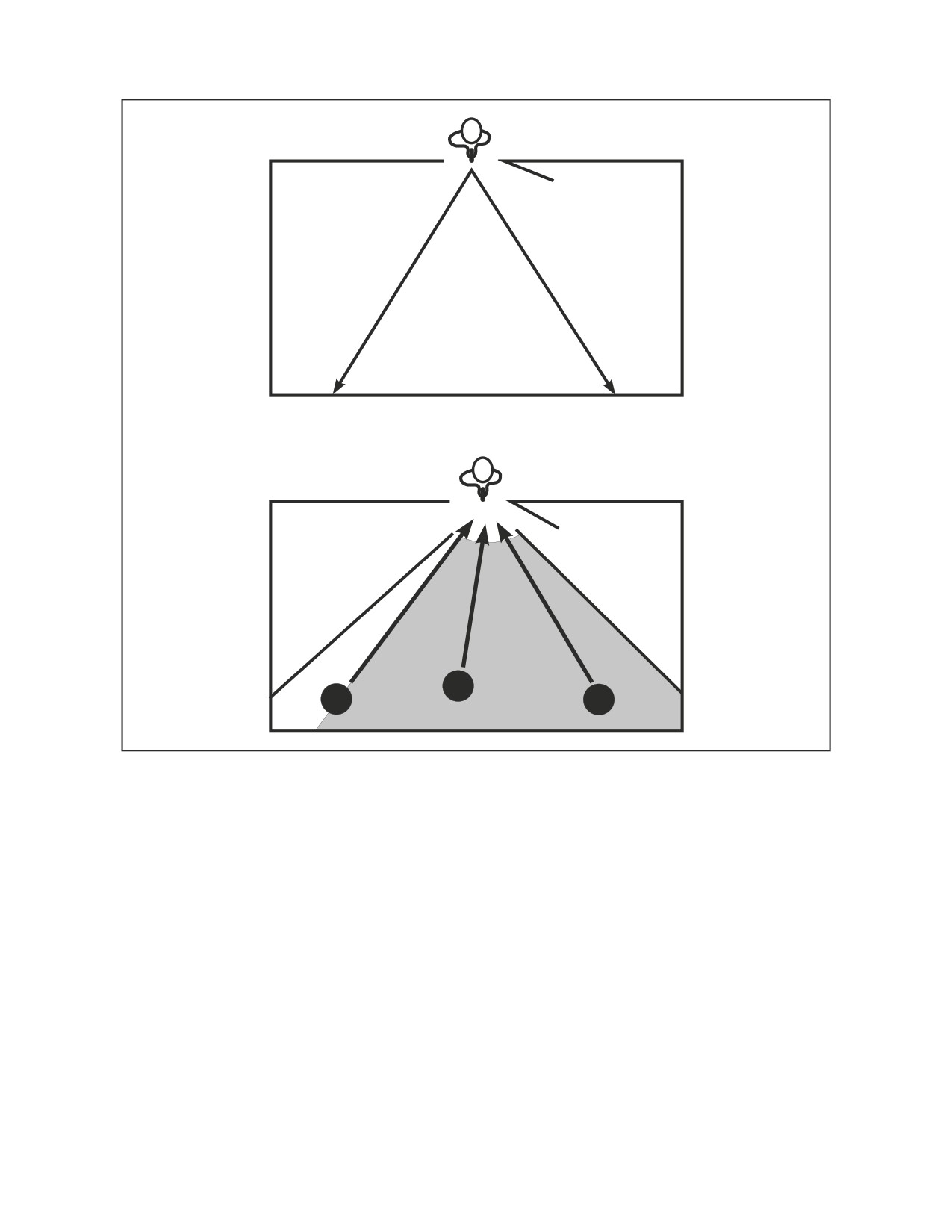
NATO-UNCLASSIFIED
ATP-71
Figure D-1. The Fatal Funnel Concept
(e) Inspect the remaining area of the compartment by doing a quick peek. If the door is al-
ready open, approach on the hinged side.
(4) When operating as a two-man team, remember the following:
(a) Team members should take up positions on opposite sides of the door.
(b) The man opposite the hinges should open and inspect behind the door.
(c) Both team members should inspect the area visible using quick peeks as necessary to
ensure thorough coverage of the compartment.
(d) Team members should enter the compartment using one of the techniques described on
the following pages.
D-5
ORIGINAL
NATO-UNCLASSIFIED
NATO-UNCLASSIFIED
ATP-71
(e) If the door opens out, the man on the knob side should loop a cord around the knob and
throw the end to his partner, staying back along the wall as far as possible from the door-
way, reaching out full arms length, and unlatching the door.
(f) After having pulled back and readied his weapon, the other man should pull the door
open.
(g) If the door opens in, the person on the knob side should try to unlatch the door. First,
open the door an inch, back away, and listen for a moment. Next, shove the door open with
enough force to strike the wall or a person hiding behind it.
(h) When entering the door, the following should be performed:
(1) Strive for speed, surprise, and safety.
(2) Quick peek before moving, then get in and get low, protect the back, and get the area of re-
sponsibility under control as quickly as possible.
(3) Don’t dally in the doorway.
(4) For speed, move in high with nothing lower than a slight crouch. (Going in low with the
knees radically bent will be too slow.) Move in high, and then get low.
(5) Once across the threshold, get away from the door.
(6) In essence, use a pattern, a tactical way of entering in minimum time with minimum expo-
sure. Patterns are not absolutes, and getting in fast is more important than executing a perfect
entry movement. Some of the more common methods are described below.
b.
The Buttonhook. The buttonhook (see Figure D-2) can be used when working alone or in a
two-man team. After visual inspection from outside the door, quickly enter the compartment,
hooking away from the door and keeping back to the bulkhead while entering. In a two-man team,
normally enter together on signal. If the doorway is too narrow to enter together, decide by signal
who will go first, and then quickly enter one after the other. In cases where furniture or other objects
obstruct the view of the entire room, after entering, slowly move further into the room keeping the
back towards the bulkhead until the compartment seems to be safe. Two-man teams usually work
down opposite bulkheads. Commonly on vessels, doorways are located at the ends of passageways,
thereby preventing both men from getting on either side of the door. In this instance, wrap around
the door to the other side of the wall (one at a time, from the same side of the door and keeping the
backs close to the frame).
c. The Crisscross. The crisscross (see Figure D-3) is the entry of choice for a dynamic entry.
With the door closed, take up positions on opposite sides of the door. On signal, the man opposite
the hinges opens the door and using the door as a shield during the initial arc of 70°, quickly enters
the compartment, assuming a position to the side of the doorway. Once clear of the doorway, the
second man enters to the opposite side of the room.
When the doorway is too narrow to enter simultaneously, the crisscross is an effective nondynamic room
entry because, unlike the buttonhook, it is possible to see the destination before getting there.
d. The Special Air Service. The special air service (SAS) pattern can be used as a non-dynamic
room entry when it is impossible to stand on each side of the doorway for entry. (See Figure D-4.) It
is a technique where two or more men position themselves heel to toe on one side of the door, and
one man holds onto the belt of the man in front of him. On signal, both men simultaneously rush into
D-6
ORIGINAL
NATO-UNCLASSIFIED
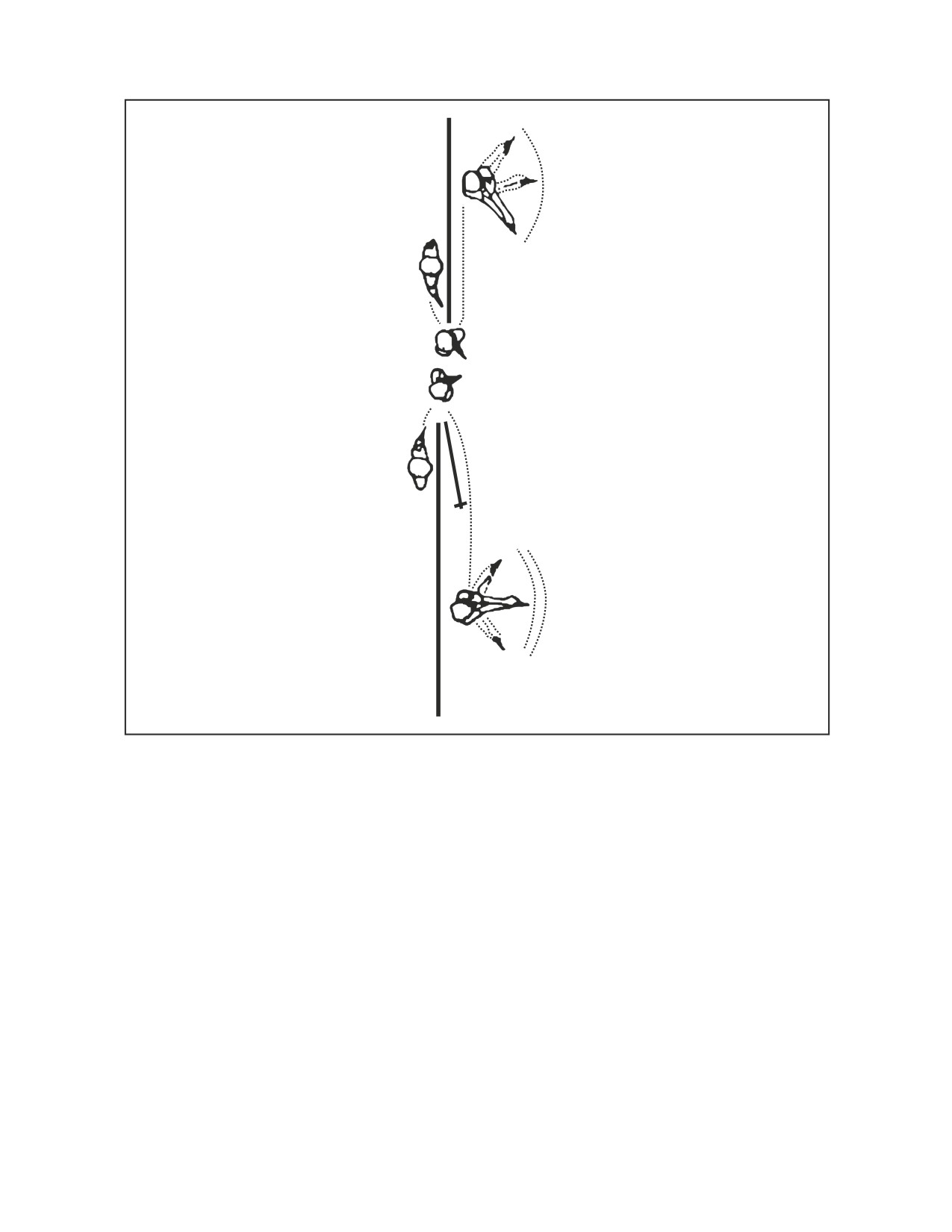
NATO-UNCLASSIFIED
ATP-71
Figure D-2. The Buttonhook
the room. As each man in line enters the compartment, he lets go of the belt and positions himself at
a predetermined location inside the room.
e. The Israeli. Many search teams do an Israeli move (see Figure D-5) before they enter a
compartment. The position for a quick peek into a compartment is the same position as for an Israeli
move. On signal, immediately follow a quick peek with another quick peek with handgun being the
third eye. In other words, swing only the gun hand into the compartment from the barricade
position, sweeping the area of responsibility, then move back outside to set up for a standard entry.
f. For all entry techniques, if the right hand is the stronger hand and the right side of the doorway is
being entered, switch weapon to the left hand. This minimizes exposure of the body in case it
becomes necessary to engage a suspect hiding against the wall. The same holds true for a
left-handed person on the left side of a doorway.
g. All entry tactics, while infinitely better than impulsively rushing the room, are tricky to perform
and require practice.
D-7
ORIGINAL
NATO-UNCLASSIFIED
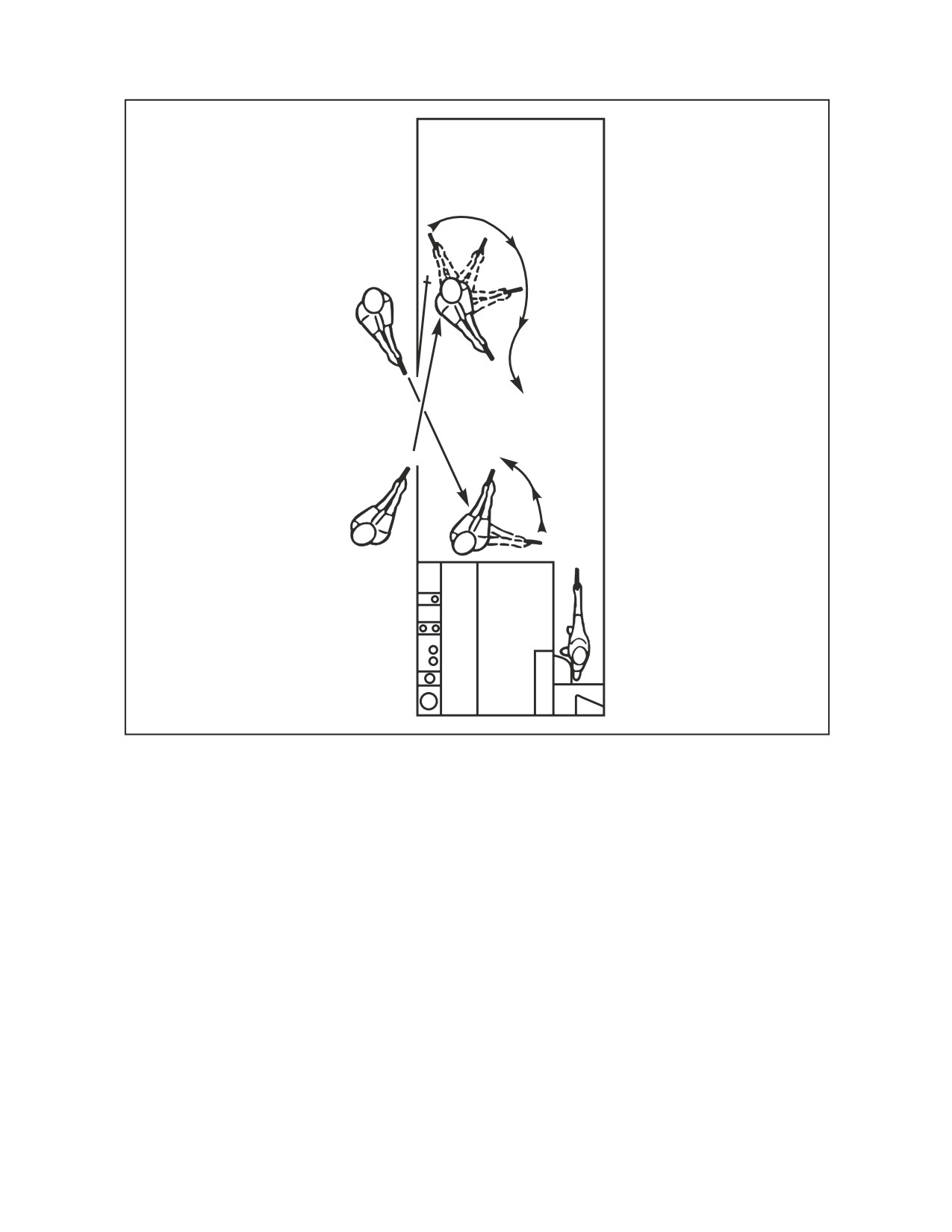
NATO-UNCLASSIFIED
ATP-71
Figure D-3. The Crisscross
10.
Tactical Movement. Nothing is more important to surviving vessel sweeps than the principle
of concealment that can minimize the risk. This can help in constructing a systematic plan rather than re-
lying on random movement. Yet, ironically, when conducting tactical sweeps, often many of these tacti-
cal principles cannot be applied because of constraints in manpower, the impulses of human nature, or the
realities of vessel design. Adhere to these principles as if they were the moral principles of life and appre-
ciate their value. Try to adhere to them as often as possible and understand that there will be times when
they will have to be compromised because of uncontrollable elements. At the very least, be aware when
they are violated and why. The following are some specific tactical movement strategies:
a. Clearing the Room. After entering a room and establishing the areas of responsibility, clear
the room with the same amount of safety used to enter it. Threat locations typically include under
beds, behind large pieces of furniture, in closets, or around corners within the room. Look
especially for doors that are open and doorways that lead to adjoining rooms. The primary area of
interest will be that spot which, if a hostile person were hiding there, would give him the greatest
opportunity to attack.
D-8
ORIGINAL
NATO-UNCLASSIFIED
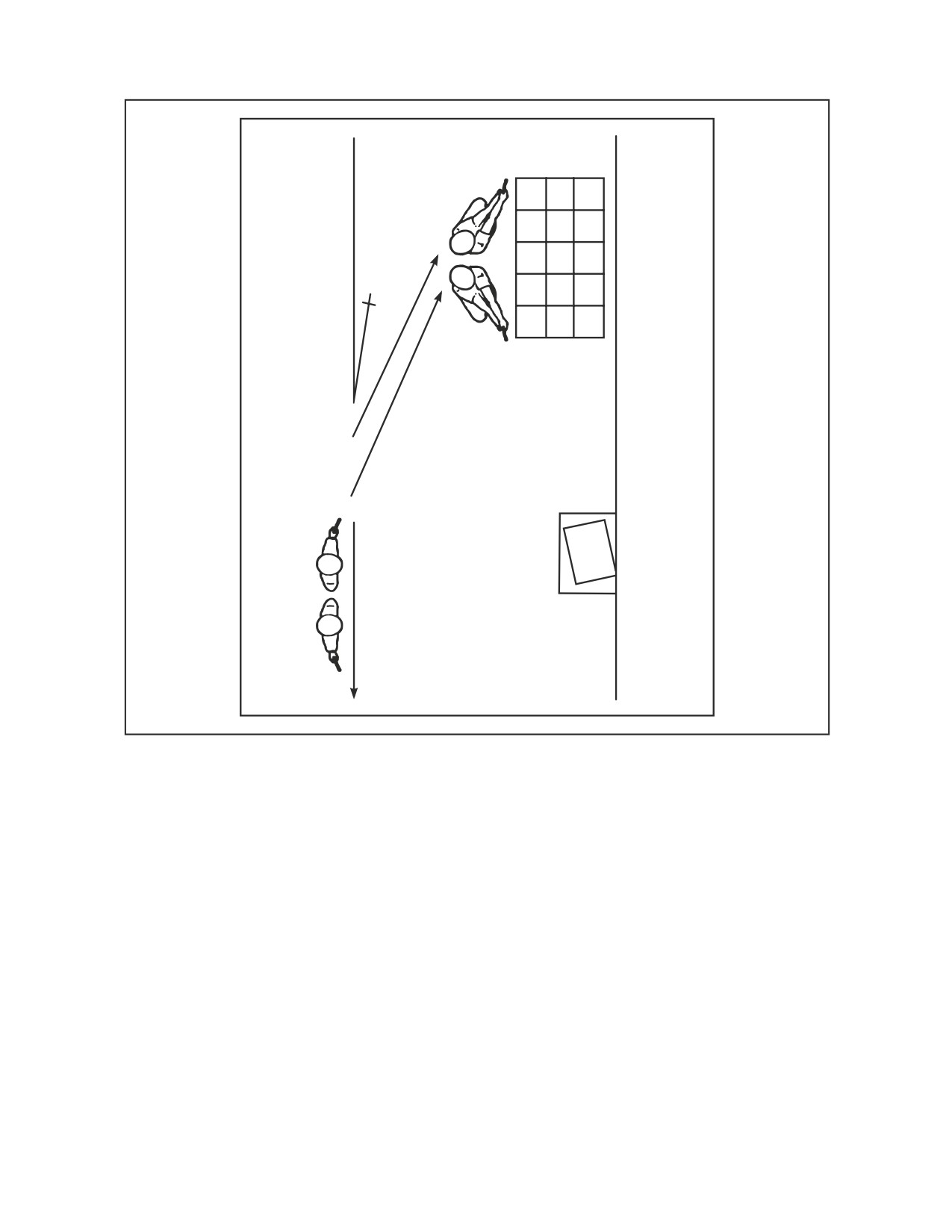
NATO-UNCLASSIFIED
ATP-71
Figure D-4. The SAS.
b. The Most Immediate Threat. Always take care of the most immediate threat first, even if it
is not the greatest threat. The rules of the room says one ought to always move around the
perimeters of rooms with back to the wall. In reality, furnishings or other obstacles often prevent
this, especially on vessels. In large holds, mess decks, or other large spaces, it is tactically sound for
decreasing the chance of exposing the back to a suspect. Stay low to reduce the possibility of being
a target.
c. Stationary/Moving Man. No matter which partner chooses to negotiate the same side of the
room or along opposite sides, only one should move at a time. The other should provide security.
Usually, the stationary man performs most of the searching. The moving man will be able to open
closet doors or lift void covers so the stationary officer can see into them.
d. Weapon Preparation. While moving, ready weapon to meet force with force. Forcefully
challenge noises or movement not identifiable from the nearest cover by saying (for example),
“You in the closet! Come out! Hands first!” Command the crewman to come. Do not approach what
may turn out to be an armed crewman waiting.
D-9
ORIGINAL
NATO-UNCLASSIFIED
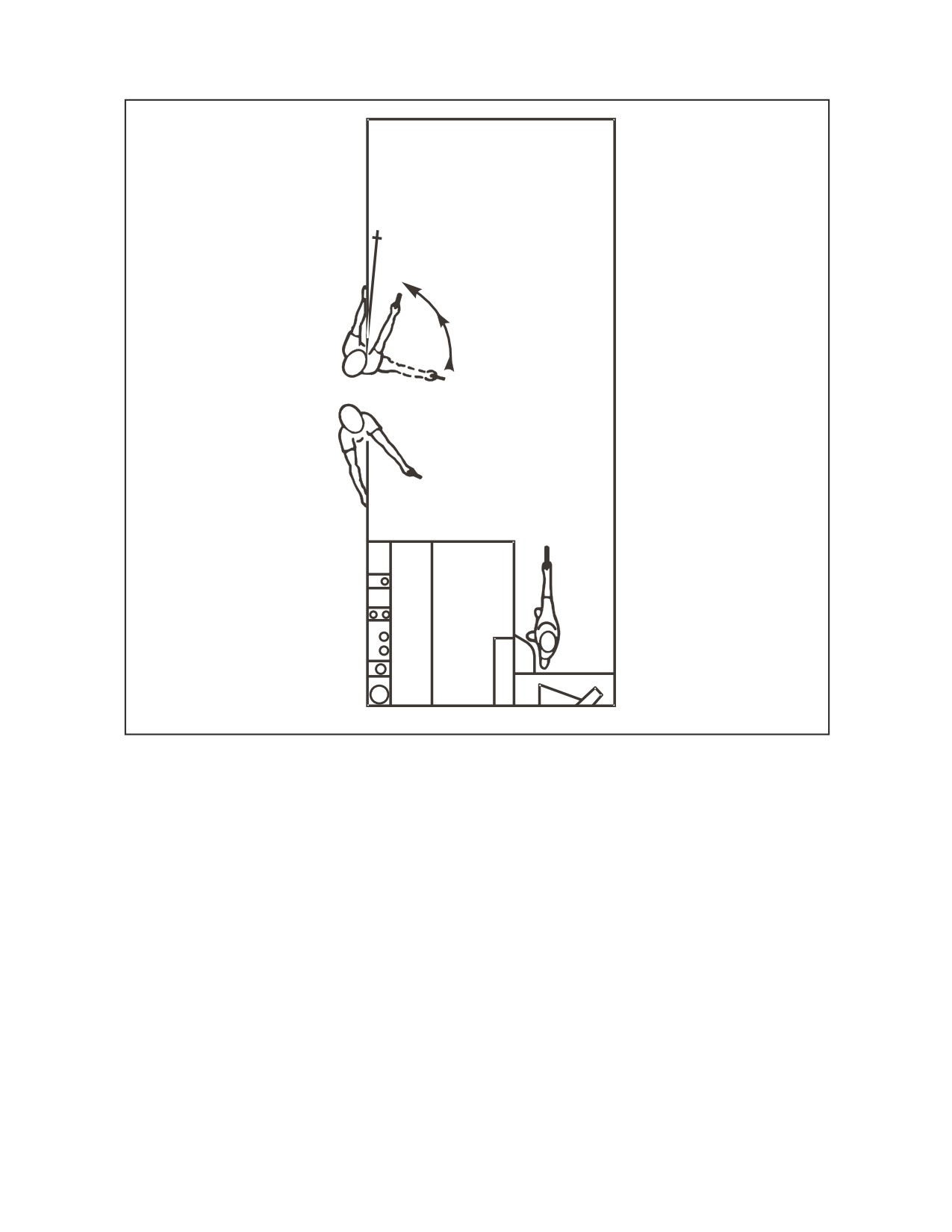
NATO-UNCLASSIFIED
ATP-71
Figure D-5. The Israeli Move
e. Adversary’s Field of View. While moving, think constantly about the cover and the
adversary’s field of view. Could a crewman be hidden in a spot from which he could see (or shoot)?
As a tactical minimum, never enter a field of view that a partner cannot cover.
f. Positioning. Remain aware of own position relative to where a crewman may be and the
position relative to that of the partner. Partners getting into each other’s crossfire are a major risk,
especially in the close quarters of a vessel and where high stress tends to keep them engrossed in the
search process.
g. Bunching Effect. Avoid the bunching effect, the tendency to cluster together in the illusion
of safety in preparation to move, enter, or search. The closer partners are, the easier it is for an
adversary to shoot both of them. Tactical separation buys time for proper reaction. However,
partners should not distance themselves apart to a point where they cannot keep in visual contact.
They should be able to see each other at all times, except in extreme circumstances.
D-10
ORIGINAL
NATO-UNCLASSIFIED
NATO-UNCLASSIFIED
ATP-71
h. Triangulation. Strive for the principle of triangulation, which promotes tactical separation,
minimizes crossfire and bunching, and maximizes the impact of defensive fire by directing it to a
central point. (See Figure D-6) To understand triangulation, think of the potential hiding places in
the field of view as being at the apex of a triangle. Ideally, both partners should be positioned so as
to form the other corners of the triangle relative to each of these hiding places. If a threat presents
itself, it is then possible to direct fire at it from different angles, while the adversary will be forced to
separate his fire power in order to hit both partners. While moving to clear areas of responsibility,
one partner shifts his position to maintain triangulation on new potential threat locations.
(1) Two movement techniques that accommodate this principle of triangulation are follow the
leader and leapfrog. They are described as follows:
(a) Follow the leader is a technique where one man moves, and then stops, then the second
man moves to his position (maintaining tactical separation). The second man also has rear
guard responsibilities.
(b) Leapfrog is a technique where one man searches an area, then signals when it has been
secured. The second man then moves past him into a new area and secures it.
(2) These two methods are used at various times during a vessel search. If one partner insists on
moving about in a careless manner, the other partner should cover and not be lured into joining
him in untactical movements.
11.
Movement Strategies During a Search. Employ the following during a search:
a. Make sure that only one man moves at a time. (One covers while one moves.) This principle
ensures that someone is always maintaining control and is prepared to provide reliable defence.
b. Look before leaping. Spot a covered or concealed position and plan the route to it prior to
moving. Move by short bounds from one covered or concealed location to another. Keep low and
don’t hesitate to creep or crawl.
c. Take full advantage of shadows and dark areas after making certain that no one is hiding in a
potential moving spot.
d. Shift slowly while moving. Don’t wave the arms or rapidly turn the head.
e. Be conscious of self-made noises. The crewman will probably know of the team’s presence,
especially once the team enters the compartment where he’s hiding. Breathing alone may be
enough to alert him. It is amazing how acute the senses can be when someone is hiding and waiting
for someone. Don’t help him by jangling keys, jingling coins in the pocket, carrying squawky
radios, or wearing watches with alarms.
f. Minimize noise by using the sides of the feet to lightly feel the floor, rolling forward with the
whole length of the outer edge of the foot before putting any weight on it.
g. Consider eliminating visual noise, such as ball caps with protruding bills. At least turn it around
backward if it is worn at all. Besides announcing the team’s presence in manoeuvres like the quick
peek, a hat bill will restrict the peripheral vision and may discourage the team from looking up, an
important and often neglected part of searching.
h. Get rid of the loudness of unnecessary odours, too. The scent of cologne can give locations away
as easily as being heard.
D-11
ORIGINAL
NATO-UNCLASSIFIED
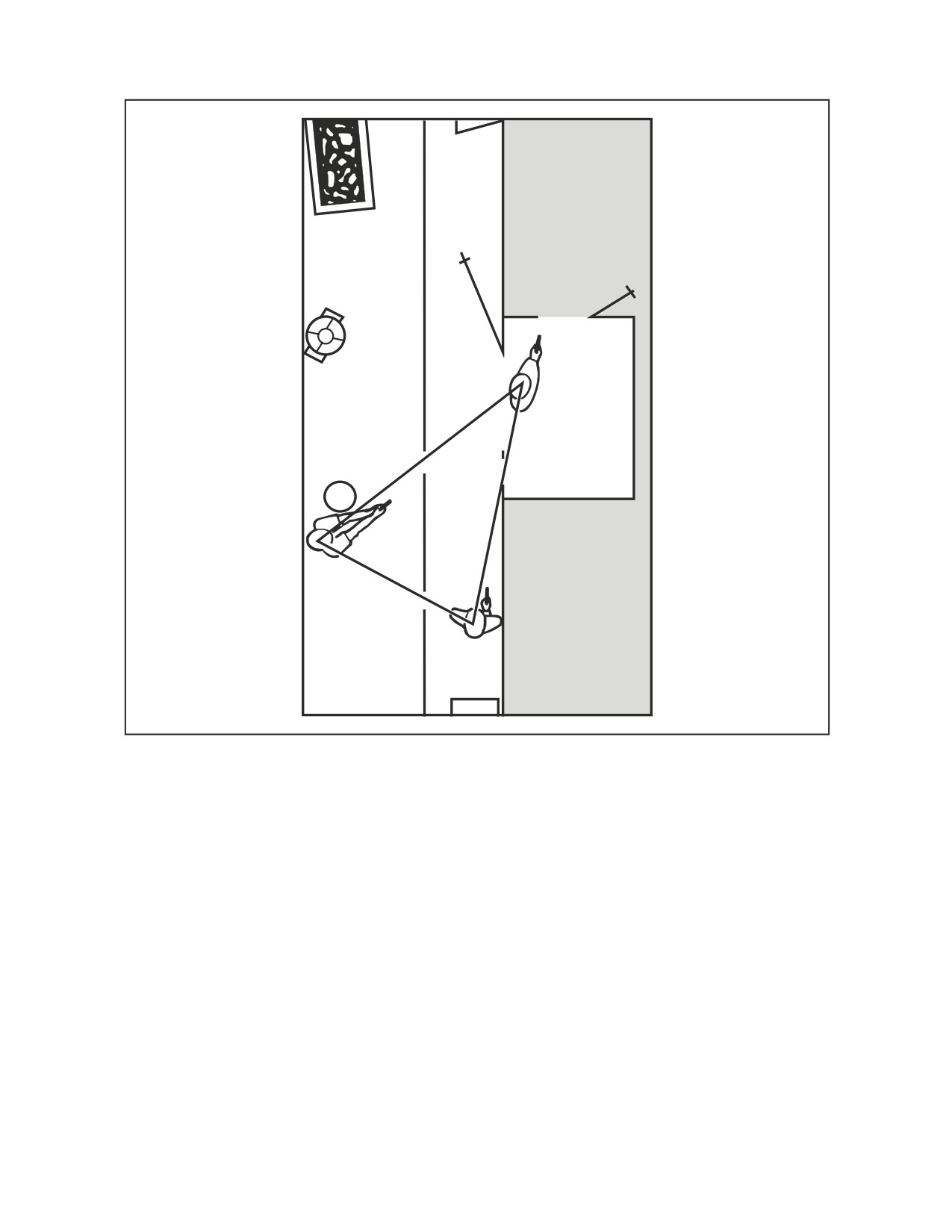
NATO-UNCLASSIFIED
ATP-71
Figure D-6. The Triangulation Concept
i. Search with a gun on hand. It is disadvantageous enough to encounter a threat without being slow
to respond by having to draw a weapon. Keep the following in mind:
(1) When standing or moving, avoid the movie cop syndrome by holding the gun beside the
head. There is a risk of shooting off a partner’s head.
(2) Move with the gun pulled back snugly in a two-hand hold against the waist, at the belt
buckle, and with the muzzle pointed slightly downward. Having the gun in this position pro-
vides good stability, even to release one hand to open doors or balance against a rocking ship.
Then, if a threat comes unexpectedly from either side, the team member(s) will be on target (re-
ferred to as the third eye concept).
(3) Employ the third eye concept because as the body turns toward a threat, the gun (lined up in
the centre) turns, too. This turning is the essence of instinct shooting: what the gun sees as a third
eye, it can hit.
D-12
ORIGINAL
NATO-UNCLASSIFIED
NATO-UNCLASSIFIED
ATP-71
j.
When searching for a suspect:
(1) Avoid passing any potential hiding place without first checking and securing it. Do not dis-
miss any space for being too small or too unlikely. Motivated by the fear of being caught, hu-
mans can squeeze into amazingly small spaces.
(2) When searching an area of a vessel without having found someone, keep the senses sharp
by thinking “I didn’t find anyone” and not “There is no one in there.”
(3) While searching, pause frequently and just listen. Remember, the crewman is excited and
under stress, too. He may make a noise because his throat is dry, or he may get a muscle cramp.
(4) Do not rush the search. Because the mind may be accelerating under stress does not mean
the movements have to accelerate to match.
(5) If a person is found, perform the following:
(a) Move him to a secure area.
(b) Handcuff and search him for weapons (one team member only, while the other pro-
vides cover).
(c) Move the suspect topside via a path that has been cleared or call for another search team
to get him.
(d) Remember that if both team members leave the area, they will have to search their way
to their previous location. Finding one unaccounted-for crewman should be a flag to search
for more.
k.
After clearing a room, be sure that all doors and accesses behind have been closed and locked, if
possible, before moving on. Place pieces of masking tape across the top of the door and collect them
when passing these places on the way out. Also, make sure that none of the tape has been disturbed.
l. If a barricaded crewman is encountered and cannot be talked out, try to wait him out, smoke him
out, or starve him out. Do not try to go in and get him. Leave that to the professionals. Lock him in, if
possible, or post a guard and leave him.
12.
Tactical Communications.
a. Communications with other team members during the conduct of a sweep should be
accomplished by using nonverbal signals. See Figure D-7 for a few of the standard signals and their
meanings.
b. Decisions dealing with who will go first, who will be high, who will be low, etc., are made
simply by pointing and directing with the hands. Normally, the person in charge of a search team
initiates the communication.
c. The sounds partners make while communicating should be soft, also. Instead of speaking out
loud (a hard sound that can easily be pinpointed), whisper (a soft sound whose precise location
cannot be so easily placed). Obviously, if a threat is imminent, shout out loud so there is no doubt
that the warning is heard. While moving through the interior of the vessel, keep in mind that
everyone may not always hear or see the same things, even though it may seem impossible that they
wouldn’t.
D-13
ORIGINAL
NATO-UNCLASSIFIED
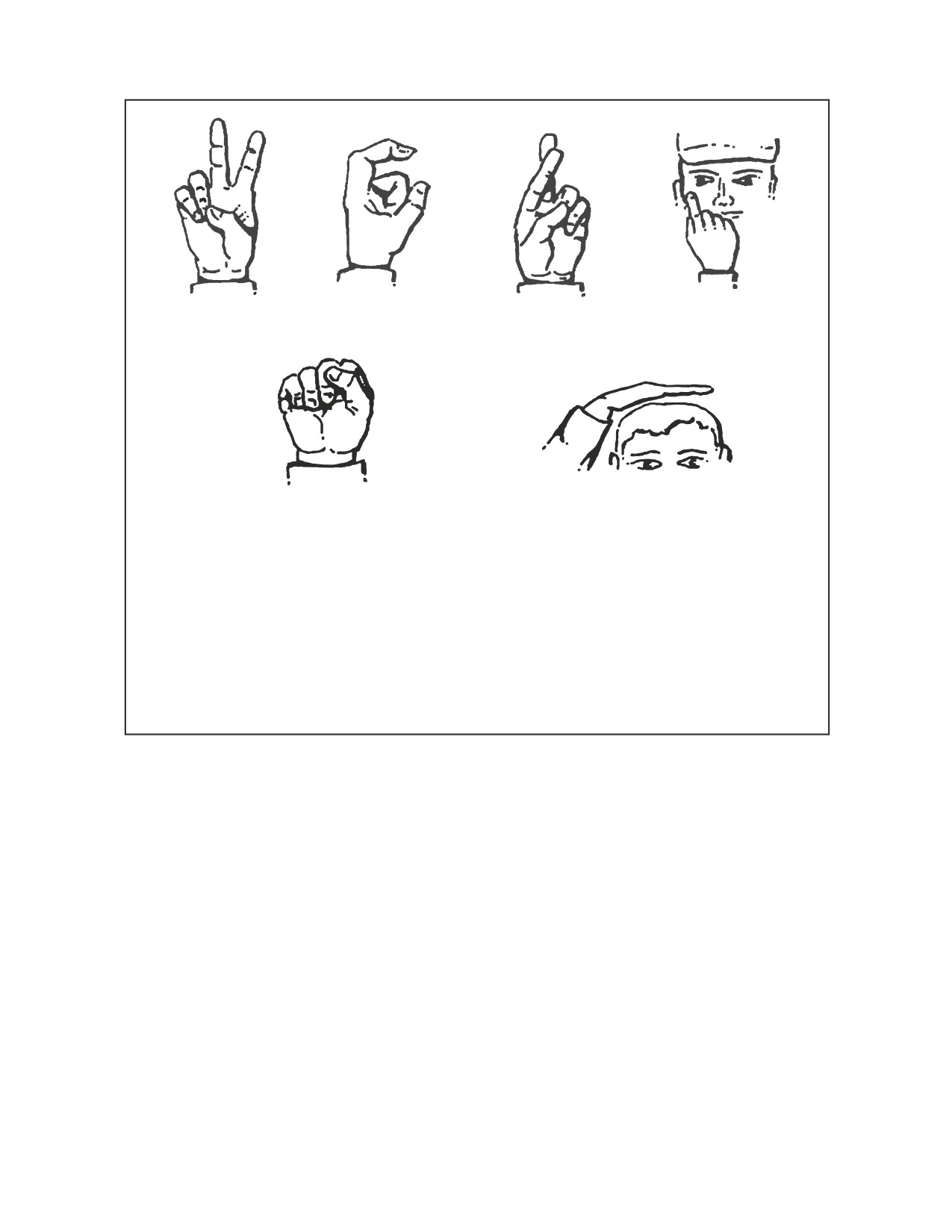
NATO-UNCLASSIFIED
ATP-71
1.
2.
3.
4.
5.
6.
LEGEND
1. SAS
2. BUTTONHOOK
3. CRISSCROSS
4. QUICK PEEK
5. ISRAELI
6. COVER ME
Figure D-7. Nonverbal Signals
d.
In addition to the above, employ the following:
(1) Be sure that communication does not require either partner to look away from his area of re-
sponsibility. Hand and head signals should be used only when they can be seen in direct or pe-
ripheral vision while attention is kept on the potential threat location. Normally, the man in
front uses hand signals, while the man at the rear whispers, because his whisper will project for-
ward. If in front, resist the impulse to look back to see if the other person got the message. When
either partner receives a message, whisper or signal back to the other person that the message
was received. Signals need to be very simple so they won’t be forgotten or confused under
stress.
(2) Do not rub against walls while moving from one spot to another due to possible exposure
and ricochet fire. To avoid being ambushed or surprised by someone on a different level, take
care to check openings above and below while moving. In a situation where close attention must
be given to the level above, cover the area into which the team is moving (see Figure D-8) while
one partner, walking backwards and guided by the other partner, covers the higher level away
D-14
ORIGINAL
NATO-UNCLASSIFIED
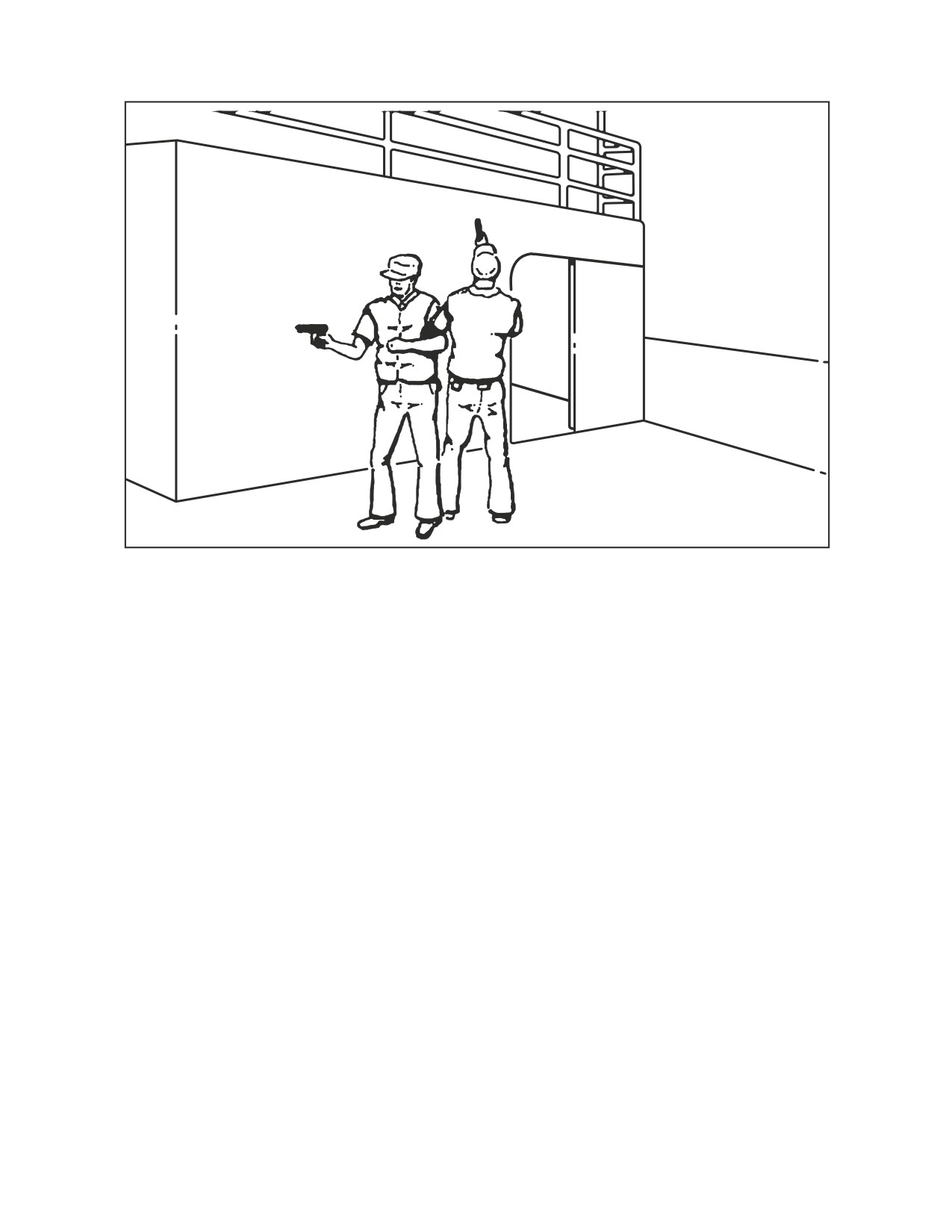
NATO-UNCLASSIFIED
ATP-71
Figure D-8. The Cover Concept
from the area into which the team is moving. If a possible threat is detected, the team should take
cover and confront the threat.
(3) Enter the passageways cautiously because they are ready-made for an ambush. Due to the
possibility of an ambush, employ the following:
(a) Take a quick peek to clear the passageway before entering it. Instead of peeking around
a corner, move to the opposite wall and peek out. (If someone is just around the corner, this
will maximize the distance between them and the team member(s).)
(b) Utilize the slicing the pie option (see Figure D-9) while entering passageways or a cor-
ner and a threat may be on the other side. When near the corner, move away from the wall as
far as possible, face the corner, and, while shuffling to the side, gradually increase the arc of
visibility around it. Once the decision has been made to enter the passageway, only one man
should enter at a time. Again, one man should move and one should cover. While moving
around, always try to keep some cover in sight: a place to retreat if trouble explodes.
(c) When traversing narrow passageways and spaces, one team member should go first
(crouching low) while the other covers him. When the first man gets to his destination, the
other may advance.
(d) While moving up a ladder (see Figure D-10), one team member should slide up the lad-
der on his back, using his heels to push himself. The second team member should provide
cover to the front. When moving down the ladder, take one or two steps down, exposing
only the feet, and then do a quick peek before proceeding. Use a mirror to look into a com-
partment to prevent being exposed.
D-15
ORIGINAL
NATO-UNCLASSIFIED
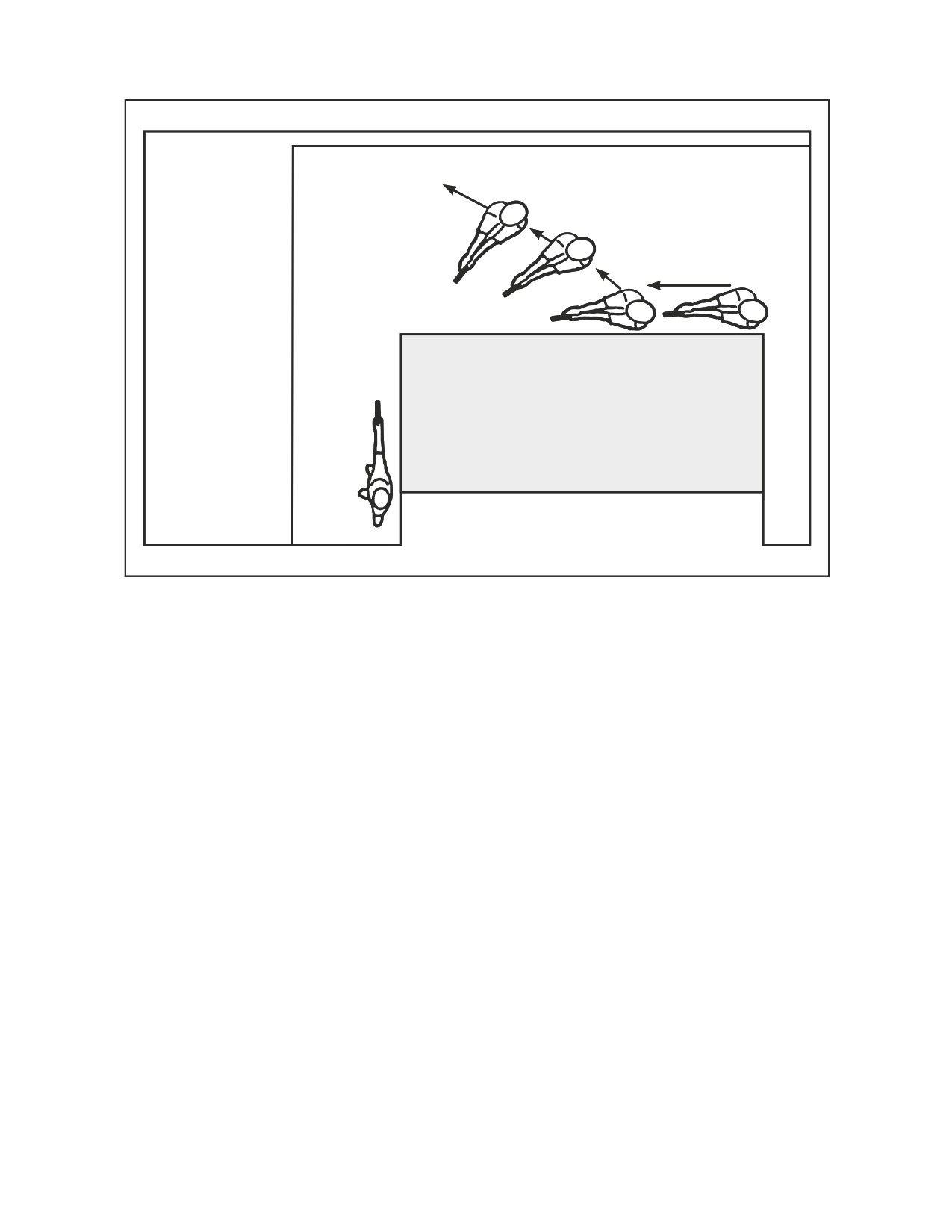
NATO-UNCLASSIFIED
ATP-71
Figure D-9. Slicing the Pie
(e) Remember that there are two objectives when approaching a search: To move through
the passageway to reach a more distant area that was intended to be entered and searched, or
to position one’s self in the passageway to enter a room that opens off the passageway.
13.
Tactical Lighting.
a. One method of expanding the field of view is through the manipulation of light in darkened
locations. Where there is controllable lighting, move from dark areas into lighted ones and never
the reverse, if possible. If, prior to entering a compartment, it is impossible to turn on its lights, turn
the lights out in the occupied room. Do not form a silhouette by moving with bright light behind.
Light switches in most compartments are opposite the hinge side of the door about chest height off
the floor. Don’t linger around the switch too long, though; the other guy probably knows where it is,
too.
b. Use the following procedures prior to entering compartments in which the lights cannot be
turned on:
(1) Take cover together on the same side of the doorway with the partner standing and facing
the wall as far back from the doorway as possible and holding his flashlight pointing into the
compartment near the top of the doorway.
(2) Lay on the deck and peek into the compartment with weapon ready. On signal from one
partner, the other partner should turn the light on.
D-16
ORIGINAL
NATO-UNCLASSIFIED
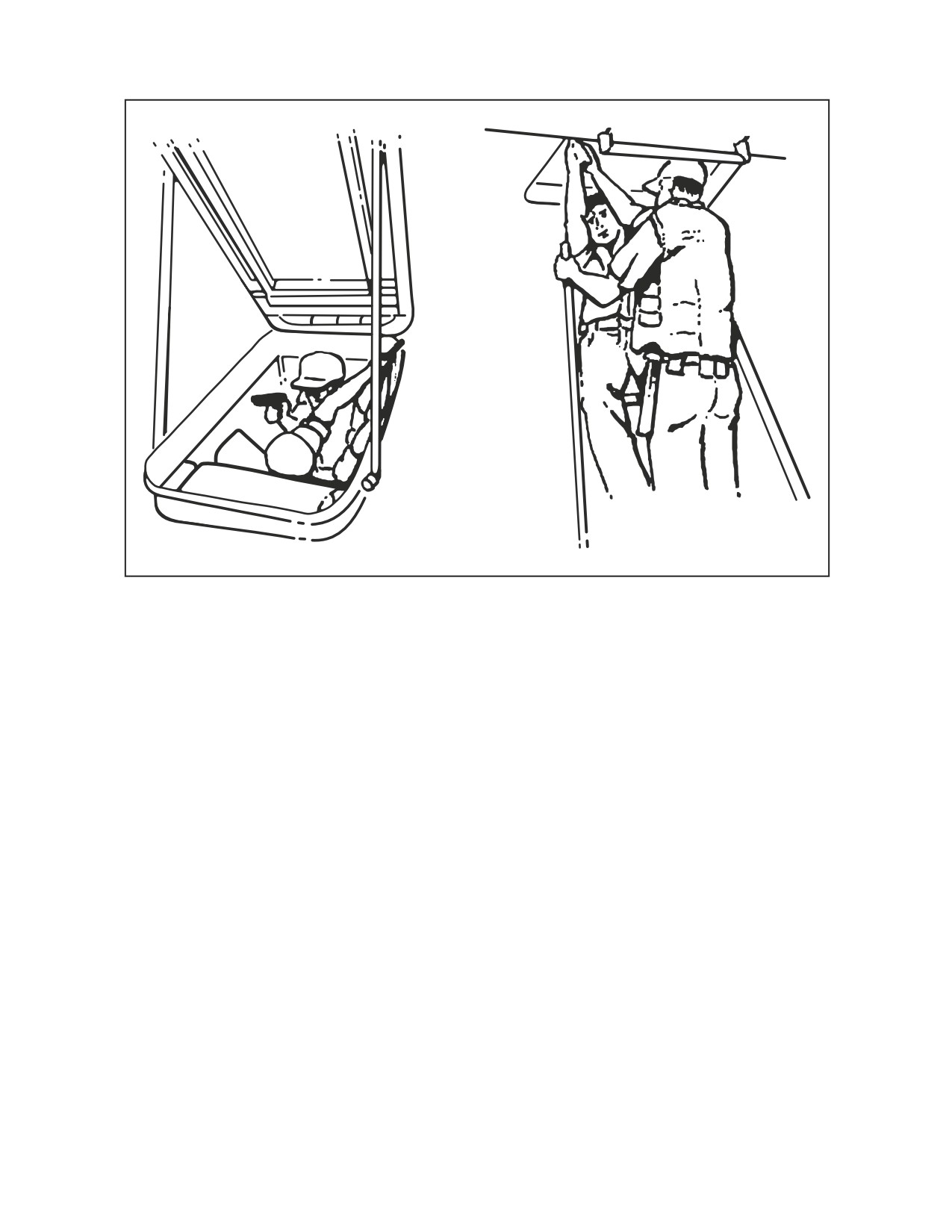
NATO-UNCLASSIFIED
ATP-71
Figure D-10. The Ladder Concept
(3) Send signals to the partner by pulling either up, down, left, or right on his pants leg. The
partner should then correspond by slowly moving the flashlight in the direction of the pull.
c. When performed properly, a person inside the compartment can only see a bright light near the
top of the door. Use of this technique and slicing the pie should provide a look at most of the
compartment.
d. When moving about a dark compartment, consider using the harries flashlight technique. The
flashlight is held with the back-of-flashlight hand meeting the back-of-gun hand. The two press
together to create dynamic tension that stabilizes the pistol. Depending on hand and flashlight
shape, the light button may be controlled by the little finger, index finger, or thumb. The idea is to
flash momentarily, change position, and do it again, leaving the light out while moving. Regardless
of the illumination created, before passing any corner or entering any doorway, see what may be
waiting on the other side.
D-17
ORIGINAL
NATO-UNCLASSIFIED
NATO-UNCLASSIFIED
ATP-71
INTENTIONALLY BLANK
D-18
ORIGINAL
NATO-UNCLASSIFIED
NATO-UNCLASSIFIED
ATP-71
ANNEX E
Checklists
E001 Seaworthiness Assessment Checklist
ASSESS/
ITEM
NO GO
VALUE
Pre-boarding
Monitor and record:
Period of roll/hang time (>1.5-2 sec hang time)
sec
List
deg
Trim
Freeboard
ft
Sea State
SS
Cumulative assessment
GO/NO GO
En route
Determine/record
Draft markings and waterline (first 100 ft = 10
ft
ft
of draft, every additional 110 ft and 5 ft of draft)
Bubbles/Oil Slick
Yes/No
Hull Penetrations
Yes/No
Cumulative assessment
GO/NO GO
Onboard Vessel
Monitor/determine:
sec
Period of roll/hang time
in
Bilge water level
Sea State
SS
Use of pumps and educators
Yes/No
Anchor viability
Yes/No
Fire
Yes/No
Flooding
Yes/No
Toxic hazards
Yes/No
Electrical shock
Yes/No
Cumulative assessment
Yes/No
GO/NO GO
E-1
ORIGINAL
NATO-UNCLASSIFIED
NATO-UNCLASSIFIED
ATP-71
E002 Operational Brief to Command Team Checklist
ITEM
COMPLETE
Weather forecast
Intel brief on suspect vessel
Type vessel and size
Vessel's flag/registry
Last port
Next port
MIO history
Type cargo
Crew information
RFIs/EEIs
Threat level
Review ONI database
Overall mission plan
Forces/Units assigned
Command organization
Aircraft employment
Governing ROE
Communications
Internal
External (Pri/Sec/Tert)
Codewords/prowords
Navigation considerations
Pre-planned responses
Review NO/GO criteria
ORM assessment
Position of suspect vessel
Extraction procedure
Sanitation procedure
E-2
ORIGINAL
NATO-UNCLASSIFIED
NATO-UNCLASSIFIED
ATP-71
E003 Bridge/CIC Watch Checklist
ITEM
COMPLETE
Set MIO condition watch teams (Bridge/CIC)
Man Query Control position
Review query scripts
Review navigation track with BO
Commence seaworthiness assessment of suspect vessel
Obtain weather forecast
Set up MIO COMMS circuits
Establish suspect vessel tracking watch
Nominate personnel for ship recording of boarding report
Set ship's material condition for MIO
Consolidate Intel briefing information
Conduct Ship/RHIB/Boarding Team COMM checks (EMCON
permitting)
ESM collect racket information
Monitor suspect vessel with SSEE
Provisions for Boarding Team, re-supply as required
Set/Station as appropriate:
Flight Quarters
Boat Detail
Navigation Detail
Special Sea and Manoeuvering Detail
Snoopy Team
Designated SCAT and main battery weapons details
MIO Boarding Team
E-3
ORIGINAL
NATO-UNCLASSIFIED
NATO-UNCLASSIFIED
ATP-71
E004 GO/NO GO Checklist
ITEM
VALUE
NO GO
Mission essential support assets available
ft
Sea State/Weather (Seas in excess of 6 ft, winds greater 35 kts)
kts
Suspect vessel enters TTW & host nation forbids boarding
Sea worthiness assessment
ft
Authorized levels of force unsuccessful and freeboard prevents NCB
Passive resistance measures intended to inflict harm
Intel of possible threat/hostile intent
Suspect vessel opposes boarding
BO or OSC determines operation is unsafe
E-4
ORIGINAL
NATO-UNCLASSIFIED
NATO-UNCLASSIFIED
ATP-71
E005 Boarding Officer Pre-mission Brief to Boarding Team
ITEM
COMPLETE
Intel brief on suspect vessel
Type vessel and size
Vessel's flag/nationality
Last port
Next port
Vessel MIO history
Cargo type
Number in crew and nationality
Threat level
Expected compliant or non-compliant
Use of force continuum
Non-firing weapons function check
Equipment checks
Governing ROE
Weather/sea conditions and forecast
Vessel's position/safe navigation considerations
COMM procedures/prowords/codewords
COMMS checks
Overall mission plan and goal
RHIB employment
Aircraft employment
Personnel assignments
Insertion point
Pre-planned responses
E-5
ORIGINAL
NATO-UNCLASSIFIED
NATO-UNCLASSIFIED
ATP-71
E006 Ship Control Team Pre-mission Brief
ITEM
COMPLETE
Intelligence synopsis
Type vessel and size
Vessel's flag/nationality
Vessel MIO history
Cargo type
Vessel MIO history
Cargo type
Number in crew and nationality
Threat level
Weather brief
Communications plan
Callsigns and codewords
EMCON permitting, conduct Ship/SCT COMM checks
Turnover process
Pre-planned responses
Boarding ORM assessment
Equipment check
EMCON permitting, conduct Ship/RHIB/BT COMM checks
Personnel assignments
Provisions for boarding team, re-supply as required
Non-firing weapons function check (for armed personnel)
E-6
ORIGINAL
NATO-UNCLASSIFIED
NATO-UNCLASSIFIED
ATP-71
E007 Ship Control Team Turnover Checklist
ITEM
COMPLETE
Suspect vessel crew mustered and under control
Review crew security measures in place
Determine compliance of master and crew
Identify key crew members (master, mates, engineer, deckhands etc)
Determine primary language(s) of master and crew (request linguist
support if necessary and available)
Determine any crew special medical considerations
Determine any crew special religious considerations
Review location of crew containment area, relocate if necessary
Inspect crew messing and berthing arrangements and food/water
stores. If insufficient stores for transit to diversion port, request
re-supply from escort
Establish primary and secondary rally points
Check primary and secondary ship communications circuits, including sus-
pect vessel BTB
Review suspect vessel internal communications arrangements
Inspect navigation equipment
Test/inspect navigation lights
Inspect liferafts
Identify and locate any potential fire/flood or toxic hazards
Determine proposed fire/flooding/gas boundaries (transverse bulkheads/
doors/watertight hatches)
Ensure water and fuel integrity is satisfactory and sufficient for expected
transit
Conduct seaworthiness assessment
Ensure adequate DC equipment is available
Ensure engineering plant functioning and stable. If sabotages request spe-
cialist assistance from escort
Check for throttle control satisfactory
Ensure steering arrangement/control is satisfactory
Test/inspect deck equipment, in particular anchor, cable and capstan
Take custody of any weapons discovered by initial take down team
Verify there is no apparent damage/casualty/sabotage that would make the
vessel unseaworthy (as per seaworthiness assessment criteria) or unsafe
Conduct deck/ship control/engineering equipment familiarization
Review engineering plates/blueprints (if available)
Ensure SCT is familiar with suspect vessel deck and engineering layout
Verify that SCT manning is sufficient to operate suspect vessel
E-7
ORIGINAL
NATO-UNCLASSIFIED
NATO-UNCLASSIFIED
ATP-71
E008 Boarding Officer Task List
ITEM
COMPLETE/VALUE
COMMS Checks
Channel __________ (CO, OOD, Boat, BO)
Channel __________ (ABO, Search Team, Security Team)
Embark time
Security team aboard time
ABO aboard time
Establish triangulated security perimeter
BO aboard time
Boarding Officer greet Master
Confirm vessel crew muster
Notify supporting ship of status
Post watch over suspect vessel crew
Conduct sweep
Inspect papers
Certificate of registry
Logs
Crew and passenger list
Bill of Health
Clearance papers
Invoices or Cargo Manifest
Bill of Lading
Ship's Charter
Receipts documenting on load of cargo/stores
Tank sounding data
Tank capacity (metric tons)
Intelligence collection requirements
Documentation which establishes a link to sanctions violators
Charts
Notify teams of dangerous cargo discovered
Compare papers for inconsistencies
Verify cargo count
Give recommendations to CO
Make appropriate Deck Log entries
Extradition method
Disembark suspect vessel time
Recover to supporting ship time
E-8
ORIGINAL
NATO-UNCLASSIFIED
NATO-UNCLASSIFIED
ATP-71
Annex F
OPTASK MIO and Information
to be Included in OPTASK MIO SUPP
F001 OPTASK MIO
The OPTASK MIO will be promulgated by the designated MCC. An example follows:
A1/REFERENCES (REF)
A2/PERIOD COVERED (PERIOD)
A3/ADMINISTRATIVE
/1/DEFINITIONS
/2/PURPOSE
A4/TASKING (TASKING)
C2/THREAT
/2/ROE (THREAT)
D1/MISSION (MISSION)
I1/AIR TASKING (AIRTASK)
X1/REPORTING INSTRUCTIONS (REPINST)
/1/GENERAL
/2/INITIAL QUERY AND BOARDING REPORT
Y1/SPECIAL INSTRUCTIONS (SPECINST)
/1/OPGEN/OPTASK MIO SUPP GUIDANCE
/2/SEAWORTHINESS ASSESSMENT
/3/SECURITY TEAM
/4/SEARCH LIMITATIONS
/5/ASYLUM AND SAFE HAVEN
/6/SAFETY
F002 OPTASK MIO SUPP
The OPTASK MIO will be amplified by the appointed MIO commander through promulgation of an
OPTASK MIO SUPP. The OPTASK MIO SUPP should address the following topics:
a. Definition/designation of contacts of interest
b. Intelligence/information collection guidelines including priority of EEIs.
c. Self-defence/collective self-defence
d. Query/BTB COMMS guidance
e. Authority to determine compliant, non-compliant, opposed boarding
f. Authority to conduct compliant, non-compliant, and opposed boarding
g. CONOPS for ship support of SOF and/or interagency participation in MIO
h. CONOPS for integration of allied forces
i. Entry/pursuit into territorial waters and airspace
F-1
ORIGINAL
NATO-UNCLASSIFIED
NATO-UNCLASSIFIED
ATP-71
j. Illumination of contacts
k. Advising shipping of MIO mission
l. Safety/seaworthiness assessment procedures
m. Divert/escort and seizure of vessels
n. Health and comfort support to detained vessels
o. Search and boarding of vessels
p. Interrogation and detaining of suspect vessel crewmembers/passengers
q. Guidelines for security teams’
r. Review/seizing documents and cargo
s. Use of warning shots to include pyrotechnics
t. Use of disabling fire
F-2
ORIGINAL
NATO-UNCLASSIFIED
NATO-UNCLASSIFIED
ATP-71
GLOSSARY
This Glossary contains abbreviations and acronyms used in this document as well as others commonly
used in joint and combined operations. A comprehensive list of NATO abbreviations is contained in
AAP-15, the NATO Glossary of Abbreviations Used in NATO Documents and Publications.
ABO
assistant boarding officer
AF
assault force
AFC
assault force commander
AMC
air mission commander
AT
anti-terrorism
ATL
assault team leader
BO
boarding officer
BP
boarding party
BT
boarding team
BTB
bridge-to-bridge
C2
command and control
CESM
communications electronic support measures
CIC
combat information centre
CO
commanding officer
COMMS
communications
DC
damage control
DIW
dead in water
EEBD
emergency egress breathing device
EEI
essential elements of information
EMCON
emission control
EO
electro-optical
EOD
explosive ordnance disposal
ESM
electronic warfare support measures
Glossary-1
CHANGE 2
NATO-UNCLASSIFIED
NATO-UNCLASSIFIED
ATP-71
ETA
estimated time of arrival
ETD
estimated time of departure
FLIR
forward-looking infrared
FM
frequency modulation
GPS
global positioning system
HAF
heliborne assault force
HAZMAT
hazardous material
HVBSS
heliborne visit, board, search and seizure
IMO
International Maritime Organization
IR
infrared
IRDS
infrared detection set
JFC
joint force commander
LLTV
low-light television
LPOC
last port of call
MCC
maritime component commander
METOC
meteorological and oceanographic
METOC Det
Meteorology and Oceanography Detachment
MHZ
megahertz
MIO
maritime interdiction operation(s)
MLA
mean line of advance
NATO
North Atlantic Treaty Organization
NB
narrowband
NIMA
National Imagery and Mapping Agency
nm
nautical mile
OIC
officer in charge
ONI
Office of Naval Intelligence
OOD
officer of the deck
Glossary-2
CHANGE 2
NATO-UNCLASSIFIED
NATO-UNCLASSIFIED
ATP-71
OPAREA
operating area
OPGEN
operation general
OPORD
operational order
OPTASK
operational tasking
ORM
operational risk management
OSC
on-scene commander
OTC
officer in tactical command
OTH
over-the-horizon
PPR
preplanned response
RFI
requests for intelligence
RHIB
rigid hull inflatable boat
ROE
rules of engagement
RSP
recognized surface picture
SAR
search and rescue
SAS
special air service (name of SOF/AT units from the UK, NZ, and AUS)
SATCOM
satellite communications
SCT
ship control team
SOF
special operations forces
SOLE
special operations liaison element
SITREP
situation report
SSEE
ship's signals exploration equipment
TACAIR
tactical air
TACON
tactical control
TTW
territorial waters
UHF
ultrahigh frequency
UN
United Nations
VBSS
visit, board, search and seizure
Glossary-3
CHANGE 2
NATO-UNCLASSIFIED
NATO-UNCLASSIFIED
ATP-71
VHF
very high frequency
WMD
weapons of mass destruction
Glossary-4
CHANGE 2
NATO-UNCLASSIFIED
NATO-UNCLASSIFIED
ATP-71
LIST OF EFFECTIVE PAGES
Effective Pages
Page Numbers
Original
I thru IV
Change 2
V, VI
Original
VII thru X
Change 2
XI thru XIV
Original
XV, XVI
Original
1-1, 1-2
Change 1
1-3, 1-4
Change 2
1-5, 1-6
Change 2
2-1 thru 2-4
Original
2-5, 2-6
Original
3-1 thru 3-6
Change 2
4-1 thru 4-6
Change 1
5-1, 5-2
Change 1
5-2a, 5-2b
Original
5-3 thru 5-20
Original
6-1 thru 6-4
Original
7-1, 7-2
Change 1
7-3, 7-4
Change 1
7-4a, 7-4b
Original
7-5, 7-6
Original
8-1, 8-2
Change 2
8-3 thru 8-6
Original
8-7, 8-8
Change 1
A-1 thru A-4
Change 1
B-1, B-2
Original
C-1 thru C-14
Original
D-1 thru D-18
Original
E-1 thru E-8
Original
F-1, F-2
Change 2
Glossary-1 thru Glossary-4
Change 2
LEP-1, LEP-2
LEP-1
CHANGE 2
NATO-UNCLASSIFIED
NATO-UNCLASSIFIED
ATP-71
INTENTIONALLY BLANK
LEP-2
CHANGE 2
NATO-UNCLASSIFIED
NATO-UNCLASSIFIED
ATP-71
NATO-UNCLASSIFIED
NATO/PfP UNCLASSIFIED
RECORD OF AMENDMENTS
N°
Reference/date of
Date entered
Signature
Amendment
EXPLANATORY NOTES
AGREEMENT
1.
This NATO Standardization Agreement (STANAG) is promulgated by the Director
NATO Standardization Agency under the authority vested in him by the NATO
Standardization Organisation Charter.
2.
No departure may be made from the agreement without informing the tasking
authority in the form of a reservation. Nations may propose changes at any time to the
tasking authority where they will be processed in the same manner as the original
agreement.
3.
Ratifying nations have agreed that national orders, manuals and instructions
implementing this STANAG will include a reference to the STANAG number for purposes
of identification.
RATIFICATION, IMPLEMENTATION AND RESERVATIONS
4.
Ratification, implementation and reservation details are available on request or
FEEDBACK
5.
Any comments concerning this publication should be directed to NATO/NSA -
Bvd Leopold III - 1110 Brussels - BEL.
NATO/PfP UNCLASSIFIED
NATO/PfP UNCLASSIFIED
STANAG 1444
(Edition 2)
NATO STANDARDIZATION AGREEMENT
(STANAG)
MARITIME CONSIDERATIONS ON THE CONDUCT
OF FAST ROPING AND RAPPELLING (FRR)
Annex:
A.
FRR BRIEFING GUIDE FOR AIRCREW/BOARDING PARTY
AIM
1.
The aim of this agreement is to specify the detailed requirements for the safe
conduct of maritime cross deck fast roping and rappelling (FRR) utilising national and/or
another nation’s aircraft and personnel.
AGREEMENT
2.
The participating nations agree to adhere to, as a minimum, the requirements and
procedures specified in this STANAG.
GENERAL
3.
The requirement exists for NATO nations to be able to conduct combined joint
maritime FRR operations. This may include FRR of a national helicopter and crew
composition to another nation’s deck as well as mixing aircraft and crews from different
nations for a specific operation.
4.
Before using mixed nation FRR teams for operational missions the formal bi- or
multi-lateral agreement(s) of each participating nation is required. Pre briefing is a
mandatory requirement before conducting cross deck FRR Operations, specifically hand
signals, emergencies and method of descending are to be briefed. An intensive training
phase prior to conducting multinational FRR on an operational level is mandatory. FRR
operations in general should only be undertaken when it is viewed as the most efficient
and practical method of completing a task. The decision to FRR will be decided based on
such constraints as hover height, team member weight, etc.
PERSONNEL REQUIREMENTS AND RESPONSIBILITIES
5.
FRR operations require thorough planning and a high degree of cockpit/cabin
crew co-ordination. Whilst the aircraft commander retains overall responsibility for the
aircraft and the conduct of the operation, the rope master is responsible to the aircraft
commander for the execution of the FRR operations. Within the cabin of the aircraft the
rope master is normally under the supervision of a qualified aircrew-member.
- 1 -
0065E-07ST1444 Ed2
NATO/PfP UNCLASSIFIED
NATO/PfP UNCLASSIFIED
6.
Specific responsibilities are as follows:
a.
Aircraft commander:
-
retains overall responsibility for the aircraft and the conduct of
operations.
-
ensures general safety of the operation.
-
ensures that aircraft hardware is inspected by qualified personnel
before flight.
-
ensures that all personnel are adequately briefed.
-
studies obstacles/hazards on the receiving ship and briefs
crew/boarding party accordingly.
-
determines hover-height for FRR operations in agreement with the
rope master.
-
selects drop zone.
-
authorises deployment of the rope and dispatch of boarding party.
b.
Qualified cabin aircrew-member:
-
conducts aircraft safety briefing to boarding party personnel.
-
demonstrates hand-signals used for:
-
prepare for FRR.
-
next person to the rope.
-
GO.
-
break off.
-
emergency stop.
-
adopt crash position.
-
carry out emergency jump.
-
ensures correct attachment of FRR equipment and rope(s) to the
helicopter.
-
inspects equipment available (e.g. rappelling device, rope, aircraft
hook) and checks its compatibility (dependant on national
procedures).
-
is responsible for compliance to flight safety aspects within the cabin.
-
deploys rope(s) after being cleared by aircraft commander.
-
carries out the following checks after rope is deployed:
-
no knots in the rope(s).
-
sufficient rope lying on the drop zone iaw national procedures.
-
hover position and height appropriate for the operation.
-
retrieves/releases the rope after boarding party insertion.
-
continuously informs aircraft commander about the progression of
the FRR process.
-
indicates completion of FRR after final team member is on the
ground and clear of the rope(s).
c.
Qualified Rope master (also referred to as dispatcher in some countries):
-
discusses conduct of FRR operations, national FRR procedures and
limitations of the team (if applicable) with aircraft commander /
aircrew.
-
is responsible for currency of team members.
- 2 -
0065E-07ST1444 Ed2
NATO/PfP UNCLASSIFIED
NATO/PfP UNCLASSIFIED
-
ensures correct attachment of FRR equipment and rope(s) to the
helicopter (dependant on national procedures).
-
inspects equipment available (e.g. rappelling device, rope, aircraft
hook) and checks its compatibility (dependant on national
procedures).
-
attends briefing of the aircraft commander on the operation.
-
conducts the briefing of team members after the aircrew briefing.
-
ensures that all team members are correctly dressed.
-
determines sequence of descent of the team member and reports it
to the qualified helicopter aircrew.
-
orders team members to the rope.
-
passes rope to rappellers and assists them in hooking up.
In case the rope master is a team member, he should be the final team
member to descend.
d.
Team members:
-
check their specific dressing and equipment to ensure no loose
items or unsecured straps.
-
hook up to the rope.
-
clear the area underneath the helicopter immediately after descent.
e.
Receiving ship during training only:
-
Ensure deck and personnel preparation is completed.
-
Maintain communications with helo for co-ordination.
-
Maintain suitable course and speed for helo to hover safely.
-
Be prepared to recover helo in an emergency if flight deck fitted.
-
Be prepared to render medical and emergency services if required.
TRAINING/CURRENCY
7.
Aircrew and boarding party personnel are to be qualified and current in
accordance with National requirements.
8.
All personnel are to have completed a brief on the agreed procedures before
commencing cross deck FRR operations.
9.
Completion of the relevant national underwater escape trainer for boarding party
members is to be iaw the flying nation’s regulations.
EQUIPMENT
10.
Personal Protective Equipment (PPE) for the team members during transit shall be
agreed to prior to mission brief. Team member operational dress shall be iaw national
standards.
11.
The FRR equipment (ropes, harnesses, rappelling devices, etc) shall be
compatible and authorized with the airframe and individual equipment of team members.
- 3 -
0065E-07ST1444 Ed2
NATO/PfP UNCLASSIFIED
NATO/PfP UNCLASSIFIED
PLANNING AND BRIEFING
12.
Besides the individual briefings of the aircrew and the FRR team, each
FRR operation will be preceded by a general planning briefing conducted in a language
understood by all participants. The briefing must be attended by the aircraft
commander, aircrew and the team leader and has to cover, as a minimum, the following
items:
-
conduct of the operation in general.
-
FRR drop zone (size, obstacles etc.).
-
probable hover height, maximum and minimum acceptable hover height.
-
actions in case of emergencies:
-
aircraft (engine failure, control malfunction, etc).
-
FRR (team member hung up during descent, fouled rope(s).
-
medical (team member injury).
-
number of team members to descend.
-
limitations of the FRR team / aircraft if applicable.
-
hazards caused by external equipment, if applicable.
-
method of team member recovery.
The aircrew and team members shall be briefed on the entire operation separately by the
aircraft captain and team leader as guided covering the details in Annex A. For FRR
training it is the aircraft commander’s responsibility to brief the receiving ship’s CO.
RIGGING AND INSPECTION
13.
The team leader and/or the cabin aircrew are responsible for the inspection of the
aircraft and rope prior to commencing operations. This will include:
-
Inspect the aircraft anchoring point(s) and attachment hardware.
-
Inspect the rope(s) for wear, moisture, dirt/grease and general condition.
Caution
If there is any doubt regarding the condition, compatibility or authorization of the
equipment, it shall not be used.
14.
For fast roping operations it is recommended that the fast rope be rigged with a
minimum of one safety line (where possible) which must bypass all possible primary
hardware failures. The safety line should be tied or spliced through the fast rope. This
safety line will be secured to a secondary strong point in the aircraft so that quick release
by the aircrew/team leader is possible in the case of emergency.
Note: Certain nations do not use a safety line.
CONDUCT
15.
The procedures used for FRR from helicopters may vary according to the different
types of aircraft used. There are, however, basic procedures that are common to all types
of helicopters.
- 4 -
0065E-07ST1444 Ed2
NATO/PfP UNCLASSIFIED
NATO/PfP UNCLASSIFIED
16.
The team members are only to approach the aircraft on the command of the
aircraft commander. Personnel are to walk to the aircraft and approach the door as
previously briefed.
17.
The rope master must embark first, secure him/herself with his/her harness and
ensure that the intercom (if required) is working properly
18.
All personnel should be seated in the appropriate exit order keeping movement in
the aircraft to a minimum; however, for particular circumstances (short transit/ bulky
equipment) this can be impractical and team members may be seated on the cabin floor.
Whenever possible, every effort should be made to secure the team. All personnel are to
remain seated until directed to exit.
19.
In the event of an in flight emergency, personnel are to remain seated and secure.
They are to wait until the rotors have stopped turning before exiting the aircraft, unless
directed otherwise by the aircrew.
20.
At night the helicopter landing lamp may be used (if appropriate) to facilitate the
boarding.
21.
Specifics for Fast rope and Rappelling differ and are described separately below.
FAST ROPE SPECIFICS
22.
Fast Ropers are to descend iaw their national procedure.
23.
The aircraft commander will specifically direct the deployment of the team. After
receiving permission to deploy the team the cabin aircrew/fast rope leader will direct the
release of personnel using the following sequence:
-
unfasten seat belts/harness (in suitably equipped aircraft).
-
stand by (designated personnel move to the door).
-
take position (roper closest to the rope rotates towards rope and grasps it at
eye level.
-
exit the aircraft.
Note: The sequence may be conducted using pre-briefed hand signals.
24.
If night fast roping is required a cylume is to be place at the end of the rope with
another 6 ft from the end. Additionally a third cylume should be placed at the top of the
rope just above the position where the team member would grab the rope to commence
the descent.
Caution
If the rope becomes entangled it may become a hazard to the aircraft. If this is the case,
the entangled rope will be jettisoned as soon as possible.
WARNING
The fast rope is NEVER to be secured to the deck or surface that it has been deployed
to.
- 5 -
0065E-07ST1444 Ed2
NATO/PfP UNCLASSIFIED
NATO/PfP UNCLASSIFIED
RAPPELLING SPECIFICS
25.
Rappellers are to descend in accordance with their national procedure.
26.
For safety reasons, the first rappeller should steady the line when reaching the
ground.
27.
Single/Multi-Point Rappelling
-The maximum number of ropes should be
determined by national procedures.
Although the basic procedures are the same as
those described in single rappelling procedures, there are additional drills that the rope
master must use.
WARNING
The rappelling rope is NEVER to be secured to the deck or surface that it has been
deployed to.
ACTIONS AFTER FRR
28.
After the team is deployed, the rope(s) will be retrieved or released clear of
personnel.
29.
If rope(s) is (are) to be released, the aircrewman checks that all team members
and stores are on the ground and clear of the rope(s). He may then drop the rope(s) and
allow it (them) to fall clear of the aircraft. If the aircrewman cannot clearly see each team
member on the ground for each rope, he must not drop the rope. If any doubt exists, the
rope must be pulled up until the end of the rope can be clearly seen above the ground
before jettisoning.
30.
The cabin aircrew will clear the pilot to depart before the aircraft leaves the hover
position.
FRR EMERGENCY PROCEDURES
31.
Anyone can stop the procedure at anytime if it is thought that something is wrong or
unsafe.
32.
In case of an emergency the helicopter may have to depart from the FRR area
immediately to perform a flyaway or ditching manoeuvre. In this case the FRR process has
to be stopped immediately, team members in the cabin have to remain in the helicopter
and adopt the briefed crash position. In case of any minor emergencies training missions
are to be aborted. During operational FRR the further course of action will be decided by
the aircraft commander.
33.
Should a rappeller become hung up on the rope, the helicopter must descend
keeping clear of the obstacles.
34.
In the event of a FRR hardware failure, no further descents will be permitted.
- 6 -
0065E-07ST1444 Ed2
NATO/PfP UNCLASSIFIED
NATO/PfP UNCLASSIFIED
LIMITATIONS
35.
The following limitations should be applied with any deviations being formally
agreed beforehand.
a.
Maximum number of personnel on a rope is to be determined by the
National procedures of the FRR team and aircraft limitations.
b.
The safest hover height for the FRR operation should be agreed upon
during the brief and should be iaw the national standards of the FRR team.
c.
No loaded weapons in the aircraft during training exercises.
IMPLEMENTATION OF THE AGREEMENT
36.
This STANAG is considered to be implemented when a nation accepts and adopts
the criteria standardising the use of the conduct of fast roping as described above.
- 7 -
0065E-07ST1444 Ed2
NATO/PfP UNCLASSIFIED
NATO/PfP UNCLASSIFIED
ANNEX A to
STANAG 1444
(Edition 2)
FRR BRIEFING GUIDE FOR AIRCREW/BOARDING PARTY
Administration
•
Identify key personnel - Aircraft Commander/pilot/dispatcher (team leader).
•
Complete manifest.
•
Check qualification of aircrew, dispatcher and currency of team members.
Situation
•
Weather forecast.
- sea state/swell/visibility/wind/precipitation
•
Personnel involved.
•
Type of insertion/number.
•
Aircraft description.
•
Target ship
- name/type/size.
- landing zone details/obstacles.
- Required hover height.
•
Timings.
•
Threat/hazards.
•
Other aircraft (where they are approaching from and in what order).
Mission
•
Aim of FRR deployment.
Equipment
•
Equipment.
- personal/stores.
•
Rope length.
Execution
•
Loading order.
- stick order - load in reverse.
•
Embarking in aircraft.
- safe approach lane to aircraft.
- seat belts - thumbs up when secure in aircraft.
A - 1
0065E-07ST1444 Ed2
NATO/PfP UNCLASSIFIED
NATO/PfP UNCLASSIFIED
•
Hand signals used.
- prepare for FRR.
- next person to the rope.
- GO.
- HOLD.
- break off.
- adopt crash position.
- carry out emergency jump.
•
Deploying team.
- exit location.
- do not move until instructed by dispatcher.
-
body/hand position for exit.
- clear rope below.
- make positive braking.
- clear area immediately after landing.
- assign positions for insertion.
- safety - stay alert/follow instruction.
- upon reaching the ground, the first rappeller should act as a brakeman.
Emergency Procedures
•
Helicopter emergency landing.
- Terminate FRR procedure.
-
boarding party member on rope complete descent as rapidly as possible.
-
once on ground clear from under aircraft immediately.
•
Altitude gain above rope length.
-
team member to apply braking action - lock off on rope.
-
wait for rope to return to ground before continuing.
-
immediately notify the Aircraft Commander.
•
Entangled rope.
-
Boarding party member will complete descent as rapidly as possible.
-
Rope master to release rope when all boarding party are off the rope.
•
If team member is ‘hung’ on to the rope, the dispatcher will make every effort to
recover the rope, however the likely option will be to descend to the lowest
possible altitude and place the roper on the deck in order that they may be freed.
Post Operation Procedures
•
Return/Secure equipment.
•
Muster for debrief - who, where, when.
•
Comments on SOPs.
A - 2
0065E-07ST1444 Ed2
NATO/PfP UNCLASSIFIED
NATO/PfP UNCLASSIFIED
Safety
•
Follow instructions of Aircrew and Dispatcher.
•
Approach direction to aircraft / aircraft hazards.
•
Use of ‘hold’ signal if something is wrong or unsafe.
•
Ask questions if unsure.
Go/No Go
Determine Go/No Go items that require the mission to be aborted.
A - 3
0065E-07ST1444 Ed2
NATO/PfP UNCLASSIFIED
MTP 1(D), Vol. I
MTP 1(D)
VOLUME I
Multinational Maritime
Tactical Instructions and
Procedures
This Multinational Manual may be released to a non-
NATO nation by a NATO nation or command, on a need to
know basis, without further authorization from the NSA
or NATO Headquarters. This MM shall not be released by
any non-NATO nation. The releasing nation is responsi-
ble for:
a. Providing updates of the publication to receiving
nations as required.
b. Informing NSA when distributing this MM to other
nations.
This MM shall not be posted on any freely accessible in-
formation or media facility unless previously and ex-
pressly approved by the Naval Board on a case-by-case
basis.
JANUARY 2002
0410LP1077757
I (Reverse Blank)
ORIGINAL
MTP 1(D), Vol. I
CHAPTER 8
Antisurface Warfare
SECTION 1 — GENERAL
8100 GENERAL
a. This chapter contains tactical and procedural instructions for ships (including submarines) and
aircraft when operating against enemy surface forces. Its purpose is to:
(1) Specify tactics and procedures in antisurface operations.
(2) Enable commanders to issue orders and instructions to fulfill their responsibilities.
(3) Enable subordinates to understand and comply with orders and instructions received.
b. NOT RELEASABLE
8101 COMMAND IN ANTISURFACE WARFARE
The OTCs functions in surface warfare, including those that may be delegated to the antisurface
warfare commander (ASUWC), are summarized in Table 1-3.
8102 FORCE TRACK COORDINATOR (FTC) SURFACE AND SUBSURFACE
The OTC may delegate surface and subsurface surveillance to one of the warfare commanders.
They in turn can assign a FTC. In principle the designated force track coordinator surface and subsurface
performs the tasks as described in Chapter 6, Article 6314.
8103 CONCEPT OF ANTISURFACE WARFARE
a. Antisurface warfare must make full use of the offensive potential of own surface, submarine, and
air forces in order to deny the enemy effective use of his surface forces.
b. Antisurface operations by surface ships and submarines include all actions to combat enemy sur-
face forces. In the case of an offensive antisurface action, a SAG will be formed. A SAG may be comprised
of surface ships and/or submarines. If the action is of a defensive nature, the OTC may either detach a SAG
to counter the surface threat, maintain the integrity of the force, or avoid any action by altering course with
the whole force, depending upon the significance of the surface threat as compared to the air and
subsurface threats.
c. Forces Employed. Antisurface operations may be carried out by:
(1) Ships.
(2) Fast patrol boats.
(3) Fixed-wing aircraft.
(4) Helicopters.
8-1
ORIGINAL
MTP 1(D), Vol. I
(5) Submarines.
(6) Coastal batteries (tactics and procedures are a national responsibility).
(7) Mining (see ATP 6).
NOTE
Submarine operations are not dealt with in this chapter. Safety precautions to be observed when
cooperating with submarines are prescribed in Chapters 6 and 9.
NOT RELEASABLE
d. Coordinated Operations. Antisurface operations may be carried out by a combination of
any of the single types of forces listed in paragraph c, in order to exploit the different advantages of their
sensor, weapon, and command capabilities. The most important combinations in coordinated operations
are dealt with in this chapter. The cooperation of those combinations not described must be arranged for ad
hoc using the procedural principles of this chapter.
8104 SURFACE POLICY
a. Surface Threat. Whenever a surface threat is deemed to exist, the OTC should promulgate a
policy for surface action. An early and comprehensive statement of intentions in an Operation Order/
OPGEN/OPTASK will reduce the requirement for messages, unless the situation changes.
b. Surface Policy. The Surface Policy can be stated in broad terms only, or specified in detail as
required. Table 8-1 contains a checkoff list, based on the phases of surface action outlined in Article 8105.
They may be used to prepare orders and to update and execute them.
c. Success of Surface Action. The success of surface action depends on a thorough under-
standing of the Surface Policy, a good initial plan, and the initiative of commanding officers.
8105 SURFACE ACTION
a. Phases of Surface Action. Surface action can be broadly stated as taking place in the follow-
ing phases.
(1) Phase 1 — Preparation.
(a) Events leading to the detection, localization, identification, and recognition of the enemy.
(b) A review of the situation against the established policy, planning, and tasking.
(2) Phase 2 — Detection, Localization, Identification, Recognition, and Target
Assignment.
(a) Assuming the optimum force offensive and defensive posture.
(b) The decision to join the enemy in battle.
(c) Selection and localization of particular enemy units as prime targets.
(d) Decision to request area commanders assets or to use force assets.
8-2
ORIGINAL
MTP 1(D), Vol. I
Table 8-1. Surface Action Checkoff List
PHASE 1 — PREPARATIONS
PHASE 2 — DETECTION, IDENTIFICATION, AND
TARGET ASSIGNMENT
a. Evaluate updated threat intelligence, SSM ships
a. Determine employment of available surveillance
will be primary threat; SAM ships must also be con-
assets, including provision of extra helicopters and
sidered. Decide enemy’s most dangerous likely
tasking of ESM equipment of all aircraft.
courses of action, having determined whether he has
already been targeted by other friendly forces.
b. Determine employment of air, surface, and
subsurface units, and other support facilities to pro-
b. Consider surface surveillance priority in relation to
vide timely, continued, and accurate target localiza-
ASW and AAW.
tion, identification, and recognition data.
c. Consider stationing of pickets, bulging the screen,
c. If appropriate, request support from area com-
and/or detaching SAGs or submarines.
manders’ forces.
d. Consider use of deception and evasion.
d. In light of available target localization, identifica-
tion, and recognition data, review force weapon re-
lease criteria.
e. Consider best use of assets, links, and communi-
cations for targeting.
e. Consider employment of air, subsurface, and sur-
f. Ensure emission policy is appropriate to surface
face units for attack.
threat priority.
f. Review previously ordered, or order appropriate
g. Consider retention or delegation of authority to ini-
Surface Action Plans.
tiate and coordinate OTH attacks by LR ASSM.
g. Review Emission Policy.
h. Consider target identification criteria, required
recognition level, required recognition confidence
h. Consider SSM Missile Seeker Free Zone (MSFZ)
level, and weapons expenditure.
and Missile Seeker Tight Zone (MSTZ).
i. Consider target priorities and damage criteria.
i. Determine SAG composition after considering dis-
position and capabilities.
j. Determine likely units to coordinate and conduct
OTH action, after considering disposition, capabili-
j. Assign targets and promulgate clear directions to
ties, etc.
participating units.
k. Consider methods of damage assessment.
l. Reevaluate jamming tasking.
m. Consider effects of weather, e.g., on ship’s ma-
neuverability and flying operations.
n. Determine the execution of gridlocks, ensuring a
matched picture with all participating units.
8-3
ORIGINAL
MTP 1(D), Vol. I
Table 8-1. Surface Action Checkoff List (Cont.)
PHASE 3 — LONG-RANGE ENGAGEMENT
PHASE 3 — LONG-RANGE ENGAGEMENT
(CONT.)
a.
INITIATION.
(a) SAG uses appropriate HF/UHF/Secure
Voice circuits or visual signals, for maneuver-
(1) Engage with air or, if appropriate, subsurface
ing and picture compilation.
assets.
(b) Establish communications with cooperat-
(2) Unless tasks have already been assigned, the
ing submarines, MPA, AEW, or helicopters on
OTC or ASUWC may:
their previously assigned nets, ordering shift
to SAG net as necessary.
(a) Detach a SAG with LR SSM assets and
consider redisposition of remaining forces.
(c) The Air Strike Control Net is used to pass
position and intentions to friendly attack air-
(b) Order LR SSM attacks without forming a
craft deployed against assigned target.
SAG.
(d) Establish communications on the TF/TG
(c) Order OTH Standard Action Plan, and if
OTH Command Net if necessary.
not already specified:
(3) SAGC may assume duties of LAAWC,
FTC-S, and ACU for the SAG.
1. Target to be engaged.
(4) Reassess threat, open-fire range, expected
2. When LR SSM are to be fired, or time
time of coming under fire, and missile advantages
on target (TOT) for missiles.
and disadvantages.
3. Communications/links to be used.
(5) Reassess current electronic warfare policy.
(d) Order any other, or combination of,
(6) Employment of allocated air, surface and sub-
Standard Surface Action Plan(s).
surface assets to optimize OTH attacks. Consid-
erations include:
(3) If detaching a SAG, consider shifting remain-
der of force to alternate SAG net.
(a) Assessment of OTHT information.
b.
SAG APPROACH.
1. Single passive bearing.
(1) SAG Commander (SAGC) orders formation,
2. Triangulation.
disposition, course, and speed in accordance with
Action Plan(s). If no Plan is detailed, considera-
3. Deploying a TRU.
tions are:
4. Other sources.
(a) Formation/disposition.
(b) Updating of plots, identification/recognition,
(b) Freedom to maneuver.
and target selection.
(c) Mutual support.
(c) Obtaining best possible picture of imme-
diate area around target for selection of opti-
(d) Separation to avoid single jammer beam
mum missile seeker settings (e.g., weather,
width.
clutter, and proximity of other units).
(e) Concealment of identities of
(d) Selection TRU for passing accurate data
missile-armed ships.
by link or voice.
(2) Communications (unless specified otherwise):
(e) Stationing and protection of TRU.
8-4
ORIGINAL