HELICOPTER FLIGHT INSTRUCTOR GUIDE (2018) - page 1
FOREWORD
One of the important ingredients for a safe and viable aviation industry is
a properly resourced flying training sector. Some of these resources can
be quite fundamental. For example, an important contribution to training
is for flying instructors to have available to them a basic guide to
elementary flying training. In response to this need, the European
Helicopter Safety Team (EHEST) contacted the Australian Government
Civil Aviation Safety Authority (CASA) which was known to have
developed a flying instructors' guide based on extensive feedback from
the helicopter training industry. CASA kindly made this guide freely
available to the EHEST team for dissemination. Some changes were
incorporated to reflect European terminology and syllabus content.
In this, the second issue of the guide, further changes have been made
to bring Part 1 in line with the requirements of AMC1 FCL.920 - Instructor
competencies and assessment and the Teaching and Learning
(Instructional Techniques) syllabus as set out in AMC1 FCL.930 - FI
Training course. In Part 2, air exercise objectives have been included for
all the flying exercises and labled lesson checklist. Other changes have
been incorporated and sections re-written as a result of suggestions
received following publication of Issue 1.
Important Notice. The EHEST was formally closed in October 2016 and
its functional activities were transferred to other teams including the
Collaborative Analysis Groups (CAGs), the European Safety Promotion
Network Rotorcraft (ESPN-R) and the RCOM, the Rotorcraft committee
of the EASA Stakeholder Advisory Body (SAB).
Readers are encouraged to provide feedback to ensure that any further
versions meet industry needs. You can email your feedback to us at:
For comments and questions contact:
SafetyPromotion@easa.europa.eu
Safety Promotion
Safety Intelligence and Performance Department
European Aviation Safety Agency (EASA)
Postfach 10 12 53, D-50452 Cologne, Germany
Tel: +49 221 89990 2024
Fax: +49 221 89990 2524
SafetyPromotion@easa.europa.eu
This guide is for general information only.
Where the helicopter manufacturer's flight guide or pilot operating handbook, or similar document
describes techniques different from those in this guide, the manufacturer's techniques must take
Disclaimer:
precedence.
The views expressed in this leaflet are the exclusive
All EASA Approved Training Organisations (ATO) are required to maintain an operations guide.
responsibility of EHEST. All information provided is
The procedures and techniques as laid out in the ATO's operations guide must take precedence
of a general nature only and is not intended to
over the techniques referred to in this guide or in the case of a Declared Training Organisation
address the specific circumstances of any particular
(DTO), the verified training Programme.
individual or entry. Its only purpose is to provide
guidance without affecting in any way the status of
Instructors should also refer to current rules and the relevant Aeronautical Information Publication
officially adopted legislative and regulatory
(AIP) for full details of operational requirements.
provisions, including Acceptable Means of
Compliance or Guidance Materials. It is not intended
and should not be relied upon, as any form of
Notice: The information contained in this document is subject to change without notice. This guide
warranty, representation, undertaking, contractual,
has been prepared by EASA Safety Analysis and Research Department for educational purposes
or other commitment binding in law upon EHEST its
only. It should never be used for any other purpose. The contents of this document have been
participants or affiliated organisations. The adoption
adapted with permission from the Civil Aviation Authority of Australia (CASA) and Civil Aviation
of such recommendations is subject to voluntary
Authority (CAA) of New Zealand Flight Instructor Manual for Helicopters which in turn was based
commitment and engages only the responsibility of
on Department of Transport, Canada Flight Instructor Guide 2005 with permission. While use of
those who endorse these actions. Consequently,
this material has been authorised, CASA, the CAA New Zealand and the Department of Transport,
EHEST and its participants or affiliated organisations
Canada shall not be responsible for the manner in which this information has been presented. The
do not express or imply any warranty or assume any
authors also wish to acknowledge the FAA’s excellent publication - The Aviation Instructor’s
liability or responsibility for the accuracy,
Handbook - which was a valuable source of material for Part 1 of this guide.
completeness or usefulness of any information or
recommendation included in this leaflet. To the
Project Manager for Issue 1: Captain Fred Cross, Senior Examiner (Helicopters) UK CAA
extent permitted by Law, EHEST and its participants
Project Manager for Issue 2: Dr Michel Masson, Safety Promotion Coordinator, EASA
or affiliated organisations shall not be liable for any
kind of damages or other claims or demands arising
Produced for EASA and the EUROPEAN HELICOPTER ASSOCIATION (EHA) by
out of or in connection with the use, copying, or
ODEE Consulting Ltd
display of this leaflet.
Additional contributions from Balearic Helicopters, Bliss Aviation Ltd, Heli Air,
Helicentre Aviation Ltd and Vantage Aviation Ltd
HELICOPTER FLIGHT INSTRUCTOR GUIDE>> PAGE I
CONTENTS
PART 1
PART 2
Teaching and Learning
Page
Air Exercises
Page
The learning process:
6
1a
Familiarisation with the Helicopter
68
- motivation;
6
1b
Emergency procedures
- perception and understanding;
7
- memory and its application;
8
2
Preparation for and action after flight
70
- habits and transfer;
9
3
Air Experience
72
- obstacles to learning;
10
- incentives to learning;
11
4
Effects of Controls
74
- learning methods;
11
5
Power and attitude changes
76
- rates of learning.
12
6
Straight and level
78
The teaching process:
14
7
Climbing
- elements of effective teaching;
14
80
- planning of instructional activity;
17
8
Descending
82
- teaching methods;
18
- teaching from the 'known' to the 'unknown';
19
9
Turning
84
- use of 'lesson plans'.
20
10
Basic Autorotation
86
Training philosophies:
22
11a Hovering
88
- value of a structured (approved) course of training;
22
11b
Hover taxiing and spot turns
90
- importance of a planned syllabus;
22
- integration of theoretical knowledge and
22
11c Hovering and taxiing emergencies
92
flight instruction;
12
Take-off and landing
94
Techniques of applied instruction
23
13
Transitions from hover to climb and approach to hover
96
- theoretical knowledge: classroom instruction
23
14a
Circuit, approach and landing
techniques:
100
- flight: airborne instruction
28
14b
Steep and limited power approaches and landings
102
Student evaluation and testing
32
14c Emergency procedures
104
- assessment of student performance:
32
15
First Solo
108
- analysis of student errors:
35
16
Sideways and backwards hover manoeuvring
110
Training programme development
38
17
Spot turns
114
- lesson planning;
38
- preparation;
38
18
Hover OGE and vortex ring
116
- explanation and demonstration;
38
- student participation and practice;
39
19
Simulated EOL
118
- evaluation.
41
20
Advanced autorotation
122
Human performance and limitations relevant to
42
21
Practice forced landing
126
flight instruction
22
Steep Turns
128
- physiological factors:
42
- pyschological factors
43
23
Transitions
130
- threat and error management.
49
24
Quick stops
132
Training administration:
54
25a
Navigation
134
- flight or theoretical knowledge instruction records;
54
25b Navigation problems at low heights and in reduced
138
- pilot's personal flying logbook;
56
- the flight or ground curriculum;
57
visibility
- study material;
57
25c
Radio navigation
140
- official forms;
58
- flight guide or equivalent document (for example
60
26
Advanced take-offs, landings and transitions
142
owner's guide or pilot's operating handbook);
- flight authorisation papers;
60
27
Sloping ground
146
- aircraft documents;
60
28
Limited power
150
- the private pilot's licence regulations.
60
29
Confined areas
154
Flight safety
61
30
Basic instrument flight
160
Checklist
62
HELICOPTER FLIGHT INSTRUCTOR GUIDE>> PAGE II
__
__
INTRODUCTION
__
__
__
__
THE FLIGHT INSTRUCTOR
__
A trainer is a person who teaches a particular skill or type of
behaviour through sustained practice and instruction'. Flight
__
instructors are clearly trainers and their aim is to give students
__
good instruction and sufficient practice so that they can fly the
helicopter proficiently and safely. People usually remember
__
their teachers from school or elsewhere often with a great deal
__
of clarity. This is particularly true in flying instruction and most if
not all pilots will remember who taught them to fly. They will
__
recall the attributes of the instructor and more often than not
__
will base their future flying on that of their instructor. Being a
flying instructor is therefore extremely rewarding but it also
__
carries with it great responsibility.
__
To student helicopter pilots, their flight instructor is one of the
__
most important people in the world at this phase of their lives.
__
They expect you to have a thorough knowledge of the subject
and a sincere desire to help them. They expect you to be
__
__proficient aviators. They trust that flight instructors will not only
consider safety in the day-to-day progress of the course but in
their ability to judge when they will be competent for solo
operations or movement to another phase. They expect a lot
and they have every right to do so.
The responsibilities of a flight instructor are therefore large but
what about the rewards? Leaving aside financial
considerations, instructing offers opportunities for much
greater recompense. For example, the personal satisfaction
received when a slow student shows unexpected progress or
when your efforts cause a blank look to change into an
enlightened expression and the satisfaction of seeing someone
who couldn't fly a helicopter before they met you becoming a
confident and competent pilot.
This guide is not meant as a text book for the Flight Instructors
Course (FIC) although it will be useful to trainee instructors
undergoing such instruction. Rather it is designed to be a
resource for FI(H) to revise the basic knowledge and skills
associated with helicopter flight instruction, assist in
standardisation and help prepare them for their periodic
assessments of competence.
At least every six years, instructors are required to pass an
Assessment of Competence (AOC) with a Flight Instructor
Examiner [FIE(H)]. During the AOC, the FIE(H) will assess the
instructor's skills and competencies on the ground and in the
air. The schedule for the AOC is shown in Table 1.
HELICOPTER FLIGHT INSTRUCTOR GUIDE>> PAGE 1
__
Table 1: AMC1 FCL.920 Instructor competencies and assessment
__
__
COMPETENCE
PERFORMANCE
KNOWLEDGE
__
__
Prepare resources
(a) ensures adequate facilities;
(a) understand objectives;
(b) prepares briefing material;
(b) available tools;
__
(c) manages available tools.
(c) competency-based training methods.
__
Create a climate
(a) establishes credentials,
(a) barriers to learning;
__
conducive to
role models appropriate behaviour;
(b) learning styles.
__
learning
(b) clarifies roles;
(b) learning styles.
__
(c) states objectives;
__
(d) ascertains and supports trainees needs.
__
Present knowledge
(a) communicates clearly;
teaching methods.
__
(b) creates and sustains realism;
__
(c) looks for training opportunities.
__
Integrate TEM or
makes TEM or CRM links with
HF, TEM or CRM.
__
CRM
technical training.
__
Manage time to
allocates time appropriate to
syllabus time allocation.
__
achieve training
achieving competency objective.
objectives
__
Facilitate learning
(a) encourages trainee participation;
(a) facilitation;
(b) shows motivating, patient, confident
(b) how to give constructive feedback;
and assertive manner;
(c) how to encourage trainees to ask
(c) conducts one-to-one coaching;
questions and seek advice;
(d) encourages mutual support.
Assesses trainee
(a) assesses and encourages trainee
(a) observation techniques;
performance
self-assessment of performance
(b) methods for recording observations.
against competency standards;
(b) makes assessment decision and
provide clear feedback;
(c) observes CRM behaviour.
Monitor and
(a) compares individual outcomes to
(a) learning styles;
review progress
defined objectives;
(b) strategies for training adaptation
(b) identifies individual differences in
to meet individual needs.
learning rates;
(c) applies appropriate corrective action.
Evaluate training
(a) elicits feedback from trainees;
(a) elicits feedback from trainees;
sessions
(b) tracks training session processes
(a) competency unit and associated
against competence criteria;
elements;
(c) keeps appropriate records.
(b) performance criteria.
Report outcome
reports accurately using only observed
(a) phase training objectives;
actions and events.
(b) individual versus systemic weaknesses.
HELICOPTER FLIGHT INSTRUCTOR GUIDE>> PAGE 2
__
__
__
__
__
__
__
__
__
__
PART 1
__
__
__
TEACHING AND LEARNING
__
This part outlines and discusses the various methods and
__
techniques that have proved to be effective for use in the
__
flying training environment.
__
__
__
HELICOPTER FLIGHT INSTRUCTOR GUIDE >> PAGE 4
__
__
__
__
__
__
__
__
__
__
__
__
__
__
__
__
__
__
__
HELICOPTER FLIGHT INSTRUCTOR GUIDE >> PAGE 5
__
__
THE LEARNING PROCESS
__
The Teaching and Learning syllabus in the Manual is laid out in
__
the same order as it appears in AMC FCL.930.FI for ease of
reference and this is the primary difference between this version
If you tell me, I will listen,
__
of the handbook and Issue 1.
If you show me, I will see,
__
There are many books on the subject of Teaching and Learning
If you let me experience, I will learn.
__
which cover this complex subject and which should be consulted
for greater depth on some of the individual topics which are
__
necessarily covered in headline detail only in this guide.
__
Part One of this guide describes some of the basic instructional
Lau-Tzu (c550 BC) - mystic philosopher
of ancient China.
__
techniques in accordance with the Teaching and Learning
Lau-Tzu was one of the first philosophers
syllabus that apply to:
__
to create an active learning philosophy
__
Theoretical knowledge training
__
Pre-flight briefing
__
In-flight instruction
__
Post flight briefing and debriefing
__
Student assessment and evaluation
__
By using these techniques you will make learning easier for
your students as you help them to meet the required flight
__
test standards
__
MOTIVATION
The factor that has perhaps the greatest influence on learning is
motivation, the force that causes a person to move towards a goal.
Motivations may be subtle and difficult to identify or they may be
obvious. Negative motivations are those which may engender
fear and be accepted by the student as threats. They are not
characteristically as effective in promoting learning as positive
motivations. Positive motivations are provided by the promise or
achievement of rewards. These rewards may be personal or
social; they may involve financial gain; satisfaction of a person's
sense of self-worth (self-concept) or public recognition. The flight
instructor can use some of these to advantage, for example, the
creation of a sense of achievement which, in turn contributes
positively to an individual's self-concept.
Helicopter instructors need to understand the individual motivation
of their students. These can be as varied as somebody who is just
thrilled by the concept of vertical flight and is eager to acquire the
skills necessary to achieve this, a person who wants to save time
travelling or commuting to work and who plans to use the
helicopter actively in the realm of his business to people seeking to
become commercial helicopter pilots. In these disparate cases,
the individual motivation may be different and lead to differences
in learning styles. In all cases, motivation may affect the student's
rate of progress. If for example, the business person begins to
form the opinion that it will be difficult to acquire the necessary
skills in the time available, then his or her motivation may suffer as
a result. The flight instructor needs to be aware of this and if
necessary vary instruction to maintain interest and to highlight its
relevance to the goal.
HELICOPTER FLIGHT INSTRUCTOR GUIDE >> PAGE 6
__
Insight involves the grouping of perceptions into a meaningful
__
PERCEPTION AND
whole. Implicit in this is an understanding of how the
__
UNDERSTANDING
knowledge is to be used (relevance); how one factor affects
another and the interrelationship among the various sections of
__
Perception is the basis of all learning. Items of information,
knowledge that have been taught. Evoking these is the flight
__
called perceptions (sometimes called percepts) may be
instructor's principal responsibility.
__
directed to the brain by any one or a combination of the senses.
The senses are the routes into the human brain. In the
__
classroom the ears and eyes are the dominant routes but the
__
kinaesthetic sense of feel can be used too, notably when using
training aids and of course in the air when all of these senses
__
will be used.
__
Routes or channels for information entering the brain can be
__
described using the VARK acronym:
__
Visual (See It)
__
Aural (Hear/Say It)
__
Reading and Writing (It)
__
Kinaesthetic (Do It)
__
These channels for assimilating information will vary in
effectiveness. For some people visual stimuli are very
__
powerful and may well be the dominant route into the brain, for
__
others reading and writing or perhaps the aural route will be the
strongest. In practice a mixture of channels will be used. The
__
resultant mix can be said to be the individual's learning
Note: Although not strictly relevant here, it is worth noting that,
preference. The most productive instructional output will be
perhaps surprisingly, the auditory channel to the brain is the
achieved if instructional content is delivered in accordance with
quickest route. However, it is also likely that it will be the first
the student's individual learning preference. It is therefore
one to be shed in conditions of high workload and stress. This
helpful if the instructor can establish what this is this at an early
can happen in classroom settings but is more likely to be
stage. One way of doing this is to ask the person who may well
noticed in high workload or stressful situations in flight.
know what works best for them. However, it's worth
monitoring this at first because an individual may actually think
that their preference is different from that which it actually is.
Among the most important factors which affect students'
perceptions are:
• Their physical organism (e.g. is their perceptual apparatus
working in the environment?)
• Their needs and requirements (e.g. could be as simple as
basic needs such as food and water but also the student's
sense of self-esteem)
Their goals and values (e.g. motivation)
•
• Their self-concept (e.g. does it fit in with how they see
themselves?)
The time and opportunity for perception (e.g. making
•
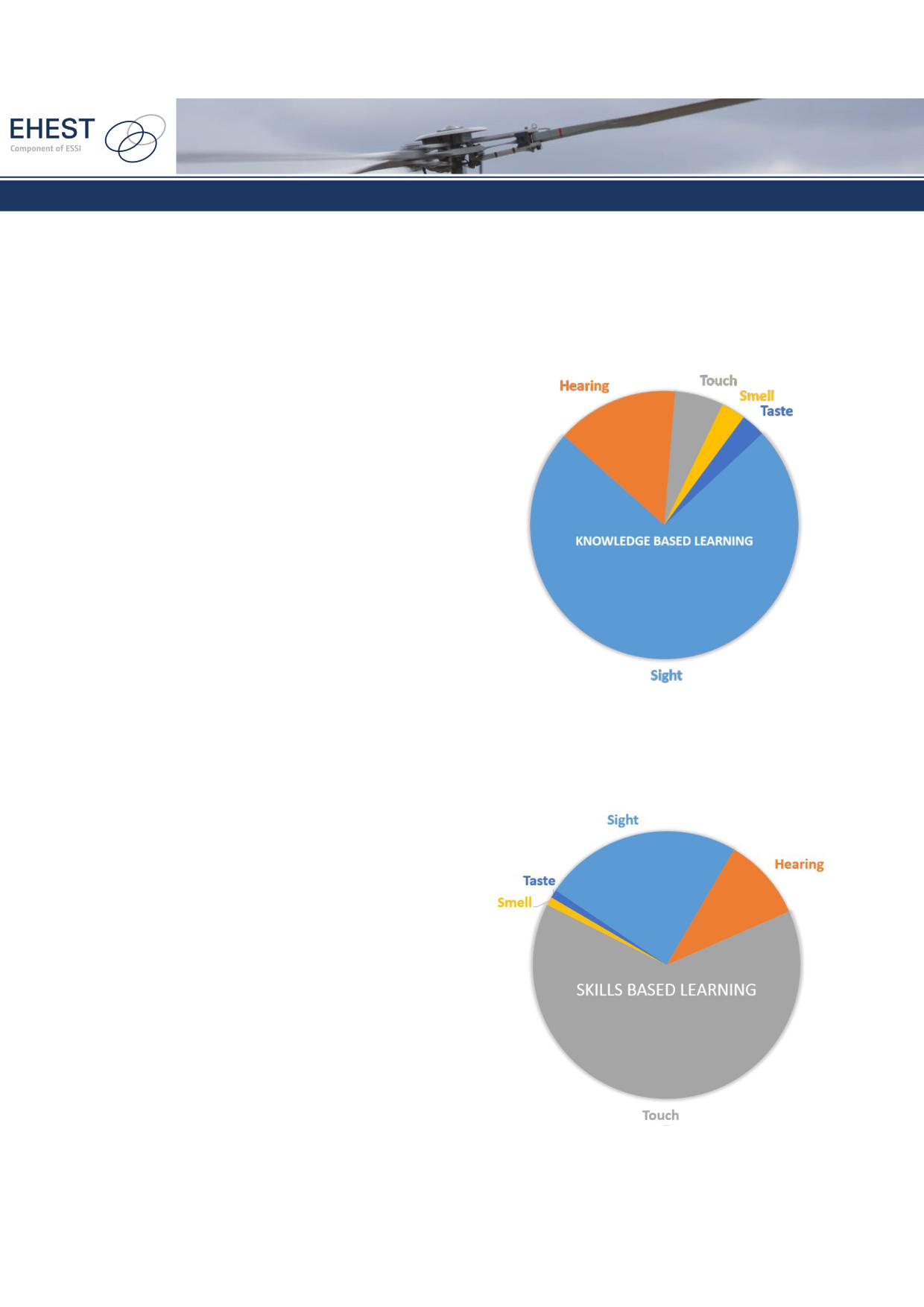
These channels also vary depending on whether learning is
effective use of instructional time both in the air and on
acquiring knowledge or skills based. Given that flying
the ground)
instruction is a combination of the two, it is worth noting the
•
The element of threat (e.g. fear, not just of physical
difference in perception when the learning task is purely skills
danger but also failure to make progress)
based. Again the proportions are purely illustrative but they do
highlight to the instructor the potential variation in the
perceptive channels depending on the the type of learning.
HELICOPTER FLIGHT INSTRUCTOR GUIDE >> PAGE 7
__
MEMORY AND ITS APPLICATION Here are some suggestions you can follow to arouse interest and
__
make the student ready to learn:
__
Memory is the major factor in learning. It constitutes
essentially all of the learning classified as 'knowledge' and has a
•
Start lessons with an ATTENTION-GETTING opening. For
__
basic effect on the retention of motor skills. The following are
examples of opening sentences that are effective, listen
carefully to the start of documentary films or interviews
__
five significant principles which are generally accepted as
having a direct application to remembering and consequently to
on television. Writers spend a great deal of time
__
learning:
developing the exact words to tune you in.
__
•
State SPECIFICALLY WHAT is required during the lesson
__
•
Praise stimulates remembering. Responses which give a
and how you intend to prove that the student has the
pleasurable return tend to be repeated. The absence of
knowledge or can master the skill at the end of the lesson.
__
praise or recognition tends to discourage one and
Make all your statements student-centred.
__
negative responses or lack of acceptance from the
•
Tell students the PURPOSE of the lesson and stress the
instructor tends to make recall less likely.
__
BENEFIT from the new knowledge or skill. Try to give
•
Recall is promoted by association. Pieces of information
more than one reason for learning, just in case the
__
or actions that are associated with something to be
student doesn’t fully accept the first reason.
__
learned tend to facilitate their later recall by the student.
•
Specify WHERE the lesson fits into the overall picture,
Unique or disassociated facts tend to be forgotten unless
__
and relate the lessons to past experiences that the
they are of particular interest to the student.
students may have had. This statement provides a link
__
•
Favourable attitudes aid retention. We learn and
with something students have learned before and allows
__
remember only what we wish to. Without motivation
them to build on that knowledge or skill. As an example, if
__
there is little chance for recall. The most effective
you were giving instruction on how to level out from the
motivations are those based on positive or rewarding
climb to a student with an aeroplane pilot licence, you
__
objectives.
could point out that the sequence of control movements
__
is the same as in an aeroplane. This concept is closely
Learning with all our senses is most effective. Although
•
related to the RELATIONSHIP learning factor.
we generally receive what we learn through the eyes and
ears, other senses also contribute to most perceptions.
•
If the new material is dependent on students having
When several senses respond together fuller
mastered previous lessons, confirm that the required
understanding and greater chance of recall is achieved.
level has been attained before proceeding with the new
material. Conduct a review and, if necessary, clear up any
• Meaningful repetition aids recall. Each repetition gives
misunderstandings by briefly re-teaching the major
the student an opportunity to gain a clearer and more
points.
accurate perception of the subject to be learned but
repetition alone does not guarantee retention. Practice
• Plan for reviews of lesson material. Students start to
gives an opportunity for learning but does not deliver it in
forget the moment they leave the instructional
its own right. Theorists believe that three to four
environment. The greatest rate of forgetting occurs
repetitions provide the maximum effect, after which the
during the first 24 to 48 hours after the material has been
rate of learning and probability of retention fall off rapidly.
learned. Ohio State University has carried out extensive
This is consistent with the learning curve illustrated in
research in this area and has designed a recommended
Table 1 on page 8.
schedule of when reviews should be done. Refer to
Figures 1 & 2 and the notes below each diagram.
Figure 1: Curve of remembering
100 --
90 --
80 --
70 --
X
60 --
50 --
40 --
30 --
20 --
10 --
0 --
Days since initial training
Figure 1
HELICOPTER FLIGHT INSTRUCTOR GUIDE >> PAGE 8
__
__Notes: S tatistics are based on an average cross section of
HABITS AND TRANSFER
students.
__
Learning by developing perceptions and combining them into
The curve is very steep initially: within 2 days
__
insights is a process of forming performance habits and
students will remember less than 70% of what
transferring the habits performed in one task to the
__
they learned.
performance of more complicated subsequent tasks. For
__
At the end of the month, without reviews,
example the application of forward cyclic when collective pitch
students will remember only approximately 40%
is applied to maintain an accelerative attitude. The influence of
__
of the lesson material.
these small habits in the subsequent task, in this case, applying
__
forward cyclic when increasing collective pitch during the
__
recovery to the climb following an autorotation is called a
Figure 2: Curve of remembering
'transfer'.
__
1-2 days
7 days
28 days
Transfer is generally considered to be either positive or
100 --
__
90 --
negative. The application of aft cyclic when entering
80 --
__
X
autorotation to prevent the nose dropping would be an example
70 --
X
X
60 --
of a positive transfer while lowering the collective lever when
__
50 --
40 --
practising an engine-off landing in the hover would be an
__
30 --
example of a negative transfer where the student has applied a
20 --
Represents a review
10 --
to bring student back
procedure which has worked in other flight situations.
__
0 --
up to 100%
The syllabus of flight instruction must be arranged to take
__
Days since initial training
maximum advantage of positive transfer by introducing new
Figure 2
__
manoeuvres in an order and manner which permit the lessons
__
learned up till then to be applied in the new exercise.
Notes:
Habit patterns are probably the most important factor in
__
•
To maintain at least a 70% level, a review should be
learning to control the helicopter, for example, the correct use
conducted within 2 days.
of the sequences such as: Attitude-Power-Trim when levelling
•
After the material is learned a second time the curve
off from the climb or Select-Hold-Adjust to overcome flapback
flattens out somewhat, but after 7 days the student is
when accelerating. It is therefore the responsibility of the
back down to the 70% level.
instructor to insist on correct procedures from the outset.
•
Another review at 7 days and the curve really flattens. The
student will be above 70% retention until approximately
day 28.
A review at this time will generally cause long-lasting
•
retention of lesson material.
The amount of time required for reviews reduces each
•
time a review is conducted.
Example:
•
Initial training: 50 minutes
•
1st review (at 2 days): 15 minutes
•
2nd review (at 7 days): 10 minutes
3rd review (at 28 days): 5 minutes
•
HELICOPTER FLIGHT INSTRUCTOR GUIDE >> PAGE 9
__
OBSTACLES TO LEARNING
__
Students may fail to make progress or learn for reasons other
__
than failing to understand the instruction imparted or the rules
__
of memory and forgetting. It could be that there are other
__
barriers or obstacles that are preventing the student from
concentrating upon the task in hand and assimilating the
__
instruction. A number of obstacles that are commonly found in
__
flying instruction are set out below:
__
__
•
A feeling of unfair treatment - Students who believe that
their instruction is inadequate or that efforts are not being
__
conscientiously considered and evaluated do not learn
__
well and their motivation will also suffer.
__
•
Impatience to proceed to more interesting operations -
Impatience is a greater deterrent to learning pilot skills
__
than is generally recognised. The instructor can do a
__
great deal to help here by explaining how the student is
progressing in terms of the syllabus of instruction and
__
norms and why certain skills have to be mastered in a
__
given order before progressing to the next lesson. If
students can see that there is a plan with clear goals and
__
milestones that are achievable and understand the
__
underlying reason, their impatient feelings give way to
eager anticipation and involvement. Of course there can
__
be other factors that can cause frustration and impatience
such as a prolonged spell of non-flying weather, aircraft
and/or instructor unavailability which may have to be
managed.
•
Worry or lack of interest. Worry and/or lack of interest has
a detrimental effect on learning. It can be difficult to deal
with and can stem from a variety of causes such as other
barriers. It could be external factors such as family or
financial worries and in some cases inadequacies on the
part of the instructor or the course. In the latter case the
best solution is prevention rather than cure.
Discouragement and emotional upsets are rare when
students feel that nothing is being withheld from them or
being neglected in their training.
Physical discomfort, illness or fatigue. Students who are
•
not completely at ease and whose attention is diverted by
discomfort caused by their surroundings or illness cannot
learn at a normal rate and flight instructors have to
monitor this closely. In the case of fatigue this is
particularly important as it is an insidious condition.
Fear, anxiety or timidity. Student anxiety will limit the
•
student's ability to absorb instruction. Flight Instructors
are responsible for providing a safe and comfortable
learning environment for their students. Those
instructors who remain calm and professional in their
demeanour will provide the necessary quiet reassurance
to their students through their competence and the
obvious priority that they place on flight safety. If the
instructor appears to be tense and excitable in the
helicopter then this will communicate itself rapidly to the
already anxious student.
HELICOPTER FLIGHT INSTRUCTOR GUIDE >> PAGE 10
__
__
INCENTIVES TO LEARNING
LEARNING METHODS
__
Learning to fly should be an enjoyable experience. By making
People learn through meaningful instruction which builds
__
each lesson a pleasurable experience for the student, the flight
patterns of relationship in the student's consciousness. Rote
instructor can maintain a high level of motivation in the student.
learning on the other hand is superficial and is not easily
__
This does not mean that things must be made easy for the
retained, whereas meaningful learning goes deep because it
__
student nor that the instructor should sacrifice his standards of
involves principles and concepts in the student's own
performance to please the student. Students experience great
experience.
__
deal of satisfaction from accomplishing a learning task well or
People learn when there is a reason for remembering. A desire
__
by meeting the challenge of a difficult task.
to remember increases the chances of remembering. The
__
People are not always attracted to things that are pleasant and
flight instructor can help the student find and understand this
easy. They are more likely to devote more effort to things
desire.
__
which bring rewards such as self-enhancement and personal
Good study habits promote learning and the student must be
__
satisfaction. People want to feel capable and they are proud of
encouraged to study for meaning and not to learn by rote.
difficult achievements. A good flight instructor helps the
__
Short periods of review are beneficial and recitations and
student to attain these goals by using alternative presentations
__
quizzes can help.
and methods to impart instruction so that the students do not
__
feel that they are simply following in the steps of others.
Of the above frequent opportunities for practice is probably the
best method of them all.
Here are some suggestions you can follow to arouse interest
__
and make the student ready to learn:
__
Start lessons with an ATTENTION-GETTING opening. For
__
examples of opening sentences that are effective, listen
__
carefully to the start of documentary films or interviews on
__
television. Writers spend a great deal of time developing the
exact words to capture the imagination and stimulate interest.
State SPECIFICALLY WHAT is required during the lesson and
how you intend to prove that the student has the knowledge or
can master the skill at the end of the lesson. Make all your
statements student-centred.
Tell students the PURPOSE of the lesson and stress the
BENEFIT from the new knowledge or skill. Try to give more
than one reason for learning, just in case the student doesn't
fully accept the first reason.
Specify WHERE the lesson fits into the overall picture, and
relate the lessons to past experiences that the students may
have had. This statement provides a link with something
students have learned before and allows them to build on that
knowledge or skill. As an example, if you were giving instruction
on how to level out from the climb to a student with an
aeroplane pilot licence, you could point out that the sequence of
control movements is the same as in an aeroplane. This
concept is closely related to the RELATIONSHIP learning
factor.
HELICOPTER FLIGHT INSTRUCTOR GUIDE >> PAGE 11
__
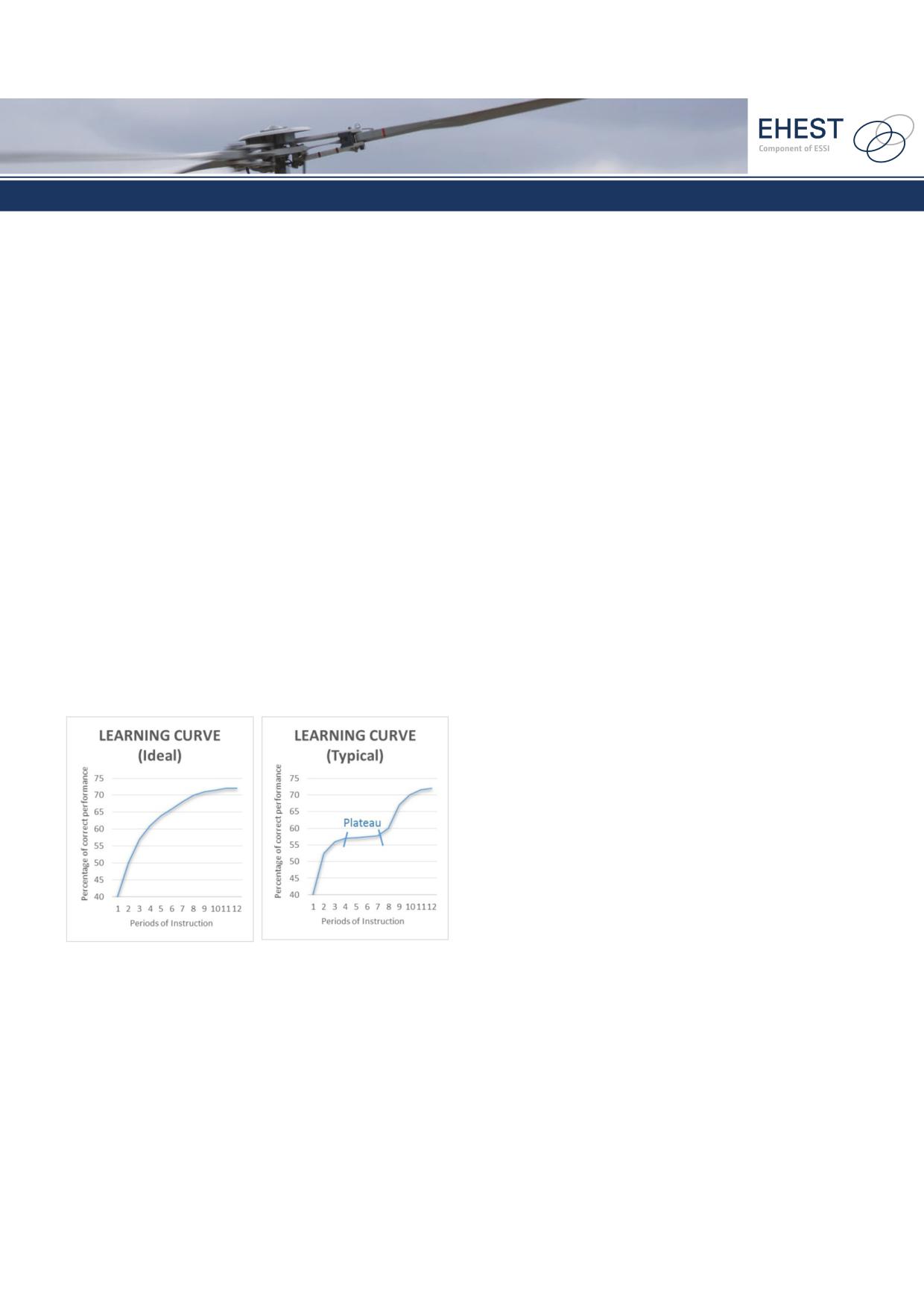
Slumps or plateaus in the rate of learning, as depicted in Figure
RATES OF LEARNING
__
4, are more likely to occur as the student advances to more
Learning proceeds rapidly at first when a new task is
complicated operations, such as hovering or transitions. Often
__
introduced, then slows as a reasonable degree of proficiency is
the reason is that a student has failed to master one basic
__
achieved. When plotted on a graph, this decrease in the rate of
element of the operation, and this leads to the appearance of
__
learning is shown as a levelling of the ascending curve that
deficiency in the performance of later elements. Improvement
represents progress. An exaggerated ideal curve is shown in
usually becomes normal again when this one basic element is
__
Figure 3 below.
mastered. You can accelerate improvement by careful fault
__
analysis and by concentrating instruction on that one phase of
The rate of progress in learning is affected by so many outside
the operation concerned.
__
influences that it is not often predictable. The rate of learning is
affected by such things as:
Without competent instruction, students will probably not
__
understand why they aren't improving and will become
__
discouraged. This discouragement tends to prolong the
•
Diversions
__
plateau. During such periods of discouragement, you should
step in to isolate and correct the situation and to provide special
__
• Flagging or lacking motivation
incentives until normal progress is resumed.
__
• Emotional disturbances
Reversals sometimes occur, during which a student's
__
performance becomes worse with continued practice.
• Upset training schedule
Generally such reversals are due to a faulty habit pattern
__
involving one of the basic elements of the manoeuvre or
• Weather
__
operation involved. This faulty habit causes your student to
• Equipment breakdown
practise an erroneous performance repeatedly, until correction
__
becomes very difficult. You must not accept such errors and
__
Unavoidable absences
•
misunderstandings as normal plateaux in the learning process.
__
They must be corrected before progress can resume.
During advanced stages of learning, the rate of progress can be
very slow.
Example: An acrobat who can perform a routine to a
level of 9.6 continually practises to improve the
performance. Raising the score up to 9.8 or 10 requires
extensive additional training and practice. The same is
true for flying; students may be nearly ready for a skill
test at an early stage but during the additional required
training to reach the required standard will only show
slight, slow improvement.
Reversals in the rate of learning could also take place if you
were to place too much emphasis on a single phase, element or
manoeuvre, particularly to the detriment of other evolutions.
Fig
3 - The Ideal Learning Curve
Fig 4 - A typical Learning Curve
Many helicopter students cannot attend regularly for reasons of
cost or other commitments. In such cases much time will be
Although it would be convenient if the rate of learning could be
spent in recapping previous instruction and progress can be
consistent and predictable as shown in Figure 3, it is not always
somewhat laborious. This may not however be as a result of the
so. Students may progress rapidly for a period, and then
student reaching a plateau of learning. Instead it is more likely
suddenly progress more slowly or even regress for a time. Such
to be due to the curve of remembering (see Memory and its
variations are to be expected and may represent a period of
Application) from which we note that at the end of a month,
training during which the student is perfecting the application of
without reviews, students will remember only approximately
the new skill. The correlation of the new skill with the other
40% of the lesson material.
learning tasks may not yet be obvious. It is the flight instructor's
responsibility to detect them as soon as possible and to try to
eliminate their causes by redirecting your instruction to level
them out as much as possible.
HELICOPTER FLIGHT INSTRUCTOR GUIDE >> PAGE 12
__
Instructors may be discouraged to discover that a well-planned
FAST STARTERS. Fast starters are usually students with
__
lesson does not teach all students with equal effectiveness.
previous exposure to flight training who quickly grasp the initial
__
This is normal. Students seldom learn at the same rate.
air exercises. You should not omit anything from the briefing.
Differences in rates of learning are based on differences in
Watch for signs of weakness when new work is introduced.
__
intelligence, backg2round, experience, interest, desire to learn,
This type of student usually slows down to the level of the
__
and many other psychological, emotional, and physical factors.
others shortly after going solo. A high degree of proficiency
__
Instructors have to acknowledge that students are different and
throughout the course should not be anticipated unless the
that this fact dictates how much can be taught at what rate, and
student has above-average ability.
__
when. Some student characteristics that may give rise to
__
differences in the rate of learning are covered below:
IMMATURE. You must not be too harsh with students who
__
NERVOUS OR UNDER CONFIDENT. Nervousness or under
appear immature. You will find that within a short time in the
confidence in a student is a trait that may or may not disappear.
__
flying training environment, the students will more than likely
Instruction may be too rapid and material may not be absorbed.
attain a greater degree of maturity. Your attitude is of prime
__
Repeating the fundamentals and ensuring mastery will often
importance in setting an example. You must encourage and
__
alleviate this condition. You must ensure that this type of
help these students mature into the role of a responsible pilot
student receives deserved praise whenever possible. Harsh
__
whenever possible.
rebukes should be avoided. Patience is very necessary when
__
dealing with a student of this nature. The student must be
aware that you are trying to help. Nervous students may be so
__
apprehensive that they may not be suitable for pilot training.
__
You should avoid manoeuvres involving extreme helicopter
__
attitudes, unless they are essential to the lesson being taught.
Take the time to build the student up to exercises involving
__
__O
VERCONFIDENT OR CONCEITED. You must first ensure
that this type of student has the ability to match the confidence
and, if so, set more difficult tasks that require greater accuracy.
More criticism of imperfections is advisable. If the student has
little ability, a frank conversation may be required.
FORGETFUL OF INSTRUCTION. At the beginning of training,
students may forget previous instruction. Students with this
problem require a great deal of patience and probably need
more review than the average student. Extra time spent in
briefing and debriefing and more study on the student's part
should be rewarding for all concerned.
INCONSISTENT. Many students, at one time or another
throughout the course, appear to lack consistency in flying
proficiency. There are many reasons for this, and you must try
to find the one that fits a particular student. You must look at
yourself and your attitude towards the student. Most of us have
good days and bad days, but when a student shows large
fluctuations in proficiency the instructor must look closely at the
teaching activities. A change in approach or even a change of
instructors may be called for.
SLOW STARTERS. Slow starters are students who find
difficulty doing more than one thing at a time. Again, patience is
mandatory. Progress may be slow, but encouragement will
help.
HELICOPTER FLIGHT INSTRUCTOR GUIDE >> PAGE 13
__
__
THE TEACHING PROCESS
__
anything, to inspire a student to learn. If outside responsibilities,
ELEMENTS OF EFFECTIVE
__
interests or worries are weighing heavily, if schedules are
TEACHING
overcrowded, or if personal problems seem insoluble, then the
__
student will be unable to develop the interest to learn. (see
Read the seven learning factors listed below carefully and
__
Incentives to Learning for suggestions on how to achieve this)
determine to what degree they apply to you as you learn new
__
skills and knowledge. If they apply to you, they will also apply to
PRIMACY: Present new knowledge or skills correctly the first
your students. Attempt to associate a single word that is used
time. (Teach it right the first time.)
__
to represent the entire learning factor.
When students are presented with new knowledge or skills,
__
Relationship is covered under Teaching from the Known to the
the first impression they receive is almost unshakeable. This
__
Unknown later in the guide.
means that what you teach must be correct the first time.
Students may forget the details of lessons, but they will retain
__
These factors are frequently referred to as Thorndike's Laws of
__
an overall image of the skill or knowledge for a long time.
Learning after E. L. Thorndike (1874 -1949), a pioneer of
Frequently you will be required to perform manoeuvres in the
educational psychology. His laws are universally accepted and
__
helicopter before a student has had the necessary backg2round
apply to all kinds of learning. Since Thorndike set down his
__
training. You must perform those manoeuvres correctly or the
original four laws, three more have been added: the law of
student may imitate any errors you make.
primacy, the law of intensity and the law of recency.
__
For example, before the exercise on Confined Areas, you and
__
•
READINESS: Ensure students are mentally, physically
your student may be required to land in a Confined area. Any
and emotionally ready to learn.
poor example shown at this time would have to be 'unlearned'
__
when the exercise came up in a subsequent lesson.
PRIMACY: Present new knowledge or skills correctly the
__
•
first time. (Teach it right the first time - see Memory and its
Suggestions:
__
Application)
•
Rehearse lessons to become thoroughly proficient at the
•
RELATIONSHIP: Present lessons in the logical sequence
skill or in answering questions related to the subject.
of known to unknown, simple to complex, easy to difficult.
(Note: Relationship is covered under Teaching from the
•
Attempt to give a perfect demonstration of the
Known to the Unknown later in the Guide.)
manoeuvres to be learned in the next lesson. If students
read or study exercise material without experiencing the
• EXERCISE: Ensure students are engaged in meaningful
actual exercise, they may form an incorrect mental image.
activity.
•
INTENSITY: Use dramatic, realistic or unexpected things,
•
If practicable, start each lesson with a perfect
as they are best remembered.
demonstration. Sometimes it may be better to avoid
talking during this demonstration to allow maximum
EFFECT: Ensure students gain a feeling of satisfaction
•
concentration on doing the skill perfectly.
from having taken part in a lesson. (see Memory and its
Application)
While the student is performing an exercise, supervise the
•
actions very closely. Stop the student as soon as any
RECENCY: Summarise and practise the important points
•
performance error is noticed, and teach the correct
at the end of each lesson, as the last things learned and
method. Close supervision means that you NEVER allow a
practised will be remembered the longest
student to make an error during the initial stages of
The learning factors listed above are useful 'tools' when they
training. Think of how you would go about training a
student to defuse a live bomb.
are applied correctly. The question, of course, is: 'How do these
learning factors apply to flight instruction?' This question will be
answered by reviewing and discussing each of the learning
EXERCISE: Ensure students are engaged in meaningful
activity.
factors that offer specific suggestions on what you can do to
utilise these 'tools' in your instruction.
Meaningful mental or physical activity is essential if learning is
to occur. During flight training this is achieved through correct
READINESS: Ensure students are mentally, physically and
practice or repetition. Students learn by applying what they
emotionally ready to learn.
have been told or what has been demonstrated. As learning
continues or is strengthened by additional practice, your
To learn, a person must be ready to do so. An effective
training syllabus should make provision for this practice time.
instructor understands this necessity and does the utmost to
You must ensure that the practice is directed towards a specific
provide well-conceived motivation. If a student has a strong
goal. Oral questions, hypothetical problems, dual review, or
purpose, a clear objective and a sound reason for learning
solo practice are all methods of providing mental or physical
something, progress will be much better than if motivation
activity.
were lacking. Under certain circumstances you can do little, if
HELICOPTER FLIGHT INSTRUCTOR GUIDE >> PAGE 14
__
If students are able to answer questions involving the words
Suggestions:
__
'how' and 'why', it usually means that they have a good
•
Show enthusiasm and sincerity for the subject you are
__
understanding of the subject. For you as a flight instructor,
teaching.
these two words are probably the most important in your
__
Attempt to employ a wide range of speech variation in
•
vocabulary. Study Table 1 opposite and note both the instructor
__
rate, volume and pitch to keep students attentive.
and student activities for each level of learning. Should you
__
attempt to employ the application level of learning without
•
Use appropriate and effective gestures while explaining
having covered the understanding level, students will probably
major points. The lesson will seem to 'come alive', and the
__
encounter much more difficulty than if they had mastered
points made will make a greater impression on your
__
previous levels.
student.
__
Suggestions:
•
Use a variety of training aids to appeal to as many senses
as possible. Each aid must relate directly to the subject
__
•
Unless you are testing to see what students have learned,
matter being taught.
avoid questions that are prefixed by the word 'what'. Give
__
students the facts, figures and necessary knowledge,
__
then ask 'how' and 'why' questions to develop their
EFFECT: Ensure that students gain a feeling of satisfaction
understanding of the new knowledge.
__
from having taken part in the lesson.
•
Once you have told students a fact, avoid repeating
__
Learning is strengthened when accompanied by a pleasant or
yourself. Instead, have them relate the facts back to you.
satisfying feeling. Students will learn and remember more
__
This strengthens their learning and confirms their
under these conditions than when feelings of defeat,
__
knowledge of the required material.
frustration, anger or futility are developed. If you were to
__
•
Give students challenging problems that fit the level of
demonstrate a 'wingover' type manoeuvre during the first air
learning, and provide only enough assistance to keep
exercise, students would likely feel some inferiority, if not
__
actual fear. The experience would be negative. They might
__p
roblems alone, they have demonstrated adequate
even give up flying at that stage. This example is rather obvious,
knowledge and ability.
but you need to consider how your actions could produce
feelings of frustration or anger. For example, you ask a student
Test students' knowledge and abilities frequently. This
•
to perform a manoeuvre and then you immediately emphasise
reinforces learning and builds confidence. However,
all the errors the student made. Your identification of each error
before testing you must be reasonably certain that
may be very accurate, but how would the student feel about it?
students can answer the questions or perform the skills;
If the objective were to make the student feel defeated, then
otherwise they may become frustrated. Testing will also
you would probably succeed. It is better to point out the
identify areas in which students have weaknesses, thus
positive aspects of a student's performance first and then
allowing you to re teach these subjects to the required
discuss the major errors that were committed and finish with
standard.
suggestions for improvement.
Whatever the learning situation, it should contain elements that
INTENSITY: Use dramatic, realistic or unexpected things, as
affect your student positively and give feelings of satisfaction.
they are best remembered.
Each learning experience does not have to be entirely
Students learn more from dramatic or exciting experiences
successful, nor do students have to master each lesson
than from boring ones. It is a well-known fact that a student's
completely. However, a student's chance of success will be
'look out' while flying will improve considerably after a first
increased with a sense of accomplishment and a pleasant
experience with a near miss. There is no suggestion here that
learning experience.
you provide your student with a near miss, but you should
Involve students in the lesson by developing some of the new
attempt to make your students' learning experiences exciting
material with them. This can be done by asking students
by being excited yourself and perhaps using appropriate
questions related to the subject and allowing students to
opportunities you can to introduce unexpected things to your
contribute knowledge and ideas.
students.
Throughout your lessons, obtain feedback from students by
The INTENSITY learning factor implies that students will learn
asking questions, observing the performance of a skill, and
more from real experiences than from substitutes. Instructors
watching for facial expressions that show a lack of
will have to use their imagination to develop vivid experiences
understanding. You must respond to any feedback by
for dramatic or realistic effects.
answering questions and providing help and correction where
needed.
HELICOPTER FLIGHT INSTRUCTOR GUIDE >> PAGE 15
__
Suggestions:
Suggestions:
__
•
Show students how to improve, and offer praise when
•
Plan for a pre-flight briefing immediately before the air
__
improvement occurs.
exercise, and review the main points by questioning. This
may sound like the READINESS and EXERCISE learning
__
•
Backup all your statements with reasons. Whenever you
factors. However, recency deals with the timing of the
tell students something, give the reason behind it. For
__
practice.
example, you say to a student, 'This helicopter has two
__
static vents, one on each side of the fuselage.' This is a
•
Ensure that students receive a thorough summary of the
__
fact, but if students do not know the reason for the two
important points towards the end of each lesson.
vents, they will probably pass it off as unimportant and
__
•
After each sequence within an exercise or class
forget. Remember, if a student understands the concept
presentation, ask questions on the material or summarise
__
or theory, details may be forgotten but the overall concept
the 'need to know' material.
will remain, and when a helicopter with only one vent is
__
•
Conduct a test as the final part of your lesson.
encountered more attention may be given to instrument
__
readings while making a cross-wind approach.
•
At intervals throughout the course, conduct review
__
sessions in which no new material is taught, but
•
When a student encounters difficulty in mastering an
objective, find a means of allowing some degree of
reinforcement of previously learned material is obtained.
__
success. For example, the lesson is steep turns. Rather
•
Attempt to finish each lesson with a practice of the most
__
than having students attempt the entire manoeuvre, try
important parts of the lesson. This applies to solo lessons
__
having them practise the entry. When no difficulty is
as well as dual exercises. Remember, students practise
experienced with the entry, add the next stage, then
knowledge by answering questions and they practise
__
continue until the entire manoeuvre is completed. Should
skills by doing.
__
difficulty still occur, back up a step and attempt medium
•
An important skill for a flight instructor is the ability to ask
turns rather than causing too much frustration.
__
good questions orally. Good oral questions satisfy all the
Sometimes instructors make the mistake of continuing to
__
identified learning factors. The next section of this guide
have students attempt a manoeuvre when performance is
will deal exclusively with oral questions.
deteriorating. It is better to quit at that point and go back to
something the student can do well.
•
Avoid ridicule or sarcasm. You may feel that it might take
the place of humour. However, students seldom have the
same feeling, especially if they are the butt of the remark.
•
Arrange each lesson so that when a student does
something correctly there is a reward. This reward can be
in the form of sincere, honest praise. You ask a student to
complete a walk pre-flight inspection on a specific
helicopter for which you have a component such as a nut
placed on the ground under the engine. Your student
notices the offending part and brings this to your attention
and is praised for this. If a thorough inspection is not
completed, you have an excellent teaching point to
emphasise why careful inspections must be done.
RECENCY: Summarise and practise the important points at the
end of each lesson, as things learned and practised last will be
remembered longest.
All things being equal, the things learned last are best
remembered. Conversely, the longer students are removed
from a new fact or even an understanding, the more difficulty
they will have remembering it. The need for reviews was
stated earlier, and a full circle has been completed: review new
material, etc.
HELICOPTER FLIGHT INSTRUCTOR GUIDE >> PAGE 16
__
By comparison, construction of a course training plan for a
PLANNING OF INSTRUCTIONAL
__
smaller training organisation or a short course will be relatively
__
ACTIVITY
straightforward. This does not mean however, that the
process can be ignored. As flying instructors gain in
__
This Guide has quite a lot to say about the need for properly
structured lessons stressing how important thorough
experience, they will usually hold more senior positions in
__
preparation is to successful delivery and ultimately to the
organisations and assume greater responsibility for the
__
planning and management of instructional activity. However,
effectiveness of the learning that takes place. However, even
well-planned lessons in the classroom or aircraft won't be
the management of the training programme and planning of
__
instruction is a shared responsibility and all helicopter flying
effective unless they take place within the context of a well-
__
instructors will be required to develop these skills to a greater or
planned delivery system. Instructional activity has to be
__
resourced and managed to be effective. Lessons have to take
lesser degree. In a small training organisation employing a
single helicopter instructor, it is quite likely that the instructor
place in a logical sequence, and facilities have to be available to
__
provide the learning environment. In a large and busy ATO, the
will be responsible for planning instructional activity or play a
__
management of this will be the responsibility of a training
large part in the process.
operations team probably reporting directly to the Head of
__
Training. It will be necessary to coordinate the flying
__
programme with the ground instructional programme to
__
include the availability of classrooms, teaching aids and
instructors. Due consideration must be paid to the physical
__
needs of both classroom and flight instructors and their
__
students when planning the instructional activity. In a teaching
establishment where instruction is full-time, then a training
__
programme and timetable will be necessary. Detailed
__
discussion of how to construct a training programme and
__
timetable is outside the scope of this guide. Complex courses
may call for detailed design by a training analyst but the basic
principles (much simplified) are:
Obtain the approved course syllabus and learning
•
objectives from the appropriate authority then break this
down into sections with individual lessons identified in
each block of instruction. Naturally, this task is made
much easier if lesson plans have already been developed
for the course.
Assign realistic timings to each lesson. In the case of air
•
exercises, ensure that adequate time is allowed for pre-
flight instructional tasks including planning and briefing,
getting to the aircraft and carrying out the necessary pre-
flight inspection. Realistic timings must be allowed to get
airborne and position the aircraft for the lesson. Similarly
sufficient time must be allowed to shut-down the aircraft,
carry out a post flight walk round, return to the operations
room, complete paperwork, debrief the student and
complete the post flight assessment and report. Training
organisations will naturally wish to compress these
timings for business reasons but flying instructors should
insist on adequate time for the activities to be completed
quickly and efficiently but not rushed.
When the 'block' programme of instruction has been
•
assembled (a spreadsheet application can be very useful
in speeding up the process particularly when the
inevitable changes have to be made), a timetable can be
constructed by arranging the lessons in a logical
sequence taking account of available resources. Don't
forget to allow sufficient time for administrative activity
and it is sensible to include some spare or 'float' time to
allow for the weather and other operational delays.
HELICOPTER FLIGHT INSTRUCTOR GUIDE >> PAGE 17
__
Novice instructors are frequently apprehensive about trying
TEACHING METHODS
__
developmental teaching. Experience has shown that students
DEVELOPMENTAL TEACHING OR
consistently surprise instructors if given the chance to
__
TEACHING BY QUESTIONING
participate actively in the learning process. The disadvantage of
__
lecturing during preparatory instruction is that students are
Developmental teaching is based upon a student-centred
frequently told material that they already know, or that they
__
philosophy of teaching that requires you to reason with
reasonably can be expected to deduce on their own. The best
__
students to have them meet predetermined objectives. By
teaching occurs when students are led to a point from which
using the students' backg2round knowledge, you ask questions
they can systematically direct their own reasoning to the
__
that lead the students to determine the next step in a
solution of a problem. The secret of effective learning is to keep
procedure, the logical application of a principle, or the final
students mentally active in the learning process. With
__
solution to a problem. The rate of progress in developing the
developmental teaching students are forced to think.
__
more complex ideas of the lesson is governed by the students'
This method is ideally suited to ground instruction and pre and
perception and comprehension. Questions should be asked to
__
post flight debriefing. Good questioning technique is the
review previously learned material. The process of
cornerstone of developmental teaching and techniques for oral
__
developmental teaching begins when students are required to
questioning and handling student answers are covered in depth
reason out, and make suggestions, with respect to new
__
later in the Guide in the section entitled Training Programme
material.
Development - Student Participation and Practice
__
Developmental teaching has been used throughout the years by
__
all good teachers. Because of the requirement for every student
to participate, developmental teaching is effective with small
__
groups and with individual students. It can be used at any level of
__
student knowledge, provided that you know or determine the
appropriate level and proceed accordingly. Depending upon the
__
subject matter, some lessons can be entirely 'developmental'.
__
More frequently, however, there will be a combination of
teaching by explanation (where it may be more efficient to
__
explain certain material) and developmental teaching (where
crucial areas of the subject matter can be reasoned with your
students). In almost every lesson, some developmental
teaching is appropriate and desirable.
The main advantage of developmental teaching is that it
promotes efficient student learning because it satisfied all the
basic aspects of learning. Since students participate in
meaningful activity, they are forced to think about the material
being learned, as questions are answered verbally.
Consequently, interest is maintained, a sense of
accomplishment is gained, and effective learning takes place.
You receive constant feedback and frequent confirmation of
the students' progress.
Careful planning for developmental teaching is critical because
you must formulate appropriate questions that demand
reasoning on the part of your students. The standard
questioning techniques must be observed, and student
responses must be handled with tact and discretion. In addition
to being a master of the subject material, you must be flexible in
your approach. You must permit adequate discussion, yet
exercise sufficient control to move towards the lesson
objectives. Frequent summaries are necessary to consolidate
the material as the lesson progresses.
HELICOPTER FLIGHT INSTRUCTOR GUIDE >> PAGE 18
__
THE DEMONSTRATION PERFORMANCE METHOD
__
TEACHING FROM THE 'KNOWN'
__
The Demonstration - Performance method of flight instruction
TO THE 'UNKNOWN'
(sometimes called the Demonstration Method) is widely
__
Thorndike's Law of RELATIONSHIP states that lessons
accepted as the preferred method for in-flight instruction. It is
__
discussed in some detail as part of the FLIGHT: AIRBORNE
should be presented : In the logical sequence of known to
INSTRUCTIONAL TECHNIQUES section.
unknown, simple to complex, easy to difficult.
__
This method of instruction has five components
This particular learning factor emphasises the necessity for your
__
student to understand relationships between new and old facts,
• Explanation
or between ideas and skills, if learning is to take place. During
__
flight training, students must understand not only why they are
• Demonstration
__
learning a particular exercise, but how that exercise combines
• Student Performance
with previous ones and where it fits into the overall syllabus.
__
Giving students the relationship at the start of the lesson
• Instructor Supervision
provides preparation for learning. Continuing the process
__
• Evaluation
throughout the lesson helps to maintain the desire to learn.
__
• known to unknown
__
THE TELLING AND DOING TECHNIQUE
•
easy to difficult
__
•
concrete to abstract
__
Another technique that can be used is the telling and doing
•
simple to complex
technique which can be summarised as follows:
__
•
familiar to unfamiliar.
1.
Instructor tells - instructor does
__
Always review basic knowledge before proceeding to the
2.
Student tells - instructor does
__
unknown. For example, when teaching students to multiply
3.
Student tells - student does
with a circular slide rule, the first example should be as simple
__
as 2 × 2. The reason is that students already know the answer
4.
Student does - instructor evaluates
and are able to follow the manipulation of the slide rule. In the
The difference between this technique and the Demonstration-
next problem or example, a change of one factor (2 × 4) allows
students to build on knowledge already gained. The process is
Performance method is that the student is involved in the
second demonstration by the instructor (student tells - instructor
continued until students have mastered all the required
does) and thus cannot adopt a passive role. This strategy could
knowledge and skills necessary to solve real problems.
be useful to confirm that students know and understand exactly
Present new material in stages, confirming that students have
what is required from them when it is their turn to perform the
mastered one stage before proceeding to the next. The length
manoeuvre. This method requires high-order communication
of time for each stage would depend on the complexity of the
skills from students at a time when they may find it is all that they
material covered.
can do to fly the manoeuvre accurately.
Reinforce students' learning of new facts or ideas by frequently
summarising the major points of your lesson.
Use examples and comparisons to show how the new material
being learned is really not much different from that already
known by your students. The examples you use may be real or
imaginary, as the main purpose of an example is to paint a
verbal picture so students can visualise relationships between
the new material and things that have happened before. This is
called using 'verbal aids' for your instruction.
HELICOPTER FLIGHT INSTRUCTOR GUIDE >> PAGE 19
__
In this case, the items that will need further development are
USE OF LESSON PLANS
__
the long briefing objectives and the air exercise and the flight
instructor would need to prepare his board layout in advance
__
The lesson plan is an essential tool for the flight instructor.
There are many formats available and they will differ depending
and rehearse it as necessary. However, It is likely that
__
on the type of instruction being undertaken. For a large class,
instructors will have their own board plans and notes already
__
covering a major theoretical knowledge topic, it is probable that
available from their own notes taken during their FIC training or
perhaps using a standard set of lesson plans included in the
__
a fairly complex and detailed plan will be involved. In contrast,
for a one-to-one revision session, the requirement to produce a
ATO Manual. Whatever method is used, it is essential that
__
formal lesson plan will be greatly reduced.
flight instructors prepare their briefings thoroughly and the
lesson plan is the tried and tested way of doing this.
__
Learning objectives are written so that they are exact,
For the air exercise, an aide memoire in card form is the usual
__
observable and measurable and are composed of the
method of ensuring that the lesson sequence is followed. So
Performance Standard that has to be achieved, the conditions
__
under which it has to be achieved and the standard that must be
that flight instructors maintain situational awareness at all times
and monitor what their students are doing, such aide memoires
__
attained. For flying lessons, the objectives will form part of the
should contain the minimum amount of detail necessary to
pre-flight briefing, the conditions are normally standard, for
__
example, by day under VFR and the standard that has to be
prompt the instructor and maintain the pace of the lesson. For
__
obtained is ultimately that of the PPL(H)/LAPL(H) Skill Test.
this reason in some quarters, these kneeboard sized aides are
called 'pace notes'. As experience is gained, they can largely
__
These objectives should be noted down together with the
be dispensed with but it is still important that the airborne
standard and to be achieved and the conditions. Enabling
__
lesson and sequence is planned or reviewed for each flight to
objectives that will have to be covered in order to meet the main
take account of different factors, e.g. the student's ability and
__
objective(s) must also be included as they will also need to be
progress, the wind and weather conditions and the TEM special
__
covered in the lesson or briefing.
considerations for them.
__
A simple lesson plan from which the briefing could be
developed further is shown below. The contents have been
__
drawn up using the details provided in Part 2 of the Guide for
Exercise 16.
HELICOPTER FLIGHT INSTRUCTOR GUIDE >> PAGE 20
__
__
__
__
__
__
__
__
__
__
__
__
__
__
__
__
__
__
__
HELICOPTER FLIGHT INSTRUCTOR GUIDE >> PAGE 21
__
__
TRAINING PHILOSOPHIES
__
THE VALUE OF A STRUCTURED
INTEGRATION OF THEORETICAL
__
(APPROVED) COURSE OF
KNOWLEDGE AND FLIGHT
__
TRAINING
INSTRUCTION
__
An approved course of training for the EASA PPL(H) comprises
Courses offered a part of the curriculum of ATOs and DTOs are
__
at least 100 hours of theoretical knowledge instruction. The
required to be structured. This means that ground and flight
__
training should cover aspects related to non-technical skills in
instruction is systematic and can be presented in a logical
__
an integrated manner. The theoretical knowledge instruction
sequence which will help the student to make progress. It will
provided by the ATO should include a certain element of formal
also assist the flight instructor to prepare lessons properly and
__
classroom work but may include also such facilities as
teaching will be more effective as a result.
__
interactive video, slide or tape presentation, computer-based
The structured course is equally valuable to those learners who
training and other media distance learning courses.
cannot take advantage of regularly paced instruction for
__
The arrangement of flying lessons set out in, for example, the
whatever reason because their progress (or lack of) will be
__
Part FCL PPL(H) syllabus set out in Part 2 is progressive and
easier to measure from the standpoint of the performance
__
although lessons do not always have to be carried out in the
standard that they should be at in contrast to their actual
exact order of the exercise numbers, they broadly follow one
standard. Remedial action can then be instigated to restore
__
another in sequence. The reason for this is that each exercise
their position within the training taxonomy.
__
consists of training and enabling objectives which build on the
__
knowledge and skills of gained during earlier exercises. In turn,
THE IMPORTANCE OF A
these rely on underpinning theoretical knowledge to
__
understand and make sense of the briefing which the student
PLANNED SYLLABUS
__
needs to understand the flying briefing and make progress in
In the same way as it is valuable to have a structured course, it is
the air where time is so precious.
equally important to have a planned syllabus of instruction
The laid down theoretical knowledge for the PPL(H) is shown
which enables the flying instruction to be correctly sequenced.
under main subject headings in the table below.
Arguably, it would be difficult to have a structured course
without a planned syllabus.
With a planned syllabus, any training gaps are readily
identifiable to the student and instructor and it is easier to
measure progress. This can help motivate the student where
progress is apparent or highlight areas of weakness if this is not
the case. This is particularly important where a student's
attendance is irregular for any reason.
Another advantage of a planned syllabus is that it allows the
operations staff and the instructor to plan ahead and book slots
in the flying programme appropriate to the student's progress.
There is a lot to learn and this needs to be planned and
integrated with the flying instruction. For example, the student
should have completed the theoretical knowledge syllabus for
Navigation a short time (Law of Recency) before embarking on
the navigation phase of the course. Similarly, during the earlier
lessons, if a student had not covered some of the aspects of
Helicopter Principles of Flight, then it is likely that time will be
wasted in briefing prior to flying the sortie at best or, at worst,
the student won't understand the instruction and fail to make
progress. For this reason, the Theoretical Knowledge syllabus
should be integrated with the flying syllabus to the maximum
extent possible.
HELICOPTER FLIGHT INSTRUCTOR GUIDE >> PAGE 22
__
__
TECHNIQUES OF
__ APPLIED INSTRUCTION
__
__
PREPARE THE CLASSROOM/TEACHING AREA
The following techniques, if applied in a conscientious manner,
will help the flight instructor to give effective instruction.
__
BEFORE THE LESSON
Because most flight instructors also carry out some, if not all, of
__
the ground school training, references to classroom-type
Reason: The class must be arranged for best student learning. If
instruction are included in this summary. The techniques of
students cannot see all the aids, they may miss a point. Lesson
__
preparation appears more professional if no time is wasted
instruction, questioning techniques, lesson planning, etc., are
__
organising aids or rearranging seating.
equally applicable for providing large group instruction or for air
__
instruction on a one to one basis, individual preparatory ground
instruction, or pre flight briefings.
__
PREPARE/CHECKTRAININGDEVICES/AIDS
To present a lesson in a professional manner, you must prepare
__
BEFORE THE LESSON
in advance and proceed as follows:
__
Reason: This avoids embarrassment should an item not work,
or should any chart, slide or graph be shown in the wrong order.
__
PREPARE A LESSON PLAN
__
PREPARE YOUR STUDENTS FOR LEARNING
Reason: A lesson plan acts as a guide and keeps you on track
__
during your presentation. It also ensures that important points
Reason: If students are to learn, they must be physically,
__
are covered and not neglected because of poor memory.
mentally and emotionally ready to do so.
__
What to include: Headings of main points; sufficient notes to
How to do it:
jog memory on talking points; specific questions and answers
to confirm student learning; visual aid instructions (including a
•
Tell students specifically what is required of them during
chalkboard plan); a well-thought-out opening and closing
the lesson and what they will be able to do at the end of
statement; estimates of the amount of time to be spent on each
the lesson.
major idea or item; a visual aids plan; any other point that you
•
Tell students why they should take part in the lesson and
feel will help to get the lesson across.
how the new skill or knowledge will benefit them. Give as
What to avoid: Writing material out in full detail (this promotes
many advantages as you possibly can for having students
reading of the material while you are in front of the class); using
learn, as they may not agree with some of your reasons.
single space format (this does not allow for revision of the notes
Give students an overall picture of the lesson, and show
the next time the lesson is to be given); writing in longhand,
•
them how it fits into the entire course. Attempt to relate
unless you are able to read your notes at a distance of 1 metre.
the new material to some past and/or future experience
(This makes you appear not to know your material because you
of your students.
have to look closely at your lesson plan rather than just glance at
it to jog your memory.)
The length of time required to prepare students for
• learning depends primarily on their backg2round
knowledge and the complexity of the material. As a
general guide, the amount of time needed is
approximately 10% of the lesson.
HELICOPTER FLIGHT INSTRUCTOR GUIDE >> PAGE 23
__
START THE PRESENTATION OF NEW
IDENTIFY AND EMPHASISE MAJOR POINTS
__
MATERIAL AT THE STUDENTS’ LEVEL OF
FOR THE STUDENTS
__
UNDERSTANDING
Reason: During any presentation there is a mixture of ‘need to
__
know’ material, which is extremely important, and ‘nice to
Reason: If you begin your presentation at a level your students do
__
know’ material, which may or may not have to be remembered
not understand, there will be confusion and time wasted. Little or
no learning will take place.
for a long period of time.
__
How to determine the students’ level of understanding:
How to identify and emphasise points for your students:
__
•
Prepare a visual aid of the main points;
__
Before the instruction starts, conduct a Threshold
•
approximately75% of learning comes from vision,
Knowledge Test to determine what your student knows
__
whereas only about 13% comes from hearing. The visual
or doesn’t know. A Threshold Knowledge Test is simply
__
aid may be a heading on a chalkboard, chart, or projected
some form of examination, written or oral, of sufficient
image.
__
length to inform you as to the actual level of knowledge.
•
Have students write the main points down in their note
__
During the course of instruction have periodic reviews.
•
books, or provide notes that include these main points.
Conduct a review of previous lessons before you start
•
__
•
Make a verbal statement to the students, such as: ‘This
each lesson. The review should consist of a series of
__
particular point is very important: remember it.’
questions. If your students answer correctly, proceed. If
•
__
they do not, re-teach.
Prepare an orientation board (chalk board or sheet of
paper) that identifies the major points for a lesson.
__
Check with other instructors for the strengths and
•
Students can refer to this board throughout the lesson,
weaknesses of your students, and arrange your material
__
and this helps their thoughts to be guided to a specific
to fit the students’ needs.
area.
__
•
Raise the volume of your voice and reduce the rate of
__
PROCEED AT THE RATE OF STUDENT
delivery while stating an important point, to add
COMPREHENSION
emphasis.
•
Besides emphasising the main points, you should also
Reason: If you get ahead of your students during the
emphasise safety and the points that are easily forgotten
presentation, you are in the same position as if you started
or difficult to remember.
above their level.
•
Provide emphasis according to relative importance. The
How to ensure that you are proceeding at the required rate:
most important things get a greater amount of emphasis.
•
Arrange your material in stages. Stop at the end of each
•
Emphasise points by giving verbal examples (real or
imaginary); by comparisons (similarity to, or difference
stage and ask specific questions on the material you have
just covered. If your students answer correctly, proceed.
from, known facts); and, perhaps most importantly, by
giving reasons for each point you make. Students tend to
If they do not, re-teach. The length of time for a stage
remember better if they understand the reasons behind
depends on the complexity of the material being
presented, but a good general rule is 8 to 12 minutes.
every point they must learn.
Repeat the point frequently by using summaries, or have
Write out in full a number of well-thought-out questions.
•
•
Put these questions on your lesson plan and make sure
your students repeat the point by answering your
questions.
they are asked during the presentation. The feedback you
get from these answers will determine whether or not
Conduct periodic reviews of the ‘need-to-know’ material.
your students understand.
•
Have the students complete a home assignment of the
Observe your students closely for facial expressions that
important points of a lesson.
•
•
could indicate that they do not understand a particular
Have students record, in note form, the major ideas or
point. If students say they understand, ask them a
items that you feel must be emphasised. By having them
•
question to make sure.
write ideas down you are using another sense, so
Encourage students to ask questions on points that they
learning may be reinforced.
•
do not fully understand.
Use a variety of training aids to appeal to several senses
Provide for lots of practice of basic skills before you go on
•
(touch, feel, etc.).
• to the more complex parts.
Do not emphasise ‘nice-to-know’ material.
• Orphan
HELICOPTER FLIGHT INSTRUCTOR GUIDE >> PAGE 24
__
GIVE CLEAR EXPLANATIONS AND
__
DEMONSTRATIONS
__
Guidelines:
Reason: If students do not understand an explanation, you will
__
have to re-teach by rephrasing or by going over the material a
•
Plan the lesson first, and then select the type of visual
__
second time. The same applies to a sloppy or inaccurate
support that helps students learn the material. DO NOT
demonstration.
__
select a visual aid and then try to build a lesson around it.
Suggestions for ensuring that your explanations and
Just because the aid looks impressive, it does not mean it
__
demonstrations are clear:
will fill the need, the need being to help your students
__
learn the ‘must-know’ information.
•
Start verbal explanations by referring to something
__
Plan to use a visual display of all major points that are
already known by your students. Association of ideas
•
__
makes it easier to follow your explanation.
covered during your lesson. Simple wording on the
whiteboard is usually better than repeating the main
__
•
Use words and phrases that are commonly used. Avoid
points over and over again.
showing off your command of the English language by
__
using such phrases as: ‘Elaborate on the fundamental
Make your aids simple and clear. Eliminate all
•
__
unnecessary data. Avoid the tendency to produce ornate,
ramifications of hylampherism’. Instead, ask (‘What
happens when the lever is lifted?’)
detailed artwork.
__
Attempt to reduce complex material and ideas to a
Manufacture aids that can be seen by all the students.
__
•
•
simple, easy to understand form. The best way to do this
Before you use it, put the aid in the position in which it is
__
to be used. Go to the position of the student farthest
is to start with something your students know about and
away, and ensure that you can see the aid clearly.
__
build on that knowledge in small steps.
__
If you are required to demonstrate something, make sure
Use a variety of colours to add interest, but make sure you
•
•
keep associated parts or ideas or a repeating idea in the
you can do it correctly before you show the students.
__
same colour. In this way, you help your students to follow
Make sure all students can see even the smallest points
your presentation more easily.
•
of a demonstration; if necessary, gather them around
you.
•
If you are doing a simultaneous demonstration and
When an aid is not in use, cover it up or remove it from sight. It
explanation, break the demonstration down into small
can act as a distraction for your students if it is there but not
steps and explain each step thoroughly, giving reasons,
being used.
examples and comparisons.
•
If the aid includes written words, have someone check for
USE VISUAL AIDS AND USE THEM EFFECTIVELY
correct spelling and grammar. You would be surprised
how many times misspelled words are displayed for
Reason: Approximately 75% of all learning comes through
students.
sight.
If possible, stand well away from the aid and use a
•
Sources of ideas:
pointer, so that you do not obstruct the view of any
student.
•
graphic artists or personnel associated with the
•
production of visual aids
If you are using charts it is sometimes advisable to have
two copies, one labelled and one unlabelled. The
•
other instructors, who can often give spark to an idea
unlabelled one can be used later to test student
•
commercial displays in newspapers, magazines,
knowledge. Alternatively, a duplicate work sheet of the
television and stores
chart can be given to each student to fill in or label.
finally, your own imagination, which (if you give it full rein)
•
Consider: Will the aid help the student learn better, easier, or
is an excellent source of ideas for aids.
faster? You should ‘show them as well as tell them’.
Types of visual support:
•
actual equipment
•
mock-ups, charts, diagrams, pictures or models
DVDs, films, video tape and cassette recordings
•
• sometimes, people.
HELICOPTER FLIGHT INSTRUCTOR GUIDE >> PAGE 25
__
PROVIDE FOR MAXIMUM STUDENT ACTIVITY
VARY THE RATE, VOLUME AND PITCH OF YOUR
__
VOICE WHEN DELIVERING THE LESSON
DURING THE LESSON
__
Reason: Any form of variety adds to student interest. Speaking
Reason: Students learn more easily if they are actively
__
in a dull manner will generally put students to sleep, or at least
engaged in the learning situation.
allow their minds to wander off the subject.
__
Consider:
Consider:
__
•
When learning a theory subject, students’ practice of that
__
•
Speak at a fast rate while presenting ‘nice to know’
theory is usually in the form of answering questions.
material. This produces the effect of observable
Ensure that you ask questions throughout the
__
enthusiasm, and enthusiasm is contagious.
presentation.
__
Speak at a slow rate when identifying‘ must know’
Use sound questioning technique, as outlined in the
•
•
__
information. This allows students to separate the ‘need to
section ‘Oral Questions’.
know’ from the ‘nice to know’ material and in most cases
__
Distribute your questions evenly among all the students,
•
adds emphasis to the points being made.
to avoid having a few answer all the questions.
__
Adjust the volume of your voice to the conditions under
•
Make your questions thought provoking and challenging.
__
•
which you are instructing. If there is backg2round noise
Avoid questions that require a simple YES or NO answer,
__
you must raise the volume of your voice so that all the
•
unless you immediately follow up with a ‘why’ or ‘how’
students can hear what you are saying.
__
question.
Generally you will have very little control over the pitch of
__
•
Always have enough information in the stem of your
your voice, but adjusting the volume and varying the rate
__
•
question to guide the students’ thoughts towards a
of delivery will often help to vary the pitch to some extent.
particular area. Avoid general or ambiguous questions,
__
such as ‘What goes up the cylinder of an engine?’ You
__
OBTAIN FEED BACK FROM STUDENTS BY
may not get the answer you are looking for.
LOOKING AT THEM (EYE CONTACT)
Meaningful activity while learning a skill is normally a
•
combination of answering questions and practising the
Reason: It gives students the feeling that you are interested in
various steps of the skill. Arrange to have students
them and allows you to determine whether or not they
involved in the practice as soon as possible after the start
understand what you are presenting.
of the lesson. If possible, build into the first part of the
Consider:
lesson a ‘hands on’ opportunity for your students. This
increases their interest and in most cases will give them a
•
Look directly at the students, but do not stare at any
positive desire to learn more.
particular individual for too long at a time. If students avert
Always supervise student practice very closely; do not
their eyes it means you have stared too long and possibly
allow them to make mistakes from which they could
caused some embarrassment-look elsewhere.
•
begin to learn bad habits. If you do, you will have to
•Make your eye contact impartial. Do not favour any
reteach them. The phrase ‘practice makes perfect’ is only
individual student or group of students; include them all in
true if the person practising receives close guidance and
your presentations.
supervision. REMEMBER, ONLY CORRECT PRACTICE
MAKES PERFECT.
When students are able to perform a task with a
reasonable degree of proficiency, introduce some
•
competition (speed or ability) or a variation of the
skill-but only when they have almost mastered the basic
skill.
HELICOPTER FLIGHT INSTRUCTOR GUIDE >> PAGE 26
__
__
GROUP LECTURES
__
The techniques described above will work equally well for
group instruction. In particular, group instruction calls for
__
developmental teaching using oral questioning techniques.
These are covered in depth in the section entitled STUDENT
__
PARTICIPATION AND PRACTICE later on in the Guide. It is
__
normal for a group lecture to be instructor led and while student
participation and discussion is generally to be welcomed it can
__
be harder to control leading to timings going awry unless care is
__
taken.
__
INDIVIDUAL BRIEFINGS
__
Individual briefings lie at the heart of helicopter flying
__
instruction. It is rare to get large or even medium sized groups
__
together for classroom work so the theoretical knowledge
lessons required may be given in a very small group or a one-to-
__
one setting.
__
In the photograph below the instructor and student are making
__
effective use of a computer during a one-to-one pre-flight
briefing. Use of this sort of display, speeds up briefings and can
__
provide high quality graphics with the ability to integrate video
__
and other media seamlessly. There are some disadvantages as
it can be harder to get the student to help build up the picture
__
using question and answer technique than it would be if using a
__
whiteboard.
STUDENT PARTICIPATION OR
DISCUSSION
Properly managed, student discussion is very fruitful. It is an
excellent way in which to explore certain topics and get the
students involved and thinking about the subject. Careful
preparation is needed by the instructor to identify a set of
questions that will support the planned training objectives for
the session so that he can 'seed' the discussion as necessary.
It may be necessary to circulate some of the questions
beforehand so that the learners can do some preparation in
advance. For a discussion, the instructor should arrange for the
classroom to be set out in seminar style and nominate a student
to act as chairperson. The instructor can then take a backseat
to observe and join in for time to time if necessary to clarify or
correct a point.
HELICOPTER FLIGHT INSTRUCTOR GUIDE >> PAGE 27
__
FLIGHT: AIRBORNE
__
INSTRUCTIONAL TECHNIQUES
__
__
THE FLIGHT OR COCKPIT ENVIRONMENT
As your student gains proficiency, you may look for minor errors
__
The in-flight exercise is the culmination of all ground training
and correct them in the same manner. Remember, though, that
__
and preparation. To achieve maximum effectiveness, it must be
learning to fly proficiently takes time and you should
flown immediately after the pre-flight briefing, and to avoid
concentrate on the major points first. Many of the minor errors
__
confusion it should be flown as briefed. The following is a guide
will be corrected as your student corrects the major faults. Also,
__
to the conduct of a training flight. Variations may be necessary
remember to acknowledge good performance.
to suit individual student requirements.
__
If practicable, conclude the air exercise with a perfect
There should never be any doubt as to who has control of the
demonstration of the manoeuvre to be learned on the next
__
helicopter. The procedure for giving and taking control is:
lesson. This will help your student to fully understand the home
__
study for the next exercise and will also provide a positive
When you, as pilot in command, wish to give control to your
mental picture about what will be taking place during the next
__
student, say clearly 'Follow me'. Teach your student to take
flight. Of course, you would not give a demonstration of new
control only when ready and to always say 'I have control'. You
__
material if the next lesson were to be a review or a repeat of a
do not relinquish control until you hear this phrase. Formalise
lesson.
__
this portion of the evolution by saying 'You Have Control'.
When you want to take control, do so positively using the same
While safety in the classroom cannot be ignored, it is benign by
__
procedure in reverse.
comparison with the flight environment which is potentially
hazardous. As well as imparting instruction, the instructor is
__
As pilot in command, you have the final authority. Your request
responsible for all aspects of flight safety, maintaining
to give or take control should not be questioned but acted on as
__
situational awareness at all times and acting as a role model for
quickly as possible by your students.
the students on which they will base their own flying both while
__
When the student has control, you must not 'ride' the controls.
undergoing training and in the years to come. It is therefore
__
Your student may feel that you are taking control, and this could
vital that slavish attention is paid to cockpit discipline, checks,
lead to a dangerous situation. Additionally, you may rob your
lookout and the handover control at all times. For example, it is
student of the feeling of accomplishing the manoeuvre
not sufficient for instructors to simply glance at the instruments
independently. This is particularly difficult during critical
to check that everything is working as it should be and move on
manoeuvres, such as simulated engine off landings to the
to the next item, they must draw the student's attention to the
ground, when there is little time available to the instructor to
fact that the necessary checks have been completed in
correct errors. For low intervention time exercises such as this,
accordance with the checklist or standard operating
the instructor's hands and feet should be very near to the
procedures. It is not simply sufficient to ensure all the safety
controls at all times. Before entering the manoeuvre the flight
requirements of the flight have been met, it is necessary to
instructor should confirm the procedure for closing the throttle
show overtly by example how this has been achieved.
and any other points.
Instructors must therefore maintain a great deal of spare
capacity at all times and be able to divide their attention so that
For most new exercises you should first review the main points
due attention is given to the cockpit environment, the conduct
of the manoeuvre and then give a perfect demonstration. The
of the flight and at the same time be able to impart instruction
review must be short. Include such items as airspeeds, power
confidently and clearly as well as monitoring their student's
settings, altitudes, etc. Usually you can obtain this information
performance at all times. This is not an easy task.
from your student. Your demonstration should be a complete
manoeuvre and should set the standard you want your student
When planning the instructional flight, instructors have to take
to ultimately achieve.
into account and mitigate the threats posed by the airborne
environment and be prepared to trap any errors that occur
In the case of a complex manoeuvre, after the perfect
quickly. A momentary lapse in in situational awareness,
demonstration, demonstrate a small portion of the manoeuvre,
possibly caused by concentrating on student performance or
giving a brief explanation either before, during or after the
correcting an error could result in an airspace infringement,
demonstration. Have your student attempt this small portion.
failing to notice other traffic, or even loss of control. It is
Watch closely for any major error. If you observe a major error,
therefore important to pay sufficient attention not just to what
take control immediately and explain to your student what was
is to be taught during the lesson but how and where the air
done incorrectly, then demonstrate as soon as possible what to
exercise will be conducted. The necessary spare capacity can
do to correct the error. Allow practice of that small portion
be built into the instructional flight by careful planning and
before proceeding to the next portion. Continue the process of
preparation and choice of exercise location.
demonstration, explanation and practice with close supervision
of each step or portion, until your student has completed the
entire manoeuvre. Then, allow continued practice, slowly
withdrawing your guidance and assistance.
HELICOPTER FLIGHT INSTRUCTOR GUIDE >> PAGE 28
__
__
THE DEMONSTRATION-PERFORMANCE
METHOD OF TEACHING
__
__
This technique which is the basis of in-flight instruction was
You will find that different instructors will approach the teaching
__
covered briefly in Teaching Methods earlier in the Guide. To
of this skill differently. The following represents a suggested
__
recap, it consists of the five elements which are covered in
approach that appears to work best for most instructors.
more detail in this section:
__
•
On the flight before the exercise on ‘practice forced
•
Explanation
__
landings’ (PFL’s) give a perfect demonstration of a PFL. It
•
Demonstration
may be better not to talk during this demonstration, since
__
you want it to be as perfect as possible to set the standard
• Student performance
__
for the future performance. There is another advantage of
•
Instructor supervision
giving a perfect demonstration before the forced landing
__
•
Evaluation.
exercise. Your students will be able to form a clearer
__
mental picture when studying the flight guide, because
__
EXPLANATION AND DEMONSTRATION
they have seen the actual manoeuvre.
__
•
The next step would be for you to give a full detailed
The explanation and demonstration may be done at the same
explanation of a practice forced landing. During this
__
time, or the demonstration given first followed by an
explanation you would use all the instructional techniques
explanation, or vice versa. The type of skill you are required to
__
described previously. You must give reasons for what is
teach might determine the best approach.
expected, draw comparisons with things already known,
__
Consider the following. You are teaching a student how to do a
and give examples to clarify points. This explanation
__
forced landing. Here are your options:
should be given on the ground; use visual aids to assist
__
student learning.
•
Demonstrate a forced approach and simultaneously give
•
When in the air, give a demonstration, but also include
an explanation of what you are doing and why you are
important parts of the explanation. Usually asking
doing it.
students questions about what you are doing or should do
will give them an opportunity to prove that they know the
•
Complete the demonstration with no explanation and
procedure, although they have not yet flown it.
then give a detailed explanation of what you have done.
•
After completing the practice forced landing approach,
Give an explanation of what you intend to do and then do
•
and while climbing for altitude, clear up any
it.
misunderstandings the students may have and ask
questions.
•
The demonstration and explanation portion of the
demonstration-performance method is now complete,
and you should proceed to the next part, which is the
student performance and instructor supervision.
HELICOPTER FLIGHT INSTRUCTOR GUIDE >> PAGE 29
__
STUDENT PERFORMANCE AND INSTRUCTOR
RULES FOR USING THE DEMONSTRATION
__
SUPERVISION
PERFORMANCE METHOD
__
Student performance and instructor supervision are always
Give a perfect demonstration or, if this is not practicable, show
__
carried out concurrently during the initial stages of training. A
the finished product. Example: When teaching map
__
student should not be allowed to make a major error at this
preparation, show a map with a cross country trip all marked
time. Your supervision must be close enough to detect the start
out: students will see the standard expected in preparing their
__
of an error, and you must correct the student at that point.
own maps.
__
The student should be allowed to perform the task in small
Give a step by step explanation of the required task. Use
__
segments, with you providing close supervision of each
reasons, examples and comparisons to make the explanation
segment.
clear.
__
Referring to our example of the practice forced landing,
Have students imitate a step of the skill while you provide close
__
consider the following suggestion of how to divide the task into
supervision. For example, have students practise the entry to a
__
segments:
steep turn until it is correctly done, before you go on to the next
step.
__
On the student's first attempt:
Continue until the student has imitated each step.
__
You, the instructor:
Provide student practice, with assistance as necessary.
__
select the field, making sure that it is within easy autorotational
range
Ensure that the amount of time allotted for student practice
__
equals or exceeds the amount of time for the demonstration,
perform all in-flight checks, including LOOKOUT.
__
explanation, and student performance under very close
The student flies the helicopter and concentrates on making
__
supervision. Students should take as much time to practise as
the field.
you take to teach.
__
If the student makes a major error, you take control and place
Overall rule: while you are demonstrating and explaining, your
__
the helicopter in the correct position, then give the student
student listens and observes. While your student is performing,
control and continue the approach. (Try to ensure that the
you listen and observe. NEVER ask the student to perform
student makes the field on the first attempt, even if you have to
while you are explaining.
help all the way through.)
Complete the exercise with an evaluation (final check-up) in
On subsequent attempts, depending on the degree of success
which students have the opportunity to prove what they can do.
of the previous attempt, add more items for the student to carry
NEVER just explain and demonstrate a skill or procedure for
out.
students. ALWAYS have students perform the skill to ensure
Continue the process until you feel the student can fly the
that the skill or procedure is done properly. STICK WITH THEM
complete manoeuvre alone. You have now completed the
UNTIL THE SKILL IS DONE CORRECTLY. For example, a
student performance and instructor supervision portion of this
student is about to proceed on a solo cross country trip and asks
method, and you should now proceed to the evaluation.
you how to fill in the navigation log. Explaining how to do it,
even with a demonstration, is no guarantee of student success.
EVALUATION
Have students tell you how to do it or, better still, have them
The evaluation portion of the demonstration method is where
make a practice log entry before departure.
students get an opportunity to prove that they can do the
manoeuvre without assistance.
For the practice forced landing you should tell students that you
will be simulating an engine failure and that they are to carry out
the entire procedure, including all checks and lookout.
While the student is performing this manoeuvre you must
refrain from making any comments. Offer no assistance
whatsoever even grunts or head nods. You must, however,
observe the entire manoeuvre very carefully, so that you can
analyse any errors that the student may make and debrief
accordingly.
NOTE: Of course, you would interrupt the student's
performance if safety were to become a factor.
Success or failure during the evaluation stage of the lesson will
determine whether you carry on with the next exercise or
repeat the lesson.
HELICOPTER FLIGHT INSTRUCTOR GUIDE >> PAGE 30
__
POST-FLIGHT AND IN-FLIGHT JUDGEMENT
__
AND DECISION MAKING
__
__
Review with the student each exercise undertaken during the
flight. In the case of a dual flight, the debriefing should include
__
strengths and weaknesses and suggestions to improve
__
performance. An outline of the next training session should be
__
given, along with study assignments.
__
This should follow all flights, dual and solo. Points should
include:
__
__
•
the student's own assessment of the flight and
__
performance
__
•
your assessment of the student's performance.
__
•
This should include both the strong and weak points,
__
and advice on how to correct any errors.
•
answering any questions the student may have
__
assigning study subjects where appropriate.
__
•
__
Note: Debriefings should always be conducted in private and in
__
a manner mindful of the sensitivities of the student.
__
When the debriefing is complete a record of the flight should be
made in the form set out in the Approved Training
Organisation's Manual and the taxonomy completed. Such
records form an essential record of student progress and must
be completed accurately and in sufficient detail.
HELICOPTER FLIGHT INSTRUCTOR GUIDE >> PAGE 31
__
__
STUDENT EVALUATION AND TESTING
__
ASSESSMENT OF STUDENT PERFORMANCE
__
__
In order to monitor students' progress with the aim of providing
temptation to be more lenient during post-flight debriefs
__
direction and raising the level of performance, periodic
and write-ups. This must be resisted as it does nobody
__
objective assessments must be made. These assessments
any favours in the long term and could even be a safety
can be entered into the student's records. It is important that
issue. Students have a right to expect an honest
__
such assessments are objective and that assessments are
appraisal of their ability and progress. Experience would
__
made against a defined standard or rubric. Not all ATOs will
show that far from taking their business elsewhere they
__
have a grading system in their Manuals but if there is one it
are likely to remain with an ATO or DTO where
should be used as it will provide examples of student
instructors have this ethos.
__
performance against which a grade could be awarded.
__
Personal contrast. This error is found to be where the
•
Typically an assessment based on Above Average, Average
instructor tends to downgrade the student in areas where
and Low Average might be made. An overview of these grades
__
his personal performance excels and to upgrade the
over a period of time will provide the instructor, Chief Flying
student where he feels he is less skilful.
__
Instructor and the Head of Training with an idea of whether the
__
Logical Error. This error results from a tendency on the
•
student is making satisfactory progress or whether another
part of the instructor to see a similarity in unrelated skills
training strategy or one-to-one appraisal would be appropriate.
__
and to rate them alike. An example of this is where an
There is inevitably a degree of subjectivity when assessing skill
__
instructor may tie together two items such as ability to
based performance rather than examination results so it is
maintain heading and ability to maintain altitude. When a
__
worth considering some of the common errors that can be
high performance is observed in one, the instructor rates
made and which persistently occur in all subjective rating
__
highly in the other.
systems. When the instructor understands these errors, it
helps to reduce their effect.
•
Error of narrow criteria. This is the error caused by an
instructor grading his immediate students relative to each
Halo Error. This error is described as a tendency, on the
•
other bracket off (e.g. a flight instructor has three
part of the instructor, to judge individual skills based on a
students and will see one as above average, one as an
general mental attitude toward the individual. In other
average, and one below average). Actually, they may be
words, the instructor's opinion of individuals such as
above or below average with respect to normal
speech, mannerisms, personality and demeanour does
standards.
affect ratings.
• Central tendency. This error is commonly referred to as
the tendency to centralise assessments and scores. It is
the tendency to group ratings in a narrow range in the
centre of whatever scoring scale is being used. The type
THE FUNCTION OF PROGRESS TESTS
of scale in use, e.g. a descriptive scale such as below
average, average, and above average or a numerical scale
Evaluation is one of the fundamental principles of the teaching
e.g. a score of one to five, has no bearing on this error.
process described earlier in the Guide. The evaluation of a
The reason for this is error seems to be the reluctance on
student's progress is a continuing process carried on
the part of the instructor to use the extreme ends of a
throughout each piece of instruction. Similarly, demonstration
rating scale, since the use of average normally requires no
of piloting ability is one of the basic elements of flight
further comment or qualification.
instruction. It is a method of confirming that the instructional
objectives have been met. It is reassuring for the students to
Leniency. This error is the tendency for the instructor to
•
know that they are making progress and it is useful for the
mark too high on whatever scale there are using.
instructor who will be confident in their ability to move on to the
Generally, the tendency is to the high side; however,
next stage of instruction.
there are some who tend to mark on the low side. This
inclination among some instructors has been recognised
For students who are failing to make the required progress,
for some time and students are generally aware of it
revision can be arranged and any mistakes and errors that have
perhaps referring to them as 'hard' or 'easy' graders. This
crept into their flying can be analysed and corrected. How this
area is more prevalent where the results must be made
is done is covered later in this section.
known to the student and in cases where the student and
instructor are relatively more acquainted. If, for example,
the student is a valued client then there could be a
HELICOPTER FLIGHT INSTRUCTOR GUIDE >> PAGE 32
__
RECALL OF KNOWLEDGE
TRANSLATION OF KNOWLEDGE INTO
__
UNDERSTANDING
Each of the theories of forgetting implies that when a person
__
forgets something, it is not actually lost, it is simply unavailable
Students acquire knowledge from a mix of their learning
__
for recall. The flight instructor's challenge is how to make sure
experiences and the effort that they put into learning them.
that the student's learning is readily available for recall.
__
Ultimately, facts have to be learned and the skills acquired by a
In addition to the five principles covered under Memory and Its
dint of hard work and application. This stage of knowledge
__
Application earlier in the Guide, there is a considerable amount
acquisition is reached by Rote learning. Rote is the ability to
__
of research to show that the students who are most actively
recall facts and information that have been learned but without
__
engaged in the learning process have a much higher retention
having anything other than a superficial understanding of their
thereby supporting the contention that active learning is
importance.
__
superior to listening which has be a continual theme throughout
The next level is reached as the students begin to develop an
__
the Guide.
understanding of the importance and relevance of the facts and
__
There are other practical things instructors can do to assist their
information that they have at their disposal. At the point at
students to retain knowledge. The use of mnemonics is an
which they comprehend or grasp the nature or meaning of
__
example. The chief value in Mnemonics is that they allow
something they can be said to have developed understanding
__
items to be recalled in a particular order which can be
or comprehension.
__
particularly helpful. For example the well-known 'ANDS'
acronym for East/West compass acceleration errors and UNOS
DEVELOPMENT OF UNDERSTANDING INTO
__
for North/South turning errors:
ACTIONS
__
Accelerate
Undershoot
The next levels of learning occur when the student is able to
__
North
North
deploy a particular bit of knowledge or a skill that has been
__
Decelerate
Overshoot
learned because the relevance and use of it is now understood
and the student can apply it successfully to a task. This is the
__
South
South
point at which students are said to have turned their
Chaining is a way of remembering ordered and unordered lists
understanding into actions or application. Further progress up
and consists of creating a story in which each word or idea that
the taxonomy of the Cognitive Domain comes as the students
needs to be remembered cues the next list.
are able to correlate their understanding of what they have
A useful way of ensuring that knowledge and skills are retained
learned, understood and applied with their previous or
is through the formation of good habits in aviation. If the
subsequent training. They will be able to synthesise their
instructor uses a particular technique to remember a sequence
learning by putting different parts together to form a new and
of last-minute checks in the cockpit just to confirm that all
integrated whole. This represents the fifth of the six levels of
switch selections have been made and that the instrument
the cognitive hierarchy developed by Benjamin Bloom in the
readings are correct for take-off and, importantly he does this
mid-1900s which is known as Bloom's Taxonomy of the
consistently and without variation before every flight, then his
Cognitive Domain or Learning in Action.
student is likely to imitate this and bring it into his or her own
practice. This is a good example of habit formation. Providing
NEED TO EVALUATE THE RATE OF PROGRESS
always that the habits are representative of good airmanship,
The final stage of Bloom's taxonomy is that of Evaluation and
this would be a very positive and repeatable way for the student
occurs when the students above are able to evaluate the
to recall knowledge.
importance of the information they have acquired. As flying
Instructors can do much to help students by sharing their own
students, they would be expected to evaluate the importance
methods with them and explaining the limitations of short-term
of the information for a pilot. They would be able to make
memory and the benefits of regular paced study rather than last
judgements about the merits of the ideas, methods or materials
minute 'cramming' for exams which may be effective but the
being discussed.
retention will not be there in the long term
HELICOPTER FLIGHT INSTRUCTOR GUIDE >> PAGE 33
__
__
__
__
__
__
__
__
__
__
__
__
__
__
__
__
__
__
__
HELICOPTER FLIGHT INSTRUCTOR GUIDE >> PAGE 34
__
The necessity for analysing weaknesses is readily apparent.
__
ANALYSIS OF STUDENT ERRORS
This leads into the third element: specific suggestions for
__
When discussing a student's faults, always take control so that
improvement. Whenever you are critiquing a student, consider
your student may devote full attention to the instruction.
the following. If you are unable to suggest a remedy for
__
overcoming the weakness, your student does not have that
__
ESTABLISH THE REASONS FOR ERRORS
weakness. Positive suggestions are mandatory for improving
__
future performance. However, you should limit your critique to
In some cases you may ask the student to analyse the errors in
the identification of a maximum of three weaknesses with
__
a particular sequence; usually this will happen during the later
suggested remedies. Attempting to correct all the weaknesses
stages of training. If a student indicates problems on a solo
__
that a student may have at one time could result in your student
flight, it may be possible to analyse the problems from the
not being able to correct any weaknesses. During actual flight
__
student's description of actions and the helicopter's response.
instruction you should attempt to pinpoint a single major
The correct technique can then be reviewed and practised on
__
weakness before considering the next. Improvement in a
the next flight. Sometimes, however, students may not be able
__
student's performance takes time. An expert will not appear
to identify or describe a problem clearly enough for a good
overnight. More will be learned if a definite improvement in
__
ground analysis to be made. You should then fly the exercise on
performance is experienced each time the student takes part in
the next dual flight, where you can analyse the performance
__
a lesson.
and correct any faults. The process of fault analysis can be
__
summarised as follows:
Effective fault analysis always strives for maximum objectivity.
•
Recognise the fault
You should never allow personal bias to affect the grading or
__
analysis of any particular flight. Objectivity should be
__
•
Correct the fault
considered in both student personality and flying techniques.
•
Prevent reoccurrence
At times, personality conflicts occur, but as a professional
__
instructor you will hold these to a minimum. In the area of flight
Fault analysis is necessary at all levels of flight training. The
__
technique, you may become dogmatic and accept only one way
ability to debrief effectively does more to separate the
__
to accomplish a manoeuvre. Always keep in mind that there are
successful instructor from the poor one than does above
many techniques that accomplish the same manoeuvre
average flying ability. You must realise that the sole purpose of
correctly.
fault analysis is to improve future student performance. A valid
critique contains three essential elements:
You must be consistent in your analysis. Always attach the
same importance to an error, provided the circumstances
1. Strengths
remain the same. Without a consistent set of rules, you will be
2. Weaknesses
considered arbitrary or accused of playing favourites.
3. Specific suggestions for improvement.
Honesty is the best policy for critiquing. The situation where
Without each of these elements, fault analysis is ineffective.
you may attempt to motivate a weak student by giving better
grades than deserved jeopardises the effectiveness of your
Strengths are analysed to give a feeling of satisfaction and to
instruction. Students must know exactly where they stand and
show that you recognise what students can do well. If you are
be given specific suggestions for their improvement. This is the
unable to identify strengths, it will be difficult for students to
sole purpose of faults analysis.
believe that your identification of weaknesses is accurate.
Positive reinforcement of a student's strengths will frequently
do more for the student than any number of remedial
suggestions on your part.
HELICOPTER FLIGHT INSTRUCTOR GUIDE >> PAGE 35
__
TACKLE MAJOR FAULTS FIRST,
THE NEED FOR CLEAR CONCISE
__
MINOR FAULTS SECOND
COMMUNICATION
__
The recommended format to follow when conducting fault
Effective communication between flight instructor and student
__
analysis is:
is essential or instruction will be ineffective. The in-flight
environment poses additional requirements given the added
__
When in the air:
distractions of aircraft and intercom noise, the sensations of
__
•
identify major strengths
flight possibly accompanied by feelings of apprehension,
__
•
pinpoint a major weakness
anxiety and physical discomfort, e.g. feeling too hot and air
sickness. Due allowance must be made for these and
__
•
suggest a remedy to correct that major weakness
communication adjusted accordingly.
__
Communication is a three-stage rather than two-stage process.
On the ground:
__
For example, if an instructor wishes to impart an instruction or
identify major strengths
convey some information to students then this has to be
__
•
transmitted by the instructor in the first place. Secondly the
•
identify a maximum of three major weaknesses
__
students have to receive the instruction or information.
•
suggest remedies to correct the major weaknesses.
However, even if these two stages have been successful, it
__
does not necessarily mean that the students have extracted the
NOTE: One way to think of a major weakness is: 'What item, if
__
exact meaning intended by the instructor. Different word or
corrected now, would result in the correction of the greatest
__
tones or even mishearing may mean that the students'
number of other faults?' As student performance improves, the
interpretation of what the instructor intended to tell them has
__
weaknesses that originally were considered minor ones now
been lost or distorted. A third stage is therefore needed to
become the only weaknesses. All weaknesses will be dealt
__
check that the students understanding of the meaning is the
with, but in order; the most important ones first.
same as the instructor intended. This can best be achieved by
__
the instructor posing a question to check understanding. This
AVOIDANCE OF OVER CRITICISM
__
could be done by asking the student to describe briefly how
Do not be overly critical of minor faults during early stages. A
they would go about the manoeuvre or procedure that was the
useful method of doing this is to pick one thing that you would
subject of the initial communication. This need not be a
like your student to continue doing as a result of what you have
protracted process but it should be possible to quickly ascertain
seen during today's flight and one thing that you would like
whether or not the communication has been successful
them to stop doing immediately. It is possible to increase the
thereby avoiding situations where the student says… “But I
number in both categories but this technique will be more
thought you wanted me to turn on to a southerly heading when
effective if you choose a very low number so that students can
I reached …”
readily understand what has to be done to improve and sustain
Communication is likely to be more effective if it is kept short
their performance and, most importantly, develop a strategy to
using simple words and uncomplicated short sentences. This
address them. The more items in the list the harder this will be
is even more important in the air.
and will eventually lead to confusion
HELICOPTER FLIGHT INSTRUCTOR GUIDE >> PAGE 36
__
__
__
__
__
__
__
__
__
__
__
__
__
__
__
__
__
__
__
HELICOPTER FLIGHT INSTRUCTOR GUIDE >> PAGE 37
__
__
TRAINING PROGRAMME DEVELOPMENT
__
LESSON PLANNING
__
The starting point for lesson planning is the course aim and
__
objectives closely followed by the syllabus. The latter so that
__
the lesson can be put into context. With these documents to
hand, the instructor can begin the task of planning the lesson in
__
outline to start with. If the course is a tried and tested one like,
__
say the PPL(H), then the syllabus is already well defined. If this
__
is a course already offered by the ATO, then details will be
available already be available. The details will include the
__
course training plan consisting of all the necessary documents
__
to run the course including a model timetable.
__
If this is the first presentation of the course by the ATO/DTO
then there is a great deal to do. An early and quite laborious task
__
that has to be undertaken first of all is to translate the syllabus
__
for the course into blocks of instruction showing the availability
__
of resource. The next stage is to confirm the training objectives
and prepare an outline timetable for the course. When this has
__
been done and the details of each lesson objectives are known,
__
work can begin on preparing the lesson plans.
__
PREPARATION
__
The preparation of lesson pans is covered in several places in
this Guide and will not be repeated here.
EXPLANATION AND
DEMONSTRATION
The Explanation and Demonstration elements of the
Demonstration - Performance method of flying instruction is
covered in depth in an earlier chapter.
HELICOPTER FLIGHT INSTRUCTOR GUIDE >> PAGE 38
__
__ STUDENT PARTICIPATION
__
AND PRACTICE
__
When you present a lesson you have many techniques and aids
NOTE: A drawback of using oral questions to evaluate learning
__
at your disposal. One aid that can be used to stimulate learning
is that only random sampling of a class is obtained, since only
and can be effectively applied to satisfy all seven learning
one student answers each question. This drawback can be
__
factors is oral questioning.
overcome by the use of some sort of student response system
__
by the instructor. On a one-to-one basis, as in pre-flight and post
The actual technique of questioning is a difficult one and is
__
flight briefings, the issue mentioned above is not a problem.
normally one of the most neglected areas of instruction. Good
__
oral questioning requires the ability to think quickly and easily
If oral questions are to serve the purposes stated in paragraph
while facing a class or individual student, to shift and change as
3, you must be mindful of the following desirable qualities of
__
thoughts progress, and to phrase questions in clear and simple
good questions when composing or preparing to use them.
__
terms. You must always be mindful of the technique to follow
EASILY UNDERSTOOD. Questions should be stated in
when handling student questions and answers.
__
simple straightforward language. They should be brief, yet
First, questions can be used to PROMOTE MENTAL ACTIVITY.
complete enough that students have no doubt as to the
__
You can state a fact and provide visual or verbal support to back
meaning of the question.
__
it up, but the surest way for students to remember is to work it
COMPOSED OF COMMON WORDS. Questions should be
out for themselves. Whenever you can use an oral question to
__
designed to measure knowledge of a subject, not use of
make your students think and reason out the fact, you should
__
language. The use of high-sounding words may give you a
take advantage of the situation. Example: As students work
chance to display your vocabulary but adds nothing to
towards an objective it is often necessary for them to recall
__
instruction. Remember, if students do not know the meaning of
pertinent data or knowledge learned previously. A well worded
__
the words they will not be able to answer the question. Always
oral question could provide the required information, thus
keep your vocabulary within the grasp of your student.
promoting mental activity.
__
THOUGHT-PROVOKING. Questions should not be so easy
A second purpose of oral questions is to AROUSE AND
that the answer is obvious to all students. Students should be
MAINTAIN STUDENT INTEREST. Merely making a statement
challenged to apply their knowledge. You should avoid using
will often result in a 'so what' attitude, but asking questions
questions where your student has a 50/50 chance of being
makes students feel they are participating and contributing to
correct. Examples of these are the YES/NO and TRUE/FALSE
the lesson and thereby arouses interest. You can maintain this
type, unless these questions immediately are followed by a
interest throughout the lesson by the continuous development
'why' or 'how' type question.
of facts and ideas. Remember: Telling is NOT teaching.
Another purpose of oral questions is to GUIDE THOUGHT. By
using questions you can lead students to think through to a
logical solution. Questions can direct students' thinking
through a definite sequence or to particular objectives. During
discussions you can use questions to guide your students'
thoughts back to the objective if they seem to be far afield. An
experienced instructor can guide students through an entire
lesson by asking the right questions at the right time.
A final purpose of oral questions is to EVALUATE LEARNING for
the benefit of both instructor and student. Oral questions may
be used after each stage of a lesson to ensure that students are
following before you proceed to the next stage. At the end of
the lesson, such questions confirm that students have attained
the objectives for that particular lesson.
HELICOPTER FLIGHT INSTRUCTOR GUIDE >> PAGE 39
__
HANDLING STUDENT ANSWERS
__
ABOUT THE MAJOR TEACHING POINTS OF THE LESSON.
LISTEN TO THE ANSWER. Often an instructor, after naming a
__
Questions must be built around the main teaching points of the
student to answer a question, will immediately begin to think
__
lessons. They must be asked at the proper time so that these
about phrasing the next question and will not be listening to the
__
points are emphasised. Your students may be confused if
answer; the instructor may say 'Right' to an incorrect answer.
questions are asked in a haphazard fashion. The purpose for
This could lead to student confusion. You should always listen
__
which a question is intended may be lost. To ensure mental
to the answer.
__
participation by all students, the following procedure is used:
CONFIRM THE CORRECT RESPONSE. Student answers
__
ASK THE QUESTION. You should state the question, applying
must be evaluated carefully so as to leave no doubt as to what is
the qualities of a good question. To do this you must have the
the correct answer.
__
question in mind before asking it. If questions are being used to
Aside from always confirming correct answers, there are
__
evaluate learning or to confirm attainment of objectives, you
certain techniques you must be aware of when handling
__
should prepare them beforehand and write them in your lesson
student answers.
plan. It is often a good idea for beginning instructors to write out
__
ALL questions until they are accustomed to thinking on their
DISCOURAGE GROUP ANSWERS. When students answer
__
feet.
as a group it is difficult to determine who supplied correct or
incorrect answers. This may lead to student confusion. When
__
PAUSE. After asking the question, you should pause for
you are given a new class, establish early that you do not want
approximately 1 to 5 seconds (depending on the complexity of
__
group answers but will call upon a student by name to answer.
the question) to allow all students to think it over and formulate
You may, however, want to use group answers at times to
__
an answer. During the pause you should look over the class,
increase class enthusiasm.
being careful not to 'telegraph' who you are going to call upon to
__
provide the answer.
DO NOT MAKE A HABIT OF REPEATING ANSWERS. This
__
becomes monotonous to students when you always repeat the
NAME THE STUDENT. A problem you continuously have to
answer. If the answer provided is not correct or needs
__
face is selecting the student to answer the question. Some
clarification, pass the question on to another student. If the
effort should be made to fit the question to the individual,
students do not answer loudly enough for all the class to hear,
because students will vary in ability and you have to recognise
have them speak more loudly and repeat the answer.
and provide for these differences. Therefore, you should
consider giving the more difficult questions to the most
GIVE CREDIT FOR GOOD ANSWERS. This is especially true
advanced students. You also have to ensure that everyone in
for the weak or shy student. When you are using oral questions
the class is called upon to provide answers with reasonable
to develop points from the class, do not reject answers that
frequency. A number of systems commonly used to ensure
pertain to the subject although they may not be exactly what
this have serious drawbacks. For example, if members of a
you are after. Give praise and try using a newly phrased
class are called on according to seating arrangement or
question to bring out your point. If you receive a completely
alphabetical order, it becomes quite easy for students to
incorrect answer, don't embarrass your student by saying
determine when they will be named to answer; thus the lazy
'Wrong!' Diplomatically state that the answer is not what you
students will not give serious thought to any question until it is
wanted, comment on the degree of correctness and ask a
getting close to their turn to answer. Possibly the most practical
supplemental question or refer the question to another
approach is to call upon students in a random order, then
student.
indicate by a check mark on a seating plan card each time a
student is asked a question. To get a broader sampling of
learning and to maintain interest, you should periodically call
upon other class members to confirm the answer made by the
first student asked.
HELICOPTER FLIGHT INSTRUCTOR GUIDE >> PAGE 40
__
HANDLING STUDENT QUESTIONS
The Kirkpatrick Model considers the effectiveness of training
__
across four levels:
NEVER discourage a genuine question pertaining to the lesson.
__
Level 1: Reaction
__
The degree to which participants find the training
here are six others who wanted to ask it'. Usually students ask
favourable, engaging and relevant to their jobs
__
questions because you have not given a clear explanation of the
point or fact being queried. Some techniques to follow regarding
Level 2: Learning
__
student questions are:
The degree to which participants acquire the intended
__
ENCOURAGE QUESTIONS. Let the class know early in the
knowledge, skills, attitude, confidence and commitment
__
lesson that you encourage questions at any time if the students
based on their participation in the training
are not clear on points being taught. If it will not interfere with the
Level 3: Behaviour
__
presentation of the lesson, it is usually best to allow questions
The degree to which participants apply what they learned
immediately any point arises rather than waiting for a break in the
__
during training when they are back on the job
lesson to solicit questions. If you wait for questions, the point of
__
Level 4: Results
concern may have slipped their minds.
__
The degree to which targeted outcomes occur as a result of
PASS QUESTIONS TO OTHER STUDENTS. Occasionally pass
the training and the support and accountability package
__
a student question to other members of the class. This will create
interest and get class participation. Do not over use this
From a practical standpoint, the model can be implemented in
__
two ways, internally and externally. Internally, the training
technique, as the students may get the impression that you don't
organisation establishes the effectiveness of its own training by
know the answer and are fishing for help. Above all, never use
__
monitoring the results of internal testing, quizzes and
this technique for any question to which you do not know the
__
questionnaires. The organisation will seek and gather
answer.
information from its students on all four of Kirkpatrick's levels.
__
REJECT QUESTIONS NOT RELATED TO THE LESSON. Quite
Armed with this information it will be able to make changes to
__
often students will ask a question totally unrelated to the lesson.
its training programme addressing any weaknesses or areas for
improvement identified by its customers (the students). This
__ Politely reject the question, being careful not to offend the
student, and then say that it is a question you would prefer to
process which is one of continuous improvement, is known as
INTERNAL VALIDATION.
discuss after class.
As its name suggests, EXTERNAL VALIDATION takes place
DO NOT BLUFF. No matter how knowledgeable you are of your
away from the ATO or DTO. The most obvious example of
subject, there will be times when you will be asked a legitimate
external evaluation at work is that of oversight by the National
question and will not have an answer. If you do not know the
Aviation Authority (NAA). When skill and proficiency checks are
answer, say so do not bluff. Tell the class you will find the
carried out, even if they are done by a flight examiner employed
answer. Ensure you do, and then inform the individual who
by the training organisation, they are being carried out on behalf
asked, as well as the rest of the class.
of the NAA and therefore this is external evaluation in the form
ENSURE THAT ALL THE CLASS HEARS THE QUESTION.
of confirmation that the candidate has reached or maintained
When a question is asked, check that all members of the class
the standard required to exercise the privileges of his or her
licence. Other external validation checks are carried out on the
have heard it. When you answer the question, answer to the
training programme by NAAs. Where an ATO is training
class and not only to the individual asking it. If a long, detailed
candidates for another organisation, for example, a helicopter
answer is necessary, the remainder of the class may lose
operating company, then examiners and heads of training from
interest and 'tune out' if you get into a conversation with one
that company should be involved in the external validation
student.
(evaluation) of the effectiveness of the training and the training
programme provided by the ATO as they will be able to
EVALUATION
comment on Level 3 and especially Level 4 of the model.
Evaluation is a specialised subject and detailed consideration of it
Helicopter flight instructors will therefore find themselves
is beyond the scope of this Guide. Nevertheless, flying
involved in evaluation of the training programme. Often this is
instructors have to be equipped with a basic knowledge of how
simply limited to asking for feedback from students in a form
training programmes are evaluated so that they can contribute to
that can be posted on social media. While there is nothing
the process.
wrong with this, it is hardly the disciplined approach advocated
by Kilpatrick and while it might do much for the popularity of the
The Kirkpatrick Model is the worldwide standard for evaluating
training organisation - which is not a bad thing in itself - it is less
the effectiveness of training and was developed by Dr Donald
likely to achieve the critical appraisal necessary for
Kirkpatrick, Professor Emeritus at the University of Wisconsin
improvement. Professional helicopter flight instructors might
and past president of the American Society for Training and
consider seeking further training on how to get the most of the
Development (ASTD). He first published his Four-Level Training
evaluation process as a tool to improve the effectiveness of
Evaluation Model in 1959, in the US Training and Development
their training programmes.
Journal . The model was updated in 1975 and again in 1994 in his
best-known work, Evaluating Training Programs. The value of
any type of training, formal or informal is considered and it applies
equally to flying training.
HELICOPTER FLIGHT INSTRUCTOR GUIDE >> PAGE 41
__
__
HUMAN PERFORMANCE AND LIMITATIONS
__
RELEVANT TO FLIGHT INSTRUCTION
__
__
Human factors have a very profound effect on the performance
other aircraft and situations. This is another example of
__
of a student helicopter pilot. They can basically be divided into
Thorndike's Laws of Primacy and Exercise at work.
__
Physiological and Psychological Factors. Of the two,
Different perspectives of the ground seen from the air
psychological factors will be constantly present while
can cause visual illusions which could be a barrier to
__
physiological ones tend to be transient in nature. They are of
learning if they are not discussed with the student.
__
huge importance but once identified, they can usually be dealt
•
Vestibular Illusions. These can be powerful and need to
__
with and strategy or method devised to keep them in check.
be understood particularly before instrument flying.
For this reason, more space is devoted to the psychological
__
•
Aircraft Noise. If students are uncomfortable during
factors in this Guide
__
flight, then they will be unable to absorb instruction. Also
excessive noise can damage hearing and instructors
PHYSIOLOGICAL FACTORS
__
must discuss hearing loss and how to prevent it with their
__
students. Clearly students will be in difficulties in a short
In order to absorb instruction and make the learning process
__
time if they have to struggle to catch what their instructor
work, students must not be distracted by their physical
is telling them or they are having difficulty hearing what is
environment. Clearly, if someone is feeling unwell they will not
__
being said on the radio.
feel up to studying, their concentration is likely to be affected
__
and it is probable that their performance will be adversely
•
Vibration. Vibration too can cause health issues and
affected. In this case the remedial action is evident and the
students must know what is normal for a particular
__
student should take time off to rest and recover from minor
helicopter.
__
ailments such as a heavy cold. In any cases of doubt, medical
Anthropometry. Students are likely to come in all shapes
•
assistance should be sought and if there is any doubt about the
and sizes. It is important that they adopt the correct
illness, the advice of an authorised medical examiner (AME)
posture while flying and that seats (including restraints)
must be sought. Flight instructors should look out for the
and pedals are correctly adjusted so that they can reach
welfare of their students and be able to offer the correct advice.
the controls while seated comfortably and correctly.
Apart from the everyday risks of spreading germs to other
Back pain is common in helicopters can be exacerbated
people which is socially most undesirable, the flying
by poor posture and vibration. A student suffering from
environment poses additional risks. It is an alien environment
back pain will not be able to concentrate on the task in
for the human body and flying instructors should take every
hand.
opportunity to cover aeromedical aspects of flight with their
Medication. Only medication approved by an AME
•
students, possibly including them routinely in pre-flight TEM
should be taken. Over the counter medicines may cause
and briefings.
drowsiness and should not be used unless specific advice
Some particular physiological considerations which the
has been obtained. In some cases, the real issue may be
instructor has to monitor and brief student on are shown in the
that the medication is being taken to treat a minor ailment
list below:
such as a headache or cold. In such cases the question of
whether the student should be flying at all is the crucial
• Altitude Effects. Air pressure and barotrauma; lack of
one to ask. Again instruction and example falls to the
oxygen - hypoxia and its effect on night vision.
instructor.
Instructors need to be on the alert for signs of barotrauma
(notably pain from the ears and sinus pain typically in the
•
Alcohol and Drugs. The rules for flying after imbibing
descent) particularly during autorotations.
alcohol are more stringent than for motoring in many
European countries. The only safe advice is not to fly for
• Eyesight. It is important to understand the limitations of
24 hours after drinking and even then if the drinking
human vision in order to carry out effective lookout.
concerned was heavy, then traces of alcohol will still be in
Although the students may have covered this subject in
the blood after 24 hours. Indeed, even after as long as 72
their theoretical knowledge training, they are unlikely to
hours have elapsed following a consumption of alcohol,
have completed the course before their first training
flight. Instructors should therefore devote sufficient time
traces have been found in the endolymph contained in the
semi-circular canals of the ear. The dilution caused by the
to ensuring that the correct techniques are known and
alcohol can lead to disorientation. Clearly, there is no
understood. Many pilots have poor visual scan
techniques. If the correct technique is taught in the first
place for recreational or other non-prescription drugs in
aviation.
place then it will become a habit and transfer positively to
HELICOPTER FLIGHT INSTRUCTOR GUIDE >> PAGE 42
__
•
Lack of awareness - radio calls or checklists that go
__
unanswered
__
•
Diminished motor skills - sloppy flying, writing that trails
__
off into nothing as weather reports or clearances are
written down
__
Obvious tiredness - drooping head, staring or half-closed
•
__
eyes
__
Diminished vision - difficulty in focusing
•
__
•
Slow reactions
__
•
Short-term memory problems - unable to remember a
__
clearance long enough to repeat it or write it down
accurately
__
•
Channelled concentration fixation on a single, possibly
__
unimportant issue to the neglect of others and failure to
__
maintain an overview of the flight
__
• Easily distracted by trivial problems or the other extreme
either of which coul indicate fatigue
__
•
Poor instrument flying - difficulty in focusing on one
__
instrument, fixation on one instrument to the detriment of
__
scan, drifting in and out oif sleep
__
•
Increased mistakes - poor judgement and poor decisions
or even no decisions at all
__
Abnormal moods - mood swings, depressed, periodically
•
elated and energetic, diminished standards
All of the above focus on the student but, the helicopter flight
instructors also at risk. Flying instruction is a demanding
profession. Often working hours are long and the breaks
between briefings and flights short or non-existent. Nutritional
opportunities can be equally few and far between so in the flight
instructors commendable care for his or her students there is a
possibility that they will neglect their own circumstances. So
here again, the solution must be one of setting a good example
and taking care of oneself too!
The IMSAFE acronym is a useful tool to assess your fitness
before every flight in the same way as you assess your aircraft's
airworthiness.
PYSCHOLOGICAL FACTORS
While it is not necessary for a helicopter flight instructor to be a
certified psychologist, it is helpful to learn how to analyse
student behaviour before and during each flying lesson. This
ability helps a flight instructor develop and use appropriate
techniques for instruction.
HELICOPTER FLIGHT INSTRUCTOR GUIDE >> PAGE 43
__
BEHAVIOURAL ATTITUDES
__
__
You are likely to be discouraged when you discover that a well
DEGREES OF EMOTION
__
planned lesson does not teach all students with equal
For our purposes, we will divide the various levels of emotion
effectiveness. Usually, however, you soon see that this is
__
into three categories:
natural. One manifestation of the difference among students is
__
that they seldom learn at the same rate. Differences in rates of
MILD EMOTION: This is the everyday type of emotion such as a
learning are based on differences in intelligence, backg2round,
small amount of satisfaction or dissatisfaction with our jobs, our
__
experience, interest, desire to learn, and countless
personal lives, or with other people. Mild emotions affect
__
psychological, emotional, and physical factors. You must
motivation.
__
recognise that students are different. You must recognise that
STRONG EMOTION: This degree of emotion is not felt very
this fact dictates how much you can teach, at what rate, and
__
often in everyday life, but it causes most of our emotional
when.
problems in flying training. Strong emotions cause a large
__
amount of tension in an individual, and no one can live or work
__
normally with prolonged tension. However, strong emotion can
PERSONALITY DIFFERENCES
be coped with.
__
ATTITUDE: Students have their own personal attitudes and
__
DISRUPTIVE EMOTION: These are very severe, deep rooted
methods of thinking. Thinking patterns and reactions to the
emotional tensions that disrupt logical action and clear thinking.
various philosophies and types of training must be reconciled.
__
Persons suffering disruptive emotions usually require the
The instructor must consider whether the attitude is caused by
__
assistance of a psychiatrist. However, these problems occur so
hereditary or environmental factors. The root of attitude
rarely that you need only be aware that they exist.
problems may sometimes be found in the general attitude of
__
the school staff.
__
INTEREST: People sense ideas and activities that possess
__
special values, uses or attractions for them. Three general
categories of interest are the vocational, educational, and
avocational. The interests of students in different aspects of
flying will differ. Efforts should be made to take advantage of
these, and to channel students into different areas as needed.
EMOTIONS
Emotions play an important part in the training of a student. You
must know the kinds of emotions and the techniques needed
to control them. Most of us think of emotion as overpowering
feelings such as passion, hatred, or grief. These are not typical
of the entire range of emotions. Everything we do, or with
which we come in contact, is coloured by some emotional
feeling. Emotions vary from mildly pleasant or unpleasant
feelings, all the way up to feelings so intense that physical and
mental activity is paralysed. All of us experience a wide variety
of emotions every day. Rarely do they bother us or interfere
with our ability or willingness to do our job. However, students
in flight training are in an abnormal emotional condition.
Students are in unfamiliar situations where accelerated
pressures are experienced over a long period of time. The
learning situation tends to intensify the students’ emotional
problems more than we would expect in everyday life. You
cannot ignore this problem but must learn how to recognise
and overcome it.
HELICOPTER FLIGHT INSTRUCTOR GUIDE >> PAGE 44
__
THE EFFECT OF STRONG EMOTIONAL
__
TENSION
__
A person cannot tolerate strong emotional tension over any
__
length of time. It causes extreme nervousness, irritability, and
__
an inability to relax. It interferes with normal eating and sleeping
habits and makes the subject generally miserable. Everyone,
__
either consciously or subconsciously, tries to relieve prolonged
__
emotional tension.
__
The effect of emotional tension on learning depends on the
method chosen by the student for relieving it. If the problem is
__
attacked directly, and solved, then learning is enhanced. For
__
example, students may have strong feelings of frustration or
__
worry due to deficiency in one phase of the flight-training
program. If they work harder, study more, and receive extra
__
instruction, progress will probably become satisfactory and
__
tension will disappear. On the other hand, if the real problem is
avoided, an escape mechanism may be used to reduce tension
__
and learning will suffer.
__
__
USE OF EMOTIONAL ESCAPE MECHANISMS
__
Students in flight training will often use the following escape
__
mechanisms. Occasional use of escape mechanisms is normal
in everyone, but their over use indicates strong emotional
__
problems. You, therefore, must learn to identify the symptoms
that indicate that a student is using escape mechanisms.
•
PROJECTION: transferring the blame from oneself to
someone or something else.
•
RATIONALISATION: finding a believable excuse for one’s
actions or failure; trying to justify unjustifiable behaviour
RESIGNATION: becoming resigned to the situation;
•
giving up
FLIGHT: physically or mentally removing oneself from the
•
tension-producing situation.
AGGRESSION: taking one’s tension out on someone else
•
by becoming belligerent or argumentative.
A student’s over use of one or more of the escape
mechanisms, along with other symptoms, may indicate an
emotional problem. You should not wait until emotional tension
becomes extreme before taking corrective action.
HELICOPTER FLIGHT INSTRUCTOR GUIDE >> PAGE 45
__
__
__
__
__
__
__
__
__
__
__
__
__
__
__
__
__
__
__
HELICOPTER FLIGHT INSTRUCTOR GUIDE >> PAGE 46
__
__
HUMAN INFORMATION
__
PROCESSING
__
Human information processing theory uses the analogy of a
__
computer system to describe the working of the brain. The
__
model created visualises the brain processing incoming
information in the same way as the central processor does in a
__
computer. The information is collected by the senses,
__
perceived, stored and transported to the Central Decision
Maker. The Central Decision Maker takes care of our thinking.
__
It can only deal with one thing at a time and therefore has to
__
tackle things serially before generating the required action.
This fundamental process of conscious decision making is also
__
called cognition. The way in which this model of the brain
__
copes with sensory overload caused by the Central Decision
__
Maker's limitation of only being able to do one thing at a time is
because many of the other demands do not need conscious
__
decision making and can be controlled by motor programme or
__
skills.
__
Knowledge of this process is useful to the flight instructor it will
explain certain things about the way in which we learn. If
__
students are concentrating hard on a task other stimuli will be
__
ignored because the Central Decision Maker is fully occupied
__
with the cognitive task in hand. Other things will go unnoticed.
This can lead to a situation called inattentional blindness. Where
other sometimes quite obvious things are just not seen.
Instructors need to remember this in high workload situations
both for themselves and the safety of the aircraft and crew but
also when imparting instruction.
It is also useful to understand the limitations of the short-term
memory which can only hold 7 ± 2 pieces of information. This is
important to realise when giving instructions to students and
wondering why they cannot retain it. There are ways in which
this capacity can be increased by 'chunking' pieces of
information. Remembered in this way it is possible to make
room for one or two additional pieces of information.
HELICOPTER FLIGHT INSTRUCTOR GUIDE >> PAGE 47
__
•
Simulator Training. Simulators are particularly effective in
DEVELOPMENT OF JUDGEMENT
__
training decision making skills as high workload and high
AND DECISION MAKING
stress scenarios with poor or conflicting information can
__
easily be created in complete safety. It is recognised that
__
As early as possible in their training, pilots should be made
simulators are not readily accessible during PPL(H)
aware of the characteristics and limitations of human decision
__
training but they represent a highly effective training
making. Flight instructors should emphasise the importance of
__
resource which could be used if available. For multi
maintaining Situational Awareness, of prioritising responses to
engine and/or multi crew operations, use of simulators is
__
undesired aircraft states (1. Aviate -> 2. Navigate ->
3.
the norm for scenario based training.
Communicate), and of contingency planning (What if
__
•
Decision Making Training. As early as possible in their
something goes wrong during this flight?).
__
training, pilots should be made aware of the
The following strategies can improve decision making. Training
characteristics and limitations of human decision making.
__
pilots using these solutions will allow them to make better
Instructors should emphasise the importance of
decisions. Teaching them at the beginning of a pilot's training
__
maintaining Situational Awareness at all times and of
and practising them regularly throughout the course will create
prioritising responses to undesired aircraft states and
__
a strong and almost unshakeable impression which will stay
emergences. (1. Aviate -> 2. Navigate -> 3 .
with pilots for the rest of their lives (Thorndike's Laws of
__
Communicate).
Primacy and Exercise).
__
Standard Operating Procedures (SOPs). If students are
•
__
introduced to clear and concise SOPs from the start of
__
their training and the instructor sets an example by
following them rigorously thereby preventing any conflict
__
Training Leaflet HE
4
in the minds of the student of the don't do as I do, do as I
__
produced by the then EHEST
say variety, the use of SOPs will become ingrained and
and available free of charge on
become a form of Rule-based behaviour which is known
__
line is an excellent starting
to be less error prone than Knowledge-based behaviour.
point for Decision Making
•
Pre-Flight Planning. It is known that planning conducted
training and an invaluable
prior to a flight in a low-stress environment can enable
resource for helicopter flight
pilots to produce a safe strategy for the flight, selecting
instructors.
safe routes, establishing decision points for each flight
phase and employing collaborative decision making with
Decision Making Aids. Decision aids are easy to
•
other agencies so that a sound plan is made which in turn
remember lists intended to support the decision maker
will reduce the workload when airborne. Teaching
and to avoid errors. They are particularly beneficial in the
students to carry out thorough pre-flight planning is a key
case of critical and stressful situations. If they are to be of
part of the flight instructor's job and it will normally be
use in the future, pilots need to use them as a matter of
done well. However, particularly during flights early in
course. Flight instructors could, for example teach the
the syllabus there can be missed learning opportunities
FADEC model in scenarios or situations occurring during
when instructors don't share their own strategies with
training for example: lost procedure during navigation
students because of time pressures or the fear of
training or dealing with an emergencies that do not call for
overloading the student early in in the course.
an immediate landing
Single Pilot Crew Resource Management (SRM) Training.
•
SRM training is a form of Crew Resource Management
for single pilot operations. It helps pilots to maintain
situational awareness by managing the flight and
navigation tasks and to enhance the social skills needed
to communicate and interact with, for example, the
instructor and ATC and passengers in the future.
Threat and Error Management (TEM) Training. TEM is
•
covered in some detail in the next section. It is a useful
and effective way of developing judgement and
enhancing decision making skills.
HELICOPTER FLIGHT INSTRUCTOR GUIDE >> PAGE 48
__
__
THREAT AND ERROR MANAGEMENT
__
THREAT AND ERROR MANAGEMENT (TEM)
__
DEFINITIONS
__
TEM is an operational concept applied to the conduct of a flight
ACAS RA/TA;
__
that is more than the traditional role of airmanship, as it provides
Un-forecast bird activity;
for a structured and pro-active approach for pilots to use in
__
Laser attacks;
identifying and managing threats and errors that may affect the
__
safety of the flight. The International Civil Aviation Organization
Sloping landing areas;
__
(ICAO) and EASA Part FCL require that Human Factors and
Threat and Error Management (TEM) be introduced into all pilot
• Latent: Lastly, some threats may not be directly obvious
__
training.
to, or observable by, flight crews immersed in flight
__
There are three basic components in the TEM model,
operations, and may need to be uncovered by safety
from the perspective of flight crews:
analysis. These are considered latent threats and may
__
include organisational weaknesses and the psychological
THREATS. Threats are defined as events or errors that occur
__
state of the pilot:
beyond the influence of the flight crew, increase operational
__
complexity and which must be managed to maintain the
Organisational culture/changes;
__
margins of safety. During typical flight operations, flight crews
Documentation error;
have to manage various contextual complexities. The TEM
__
model considers 3 types of threats, anticipated, unanticipated
Equipment design issues;
__
and latent which all have the potential to negatively affect flight
Operational pressures/ delays;
operations by reducing margins of safety.
__
Optical illusions;
__
Fatigue / rostering;
• Anticipated: Some threats can be anticipated, since they
Complacency;
are expected or known to the flight crew:
Over or under confidence;
Thunderstorms / wind shear and other forecast
inclement weather;
Lack of recency/ proficiency
Congested airport / heliport;
ERRORS. Errors are defined actions or inactions by the flight
Obstacles/Wires;
crew that lead to deviations from organisational or flight crew
Complex ATC clearances;
intentions or expectations. Unmanaged or mismanaged errors
Out of wind approaches/landings;
frequently lead to undesired aircraft states. Errors in the
operational context thus tend to reduce the margins of safety
Air temperature/DA extremes;
and increase the probability of adverse events.
Mass and balance;
UNDESIRED AIRCRAFT STATES (UAS). Undesired aircraft
states are flight crew-induced aircraft position or speed
• Unanticipated: Some threats can occur unexpectedly,
deviations, misapplication of flight controls, or incorrect
suddenly and without warning. In this case, flight crews
systems configuration, associated with a reduction in margins
must apply skills and knowledge acquired through
of safety. Undesired aircraft states that result from ineffective
training and experience:
threat or error management may lead to compromising
In-flight aircraft malfunction;
situations and reduce margins of safety in flight operations.
Often considered at the cusp of becoming an incident or
Automation - anomalies /over reliance;
accident, undesired aircraft states must be managed by flight
Un-forecast weather:
crews.
ATC re-routing / error / non-standard phraseology
navigation aid un-serviceability;
Ground handling errors;
Wires;
HELICOPTER FLIGHT INSTRUCTOR GUIDE >> PAGE 49
__
TEACHING THREAT MANAGEMENT
__
Instructors should stress that threats (and errors) are a part of
A good technique to teach the student to recognise these
__
everyday aviation operations that must be managed through all
threats is to:
__
the phases of flight:
Prompt (what is the threat)
•
__
•
Question (how could it be mitigated)?
•
Pre flight: As part of the airmanship element of the
__
briefing, time should be spent identifying possible
•
Direct (do this)
threats and errors associated with the flight in order to
__
•
Physical intervention if necessary (take control)
plan and develop countermeasures. For example a
__
possible threat in the circuit is other aircraft which could
•
Post flight: Reconsider what threats, errors and/or UAS
__
lead to a mid air collision. Possible errors that could lead
were encountered during the flight. Ask the student how
to this UAS are: spending too much time with 'head in'
well they were managed and what could be done
__
not looking out, looking out in the wrong area, not
differently to improve the management of similar threats
__
scanning properly, not listening out on the radio. Counter-
and errors on future flights to assist with the
measures could be to develop a crew strategy for
development of improved TEM strategies.
__
lookout, adopting a scan technique taking into account
__
TEACHING ERROR MANAGEMENT
climbing/descending/turning, listening out on the RT for
__
other traffic calling ATC for traffic information etc).
The acknowledgement that errors will occur has changed
__
• In flight: Brief on the planned procedures before take-
the emphasis in aviation operations to error recognition
off and prior to commencing each significant flight
and management rather than just error prevention. Rather
__
sequence including anticipated threats and counter-
than just pointing out errors to the student as they occur,
__
measures in briefings. Prioritise tasks and manage
instructors should show how to minimise the chances of
workload to avoid being overloaded (e.g. use checklists);
errors happening, and then if they do happen, recognise
__
Identify any UAS to the student and manage
the fact and implement strategies to manage them.
__
accordingly. Recover aircraft to safe flight
Instructors must afford the student the opportunity to
configuration safety margins before dealing with other
recognise a committed error rather than intervening as soon as
problems.
they see an error committed, they must wait (if time allows) to
Unanticipated threats are most likely in flight. These
see if the error is identified by the trainee. If it is not, the
threats are generally managed by applying skills and
instructor should then analyse why the error happened, why it
knowledge acquired through training and flight
was not recognised and how to prevent future occurrences.
experience. Typically, a practice engine failure or
Mitigators that are in place such as checklists, SOPs and
simulated system failure are methods of training a pilot
aviation rules must be applied and complied with. Whether a
to manage unexpected threats. Knowledge and
checklist is used from memory or read, they are provided to
repetition prepare a trainee to manage such events
enhance safety (by helping reduce errors) and instructors must
should they occur for real in flight.
continually stress their importance and accept no deviations to
Instructors should develop training scenarios, 'what if'
its application and terminology.
questions or examples that will address the different
categories of threats and thereby develop the trainee’s
ability to detect and respond appropriately to threats .
During flight training the instructor must identify
unanticipated threats such as incorrect ATC instructions,
traffic hazards or adverse weather and point them out
to the trainee should they fail to identify them. Then it
is important to question the trainee to see what steps
they could take to mitigate the threats, ensuring that
the action is completed in the time available.
EHEST training leaflet HE8
covers the theory of Threat
& Error Management and
provides practical advice on
how to teach the subject.
HELICOPTER FLIGHT INSTRUCTOR GUIDE >> PAGE 50
__
TEACHING UNDESIRED AIRCRAFT STATE
SPECIFIC HAZARDS INVOLVED IN SIMULATING
__
MANAGEMENT
SYSTEMS FAILURES AND MALFUNCTIONS IN
__
THE AIRCRAFT DURING FLIGHT
Unmanaged or mismanaged threats or errors may result in a
__
It should be the aim of all instructors to return an aircraft back to
UAS. Ideally, students should be taught to manage threats and
the dispersal in the same state as they found it. In order to do
errors before a UAS develops. During flight training, instructors
__
this they should use the principles of TEM described above to
will be dealing with many undesired aircraft states as trainees
__
assess the possible threats they could encounter during the
develop their flying skills.
__
flight. In the case of teaching emergency and abnormal
In this context, instructors have the dual role of practising TEM
procedures the students and their actions (or inactions) could
by ensuring that undesired aircraft states are managed and then
__
be considered as a source of threat and appropriate mitigations
teaching trainees how to do the same. Because students may
__
should be taken into account before and during flight before and
not have the manipulative and cognitive skills of a qualified pilot,
during the flight.
__
they will often not meet specified flight tolerances or
Flight instructors are required to have completed the Teaching
__
procedures.
and Learning Syllabus laid out in Part 1 of this Guide. The
__
Some typical examples would be:
syllabus includes the Specific Hazards involved in simulating
systems failures and malfunctions in aircraft during flight which
__
• hover taxiing too fast;
lists the following items:
__
• too fast or slow on final approach; or
•
Importance of touch drills
__
• inability to maintain altitude or heading during straight
•
Situational awareness
__
and level flight.
•
Adherence to correct procedures
__
Although such examples would be classified as UAS when
More detail can be found in EHEST training leaflet HE11
__
committed by a qualified pilot, they are not unusual events
illustrated below.
during flight training. The difference is that the instructor should
__
be aware of the threats and errors and should not let an
undesired aircraft state develop into an undesired outcome (i.e.
an accident or incident).
A critical aspect that instructors must teach is the switch from
error management to UAS management. During the error
management phase, a pilot can become fixated on determining
the cause of an error and forget the old adage 'aviate, navigate,
communicate'.
HELICOPTER FLIGHT INSTRUCTOR GUIDE >> PAGE 51
__
IMPORTANCE OF TOUCH DRILLS
__
'Touch Drills' are used when an aircraft system is identified by
__
touching (or being pointed to) without further action being
taken. It is used to ensure that a pilot can in a timely manner
__
correctly identify and reach a relevant system control without
__
actually manipulating it and therefore preventing inadvertent
__
de-selection (or selection) of the system. Prior to any flight
where simulated emergency drills are to be performed it is
__
essential that the instructor or examiner establishes the
__
student's understanding of how, and when touch drills, are to
be performed in the flight. The instructor/examiner should at all
__
times monitor the student's actions to ensure that they do not
__
inadvertently activate, or deactivate a system.
__
SITUATIONAL AWARENESS
__
As the Instructor/Examiner is ultimately responsible for the
__
safety of the aircraft he should ensure that it is not placed in a
__
dangerous situation. An ongoing assessment of potential
hazards should be conducted of the immediate operating
__
environment to include:
__
the proximity of obstacles (including the ground),
__
other traffic (as avoiding action may not be possible),
__
escape routes,
__
the terrain over which is being operated (in case a landing
is required),
the weather (in particular the cloud base, wind velocity,
visibility and temperature).
aircraft operating limits.
During initial instruction and demonstrations the student will be
concentrating on dealing with the emergency and
consequently his situational awareness may be compromised.
However as the training progresses, and during testing,
situational awareness will be assessed.
ADHERENCE TO CORRECT PROCEDURES
The FM or ATO training manual will often state the conditions or
techniques to be used for training which should be adhered to
for example:
Weight, Altitude, Temperature charts
MAUM to be used
Maximum speeds to be used
Training limitations
Minimum heights
Crew composition
Areas/ground to be used
HELICOPTER FLIGHT INSTRUCTOR GUIDE >> PAGE 52
__
__
__
__
__
__
__
__
__
__
__
__
__
__
__
__
__
__
__
HELICOPTER FLIGHT INSTRUCTOR GUIDE >> PAGE 53
__
__
TRAINING ADMINISTRATION
__
The importance of keeping good instructional records cannot
__
be emphasised enough. Well-kept records will ensure that a
student's progress can be tracked and adjusted as necessary.
__
This becomes all the more important when the student flies
__
irregularly or with more than one instructor so that they can be
reviewed and the instruction picked up seamlessly by the next
__
instructor. 'What did you do last time? Is a question that
__
should not be asked in a reputable training establishment
__
unless used as a light-hearted icebreaker because the flight
instructor should already be familiar with the student's training
__
records and requirements and already have formulated a lesson
__
plan before the briefing gets underway. This said, it is perfectly
permissible and good practice to ascertain from students any
__
areas that they wish to revise or repeat because of perceived
__
weakness.
__
Training records also provide a legal record of the student's
training and will be retained by the ATO or DTO for a specified
__
period. An ATO/DTO can be called upon to produce the records
__
in the sorry event of an accident involving the student in years to
__
come. It is a fact of life today that legal process invariably takes
place in the aftermath of a serious accident and the courts will
__
wish to be satisfied that all the required training for the licence
__
took place and was delivered in accordance with the ATO's
manual and the rules and regulations appertaining at the time.
FLIGHT OR THEORETICAL
KNOWLEDGE INSTRUCTIONAL
RECORDS
Filling in these forms requires some practice and training. The
report should contain all the timing and other detail such as
The required records will be set out in the ATO's Manual or as
aircraft type and registration, the date of the flight, what was
per a DTO's Verified Training Programme.
covered and details of the weather. The most important part is
A full set of records will include records of each flight
the textual record of the flight. Completing this section calls for
undertaken. Normally these will be kept with all the other
a succinct summary of the flight and the training given. How
paperwork for the student in a course record folder which may
the student coped with the task; what was done well and what
also include personal and contact details, including next of kin; a
needs further work or revision. It is useful to make reference to
copy of the student's medical certificate, theoretical
basic qualities here. For example, Airmanship, Division of
knowledge training and exam results. It is helpful to include a
Attention and Control Touch. In the General comments box
record of any student's pre-solo essential knowledge quiz
shown on this form the instructor could include an assessment
results or similar together with copies of the required pre solo
of the sortie using a guide issued by the organisation together
cross county authorisation certificates.
with a recommendation for the next lesson.
The details of instructional flight reports vary from organisation
It is good practice to copy any scores and assessments into a
to organisation to suit individual preferences and
taxonomy at the front of the folder. The aim of this is to provide
circumstances. The mock-up of a typical flight report form
a 'form at a glance' record that is useful to remind the student's
opposite contains most of the information that is likely to be
own instructor of progress to date but is also very useful for a
needed to track student progress.
new instructor and most helpful to Heads of Training so they
can identify students that are struggling and discuss remedial
action with the student's instructor. In the example shown
overleaf or Page 55, the amount of time allocated to each
lesson is broken down into 15 minute blocks. There are other
ways of doing this but it is a simple visual way of presenting the
student's progress through the syllabus.
HELICOPTER FLIGHT INSTRUCTOR GUIDE >> PAGE 54
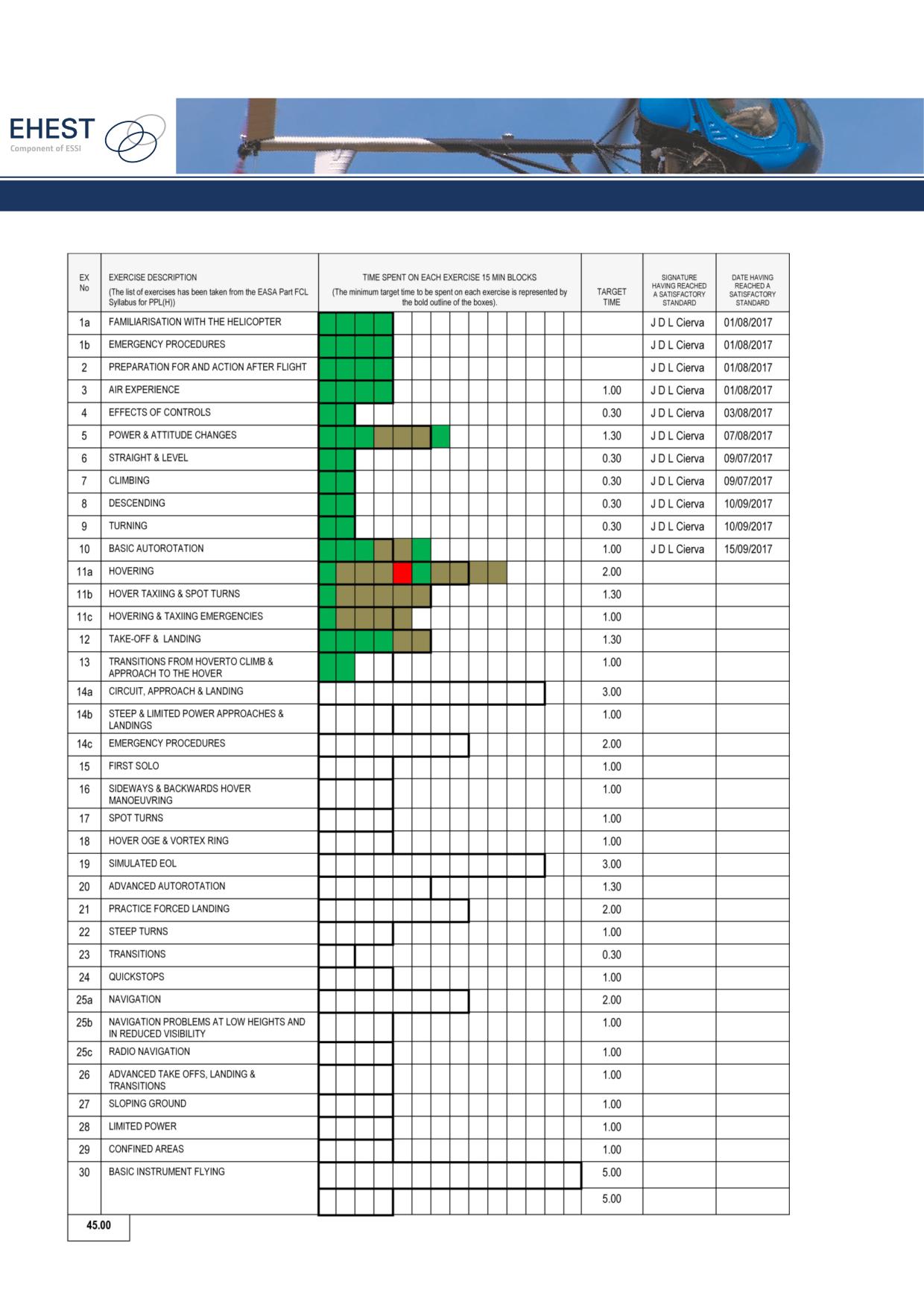
__
_
_
_
_
_
_
_
_
_
_
_
_
_
_
_
_
_
_
HELICOPTER FLIGHT INSTRUCTOR GUIDE >> PAGE 55
__
flight under the guidance of their instructor. In this way, the
PILOT'S PERSONAL FLYING
__
entries and addition can be checked against the flying record
LOG BOOK
folder to ensure that they match. This can save much
__
It is a legal requirement for a pilots to record details of the flights
frustrating work at the end of a course! It may be save time in
__
that they have made. The personal flying log book is often a
the long run if entries are made in pencil initially and then 'inked'
__
source of great pride to the student and instructors will need to
over when the accuracy of each entry has been confirmed.
teach them how to complete it. Although completing it may
__
There is a wide selection of personal flying log books available
appear straightforward to the student, there are details that will
from aviation equipment suppliers and bookshops and the
__
need explanation, for example, how flight time is recorded,
layout varies among them. The ATO or DTO may have a
__
what is meant by the holder's operating capacity and other
preference but it is a good idea to check that the log book is
details that may not be apparent to the new aviator. The
suitable for the type of flying that the student is likely to do in the
__
National Aviation Authority responsible for issuing the licence
future.
__
will check the entries in the log book to verify that the
This example below is taken from Part FCL,
requirements for issue of a PPL (H) or LAPL(H) have been
__
fulfilled when checking the licence application. (The same
The Personal flying record can be maintained electronically
__
applies to CPL(H) candidates undergoing instruction at ATO but
which offers advantages particularly in gathering data such as
it is assumed that by this stage they will be familiar with the use
time on type or periodic summaries of flying hours. However, it
__
of their log book).
is recommended that at least for the period of pre-licence
__
training a physical log book is maintained so that students
It is very important therefore that all details are correct from the
__
understands the procedure and process for recording flight
outset. It may be a good idea for the log book to be kept with
details.
__
students' flying records, at least initially, and filled in after each
__
__
__
HELICOPTER FLIGHT INSTRUCTOR GUIDE >> PAGE 56
__
__
THE FLIGHT OR GROUND
__
CURRICULUM
__
A course of training is a complete series of studies leading to
the attainment of a specific goal. This could be a course leading
__
to the award of a PPL(H). Such a course will have learning
__
objectives, a syllabus of instruction and course outline. The
theoretical knowledge requirements will be described in detail
__
together with the method of evaluation by exams. Similarly,
__
airborne instruction will be covered detail in accordance with
__
the Part FCL syllabus of flying exercises as set out in Part 2 of
this Guide.
__
It is likely that an ATO will be offering a range of courses which
__
might include: LAPL(H); PPL(H); Night Rating; additional Type
__
Ratings, FI ratings and CPL(H) courses. Each one of these
courses will be described in detail in the ATO Manual setting
__
out the syllabi for theoretical knowledge and flying exercise
__
training and how they will be covered in the course together
with the supporting learning objectives, syllabus of instruction
__
and course outline forming a course training package. Taken
__
together the associated course training packages for the
__
different courses on offer would be described as the ATO's
Curriculum which could be further broken down to describe the
__
__flight or ground curriculums as required.
STUDY MATERIAL
It is usual for organisations to have a preferred list of text books,
study guides, leaflets, handouts and other supporting material
to support its curriculum. These are listed in the ATO Manual
and students should be directed to them for further reading and
study.
The material may differ from that which the FI(H) used in his or
her own training. If this is the case, then it is very important that
flight instructors make themselves fully conversant with the
material that the ATO references in its manual so that they
understand what sources their students are using. They can
then set study to assignments based on these sources for the
students can use in preparation for their next lesson and for
revision afterwards.
HELICOPTER FLIGHT INSTRUCTOR GUIDE >> PAGE 57
__
OFFICIAL FORMS
__
Each ATO/DTO will have a series of forms that it requires
__
students and instructors to complete. A description of these
__
forms and the student's responsibilities for their completion
will form part of the initial student briefing adding to this as and
__
when additional documentation is required.
__
In addition, National Aviation Authorities will require official
__
forms to be completed for the issue of licences and type
ratings. Students may find the bureaucratic process associated
__
with this form-filling which may also be done on-line, daunting.
__
A good flight instructors will assist the student to navigate their
__
way round these official forms by explaining what needs to be
done, how to do it and when to do it. It is therefore necessary
__
for instructors to have up-to-date information at their fingertips
__
so that they can do this confidently and competently. If their
instructor seems unsure who to deal with these fundamental
__
issues, then students will quickly lose confidence.
__
There are other forms with which the student must be familiar,
__
for example flight plans, met briefing forms, customs forms and
__
others depending on national procedures and circumstance.
Again instructors must ensure that their students are familiar
__
with all the relevant pre and post flight documentation needed
__
for safe and legal flying.
__
HELICOPTER FLIGHT INSTRUCTOR GUIDE >> PAGE 58
__
__
__
__
__
__
__
__
__
__
__
__
__
__
__
__
__
__
__
HELICOPTER FLIGHT INSTRUCTOR GUIDE >> PAGE 59
__
THE FLIGHT MANUAL OR
AIRCRAFT DOCUMENTS
__
EQUIVALENT DOCUMENT
In the same way as flight instructors are responsible for
__
ensuring that their students understand flight authorisation and
(FOR EXAMPLE, OWNER'S MANUAL OR
__
training documents, they also need to cover helicopter
PILOT'S OPERATING HANDBOOK)
acceptance, including the technical log (if applicable), certificate
__
of maintenance and helicopter serviceability documents. This
The flight manual (FM) or equivalent is the authoritative
__
is covered in Exercise 2 - PREPARATION FOR AND ACTION
document that flight instructors must use for all training.
__
AFTER FLIGHT but will need constant re-enforcement
Checklists must follow the exact sequence laid down in the FM
throughout the course.
__
as should all the procedures laid down. It is the authoritative
source for all normal and emergency procedures and students
The importance of making accurate entries in the technical log
__
should be completely familiar with the document. The FM is
and for checking on the serviceability of the aircraft, noting
__
often expensive and it is required to be kept in the aircraft
when servicing is due and how many hours are available before
thereby limiting student access at times. Ideally, spare copies
the aircraft is due for planned servicing. If the instructor and
__
(which are kept up to date) should be available in briefing rooms
student use the MATED sequence of pre-flight briefing checks,
__
these details can be covered in the briefing under 'A' for aircraft.
and used during pre-flight briefings and knowledge tests.
__
The FM is also the authoritative source of performance
information. Flight instructors are recommended to devise
__
THE PRIVATE PILOT'S LICENCE
scenario based exercises to test knowledge of weight and
__
balance calculations and assess aircraft performance.
REGULATIONS
__
Licence regulations are quite involved and they do change from
__
FLIGHT AUTHORISATION
time to time. Students expect their instructors to have a good
__
knowledge of the relevant regulations and be able to answer
PAPERS
their questions authoritatively without having to refer
__
All flights from an ATO or DTO need to be controlled from a
continuously to Part FCL, other instructors or the National
Aviation Authority. This said, if there is any doubt in the mind of
practical point of view. In smaller organisations, it will be much
easier to keep track of aircraft movements but in a busy ATO
instructors that the advice or information they are is about to
impart may not be 100% accurate then, it must be corroborated
operating several helicopters, it could be possible to miss the
immediately. It would be good instructional practice to make
fact that a helicopter due back at a certain time is late returning,
thus delaying the start of overdue action. In addition to the
the point that all aviation information should be checked with
the relevant source document(s) before basing a decision upon
flight safety reasons, it is essential to confirm that students and
instructors are authorised and competent to carry out the
it. It is therefore as important for instructors to be able to find all
training that has been briefed. There are additional
applicable regulations quickly and accurately.
considerations in the case of first solo flights which are covered
in Exercise 15 in Part 2 of the Guide. Flight instructors are
responsible for ensuring that their students understand the
importance of flight authorisation and they have a complete
grasp of the exercise that they have been set, where they have
been authorised to fly it together with the minimum safe
altitude and any other restrictions.
A good flight authorisation system offers the additional
safeguard of checking that all the necessary up-to-date pre-
flight information has been included in the brief such as
NOTAM, Met together with any recently issued notices. It is
good practice, to include a check sheet to confirm that this has
been done. Similarly, there are instances when additional
authorisation papers are required in the case of solo navigation
exercises confirming that the student has successfully
completed the necessary preparatory instruction and been
briefed what to do in the case of emergencies and worsening
weather.
HELICOPTER FLIGHT INSTRUCTOR GUIDE >> PAGE 60
__
__
FLIGHT SAFETY
__
Flight safety is a vital aspect of flight training. Both aircrew and
__
ground crew must be aware of the need for correct safety
__
practices. You are in a position to reduce incorrect, unsafe and
illegal practices. You are also in a position to influence the
__
attitudes and disciplines of future pilots in this industry. To be
__
successful, a flight safety program requires the correct attitude,
proper supervision, rigid enforcement, and proper training.
__
Your student learns by example: YOU MUST SET THIS
__
EXAMPLE!
__
An experienced instructor is an effective supporter of the
__
principles of good airmanship and flight discipline. As you gain
experience, learn to recognise unsafe practices and do
__
something to correct the situation. Practise flight safety by:
__
• being alert to unsafe practices and taking the
appropriate action
__
__
• following up when you see an unsafe practice by
informing the people involved that they have been
__
seen
__
• promoting the principles of effective flight safety to
__
students and other aircrew and groundcrew.
__
Flight safety consciousness by all personnel must become the
fashion. Unsafe procedures must be watched for, identified,
and eliminated by firm and consistent action. Throughout your
instruction, stress the importance of being fuel conscious, the
need for proper lookout and the danger of having loose articles
in the helicopter.
HELICOPTER FLIGHT INSTRUCTOR GUIDE >> PAGE 61
__
__
A CHECKLIST FOR GOOD INSTRUCTION
__
__
__
Each instructor should:
__
1.
11.
Tell the students specifically what is required of them
Appear enthusiastic about the subject being taught.
__
during the lesson and at the end of the lesson (the ‘what’ of
12.
Use speech variation in rate, volume and pitch.
the introduction).
__
13.
Have students answer questions related to the objective(s)
2.
Identify the main teaching points for the student by:
__
for the lesson during the presentation of new material.
(a) using visual support (i.e. whiteboard, orientation
__
14.
Use correct questioning techniques.
board, or other visual aids)
15.
Use a variety of training aids to appeal to as many senses as
__
(b) verbally referring to the visual aids.
possible whenever these aids help to achieve the
__
objective(s) of the lesson.
3.
Tell the student the purpose of the lesson and stress the
__
advantages of the new knowledge or skill (the ‘why’ of the
16.
Provide sufficient meaningful practice of the main points of
__
introduction).
the lesson so that students confidently achieve the
objective.
__
4.
Tell students where the lesson fits into the overall picture.
17.
Allot time relative to the importance of the teaching point.
__
5.
Relate the lesson to the student’s past and/or future
experiences (the ‘where’ of the introduction).
18.
Identify and correct errors or mistakes made by the
__
students at the time they occur, or as soon thereafter as
6.
Confirm that students are at the required level before
__
practicable.
having them learn new material.
__
19.
Use clearly worded explanations.
7.
Present the new material in stages.
20.
Deliver the lesson in a logical sequence.
8.
Introduce each stage of the lesson and provide a link or
bridge between stages.
21.
Conduct periodic reviews of critical areas of the lesson.
9.
Obtain student feedback throughout the lesson by:
22.
Summarise the main points of each stage.
23.
Evaluate level of student learning at the end of each stage.
(a) asking questions
24.
Test students on the main points of the entire lesson
(b) observing student performance of a skill
towards the end of the lesson.
(c) looking at students (watching for facial expressions)
25.
Provide a final summary that links all stages to the
objective(s) of the lesson.
(d) taking student questions.
26.
Re-motivate students by telling them how the new
10. Respond to feedback by:
knowledge or skill will benefit them.
(a) answering questions
27.
Ensure they are well prepared for the programmed lesson
(b) stopping students from doing a step of a skill
prior to meeting with student.
incorrectly
(c) reviewing material or steps
(d) asking questions
(e) correcting the student if an error has been made
(f) explaining why the student’s performance is
incorrect
(g) using verbal support
(h) re-teaching (if necessary)
(I)
praising students for good work.
HELICOPTER FLIGHT INSTRUCTOR GUIDE >> PAGE 62
__
__
__
__
__
__
__
__
__
__
__
__
__
__
__
__
__
__
__
HELICOPTER FLIGHT INSTRUCTOR GUIDE >> PAGE 63
__
__
PART 2
__
__
__
__
AIR EXERCISES
__
This part outlines the purpose of each exercise, the essential
__
backg2round knowledge a student must possess before
__
commencing the air exercise, advice to the instructor and a
simple outline for each air exercise.
__
__
__
__
__
__
__
__
__
__
HELICOPTER FLIGHT INSTRUCTOR GUIDE >> PAGE 62
__
__
__
__
__
__
__
__
__
__
__
__
__
__
__
__
__
__
__
HELICOPTER FLIGHT INSTRUCTOR GUIDE >> PAGE 63
__
INTRODUCTION
__
__
GROUND AND AIR INSTRUCTION EXERCISES
PREPARATORY INSTRUCTION
__
This part is presented as a series of exercises. These are
This is the presentation given by the flight instructor when
__
specific skills that either singly or in a group form a convenient
introducing a new exercise. Ideally you should give it in the form
__
unit for the student to learn.
of a mass briefing and no more than 24 hours before the related
__
training flight.
In most cases, when presenting a new exercise to a student,
you should be able to follow the sequence shown. However the
__
Preparatory instruction is presented as follows:
numbering of exercises should be used primarily as an exercise
__
reference list and as a broad instructional sequencing guide.
Aim
__
Therefore the demonstrations and practices need not
State the aim in terms of not so much what you, the
necessarily be given in the order listed. The actual order and
__
content will depend upon the following interrelated factors:
instructor, are about to teach, but what your student is
__
about to learn.
__
(i)
the applicant's progress and ability;
Review
__
(ii)
the weather conditions affecting the flight;
Review previously learned facts. This will generally help
students to understand and assimilate the new skills and
__
(iii)
the flight time available;
knowledge they are about to acquire. This is a good time
__
(iv)
instructional technique considerations;
to discuss any related problems they may have.
__
(v)
the local operating environment;
Motivation
__
(vi) applicability of the exercises to the helicopter.
Give students a good reason why they should learn this
skill. Use specific terms to suit the individual student and
__
Ground instruction in weather interpretation, planning and
training situation.
route assessment, decision making on encountering a
Airmanship / TEM
degraded visual environment (DVE) including reversing
Airmanship points will vary with the type of training
course or conducting a precautionary landing should be
helicopter and local conditions. Always stress the safety
incorporated throughout the course. Wherever possible,
flight simulation should be used to demonstrate to student
and TEM aspects of any training.
pilots the effects of flight into DVE and to enhance their
Teaching Points
understanding and need for avoidance of this potentially
These are self-explanatory. They are sometimes listed in
fatal flight regime.
broad terms, so as to cover all training helicopter and
Each exercise is presented in the following manner:
conditions. Occasionally you will need to amend them to
your specific needs.
GROUND SCHOOL
Confirmation
This is a list of subjects that the student should have learned or
This is a reminder to you to ask the student appropriate
should be familiar with before the preparatory instruction is
questions to confirm that learning has taken place and
given. These points should not form part of the preparatory
that the air exercise is likely to be effective. Give students
instruction or the pre-flight briefing.
ample opportunity to ask you questions so as to remove
any doubts or problems they might have.
HELICOPTER FLIGHT INSTRUCTOR GUIDE >> PAGE 64
__
__
__
__
PRE-FLIGHT BRIEFING
TIPS FOR INSTRUCTORS
__
This is a separate part of the ground presentation. It should
These are aimed at helping you in your role as an instructor. The
precede all flights, whether there is a new exercise to be
points mentioned should not be included in your ground or air
__
covered or not. It is also particularly important when sending a
presentations.
__
student solo.
__
Points to be covered include:
__
•
local weather and meteorological conditions
__
•
the helicopter to be used, its fuel state, C of G, servicing
schedule, aircraft documentation and any other relevant
__
information
__
•
where the exercises will be conducted including any
__
airspace , communication, NOTAM considerations
__
•
take-off time, duration of flight, and estimated landing
__
time back at base
__
•
the sequence of exercises to be covered during this flight
•
a review of relevant airmanship CRM and TEM points
__
•
Threat and Error Management
__
__
AIR EXERCISE
This is the recommended sequence of introducing an exercise
to a student. The sequence of further demonstration, practice
and fault analysis will vary from one student to another.
POST-FLIGHT DE-BRIEFING
This follows all flights, dual and solo. Points should include:
•
the student’s assessment of the flight and performance.
•
your assessment of the student’s performance. This
includes both strong and weak points, and advice on how
to correct any repeated errors.
•
answering any student questions.
•
assigning study subjects where appropriate.
•
completion of student training records and taxonomy.
Note: Full and accurate training records are essential to
effective training. It is important that training records
should be completed by the instructor as soon as possible
after completion of the training session. Records for each
individual training session should ideally include a
comprehensive narrative report recording the training
provided, the training medium, weather (if applicable), as
well as the trainee's performance, progress, any
weaknesses and should be signed by the instructor and
the student. See Page 54 for more detail.
HELICOPTER FLIGHT INSTRUCTOR GUIDE >> PAGE 65
__
__
__
__
__
__
__
__
__
__
__
__
__
__
__
__
__
__
__
HELICOPTER FLIGHT INSTRUCTOR GUIDE >> PAGE 67
__
__
1a & 1b
__
FAMILIARISATION WITH THE HELICOPTER
__
__
AND EMERGENCY PROCEDURES
__
GROUND SCHOOL POINTS
__
Explain:
__
Familiarise the student with the layout of the school,
•
the cockpit layout and the control system. In the case of
including briefing rooms, crew rooms, etc., introduce him or her
students with fixed wing experience, with particular
__
to the members of the staff who are associated with the flight
reference to those controls that are new to the student.
__
training.
the various aircraft systems:
•
__
Explain the course syllabus and how it will be applied,
the main and tail rotor systems
including details of how, when and where ground school,
__
preparatory instruction, pre-flight briefings and post-flight
the fuel and oil systems
__
debriefings are carried out; how dual and solo flights are
the electrical system and avionics equipment
authorised; how progress is monitored; and any other
__
the hydraulic system (if applicable)
information necessary to the student in his or her day-to-day
__
attendance at the Approved Training Organisation (ATO).
•
weight and balance.
__
•
the use of the check lists, drills for normal flight and
__
PREPARATORY INSTRUCTION
emergency drills.
__
Aim:
•
Emergency procedures escape drills and emergency
__
fire drills.
Exercise 1a: To familiarise the student with:
the Rotorcraft Flight Manual (or Pilot's Operating
•
the characteristics of the helicopter, its external features,
•
Handbook).
cockpit layout, systems, and controls drills, checklists and
procedures
any course material provided by the ATO together with
•
recommended publications for study during the course.
Exercise 1b - Emergency Procedures: To learn the action to
be taken in the event of:
Teaching Points:
•
fire on the ground and in the air,
Cover all the learning points in a logical sequence using the
aircraft as a training aid getting the student to identify the
•
engine, cabin and electrical system fire,
main components and systems of the helicopter while
•
system failures (where appropriate),
explaining their purpose.
escape drills including the location and use of emergency
•
There is a great deal to cover in these two lessons so it is
equipment and exits.
advisable to have the lesson plan readily to hand and work
through each learning point to avoid going into too much
Motivation:
detail at the same time ensuring that all the necessary items
The knowledge gained in this exercise underpins the whole of
have been covered. Whilst too much detail should be avoided
bear in mind that the student will usually be fresh and eager for
the course. Understanding how the helicopter works will make
subsequent lessons easier to understand and save valuable
knowledge so full advantage should be taken of this desire to
learn. Explanations may be simplified if necessary but care
training time both in the air and on the ground.
must be taken to avoid the student forming a false impression
Airmanship / TEM:
of how a system or control works which may be difficult to
correct later.
the use of Checklists,
•
Cover the drills for Engine Fire on Start Up, Engine Fire in
Approaching and leaving a helicopter and procedures to
•
Flight and Electrical Fire in Flight in detail and get the student to
be observed when 'airside' e.g. No Smoking, switch off
practise aircraft escape drills physically rather than just talk
mobile phones,
about them. Discuss other systems failures and avoid
thorough pre-flight inspection,
•
creating a negative impression of helicopter flying by
knowledge of emergency drills, the helicopter's
explaining that these are rare occurrences. However a pilot
•
emergency equipment and fire extinguisher types
must be able to deal with all potential emergencies.
HELICOPTER FLIGHT INSTRUCTOR GUIDE >> PAGE 68
__
TIPS FOR INSTRUCTORS
__
Show the student a thorough external check on the aircraft,
__
with particular reference to items that are probably completely
__
new to him or her (e.g. main rotor, tail rotor, transmission etc)
__
Reinforce the classroom instruction with practical exercises,
e.g. reading the checklist; practical escape drills; dry use of fire
__
flighting equipment and physical identification of components
__
on the helicopter.
__
Avoid confusing the student by presenting too much detailed
information at this initial stage. The use of models and training
__
aids is helpful when explaining aircraft systems especially
__
where it is not easy to visualise how a component works by
looking at its exterior.
__
Relate this exercise to the student's flying backg2round, level
__
of experience and general aviation knowledge.
__
Discuss ground school requirements and how these will be
__
integrated with flight instruction as a precursor to each air
__
exercise.
__
This lesson is often combined with Exercise 2: Preparation for
and Action after Flight.
__
__
__
LESSON CHECKLIST
Exercise 1a: Familiarisation with the helicopter:
(A) characteristics of the helicopter, external features;
(B) cockpit layout;
(C) systems;
(D) checklists, procedures and controls
Exercise 1b: Emergency procedures:
(A) action if fire on the ground and in the air;
(B) engine, cabin and electrical system fire;
(C) systems failures;
(D) escape drills, location and use of emergency
equipment and exits.
HELICOPTER FLIGHT INSTRUCTOR GUIDE >> PAGE 69
__
__
2
__
PREPARATION FOR AND ACTION AFTER FLIGHT
__
__
__
PREPARATORY INSTRUCTION
__
Aim
Documents: Show the student all the documents required by
__
legislation to be on board the helicopter in flight. Explain the
__
To introduce the student to the preparation necessary before
significance of each and its bearing on airworthiness.
commencing a flight.
__
Inspections and checks
Review
__
While walking to the helicopter, point out that the student
Exercise 1a & 1b
should always note:
__
Motivation
__
•
wind velocity.
Stress the fundamental part that proper preparation for flight
__
•
the presence of any helicopter or obstacle that might
plays in flight safety. Explain that a high percentage of
__
affect the starting of the rotors or the departure
helicopter accidents and incidents are due to poor preparation
procedure.
and inadequate planning.
__
the location of any external fire flighting equipment.
Airmanship / TEM
•
__
Demonstrate the external inspection and the internal checks
__
• Equipment required
and procedures to be carried out before take-off, as appropriate
__
• Maps
to type.
Teaching Points
Demonstrate seat position, the operation of the harness and
Explain that the sequence of events leading up to the take-off
emergency exits together with the brace position.
and departure can be conveniently considered in three phases:
Demonstrate starting and warm-up checks, clutch engagement
and starting rotors. Once completed the start up demonstrate
•
flight planning
the power checks used, appropriate to type. Upon completion
•
checking of helicopter documents
of flight demonstrate shut-down checks and procedures
appropriate to type.
• inspection of the helicopter and completion of checks and
procedures.
Discuss the procedures for parking and security of the
helicopter, and completion of the necessary documentation.
Point out that during the initial stages of training, the flight-
planning phase will be covered by the instructor during Pre-
Flight Briefings. As the course progresses, the student will be
TIPS FOR INSTRUCTORS
required to take part increasingly in all the aspects of
Although treated here as a separate exercise, it may be more
preparation for flight.
convenient to combine the introduction to Preparation for Flight
Explain that it is the pilot-in-command’s responsibility to ensure
with Exercise 3.
that the helicopter is safe and fit in all respects for the intended
Student practice of the external inspection, and pre-take-off
flight.
procedures, should be carefully monitored until reliable
Explain the need to wear, or have on board the helicopter,
proficiency is attained, and should be checked at regular
proper survival equipment, clothing and footwear for existing or
intervals thereafter.
anticipated weather conditions in case of an unscheduled
Explain the importance of the student becoming familiar with
landing away from base.
the helicopter and its components when all is normal and
Explain the procedures for the student to follow, should he or
serviceable so that any abnormality becomes readily and easily
she discover a defect or unserviceability in the training
apparent when conducting the pre flight inspection.
helicopter during the inspection or pre-take-off phase. Stress
that students should not fly the helicopter if they have any
doubts about its airworthiness.
HELICOPTER FLIGHT INSTRUCTOR GUIDE >> PAGE 70
LESSON CHECKLIST
Exercise 2: Preparation for and action after flight:
(A) flight authorisation and helicopter acceptance;
(B) serviceability documents;
(C) equipment required, maps, etc.;
(D) external checks;
(E) internal checks;
(F) seat, harness and flight controls adjustments;
(G) starting and warm-up checks clutch engagement
and starting rotors;
(H) power checks;
(I) running down system checks and switching off the
engine;
(J) parking, security and picketing;
(K) completion of authorisation sheet and
serviceability documents.
__
__
3
__
AIR EXPERIENCE
__
__
GROUND SCHOOL POINTS
__
Review Exercise 1- Familiarisation with the Helicopter and
Teaching Points
__
Exercise 2 - Preparation for and action after flight
It is not intended that the flying instruction given in this period
__
PREPARATORY INSTRUCTION
should be formal in nature but students should be allowed to
get accustomed to the sensations of rotary-wing flight, the
__
Aim
attitudes of the aircraft when climbing and descending and,
__
To introduce the student to rotary wing flight
particularly, the ability to reduce speed to zero (i.e. hover) in the
air. They may be given the feel of the controls without any
__
Review
attempt to explain their effects in detail but emphasising their
__
Exercise 1 & 2
sensitivity and the need not to let go of them.
__
Motivation
The student should be encouraged to relax and pay particular
__
attention to the need for fresh air and the action to be taken in
By the end of this lesson the student will be able to make a
the event of feeling unwell. The student should assist in lookout
__
judgement to continue to learn to fly or not.
throughout the sortie stressing the need to keep the eyes out of
__
Airmanship / TEM
the cockpit as much as possible and to develop a basic scan
pattern.
__
• Lookout
__
Talk about communications in the cockpit environment
• Use of Checklists
avoiding the natural instinct to make eye contact with the other
__
person in order to maintain external lookout.
• Handing Over/Taking Over Control
This period can also be used to show the student the
• Aircraft Limitations
immediate vicinity of the airfield pointing out the local
Explain
landmarks and providing a general impression of the circuit area
•
how to enter and leave the helicopter with the rotors
with particular reference to any other flying that may be taking
place.
turning
•
that seat belts or harnesses should be done up at all times
during flight
the necessity for positive hand-over and take-over of the
•
controls as discussed in Part 1.
the need for a constant and thorough lookout for other
•
aircraft. Describe the clock method of reporting aircraft to
the other crew member.
the need for flight clothing commensurate with the
•
weather, area of operation and role being performed.
Common
COMMON ERRORS
Errors
• Student will be nervous and tense -encourage the student
to relax and enjoy the flight confusing the student in the
air. A thorough explanation is necessary before flight.
Emphasis must be made on using the horizon and attitude,
not on the instruments
HELICOPTER FLIGHT INSTRUCTOR GUIDE >> PAGE 72
__
AIR EXERCISE
__
Identify the main components of the helicopter. This can be
__
done during the instructor's external check, but care should be
__
taken not to confuse the student with too many details.
__
Seat the student in the pilot's position in the helicopter and give
__
a full passenger and crew briefing. Explain the general function
of the controls and instruments. Demonstrate adjustment of
__
the controls for comfort and safety, as applicable to type.
__
Carry out a short familiarisation flight, pointing out prominent
__
landmarks and giving the student an opportunity to handle the
controls in cruising flight. Student performance should not be
__
criticised or corrected at this stage and ensure all checks are
__
completed by using a checklist.
__
__
TIPS FOR INSTRUCTION
__
As this is to be the student's first flight training exercise, ensure
that everything is explained painstakingly. Emphasise this as
__
necessary, since all future flight training exercises are based
__
around the basic principles learned in this exercise.
__
This exercise should be tailored to the student's previous flying
__
experience if applicable. It is important that the student has an
enjoyable and pleasant experience. The instructor must set the
__
highest standard of airmanship and procedures throughout.
Students will often get very tense in the earlier air exercises.
The instructor should make every effort to ensure that the
student is comfortable and relaxed as much as possible. Stress
the need for correct, comfortable posture in these early stages.
Introducing short in-flight relaxation exercises from time to time
to prevent the student from tensing muscles may be helpful
during earlier flights.
Ensure that the helicopter is reasonably stable before handing
over control to the student.
Emphasise the use of verbal confirmation before commencing
any turns.
The use of a model helicopter will make preparatory instruction
much more effective.
LESSON CHECKLIST
Exercise 3: Air experience:
(A) to introduce the student to rotary wing flight;
(B) flight exercise.
HELICOPTER FLIGHT INSTRUCTOR GUIDE >> PAGE 73
__
__
4
__
EFFECTS OF CONTROLS
__
__
GROUND SCHOOL POINTS
__
Theory of flight:
Describe the visual and instrument indications resulting
__
• definitions
from various cyclic control movements.
__
Explain that the cyclic a sensitive control and that the
• helicopter controls
__
disc responds rapidly to the rate of movement of the
Function of flight and engine instruments
cyclic so smooth controlled movements should be
__
Function of ancillary controls
made. Also emphasise to the student that the cyclic is
__
not self centering and will need continual adjustments
PREPARATORY INSTRUCTION
to maintain attitude.
__
• Collective pitch control
__
Aim
Moving the collective causes an equal change of pitch
__
For the student to learn:
to all main rotor blades. The primary effect of moving
__
• the primary and secondary effects of flight controls in
the collective alone, in cruising flight, is a change in
flight
height.
__
•
the effects of:
Explain that there are secondary effects comprising
__
(a) air speed;
changes of attitude, heading and RPM. For this reason,
__
(b) power changes (torque);
the collective is seldom moved without coordinating
(c) yaw (sideslip);
__
movements of the cyclic, pedals and throttle. This
(d) disc loading (bank and flare);
aspect will be covered in the following exercise.
(e) controls of selecting hydraulics on/off;
• Throttle
(f) control friction.
Move the twist grip to open and close the throttle.
(g) instruments;
(h) use of carburettor heat or anti-icing control.
Explain the function of the throttle as appropriate to the
type. The primary effect is RPM control (engine and
• the use of ancillary controls.
rotor RPM). Explain that there are secondary effects
comprising YAW and MAP changes.
Review
• Tail rotor pedals
Exercise 2: Preparation for Flight
Movement of the pedals causes a change in pitch of the
Exercise 3: Air Experience
tail rotor blades. The result of this is a yaw. Stress that,
Motivation
in the cruise, this yaw is a large skidding motion. Explain
that there are secondary effects comprising roll, RPM
This exercise introduces the helicopter controls and their
changes and IAS errors. The pedals should not be used
functions with the associated indications and use of the
to change the helicopter’s direction of flight.
instruments.
• Ancillary controls
Airmanship / TEM
Describe the use of the ancillary controls (e.g.
• Lookout
carburettor heat, mixture, trim, rotor brake, anti-ice,
• Handing Over/Taking Over
windscreen, de-fogging, heater, etc.) as appropriate to
type.
• Aircraft Limitations
Common
Teaching Points
COMMON ERRORS
Errors
• Cyclic pitch control
Moving the cyclic causes the rotor disc to tilt. As a result
•
Particular care must be taken when demonstrating the
of this, the helicopter will either pitch or roll, or a
effect of the throttle and collective pitch lever to avoid
combination of the two, depending on the direction in
confusing the student in the air. A thorough explanation is
necessary before flight.
which the cyclic is moved. Explain that there are
secondary effects comprising changes in altitude,
Emphasis must be made on using the horizon and attitude,
•
airspeed and RPM.
not on the instruments
HELICOPTER FLIGHT INSTRUCTOR GUIDE >> PAGE 74
__
AIR EXERCISE
• Tail Rotor Pedals
__
Re-establish a straight and level cruise.
__
Before take-off:
Demonstrate the effects of right and left pedal movement,
__
•
make sure the student is seated comfortably and ensure
pointing out the visual and flight instrument indications.
__
all checks are completed by using a check list
Student practice
__
•
demonstrate the correct use of frictions, trims and control
• Ancillary Controls
adjustments, as appropriate to type
__
As appropriate to type:
•
demonstrate the effect of cyclic control movements on
__
Demonstrate the use of ancillary controls.
the rotor disc, including how the horizon is used as a
__
reference to interpret the helicopter’s attitude
Student practice
__
• demonstrate the effect of collective lever on the pitch of
•
All Controls
both blades when raising and lowering the control
__
Have the student practise simple flight manoeuvres by
•
demonstrate opening and closing the throttle
application of the basic principles of this exercise. Stress the
__
•
demonstrate the effect of pedals on the pitch of the tail
need for smooth operation. Rather than demand accuracy at
__
rotor
this stage, monitor the controls to avoid excessive control
__
movements by following through as necessary.
In Flight:
__
• Cyclic Control
TIPS FOR INSTRUCTORS
__
Establish a straight and level cruise at a safe altitude.
As this is to be the student’s first flight training exercise, spare
__
Demonstrate pitching movement in the normal range.
no pains to explain everything carefully. Emphasis is necessary,
__
Point out the sensitivity or lag, as appropriate to type.
since all future flight training exercises are based around the
basic principles learned in this exercise.
Student practice
__
This exercise should be tailored to the student’s previous flying
When the student demonstrates reasonable
experience if applicable.
competency, point out the flight instrument indications.
Students will often get very tense in the earlier air exercises.
Re-establish a straight and level cruise.
The instructor should make every effort to ensure that the
student is comfortable and relaxed as much as possible.
Demonstrate rolling movement (gentle and medium turns)
Ensure that the helicopter is reasonably stable before handing
Student practice
over control to the student.
Point out flight instrument indications
Emphasise the use of verbal confirmation before commencing
Re-establish a straight and level cruise.
any turns.
Demonstrate a combination of pitching and rolling
The use of a model helicopter will make preparatory instruction
much more effective.
movements.
Stress the need for correct, comfortable posture in these early
Student practice
stages.
Point out flight instrument indications.
• Collective Control
LESSON CHECKLIST
Re-establish a straight and level cruise.
Exercise 4: Effects of controls:
Demonstrate the effects of raising and lowering the
(A) function of flight controls, primary and secondary
collective, pointing out the visual and flight instrument
effect;
indications.
(B) effects of:
Student practice.
(a) air speed;
• Throttle
(b) power changes (torque);
Where appropriate to type, re-establish a straight and level
(c) yaw (sideslip);
cruise.
(d) disc loading (bank and flare);
(e) controls of selecting hydraulics on/off;
Demonstrate the effects of opening and closing the
(f) control friction.
throttle, pointing out the visual and flight instrument
(g) instruments;
indications.
(D) use of carburettor heat or anti-icing control.
Student practice
HELICOPTER FLIGHT INSTRUCTOR GUIDE >> PAGE 75
__
__
5
__
POWER AND ATTITUDE CHANGES
__
__
Speed Decrease
__
GROUND SCHOOL POINTS
__
Explain to decrease the speed the disc is tilted back with
Flight guide: engine, transmission and airspeed limitations
the cyclic, the nose rises to a more nose up attitude and
__
Flapback
the aircraft slows down. As the speed decreases, the disc
Power required diagram
'flaps' forward and the cyclic must be moved further back
__
to maintain the deceleration. When the speed is close to
__
PREPARATORY INSTRUCTION
the desired speed the nose attitude is reselected to the
__
attitude for the required speed.
Aim
__
Is for the student to learn how to maintain a specified
Power changes
airspeed, how to change that airspeed by changing the
__
Explain how the height of the aircraft is controlled by
fuselage attitude and the relationship of the cyclic position
__
collective lever. When the lever is raised the power
to the airspeed and how to make power changes.
__
increases because of the correlater linkage and the
aircraft nose will yaw. The reverse is true when the lever
Review
__
is lowered and consequently to maintain the heading the
Exercise 4: Effects of Controls
use of pedal is required when changing power. Increases
__
Motivation
and decreases in collective pitch will result in attitude
__
changes which should be anticipated.
This exercise will enable the student to maintain and change
__
the aircraft airspeed.
AIR EXERCISE
Airmanship / TEM
Demonstrate airspeed changes.
• Positive hand over of controls
Student practice
•
Lookout
Demonstrate power changes.
•
W/V
Student practice
Monitor /scan of engine temperatures and pressures
•
TIPS FOR INSTRUCTORS
Helicopter limitations
•
If the student is able to cope, this exercise can be combined
Teaching Points
with Exercise 6.
Describe how to conduct attitude and power changes as follows:
Students will often tend to pay excessive attention to the flight
Speed Increase
instruments in this exercise. Care must be taken to ensure that
a proper scan between the instruments and external
Explain that to increase the speed from balanced cruise
references is established and that a good lookout is maintained.
flight it is necessary to tilt the rotor disc further forward
with the cyclic which will result in the nose dropping to
It should be explained that it takes a certain time for speed
a new attitude. As the aircraft accelerates the rotor disc
changes to occur and attempts to hurry the process can lead to
will tend to 'flapback' so to maintain the acceleration it
over controlling. Therefore the student should be encouraged
is necessary to move the cyclic progressively forward and
to SELECT, HOLD and ADJUST. It is recommended that initially
reselect the attitude for the required speed. In light
speed changes only between 40-80kts is practised.
helicopters with an effective horizontal stabiliser the
increase in down wash force tends to maintain the
Common
fuselage attitude relatively constant over a large part of
Errors
COMMON ERRORS
the speed range.
• Over controlling on the cyclic, usually caused by failure to
appreciate the lag in control response.
• Failure to maintain selected attitude.
• Incorrect Throttle movement.
Failure to appreciate and correct for yaw.
•
HELICOPTER FLIGHT INSTRUCTOR GUIDE >> PAGE 76
__
Changes of airspeed during the early stages of this air exercise
__
will result in changes of altitude. It is important therefore, to
__
conduct this lesson at 1000 feet AGL or more, in good weather
conditions with a defined horizon.
__
Where appropriate to the aircraft type, demonstrate the
__
methods of changing manifold pressure at constant rotor RPM
__
and changing rotor RPM at constant manifold pressure.
__
__
__
__
__
__
__
__
__
__
__
__
__
LESSON CHECKLIST
Exercise 5: Power and attitude changes:
(A) relationship between cyclic control position, disc
attitude, fuselage attitude and air speed;
(B) flapback;
(C) power required diagram in relation to air speed;
(D) power and air speed changes in level flight;
(E) use of instruments for precision;
(F) engine and air speed limitations.
HELICOPTER FLIGHT INSTRUCTOR GUIDE >> PAGE 77
__
__
6
__
STRAIGHT AND LEVEL
__
__
GROUND SCHOOL POINTS
__
Flight guide: engine, transmission and airspeed limitations
Make appropriate movement to the collective lever to
__
correct climb or descent back to level flight at the same time
Flapback
preventing/correcting yaw with pedals.
__
Power required diagram
Adjust attitude, power and yaw pedals as required to settle
__
accurately in level flight at the nominated airspeed ensuring
PREPARATORY INSTRUCTION
__
balance ball and/or string is in the middle. Note that attitude
Aim
of the aircraft is not significantly different between 40-
__
The aim is for the student to learn how to utilise speed control
__
and power changes to achieve level balance flight at specified
AIR EXERCISE
__
airspeeds. (Note: straight and level flight means at constant
altitude and heading)
Demonstrate straight and level balance flight at cruise power
__
Student practice
__
Review
Exercise 4: Effects of Controls
Demonstrate airspeed changes whilst maintaining altitude
__
Exercise 5: Power and Attitude Changes
Student practice
__
Motivation
__
TIPS FOR INSTRUCTORS
This exercise will utilise speed control and power changing
__
techniques learned in last exercise to achieve a level balanced
If the student is able to cope, this exercise can be combined
flight at specified airspeeds.
with Exercise 5.
Students will often tend to pay excessive attention to the flight
Airmanship / TEM
instruments in this exercise. Care must be taken to ensure that
• Positive hand over of controls
a proper scan between the instruments and external
•
Lookout
references is established and that a good lookout is maintained.
•
W/V
It should be explained that it takes a certain time for speed
Monitor /scan of engine temperatures and pressures
changes to occur and attempts to hurry the process can lead to
•
over controlling. Therefore the student should be encouraged
Helicopter limitations
•
to SELECT, HOLD and ADJUST. It is recommended that
Teaching Points
initially speed changes only between 40-80kts are practised.
Where appropriate to the aircraft type, demonstrate the
Describe how to maintain straight and level flight as follows:
methods of changing manifold pressure at constant rotor RPM
Explain that the basic rules to remember from previous
and changing rotor RPM at constant manifold pressure.
exercises are that the collective lever controls height and
the cyclic controls the attitude therefore the airspeed.
Describe the power and airspeed settings used for straight
and level cruise flight as appropriate to type.
Common
COMMON ERRORS
Describe how to maintain airspeed at a constant altitude
Errors
and airspeed by the use of visual and instrument cues, such
as the relationship between the disc and the horizon, cross
•
Failure to hold attitude long enough to allow the speed to
checking with the airspeed indicator, altimeter, VSI etc.
stabilise resulting in over controlling on the cyclic.
Describe how to conduct speed changes between 40-80kt in
•
Poor rotor RPM control usually caused by the lack of
level balanced flight as follows:
anticipation of the effect of changing airspeed.
Select the attitude to accelerate or decelerate, using trim or
•
Failure to correct yaw during power changes.
control friction if appropriate, to the desired speed and
•
When flying straight and level controlling height with
check with the altimeter and VSI to see whether climbing or
cyclic and speed with power.
HELICOPTER FLIGHT INSTRUCTOR GUIDE >> PAGE 78
LESSON CHECKLIST
Exercise 6: Straight and level:
(A) at normal cruising power, attaining and
maintaining straight and level flight;
(B) control in pitch, including use of control friction or
trim;
(C) maintaining direction and balance, (ball or yaw
string use);
(D) setting power for selected air speeds and speed
changes;
(E) use of instruments for precision.
__
__
7
__
CLIMBING
__
__
GROUND SCHOOL POINTS
__
Flight guide, Power Limitations & Performance Data
Once the aircraft is assessed to be established in the climb
__
the student should then check the airspeed, VSI, Altimeter,
Optimum Climb Speed, Best Rate of Climb, Best Angle of
__
Compass, Power and make the necessary adjustments to the
Climb
appropriate control .
__
Power Required Diagram
Explain that before reaching the required altitude that it is
__
necessary to anticipate the 'level off' and the same mnemonic
PREPARATORY INSTRUCTION
can be applied:
__
Aim
__
For the student to learn how to climb at given speeds, reommended
ATTITUDE:
Move the cyclic forward to adopt the
helicopter in a straight and level attitude
__
airspeed and power settings.
Lower collective to required power to maintain
__
Review
POWER:
straight and level flight
__
Exercise 5: Power and attitude changes.
Exercise 6: Straight and Level Flight.
TRIM:
Apply the necessary pedal to maintain balance
__
flight
__
Motivation
When learning to fly helicopters being able to climb with
Describe how the level off is performed visually using the
__
precision is an integral part of the basic handling of the aircraft.
helicopter attitude and the horizon. Once the aircraft is
__
assessed to be established in straight and level flight the
Airmanship / TEM
student should then check the airspeed, VSI, Altimeter,
•
Lookout
compass, power and make the necessary adjustments to the
appropriate control .
•
Helicopter limitations
•
Control Handover
AIR EXERCISE
Teaching points
Demonstrate descending and level off at various speeds and
Explain using the Power Required Diagram and the POH: the
power settings.
different speeds for optimum climb best rate of climb and best
angle of climb, that are achievable when altering power and
Student practice
airspeed. Give examples when and why the different
techniques may be used.
TIPS FOR INSTRUCTORS
Explain the importance of initially adopting straight and level
Emphasise the need for lookout, before and during the
attitude, before commencing a climb and performing a lookout,
manoeuvre, especially above the aircraft,
-
LOOK OUT
including above the aircraft altitude, emphasising the difficulty
and CHECK IN!
in seeing aircraft.
Describe how cyclic is used for airspeed corrections, collective
A mnemonic commonly used for climbing is APT:
for altitude corrections and pedals used to maintain balanced
flight and although the cyclic is used to initiate the climb after
ATTITUDE: Move the cyclic aft to adopt the helicopter
practice the procedure should be a co-ordination exercise
climb attitude for the desired climbing
among all three controls.
POWER:
Raise collective to recommended climb power
It may be possible to combine Exercises 7, 8 & 9 to make
efficient use of time and airspace
TRIM:
Apply the necessary pedal to maintain balanced
flight
Describe how the climb attitude is performed visually using the
Common
COMMON ERRORS
helicopter attitude and the horizon.
Errors
On levelling out from the climb, reducing power before
•
speed increases.
HELICOPTER FLIGHT INSTRUCTOR GUIDE >> PAGE 80
__
__
__
__
__
__
__
__
__
__
__
__
__
__
__
__
__
__
__
LESSON CHECKLIST
Exercise 7: Climbing:
(A) optimum climb speed, best angle or rate of climb
from power required diagram;
(B) initiation, maintaining the normal and maximum
rate of climb, levelling off;
(C) levelling off at selected altitudes or heights;
(D) use of instruments for precision.
HELICOPTER FLIGHT INSTRUCTOR GUIDE >> PAGE 81
__
__
8
__
DESCENDING
Describe how the descent attitude is performed visually using
__
the helicopter attitude and the horizon. Once the aircraft is
__
GROUND SCHOOL POINTS
assessed to be established in the descent the student should
then check the airspeed, VSI, Altimeter, Compass, Power and
__
Flight guide, Power Limitations & Performance Data
make the necessary adjustments to the appropriate control.
__
Optimum Descent Speed, Best Rate of Descent, Best
Explain that before reaching the required altitude that it is
Angle of Descent, Carburettor Icing
__
necessary to anticipate the 'level off' and the same mnemonic
Power Required Diagram
can be applied:
__
__
PREPARATORY INSTRUCTION
POWER:
Raise the collective to the required power
__
Aim
setting for the desired level flight speed
For the student to learn how to descend at given speeds
__
ATTITUDE:Move the cyclic forward to prevent nose up
__
pitch, and select the helicopter attitude for the
Review
desired level flight speed
Exercise 5: Power and attitude changes.
__
Apply the necessary pedal to maintain
TRIM:
Exercise 6: Straight and Level Flight.
__
balanced flight
Motivation
__
Describe how the level off is performed visually using the
When learning to fly helicopters being able to descend with
__
helicopter attitude and the horizon. Once the aircraft is
precision is an integral part of the basic handling of the aircraft.
assessed to be established in straight and level flight the
__
Airmanship / TEM
student should then check the airspeed, VSI, Altimeter,
__
compass, power and make the necessary adjustments to the
•
Lookout
appropriate control.
•
Carburettor Heat, if applicable
• Helicopter limitations
AIR EXERCISE
•
Control Handover
Demonstrate descending and level off at various speeds and
Teaching points
power settings.
Explain using the Power Required Diagram and the POH, the
Student practice
optimum descent speed, best rate of descent speed, best
TIPS FOR INSTRUCTORS
angle of descent, and the different rates of descent (ROD)
achievable when altering power and airspeed, giving examples
Emphasise the need for lookout, before and during the
when and why the different techniques may be used.
manoeuvre, especially below the aircraft,
-
LOOK OUT;
Explain the importance of initially adopting a straight and level
ATTITUDE; INSTRUMENTS
attitude, before commencing a descent and performing a
Describe how cyclic is used for airspeed corrections, collective
lookout, including below the aircraft altitude, emphasising the
for altitude corrections and pedals used to maintain balanced
difficulty in seeing aircraft below the horizon.
flight and although the cyclic is used to initiate the descent after
If the helicopter requires the application of carburettor heating
practice the procedure should be a co-ordination exercise
emphasise the dangers of carburettor icing when reducing
among all three controls.
power to descend.
If the helicopter is equipped with a carburettor - explain the
A mnemonic commonly used for descending is PAT:
formation and dangers of carburettor icing, and explain the
carburettor heating system and its operation.
POWER:
Lower the collective to the required power
It may be possible to combine Exercises 7, 8 & 9 to make
setting for the descent
efficient use of time and airspace
ATTITUDE:
Move the cyclic aft to prevent nose down
pitch, and select the helicopter attitude for the
desired descent speed
Common
COMMON ERRORS
Errors
Apply the necessary pedal to maintain
TRIM:
balanced flight
• Failure to maintain attitude caused by chasing the aircraft
instruments.
HELICOPTER FLIGHT INSTRUCTOR GUIDE >> PAGE 82
__
__
__
__
__
__
__
__
__
__
__
__
__
__
__
__
__
__
__
LESSON CHECKLIST
Exercise 8: Descending:
(A) optimum descent speed, best angle or rate of
descent from power required diagram;
(B) initiation, maintaining and levelling off;
(C) levelling off at selected altitudes or heights;
(D) descent (including effect of power and air speed);
(E) use of instruments for precision.
HELICOPTER FLIGHT INSTRUCTOR GUIDE >> PAGE 83
__
__
9
__
TURNING
__
GROUND SCHOOL POINTS
__
POH Optimum Angle of Bank, for Rate 1 & Medium Turns
Climbing and Descending Turns
__
Describe how to perform turning in the climb and in the
__
PREPARATORY INSTRUCTION
descent as follows:
__
Aim
Perform a lookout, including above, and then initiate a
__
climb. Once the climb has been established use lateral
For the student to learn how to turn the helicopter on a new
cyclic to turn, noting the reduced rate of climb during the
__
heading in level flight and whilst climbing and descending.
turn and control/correct with collective application. Note
__
Review
that returning to level attitude during the climb will
__
restore the original rate of climb.
Exercise 6: Straight and Level Flight
__
Perform a Lookout, including below, and then initiate a
Exercise 7: Climbing
descent. Once the descent has been established use
__
Exercise 8: Descending
lateral cyclic to turn. Note the increased rate of descent
__
Motivation
during the turn and control with collective application.
Note that returning to level attitude during the descent
__
When learning to fly helicopters it is necessary to be able to alter
will restore the original rate of descent.
the direction of the helicopter in a controlled and accurate
__
manner.
__
AIR EXERCISE
Airmanship / TEM
__
Demonstrate medium level turns left and right on to
•
Lookout
nominated headings using the gyro heading indicator and
• Helicopter limitations
compass.
•
Control Handover
Student practice
Teaching points
Demonstrate medium climbing and descending turns left
and right on to nominated headings using the gyro heading
Level Medium Turns
indicator and compass.
Explain that before any turn is attempted it is necessary to
Student practice
perform an effective lookout, especially in the direction of
Demonstrate medium level turns left and right on to
turn.
nominated headings using the gyro heading indicator and
Describe how lateral cyclic is used to roll to the desired angle
compass.
of bank, noting that the cyclic is affected by rate of
Student practice
displacement so should be a smooth controlled movement.
The bank angle should be selected by reference to the
horizon.
Explain once in the turn the ASI, VSI, Altimeter, Power,
balance all should be checked and the student should return
to looking outside and referencing the horizon and bank
angle. Describe how cyclic is used for airspeed corrections,
collective for altitude corrections and pedals used to maintain
balanced flight and how it will be necessary to repeat the
check during the turn.
Explain that the student should anticipate when the new
desired direction is reached and begin to roll level before the
Common
direction is obtained. To roll level use lateral cyclic to place
COMMON ERRORS
Errors
the helicopter in a level attitude. Once level, the instruments
should be checked for precision and necessary adjustments
made for straight and level flight.
•
When turning, using the pedals to assist in the turn, causing
out of trim flight.
HELICOPTER FLIGHT INSTRUCTOR GUIDE >> PAGE 84
__
TIPS FOR INSTRUCTORS
__
Emphasise the need for lookout, before and during the
__
manoeuvre, especially in the direction of turn and above and
__
below when descending and climbing.
__
It should be noted that in a helicopter with side-by-side seat
__
configuration, there may be an offset seating visual error. This is
due to the fact that the helicopter is turning through the
__
longitudinal axis, from which the student position is offset. This
__
can lead to incorrect fore and aft attitude selection and should
be corrected in the turn. It is important that turns be practised in
__
both directions to show the different visual references in the
__
helicopter.
__
It is usual for the student to spend too much time looking in at
__
the instruments during the turn/climb/descent and over control
__
the helicopter, especially with instruments that lag. An
effective scan and lookout should be used to climb/descend
__
accurately. Because of the need for safety and accuracy the
__
student should be taught how to LOOK OUT and CHECK IN!
__
Students also have a tendency to assist the turn using the
__
pedals, (especially fixed wing pilots). This needs to be
monitored and corrected if it occurs.
__
Once the student is comfortable with the basic handling during
__
a turn the instructor can introduce turning on to headings using
the Compass and demonstrate the changes of compass when
rolling level on to a Magnetic Heading of North and South. The
student can also learn how to turn on to heading using the
Directional Gyro, and emphasise the need to check the
Directional Gyro before turning, and Gyroscopic Errors.
However the Directional Gyro removes the Compass turning
errors.
Note that any errors should be correctly identified before any
corrections made (e.g. it is possible for the student to note a
rate of climb and adjust the collective, when the rate of climb
was caused by the helicopter attitude. Therefore requiring a
cyclic correction).
Explain that the student should anticipate when the new
desired direction is reached and begin to roll level before the
direction is obtained. To roll level use lateral cyclic to place the
helicopter in a level attitude. Once level, the instruments should
be checked for precision and if necessary adjustments made
for straight and level flight.
LESSON CHECKLIST
It may be possible to combine Exercises 7, 8 & 9 to make
efficient use of time and airspace
Exercise 9: Turning:
(A) initiation and maintaining medium level turns;
(B) resuming straight flight;
(C) altitude, bank and co-ordination;
(D) climbing and descending turns and effect on rate
of climb or descent;
(E) turns onto selected headings, use of gyro heading
indicator and compass;
HELICOPTER FLIGHT INSTRUCTOR GUIDE >> PAGE 85
__
__
10
__
BASIC AUTOROTATION
__
__
GROUND SCHOOL POINTS
__
• H. V. Diagram
Teaching Points
__
• Flight Manual
Explain that the helicopter is fully manoeuvrable in autorotation.
__
•
Aerodynamics of Autorotations
State the manufacturer’s Indicated Airspeed and RPM for
__
minimum rate of descent in autorotation.
PREPARATORY INSTRUCTION
__
Describe the entry, as follows:
Aim
__
For the student to learn autorotation
At a safe altitude, straight and level cruise, into wind, over a
__
suitable area, complete airmanship checks.
(A)
safety checks, verbal warning and look-out;
__
Lower collective.
(B)
entry, development and characteristics;
__
Use throttle to prevent overspeed, as appropriate to type.
(C)
control of air speed and RRPM, rotor and engine
__
When collective is fully down, split needles and select
limitations;
recommended engine RPM.
__
effect of AUM, IAS, disc loading, G forces and density
(D)
Prevent yaw.
__
altitude;
__
re-engagement and go-around procedures (throttle
Explain that:
over-ride or ERPM control);
__
Heading and airspeed are controlled with cyclic, as in
danger of vortex condition during recovery;
(F)
powered flight.
gentle and medium turns in autorotation techniques;
(G)
Changes in speed will cause the RRPM to increase and
demonstration of variable flare simulated engine off
decrease.
(H)
landing.
RPM is controlled by collective.
Review
Point out that turns in autorotation increase the rate of descent
Climbs, descents and turns
and RPM.
Motivation
In powered flight the rotor drag is overcome by engine power
Common
but when the engine fails or is deliberately disengaged some
Errors
COMMON ERRORS
other means is required to maintain the RPM. This is achieved
by allowing the helicopter to descend and lowering the
• Allowing the nose to drop during entry.
collective lever so that the resultant airflow provides the driving
force to turn the blades.
•
Allowing aircraft to yaw during entry and re engagement.
Airmanship / TEM
•
Over controlling on cyclic on entry.
Pre-entry checks, to include:
•
Closing throttle before collective lever is fully down.
•
Over speeding the engine by not closing the throttle as
Pre-landing check.
collective lever is lowered.
Lookout, particularly below in the descent and above in the
Harsh re-engagement with a tendency to over pitch on go-
•
go-around.
around with low RPM.
Select suitable precautionary landing area.
•
Rapid throttle engagement and raising collective lever on
Verbal warning.
go-around causing Overspeed.
Post-entry checks as appropriate to type.
•
Ensuring safe airspeed, before initiating go-around, to
Aircraft performance limitations, specifically RPM.
prevent Vortex Ring state.
HELICOPTER FLIGHT INSTRUCTOR GUIDE >> PAGE 86