Technology of watch production - part 50
CUTTING CONDITIONS FOR HOBBING
Hobbing is used, as mentioned earlier, for milling wheels and, some
times, pinions .
The m ounting and positioning of pinion and wheel blanks in the model 5 3 0 ,
and T - 84 machines i s similar to the m ounting and pos itioning i n the S - 4 0
and S - 5 3 machines (see Figure 7 ).
The cutting speeds and feed rates are es tablished as a function of the
mechanical p roperties of the material, the dimens ions of the blank and the
hob material . The feed rate in hobbing is expressed in millimeters per
revolution of the part being hobbed and is determined by the following for
mula:
S0
==
Cs · M"zb
mm/ rev.
where
s0
=
the feed in mm per blank revolution;
c&
=
a factor depending on the mechanical prope rties of the material;
M
=
the module;
z =
the number of teeth on the wheel or pinion being hobbed.
The values of the factor
C&
and the exponents
a
and
b
are given in Table 6 .
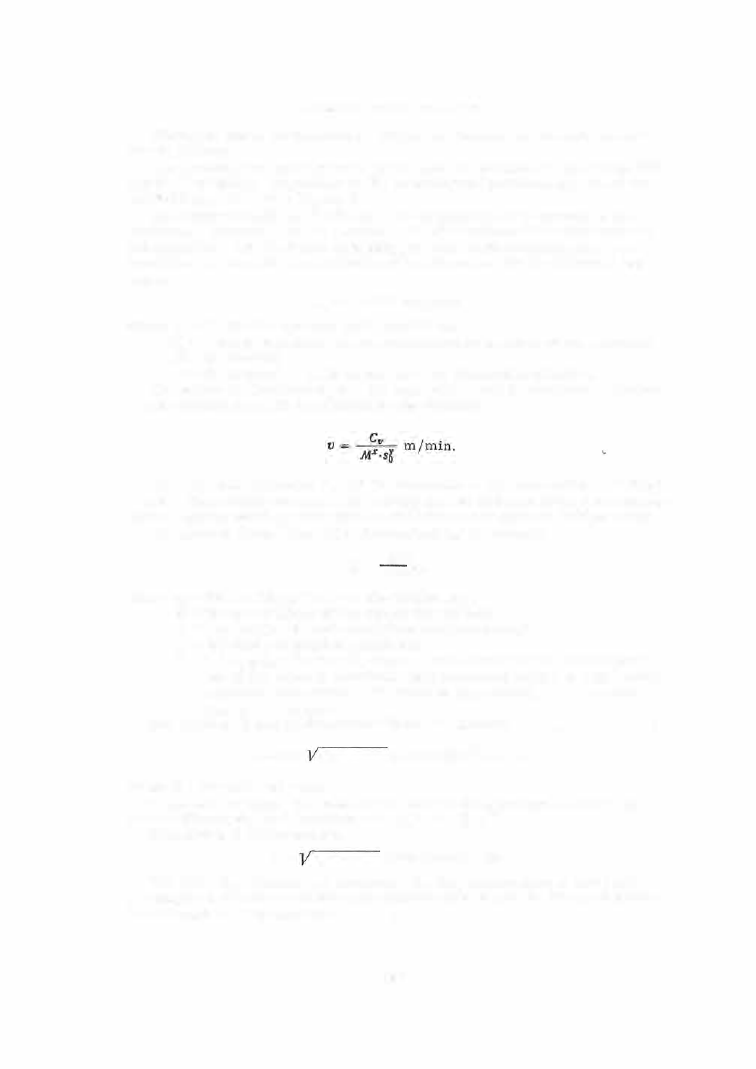
The cutting speed is determined by the formula
The values of the factor
Cf}
and the exponents
x
and y are given in Table 7 .
A s a tim e -saving m easure, the cutting speeds and feed rates recomm end
ed for hobbing watch- gearing wheels and pinions are given in Tables 1 6 - 2 0.
The hobbing (basic ) time Th is determined by the formula
T
=
L·z:p_
h
n·S0 ·k '
where
Zp
=
the numbe r of teeth on the hobbed part;
n =
the speed (rp m ) of the single- thread hob;
k
=
the numbe r of parts machined simultaneously;
S0
=
the feed per blank revolutions;
L
=
l + [1 + [2 ,
=
the travel, where
l
=
the length of the hobbed part
(or of the s everal simultaneously machined parts ), [1
=
the cutter
approach (according to the table in Appendix 3 ) , [2
=
the over
travel ( 1 - 1 . 5 mm).
The value of [1 can be determined from the formula
[1 = cos �
h0 (d - h0)
+
l ,Stan�
(
m
Vz
+
h0) ,
where �
=
the hob lead angle.
In the case of hobs , the value of the angle � does not exceed 0°3 0 ' , as
s een in Figure 30, and therefore cos � � 1 , tan � :::: 0.
This reduces the formula to
11
=
h0 (d - h0)
(see formula ( 3 )]
The time Th , calculated as necessary for the manufacture of one part,
is compared with the available work-spindle speeds and the time per revolu
tion closest to Th is selected.
1 9 7