Military reference books and manuals (2009-2023, Volume 7) - page 27
Terrorism
larger population would accent anxiety, fear, and frustration of how to prevent other similar attacks with a
WMD (see figure 6-7).
Figure 6-7. Anthrax-laced letters: death-mayhem in targeted population (example)
6-115. The expertise to acquire and use WMD remains a significant terrorist threat based on some irregular
forces intent to―
z Acquire materials to construct or develop WMD.
z Threaten to attack with WMD
z Attack combatants and noncombatants indiscriminately with WMD.
z Create mass injury, death, mayhem, and damage with WMD.
TERRORISM TRENDS AND EMERGENT VECTORS
6-116. Trends of terrorism can be considered emergent variations and adaptation to age-old truths of conflict
when at least two forces are unequally matched in military power. Terrorism is often indicative of a weaker
force seeking vulnerabilities in a more powerful force and attacking those weaknesses with an expectation of
persistent conflict. No accurate prediction exists on the character, location, or duration of any specific future
terrorism; however, irregular force will continue to improvise, innovate, and adapt TTP to achieve success
through acts of terror.
6-117. Situational accelerators can spotlight probable vectors of terrorism adaptation by irregular forces in
near-term years. Uncertainties include the pace and/or tempo an irregular force can demonstrate in its
tactical or operational reach, effects an irregular force can display throughout the strategic depth of an
enemy, and how successful the “battle of the narrative” will be in influencing a targeted population. The
resilience of motives and ideological commitment of an irregular force and its leaders remain primary
strengths in an irregular force campaign of terror. Terrorism trends and emergent vectors that irregular
forces consider include—
z
Improved situational awareness and understanding of the enemy.
z
Radicalized philosophy and/or ideology as a compelling motivation.
z
Adaptive organizational tactics and techniques.
z
Versatile organizational affiliations.
z
Expanded transnational affiliates.
z
Emergent independent adherents.
z
Devastating full spectrum weaponry.
z
Targeted economic disruption.
z
Globalized media affairs.
17 January 2014
TC 7-100.3
6-21
Chapter 6
IMPROVED AWARENESS AND UNDERSTANDING
6-118. Understanding situational context approaches the issue of irregular emergent vectors along an avenue
of action used by irregulars, paramilitary, guerrillas, terrorists, insurgents, or criminals. Intent has a premise
of adapting constantly to optimize knowledge, training, logistical support, and readiness to conduct irregular
operations. Terrorism will be used when this type of action accomplishes the desired psychological and
physical effects. Irregular forces can be patient. Irregular forces plan while waiting for critical opportunities
to strike.
6-119. Irregular force vectors consider the nature of irregular forces and the capabilities and limitations of
specific irregular forces in an evolving contemporary operational environment. As the regions of the world
advance in technological areas, expand the mobility opportunities of people, and exploit the Internet and
other media, extremists concurrently fuel grievances and alienate segments of populations to foster support
for their agendas.
6-120. Irregular forces assess and plan for conducting operations in an area of responsibility and also
consider how to attack forces and/or states that may exist in regions that are distant from a primary area of
land, air, and/or maritime conflict. Cooperation and collaboration among extremist affiliates and/or
adherents will plan for and attempt to attacks the homelands of those states that may be supporting a
governing authority with whom the irregular force is in conflict. Irregular forces also assess and plan
for attacking intermediate staging locations that would disrupt the flow or prevent significant support
from these states.
RADICALIZED MOTIVATIONS
6-121. Core grievances are real or perceived issues of segments in a targeted population. The importance of
the core grievances or even their existence can change over time. Irregular forces can manipulate core
grievances to create conditions for developing the willing support within a population. The perception of
foreign exploitation or a governing authority that appears to be excessively influenced by foreigners can be a
core grievance. For example, if foreign businesses dominate critical portions of the local economy, some of
the population may feel that they or their country are being exploited by outsiders. A foreign military
presence or military treaty may offend national sentiment as well. The mere presence or specific actions of
foreigners may offend local religious or cultural sensibilities. A state or regional governance in an area can
be a core grievance.
6-122. Extremists that are very conservative can be as revolutionary in intent as other groups that are
considered very liberal. Intents may include replacing forms of legitimate government with varied types of
authoritarian rule. Socialism or variants of communism and/or other forms of totalitarianism can exist in
many forms. However, ideology can range the political variable from fascist or other totalitarian intentions
to an opposite political perspective of anarchism. As regimes fail to demonstrate its value to a subjected
population, a population may gradually and secretly plan and act for change. Religious fundamentalism or
extremist viewpoints can become a core grievance. Pervasive and desperate poverty often fosters and fuels
widespread public dissatisfaction in a relevant population. Young people without jobs or hope are ripe for
recruitment into an irregular force. Lack of essential services in a population complicates an OE and its
effective governance. Examples of these essential needs are availability of food and potable water, credible
law enforcement, emergency services, electricity, shelter, health care, schools, transportation, and sanitation
programs for trash and sewage. Stabilizing a relevant population requires meeting these basic social and
civil needs. Frustration and a feeling of disenfranchised existence can sway a relevant population to support
an irregular force that promises change and improved living conditions.
ADAPTIVE ORGANIZATIONAL TACTICS AND TECHNIQUES
6-123. In an era of sophisticated weapon systems and rapid international deployment of military forces,
incidents demonstrate the effectiveness of simple tactics conducted efficiently by small irregular forces.
Devastating attacks can be conducted by a small unit or cell of irregular force terrorists. Operating in two- or
three-person teams, they could simultaneously attack separate locations. The terrorists would be armed
primarily with small arms, hand grenades, and improvised explosive devices. The attacks and eventual
destruction of the terrorists could extend to hours or days of horrifying murder and mayhem. A methodical
6-22
TC 7-100.3
17 January 2014
Terrorism
containment and room-by-room clearance of historic and multi-story buildings in a large metropolitan
complex would be covered by global media outlets throughout the incident. An irregular force conducts
operations with the expectation of such publicity to spotlight its irregular force agenda and embarrass the
governing authority that it defies.
VERSATILE ORGANIZATIONAL AFFILIATIONS
6-124. Irregular forces will normally start as small entities with modest operational capabilities. As
capabilities develop, plans may focus on acquiring improved capabilities across the functions of intelligence,
logistics, communications, media affairs, and direct action. Building capacity in order to demonstrate
commitment and capability is progressive. Temporary setbacks in plans and actions require flexibility to
adjust timelines and adapt support networks. These networks can be as local as a neighborhood information-
intelligence collection effort to a disciplined outreach for assistance from sources external to the immediate
community or region.
6-125. Organizational versatility can include units or cells focused on acts of terrorism or other actions and
organizations which are difficult to distinguish from civil crime. The increasing role of criminal activity in
financing an agenda, either in partnership or competition with traditional criminal activities, can be a
condition used by irregular forces. These enterprises include drug trafficking and human smuggling, fraud,
tax evasion, counterfeiting, money laundering, and theft. Some activities are associated with terrorist’s
evolving capabilities for false documents production and concealment of money transactions for their
operational purposes.
6-126. Irregular forces and criminal organizations can be closely related for mutual benefits. Mega-cities are
expanding in countries with poor services and weak governance. Bases and operations in rural and urban
environments will increase where law enforcement is often ineffective and/or corrupt. Rampant
unemployment and dissatisfaction creates a productive recruiting ground and operating environment for
irregular forces promoting grievances acknowledged by large segments of the population. Many of these city
areas have materiel, communication, and transport capacities for irregular forces to use, and a potentially
huge base of sympathizers and recruits.
6-127. A development related to this is the emergence of regions where governments exercise marginal
control of geographic areas within their sovereign territory. Control is imposed by sub-state actors that can
span criminal organizations, militias, guerrillas, insurgents, and terrorists. Government forces confront
violent and capable irregular forces that often resort to open coercion and terrorism of officials, police
officers, military forces, their families, and the general citizenry. In addition to overt intimidation of a
populace, irregular forces exploit the vulnerabilities of new technologies to attack and have a great deal of
flexibility in their use of new technology. They have the advantage of only needing to attack or neutralize
specific systems or capabilities, and can concentrate fiscal expenditures on specialized counter-technology to
protect their criminal systems. Nonetheless, irregular forces can often neutralize advanced systems or
capabilities through the use of simple and unconventional techniques such as a suicide bomber.
EXPANDED TRANSNATIONAL AFFILIATES
6-128. Transnational actions and terrorism presents a global challenge. Some irregular forces seek to
conduct major operations that cause large scale, maximum casualty impact. Globalization removes the
perceived security that national borders and geographic distance from adversaries and enemies once
indicated. Commerce and finance is international, travel is international, and society in general is a much
more international community. Operating beyond the organizational reach of an opponent can provide the
physical space or fiscal and media affairs support to enhance an irregular force purpose.
6-129. Irregular forces can operate in and among this international reach and develop transnational
capabilities through a loose affiliation of clandestine networks, inserted sleeper or active cells within
geographic regions, and adaptability to constantly shift and change in organizational form. When extremist
ideology is the primary motivation, the commitment is often absolutist with no allowance for compromise
and seeks no negotiation. Violence signals a committed path to conditions with no restrictions by social
norms, laws, or values. Actions such as terrorism are often becoming more networks based. Irregular forces
can encourage loosely organized, self-financed organizational structures. The motivation of terrorists
17 January 2014
TC 7-100.3
6-23
Chapter 6
appears to be based increasingly on theological extremes and ideological absolutes. International or
transnational cooperation among some terrorists provides an improved ability to recruit members, develop
fiscal support and resources, gain skills training and expertise, transfer technology, and when desired,
political advice.
EMERGENT INDEPENDENT ADHERENTS
6-130. The presence of varied irregular forces and/or possible independent actors that separate from an
originating organization can easily blur in organizations claiming responsibility for terrorism incidents.
These actors can be at the individual level or small cells acting on a specified agenda that may be similar but
distinct from more well known irregular force organizations. Independent actors may purposely minimize or
preclude public announcement of their plans and action in order to improve their cell security.
6-131. Independent adherents are adjusting their financial operations to be self-sustaining in their activities.
This independence from any external control is a value to an irregular force as it gains the impact of diverse
and separate adherent actions at no real cost to his own organizational base. The facility with which groups
can obtain and move funds, procure secure bases, and obtain and transport weaponry determines their own
operational abilities and the level of threat that they pose to a common enemy. The international nature of
finance, the integration of global economies, and the presence of terrorist adherents in the illegal economies
of slaves, drugs, smuggling, human trafficking, counterfeiting, identity theft, and fraud have aided an
independence from traditional sources of state-linked sponsorship and other interconnected support.
DEVASTATING FULL SPECTRUM WEAPONRY
6-132. Weapon lethality can be assessed in many ways but efficiency and effectiveness are two general
means to determine intent. Some weapons are quite simple and very deadly in effect. Lethality and overall
effects are key considerations when assessed with types of action to obtain attention and reaction. The
trauma of violent deaths as well as mass injuries and damage on a targeted population can be critical to the
psychological effect and consequent actions or inaction by the affected population. Terrorism will continue
to seek forms of indiscriminate violence. Acts of terror can also be targeted to specific people, groups, or
capabilities. Terrorism is merging and combining with various other state and sub-state actors, further
blurring the difference between criminals, rogue governments, and terrorists.
6-133. Ongoing conflicts display that terrorism attacks account for only a small fraction of civil violence but
the high-profile nature of many terrorist operations can have a disproportionate negative impact. Conditions
and changing dynamics in conflict can create a perception in a relevant population of unchecked violence
and fear. Such perception can harden differing opinions, empower militias and vigilante groups, increase a
middle-class exodus from a region, and disrupt confidence in a governing authority and its security forces.
Terrorism plays a key role in much of this physical and psychological violence.
6-134. The means to cause mass casualties can be a highly sophisticated weapon system such as a
weaponized military-grade nuclear device. However, mass destruction can also be caused by an improvised
low-yield explosive weapon such as the 2001 attacks on the Twin Towers in New York City and the
Pentagon. While purposeful mass casualty incidents may have appeared to be extraordinary events several
decades ago, contemporary acts of terror surpass these former acts and demonstrate a profound impact on
populations at the local, regional, national, and international levels. Emergent actions indicate that terrorism
previously centralized and controlled by formal networks and organizations, is being conducted increasingly
by loosely affiliated terrorists or groups that may generally identify themselves with an ideology or special
purpose agenda. The threat can be foreign and domestic.
6-135. Proliferation of weapons of mass destruction is a particularly alarming issue. The projected effects
amplify the danger and fear of a catastrophic attack. Some of these materials that could be used to construct
some form of WMD are easily accessible in the public domain. Other potential capabilities are quite
problematic to weaponizing materiel. The knowledge and technological means of specialists to produce
WMD is a shadowy area of science, crime, and intrigue available to some terrorists.
6-136. The trend to exploit available simple and sophisticated technologies and the desire to cause mass
casualties could be demonstrated in irregular force attacks that employ WMD such as—
6-24
TC 7-100.3
17 January 2014
Terrorism
z
Chemical [sarin nerve agent] attacks in a metropolitan subway system.
z
Biological [anthrax] attacks using contaminated letters in postal system.
z
Low-yield explosive aerial bomb as in nearly simultaneous suicide attacks with large commercial
jet aircraft into critical infrastructure.
z
Low-yield explosive vehicular bomb as in a vehicle borne improvised explosive device attack on a
Federal governing authority building and commercial business locale.
z
Radioactive material placed in a public location for area contamination.
z
Nuclear weapon detonation in a controlled environment as a demonstration of capability.
TARGETED ECONOMIC DISRUPTION
6-137. Modern, high-technology societies are susceptible to a concept of complex terrorism. Dependence
on electronic networks in modern infrastructure, sometimes with questionable redundancy in systems, and
concentrating critical assets in small geographic locales can present lucrative targets for the irregular force.
Some emerging irregular forces wield effective power in failing states and view terrorism as an effective
mode of conflict.
6-138. Critical infrastructure and support systems provide terrorists with a wide array of potential targets in
land, maritime, cyber, and space environments that would directly affect economies on a regional and global
scale. Common vulnerabilities may focus on oil refinery operations and overland and/or maritime
shipment of oil products. Infrastructure for oil production has critical aspects in key areas of the world.
Single points of failure in the infrastructure or denying critical services for a period of time could severely
disrupt world economies.
GLOBALIZED MEDIA AFFAIRS
6-139. Exploiting mass media considers the value of effectively marketing an irregular force message
through a nearly simultaneous global information environment. An overarching principle is to create and
maintain international attention and impact. To gain international awareness and attention to grievances and
issues, incidents must often be spectacular to attract mass media coverage. Effectiveness of INFOWAR will
be measured by its ability to cause a dramatic impact of fear and uncertainty in a target population. Surprise
and sustained violence may be normal against specified people representing elements of civil or military
control and order of a governing authority with whom irregular forces are in conflict. Common citizens may
also be targets in a culture of violence. Damage or destruction of community, regional, or national
infrastructure and governance will be used to gain attention, provoke excessive reaction by host nation or
coalition military forces, and attempt to alienate general population support of a governing authority.
6-140. Irregular force operations consider a desired media effect and plan for verbal or visual reporting
coverage. Supporting events and interviews reinforce the desired message. These messages may present
disinformation and false perspectives. Frequently, military reluctance to comment on ongoing operations in
the media for operational security reasons can assist the irregular force. If no balanced information comes
from official sources in a timely manner, the media may use the information readily available from the
irregular force or a terrorist cell as a primary source for reporting an incident.
6-141. Future armed conflicts are more likely to be fought “among the people” rather than “around the
people.” Conflict in urban areas and populated locales is inevitable. Much of the world’s population is
already located in urban terrain. In the next two decades, estimates pose five billion of the world’s eight
billion people will live in cities. Many of the population hubs will be along coastlines throughout the world’s
regions. Irregular forces will attempt to blend into concentrated populations in order to marginalize
detection of their recruiting, training, and staging initiatives; obtain support within a coerced or passive
populace, and act at times and locations of their own selection. Media attention to a major incident will be
immediate in coverage.
6-142. Rural areas and their inhabitants, depending on conditions in particular regions, will complement
operations in urban centers. Irregular forces will evolve hybrid capacity of selective conventional military,
paramilitary, and criminal organization capabilities. Rural irregular forces will operate in regions providing
cover and concealment such as heavily forested or mountainous areas that hinder some forms of detection
17 January 2014
TC 7-100.3
6-25
Chapter 6
and interdiction. Notwithstanding, a rural orientation must lead back to urban centers as a presence and
connection to the main population masses and the political infrastructure of governing authorities with
whom irregular forces are in conflict.
THE SPECTER OF TERRORISM
6-143. The specter of irregular forces using terrorism on a society illustrates the value that such acts can
provide to an irregular force that is often incapable of directly confronting an enemy with overwhelming
combat power. The key factors of a successful campaign of irregular force terrorism will continue to be the
long-term resolve and resilience of terrorists to continue the conflict until their aims are achieved.
6-144. The dedicated irregular force using terrorism must be adaptive and flexible to the periodic success of
an enemy. When terrorism is disrupted with key irregular force leaders killed or captured, and functional
capabilities are degraded or destroyed, other irregular force members, affiliates, and/or adherents are
prepared to continue the struggle against a declared enemy.
6-145. A relevant population is a critical qualifying environment of nearly all irregular conflict. Irregular
forces decentralize, network, and operate among a relevant population to overcome technological advantages
of an enemy. The resilience of an irregular force and the expected debilitating effects of terrorism on an
enemy require a determined long-term commitment from irregular force leaders to defeat an enemy. The
massing of effects over time often requires a patient and decentralized approach to irregular conflict. The
irregular force maintains a keen sense of cultural awareness and social understanding to establish a rationale
for terror that is tolerated to a relevant population. The irregular force must obtain and sustain the passive
and/or active support of the relevant population within which it operates.
6-146. An INFOWAR campaign must promote a resilient irregular force message of purpose and
commitment to a relevant population. The objective of terrorism in support of an irregular force agenda must
be recognized by a relevant population as a compelling outcome worth the amount of suffering and social
disruption that terrorism and other acts by an irregular force may cause. Whether the ultimate aims of an
irregular force are ideological, philosophical, and/or practical, terrorism will continue to be a vexing
factor in future conflicts among and between state and non-state actors throughout the world.
6-26
TC 7-100.3
17 January 2014
Chapter 7
Functional Tactics
Insurgents and guerrillas, as part of the irregular OPFOR, may employ adaptive
functional tactics. When planning a tactical action, an irregular OPFOR commander
or leader determines what functions must be performed to accomplish the mission.
Then he allocates functional responsibilities to his subordinates and synchronizes
the effort.
Note. Since criminal elements do not normally have the ability to execute these functional
tactics, the term irregular OPFOR in this chapter refers to insurgents and/or guerrillas.
FUNCTIONAL ORGANIZATION OF FORCES AND ELEMENTS
7-1. An irregular OPFOR commander or leader specifies the initial organization of forces or elements
within his level of command, according to the specific functions he intends his various subordinates to
perform. At brigade level (when that exists in guerrilla units), the subordinate units performing these
functions are referred to as forces. At lower levels they are called elements.
Note. This functional organization provides a common language and a clear understanding of
how the commander or leader intends his subordinates to fight functionally. Thus, subordinates
that perform common tactical tasks such as disruption, fixing, assault, exploitation, security,
deception, or main defense are logically designated as disruption, fixing, assault, exploitation,
security, deception, or main defense forces or elements. Irregular OPFOR commanders and
leaders prefer using the clearest and most descriptive term to avoid any confusion. When the
irregular OPFOR operates in conjunction with an affiliated regular military force, there is the
advantage that regular OPFOR commanders also use this common language.
7-2. The commander or leader organizes and designates various forces and elements according to their
function in the planned offensive or defensive action. A number of different functions must be executed
each time the irregular OPFOR attempts to accomplish a mission. The functions do not change, regardless
of where the force or element might happen to be located. However, the function (and hence the functional
designation) of a particular force or element may change during the course of a tactical action. The use of
precise functional designations for every force or element involved in a particular tactical action allows for
a clearer understanding by subordinates of the distinctive functions their commander or leader expects them
to perform. It also allows each force or element to know exactly what all of the others are doing at any
time. This knowledge facilitates the ability to make quick adjustments and to adapt very rapidly to shifting
tactical situations. This practice also assists in a more comprehensive planning process by eliminating the
likelihood of some confusion (especially on graphics) of who is responsible for what.
Note. A subordinate designated as a particular functional force or element may also be called
upon to perform other, more specific functions. Therefore, the function of that force or element,
or part(s) of it, may be more accurately described by a more specific functional designation. For
example, a disruption force generally “disrupts,” but also may need to “fix” a part of the enemy
forces. In that case, the entire disruption force could become the fixing force, or parts of that
force could become fixing elements.
17 January 2014
TC 7-100.3
7-1
Chapter 7
7-3. The various functions required to accomplish any given mission can be quite diverse. However, they
can be broken down into two very broad categories: action and enabling.
ACTION FORCES AND ELEMENTS
7-4. One part of the organization conducting a particular offensive or defensive action is normally
responsible for performing the primary function or task that accomplishes the overall mission goal or
objective of that action. In most general terms, therefore, that part can be called the action force or action
element. In most cases, however, the higher unit commander will give the action force or element a more
specific designation that identifies the specific function or task it is intended to perform, which equates to
achieving the objective of the higher command’s mission.
7-5. For example, if the objective of the action of a guerrilla company or a grouping of insurgent direct
action cells is to conduct a raid, the element designated to complete that action may be called the raiding
element. In a brigade-level offensive, a force that completes the primary offensive mission by exploiting a
window of opportunity created by another force is called the exploitation force. In defensive actions,
the grouping that performs the main defensive mission is called the main defense force or main
defense element.
ENABLING FORCES AND ELEMENTS
7-6. In relation to the action force or element, all other parts of the organization conducting an offensive
or defensive action provide enabling functions of various kinds. In most general terms, therefore, each of
these parts can be called an enabling force or enabling element. However, each subordinate force or
element with an enabling function can be more clearly identified by the specific function or task it
performs. For example, an element that clears obstacles to permit an action element to accomplish a
battalion’s tactical task is a clearing element.
7-7. In most cases, irregular OPFOR tactical actions would involve one or more types of enabling forces
or elements designated by their specific function. The most common types include—
z
Disruption force or element. Disrupts enemy preparations or actions; destroys or deceives enemy
reconnaissance; begins reducing the effectiveness of key enemy elements.
z
Fixing force or element. Fixes the enemy by preventing a part of his force from moving from a
specific location for a specific period of time, so it cannot interfere with the primary
OPFOR action.
z
Security force or element. Provides security for other parts of a larger organization, protecting
them from observation, destruction, or becoming fixed.
z
Deception force or element. Conducts a deceptive action (such as a demonstration or feint) that
leads the enemy to act in ways prejudicial to enemy interests or favoring the success of an
OPFOR action force or element.
z
Support force or element. Provides support by fire; other combat or combat service support; or
command and control (C2) functions for other parts of a larger organization.
z
Reconnaissance force or element. Conducts specific reconnaissance task(s) tailored to
the mission.
Note. In a defensive situation, there may be a particular unit or grouping that the irregular
OPFOR commander or leader wants to be protected from enemy observation and fire, to
ensure that it will still be available for further actions. This may be designated as the protected
force or element.
FLEXIBILITY
7-8. The function of a particular force or element may change in the course of a tactical action. For
example, a grouping originally designated as a reconnaissance element may locate an enemy unit that it has
the combat power to engage. In that case, the element in question could become an assault element, ambush
element, or raiding element.
7-2
TC 7-100.3
17 January 2014
Functional Tactics
TYPES OF OFFENSIVE ACTION
7-9. Insurgents and guerrillas can employ some of the types of offensive action also used by smaller
tactical units of the regular OPFOR. Such actions can include—
z
Ambush.
z
Assault.
z
Raid.
z
Reconnaissance attack (guerrillas only).
Insurgent cells typically do not have sufficient combat power to conduct a reconnaissance attack. (See TC
7-100.2 for basic discussion of these offensive actions, as they are also conducted by the regular OPFOR.)
7-10. Irregular OPFOR leaders and commanders select the offensive action best suited to accomplishing
their mission. Insurgent cells and small guerrilla units typically execute one combat mission at a time.
Therefore, it would be rare for such a cell or unit to employ more than one type of offensive action
simultaneously. However, irregular OPFOR organizations are dynamic and adapt very quickly to the
situation. An offensive action may have to make use of whatever cell(s) or unit(s) can take advantage of a
window of opportunity.
AMBUSH
7-11. An ambush is a surprise attack from a concealed position against a moving or temporarily halted
target. In an ambush, the actions of the enemy determine the time, and the irregular OPFOR leader decides
on the location. Similar to purposes used by regular military OPFOR, the irregular OPFOR can conduct
ambushes to—
z
Destroy or capture enemy elements, personnel, and/or designated very important persons.
z
Secure supplies.
z
Demoralize enemy military forces and officials of a governing authority.
z
Delay introduction of international and/or enemy coalition assistance to a governing authority.
z
Block enemy movements and/or logistics support.
z
Canalize or restrict enemy movement.
7-12. The irregular OPFOR can use an ambush as a primary psychological tool in its information warfare
(INFOWAR) activities. The psychological effects of ambushes can be enhanced by—
z
Conducting recurring ambushes at known areas and/or points where enemy forces must travel.
z
Changing the tempo or the number of ambushes to appear unpredictable.
z
Attacking targets that were previously considered safe or had not been attacked.
z
Using weapons with range capabilities previously not used in an area of conflict.
z
Increasing weapons and/or demolitions effects against particular targets.
7-13. A common tactic is to conduct an ambush as a means to set up ambush(es) of enemy forces that
respond to the original ambush. Multiple and nearly simultaneous ambushes can be conducted along likely
avenues of approach to the area of the initial ambush. Ambushes may also target enemy medical treatment
and evacuation assets, when irregular OPFOR commanders or leaders decide to not comply with
international conventions and law of war norms that regular military forces use. The destruction of means
to evacuate and treat wounded can instill a sense of tentativeness in enemy soldiers because they realize
that, should they become wounded or injured, medical help may not be forthcoming.
7-14. Attacking known points of enemy weakness is a fundamental planning consideration for the irregular
OPFOR. Correspondingly, the irregular OPFOR avoids enemy strength.
7-15. Surprise and overwhelming massed firepower at a specific place and time provides an expectation
of tactical success for the irregular OPFOR. Factors that complement tactical surprise and massed
firepower are—
z
Detailed plans and rehearsals.
z
Selection of ambush positions.
17 January 2014
TC 7-100.3
7-3

Chapter 7
z
Rapid and violent conduct of the ambush.
z
Disciplined withdrawal of irregular OPFOR elements from the ambush site.
Functional Organization for an Ambush
7-16. An ambush force is typically organized into three types of elements: the ambush element, security
element, and support element. There may be more than one of each element (see figure 7-1).
IED
IED
IED
Ambush
Security
Support
Element
Element
Element
(w/ Video
Security
Camera)
Element
Exfiltrate
Exfiltrate
Exfiltrate
Figure 7-1. Insurgent ambush (example)
Ambush Element(s)
7-17. The ambush element has the mission of attacking and destroying enemy elements in kill zone(s).
Other tasks may include capturing personnel and/or recovering supplies and equipment.
Security Element(s)
7-18. The security element has a mission to provide early warning to irregular OPFOR elements of any
enemy presence that might disrupt the ambush. Another task can be to protect the ambush element from
becoming decisively engaged by enemy forces before, during, or after the ambush.
Support Element(s)
7-19. The support element can include direct and/or indirect fires and provides general support to improve
success of the ambush. The insurgent leader or guerrilla commander typically commands and controls the
ambush from the support element. However, he will position himself where he can best command and control.
Executing an Ambush
7-20. There are three types of ambushes based on the desired mission effects⎯annihilation, harassment, or
containment. The irregular OPFOR conduct ambushes with a particular purpose that often supports a larger
tactical action.
Annihilation Ambush
7-21. The purpose of an annihilation ambush is to destroy an enemy force within a designated kill zone. In
addition to massed direct fires, the irregular OPFOR often increases the lethality of a kill zone with indirect
fires, manmade obstacles, mines, and/or improvised explosive devices (IEDs) to halt, contain, and kill the
enemy force in the kill zone (see figure 7-2).
7-4
TC 7-100.3
17 January 2014

Functional Tactics
Note. For guerrilla forces, annihilation ambushes in complex terrain, including urban
environments, often involve task-organized hunter-killer (HK) teams.
Ambush
IED
Support
Element
Element
G
G
Security
Element
G
Support
Element
G
KILL
ZONE
IED
Ambush
Element
G
Ambush
G
Security
Element
Element
G
IED
Figure 7-2. Guerrilla ambush (example)
7-22. Irregular OPFOR commanders and leaders may be willing to accept decisive engagement with the
enemy in this type of ambush. An annihilation ambush typically emphasizes tactical tasks to—
z
Block.
z
Contain.
z
Destroy.
7-23. The ambush and support elements normally remain in their fighting positions until the enemy in the
kill zone is rendered combat ineffective. The intent is to destroy enemy personnel and equipment within the
kill zone with concentrated firepower.
7-24. Once the enemy is destroyed, the ambush element can secure the kill zone and eliminate any
remaining enemy in the kill zone. The support element provides overwatch protection to the ambush
element when the ambush element is directed to search the destroyed enemy force and equipment for
information and/or intelligence. Weapons and materiel can be seized by the ambush element for future
irregular OPFOR tactical actions.
7-25. The security element remains in fighting positions to ensure early warning, isolate a kill zone, and
prevent any enemy from escaping the kill zone. Once the ambush element clears the kill zone, the ambush
force withdraws from the ambush area. The ambush element withdraws first and is followed by the support
element. The security element is the last element to depart the kill zone area and delays or blocks any rapid
response of enemy forces that attempt to pursue irregular OPFOR elements as they depart the kill zone
17 January 2014
TC 7-100.3
7-5
Chapter 7
area. Depending on the size of the ambush force, the elements typically reassemble at a predetermined
location and time at a safe house or safe haven.
Note. An irregular OPFOR ambush could employ security elements to provide early warning
and/or isolate a series of kill zones on a known convoy route of the enemy. Restrictive natural
terrain and manmade features are reinforced with IEDs to disrupt and contain an enemy force in
the kill zones. A simple ambush technique is to employ a decoy IED that is observable on an
enemy force route. Once enemy forces halt to investigate the potential of an IED detonation, the
ambush force initiates the actual ambush with the simultaneous detonation of IEDs directed into
the kill zone where enemy soldiers and vehicles are expected to halt. Lead and trail vehicles are
initially the primary targets for massed direct fires and destruction. When they are destroyed, the
ambush and support elements shift direct and indirect fires from both ends of the enemy column
toward the center of the contained enemy forces. The enemy convoy is destroyed with massed
overlapping direct and indirect fires. Ambush elements and designated support elements
exfiltrate from the area while security elements provide rear security and an all-arms air defense
capability against any enemy response forces. On order, security elements also exfiltrate from
the ambush site and rendezvous with other guerilla elements at a safe haven.
Harassment Ambush
7-26. The purpose of a harassment ambush is to disrupt routine enemy activities, impede the enemy’s
freedom of movement, and/or create a negative psychological impact on enemy personnel. The irregular
OPFOR may choose to conduct a harassment ambush when the enemy has superior combat power and
destruction of an enemy force is not feasible as in an annihilation ambush. This type of ambush does not
require the use of obstacles to keep the enemy in the kill zone but can include terrain reinforced into a kill
zone with manmade obstacles, mines, and/or IEDs to halt and/or contain the enemy force for a limited
period of time. Compared to an annihilation ambush, the irregular OPFOR typically conducts a harassment
ambush at a greater distance from the enemy in a kill zone. A harassment ambush often considers the
maximum effective range of its weapons when massing firepower.
7-27. The irregular OPFOR does not normally accept decisive engagement with the enemy in this type of
ambush. A harassment ambush typically emphasizes tactical tasks that can include—
z
Disrupt.
z
Delay.
z
Defeat.
7-28. The ambush and support elements are often combined to provide more effective control of fires
throughout the kill zone. This combination is especially useful when the kill zone is quite wide and/or
extends for a long distance. The security element provides early warning of any enemy forces conducting
reconnaissance prior to the ambush and/or enemy forces attempting to respond to the ambush.
7-29. Once the irregular OPFOR commander or leader determines that the ambush has achieved the
desired effects, he directs the ambush and support elements to withdraw along designated routes. The
security element continues to report on enemy activity in the kill zone area and any attempt of enemy
forces to pursue. The irregular OPFOR will not become decisively engaged by enemy forces and often
emplace mines and/or IEDs to delay enemy pursuit.
7-30. Repeated harassment ambushes against the enemy can⎯
z
Cause the enemy to allocate a disproportionate amount of forces to security tasks which affect
other enemy force missions and potentially create enemy vulnerabilities.
z
Create a negative psychological effect upon enemy soldiers and leaders, and officials of a
governing authority with which the irregular OPFOR is in conflict.
7-6
TC 7-100.3
17 January 2014
Functional Tactics
Containment Ambush
7-31. A containment ambush is a security task that is usually part of a larger tactical action. This type of
ambush can prevent the enemy from using an avenue of approach or interdicting another tactical action
such as a raid or another ambush.
7-32. The ambush element can be directed to secure a kill zone, but this task is not necessarily required for
mission success. The support and security elements perform the same functions as those described in an
annihilation ambush. Obstacles are an integral part of a successful containment ambush. The commander or
leader determines if his relative combat power compared to enemy forces is adequate to conduct a
containment ambush. The fact that containment may require the irregular OPFOR elements to remain in an
ambush site for an extended period places those elements in danger of being fixed and defeated by enemy
reinforcements.
7-33. The ambush force will normally not accept decisive engagement with the enemy in this type of
ambush. However, it can be directed to accept decisive engagement in support of a larger irregular OPFOR
action. A containment ambush typically emphasizes related tactical tasks that can include—
z
Contain.
z
Fix.
z
Delay.
z
Defeat.
Command and Control of an Ambush
7-34. The commander or leader of the ambush force normally positions himself with the support element
and designates a subordinate leader to move and maneuver with the ambush element. However, the ambush
force commander or leader locates himself where he can best command and control the ambush.
7-35. Urban and rural complex terrain provides several tactical advantages to irregular OPFOR ambush,
security, and support elements. Operating among indigenous citizens in an urban area or other complex
terrain can be used to—
z
Observe enemy forces along known canalized routes or areas of reconnaissance and/or avenues
of approach or directions of attack.
z
Provide for easily camouflaged irregular OPFOR reconnaissance and surveillance activities.
z
Provide covered and/or concealed irregular OPFOR routes into and out of the ambush kill zone
area.
z
Improve irregular OPFOR ambush, security, and support positions with cover, concealment, and
camouflage of the natural and manmade tactical environment.
z
Encourage deception activities in a relevant civilian population against enemy forces and a
governing authority.
z
Encourage techniques that employ overlapping direct fires from multiple directions into a
designated kill zone.
Support of an Ambush
7-36. An ambush typically requires several types of support. These can include reconnaissance, fire
support, air defense, engineer-like capabilities, logistics, and INFOWAR. Covert or overt assistance may
also be provided from external sources such as special-purpose forces (SPF) of another state.
Reconnaissance
7-37. Reconnaissance is critical to a successful ambush and is continuous in the objective area in order to
confirm and/or adjust information collection and intelligence previously collected and analyzed. The
irregular OPFOR uses active supporters in the relevant population to observe and report on enemy activities
at the planned objective area in order to select the best terrain on which to locate irregular OPFOR
positions.
17 January 2014
TC 7-100.3
7-7
Chapter 7
7-38. The irregular OPFOR often has sufficient time in a local community and in vicinity of the objective
to observe and interact with the relevant population. Posing as innocent civilians or coercing local civilians
and/or civic leaders, irregular OPFOR reconnaissance and surveillance reports combine with the reports
from active supporters. Assessing and analyzing these reports assist the commander or leader in finalizing
his ambush plan. Once infiltration and exfiltration routes are planned, the irregular OPFOR maintain these
routes under constant surveillance prior to and during the ambush. Secrecy of irregular OPFOR locations
and activities is essential to tactical survival.
7-39. The irregular OPFOR will closely monitor—
z
Routines of enemy forces selected as the target.
z
Enemy use of weapons and equipment, crew duties, and teamwork.
z
Lapses in local security measures among groupings of enemy soldiers and vehicles.
z
Routes and response time of enemy quick reaction forces during prior ambushes or irregular
OPFOR ruses.
z
Cooperation of governing authority law enforcement and paramilitary units with enemy forces.
z
Medical treatment and evacuation norms of enemy forces.
Fire Support
7-40. Fire support is typically in the support element. In most ambushes, support elements in proximity to
ambush elements provide supporting direct fires from light, medium, or heavy machineguns and/or antitank
grenade launchers (ATGLs). However, some support elements may also provide indirect fires from mortars
and rockets. Fires can also support security elements, if necessary. The irregular OPFOR emplaces fire
support systems with the intention of quickly withdrawing them at the conclusion of the ambush.
7-41. Artillery from an affiliated regular military force can augment fires organic to the irregular OPFOR
ambush force. Such artillery support can provide additional fires into the kill zone, illumination over it, or
smoke to permit withdrawal.
Air Defense
7-42. Capabilities for air defense during an ambush may be limited to an all-arms air defense concept,
using the small arms and direct fire weapons with the ambush force. However, guerrilla battalions typically
have a limited man-portable air defense system (MANPADS) capability in their weapons company. If
allocated to an ambush force, these MANPADS would likely be located in security element(s).
Note. Air defense in the irregular OPFOR can also be improved by state and non-state sponsors
providing sophisticated air defense weapons, technologies, training, and logistics support. Other
opportunities may arise when insurgents or guerrillas in armed conflict capture or acquire
sophisticated air defense weapons. In either case, clandestine state or non-state agents and/or
technicians can provide technical support to ensure the effective use of the weapon systems.
Examples of state-of-the-art air defense systems include shoulder-fired MANPADS and/or other
air defense missiles with detection and tracking systems mounted on wheeled or tracked
vehicles.
Engineer-Like Capabilities
7-43. Mobility and countermobility support often depends on insurgents or guerrillas with specialized
skills and expertise from their civilian occupations or previous military experience. Guerrilla units include
sappers, who are not engineers but can perform some engineer-like functions. Covert or overt assistance
may also be provided from external sources such as SPF of another state.
Logistics
7-44. Logistics are prepared as caches or supported from safe houses and havens as part of detailed
planning and rehearsals. The ambush force typically moves from a secured location with everything it
needs to complete the mission. In those rare situations that require a multi-day hide prior to executing the
7-8
TC 7-100.3
17 January 2014
Functional Tactics
ambush, the ambush force will have to move with its own extra life support. Resupply of the ambush force
would significantly increase the chances of its detection and defeat its purpose.
INFOWAR
7-45. INFOWAR activities can support ambushes by concealing the intended action through deception and
information protection. An INFOWAR campaign may use successful ambushes to demonstrate the
progressive failure of an enemy force and/or governing authority. INFOWAR support of an ambush can
temporarily and psychologically isolate the enemy force. (See appendix A for additional information on
irregular OPFOR INFOWAR capabilities.)
ASSAULT
7-46. An assault is an attack that destroys an enemy force through firepower and the physical occupation
and/or destruction of his position. An assault is a basic form of irregular OPFOR tactical offensive combat.
Therefore, other types of offensive action may include an element that conducts an assault to complete the
mission. However, that element will typically be given a designation that corresponds to the specific
mission accomplished. For example, an element that conducts an assault in the completion of an ambush
would be called the ambush element.
Functional Organization for an Assault
7-47. The insurgent cell(s) or guerrilla unit(s) conducting an assault constitute an assault force. The assault
force typically is organized into three types of elements:
z
Assault element.
z
Security element.
z
Support element.
There may be more than one of each of these types of element.
Assault Element
7-48. The assault element is the action element. It maneuvers to and seizes the enemy position, destroying
any forces there.
Security Element
7-49. The security element provides early warning of approaching enemy forces and prevents them from
reinforcing the assaulted enemy unit. Security elements often make use of terrain choke points, obstacles,
ambushes, and other techniques to resist larger forces for the duration of the assault. The commander or
leader may (or may be forced to) accept risk and employ a security element that can only provide early
warning that is not strong enough to block or delay enemy reinforcements. This decision is based on the
specific situation.
Support Element
7-50. The support element provides the assault element with one or more of the following:
z
C2.
z
Combat service support (CSS).
z
Supporting direct fire (such as small arms, grenade launchers, or ATGLs).
z
Supporting indirect fire (such as mortars or rockets).
z
Mobility support.
7-51. The assault force commander or leader typically commands and controls the assault from the support
element. However, he will position himself where he can best exercise C2.
17 January 2014
TC 7-100.3
7-9

Chapter 7
Executing an Assault
7-52. An assault is a rapid and violent action that can have significant and even decisive effects. However,
a simple direct assault has a very low chance of success without some significant mitigating factors.
Decisive assaults are characterized by—
z
Isolation of the objective (enemy position) so that it cannot be reinforced during the assault.
z
Early warning of any approaching enemy reinforcements and/or other security measures by the
security element.
z
Effective suppression of the enemy by the support element prior to the assault element
maneuvering on the enemy position.
z
Violent fire and maneuver into and through the enemy position.
7-53. The assault element maneuvers from its assault position to the objective and destroys the enemy
located at the objective. It can conduct attack by fire, but this is often not an optimal method and should be
used only when necessary. Typical tactical tasks of the assault element are—
z
Clear.
z
Destroy.
z
Seize.
7-54. The irregular OPFOR normally does not assault to secure, since this task indicates an intention to
prevent the loss of an objective to subsequent enemy reaction. Any occupation of an objective is typically
temporary to minimize the ability of an enemy force to mass overwhelming combat power against the
irregular OPFOR. Speed of execution and surprise are critical to an assault. (See figures 7-3 and 7-4 for
examples of assaults.).
Security
Element
I
INFOWAR
Coalition
KILL
TCP
ZONE
I
Support
Element
Assault
Security
Element
Element
I
I
Coalition
QRF
Figure 7-3. Insurgent assault (example)
7-10
TC 7-100.3
17 January 2014

Functional Tactics
IED
IED
Security
Element
Support Element
G
2ea 7.62-mm PKM
G
Assault
Support
Element
Element
G
G
G
KILL
ZONE
Support
Element
G
60-mm
Security
Element
G
IED
Figure 7-4. Guerrilla assault (example)
7-55. The security element is equipped and organized to detect enemy forces that may be able to react to an
assault on an objective. While the assault is in progress, security tasks may include the requirement to
isolate the objective from any reinforcement by enemy forces, with tasks such as block, contain, or delay.
The security element may be directed to conduct similar tasks that allow the assault and support elements to
exfiltrate.
Note. A simple, effective, and successful assault technique employed often by the irregular
OPFOR is to surprise the enemy by focusing enemy attention in one direction and then
assaulting from a different direction in a nearly simultaneous action with massed firepower and
maneuver on the objective. Support element(s) shift and/or lift initial small arms fire across the
objective as the assault element assaults through the objective. Security element(s) prepare to
ambush any enemy response forces and provide early warning to other elements. The assault
element is already exfiltrating from the objective when the assault force commander or leader
gives the order to support and security element(s) to exfiltrate from the area. A security element
with an INFOWAR team can record the successful assault and relay the video and audio
coverage to an intermediary for delivery to local media outlets. The INFOWAR team can
publish its videotape with added narrative from a higher headquarters spokesperson on an
Internet website often within hours of the assault.
7-56. The commander or leader of the assault force typically exercises C2 from within the support element.
He can also lead the assault element when he determines that his personal presence in the assault is critical
to mission success.
17 January 2014
TC 7-100.3
7-11
Chapter 7
7-57. The support element controls all combat support (CS) and CSS functions as well as any supporting
fires. Tasks expected of support elements in the assault are normally attack by fire and/or support by fire.
These direct and/or indirect fires are often intended to divert the enemy’s attention during the maneuver by
the assault element.
Command and Control of an Assault
7-58. Command and control of the assault masses irregular OPFOR capabilities in time and space for rapid
and violent attack on a selected objective. The irregular OPFOR normally plans an assault in detail to
improve tactical execution with surprise and deception and in order to achieve temporary superior combat
power against an enemy force. However, the irregular OPFOR will often take advantage of an unexpected
opportunity as it occurs in order to assault an enemy force.
7-59. Fighting in complex terrain can be a significant tactical advantage for the irregular OPFOR. In urban
areas the irregular OPFOR can use the civilian community and its infrastructure for shielding and obstacles
against enemy forces. The irregular OPFOR may decide to not comply with international conventions and
law of war restrictions that apply to regular military forces and governing authorities.
Note. Complex terrain is a topographical area consisting of an urban center larger than a village
and/or of two or more types of restrictive terrain or environmental conditions occupying the
same space. (Restrictive terrain or environmental conditions include but are not limited to slope,
high altitude, forestation, severe weather, and urbanization.)
7-60. Channelized corridors of urban traffic networks and the vantage points of multi-story buildings
and/or surface or subsurface infrastructure can be demoralizing to an enemy force attempting to counter the
irregular OPFOR. People and facilities in urban areas provide cover and concealment to the irregular
OPFOR. Beyond that, enemy forces often operate within a relevant population that they do not want to
alienate due to excessive civilian casualties, restrictions, and/or damage to their facilities and livelihoods. In
comparison, rural complex terrain may have fewer people within designated areas but can provide similar
cover and concealment advantages to the irregular OPFOR. The civilians that reside in such rural areas can
be influenced to support the irregular OPFOR involuntarily or voluntarily through an effective INFOWAR
campaign.
Support of an Assault
7-61. Support of an assault normally includes reconnaissance, logistics, and INFOWAR. When required
for a particular mission, capabilities such as fire support and air defense can be added to the elements
conducting an assault.
Reconnaissance
7-62. Reconnaissance effort for an assault is continuous in the objective area in order to confirm and/or
adjust information collection and intelligence previously collected and analyzed. The irregular OPFOR uses
active supporters in the relevant population to observe and report on enemy activities at the planned
objective area. Insurgents or guerrillas are often positioned in the local community and in vicinity of the
objective posing as innocent civilians conducting normal commercial or social actions. These
reconnaissance and surveillance reports, combined with the reports from active supporters, assist the
commander or leader of the assault force in finalizing his assault plan to shape, assault, and exfiltrate. Once
infiltration and exfiltration routes are planned, the irregular OPFOR maintains these routes under constant
surveillance prior to and during the assault. Secrecy of irregular OPFOR locations and activities is essential
to tactical survival. Locations of keen interest for reconnaissance and surveillance include—
z
Caches.
z
Infiltration routes.
z
Assault position.
z
Support position.
z
Objective.
7-12
TC 7-100.3
17 January 2014
Functional Tactics
z
Exfiltration routes.
z
Safe houses.
Fire Support
7-63. The primary mission of fire support in an assault is to suppress the objective and protect the advance
of the assault element. Fire support assets are typically part of the support element(s). In most ambushes,
support elements in proximity to ambush elements provide supporting direct fires from machineguns and/or
ATGLs. However, the support element(s) can also include indirect fire weapons such as mortars and
rockets allocated to the assault force.
Air Defense
7-64. The typical purpose of air defense support to an assault is to prevent enemy air power from
influencing the action of the assault element. All three elements of an assault typically employ the concept
of all-arms air defense. If specialized air defense weapons (such as MANPADS) are available, they could
be used in any of the elements, but are least likely to be found in the assault element. The security element
provides early warning of enemy aerial response to the assault and may try to destroy the enemy aircraft.
The support element provides overwatch of the assault element and the objective. (See note under Air
Defense in Support of an Ambush regarding additional air defense assets that may be available.)
Logistics
7-65. Logistics support for an ambush is similar to that for an ambush (see above). The support element is
responsible for CSS.
INFOWAR
7-66. INFOWAR support of an assault considers the rapid and violent nature of an assault and the intention
to temporarily and psychologically isolate the enemy force. Isolation of the enemy may also use physical
means such as simultaneous assaults on multiple objectives to overload the enemy’s ability to respond
and/or effectively reinforce an enemy force at a particular irregular OPFOR objective. (See appendix A for
additional information on irregular OPFOR INFOWAR capabilities.)
RAID
7-67. A raid is an attack against a stationary target for the purposes of its capture or destruction that
culminates in the withdrawal of the raiding force to safe territory. Raids are usually small-scale attacks that
use surprise and combat power to successfully accomplish the purpose of the mission. Sudden violence
characterizes most raids and may be conducted to secure information, materiel, or individuals and can also
be used to confuse or deceive an enemy. A raid concludes with a planned withdrawal upon completion of
the assigned mission.
7-68. Raids can be used to⎯
z
Destroy or damaging key systems or facilities
(such as command posts, communication
facilities, supply depots, radar sites)
z
Seize hostages and/or prisoners.
z
Rescue insurgents, guerrillas, and /or active supporters being detained and/or imprisoned.
z
Destroy, damage, or capture supplies or lines of communication.
z
Obtain or denying critical information to the enemy.
z
Support INFOWAR actions that distract attention from other irregular OPFOR actions, keep the
enemy off balance, and/or to cause the enemy to deploy additional units to protect critical sites.
17 January 2014
TC 7-100.3
7-13
Chapter 7
Functional Organization for a Raid
7-69. The size and configuration of a raiding force depends upon its mission, the nature and location of the
target, and the enemy situation in the objective area. Examples various raiding forces and their missions
could include—
z
A small insurgent cell or guerrilla HK team attacking an isolated voting station or a portion of
unprotected railroad track.
z
A larger raiding force attacking an enemy checkpoint, convoy route, or a large supply depot.
z
A larger insurgent cell, group of cells, or task-organized guerrilla unit attacking an enemy
combat outpost that is attempting to interdict irregular OPFOR movements and control in a
geographic area.
7-70. Regardless of size and specific capabilities, a raiding force typically consists of three elements:
raiding, security, and support. However, a raiding force may employ other functional elements such as a
fixing element or breaching element. It may also obtain advice and direct assistance from SPF teams and or
regular military forces that are in conflict with the same enemy force or governing authority.
Raiding Element(s)
7-71. The raiding element executes the primary task of the raid. That is to destroy or seize the objective of
the raid. In some situations, the raiding element moves physically into the objective, and in other cases it is
able to accomplish the raiding task from a distance. Other elements of a raid support and/or protect the
raiding element while it approaches, enters, and departs the objective.
Security Element(s)
7-72. The security element in a raid is primarily focused on enemy containing enemy security forces,
blocking enemy response forces, and/or fixing enemy escape from the objective area. Any of these tasks
are usually conducted for a limited time period in support of the raid objective. The security element is
often equipped and organized to detect enemy forces in the vicinity of the objective and prevent them from
alerting enemy forces at the objective. Insurgents or guerrillas may infiltrate into the objective area and
position themselves posing as civilians until the time of mission execution.
7-73. The task of a security element is to occupy enemy security and response forces and fix these enemy
forces so that they cannot react to the raiding element. Security elements deploy to locations where they
can deny the enemy freedom of movement along any ground or air avenues of approach that can reinforce
the objective or interfere with the raid mission. Insurgents and guerrillas employ an all-arms air defense
concept that uses all available weapons to disrupt and/or defeat enemy aircraft. Any additional air defense
assets are most likely found in the security element(s).
7-74. Covering the withdrawal of the raiding element with a designated level of rear security, the security
element typically does not allow itself to become decisively engaged. The size of the security element
depends upon the size of the enemy’s estimated capability to intervene and disrupt the raid.
Support Element(s)
7-75. The support element in a raid serves several enabling functions that assist in setting the conditions for
success of the raid. This support may take several forms. The support element provides fire support,
logistics, mobility and countermobility actions, and INFOWAR support to the raiding and security
elements.
7-76. The commander or leader of the raiding force normally commands and controls the raid from within
the support element. However, he will position himself where he can best command and control the raid.
7-77. Critical support element tasks are often executed immediately prior to conduct of the raid and/or
facilitate its execution. Tasks that assist the raiding element(s) to achieve their objective can include—
z
Breaching and removing obstacles to the objective.
z
Conducting diversionary actions.
z
Providing fire support.
7-14
TC 7-100.3
17 January 2014
Functional Tactics
Executing a Raid
7-78. Irregular OPFOR leaders and commanders plan for a rapid and violent execution of a raid. They do
not intend to be decisively engaged with the enemy. The security and support elements normally remain in
their fighting positions unless a task requires an element to accompany the raiding element into the
objective. A breaching element may be required to clear a lane or lanes in enemy defenses and pass the
raiding element(s) through to the objective.
7-79. When the intent is to destroy enemy personnel and equipment within the kill zone, concentrated
firepower may be able to accomplish the task without physically entering the objective. For example, a
guerrilla unit could use indirect fire weapons to raid an enemy site as an attack by fire with no intention of
entering the objective site (see the examples in figure 7-5 and 7-6 at pages 7-16 to 7-17).
7-80. If the raiding task includes seizing individuals and/or equipment, the raiding element temporarily
secures the objective and seizes designated equipment, individuals, and/or other materiel. The support
element provides protection to the raiding element when the raiding element searches the objective for
information and/or intelligence. The raiding element can seize weapons and other materiel for future
irregular OPFOR tactical actions.
Command and Control of a Raid
7-81. A raid is conducted by elements that are often autonomous from other irregular OPFOR or regular
OPFOR cells or units but can be coordinated in actions to support a common purpose. A raid is not
necessarily associated with actions being conducted concurrently by larger OPFOR organizations in the
same area. Irregular OPFOR raids are typically conducted by small insurgent cells or guerrilla units at the
tactical level of conflict.
7-82. The commander or leader of the raiding force normally positions himself with the support element
and designates a subordinate leader to move and maneuver with the raiding element. However, the raiding
force commander or leader locates himself where he can best command and control the raid and may
maneuver with the raiding element into the objective when appropriate.
Support of a Raid
7-83. A raid typically requires several types of support. These types of support can typically include
reconnaissance, fire support, air defense, engineer-like capabilities, logistics, and INFOWAR.
Reconnaissance
7-84. The primary task of reconnaissance and surveillance in a raid is to collect information and
intelligence on the target of the raid and monitor all activities in and near the objective. Reconnaissance
also identifies the locations of response forces and their expected response routes to the objective
during a raid.
7-85. Reconnaissance elements confirm and/or adjust information collection collected previously in order
to determine current intelligence. Insurgents and guerillas are often members of a local community and
easily interact with the relevant population. The irregular OPFOR uses active supporters in the relevant
population to observe and report on enemy activities at the objective area in order to select the best terrain
in which to locate irregular OPFOR positions. Infiltration and exfiltration routes are planned and rehearsed,
and security elements maintain these routes under constant surveillance prior to and during the assault.
7-86. In preparation for a raid, the irregular OPFOR will closely monitor—
z
Patterns of enemy force activities selected as the target.
z
Lack of discipline in enemy soldier use of weapons and equipment, crew duties, and teamwork.
z
Lapses in enemy local security measures in the objective area.
z
Availability of enemy quick reaction forces.
17 January 2014
TC 7-100.3
7-15

Chapter 7
Raid Examples
Insurgent Raid
Insurgents could use a raid to rescue an insurgent leader who is being held in a
governing authority detention facility. A suicide vehicle-borne IED detonates at the
main gate to breach barriers and kill, wound, or daze internal security force (ISF)
guards in the immediate vicinity. Concurrently, support elements use small arms and
ATGL fire to kill and/or contain other guard forces at a separate gate and small
barracks. Security elements detect and ambush enemy reaction forces coming to the
aid of the detention facility.
Security
MP
I
Element
IED
Support
IED
Element
I
Support
I
Element
Raiding Element
I
I
Raiding Element
Security
4ea (Motorcycle)
4ea(Motorcycle)
Element
with Detainee
ISF
Leader
Detainee
I
Leader
(Linkup)
ISF
Security
I
I
Element
ISF
IED
ISF
IED
I
I
Vehicle Borne
IED IED
Security
I
I
Element
Support
I
Element
Raiding Element
4ea (Motorcycle)
Security
I
IED
Element
I
Figure 7-5. Insurgent raid (example)
A raiding element of four motorcycles moves through the breach at the main gate to a
designated linkup point inside the facility that had been coordinated within a covert
operative of the insurgency. The covert operative kills guards inside the holding cells
area and releases the insurgent leader. Once the raiding element secures the
insurgent leader, the element exits the facility through a side gate and quickly departs
the area on motorcycles to a safe house.
During the raid, security elements positioned along likely avenues for enemy
response forces ambush and delay law enforcement and quick reaction forces as
they approach the detention facility. The local insurgent leader in command of the
raid determines that the insurgent leader secured from the facility is now safe and
directs support and security elements to exfiltrate from the area.
An INFOWAR cell video and audio records the raid from several vantage points. It
releases an account of the successful raid on the Internet and to regional media
outlets within hours of the raid.
(continued)
7-16
TC 7-100.3
17 January 2014

Functional Tactics
An INFOWAR cell video and audio records the raid from several vantage points. It
releases an account of the successful raid on the Internet and to regional media
outlets within hours of the raid.
Guerrilla Raid
A guerrilla battalion could employ a raid to demonstrate the inability of the enemy to
effectively defend critical infrastructure. However, the battalion in this example has
suffered significant losses, now having only one of its original three guerrilla
companies. Therefore, it is reluctant to attempt a raid against an enemy POL
installation by physically entering the objective, which has an enemy motorized infantry
company and two combat outposts in the vicinity. However, the guerrilla battalion still
has two of the original three 107-mm multiple rocket launchers (MRLs) of its weapons
company, although it has lost the crews trained to operate them. So the battalion
commander has one guerrilla platoon from his remaining company task-organized as
an MRL platoon and moved to a designated site for specialized training in MRL tactical
operations. SPF advisors from a neighboring state deploy into the area to train the
task-organized platoon and continue plans and rehearsals for the MRL raid. Insurgent
leaders and senior guerrilla commanders position themselves to observe the raid. An
INFOWAR cell of the local insurgent organization positions to record the raid.
MRL
107-mm
I
G
Support
G
CIV
Element
Support
SPF
Element
G
INFOWAR
I
Videographer
Security
Element
Security
Element
Raiding
G Element
MRL 107-mm
Security
Security
Element &
Element &
Observer
Observer
COP
(-)
COP
Figure 7-6. Guerrilla raid (example)
(continued)
17 January 2014
TC 7-100.3
7-17
Chapter 7
In this example, the raiding element is one MRL section from the task-organized MRL
platoon, with one MRL (broken down into man-packable loads), the mortar crew, and
additional riflemen (from the original guerrilla platoon). It infiltrates to a firing point
near the maximum range of the rockets and establishes observations posts and
security teams. With their weapon reassembled and ammunition ready for firing, the
section leader orders the firing to commence. Significant damage is accomplished
with three volleys of rockets from the MRL. The guerrillas quickly disassemble the
weapon and move to hide positions along multiple exfiltration routes. The INFOWAR
cell video and audio records the raid from several vantage points and releases an
account of the successful raid on the Internet and to regional media outlets with a
message from the local insurgent organization leader. On order, the guerrillas split
into small teams and continue to exfiltrate to safe havens in the neighboring
mountain range.
Fire Support
7-87. Most raids may use support elements in proximity to raiding elements with supporting direct fires
from light, medium, or heavy machineguns and/or ATGLs. In some cases, support element(s) can also
provide indirect fires from mortars or rockets allocated to the raiding force.
7-88. Fire support for a raid can assist in—
z
Isolating a point of penetration in the enemy defenses at the objective.
z
Fixing enemy forces in the objective and protecting the breach of enemy defenses.
z
Suppressing effective direct and indirect fires from enemy forces.
z
Disrupting enemy response forces.
z
Obscuring the vision and sensors of the enemy as the raiding force withdrawals.
Air Defense
7-89. The irregular OPFOR recognizes that air defense is an all-arms effort that uses all weapon systems
and resources available to the raid. (See TC 7-100.2, chapter 11 for more information on the OPFOR all-
arms air defense concept.) The irregular OPFOR seeks new and adaptive ways to employ systems not
traditionally associated with air defense. However, guerrilla battalions typically have a limited MANPADS
capability in their weapons company. If allocated to a raiding force, these MANPADS would likely be
located in security element(s). Security elements provide early warning and fires against enemy aerial
response forces. (See note under Air Defense in Support of an Ambush regarding additional air defense
assets that may be available.)
Engineer-Like Capabilities
7-90. Irregular OPFOR cells and units do not have organic mobility and/or countermobility capabilities.
Breaching and/or removing obstacles before and during a raid on an objective may require insurgents or
guerrillas with specialized skills and expertise from their civilian professions or previous military
experience. Guerrilla sappers are not engineers but can perform some engineer-like functions. The irregular
OPFOR may also rely on assistance from affiliated SPF or regular military forces in support of a raid.
Tasks in either situation involve ensuring freedom of movement and maneuver to the objective, within the
objective and to the target, and timely withdrawal from the objective. Insurgents, guerillas, and/or SPF
soldiers with these skills may be located with the raiding, support, and/or security element depending on
the assigned tasks.
Logistics
7-91. Raids are typically brief in duration. The raiding force will move from a secured location such as a
safe house or safe haven to the objective area with all materiel required for the raid. Caches can be used in
the vicinity of the objective when this technique improves tactical security and/or when irregular OPFOR
materiel needs to be located close to the objective. Caches can also be mobile in transportation masked
7-18
TC 7-100.3
17 January 2014
Functional Tactics
within a relevant civilian population in urban or rural environments. Examples of mobile caches are as
simple as a wheel barrow covered with a tarpaulin to a modern truck with hidden compartments as part of a
commercial convoy.
INFOWAR
7-92. INFOWAR primarily supports a raid by concealing the action through deception and information
protection. Successful raids can be used in INFOWAR to demonstrate the inability of enemy forces to do
one or more of the following:
z
Defend civilian, government, and military facilities.
z
Safeguard key representatives of the governing authority.
z
Protect civilian and military infrastructure critical to a governing authority’s counterinsurgency
or counter-guerrilla campaign.
(See appendix A for more information on irregular OPFOR INFOWAR capabilities.)
7-93. Recurring irregular OPFOR raids can be conducted to—
z
Isolate psychologically the enemy force and governing authority from each other and the
relevant civilian population.
z
Degrade the resolve of the enemy force and governing authority to continue counterinsurgency
or counter-guerrilla operations.
z
Obtain needed materiel to continue the irregular OPFOR.
RECONNAISSANCE ATTACK (GUERILLAS)
7-94. A reconnaissance attack is a tactical offensive action that locates moving, dispersed, or concealed
enemy elements and either fixes or destroys them. A guerrilla commander may also use it to gain
information about the enemy’s location, dispositions, military capabilities, and possibly his intentions.
(Insurgent cells typically do not have sufficient combat power to conduct a reconnaissance attack.)
7-95. The guerrillas recognize that an enemy will conduct significant measures to prevent them from
gaining critical intelligence. Therefore, quite often they will have to fight for information, using an
offensive action to penetrate or circumvent the enemy’s security forces to determine who and/or what is
located where or doing what.
7-96. The reconnaissance attack is the most ambitious method to collect information and is ordered by a
guerrilla commander only after prudent consideration of other tactical alternatives. Key factors in
reconnaissance attack considerations are—
z
Accurate situational assessment of an area of responsibility (AOR) within which the guerrillas
operate.
z
Contact conditions: having maintained contact with the enemy or the requirement to reestablish
contact.
z
Current capabilities to simultaneously support the movement and/or maneuver of multiple
reconnaissance, security, and action elements in the guerrilla AOR.
z
Level of active support from the local relevant population.
Functional Organization for a Reconnaissance Attack
7-97. Depending on the situation, a guerrilla commander organizing a reconnaissance attack may designate
reconnaissance, security, and/or action elements. There may be more than one of each type. The
commander may also form various types of support elements.
Reconnaissance Element(s)
7-98. If the purpose of the reconnaissance attack is merely to gain information, a guerrilla commander may
organize several reconnaissance elements. Their role is to locate enemy elements operating in the unit’s
AOR. If the purpose is to also have the capability to fix and/or destroy located enemy elements, the
reconnaissance elements provide reconnaissance and surveillance support to the elements that carry out
17 January 2014
TC 7-100.3
7-19
Chapter 7
those functions. A tactical option is for security elements to perform this role if reconnaissance
elements are not formed. Once a reconnaissance element locates an enemy element, it may become a
security element.
Security Element(s)
7-99. If the guerrilla commander believes he has sufficient combat power to engage enemy elements that
may be located, he may also organize one or more security elements. Size and task organization of security
elements are dependent on the assigned mission and the expectation of how long a security element will
conduct its functional tasks before arrival of action elements or other elements. (When performing some of
these functional tasks, the unit originally designated as a security element may receive a designation that
describes that specific function.)
7-100. Security elements can either work in conjunction with reconnaissance elements or perform the
reconnaissance role for the guerrilla unit. Upon locating an enemy element, a security element may be
directed to conduct one of several tactical tasks. It may—
z
Report on conditions in the AOR.
z
Observe and monitor the enemy in the AOR.
z
Locate enemy direct-fire weapons concentrations such as enemy antitank ambush sites.
z
Locate enemy countermobility obstacles along friendly axes.
z
Identify bypasses to enemy countermobility obstacles.
z
Prepare infiltration lanes through enemy countermobility obstacles that cannot be bypassed.
z
Fix enemy forces (as a fixing element).
z
Block probable enemy avenues of withdrawal or reinforcement (as a blocking element).
z
Attack a smaller enemy element (as an ambush element or raiding element).
Action Element(s)
7-101. A guerrilla commander task-organizes one or more action elements to conduct designated tasks
against enemy element(s). These action elements may receive a functional designation that more
specifically describes the action they are to accomplish, such as raiding element. Once an enemy element is
located and/or fixed, the action element(s) attack to defeat or destroy the enemy. The number of action
elements for a mission is based on the anticipated tasks to engage enemy elements located by
reconnaissance and/or security elements. Action elements may be directed to plan for operations in
conjunction with one or more security elements in an AOR. Each security element may not necessarily
have an action element dedicated to follow and assume an offensive task.
Support Element(s)
7-102. One or more support elements can perform various supporting tasks. Typical CS and/or CSS tasks
are discussed in subsequent paragraphs under Support of a Reconnaissance Attack.
Executing a Reconnaissance Attack
7-103. Multiple attack axes often characterize reconnaissance attacks. Control measures may include start
times, check points, orientation objectives, and objective rally points designated for each axis. Multiple
axes of advance provide more tactical flexibility to guerrilla elements in accomplishing their respective
missions and tasks (see figure 7-7 on page 7-21).
7-104. Guerrilla elements normally infiltrate within or into an AOR. The norm is reconnaissance and/or
security elements maneuvering separately to find the enemy and/or report on activity and/or conditions
along designated routes or axes. When the enemy is located, the guerrilla commander decides on
subsequent tasks for his unit. A typical task is to fix the enemy with security forces and attack with action
elements to defeat or destroy the enemy. Success often relies on the ability of reconnaissance and/or
security elements to operate independently. Action elements are positioned within an AOR to quickly
respond to intelligence confirmed by reconnaissance and/or security elements. (See figure 5-7 for an
example of a reconnaissance attack.)
7-20
TC 7-100.3
17 January 2014

Functional Tactics
Reconnaissance Attack Example
Recent combat actions have severely reduced a guerrilla battalion two guerrilla
companies and limited organic fire support. The guerrilla brigade allocates mortar
and rocket launcher support as the guerrilla battalion prepares for a reconnaissance
attack. The battalion commander uses remnants of his third company to create two
dummy companies as deception elements. SPF INFOWAR teams support guerrilla
deception activities. Avoiding enemy screening elements, several reconnaissance
elements infiltrate to reestablish contact with the enemy. Reconnaissance elements
report on activities and conditions within the AOR, identify enemy force locations, and
guide security elements into positions to fix enemy forces. Other reconnaissance
elements reach their orientation objectives without enemy contact and transition to
security tasks. The guerrilla battalion conducts simultaneous attacks on enemy forces
using massed direct and indirect fires.
Recon
Recon
Element
KILL
Element
Security
ZONE
?
G Element
Security
Raid
G Element
Element
Raid
G
Element
G
Raid
Element
G
IED
MRL
G
107-mm
G
IED
Support
Element
Recon
Element
G
Recon
RL 122-mm
120-mm
G
Element
Support
Recon
Support
Action
Element
G
Element
82-mm
IED
Element
Element
INFO
Support
G
WAR
Element
IED
G
G
Action
G
Element
Cache
SPF
INFO
WAR
G
Cache
Cache
Figure 7-7. Guerrilla reconnaissance attack (example)
Guerrilla forces quickly withdraw to safe havens while security elements and on-call
indirect fires prevent any enemy pursuit. The surprise attack by guerrillas disrupts
enemy logistics and stalls enemy offensive operations.
Command and Control of a Reconnaisance Attack
7-105. A reconnaissance attack requires planning and coordination typically more detailed than in other
offensive actions for a guerrilla unit. The commander or leader must plan for multiple reconnaissance
and/or security elements operating across a broad area is one consideration. He must also position one or
more action elements to respond quickly to tactical opportunities identified by reconnaissance and/or
17 January 2014
TC 7-100.3
7-21
Chapter 7
security elements. The organization and positioning of functional elements is further complicated as
guerrillas plan to deceive the enemy as to their presence and tactical intentions.
Support of a Reconnaissance Attack
7-106. A reconnaissance attack typically requires several types of support. These can include
reconnaissance, fire support, air defense, engineer-like capabilities, logistics, and INFOWAR.
7-107. Special situations may exist when guerrilla units have levels of capability more expected of regular
forces. These capabilities can include armored fighting vehicles, aviation, and additional air defense or fire
support. Weapons and equipment can be—
z
Provided by state and/or non-state sponsors.
z
Acquired from indigenous resources.
z
Captured from the enemy.
z
Purchased from criminal organizations and/or other commercial enterprise intermediaries.
7-108. Sustained intelligence activities, logistics, and training support are critical aspects of long-term
guerrilla unit effectiveness. These types of functional capabilities of a guerrilla unit can be supported by—
z
SPF from a state overtly or covertly affiliated with the guerrilla unit.
z
Regular military force or intelligence activity liaison teams that operate with the guerrilla unit.
z
Criminal organizations with expertise and assets available on a contractual basis to the guerrilla
unit.
z
Adherents in the relevant population who actively support guerrilla actions but will not be
visibly involved in the direct actions and combat of the guerrilla unit.
z
Higher-level or SPF-supported INFOWAR activities.
Reconnaissance
7-109. Reconnaissance in a reconnaissance attack can be conducted in two primary ways. A
reconnaissance element can be formed with a mission to find the enemy forces and guide security elements
to locations that allow the security elements to fix the enemy forces. When no reconnaissance element is
formed, each security element performs its own reconnaissance tasks with the responsibility to both find
and fix an enemy force.
Armored Fighting Vehicles
7-110. Some guerrilla units may have armored vehicles present in their organization and can use them for
particular tasks. When a guerrilla commander believes he has a level of near parity with local enemy forces
and is confident in his air defense capabilities for limited periods of time, he can use armored vehicles in
his various functional element(s). With effective camouflage, concealment, cover, and deception (C3D), he
may decide to introduce wheeled and/or tracked armored vehicles from safe havens or local hide positions
to augment reconnaissance and/or security elements. The thermal imagers and other electro-optical aids on
armored vehicles can be of great value in detecting enemy forces. Armored vehicles can also increase
mobility, firepower, and protection for reconnaissance and/or security elements, significantly enhancing
their ability to fix and possibly destroy the enemy. The mobility and speed of these vehicles permit them to
serve in the action element(s), rapidly orienting on located and/or fixed enemy forces and moving to a
position of advantage to destroy them. Especially when the enemy was previously unaware of their
presence in the AOR, these armored vehicles can provide a significant advantage in firepower and
shock effect.
Fire Support
7-111. Fire support is positioned in an AOR to provide responsive fires throughout the reconnaissance
phase, security element movement and occupation of fixing and/or blocking positions, and the maneuver
and combat of action of elements. Various wheeled, towed, or tracked fire support systems may be
available to cover the withdrawal of reconnaissance, security, action, or other support elements after
completing the reconnaissance attack mission.
7-22
TC 7-100.3
17 January 2014
Functional Tactics
7-112. Guerrilla units may include medium and heavy mortars, artillery, and/or rocket systems as a varied
collection of antiquated and contemporary capabilities. Mobility of systems can vary also. Guerrilla units
may have to improvise transportation, using captured military trucks, local commercial vehicles that
conceal a weapon system, or other expedient means. In some cases, pack animals, bicycles with reinforced
frames, and/or porters can be used to transport disassembled fire support systems for reassembly at
locations unexpected by the enemy.
Aviation
7-113. Aviation is not typically anticipated in a guerrilla unit order of battle. However, a guerrilla
commander can acquire small unmanned aerial vehicles (UAVs) with relative ease through normal means
on the commercial market and/or illicit purchases from criminal organizations or other sources. State
sponsors can provide technical expertise with clandestine agents and/or technicians or provide training and
advice through SPF teams. A guerrilla commander could acquire systems and technical expertise on a
contractual basis from disenfranchised experts or rogue non-state enterprises. UAVs in a guerrilla unit can
be used to enhance real-time reconnaissance and surveillance in conjunction with reconnaissance elements
maneuvering on the ground in an AOR. A number of small UAVs could be armed with IEDs to create an
aerial attack capability. Used with a swarm technique on a point or area target, a mass of low-flying UAVs
could conduct a disruptive or devastating attack on critical enemy assets.
7-114. Aviation in guerrilla units can also include rotary- and/or fixed-wing capabilities. Although these
capabilities may be considered exceptional for most guerrilla forces, state and non-state sponsors can
covertly introduce limited aviation capabilities into an advanced insurgency and/or highly trained guerrilla
units. Operating from a guerrilla enclave or safe haven, even one or two helicopters or fixed-wing
commercial aircraft could be converted into an attack system with military-grade rockets or bombs.
Capability for aviation attack against a governing authority or its military forces could create a significant
psychological impact in a guerrilla INFOWAR campaign.
Air Defense
7-115. Guerrilla air defense can be developed to a level of protection that limits enemy aerial response
forces and reinforcements from influencing a particular guerrilla mission in the AOR. Any guerrilla unit
conducts all-arms air defense as a norm to damage and/or destroy tactical enemy aircraft within the range
of their available small arms weapons systems. (For more information on the all-arms air defense concept,
see chapter 11 of TC 7-100.2.) However, guerrilla battalions also typically have a limited MANPADS
capability in their weapons company. (See note under Air Defense in Support of an Ambush regarding
additional air defense assets that may be available.)
Engineer-Like Capabilities
7-116. Mobility and countermobility support to a reconnaissance attack focuses on freedom of movement
and/or maneuver of reconnaissance, security, and action elements. Mobility and countermobility tasks are
performed by guerrillas with specialized skills. For example, guerrillas with expertise from civilian
engineering occupations and/or previous training by SPF teams may be assigned tasks that concentrate on
emplacing rudimentary obstacles and IEDs along planned withdrawal routes to disrupt any pursuit by the
enemy after a successful reconnaissance attack. Guerrillas from sapper units can be task-organized to assist
various elements in infiltrating through enemy security elements, breaching enemy obstacles, as well as
support attacks on located enemy forces or installations.
7-117. Additional mobility and countermobility support, training, and assistance can be obtained from
sappers in SPF teams that accompany and/or augment a guerrilla unit. SPF and/or guerrilla sappers can also
train active supporters in the relevant local population to assist the reconnaissance attack in specified
supporting roles. Guerrilla units can use to their advantage the blurred distinctions of what constitutes the
role of active support versus being considered a guerrilla. Regardless of who is providing mobility and
countermobility support, this guerrilla capability is essential to offensive action in fixing, blocking, and/or
attacking enemy forces.
17 January 2014
TC 7-100.3
7-23
Chapter 7
Note. Guerrilla sappers are not combat engineers. However, sappers are trained to perform
several tasks that are typical of raider and combat engineer-like functions.
Logistics
7-118. A reconnaissance attack can be conducted by widely dispersed guerrilla elements operating over
extended time periods and distances. Elements typically carry sufficient logistics with them during their
movements. Guerrillas can create and stock caches and/or preposition designated logistics elements in an
AOR for multiple reconnaissance advances toward orientation objectives and during guerrilla unit
withdrawals to safe havens after a reconnaissance attack.
7-119. Guerrillas are self-sufficient as a goal but must often subsist on the local economy without
offending a local relevant population. Use of civilian facilities and support of the population to guerrilla
units may result in reaction by enemy forces and the governing authority on the civilian population and its
institutions. Guerrilla INFOWAR activities amplify enemy repression to increase and sustain tactical and
logistics support by a relevant population for guerrilla actions.
INFOWAR
7-120. With the support of INFOWAR deception, the guerrilla commander attempts to deceive the enemy
concerning the strength and composition of his forces, their current deployment and orientation, and the
intended manner of employment. False intelligence provided to enemy forces by active supporters of
the guerrillas disrupts enemy information collection. When successfully conducted, deception
activities support tactical surprise by the guerrilla force and improve the likelihood of achieving the
reconnaissance attack objective.
7-121. INFOWAR activities in a reconnaissance attack are primarily executed to—
z
Deceive the enemy force regarding guerrilla actions and intentions.
z
Protect elements of the guerrilla force from being detected.
z
Create a false sense of security in the enemy.
z
Encourage the active and passive support of the guerrilla operations by a relevant population.
z
Demoralize enemy forces and the governing authority they support.
TYPES OF DEFENSIVE ACTION
7-122. Insurgents and guerrillas can employ some of the types of defensive action also used by smaller
tactical units of the regular OPFOR. Such actions can include—
z
Defense of a simple battle position.
z
Defense of a complex battle position.
(See TC 7-100.2 for basic discussion of these types of defensive actions, as they are also conducted by the
regular OPFOR.)
7-123. Irregular OPFOR leaders and commanders select the defensive action best suited to accomplishing
their mission, given the conditions under which they assume a defensive posture. Some parts of an
insurgent or guerrilla organization may conduct defensive actions while other parts of the same
organization are on the offense.
BATTLE POSITIONS
7-124. A battle position (BP) normally is a defensive location oriented on a likely enemy avenue of
approach. However, the irregular OPFOR may select defensive locations to avoid contact with an enemy
but provide for defense if discovered. When irregular OPFOR leaders determine that they will operate in a
defensive posture, defensive positions will be either a simple battle position (SBP) or complex battle
position (CBP). The mission and specific circumstances will influence the type of BP to establish and
occupy. Figure 5-8 shows examples of symbols for SBPs and CBPs (see figure 7-8 o page 7-25.
7-24
TC 7-100.3
17 January 2014

Functional Tactics
G
G
CBP perimeter and
guerrilla company occupation
SBP perimeter and
platoon-size defense
SBP perimeter and
DA Cell
squad-size defense
I
INFOWAR
Demolitions,
I
Sabotage & IED
G
Team
Cache
DA Cell
I
I
CBP perimeter and
Enemy
insurgent cells occupation
Figure 7-8. Simple and complex battle positions
Note. Sometimes graphics show a relatively large unit, such as a guerrilla battalion or brigade,
inside a symbol for a CBP. This actually means that such a unit’s subordinates occupy a series of
CBPs within that area.
Simple Battle Position
7-125. A simple battle position (SBP) is a defensive location oriented on the most likely enemy avenue of
approach. SBPs are not necessarily tied to complex terrain. However, they often employ as much
fortification and C3D measures as time allows. Defenses are improved upon continuously until the
SBP is abandoned.
Complex Battle Position
7-126. A complex battle position (CBP) is a defensive location designed to employ a combination of
complex terrain, C3D, and engineer-like capabilities to protect the cells or units within them from detection
and attack while denying their seizure and occupation by the enemy. CBPs typically have the following
characteristics that distinguish them from SBPs:
z
Not on or along an enemy avenue of approach.
z
Limited avenues of approach toward and/or in vicinity of a CBP.
z
Observation of any existing avenues of approach.
z
Defensive posture with an integrated 360-degree perimeter.
z
Countermobility and mobility efforts prioritizing C3D measures of the CBP location.
z
Substantial logistics caches.
z
Sanctuary.
DEFENSE OF A SIMPLE BATTLE POSITION
7-127. Construction of an SBP places special attention on the camouflage, concealment, and cover of
fighting positions in urban and rural terrain. The irregular OPFOR normally expects significant enemy
17 January 2014
TC 7-100.3
7-25
Chapter 7
reconnaissance, intelligence, surveillance, and target acquisition (RISTA) capabilities and recognizes that
sophisticated RISTA capabilities may be supporting the enemy. An effective counter to such levels of
sophisticated technology and systems may be to embed the SBP within a relevant population in an urban
and/or rural environment, or physically use rural and/or urban terrain to mask the presence of SBPs.
Examples include the use manmade underground shelters, tunnels, natural shelters such as caves,
and/or village or city dwellings. An SBP or group of SBPs establishes kill zone(s) on likely enemy
avenues of approach.
7-128. Deceptive techniques can include the façade of being commercial or private equipment, vehicles,
work places, and/or public institutions and public gathering places such as houses of worship, hospitals,
and civic centers with regular intermingling of the relevant population. Insurgents usually wear the clothing
of the local population and often keep weapons, munitions, and materiel in caches that are easily retrievable
in the vicinity of the SBP. The same may be true of guerrillas. However, guerrillas may transition to
recognizable paramilitary uniforms.
7-129. The irregular OPFOR commander or leader makes prudent risk assessments when establishing
SBPs. He evaluates the desirability and/or requirement to invest substantial time, effort, and materiel on an
SBP. He weighs this against the expectation that he must defeat an enemy that can typically mass combat
power quickly against an SBP.
7-130. Once the commander or leader decides to defend an SBP, he focuses his available combat power
on one or more kill zones. The irregular OPFOR plans and rehearses all actions necessary to prevent enemy
penetration of an SBP and/or what an SBP or group of SBPs is protecting, and also considers measures to
defeat an enemy penetration of an SBP if it occurs.
7-131. The commander or leader considers what criteria he will use to direct a withdrawal and/or
withdrawal under pressure from an SBP or group of SBPs. Unless directed to retain a specific SBP by a
higher level, the commander or leader responsible for an SBP recognizes that he is committed to a long-
term struggle and that preserving combat power for a future engagement may be the appropriate decision.
However, some insurgents or guerrillas may have a self-determined commitment or directed mission to
fight until killed or captured in a particular SBP.
Functional Organization for Defending an SBP
7-132. The commander or leader defends an SBP with cells or units that are organized as functional
elements. Typical functional designations are—
z
Disruption element.
z
Main defense element.
z
Reserve element.
z
Support element.
z
Deception element.
7-133. There may be more than one of each type. The name of an element describes its function within
the defensive action.
Disruption Element(s)
7-134. Insurgents or guerrillas assigned to a disruption element have a mission of identifying enemy
reconnaissance efforts and reporting the location, disposition, and composition of approaching enemy
forces. When disruption elements have the capability to target and attack designated subsystems of an
enemy force, they conduct disruption actions as part of a comprehensive defense plan of the higher
commander or leader.
7-135. Disruption activities may include direct and indirect fires, remote-controlled or command-
detonated IEDs and/or other execution of obstacles to slow, channel, contain, or block an enemy force. The
normal intention of a disruption element is to not become decisively engaged by the enemy. However, a
commander or leader can direct decisive engagement if the action is necessary to preserve the combat
power of other critical capabilities in the irregular OPFOR organization.
7-26
TC 7-100.3
17 January 2014
Functional Tactics
7-136. Tactical tasks typical of a disruption element include—
z
Ambush.
z
Attack by fire.
z
Delay.
z
Disrupt.
7-137. The irregular OPFOR will typically not assign a small cell or unit a fixing task when an
expectation of “fix” is to deny movement of any part of an enemy force. A more probable task for the
irregular OPFOR in an SBP is “delay” with an expectation to slow the momentum of an enemy advance
and cause significant damage to the enemy force without becoming decisively engaged.
7-138. A disruption element for an SBP can be as small as one or two insurgents or guerrillas with assault
rifles, light and/or medium machineguns, grenade launchers, IEDs, and/or ATGLs. Typically, it is no larger
than 8 to12 such personnel.
Main Defense Element(s)
7-139. The main defense element of an SBP is responsible for defeating an attacking force. Insurgents or
guerrillas in a main defense element are prepared to use fires and maneuver to defeat the penetration or
seizure of their SBP or other SBPs. Main defense elements focus the combat power of available weapon
systems into designated kill zones to defeat or destroy an enemy force.
Reserve Element(s)
7-140. The reserve element of an SBP exists to provide the irregular OPFOR commander or leader with
tactical flexibility. The commander or leader will normally assign priorities of effort to the reserve element
for contingency planning and rehearsals. Although a reserve element may not have specified tasks to
perform initially, tactical tasks it can later receive include—
z
Counterattack.
z
Block.
z
Contain.
z
Delay.
z
Defend.
Support Element(s)
7-141. The support element of an SBP can include—
z
CSS.
z
C2.
z
Direct fires such as heavy machineguns, ATGLs, antitank guided missiles, recoilless rifles, or
automatic grenade launchers.
z
Indirect fires such as mortars or rockets.
z
Nonlethal actions such as smoke obscurants.
z
INFOWAR activities.
z
Engineer-like capabilities with specialized talents of individual insurgents or guerrillas.
Deception Element(s)
7-142. To keep the enemy from discovering the nature of the defenses and to draw fire away from actual
elements, the defending force may establish dummy firing positions and battle positions. In addition to
enhancing force protection, the irregular OPFOR may use these deception elements as an economy-of-force
measure to portray strength where none exists.
17 January 2014
TC 7-100.3
7-27

Chapter 7
Organizing the Battlefield for an SBP
7-143. When establishing an SBP, the commander or leader of the defending force specifies the
organization of the battlefield from the perspective of his level of command. This normally includes a battle
zone and often a support zone. It may also include a disruption zone. (See figures 7-9 and 7-10 for
examples of SBP defense.)
Battle Zone
7-144. The battle zone is the area where the defending commander or leader commits the preponderance
of his force to the task of defeating attacking enemy forces. Generally, an SBP will have its battle zone fires
integrated with those of any adjacent SBPs. Fires will orient to form kill zones where the defenders plan to
destroy key enemy targets.
IED
IED
Main Defense
Element
I
Security
I
Element
RPK
AKMS
AKMS
AKMS
RPG-7V
7.62-mm
7.62-mm 7.62-mm
7.62-mm
KILL
ZONE
IED
Main Defense
I
Element
Support
Element
60-mm
AKM with BG-15
Mosin/
AKMS
PKM
7.62-mm
40-mm
Nagant
7.62-mm
7.62-mm
IED
Figure 7-9. Insurgent defense of a simple battle position (example)
Disruption Zone
7-145. The disruption zone is the area outside the battle zone where the defenders may seek to—
z
Report on the enemy situation.
z
Defeat enemy reconnaissance efforts.
z
Detect attacking forces.
z
Disrupt and delay an attacker’s approach.
z
Engage and destroy key attacking elements prior to engagement in the battle zone.
7-28
TC 7-100.3
17 January 2014

Functional Tactics
7-146. Engagement (such as ambush or attack by fire) in the disruption zone may be beyond the
capabilities of a small disruption element. However, it may be able to delay or disrupt the enemy advance
or channel it away from the SBP(s). In any case, some level of reconnaissance and/or security will be
placed outside of an SBP for early warning of enemy approach.
Support Zone
7-147. Depending on the mission and size of the defensive positions, support capabilities may be
incorporated into the battle zone of an SBP, or there may be a support zone inside or outside the battle
zone. Aside from the support element(s), the support zone may contain a reserve element.
Executing Defense of an SBP
7-148. Aggressive security measures throughout the development and occupation of an SBP provide early
warning of enemy activities. Once enemy forces are detected, the irregular OPFOR commander or leader
decides when to engage the enemy. He may direct that disruption elements engage with direct and
indirect fires, or he can continue to observe movements and maneuver of the enemy as it approaches
SBP kill zones.
Disruption
Security
Element
Main
Defense
Element
G
G
Reserve
G
Support
Element
Support
G
Element
Element
60-mm
PKM 7.62mm
G
Main
G
Defense
Element
Support Element
PKM 7.62mm
G
Main
Defense
Disruption
G
Element
Security
Element
Figure 7-10. Guerrilla defense of a simple battle position (example)
7-149. On order of the commander or leader, the irregular OPFOR engages the enemy to defeat and/or
destroy the enemy in designated kill zones. Given the norm of an enemy quickly responding to contact
with additional forces, the commander or leader may decide to withdraw or reposition from initial
defensive positions.
7-150. The irregular OPFOR can initiate deception activities to confuse an enemy when it is displacing
from its initial SBP or SBPs. Deception can include small stay-behind direct action cells or guerrilla teams
17 January 2014
TC 7-100.3
7-29
Chapter 7
to indicate a continued defense of an SBP or SBPs. Other actions that can slow the reaction of enemy
forces to irregular OPFOR maneuver are keeping insurgents or guerrillas close to or within a relevant
civilian population as a shield. Multiple IEDs along withdrawal routes can be both active and inert
munitions. Both types of IED-appearing obstacles cause enemy responses to assess and disarm or bypass
the munitions.
Note. The commander or leader of an SBP can position main defense elements to mass
overlapping small arms fire (SAF) and ATGL fires in to a kill zone or kill zones. He selects the
kill zone(s) to best use restrictions in terrain, such as difficult fords across a river. He reinforces
the terrain with antipersonnel mines to further channel, separate, or contain the enemy force as it
enters the kill zone(s). Security elements are located where they can observe any approaching
enemy along ground and aerial avenues of approach to the SBP. The security elements may be
directed to continue reporting on enemy activity and to not engage the enemy. Support elements
such as mortars are ordered to commence indirect fires in support of machinegun and automatic
rifle SAF that coincide with detonation of antipersonnel mines and/or IEDs in and near the kill
zone. All SAF orient on identified enemy in their kill zone(s).
When the commander or leader determines that he has achieved the intended effects on the
enemy, he directs exfiltration of his elements and rendezvous at a designated location. Main
defense elements disengage while support elements continue to suppress enemy forces. Security
elements may add their SAF to the suppression. Security and support elements disengage but
may leave observers in the area to continue reporting on actions of the enemy.
Command and Control of an SBP Defense
7-151. The irregular OPFOR commander or leader will position himself where he can best command and
control the defensive fight. Security during defensive preparations includes communications such as
couriers, landline or wire intercommunication systems, visual signals, and limited use of cellular
telephones. Once the irregular OPFOR initiates the defense with direct and indirect fires, communications
make full use of handheld radios and cellular telephone technology.
Support of an SBP Defense
7-152. Support of an SBP defense is typically provided from local resources in the geographic area and
may include CS and/or CSS. While some of this support resides in irregular OPFOR cells or units, a
higher-level organization may temporarily allocated some support or assign it to a particular subordinate
cell or unit.
Reconnaissance
7-153. SBP defenders will perform aggressive counterreconnaissance activities to prevent the enemy from
remaining in reconnaissance contact with the SBP. The irregular OPFOR will observe avenues of approach
to provide early warning; determine location, composition, and disposition of attackers; and direct fires
against key enemy capabilities.
Armored Fighting Vehicles
7-154. The irregular OPFOR may occasionally capture armored fighting vehicles or acquire them from
other sources operating in the region. When possessed by the irregular OPFOR, armored fighting vehicles
are normally concealed and covered in hide positions until the commander or leader directs them into the
engagement. Their visible and other signatures are masked to preclude identification by enemy RISTA
systems. Once armored fighting vehicles are employed in defensive actions, they move frequently to
alternate and supplemental fighting positions to improve their survivability.
Fire Support
7-155. Fire support to an SBP or SBPs is usually under the command and control of the commander or
leader responsible for the defensive actions. When additional fire support assets are required in a defensive
7-30
TC 7-100.3
17 January 2014
Functional Tactics
mission, a higher-level organization may allocate assets to a subordinate for a particular mission or on a
temporary basis.
Air Defense
7-156. The irregular OPFOR in an SBP can employ active and passive air defense measures to protect the
defender from air threats within an all-arms air defense concept. Medium or heavy machineguns and
shoulder-fired MANPADS may be found in or near an SBP. (See note under Air Defense in Support of an
Ambush regarding additional air defense assets that may be available.)
Engineer-Like Capabilities
7-157. The irregular OPFOR commander or leader is responsible to countermobility and mobility tasks.
He uses the specialized talents that exist among insurgents or guerrillas in a cell or unit but does not have
cells or units structured for only engineer-like tasks.
Logistics
7-158. When present, logistics capabilities will normally be found with the support element, within the
SBP. However, they can also be located in caches and safe houses in or near an SBP. Weapons, munitions,
and materiel will normally be hidden from open surveillance until just prior to a defensive action. Items are
brought from concealment and emplaced in fighting positions on order of the irregular OPFOR commander
or leader.
INFOWAR
7-159. The SBP obtains support from INFOWAR activities that deceive the enemy as to the defenders’
presence, actual locations, and/or intentions. A successful INFOWAR campaign can promote the
impression that the enemy to failing to effectively protect its population. Other INFOWAR messages
portray the enemy force and governing authority as a corrupt regime and further isolate them from a
relevant population the irregular OPFOR claims to protect. (See appendix A for additional information on
irregular OPFOR INFOWAR capabilities.)
DEFENSE OF A COMPLEX BATTLE POSITION
7-160. C3D measures are critical to the success of a CBP, since the defenders generally want to avoid
enemy contact. Additionally, cells or units in a CBP will remain dispersed to negate the effects of precision
ordnance strikes. Generally, once the defense is established, non-combat vehicles will be moved away from
concentrations of personnel to reduce their signature on the battlefield.
7-161. Units defending in CBPs will use restrictive terrain and countermobility efforts to deny the enemy
the ability to easily approach the position. Construction of a CBP places special attention on the
camouflage, concealment, and cover of fighting positions in urban and rural terrain. The irregular OPFOR
normally expects enemy RISTA capabilities to be significant and recognizes that sophisticated RISTA
capabilities may be supporting the enemy. An effective counter to such levels of sophisticated technology
and systems may be to embed a CBP within a relevant population in an urban and/or rural environment.
Examples include the use manmade underground shelters, tunnels, natural shelters such as caves, and/or
village or city dwellings.
7-162. Cultural shielding is a tactical consideration to deny the enemy the ability to detect and attack a
CBP. Examples of cultural shielding in order to create tactical standoff are using a religious location,
school, community center, or medical facility as a base of fire or firing from within a crowd of
noncombatants.
7-163. If a CBP is identified and attacked, the commander or leader will engage only as long as he
perceives an ability to defeat the enemy. Prior to becoming decisively overmatched, he will withdraw in
order to preserve his combat power. A guerrilla commander or leader can be directed by a higher guerrilla
headquarters to accept decisive engagement in order to support a larger mission.
17 January 2014
TC 7-100.3
7-31
Chapter 7
Functional Organization of a CBP Defense
7-164. The commander or leader of the defending force organizes his subordinates as functional elements.
Typical functional designations are─
z
Disruption element.
z
Main defense element.
z
Reserve element.
z
Support element.
z
Deception element.
7-165. These functional elements conduct tactical actions very similar to those used in defending an SBP.
That is because the names of these elements identify their basic functions. However, the following
paragraphs highlight some differences. There may be more than one of each type of element.
Disruption Element(s)
7-166. The disruption element of a CBP is primarily concerned detecting attackers and providing
early warning to the defending force. The disruption elements may be directed to only observe and
report enemy movements and maneuver but can also be directed to attack enemy forces once they pass
the disruption elements.
Main Defense Element(s)
7-167. The main defense element of a CBP is responsible for defeating an attacking force. This element
can be directed to delay an enemy while other cells or units withdraw from direct contact with the enemy.
Reserve Element(s)
7-168. The reserve element of a CBP exists to provide the commander or leader with tactical flexibility.
Tasks for a reserve element can include—
z
Counterattack.
z
Block.
z
Delay.
z
Defend.
Support Element(s)
7-169. The support element of a CBP has tasks that include C2, CS, and CSS for the defending force.
Other support functions can include direct and direct fires; countermobility or mobility capabilities; and/or
INFOWAR activities. Support elements typically are located within the CBP but can be outside and in the
vicinity of a CBP.
Deception Element(s)
7-170. To keep the enemy from discovering the nature of the defenses and to draw fire away from actual
elements, the defending force may establish dummy firing positions and battle positions. In addition to
enhancing force protection, the irregular OPFOR may use these deception elements as an economy-of-force
measure to portray strength where none exists.
Organizing the Battlefield for a CBP
7-171. When establishing a CBP, the commander or leader of the defending force specifies the
organization of the battlefield from the perspective of his level of command. He will determine if he
designates a battle zone supported by a disruption zone and support zone. (See figures 7-11 on page 7-33
and 7-12 on page 7-34 for examples of a CBP defense.)
7-32
TC 7-100.3
17 January 2014
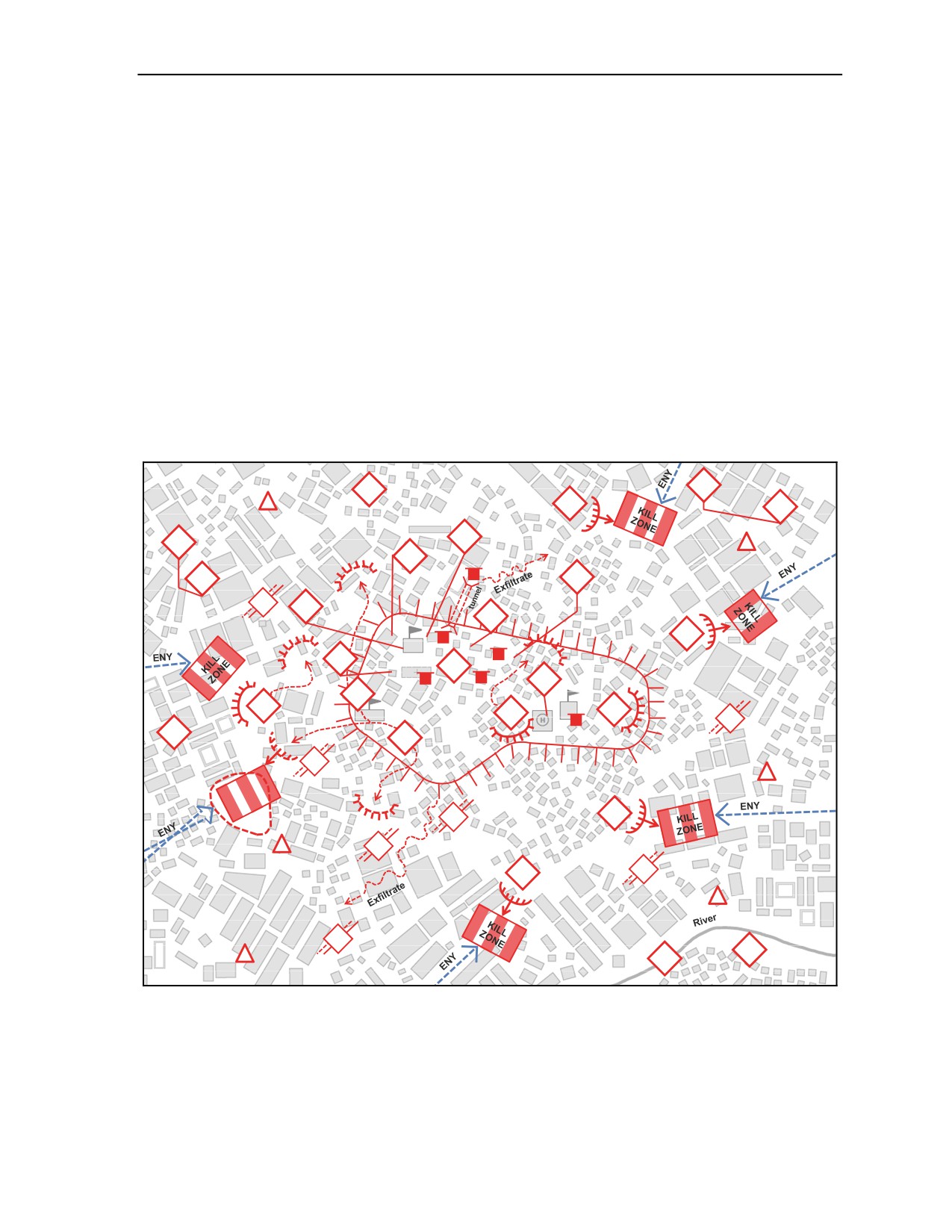
Functional Tactics
Battle Zone
7-172. The battle zone is the area where the defending commander commits the preponderance of his
force to the task of defeating attacking enemy forces or delaying them while the defenders withdraw. In the
defense of a CBP, the battle zone is typically the area in and surrounding the CBP that the defending force
can influence with its direct fires. It may be larger depending on the availability of indirect fires.
Disruption Zone
7-173. The disruption zone is the area outside the battle zone where the defenders may seek to—
z
Report on the enemy situation.
z
Defeat enemy reconnaissance efforts.
z
Detect attacking forces.
z
Disrupt and delay an attacker’s approach.
z
Destroy key attacking elements prior to engagement in the battle zone.
Support Zone
7-174. The support zone contains C2, CSS, fire support, and other supporting assets. A reserve element
may also be located there. The support zone is normally located within the CBP.
DA Cell
DA Cell
Suicide
Support
Disruption
I
IED TM
I
Element
Observer
Mortar
SAFE
60-mm
I
I
DA Cell
Comms &
DA Cell
I
Tradecraft
Observer
I
Extortion
I
DA Cell
DA Cell
Technical
I Finance
I
Support
IED
DA Cell
DA Cell
Intell
Transport
I
DA Cell
I
Disruption
Element
I
DA Cell
I Planning
CACHE
Demolitions,
I
abotage& IED
DA Cell
I
TM
DA Cell
I INFOWAR
DA Cell
DA Cell
Main Defense
I
Main Defense
Main Defense
I
I
Element
IED
Element
Element
SAFE
I
DA Cell
I
Multi-Function
IED
Reserve
Observer
ENY
LZ ?
DA Cell
KILL
IED
Disruption I
ZONE
Element
Observer
IED
DA Cell
Disruption
IED
Element
I
Observer
IED
SAFE
CACHE
Observer
DA Cell
I
I
Logistics
Figure 7-11. Insurgent defense of a complex battle position (example)
Executing Defense of a CBP
7-175. The commander or leader will determine whether or not to organize a disruption force in a
disruption zone. He may determine that the manning and capabilities of his organization are more
effectively used with security elements close to the defensive perimeter of the CBP. Whether near or distant
17 January 2014
TC 7-100.3
7-33

Chapter 7
from the CBP main defenses, security actions are disruption, active reconnaissance, and
counterreconnaissance. However, contact with the enemy is on order of the commander or leader. The
normal intention is to keep a CBP undiscovered by enemy forces. Working in close coordination with main
defense elements, support capabilities are often incorporated into the CBP.
7-176. A disruption element in the disruption zone can engage enemy forces in tactical depth as they
approach the CBP or CBPs. Direct and indirect fires coordinated by a disruption element can delay and
attrit enemy forces and cause them to enter the attack on a CBP in a piecemeal manner.
7-177. Main defense elements mass direct and indirect fires to defeat an enemy attack. The commander or
leader of the defending force may retain a reserve element and commit it only when necessary to prevent
defeat by enemy forces. Support elements in the support zone provide support to defenders in the disruption
zone and battle zone as required. In the event the commander or leader orders of a withdrawal from the
CBP, some support elements will exfiltrate quickly while other elements such as indirect fires
continue support to the main defense elements until directed to disengage by the commander or leader
and also exfiltrate.
KILL
ZONE
82-mm
IED
G
G
PKM
7.62-mm
G
G
60-mm
G
G
G
G
KILL
IED
ZONE
IED
CSOP
G
Figure 7-12. Guerrilla defense of a complex battle position (example)
Command and Control of a CBP Defense
7-178. The irregular OPFOR leader will position himself where he can best command and control the
defensive fight. C2 of a CBP is generally more difficult than that of an SBP because the defenders may be
more dispersed. Insurgents or guerrillas operating in and from the CBP use secure communications such as
couriers and wire.
7-34
TC 7-100.3
17 January 2014
Functional Tactics
Support of a CBP Defense
7-179. Support of a CBP can be provided from within the local insurgent or guerrilla organization and/or
local resources in the relevant population. Some support may be allocated higher-level irregular OPFOR
organizations or from a state or non-state sponsor. Specialized support such as SPF can be temporarily
associated with insurgents or guerrillas in a CBP in order to provide training, materiel, and/or tactical and
technical advice.
Reconnaissance
7-180. Reconnaissance assets observe avenues of approach key to providing early warning and allow the
commander or leader time to defend or to exfiltrate personnel and resources from the CBP. Insurgents,
guerrillas, and/or their active supporters embed themselves within local populations. The irregular OPFOR
is less likely to engage in counterreconnaissance activities if these actions would reveal CBP location.
Armored Fighting Vehicles
7-181. Armored vehicles are not the norm in a CBP. When possessed by the irregular OPFOR, armored
fighting vehicles and ad hoc fighting vehicles mounting heavy weapons are normally concealed and
covered in hide positions. The commander or leader may retain armored vehicles as part of his reserve for
quick response to contingencies in defense of his CBP.
Fire Support
7-182. CBPs are typically self-supporting in their defense. Fire support assets normally locate within the
CBP but may also locate outside of the CBP perimeter to best employ specific fires. Defenders employ
these fires to—
z
Defeat enemy forces in the battle zone.
z
Attrit enemy forces along avenues of approach near a CBP.
z
Disrupt enemy use of landing zones in the vicinity of a CBP.
z
Delay enemy forces to support withdrawal of the irregular OPFOR from the CBP.
Air Defense
7-183. Passive air defense is the norm for a CBP. Active air defense generally involves systems that do
not emit an electromagnetic signature. Insurgents or guerrillas engage aerial targets on order of the
commander or leader. An all-arms air defense concept involves using weapons of all personnel of a CBP to
protect against fixed- and rotary-wing aircraft threats. However, guerrilla battalions typically have a limited
MANPADS capability in their weapons company. When available, shoulder-fired MANPADS would likely
be located in disruption or security element(s) that occupy fighting positions near a CBP oriented on
probable enemy air avenues of approach. (See note under Air Defense in Support of an Ambush regarding
additional air defense assets that may be available.)
Engineer-Like Capabilities
7-184. The irregular OPFOR conceals fighting and survivability positions using C3D techniques with
locally available resources. Military-manufactured antipersonnel and/or antitank mines and/or IEDs are
emplaced on or near likely enemy avenues of approach. Particular mines and/or IEDs are emplaced
and secured with a cell or unit designated to arm and/or detonate the munition on order of the
commander or leader.
7-185. The irregular OPFOR reinforces urban and/or rural terrain to channel enemy forces into kill zones
on approaches to a CBP. Obstacles are generally more protective in nature than obstacles used near an SBP.
Insurgents or guerrillas may have specialized talents for engineer-like countermobility and mobility tasks.
When supported overtly or covertly by a state sponsor, SPF or regular forces may be associated with an
insurgent or guerrilla organization in order to provide training, materiel, and advice.
17 January 2014
TC 7-100.3
7-35
Chapter 7
Logistics
7-186. Logistics operations of a CBP are generally self-sustaining and blend into the local commerce and
daily operations of a relevant population in the vicinity of the CBP. Provisioning a CBP with regular
resupply is facilitated by active supporters of the insurgent or guerrilla organization. The commander or
leader typically does not coerce local citizens to provide logistics support but can use such extortion when
critical commodities are required to sustain the CBP defense.
7-187. Supply caches and safe houses are distributed throughout the urban or rural area near the CBP.
Other supply caches and safe houses are located within the CBP perimeter.
INFOWAR
7-188. Elements from the CBP may attempt to integrate within any local communities for the purpose of
gathering information, collecting intelligence, and disseminating INFOWAR themes to the local relevant
population. Active supporters of the irregular OPFOR assist the commander or leader in keeping a low
profile. INFOWAR activities may focus on downplaying the existence or significance of the CBP.
Generally, the CBP will not conduct easily detectable INFOWAR activities that would call the enemy’s attention
to it. (See appendix A for additional information on irregular OPFOR INFOWAR capabilities.)
7-189. If the presence of a CBP cannot be hidden, INFOWAR may attempt to convince enemy forces that
the defenders are friendly to them. It may attempt to convince leaders of the governing authority that the
insurgents or guerillas are willing to affiliate and/or associate with them in levels of reconciliation. Other
INFOWAR techniques can portray the enemy force and governing authority as a corrupt regime to further
isolate them from the relevant population. The insurgents or guerrillas can claim and demonstrate
themselves to be the population’s protector. In some cases, senior irregular OPFOR leaders may conduct
INFOWAR from a CBP to convince followers in other locations that they are still alive and leading their
organizations in the struggle against the enemy. INFOWAR can include support to provide basic social and
civic services to the relevant population that is not being provided by the governing authority.
7-190. Other INFOWAR techniques can result in the gradual acceptance by the relevant population to the
point that members of the insurgent or guerrilla organization become informal or legitimate representatives
in civil governance. This recognition can lead to election in a state’s formal voting processes and/or
establishing self-proclaimed semi-autonomous enclaves within a state with which the irregular OPFOR is
in conflict. In either case, the irregular OPFOR ensures a significant INFOWAR campaign to weaken
enemy support and strengthen its own support from a relevant population.
IRREGULAR OPFOR IN HYBRID THREAT TACTICS
7-191. The above section of this chapter shows examples of functional tactics in which insurgents and/or
guerrillas employ some of the same types of offensive and defensive actions used by smaller tactical units
of the irregular OPFOR (see TC 7-100.2). However, insurgents and/or guerrillas may also participate in
larger-scale functional tactics when acting as part of the Hybrid Threat (HT). (See TC 7-100 for examples
of such involvement.) They often work closely with SPF units in such roles.
7-192. One would expect the irregular OPFOR to play a relatively minor role in HT tactics, perhaps used
as an economy-of-force measure when regular OPFOR units are not available. However, as examples in TC
7-100 show, insurgents and guerrillas can sometimes do things that regular military units cannot. For
example, they are well suited to dispersed actions as part of a disruption force in a disruption zone (in
offense or defense). However, their small size and ability to blend in with the local population also make it
easier for irregular OPFOR units or cells to infiltrate into enemy-held positions. There, they may serve as
enabling forces or elements, paving the way for exploitation by larger, regular military units, or they may
play key roles as part of an exploitation force or other action force or element that accomplishes the overall
mission of the HT action.
Note. Insurgents, guerrillas, or even criminals can perform acts of terrorism that complement
functional tactics actions separate from or in conjunction with a larger HT force. (See chapter 6
for more details on terrorism.)
7-36
TC 7-100.3
17 January 2014
Appendix A
Information Warfare
The irregular OPFOR (including insurgents, guerrillas, and criminal elements) is trained to
use adaptive techniques to defeat a superior opponent. Naturally it uses information warfare
(INFOWAR) to obtain asymmetrical effects. These tactics are constantly evolving thanks to
the exponential growth of networking and information technology. Increased accessibility to
the Internet, commoditization of information, and unprecedented global awareness provide
the irregular OPFOR with the ability to focus its INFOWAR activities on one of the
enemies greatest weaknesses—his dependence on information communication
technology in every aspect of his operations.
GENERAL CHARACTERISTICS
A-1. The irregular OPFOR, along with the regular OPFOR, defines information warfare as specifically
planned and integrated actions taken to achieve an information advantage at critical points and times.
Conducted in conjunction with offensive or defensive actions, INFOWAR is designed to exploit the
weaknesses of the opponent’s information systems.
GOALS
A-2. The primary goals of INFOWAR are to—
z
Influence the enemy’s decisionmaking through his collected and available information,
information systems, and information-based processes.
z
Retain the ability to employ friendly information and information-based processes and systems.
TACTICAL TASKS
A-3. The effects of INFOWAR can be multidimensional and at times hard to pinpoint. However, the
irregular OPFOR highlights the following tasks and associated effects as critical to the application of
INFOWAR at the tactical level:
z
Destroy. Destruction tasks physically render the enemy’s information systems ineffective.
Destruction is most effective when timed to occur before the enemy executes a command and
control (C2) function or when focused on a resource-intensive target that is hard to reconstitute.
Neutralizing or destroying the opponent’s information capability can be brought about by
physical destruction of critical communications nodes and links.
z
Degrade. Degradation attempts to reduce the effectiveness of the enemy’s information
infrastructure, information systems, and information collection means.
z
Disrupt. Disruption activities focus on disrupting enemy observation and sensor capabilities at
critical times and locations. Disruption impedes the enemy’s ability to observe and collect
information and obtain or maintain information dominance.
z
Deny. Denial activities attempt to limit the enemy’s ability to collect or disseminate information
on the irregular OPFOR or deny his collection efforts.
z
Deceive. Deception activities strive to mislead the enemy’s decisionmakers and manipulate his
overall understanding of OPFOR activities. Deception manipulates perception and causes
disorientation among decisionmakers within their decision cycle.
z
Exploit. Exploitation activities attempt to use the enemy’s C2 or reconnaissance intelligence,
surveillance, and target acquisition
(RISTA) capabilities to the advantage of the irregular
OPFOR. The irregular OPFOR also uses its various INFOWAR capabilities to exploit any
enemy vulnerability.
17 January 2014
TC 7-100.3
A-1
Appendix A
z
Influence. Influencing information affects an enemy’s beliefs, motives, perspectives, and
reasoning capabilities, in order to support irregular OPFOR objectives. This may be done
through misinformation or by manipulating or “spinning” information.
INFOWAR ELEMENTS
A-4. Across the spectrum of competition, conflict, and war, the following elements are integrated when
developing and implementing INFOWAR:
z
Electronic warfare (EW). Activity conducted to control or deny the enemy’s use of the
electromagnetic spectrum, while ensuring its use by the irregular OPFOR.
z
Deception. Measures designed to mislead the enemy by manipulation, distortion, or falsification
of evidence to induce the enemy to react in a manner prejudicial to his interests.
z
Physical destruction. Use of all types of weapons and explosives to destroy critical components
of the enemy force, focusing on C2 nodes and RISTA sensors.
z
Protection and security measures. A wide range of activities (including the elements of
deception and EW) to enhance survivability and preserve combat power.
z
Perception management. Measures aimed at creating a perception of truth that best suits
irregular OPFOR objectives.
z
Information attack (IA). Intentional disruption or distortion of information in a manner that
supports accomplishment of the irregular OPFOR mission.
z
Computer warfare. Attacks focused specifically on computer systems, networks, and nodes.
A-5. The seven elements of INFOWAR do not exist in isolation from one another and are not mutually
exclusive. The overlapping of functions, means, and targets requires that they all be integrated into a single,
integrated INFOWAR plan. However, effective execution of INFOWAR does not necessarily involve the
use of all elements concurrently. In some cases, one element may be all that is required to successfully
execute a tactical INFOWAR action. Nevertheless, using one element or subelement, such as camouflage,
does not by itself necessarily constitute an application of INFOWAR.
A-6. The use of each element or a combination of elements is determined by the tactical situation and
support to the overall objective. The size and sophistication of an enemy force also determines the extent to
which the irregular OPFOR employs the various elements of INFOWAR. The commander or leader has the
freedom to mix and match elements to best suit his tactical needs, within the bounds of guidance from
higher authority. The resources and capabilities of the irregular OPFOR, and the appropriateness of the
INFOWAR medium to the target, determine the choices and the extent to which the various INFOWAR
elements are employed and integrated.
TOOLS
A-7. Tools for waging INFOWAR can include, but are not limited to—
z
Conventional physical and electronic destruction means.
z
Malicious software.
z
Denial-of-service attacks.
z
The Internet.
z
The media.
z
International public opinion.
z
Communication networks.
z
Various types of reconnaissance, espionage, and eavesdropping technologies.
The irregular OPFOR can employ INFOWAR tools from both civilian and military sources and from assets
of third-party actors.
A-8. In some cases, the irregular OPFOR will conduct INFOWAR activities that are criminal in nature.
For example, it may—
z
Use known computer exploitation tactics such as identity theft and industrial espionage.
z
Sell its computer warfare capabilities to create additional funding for its operations.
A-2
TC 7-100.3
17 January 2014
Information Warfare
TARGETS
A-9. The OPFOR sees the targets of INFOWAR as an opponent’s—
z
Decisionmakers.
z
Weapons and hardware.
z
Critical information infrastructure.
z
C2 system.
z
Information and telecommunications systems.
z
C2 centers and nodes.
Information links, such as transmitters, communication devices, and protocols, will be targeted. The
irregular OPFOR is extremely adaptive and will employ the best option available to degrade, manipulate,
influence, use, or destroy an information link. See table A-1 for typical examples of INFOWAR objectives
and targets.
Table A-1. INFOWAR elements, objectives and targets
Elements
Objectives
Targets
Electronic Warfare (EW)
Exploit, disrupt, deny, and degrade the
C2 and RISTA assets and
enemy’s use of the electromagnetic
networks.
spectrum.
Deception
Mislead enemy decisionmakers.
Key military decisionmakers.
Cause confusion and delays in the
decisionmaking process.
General population and
international media sources and
Persuade the local population and/or
Internet sites.
international community to support
irregular OPFOR objectives.
Physical Destruction
Destroy the enemy’s information
C2 nodes and links, RISTA
infrastructures.
assets, telecommunications, and
power sources.
Protection and Security
Protect critical assets.
Enemy RISTA assets.
Measures
Perception Management
Distort reality or manipulate information to
Enemy RISTA assets.
support irregular OPFOR goals.
Local populace and leaders.
Media sources (international and
domestic).
Information Attack (IA)
Alter or deny key information.
Decisionmakers and other users
of information.
Systems reliant on accurate
information.
Computer Warfare
Disrupt, deny, or degrade the enemy’s
C2 and RISTA assets and
computer networks and information flow.
networks.
WINDOWS OF OPPORTUNITY
A-10. To conduct successful action against a more powerful enemy force likely enjoying a technological
overmatch, the irregular OPFOR must exploit windows of opportunity. Sometimes these windows occur
naturally, as a result of favorable conditions in the operational environment (OE). Most often, however, the
17 January 2014
TC 7-100.3
A-3
Appendix A
irregular OPFOR will have to create its own opportunities. INFOWAR can help create the necessary
windows of opportunity for any type of offensive or defensive action, by executing deception techniques,
EW, perception management, and/or physical destruction.
A-11. Specific INFOWAR activities that can limit enemy force effectiveness can include—
z
Deceiving enemy forces with recurring social and political activities by active supporters of the
irregular OPFOR that appear non-threatening in the vicinity of the targeted objective.
z
Exploiting enemy information collection with false intelligence provided by active supporters of
the irregular OPFOR and/or insider threats.
z
Disrupting enemy information collection through coercion and extortion of the relevant
population to not cooperate with enemy forces.
z
Influencing enemy forces with misinformation and/or manipulated claims against the governing
authority to which the enemy forces belong.
z
Demonstrating the inability of enemy forces to protect civilians, effectively defend civil and/or
military facilities, and/or safeguard key representatives of the governing authority.
z
Psychologically isolating the enemy force and governing authority from each other as well as
from a relevant civilian population.
z
Creating a positive impression of irregular OPFOR actions and objectives among local, regional,
and/or global audiences.
z
Influencing a local, regional, and/or global audience with near real-time media coverage of
successful irregular OPFOR actions against enemy forces and the governing authority.
z
Using media releases to indicate the increasing discontent in a relevant population due to the
governing authority’s actions and reactions affecting daily civil commerce and lifestyles.
z
Using progressive INFOWAR activities to degrade the resolve of the enemy force and governing
authority to continue counterinsurgent, counter-guerrilla, or anti-crime operations.
INFOWAR ORGANIZATIONS
A-12. Various types on non-state actors might be part of the irregular OPFOR, affiliated with it, or support
it in some manner. Even those organizations that do not belong to the irregular OPFOR or support it
directly or willingly could be exploited or manipulated to support its objectives. Irregular INFOWAR
organizations can be semiformal in the case of insurgent organization or ad hoc in informal organizations
such as guerrillas or criminal gangs. In most case, the irregular forces are organized to perform a specific
mission. Their number and size will increase or decrease based on the tactical situation.
A-13. INFOWAR organizations conduct actions either in support of or independent of established irregular
OPFOR units. The determining factors are base on those means that achieve their goals expeditiously.
Note. Special-purpose forces (SPF) can organize, train, and support parts of the irregular
OPFOR (insurgents or guerrillas and possibly even criminal organizations) and conduct
operations in conjunction with them. SPF missions can also include the use of INFOWAR.
A-14. Criminal elements will engage in INFOWAR activities to protect their operations. However, some
criminal organization specialize in INFOWAR and use technology to illegally produce profits either by
acquiring sensitive financial information or by selling hacking services and malware toolkits. (See chapter
4 for more information.) INFOWAR organizations will provide a variety of products and technical
assistance to aligned irregular forces through direct action cells or through specialized INFOWAR cells.
INFOWAR CELLS
A-15. In a local or higher insurgent organization, an INFOWAR cell plans, coordinates, and implements
the organization’s INFOWAR plan and provides guidance and assistance to the INFOWAR direct action
cells whenever required. The INFOWAR cell may use a variety of lethal and nonlethal methods to
influence the enemy and the population. Examples of such activities include but are not limited to—
z
Propaganda such as night letters and disinformation campaigns.
A-4
TC 7-100.3
17 January 2014
Information Warfare
z
Incentivizing of destabilization activities such as criminal activities.
z
Assassinations and sabotage.
IED and other terrorist attacks are often used to support the overall INFOWAR plan. These attacks may
also be used in a manner to deceive the enemy and confuse the source of the attacks. The ultimate goal of
the INFOWAR cell is to create and maintain the perception that the enemy cannot provide security and
stability to the population.
A-16. Depending on the size, nature, and focus of the insurgent organization, the INFOWAR cell may be
capable of several functions. Multiple functions and activities are necessary if the enemy has mounted his
own INFOWAR campaign. Some example functions performed by the INFOWAR cell are—
z
Information management (internal methods, links, and security).
z
Media manipulation, psychological warfare (PSYWAR), and public affairs designed to influence
the population.
z
Communications (cyber embeds via Internet sites, propaganda videos, broadcast successes of
direct action teams, or printing).
z
Rumor control (misinformation and disinformation).
z
Sabotage actions.
z
Civic actions.
z
Indoctrination training.
z
Fund-raising (including international).
z
Recruiting.
z
Assistance in cyber-mining for intelligence.
All these functions are integrated to further short- and long-range goals.
INFOWAR DIRECT ACTION CELLS
A-17. An INFOWAR direct action cell supports the insurgent organization’s INFOWAR plan and may or
may not receive guidance from the INFOWAR cell. Direct action as the title indicates is the nature of its
objective, purpose, and role. Improvised explosive devices (IEDs) and other terror attacks are often used to
support the overall INFOWAR plan. These attacks may also be used in a manner to shift blame for the
attack to their enemy.
A-18. Depending on the size, nature, and focus of the insurgent organization, an INFOWAR direct action
cell may be capable of several functions. Some example functions performed by this cell are—
z
Selective sabotage actions.
z
Information management
z
Media manipulation (misinformation and disinformation—PSYWAR).
z
Communications
(cyber embeds via Internet sites, propaganda and indoctrination videos,
broadcast successes of other direct action teams).
z
Civic actions.
z
Assistance in the cyber-mining for intelligence.
All of these functions are integrated to further short- and long-range goals.
A-19. Some of the functions may require specialized expertise. For example, the media manipulation
function (PSYWAR) may require expertise and/or advice from a cleric; a political, a tribal, ethic, or
cultural leader; or other experts. Portions of the INFOWAR direct action cell may be dispersed and are
assigned as the mission dictates. When countering the enemy’s INFOWAR campaign, specific knowledge
of stabilizing factors and systems is required. For example, if the enemy engages in reconstruction efforts
the direct action cell may require specific knowledge to sabotage the operation.
A-20. The mission, combat conditions, and many other variables determine the configuration and
composition of each direct action cell. Direct action cells do not have a fixed structure. Cell composition is
not fixed and varies from cell to cell, mission to mission, and OE to OE. The structure, personnel,
equipment, and weapons mix, all depend on specific mission requirements. Personnel select weapons
17 January 2014
TC 7-100.3
A-5
Appendix A
appropriate to the mission. Other equipment is added as required, such as computers, computer rigged
vehicles, specialized antennas, and communications. Several members of the direct action cell may be hired
INFOWAR specialists. Some functions can also be performed by personnel outside of the cell. There may
be as few as one INFOWAR direct action cell to over 20 INFOWAR direct action cells, depending on the
mission and other factors. Portions of the INFOWAR direct action cell are probably dispersed.
SUPPORT TO INFOWAR Cells
A-21. Irregular OPFOR organizations at times will compete for limited resources either from their higher
headquarters or from an external supporting state or non-state actors. This competition appears to the
outside observer as disjointed or lacking the discipline needed for unity of effort. However, individual
leaders of the irregular OPFOR are allowed to develop lines of operation as it sees fit given the unique set
of circumstances of its area of responsibility and the means at its disposal. When a particular tactic is
proven to be effective, it will be replicated as necessary in order to exploit success, increase the perception
of legitimacy for the irregular OPFOR cause, and to give the impression of progress. This sort of “groping
in the dark” for a successful strategy means that the irregular OPFOR is able to experiment to find what
works and to capitalize on effective tactics. The key is to open as many inroads as possible and to increase
the likelihood for windows of opportunity for the irregular OPFOR to exploit the political, economic or
social situation.
A-22. The operational variables will determine whether or not a local area will require all of the elements of
tradecraft for a complete perception management campaign. Important issues such as regional conflicts,
underprivileged and underrepresented populations, and the location of political, commercial or economic
power centers, all have the potential to be targets of an INFOWAR campaign plan. Support may come in
many forms from the general population. Online chat rooms, radio and television opinion shows and
politically motivated groups may all provide support to the INFOWAR mission. As the irregular OPFOR
assess the local environment and the enemy’s center of gravity is determined, INFOWAR planners will
target select groups, organizations, and individuals for a variety of activities.
A-23. Some INFOWAR missions may require cultural insights, organizational intelligence, and specialized
expertise for use in an INFOWAR campaign. For example, the media manipulation function (PSYWAR)
may require expertise and/or advice from a cleric; a political, a tribal, ethnic, or cultural leader; or other
experts. Other functions could be used to obtain specific technical expertise such as the configuration of
important infrastructure, industrial, economic, and financial systems to develop targets for cyber attack.
INFOWAR activities will leverage the knowledge of individuals employed by these sectors of the
operational environment.
INFOWAR SUPPORT TO IRREGULAR OPFOR
A-24. INFOWAR activities support all of the categories of irregular OPFOR—insurgents, guerrillas, and
criminal elements. INFOWAR Cells provide the ways and means to conduct all elements of INFOWAR
activities. INFOWAR actions in the form of perception management or propaganda are designed to garner
support of the population for the irregular OPFOR. By establishing seemingly innocuous activities such as
web logs (blogs) and news outlets, INFOWAR cells can establish inroads for C2 functions, targeting and
other support functions. By targeting an information system’s weakest link, (the user), INFOWAR cells can
obtain information that provides inroads for further attacks by the irregular OPFOR or to by components of
the Hybrid Threat. If the current governing authority has control over information technology, INFOWAR
cells can conduct their operations from the sanctuary of a sympathetic nation.
A-25. INFOWAR activities provide support to the irregular OPFOR covertly in both times of peace and
times of war. OPFOR INFOWAR organizations can provide a variety of products and technical assistance
to aligned irregular organizations. INFOWAR cells also provide information technology resources such as
servers and networks to the irregular OPFOR in order to protect INFOWAR activities and disassociate it
from INFOWAR operations.
A-26. Some examples of INFOWAR support—
z
Locations of media outlets and personalities both friendly and enemy.
A-6
TC 7-100.3
17 January 2014
Information Warfare
z
Accepted customs and norms and practices used to foster support for the irregular OPFOR.
z
Inside access to government, commercial, and financial leaders and institutions that support the
enemy.
z
Locations of civilian and government communications infrastructure.
z
Distracting of enemy forces through instantaneous civil disobedience such as flash mobs.
z
Economic data vital to projecting required resources necessary to establish local rapport.
z
Established networks for recruiting and mobilization of combatants and noncombatants.
z
Enemy forces mission command tactics techniques and procedures, and command and control
structure.
A-27. INFOWAR cells provide advisors and technological resources to the irregular OPFOR in either a
covert or clandestine manner depending on the objective. Examples of such support could include either
all or some of the elements of INFOWAR and range from hosting servers and managing networks for
an insurgency or criminal element to supplying software and/or EW equipment to guerrillas for
INFOWAR operations.
A-28. INFOWAR cells may or may not have the necessary resources to conduct research and development
of INFOWAR technologies and to develop mature INFOWAR training and doctrine. In some cases,
commercial-off-the-shelf technology satisfies the requirement for the irregular OPFOR. The INFOWAR
cell may provide funds or equipment such as computers and network equipment, low-power GPS jammers,
or software for use by other insurgents or by affiliated guerrillas or criminals. The benefit of using
commercial information technology is that it is dual purpose and has less chance of raising suspicion when
transporting it.
Perception Management Activities
A-29. Perception management involves measures aimed at creating a perception of truth or stability that
best suits the irregular OPFOR objectives. Perception management integrates a number of widely differing
activities that use a combination of true, false, misleading, or manipulated information. Targeted audiences
range from enemy forces, to the local populace, to world popular opinion. At the tactical level, the irregular
OPFOR seeks to undermine an enemy’s ability to conduct combat operations through PSYWAR and other
perception management activities aimed at deterring, inhibiting, and demoralizing the enemy and
influencing civilian populations.
A-30. The various perception management activities include efforts conducted as part of—
z
PSYWAR.
z
Direct action.
z
Public affairs.
z
Media manipulation and censorship.
z
Regional or international recruitment and/or fundraising for affiliated irregular forces.
A-31. Information communications technology and global dissemination of the 24-hour news cycle has
empowered the irregular OPFOR to implement complex perception management activities public affairs to
affect change, garner global support, and generally shape the OE to its purposes. INFOWAR activities
engage in public affairs to involve interest groups and media outlets to gain influence and to obtain their
objectives. The irregular OPFOR can enable political and civic leaders at all levels to engage the population
to accept its ideology and support the irregular OPFOR.
A-32. Although the irregular OPFOR maintains that perception management activities conducted at the
tactical level must be consistent with, and contribute to, the goals of the highest levels of organization,
subordinates are allowed much discretion on the ways and means of achieving their perception
management objectives. For example, forming a partnership with a charitable organization or a local
business leader in order to obtain secure lines of communications, and a recruiting pool would be a natural
extension of the strategy necessary to influence the local populace. If there is a religious or other
ideological approach available, the irregular OPFOR will leverage this to establish drivers of social
mobility such as educational organizations or business alliances. These organizations also provide the
17 January 2014
TC 7-100.3
A-7
Appendix A
irregular OPFOR a conduit for recruiting, indoctrination, and long-term influence within the target group.
Additionally, the irregular OPFOR has the freedom to provide immediate assistance and disperse funds
without delay during times of crisis or whenever there is an opportunity to meet a particular objective. This
gives the irregular OPFOR the opportunity to be the so called “first with the most” in the struggle for hearts
and minds.
Psychological Warfare
A-33. PSYWAR is a major contributor to perception management. Targeting the forces of the enemy,
PSYWAR attempts to influence the attitudes, emotions, motivations, aggressiveness, tenacity, and
reasoning of enemy personnel. In addition to the enemy’s military forces, PSYWAR specialists also
concentrate on manipulating the local population and international media in favor of the irregular OPFOR,
turning opinion against the enemy’s objectives. Planners focus special emphasis on highlighting enemy
casualties and lack of success. They also highlight enemy mistakes, especially those that cause civilian
casualties or damage civil infrastructure.
A-34. The irregular OPFOR skillfully employs media and other neutral players, such as nongovernmental
organizations
(NGOs), to further influence public and private perceptions. However, if the irregular
OPFOR perceives the presence of NGOs to be detrimental to its objectives, it can be extremely effective in
hindering their efforts to provide humanitarian assistance, thus discrediting them.
Public Affairs
A-35. Local partnerships and projects are regarded as enhancing the strategic and operational goals of the
irregular OPFOR but are not necessarily prescribed by the higher command. The objective is to provide a
working solution that is culturally acceptable to the target population and does not compromise the core the
irregular OPFOR. The irregular OPFOR seeks to integrate its activities into the target society and does this
by providing the essential services for everyday life. Through cultural acceptance and shared goals,
INFOWAR operators are able to develop trust and loyalty among the society and create opportunity for
future projects and the perception of social mobility. Other examples of grassroots assistance given to a
disenfranchised segment of the population by the irregular OPFOR could include—
z
Establishment or purchase of a local business or industry in order to buy influence, generate
funds for irregular OPFOR activities, and provide access to lines of communications.
z
Cash payments to victims of both natural and manmade disasters.
z
Support to religious, educational, or charitable institutions for public relations purposes, and
recruitment.
z
Provision of public services such as welfare, disaster response, or law and order services in order
to delegitimize the existing government.
z
Monetary support to religious, political, academic, or business leaders who are willing to support
the irregular OPFOR cause.
z
Establishing a parallel legal process where the population can obtain a just resolution for
disputes without unwanted corruption by external values.
A-36. If properly employed, the results of perception management activities become ingrained into
everyday life and can be viewed as a positive force to the targeted population. The targeted population gets
the services denied to them by the current governmental structure, while the irregular OPFOR is able to
move freely among the population and establish a support structure for future operations. Perception
management activities are regarded by the enemy as propaganda, despite the fact that the irregular OPFOR
enjoys more influence over the population than the existing government does. The irregular OPFOR is able
to maintain contact with the target population in an overt way that further legitimizes its presence. By
providing opportunities for education, work and charity, the irregular OPFOR receives in return loyalty and
support for its cause. The irregular OPFOR may adopt a long-term strategy that allows it to fully integrate
into all aspects of society. The fact that it administers resources and services that are unavailable to the
targeted population increases its influence and makes affiliation with its cause a desirable goal for the
target population.
A-8
TC 7-100.3
17 January 2014
Information Warfare
A-37. Providing footage of perceived abuses of power by the enemy to the public helps INFOWAR
activities make a case for allowing the irregular OPFOR to establish an ideological foothold within the state
and provides the moral support needed to increase the resistance to the government.
Disaster Response
A-38. Response to disaster, whether natural or manmade, is viewed by the irregular OPFOR as another
opportunity to gain influence and support in a region. Human suffering on a large scale sets the conditions
for chaos and an overextension of the state’s resources. In many regions, disaster-relief services may be
inadequate, and there is usually an inordinate amount of suffering before any assistance becomes available.
Because of its access to resources and support systems that are outside the government’s bureaucratic
structure, the irregular OPFOR can enable a more comprehensive response to natural disasters in certain
targeted areas. In some cases, it will augment the current regime’s disaster-relief efforts and attempt to
integrate and legitimize its role in assisting the population. In other situations, it will supplant the existing
structure and outperform the competition. The goal is to be the first with the most in terms of aid and
assistance. Disaster response efforts may include—
z
Evacuation of personnel from threatened areas.
z
Provision of humanitarian relief such as food and temporary shelter.
z
Long-term plans to rebuild structures destroyed by the disaster.
z
Cash payments to victims to pay for immediate needs or to compensate a loss.
A-39. The irregular OPFOR can couple these services—including grassroots activism, social services and
disaster response—with a political message and an intimidating presence. These combined methods allow
the irregular OPFOR to establish its legitimacy, separate its enemies from its friends, and build support
among the population while establishing inroads for future operations.
Media Activities
A-40. Irregular OPFOR will use all available means to exploit the media. These include both traditional
forms such as television and newspaper outlets and as “new” media such as social networks and other
computerized outlets. Benefits to the irregular OPFOR include the ability to connect with sympathizers for
recruiting and resourcing, channeling responses through emotive themes, and promulgating a narrative of
events that is more conducive to its objective.
A-41. The barriers to obtaining and using the media have diminished significantly with the ubiquitous
expansion of the Internet. Media resources are no longer restricted to a limited number of corporations or
individuals. Individuals with the technical knowledge can leverage a variety of commercially available
technologies and reach a large audience. In some cases video releases or newscasts produced exclusively
within the new media are used by traditional media outlets and are given more attention than the official
account of events. Unburdened by a multi-step approval process, irregular OPFOR can manipulate the
media to their political and military advantage. Oftentimes it is not the most accurate or properly vetted
message that attracts attention, but rather the first to hit the media.
A-42. Having the ability to appeal or relate to the broadest possible audience within the cultural context of
the OE, means that the irregular OPFOR has an intimate understanding of the target audience including
social and cultural factors such as race issues, economic status and education levels.
A-43. The irregular OPFOR uses its knowledge of technology and culture to craft a message that is both
targeted and suggestive. It also uses media operations as a front for reconnaissance and intelligence
operations. Some of the techniques available to the irregular OPFOR are —
z
Producing pamphlets, signs, and banners to spread their message usually through the use of
images for illustration.
z
Using radio television and other media in a fashion that exploits freedom of speech laws in order
to operate on the fringe of social norms without being illegal.
17 January 2014
TC 7-100.3
A-9
Appendix A
Computer Warfare Information Attack
A-44. OPFOR information warfare (INFOWAR) units engage in a combination of computer warfare,
information attack and perception management to establish and maintain information dominance in
cyberspace by using both direct and indirect attacks on their adversary’s computer networks, information
systems and online media. Computer warfare and information attack targets both the networks and the
information enemy elements of national power need to function daily basis and conduct warfare.
INFOWAR brings to bear the information oriented elements of national power to decisively defeat
the enemy.
A-45. The complex nature of the information environment provides the conditions for both direct and
indirect INFOWAR attacks and presents an opportunity for INFOWAR tactics and techniques to augment
traditional military operations at all levels of command from tactical to the strategic. Modern militaries
rely on information systems and automation as well as worldwide connectivity to project power on a global
scale. These information systems are used in command and control; logistics support; surveillance and
reconnaissance; and for global positioning and navigation satellites which provide both navigation and
precision targeting data.
A-46. The direct approach to INFOWAR is a concerted operation designed to attack a specific target
whether it is key infrastructure, a civil institution’s databases or critical command and control nodes. While
the indirect approach could involve the constant probing of the adversary’s weaknesses and multiple
limited engagements designed to wear down electronic defenses, win decisively in the propaganda
campaign, or to identify vulnerabilities for future operations.
Providing Computer Warfare Tools and Services
A-47. Hosting services are the key to supporting INFOWAR activities in cyberspace. The INFOWAR unit
provides access for a variety of services and is a clearing house for exchanging successful techniques and
data on potential targets in chat rooms and on blogs. The irregular OPFOR can use these services to email
or embed links to servers outside the area of operations that can be used for recruiting, exchanging
intelligence and propaganda, and launching attacks.
A-48. Propaganda is still a key component of the INFOWAR campaign. Redirecting Internet users to
OPFOR themed websites will have the effect of not only spreading the irregular OPFOR’s message but
giving the enemy and his supporters the impression that the irregular OPFOR has compromised every
aspect of his society.
Developing Paralell Networks
A-49. Providing to the irregular OPFOR a C2 network is an effective way for the INFOWAR activity to
maintain situational awareness and gather intelligence on the state’s infrastructure and elements of power.
A dedicated communications network can also be used to recruit and mobilize large groups for specific
actions such as rallies, protests, riots, or attacks.
A-50. The irregular OPFOR posing as commercial or humanitarian venture, such as an NGO, a legitimate
business, or another noncombatant entity, can establish network connectivity in a contested area of interest.
This can be accomplished at another level by providing telecommunications infrastructure and switching
equipment to the state’s telecommunications company with embedded backdoor access to the input-output
systems of the equipment.
A-51. This will give the INFOWAR activity free access to important elements of the nation’s
telecommunications network. In other cases, after hostilities have begun, telecommunications equipment
can be replaced or reconfigured after a key node is physically seized and repurposed for manipulation and
use by the irregular OPFOR.
A-52. The irregular OPFOR has the ability to seize enemy civil telecommunications infrastructure and use
it for their purposes. Existing switching equipment can be integrated with that of their own and used with
existing lines and wireless towers to extend the range and services for the irregular OPFOR C2 network.
Once implemented the irregular OPFOR can commercialize its services. As more subscribers are added, the
A-10
TC 7-100.3
17 January 2014
Information Warfare
network becomes a source of intelligence by logging calls made and received by persons of interest. It can
also be a source of revenue to fund future actions.
SPF and INFOWAR
A-53. INFOWAR capabilities provide clear advantages for SPF missions, due to the fact that SPF will
always conduct missions in small teams or detachments and will use INFOWAR capabilities and
techniques to maximize the effectiveness of their small numbers. INFOWAR capabilities have the potential
to increase situational awareness, facilitate deception, and disrupt the enemy’s decision making process.
A-54. SPF conducts an array of operations in support of the INFOWAR plan. Examples include—
z
Perception Management.
z
Diversionary Measures.
z
Sniper.
z
Indirect Fire.
z
Air Defense (denial of airspace and enemy claims of air supremacy and/or superiority).
z
Electronic Warfare.
Note. SPF can recruit, organize, train, advise, and support local insurgents or guerrillas and
possibly even criminal organizations and conduct (or lead) operations in conjunction with them.
SPF personnel may fight alongside such affiliates or assist them to prepare for offensive actions,
diversionary measures, INFOWAR activities or other missions. In some cases, the SPF will not
only advise and assist but actually control (command) the irregular forces as a surrogate force.
SPF missions (and those of their affiliates or surrogates) can include the use of terror tactics. See
TC 7-100.2 Opposing Force Tactics Chapter 7 INFOWAR, and Chapter 15Special Purpose
Forces for more information.
A-55. The nature of the shared goal or interest determines the tenure and type of relationship and the degree
of affiliation. For example, the affiliation of an SPF detachment with criminal (or guerrilla) organizations is
dependent only on the needs of the criminal (or guerrilla) organization or on the needs of the SPF at a
particular time. The relational dynamics of SPF units are very fluid and apt to change from one day to
the next. Shifts in affiliations may in turn cause adjustments in the SPF task organization to
accommodate these changes.
Direct Action Team
A-56. A Direct Action Team is embedded in most INFOWAR units to provide support to the PSYWAR
company. The teams specialize in infantry antiarmor style attacks; antiarmor ambushes; hit-and-run attacks
against armored and/or hardened or rear area targets. Usually one Direct Action Teams, each broken into
three attack elements of 4 persons each. The teams will probably be supported or augmented by different
types of SPF specialty teams such as Sniper Teams or Sapper Teams. The SPF Teams (UAV) may be used
to acquire reconnaissance information on targets or facilities.
A-57. SPF team members are cross-trained in the use of all equipment, weapons, and vehicles assigned to
the company. The equipment and weapons mix is determined by the mission. SPF Soldiers speak several
languages and are able to interact with the local populace for perception management and or PSYWAR missions.
All SPF teams may be augmented by other SPF personnel, weapons, and/or equipment. The team serves as a
standard SPF Team when not required for INFOWAR.
A-58. The SPF team leader coordinates all combat activities as well as reconnaissance and jamming
activities, operations, employment, monitoring, direction finding, collection, and reporting. This includes
GSR, sensor sets, remote sensor monitoring, and observation.
Signal Team
A-59. A single small SPF signal team can provide long-range communications support for guerrilla units up
to battalion size. A full SPF signal team can do the same for a brigade-size unit. Teams can also support
17 January 2014
TC 7-100.3
A-11
Appendix A
insurgent operations. This team may also serve in a signals reconnaissance collection role. In the collection
role, the signal equipment is exchanged one-for-one with communications intercept and direction finding
equipment. Each team then becomes a communications intercept and direction finding unit.
Sniper Team
A-60. The snipers (7.62-mm or .50 cal) in each attack element provide covering fires. The 35-mm AGL-L
and the 7.62-mm GP MG engage personnel when they exit the armored vehicles, pin down the supporting
infantry allowing the ATGM/ATGL gunner to engage the armored vehicle. and provide covering fires for
the ATGM and ATGL gunners. Sniper operations are useful to create hesitancy among enemy forces and to
disrupt the enemy decision making process by forcing enemy commanders to account for sniper counter
sniper operations.
A-12
TC 7-100.3
17 January 2014
Glossary
SECTION I - ACRONYMS AND ABBREVIATIONS
AKO
Army Knowledge Online
AOR
area of responsibility
AP
antipersonal
AR
Army regulation
AT
antitank
ATGL
antitank grenade launcher
ATGM
anitiank guided missile
AUTL
Army Universal Task List
BP
battle position
C2
command and control
C3D
camouflage, cover, concealment, and deception
CBP
complex battle position
CBRN
chemical, biological, radiological, nuclear
CI
counterintelligence
CP
comand post
CR
counterreconnaissance
CS
combat support
CSS
combat service support
DA
direct action
DODD
Department of Defense Directive
EFP
explosive formed projectile
EW
electronic warfare
FM
field manual
G
guerrilla [in guerrilla unit symbol]
GANG
criminal (generic) [in crimainal organization symbol]
GPS
global positioning system
HEAT
high explosive antitank
HK
hunter-killer
HRO
humantarian relif organization
HT
Hybrid Threat
HUMINT
human intelligence
HVT
high-value target
I
insurgent [in insurgent organization symbol]
IA
information attack
IED
improvised explosive device
INFOWAR
information warfare
INS
internal security
ISF
internal security forces
JP
joint publication
km
kilometer(s)
LNG
liquefied natural gas
17 January 2014
TC 7-100.3
Glossary-1
Glossary
LOC
line of communications
LVCG
live, virtual, constructive, and gaming
LZ
landing zone
MANPADS
man-portable air defense system
m
meter(s)
mm
millimeter(s)
MRL
multiple rocket launcher
NGO
nongovernmental organization
OE
operational environment
OP
observation post
OPFOR
opposing force (AR 350-2)
OPSEC
operational security
PSC
private security contractor
PMESII-PT
political, military, economic, social, information, infrastructure, physical
environment, and time
PSYWAR
psychologcial warfare
POL
petroleum, oils, and lubricants
RISTA
reconnaissance, intelligence, surveillance, and target acquisition
SAF
small arms fire
SAM
surface-to-air missile
SATCOM
satellitte communications
SBP
simple battle position
SIGINT
signals intelligence
SPF
special-purpose forces
SSM
surface-to-surface missile
SVIED
suicide vest improvised explosive device
SVBIED
suicide vehicle borne improvised explosive device
TC
training circular
TCP
traffic control post
TIC
toxic industrial chemical
TIM
toxic idustrial material
TRADOC
Training and Doctrine Command [US Army]
TRISA
TRADOC G-2 Intelligence Support Activity [US Army]
TTP
tactics, techniques, and procedures
US
United States
UAV
unmanned aerial vehicle
UJTL
Universal Joint Task List
UN
United Nations
VBIED
vehicle borne improvised explosive device
WMD
weapon of mass destruction
Glossary-2
TC 7-100.3
17 January 2014
Glossary
SECTION II - TERMS
adherent
An individual or one or more unit, organization, or cell that forms collaborative relationships with, acts
on behalf of, or is otherwise inspired, without any requirement of allegiance to another organization, to
take action in support of the goals and objectives of another irregular force [such as al-Qa‘ida—the
organization and the ideology—including support and/or acts of violence]. (As adapted for TC 7-100.3
from U.S. National Strategy for Counterterrorism)
affilitate
An individual or one or more unit, organization, or cell that aligns with another individual, unit,
organization, or cell to influence, support, and/or act in concert with for mutual benefit. No command
relationship exists necessarily between an affiliate and the unit, organization, or cell in whose area of
responsibility it operates; however, localized operations of the affiliate may support the area, regional,
or global agenda of an organization [such as al-Qa’ida]. Affiliates are typically nonmilitary or
paramilitary individuals or groups. In some cases, affiliated forces may receive support from regular
military forces as part of an agreement under which they cooperate. (As adapted for TC 7-100.3 from
U.S. National Strategy for Counterterrorism)
antiterrorism
Defensive measures used to reduce the vulnerability of individuals and property to terrorist acts, to
include limited response and containment by local military and civilian forces. Also called AT. (JP 3-07.2)
ambush
A surprise attack from a concealed position used against moving or temporarily halted targets in order to
destroy or capture personnel and/or supplies; harrass and demoralize the enemy; delay or block movement
of personnel and supplies; and/or canalize enemy movements. (TC 7-100.2)
area defense
A defensive operation designed to achieve tactcial decision by forcing the enemy’s offensive
operations to culminate before the enemy can achieve his objective, and/or by denying the enemy his
objectives while preserving combat power until decision can be achieved through strategic operations
and operational mission accomplishment. (TC 7-100.2)
area of reposnibility
The geographical area and associated airspace, as defined by the Opposing Force (OPFOR), within
which a commander has the authority to plan and conduct combat operations. An AOR is bounded by a
limit of responsibility (LOR) beyond which the organization may not operate or fire without
coordination through the next-higher headquarters. AORs may be linear or nonlinear in nature. Linear
AORs may contain subordinate nonlinear AORs and vice versa. (TC 7-100.2)
assault
An attack that destroys an enemy force through firepower and the physical occupation and/or
destruction of the enemy position. (TC 7-100.2)
attack
An offensive operation that destroys or defeats enemy forces, seizes and secures terrain, or both
destroys or defeats enemy forces and seizes and secures terrain. (TC 7-100.2)
battle
A battle consists of a set of related engagements that last longer and involve larger forces than an
engagement. (ADRP 3-90)
battle positon
A defensive location oriented on a likely enemy avenue of approach. (TC 7-100.2)
17 January 2014
TC 7-100.3
Glossary-3
Glossary
combating terrorism
Actions, including antiterrorism (defensive measures taken to reduce vulnerability to terrorist acts) and
counterterrorism (offensive measures taken to prevent, deter, and respond to terrorism), taken to
oppose terrorism throughout the entire threat spectrum. Also called CbT. See antiterrorism and
counterterrorism. (See also JP 3-26)
complex battle position
A defensive location designed to employ a combination of complex terrain, C3D, and engineer effort
to protect the unit(s) within it from detection and attack while denying their seizure and occupation by
the enemy. (TC 7-100.2)
condition
Those variables of an operational environment or situation in which a unit, system, or individual is
expected to operate and may affect performance. See also joint mission-essential tasks. (JP 1-02)
counterterrroism
Operations that include the offensive measures taken to prevent, deter, preempt, and respond to
terrorism. Also called CT. (JP 3-26)
deception
Those measures designed to mislead the enemy by manipulation, distortion, or falsification of evidence
to induce him to react in a manner prejudicial to his interests. (JP 1-02; JP 3-13.4)
enemy
A party identified as hostile against which the use of force is authorized. (ADRP 3-0) [The enemy in
the context of TC 7-100.3 is any hostile party to the irregular opposing force (TC 7-100.3)]
enemy combatant
In general, a person engaged in hostilities against the United States or its coalition partners during an
armed conflict. The term “enemy combatant” includes both “lawful enemy combatants” and “unlawful
enemy combatants.” (U.S. Department of Defense Directive (DODD) 2310.01E, The Department of
Defense Detainee Program, September 5, 2006)
engagement
A tactical conflict, usually between opposing, lower echelon maneuver forces. (ADP 3-0)
guerrilla
A typically indigenous individual within a irregular unit structure organized along military lines in
order to conduct military and paramilitray operations in enemy-held, hostile, or denied territory. TC 7-
100.3 typically identifies guerrillas within the context of guerrilla units. [As adapted to TC 7-100.3
from JP 1-02/No approved JP 1-02 definition]
guerrilla force
A group of irregular, predominantly indigenous personnel organized along military lines to conduct
military and paramilitary operations in enemy-held, hostile, or denied territory. (JP 1-02; JP 3-05)
hybrid threat
The diverse and dynamic combination of regular forces, irregular forces, and/or criminal elements all
unified to achieve mutually benefiting effects. (ADRP 3-0; see also TC 7-100)
improvised explosive device
A weapon that is fabricated or emplaced in an unconventional manner incorporating destructive, lethal,
noxious, pyrotechnic, or incendiary chemicals designed to kill, destroy, incapacitate, harass, deny
mobility, or distract. Also called IED. (JP 1-02)
information operations
The integrated employment of the core capabilities of electronic warfare, computer network
operations, psychological operations, military deception, and operations security, in concert with
specified supporting and related capabilities, to influence, disrupt, corrupt or usurp adversarial human
and automated decision making while protecting the irregular opposing force human and automated
decision making. Also called IO. [As adapted for TC 7-100.3 from JP 3-13]
Glossary-4
TC 7-100.3
17 January 2014
Glossary
intergovernmental organization
An organization created by a formal agreement between two or more governments on a global, regional, or
functional basis to protect and promote national interests shared by member states. (ADRP 3-0)
irregular forces
Armed individuals or groups who are not members of the regular armed forces, police, or other internal
security forces. (JP 1-02; JP 3-24)
irregular warfare
A violent struggle among state and non-state actors for legitimacy and influence over relevant
population(s). Irregular warfare favors indirect and asymmetric approaches, though it may employ the full
range of military and other capacities, in order to erode an adversary’s power, influence, and will. (JP 1-02)
insurgent
An individual organized within an irregular insurgent organization structure that uses subversion
and/or violence in order to overthrow or force change of a governing authority. TC 7-100.3 typically
identifies insurgents within the context of cells. [As adapted for TC 7-100.3 from JP 1-02 and
JP 3-24/no approved JP 1-02 defintion.]
kill zone
A designated area on the battlefield where the opposing force (OPFOR) plans to destroy an enemy
using obstacles and massed fires of direct and indirect weapon systems. (TC 7-100.2) [As adapted for
TC 7-100.3 from FM 3-21.8, ATTP 3-06.11, ATTP 3-21.9.]
lawful enemy combatant
Lawful enemy combatants, who are entitled to protections under the Geneva Conventions, include
members of the regular armed forces of a State party to the conflict; militia, volunteer corps, and
organized resistance movements belonging to a State party to the conflict, which are under responsible
command, wear a fixed distinctive sign recognizable at a distance, carry their arms openly, and abide
by the laws of war; and members of regular armed forces who profess allegiance to a government or an
authority not recognized by the detaining power. (Department of Defense Directive (DODD)
2310.01E, The Department of Defense Detainee Program, 5 September, 2006)
maneuver defense
A defensive operation designed to achieve tactcial decision by skillfully using fires and manuever to
destroy key enemy elements of the enemy’s combat system and deny enemy forces their objective,
while preserving the friendly force. (TC 7-100.2)
militia
An organization which generally refers to citizens trained as soldiers (as opposed to professional
soldiers), but applies more specifically to a state-sponsored militia that is part of the state’s armed
forces but subject to activation only in an emergency. To avoid confusion, the TC 7-100 series uses
militia typically in the latter sense. Irregular forces might be referred to or declare itself as a “militia;”
however, the term militia is not typically used to describe gurrilas, insurgents, or criminals associated
with opposing forces. (TC 7-100.2; TC 7-100; TC 7-100.3)
mercenary
An individual who acts individually or acts a member of a formed group and volunteers from
recruitment locally or abroad in order to fight in an armed conflict; is operating directly in the
hostilities; is motivated by the desire for private gain, are promised, by or on behalf of a party to the
conflict, material compensation substantially in excess of that promised or paid to the combatants of
similar rank and functions in the armed forces of that party; is neither a national of a party to the
conflict nor residents of territory controlled by a party to the conflict; is not a member of the armed
forces of a party of the conflict; and, is not on official military duty representing a country that is not
involved in the conflict such as a legitimate loan service or training appointment between. (Geneva
Conventions IV)
nongovernmental organization
A private, self-governing, not-for-profit organization dedicated to alleviating human suffering; and/or
promoting education, health care, economic development, environmental protection, human rights, and
17 January 2014
TC 7-100.3
Glossary-5
Glossary
conflict resolution; and/or encouraging the establishment of democratic institutions and civil society.
NGO. (JP 3-08)
objective
The clearly defined, decisive, and attainable goal toward which every operation is directed. A location
on the ground used to orient operations, phase operations, facilitate changes of direction, and provide
for unity of effort. (ADRP 1-02)
operational area security
A form of security operations conducted to protect friendly forces. Forces engaged in area security
operations focus on the force, installation, route, area, or asset to be protected. (ADRP 3-37)
operational environment
A composite of the conditions, circumstances, and influences that affect the employment of
capabilities and bear on the decisions of the commander. (JP 3-0)
operational variables
Those interrelated aspects of an operational environment, both military and nonmilitary, that differ
from one operational environment to another and define the nature of a particular operational
environment. The eight operational variables are political, military, economic, social, information,
infrastructure, physical environment, and time (PMESII-PT) (ADRP 3-0)
opposing force
A plausible, flexible military and/or paramilitary force representing a composite of varying capabilities
of actual worldwide forces, used in lieu of a specific threat force for training and developing US forces
(AR 350-2).
paramilitary
An irregular individual belonging to forces or groups distinct from the regular armed forces of any
country, but resembling them in organization, equipment, training, or mission. [As adapted for TC 7-
100.3 from JP 1-02 and JP 3-24]
paramilitary forces
Forces or groups distinct from the regular armed forces of any country, but resembling them in
organization, equipment, training, or mission. (JP 1-02; JP 3-24)
procedure
Standard, detailed steps that prescribe how to perform specific tasks. See also tactics; techniques.
(JP 1-02)
propaganda
Any form of adversary communication, especially of a biased or misleading nature, designed to
influence the opinions, emotions, attitudes, or behavior of any group in order to benefit the sponsor,
either directly or indirectly. (JP 1-02)
protection
The preservation of the effectiveness of mission-related military and nonmilitary personnel,
equipment, facilities, information, and infrastructure deployed or located within or outside the
boundaries of a given operational area. (ADRP 3-37)
raid
An attack against a stationary target for the purpose of its capture or destruction that culminates in the
wihdrawal of the raiding dorce to safe territory. (TC 7-100.2)
reconnaissance attack
A tactical offensive action that locates moving, dispersed, or concealed enemy elements and either
fixes or destroys them; and/or gain information about the enemy’s location, dispositons, military
capabilities, and/or intentions. (TC 7-100.2)
Glossary-6
TC 7-100.3
17 January 2014
Glossary
red team
An organizational element comprised of trained and educated members that provide an independent
capability to fully explore alternatives in plans and operations in the context of the operational
environment and from the perspective of adversaries and others. (JP 1-02)
resistance movement
An organized effort by some portion of the civil population of a country to resist the legally established
government or an occupying power and to disrupt civil order and stability. (JP 1-02; JP 3-05)
risk management
The process of identifying, assessing, and controlling risks arising from operational factors and making
decisions that balance risk cost with mission benefits. (JP 1-02)
rules of engagement
Directives issued by competent military authority that delineate the circumstances and limitations
under which [United States] forces will initiate and/or continue combat engagement with other forces
encountered. Also called ROE (JP 1-04; ADRP 3-0)
simple battle position
A defensive location oriented on the most likely enemy avenue of approach. (TC 7-100.2)
standard
A satisfactory level of performance for a task and condition for each individual and collective task to
ensure that the individual or organization meets mission requirements. When no standard exists, the
commander or organizational leader establishes a standard and the next higher commander or leader
approves it. All training conducted by the unit, organization, or cell is assessed against the
commander’s or leader’s intent for the training event, mission, and/or published doctrinal standards.
See also TC 7-101, Appendix A. [As adapted for TC 7-100.3 from ADP 7-0]
tactics
The employment and ordered arrangement of forces in relation to each other. See also procedures;
techniques. (JP 1-02)
task-organizing
The act of designing an operating force, support staff, or sustainment package of specific size and
composition to meet a unique task or mission. (ADRP 3-0)
techniques
Non-prescriptive ways or methods used to perform missions, functions, or tasks. See also procedures;
tactics. (JP 1-02 )
terrorist
An individual who commits unlawful acts of violence or threat of violence to instill fear and coerce
governments and societies in pursuit of political, religious, or ideological objectives. TC 7-100.3
typically identifies terrorists in the context of cells. [As adapted to TC 7-100.3 from JP 1-02/no
approved JP 1-02 defintion.]
terrorism
The use of unlawful violence or threat of unlawful violence to inculcate fear; intended to coerce or to
intimidate governments or societies. Terrorism is often motivated by religious, political, or other
ideological beliefs and committed to the pursuit of goals that are usually political. (JP 1-02 and JP 3-07.2)
threat
Any combination of actors, entities, or forces that have the capability and intent to harm the United
States forces, United States national interests, or the homeland. (ADRP 3-0) Note. Irregular opposing
forces can apply this definition to actors, entities, or forces that have the capability and intent to harm
irregular opposing force goals and objectives.
threat analysis
In antiterrorism, a continual process of compiling and examining all available information concerning
potential terrorist activities by terrorist groups which could target a facility. A threat analysis will
17 January 2014
TC 7-100.3
Glossary-7
Glossary
review the factors of a terrorist group's existence, capability, intentions, history, and targeting, as well
as the security environment within which friendly forces operate. Threat analysis is an essential step in
identifying probability of terrorist attack and results in a threat assessment. See also antiterrorism.
(JP 1-02) Note. Irregular opposing forces can apply this definition to actors, entities, or forces that
have the capability and intent to harm irregular opposing force goals and objectives.
traditional warfare
A form of warfare between the regulated militaries of states, or alliances of states, in which the
objective is to defeat an adversary’s armed forces, destroy an adversary’s war-making capacity, or
seize or retain territory in order to force a change in an adversary’s government or policies. (DOD
Directive 3000.07, Irregular Warfare (IW), December 1, 2008)
transnational threat
Any activity, individual, or group not tied to a particular country or region that operates across
international boundaries and threatens [United States] national security interests. (JP 3-26) Note.
Irregular opposing forces can apply this definition to actors, entities, or forces that have the capability
and intent to harm irregular opposing force goals and objectives.
unconventional warfare
A broad spectrum of military and paramilitary operations, normally of long duration, predominantly
conducted through, with, or by indigenous or surrogate forces who are organized, trained, equipped,
supported, and directed in varying degrees by an external source, and includes but is not limited
to, guerrilla warfare, subversion, sabotage, intelligence activities, and unconventional assisted
recovery. (JP 1-02)
unlawful enemy combatant
Persons not entitled to combatant immunity, who engage in acts against the United States or its
coalition partners in violation of the laws and customs of war during an armed conflict. For purposes of
the war on terrorism, the term unlawful enemy combatant is defined to include, but is not limited to, an
individual who is or was part of or supporting Taliban or al Qaeda forces or associated forces that are
engaged in hostilities against the United States or its coalition partners. (Department of Defense
Directive (DODD) 2310.01E, The Department of Defense Detainee Program, September 5, 2006)
weapon of mass destruction
Chemical, biological, radiological, or nuclear weapons capable of a high order of destruction or
causing mass casualties and exclude the means of transporting or propelling the weapon where such
means is a separable and divisible part from the weapon. Also called WMD. (JP 3-40) Note. WMD
effects can be caused by other means such as high-yield or low-yield explosives.
Glossary-8
TC 7-100.3
17 January 2014
References
DOCUMENTS NEEDED
These documents must be available to the intended users of this publication.
ADP 1-02. Operational Terms and Graphics. 24 September 2013.
ADP 7-0. Training Units and Developing Leaders, 23 August 2013.
ADRP 1-02. Operational Terms and Graphics. 24 September 2013.
AR 350-2. Opposing Force Program. 9 April 2004.
DOD MIL-STD-2525-C. Common Warfighting Symbology. 17 November 2008.
JP 1-02. Department of Defense Dictionary of Military and Associated Terms. Available online at
http://www.dtic.mil/doctrine/jel/doddict/.
TC 7-100. Hybrid Threat. 26 November 2010.
TC 7-100.2. Opposing Force Tactics. 9 December 2011.
TC 7-101. Exercise Design. 26 November 2010.
READINGS RECOMMENDED
These sources contain relevant supplemental information.
ADRP 3-0. Unified Land Operations. 16 May 2012.
ADRP 3-05. Special Operations. 31 August 2012.
ADRP 3-07. Stability. 31 August 2012.
ADRP 3-37. Protection. 31 August 2012.
ADRP 3-90. Offense and Defense. 31 August 2012.
ADRP 6-0. Mission Command. 17 May 2012.
ADRP 6-22. Army Leadership. 1 August 2012.
AR 11-33. Army Lessons Learned Program (ALLP). 17 October 2006.
AR 381-11. Intelligence Support to Capability Development. 26 January 2007.
ATTP 3-06.11. Combined Arms Operations in Urban Terrain. 10 June 2011.
ATTP 3-21.9. SBCT Infantry Platoon and Squad. 8 December 2010.
DODD 2310.01E. The Department of Defense Detainee Program. 5 September 2006.
DODD 3000.07. Irregular Warfare. 1 December 2008.
FM 3-21.8 The Infantry Rifle Platoon and Squad. 28 March 2007.
FM 3-22. Army Support to Security Cooperation. 22 January 2013.
FM 3-24, Counterinsurgency. 15 December 2006.
FM 3-24.2. Tactics in Counterinsurgency. 21 April 2009
FM 3-37.2. Antiterrorism. 18 February 2011.
FM 7-15. The Army Universal Task List. 27 February 2009.
FM 7-100.1, Opposing Force Operations. 27 December 2004.
FM 7-100.4, Opposing Force Organization Guide. 3 May 2007.
JP 3-05. Special Operations. 18 April 2011
JP 3-07.2. Antiterrorism. 24 November 2010.
JP 3-08. Interorganizational Coordination During Joint Operations. 24 June 2011.
JP 3-13. Information Operations. 27 November 2012.
JP 3-13.4. Military Deception, 26 January 2012.
17 January 2014
TC 7-100.3
References-1
References
JP 3-24. Counterinsurgency Operations. 5 October 2009.
JP 3-26. Counterterrorism. 13 November 2009.
JP 3-40. Combating Weapons of Mass Destruction. 10 June 2009.
Universal Joint Task List (UJTL) [Database with Conditions Version 7.1.] 17 July 2012.
office/2011/06/29/fact-sheet-national-strategy-counterterrorism
DEPARTMENT OF ARMY FORMS
DA Form 2028, Recommended Changes to Publications and Blank Forms.
References-2
TC 7-100.3
17 January 2014
Index
Entries are by paragraph number unless page (p.) or pages (pp.) is specified. After a
page reference, the subsequent use of paragraph reference is indicated by the
paragraph symbol (¶).
cadre, 2-36
immediate leaders, 4-44
A
camera operator, 2-119, 5-93
passive supporter, 4-47
action element, 7-4
CBRN, 6-112
senior leaders, 4-41
action force, 7-4
cellular structure, 2-72, 2-73
cult, 1-53
action function, 7-1 ¶ 1
child combatant, 6-91
cyber attack, 6-108
actions on objective, 6-27
civil affairs cell, 2-155
cyber crime, 4-81
active supporter, 1-57, 2-41
clan, 1-21, 2-43
adaptive, 2-19
D
clandestine, 2-34, 3-28, 6-129
adherent, 6-4, 6-130
deception elment, 7-170
clearing element, 7-6
adversary, 1-6, 1-64, 6-8
deception force, 7-7
coalition, 1-67
advisor, 2-29
deception, 1-40, 6-39,
combat service support, 7-50
affiliation, 1-10, 1-57, 2-48, 3-2.
defensive action, 3-181, 6-41,
combat support, 7-57
3-13, 4-8, 5-66, 6-124
7-122
command and control, 2-10,
air defense, 7-42
demolition, sabotage, and IED
3-1, 4-40
all-arms air defense, 7-89
team, 2-124
compare and contrast table:
allegiance, 1-56, 2-43, 5-10
diaspora, 1-25, 1-60-1-63
communications, p.1-17
ambush, 6-80, 7-11
direct action cell, 2-11, 2-64,
composition, p.1-16
annihilation ambush, 7-11,
2-70, 2-71, 2-75 2-81,
disposition, p. 1-16
7-21
assassination cell, 2-84
equipment, p.1-16
containment ambush, 7-11,
extortion cell, 2-90
finances, p.1-17
7-31
INFOWAR cell, 2-117, A-15
interal security, p. 1-17
harrassment ambush, 7-11,
kidnapping cell, 2-90
organization-structure,
7-26
mortar cell, 2-99
p. 1-16
antitank battery, 3-80
multifunction cell, 2-81
personnel, p. 1-16
antitank platoon, 3-123
rocket cell, 2-99
recruitment, p. 1-16
anxiety, 6-39, 6-55, 6-75
sniper cell, 2-84
terrorism, p. 1-17
area of operations (AOR), 3-2
dispersion, 6-87
training, p. 1-17
armed combatant, 5-1, 5-10,
disruption element, 7-134
uniforms, p. 1-16
5-90
disruption force, 7-2, 7-7
weapons, p. 1-16
armor, 2-62, 7-110, 7-181
disruption zone, 7-145
complex battle position,
arms trafficking, 4-73
drug trade, 4-76
7-122, 7-124, 7-126
arson, 4-63, 6-59
complex terrain, 7-59
E
assassination, 4-69, 6-83
computer crime, 4-85
economic disruption, 6-137
assault, 7-46
computer fraud, 4-90
element, 7-1
assault element, 7-48
computer warfare, A-44
enabling element, 7-6
association, 1-57, 2-43, 2-49,
corporate organization, 5-25
enabling force, 7-6
2-61, 3-11, 3-174, 4-30
counterintelligence, 2-41, 2-53,
enabling function, 7-6, 7-75
attack, aerial, 6-49
2-112,
enemy, 6-5
attack maritime, 6-47
counterreconnaissance, 7-153,
engineer, 3-97, 7-43
attack on land, 6-45
7-175, 7-180
escape and exploitation, 6-29
courier, 3-88, 3-145, 4-14, 5-93
B
exploitation force, 7-192
criminal activity, 1-73, 4-2
base camp, 3-31-3-37
exploitation, 6-29
criminal network, 4-30
battle position, 7-124
explosively formed projectile,
criminal organization, 4-4,
battle zone, 7-144
6-67
4-30
bombing, 6-63
external state, 1-8, 1-64, 5-54
transnational organization,
external support, 1-71
breach, 7-77, 7-90
4-36
extortion, 2-90
bribery, 4-62
criminal, 1-56, 2-73,
4-1
F
C
field operatives, 4-46
faith system, 1-52, 2-43
cache, 7-91
17 January 2014
TC 7-100.3
Index-1
Index
finance, 2-39, 2-90
6-104, 7-45, 7-66, 7-92,
non-state, 1-68-1-71
finance cell, 2-138
7-120, 7-159, 7-188,
O
fire support, 7-40
A-1
fixing element, 7-7
insider threat, 5-88, 6-99, A-11
objectives, irregular OPFOR
fixing force, 7-7
insurgents, 1-48, 2-1
1-12, 1-39
flexibility 7-8
insurgent irregular OPFOR,
offensive action, 2-180,
forces, 7-1
2-1
3-178, 6-43, 7-9
fraud, 4-52
insurgent organization, 2-1
OPFOR, p. vii ¶ 1, p. vi ¶ 1
functional tactics, 1-18, 1-72,
higher insurgent
opposing forces, p. vii ¶ 1
p.7-1 ¶ 1
organization, 2-48
fundamentalist, 1-52
local insurgent organization,
P
2-13, 2-64
paramilitary, p. vii ¶ 4 , 1-2,
G
insurgents-criminals,1-77, 6-76
gambling, 4-57
1-23, 2-43, 3-1, 4-1, 5-2
intelligence cell, 2-105
gang, 4-4, 4-27
passive supporter, 2-27, 2-44
internal security forces, 1-11,
Geneva Conventions, 5-4
perception management,
2-12, 5-32, 6-3
governing authority, 1-21
1-30, 2-37, 4-110, A-29
irregular forces, p. viii-ix
government-in-exile, 2-6, 2-32,
planning cell, 2-115
irregular OPFOR, 1-1,1-9,
2-37
PMESII-PT, 1-20
p.7-1 ¶ 2
guerrilla, 1-47-1-48, 3-1
political, 1-21
irregular warfare, p. vii ¶ 4,
guerrilla battalion, 3-107
military, 1-23
guerrilla brigade, 3-23, 3-46
economic, 1-26
guerilla company, 3-150
J
social, 1-28
guerrilla company, hunter- killer,
information, 1-30
K
3-163
infrastructure, 1-32
kidnapping, 4-65, 6-75
guerrilla force, 2-2-2-3, 3-1
physical environment, 1-33-
guerrilla hunter-killer group,
1-34
L
3-170
time, 1-36
law enforcement agencies, 1-5
guerrilla platoon, 3-159
political advisor, 2-33, 2-37,
guerrilla scouts, 3-169
legitimacy, 1-7, 5-6, 6-5
2-56, 3-57, 3-114,
guerrilla squad, 3-160
local insurgent organization
principles [OPFOR], 1-38
guerrilla unit, 2-65, 2-72, 3-1
2-64
adaptability, 1-44
logistics, 1-71, 3-21
concentration, 1-45
logistics cell, 2-134
deception, 1-40
H
initiative, 1-39
hierarchical organization, 1-68
M
mobility, 1-43
hijacking, 2-90, 4-64, 6-71
main defense element,,
perseverance, 1-46
hoax, 6-55
7-132, 7-167
protection, 1-42
hostage taking, 4-67, 6-78
main defense force, 7-5
surprise, 1-41
higher insurgent organization,
MANPADS squad, 3-126
private security company, 4-15
2-48
media activities, 6-136, A-40
private security contractor,
human shield, 6-89
media manipulation, 2-96,
5-13
human trafficking, 4-74
2-117, 5-41,6-30
protected element, 7-7
humanitarian, 2-16, 5-9
media organization, 5-42
protected force, 7-7
hunter-killer, 3-42
media personnel, 5-37
psychologcial techniques, 1-16
Hybrid Threat tactics, 5-188
medical cell, 2-157
psychologcial warfare, 1-6,
Hybrid Threat, 1-1, 2-5,
medical section, 3-103
5-21, A-16, A-33
3-10, 6-3, 7-191
mercenaries, 1-71, 6-3
public affairs, A-35
militia, 3-44, 4-13, 5-31
I
mortar battery, 3-69
Q
independent, 1-51, 2-4, 3-2
mortar platoon, 3-119
independent actor, 1-51, 6-4,
R
motivations, 1-47,
4-19,
5-5,
6-130
raid, 1-83, 6-80, 7-67
5-77-5-78, 6-6, 6-121, A-33
infiltrate, 3-185, 6-6, 7-192
raiding element, 7-5,
multile rocket launcher
information warfare cell, 2-96,
7-70
platoon, 3-75, 3-121
2-117
reconnaissance, 2-205, 3-58,
information, 1-30
3-90, 7-37, 7-62, 7-84,
elements, A-4
N
7-108
objectives, A-9
reconnaissance attack, 7-94
nationalistic, 1-50, 1-61, 2-149
tactical tasks, A-3
network organization,2-49,4-12
reconnaissance company, 3-90
targets, A-9
reconaissance element, 7-7
noncombatant, 5-1
tools, A-7
nongovernmental organization,
reconnaissance force, 7-7
INFOWAR, 1-30, 2-117,
reconnaissance platoon, 3-128
5-56
Index-2
TC 7-100.3
17 January 2014
Index
recruiting cell, 2-147
subversion, 1-21, 2-1, 4-3
transnational affiliate, 6-128
recruitment, 2-14, 6-94
suicide attack, 6-106
transnational corporation, 5-84
regular forces, 1-22
support element, 7-19, 7-50
transnational network, 1-68
regular OPFOR, 1-10
support force, 7-7
transportation cell, 2-152
regulated military forces, 1-5,
support zone, 7-143, 7-147
tribe, 1-50
5-4
supporting cell, 2-18, 2-73
rehearsal, 6-24
surprise, 1-41, 6-39
surveillance, 2-41, 3-129,
relevant population, 1-6, 1-21
4-50, 5-3, 6-22
U
6-145
surveillance, pre-attack, 6-22
unarmed combatant, 5-1, 5-92
reserve element, 7-140
swarming, 1-45, 3-188
rocket launcher battery, 3-73
unmanned aerial vehicle (UAV)
T
3-19, 6-50, 7-113, A-56
S
tactics and techniques, 7-1
V
tailor, vii
sabotage, 6-61
videographer, 2-79, 5-42, 5-93,
target selection, 6-13, 6-20
safe haven, 1-25, 1-34, 1-54,
6-30
technical support cell, 2-120
1-66, 3-21, 6-25, 6-97
terror tactics, 6-36
safe house, 2-41, 2-141, 3-41,
W
terrorism, 1-72, 6-1
6-23, 6-29, 7-44
weapons battalion, 3-66
terrorism techniques, 6-37
sapper, 3-16, A-12
weapons company, 3-116
terrorist, p. viii ¶ 3, 6-1
sapper company, 3-97
weapons of mass destruction,
threat, p. viii ¶ 2
security element, 7-7, 7-18,
6-54, 6-111, 6-135
totalitarian, 1-54
7-25
WMD support team, 2-129
toxic industrial chemicals,
security force, 7-7
woman combatant, 6-91
2-131, 6-113
separtist, 1-50
toxic industrial material, 2-131,
Y
shelter cell, 2-141
6-113
simple battle position, 2-272,
Z
trafficking, 4-73
3-183, 7-125
training, 1-60, 2-45, 6-10, A-16
sniper section, 3-157
training camp, 3-31-3-37, 3-41
special purpose forces, 1-11,
training cell, 2-143
2-3, 3-13, 4-13, 6-6, A-53
training facilities, 1-66
stay-behind forces, 3-191
17 January 2014
TC 7-100.3
Index-3
This page intentionally left blank.
TC 7-100.3
17 January 2014
By order of the Secretary of the Army:
RAYMOND T. ODIERNO
General, United States Army
Chief of Staff
Official:
GERALD B. O’KEEFE
Administrative Assistant to the
Secretary of the Army
1402301
DISTRIBUTION:
Active Army, Army National Guard, and United States Army Reserve: Not to be distributed; electronic
media only.