Military reference books and manuals (2009-2023, Volume 6) - page 23
Appendix A
z
Crew proficiency?
z
Reload and fire time? What is the number of ballistic missiles available per TEL?
z
Warhead type and size?
z
Guidance modes?
z
Sub-munitions release altitude?
Cruise missiles
A-29. The following questions should be asked concerning the capabilities of threat cruise missiles:
z
Performances (duration of flight, speed, altitude, and launch restrictions)?
z
Maximum and minimum ranges?
z
Circular error probable?
z
Targeting capabilities and type?
z
Contour flying capability?
z
Vulnerability to countermeasures?
z
Guidance modes?
z
Warhead type and size?
Aircraft
A-30. The following questions should be asked concerning the capabilities of air systems:
z
The enemy's capability to coordinate air-to-ground attacks?
z
The enemy's capability to coordinate air and artillery operations? Are ground forward air
controllers used?
z
The enemy's capabilities for suppression of friendly air and missile defense?
z
Performance (speed, altitude, airfield restrictions, troop and weapon load capacity)?
z
Endurance and range (ingress and egress altitudes and speeds)?
z
Levels of combat readiness and sortie generation rate?
z
Ability to conduct pop-up maneuvers? What is the standoff range?
z
Target acquisition capability, night and adverse-weather capability, and identification ranges?
z
The standoff ranges for cruise and tactical air-to-surface missiles?
z
Ordnance load (maximum weight, type, load mixture, and level of sophistication)?
z
Navigational capability (type of radar; can it fly at night or in adverse conditions)?
z
Combat radius (with or without external tanks, ordnance, and location of staging bases)?
z
Loiter time (how long will it have on station over the target area)?
z
Countermeasures environment? For example, will standoff jammers, ground-based jammers,
reconnaissance or chaff-laying UASs, or aircraft degrade friendly air defense artillery systems?
z
How much do they conform to doctrine?
z
Ability of pilots to fly at night or perform contour flying? During peacetime did the pilot train on
wartime type missions?
z
Types and capabilities of threat ordnance? Each type of ordnance also should be evaluated for
the following:
Range (assume engagement at maximum range and two-thirds maximum range)?
Accuracy?
Release altitude (how high or low must the aircraft fly)?
Reload and fire time. What is the number of missiles available?
Warhead type (for example, mass casualty, conventional, and sub-munitions)?
What is the release altitude?
Guidance modes (how does the pilot acquire and engage)?
A-6
FM 3-01
25 November 2009
Intelligence Preparation of the Battlefield
Unmanned aircraft systems
A-31. The following questions should be asked concerning the capabilities of threat UASs:
z
Performances (speed, altitude, and launch restrictions)?
z
Endurance and range?
z
Contour flying or terrain limiting factors?
z
Target acquisition and standoff range?
z
Sensor package and payload (maximum weight, type, and load mixture)?
z
Loiter time (how long can the UAS stay on station)?
z
Visibility effects on acquisition?
z
Modes of recovery and turnaround time?
z
Real-time, data-link capability?
z
Guidance modes (ground controlled and preprogrammed)?
z
Crew proficiency?
CONDUCT TARGET VALUE EVALUATION
A-32. This should determine what targets are to be labeled as high-value targets. High-value targets are
assets the enemy or friendly commander has deemed as important for the successful accomplishment of the
mission. High-value targets are determined by operational necessity and weapon system capability.
DETERMINE THREAT COURSES OF ACTION
A-33. Determining both the enemy air and ground courses of action integrates the results of the previous
three steps into a meaningful conclusion. Given what enemy air and missile forces prefer to do, and the
effects of the operational environment, what are the enemy's likely objectives and what COA is available to
him? The G-2 or S-2 develops threat models that depict the enemy's air and missile COA. They also
prepare event templates and matrices that focus intelligence collection on identifying which COA the
enemy will execute. The process of developing these templates and matrices is covered in depth in FM 34-
130. The decision support template is an integrated staff product that results from the war-gaming of
potential friendly courses of action (FM 34-130).
SITUATION TEMPLATE
A-34. A situation template is a graphic depiction of expected enemy dispositions should they adopt a
particular COA. They usually depict the most critical point in the operation as agreed upon by the G-2 and
G-3. However, the G-2 or S-2 might prepare several templates representing different snapshots in time
starting with the initial threat array. The situation template integrates air attack and surveillance profiles
with terrain. It focuses on specific air avenues of approach and mobility corridors to determine which
avenues are the most capable of supporting specific attack techniques, profiles, and the most direct routes
to landing and drop zones to protect and ensure the survivability of air threat systems (FM 34-130).
EVENT TEMPLATE
A-35. An event template is a guide for collection and reconnaissance and surveillance (R&S) planning. It
depicts named areas of interest (NAI) where the commander expects to see certain activities of tactical
significance and is used to confirm or deny an enemy course of action. These NAI are based on the terrain
constraints on air approach routes to potential targets and analysis of the enemy’s attack and ISR profiles.
The G-2 or S-2 develops an event matrix to support the event template by providing details on the type of
activity expected in each NAI, the times the NAI is expected to be active, and its relationship to other
events on the battlefield. Examples of NAI include landing and drop zones, forward arming and refueling
points, forward staging areas, and previous BM launch locations (FM 34-130).
25 November 2009
FM 3-01
A-7
Appendix A
DECISION SUPPORT TEMPLATE
A-36. A decision support template is based on the situation and event templates, event matrix, and the war
gaming of friendly COA results. A decision support template should depict the following-
z
Air avenues of approach.
z
Airborne and air assault objectives.
z
Landing and drop zones and largest size enemy element that could be employed at the zone.
z
Range of threat systems.
z
Range of friendly air and missile defense systems.
z
Target areas of interest (TAI).
z
Decision points (DP).
A-37. Air TAI and DP are determined in the same manner as for ground operations. However, due to the
high speeds of air systems, decision points must be placed significantly farther in advance of the TAI.
APPLYING IPB
A-38. IPB is a systematic, continuous process of analyzing the threat and environment in a specific
geographic setting. Applying the IPB process helps the commander apply and maximize combat power at
critical points in time and space by determining the enemy's likely COA and describing the environment
and its effects on operations. Preparation and continuous updates of the aerial portion of IPB are
fundamental to the execution of the air and missile defense and land force missions on the modern
battlefield.
A-8
FM 3-01
25 November 2009
Appendix B
Threat
This appendix summarizes the air and missile threats facing Army ADA forces and
systems. The summaries are generic threat capability descriptions of near-term
threats (through 2010). The air and missile threats to be countered by Army ADA
systems include theater missiles
(ballistic, cruise, and air-to-surface), unmanned
aircraft systems, unmanned combat aerial vehicles, fixed-wing aircraft, rotary-wing
aircraft, and large caliber rockets. The employment of WMD in missile warheads and
use of unmanned platforms are the asymmetric methods of aggression of primary
concern to Army ADA forces. The threat environment (threats to our systems/forces)
is also described.
OVERVIEW
B-1. The evolving theater air and missile threat will take on new, stressing characteristics in the 21st
century Figure B-1. The major threat to deployed U.S. forces in 2010 will continue to be that of regional
powers as they seek to dominate their respective regions. Adversaries will continue to closely observe
emerging U.S. capabilities in an effort to identify and exploit weaknesses using asymmetric approaches.
Chemical, biological, Radiological, nuclear weapons proliferation⎯and their delivery means (particularly
ballistic and cruise missiles), stealth capabilities, and the employment of unmanned aircraft systems (UAS)
will improve their military forces and the asymmetric options available to them when facing the U.S. and
its allies and coalition partners.
B-2. Fundamental capabilities that 21st century adversaries may pursue to counter U.S. strengths include,
but are not limited to, weapons of mass destruction (WMD), unmanned reconnaissance, surveillance and
target acquisition (ISR) platforms, UAS, large numbers of inexpensive rockets, low-observable cruise
missiles, and information warfare. Some states may rely on asymmetric capabilities as a substitute for, or
complement to, large conventional forces. Regional competition reinforces the perceived need to acquire
unmanned systems that provide high operational effectiveness for nominal cost.
B-3. Transformation planning must start with the evaluation of the global threat environment. Knowledge
of this environment enables AMD planners to focus resources on countering the threat. The following
perceptions of combat operations widely held within the U.S. and abroad, have been filtered through the
lens of Desert Storm, Bosnia and Kosovo. These perceptions, however, do not represent future military
reality. The U.S. conducts deliberate actions and dictates the tempo of these actions. U.S. systems and
technology are so advanced that opponents are virtually helpless to respond or retaliate by traditional
means.
B-4. Close combat operations (except for WWII, Korea and Vietnam) are based on low casualties, a
secure homeland, precision attacks and a relatively short duration of conflict. U.S. military forces have a
significant advantage in almost every measurable area.
THE STRATEGIC LANDSCAPE
B-5. The multi-polar nature of today’s strategic environment is likely to continue at least for the next two
decades. By 2015, regional powers will emerge on the global scene as both developed and developing
states move into global networks of economic interest. This will create a strategic framework for friction as
cultures, religions, governments, economies, and people collide in a highly competitive global market.
Alliances and political alignments will change as nations within regions seek to form strategic partnerships
in an increasingly global economy.
25 November 2009
FM 3-01
B-1
Appendix B
B-6. The key powers in a regional and global context will most likely be the United States, the European
Union, China, Japan, and Russia. Future alliances, coalitions, and partnerships will most likely be made
with these nations. Key regional powers with the greatest potential for creating global consequences are
most likely Indonesia, India, Iran, Pakistan, Turkey, Egypt, South Africa, Brazil, Algeria and Mexico. The
implication is not that these nations represent the most powerful in a given region, but that certain
countries/regions have assumed a growing significance in the global setting.
B-7. Of the 192 Nation-States in the world today, as many as 30 have the potential to fail because they
cannot meet the needs of their populations, or because of ethnic, cultural or religious friction. Failure of a
state(s) will cause instability in a region and possibly have worldwide ramifications for the U.S. and its
allies. It is probable that within the next ten years the Koreas will reunite by either peaceful of violent
means. Such changes will affect world geopolitical and economic reality. There have been more than 50
ethnic wars, 170 border conflicts and 2 major wars involving extra regional forces in the past 10 years.
Violence on a national, transnational and sub national level will continue.
B-8. During the period from the present to 2015, The Army will operate in a geostrategic environment of
considerable instability, driven by significant demographic, geopolitical, economic and technological
dynamics. The realities of this environment will force the Army to remain engaged in a wide variety of
missions. Despite this instability, it is quite possible the U.S. will enjoy a period of relative strategic calm
in which no single conventional foreign power can threaten its survival. This is by no means a certainty,
however, as regional alliances and reallocation of spending could quickly change military capabilities.
What is certain is that numerous opponents will have the capability and the desire to challenge U.S.
interests on a regional basis.
POTENTIAL CONFLICT
B-9. State interests will determine the nature and scope of any future conflict. Adversaries will study how
we fight and develop appropriate doctrine/capabilities to exploit perceived vulnerabilities in our force
projection strategy. The potential for a high-intensity Major Theater of War will exist to 2015 and beyond,
Major Regional Crises requiring combat operations are highly probable, and Small-Scale Contingencies
will be a certainty. The Army must therefore be ready to fight across the full spectrum of conflict against
any foe, regardless of the environment. The threat will strike in unconventional and unexpected ways. U.S.
forces will have to deal with terrorists’ attacks, sophisticated ambushes, and other complex variables of the
operational environment.
Threat Tactics And Objectives
B-10. Most operations against the U.S. will be force oriented and focus on our universally perceived
strategic center of gravity—mass casualties and the resultant on our national resolve.
Denying Entry
B-11. One of the prime objectives of future Threat forces is to prevent U.S. forces from gaining entry into
the theater. The threat will want to establish a rapid tempo early on to achieve objectives and prevent U.S.
from establishing a foothold in the region. The enemy will seek to interdict U.S. forces attempting to enter
the conflict area using all means available. If the U.S. successfully gains entry, the enemy will seek battle
in complex terrain and urban environments as a way of offsetting U.S. advantages, particularly its principle
operating construct of standoff/long-range precision fires.
INTEGRATED INFORMATION AND DECEPTION PLANS
B-12. Threat forces will be capable of supporting camouflage and deception operations at all levels
throughout all battlefield operating systems. Potential adversaries will consider deception operations
imperative when fighting a U.S. force—they will try to convince U.S. commanders that conventional
tactics are being used, thereby making them vulnerable to unconventional tactics. The enemy will be
difficult to predict as it adapts and attempts to create opportunity. Coalitions, both friendly and adversarial,
will be used to limit the nature of operations. Commercial, space based ISR systems will be used to support
precision targeting and increased situational awareness. In many cases the threat could reduce “logistics
B-2
FM 3-01
25 November 2009
Threat
signature” by pre-positioning supplies. The threat will not see the use of chemical weapons as an escalation
of the conflict.
AMBUSHES
B-13. Threat forces will also plan, prepare and execute sophisticated ambushes against U.S. forces moving
toward defended areas. These ambushes will usually take place in complex terrain, where Threat forces can
canalize advancing U.S. units into minefields. Once the U.S. force encounters the minefields, unmanned
aerial vehicles (UASs) will be used to confirm U.S. force locations. Long range artillery rockets and
standoff attack helicopters are the preferred attack means, ensuring U.S. casualties while avoiding force-on-
force contact. Artillery rockets are ideal for delivering large quantities of WMD warheads, while attack
helicopters are the fastest means of transporting standoff firepower around the battlefield. Multiple
ambushes will be planned and executed, and the combination of UASs for constant target acquisition/battle
damage assessment and the long range firepower of attack helicopters and artillery rockets pose significant
risk to the U.S. force.
Threat Capabilities
B-14. In the future, most nations will continue to improve and maintain military capabilities in line with
regional threats or opportunities. However, potential adversaries will also modernize their military
capabilities based on lessons learned from late 20th-century conflicts, particularly those involving the U.S.
Evidence exists that they will resort to a wide range of constantly modified, asymmetrically applied
conventional and unconventional tactics and capabilities to oppose the U.S. on the battlefield and to
interdict deployment of U.S. forces. Advances in information and missile technology (ballistic as well as
cruise missiles), weapons of mass destruction, genetic engineering, and an increasingly competitive global
economy will fuel continued military change. The proliferation of weapons of mass destruction (WMD)
and long range delivery systems will enable adversaries to threaten each other at greater ranges, with
greater accuracy and lethality.
21st Century Threat Capabilities
B-15. The evolving threat will take on new, more challenging characteristics in the
21st century.
Adversaries will closely observe emerging U.S. capabilities in an effort to identify and exploit weaknesses
using asymmetric approaches. An asymmetric approach uses simple counters to negate U.S. capabilities
and avoid a direct match with U.S. strengths. Fundamental capabilities that 21st-century adversaries may
pursue to counter U.S. strengths include weapons of mass destruction; intelligence, surveillance, and
reconnaissance (ISR) via unmanned aircraft systems (UASs); precision strike technology; large caliber
rockets; cruise missiles; and information warfare (see Figure B-1). Some countries will rely on asymmetric
capabilities as a substitute for, or complement to, large conventional forces. Regional competition will
reinforce the perceived need to acquire unmanned systems that provide high operational effectiveness at a
nominal cost, as a substitute for manned aircraft. Emerging Technology Cyberspace and microelectronics
are enhancing today’s and tomorrow’s capabilities. Potential adversaries can purchase technologically-
advanced equipment that allows them to upgrade their capabilities and regional position quickly.
B-16. The best state-of-threat equipment in the world is routinely offered for sale at trade shows, via
foreign military sales, and through the Internet. Everything is available on the Internet—from sophisticated
cruise missiles, to TBM components, to satellite imagery. The microelectronics revolution has given
potential adversaries numerous means of providing their lethal systems with real-time targeting data.
Online commercially available satellite imagery, cable network news, and unmanned aerial platforms fill in
many of the gaps in intelligence that previously degraded the threat targeting capability.
25 November 2009
FM 3-01
B-3

Appendix B
Figure B-1. Platforms and payloads
Theater Air And Missile Threat
B-17.
The emerging
air and missile threat is diverse and complex, encompassing a wide range of missiles,
rockets, projectiles,
and aerial platforms. The
number of countries developing nuclear,
chemical, and
biological weapons
is unconstrained, and delivery systems
with increasing range and accuracy are
proliferating. The air and missile threats discussed in this chapter are concise and unclassified. Additional
classified information on producers, users and more specific characteristics and capabilities is available in
the references provided at the end of each threat category (references will be incorporated at
a later date).
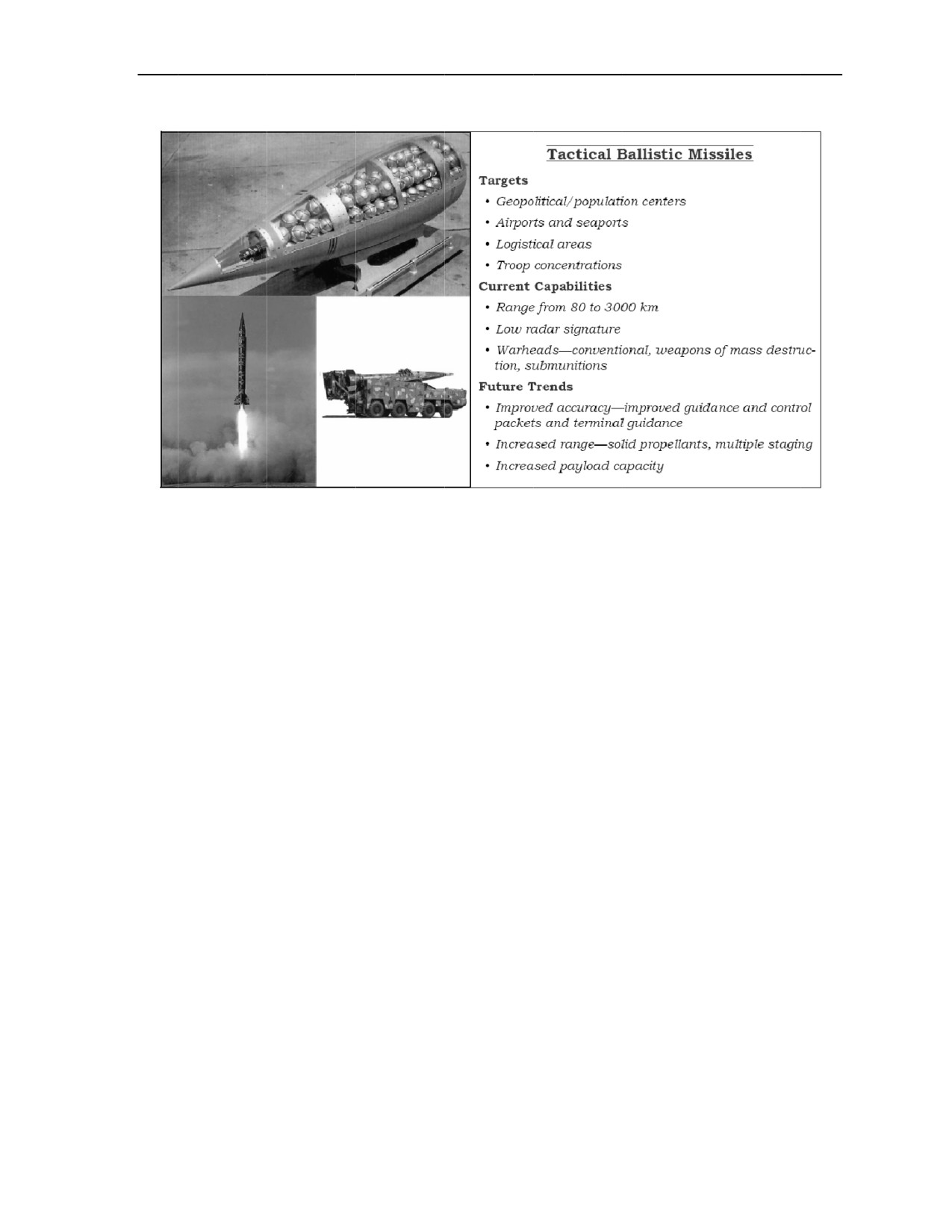
Tactical Ballistic Missiles
B-18.
TBMs include
short-range ballistic missiles with ranges
up to 1,000 kilometers and
medium-range
ballistic missiles with ranges from
1,000 to 3,000 kilometers. These are surface-launched missiles with
ballistic trajectories. TBMs, often
launched from highly mobile, difficult-to-detect transporter erector
launchers, can carry
nuclear, biological, and chemical weapons. Most TBMs
are single-stage missiles with
an estimated circular error probable accuracy of one-tenth of one percent
of the range.
State-of-the-art
guidance technologies, such as the
global positioning system and GLONASS, can increase
this accuracy to
less than 50 meters (Figure B-2).
B-4
FM 3-01
25 November 2009
Threat
Figure B-2. Tactical ballistic missiles
What
Makes TBMs Threatening?
B-19. TBMs are inherently difficult to defend against. Characteristics
that increase
TBM survivability
include a small
radar cross section, high terminal velocity, short notification time for
defending forces, a
variety of difficult-to-kill warheads, and an all-weather salvo launch capability.
Rockets, Artillery, And Mortars
B-20. Though rockets and artillery are organic to field artillery units and
mortars to infantry units, they are
grouped together because they
exhibit similar characteristics and trends. They are expected to remain the
most serious threat to personnel and to all
but the most heavily protected vehicles and other equipment.
Advances in munitions and delivery systems have increased their ranges and lethality. The advent of
artillery-delivered, high precision munitions
(ADHPM) makes the
mounted and armored
forces
increasingly vulnerable to artillery indirect fire (Figure B-3).
25 November 2009
FM 3-01
B-5

Appendix B
Figure
B-3. Rockets, artillery, and mortars
Large-Caliber Rockets
B-21.
Large-caliber
rockets, classified as those
of 200 millimeters and greater, are unguided, surface-
launched, indirect fire rockets with minimum ranges of 50 kilometers and maximum ranges in excess of
100 kilometers. They can be fired from single or
multiple launch platforms (Figure B-4).
B-6
FM 3-01
25 November 2009

Threat
Figure B-4. Large caliber rockets
B-22. Rockets can deliver high
rates of fire
and a variety of warheads, making them ideal weapon systems
for fire support
missions. The highly mobile launchers
can rapidly move around
the battlefield. This
mobility, coupled with the rockets’ short burn time, gives maneuver forces little warning. Their short
range
and salvo capability preclude engagement by
current missile defense systems.
Cannon Artillery
And Mortars
B-23. Artillery
and mortars are recognized
as systems of systems—each is not effective if one
of its
components (weapon, C2, reconnaissance, and munitions)
is deficient. Thus, countries are upgrading and
improving deficient components rather than
replacing the entire systems.
What
Makes Cannon Artillery
And Mortars Threatening?
B-24. Cannon artillery and mortars possess high firepower and a variety of warheads. The advent of
ADHPM represents a force multiplier, allowing smaller
forces to rapidly and accurately attack
larger
mechanized forces.
Aerodynamic Missiles
B-25. Aerodynamic missiles include cruise missiles and tactical air-to-surface missiles.
Though regarded as
distinctly separate threats, the
application of
new technologies has given cruise missiles and tactical
air-to-
surface missiles virtually identical capabilities.
25 November 2009
FM 3-01
B-7

Appendix B
Cruise Missiles
B-26.
Cruise missiles are unmanned, self-guided vehicles that maintain sustained flight
at one or more
predetermined constant (cruise) altitudes. These missiles carry
a warhead or other lethal payload. There are
two types of cruise
missiles: anti-ship and land
attack. The Army is most concerned with
the land attack
versions (Figure B-5).
Figure B-5. Characteristics of cruise missiles
B-27.
Cruise missiles are reliable,
accurate, survivable, and lethal. They can be launched from the land, air,
or sea; in flight, they
are difficult to
detect, can fly indirect routes at low altitudes to avoid heavily defended
areas,
and can attack
from any direction. Today’s cruise missile can hit a target with remarkable accuracy;
tomorrow’s smarter,
maneuverable, more accurate missile will
pose a far greater threat. Cruise missiles are
ideal for striking high-value targets in highly defended areas, since aircraft and aircrews are
not put at risk
Although only a few countries have operational land attack
cruise missiles in their inventories today,
Russia, France, Germany, Italy, Israel, South Africa, and China have ongoing development programs and
are aggressive arms
exporters. Many of the cruise missiles in
development
should become operational in
the next five to ten years.
What Makes Cruise Missiles Threatening?
B-28.
Emerging cruise missiles pose a serious threat because
of their unique operational
characteristics.
New technologies used in airframe and warhead
design and in
propulsion and guidance systems increase
their lethality. Stronger and lighter
airframes made of composite materials give these missiles a lower radar
cross
section; also, low-observable
and stealth technologies are now available to further reduce the radar
cross section.
B-29.
The use of air-breathing turbojet and turbofan engines has given cruise missiles a longer range, and
the capability to fly
at high, subsonic speeds and altitudes as
low as 50 meters above ground level. Their
flight
paths can be
programmed
using sophisticated guidance systems such as the global positioning
system, the inertial navigation system, and terrain
contour matching; guidance
systems contribute to overall
accuracy, optimize surprise and help avoid air defenses. A terminal guidance
seeker can increase accuracy
to less
than 10 meters. A wide
array of conventional warheads, including individually
targetable sub
munitions, allows targeting of both soft and hard targets. Weapons of mass destruction
pose the most
B-8
FM 3-01
25 November 2009

Threat
serious threat, but currently only Russia, France, and the
United States
have cruise missiles with nuclear
warheads.
B-30. However,
the development of a chemical or biological warhead
is not difficult. The May
1997
Quadrennial Defense Review
noted that the
use of weapons of mass destruction is a
likely condition of
future warfare and that these weapons could
be delivered by several means, including cruise missiles.
B-31. While land attack cruise missiles pose the greatest
threat, submarine-launched cruise missiles
are a
potential threat
to the United
States in the foreseeable future. Some 19
countries currently produce
cruise
missiles, and several more have production capability. At least 54 others
countries have
some type of
cruise
missiles (mostly
anti-ship) in their arsenals, and the trend toward land attack types is growing. A significant
number of both
land and anti-ship cruise missiles can be submarine launched, and at least three countries of
concern (China,
Iran, and North Korea) have submarines. Submarine-launched cruise
missiles provide a
viable asymmetrical attack option against U.S. ports and the U.S. homeland.
Tactical Air-To-Surface Missiles
B-32. These missiles are air-launched, precision-guided munitions designed to strike ground targets.
. They
are ideal against
targets that are difficult to destroy with conventional “dumb” bombs such as bridges. They
are similar to air-launched cruise missiles, but are smaller, have shorter ranges,
lack the wings and
aerodynamic lifts associated
with cruise missile flights, and are launched by tactical fighter-bomber
aircraft. The former Soviet Union and Free
World countries widely export tactical air-to-surface missiles,
and the missiles
are operational in numerous
air forces around the world (Figure B-6).
Figure B-6. Characteristics of tactical air-to-surface missiles
What
Makes Tactical Air-To-Surface Missiles Threatening?
B-33. Tactical air-to-surface missiles are an
extremely lethal threat because of their versatility and pinpoint
accuracy. Most
threat variants are of Soviet or Russian origin and
employ radio-command,
laser,
antiradiation homing, or electro-optical guidance systems. Missiles that employ antiradiation homing
systems are referred to as antiradiation missiles (ARMs);
they represent
the greatest threat to AMD, field
artillery (counter-battery), aviation, and intelligence radars. Most have ranges of more
than 100 kilometers.
An aircraft firing an ARM will usually launch from outside the lethal envelope of the
air defense system
defending the asset. Laser-guided systems provide the least
standoff protection because
of their short
range,
generally less than 10 kilometers. Electro-optical or video-guided systems and ARMs offer the greatest
25 November 2009
FM 3-01
B-9

Appendix B
standoff range and aircraft survivability factor. Some electro-optical systems
have ranges of approximately
100 kilometers.
Unmanned Aircraft Systems (UASs)
B-34.
UASs include
drones, characterized by
preprogrammed flight paths
and patterns, and remotely
piloted
vehicles, controlled by ground-based operators. Each
can perform a
variety of missions, ranging
from reconnaissance
and battlefield
surveillance to attack and electronic warfare (Figure B-7).
Figure B-7. Characteristics
of unmanned aircraft systems
What Makes UASs Threatening?
B-35.
UASs serve as ISR platforms for target
detection, identification, and
location; weapon targeting;
target
designation; and battle damage assessment. State-of-the-art sensors and data links provide real-time
targeting for fire support systems, maneuver forces, and aircraft. UASs equipped with laser designators
provide immediate targeting of assets for attack by smart munitions and field
artillery.
B-36.
UASs have relatively low radar cross sections, low speed, and low thermal signatures, thus making
them difficult to detect, track, and
engage. Mission-dictated flight profiles take full advantage of terrain,
increasing system survivability and optimizing coverage. Flight altitudes are
normally between 1,000 and
3,000
meters above
ground level. UASs conducting ISR missions fly at altitudes safe from
small arms fire.
In addition, UASs can stand off and detect from up to 25 kilometers.
B-37.
UAS payloads
consist of daylight television, infrared video, and film
cameras (for
reconnaissance
missions). Other major payload categories include electronic
warfare, electronic intelligence, radar, and
attack
warheads. Several nations are developing
and fielding antiradiation homing UASs with the primary
mission of attacking
battlefield radio frequency emitters (radars, communications). These platforms have
a
variety
of launch options and are
usually fire-and-forget systems. Other attack UASs employ terminal
guidance to kill tanks or fighting vehicles.
B-10
FM 3-01
25 November 2009

Threat
Helicopters
B-38. Most countries maintain helicopter
fleets to support military operations. While the majority of
helicopters can
be armed to perform a variety of roles, the attack helicopter poses the greatest threat to
maneuver forces. The versatility and survivability of helicopters make them ideal for
use in most combat
areas (Figure B-8).
Figure
B-8. Helicopters
What
Makes Helicopters Threatening?
B-39. Threat ground force commanders
rely primarily
on helicopters to fulfill
direct air support
requirements. Helicopters can
perform a variety of missions. Hovering
and low-flying
helicopters,
taking
full advantage
of terrain masking, are difficult to acquire and target. Better fire control and weapon
capabilities will
enable helicopters to search, acquire, and fire at ground targets from longer standoff
ranges, thus increasing their survivability and
effectiveness
Fixed-Wing Aircraft
B-40. Air power
remains essential to virtually every type
of military operation, and despite the emergence
of
TBMs and cruise missiles,
it will continue to play a key role in future conflicts. There are more than
40,000 operational military aircraft today; of
these, some 10,000 (many produced during the Cold War era)
are in Third World inventories. Some 45 countries have an
aviation industry of some kind, and 21 countries
design their own
aircraft. Today, the United
States, France, and Russia are the leading exporters of combat
aircraft (Figure B-9).
25 November 2009
FM 3-01
B-11

Appendix B
Figure B-9. Fixed-wing aircraft
What Makes Fixed-Wing Aircraft
Threatening?
B-41.
Fixed-wing combat aircraft
are highly flexible and can perform a
variety of missions in both
offensive and defensive operations: air interdiction, strategic attack, suppression of enemy
air defense, and
close
air support. Fixed-wing aircraft can employ a variety of munitions, including guns,
rockets, cruise
missiles, and tactical
air-to-surface
missiles. Integrated navigation/bombing computers and
related mission
equipment provide new combat aircraft with a precision-strike capability day
or night and in
bad weather.
B-42.
New aircraft incorporate such features as
radar warning
receivers, on-board jammers, chaff, flares,
and a
lower radar
cross section
to improve survivability and mission success rate. In addition, the
proliferation of fixed-wing aircraft
throughout the world increases the probability that opposing forces may
employ the same aircraft in a conflict; this will further exacerbate the already challenging problem of
identification.
STRATEGIC THREAT
B-43.
Despite the end of the Cold
War, the threat of accidental, unauthorized, or limited
strategic strikes
against the United
States exists.
. Intercontinental ballistic missiles
(ICBMs) and submarine-launched
ballistic missiles (SLBMs) are a threat to the United States—
they carry nuclear warheads and employ
a
variety
of penetration
aids.
Intercontinental Ballistic Missiles (ICBMs)
B-44.
Although the
only current ICBM producers are the United States, Russia, North Korea, and China,
several countries are
developing production capabilities. Thus,
the threat to the United States continues to
grow.
Other countries developing
ballistic missiles are likely
to also develop various responses to U.S
defenses. Developing countries would probably rely on available Russia
or Chinese
countermeasure
technologies such as
separating reentry vehicles,
spin stabilizing reentry vehicles, radar absorbing material,
low-power jammers, and simple (balloon) decoys
(Figure B-10).
B-12
FM 3-01
25 November 2009

Threat
Figure B-10. Intercontinental
ballistic missiles
B-45. Rudimentary technologies from earlier versions of U.S. and Soviet missiles are more readily
available and are adequate for use by nations not overly
concerned with missile accuracy, reliability, or
safety. The increased availability of technical assistance from other nations and of classified information
related to ballistic missiles and weapons of
mass destruction will short-cut development programs.
Once
launched, ICBMs are difficult to defeat. Their targets may be strategic
or political,
civilian or military.
ICBMs will most likely use nuclear warheads, and many
systems (currently only Russian ones) will
carry
multiple reentry
vehicles. Projected improvements include mobile basing, improved reliability, increased
accuracy, and improved penetration aids.
Submarine-Launched Ballistic Missiles (SLBMs)
B-46. The United States, France, Russia,
and China currently produce SLBMs.
Submarine mobility
provides launch
location options unavailable to ICBM
forces and makes detection difficult. SLBMs
provide ICBM capabilities with the added advantages of better hiding, shorter flight times, and depressed
reentry angles.
Targets will generally be identical to those of ICBMs. Projected SLBM improvements
include more sophisticated payloads and guidance systems, improved
reliability, increased range, and
improved penetration aids.
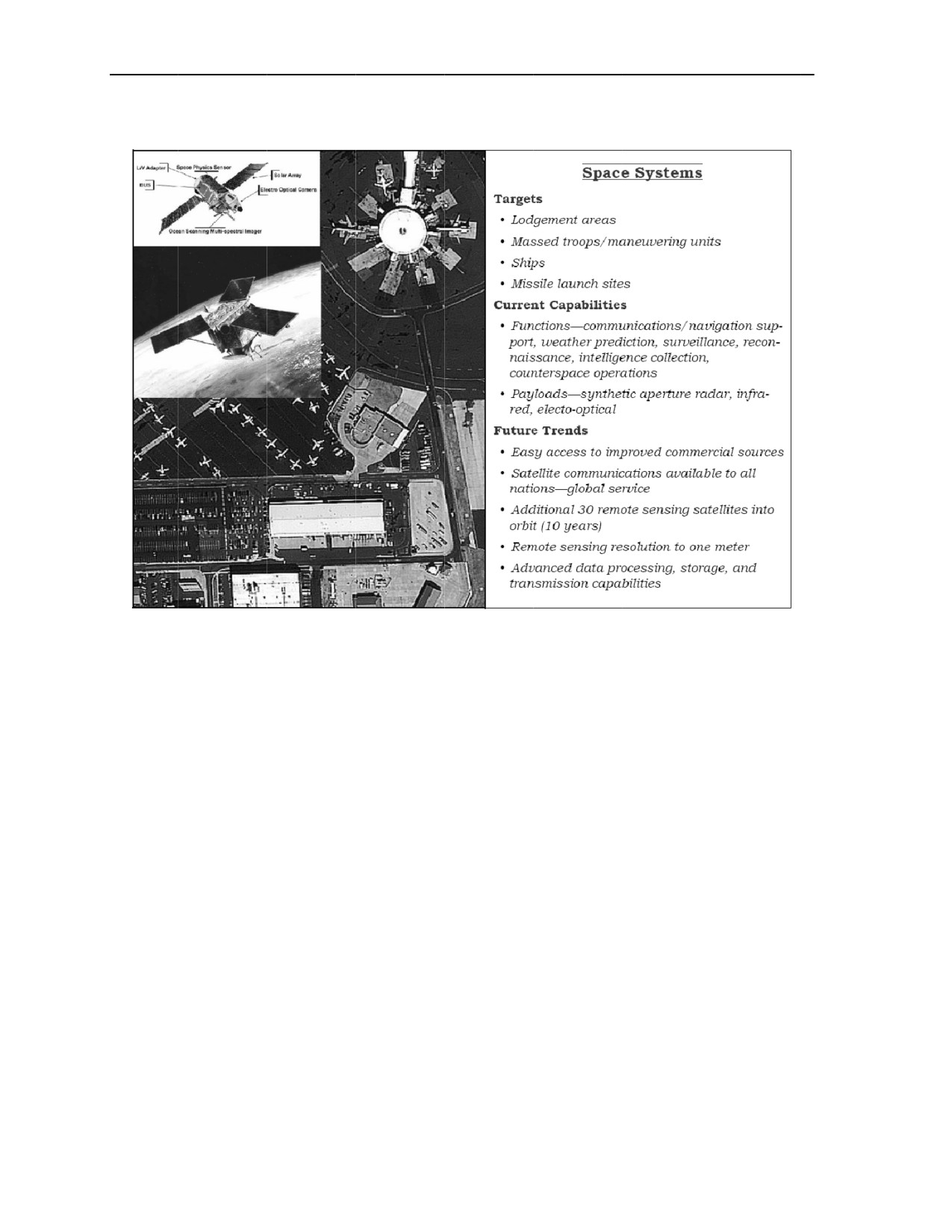
SPACE SYSTEMS
B-47. Space is the new high ground for operations. Space
systems are emerging as key
force multipliers—
they are critical
to the tactical,
operational, and strategic levels of warfighting. Space systems consist
of the
space mission element, the ground support element, and the control linkage between them. A separate but
necessary adjunct is the space
launch facility. Current military operations
dating back to
the 1991 Gulf War
illustrate the criticality of assuring our access to space and
space systems while denying it to our enemies.
Space system
functions include communications support, weather prediction, navigation support,
surveillance, and reconnaissance (Figure B-11).
25 November 2009
FM 3-01
B-13
Appendix B
Figure B-11. Characteristics of space systems
What Makes Space Systems Threatening?
B-48.
Until recently, space systems represented
revolutionary
technology
that only nation states could
afford. Today, many
of the capabilities that were
once the sole
purview of the military are
available on the
international market. Worldwide access to space
system resources is available through purchasing, leasing,
renting, or time-sharing available
assets from
one of the space developer nations or
consortia. The
commercial sector—not the Federal Government—now drives advancements in satellite
technology and
products.
B-49.
The “leveling”
of global technology and the multibillion-dollar space industry have spawned a robust
commercial industry
our adversaries can use to support a variety of military or terrorist operations. Over the
next 10 years, more than 30 commercial or government-sponsored imaging satellites are planned for
launch. The sheer number of these new satellites, and the fact that most are foreign or consortia owned,
diminishes the ability of the United States to impose political
constraints on the use of satellite imagery
products. These new
commercial imaging capabilities will allow an adversary
to challenge
the U.S. force’s
ability
to achieve strategic and tactical surprise and to gain and sustain information superiority.
B-14
FM 3-01
25 November 2009
Appendix C
Air and Missile Defense Planning
This appendix describes the Air and Missile defense planning process and the
specific requirements of the AMD estimate and AMD annex. The estimate process
assists the force commander in decision-making. The end result of the planning
process is the AADP annex detailing ADA support for the concept of the operation.
AIR AND MISSILE DEFENSE PLANNING
C-1. Air and missile defense planning is a distributed process occurring at all echelons. The JFC, or if
delegated, the JFACC or AADC will task components to develop a detailed prioritized list of defended
assets. The AAMDC commander in the roles of TAAMDCOORD and DAADC (AMD) is involved in this
development process by assisting the ARFOR and AADC in the planning and coordination of the critical
asset list (CAL) and creating the defended asset list (DAL). The JFC or JFACC/AADC goes through a
staffing process with the components to merge all priorities into a single list.
C-2. The AADC develops the AADP for the theater. The DAADC (AMD) assists the AADC with the
AADP development. In the role of DAADC (AMD), the TAAMDCOORD, with input from the fire support
element and the Army airspace command and control element, assists the JFLCC’s staff (J3 and J5) in
providing recommendations on Army critical asset priorities, ADA priorities, and resource allocation to
support the JFC’s air and missile defense concept.
C-3. The Army Air and Missile Defense Command is the Army’s focal point for planning, coordinating,
integrating, and executing TAMD operations. EAC ADA brigades conduct defense planning and task
organize forces to protect assigned assets from the DAL. ADA battalions continue to refine these plans and
further task organize to execute air and missile defense operations. Also, the TAAMDCOORD advises the
COMARFOR/JFLCC on the employment of the EAC ADA brigade to ensure integration into the theater
air and missile defense plan. When necessary, corps commanders may be tasked to protect theater assets on
the DAL located in the corps area using corps ADA forces.
C-4. As in the offense, the commander needs to mass enough forces at the critical place and time to defeat
the enemy's airborne platform attack and deny aerial surveillance of friendly forces. The AMD plan
addresses air defense protection of shaping, decisive, and sustaining operations. Lateral coordination helps
to preclude coverage gaps in the defense along boundaries. Depending on the size and the mission of the
covering force, the AMD plan may allocate some air defense to the covering force. If the covering force's
mission is to destroy the lead elements of the enemy force, the Avenger is the more mobile weapon system.
If the covering force is merely a screening force providing information, over-watching fires from air
defense systems farther back may suffice.
C-5. ADA units may be allocated to protect reserve or counterattack forces, C2 nodes and logistics
facilities. If the division is defending against the enemy main attack, ADA systems may be moved forward
to achieve the mass and early engagement capability needed to defeat the likely attack helicopter, CM, and
UAS threat. If the division is defending against what becomes a supporting attack, ADA systems can be
moved to rearward positions to protect forces not committed to combat. The AMD plan must support
contingency options to enable rapid transition from defensive to offensive operations. AMD plans are
synchronized with the supported force and coordinated with higher and lower ADA echelons and adjacent
ADA units.
C-6. The factor of METT-TC influences integrated air and missile defense planning from theater through
battalion level and permits reinforcement of the synchronization process. The type of theater and defensive
operation provide the framework for METT-TC analysis. The type of theater can affect our ability to
collect intelligence and targeting information on the enemy. It also affects the deployment of friendly
25 November 2009
FM 3-01
C-1

Appendix C
forces and the development timeline. The integrated planning process and products are depicted in Figure
C-1.
THEATER CAMPAIGN PLAN
EAC
METT-TC
JTAMD PLANS
CORPS OPERATIONS PLAN
CORPS
CORPS AMD ANNEX
DIVISION OPERATIONS PLAN
DIVISION
DIVISION AMD ANNEX
BRIGADE OPERATIONS PLAN
BRIGADE
BRIGADE AMD ANNEX
BATTALION OPERATIONS PLAN
BATTALION
BATTALION AMD ANNEX
Figure C-1. Integrated air and missile defense planning
AIR AND MISSILE DEFENSE PRIORITIES
C-7. The ADA commander considers METT-TC, IPB, and the supported commander's intent, concept of
operations, and develops AMD priorities. The ADA commander submits these priorities to the maneuver
commander for approval. Priorities are based on the factors of criticality, vulnerability, and threat (CVT).
CVT is the methodology used to evaluate each asset on the critical asset list (CAL). This methodology
employs objective criteria and quantifies the level of importance of each asset. The CVT methodology
assists the commander in identifying those assets to be protected from attack using available ADA
resources and accepting risk as necessary. The CVT is a mission, location, and command influenced
process, the numbers and weights, are changeable as required by the commanders’ intent or as the changing
mission dictates.
C-8. Criticality is the degree to which an asset or force is essential to mission accomplishment.
Determination of the criticality of an asset or force is made by assessing the impact on the conduct of the
operation that would result from damage to the asset or force. The degree of criticality is based on whether
damage to the asset or force prevents, seriously interferes with, or causes only limited interference with the
execution of the plan.
C-9. Vulnerability consists of two parts: susceptibility to damage, if attacked, and recuperability.
Susceptibility to damage is further subdivided into two parts: hardness and dispersion. Consideration
should be given to the asset or force’s hardness and its ability to disperse or displace to another position.
Recuperability is the degree to which an asset or force can recover from inflicted damage in terms of time,
equipment, and available manpower to continue its mission.
C-2
FM 3-01
25 November 2009

Air and Missile Defense Planning
C-10. Threat is the assessed probability of an asset or force being targeted for surveillance or attack by
enemy air and missile threats. The use of threat information, to develop AMD priorities, is a reverse IPB
process—what we expect enemy air to detect and attack, based on IPB. Targeting information provided by
intelligence estimates, past enemy surveillance and attack methods, and enemy doctrine is useful in
evaluating AMD priorities. To determine the relative importance of assets and forces, the commander
considers certain characteristics, which make an asset or force a lucrative target for the enemy. In effect,
this is reverse target value analysis. Intelligence estimates, past enemy surveillance and attack methods,
and enemy doctrine are useful in assessing the probability that an asset or force will be targeted by the
threat. This is, in effect, reverse target analysis.
Theater-Level Critical Asset Lists
C-11. The critical asset list (CAL) is a prioritized list of critical assets identified by phase of the operation.
This list is developed by the J3/J5 with input from the components of the joint forces. They identify
candidate assets to be protected from attack. The JFC or combatant commander approves the CAL listing
and it is included in the OPLAN and AADP. The CAL development process evaluates critical assets based
on CVT, ADA resources, possible defense designs, and the elements of risk to develop the defended asset
list (DAL).
Defended Asset List
C-12. The defended asset list (DAL) is a JFC-approved prioritized listing of assets by phase that are to
receive AMD protection. This list is included in the OPLAN and the area AADP. The DAL specifies
required levels of protection for each asset. The DAL may be developed by the AADC with component
input but normally the AADC delegates the DAL process to the DAADC (AMD). The DAADC (AMD)’s
DAL recommendation (with component commanders input) is submitted through the AADC to the JFC for
approval. Figure C-2 depicts the process used to develop the DAL.
JFC JTMD Guidance
Priorities
CAL
DAL
Concept of Operations
J5 Planning Staff
AADC/DAADC
JTMD Responsibility
JTMD Responsibility
NAVFOR
NAVFOR
AFFOR
AFFOR
CRITICAL
DEFENDED
ASSET
ARFOR
ASSET
LIST
CVT
MARFOR
MARFOR
LIST
ARFOR
DEFENSE DESIGN
CRITICAL
JSOTF
JSOTF
ASSETS
AMD RESOURCES
Conducted during
Conducted during
RISK
Reprioritization
MDMP
Board
Figure C-2. CAL-DAL development process
Defense Designs
C-13. Defense designs are the implementation of AMD plans. Defense designs are the detailed positioning
of the ADA systems, radar, launchers, and communications to maximize the defense of defended assets.
Through defense designs, available ADA assets are arrayed to provide required levels of protection for
25 November 2009
FM 3-01
C-3
Appendix C
assets on the DAL. Defense planning is a top down interactive process that covers the full range of AMD
operations from the JFC to the fire unit level. The objective of defense planning is to protect the force and
critical assets in accordance with the DAL priorities. This process ensures effective ADA coverage for
assets on the prioritized DAL utilizing all ADA systems available.
ACTIVE DEFENSE PLANNING CONSIDERATIONS
C-14. Army ADA units will be positioned by the appropriate ground force commander in defense of
critical assets relative to suspected threat approach avenues or azimuths. Because of their limited numbers,
ADA resources are allocated based on specific air and missile defense priorities. The AAMDC provides the
air and missile defense annex to the ARFOR or JFLCC plan. In the air and missile defense plan, EAC ADA
brigades normally will protect priority assets from the combatant commander's defended asset list. ADA
commanders design defenses and task organize forces to protect designated priority assets.
PASSIVE DEFENSE PLANNING CONSIDERATIONS
C-15. Passive measures are an essential part of air and missile defense planning at all levels. All units
conduct passive actions in conjunction with their assigned missions. Passive actions reduce the
effectiveness of the enemy air threat. The AAMDC has an ADA passive defense cell with the necessary
personnel and equipment to support the TAAMDCOORD.
C-16. The AMDCOORD evaluates and recommends passive measures for incorporation into the maneuver
commander's plans and SOPs. The AMDCOORD recommends measures that may deceive, frustrate, and
surprise enemy air and surveillance assets. Some examples at the operational level are moving large units at
night, developing an early warning system, creating large area smoke screens, and establishing emissions
control
(EMCON) procedures. Some examples at the tactical level are employing radar scattering
camouflage, utilizing early warning instead of local sensors, and locating units on revetted or otherwise
prepared sites.
OPERATIONAL PLANNING PROCESS
C-17. Air and missile defense planning at the operational level is an interactive process. The same planning
process will occur regardless of whether the Air Force, Navy or the Marine Corps is providing the majority
of the air assets.
C-18. When the AAMDC is in theater, normally the AAMDC commander will be designated the DAADC
(AMD) and will be the principal integrator for the JFLCC to the AADC on all air and missile defense
aspects Figure C-3. An AAMDC liaison team works closely with the AADC and their staff and the BCD to
accomplish air and missile defense integration. The BCD air defense section coordinates its activities with
the AAMDC LNO team. The BCD air defense section may also augment the AAMDC LNO team as
needed. The BCD accomplishes coordination when the AAMDC is not in theater, which locates part of its
staff with the joint air operations center JAOC.
C-4
FM 3-01
25 November 2009

Air and Missile Defense Planning
Figure C-3. AAMDC integration with JAOC and BCD
C-19. The JFLCC, through the AAMDC commander in the DAADC (AMD) role, provides an air and
missile defense estimate to the AADC. The BCD may perform this handoff function when the AAMDC is
not in theater. With JFC guidance, the JFACC in coordination with the component commanders develops
the air operations plan.
C-20. The BCD establishes the ARFOR liaison and interface with the JFACC. The BCD eases the
coordination and synchronization of the JFACC air and ARFOR ground operations. The BCD performs its
mission by (1) exchanging operational and intelligence data between the JFACC and COMARFOR and (2)
interpreting the land battle situation for the JFACC and the air operations situation for the COMARFOR. If
the JFACC is from the USN or the USMC the BCD has a contingency mission to deploy support teams
with the USN JAOC and/or Marine tactical air command center to give the same BCD functional area links
as in the USAF JAOC. If the COMARFOR is not the JFLCC, the BCD will coordinate with the agency
determined by the JFLCC. The BCD may also be tasked by the JFLCC to provide JFLCC input to the
JFACC. The JFLCC organizes the BCD based on the type of theater and the JAOC organization. In force-
projection operations involving only one corps, the corps commander will structure the BCD. The BCD
provides ARFOR or, if JFLCC directed, JFLCC input into the air operations planning process. Army air
and missile defense contributions are planned and coordinated through the AAMDC, EAC ADA brigade,
corps, and division CPs. Refer to FM 100-13 for a more detailed discussion of the BCD.
C-21. The AADC develops the DCA portion of the plan and allocates assets for various missions (see
Figure C-4). The JFLCC's TAAMDCOORD determines whether the corps has sufficient air and missile
defense resources or if the JFLCC should allocate additional theater Army air defense assets for protection
of the corps. The TAAMDCOORD may also recommend that the JFLCC allocate corps air and missile
defense resources to protect theater assets. The TAAMDCOORD recommends to the JFLCC which assets
Army ADA units can protect and which assets require other component or multinational coverage. The
AAMDC is the only Army organization properly staffed and equipped to ensure AMD integration and is
normally collocated with the AADC. In the absence of the DAADC (AMD) when the AAMDC is not in
theater, the senior ADA commander will perform the AADC's DCA planning process. However, this is
normally a DAADC (AMD) function because the AAMDC has the necessary expertise, personnel, and
equipment to deploy to the AADC's location to accomplish AMD integration.
25 November 2009
FM 3-01
C-5

Appendix C
Recommended AMD Priorities
Approved AMD Priorities
AAMDCOORD
Air and Missile
AAMDCOORD
IPB
Air and Missile
Defense Estimate
Defense Annex
IPB
Recommended
Approved OCA/TMD
Commander’s
Mission and
OCA/AMD Targeting
Targeting Priorities,
Approval
Commander’s
Prorities, Targets, and TAIs
Targets, and TAIs
Concept
IPB
IPB
Fire Support
FSCOORD
FSCOORD
Estimate
Fire Support
Annex
Recommended Targeting Priorities,
Approved Targeting Priorities,
Targets, and TAIs
Targets, and TAIs
Figure C-4. Development of air defense and fire support annexes
C-22. The AAMDCs plan enables the JFLCC to finalize the air and missile defense and fire support
portions of the land operation plan. The JFLCC's priorities are the foundation for interdiction targeting. The
JFLCC's TAAMDCOORD develops the air and missile defense portion of the land operation plan.
C-23. The JFLCC allocates resources and assigns tasks to corps, which can sub-allocate assets and assign
air and missile defense missions to divisions. In each corps and division main CP, the G3 plans section
develops the maneuver plan. Within the G3 plans section, the AMDCOORD, with input from the G2, AC2
cell, and artillery’s fire direction center incorporates the air and missile defense mission into this maneuver
plan.
C-24. During the targeting process, the AMDCOORD, in conjunction with the G2, develops and
recommends OCA and AMD targeting priorities and nominates OCA and AMD targets and target areas of
interest (TAI). The AMDCOORD then develops and recommends AMD priorities to the commander for
approval. The air liaison officer participates in this process by recommending suppression of enemy and air
defense (SEAD) targets to the fire support coordinator (FSCOORD).
C-25. The FSCOORD and the AMDCOORD incorporate the approved priorities into the fire support annex
and the air and missile defense annex of the maneuver plan. The FSCOORD integrates OCA and AMD
targets, targeting priorities, and theater areas of interests into the force’s fire support plan. The
AMDCOORD includes the DCA and AMD active defense priorities and associated IPB products in the
development and coordination of the force's air and missile defense operation.
C-26. Coordination between AMDCOORD and FSCOORD ensures that the OCA, DCA, and AMD
portions of the air and missile defense effort are complementary. The integration and synchronization of
DCA and AMD attack operations by the AMDCOORD and FSCOORD prevents mutual interference and
maximizes unity and economy of effort.
C-27. Coordination of OCA and AMD targets between the Army and the Air Force occurs at the AOC and
the control and reporting center (CRC). OCA, DCA, SEAD, and AMD plans are developed simultaneously
and in concert, not as separate, isolated plans. The OCA, DCA, SEAD, and AMD plans are an integral part
of the theater campaign plan and the maneuver plan at each Army echelon.
C-6
FM 3-01
25 November 2009
Air and Missile Defense Planning
AIR DEFENSE ESTIMATE AND ANNEX PROCESS
C-28. Estimates are evaluations of how factors in each field of interest will influence the courses of action
the commander considers. Estimates provide the basis for logically and analytically developing solutions to
situations (both in planning future operations and fighting current operations). The staff recommends how
the commander can employ the command's available assets. The commander uses this information to reach
decisions.
C-29. Once a mission is received, the estimate process begins. The ADA commander develops the air and
missile defense estimate in concert with the force S-3 or G-3. The ADA commander uses the IPB during
the estimate process. The ADA commander gathers and analyzes facts and makes assumptions. They will
use these facts and assumptions to develop logical courses of action. The commander then chooses the
course of action that will best support the mission.
C-30. After the force commander selects a course of action, the AMD planning process continues. The
result of this process is the air defense annex detailing AMD support for the concept of the operation.
AIR DEFENSE ESTIMATE FORMAT
C-31. The air defense estimate follows the basic staff estimate format. The air defense estimate provides
information regarding the air and missile defense supportability of proposed courses of action. It also
provides recommended air and missile defense priorities and an air and missile defense scheme of
maneuver. This information forms a basis for the AMD plan and is presented in the air defense annex.
C-32. The estimate must be constantly reevaluated to keep it current. The factors of METT-TC,
observation, cover and concealment, obstacles, key terrain, and other considerations guide the ADA
commander and staff during the estimate and subsequent planning. The degree of detail presented in the
estimate depends on the planning time available. However, all elements of the estimate must be considered
to make valid recommendations (see Figure C-5).
AIR DEFENSE ANNEX FORMAT
C-33. The estimate of the situation assists the commander in determining the most suitable course of action
to accomplish the mission. Once the commander makes this decision and clearly articulates the intent, the
staff prepares OPLANs and OPORDs.
C-34. The AMDCOORD must conduct detailed coordination with other staff sections to develop this
annex. The AMDCOORD derives information affecting the air defense annex from other staff estimates.
Additionally, the air defense estimate helps drive these other staff estimates.
C-35. The AMDCOORD writes the plan as a five-paragraph annex to the supported unit's OPLAN or
OPORD. The air defense annex assigns specific air and missile defense missions each unit must
accomplish. Concurrently or sequentially, ADA units may be preparing their own OPLANs or OPORDs
(see Figure C-6).
25 November 2009
FM 3-01
C-7
Appendix C
ESTIMATE OF THE AIR DEFENSE SITUATION
(Classification)
Headquarters
Place
Date, time, and zone
Message reference number
AIR DEFENSE ESTIMATE NUMBER____
References: Maps, charts, or other documents.
Time Zone Used Throughout the Estimate:
1. MISSION
When the estimate's purpose is to support the force level commander's operation, use the force level
commander's mission statement. As the commander or operations officer, use the unit's mission
statement when the estimate's purpose is to determine which course of action best accomplishes the
support mission.
2. SITUATION AND CONSIDERATIONS
This paragraph describes the conditions under which the unit will perform its mission and the possible
courses of action of the supported force.
(a) Characteristics of Area of Operation. For this paragraph, determine those factors of the
situation, which influence friendly and threat actions and which, therefore, may influence the choice of
a course of action. In the absence of facts, use logical assumptions that might directly affect the
mission. Includes analysis of the effects of pertinent characteristics on conducting air and missile
defense operations
1. Weather. Put the analysis of data from predicted weather and light conditions for the period
in this paragraph. Assess how the weather affects friendly operations. Also include the evaluation
of how weather and light conditions might affect the use of threat UASs; missiles; aircraft, both
fixed and rotary-wing; and airborne or air assault operations. Try to determine or predict when the
threat will probably use those assets due to the weather.
2. Terrain. Analyze the effects of terrain, including effects on observation and fire; cover and
concealment; movement (surface and air); employment of friendly and threat CBRNE weapons;
communications, electronic warfare and combat surveillance; unconventional warfare;
psychological operations; and other aspects of military operations. Determine key terrain and air
avenues of approach. Also discuss terrain features that limit air vehicle detection or target
acquisition and terrain that might canalize or force air targets to fly a particular profile. Try to
determine where the threat will most probably use air assets.
3. Other pertinent factors. List analysis of political, economic, sociological, psychological,
and other factors
(such as hydrograph, environment, communications, science, technology,
materiel, transportation, safety and accident prevention, and manpower). Include deduction about
their effects on friendly and threat operations.
Figure C-5. AMD estimate general format
C-8
FM 3-01
25 November 2009
Air and Missile Defense Planning
AIR DEFENSE ESTIMATE NUMBER____
(b) Threat Forces. A threat evaluation discusses threat capabilities that are or may be a threat to
the operation.
1. Disposition. List locations of threat forces that will participate in air or missile operations or
that threaten friendly air and missile defense operations. Determine combinations of air platforms
that the threat may use when conducting a particular type of operation.
2. Composition. The threat organization for combat includes identity of units, types of air
platforms and missiles, and armament. Also address the expected number of sorties and missiles
to be flown per day, and possible composition of those sorties.
3. Strength. Consider numbers, sizes of committed and reinforcing units. Consider the
location of the threat, threat doctrine, and the unit's mission. Identify air and missile assets and air
support units that could or may affect the operation. When, where, and how many air platforms
will the threat fly during this operation?
4. Other considerations. Threat forces not discussed above.
5. Recent and present significant activities. Summarize recent threat activities that were
both successful and unsuccessful activities. Highlight any threat air activity to include number,
type of air platforms, and locations.
6. Peculiarities and weaknesses. Indicate threat peculiarities and weaknesses that might
influence combat effectiveness, including vulnerability to deception.
7. Threat courses of action. A compilation of available information from which to draw
conclusions about possible threat air courses of action and how they relate to the threat ground
courses of action.
(c) Friendly forces. The friendly force air and missile defense forces disposition, composition, and
strength. Highlight the vulnerability of the force to threat air and missile attacks and surveillance.
1. Friendly courses of action. State the force commander's course of action. Include any
guidance that affects air and missile defense operations. Include description of any phasing of
operations in the courses of action and the impact of those operations on support relationships or
requirements.
2. Current status of resources within staff area of responsibility. Report the status of personnel
and logistics in the unit. Identify civil-military operations requirements. Identify limitations that
affect or may affect the conduct of air and missile defense operations. Can the mission be
accomplished?
3. Current status of resources that affect AMD area of responsibility.
4. Comparison of requirements versus capabilities and recommended solutions.
5. Key considerations (evaluation criteria) for COA supportability.
(d) Assumptions.
Figure C-5. AMD estimate general format (continued)
25 November 2009
FM 3-01
C-9
Appendix C
AIR DEFENSE ESTIMATE NUMBER____
3. ANALYSIS
Analyze each COA using evaluation criteria to determine advantages and disadvantages. Identify
those aspects in the commander's plan, which create difficulty in providing air and missile defense
coverage and affect the ability of the force to accomplish its mission.
4. COMPARISON
Compare COAs using evaluation criteria. Evaluate and rank-order COAs for each key consideration.
A decision matrix should visually support comparison. Present an AMD course of action for each of
the supported force courses of action. Each AMD course of action presented should include the
following aspects:
• Air defense mission.
• Air defense priorities.
• Air defense fires.
• Air defense scheme of maneuver.
• AMD task organization.
•
Command and support relationships.
•
Key passive AMD measures.
•
Type of action required in each operational area (close, deep, and rear).
•
Combined arms for air defense active measures.
5. RECOMMENDATION AND CONCLUSIONS. Recommended COAs based on the comparison.
• Indicate which course or courses of action AMD can best support (using the elements of who,
what, when, where, how, and why).
• Recommend a list of AMD priorities.
• State the recommended AMD organization for combat, and employment of other active air
and missile defense assets.
• Possible OCA targets.
• Passive and active air and missile defense measures that will be most effective.
• Issues, deficiencies, and risks with recommendations to reduce their impacts.
________________________
NAME
RANK
(Air Defense Coordinator)
ANNEXES: (as required)
ESTIMATE OF THE AIR DEFENSE SITUATION
(Classification)
Figure C-5. AMD estimate general format (continued)
C-10
FM 3-01
25 November 2009
Air and Missile Defense Planning
Copy___of___copies
Issuing headquarters
Place of Issue
Date-time group of signature
Message Reference Number
ANNEX G (AIR DEFENSE) TO OPERATION ORDER NO _____
References: Maps, charts, or other relevant documents.
Time Zone Used Throughout the Order:
Task Organization:
1. SITUATION
a. Enemy. See Annex B (Intelligence).
1. Terrain. Identify most likely threat ingress and egress routes.
2. Weather. Identify threat aircraft all-weather capabilities and limitations.
3. Threat air capability and or activity.
(a) Air threat data. List air-capable organizations including air platforms by number and
type.
(b) Additional air threat information. List airs threat information pertinent to the operation
but not covered in the Intelligence Annex. Highlight specific air threat considerations like
sortie rates, subordination of air elements to ground units, ordnance peculiarities, target
preferences, tactics, and recent significant activities.
(c) Air avenues of approach. Lists all expected air avenues of approach and identify by
air platform their potential users. List all known-beginning points and describe avenue of
approach as it goes through the area of interest.
b. Friendly situation. AMD missions at all applicable levels. Describe how the air defense plan
integrates with higher echelon plans.
1. Higher units. Outline higher AMD unit intent and plans.
2. Adjacent units. Outline adjacent AMD unit intent and plans.
3. Supporting elements. Note supporting units and support relationship.
c. Attachments and detachments. Identify air and missile defense resources attached from
other commands and identify those air and missile defense resources detached.
2. MISSION
Mission statement should include who, what, when, where, how, and why statement of the
mission for the AMD unit.
Figure C-6. AMD annex general format
25 November 2009
FM 3-01
C-11
Appendix C
3. EXECUTION
a. Scheme of AMD support. Commanders overall AMD plan to include the intent, objectives, and
priorities.
b. Tasks to subordinate units. Briefly discuss AMD plan, command and support relationships,
and priority of protection.
c. Coordinating instructions. Instructions are applicable to two or more subordinate units.
Include references to other applicable annexes.
1. Coordination instructions for ADW, ADW, and LADW authority.
2. WCS authority. Include any plans to change WCS.
3. Hostile criteria. Basic rules the commander has established to assist in the identification of
friendly or hostile air vehicles. Include pre-planned changes.
4. Rules of engagement. Address ROE unique to the operation or points in the operation
where changes are intended. Include use of supplemental fire control measures.
5. Passive air defense. Addresses specific passive air defense measures that all units should
take to protect themselves from air and missile attack or surveillance during this operation.
6. Combined arms for air defense. Briefly discuss specific techniques units should use to help
in defending themselves against an air or missile attack or surveillance.
7. Early warning. Review method and format for passing early warning to the entire force.
4. SERVICE SUPPORT See Service Support Annex.
5. COMMAND AND SIGNAL
a. Command.
1. AMD CP locations.
2. Succession of command.
b. Signal. See Signal Annex.
1. IFF code edition and book number.
2. Communications links for early warning equipment.
ACKNOWLEDGE:
OFFICIAL:
RANK (Commander's rank)
NAME (Commander's last name)
APPENDIXES:
DISTRIBUTION:
ANNEX G (AIR DEFENSE) TO OPERATION ORDER NO _____
(Classification)
Figure C-6. AMD annex general format (continued)
C-12
FM 3-01
25 November 2009
Appendix D
Impact of Technology on ADA Forces
This appendix covers the impact of technology on our forces. Army ADA is
transforming to align with the transformation of the Army and Joint services. The
transformation will require the Army ADA community to become more mobile,
smaller, and able to overcome a changing asymmetric air and missile threat. The
transformation will provide for a more responsive, versatile, and adaptive ADA force.
The transformed ADA force must provide a more scalable, mission-tailored,
multifunctional capability for both the Army and the joint forces commanders. We
will no longer be a weapon centric force but, we will be a capabilities, and system of
systems force that will allow ADA forces to perform the AMD mission at the
strategic, operational, and tactical level in a wide range of military operations.
IMPACT OF TECHNOLOGY
D-1. Improved ADA weapon system technology provides commanders increased flexibility for defensive
counterair operations. The fusion of information from communications system, C2, and ISR, fire support,
and ADA systems combined with the commander’s judgment allows commanders to understand their
battlespace and conduct fluid noncontiguous operations from widely dispersed locations. A SIAP/COP
based on this fused information helps commanders make better and quicker decisions.
D-2. The increasing range and precision of direct and indirect fires allow Army forces to weaken attackers
and shape the situation before entering close combat. Improved C2, communications system and ISR
systems allow commanders to disperse their forces without losing the ability to mass effects at the decisive
time and place.
D-3. Dispersed Army forces present tactical challenges to air defense artillery forces. Modern technology
is providing ADA forces with the means for protection of the force. Trained soldiers and decisive leaders
apply those capabilities in uncertain situations to defeat enemies and transition to offensive operations that
achieve the desired end state.
D-4. These new ADA systems and capabilities include Terminal High Altitude Air Defense (THAAD),
Non Divisional Patriot PAC-3, Joint Land-Attack Cruise Missile Defense Elevated Netted Sensor System
(JLENS), Enhanced Target Range and Classification and maneuver AMD systems Surface-Launched
Advanced Medium Range Air-to-Air Missile (SLAMRAAM), Medium Extended Air Defense System
(MEADS), and communications and Intelligence systems.
D-5. There are emerging technology improvements that will improve the capabilities of air defense that
include; Beyond Visual Range (BVR), and Single Integrated Air Picture (SIAP), Non-Line-of Sight
(NLOS).
BALLISTIC MISSILE DEFENSE SYSTEM
D-6. The THAAD weapon system provides the Combatant Commander a rapidly deployable ground-
based, hit-to-kill, wide area missile defense capability and components that deepen, extend and
complement ADA systems and the Ballistic Missile Defense System. THAAD is an element of the
Terminal Defense Segment of the BMDS. Terminal Defense Elements provide the last best opportunity to
engage ballistic missiles not engaged or destroyed in the boost or mid-course phases of their trajectories.
The THAAD element contributes significant capability to the BMDS in its ability to engage and negate
ballistic missiles in both the late mid-course (exo-atmospheric engagements) and terminal phase (endo-
atmospheric engagements) of their trajectories. THAAD’s powerful radar and versatile C2BMC provide
early warning surveillance and discrimination capability to the AMD and BMDS systems through provision
25 November 2009
FM 3-01
D-1
Appendix D
of precision cues and discrimination data. Integrated with AEGIS, Patriot, and the BMDS Command and
Control, Battle Management and Communications (C2BMC), the rapidly deployable THAAD improves
BMDS and ADA overall effectiveness.
NON-DIVISIONAL ADA
D-7. Patriot Configuration-3 is a block in a series of time-phased changes to the Patriot system to meet the
Patriot advance capability-3
(PAC-3) program requirements. This configuration consists of several
hardware modifications, a new missile, and the fielding of the post deployment build-5/5+ (PDB-5/5+)
software. The PAC-3 program provides enhanced system performance against advanced air and missile
threats.
D-8. These changes are advancements in technology designed to improve the search, detection, and
tracking capabilities of the radar; improve the discrimination of TBMs warheads from debris; increase
battlespace; improve communications within the battalion; improve interoperability with the THAAD
system and joint forces; enable BMs launch point determination; and finally, increase lethality against
BMs. In addition, these modifications provide increased system reliability, availability, maintainability, and
simplify operations.
D-9. The PDB-5/5+ software supports the hardware modifications and user requirements for the Patriot
PAC-3 program. This software is comprised of those changes necessary to support the Configuration-3
hardware modification such as Radar Enhancement Phase-3, classification discrimination identification,
remote launch and communications enhancement upgrade, THAAD integration and the PAC-3 missile
integration. The PDB-5/5+ software also include several new requirements, which were implemented with
software changes.
D-10. Patriot Configuration-3 enhancements provide increased firepower and lethality. The upgrade to
communication equipment provides improved voice and data capabilities for internal and external
integration. This enhancement increases Patriot’s capability to conduct multiple simultaneous engagements,
increases track handling capabilities, extends engagement range. Configuration-3 is designed to counter a
growing threat that is capable of conducting massed aircraft raids, integrated ballistic missile attack, and
aerodynamic missile raids. Figure D-1 is an overview of the PAC-3, Configuration-3 Enhancements.
D-11. The Joint Land-Attack Cruise Missile Defense Elevated Netted Sensor System (JLENS) consists of
an aerostat with radars to provide over-the-horizon surveillance for defense against cruise missiles. JLENS
is primarily intended to tackle the growing threat of cruise missiles to U.S. forces deployed abroad. The
system enhances cruise missile detection and engagement ranges with current air defense weapons JLENS
will operate at altitudes between 10,000 and 15,000 feet; be capable of detecting long range, terrain masked
targets; and provide an effective fire control solution for joint theater air and missile defense weapon
systems. Additionally, it can operate from sites on both land and sea, and is tactically re-locatable.
Comparing these capabilities against the performance of our current sensor systems, the value added of
JLENS is readily apparent.
D-2
FM 3-01
25 November 2009

Impact of Technology on ADA Forces
Figure
D-1. PAC 3,
Configuration-3 enhancements
MANEUVER AMD
D-12. Avenger/man-portable air defense system (MANPADS) improvements in digital technology
allow
ADA forces to
extend the battlespace further than before possible. Threat aircraft
may be engaged at
distances that maximize the
range of Stinger missiles. In accordance
with ROE, the forward area air
defense (FAAD) communications and Intelligence system
allows beyond
visual range (BVR) engagements.
These engagements are capable because of
the continued
improvements of the battle command system,
FAAD communications and
Intelligence and ADA weapons, and are
dependent on METT-TC.
BVR
eliminates the visual hostile ID
requirement
for Avenger shooters. MANPADS systems still require
visual
identification of
hostile aircraft. BVR stresses the use of
externally provided track data to engage hostile
aerial platforms and allows the communications and Intelligence system to
be utilized
as a
cueing/electronic warfare (EW) system.
D-13. Enhanced
Target Range and Classification (ETRAC) improves
the Sentinel radar capabilities to
detect small radar cross section targets like cruise missiles, and unmanned aerial
vehicles to enable
identification of
target beyond
visual range.
D
-14. Surface-launched advanced medium
range air-to-air missile (SLAMRAAM) is a lightweight, day
or
night, limited
adverse weather, non-line-of-sight launcher. SLAMRAAM is used to
counter low altitude
RW, FW, CM, UAS, and ISR
platforms. SLAMRAAM is
replacing the
Stinger based
systems. It supports
engagements in
close combat
areas where maneuvering forces and their
supporting units operate together.
SLAMRAAM’s
force protection mission is to engage the low-altitude aerial threats at longer range than the
Stinger missile of today.
25 November 2009
FM 3-01
D-3
Appendix D
D-15. SLAMRAAM system is mounted on a high mobility multipurpose wheeled vehicle (HMMWV) with
a basic load of four (4) to six (6) AIM-120 Advanced Medium Range Air-to-Air Missiles mounted on a
turntable. Targets can be engaged using unattended remote control (primary mode) or a local control
console (secondary mode).
D-16. Primary mode of fire control, target designation, and engaging platform selection is made from the
senior integrated fire control station (IFCS) or air and missile planning and control station (AMDPCS) and
transmitted over existing FAAD communications system and Intelligence networks. In all cases the
SLAMRAAM control console may be used to monitor and engage targets and to conduct operations in the
theater.
COMMAND AND CONTROL
D-17. The air defense tactical operations center is located with the TAOC and consists of the S-2, S-3, and
the air battle management operations center (ABMOC). The AMDCOORD is located at the division's main
CP and consists of the AMDCOORD equipment and staff. The air lines of communications are deployed
based on METT-TC and consists of the executive officer (XO), S1, and S4. The corps ADA element is
located at the corps main headquarters.
D-18. The air defense and airspace management
(ADAM) cell in its airspace management role,
coordinates, synchronizes, and executes in the third dimension for support of maneuver, fires, and effects.
D-19. ADAM cell personnel coordinate existing and proposed airspace control measures with ADA
forces and AC2 elements of the maneuver force. The ADAM cell receives and distributes the relevant data
from the ACO and ATO, interprets and displays the procedural airspace control means (for example,
corridors, restricted operations zones) and schedules friendly air operations that may impact on SBCT
operations.
D-20. The ADAM cell also coordinates existing and proposed airspace control means with all elements of
the SBCT force. Close coordination between ADA forces, airspace control, and other airspace users is
imperative to ensure safe, unencumbered passage of friendly aircraft while denying access to enemy
aircraft and missiles.
D-21. The ADAM cell also serves to identify and plan airspace management positive and procedural
control requirements, and de-conflict airspace by monitoring both enemy and friendly aerial activities.
D-22. The ABMOC plays a critical role in the Beyond visual Range Engagement process. Constant track
monitoring provides near real time surveillance and acquisition. The ABMOC tactical control officer
disseminates fires and manages by exception, meaning, the fire unit requests permission to engage using
BVR engagements and the tactical control officer (TCO) confirms. The ABMOC TCO will be the final
approval for beyond visual range engagements. The ABMOC TCO will also determine distances between
tracks to coincide with the “in the vicinity” condition that will allow or prevent the BVR engagement
process. The primary tool the ABMOC TCO will use to determine distance is the AMDWS. The AMDWS
provides maps of varying scales to assist the operator. The operator may also use the cursor to determine
distance.
EMERGING
D-23. Beyond Visual Range allows ADA units a marked increase in their abilities to conduct engagement
beyond visual range. ADA units receive and pass digital early warning information on tracks beyond visual
range of the shooter. This is made possible with the advent of the Forward Area Air Defense (FAAD) C2
information architecture that extends the integrated air picture from the engagement operations station in
the ABMOC through the radar sensor and C2 nodes to the hand-held terminal unit at each weapon system.
D-24. The FAAD C2 information system allows data from higher echelon units and the joint data network
(JDN), to be passed via the ABMOC to an ADA gunner. This data link capability gives the gunner and the
respective team chief/squad leader an enhanced capability to potentially engage hostile air threats beyond
their visual identification range, as long as the ROE engagement criteria are met.
D-4
FM 3-01
25 November 2009
Impact of Technology on ADA Forces
D-25. Joint doctrine fully supports engagement of aerial threats beyond the visual range of the shooter(s) as
long as a positive identification authority has tagged the target as hostile. JP 3-01 states, “Employment of
defensive weapon systems requires early identification of Friend, Neutral, or Hostile aircraft and missiles to
maximize beyond-visual-range engagements and avoid fratricide.”
D-26. BVR engagement does not allow the gunner to shoot at all tracks. The gunner must follow the
established procedural control (WCS, ADW, volumes, etc.). If the data link to higher controlling system is
lost, BVR engagements will not occur. If track data is lost, the track must be visually identified before
engaging. The following conditions will apply to utilize BVR-
z
Theater ROE must allow the use of BVR.
z
Track is positively identified as hostile by the ID (identification) authority.
z
Information link to the source that is providing the track data must be stable.
z
There must be no friendly or unknown platforms in the vicinity (required separation distance
will be disseminated in the daily ACO as determined by the JFC) of the track to be engaged.
z
Line-of-sight must exist between the target and the firing unit for missile lock to occur (unit may
or may not see target for visual ID).
SINGLE INTEGRATED AIR PICTURE (SIAP) AND COMMON OPERATING
PICTURE (COP)
D-27. The single integrated air picture (SIAP) and common operating picture (COP) will consist of
common, continuous, and unambiguous tracks of detected airborne objects in the surveillance area Figure
D-2. Each object within the SIAP will have one, and only one, track number, identification, and set of
associated characteristics. The SIAP will be developed from real-time and near real-time data. Information
available via the SIAP will facilitate CID, allowing aerial objects to be accurately and absolutely identified
as friend, hostile, or neutral.
D-28. Commanders and staffs can utilize the SIAP and COP to analyze and comprehend the air-ground
situation to determine relevant information gaps, potential enemy options/actions, the consequences of
friendly actions, and the effects of the information environment on friendly and enemy actions. These
contributors enable and complement full spectrum operations. Specific objectives that contribute to
information superiority include the following-
z
Develop and maintain a comprehensive picture of enemies and adversaries; forecast their likely
actions.
z
Deny enemy and adversary information about friendly ADA forces and operations with radar
emission control (EMCON) procedures.
z
Influence enemy perceptions as to the positions of friendly ADA forces.
z
Influence defense of critical and geopolitical assets.
z
Continually provide relevant information (including targeting and intelligence) to support the
decision-making process.
z
Synchronizing airspace essential to successful three-dimensional air and ground combat
operations.
D-29. Sensor data will be used to create a scaleable and filterable single SIAP and COP that will provide
for force-wide understanding of the battlespace. Information management has four basic steps; identify
information requirements, collect and process, build a COP, and develop understanding. Information
management begins with the identification and/or updating of information requirements.
D-30. ADA sensors and communications system elements integrated within the joint architecture will
provide continuous tailored situational awareness for situational understanding. Additionally, ADA
communications system elements provide tactical mission planning and rehearsal capabilities that allow
commanders and their staffs to wargame courses of actions (COAs) and formulate battle plans en route to
and while in the maneuver area of operations.
25 November 2009
FM 3-01
D-5
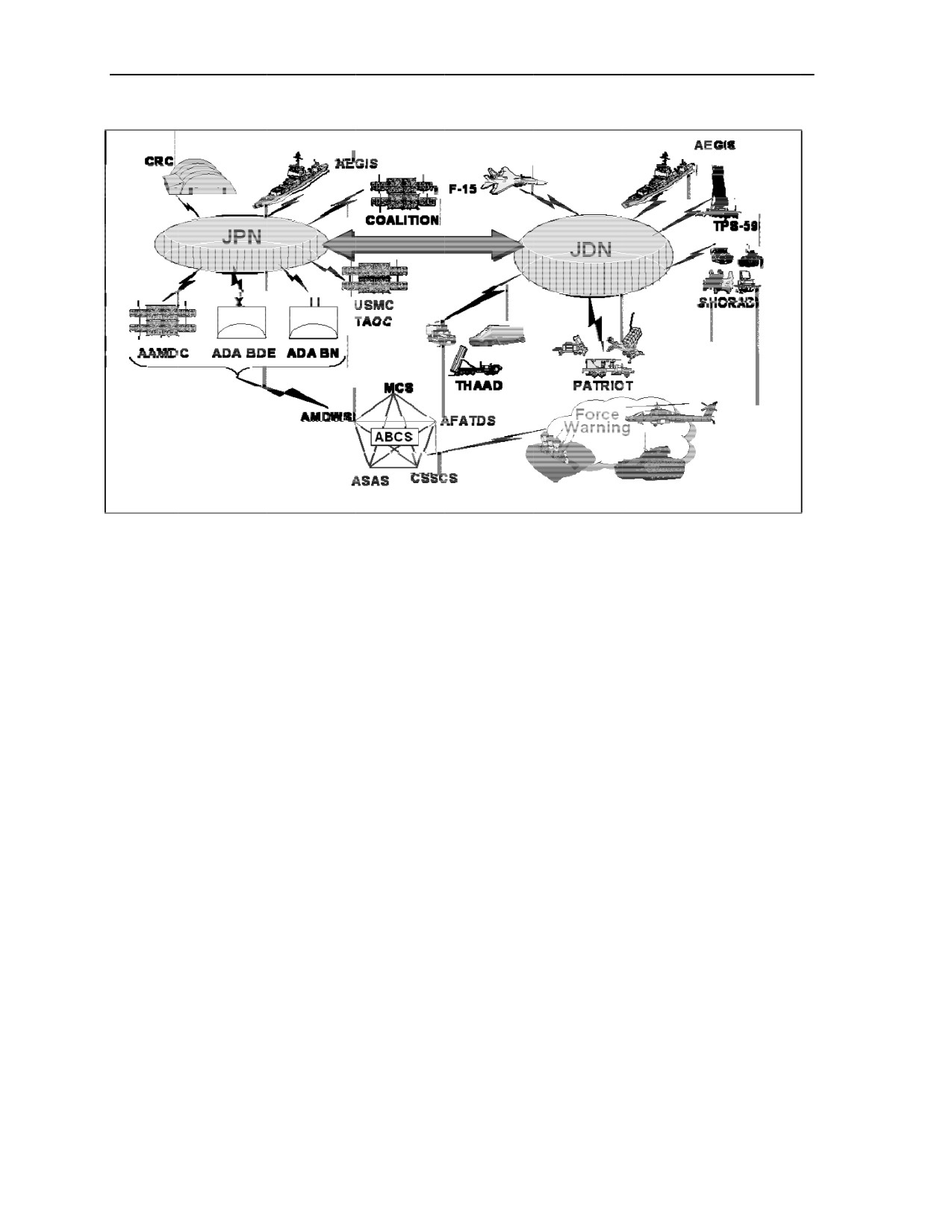
Appendix D
Figure D-2.
Example of
single-integrated air picture
NON-LINE-OF-SIGHT (NLOS)
D-31.
NLOS engagements utilize the JLENS and
presently Patriot, and in the
future other ADA systems to
engage CMs and other non-TBM
targets beyond the horizon, and out to
the kinematic
limits of ADA
systems.
D-32.
The JLENS system technology allows for other engagement improvements such
as; Engage-On-
Remote, and Forward Pass through its fire control quality data and identification which is provided on
a
real-time basis to Patriot units currently, and future ADA systems.
KILL BOX
D-33.
The concept of the “Kill Box” and its use
and employment in the Air Defense community is new
The Kill Box is used
by both the Air Force in its
mission, and
for the Army’s field artillery
unit’s mission
The Kill Box is a three-dimensional Fire Support Coordinating Measure (FSCM) used for air-to-surface
lethal
fires in the supported commander’s Area of Operations (AO) (see Figure D-3).
D-34.
The purpose of a Kill Box
is an FSCM, which facilitates the expeditious attack of
surface targets.
When
established, the purpose of a
Kill Box is to
allow air assets to attack surface targets without terminal
attack
control. A Kill Box will not
be used for Close Air Support (CAS) missions.
D-35.
A Kill Box is
established and adjusted by
the appropriate supported commander within their AO.
If
possible, Kill Box lateral boundaries should be defined using the Common Geographic Reference System,
but could follow well-defined terrain features or
may be located by grid or by
a radius from
a center point.
Changes to a Kill Box require notification of all affected forces within the AO and must
allow sufficient
time for these forces
and/or components to incorporate the Kill
Box change.
D-36.
Presently the only ADA system that utilizes the Kill Box is Patriot with the Post Deployment Build
PDB 6 software upgrade.
D-6
FM 3-01
25 November 2009

Impact of Technology on ADA Forces
Figure D-3. Kill box
25 November 2009
FM 3-01
D-7
This page intentionally left blank.
Glossary
SECTION I - ACRONYMS AND ABBREVIATIONS
AADC
area air defense commander
AADP
area air defense plan
AAMDC
Army air and missile defense command
ABCS
Army battle command systems
ABMOC
air battle management operations center
ABT
air-breathing threat
AC2
airspace command and control
ACA
airspace control authority
ACE
analysis and control element
ACM
airspace coordinating measure
ACO
airspace control order
ACP
airspace control plan
AD
air defense
ADA
air defense artillery
ADAFCO
air defense artillery fire control officer
ADAM
air defense airspace management
ADHPM
artillery-delivered, high precision munitions
ADIZ
air defense identification zone
ADOA
air defense operations area
ADW
air defense warning
AFFOR
Air Force forces
AMC
Air Mobility Command
AMCOM
Aviation and Missile Command
AMD
air and missile defense
AMDCOORD
air and missile defense coordinator
AMDPCS
air and missile defense planning and control system
AMDWS
air and missile defense workstation
AO
area of operations
AOC
air operations center
AOR
area of responsibility
APOD
aerial port of debarkation
ARFOR
Army forces
ARSTRAT
Army Strategic Command
ASM
air-to-surface missile
ASP
ammunition supply point
ATO
air tasking order
AUTL
Army Universal Task List
25 November 2009
FM 3-01
Glossary-1
Glossary
AWACS
Airborne Warning and Control System
BCD
battlefield coordination detachment
BCT
brigade combat team
BM
ballistic missile
BMDS
ballistic missile defense system
BVR
beyond visual range
C2
command and control
C2BMC
command and control, battle management, communications
CA
counterair
CAL
critical asset list
CAOC
combined air operations center
CAS
close air support
CBRNE
chemical, biological, radiological, nuclear, and high-yield
explosives
CCDR
combatant commander
CCIR
commander’s critical information requirement
CDR
Commander
CDI
Clarification, determination, and identification
CG
commanding general
CID
combat identification
CJCSI
Chairman of the Joint Chiefs of Staff instruction
C/JFLCC
combined/joint force land component commander
CM
cruise missile
CMMC
corps materiel management center
CMO
civil-military operations
CND
computer network defense
CNR
combat network radio
COA
course of action
COCOM
combatant command (command authority)
COMARFOR
commander, ARFOR
COMMZ
communications zone
CONUS
continental United States
COP
common operational picture
COSCOM
corps support command
CP
command post
CRC
control and reporting center
CSA
corps storage area
CSSB
combat sustainment support brigade
CSSCS
combat service support control system (legacy term)
CVT
criticality, vulnerability, threat
CZ
combat zone
DA
Department of the Army
Glossary-2
FM 3-01
25 November 2009
Glossary
DAADC(AMD)
deputy area air defense commander for AMD
DAL
defended asset list
DAO
division ammunition officer
DCA
defensive counterair
DIRLAUTH
direct liaison authorized
DISCOM
division support command
DLA
Defense Logistics Agency
DOCC
deep operations coordination cell
DOTMLPF
doctrine, organization, training, materiel, leadership and
education, personnel, facilities
DP
decision point
DS
direct support
DSP
Defense Support Program
EA
electronic attack
EAC
echelons above corps
ECS
engagement control station
EEFI
essential element of friendly information
EMCON
emissions control
EO
engagement operations
EPLRS
enhanced position location reporting system
ETRAC
enhanced target range and classification
EW
electronic warfare
FAA
Federal Aviation Administration
FAAD
forward area air defense system
FARP
forward arming and refueling point
FC
fires cell
FCC
fire control center
FDC
fire direction center
FEZ
fighter engagement zone
FFIR
friendly force information requirement
FLIR
forward-looking infrared
FM
field manual; frequency modulation
FO
force operations
FSCM
fire support coordination measure
FSCOORD
fire support coordinator
FSU
former Soviet Union
FW
fixed wing
G-1
assistant chief of staff, personnel
G-2
assistant chief of staff, intelligence
G-3
assistant chief of staff, operations
G-4
assistant chief of staff, logistics
GBMD
Global Ballistic Missile Defense
25 November 2009
FM 3-01
Glossary-3
Glossary
GCC
geographic component commander
GMD
ground-based midcourse defense
GS
general support
GS-R
general support - reinforcing
HAD
homeland air defense
HAS
homeland air security
HASCC
Homeland Air Security Coordination Center
HASD
homeland air security director
HHB
headquarters and headquarters battery
HIDACZ
high density airspace control zone
HIMEZ
high-altitude missile engagement zone
HNS
host-nation support
IA
information assurance
ICBM
intercontinental ballistic missile
ID
identification
IEW
intelligence and electronic warfare
IFF
identification, friend or foe
IFCS
Integrated fire control station
IM
information management
IO
information operations
IPB
intelligence preparation of the battlefield
IR
information requirement
IRBM
intermediate-range ballistic missile
ISR
intelligence, surveillance, reconnaissance
ITW/AA
integrated tactical warning and attack assessment
J-3
operations directorate of a joint staff
J-5
plans directorate of a joint staff
JAOC
joint air operations center
JDN
joint data network
JEZ
joint engagement zone
JFACC
joint force air component commander
JFC
joint force commander
JFLCC
joint force land component commander
JFMCC
joint force maritime component commander
JIIM
joint, interagency, intergovernmental, multinational
JLENS
Joint Land-Attack Cruise Missile Defense Elevated Netted Sensor
System
JOA
joint operations area
JP
joint publication
JSOTF
joint special operations task force
JSTARS
Joint Surveillance Target Attack Radar System
JTAGS
joint tactical ground station
Glossary-4
FM 3-01
25 November 2009
Glossary
JTIDS
Joint tactical information distribution system
JTF
joint task force
LACM
land-attack cruise missile
LAN
local area network
LCC
land component commander
LNO
liaison officer
LOC
line of communications
LOMEZ
low-altitude missile engagement zone
LRU
line replaceable unit
MANPADS
man-portable air defense system
MDMP
military decision-making process
METT-TC
mission, enemy, terrain and weather, troops and support
available, time available, civil considerations
MEZ
missile engagement zone
MIDS
multifunctional information distribution system
MOS
military occupational specialty
MRBM
medium-range ballistic missile
MRR
minimum risk route
MSR
main supply route
NAI
named area of interest
NATO
North Atlantic Treaty Organization
NEO
noncombatant evacuation operations
NIPRNET
Non-secure Internet Protocol Router Network
NLOS
non-line of sight
NMC
not mission capable
O&O
operational and organizational
OAKOC
observation and fields of fire, avenues of approach, key terrain,
obstacles, and cover and concealment
OCA
offensive counterair
OIF
Operation IRAQI FREEDOM
OPCON
operational control
OPLAN
operation plan
OPORD
operation order
OPSEC
operations security
PAC
Patriot advanced capability
PADIL
Patriot data information link
PDB
post-deployment build
PIR
priority intelligence requirement
POL
petroleum, oil, and lubricants
PTL
primary target line
R&S
reconnaissance and surveillance
RADC
regional air defense commander
25 November 2009
FM 3-01
Glossary-5
Glossary
ROE
rules of engagement
RW
rotary wing
S-1
personnel staff officer
S-2
intelligence staff officer
S-3
operations staff officer
S-4
logistics staff officer
SA
situational awareness
SADC
sector air defense commander
SAM
surface-to-air missile
SBCT
Stryker brigade combat team
SEAD
suppression of enemy air defenses
SHORAD
short-range air defense
SHORADEZ
short-range air defense engagement zone
SIAP
single integrated air picture
SINCGARS
single-channel ground and airborne radio system
SIPRNET
SECRET Internet Protocol Router Network
SLAMRAAM
surface-launched advanced medium-range air-to-air missile
SLBM
submarine-launched ballistic missile
SLS
shoot-look-shoot
SMC
support maintenance company
SOF
special operations forces
SOP
standing operating procedure
SPINS
special instructions
SPOD
seaport of debarkation
SRBM
short-range ballistic missile
STANAG
standardization agreement (NATO)
STL
Secondary target line
STO
surface-to-air missile tactical order
SU
situational understanding
TAAMDCOORD
theater Army air and missile defense coordinator
TACON
tactical control
TADIL
tactical digital information link
TAI
target area of interest
TAMD
theater air and missile defense
TAOC
tactical air operations center
TBM
theater ballistic missile
TCO
tactical control officer
TCS
tactical control station
TEL
transporter-erector launcher
TES
theater event system
TF
task force
Glossary-6
FM 3-01
25 November 2009
Glossary
THAAD
terminal high altitude area defense
TM
theater missile
TOC
tactical operations center
TRADOC
United States Army Training and Doctrine Command
TSA
theater storage area
TSOP
Tactical standing operating procedure
UAS
unmanned aircraft system
UHF
ultrahigh frequency
UJTL
Universal Joint Task List
UN
United Nations
U.S.
United States
USAF
United States Air Force
USCENTCOM
United States Central Command
USMC
United States Marine Corps
USN
United States Navy
USNORTHCOM
United States Northern Command
USSTRATCOM
United States Strategic Command
VMF
variable message format
WAD
weapons alert designator
WCS
weapons control status
WEZ
weapon engagement zone
WMD
weapons of mass destruction
WMD/E
weapons of mass destruction/effects
XO
executive officer
SECTION II - TERMS AND DEFINITIONS
active air defense
(Joint) Direct defensive action taken to destroy, nullify, or reduce the effectiveness of hostile air
and missile threats against friendly forces and assets. It includes the use of aircraft, air defense
weapons, electronic warfare, and other available weapons. (JP 3-01)
active missile defense
Operations that protect selected assets and forces from attack by destroying their missile
airborne launch platforms and/or theater missiles in flight.
air defense
(Joint) Defensive measures designed to destroy attacking enemy aircraft or missiles in the
atmosphere, or to nullify or reduce the effectiveness of such attack. (JP 3-01)
air defense artillery
(Joint) Defensive measures designed to destroy attacking enemy aircraft or missiles in the
atmosphere, or to nullify or reduce the effectiveness of such attack. (JP 3-01)
25 November 2009
FM 3-01
Glossary-7
Glossary
air interdiction
(Joint) Air operations conducted to divert, disrupt, delay, or destroy the enemy’s military potential
before it can be brought to bear effectively against friendly forces, or to otherwise achieve
objectives. Air interdiction is conducted at such distance from friendly forces that detailed
integration of each air mission with the fire and movement of friendly forces is not required.
(JP 3-0)
airspace control authority
(Joint) The commander designated to assume overall responsibility for the operation of the
airspace control system in the airspace control area. (JP 1-02)
airspace control order
(Joint) An order implementing the airspace control plan that provides the details of the approved
requests for airspace coordinating measures. It is published either as part of the air tasking order
or as a separate document. (JP 3-52)
airspace control plan
(Joint) The document approved by the joint force commander that provides specific planning
guidance and procedures for the airspace control system for the joint force operational area.
(JP 3-52)
airspace management
(Joint) The coordination, integration, and regulation of the use of airspace of defined dimensions.
(JP 1-02)
air superiority
(Joint) That degree of dominance in the air battle of one force over another which permits the
conduct of operations by the former and its related land, sea, and air forces at a given time and
place without prohibitive interference by the opposing force. (JP 3-30)
air supremacy
(Joint) That degree of air superiority wherein the opposing air force is incapable of effective
interference. (JP 1-02)
alert
Attack and launch early reporting to theater.
area air defense commander
(Joint) Within a unified command, subordinate unified command, or joint task force, the
commander will assign overall responsibility for air defense to a single commander. Normally, this
will be the component commander with the preponderance of air defense capability and the
command, control, and communications capability to plan and execute integrated air defense
operations. Representation from the other components involved will be provided, as appropriate,
to the area air defense commander’s headquarters. (JP 3-52)
attack operations
Offensive operations intended to destroy and disrupt enemy theater missile capabilities before,
during, and after launch. The objective of these operations is to prevent the launch of theater
missiles by attacking each element of the overall system, including such actions as destroying
launch platforms; reconnaissance, surveillance, and target acquisition platforms; command and
control nodes; and missile stocks and infrastructure.
ballistic missile
(Joint) Any missile which does not rely upon aerodynamic surfaces to produce lift and
consequently follows a ballistic trajectory when thrust is terminated. (JP 1-02)
Glossary-8
FM 3-01
25 November 2009
Glossary
classify
To declare a target to be a ballistic missile or air-breathing object.
close air support
(Joint) Air action by fixed- and rotary-wing aircraft against hostile targets that are in close
proximity to friendly forces and that require detailed integration of each air mission with the fire
and movement of those forces. (JP 3-0)
counterair
(Joint) A mission that integrates offensive and defensive operations to attain and maintain a
desired degree of air superiority. Counterair missions are designed to destroy or negate enemy
aircraft and missiles, both before and after launch. (JP 3-01)
cueing
Providing timely position data and tentative identification of aircraft within a designated range of a
fire unit.
defensive counterair
(Joint) All defensive measures designed to detect, identify, intercept, and destroy or negate
enemy forces attempting to attack or penetrate the friendly air environment. (JP 3-01)
engagement operations
Those activities required to execute the air, missile, and counter-surveillance battles.
force operations
Those activities required to plan, coordinate, prepare, and sustain the total air and missile
defense mission.
joint force air component commander
(Joint) The commander within a unified command, subordinate unified command, or joint task
force responsible to the establishing commander for making recommendations on the proper
employment of assigned, attached, and/or made available for tasking air forces; planning and
coordinating air operations; or accomplishing such operational missions as may be assigned. The
joint force air component commander is given the authority necessary to accomplish missions
and tasks assigned by the establishing commander. (JP 3-0)
joint force land component commander
(Joint) The commander within a unified command, subordinate unified command, or joint task
force responsible to the establishing commander for making recommendations on the proper
employment of assigned, attached, and/or made available for tasking land forces, planning and
coordinating land operations, or accomplishing such operational missions as may be assigned.
The joint force land component commander is given the authority necessary to accomplish
missions and tasks assigned by the establishing commander. (JP 3-0)
joint targeting coordination board
(Joint) A group formed by the joint force commander to accomplish broad targeting oversight
functions that may include but are not limited to coordinating targeting information, providing
targeting guidance and priorities, and refining the joint integrated prioritized target list. The board
is normally comprised of representatives from the joint force staff, all components, and if required,
component subordinate units. (JP 3-60)
offensive counterair
(Joint) Offensive operations to destroy, disrupt, or neutralize enemy aircraft, missiles, launch
platforms, and their supporting structures and systems both before and after launch, but as close
to their source as possible. Offensive counterair operations range throughout the enemy territory
25 November 2009
FM 3-01
Glossary-9
Glossary
and are generally conducted at the initiative of friendly forces. These operations include attack
operations, fighter sweep, escort, and suppression of enemy air defenses. (JP 3-01)
passive air defense
(Joint) All measures, other than active air defense, taken to minimize the effectiveness of hostile
air and missile threats against friendly forces and assets. These measures include camouflage,
concealment, deception, dispersion, reconstitution, redundancy, detection and warning systems,
and the use of protective construction. (JP 3-01)
suppression of enemy air defenses
(Joint) Activity that neutralizes, destroys, or temporarily degrades surface-based enemy air
defenses by destructive and/or disruptive means. (JP 3-01)
theater missile
(Joint) A missile, which may be a ballistic missile, a cruise missile, or an air-to-surface missile (not
including short-range, non-nuclear, direct-fire missiles, bombs, or rockets such as Maverick or
wire-guided missiles), whose target is within a given theater of operation. (JP 3-01)
Glossary-10
FM 3-01
25 November 2009
References
REQUIRED PUBLICATIONS
These sources must be available to the intended users of this publication.
None
RELATED PUBLICATIONS
These sources contain relevant supplemental information. Most Army doctrinal publications are
available on-line at http://www.apd.army.mil/. Most joint publications are available on-line at
http://www.dtic.mil/doctrine/s_index.html.
ARMY PUBLICATIONS
FM 1-0, Human Resources Support, 21 February 2007
FM 1-06, Financial Management Operations, 21 September 2006
FM 4-30.3, Maintenance Operations and Procedures, 28 July 2004
FM 4-93.4, Theater Support Command, 15 April 2003
FM 100-13, Battlefield Coordination Detachment (BCD), 05 September 1996
FMI 1-0.02, Theater-Level Human Resources Support, 20 February 2008
FMI 4-93.2, The Sustainment Brigade, 04 February 2009
SOURCES USED
These are the sources quoted or paraphrased in this publication.
ARMY PUBLICATIONS
FM 3-0, Operations, 27 February 2008
FM 3-52, Army Airspace Command and Control in a Combat Zone, 01 August 2002
FM 4-0, Sustainment, 30 April 2009
FMI 2-01.301 (FM 34-130), Specific Tactics, Techniques, and Procedures and Applications for Intelligence
Preparation of the Battlefield, 31 March 2009
FM 44-100, U.S. Army Air and Missile Defense Operations, 15 June 2000
INTERNATIONAL STANDARDIZATION AGREEMENTS
STANAG 3805, Doctrine for Joint Airspace Control -AJP-3.3.5(A), Edition 8, 05 April 2006
JOINT AND MULTISERVICE PUBLICATIONS
JP 1-02, Department of Defense Dictionary of Military and Associated Terms, 12 April 2001
JP 3-01, Countering Air and Missile Threats, 05 February 2007
JP 3-07.3, Peace Operations, 17 October 2007
25 November 2009
FM 3-01
References-1
References
PRESCRIBED FORMS
None
REFERENCED FORMS
DA Form 2028, Recommended Changes to Publications and Blank Forms
References-2
FM 3-01
25 November 2009
Index
A
through
3-18, C-1, C-3
defensive,
acquire, 3-20, A-2, A-3, A-7,
through C-5
criticality, B-14, C-2
B-1, B-3, B-11
Area Air Defense Plan
cruise missiles (CMs), 1-2, 1-
active air defense, 2-6, 3-16,
(AADP), 1-7, 2-7, 3-4, 3-8,
7, 1-8, 3-19, 4-3, 4-4, 5-5,
3-18, 4-4, 4-5
6-3, C-1, C-3
A-1, A-4, A-6, B-1, B-3, B-
employment, 4-4, 4-5, C-
Army Air and Missile
7 through B-9, B-11, B-12,
10
Defense
Command
D-2, D-3
operations, 3-16, 3-18, 4-4
(AAMDC), 1-6, 1-9, 3-2,
cueing, 1-6, 3-18, 5-7, 6-7, D-
resources, C-4
3-7, 3-8 through 3-10, 3-14,
3
weapon systems, 2-3, 2-6,
3-15, 3-20 through 3-22, 6-
D
2-9, 2-10
2, C-1, C-4 through C-6
deputy area air defense
active missile defense, 3-7, 3-
liaison teams, 3-15, 3-20
commander for AMD
9, 3-18
role, 3-8, C-5
DAADC (AMD), 1-6, 3-7,
air and missile defense
attack operations, 1-5, 1-8, 3-
3-8, 3-15, C-1, C-3 through
coordinator
3,
3-7, 3-15, 3-18 through
C-5
(AMDCOORD), 2-12, 3-8,
3-21, 4-1 through 4-3, 4-8,
decentralized control, 2-7, 3-
3-14, 3-15, 3-17,
3-19,
3-
6-7, C-6
3
20, C-4, C-6, C-7, D-4
autonomous operations, 2-7,
defense readiness conditions,
air battle management, 3-4,
3-3
2-4
3-5, 3-17, D-4
Avenger, 1-9, 2-3, 3-8, 3-9, 4-
detect, 4-7
air defense (AD), vii, 1-5, 4-1
5, 5-7, 5-8, 5-10, C-1, D-3
through 4-10
E
B
active, 3-18
early engagement, 2-2, C-1
battle command
emergency, 2-5
electronic warfare,
3-18,
3-
concept, 3-18
estimate, C-7 through C-10
20, 4-3, 4-4, 4-8, A-4, B-
elements, 3-18
operations area, 2-9
10, C-8, D-3
engagement operations, 3-
passive, 3-18
employment principles, v, 1-
1
air defense artillery
8, 1-10, 2-1
force operations, 3-1
employment guidelines, 1-
engagement operations
leadership, 3-1
8, 1-10, 2-2
AAMDC, 1-6, 1-9, 3-2, 3-7
systems, 3-18, 6-5, D-3
employment principles, 1-
through 3-10, 3-15, 3-21, 3-
battle
coordination
8, 2-1
22, 6-2, C-1, C-4, C-5
detachment (BCD), 1-7, 2-
geopolitical assets,
1-1
entry operations, 1-10, 4-5
12, 3-14, 3-15, 3-17, 3-20,
through 1-3, 1-8, 3-8, 3-9,
C-4, C-5
F
4-1, 5-2, 5-4, 6-2, D-5
fighter engagement zone
mission, 1-1
C
(FEZ), 2-10
air defense warnings, 2-5
centralized control, 1-8, 2-7,
Fires Cell (FC), 1-7, 1-8, 3-20
airspace control 1-7, 2-6, 2-9,
2-10, 3-4, 3-18, 3-21
fire direction center
(FDC),
2-11, 2-12, 3-5, 3-16, 3-17,
chemical weapons, B-3, B-4
3-10, C-6
4-4, 4-9, 5-1, 5-3, 5-4, D-4
classify, 4-4
fire support, 3-9 3-15, 3-19,
airspace control authority
counterair,
1-1,
1-3,
1-8
3-20, 4-2, 4-3, B-7, B-10,
(ACA), 1-8, 2-6, 2-9, 2-11,
through 1-10, 2-9, 3-5, 3-7,
C-1, C-6, D-1, D-6
2-12, 3-5, 3-7, 3-16, 3-17
3-9, 3-20, 4-4
force operations, vii, 1-7, 3-1,
AMD planning, 1-10, 3-9, 3-
defensive,
3-21,
4-4,
4-8,
3-4, 5-3, A-1
10, 3-20 through 3-22, C-7
D-1
force projection, B-2
integration with JAOC,
joint, 4-6, 4-7, 5-4
fire
support coordinator
C-5
command post (CP), 3-2, 3-
(FSCOORD), 3-20, C-6
antiradiation missile (ARM),
10, 3-15, 4-4, C-6, D-4
B-9, B-10
H
Area
Air
Defense
contingency, 3-9, 5-3, 7-4, C-
high-density,
airspace
Commander (AADC), 1-
1, C-5
control zone
(HIDACZ),
6, 1-8, 2-5 through 2-7, 3-4
operations, 5-3
2-9, 2-11
through
3-8,
3-11,
3-15
theater, 1-10
25 November 2009
FM 3-01
Index-1
Index
hostile criteria, 2-6, 2-7, 2-10,
Patriot, 1-9, 1-10, 2-3, 2-4, 2-
weapons tight, 2-7, 2-11
C-12
8, 2-10, 3-8, 3-9, 3-11, 3-
weapon engagement zone
humanitarian assistance, 5-2
16, 4-5, D-1, D-2, D-6
(WEZ), 2-10
procedural control,
3-16
weapons alert designator
I
through 3-18, D-4, D-5
(WAD), 2-4
identification criteria, 2-6
weapons
of
mass
R
information superiority, v, 1-
destruction/effects
reconstitution, 3-18, 7-3
4, 1-5, 1-7, 3-20, 4-1, 6-1,
(WMD/E), 1-2, 1-5
recuperability, C-2, C-3
6-4, B-15, D-5
redeployment, 7-3
intelligence preparation of
restricted operations area, 2-
the battlefield (IPB), vi, 1-
9 through 2-11
7, 3-15, 6-3, A-1
rules of engagement (ROE),
intelligence,
surveillance,
1-8, 2-5, 2-6, 3-1, 3-4, 3-16,
reconnaissance (ISR), 3-2
3-18, 3-20, C-12, D-3, D-4
J
S
joint force air component
surface-launched advanced
commander (JFACC), 1-
medium-range air-to-air
8, 3-5, 3-7, 3-15, 3-16, 3-
missile (SLAMRAAM), 4-
19, 3-21, 4-11, C-1, C-5
5, D-1, D-3, D-4
joint force land component
special instructions (SPINS),
commander (JFLCC), 1-
2-9, 3-17
3, 1-6, 1-8, 3-6, 3-7, 3-11,
3-21, C-1, C-4 through C-6
T
joint
force
maritime
theater Army air and missile
component commander
defense
coordinator
(JFMCC), 3-7, 3-15
(TAAMDCOORD),
3-8,
3-9, C-1, C-4 through C-6
K
tactical
ballistic
missiles
kill box, D-6, D-7
(TBM), 2-3, 2-9, 4-3, 6-1,
L
6-7, B-3, B-4, B-11, D-2,
logistics, 7-3
D-6
low-altitude
missile
tactical control, 3-12, A-5
engagement
zone
tactical operations center
(LOMEZ), 2-10
(TOC), 3-10, 6-4, 6-7
terminal high-altitude area
M
defense (THAAD), 4-5, 6-
management by exception, 2-
2, D-1, D-2
7, 3-4, 3-5
theater air and missile
military
decision-making
defense (TAMD), vii, 1-6
process (MDMP), 3-22, 3-
through 1-8, 1-10, 2-1, 3-2,
23
3-6, 3-11, 3-20, 3-21, 4-2,
minimum risk route, 2-10
4-5, 6-4, C-1
N
U
National Capitol Region
unmanned aircraft system
(NCR), 5-4, 5-8
(UAS), 1-7, 1-8, 2-6, 2-7,
O
2-10, 3-4, 3-19 through 3-
offensive counterair,
1-8,
3-
21, 4-2, 4-8, 4-9, 5-3, 6-4,
21, 4-8
A-3, A-4, A-7, B-1, B-10,
operational control, 1-5, 3-4,
C-1, D-3
3-6, 3-11 through 3-13, A-5
W
P
weapon control status, 2-7, 3-
passive missile defense,
3-9,
1, 3-17
3-18
weapons free, 2-7, 2-10, 2-11
weapons hold, 2-7, 2-11
Index-2
FM 3-01
25 November 2009
FM 3-01
25 November 2009
By order of the Secretary of the Army:
GEORGE W. CASEY, JR.
General, United States Army
Chief of Staff
Official:
JOYCE E. MORROW
Administrative Assistant to the
Secretary of the Army
0930901
DISTRIBUTION:
Active Army, the Army National Guard, and the United States Army Reserve: Not to be distributed;
electronic media only.
PIN: 086026-000
HEADQUARTERS,
ARTEP 3-327-10-DRILL
DEPARTMENT OF THE ARMY
DRILLS FOR CHEMICAL, BIOLOGICAL,
RADIOLOGICAL, OR NUCLEAR (CBRN)
DOMESTIC SUPPORT MISSIONS
DECEMBER 2004
DISTRIBUTION RESTRICTION: Distribution authorized to United
States Government agencies only to protect technical or operational
information from automatic dissemination under the International
Exchange Program or by other means. This determination was made
on 31 July 2000. Other requests for this document will be referred to
Commandant, United States Army Chemical School, ATTN: ATSN-
CM-DT-I, 464 MANSCEN Loop, Suite 2617, Fort Leonard Wood, MO
65473-8929.
DESTRUCTION NOTICE: Destroy by any method that will prevent
disclosure of contents or reconstruction of the document.
This publication is available at Army
and General Dennis J. Reimer
Training and Doctrine Digital Library
ARTEP 3-327-10-DRILL
Army Training and
Headquarters
Evaluation Program
Department of the Army
No. 3-327-10-DRILL
Washington, DC, 27 December 2004
Drills for Chemical, Biological, Radiological, or
Nuclear (CBRN) Domestic Support Missions
TABLE OF CONTENTS
Page
PREFACE
iii
Chapter 1
UNIT TRAINING
1-1
1-1. General
1-1
1-2. Training Guidance
1-1
1-3. Battle Focus
1-3
1-4. Safety Consideration
1-3
1-5. Evaluation
1-3
1-6. Feedback
1-4
Chapter 2
BATTLE DRILLS
2-1
DISTRIBUTION RESTRICTION: Distribution authorized to United
States Government agencies only to protect technical or operational
information from automatic dissemination under the International
Exchange Program or by other means. This determination was made
on 31 July 2000. Other requests for this document will be referred to
Commandant, United States Army Chemical School, ATTN: ATSN-
CM-DT-I, 464 MANSCEN Loop, Suite 2617, Fort Leonard Wood, MO
65473-8929.
DESTRUCTION NOTICE: Destroy by any method that will prevent
disclosure of contents or reconstruction of the document.
i
ARTEP 3-327-10-DRILL
Page
Chapter 3
DRILLS
3-1
3-1. General
3-1
3-2. Crew Drill 03-3-DC101
3-1
3-3. Crew Drill 03-3-DC102
3-5
3-4. Crew Drill 03-3-DC103
3-9
3-5. Crew Drill 03-3-DC104
3-13
3-6. Crew Drill 03-3-DC105
3-17
3-7. Crew Drill 03-3-DC106
3-21
3-8. Crew Drill 03-3-DC107
3-25
3-9. Crew Drill 03-3-DC108
3-29
3-10. Crew Drill 03-3-DC109
3-32
3-11. Crew Drill 03-3-DC110
3-35
3-12. Crew Drill 03-3-DC111
3-38
3-13. Crew Drill 03-3-DC112
3-41
3-14. Crew Drill 03-3-DC113
3-45
3-15. Crew Drill 03-3-DC114
3-49
3-16. Crew Drill 03-3-DC115
3-54
3-17. Crew Drill 03-3-DC116
3-58
3-18. Crew Drill 03-3-DC117
3-61
3-19. Crew Drill 03-3-DC118
3-66
3-20. Crew Drill 03-3-DC119
3-70
Appendix A
METRIC CONVERSION CHART
A-1
GLOSSARY
Glossary-1
REFERENCES
References-1
ii
Preface
This drill book provides platoon, squad, and team leaders with
standardized drills that are designed for use by trainers at the
platoon and squad level. Standardized drills are essential to the
success of platoon leaders, trainers, and small-unit leaders. These
drills provide the performance measures, standards, and sequential
procedures that will help guide the unit through training tasks for
which doctrine is just now being developed. Chemical Corps
platoons and squads must be able to perform these drills quickly,
effectively, and to standard at all times.
The target audience for this drill book is Chemical Corps squads and
platoons who have been assigned the additional chemical, biological,
radiological, and nuclear (CBRN) domestic support mission.
The proponent for this publication is HQ, TRADOC. Submit changes
for improving this publication on Department of the Army (DA)
Form 2028 (Recommended Changes to Publications and Blank
Forms) and forward to the Commandant, United States Army
Chemical School, ATTN: ATSN-CM-DT-I, 464 MANSCEN Loop,
Suite 2617, Fort Leonard Wood, MO 65473-8929.
Unless this publication states otherwise, masculine nouns and
pronouns do not refer exclusively to men.
iii
This page intentionally left blank
Chapter 1
Unit Training
1-1. General. The success of a mission depends on the ability of the
soldiers to react to a situation or order by executing key actions
instinctively and immediately. Drills are designed to focus on the
key actions that like units in the Army must master. Battle drills
and crew drills are two types of drills discussed in this document.
a. A battle drill is a collective action executed by a platoon or
smaller element without applying a deliberate, decision-making
process. This action is vital to combat success or is critical to
preserving life. The drill is initiated on a cue (such as an enemy
action or a leader command) is a trained response to a given
stimulus, is accomplished with minimal leader orders, and is
standard throughout like units.
b. A crew drill is a collective action that a crew of a weapon
system or a piece of equipment must perform to use the weapon or
equipment successfully in combat or to preserve life. This action is a
trained response to a given stimulus (such as a leader command or
the status of the weapon or equipment) requires minimal leader
orders to accomplish, and is standard throughout like units.
c. Battle and crew drills have the following advantages:
(1) They allow teams, squads, and platoons to perform
critical tasks automatically because they have been practiced to the
standards repetitively.
(2) They reduce communication requirements because the
soldiers know what they have to do.
(3) They develop leaders and build teamwork and cohesion
under stress.
(4) They save time, energy, and lives.
1-2. Training Guidance.
a. Train as you fight. This drill book is based upon the training
principles outlined in the Field Manual (FM) 25-series. Drills are
1-1
ARTEP 3-327-10-DRILL
trained using the talk-through, walk-through, and run-through
methods. You—as the trainer—must master the drill in order to
train your soldiers to execute the drill to the prescribed training
standards. You may wish to periodically talk your soldiers through
the drill by explaining the role of each soldier, having them go
through the drill slowly, and making on-the-spot corrections.
Whenever possible, train in an environment or under conditions
similar to actual combat conditions. Conduct the drill training
frequently in mission-oriented protection posture level 4 (MOPP4).
Be tough on yourself and your soldiers. A good team executes
training tasks instantly and precisely. Your soldiers will pay a high
price if they fail to meet the training standards.
b. Train to standard. Units fight as they are trained. Soldiers
remember the last way they performed a task; therefore, soldiers
must perform tasks according to established standards that are
strictly enforced by leaders.
c. Train at all levels. The commander is the primary trainer.
Leaders, at all levels, are responsible for training their soldiers and
their units. The success of the unit depends on the personal
involvement of the unit leaders at all levels.
d. Train the current doctrine. Leaders are responsible for
knowing and training according to the current doctrine.
e. Train performance-oriented tasks. Units become more
proficient by performing specific tasks to the standard. The majority
of unit training must involve task performance followed by a
thorough after-action review (AAR).
f. Train to sustain proficiency. The cornerstone of a drill book
is the concept of sustaining individual and unit proficiency. The unit
must train, evaluate, and continue to train at all times. Because
training sustainment requires practice and repetition, constant
evaluation of these training drills is required to identify critical
training strengths and weaknesses. Training must focus on
sustaining skills and correcting weaknesses.
g. Train to challenge. Challenging training builds competence
and confidence by developing and sharpening skills and inspires
excellence by fostering initiative, enthusiasm, and eagerness to
learn.
1-2
ARTEP 3-327-10-DRILL
1-3. Battle Focus. Battle focus derives peacetime training
requirements from specified missions. It guides the planning,
execution, and assessment of the unit training program.
Commanders use battle focus to allocate resources for training
based on mission requirements. A successful training program is
achievable by focusing on a specific set of mission-essential tasks.
1-4. Safety Consideration.
a. Protection is an element of combat power. Conserving the
fighting potential of a force is an intricate part of protection. Leaders
must verify structural soundness of the training and evaluation
plans from a safety viewpoint. Leaders must conduct training at
levels that are consistent with the abilities of the soldiers being
trained. Leaders must instill an awareness of individual safety in all
subordinate leaders and soldiers. Soldiers must constantly be alert
to avoid situations that may result in injury or death.
b. Leaders must establish safety overwatch procedures for
training. Safety procedures should emphasize adherence to
standards, consideration of environmental factors, assessment of
risks, and prevention of accidents. Leaders must balance training
risks against training requirements and monitor conditions to
eliminate or control safety and health hazards. Leaders must ensure
the welfare of their soldiers in all situations.
c. Leaders must establish a buddy system for safety. Soldiers
should maintain a safety watch over each other with emphasis on
individual safety training and first aid responsibilities. Soldiers
must constantly be alert to and avoid situations that may result in
injury or death. Following the proper safety procedures preserves
troop strength by preventing personnel losses through accidents.
1-5. Evaluation. Training standards are provided as a part of each
drill, and the successful execution of that drill is the standard for the
task or task step.
a. Evaluations may be internal or external. Internal
evaluations are conducted at all levels and must be inherent in all
training. External evaluations are usually more formal and are
conducted by the next higher headquarters (HQ).
b. Failure to evaluate a task when it is executed is a critical
weakness. The Army training and evaluation program (ARTEP)
concept is based on simultaneously training and evaluating. Every
1-3
ARTEP 3-327-10-DRILL
exercise provides the potential for evaluation feedback. Every
evaluation is a training session. To optimize training, trainers and
leaders must evaluate training as it is performed.
c. Place emphasis on direct, on-the-spot evaluations.
Correcting poor performance during drills is easy to do. However, in
higher-level exercises with outside evaluators, this is usually not
feasible. AARs should be planned at frequent, logical intervals
during the exercise (usually after the completion of a major event).
This is a proven technique that allows for corrections of performance
shortcomings while the shortcomings are still fresh in the soldier's
mind. Additionally, AARs involve everyone and prevent a repeat of
poor performance or reinforcement of bad habits.
1-6. Feedback. The US Chemical School requests your
recommendations for improvement of this drill book. Your feedback
will help ensure that this book stays current with new equipment
and operational concepts that will be employed in the diverse
missions of tomorrow. Please make your comments on
DA Form 2028 or DA Form 7507 (ARTEP Mission Training Plan
User Feedback) and send to the address reflected in the preface.
1-4
Chapter 2
Battle Drills
NOTE: THIS DRILL BOOK DOES NOT CONTAIN ANY
BATTLE DRILLS.
2-1
This page intentionally left blank
Chapter 3
Drills
3-1. General. A crew drill is a collective action that a crew of a
weapon system or piece of equipment must perform to use the
weapon or equipment successfully in combat or to preserve life.
3-2. Crew Drill 03-3-DC101.
TASK: Prepare for Domestic Response Casualty Decontamination
(DRCD) Operations
CONDITIONS (CUE): Terrorist acts involving weapons of mass
destruction (WMD) are threatened or have occurred. The unit has
received an order to alert, recall, and assemble in support of a
DRCD mission. The DRCD equipment has been issued and
preloaded into shipping containers. The unit receives the order to
prepare for the DRCD operations.
STANDARDS: Each crew member conducts preventive-
maintenance checks and services (PMCS) on the equipment and
vehicles according to the operator's manual. The equipment and
vehicles are prepared according to the unit standard operating
procedure (SOP) and load plan. The vehicles are assembled and
prepared for convoy movement.
SUPPORTING INDIVIDUAL TASKS:
References
Task Number Task Title
STP 3-54B1-SM
113-571-1019
Establish, Enter, and
Leave a Radiotelephone
Net
ILLUSTRATIONS: N/A
SETUP INSTRUCTIONS:
a. Resources.
(1) Tables of organization and equipment (TOE) assigned
personnel and equipment.
3-1
ARTEP 3-327-10-DRILL
(2) DRCD equipment augmentation packages.
(3) Maps with overlays.
b. Training Site. The training site should provide the following:
(1) A large area with suitable access and egress routes for
DRCD operations.
(2) A fire hydrant or an adequate water source to support
decontamination operations.
c. Unit Instructions. None.
TALK-THROUGH INSTRUCTIONS:
a. Objective. The mission is to prepare for the DRCD
operations by loading the equipment and supplies and preparing the
vehicles for movement.
b. Safety/Fratricide. The unit must be extremely cautious at all
times. Conduct the safety briefing and—
(1) Instruct the drivers to employ safe convoy-driving
procedures.
(2) Identify current weather and traffic hazards associated
with convoy movements.
(3) Specify the vehicle and serial convoy intervals for all
drivers and vehicle commanders.
(4) Specify vehicle breakdown and emergency roadside
procedures.
(5) Equip each vehicle with emergency roadside warning
triangles.
c. Demonstration (Optional). If a nearby unit has successfully
performed this drill, have that unit demonstrate. Describe the
actions using the performance measures as a guide. After the
demonstration, summarize what was done.
d. Explanation.
(1) Explain the objective.
(2) Use a simple sketch, a diagram, or any other means to
identify the location of each vehicle in the convoy. Identify each
vehicle by its bumper number. Issue the convoy control number, and
3-2
ARTEP 3-327-10-DRILL
ensure that the number is chalked on the left and right sides of each
vehicle.
(3) Identify the locations of the staging and marshaling
areas.
(4) Issue the route strip maps.
WALK-THROUGH INSTRUCTIONS: The platoon leader should
conduct the walk-through slowly at first, making on-the-spot
corrections. Do not proceed until the drill is done right. After the
soldiers demonstrate proficiency at a slow pace, let them do it faster.
Remember that safety is never sacrificed for speed. Watch carefully
to make sure the unit achieves all of the standards for the drill.
TASK STEPS AND PERFORMANCE MEASURES:
1. Conduct PMCS on the equipment and the vehicles.
2. Ensure that all equipment faults are corrected and that the status
is reported to the platoon leader.
3. Use current load plans to ensure that the vehicles are properly
loaded for sustained operations.
4. Conduct radio checks with proper call signs.
5. Prepare the individual, DRCD, and TOE equipment and vehicles
for inspection.
6. Notify the platoon leader when the preparation is complete.
COACHING POINT:
a. Have each member explain his part in the drill.
b. Identify (with the route strip maps) the primary route, start
point, check points, release point, designated rest and refuel points,
and convoy and catch-up speeds. Designate the alternate
communication means, call signs, and frequencies.
c. Conduct an after-action review (AAR) to identify strengths,
shortcomings, and corrective actions.
RUN-THROUGH INSTRUCTIONS: The soldiers should practice
this drill until they can perform it according to the standards
without the drill book. The initial run-through should be conducted
slowly. The soldiers should change positions in order to learn all the
steps and standards.
3-3
ARTEP 3-327-10-DRILL
PERFORM: When the soldiers can perform this drill according to
the standards, the platoon or section leader should evaluate them.
3-4
ARTEP 3-327-10-DRILL
3-3. Crew Drill 03-3-DC102.
TASK: Establish a Domestic Response Casualty Decontamination
Site
CONDITIONS (CUE): Terrorist acts involving weapons of mass
destruction (WMD) are threatened or have occurred. The unit has
received the mission to establish a DRCD site. The incident
commander (IC) has established the location to receive and process
the ambulatory and nonambulatory casualties. The platoon leader
directs the unit to establish the DRCD site.
STANDARDS: The unit downloads the supplies, tentage,
equipment, and vehicles and establishes the DRCD site within
90 minutes of receiving the directive.
SUPPORTING INDIVIDUAL TASKS:
References
Task Number Task Title
STP 3-54B1-SM
071-326-0608
Use Visual Signalling
Techniques
113-600-1012
Install Telephone Set
TA-312/PT for
Operation
171-121-3009
Control Techniques of
Movement
ILLUSTRATIONS: N/A
SETUP INSTRUCTIONS:
a. Resources.
(1) Tables of organization and equipment (TOE) assigned
personnel and equipment.
(2) DRCD equipment augmentation packages.
(3) Maps with overlays.
b. Training Site. The training site should provide the following:
(1) A large area with suitable access and egress routes for
DRCD operations.
3-5