Military reference books and manuals (2009-2023, Volume 4) - page 32
AzSPU Procedure for Transportation of Radioactive Materials
Page 14 of 24
If the contamination level is exceeded, the samples should be sent as Excepted Packages (see
Appendix A).
NB: In the case of produced water NORM samples and radon-in-gas samples, the activity
concentration will always be low enough for the sample to be classed as Exempt.
5.4
TRAINING
All persons involved in the transport of dangerous goods must have received appropriate training.
Contractors must provide evidence, when requested, that personnel have received training in the
transport of Class 7 (i.e. Radioactive) dangerous goods.
For transport operations by sea and road the RPSs require only basic awareness level of training.
Materials Coordinators must have passed a suitable training course that includes Class
7
dangerous goods, i.e. radioactive material.
Persons involved in transport operations by air must have completed a course approved by the
Civil Aviation Authority (CAA) that satisfies the IATA Dangerous Goods Regulations.
5.5
PERMITTING / LICENSING REQUIREMENTS
The following permits must be obtained for transportation of radioactive materials:
A special permit (license) from the State Committee for Supervision of Safe Industrial
and Mining Practices (SCSSIMP) of the Ministry of Emergency Situations (MES).
A “radiological-hygienic” passport from the State Sanitary-Epidemiological Service of
the Ministry of Health.
In addition prior to transporting radioactive substances by road approval must be obtained from
the State Road Police (within the Ministry of Internal Affairs) and MES.
It is the responsibility of AzSPU‟s transportation contractors to obtain the permits listed above
and will be a requirement of their contracts.
Drivers of vehicles transporting radioactive substances have to pass a training course approved
by the State Road Police and MES.
The consignor will provide instructions to the driver regarding accidents and emergencies. In
cases where AzSPU is the consigner then instructions will be supplied by the RPA.
6. KEY DOCUMENTS/TOOLS/REFERENCES
Control Tier: 2
Revision Date: 1 July, 2010
Document Number: AZSPU-HSSE-DOC-00115-2
Print Date: 2/1/2011
PAPER COPIES ARE UNCONTROLLED. THIS COPY VALID ONLY AT THE TIME OF PRINTING. THE
CONTROLLED VERSION OF THIS DOCUMENT CAN BE FOUND AT

AzSPU Procedure for Transportation of Radioactive Materials
Page 15 of 24
This document shall, where appropriate, be used in conjunction with of the following procedures
and plans:
Document Number
Title of Procedure
AzSPU-HSSE-DOC-00058-2
AzSPU Procedure for Management of Radioactive Materials and
Radiation Generators
AzSPU-HSSE-DOC-00097-2
AzSPU Procedure for the Management of NORM
AzSPU-HSSE-DOC-00086-2
AzSPU Radiation Contingency Plan
AzSPU-HSSE-DOC-00083-2
AzSPU Procedure for The Import / Export of Radioactive
Materials and Sources of Ionising Radiation
AzSPU-HSSE-DOC-00011-2
AzSPU Procedure for Deviations
AzSPU-HSSE-DOC-00025-2
AzSPU Document Management Procedure
Revision/Review Log
Revision Date
Authority
Custodian
Revision Details
7 October, 2009
Yuliy Zaytsev (Safety
Idrak Nazarov (HSE
This procedure replaces the Offshore
& Compliance
MS Team Leader)
Operations radioactive Source
Manager)
Management Chain of Custody
Procedure (AzSPU-HSSE-DOC-
00033-3).
The original procedure has been
expanded to encompass both
offshore and onshore operations (and
hence moved to Tier 2 level). It has
also been expanded to include
transportation requirements for
NORM contaminated equipment /
waste and NORM samples.
More detailed information on
categorizing, packing, marking,
labeling and providing
documentation for the transportation
of radioactive materials has been
added to the procedure (see
Appendices A and B).
1st July, 2010
Yuliy Zaytsev
Rebecca Heath (AzSPU
Document revised to include
(Offshore Health &
HSE MS Senior Advisor)
requirement for transporting
Safety Manager)
radioactive sources, together with all
accompanying documentation and
monitoring equipment, on the same
vessel (based on LL on WA).
Control Tier: 2
Revision Date: 1 July, 2010
Document Number: AZSPU-HSSE-DOC-00115-2
Print Date: 2/1/2011
PAPER COPIES ARE UNCONTROLLED. THIS COPY VALID ONLY AT THE TIME OF PRINTING. THE
CONTROLLED VERSION OF THIS DOCUMENT CAN BE FOUND AT

AzSPU Procedure for Transportation of Radioactive Materials
Page 16 of 24
APPENDIX A
- REQUIREMENTS FOR CATEGORISING, PACKING, MARKING, AND
LABELLING RADIOACTIVE MATERIALS FOR TRANSPORTATION
In the transport of all classes of dangerous goods, primary reliance for safety is on the package
design. As the hazard associated with the radioactive material increases, so to does the packaging
requirement.
The package types most likely to be encountered in the oil and gas industry are listed below in
order of increasing robustness:
Excepted package - those in which the allowed radioactive content is restricted to such
low levels that the potential hazards are insignificant and therefore no testing is required
with regard to containment or shielding integrity. There is a requirement that the
radiation level at the surface of an excepted package must not exceed 5 μSv/h. This is in
order to ensure that sensitive photographic material adjacent to the package will not be
damaged and that any radiation dose to members of the public will be insignificant.
Industrial package - may be either Type IP-1, IP2 or IP3. Type IP-1 packages must be
able to contain their radioactive contents under routine transport conditions i.e. incident
free. In the event of an incident the release of the radioactive contents would not present
a significant hazard.
Type A package - used for the transport of relatively small, but significant, quantities of
radioactive material. Because it is assumed that this type of package theoretically could
be damaged in a severe accident and that a portion of their contents may be released, the
amount of radionuclides they can contain is limited. In the event of a release, these limits
ensure that the risks from external radiation or contamination are very low.
Table 1: Summary of Requirements for Categorising, Packing, Marking & Labelling
Radioactive Materials for Transportation
Radioactive sources
NORM contaminated /
LSA
Activity Limits in
Activity Limits in
accordance with Table
accordance with Table 2
3
Package Type
Excepted
Type A (A1 or A2)
Industrial (IP-1 or IP-2,
see Table 4)
Category of
NA
I-WHITE, II-YELLOW or III-
I-WHITE, II-YELLOW or
Package
YELLOW (see Table 5)
III-YELLOW (see Table 5)
Marking (packages
Consignor and
Consignor and consignee.
Consignor and consignee.
& overpacks)
consignee.
UN number.
UN number.
UN number.
Proper Shipping Name
Proper Shipping Name
Type A
Type IP-1 or IP-2.
Labelling
NA
I-WHITE + Contents +
I-WHITE + Contents +
(packages,
Activity
Activity
overpacks & freight
OR
OR
containers)
II & III-YELLOW + Contents
II & III-YELLOW +
+ Activity + Transport index
Contents + Activity +
Transport index
Placarding (large
NA
Placards required
Placards required
freight containers)
Control Tier: 2
Revision Date: 1 July, 2010
Document Number: AZSPU-HSSE-DOC-00115-2
Print Date: 2/1/2011
PAPER COPIES ARE UNCONTROLLED. THIS COPY VALID ONLY AT THE TIME OF PRINTING. THE
CONTROLLED VERSION OF THIS DOCUMENT CAN BE FOUND AT
AzSPU Procedure for Transportation of Radioactive Materials
Page 17 of 24
Documentation
Dangerous goods
Dangerous goods transport
Dangerous goods
transport document to
document to be completed
transport document to be
be completed
completed
PACKAGE TYPE
Type A Packages
Limits are placed on the total activity of radioactive material that can be transported in each type
of package. The limits are based on the relative hazard associated with each radionuclide and
how easily it is dispersed in the event of an accident.
Package limits are expressed as A1 and A2 values (see Table 2). A1 is either an indispersible
solid material, or a sealed capsule containing radioactive material that has been designed to
withstand a transportation accident. A2 relates to radioactive material in other forms.
Table 2: Activity Limits for Type A Packages
Radionuclide
A1 (TBq)1
A2 (TBq)
Americium-241
1 x 101
1 x 10⁻³
Bromine-82
4 x 10⁻¹
4 x 10⁻¹
Caesium-137
2 x 100
6 x 10⁻¹
Carbon-14
4 x 101
3 x 100
Cobalt-60
4 x 10⁻¹
4 x 10⁻¹
Hydrogen-3
4 x 101
4 x 101
Iridium-192
1 x 100
6 x 10⁻¹
Lead-210
1 x 100
5 x 10⁻²
Polonium-210
4 x 101
2 x 10⁻²
Radium-226
2 x 10⁻¹
3 x 10⁻³
Radium-228
6 x 10⁻¹
2 x 10⁻²
Excepted Packages
For radioactive materials where the quantity of material is significantly below the limits of a
Type A Package, it is possible to transport those materials in Excepted Packages. The content
limits for Excepted Packages are based on fractions of the A1 and A2 values, see Table 3.
Table 3: Activity Limits for Excepted Packages
Physical state of
Instrument or article
Materials
contents
Item limits
Package limits
Package limits
1 1 TBq = 1000000000 Bq, or 1000 GBq.
Control Tier: 2
Revision Date: 1 July, 2010
Document Number: AZSPU-HSSE-DOC-00115-2
Print Date: 2/1/2011
PAPER COPIES ARE UNCONTROLLED. THIS COPY VALID ONLY AT THE TIME OF PRINTING. THE
CONTROLLED VERSION OF THIS DOCUMENT CAN BE FOUND AT
AzSPU Procedure for Transportation of Radioactive Materials
Page 18 of 24
Solids:
Special form
10-2 A1
A1
10-3 A1
Other forms
10
-2 A
2
A2
10-3 A2
Liquids
10-3 A2
10-1A2
10-4 A2
Gases
Special form
10-3 A1
10-2A1
10-3A1
Other forms
10
-3 A
2
10-2A2
10-3A2
Industrial Packages
NORM contaminated equipment and items are transported as Surface Contaminated Objects
(SCO-1).
Contaminated sand, sludge, pig wax, scale, etc are transported as low specific activity (LSA)
material.
Both surface contaminated objects and LSA must be transported in Industrial Packages, the type
of which is determined with reference to Table 4.
Under certain conditions (see Section 5.2) it is possible to transport these objects „unpackaged‟
although controls over the spread of contamination are still required.
Table 4: Industrial Package Requirements for SCO and LSA
Radioactive
Industrial package Type
Contents
Exclusive Use2
Not Under Exclusive Use
LSA-I
Solid
Type IP-1
Type IP-1
Liquid
Type IP-1
Type IP-2
SCO-I
Type IP-1
Type IP-1
CATEGORY OF PACKAGE
Type A and Industrial Packages must be assigned to a specific category for transport depending
on the level of radiation hazard, as shown in Table 5.
The Transport Index is calculated by dividing the dose rate, measured in µSv/h at 1m from the
package, by 10.
2 ‘Exclusive use means the sole use, by a single consignor, of a conveyance or of a large freight container, in respect of
which all initial, intermediate and final loading and unloading is carried out in accordance with the directions of the
consignor or consignee.’
Control Tier: 2
Revision Date: 1 July, 2010
Document Number: AZSPU-HSSE-DOC-00115-2
Print Date: 2/1/2011
PAPER COPIES ARE UNCONTROLLED. THIS COPY VALID ONLY AT THE TIME OF PRINTING. THE
CONTROLLED VERSION OF THIS DOCUMENT CAN BE FOUND AT
AzSPU Procedure for Transportation of Radioactive Materials
Page 19 of 24
Table 5: Categories of Packages
Conditions
Category
Maximum radiation level at
Transport Index
any point on external surface
0a
Not more than 5 µSv/h
I-WHITE
More than 0 but not more
More than 5 µSv/h but not more
II-YELLOW
than 1
than 500 µSv/h
More than 1 but not more
More than 500 µSv/h but not
III-YELLOW
than 10
more than 2000 µSv/h
a
If the measured T.I> is not greater than 0.05, the value quoted may be recorded as
zero.
MARKING
Packages and overpacks must be marked on the outside with the consignor and consignee and the
UN number. For Type A and Industrial Packages the proper shipping name also has to be added.
All marking must be legible and durable.
LABELLING
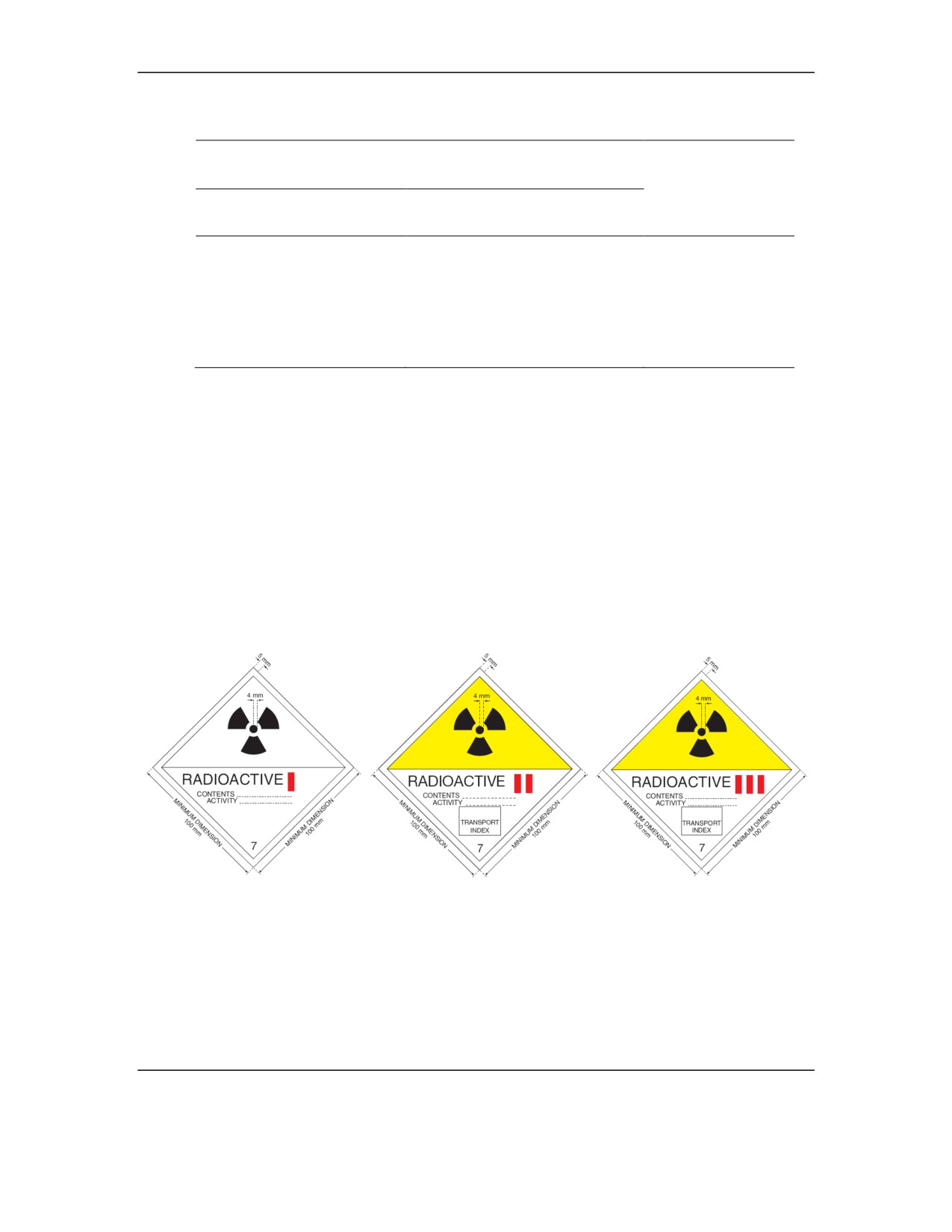
Type A and Industrial Packages must be labelled according to the category of package, as
follows:
Contents section should be completed using the name of the radionuclide, e.g. 226Ra, 137Cs, etc.
For NORM contaminated equipment the name of the radionuclide should be followed by SCO-I.
For LSA material, LSA-1 is all that is required.
Activity section should be completed using the maximum activity of the radioactive contents in
Bq, or multiples of Bq. For LSA the activity must be calculated based on the specific activity
(Bq/g) and the total mass. For SCO the activity must be calculated based on the measured surface
Control Tier: 2
Revision Date: 1 July, 2010
Document Number: AZSPU-HSSE-DOC-00115-2
Print Date: 2/1/2011
PAPER COPIES ARE UNCONTROLLED. THIS COPY VALID ONLY AT THE TIME OF PRINTING. THE
CONTROLLED VERSION OF THIS DOCUMENT CAN BE FOUND AT
AzSPU Procedure for Transportation of Radioactive Materials
Page 20 of 24
contamination (Bq/cm2) and the total surface area (cm2). Where the specific activity or surface
contamination levels are not known a best estimate should be made based on previous results.
For overpacks and freight containers the „contents‟ and „activity‟ sections should be completed
with the details from each package totalled together. In addition the Transport Index should be
recorded as either the sum of the individual transport indices, or it should be measured and
recorded.
Labels must be fixed to 2 opposite sides of the outside of the package, or on the outside of all 4
sides of a freight container or tank. Any label that do not relate to the contents must be removed.
Care must be taken to ensure that any marking described above are not covered by labels.
In the case of surface contaminated equipment I-WHITE labels are to be fixed on bundles,
baskets or slings carrying tubulars / equipment. Two labels are to be fitted to either side of the
basket.
PLACARDING
Large freight containers carrying packages (other than those for Excepted packages) must be
placarded on all 4 sides using the placard below:
In the case of road transportation vehicles placards will be fixed to both sides and the rear of the
vehicle. In addition, orange plates will be displayed, one at the front and one at the rear of the
vehicle bearing the hazard identification number “70” and the UN number.
DOCUMENTATION
A shipping manifest listing each item must be completed. In the case of tubulars, the number of
tubulars of each size and the number of bundles should be recorded. In the case of NORM
material, “NORM contaminated‟ must be marked on the manifest.
A Dangerous Goods Declaration must also be completed for all packages containing radioactive
material, including Excepted packages. A Dangerous Goods Declaration form completed for
NORM contaminated equipment / waste in included in Appendix B as an example (see red text).
Control Tier: 2
Revision Date: 1 July, 2010
Document Number: AZSPU-HSSE-DOC-00115-2
Print Date: 2/1/2011
PAPER COPIES ARE UNCONTROLLED. THIS COPY VALID ONLY AT THE TIME OF PRINTING. THE
CONTROLLED VERSION OF THIS DOCUMENT CAN BE FOUND AT
AzSPU Procedure for Transportation of Radioactive Materials
Page 21 of 24
CONTAMINATION LIMITS FOR PACKAGES
The non-fixed contamination on the external surfaces of any package must be kept as low as
practicable and must not, when averaged over 300cm2 of any part of the surface, exceed 4
Bq/cm2 for beta and gamma emitters and low toxicity alpha emitters, and 0.4 Bq/cm2 for other
alpha emitters.
For sealed sources radiation monitoring is only required where leakage is identified, or
suspected.
RADIOACTIVE MATERIAL POSSESSING OTHER DANGEROUS PROPERTIES
In addition to the radioactive properties of a consignment, any subsidiary risk of the contents
such as explosiveness, flammability, pyrophoricity, chemical toxicity and corrosiveness, also
need to be taken into account in the documentation, packing, labelling, marking, placarding,
stowage, segregation and carriage, in order to be in compliance with all relevant provisions of the
applicable legislation.
This is applicable in particular to materials containing hydrocarbons that also contain LSA.
Control Tier: 2
Revision Date: 1 July, 2010
Document Number: AZSPU-HSSE-DOC-00115-2
Print Date: 2/1/2011
PAPER COPIES ARE UNCONTROLLED. THIS COPY VALID ONLY AT THE TIME OF PRINTING. THE
CONTROLLED VERSION OF THIS DOCUMENT CAN BE FOUND AT

AzSPU Procedure for Transportation of Radioactive Materials
Page 22 of 24
APPENDIX B - DANGEROUS GOODS DECLARATION FORM - COMPLETED FOR NORM
CONTAMINATED EQUIPMENT / WASTE IN ACCORDANCE WITH IMDG / ADR REQUIREMENTS
(SEE RED TEXT)
MULTIMODAL DANGEROUS GOODS FORM
This form may be used as a dangerous goods declaration as it meets the requirements of SOLAS 74, chapter
VII, regulation 4; MARPOL 73/78, Annex III, regulation 4
1 Shipper/Consignor/Sender
2 Transport document number
3 Page 1 of pages
4 Shipper's reference
5 Freight Forwarder's reference
6 Consignee
7 Carrier (to be completed by the carrier)
SHIPPER'S DECLARATION
I hereby declare that the contents of this consignment are fully and accurately described
below by the Proper Shipping Name, and are classified, packaged, marked and
labelled/placarded and are in all respects in proper condition for transport according to the
applicable international and national governmental regulations.
8 This shipment is within the limitations prescribed for:
9 Additional handling information
(Delete non-applicable)
PASSENGER AND
CARGO
CARGOAIRCRAFT
AIRCRAFTONLY
10 Vessel/flight no. and date
11 Port/place of loading
12 Port/place of discharge
13 Destination
14 Shipping marks
*Number and kind of packages; description of goods
Gross mass (kg)
Net mass (kg)
Cube
(m3)
UN2913
RADIOACTIVE MATERIAL, SURFACE
CONTAMINATED OBJECT, non-fissile
Class 7
226Ra and 228Ra and Daughters
Solid Sulphate Scale
< 10MBq,
I-WHITE,
0.0005A2,
Unpackaged.
15 Container identification No./
16 Seal number(s)
17 Container/vehicle size
18 Tare mass
19 Total gross mass (including tare) (kg)
vehicle registration No.
& type
(kg)
CONTAINER/VEHICLE PACKING CERTIFICATE
21 RECEIVING ORGANISATION RECEIPT
Received the above number of packages/containers/trailers in apparent good order and
I hereby declare that the goods described above have been
condition unless stated hereon: RECEIVING ORGANISATION REMARKS:
packed/ loaded into the container/vehicle identified above in
accordance with the applicable provisions. †
MUST BE COMPLETED AND SIGNED FOR ALL
CONTAINER/VEHICLE LOADS BY PERSON
RESPONSIBLE FOR PACKING/LOADING.
Control Tier: 2
Revision Date: 1 July, 2010
Document Number: AZSPU-HSSE-DOC-00115-2
Print Date: 2/1/2011
PAPER COPIES ARE UNCONTROLLED. THIS COPY VALID ONLY AT THE TIME OF PRINTING. THE
CONTROLLED VERSION OF THIS DOCUMENT CAN BE FOUND AT
AzSPU Procedure for Transportation of Radioactive Materials
Page 23 of 24
20 Name of company
22 Name of company (OF SHIPPER
Haulier's name
PREPARING THIS NOTE)
Vehicle reg. no.
Name/Status of declarant
Name/status of declarant
Signature and date
Place and date
Place and date
Signature of declarant
DRIVER'S SIGNATURE
Signature of declarant
* DANGEROUS GOODS:
You must specify: UN No., Proper Shipping Name, hazard class, packing group, (where assigned) marine pollutant and
observe the mandatory requirements under applicable national and international governmental regulations. For the purposes of
the IMDG Code see 5.4.1.4
† For the purposes of the IMDG Code, see 5.4.2
Documentary Aspects of the International Transport of Dangerous Goods
Container/Vehicle Packing Certificate
The signature given overleaf in Box 20 must be that of the
When materials are transported in bulk packagings the cargo has
person controlling the container/vehicle operation.
been evenly distributed in the container/vehicle.
It is certified that:
The packages and the container/vehicle have been properly
marked, labelled and placarded. Any irrelevant mark, labels and
The container/vehicle was clean, dry and apparently fit to
placards have been removed.
receive the goods.
When solid carbon dioxide (CO2 - dry ice) is used for cooling
If the consignments include goods of class 1, other than
purposes, the vehicle or freight container is externally marked or
division 1.4, the container is structurally serviceable.
labelled in a conspicuous place, e.g. at the door end, with the
words: DANGEROUS CO2 GAS (DRY ICE) INSIDE -
No incompatible goods have been packed into the
VENTILATE THOROUGHLY BEFORE ENTERING.
container/vehicle unless specially authorised by the
Competent Authority.
When this Dangerous Goods Form is used as a container/vehicle
packing certificate only, not a combined document, a dangerous
All packages have been externally inspected for damage
goods declaration signed by the shipper or supplier must have
and only sound packages packed.
been issued/received to cover each dangerous goods consignment
packed in the container.
Drums have been stowed in an upright position, unless
otherwise authorised by the Competent Authority.
Note: The container packing certificate is not required for tanks
All packages have been properly packed and secured in
the container/vehicle.
Control Tier: 2
Revision Date: 1 July, 2010
Document Number: AZSPU-HSSE-DOC-00115-2
Print Date: 2/1/2011
PAPER COPIES ARE UNCONTROLLED. THIS COPY VALID ONLY AT THE TIME OF PRINTING. THE
CONTROLLED VERSION OF THIS DOCUMENT CAN BE FOUND AT
AzSPU Procedure for Transportation of Radioactive Materials
Page 24 of 24
APPENDIX C - RADIATION PROTECTION ADVISER / QUALIFIED EXPERT (RPA) CONTACT
DETAILS
AzSPU has appointed Tracerco Radiation Protection Advisory Services as their Radiation
Protection Adviser (RPA) (which is equivalent to the term Qualified Expert used by the
IAEA and the EC).
The first point of contact is Donald Urquhart, who is based in the Tracerco office in Aberdeen,
UK. However, all of the RPAs who are based either in the Aberdeen office or the Tracerco
Billingham office are able to advise on any issues affecting BP.
Contact details:
Aberdeen
Email
Telephone
RPAs
+44(0)1224576748 (direct)
Donald Urquhart
donald.urquhart@matthey.com
+44(0)7875384225 (mobile)
+44(0)1224576742 (direct)
Graham Wales
graham.wales@matthey.com
+44(0)7764836669 (mobile)
+44(0)1224576743 (direct)
Bill Good
bill.good@matthey.com
+44(0)7801662320 (mobile)
Billingham
Email
Telephone
RPAs
+44(0)1642375462 (direct)
Andrew Smith
andrew.smith@matthey.com
+44(0)7764290567 (mobile)
+44(0)1642375463 (direct)
Nick Hutchison
nick.hutchinson@matthey.com
+44(0)7919091388 (mobile)
+44(0)1642375461 (direct)
Paul Warren
paul.warren@matthey.com
+44(0)7889828968 (mobile)
Emergency Contact Details:
If none of the above can be contacted outside normal hours then
call
+44(0)1642 375500 and ask to speak to the duty RPA.
Postal Addresses
Aberdeen
Billingham
Office
Office
Tracerco
Tracerco Technology Centre,
Chattan Mews Office
Pavilion 10, The Moat,
18 Chattan Place
Belasis Hall Technology Park
Aberdeen
Billingham, Cleveland,
AB10 6RD
TS23 4AZ,
United Kingdom
United Kingdom
Control Tier: 2
Revision Date: 1 July, 2010
Document Number: AZSPU-HSSE-DOC-00115-2
Print Date: 2/1/2011
PAPER COPIES ARE UNCONTROLLED. THIS COPY VALID ONLY AT THE TIME OF PRINTING. THE
CONTROLLED VERSION OF THIS DOCUMENT CAN BE FOUND AT
AzSPU Radiation Contingency Plan
Page 1 of 22
AzSPU Radiation Contingency Plan
AzSPU-HSSE-DOC-00086-2
Authority:
Yuliy Zaytsev (AzSPU
Custodian:
John Elliott (AzSPU Senior HSE
Safety & Compliance
Advisor)
Manager)
Scope:
AzSPU
Document
AzSPU HSSE MS Document
Administrator:
Coordinator
Issue Date:
16th September, 2009
Issuing Dept:
AzSPU HSSE
Revision Date:
04th October, 2010
Control Tier:
2
Next Review
04th March, 2011
Date:
Control Tier:
2
Revision Date:
04 October, 2010
Document Number: AZSPU-HSSE-DOC-00086-2
Print Date: 2/1/2011
PAPER COPIES ARE UNCONTROLLED. THIS COPY VALID ONLY AT THE TIME OF PRINTING. THE
CONTROLLED VERSION OF THIS DOCUMENT CAN BE FOUND AT
AzSPU Radiation Contingency Plan
Page 2 of 22
CONTACT DETAILS OF KEY PERSONNEL
Position Title
Name
Phone No.
AzSPU Radiation Protection
Yuliy Zaytsev (temporary)
(055) 450-7981
Single Point Accountability
(SPA)
AzSPU Radiation Protection
Donald Urquhart
+44(0) 01224 650658 (direct)
Advisor (RPA)
+44(0) 7875384225 (mobile)
Full contact details in
Appendix B.
AzSPU Permitting &
Arif Muganlinsky
(055) 220-6882
Regulatory Affairs Advisor
AzSPU Central Environment
Faig Askerov
(055) 215-3877
Team Manager
Control Tier:
2
Revision Date:
04 October, 2010
Document Number: AZSPU-HSSE-DOC-00086-2
Print Date: 2/1/2011
PAPER COPIES ARE UNCONTROLLED. THIS COPY VALID ONLY AT THE TIME OF PRINTING. THE
CONTROLLED VERSION OF THIS DOCUMENT CAN BE FOUND AT
AzSPU Radiation Contingency Plan
Page 3 of 22
TABLE OF CONTENTS
CONTACT DETAILS OF KEY PERSONNEL
2
1.
PURPOSE/SCOPE
4
2.
DEFINITIONS
4
3.
GENERAL REQUIREMENTS
5
4.
KEY RESPONSIBILITIES
5
5.
CONTINGENCY PLANS
8
5.1 CONTINGENCY PLANS FOR INCIDENTS INVOLVING RADIATION
8
5.2.
NUCLEONIC DEVICE RELATED INCIDENTS
8
5.2.1
General Principles
8
5.2.2
Loss or Damage to Shielding
9
5.2.3
Leakage of Radioactive material
10
5.2.4
Loss or Theft of Source
11
5.2.5
Overexposure
11
5.2.6
Waste
12
5.3.
INSTRUCTIONS FOR CONTRACTOR INCIDENTS INVOLVING IONISING RADIATION
12
5.3.1
Well Logging Incidents - Source Abandonment
12
5.3.2
Incidents involving Radiography Sources
14
5.4.
NOTIFICATION TO THE AUTHORITIES
14
5.4.1
Downhole Stuck Radioactive Source Notification Process
15
FIGURE 1: DOWNHOLE RADIOACTIVE SOURCE ABANDONMENT NOTIFICATION FLOWCHART
16
6. KEY DOCUMENTS/TOOLS/REFERENCES
18
APPENDIX A - AZSPU INVENTORY OF RADIOACTIVE SOURCES
20
APPENDIX B - RADIATION PROTECTION ADVISER (RPA) CONTACT DETAILS
21
APPENDIX C - VERBAL INCIDENT NOTIFICATION FORM
22
Control Tier:
2
Revision Date:
04 October, 2010
Document Number: AZSPU-HSSE-DOC-00086-2
Print Date: 2/1/2011
PAPER COPIES ARE UNCONTROLLED. THIS COPY VALID ONLY AT THE TIME OF PRINTING. THE
CONTROLLED VERSION OF THIS DOCUMENT CAN BE FOUND AT
AzSPU Radiation Contingency Plan
Page 4 of 22
1.
PURPOSE/SCOPE
The purpose of this document is to provide clarity regarding management of potential incidents
involving radioactive materials and radiation generators.
This controlled procedure applies to AzSPU Operations PUs and Projects engaged in the drilling,
production, and/or transportation of oil and gas (including support activities), and construction
activities when working with ionising radiation in Azerbaijan. Contractors working on AzSPU
owned or operated sites/installations are also required to align with this procedure.
This procedure does not replace, not should it conflict with, the AzSPU Procedure for
Management of Radioactive Materials and Radiation Generators (AzSPU-HSSE-DOC-00058-2).
Revision of this procedure and the operational controls detailed therein will be in accordance
with the AzSPU HSSE Document Management Procedure (AzSPU-HSSE-DOC-00025-2).
2.
DEFINITIONS
A full glossary of terms related to radiation is provided in Appendix A of the AzSPU Procedure
for Management of Radioactive Materials and Radiation Generators (AzSPU-HSSE-DOC-00058-
2).
Abbreviations:
AzSPU
Azerbaijan Strategic Performance Unit
CET
Central Environment Team
DC&I
Drilling, Completions & Interventions
ERP
Emergency Response Plan
ERT
Emergency Response Team
HSE&TD
Health, safety, environment & technical directorate
LWD
Logging whilst drilling
MENR
Ministry of Ecology and Natural Resources
MES
Ministry of Emergency Situations
MoH
Ministry of Health
OIM
Offshore Installation Manager
P&RAs
Permitting & Regulatory Affairs
PU
Performance Unit
RPA
Radiation Protection Advisor
RPO
Radiation Protection Officer
RPS
Radiation Protection Supervisor
RP SPA
Radiation Protection Single Point Accountability
SOCAR
State Oil Company of the Azerbaijan Republic
mSv/h
Milli sieverts per hour
Sv/h
Micro sieverts per hour
Control Tier:
2
Revision Date:
04 October, 2010
Document Number: AZSPU-HSSE-DOC-00086-2
Print Date: 2/1/2011
PAPER COPIES ARE UNCONTROLLED. THIS COPY VALID ONLY AT THE TIME OF PRINTING. THE
CONTROLLED VERSION OF THIS DOCUMENT CAN BE FOUND AT
AzSPU Radiation Contingency Plan
Page 5 of 22
3.
GENERAL REQUIREMENTS
General requirements pertaining to radiation safety are detailed in Section 3.1 of the AzSPU
Procedure for Management of Radioactive Materials and Radiation Generators (AzSPU-HSSE-
DOC-00058-2).
4.
KEY RESPONSIBILITIES
A full description of the responsibilities with regard to radiation protection is provided in Section
4 of the AzSPU Procedure for Management of Radioactive Materials and Radiation Generators
(AzSPU-HSSE-DOC-00058-2). A summary of key responsibilities directly applicable to this
Plan are provided below:
AzSPU Radiation Protection Single Point Accountability (RP SPA)
The RP SPA resides in the AzSPU Safety & Compliance Team. The duties of the RP SPA are
summarized as follows:
Ensuring that this AzSPU Radiation Contingency Plan is reviewed, and updated as required,
on a regular basis.
Maintaining proper communication flow between the AzSPU RPA (UK based) and the Site
Radiation Protection Supervisors (RPSs).
Processing radiation incident notifications (prior to submission by AzSPU Permitting and
Regulatory Affairs / AzSPU Central Environmental Team).
Supporting investigations into radiation related issues.
Providing advice on source recovery, clean-up and waste disposal following an incident (in
consultation with the AzSPU RPA).
AzSPU Radiation Protection Adviser / Qualified Expert (RPA)
AzSPU retains by contract and appointment a RPA to provide the AzSPU with expert advice on
radiation safety and compliance matters. The RPA reports to the AzSPU Safety & Compliance
Manager and works directly with the AzSPU RP SPA. Contact details for the RPA are provided
in Appendix B.
In terms of this procedure, the RPA will be consulted with respect to the following:
Development and update of contingency plans.
Investigations into doses in excess of the investigation level.
Investigation of incidents.
Advice on source recovery, clean-up, waste disposal following an incident.
Site Manager / Offshore Installation Manager (OIM)
Control Tier:
2
Revision Date:
04 October, 2010
Document Number: AZSPU-HSSE-DOC-00086-2
Print Date: 2/1/2011
PAPER COPIES ARE UNCONTROLLED. THIS COPY VALID ONLY AT THE TIME OF PRINTING. THE
CONTROLLED VERSION OF THIS DOCUMENT CAN BE FOUND AT
AzSPU Radiation Contingency Plan
Page 6 of 22
The Site Manager / OIM is accountable for all aspects of radiation safety on any site under his
control or authority. In particular he is accountable for ensuring that:
Suitable persons have been appointed to supervise work with ionising radiation i.e. Radiation
Protection Supervisors (RPSs) and that a Site Register of RPSs is kept.
All persons involved in work with ionising radiation have received adequate training and
details of their training are recorded.
Suitable and sufficient radiation monitoring instruments are provided.
Prior to any work with ionising radiation, a risk assessment is carried out.
Suitable and sufficient personal protective equipment is provided, as and when necessary, for
the prevention of contamination of personnel.
Radiation Protection Supervisors (RPSs)
The specific duties of the RPS, with respect to this Plan, are to:
Ensure that all work with ionising radiation is subject to a radiation risk assessment.
Implement this Contingency Plan for incidents or accidents involving work with ionising
radiation.
To carry our radiation surveys, visual surveys, and leakage tests in the event of an incident
(providing it is safe to do so).
Instigate personnel searches (with assistance from site security) and site searches (using a
suitable meter) in the event of a lost radioactive source.
Cordon off areas, as required, following an incident.
Conduct contamination screening of personnel leaving the incident area (in collaboration
with the ERT).
Manage the handling and storage of contaminated items resulting from the incident
(following consultation with the AzSPU RP SPA).
In the event of overexposure, for calculating likely personnel doses and notifying the RPA if
doses are exceeded.
Maintain Site Radiation Records.
AzSPU Permitting and Regulatory Affairs / AzSPU Central Environmental Team
The AzSPU Permitting and Regulatory Affairs Team is responsible for notifying SOCAR,
Ministry of Emergency Situations (MES), Ministry of Health (MoH), Ministry of Industry and
Energy, Cabinet of Ministers, and heads of local executive authorities (onshore incidents only),
in the event of a radiation incident.
The AzSPU Central Environmental Team is responsible for notifying the Ministry of Ecology
and Natural Resources (MENR) in the event of a radiation incident.
Notifications must be carried out in a timely manner, and in the case of a downhole stuck
radioactive source in accordance with the time limitations in Figure 1.
Control Tier:
2
Revision Date:
04 October, 2010
Document Number: AZSPU-HSSE-DOC-00086-2
Print Date: 2/1/2011
PAPER COPIES ARE UNCONTROLLED. THIS COPY VALID ONLY AT THE TIME OF PRINTING. THE
CONTROLLED VERSION OF THIS DOCUMENT CAN BE FOUND AT
AzSPU Radiation Contingency Plan
Page 7 of 22
Drilling, Completion & Intervention (DC&I) Team
In the event of a downhole stuck radioactive source DC&I are responsible for:
Completing the verbal notification incident form (Appendix C), in consultation with the well
logging contractor.
Providing written formal notification of decision to abandon source (based on information
provided by well logging contractor) if attempts to free stuck radioactive source
unsuccessful.
Preparing „Close-out Letter‟ on completion of source abandonment and well sidetrack.
Submitting above documents to the AzSPU RP SPA in accordance with the time limitations
in Figure 1.
Workers
All workers are responsible for the safety of themselves and others who may be affected by their
actions or inactions. In particular, all workers are required to:
Follow any applicable procedures or local rules relating to radiation protection or safety.
Use monitoring devices and personal protective equipment and clothing provided.
Refrain from any actions that will cause unnecessary exposure of themselves or others.
Accept information, instruction and training on radiation protection and safety that will
enable them to carry out their work in accordance with this plan, and other radiation
procedures.
In addition, female workers have the responsibility of informing management when they know,
or suspect, that they are pregnant.
Contractors
Contractors are required to have their own Emergency Response Plans within their radiation
procedures and to have all equipment on site to allow for retrieval of sources.
Contractor ERPs will be aligned with the requirements of this AzSPU Radiation Contingency
Plan.
Available Resources
BP and Contractors have the following human, material & procedural resources in case of
radiation incidents:
AzSPU Radiation Protection Single Point Accountability (SPA).
Site Radiation Protection Supervisors (RPSs).
Contractor Radiation Protection Officers (RPOs).
AzSPU Radiation Protection Adviser / Qualified Expert (Tracerco).
Emergency Response Team.
Incident Management Team.
Control Tier:
2
Revision Date:
04 October, 2010
Document Number: AZSPU-HSSE-DOC-00086-2
Print Date: 2/1/2011
PAPER COPIES ARE UNCONTROLLED. THIS COPY VALID ONLY AT THE TIME OF PRINTING. THE
CONTROLLED VERSION OF THIS DOCUMENT CAN BE FOUND AT
AzSPU Radiation Contingency Plan
Page 8 of 22
AzSPU and contractor radiation emergency equipment.
Asset medic and sick bay offshore, ISOS clinics onshore.
Procedures and manuals referenced in Section 6 of this procedure.
In cases of severe exposure to radiation, offshore personnel will be evacuated to onshore-based
ISOS clinic in accordance with AzSPU Offshore Emergency Medical Evacuation Procedure
(AzSPU-HSSE-DOC-00085-2).
5.
CONTINGENCY PLANS
The following reasonably foreseeable incidents involving radioactive materials have been
identified:
Nucleonic device related incidents, which include:
o Fire, explosion, or mechanical impact resulting in loss or damage to shielding, or
leakage of radioactive material.
o Loss, or theft, of source.
o Overexposure to personnel.
Well logging related incidents, including source abandonment.
Site radiography related incidents, including stuck source.
5.1
CONTINGENCY PLANS FOR INCIDENTS INVOLVING RADIATION
The presence of radioactive material should not prevent life saving and other critical actions. Life
saving actions near a high activity source are not likely to lead to doses in excess of the 200 mSv
limit for radiation emergencies and will not cause severe health effects. It should be remembered
that hazards other than radiation may be present and may represent a greater health risk.
In instances where lifesaving and fire-fighting are required, each facility will refer to its asset-
specific Emergency Response Plan. If an incident escalates to a Tier 2 or Tier 3 response the
relevant country Incident Management Team will provide support, as detailed in the AzSPU
Incident Management System Manual (AzSPU-HSSE-DOC-00107-2).
Any incident involving a radioactive source must be investigated in accordance with the AzSPU
Incident Reporting and Investigation Procedure (AzSPU-HSSE-DOC-00054-2).
5.2. NUCLEONIC DEVICE RELATED INCIDENTS
5.2.1 General Principles
Follow standard safety procedures.
The person identifying the radiation incident has to evacuate the immediate area and
warn others to do the same.
The Central Control Room organises muster of all on-shift personnel to a safe area
and informs all other personnel to remain in a safe area until further notice.
Control Tier:
2
Revision Date:
04 October, 2010
Document Number: AZSPU-HSSE-DOC-00086-2
Print Date: 2/1/2011
PAPER COPIES ARE UNCONTROLLED. THIS COPY VALID ONLY AT THE TIME OF PRINTING. THE
CONTROLLED VERSION OF THIS DOCUMENT CAN BE FOUND AT
AzSPU Radiation Contingency Plan
Page 9 of 22
In instances of catastrophic damage, the risk of significant exposure due to inhalation
of aerosols is small, but inhalation of smoke should be avoided and respiratory
protection worn if available. If respiratory protection equipment is not available the
mouth and nose should be covered with a handkerchief, or something similar.
Time spent being exposed to radiation should be minimized, where practicable.
Distance between yourself and the source of radiation should be maximized, where
practicable.
Local shielding such as steel structures can be used to reduce your exposure, if
practicable.
Do not touch or pick up anything that might be a radioactive source, or anything that
might be contaminated. Keep hands away from the face.
Do not enter an area where the dose rate is greater than 100 mSv/h, except for life
saving actions (in case of life saving, limit the time spent in the area of >100 mSv/h
to no more than 30 minutes).
All personnel who have been directly or indirectly involved in an incident, where
there has been a risk of contamination, shall be monitored.
ERT personnel wearing breathing apparatus can safely enter a contaminated area, but
any contaminated PPE shall be removed prior to leaving the outer area.
Contaminated waste from response actions, such as water used for decontamination,
should not represent a health hazard, but in order to reduce later clean up costs as
well as anxiety among the work force, reasonable efforts should be taken to minimise
the spread of contamination, provided this does not delay other response actions.
Once emergency operations have ended, other activities (source recovery, clean-up,
waste disposal etc.) will follow guidance from the RPA and the relevant authorities
(through the AzSPU Radiation Protection SPA).
A report will be prepared by the RPS and retained in the Site Radiation Records.
5.2.2
Loss or Damage to Shielding
In the event of fire, explosion, or mechanical impact affecting a nucleonic device (or the vessel
on which a device is fitted), loss of shielding should be assumed with the potential for radiation
exposure.
In the event of a catastrophic incident, complete loss of shielding could result in the source
capsule being accessible. In addition, the source may be projected some distance away from its
original location.
Initial Actions:
Inform the Site Manager / OIM, Central Control Room and site RPS.
The site RPS will obtain a suitable dose rate meter and switch it on before
approaching the incident area. The backg2round reading will be noted, which should
normally be zero.
Provided it is safe to do so, the site RPS will carry out a radiation survey around the
device and vessel.
If dose rates no higher than normal are measured around the vessel, or nucleonic
device, then a visual inspection of the device will be carried out by the site RPS.
Control Tier:
2
Revision Date:
04 October, 2010
Document Number: AZSPU-HSSE-DOC-00086-2
Print Date: 2/1/2011
PAPER COPIES ARE UNCONTROLLED. THIS COPY VALID ONLY AT THE TIME OF PRINTING. THE
CONTROLLED VERSION OF THIS DOCUMENT CAN BE FOUND AT
AzSPU Radiation Contingency Plan
Page 10 of 22
If there appears to be no damage to the outside of the device then a leakage test will
be carried out by the site RPS (see Appendix J of the AzSPU Procedure for
Management of Radioactive Materials and Radiation Generators (AzSPU-HSSE-
DOC-00058-2)).
If no leakage is detected then no further action is required, unless internal damage to
the device is suspected, in which case the supplier will be contacted by the site RPS
for further advice.
If dose rates above backg2round are measured (in an area that is not already a
Controlled Area) this indicates a probable loss of shielding.
A cordon will immediately be set up at 10m radius in all directions around the device
by the site RPS, or a member of the ERT as appropriate - if necessary, the cordon
will be expanded to any area where the dose rate is 100 µSv/h. Only the ERT will be
allowed access within the cordon.
Anyone leaving the incident area will be screened for any gross contamination by the
site RPS, or a member of the ERT as appropriate, using a dose rate meter. In the
unlikely event that anyone is found to be contaminated, that person will be isolated at
the edge of the inner cordon and decontamination procedures applied, as outlined in
Section 5.2.3.
If there is obvious damage to the housing of a nucleonic device then leakage of
radioactive material must be suspected and the steps in Section 5.2.3 implemented.
Once emergency operations have ended, clean-up and waste disposal will follow
guidance from the RPA and the relevant authorities (through the AzSPU Radiation
Protection SPA).
5.2.3
Leakage of Radioactive material
Initial Actions:
Inform the Installation Manager / OIM, Central Control Room and site RPS.
Contamination monitoring will be carried out by the site RPS to determine the extent
of the spread of contamination.
The spread of contamination will be minimised by the RPS marking and restricting
access to the contaminated area.
The spread of contamination, particularly on shoes or clothing of persons leaving the
affected area, should be prevented.
All persons who have been present in areas of contamination will be monitored for
contamination by the site RPS. In the unlikely event that anyone is found to be
contaminated, or if monitoring cannot be carried out immediately, persons will be
isolated at the edge of the inner cordon. They will remove outer clothes and leave
these at the edge of the cordon, if it is safe to do so. They will then shower.
Contaminated parts of the body will be washed thoroughly but gently until either
monitoring shows that contamination will not be significantly reduced further by this
method, or there is a risk of roughening or breaking the skin.
Any contaminated wound, however trivial, shall be irrigated with water or saline
solution, care being taken to limit any spread of contamination to or from other parts
of the skin.
Control Tier:
2
Revision Date:
04 October, 2010
Document Number: AZSPU-HSSE-DOC-00086-2
Print Date: 2/1/2011
PAPER COPIES ARE UNCONTROLLED. THIS COPY VALID ONLY AT THE TIME OF PRINTING. THE
CONTROLLED VERSION OF THIS DOCUMENT CAN BE FOUND AT
AzSPU Radiation Contingency Plan
Page 11 of 22
Any items that are found to be contaminated (e.g. gloves, coveralls, boots) shall be
removed, taking care not to spread any contamination, sealed in bags and left in or
near the affected area.
Bags of contaminated items will be placed in a secure (lockable) container by the site
RPS. The container will be marked with a radiation warning sign and the words
“Danger Radioactive Contamination”. In the event of high dose rates, a barrier will
be set up around the container.
Once emergency operations have ended, clean-up and waste disposal will follow
guidance from the RPA and the relevant authorities (through the AzSPU Radiation
Protection SPA).
5.2.4 Loss or Theft of Source
The aim is to prevent lost or stolen radioactive sources entering the public domain by deliberate
or accidental removal from the site.
Initial Actions:
If a fixed source becomes lost, or unaccounted for, the site RPS, Installation Manager
/ OIM, Central Control Room, and Site Security must be informed.
All personnel leaving the site will be searched and monitored by Site Security and
the site RPS, or an authorized person who has received appropriate training.
The site RPS will immediately start a search for the source using a suitable meter. It
should be noted that it may not be possible to detect a source that is in a shielded
container.
If the source is found and it is in its shielded container then a visual inspection of the
container will be carried out by the site RPS to determine whether there is any
damage.
If the container is damaged then the steps for loss or damage to shielding will be
applied, see Section 5.2.2.
If there is no damage then the container will be placed in temporary storage until it
can be safely reinstalled by the appropriate contractor personnel.
If the source is not found, source accounting records will be examined to ascertain when and
where the source was last used. The AzSPU Radiation Protection SPA and the RPA must be
notified as soon as possible.
5.2.5 Overexposure
In the event that overexposure of an individual is suspected, the site RPS will carry out an
investigation to determine the likely dose that has been received.
The RPS will calculate the potential dose based on the maximum dose rate that the individual
was exposed to and the duration of the exposure.
In the case of inhalation / ingestion of radioactive material the RPS will make an estimate of the
likely quantity of material involved and contact the RPA for further assistance.
Control Tier:
2
Revision Date:
04 October, 2010
Document Number: AZSPU-HSSE-DOC-00086-2
Print Date: 2/1/2011
PAPER COPIES ARE UNCONTROLLED. THIS COPY VALID ONLY AT THE TIME OF PRINTING. THE
CONTROLLED VERSION OF THIS DOCUMENT CAN BE FOUND AT
AzSPU Radiation Contingency Plan
Page 12 of 22
If the investigation shows that the individual has exceeded a dose limit, or it cannot be proved
otherwise, then the RPA shall be notified immediately.
5.2.6 Waste
In the event that contamination occurs, it will be necessary to collect all contaminated items /
materials and dispose of them through a national radioactive waste management facility. If such a
facility does not exist, or is not willing to take the contaminated material, it may then be
necessary for AzSPU to store the material until a suitable disposal route can be identified. This
will involve discussions with the relevant Azerbaijani authorities in order to get their input.
As stated above, clean-up operations will follow guidance from the RPA, through the AzSPU
Radiation Protection SPA.
5.3. INSTRUCTIONS FOR CONTRACTOR INCIDENTS INVOLVING IONISING RADIATION
Contractors will have Emergency Response Plans within their radiation procedures / site specific
instructions to deal with reasonably foreseeable incidents or accidents. All equipment to allow
for retrieval of sources will be available on site, in accordance with the Plan.
Notification of an incident involving work with ionising radiation is initially processed by the
AzSPU Radiation Protection SPA and submitted to the authorities by the appropriate AzSPU
department, see Section 5.4.
5.3.1 Well Logging Incidents - Source Abandonment
This section provides guidance in the event of a radioactive source becoming stuck in a well. The
basic scenario being described is for a well with a stuck wireline logging tool, but would also be
applicable for a Logging Whilst Drilling (LWD) tool.
All „reasonable‟ efforts must be made to recover the source, while ensuring that the source
integrity is not affected by the recovery operations.
If the source is recovered, a leakage test will be carried out. If the source is found to be leaking
the Contractor‟s Emergency Response Plans for a leaking source will be put into effect. The
authorities will be informed in accordance with Section 5.4.
If it is not possible to recover the source, the authorities will be informed in accordance with the
process outlined in Section 5.4 and Figure 1.
The following information will be recorded by the contractor: details of the well location, the
source location within the well, the source type, source serial number, and source activity
(current or at a reference date).
In addition, the contractor will detail the steps taken to recover the source and the mitigating
factors that prevent recovery. These factors may include:
Practical difficulties of recovering the tool and/or source without potentially causing
damage to the source.
The additional costs that will be incurred in further fishing operations, compared with the
value of the recovered tool.
Control Tier:
2
Revision Date:
04 October, 2010
Document Number: AZSPU-HSSE-DOC-00086-2
Print Date: 2/1/2011
PAPER COPIES ARE UNCONTROLLED. THIS COPY VALID ONLY AT THE TIME OF PRINTING. THE
CONTROLLED VERSION OF THIS DOCUMENT CAN BE FOUND AT
AzSPU Radiation Contingency Plan
Page 13 of 22
Location of production zones.
The proposal may also need to include a justification that abandoning the source is the best
environmental option with reference to the following influencing factors:
The environmental impact associated with further recovery operations.
Possibility of drilling into or damaging the source during the recovery operation.
The low risk of sources coming to surface or leaking radioactivity into the environment.
Supporting evidence will include a description of the position of the source within the
logging tool and the location of the tool within the well bore and also the current leak test
certificate, the original source document verifying the source ISO Classification and/or
the Special Form Certificate.
Finally, the mitigations that will be taken to prevent damage to the source as a result of further
drilling operations will be described.
The mitigations will be:
The radioactive sources will be immobilised and sealed in place with a cement plug.
A drill-bit deflector will be placed on top of the cement to deflect any future drilling
unless the sources are not accessible to future drilling operations. If a sidetrack is
proposed, then include a specific statement of how collision with the old hole will be
avoided. If proposing to sidetrack, include a plot of the proposed sidetrack indicating the
minimum separation of the new well bore from the source.
A plaque 17 cm square and 3 mm thick, manufactured of steel, brass, bronze or monel,
will be placed on the surface of the well or well head, unless this is not practical, to warn
of the presence of the abandoned source in the well. The plaque will contain the
following details:
The word “Caution”;
The ISO radiation trefoil symbol;
The date the source was abandoned;
The name of the well owner or well operator;
The well name and identification number;
Source type(s) and activity;
Depth of the source(s) and depth to the top of the plug;
An appropriate warning such as “do not re-enter this well”.
There will be a clear statement of the hazard/risk level once mitigations are in place.
The report will be included in the Site Radiation Records.
If the source is abandoned the site RPS is responsible for:
Closing out the entry in the Site Mobile Source Register, see Appendix N of the AzSPU
Procedure for Management of Radioactive Materials and Radiation Generators (AzSPU-
HSSE-DOC-00058-2).
Entering the details in the site inaccessible source register, see Appendix O of the
AzSPU Procedure for Management of Radioactive Materials and Radiation Generators
(AzSPU-HSSE-DOC-00058-2).
Control Tier:
2
Revision Date:
04 October, 2010
Document Number: AZSPU-HSSE-DOC-00086-2
Print Date: 2/1/2011
PAPER COPIES ARE UNCONTROLLED. THIS COPY VALID ONLY AT THE TIME OF PRINTING. THE
CONTROLLED VERSION OF THIS DOCUMENT CAN BE FOUND AT
AzSPU Radiation Contingency Plan
Page 14 of 22
5.3.2 Incidents involving Radiography Sources
All equipment will be on site to allow retrieval of a stuck radiography source in accordance with
the Contractor‟s Emergency Response Plans. This will include bags of lead shot, or lead sheets to
be used as shielding. If the source is exposed and cannot be retracted immediately then shielding
material will be applied. This should reduce the dose rate significantly, but it may still be
necessary to extend the Controlled Area barriers to the 7.5 µSv/h contour.
If a site / facility moves to “Hazard” status during radiography, the source will be wound back or
replaced into its container and/or its shutter closed, the container locked, the key removed and
retained by the operator prior to the involved personnel proceeding to muster. This action must
be communicated to the Site Manager / OIM via the Central Control Room in order to advise
emergency response teams that any radiation barriers in place can be disregarded.
5.4. NOTIFICATION TO THE AUTHORITIES
Any notification of an incident involving a radiation source shall be initially processed by the
AzSPU Radiation Protection SPA and submitted to the authorities by the appropriate AzSPU
department - AzSPU Permitting & Regulatory Affairs and AzSPU Central Environmental Team.
The authorities that are notified in the event of a radiation incident are:
State Oil Company of the Azerbaijan Republic (SOCAR);
Ministry of Emergency Situations (MES);
Ministry of Ecology and Natural Resources (MENR);
Ministry of Health (MoH);
Cabinet of Ministers of Azerbaijan Republic;
Ministry of Industry and Energy;
Heads of local executive authorities.
For AzSPU owned radiation sources, a formal notification shall be sent to the authorities listed
above by the AzSPU specifying:
(i)
Circumstances of the emergency / incident.
(ii)
First steps taken to remedy the situation and the results of said efforts.
(iii)
Measures taken to bring the emergency situation under control and protect against
loss of life, harm to natural resources and the environment, and loss of / damage to
property.
For contractor owned sources on BP controlled / operated facilities, a joint formal notification
will be issued by AzSPU and the contractor (submitted to the authorities by AzSPU). This will
contain the same information as specified above. With respect to downhole radioactive source
abandonment, pertinent information will also be included from the report compiled by the
contractor (see Section 5.3.1).
For contractor owned sources on contractor facilities but within the PSA Contract Areas (e.g. on
drilling rigs), a high level notification will be issued by AzSPU with the contractor‟s detailed
report attached to it.
Control Tier:
2
Revision Date:
04 October, 2010
Document Number: AZSPU-HSSE-DOC-00086-2
Print Date: 2/1/2011
PAPER COPIES ARE UNCONTROLLED. THIS COPY VALID ONLY AT THE TIME OF PRINTING. THE
CONTROLLED VERSION OF THIS DOCUMENT CAN BE FOUND AT
AzSPU Radiation Contingency Plan
Page 15 of 22
Further details regarding this process will be included within the AzSPU Health & Safety
External Reporting Procedure (currently in preparation).
5.4.1 Downhole Stuck Radioactive Source Notification Process
Details of the notification process for a downhole stuck radioactive source are provided in Figure
1.
In summary, if it is not possible to free the stuck string by normal drilling methods, an initial
verbal notification will be sent to the authorities informing them of the issue, along with plans for
freeing the bottom hole assembly. In order to ensure that consistent and accurate information is
communicated, the verbal notification incident form in Appendix C is completed by DC&I.
Following this, attempts will be made to recover the source by fishing (application of tools,
equipment and techniques to remove items from the wellbore). If this is unsuccessful, a formal
written notification of the decision to abandon the source will be prepared by DC&I containing
the data requirements listed in Section 5.3.1.
On completion of abandonment and sidetrack, a final „Close-out Letter‟ will be prepared by
DC&I and submitted to the authorities.
Control Tier:
2
Revision Date:
04 October, 2010
Document Number: AZSPU-HSSE-DOC-00086-2
Print Date: 2/1/2011
PAPER COPIES ARE UNCONTROLLED. THIS COPY VALID ONLY AT THE TIME OF PRINTING. THE
CONTROLLED VERSION OF THIS DOCUMENT CAN BE FOUND AT

AzSPU Radiation Contingency Plan
Page 16 of 22
Figure 1: Downhole Radioactive Source Abandonment Notification Flowchart
Initial Notification.
Data provided by contractor, through DC&I (completion of verbal
PART-1
notification incident form - Appendix C). Submitted to AzSPU RP SPA.
Tool String (plus RA source) stuck
VERBAL notifications issued by AzSPU HSE & TD (CET and P&RAs)
in hole
SOCAR
Perform leak
test
Attempt to work
N
Ministry for Emergency Situations
free
O
Leaking
T
MENR
I
No
Implement
F
Ministry of Health
leak
Yes
Contractor
Free?
Y
ERP and
NO
Ministry of Industry & Energy
notify
ACTION
No
accordingly
*No later than third day
Data provided by contractor, through DC&I (data requirements listed in Section
PART-2
Perform leak
Attempt
5.3.1). Submitted to AzSPU RP SPA.
No
fishing for
For contractor owned sources on AzSPU platforms, a joint written notification is
test
source?
prepared (DC&I and Contractor).
For contractor owned sources on contractor rigs, a high level notification is prepared
Leaking
by DC&I, with the contractor’s detailed report attached to it.
No
Yes
FORMAL WRITTEN notifications issued by AzSPU HSE&TD (CET and PARAs).
Implement
Yes
Contractor
leak
Free?
ERP and
NO
notify
ACTION
No
SOCAR
accordingly
N
Ministry for Emergency Situations
BP Decision to Abandon
O
T
MENR
I
F
Ministry of Health
Y
Ministry of Industry & Energy
**No later than 3 days after decision to abandon /
identification of leaking source
On completion of abandonment and sidetrack, ‘Close-out Letter’ prepared by DC&I and submitted to AzSPU RP SPA.
PART-3
Submitted to authorities listed above by AzSPU HSE&TD (CET & PARAs).
* DC&I to provide data within 2 days of source being stuck. Verbal notification within 1 day of provision of required information.
** DC&I to provide data within 1 day of decision to abandon / id of leaking source. Written notification within 2 day of provision of required information (time allowed for translation).
Control Tier:
2
Initial Issue:
16 September, 2009
Document Number: AZSPU-HSSE-DOC-00086-2
Print Date: 2/1/2011
PAPER COPIES ARE UNCONTROLLED. THIS COPY VALID ONLY AT THE TIME OF PRINTING. THE CONTROLLED VERSION OF THIS DOCUMENT CAN BE
AzSPU Radiation Contingency Plan
Page 17 of 22
Control Tier:
2
Initial Issue:
16 September, 2009
Document Number: AZSPU-HSSE-DOC-00086-2
Print Date: 2/1/2011
PAPER COPIES ARE UNCONTROLLED. THIS COPY VALID ONLY AT THE TIME OF PRINTING. THE CONTROLLED VERSION OF THIS DOCUMENT CAN BE

AzSPU Radiation Contingency Plan
Page 18 of 22
6. KEY DOCUMENTS/TOOLS/REFERENCES
This document shall, where appropriate, be used in conjunction with of the following procedures
and plans:
Document Number
Title of Procedure
AzSPU-HSSE-DOC-00058-2
Procedure for Management of Radioactive Materials
and Radiation Generators
AzSPU-HSSE-DOC-00097-2
AzSPU Procedure for the Management of NORM
AzSPU-HSSE-DOC-00115-2
AzSPU Procedure for Transportation of Radioactive
Materials.
AzSPU-HSSE-DOC-00083-2
AzSPU Procedure for The Import / Export of
Radioactive Materials and Sources of Ionising
Radiation
AzSPU-HSSE-DOC-00054-2
AzSPU Incident Reporting and Investigation
Procedure
AzSPU-HSSE-DOC-000107-2
AzSPU Incident Management System Manual
AzSPU-HSSE-DOC-00085-2
Offshore Emergency Medical Evacuation Procedure
Revision/Review Log
Revision Date
Authority
Custodian
Revision Details
16 September,
Yuliy Zaytsev (Safety
Idrak Nazarov (HSE
Initial Issue.
2009
& Compliance
MS Team Leader)
Manager)
15 October 2009
Yuliy Zaytsev (Safety
Idrak Nazarov (HSE
Figure 1 and Section 5.4.1 added
& Compliance
MS Team Leader)
to the procedure, in consultation
Manager)
with DC&I.
04 October 2010
Yuliy Zaytsev (Safety
John Elliott(Senior
Contact details of key personnel
& Compliance
HSE Advisor)
were updated
Manager)
Section
2 Definitions has been
updated with new abbreviations
Section 5 Contingency plans first
bullet point has been reworded
Sub-paragraph
5.2.2 Loss or
Damage to Shielding has been
updated
Sub-paragraph 5.2.6 Waste New
paragraph has been added in order
to bring clarity on contaminated
waste
encountered
decision
making tree process
Appendix A - AzSPU Inventory
of Radioactive Sources data may
be collected from relevant
Control Tier:
2
Revision Date:
04 October, 2010
Document Number: AZSPU-HSSE-DOC-00086-2
Print Date: 2/1/2011
PAPER COPIES ARE UNCONTROLLED. THIS COPY VALID ONLY AT THE TIME OF PRINTING. THE
CONTROLLED VERSION OF THIS DOCUMENT CAN BE FOUND AT
AzSPU Radiation Contingency Plan
Page 19 of 22
department upon request
Control Tier:
2
Revision Date:
04 October, 2010
Document Number: AZSPU-HSSE-DOC-00086-2
Print Date: 2/1/2011
PAPER COPIES ARE UNCONTROLLED. THIS COPY VALID ONLY AT THE TIME OF PRINTING. THE
CONTROLLED VERSION OF THIS DOCUMENT CAN BE FOUND AT
AzSPU Radiation Contingency Plan
Page 20 of 22
APPENDIX A - AZSPU INVENTORY OF RADIOACTIVE SOURCES
The „Inventory Report of BP Exploration (Caspian Sea) Ltd Radioactive Sources‟ is available on
request from AzSPU Permitting and Regulatory Affairs.
Control Tier:
2
Revision Date:
04 October, 2010
Document Number: AZSPU-HSSE-DOC-00086-2
Print Date: 2/1/2011
PAPER COPIES ARE UNCONTROLLED. THIS COPY VALID ONLY AT THE TIME OF PRINTING. THE
CONTROLLED VERSION OF THIS DOCUMENT CAN BE FOUND AT
AzSPU Radiation Contingency Plan
Page 21 of 22
APPENDIX B - RADIATION PROTECTION ADVISER (RPA) CONTACT DETAILS
AzSPU has appointed Tracerco Radiation Protection Advisory Services as their Radiation
Protection Adviser (RPA) (which is equivalent to the term Qualified Expert used by the
IAEA and the EC).
The first point of contact is Donald Urquhart, who is based in the Tracerco office in Aberdeen,
UK. However, all of the RPAs who are based either in the Aberdeen office or the Tracerco
Billingham office are able to advise on any issues affecting BP.
Contact details:
Aberdeen
Email
Telephone
RPAs
+44(0) 01224 650658 (direct)
Donald Urquhart
donald.urquhart@matthey.com
+44(0)7875384225 (mobile)
+44(0) 1224 650652 (direct)
Graham Wales
graham.wales@matthey.com
+44(0)7764836669 (mobile)
+44 (0) 1224 650653 (direct)
Bill Good
bill.good@matthey.com
+44(0)7801662320 (mobile)
Billingham
Email
Telephone
RPAs
+44(0)1642375462 (direct)
Andrew Smith
andrew.smith@matthey.com
+44(0)7764290567 (mobile)
+44(0)1642375463 (direct)
Nick Hutchison
nick.hutchinson@matthey.com
+44(0)7919091388 (mobile)
+44(0)1642375461 (direct)
Paul Warren
paul.warren@matthey.com
+44(0)7889828968 (mobile)
Emergency Contact Details:
If none of the above can be contacted outside normal hours then
call
+44(0)1642 375500 and ask to speak to the duty RPA.
Postal Addresses
Aberdeen
Billingham
Office
Office
Tracerco
Tracerco Technology Centre,
Chattan Mews Office
Pavilion 10, The Moat,
18 Chattan Place
Belasis Hall Technology Park
Aberdeen
Billingham, Cleveland,
AB10 6RD
TS23 4AZ,
United Kingdom
United Kingdom
Control Tier:
2
Revision Date:
04 October, 2010
Document Number: AZSPU-HSSE-DOC-00086-2
Print Date: 2/1/2011
PAPER COPIES ARE UNCONTROLLED. THIS COPY VALID ONLY AT THE TIME OF PRINTING. THE
CONTROLLED VERSION OF THIS DOCUMENT CAN BE FOUND AT

AzSPU Radiation Contingency Plan
Page 22 of 22
APPENDIX C - VERBAL INCIDENT NOTIFICATION FORM
INCIDENT NOTIFICATION:
Document:
Incident date and time:
Description:
Location:
Mitigation measures:
Actions planned:
Incident Review (Y/N):
Company contact:
To be filled in by Central HSSE
Title
Name
Signature
PU/Asset Manager
Central HSSE Managers
Legal Advisor
HSE&TD VP or delegate
Amendments/additional
information provided:
Date &Time
Name/Position of
Who notified
Comments
Notifier
To be filled in by
To be filled in by Central
Central HSSE
HSSE
Control Tier:
2
Revision Date:
04 October, 2010
Document Number: AZSPU-HSSE-DOC-00086-2
Print Date: 2/1/2011
PAPER COPIES ARE UNCONTROLLED. THIS COPY VALID ONLY AT THE TIME OF PRINTING. THE
CONTROLLED VERSION OF THIS DOCUMENT CAN BE FOUND AT
AzSPU HSSE Record Control Procedure
Page 1 of 9
Record Control Procedure
AZSPU-HSSE-DOC-00041-2
Authority:
Yuliy Zaytsev
Custodian:
Rebecca Heath
(AzSPU Safety &
(AzSPU HSSE MS Senior
Compliance Manager)
Advisor)
Scope:
AzSPU Operational
Document
AzSPU HSSE MS
PUs
Administrator:
Document Co-ordinator
Issue Date:
December 26, 2005
Issuing Dept:
AzSPU HSSE
Revision Date:
May, 1, 2010
Control Tier:
2- AzSPU
Next Review Date:
30 July, 2010
Control Tier:
2-AzSPU
Revision Date: May 1, 2010
Document Number: AzSPU-HSSE-DOC-00041-2
Print Date: 2/1/2011
PAPER COPIES ARE UNCONTROLLED. THIS COPY VALID ONLY AT THE TIME OF PRINTING. THE CONTROLLED
VERSION OF THIS DOCUMENT CAN BE FOUND AT http://docs.bpweb.bp.com/dkazspu
AzSPU HSSE Record Control Procedure
Page 2 of 9
1.0 Purpose/Scope
The purpose of this document is to describe the Azerbaijan Strategic Performance Unit (AzSPU)
Health, Safety, Security, Environment (HSSE) Record Control Procedure, which applies to all
AzSPU Operational Performance Units
(PUs) engaged in the drilling, production, and/or
transportation of oil and gas.
This procedure provides guidance to ensure that required HSSE records critical to the functioning
of the management system (including but not limited to permits, inspection reports, hazardous
waste manifests, training attendance manifests, monitoring and calibration logs, audit reports and
correspondence with regulatory agencies) are managed in a controlled fashion to ensure that:
Records are properly filed and readily accessible to a) the workforce to which they apply,
b) regulatory authorities as requested, and c) other interested parties who have a right to
access said records.
Records are retained according to specified BP retention periods, see Appendix 1.
Records are destroyed when the applicable retention period is reached.
Revision of this procedure and the operational controls detailed therein will be in accordance with
AzSPU HSSE Document Management Procedure (AzSPU-HSSE-DOC-00025-2).
2.0 Definitions
Refer to AzSPU HSSE Definitions document AzSPU-HSSE-DOC-00021-2 for definitions
common to the management system.
Record - A document stating results achieved, or providing evidence of activities performed.
3.0 Specific Requirements
Only requirements specific to this procedure are listed here. For requirements applicable to all
procedures refer to the AzSPU HSSE Procedures General Requirements document (AzSPU-
HSSE-DOC-00037-2).
OMS Sub-element 4.3 - Information Management & Document Control
ISO 14001:2004 - 4.5.4 Control of Records.
OHSAS 18001:1999 - 4.5.3 Records and Records Management
4.0 Key Responsibilities
AzSPU HSE & Compliance Team - Accountable and responsible for coordinating, developing
and maintaining, in conjunction with the Legal Department, the HSSE&S Record Retention
Schedule provided in Appendix 1. Responsible for conducting periodic assessment of records to
ensure that records retention policies are being followed.
Control Tier:
2-AzSPU
Revision Date: May 1, 2010
Document Number: AzSPU-HSSE-DOC-00041-2
Print Date: 2/1/2011
PAPER COPIES ARE UNCONTROLLED. THIS COPY VALID ONLY AT THE TIME OF PRINTING. THE CONTROLLED
VERSION OF THIS DOCUMENT CAN BE FOUND AT http://docs.bpweb.bp.com/dkazspu
AzSPU HSSE Record Control Procedure
Page 3 of 9
Record Control Personnel / AzSPU HSSE Document Co-ordinator (for records in dK)
Responsible for:
Generation of a Records List for their Department / PU / Asset.
Records storage.
Periodic review of the Records List and provision of a list of records for destruction to
the Record Owner (in line with the Record Retention Schedule).
Destruction of the record, in line with this procedure, following approval from Record
Owner.
Record Owner
Responsible for:
Providing record for upload to Record Control Personnel / AzSPU HSSE Document Co-
ordinator and confirming record ownership and the record destruction date (based on
information in the Record Retention Schedule).
Providing record destruction approval, extension of retention period, or a “hold” on a
document to Record Control Personnel / AzSPU HSSE Document Co-ordinator when
record destruction date has been reached.
Employees - BP employees are responsible for compliance with this procedure with respect to
BP records, consistent with AzSPU requirements.
5.0 Procedure
5.1 Identification of Records
Records are identified at AzSPU level (or below) and are maintained based on legal, regulatory
and business requirements.
For records stored in dK, a Records List can be generated using the search functions available.
For records that are not stored in dK, a Records List is maintained at AzSPU / PU / Asset level by
a designated individual (Record Control Personnel) that identifies, as a minimum, the:
Record description.
Storage location.
Assigned owner of the record.
5.2 Records Filing and Accessibility
Records shall be legible, identifiable and traceable to the activity, product, or service involved.
Records are stored in identified secure locations and maintained in such a way that they are
readily retrievable and protected against damage, deterioration, or loss. AzSPU Departments /
PUs and / or Assets designate record storage areas for their operations, as appropriate.
5.3 Records Retention
The purpose of the Records Retention Schedule is to:
Control Tier:
2-AzSPU
Revision Date: May 1, 2010
Document Number: AzSPU-HSSE-DOC-00041-2
Print Date: 2/1/2011
PAPER COPIES ARE UNCONTROLLED. THIS COPY VALID ONLY AT THE TIME OF PRINTING. THE CONTROLLED
VERSION OF THIS DOCUMENT CAN BE FOUND AT http://docs.bpweb.bp.com/dkazspu
AzSPU HSSE Record Control Procedure
Page 4 of 9
provide a foundation for creation and maintenance of record management programs;
maintain record retention periods associated to categories of records; and
ensure consistency of retention, regardless of the organisation’s structure.
The AzSPU HSSE&S Record Retention Schedule is provided in Appendix 1.
5.4 Records Destruction
Records are destroyed after the retention period has expired and approval is gained from the
Record Owner. A list of records for destruction is periodically produced by the designated
individual (Record Control Personnel) at AzSPU / PU / Asset level and by the AzSPU HSSE
Document Controller (for records stored in dK) and sent to the Record Owner for destruction
approval.
Record Owners may give destruction approval, extension of retention period, or a “hold”.
A "hold" on a record is a deferment of destruction pending litigation, government investigation,
audit, or identified as not for destruction due to business reasons. Record Owners may seek
additional advice from the Legal Department pertaining to certain records prior to destruction.
Records approved for destruction will be removed from the records management program and the
Records List (or dK) updated to show that the record has been destroyed. Hard copies of records
will be removed from binders / hanging files and shredded. Electronic records will be destroyed,
or recycled, in line with the universally accepted standard at the time.
6.0 Key Documents/Tools/References
AzSPU Legal Department Records Retention Schedule - will be incorporated into the BP
Global Records Management Website http://recordsinfo.bpweb.bp.com
Review / Revision Log
Revision Date
Authority
Custodian
Revision Details
December 26, 2005
Gunther Newcombe
Yuliy Zaytsev
Initial version.
December 19, 2006
Gunther Newcombe
Yuliy Zaytsev
Appendix 1: HSSE&S Record
Retention Schedule added.
Reference to dK added.
Additional information on
Records Destruction added.
March 05, 2008
Yuliy Zaytsev
Rebecca Heath
Appendix 1: HSSE&S Record
(AzSPU HSSE MS
(AzSPU HSSE MS
Retention Schedule updated in
& Compliance
Senior Advisor)
line with revised AzSPU Legal
Manager)
Department Records Retention
Schedule, AzSPU Permit to Work
Procedure and feedback from
PUs / Assets.
Confirmation received from BP
Georgia Legal Team regarding
applicability of stated retention
Control Tier:
2-AzSPU
Revision Date: May 1, 2010
Document Number: AzSPU-HSSE-DOC-00041-2
Print Date: 2/1/2011
PAPER COPIES ARE UNCONTROLLED. THIS COPY VALID ONLY AT THE TIME OF PRINTING. THE CONTROLLED
VERSION OF THIS DOCUMENT CAN BE FOUND AT http://docs.bpweb.bp.com/dkazspu
AzSPU HSSE Record Control Procedure
Page 5 of 9
periods to their operations.
Clarification provided regarding
format that HSSE&S records can
be stored in.
July 15, 2008
Yuliy Zaytsev
Rebecca Heath
Appendix 1: HSSE&S Record
(AzSPU HSSE MS
(AzSPU HSSE MS
Retention Schedule updated to
& Compliance
Senior Advisor)
include:
Manager)
- Retention periods of ISSOW
Task Risk Assessments.
- Additional information on
HSSE&S Incident Report storage.
- Retention period for External
Environmental Reports.
- Retention periods for
dangerous, explosive, hazardous
or flammable substances
transportation records.
January 19, 2009
Yuliy Zaytsev
Rebecca Heath
Responsibilities of Record Owner
(AzSPU Safety
(AzSPU HSSE MS
clarified.
& Compliance
Senior Advisor)
Manager)
April 15, 2009
Yuliy Zaytsev
Rebecca Heath
Reference to COSHH
(AzSPU Safety
(AzSPU HSSE MS
requirements added to Record
& Compliance
Senior Advisor)
Retention Schedule.
Manager)
May 1, 2010
Yuliy Zaytsev
Rebecca Heath
Annual review conducted of
(AzSPU Safety
(AzSPU HSSE MS
procedure. Validity of document
& Compliance
Senior Advisor)
extended to end of July 2010
Manager)
when further clarity will be
available on AzSPU
reorganization, roles /
responsibilities, and location of
records.
Control Tier:
2-AzSPU
Revision Date: May 1, 2010
Document Number: AzSPU-HSSE-DOC-00041-2
Print Date: 2/1/2011
PAPER COPIES ARE UNCONTROLLED. THIS COPY VALID ONLY AT THE TIME OF PRINTING. THE CONTROLLED
VERSION OF THIS DOCUMENT CAN BE FOUND AT http://docs.bpweb.bp.com/dkazspu
AzSPU HSSE Record Control Procedure
Page 6 of 9
Appendix 1: AzSPU HSSE&S Record Retention Schedule
Note: For the purposes of this schedule “record’ means any form of recorded information including paper, electronic copy
(on server, CD-Rom, etc), microfilm, microfiche, photograph, map, email, voice message or other recorded information,
personal drafts and handwritten notes.
Office of
Department
Record Type
Description
Owner
Retention Time
Reference
Uploaded to:
Record
HSSE&S
Permits
PSAs, HGAs, IGAs, ESIAs, Technical
AzSPU Safety
HSE&TD
Termination
English law
dK
Notes, ESIA Addendums and other
& Compliance
plus 6 years
publicly disclosed documents, e.g.
Systems
(period should
Management and Monitoring Plans,
Manager
be measured
Waste Management Plans, Public
from contract /
Consultation and Disclosure Plans,
agreement
Community Liaison Programmes,
termination)
ESAPs, SLIPs, Resettlement Action
Plans, Environmental Assurance
Reports, Environmental Risk
Assessments, CDAP Reports.
Regulatory approval letters.
HSSE&S
Accreditation
Records documenting the attainment
AzSPU Safety
HSE&TD
Termination of
NA
dK
certificates
and maintenance of accreditation
& Compliance
accreditation
under established management
Systems
plus 1 year
schemes.
Manager
HSSE&S
Training
Attendance Records
AzSPU HSE
HSE&TD
5 years as a
NA
VTA
Records
L&OD Team
minimum
Leader
HSSE&S
Training
Training Materials (slides,
PU / Asset /
PU / Asset /
3 years as a
Documents
presentations, handouts)
Facility
Facility
minimum
Training
Manager
HSSE&S
Audit Reports
Internal and External AzSPU Audit
Audit Owner
HSE&TD
Completion of
NA
dK
Reports
audit plus 5
(Actions also
years
in Traction)
HSSE&S
Audit
AzSPU Audit / Inspection Checklists
AzSPU Safety
HSE&TD
3 years as a
dK
Supporting
& Compliance
minimum
Information
Systems
Manager
HSSE&S
Audit Reports
PU / Asset Audit Reports
Audit Owner
PU / Asset
Completion of
NA
(Actions in
audit plus 5
Traction)
years
HSSE&S
Audit
PU / Asset Audit / Inspection
PU / Asset
PU / Asset
3 years as a
Supporting
Checklists
Env / H&S
minimum
Information
Manager
HSSE&S
Task Risk
Level 1 Task Risk Assessments
Assets /
Site
1 year as a
Based on BP
Assessments
Facilities
minimum
Operations
Top page of permit only
(paper based
practices
PTW system)
HSSE&S
Task Risk
Level 2 Task Risk Assessments
Assets /
Site
5 years as a
Azerbaijan
Assessments
Facilities
minimum
law
(paper based
PTW system)
HSSE&S
Task Risk
Level 1 and 2 Task Risk Assessment
Assets /
Site
5 years as a
Azerbaijan
Sentinel Pro
Assessments
Operational Risk Assessment
Facilities
minimum
law
database
(ISSOW)
Stand alone Risk Assessment
Control Tier:
2-AzSPU
Revision Date: May 1, 2010
Document Number: AzSPU-HSSE-DOC-00041-2
Print Date: 2/1/2011
PAPER COPIES ARE UNCONTROLLED. THIS COPY VALID ONLY AT THE TIME OF PRINTING. THE CONTROLLED
VERSION OF THIS DOCUMENT CAN BE FOUND AT http://docs.bpweb.bp.com/dkazspu

AzSPU HSSE Record Control Procedure
Page 7 of 9
Office of
Department
Record Type
Description
Owner
Retention Time
Reference
Uploaded to:
Record
HSSE&S
Task Risk
Worksite declaration of work party
Assets /
Site
1 month from
Based on BP
Sentinel Pro
Assessments
Facilities
completion
Operations
database
(ISSOW)
practices
HSSE&S
Annual
Slide packs, meeting minutes, actions,
AzSPU Safety
HSE&TD
3 years as a
dK
Management
etc
& Compliance
minimum
Reviews
Systems
Manager
HSSE&S
External
Correspondence with Regulatory
AzSPU
HSE &TD
Current year
Azerbaijan
AzSPU
correspond-
Agencies. Records of external
Environment
plus 5 years
law
Environment
dence
enquiries from public, NGOs, non-
Manager
Team Shared
regulatory agencies, etc.
Drive
HSSE&S
Incident
Minor incidents - severity level F-H.
PU / Asset /
Site
Current year
Azerbaijan
Tr@ction
Reports
Scanned incident investigation records
Facility Safety
plus 45 years
law
to be attached to Traction IR (witness
Manager
statements, police statements, maps,
risk assessments, etc). An exception
to this is medical records which are
treated as confidential information.
HSSE&S
Incident
Major incidents - fatalities, workplace
PU / Asset /
Site
Current year
Azerbaijan
Tr@ction
Reports
injuries and illness, security breaches,
Facility Safety
plus 45 years
law
(plus original
spills & leaks, vehicle accidents, near
Manager
of Major
misses (G+ severity), process safety
Investigation
incidents and plant / integrity incidents.
Report to be
kept at site
and copies in
SPU files and
in Corporate
HSE files)
Environment
External
Environmental reports submitted to
PU / Asset
PU / Asset
6 years after
NA
dK
Environmental
MENR and other statutory bodies
Env Manager
and AzSPU
relevant PSA,
Reporting
Env Team
HGA, IGA
expired
Environment
External
MENR Acts (Reports on External
AzSPU
HSE&TD
Current year
Azerbaijan
dK
Inspection
Inspections)
Environment
plus 5 years
law
Records
Manager
Environment
Internal
Asset / Facility Inspection Reports
Asset / Facility
Site
3 years as a
Inspection
Env Manager
minimum
Records
Environment
Waste
Waste Transfer Notes / Waste
Asset / Facility
Site
3 years as a
Records
Consignment Notes / Manifests.
Waste
minimum
and English
Hazardous Waste Shipment Forms.
Manager
law
Waste Analysis Records. Facility
(hazardous
waste records (tracking logs,
waste)
inspections).
Environment
Dangerous,
Records related to the transportation
PU / Asset
PU / Asset
Indefinitely
BP UK
Explosive,
of dangerous, explosive, hazardous or
Env Manager
Retention
Hazardous or
flammable substances. Includes
Period
Flammable
shipping manifests.
Substances
Transportation
Environment
Environmental
Emissions monitoring, sewage
Asset / Facility
Site
6 years after
NA (linked to
Monitoring
discharge monitoring, drainage
Env Manager
relevant PSA,
permit
Records
monitoring, drilling discharges, etc
HGA, IGA
retention
expired
period)
Control Tier:
2-AzSPU
Revision Date: May 1, 2010
Document Number: AzSPU-HSSE-DOC-00041-2
Print Date: 2/1/2011
PAPER COPIES ARE UNCONTROLLED. THIS COPY VALID ONLY AT THE TIME OF PRINTING. THE CONTROLLED
VERSION OF THIS DOCUMENT CAN BE FOUND AT http://docs.bpweb.bp.com/dkazspu

AzSPU HSSE Record Control Procedure
Page 8 of 9
Office of
Department
Record Type
Description
Owner
Retention Time
Reference
Uploaded to:
Record
Environment
Ecological
Integrated Ecological Monitoring
AzSPU
HSE &TD
6 years after
NA (linked to
Ecological
Monitoring
Program Reports
Environment
relevant PSA,
permit
monitoring
Records
Manager
HGA, IGA
retention
database
expired
period)
Environment
Calibration
Asset / Facility
Site
3 years as a
Logs
Env Manager
minimum
Health
Maintenance
Potable water maintenance systems
Asset / Facility
Site
3 years as a
Reports
and logs.
Maintenance
minimum
Manager
Health
Health
Pre-employment, pre-posting, travel,
AzSPU Health
Medical
Current year
Azerbaijan
Clinic system
Assessments
periodic, business travel, health
Manager
provider
plus 75 years
law
exposure assessments (noise,
ISOS clinic
(this period
hazardous substances, etc), post
should be
illness health assessments, etc
measured from
the date of the
relevant
document)
Health
Medical
Scanned versions of pre-employment
AzSPU Health
HSE &TD
Current year
Azerbaijan
Clinic system
Certificates
medical certificates, offshore medical
Manager
and
plus 75 years
law
and Test
certificates, etc.
(this period
medical
Results
should be
Hard copies of drug and alcohol test
provider
results and medical summary reports.
ISOS clinic
measured from
the date of the
relevant
document)
Health
Inspections /
Inspection reports, potable water
AzSPU Health
HSE & TD
3 years as a
Testing
testing results, food testing results, etc.
Manager
minimum
Health
Inspections /
Weekly inspections of local exhaust
AzSPU Health
HSE & TD
5 years as a
COSHH
Testing
ventilation systems and PPE and
Manager
minimum
annual maintenance, examination and
testing of this equipment.
Safety
STOPs
Safety Training Observation
AzSPU Safety
HSE&TD
3 years as a
Web based
Programme
& Compliance
minimum
STOP system
Systems
Manager
Safety
SOCs
Safety Observations and
AzSPU Safety
HSE&TD
3 years as a
Tr@ction
Conversations
& Compliance
minimum
Systems
Manager
Safety
AzSPU Dashboards
AzSPU Safety
HSE&TD
3 years as a
& Compliance
minimum
Systems
Manager
Security
Security incident database, internal
Azerbaijan
Azerbaijan
3 years as a
Azerbaijan
investigation database
Security
Security
minimum.
law
Manager
Org
However, if
transferred to
employee
personal files
current year
plus 75 years.
Security
Visitors registration log book
Azerbaijan
Azerbaijan
3 years as a
*
Security
Security
minimum
Manager
Org
Control Tier:
2-AzSPU
Revision Date: May 1, 2010
Document Number: AzSPU-HSSE-DOC-00041-2
Print Date: 2/1/2011
PAPER COPIES ARE UNCONTROLLED. THIS COPY VALID ONLY AT THE TIME OF PRINTING. THE CONTROLLED
VERSION OF THIS DOCUMENT CAN BE FOUND AT http://docs.bpweb.bp.com/dkazspu
AzSPU HSSE Record Control Procedure
Page 9 of 9
Office of
Department
Record Type
Description
Owner
Retention Time
Reference
Uploaded to:
Record
Security
Badge request forms, lost badges log,
Azerbaijan
Azerbaijan
3 years as a
property passes, staff search lists,
Security
Security
minimum
material transfer dockets.
Manager
Org
Security
Weekly schedules, guard service
Azerbaijan
Azerbaijan
3 years as a
*
working schedules, patrolling log book,
Security
Security
minimum
shift handover logbooks, car
Manager
Org
registration log books, vehicle
inspection checklists, vehicle
maintenance sheets.
* In accordance with the “list describing the terms of storage of documents drawn up as a result of the activities of executive authorities, administrations,
enterprises and organisations” approved by the National Archive Department of the Azerbaijan Republic (Certificate No: 3104, 9th December 2004 on the
should keep their documents (excluding those related to personal or finance) for 3 years.
State Registration of Regulatory Legal Act) all organisations
Therefore 3 years has been set as a minimum retention period for these records.
Control Tier:
2-AzSPU
Revision Date: May 1, 2010
Document Number: AzSPU-HSSE-DOC-00041-2
Print Date: 2/1/2011
PAPER COPIES ARE UNCONTROLLED. THIS COPY VALID ONLY AT THE TIME OF PRINTING. THE CONTROLLED
VERSION OF THIS DOCUMENT CAN BE FOUND AT http://docs.bpweb.bp.com/dkazspu
AzSPU Respiratory Protection Programme
AzSPU Respiratory Protection Programme
AZSPU-HSSE-DOC-00136-2
Authority:
AzSPU Health Manager
Custodian:
AzSPU Industrial Hygiene Advisor
Almaz Agazade
Hijran Jafarova
Scope:
AzSPU
Document
AzSPU HSSE MS Document
Administrator:
Coordinator
Issue Date:
17/04/2008
Issuing Dept:
HSE&TD
Revision Date:
15/07/2010
Control Tier:
2
Next Review
15/07/2011
Date:
Control Tier:
<<2>>
Revision Date: <<15/07/10>>
Document Number: AZSPU-HSSE-DOC-00136-2
Print Date: 2/1/2011
PAPER COPIES ARE UNCONTROLLED. THIS COPY VALID ONLY AT THE TIME OF PRINTING. THE
CONTROLLED VERSION OF THIS DOCUMENT CAN BE FOUND AT
AzSPU Respiratory Protection Programme
Section 1. Purpose and Scope
1.1 Purpose
The Respiratory Protection Program assures that employees of BP Exploration
Caspian Sea Ltd., Azerbaijan Strategic Performance Unit
(AzSPU) and its
contractors use respirators safely, effectively and in accordance with this policy.
1.2 Scope
This program addresses the use of air purifying and supplied air respirators by
all employees at all AzSPU-controlled worksites in Azerbaijan, Georgia, and
Turkey. Contract workers using respirators on AzSPU-controlled worksites will
be enrolled in their company’s Respiratory Protection Program.
It is the goal of AzSPU to minimize worker exposures to potentially hazardous
airborne substances. The Company’s primary objective is to reduce exposure
potential whenever feasible through elimination, substitution, engineering or
administrative controls. Where these controls are not feasible, or while they are
being instituted, appropriate respirators shall be used to protect the health of the
employee.
All respirator use will be in accordance with policy set forth in this Program. In
situations where occupational exposure limits are not exceeded, good industrial
hygiene practice or worker request may suggest that respirators be worn for
additional comfort or safety. In such situations, respirators must be used in
accordance with the included policy for voluntary use of respirators. Workers
may use disposable dust masks voluntarily for avoidance of nuisance dusts in
non-hazardous atmospheres, without enrollment in the AzSPU Respiratory
Protection Program and without fit testing, training, or medical approval.
Section 2. Responsibilities
2.1 Respiratory Program Administrator
The AzSPU Central HSSE Team industrial hygienist is the Respiratory Program
Administrator, has the overall responsibility for development and administration
of the program, and shall ensure the following key elements are implemented at
AzSPU worksites:
2.1.1 Establish and maintain a written program and associated procedures
governing the selection and use of respirators, and review the program at
least every three years.
2.1.2 Assure that program elements delegated to others are completed as
called for by the program.
2.1.3 Determine purchase specifications and standards for all respiratory
protection equipment, including compressor units used to supply
breathing air.
Control Tier:
<<2>>
Revision Date: <<15/07/10>>
Document Number: AZSPU-HSSE-DOC-00136-2
Print Date: 2/1/2011
PAPER COPIES ARE UNCONTROLLED. THIS COPY VALID ONLY AT THE TIME OF PRINTING. THE
CONTROLLED VERSION OF THIS DOCUMENT CAN BE FOUND AT
AzSPU Respiratory Protection Programme
2.1.4
Assess exposures in AzSPU industrial worksites to determine respiratory
protection requirements.
2.1.5
Coordinate respirator program evaluation with field HSE and Health
Advisors as necessary. The evaluation process shall determine whether
provisions of this program are being implemented and shall assess
worker views of the effectiveness of the program.
2.2
AzSPU Industrial Hygienists
2.2.1.
Evaluate exposure complaints relating to the use or misuse of respiratory
protective equipment.
2.2.2.
Coordinate with Health Team and site medics or PU Health Advisors to
assure that all AzSPU and contractor employees assigned to wear
respirators at AzSPU controlled work sites have been medically
approved.
2.2.3
Assure health risk assessments are performed, of various job tasks to
determine the appropriate type of respirator for the task.
2.2.4
Coordinate with site H&S and/or medics to assure inspection of worksites
and oversee major maintenance operations to assure that respirator use
is appropriate for the hazards present and is in accordance with the
Respiratory Protection Program.
2.3 Health Team Manager
The Health Team Manager ensures the following key elements are implemented:
2.3.1 Health Team maintains an Occupational Health Database listing workers
enrolled in the AzSPU Respiratory Protection Program. The database
contains all records pertaining to required respirator medical approval, fit
testing and training. The AzSPU Health Team Members track respiratory
program enrollees on the Occupational Health Database. They notify
workers when they are due for medical approval, fit testing and training
and schedule appointments in the clinic.
2.3.2 Medical qualifications are assessed for persons assigned to job tasks
where respiratory protection is used. Occupational health physicians
shall medically approve or disapprove an employee’s ability to wear a
respirator. Additional follow-up assessment where recommended will be
determined by Health team Occupational Health Advisor. The
assessment may include a physical examination, covering a respirator
medical evaluation questionnaire, pulmonary function testing,
electrocardiogram, chest X-ray or any other test deemed necessary by
the Occupational Health physician.
Control Tier:
<<2>>
Revision Date: <<15/07/10>>
Document Number: AZSPU-HSSE-DOC-00136-2
Print Date: 2/1/2011
PAPER COPIES ARE UNCONTROLLED. THIS COPY VALID ONLY AT THE TIME OF PRINTING. THE
CONTROLLED VERSION OF THIS DOCUMENT CAN BE FOUND AT
AzSPU Respiratory Protection Programme
2.3.3 Notify the affected employee, employee's supervisor, and Human
Resources when an employee cannot medically qualify to wear
respiratory protective equipment.
2.3.4 Perform fit tests and conduct training for enrollees on a scheduled basis,
and update records in the Occupational Health Database.
2.4 Site Managers and Supervisors
Site managers and supervisors maintain ultimate responsibility for the safety and
health of their employees. They take the following actions or ensure that their
delegates perform the actions:
2.4.1
Maintain a stock of respirators and supplies as approved by the Industrial
Hygienists.
2.4.2
Ensure that respiratory protection equipment is issued only to workers
who can demonstrate fit test approval for the specific model and size of
respirator to be issued.
2.4.3
Ensure medical certification of respirator assignees prior to the use of
respiratory protective equipment and annually thereafter.
2.4.4
Ensure initial and annual respirator training and fit-test of respirator
assignees
2.4.5
Ensure that the medical evaluation and approval is renewed annually for
respirator assignees
2.4.6
Ensure that respirator assignees meet facial hair requirements in section
3.6 of this program when using respirators.
2.4.7
Request an Industrial hygiene evaluation when needed for tasks involving
respirator usage.
2.4.8
Ensure that respirator users clean, inspect and maintain their respirators
according to the Respirator Cleaning Procedure
2.4.9
Inspect air-purifying respirators in their departments occasionally (based
on usage) to assure that the equipment is being properly maintained.
2.4.10
Ensure that only skilled personnel trained in the use of breathing air
systems provide, install, service and retrieve them. An HSE Advisor or
Industrial Hygienist should inspect and approve the systems, as installed
at the use site, before use.
2.5 Workers Assigned to Wear Respirators
Workers assigned to wear respirators are responsible for using respirators in
accordance with their training and the instructions of their supervisor:
Control Tier:
<<2>>
Revision Date: <<15/07/10>>
Document Number: AZSPU-HSSE-DOC-00136-2
Print Date: 2/1/2011
PAPER COPIES ARE UNCONTROLLED. THIS COPY VALID ONLY AT THE TIME OF PRINTING. THE
CONTROLLED VERSION OF THIS DOCUMENT CAN BE FOUND AT
AzSPU Respiratory Protection Programme
2.5.1 Complete annual requirements for medical approval (AzSPU Fitness for
task management programme: scope and Frequency) for respirator
use in accordance with this program.
2.5.2. Advise supervision or the Health Team medical personnel of any medical,
physical, or psychological condition that would preclude use of a
respirator.
2.5.3 Ensure that nothing is allowed to interfere with a proper respirator to skin
seal. An enrolled employee with garment or hair, including stubble,
mustache, sideburns, beard, low hair hairline, bangs that interferes with
the skin to mask seal, or with chin hair that could interfere with the valves,
shall not be permitted to wear a respirator. Workers assigned to wear
respirators must be clean shaven in the entire sealing surface area and
chin. Clean-shaven means no more than 24 hours beard growth. .
2.5.4 Follow all steps in the Respirator Usage Procedure.
2.5.5 Promptly report any malfunction or problem with the respirator to the
supervisor.
2.5.6 Clean, sanitize, and properly store the respirator according to the
Respirator Cleaning Procedure after each use.
2.6 Human Resources Manager
The Human Resources Manager is responsible for assisting field management
with the processing of affected employees who cannot pass the medical
evaluation and/or cannot be fitted with a required respirator.
Section 3. Program Elements
3.1 Respirator Use Criteria
Use of respiratory protective equipment, whether the respirators are required or
voluntary, will require adherence to all the prescribed requirements in this
program. The only exception is voluntary use of disposable dust respirators for
comfort, not to protect against hazards.
3.1.1 Company Industrial Hygienists will advise supervisors regarding
conditions under which company policy or good industrial hygiene
practice requires respirators.
3.1.2 Employees may also use respiratory protection at their discretion (see
paragraph 3.2 voluntary use, below) when not specifically required or
may use a respirator with a higher level of protection than that specified,
for example supplied air instead of a negative pressure air purifying
respirator.
Control Tier:
<<2>>
Revision Date: <<15/07/10>>
Document Number: AZSPU-HSSE-DOC-00136-2
Print Date: 2/1/2011
PAPER COPIES ARE UNCONTROLLED. THIS COPY VALID ONLY AT THE TIME OF PRINTING. THE
CONTROLLED VERSION OF THIS DOCUMENT CAN BE FOUND AT
AzSPU Respiratory Protection Programme
3.2 Voluntary Use
3.2.1. Workers may use respirators in cases where they are not necessarily
required by the respiratory hazards. For example, workers may choose
to wear a respirator to avoid an annoying smell or to avoid low level
nuisance dust even though the ―exposures‖ do not approach occupational
exposure limits.
3.2.2. Voluntary use of air-purifying or atmosphere-supplying respirators in non-
hazardous environments requires full conformance with the AzSPU
Respiratory Protection Program requirements. The only exception is
voluntary use of disposable dust respirators for comfort, not to protect
against hazards.
3.2.2 Supervisors may issue disposable dust masks to workers without proof of
fit testing or other requirements of the Respiratory Protection Program.
3.2.3. Supervisors will post the Voluntary Use of Respirator Notice for users
of disposable dust masks where disposable dust masks are issued. It is
important that users understand that disposable dust masks are not
intended for protection from hazardous air concentrations of dusts,
vapors, gasses, or fumes, or from oxygen-deficient atmospheres.
3.3 Medical Approval (AzSPU Fitness for task management programme:
scope and Frequency)
Workers shall not be assigned to tasks requiring the use of a respirator unless it
has been determined that they are physically able to perform the work and use
the equipment.
3.3.1. All employees assigned to wear respiratory protection for toxic
exposures, regardless of frequency of use, must have medical approval.
3.3.2 The AzSPU Health Team Members track respirator program enrollees on
the Occupational Health Database. They notify workers when they are
due for medical approval, fit testing and training and schedule
appointments in the clinic.
3.3.3. Medical approval for workers enrolled in the AzSPU Respirator Program
to be provided by nominated medical providers. Medical approval is
reviewed annually.
3.3.4 The Industrial Hygienists provide the workplace survey and exposure
data pertinent to the worker’s job.
3.3.5. Company Occupational Health Advisor will determine if additional
specific tests beyond the standard scope are required for medical
approval for individual enrollees.
3.3.6. Medical approval shall be obtained before conducting a respirator fit test
and respirator issue.
Control Tier:
<<2>>
Revision Date: <<15/07/10>>
Document Number: AZSPU-HSSE-DOC-00136-2
Print Date: 2/1/2011
PAPER COPIES ARE UNCONTROLLED. THIS COPY VALID ONLY AT THE TIME OF PRINTING. THE
CONTROLLED VERSION OF THIS DOCUMENT CAN BE FOUND AT
AzSPU Respiratory Protection Programme
3.3.7. Medical approval is not required for voluntary use of disposable dust
masks in non-hazardous environments.
3.4 Training
All employees enrolled in the Respiratory Protection Program must complete
respirator training. Respirator training for AzSPU employees is available through
VTA and will be supplemented by site medic during fit testing. This training is
repeated at least annually and includes at a minimum, the following elements
specific to the type of respirator used by the worker. Additional site-specific
refresher training may be conducted in individual work groups.
The training will include:
3.4.1 Why the respirator is necessary. It describes types of hazardous
atmospheres and their health effects on worker health.
3.4.2 Function of the respirator and the limitations and capabilities of the
respirator.
3.4.3 How to use the respirator effectively in emergencies, including situations
where the respirator malfunctions.
3.4.4 How to inspect, put on, and remove, use, and check the seals of the
respirator.
3.4.5 How to maintain and store the respirator.
3.4.6 When to change cartridges on air purifying respirators.
3.4.7 How to recognize medical signs and symptoms that may limit or prevent
the effective use of the respirator.
3.4.8 The general requirements of this program.
3.5 Fit-Testing
Medical providers will provide fit testing for AzSPU Respirator Program enrollees
in the site medical clinic (where available) or at a contract central health clinic
when the site does not have a medical clinic.
3.5.1 Respirator users must be fit-tested before being issued a respirator and
annually thereafter. Any usage requires fit testing. The fit-test will be
conducted after the employee has been medically certified to use
respiratory protective equipment. Workers may use disposable dust
masks for nuisance dust avoidance, in non-hazardous atmospheres,
without being fit tested.
3.5.2 Quantitative fit testing using the Porta-count system is the method of
choice. However, users of negative pressure respirators may be
qualitatively fit tested by the Occupational physician using the Irritant
Control Tier:
<<2>>
Revision Date: <<15/07/10>>
Document Number: AZSPU-HSSE-DOC-00136-2
Print Date: 2/1/2011
PAPER COPIES ARE UNCONTROLLED. THIS COPY VALID ONLY AT THE TIME OF PRINTING. THE
CONTROLLED VERSION OF THIS DOCUMENT CAN BE FOUND AT
AzSPU Respiratory Protection Programme
Fume or the Isoamyl Acetate Protocols. See the Industrial Hygienist for
fit testing instructions.
3.5.3 Individuals with interfering facial hair (see section 3.6) or lack of medical
approval will not be fit-tested.
3.5.4 Employees will be refit-tested ahead of schedule if conditions that might
affect the integrity of the respirator to skin seal occurs for example,
change in manufacturer and/or respirator type, weight gain/loss of more
than
10 Kg, dentures, scars or facial deformities, reconstructive or
cosmetic surgery, etc. The Respirator Fit Testing Procedure provides
quantitative fit test procedures.
3.6 Facial Hair Considerations
3.6.1 To ensure a proper fit, nothing is allowed to interfere with seal of the
respirator to the skin of the face (facepiece to face seal), nor with the
valves.
3.6.2 Workers with garments or hair, including stubble, mustache, sideburns,
beard, low hair hairline, bangs, which interferes with the skin to mask
seal, or with chin hair that could interfere with the valves, shall not be
permitted to wear a respirator.
3.63. Workers assigned to wear respirators must be clean shaven in the entire
sealing surface area and chin. Clean-shaven means no more than 24
hours beard growth.
3.7 Contact Lenses and Full Face Piece Glasses Inserts
3.7.1 Workers may use contact lenses with respirator wear provided the
individual has had successful experience wearing contact lenses. If the
respirator used is a half facemask, contact lens users should consider
whether dust conditions during the work might cause lens discomfort.
Contact lenses do not provide protection from chemical or physical
agents. They must wear eye protection meeting the ANSI Z87 standard
and appropriate for anticipated hazards. If the respirator used is a full-
face atmosphere-supplied respirator, contact lens users should consider
whether airflow might cause eye drying and lens discomfort.
Control Tier:
<<2>>
Revision Date: <<15/07/10>>
Document Number: AZSPU-HSSE-DOC-00136-2
Print Date: 2/1/2011
PAPER COPIES ARE UNCONTROLLED. THIS COPY VALID ONLY AT THE TIME OF PRINTING. THE
CONTROLLED VERSION OF THIS DOCUMENT CAN BE FOUND AT