Military reference books and manuals (2009-2023, Volume 4) - page 30

AZSPU-HSSE-DOC-00054-2
Page 51 of 62
Incident Investigation and Reporting
APPENDIX H - EXPORTS PU INTERNAL INCIDENT NOTIFICATION REQUIREMENTS FOR ILLEGAL TAPS
Control Tier:
2
Revision Date: 06 January, 2011
Document Number: AZSPU-HSSE-DOC-00054-2
Print Date: 1 February 2011
PAPER COPIES ARE UNCONTROLLED. THIS COPY VALID ONLY AT THE TIME OF PRINTING. THE CONTROLLED VERSION OF THIS DOCUMENT CAN BE FOUND AT

AZSPU-HSSE-DOC-00054-2
Page 52 of 61
Incident Investigation and Reporting
APPENDIX I - ONSHORE OPERATIONS EXTERNAL NOTIFICATION
REQUIREMENTS
What
When
By Whom
To Whom
Major Incidents (MIAs)
<24hrs (verbal)
AzSPU CHSSE (Az) or
In-country Regulators
C&EA (Geo) (during
<3 days (written)
office hours) or Duty
Incident Commander
(out of office hours)
<2 days
PUL
Partners (BTC or SCP)
<3 days
BTC Commercial
BTC Lenders (BTC
MIAs only)
High Potential Incidents
<24 hrs (verbal)
AzSPU CHSSE (Az) or
In-country Regulators
(HiPos)
C&EA (Geo) (during
<3 days (written)
office hours) or Duty
Incident Commander
(out of office hours)
<2 days
PUL
BTC or SCP Partners
<3 days
BTC Commercial
BTC Lenders (BTC
HiPos only)
Any other Incident (that
<5 days
Onshore PU E&S
BTC Lenders
is not an MIA or HiPo)
Manager
(Environmental
Incidents only)
Spill / material release
24 hrs verbal
CHSSE External
Regulatory notification
to the environment (i.e.
Relations (Az) or C&EA
72 hrs written
that breach secondary
Teams (Geo)
containment) that is not
an MIA or HiPo
Control Tier:
2
Revision Date: 06 January, 2011
Document Number: AZSPU-HSSE-DOC-00054-2
Print Date: 1 February 2011
PAPER COPIES ARE UNCONTROLLED. THIS COPY VALID ONLY AT THE TIME OF PRINTING. THE CONTROLLED
VERSION OF THIS DOCUMENT CAN BE FOUND AT http://docs.bpweb.bp.com/dkazspu/component/hssesms
AZSPU-HSSE-DOC-00054-2
Page 53 of 61
Incident Investigation and Reporting
APPENDIX J - INCIDENT CLASSIFICATION, RESOLUTION PROCEDURE
Incident Classification - Resolution Procedure
The business line shall be accountable for reporting HSSE data in accordance with the requirements of this
practice. Group S&O provides specific subject matter expertise on HSSE topics to support accurate and
consistent reporting. S&O finance is accountable for providing assurance on the integrity of all group HSSE
data.
Clarification on the reportability or classification of specific HSSE incidents may be requested by group
S&O or by S&O finance. These may include, for example, whether an incident is work-related, whether an
injury is properly classified as DAFWC or a recordable Injury, whether or how an incident is properly
classified as Loss of Primary Containment (LOPC), or incident severity classification.
Request for clarification from group S&O or S&O finance shall be directed to the line initially through the
relevant segment HSSE functional lead or function HSSE equivalent. In response, line management shall
consult with local and BP group subject matter experts as needed.
If a difference of view is identified and not resolved by this means, the issue shall be referred to S&O HSSE
head of discipline and S&O finance manager who shall consult with representatives from the segment (or
equivalent) and, if appropriate, with resources outside the company before advising line management of their
recommendation.
In order to reach resolution, it may be necessary to escalate through both the line and the functional
organizations. Ultimate authority for classification resolution resides with executive management.
Control Tier:
2
Revision Date: 06 January, 2011
Document Number: AZSPU-HSSE-DOC-00054-2
Print Date: 1 February 2011
PAPER COPIES ARE UNCONTROLLED. THIS COPY VALID ONLY AT THE TIME OF PRINTING. THE CONTROLLED
VERSION OF THIS DOCUMENT CAN BE FOUND AT http://docs.bpweb.bp.com/dkazspu/component/hssesms
AZSPU-HSSE-DOC-00054-2
Page 54 of 61
Incident Investigation and Reporting
APPENDIX K - INITIAL INTERNAL INCIDENT NOTIFICATION FORM
To assist with verbal notification of MIAs, HiPOs, all injury/illness incidents and all
production loss events.
Notification of :
(insert incident title)
(VP Group / Operating Area / Facility / Specific Location etc)
Location:
Date of the
Event:
Time of the
Event:
Brief
Description:
Injury/Illness
Details:
Damage/Loss
Details:
Likely Causes:
Immediate
Actions Taken:
Potential:
Person reported
the Incident
Person Leading
the
Investigation, if
known:
Control Tier:
2
Revision Date: 06 January, 2011
Document Number: AZSPU-HSSE-DOC-00054-2
Print Date: 1 February 2011
PAPER COPIES ARE UNCONTROLLED. THIS COPY VALID ONLY AT THE TIME OF PRINTING. THE CONTROLLED
VERSION OF THIS DOCUMENT CAN BE FOUND AT http://docs.bpweb.bp.com/dkazspu/component/hssesms

AZSPU-HSSE-DOC-00054-2
Page 55 of 61
Incident Investigation and Reporting
APPENDIX L - GUIDANCE ON USE OF DROPS CALCULATOR AND DROPPED
OBJECT HIPO DETERMINATION.
The DROPS calculator is effectively a graph template upon which a dropped object „is
plotted‟, based upon the mass of the object and the distance that it fell, in order to determine
its potential effects.
The graph is based on three probit functions. A probit function indicates the relationship
between exposure and the probability that the consequential risk takes place. This is a
method which is currently available to determine the effects of dropped objects:
With light objects (<0.1kg) the most important effect is the skin being punched and the
tissue/organic functions being damaged; this criteria can be used for incidents such as
breaking glass flying around or metal particles
With heavier objects (>0.1kg) the effects of skull fractures are used
All dropped objects that occur on, or at, a BP establishment or location, or as a result of BP-
related work, shall be appropriately assessed and reported.
Whilst the actual severity of any dropped object is generally easy to determine, it is important
that in all cases the most likely potential severity of the dropped object is understood.
To assist in understanding the most likely potential severity, the AzSPU uses the industry
standard Dropped Objects Prevention Scheme
(DROPS) consequence calculator, the
DROPS calculator.
Use the DROPS calculator to establish the likely severity.
Note: The use of DROPS gives an indication of the likely severity of a dropped object and in
any analysis, the following questions should be considered:
Control Tier:
2
Revision Date: 06 January, 2011
Document Number: AZSPU-HSSE-DOC-00054-2
Print Date: 1 February 2011
PAPER COPIES ARE UNCONTROLLED. THIS COPY VALID ONLY AT THE TIME OF PRINTING. THE CONTROLLED
VERSION OF THIS DOCUMENT CAN BE FOUND AT http://docs.bpweb.bp.com/dkazspu/component/hssesms
AZSPU-HSSE-DOC-00054-2
Page 56 of 61
Incident Investigation and Reporting
Was the energy potential expended in some way as the object fell (ie deflected by
pipework)? If so, you should assume that DROPS may have overestimated the likely
potential severity.
Was the object that „dropped‟ of differing size? The DROPS calculator was based on an
object delivering a force over a small surface area (point load), so the force delivered
from an object of differing size and makeup needs to be considered.
Was the dropped object made of solid material? DROPS assumes a solid object. In
some rare cases the material may not always be solid and DROPS may have therefore
overestimated the likely potential severity.
Did the object fall into a „barriered off‟ area or an area where no personnel were present?
If so then this would again have the effect of lowering the likely potential severity
indicated by DROPS.
Note: Any reassessment of the likely severity as a result of any of the above questions is
going to be subjective, the purpose of this guidance is to ensure that a meaningful review of
the likely potential severity indicated by the DROPS calculator is carried out, even if the
eventual outcome remains unchanged.
Decide whether the incident is BP reportable as a HiPo.
The ultimate potential of any dropped object incident is determined by asking what the most
serious probable outcome would have been. For a HiPo, the most relevant serious probable
outcome refers to those incidents that could have led to either:
A fatality associated with BP operations
Multiple serious injuries
A significant adverse reaction from authorities, media, NGOs or the general public
The cost of accidental damage exceeding US $500,000
In reaching a conclusion as to the likely potential severity of a dropped object incident,
further consideration shall also be given to the following:
The location in which the object falls. In the extreme, a heavy object falling into the sea
would not raise any question in terms of a likely personnel injury outcome (provided a vessel
was not present and no diving operations were ongoing), so the same would apply to
locations on a platform or rig which are rarely accessed by people.
There has to be proximity - for a dropped object incident to be defined as a BP recordable
HiPo, the following two criteria must be met:
An individual needs to be close to the impact area when the dropped object actually
lands, and
In a position where it would be reasonable to assume that in slightly different
circumstances they could have been struck by the object (ie they have just left the area
where it actually landed)
There has to be some kind of reported incident. So as a guide, if an object (that had clearly
dropped) was „found‟ on the floor and was of a weight that would have potentially resulted in
a fatality, but the incident had not been observed or heard, then the assumption would be
that nobody was present and it would not be reportable as a HiPo.
The fact that an area has been barriered off to keep people away from a potential dropped
object situation is valid grounds to declare that there was no risk of injury.
Control Tier:
2
Revision Date: 06 January, 2011
Document Number: AZSPU-HSSE-DOC-00054-2
Print Date: 1 February 2011
PAPER COPIES ARE UNCONTROLLED. THIS COPY VALID ONLY AT THE TIME OF PRINTING. THE CONTROLLED
VERSION OF THIS DOCUMENT CAN BE FOUND AT http://docs.bpweb.bp.com/dkazspu/component/hssesms
AZSPU-HSSE-DOC-00054-2
Page 57 of 61
Incident Investigation and Reporting
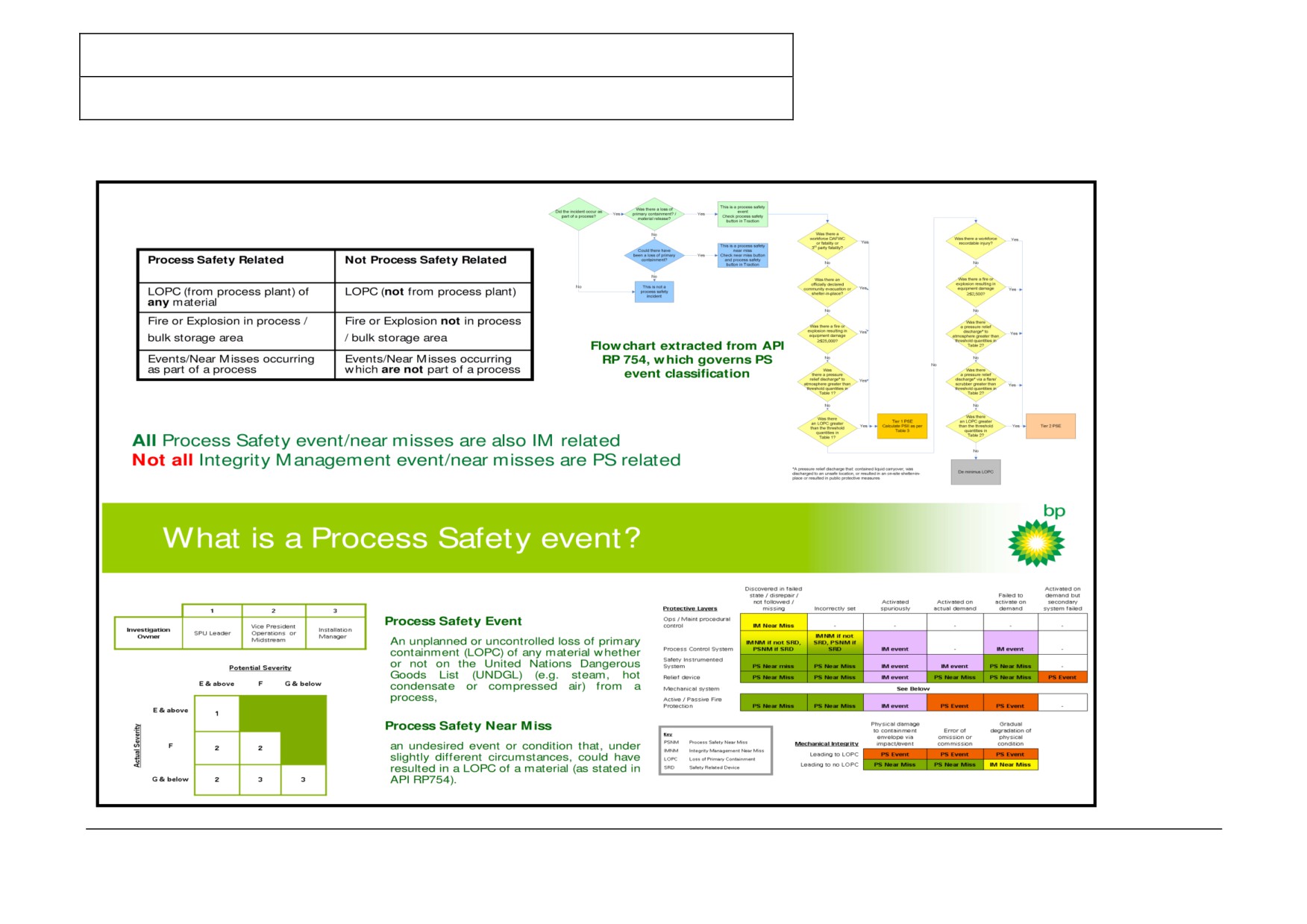
APPENDIX M - PROCESS SAFETY INCIDENT CLASSIFICATION GUIDANCE
(Consider A3 format when printing)
Control Tier:
2
Revision Date: 06 January, 2011
Document Number: AZSPU-HSSE-DOC-00054-2
Print Date: 1 February 2011
PAPER COPIES ARE UNCONTROLLED. THIS COPY VALID ONLY AT THE TIME OF PRINTING. THE CONTROLLED VERSION OF THIS DOCUMENT CAN BE FOUND AT
AZSPU-HSSE-DOC-00054-2
Page 58 of 61
Incident Investigation and Reporting
REVISION/REVIEW LOG
Revision Date
Authority
Custodian
Revision Details
23 February 2006
Alan McNuilty
Abbas Islamov
Initial Issue
09 July 2007
Alan McNuilty
Abbas Islamov
The major changes made in the document
cover the following areas:
Clarity on individual Roles and
responsibilities and incident owners based
on severity of incident
Process for notification of MIA/HiPo
incidents to Group and AzSPU Senior
Management
Clarity on the procedure for classification
and initiation of DAFWC/HiPo/MIA
investigations
Actions setting and prioritization - note
change from targets based on prescriptive
dates to agreed timescales between
actionee and action owner
Approval process - owner and approver is
now the same person
Removal of "Spheres of Influence"
Roles and responsibilities
MIA/HiPo notification
Investigation Process
Actions setting and prioritization
30 April 2008
Alan McNuilty
Rufat Mamedov
The major changes made in the document
cover the following areas:
Tr@ction and MIA/HiPo Database
recording requirements
Incident Notification Requirements clarified
in Figure 3.1
Included Figure 4.1 “Guidelines to Assess
Potential Severity”
Update to figure 4.2 “HiPo determination
flowchart” in light of new Group severity
matrices
Included section on ABC Analysis
Requirements for AzSPU outside
distribution requirements for HiPlus,
Lessons Learned one pager and similar
documents.
New Comprehensive List of Causes (CLC)
Chart
Appendix E renamed to “Definitions” and
definitions were updated in light of new BP
Group F&CA HSE Definitions and OMS
GDPs 44-00-01 and GDPs 44-00-02
new severity matrices
Export PU Internal Notification
requirements for illegal taps
Onshore Operations External Notification
Requirements
Control Tier:
2
Revision Date: 06 January, 2011
Document Number: AZSPU-HSSE-DOC-00054-2
Print Date: 1 February 2011
PAPER COPIES ARE UNCONTROLLED. THIS COPY VALID ONLY AT THE TIME OF PRINTING. THE CONTROLLED
VERSION OF THIS DOCUMENT CAN BE FOUND AT http://docs.bpweb.bp.com/dkazspu/component/hssesms
AZSPU-HSSE-DOC-00054-2
Page 59 of 61
Incident Investigation and Reporting
Revision Date
Authority
Custodian
Revision Details
30 April 2009
Yuliy Zaytsev
Rufat Mamedov
The major changes made in the document cover
the following areas:
Added definition of Marine related Incident
Added Marine Authority responsibilities
Added the requirement to consult BP legal
for Level A-E incidents
Added the requirement to provide a relief
from normal duties for Investigation Team
Members
Added “Training Requirements and
Competence” section
Added additional incident notification
requirements for Marine related incidents in
“Reporting and Notification Requirements”
section
Removed LOPC from Major Incident
definition to reflect that LOPC on itself
doesn‟t constitute Major Incident unless
causing MI in “H&S, Environment, Property
damage” severity levels
Updated HiPo determination chart by
removing LOPC box reflecting the above
point
Added Appendix N, specifying level of
investigation required depending on actual
severity level
Revised HiPo definition
Revised minimum requirement for
investigation team composition for MIA and
HiPo incident
Added Appendix O, giving an example of
formal incident investigation report
25 May 2009
Yuliy Zaytsev
Rufat Mamedov
The major changes made in the document cover
the following areas:
Timeline for completing formal incident
investigation report - Section 5.11
AzSPU specific protocol and process
timeline established for development and
distribution of LL reports - Section 7
8 July 2009
Yuliy Zaytsev
Rufat Mamedov
The major changes made in the document cover
the following areas:
Added definition and guidance for “Loss of
Primary Containment” (LOPC)
Added “Primary Containment” definition
Added definition on “Unsafe/Unhealthy
condition”
Added “Incident Investigation” definition
Added Major Incident guidance
Added “Process Safety” and “Process Safety
incident” definitions
Added definition of “Injure/Illness”
Added “Occupational Injury” and
“Occupational Illness” definitions
Revised “Recordable Occupational Illness
and Injury” definition
Revised “Medical Treatment Case” definition
Control Tier:
2
Revision Date: 06 January, 2011
Document Number: AZSPU-HSSE-DOC-00054-2
Print Date: 1 February 2011
PAPER COPIES ARE UNCONTROLLED. THIS COPY VALID ONLY AT THE TIME OF PRINTING. THE CONTROLLED
VERSION OF THIS DOCUMENT CAN BE FOUND AT http://docs.bpweb.bp.com/dkazspu/component/hssesms
AZSPU-HSSE-DOC-00054-2
Page 60 of 61
Incident Investigation and Reporting
Added “Equipment /Property Damage”
(Incident Direct Cost)
Added Business Travel - BP employee and
Business Travel - Contractor definition
Added another column into the 2.1 table
describing information use internally and
externally
Added definition of an “Explosion”
Added definition of “Fire”
Added definition for “Severe Vehicle
Accident”
Added definition on “Uncontrolled
Release/Event”
20 October
Yuliy Zaytsev
Rufat Mamedov
Added definition of “IM related incident”
2009
19 January
Yuliy Zaytsev
Rufat Mamedov
Main reason for the revision was the issue of
2010
updated GDP 4.4-0001 and GDP 4.4-0002.
Details are:
Incident notification flowchart has been
revised to reflect that all MIA e-mail
notifications to the Group relaxed from 8 to
24 hours.
Requirement to advise BP legal on any MIA
incident and other incidents with possibility of
regulatory action or litigation.
Requirement not to enter incident into
traction if information contained is classified
as “BP confidential”.
“Incident Classification” section has been
added.
Training requirements for Fatality incident
investigation team leader.
AzSPU incident distribution lists have been
revised.
Requirement to notify regional security
advisor for MIA and HIPO security incidents
which may not be in public domain.
Requirement to notify BP regional health
director for fatalities resulting from natural
causes or self-inflicted.
Details on required level of investigation and
investigation team make-up.
“Guidelines to assess potential severity”
(Figure 6.1) has been updated.
“HiPo determination flowchart” has been
updated.
“Storage of records” section has been
updated.
Severity Matrices and Potential LOPC
severity matrices have been updated.
“Business Value Loss” severity category has
been removed.
“Definition” section has been revised.
Formats for LL one Pager, CLC chart,
MIA/HiPO announcement and RCA
investigation report have been removed as
appendices. Uploaded to Dk and links
provided within the document.
Control Tier:
2
Revision Date: 06 January, 2011
Document Number: AZSPU-HSSE-DOC-00054-2
Print Date: 1 February 2011
PAPER COPIES ARE UNCONTROLLED. THIS COPY VALID ONLY AT THE TIME OF PRINTING. THE CONTROLLED
VERSION OF THIS DOCUMENT CAN BE FOUND AT http://docs.bpweb.bp.com/dkazspu/component/hssesms

AZSPU-HSSE-DOC-00054-2
Page 61 of 61
Incident Investigation and Reporting
08 February
Yuliy Zaytsev
Rufat Mamedov
Updated incident notification flowchart to
2010
reflect notification requirements for BIL
MIA/HiPo incidents.
Added section on HSSE & Operational
Incident Reporting Boundaries
Added the requirement to classify incident
relatedness to PS, IM, CoW, Driving, Marine,
Security when entering incident into Traction
Requirement to inter incident relatedness to
PS, IM, CoW, Driving, Marine, Security into
One Pager LL summary.
Requirement to initially report the incident
even if in doubt as to whether incident is
within reportable boundaries.
21 June, 2010
Yuliy Zaytsev
Rufat Mamedov
Revised and updated R&R as part of Sector
Leadership Functional Organisation.
Revised “incident owner” section.
Clarified drilling related incidents notification
requirements.
Added Initial Internal Incident Notification
form as Appendix K.
Updated Reference Section.
Slight update to section “HSE & Operational
Incident Reporting Boundaries”.
17 September,
Yuliy Zaytsev
Rufat Mamedov
Added requirement to mark the formal RCA
2010
investigation report as
“Draft” or
“Final” to
ensure only action from final report are
entered into traction.
08 October,
Yuliy Zaytsev
Rufat Mamedov
Slight change to section
9 to bring more
2010
clarity on investigation reports retention
schedule.
6 December,
Yuliy Zaytsev
Rufat Mamedov
Added Appendix L for “Guidance on use of
2010
DROPS Calculator and Dropped Object
HiPo determination”.
Added Figure 10.2 to Section 10 to bring
clarity on BP Operational Boundaries for
AzSPU.
Added AzSPU Entity Aviation Authority
(EAA) roles and responsibilities and
expanded Logistic Manager responsibility to
notify EAA on aviation related incidents.
Section 1.2 was updated to ensure that all
drilling and well operations safety and
integrity management accidents, incidents
and significant near misses are investigated.
Added Process Safety Incident Classification
Guidance as Appendix M.
Control Tier:
2
Revision Date: 06 January, 2011
Document Number: AZSPU-HSSE-DOC-00054-2
Print Date: 1 February 2011
PAPER COPIES ARE UNCONTROLLED. THIS COPY VALID ONLY AT THE TIME OF PRINTING. THE CONTROLLED
VERSION OF THIS DOCUMENT CAN BE FOUND AT http://docs.bpweb.bp.com/dkazspu/component/hssesms
AzSPU Procedure for Management of NORM
Page 1 of 20
AzSPU Procedure for
Management of Naturally Occurring
Radioactive Material (NORM)
AzSPU-HSSE-DOC-00097-2
Authority:
Yuliy Zaytsev (AzSPU
Custodian:
Idrak Nazarov (AzSPU HSE MS Team
Safety & Compliance
Leader)
Manager)
Scope:
AzSPU
Document
AzSPU HSSE MS Document Co-
Administrator:
ordinator
Issue Date:
7th October, 2009
Issuing Dept:
AzSPU HSSE
Revision
NA
Control Tier:
2- AzSPU
Date:
Next Review
7th October, 2010
Date:
Control Tier: 2
Initial Issue:
7 October, 2009
Document Number: AZSPU-HSSE-DOC-00097-2
Print Date: 2/1/2011
PAPER COPIES ARE UNCONTROLLED. THIS COPY VALID ONLY AT THE TIME OF PRINTING. THE
CONTROLLED VERSION OF THIS DOCUMENT CAN BE FOUND AT
AzSPU Procedure for Management of NORM
Page 2 of 20
TABLE OF CONTENTS
1
Purpose/Scope
3
2
Definitions
3
3
General Requirements
3
4
Key Responsibilities
4
5
Procedure
5
5.1
NORM Overview
5
5.2
Monitoring for NORM
6
5.3
Preparation for Work Involving NORM
7
5.3.1
Risk Assessment
7
5.3.2
Training
7
5.3.3
NORM Handling Materials
7
5.3.4
Personal Protective Equipment
7
5.3.5
Breaking Containment
8
5.4
Storage Arrangements for NORM Contaminated Material
8
5.4.1
Handling
10
5.4.2
Marking and Labelling of NORM Contaminated Material
11
5.4.3
NORM Storage Areas
12
5.4.4
Records & Inspection
12
5.5
Transportation & Disposal of NORM Contaminated Equipment and Waste.. 13
6
Key Documents/Tools/References
13
Appendix A - NORM Monitoring of Tubulars
Appendix B - NORM Contamination Monitoring Log
Appendix C - NORM Survey Report
Appendix D - Sampling Protocol for NORM
Appendix E - NORM Sample Register
Appendix F - NORM Waste Accumulation and Storage Record
Control Tier: 2
Initial Issue:
7 October, 2009
Document Number: AZSPU-HSSE-DOC-00097-2
Print Date: 2/1/2011
PAPER COPIES ARE UNCONTROLLED. THIS COPY VALID ONLY AT THE TIME OF PRINTING. THE
CONTROLLED VERSION OF THIS DOCUMENT CAN BE FOUND AT
AzSPU Procedure for Management of NORM
Page 3 of 20
1
Purpose/Scope
This procedure provides instructions for work involving Naturally Occurring Radioactive
Material (NORM) to ensure that it is carried out safely, and in accordance with applicable
legislation and standards.
This procedure applies to all work involving NORM carried out by, or on behalf of, the
Azerbaijan Strategic Performance Unit (AzSPU).
Revision of this procedure and the operational controls detailed therein will be in accordance
with the AzSPU HSSE Document Management Procedure (AzSPU-HSSE-DOC-00025-2).
2
Definitions
Refer to document AzSPU HSSE Definitions AzSPU-HSSE-DOC-00021-2 for definitions
common to this HSSE&S MS.
Definitions specific to radiation management are included in Appendix A of the AzSPU
Procedure for Management of Radioactive Materials & Radiation Generators (AzSPU-HSSE-
DOC-00058-2).
3
General Requirements
General requirements pertaining to radiation safety are detailed in Section 3.1 of the AzSPU
Procedure for Management of Radioactive Materials and Radiation Generators (AzSPU-
HSSE-DOC-00058-2).
Radioactive Material Exemptions
Under Safety Series 115 - International Basic Safety Standards for Protection against Ionising
Radiation and for the Safety of Radiation Sources (IAEA, 1996) sources within practices are
automatically Exempted if they do not exceed specified Exemption levels of total activity or
activity concentration. For NORM containing radium-226 and radium-228, the Exemption
level for each is 10 Bq/g.
NB: Exempt material is nonetheless radioactive and should be treated as such. In addition,
there may be other properties of the waste that restrict the disposal options such as oil content.
Radioactive Waste
Radioactive waste is any scrap material, effluent, or unwanted surplus material that has been
identified as radioactive, in accordance with the definitions above.
In terms of contaminated equipment, this can only be classed as radioactive waste if it is to be
scrapped. If equipment is being cleaned (either offshore or onshore) and then re-used it is not
classed as waste. If equipment has to be cleaned before the decision is made to scrap, then it is
also not classed as waste.
Licences
In accordance with the Decree of the President of the Azerbaijan Republic on “Additional
Measures in the Area of Issuing Special Permits (Licences) for Certain Types of Activity”,
Control Tier: 2
Initial Issue:
7 October, 2009
Document Number: AZSPU-HSSE-DOC-00097-2
Print Date: 2/1/2011
PAPER COPIES ARE UNCONTROLLED. THIS COPY VALID ONLY AT THE TIME OF PRINTING. THE
CONTROLLED VERSION OF THIS DOCUMENT CAN BE FOUND AT
AzSPU Procedure for Management of NORM
Page 4 of 20
No. 510 (29.12.2006), a „special permission‟ is required for the storage and disposal of
radioactive and ionising waste, which is issued by the MENR.
Any AzSPU operated site that requires a „special permission‟ should discuss this with the
AzSPU Radiation Protection SPA.
4
Key Responsibilities
A full description of the responsibilities with regard to radiation protection is provided in
Section 4 of the AzSPU Procedure for Management of Radioactive Materials and Radiation
Generators
(AzSPU-HSSE-DOC-00058-2). A summary of key responsibilities directly
applicable to this procedure are provided below:
Site Radiation Protection Supervisor (RPS)
The site RPS is responsible for the following:
Conducting contamination checks of equipment (using monitors).
Establishing supervised / controlled areas, where required.
Collecting NORM samples (where required) and arranging for them to be couriered
to the Tracerco laboratory.
Maintaining generic risk assessments for work with NORM contaminated equipment
/ waste and providing input to task specific risk assessments.
Carrying out on-site NORM hazard and control training, and ensuring persons
working with NORM are aware of, and understand this procedure.
Managing the storage, handling and labelling of NORM contaminated material and
doing a weekly inventory and review of storage arrangements.
Maintaining Site Radiation Records (NORM Contamination Monitoring Log, NORM
Survey Report, NORM Sample Register, NORM Waste Accumulation and Storage
Record, training records, etc).
Notifying the AzSPU RP SPA if NORM waste is to be stored on site, so that a
„Special Permission‟ can be obtained.
AzSPU Radiation Protection Single Point Accountability (AzSPU RP SPA)
Responsible for:
Maintaining a proper communication flow between the AzSPU Radiation Protection
Advisor (UK based) and the Site Radiation Protection Supervisors (RPSs).
Liaising with MENR in order to obtain a „Special Permission‟ if NORM waste
storage is to be carried out on an AzSPU site.
AzSPU Radiation Protection Advisor (RPA)
AzSPU retains by contract and appointment a RPA to provide the AzSPU with expert advice
on radiation safety and compliance matters. The RPA reports to the AzSPU Safety &
Compliance Manager and works directly with the AzSPU RP SPA.
In terms of this procedure, the RPA will provide guidance on the following:
Sample analysis results interpretation.
Advice on transportation requirements and disposal route options (based on results of
sample analysis).
Control Tier: 2
Initial Issue:
7 October, 2009
Document Number: AZSPU-HSSE-DOC-00097-2
Print Date: 2/1/2011
PAPER COPIES ARE UNCONTROLLED. THIS COPY VALID ONLY AT THE TIME OF PRINTING. THE
CONTROLLED VERSION OF THIS DOCUMENT CAN BE FOUND AT

AzSPU Procedure for Management of NORM
Page 5 of 20
OIM / Site Manager
Accountable for ensuring that any NORM contaminated waste is transferred from site as soon
as reasonably practicable (in consultation with the site RPS).
5
Procedure
5.1
NORM Overview
Naturally occurring radionuclides are present at varying concentrations in the earth‟s crust and
can be concentrated and enhanced by processes associated with the recovery of oil and gas.
This „enhanced‟ NORM, often known as TENORM (Technologically Enhanced Naturally
Occurring Radioactive Material) can be created when industry activity increases the
concentrations of radioactive materials, or when the material is redistributed as a result of
human intervention or some industrial processes.
During the production process, NORM flows with the oil, gas and water mixture and
accumulates in scale, sludge and scrapings. It can also form a thin layer of film on the interior
surfaces of gas processing equipment and vessels (see Figure 1). The level of NORM
accumulation can vary substantially from one facility to another depending on the geological
formation, operational factors, and other variables. To determine whether or not a facility has
NORM contamination, NORM survey, sampling and analysis needs to be conducted.
Figure 1: The Origins of NORM, indicating where NORM may accumulate in the
recovery process (OGP, 2008)
Control Tier: 2
Initial Issue:
7 October, 2009
Document Number: AZSPU-HSSE-DOC-00097-2
Print Date: 2/1/2011
PAPER COPIES ARE UNCONTROLLED. THIS COPY VALID ONLY AT THE TIME OF PRINTING. THE
CONTROLLED VERSION OF THIS DOCUMENT CAN BE FOUND AT
AzSPU Procedure for Management of NORM
Page 6 of 20
The NORM nuclides of primary concern in oil production are Radium-226 and Radium-228.
These decay into various radioactive progeny, before becoming stable lead.
Other radionuclides such as Lead-210 and Polonium-210 can also be found in pipeline
scrapings as well as sludge accumulating in tank bottoms, separators, tanks and waste pits.
Radon-222 is a radioactive gas, which is present in varying degrees in natural gas in oil & gas
formations. In the absence of natural gas, radon dissolves in the (light) hydrocarbon and
aqueous phase. When produced with the oil and gas, radon will usually follow the gas stream.
5.2
Monitoring for NORM
Due to the fact that NORM can occur in numerous locations, it is important to test all
equipment which has been in contact with fluids of any sort for NORM contamination before
work commences. This applies to work involving maintaining, repairing or exposing internal
surfaces of the oil and produced water process (vessel entry, pipework systems, tubulars, etc).
It also applies to seawater systems, as seawater contains trace levels of Lead-210 and
Uranium-238, which can be deposited as a radioactive film when large quantities of seawater
pass through any plant or equipment. Pipeline pigs and debris from pigging operations should
also be routinely checked for NORM contamination.
The presence of NORM within well and process equipment is identified by the use of site
contamination monitors. Contamination checks are only carried out by the site RPS, or by an
Authorised Monitor User (i.e. someone who has received appropriate training).
Guidance on the proper use of radiation monitoring instruments and the correct interpretation
of results, is provided in Appendix F of the AzSPU Procedure for Management of Radioactive
Materials & Radiation Generators (AzSPU-HSSE-DOC-00058-2). Specific information on the
method for conducting contamination monitoring of tubulars is provided in Appendix A.
The site RPS, or Authorised Monitor User, will consider a
“sustainable rise above
backg2round” as a sign of contamination when monitoring items or material.
The NORM Contamination Monitoring Log (Appendix B) must be completed each time a
check is made, even if the result is negative.
If a positive result is found then a NORM Survey Report (Appendix C) must be completed
and the report given a unique reference number.
If the contaminated material / equipment is to be disposed of, the site RPS will then collect
samples (in accordance with Appendix D) and ensure that they are sent to a specialist
laboratory for analysis, i.e. the Tracerco laboratory in Billingham (contact details provided in
Appendix B of the AzSPU Procedure for Management of Radioactive Materials & Radiation
Generators (AzSPU-HSSE-DOC-00058-2)). Details of the samples will be recorded in the
NORM Sample Register (Appendix E).
The RPA will use the analysis results to determine whether the material is Exempt or not (see
Section 3) and will advise the site RPS accordingly (through the AzSPU RP SPA). A record of
the weight of material, together with the analysis results, will be used to record the actual
activity of the material that is to be disposed of.
Control Tier: 2
Initial Issue:
7 October, 2009
Document Number: AZSPU-HSSE-DOC-00097-2
Print Date: 2/1/2011
PAPER COPIES ARE UNCONTROLLED. THIS COPY VALID ONLY AT THE TIME OF PRINTING. THE
CONTROLLED VERSION OF THIS DOCUMENT CAN BE FOUND AT
AzSPU Procedure for Management of NORM
Page 7 of 20
5.3
Preparation for Work Involving NORM
5.3.1 Risk Assessment
A generic risk assessment for work with NORM will be maintained by the RPS in the Site
Radiation Records. Task or job specific risk assessments will also be carried out, using the
generic risk assessment as a basis.
5.3.2 Training
All persons involved in work with NORM must have received radiation awareness training.
Normally this will involve a one day NORM Awareness Training Course, however, the RPS
may carry out on-site training provided this covers the hazards and risks associated with
exposure to NORM and the control measures to keep exposures as low as reasonably
practicable. In addition, the Site RPS will ensure that all persons working with NORM are
aware of and understand the relevant parts of this procedure.
The RPS will ensure that records of all training are kept in the Site Radiation Records.
5.3.3 NORM Handling Materials
All sites must have a stock of basic NORM handling materials, namely NORM tape,
polythene sheeting and sample pots. If well work is being carried out (which involves pulling
tubing) then sufficient end caps and polythene sleeves must also be available.
5.3.4 Personal Protective Equipment
There are two ways in which personnel can be exposed to NORM, namely:
External exposure - where the radioactive material remains outside the body.
Internal exposure - where radioactive material is taken into the body via inhalation,
ingestion or absorption.
All persons carrying out work where NORM may be present must wear the following PPE as
a minimum:
Impervious overalls that can be easily decontaminated e.g. one-piece slicker suits.
Impervious boots and gloves.
A filtering face piece respirator with P3 filter for work with small quantities in
Supervised Areas. Or a „face fitted‟ respirator to EN149FFP - P3 rated as minimum
(e.g. 3M 8835, Moldex 3405 or Draeger Piccola FFP3-V type) for work in Controlled
Areas. All respirators must be „CE‟ marked and consideration must also be given to
the presence of other hazards that may require a COSHH assessment to be carried out.
For „heavy work‟, or work in areas where other hazards exist, it may be appropriate to
use air-fed breathing apparatus.
Eye protection goggles.
All open wounds must be dressed with water proof dressings prior to any work with NORM.
No smoking, eating, drinking, chewing of gum, sweets or tobacco or application of barrier
cream, e.g. lip salve, is permitted by any individual whilst engaged in any operation where
NORM scale is being handled.
Control Tier: 2
Initial Issue:
7 October, 2009
Document Number: AZSPU-HSSE-DOC-00097-2
Print Date: 2/1/2011
PAPER COPIES ARE UNCONTROLLED. THIS COPY VALID ONLY AT THE TIME OF PRINTING. THE
CONTROLLED VERSION OF THIS DOCUMENT CAN BE FOUND AT
AzSPU Procedure for Management of NORM
Page 8 of 20
Any individual involved in a NORM operation must decontaminate himself prior to leaving
the worksite by wiping down or showering/hosing with water, with particular attention being
paid to boots and gloves. Personnel must be monitored by the site RPS to confirm that the
decontamination procedure has been effective.
Personal protective equipment may be kept for reuse provided it has been decontaminated.
5.3.5 Breaking Containment
Prior to breaking containment, a Supervised Area will be designated and heavy-duty
polythene sheeting used to cover the deck within the whole Supervised Area, or at least in
areas where scale may fall. Drains will also be covered.
Personnel entering the Supervised Area will wear appropriate PPE, and will monitor for
NORM contamination once the equipment has been opened. If a “sustainable rise above
backg2round” is recorded a Controlled Area will be established.
The Controlled Area will be marked by barriers and tape, with signs stating that it is a NORM
Controlled Area and that entry is restricted. All NORM handling procedures must be enforced
within this area, e.g. protective clothing must be put on at the entry point and removed and
decontaminated at the exit point. Entry must be restricted to people directly involved in the
work.
If removal of NORM waste from the vessel / equipment is required, samples of NORM scale,
sludge, etc will be obtained in accordance with Appendix D and sent to the Tracerco
laboratory in Billingham.
Removal and storage of NORM waste from the vessel / equipment will be carried out in
accordance with Section 5.4 and the equipment closed up.
When the work is complete, a contamination check will be made of the Controlled Area. The
area will be cleaned down, and the deck below the polythene sheeting checked for
contamination.
The RPA will advise on transportation and disposal requirements for the NORM waste
(through the AzSPU RP SPA), based on the results of the sample analysis.
A flow chart summarising this process is provided in Figure 2.
5.4
Storage Arrangements for NORM Contaminated Material
Storage arrangements for NORM contaminated material will meet the following general
requirements:
Only suitably qualified and experienced persons (RPS and those who have had
appropriate training) shall have access to the radioactive waste (with measures taken
to prevent access by others).
The premises where radioactive waste is being accumulated shall be constructed and
maintained in such a way and condition that they can be easily decontaminated.
The storage area will provide protection from the effects of the weather.
Control Tier: 2
Initial Issue:
7 October, 2009
Document Number: AZSPU-HSSE-DOC-00097-2
Print Date: 2/1/2011
PAPER COPIES ARE UNCONTROLLED. THIS COPY VALID ONLY AT THE TIME OF PRINTING. THE
CONTROLLED VERSION OF THIS DOCUMENT CAN BE FOUND AT

AzSPU Procedure for Management of NORM
Page 9 of 20
Figure 2: Breaking Containment - Vessel Entry
Prior to breaking containment
designate a Supervised Area,
put down polythene sheeting,
and wear appropriate PPE.
Open equipment. Monitor for
NORM contamination.
Is there a
Keep monitoring
No
sustainable rise
throughout. De-designate
above backg2round?
if nothing detected.
Yes
Elevate to a Controlled Area.
No
Close up equipment
Does work require removal and
following
disposal of NORM waste?
maintenance.
Yes
Obtain samples of NORM scale,
sludge, etc in accordance with
Appendix D and send to lab.
Remove NORM scale, sludge,
etc from vessel and store in
accordance with Section 5.4.
Close up equipment.
RPA will advise on
transportation requirements and
disposal route, based on results
of sample analysis.
Control Tier: 2
Initial Issue:
7 October, 2009
Document Number: AZSPU-HSSE-DOC-00097-2
Print Date: 2/1/2011
PAPER COPIES ARE UNCONTROLLED. THIS COPY VALID ONLY AT THE TIME OF PRINTING. THE
CONTROLLED VERSION OF THIS DOCUMENT CAN BE FOUND AT
AzSPU Procedure for Management of NORM
Page 10 of 20
5.4.1 Handling
Bulk Material
Contaminated bulk material must be placed in good quality steel drums with secure lids. The
drums will be no more than three quarters filled and bulk material should be contained within
sealed heavy-duty polythene bags within the drums.
The site RPS, or other nominated person, will check the drums for external contamination, and
if any contamination is found it will be removed fully by wiping with a rag. Contaminated
rags will also be placed in the drums.
Contaminated Equipment
Contaminated equipment will be immediately secured in such a way as to prevent spread of
contamination to other items, work areas or personnel.
Any item contaminated internally will be sealed to prevent contamination from escaping e.g.
contaminated tubulars will be sealed with end caps, and the seals wrapped with polythene and
taped.
Contaminated items must not be allowed to dry out in the atmosphere. They must either be
suitably sealed, or kept moist.
Tubulars will be stored in bundles, or stows, and not directly placed on the ground. If there is
a possibility that weather could affect the integrity of the containment measures then
additional protection will be provided, e.g. wrapping of tubular bundles in heavy duty
polythene sheeting that is secured in place.
Items other than tubulars will be placed in fully sealable containers, or units that can be
covered.
Any pieces of scale falling out of contaminated equipment / tubulars must be inserted back
into the equipment which will then be sealed / capped.
Items that are externally contaminated will be wrapped in heavy-duty polythene sheeting (to
ensure total enclosure) and taped.
A flow chart summarising the handling of NORM contaminated equipment is provided in
Figure 3.
Control Tier: 2
Initial Issue:
7 October, 2009
Document Number: AZSPU-HSSE-DOC-00097-2
Print Date: 2/1/2011
PAPER COPIES ARE UNCONTROLLED. THIS COPY VALID ONLY AT THE TIME OF PRINTING. THE
CONTROLLED VERSION OF THIS DOCUMENT CAN BE FOUND AT

AzSPU Procedure for Management of NORM
Page 11 of 20
Figure 3: Handling of NORM Contaminated Equipment and Tubulars
Monitor for
Is there a
Equipment,
No
No action required.
pipe work,
NORM
sustainable rise
tubulars, etc.
contamination
above
on internal and
backg2round?
external
surfaces.
Yes
Is the
Subsequent
equipment to be
No
handling of
scrapped or
equipment should be
sent onshore for
carried out using
storage?
appropriate PPE.
Yes
Do you have time
Yes
No
and space to take
samples and send
to lab?
Transport equipment,
Obtain samples in
pipe work, tubulars, etc,
accordance with
in such a way as to
Appendix D and send
prevent spread of
to lab
contamination *
RPA will advise on
transportation
Store equipment,
requirements and
pipework, tubulars, etc
disposal route, based
temporarily at Supply
on results of sampling
Base
analysis.
* Must meet specifications listed in Section 5.2 of the AzSPU Procedure for Transportation of Radioactive
Materials if being sent unpackaged.
5.4.2 Marking and Labelling of NORM Contaminated Material
Bulk Waste
A label with the legend “Radioactive” and the radiation trefoil will be attached to each drum.
The label will include details of the name of the site, the origin of the waste, the date produced
and a unique reference number. The unique reference number must be traceable to samples or
a sample reference number for the waste. The label will also be marked “Solid Waste”,
“Contaminated Fluids” or some other appropriate description of the form of the waste.
Contaminated Items
Each contaminated item will be identified with yellow / black NORM tape and a suitable,
indelibly marked label or marking on the item stating „Radioactive NORM”. Items will be
marked with name of the site, date produced and a unique reference number, which will be
used for other documentation relating to the particular waste.
In terms of contaminated tubulars, each joint must be identified with its well and tubing string
number, which should be painted on the joint where possible.
Control Tier: 2
Initial Issue:
7 October, 2009
Document Number: AZSPU-HSSE-DOC-00097-2
Print Date: 2/1/2011
PAPER COPIES ARE UNCONTROLLED. THIS COPY VALID ONLY AT THE TIME OF PRINTING. THE
CONTROLLED VERSION OF THIS DOCUMENT CAN BE FOUND AT
AzSPU Procedure for Management of NORM
Page 12 of 20
When transporting contaminated tubulars in bundles, NORM tape must be wrapped round the
legs of the sling to aid identification. Individual tubulars should also be marked. Do not tape
complete bundles as the tape inevitably breaks and falls off in transit.
The total activity of the waste on each item will be estimated using average contamination
measurements in Bq/cm2 and multiplying this by the estimated surface area covered by the
waste in cm2, to give a figure in Bq.
5.4.3 NORM Storage Areas
Drums of NORM, or wrapped contaminated items, will be stored in a skip or bunded area
with tarpaulin or some other form of cover. This area should also be barriered and access
restricted to authorised persons only i.e. persons involved with NORM work.
Offshore, if deck space is short and larger items cannot fit in a waste store, then any temporary
storage area must be secure and procedures in place to control access.
Only NORM waste may be stored in the NORM storage area and it must be ensured that the
storage area is away from other major hazards such as explosives or corrosives.
Warning signs must be displayed around the NORM storage area with the radiation trefoil
symbol and the legend “Radioactive. NORM Storage Area. No Unauthorised Access”.
The OIM/Site Manager, with the assistance of the site RPS, will ensure that the waste is
transferred from site as soon as reasonably practicable (see Section 5.5). Waste will normally
be transferred within three months of being accumulated. If this is not practicable then the
OIM must review the situation and ensure that arrangements are made for the waste to be
transferred within six months of being accumulated. If this cannot be achieved then the
AzSPU Radiation Protection SPA and the RPA will be consulted.
Dose rate monitoring must be carried out around bulk accumulations and around contaminated
equipment stows. If the dose rate exceeds 7.5 µSv/h at 30 cm from drums, or stows then a
Controlled Area must be designated and appropriate barriers and signage in place.
NB: If storage of NORM waste is initiated on-site, the AzSPU Radiation Protection SPA
needs to be notified immediately so that a „Special Permission‟ can be obtained from the
MENR.
5.4.4 Records & Inspection
The site RPS will ensure that details of all NORM waste being accumulated and stored are
added to the Waste Accumulation and Storage Record (Appendix F).
The inventory of waste items will be checked on a regular basis, e.g. weekly, by the site RPS.
At the same time the storage arrangements will be reviewed to ensure they remain adequate.
Control Tier: 2
Initial Issue:
7 October, 2009
Document Number: AZSPU-HSSE-DOC-00097-2
Print Date: 2/1/2011
PAPER COPIES ARE UNCONTROLLED. THIS COPY VALID ONLY AT THE TIME OF PRINTING. THE
CONTROLLED VERSION OF THIS DOCUMENT CAN BE FOUND AT
AzSPU Procedure for Management of NORM
Page 13 of 20
5.5
Transportation & Disposal of NORM Contaminated Equipment and
Waste
The transportation and disposal requirements for NORM contaminated equipment and waste
are dependent on whether the waste is classed as Exempt, in accordance with the IAEA
specifications (see Section 3).
Exemption is the determination by a regulatory body that a source or practice need not be
subject to some or all aspects of regulatory control, on the basis that the exposure (including
potential exposure) is too small to warrant the application of the requirements.
The RPA (through the AzSPU RP SPA) will advise on the transportation and disposal
requirements, based on the results of the sampling and analysis.
The AzSPU Procedure for Transportation of Radioactive Materials (AzSPU-HSSE-DOC-
00115-2) provides further detail on transportation of NORM contaminated waste and
equipment, and NORM samples.
6
Key Documents/Tools/References
This document shall, where appropriate, be used in conjunction with of the following
procedures and plans:
Document Number
Title of Procedure
AzSPU-HSSE-DOC-00058-2
Procedure for Management of Radioactive Materials
and Radiation Generators
AzSPU-HSSE-DOC-00115-2
AzSPU Procedure for Transportation of Radioactive
Materials
AzSPU-HSSE-DOC-00086-2
AzSPU Radiation Contingency Plan
AzSPU-HSSE-DOC-00083-2
AzSPU Procedure for The Import / Export of
Radioactive Materials and Sources of Ionising Radiation
AzSPU-HSSE-DOC-00025-2
AzSPU HSSE Document Management Procedure
AzSPU-HSSE-DOC-00021-2
AzSPU HSSE Definitions
References:
OGP (International Association of Oil and Gas Producers),
2008. Guidelines for the
Management of NORM in the Oil and Gas Industry. Report No. 412.
Revision/Review Log
Revision Date
Authority
Custodian
Revision Details
7th October, 2009
Yuliy Zaytsev (Safety
Idrak Nazarov (HSE
Initial Issue.
& Compliance
MS Team Leader)
Manager)
Control Tier: 2
Initial Issue:
7 October, 2009
Document Number: AZSPU-HSSE-DOC-00097-2
Print Date: 2/1/2011
PAPER COPIES ARE UNCONTROLLED. THIS COPY VALID ONLY AT THE TIME OF PRINTING. THE
CONTROLLED VERSION OF THIS DOCUMENT CAN BE FOUND AT
AzSPU Procedure for Management of NORM
Page 14 of 20
Appendix A - NORM Monitoring of Tubulars
Well control equipment and tubulars that have been used to produce reservoir fluids have the
potential to be contaminated with NORM, monitoring will therefore be carried out during the
drilling operation by the site RPS, or an Authorised Monitor User.
Initial Actions
A supply of tubing end caps will be on hand for sealing the complete string in the event
that contamination is found and it is to be removed from the well.
Heavy duty polythene sheeting and sleeves will be provided for wrapping externally
contaminated items.
The drill floor will be designated a Supervised Area if contamination is detected and
access will be restricted. Personnel at risk of exposure will wear suitable PPE (see Section
5.3.4) and appropriate washing and changing facilities will be provided at the entry to the
area. If there is a significant risk that contamination may be spread, then the area
designation will be elevated to a Controlled Area.
Identification of NORM Contamination
The site RPS, or an Authorised Monitor User, will monitor all well control equipment (e.g.
tubing hangers, down-hole safety valves) as they are removed, ensuring all accessible internal
surfaces are monitored. If contamination is detected, open flanges must be sealed with flange
protectors or heavy-duty polythene sheeting and secured with NORM tape.
If contamination is later detected on the tubing string then it must be assumed that down hole
valves and pumps are internally contaminated, unless they have been monitored internally and
shown to be clean.
As the tubing string is pulled, the first five joints will be monitored for contamination and if
none is found then every tenth joint thereafter will be monitored. If a contaminated joint is
found, then all joints up to the last one to have been monitored, will be checked. All
subsequent joints will then be monitored.
All monitoring outcomes must be recorded on the NORM Contamination Monitoring Log
(Appendix B). In the event that contamination is found, then a NORM Survey Report
(Appendix C) must be completed.
If the tubulars are to be reused, subsequent handling must be carried out using appropriate
PPE. If the tubulars are to be scrapped, sampling and analysis must be conducted prior to
disposal.
Monitoring of Logging Tools
Some logging tools contain radioactive sources. Monitoring should only be carried out prior to
sources being loaded into the tools or after the sources have been removed.
In addition, some logging tools that use neutron generating devices can become „activated‟ i.e.
the casing of the tool becomes radioactive (note, not contaminated) for a period of time after
the tool has been energised. If a tool could have been activated during operation then it should
be isolated for several hours after retrieval and then checked. If contamination is apparently
detected then the tool should be left for around 1 hour to see if the contamination level
decreases. Only then should a decision be made as to whether it is contaminated or not.
Control Tier: 2
Initial Issue:
7 October, 2009
Document Number: AZSPU-HSSE-DOC-00097-2
Print Date: 2/1/2011
PAPER COPIES ARE UNCONTROLLED. THIS COPY VALID ONLY AT THE TIME OF PRINTING. THE
CONTROLLED VERSION OF THIS DOCUMENT CAN BE FOUND AT

AzSPU Procedure for Management of NORM
Page 15 of 20
Appendix B - NORM Contamination Monitoring Log
Installation
Monitor Details
Monitor Check
Test Results
Item
Ref
Date
Signed
Check
Pass
Description
Bkgd
Test
Net
Type
Serial No.
(c.p.s.)
/Fail
(cps)
(cps)
(cps)
Control Tier: 2
Initial Issue:
7 October, 2009
Document Number: AZSPU-HSSE-DOC-00097-2
Print Date: 2/1/2011
PAPER COPIES ARE UNCONTROLLED. THIS COPY VALID ONLY AT THE TIME OF PRINTING. THE CONTROLLED VERSION OF THIS DOCUMENT CAN BE FOUND AT

AzSPU Procedure for Management of NORM
Page 16 of 20
Appendix C - NORM Survey Report
Installation:
Report No.:
Plant
Plant I.D.
Description
No.
Monitor
Monitor
Type:
Serial
No.:
No. of
Reason if
samples
none:
Sample references
Comments:
Vessels
Reason for Survey
Pre-entry check
Pre-cleaning check
c.p.s
Bq/cm2
µSv/h
Monitoring Results
Estimated Volume
Estimated
Estimated
Quantity of Material (scale,
(m3)
Weight (kg)
Thickness (mm)
sand, sludge, other etc)
Action Taken
Not Removed
Storage
Discharged
Comments
Spools / Valves / Other
Removed for Repair
Removed for Cleaning
Reason for Survey
Removed to Replace
Other
c.p.s
Bq/cm2
µSv/h
Monitoring Results
Estimated Volume
Estimated
Estimated
(m3)
Weight (kg)
Thickness (mm)
Quantity of Scale etc.
Return to Service Uncleaned
Action to be Taken
Clean Offshore Return to Service Scrap Item
Clean Onshore Return to Service Scrap Item
Comments
Production Tubing / Downhole Equipment
Reason for Survey
Renewal
Workover
Other
(i.e. reason removed)
c.p.s
Bq/cm2
µSv/h
Monitoring Results
External Scaling
Yes No
Return Downhole Uncleaned
Action to be Taken
Clean Onshore and Re-use
Clean Onshore and Scrap
Comments
Control Tier: 2
Initial Issue:
7 October, 2009
Document Number: AZSPU-HSSE-DOC-00097-2
Print Date: 2/1/2011
PAPER COPIES ARE UNCONTROLLED. THIS COPY VALID ONLY AT THE TIME OF PRINTING. THE
CONTROLLED VERSION OF THIS DOCUMENT CAN BE FOUND AT
AzSPU Procedure for Management of NORM
Page 17 of 20
Appendix D - Sampling Protocol for NORM
Introduction
If a positive sustainable rise above backg2round is observed during radiation monitoring then
representative sampling should be conducted (if the intention is to dispose of the contaminated
equipment, NORM scale, etc). The activity concentration of NORM materials can only be
determined by radiochemical analysis.
The site RPS will conduct any required sampling as follows:
Process Vessels
Where progress through a vessel can be made on entry, an initial contamination survey will be
conducted under the supervision of the site RPS.
Where a positive sustainable rise above backg2round is observed, samples of materials (e.g.
sand, sludge, scale) will be taken. The number of samples required of each form of material
will be determined by the RPS, based on the quantity of material and the range of
contamination monitor readings obtained.
Samples will be taken from the front, middle and back of the vessel - five samples from each
area. These will then be aggregated for each area and a representative sample taken from each
and sent for radiochemical analysis (3 samples in total).
Sample sizes should meet the following criteria for the purposes of transportation:
1-4 samples - maximum weight per sample 50g.
5-8 samples - maximum weight per sample 25g.
Where progress through a vessel is determined by the progressive removal of internal fittings,
monitoring will be carried out whenever a new internal surface is exposed. Representative
sampling will also be done at each stage if recordings above backg2round are detected, again
paying attention to possible different forms of the material. Where considered appropriate by
the RPS, on the basis of the contamination readings observed, such samples may be
aggregated and a representative sample analysed.
Tubulars
In order to obtain a sample, scrape approximately 25 - 50g of material into a small container
(e.g. 100 ml sample pot with screw lid) using a spatula or other suitable tool. Fix a lid on the
container and add tape to the seal to prevent leakage. The RPS should ensure that
representative samples are taken from the batch of tubulars e.g. a sample from the most
contaminated, the least contaminated, and those in between.
Pigging Wax
If a positive sustainable rise above backg2round is observed whilst monitoring pigging wax, at
least two 50 g representative samples will be required from each drum of wax. The volume of
wax must be recorded.
Control Tier: 2
Initial Issue:
7 October, 2009
Document Number: AZSPU-HSSE-DOC-00097-2
Print Date: 2/1/2011
PAPER COPIES ARE UNCONTROLLED. THIS COPY VALID ONLY AT THE TIME OF PRINTING. THE
CONTROLLED VERSION OF THIS DOCUMENT CAN BE FOUND AT
AzSPU Procedure for Management of NORM
Page 18 of 20
Contaminated PPE
PPE that has been cleaned but which still retains activity levels above backg2round should be
placed in sealed drums and a representative sample taken. The RPS shall identify the
contaminated PPE which gives the highest counts per second (cps) on the contamination
monitor, remove a section and place into a 50g sample pot.
Sample Storage
Samples should be placed in a secure container (sample pots can be obtained from the
Tracerco laboratory), with the lid sealed with tape and labelled to indicate the radioactive
nature of the material, the date, origin and site. Unless being immediately despatched, the
samples will be securely held by the site RPS, or other Authorised Person, in a suitable store,
labelled with the radiation trefoil and the legend „Radioactive‟.
Transport of Samples
All samples are to be sent for analysis to the Tracerco laboratory in Billingham (address
provided in Appendix B of the AzSPU Procedure for Management of Radioactive Materials &
Radiation Generators (AzSPU-HSSE-DOC-00058-2)).
Section 5.3 of the AzSPU Procedure for Transportation of Radioactive Materials (AzSPU-
HSSE-DOC-00115-2) provides more detail on how to transport NORM contaminated
samples.
Records
Details of all samples taken and sent for analysis will be added to the site NORM Sample
Register (Appendix E).
Copies of the sample analysis results will be filed in the Site Radiation Records and must be
kept for five years.
The weights of the material to be disposed of will be calculated by direct measurement or by
volume calculations. AzSPU has the responsibility of ensuring that there is some way of
documenting how the weights were arrived at.
Control Tier: 2
Initial Issue:
7 October, 2009
Document Number: AZSPU-HSSE-DOC-00097-2
Print Date: 2/1/2011
PAPER COPIES ARE UNCONTROLLED. THIS COPY VALID ONLY AT THE TIME OF PRINTING. THE
CONTROLLED VERSION OF THIS DOCUMENT CAN BE FOUND AT
AzSPU Procedure for Management of NORM
Page 19 of 20
Appendix E - NORM Sample Register
Installation:
Year:
Sample
Date
Sample Source / Location
Signed
I.D. Number
Taken
Control Tier: 2
Initial Issue:
7 October, 2009
Document Number: AZSPU-HSSE-DOC-00097-2
Print Date: 2/1/2011
PAPER COPIES ARE UNCONTROLLED. THIS COPY VALID ONLY AT THE TIME OF PRINTING. THE
CONTROLLED VERSION OF THIS DOCUMENT CAN BE FOUND AT

AzSPU Procedure for Management of NORM
Page 20 of 20
Appendix F - NORM Waste Accumulation and Storage Record
Installation:
Description of material /
Weight1
Date
Date
Unique I.D.
Storage Location
Disposal Route
RPO
Item
(kg)
In
Out
1. An estimate of the weight of bulk material should be made and recorded here.
Control Tier: 2
Initial Issue:
7 October, 2009
Document Number: AZSPU-HSSE-DOC-00097-2
Print Date: 2/1/2011
PAPER COPIES ARE UNCONTROLLED. THIS COPY VALID ONLY AT THE TIME OF PRINTING. THE CONTROLLED VERSION OF THIS DOCUMENT CAN BE FOUND AT
AzSPU Procedure for Management of Radioactive Materials & Radiation Generators
Page 1 of 56
AzSPU Procedure for
Management of Radioactive Materials and
Radiation Generators
AzSPU-HSSE-DOC-00058-2
Authority:
Yuliy Zaytsev (AzSPU
Custodian:
John Elliott (AzSPU Senior HSE Advisor)
Safety & Compliance
Manager)
Scope:
AzSPU
Document
AzSPU HSSE MS Document Co-ordinator
Administrator:
Issue Date:
20 October 2004
Issuing Dept:
AzSPU HSSE
Revision Date:
04 October, 2010
Control Tier:
2- AzSPU
Next Review
04 March, 2011
Date:
TABLE OF CONTENTS
Control Tier:
2-AzSPU
Revision Date: October 04, 2010
Document No: AzSPU-HSSE-DOC-00058-2
Print Date: 2/1/2011
PAPER COPIES ARE UNCONTROLLED. THIS COPY VALID ONLY AT THE TIME OF PRINTING. THE
CONTROLLED VERSION OF THIS DOCUMENT CAN BE FOUND AT http://docs.bpweb.bp.com/dkazspu
AzSPU Procedure for Management of Radioactive Materials & Radiation Generators
Page 2 of 56
1
Purpose/Scope
4
2
Definitions
4
3
General Requirements
4
3.1
Legislative Requirements
4
3.2
AzSPU Ionising Radiation Policy
5
4
Key Responsibilities
6
5
Procedure
10
5.1
Radiation Protection Programme (RPP)
10
5.1.1
Designation of Controlled & Supervised Areas
10
5.1.2
Radiation Procedures and Radiation Protection Supervisors
11
5.1.3
Monitoring of Workers, the Workplace, and Radiation Monitoring Equipment
12
5.1.4
Recording and Reporting Monitoring Information
14
5.1.5
Provision of Training to Persons Involved in Work with Ionising Radiation
15
5.1.6
Periodic Reviews / Audits of Performance and Compliance
16
5.1.7
Provision of Contingency Plans to Address Incidents / Accidents
16
5.1.8
Provision of a Health Surveillance Programme
16
5.2
Management of Contractors Working With Ionising Radiation
16
5.2.1
Management Arrangements
16
5.2.2
Responsibilities
17
5.2.3
Contractor’s Arrangements for Managing Work with Ionising Radiation
17
5.2.4
Completion of Contractor’s Checklist by AzSPU Site RPS
20
5.2.5
General Arrangements for Managing Contractor Sources on Site
20
5.3
General Work Instructions for Working with Ionising Radiation
21
5.4
Work Instructions for Site Radiography
22
5.5
Work Instructions for Well Logging
23
5.6
Work Instructions for the Storage and Use of Pip Tags
24
5.7
Work Instructions for Nucleonic Devices
25
5.7.1
Management Arrangements
26
5.7.2
Critical Examination on Installation
26
5.7.3
Controlled and Supervised Areas
26
5.7.4
Site Register of Installed Sources
27
5.7.5
Source Accounting
27
5.7.6
Radiation Monitoring
28
5.7.7
Maintenance and Safety Checks
28
5.7.8
Leakage Testing
29
5.7.9
Entry to Vessels Fitted with Nucleonic Devices
29
5.7.10
Precautions for Vessels Incorporating Nucleonic Interface Gauges
30
5.7.11
Removal of an Installed Nucleonic Device
30
5.7.12
Temporary Storage of Nucleonic Devices
31
5.7.13
Source Disposal
31
6
Key Documents/Tools/References
32
Control Tier:
2-AzSPU
Revision Date: October 04, 2010
Document No: AzSPU-HSSE-DOC-00058-2
Print Date: 2/1/2011
PAPER COPIES ARE UNCONTROLLED. THIS COPY VALID ONLY AT THE TIME OF PRINTING. THE
CONTROLLED VERSION OF THIS DOCUMENT CAN BE FOUND AT http://docs.bpweb.bp.com/dkazspu
AzSPU Procedure for Management of Radioactive Materials & Radiation Generators
Page 3 of 56
Appendices
Appendix A Definitions
Appendix B Qualified Expert / Radiation Protection Adviser Contact Details
Appendix C Controlled Area Handover Certificate
Appendix D Record of Entry into a Controlled Area
Appendix E Radiation Exposure Log
Appendix F Radiation Monitoring
Appendix G Site Radiation Monitoring Equipment Register
Appendix H Critical Examination Checklist
Appendix I
Radioactive Source Accountancy, Monitoring and Safety Checks
Appendix J
Leakage Test Method
Appendix K
Procedure for Isolating and De-isolating Sources in Dip-pipes
Appendix L
Procedure for Isolating and De-isolating Profiler Sources
Appendix M
Contractors Checklist for Contractors Using Radioactive Materials on
AzSPU Sites
Appendix N Site Mobile Source Register
Appendix O Site Inaccessible Source Register
Appendix P References
Control Tier:
2-AzSPU
Revision Date: October 04, 2010
Document No: AzSPU-HSSE-DOC-00058-2
Print Date: 2/1/2011
PAPER COPIES ARE UNCONTROLLED. THIS COPY VALID ONLY AT THE TIME OF PRINTING. THE
CONTROLLED VERSION OF THIS DOCUMENT CAN BE FOUND AT http://docs.bpweb.bp.com/dkazspu
AzSPU Procedure for Management of Radioactive Materials & Radiation Generators
Page 4 of 56
1
Purpose/Scope
Azerbaijan Strategic Performance Unit (AzSPU) has a responsibility to ensure that all work
with ionising radiation, including the use of radioactive materials and radiation generators, is
carried out in accordance with applicable national and international legislation and standards.
The purpose of this document is therefore:
to define the AzSPU‟s Ionising Radiation Policy, the aims and objectives of which are to
ensure that all work with ionising radiation is carried out in accordance with applicable
national and international legislation and standards.
to describe how the Policy objectives will be achieved through a Radiation Protection
Programme; and
to provide detailed information and procedures relating to radiation safety.
This controlled procedure applies to AzSPU Operations PUs and Projects engaged in the
drilling, production, and/or transportation of oil and gas (including support activities), and
construction activities when working with ionising radiation in Azerbaijan. Contractors
working on AzSPU owned or operated sites/installations are also required to align with this
procedure.
This procedure is written in sufficient detail to enable it to be applied consistently at all sites
or installations. There may still be the requirement for some site-specific instructions covering
logistical & administrative arrangements, and site-specific variations in responsibilities to
reflect differences in organisational arrangements. These site-specific instructions should not
deviate from the core processes within this document. Any form of deviation from this
procedure, including but not limited to site-specific instructions, shall be requested and
authorised in accordance with the AzSPU Deviations Procedure (AzSPU-HSSE-DOC-00011-
2).
Revision of this procedure and the operational controls detailed therein will be in accordance
with the AzSPU HSSE Document Management Procedure (AzSPU-HSSE-DOC-00025-2).
2
Definitions
Refer to document AzSPU HSSE Definitions AzSPU-HSSE-DOC-00021-2 for definitions
common to this HSSE&S MS. Definitions specific to this procedure are included in
Appendix A.
3
General Requirements
3.1
Legislative Requirements
The principle piece of legislation in Azerbaijan is the Law of the Azerbaijan Republic on
Radiation Safety of the Population, No. 423IQ, 30th December, 1997. Article 3 of the Law
lists the Basic Principles for Ensuring Radiation Safety. These principles are based on, or
have parallels with, the basic principles of Justification, Optimisation and Dose Limitation, as
recommended by the International Atomic Energy Agency in Safety Series 115 „International
Control Tier:
2-AzSPU
Revision Date: October 04, 2010
Document No: AzSPU-HSSE-DOC-00058-2
Print Date: 2/1/2011
PAPER COPIES ARE UNCONTROLLED. THIS COPY VALID ONLY AT THE TIME OF PRINTING. THE
CONTROLLED VERSION OF THIS DOCUMENT CAN BE FOUND AT http://docs.bpweb.bp.com/dkazspu
AzSPU Procedure for Management of Radioactive Materials & Radiation Generators
Page 5 of 56
Basic Safety Standards for Protection Against Ionising Radiation and for the Safety of
Radiation Sources‟ (IAEA, 1996).
The IAEA principles in Safety Series 115 (SS115) are summarised here:
Justification (Substantiation)
No practice involving exposure to radiation should be adopted unless it produces at least
sufficient benefit to the exposed individuals or to society to offset the radiation detriment
caused.
Optimisation (Intimation)
All exposures shall be kept As Low As Reasonably Practicable (ALARP), economic and
social factors being taken into consideration.
Dose Limitation (Standardisation)
The doses received by individuals from practices involving radiation, should not exceed the
relevant limits specified by the Regulatory Authority.
The dose limits specified in SS115 dose limits, Schedules II-5, II-6 and II-8 are:
Annual Dose Limits
Workers
Public
Trainees
Whole Body Effective Dose
20 mSv
1 mSv
6 mSv
Lens of the eye (Equivalent dose)
150 mSv
15 mSv
50 mSv
Extremities (hands and feet) or skin
500 mSv
50 mSv
150 mSv
In the special case of female workers, the worker must notify management on becoming
aware that she is pregnant so that the worker‟s working conditions can be reviewed. A dose
limit of 1 mSv to the embryo or foetus will be applicable in this situation.
3.2
AzSPU Ionising Radiation Policy
AzSPU is committed to a policy of restricting exposure to ionising radiation in accordance
with the ALARP principle and ensuring that dose limits are not exceeded. This principle will
be applied in all situations involving work with ionising radiation, whether the work is carried
out by AzSPU, or by contractors operating on AzSPU sites. AzSPU will affect this through
the implementation of the organisational arrangements and responsibilities detailed in the
Radiation Protection Programme (see Section 5.1). AzSPU will also take all reasonably
practicable steps to protect the environment from discharges and disposal of radioactive
waste.
AzSPU will comply with all applicable national and international legislation. Account will
also be taken of international standards in radiation protection, such as may be issued
periodically by the International Atomic Energy Agency. In all situations the objective will
be to provide the highest standard of radiation protection.
AzSPU shall ensure that workers exposed to radiation from sources, other than natural
sources, that are not directly related to their work or not required by their work, receive the
Control Tier:
2-AzSPU
Revision Date: October 04, 2010
Document No: AzSPU-HSSE-DOC-00058-2
Print Date: 2/1/2011
PAPER COPIES ARE UNCONTROLLED. THIS COPY VALID ONLY AT THE TIME OF PRINTING. THE
CONTROLLED VERSION OF THIS DOCUMENT CAN BE FOUND AT http://docs.bpweb.bp.com/dkazspu
AzSPU Procedure for Management of Radioactive Materials & Radiation Generators
Page 6 of 56
same level of protection as if they were members of the public. This in effect applies a dose
limit of 1 mSv to individual members of the general workforce who are not involved in
work with ionising radiations, but who may be exposed as a result of ongoing work with
ionising radiation.
Furthermore, AzSPU will ensure that the use of radioactive materials and radiation generators
in equipment or processes, or by third party contractors is subject to a justification process.
This will be a relatively simple and straightforward process for common practices such as the
use of nucleonic instrumentation, well logging and radiography (both X and gamma), where
the justification for the use of radiation sources over other methods is well established. For
most other industrial uses of radioactive materials or radiation generators, the justification
process should again be relatively straightforward, providing consideration has been given to
alternative methods or technologies and that the radiation doses that are likely to be received
by affected personnel will not be significant and that there are clear advantages in terms of
cost and resources. However, cost alone should not be the only reason for ruling out
alternatives that do not involve radioactive materials or radiation generators.
In the event that the use of radioactive materials or radiation generators cannot be easily
justified, then the Radiation Protection Adviser (RPA) should be contacted for advice.
It will not normally be necessary to restrict exposure from routine operations
(unless
otherwise identified by a risk assessment), however, pregnant workers will not be allowed to
work with unsealed radioactive materials, including NORM.
These policy goals will be achieved by implementing a Radiation Protection Programme
(Section 5.1), the main elements of which are as follows:
Assigning responsibilities for occupational radiation protection and safety;
Designating controlled or supervised areas;
Providing procedures, local rules, work instructions, etc for workers to follow and
appointing individuals to supervise work with ionising radiation;
Monitoring workers and the workplace as appropriate, including the acquisition and
maintenance of radiation monitoring instruments;
Recording and reporting all the relevant information related to the control of exposures,
the decisions regarding measures for occupational radiation protection and safety, and the
monitoring of individuals;
Providing suitable and sufficient training to all persons involved in work with ionising
radiation;
Carrying out periodic reviews / audits of performance and compliance;
Providing contingency plans to address accident situations;
Providing a health surveillance programme for certain individuals as appropriate.
4
Key Responsibilities
AzSPU Azerbaijan Leadership Team (ALT)
The ALT is ultimately accountable for ensuring that all radiation exposures are as low as
reasonably practicable (ALARP) and for ensuring that dose limits are not exceeded. They are
also accountable for ensuring that the requirements of applicable national and international
legislation are met.
Control Tier:
2-AzSPU
Revision Date: October 04, 2010
Document No: AzSPU-HSSE-DOC-00058-2
Print Date: 2/1/2011
PAPER COPIES ARE UNCONTROLLED. THIS COPY VALID ONLY AT THE TIME OF PRINTING. THE
CONTROLLED VERSION OF THIS DOCUMENT CAN BE FOUND AT http://docs.bpweb.bp.com/dkazspu
AzSPU Procedure for Management of Radioactive Materials & Radiation Generators
Page 7 of 56
Although these responsibilities cannot be delegated, AzSPU ALT will aim to fulfil their
responsibilities by implementing the following organisational arrangements and
appointments.
AzSPU HSE & Technical Vice-President / AzSPU Safety & Compliance Manager
AzSPU HSE & Technical Vice-President / AzSPU Safety & Compliance Manager are
accountable and responsible
(respectively) for ensuring that suitable organisational and
procedural arrangements are in place in order that the AzSPU Radiation Protection
Programme can be implemented.
In addition they are accountable / responsible for:
Appointing an AzSPU Radiation Protection Single Point Accountability (RP SPA).
Appointing a suitable Qualified Expert / Radiation Protection Adviser (RPA) to provide
advice to AzSPU SPA on radiation safety matters and legal compliance issues and to
ensure that all work with ionising radiation at AzSPU sites is audited on a regular basis.
AzSPU Radiation Protection Single Point Accountability (RP SPA)
The RP SPA occupies a central HSE role and resides in the AzSPU Safety & Compliance
Team covering Onshore and Offshore Operations, Drilling, Completion & Intervention
(DC&I), as well as major projects. The duties of the RP SPA are summarised as follows:
Ensuring that the AzSPU Procedure for Management of Radioactive Materials and
Radiation Generators is reviewed on a regular basis.
Providing internal coordination between PUs and departments to ensure alignment of
processes and practice.
Ensuring that internal monitoring is in place and carried out on regular basis.
Providing contractor management.
Maintaining proper communication flow between the RPA (UK based) and the AzSPU
Radiation Protection Supervisors (RPSs).
Coordination of radiation protection audits.
Liaising with government bodies regarding radiological protection issues, if required.
Ensuring timely development of required reports, if any.
Supporting investigations into radiation related issues.
AzSPU Radiation Protection Adviser (RPA) / Qualified Expert
AzSPU will retain, by contract and appointment, Radiation Protection Advisers (also called
Qualified Experts) to provide the AzSPU with expert advice on radiation safety and to advise
on compliance matters. The RPA will report to the AzSPU Safety & Compliance Manager
and work directly with the AzSPU RP SPA. Contact details for the RPA‟s are provided in
Appendix B.
An important part of the RPA‟s role will be to carry out a review of all activities involving
ionising radiation at AzSPU facilities to determine whether associated exposures are ALARP.
Audits will be carried out to this end, the frequency of which will be determined by the
AzSPU Safety & Compliance Manager, in agreement with the Offshore & Onshore PULs and
DC&I & MPPU VPs. Matters on which the RPA should be consulted are:
Control Tier:
2-AzSPU
Revision Date: October 04, 2010
Document No: AzSPU-HSSE-DOC-00058-2
Print Date: 2/1/2011
PAPER COPIES ARE UNCONTROLLED. THIS COPY VALID ONLY AT THE TIME OF PRINTING. THE
CONTROLLED VERSION OF THIS DOCUMENT CAN BE FOUND AT http://docs.bpweb.bp.com/dkazspu
AzSPU Procedure for Management of Radioactive Materials & Radiation Generators
Page 8 of 56
Radiation risk assessment;
Radiation procedures;
Emergency response plans;
Methods for restricting exposure;
Designation of areas;
Training;
Radiation monitoring and selection and calibration of radiation monitoring equipment;
Maintenance of engineering controls;
Dose assessment and recording;
Investigations into doses in excess of the investigation level;
Investigation of accidents.
AzSPU Safety & Compliance Team
AzSPU Safety & Compliance Team is responsible for identifying and communicating current
applicable legislation for work involving ionising radiation, and for maintaining the
Compliance Task Management (CTM) database.
Site Manager / Offshore Installation Manager (OIM)
The Site Manager / OIM is accountable for all aspects of radiation safety on any site under his
control or authority. He will ensure that the radiation procedures are implemented and that
suitable local arrangements are made to achieve the AzSPU‟s Ionising Radiation Policy goals.
In particular he is accountable for ensuring that:
Suitable persons have been appointed to supervise work with ionising radiation i.e.
Radiation Protection Supervisors (RPSs) and that a Site Register of RPSs is kept.
All persons involved in work with ionising radiation have received adequate training and
details of their training are recorded.
The radiation procedures and site-specific instructions are made available to those
persons who are affected by them.
Suitable and sufficient radiation monitoring instruments are provided.
Prior to any work with ionising radiation, a risk assessment is carried out.
Suitable and sufficient personal protective equipment is provided, as and when necessary,
for the prevention of contamination of personnel.
Suitable and sufficient work equipment and facilities are provided for all work with
ionising radiation.
Suitable records are kept with details of the radioactive substances that are used or stored
on site, or that are disposed of from site i.e. the Site Radiation Records.
Radiation Protection Supervisors (RPSs)
The Site Manager / OIM will appoint RPSs to ensure that, on a day to day basis, all work is
carried out and supervised in accordance with AzSPU procedures, site-specific instructions,
etc. Specific duties of the RPS are:
To ensure that all work with ionising radiation is subject to a radiation risk assessment.
To implement Contingency Plans for incidents or accidents involving work with ionising
radiation.
To be a first point of contact for all persons with concerns regarding radiation protection
on site.
Control Tier:
2-AzSPU
Revision Date: October 04, 2010
Document No: AzSPU-HSSE-DOC-00058-2
Print Date: 2/1/2011
PAPER COPIES ARE UNCONTROLLED. THIS COPY VALID ONLY AT THE TIME OF PRINTING. THE
CONTROLLED VERSION OF THIS DOCUMENT CAN BE FOUND AT http://docs.bpweb.bp.com/dkazspu
AzSPU Procedure for Management of Radioactive Materials & Radiation Generators
Page 9 of 56
To liaise with the Site Manager / OIM regarding radiation protection issues and the
implementation of the radiation procedures.
To maintain the Site Radiation Records.
To assist and participate in radiation safety audits organised by AzSPU RP SPA and
conducted by the RPA.
To ensure that any work with radioactive substances, carried out by contractors, is in full
compliance with the requirements of their radiation procedures or site-specific
instructions.
AzSPU Permitting and Regulatory Affairs / AzSPU Central Environmental Team
AzSPU Permitting and Regulatory Affairs are responsible for liaising with regulatory bodies,
e.g. Azerbaijan Ministry of Emergency Situations (MES), regarding permitting and licensing
issues. AzSPU Central Environmental Team is responsible for liaising with Azerbaijan
Ministry of Ecology and Natural Resources (MENR).
Authorised Persons
Personnel may be appointed to carry out specific tasks included in this procedure. These
individuals will be authorised by the Site Manager / OIM to carry out those tasks provided
they have attended a suitable radiation awareness course, appropriate to the task involved.
Training records and a Register of Authorised Persons will be maintained in the Site
Radiation Records. Examples of tasks for which Authorised Persons may be appointed are
routine radiation monitoring and safety checks around fixed nucleonic sources and
contamination (NORM) checks.
Workers
All workers are responsible for the safety of themselves and others who may be affected by
their actions or inactions. In particular, all workers are required to:
Follow any applicable procedures or local rules relating to radiation protection or safety.
Use monitoring devices and personal protective equipment and clothing provided.
Comply with any dose assessment or health surveillance programmes.
Provide AzSPU with information about previous occupational exposure to ionising
radiation.
Refrain from any actions that will cause unnecessary exposure of themselves or others.
Take appropriate actions to ensure their personal exposure to radiation is ALARP,
through using safe working practices on which they are trained.
Accept information, instruction and training on radiation protection and safety that will
enable them to carry out their work in accordance with the radiation procedures or local
rules.
In addition, female workers will have the responsibility of informing management when they
know, or suspect, that they are pregnant.
Contractors
All third party contractors working with radioactive sources or radiation generators on
AzSPU sites will be required to work according to this procedure and in compliance with
applicable national and international legislation. In all cases third parties will have appointed
a Radiation Protection Officer (RPO) to supervise their work. The Contractor RPO will be
Control Tier:
2-AzSPU
Revision Date: October 04, 2010
Document No: AzSPU-HSSE-DOC-00058-2
Print Date: 2/1/2011
PAPER COPIES ARE UNCONTROLLED. THIS COPY VALID ONLY AT THE TIME OF PRINTING. THE
CONTROLLED VERSION OF THIS DOCUMENT CAN BE FOUND AT http://docs.bpweb.bp.com/dkazspu
AzSPU Procedure for Management of Radioactive Materials & Radiation Generators
Page 10 of 56
responsible for ensuring that all work is carried out in accordance with this radiation
procedure, or site-specific instructions, and meets the requirements of applicable national and
international legislation.
5
Procedure
5.1
Radiation Protection Programme (RPP)
5.1.1 Designation of Controlled & Supervised Areas
As a means of restricting radiation exposure, work areas will be designated as either
„Controlled‟ or „Supervised‟.
In determining whether an area should be categorised as Controlled or Supervised, the
following criteria will be used:
5.1.1.1 Controlled Areas
A controlled area is a workplace in which an individual could be exposed to an annual
radiation dose greater than 6mSv. This annual dose is translated into the following criteria,
which are designed to ensure that the annual dose is not exceeded:
The whole body dose rate exceeds 7.5 Sv/h averaged over 8 hours, or the dose rate to
the hands, forearms or feet exceeds 75 Sv/h.
(Note. Where the dose rate is less than 7.5
Sv/h, it will still be necessary to demonstrate by risk assessment that 6 mSv a year will
not be exceeded, otherwise a controlled area will be designated).
Controlled areas will also be designated in the following situations:
For work involving mobile radioactive sources e.g. well logging, radiography and
radiotracer studies (Note. Work with mobile radioactive sources may give rise to dose
rates exceeding 7.5 Sv/h outside of the controlled area, provided that the exposure is of
short duration i.e. a few tens of seconds).
Where a source of radiation has the potential to give rise to significant exposures over a
short period of time (e.g. X-ray equipment).
Where work involving unsealed radioactive substances is carried out and there is a risk of
contamination being spread (including by airborne means) outside of the work area and if
there is potential for elevated exposures.
Where a person is required to bodily enter an area in which contamination is, or may be,
present.
Requirements for Controlled Areas:
The extent of any Controlled Area will be delineated by physical means;
Where practicable, barriers will be erected to restrict access;
Access shall be further restricted using the Safe Systems of Work;
Radiation warning signs will be posted at all entrance points.
Work in Controlled Areas shall only be carried out in accordance with applicable national
and international legislation.
Control Tier:
2-AzSPU
Revision Date: October 04, 2010
Document No: AzSPU-HSSE-DOC-00058-2
Print Date: 2/1/2011
PAPER COPIES ARE UNCONTROLLED. THIS COPY VALID ONLY AT THE TIME OF PRINTING. THE
CONTROLLED VERSION OF THIS DOCUMENT CAN BE FOUND AT http://docs.bpweb.bp.com/dkazspu
AzSPU Procedure for Management of Radioactive Materials & Radiation Generators
Page 11 of 56
A Radiation Protection Supervisor shall be present at the commencement of all work
carried out in a Controlled Area. Once work has commenced, the RPS will carry out
periodic checks based on risk assessment of the task in hand.
NB: It should be remembered that decks above and below the source may require
barriers dependent on the dose rate.
An RPS may designate a temporary controlled area, without the need for barriers or warning
signs, on the basis that the duration of any work will be short (subject to risk assessment) and
access to the area can be adequately restricted.
Contractors who designate their own Controlled Areas shall do so using the criteria above.
Alternative arrangements that provide at least the same level of protection may be used.
In the event that a Contractor takes control of a Controlled Area established by the AzSPU
RPS, then the Controlled Area Handover Certificate (Appendix C) must be completed and
copies filed in the Site Radiation Records.
5.1.1.2 Supervised Areas
A supervised area will be designated in any area not already designated as a controlled area
but where occupational exposure conditions need to be kept under review, even though
specific protection measures and safety provisions are not normally needed.
A supervised area will be designated in any area where it is likely that someone could exceed
an effective dose of more than 1 mSv per year. This annual dose is translated into the
following criteria, which are designed to ensure that the annual dose is not exceeded:
The whole body dose rate exceeds 1 Sv/h but is less than 7.5 Sv/h.
Based on the above, a supervised area will be designated as follows:
Where routine radiation monitoring (including contamination monitoring) is carried out
for the purposes of keeping the conditions in that area under review.
Where work with unsealed radioactive material is carried out for which a Controlled Area
has not already been designated and where there is little or no risk of a spread of
contamination i.e. the material can be easily contained.
Note. It will not automatically be necessary to set up a supervised area around every
controlled area, as the requirements for the controlled area are likely to be sufficient.
Requirements for Supervised Areas:
Access to supervised areas designated on the basis of external dose rate will not normally
be restricted.
Warning signs do not need to be displayed at all supervised areas, but they will be
displayed in the case of work with unsealed materials.
5.1.2 Radiation Procedures and Radiation Protection Supervisors
5.1.2.1 Radiation Procedures and Site-Specific Instructions
Control Tier:
2-AzSPU
Revision Date: October 04, 2010
Document No: AzSPU-HSSE-DOC-00058-2
Print Date: 2/1/2011
PAPER COPIES ARE UNCONTROLLED. THIS COPY VALID ONLY AT THE TIME OF PRINTING. THE
CONTROLLED VERSION OF THIS DOCUMENT CAN BE FOUND AT http://docs.bpweb.bp.com/dkazspu
AzSPU Procedure for Management of Radioactive Materials & Radiation Generators
Page 12 of 56
Radiation procedures are provided for all aspects of work with ionising radiation carried out
by AzSPU, including the management of contractors working with sources of ionising
radiation (see Section 6). The procedures contain, where appropriate, the following:
Key working instructions for ensuring that radiation exposures are kept ALARP.
Arrangements for monitoring exposures (area monitoring, personal monitoring, or a
combination of both).
Dose investigation or trigger levels.
Contingency plans for reasonably foreseeable incidents and accidents.
Additionally, site-specific instructions will be drawn up for any site that designates controlled
areas or Radioactive Substances Storage Areas, including those used for Contractor‟s sources.
The site-specific instructions will detail the local arrangements for radiation protection and
they must reflect the AzSPU Ionising Radiation Policy, the Radiation Protection Programme
and this procedure.
Contractors who designate their own controlled areas will be required to provide their own
procedures or site-specific instructions and Radiation Protection Officers.
5.1.2.2 Radiation Protection Supervisors (RPSs)
RPSs will be formally appointed by the Site Manager / OIM for the purpose of ensuring
compliance with the radiation procedures or site-specific instructions. Prior to appointment,
RPSs will attend a suitable training course, appropriate to the nature of the work and attain a
pass mark of at least 70%. A copy of the letter of appointment and the RPS‟s training
certificate will be maintained on site in the Site Radiation Record along with a Register of
Appointed RPSs.
Also, only those individuals who have the authority to exercise supervision over work with
ionising radiation will be appointed.
A copy of the Register of RPSs will be made available to the Control Room and Emergency
Response Team (ERT). The AzSPU Radiation Protection SPA should be notified in the event
that the Register of RPSs is amended.
As part of the annual audit, the RPA will review the competence of the RPSs and report his
findings to the Site Manger / OIM and the AzSPU Safety & Compliance Manager.
5.1.3 Monitoring of Workers, the Workplace, and Radiation Monitoring Equipment
5.1.3.1 Monitoring of Workers
In general, for any worker who is normally employed in a controlled area, or who
occasionally works in a controlled area and is likely to receive an annual exposure exceeding
6 mSv, individual dose assessment will be undertaken. Individual dose meters will be
provided in this instance. In consultation with the RPA, it may be possible in some
circumstances to assess occupational exposure on the basis of the results of monitoring of the
workplace and on information on the locations and durations of exposure of the worker. In
any case the RPA must be consulted if a risk assessment shows that individual dose
assessment may be necessary.
For any worker who is regularly employed in a supervised area or who enters a controlled
area only occasionally, individual monitoring will generally not be required, but the
Control Tier:
2-AzSPU
Revision Date: October 04, 2010
Document No: AzSPU-HSSE-DOC-00058-2
Print Date: 2/1/2011
PAPER COPIES ARE UNCONTROLLED. THIS COPY VALID ONLY AT THE TIME OF PRINTING. THE
CONTROLLED VERSION OF THIS DOCUMENT CAN BE FOUND AT http://docs.bpweb.bp.com/dkazspu
AzSPU Procedure for Management of Radioactive Materials & Radiation Generators
Page 13 of 56
occupational exposure of the worker shall be assessed on the basis of the results of monitoring
of the workplace.
In both of the above cases, the exposure will be recorded on the Record of Entry Into
Controlled Areas (Appendix D) and the Radiation Exposure Log (Appendix E).
Dose assessment will not be required for workers who only enter supervised areas
occasionally, on the basis that occupancy rates will be low and the radiation levels are
routinely monitored.
In the unlikely event that work carried out by AzSPU will cause individual dose assessment to
be necessary (based on the outcome of a risk assessment), the RPS will be responsible for
issuing and collecting dose meters from the appropriate personnel. The RPS will be
responsible for examining the dose records to ensure that dose investigation levels are not
being exceeded.
It will be the responsibility of each worker issued with a dose meter to look after it and to
wear it when there is a potential for exposure. The dose meters will only be worn at work.
The wear period for dose meters will be determined by a risk assessment and with reference
to Decree No. 134 of the Cabinet of Ministers of AR “On Approval of the Rules on Form and
Completion of Radiological-Hygienic Passports of Territories, Enterprises and Organizations
and the Rules of Recordation and Control Over Individual Ray Doses”, 25.08.1999.
5.1.3.2 Monitoring of the Workplace
Where monitoring of the workplace is required on-site documents will specify:
The quantities to be measured;
Where and when the measurements are to be made and at what frequency;
The most appropriate measurement methods and procedures;
Reference levels and actions to be taken if they are exceeded;
Who will perform the monitoring.
All monitoring will be carried out in accordance with the principles stated in Appendix F
(Radiation Monitoring).
5.1.3.3 Radiation Monitoring Equipment
AzSPU Operational Assets or Projects will provide suitable and sufficient monitoring
equipment, according to the nature of the work, where a requirement to carry out monitoring
has been identified in either procedures or risk assessments. This will include dose rate
meters, contamination monitors and where appropriate, personal air samplers. The RPA will
be consulted with regards to the suitability of any new radiation monitoring equipment being
used or purchased.
Radiation monitoring equipment will be calibrated at least once every twelve months by an
approved testing service; advice will be obtained by from the RPA if necessary. Additional
function tests shall be specified in the radiation procedures or local rules as appropriate.
The Site RPSs will maintain a Site Register of Radiation Monitoring Equipment (Appendix
G) that will include details of all dose rate and contamination monitors. The following
information will be recorded:
Control Tier:
2-AzSPU
Revision Date: October 04, 2010
Document No: AzSPU-HSSE-DOC-00058-2
Print Date: 2/1/2011
PAPER COPIES ARE UNCONTROLLED. THIS COPY VALID ONLY AT THE TIME OF PRINTING. THE
CONTROLLED VERSION OF THIS DOCUMENT CAN BE FOUND AT http://docs.bpweb.bp.com/dkazspu
AzSPU Procedure for Management of Radioactive Materials & Radiation Generators
Page 14 of 56
Manufacturer
Model
Serial No.
Date last tested
Reason for test (i.e. “Routine” or “Damaged”)
Next test due
All radiation monitoring instruments must be kept in a good state of repair and be inspected
for damage prior to use. Damaged instruments must not be used and will be sent for repair as
soon as is practicable.
Each site that uses contamination monitors will keep a test source so that the function of the
instrument can be checked prior to use. Details of the test source will be recorded in the Site
Register of Radiation Monitoring Equipment (Appendix G).
5.1.4 Recording and Reporting Monitoring Information
5.1.4.1 Occupational Radiation Protection and Safety (Risk Assessment)
The decisions regarding measures for occupational radiation protection and safety will be
determined by radiation risk assessments. The scope and content of the risk assessments will
be defined by the RPA. All radiation risk assessments will be site specific and records of risk
assessments will be maintained in the Site Radiation Records. The Radiation Risk
Assessments will be copied to the AzSPU RP SPA and Permitting and Regulatory Affairs.
Task Risk Assessments will be carried out for specific tasks with ionising radiation not
already covered by a general risk assessment.
Work with ionising radiation will be subject to the Permit to Work System.
5.1.4.2 Workplace Monitoring Records
The results of workplace monitoring will be recorded in the appropriate form in the radiation
procedures or local rules. Copies of the records will be kept in the Site Radiation Records for
review, auditing and compliance purposes.
5.1.4.3 Individual Monitoring Records
Where an individual is subject to personal dosimetry, a „personal record card‟ will be created
and a record of the individual‟s dose will be kept in accordance with the requirements of
Resolution 134 of the Cabinet of Ministers of the Azerbaijan Republic. Records will be
maintained while that individual is employed by BP and for 50 years following termination of
employment. If the individual leaves employment with BP to work for another employer,
then a copy of the individual‟s summary dose record will be made available to the new
employer.
5.1.4.4 Dose Investigation and Trigger Levels
In order to manage exposures, a Trigger Level and a Dose Investigation Level are used.
Control Tier:
2-AzSPU
Revision Date: October 04, 2010
Document No: AzSPU-HSSE-DOC-00058-2
Print Date: 2/1/2011
PAPER COPIES ARE UNCONTROLLED. THIS COPY VALID ONLY AT THE TIME OF PRINTING. THE
CONTROLLED VERSION OF THIS DOCUMENT CAN BE FOUND AT http://docs.bpweb.bp.com/dkazspu
AzSPU Procedure for Management of Radioactive Materials & Radiation Generators
Page 15 of 56
Since personnel are not routinely exposed to radiation and are not required to wear personal
dose meters, the assessment and management of personal exposures will be based on the
results of workplace monitoring.
The trigger level is the dose rate at or above which an informal investigation should be carried
out by the RPS to determine the cause of the elevated dose rate and what actions are
necessary to re-establish normal conditions.
A trigger level is set at 7.5µSv/h. If a dose rate of 7.5µSv/h or above is measured during
routine monitoring, or vessel entry, then the RPS should immediately investigate to determine
the cause and take action as necessary to restrict exposure.
The dose investigation level is the dose at which exposures are deemed no longer ALARP and
a formal investigation is initiated to determine the cause of the exposure and the actions
needed to ensure that continued exposure is ALARP.
If any individual receives a dose in excess of 60 µSv in 8 hours, this will be investigated and
the AzSPU RP SPA and the RPA will be informed.
5.1.5 Provision of Training to Persons Involved in Work with Ionising Radiation
Everyone involved in work with ionising radiation will receive radiation protection
information, instruction and training as appropriate. The level of training required will be
agreed by the AzSPU Safety & Compliance Manager and the AzSPU Radiation Protection
SPA and reviewed periodically. The AzSPU Safety & Compliance Team will conduct audits
of the training as part of the AzSPU integrated HSE internal audit programme.
Management will receive training in the basic principles of radiation protection and their main
responsibilities within the Radiation Protection Programme.
It is the Site Manager / OIM‟s responsibility to ensure that workers who may be exposed to
ionising radiation and individuals with assigned responsibilities receive the necessary
training.
In particular, the Site Manager / OIM will ensure that persons required to supervise work with
ionising radiation, which includes supervising contractors working with ionising radiation,
attend an approved Radiation Protection Supervisors Training Course.
The Site Manager / OIM will also ensure that individuals who may be exposed to radiation as
a result of work carried out in a controlled or supervised area attend a Radiation Awareness
Training Course appropriate to the hazard involved e.g. Radiation Awareness for Gauge
Users, or Radiation Awareness for Persons Working with Naturally Occurring Radioactive
Material.
Emergency Response Teams (ERT) will receive specific training highlighting the potential
hazards and the steps to be taken to minimise potential exposures to the individuals in the
team and others.
Training courses and materials should be agreed with and approved by the AzSPU RP SPA
and the AzSPU Safety & Compliance Manager respectively.
Potential radiation hazards will also be included in general Site HSE inductions.
Control Tier:
2-AzSPU
Revision Date: October 04, 2010
Document No: AzSPU-HSSE-DOC-00058-2
Print Date: 2/1/2011
PAPER COPIES ARE UNCONTROLLED. THIS COPY VALID ONLY AT THE TIME OF PRINTING. THE
CONTROLLED VERSION OF THIS DOCUMENT CAN BE FOUND AT http://docs.bpweb.bp.com/dkazspu
AzSPU Procedure for Management of Radioactive Materials & Radiation Generators
Page 16 of 56
5.1.6 Periodic Reviews / Audits of Performance and Compliance
The RPA will carry out radiation safety and compliance audits at all facilities and sites where
there is occupational exposure to ionising radiation. The RPA will report his findings to the
Site Manager / OIM, the AzSPU Safety & Compliance Manager and the AzSPU RP SPA.
Any significant findings will be discussed at the Quarterly Cross-SPU HSE meeting.
5.1.7 Provision of Contingency Plans to Address Incidents / Accidents
All reasonably foreseeable incidents and accidents will be identified in a radiation risk
assessment.
In case of any incident involving radioactive materials, the AzSPU Radiation Contingency
Plan (AzSPU-HSSE-DOC-00086-2) shall be followed. This document also describes the
process for notifying authorities in the event of an incident.
5.1.8 Provision of a Health Surveillance Programme
Specific health surveillance, over and above routine health surveillance, will not be carried
out, except in the case of workers for whom a risk assessment has shown that they are likely
to receive an effective dose in excess of 6 mSv in a year.
5.2
Management of Contractors Working With Ionising Radiation
The use of radioactive materials in either a sealed or unsealed form and the use of radiation
generating equipment such as X-ray machines, is carried out from time to time by Contractors
operating on AzSPU managed sites, both offshore and onshore.
The most common uses of ionising radiation include the following:
Industrial radiography using sealed sources or X-ray machines.
Well logging using gamma and neutron sealed sources (either wire-line operations or
measuring while drilling techniques) and Minitron neutron generators.
Vessel, pipe or jacket member scanning using sealed sources.
Radiotracer work involving the injection of unsealed radioactive material into a vessel or
pipeline.
In the special case of work involving Naturally Occurring Radioactive Material (NORM),
AzSPU is responsible for managing the HSE aspects on the basis that the material has arisen
as a direct result of AzSPU operations i.e. the extraction of oil and gas. This work is covered
by the Procedure for Working with Naturally Occurring Radioactive Materials (NORM)
(AzSPU-DOC-HSSE-00097-2).
Work with ionising radiation carried out by contractors has the potential to cause radiation
exposure of other persons working nearby. In the case of AzSPU managed sites, this includes
AzSPU personnel, other contractors, and visitors to the site.
5.2.1 Management Arrangements
Site Management have the ultimate responsibility for ensuring that work with ionising
radiation is carried out in accordance with this procedure and the Radiation Protection Plan.
This responsibility cannot be delegated to employees, workers, the radiation protection
supervisor (RPS), the AzSPU RP SPA, the RPA or anyone else.
Control Tier:
2-AzSPU
Revision Date: October 04, 2010
Document No: AzSPU-HSSE-DOC-00058-2
Print Date: 2/1/2011
PAPER COPIES ARE UNCONTROLLED. THIS COPY VALID ONLY AT THE TIME OF PRINTING. THE
CONTROLLED VERSION OF THIS DOCUMENT CAN BE FOUND AT http://docs.bpweb.bp.com/dkazspu
AzSPU Procedure for Management of Radioactive Materials & Radiation Generators
Page 17 of 56
All persons who may be affected by the content of this procedure should be made aware of
the relevant details. Site management will enable a free flow of radiation protection and
safety related matters between workers and management.
5.2.2 Responsibilities
Responsibility for ensuring that work with ionising radiation is carried out safely and in
accordance with the regulatory requirements generally rests with the owners and users of
sources of ionising radiation, whether radioactive materials or radiation generating equipment
such as X-ray machines.
Where radioactive materials need to be imported (or exported) for the intended work and
where the work may involve a change of ownership of radioactive sources from a third party
to AzSPU (e.g. where sources are installed in nucleonic equipment), then the Procedure for
Import / Export of Radioactive Materials and Sources of Ionising Radiation (AzSPU-HSSE-
DOC-00083-2) must be implemented. This is to ensure that contractors / subcontractors are
aware of the statutory requirements in the Azerbaijan legislation, and that the necessary forms
are completed and forwarded to the Permitting and Regulatory Affairs Team prior to a Permit
being issued by the authorities. This process also allows the Permitting and Regulatory
Affairs Advisor to maintain an up to date radioactive source inventory.
Contractors carrying out work with ionising radiation on AzSPU managed sites have a duty to
carry out that work so that they achieve a suitable level of protection of themselves and other
persons, including AzSPU personnel, other contractors, and site visitors who could be
affected by their work.
AzSPU has a duty to ensure so far as is practicable that only suitably trained and qualified
personnel, who have been deemed competent, undertake work with ionising radiation on any
AzSPU managed site. To this end, arrangements should be made at the contractual stage to
verify that the contractor meets a minimum level of competence and is aware of the AzSPU
requirements specified here. AzSPU however is not responsible for the competence of the
contractor and it is a legal obligation of the contractor to ensure that his staff have received
suitable training and are competent to conduct work with ionising radiation.
The method of controlling this type of work is based on a two-stage process, aimed at
verifying a minimum level of competence of the contractor. The first stage involves a review
of the contractor‟s arrangements for managing the proposed scope of work safely and in
accordance with the applicable legislation. Verification needs to be made at the contractual
stage so that contracts are not signed unless the Contractor has demonstrated a minimum level
of competence.
The second stage focuses on verifying the competence of the individual personnel who will
be carrying out the work and ensuring that they have appropriate resources to allow them to
carry out the work safely.
5.2.3 Contractor’s Arrangements for Managing Work with Ionising Radiation
Contractors must be able to demonstrate that they have effective systems in place for
managing work with ionising radiation.
PSCM will include a requirement for contractors to provide documentary evidence of their
radiation management system, which must be reviewed by the relevant Technical Authority
Control Tier:
2-AzSPU
Revision Date: October 04, 2010
Document No: AzSPU-HSSE-DOC-00058-2
Print Date: 2/1/2011
PAPER COPIES ARE UNCONTROLLED. THIS COPY VALID ONLY AT THE TIME OF PRINTING. THE
CONTROLLED VERSION OF THIS DOCUMENT CAN BE FOUND AT http://docs.bpweb.bp.com/dkazspu
AzSPU Procedure for Management of Radioactive Materials & Radiation Generators
Page 18 of 56
or Subject Matter Expert (SME) in consultation with the AzSPU RP SPA and relevant RPS if
necessary, before a contract is awarded. Alignment with the AzSPU radiation procedures
should also be ensured. If necessary the RPA should be contacted for further assistance.
As a minimum, the contractor must have the following in place as part of their management
system:
5.2.3.1 Special Permit
A copy of the Special Permit to carry out work with ionising radiation for the type of work
included in the proposed scope of work. Special Permits are issued by the State Committee
for the Supervision of Safe Industrial and Mining Practices (SCSSIMP) of the Ministry of
Emergency Situations and are valid for three years. Details on permitting processes are
provided in the Radioactive Materials Regulatory Management System, The Import / Export
of Radioactive Materials and Sources of Ionising Radiation Procedure (AzSPU-HSSE-DOC-
00083-2).
Work with ionising radiation must not be carried out if a contractor does not have a Special
Permit. If the Special Permit is due to expire prior to the end of the proposed scope of work
then the contractor must provide evidence of the arrangements that have been made to obtain
a new licence at that time.
5.2.3.2 Radiological Hygiene Passport
In addition to the Special Permit, the contractor must have a current Radiological Hygiene
Passport that is approved by the Centre of Hygiene and Epidemiology of the Ministry of
Health and SCSSIMP of the Ministry of Emergency Situations. Radiological Hygiene
Passports are valid for a period of one year.
5.2.3.3 Risk Assessment
A suitable risk assessment, which may be in the form of a generic risk assessment for the
proposed scope of work, must be available. The risk assessment will identify the ordinary
control measures that are required to carry out the work safely. The risk assessment will also
identify all reasonably foreseeable accidents or incidents and the steps that are necessary to
prevent these accidents, or to mitigate their consequences. Job specific risk assessments may
be necessary prior to work commencing.
5.2.3.4 Radiation Procedures
A copy of the Contractor‟s „Radiation Procedures‟ (or „Site-Specific Instructions‟ etc), which
describe the arrangements for the management of the radiation protection aspects of the
intended scope of work are required. The procedures should describe any controlled or
supervised areas, how access to these areas will be restricted, and how radiation exposures
will be assessed. In particular, the procedures should describe how the radiation exposure of
personnel who are not employed by the contractor will be both controlled and assessed e.g. a
driller who is exposed in the doghouse when well logging sources are handled on the drill
floor.
The equipment used to restrict radiation exposure must be described in the procedures,
including any barriers, warning signs and warning devices, and PPE where appropriate.
Control Tier:
2-AzSPU
Revision Date: October 04, 2010
Document No: AzSPU-HSSE-DOC-00058-2
Print Date: 2/1/2011
PAPER COPIES ARE UNCONTROLLED. THIS COPY VALID ONLY AT THE TIME OF PRINTING. THE
CONTROLLED VERSION OF THIS DOCUMENT CAN BE FOUND AT http://docs.bpweb.bp.com/dkazspu
AzSPU Procedure for Management of Radioactive Materials & Radiation Generators
Page 19 of 56
5.2.3.5 Contractor’s Personnel & Training Records
A list of all personnel who may be involved in the work must be submitted to the Technical
Specialist (formerly CAM) along with evidence of relevant training and copies of training
certificates, prior to arrival of the contractor at the site / facility. The Technical Specialist will
forward these records on to the site RPS and Site Manager / OIM.
Training records must demonstrate that personnel who are responsible for putting the
emergency response plan into effect have received appropriate training.
In the event that the contractor wishes to include additional personnel to the work team after
the work has commenced, he must submit the same information to the Technical Specialist
and the site RPS and Site Manager / OIM.
5.2.3.6 Radiation Monitoring Equipment
The contractor should specify what radiation monitoring equipment will be used for the work.
The monitoring equipment must be suitable for the type of work and calibration / test
certificates must be supplied that show that the equipment has been tested (and passed the
test) within the last twelve months. It must be clearly stated in any contract that the
contractor is responsible for providing such equipment.
5.2.3.7 Radioactive Materials and Radiation Generating Equipment
Details of all radioactive materials and radiation generating equipment to be used for the
scope of work must be supplied. For radioactive materials this will include the following:
Radionuclide e.g. caesium-137, krypton-85.
Form of the material e.g. gas, liquid, sealed source or Special Form source (note, in the
case of a Special Form source a copy of the Special Form Certificate for the source must
be supplied).
Activity of the radioactive material with a reference date.
Details of the equipment that the radioactive materials will be used in and evidence that
this meets applicable international standards.
Evidence that the equipment is subject to a routine maintenance and inspection
programme.
For radiation generators, the following details must be supplied:
Type of equipment e.g. X-ray equipment or neutron generator.
Nature of radiation produced i.e. energy of the radiation.
Evidence that the equipment meets applicable international standards.
Evidence that the equipment is subject to a routine maintenance and inspection
programme.
5.2.3.8 Emergency Preparedness
The contractor must have a documented emergency response plan (also known as a radiation
contingency plan). The emergency response plan must include:
A list of potential incidents and accidents.
Procedures to be followed in the event of an incident or accident.
Control Tier:
2-AzSPU
Revision Date: October 04, 2010
Document No: AzSPU-HSSE-DOC-00058-2
Print Date: 2/1/2011
PAPER COPIES ARE UNCONTROLLED. THIS COPY VALID ONLY AT THE TIME OF PRINTING. THE
CONTROLLED VERSION OF THIS DOCUMENT CAN BE FOUND AT http://docs.bpweb.bp.com/dkazspu