Military reference books and manuals (2009-2023, Volume 4) - page 18
AzSPU Food Safety Management Programme
Page 13 of 36
PART 6.
FOOD SAFETY AUDIT GUIDANCE
6.1 Introduction
This section of the assurance programme gives information to BP managers and others who have
responsibility for catering services about the audits and inspections which are used to assure the
effective implementation of the Contractor Control Plan.
The purpose of the food safety audit and inspection program is to provide assurance and
determine compliance with the Contractor Control Plan - Catering Services Provision.
It is recommended that those who are assigned to conduct weekly hygiene inspections have at least
some understanding and knowledge of food safety and auditing. Formal quarterly and annual audits
require a deeper understanding of the subject and the experience and qualifications of such individuals
should be reflected accordingly.
Food safety audits & inspections shall be carried out according to the established schedule (see Table 3
for recommended frequencies of audits & inspections) and must comply with general site requirements
for visits. Each inspection should involve a walk through the catering facility, meeting with key personnel
and analysis of hazards by asking a series of questions that are appropriate for each stage of the
catering process. Audits will also require the examination of records.
References to the Food Safety Audits, checklists and where required guidance, are provided in this
document in Parts 7 - 9.
The following principles must be adopted for audits and inspections:
SPU / Operations and Projects must have a schedule of planned visits, which shall be
communicated to all relevant sites and catering providers.
One weeks notice will be given for the annual audit.
During each Audit and Inspection, notes shall be made and any significant issues discussed
and explained to the Camp Boss, HSE Advisors, Operations Health Advisors, Operations /
Projects Sites as necessary.
Documented records of inspections and audits must be given to and retained by the site /
facility.
Every effort should be made to rectify any identified problems as soon as possible and an
action plan agreed and documented. Copies of all audits shall be kept and tracked by each
Operations / Projects and centrally within the SPU, and escalated if not complied with, in an
agreed time scale.
Significant issues, representing a potential food safety or health hazard, must be escalated to
the contract Technical Specialist, Operations HSE Advisors and Az SPU Technical Authority /
Food Safety Lead (Environmental Health Specialist).
All KPI non-conformances must be reported to the Operations and Projects including when
and how the non-conformance was rectified.
Control Tier: 2
Revision Date: 25 May 2010
Document Number: AZSPU-HSSE-DOC-00080-2
Print Date: 2/1/2011
PAPER COPIES ARE UNCONTROLLED. THIS COPY VALID ONLY AT THE TIME OF PRINTING. THE CONTROLLED VERSION OF THIS
DOCUMENT CAN BE FOUND AT http://docs.bpweb.bp.com/dkazspu/component/hssesms
AzSPU Food Safety Management Programme
Page 14 of 36
6.2 Recommended Frequencies of Food Safety Audits & Inspections
The audit and inspection programme is to provide assurance and determine compliance with the
Contractor Control Plan.
Each catering provider servicing BP AzSPU staff or functioning on a BP operated site / premises must
implement a programme of food safety inspections and ensure adherence is maintained.
Table 3: Audit Frequency & Rationale
Checklist / Audit
Where
When
Who
Rationale
Food Safety Audit
Site
Annual
SPU Technical Authority /
Assesses effectiveness of
Report
Food
Safety
Lead
weekly checks
(Environmental
Health
Focus on communication /
Specialist)
resources
Ensure no long standing /
significant issues
Full structural / maintenance
review
Full training review
Catering Action
Site
Quarterly
Operations Food Safety
Check Hygiene Inspection
Report
Advisor
(SPU if not
Checklist consistency
available)
Deal with outstanding issues
Focus on site / catering
management
Review structure / layout
Review wear & tear /
maintenance
Hygiene
Site
Weekly
Health Advisors/ Site
Self-check tool
Inspection
Medic / HSE Advisors
Behavioural based
Checklist
Observations / conversations
Surveys
Site
Random
Operations / SPU Food
A review of a specific task or
Safety Advisor with
area of the catering operation
support from HSE
(e.g. HVAC review, water
Advisors / Camp Boss as
sampling, temperature control)
required
and/or pre-mobilisation of a new
facility.
Unscheduled
Site
Sporadic
Member of SPU Food
A visit in response to a specific
inspection visits
Safety Team with approval
issue or concern, which may
of Contract TS
have been raised or needs
more immediate support
Control Tier: 2
Revision Date: 25 May 2010
Document Number: AZSPU-HSSE-DOC-00080-2
Print Date: 2/1/2011
PAPER COPIES ARE UNCONTROLLED. THIS COPY VALID ONLY AT THE TIME OF PRINTING. THE CONTROLLED VERSION OF THIS
DOCUMENT CAN BE FOUND AT http://docs.bpweb.bp.com/dkazspu/component/hssesms
AzSPU Food Safety Management Programme
Page 15 of 36
6.3 Annual Audit - BP AzSPU Annual Food Safety Audit
Link to BP AzSPU Annual Food Safety Audit Checklist
Sites and catering facilities will be given a minimum of one weeks notice prior to the BP Annual Audit.
The Audit notification will be made by the Technical Authority or representative of the SPU and
notification will be made to the Lead and Site HSE manager for the operation or project as required.
Every effort should also be made to notify the Contract TS and health advisor who supports the facility.
NB. It is essential that such audits are communicated through the line.
The BP AzSPU audit will likely take a whole day and consists of 2 parts. Part 1 will involve a review of all
the relevant paperwork and Part 2 involves a physical review of the catering facilities. The Annual Food
Safety Audit is designed to promote „best practice‟ and therefore is not a pass / fail audit.
The following paperwork must be available for the Annual Audit and copies of documentation may also
be requested for supply to the auditor at least 1 week prior to the audit:
The Food Safety Policy
HACCP Plan
Medical screening and vaccination documentation
All food delivery records and checks for the week before the audit
All Temperature Records (1 month prior)
Cleaning Schedules and checklists
Pest Control Documentation and records of visits (3 months)
All Training Records and Induction Training records (Current)
Complaint / comment book or records (6 months)
Maintenance records (for the previous 6 months) e.g. refrigeration or HVAC etc
Recipe books and records (3 months)
Records of water sampling and testing (e.g. potable water used for salad washing)
Records of Internal Audits & Inspections (12 months)
Internal client / caterer reports or meeting minutes etc
Completed Hygiene Inspection checklist (3 months)
Catering Action Reports
The effectiveness of weekly checks will be achieved through a combined review of completed Hygiene
Inspection Checklists and previous quarterly Catering Action Reports. This will be used to assess the
ability of the facilities owner and caterer to resolve issues.
6.4 Quarterly Audit - Catering Action Report
Link to Catering Action Report
The quarterly audit is intended to take about 4 hours in each catering facility and is mainly conducted in
the catering facility but will also require a review of the following records.
Completed Hygiene Inspection Checklist (4 weeks)
Temperature records (e.g. delivery, storage, cooking, blast chilling, hot holding and display
temperatures) (1 month)
Cleaning schedules and checklists
Training records (Current)
Control Tier: 2
Revision Date: 25 May 2010
Document Number: AZSPU-HSSE-DOC-00080-2
Print Date: 2/1/2011
PAPER COPIES ARE UNCONTROLLED. THIS COPY VALID ONLY AT THE TIME OF PRINTING. THE CONTROLLED VERSION OF THIS
DOCUMENT CAN BE FOUND AT http://docs.bpweb.bp.com/dkazspu/component/hssesms
AzSPU Food Safety Management Programme
Page 16 of 36
Medicals / vaccination records as required by BP local health policy (Current)
Planned Preventative Maintenance programme and maintenance records
A written report and a corresponding colour coded Catering Action Report (CAR) reflecting the key
issues will be provided as soon as practicable after the quarterly audit. This colour coded CAR will
assist in prioritising the key issues identified during the audit
/ inspection along with standards or
guidance required to implement remedial actions and achieve compliance. On completion of an audit a
close down meeting shall be held.
6.5 Weekly Review - Weekly Hygiene Inspection Checklist
Link to Weekly Hygiene Inspection Checklist
The weekly inspection is intended to take about 1 hour in each catering facility. The inspection is based
on observations and conversations to assess behaviours relating to food safety and appropriate use of
available equipment. It should also provide assurance that procedures are available & implemented and
appropriate records are being maintained.
The inspection will assess the standards and checks, which are in place at the time of the inspection
and a hand written report will be supplied to the facility immediately after the inspection
6.6 Corrective Actions
The Contractor is ultimately responsible for managing the Caterer and liaising with the Operations to
track non-conformances. All non-compliances identified during pre-qualification, inspections, quarterly
and annual audits will be followed up to ensure all recommendations and non conformances are
rectified.
Failure on the part of the Contractor and/or Caterer to close any non-conformance in an agreed
timescale may result in intervention by the Operations / SPU.
6.7 Reporting
Records and relevant documentation will be kept at three primary levels:
On-site by the Caterer and by the Contractor;
Off-site by BP HSE Operations or Project team/s.
BP AzSPU Technical Authority / Food Safety Lead (Environmental Health Specialist) or other
suitably appointed person.
The initially agreed audit frequency in this Food Safety Management Program may change dependant
on performance.
The Caterer and Contractor will discuss on a monthly meeting basis the following as standing items on
the agenda:
The action tracking system; and
Performance against the KPI‟s.
Outstanding issues
Agreed timescales for closeout of non-conformances
The Contractor will ensure all reports from these meetings are sent to the Contract TS who will copy the
reports to the Operations and SPU HSE teams.
Control Tier: 2
Revision Date: 25 May 2010
Document Number: AZSPU-HSSE-DOC-00080-2
Print Date: 2/1/2011
PAPER COPIES ARE UNCONTROLLED. THIS COPY VALID ONLY AT THE TIME OF PRINTING. THE CONTROLLED VERSION OF THIS
DOCUMENT CAN BE FOUND AT http://docs.bpweb.bp.com/dkazspu/component/hssesms
AzSPU Food Safety Management Programme
Page 17 of 36
PART 7.
ANNUAL AUDITS
For those without access to the BP network, copies of these documents can be obtained from
Operations or Az SPU HSE.
7.1 BP AzSPU Annual Food Safety Audit Standard
The BP Food Safety Standard is contained within the Contractor Control Plan. The BP Food Safety
Audit, the KPI‟s and Action Tracking Parameters form a key part of the Contractor Control Plan (CCP),
the purpose of which is to communicate these BP food safety standards to Contractors and Caterers.
The quarterly audits and weekly reviews are designed to provide an assurance of, and assess
compliance with this standard by focussing on specific parts of the standard.
7.2 BP AzSPU Annual Food Safety Audit Report
The BP Food Safety Standard Audit Report is in Word format and can be downloaded here
PART 8.
QUARTERLY AUDITS
8.1 Action Tracking Parameters
The key audit criteria are set out in Table 2. Action Tracking Parameters and further explanation is
given in Section 5.2 Action Tracking Parameters.
8.2 Catering Action Report
The report is in Excel format and can be downloaded here. The report follows the sections in the Action
Tracking Parameters.
8.3 Catering Action Report Checklist
The checklist is in Word format and can be downloaded here. The guidelines follow the sections in the
Catering Action Report.
PART 9.
WEEKLY REVIEWS
9.1 Hygiene Inspection Checklist
The checklist is in Word format and can be downloaded here.
9.2 Hygiene Inspection Checklist Guidelines
The guidelines are in Word format and can be downloaded here. The checklist follows the sections of
the Hygiene Inspection Checklist.
9.3 Hygiene Inspection Checklist - Small Facilities
The checklist is in Word format and can be downloaded here.
9.4 Hygiene Inspection Checklist Guidelines - Small Facilities
The guidelines are in Word format and can be downloaded here. The checklist follows the sections of
the Hygiene Inspection Checklist.
Control Tier: 2
Revision Date: 25 May 2010
Document Number: AZSPU-HSSE-DOC-00080-2
Print Date: 2/1/2011
PAPER COPIES ARE UNCONTROLLED. THIS COPY VALID ONLY AT THE TIME OF PRINTING. THE CONTROLLED VERSION OF THIS
DOCUMENT CAN BE FOUND AT http://docs.bpweb.bp.com/dkazspu/component/hssesms
AzSPU Food Safety Management Programme
Page 18 of 36
PART 10.
GENERAL FOOD SAFETY PRINCIPLES
It is the responsibility (delegation of responsibility to the caterer must be avoided) of the catering facility
provider to ensure the facilities and equipment are sufficient. The caterer must be allowed to work within
a safe environment which is maintained effectively. It is the direct responsibility of catering companies
(through self-governance e.g. the application of HACCP etc.) to ensure food safety.
The following guidance is intended as a foundation for ensuring „best practice‟. These principles are
derived primarily from the World Health Organisation
(WHO) and are therefore internationally
recognized principles. (WHO, Codex Alimentarius - General Principles of Food safety [Ref. 4]) and
principally the use of HACCP as a food safety control system.
10.1 Design and Facilities (Structure & Layout)
10.1.1 Location of Facilities
Food establishments should not be located anywhere where there is a threat to food safety. In particular,
food establishments must not be located in environmentally polluted areas and areas prone to flooding
and infestations of pests. E.g. locating a food premises near to a waste disposal site (where rodents and
flies would exist) or a paint shop (where foul smells might emanate).
10.1.2 Location of Equipment
Equipment must be located so that it permits access for maintenance & cleaning. Equipment should
function according to its intended use. Equipment location must not impede good hygiene practices,
including monitoring of cleaning standards or build up of food debris.
10.1.3 Premises and Rooms
Design and layout should be linear and logical (flow from raw to cooked); design of premises and rooms
must allow good hygiene practices, including protection against cross-contamination.
Food premises should be exclusively used for the food service only. Caterers should be able to
demonstrate self-regulation and be able to define minimum hygiene standards for employees to utilise
the food service areas safely and that minimum hygiene standards are maintained.
Structures provided must be soundly built of durable materials and be easy to maintain, clean and where
appropriate, able to be disinfected. Particular attention must be given to surfaces of walls, partitions,
floors, ceilings, windows, doors, and working surfaces especially in food preparation areas. It is
essential that the caterer is able to operate safely.
10.1.4 Equipment
Food equipment which comes into contact with food should be designed and constructed to ensure that,
adequate cleaning and disinfection can be maintained to avoid the contamination of food. Food
equipment should be constructed using smooth, impervious and easily cleansable materials. Where
necessary, equipment must be durable and movable or capable of being disassembled to allow for
maintenance, cleaning, disinfection, monitoring and, for example, to facilitate inspection for pests.
Although stainless steel is preferred, other materials can be used as long as wear and tear is monitored.
10.1.5 Food Control and Monitoring Equipment
Equipment used to cook, heat-treat, cool, store or freeze food must be designed to achieve required
food temperatures as rapidly as necessary and maintain them effectively. Such equipment must have
effective means of controlling and monitoring temperature, humidity, air-flow and any other characteristic
likely to affect the safety or suitability of food.
Containers for waste and inedible substances: Containers for waste, by-products and inedible or
dangerous substances, must be specifically identifiable, suitably constructed and, where appropriate, be
lockable and made of impervious material.
10.1.6 Facilities
Water supply: An adequate supply of potable water (see BP AzSPU Water Quality Management
Program) with appropriate facilities for its storage, distribution and temperature control, must be
Control Tier: 2
Revision Date: 25 May 2010
Document Number: AZSPU-HSSE-DOC-00080-2
Print Date: 2/1/2011
PAPER COPIES ARE UNCONTROLLED. THIS COPY VALID ONLY AT THE TIME OF PRINTING. THE CONTROLLED VERSION OF THIS
DOCUMENT CAN BE FOUND AT http://docs.bpweb.bp.com/dkazspu/component/hssesms

AzSPU Food Safety Management Programme
Page 19 of 36
available to ensure the safety and suitability of food. Where potable water is transported to a work
location, it must be obtained from an acceptable approved source, covered in a properly designed and
dedicated water container/tanker and used for no other purpose.
Drainage and waste disposal: Adequate drainage and waste disposal systems and facilities must be
provided. They must be designed and constructed so that the risk of contaminating food or the potable
water supply is avoided. Drainage should be constructed to minimize foul odours.
Cleaning: Cleaning facilities and equipment (including food grade chemicals) must be provided for
cleaning utensils and equipment. Such facilities must have an adequate supply of hot (see Table 4) and
cold potable water. Sinks should be dedicated for the exclusive use of cleaning.
Personnel hygiene facilities and toilets: Personnel hygiene facilities such as wash hand basins with a
supply of anti-bacterial liquid soap, hot (see Table 4) and cold water, hygienic means for drying hands,
lavatories, waste bins and changing facilities must be available to ensure that an appropriate degree of
personal hygiene can be maintained to avoid contaminating food. Toilets/lavatories must be located
such that they do not open directly into any food preparation, cooking or eating area. Storage lockers
must be provided in changing rooms.
Temperature control: Adequate facilities must be available for cooking, heating, hot holding/display,
cooling, refrigerating, cold display and freezing food, for storing refrigerated or frozen foods. Food
temperatures must be monitored (see Table 4 for standards).
Air quality and Heating, Ventilation & Air Conditioning
(HVAC): Adequate means of natural or
mechanical ventilation and/or air conditioning must be provided to minimize airborne contamination of
food, control of ambient temperature in food preparation areas, including controlling odours, vapours
and humidity. Furthermore, higher ambient temperatures in food preparation areas have the effect of
making refrigeration compressors etc. work harder (which in turn increases ambient temperatures,
refrigerated food temperatures and compromises equipment reliability).
Ventilation systems must be designed and constructed so that air does not flow from contaminated
areas to clean areas and must be easy to clean and maintain. Ventilation must be sufficient to provide a
minimum of 20 air changes per hour. Ventilation hoods and grease filters over cooking areas must
undergo regular maintenance and cleaning. Poor ventilation can have a significant impact on food
safety and the operational effectiveness of critical equipment such as chillers etc. Grease filters
should be regularly checked as these can present a potential fire risk.
Lighting: Adequate natural or artificial lighting must be provided particularly in food preparation and
service areas. Lighting fixtures must be protected to ensure that food is not contaminated by breakages.
Table 4 lists recommended illumination levels.
TABLE 4: RECOMMENDED ILLUMINATION LEVELS
Illumination
Illumination
Area / Location
Area / Location
(Lux)*
(Lux)*
Ablution Block
200
Office Area
500
Bakery
300
Stairways (Interior)
150
Detailed food work
500
Storage Areas
200
Dining Room
300
Toilets
200
Dormitory Living Room
200
Walk In Freezers
100
Exterior Area (Compound)
50
Walkway (Exterior)
50
Galley
500
Kitchens
500
Hallways
150
Laundry Room
250
*Measurement taken 1.2 metres above floor
Control Tier: 2
Revision Date: 25 May 2010
Document Number: AZSPU-HSSE-DOC-00080-2
Print Date: 2/1/2011
PAPER COPIES ARE UNCONTROLLED. THIS COPY VALID ONLY AT THE TIME OF PRINTING. THE CONTROLLED VERSION OF THIS
DOCUMENT CAN BE FOUND AT http://docs.bpweb.bp.com/dkazspu/component/hssesms
AzSPU Food Safety Management Programme
Page 20 of 36
Storage: Adequate facilities for the storage of food ingredients must be provided. Food storage facilities
must be designed and constructed to permit adequate maintenance and cleaning, avoid pest access
and harborage, allow effective protection from contamination, and provide an environment which
minimizes the deterioration of food. Separate, secure storage facilities for cleaning materials and
hazardous substances must be provided.
10.2 Control of Catering & Food Service Operations
10.2.1 Control of Food Hazards
HACCP must be adopted as a system for controlling food hazards required. This is also a
legal/international requirement in many countries. HACCP is deemed a key component within a food
safety policy (see Table 1, KPI 1).
10.2.2 Time and Temperature Control
Inadequate food time/temperature control is one of the most common causes of food poisoning,
food borne illness and/or food spoilage. Such controls include time and temperature of thawing,
cooking, cooling, processing and storage. Systems must be in place to ensure that temperature is
controlled effectively where it is critical to the safety and suitability of food. Cooked foods that need to be
chilled must be kept at or below 5˚C. Foods that are being kept hot before serving (hot-holding) must
remain at or above 63˚C. Temperature recording devices must be provided and checked at regular
intervals and tested for accuracy. It is also important that during temperature monitoring that the
temperature of food is verified as opposed to merely reading temperature gauges on cabinets which can
often be inaccurate.
It is recognized that there are certain occasions when foods can be kept outside these temperatures for
a limited period, for example to be served or displayed, when food needs to be handled during or after
processing, and when equipment is being defrosted or temporarily breaks down. Such systems must
also specify tolerable limits for time and temperature variations. It is regarded good practice to keep
high risk cold food out of temperature for no more than 20 minutes during preparation.
Thawing of frozen raw meat, fish and poultry must be done in a controlled manner, i.e. in a cold room or
refrigerator with the temperature not exceeding 10C, using a microwave oven, or a defrosting cabinet.
Defrosting using sinks/running water is not acceptable. Moreover, it is an indicator of poor management
and/or facilities.
Hot and cold storage facilities/equipment must be capable of maintaining the required temperatures and
should have external temperature displays for informal monitoring between the regular checks. Deep
freezers must operate at -18C or below, walk-in chillers and refrigerators/cold storage cases at 1C to
5C. Blast chilling equipment must be installed in all large catering facilities.
10.2.3 Microbiological Specifications
A guide for the microbiological quality of food is included in this document (UK Health Protection
Agency-HPA, Guides for Microbiological Quality of Ready-to-Eat Foods Sampled at Point of Sale)
10.2.4 Microbiological Cross-Contamination
Raw, unprocessed food should be effectively separated, either physically or by time, from ready-to-eat
foods, with effective intermediate cleaning and disinfection. This can be accomplished by using different
work surfaces for raw and cooked food during preparation, e.g. colour-coded cutting boards. Surfaces,
utensils, equipment, fixtures and fittings must be thoroughly cleaned and disinfected. If the aforesaid
has been in contact with raw food, particularly meat and poultry, disinfection should ideally be carried out
using food grade chemicals. This can be accomplished by immersion in 50 - 200ppm of hypochlorite
solution (for optimum effect, solution temperature must be less than 40C with a contact time of up to 20
minutes). Food grade sanitizers are also available for food contact surfaces (which do not require a
contact time or rinsing) as the preferred „Clean as you go‟ method. Also see notes on cleaning.
Control Tier: 2
Revision Date: 25 May 2010
Document Number: AZSPU-HSSE-DOC-00080-2
Print Date: 2/1/2011
PAPER COPIES ARE UNCONTROLLED. THIS COPY VALID ONLY AT THE TIME OF PRINTING. THE CONTROLLED VERSION OF THIS
DOCUMENT CAN BE FOUND AT http://docs.bpweb.bp.com/dkazspu/component/hssesms
AzSPU Food Safety Management Programme
Page 21 of 36
10.2.5 Physical and Chemical Contamination
Systems must be in place to prevent contamination of foods by foreign bodies such as glass or metal
from machinery, dust, harmful fumes and unwanted chemicals. These precautions also need to be
clearly understood by food handlers.
10.2.6 Incoming Material Requirements
Raw materials should only be purchased from reliable sources after ensuring catering suppliers‟
acceptable standards of hygiene. No raw materials or ingredients must be accepted if it is known to
contain parasites, undesirable microorganisms, pesticides, veterinary drugs or toxic, decomposed or
extraneous substances which would not be reduced to an acceptable level by normal sorting and/or
processing. Where appropriate, specifications for raw materials must be identified and applied.
Temperature requirements of goods must be verified at the point of delivery (including date codes) and
accepted/rejected as necessary. Measures must be in place to prevent cross-contamination.
Raw materials or ingredients must be inspected (e.g. for pest damage) and sorted before processing.
Canned foodstuffs must be discarded if cans show evidence of damage (e.g. badly dented, “blown”,
punctured, damaged seams, or rusty). Stocks of raw materials and ingredients must be subject to
effective stock rotation (FIFO - first in, first out). It is important that raw material suppliers are visited
where practicable.
10.2.7 Packaging
Packaging materials (e.g. packed meals, sandwiches) must be non-toxic, must not pose a threat to the
safety and suitability of food, and must provide adequate protection for foods to minimize contamination
and prevent damage.
10.2.8 Water
Potable water must be used in food handling, salad washing, processing, as an ingredient, in ice
production and steam generation (see BP AzSPU Water Quality Management Program)
10.2.9 Management and Supervision
Catering mangers and supervisors must have appropriate knowledge of food safety principles and
practices to be able to judge and minimize potential risks, and ensure that effective monitoring and
supervision takes place. Managers should be suitably trained in Food Safety BP-Food Safety for
Managers Course-intermediate or advanced. Changes in key catering management must be notified to
the facilities provider beforehand.
10.2.10 Documentation and Records
Appropriate records of cooking, processing, production, hot holding, chilling, freezing and distribution
must be kept and retained for not less than 12 months. Documentation can not only enhance the
credibility and effectiveness of the food safety control system, but can allow managers to be more
effective around food standards and may be required for due diligence/audit purposes.
10.2.11 Maintenance and Cleaning
Establishments and their equipment must be kept in an appropriate state of repair and condition through
the use of planned preventative maintenance (PPM) which includes regular deep cleaning. Cleaning
must remove food residues and dirt which may be a source of contamination. The necessary cleaning
methods and materials will depend on the nature of the facility. Disinfection may be necessary after
cleaning. Cleaning standards will be reviewed during Food Safety Audits.
Cleaning chemicals must be handled and used carefully and in accordance with manufacturers‟
instructions and stored separately from food in clearly identified containers to avoid the risk of
contaminating food. Material Safety Data Sheets
(MSDS) and COSHH (Control of Hazardous
Substances to Health) assessments should be kept on sites and staff should be made aware of any
precautions they should take in the use of such chemicals and provided with training as required.
Control Tier: 2
Revision Date: 25 May 2010
Document Number: AZSPU-HSSE-DOC-00080-2
Print Date: 2/1/2011
PAPER COPIES ARE UNCONTROLLED. THIS COPY VALID ONLY AT THE TIME OF PRINTING. THE CONTROLLED VERSION OF THIS
DOCUMENT CAN BE FOUND AT http://docs.bpweb.bp.com/dkazspu/component/hssesms
AzSPU Food Safety Management Programme
Page 22 of 36
10.2.12 Cleaning Procedures and Methods
Cleaning can be carried out by the application of physical methods, chemicals and heat. Cleaning
procedures must effectively remove food debris etc. from surfaces and must include disinfection as
necessary. Where cleaning chemicals are required, only food grade chemicals must be used. Most
cleaning chemicals contain hazardous substances and must be used and stored according to
manufacturers‟ recommended precautions.
10.2.13 Cleaning Programmes
Cleaning and disinfection programmes must ensure that all parts of the Catering establishment are
appropriately clean, and must include the cleaning of cleaning equipment. Documented procedures
must specify (within a schedule):
Areas, items of equipment and utensils to be cleaned.
Responsibility for particular tasks.
Method and frequency of cleaning i.e. routine cleaning, deep cleaning etc.
Cleaning and disinfection must be monitored for suitability and effectiveness.
10.2.14 Pest Control Systems
The emergence of Pests (e.g. flying & crawling insects, rodents, birds, domestic animals) is directly due
to an environment, which is conducive to pest prevalence and survival. Good hygiene practices must
therefore be employed to avoid creating an environment for pests. Good housekeeping, cleaning,
inspection of incoming materials and good monitoring can minimize the likelihood of pest activity and
avoid possible infestation and thereby limit the need for pesticides.
Preventing access: Food facilities must be designed & constructed to prevent pest access and breeding
sites.
Harborage and infestation: The availability of shelter, food and water encourages pest harborage and
infestation. Potential food sources must be stored in pest-proof containers and/or stacked above the
ground and away from walls. Areas both inside and outside food premises must be kept clean. Refuse
must be stored in covered, pest-proof containers.
Monitoring and detection: Facilities and surrounding areas must be regularly examined for evidence of
infestation.
Eradication: Treatment with chemical, physical or biological agents must be carried out by licensed and
authorised pest control agencies without posing a threat to the safety or suitability of food and the
suitability of the individual who undertakes the work.
It is essential that any Pest Control advisor is properly trained and experienced in pest control.
10.2.15 Waste Management
Suitable provision must be made for the removal, storage and disposal of waste. Waste must not be
allowed to accumulate in food handling, food storage, and other working areas and the adjoining
environment. External food waste containers must be sealed and kept away from food preparation
entrances and windows.
10.2.16 Monitoring Effectiveness
Food Safety systems should be internally monitored by the caterer and externally by the contractor (see
Part 3 - Roles & Responsibilities).
10.2.17 Personal Hygiene
It is a prerequisite for catering that food handler‟s practice the highest standards of personal hygiene at
all times. This will include regular hand washing, use of head coverings, appropriate protective clothing
and good hygienic habits that will prevent the contamination of food. It is important that this is effectively
monitored and managed.
Control Tier: 2
Revision Date: 25 May 2010
Document Number: AZSPU-HSSE-DOC-00080-2
Print Date: 2/1/2011
PAPER COPIES ARE UNCONTROLLED. THIS COPY VALID ONLY AT THE TIME OF PRINTING. THE CONTROLLED VERSION OF THIS
DOCUMENT CAN BE FOUND AT http://docs.bpweb.bp.com/dkazspu/component/hssesms
AzSPU Food Safety Management Programme
Page 23 of 36
Food handlers must maintain a high degree of personal cleanliness and, where appropriate, wear
suitable protective clothing, head covering and footwear.
Personnel must always wash their hands:
At the start of food handling activities.
On entering a food room.
Immediately after using the toilet.
After handling raw food or any contaminated material, where this could result in contamination
of other food items.
Food handlers must ensure any cut or open wound is appropriately covered.
People engaged in food handling activities must refrain from behaviour which could result in
contamination of food such as smoking, spitting, chewing or eating while at work, and sneezing or
coughing over unprotected food. SUCH BEHAVIOUR MUST BE CLOSELY SUPERVISED.
Personal effects such as jewellery, watches, pins or other items must not be worn or brought into food
handling areas if they pose a threat to the safety and suitability of food. A plain wedding band and/or
plain sleeper earrings may be accepted.
10.2.18 Fitness for Work
The health status of people known, or suspected, to be suffering from, or to be a carrier of a disease or
illness likely to be transmitted through food, must not be allowed to enter any food handling area. Any
person so affected must immediately report illness or symptoms of illness to catering management.
Medical examination and where required, vaccination of all food handlers must be carried out as per BP
policy (see BP AzSPU Fitness for Task Management Programme, “Food Handlers” section).
10.2.19 Visitors
At all times visitors to food facilities must wear protective clothing and adhere to all personal hygiene
requirements.
10.2.20 Transportation
Food, when transported must be protected from any form of contamination and for temperature
sensitive ingredients; temperature control must be maintained while in transit. Chemicals should not be
transported with food.
Where necessary, vehicles must be designed and constructed so that they:
Do not contaminate foods or packaging.
Can be effectively cleaned and, where necessary, disinfected.
Permit effective separation of different foods or foods from non-food items where necessary
during transport.
Provide effective protection from contamination, including dust and fumes.
Can effectively maintain the temperature necessary to protect food from harmful or
undesirable microbial growth and deterioration likely to render it unsuitable for consumption.
Vehicles and containers for transporting food must be kept in an appropriate state of cleanliness, repair
and condition.
10.2.21 Training
Food safety training is essential. Food handlers must have the necessary knowledge and skills to enable
them to handle food hygienically. Those who handle strong cleaning chemicals or other potentially
hazardous chemicals must be instructed in safe handling techniques, Material Safety Data Sheets
(MSDS), Control of substances Hazardous to Health (COSHH) and Personal Protective Equipment
(PPE) requirements.
Control Tier: 2
Revision Date: 25 May 2010
Document Number: AZSPU-HSSE-DOC-00080-2
Print Date: 2/1/2011
PAPER COPIES ARE UNCONTROLLED. THIS COPY VALID ONLY AT THE TIME OF PRINTING. THE CONTROLLED VERSION OF THIS
DOCUMENT CAN BE FOUND AT http://docs.bpweb.bp.com/dkazspu/component/hssesms
AzSPU Food Safety Management Programme
Page 24 of 36
Programmes must be in place to provide training appropriate to the nature of the food and the food
facility, including HACCP training and task-specific training for personnel with assigned critical tasks.
Training and instruction programmes must be periodically assessed for effectiveness, as well as routine
supervision and checks to ensure that procedures are being performed effectively.
Managers and supervisors of catering operations must have the necessary knowledge of food safety
principles and practices to be able to identify potential risks and take the appropriate corrective action to
remedy deficiencies. Training programmes must be routinely reviewed and updated where necessary.
Systems must be in place to ensure that food handlers remain aware of all procedures necessary to
maintain the safety and suitability of food. Hygiene should form part of induction training so the
importance is stated from day one. Refresher training (e.g. briefings, Tool Box Talks) should also be
provided to remind staff of the important issues. The follow-on training should be practical and relevant
to the work carried out. Apart from consolidating the benefits of good hygiene it also improves the skills
of staff, enhancing their confidence, motivation and pride in their work. Training records should be kept
so that evidence can be provided that staff has been properly trained.
10.2.22 Qualifications
BP recognises the following qualifications from the Chartered Institute of Environmental Health (CIEH),
Royal Institute of Public Health (RIPH) and Royal Society for the Promotion of Health (RSPH) or
equivalents as being evidence of minimum acceptable competencies:
Managers-Advanced Certificate in Food Safety (Level 4)
Supervisors-Intermediate Certificate in Food Safety (Level 3)
Food Handlers-Foundation Certificate in Food Hygiene (Level 1-2)
10.3
Hazard Analysis Critical Control Points (HACCP)
HACCP is an internationally recognised and recommended system of food safety management and is a
legal requirement in many countries including the European Union. It focuses on identifying the „critical
points‟ in a process where food safety hazards could arise and putting steps in place to assure food
safety. The HACCP concept involves systematically assessing each step in the food production process
and identifying those points that are critical to food safety to produce „zero defect food‟. Technical and
financial resources can then be concentrated on the critical points to ensure they remain under control.
The key factors to be controlled are usually:
time and temperature control
prevention of cross contamination
cleaning and disinfection
personal hygiene
pest control
Caterers are recommended to base their HACCP's on groups of products with similar processes
because of the likely changes that may be made to menus and types of products sold.
10.3.1 Preparing for a HACCP
Before any food operation can successfully implement a HACCP system, it is a fundamental pre-
requisite that the business must be operating to minimum food safety standards (see Part 5. KPI‟s).
Appropriate monitoring, critical limits, corrective action and documentation must be implemented at each
point in a process where a critical control point has been identified. Staff training and effective
supervision will significantly contribute to assuring the production of safe food.
HACCP is usually carried out by a team of people who are familiar with different facets of the operation
and have been trained in the principles of food safety and hazard analysis. This team should be drawn
from people with different skills e.g. Food safety, catering operations, procurement, etc. Management
and supervisors should be aware of what is involved in the hazard analysis process as they may need to
liaise with local enforcement officials during inspections/audits.
Control Tier: 2
Revision Date: 25 May 2010
Document Number: AZSPU-HSSE-DOC-00080-2
Print Date: 2/1/2011
PAPER COPIES ARE UNCONTROLLED. THIS COPY VALID ONLY AT THE TIME OF PRINTING. THE CONTROLLED VERSION OF THIS
DOCUMENT CAN BE FOUND AT http://docs.bpweb.bp.com/dkazspu/component/hssesms

AzSPU Food Safety Management Programme
Page 25 of 36
Appendix 1: BP Microbiological Guidelines (Ready to Eat Food)
Microbiological quality
Food
(Colony Forming Units or CFU per gram unless stated)
Category
Criterion
Unacceptable /
(see Table
Satisfactory
Acceptable
Unsatisfactory
potentially
A3-2)
hazardous
Aerobic colony count†
30C/48h
1
<103
103-<104
>104
N/A
2
<104
104-<105
>105
N/A
3
<105
105-<106
≥106
N/A
4
<106
106-<107
≥107
N/A
5
N/A
N/A
N/A
N/A
Indicator organisms‡
1 - 5
Enterobacteriaceae §
<100
100-<104
>104
N/A
1 - 5
E. coli (total)
<20
20-<100
≥100
N/A
1 - 5
Listeria spp (total)
<20
20-<100
≥100
N/A
Pathogens
not detected
1 - 5
Salmonella spp
detected in 25g
in 25g
not detected
1 - 5
Campylobacter spp
detected in 25g
in 25g
E. coli O157 & other
not detected
1 - 5
detected in 25g
VTEC
in 25g
not detected
1 - 5
V. cholerae
detected in 25g
in 25g
1 - 5
V. parahaemolyticus¶
<20
20-<100
100-<103
≥103
1 - 5
L. monocytogenes
<20**
20-<100
N/A
≥100
1 - 5
S. aureus
<20
20-<100
100-<104
≥104
1 - 5
C. perfringens
<20
20-<100
100-<104
≥104
B. cereus and other
1 - 5
<103
103-<104
104-<105
≥105
pathogenic Bacillus spp#
Add yeast to listing
† Guides for aerobic colony counts may not apply to certain fermented foods for example, salami, soft cheese, and
unpasteurised yoghurt. These foods fall into category 5. Acceptability is based on appearance, smell, texture, and
the levels or absence of indicator organisms or pathogens.
‡ On occasions some strains may be pathogenic.
§ Not applicable to fresh fruit, vegetables and salad vegetables.
¶ Relevant to seafood only.
# If the Bacillus counts exceed 104 CFU/g, the organism must be identified.
** Not detected in 25g for certain long shelf-life products under refrigeration
NA - Not applicable
The terms used to express the microbiological quality of the ready-to-eat foods are:
Satisfactory - test results indicating good microbiological quality
Acceptable - an index reflecting a borderline limit of microbiological quality
Unsatisfactory
- test results indicating that further sampling may be necessary and that
environmental health officers may wish to undertake a further inspection of the premises concerned
to determine whether hygiene practices for food production or handling are adequate or not.
Unacceptable/potentially hazardous - test results indicating that urgent attention is needed to
locate the source of the problem; a detailed risk assessment is recommended.
Control Tier: 2
Revision Date: 25 May 2010
Document Number: AZSPU-HSSE-DOC-00080-2
Print Date: 2/1/2011
PAPER COPIES ARE UNCONTROLLED. THIS COPY VALID ONLY AT THE TIME OF PRINTING. THE CONTROLLED VERSION OF THIS
DOCUMENT CAN BE FOUND AT http://docs.bpweb.bp.com/dkazspu/component/hssesms

AzSPU Food Safety Management Programme
Page 26 of 36
Colony Count Categories for Different Types of Ready to Eat Foods
Food
Product
Category
Food
Product
Category
group
group
Meat
Beef burgers
1
Seafood
taramasalata
4
brawn
4
smoked fish
4
faggots
2
other fish (cooked)
3
Ham - raw (Parma/country
5
seafood meals
3
style)
kebabs
2
molluscs and other shellfish
4
(cooked)
meat meals
2
herring/roll mop and other raw
1
(shepherds/cottage pie,
pickled fish
casseroles)
Meat pies (steak and kidney,
1
crustaceans (crab, lobster,
3
pasty)
prawns)
Meat, sliced (cooked ham,
4
Dessert
cakes, pastries, slices, and
3
tongue)
desserts - with dairy cream
Meat, sliced (beef, haslet,
3
cakes, pastries, slices, and
2
poultry)
desserts - without dairy cream
poultry (unsliced)
2
cheesecake
5
scotch egg
1
mousse/dessert
1
sausages (British)
2
tarts, flans, and pies
2
sausages (smoked)
5
trifle
3
sausage roll
1
Dairy
cheese
5
salami and fermented meat
5
ice cream, milk shakes (non-
2
products
dairy)
Tripe and other offal
4
ice lollies, slush, and sorbet
2
Vegetable
coleslaw
3
yoghurt/frozen yoghurt (natural)
5
Fruit and vegetables (dried)
3
Ready-
pasta/pizza
2
to-eat
Fruit and vegetables (fresh)
5
meals (other)
2
meals
prepared mixed salads and
4
Sandwic
with salad
5
crudités
hes and
filled
Rice
3
without salad
4
rolls
vegetables and vegetable
2
with cheese
5
meals (cooked)
Savoury
Bean curd
5
Savoury
mayonnaise/dressings
2
bhaji (onion, spinach,
1
paté (meat, seafood, or
3
vegetable)
vegetable)
cheese-based bakery products
2
samosa
2
fermented foods
5
satay
3
flan/quiche
2
spring rolls
3
homous, tzatziki, and other
4
dips
Control Tier: 2
Revision Date: 25 May 2010
Document Number: AZSPU-HSSE-DOC-00080-2
Print Date: 2/1/2011
PAPER COPIES ARE UNCONTROLLED. THIS COPY VALID ONLY AT THE TIME OF PRINTING. THE CONTROLLED VERSION OF THIS
DOCUMENT CAN BE FOUND AT http://docs.bpweb.bp.com/dkazspu/component/hssesms
AzSPU Food Safety Management Programme
Page 27 of 36
Appendix 2: Food Sampling Record
Microbiological Examination of Food
Sampling Authority
Lab No
________________________________________________________
_____________________
Address
________________________________________________________
Sample Ref No
Tel:
________________________________
______________
Fax:
________________________________
Type of Sample ___________________________________ Weight
Report (send report to):
________________ Batch/lot No _______________
________________________
___________
Process code _____________________________________ Best before
Contact telephone No
/ display / use by date ______ /______ / ______
________________________
____________
Purpose of investigation (tick): Formal
Informal Testing
Laboratory investigations
Outbreak
Suspect Item: Yes No
commenced at ______ am/pm
__ / __ / __
Other (details)
Quantity of food examined
________________________________________________________
________________________
__ Food detained: Yes No
_________
Sample Collected by ________________________________ Status
Appearance
_______________________ (No ______________)
________________________
____________________
Place of sampling
Microscopy
________________________________________________________
________________________
__(Post code_______________)
________ pH __________
Manufacturer
Caterer
Wholesaler
Retail
Plate count/g Aerobic
Other ______________________________
____________ at _______ C
for ______ hrs
Date of sampling ______ / ______ / ______ Time _____________
Aerobic
am/pm
____________ at _______ C
for ______ hrs
Name of company/provider
Anaerobic
________________________________________________________
__________ at _______ C
_______________
for ______ hrs
Sample collected from: Shelf
Display cabinet ______ C
Coliforms/g
Fridge
Freezer Other ________________
______________________ E.
coli/g ________________
Storage condition at place of sampling: Temperature ____________
Salmonella spp/259
C
Humidity _______________ %
_______________ I.D. =
__________________
Condition of packaging: Clean whole and intact
Dirty
Listeria spp/25g
Damaged
Leaking Other
__________________ I.D. =
__________________
Details
Staph. aureus/g
________________________________________________________
__________________ C.
__________________________________
perfringence/g _________
Cooking process
Vibrio spp/25
______________________________________________ Date of
________________________
Control Tier: 2
Revision Date: 25 May 2010
Document Number: AZSPU-HSSE-DOC-00080-2
Print Date: 2/1/2011
PAPER COPIES ARE UNCONTROLLED. THIS COPY VALID ONLY AT THE TIME OF PRINTING. THE CONTROLLED VERSION OF THIS
DOCUMENT CAN BE FOUND AT http://docs.bpweb.bp.com/dkazspu/component/hssesms
AzSPU Food Safety Management Programme
Page 28 of 36
cooking ______ / _______ / _______
____________________
Country of origin _________________________________ Mode of
Enterococci/g
transport ___________________________________
________________________
___________________
Transport condition: Time (hours):
Bacillus spp/g
__________________________________ Temperature
____________________ I.D.
_____________C
= __________________
Method of sampling: Random throughout lot
Random
Compylobacter spp/255g
throughout accessible units
___________ I.D. =
__________________
Isolated sample
Other
Yersinia spp/25g
________________________________________________
__________________ I.D. =
__________________
Storage & transport conditions since samples taken
Moulds/g
_____________________________________________ (______ C)
________________________
Yeast/g = ______________
Interpretation
________________________
____________________
In Suspected food poisoning also provide additional information
________________________
___________________
________________________
___________________
Sample received by (print): __________________________ Received
Food Examiner
from (print) _______________________________
________________________
__________________
Sample received on ______ / ______ / _______ at ___________
Microbiologist
am/pm
Temperature on receipt __________C
________________________
___________________
Storage conditions since receipt by laboratory:
Reported ___ / ___ / ___
_________________________________________________ (______
Certificate of examination
C)
issued Yes No
N.D. Not detected
N.E.
Not examined I.D.
Identification
Control Tier: 2
Revision Date: 25 May 2010
Document Number: AZSPU-HSSE-DOC-00080-2
Print Date: 2/1/2011
PAPER COPIES ARE UNCONTROLLED. THIS COPY VALID ONLY AT THE TIME OF PRINTING. THE CONTROLLED VERSION OF THIS
DOCUMENT CAN BE FOUND AT http://docs.bpweb.bp.com/dkazspu/component/hssesms

AzSPU Food Safety Management Programme
Page 29 of 36
Appendix 3: Protocol of a Food Poisoning Outbreak
Routine Surveillance (1)
(or reports of illness received)
Potential Outbreak Observed (2)
Outbreak Confirmed (5)
Potential Outbreak Investigation (3)
Not an outbreak (4)
Outbreak over (7)
Outbreak Assessed (6)
(No Health significance)
Outbreak Continuing (8)
Empirical Control Measures
Outbreak Control group
No
Potential to
No
As Appropriate (9)
Required? (10)
Advance Knowledge (11)
Document (12)
Yes
Yes
No, but investigation
Convene Outbreak
Are Resources
Required (13)
Control group (14)
Available? (15)
Investigate and Document (16)
Control Measures
Control Measures
As Appropriate (17)
As appropriate (18)
Root Cause Investigation
And Data Recording (19)
Control Tier: 2
Revision Date: 25 May 2010
Document Number: AZSPU-HSSE-DOC-00080-2
Print Date: 2/1/2011
PAPER COPIES ARE UNCONTROLLED. THIS COPY VALID ONLY AT THE TIME OF PRINTING. THE CONTROLLED VERSION OF THIS DOCUMENT CAN BE FOUND AT
AzSPU Food Safety Management Programme
Protocol of a Food Poisoning Outbreak - Guidance
No
Description
Description of Action to be taken
1
Routine Surveillance or
Routine surveillance can be described as food & water samples which regularly come
Reports of illness
into the laboratory showing food poisoning organisms or being observed as a
problem. Reports of illness including D&V might indicate cause for concern if in
increased numbers or symptoms significant.
2
Potential outbreak
Potential outbreak is observed when two or more people are thought to have a
observed
common infection which has involved a similar experience or proven infection. A
general outbreak is once which affect members of more than one private residence or
residents of an institution.
3
Potential Outbreak
Escalate information received and discuss with health professionals or Food Safety
Investigation
Advisor. Are the cases or samples related in any way or sporadic cases or viral?
4
Not an Outbreak
No further action in terms of escalation but labs and clinics should continue to monitor
for further cases.
5
Outbreak confirmed
See point 2 above for definition. It is important to take action quickly especially if the
organism involves person to person spread. Ensure authorities are notified as
required and medical backup is available. Labs may need to be put on standby.
6
Outbreak assessed
It is important to assess early the numbers involved, likely to be involved or any
trends. Symptoms should be reviewed to start to assess type of outbreak and review
initial indicators. Also what medical capability is required to treat patients.
Transportation means should be assessed.
7
Outbreak over
The outbreak might be of very short duration due to organisms such as S.aureus or B.
cereus.
8
Outbreak continuing
It might be probable that the outbreak is not single source outbreak and may involve
large numbers of individuals. This might involve escalation or activation of support
teams.
9
Empirical Control
In addition to treatment of patients, disinfection measures, exclusion and closure of
Measures as
food preparation areas might be required. Food chains might have to be interrogated
appropriate
and investigations up the food chain might lead to food preparation areas of factories
or plants being closed. The Food Safety advisor may have to work in conjunction with
local authorities to determine what control measures or investigations are required.
Further food samples and swabs might also be required
10
Outbreak Control
Depending on size and if the outbreak shows no sign of abatement, a group of
Group Required
individuals with the right expertise and knowledge should either be assembled or
communicate to assess the situation and start to take decisions. Members of the
team might include Crisis Manager, Health Manager, Health Advisors, Regional
Health Directors and Food Safety Advisors, or left to the IMT/BST. Consider inviting
management representative of the food company.
11
Potential to advance
It is essential to record all information properly as there will be a debrief session at
Knowledge
some point. Also, the organism might be new or science has not advance to abate the
organism in a satisfactory way.
12
Document
Someone should be made responsible for documentation of all information in real
time where possible.
13
No outbreak control
The organism involved may be known in the environment and self-contained or of
group is needed but
short duration. In this case there is no requirement to convene an outbreak control
investigation required
team but all information should be investigated in accordance with company
procedures. This might be in addition to an outbreak control team. Also root causer
investigation might be required.
14
Convene Outbreak
This can be done by tele/video conference. The Outbreak control team should be
Control Group
responsible for deciding what measures need to be taken to control the current
situation and bring the outbreak back under control.
15
Are the resources
It is important that resources are made available in terms of bringing together the
Control Tier: 2
Revision Date: 25 May 2009
Document Number: AZSPU-HSSE-DOC-00080-2
Print Date: 2/1/2011
PAPER COPIES ARE UNCONTROLLED. THIS COPY VALID ONLY AT THE TIME OF PRINTING. THE CONTROLLED VERSION OF THIS
DOCUMENT CAN BE FOUND AT http://docs.bpweb.bp.com/dkazspu/component/hssesms
AzSPU Food Safety Management Programme
available?
Incident Management Team or appropriate personnel and the support of the Business
support team if required.
16
Investigate and
Any investigations carried out should be properly investigated and documented in
Document
accordance with business requirements. Also root cause investigation might be
required
17
Control Measures as
The investigation may conclude that certain control measures are required until
appropriate
further notice or until control is restored.
18
Control Measures as
The outbreak control team might decide that certain control measures should be put
appropriate
in place until further notice or until control; is restored.
19
Root Cause
It is essential that an investigation debrief is conducted prior to any official or root
investigation & Debrief
cause investigation and that and Health & Safety or illness recording is correctly
completed.
The Objectives of the investigation of an outbreak
To contain the spread of the outbreak
Identify the outbreak location(place where the food was served or prepared)
Identify the food vehicle(s) involved (the food eaten which gave rise to illness)
Identify the causative agent (the organism, toxin, or poison associated with the illness that is recovered
from suffers and .or food and/or the environment under investigation, for example salmonella,
scrombotoxin or mercury
Trace causes and carriers (especially food handlers)
Trace the source of the causative agent(the vehicle which brought the causative agent into the outbreak
location, for example raw food or a food handler, and/or the origin of the causative agent, for example a
cow in the case of raw milk);
Determine the causal factors (how the vehicle was contaminated and what stage of food preparation
allowed bacterial multiplication);
Recommend how food should be prepared in the future to avoid recurrence;
Provide data for use in surveillance;
Provide evidence for any action further required or authorities.
Control Tier: 2
Revision Date: 25 May 2009
Document Number: AZSPU-HSSE-DOC-00080-2
Print Date: 2/1/2011
PAPER COPIES ARE UNCONTROLLED. THIS COPY VALID ONLY AT THE TIME OF PRINTING. THE CONTROLLED VERSION OF THIS
DOCUMENT CAN BE FOUND AT http://docs.bpweb.bp.com/dkazspu/component/hssesms
AzSPU Food Safety Management Programme
Appendix 4: Food Poisoning Questionnaire
FOOD POISONING QUESTIONNAIRE - PAGE 1
You are requested to complete and return this form quickly to assist in investigating possible food poisoning.
PLEASE COMPLETE IN BLOCK CAPITALS
1
NAME:
2
DATE OF BIRTH:
3
ADDRESS:
POSTCODE:
4
TEL № HOME:
WORK:
5
WHEN AND WHERE YOU CAN BE USUALLY CONTACTED:
6
OCCUPATION:
PLACE OF WORK:
(PLEASE MAKE IT CLEAR WHETHER YOU ARE A FOOD HANDLER)
7
FAMILY DOCTOR:
TELEPHONE NO:
8
HAS YOUR DOCTOR BEEN CONSULTED IN THIS INCIDENT?
9
HAVE YOU HAD A SPECIMEN TAKEN?
10
ONSET OF SYMPTOMS:
DATE:
TIME:
Control Tier: 2
Revision Date: 25 May 2009
Document Number: AZSPU-HSSE-DOC-00080-2
Print Date: 2/1/2011
PAPER COPIES ARE UNCONTROLLED. THIS COPY VALID ONLY AT THE TIME OF PRINTING. THE CONTROLLED VERSION OF THIS
DOCUMENT CAN BE FOUND AT http://docs.bpweb.bp.com/dkazspu/component/hssesms
AzSPU Food Safety Management Programme
FOOD POISONING QUESTIONNAIRE - PAGE 2
11
PLEASE DESCRIBE ALL MEALS EATEN ON THE DAY SYMPTOMS BEGAN AND ON EACH
DAY FOR THE THREE DAYS PRIOR TO THE ONSET OF SYMPTOMS:
DAY SYMPTOMS STARTED:
BREAKFAST
LUNCH
DINNER
OTHER
DAY BEFORE SYMPTOMS STARTED:
BREAKFAST
LUNCH
DINNER
OTHER
TWO DAYS PRIOR TO SYMPTOMS STARTED:
BREAKFAST
LUNCH
DINNER
OTHER
Control Tier: 2
Revision Date: 25 May 2009
Document Number: AZSPU-HSSE-DOC-00080-2
Print Date: 2/1/2011
PAPER COPIES ARE UNCONTROLLED. THIS COPY VALID ONLY AT THE TIME OF PRINTING. THE CONTROLLED VERSION OF THIS
DOCUMENT CAN BE FOUND AT http://docs.bpweb.bp.com/dkazspu/component/hssesms

AzSPU Food Safety Management Programme
FOOD POISONING QUESTIONNAIRE - PAGE 3
THREE DAYS PRIOR TO SYMPTOMS STARTING:
BREAKFAST
LUNCH
DINNER
OTHER
12
DESCRIPTION OF SYMPTOMS:
HEADACHES
DIARRHOEA
RASH
BLOOD STAINED DIARRHOEA
NAUSEA
DIZZINESS
VOMITING
TEMPERATURE
STOMACH CRAMPS
13
HOW LONG DID SYMPTOMS LAST?
(Please state separately for Diarrhoea, Vomiting, and any other symptom).
14
NAME AND ADDRESS OF CLOSE FAMILY AND OTHER CONTACTS WHO YOU KNOW HAVE
HAD SIMILAR SYMPTOMS:
15
PLEASE STATE IF ANY OF YOUR CLOSE CONTACTS ARE EMPLOYED IN FOOD HANDLING
- IF SO PLEASE GIVE NAME, ADDRESS & TEL NOS.
16
ANY OTHER INFORMATION WHICH YOU FEEL COULD BE RELEVANT
Control Tier: 2
Revision Date: 25 May 2009
Document Number: AZSPU-HSSE-DOC-00080-2
Print Date: 2/1/2011
PAPER COPIES ARE UNCONTROLLED. THIS COPY VALID ONLY AT THE TIME OF PRINTING. THE CONTROLLED VERSION OF THIS
DOCUMENT CAN BE FOUND AT http://docs.bpweb.bp.com/dkazspu/component/hssesms

AzSPU Food Safety Management Programme
Appendix 5: Scope and Frequency of Food-Handlers Medical Assessment
Please refer to BP AzSPU Fitness for Task Management Programme, “Food Handlers” section.
N
Type of Examination
Pre-employment
Periodic (6 monthly)
1.
Clinical form filled in / reviewed / signed
√
√
2.
Full General Examination (+ BP, Urine test, BMI) and
√
√
Mental State Examination
3.
General Dental Assessment
√
√
4.
Vision check basic
√
√
5.
Chest X-ray
√
If indicated
6.
ECG (if over 40 y.o., if a smoker or if indicated)
√
√
7.
Audiometry
√
If indicated
8.
Drug test - 5 panel drug THC, COC, OPI, AMP, PCP
√
As needed
urine testing (Buprenorphine for Georgia based staff)
9.
Blood Group and Type
√
If not known
10.
Urine analysis
√
√
11.
Stool microscopy and culture
√
√
12.
Medical swabs
As needed to comply with local legal
requirements
13.
Rabies
If at risk
14.
Vaccinations: D/T, Hepatitis A; Polio; Typhoid
√
Revision/Review Log
Revision Date
Authority
Custodian
Revision Details
08.07.2005
AzSPU Health
Eldar Yarmamedov
Initial issue
Manager
25.04.2008
AzSPU Health
AzSPU Food Safety /
Periodic review
Manager
Hygiene Advisor
Almaz Agazade
Eldar Yarmamedov
25.04.2009
AzSPU Health
AzSPU Food Safety /
Updated Appendix 3 - Protocol
Manager
Hygiene Team leader
of Food Poisoning Outbreak
Almaz Agazade
Eldar Yarmamedov
Reviewed and brought in
compliance with BP standards
Appendix 5
25.05.2010
AzSPU Health
Environmental Health
Front Page: Custodian title,
Manager
Specialist Eldar
Revision date and Next revision
Almaz Agazade
Yarmamedov
date are changed.
1.0 Purpose: Added reference
to OMS Group Essentials
Control Tier: 2
Revision Date: 25 May 2009
Document Number: AZSPU-HSSE-DOC-00080-2
Print Date: 2/1/2011
PAPER COPIES ARE UNCONTROLLED. THIS COPY VALID ONLY AT THE TIME OF PRINTING. THE CONTROLLED VERSION OF THIS
DOCUMENT CAN BE FOUND AT http://docs.bpweb.bp.com/dkazspu/component/hssesms
AzSPU Food Safety Management Programme
3.4 - Health and Industrial
Hygiene
Through all document: PU
changed to Operations and
CAM to Contract TS
Control Tier: 2
Revision Date: 25 May 2009
Document Number: AZSPU-HSSE-DOC-00080-2
Print Date: 2/1/2011
PAPER COPIES ARE UNCONTROLLED. THIS COPY VALID ONLY AT THE TIME OF PRINTING. THE CONTROLLED VERSION OF THIS
DOCUMENT CAN BE FOUND AT http://docs.bpweb.bp.com/dkazspu/component/hssesms
AzSPU Hand-Arm Vibration Programme
1
AzSPU Hand-Arm Vibration Programme
AZSPU-HSSE-DOC-00275-2
Authority:
Almaz Aghazada, Health
Custodian:
Hijran Jafarova, Industrial Hygiene Advisor
Manager
Scope:
SPU
Document
Administrator:
Document Asset Technician Name
Issue Date:
12/12/2008
Issuing Dept:
HSE & Technical Directorate
Revision Date:
15/07/2010
Control Tier:
2
Next Review
15/07/2011
Date:
Control Tier:
<<2>>
Revision Date: <<July 15, 2010>>
Document Number: << AZSPU-HSSE-DOC-00275-2>>
Print Date: 2/1/2011
PAPER COPIES ARE UNCONTROLLED. THIS COPY VALID ONLY AT THE TIME OF PRINTING. THE
CONTROLLED VERSION OF THIS DOCUMENT CAN BE FOUND AT
AzSPU Hand-Arm Vibration Programme
2
1.0
Purpose/Scope
BP is committed to the HSE policy of “no harm to people” and so recognizes that hand
arm vibration is an area where ill health can arise.
This document presents the AzSPU approach to the assessment and management of
Hand Arm Vibration risks. It provides a control strategy to eliminate, or reduce to as low
as is reasonably practicable, the effects of hazardous vibration on employees working at
AzSPU locations, who are exposed to potentially harmful levels of vibration, as a result of
working with hand held power tools.
The scope of this programme relates to all tools, equipment and processes that transmit
harmful levels of vibration to the hands and arms of employees, including contractor
employees within AzSPU locations.
This programme is aimed to supervise hand arm vibration management programmes of
contractor companies using power tools and to ensure their compliance with BP
requirements and UK HSE regulations.
2.0
Definitions
AzSPU
Azerbaijan Strategic Performance Unit
Health Team
BP Azerbaijan SPU HSE and Engineering Department,
Health Team.
ALARP
As Low As Reasonably Practicable
HAV
Hand Arm Vibration
EAV
Exposure Action Value
ELV
Exposure Limit Value
3.0 General Requirements
The Control of Vibration at Work Regulations 2005, UK.
4.0 General Information
4.1 What is HAV?
Hand Arm Vibration is vibration transmitted from work processes into workers‟ hands
and arms. It can be caused by operating hand held power tools such as grinders, drills,
needle guns, cengar saws, electrical and pneumatic hammers and drills, both percussive
and rotary grinders, or by holding materials being processed by machines such as
pedestal grinders.
4.2 When it is hazardous?
Regular exposure to HAV can cause a range of permanent injuries to hands and arms,
collectively known as hand-arm vibration syndrome (HAVS).
Control Tier:
<<2>>
Revision Date: <<July 15, 2010>>
Document Number: << AZSPU-HSSE-DOC-00275-2>>
Print Date: 2/1/2011
PAPER COPIES ARE UNCONTROLLED. THIS COPY VALID ONLY AT THE TIME OF PRINTING. THE
CONTROLLED VERSION OF THIS DOCUMENT CAN BE FOUND AT

AzSPU Hand-Arm Vibration Programme
3
4.3. Exposure Limit Value
The daily exposure limit value is the maximum amount of vibration an employee may be
Exposed to on any single day.
For hand-arm vibration the daily exposure limit value, standardized to an eight-hour
reference period, shall be 5 m/s2 .Exposure shall be assessed by measuring vibration
acceleration .
4.4. Exposure Action Value
The daily exposure action value is the level of daily exposure to vibration above
Which you are required to take certain actions to reduce exposure.
For hand-arm vibration the daily exposure action (acceleration) value, standardized to an
eight hour reference period, shall be 2.5 m/s2. Recommended daily action levels are
reflected in the Table 1.
For the average overall vibration levels over the working day that cause an A(8) of
2.5m/c2 refer to Table 2.
5.0 Key roles and responsibilities
5.1 Site Manager is responsible for health and safety of all personnel at the site, but shall
assign specific responsibilities to the following personnel:
5.1.1 Site HSE Advisor
Acts as a focal point for all HAV issues, including:
Ensuring that the use of power tools has been assessed in accordance with this
programme
Ensuring all personnel using hand tools are trained in HAV and that training logs are
maintained.
Monitoring HAV assessment and record sheet (see Appendix 3).
Ensuring that personnel‟ exposure to HAV is not exceeding action value of 2.5 m/s²
A(8).
Regularly communicating to employing company on any personnel exposed to
excessive HAV (A(8) over 2.5m/s²)
Conducting internal audits to determine contractor compliance with this programme
Liaise with Industrial Hygienist on any support in hand arm vibration programme,
including measurements
Ensure that suitable PPE is available
Control Tier:
<<2>>
Revision Date: <<July 15, 2010>>
Document Number: << AZSPU-HSSE-DOC-00275-2>>
Print Date: 2/1/2011
PAPER COPIES ARE UNCONTROLLED. THIS COPY VALID ONLY AT THE TIME OF PRINTING. THE
CONTROLLED VERSION OF THIS DOCUMENT CAN BE FOUND AT
AzSPU Hand-Arm Vibration Programme
4
5.1.2 Responsible Site Personnel for Issuing Tools (Site to identify)
Those responsible for all power tools under their control shall:
Ensure that each tool has been supplied with Tool Identification Number; Test Date;
Vibration Level and Maximum Hourly Use per Day.
Ensure that, prior to issue, each tool is fitted with a MicroTag detailing Tool
Identification Number; Test Date; Vibration Level and Maximum Hourly Use Per Day.
Micro-tags may be colour coded as follows:
9 Red Tag -For tools above 5.0 m/s². Indicates high risk therefore Bi-monthly
assessment is required.
9 Amber - between 2.5 and 5m/s2 .Assessment shall be carried out annually.
9 Green Tag-For tools below 2.5 m/s². Indicates low risk, 2-yearly assessment
is required.
Ensure HAV Assessment and Record Sheets are issued with power tools.
5.1.3 Supervisors of personnel using power tools shall:
Identify and implement methods or work practices to reduce workers‟ exposure to
HAV.
Collect all HAV Assessment and Record Sheets from individuals using power tools
and filing of completed sheets for future analysis by site medic/H&S Advisor and BP
Industrial Hygienist.
Ensure that site medics are aware and involved on any health issues related to
exposure to HAV
5.1.4 Users of Power Tools are responsible for:
Regular visual inspection of tools to identify any defects prior to use.
Completion of HAV Assessment and Record Sheet for tools above 2.5 m/s²
Reporting symptoms of HAV to supervisor and/or site Medic.
Getting adequate training in HAV and proper use of tools
5.2 Contractors shall:
Comply with all requirements of this programme and ensure that all necessary actions
are taken to reduce exposure of their employees to hand arm vibration
Contractors‟ companies using power tools should carry out regular audits to ensure
compliance with BP requirements and regulations .
5.3 Health Manager shall:
Appoint a person for periodic review and update of this document.
Support Assets in the implementation and monitoring of Hand Arm Vibration
programme
5.4
Industrial Hygienist shall:
Be responsible for provision of technical support, guidance and advice on all aspects
of hand arm vibration management
Carry out HAV assessment wherever required
Control Tier:
<<2>>
Revision Date: <<July 15, 2010>>
Document Number: << AZSPU-HSSE-DOC-00275-2>>
Print Date: 2/1/2011
PAPER COPIES ARE UNCONTROLLED. THIS COPY VALID ONLY AT THE TIME OF PRINTING. THE
CONTROLLED VERSION OF THIS DOCUMENT CAN BE FOUND AT
AzSPU Hand-Arm Vibration Programme
5
Support site HSE Advisors in conducting periodic audits at different locations to
ensure contractors‟ compliance with this programme.
5.5
PU Health Advisor shall:
Set up and implement hand arm vibration surveillance programme if necessary
Coordinate medical provider in implementation of Hand arm vibration surveillance
programme
6.0 CONTROL MEASURES
6.1 Overview
The control measures, which are to be considered to eliminate or reduce the effects of
hazardous vibration, are as follows:
Elimination or Substitution
Engineering Controls
Procedural Controls
Personal Protective Equipment
7.2 Elimination or Substitution
Elimination of exposure to HAV is the best control measure, therefore the question “Is it
absolutely necessary to carry out this work?” should always be asked. In a practical
working environment the more realistic outcome is for exposure to be “As Low As
Reasonably Practicable” and this can be achieved by substitution, modification or
management controls. In addition to the assessment of specific working practices
reference should be made to manufacturers‟ data on the probable magnitudes of vibration
corresponding to the types of equipment and particular conditions of use. Alternative
designs or models of equipment should be selected if this will achieve a quantifiable
reduction of risk from HAV.
7.3 Engineering Controls
Where elimination or substitution is not feasible, then consideration must be given to the
design of the product or process. The desired effect would be to design out hazardous
operations that involve power tools and equipment. Existing tools and equipment can be
modified to reduce the risk of HAVS to the worker. Manufacturer should be involved into
decision on the correct and applicable modification. If existing tools and equipment are
modified then site assessments should be conducted and recorded to take account of the
modifications. Provision of auxiliary equipment, such as handles which reduce the
vibration transmitted to the hand arm
7.4 Procedural Controls
Where workers‟ exposure regularly exceeds an A(8) of
2.5 m/s² programmes of
preventative measures are recommended. This programme will include:
Selection of tools and machinery
Appropriate maintenance programmes for work equipment, the workplace and
workplace systems
Selection of consumables such as abrasives, cutting-bits etc
Collation and assessment of vibration data
Control Tier:
<<2>>
Revision Date: <<July 15, 2010>>
Document Number: << AZSPU-HSSE-DOC-00275-2>>
Print Date: 2/1/2011
PAPER COPIES ARE UNCONTROLLED. THIS COPY VALID ONLY AT THE TIME OF PRINTING. THE
CONTROLLED VERSION OF THIS DOCUMENT CAN BE FOUND AT
AzSPU Hand-Arm Vibration Programme
6
Assessment of workplace design, layout and environment -
Medical examination and health surveillance
Provision of information, instruction, training and supervision
Audit and review
Management of subcontractors
Inspection
Job rotation
Where people have to work in cold areas further specific measures may include:
Wearing warm gloves, and waterproof clothing for work in cold or wet areas
Avoid pneumatic exhausts which discharge towards the workers hands (a flexible
hose to lead the exhaust away might help)
Arrangements to allow workers to warm up before starting work
Massaging and exercising fingers during regular breaks to help blood circulation.
This guidance, together with Section 6.0 of this programme, details implementation of
the above procedural controls.
7.5 Personal Protective Equipment
Keeping the hands and body warm helps to maintain good blood flow to the fingers and
reduces the risk of injury from HAVS. Various gloves, with special soft linings intended to
provide vibration isolation, are commercially available, but tests have shown that they are
not usually effective in reducing the amount of vibration reaching the workers hands. They
will usually provide little or no protection against vibration at the most damaging
frequencies, and poorly selected gloves might even increase the vibration transmitted to
the wearer‟s hands.
As a result of the poor performance of anti-vibration gloves, it is recommended
that gloves should be selected on their ability to keep hands warm.
7.6 Maintenance Strategy
Vibratory equipment shall have routine maintenance carried out:
9 Red Tag -For tools above 5.0 m/s². Indicates high risk therefore Bi-monthly
assessment is required.
9 Amber - between 2.5 and 5m/s2. Assessment shall be carried out annually.
9 Green Tag-For tools below 2.5 m/s². Indicates low risk, 2-yearly assessment
is required.
The assessment should consist of maintenance checks, electrical integrity (i.e. PAT
Testing) etc, which should be in accordance with the manufacturer‟s advice.
8.0 Implementation of HAVS Control Strategy:
8.1 Identification and assessment of hazardous tools and operations
Every site should create equipment inventory.
Every employer, who uses equipment, must ensure measures are taken to reduce the
risk and to conform to the AzSPU HAV Management Programme.
Control Tier:
<<2>>
Revision Date: <<July 15, 2010>>
Document Number: << AZSPU-HSSE-DOC-00275-2>>
Print Date: 2/1/2011
PAPER COPIES ARE UNCONTROLLED. THIS COPY VALID ONLY AT THE TIME OF PRINTING. THE
CONTROLLED VERSION OF THIS DOCUMENT CAN BE FOUND AT
AzSPU Hand-Arm Vibration Programme
7
Suppliers and vendors sending tools to BP sites are responsible for supplying the
following information with each tool:
Tool Identification Number
Vibration Magnitude in m/s²
Test Date
Maximum Hourly use per day (in order for the user not to exceed an A(8) of 2.5
m/s²
This information must accompany each tool sent to the site and will be included within the
site inventory of power tools. Prior to purchasing tools for use on BP/AzSPU sites,
information must be obtained from suppliers about the vibration magnitudes their
products are likely to create in normal use (frequency weighted acceleration in m/s²). Data
Sheets should also be obtained for existing tools and equipment from suppliers or
manufacturers. It must be borne in mind that these figures have been derived from test
lab conditions and not workforce conditions.
Vibration level should be verified at the earliest opportunity and at least during the
first service period by measuring the vibration magnitude when the tool is
operating, utilizing relevant consumables against a suitable surface by site H&S
Advisor
This information should then be used to update exposure limits/recommended working
time for that tool as identified above. The following question list provides useful guidance
for tool selection:
Control Tier:
<<2>>
Revision Date: <<July 15, 2010>>
Document Number: << AZSPU-HSSE-DOC-00275-2>>
Print Date: 2/1/2011
PAPER COPIES ARE UNCONTROLLED. THIS COPY VALID ONLY AT THE TIME OF PRINTING. THE
CONTROLLED VERSION OF THIS DOCUMENT CAN BE FOUND AT
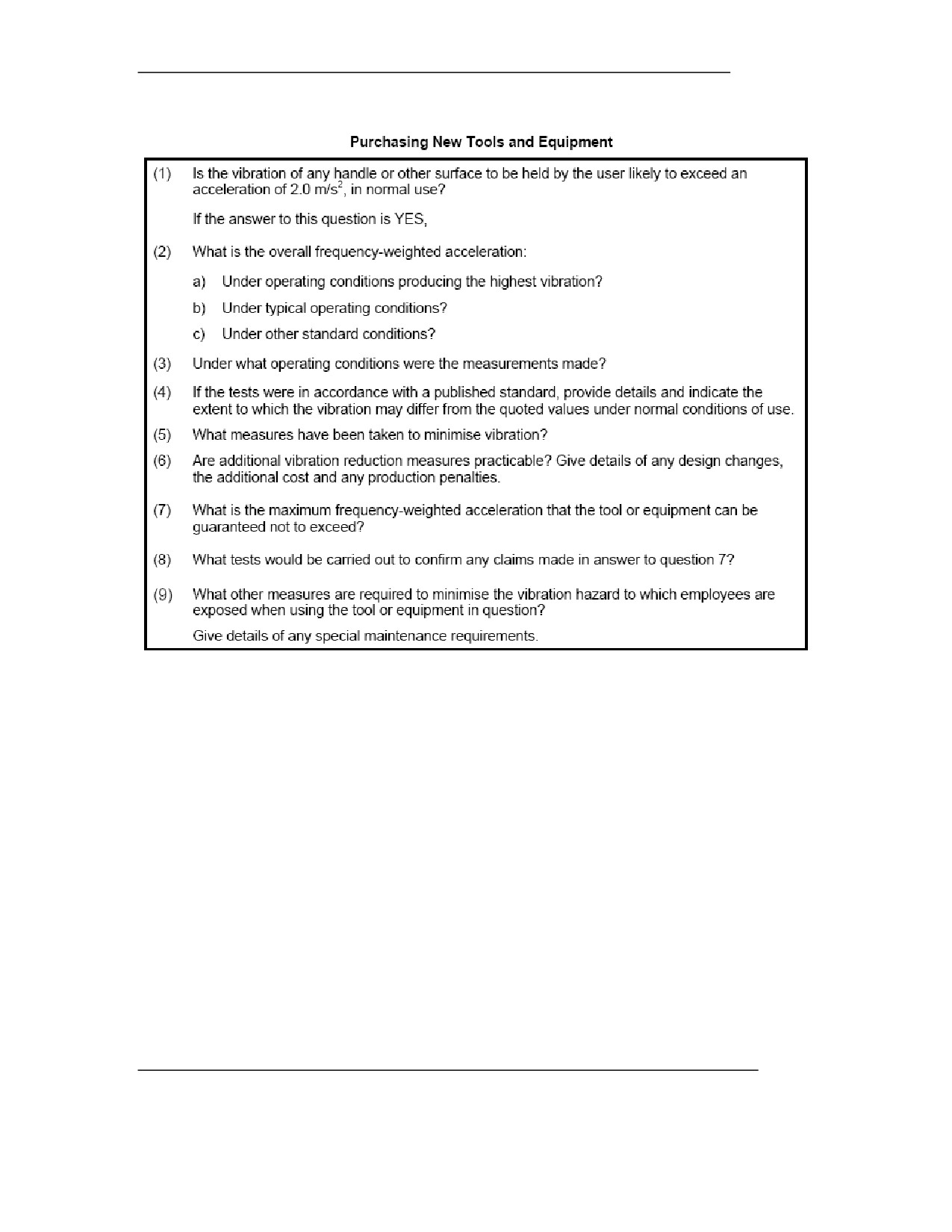
AzSPU Hand-Arm Vibration Programme
8
8.2 REGISTRATION OF TOOLS
All tools with the potential to cause exposure to vibration must be registered and supplied
by companies sending tools to site with information as detailed above. This information
will be included within the site inventory of power tools and should be added to the site‟s
HAVS monitoring spreadsheet.
To aid identification each tool must be fitted with a Micro-tag, by the person responsible
for issuing the tools, identifying Tool Identification Number; Test Date; Vibration Level and
Maximum Hourly Use Per Day (Appendix 1). A colour coding system may be used if
desired. These will be colour coded as follows -
Red Label - For tools above 2.0 m/s².
Green Label - For tools below 2.0 m/s².
The user of any tool having a vibration magnitude greater than 2.0 m/s² will be required to
complete a HAV Assessment and Record Sheet ( See Appendices) in order to ensure
that daily exposure does not exceed an A(8) of 2.5 m/s².
Assessments must be maintained on site for at least three months for inspection by the
site HSE personnel.
Examples of the Assessment and Record Sheet together with tool colour label sheets are
included as appendices.
Control Tier:
<<2>>
Revision Date: <<July 15, 2010>>
Document Number: << AZSPU-HSSE-DOC-00275-2>>
Print Date: 2/1/2011
PAPER COPIES ARE UNCONTROLLED. THIS COPY VALID ONLY AT THE TIME OF PRINTING. THE
CONTROLLED VERSION OF THIS DOCUMENT CAN BE FOUND AT
AzSPU Hand-Arm Vibration Programme
9
8.3 AWARENESS, INFORMATION, INSTRUCTION AND TRAINING
Training is recognised as being an essential tool to raise awareness and help reduce the
risk of employee‟s health being affected by vibration. The level of training and awareness
will be as follows:
All personnel working in AzSPU locations can receive a awareness session to
provide backg1round knowledge and information Reference to VTA number
All personnel performing, or supervising, work involving power tools, must be
trained in the requirements of this programme. - Reference to VTA number
This will include:
•Awareness on exposure limit and action values
• Potential sources of HAV
• The health effects of HAV, including circumstances which provide entitlement to
health surveillance
• Risk factors (e.g. high levels of vibration, daily length/regularity of exposure)
• Results of any applicable assessment and/or measurements
• How to recognize and report signs of injury
• Ways to minimize risk, including:
9 Changes to working practices to reduce vibration exposure
9 Correct selection, use and maintenance of equipment
9 Maintenance of good blood circulation at work, e.g. by keeping warm and
exercising fingers
Maintenance personnel must be given instruction and training on the repair of
equipment to ensure good maintenance practice to reduce vibration. -
Purchasers/subcontractors to be given instruction and information regarding AzSPU
HAV management programme and its requirements.
8.4 Assessment and Reporting of use of vibration equipment
Each tool must be marked with maximum hourly use per day. In any 12-hour shift it is
expected that, with breaks etc., no person is likely to achieve a total usage of a power tool
in excess of 8 hours. Therefore, using the action level given above, tools with a vibration
magnitude equal to, or less than, 2.5 m/s² should not, under normal circumstances, cause
the user to exceed an A(8) of 2.5 m/s² if used for 8 hours or less in a 24 hour period.
To ensure satisfactory control, when using tools with a vibration magnitude above 2.0
m/s², the risk of using that tool must be assessed. Each employee must record usage of
power tools on a HAV Assessment and Record Sheet to determine if exposure limits have
been breached (Appendix 3). Use of a power tool will have been identified during the pre-
job risk identification process and, on withdrawing a power tool with a vibration level
above 2.0 m/s² from the tool store, a HAV Assessment and Record Sheet will be issued
with the tool.
Where the same worker, in the completion of a task, uses more than one vibratory tool,
the maximum exposure time for each tool is reduced. The spreadsheet, which
accompanies this programme, allows the calculation of A(8) values when using a
combination of tools. By entering identified vibration levels and usage times for each tool
it calculates the overall A(8) value, which would occur if using those tools. If overall A(8)
values are over 2.5 m/s² then it will be necessary to reduce the usage until satisfactory
levels are achieved.
It shall be the responsibility of both the user and his employer/supervisor to ensure that
both the maximum permitted time and the daily cumulative time for the tool(s) are not
exceeded.
Control Tier:
<<2>>
Revision Date: <<July 15, 2010>>
Document Number: << AZSPU-HSSE-DOC-00275-2>>
Print Date: 2/1/2011
PAPER COPIES ARE UNCONTROLLED. THIS COPY VALID ONLY AT THE TIME OF PRINTING. THE
CONTROLLED VERSION OF THIS DOCUMENT CAN BE FOUND AT
AzSPU Hand-Arm Vibration Programme
10
At the end of the day the user shall present the HAV Assessment and Record Sheet to his
supervisor who shall sign the sheet as verified and retain it on file. At regular intervals, of
not less than three months, the MEDIC or other person on site responsible for health
issues will review returned record sheets.
It is important to note that the use of the HAV Control Strategy is additional to any controls
specified in the Permit to Work system. The normal operations of AzSPU BP will still
apply in that the use of power tools will still be subject to the controls and authorisations
required by the Permit to Work System
8.5 HEALTH SURVEILLANCE
Employers of personnel carrying out work giving rise to significant risk of HAVS, i.e.
workers likely to be exposed above an A(8) of
2.0 m/s², must ensure that their
employees are annually monitored for the development of HAVS.
Such a health surveillance system will include:
New and existing employees, identified as having significant exposure to HAVS risk
will undergo a medical assessment, including completion of a Health Surveillance
Questionnaire such as that detailed in AzSPU Health Surveillance Programme.
Employees are encouraged to recognize and report symptoms as soon as possible to
their own Doctor, Supervisor, site Medic or other person responsible for health issues
on site, in order that controls can be introduced or reviewed to prevent symptoms
developing further.
For more detailed information on health surveillance please refer to AzSPU Health
Surveillance Programme
8.6 Analysis and Audit
At regular intervals, of not less than three months, the site medic or other responsible for
site health issues person ( e.g. H&S Advisor) will review returned HAV Assessment and
Record Sheets in order to ensure that HAV controls are being complied with, including, in
particular, that exposure of any individual has not exceeded recommended levels. In
addition the site tools inventory, color code tags; tool and task risk assessment should be
reviewed. This will help to identify any improvements to the system, and ensure that
requirements are being met.
The review should include a check on which tools are being used most frequently and to
cross check this to the HAV risk associated with those tools. In this way it may be
possible to identify and investigate the potential for high-risk tools to be changed out or
replaced, or for different method to be used to eliminate HAV risk completely
It is expected that all employers of personnel who use vibration tools at AzSPU BP
locations will have a demonstrated system to ensure controls are adequate to reduce
vibration exposure to their employees to as low as reasonably practicable.
Using this approach it will be possible to drive a continuous improvement process with
respect to HAV risk minimisation at the site.
8.7 Records
8.7.1 Health Records
The employing company should retain relevant health records, including:
• Pre-employment Health Surveillance Questionnaire
• Hand assessments - Health Surveillance Questionnaire
• Individual health surveillance records
Control Tier:
<<2>>
Revision Date: <<July 15, 2010>>
Document Number: << AZSPU-HSSE-DOC-00275-2>>
Print Date: 2/1/2011
PAPER COPIES ARE UNCONTROLLED. THIS COPY VALID ONLY AT THE TIME OF PRINTING. THE
CONTROLLED VERSION OF THIS DOCUMENT CAN BE FOUND AT
AzSPU Hand-Arm Vibration Programme
11
8.7.2 Equipment Records
Equipment Records must be available on each installation and consist of:
Equipment inventory
Test certificate and Test Date
Tool Identification Number
Vibration Level in m/s²
Maximum Daily Usage
8.7.3 Training Records
Training Records must be maintained by each site and copied, where applicable, to
parent companies. These will consist of:
Course name and contents
Attendees name and date of course
8.7.4 Exposure Records: HAV Assessment and record sheet
Exposure Records should be held for those personnel with exposure above an A(8) of 2.5
m/s² or who, after risk assessment, perform tasks, which cannot be executed within the
equipment safe working times. These records should be held on the site for at least three
years for review by the medic, H&S Advisor, Industrial Hygienist. Records should include:
A risk assessment of the work
Exposure times of employees who executed work out with the equipment safe
working times
Revision/Review Log
Revision Date
Authority
Custodian
Revision Details
12/12/2008
Almaz
Hijran Jafarova
Initial Issue
Aghazada
14/12/2009
Section 4.3 /4.4 Exposure limit
Almaz
and action values established as
Aghazada
Hijran Jafarova
per the UK HSE HAV regulations
Section 5.0 Roles and
responsibilities have been
revised
Section 7.6 Maintenance
strategy: Color coded information
added
Almaz
Hijran Jafarova
15/07/2010
Periodic review
Aghazada
Control Tier:
<<2>>
Revision Date: <<July 15, 2010>>
Document Number: << AZSPU-HSSE-DOC-00275-2>>
Print Date: 2/1/2011
PAPER COPIES ARE UNCONTROLLED. THIS COPY VALID ONLY AT THE TIME OF PRINTING. THE
CONTROLLED VERSION OF THIS DOCUMENT CAN BE FOUND AT
AzSPU Hand-Arm Vibration Programme
12
Appendix1
VIBRATION MEASUREMENTS AND VIBRATION EXPOSURE
Vibration is measured using a meter with a „hand arm weighting‟ that filters the
signal from accelerometers to give a hand arm acceleration value in m/s².
The method of measurement involves determining the frequency weighted acceleration
values for three orthogonal axes, ahwx, ahwy and ahwz. The overall vibration ahv is then
calculated as follows:
The measurements should be made on the vibrating surface as close as possible
to the centre of the gripping zone of the machine, tool or workpiece. A mounting
force should be used which is representative of the coupling of the hand to the
vibrating power tool, handle or workpiece.The vibration dose received by the
worker over a typical working day depends on the duration of exposure as well
as the level of vibration. The duration of exposure is the time actually working
with the tool on i.e. the “Trigger Time” the tool is used.
To allow different exposure patterns to be compared, they are adjusted or „normalised‟ to
a standard reference period of 8 hours.
This equivalent value over 8 hours is called the A(8) value and is determined as follows:
Where
T is the total daily duration of exposure to the vibration
ahv,
T0 is the reference duration of 8 hours.
If the work is such that the total daily vibration exposure consists of several operations,
with
different vibration magnitudes, then the daily vibration exposure A(8) is determined by:
Control Tier:
<<2>>
Revision Date: <<July 15, 2010>>
Document Number: << AZSPU-HSSE-DOC-00275-2>>
Print Date: 2/1/2011
PAPER COPIES ARE UNCONTROLLED. THIS COPY VALID ONLY AT THE TIME OF PRINTING. THE
CONTROLLED VERSION OF THIS DOCUMENT CAN BE FOUND AT
AzSPU Hand-Arm Vibration Programme
13
where:
ahvi is the vibration total value for the i th operation
n is the number of individual vibration exposures
Ti is the duration of the i th operation
The permissible maximum exposure time to a measured level of overall hand arm
vibration can
be calculated as follows:
where:
t = time in hours
ahv = overall hand arm acceleration value in m/s2
The overall hand arm vibration dose to which workers are exposed should not exceed the
equivalent value of 2.5 m/s² for a period of 8 hours (2.5 m/s² A(8)). For example if you had
a tool with a vibration level of 2.0 m/s² then the permitted usage time without exceeding
the recommended daily exposure i.e. an A(8) of 2.5 m/s² would be calculated as follows:
Hence the tool can be used safely for t = 12 Hours
Where the same worker, in the completion of a task, uses more than one vibratory tool,
the maximum exposure time for each tool is reduced. Hand arm vibration calculator
(Appendix 4), allows the calculation of A(8) values when using a combination of tools. By
entering identified vibration levels and usage times for each tool, it calculates the overall
A(8) value, which would occur if using those tools. If A(8) values are over 2.5 m/s² then it
would be necessary to reduce the usage until satisfactory levels are achieved.
Control Tier:
<<2>>
Revision Date: <<July 15, 2010>>
Document Number: << AZSPU-HSSE-DOC-00275-2>>
Print Date: 2/1/2011
PAPER COPIES ARE UNCONTROLLED. THIS COPY VALID ONLY AT THE TIME OF PRINTING. THE
CONTROLLED VERSION OF THIS DOCUMENT CAN BE FOUND AT

AzSPU Hand-Arm Vibration Programme
14
Appendix 2
Tool Identification Tag
Control Tier:
<<2>>
Revision Date: <<July 15, 2010>>
Document Number: << AZSPU-HSSE-DOC-00275-2>>
Print Date: 2/1/2011
PAPER COPIES ARE UNCONTROLLED. THIS COPY VALID ONLY AT THE TIME OF PRINTING. THE
CONTROLLED VERSION OF THIS DOCUMENT CAN BE FOUND AT

AzSPU Hand-Arm Vibration Programme
15
Appendix 3
HAV assessment and record sheet
Control Tier:
<<2>>
Revision Date: <<July 15, 2010>>
Document Number: << AZSPU-HSSE-DOC-00275-2>>
Print Date: 2/1/2011
PAPER COPIES ARE UNCONTROLLED. THIS COPY VALID ONLY AT THE TIME OF PRINTING. THE
CONTROLLED VERSION OF THIS DOCUMENT CAN BE FOUND AT
AzSPU Hand-Arm Vibration Programme
16
Appendix 4
Control Tier:
<<2>>
Revision Date: <<July 15, 2010>>
Document Number: << AZSPU-HSSE-DOC-00275-2>>
Print Date: 2/1/2011
PAPER COPIES ARE UNCONTROLLED. THIS COPY VALID ONLY AT THE TIME OF PRINTING. THE
CONTROLLED VERSION OF THIS DOCUMENT CAN BE FOUND AT

AzSPU Hand-Arm Vibration Programme
17
Control Tier:
<<2>>
Revision Date: <<July 15, 2010>>
Document Number: << AZSPU-HSSE-DOC-00275-2>>
Print Date: 2/1/2011
PAPER COPIES ARE UNCONTROLLED. THIS COPY VALID ONLY AT THE TIME OF PRINTING. THE
CONTROLLED VERSION OF THIS DOCUMENT CAN BE FOUND AT
AzSPU Hand-Arm Vibration Programme
18
Appendix 5
Control Tier:
<<2>>
Revision Date: <<July 15, 2010>>
Document Number: << AZSPU-HSSE-DOC-00275-2>>
Print Date: 2/1/2011
PAPER COPIES ARE UNCONTROLLED. THIS COPY VALID ONLY AT THE TIME OF PRINTING. THE
CONTROLLED VERSION OF THIS DOCUMENT CAN BE FOUND AT
AzSPU HSE Training, Awareness and Competence Procedure
Page 1 of 13
HEALTH, SAFETY & ENVIRONMENTAL (HSE)
TRAINING, AWARENESS AND COMPETENCE
PROCEDURE
AZSPU-HSE-DOC-00030-2
Authority:
HSE L&OD Team
Custodian:
Learning Coordinator
Advisor / Learning
Ops Manager
Scope:
AzSPU
Document
AzSPU HSE MS
Administrator:
Document Coordinator
Issue Date:
September, 1998
Issuing Dept:
HSE & Engineering
Revision Date:
10 August, 2010
Control Tier:
2- AzSPU
Next Review
10 August, 2011
Date:
Control Tier:
2-AzSPU
Revision Date: August 10, 2010
Document Number: AzSPU-HSE-DOC-00030-2
Print Date: 2/1/2011
PAPER COPIES ARE UNCONTROLLED. THIS COPY VALID ONLY AT THE TIME OF PRINTING. THE CONTROLLED
VERSION OF THIS DOCUMENT CAN BE FOUND AT http://docs.bpweb.bp.com/dkazspu
AzSPU HSE Training, Awareness and Competence Procedure
Page 2 of 13
1.0
Purpose/Scope
The purpose of this document is to describe the process of identifying Health, Safety &
Environmental (HSE) training requirements at the AzSPU level, delivering training commensurate
with defined responsibilities, and maintaining training records. This procedure applies to BP
Exploration (Caspian Sea) Ltd. full time national permanent, direct hire; expatriate in; Georgia
permanent, and agency staff in addition to contractors as defined within the Contractor HSE Training
Requirements procedure. It is at the discretion of a BP supervisor, team leader, and/or manager, to
determine if the scope of this procedure would apply to day rates working less than 6 months.
Operational Unit level procedures describe the process of identifying HSE training requirements,
delivering training commensurate with defined responsibilities, and maintaining training records.
2.0
Definitions
General HSE management system definitions are in the HSE Definitions document.
3.0
General Requirements
ISO 14001 - Element 4.4.2 Competence, training and awareness
BP Global HSE Compliance Framework - Step 3, Items 3.2, 3.5, 3.7, 3.9
4.0
Responsibilities
AzSPU Top Management
Provide resources and visible management support for the HSE and compliance training
programs.
Monitor training completion via Key Performance Indicators (KPIs), and provide incentives
and disciplinary measures as needed to ensure appropriate training and competent personnel.
AzSPU HSE & Engineering Vice President
Annually approves the AzSPU HSE Training Requirements Matrix and AzSPU HSE Training
Foundation Competency Guidelines, working with Top Management for concurrence as
needed.
Influences training conformance expectations across the AzSPU operational units as it relates
to this procedure.
AzSPU HSE Compliance Team Leader
Maintains the AzSPU Compliance Task Manager (CTM) database, which includes a flag
(trigger) to identify training required by HSE legal and other compliance tasks.
Communicates legally required training identified in CTM compliance tasks to the HSE
L&OD Advisor.
Develops and implements compliance training.
Develops and implements integrated HSE management system training.
Works with appropriate subject matter experts to develop and make available a list of AzSPU
requirements for contractor training programs.
AzSPU HSE Learning and Development Advisor
Provides assurance oversight for this procedure, AzSPU-coordinated HSE training identified
within the AzSPU HSE Training Requirements Matrix, and the AzSPU HSE Training
Foundation Competency Guidelines documents.
VTA learning management system implementation.
Control Tier:
2-AzSPU
Revision Date: August 10, 2010
Document Number: AzSPU-HSE-DOC-00030-2
Print Date: 2/1/2011
PAPER COPIES ARE UNCONTROLLED. THIS COPY VALID ONLY AT THE TIME OF PRINTING. THE CONTROLLED
VERSION OF THIS DOCUMENT CAN BE FOUND AT http://docs.bpweb.bp.com/dkazspu
AzSPU HSE Training, Awareness and Competence Procedure
Page 3 of 13
Performs quality assurance of AzSPU coordinated third party providers for HSE training
courses (e.g. assurance plan, audit schedule, survey results) identified within the AzSPU HSE
Training Requirements Matrix and AzSPU Training Foundation Competency Guidelines.
Communicates AzSPU HSE training requirements defined with the AzSPU HSE Training
Requirements Matrix and AzSPU Training Foundation Competency Guidelines and
periodically assesses training completion.
Approves AzSPU coordinated HSE training course specifications as defined within the
AzSPU HSE Training Requirements Matrix and AzSPU Training Foundation Competency
Guidelines, and ensures they are defined and current.
Provides for quality and completeness of training design, including assurance that appropriate
training materials, tests, and delivery strategies are provided and maintained for all AzSPU
coordinated HSE training defined within AzSPU HSE Training Requirements Matrix and
AzSPU Training Foundation Competency Guidelines.
Ensures technical content is reviewed and verified for accuracy and completeness with
AzSPU Technical Authorities
Reviews materials for instructional quality
Facilitates updates and revisions to course materials as part of the management of change and
continuous improvement process for all AzSPU coordinated HSE training as defined within
the AzSPU HSE Training Requirements Matrix and AzSPU Training Foundation
Competency Guidelines.
Ensures approved course materials are utilized in the delivery of all AzSPU coordinated HSE
training as defined within the AzSPU HSE Training Requirements Matrix and AzSPU
Training Foundation Competency Guidelines.
Accountable for managing all aspects of AzSPU coordinated HSE training implementation
defined within the AzSPU HSE Training Requirements Matrix and AzSPU Training
Foundation Competency Guidelines.
Ensures a standardized customer response and attendance forms are utilized with each AzSPU
coordinated HSE training course defined within the AzSPU HSE Training Requirements
Matrix and AzSPU Training Foundation Competency Guidelines, as well as spot checks
customer response forms to confirm that the course is performing as intended.
Approves third party providers, facilitates contract scope requirements, conducts third party
evaluations, and recommends corrective actions when third party providers fail to meet
contractual scope requirements and/or scores “1 - Not Yet Attained Competencies” as defined
within the 3rd Party Course Evaluation Guidelines for all AzSPU coordinated HSE training as
defined within AzSPU HSE Training Requirements Matrix and AzSPU Training Foundation
Competency Guidelines.
Management and administrative oversight for training documentation as it relates to AzSPU
coordinated HSE training defined within the AzSPU HSE Training Requirements Matrix and
AzSPU Training Foundation Competency Guidelines.
Provides and regularly maintains information on available relevant training for AzSPU
coordinated HSE training as defined within the AzSPU HSE Training Requirements Matrix
and AzSPU Training Foundation Competency Guidelines.
Develops and maintains the AzSPU HSE Training Requirements Matrix, clearly identifying
training requirements for AzSPU job categories, and providing the capability to track training
completed relative to requirements for all AzSPU coordinated HSE training as defined within
the AzSPU HSE Training Requirements Matrix and AzSPU Training Foundation
Competency Guidelines.
Modifies and updates the list of required training for all AzSPU coordinated HSE training as
defined within the AzSPU HSE Training Requirements Matrix and AzSPU Training
Foundation Competency Guidelines for employees when notified of changes in HSE legal
and other training requirements.
Annually communicates employee training requirements for AzSPU coordinated HSE
Control Tier:
2-AzSPU
Revision Date: August 10, 2010
Document Number: AzSPU-HSE-DOC-00030-2
Print Date: 2/1/2011
PAPER COPIES ARE UNCONTROLLED. THIS COPY VALID ONLY AT THE TIME OF PRINTING. THE CONTROLLED
VERSION OF THIS DOCUMENT CAN BE FOUND AT http://docs.bpweb.bp.com/dkazspu
AzSPU HSE Training, Awareness and Competence Procedure
Page 4 of 13
training as defined with the AzSPU HSE Training Requirements Matrix and AzSPU Training
Foundation Competency Guidelines, and periodically provides updates to employees,
supervisors, and the HSE Compliance Team Leader regarding training completions.
Manages the logistics of providing the AzSPU coordinated HSE training defined within the
AzSPU HSE Training Requirements Matrix and AzSPU Training Foundation Competency
Guidelines.
Manages and maintains training records for AzSPU coordinated HSE training programs
defined within the AzSPU HSE Training Requirements Matrix and AzSPU Training
Foundation Competency Guidelines such that they are quickly available to document training
program implementation.
Provides material for or participates in implementation of general new employee induction
training for new employees.
Periodically, approximately once per year, checks the compliance database against the
AzSPU coordinated HSE training as defined within the AzSPU HSE Training Requirements
Matrix and AzSPU Training Foundation Competency Guidelines to ensure all relative HSE
legal and other training is fully represented.
Nominated HSE Advisors:
Defines operational unit’s HSE training requirements.
Assist in preparation of compliance awareness, integrated HSE management system, and
other HSE training materials as requested, including addition of operational unit-specific
information when needed.
Participate in Train-the-Trainer sessions when available, to assist in providing HSE training to
their business.
Participates in selection of 3rd party training providers where applicable to provide HSE
training.
Implement the HSE training program in accordance with the training requirements defined
within the AzSPU HSE Training Requirements Matrix, AzSPU Training Foundation
Competency Guidelines and operational unit level HSE training procedures/ matrices.
Periodically (recommended quarterly), check on the status of training completions for the
year and notify Operational Unit Leaders and the AzSPU HSE Compliance Team Leader if
there are discrepancies between required training and training expectations defined within the
AzSPU HSE Training Requirements Matrix, AzSPU Training Foundation Competency
Guidelines and Operational Unit level HSE training procedures/training matrices.
Follow up and scheduling for personnel who are late in meeting HSE training requirements
defined within the AzSPU HSE Training Requirements Matrix, AzSPU Training Foundation
Competency Guidelines and Operational Unit level HSE training procedures/matrices.
Technical Authorities - Various Subjects
Provide technical oversight and guidance for HSE training course content (e.g., objectives,
required audiences, delivery methods, provider, etc.) defined within the AzSPU HSE Training
Requirements Matrix, AzSPU Training Foundation Competency Guidelines, and Operational
Unit level HSE training procedures/matrices.
Recommend new HSE course development as well as revision to existing HSE training
programs in accordance with applicable BP policies and procedures.
Supervisors:
Assure individuals working for them are competent and effective in performing assigned
compliance tasks.
Ensure persons working for them and performing tasks that have the potential to cause a
significant impact on HSE or compliance issues are competent on the basis of appropriate
Control Tier:
2-AzSPU
Revision Date: August 10, 2010
Document Number: AzSPU-HSE-DOC-00030-2
Print Date: 2/1/2011
PAPER COPIES ARE UNCONTROLLED. THIS COPY VALID ONLY AT THE TIME OF PRINTING. THE CONTROLLED
VERSION OF THIS DOCUMENT CAN BE FOUND AT http://docs.bpweb.bp.com/dkazspu
AzSPU HSE Training, Awareness and Competence Procedure
Page 5 of 13
education, training, or experience.
Have performance contracts/evaluations that take into account whether they have routinely
performed assurance activities (such as work observations, performance reviews, facility
walk-arounds, and other activities that assist in observing worker performance) to confirm
that individuals who are or may be working for them are competent and effective in
performing assigned compliance tasks and managing HSE impacts.
Ensure persons working for them are allowed to perform their tasks with up to date training
certificates and/or dispensation, if applicable.
Ensure monthly review of training validity for BP and core contractor personnel working at
operational sites and formal notification to Operational Site Manager(s) of training expiry
dates 60 days in advance.
Ensure formal notification to core contractors’ management and/or respective Contract
Accountable Managers of the contractor personnel training expiry dates 60 days in advance
from Operational Site Manager(s) and/or designee.
Be responsible for identifying where a dispensation/deviation should be given if training
certificates are expired and have it verified by Authorizing person defined for each role as per
AzSPU Procedure for Deviation
(AzSPU-HSE-DOC-00011-2) or any other applicable
procedures/policies.
Agree mitigations set with Operational Site Manager(s) if dispensation/deviation is given to
members of staff when training certificates are expired.
Suspend members of personnel from performing of the respective part of their duties if their
training certificates are expired and no dispensation/deviation is applicable and/or given.
Approve minimum mitigations required as part of dispensation/deviation process in the form
of a successful formal reassessment using agreed set of questionnaire. Records of successful
assessment shall be kept with dispensation/deviation form by the Operational Site Controller
and be made available for auditors at any time.
Site Managers, Procurement, and Contract Technical Specialists
Communicate AzSPU HSE training expectations for contractors.
Periodically check contractor training programs and contractor performance as part of the
overall Contractor Oversight process.
Course Instructors
Provide courses according to approved course specifications and with approved course
materials.
Have attendees sign course registers, and ensure attendance is documented within the VTA by
delivering the attendance register to a VTA Administrator and/or the AzSPU HSE Training
coordinator.
For AzSPU coordinated HSE training courses defined within the AzSPU HSE Training
Requirements Matrix and AzSPU Training Foundation Competency Guidelines with a graded
test, course instructors review test results, determine whether attendees pass required courses,
and notify attendees and AzSPU HSE Training coordinator of failed test results.
Learning Coordinators
Provides assurance oversight for Operational unit level HSE training procedures and matrices
(if required).
Administers VTA learning management system for operational unit coordinated HSE training
defined within operational unit level HSE training procedures/matrices.
Performs quality assurance of operational unit coordinated HSE training course third party
providers (e.g. assurance plan, audit schedule, survey results) identified within defined within
operational unit level HSE training procedures/matrices.
Communicates operational unit HSE training requirements defined within operational unit
Control Tier:
2-AzSPU
Revision Date: August 10, 2010
Document Number: AzSPU-HSE-DOC-00030-2
Print Date: 2/1/2011
PAPER COPIES ARE UNCONTROLLED. THIS COPY VALID ONLY AT THE TIME OF PRINTING. THE CONTROLLED
VERSION OF THIS DOCUMENT CAN BE FOUND AT http://docs.bpweb.bp.com/dkazspu
AzSPU HSE Training, Awareness and Competence Procedure
Page 6 of 13
level HSE training procedures/matrices, periodically assesses training completion.
Approves operational unit coordinated HSE training course specifications as defined within
operational unit level HSE training procedures/matrices, and ensures they are defined and
current.
Provides for quality and completeness of training design, including assurance that appropriate
training materials, tests, and delivery strategies are provided and maintained for all
operational unit coordinated HSE training defined within operational unit level HSE training
procedures/matrices.
Ensures technical content is reviewed and verified for accuracy and completeness with
AzSPU and operational unit Technical Authorities.
Reviews materials for operational unit coordinated HSE training defined within operational
unit level HSE training procedures/matrices for instructional quality
Facilitates updates and revisions to course materials as part of the management of change and
continuous improvement process for all operational unit coordinated HSE training as defined
within operational unit level HSE training procedures/matrices..
Ensures approved course materials are utilized in the delivery of all operational unit
coordinated HSE training defined within operational unit level HSE training
procedures/matrices.
Accountable for managing all aspects of operational unit coordinated HSE training
implementation defined within operational unit level HSE training procedures/matrices.
Ensures AzSPU standardized customer response and attendance forms are utilized with each
operational unit coordinated HSE training course defined within operational unit level HSE
training procedures/matrices, as well as spot checks customer response forms to confirm that
the course is performing as intended.
Approves third party providers, facilitates contract scope requirements, conducts third party
evaluations, and recommends corrective actions when third party providers fail to meet
contractual scope requirements and/or scores “1 - Not Yet Attained Competencies” as defined
within the 3rd Party Course Evaluation Guidelines for all operational unit coordinated HSE
training defined within operational unit level HSE training procedures/matrices.
Management and administrative oversight for training documentation as it relates to
operational unit coordinated HSE training defined within operational unit level HSE training
procedures/matrices.
Provides and regularly maintains information on available relevant training for operational
unit coordinated HSE training as defined within operational unit level HSE training
procedures/matrices.
Develops and maintains the operational unit level HSE training procedures/matrices, clearly
identifying training requirements for operational unit job categories, and providing the
capability to track training completed relative to requirements for all operational unit
coordinated HSE training as defined within operational unit level HSE training
procedures/matrices.
Modifies and updates the list of required training for all operational unit coordinated HSE
training as defined within operational unit level HSE training procedures/matrices for
employees when notified of changes in HSE legal and other training requirements.
Annually communicates employee training requirements for operational unit coordinated
HSE training defined within operational unit level HSE training procedures/matrices, and
periodically provides updates to employees, supervisors, and the HSE Compliance Team
Leaderregarding training completions.
Manages the logistics of providing operational unit coordinated HSE training defined within
operational unit level HSE training procedures/matrices.
Manages and maintains training records for operational unit coordinated HSE training
programs defined within operational unit level HSE training procedures/matrices, such that
they are quickly available to document training program implementation.
Control Tier:
2-AzSPU
Revision Date: August 10, 2010
Document Number: AzSPU-HSE-DOC-00030-2
Print Date: 2/1/2011
PAPER COPIES ARE UNCONTROLLED. THIS COPY VALID ONLY AT THE TIME OF PRINTING. THE CONTROLLED
VERSION OF THIS DOCUMENT CAN BE FOUND AT http://docs.bpweb.bp.com/dkazspu
AzSPU HSE Training, Awareness and Competence Procedure
Page 7 of 13
Periodically, approximately once per year, checks the compliance database against the
operational unit coordinated HSES training defined within operational unit level HSE training
procedures/matrices to ensure that all relevant HSE legal and other training is fully
represented.
5.0
Procedure
HSE training requirements and competence management will be performed in accordance with this
procedure to ensure that BP employees and contractors are provided with the necessary training in
HSE issues based on their positions. This will enable personnel to conduct their work tasks in a way
that safeguards the environment; protects employee and community health, safety; meets social
obligations; meets legal and other requirements; and meets the requirements of BP HSE Policy.
5.1
Identification of Employee HSE Training Needs
Personnel throughout the AzSPU require different levels of AzSPU and operational unit HSE training.
The AzSPU Training Requirements Matrix and AzSPU Training Foundation Competency Guidelines
identify the minimum AzSPU coordinated HSE training required for each person/position, and is
developed by:
Reviewing personnel job descriptions, applicable operational controls and functional
organization charts to identify HSE responsibilities and required competencies for personnel.
Interviewing personnel, team leaders and managers as-needed to clarify responsibilities and
required competencies.
Analyzing personnel job responsibilities and required competencies to identify appropriate
level of AZSPU and site HSE training requirements.
Reviewing compliance task assignments in CTM, including training that is mandated by legal
and other requirements.
Management of change processes and periodic reviews of the HSE training assessment process enable
the AzSPU Training Requirements Matrix and AzSPU HSE Training Foundation Competency
Guidelines to reflect current personnel job category requirements.
HSE training requirements include (as appropriate to the job responsibilities):
Induction training.
Specialist Training.
Management system training.
Compliance training - how legally required HSE training is identified, provided, evaluated
and recorded.
Other training, such as training included in the employee’s Personal Development Plan,
training dictated by the employee’s work location (i.e., AzSPU, operational unit-specific,
Asset-specific) and training identified by supervisors or other interested parties.
Completion of required training is tracked in VTA, and training non conformance is reported through
VTA for employees who are late or do not complete required training.
5.1.1 New Employee HSE Induction Training
One type of training identified through the training assessment process is an initial new
employee HSE induction. Inductions are carried out for employees on joining the company,
as appropriate to their job assignments. These inductions include HSE issues, compliance
awareness, management systems, and actions to be taken in the event of an HSE or social
accident/incident.
Control Tier:
2-AzSPU
Revision Date: August 10, 2010
Document Number: AzSPU-HSE-DOC-00030-2
Print Date: 2/1/2011
PAPER COPIES ARE UNCONTROLLED. THIS COPY VALID ONLY AT THE TIME OF PRINTING. THE CONTROLLED
VERSION OF THIS DOCUMENT CAN BE FOUND AT http://docs.bpweb.bp.com/dkazspu
AzSPU HSE Training, Awareness and Competence Procedure
Page 8 of 13
5.1.2 Specialist Training
Where there is a need for specialist HSE or social training, the AzSPU HSE Training
coordinator in consultation with Nominated HSE Advisors, is responsible for identifying
appropriate training. If this requires participation in external HSE or social training courses,
HSE resources will be consulted to ensure the appropriateness of the identified course.
Once approved by Nominated HSE Advisors, specialist courses are included in the AzSPU
HSE Training Requirements Matrix and AzSPU HSE Training Foundation Competency
Guidelines for that job category. Line Managers/Team Leaders review and have input on
their employee’s training plans, and are to:
1) ensure that realistic requirements and
timescales are identified; and 2) make employees available for identified training sessions.
5.1.3
Management System Training
The AzSPU HSE Compliance Team Leaderis responsible for developing and conducting
integrated HSE management system training for those elements of the management system
applicable to all assets and sites. This training will be integrated with asset and site level
specific training and will incorporate:
Any updates to the integrated HSE management system.
Conformance with the HSE regulatory policy and procedures.
Compliance with HSE legal requirements and reporting of non-compliances.
Overview of significant HSE aspects and impacts associated with operations.
Incorporation of significant HSE aspects and compliance requirements into
Objectives, Targets and Management Programmes.
The initial and refresher management system training obligations are included within the
AzSPU HSE Training Requirements Matrix, AzSPU HSE Training Foundation Competency
Guidelines, and operational unit level HSE training procedures/matrices.
5.1.4 Compliance Training
AzSPU HSE legal and other requirements compliance training is identified and included
within the AzSPU Training Requirements Matrix, AzSPU HSE Training Foundation
Competency Guidelines, in CTM, in the AzSPU HSE Compliance Training and
Communication Strategy
(2008-2009+) and in operational unit level HSE training
procedures/matrices. This training:
Provides awareness of BP’s compliance expectations, the AzSPU HSE compliance
program and the importance of compliance.
Conveys information on how to access compliance tasks in CTM, and the source of
other compliance tools and resources (e.g. Compliance Position Papers).
Provides guidance to individuals on how to discharge their HSE compliance
accountabilities - complete compliance tasks.
Provides guidance to supervisors on how to oversee their direct reports who perform
HSE compliance tasks.
Provides information on where to obtain guidance if compliance requirements are not
clear.
Provides regulatory-required communications.
Provides information on the procedure for confidentially reporting compliance
concerns.
5.1.5 Other HSE Training Requirements
Additional HSE training added to an employee’s list of training requirements includes
Control Tier:
2-AzSPU
Revision Date: August 10, 2010
Document Number: AzSPU-HSE-DOC-00030-2
Print Date: 2/1/2011
PAPER COPIES ARE UNCONTROLLED. THIS COPY VALID ONLY AT THE TIME OF PRINTING. THE CONTROLLED
VERSION OF THIS DOCUMENT CAN BE FOUND AT http://docs.bpweb.bp.com/dkazspu
AzSPU HSE Training, Awareness and Competence Procedure
Page 9 of 13
training identified in the employee’s Personal Development Plan, training dictated by the
employee’s work location (i.e., AzSPU, operational unit-specific, Asset-specific) and training
identified by supervisors or other interested parties.
5.2
HSE Training Design and Development
HSE training is designed to provide the knowledge, skills and competencies identified in the AzSPU
HSE Training Requirements Matrix, AzSPU HSE Training Foundation Competency Guidelines, and
operational unit level HSE training procedures/matrices. Training is designed and developed by:
Establishing a list of training objectives that will be covered in each course.
Identifying the recommended target audience.
Determining appropriate training environment (classroom, online such as computer based
training (CBT), or on-the-job) as well as instructional methods (instructor-led, including the
selection and certification of qualified instructors or third party providers, and CBT).
Determining methods to evaluate training effectiveness, including confirmation that trainees
obtain desired knowledge, skills, and competencies.
Determining refresher frequency.
Developing training materials.
Standardizing AzSPU and operational unit HSE training (e.g. content, materials, delivery
method, providers, etc.) where applicable.
AzSPU HSE training as defined within the AzSPU HSE Training Requirements Matrix and AzSPU
HSE Training Foundation Competency Guidelines is developed to deliver on approved course
specifications. AzSPU coordinated HSE social and training course specifications shall include
approved criteria specific to that course as follows:
Course Name
Course Tag
Provider
Duration
Certification Date
Accreditation
Objectives
Intended For
Content
Expiration Date
Appropriate HSE developed training materials may include self-study, electronic courses, train-the-
trainer sessions, and traditional in-classroom instruction. When available, courses are provided
through VTA.
5.3
HSE Training Implementation
AzSPU coordinated HSE training is implemented in accordance with the training programs defined in
the AzSPU HSE Training Requirements Matrix and AzSPU Training Foundation Competency
Guidelines and includes assigning instructors and support staff, scheduling, and identifying suitable
facilities.
The AzSPU HSE Training coordinator is accountable for managing all aspects of AzSPU coordinated
HSE training implementation. Asset Training Coordinators are accountable for managing all aspects
of operational unit HSE training implementation defined outside the scope of this procedure.
5.4
Refresher Training
Refresher training is identified for select HSE training and provided as appropriate. The need for
refresher HSE training for employees is determined based on both the course itself and as part of an
employee’s annual performance appraisal. When needed, supervisors can enroll employees into
refresher courses defined within the AzSPU HSE Training Requirements Matrix, AzSPU Training
Foundation Competency Guidelines and operational unit level HSE training procedures/matrices.
Control Tier:
2-AzSPU
Revision Date: August 10, 2010
Document Number: AzSPU-HSE-DOC-00030-2
Print Date: 2/1/2011
PAPER COPIES ARE UNCONTROLLED. THIS COPY VALID ONLY AT THE TIME OF PRINTING. THE CONTROLLED
VERSION OF THIS DOCUMENT CAN BE FOUND AT http://docs.bpweb.bp.com/dkazspu
AzSPU HSE Training, Awareness and Competence Procedure
Page 10 of 13
5.5
Drills and Exercises
Drills and exercises are fundamental in assessing the existing systems and operations in place for
certain types of courses and skills. Drill and exercise schedules are implemented by subject matter
experts.
5.6
Contractor Training
Contractors working within the AzSPU are responsible for developing and implementing a
comprehensive HSE training program to meet legal and other requirements, meet BP-specific
requirements, and ensure competency of personnel performing work for BP.
Overall contractor HSE training program expectations are included in contracts as appropriate.
Contractors are required to identify training obligations applicable to their work, including but not
limited to AzSPU and operational unit level HSE training, ensure their staff obtains all required
training, provide competent employees, maintain training documentation including attendance records
for at least five years, and provide training program documentation and training records to BP upon
request. Refer to Appendix A, AzSPU Minimum Contractor HSE Training Requirements.
Contractor oversight procedures are established to communicate contractor training requirements and
to periodically check contractor training programs and contractor performance.
5.7
AzSPU and Operational Unit HSE Awareness / Toolbox Talks and Safety Meetings
AzSPU Toolbox talks and Safety Meetings are performed on a regular basis, and progressively cover
relevant HSE issues. Operational unit and site level toolbox talks and safety meetings are managed at
a operational unit/site level and covered in operational unit/site procedures.
Topics may include:
Environmental and Social Policies
Environmental and Social Aspects and Impacts
Legal and Other Requirements
Objectives and Targets
Environmental and Social Management Programs
Structure and Responsibilities
Training, Awareness and Competency
Communication
Environmental and Social Management System Documentation
Operational Control
Emergency Preparedness and Response
Monitoring and Measurement
Non Conformance and Corrective and Preventative Action
Records
Environmental and Social Management System Auditing
Management Review
Toolbox talks and safety meetings are not documented within the VTA learning management system.
Documentation is at the discretion of the team leader or manger and shall be retained on file at the
site/office.
Control Tier:
2-AzSPU
Revision Date: August 10, 2010
Document Number: AzSPU-HSE-DOC-00030-2
Print Date: 2/1/2011
PAPER COPIES ARE UNCONTROLLED. THIS COPY VALID ONLY AT THE TIME OF PRINTING. THE CONTROLLED
VERSION OF THIS DOCUMENT CAN BE FOUND AT http://docs.bpweb.bp.com/dkazspu
AzSPU HSE Training, Awareness and Competence Procedure
Page 11 of 13
5.8
Competency
HSE competency of personnel is achieved through experience, training courses, toolbox talks, safety
meetings and on the job (OJT) training. Supervisors assure individuals working for them are
competent and effective in performing assigned compliance tasks. Supervisors also ensure persons
working for them and performing tasks that have the potential to cause a significant impact on HSE or
compliance issues are competent on the basis of appropriate education, training, or experience.
Supervisors confirm employee competence through processes such as work observations,
performance reviews, facility walk-arounds, effective completion of CTM compliance tasks, and other
activities that assist in observing worker performance. Individual performance evaluations are
conducted annually to assess an individual’s overall competency and effectiveness in performing
assigned compliance tasks and managing HSE impacts.
5.9
HSE Training Evaluation and Improvement
AzSPU coordinated HSE training courses, defined within the AzSPU HSE Training Requirements
Matrix and AzSPU Training Foundation Competency Guidelines, are routinely evaluated for
adequacy of content, testing, presentation, and documentation. Improvements may be required
regarding the quality of HSE training courses and to keep training up-to-date. Evaluation activities
include:
Customer response forms for each training course.
Graded tests, quizzes, or demonstrated competence as appropriate for the training course.
Third party course evaluations.
Employees attending AzSPU coordinated courses defined within the AzSPU HSE Training
Requirements Matrix and AzSPU Training Foundation Competency Guidelines are encouraged to
comment on training. Comments are forwarded to course trainers for review and action where
appropriate. Where action is deemed necessary at the discretion of the course trainer, the course
trainer discusses with the AzSPU HSE Training coordinator, to agree on actions required.
5.10
Training Records
Attendance and completion of AzSPU coordinated training courses defined within the AzSPU HSE
Training Requirements Matrix and AzSPU Training Foundation Competency Guidelines is
documented in VTA learning management system. The following records are retained by HSE & TD
and Human Resources Management:
AzSPU HSE Training Requirements Matrix, AzSPU Training Foundation Competency
Guidelines, and records of training completed.
Annual Performance Appraisal Records.
AzSPU coordinated HSE training materials defined within AzSPU HSE Training
Requirements Matrix and AzSPU Training Foundation Competency Guidelines
document.
Comments received on Training Courses
Job descriptions - reviewed and updated, where applicable, as part of the performance
appraisal process.
The AzSPU HSE Training coordinator is responsible for management and administration oversight
for all AzSPU coordinated HSE training records as defined within the AzSPU HSE Training
Requirements Matrix and AzSPU Training Foundation Competency Guidelines. The asset or project
Training Coordinators are responsible for management and administration oversight for all other HSE
training records. VTA is the system to document training completed, reporting training attendance as
Control Tier:
2-AzSPU
Revision Date: August 10, 2010
Document Number: AzSPU-HSE-DOC-00030-2
Print Date: 2/1/2011
PAPER COPIES ARE UNCONTROLLED. THIS COPY VALID ONLY AT THE TIME OF PRINTING. THE CONTROLLED
VERSION OF THIS DOCUMENT CAN BE FOUND AT http://docs.bpweb.bp.com/dkazspu
AzSPU HSE Training, Awareness and Competence Procedure
Page 12 of 13
well as other training compliance/status reporting.
6.0 Key Documents/Tools/References
AzSPU HSE Training Foundation Competency Guidelines
Virtual Training Assistant Learning Management System
Appendix A
AzSPU Minimum Contractor HSE Training Requirements
SPA
All Field-Based Contractors Employees:
Site Inductions
Operational Unit
Behavioral Safety Observation Training
HSE L&D TL
CoW training as per Job profile requirements
HSE L&D TL
Contract Supervisors/Leads/Foreman:
Site Inductions
Safety Observations and Conversations Training
Operational Unit
CoW training as per Job profile requirements
HSE L&D TL
HSE L&D TL
Revision/Review Log
Revision Date
Authority
Custodian
Revision Details
September 1998 AD Little
R. Norman
Initial Issue
July 2000
G. Vidrine
J. Casey
Consistency with BP EMS Guidelines
F. Askerov
Control Tier:
2-AzSPU
Revision Date: August 10, 2010
Document Number: AzSPU-HSE-DOC-00030-2
Print Date: 2/1/2011
PAPER COPIES ARE UNCONTROLLED. THIS COPY VALID ONLY AT THE TIME OF PRINTING. THE CONTROLLED
VERSION OF THIS DOCUMENT CAN BE FOUND AT http://docs.bpweb.bp.com/dkazspu
AzSPU HSE Training, Awareness and Competence Procedure
Page 13 of 13
August 2000
G. Vidrine
G. Stacey
Consistency with EMS Guidelines
R. Gallagher
April 2004
L. Emmons
S. Sultanova
Consistency with EMS requirements
September 28,
Gunther
Mary Holmes,
Updated to combine several training
2005
Newcombe
Yuliy Zaytsev
procedures into one, address integrated
HSE MS, describe the AzSPU training
matrix, incorporate the role of the
compliance database for identification of
“legal and other requirement” training,
and to address requirements of the
revised ISO 14001 standard.
February 27,
Gunther
Yelena Mirtagavi
Overall review
2007
Newcombe
August 20, 2007
Gunther
Yelena Mirtagavi
Reflected changes in moving towards
Newcombe
BSA
January 17, 2008
Yelena Mirtagavi
Naiba Ahmadova
Reflected changes in moving towards
SOC
March 11, 2008
Yelena Mirtagavi
Ilaha
Management system and compliance
Akhmedova
training requirements updated by
Rebecca Heath and Ilaha Akhmedova has
become document custodian.
May 21, 2008
Yelena Mirtagavi
Ilaha
Updated SPA for SOC program
Akhmedova
August 27, 2008
Yelena Mirtagavi
Ilaha
Updated HSE training requirements
Akhmedova
guidelines for contractor staff
March 28, 2009
Yelena Mirtagavi
Ilaha
Added HSE Training dispensation form
Akhmedova
April 6, 2009
Yelena Mirtagavi
Ilaha
Incorporated Exports PU specific
Akhmedova
documents on training validity
May 13, 2009
Yelena Mirtagavi
Ilaha
Amended alignment with AzSPU
Akhmedova
Procedure for Deviation.
September
29,
Yelena Mirtagavi
Ilaha
Removed reference to safety immersion
2009
Akhmedova
programs for contractors
January 29, 2009
Yelena Mirtagavi
Leyla
Removed reference to Social trainings.
Balaglanova
August 02, 2010
Yelena Mirtagavi
Y.Mirtagavi
Changed custodian and issuing
department.
August 10, 2010
Yelena Mirtagavi
Y.Mirtagavi
Changed titles as per organizational
change.
Added requirement to verify CTM
required trainings.
Removed reference to security trainings
Control Tier:
2-AzSPU
Revision Date: August 10, 2010
Document Number: AzSPU-HSE-DOC-00030-2
Print Date: 2/1/2011
PAPER COPIES ARE UNCONTROLLED. THIS COPY VALID ONLY AT THE TIME OF PRINTING. THE CONTROLLED
VERSION OF THIS DOCUMENT CAN BE FOUND AT http://docs.bpweb.bp.com/dkazspu
AzSPU Heat Stress Management Programme
Az SPU Heat Stress Management
Programme
AZSPU-HSSE-DOC-00109-2
Authority:
AzSPU Health Manager
Custodian:
AzSPU Industrial Hygiene Advisor
Almaz Agazade
Hijran Jafarova
Scope:
AzSPU
Document
Administrator:
Document Asset Technician Name
Issue Date:
10.05.2004
Issuing Dept:
HSE&TD/Health
Revision
15.07.2010
Control Tier:
2
Date:
Next Review
15.07.2011
Date:
Control Tier:
<<2>>
Revision Date: 16.07.2010
Document Number: << AZSPU-HSSE-DOC-00109-2>>
Print Date: 2/1/2011
PAPER COPIES ARE UNCONTROLLED. THIS COPY VALID ONLY AT THE TIME OF PRINTING. THE
CONTROLLED VERSION OF THIS DOCUMENT CAN BE FOUND AT
AzSPU Heat Stress Management Programme
1.0 Purpose/Scope
The purpose of this document is to provide information necessary to establish,
operate and maintain effective programmes to protect the health of employees,
contractors and others from exposure to heat stress while working for BP
Exploration Caspian Sea Ltd.
This controlled document applies to Azerbaijan Strategic Performance Unit
(SPU) engaged in the exploration, drilling, production and transportation of oil;
including all related construction activities.
2.0 Definitions
Calorie
The amount of heat required to raise 1 gram of
water 1 degrees C (based on a standard
temperature of 16.5 to 17.5 degrees C)
Conduction
The transfer of heat between materials that contact
each other. Heat passes from the warmer material
to the cooler material. For example, a worker's skin
can transfer heat to a contacting surface if that
surface is cooler, and vice versa
Dry bulb temperature
The temperature as measured by a thermal sensor,
such as an ordinary mercury-in-glass thermometer,
that is shielded from direct radiant energy sources
Evaporative cooling
Cooling that occurs when sweat evaporates from
the skin. High humidity reduces the rate of
evaporation and thus reduces the effectiveness of
the body's primary cooling mechanism
Globe temperature
The temperature inside a blackened, hollow, thin
copper globe
Heat
A measure of energy in terms of quantity
Heat Cramp
There is a sudden onset of pain and cramps in the
extremities; occurs after prolonged vigorous
exercise especially in hot environments. There may
be nausea and hypotension (low blood pressure)
and in some cases hyperventilation.
Heat Exhaustion
A progression from heat cramp and it is a more
severe condition. It is more likely in the dehydrated,
unfit, the elderly and those who have high blood
pressure. It is caused by both salt and water loss.
Heat Hyperpyrexia,
Caused by exactly the same conditions as heat
or Heat Stroke
exhaustion. It begins as heat exhaustion, but when
the body's system for losing heat is overwhelmed
the core body temperature rises rapidly and tissue
Control Tier:
<<2>>
Revision Date: 16.07.2010
Document Number: << AZSPU-HSSE-DOC-00109-2>>
Print Date: 2/1/2011
PAPER COPIES ARE UNCONTROLLED. THIS COPY VALID ONLY AT THE TIME OF PRINTING. THE
CONTROLLED VERSION OF THIS DOCUMENT CAN BE FOUND AT
AzSPU Heat Stress Management Programme
damage occurs. This affects mainly the brain,
kidneys and liver. The circulation collapses. This
condition can be fatal if not treated rapidly.
Heat Strain
The net physiological load resulting from heat
stress
Heat Stress
The heat load on the body with contributions from
both metabolic heat production and external
environmental factors
Heat Syncope
A heat related condition where blood, which would
normally be circulated to the heart and brain, tends
to pool in the leg veins, thereby causing fainting.
Metabolic heat
A by-product of the body's activity.
Natural wet bulb
The temperature measured by exposing a wet
sensor,
temperature
such as a wet cotton wick fitted over the bulb of a
thermometer, to the effects of evaporation and
convection. The term natural refers to the
movement of air around the sensor.
Radiation
The transfer of heat energy through space. A
worker whose body temperature is greater than the
temperature of the surrounding surfaces radiates
heat to those surfaces. Hot surfaces and infrared
light sources radiate heat that can increase the
body’s heat load
3.0 General Requirements
OGP Health Aspects of Work in Extreme Climates within the E& P Industry.
Labor Code of the Republic of Azerbaijan (Eng)
Labor Code of the Republic of Azerbaijan (Az)
4.0 Key Responsibilities
Line Managers/Supervisors shall
Be responsible for assessment and management of health risks within
their areas of responsibility
Provide input when required to the heat stress risk assessment
processes
Review health risk assessment findings and recommendations, as well as
the systems established to implement and track the resulting actions
Ensure that people assigned for work in high temperature are medically
assessed for their fitness for task
Ensure findings and recommendations from the health risk assessment
are communicated to all necessary personnel, including contractors and
Control Tier:
<<2>>
Revision Date: 16.07.2010
Document Number: << AZSPU-HSSE-DOC-00109-2>>
Print Date: 2/1/2011
PAPER COPIES ARE UNCONTROLLED. THIS COPY VALID ONLY AT THE TIME OF PRINTING. THE
CONTROLLED VERSION OF THIS DOCUMENT CAN BE FOUND AT
AzSPU Heat Stress Management Programme
visitors to the site
Ensure a heat stress risk assessment is completed for the tasks where
the hot working conditions could be a problem
Ensure all measures and recommendations resulting from the heat stress
risk assessment are undertaken
Ensure all people working within their area of control are made aware of
any health risks, including those related to heat stress, associated with
their activities or work place and of the necessary precautions
Ensure the suitability of the personal protective equipment provided for
people carrying out, or affected by, the activity
Record and report any illness and/or problem that is associated with heat
stress via the established HSE reporting procedures
Health Manager (or designee) shall
Ensure maintenance and periodic review of this document
Provide technical support, guidance and advice as requested on heat
stress related issues
Ensure that relevant training programmes are available
Employees shall
Take all necessary precautions for working in hot conditions see
Precautions for Working in Hot Environment.
5.0 Procedure
5.1 Heat Stress Causes
5.1.1 Individual Susceptibility
It is difficult to predict just who will be affected and when, because individual
susceptibility varies. In addition, environmental factors include more than the
ambient air temperature. Radiant heat, air movement, conduction, and relative
humidity all affect an individual's response to heat.
Age, weight, degree of physical fitness, degree of acclimatization, metabolism,
use of alcohol or drugs, and a variety of medical conditions such as hypertension
all affect a person's sensitivity to heat. Even the type of clothing worn must be
considered.
Note: Prior heat injury predisposes an individual to additional injury.
5.1.2 Temperature
The higher the air temperature, the less heat the body can lose by convection,
conduction and radiation. If the temperature of the environment increases above
Control Tier:
<<2>>
Revision Date: 16.07.2010
Document Number: << AZSPU-HSSE-DOC-00109-2>>
Print Date: 2/1/2011
PAPER COPIES ARE UNCONTROLLED. THIS COPY VALID ONLY AT THE TIME OF PRINTING. THE
CONTROLLED VERSION OF THIS DOCUMENT CAN BE FOUND AT
AzSPU Heat Stress Management Programme
skin temperature, the body will actually gain heat from the environment instead
of losing heat to it. There are three relevant temperatures:
Air temperature
Radiant temperature
Surface temperature
5.1.3 Air Humidity
The amount of moisture present in the air determines whether moisture (sweat)
in vapour form flows from the skin to the environment or vice versa. In general
the moisture concentration at the skin will be higher than in the environment,
making evaporative heat loss from the skin possible.
When the humidity is low, a large amount of evaporation takes place and
increased cooling results. In a very humid climate evaporation of body sweat is
difficult since the surrounding air is already highly saturated with water.
This explains why hot humid days produce more heat problems than hot dry
days.
5.1.4 Wind Speed
Convective and evaporative heat loss increases with increasing wind speed.
5.1.5 Clothing Insulation
Clothing functions as a barrier to heat and moisture transfer between skin and
environment. In this way it can protect against extreme heat and cold, but at the
same time it hampers the loss of excessive body heat generated during physical
effort.
5.2 Temperature Monitoring
Since the measurement of deep body temperature is impractical for monitoring
the workers’ heat load, the measurement of environmental factors is required.
Using portable heat stress meters or monitors, environmental heat
measurements should be made at (or as close as possible to) the specific work
area where the worker is exposed. When a worker is not continuously exposed
in a single hot area but moves between two or more areas having different levels
of environmental heat (or when the environmental heat varies substantially at a
single hot area) environmental heat exposures should be measured for each
area and for each level of environmental heat to which the worker is exposed.
Measurement methods, calculations, exposure limits and recommendations are
provided in Heat Measurement Methods and Formula..
Control Tier:
<<2>>
Revision Date: 16.07.2010
Document Number: << AZSPU-HSSE-DOC-00109-2>>
Print Date: 2/1/2011
PAPER COPIES ARE UNCONTROLLED. THIS COPY VALID ONLY AT THE TIME OF PRINTING. THE
CONTROLLED VERSION OF THIS DOCUMENT CAN BE FOUND AT
AzSPU Heat Stress Management Programme
5.3 Prevention and Control of Heat Stress
5.3.1 Engineering Controls
The five major types of engineering controls used to reduce heat stress in hot
work environments are:
Ventilation
Air cooling
Fans
Shielding
Insulation
Heat reduction can also be achieved by using power assists and tools that
reduce the physical demands placed on a worker.
5.3.2 Acclimatisation
Acclimatization of an individual is a major factor in preventing heat-related
problems. Any person when exposed for the first time to heat will develop signs
of strain, such as elevated body temperature, high pulse rate and sweating. But
the body will, over a series of days spent working in the heat, make a series of
adjustments.
Acclimatization to the heat through short exposures followed by longer periods of
work in the hot environment can reduce heat stress.
New employees and workers returning from an absence of two weeks or more
should have 5-day period of acclimatization. This period should begin with 50 %
of the normal workload and time exposure the first day and gradually building up
to 100% on the fifth day.
5.3.3 Fluid Replacement
Cool water (between 10o C and 15o C) or any cool liquid (except alcoholic
beverages) should be made readily available to workers to encourage them to
drink small amounts frequently (for example, one cup every 20 minutes). Ample
supplies of liquids should be placed close to work areas, and workers
encouraged to salt their food well.
People who sweat profusely must be encouraged to drink large amount of water
whether they are thirsty or not. Thirst is a poor indicator in preventing
dehydration because by the time thirst is felt the problem already exists.
Control Tier:
<<2>>
Revision Date: 16.07.2010
Document Number: << AZSPU-HSSE-DOC-00109-2>>
Print Date: 2/1/2011
PAPER COPIES ARE UNCONTROLLED. THIS COPY VALID ONLY AT THE TIME OF PRINTING. THE
CONTROLLED VERSION OF THIS DOCUMENT CAN BE FOUND AT
AzSPU Heat Stress Management Programme
5.3.4 Food and Salt
Eating well balanced meals at regular intervals is important.
The body requires a certain amount of salt to function correctly but the routine
use of salt tablets is not recommended. Salt tablets cause stomach irritation,
which may provoke nausea and vomiting.
It is important that employees who work in a high heat environment be
encouraged to eat a normal diet from which they will find all of the necessary
salt.
5.3.5 Education
Employee education is important because it can ensure that workers:
Are aware of the need to replace fluids and salt lost through sweat
Can recognize dehydration, exhaustion, fainting, heat cramps, salt
deficiency, heat exhaustion, and heat stroke as heat disorders
Are aware of first aid measures during heat stress
See Heat Stress.
5.3.6 Work and Rest Periods
Pursuant to Article 233 of the Labour Code of Azerbaijan, if the temperature
goes above 41 °C the work in hot and open area workplaces, as well as in
offices with no air conditioning, shall be stopped and employees shall be
given breaks for cooling. The 41 °C criteria is effective from 17 May 2009,
previous criteria was 45 °C.
Alternating work and rest periods, with longer rest periods in a cool area, can
help workers avoid heat stress.
Where possible, work should be moved indoors or to cooler areas.
Work area should be shielded from the dust and sun.
Provision should be made for workers to have access to shady areas to rest
during work breaks.
If possible, heavy work should be scheduled during the cooler parts of the day
and appropriate protective clothing provided.
Extra workers should be assigned to very demanding and strenuous tasks.
Supervisors should be able to detect early signs of heat stress and should permit
workers to interrupt their work if they are uncomfortable or unwell.
5.3.7 Work Monitoring
Control Tier:
<<2>>
Revision Date: 16.07.2010
Document Number: << AZSPU-HSSE-DOC-00109-2>>
Print Date: 2/1/2011
PAPER COPIES ARE UNCONTROLLED. THIS COPY VALID ONLY AT THE TIME OF PRINTING. THE
CONTROLLED VERSION OF THIS DOCUMENT CAN BE FOUND AT
AzSPU Heat Stress Management Programme
Only fit, healthy workers should be allowed to work in conditions where severe
heat stress is a possibility.
Every worker who works in extraordinary conditions that increase the risk of heat
stress should be personally monitored. Personal monitoring can be done by
checking the heart rate, recovery heart rate, oral temperature, or extent of body
water loss.
5.3.8 Protective Clothing / PPE
Certain work in hot conditions may require Personal Protective Equipment
including insulated gloves, insulated suites, ice vests, wetted or reflective
clothing.
Before selecting an item of Personal Protective Equipment, it is necessary that
an assessment of suitability of that equipment be undertaken. The assessment
should:
Identify the risk with respect to a job or particular circumstances
Take into account the characteristics and standards of the proposed
personal protective equipment
Establish the suitability of the equipment for the risk involved and for the
personal characteristics of the user
6.0 Key Documents/Tools/References
1. Heat Disorders and Health Effects.
2. Evaluating Heat Stress and Strain.
3. Heat Measurement Methods and Formula.
4. Fitness for Task Health Assessment Scope and Frequency.
5. Presentations on Heat Stress.
6. Posters
Heat Stress and First Aid
Am I Dehydrated?
7. Leaflets
HSE “Sun Protection Advice for Employers of Outdoor Workers”
HSE “Heat Stress in the Workplace. What you need to know as
an Employer”
Working in the Sun
8. Occupational Health, J.M. Harrington, Fourth Edition
9. American Conference of Governmental Industrial Hygienists (ACGIH).
Documentation of the Threshold Limit Values and Biological Exposure
Indices
Control Tier:
<<2>>
Revision Date: 16.07.2010
Document Number: << AZSPU-HSSE-DOC-00109-2>>
Print Date: 2/1/2011
PAPER COPIES ARE UNCONTROLLED. THIS COPY VALID ONLY AT THE TIME OF PRINTING. THE
CONTROLLED VERSION OF THIS DOCUMENT CAN BE FOUND AT
AzSPU Heat Stress Management Programme
Revision/Review Log
Revision
Authority
Custodian
Revision Details
Date
30.07.2007
Alan McNulty
Almaz
Periodic Review
Agazade
09.07.2008
Alan McNulty
Almaz
Minor changes
Agazade
09.07.2009
Almaz
Hijran
Periodic Review
Agazade
Jafarova
16.07.2010
Almaz
Hijran
Periodic Review
Agazade
Jafarova
Control Tier:
<<2>>
Revision Date: 16.07.2010
Document Number: << AZSPU-HSSE-DOC-00109-2>>
Print Date: 2/1/2011
PAPER COPIES ARE UNCONTROLLED. THIS COPY VALID ONLY AT THE TIME OF PRINTING. THE
CONTROLLED VERSION OF THIS DOCUMENT CAN BE FOUND AT
AzSPU OFFICE
HEALTH, SAFETY
AND ENVIRONMENTAL
(HSE) MANUAL
AZSPU-HSSE-DOC-00082-2
No Accidents,
No Harm to People,
No Damage to the Environment
Authority:
Yuliy Zaitsev, Health & Safety
Custodian:
Abbas
Islamov,
Non-operational
Manager, AzSPU Offshore
Facilities HSE Lead
Scope:
AzSPU
Document
HSE
Document
Management
Administrator:
Coordinator
Issue Date:
03 November 2006
Issuing Dept:
HSE & Engineering
Revision Date:
03 February 2011
Control Tier:
2
Next Review Date:
03 February 2012
Control Tier:
<<2>>
Revision Date: 03 February 2011
Document Number: << AZSPU-HSSE-DOC-00082-2>>
Print Date: 2/8/2011
PAPER COPIES ARE UNCONTROLLED. THIS COPY VALID ONLY AT THE TIME OF PRINTING. THE CONTROLLED VERSION
OF THIS DOCUMENT CAN BE FOUND AT http://docs.bpweb.bp.com/dkazspu/component/hssesms
Of
i
ice HSE Manu
l
Page 2 of 32
TABLE OF CONTENTS
I
INTRODUCTION
3
II
ABBREVIATIONS
3
III
MY KEY TO OFFICE HSE
5
IV EMERGENCY PREPAREDNESS - LIFE SAFETY PLAN
7
LIFE SAFETY PLAN
7
REPORTING EMERGENCIES
8
V HAZARDS IDENTIFICATION, EVALUATION AND REPORTING
10
HAZARD IDENTIFICATION AND EVALUATION
10
REPORTING HAZARDS
10
BEHAVIORAL SAFETY PROGRAMMES: BOSS/ SOC
11
OFFICE SAFETY INSPECTIONS
11
VI
REPORTING INCIDENTS
12
VII
AUTHORIZATION TO PERFORM NON-ROUTINE WORKS
13
VIII
HSE MEETINGS
13
IX
OFFICE HSE GUIDELINES AND PRACTICES
13
HOUSEKEEPING
13
MATERIALS STORAGE
14
SPILL RESPONSE
3
TRAINING
14
OFFICE EQUIPMENT
15
OFFICE ERGONOMICS
16
MANUAL LIFTING AND CARRYING
16
SLIPS AND FALLS
16
VENTILATION, AIR QUALITY
17
ELECTRICAL SAFETY
17
FIRE SAFETY
18
WASTE MANAGEMENT
18
FIRST AID FACILITIES
19
TRANSPORT SAFETY
20
ATTACHMENTS
22
1.
OFFICE HSE INSPECTION CHECKLIST / ACTION PLAN
22
2.
CAR ACCIDENT ACTIONS
29
3.
DISPLAY SCREEN EQUIPMENT CHECKLIST
30
REVISION/REVIEW LOG
31
Control Tier:
<<2>>
Revision Date: 03 February 2011
Document Number: << AZSPU-HSSE-DOC-00082-2>>
Print Date: 2/8/2011
PAPER COPIES ARE UNCONTROLLED. THIS COPY VALID ONLY AT THE TIME OF PRINTING. THE CONTROLLED VERSION
OF THIS DOCUMENT CAN BE FOUND AT http://docs.bpweb.bp.com/dkazspu/component/hssesms
Of
i
ice HSE Manu
l
Page 3 of 32
I
INTRODUCTION
This HSE Manual is intended to be a personal guide for office related HSE subjects for AzSPU
office-based staff in order to help prevent accidents/incidents improve occupational health and
create awareness of the working environment.
The purpose of this Manual is to familiarize office personnel and visitors with:
• HSE policies and procedures applicable to the office environment
• General office HSE guidelines & practices
Useful HSE guidelines, tips & practices have been included in this Manual to explain AzSPU
requirements on such matters as HSE training, office inspections, reporting unsafe and unhealthy
conditions, dealing with emergencies and incidents, fire prevention, etc. While the Manual is
intended for use in offices, the principles it contains may also be applied to offices at other AzSPU
operating facilities.
It is important to read, understand and personnel shall implement the various requirements outlined
in this manual in order to maintain safe and healthy workplaces. This manual is not
meant/proposed to be all-inclusive.
Should employees require further advice or assistance on office HSE related matters/issues, they
should refer to their immediate supervisors, HSE Advisors or Central HSE.
A copy of the AzSPU Health, Safety, Security and Environmental Policy is included in the Manual
(Page 5). The AzSPU HSSE Policy sets out management’s commitment to HSE performance.
AzSPU Management committed to providing a safe, healthy workplace and to accident, incident
prevention.
II
ABBREVIATIONS
AzSPU - Azerbaijan Strategic Performance Unit
HSE - Health, Safety & Environment
GR - BP’s Golden Rules of safety
LSP - Life Safety Plan
CM&ER Team - Crisis Management and Emergency Response Team
HR - Human Resources
PPE - Personal Protective Equipment
SOC - Safety Observations Conversations
BOSS - Behavioral Observation Safety System
FW - Fire Wardens
ERP - emergency risqué plan
IMP - Incident management plan
VTA - Virtual Training Assistant
OCO - Old City Office
OPM&S - Office Property Management and Services
DSE - display screen equipment - Suggest Policy to be signed by Rashid Javanshir
Control Tier:
<<2>>
Revision Date: 03 February 2011
Document Number: << AZSPU-HSSE-DOC-00082-2>>
Print Date: 2/8/2011
PAPER COPIES ARE UNCONTROLLED. THIS COPY VALID ONLY AT THE TIME OF PRINTING. THE CONTROLLED VERSION
OF THIS DOCUMENT CAN BE FOUND AT http://docs.bpweb.bp.com/dkazspu/component/hssesms
Of
i
ice HSE Manu
l
Page 4 of 32
Control Tier:
<<2>>
Revision Date: 03 February 2011
Document Number: << AZSPU-HSSE-DOC-00082-2>>
Print Date: 2/8/2011
PAPER COPIES ARE UNCONTROLLED. THIS COPY VALID ONLY AT THE TIME OF PRINTING. THE CONTROLLED VERSION
OF THIS DOCUMENT CAN BE FOUND AT http://docs.bpweb.bp.com/dkazspu/component/hssesms
Of
i
ice HSE Manu
l
Page 5 of 32
III
MY KEY TO OFFICE HSE
In many health, safety and environmental incidents the major contributory cause has been
associated with people’s behavior. In office environments it is easy to presume it is “safe”, in
doing can lead to complacency when considering personal safety.
Applying consistent standards in every office location to address the main hazards and risks will
help move AzSPU towards our goal of delivering “no accidents, no harm to people and no
damage to the environment”. OMS is the tool to help us achieve these standards.
My Key to office HSE supports the Elements in OMS by describing the minimum standards
expected from office-based personnel working in BP, under the following key headings:
• Emergency procedures
• Spill Response
• Incident / Accident Reporting
• Training
• Risk Assessment
• Ergonomics
• Travel Care
• Work/Home Balance
• Housekeeping
• Stair Code
• Car Park/Garage & Driving
• Waste Management
• Energy & Water Reduction.
Please, read and familiarize yourself with these expectations. AzSPU personnel shall follow
these expectations in the offices, whilst traveling or in other locations:
Emergency procedures:
• Report to BP reception on arrival at any site/office
• Ensure you know the evacuation procedure including alarms and muster points
• Meet and accompany visitors and ensure they understand the emergency response
procedure including contact numbers
• Commence all meetings with evacuation notice/safety moment / HSE issues & concerns.
• Familiarise yourself with your HSE representative, fire warden, first aider and
occupational health adviser
Spill Response
• In case of any hydrocarbon or petrochemical and/or chemical spill noticed at the building
and outside of its perimeter report BP reception.
• Provide information on location of spill observed, type of spill and volume.
Reporting
If you are concerned that any activity, which does not comply with BP’s expectations you are
empowered to challenge the practice and if necessary stop the work.
• Never “walk by” if you see something wrong. Stop and have a conversation
• Immediately report all HSE concerns or issues, also incidents (injuries, spills, near miss)
to your supervisor
Control Tier:
<<2>>
Revision Date: 03 February 2011
Document Number: << AZSPU-HSSE-DOC-00082-2>>
Print Date: 2/8/2011
PAPER COPIES ARE UNCONTROLLED. THIS COPY VALID ONLY AT THE TIME OF PRINTING. THE CONTROLLED VERSION
OF THIS DOCUMENT CAN BE FOUND AT http://docs.bpweb.bp.com/dkazspu/component/hssesms
Of
i
ice HSE Manu
l
Page 6 of 32
• Notify potentially affected people.
Risk Assessment
Before undertaking any task, a pre-job risk assessment and a safety discussion should be
conducted. Hazards and risks associated with the task should be identified, and required
measures should be implemented to mitigate risks for:
• Ergonomic and Manual handling
• Chemicals and substances
• Travel
• MoC - Management of Change to: organisation, process etc.
• Other e.g. office moves, team building
Ergonomics
• Ensure that you have an ergonomic assessment which includes, posture, seating,
monitor, lighting, noise, manual handling. This can be done trough completing DSE
questionnaire in Healthy Computing tool.
• Ensure that you know your DSE Champion. If not known please refer to the Health
Website or Occupation Health Team (OccupHth@bp.com)
• Ergonomic practice should be adopted at all times e.g. when working from home, hot-
decking or using a laptop.
For more details please see page 15.
Travel Care
Seek information on risks prior to travelling:
• Get a travel health assessment together with appropriate inoculations
• Compile a travel plan including: contacts, collection from airports, security advice for
area, road familiarization prior to driving.
• All travelers are provided with the Guest Info Booklet upon arrival in Baku by BP M&A
reps. All BP travelers may listen BP Safety Info during the trip from airport to Baku.
When staying in a hotel always:
• Check the nearest emergency evacuation route from your room
• Keeping a flashlight near the bed is recommended.
• In an evacuation take your room key
Reference BP Fire Safety Booklet (IChem): Hotel fire Safety
Work/Home Balance
• Decide on the key issues that will help you maintain a sensible work/home balance in
order to enhance your well-being and maintain good health. Then plan your work and
home schedules to achieve this.
• Maintain reasonable working hours, taking time off for weekends, flexi-days and
holidays. Where possible balance periods of heavy workload and frequent travel with
time off and suitable rest breaks. Note: This may need to be addressed as a group/team.
Control Tier:
<<2>>
Revision Date: 03 February 2011
Document Number: << AZSPU-HSSE-DOC-00082-2>>
Print Date: 2/8/2011
PAPER COPIES ARE UNCONTROLLED. THIS COPY VALID ONLY AT THE TIME OF PRINTING. THE CONTROLLED VERSION
OF THIS DOCUMENT CAN BE FOUND AT http://docs.bpweb.bp.com/dkazspu/component/hssesms