Military reference books and manuals (2009-2023, Volume 2) - page 43
FOR OFFICIAL USE ONLY
contacts.215 This means that foreign visitors have a great deal of contact with MND
personnel, disproportionate to their actual role in the PLA. The Foreign Affairs Office of
the MND is discussed in greater detail in Chapter 6.
Although the MND as an institution has only an extremely limited ability to influence the
PLA, the individual who sits at its head is one of the most powerful figures in the Chinese
defense establishment. However, he derives his power not from his position in the State
but rather from his position in the Party, as a member of the CMC and the Politburo.216
The PLA coordinates with State institutions on certain issues.
Although the Party dominates military affairs, the PLA is not completely isolated from
State institutions. It must coordinate with central government agencies and local State
organs on multiple issues. At the central government level, the CMC must coordinate
with State ministries on such tasks as:
• Formulating the military budget
• Preparing for military-to-military exchanges
• Developing defense white papers.217
At the local level, PLA leaders coordinate with civilian officials to fulfill tasks related to
mobilization and civil defense, as well as to some of the routine needs of the PLA. 218
These tasks include (but are not limited to):
• Military recruitment. Local governments contribute both finances and labor to the
annual process of registering and screening new PLA conscripts.219
• Finding jobs for military spouses and educating military dependents.
• Finding civilian jobs for demobilized personnel.
215 Kenneth Allen, “Introduction to the PLA’s Administrative and Operational Structure,” in James C.
Mulvenon and Andrew N.D. Yang, eds., The People’s Liberation Army as Organization; Reference
Volume v1.0 (Arlington, VA: RAND, 2002), p. 39.
216 Allen, “Introduction to the PLA’s Administrative and Operational Structure,” p. 39.
217 See Dean Cheng, Kristen Gunness, and James Bellacqua, An Exploration of the Evolving PLA Elite,
CNA Research Memorandum D0017346.A1, 2007 (Alexandria, VA: The CNA Corporation, 2007), pp.
170-173.
218 Xie Qingyun and Qiu Guilin, “Political Work in Each Type of Task” in Song Shilin and Xiao Ke, eds.,
Chinese Military Encyclopedia, vol. 4; Dean Cheng, Kristen Gunness, and James Bellacqua, An
Exploration of the Evolving PLA Elite, pp. 174-77.
219 See Kenneth Allen and James Bellacqua, Overview of the Chinese People’s Liberation Army’s Enlisted
Forces, CNA Research Memorandum D0014253.A1/Final (Alexandria, VA: The CNA Corporation, 2006),
pp. 51-61.
64
FOR OFFICIAL USE ONLY
FOR OFFICIAL USE ONLY
• Offering PLA assistance to civilian governments. This includes allocating military
personnel and equipment to support civilian agricultural production,
transportation and energy construction efforts, and environmental protection
measures.220
• Obtaining civilian logistical and economic support for military tasks, and carrying
out joint defense measures in times of war or other emergency. In peacetime, this
includes joint military-civilian maintenance of military equipment and supplies,
and outsourcing PLA logistics to civilian institutions. In times of war or
emergency (such as natural disaster or domestic instability), civilians might be
required to provide what Americans would term “combat service support,” such
as equipment repair, medical and emergency services preparation,
communications support, logistics, and transportation.221
• Managing National Defense Education (NDE) in local schools. The NDE system
seeks to provide Chinese citizens with a basic understanding of military affairs,
and to ensure that civilians can be called upon to assist military efforts if needed.
Elements of NDE are incorporated into all levels of schooling, culminating with
several weeks of field training that all civilian college students are required to
undergo.222
Formal authority in the PLA flows simultaneously along vertical and
horizontal lines.
The PLA operates within a bureaucratic system characterized by multiple lines of
authority. Authority in the PLA flows in two directions simultaneously:
• Vertically, from the Central Military Commission down through military units at
every level
• Horizontally, across units or organizations within a single jurisdiction, such as a
province or a Military Region.223
220 Ou Guozheng, Wang Zongyun, and Li Gang, eds., A Guide to the Practice of Political Organ Work
(zhengzhi jiguan gongzuo shijian zhinan; 政治机关工作实践指南) (Beijing: Long March Publishing
House, 2000), p. 268.
221 On peacetime civilian support for the PLA, see e.g. Xu Kaiwei and Li Qisong, “PLA Guizhou Military
District Explores New Mode of Maintaining Militia Arms by Getting Military, Civilian Forces Involved in
Commonly Used Equipment Maintenance,” Zhongguo Guofang Bao, 30 Oct 2008, OSC
CPP20081106711002; Collins Alt, The PLA Logistics System & Armaments System: Organizations, Roles,
and Missions, CNA Research Memoranudum D0018111.A1/Final (Alexandria, VA: CNA, 2008), p. 26. On
wartime support, see Dean Cheng, Chinese Approaches to Mobilization: An Open Source Exploitation,
CNA Research Memorandum D0010853.A2/Final (Alexandria, VA: CNA, 2004), p. 74.
222 Law of the Peoples’ Republic of China on National Defense Education, Articles 13-17,
223 Lieberthal, Governing China, p. 186.
65
FOR OFFICIAL USE ONLY
FOR OFFICIAL USE ONLY
As a result, a single office, at any level of the PLA, must answer to multiple masters, and
rarely, if ever, has the authority to single-handedly make or implement decisions. This
system results in “fragmented authority”: decisions in the PLA must be coordinated
across numerous organizations and individuals, and PLA personnel are embedded in a
complicated web of command and authority relationships.
Many aspects of this system remain closed to foreigners (and even to Chinese citizens).
American analysts have developed a framework for understanding this system based on
years of observation, but much remains unknown. Hence this section should be
understood as an outline of the principles and practices of PLA organization. These
principles mirror those of the Chinese government, within whose bureaucratic structures
the PLA is embedded.
Vertical lines
Vertical lines of authority (tiao; 条) are based on functional divisions (e.g., education,
military, environment) that stream from higher to lower levels of the PRC bureaucracy.
For example, the highest body in the military political work system, the General Political
Department (GPD), transmits political work tasks from the Party and the CMC down to
political work organs at lower levels in the PLA, and supervises their implementation of
these tasks. Similarly, each unit’s political officer and Party committee oversee the
implementation of political work tasks in subordinate units.224 Since all authority in these
vertical lines ultimately comes from the highest level of the State, Party, or army
(depending on the issue), this system is often called “centralized management.”225
There are vertical lines within vertical lines. For instance, the vertical line for schools
might itself be part of a larger vertical line for general educational affairs. The largest and
broadest vertical divisions are sometimes referred to as “systems” (xitong; 系统). For
example, everything to do with the Chinese armed forces falls under the “military affairs
system” (junshi xitong; 军事系统).226
224 See Gunness, Rosenfield, and Bellacqua, Not Just Party Propaganda, p. 22.
225 See e.g. Xiong Wenzhao and Cao Xudong, “Getting the Most From Vertical Management,” China Daily
Online, 21 Dec 2007, http://www.china.org.cn/english/GS-e/236456.htm.
226 Foreign analysts dispute the number of “systems” that exist in the central government. See e.g.
Lieberthal, Governing China, pp. 218-223; Lu Ning, “The Central Leadership, Supraministry Coordinating
Bodies, State Council Ministries, and Party Departments,” in David M. Lampton, ed., The Making of
Chinese Foreign and Security Policy in the Era of Reform, 1978-2000 (Stanford, CA: Stanford University
Press, 2001). Foreign observers sometimes inaccurately refer to all vertical networks as “systems.”
66
FOR OFFICIAL USE ONLY
FOR OFFICIAL USE ONLY
PLA vertical lines: the four General Departments
The PLA has four vertical lines of its own, represented by four General Departments (si
zongbu; 四总部):
• General Staff Department (GSD)
• General Political Department (GPD)
• General Logistics Department (GLD)
• General Armaments Department (GAD).227
These are formalized vertical lines, and their functions are outlined in the biennial PLA
White Paper.228 The heads of the four General Departments currently all sit on the CMC,
although this is not required by law.
Table 3-2: The PLA's four General Departments and their functions
DEPARTMENT
FUNCTION229
•
General Staff
•
“To put forward proposals on major issues of military building
Department (GSD,
and operations, organize and exercise strategic command,
zong canmou bu; 总
formulate programs, rules and regulations for military work,
and organize and direct war preparations, as well as military
参谋部)
training and mobilization.”
•
“To ensure the armed forces’ compliance with an
•
General Political
implementation of … the principles and policies of the Party
Department (GPD,
and the Constitution and laws of the State, draw up general and
zong zhengzhi bu; 总
specific policies for political work, formulate rules and
政治部)
regulations for political work, and make arrangements for,
supervise and provide guidance to the political work of the
armed forces.”
•
“To formulate programs, rules and regulations for logistical
•
General Logistics
construction, deploy logistical forces, organize logistical
Department (GLD,
mobilization and provide logistical support, carry out the
zong houqin bu; 总后
application, allocation, budgeting, and final accounting of
勤部)
military expenditure, and conduct material procurement.”
•
General Armament
•
“To formulate strategies, programs and plans, policies, and
Department (GAD,
rules and regulations for equipment development, organize
zong zhuangbei bu;
equipment R&D, experimentation, procurement, combat
总装备部)
service, maintenance and support, and administer the PLA’s
funds for equipment buildup.”
227 The GAD is sometimes given the English name “General Equipment Department (GED)”; the Chinese
name is the same for both translations.
228China’s National Defense in 2006, III: “China’s Leadership and Administration System for National
Defense.”
67
FOR OFFICIAL USE ONLY
FOR OFFICIAL USE ONLY
Through the four General Departments, the CMC exercises administrative control and
political leadership over the Military Regions, the PLA Navy, Air Force, and Second
Artillery, and several military academic institutions. (See Figure 3-1, on p. 62, for a
graphic representation.) Vertical lines of authority are structured around functional areas
of authority (described in Table 3-2, above), not around the different military services.230
The four General Departments are mirrored at each level of the PLA bureaucracy by an
administrative department: for instance, each Military Region has a Headquarters
Department (associated with the GSD), a Political Department, a Logistics Department,
and an Armaments Department. These departments exist at the army/corps, division, and
regiment levels, and are tasked by the unit commander to carry out any policies sent
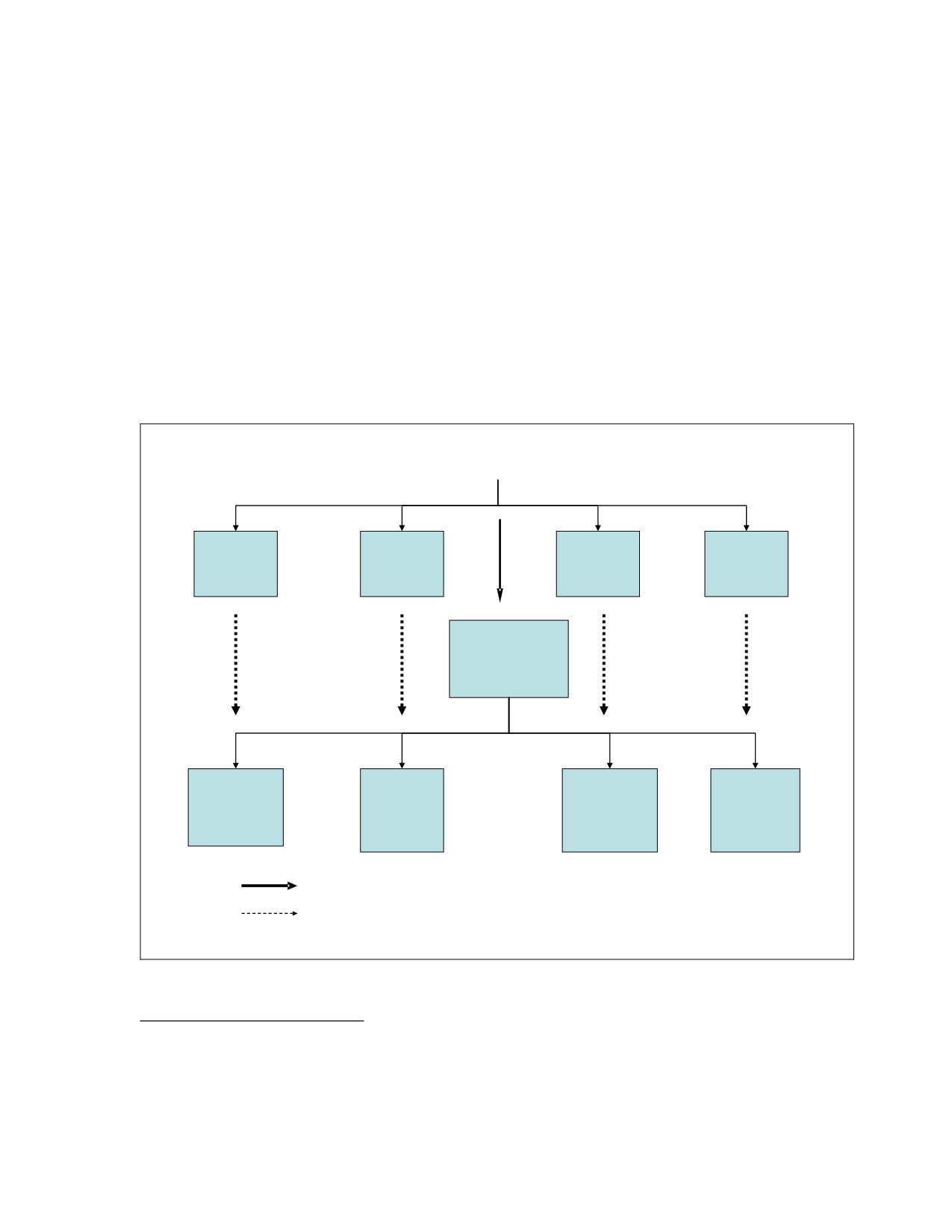
down by the relevant General Department. Figure 3-2 shows how these vertical lines
work.
Figure 3-2: Vertical lines in the PLA
Central Military Commission
General
General
General
General
Staff
Political
Logistics
Armaments
Dept
Dept
Dept
Dept
Nanjing Military
Region (MR)
Headquarters
MR
MR
MR
MR
Headquarters
Political
Logistics
Armaments
Dept
Dept
Dept
Dept
Solid arrow = command or “leadership” relationship
Dotted arrow = “guidance” or “professional” relationship
229China’s National Defense in 2006, III: “China’s Leadership and Administration System for National
Defense.”
230 Nan Li, The Central Military Commission and Military Policy in China,” p. 76.
68
FOR OFFICIAL USE ONLY

FOR OFFICIAL USE ONLY
Horizontal lines
Horizontal lines of authority
(literally,
“pieces” or kuai; 块 ) exist within a single
jurisdiction, such as a province or a Military Region. These lines coordinate issues across
that jurisdiction.
•
This means coordinating issues
COORDINATING ISSUES AT THE TOP:
across functional areas within a
LEADING SMALL GROUPS
single military unit: for instance,
procuring materials for training
At its very highest levels, the Chinese
tasks might require input from
government must coordinate issues across
the headquarters, logistics, and
Party, State, and army, and between policy-
armaments departments in a
setting bodies and policy-implementing
single unit.
bodies. It appears to do so through a series of
tightly knit, rather secretive bodies called
•
It also means coordinating not
“leading small groups” (lingdao xiaozu; 领导
just
within that
military
小组), or LSGs. The purpose of these bodies
jurisdiction, but also with the
is not to formally set policy, but to serve as a
local civilian administration.
locus of policy coordination, communication,
The joint civil-military tasks
and consultation.
discussed previously - such as
finding civilian
jobs for
Little information about these groups is
demobilized military personnel
available to foreigners or even to the Chinese
or coordinating the maintenance
citizenry, and their exact membership is
of military equipment and
unknown; however, it appears that high-level
supplies - are examples of tasks
PLA personnel sit on several LSGs, including
requiring
horizontal
the Foreign Affairs LSG and the National
coordination with
the local
Security Affairs LSG. In this way, the PLA,
government.
along with other concerned Party and State
organs, can weigh in on issues that stretch
Horizontal lines exist all the way up to
across their different bureaucracies.231
the central government, where multiple
ministries are often required to
coordinate policy-making efforts. This
system is sometimes called
“decentralized
management.”232
231 For more on LSGs, see e.g. Carol Lee Hamrin, “The Party Leadership System,” in Kenneth G.
Lieberthal and David M. Lampton, eds., Bureaucracy, Politics, and Decision Making in Post-Mao China
(Berkeley, CA: University of California Press, 1992), pp. 95-124; Cheng, Gunness, and Bellacqua, An
Exploration of the Evolving PLA Elite, pp. 163-69.
232 There are some indications that the central government is moving to consolidate some of these
horizontal functions into single organizations, essentially “re-centralizing” some organizations into vertical
networks. Moves in this direction were announced at the Second Plenary Session of the 17th Party Congress
in March 2008. See, e.g., “Responsible Official From Central Organization Committee General Office
Answers Questions From Renmin Ribao and Xinhua News Agency Reporters on Deepening Reforms of
the Administrative System and Organizational Structure,” 11 Mar 2008, OSC CPP20080311074003; and
Hua Jianmin, “Explanation on Reforming State Council Organizations,” 11 Mar 2008, OSC
CPP20080311074016. Horizontal networks also tend to give a degree of power to local governments.
Recent policy decisions suggest that the PRC central government is attempting to reassert some degree of
69
FOR OFFICIAL USE ONLY
FOR OFFICIAL USE ONLY
Which line takes precedence?
Together, vertical and horizontal lines form a “matrix” of authority relationships in which
every organization, at every level of the government and military, is embedded.233 Every
organization in this “matrix” potentially has two masters: the logistics department in a
PLA regiment, for instance, has a duty to report both vertically, to the logistics
department at the next level up (the division logistics department) and horizontally, to the
commander and other affected officers in its own unit.
The greatest potential pitfall of this system is obvious: if there is a disagreement between
an organization’s vertical and horizontal relationships, which one should take precedence?
The PRC bureaucracy has attempted to solve this problem by designating all relationships,
both vertical and horizontal, as either “leadership relationships” (lingdao guanxi; 领导关
系 ) or “professional relationships” (yewu guanxi; 业 务 关 系 ). Only in a leadership
relationship does the superior partner have the authority to issue formal, binding orders.
Every organization has only one leadership relationship. Organizations in a professional
relationship
(sometimes called a
“guidance relationship”) can offer guidance and
coordination, but not binding orders. 234
For example: the vertical lines of the four General Departments are professional, not
leadership relationships. The four General Departments send guidelines down to military
units through their vertical lines, but the officers in a unit receive orders to implement
these guidelines from their unit commander and political officer. They are also subject to
discipline by the commander, not the four General Departments, if they fail in their task.
If a battalion-level logistics officer fails to carry out his assigned tasks, he has to answer
to the battalion commander, not to the division-level logistics department. (See Figure 3-
2, above, for a schematic depiction of the leadership and guidance relationships in a unit.)
Implications
Formal command relationships notwithstanding, the vertical/horizontal structure sets up
potential communication roadblocks among units at all levels of the PLA, and has at least
two major implications:
Because officers are trained to carry out functions within a single vertical line, their
career paths and skill sets are relatively narrow. There are five PLA career tracks:
• Military (or command) officers (junshi/zhihui junguan; 军事/指挥 军官)
• Political officers (zhengzhi junguan; 政治军官)
control over localities by strengthening the authority of vertical lines; see Xiong Wenzhao and Cao Xudong,
“Getting the Most From Vertical Management”; Andrew C. Mertha, “China’s ‘Soft’ Centralization:
Shifting Tiao/Kuai Authority Relations,” China Quaterly 184 (Dec 2005), pp. 791-810.
233 Lieberthal, Governing China, p. 187.
234 Mertha, “China’s ‘Soft’ Centralization,” p. 797; Lieberthal, Governing China, pp. 219-220.
70
FOR OFFICIAL USE ONLY

FOR OFFICIAL USE ONLY
• Logistics officers (houqin junguan; 后勤军官)
• Armaments officers235 (zhuangbei junguan; 装备军官)
• Specialized technical officers (zhuanye jishu junguan; 专业技术军官).
Four of these five categories correspond to the four General Departments. (Specialized
technical officers, who are responsible for equipment maintenance, repair, research,
development, and testing, may belong to any functional category, though they are most
frequently associated with the logistics or armaments tracks.237) Officers are tracked into
one of these systems when they are commissioned, are trained and educated throughout
their career in the same system, serve in units and headquarters within that system, and
do not routinely transfer from one system to another until they have reached quite a high
position (MR deputy leader or above) in
the military hierarchy.
(The one
SOLVING VERTICAL STOVEPIPING
exception is political officers, who - as
THROUGH HORIZONTAL COORDINATION
discussed earlier in this chapter - often
start their careers in a command or other
A 2004 newspaper article reported on a PLA
Navy officer who was promoted but did not
non-political billet.) As a result, PLA
officers are generally more narrowly
receive the pay raise he was expecting. Upon
specialized
than
their
American
investigation, the base’s command staff and
counterparts. Appendix 4 of this study
Party committee discovered that the various
depicts the notional career path of a
departments responsible for pay raises and
“cost of living fees” (including the finance,
typical “tracked” PLA officer.
cadre, military affairs, training, and health
Strong vertical lines encourage stove-
departments) had not coordinated on this
piping of information. Although
officer’s promotion or on many other cases.
vertical lines often lack command
The base Party committee was tasked with
authority, the PLA still tends to vertically
funnel information. This can lead to
coordinating these departments horizontally
inadequate
communication
among
across the unit. The Party committee ran
members of a military unit who belong to
educational activities for members of the
different vertical lines.
relevant departments, and devised base
regulations on the disbursement of cost of
This tendency is theoretically offset by
living fees, in accordance with regulations
the unit management structure: the
set forth by the four General Departments.236
commander and political commissar
should be well versed in all the issues
that the unit is dealing with, and the Party
committee provides a forum in which information should be shared across vertical
235 Sometimes translated as “equipment officers.”
236 Renmin Haijun, 30 Sept 2004, p. 1.
237 Elizabeth Hague, “PLA Career Progressions and Policies,” p. 264. See also Dennis J. Blasko, The
Chinese Army Today: Tradition and Transformation for the 21st Century (New York: Routledge, 2006), p.
55.
71
FOR OFFICIAL USE ONLY
FOR OFFICIAL USE ONLY
networks and policies coordinated. Anecdotally, however, frequent problems are still
reported.238
Individuals’ status within the PLA hierarchy is determined by their
grade, not their rank.
Within the structure described above, PLA officers sit in a hierarchy that, superficially,
looks similar to that of the U.S. military. In reality, however, a PLA officer’s status
within the military is determined by his grade, a complex hierarchical system unique to
the PLA.
What is a grade?
Since
1979 the PLA has had a
15-level grade system that applies to all units,
organizations, and officers in all services and branches. Each grade level has a name (e.g.,
“division leader” or “MR deputy leader”), and every organization and job position in the
PLA is assigned one of these grades. The grades and their names are shown in Table 3-3.
The grade system determines the formal authority relationships among PLA organizations
and officers.
When referring to grade levels, the PLA does not refer to the grade number. For example,
a division commander is identified as a “division leader-grade officer,” not as a “grade-7
officer.”
Institutional grades
Each unit or organization within the PLA is assigned a grade level that determines its
authority in relation to other PLA units or organizations.
Specific grades are also applied to each department level within a unit or organization.
The PLA’s administrative structures are fairly consistent from the CMC down to the
regiment level. Within each PLA unit or organization, there are first-level (yijibu; 一级
部), second-level (erjibu; 二级部), and in some cases third-level (sanjibu; 三级部)
departments. The first-level department is one grade level below the main organization,
the second-level department is one grade level below that, and so on. Appendix 5
provides a graphical representation of this system.
238 Interviews #2 and 7. These and all other interviews were conducted with members of the U.S. defense
establishment.
72
FOR OFFICIAL USE ONLY

FOR OFFICIAL USE ONLY
Personnel grades
Table 3-3: Grade levels and their names
Every officer in the PLA also
has a grade level, sometimes
CMC Chairman (junwei zhuxi; 军委主席)
1
called a
“duty grade”
(zhiwu
Vice Chairman (junwei fuzhuxi; 军委副主席)
dengji; 职 务 等 级 ). It is an
officer’s grade that most clearly
CMC Member (junwei weiyuan; 军委委员)
2
signals his status in the PLA
hierarchy. The importance of the
MR Leader239 (daqu zhengzhi; 大区正职)
3
grade system is indicated in
several ways:
MR Deputy Leader (daqu fuzhi; 大区副职)
4
•
Grade level determines a
PLA officer’s authority
Army/Corps Leader (zhengjun; 正军)
5
vis-à-vis other officers.
For instance, it is because
Army/Corps Deputy Leader (fujun; 副军)
6
the commander and the
political officer in a given
Division Leader (zhengshi; 正师)
7
unit are always of the
same grade that they have
Division Deputy Leader (fushi; 副师)
8
equal authority in the unit.
Regiment Leader (zhengtuan; 正团)
9
•
Officers at the same
grade level are equal in
Regiment Deputy Leader (futuan; 副团)
10
status even if they have
different ranks.
Battalion Leader (zhengying; 正营)
11
•
An officer’s grade level
determines what billets he
Battalion Deputy Leader (fuying; 副营)
12
is eligible to fill.
Company Leader (zhenglian; 正连)
13
•
Officers’
pay
is
determined first by their
Company Deputy Leader (fulian; 副连)
14
grade level, and only after
that by their military rank
Platoon Leader (zhengpai; 正排)
15
and years of service.240
•
Promotion in
grade
indicates that one is moving up the career ladder. Moving from one grade level to
the next is a promotion; moving from one position to another in the same grade is
a lateral transfer. For example, moving from a position as chief of staff in an MR
headquarters to become deputy commander in the same MR headquarters is not a
promotion, because both have a grade level of MR Deputy Leader.
239 “Leader” = grade equivalent to the commander and political officer of a unit. “Deputy leader” = grade
equivalent to the deputy commander of the unit.
240 “Military Personnel Salary and Benefits,” Jiefangjun Bao, 14 Jan 2005, OSC CPP20080226436001.
73
FOR OFFICIAL USE ONLY

FOR OFFICIAL USE ONLY
• Each grade level is associated with a mandatory retirement age. Upon reaching
that age, an officer must either be promoted or leave the military.
MILITARY AND CIVILIAN GRADES
Grade levels also permit military officers to compare their positions to civilians in the
government bureaucracy. Like PLA officers, civilian personnel are divided into 15 grades.
One option for PLA officers leaving active duty is to transfer to a civilian government
institution at the same grade as their last military billet. Officers choosing this option will
not receive retirement benefits from the PLA, but their time in the PLA will count toward
retirement from their new civilian positions.241 In this way, PLA officers’ grades are
important not just to their status in the military but also to their career prospects after they
leave.
The heads (military commanders and political officers) of units and organizations at each
level hold a grade level equal to that of the unit or organization itself. Their subordinates
hold lower grades, as do personnel serving in lower-level units and organizations.
What about ranks?
Each PLA officer holds one of 10 military
PLA RANKS: HIERARCHY
ranks. The ranks use ground force
Officers are divided into three levels with
terminology and mostly bear titles similar to
U.S. military ranks (as indicated in the shaded
10 ranks (sandeng shiji; 三等十级).
box). PLA Navy and Air Force officers
simply add “Navy” (haijun 海 军 ) or “Air
General officers (jiangguan; 将官):
Force”
(kongjun 空 军 ) before the ground
o general (shangjiang; 上将)
force rank, as in
“Navy general”
(haijun
o lieutenant general (zhongjiang; 中将)
shangjiang 海 军 上 将 ). However, English
o major general (shaojiang; 少将)
translations use American naval ranks, such
as “admiral” rather than “Navy general.”
Field grade officers (xiaoguan; 校官):
o senior colonel (daxiao; 大校).
Rank epaulets allow an observer to fix
o colonel (shangxiao; 上校)
approximately where an officer fits into the
o lieutenant colonel (zhongxiao; 中校)
PLA hierarchy. However, U.S. military
o major (shaoxiao; 少校)
officers of a particular rank should not
assume that PLA officers of equal rank are
Company grade officers (weiguan; 尉官):
their exact counterpart in terms of authority
or responsibilities.
o captain (shangwei; 上尉)
o first lieutenant (zhongwei; 中尉)
o second lieutenant (shaowei; 少尉)
241 Maryanne Kivlehan-Wise, “Demobilization and Resettlement: The Challenge of Downsizing the
People’s Liberation Army” in David M. Finkelstein and Kristen Gunness, eds., Civil-Military Relations in
Today’s China: Swimming in a New Sea (Armonk, NY: M.E. Sharpe, 2007), p. 263.
74
FOR OFFICIAL USE ONLY
FOR OFFICIAL USE ONLY
Officers rise in both grade and rank as they are promoted; however, officers’ grades do
not dictate their exact rank, or vice versa.
• With the exception of CMC Chairmen and Vice Chairmen, who are always
generals, each grade level is associated with two ranks: for example, a deputy
Military Region leader could be a lieutenant general or a major general.
• Each rank is associated with as many as four grade levels. Hence, one might see
an officer deferring to another of the same rank, if the former is of a lower grade.
For a graphical representation of how PLA ranks and grades relate to one another, see
Appendix 6.
Determining an officer’s grade: looking for clues
PLA officers may not readily discuss their grade level with outsiders, so when meeting
PLA officers it can be difficult to gauge their place in the PLA hierarchy. However,
officers’ grades can be determined, either approximately or exactly, if one or more of the
following things are known:
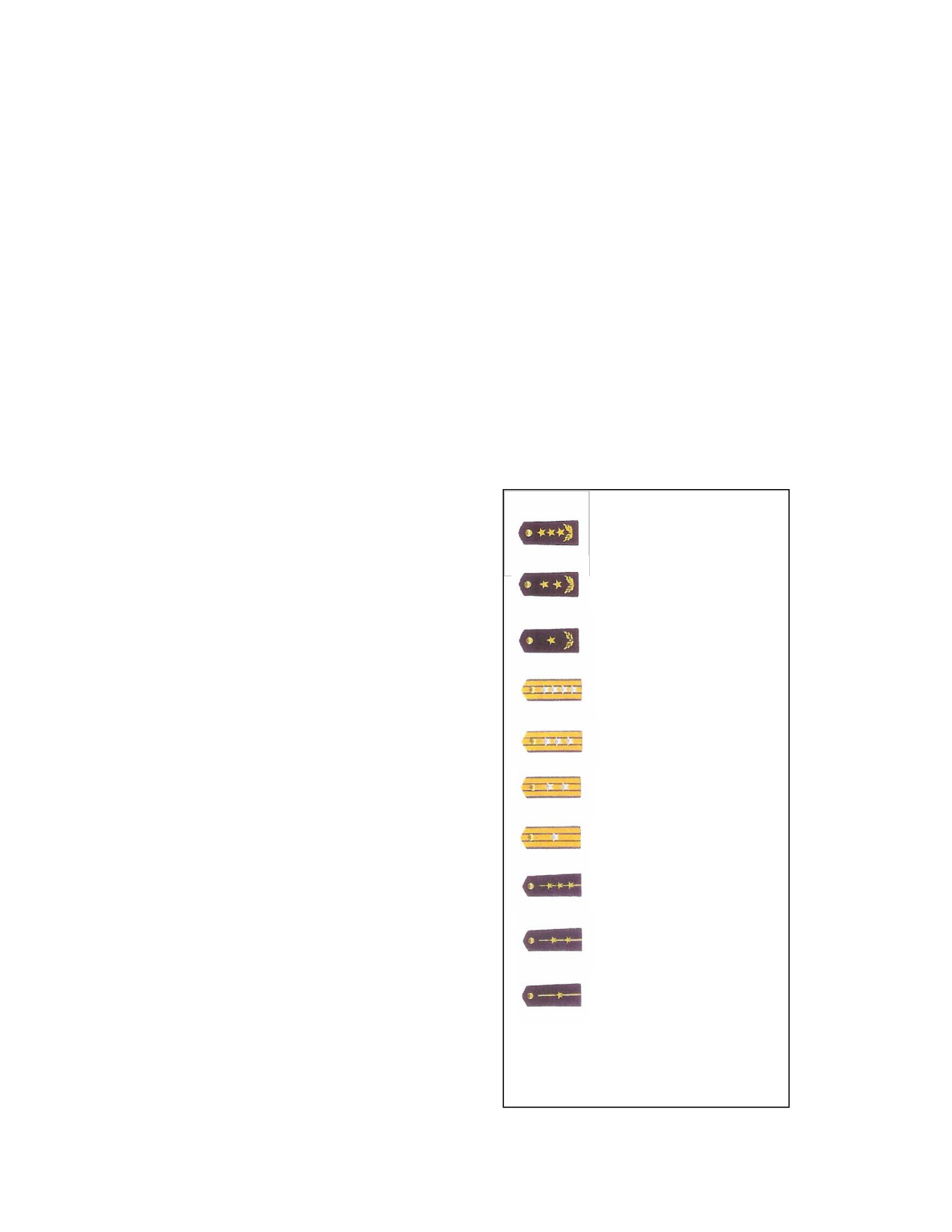
Figure 3-3: Rank shoulder epaulets
• Their rank
General/Admiral
• Their job title
• Their uniform insignia.
Lt. General/Vice Admiral
Rank
Maj. General/Rear Admiral
Knowing officers’ ranks - identified by their
shoulder epaulets, as shown in Figure 3-3 -
Sr. Colonel/Sr. Captain
allows an observer to infer their approximate
grade. The reason is that a limited number of
grades can be attained by officers of a
Colonel/Captain
particular rank. For instance, a lieutenant
colonel may hold the grade level of regiment
Lt. Colonel/Commander
leader, regiment deputy leader, or battalion
leader. Appendix 6 illustrates how the ranks
Major/Lt. Commander
and grades correspond.
Job title
Captain/Lieutenant
Officers’ job titles indicate their current billet
(commander, political officer, department
1st Lieutenant/Lieutenant JG
director, etc.). Since each position within a
particular institution corresponds to a specific
2nd Lieutenant/Ensign
grade, an officer’s job title indicates the exact
grade level he has attained. For instance, if
Note: The colors shown here are for PLA
one learns that a PLA officer is the Director of
Navy officers. Colors differ by service,
but the configuration of stars on the
the Political Department for the Nanjing
epaulets is the same for all PLA officers.
Military Region (i.e., the head of a first-level
department of a Military-Region grade
75
FOR OFFICIAL USE ONLY

FOR OFFICIAL USE ONLY
organization), it can be deduced that he is at the MR Deputy Leader grade level. Of
course, not all job titles make clear exactly what grade level that billet occupies.
Uniform insignia
In the summer of 2007, the PLA introduced a new style of uniforms for officers on which,
for the first time, an officer’s grade can be directly determined from the color and
number of stars on the center ribbon in the top row of ribbons worn on the left chest of
dress uniforms. (The other ribbons worn on the left chest signify years of service.) Table
3-4 shows dress uniform grade insignia.
Table 3-4: Uniform grade insignia
PLA Grades, Ranks, Insignia, and Ribbons
Grad
Ret.
P rimary Rank/
R ows of
Grade
Ins ignia
e #
Age
Secondary
R ibbons
Rank
1
N/A
CMC Vice Chairman
N/A or Gen
7
2
70
CMC Member
Gen
3
65
MR Leader
Gen/Lt Gen
6
4
63
MR Deputy Leader
Lt Gen/Maj Gen
5
Army Leader
Maj Gen/Lt Gen
55
5
6
Army Deputy Leader
Maj Gen/S r Col
7
Divis ion Leader
S r Col/Maj Gen
50
4
8
Divis ion Deputy Leader
Col/S r Col
9
Regiment Leader
Col/Lt Col
45
3
10
Regiment Deputy Leader
Lt Col/Maj
11
Battalion Leader
Maj/Lt Col
40
2
12
Battalion Deputy Leader
Capt/Maj
13
Company Leader
Capt/1st Lt
35
14
Company Deputy Leader
1st Lt/Capt
1
15
30
P latoon Leader
2nd Lt/1st Lt
76
FOR OFFICIAL USE ONLY
FOR OFFICIAL USE ONLY
Addressing a member of the PLA
PLA personnel are given formal guidance on how to address one another. The PLA’s
Routine Service Regulations provide the following guidelines:
Service members address one another by their position, or position plus surname,
or position plus the word “comrade.” Senior officers and superiors may address
their subordinates or their equals by surname, or by surname plus the word
“comrade.” Those at the lower levels may address their superiors as “senior
officer” or “senior officer” plus the word “comrade.” On public occasions and
when the position of the other person is not known, one may address the other
person by his military rank plus the word “comrade” or simply as “comrade.”242
In other words, Staff Officer Zhang is likely to address his superior as “Commander
Zhou” or “Chief of Staff Zhou,” not “Colonel Zhou.” This mode of addressing officers
contrasts with that of most modern militaries, in which officers address each other by
military rank and surname, or just by rank.
An exception is when PLA delegations visit abroad or meet foreign military visitors in
China. In such situations, the Chinese media usually refer to the PLA officers’ rank and
sometimes to their positions.
There are three sources of authority and influence in the PLA.
The actual authority that PLA members can wield is a function of several factors beyond
their formal status within the PLA. These factors are essential to an individual’s ability to
influence decision-making, which is discussed in Chapter 4.
Status within the PLA
As discussed above, officers’ grade levels are the best indicator of how much authority
their position holds in the PLA bureaucracy. If an outside observer can determine a PLA
officer’s grade level, he can ascertain roughly how much authority that officer’s position
has relative to that of other officers in the room.
Party position
An individual’s influence within the PLA is also a factor of her status within the CCP, for
several reasons:
• Positions of authority in the PLA usually come with positions of authority in the
Party, since positions on a unit’s Party committee are normally reserved for
officers in leadership roles: commanders, political commissars, and heads of
functional departments. In this sense they wear “two hats.” Someone who is not
242 “Routine Service Regulations for the PLA,” Jiefangjun Bao, 1 Apr 2002, pp. 4-8; emphasis added.
77
FOR OFFICIAL USE ONLY

FOR OFFICIAL USE ONLY
considered politically reliable will not rise to a leadership position, in the military
or the Party.
• The Party committee system (along with other elements of the political work
system) plays a key role in officer evaluations. Hence, regardless of professional
qualifications, an officer cannot have a successful career in the PLA without
receiving the imprimatur of the CCP via the Party committee system.243
• Unless one sits on the unit Party committee, one has little to no direct role in unit
decision-making. This excludes all non-Party members
(particularly enlisted
personnel, many of whom are not Party members), as well as unit personnel who
are Party members but who were not selected to be on the unit Party committee
by the next higher level Party committee.
The length of time an officer has been a Party member and her role in the Party
committee system are thus strong determinants of her status vis-à-vis her fellow
personnel. This may help explain some professional and social interaction among PLA
officers of various grades and ranks, which, from a Western military perspective, might
be considered instances of “undue familiarity” or disregard for rank and authority.245
SEPARATING PLA POSITION AND PARTY AUTHORITY
The PLA promotes the principle that personnel’s different positions in a unit should not
affect their authority within the Party committee, where all members are theoretically
equal (see Chapter 4). However, the PLA may be struggling to square this egalitarian
ideal with the realities of command relationships.
For example, a July 2002 PLA newspaper article reported that NCOs - who had only
recently been allowed to sit on the Party committees of tactical units - were beginning
to withdraw from these committees in significant numbers. The NCOs complained that
officers serving on the committees acted as if their superior positions also gave them
greater authority in Party organs, so they did not pay attention to NCOs’ opinions. The
article reported that one unit’s Party committee admonished officers to “separate the
relationship between their administrative and Party committee duties.”244
Informal networks
In the CCP and the PLA, certain individuals wield a level of influence disproportionate to
their formal positions. This can be traced largely to their membership in powerful
informal networks based on personal connections, or guanxi.
243 Gunness, Rosenfield, and Bellacqua, Not Just Party Propaganda, p. 71.
245 Gunness, Rosenfield, and Bellacqua, Not Just Party Propaganda, p. xii.
78
FOR OFFICIAL USE ONLY

FOR OFFICIAL USE ONLY
GUANXI: THE ART OF RELATIONSHIPS
The concept of guanxi (关系) - literally, “connections” or “relationships” - is a well-
documented element of Chinese social, business, and political practices.246 In general,
guanxi relationships are long-term ties based on a sense of mutual obligation. These
relationships tend to be reinforced by such practices as giving gifts and hosting banquets,
and reflect a traditional emphasis on reciprocal relations as the basis of social order.247
Guanxi may rest on any of a variety of affiliations, including familial and geographical
ties. In modern China, guanxi may be formed among people who fought together in the
Civil War, were sent to work in the same rural units during the Cultural Revolution, or
went to school together.248 Guanxi may provide a way for people to attain positions of
status, by relying on the influence of senior members of their guanxi network.
Guanxi played a significant role in the rise of the CCP. The first generation of CCP
leaders fought together in a protracted civil war, an experience which cemented long-
term loyalties. Once the CCP came to power, one analyst notes, the subsequent
“volatility of Chinese politics” further encouraged leaders to
“rely on personal
relationships to get things done.”249 Some were able to use their guanxi networks to
avoid the purges that characterized Chinese factional politics during the 1950s and
1960s.250
Members of the PLA draw both on connections they formed before entering military
service and on a number of shared military experiences to establish guanxi networks.
PLA-specific networks include:
• Officers who attended the same institutions of professional military education251
246 For an overview of the many ways that guanxi affects daily interactions in China, see Thomas Gold,
Doug Guthrie, and David Wank, eds., Social Connections in China: Institutions, Culture, and the Changing
Nature of Guanxi (Cambridge, UK: Cambridge University Press, 2002).
247 For a discussion of these practices in urban settings, see Mayfair Mei-Hui Yang, Gifts, Favors, and
Banquets: The Art of Social Relationships in China (Ithaca, NY: Cornell University Press, 1994); on rural
settings, see Andrew Kipness, Producing Guanxi: Sentiment, Self, and Subculture in a North China Village
(Durham, NC: Duke University Press, 1997). One author notes that people attempting to cement a guanxi
relationship may offer favors now in order to create a sense of obligation for the future; see Xuezhi Guo,
“Dimensions of Guanxi in Chinese Elite Politics,” The China Journal, No. 46 (Jul 2001), p. 74.
248 Pre-existing networks among overseas Chinese are sometimes touted as the reason for their economic
success in many countries. For just one example of the many published works on this topic, see Yadong
Luo, Guanxi and Business (Singapore: World Scientific Publishing Company, 2000).
249 Xuezhi Guo, “Dimensions of Guanxi in Chinese Elite Politics,” p. 70.
250 Lowell Dittmer, “Chinese Informal Politics,” The China Journal, 34 (Jul 1995), p. 13.
251 Mulvenon, Professionalization of the Senior Chinese Officer Corps, pp. 59-61.
79
FOR OFFICIAL USE ONLY

FOR OFFICIAL USE ONLY
• Officers whose early service was in particular corps or group armies252
• Officers who entered the PLA in the same province or region253
• Officers from particular “generations” or age cohorts254
• Commanders and their former subordinates255
• Officers from prominent military families.256
One analyst notes that the dual-leadership system further encourages the development of
“personal bonds mingled with personal emotions and moral obligations” between
commanders and political officers.257 Another source of long-term ties is the fact that
most PLA officers spend their entire military career in a single region and even in a
single unit: this means that they work with the same people for many years, and develop
relationships with local governments and Party committees.
INFLUENCE WITHOUT TITLES
The most influential leaders in the CCP and the PLA are those who have been able to
cultivate extensive ties and place “loyal friends” within multiple organizations at multiple
levels.258
Deng Xiaoping famously remained China’s “paramount leader” for years after resigning
his last formal leadership post in
1989. Under Deng, the PLA’s Central Military
Commission was dominated by an informal network of “elders” who had fought together
in China’s Revolutionary War. When these leaders retired, they maintained personal
influence through family members, protégés, and personal friends who remained in the
system.259
Under Jiang Zemin and Hu Jintao, the influence of this
“elder network” declined
considerably and power became more formalized. However, informal networks are said to
still play a crucial role within the highest levels of China’s defense establishment.
252 Michael Swaine, The Military & Political Succession in China (Santa Monica, CA: RAND, 1992), pp.
23-25.
253 James C. Mulevenon, Professionalization of the Senior Chinese Officer Corps: Trends and Implications
(Santa Monica: RAND, 1997), p. 51; Li Cheng and Scott W. Harold, “China’s New Military Elite,” China
Security, Autumn 2007, p. 70-71. Mulvenon points out that more than half of the PLA officer corps from
1989-1994 was born in one of four coastal provinces (Shandong, Hebei, Jiangsu, and Liaoning), with 24
percent from Shandong alone. Ten years later, Cheng and Harold reported that officers from Shandong
continued to make up a disproportionate share of the “military elite.”
254 See William Whitson, “The Concept of Military Generation: The Chinese Communist Case,” Asian
Survey, Nov 1968, pp. 921-947; Cheng and Harold, “China’s New Military Elite,” pp. 71-72.
255 Xuezhi Guo, “Dimensions of Guanxi in Chinese Elite Politics,” p. 70.
256 Cheng and Harold, “China’s New Military Elite,” p. 77. According to the authors, in 2007 three
“princelings,” or sons of prominent military leaders, held posts on the Central Military Commission.
257 Xuezhi Guo, “Dimensions of Guanxi in Chinese Elite Politics,” p. 70.
80
FOR OFFICIAL USE ONLY

FOR OFFICIAL USE ONLY
Recent publications indicate concern among the PLA leadership that guanxi networks at
lower levels have the potential to undermine discipline and cohesion. They express
particular concern about two types of networks: “soldiers with connections” (guanxi bing;
关系兵) and “hometown ties” (laoxiang; 老乡).
“Soldiers with connections” are enlisted soldiers with close ties to officers above their
immediate superiors. Recent PLA publications report that because of such ties, these
soldiers can be difficult to command. A 2004 newspaper article, for instance, reports that
the commander of a certain company was unable to punish a soldier for poor discipline
because this soldier “had strong connections to leaders above the company commander.”
261 A manual for NCOs notes that
TAKING CARE OF OLD FRIENDS
those commanding
“soldiers with
A 2006 newspaper article reported on a
connections” may be subject to
regiment that had sent a group to conduct
entreaties from superiors to
“look
surprise safety and health inspections of its
after” these soldiers when decisions
grassroots units.260 The group found one
are to be made about accession to the
company in such perfect order that they
Party or NCO selection.262
concluded it must have been warned about the
inspection. The company commander admitted
The importance of “hometown ties”
that a headquarters staff officer had once been
in Chinese society has been well-
the deputy commander of the regiment. In order
documented for many centuries, and
to protect his “old unit,” this officer had leaked
PLA publications indicate that they
news of the upcoming inspection. The offending
remain an important source of
officer was reprimanded, and the regiment’s
informal affiliation among officers
Party committee launched a campaign to rectify
and enlisted personnel.263
similar disciplinary problems.
258 See David M. Lampton, “A Plum for a Peach: Bargaining, Interest, and Bureaucratic Politics in China,”
in Kenneth G. Lieberthal and David M. Lampton, eds., Bureaucracy, Politics, and Decision Making in
Post-Mao China (Berkeley: University of California Press, 1992), p. 56.
259 Jonathan D. Pollack, “Structure and Process in the Chinese Military System,” in Kenneth G. Lieberthal
and David M. Lampton, eds., Bureaucracy, Politics, and Decision Making in Post-Mao China (Berkeley:
University of California Press, 1992), pp. 160-161 and 163.
260 Huojianbing Bao,16 Feb 2006, p. 2.
261 Renmin Haijun, 17 Jul 2004.
262 Ou Guozheng, Liu Changjian, and Sha Gongping, (eds.), How to Be a Good NCO (zenyang dang
haoshibing; 怎样当好士官) (Beijing: Long March Press, 2000), p. 103; for an example, see Kongjun Bao,
9 Jul 2005.
263 For instance, home-town connections became the basis for the powerful political organizations that
provided social support and governed social and political relations among San Francisco’s Chinese
population in the late 19th century; see, e.g., Yong Chen, Chinese San Francisco, 1850-1943: A Trans-
Pacific Community (Stanford, CA: Stanford University Press, 2000), Chapter 3.
81
FOR OFFICIAL USE ONLY
FOR OFFICIAL USE ONLY
Hometown ties are viewed by many PLA leaders as a largely benign phenomenon. As a
manual for platoon leaders explains,
“Loving one’s native place and emphasizing
affection for one’s homeland are emotions that all people share.”264 However, PLA
publications also warn against allowing hometown ties to give enlisted personnel an
unfair advantage with their superiors.265 Some assert that these ties may also become the
basis for gangs or “brotherhoods” that engage in violent or criminal activity and retaliate
against perceived slights by members of other groups.266
The PLA has begun to introduce policies aimed at limiting the influence of hometown
ties. For instance, the 2000 “Active Duty Officers Law” forbids officers to command the
Military Sub-District or People’s Armed Forces Department in their places of origin.267
One PLA newspaper reported that PLA units are also paying closer attention to
conscripts’ files and trying to make it more difficult for soldiers to self-segregate by
home region or ethnicity.268
264 Liu Shihao, Techniques and Methods for Platoon Leaders Commanding Troops (paizhang daibing jifa;
排长带兵技法) (Beijing: PLA Press, 2005), p. 19.
265 Renmin Haijun, 22 May 2004; Ou Guozheng, Liu Changjian, and Sha Gongping, eds., How to Be a
Good NCO, p. 71.
266 Liu Shihao, Techniques and Methods for Platoon Leaders Commanding Troops, pp. 20-21; Ou,
Guozheng, Liu Changjian, and Sha Gongping, How to Be A Good NCO, p. 122.
267 “Law of the People’s Republic of China for Active Duty Military Officers,” Xinhua, 28 Dec 2000,
Article 31, OSC CPP20001228000194. The law excludes officers in non-command positions or in
operational group army, division, and brigade units.
268 Renmin Haijun, 11 Feb 2006.
82
FOR OFFICIAL USE ONLY
FOR OFFICIAL USE ONLY
Chapter 4: Decision-Making in the PLA
Introduction: An opaque process
Decision-making in the PLA is shaped by the organizational structures outlined in the
previous chapter, and by the traditions and values discussed in Chapters 1 and 2.
Since PLA sources seldom discuss the inner dynamics of PLA decision-making, these
remain murky to outside observers. Indeed, a signature characteristic of PLA decision-
making is its lack of transparency. PLA texts are more forthcoming about the ideal
principles and procedures that decision-makers are expected to uphold. It is also possible
to draw some inferences about PLA decision-making from our understanding of CCP
decision-making processes.
Although understanding these ideals is key to grasping the context in which PLA
decision-making takes place, readers should keep in mind that it is impossible to know
for certain how closely the PLA abides by these ideals in actual situations.
PLA decision-making principles
All members of the PLA are politically equal.
As discussed in Chapter 2, the PLA espouses the political equality of all personnel. It
seeks to create within its ranks a mirror of the Communist Party’s relationship with the
Chinese citizenry, whereby Party members and leading officials are instructed not to see
themselves as inherently better or of higher status than the common people. Similarly,
PLA publications insist that officers and enlisted personnel are “politically equal,” with
no difference in their rights or social status. As a result, the interests and concerns of all
personnel are held to be of equal merit.
The Party takes the lead in decision-making.
“Political equality” does not mean that all members of a unit have an equal say in unit
decision-making. The “vanguard” principle of Marxism-Leninism-Mao Zedong Thought,
detailed in Chapter 1, means that Party members are considered more “advanced” in their
ability to understand the needs and concerns of the “masses.” Hence, Party committees
are the locus of decision-making within a military unit.
83
FOR OFFICIAL USE ONLY

FOR OFFICIAL USE ONLY
Party committees make decisions “democratically,” in consultation with all
affected parties.
Although final decisions on major issues are made by unit Party committees, the PLA
professes a commitment to a form of “democracy within the military” (jundui nei de
minzhu; 军队内的民主) that gives all
members of a unit some input.270 The
In the CCP and the PLA, “democracy” means:
PLA’s “democracy” rests on ideals
•
“Consulting” with the masses to ensure
that diverge significantly from
that their needs are met by Party decisions
Western
democratic
traditions,
although both are aimed at
• Giving the masses the right to “criticize”
incorporating the knowledge and
and to
“supervise” their leaders, thus
opinions of the broader public into
ensuring the leaders’ adherence to laws
decision-making.
and Party regulations.269
In his 1948 essay “The Democratic Movement in the Army,” Mao Zedong described the
three forms of
“democracy” he deemed appropriate for the PLA.271 These “Three
Democracies” are meant to provide a role for ordinary servicemen in decision-making,
and to employ a modified version of the Leninist principle of “democratic centralism,”
discussed in Chapter 1. Whereas Lenin’s “democratic centralism” was limited to intra-
Party discussions, Mao at times broadened this principle to include all affected persons.
Mao’s “Three Democracies” have undergone a number of refinements, but the PLA
leadership still considers them to be the cornerstone of enlisted personnel’s participation
in unit decision-making.272 The “Three Democracies” are as follows:
269 On “democracy” within the military, see, e.g., Ou Guozheng, Liu Changjian, and Sha Gongping, eds.,
How to Be a Good NCO (zenyang dang hao shiguan; 怎样当好士官) (Beijing: Long March Press, 2000), p.
154; Zhou Guangde and Zhu Jinhai, Skills for Company Leaders Commanding Troops (lianzhang daibing
jineng; 连长带兵技能) (Beijing: PLA Publishing House, 2005), pp. 96-97. On supervision as a central
element of “military democracy,” see Chen Zhou, Theory and Practice of the PLA Democratic System, pp.
96-97.
270 For a more in-depth discussion of the PLA’s principle of “military democracy” and the PLA’s
“democratic” institutions, see Peter W. Mackenzie, From the Masses, to the Masses: Servicemen’s
Committees and PLA ‘Democracy,’ CNA Information Memorandum D0019043.A1/Final (Alexandria, VA:
CNA, 2008), OSC CPP20081110325005.
271 Mao Zedong, “The Democratic Movement in the Army” (1948), Selected Works of Mao Zedong
(Beijing: Foreign Languages Press, 1969), Vol. IV, pp. 191-92,
Zhou, Theory and Practice of the PLA Democratic System, pp. 36, 37.
272 See e.g. Zhang Shusen and Cao Xueyi, eds., Guidebook to Military Life (junlü shenghuo zhinan; 军旅生
活指南), 2nd Edition (Beijing: People’s Armed Police Publishing House, 2007), p. 265; Sai Zhongbao,
Interview with PLA Official, “Important Measures to Strengthen the Army’s Internal Democracy
Building,” Jiefangjun Bao, 7 Aug 2007, p. 3, OSC CPP20070807710003.
84
FOR OFFICIAL USE ONLY

FOR OFFICIAL USE ONLY
Political democracy. Officers and enlisted personnel are politically equal. All have
the right to criticize leaders, offer suggestions, and report abuses of power and
violations of discipline. Leaders solicit the ideas and opinions of the “masses” of
enlisted personnel before making decisions.
Economic democracy. Enlisted personnel have the right to supervise and take part in
their unit’s economic management, including such issues as mess expenses and
provisioning.
MILITARY DEMOCRACY IN ACTION
Military democracy. Enlisted
personnel have the opportunity to
“Before our assault on Shijiazhuang
[in
provide ideas and suggestions
November
1947], we called for giving
before military operations are
precedence to studying how to attack the city,
conducted. Training is to be
with senior and junior cadres holding a
conducted on the basis of “mutual
meeting together. When we were fighting we
learning” between officers and
also held meetings, and also when we were
enlisted personnel.
unable to advance. On the firing line, three to
five people would still hold meetings,
As discussed in Chapter 1, the two
especially branch personnel, to bring up
components of Maoist
“democratic
leadership functions
The result was that
centralism” dictate, first, that all
soldiers worked as a team, with each man
affected individuals engage in debate
doing his part, to obtain victory.”273
before a decision is made, and, second,
— Zhu De, “Letter to the CCP Central Committee and
that once a decision is made by the
Comrade Mao Zedong” (Dec 1947)
Party leadership, everyone must
conscientiously implement the decision even if they do not agree with it.274
Accordingly, PLA decision-makers are supposed to conduct broad consultations with
members of both the Party committee and the unit as a whole, and to allow energetic
debates to take place before a decision is made.275 The processes by which these
consultations are conducted are discussed later in this chapter.
Decisions are made collectively.
Party leaders in PLA units are supposed to abide by the principle of
“collective
leadership” (jiti lingdao; 集体领导). This principle holds that no single individual has the
273 Selected Works of Zhu De (Zhu De xuanji; 朱德选集) (Beijing: People’s Publishing House, 1983), pp.
225-26.
274 Kenneth Lieberthal, Governing China: From Revolution Through Reform (New York: W.W. Norton,
2004), p. 193.
275 Chen Zhou, Theory and Practice of the PLA Democratic System, p. 71.
85
FOR OFFICIAL USE ONLY
FOR OFFICIAL USE ONLY
power to dictate policy. Rather, all major decisions should be based on agreement within
multi-member decision-making bodies.276
PLA regulations state that in a military unit’s Party committee, the secretary, deputy
secretary, standing committee members, and members of the full committee are equal in
status—none has a disproportionate vote in committee decisions.277
At the highest level of the Chinese government and military, “collective leadership”
coalesces around a central figure, designated the “core” in Chinese terminology. This
figure - Hu Jintao in the current era - is considered to be “first among equals”: he wields
great influence over the PLA by merit of his military and Party positions and personal
connections. Still, not even he can unilaterally make or implement decisions.278
Decisions should be made by consensus.
According to CCP and PLA norms, decisions should be reached by consensus, not by a
majority imposing its will on a minority.279 The norms of collective decision-making also
emphasize that a large number of individuals should be involved in decision-making, to
ensure that decisions represent as wide a variety of opinions and concerns as possible.
Accordingly, CCP and PLA decision-making bodies spend a great deal of time and effort
discussing policy options, deciding on courses of action, and ensuring that there is broad
consensus.
276 The term
“collective responsibility” as used here should not be confused with the
“collective
responsibility” system introduced in the 1980s as part of China’s economic reforms.
277 Cheng Baoshan, ed., The Fundamental Laws and Regulations of Military Political Work in the New
Century and New Era—Studying the Newly Revised and Promulgated “Regulations of the Chinese
People’s Liberation Army on Political Work” (xin shiji xin jieduan jundui zhengzhi gongzuo de genben
fagui—xuexi xin xiuding banbu de “zhongguo renmin jiefangjun zhengzhi gongzuo tiaoli”; 新世纪新阶段
军队政治工作的根本法规—学习新修订颁布的《中国人民解放军政治工作条例》) (Beijing: Military
Science Press 2004), pp. 194-201.
278 Bo Zhiyue, China’s Elite Politics: Political Transition and Power Balancing (Singapore: World
Scientific, 2007), pp. 48-49. This does not mean that in practice, all Party committee members’ opinions
are treated equally in all circumstances. As detailed in Chapter 3, a number of factors can increase the
weight of individuals’ opinions, including their position in the PLA, their position in the Party, and the
extent of their informal networks.
279 PLA writings do not entirely reject the possibility of decision by majority, but indicate a strong
preference for consensus. See, e.g., Chen Zhou, Theory and Practice of the PLA Democratic System, p. 70.
86
FOR OFFICIAL USE ONLY

FOR OFFICIAL USE ONLY
PLA decision-making practices
Consensus-based decision-making within PLA units tends to follow certain steps.
1. Discussion and debate
PLA publications suggest that
INSUFFICIENT DISCUSSION?
vigorous debate and discussion is
indispensable to developing new
Recent PLA newspaper articles suggest a
policies, especially at higher levels. In
concern that there may be too little debate in
practice, this ideal has received
PLA Party committees. These articles suggest
varying degrees of adherence over the
that PLA leaders are particularly troubled that
years. Chairman Mao, for instance,
NCOs, who have recently been allowed to sit on
often consulted with a group of high-
company-level Party committees, do not
level civilian and military leaders
participate enough in committee discussions.
about policy decisions; in most cases,
One article points out, for instance, that
however, the
“consensus” that
although PLA Navy companies have set aside
resulted from these meetings reflected
company-level Party branch posts for NCOs,
Mao’s personal preferences.281 At
these NCOs “are reticent to speak up during
times, most infamously in the
Committee meetings and worry that their
“Hundred
Flowers”
movement
suggestions will not be viewed favorably.”
(baihua yundong; 百花运动) of 1956
Thus, they are “usually very quiet during times
and 1957, Mao encouraged a broad
of discussion and decision making.”280
public debate on policy issues, only to
use this debate to identify and punish critics.282
In recent years, the Party has again encouraged open discussions on policy issues within
decision-making bodies, especially with regard to doctrinal issues.
280 Renmin Haijun, 29 May 2003 and 24 Apr 2004.
281 Michael Swaine, “Chinese Crisis Management: Framework for Analysis, Tentative Observations, and
Questions for the Future,” in Andrew Scobell and Larry M. Wortzel, eds., Chinese National Security
Decisionmaking Under Stress (Carlisle, PA: U.S. Army War College Strategic Studies Institute, 2005), p.
25.
282 See Jonathan D. Spence, The Search For Modern China, 2nd Edition (New York: W.W. Norton, 1990),
pp. 539-43.
87
FOR OFFICIAL USE ONLY

FOR OFFICIAL USE ONLY
DEBATING DOCTRINE
The PLA encourages open discussion on issues relating to military doctrine within its
professional newspapers and journals. Much can be gleaned about recent doctrinal debates
from these publications. For readers of PLA periodicals, a series of articles expressing a
variety of views on a similar topic usually indicates several things:
• The PLA is considering a doctrinal adjustment in this area.
• PLA institutions are probably engaged in formal research efforts on this topic.
• The course of adjustment has not yet been decided. These articles indicate the range
of views being explored.283
However, once a doctrinal concept has been settled upon and codified by the CMC, public
debate appears to cease completely. Just as they are used to announce the beginning of a
doctrinal debate, PLA newspapers and journals also signal that debate has ended, consensus
has been reached, and a decision has been made. This type of message is normally sent by
way of articles announcing the issuance of new regulations.284 From that point forward, the
expression of contending views stops and all voices rally around the new guidance.285
2. Bargaining
After allowing sufficient time for debate, Party committees build consensus through a
process of bargaining. CCP and PLA leaders at all levels must wait to act until the
complex trade-offs involved in this process have been concluded and a consensus has
emerged.286
One recent analysis of CCP decision-making notes that this process occurs largely behind
the scenes; the particulars of discussions and the various bargaining positions are not
discussed outside the Party committee “until decisions have been reached and the unified
line is ready for public viewing.”287
283 Maryanne Kivlehan, Doctrinal Change in the Chinese People’s Liberation Army: Institutions, Processes,
and Influences, CNA Research Memorandum D0008391.A2/Final (Alexandria, VA: CNA, 2003), p. 65.
284 Kivlehan, Doctrinal Change in the Chinese People’s Liberation Army, p. 103.
285 Kivlehan, Doctrinal Change in the Chinese People’s Liberation Army, p. 81.
286 David M. Lampton, “A Plum for a Peach: Bargaining, Interest, and Bureaucratic Politics in China,” in
Kenneth G. Lieberthal and David M. Lampton, eds., Bureaucracy, Politics, and Decision Making in Post-
Mao China (Berkeley: University of California Press, 1992), p. 35.
287 Susan Puska, “SARS 2002-2003: A Case Study in Crisis Management,” in Scobell and Wortzel,
Chinese National Security Decisionmaking Under Stress, p. 94.
88
FOR OFFICIAL USE ONLY
FOR OFFICIAL USE ONLY
3. Deferring decisions to higher levels
If a Party committee cannot reach consensus or committee members have significant
differences of opinion on a key policy issue, the issue may be “kicked up” to a higher-
level Party committee - which may choose to defer to an even higher level.288 In certain
cases, one analyst reports, the Central Military Commission (CMC) has been called upon
as a “court of last resort” to resolve lower-level disputes, such as those on key decisions
involving weapons acquisition.289 This “kicking up” appears to be fairly common within
CCP decision-making as a whole.290
4. Ending the debate
According to the principle of
“democratic centralism,” once decisions are made,
everyone must conscientiously implement them; debate is no longer welcomed.
All members of a unit may provide input to the Party committee through
“democratic” mechanisms.
The PLA has established a range of institutions and practices aimed at gathering ideas
and opinions during the decision-making process. These institutions and practices carry
out the principles of the “mass line,” discussed in Chapter 1, and include the following:
Servicemen’s committees (junren weiyuanhui; 军人委员会). All company-level
units and organizations within the PLA are required to establish servicemen’s
committees. These sitting committees are elected on an annual basis by a caucus of
the entire unit, also known as the servicemen’s assembly (junren dahui; 军人大会).
They provide opinions and suggestions to the Party committee, and carry out some
political work tasks at the committee’s request. They act as a key liaison between the
Party and enlisted personnel, very few of whom are Party members. 291
Servicemen’s congresses (junren daibiao huiyi; 军 人 代 表 会 议 ) are the main
“democratic” institutions at the brigade and regiment levels. They are made up of
representatives selected by company-level servicemen’s assemblies, but are not
sitting organizations like servicemen’s committees; they are convened once a year by
the Party committee.292
288 Gunness, Rosenfield, and Bellacqua, Not Just Party Propaganda, p. 87.
289 Jonathan D. Pollack, “Structure and Process in the Chinese Military System,” in Lieberthal and Lampton,
Bureaucracy, Politics, and Decision Making in Post-Mao China, p. 167.
290 Lampton, “A Plum for a Peach,” p. 39.
291
“Notification Regarding Distribution of ‘Regulations on Political Work in the People’s Liberation
Army’ by the Central Committee of the Communist Party of China,” Jundui Zhengzhi Gongzuo, 5 Dec
2003, Article 100, OSC CPP20070122325003.
292 “Notification Regarding Distribution of ‘Regulations on Political Work in the People’s Liberation
Army’ by the Central Committee of the Communist Party of China,” Articles 95 and 97.
89
FOR OFFICIAL USE ONLY
FOR OFFICIAL USE ONLY
Democratic evaluation. The PLA employs a system of “democratic evaluation” by
which Party committees solicit the opinions and criticisms of unit members before
deciding who among enlisted personnel will be promoted, selected to take military
academy entrance exams, or awarded for exemplary service. New regulations
publicized in August 2008 state that servicemen’s committees will take a leading role
in conducting democratic evaluation.293
According to PLA newspapers, certain units have even introduced “open elections” to
choose squad leaders.294 These activities extend Mao’s original conception of
“political democracy,” which allowed for enlisted personnel to
“nominate those
whom they trust from their own ranks for lower-level cadre posts” in certain
circumstances.295
Implications of PLA decision-making principles and practices
No individual is clearly accountable for any decision.
One practical consequence of the system of collective decision-making is that few PLA
individuals hold personal accountability for a given decision. This can make things
difficult for foreign visitors: Americans interacting with the PLA often seek,
understandably, to identify key decision-makers who are potentially sympathetic to the
U.S. position. As one American defense official who has had extensive contact with the
PLA explained, “The U.S. approach is often to find the ‘right’ person to talk to, or to
separate the white hats from the black hats.” However, the official noted, when talking
with the PLA, “you are negotiating with an institution, not an individual.”296 Any
individual negotiator must receive the agreement of many other people before a decision
can go forward.
There are too many meetings.
Fulfilling the PLA’s ideal of collective, consensus-based decision-making requires an
extraordinary number of meetings.297 PLA publications indicate that when an ongoing
problem or disagreement on nearly any topic emerges at the unit level, the most common
solution is to introduce regular
“discussion meetings” (yantao hui; 研 讨 会 ) on the
issue.298
293 “Regulations on the Work of Servicemen’s Committees,” Jiefangjun Bao, 19 Aug 2008, p. 3.
294 Huojian Bingbao, 4 Apr 2006.
295 Mao Zedong, “The Democratic Movement in the Army” (1948),
296 Interview #6.
297 See Lieberthal, Governing China, p. 194.
298 Various articles from Huojian Bing Bao, Kongjun Bao, and Renmin Haijun, 2003-2006.
90
FOR OFFICIAL USE ONLY

FOR OFFICIAL USE ONLY
PLA newspapers from the past several years indicate that although holding meetings is
still considered an appropriate way to gather “democratic” input, PLA leaders are seeking
to moderate what they view as an excessive proliferation of meetings. The articles
suggest that the meetings often take attention away from important operational tasks.
THE TROUBLE WITH MEETINGS
Recent PLA media articles have cited the burden of frequent meetings. For example:
On 15 January 2004, Renmin Haijun reported that the PLA Navy Political Department
had set forward guidance for naval headquarters on the “three do nots (san bu; 三不),”
the first of which was “do not hold useless meetings.” The article noted that because of
the overabundance of meetings, “grassroots level work units were overwhelmed.”
On 25 May 2004, a Kongjun Bao article quoted an Air Force company commanding
officer who reported having to attend five to six meetings per day: “There are too many
meetings, so many in fact that he cannot get his work done.”
In January 2006, Renmin Haijun reported that a field navigation station had not had
running water for over a month. Faulty pipes had not been fixed because “the period at
the end of a year and beginning of the new one is filled with meetings…command staff
is often taken away from taking care of important problems like this one.”
The bureaucratic process is slow.
The PLA’s emphasis on consensus-building can make decision-making an extremely
slow process, and can limit flexibility during times of crisis. Western analysts of the CCP
and the PLA have made the following observations:
The need to solicit and balance a wide range of views, and then build consensus
among a number of different actors, can slow down the process of policy
formulation.299 Though this process gives decision-makers access to useful
information, opinions, and ideas, it also requires a significant amount of time to
process and discuss all this information. Since CCP decision-making is largely closed,
this delay can convey to outsiders the impression that decision-makers are afflicted by
“policy paralysis.”300
Too many people have a veto in the bargaining process, which can be a recipe
for infighting and inertia.301 If a significant minority holds out for greater
concessions, it can hamstring the process.302
299 See David Lampton, “China’s Foreign and National Security Policy-Making Process: Is It Changing,
and Does It Matter?” in David Lampton, ed., The Making of Chinese Foreign and Security Policy (Stanford:
Stanford University Press, 2001), p. 13.
300 Frank Miller and Andrew Scobell, “‘Decisionmaking under Stress’ or ‘Crisis Management’?: In Lieu of
a Conclusion” in Scobell and Wortzel, Chinese National Security Decisionmaking Under Stress, p. 235.
91
FOR OFFICIAL USE ONLY
FOR OFFICIAL USE ONLY
This mode of decision-making does not work well in a crisis, when there is a
great demand for rapid action, information is scarce, and the stakes are high.
Engaging in time-consuming processes of consensus-building can cause leaders to
miss crucial opportunities to act during a crisis, or even to exacerbate the situation.303
Foreign observers surmise that this was the case in several recent crises, including the
Tiananmen Square demonstrations, the Falun Gong crackdown, and the SARS
crisis.304
301 See, e.g., Bates Gill, “Two Steps Forward, One Step Back: The Dynamics of Chinese Nonproliferation
and Arms Control Policy-Making in an Era of Reform” in Lampton, The Making of Chinese Foreign and
Security Policy, p. 258.
302 Lampton, “A Plum for a Peach,” p. 35; Susan L. Shirk, “The Chinese Political System and the Political
Strategy of Economic Reform” in Lieberthal and Lampton, Bureaucracy, Politics, and Decision Making in
Post-Mao China, p. 73.
303 Nan Li, “Organizational Changes of the PLA, 1985-1997,” China Quarterly 158 (Jun 1999), p. 323;
Puska, “SARS 2002-2003,” p. 95.
304 See Scobell and Wortzel, Chinese National Security Decisionmaking Under Stress.
92
FOR OFFICIAL USE ONLY

FOR OFFICIAL USE ONLY
Chapter 5: Challenges to PLA Culture
Recent PLA writings depict a military whose traditional culture is under bombardment by
internal and external forces. PLA leaders are concerned that changes in society and in the
PLA itself are making it harder to sustain a critical balance between its twin goals,
discussed in Chapter 2, of “winning wars” and “not degenerating.” They worry that if the
PLA does not rise to meet the challenges currently facing it, it will be unable to
accomplish either goal.
Changing world, changing China
PLA publications discuss several trends that are altering the environment in which the
PLA recruits, trains, and operates.
The changing nature of warfare
PLA leaders have long been aware that the PLA lags behind the militaries of other
powerful countries in terms of advanced weaponry, technology, and doctrine. PLA
propaganda has consistently promoted the belief that the PLA’s superior human qualities
allow it to overcome these shortcomings. As discussed in Chapters 1 and 2, Chinese
armies historically drew upon the country’s large peasant class for the majority of their
personnel. Beyond the simple
availability of large numbers
“Our army’s modernization in recent years has resulted
of able young peasant men,
in significant developments. Nonetheless, China still
Chinese
peasants
were
lags behind neighboring countries, not to mention its
believed to be “possessed of
gap with developed countries. Our army’s
many military virtues, such
modernization level is no match for winning
as
simplicity,
sincerity,
informatized wars. Its military capacity does not fit in
bravery, obedience, tenacity,
well with the army’s historical mission in the new stage
and the ability to stoically
of the new century.”305
endure great hardship.”306
— Two PLA major generals, in an interview with a Chinese journal
However, in recent decades - and especially since observing the U.S. forces’ use of high-
tech weapons and joint operations in the First Persian Gulf War - many PLA strategists
have become convinced that the nature of modern warfare has changed so fundamentally
that Chinese soldiers’ excellent human qualities alone can no longer guarantee victory.
PLA texts warn that unless the PLA upgrades its capabilities to become competitive with
the world’s most advanced militaries, China will not play its rightful role in the world and
will again be vulnerable to the whims of foreign powers.
305 Liu Demou, Yun Shan, and Wu Liang, “The New Mission of the People’s Army” (interview with Major
Generals Yao Youzhi and Fu Liqun at the Academy of Military Science), Liaowang, 8 Jan 2007, pp. 26-28,
OSC CPP20070111710012.
306 Chang Jui-te, “The National Army from Whampoa to 1949,” in David A. Graff and Robin Higham, A
Military History of China (Boulder: Westview Press, 2002), p. 203.
93
FOR OFFICIAL USE ONLY
FOR OFFICIAL USE ONLY
Rapid growth of the market economy
Since the beginning of China’s “reform and opening” policy in 1978, China’s gross
domestic product (GDP) has grown at an average annual rate of nearly 10 percent.307
According to the Chinese government, per capita disposable income in 2007 was more
than 30 times what it was in 1978 for urban Chinese and more than 25 times what it was
for rural Chinese.308
This has had an enormous impact on Chinese society. Since the late 1980s, China has
created
120 million new jobs and lifted 400 million people out of poverty, a feat
unprecedented in human history.309 For the PLA, this has meant that younger generations
of officers and enlisted soldiers have been brought up with a much higher standard of
living, and vastly different expectations from life, than their predecessors. It also means
that people in many sectors of Chinese society who once saw military service as an
economic lifeline now have a vastly expanded range of career opportunities.
Increasing access to foreign culture and information
China’s post-Mao leaders have acknowledged that economic opening could lead to
infiltration by foreign cultures and ideas. Deng Xiaoping famously noted that “when you
open the window, flies and mosquitoes come in.”310 Thirty years later, China has many
windows open. Young Chinese have become avid consumers of foreign information,
cultural products, clothing, food, and designer goods.
The largest window is the internet, which now has over 220 million Chinese users - more
than in any other country.311 Increasingly, Chinese internet users are becoming active
creators and distributors of information rather than simply consumers of government
propaganda. In 2007, the People’s Daily reported that China had 20.8 million bloggers.312
This access means that many more Chinese are conversant with viewpoints beyond the
relatively narrow ones provided by the CCP. Many PLA publications report that young
officers and enlisted soldiers exhibit greater independence of thought than older
307 Figures reported by the National Bureau of Statistics of China,
308 “GDP Grows At an Annual Average of 9.67% from 1978 to 2006,” Xinhua, 7 May 2007.
309 Jahangir Aziz and Steven Dunaway, “China’s Rebalancing Act,” Finance and Development: A
Quarterly Magazine of the IMF, 44:3 (Sept 2007),
310 Phillip C. Saunders, “Supping with a Long Spoon: Dependence and Interdependence in Sino-American
Relations,” The China Journal 43 (Jan 2000), p. 55.
311 “China’s Internet Users Hit 221m, Rank World’s First,” Xinhua, 24 Apr 2008.
312 “China Has 20.8 Million Bloggers,” Renmin Ribao, 11 Jan 2007.
94
FOR OFFICIAL USE ONLY
FOR OFFICIAL USE ONLY
servicemen, and worldviews that incorporate not just traditional Chinese or Communist
Party values but also foreign ones.
Rippling effects of the “one child policy”
To curb population growth, China introduced a policy in 1979 requiring most Chinese
women to have no more than one child.313 The Chinese government claims that this
policy has prevented 400 million births.314
PLA publications express concerns about the social and psychological effects of this
policy on the generation of Chinese born since the one child policy began, often referred
to as the “little emperors” (xiao huangdi; 小皇帝). Members of this generation, especially
males, are characterized as having received the exclusive attention and doting protection
of their parents and grandparents. They are often described as pampered, demanding, and
intolerant of setbacks.
A long era of relative peace and stability
China has not engaged in a full-scale war since its brief border conflict with Vietnam in
1979. This has been the longest period of peace and stability that China has experienced
in more than 150 years.
While this peaceful era has contributed immensely to China’s economic and social
development, it presents unique challenges to the PLA. Most importantly, PLA leaders
fear that most of the younger PLA members do not think they face any imminent threat of
war; this has made it difficult to impress upon them a sense of the urgency about their
tasks.
Challenges and responses
The changes outlined in the previous section have serious implications for the PLA’s
ability to meet warfighting needs and organizational objectives. This section
highlights the challenges and problems PLA leaders have identified, and the
measures they have taken to address these challenges.
Challenge: The PLA does not have the force it wants.
Today’s PLA faces immense difficulties in attracting the people it needs in order to build
the high-quality fighting force it wants. PLA leaders have expressed considerable concern
that today’s force is not ready to meet the demands of 21st century warfare. At the
beginning of the reform period the PLA was large and unwieldy, with a huge, bloated
313 Wang Feng, “Can China Afford to Continue its One Child Policy?” Asia Pacific Issues, Analysis From
the East-West Center, No. 77 (Mar 2005), p. 3.
314 “Family Planning Policy Prevents 400 Million Births,” Xinhua, 9 Nov 2006.
95
FOR OFFICIAL USE ONLY

FOR OFFICIAL USE ONLY
officer corps that had limited technological skills and a narrow knowledge base, and an
enlisted force composed largely of unskilled, poorly educated rural conscripts.315
LOOKING FOR A FEW GOOD MEN
Due to the changing demands of 21st-century warfare, the PLA now seeks:
• Conscripts from urban, educated backg2rounds
• Officers who are better educated and more technically capable
• Personnel who are capable of incorporating new technologies
• Personnel who are innovative and willing to take risks.
However, despite reforms to the personnel system, PLA leaders remain concerned that the
PLA has too many:
• Conscripts who are rural, uneducated, and poor
• Officers who stay too long in their positions and are too slow to adapt to new
techniques and technologies
• Personnel (particularly officers) who are conservative and risk averse.316
The PLA now wants to fill its ranks with technically proficient personnel who have
sophisticated critical thinking skills and broad educational backg2rounds. However, it
faces two difficulties in meeting this goal:
The rural, uneducated youths from whom the PLA traditionally drew its
personnel still make up the bulk of the PLA’s enlisted force. Traditionally
peasants were thought to be honest and hardworking, but they do not have the broad
education or the technological know-how to meet the PLA’s current needs.
The urban, educated youth whom the PLA now seeks to recruit increasingly do
not want to join the PLA. In the past, the career opportunities and compensation
level provided by the PLA were comparable to - or better than - those of the
agricultural and state sectors that employed the vast majority of young Chinese.
However, today’s rapidly growing private sector generally offers better pay and more
flexibility to the urban, well-off, educated youths whom the PLA most needs. 317
315 See, e.g., Shang Chunming, “A Review of New-Era Military Academy Training and a Preview of
Coming Reform and Development,” Junshi Kexue, 1999-4; Cheng Sijin, “The Challenge of Conscription in
an Era of Social Change,” in David M. Finkelstein and Kristen Gunness, eds., Civil-Military Relations in
Today’s China: Swimming in a New Sea (Armonk, NY: M.E. Sharpe, 2007), pp. 237-39.
316 Military Power of the People’s Republic of China 2008 (Washington, DC: Office of the Secretary of
Defense, 2008), p. 46; Kenneth Allen and James Bellacqua, Overview of the Chinese People’s Liberation
Army’s Enlisted Forces, CNA Research Memorandum D0014253.A1/Final (Alexandria, VA: The CNA
Corporation, 2006), pp. 6-7.
317 See, e.g., Renmin Haijun, 21 Jun 2005, p. 1, which notes that “the disparity between military and
civilian incomes is a constant challenge for political education,” and that “the challenges of recruiting and
retaining these young talented individuals” are difficult.
96
FOR OFFICIAL USE ONLY
FOR OFFICIAL USE ONLY
Furthermore, China’s rising living standards have made the adjustment to military life
and its hardships much more dramatic than it was in the past. It is increasingly
difficult to convince capable young people to choose a life that is often stark, lonely,
boring, and physically demanding. PLA newspapers are filled with stories of NCOs
who have been separated from spouses and children for years, and of young enlisted
personnel who worry that they will not be able to find spouses while stationed at a
remote military base.318 While historically PLA troops were expected to sacrifice
these personal considerations out of loyalty to the Party and the nation, today’s PLA
worries that fewer and fewer young Chinese are willing to make such sacrifices.
Indeed, the urban, educated youth whom the PLA most wants are those least likely to
accept these hardships.
Response #1: Restructuring the enlisted force and officer corps to improve quality
Since the 1990s, the PLA has taken significant steps to transform itself “from a military
focused on quantity to one focused on quality.”319 The most dramatic result of this re-
orientation is the PLA’s downsizing of its forces by almost half, from 4.5 million in 1981
to 2.3 million in 2005. 320 The most recent round of downsizing, which took place from
2003 to 2005, demobilized 200,000 PLA personnel, 85 percent of whom were officers.321
The PLA is also endeavoring to broaden the knowledge and capabilities base of its
officers by drawing many more candidates directly from civilian colleges and universities,
through on-campus recruitment offices and National Defense Scholarships (similar to the
U.S. ROTC program). New PLA officers are now required to have a four-year bachelor’s
degree or three-year “senior technical” degree. The vast majority of PLA officers still
come from military academies, of which there were 63 in 2005, but in the past decade
PLA leaders have pushed to change this.322
318 See, e.g., Renmin Haijun, 4 Apr 2004, p. 3; Kongjun Bao, 15 Apr 2006, p. 1; Kongjun Bao, 19 Aug 2004,
p. 3.
319 The wording comes from former PRC President Jiang Zemin’s 1995 “Two Transformations” policy,
which aimed improving the PLA’s capabilities; see Appendix 1 for more details. See also David M.
Finkelstein, “Thinking about the PLA’s Revolution in Doctrinal Affairs,” in James Mulvenon and David
Finkelstein, eds., China’s Revolution in Doctrinal Affairs (Alexandria, VA: The CNA Corporation, 2002),
p. 3.
320 Harlan Jencks, From Muskets to Missiles: Politics and Professionalism in the Chinese Military, 1945-
1981 (Boulder, CO: Westview, 1982), p. 146; Guo Nei, “PLA Downsizes Its Forces by 200,000,” China
Daily, 10 Jan 2006.
321 Guo Nei, “PLA Downsizes Its Forces by 200,000.”
322 Prior to 1982, many PLA officers had no higher education at all, due partly to the fact that all China’s
educational institutions - military and civilian - had been shut down for nearly a decade during the Cultural
Revolution. For the number of PLA academies, see Chen Liangyu, Sun Wei, and Lu Li, Education and
Management of Cadets at Military Schools (junxiao xueyuan jiaoyu yu guanli; 军校学员教育与管理)
(Beijing: National Defense University Press, Dec 2003), p. 20. For a detailed study of China’s professional
military education (PME) system, see James Bellacqua, Malia K. DuMont, Kristen Gunness, David M.
Finkelstein, and Maryanne Kivlehan-Wise, Professional Military Education in the Chinese People’s
Liberation Army: An Institutional Overview, Volume 1, CNA Research Memorandum D0012462.A1/Final
97
FOR OFFICIAL USE ONLY
FOR OFFICIAL USE ONLY
Finally, the PLA established a formal NCO corps in 1998 to introduce more technically
and professionally competent enlisted personnel.323 PLA enlisted personnel may apply to
become NCOs after completing their conscription period; a few NCOs are also recruited
directly from the civilian sphere, if they have useful professional or technical skills.324
NCOs hold many key technical billets in the PLA, and their responsibilities are
increasing; however, their authority is still quite limited compared to that of their
counterparts in the U.S. military, and many tasks that Americans would expect to be
performed by NCOs are done in the PLA by junior officers.325
Response #2: Improved living conditions on military bases
The PLA has also attempted to make daily life in the military more appealing. It has
publicized a number of improvements at many PLA bases, including:
• Upgraded health facilities
• Higher-quality food
• Computing facilities
• On-base internet access
• Courses providing specialized skills
• Fitness equipment and athletic fields
• Entertainment and cultural centers
• Legal services stations.326
Notable improvements are also underway in soldiers’ family lives. In recent years PLA
leaders have recognized that long separations from family and financial worries “can
cause many military households to go through difficulties and contradictions” and that
these difficulties can contribute to poor performance by distracted PLA personnel. 327 The
PLA has employed several methods to lessen family hardships, including:
(Alexandria, VA: The CNA Corporation, 2005). See also “PLA Rank Regulations” (zhongguo renmin
jiefangjun junguan jun xian tiaoli; 中国人民解放军军官军衔条例),
323 “Military Service Law of the People’s Republic of China,” Xinhua, 30 Dec 1998.
324 Military Power of the People’s Republic of China 2008, p. 46; Dennis J. Blasko, The Chinese Army
Today (New York: Routledge, 2006), p. 52.
325 Jiang Heping and Su Ruozhou, “Training and Recruitment for Officer Billets to be Converted to NCO
Duties Next Year,” Jiefangjun Bao, 23 Dec 2004, p. 1; interviews # 1, 9, 10, 12, 15.
326 Various articles from Huojianbing Bao, 2006.
327 Kongjun Bao, 22 Jun 2004, p. 2.
98
FOR OFFICIAL USE ONLY
FOR OFFICIAL USE ONLY
• Building or improving temporary housing units for NCOs’ visiting family
members
• Helping to find jobs or provide job training for military spouses and find schools
for servicemen’s children
• Providing assistance to alleviate the difficulties of families of servicemen on long
deployments, sometimes through "Help Those in Hardship Detachments"
(bangkun fendui; 帮困分队) or “family service providers” (jiating fuwu xiaojie;
家庭服务小姐).328
Challenge: Some servicemembers are demanding greater input in unit decision-
making, conflicting with traditional PLA emphasis on loyalty and obedience.
Unlike 1960s’ soldier-hero Lei Feng, who famously aspired only to be a “small cog in the
machine” of Communism, many younger servicemen want to be “masters of their
destinies.”329 There is a widespread sense that younger Chinese are more open to
participatory ways of thinking than their elders, and that if they are to be persuaded to
join the military they may demand greater input in unit decision-making. As early as
1983, Yu Qiuli, the head of the PLA’s General Political Department, observed, “Today’s
soldiers are very young, their self-confidence is very strong, and they demand equal
treatment.”330 A recent manual for company leaders concurs that these personnel “have
an intense consciousness for democracy and participation; they all want to be able to
stand out conspicuously in their work, to find a suitable place to use their skills, and to
achieve something.”331
PLA writings indicate that this sentiment extends to servicemen’s views on authority:
younger personnel are less likely to accept it unquestioningly. For instance, from 2000 to
2002 Kongjun Bao published a series of articles tracking the progress of a “typical” PLA
Air Force conscript, meant to represent a new generation of PLA personnel. One article
portrayed this conscript as having a different attitude toward leadership than earlier
generations:
When he talked about his squad leader, he often used the words “appreciate” and
“admire” but never “worship”….While standing in formation to receive training
he would think of how he would organize exercises if he were the squad
328 Various articles from Huojianbing Bao, Renmin Haijun, and Kongjun Bao, 2002-2006.
329 See, e.g., Liu Shihao, Techniques and Methods for Platoon Leaders Commanding Troops (paizhang
daibing jifa; 排长带兵技法) (Beijing: PLA Publishing House, 2005), pp. 196, 205, 244.
330 Chen Zhou, Theory and Practice of the PLA Democratic System (zhongguo jiefangjun minzhu zhidu de
lilun yu shijian; 中国解放军民主制度的理论与实践) (Beijing: Military Science Press, 1993), p. 64.
331 Zhou Guangde and Zhu Jinhai, Skills for Company Leaders Commanding Troops (lianzhang daibing
jineng; 连长带兵技能) (Beijing: PLA Publishing House, 2005), p. 96.
99
FOR OFFICIAL USE ONLY
FOR OFFICIAL USE ONLY
leader….When work groups from superior levels came to inspect the unit, he
faced them and bravely put forward criticisms like “I feel that this kind of
inspection is basically unnecessary.”332
This symbolic figure thus showed himself to be an independent thinker, not afraid to
question his superiors and suggest alternative methods when he believed them to be
taking the wrong approach. Given the PLA’s desire for its servicemembers to improve
their critical thinking skills, discussed in Chapter
2, this is a potentially welcome
development. The articles indeed have a tone of admiration for these conscripts, but they
also point to potential difficulties should large numbers of them begin to voice their
opinions about training regimens and other matters.
Response: Increased (but controlled) “democracy”
To respond to these issues, the PLA is seeking to reinvigorate the “democratic”
institutions discussed in Chapter 3. Recent developments include:
• New regulations, passed in April 2008, to increase the amount of input given to
the unit by servicemen’s committees. These company-level organizations are
directly elected by the entire unit to represent servicemen’s interests, protect their
rights, supervise company financial and administrative management, and provide
input into company decision-making.333
• Increased use of
“democratic evaluation,” the practice by which enlisted
personnel provide input on the promotions of their peers or even their
superiors.334
•
“Democratic life meetings,” convened by Party committees or branches at all
levels at least twice a year, at which all of the unit’s Party members are
encouraged to “speak their minds, criticize, and self-criticize.”335 This is not a
new requirement, but recent PLA media indicate that in the last several years the
PLA has sought to reinvigorate these meetings and transform them into more
332 Chen Zhiming and Liu Pengyue, “Two Years Spent with One Ordinary Soldier,” Kongjun Bao, 28 Dec
2002, p. 2.
333 Ling Huanxin, “A New Starting Point for the Military’s Grassroots Democratic Construction,” PLA
Daily, 24 Jun 2008; Information Office of the State Council of the People’s Republic of China, China’s
Defense in 2008 (Beijing, Jan 2009), III: “Reform and Development of the PLA.”
334 “Regulations on the Work of Servicemen’s Committees,” Jiefangjun Bao, 19 Aug 2008, p. 3; Huojian
bingbao, 4 Apr 2006.
335 Cheng Baoshan, ed., The Fundamental Laws and Regulations of Military Political Work in the New
Century and New Era - Studying the Newly Revised and Promulgated ‘Regulations of the Chinese People’s
Liberation Army on Political Work (xin shiji xin jieduan jundui zhengzhi gongzuo de genben fagui - xuexi
xin xiuding banbu de ‘zhongguo renmin jiefangjun zhengzhi gongzuo tiaoli; 新世纪新阶段军队政治工作
的根本法规—学习新修订颁布的 “中国人民解放军政治工作条例”) (Beijing: Military Science Press,
2004), Article 45.
100
FOR OFFICIAL USE ONLY

FOR OFFICIAL USE ONLY
useful forums for exchanging opinions and pinpointing problems within the
unit.336
• Informal debates and discussions, usually convened by a unit’s Party committee,
for the purpose of settling disputes by “airing out the opinion of the two sides”337
or of exploring all sides of an operational or ideological issue.338
Challenge: Younger personnel are seen as weak, immature, and morally deficient.
PLA publications indicate serious concern among the PLA leadership about the rise of
the “little emperors” (xiao huangdi; 小皇帝), those born in the years since the one child
policy was implemented. Within the PLA, this generation is viewed as spoiled and soft.
Two factors contribute to this
perception:
THE PLA’S DEPICTION OF ONLY CHILDREN
• As only children, or “single-
“In
2006,
65% of the
[Second Artillery]
child soldiers”
(dusheng
conscripts were only children and
60% were
zibing; 独生子兵), they have
from cities and towns. During new conscript
received the total attention -
training, these conscripts frequently stayed in
and collective aspirations
-
bed, goofed around, or cried. During meals, they
of their parents, and often of
wasted food that they did not find appetizing.
their grandparents as well.
The new conscript company held arduous
education sessions to try and correct their
• Having grown up entirely in
behavior, but met with little success.”339
the reform period, they have
— Huojianbing Bao, 2006
little experience with the
political chaos and economic
hardship that characterized and “toughened” the generation of citizens who came
of age in the 1950s and 1960s and are now in positions of senior PLA leadership.
On one hand, the little emperors are believed to exhibit “talent” and “innovation.”
PLA publications suggest that these young people, having grown up with greater personal
freedoms and opportunities than their parents, add
“new vigor and vitality to the
undertaking of socialism with Chinese characteristics.”340 A 2007 Jiefangjun Bao survey
of only-child soldiers concluded that most of them “possess a special literary aptitude,
[and] stress the … use of personal competences; their thinking is open and lively, their
336 Zou Weirong, Yang Jiqing, and Guo Jianyao, “PRC Article Compares Quality of Two ‘Democratic
Life’ Meetings Held by Military,” Jiefangjun Bao, 22 Oct 2003, p. 6, OSCCPP20031022000066.
337 Huojianbing Bao, 27 May 2006, p. 2
338 See, e.g., Huojianbing Bao, 20 Jun 2006, p. 2; Kongjun Bao, 16 Dec 2004, p. 2.
339 Huojianbing Bao, 21 Feb 2006.
340 Jing Zhiyuan and Peng Xiaofeng, “To Unremittingly Cultivate a New Generation with the Innovative
Theory of the Party—Reflections on Learning From and Publicizing the Outstanding University Student
Soldier Gao Ming,” Beijing Qiushi, 16 Oct 2007.
101
FOR OFFICIAL USE ONLY

FOR OFFICIAL USE ONLY
democratic and competitive consciousness is relatively strong, they are good at
independent thought, and they are relatively self-sufficient.”341
A SAMPLING OF PERSPECTIVES ON “ONLY-CHILD
On the other hand, they are
SOLDIERS” IN PLA PUBLICATIONS
perceived as having weak
moral and psychological
•
They are
“delicate and fragile,” and
“cannot
fiber. The ways in which the
handle setbacks.”342
PLA describes its new
•
They are “soft and materialistic (gonglixing; 功利
generation
of
enlisted
性).”343
soldiers could apply to young
recruits in any military: they
•
They are “lacking in willpower.”
are viewed as immature,
•
They “easily get into clashes with their comrades-
undisciplined, and overly
in-arms.”
concerned with their peers’
opinions.346
However, the
•
They have
“unsociable
and
eccentric
PLA attributes these traits
personalities.”
less to recruits’ youth than to
•
They “lack a sense of collective identity and a
their status as only children
sense of honor.” 344
or as members of a post-
reform generation.
•
Their “demands and expectations are excessively
high, and when they cannot do as they wish, their
PLA service newspapers run
feelings of disappointment are strong.”
frequent
stories
about
•
They “rely excessively on their affection for their
“single-child soldiers.” One
families and hometowns.”
cites unit-level surveys that
indicate that these soldiers
•
Their “moods fluctuate greatly, and they easily get
are “relatively selfish and are
excited in reaction to events.” 345
unaccustomed to obeying
orders or caring for others” and are “accustomed to getting whatever they want.”347
Training errors and discipline problems are often blamed on soldiers’ only-child status.
341 Zhou Weimin, “One Child Families’ Influence on the Thinking of Officers and Enlisted Personnel and
Countermeasures,” Jiefangjun Bao, 7 Nov 2007.
342 Maureen Fan, “China Scouts Colleges to Fill Ranks of Modern Army,” The Washington Post, 17 Dec
2007, p. A01; Zhou Weimin, “One Child Families’ Influence on the Thinking of Officers and Enlisted
Personnel.”
343 Willy Wo-Lap Lam, “Hu’s New Goal: Inspiring the PLA for Victory,” China Brief 7:5 (5 Apr 2007).
344 Zhou Weimin, “One Child Families’ Influence on the Thinking of Officers and Enlisted Personnel.”
345 Zhang Wei and Chen Jianzhou, “Harmony and the ‘Soft Power’ of Leaders” (hexie, lingdaozhe de ‘ruan
shili’; 和谐,领导者的“软实力”), Jiefangjun Bao, 14 Sept 2007, p. 6.
346 See, e.g., Sun Shiquan and Liu Zhihong, Dispelling Doubt on Soldier’s Psychological Problems (junren xinli
wenti shiyi; 军人心理问题释疑) (Jinan: Yellow River Press, 2006), p. 161.
347 Huojianbing Bao, 23 Feb 2006, p. 3.
102
FOR OFFICIAL USE ONLY

FOR OFFICIAL USE ONLY
According to PLA publications, the major faults of only children include:
Fearfulness. A number of PLA newspaper articles recount training problems where
young enlisted soldiers were terrified by live ammunition training, night-time flying,
and other exercises.348 PLA publications contrast the fearfulness of this generation
with the bravery of their predecessors.349
Poor self-control. PLA publications report that the little emperors lack the self-
discipline to curb such behaviors as excessive internet use, drunkenness, fighting,
gambling, and financial irresponsibility.351 The latter behavior is of particular concern
both because it undermines the PLA’s public image as a frugal, self-sacrificing
institution, and because it may drive young soldiers into debt from which they have a
hard time recovering. Tendencies
toward conspicuous consumption can
“What [today’s enlisted personnel] are not
also encourage a culture of gift-giving
eager to do themselves, they pay others to
and bribery, which the PLA is eager to
do; they spend a good deal of money when
avoid.
they go on holiday or leave, and are not
willing to take public buses; when they
Lack of discipline. The PLA attributes
wear civilian clothes they pay attention to
many disciplinary problems to the
famous brands, and the “class” of their
“psychological” weaknesses of young
cigarettes gets higher and higher;…The
recruits and to the temptations of the
squads and platoons of some companies
outside world. Examples include
now frequently hold dinner parties.…Some
soldiers going AWOL or taking
soldiers, when they have any sort of good
excessive leave; urban soldiers or
news or happy occasion, everyone yells
college graduates showing disdain for
out ‘treat us,’ so they buy some dishes, go
working in “grassroots units” in rural
out to restaurants, and order some good
areas; and enlisted soldiers refusing to
food and wine to eat and drink
obey commanders whom they find
together.”350
“overly repetitive” or
“untrust-
— Platoon Leaders’ Handbook
worthy.”352
Aversion to hardship. Today’s young recruits are believed to be either unprepared or
unwilling to “suffer hardship” (chiku; 吃苦), either because as only children they
348 See, e.g., Renmin Haijun, 1 Apr 2004, p. 1, and 31 Aug 2004, p. 1.
349 Kongjun Bao, 4 Sept 2003, p. 4.
350 Liu Shihao, Techniques and Methods for Platoon Leaders Commanding Troops, p. 395.
351 See, e.g., Kongjun Bao, 14 Sept 2004, p. 3.
352 Kongjun Bao, 14 Oct 2004, p. 3; Sun Shiquan and Liu Zhihong, Dispelling Doubt on Soldier’s
Psychological Problems, p. 161.
103
FOR OFFICIAL USE ONLY

FOR OFFICIAL USE ONLY
have been spoiled by their parents, or because as urbanites they have simply never
experienced true hardship. 353
PLA leaders worry that as younger generations become accustomed to mental
stimulation, information, and entertainment from the outside world, the relatively
sparse barracks lifestyle will become ever more difficult for young troops to endure.
PLA publications on managing enlisted personnel recount dozens of problems,
including the troops’ “growing sense of anxiety” about being cut off from the internet,
their complaints about life on base being boring, resentment among remotely
stationed troops that they did not get urban postings, and so on. 354
In recent years, the PLA has attempted to address some of these complaints by
providing soldiers with more amenities, including better recreational facilities and
higher-quality food, as described earlier in this chapter. However, some PLA officials
are concerned that soldiers’ more comfortable surroundings may soften their resolve,
such that “the affluent living conditions of the peace era may become the root of
misfortune for the corrosion of fighting spirit.”355
Weak devotion to the people. PLA publications suggest that the individualistic
nature of a market economy
undermines the Party’s and the PLA’s
“The negative influences of the market
goal of
“serving the people.” A
economy have increased the difficulty of
Jiefangjun Bao commentary on the
ideological and political construction.… The
2001
“Servicemen’s
Moral
corrosion of the unit by the diversification
Standards” complained that some
of social life and the ideologies of money
personnel
“consider it incompatible
worship,
hedonism,
and
excessive
with the basic principle and inherent
individualism is becoming more and more
law of market economic operations to
widespread…. Officers’ and enlisted men’s
emphasize serving the people .…
ideals and convictions, ideologies, outlooks
They regard serving the people as
on life, and outlooks on morals are facing an
‘mere formality,’ and
.… regard
unprecedented assault.”356
satisfying personal needs as the most
— PLA General, writing about the current state of
tangible benefit.”357
the PLA
Other reports indicate that former
PLA servicemen often expect to receive some “preferential treatment” in looking for
353 Renmin Haijun, 23 Aug 2005, p. 1; Huojianbing Bao, 23 Feb 2006, p. 1.
354 Lu Jiamo and Heng Xiaochen, eds., 100 Cases in Psychological Counseling for Officers and Enlisted
Soldiers (guanbing xinli shudao yibai li; 官兵心理疏导一百例) (Beijing: PLA Press, 2003), pp. 29, 276.
355 Liu Shihao, Techniques and Methods for Platoon Leaders Commanding Troops, p. 395.
356 Qiu Nengyang, “Strengthening ‘Five Types of Consciousness’ to Ensure the Party’s Absolute
Leadership of the Military,” in Cai Dongchen, ed., Generals Discuss the Military (jiangjun lun bing; 将军
论兵) (Beijing: Military Science Press, 2006), p. 543.
357 Qiao Jinping and Zhou Shanying, “Ethics for Chinese Servicemen,” Jiefangjun Bao, 22 Nov 2001.
104
FOR OFFICIAL USE ONLY
FOR OFFICIAL USE ONLY
future government work, gaining entrance to local schools, and reducing tuition costs,
and that recruits may join the PLA based on these expectations rather than on a desire
to “serve the people.” In interviews about their reasons for joining the PLA, the
newspapers report,
“very few of these recruits talk about supporting national
development.”358
Response #1: Targeted “political work”
As discussed in Chapters 2 and 3, the PLA conducts a number of activities, usually
through its political work system, to inculcate and maintain correct political values and
ethics among all personnel. Political officers provide PLA servicemen with periodic
ideological education and training to guide them in “continuously raising and broadening
their ideological and political consciousness.”359 Such activities as political classes,
reading groups, and discussion meetings are aimed at solving the “practical ideological
problems” that are deemed to be at the root of some of the problems discussed above.360
PLA newspapers give numerous examples of grassroots units holding such activities to
address disciplinary problems arising from these ideological failures, ranging from
excessive use of the internet, to inability to adjust to a rigorous training schedule, to
personnel leaving the base to go into the local town.361 Though PLA press reports
indicate that requirements for soldiers to participate in political meetings and training
activities have decreased in recent years, the ubiquity of the political work system within
PLA units makes these a commonly employed channel through which the PLA seeks to
address and reduce problems with its personnel’s outlook and behavior. 362
Response #2: Psychological counseling
Recent PLA publications indicate that the Chinese military now believes that political
work alone is insufficient to tackle these challenges. Some argue that the younger
generation’s difficulties in meeting PLA expectations can be traced to “the influence of
emotions and other psychological elements” rather than to poor political training.363
Indeed, one PLA scholar argues, “of the major incidents that have occurred in the armed
358 Kongjun Bao, 29 Jan 2004, p. 4.
359Zhang Shusen and Cao Xueyi, eds., Guidebook to Military Life (junlü shenghuo zhinan; 军旅生活指南),
2nd Edition (Beijing: People’s Armed Police Publishing House, 2007), p. 8.
360 James Bellacqua and Maryanne Kivlehan-Wise, Examining the Functions and Missions of Political
Work in the PLA, CNA Information Memorandum D0014286.A1/Final (Alexandria, VA: The CNA
Corporation, 2006), pp. 4-5.
361 Various articles in Renmin Haijun and Kongjun Bao, 2002-2006; articles in Huojianbing Bao, 2006.
362 Bellacqua and Kivlehan-Wise, Examining the Functions and Missions of Political Work in the PLA, p. 5.
363 Chen Anren, On the Cultivation of Military Talent’s Moral Character (junshi rencai pinde peiyu lun; 军
事人才品德培育论) (Beijing: National Defense University Press, 2001), p. 71. One PLA senior officer
suggested in an interview that this focus on psychology has developed since the early 2000s.
105
FOR OFFICIAL USE ONLY
FOR OFFICIAL USE ONLY
forces in recent years, relatively few were triggered by political viewpoints, while the
vast majority were caused by bad moral character and by psychological shortcomings.”364
Consequently, in the past several years the PLA has devoted more and more attention to
providing psychological resources at the unit level. These include:
• Psychological counseling offices (xinli zixun bangongshi; 心理咨询办公室) or
“psychology counseling stations” (xinli zixun zhan; 心 理 咨 询 站 ) staffed by
trained personnel
• Regular visits to units by psychologists to give lectures and meet with troubled
soldiers
• Education courses in psychology for unit personnel
• Psychological counseling hotlines and websites
•
“Psychological training” (xinli xunlian; 心理训练) activities aimed at preparing
soldiers to handle the intense pressures of actual combat
• Opening psychological health files for new conscripts (xinbing xinli jiankang
dangan; 新兵心理健康档案)
• Incorporating psychological evaluations into the enlisted recruitment and officer
selection process.365
Despite the increased emphasis on psychological counseling, the number of qualified
psychological workers remains small. For instance, as of 2005 the PLA Navy reported
that it had fewer than 100 psychologists, most of whom were not nationally certified.366
Response #3: “Heart-to-heart talks”
As discussed in Chapter 2, the relationship between officers and enlisted personnel is
seen as the basis of cohesion in the PLA. As a result, many PLA publications recognize
that the ways in which officers and NCOs deal with troops under their command is
essential to resolving problems. One tool employed by these officers is the “heart-to-heart
talk” (tanxin; 谈心).
“Heart-to-heart talks” are simply one-on-one sessions between an enlistee and his
superior officer, in which they “admire each other, bare their hearts to each other, share
jokes and feel happy, and allow soldiers’ ideological problems and contradictions to be
364 Chen Anren, On the Cultivation of Military Talent’s Moral Character, p. 71.
365 Various articles from Renmin Haijun, Kongjun Bao, and Huojianbing Bao, 2002-2006.
366 Renmin Haijun, 12 Jul 2005, p. 1.
106
FOR OFFICIAL USE ONLY

FOR OFFICIAL USE ONLY
resolved.”367 Such talks are employed in a wide range of situations, from correcting
soldiers’ training errors to dealing with personnel who have gone AWOL.368
Officers are instructed to hold these talks as soon as problems become evident, to
maintain a warm rather than reprimanding tone, and to focus on guiding soldiers to
willingly improve their performance rather than on pressuring or threatening them. Since
lower-level figures of authority, such as squad leaders, traditionally assume the role of a
sympathetic “elder brother” to enlisted soldiers, it is thought by many in the PLA that
soldiers will be most receptive to their persuasion and guidance. “Heart-to-heart talks”
also allow unit leaders to criticize their troops without exposing them to a public loss of
face.
Challenge: Three decades of peace have weakened personnel’s sense of urgency
about the PLA’s missions.
Because the PLA has not engaged in significant conflict since its
1979 war and
subsequent skirmishes with Vietnam nearly thirty years ago, the vast majority of PLA
soldiers have never seen actual combat.370
“Although great wars are not being
PLA publications express concern that China’s
fought right now, that does not mean
long peace has led many personnel to develop
that they will not be fought; we
the
“muddled idea” that they are “peacetime
should see that behind ‘peace’ there is
soldiers.” This phenomenon is described in a
still the scent of gunpowder; we
leadership manual for squad leaders:
should not have the mindset of being
When a line forms, they are the last to come
‘peacetime’ soldiers.”369
out of the dormitory; when the troops
— Guidebook to Military Life
assemble on the drilling ground, they are the
last to take their place in the ranks; during exercises, they always have a few small
problems
When you look for reasons, they say, “It’s peacetime now, we’ll never
fight a war,” “These are exercises, not war-fighting or being on duty,” or “These
are not real guns and bullets, so there’s no need to be so serious.”371
The “peacetime soldier” phenomenon has potentially harmful effects on PLA values and
on its operational capabilities, including the following:
367 Ou Guozheng, Liu Changjian, and Sha Gongping, eds., How To Be a Good NCO (zenyang dang hao
shiguan; 怎样当好士官) (Beijing: Long March Press, 2000), p. 233.
368 Huang Shaowen, Squad Leaders’ Techniques for Commanding Troops (banzhang daibing jiqiao; 班长
带兵技巧) (Beijing: PLA Publishing House, 2001), p. 130.
369 Zhang and Cao, Guidebook to Military Life, p. 32.
370 Cheng Li and Scott W. Harold, “China’s New Military Elite,” China Security 3:4 (Autumn 2007), p. 72.
371 Huang Shaowen, Squad Leaders’ Techniques for Commanding Troops, p. 115.
107
FOR OFFICIAL USE ONLY

FOR OFFICIAL USE ONLY
Diminished “fighting spirit.” PLA publications note that young soldiers often do not
enter the military with the appropriate sense of devotion and urgency to create a
unified, strong-willed fighting force. Young conscripts are more likely to join the
PLA out of personal motivations - to gain income and technical skills - than out of a
sense of patriotism and self-sacrifice.372
PLA newspapers also report that some units underestimate the importance of mental
training and overemphasize technical skills, because they believe that
“modern
warfare involves little bodily contact, and that knowing how to use modern
equipment is the most important knowledge set.”373 This kind of training downplays
the “fighting spirit” and other “human qualities” that the PLA has long considered its
greatest asset.
Lax combat training. PLA leaders also
AIMING FOR PERFECTION OVER
worry that these “peacetime soldiers” have
REALISM
been subject to a training culture that
focuses on the perfection of rote tasks, and
In
2005, one PLA Marine Corps
thus have been inadequately trained to
brigade suddenly gave up an award it
respond to the contingencies of combat.
had won after live-fire training and
demanded that the brigade political
In recent years, there has been a great deal
commissar cancel its first-place
of discussion in PLA newspapers about
ranking. During a private conversation
the shortcomings of the PLA’s combat
with some of his soldiers, a squad
training practices. These newspapers
leader within the brigade had
report that in many of these exercises,
inadvertently revealed that the night
units are provided with meticulous
before the contest he had secretly
training plans that detail every step and
sneaked onto the tank combat assault
leave little to chance, leaving soldiers
field and measured the distance from
unable to respond to the inevitable
the point his tank would stop to the
contingencies and uncertainties of
target. The following day when he took
warfare.375
the field he fired four rounds and struck
four targets. Unfortunately for this
Additionally, since many units are
squad leader, news of his trickery
rewarded according to the
“success” of
reached the platoon leader who then
their training exercises, there is little sense
made a report to the company leader.374
that training can be used to uncover and
— Renmin Haijun
rectify
weaknesses. This provides
incentives for even tighter scripting and, in some units, outright cheating.
372 Chen Anren, On the Cultivation of Military Talent’s Moral Character, p. 277; see also Kongjun Bao, 13
Jul 2004, p. 3.
373 Kongjun Bao, 11 May 2004, p. 3.
374 Renmin Haijun, 23 Apr 2005.
375Renmin Haijun, 16 Mar 2004, p. 1.
108
FOR OFFICIAL USE ONLY
FOR OFFICIAL USE ONLY
PLA publications point out that this mode of training has failed to provide personnel
with a sense of the complicated and unpredictable nature of battlefield conditions.
Many PLA units are able to “fight on paper” but have little understanding of actual
combat or psychological preparation to deal with its pressures and rapidly changing
conditions.376
Response #1: Increased “real war” training
Significant initiatives have been underway for the past several years in the PLA to
address concerns about personnel’s lax attitudes and training. Chief among these is the
push for more “real war” (shizhan; 实战) training.
Rather than relying on familiar locations and closely scripted procedures, “real war”
seeks to replicate the uncertain conditions of actual combat. PLA units have sought to
introduce such training methods as the following:
• Deploying over unfamiliar geographic areas
• Wearing full battle dress
• Involving all unit personnel rather than smaller groups
• Training in all types of weather377
• Using live ammunition and real equipment rather than substitute materials
(tidaipin; 替代品)378
• Making sudden, unannounced changes to training plans and conditions, and
observing how quickly units are able to adapt379
• In the PLA Navy, conducting training further from shore, requiring more days at
sea and a larger combat radius (banjing; 半径).380
These initiatives have in turn created new challenges for the PLA. Most importantly, they
have led to debate within some units about how to balance the need for “real war”
preparation with the imperative of soldiers’ safety. Some officers and enlisted soldiers are
concerned that higher-intensity forms of training may cause more frequent accidents and
injuries.381 Others have expressed concern that higher accident rates will damage units’
reputations. However, some commanders, including a regiment leader quoted in
376 Kongjun Bao, 15 Oct 2002, p. 1; Renmin Haijun, 5 Feb 2005, p. 1.
377 Kongjun Bao, 19 Aug 2004, p. 2.
378 Huojianbing Bao, 4 Apr 2006, p. 2.
379 Huojianbing Bao, 18 May 2006, p. 2.
380 Renmin Haijun, 28 Feb 2004, p. 1.
381 Huojianbing Bao, 4 Jul 2006, p. 2.
109
FOR OFFICIAL USE ONLY
FOR OFFICIAL USE ONLY
Huojianbing Bao, believe that “fighting spirit cannot be sacrificed for the sake of safety,”
and are calling for more time to be spent on dangerous training subjects (kemu; 课目).382
Response #2: Increased engagement in non-combat operations such as disaster
relief and humanitarian assistance
Since the late 1990s, the PLA has been deployed to conduct major disaster relief efforts,
in response to catastrophes, such as:
• Several instances of Yangtze River flooding, most notably in 1998
• Severe snowstorms during the Chinese New Year holiday in January 2008
• The May 2008 earthquake in Sichuan Province.383
Beyond their basic function of relieving human suffering, these operations serve several
additional purposes for the PLA:
• They give personnel a sense of purpose, and instill an understanding that even in
times of peace, PLA officers and enlisted soldiers must be prepared to respond to
the call of duty in tense and often dangerous circumstances.
• They allow PLA leaders to put mobilization, command, and communications
systems to the test in real-world situations.
• They serve an important public relations purpose in displaying to the Chinese
people - and to the world - the PLA’s acts of bravery and sacrifice. In each of
these cases, the Chinese government and State-run media have transmitted
countless images of PLA members heroically “serving the people” and bearing
enormous burdens to save civilian lives.384
382 Huojianbing Bao, 4 Apr 2006, p. 2. It is worth noting that outside observers do not generally regard
PLA units as having very good safety records. E.g., interview #20.
383 Gao Jianguo, “Transformation of the PLA and Building the Army’s Image,” Jiefangjun Bao, 24 Jul
2008, p. 6, OSC CPP20080724710004.
384 See, e.g., Xiong Qunfeng, “’Battlefield’ is the Best Classroom,” Jiefangjun Bao, 22 Feb 2008, OSC
CPP20080222702014.
110
FOR OFFICIAL USE ONLY
FOR OFFICIAL USE ONLY
Chapter 6: Interacting With the PLA
Introduction: Overcoming frustration
American personnel who interact with the PLA often return from China frustrated by
Chinese behaviors and attitudes that seem unusual or even counter-productive. One
interviewee compared working with the PLA to “slamming your head against a brick
wall, all day, every day,” and another stated that “in dealing with the PLA, everything is
much harder than it needs to be.” 385
The values, organizational structures, and decision-making norms outlined in previous
chapters all provide motivations and constraints for PLA interactions with foreigners.
Understanding the reasons behind the behaviors may not entirely eliminate the
frustrations of working with the PLA, but it can at least give U.S. personnel an idea of
what to expect and how to prepare.
This chapter addresses the following four questions:
• What goals does the PLA have for its military-to-military
(mil-mil)
relationship with the United States?
• What distinctive viewpoints does the PLA bring to its interactions with the
U.S. military?
• What behaviors are Americans likely to encounter in their interactions with
the PLA?
• How can U.S. personnel make the most of exchanges with the PLA?
For this chapter, the authors conducted interviews with numerous U.S. military and
defense personnel who have worked with the PLA, including officials from the Office of
the Secretary of Defense, U.S. military foreign area officers and defense attachés, and
participants in mil-mil exchanges. The authors also drew upon published works by
American military and civilian analysts, and by PLA officers and academics.
385 Interviews #1 and 2.
111
FOR OFFICIAL USE ONLY
FOR OFFICIAL USE ONLY
What goals does the PLA have for its military-to-military relationship
with the United States?
Goal # 1: Advance the overall bilateral relationship
The PLA is not an independent actor in mil-mil relations. The PLA’s interactions with the
U.S. military are guided by the missions it receives from the CCP, and are carried out in
the context of the CCP’s goals for the larger bilateral relationship.
The PLA views military-to-military relations as a means of advancing the CCP’s
political and national security objectives.
As the military arm of the CCP, the PLA has always played a significant role in the
Party’s external relations and in the PRC’s state-to-state diplomacy.386 The CCP instructs
the PLA to view “political diplomacy” and “military diplomacy” as merely different
means to the same ends.387 Therefore, in bilateral discussions, PLA officers often make
assertions about China’s broad strategic objectives, and ask questions about America’s
political and strategic goals, in ways that may startle American visitors.388
Most PLA officers (especially at more senior levels) are Party members, which further
ties together military and political considerations. It does not make sense, in the Chinese
context, to view military issues as being distinct from political concerns. One American
observer noted that U.S. military personnel
“often make the mistake
[in mil-mil
exchanges] of thinking, ‘we’re all military folks here, so we can set politics aside.’ This
just isn’t possible with the PLA.” 389 As a result, the PLA’s conduct of military diplomacy
may be subject to Party agendas and calendars not obvious to American interlocutors.390
386 David M. Finkelstein and John Unangst, Engaging DoD: Chinese Perspectives on Military Relations
with the United States, CNA Research Memorandum 99-0046.90 (Alexandria, VA: The CNA Corporation,
1999), p. 4.
387 Finkelstein and Unangst, Engaging DoD, pp. vii, 26.
388 Interviews #7 and 8.
389 Interview #6.
390 Interview #4.
112
FOR OFFICIAL USE ONLY

FOR OFFICIAL USE ONLY
Military-to-military relations with China are captive to the larger bilateral
relationship.
Since U.S.-PRC bilateral relations were normalized in 1979, their least stable element
has been the military dimension.392 When the political relationship has soured, mil-mil
relations have usually been the first to be cut
off and the last to be reestablished. They are
“U.S. military ties with China often have
also the only element in the relationship that
served as the proverbial canary in the
has undergone periods of complete
coalmine, acutely vulnerable to harmful
suspension. These suspensions follow a
changes in their environment.”391
familiar cycle: they begin with an instigating
— Two American analysts of the PLA
event, and are followed by a period in which
the two sides “court” one another to resume or deepen relations. See Table 6-1, on the
following page, for an overview of major swings in the relationship since the 1980s.
When the CCP deems mil-mil exchanges to be necessary, the PLA must execute
this directive whether or not its leaders want to.
The decision to enhance mil-mil interaction with the United States rests with the Party,
not the PLA. How dialogue with the U.S. military is executed, however, is largely left to
the PLA. 393 As a result, when PLA leaders find specific tasks unpalatable, the PLA can
drag its feet and make execution difficult. Even when the Party is clearly willing to
improve the military relationship, agreements in principle do not necessarily translate—
or they may translate only very slowly—into action on the ground. 394
391 Kurt Campbell and Richard Weitz, “The Limits of U.S.-China Military Cooperation: Lessons from
1995-1999,” The Washington Quarterly 29:1 (Winter 2005-06), p. 180.
392 For a history and analysis of the U.S.-China military-to-military relationship since 1980, see Kevin
Pollpeter, U.S.-China Security Management: Assessing the Military-to-Military Relationship (Arlington,
VA: RAND Corporation, 2004), Chapter 2; Shirley A. Kan, U.S.-China Military Contacts: Issues for
Congress (Washington, DC: Congressional Research Service, 2007), pp. 1-4; Kurt Campbell and Richard
Weitz, “The Limits of U.S.-China Military Cooperation,” pp. 169-186; David Finkelstein and John Unangst,
Engaging DoD; and Kristen Gunness, “China’s Military Diplomacy in an Era of Change,” paper presented
at the National Defense University symposium on China’s Global Activism: Implications for U.S. Security
Interests, National Defense University, Fort Lesley J. McNair, 20 Jun 2006.
393 Finkelstein and Unangst, Engaging DoD, p. vii.
394 Finkelstein and Unangst, Engaging DoD, p. 32.
113
FOR OFFICIAL USE ONLY

FOR OFFICIAL USE ONLY
Table 6-1: Swings in the U.S.-China mil-mil relationship between 1980 and 2008 - selected incidents395
DATES
INSTIGATING INCIDENT
RESULT
HOW WAS THE ISSUE RESOLVED?
1981-1983
U.S. arms sales to Taiwan
China halts technology transfers and
Two countries sign the U.S.-PRC Joint Communique in August 1982, in which
arms purchases from the U.S.
U.S. promises to “gradually … reduce its sale of arms to Taiwan.” In 1983, the
two sides agree in principle to resume military ties. U.S. agrees to four arms sale
programs between 1985 and 1987.
1987-1988
Chinese arms sales to Iran and
U.S. suspends additional
Suspension lifted March 1988, but many in U.S. government remain skeptical of
Saudi Arabia
liberalization of high-tech transfers to
whether such transfers are in U.S. interest.
China.
June 1989 -
Tiananmen Square massacre
U.S. side suspends mil-mil contacts
Some restrictions on equipment sales lifted in December 1992; President Clinton
fall 1994
and arms sales to China. Both sides
and Secretary of Defense William Perry reestablish bilateral military contacts in
cancel completion of previously-
1994 as part of overall “comprehensive engagement” with China. Reflecting
agreed arms sale programs.
lingering suspicion of Chinese intentions, U.S. Congress passes a law in 1995
barring U.S. assistance in Chinese defense conversion.
1996
PLA launches missiles across
U.S. briefly cancels high-level mil-
Some in U.S. advocate increased military ties with China to improve
the Taiwan Strait for the
mil visits.
communication. The two countries hold first Defense Consultative Talks (DCT)
second time in six months.
in December 1997.
May 1999
US errantly bombs Chinese
China suspends military contacts in
U.S. Deputy Assistant Secretary of Defense for East Asia, Kurt Campbell, meets
embassy in Belgrade during
1999.
with Chinese officials in November 1999 to discuss restarting the mil-mil
the war in Kosovo.
relationship. High-level contacts resume by 2000. Reflecting years of concern on
the part of U.S. lawmakers, in 2000 the U.S. Congress passes the National
Defense Authorization Act (NDAA) and DeLay Amendment limiting mil-mil
contacts to a few areas.
April 2001
American surveillance plane
U.S. briefly suspends all mil-mil
U.S. reestablishes limited mil-mil contacts in May 2001, subject to case-by-case
and Chinese fighter plane
contacts.
review. DCT resume in late 2002. Cabinet-level mil-mil contacts held 2005-2006.
collide near China, killing the
Chinese pilot.
Oct 2008
U.S. arms sales to Taiwan.
China suspends mil-mil contacts.
Not resolved as of January 2009.
395 For more on the impact of these incidents on U.S.-China relations, see e.g. Pollpeter, U.S.-China Security Management, Chapter 1; Kan, U.S.-China Military
Contacts, pp. 1-4; Finkelstein and Unangst, Engaging DoD, Chapter 1.
114
FOR OFFICIAL USE ONLY
FOR OFFICIAL USE ONLY
Goal #2: Improve China’s image within the U.S. political and military
establishments
The PLA sees mil-mil interaction as an opportunity to show that it has become a
modern military worthy of the United States’ respect.
In mil-mil interactions, the PLA appears eager to show foreign visitors that the values
and the nation it represents are worthy of respect. The following themes often emerge in
discussions with U.S. personnel:
Insistence on equality. PLA members appear anxious to show that the PLA can deal
with the U.S. military on “equal terms” - referring not to equivalence of military
might, but to an equal status on the world stage. One interviewee noted that senior
PLA officers are “slipping the word ‘equality’ more and more into their wording” and
demanding mil-mil arrangements that reflect this sentiment.396 In a 2007 newspaper
interview, a PLA academic explained that only when two countries believe
themselves to be “on an equal footing” will a deep, sustained military-to-military
relationship be possible.397
National pride. Chinese military personnel display great pride in their nation and in
the PLA’s role as its defender. Americans who have worked with Chinese military
personnel in overseas settings, such as UN peacekeeping missions, note the fervor
with which many PLA officers discuss their nation’s historical and ideological
uniqueness.398
Competitiveness. Operational interactions between the PLA and the U.S. military
have been limited, but U.S. participants in such interactions report being surprised by
the degree of competitiveness displayed by their Chinese counterparts. In part, this
competitiveness seems geared toward proving that Chinese military personnel are as
good as, or even better at some tasks, than their U.S. counterparts, despite the
technological advantages of the U.S. military.399 One instructive example is the
military skills competition between U.S. and Chinese Marines that took place in 2006,
described on the next page.
396 Interview #5.
397 “Pride and Prejudice: An Interpretation of Keating's Visit to China,” Bingqi Zhishi, 4 Mar 2008, OSC
CPP20080411563001. See also Tao Shelan, “Military Specialist: Chinese, US Military Forces Building a
New Type of Constructive Military Relationship,” Zhongguo Xinwen She, 6 Nov 2007, OSC CPP
20071106138004.
398 Interviews #8 and 13.
399 Interviews #11 and 12.
115
FOR OFFICIAL USE ONLY

FOR OFFICIAL USE ONLY
PLA COMPETITIVENESS
In 2006, an unusual military competition took place in Zhanjiang, China, between a
U.S. Marine Corps detachment and a unit of Chinese Marines. Organized at the PRC’s
suggestion, this was the first such competition held between the two militaries. It
consisted of a tug-of-war, a basketball game, an obstacle course, and a target-shooting
competition.
American Marines who participated in the event reported being surprised by the
degree of competitiveness that their Chinese counterparts displayed on several levels.
•
First, the PLA participants in this
“casual” competition had clearly been
handpicked for their extraordinary physical strength and skill. As one U.S.
participant later said, “These guys obviously played basketball all day - this was
their job.… The tug-of-war guys were big guys, with thick legs, and they all had
these specialized shoes.” The U.S. Marines were outmatched in every event
except the rifle competition.
•
Second, although the Chinese agreed to the Americans’ suggestion that U.S. and
Chinese Marines form two mixed teams, each with members from both
militaries, “the Chinese changed it up once we got started - they ran every race
as one of them vs. one of us.” A Chinese television report of the event highlights
individual U.S. Marines losing badly on the course, and makes no mention of the
combined teams.
•
Third, PLA officers and Chinese media repeatedly touted the superiority of the
Chinese Marines over the Americans. U.S. participants said that the PLA
Marines were gracious, but that their commanding officers were determined to
make clear to the media and other bystanders that the Chinese military had
proved its superiority. For instance, the Chinese and U.S. participants got into a
mild disagreement over who had won a target-shooting competition: the U.S.
Marines had a higher average score, but a Chinese Marine had the highest single
score. U.S. participants report that the Chinese media and officers were adamant
that the Chinese had “won” this competition. As one U.S. participant said,
“There was definitely a purpose to all this - to show that they [the Chinese] were
superior.”400
PLA leaders see mil-mil interaction as a chance to correct what they consider
unfairly negative U.S. perceptions of China’s strategic intentions.
PLA leaders believe that the United States wrongly sees China as a threat. When U.S.
government or military leaders express concern about the purpose of China’s current
military buildup, they are pilloried in the Chinese press as having a “Cold War mentality”
400 Interviews #4, 11, and 12; a video of the event is at http://www.youtube.com/watch?v=bFoWCbQjwXw.
116
FOR OFFICIAL USE ONLY
FOR OFFICIAL USE ONLY
that displays the U.S. desire to seek
“absolute military supremacy” by suppressing
China’s natural desire to safeguard national security and protect its territorial integrity.401
PLA leaders see mil-mil interaction as an opportunity to dispel this “China threat theory”
and to defend the PLA’s actions. The PLA’s main lines of counter-argument are that:
• China’s military intentions do not threaten any nation
• The PLA’s capabilities are weak, and pose no threat to the United States.402
The PLA seeks to give these arguments credence by:
Maintaining a high-level dialogue through which the PLA can present CCP
concerns and priorities to the U.S. military and political establishment. Members
of the PLA, particularly at the higher levels, take any opportunity available to state
China’s case on crucial topics, such as Taiwan.403 Dialogue at senior levels, in
particular, is sought as a “welcome antidote to the perceived ‘anti-China forces’ in the
United States.” 404
Showing China’s willingness to engage in the international arena. In recent years
China has been eager to show in mil-mil interactions that it is meeting its
responsibilities as a “world power” (shijie daguo; 世界大国) and a reliable member
of the international community. Americans who have interacted with the PLA in
recent years view this as a positive development. One interviewee said that although
“gains will always be incremental…things are improving - the Chinese have a
growing recognition that there’s a need to engage, and that there are certain things
expected that they’ll have to do.” 405 Others noted that the PLA’s growing
involvement in international issues, such as humanitarian assistance, disaster relief,
and military environmental protection, show that it is growing more comfortable
taking a constructive role on the world stage.406
401 Lin Chuan, “The United States Is Playing Up 'China Military Threat Theory'; Chinese and US Military
Leaders Engage in 'War of Words' in Singapore,” Zhongguo Tongxun She, 3 Jun 2008, OSC
CPP20080603172001.
402 Interview #6; Finkelstein and Unangst, Engaging DoD, p. 28.
403 Interviews #2, 5, 7, and 8.
404 James Mulvenon, “Make Talk Not War: Strategic U.S.-China Military-to-Military Exchanges in the
First Half of 2007,” China Leadership Monitor, No. 21 (Summer 2007), p. 2,
405 Interview #5.
406 Interview #3.
117
FOR OFFICIAL USE ONLY

FOR OFFICIAL USE ONLY
Goal #3: Learn about the U.S. military
All PLA interactions with developed foreign militaries are seen as opportunities to assess
the state of modern warfare. The PLA leadership uses military exchanges to learn about
aspects of U.S. military technology, doctrine, and organization that may be worth
emulating. As one interviewee said, “For the PLA, the U.S. is the gold standard.” 407
U.S. analysts suggest that members of the PLA show “great interest in U.S. defense
doctrines and manuals,” and in learning from U.S. military practices.408 Interviewees
noted that during mil-mil exchanges the PLA tends to show fairly high levels of interest
in:
• U.S. military technology
• How the U.S. military manages its personnel.
INTEREST IN U.S. NCOS
American visitors to China note that their PLA counterparts are clearly interested in
how the U.S. military organizes and manages people. Several remarked that the
PLA seems particularly interested in the authority and autonomy given to
noncommissioned officers.409 One interviewee reported, “The Chinese were really
intrigued by the fact that the U.S. NCOs were making things happen. This was
something their leadership had a lot of questions about - how do your NCOs do
that, how do they make their decisions?”410 The PLA’s interest in foreign
militaries’ use of NCOs, and in military management more generally, is echoed in
many of its publications.411
407 Interview #3.
408 Campbell and Weitz, “The Limits of U.S.-China Military Cooperation,” p. 173.
409 Interviews # 9, 10, 12, 14, and 15.
410 Interview #12.
411 See, e.g., Deng Zhongdang, A Comparison of Chinese and Foreign NCO Education (zhongwai shiguan
jiaoyu bijiao; 中外使馆教育比较) (Beijing: Military Science Press, 2005).
118
FOR OFFICIAL USE ONLY

FOR OFFICIAL USE ONLY
What distinctive viewpoints does the PLA bring to its interactions with
the U.S. military?
Chinese and American military leaders have significantly different understandings of the
demands that militaries may reasonably make on one another. Specifically, they display
divergent views on:
• How to build “mutual trust”
• How to cultivate relationships among members of the two militaries
• How to define “transparency.”
Mutual trust
The PLA assesses the outlook for bilateral military relations
“Mutual trust is the
in terms of the level of “mutual trust” (huxin; 互信) that has
basis of all bilateral
already been established between the two sides.413 They argue
relations.”412
that only when deep “mutual trust” exists can two nations
— PLA military academic
conduct a successful military-to-military relationship.
For the PLA, “mutual trust” means an absence of significant suspicion about the
intentions of the other party.
A perusal of Chinese sources suggests that when the PLA leadership says that a high
degree of “mutual trust” exists between two nations, it means that neither country harbors
significant concerns about the intentions or actions of the other. PLA writers complain
that the U.S. government and military display a lack of
“trust” when they make
statements indicating that China is not transparent enough and may pose a military threat
to the United States. In the view of the PLA leadership, these “groundless suspicions,”
and the continued U.S. attempts to “pressure” China into changing some of its military
practices, pose major obstacles to the two countries’ ability to build the “mutual trust”
that is necessary for cooperative military relations.414
412 PLA Colonel Teng Jianqun (ret.), Director, Research Department, China Arms Control and
Disarmament Association, quoted in Ding Ying, “Ring Up the Generals,” Beijing Review, 17 Apr 2008,
OSC CPP20080428715036.
413 Interview # 2.
414 Ding Ying, “Ring Up the Generals”; see also Liu Jun, “China-Russian Military Hotline is Set Up as a
Natural Result of the Ripe Conditions,” Guoji Xianqu Daobao, 18 Mar 2008, p. 4, OSC
CPP20080408624002.
119
FOR OFFICIAL USE ONLY

FOR OFFICIAL USE ONLY
“Mutual trust” is built on “mutual understanding,” which is achieved through
dialogue.
Long-time observers of China’s military note that in PLA parlance, achieving “mutual
trust” requires that nations first reach a
“mutual understanding” of one another’s
viewpoints. This “mutual understanding”
is attained through dialogue and personnel
“Security is mutual, and security dialogues
exchanges, particularly at higher levels -
and cooperation should be aimed at
for instance, the U.S.-China bilateral
promoting
trust,
not
at
creating
Defense Consultative Talks, or exchanges
confrontations.” 415
between the two countries’ National
— Information Office of the PRC State Council
Defense Universities.416
Theoretically such dialogue should allow the two sides to frankly confront strategic
differences and take one another’s concerns seriously. However, observers report that in
practice “dialogue” usually means persuading the United States of the correctness of
China’s position.417
Once “mutual understanding” has been attained through dialogue - or once the United
States has been brought around to the Chinese point of view - the two countries can then
prove their commitment to establishing “mutual trust” by displaying, through public
statements, that they harbor no concerns about each other’s intentions.418
Mil-mil interaction is a symbol of “mutual trust” that already exists, not a path
toward building trust.
PLA writings argue that nations cannot engage in combined military activities unless a
high degree of political and military “mutual trust” has been established. One recent
Jiefangjun Bao commentary states that “If a joint exercise is held between the countries
that have serious conflicts… [it] can only be a symbolic military exercise with no
concrete content.”419 PLA-U.S. military joint activities or contacts are usually tied to
Chinese assessments of an increase in “mutual trust” and positive movement in the
bilateral strategic agenda.420
415 China’s National Defense (Beijing: Information Office of the State Council of the People’s Republic of
China, Jul 1998), I: “The International Security Situation”; emphasis added.
416 Finkelstein and Unangst, Engaging DoD, p. 18.
417 E.g., interview #6; also Finkelstein and Unangst, Engaging DoD. p. v.
418 Finkelstein and Unangst, Engaging DoD, p. 17.
419 Wang Xinjun, “What To Look For in Joint Exercises,” Jiefangjun Bao, 7 Aug 2007, p. 5, OSC
CPP20070807710002.
420 Finkelstein and Unangst, Engaging DoD, p. 19.
120
FOR OFFICIAL USE ONLY

FOR OFFICIAL USE ONLY
The difference between the U.S. and Chinese perspectives on mil-mil interaction may be
characterized as a
“trickle-up” approach versus a
“trickle-down” approach. In the
American view, specific joint initiatives build mutual understanding and trust, which
eventually lead to strategic agreement. For the PLA, conversely, agreement on strategic
issues results in mutual understanding and trust, which allows for specific initiatives to
take place.421 These approaches are shown below, in Figure 6-1.
Figure 6-1: Different approaches to building mutual trust
China: “Trickle-Down”
U.S.: “Trickle-Up”
1. Agreement on
3. Leads to eventual
strategic issues
strategic agreement
2. Results in mutual
2. Build mutual
understanding &
understanding &
mutual trust
mutual trust
3. Allows specific
1. Specific initiatives
mil-mil initiatives
Relationship building
PLA members view personal relationships as carrying a degree of obligation.
As was discussed in Chapter 1, traditional Chinese thought holds that all relationships
carry clear mutual obligations, including that between “friends.” Observers note that
Chinese officials seek to form strong friendships with key individuals on the U.S. side
who are viewed as sympathetic to China. They hope that when necessary they will be
421 Yuan Peng, “Strategic Mutual Trust and Strategic Stability: Principal Tasks Facing Sino-US Relations,”
Xiandai Guoji Guanxi, 20 Jan 2008, OSC CPP20080403587001; Finkelstein and Unangst, Engaging DoD,
p. 45.
121
FOR OFFICIAL USE ONLY

FOR OFFICIAL USE ONLY
able to call upon these “old friends” to advocate for conciliatory policies and negotiation
stances toward China.422 In doing so, they may seek to manipulate their American
friends’ “feelings of good will, obligation, guilt, or dependence.” 423
PLA officials do not consider individuals to be interchangeable, and are
frustrated by the many “new faces” in U.S. delegations.
One implication of the PLA’s preference for building long-term relationships is that new
arrivals to the conversation cannot expect to pick up a discussion where their predecessor
left off. As a U.S. military attaché said, “You can’t just plug in a new person.”424
Members of the PLA endeavor to build relationships with their American counterparts
over many years and multiple visits. Because “mutual understanding” is achieved through
a long process of dialogue between members of both militaries, replacing members of
that conversation sets this process back.
“[A recent visit] confirmed one of Beijing’s
Because PLA personnel tend to stay in a
greatest frustrations with Sino-U.S. senior
single unit
- and hence a single
military dialogue … [namely that] many of its
geographic location - for a long time,
visiting U.S. interlocutors are soon-to-retire
they expect their interpersonal networks
officers on their final,
“swan song” visit,
to remain fairly stable. This does not
which undermines the goal of developing
mesh well with the U.S. standard of
long-term ties between professionals.” 425
moving officers from one position to
— American analyst of the PLA
another after just two or three years.
Senior PLA members have been known to complain that each American delegation
seems to consist of an entirely new set of faces, making it difficult to establish the solid
relationships that are conducive to “mutual trust.” 426
Friendliness and cordiality are not indicators of a strong relationship.
American personnel sometimes misread the cordial tone of interactions with the PLA.
PLA officers - and the Chinese more generally - are known as extremely gracious hosts,
but this does not reflect an underlying sense of obligation or trust.427 One interviewee
commented that U.S. visitors often wrongly assume that “after having a meeting, sharing
a meal, and engaging in some sidebar conversations, they will get a sense of their
422 Alfred D. Wilhelm, Jr., The Chinese at the Negotiating Table (Washington, DC: National Defense
University Press, 1994), p. 58; Richard H. Solomon, Chinese Negotiating Behavior: Pursuing Interests
Through “Old Friends” (Washington, DC: United States Institute of Peace, 1999), p. 61.
423 Solomon, Chinese Negotiating Behavior, p. 4.
424 Interview #4.
425 Mulvenon, “Make Talk Not War,” p. 4.
426 Interviews #3 and 6.
427 Interviews #4, 6, and 7.
122
FOR OFFICIAL USE ONLY
FOR OFFICIAL USE ONLY
Chinese counterparts and build a rapport so they can achieve some things off-script.” 428
In fact, this kind of rapport can take a long time and multiple visits to develop.
Once a relationship has been established, there may be a drop in formality and
reserve.
Several interviewees commented that, at all levels of interaction, members of the PLA
drop their initial reserve once the parties have spent more time together.429 This allows
members of the two militaries to have more personal conversations - for example, about
family or life plans, or other topics that Americans consider fairly casual. Longer-term
relationships also smooth some logistical aspects of the bilateral relationship. One U.S.
official, for instance, noted that PLA officers may display “more flexibility” in setting
meeting agendas and other arrangements with Americans with whom they have worked
for several years.430
Transparency and reciprocity
“Transparency” and
“reciprocity” are major sticking points in U.S.-China mil-mil
contacts. U.S. personnel complain that the PLA is reluctant to provide even the most
basic information about its structures and capabilities. On visits, Americans are given
access only to a limited number of “show units” putting on scripted displays, and requests
to learn more about training procedures or about units’ capabilities are politely but firmly
turned down.431 The U.S. report, Military Power of the People’s Republic of China, 2008,
produced by the Office of the Secretary of Defense, characterizes China’s lack of
transparency in military and security affairs as posing “risks to stability by increasing the
potential for misunderstanding and miscalculation.”432
Conversely, the PLA leadership complains that the American view of
“military
transparency” (junshi touming; 军事透明) and its related demands for “reciprocity” are
one-sided and inapplicable to China.
The PLA does not view transparency as an inherent good.
One American commentator has noted that the U.S. push for transparency reflects not
just a desire for more information about the PLA, but a “uniquely Western…disposition”
towards information—one that
“perceive[s] transparency as an intrinsic good and
regard[s] access to information, especially regarding the actions of public institutions and
428 Interview # 6.
429 Interviews # 9 and 14.
430 Interview # 6.
431 Pollpeter, U.S.-China Security Management, pp. xiv, 55; interviews #1, 2, 7, 9; Campbell and Weitz,
“The Limits of U.S.-China Military Cooperation,” p. 175.
432 Military Power of the People’s Republic of China, 2008 (Washington, DC: Office of the Secretary of
Defense, 2008), p. 1.
123
FOR OFFICIAL USE ONLY

FOR OFFICIAL USE ONLY
organizations, as an individual right.”433 There is little evidence that a similar disposition
exists in China. Even information that Americans might see as innocuous may be
considered off-limits for their Chinese interlocutors.434 One American analyst recalls a
PLA delegation visit to the United States in 1997, when “delegation members refused to
answer simple questions of unit designation, type of aircraft flown, or even what province
they were from.”435
The PLA believes that transparency is a tool used by the strong against the weak.
A number of PLA writers put forth the idea that military transparency is a Western
concern, aimed at arrogantly displaying the military might of strong nations while
revealing the vulnerabilities of weak
“The differences between individual countries
ones. 437 Many PLA officials believe
mean that it is impossible to have a universal
that the
“transparent” display of U.S.
standard for military transparency.…To rich
strengths is aimed at dissuading China
countries military transparency is an effective
from risking a conflict with the United
way to brandish military power and deter
States. One PLA official has been
others, whereas to poor nations low military
paraphrased as saying that the Chinese
transparency is a way to protect themselves,
military is “insulted by the suggestion,
by being ambiguous rather than specific.”436
made all too clear, that China needs to
be deterred and is being shown things
— PLA senior official, Academy of Military Science
for that purpose.…Why should China
be transparent if the United States is talking, acting, and treating China as an adversary to
be deterred?”438 The PLA sees this type of deterrence as an affront to the “mutual trust”
that must be the basis for transparency.439
433 Gregory Kulacki, “Chinese Perspectives on Transparency and Security,” Global Security, 13 Jan 2003,
security.html.
434 See, e.g., Military Power of the People’s Republic of China 2008. For details on the PRC’s extensive
secrecy laws, see “Law of the People’s Republic of China on Guarding State Secrets” and “Regulations of
the Chinese People's Liberation Army on the Guarding of Secrets,” selected portions available at
http://www.cecc.gov/pages/newLaws/protectSecretsENG.php.
435 Pollpeter, U.S.-China Security Management, p. 68.
436 Luo Yuan, “China to Increase Military Transparency,” China Daily, 25 Oct 2007, OSC
CPP20071025968108.
437 See, e.g., interview with senior PLA official, quoted in Pollpeter, U.S.-China Security Management, p.
84; also, Xu Jia, “Issues of Military Transparency,” China Daily Online, 1 Aug 2008, OSC
CPP20080801968029.
438 Cited in Mark T. Nakagawa, United States Military-to-Military Contacts with the People’s Liberation
Army: Can it further U.S. policies and aims in the Asia-Pacific region?, thesis, Master of Military Art and
Science, U.S. Army Command and General Staff College (Fort Leavenworth, KS: 2003), pp. 56-57.
439 Finkelstein and Unangst, Engaging DoD, p. xi.; see also Xu Jia, “Issues of Military Transparency.”
124
FOR OFFICIAL USE ONLY

FOR OFFICIAL USE ONLY
Some U.S. military leaders expect that if the United States is transparent about its
operational capabilities, China will feel obligated to reciprocate. For the most part, this
idea has proved to be mistaken, mainly because PLA leaders believe that revealing
China’s military assets to the United States would compound the PLA’s already
substantial material disadvantages.440
The PLA believes that transparency of strategic intentions is more important
than transparency of operational or tactical capabilities
The term “strategic intentions” refers to
a broad articulation of state principles.
THE PLA’S DEFINITION OF
An example is China’s “no first use”
“STRATEGIC TRANSPARENCY”
policy
on
nuclear
weapons.
“We do not conceal our intention to build a
“Transparency of capabilities” refers to
strong and modern national defense. We also
specific knowledge of a military’s
tell the world candidly that the Chinese defense
organization, personnel, or assets. 442
policy is always defensive in nature. The
modernization of the Chinese armed forces
In the view of the PLA leadership, if a
aims to achieve the ability to defend national
nation is clear about its strategic
sovereignty, security and reunification of the
intentions there is no need to be
country.” 441
concerned about its operational
— PLA senior official
capabilities.443
PLA leaders believe both that their concerns are reasonable, and that the U.S.
does not give the PLA enough credit. 444
The PLA asserts that its concerns about providing too much transparency are reasonable,
and that it has not gotten enough credit from the United States for the many
improvements in transparency it has made in recent years. The PLA leadership’s views
on transparency include the following:
440 Interviews # 1, 7, and 8; Arthur Ding, U.S.-China Ties: Seeking Common Ground Amid Mutual
Suspicion, RSIS Commentaries, S. Rajaratnam School of International Studies, Nanyang Technological
University (Singapore: 27 Nov 2007), p. 2
441 Sun Shangwu’s interview with Lt. General Zhang Qinsheng, Deputy Chief of the General Staff of the
PLA, “PLA Making Great Efforts to Be More Open,” China Daily, 2 Feb 2007, p. 12.
442 Interviews #1 and 7. See also Ding, U.S.-China Ties, p. 2.
443 This point is repeated in numerous PLA writings; see, e.g., Luo Yuan, “China To Increase Military
Transparency” and Xu Jia, “Issues of Military Transparency.”
444 For more on the topic of the PLA’s military transparency, see Heidi Holz with Alison Kaufman, A
Means to an End: The Chinese Military’s Use of Transparency, CNA Information Memorandum
D0019044.A1/Final (Alexandria, VA: CNA, 2008), OSC CPP20081110325003001.
125
FOR OFFICIAL USE ONLY

FOR OFFICIAL USE ONLY
The PLA believes that it is transparent. PLA leaders argue that the PLA is entirely
upfront about its strategic intentions, and that in recent years it has made significant
concessions to U.S. standards of operational transparency, including the following:
• China now issues a biennial White Paper on
national defense
“China's current military strategy
is clear. The objective is building
• the PLA has opened several military exercises
informatized troops and winning
to foreign observers
an informatized war. China's
• the PLA now conducts more joint exercises
strategic
intentions
are
and exchanges with foreign militaries
transparent, the most transparent
in the world: we follow the
• the PLA sends more of its own personnel
military strategy of active
overseas to observe foreign militaries
defense. In contrast, the U.S.’s
• China has joined the UN Military
and Japan’s strategic intentions
Transparency System and participates in the
are not transparent.” 445
UN Conventional Weapons Registration
— PLA Navy Rear Admiral
System. 446
The PLA complains that the U.S. is not transparent with the PLA. The PLA
argues that the United States is opaque about its strategic
intentions toward China, particularly in maintaining a military
“When
we complain about
relationship with Taiwan. Moreover, PLA officials say, U.S.
transparency, they [the Chinese]
legal restrictions on what the Chinese may see on visits to U.S.
shift the blame to us. They point
military facilities mean that the United States is not truly
to the [2000] National Defense
interested in operational transparency.447 The PLA also
Authorization Act and DeLay
suggests that the fact that the United States is more open with
Amendment, which limits the
some other countries than it is with China indicates that the
extent of military exchanges
U.S. does not trust China enough to be truly transparent.448
with China. ‘You poke us about
transparency, but the NDAA
PLA leaders argue that when the U.S. perceives China to
won’t let you do exchanges with
have a deliberate lack of operational transparency, it
us. This is non-transparent.’”
simply misunderstands how the PLA works. PLA officials
— Former U.S. defense attaché
assert that the U.S. military sometimes misreads the PLA’s
institutional processes and its internal standards on the
handling of information, mistaking these standards for a deliberate eschewal of
445 PLA Navy Rear Admiral Yang Yi, quoted in Liu Haijian et al., “Our Troops March Toward the Sun,”
Guangzhou Ribao, 1 Aug 2007, OSC CPP20070801050012.
446 Xu Jia, “Issues of Military Transparency”; see also Sun Shangwu’s interview with Lieutenant-General
Zhang Qinsheng, p. 12. Interviewee #1 reiterated that PLA officials often make these points in discussions
with their American counteparts.
447 Interview #3.
448 Interview # 15.
126
FOR OFFICIAL USE ONLY

FOR OFFICIAL USE ONLY
transparency. PLA officials are quick to point out that the PLA is closed not only to
foreigners but also to the average Chinese citizen.449 One senior PLA officer notes
that military personnel may at times choose not to discuss budgetary and management
issues simply because the systems involved are too complicated to explain easily to
foreigners, and will engender awkward or frustrating conversations.450 Table 6-2,
below, highlights the main differences between the U.S. and PLA views on military
transparency.
Table 6-2: Overview of U.S. and PLA views on military transparency
U.S. VIEWS
PRC VIEWS
• Military transparency is an international
• Military transparency is a standard
standard that applies equally to all
imposed by strong nations on weak
countries.
ones.
• Operational
transparency
allows
• Strategic transparency is more
countries to assess each other’s strategic
important
than
operational
intentions.
transparency.
• High levels of transparency and
• Transparency relies on having already
reciprocity can engender trust.
high levels of “mutual trust.”
449 Finkelstein and Unangst. Engaging DoD, p. 15.
450 Interview # 15.
127
FOR OFFICIAL USE ONLY

FOR OFFICIAL USE ONLY
What behaviors are Americans likely to encounter in their interactions
with the PLA?
Planning and coordinating U.S.-China military-to-military events
The PLA plans and coordinates mil-mil events in ways that seek to ensure that the
Chinese side retains the initiative at all times.
The PLA personnel with whom U.S. visitors have the most direct contact are
specialized handlers.
In organizing exchanges with the PLA, the U.S. military does not deal directly with
Chinese operational units, but rather with the Foreign Affairs Office (FAO) of the
Ministry of National Defense. This office is the PLA’s
“frontline organization for
handling contacts and programs with foreign militaries.”451
The FAO generally serves as a gate-keeper, preventing the leakage of sensitive
information to foreigners. Some frustrated members of the U.S. military have described
the FAO’s primary purpose as
erecting bureaucratic barriers to
WHO IS THE FOREIGN AFFAIRS OFFICE?
ensure that a proper distance is
maintained between PLA operational
Because the nature of their work is considered
personnel
and
their
U.S.
“sensitive,” the staff of the Foreign Affairs
counterparts.453
Office is small and carefully selected through
political and security vetting. According to one
Interviewees noted that many FAO
scholar, Foreign Affairs Office staff members:
staff members are posted at the
• Are considered by the Party and the PLA
Ministry in Beijing for their entire
to be politically “highly reliable”
careers after only one or two tours in
operational units, and have little
• Have significant foreign experience, as
knowledge of the PLA outside their
students or attachés
areas of responsibility.454
• Have requisite language skills for the
countries with which they work.452
451 Finkelstein and Unangst, Engaging DoD, p. 49.
452 Interviews #1, 6, and 7.
453 Interview #5; Col. Jer Donald Get, US Army (ret.), What’s With the Relationship Between America’s
Army and China’s PLA? (Carlisle, PA: Strategic Studies Institute, 1996), p. 12-13.
454 Interviews #1 and 3.
128
FOR OFFICIAL USE ONLY
FOR OFFICIAL USE ONLY
The PLA frequently withholds or changes itineraries, perhaps to keep U.S.
personnel off balance or to send messages of dissatisfaction.
Reaching agreement with the PLA on itineraries takes more effort and is freighted with
greater significance than U.S. personnel may be accustomed to. Several interviewees
pointed out that when U.S. personnel agree to an itinerary drafted by the PLA, they are
perceived to have acquiesced to PLA priorities for the visit - even if they express some
reservations or concerns about the particulars.455
One major frustration of dealing with the PLA, U.S. personnel report, is that it is often
difficult to get a solid itinerary until the last minute.
• In some cases, U.S. delegations do not know which cities and bases they will visit
until after they arrive in Beijing. They also may not know exactly with whom they
will be meeting.456
• The Foreign Affairs Office routinely makes major changes to itineraries with no
advance notice or explanation. Some American
“There was a [U.S.] delegation to
analysts argue that this “deliberate uncertainty”
China…The American guy
is calculated to keep U.S. personnel off
didn’t live up to some of the
balance.457
expectations, but he focused on
the fact that they were all polite
If PLA hosts are dissatisfied with the U.S. side, this
to him and didn’t say anything -
can manifest in canceled or delayed meetings with
he didn’t see that they weren’t
key officials.458 However, U.S. personnel are often
happy….When they say that
unprepared to pick up these signals. As one
someone is busy, or they change
interviewee said,
“[Because] the U.S. understands
the person you’re supposed to be
success differently, we may choose to ignore snubs,
meeting with, that’s a snub.”
or just not know that they’re happening.”459
— U.S. Army foreign area officer
455 Interviews #1, 3, and 5.
456 Interview #9; Get, What’s With the Relationship Between America’s Army and China’s PLA?, p. 13.
457 Solomon, Chinese Negotiating Behavior, p. 9; Wilhelm, The Chinese at the Negotiating Table, pp. 42-
43.
458 Solomon, Chinese Negotiating Behavior, p. 108.
459 Interview #3.
129
FOR OFFICIAL USE ONLY
FOR OFFICIAL USE ONLY
Access to PLA units and personnel is tightly controlled.
U.S. military visitors to China report that the FAO often provides only a small window
into PLA operational units. Quotes from interviewees highlight several specific areas in
which access for U.S. visitors was limited:
Access to weapons and equipment. An American involved in a recent visit to China
said, “The Chinese had a static display….They showed us only stuff you would have
within a company
- no rockets, no larger mortar systems, howitzers, grenade
launchers, large systems…. I noticed that they did not want us to handle the weapons
- when I grabbed one, I was immediately told to put it down.” 460
Access to enlisted personnel. One former U.S. Army foreign area officer said of a
visit to PLA units, “The few enlisted soldiers we met were even afraid to talk to us, or
if we wanted to give them something small, like a US-China pin or something…I’d
have to get their commanding officer to tell them it was okay to take it.” 461
Access to lower-level officers. A U.S. military official responsible for arranging mil-
mil exchanges reported, “The U.S. wanted to do exchanges at the O-4 and O-5 level,
but the Chinese refused. They said that officers at those levels might get ‘confused’
about
‘where their future may lie’ and that they were concerned about their
‘ideological purity.’ They were concerned that these officers were not yet vested
enough in the system.”462
Many of the facilities U.S. visitors see are PLA “showcases.”
A number of interviewees pointed out that rather than presenting an unvarnished,
authentic picture of the PLA, the Foreign Affairs Office tends to bring visiting U.S.
delegations to the PLA’s “showcase units,” which are extensively prepared for the
visit.463 Every two years, the CMC provides the FAO with a list of bases that are
approved for visits. One interviewee estimated that this list excludes roughly 80 percent
of all PLA bases.464 Another interviewee complained that U.S. delegations are sometimes
taken to the same units repeatedly.465
460 Interview #12.
461 Interview #3.
462 Interview #7.
463 Interviews #3, 9, and 10.
464 Interview #3.
465 Interview #10. An American analyst reports similar claims; see Pollpeter, U.S.-China Security
Management, p. 57.
130
FOR OFFICIAL USE ONLY

FOR OFFICIAL USE ONLY
PLA units are usually upfront about being “showcased”: many such units put up signs in
English, give tours, and present as “training exercises” well-rehearsed performances that
are, as one U.S. delegation member put it, “a little too organized, too hokey.”466
“One U.S. leader saw a PLA armored division performing a live ammunition exercise.
These guys ran out with a mortar, slapped it down on the ground, leveled it and fired a
round, which hit exactly in the center of the target. This is almost impossible to do -
you knew that they had gone out beforehand and set it all up, figured out exactly the
right place to put the base, probably dug holes so they could pop it into the slots, figured
out exactly what the charge needed to be for that wind speed, etc. The U.S. guys saw
right through it; they know that any tiny deviation throws off the known distance and
range. This sort of thing isn’t unique to the PLA, but we wouldn’t call it “training,” we
call it a demonstration.”
— U.S. Army foreign area officer
The PLA places great importance on securing meetings with high-level officials.
Whereas Americans tend to see meetings as a means to achieving tangible outcomes, for
the Chinese meetings are successful outcomes in and of themselves, regardless of what is
discussed or achieved. Chinese military delegations visiting the United States often seem
primarily focused on securing meetings with high-ranking U.S. government and military
officials: two American observers assert that PLA officers are sent to the United States
with orders to convey to the highest
levels an understanding of China’s
“Every time a delegation arrives in Beijing,
strategic intentions and its concerns
they are first taken into a little room at the
about U.S. actions. It is less clear that
airport, where they sit and chat with their
they are tasked with ensuring that the
hosts, who assure them ‘the visit will be a
message is received in a certain way.
success.’ To them, it’s a fait accompli that
Therefore, whom they see often takes
the visit will be a success because you’re
precedence over what they see or what is
there, which means you’ve accepted the
achieved, and they seem oddly - from an
itinerary. Once you’ve done everything on
American perspective - uninterested in
the itinerary, to them the visit has been a
the actual content of the meeting.467 One
success regardless of the content of the
interviewee
gave
the
following
discussions and of whether the Americans
hypothetical example: if the Defense
have gotten the itinerary they wanted. It’s
Secretary meets with a visiting Chinese
form over function.”
delegation to express U.S. discontent
— Former U.S. defense attaché
about Chinese actions, the delegation is
likely to be more impressed by the fact that they were allowed to meet with the Secretary
than with the message he was trying to deliver.468
466 Interviews #3 and 9.
467 Interview #5; Finkelstein and Unangst, Engaging DoD, p. 60.
468 Interview #3.
131
FOR OFFICIAL USE ONLY

FOR OFFICIAL USE ONLY
Interacting with PLA hosts
The Chinese take their delegation-hosting duties very seriously, and seek to
convey a sense of hospitality and national pride.
Interviewees noted that the Chinese are gracious and extravagant hosts. U.S. military
delegations are given police escorts that can stop traffic to allow quicker passage to their
destinations; they are given tours of spectacular historical sites, such as the Great Wall,
the Forbidden City, and the Shaolin Temple; and they are treated to lavish multi-course
meals at four-star restaurants. At these meals, Chinese officers give eloquent, well-
rehearsed toasts and speeches about bilateral friendship and cooperation. 469
This treatment can make for an enjoyable trip, but it can also give the visitor a false sense
that the exchange has been successful and that substantial things have been achieved. As
one U.S. military attaché puts it, mil-mil exchanges can be “like Chinese food: it looks
great, it tastes great, but an hour later you’re hungry again. People feel good about their
visit, and only later say ‘Hey, we didn’t really get anything there!’” 470
In a study of Chinese negotiating behavior, one American scholar argues that this
hospitality sets a tone for negotiations by impressing upon U.S. visitors the grandiosity of
China’s
“great tradition and future potential” while downplaying its current
weaknesses.471
The Chinese strive to learn about the U.S. military while providing as little
information as possible about the PLA.
U.S. visitors often find themselves
giving lengthy, detailed briefings to
“My overall impression of them was - ‘guarded.’
their PLA counterparts regarding
For example, I asked them how they coordinated
U.S. personnel and equipment while
a particular sort of joint operation in the PLA.
Chinese officers take copious notes,
Their answer was extremely general:
‘We
only to receive abbreviated, non-
coordinate closely with the Air Force.’…They
specific information in return.472
seemed to be tolerating us, but weren’t willing to
have open discussions.”
The PLA almost always speaks
— U.S. NCO
with one voice.
U.S. personnel note that PLA members almost always present a united front, hew closely
to a single message, and employ uniform rhetoric. One analyst notes, “The consistency
469 Interviews #7 and 8.
470 Interview #4.
471 Solomon, Chinese Negotiating Behavior, p. 1.
472 Interviews #4 and 7; Pollpeter, U.S.-China Security Management, p. 68.
132
FOR OFFICIAL USE ONLY

FOR OFFICIAL USE ONLY
with which different officials invoke the same phrasing…reflects what must be written
instructions or briefs that they follow closely.” 473
This can be a source of consternation for Americans, who find it difficult to have a frank
exchange of views with Chinese officials who give “canned” presentations, “stick to their
talking points,” and are “very well locked in step.” 474 As a result, formal meetings can
seem like a pointless exercise in which “we talk at them and they talk at us.” 475
THE PLA’S TWO AUDIENCES
PLA officers’ tendency to speak with one voice is aimed not just at the external
audience (U.S. military interlocutors), but also at an internal one (peers and superiors).
One interviewee explained that officers “need to be viewed a certain way by the other
Chinese, perhaps to survive in their system. This is a very insular group.”476 Thus, a
former U.S. military attaché asserted, they are “less likely to express strong opinions in
front of their leaders and peers.”477 As one U.S. defense official reported:
One guy we dealt with at the Defense Consultative Talks was [in a high position in
the PLA]. His predecessor was a master “barbarian handler” and never went off
script. But the new guy had an operations backg2round, and when he started to go off
message the Foreign Affairs Office people actually interrupted him, or cut him off.
He didn’t stay in the job very long. His successor was much more on message.478
However, Chinese interlocutors may be more candid in certain settings.
Several interviewees reported that during tea breaks, meals, and other intervals between
scheduled events, individual PLA personnel were willing to answer questions or discuss
topics that had been too sensitive for larger sessions.479 Unfortunately, military exchanges
are often so overscheduled that free time is limited and opportunities for informal
discussions are rare.
Other interviewees reported that some younger PLA officers are more open and less
afraid of talking to foreigners.480 One interviewee speculated that older officers are fully
invested in their military careers and deeply concerned about impairing their chances for
473 Solomon, Chinese Negotiating Behavior, p. 49.
474 Interviews #1, 8, and 13.
475 Interview #8.
476 Interview #18.
477 Interview #2.
478 Interview #6.
479 Interviews #8, 9, and 10.
480 Interviews #3 and 8.
133
FOR OFFICIAL USE ONLY

FOR OFFICIAL USE ONLY
promotion. Younger officers, by contrast, often have other attractive career options
outside the military, and thus they “have less
to lose if they get in trouble for talking.”481 By
“You often see younger officers talking
the same token, another interviewee noted,
to foreigners while their commanding
PLA officers who are close to retirement are
officers are totally shaking over in the
also comparatively open, for similar reasons:
corner and trying to get them to stop,
they are no longer concerned with
but they ignore them.”
safeguarding their career prospects.482
— U.S. Army foreign area officer
Interviewees also noted that it was easier to have frank discussions with officers at lower-
ranking institutions far from Beijing or Military Region headquarters, and with
“uniformed academics” at PLA academies or think-tanks.483
Members of the PLA display a strong aversion to delivering “bad news.”
Foreign observers note that members of the PLA seem reluctant to deliver bad news or
directly say “no.” This can be traced to the Chinese concern with “face,” the desire of
individual PLA members to avoid being held accountable for problems or errors, and the
PLA’s desire to keep American military personnel happy on their visits to China.
THE IMPORTANCE OF “FACE”
To have “face” (mianzi; 面子) means to have standing within one’s community and to be
recognized as someone worthy of respect. To cause someone to “lose face” is to publicly deny
him that respect and to treat him as an inferior. “Losing face” is a shameful experience for the
loser, and usually a person who causes someone else to lose face will also come off looking
bad.484 When interacting with the PLA, a foreign visitor must be cautious not to “do things
that are set up to embarrass them.”485 For example, one U.S. delegation was cautioned to
allow the Chinese to supply their own interpreters rather than to insist on using American
translators, to avoid making the Chinese look unsophisticated.486
The desire to maintain face may make it difficult for a member of the PLA to back down or be
seen as compromising. This can result in unwillingness to accept criticism or correction, even
if the PLA member has clearly made a mistake.487 In negotiations, this may cause a PLA
member to dig in his heels on a seemingly small issue, particularly in front of other PLA
members. One former U.S. Ambassador to China recently said that successful diplomacy with
China often requires that the United States “build ladders for the Chinese to climb down.”488
481 Interview #3.
482 Interview #5.
483 Interviews #1 and 2.
134
FOR OFFICIAL USE ONLY

FOR OFFICIAL USE ONLY
This aversion to conflict applies to the PLA’s interactions not just with foreigners but
also among its own members. Disagreeing publicly with a superior or a peer can cause a
person to lose face, and delivering bad news can be seen as criticism.489 The result is that
bad news is often toned down or simply not delivered at all.490
This means that in
interactions
with
HOW THE CHINESE SAY “NO”
foreigners,
PLA
PLA members often employ indirect means of refusing requests
personnel tend to put a
or turning down proposals, such as:
good face on all
•
“It is not convenient” (bu fangbian; 不方便). Example: “It
situations in order to
avoid or smooth over
is not convenient for you to meet with the Minister today.”
conflict.
As one
•
“It is not clear” (bu qingqu; 不清楚) or “I cannot say for
former U.S. military
certain” (shuo buding; 说不定). Example: “I cannot say for
attaché said,
“They’ll
certain whether we will be able to visit that facility.”
tell you what you
want to hear in order
•
“We are embarrassed” (bu hao yisi; 不好意思). Example:
to
get
past
a
“We cannot show you that base because we are
stalemate.”491 It also
embarrassed about its poor condition.”
means that when they
In most cases these statements indicate that the Chinese side
must say
“no,” they
has already made up its mind, and the answer is “no.”
will tend to do so
indirectly.
484 For more on “face,” see e.g. H.C. Hu, “The Chinese Concept of ‘Face,’” American Anthropologist 46
(1944), pp. 45-64; David Yau-fai Ho, “On the Concept of Face,” The American Journal of Sociology, Vol.
81, No. 4 (Jan., 1976), pp. 867-884; Joo Yup Kim and Sang Hoon Nam, “The Concept and Dynamics of
Face: Implications for Organizational Behavior in Asia,” Organization Science 9, 4 (Jul.-Aug. 1998), pp.
522-534. For “face” as it relates to Chinese foreign policy and relations with the United States, see the
many writings of Peter Hays Gries, particularly Face Nationalism: Power and Passion in Chinese Anti-
Foreignism, Ph.D. dissertation, University of California, Berkeley, 1999.
485 Interview #4.
486 Interview #12.
487 Interviews #13 and 14; Kongjun Bao, 26 Sept 2002, p. 3, 24 Oct 2002, p. 2, and 20 Jul 2004, p. 3.
488 Former U.S. Ambassador to China, Admiral Joseph W. Prueher, USN (ret.), Ambassador’s Panel,
“China and the Next Administration: Insights for Managing a Critical Relationship,” conference held in
Washington, DC, 5 Dec 2008.
489 Interview #3.
490 Interview #3.
491 Interview #2.
135
FOR OFFICIAL USE ONLY
FOR OFFICIAL USE ONLY
Negotiating with the PLA
Chinese negotiators seek agreement on basic principles before they will discuss
specific issues to be resolved.
According to American studies of Chinese negotiating behavior, Chinese negotiators
often insist that discussion of specific issues can proceed only after both sides have
committed to a set of basic principles. These principles will serve as guidelines and
constraints for negotiation on individual issues.
The Chinese emphasis on basic principles means that they do not share what one
American scholar calls “the American fascination with agreements of excruciating detail
and execution to the letter of the law.” For the Chinese, it is most important to achieve a
“spirit of agreement.”492
The Chinese side often seeks to avoid making incremental concessions.
Chinese and American negotiators hold different views of how to set an opening position.
Americans are most likely to employ what Henry Kissinger has called the “salami-slicing
method”: they normally begin negotiating from a position that is far more favorable to
their interests than they expect the final agreement to be. They expect that the other side
will do the same, and that a compromise will be reached through a process of incremental
concessions, or “slices.”493
According to a former U.S. military attaché, while “Americans expect to bend a little
during discussion,” the Chinese “come to the table with a hard position.”494 They expect
that the final point of convergence will be very close to this opening position. The main
purpose of negotiations for the Chinese is not to exchange incremental concessions, but
rather to minimize opposition to their point of view by persuading the other side that the
Chinese position is correct.495
PLA negotiators understand that Americans are prepared to move away gradually from
their opening position as negotiations proceed. Therefore, they may seek to test how
much ground the Americans will concede before the Chinese side has to move at all.496
The Chinese normally make concessions only when they believe they know for certain the
Americans’ true bottom-line position. When they judge that all the
“give” in the
492 Wilhelm, The Chinese at the Negotiating Table, p. 14.
493 Henry Kissinger, White House Years (Boston: Little, Brown, 1979), p. 753.
494 Interview #1.
495 Wilhelm, The Chinese at the Negotiating Table , p. 16.
496 Interview #1; Solomon, Chinese Negotiating Behavior, p. 75
136
FOR OFFICIAL USE ONLY

FOR OFFICIAL USE ONLY
American position has been exhausted, they may put forth a compromise position.497 As
Kissinger noted, the Chinese prefer to determine a reasonable solution and “get there in
one jump” rather than engage in the back-and-forth of incremental concessions.498
PLA negotiators place great importance on the history of a negotiation.
Interviewees were impressed with the level of preparedness PLA negotiators bring to the
table. The Chinese possess a strong sense of the history of a negotiation and an ability to
call up minute details of previous meetings. As one Pentagon official emphasized, “These
guys keep book.”499
PLA personnel keep meticulous notes of everything that is said by their American
counterparts, and, after talks conclude, they draft detailed reports that are dutifully filed
for use in later negotiations. These records allow Chinese negotiators to point out when
U.S. positions contradict statements or commitments American officials made in earlier
exchanges.500
The Chinese convey the image that they are prepared to wait out their foreign
counterparts.
The Chinese take pride in their tendency to
We’re looking at our clocks when
think in the long term, and their ability to
we’re trying to get things done, and
patiently delay action until the ideal moment
they’re looking at the calendar.
arrives. Chinese negotiators seek to reinforce
this
image
among their
American
— Former U.S. military attaché
interlocutors.501
The Chinese deliberately use their image of infinite patience as part of their “hard
bargaining” strategy. They purposefully convey the impression that they are willing and
able to “wait us out.” According to one American study of Chinese negotiating behavior,
Chinese leaders believe that Americans “have little sensitivity to the lengthy rhythms of
history; they are future-oriented and driven by a sense of urgency derived from notions of
efficiency and progress, as well as political institutions that create the rhythm of four-year
cycles of leadership authority and policy initiative.”502
To properly respond to China’s tactic of “waiting us out,” it is important to recognize that
perception is not always reality. Chinese negotiators are often subject to significant time
497 Solomon, Chinese Negotiating Behavior, p. 50.
498 Kissinger, White House Years, p. 753
499 Interview #6.
500 Interview #3; Solomon, Chinese Negotiating Behavior, p. 172.
501 Wilhelm, The Chinese at the Negotiating Table, p. 46.
502 Solomon, Chinese Negotiating Behavior, p. 165.
137
FOR OFFICIAL USE ONLY

FOR OFFICIAL USE ONLY
pressures of their own. One American scholar notes that last-minute concessions by the
Chinese often occur just before or even after American negotiators’ self-imposed
deadlines have passed, and are often signaled by the intervention of senior leaders to “cut
the knot” of a deadlocked negotiation.503
The real decision-makers are often not at the negotiating table.
In many negotiations, the Chinese officers at
“Let’s say you’re in a shop in China
the table have little personal authority to make
and you agree on a price with the
decisions. Due to the centralized nature of PLA
clerk…if they don’t go into the back
decision-making, offers made by the American
room to talk to their boss, there’s no
side often have to be “taken back” to leaders in
deal. You don’t always know how far
Beijing before agreement is reached.504
up the decision is going to go; they
may decide not to have it go
Pentagon officials note that this is also true with
anywhere, or it could go all the way
regard to U.S. requests for scheduling changes
up to the top
When they say ‘we
or access to specific individuals or facilities.
agree,’ what they mean is ‘I agree that
These can only be “agreed to in principle” by
I will take this to my bosses for a
the Chinese officials with whom the United
decision.’…You have to let them take
States directly interacts, who must wait for
a break, smoke a cigarette and make
higher officials in Beijing to sign off on the
some phone calls.”
changes.505
—U.S. Army foreign area officer
Negotiations continue even after an
agreement is reached.
Interviewees pointed out that even when the arduous negotiation process detailed above
concludes and an agreement is in place, the Chinese side often continues to push for a
better deal.506 The Chinese see negotiation not as a finite event with a clear end point, but
as an open-ended process: each agreement is only a benchmark in a longer struggle to
maximize Chinese interests and an acknowledgement that nothing better can be achieved
at that moment.507
In addition, when implementing agreements with the United States, the Chinese will
often push for an interpretation of the agreements’ terms and intentions that is most
favorable to the Chinese side. They may selectively cite the records they have carefully
kept of statements (formal and informal) made by the U.S. side during the negotiation
process.508
503 Solomon, Chinese Negotiating Behavior, p. 7.
504 Interview #5.
505 Interviews #2 and 5.
506 Interviews #3 and 6.
507 Wilhelm, The Chinese at the Negotiating Table, pp. 62-63.
138
FOR OFFICIAL USE ONLY

FOR OFFICIAL USE ONLY
How can U.S. personnel make the most of exchanges with the PLA?
Interviewees provided a range of suggestions for U.S. personnel interacting with the PLA.
RECOMMENDATIONS FOR U.S. MILITARY DELEGATES AND NEGOTIATORS
• Prepare well.
• Be clear with the PLA about U.S. bottom lines.
• Be patient and persistent.
• Coordinate questions and presentations.
• Send signals of dissatisfaction that the Chinese will understand.
• Be prepared, and cleared, to say “no” and walk away without an agreement.
• Cultivate relationships, but don’t expect too much.
• Develop long-term expertise.
Prepare well.
Several interviewees pointed out that many U.S. military delegations are not sufficiently
prepared in advance of their visits to China. This puts them at a considerable
disadvantage compared to the Chinese, who evidently spend a great amount of time
studying the history of the relationship and American negotiating tactics, and developing
a unified view of what is to be achieved through each exchange.
Effective preparation for engaging the PLA greatly depends on the quality of records
produced from past exchanges. Interviewees agreed that the U.S. military should
emphasize the importance of having personnel maintain and file detailed notes on how
events transpired and what their thoughts and impressions were of Chinese behavior and
statements.
Be clear with the PLA about U.S. bottom lines.
Interviewees argued that U.S. negotiators’ tendency to remain vague about bottom lines
in advance of a negotiation is not as effective a technique in China as it may be elsewhere.
The most effective strategy for negotiating with the PLA is for the United States to be
upfront about the concrete outcomes it feels must be achieved for the exchange or
negotiation to be considered successful. All members of the U.S. delegation should be
familiar with these bottom-line objectives, and should be able to speak from the same
page about them.509
508 Interview #6; Wilhelm, The Chinese at the Negotiating Table, pp. 20-21, 48.
509 Interviews #4 and 7; Solomon, Chinese Negotiating Behavior, p. 173; Get, What’s With the Relationship
Between America’s Army and China’s PLA?, p. 20.
139
FOR OFFICIAL USE ONLY

FOR OFFICIAL USE ONLY
Be patient and persistent.
“We must have realistic expectations.
Some interviewees asserted that one of the
We should expect to be stalled, slow-
greatest impediments to progress in the Sino-
rolled, and milked for whatever
U.S. military relationship is the pressure placed
we’ve got. We are going to get
on U.S. military personnel to achieve concrete
incremental benefits, over the course
outcomes by certain deadlines. The Chinese,
of years and years. We have to be
while not without time pressures of their own,
persistent, and keep trying alternate
know that U.S. interlocutors will be under more
approaches.”
stress as deadlines approach, and so they give
up very little until deadlines are imminent or
— Former military attaché
have already passed.510
Henry Kissinger once advised that in negotiations with China “the best means of pressure
available to each side was to pretend that there was no deadline.”511 To achieve its
objectives, one interviewee suggested, the U.S. side needs to “slow down, expect no
results, and wait it out.”512
Coordinate questions and presentations.
Several interviewees noted that many U.S. delegations, even those that are well briefed in
advance, travel to China with no coordinated strategy for learning about the PLA and
conveying information about the U.S. military to the Chinese.
Because U.S. visits to China are highly stage-managed by the PLA, with little time for
questions or discussion, interviewees urged that U.S. delegations coordinate their
information-gathering in advance to make the most efficient use of scant opportunities.
This may involve prepping particular delegation members to ask specific questions.513
One interviewee recommended sending questions in advance to Chinese contacts; they
may be able to get advance permission from their superiors to discuss certain issues, but
cannot take the initiative on the spot to answer unexpected questions.514
Interviewees also recommended that American military delegations actively seek out
opportunities for informal discussion with Chinese personnel. These may include breaks
between presentations, shared meals, travel time, or any other occasion during which
Chinese and American personnel mingle informally. Too often, one interviewee pointed
out, during meals the Americans choose to sit at their own table, wasting opportunities
for unstructured conversation with their Chinese counterparts.515 U.S. personnel should
510 Interview #2; Solomon, Chinese Negotiating Behavior, p. 7.
511 Solomon, Chinese Negotiating Behavior, p. 145.
512 Interview #2.
513 Interview #9; Pollpeter, U.S.-China Security Management, p. 70.
514 Interview #17.
140
FOR OFFICIAL USE ONLY
FOR OFFICIAL USE ONLY
avoid doing this, and should also seek out Chinese personnel most likely to be candid
with them, including junior officers and those about to retire. The language barrier
between U.S. and Chinese personnel may limit the opportunities to hold such
conversations, but so far as possible these opportunities should be pursued.
Another interviewee noted that U.S. personnel often make presentations that are not well
tailored to their Chinese audience, containing too much American military jargon and
acronym-speak. Presentations should be broad, concise, and well-prepared.516
Send signals of dissatisfaction that the Chinese will understand.
As noted before, the PLA uses meetings and agendas as a way of expressing discontent
with certain aspects of the bilateral relationship. Several interviewees argued that the U.S.
side should not only learn to interpret the signals that the Chinese are sending, but also
learn how to send similar signals to the Chinese.
Interviewees pointed out that the U.S. military can convey messages of discontent to the
Chinese through its handling of mil-mil events, either deliberately or inadvertently:
Deliberately, by canceling or shortening visits. Prior experience suggests that
canceling or shortening planned visits of U.S. military officials to China may send a
stronger message to the PLA than going along with existing itineraries and trying to
verbally convey dissatisfaction during those visits.
Inadvertently, by curtailing access to high-level officials. When the Chinese are
not able to get the meetings they want, they may take it as a snub even when it is not
intended as such. As one U.S. Army foreign area officer said, “Sometimes our people
just really aren’t available - a guy has to go have a meeting about Iraq. But what they
hear is, China isn’t important, or the U.S.-China relationship is less important to us
than the U.S.-Iraq relationship, and they take it as a snub.”517
Be prepared, and cleared, to say “no” and walk away without an agreement.
Negotiators from the U.S. military naturally go to China hoping that they will bring
tangible agreements home with them. However, interviewees emphasized, U.S. personnel
515 Interview #2; Pollpeter, U.S.-China Security Management, p. 71.
516 Interview #8.
517 Interview #3.
141
FOR OFFICIAL USE ONLY

FOR OFFICIAL USE ONLY
must be prepared to walk away from a negotiation if the only other option is “giving
away too much.”518 Interviewees noted that PLA negotiators are not hesitant to leave
proposals on the table, but Americans too often
accept unfavorable agreements in order to
“The U.S. always wants to make it
obtain concrete outcomes before self-imposed
work
- we always care, and the
deadlines.519
Chinese know it…we want to feel
like we’ve accomplished something,
Similarly, one interviewee suggested, U.S.
no matter what the cost. It’s like
delegations should not accept itineraries that do
taking a piece of land in a campaign -
not satisfy U.S. needs, out of a desire not to rock
we don’t want to turn around and go
the boat or offend the sensitivities of Chinese
home and say, ‘I didn’t take the hill.’
hosts. American acceptance of PLA itineraries
But in the end we need to be able to
sends the signal, often incorrect, that a
say, ‘I’m sorry, I don’t want that, I’d
delegation fully approves of how the visit has
rather just get nothing.’”
been handled by the PLA.
— U.S military attaché
Cultivate long-term relationships, but don’t expect too much.
It clearly serves U.S. interests to identify and form friendly ties with promising young
PLA officers who appear likely to rise to important positions. One analyst argues that U.S.
personnel can make good use of these connections during times of stability in the
bilateral relationship. They can serve to facilitate communication to “dissuade the PLA
and its civilian leadership from taking courses of action inimical to U.S. interests and
disabuse them of misperceptions.”520
However, the same analyst noted, the United States should have realistic expectations.
Most notably, the United States has seldom been able to count on its network of
relationships with PLA officers to relieve tensions in times of crisis.521 One interviewee
noted that even though the PLA expects its “old friends” to support policies and solutions
sympathetic to China’s interests, they do not appear to see this as a reciprocal
obligation.522
Develop long-term expertise.
Finally, interviewees argued that in the long term the U.S. military should devote more
attention to cultivating knowledge about China and using China experts in the Sino-U.S.
military relationship. Sending a core group of well-informed personnel on multiple trips
518 Interview #2.
519 Interview #4; Solomon, Chinese Negotiating Behavior, p. 170.
520 Pollpeter, U.S.-China Security Management, pp. 94-95.
521 Pollpeter, U.S.-China Security Management, pp. 94-95. The EP-3 incident of 2001 is an excellent
example of this.
522 Interview #6.
142
FOR OFFICIAL USE ONLY
FOR OFFICIAL USE ONLY
would help improve the continuity of negotiations, convey that the United States is
serious about building the relationship, and develop institutional capacities for dealing
effectively with the PLA. According to one interviewee, the United States must
understand that it needs to “take the long view, create regional experts, and build career-
long relationships.”523
523 Interview #2.
143
FOR OFFICIAL USE ONLY