Volkswagen Taos (2023 year). Manual in english - page 8
Make sure the coolant additive is always adjusted according to the ambient temperature.
Only use coolant additive approved by the manufacturer.
NOTICE
The coloring of the engine coolant results from the mixture of the purple coolant additive and distilled water. If the fluid in the coolant expansion tank is not
purple, but for example brown, the engine coolant has been mixed with another non-suitable coolant. Serious malfunctions or damage to the engine and cooling
system could occur.
Only use coolant additive approved by the manufacturer.
If the coolant turns brown, have it changed immediately by an authorized Volkswagen dealer or authorized Volkswagen Service Facility. Volkswagen
recommends contacting an authorized Volkswagen dealer or authorized Volkswagen Service Facility.
Never mix original Volkswagen coolant additives with coolant additives that are not approved by Volkswagen when topping up.
Engine coolant and coolant additives can harm the environment. Catch any leaking operating fluids and dispose of them correctly according to environmental
regulations.
Checking and filling engine coolant
Please read the introductory information and heed the Warnings and Notice ⇒
Safety precautions for working in the engine compartment .
Preparations
1. Parking the vehicle on a level, secure surface.
2. Allow the engine to cool ⇒
3. Open the hood.
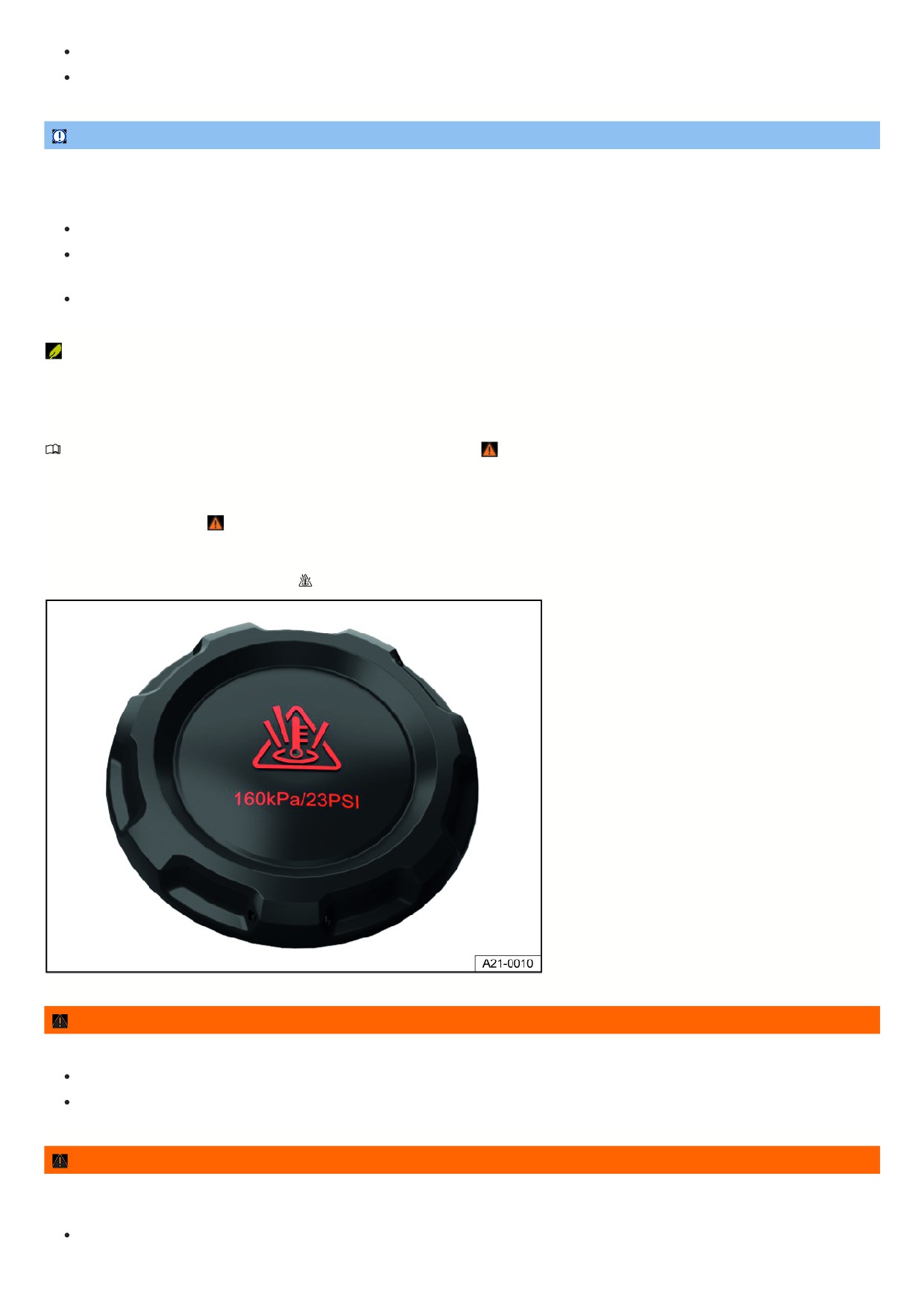
The coolant expansion tank is identified with the
red symbol on the cap fig. 166.
Fig. 166 In the engine compartment: cap on the engine coolant expansion tank.
WARNING
Escaping hot steam or hot coolant and hot components may cause serious burns.
Never open the engine hood if you can see or hear steam or coolant escaping from the engine compartment.
Always wait until you can no longer see or hear steam or engine coolant escaping from the engine compartment.
WARNING
The engine cooling system is under pressure when the engine is hot. If the cover is opened carelessly, coolant may spray out and cause serious burns or fatal
injuries.
Never open the cap on the coolant expansion tank when the engine is hot.
283
Always protect your face, hands and arms from hot coolant or steam with a large, thick cloth if you need to open the cover of the coolant tank.
Slowly and very carefully turn the cap on the coolant expansion tank counterclockwise while pressing down lightly on the cap.
Checking the coolant level
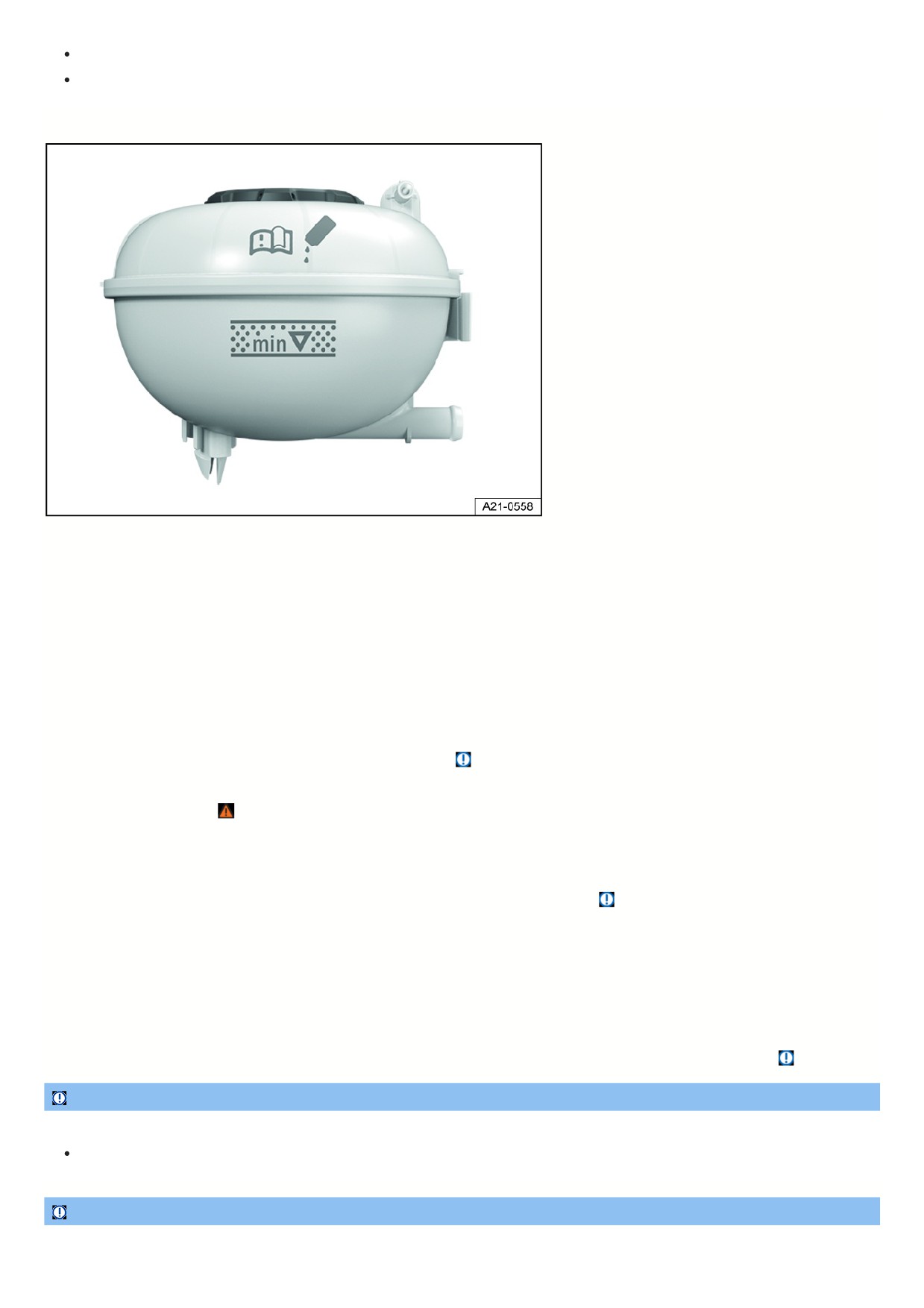
Fig. 167 In the engine compartment: markings on the engine coolant expansion tank.
When new vehicles are delivered or after repairs to the cooling system, the coolant level may be above the marked area. This is normal. The coolant does not need
to be extracted.
The coolant level cannot be checked exactly for every model, because the view of the fluid level in the coolant expansion tank may be obstructed. If you cannot rea
off the engine coolant level accurately, contact a suitably qualified professional. Volkswagen recommends contacting an authorized Volkswagen dealer or
authorized Volkswagen Service Facility.
1. When the engine is cold, check the coolant level using the markings on the side of the engine coolant expansion tank fig. 167. The coolant level must be
between the markings.
2. If the fluid level in the coolant expansion tank is below the minimum mark (“min”), have coolant added. When the engine is warm, the engine coolant level may
be slightly above the upper marking.
3. If no coolant is visible in the coolant expansion tank, do not add coolant
⇒
Filling the coolant
1. Carefully unscrew the cap ⇒
2. Only add new coolant that conforms to the Volkswagen specification ⇒ Engine coolant specifications.
If there is no engine coolant available that conforms to the required specification, initially only top up with distilled water. Then have the correct mixture ratio
using the specified coolant additive restored as soon as possible by an authorized Volkswagen dealer or authorized Volkswagen Service Facility. Volkswagen
recommends contacting an authorized Volkswagen dealer or authorized Volkswagen Service Facility ⇒
3. Top up the engine coolant to the upper fill level marker. After topping up the engine coolant, the coolant level must be between the markings on the coolant
expansion tank fig. 167.
4. Install the cap securely.
5. Check the coolant level after one day. If the level of the engine coolant tank drops below the “min” minimum marking again, contact an authorized Volkswagen
dealer or authorized Volkswagen Service Facility and have the cooling system checked. Volkswagen recommends contacting an authorized Volkswagen dealer
or authorized Volkswagen Service Facility.
6. If there is no engine coolant available that conforms to the specification, do not use any other engine coolant additive in an emergency
⇒
NOTICE
Coolant expands when it heats up. If coolant is topped up above the marked level, excess coolant may leak out and cause damage to the vehicle.
Do not refill the system with engine coolant above the upper edge of the marked area of the engine coolant tank.
NOTICE
If there is no more engine coolant in the coolant expansion tank, air can get into the cooling system. This could result in damage to the engine.
284

Do not continue driving.
Do not top up the coolant.
See an authorized Volkswagen dealer or authorized Volkswagen Service Facility for assistance.
NOTICE
The chemical components contained in water that is not distilled can cause considerable corrosion damage in the engine. This can cause engine malfunctions.
Only use distilled water for refilling the system!
If you have added water that is not distilled, have the fluid in the cooling system changed completely by an authorized Volkswagen dealer or authorized
Volkswagen Service Facility. Volkswagen recommends contacting an authorized Volkswagen dealer or authorized Volkswagen Service Facility.
NOTICE
The use of incorrect fluids can cause serious malfunctions and damage to the engine.
When filling or changing fluids, make sure the correct fluids are added to the corresponding reservoirs.
Troubleshooting
Please read the introductory information and heed the Warnings and Notice ⇒
Safety precautions for working in the engine compartment .
Engine coolant
The red warning light blinks. The coolant temperature is too high or the coolant level is too low.
Do not continue driving! Engine damage could result.
1. Stop the vehicle as soon as it is safe to do so
⇒ Parking.
2. Stop the engine.
3. Allow the engine to cool.
4. Check the engine coolant level on the Coolant expansion tank ⇒ Checking and filling engine coolant .
5. If the warning light does not turn off, do not continue driving or let the engine run, even if the engine coolant is at the correct level.
6. Contact an authorized Volkswagen dealer or authorized Volkswagen Service Facility for assistance.
Brake fluid
Introduction
Brake fluid absorbs moisture from the air over the course of time. Too much water in the brake fluid causes damage to the brake system. Water lowers the boiling
point of the brake fluid. If the water content in the brake fluid is too high, vapor lock may form in the brake system during heavy braking and full braking. Vapor lock
reduces the braking efficiency, increases the braking distance considerably, and can lead to a total failure of the brake system. Your own safety and the safety of
others on the road depends on your brake system functioning correctly at all times.
WARNING
Brake fluid is poisonous. Contact with brake fluid, especially swallowing brake fluid, may result in serious or fatal injuries.
If you swallow brake fluid, seek urgent medical help.
If you have health problems after working with brake fluid, seek medical help.
Always store brake fluid out of the reach of children and only within the sealed original container.
Never use empty food cans, bottles, or other containers to store brake fluid, because someone could drink the brake fluid by mistake.
Avoid regular contact with brake fluid to prevent damage to your skin.
Protect your skin, face, and particularly your eyes when working with brake fluid.
Do not eat, drink, or smoke when working with brake fluid.
Wash your skin with soap and water after working with brake fluid.
NOTICE
Spilled or leaking brake fluid will damage the vehicle's surfaces. The vehicle's paint, plastic parts, and tires may be damaged.
Immediately wipe up any spilled or leaking brake fluid that comes into contact with vehicle components.
285
Then rinse all vehicle parts with plenty of water.
Brake fluid can pollute the environment. Collect spilled brake fluid and dispose of it correctly.
Brake fluid specifications
Please read the introductory information and heed the Warnings and Notice ⇒
Safety precautions for working in the engine compartment .
Volkswagen has developed a special brake fluid that is optimized for the vehicle's brake system. For optimum performance of the brake system, Volkswagen
recommends only using brake fluid that complies with the VW standard 501 14.
Before using brake fluid, check that the brake fluid specification on the bottle matches the vehicle requirements.
Brake fluid that complies with the VW standard 501 14 can be obtained from an authorized Volkswagen dealer or authorized Volkswagen Service Facility.
If brake fluid that meets this specification is not available and another high-quality brake fluid must therefore be used, brake fluid that complies with the specification
DIN ISO 4925 or the US Standard FMVSS 116 DOT 4 CLASS 6 can be used.
Not all brake fluids that comply with the requirements of DIN ISO 4925 or US Standard FMVSS 116 DOT 4 CLASS 6 have the same chemical composition. Some
of these brake fluids can contain chemicals that can destroy or damage components of the vehicle brake system over time.
To help ensure that the brake system functions correctly over the long term, Volkswagen recommends using a brake fluid that expressly conforms to the
VW standard 501 14.
Brake fluid that complies with the VW standard 501 14 meets the requirements of DIN ISO 4925 or the US Standard FMVSS 116 DOT 4 CLASS 6.
Checking the Brake Fluid
Please read the introductory information and heed the Warnings and Notice ⇒
Safety precautions for working in the engine compartment .
Preparations
1. Parking the vehicle on a level, secure surface.
2. Open the hood.
Checking the Brake Fluid Level
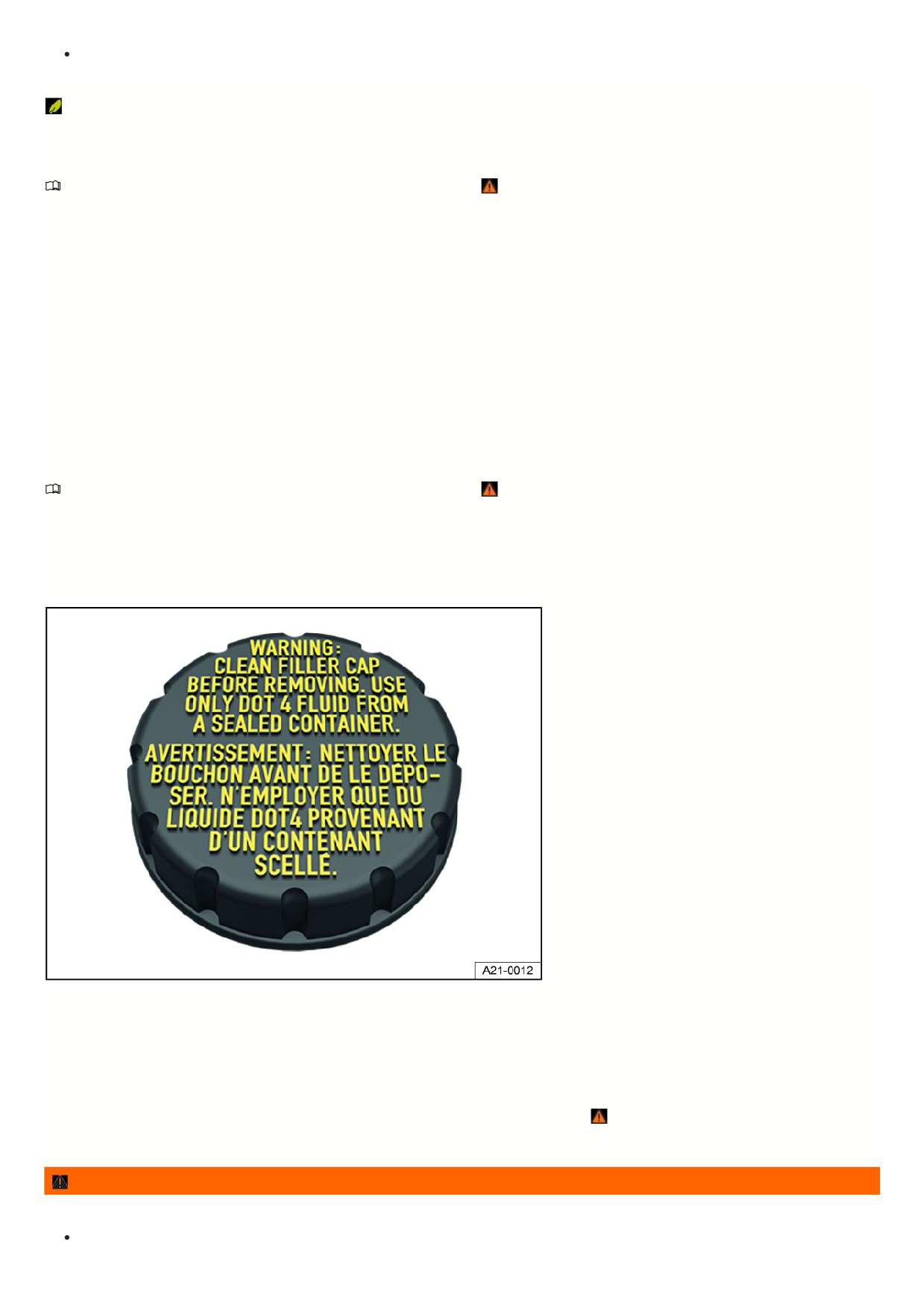
Fig. 168 In the engine compartment: cap on the brake fluid reservoir.
The brake fluid reservoir can be recognized by its cap fig. 168.
The brake fluid level cannot be checked precisely on all models because the hood or engine components may obstruct the view of the fluid level in the reservoir. If
you cannot read the brake fluid level clearly, see an authorized Volkswagen dealer or authorized Volkswagen Service Facility for assistance. Volkswagen
recommends contacting an authorized Volkswagen dealer or authorized Volkswagen Service Facility.
The brake fluid level must always be between the MIN and MAX markings on the brake fluid reservoir
⇒
The brake fluid level decreases slightly when the vehicle is being used as the brake pads wear and the brakes automatically adjust themselves.
WARNING
A low brake fluid level or unsuitable brake fluid may cause the brakes to fail or may reduce braking efficiency. Accidents and serious or fatal injuries could result.
Have the brake system and brake fluid level checked regularly.
286

Be sure to use the correct brake fluid.
Only use brake fluid that expressly complies with the VW standard 501 14.
If brake fluid that complies with the VW standard 501 14 is not available, in exceptions only use a high-quality brake fluid that complies with
DIN ISO 4925 CLASS 6 or US standard FMVSS 116 DOT 4.
Changing brake fluid
Have the brake fluid changed regularly. An authorized Volkswagen dealer or authorized Volkswagen Service Facility can provide information about the interval for
changing the vehicle brake fluid. Only have brake fluid added that meets the required specifications. Volkswagen recommends contacting an authorized
Volkswagen dealer or authorized Volkswagen Service Facility.
WARNING
Vapor lock may occur in old brake fluid due to absorbed moisture during hard braking, reducing braking efficiency and potentially causing total brake failure.
Accidents and serious or fatal injuries could result.
Have the brake fluid changed regularly.
Only have new brake fluid added.
Troubleshooting
Please read the introductory information and heed the Warnings and Notice ⇒
Safety precautions for working in the engine compartment .
Brake fluid level
The red warning light turns on. The brake fluid level is too low.
Do not continue driving! This could result in the brake failing.
1. Stop the vehicle immediately as soon as it is safe to do so
⇒ Parking.
2. Check the brake fluid level.
3. If the brake fluid level is too low, contact an authorized Volkswagen dealer or authorized Volkswagen Service Facility.
12 V vehicle battery
Introduction
The 12-volt vehicle battery is a component of the electrical system and serves to supply energy to the vehicle. During maintenance procedures, the 12 V vehicle
battery is checked and replaced if necessary.
You may only perform procedures on the electrical system yourself if you are familiar with the necessary activities and the general safety precautions, and if the
correct operating equipment and fluids and suitable tools are available. Work performed incorrectly can result in serious injuries ⇒
. Have all work performed by
suitably qualified professionals. Volkswagen recommends contacting an authorized Volkswagen dealer or authorized Volkswagen Service Facility.
Information about warning and indicator lights can be found in the troubleshooting section at the end of the chapter
⇒ Troubleshooting.
Battery switch-off in an accident with triggering of the airbag
In vehicles with a 12 V vehicle battery in their vehicle interior or luggage compartment, the electrical connection to the 12 V vehicle battery is pyrotechnically
disconnected in an accident with airbag deployment. This prevents a short circuit. For more information on the installation location of the vehicle battery, refer to
section → page , Checking the 12 V vehicle battery acid level .
Detailed warnings for the 12 V vehicle battery
Always wear eye protection. Battery acid is highly corrosive. Always wear protective gloves and eye protection.
Fire, sparks, open flame, and smoking
are forbidden. A highly explosive mixture of gases forms when charging the 12 V vehicle battery.
Always keep children away from battery acid and the 12
V vehicle battery. Always heed the Owner's Manual.
WARNING
Performing work on the 12 V vehicle battery and the electrical system can cause serious injuries, fires, or electric shocks. This could result in serious injuries.
Always read and follow the warning information on the 12 V vehicle battery.
Before performing any work on the 12 V vehicle battery, switch off the ignition and all electrical equipment and disconnect the 12 V battery negative
cable.
Always keep children away from battery electrolyte and the 12 V vehicle battery.
When handling 12 V vehicle batteries, always protect your hands, arms, and face from spraying battery acid.
Always wear eye protection and safety gloves.
Never short circuit the battery terminals.
287

WARNING
When work is carried out on the 12 V vehicle battery, a highly explosive, flammable gas mixture builds up. Sparks could form and ignite the flammable gas that
is released by the 12 V vehicle battery. This can result in serious injury or death.
Always keep fires, sparks, open flames, and lit cigarettes far away from the 12 V vehicle battery.
Avoid creating sparks when working with wires and electrical equipment or when discharging static electricity.
WARNING
A drained 12 V vehicle battery can freeze at temperatures around 0 °C (+32 °F). Acid may leak out of 12 V vehicle batteries that have frozen and thawed again
and cause damage to the vehicle in the long run.
Never charge a frozen or thawed 12 V vehicle battery.
Always replace the 12 V vehicle battery if it freezes.
WARNING
California Proposition 65 Warning.
This product can expose you to chemicals including lead and lead components, which are known to the State of California to cause cancer and birth
defects or other reproductive harm. For more information go to https://www.P65Warnings.ca.gov.
NOTICE
UV rays can damage the battery housing.
Do not expose the 12 V vehicle battery to direct sunlight for a long period of time.
NOTICE
The 12 V vehicle battery could freeze and be destroyed.
Protect the 12 V vehicle battery against freezing temperatures if the vehicle is parked for long periods of time.
After starting the engine when the 12-volt vehicle battery is severely drained or when it has been replaced or jump-started, the system settings (time, date,
personal convenience settings, and programming) and user profiles may be changed or erased. Check and correct the settings after the 12 V vehicle battery is
sufficiently recharged.
Checking the 12 V vehicle battery acid level
Please read the introductory information and heed the Warnings and Notice ⇒
Safety precautions for working in the engine compartment .
Check the acid level of the 12 V vehicle battery regularly if mileage is high, in countries with warm climates, or if the 12 V vehicle battery is old. Otherwise, the 12 V
vehicle battery is maintenance-free.
12 V vehicle battery location
The 12 V vehicle battery is located in the engine compartment.
Preparations
1. Prepare the vehicle for work in the engine compartment.
2. Wear suitable eye protection and safety gloves.
3. Open the hood.
Checking the battery acid level
WARNING
Battery acid is corrosive. Contact with battery acid, especially swallowing battery acid, can result in serious burns.
Never open a 12 V vehicle battery.
Never tilt the 12 V vehicle battery. Acid can leak out of the vent openings.
Protect your skin, face, and particularly your eyes when working with the 12 V vehicle battery.
Do not eat, drink, or smoke when working on the 12 V vehicle battery.
288
Wash your skin with soap and water after working on the 12 V vehicle battery.
If acid comes into contact with your skin or hair, remove all soiled or wet clothing and wash your skin and hair with water. Consult a doctor.
If acid comes into contact with your eyes, rinse the affected area carefully with water for several minutes. Then consult a doctor immediately.
If you swallow battery acid, immediately drink plenty of water and swallow activated charcoal. Consult a doctor immediately.
If you have inhaled acid vapors, leave the hazard area and breathe in fresh air. Consult a doctor immediately.
WARNING
When work is carried out on the 12 V vehicle battery, a highly explosive, flammable gas mixture builds up. Sparks could form and ignite the flammable gas that
is released by the 12 V vehicle battery. This can result in serious injury or death.
Always keep fires, sparks, open flames, and lit cigarettes far away from the 12 V vehicle battery.
Avoid creating sparks when working with wires and electrical equipment or when discharging static electricity.
Depending on the vehicle equipment, an additional bracket must be removed to see the viewing window. An additional tool that is not available in the vehicle tool ki
is required to do this. Always have the acid level of the 12 V vehicle battery checked by an authorized Volkswagen dealer or authorized Volkswagen Service Facility
Volkswagen recommends contacting an authorized Volkswagen dealer or authorized Volkswagen Service Facility.
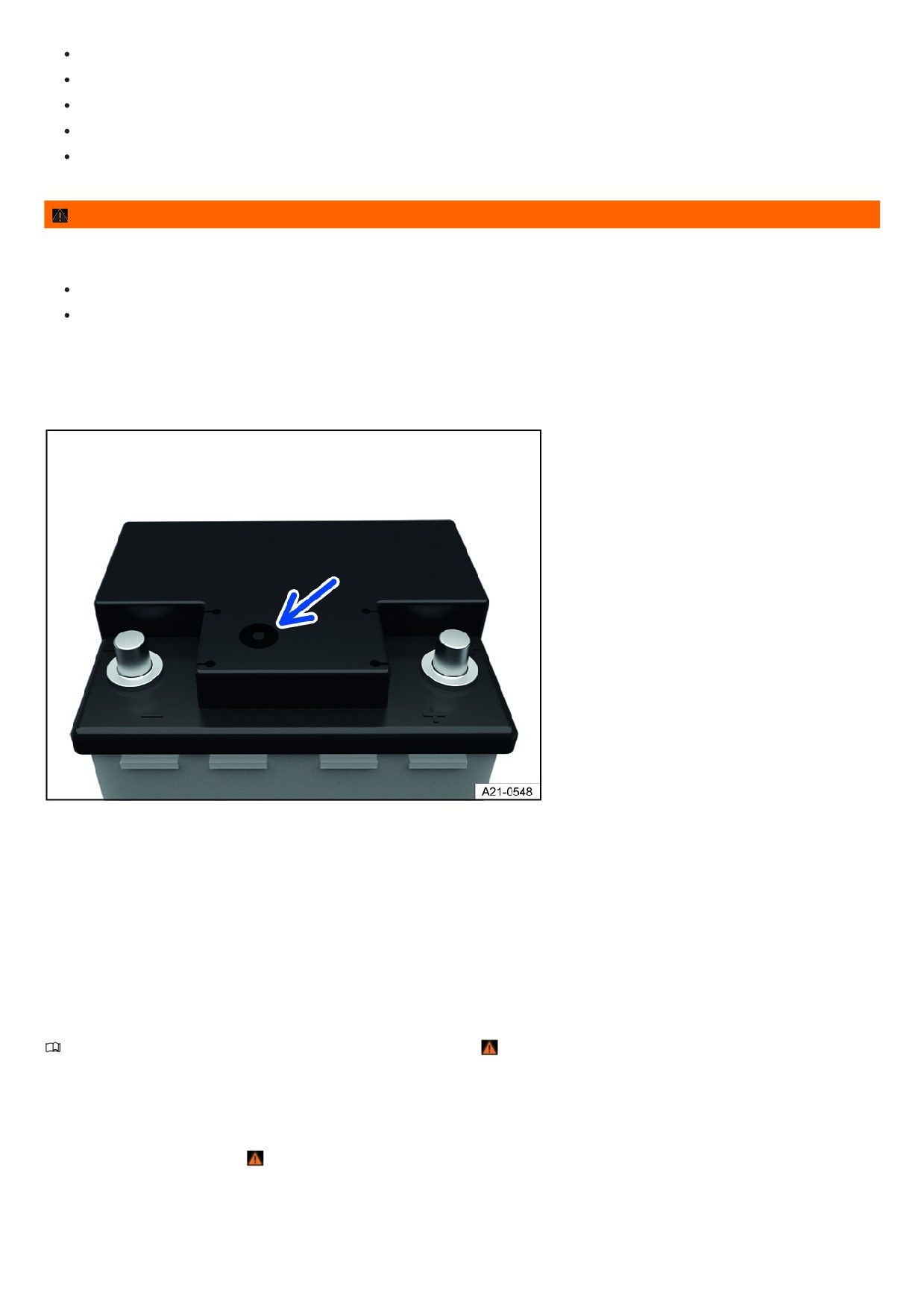
Fig. 169 On the top of the 12 V vehicle battery: Window (general example).
Make sure there is enough lighting to clearly see the color indicator in the circular window on the top of the 12 V vehicle battery fig. 169.
The color indicator in the circular window changes depending on the acid level in the 12 V vehicle battery.
Light yellow or colorless
The 12 V vehicle battery acid level is too low. Have the 12 V vehicle battery replaced by an authorized Volkswagen dealer or authorized
Volkswagen Service Facility. Volkswagen recommends contacting an authorized Volkswagen dealer or authorized Volkswagen Service Facility.
Blac
The 12 V vehicle battery acid level is OK.
The acid level of 12 V vehicle batteries labeled AGM cannot be checked for technical reasons. Suitably qualified professionals can inspect the battery. Volkswagen
recommends contacting an authorized Volkswagen dealer or authorized Volkswagen Service Facility.
Charging, replacing, disconnecting, or connecting the 12 V vehicle battery
Please read the introductory information and heed the Warnings and Notice ⇒
Safety precautions for working in the engine compartment .
If you suspect that the 12 V vehicle battery is damaged or malfunctioning, see suitably qualified professionals to have the 12 V vehicle battery checked. Volkswagen
recommends contacting an authorized Volkswagen dealer or authorized Volkswagen Service Facility.
Charging the 12 V vehicle battery
The 12 V vehicle battery should be charged by suitably qualified professionals because the 12 V vehicle battery that is installed at the factory requires a charging
process where the voltage is limited ⇒ . Volkswagen recommends contacting an authorized Volkswagen dealer or authorized Volkswagen Service Facility.
Replacing the 12 V vehicle battery
The 12 V vehicle battery is designed to fit the location where it is installed and is equipped with safety features. If a 12 V vehicle battery needs to be replaced, have
the replacement part fitted by qualified professionals. Volkswagen recommends contacting an authorized Volkswagen dealer or authorized Volkswagen Service
Facility. Check with qualified professionals to find out the component information regarding size and the required maintenance, performance, and safety features.
289

They must possess the necessary technical documentation and equipment. Volkswagen recommends contacting an authorized Volkswagen dealer or authorized
Volkswagen Service Facility. The vent opening on the 12 V vehicle battery must always be located on the negative terminal side. The vent opening on the positive
terminal side must always be sealed ⇒
Only use a maintenance-free 12 V vehicle battery that conforms to the TL 825 06 and VW 7 50 73 standards. These standards must be from October 2014 or later.
Always have the 12 V vehicle battery replaced by qualified professionals because the vehicle electronics must be adapted as part of the replacement. Only qualified
professionals have the necessary equipment to perform the adaptation and have access to the correct replacement batteries.
Disconnecting the 12 V vehicle battery
If the 12 V vehicle battery must be disconnected from the vehicle electrical system, note the following:
1. Switch off all electrical consumers.
2. Unlock the vehicle before disconnecting the battery. Otherwise, the anti-theft alarm system will be triggered.
3. Disconnect the negative cable first, and then the positive cable
⇒
Connecting the 12 V vehicle battery
If the 12 V vehicle battery must be connected to the vehicle electrical system, note the following:
1. Switch off all electrical consumers.
2. Connect the positive cable first, and then the negative cable
⇒
Various indicator lights may turn on after connecting the 12 V vehicle battery and switching the ignition on. They will turn off after driving a short distance at a speed
of approx. 15 to 20 km/h (approx. 10 to 12 mph). If the indicator lights light up and remain on, contact an authorized Volkswagen dealer or authorized Volkswagen
Service Facility and have the vehicle checked. Volkswagen recommends contacting an authorized Volkswagen dealer or authorized Volkswagen Service Facility.
If the 12 V vehicle battery was disconnected for a long period of time, the next scheduled maintenance may not display correctly or it may not be calculated correctl
⇒ Service interval display. Follow the maximum permissible maintenance interval ⇒ Maintenance.
Vehicles with a starter button: If the ignition cannot be switched on after connecting the 12 V vehicle battery, carry out the following activities:
1. Lock and unlock the vehicle from the outside.
2. Try to switch the ignition on again.
3. If the ignition will not switch on, see an authorized Volkswagen dealer or authorized Volkswagen Service Facility for assistance.
Automatic equipment deactivation
If the ignition is switched on for a very long time when the engine is off or the parking light is switched on when parking for a very long time, the intelligent power
management cannot always prevent the 12 V vehicle battery from being drained.
If the 12 V vehicle battery is under a heavy load, the intelligent power management will automatically begin certain measures to prevent the 12 V vehicle battery
from draining.
The idle speed will be increased so that the alternator delivers more power.
If necessary, equipment that uses a lot of power will have its performance limited or will be switched off.
The power supply to the 12 V socket will be interrupted temporarily when the engine is started.
12 V Vehicle Battery Draining
If the battery is drained, it may not be possible to start the engine. The 12 V vehicle battery will be drained in the following situations:
If the vehicle is parked for long periods of time without running the engine, especially if the ignition is on.
If electrical equipment is used when the ignition is switched off.
WARNING
Use of a 12 V vehicle battery that does not have identical specifications and dimensions to the 12 V vehicle battery that was installed at the factory may cause
short circuits or fire. This could result in serious or fatal injuries.
Always use a maintenance-free and leak-proof 12 V vehicle battery that has the same characteristics, specifications, and dimensions as the 12 V vehicle
battery that was installed at the factory.
WARNING
Fitting 12 V vehicle batteries incorrectly may cause short circuits or fire. This could result in serious or fatal injuries.
Always attach the 12 V vehicle battery to the attachment points provided in the vehicle.
Replace all covers that are required for the vehicle back on the battery.
WARNING
29

A highly explosive mixture of hydrogen gas can form when charging the 12 V vehicle battery. Sparks or naked flames could ignite the gas mixture. This could
cause serious burns.
Only charge 12 V vehicle batteries in well-ventilated areas.
Keep sparks and naked flames away from the 12 V vehicle battery.
WARNING
A drained 12 V vehicle battery can freeze at temperatures around 0 °C (+32 °F). Acid may leak out of 12 V vehicle batteries that have frozen and thawed again
and cause damage to the vehicle in the long run.
Never charge a frozen or thawed 12 V vehicle battery.
Always replace the 12 V vehicle battery if it freezes.
WARNING
If the degassing tube is not attached to the 12 V vehicle battery correctly, the highly explosive gas mixture that builds up when the vehicle is running may enter
the vehicle interior. The flammable gas could ignite and cause serious injuries or death.
For vehicles with the 12 V vehicle battery in the vehicle interior or luggage compartment, ensure that the degassing hose is connected to the 12 V vehicle
battery correctly. The degassing hose must always be connected to the negative terminal side of the 12-volt vehicle battery.
Always ensure that the opening on the positive terminal side of the 12 V vehicle battery is capped.
CAUTION
Cables that are connected incorrectly can cause a short circuit. This could damage the on-board electronics and result in serious injuries.
Connect the positive cable first and then the negative cable.
NOTICE
If the 12 V vehicle battery is connected or disconnected when the ignition is switched on or the engine is running, this could damage the electrical system or
electronic components, resulting in electrical malfunctions.
Never connect or disconnect the 12 V vehicle battery when the ignition is on or the engine is running.
NOTICE
If accessories that provide power for charging the 12 V vehicle battery are connected to the 12 V socket, this could damage the electrical system or electronic
components, resulting in electrical malfunctions.
Never connect accessories that provide power, such as solar panels or battery chargers, to the 12 V socket in order to charge the 12 V vehicle battery.
12 V vehicle batteries can contain toxic substances such as sulfuric acid and lead. Dispose of 12 V vehicle batteries correctly.
Battery acid can pollute the environment. Collect spilled battery acid and dispose of it correctly.
Troubleshooting
Please read the introductory information and heed the Warnings and Notice ⇒
Safety precautions for working in the engine compartment .
12-volt power supply
The red warning light turns on. A message is shown in the instrument cluster display.
Do not continue driving! Possible failure of the electrical system.
1. Stop the vehicle immediately and park it safely.
2. Turn off electrical equipment that is not needed.
3. Switch the ignition off.
4. Contact an authorized Volkswagen dealer or authorized Volkswagen Service Facility for assistance.
If the red warning light comes on, the start-stop system is switched off. The start-stop system will only be automatically switched on again after the engine is
291

restarted.
12-volt power supply
The yellow indicator light turns on. A message is shown in the instrument cluster display.
Messages about the battery charge level of the 12 V vehicle battery.
1. Let the engine run so that the 12 V vehicle battery can be recharged.
2. If the message about the battery charge level of the 12 V vehicle battery does not turn off after a few minutes despite the measures having been taken, then
contact an authorized Volkswagen dealer or authorized Volkswagen Service Facility.
Messages about the 12 V power supply.
1. Contact an authorized Volkswagen dealer or authorized Volkswagen Service Facility for assistance.
If the yellow indicator light lights up, the start-stop system will not be able to start the engine. If the yellow indicator light has turned off, the 12 V vehicle battery has
sufficient battery charge level to automatically restart the engine.
292

Wheels and tires
Introduction
Tires are the part of the vehicle that are under the most demand yet are the most underestimated. Tires are extremely important, because the small running surface
on the tires is the only point of contact that the vehicle has with the road.
The tire and rim combinations approved by Volkswagen are specifically designed for each other.
The service life of the tire depends on the tire pressure, the driving style, the way the tires are handled, and correct mounting of the tire.
Rims, tires and wheel bolts
Rims, tires, and wheel bolts are determined based on the vehicle model. Whenever another rim is installed, the wheel bolts to be used must have the correct length
and bolt head shape. This ensures that the brakes can work correctly and that the vehicle drives smoothly and safely. For technical reasons, standard rims from
other vehicles cannot be used. Under certain circumstances, this may even apply to rims for the same vehicle model. You must consult a suitably qualified
professional to replace rim/tire combinations. Volkswagen recommends contacting an authorized Volkswagen dealer or authorized Volkswagen Service Facility.
The correct wheel bolts must always be used for each vehicle model, and these bolts must always be tightened to the correct torque
⇒ Monitoring the tightening
torque.
WARNING
Handling wheels and tires incorrectly can reduce driving safety and cause serious accidents and death.
Regularly check the tire pressure when the tires are cold and always maintain the specified pressure
⇒ Checking the tire pressure . If the tire pressure is
too low, the tire can heat up so much while driving that the tread separates or the tire ruptures.
Check the tires regularly for damage and wear.
Never exceed the maximum permissible speed and tire load specified for the tires fitted to your vehicle.
For all four wheels, use only radial tires of the same design, size (rolling circumference), and tread pattern.
If there are unusual vibrations or if the vehicle pulls to one side while driving, stop immediately and check the wheels and tires for damage.
Never loosen the bolts on rims with a bolted rim ring.
WARNING
New tires or tires that are old, worn, or damaged cannot provide the maximum vehicle control and braking effect.
This can cause accidents and fatal injuries.
Break in new tires because they have reduced traction and braking efficiency when they are new. Therefore drive carefully for the first 600 km
(370 miles).
Never drive with tires that are worn or damaged, e.g. due to being punctured, cut, cracked, or bulging.
If there are unusual vibrations or if the vehicle pulls to one side while driving, stop immediately and check the wheels and tires for damage.
Do not use any wheels or tires if you do not know how they have been used in the past. Used wheels and tires could be damaged, even if there is no
visible damage.
Only use tires that are more than six years old if absolutely necessary and drive with extreme caution if doing so, even if the tires have never been used
before.
Replace worn or damaged tires immediately.
WARNING
If the wheel bolts are not tightened enough to meet the specification, the wheel bolts and consequently the wheel could come loose while driving. Exceeding the
tightening specification could damage the wheel bolts and threads.
Wheel bolts that are tightened incorrectly or missing could cause you to lose control of the vehicle and lead to serious accidents and fatal injuries.
Always tighten the wheel bolts to the correct tightening torque. If you do not have a torque wrench, tighten the wheel bolts with the lug wrench and then
have the tightening torque checked as soon as possible by an authorized Volkswagen dealer or authorized Volkswagen Service Facility. Volkswagen
recommends contacting an authorized Volkswagen dealer or authorized Volkswagen Service Facility.
Never drive with missing or loose wheel bolts.
Always use wheel bolts that are correct for the rim and the vehicle model.
Never grease or oil the wheel bolts and the threads in the wheel hub. Even when tightened to the specification, the wheel bolts could become loose while
driving.
Ensure the wheel bolts and threads in the wheel hubs are clean, easy to move and free of oil and grease.
293

Never loosen the bolts on rims with a bolted rim ring.
WARNING
Improper installation of the tires on the rim can damage the rim and cause tires to suddenly lose air or go flat while driving.
This can cause accidents and fatal injuries.
Always have tires installed on the rim by an authorized Volkswagen dealer or authorized Volkswagen Service Facility. Volkswagen recommends
contacting an authorized Volkswagen dealer or authorized Volkswagen Service Facility.
Taking care of wheels and tires
Handling tires
Preventing damage to the tires
Always drive over curbs and other low obstacles slowly and at a right-angle so that both front wheels come into contact with the obstacle at the same time.
Check the tire pressure regularly.
Check tires regularly for damage, e.g. punctures.
Never exceed the load index and maximum speed of the tire ⇒ Tire labeling and tire classifications.
Have damaged or worn rims replaced immediately ⇒ Troubleshooting.
Protect tires from coming into contact with corrosive materials such as grease, oil, gasoline, and brake fluid
⇒
Replace missing dust caps on the valves immediately.
Remove any objects provided they have not punctured the inside of the tire ⇒ Troubleshooting.
Pay attention to all warnings issued by the Tire Pressure Monitoring System
⇒ Troubleshooting the Tire Pressure Monitoring System .
WARNING
Corrosive fluids and materials can cause visible and invisible damage to the tires, which can cause the tires to fail.
This can cause accidents and fatal injuries.
Always keep chemicals, oils, grease, fuel, brake fluid, and other corrosive materials away from the tires.
Storing tires
Only store tires in a cool, dry location that is as dark as possible.
Do not stand tires that are mounted on rims up vertically.
Protect tires that are not mounted on rims from dirt with suitable covers and store them standing on the tread surface.
Tires that are more than six years old
Tires age due to physical and chemical processes that affect their function. Tires that have been stored and unused for long periods of time age more quickly than
tires that are used continuously.
Volkswagen recommends replacing tires that are more than six years old with new tires. This even applies to tires that may appear to be usable and whose tread
depth is still greater than the minimum requirement ⇒
Winter and all season tires lose their characteristics to a large extent due to aging, regardless of the remaining tread depth.
The age of the tire can be determined based on the production date ⇒ Tire labeling and tire classifications.
WARNING
Old tires can suddenly lose air or rupture, particularly at high speeds.
This can cause accidents and fatal injuries.
Only use tires that are more than six years old if absolutely necessary and drive with extreme caution if doing so, even if the tires have never been used
before.
New tires
Drive particularly carefully during the first 600 km (370 mi) with new tires because they must be broken in. Tires that have not been broken in yet have reduced
gripping abilities and braking efficiency ⇒
Only use tires with the same design and as close to the same construction, size (rolling circumference) and tread pattern as possible on all four wheels.
294

The tread depth of new tires may vary between tire models and manufacturers due to different design features and tread designs.
WARNING
New tires must be broken in because they have reduced traction and braking efficiency when they are new.
This could cause you to lose control of the vehicle and lead to serious accidents and death.
Break in new tires. Drive carefully for the first 600 km (370 miles).
The size specifications for new tires may vary significantly from the actual tire dimensions for different tire brands.
Replacing tires
At a minimum, replace both tires on a single axle.
Only replace old tires with tires that have been approved by Volkswagen for your vehicle model.
Never use tires whose size exceeds the measurement of tires that are approved by Volkswagen
⇒
Volkswagen Genuine tires
At the factory, the vehicle can be equipped with Volkswagen Genuine tires. These tires are marked with the
symbol and are specially adapted for this vehicle.
Volkswagen Genuine tires fulfill the highest standards of safety and driving characteristics when used appropriately.
Recalibrating the Tire Pressure Monitoring System
The Tire Pressure Monitoring System must be recalibrated each time one or more wheels is replaced. This also applies if the tires are rotated, for example from fron
to back ⇒ How the Tire Pressure Monitoring System Works .
WARNING
Tires must have enough clearance from vehicle components. If there is not enough clearance, tires could rub against components of the suspension, the body,
and the brake lines.
This may cause the brake system to fail, the tread to separate, and the tire to rupture, resulting in serious accidents and fatal injuries.
Only use tires with dimensions that do not exceed the dimensions of the tire brands approved by Volkswagen and that do not rub against other
components of the vehicle.
NOTICE
Driving over potholes and curbs can cause the tires to become deformed.
Damage to the tires and rims can result.
Avoid strong impacts and drive around obstacles where possible.
NOTICE
The valves may be damaged by dirt.
Never drive without caps on the valves.
NOTICE
The valves can be damaged when replacing wheels.
Do not let wheels that you have removed fall on the rim.
Always dispose of old tires correctly and according to regulations.
If the spare wheel is different from the regular vehicle wheels, e.g. in the case of winter tires or a temporary spare wheel, only use the spare wheel temporarily
and in the event of a breakdown, and drive especially carefully. Replace the compact spare wheel with a regular wheel as soon as possible.
Using tires approved by Volkswagen ensures that the dimensions will fit correctly on your vehicle. If other tires are used, the seller must provide a certificate
from the tire manufacturer stating that the tires are suitable for the vehicle. Keep the certificate stored safely in the vehicle.
Handling rims
Preventing damage to the rims
295

Missing hubcaps can cause damage to the rims and wheel bolts.
Always install missing hubcaps before driving.
Always drive over curbs and other low obstacles slowly and at a right-angle so that both front wheels come into contact with the obstacle at the same time.
Replace missing dust caps on the valves immediately.
Check the tire pressure regularly.
Rims with bolted rim ring or accent elements
Rims with a bolted rim ring or accent element consist of multiple pieces. These pieces are connected together with special bolts. Damaged rims must be replaced
and may only be repaired by an authorized Volkswagen dealer or authorized Volkswagen Service Facility. Volkswagen recommends contacting an authorized
Volkswagen dealer or authorized Volkswagen Service Facility.
Rim identification
In some countries, new rims must include information about certain properties. The following information may be on the rim:
Seal of conformity
Rim size
Manufacturer or brand name
Production date (month/year)
Country of origin
Serial number
Raw material batch number
Commodity code
WARNING
Using unsuitable or damaged rims can impair driving safety and cause accidents and serious injuries.
Only use rims permitted for the vehicle.
Check the rims regularly for damage and replace them if necessary.
WARNING
Loosening and tightening bolts incorrectly on rims with bolted rim rings can cause severe accidents and death.
Never loosen the bolts on rims with a bolted rim ring.
Have all procedures on rims with bolted rim rings performed by an authorized Volkswagen dealer or authorized Volkswagen Service Facility. Volkswagen
recommends contacting an authorized Volkswagen dealer or authorized Volkswagen Service Facility.
Maintaining wheels and tires
Checking the tire pressure
Check the tire pressure at least once a month.
Check the tire pressure only when tires are cold. The specified tire pressure only applies to a cold tire. The tire pressure on warm tires is higher than on cold
tires. Therefore, never release air from a warm tire to adjust the tire pressure.
Always adjust the tire pressures to the vehicle load
⇒
After adjusting tire pressures, always screw the caps on the valves and note the information about the Tire Pressure Monitoring System (TPMS).
Always use the tire pressures specified on the label. Never exceed the maximum tire pressure specified on the side of the tire.
296
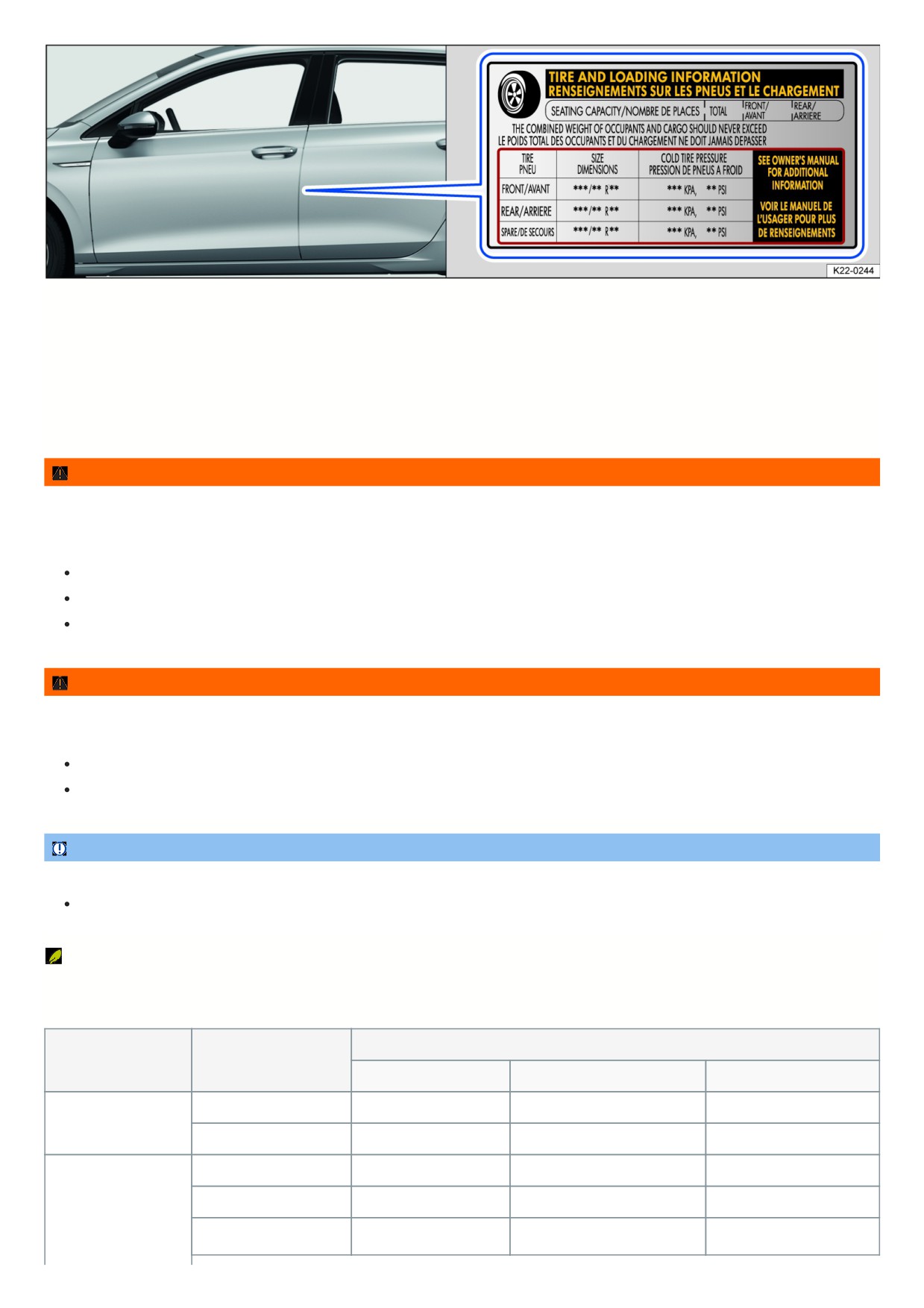
Fig. 170 On the driver door pillar: Tire inflation pressure label.
The correct tire pressure for the tires fitted at the factory can be found on a label on the B-pillar of the driver door fig. 170. The factory-installed tires can be winter
summer or all-season tires.
An incorrect tire pressure can cause increased tire wear, negatively affect driving behavior and damage tires. Compliance with the correct tire pressure is very
important, particularly when driving at high speeds.
The specified tire pressure is given for a cold tire. For warm tires, the pressure is higher.
Never reduce the pressure of a warm tire in order to reach the specified value. This will cause the actual pressure when the tire is cold to be too low.
WARNING
A tire pressure that is too low can result in a sudden loss of air, separation of the tire tread or bursting of the tire while driving. An incorrect tire pressure shortens
the service life of the tire and negatively affects driving behavior.
An incorrect tire pressure can cause accidents and fatal injuries.
Check the tire pressures regularly, at least once a month and also before driving long distances.
Always adjust the tire pressure according to your load.
Never reduce the tire pressure when tires are warm.
WARNING
Excessive speeds and vehicle overloading can cause overheating, sudden tire damage (including tire blow-outs) and separation of the tread.
This can cause accidents and fatal injuries.
Never exceed the maximum load for the tires fitted
⇒ Tire labeling and tire classifications .
Never exceed the maximum permitted speed for the tires fitted
⇒ Tire labeling and tire classifications .
NOTICE
Careless handling of the tire pressure gage may damage the valve.
When positioning the tire pressure gauge, make sure it is not tilted at the valve stem.
Tire pressures that are too low increase fuel consumption.
Tire inflation pressure for cold tires
Tire pressure
Drive
Size designation
psi
kPA
bar
215/55 R17 94H
36
250
2.5
Front-wheel drive
215/50 R18 92H
36
250
2.5
225/55 R17 97H
36
250
2.5
225/50 R18 95H
36
250
2.5
All-wheel drive
225/45 R19 92H
41
280
2.8
(4MOTION)
297

Tire pressure
Drive
Size designation
psi
kPA
bar
Compact spare wheel
T125/70 R18 99M
60
420
4.2
Vehicles Approved as Light Commercial Vehicles
Tire pressure
Drive
Size designation
psi
kPA
bar
215/55 R18 95H
41
280
2.8
All-wheel drive
(4MOTION)
235/45 R19 95H
41
280
2.8
Compact spare wheel
T125/70 R18 99M
60
420
4.2
Details of the correct tire pressure are located on the tire pressure label on the driver's door pillar. If the details on the tire pressure label differ from the details in the
Manual, the details on the tire pressure label apply.
2) This data was not yet available at the time of printing.
Monitoring the tightening torque
The correct wheel bolts must always be used for each vehicle model, and these bolts must always be tightened to the correct torque. The wheel bolt tightening
torque must be checked regularly with a functional torque wrench. In addition, the tightening torque must be checked immediately after each wheel change with a
functional torque wrench. If the wheel bolts are not tightened enough to meet the specification, the wheel bolts and rims could come loose while driving. Exceeding
the tightening specification could damage the wheel bolts and threads.
Wheel bolts that are corroded and difficult to turn must be replaced and the threads in the wheel hub must be cleaned before checking the tightening torque. Never
grease or oil the wheel bolts and the threads in the wheel hub.
Wheel bolt tightening specification
The tightening torque of the wheel bolts is specified in the chapter on replacing wheels → page , Changing a wheel.
WARNING
If the wheel bolts are not tightened enough to meet the specification, the wheel bolts and consequently the wheel could come loose while driving. Exceeding the
tightening specification could damage the wheel bolts and threads.
Wheel bolts that are tightened incorrectly or missing could cause you to lose control of the vehicle and lead to serious accidents and fatal injuries.
Always tighten the wheel bolts to the correct tightening torque. If you do not have a torque wrench, tighten the wheel bolts with the lug wrench and then
have the tightening torque checked as soon as possible by an authorized Volkswagen dealer or authorized Volkswagen Service Facility. Volkswagen
recommends contacting an authorized Volkswagen dealer or authorized Volkswagen Service Facility.
Never drive with missing or loose wheel bolts.
Always use wheel bolts that are correct for the rim and the vehicle model.
Never grease or oil the wheel bolts and the threads in the wheel hub. Even when tightened to the specification, the wheel bolts could become loose while
driving.
Ensure the wheel bolts and threads in the wheel hubs are clean, easy to move and free of oil and grease.
Never loosen the bolts on rims with a bolted rim ring.
Replacing tires
298
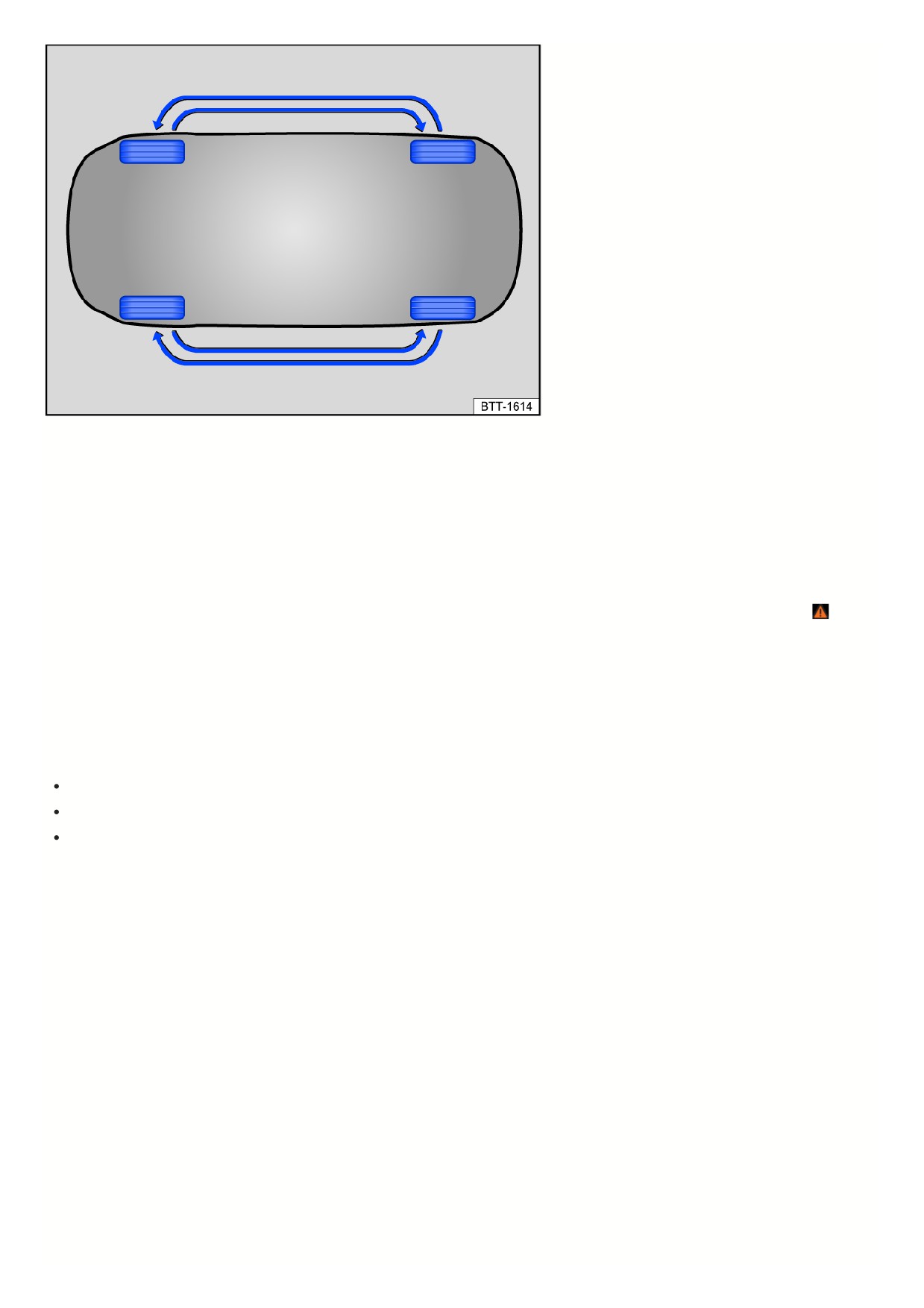
Fig. 171 General example: Diagram for rotating the wheels.
To ensure that the tires wear evenly, rotating the tires regularly according to the diagram is recommended fig. 171. This will allow the tires to have approximately t
same length of service life.
Volkswagen recommends having the wheel replacement carried out by an authorized Volkswagen dealer or authorized Volkswagen Service Facility. Volkswagen
recommends contacting an authorized Volkswagen dealer or authorized Volkswagen Service Facility.
Monitoring the tread depth
Tread depth
Most driving situations require a tire tread that is as deep as possible. All tires, or at least tires on the same axle, must have an even tread depth
⇒ . This app
in particular to wet or wintry road conditions.
In most countries, the legal minimum tread depth is 1.6 mm (1/16 of an inch). This is measured in the tread grooves next to the wear indicators. Observe any legal
regulations specific to the country where you are driving.
Note the legal requirements in the applicable country for minimum tread depths on winter and all-season tires.
Tire wear
Tire wear depends on various factors:
Driving style.
Wheel balancing.
Running gear alignment.
An imbalance can occur while driving, which can be noticed by uneven steering. Tire imbalances also affect tire wear. In these situations, have the wheels balanced
again.
Incorrect wheel alignment impairs driving safety and increases tire wear. If there is high degree of tire wear, have the wheel alignment checked by an authorized
Volkswagen dealer or authorized Volkswagen Service Facility. Volkswagen recommends contacting an authorized Volkswagen dealer or authorized Volkswagen
Service Facility.
Tire Wear when Driving with a Sporty Driving Style
Driving quickly around curves, rapid acceleration, and heavy braking increase tire wear.
If you drive with a sporty driving style, check the tread depth every 5000 to 10,000 km (approx. 3107 to 6214 miles).
Tread wear indicator in tires
299
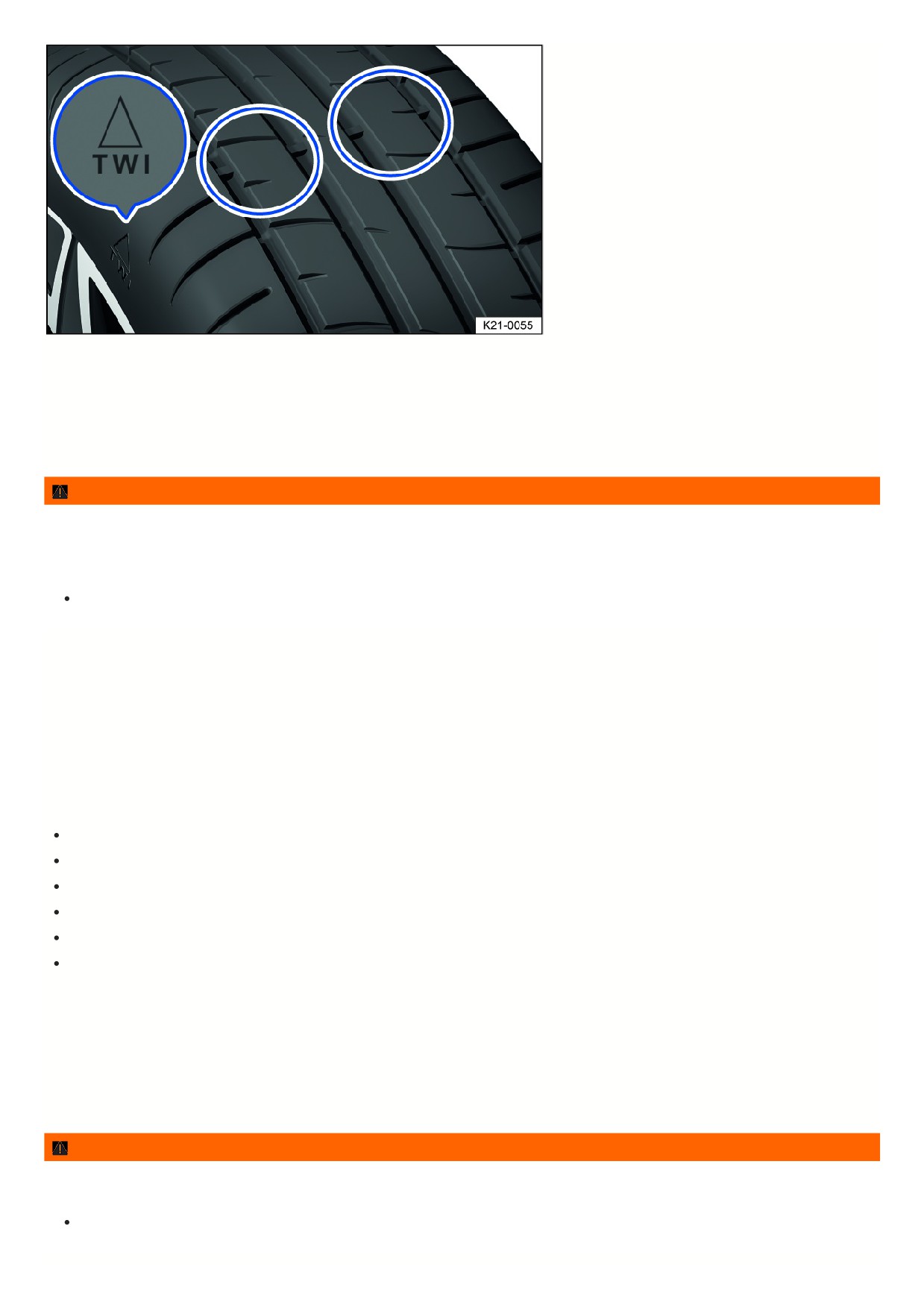
Fig. 172 Tire tread: tread wear indicator.
The tread wear indicator is 1.6 mm (1/16 in) above the base of the tread fig. 172. Markings on the sides of the tire indicate the location of the tread wear indicator
fig. 172.
The tread wear indicator indicates if a tire is worn out. At the latest, the tire must be replaced if the tread depth is worn down to the tread wear indicator.
When you check the tread depth, you must check the wear indicators of all tread grooves
WARNING
Worn tires are a safety risk and make it difficult to control the vehicle well. They increase the braking distance and the risk of skidding.
Worn tires have significantly less grip. Particularly on wet roads, the vehicle is more likely to “hydroplane”.
Worn tires could cause loss of vehicle control, serious accidents and death.
Replace tires with new tires when the tires are worn down to the tread wear indicator.
Wheels and tires in snow and ice
Winter tires
Summer tires offer very little holding force on icy or snowy roads. Winter or all-season tires improve vehicle handling and braking performance in winter road
conditions. Volkswagen recommends using winter tires on the vehicle at temperatures below +7 °C (+45 °F) or in winter road conditions. This also applies to
vehicles with all-wheel drive (4MOTION).
The effectiveness of winter or all-season tires is greatly reduced when the tire tread is worn down to a depth of 3/16 in (4 mm).
The following applies when using winter tires:
Follow all applicable laws in the country of operation.
Use winter tires on all four wheels at the same time.
Only use in winter road conditions.
Only use the tire sizes permitted for the vehicle.
Only use winter tires that have the same belt construction, size, and tread pattern.
Follow the speed restriction based on the speed rating.
Speed restriction
Winter tires have a speed restriction based on their speed rating ⇒ Tire labeling and tire classifications.
A speed warning can be set in the Vehicle settings menu in the Infotainment System under the Tires menu.
On V winter tires, the speed restriction and required tire pressure depend on the engine. Always ask an authorized Volkswagen dealer or authorized Volkswagen
Service Facility about the permitted speed and required tire pressure. Volkswagen recommends contacting an authorized Volkswagen dealer or authorized
Volkswagen Service Facility.
WARNING
In winter road conditions, do not let the improved driving characteristics of winter tires tempt you to take safety risks, as otherwise you may lose control of the
vehicle, resulting in serious injuries.
Adapt your speed and driving style to the visibility, weather, road and traffic conditions.
3

When temperatures are above +7 °C (+45 °F), summer tires provide better vehicle handling. There is less road noise, the tires wear more slowly, and economy
is better.
For vehicles with a Tire Pressure Monitoring System, the system must be recalibrated after changing to winter tires
⇒ How the Tire Pressure Monitoring System
Works.
The speed limit and tire load of winter tires may differ from those of summer tires.
You can contact an authorized Volkswagen dealer or authorized Volkswagen Service Facility for permitted winter tire sizes. Volkswagen recommends
contacting an authorized Volkswagen dealer or authorized Volkswagen Service Facility.
Snow chains
Note the legal requirements and the permitted maximum speed when driving with snow chains.
Snow chains improve driving and braking handling when on roads covered with ice or snow.
Snow chains may only be mounted on the front wheels and only on the following tire/rim combinations:
Tire size
Rim
215/55 R17
7 J x 17 ET45
If possible, use fine-mesh snow chains that include a chain lock no larger than 11 mm (approx. 7/16 in).
Volkswagen recommends contacting an authorized Volkswagen dealer or authorized Volkswagen Service Facility for more information about wheel, tire, and snow
chain sizes. Volkswagen recommends contacting an authorized Volkswagen dealer or authorized Volkswagen Service Facility.
Snow chains may only be used on tire/rim combinations that are approved for snow chain operation.
If using snow chains, remove the wheel covers and rim accent rings before mounting the snow chains. However, the wheel bolts must be covered with caps for
safety reasons. Caps can be obtained from an authorized Volkswagen dealer or authorized Volkswagen Service Facility. Volkswagen recommends contacting an
authorized Volkswagen dealer or authorized Volkswagen Service Facility.
Using snow chains on the compact spare tire or collapsible spare tire
Using snow chains on the compact spare tire or collapsible spare tire is not permitted for technical reasons.
1. If a front tire is flat, mount the compact spare tire or collapsible spare tire on the rear axle.
2. Replace the damaged front wheel with the removed rear wheel. Pay attention to the running direction when doing this.
Volkswagen recommends attaching the snow chains before mounting the wheel.
WARNING
Using unsuitable snow chains or installing snow chains incorrectly can cause serious accidents and death.
Always use the correct snow chains.
Only use snow chains on the tire/rim combinations approved by Volkswagen.
Follow the installation instructions provided by the snow chain manufacturer.
Never drive faster than intended according to the specifications of the snow chain manufacturer or permitted by law when snow chains are mounted.
NOTICE
If snow chains are used on routes that are not snowy, they will impair the driving characteristics, damage the tires, and be quickly destroyed.
Remove snow chains when driving on roads without snow.
NOTICE
Snow chains that come into contact with the rim directly can scratch or damage the rim.
To prevent damage, use snow chains with integrated rim protection.
On vehicles with a Tire Pressure Monitoring System, the system must be reprogrammed after snow chains are mounted
⇒ How the Tire Pressure Monitoring
System Works.
Troubleshooting
Damage to tires and rims can often occur where it is not visible ⇒
3 1

If you suspect that a wheel is damaged, slow down and stop as soon as traffic allows and it is safe to do so.
Vehicle pulls to one side or unusual vibrations
The vehicle pulls to the left or right when driving, or there are unusual vibrations. This could indicate tire damage or too low a tire inflation pressure.
Check the tires!
Slow down immediately and stop the vehicle as soon as the traffic situation allows and it is safe to do so.
1. Check the tires and rims for damage.
2. Do not continue driving if there is tire damage.
3. Replace the damaged wheel ⇒
Introduction. If necessary, contact an authorized Volkswagen dealer or authorized Volkswagen Service Facility for
assistance.
4. If no exterior damage is visible, drive slowly and carefully to the nearest authorized Volkswagen dealer or authorized Volkswagen Service Facility to have the
vehicle checked. Volkswagen recommends contacting an authorized Volkswagen dealer or authorized Volkswagen Service Facility.
Foreign object stuck in the tire
A foreign object is stuck in the tire or between the tread segments.
1. If an object has punctured through to the inside of a tire, leave the object in place. Objects stuck between the tire tread segments can be removed.
2. Replace the damaged wheel ⇒
Introduction. If necessary, contact an authorized Volkswagen dealer or authorized Volkswagen Service Facility for
assistance.
3. Check and adjust the tire pressure.
4. Contact an authorized Volkswagen dealer or authorized Volkswagen Service Facility. Volkswagen recommends contacting an authorized Volkswagen dealer or
authorized Volkswagen Service Facility.
Tires lose traction
The vehicle loses traction when driving along curved stretches, and swerves. The braking distance is longer and the anti-slip regulation (ASR) and the anti-lock
brake system (ABS) take control earlier.
The tire may be too worn down to guarantee sufficient traction ⇒ Monitoring the tread depth.
1. Go slowly and carefully to the nearest suitably qualified professional to have the vehicle checked. Volkswagen recommends contacting an authorized
Volkswagen dealer or authorized Volkswagen Service Facility.
Wheel bolts can only be undone with difficulty
Wheel bolts can corrode over time. This means that the wheel bolts can only be undone with difficulty.
1. Contact professional assistance, or drive slowly and carefully to the nearest qualified professional to have the vehicle checked. Volkswagen recommends
contacting an authorized Volkswagen dealer or authorized Volkswagen Service Facility.
WARNING
Unusual vibrations or the vehicle pulling to one side while driving may indicate tire damage.
Tire damage could cause loss of vehicle control, accidents and serious or fatal injuries.
Slow down immediately and stop the vehicle as soon as the traffic situation allows and it is safe to do so.
Check the tires and rims for damage.
Never continue driving with damaged tires or rims. Instead, seek professional assistance.
If no exterior damage is visible, drive slowly and carefully to the nearest authorized Volkswagen dealer or authorized Volkswagen Service Facility to have
the vehicle checked. Volkswagen recommends contacting an authorized Volkswagen dealer or authorized Volkswagen Service Facility.
Tire Pressure Monitoring System
How the Tire Pressure Monitoring System Works
The Tire Pressure Monitoring System
warns the driver if tire pressures are too
low.
The Tire Pressure Monitoring System uses the ABS sensors to monitor the RPM and therefore the rolling circumference of the individual wheels during travel.
If a tire loses air or the tire pressure is too low, the rolling circumference is reduced and the RPM increases.
The Tire Pressure Monitoring System shows a change in the rolling circumference of the tires via the
indicator light in the instrument cluster.
However, the following situations can also cause changes in the RPM
The tire pressure has changed
3 2

The tire has structural damage
One side of the vehicle has a heavier load than the other
Snow chains are installed on the tires
Only one wheel was replaced on each axle
The Tire Pressure Monitoring System will not work if the ESC or ABS is malfunctioning
⇒ Troubleshooting.
Reference Pressure
The reference pressure for the Tire Pressure Monitoring System is the recommended tire pressure for the tires installed at the factory when the tires are cold at
maximum load. The reference pressure corresponds to the details on the tire pressure label ⇒ Checking the tire pressure.
If the tire pressure has been correctly adjusted on all four tires, the Tire Pressure Monitoring System must be re-calibrated
⇒ Calibrating the Tire Pressure
Monitoring System. This adapts the reference pressure to the current tire pressure.
The Tire Pressure Monitoring System
may not react at first or may not react at all when you are driving in a sporty manner, or on snow-covered or unpaved
roads, when you are driving with snow chains, or in certain other situations. A change in the tread circumference of a tire is signaled by the Tire Pressure Monitoring
System indicator in the instrument cluster (telltale).
The tire pressure recommended for the tires originally installed on the vehicle is on a sticker on the driver door jamb.
Each tire, including the spare (if provided), should be checked monthly when cold and inflated to the inflation pressure recommended by the vehicle manufacturer
on the vehicle placard or tire inflation pressure label. (If your vehicle has tires of a different size than the size indicated on the vehicle placard or tire inflation pressu
label, you should determine the proper tire inflation pressure for those tires).
As an added safety feature, your vehicle has been equipped with a tire pressure monitoring system (TPMS) that illuminates a low tire pressure telltale when one or
more of your tires is significantly under-inflated. Accordingly, when the low tire pressure telltale illuminates, you should stop and check your tires as soon as
possible, and inflate them to the proper pressure. Driving on a significantly under-inflated tire causes the tire to overheat and can lead to tire failure. Under-inflation
also reduces fuel efficiency and tire tread life, and may affect the vehicle's handling and stopping ability.
Please note that the TPMS is not a substitute for proper tire maintenance, and it is the driver's responsibility to maintain correct tire pressure, even if under-inflation
has not reached the level to trigger illumination of the TPMS low tire pressure telltale.
Your vehicle has also been equipped with a TPMS malfunction indicator to indicate when the system is not operating properly. The TPMS malfunction indicator is
combined with the low tire pressure telltale. When the system detects a malfunction, the telltale will flash for approximately one minute and then remain continuousl
illuminated. This sequence will continue upon subsequent vehicle start-ups as long as the malfunction exists.
When the malfunction indicator is illuminated, the system may not be able to detect or signal low tire pressure as intended. TPMS malfunctions may occur for a
variety of reasons, including the installation of replacement or alternate tires or wheels on the vehicle that prevent the TPMS from functioning properly. Always
check the TPMS malfunction telltale after replacing one or more tires or wheels on your vehicle to ensure that the replacement or alternate tires and wheels allow th
TPMS to continue to function properly.
WARNING
The Tire Pressure Monitoring System is not a replacement for the driver's attention and works only within the system limitations. The Tire Pressure Monitoring
System cannot detect all driving situations and may not react, or may react with a delay, or may react in a way that is not desired. If you are careless, there is a
risk of accidents, serious injuries and death.
Always stay attentive and do not rely solely on the Tire Pressure Monitoring System. The driver is always responsible for adhering to the correct tire
inflation pressure.
Observe the system limitations ⇒ Limitations of the Tire Pressure Monitoring System .
Regularly check the tire pressure when the tires are cold and always maintain the specified pressures as stated on the tire inflation pressure label for the
tires fitted on the vehicle ⇒ Checking the tire pressure.
Check the tires regularly for signs of wear or damage and replace worn or damaged tires immediately.
Never exceed the maximum permissible speed and tire load specified for the tires fitted to your vehicle.
WARNING
Driving with too low a tire inflation pressure could cause the tire to become so hot that the tread could separate, the tire could rupture, and you could lose control
of the vehicle.
Tire pressure that is too high or too low shortens the service life of the tire and affects driving behavior.
Different tire pressures or low tire pressures can increase tire wear, decrease vehicle stability, increase braking distance, and result in tire damage, tire failure
and loss of vehicle control.
This can cause serious accidents and fatal injuries.
Always pay attention to the warnings given by the Tire Pressure Monitoring System. If the
indicator light turns on, stop the vehicle immediately where
it is safe to do so and check all tires ⇒ Checking the tire pressure.
3 3

The driver is responsible for maintaining the correct tire pressure. Regularly check the tire pressure when the tires are cold and always maintain the
specified pressures as stated on the tire inflation pressure label for the tires fitted on the vehicle ⇒ Checking the tire pressure. The Tire Pressure
Monitoring System (TPMS) can only function correctly when all tires are inflated to the correct pressure when they are cold.
If the tire is not “flat” and the tire does not need to be replaced immediately, drive slowly to the nearest authorized Volkswagen dealer or authorized
Volkswagen Service Facility to have the tire pressure checked and corrected ⇒ Checking the tire pressure . Volkswagen recommends contacting an
authorized Volkswagen dealer or authorized Volkswagen Service Facility.
Always set up the Tire Pressure Monitoring System correctly .
WARNING
Excessive speeds and vehicle overloading can cause overheating, sudden tire damage (including tire blow-outs) and separation of the tread.
This can cause accidents and fatal injuries.
Never exceed the maximum load for the tires fitted
⇒ Tire labeling and tire classifications .
Never exceed the maximum permitted speed for the tires fitted
⇒ Tire labeling and tire classifications .
Low tire pressure increases fuel consumption and tire wear.
New tires may expand slightly the first time they are driven at high speeds, which can trigger a tire pressure warning.
Only replace old tires with tires that have been approved by Volkswagen for the vehicle model.
Do not rely on the Tire Pressure Monitoring System alone. Inspect the tires regularly to make sure the tire pressure is correct and check the tires for any signs of
damage, such as punctures. Remove any objects stuck in the tire tread as long as they have not punctured the inside of the tire.
Limitations of the Tire Pressure Monitoring System
Regular Maintenance
The Tire Pressure Monitoring System is not intended to replace regular inspection and maintenance of the tires. The driver is responsible for ensuring that the
correct tire pressure is used at all times, even if the Tire Pressure Monitoring System is not showing a warning that the tire pressure is too low.
The tire pressure of all tires must be checked once a month when the tires are cold and must correspond to the vehicle manufacturer's specifications on the tire
inflation pressure label.
This also applies to the tire pressure of the spare wheel or compact spare wheel.
The recommended tire pressure for the tires installed at the factory is specified on the tire inflation pressure label
⇒ Checking the tire pressure .
Unresolved Malfunctions
If the Tire Pressure Monitoring System displays a malfunction, the tire pressure cannot be monitored correctly. A malfunction in the Tire Pressure Monitoring System
can have a number of causes, e.g. a wheel or a tire being replaced. After replacing a wheel or tire, you must check whether the
indicator light displays a system
malfunction to make sure that the Tire Pressure Monitoring System is working properly ⇒ Troubleshooting the Tire Pressure Monitoring System .
Sporty driving
The Tire Pressure Monitoring System may be delayed or not be displayed at all when driving with a sporty style, on winter or unpaved roads, or when driving with
snow chains.
Calibrating the Tire Pressure Monitoring System
The Tire Pressure Monitoring System must be recalibrated under the following conditions:
If the tire pressures were adjusted.
If one or more wheels were changed.
If one or more wheels were repaired.
If the wheels were rotated, for example from front to rear.
The Tire Pressure Monitoring System must only be recalibrated if all tires are inflated to the correct pressure when they are cold. In order to measure the tire
pressure on cold tires, the vehicle must be left to stand for 3 hours or only be driven slowly over short distances during this time.
After being warned about a low tire pressure, switch the ignition off and back on. The Tire Pressure Monitoring System can only be recalibrated after this is
done.
1. Switch the ignition on.
2. Depending on the vehicle equipment, press the
button or function key and open the Vehicle menu in the Infotainment system
⇒ Vehicle settings menu
Or: depending on the vehicle equipment, press the
button or function key.
3. Tap Settings if this key is available.
3 4

4. Tap Tires .
5. Tap SET.
6. If all four tires meet the required tire pressure values, tap Confirm .
After travel times of at least 20 minutes and at different vehicle speeds, the system adapts to the new values and monitors them.
WARNING
If the Tire Pressure Monitoring System has been calibrated with a tire pressure that is too high or low, the Tire Pressure Monitoring System may give false
warnings or fail to give a warning when the tire pressure is dangerously low.
Ensure that the tire pressure is correct on all wheels before calibrating the Tire Pressure Monitoring System.
Troubleshooting the Tire Pressure Monitoring System
Tire pressure low
The yellow indicator light turns on.
The tire pressure of one or more tires has decreased or the tire is structurally damaged.
1.
Stop the vehicle immediately where it is safe to do so.
2. Check the tires for visible damage.
3. If there is no visible damage on the tires, drive at reduced speed to the nearest gas station and check the tire pressure. Adjust it if necessary.
4. If one of the tires is damaged, change the damaged wheel
⇒ Wheel change. If necessary, contact an authorized Volkswagen dealer or authorized Volkswagen
Service Facility for assistance.
5. Recalibrate the Tire Pressure Monitoring System ⇒ How the Tire Pressure Monitoring System Works .
6. If the malfunction persists, contact a suitably qualified professional. Volkswagen recommends contacting an authorized Volkswagen dealer or authorized
Volkswagen Service Facility.
Tire Pressure Monitoring System malfunction
The yellow indicator light flashes for approximately one minute and then stays on.
There is a system malfunction.
1.
Do not continue driving!
2. Switch the ignition off and back on again.
3. Recalibrate the Tire Pressure Monitoring System ⇒ How the Tire Pressure Monitoring System Works .
4. If the malfunction persists, contact a suitably qualified professional. Volkswagen recommends contacting an authorized Volkswagen dealer or authorized
Volkswagen Service Facility.
Driving on unpaved roads for a long period of time or sporty driving can deactivate the Tire Pressure Monitoring System temporarily. If there is a malfunction,
the indicator light flashes for approximately one minute and then stays on. However, the indicator light will turn off if the road conditions or driving style
changes.
Wheel change
Introduction
Only change the wheel yourself if the vehicle is parked securely, you are familiar with the safety precautions and the necessary procedures and you have the
necessary tools. Some vehicles are delivered from the factory without a vehicle jack and lug wrench. In such cases, have the wheel changed by an authorized
Volkswagen dealer or authorized Volkswagen Service Facility. Volkswagen recommends contacting an authorized Volkswagen dealer or authorized Volkswagen
Service Facility.
The vehicle jack supplied by the factory is only designed for changing one wheel that has a damaged tire and must be replaced. If both tires on one side of the
vehicle, both tires on one axle, or all tires are damaged, contact an authorized Volkswagen dealer or authorized Volkswagen Service Facility for assistance.
Volkswagen recommends contacting an authorized Volkswagen dealer or authorized Volkswagen Service Facility.
You must carry out the following steps to change a wheel.
1. Prepare the vehicle for the wheel change ⇒ Preparing Your Vehicle.
2. Depending on the vehicle and vehicle equipment, remove the subwoofer ⇒ Removing and Installing the Subwoofer.
3. Take out the spare wheel ⇒ Removing the spare wheel or compact spare wheel .
4. Remove the wheel hub cover or wheel bolt caps ⇒ Removing and Fitting Wheel Hub Covers, ⇒ Removing and Fitting Hubcaps, ⇒ Removing and Fitting the
Wheel Bolt Caps.
3 5

5. Loosen the wheel bolts ⇒ Loosening wheel bolts.
6. Jack up the car ⇒ Raising the vehicle with the vehicle jack .
7. Remove the damaged wheel and fit the spare wheel or compact spare wheel
⇒ Changing a wheel .
WARNING
It can be dangerous to change a wheel at the roadside.
If the vehicle and work area are not secured properly, serious accidents and fatal injuries may occur.
Only carry out the wheel change yourself if you are familiar with the necessary steps. Instead, seek assistance from an authorized Volkswagen dealer or
authorized Volkswagen Service Facility. Volkswagen recommends contacting an authorized Volkswagen dealer or authorized Volkswagen Service
Facility.
Stop the vehicle as soon as it is safe to do so.
Park the vehicle a safe distance from moving traffic.
Always switch off the engine and move the selector lever to the P position to reduce the risk of the vehicle moving unintentionally.
Set the electronic parking brake.
Move all passengers, particularly children, to a safe distance away from the working area on the side facing away from moving traffic.
Switch on the emergency flashers to warn other road users and set up the warning triangle.
Only jack up the vehicle on level, firm ground. Sloped or soft ground can cause the vehicle to slip off the jack. If necessary, place a large, stable surface
under the jack.
If you are on a slippery surface such as tile, place a non-slippery object such as a rubber mat on the ground to prevent the jack from slipping.
Only use suitable and undamaged tools for wheel changes.
After changing a wheel, immediately check the tightening torque of the wheel bolts with an undamaged torque wrench that is functioning correctly.
If your vehicle is equipped with a Tire Pressure Monitoring System, you must recalibrate the system immediately after a wheel is changed
⇒ How the
Tire Pressure Monitoring System Works.
Preparing Your Vehicle
Please read the introductory information and heed the Warnings and Notice ⇒
Introduction.
Checklist
Always perform the following steps in the specified order to prepare for a wheel change
⇒
:
1. Park the vehicle a safe distance from moving traffic. Observe all important information on parking when doing so
⇒ Parking. The ground must be level and firm
Sloped or soft ground can cause the vehicle to slip off the jack. If necessary, place a large, stable surface under the vehicle jack.
2. Switch on the emergency flashers ⇒ Center console.
3. Have all vehicle occupants exit the vehicle on the side facing away from traffic and move to a safe area, such as behind a guard rail. Follow the local regulation
regarding wearing a reflective vest.
4. Set up the warning triangle to warn others on the road about the vehicle.
5. Adjust the steering wheel so that the wheels are not pointing straight forward.
6. Block the tire that is diagonal from the one you will be changing with a stone, chocks, or another suitable object.
7. If the luggage compartment is full: remove the contents from the luggage compartment.
8. Remove the collapsible spare wheel, full-size spare wheel or compact spare wheel and the vehicle tool kit from the luggage compartment.
WARNING
Failing to heed this checklist that is provided for your own safety can cause accidents and serious injuries.
Always follow the tasks in the checklist.
Observe the general safety precautions.
Removing and Installing the Subwoofer
Please read the introductory information and heed the Warnings and Notice ⇒
Introduction.
The subwoofer must be removed before the spare wheel can be removed.
Removing the subwoofer (version 1)
3 6
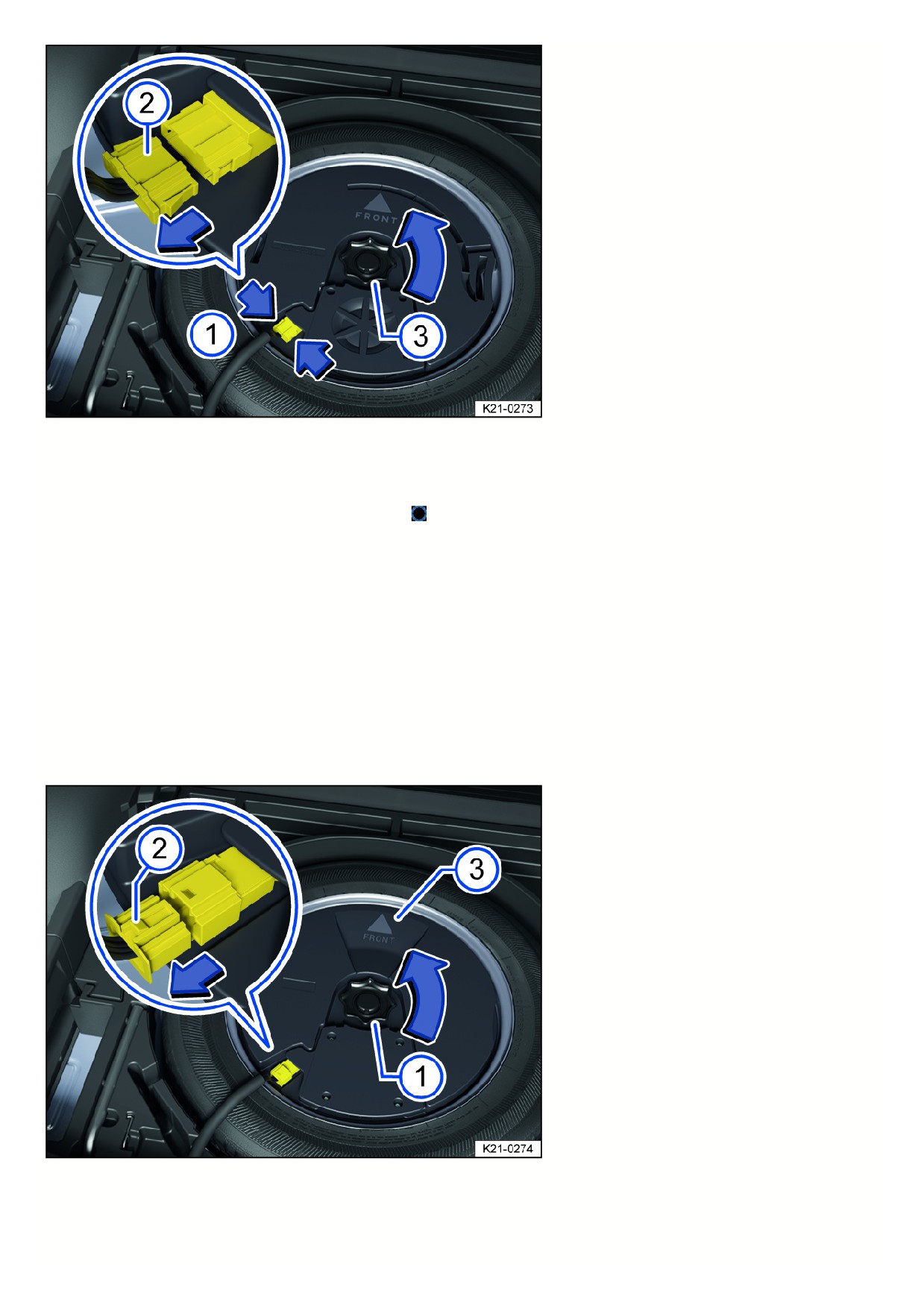
Fig. 173 In the luggage compartment: removing the subwoofer (version 1).
1. Open the trunk lid.
2. Lift up or remove the luggage compartment floor.
3. To release the connector, press the fig. 173 lugs together (arrows
).
4. Remove the connector fig. 173 in the direction of the arrow and set the removed wire to the side.
5. Unscrew the handwheel fig. 173 in the direction of the arrow.
6. Lift the subwoofer out carefully.
Installing the subwoofer (version 1)
1. Place the subwoofer carefully in the rim well. The point of the “FRONT” arrow symbol on the subwoofer must face forward.
2. Push the connector fig. 173 in until you hear it click into place.
3. Turn the handwheel fig. 173 on the threaded pin in the opposite direction to the arrow until the subwoofer is securely fastened.
4. Reinsert the luggage compartment floor or fold back down.
5. Close the trunk lid.
Removing the subwoofer (version 2)
Fig. 174 In the luggage compartment: removing the subwoofer (version 2).
1. Open the trunk lid.
2. Lift the variable luggage compartment floor until it can be held by the side retainers.
3. Unscrew the handwheel fig. 174 in the direction of the arrow.
3 7
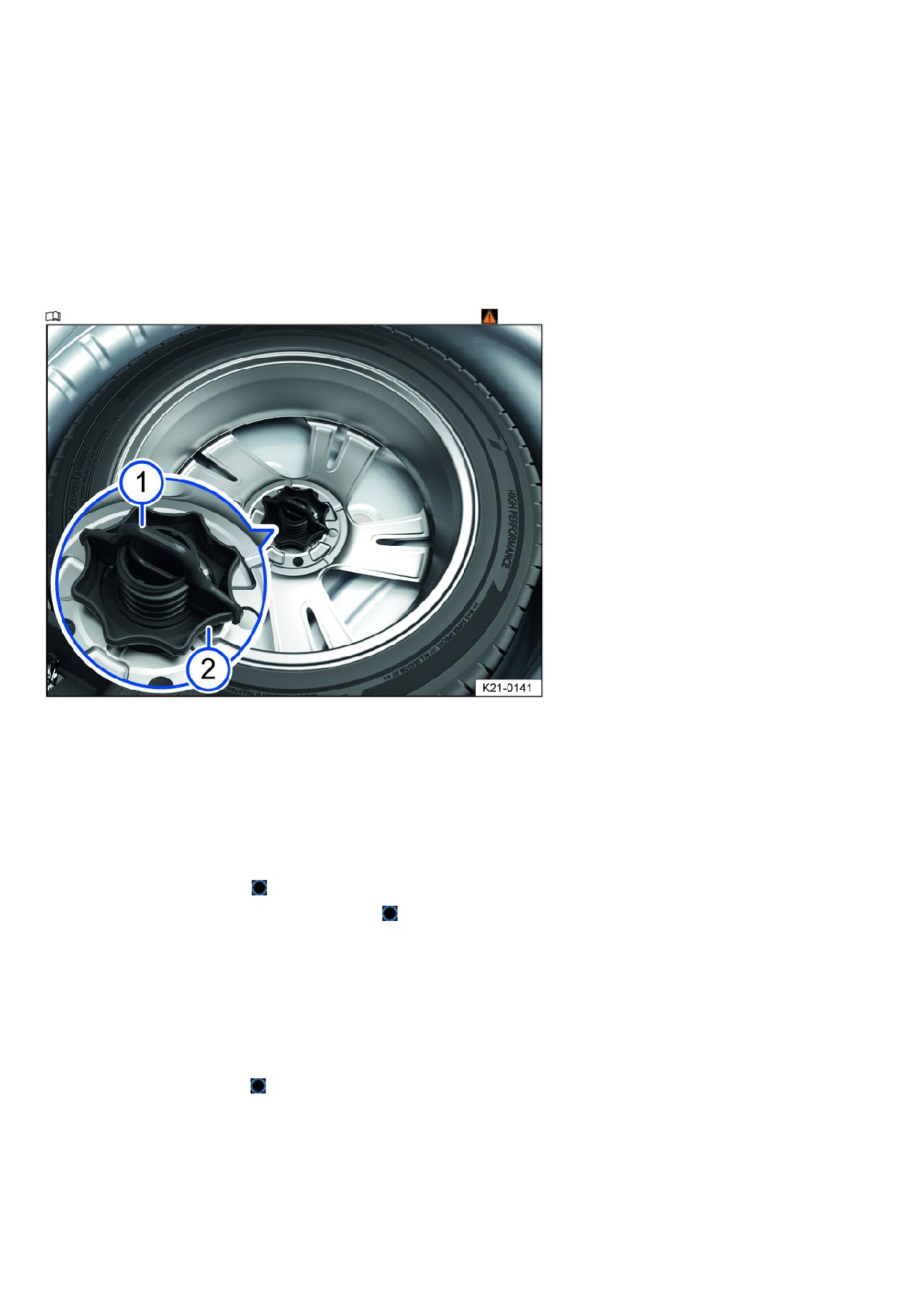
4. To release the connector, press the locking mechanism on the end of the connector fig. 174.
5. Remove the connector in the direction of the arrow and set the removed wire to the side.
6. Lift the subwoofer out carefully.
Installing the subwoofer (version 2)
1. Place the subwoofer carefully in the rim well. The point of the “FRONT” fig. 174 arrow symbol on the subwoofer must face forward
2. Connect the connector until the lock fig. 174 latches into place.
3. Turn the handwheel fig. 174 on the threaded pin in the opposite direction to the arrow until the subwoofer is securely fastened.
4. Place the variable luggage compartment floor on the floor cover.
5. Close the trunk lid.
Removing the spare wheel or compact spare wheel
Please read the introductory information and heed the Warnings and Notice ⇒
Introduction.
Fig. 175 In the luggage compartment: Handle to secure the spare wheel or compact spare wheel.
Removing the spare wheel or compact spare wheel
1. Open the trunk lid.
2. Lift up or remove the luggage compartment floor.
3. Lift up the floor covering and remove it.
4. Remove the vehicle tool kit with the container.
5. Depending on the vehicle and vehicle equipment, remove the subwoofer ⇒ Removing and Installing the Subwoofer.
6. Remove the locking wedge fig. 175
upward.
7. Turn the handwheel in the center of the spare wheel fig. 175
all the way counterclockwise.
8. Remove the spare wheel or compact spare wheel.
Stowing the removed tire
1. If the removed wheel fits in the spare wheel well: place the removed wheel with the front of the rim facing down into the spare wheel well so that the center hole
on the rim is directly above the hole or the threaded pin.
If the removed wheel does not fit in the spare wheel well, the wheel must be securely stowed in the luggage compartment on the luggage compartment floor.
2. Turn the handwheel clockwise on the threaded pin until the removed wheel is securely fastened.
3. Position the locking wedge fig. 175
in the slot on the threaded pin so that the handwheel cannot turn.
4. Place the vehicle tool kit back in the container and stow it in the luggage compartment.
5. Place the carpet (if there is one) in the luggage compartment.
6. Reinsert or fold back down the luggage compartment floor.
7. Close the trunk lid.
If the spare wheel is different from the regular tires
If the spare wheel is different from the regular wheels, then the spare wheel must only be used in the event of a vehicle breakdown and only for a short period of
3 8
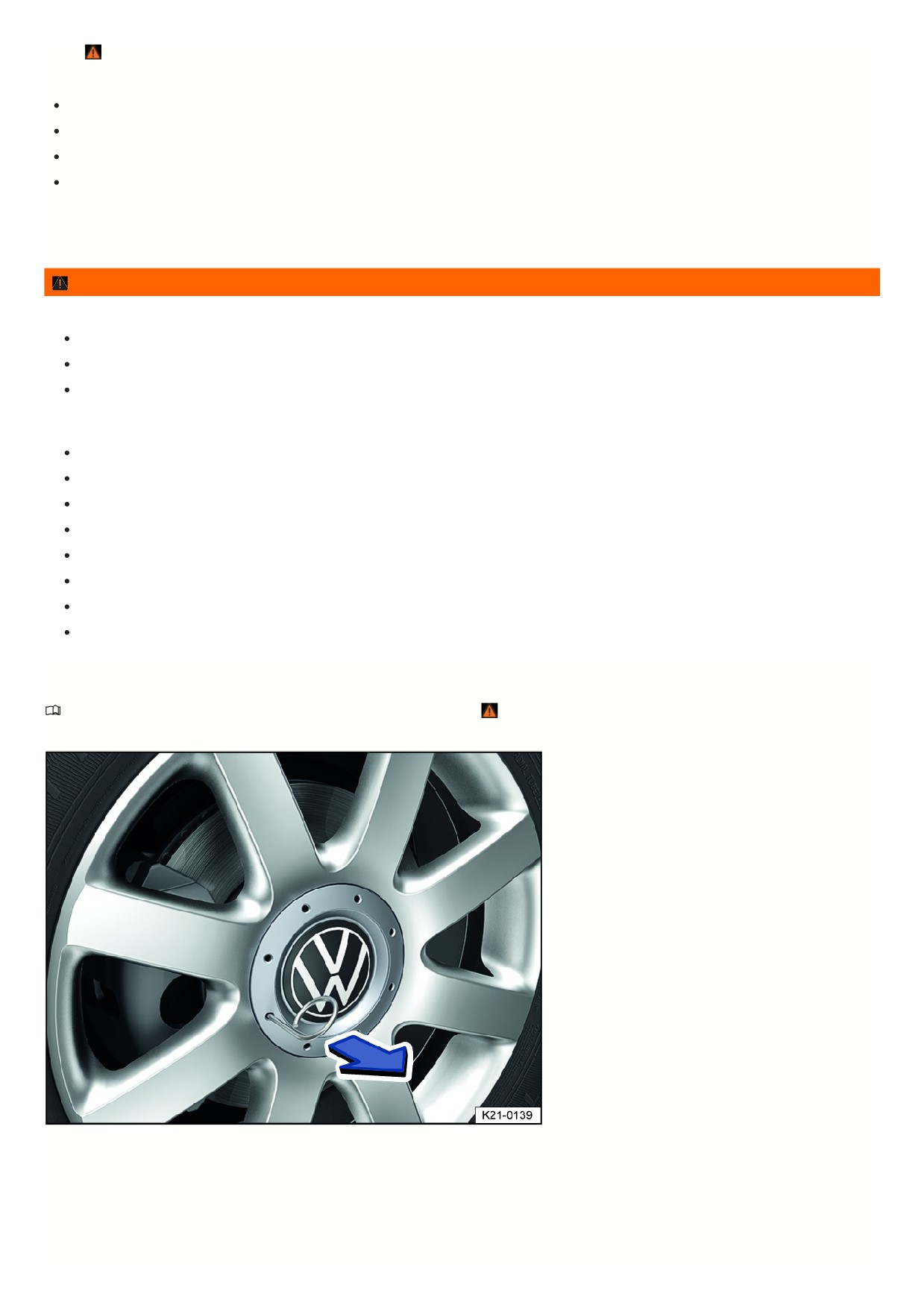
time ⇒
Note the driver information:
Do not drive faster than 80 km/h (50 mph).
Avoid hard acceleration, heavy braking, and fast cornering.
Do not use snow chains on the compact spare wheel ⇒ Snow chains.
After installing the spare wheel or compact spare wheel, check the tire pressure as soon as possible
⇒ Checking the tire pressure .
The tire pressure of the spare wheel or compact spare wheel must be checked every time the tire pressure of the regular wheels is taken, or at least once a month.
The tire pressure of the spare wheel or compact spare wheel when the tires are cold must correspond to the details on the tire inflation pressure label ⇒ Checking
the tire pressure.
WARNING
Incorrect handling of the spare wheel or compact spare wheel can result in loss of vehicle control, serious accidents or death.
Never use the spare wheel or compact spare wheel if it is damaged or if it is worn down to the wear indicator.
If the spare wheel is different from the regular wheels or you are using a compact spare wheel, never drive faster than 80 km/h (50 mph).
Some vehicles may be equipped with a compact spare wheel instead of a spare wheel. The compact spare wheel can be identified by a label stating
“80 km/h” or “50 mph”. This label indicates the permitted maximum speed at which the tire may be driven. Do not cover the sticker while the wheel is in
use.
Never drive more than 200 km (125 miles) with a temporary compact spare wheel fitted to the drive axle.
Avoid hard acceleration, hard braking, and driving fast around curves.
Replace the compact spare wheel as soon as possible with a regular wheel. The spare wheel is only intended for short-term use.
Always secure the compact spare wheel with the wheel bolts supplied by the factory.
Never drive with more than one compact spare wheel.
Never drive with more than one spare wheel that differs from the regular tires.
After mounting the spare wheel or compact spare wheel, check the tire pressure as soon as possible
⇒ Checking the tire pressure .
Do not use snow chains on the compact spare wheel.
Removing and Fitting Hubcaps
Please read the introductory information and heed the Warnings and Notice ⇒
Introduction.
Removing Hubcaps
Fig. 176 Remove the hubcap.
The wheel center trim is for protecting the wheel bolts and must be reattached after a wheel change.
1. Take the extraction hook out of the vehicle toolkit ⇒ Vehicle tool kit components and insert it into a hole (alloy wheel) or hook it onto the edge (steel wheel) of
the hubcap fig. 176.
2. Remove the trim in the direction of the arrow fig. 176.
3 9
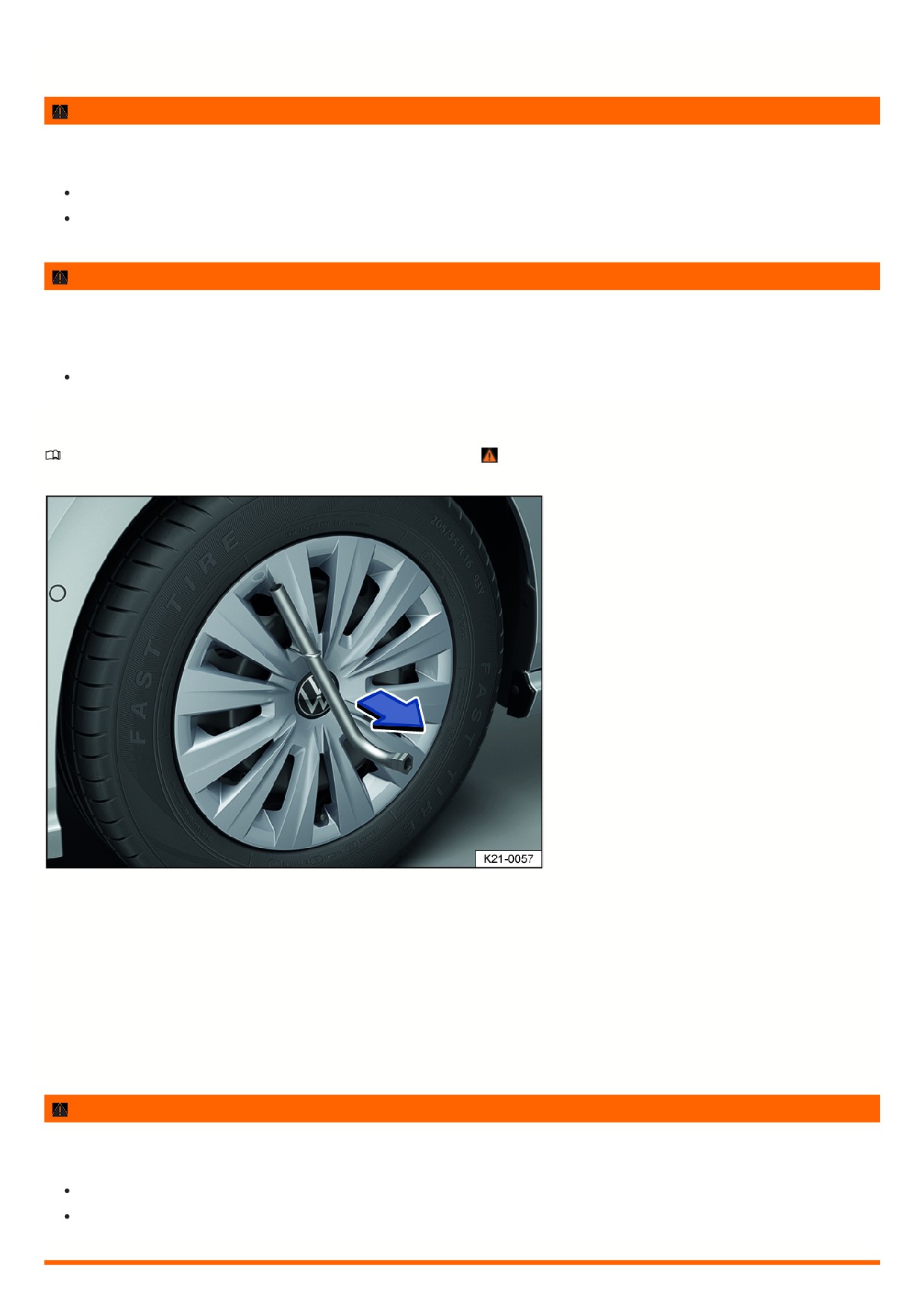
Fitting Hubcaps
1. Press the hubcap centrally onto the rim and press it against the rim until it you feel it engage.
WARNING
Unsuitable wheel covers and assembling wheel covers incorrectly can cause accidents and serious injuries.
Wheel covers that are installed incorrectly can loosen while driving and endanger other road users.
Do not use damaged hubcaps.
Check whether the hubcap is securely engaged all the way around.
WARNING
Hubcaps that are installed incorrectly can cause the air supply for cooling the brakes to be interrupted or reduced. This also applies when wheel covers are
retrofitted. An insufficient air supply can cause the braking distance to increase significantly.
This can cause accidents and fatal injuries.
Check whether the hubcap is securely engaged all the way around.
Removing and Fitting Wheel Hub Covers
Please read the introductory information and heed the Warnings and Notice ⇒
Introduction.
Removing wheel hub covers
Fig. 177 Remove the wheel hub cover.
The full wheel covers protect the wheel bolts and must be reattached after a wheel change.
1. Take the extraction hook out of the vehicle tool kit ⇒ Vehicle tool kit components.
2. Engage the extraction hook in one of the openings on the wheel hub cover.
3. Remove the wheel hub cover with extraction hook in the direction of the arrow. If necessary, use a lug wrench for removal fig. 177.
Installing the full wheel cover
1. Make sure the anti-theft wheel bolts are positioned correctly ⇒ Changing a wheel.
2. Press the full wheel cover onto the rim so that the opening for the valve aligns with the tire valve. Make sure that the entire outer edge of the cover is secured.
WARNING
Unsuitable wheel covers and assembling wheel covers incorrectly can cause accidents and serious injuries.
Wheel covers that are installed incorrectly can loosen while driving and endanger other road users.
Do not use damaged hubcaps.
Check whether the wheel hub cover is securely engaged all the way around.
31
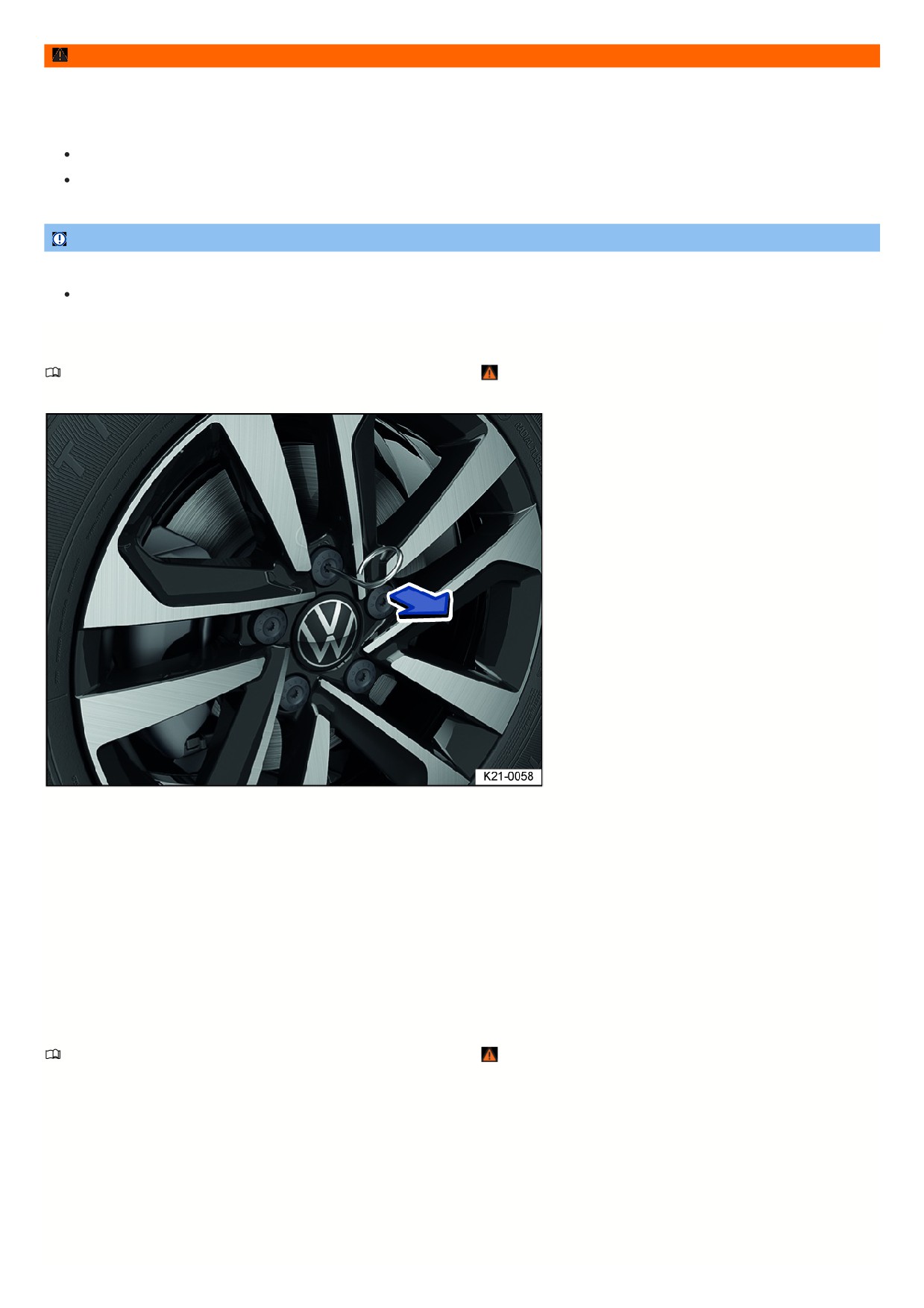
WARNING
Hubcaps that are installed incorrectly can cause the air supply for cooling the brakes to be interrupted or reduced. This also applies when wheel covers are
retrofitted. An insufficient air supply can cause the braking distance to increase significantly.
This can cause accidents and fatal injuries.
Check whether the cut-out for the tire valve in the wheel hub cover is in the right position.
Check whether the wheel hub cover is securely engaged all the way around.
NOTICE
The wheel hub cover might be screwed on tightly and may be damaged if it is pulled off.
Do not use force to remove tightly screwed wheel hub covers.
Removing and Fitting the Wheel Bolt Caps
Please read the introductory information and heed the Warnings and Notice ⇒
Introduction.
Removing the Caps
Fig. 178 Remove the caps from the wheel bolts.
The caps are for protecting the wheel bolts and must be completely reattached after a wheel change.
1. Take the extraction hook out of the vehicle tool kit ⇒ Vehicle tool kit components.
2. Insert the extraction hook into the opening in the cap.
3. Remove the cap with extraction hook in the direction of the arrow fig. 178.
Putting on Caps
1. Push the cap all the way onto the wheel bolts.
The anti-theft wheel bolt has a separate cap. This cap only fits on the anti-theft wheel bolt and not on conventional wheel bolts.
Loosening wheel bolts
Please read the introductory information and heed the Warnings and Notice ⇒
Introduction.
311
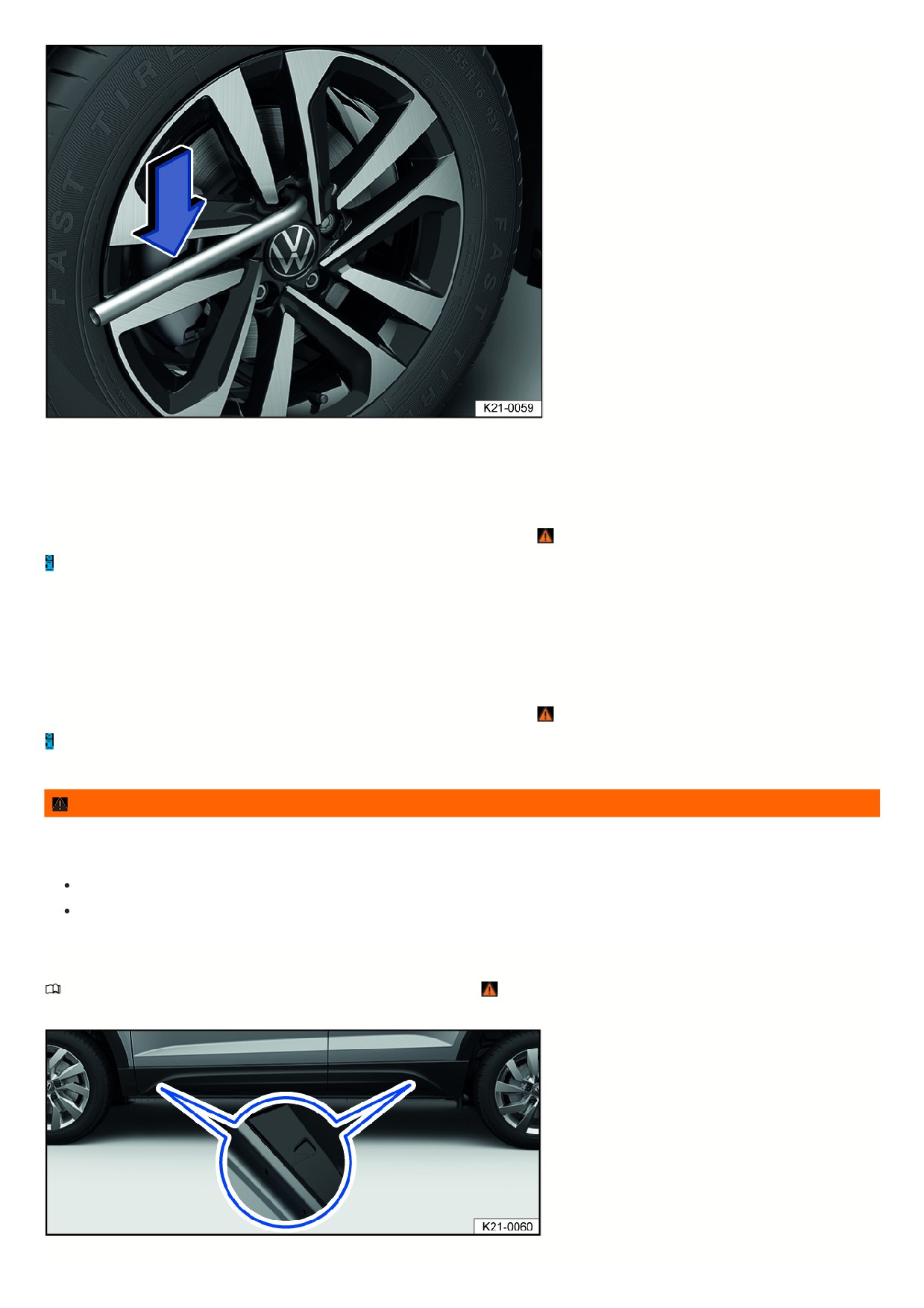
Fig. 179 Changing a tire: loosening the wheel bolts.
Use a suitable lug wrench to loosen the wheel bolts.
Only loosen the wheel bolts a few turns while the vehicle is not raised with the vehicle jack.
1. Slide the lug wrench all the way onto the wheel bolt.
2. Hold the end of the lug wrench and turn the wheel bolt about one turn counterclockwise
⇒
If a wheel bolt cannot be loosened, carefully press on the end of the lug wrench using your foot. Hold onto the vehicle firmly while doing this and make sure
you have secure footing.
Loosening anti-theft wheel bolts
1. Remove the adapter for anti-theft wheel bolts from the vehicle tool kit.
2. Slide the adapter all the way onto the anti-theft wheel bolt.
3. Slide the lug wrench all the way onto the adapter.
4. Hold the end of the lug wrench and turn the wheel bolt about one turn counterclockwise
⇒
If a wheel bolt cannot be loosened, carefully press on the end of the lug wrench using your foot. Hold onto the vehicle firmly while doing this and make sure
you have secure footing.
WARNING
If the wheel bolts are removed or loosened by more than one rotation before the vehicle is jacked up, the wheel could fall off and the vehicle might tip.
This can result in serious injuries.
Only loosen the wheel bolts about one turn while the vehicle is not lifted with the jack.
Never place any part of your body, such as your arm, under the vehicle while you loosen the wheel bolts.
Raising the vehicle with the vehicle jack
Please read the introductory information and heed the Warnings and Notice ⇒
Introduction.
Lift points
Fig. 180 Mounting points for the vehicle jack.
312
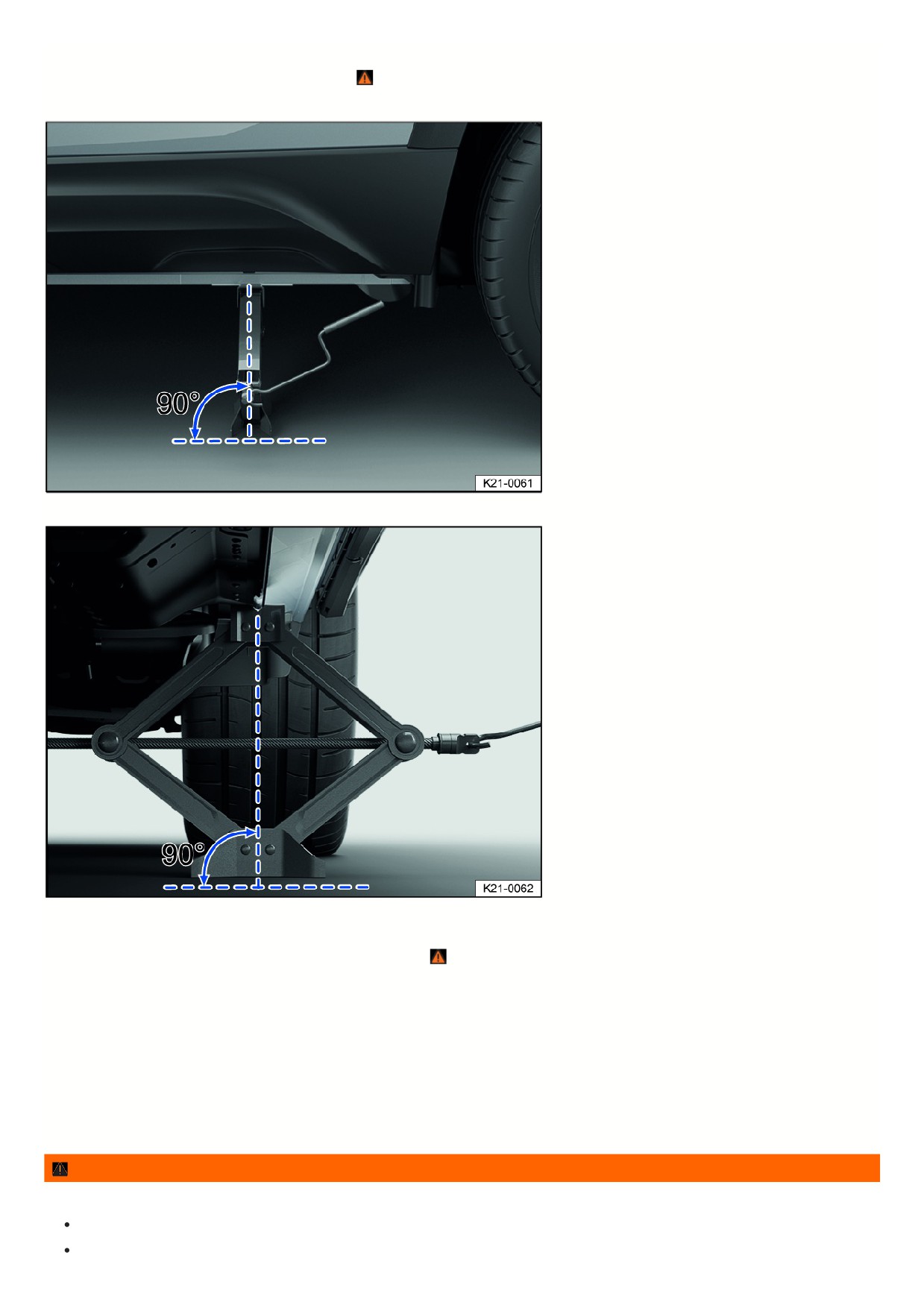
The vehicle jack must only be positioned at the reinforced areas on the underbody that are located behind the markings on the vehicle body fig. 180. Always use
the lift point that is nearest to the wheel you are changing ⇒
Positioning the vehicle jack
Fig. 181 Correct jack setup.
Fig. 182 Xack is positioned on the left side of the vehicle at the rear.
Checklist
For your own safety, follow the points below in the order they are given
⇒
:
1. Position the hand crank in the mount on the jack.
2. Find the vehicle lift point fig. 180 under the vehicle that is closest to the wheel you will be changing.
3. Crank the jack upward so that it is still positioned under the vehicle lift point.
4. Make sure the entire base of the jack is seated securely on the ground and that the base of the jack is located exactly directly below the lift point fig. 181 and
fig. 182.
5. Straighten the jack and continue cranking the claw on the top of the jack upward until the claw is positioned on the jacking point under the vehicle fig. 182.
6. Continue raising the vehicle jack until the wheel is lifted off the ground.
WARNING
Failing to heed this checklist that is provided for your own safety can cause accidents and serious injuries.
Always follow the tasks in the checklist.
Observe the general safety precautions.
313
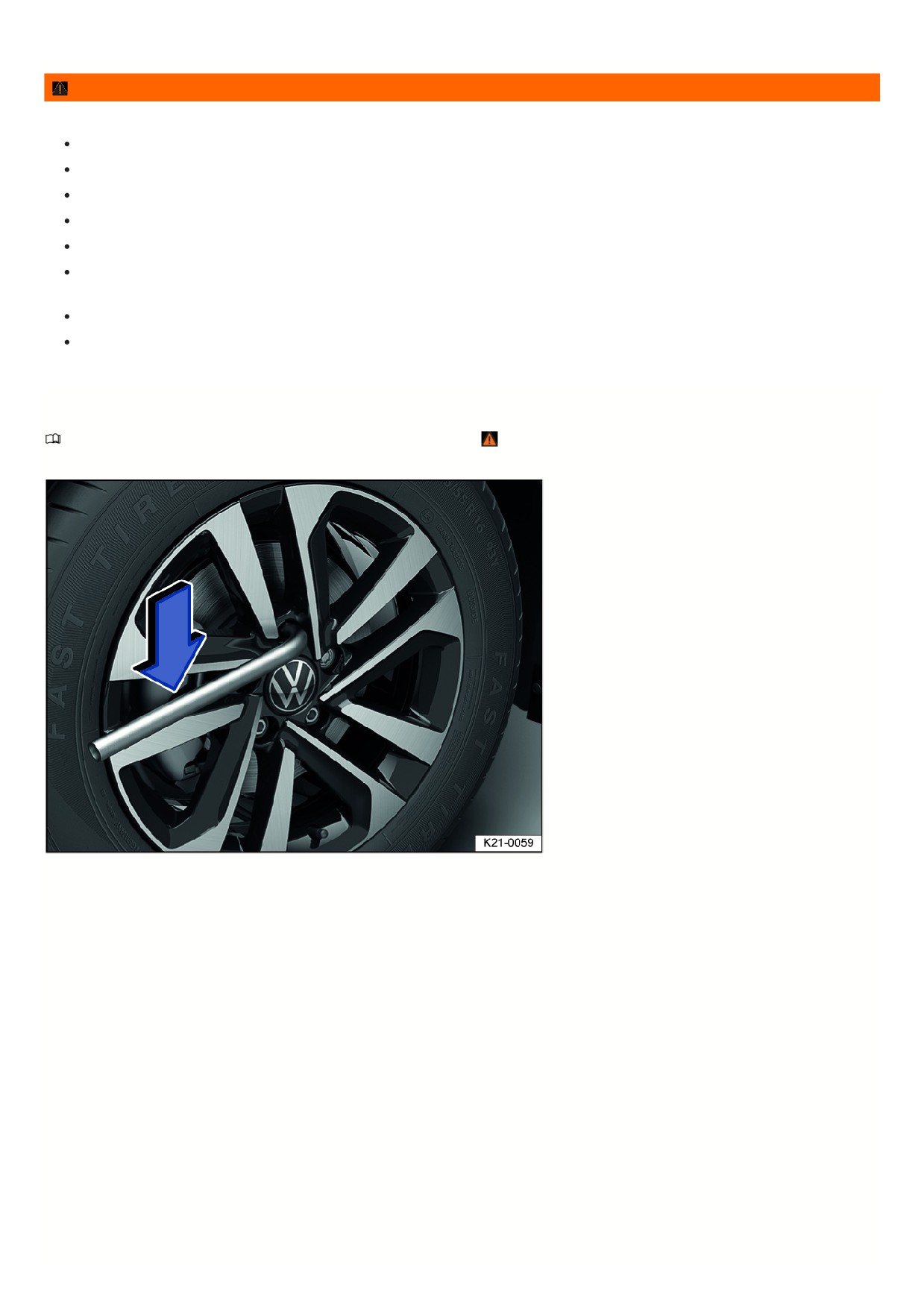
WARNING
Using the vehicle jack incorrectly can result in the vehicle slipping from the jack and cause serious or fatal injuries.
Never raise the vehicle if more than one tire is damaged.
Never jack up the vehicle when the engine is running.
Never allow the engine to be started if the vehicle is raised. Engine vibrations could cause the vehicle to fall off the jack.
Only place the vehicle jack at the lift points described. The bracket on the vehicle jack must firmly grip the sill fig. 182.
Only use jacks that are approved by Volkswagen for the vehicle. Other vehicle jacks, including those approved for other Volkswagen models, could slip.
Only jack up the vehicle on level, firm ground. Sloped or soft ground can cause the vehicle to slip off the jack. If necessary, place a large, stable surface
under the jack.
If you are on a slippery surface such as tile, place a non-slippery object such as a rubber mat on the ground to prevent the jack from slipping.
Never place any part of your body, such as your arm, under the vehicle when it is supported only by the jack. If you must work underneath the vehicle,
additionally support the vehicle securely with suitable stands.
Changing a wheel
Please read the introductory information and heed the Warnings and Notice ⇒
Introduction.
Removing a wheel
Fig. 183 Wheel change: removing wheel bolts with the lug wrench.
1. Follow the checklist ⇒ Preparing Your Vehicle.
2. Loosen the wheel bolts ⇒ Loosening wheel bolts.
3. Raise the vehicle ⇒ Raising the vehicle with the vehicle jack .
4. Remove loose wheel bolts completely using the lug wrench fig. 183 and place the bolts on a clean surface.
5. Remove the wheel.
Installing a spare wheel or compact spare wheel
314
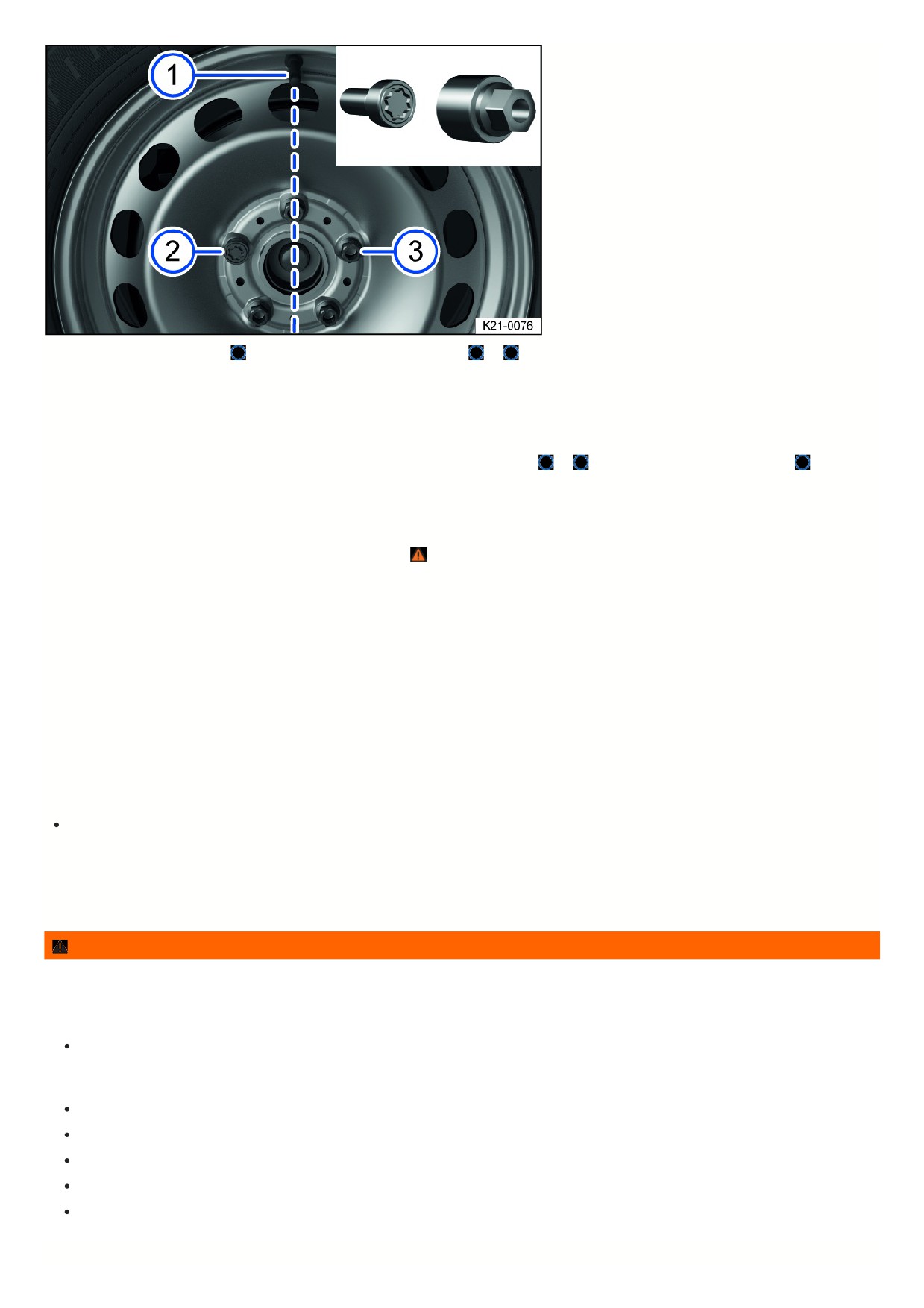
Fig. 184 Changing a tire: tire valve
and locations of the anti-theft wheel bolt
or
1. Note the running direction of the tire ⇒ Tire labeling and tire classifications.
2. Position the wheel.
3. Install the anti-theft wheel bolt clockwise using the adapter in the correct position and lightly tighten.
On wheels with full wheel covers, the anti-theft wheel bolt must be fitted in position fig. 184
or
, based on the position of the tire valve
. Otherwise, it
will not be possible to install the full wheel cover.
4. Screw in the other wheel bolts clockwise, tightening them slightly.
5. Lower the vehicle with the vehicle jack.
6. Tighten all wheel bolts securely clockwise using the lug wrench ⇒ . Do not go in order around the wheel while doing this, but rather always switch to a
wheel bolt on the opposite side.
7. Fit the caps or hubcap ⇒ Removing and Fitting Wheel Hub Covers, ⇒ Removing and Fitting Hubcaps, ⇒ Removing and Fitting the Wheel Bolt Caps.
After a wheel change
1. Clean the vehicle tool kit and place it back in the foam piece in the luggage compartment.
2. Stow the old wheel securely in the luggage compartment.
3. Get the tightening torque of the wheel bolts checked as soon as possible at the nearest authorized Volkswagen dealer or authorized Volkswagen Service
Facility. Volkswagen recommends contacting an authorized Volkswagen dealer or authorized Volkswagen Service Facility.
4. Get the damaged tires replaced as soon as possible.
Wheel bolt tightening specification
Tightening specification for wheel bolts in steel and aluminum alloy rims:
140 Nm (103 ft-lbs).
Wheel bolts that are corroded and difficult to turn must be replaced and the threads in the wheel hub must be cleaned before checking the tightening torque.
Never grease or oil the wheel bolts and the threads in the wheel hub.
Check the tightening torque using a functioning torque wrench immediately after changing a wheel.
WARNING
If the wheel bolts are not tightened enough to meet the specification, the wheel bolts and consequently the wheel could come loose while driving. Exceeding the
tightening specification could damage the wheel bolts and threads.
Wheel bolts that are tightened incorrectly or missing could cause you to lose control of the vehicle and lead to serious accidents and fatal injuries.
Always tighten the wheel bolts to the correct tightening torque. If you do not have a torque wrench, tighten the wheel bolts with the lug wrench and then
have the tightening torque checked as soon as possible by an authorized Volkswagen dealer or authorized Volkswagen Service Facility. Volkswagen
recommends contacting an authorized Volkswagen dealer or authorized Volkswagen Service Facility.
Never drive with missing or loose wheel bolts.
Always use wheel bolts that are correct for the rim and the vehicle model.
Never grease or oil the wheel bolts and the threads in the wheel hub. Even when tightened to the specification, they could become loose while driving.
Ensure the wheel bolts and threads in the wheel hubs are clean, easy to move and free of oil and grease.
Never loosen the bolts on rims with a bolted rim ring.
315
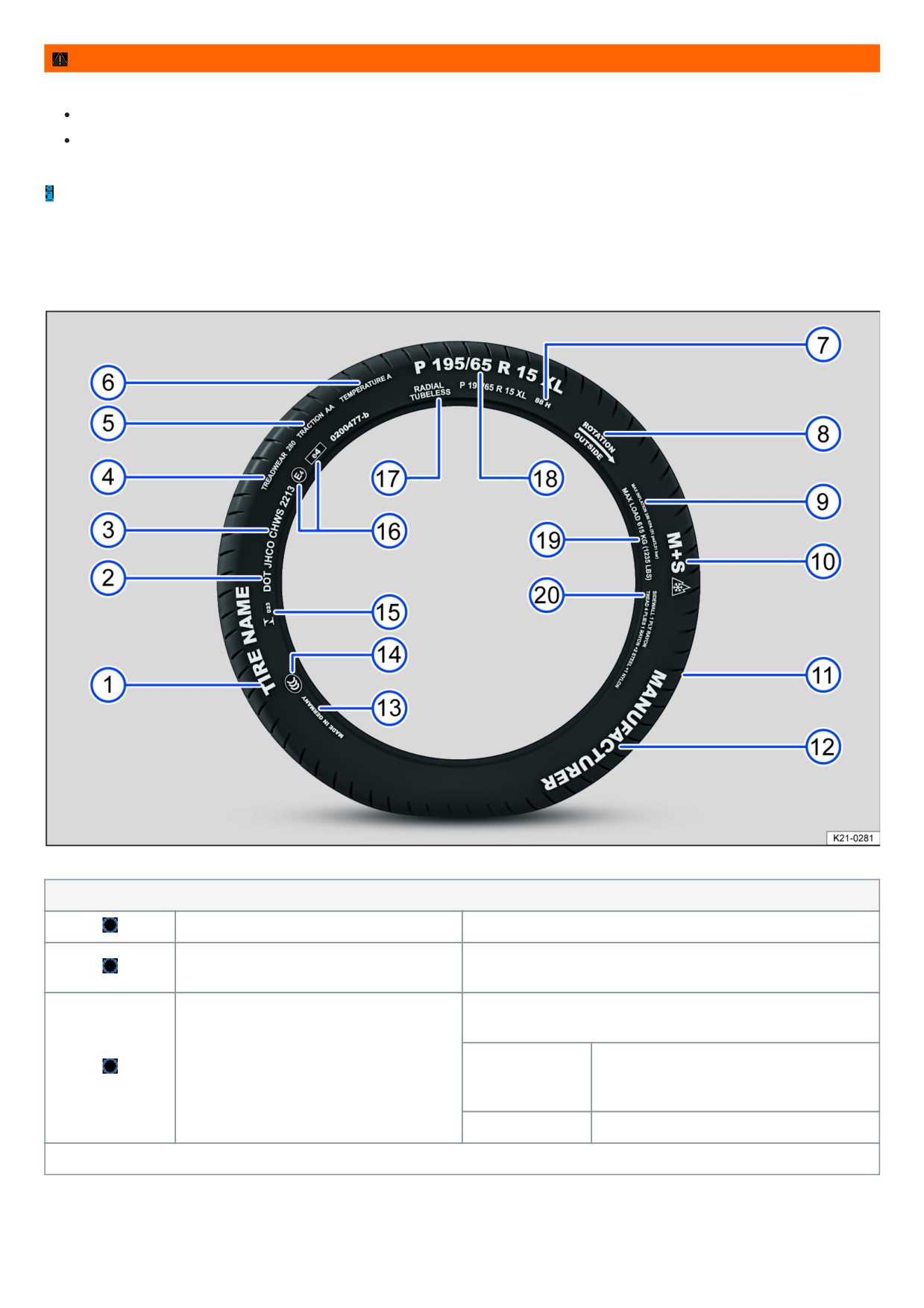
WARNING
Incorrect wheel bolts can loosen while driving and cause loss of vehicle control, serious accidents, and fatal injuries.
Always use wheel bolts that are correct for the rim and the vehicle model.
Never use different wheel bolts.
The Tire Pressure Monitoring System (TPMS) indicator light may indicate a system malfunction after a wheel is changed
⇒ Troubleshooting the Tire Pressure
Monitoring System.
Tire characteristics
Tire labeling and tire classifications
Fig. 185 International tire labeling.
fig. 185Tire labeling (example), meaning
Product name
Individual manufacturer tire designation.
The tire conforms to the legal requirements of the Department of
DOT
Transportation in the USA, which is responsible for tire safety standards.
Tire identification number (TIN - may only be on the inner side of the tire) and
production date:
Code for the factory that produced the tire and
JHCO CHWS 2213
JHCO CHWS
specifications from the tire manufacturer for the tire
size and tire characteristics.
2213
Production date: 22nd week in the year 2013.
Information for the end consumer about comparative values for specified base tires (standardized test procedures)
⇒ Customer information:
316

fig. 185Tire labeling (example), meaning
Relative service life expectancy for the tire, based on a US-specific standard
test. A tire with the specification 280 will wear 2.8 times more slowly than a
standard tire with a tread wear value of 100. The tire performance depends on
TREADWEAR 280
the usage conditions and may differ significantly from the standard values
depending on the driving behavior, maintenance, different road conditions, and
climate conditions.
Wet braking capability of the tire ( AA, A, B or C). The wet braking capability is
measured under controlled conditions on certified test courses. Tires marked
TRACTION AA
with C have low traction performance. The traction value assigned to tires is
based on straight-line traction test and includes neither acceleration and
cornering, nor hydroplaning and traction under maximum load.
Temperature stability of the tire at high speeds on the test stand ( A, B or C).
Tires marked with A and B exceed the legal requirements. The temperature
TEMPERATURE A
rating is based on the tires being inflated to the correct pressure and not
overinflated. Excess speed, incorrect tire pressure, and overinflation either
alone or in combination can cause heat to build up and cause tire damage.
88 H
Load index and speed rating .
Rotation and arrow
Tire running direction code .
Or: Outside
Code on the outside of the tire .
MAX INFLATION 350 KPA (51 psi/3.51 bar)
US limit for the maximum inflation pressure.
Code for tires that can be used in the winter (mud and snow tires)
⇒ Winter
M+S or M/S or
tires. Studded tires are marked with an E after the S.
TWI
Indicates the location of the tread wear indicator ⇒ Monitoring the tread depth.
Brand name, logo
Manufacturer.
Made in Germany
Country of manufacture.
Country-specific code for China (China Compulsory Certification).
023
Country-specific code for Brazil.
Identification according to international regulations with the number of the
country that issued the approval. Approved tires in accordance with ECE
E4 e4 0200477-b
regulations are marked with an E. Tires in accordance with EU regulations are
marked with an e. The multi-digit approval number follows that.
RADIAL TUBELESS
Tubeless radial tires.
Size designation:
P
Code for passenger vehicles.
195
Tire width from one sidewall to the other in mm.
P 195 / 65 R 15 XL
65
Height and width ratio in %.
R
Belt construction code for radial.
15
Rim diameter in inches.
XL
Reinforced tires (“Extra Load”).
MAX LOAD 615 KG (1235 LBS)
US load capacity for the maximum load per tire.
Specification for the components of the tire body.
SIDEWALL 1 PLY RAYON
1 layer rayon.
TREAD 4 PLIES
Specification for the components of the running surface.
In the example, there are the following 4 layers under the running surface: 1
1 RAYON + 2 STEEL + 1 NYLON
rayon layer, 2 steel belts, and 1 nylon layer.
317
The labeling is on both sides of the tire. In some cases, certain codes may only be on one side of the tire, such as the tire ID number and the production date.
Other digits that may be present are part of the internal labeling from the tire manufacturer or country-specific labeling.
Low-profile tires
Compared to other tire-rim combinations, low-profile tires offer a wider tread surface and a larger rim diameter with shorter tire sidewalls. Low-profile tires improve
handling performance and precision. However, they may reduce the level of comfort when driving on roads in poor condition.
Unidirectional tires
The sidewalls on unidirectional tires are marked with arrows. The specified running direction must be followed. This ensures the optimum running characteristics.
If a tire is mounted opposite from the specified running direction, drive more carefully because the tire is not being used the way it was designed to be used. The tire
must be replaced or mounted in the correct running direction as soon as possible.
Asymmetrical tires
Asymmetrical tires factor in the behavior of the inner and outer areas of the tread pattern. The sidewalls on asymmetrical tires are marked as the inner and outer
side. Maintain the correct position of the tire on the rim.
Tire load
The tire load index indicates the maximum load of an individual tires in kilograms.
Some examples:
78
425 kg (936 lbs)
81
462 kg (1018 lbs)
83
487 kg (1073 lbs)
85
515 kg (1135 lbs)
87
545 kg (1201 lbs)
88
560 kg (1234 lbs)
91
615 kg (1355 lbs)
92
630 kg (1388 lbs)
93
650 kg (1433 lbs)
95
690 kg (1521 lbs)
97
730 kg (1609 lbs)
99
775 kg (1708 lbs)
100
800 kg (1763 lbs)
101
825 kg (1818 lbs)
102
850 kg (1873 lbs)
103
875 kg (1929 lbs)
104
900 kg (1984 lbs)
Speed rating
The speed rating indicates the maximum speed that may be driven with the tire.
P
max. 150 km/h (93 mph)
Q
max. 160 km/h (99 mph)
R
max. 170 km/h (106 mph)
S
max. 180 km/h (112 mph)
T
max. 190 km/h (118 mph)
U
max. 200 km/h (125 mph)
H
max. 210 km/h (130 mph)
V
max. 240 km/h (149 mph)
W
max. 270 km/h (168 mph)
Y
max. 300 km/h (186 mph)
318
N
above 240 km/h (149 mph), depending on manufacturer also NR.
3) The TIN is the tire serial number.
UTQG tire classification
Uniform Tire Quality Grading (UTQG): Quality grades can be found where applicable on the tire sidewall between the tread shoulder and maximum section width.
Example:
Treadwear (number)
Traction AA, A, B or C
Temperature A, B or C
For example: Treadwear 200, Traction AA, Temperature A.
All passenger car tires must conform to Federal Safety Requirements in addition to these grades.
Treadwear
The treadwear grade is a comparative rating based on the wear rate of the tire when tested under controlled conditions on a specified government test course.
For example, a tire graded 150 (Treadwear-value 150) would wear one-and-one-half (1 1/2) times as well on the government course as a tire graded 100.
The relative performance of tires depends upon the actual conditions of their use, however, and may depart significantly from the norm due to variations in driving
habits, service practices and differences in road characteristics and climate.
Traction
The traction grades, from highest to lowest, are AA, A, B, and C. Those grades represent the tire's ability to stop on wet pavement as measured under controlled
conditions on specified government test surfaces of asphalt and concrete. A tire marked C may have poor traction performance.
Temperature
The temperature grades are A (the highest), B, and C representing the tire's resistance to the generation of heat, and its ability to dissipate heat when tested under
controlled conditions on a specified indoor laboratory test wheel.
Sustained high temperature can cause the material of the tire to degenerate and reduce tire life, and excessive temperature can lead to sudden tire failure.
The grade C corresponds to a level of performance which all passenger car tires must meet under the Federal Motor Vehicle Safety Standard No. 109. Grades B
and A represent higher levels of performance on the laboratory test wheel than the minimum required by law.
WARNING
The traction class assigned to this tire is based on traction tests when braking straight ahead and does not take account of the properties when accelerating,
driving around curves, hydroplaning or at maximum traction.
WARNING
The temperature class for this tire is based on a tire being inflated to the correct pressure and not being overinflated. Excess speeds, insufficient tire pressure,
and overinflation either alone or in combination can cause heat to build up and cause potential tire failure.
Tire load and vehicle load, determining the correct load
Vehicles and tires have a limited load capacity. An overloaded vehicle is difficult to steer and brakes less effectively. Overloading your vehicle can also cause
damage to the vehicle and tires, such as tire blowouts and sudden pressure losses.
To ensure your safety and the safety of your passengers, never exceed the maximum vehicle weight. This is specified as the Gross Vehicle Weight Rating
(GVWR).
The GVWR includes the weight of your vehicle including all additional equipment, a full fuel tank, all fluids and its maximum load. The maximum load includes the
number of people that can travel in the vehicle (number of seats) with an average weight of 150 lbs (68 kg) per person, and also luggage. In trailer mode, the weigh
of the trailer and the trailer tongue weight rating must be included in calculations.
The Gross Axle Weight Rating (GAWR) is the maximum axle load per axle. The GVWR and GAWR are listed on the safety certificate on the B-pillar on the
driver's side.
Your vehicle has either 4 (2 front, 2 rear), 5 (2 front, 3 rear), 6 (2 front, 2 center, 2 rear) or 7 (2 front, 3 center, 2 rear) seats, depending on the type of vehicle. Each
seat has a safety belt. As there is an upper limit to the GVWR, the maximum load also has an upper limit. Traveling with a full vehicle or with passengers heavier
than 150 lbs (68 kg) per person will reduce the remaining possible load.
The tire inflation pressure label for your vehicle also specifies the maximum weight.
Determining the correct tire load
Never overload tires. The followingexample illustrates how to determinethe combined weight of all vehicleoccupants and luggage or othervehicle payloads. Never
319
overload thevehicle!
Steps for Determining Correct Load Limit:
1.
Locate the statement “The combined weight of occupants and cargo should never exceed XXX kg or XXX lbs.” on your vehicle's placard.
2.
Determine the combined weight of the driver and passengers that will be riding in your vehicle.
3.
Subtract the combined weight of the driver and passengers from XXX kg or XXX lbs.
The resulting figure equals the available amount of cargo and luggage load capacity. For example, if the “XXX” amount equals 1400 lbs. and there
4.
will be five 150 lb passengers in your vehicle, the amount of available cargo and luggage load capacity is 650 lbs. (1400-750 (5 × 150) = 650 lbs.)
Determine the combined weight of luggage and cargo being loaded on the vehicle. That weight may not safely exceed the available cargo and
5.
luggage load capacity calculated in Step 4.
If your vehicle will be towing a trailer, load from your trailer will be transferred to your vehicle. Consult this manual to determine how this reduces the
6.
available cargo and luggage load capacity of your vehicle.
Check the tire sidewall to determine the load index specified for thetire.
WARNING
Exceeding the maximum vehicle weight can cause you to lose control of the vehicle and cause accidents resulting in severe and/or fatal injuries.
Never exceed the maximum load or the maximum vehicle weight as per the GVWR.
Glossary of tire and load terminology
Accessory weight: The combined weight (in excess of those standard items which may be replaced) of automatic transmission, electro-mechanical power
steering, power brakes, power windows, power seats, radio, and heater, to the extent that these items are available as factory-installed equipment (whether installe
or not).
Aspect ratio: The ratio of sidewall height to tire width, expressed as a percentage. A number of 50 (0.5:1 or 50%) means that the cross-sectional height is 50% of
the tread width. A shorter sidewall can improve steering response and provide better overall handling, for example, on dry pavement.
Bead: The part of a tire made of steel wires, wrapped or reinforced by ply cords, with the shape and structure to ensure proper fit to the wheel rim.
Bead separation: A breakdown of the bond between components in the bead.
Carcass: The tire structure, except tread and sidewall rubber which, when inflated, bears the load.
Chunking: The breaking away of pieces of the tread or sidewall.
Cord: The strands of material forming the plies in the tire.
Cord separation: The parting of cords from adjacent rubber compounds.
Cracking: Any parting within the tread, sidewall, or inner liner of the tire extending to cord material.
Cold tire inflation pressure: The tire pressure recommended by the vehicle manufacturer for a tire of a specified size that has not been driven for more than a
couple of miles (kilometers) at low speeds in the 3 hour period before the tire pressure is measured or adjusted.
Curb weight: The weight of a motor vehicle with standard equipment including the maximum capacity of fuel, oil, and coolant, air conditioner, and additional weight
of optional equipment.
Extra load tire: A tire designed to operate at higher loads and at higher inflation pressures than the corresponding standard tire.
Gross Axle Weight Rating (GAWR): The load-carrying capacity of a single axle system, measured where the tire contacts the ground.
Gross Vehicle Weight Rating (GVWR): The maximum loaded weight of the vehicle.
Groove: The space between 2 adjacent tread ribs.
Load rating code: The maximum load that a tire is rated to carry for a given inflation pressure. You may not find this information on all tires because it is not
required by law.
Maximum loaded vehicle weight: The total of:
Curb weight.
Accessory weight.
Vehicle capacity weight.
Production options weight.
Maximum (permissible) inflation pressure: The maximum cold inflation pressure to which a tire may be inflated. Also called “maximum inflation pressure.”
Normal occupant weight: Means 150 lbs (68 kilograms) times the number of occupants seated in the vehicle up to the total seating capacity of your vehicle.
Occupant distribution: The placement of passengers in a vehicle.
32
Outer diameter: The diameter of a new, properly inflated tire.
Overall width: Total width measured at the exterior sidewalls of an inflated tire, including the additional width of labeling, decorations, or protective bands or ribs.
Passenger car tire: A tire intended for use on passenger cars, multipurpose passenger vehicles, and trucks, that have a gross vehicle weight rating (GVWR) of
10,000 pounds or less.
Ply: A layer of rubber-coated parallel cords.
Ply separation: A parting of rubber compound between adjacent plies.
Pneumatic tire: A mechanical device made of rubber, chemicals, fabric, and steel or other materials, that, when mounted on an automotive wheel, provides the
traction and contains the gas or fluid that sustains the load.
Production options weight: The combined weight of installed regular production options weighing over 5 lbs (2.3 kg) more than the standard items they replace,
and not previously considered as curb weight or accessory weight. These include, for example, heavy-duty brakes, ride levelers, roof rack, heavy-duty battery, and
special trim.
Radial ply tires: A pneumatic tire in which the ply cords that extend to the beads are laid at substantially 90 degrees to the centerline of the tread.
Recommended inflation pressure: The tire pressure recommended by the vehicle manufacturer for a tire of a specified size that has not been driven for more tha
a couple of miles (kilometers) at low speeds in the 3 hour period before the tire pressure is measured or adjusted.
Reinforced tire: A tire designed to operate at higher loads and at higher inflation pressures than the corresponding standard tire.
Rim: The outer edge of a wheel upon which the tire beads are seated.
Rim diameter: The nominal diameter of the wheel's tire bead seating surface. If you change your wheel size, to wheels of a different diameter, you will have to
purchase new tires to match the new wheels.
Rim size: Designation means rim diameter and width.
Rim type designation: The industry or manufacturer's designation for a rim by style or code.
Rim width: The nominal distance between wheel rim flanges.
Section width: The linear distance between the exteriors of the sidewalls of an inflated tire, excluding elevations due to labeling decoration, or protective bands.
Sidewall: The portion of a tire between the bead and the tread.
Sidewall separation: The parting of the rubber compound from the cord material in the sidewall.
Speed rating (letter code): A standardized letter code indicating the maximum speed at which a tire is designed to be driven for extended periods of time. The
ratings range from 93 mph (150 km/h) “P” to 186 mph (300 km/h) “Y”. The speed rating letter code, where applicable, is molded on the tire sidewall. You may not
find this information on all tires because it is not required by law.
Tire Pressure Monitoring System: A system that detects when at least one of a vehicle's tires is underinflated and illuminates a low tire-pressure warning light.
Tread: The portion of a tire that normally touches the road.
Tread rib: A tread section running circumferentially around a tire.
Tread separation: Tire failure caused by the tread pulling away from the tire carcass.
Tread wear indicators (TWI): Raised areas within the main tread grooves that show, visually, when tires are worn and near the end of their useful life.
Uniform Tire Quality Grading (UTQG): A tire information system developed by the U.S. National Highway Traffic Safety Administration (NHTSA) that is designed
to help buyers compare tires. UTQG is not a safety rating, nor is it a guarantee that a tire will last for a certain number of miles or perform a certain way. It gives tire
buyers more information to compare with factors such as price, brand loyalty and dealer recommendations. Under UTQG, tires are graded by the tire manufacturer
in 3 areas: tread wear, traction and temperature resistance. UTQG information is molded into the tire sidewalls.
U.S. DOT Tire Identification Number (TIN): A tire's serial number. It begins with the letters “DOT” (“Department of Transportation”) and indicates that the tire meet
all federal standards. The next 2 numbers or letters indicate the plant where the tire was manufactured. The last 4 numbers represent the week and year of
manufacture. For example, the numbers 1709 mean that the tire was produced in the 17th week of 2009. Any other numbers are marketing codes used by the tire
manufacturer. This information is used to help identify affected consumers if a tire defect requires a recall.
Vehicle capacity weight: The total rated cargo, luggage and passenger load. Passenger load is 150 lbs (68 kilograms) times the vehicle's total seating capacity (a
listed on the label inside the driver door).
Vehicle maximum load on the tire: The load on an individual tire that is determined by taking each axle's share of the maximum loaded vehicle weight (GAWR)
and dividing by 2.
Vehicle normal load on the tire: The load on an individual tire that is determined by taking each axle's share of the curb weight, accessory weight, and normal
occupant weight (distributed according to the table below) and dividing by 2.
Wheel size designation: Wheel rim diameter and width.
Occupant loading and distribution for vehicle normal load for various designated seating capacities:
Designated seating capacity, number of occupants
Vehicle normal load, number of occupants
Occupant distribution in a normally loaded vehicle
2, 3, or 4
2
2 in front
5, 6, or 7
3
2 in front, 1 in back
321
Maintenance
Service
Information regarding the service schedule
Information regarding maintenance of your vehicle and the type and scope of service work can be found in your service schedule. The service schedule is included
with your manual Service schedule.
Vehicle care
Vehicle care information
Regular, proper care helps to maintain your vehicle.
The longer dirt remains on the surfaces of vehicle components, the more difficult it may be to clean and care for them. Long-term exposure can make it impossible
for dirt to be removed.
For questions regarding care products or for vehicle components that are not listed, consult a suitably qualified professional. Volkswagen recommends contacting
an authorized Volkswagen dealer or authorized Volkswagen Service Facility.
Suitably qualified professionals can provide you with suitable accessories. Volkswagen recommends the use of Genuine Volkswagen Accessories, which you can
acquire from an authorized Volkswagen dealer or authorized Volkswagen Service Facility. Read and follow the usage instructions on the packaging.
WARNING
Cleaning and caring for vehicle components incorrectly can irreparably damage and impair the vehicle's safety equipment, such as the airbag modules. This
may cause serious injuries in the event of an accident.
Clean and maintain vehicle components only according to the manufacturer’s instructions.
Always use approved or recommended cleaning solution.
Never use cleaning solutions that contain solvents.
WARNING
Cleaning the vehicle incorrectly may result in serious injuries.
Protect your hands and arms against components with sharp edges, for example when cleaning the inside of the wheel housings.
Always follow the manufacturer's instructions when using cleaning agents.
WARNING
Dirty, foggy, or icy door windows reduce visibility and can impair the vehicle's safety equipment. This can cause accidents and serious or fatal injuries.
Only drive when there is clear visibility through all windows.
Do not use water-repellent window solutions on the windshield. This can cause intense glare under poor visual conditions.
WARNING
Care products can be poisonous, highly flammable and dangerous. Using care products incorrectly or using unsuitable care products can cause burns and
poisoning and may lead to accidents and serious or fatal injuries.
Note the package insert.
Only store care products in their sealed original containers.
Keep children away from all care products.
Only use care products outside or in well-ventilated areas so that no harmful vapors are inhaled.
Never use turpentine, engine oil, fuel, nail polish remover, or other highly volatile fluids for vehicle care.
NOTICE
Cleaning dirt with aggressive and solvent-based products can cause permanent damage to vehicle equipment, for example even with only brief exposure on
seat cushions or decorative parts.
Do not allow dirt to dry.
Have stubborn spots removed by a suitably qualified, authorized Volkswagen dealer or authorized Volkswagen Service Facility.
322