Volkswagen Taos (2023 year). Manual in english - page 7

WARNING
Folding and unfolding the load-through hatch in an uncontrolled or careless manner may result in serious injury or death.
Never fold the luggage compartment pass-through forward or back while driving.
When folding up the pass-through, make sure that the safety belt does not become trapped or damaged.
Keep hands, fingers, feet and other body parts away from the pivot range of the pass-through when folding it forward or back.
Always check that the red mark on the catch indicator is not visible when the pass-through is in the upright position. A red marking indicates that the
luggage compartment pass-through is not locked into place.
If the luggage compartment pass-through is folded down or is not securely engaged, no passengers, especially children, are to be transported on this
seat.
Trailer towing technically not possible
Trailer towing information
The vehicle is not designed for towing a trailer. No trailer hitch may be retrofitted.
WARNING
Mounting a trailer hitch on the vehicle can result in damage to the vehicle, accidents and serious or fatal injuries when operating the vehicle.
Never mount a trailer hitch on the vehicle.
Roof rack
Introduction
Depending on the model, the vehicle may be designed to have a roof rack installed.
Bulky objects can be transported on the vehicle roof using the roof rack.
If you are not sure if your vehicle is designed to have a roof rack installed, check with an authorized Volkswagen dealer or authorized Volkswagen Service Facility.
Volkswagen recommends contacting an authorized Volkswagen dealer or authorized Volkswagen Service Facility.
Only use roof racks that are approved by Volkswagen for use with your vehicle.
Do not use or retrofit a roof rack if this is not approved for your vehicle.
WARNING
When transporting large, heavy, long, or flat loads on the roof rack, the vehicle's driving characteristics and aerodynamics change because of the different center
of gravity and increased wind resistance. This may cause accidents and serious or fatal injuries.
Always secure cargo correctly with suitable and undamaged cords, fixation belts or tensioning straps.
Avoid abrupt and sudden driving and braking maneuvers.
Always adapt your speed and driving style to the visibility, weather, road and traffic conditions.
WARNING
If the use of a roof rack is not approved for your vehicle or a roof rack that is incompatible with the vehicle is fitted, it may detach and fall from the roof of the
vehicle while you are driving. This may cause accidents and serious or fatal injuries.
Only use roof racks that are approved by Volkswagen for the vehicle.
Do not fit roof racks if they are not approved for your vehicle.
NOTICE
Installing any type of roof rack onto a vehicle that is not approved for use of a roof rack can cause serious damage.
Do not fit roof racks if they are not approved for your vehicle.
Driving with a roof rack fitted increases the air resistance of the vehicle and thus also the fuel consumption. This reduces the potential range of the vehicle. This
applies to all roof racks and any objects transported on them, such as bicycles and skis.
243

Mounting a roof rack
Please read the introductory information and heed the Warnings and Notice ⇒
and Introduction.
For safety reasons, special roof racks are needed to transport luggage, bicycles, surfboards, skis and boats safely.
Only use roof racks that are provided for the vehicle model, model year and vehicle equipment by the corresponding manufacturer.
Volkswagen recommends the use of Volkswagen original parts or Volkswagen original accessories, which you can acquire from an authorized Volkswagen dealer
or authorized Volkswagen Service Facility.
Mounting a roof rack on the roof rail
Mount the roof rack in accordance with the instructions supplied.
After the roof rack has been mounted, the rack base can now be secured to it
⇒
Remove the roof rack in the following scenarios
If the roof rack is no longer needed.
Before driving through an automatic car wash
If the height of the vehicle exceeds the maximum height limit, for example in a garage
NOTICE
The height of the vehicle changes when a roof rack is installed and when there is cargo secured on it. The vehicle may be badly damaged if you drive into
entrances with low heights, e.g. underpasses and garages.
Compare the height of the vehicle with the clearance height.
NOTICE
If parts on the roof of your particular vehicle (depending on the vehicle equipment), e.g. the roof antenna, and the trunk lid's range of movement are impaired by
the roof rack and the luggage, the vehicle may be damaged.
Ensure that the roof rack is positioned correctly on the roof and that it will not affect any components of the vehicle.
WARNING
Securing the roof rack and base incorrectly or using them incorrectly may cause the luggage or the entire assembly to come loose from the vehicle roof. This can
result in accidents and serious injury or death.
Always mount the roof rack and base correctly in accordance with the manufacturer's instructions.
Secure the roof rack only at the locations intended for this.
Always mount special rack assemblies for bicycles, skis, surfboards, etc. correctly and in accordance with the manufacturer's installation instructions.
Only use the roof rack and base if they are undamaged and secured correctly.
Check the roof rack mounts before starting a journey and, if necessary, retighten them after a short distance.
On long trips, check the threaded connections and fasteners each time you take a break.
Do not make any modifications or repairs to the roof rack or base.
A fitted roof rack increases air resistance and therefore may reduce the vehicle's range.
Loading the roof rack
Please read the introductory information and heed the Warnings and Notice ⇒
and Introduction.
Maximum permissible roof weight
The maximum permissible roof load is 75 kg (165 lbs), or 50 kg (110 lbs) for vehicles with tilting and sliding panoramic sunroof.
The roof load consists of the weight of the roof rack and the items carried on the roof rack
⇒
Always check the weight of the roof rack and the items that will be transported on it. Weigh the items if necessary.
When using a roof rack with a low load limit, do not load the rack with the maximum permissible roof load. In this case, only load the roof rack to the weight limit list
in the installation guide.
Distributing the load
Distribute the load evenly and secure it correctly
⇒
244

Checking that everything is secure
Once you have fitted the roof rack, drive a short distance and then check all the fasteners. Keep checking them regularly.
WARNING
Exceeding the maximum permitted roof load can result in accidents, damage to the vehicle and serious or fatal injuries.
Never exceed the specified roof load, the Gross Axle Weight Rating, and the Gross Vehicle Weight Rating of the vehicle.
Do not exceed the load limit of the roof rack, even if the roof load is below the limit.
WARNING
If loose and incorrectly secured luggage falls off the roof rack, accidents and serious or fatal injuries may occur.
Use only suitable and undamaged tie-downs, fixing and tensioning straps.
NOTICE
If the trunk lid hits the roof load, the vehicle may be damaged.
Make sure the trunk lid does not run into the roof load when opening the lid.
245
Fuel and emissions control system
Safety precautions for handling fuel
WARNING
Handling fuel incorrectly can cause explosions, fires, severe burns, and other injuries.
Before refueling, switch off the engine, the ignition and your cell phone, as well as other radio equipment.
To reduce the risk of discharging static electricity, do not enter the vehicle while refueling.
Make sure that the fuel tank cap is sealed correctly and no fuel is leaking out.
Note the applicable safety precautions and local regulations for handling fuel.
WARNING
Refueling incorrectly can cause fires, serious or fatal injuries, and vehicle damage.
Only use fuel that is approved for your vehicle.
Do not use any fuels containing metal and only use service additives approved by Volkswagen in the respective proportion.
Immediately remove any fuel that has spilled on vehicle components.
CAUTION
Fuel may leak out of reserve canisters and ignite. This can cause fires and injuries.
Do transport any reserve canisters in the vehicle.
Fuels can contaminate the environment. Collect any leaking operating fluids and dispose of them according to legal regulations.
The fuel filler flap does not have an emergency release. If necessary, contact an authorized Volkswagen dealer or authorized Volkswagen Service Facility for
assistance.
Fuel types and refueling
Introduction
The fuel filler flap is located on the right rear side of the vehicle.
Designation of fuels and fuel standards
Refer to ⇒
and Safety precautions for handling fuel.
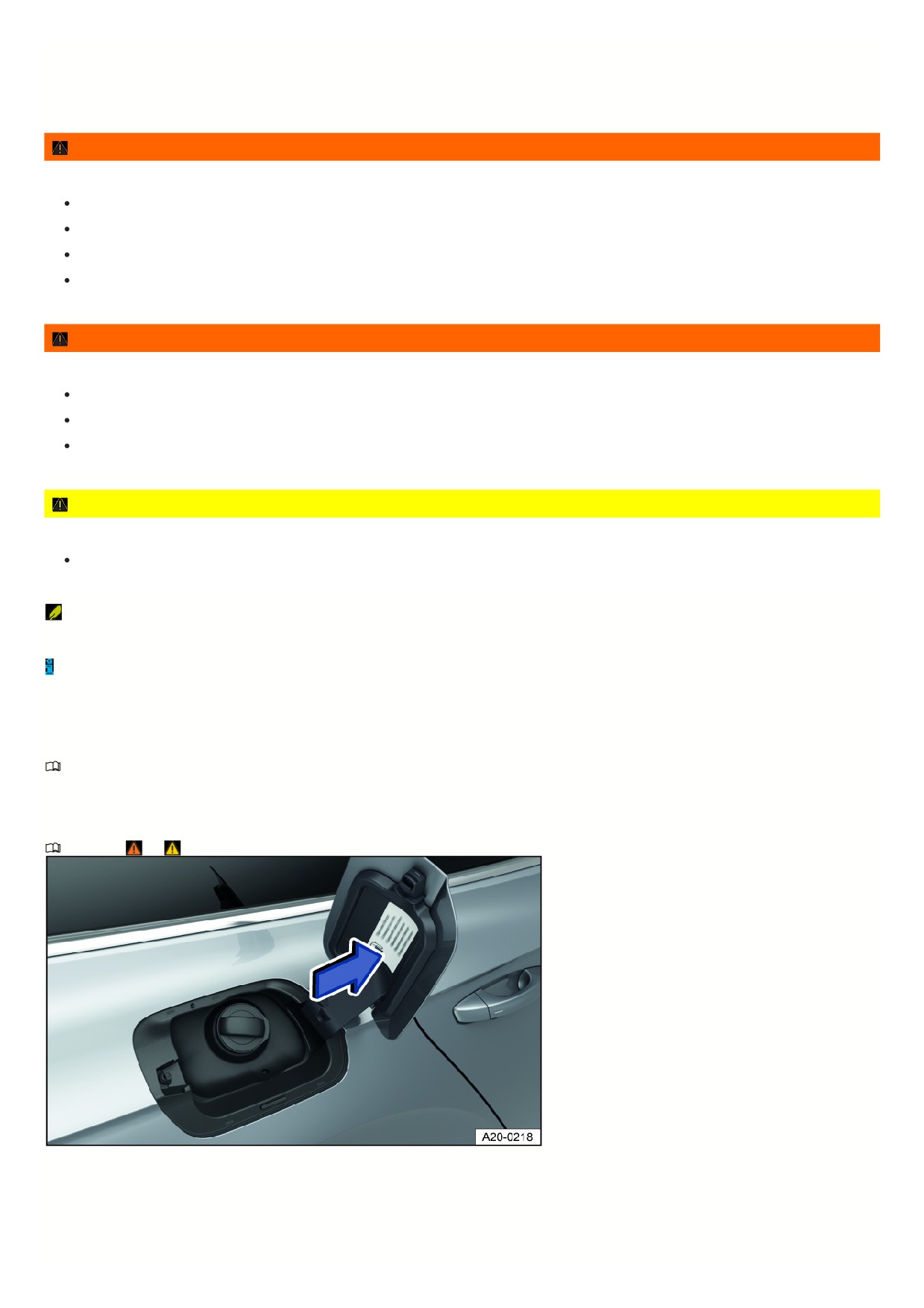
Fig. 139 On the inside of the fuel filler flap: fuel label (general example)
Fuel label
The type of fuel to use depends on the vehicle engine. When your vehicle leaves the factory there is a fuel information sticker inside the tank flap with notes about
the minimum required fuel type for your vehicle fig. 139.
The name specifies which fuels are suitable for the vehicle. This is a minimum requirement. You must not refuel the vehicle with other fuel types or fuels of lower
246

quality ⇒
Fuel standards
The fuel used must meet one of the following standards. The vehicle must not be refueled with other fuels
⇒
If fuel with the specified standards is not available, contact suitably qualified professionals for information about which fuels are suitable for the vehicle. Volkswagen
recommends contacting an authorized Volkswagen dealer or authorized Volkswagen Service Facility.
Gasoline
Gasoline and methanol mixture
AKI 87 or higher.
Maximum 3% methanol.
Gasoline and ethanol mixture
AKI 87 or higher.
Maximum 15% ethanol.
Gasoline and MTBE mixture
AKI 87 or higher.
Maximum 15% MTBE.
NOTICE
Refueling with non-standard and non-approved fuels can cause reduced performance and considerable damage to the engine and the fuel system.
Before refueling, check if the fuel specification at the fuel pump meets the vehicle specifications.
Only use fuel that conforms to the specified standard and label.
Gasoline
Refer to ⇒
and Safety precautions for handling fuel.
Gasoline types
The gasoline types differ in terms of their Anti-Knock Index (AKI) specification, which is given from the formula (RON
+MON) / 2, or the Research Octane Number
(RON) specification. The vehicle may also be fueled with gasoline that has a higher AKI or RON than what is required by the engine. However, this will not improve
fuel consumption or engine power.
The fuel label may include multiple types of gasoline, e.g. AKI 93 (AKI min. 91). The highlighted gasoline type, AKI 93 in this example, is the preferred gasoline typ
for which the vehicle is designed and optimized. The listed alternative gasoline type, AKI 91 in this example, should only be used if the preferred type, AKI 93 in this
example, is not available.
If your vehicle has a gasoline engine, fuel it only with gasoline that does not contain any metal (no lead, manganese or iron)
⇒
The most frequently purchased gasoline types in the USA and Canada have the following octane values, which are normally listed on the fuel pump:
Regular (normal gasoline): AKI 87 to 90 or RON 91.
Premium (super gasoline): AKI 91 to 93 or RON 95.
Volkswagen recommends using “TOP TIER Detergent Gasoline”, which is available in some regions, for example North America, Central America and South
America. For more information on “TOP TIER Detergent Gasoline”, visit the official website at:
NOTICE
The use of gasoline that does not meet the minimum requirements for the octane number can impair engine performance. The use of poor-quality gasoline or
gasoline with an AKI of under 87 or a RON of under 91 can cause engine damage.
Only fuel with gasoline that meets or exceeds the specified octane number, Research Octane Number (RON) or Anti-Knock Index (AKI).
Refueling
Refer to ⇒
and Safety precautions for handling fuel.
247
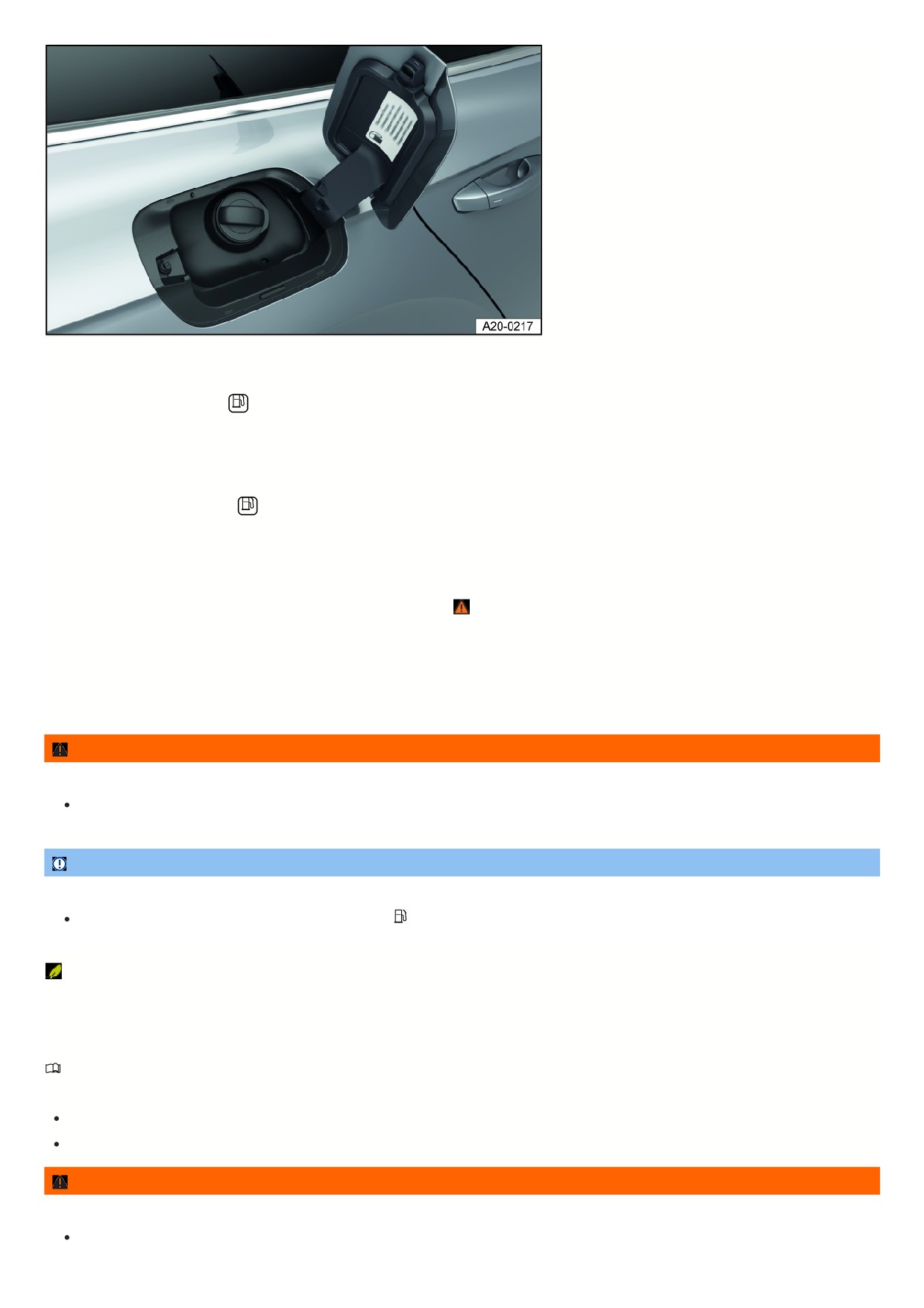
Fig. 140 Behind the fuel filler flap: fuel tank cap (general example)
Venting the fuel tank
When you press the release button
in the driver door, the fuel tank is automatically vented.
A warning chime sounds and an automatic venting message is displayed in the Volkswagen Digital Cockpit.
If you cannot open the fuel filler flap, pay attention to the messages in the instrument cluster display.
Refueling procedure
1. Unlock the fuel filler flap with the
button in the driver door.
2. Open the fuel filler flap.
3. Remove the fuel tank cap and insert it into the opening at the fuel filler flap provided for this fig. 140.
4. Hold the fuel pump nozzle handle down to ensure optimum refueling.
The fuel tank is full once the fuel pump nozzle turns off for the first time
⇒
5. Screw the fuel tank cap onto the fuel filler neck.
6. Close the fuel filler flap.
Do not continue filling after disconnection. The expansion area in the fuel tank may fill with fuel, e.g. due to heating. This may mean that the fuel overflows or the
automatic ventilation process cannot work ⇒ Troubleshooting.
WARNING
Fuel may spray out and overflow if the fuel tank is overfilled. This can cause explosions, fires, and serious or fatal injuries.
Do not continue filling after the pump nozzle switches off for the first time.
NOTICE
If the tank is not emptied up to the reserve level at regular intervals, it might not be possible to maintain the fuel quality and system function required for driving.
At least every six months, only refuel when the warning light
turns on.
Fuels can contaminate the environment. Collect any leaking operating fluids and dispose of them according to legal regulations.
Exhaust system
Introduction
The exhaust-relevant components reduce exhaust emissions:
Catalytic converter ⇒ Catalytic converter.
Particulate filter (depending on the vehicle equipment) ⇒ Particulate filter.
WARNING
If the engine runs in enclosed spaces, poisonous gases may enter the vehicle interior. This can cause serious injuries and death due to asphyxiation.
Never start the engine in confined spaces.
248

Do not allow the engine to run in confined spaces.
Do not leave your vehicle unattended while the engine is running.
WARNING
Hot vehicle parts and exhaust can ignite flammable or explosive materials in the vicinity. This can lead to a fire and cause accidents and serious or fatal injuries.
Never park the vehicle in such a way that parts of the exhaust system come into contact with flammable materials under the vehicle, such as dry grass.
Never use additional underbody protection or corrosion protection on exhaust pipes, catalytic converters, particulate filters or heat shields.
Catalytic converter
Please read the introductory information and heed the Warnings and Notice ⇒
and Safety precautions for handling fuel.
To ensure that the exhaust system and the engine catalytic converter can work correctly for a long time, observe the following:
Only refuel with fuel permitted for the vehicle.
Never drive until the fuel tank is completely empty ⇒ Refueling.
Never add too much engine oil ⇒ Checking the engine oil level and adding oil .
Do not tow-start the vehicle; use jump-start assistance instead ⇒ Preparing and Performing a Jump-start.
If there are engine misfires, loss of power, or poor engine operation while driving, reduce the speed immediately and have the vehicle checked by suitably qualified
professionals ⇒ Troubleshooting. Volkswagen recommends contacting an authorized Volkswagen dealer or authorized Volkswagen Service Facility. Otherwise,
uncombusted fuel could be present in the exhaust system and then enter the atmosphere. The catalytic converter may also be damaged from overheating.
The exhaust may smell like sulfur when the emissions control system is running correctly.
Particulate filter
Please read the introductory information and heed the Warnings and Notice ⇒
and Safety precautions for handling fuel.
Function
The particulate filter (depends on how your vehicle is equipped) filters out soot from the exhaust gas.
Regeneration
With normal vehicle usage, the filter cleans itself. If the filter is unable to clean itself, e.g. if you only make short trips for an extended period of time, the filter can
become blocked with soot. The particulate filter needs to be cleaned (regenerated).
Noises, light odors, and increased engine speeds may occur during the regeneration. The radiator fan may continue to run while driving and after turning off the
engine.
To assist in particulate filter regeneration, Volkswagen recommends avoiding driving short distances too frequently.
The soot in the particulate filter is burned periodically at high temperatures. The yellow
indicator light does not turn on during a periodic regeneration.
Troubleshooting
Please read the introductory information and heed the Warnings and Notice ⇒
and Safety precautions for handling fuel.
If the engine does not run smoothly and malfunctions
If the engine does not run smoothly or malfunctions while driving, it can indicate poor fuel quality.
1. Reduce your speed immediately.
2. Drive with a moderate RPM and low engine load to the nearest suitably qualified professional. Volkswagen recommends contacting an authorized Volkswagen
dealer or authorized Volkswagen Service Facility.
3. If these symptoms occur directly after refueling, stop the engine immediately to prevent subsequent damage.
4.
Do not continue driving! Contact an authorized Volkswagen dealer or authorized Volkswagen Service Facility for assistance.
Particulate filter clogged with soot
The yellow
indicator light turns on.
The particulate filter is clogged with soot and a regeneration is necessary.
Prerequisite for the regeneration drive: The engine is at operating temperature.
For gasoline engines
1. Drive at a speed of between 50 km/h and 120 km/h (30 mph and 75 mph).
249
The resulting temperature increase burns off the soot in the filter.
2. Only end the regeneration drive once the indicator light turns off.
3. If the indicator light is still illuminated after driving for approximately 40 minutes, drive immediately to suitably qualified professionals for assistance. Volkswagen
recommends contacting an authorized Volkswagen dealer or authorized Volkswagen Service Facility.
If, during the regeneration drive, the prompt to refuel appears in the Volkswagen Digital Cockpit, the particulate filter regeneration process can be interrupted.
Refuel if necessary and then continue the regeneration drive.
Automatic fuel tank ventilation malfunction
If the fuel tank is opened without prior ventilation, fuel vapors will escape from the filler neck. This may lead to temporary odors.
Opening the fuel tank without ventilation:
1. Press the release button
The fuel filler flap will release without ventilation.
2. Open the fuel filler flap.
Refueling with an automatic fuel tank ventilation malfunction:
1. Hold the fuel pump nozzle handle down to ensure optimum refueling.
2. Only continue carefully in this case until the fuel tank is full.
3. If the automatic ventilation process is still not working, contact a suitably qualified professional and have the ventilation system checked. Volkswagen
recommends contacting an authorized Volkswagen dealer or authorized Volkswagen Service Facility.
The fuel pump nozzle may turn off prematurely when refueling due to the lack of ventilation.
Exhaust-related malfunction
The yellow
indicator light turns on.
An exhaust-related component is malfunctioning, which could damage the vehicle.
1. Contact a suitably qualified professional and have the engine and the exhaust system checked. Volkswagen recommends contacting an authorized Volkswagen
dealer or authorized Volkswagen Service Facility.
Misfire
The yellow
indicator light flashes.
There is misfire which could damage the vehicle.
1. Contact a suitably qualified professional and have the engine and the exhaust system checked. Volkswagen recommends contacting an authorized Volkswagen
dealer or authorized Volkswagen Service Facility.
WARNING
Sudden braking or driving maneuvers, e.g. if an indicator light turns on or the engine does not run smoothly, may cause accidents. This can result in serious
injury or death.
Always adapt your speed and driving style to the visibility, weather, road and traffic conditions.
Follow the road traffic laws and regulations that apply in the country you are driving in.
If the indicator lights are on or flashing, it is likely that there is an engine malfunction and that fuel consumption will increase.
25

Do it yourself
Vehicle tool kit
Introduction
When securing the vehicle in the event of a vehicle breakdown, follow the legal regulations applicable in the respective country.
WARNING
A loose tire mobility set, spare wheel, compact spare wheel or vehicle tool kit can be thrown around the vehicle interior during sudden driving or braking
maneuvers or in a collision. This could result in serious or fatal injuries.
Always make sure the vehicle tool kit, tire mobility set, and spare wheel or compact spare wheel are secured in the luggage compartment.
WARNING
Working with an unsuitable or damaged vehicle tool kit may result in accidents. This could result in serious or fatal injuries.
Never work with an unsuitable or damaged vehicle tool kit.
Seek assistance from an authorized Volkswagen dealer or authorized Volkswagen Service Facility if there is no suitable vehicle tool kit available.
Placement
Please read the introductory information and heed the Warnings and Notice ⇒
Introduction.
There are a number of different storage locations for the tool box in the vehicle, such as under the luggage compartment floor or in a side storage compartment of
the luggage compartment.
Depending on the equipment variant, the vehicle may contain a loose box with the vehicle tool kit in the luggage compartment. This supplemental vehicle tool kit is
designed for a possible winter tire change and does not need to be carried in the vehicle at all times → page , Stowing luggage and cargo .
If used, crank the vehicle jack back down so that it can be securely stowed in the vehicle.
Vehicle tool kit components
Please read the introductory information and heed the Warnings and Notice ⇒
Introduction.
The scope of the tool box depends on the country and equipment. The following information describes the full scope of items that may be included.
251
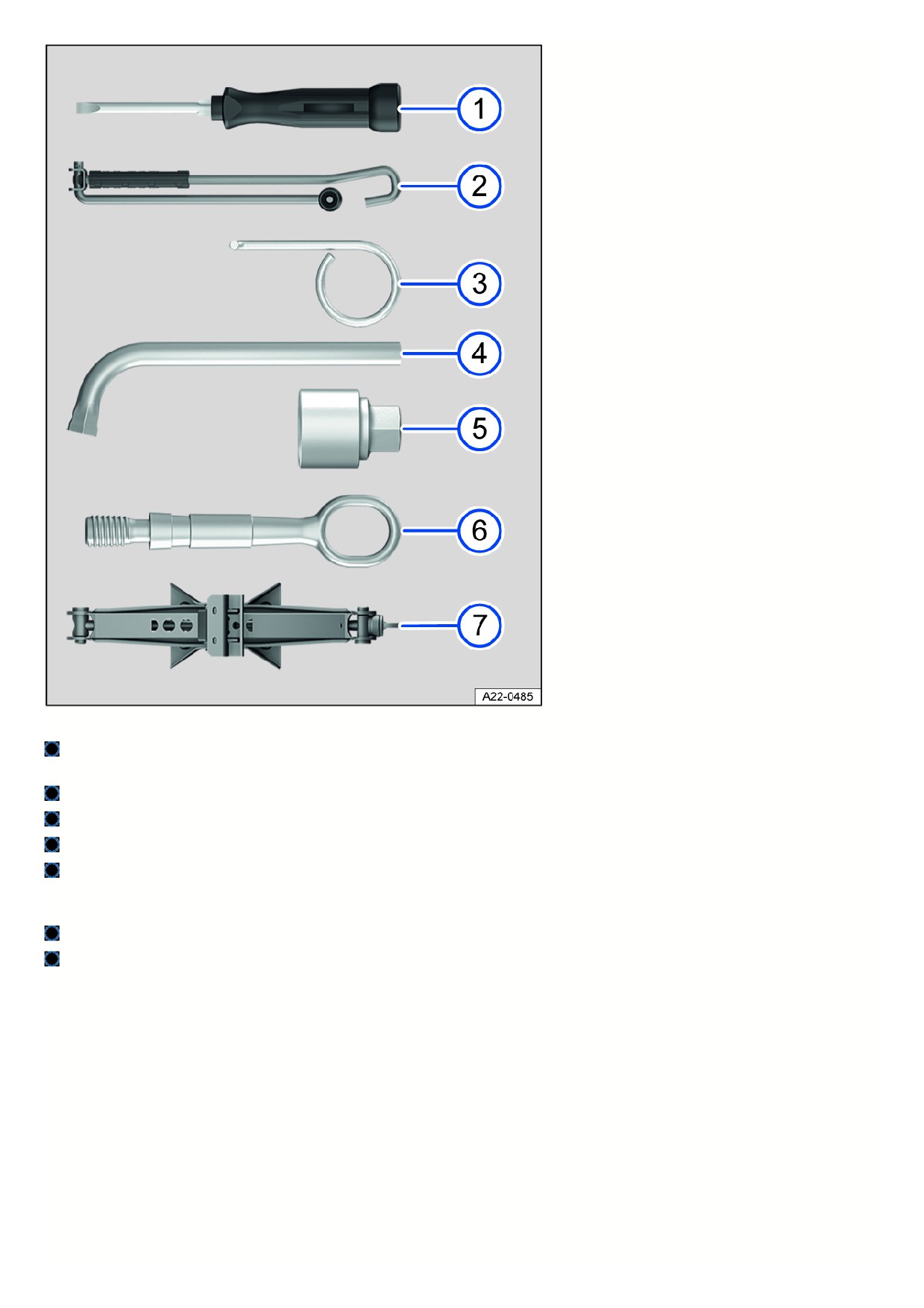
Fig. 141 Vehicle tool kit components (general example).
Screwdriver with hex socket in the handle for removing or installing loose wheel bolts. The screwdriver blade is reversible. The screwdriver may be located
under the lug wrench.
Crank.
Extraction hook for removing the center wheel covers, wheel hub covers, or wheel bolt covers.
Lug wrench.
Adapter for the anti-theft wheel bolt. Volkswagen recommends always keeping the adapter for the wheel bolts in the vehicle with the vehicle tool kit. The code
number for the wheel bolt lock is stamped on the front of the adapter. A replacement adapter can be ordered based on this number if the adapter is lost. Note
the wheel bolt lock code number and keep it separate from the vehicle.
Towing eye that can be screwed in.
Vehicle jack. Before putting the vehicle jack away, crank the vehicle jack claw all the way down.
Tire Pressure Gage
In some countries, there may also be a tire pressure gauge in the vehicle.
252
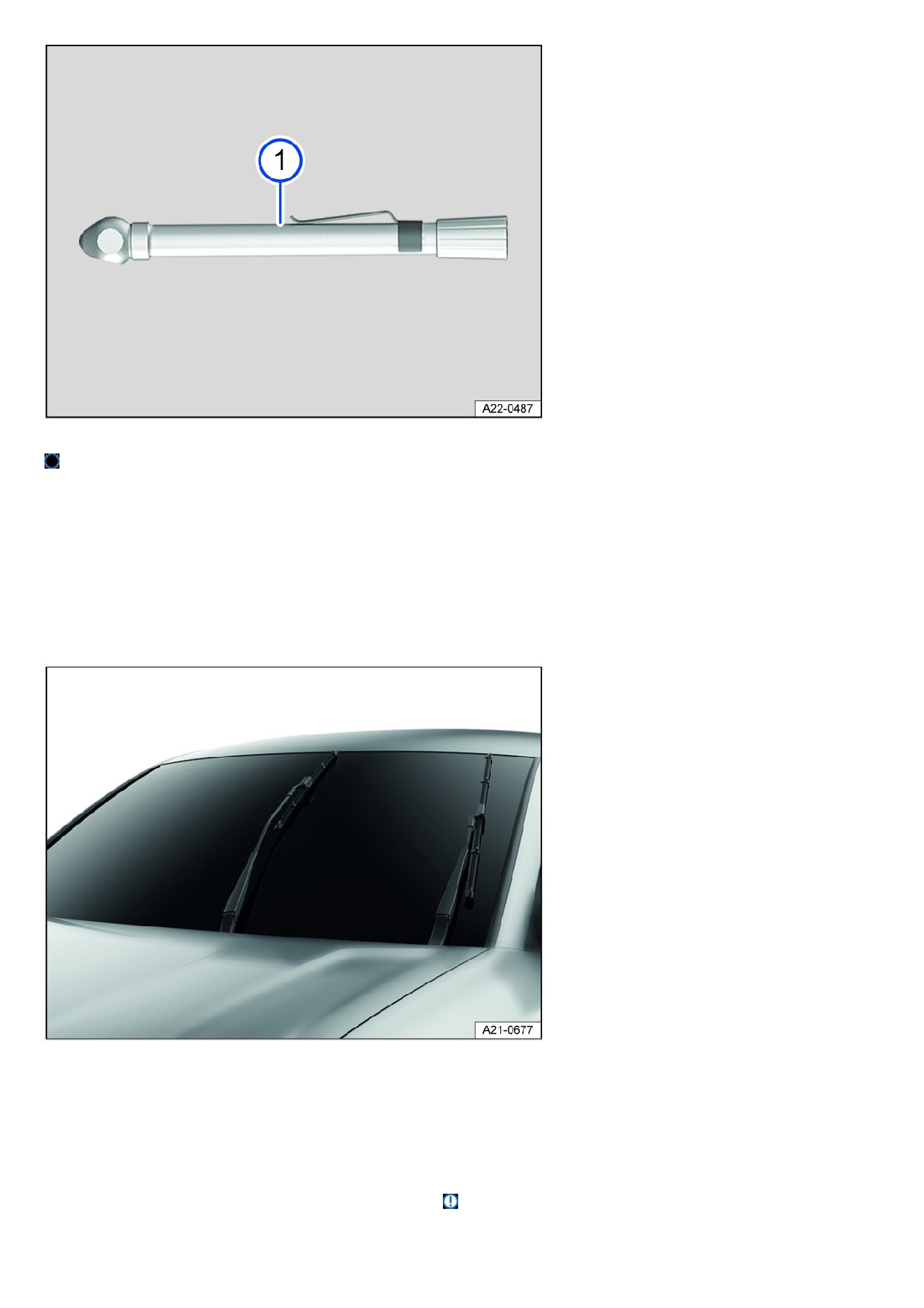
Fig. 142 Additional vehicle tool kit component (general example).
Tire pressure gage (depending on the country).
Xack maintenance
If there is a jack included in the vehicle tool kit, the jack generally does not require maintenance.
1. If necessary, apply universal lubricant to the jack.
Windshield wipers
Putting the windshield wipers in the service position
In the service position, the wiper arms can be lifted off of the windshield.
Fig. 143 Windshield wipers in service position (general example).
Activate the service position using the windshield wiper lever
1. Close the hood, driver and front passenger door.
2. Switch the ignition off and on again.
3. Briefly press the windshield wiper lever towards “one-tap wiping”
⇒ Operating the windshield wiper lever .
Lifting the windshield wiper arms
1. Move the windshield wiper arms into the service position before lifting ⇒
2. Only hold and lift wiper arms in the area where they attach to the wiper blade.
253
Placing the windshield wiper arms back
1. Before driving, carefully place the wiper arms back against the windshield, holding them only in the area where they attach to the wiper blade.
2. When the ignition is switched on, press the windshield wiper lever briefly towards “one-tap wiping”.
The wiper arms move back to the original position.
NOTICE
Failing to take care when working on the wiper arms can damage the hood, windshield, or wiper arms.
Lift the wiper arms with care, and only in the service position.
Never open the hood when the wiper arms are raised up.
Always place the wiper arms carefully against the windshield before driving.
Cleaning and changing wiper blades
Wiper blades with a graphite coating are installed at the factory. The graphite coating allows the wiper blade to glide easily over the window. A damaged graphite
coating creates an increased noise level when wiping the window.
Check the condition of the wiper blades regularly. If wiper blades are rubbing, replace them if they are damaged or clean them if they are dirty
⇒
Damaged wiper blades should be replaced immediately. Wiper blades can be obtained from suitably qualified professionals. Volkswagen recommends contacting
an authorized Volkswagen dealer or authorized Volkswagen Service Facility.
Cleaning the wiper blades
Windshield wiper: Move the windshield wiper arms into the service position before lifting.
1. Lift the wiper arms, making sure to only hold the wiper arms in the area where they attach to the wiper blade.
2. Clean the wiper blades carefully with a damp sponge ⇒
3. Place the wiper arms carefully on the windshield.
Changing the windshield wiper blades
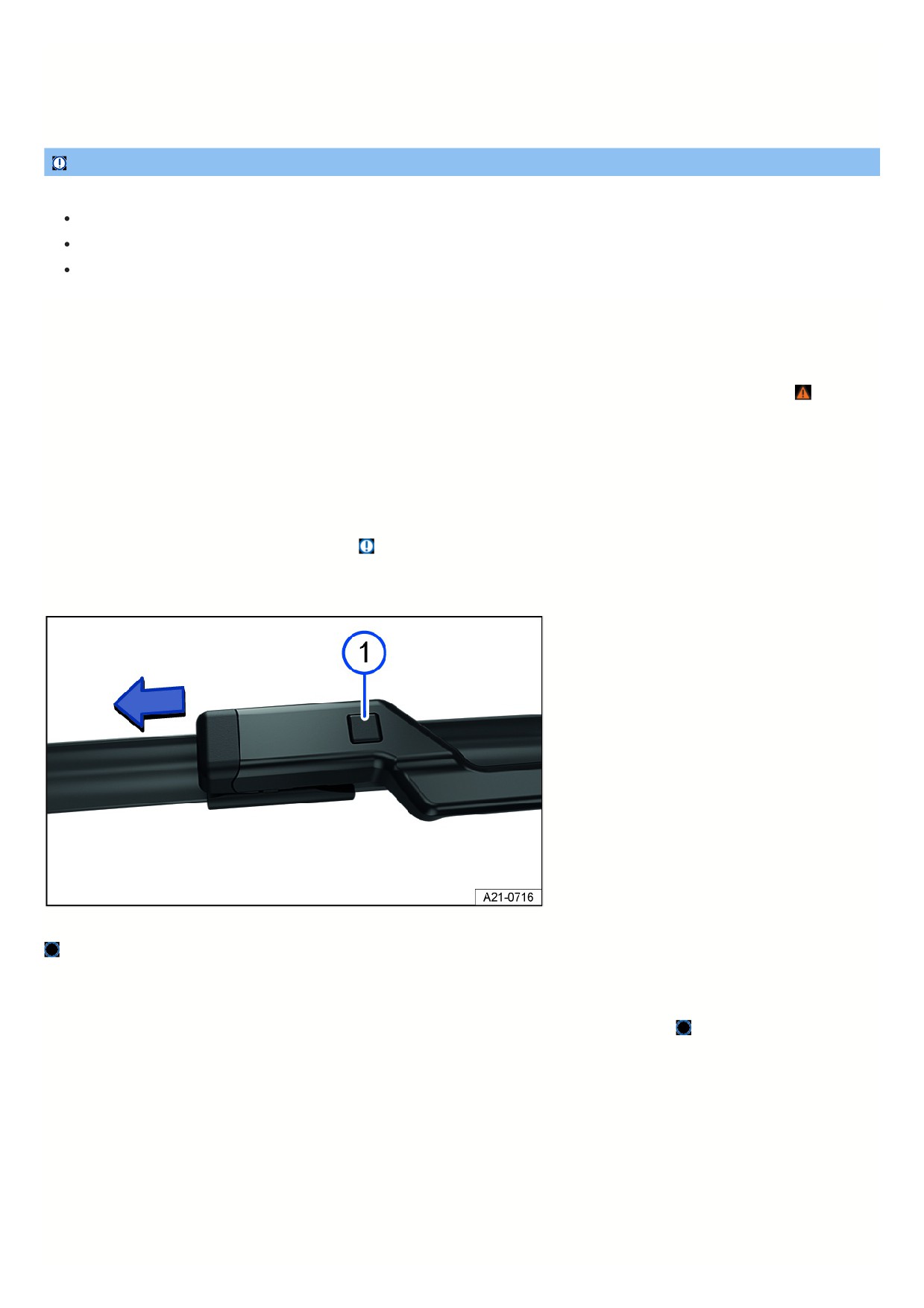
Fig. 144 Changing the windshield wiper blades.
Wiper blade release button.
1. Move the windshield wiper arms into the service position before lifting.
2. Lift the wiper arms, making sure to only hold the wiper arms in the area where they attach to the wiper blade.
3. Press and hold the release button and remove the wiper blade at the same time in the direction of the arrow fig. 144
4. Insert a new wiper blade of the same length and type on the respective wiper arm until it engages.
5. Place the wiper arms carefully on the windshield.
Changing the rear window wiper blade
254
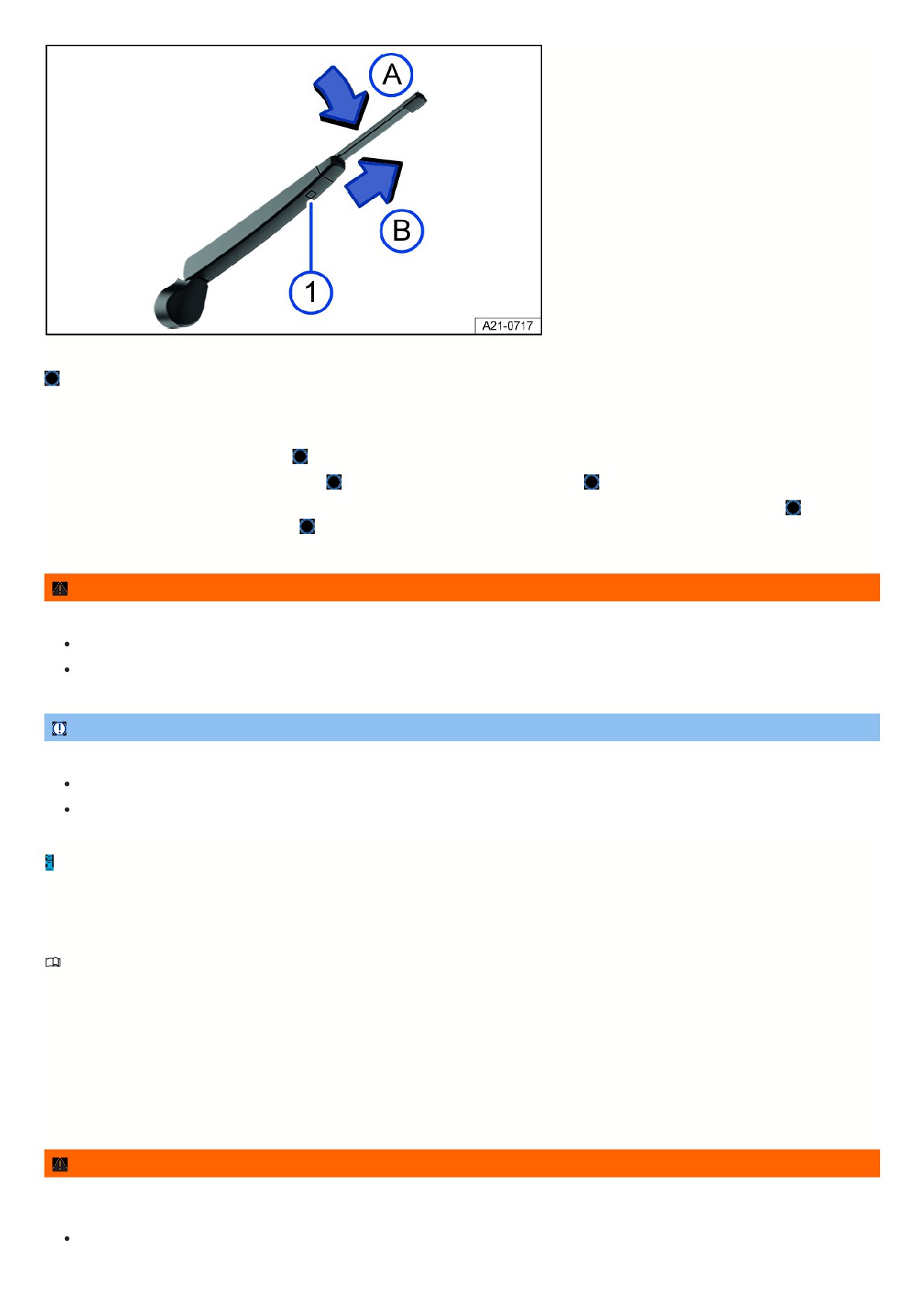
Fig. 145 Changing the rear window wiper blade.
Wiper blade release button.
1. To lift a windshield wiper arm, hold it only in the area where it attaches to the wiper blade.
2. Lift the wiper arm and fold it out.
3. Press and hold the release button fig. 145
4. Tilt the wiper blade toward the wiper arm fig. 145
while removing it in the direction of the arrow
. You may need to use more force to do this.
5. Slide a new wiper blade with the same length and design onto the wiper arm in the opposite direction to the arrow until it engages fig. 145 . For this to wor
the wiper blade has to be folded out fig. 145
6. Place the wiper arm carefully on the rear window.
WARNING
Worn or dirty wiper blades reduce visibility and increase the risk of accidents and serious injuries.
Always clean dirty wiper blades.
Always replace wiper blades if they are damaged or worn and are no longer cleaning the window glass sufficiently.
NOTICE
Cleaning wiper blades or door windows with unsuitable cleaning agents may cause damage.
Do not clean the wiper blades and windshield and windows with fuel, nail polish remover, paint thinner, or other similar fluids.
Do not clean the wiper blades with rough sponges or other sharp objects.
If there is wax residue on the windshield and rear window from car wash systems and other products, this can cause the windshield wipers to rub. Remove any
wax residue with a special cleaner or cleaning towels.
Exterior lighting
Introduction
Before performing bulb replacement, check if it is an incandescent bulb or an LED light. Generally, light bulbs can be replaced by yourself. If the exterior lighting on
your vehicle is equipped with LED technology, it is not possible to change LED lights or individual LEDs by yourself. The malfunction of individual LEDs may be an
indication that more LEDs will malfunction. If this is the case, have the LEDs checked and/or replaced if necessary by suitably qualified professionals. Volkswagen
recommends contacting an authorized Volkswagen dealer or authorized Volkswagen Service Facility.
Driving with exterior lighting that is inoperative may be against the law.
Additional bulb specifications
Some bulbs may have certain manufacturer specifications that differ from conventional light bulbs. The respective name will be on the bulb socket or glass bulb.
WARNING
If the vehicle lighting is not used appropriately for the weather conditions, the road will not be illuminated sufficiently. The vehicle will not be visible to other road
users or will be difficult to see. This can cause accidents and serious or fatal injuries.
Regularly check the vehicle's lighting system and turn signals.
255

Repair the lighting system and turn signals when necessary.
WARNING
Work in the engine compartment can result in accidents and serious injuries if bulb replacements are carried out incorrectly.
Always follow the tasks described and observe the general safety precautions.
Never perform a bulb replacement if you are not familiar with the required activities.
If you are not sure how to carry out a bulb replacement, have the work required carried out by suitably qualified professionals. Volkswagen recommends
contacting an authorized Volkswagen dealer or authorized Volkswagen Service Facility.
WARNING
During the bulb replacement, the sharp-edged parts of bulb housings and hot or exploding bulbs can cause serious injuries.
Only change bulbs when they have cooled down completely.
Always protect your hands during bulb replacement.
NOTICE
Water entering the headlight housing can damage the electrical system.
After a bulb replacement, always fit the covers on the headlight housing.
After installation, always check that the covers have been secured correctly.
Information on bulb replacement
Please read the introductory information and heed the Warnings and Notice ⇒
and Introduction.
Always perform the following activities for bulb replacement in the specified sequence
⇒
:
1. Park the vehicle a safe distance away from moving traffic on level and solid ground as soon as possible.
2. Set the electronic parking brake.
3. Switch the lights off.
4. Turn off the turn signal if it is activated.
5. Vehicles with an automatic transmission: Engage the parking lock
6. Switch the ignition off.
7. Allow the orientation lighting to turn off.
8. Allow the affected light bulbs to cool down.
9. Check if you can see that a fuse is burnt out
⇒ Introduction.
10. Change the affected light bulb according to the instructions ⇒
A light bulb may only be replaced with the same type of light bulb. The respective name will be on the bulb socket or glass bulb.
Never touch a glass light bulb with bare hands. The fingerprints left behind would vaporize from the heat when the bulb is switched on and condense on the
reflector, which would then reduce the headlight brightness.
11. Check the bulb function after a bulb is changed.
If the bulb does not function, the bulb may not have been inserted correctly, may have fallen out, or the connector may not have been plugged in correctly.
12. After every bulb replacement in the front of the vehicle, have the headlight adjustment checked by an authorized Volkswagen dealer or authorized Volkswagen
Service Facility. Volkswagen recommends contacting an authorized Volkswagen dealer or authorized Volkswagen Service Facility.
WARNING
If the steps described for the bulb replacement are ignored, accidents may occur. Serious injuries may result.
Always follow the tasks described and observe the general safety precautions.
NOTICE
Removing and inserting trim panels and headlights incorrectly can damage the vehicle paint and body.
Always be careful when removing and inserting the trim panels and headlights.
256
Replacing bulbs in LED headlights
Please read the introductory information and heed the Warnings and Notice ⇒
and Introduction.
Preparations
Only perform these activities in the specified order:
1. Refer to the information on bulb replacement and carry out the activities.
2. Open the hood.
The headlight does not need to be removed for bulb replacement.
Replacing a bulb in a turn signal
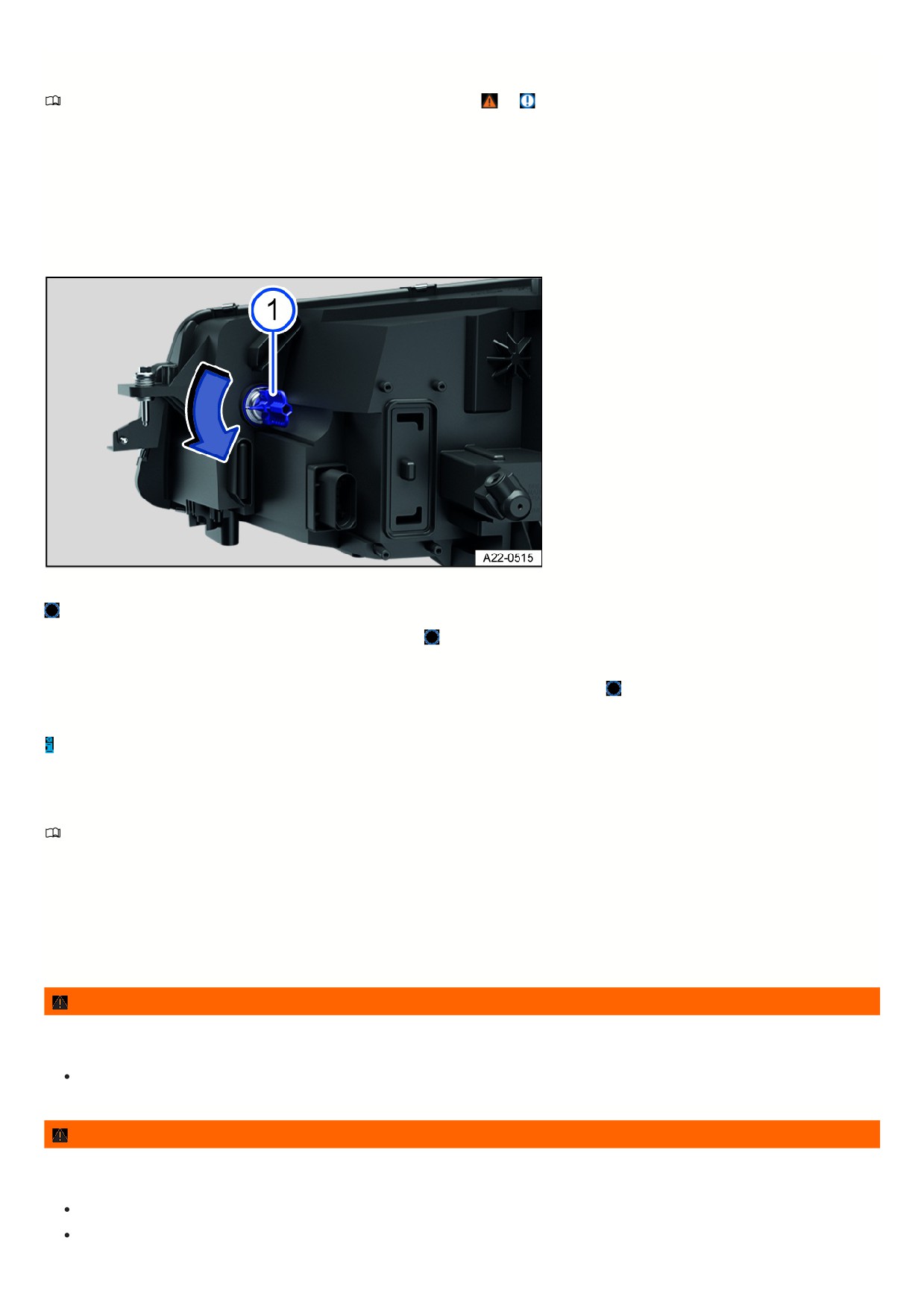
Fig. 146 In the right-side of the engine compartment: Rear side of the headlights.
Turn signal bulb holder.
1. To remove, turn the bulb holder in the direction of the arrow fig. 146
2. Replace the burned out bulb with a new bulb that is identical to the one being replaced.
3. Carefully insert the bulb holder into the headlight and turn in the opposite direction to the arrow fig. 146
4. Close the hood.
The illustration shows the right headlight from behind. The left headlight is structured as its mirror image.
Replacing fuses
Introduction
Due to the constant development of the vehicle, equipment-dependent fuse allocations, and the combined protection of multiple electrical equipment items using
one fuse, a complete overview of the fuse layout is not available at the time of print. Detailed information about fuse allocations can be obtained from suitably
qualified professionals. Volkswagen recommends contacting an authorized Volkswagen dealer or authorized Volkswagen Service Facility.
Generally, multiple electrical equipment items can be protected together through by fuse. On the other hand, some equipment items may use multiple fuses.
Only replace fuses if the cause for the malfunction has been fixed. If a new fuse blows again after a short time, the electrical system must be checked by suitably
qualified professionals. Volkswagen recommends contacting an authorized Volkswagen dealer or authorized Volkswagen Service Facility.
WARNING
The high voltage in the electrical system may cause electric shocks and severe burns. Contact with electric wires in the ignition system may result in serious or
fatal injuries.
Never touch the electrical wires in the ignition system.
WARNING
Using unsuitable fuses, repairing fuses, and bridging a power circuit without fuses can cause severe damage or fires within the vehicle. This could result in
serious or fatal injuries.
Replace fuses only with fuses of same rating and size. Make sure that the color and label are identical to the faulty fuse.
Never repair fuses.
257
Never use metal strips, paper clips or similar objects as substitutes for fuses.
NOTICE
Changing a fuse when the ignition is switched on, the engine is running, the light is switched on, or other electrical equipment is switched on could cause
damage to the electrical system.
Switch off the engine and turn off the light and other electrical equipment.
Make sure that the engine cannot be started while a fuse is being replaced.
NOTICE
If a fuse is replaced by another fuse with a higher amp rating, this could also damage the vehicle's electrical system in another location.
Never replace a fuse with a fuse that has a higher current rating.
NOTICE
Dirt and moisture in the fuse boxes can damage the electrical system.
Protect open fuse boxes from dirt and moisture.
Avoid short circuits in the electrical system.
Check that the fuse box covers are tightly sealed again and are not damaged.
There are more fuses in the vehicle than are specified in this chapter. These should only be replaced by an authorized Volkswagen dealer or authorized
Volkswagen Service Facility qualified in this respect. Volkswagen recommends contacting an authorized Volkswagen dealer or authorized Volkswagen Service
Facility.
Fuses in the engine compartment
Please read the introductory information and heed the Warnings and Notice ⇒
and Introduction.
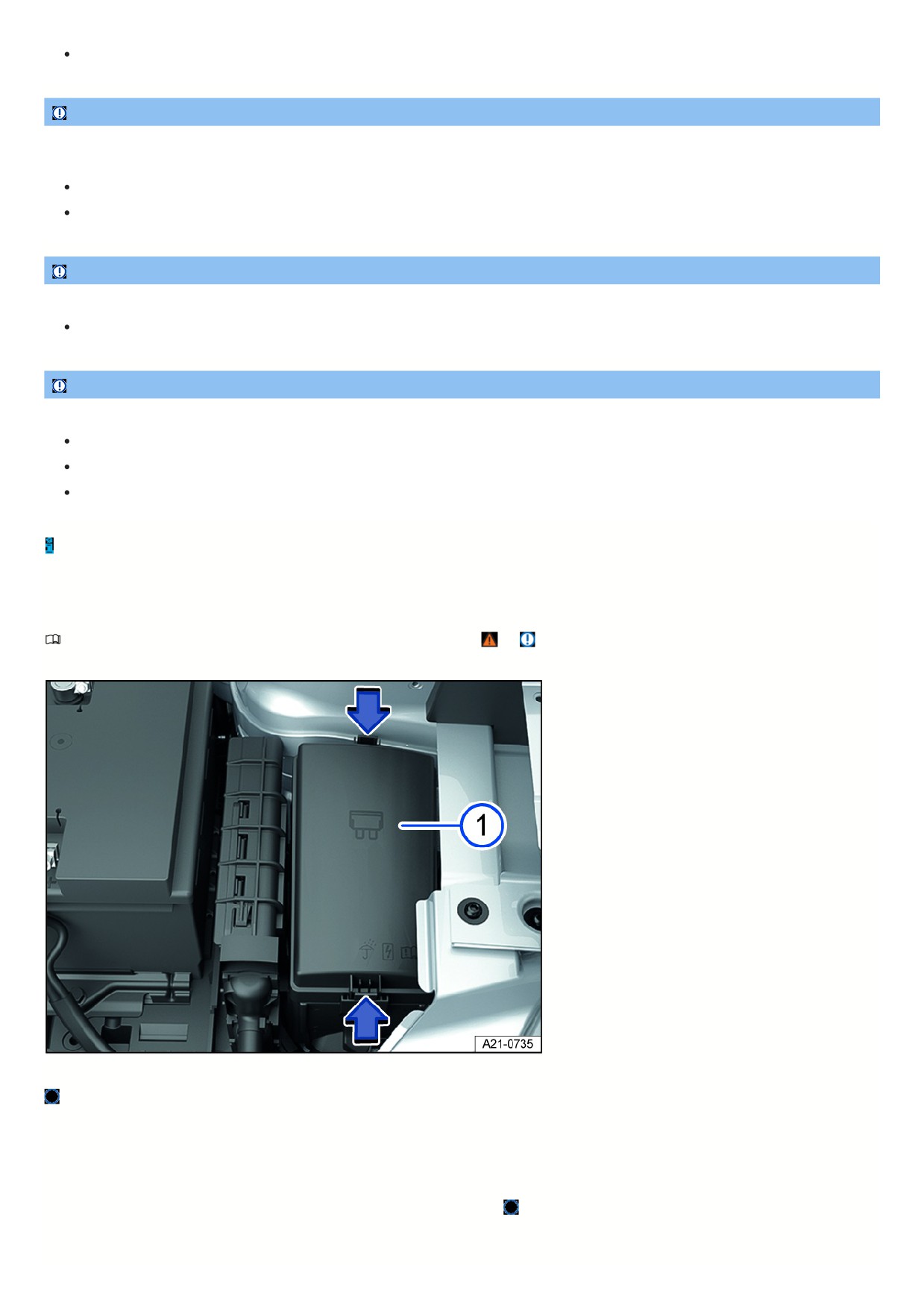
Opening the fuse box in the engine/motor compartment
Fig. 147 In the engine compartment: Fuse box.
Fuse box cover.
The plastic pliers for removing fuses can be found on the inside of the fuse box cover or on the fuse panel.
Removing the cover
1. Open the hood.
2. Press the catches in the direction of the arrow to unlock the fuse box cover fig. 147
3. Remove the cover upward.
258
Fitting the cover
1. Place the cover onto the fuse box.
2. Push the cover downwards until it audibly clicks into place on both sides.
Fuse table for fuses in the engine compartment
Please read the introductory information and heed the Warnings and Notice ⇒
and Introduction.
The list shows the fuse locations for the equipment relevant to the driver. The first column of the table contains the fuse slot; the other columns include the fuse
version, current rating, and the protected equipment.
Depending on the country and the vehicle equipment, there may be differences from the fuse numbers and fuse slots listed in the table. If necessary, ask for the
exact fuse assignment from suitably qualified professionals. Volkswagen recommends contacting an authorized Volkswagen dealer or authorized Volkswagen
Service Facility.
Fuse assignment
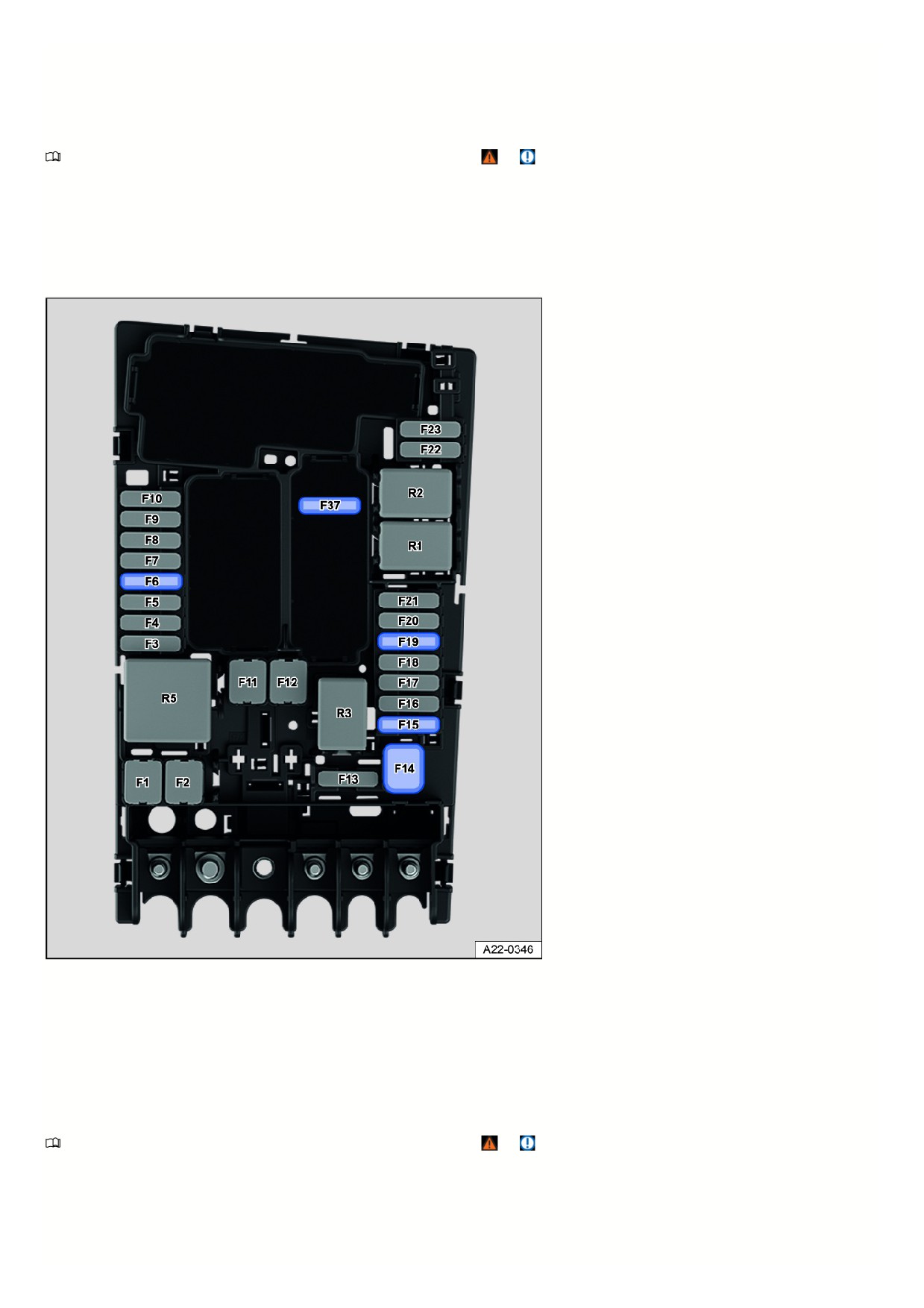
Fig. 148 Fuse locations in the engine compartment.
Fuse location fig. 148:
F6
7.5 Amp, ATO®, brake light sensor.
F15
15 A, ATO®, horn.
F19
30 Amp, ATO®, windshield wipers.
Fuses in the instrument panel
Please read the introductory information and heed the Warnings and Notice ⇒
and Introduction.
259
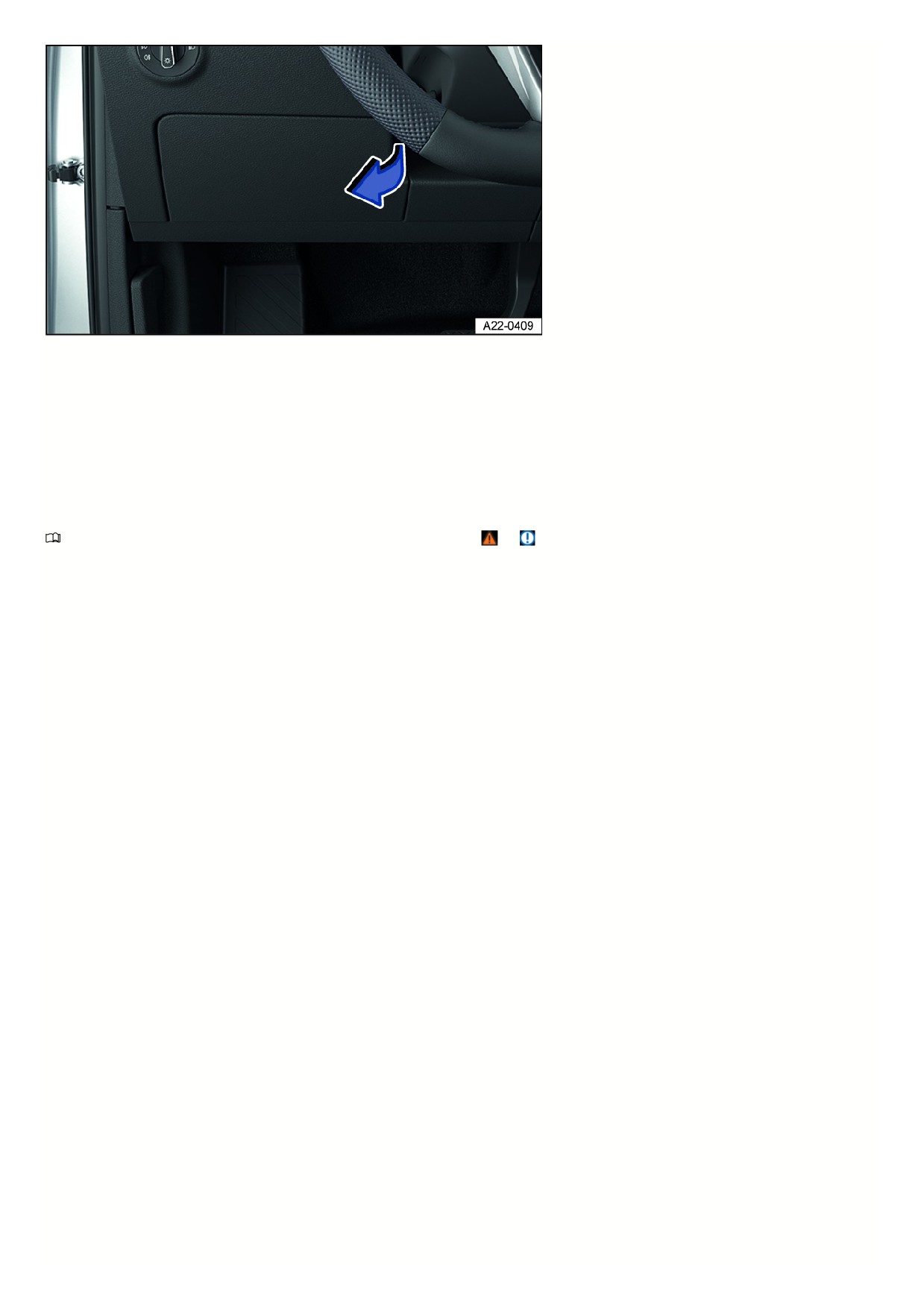
Fig. 149 On the driver side in the instrument panel: fuse box cover (general example).
Opening the fuse box in the instrument panel
1. Pull the cover to the side in the direction of the arrow and remove it fig. 149.
Depending on the vehicle equipment, plastic pliers for pulling out fuses can be found on the inside of the cover.
Closing the fuse box in the instrument panel
1. Push the cover into the instrument panel mounts in the opposite direction to the arrow until it audibly clicks into place fig. 149.
Fuse table for fuses in the instrument panel
Please read the introductory information and heed the Warnings and Notice ⇒
and Introduction.
The list shows the fuse locations for the equipment relevant to the driver. The first column of the table contains the fuse slot; the other columns include the fuse
version, current rating, and the protected equipment.
Depending on the country and the vehicle equipment, there may be differences from the fuse numbers and fuse slots listed in the table. If necessary, ask for the
exact fuse assignment from suitably qualified professionals. Volkswagen recommends contacting an authorized Volkswagen dealer or authorized Volkswagen
Service Facility.
Fuse assignment
26
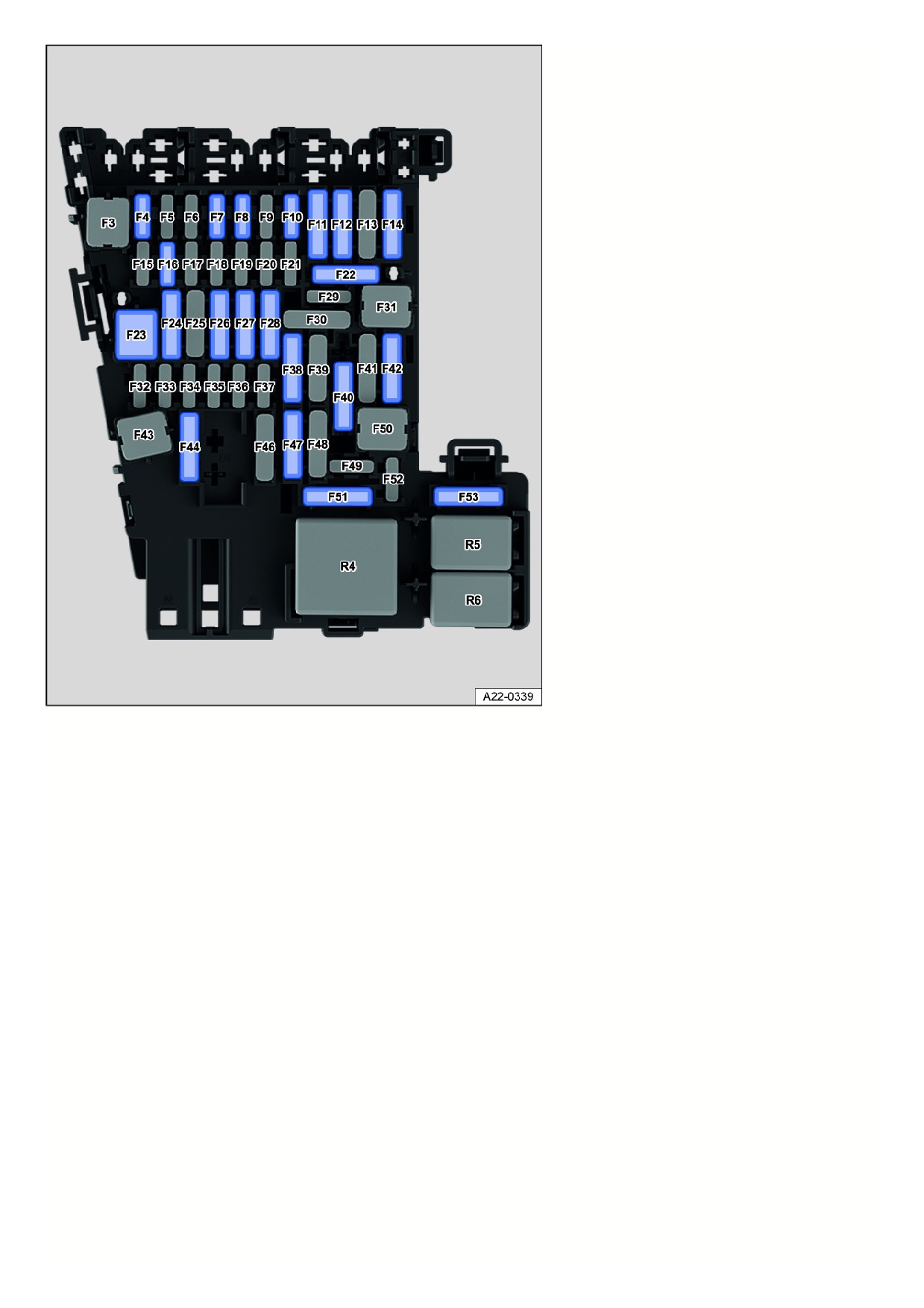
Fig. 150 Fuse assignment in the instrument panel.
Fuse locations fig. 150:
F4
7.5 Amp, MINI®, anti-theft alarm system.
F6
10 A, ATO®, automatic transmission selector mechanism.
F7
10 amp, MINI®, climate control bar, rear window defroster relay.
F8
7.5 Amp, MINI®, dipped beam light switch, rain/light sensor, electronic parking brake.
F10
7.5 Amp, MINI®, Display, Infotainment system control panel.
F11
40 Amp, ATO®, exterior lighting on the left side.
F12
20 Amp, ATO®, Infotainment system.
F14
40 Amp, ATO®, blower regulator.
F16
7.5 Amp, MINI®, telephone.
F23
20 Amp, JCASE®, power sunroof.
F24
40 Amp, ATO®, exterior lighting on the right side.
F26
30 Amp, ATO®, seat heating.
F27
30 Amp, ATO®, interior lighting.
F40
20 Amp, ATO®, cigarette lighter, sockets. Note the installation position, factory-standard fuse location as shown in the illustration.
F42
40 Amp, ATO®, central locking system.
F47
15 Amp, ATO®, rear window wiper.
F53
30 Amp, ATO®, rear window defroster.
261
Power windows and seats can be protected by circuit breakers or control modules, which switch back on automatically several seconds after correcting the
overload, for example when door windows are frozen shut.
Replacing blown fuses
Please read the introductory information and heed the Warnings and Notice ⇒
and Introduction.
Preparations
1. Switch off the ignition, lights and all other electrical equipment.
Detecting blown fuses
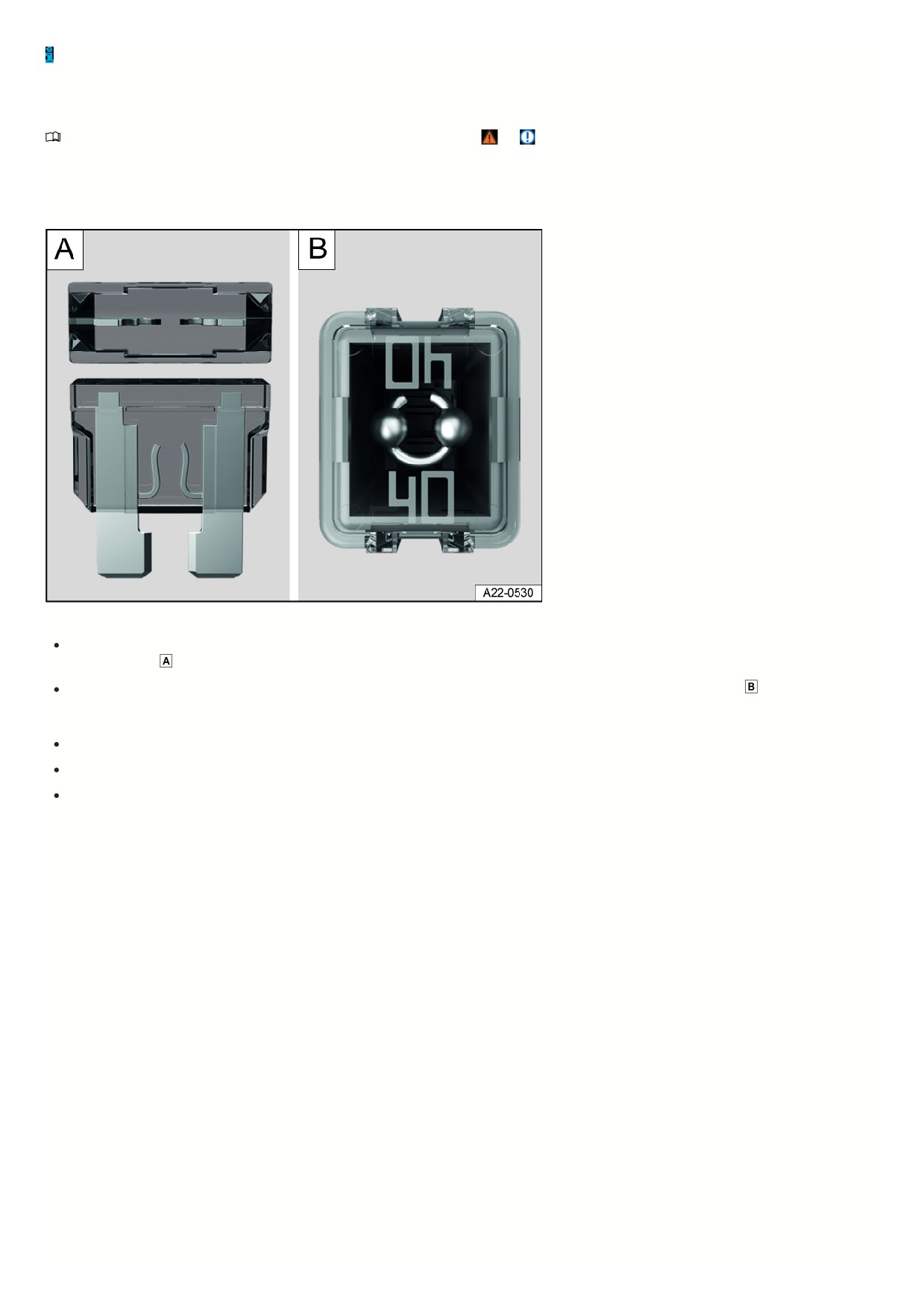
Fig. 151 Blown fuse (general example).
®
A blown flat connector fuse (ATO
, MINI®) has metal strips that have burned through, which you can see through the transparent housing from above and from
the side fig. 151
A blown block fuse (JCASE
®
) is recognizable by the melted metal strip seen through the transparent housing from above
fig. 151
Fuse versions
Standard flat connector fuse (ATO®).
Small flat connector fuse (MINI®).
Block fuse (JCASE®).
Fuse color codes
Fuses (ATO® - MINI®).
Color
Current rating
Black
1 A
Purple
3 A
Orange
5 A
Brown
7.5 A
Red
10 A
Blue
15 A
Yellow
20 A
White or clear
25 A
Green
30 A
Light green40 A
Fuses (JCASE®)
Blue
20 A
Pink
30 A
262
40 A
Green
Red
50 A
Yellow
60 A
Replacing fuses
Fig. 152 Plastic pliers for removing or installing a fuse (general example).
1. Remove plastic tongs from either the fuse box or the cover of the fuse box fig. 152.
2. Depending on the design of the fuse, slide the appropriately sized clamp on the plastic pliers onto the fuse from above or from the side.
3. Remove the fuse.
4. If a fuse is blown, replace with a fuse with the same rating (same color and same label) and the same size
⇒
5. After inserting the new fuse, place the plastic pliers back in the cover, if necessary.
6. Reinstall the cover or close the fuse box cover.
NOTICE
If a fuse is replaced by a fuse with a higher current rating, this could damage the electrical system in another location.
Never replace a fuse with a fuse that has a higher current rating.
Xump-starting
Introduction
For technical reasons the vehicle must not be tow-started
⇒ . If the engine cannot start because the 12 V vehicle battery is dead, the 12 V vehicle battery on
another vehicle can be used to start your vehicle.
For vehicles with a 12 V vehicle battery in the vehicle interior or luggage compartment, the jumper cables may only be connected to the jump-start points in the
engine compartment.
WARNING
Using jumper cables incorrectly and performing a jump-start incorrectly could cause the 12 V vehicle battery to explode. Serious injuries may result.
Always read and heed the warnings and safety precautions before working on the 12 V vehicle battery
⇒ Introduction.
Never confuse the positive battery terminal with the negative battery terminal.
Never jump-start a vehicle with a frozen or thawed 12 V vehicle battery.
WARNING
During a jump-start, a highly explosive gas mixture builds up at the 12 V vehicle battery. Sparks produced during a jump-start could ignite the flammable gas.
Serious injuries may result.
Always keep fires, sparks, open flames, and lit cigarettes far away from the 12 V vehicle battery.
263
Avoid discharging static electricity near the 12 V vehicle battery.
NOTICE
Tow-starting can cause severe damage to the vehicle.
Jump-start the vehicle to start the engine.
NOTICE
A drained 12 V vehicle battery can freeze, be damaged and fail at temperatures around approx. 0 °C (approx. +32 °F).
Always replace a frozen or thawed 12 V vehicle battery.
Ground jump-start point
Please read the introductory information and heed the Warnings and Notice ⇒
and Introduction.
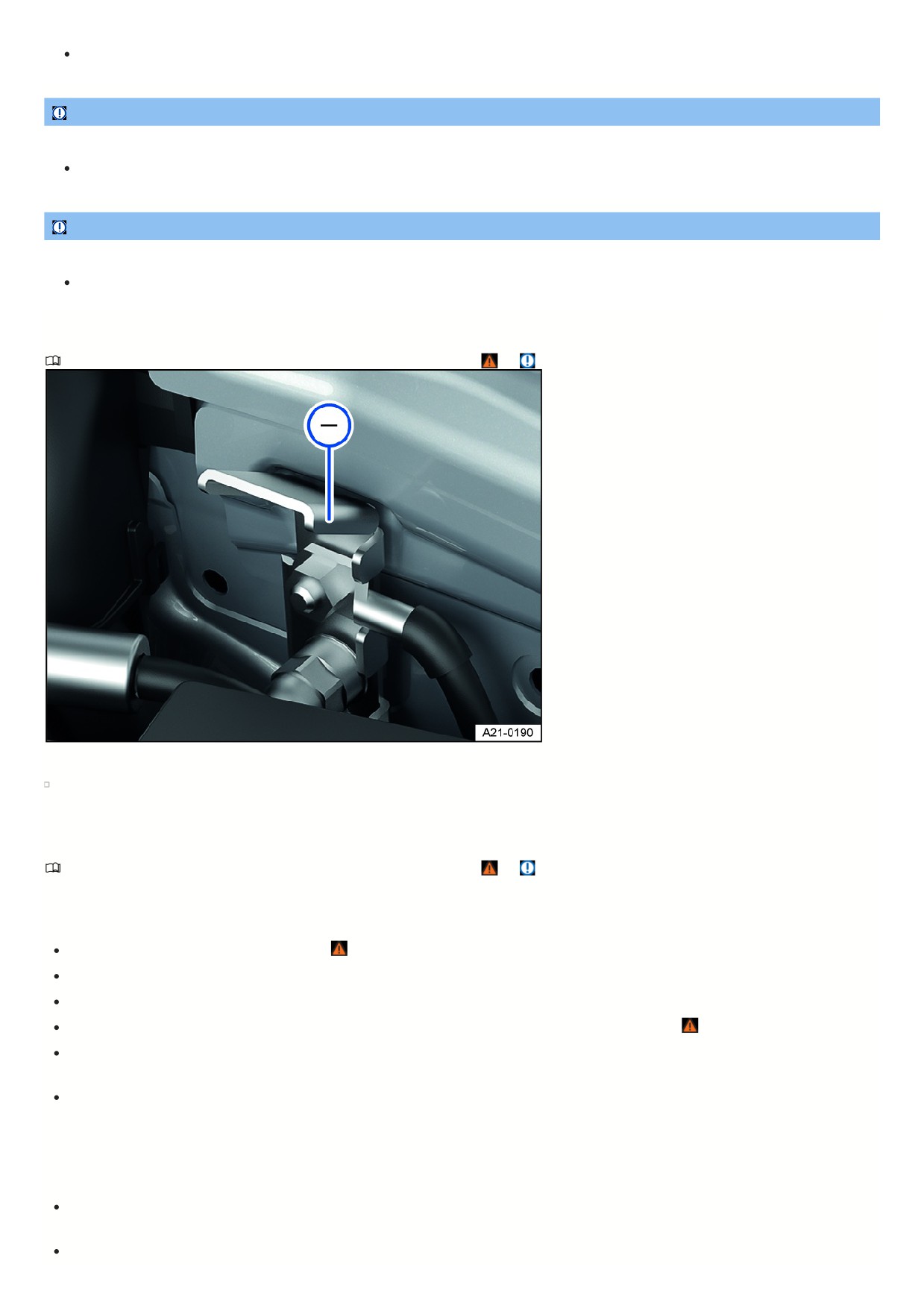
Fig. 153 In the engine compartment: Negative terminal jump-start point.
The jump-start point (negative terminal) is for connecting the black jumper cable fig. 153.
The vehicle can give and receive a jump-start using this negative terminal jump-start point.
Preparing and Performing a Xump-start
Please read the introductory information and heed the Warnings and Notice ⇒
and Introduction.
Preparations
Observe the following for jump-starting:
Wear suitable eye protection and safety gloves ⇒
Pay attention to the operating instructions provided by the manufacturer of the jump-start cables.
Open the hood.
Always use a jumper cable with fully insulated terminal clamps and without any insulation defects for jump-starting
⇒
Ensure that there is sufficient distance between the vehicle providing the jump-start and the vehicle receiving the jump-start, otherwise current could already
flow when connecting the positive battery terminals.
Make sure the terminal clamps have sufficient contact with metal.
Xumper cable
So that vehicles can be jump-started and can jump-start others, an appropriate jumper cable is required.
The following jumper cable wire diameters must not be fallen short of by the vehicle providing the jump-start.
Vehicles with electric drivetrain: To jump-start the vehicle with a drained 12 V vehicle battery, the wire diameter of the jumper cable must be at least 25 mm
2
(0.038 in2).
Vehicles with hybrid drive: To jump-start the vehicle with a drained 12 V vehicle battery, the wire diameter of the jumper cable must be at least 25 mm2
2
264
(0.038 in2).
2
Vehicles with a gasoline engine: To jump-start the vehicle with a drained 12 V vehicle battery, the wire diameter of the jumper cable must be at least 25 mm
(0.038 in2).
Vehicles with a diesel engine: To jump-start the vehicle with a drained 12 V vehicle battery, the wire diameter of the jumper cable must be at least 35 mm
2
(0.054 in2).
Vehicle Receiving the Xump-start
1. Check that the discharged 12 V vehicle battery is properly connected to the 12 V vehicle electrical system.
2. If a 12 V vehicle battery with a viewing window has been installed, check the color of the viewing window. If the viewing window is light yellow or has no color,
do not perform a jump-start and contact an authorized Volkswagen dealer or authorized Volkswagen Service Facility.
Vehicle Providing the Xump-start
1. Pay attention to the operating instructions provided by the vehicle manufacturer.
2. Check that the battery providing the jump-start has the same voltage (12 V) and approximately the same battery capacity as the discharged 12 V vehicle
battery. Pay attention to the information printed on the battery of the vehicle providing the jump-start.
Xump-starting
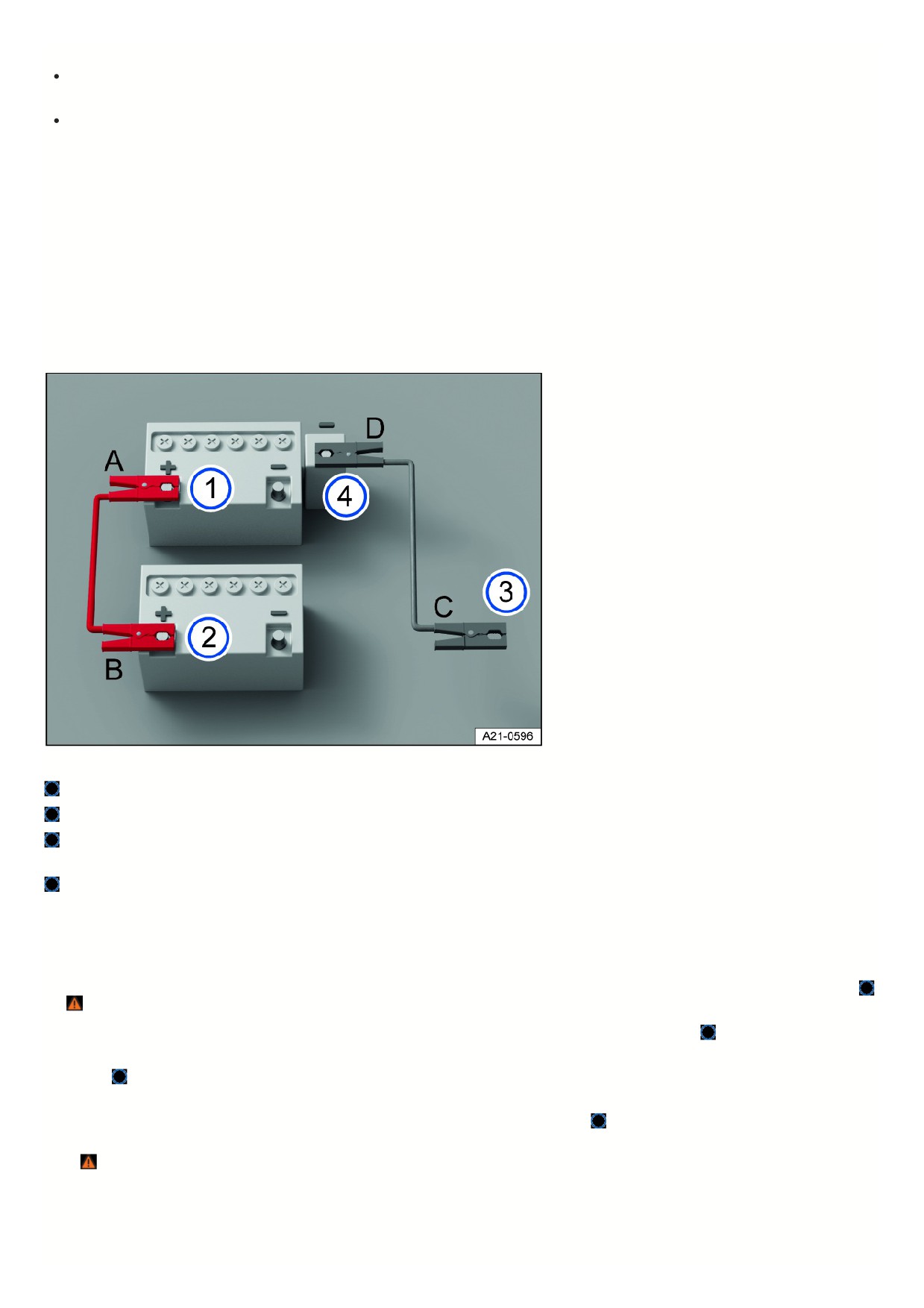
Fig. 154 Diagram for connecting the jumper cables.
Positive battery terminal of the vehicle receiving the jump-start.
Positive battery terminal of the vehicle providing the jump-start.
Suitable negative terminal of the vehicle providing the jump-start: Preferably a jump-start point (negative connection), a large metal part that is bolted securely
to the engine block, or the engine block itself.
Jump-start point (negative terminal) of the vehicle receiving the jump-start.
Only connect the jumper cables in the sequence A - B - C - D fig. 154.
1. Switch the ignition off on both vehicles.
2. In the engine compartment, open the cover on the positive battery terminal (+) of the 12 V vehicle battery, if fitted.
3. Connect one end of the red jumper cable to the positive battery terminal (+) of the 12 V vehicle battery with the discharged 12 V vehicle battery fig. 154
⇒
4. Connect the other end of the red jumper cable to the positive battery terminal (+) on the vehicle providing current fig. 154
5. Connect one end of the black jumper cable preferably to the negative terminal (-) jump-start point on the vehicle with the 12 V vehicle battery providing current
fig. 154
Or: If there is no negative terminal (-) jump-start point, connect the end of the black jumper cable to a large metal part that is bolted securely to the engine
block, or the engine block itself, on the vehicle with the 12 V vehicle battery providing current fig. 154
6. Connect the other end of the black jumper cable to the negative terminal (-) jump-start point on the vehicle with the discharged 12 V vehicle battery fig. 154
⇒
7. Route the jumper cables so that they cannot become caught in moving parts in the engine compartment.
Start the engine
1. Start the engine in the vehicle that is providing current and allow it to idle.
265

2. Wait a few minutes and then start the vehicle's engine with the discharged 12 V vehicle battery. If the engine does not start, stop the starting process after ten
seconds, and try again after approximately one minute.
If the engine still will not start, contact an authorized Volkswagen dealer or authorized Volkswagen Service Facility.
Removing the jumper cables
1. Before disconnecting the jumper cables, switch off the low beam headlight if necessary.
2. In the vehicle with the drained 12 V vehicle battery, switch on the blower for the air conditioner and the rear window defroster. This will reduce any voltage
surges that may occur when disconnected.
3. Once the vehicle has been jump-started, always disconnect the jumper cables in the order D - C - B - A fig. 154.
4. Close the cover of the positive terminal (+), if fitted.
After successful jump-starting, have the 12 V vehicle battery checked by an authorized Volkswagen dealer or authorized Volkswagen Service Facility. Volkswagen
recommends contacting an authorized Volkswagen dealer or authorized Volkswagen Service Facility.
WARNING
Performing a jump-start incorrectly can cause the 12 V vehicle battery to explode, which can cause serious injuries.
Always wear suitable eye protection and safety gloves.
Never lean over the 12 V vehicle battery.
Always connect the positive cable first and then the negative cable.
Never connect the negative terminal to parts of the fuel system or to the brake lines.
Ensure that there is no contact between the non-insulated parts of the terminal clamps.
Make sure the cable insulation is free from any defects.
Make sure that the cable that is connected to the positive battery terminal on the 12 V vehicle battery does not come into contact with any vehicle
components that conduct electricity.
NOTICE
A drained 12 V vehicle battery can freeze at temperatures around approx. 0 °C (approx. +32 °F), suffer damage and fail.
Always replace a frozen or thawed 12 V vehicle battery.
Towing
Introduction
Towing requires practice, particularly if a towing cable is used. Both drivers should be familiar with the special considerations when towing. Inexperienced drivers
should not tow.
Follow all applicable laws when towing.
Always make sure the towing force does not exceed the permitted level and there are no shock loading conditions. There is always the risk of the coupling becomin
overloaded when driving off-road.
WARNING
The vehicle handling and braking efficiency will change considerably when it is towed. This may cause you to lose control of the vehicle and result in accidents
and serious or fatal injuries.
Bear in mind that more force is required for steering and braking during towing.
WARNING
If a vehicle that has no electrical power is towed, the electronic steering lock may suddenly engage. If this happens, you will not be able to move the steering
wheel. This can cause accidents and serious or fatal injuries.
Never turn off the ignition with the starter button while towing.
If the vehicle loses power while it is being towed, stop towing the vehicle immediately and see an authorized Volkswagen dealer or authorized
Volkswagen Service Facility for assistance.
NOTICE
266
When pushing the vehicle by hand, the taillights, side spoiler on the rear window and large sections of sheet metal could be damaged and the rear spoiler could
detach.
When pushing the vehicle by hand, do not press on the taillights, side spoiler on the rear window, large sections of sheet metal, or the rear spoiler.
Towing
Towing refers to using a vehicle to pull another vehicle that cannot be driven.
The vehicle can be towed using a tow bar or tow rope:
The maximum permissible speed is 50 km/h (30 mph).
The maximum permissible distance is 50 km/h (30 miles).
The easiest and safest way to tow is using a tow bar. You should use a towing cable only if a tow bar is not available. The towing cable should be elastic to protect
both vehicles. Use a cable made of synthetic rubber or a similar elastic material.
Towing with a tow truck
If your vehicle will be raised by one axle when towing, only the axle listed below may be raised, depending on the transmission and engine combination:
Front-wheel drive
Automatic transmission
Front axle
Manual transmissionFront axle
All-wheel drive (4MOTION)
Automatic transmission
Front axle
Manual transmission Front axle
WARNING
Vehicle components can be badly damaged by incorrectly attached tow ropes or tow bars. This increases the risk of accident and could result in serious or fatal
injuries.
Only ever secure the vehicle to be recovered and towed at the points designed for this purpose.
Never secure the tow rope or the tow bar to axle or suspension components.
Contact an authorized Volkswagen dealer or authorized Volkswagen Service Facility and have the vehicle taken away on a tow truck, if necessary.
Instructions for towing
Please read the introductory information and heed the Warnings and Notice ⇒
and Introduction.
A vehicle being towed can still signal a turn using the turn signals even if the emergency flashers are switched on. To do this when the ignition is switched on,
activate the turn signal for the desired direction. The emergency flashers will stop while the turn signal is active. The emergency flashers will automatically activate
again once the turn signal and high beam lever returns to the neutral position.
When may this vehicle not be towed?
The vehicle must not be towed in the following situations:
If the 12 V vehicle battery is drained.
The indicator in the instrument cluster display does not function perfectly.
If the towing distance is greater than 50 km/h (30 miles).
The selector lever of the automatic transmission cannot be moved to neutral (position N).
The electronic parking brake cannot be released.
The steering lock cannot be released.
If the wheel clearance or the steering function can no longer be secured after an accident.
If the vehicle cannot be towed on its own wheels due to one of the conditions listed, contact professional assistance and have the vehicle transported by a tow truck
if necessary.
Towing
Please read the introductory information and heed the Warnings and Notice ⇒
and Introduction.
Secure the tow rope or tow bar only at the permitted points:
Towing lug.
WARNING
267

Vehicle components can be badly damaged by incorrectly attached tow ropes or tow bars. This increases the risk of accident and could result in serious or fatal
injuries.
Only ever secure the vehicle to be recovered and towed at the points designed for this purpose.
Never secure the tow rope or the tow bar to axle or suspension components.
Contact an authorized Volkswagen dealer or authorized Volkswagen Service Facility and have the vehicle taken away on a tow truck, if necessary.
Preparations
Make sure the tow rope is not twisted. Otherwise it could disconnect from the towing eye while towing.
Switch the ignition and emergency flashers on in both vehicles. However, do not do this if it is prohibited by law.
Read and comply with the information and instructions for towing given in the Owner's Manual for the other vehicle.
Towing vehicle (front)
1. Only start to drive when the tow rope is taut.
2. Be especially careful when accelerating.
3. Avoid sudden braking and driving maneuvers.
4. Do not exceed the permitted towing weight of the vehicle.
Vehicle being towed (rear)
1. Make sure the ignition is always switched on so that the steering wheel is not locked and so that the turn signal and windshield wiper can be used if needed.
The brake booster and power steering only work when the engine is running. Otherwise, the brake pedal needs to be pressed much harder and more force is
required to steer.
2. Make sure the vehicle key is always in the vehicle during the towing process
⇒ Introduction.
3. For vehicles with an automatic gearbox: Select gear
4. Release the electronic parking brake.
5. Make sure the tow rope is always taut.
NOTICE
If the battery charge level of the 12 V vehicle battery is insufficient, you will not be able to release the electronic parking brake and steering lock. The vehicle
may be damaged when towed.
To release the electronic parking brake and steering lock, put the vehicle into drive-ready mode, if necessary by means of a jump-start if there is a loss of
power or malfunctions.
Contact an authorized Volkswagen dealer or authorized Volkswagen Service Facility and have the vehicle taken away on a tow truck, if necessary.
Installing the front towing eye
Please read the introductory information and heed the Warnings and Notice ⇒
and Introduction.
Depending on the country and vehicle equipment, the mount for the towing eye is situated behind the bumper cover.
1. Before having it towed, check that your vehicle has a threaded mount for the towing eye.
2. Read and heed the information about towing.
3. Otherwise, contact an authorized Volkswagen dealer or authorized Volkswagen Service Facility and have the vehicle taken away by a tow truck if necessary.
The towing eye must always be kept in the vehicle ⇒
NOTICE
Using a towing eye that is not suitable for the vehicle can damage the vehicle.
When towing, always use the towing eye enclosed with your own vehicle in the vehicle tool kit, or another suitable towing eye.
Installing the front towing eye
268
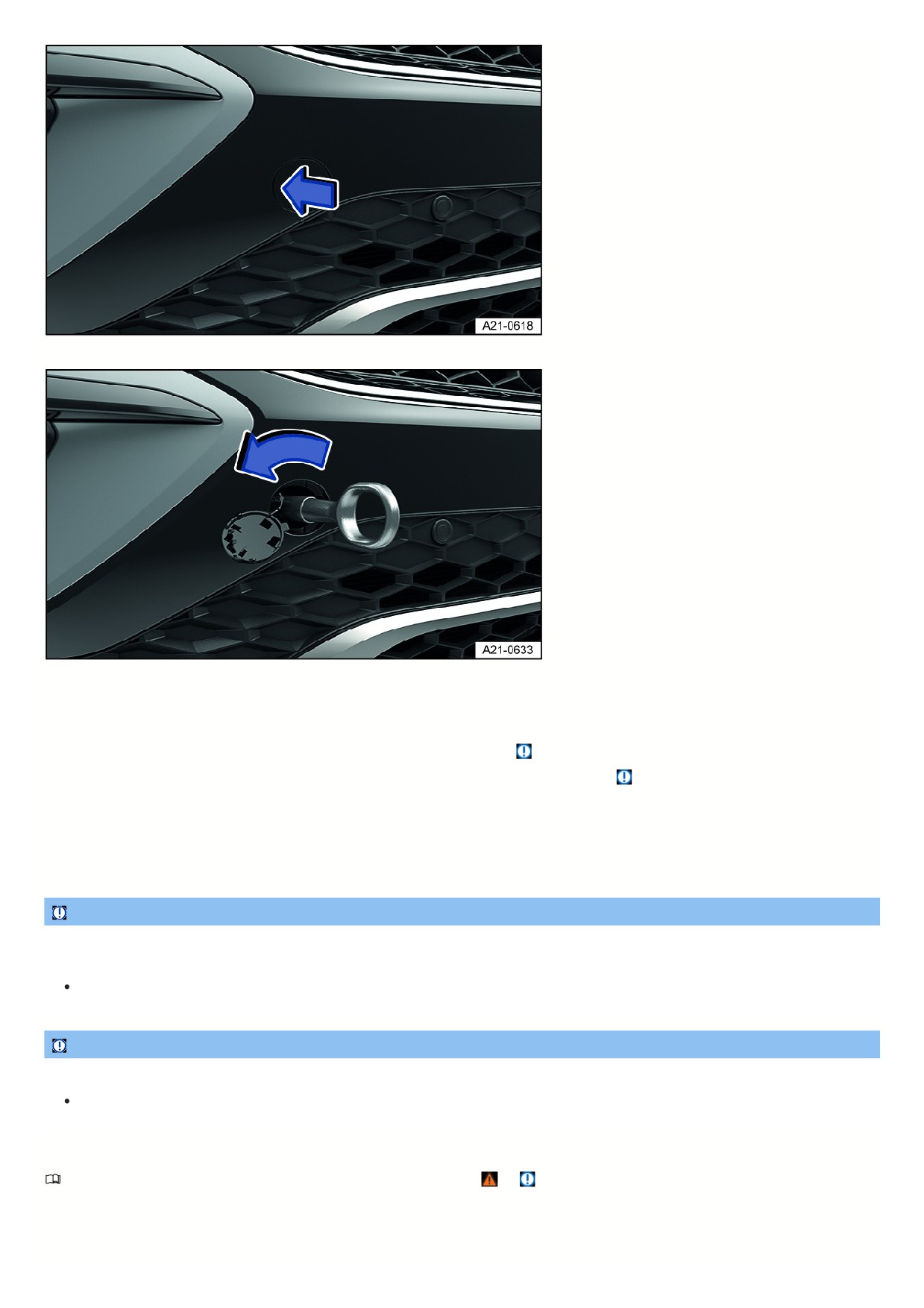
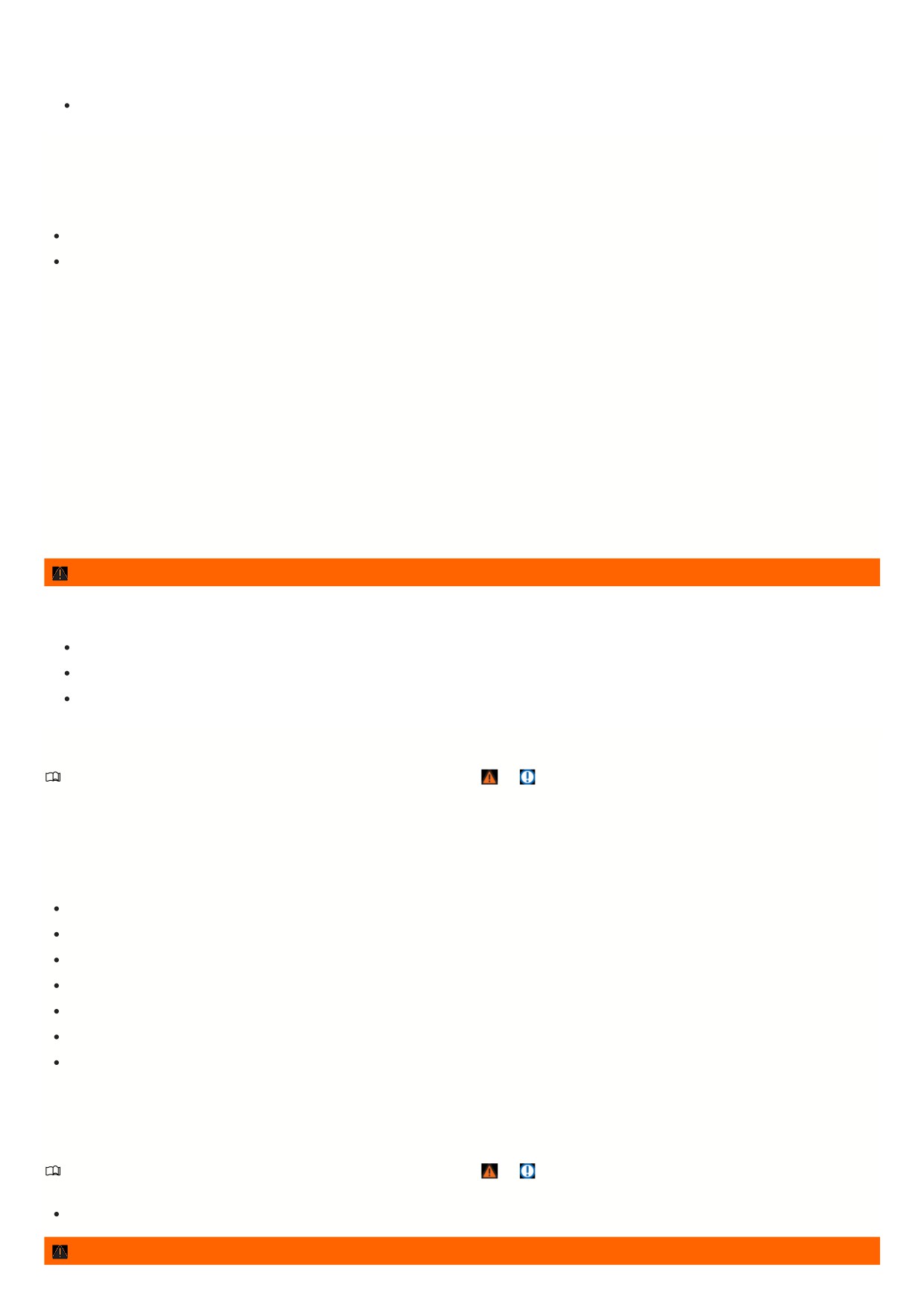
Fig. 155 In the right front bumper: Remove cover.
Fig. 156 In the right front bumper: Screw in towing eye.
1. Remove the towing eye from the vehicle tool kit in the luggage compartment.
2. Press on the marked area of the cover in the direction of the arrow to release the catch on the cover fig. 155.
3. Remove the cover, let it hang from the vehicle or place it in the vehicle if necessary
⇒
4. Rotate the towing eye in the direction of the arrow as far as possible to install it in the mount fig. 156 , ⇒ . Use a suitable object to tighten the towing eye
completely and securely in the mount.
5. After the vehicle has been towed, unscrew the towing eye with a suitable object in the opposite direction to the arrow.
6. Insert the cap into the respective opening and press in until it engages.
7. If necessary, clean the towing eye and return it to the vehicle tool kit in the luggage compartment.
NOTICE
If the towing eye is not fully and tightly screwed into the mount, it may tear out of the mount when towing the vehicle. Tearing out the towing eye may cause
damage to the vehicle.
Always screw the towing eye completely and securely into the mount.
NOTICE
Removing and fitting the cover and towing eye incorrectly may cause damage to the vehicle's paint and body.
Always remove and fit the cover and towing eye carefully.
Installing the rear towing eye
Please read the introductory information and heed the Warnings and Notice ⇒
and Introduction.
Depending on the country and vehicle equipment, the mount for the towing eye is situated behind the bumper cover.
1. Before having it towed, check that your vehicle has a threaded mount for the towing lug.
2. Read and heed the information about towing.
269
3. Otherwise, contact an authorized Volkswagen dealer or authorized Volkswagen Service Facility and have the vehicle taken away by a tow truck if necessary.
The towing eye must always be kept in the vehicle ⇒
NOTICE
Using a towing eye that is not suitable for the vehicle can damage the vehicle.
When towing, always use the towing eye enclosed with your own vehicle in the vehicle tool kit, or another towing eye suitable for the vehicle.
Installing the rear towing eye
Fig. 157 In the right rear bumper: Remove cover.
Fig. 158 In the right rear bumper: Screw in towing eye.
1. Remove the towing eye from the vehicle tool kit in the luggage compartment.
2. Press on the marked area of the cover in the direction of the arrow to release the catch on the cover fig. 157.
3. Remove the cover, let it hang from the vehicle or place it in the vehicle if necessary
⇒
4. Rotate the towing eye in the direction of the arrow as far as possible to install it in the mount fig. 158 , ⇒ . Use a suitable object to tighten the towing eye
completely and securely in the mount.
5. After the vehicle has been towed, unscrew the towing eye with a suitable object in the opposite direction to the arrow.
6. Insert the cap into the respective opening and press in until it engages.
7. If necessary, clean the towing eye and return it to the vehicle tool kit in the luggage compartment.
NOTICE
If the towing eye is not fully and tightly screwed into the mount, it may tear out of the mount when towing the vehicle. Tearing out the towing eye may cause
damage to the vehicle.
Always screw the towing eye completely and securely into the mount.
NOTICE
27

Removing and fitting the cover and towing eye incorrectly may cause damage to the vehicle's paint and body.
Always remove and fit the cover and towing eye carefully.
271

Checking and filling
In the engine compartment
Safety precautions for working in the engine compartment
The engine compartment is a potentially dangerous area in the vehicle. Only perform work in the engine compartment if you are familiar with the necessary activitie
and the general safety precautions, and if the correct operating equipment, fluids and suitable tools are available. Work performed incorrectly can result in serious
injuries ⇒
. Have all work performed by suitably qualified professionals if necessary. Volkswagen recommends contacting an authorized Volkswagen dealer or
authorized Volkswagen Service Facility.
WARNING
The engine compartment is a dangerous area. Any work in the engine compartment could lead to accidents and serious or fatal injuries.
Always work as cautiously and carefully as possible.
Only perform work in the engine compartment if you are familiar with the required activities.
If you are not sure how to do the work in the engine compartment, go to an authorized Volkswagen dealer or authorized Volkswagen Service Facility.
Volkswagen recommends contacting an authorized Volkswagen dealer or authorized Volkswagen Service Facility.
Before working in the engine compartment, apply the electronic parking brake and move the selector lever to the position or move the gearshift lever
into the neutral position.
Switch off the ignition and store the vehicle key securely and far enough away from the vehicle to ensure that the engine cannot be started accidentally.
Never touch hot components in the engine.
Do not leave any items, such as cleaning cloths or tools, in the engine compartment.
Always keep children away from the engine compartment and never leave them unattended.
WARNING
The engine compartment contains moving components. When working in the engine compartment, particularly when starting the vehicle or if the engine is
running, contact with moving parts, e.g. fan blades in the radiator fan, may cause serious or fatal injuries.
Never reach into the radiator fan or into the area near the radiator fan, even if the engine is switched off or the ignition is switched off. The ventilator is
temperature-controlled and may switch on by itself.
To reduce the risk of anything becoming caught in engine components, always remove any jewelry and/or ties, tie back long hair, and avoid wearing
loose-fitting clothing when performing work.
Always press the accelerator pedal extremely carefully and never press it without paying close attention. The vehicle could begin moving, even if the
electronic parking brake is set.
WARNING
Escaping hot steam or hot coolant and hot components may cause serious burns.
Never open or close the hood if steam or engine coolant is escaping.
Always wait until you can no longer see or hear steam or engine coolant escaping from the engine compartment.
WARNING
The engine cooling system is under pressure when the engine is hot. If the cover is opened carelessly, coolant may spray out and cause serious burns or fatal
injuries.
Never open the cap on the coolant expansion tank when the engine is hot.
Always protect your face, hands and arms from hot coolant or steam with a large, thick cloth if you have to open the cover of the coolant tank.
Slowly and very carefully turn the cap on the coolant expansion tank counterclockwise while pressing down lightly on the cap.
WARNING
Additional insulation, such as covers in the engine compartment or discarded items such as cleaning cloths or tools, can cause malfunctions, damage to the
engine, or fires. This could result in serious or fatal injuries.
Never cover the engine with blankets or other insulating materials.
Never leave items in the engine compartment.
272
Always make sure the vehicle is parked on a solid and level surface before performing any work in the engine compartment
⇒
WARNING
If the vehicle is not secured against rolling away during maintenance procedures, the vehicle may move unintentionally. This could result in accidents and
serious or fatal injuries.
Manually deactivate the start-stop system.
Never work under the vehicle if it is not correctly secured against rolling away.
If working under the vehicle with the wheels touching the floor, ensure the vehicle is on a level surface and the wheels are secured.
If you are working underneath the vehicle, additionally support the vehicle securely with suitable stands. The vehicle jack is not sufficient for this purpose
and may collapse.
WARNING
The high voltage in the electrical system may cause electric shocks and burns. This could result in serious or fatal injuries.
Never short-circuit the electrical system. The 12 V vehicle battery may explode.
Never touch the electrical wires and connections of the gas discharge lamps.
Preparing the vehicle for work in the engine compartment
Always perform the following activities in the specified sequence before all work in the engine compartment
⇒
:
1. Park the vehicle safely on level and stable ground
⇒ Parking.
2. If necessary, remove the vehicle key from the vehicle and store it outside of the vehicle so that the vehicle does not start accidentally.
3. Let the engine cool down sufficiently.
4. Always keep other people away from the engine compartment.
5. Secure the vehicle against rolling away.
WARNING
If the steps described for working in the engine compartment are ignored, accidents may occur. Serious injuries may result.
Always follow the described tasks and the general safety precautions.
Opening and closing the hood
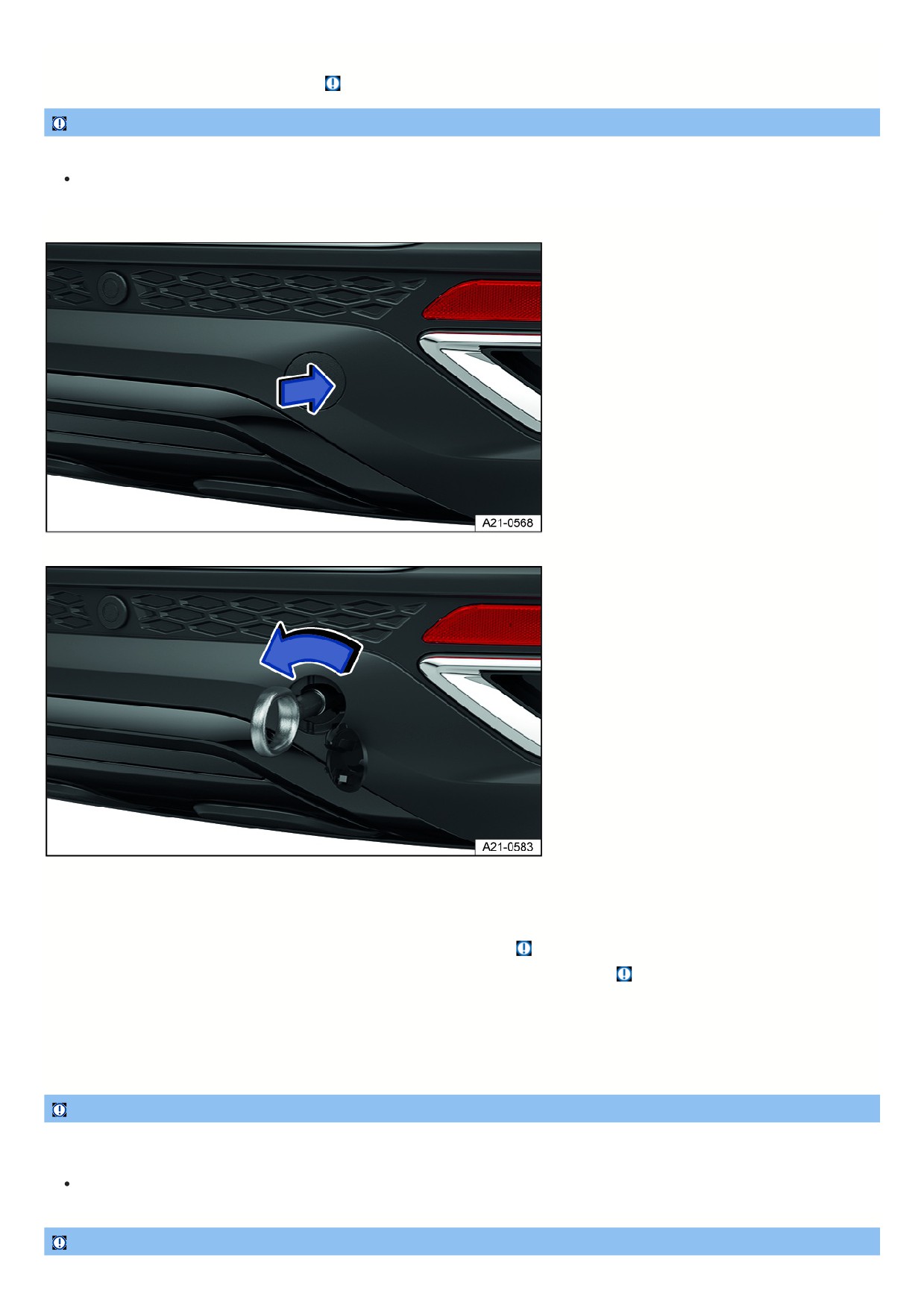
Fig. 159 In the driver's side footwell: Release lever for the hood (general example).
273
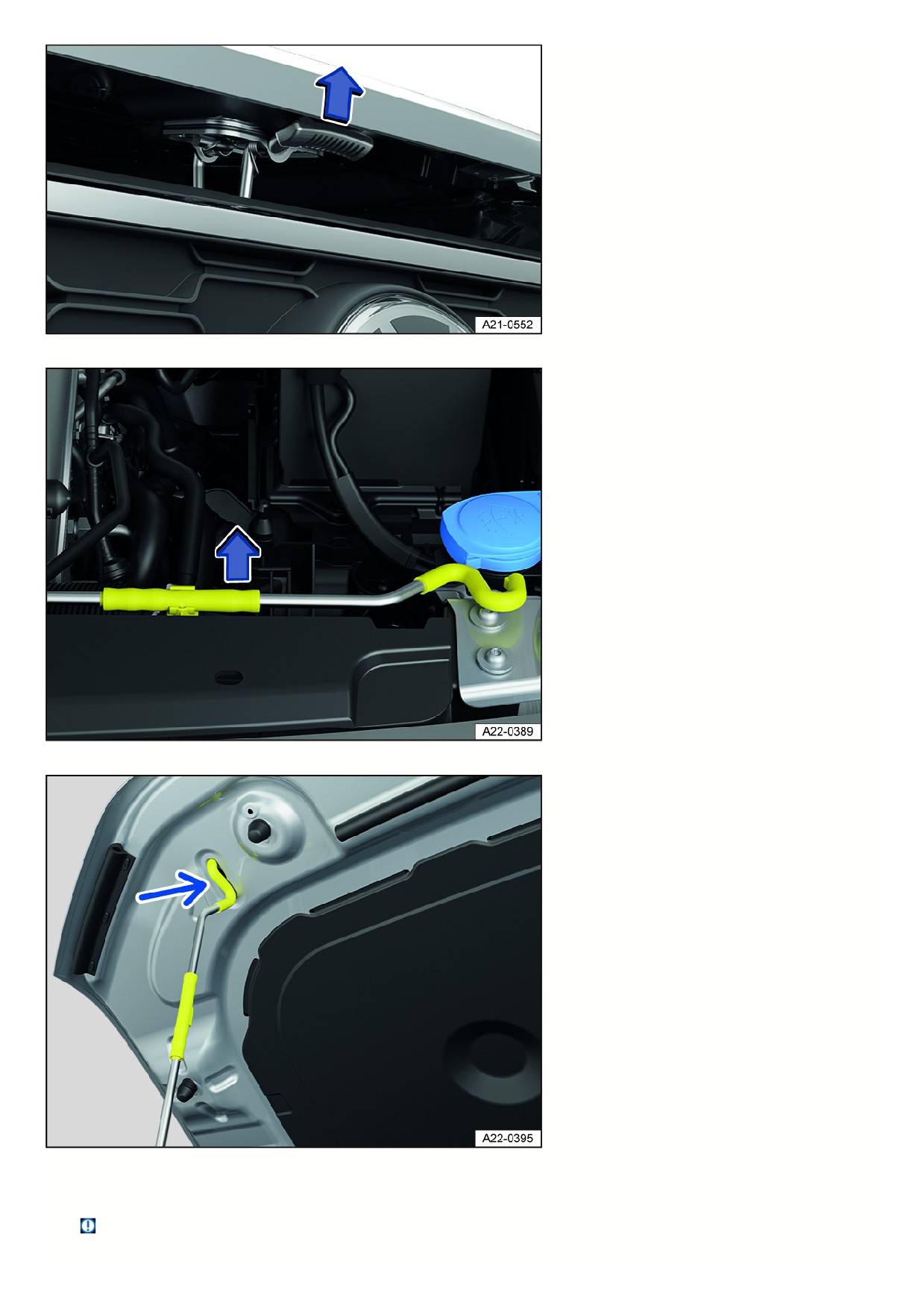
Fig. 160 Above the radiator grille: Opening lever for the hood (general example).
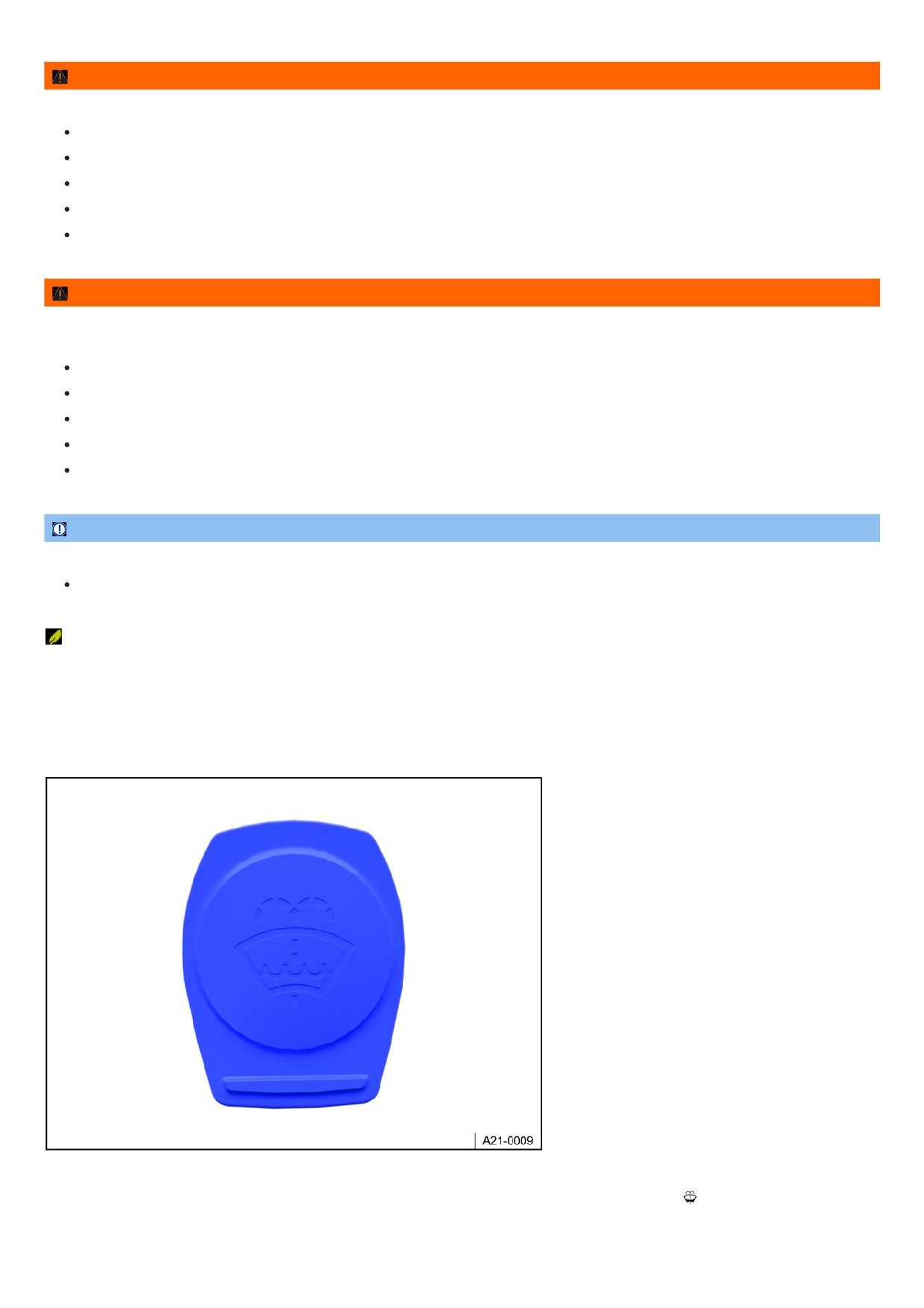
Fig. 161 In the engine compartment: Hood support in the bracket.
Fig. 162 On the engine hood: Hood support bracket (general example).
Opening the hood
1. Open the driver door and pull the release lever in the direction of the arrow fig. 159. The hood will pop open due to spring force from the catch in the lock carr
⇒
2. To open the hood fully, slightly lift the hood while pushing the actuating lever in the direction of the arrow fig. 160.
274

3. Lift the hood support out of the bracket fig. 161 in the direction of the arrow and hook it into the opening fig. 162.
Closing the hood
1. Lift the hood slightly and hold it.
2. Unhook the hood support from the opening fig. 162 and clip it back into the bracket fig. 161.
3. Let the hood fall into the lock carrier catch from a height of approximately 20 cm (8 inches); do not press it down. When the hood is closed correctly, it will be
flush with the surrounding sections of the vehicle body ⇒
If the hood is not closed correctly, lift the hood up and try to close it again.
If the hood is not correctly closed, an indicator will appear in the display of the Volkswagen Digital Cockpit. Once the hood is correctly closed, the indicator will turn
off.
WARNING
If the hood is not closed correctly, it could open suddenly while driving and block the view through the windshield. Accidents and serious or fatal injuries could
result.
After closing the hood, check that the catch is engaged correctly in the lock carrier.
If you realize when driving that the hood is not closed properly, park the vehicle safely and close the hood.
WARNING
Failing to take care when opening and closing the hood can result in serious injuries.
Do not open or close the hood if any persons are in the closing range of the hood.
NOTICE
Opening and closing the hood incorrectly can cause damage to the hood or wiper arms.
Only open the hood when wiper mode is switched off and with the windshield wipers folded in.
Always fold the wiper arms against the windshield before driving.
Display
An image in the instrument cluster display indicates if the hood is open or has not closed correctly
⇒
Do not continue driving!
1. Stop the vehicle as soon as it is safe to do so.
2. If necessary, lift the hood and close it again.
The image is also displayed when the ignition is switched off, and it disappears several seconds after the doors are closed and the vehicle is locked.
WARNING
Disregarding warning notifications could lead to breakdowns while driving, accidents and serious or fatal injuries.
Never ignore warning notifications.
Stop the vehicle as soon as it is safe to do so.
Do not continue driving and seek professional assistance if the warning light does not go out.
Operating fluids and operating equipment
All fluids and operating equipment, such as engine coolant, engine oils and vehicle batteries, are continuously being developed. Have fluids and operating
equipment replaced by suitably qualified professionals. Volkswagen recommends contacting an authorized Volkswagen dealer or authorized Volkswagen Service
Facility.
WARNING
Carrying out work on the fuel system may cause fires and serious or fatal injuries due to electrical discharge and flying sparks.
Always disconnect the 12 V vehicle battery.
Always have a fully-functioning, checked fire extinguisher nearby.
Make sure that the vehicle is unlocked when the 12 V vehicle battery is disconnected. Otherwise, the anti-theft alarm system will be activated.
275
WARNING
Fluids may be poisonous. Improper use and storage may cause serious or fatal injuries.
Only store fluids in their sealed original containers.
Never use empty food cans, bottles, or other containers to store fluids, because someone could drink the fluids by mistake.
Keep children away from all fluids and operating equipment.
Always read and heed the information and warnings on the packaging for the fluids.
When using products that emit harmful vapors, always work outdoors or in a well-ventilated area.
WARNING
Fluids and some materials in the engine compartment are highly flammable and may ignite on contact with hot surfaces, sparks or naked flames. This can lead
to a fire and cause accidents and serious or fatal injuries.
Never smoke near the engine compartment.
Never work near open flames or sparks.
Never perform work near sources of heat, boilers, or other open flames.
Never pour or spill fluids on the engine.
Always have a fully-functioning, checked fire extinguisher nearby.
NOTICE
The use of incorrect fluids can cause serious malfunctions and damage to the engine.
When filling or changing fluids, make sure the correct fluids are added to the corresponding reservoirs.
Fluids leaking from the vehicle can cause environmental damage. Always check the ground under the vehicle for leaking fluids. If you see spots of fluid on the
ground under the vehicle, have the vehicle checked by an authorized Volkswagen dealer or authorized Volkswagen Service Facility. Dispose of leaking fluids
correctly. Volkswagen recommends contacting an authorized Volkswagen dealer or authorized Volkswagen Service Facility.
Washer fluid
General information
Fig. 163 In the engine compartment: Cap on the washer fluid reservoir (general example).
The windshield washer fluid reservoir is located in the engine compartment. The washer fluid reservoir is identified with the
symbol on the cap fig. 163.
Check the washer fluid level regularly and fill if necessary.
Preparations
276

1. Prepare the vehicle for work in the engine compartment ⇒ In the engine compartment.
2. Open the hood → page , Opening and closing the hood.
Checking and refilling
1. Check if there is enough washer fluid in the reservoir.
2. To top it up, mix clean water with a suitable alcohol-based windshield cleaner. Follow the mixing instructions on the packaging of the windshield cleaner
⇒
⇒ . There is a screen in the filler tube in the windshield washer fluid reservoir. The screen keeps large particles of contaminants from entering the washer
nozzles when you refill the washer fluid ⇒
3. When the outside temperatures are cold, an anti-freeze agent should be added to the water so that it does not freeze. Follow the mixing instructions on the
packaging of the anti-freeze agent.
Do not use distilled water to fill the windshield washer fluid tank.
WARNING
Unsuitable additives in the windshield washer fluid can create an oily film on the vehicle windshield. This may reduce visibility and increase the risk of accidents
and serious or fatal injuries.
Never add coolant additive or similar unsuitable additives to the windshield washer fluid.
NOTICE
Using a cleaning agent that contains acid may result in damage and cause the spray nozzles to malfunction.
Never top up the windshield washer fluid tank using a cleaning agent that contains acid, e.g. vinegar-based cleaners.
NOTICE
Mixing different windshield cleaners can cause the components to flocculate and the spray nozzles to clog.
Only use suitable alcohol-based windshield cleaners.
Never mix different windshield cleaners together.
NOTICE
When you top up the windshield washer fluid, if you use a damaged screen or do not use a screen at all, dirt particles may get into the windshield washer fluid
tank. The spray nozzles may become clogged.
Take the screen out only to clean it.
Replace a damaged or missing screen.
Engine oil
Introduction
The engine oils are determined based on the requirements of the engines, emissions control systems, and the fuel quality. On all combustion engines, the engine o
comes into contact with combustion residue and fuel, which affects the aging of the engine oil. Using the correct engine oil is essential for the function and service
life of the engine. The vehicle is filled at the factory with a special multi-purpose, low-viscosity oil that can generally be used year-round.
The vehicle can consume engine oil. The engine oil consumption can vary and can change throughout the service life of the vehicle. Depending on the driving style
and the usage conditions, the engine oil consumption can be up to 1 l (1 quart) per 2000 kilometers (1200 miles); it can also be higher within the first
5000 kilometers (3100 miles) on new vehicles. Because of this, the engine oil level must be checked regularly and it is best to check the level before long drives.
WARNING
Engine oil gets extremely hot when the engine is running. Failure to take care when handling hot engine oil can cause serious bodily burns. This could result in
serious or fatal injuries.
Always allow the engine to cool down before starting work with the engine oil.
WARNING
Engine oil is poisonous. Contact with engine oil, especially swallowing engine oil, may result in serious or fatal injuries.
If you swallow engine oil, seek urgent medical help.
277

If you have health problems after working with engine oil, seek medical help.
Always store engine oil out of the reach of children and only in the sealed original container. This also applies to used oil until it is disposed.
Never use empty food cans, bottles, or other containers to store engine oil, because someone could drink the engine oil by mistake.
Avoid regular contact with engine oil to prevent damage to your skin.
Protect your skin, face and particularly your eyes when working with engine oil.
Do not eat, drink or smoke when working with engine oil.
Wash your skin with soap and water after working with engine oil.
Engine oil that has dripped and spilled can pollute the environment. Catch any leaking operating fluids and dispose of them correctly according to
environmental regulations.
Engine oil standards
Please read the introductory information and heed the Warnings and Notice ⇒
Safety precautions for working in the engine compartment .
Utilized engine oil
There is a label on the lock carrier that shows which engine oil should be added. Please follow the note and if possible only add the indicated engine oil
⇒
If this is not possible, get professional assistance to find out which engine oil is suitable for your vehicle. Volkswagen recommends contacting an authorized
Volkswagen dealer or authorized Volkswagen Service Facility.
If the engine oil recommended by an authorized Volkswagen dealer or authorized Volkswagen Service Facility qualified in this respect is not available, a different
engine oil can be used in an emergency. To reduce the risk of damaging the engine, a maximum of 0.5 liters (0.5 qt) of the following engine oils may be added until
the next oil change:
Gasoline engines: ACEA C3, ACEA C4, API SP, or ILSAC GF-6A standard. All viscosity classes in these standards are permitted.
NOTICE
Using engine oils that have not been approved in accordance with the respective VW standard can cause damage to the engine.
When refilling, only use engine oils that comply with the quality requirements of the respectively applicable VW standard.
Only if you absolutely must, add max. 0.5 l (0.5 qt) of engine oil that does not comply with the specified engine oil standards.
Volkswagen recommends Volkswagen Genuine oil.
Changing the engine oil
Please read the introductory information and heed the Warnings and Notice ⇒
Safety precautions for working in the engine compartment .
The engine oil must be changed regularly in accordance with the instructions in the warranty and maintenance. Your service schedule is supplied with your Manual.
Service schedule.
Additives in the engine oil can make new engine oil appear dark after a brief engine run time. This is normal and is no reason to change the engine oil more
frequently.
WARNING
If care is not taken when changing engine oil, the oil can cause environmental damage, serious burns, or fire. This could result in serious or fatal injuries.
Always allow the engine to cool down completely before the engine oil change.
Always wear eye protection for the engine oil change.
Keep your arms horizontal when using your fingers to unscrew the oil drain plug, so that the draining oil does not drip down your arm.
Use a container suitable for collecting used oil that can hold at least the entire quantity of oil in the engine.
WARNING
Engine oil is poisonous. Contact with engine oil, especially swallowing engine oil, may result in serious or fatal injuries.
If you swallow engine oil, seek urgent medical help.
If you have health problems after working with engine oil, seek medical help.
Always store engine oil in the sealed original container and keep it out of the reach of children. This also applies to used oil until it is disposed.
Never use empty food cans, bottles, or other containers to store engine oil, because someone could drink the engine oil by mistake.
278
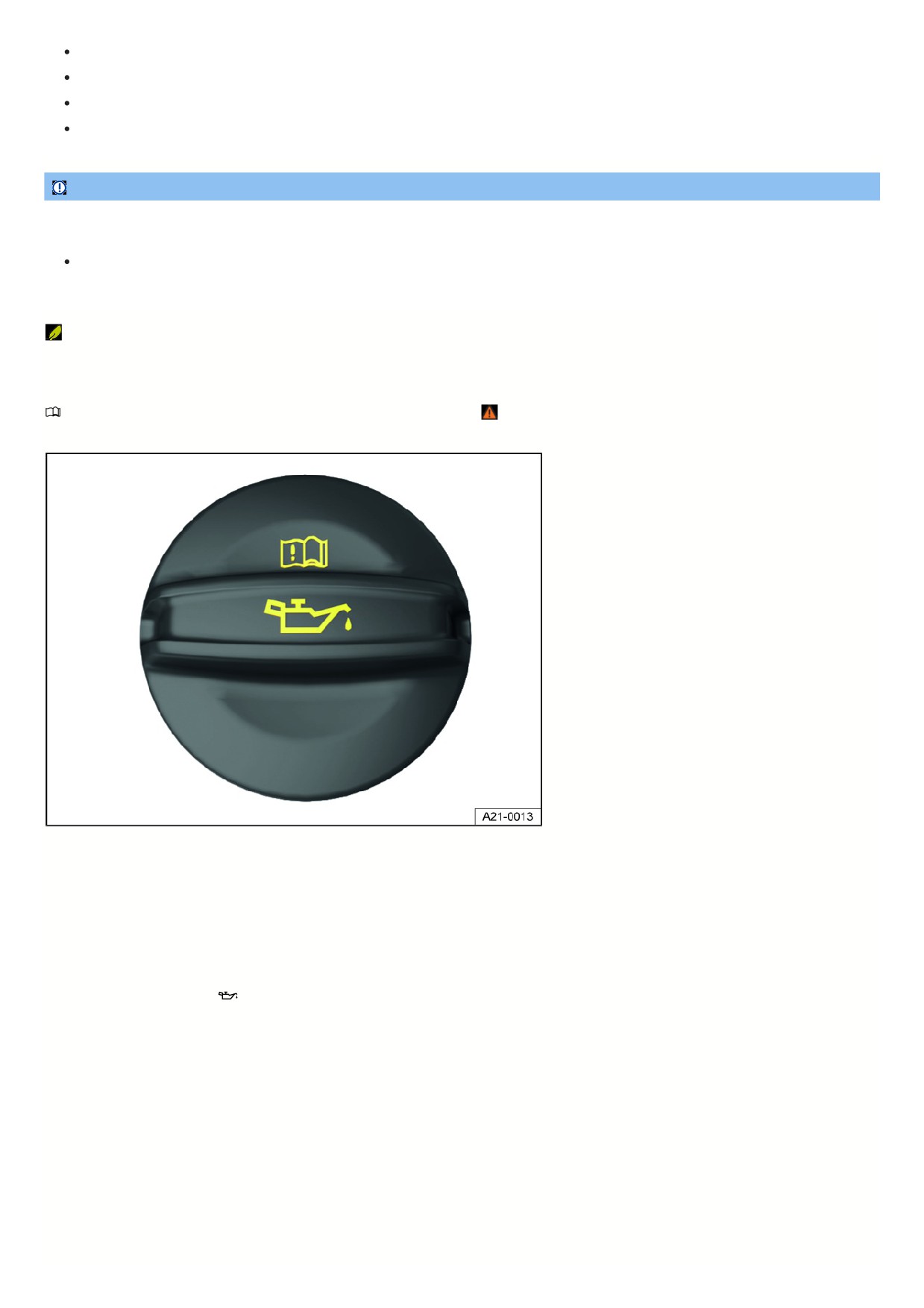
Avoid regular contact with engine oil to prevent damage to your skin.
Protect your skin, face and particularly your eyes when working with engine oil.
Do not eat, drink or smoke when working with engine oil.
Wash your skin with soap and water after working with engine oil.
NOTICE
Engine oil and filter changes require special tools, technical knowledge and the correct disposal of the used oil. Failing to act properly may cause damage to the
vehicle.
For this reason, always have the engine oil and filters changed by an authorized Volkswagen dealer or authorized Volkswagen Service Facility.
Volkswagen recommends contacting an authorized Volkswagen dealer or authorized Volkswagen Service Facility.
Dispose of the engine oil in a way that will not harm the environment and only at a collection point for used oil, e.g. a recycling center or specialist retailer.
Checking the engine oil level and adding oil
Please read the introductory information and heed the Warnings and Notice ⇒
Safety precautions for working in the engine compartment .
Preparations
Fig. 164 In the engine compartment: engine oil filler cap (general example).
To avoid an incorrect oil level reading, perform the following steps:
1. Park vehicles with an engine at operating temperature on a level surface.
2. Wait at least five minutes for the engine oil to flow back into the oil pan.
3. Open the hood.
4. Find the engine oil filler and the dipstick.
You can identify these by the
fig. 164 symbol on the engine oil filler cap and the colored handle on the oil dipstick.
Checking the engine oil level
279
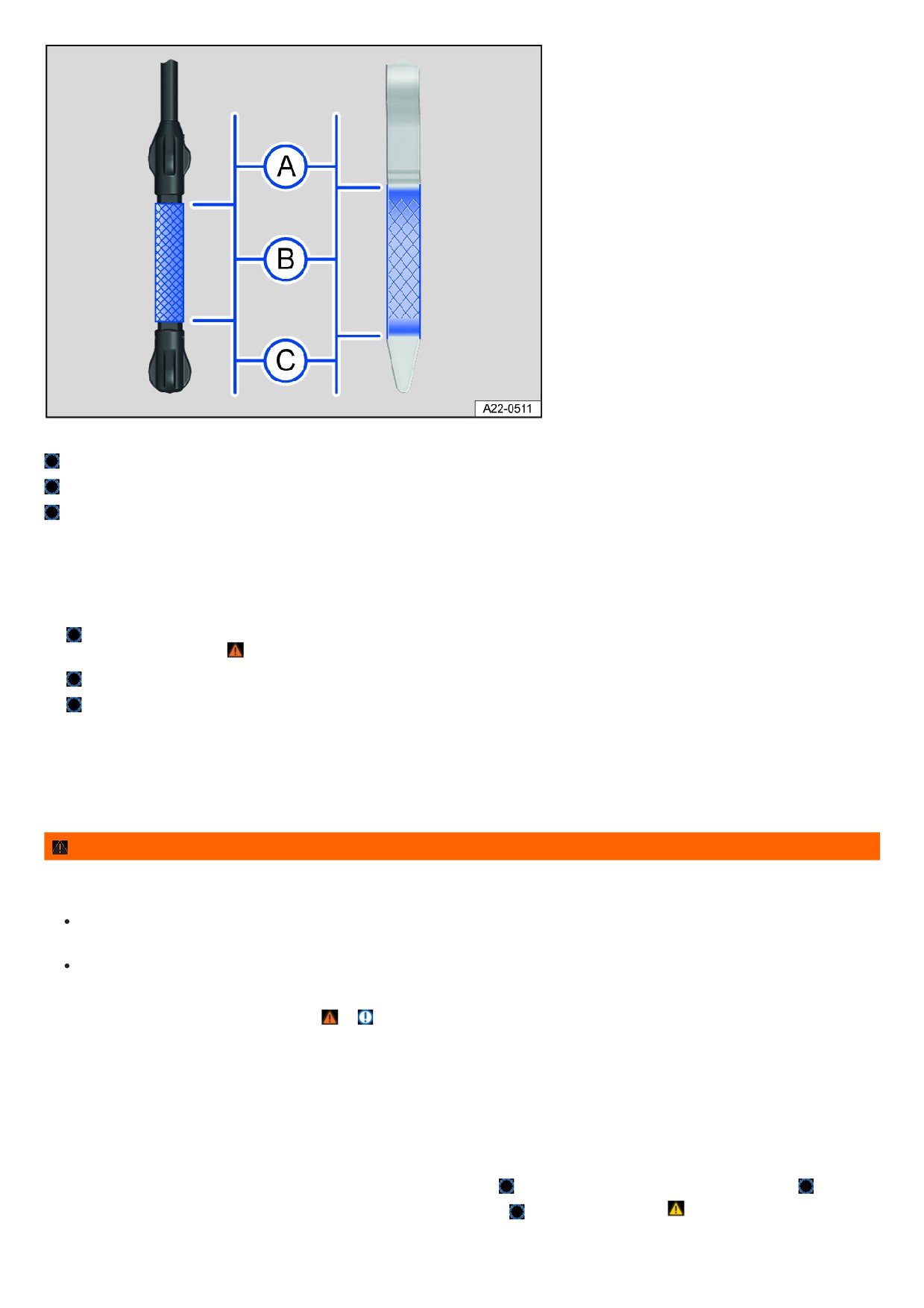
Fig. 165 Engine oil level markings on the oil dipstick (versions).
The engine oil level is too high.
Oil level in the normal range.
The engine oil level is too low.
1. Remove the dipstick from the guide tube and wipe the dipstick off using a clean cloth.
2. Reinsert the dipstick into the guide tube and push it all the way in. If there is an alignment tab on the top of the engine oil dipstick, make sure it lines up with the
notch in the guide tube, and that the dipstick goes all the way in.
3. Remove the dipstick again and read the oil level on the dipstick as described below fig. 165:
The engine oil level is too high. If necessary, follow the messages in the instrument cluster display or contact an authorized Volkswagen dealer or authorize
Volkswagen Service Facility ⇒ .
Oil level in the normal range. Engine oil can be added up to the upper edge of this area, for example if there is heavy engine load.
The engine oil level is too low. Add engine oil immediately.
4. After reading the oil level, reinsert the dipstick back into the guide tube and push it all the way in.
For high vehicle loads, for example when driving long distances on highways in the summer or when driving through high mountains, the engine oil level should be
the upper section of the permitted area.
Adding engine oil
WARNING
When you top up the engine oil, it could spill or overflow and ignite on contact with hot engine components. This may cause burns or a fire. This could result in
serious or fatal injuries.
Always make sure that the engine oil cap is installed securely on the engine filler opening after adding oil and that the oil dipstick is inserted correctly in
the guide tube.
Always ensure that engine oil does not spill onto cold components in the engine.
Only perform these activities in the specified order ⇒
⇒
:
1. Remove the cap on the engine oil filler fig. 164.
2. Top up the engine oil gradually in small quantities, not more than 0.5 l (0.5 quart), or follow the recommendation in the display of the Volkswagen Digital Cockpi
Volkswagen recommends using the approved engine oils in accordance with the respective VW standard.
3. To avoid overfilling, you must wait at least one minute each time you add engine oil so that the engine oil can flow into the oil pan up to the marking on the oil
dipstick.
4. Read the oil level on the dipstick again before adding a little more. Never add too much oil.
When you are done adding oil, the oil level should be in the center of area fig. 165 . The engine oil level must not be in the area fig. 165
5. If you accidentally add too much engine oil and the engine oil level is in area fig. 165
, do not start the engine ⇒
. Contact an authorized Volkswagen
dealer or authorized Volkswagen Service Facility for assistance.
6. Close the cap on the engine oil filler when you are done adding engine oil.
28

7. Insert the oil dipstick all the way into the guide tube. If there is an alignment tab on the top of the engine oil dipstick, make sure it lines up with the notch in the
guide tube, and that the dipstick goes all the way in.
8. Close the hood.
CAUTION
Starting the engine with the engine oil level too high after refilling can cause engine damage.
Do not start the engine, and seek professional assistance.
NOTICE
Using incorrect fluids can result in malfunctions and engine damage.
When topping up fluids, make sure the correct fluids are added to the correct reservoirs.
Volkswagen recommends using the approved engine oils in accordance with the respective VW standard.
If you are not sure where the cap and the oil dipstick are located, contact an authorized Volkswagen dealer or authorized Volkswagen Service Facility for
assistance. Volkswagen recommends contacting an authorized Volkswagen dealer or authorized Volkswagen Service Facility.
Troubleshooting
Please read the introductory information and heed the Warnings and Notice ⇒
Safety precautions for working in the engine compartment .
Engine oil pressure too low
The red warning light blinks. A message is shown in the instrument cluster display.
Do not continue driving! Engine damage could result.
1. Stop the vehicle as soon as it is safe to do so
⇒ Parking.
2. Stop the engine.
3. Check the engine oil level ⇒ Checking the engine oil level and adding oil .
4. If the warning light flashes, do not continue driving or let the engine run, even if the oil is at the correct level. Engine damage could result. Contact an authorized
Volkswagen dealer or authorized Volkswagen Service Facility for assistance.
Engine oil level very low
The red warning light blinks. A message is shown in the instrument cluster display.
Do not continue driving! Engine damage could result.
1. Stop the vehicle as soon as it is safe to do so
⇒ Parking.
2. Stop the engine.
3. Check the engine oil level ⇒ Checking the engine oil level and adding oil .
4. If necessary, top up the engine oil gradually in small quantities (not more than 0.5 l (0.5 qt) in total) or observe the top-up recommendation in the display of the
Volkswagen Digital Cockpit.
5. If the warning light lights up, do not continue driving or let the engine run, even if the oil is at the correct level. Engine damage could result. Contact an
authorized Volkswagen dealer or authorized Volkswagen Service Facility for assistance.
Engine oil level too low
The yellow indicator light turns on. A message is shown in the instrument cluster display.
1. Stop the vehicle as soon as it is safe to do so
⇒ Parking.
2. Stop the engine.
3. Check the engine oil level ⇒ Checking the engine oil level and adding oil .
4. If necessary, top up the engine oil gradually in small quantities (not more than 0.5 l (0.5 qt) in total) or observe the top-up recommendation in the display of the
Volkswagen Digital Cockpit.
5. If the indicator light comes on, do not continue driving or let the engine run, even if the oil is at the correct level. Engine damage could result. Contact an
authorized Volkswagen dealer or authorized Volkswagen Service Facility for assistance.
Engine oil level too high
The yellow indicator light turns on. A message is shown in the instrument cluster display.
281

1. Stop the vehicle as soon as it is safe to do so
⇒ Parking.
2. Stop the engine.
3. Check the engine oil level ⇒ Checking the engine oil level and adding oil .
4. If the engine oil level is too high, do not drive any further or leave the engine running. Engine damage could result. Contact an authorized Volkswagen dealer or
authorized Volkswagen Service Facility for assistance.
or
Engine oil system malfunction
The indicator light flashes yellow. A message is shown in the instrument cluster display.
1. Contact a suitably qualified professional. Volkswagen recommends contacting an authorized Volkswagen dealer or authorized Volkswagen Service Facility.
Engine coolant
Introduction
Only perform work on the engine cooling system if you are familiar with the necessary activities and the general safety precautions, and if the correct operating
equipment, fluids and suitable tools are available. Work performed incorrectly can result in serious injuries ⇒
. Have all work performed by suitably qualified
professionals if necessary. Volkswagen recommends contacting an authorized Volkswagen dealer or authorized Volkswagen Service Facility.
Information about warning and indicator lights can be found in the troubleshooting section at the end of the chapter
⇒ Troubleshooting.
WARNING
Engine coolant is poisonous. Contact with coolant, especially swallowing coolant, may result in serious or fatal injuries.
If you swallow coolant, seek urgent medical help.
If you have health problems after working with coolant, seek medical help.
Always store engine coolant out of the reach of children and only within the sealed original container.
Never use empty food cans, bottles, or other containers to store engine coolant, because someone could drink the engine coolant by mistake.
Avoid regular contact with coolant to prevent damage to your skin.
Protect your skin, face, and particularly your eyes when working with coolant.
Do not eat, drink, or smoke when working with coolant.
Wash your skin with soap and water after working with coolant.
WARNING
In extremely low temperatures, the coolant can freeze and the vehicle could break down. This can cause the heating to stop working in the vehicle. Vehicle
occupants could die of exposure if they do not have sufficient warm clothing.
Make sure the coolant additive is always adjusted according to the ambient temperature.
Only use coolant additive approved by the manufacturer.
Coolant and coolant additives can pollute the environment. Catch any leaking operating fluids and dispose of them correctly according to environmental
regulations.
Engine coolant specifications
Please read the introductory information and heed the Warnings and Notice ⇒
Safety precautions for working in the engine compartment .
The cooling system is filled at the factory with a mixture of specially prepared water and at least 40% coolant additive G12evo (TL 744-L).
To protect the engine cooling system, there must always be at least a 40% proportion of coolant additive. If greater freeze protection is needed due to the climate,
the proportion of coolant additive can be increased. However, the proportion of coolant additive must not exceed 55 %, because otherwise the freeze protection will
be reduced and the cooling effect will be decreased.
The engine coolant additive can be recognized by its violet color. The mixture of water and coolant additive provides freeze protection down to -25 °C (-13 °F),
protects the aluminum alloy parts of the cooling system from corrosion, prevents limescale deposits, and increases the boiling point of the coolant.
If the engine coolant is being topped up, a blend of distilled water and at least 40% of the G12evo engine coolant additive must be used to ensure optimum
corrosion protection ⇒
CAUTION
In extremely low temperatures, the coolant can freeze and the vehicle could break down. This can cause the heating to stop working in the vehicle. Vehicle
occupants could die of exposure if they do not have sufficient warm clothing.
282