Volkswagen Corrado (1993 year). Manual - part 141
 

  Index      Volkswagen     Volkswagen Corrado - service repair manual 1993 year


Search            


Content   ..  139  140  141  142   ..


Volkswagen Corrado (1993 year). Manual - part 141


ENGINE OVERHAUL PROCEDURES - GENERAL INFORMATION 

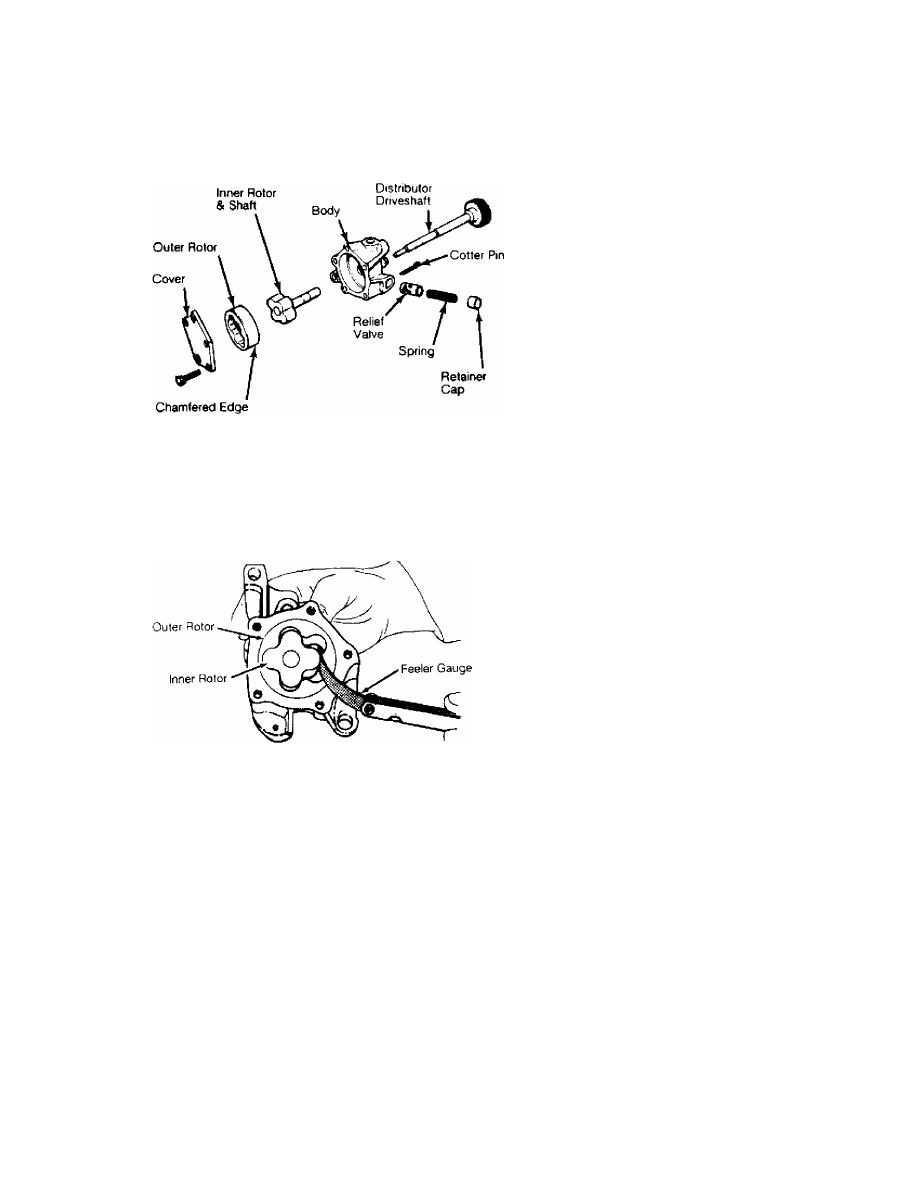
         Measure outer rotor-to-body clearance. Replace pump assembly
if clearance exceeds specification. Measure clearance between rotors.
See Fig. 31. Replace shaft and both rotors if clearance exceeds
specifications.

Fig. 31:  Measuring Rotor Clearance - Typical
This Graphic For General Information Only

         Install rotors in pump body. Position straightedge across
pump body. Using feeler gauge, measure clearance between rotors and
straightedge. Pump cover wear is measured using a straightedge and
feeler gauge. Replace pump if clearance exceeds specification.

         GEAR TYPE

         Oil pump gears must be marked for location prior to removal.
See Fig. 32. Remove gears from pump body. Inspect gears for pitting
or damage. Inspect cover for grooving or wear.

ENGINE OVERHAUL PROCEDURES - GENERAL INFORMATION 

         Measure gear diameter and length. Measure gear housing cavity
depth and diameter. See Fig. 33. Replace components if worn or
damaged.
         Pump cover wear is measured using a straightedge and feeler
gauge. Pump is to be replaced if warpage or wear exceeds
specifications or mating surface of pump cover is scratched or
grooved.

Fig. 33:  Measuring Oil Pump Gear Cavity - Typical
This Graphic For General Information Only

         BREAK-IN-PROCEDURE

         * PLEASE READ THIS FIRST *

NOTE:    Always refer to appropriate engine overhaul article in the
         ENGINES section for complete overhaul procedures and
         specifications for the vehicle being repaired.

         ENGINE PRE-OILING

         Engine pre-oiling should be done prior to operation to
prevent engine damage. A lightly oiled pump will cavitate unless oil
pump cavities are filled with engine oil or petroleum jelly.
         Engine pre-oiling can be done using pressure oiler (if
available). Connect pressure oiler to cylinder block oil passage
such as oil pressure sending unit. Operate pressure oiler long enough

ENGINE OVERHAUL PROCEDURES - GENERAL INFORMATION 

         INITIAL START-UP

         Start the engine and operate engine at low speed while
checking for coolant, fuel and oil leaks. Stop engine. Recheck coolant
and oil level. Adjust if necessary.

         CAMSHAFT

         Break-in procedure is required when a new or reground
camshaft has been installed. Operate and maintain engine speed between
1500-2500 RPM for approximately 30 minutes. Procedure may vary due to
manufacturers recommendations.

         PISTON RINGS

         Piston rings require a break-in procedure to ensure seating
of rings to cylinder walls. Serious damage may occur to rings if
correct procedures are not followed.
         Extremely high piston ring temperatures are produced obtained
during break-in process. If rings are exposed to excessively high RPM
or high cylinder pressures, ring damage can occur. Follow piston ring
manufacturer's recommended break-in procedure.

         FINAL ADJUSTMENTS

         Check or adjust ignition timing and dwell (if applicable).
Adjust valves (if necessary). Adjust carburetion or injection idle
speed and mixture. Retighten cylinder heads (if required). If
cylinder head or block is aluminum, retighten bolts when engine is
cold. Follow the engine manufacturer's recommended break-in procedure
and maintenance schedule for new engines.

NOTE:    Some manufacturer's require that head bolts be retightened
         after specified amount of operation. This must be done to
         prevent head gasket failure.

END OF ARTICLE

F - BASIC TESTING 

         1993 ENGINE PERFORMANCE
         Volkswagen Basic Diagnostic Procedures

         Cabriolet, Corrado SLC, EuroVan, Fox, Golf,
         GTI, Jetta, Passat GL, Passat GLX

         INTRODUCTION

         The following diagnostic steps will help prevent overlooking
a simple problem. This is also where to begin diagnosis for a no-start
condition.
         The first step in diagnosing any driveability problem is
verifying the customer's complaint with a test drive under the
conditions the problem reportedly occurred.
         Before entering self-diagnostics (if equipped), perform a
careful and complete visual inspection. Most engine control problems
result from mechanical breakdowns, poor electrical connections, or
damaged/misrouted vacuum hoses. Before condemning the computerized
system, perform each test listed in this article.

NOTE:    Perform all voltage tests with a Digital Volt-Ohmmeter
         (DVOM) with a minimum 10-megohm input impedance, unless
         stated otherwise in test procedure.

         PRELIMINARY INSPECTION & ADJUSTMENTS

         VISUAL INSPECTION

         Visually inspect all electrical wiring, looking for chafed,
stretched, cut or pinched wiring. Ensure electrical connectors fit
tightly and are not corroded. Ensure vacuum hoses are properly routed
and are not pinched or cut. See M - VACUUM DIAGRAMS article in this
section to verify routing and connections (if necessary). Inspect air
induction system for possible vacuum leaks.

         MECHANICAL INSPECTION

         Compression
         Check engine mechanical condition with a compression gauge,
vacuum gauge, or an engine analyzer. See engine analyzer manual for
specific instructions.

WARNING: DO NOT use ignition switch during compression tests on fuel
         injected vehicles. Use a remote starter to crank engine. Fuel
         injectors on many models are triggered by ignition switch
         during cranking mode, which can create a fire hazard or
         contaminate the engine's oiling system.

COMPRESSION SPECIFICATION TABLE


Content   ..  139  140  141  142   ..