Volkswagen Corrado (1993 year). Manual - part 102
 

  Index      Volkswagen     Volkswagen Corrado - service repair manual 1993 year


Search            


Content   ..  100  101  102  103   ..


Volkswagen Corrado (1993 year). Manual - part 102


ALTERNATOR & REGULATOR 

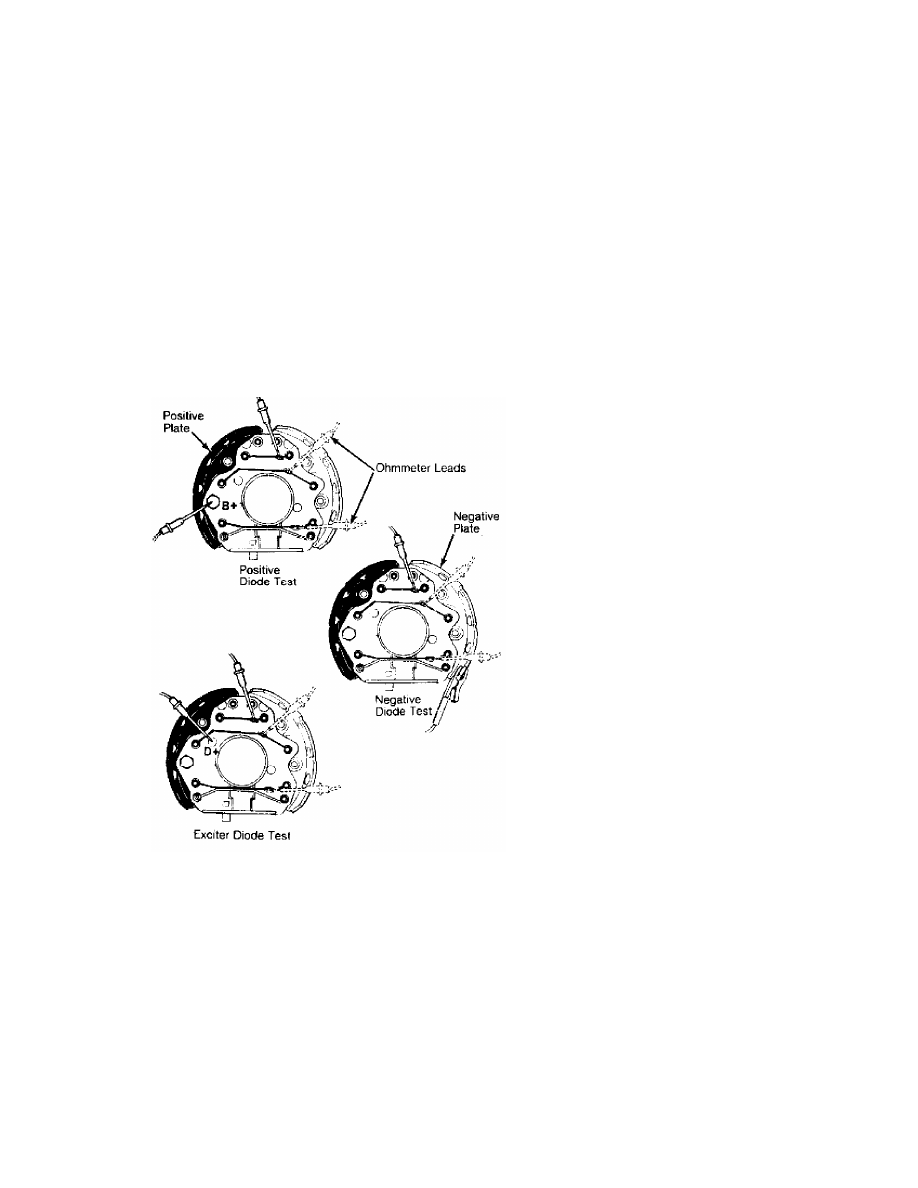
         1) Place ohmmeter on X 100 scale. Connect ohmmeter leads
across B+ terminal and 3 stator terminals one at a time. Reverse
leads. Ohmmeter should indicate continuity in one direction only.
         2) Connect ohmmeter leads across negative plate and 3 stator
terminals one at a time. See Fig. 1. Reverse leads. Ohmmeter should
indicate continuity in one direction only.
         3) Connect ohmmeter leads across D+ terminal and 3 stator
terminals one at a time. Reverse leads. Ohmmeter should indicate
continuity in one direction only. Replace diode assembly if defective.

Fig. 1:  Testing Diode Assembly
Courtesy of Volkswagen United States, Inc.

         STATOR

         1) Place ohmmeter on lowest scale. Connect ohmmeter across
stator leads. Resistance should be approximately .09-.10 ohms. If
resistance is incorrect, stator has open or shorted windings and must
be replaced.
         2) Place ohmmeter on X 1000 scale. Connect ohmmeter between
stator core and stator lead. No continuity should exist. If continuity
exists, stator is grounded and must be replaced.

         ROTOR

ALTERNATOR & REGULATOR 

         BEARINGS

         Always replace bearings. If replacement front bearing is
sealed on one side only, open side must face rotor. If replacement
rear bearing is sealed on one side only, open side must face away from
rotor.

         BRUSHES

         Ensure brushes are longer than 7/32". Replace if necessary.
Unsolder brushes from voltage regulator. Solder new brushes. DO NOT
allow solder to run into strands of brush leads. Brushes must be free
to slide in brush holder with normal spring tension of 10-14 ozs.
(283-397 g).

         OVERHAUL

Fig. 2:  Exploded View Of Bosch Alternator (Typical)
Courtesy of Volkswagen United States, Inc.

END OF ARTICLE

ANTI-LOCK BRAKE SAFETY PRECAUTIONS 

         GENERAL INFORMATION
         Anti-Lock Brake Safety Precautions

         * PLEASE READ THIS FIRST *

         This article is intended for general information purposes
only. This information may not apply to all makes and models. If
vehicle is equipped with Anti-Lock Brake System (ABS), refer to
appropriate ANTI-LOCK BRAKE SYSTEM article in the BRAKES section for
description, operation, depressurizing, testing, system bleeding,
trouble shooting and servicing of specific system.

WARNING: Failure to depressurize ABS could lead to physical injury.

         ANTI-LOCK BRAKE SAFETY PRECAUTIONS

WARNING: Failure to depressurize ABS could lead to physical injury.

      *  NEVER open a bleeder valve or loosen a hydraulic line
         while ABS is pressurized.
      *  NEVER disconnect or reconnect any electrical connectors
         while ignition is on. Damage to ABS control unit may result.
      *  DO NOT attempt to bleed hyudarulic system without first
         referring to the appropriate ANTI-LOCK BRAKE SYSTEM article
         in the BRAKES section.
      *  Only use specially designed brake hoses/lines on ABS equipped
         vehicles.
      *  DO NOT tap on speed sensor components (sensor, sensor rings).
         Sensor rings must be pressed into hubs, NOT hammered into
         hubs. Striking these components can cause demagnetization or
         a loss of polarization, affecting the accuracy of the speed
         signal returning to the ABS control unit.
      *  DO NOT mix tire sizes. Increasing the width, as long as tires
         remain close to the original diameter, is acceptable. Rolling
         diameter must be identical for all 4 tires. Some
         manufacturers recommend tires of the same brand, style and
         type. Failure to follow this precaution may cause inaccurate
         wheel speed readings.
      *  DO NOT contaminate speed sensor components with grease. Only
         use recommended coating, when system calls for an
         anti-corrosion coating.
      *  When speed sensor components have been removed, ALWAYS check
         sensor-to-ring air gaps when applicable. These specifications
         can be found in each appropriate article.
      *  ONLY use rocommended brake fluids. DO NOT use silicone brake
         fluids in an ABS equipped vehicle.
      *  When instlling transmittion devices (CB's, telephones, etc.)
         on ABS equipped vehicles, DO NOT locate the antenna near the
         ABS control unit (or any control unit).

ANTI-LOCK BRAKE SAFETY PRECAUTIONS 

ø

F/85

ø

C for 2 hours is generally considered a

         maximum limit).

END OF ARTICLE


Content   ..  100  101  102  103   ..