Volkswagen New Beetle. Manual - part 1845


  Index      Volkswagen     Volkswagen New Beetle 1998-2008 year - service repair manual


Search            


Content   ..  1843  1844  1845  1846   ..


Volkswagen New Beetle. Manual - part 1845


ECM stores DTCs related to fuel injection, ignition and emissions systems. If a malfunction occurs, it will be 
indicated by Malfunction Indicator Light (MIL) in instrument cluster, see MALFUNCTION INDICATOR 
LIGHT 
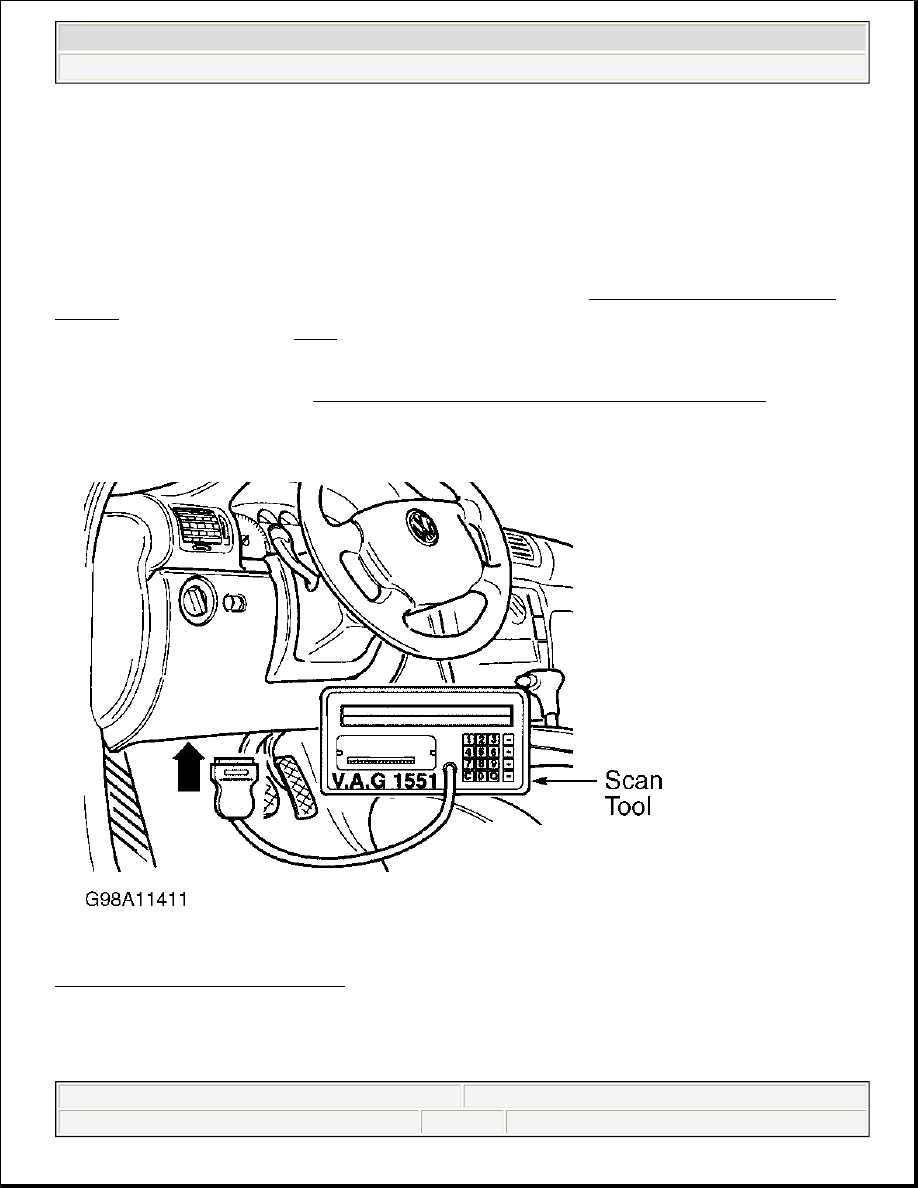
. DTCs can be read using scan tool connected to Data Link Connector (DLC). DLC is located under 
left side of instrument panel, see Fig. 1 .  

EPC malfunctions are indicated by EPC warning light and MIL in instrument cluster. DTC(s) relating to EPC 
system will be stored by ECM. See ELECTRONIC POWER CONTROL WARNING LIGHT .  

Fig. 1: Locating Data Link Connector 
Courtesy of VOLKSWAGEN UNITED STATES, INC. 

SERVICE PRECAUTIONS 

NOTE:

Read and record DTCs before starting diagnostic work. Some testing 
procedures will set DTCs. 

NOTE:

Electronic Power Control (EPC) is Volkswagen's name for their electronic 
throttle drive system. Also referred to as E-Gas System by Volkswagen. 


2003 Volkswagen New Beetle GLS 

2002-2003 ENGINE PERFORMANCE Self-Diagnostics - 1.8L Turbo


Helpmelearn Repair Manuals 


Wednesday, December 14, 2005 8:44:26 AM

Page 2 

© 2004 Mitchell Repair Information Company, LLC. 

z

Read and record DTCs before starting diagnostic work, (some testing procedures will set DTCs).  

z

Turn ignition off when connecting or disconnecting test equipment, unless specifically instructed not to 
do so in repair instructions.  

z

Turn ignition off before connecting or disconnecting ME-SFI control module (ECM - J220) connectors.  

z

Perform all resistance and voltage tests with a Digital Volt-ohmmeter (DVOM) with minimum 10-
megohm impedance, unless stated otherwise in test procedures.  

z

Ensure ignition switch is in OFF position when performing resistance tests.  

z

Remove fuel pump fuse before opening fuel system. See appropriate WIRING DIAGRAM under 
ENGINE PERFORMANCE in SYSTEM WIRING DIAGRAMS.  

z

Fuel hoses in engine compartment must only be secured by spring type clips.  

z

When performing an ignition spark test, check one spark plug at a time and ensure spark plug is 
grounded.  

z

When performing compression test, remove fuse for fuel injectors and disconnect all 4-pin connectors 
from ignition coils. See appropriate WIRING DIAGRAM under ENGINE PERFORMANCE in 
SYSTEM WIRING DIAGRAMS.  

ON-BOARD DIAGNOSTICS 

WARNING:

For safety during road test, it is advisable to have a helper operate tester 
from rear seat. If test and measuring instruments are operated from front 
passenger's seat and vehicle is involved in an accident, there is a 
possibility the person sitting in this seat may receive serious injuries 
when air bag is deployed. 

WARNING:

Always use jack stands or hoist safeties when working on a raised 
vehicle. 

WARNING:

To avoid injury, allow cooling system to cool and carefully release system 
pressure. 

WARNING:

Turbocharger and related components operate at a very high 
temperature. Always allow system to cool or use proper protective 
clothing to prevent severe burns. 

WARNING:

Vehicles with an airbag are fitted with a crash/fuel shut-off. It reduces the 
risk of a vehicle burning in the event of a crash and that the fuel pump is 
switched off by the fuel pump relay. At the same time, this device 
improves the starting of the engine because as soon as the door is 
opened, the fuel pump is activated to build up pressure in the fuel 
system. Remove fuel pump fuse before opening fuel system. See 
appropriate WIRING DIAGRAM under ENGINE PERFORMANCE in 
SYSTEM WIRING DIAGRAMS. 


2003 Volkswagen New Beetle GLS 

2002-2003 ENGINE PERFORMANCE Self-Diagnostics - 1.8L Turbo


Helpmelearn Repair Manuals 


Wednesday, December 14, 2005 8:44:26 AM

Page 3 

© 2004 Mitchell Repair Information Company, LLC. 

Misfire 

A malfunction that causes a misfire during vehicle operation causes MIL to flash in equally timed increments. 
This is a malfunction (e.g. misfire) that may cause catalytic converter damage. If MIL flashes in equally timed 
increments during vehicle operation, cause of malfunction must be determined, see DTC IDENTIFICATION 
table.  

Hard Failures 

Hard failures cause MIL to illuminate and remain on until problem is repaired. If MIL comes on and remains on 
during vehicle operation, cause of malfunction must be determined, see DTC IDENTIFICATION table. In 
addition EPC malfunctions are indicated by an EPC warning light and MIL in instrument cluster, see Fig. 3 and 
Fig. 4 under MALFUNCTION INDICATOR LIGHT (K83) . For most sensors, if a sensor fails, ECM will 
use a substitute value in its calculations to continue engine operation. In this condition, commonly known as 
limp-in or limp-home mode, the vehicle runs but driveability will not be optimum.  

The Engine Speed (RPM) sensor (G28) is a speed and reference mark sensor. The engine will not start if there 
is no speed signal. If the speed signal fails when the engine is running, it will cause the engine to stall 
immediately.  

Sporadic Malfunctions (Intermittent Failures) 

Sporadic malfunctions (intermittent failures) may cause Malfunction Indicator Light (MIL) to flicker or 
illuminate and go out after the intermittent fault goes away. DTC will be retained in ECM memory. Sporadic 
malfunctions (intermittent failures) may be caused by a sensor, connector or wiring related problems. If no DTC
(s) are present, see INTERMITTENTS in appropriate TROUBLE SHOOTING - NO CODES article.  

MALFUNCTION INDICATOR LIGHT (K83) 

CAUTION: A Malfunction Indicator Light (MIL) flashing in equally timed increments 

during vehicle operation indicates malfunction(s) causing a misfire. 
Vehicle must not be driven at full power and must be diagnosed and 
repaired before catalytic converter damage occurs. 

NOTE:

When using Scan Tool VAG 1551/1552 or VAS 5051/5052, malfunctions which 
only occur sporadically (intermittently) will have the addendum sporadic 
(intermittent) malfunction on the print out and will be indicated on the display 
by the addendum /SP. Cause of sporadic malfunctions can be a loose contact 
or a intermittently open circuit. If a sporadic malfunction does not occur again 
within 40 warm-up phases, sporadic DTC(s) will be erased from ECM memory. A 
warm-up phase is, engine started with coolant temperature below 122°F (50°C), 
and switched off at above 162°F (72°C). 

NOTE:

Instrument Cluster Control Module (J285) and Can Data Bus OBD Interface 
(J533) are integral parts of the instrument cluster. If instrument cluster is 
replaced, Can Data Bus OBD Interface (J533) must be coded. See CAN DATA 


2003 Volkswagen New Beetle GLS 

2002-2003 ENGINE PERFORMANCE Self-Diagnostics - 1.8L Turbo


Helpmelearn Repair Manuals 


Wednesday, December 14, 2005 8:44:26 AM

Page 4 

© 2004 Mitchell Repair Information Company, LLC. 

All models are equipped with a Malfunction Indicator Light (MIL). MIL illuminates when a system failure has 
been detected and DTC has been stored in Engine Control Module (ECM) memory. For location of MIL, see 
Fig. 2 and Fig. 3 .  

MIL and Electronic Power Control (EPC) warning light both illuminate when a system failure has been detected 
in the EPC system. DTC is also stored in ECM memory.  

Fig. 2: Locating Malfunction Indicator Light (Beetle) 
Courtesy of VOLKSWAGEN UNITED STATES, INC.

BUS OBD INTERFACE (J533) CODING . 


2003 Volkswagen New Beetle GLS 

2002-2003 ENGINE PERFORMANCE Self-Diagnostics - 1.8L Turbo


Helpmelearn Repair Manuals 


Wednesday, December 14, 2005 8:44:27 AM

Page 5 

© 2004 Mitchell Repair Information Company, LLC. 


Content   ..  1843  1844  1845  1846   ..