Volkswagen Golf Variant / Jetta. Manual - part 498
 

  Index      Volkswagen     Volkswagen Golf Variant (2007), Jetta (2005) - service repair manual


Search            


Content   ..  496  497  498  499   ..


Volkswagen Golf Variant / Jetta. Manual - part 498


O-Rings, Gaskets, Seals and Sealant

♦ Always thoroughly clean the separating surfaces on the hous‐

ing before applying the sealant.

♦ Apply the Sealant - AMV 188 200 03- evenly and not too thick.
♦ Replace the O-rings, seals and gaskets.
♦ Flange shafts, input shaft and selector shaft seals are also

called shaft seals.

♦ After removing seals and gaskets, check the contact surfaces

on the housings or shafts for burrs and damage caused by the

removal. Repair as necessary.

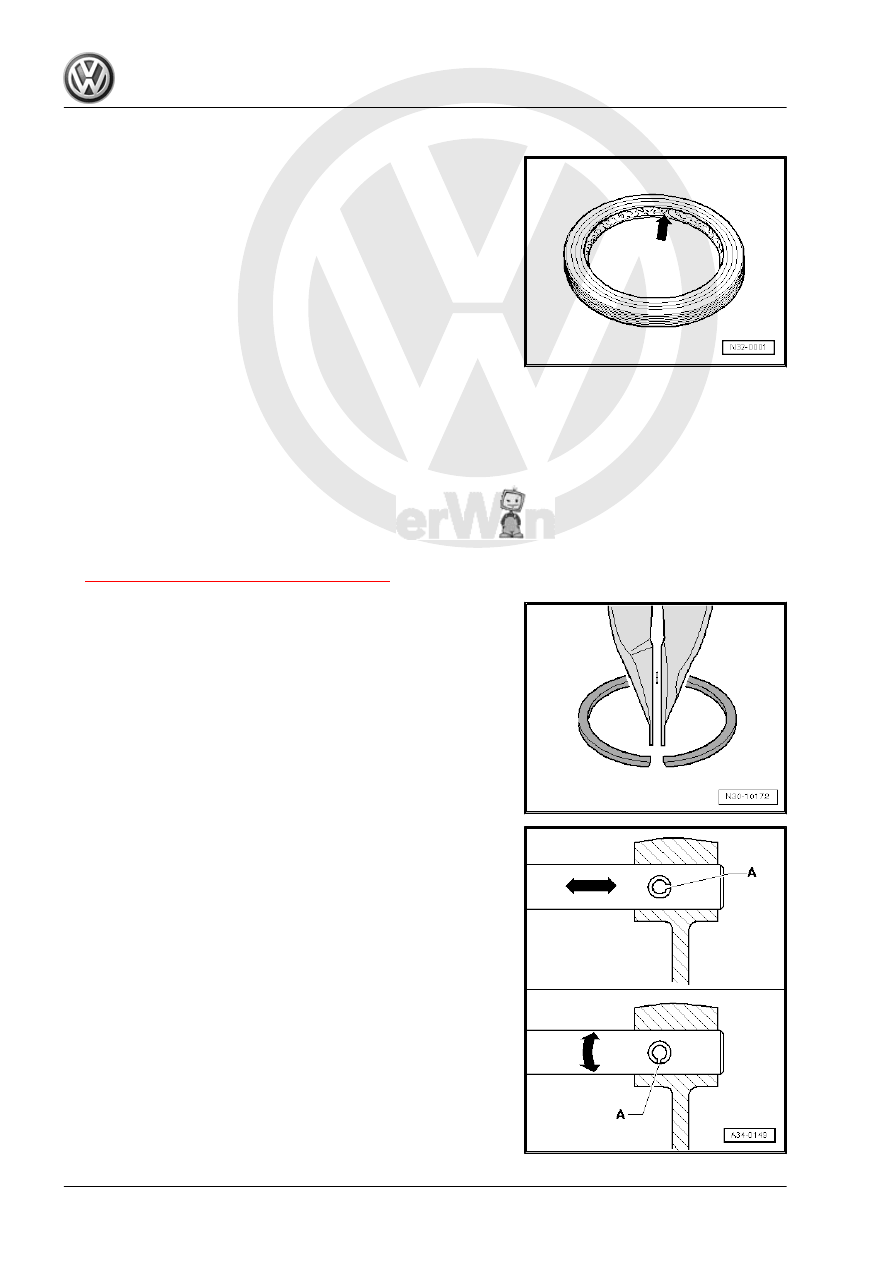
♦ Before installing the shaft seals, lightly oil the outer circumfer‐

ence and fill the space between the sealing lips -arrow- half‐

way with Grease - G 052 128 A1- .

♦ The open side of the gaskets point toward the fluid to be sealed

in.

♦ When installing the new shaft seal, make sure the sealing lip

does not run on the same point as the sealing lip from the old

seal (use offset tolerance).

♦ Lightly lubricate the O-rings before inserting to prevent the

rings from being crushed during assembly.

♦ After replacing the seals and gaskets, check the transmission

fluid level and fill if necessary. Refer to

⇒ “5 Transmission Fluid, Checking”, page 111

 .

4.2.3

Circlips

♦ Do not stretch the circlips.
♦ Installation position for some of the circlips: the circlip is »nar‐

rower at the top« and so is its installation position. This makes

it easier for the pliers to grab the circlip when removing and

installing it.

♦ Always replace damaged or stretched circlips.
♦ The circlips must rest at the bottom of the groove.
♦ Replace the adapter sleeves. Installation position: the slot

-A- should align with the line of force -arrow-.

8

Bolts and Nuts

♦ Loosen the bolts and nuts opposite the tightening sequence.
♦ Nuts and bolts which secure covers and housings should be

loosened and tightened diagonally and in steps if no tightening

sequence is specified.

♦ Especially delicate components, such as clutch pressure

plates, must not be distorted. Loosen and tighten bolts and

nuts in stages in a diagonal sequence.

♦ The tightening specifications given apply to unoiled bolts and

nuts.

♦ Always replace self-locking bolts and nuts.
♦ Make sure the contact surfaces and visible surfaces on the

nuts and bolts are waxed after assembling.

♦ Use a wire brush to clean the threads of the bolts that were

installed with locking fluid. Then insert the bolts with Locking

Fluid - AMV 185 101 A1- .

♦ Clean the threaded holes for the self-locking bolts or for the

bolts coated with locking fluid (for example with a thread tap).

Otherwise there is the risk that the bolts could break off the

next time they are removed.

♦ Please make sure that the thread pitch is correct so that the

proper thread tap is used during cleaning, and the thread does

not get damaged.

4.2.5

Bearings

♦ Install needle bearings with the lettered side (thicker metal)

facing the fitting tool.

♦ Insert all the bearings in transmission with transmission fluid.
♦ Replace all the tapered roller bearings that are on the same

shaft, and use tapered roller bearings from the same manu‐

facturer.

♦ To install, heat the bearing inner races to approximately 100°

C with Inductive Heater - VAS6414- .

♦ Do not interchange inner and outer bearing races with bear‐

ings of the same size; the bearings are paired.

4.2.6

Shims

♦ Measure the shims at several locations with a micrometer cal‐

iper. Tolerance variations make it possible to find the exact

shim thickness required.

♦ Check for burrs or damage.
♦ Only install flawless shims.

4. General Repair Information    

9

Synchronizer Rings

♦ Do not interchange them. When reusing synchronizer rings,

always install on the same gear wheel.

♦ Check for wear and replace if necessary.
♦ Check the grooves -arrow 1- on the synchronizer ring -A- and

the inner race for flat areas (grooves are worn).

♦ The coating on the synchronizer rings must not be damaged.
♦ If an intermediate ring -B- is installed, check the outer friction

surface -arrow 2- and the inner friction surface -arrow 3- for

»grooves« and »scoring«.

♦ Check taper of drive gear for »grooves« and »scoring«.
♦ Coat the synchronizing with transmission fluid and then install.

4.2.8

Gear Wheels, Synchronizer Hubs and

Needle Bearing Sleeve

♦ Warm the needle bearing sleeves to approximately 100 °C

with an Inductive Heater - VAS6414- .

♦ Heat the synchronizer hub to approximately 100 °C with the

Inductive Heat Unit - VAS6414- before installing. Press on as

far as the stop when installing so there is no axial play.

♦ Heat the gears to approximately 100 °C with the Inductive Heat

Unit - VAS6414- before installing. Press on as far as the stop

when installing so there is no axial play.

♦ Pay attention to the installed location.

4.2.9

Selector Gears

♦ After installing, check 1st through 5th gear for minimal amount

of axial clearance and for ease of movement.

4.2.10

Clutch

♦ When removing transmission, remove the clutch slave cylin‐

der without opening the lines.

♦ If the clutch slave cylinder is removed with the hydraulic line

attached, do not depress clutch pedal. Otherwise the piston

will be pressed out of the clutch slave cylinder.

♦ Do not tilt the clutch pressure plate. Loosen and tighten it di‐

agonally and in small steps.

♦ To reduce odor caused by a burnt clutch, thoroughly clean the

clutch housing and the flywheel running surface with a clean

cloth.

10

1

Transmission, Troubleshooting

1. Transmission, Troubleshooting    

11


Content   ..  496  497  498  499   ..