Volkswagen Golf Variant / Jetta. Manual - part 428
 

  Index      Volkswagen     Volkswagen Golf Variant (2007), Jetta (2005) - service repair manual


Search            


Content   ..  426  427  428  429   ..


Volkswagen Golf Variant / Jetta. Manual - part 428


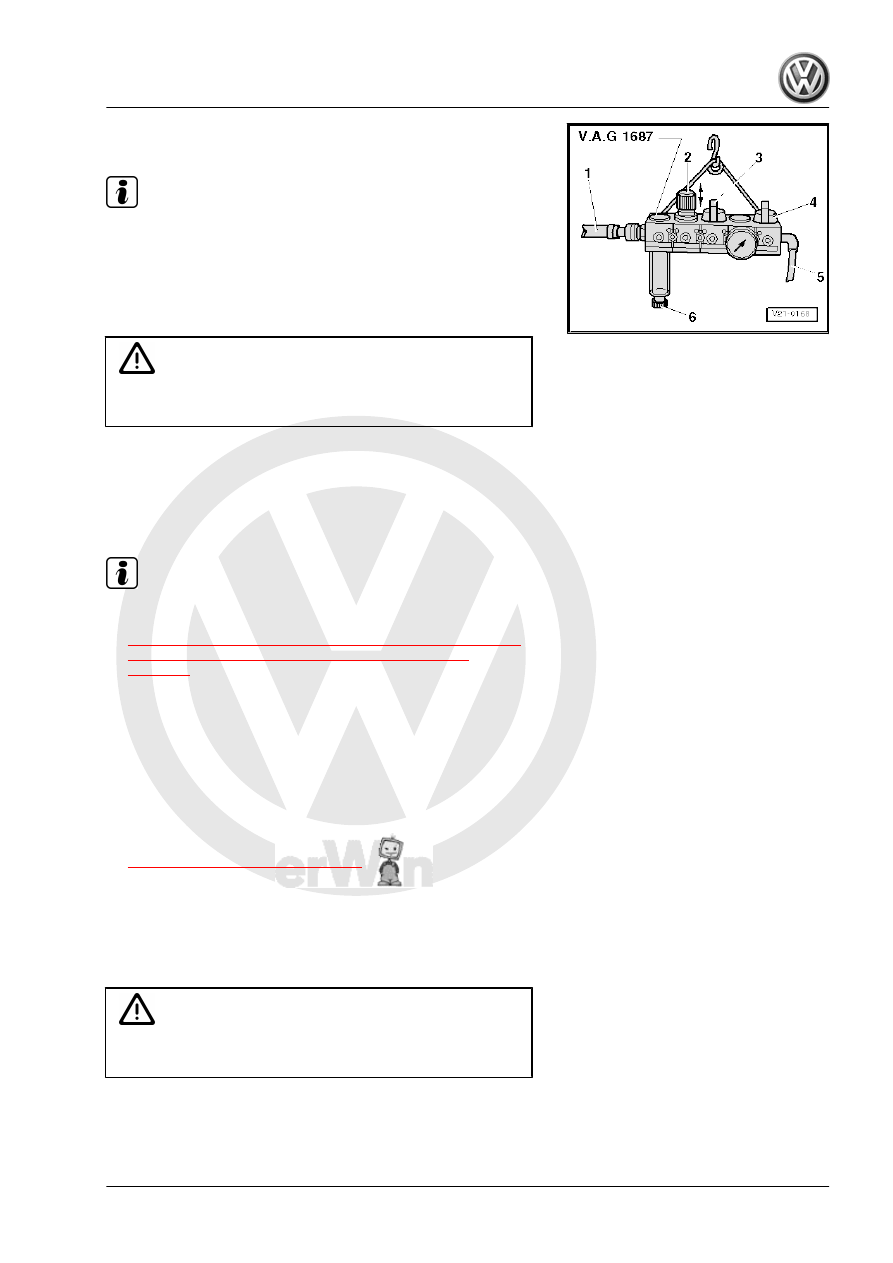
Turbo System Tester Kit - VAG1687- .

Note

If water is located in viewing glass, drain it via the water drain plug

-6-.

– Open the valve -3-.
– Set pressure to 0.5 bar (7.2 psi) using the pressure regulator

valve -2-.

Caution

The pressure must not exceed 0.5 bar (7.2 psi)! A pressure set

too high may damage the engine.

– Open the valve -4- and wait until the test circuit is filled. Adjust

the pressure to 0.5 bar (7.2 psi) if necessary.

– Check the charge air system for leaks by listening, feeling and

using a commercially available leak detection spray or using

the Ultrasonic Tester - VAG1842S- .

Note

Connector Coupling Between Charge Air Cooler and Con‐

necting Hose, Disassembling and Assembling. Refer to

⇒ “4.3 Connector Coupling Between Charge Air Cooler and

Connecting Hose, Disassembling and Assembling”,

page 291

Small leaks on the intake side of the turbocharger are permit‐

ted because the intake hoses are not designed for positive

pressure.

A small quantity of air dissipates via the valves in the engine.

For this reason a pressure retention test is not possible.

Information on the Ultrasonic Tester - VAG1842S- . Refer to

the Operating Instructions.

If a poorly sealed area is discovered, observe the notes for

charge air system when repairing. Refer to

⇒ “4 Charge Air System”, page 289

 .

Before removing the adapter, discharge the pressure in testing

circuit by pulling off the coupling from the Turbo System Tester

Kit - Adapter 10 - VAG1687/10- .

4.5

Vacuum Hose Connection Diagram

Caution

When routing the vacuum lines, make sure they are not kinked,

twisted or pinched. They could disable the vehicle.

4. Charge Air System    

295

❑ On the turbocharger
❑ With the Charge Air

Pressure Actuator Posi‐

tion Sensor - G581-

❑ Removing and instal‐

ling. Refer to

⇒ “3.4 Vacuum Dia‐

phragm with Charge Air

Pressure Actuator Posi‐

tion Sensor G581 , Re‐

placing”, page 282

 .

2 - Wastegate Bypass Regula‐

tor Valve - N75-
3 - From Brake Booster
4 - To the Vacuum Pump
5 - Connecting Piece

❑ At the vacuum pump

6 - Check Valve

❑ Pay attention to the in‐

stalled position: the

white connection faces

the junction piece

-item 10-

⇒ Item 10 (page 296)

❑ Checking. Refer to

⇒ “4.7 Vacuum System,

Checking”, page 297

 ,

Vacuum System,

Checking

7 - Air Filter
8 - Muffler
9 - Cylinder Head Cover
10 - Junction Piece

4.6

Vacuum Hose Connection Diagram, En‐

gine Codes CBDA, CBDB, CEGA

Caution

When routing the vacuum lines, make sure they are not kinked,

twisted or pinched. They could disable the vehicle.

296

❑ On the turbocharger
❑ With the Charge Air

Pressure Actuator Posi‐

tion Sensor - G581-

❑ Removing and instal‐

ling. Refer to

⇒ “3.4 Vacuum Dia‐

phragm with Charge Air

Pressure Actuator Posi‐

tion Sensor G581 , Re‐

placing”, page 282

 .

2 - Wastegate Bypass Regula‐

tor Valve - N75-
3 - Muffler
4 - Air Filter
5 - To the Brake Booster
6 - Connecting Piece

❑ at the vacuum pump

7 - Check Valve

❑ Note the installation po‐

sition

8 - EGR Cooler Switch-Over

Valve - N345-
9 - Cylinder Head Cover
10 - Vacuum Diaphragm

❑ For the EGR cooler

change over

4.7

Vacuum System, Checking

⇒ “4.7.1 Supply Line and Check Valve, Checking”, page 297
⇒ “4.7.2 Control Line to Turbocharger, Checking”, page 299

 .

4.7.1

Supply Line and Check Valve, Checking

Special tools and workshop equipment required
♦ Hand Vacuum Pump - VAS6213-

4. Charge Air System    

297

♦ When routing the vacuum lines, make sure they are not

kinked, twisted or pinched. They could disable the vehicle.

♦ Follow the safety precautions when working on the charge

air system and turbocharger. Refer to

⇒ “1 Safety Precautions when Working on Charge Air

System And Turbocharger”, page 268

 .

♦ Pay attention to the guidelines for clean working condi‐

tions. Refer to

⇒ “2 Guidelines for Clean Working Conditions”,

page 269

 .

Always pay attention to these instructions before and during

work.

– Remove the engine cover. Refer to

⇒ “1.4 Engine Cover, Removing and Installing”, page 90

 .

Remove the vacuum hose on the lower connection from the

Wastegate Bypass Regulator Valve - N75- -arrow in II-.
– Seal the open hose end with a suitable blind plug.

Note

Do not use threaded bolts or pins.

– Disconnect the vacuum hose -arrow- at the vacuum pump

connecting piece.

– Connect the Hand Vacuum Pump - VAS6213- to the removed

hose and generate a vacuum pressure of 0.6 bar (8.7 psi).

– Watch the pressure gauge on the Hand Vacuum Pump -

VAS6213- for approximately 30 seconds.

• The vacuum must not drop.
If vacuum drops:
– Replace the hose piece if there is damage or leaks in the hose

line connection.

If the vacuum does not decrease:
– First disconnect the hose at the Hand Vacuum Pump -

VAS6213- .

– Remove the blind plug from the hose end.
– If the check valve -item 6- 

⇒ Item 6 (page 296)

 functions, a

noticeable hissing can be heard as the vacuum pressure re‐

duces.

If there is not a hissing sound:
– Replace the check valve -item 6- 

⇒ Item 6 (page 296)

 .

If there is a hissing sound:
– Connect all the vacuum hoses.
– Check the control line to the turbocharger. Refer to

⇒ “4.7.2 Control Line to Turbocharger, Checking”,

page 299

 .

298


Content   ..  426  427  428  429   ..