Volkswagen Golf Variant / Jetta. Manual - part 417
 

  Index      Volkswagen     Volkswagen Golf Variant (2007), Jetta (2005) - service repair manual


Search            


Content   ..  415  416  417  418   ..


Volkswagen Golf Variant / Jetta. Manual - part 417


Fuel Filter, Removing and Installing

DANGER!

♦ Observe safety precautions when working on fuel supply.

Refer to

⇒ “1 Safety Precautions when Working on Fuel Supply

System”, page 223

 .

♦ Pay attention to the guidelines for clean working condi‐

tions. Refer to

⇒ “2 Guidelines for Clean Working Conditions”,

page 224

 .

Always pay attention to these instructions before and during

work.

Special tools and workshop equipment required
♦ Torque Wrench 1331 5-50Nm - VAG1331-
♦ Hose Clip Pliers - VAS6362-
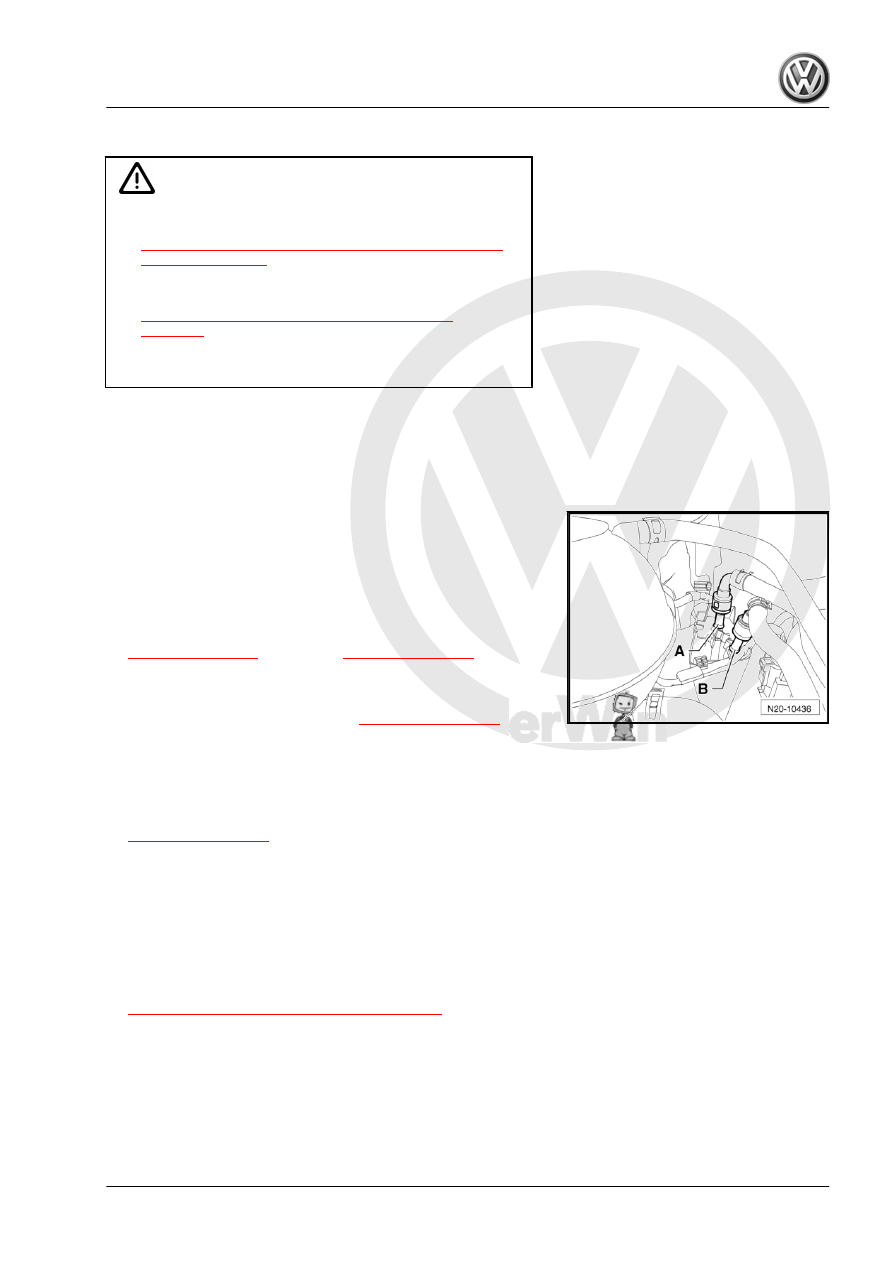
Removing:
– Disconnect the fuel lines to the fuel tank.
A - Fuel Supply Line, Black
B - Fuel Return Line, Blue or with Blue Marking
– Seal the lines so that no dirt can enter the fuel system.
– Loosen the spring clamps with the Hose Clip Pliers -

VAS6362- and remove the fuel hoses -item 6-

⇒ Item 6 (page 250)

 and -item 7- 

⇒ Item 7 (page 250)

 from the

fuel filter.

– Seal the lines so that no dirt can enter the fuel system.
– Remove the bolt and nut -item 11- 

⇒ Item 11 (page 250)

 .

– Remove the fuel filter upward.
Installing:
Install in reverse order of removal. Note the following:
• Bolt and nut tightening specification -item 11-

⇒ Item 11 (page 250)

 .

• Route the fuel hoses without kinks.
• Check the fuel hoses for secure fit.
• Do not interchange the supply and return lines (the return line

is blue or has a blue marking, the supply line is white or has a

white marking).

• Clip the fuel hoses back into the retainers.
– Fill the fuel system. Refer to

⇒ “3.9 Fuel System, Filling/Bleeding”, page 328

 .

6. Fuel Supply System, Servicing    

251

Transfer Fuel Pump - G6- , Checking

⇒ “6.4.1 Fuel Delivery Rate, Checking”, page 252

 .

⇒ “6.4.2 Power Supply, Checking”, page 253
⇒ “6.4.3 Current Draw, Checking”, page 255

 .

6.4.1

Fuel Delivery Rate, Checking

DANGER!

♦ Observe safety precautions when working on fuel supply.

Refer to

⇒ “1 Safety Precautions when Working on Fuel Supply

System”, page 223

 .

♦ Pay attention to the guidelines for clean working condi‐

tions. Refer to

⇒ “2 Guidelines for Clean Working Conditions”,

page 224

 .

Always pay attention to these instructions before and during

work.

Special tools and workshop equipment required
♦ Vehicle Diagnostic Tester
♦ Vehicle Diagnostic Tester - Test Adapter - 5 Pin - VAS5565-
♦ Pickup clamp - VAG1526B/2-
♦ Analog/Digital Multimeter - FLU83III-
♦ Pressure Tester Kit - VAS6551-
♦ Container > 3L with measuring scale
Test Conditions:
• The battery voltage must be at least 12.0V.
• The fuses must be OK.
• All electrical consumers for example lamps and rear window

defogger, must be switched off.

Test Sequence
– Disconnect -1- from the Auxiliary Fuel Pump - V393- .

252

the fuel supply line -A- to the fuel tank.

– Guide the open end of the hose from the Pressure Tester Kit

- VAS6550- into the measuring container.

– Open the shut-off valves in front of and behind the pressure

gauge in the flow direction and connect the lower shut-off

valve.

– Connect the Vehicle Diagnostic Tester -1- as follows:
– Connect diagnostic cable -2- to Data Link Connector (DLC) in

driver footwell.

– Switch the ignition on.
– Perform “Guided Functions, check electric fuel pump(s)”. Re‐

fer to Vehicle Diagnostic Tester .

Note

The fuel pump now runs for 30 seconds.

– Turn off the ignition.
– Read the quantity of fuel in the measuring container.
Specified Values
• Minimum 1000 ml for 30 seconds
If the quantity of fuel delivered is less than the specified value:
– Check the fuel pump voltage supply. Refer to

⇒ “6.4.2 Power Supply, Checking”, page 253

 . Check the cur‐

rent draw. Refer to

⇒ “6.4.3 Current Draw, Checking”, page 255

 .

6.4.2

Power Supply, Checking

DANGER!

♦ Observe safety precautions when working on fuel supply.

Refer to

⇒ “1 Safety Precautions when Working on Fuel Supply

System”, page 223

 .

♦ Pay attention to the guidelines for clean working condi‐

tions. Refer to

⇒ “2 Guidelines for Clean Working Conditions”,

page 224

 .

Always pay attention to these instructions before and during

work.

Special tools and workshop equipment required
♦ Vehicle Diagnostic Tester
♦ Vehicle Diagnostic Tester - Test Adapter - 5 Pin - VAS5565-
♦ Pickup clamp - VAG1526B/2-

6. Fuel Supply System, Servicing    

253

defogger, must be switched off.

Test Sequence
– Remove the bench seat. Refer to ⇒  Body Interior; Rep. Gr. 

72 ; Rear Seats; Rear Bench Seat, Removing and Installing .

– Unclip the cover -1- for the fuel delivery unit. The arrow -2-

points in the direction of travel.

– Switch the ignition on.
• The Transfer Fuel Pump - G6- must run audibly for approxi‐

mately 2 seconds.

Note

The Transfer Fuel Pump - G6- runs very quietly.

– Switch off the ignition.
If the Transfer Fuel Pump - G6- does not run:

– Disconnect -1- from the fuel delivery unit flange.

– Connect the Vehicle Diagnostic Tester - Test Adapter - 5 Pin

- VAS5565- between the connector and the flange.

– Connect the Analog/Digital Multimeter - FLU83III- to the test

contacts -1- and -5- on the Adapter .

254


Content   ..  415  416  417  418   ..