Volkswagen Golf Variant / Jetta. Manual - part 411
 

  Index      Volkswagen     Volkswagen Golf Variant (2007), Jetta (2005) - service repair manual


Search            


Content   ..  409  410  411  412   ..


Volkswagen Golf Variant / Jetta. Manual - part 411


Press the locking ring to release the fuel line.

WARNING

If the battery is connected, make sure that the fuel pump is not

activated when the door is opened. Fuel may leak out when

the system is open.

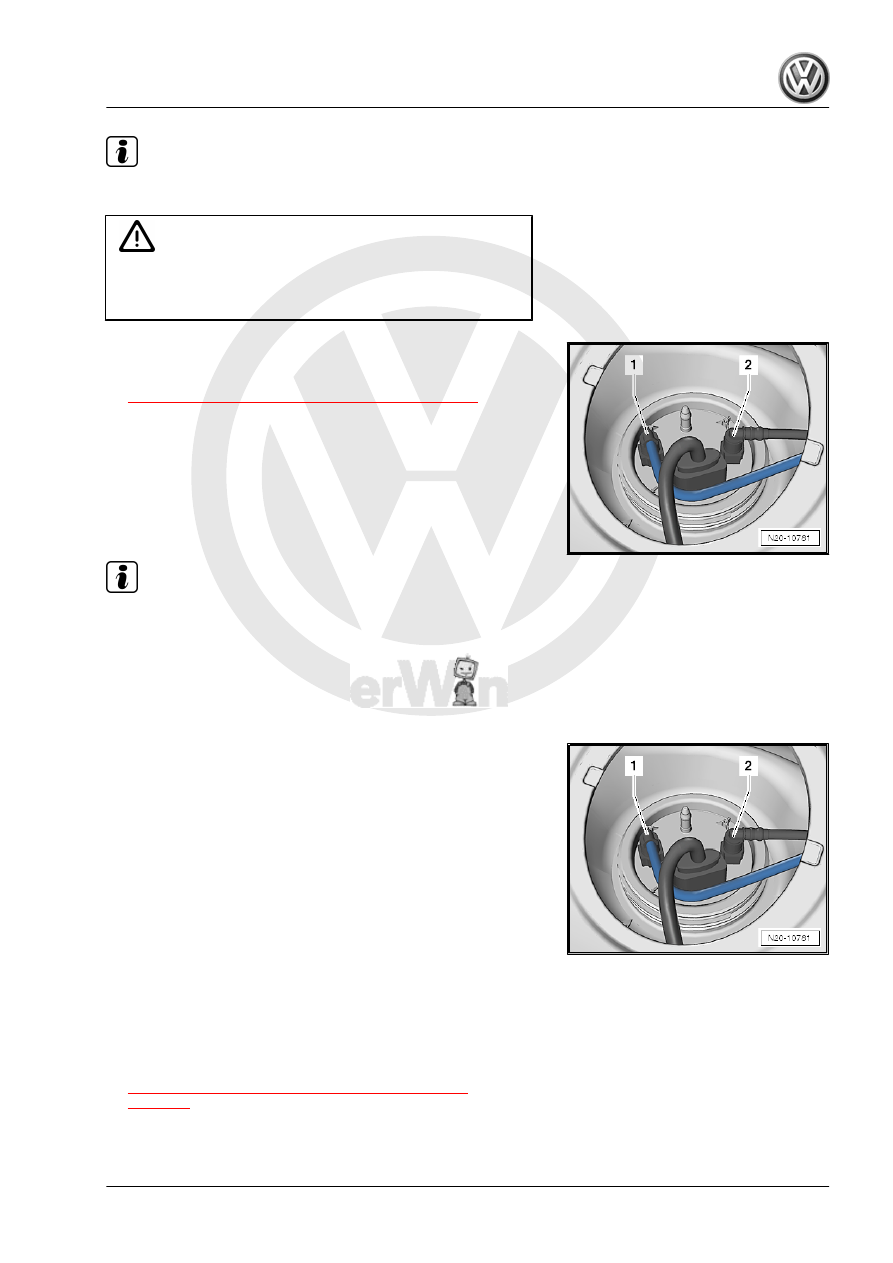
– Remove the fuel return line, which is blue or has a blue mark‐

ing, -1- from the fuel delivery unit. Disconnect the coupling.

Refer to

⇒ “5 Connector Couplings, Disconnecting”, page 245

 .

– Connect the Diesel Pressure Tester Kit - Adapter Set - Con‐

nection Hose 2 -VAS6551/5-2- to the fuel return line -1-.

– Guide the free end of the Diesel Pressure Tester Kit - Adapter

Set - Connection Hose 2 -VAS6551/5-2- into a suitable con‐

tainer.

– Connect the Vehicle Diagnostic Tester and perform the Gui‐

ded Function “Activate Fuel Pump”.

Note

The fuel pump is now activated.

– Repeat this procedure as necessary until the fuel tank is com‐

pletely empty.

– Fill the fuel tank with five liters (5.28 quarts) of diesel fuel.
– Drain the fuel tank again completely as described above.

– Reconnect the fuel return line (blue, or blue marking) -1-.
– Replace the fuel filter. Refer to ⇒ Maintenance ; Booklet  20.1 .
– Fuel the vehicle and perform a road test.
End

3.3

Step 3 (Shavings in the Fuel Delivery

Unit and Reservoir)

– Clean the fuel delivery unit and the fuel tank with the Suction

Pump - VAS5226- .

– Install the fuel delivery unit. Refer to

⇒ “4.6 Fuel Delivery Unit, Removing and Installing”,

page 241

 .

– Fill the fuel tank with five liters (5.28 quarts) of diesel fuel.
– Drain the fuel tank again completely as described above.

3. Misfueling    

227

⇒ “3.8 High Pressure Fuel Pump, Removing and Installing”,

page 325

 .

♦ High pressure lines. Refer to

⇒ “3.4.1 High Pressure Lines, Installing”, page 318

 .

♦ High pressure reservoir (Rail) including Fuel Pressure Regu‐

lator Valve - N276- and Fuel Pressure Sensor - G247- . Refer

to 

⇒ “3.2 System Overview”, page 307

♦ Injector. Refer to

⇒ “3.4 Fuel Injector (Piezo Injector), Removing and Installing”,

page 315

♦ Fuel return lines (oil overflow lines). Refer to

⇒ “3.3 Overview - Fuel System”, page 311

 .

♦ Replace the fuel filter. Refer to

⇒ “6.3 Fuel Filter, Removing and Installing”, page 251

 .

– Fuel the vehicle.
– Bleed the fuel system. Refer to

⇒ “3.9 Fuel System, Filling/Bleeding”, page 328

 .

– Perform a road test.
End

3.4

Step 4 (No Shavings in the Fuel Delivery

Unit and Reservoir)

– Fill the fuel tank with five liters (5.28 quarts) of diesel fuel.
– Drain the fuel tank again completely as described above.

Caution

Removing the Fuel Metering Valve - N290- increases the risk

that the high pressure pump will be damaged from the outside

by debris. For this reason, always ensure the utmost cleanli‐

ness.

– Carefully clean the high pressure pump near the Fuel Metering

Valve - N290- .

– Disconnect from the valve.
– Remove the bolts -arrows- and carefully remove the Fuel Me‐

tering Valve - N290- .

– Inspect the Fuel Metering Valve - N290- and the high pressure

pump for shavings.

Are There Any Shavings?

Yes. Refer to

⇒ “3.5 Step 5 (Shavings in the High Pressure Pump)”,

page 228

 .

No. Refer to

⇒ “3.6 Step 6 (No Shavings in the High Pressure Pump)”, page

229

 .

3.5

Step 5 (Shavings in the High Pressure

Pump)

– Replace the following high pressure components:

228

⇒ “3.8 High Pressure Fuel Pump, Removing and Installing”,

page 325

 .

♦ High pressure lines. Refer to

⇒ “3.4.1 High Pressure Lines, Installing”, page 318

 .

♦ High pressure reservoir (Rail) including Fuel Pressure Regu‐

lator Valve - N276- and Fuel Pressure Sensor - G247- . Refer

to 

⇒ “3.2 System Overview”, page 307

♦ Injector. Refer to

⇒ “3.4 Fuel Injector (Piezo Injector), Removing and Installing”,

page 315

♦ Fuel return lines (oil overflow lines). Refer to

⇒ “3.3 Overview - Fuel System”, page 311

 .

♦ Replace the fuel filter. Refer to

⇒ “6.3 Fuel Filter, Removing and Installing”, page 251

 .

– Fuel the vehicle.
– Bleed the fuel system. Refer to

⇒ “3.9 Fuel System, Filling/Bleeding”, page 328

 .

– Perform a road test.
End

3.6

Step 6 (No Shavings in the High Pres‐

sure Pump)

Caution

Make sure that the seals for the Fuel Metering Valve - N290-

are not damaged. The high pressure pump must be replaced

if the seal is damaged.

– Coat the lower seal for the Fuel Metering Valve - N290- with

fuel.

– Slide the valve into the high pressure pump by lightly twisting

it.

– Install both bolts -arrows- by hand.
– First tighten the bolts to 3 Nm and then tighten them to 7 Nm.
– Replace the fuel filter. Refer to ⇒ Maintenance ; Booklet  20.1 .
– Bleed the fuel system. Refer to

⇒ “3.9 Fuel System, Filling/Bleeding”, page 328

 .

– Fuel the vehicle and perform a road test.
End

3. Misfueling    

229

Fuel Supply System Components

⇒ “1 Safety Precautions when Working on Fuel Supply System”,

page 223
⇒ “2 Guidelines for Clean Working Conditions”, page 224
⇒ “4.1 General Information”, page 230
⇒ “4.2 Overview - Fuel Tank, All Vehicles Except Jetta from MY

2011”, page 231
⇒ “4.3 Overview - Fuel Tank, Jetta from MY 2011 Only”,

page 233
⇒ “4.4 Fuel Tank, Draining”, page 235
⇒ “4.5 Fuel Tank, Removing and Installing”, page 238
⇒ “4.6 Fuel Delivery Unit, Removing and Installing”, page 241
⇒ “4.7  Fuel Level Sensor G , Removing and Installing”,

page 243

4.1

General Information

Special tools and workshop equipment required
♦ Hose Clip Pliers - VAS6362-

Note

Hose connections are secured with either spring or hose

clamps.

Always replace hose clamps with spring clamps. Refer to

Parts Catalog.

Hose Clip Pliers - VAS6362- or the Hose Clip Pliers -

VAS6340- are recommended for installing spring clips.

DANGER!

♦ Observe safety precautions when working on fuel supply.

Refer to

⇒ “1 Safety Precautions when Working on Fuel Supply

System”, page 223

 .

♦ Pay attention to the guidelines for clean working condi‐

tions. Refer to

⇒ “2 Guidelines for Clean Working Conditions”,

page 224

 .

Always pay attention to these instructions before and during

work.

230


Content   ..  409  410  411  412   ..