Volkswagen Golf Variant / Jetta. Manual - part 398
imately 3 mm).
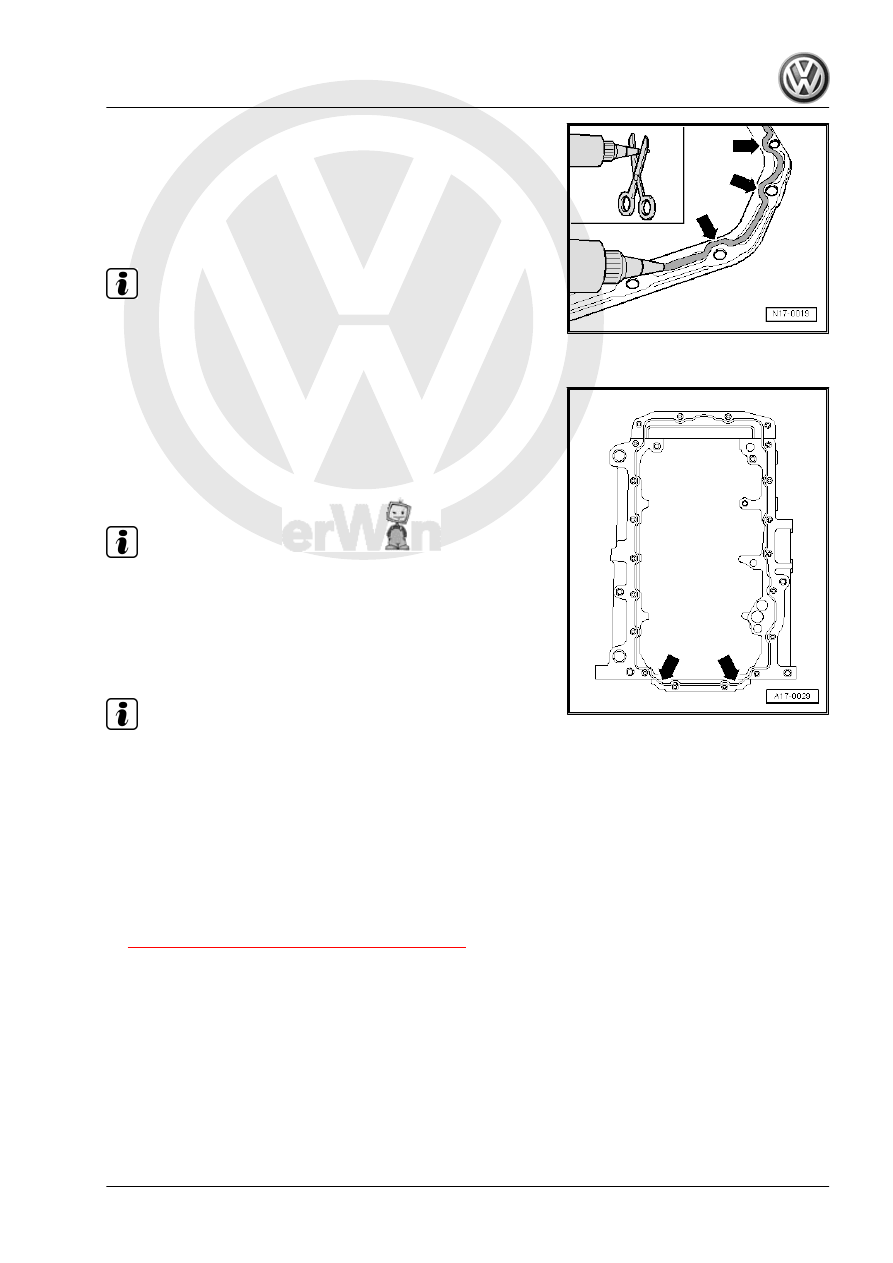
– Apply the silicone sealant as shown on the clean oil pan seal‐
ing surface. The sealing compound bead must be:
♦ 2 to 3 mm thick
♦ and run on inside in the area of the bolt holes -arrows-
Note
Sealant bead must not be thicker than specified. Otherwise, ex‐
cess sealant could get into oil pan and clog the screen in intake
line of oil pump.
– Apply a silicone sealing compound bead as shown to the clean
sealing surface of the oil pan. (The illustration shows the lo‐
cation of the sealant bead on the crankshaft housing.)
– Position the oil pan immediately and gently tighten the bolts
connecting the oil pan to the transmission and all of the oil pan
bolts. Make sure the oil pan lies flush on the intermediate plate/
transmission flange.
Note
When installing the oil pan on a removed engine, make sure that
the oil pan is positioned flush with the crankshaft housing on the
flywheel side.
– Tighten the oil pan bolts in a diagonal sequence to 15 Nm.
– Tighten the oil pan/transmission bolts to 40 Nm.
Note
After installing the oil pan, allow the sealant to dry for approxi‐
mately 30 minutes. Only afterward may the engine oil be replen‐
ished.
Further assembly is performed in the reverse order of the remov‐
al.
3.3
Oil Pump, Removing and Installing
Removing
– Remove the oil pan and the splash wall. Refer to
⇒ “3.2 Oil Pan, Removing and Installing”, page 172
3. Lubrication System Components, Engine Code CJAA
175