Volkswagen Golf Variant / Jetta. Manual - part 126
 

  Index      Volkswagen     Volkswagen Golf Variant (2007), Jetta (2005) - service repair manual


Search            


Content   ..  124  125  126  127   ..


Volkswagen Golf Variant / Jetta. Manual - part 126


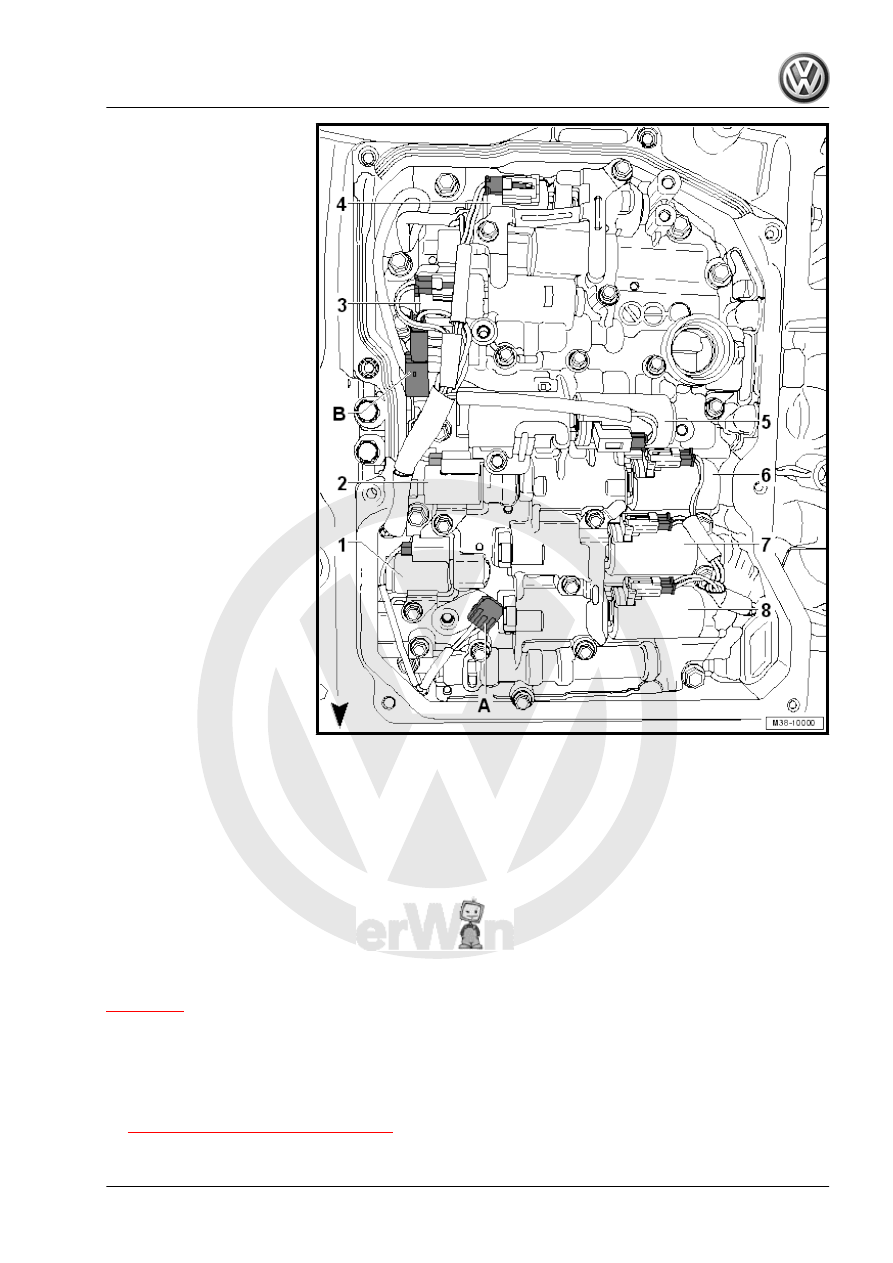
Pressure Regulating Valve 5 -

N233-
4 - Automatic Transmission

Pressure Regulating Valve 7 -

N443-
5 - Automatic Transmission

Pressure Regulating Valve 1 -

N215-
6 - Automatic Transmission

Pressure Regulating Valve 4 -

N218-
7 - Automatic Transmission

Pressure Regulating Valve 3 -

N217-
8 - Automatic Transmission

Pressure Regulating Valve 2 -

N216-
A - Transmission Fluid Tem‐

perature Sensor - G93-
B - Transmission Input Speed

Sensor - G182- Connector

4.2

Valve Body, Removing and Installing

Special tools and workshop equipment required
♦ Torque Wrench 1331 5-50Nm - VAG1331-
♦ Digital Torque Wrench - VAG1756A-
Removing
Vehicles with a generation 2 transmission (such as transmission

codes “MAN” or “PDW”)
Vehicles with generation 3 transmission (such as transmission

code “NTJ”)
Removing on Vehicles with Generation 2 Transmission. Refer to

⇒ page 135

 .

– See if a coded radio is installed. If so, obtain the anti-theft code.
– Disconnect the battery ground cable. Refer to ⇒  Electrical

Connecting .

– Remove the transmission fluid pan. Refer to

⇒ “2 Transmission Fluid Pan”, page 125

 .

4. Valve Body    

135

⇒ “3 ATF Screen”, page 127

 .

– Make a sketch, similar to the illustration, of all the sensors and

solenoid valves and their connectors.

– Mark the solenoid valve and/or sensor and its connector be‐

fore disconnecting them.

WARNING

It is absolutely required to draw or take pictures and to make

identifying marks so that connectors at solenoid valves cannot

be interchanged unintentionally when reinstalling the sensors

and valve body.
In some circumstances, confusing the connectors could cause

damage to the transmission.

– Carefully pry out the connector retaining tabs on the solenoid

valves -1 through 8- using a small screwdriver and then dis‐

connect the connectors.

136

The wiring harness or the valve body with the solenoid valves

must be replaced if the one of the connectors gets damaged.

– Disconnect the connectors -A and B-.

Note

If equipped, remove the connectors from the Automatic Transmission Hydraulic Pressure Sensor 1 - G193-

and the Automatic Transmission Hydraulic Pressure Sensor 2 - G194- . Refer to

⇒ Fig. ““ Automatic Transmission Hydraulic Pressure Sensor 1 -G193- and Automatic Transmission Hydraulic

Pressure Sensor 2 -G194- ”“ , page 18

 .

– Remove the bracket for the connectors -1 and 2-.
– Remove the Transmission Fluid Temperature Sensor - G93-

-3- carefully from the valve body.

– Disengage the wiring harnesses from the brackets -arrows-.

4. Valve Body    

137

-arrows-.

– Remove the selector lever -1- from the selector shaft.
– While doing so, carefully hold the selector lever -1- firmly with

pliers -2- so that the torque is not transferred onto the Multi‐

function Transmission Range Switch - F125- .

– Make sure the slider -3- on the valve body in which the shift

lever engages is not damaged.

The actuator valve is very »sensitive«. Even minor damage leads

to malfunction.
– Always slide the valve into the body, secure it against falling

out and never interchange it.

The valve body bolts on the transmission housing have different

lengths and must be replaced.
Only the indicated bolts -arrows- may be loosened.

Caution

When loosening the other bolts, the function of the valve body

can be impaired or the valve body will distort.

– Remove the bracket -1 and 2-.
– Loosen the valve body bolts -arrows-, -arrows A- and

-arrows B- diagonally and then remove the valve body.

-3- valve body description, for example, A2

138


Content   ..  124  125  126  127   ..