Volkswagen Golf / Golf Plus. Manual - part 74
 

  Index      Volkswagen     Volkswagen Golf (2004) / Golf Plus (2005) - service repair manual


Search            


Content   ..  72  73  74  75   ..


Volkswagen Golf / Golf Plus. Manual - part 74


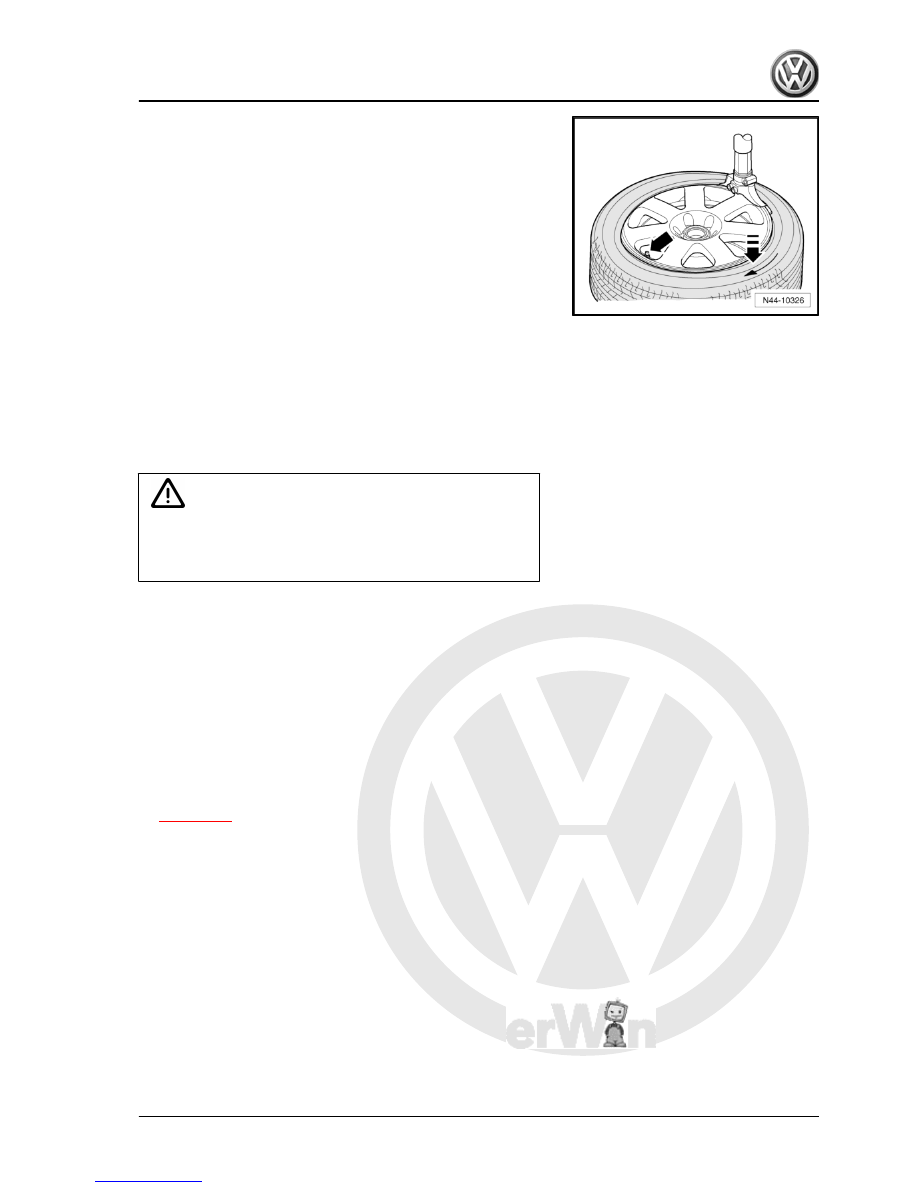
– Press tyre into drop centre in -direction of arrow- between tyre

valve with tyre pressure sensor and assembly head.

– Run tyre fitting machine clockwise.
– Stop the fitting of lower bead before reaching tyre valve/ tyre

pressure sensor to prevent damage to tyre pressure sensor .

The tyre bead will now slide over the wheel rim flange. The wheel

rim may be turned only until the assembly head is just before the

tyre valve/ tyre pressure sensor .
– Check to ensure that tyre bead is seated correctly on assembly

head and run tyre fitting machine clockwise.

– Stop the fitting of upper bead before reaching tyre valve/ tyre

pressure sensor to prevent damage to tyre pressure sensor .

The tyre bead will now slide over the wheel rim flange. The wheel

rim may be turned only until the assembly head is just before the

tyre valve/ tyre pressure sensor .
– Inflate tyre to a pressure of max. 3.3 bar (bead seating pres‐

sure)

Caution

Never increase the inflation pressure when the tyre bead does

not lie completely against the wheel rim flange.
This would lead to damage to the tyre and/or the wheel rim.

– When the tyre bead does not lie completely against the wheel

rim flange: deflate the tyre, press tyre bead off wheel rim flange

and generously coat again with tyre assembly paste.

– Inflate tyre to a pressure of max. 3.3 bar (bead seating pres‐

sure)

– If the tyre beads seat perfectly against the shoulder of the

wheel rim, increase pressure to 4 bar to “seat” the tyre.

– Fit a new nickel-plated valve insert and inflate tyre to prescri‐

bed inflation pressure.

– Then balance wheel.
– Install wheel and tighten bolts to specified torque

⇒ page 288

 .

4. Removing and fitting tyres (wheels with tyre pressure monitoring)    

293


flat capability to wheel rims

5.1

Notes on safety

• Only specially trained mechanics may remove or install tyres

with run-flat capability.

• The special tools required must be in a perfect condition and

must not be damaged. For information about appropriate ad‐

ditional tools, directly contact the manufacture of the tyre fitting

equipment in your workshop. The recommended optional ad‐

ditional tools can be located under the VAS number of the

listed tyre fitting equipment.

• Use assembly paste recommended by the tyre manufacturer

if necessary.

• The procedure for removing and fitting may differ depending

on the type of equipment used and the manufacture of the

equipment.

• The subsequent procedure describes in general the principles

of removing and fitting tyres with run-flat capabilities. It is im‐

portant that you can identify a "run-flat" tyre before starting to

remove or fit a tyre in order to follow the respective procedure.

• Distinguishing features: the tyre can be identified by one of the

following abbreviations DSST, Euforia, RFT, ROF, RSC, SSR

or ZP. The abbreviation is located on the flank of the tyre fol‐

lowing the tyre designation of the respective tyre manufactur‐

er.

• It is extremely important to adhere to the instructions and

warnings in the following descriptions.

• Check whether the tyre pressure sensor should also be re‐

placed (if present) ⇒ Vehicle diagnosis, testing and information

system VAS 5051.

Note

Ensure that the tyre does not contact the tyre pressure sensor

during removal or fitting.

The tyre pressure sensor must not come into contact with wa‐

ter or be blown upon with compressed air when the wheel rim

is cleaned.

5.2

Installation conditions

Warming cold tyres to minimum installation temperature

Note

This instruction also applies to ultra-high performance tyres

(height/width ratio less than or equal to 45 % and speed symbol

greater than or equal to V).

294

     Rep. Gr.44 - Wheels, tyres, vehicle geometry


the temperature in the core of the tyre should not be more than

30 °C.

• To install tyres without damage, it is especially important to

warm the upper part of the sidewall and the inside of the upper

bead to at least 15 °C.

• This internal temperature is referred to as the core tempera‐

ture.

• Rubber is a poor conductor of heat, therefore a cold tyre must

be left in an area with the correct temperature for a sufficiently

long period so the inner rubber layers can warm up to at least

15 °C.

• The surface temperature of the tyre during the warming up

phase is no indication of its internal temperature.

• To enable cold tyres to absorb heat from the ambient air as

quickly as possible, they should not be stacked on top of one

another but instead stored individually in order to allow the

warm air to “flow” around them effectively.

• Tyres must never be placed in front of a radiator or hot air

blower for warming, since this can very quickly lead to critical

surface temperatures.

• Except for warming with warm water or warm ambient air

(max. 50 °C), there is no process available for warming tyres

without damaging the tyre!

• When cold tyres (below 0 °C) are transferred to a warm envi‐

ronment (above 0 °C), a layer of condensation immediately

forms on the surface of the tyre. This layer of condensation

indicates that the tyre is intensively absorbing heat from its

environment through the process of water vapour in the air

condensing out on the tyre surface.

• If the layer of condensation is in liquid form and leads to mois‐

ture on the surface, it should be dried off with a cloth otherwise

the continuation of the warming process might be curtailed by

cold due to evaporation.

Warming times:
♦ Assuming a minimum room temperature of 19 °C and a tyre

temperature of 0 °C or more, a tyre should be kept at least at

19 °C for at least 2 hours

♦ Assuming a minimum room temperature of 19 °C and a tyre

temperature of below 0 °C, a tyre should be kept at least at 19

°C for at least 2.5 hours

Warming recommendations:
♦ If possible, the tyres should be kept in the workshop for 1 day

before installation (preparation for the job).

♦ Store on an insulated base, pallet or the like, as high up as

possible

♦ Position the tyres individually to allow the warm air to “flow”

around them effectively

♦ Wipe off condensation
♦ Never heat with a radiator or hot air blower!

5. Removing and fitting tyres with run-flat capability to wheel rims    

295


Caution

♦ Follow the notes on safety 

⇒ page 294

– Deflate tyre by unscrewing nickel-plated valve insert.
– When pressing off a tyre using tyre fitting equipment with a

press-off plate, always ensure that the tyre valve/ tyre pres‐

sure sensor -arrow- is directly opposite the bead breaker -1-.

The bead breaker must be positioned no more than 2 cm from

wheel rim flange.
– Remove balance weights and excessive dirt from wheel.

– Press both tyre beads off all round and liberally coat tyre and

wheel rim flange with tyre assembly paste -arrow-.

5.4

Removing tyre from wheel

Caution

♦ Follow the notes on safety 

⇒ page 294

296

     Rep. Gr.44 - Wheels, tyres, vehicle geometry


Content   ..  72  73  74  75   ..