Mercedes-Benz ML320. Service manual - part 150
 

  Index      Mercedes     Mercedes-Benz ML320 - service and repair manual 1997-2005 year


Search            copyright infringement  


Content   ..  148  149  150  151   ..


Mercedes-Benz ML320. Service manual - part 150


Operation  

In selector lever position "P" and "N" the starter lockout contact (Y3/6s1) is actuated by a cam track which is 
located on the detent plate. See Fig. 29

The permanent magnet (47) is moved away from the dry-reed contact (48). The dry-reed contact (48) is opened. 
The ETC control module (N15/3) receives an electric signal. The circuit to the starter in the selector lever 
position "P" and "N" is closed. 

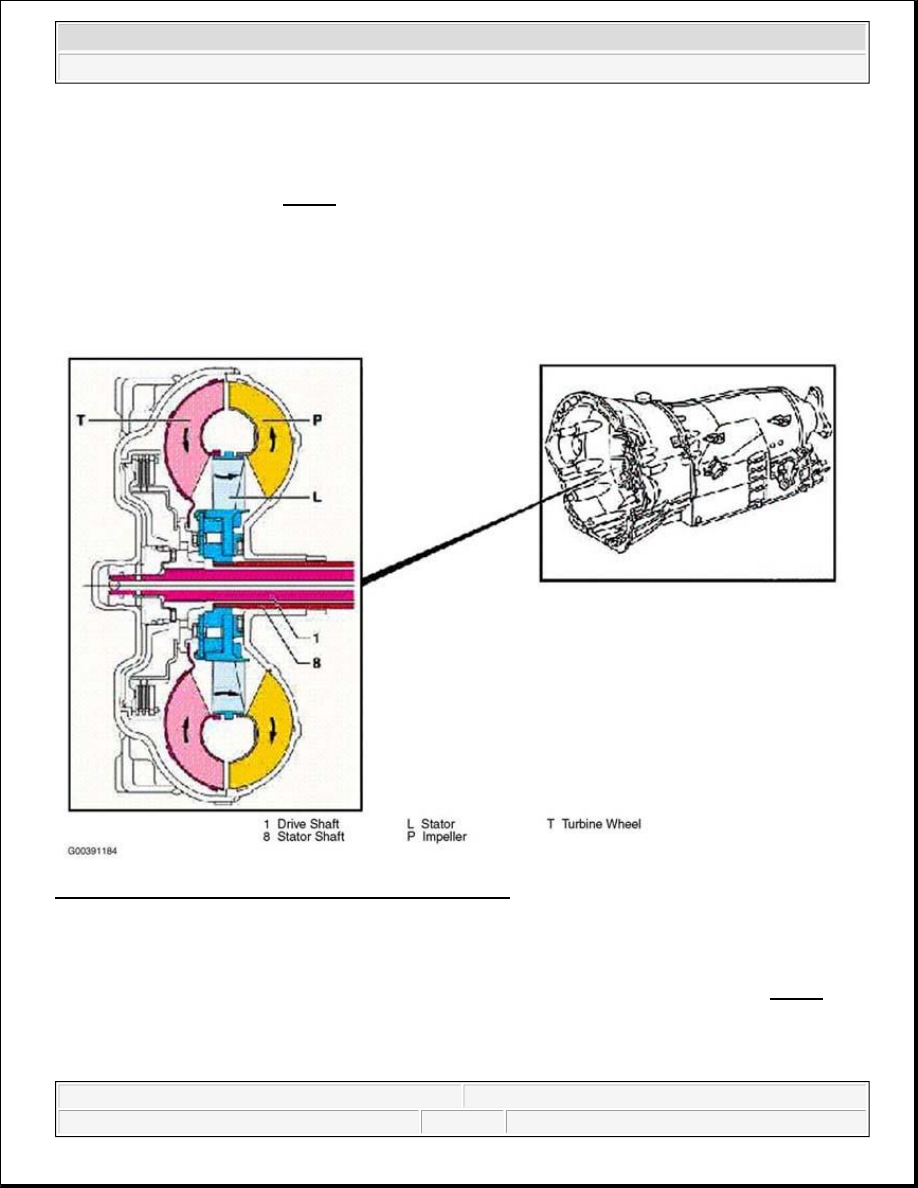
Torque Converter, Location/Task/Design/Function 

Fig. 30: Torque Converter, Location/Task/Design/Function 
Courtesy of MERCEDES-BENZ OF NORTH AMERICA. 

Torque Converter, Location 
 
The torque converter is rigidly bolted to the driver plate in the torque converter housing. See Fig. 30

Torque Converter, Task 
 
Reduces the power flow between the engine and the automatic transmission to a minimum when the 


2001 Mercedes-Benz ML320 

1998-03 AUTOMATIC TRANSMISSIONS Complete Transmissions - ML 320 - 722.662


me 


vehicle is stationary and the engine is idling, boosts the engine torque and provides infinitely variable 
engine speed and torque matching when moving off. 

Torque Converter, Design 
 
The impeller (P) is connected to the engine, the turbine wheel (T) is connected to the transmission input 
shaft. 

The stator (L) is connected to the transmission housing via a freewheel and the stator shaft (8). 

Torque Converter, Function 
 
See TORQUE CONVERTER, FUNCTION.  

Torque Converter, Function 

Due to the effect of centrifugal force, the blades of the impeller (P) pump the oil outwards to the turbine wheel 
(T), causing it to rotate. See Fig. 31. The turbine wheel blades direct the oil onto the blades of the stator, which 
in turn push the oil back to the impeller (P) (arrow). This diversion at the stator (L), which is supported against 
the transmission housing via the freewheel, produces and increase in torque. At the maximum speed difference 
between the impeller and the turbine wheel (T), the torque conversion achieves its maximum value at a factor of 
1.8 to 2.0, dropping to a torque ratio of 1:1 as the speeds converge. From this operating state onwards, also 
referred to as the coupling point, the stator (l) rotates with the impeller (P) and the turbine wheel (T). 
Efficiencies of up to approximately 98% are achieved in the coupling range. 

The oil in the torque converter is constantly being replaced so that the heat produced in the operating phase can 
be dissipated via the transmission oil cooler.


2001 Mercedes-Benz ML320 

1998-03 AUTOMATIC TRANSMISSIONS Complete Transmissions - ML 320 - 722.662


me 


2001 Mercedes-Benz ML320 

1998-03 AUTOMATIC TRANSMISSIONS Complete Transmissions - ML 320 - 722.662


me 


Fig. 31: Torque Converter, Function 
Courtesy of MERCEDES-BENZ OF NORTH AMERICA. 

Wheel Speed Sensor, Location/Task/Function 


2001 Mercedes-Benz ML320 

1998-03 AUTOMATIC TRANSMISSIONS Complete Transmissions - ML 320 - 722.662


me 


Content   ..  148  149  150  151   ..