Mercedes-Benz ML320. Service manual - part 59
 

  Index      Mercedes     Mercedes-Benz ML320 - service and repair manual 1997-2005 year


Search            copyright infringement  


Content   ..  57  58  59  60   ..


Mercedes-Benz ML320. Service manual - part 59


63

Safety and Security

Occupant safety

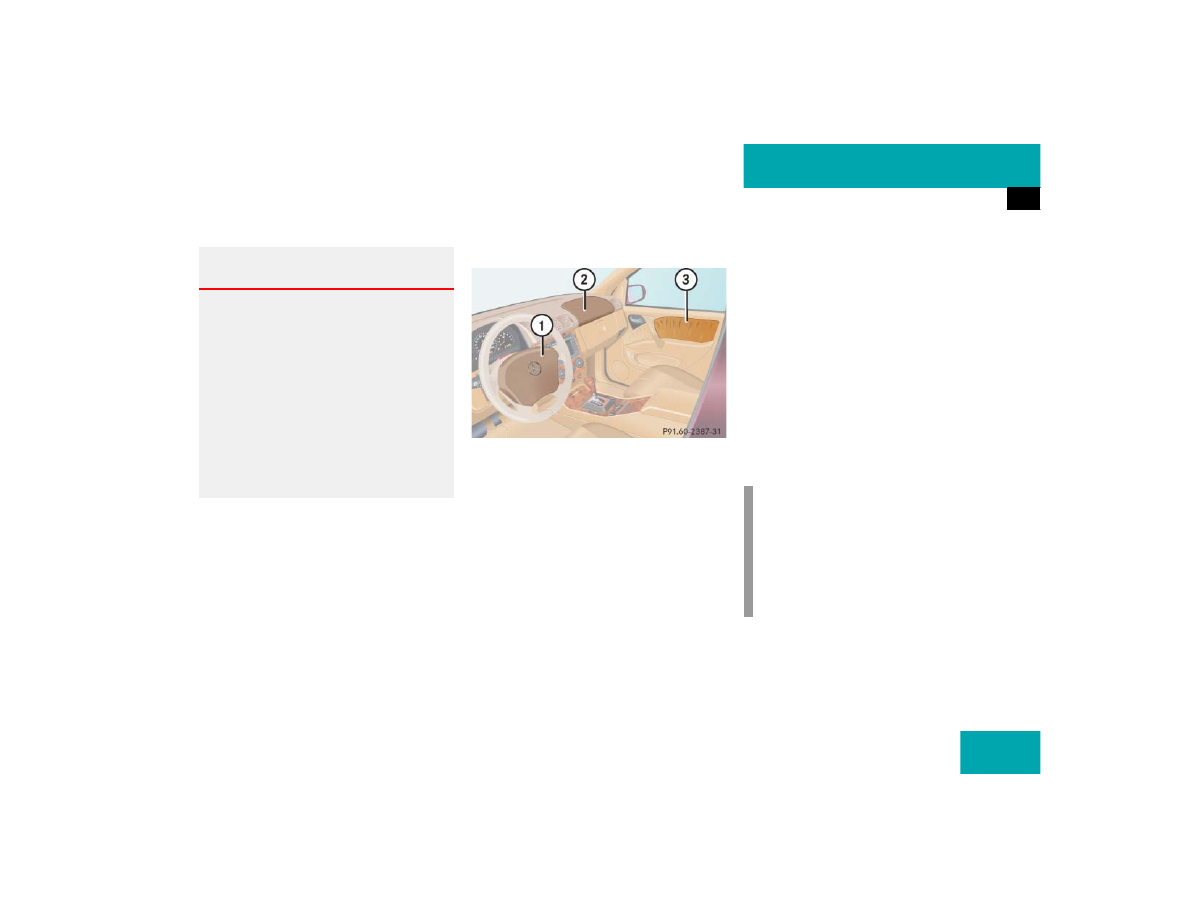
Front airbags

1 Driver airbag
2 Passenger front airbag
3 Side impact airbag

Driver and passenger front airbags are 
deployed:

in the event of a frontal impact

if impact exceeds a preset deployment 
threshold

independently of the side impact air-
bags

The airbags will not deploy in impacts 
which do not exceed the system’s deploy-
ment thresholds. You will then be protec-
ted by the fastened seat belts.

The passenger front airbag will only be 
deployed if:

the passenger seat is occupied

the 

7 indicator lamp in the instru-

ment cluster is not lit (

page 26)

the impact exceeds a preset deploy-
ment threshold

Warning!

G

In the event that the 

1 malfunction indi-

cator lamp comes on while driving, the SRS 
may not be operational. For your safety, we 
strongly recommend that you visit an autho-
rized Mercedes-Benz Light Truck Center im-
mediately to have the system checked; 
otherwise the SRS may not be activated 
when needed in an accident, which could re-
sult in serious or fatal injury, or it might de-
ploy unexpectedly and unnecessarily which 
could also result in injury.

!

Do not place objects heavier than 
20 lbs (9 kg) on the front passenger 
seat. This could cause the front or side 
impact airbag on the front passenger 
side to deploy in a crash which exceeds 
the system's deployment threshold.

64

Safety and Security

Occupant safety

Side impact airbags, window curtain 
airbags

1 Window curtain airbags
2 Side impact airbag, rear
3 Side impact airbag, front

The side impact airbags and window 
curtain airbags are deployed:

on the impacted side of the vehicle

in impacts exceeding a preset deploy-
ment threshold

independently of the front airbags

The front passenger side impact airbag will 
only deploy if the system senses that the 
front passenger seat is occupied.

The side impact airbags and window 
curtain airbags are not deployed in im-
pacts which do not exceed the system’s 
deployment threshold.

Seat belts

When the engine is started, the seat belt 
non-usage warning lamp

< illuminates 

to remind you and your passengers to 
fasten your seat belts. If the driver’s seat 
belt is not fastened before the engine is 
started, the seat belt non-usage warning 
lamp

< illuminates and a warning 

chime sounds for approximately 
six seconds when the engine is started.

The use of seat belts and infant and child 
restraint systems is required by law in all 
50 states and all Canadian provinces. Even 
where this is not the case, all vehicle occu-
pants should have their seat belts fastened 
whenever the vehicle is in motion.

Information on fastening seat belts is 
found in the “Getting started” section 
(

page 42).

i

For information on infants and children 
traveling with you in the vehicle and re-
straint systems for infants and chil-
dren, see “Children in the vehicle” 
(

page 67).

65

Safety and Security

Occupant safety

Warning!

G

Always fasten your seat belt before driving 
off. Always make sure your passengers are 
properly restrained, even those sitting in the 
rear and pregnant women.

Failure to wear and properly fasten and po-
sition your seat belt greatly increases your 
risk of injuries and their likely severity in an 
accident. You and your passengers should 
always wear seat belts.

If you are ever in an accident, your injuries 
can be considerably more severe without 
your seat belt properly buckled. Without 
your seat belt buckled, you are much more 
likely to hit the interior of the vehicle or be 
ejected from it. You can be seriously injured 
or killed.

In the same crash, the possibility of injury or 
death is lessened if you are properly wearing 
your seat belt. Airbags can only protect as 
they are designed if the occupants are prop-
erly wearing their seat belts.

Warning!

G

Never ride in a moving vehicle with the back-
rest reclined. Sitting in an excessively re-
clined position can be dangerous. You could 
slide under the seat belt in a collision. If you 
slide under it, the belt would apply force at 
the abdomen or neck. That could cause se-
rious or even fatal injuries. The backrest and 
seat belt provide the best restraint when the 
wearer is in an upright position and the belt 
is properly positioned on the body.

Warning!

G

Never let more people ride in the vehicle 
than there are seat belts available. Be sure 
everyone riding in the vehicle is correctly re-
strained with a separate seat belt.

Warning!

G

Damaged seat belts or belts that were highly 
stressed in an accident must be replaced 
and their anchoring points must also be 
checked.

Only use seat belts which have been ap-
proved by Mercedes-Benz.

Do not make any modifications to the seat 
belts. This can lead to unintended activation 
or to failure.

Have all work carried out only by qualified 
technicians. Contact an authorized 
Mercedes-Benz Light Truck Center.

66

Safety and Security

Occupant safety

Warning!

G

USE SEAT BELTS PROPERLY

Seat belts can only work when used 
properly. Never wear seat belts in any 
other way than as described in this sec-
tion, as that could result in serious inju-
ries in case of an accident.

Each occupant should wear their seat 
belt at all times, because seat belts help 
reduce the likelihood of and potential 
severity of injuries in accidents, includ-
ing rollovers. The integrated restraint 
system includes SRS (driver airbag, 
front passenger airbag, front and rear 
door mounted side impact airbags and 
window curtain airbags), ETD (seat belt 
emergency tensioning device for the 
outboard passenger seats [except in the 
optional third row seats]), and front seat 
knee bolsters.

 The system is designed to enhance the pro-
tection offered to properly belted occupants 
in certain frontal (front airbags) and side 
(side impact airbags and window curtain air-
bags) impacts which exceed preset deploy-
ment thresholds.

Never wear the shoulder belt under your 
arm, against your neck or off your shoul-
der. In a crash, your body would move 
too far forward. That would increase the 
chance of head and neck injuries. The 
belt would also apply too much force to 
the ribs or abdomen, which could se-
verely injure internal organs such as 
your liver or spleen.

Never wear belts over rigid or breakable 
objects in or on your clothing, such as 
eyeglasses, pens, keys, etc., as these 
might cause injuries.

Position the lap belt as low as possible 
on your hips and not across the abdo-
men. If the belt is positioned across your 
abdomen, it could cause serious injuries 
in a crash.

Never use a seat belt for more than one 
person at time. Do not fasten a seat belt 
around a person and another person or 
other objects.

Belts should not be worn twisted. In a 
crash, you wouldn’t have the full width 
of the belt to manage impact forces. The 
twisted belt against your body could 
cause injuries.

Pregnant women should also use a 
lap-shoulder belt. The lap belt portion 
should be positioned as low as possible 
on the hips to avoid any possible pres-
sure on the abdomen.

Never place your feet on the instrument 
panel or on the seat. Always keep both 
feet on the floor in front of the seat.


Content   ..  57  58  59  60   ..